“You ever seen how Marine guys hold big weapons, shooting from left to right? That’s how he was shooting at people.”—Jon Alamo, who said he witnessed gunman Omar Mateen spray the Orlando nightspot Pulse with automatic gunfire, killing 50 club-goers and critically wounding dozens more in the deadliest mass shooting in modern US history. AP
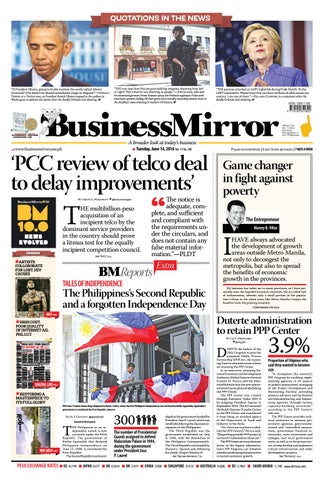
“Is President Obama, going to finally mention the words radical Islamic terrorism? If he doesn’t he should immediately resign in disgrace!”—Donald Trump, in a Twitter post, as President Barack Obama stepped to the podium in Washington to address the nation after the deadly Orlando club shooting. AP
media partner of the year
BusinessMirror
United nations
2015 environmental Media Award leadership award 2008
A broader look at today’s business
www.businessmirror.com.ph
n
Tuesday, June 14, 2016 Vol. 11 No. 248
‘PCC review of telco deal to delay improvements’ By Lorenz S. Marasigan
T
@lorenzmarasigan
he multibillion-peso acquisition of an incipient telco by the dominant service providers in the country should prove a litmus test for the equally incipient competition council.
INSIDE
See “PCC,” A12
Artists cOLLOBORATE FOR LGBT, HIV CAUSES
The notice is adequate, complete, and sufficient and compliant with the requirements under the circulars, and does not contain any false material information.”—PLDT
BMReports
Tales of Independence
ART
D4
The Philippines’s Second Republic and a forgotten Independence Day
High cost, poor quality of internet ail phl i.c.t. E2
Conversable saas platform to dIsrupt Call-Center seCtor
CONVERSABLE Inc. launched on June 7 a Software-as-a-Service (SaaS) platform that the Dallas, Texas-based firm said will do away with call centers for the service industry. Rather than search and download apps and go to a company’s web site, the platform allows users to send a message directly to a company and get their request met with no wait times and without ringing a call center, Conversable explained. “Conversable goes way beyond basic bots,” Conversable CEO and cofounder Ben Lamm was quoted in a statement as saying. Rizal Raoul Reyes
amdoCs launChes Core network-testIng servICe
AMDOCS Ltd. announced on June 6 it has launched its core network-testing service targeting service providers. Amdocs said the service will eliminate multiple vendortesting cycles that increase operational costs and delay service introductions. Citing a research by Coleman Parkes for Amdocs, Amdocs said service providers are currently using more than four different vendors on average to conduct network testing to support service introductions. Oliver Samson
dell launChes fIrst 17-InCh 2-In-1 pC
DELL Inc. launched a new line of Inspiron 2-in-1 personal computers (PC) the company is positioning at the education sector and for entrepreneurs. The laptops come with a sixth-generation Intel CoreTM processor. Each has a 360-degree hinge to enable three modes: laptop, stand and tablet. The 7000 series includes wide-viewing angle screen with FHD resolution, backlit keyboard for typing in dim environments and infrared camera. Rizal Raoul Reyes
d-lInk rolls out solutIons
TAIWANESE multinational networking equipment company D-Link Corp. announced on June 10 the rollout of several products targeting the education sector. In a statement, the company said its wirelessfidelity (Wi-Fi) routers have dual-core processor that improves Internet speeds for all applications. One router it cited gives connection speeds of up to 3.2 gigabytes per second, making transferring and downloading of large files, streaming of HD videos and playing online games faster and lag-free. Another Wi-Fi router can also accommodate multiple users simultaneously connecting to the Internet. Rizal Raoul Reyes
f5 networks expands app seCurIty portfolIo
F5 Networks Inc. announced on June 1 it has expanded its security portfolio to secure financial and e-commerce apps and mobile apps against sophisticated fraudulent threats. “The presence of more avenues for attack means that cybercriminals have more options when it comes to stealing credentials and data,” the company said in a statement. F5 said network or security specialists can tune one of its solution within hours, instead of days, and carry out installation updates within minutes, instead of hours, with zero downtime. Oliver Samson
dIsCovery Channel operator partners wIth sIngaporeans
DISCOVERY Networks Asia-Pacific Networks (Malaysia) Sdn Bhd announced on June 1 a content partnership with Singapore-based online video service Viddsee Pte. Ltd. In a statement, the Discovery Communications Inc. subsidary said it will make its content available online for the first time in the region, starting with full-length documentary films from the channel’s first time filmmakers initiative. “Distributing our content on digital platforms is only going to deepen and grow our audience engagement,” executive Charmaine Kwan was quoted in a statement as saying. Rizal Raoul Reyes
nImble software raIses $4m fund
SEEK Ltd. was able to raise $4 million in Series A funding to Nimble Software Systems Inc. (NSSI), the latter said. According to NSSI, the money raised by Seek, which funds entities in the Philippines among others, “will support ongoing technology development and marketing to improve the company’s customer experience and accelerate global expansion.” The funding round closed on April 16. Rizal Raoul Reyes
HigH cost, poor quality of internet ail pHl i.c.t.
I
NFORMATION and communications technology (ICT) services in the country remain one of the most expensive in the Asia-Pacific region. Worse, Internet speed is not proportional to the costs. A recent study by the Philippine Institute for Development Studies (PIDS) concluded that this problem is primarily caused by the lack of comprehensive policies on ICT development, which, in turn, results in unequal distribution of digital dividends or the development effects of ICT. The study, authored by PIDS senior fellows Jose Ramon Albert and Ramonette Serafica, and former PIDS research analyst Beverly T. Lumbera, asserts there is a direct relationship between increased ICT access and economic growth. A World Bank study, likewise, concluded that for every 10-percent increase in high-speed Internet connection, economic growth increases by 1.3 percent.
“ICT, especially the Internet, promotes inclusion. Micro and small firms can connect with potential buyers in another country through Internet and social media. They can also gain knowledge and skills to trust a new business partner based on information gained from the Internet,” the PIDS paper stated. Thus, the authors argue that for the Philippines to sustain its good economic performance and boost its growth, the government must invest in building a reliable, accessible and affordable ICT infrastructure. Ma ximizing the benefits from ICT, according to them, requires formulating and implementing policies that would boost ICT development, promote
competition and further interconnectedness. According to the International Telecommunication Union’s ICT development index, the Philippines placed fifth among countries across Southeast Asia in terms of the number of people who have access to the Internet. Internet access or Internet penetration has grown the most in the last six years, from 9 percent in 2009 to 25 percent in 2010. By 2014, the Philippines is expected to have 40-percent Internet penetration. The Philippines improved its performance ranking in the global ICT ranking from 105th in 2014 to 98th in 2015. This can be attributed to the increase in access to mobile phones and broadband subscription services. However, policy-makers should look beyond widening access, the authors said. The Philippines’s connection speed, according to the Akamais State of the Internet Report on Asia Pacific, is at 2.8 megabits per second (Mbps), the second-lowest in terms of average connection speed. The global average is 5.2 Mbps. To maximize digital dividends,
suCCess In semICon seCtor a CombInatIon of faCtors By Rizal Raoul Reyes
F
OR Luis Martin Harder, it’s easier to succeed as an entrepreneur in the semiconductor industry if one combines several factors. For Harder, Wings Technology Enterprise Inc. president, these factors include the readiness of the market to accept the products and services. Combine this with the application of skills he learned while working as a technical salesperson and the stark reality that a monthly income was insufficient to bring enough food on the table for his growing family. “These factors led me to become an entrepreneur regardless of the challenges I encountered in my journey to this path,” the Santa Ana, Manila, native told the BusinessMirror. “Equally important is that I was also facing my own financial crisis at that time.” Before becoming an entrepreneur, the Jose Rizal University economics graduate took several jobs that he says gave him the knowledge, skills and experience to prepare him to the road to entrepreneurship. His work with Intel Philippines as a foot buyer required him to find suppliers for certain electronic components. He also
Harder
credits Robert Hornbossel, owner of the former Republic Crystal Labs (RCL), for giving him the opportunities to learn the important points of the electronics business. “My working stint at [RCL] allowed me to learn the ropes of the business.” In 1990 Harder opened WTEI with only three employees. Just like any fledgling enterprise, Harder reveals there were also various chal-
lenges confronting them. “The financial aspect is one of our major challenges,” Harder said. “Even though we had a dearth of financial resources, we have to give an open credit line to our suppliers. We also have to secure additional funds from other sources to keep us going.” Harder said he tapped the Small Business Corp. for loans. “As long as I had the contract and the purchase order, I was able to avail of their assistance.” In a globalized economy, Harder and fellow local suppliers faced challenges from foreign companies. “The Internet made it easier for them to enter the [Philippine] market.” The setup allows foreign companies to be nimbler because they just need a single agent to talk directly with companies and other clients. The agent goes to the companies and talks directly with their clients. It is doubly cheaper for companies because they are operating in the Philippine Economic Zone Authority zones, according to Harder. “Unlike the foreign companies, local suppliers have to pay taxes to the government,” he said. “We are also forced to level up. But I believe we can compete given the necessary support.”
globe taps fortumo for direct-carrier billing
G
LOBE Telecom Inc. and Fortumo Ltd. have sealed a partnership to launch enhanced direct-carrier billing in the Philippines, the Singaporean mobile payments company said on June 7. “With this collaboration, over 52 million Globe customers will be able to use their mobile phones to make payments in various application stores, as well as for digital services and games,” it added. Direct-carrier billing significantly increases the amount of users who are able to make online payments, Fortumo explained. In the Philippines only 3 percent of Filipinos have access to a credit card, while smartphone penetration has reached 40 percent and is forecasted to grow to 70 percent during the next two years.
“The continuous rise in smartphone penetration alongside the drastic adoption of the digital lifestyle has made more and more Filipinos dependent on their mobile devices,” Dan Horan, Globe senior advisor for consumer business, was quoted in a statement as saying. “Customers continue to be on the lookout for a better mobile experience, including conveniences, such as making payments.” Besides app stores, Fortumo’s directcarrier billing platform is used by Asia’s leading streaming providers, as well as game developers and device manufacturers, Fortumo said. In addition to digital content, Fortumo’s direct-carrier billing platform also supports payment processing for financial services, such as topping up virtual credit cards or wallets.
the authors urge policy-makers to target ICT development, widen access, and promote competition and further interconnectedness. “Pa r t of IC T development should improve regulations regarding Internet exchanges. Telecommunication companies exact fees to let other companies pass through their physical networks; in turn, this racks up the costs of providing connection,” they explained. The authors lamented the fact that despite the high cost paid by consumers for poor quality connection, there is little action from the government. Effective implementation of rules and regulations is also lacking; thus, telecommunication companies have gotten away with providing a lot less speed than advertised. With the passage of the Philippine Competition Act, the authors are hoping that these would give regulators more legal ammunition to address anticompetitive practices and bad performance, and hold telecommunication companies accountable. “The responsibilities lie with the National Telecommunications
The Entrepreneur
applications track e-mails, receipts to spot potential price-match refunds By Lauren Zumbach Chicago Tribune/TNS
C
HICAGO—Nothing takes a big-ticket buy, from exciting to maddening, faster than finding out the item went on sale shortly after a purchase. A handful of apps have popped up recently promising to track shoppers’ purchases and score refunds from retailers who offer to match postpurchase price changes. But at least one retail analyst isn’t sold on the idea, and there are privacy concerns associated with the apps that consumers should be aware of. Price guarantees make even less sense when customers can outsource the work of finding the deal, said David Marcotte, senior vice president at Kantar Retail. “From the retailer perspective, this gets stupid on so many levels it’s embarrassing,” Marcotte said. According to the CEOs of two of the refund-hunting apps, Amazon appears to have made it harder for customers to get cash back when the e-commerce giant lowers prices soon after customers’ purchases. In an interview with the Chicago Tribune, Earny CEO Oded Vakrat said Amazon used to grant refunds if a customer noticed the retailer reduced a product’s price within a week of their purchase, but now only offers them on TVs and preordered items. Eric Glyman, CEO and cofounder of a similar app called Paribus, said the service had helped customers get cash back from Amazon on a wider range of products in the past.
paribus is one of a crop of apps that help consumers know if they can get a better price for an item they recently purchased. PARIBuS/HANDOuT
enough that a price-matching policy isn’t necessary. Although handy for consumers, retailers likely didn’t envision the apps when they created the price guarantees, retail analysts said, and users need to give up some personal info to get the deals. Paribus and Earny connect to a user’s e-mail account, scan messages for e-receipts, compile a list of items purchased, automatically monitor prices on those items at retailers that meet the store’s price-match policy, and file refund claims on the user’s behalf. They also ask for the e-mail and password to access users’ Amazon accounts since Amazon e-mail receipts don’t provide all the information needed to request refunds. In its statement, Amazon also said it takes customer security seriously and asked customers not to share account information. Both services take a 25-percent cut of any refunds they find.
Digital life
This is achieved through token-based, twostep charging. “We are seeing a growing interest from financial service providers in leveraging carrier billing in Asia for use in their payment products,” Fortumo Chief Business Officer Gerri Kodres was quoted in a statement as saying. We expect the first initiatives in this segment to take off during 2016, he added. Previously, Fortumo has launched direct-carrier billing with the other mobile operators in the Philippines. The newly formed partnership with Globe means Fortumo now covers 100 percent of the mobile subscriber base in the country. In the Asia-Pacific region, Fortumo’s direct-carrier billing platform is available in 17 countries to more than 1.6 billion mobile users. Dennis D. Estopace
Isn’t necessary
TECHCRUNCH posted an image of an e-mail in which Amazon customer service referred to a “seven days price match from the time of delivery.” Users of social-networking web site Reddit also said they’d received refunds on items sold and shipped by Amazon when Amazon’s price dropped within a week a delivery. In a statement, Amazon denied ever offering postpurchase price adjustments on other products, saying the company works to keep prices low
Credentials request
PARIBUS has been out for a little more than a year, and the average user saves $60 to $100 per year, Glyman said. Earny launched publicly in May and said it had raised $1.2 million from investors, including Sweet Capital and Science. Shopping app Slice also pulls its purchase data from receipts in users’ e-mail inboxes and requests Amazon credentials. The app has been around since 2010 and also can track packages, provide product recall notifications and analyze users’ spending.
E2
This June 12 photo shows flags displayed in Kawit, Cavite, where the first Philippine Independence was declared by Emilio Aguinaldo. Aguinaldo’s government is considered the First Republic. NONIE REYES
t’s been a year since we first visited with Luisita Golf and Country Club after its purchase by Martin Lorenzo and company, and in that short span of time so much has changed and for the better. » F2
Luisita Revisited
I
By Mike Besa
bm golf
Manny B. B.Villar Manny Villar
I
have always advocated the development of growth areas outside Metro Manila, not only to decongest the metropolis, but also to spread the benefits of economic growth in the provinces.
My business has taken me to many provinces, so I have personally seen the lopsided economic situation, the so-called lack of inclusiveness, wherein only a small portion of the population—those in the urban areas like Metro Manila—enjoys the benefits from the growing economy. Continued on A10
Duterte administration to retain PPP Center
D
Commission and the Department of Trade and Industry,” the paper suggested. “They need to reform some regulations and rectify penalties that are no longer effective to prompt better competitive practices.” Other policies being monitored include the Data Privacy Act of 2012, which covers the protection of personal privacy and data, cyber security and digital literacy. The paper noted that access is a good priority, but making sure access remains open and safe is equally critical. The authors noted that the quality of the national Internet backbone is so bad that 70 percent of domestic Internet traffic runs through Hong Kong. The lack of a national broadband policy makes Internet services expensive, yet slow. Meanwhile, the foreign-equity restriction of 40 percent dissuades capital and expertise from coming into the country to help improve the ICT sector. In conclusion, the authors emphasized that the government and the private sector have to work together to address the bottlenecks that impede ICT development.
RestoRing a masteRpiece to its full gloRy
F1
| Tuesday, June 14, 2016 sports@businessmirror.com.ph Editor: Mike G. Besa | www.pinoygolfer.com
Game changer in fight against poverty
By Cai U. Ordinario
restoring a masterpiece to its full glory
The feared 17th is a watery graveyard of golf balls
P25.00 nationwide | 6 sections 36 pages | 7 days a week
BusinessMirror
Tuesday, June 14, 2016
briefs
“The gunman attacked an LGBT nightclub during Pride Month. To the LGBT community: Please know that you have millions of allies across our country. I am one of them.”—Hillary Clinton, in a statement after the deadly Orlando club shooting. AP
By Fil V. Elefante
T F1
@elefantefil
Second of three parts
HE Philippines as an independent nation is now currently under the Fifth Republic. T he government of Emilio Aguinaldo that declared Ph i l ippi ne i nde pendence on June 12, 1898, is considered the First Republic. The Second Republic is acknowl-
PESO exchange rates n US 46.1190
300
The number of Presidential Guards assigned to defend Malacañan Palace in 1944, during the government under President Jose P. Laurel
edged as the government headed by President Jose P. Laurel, which was established during the Japanese occupation of the Philippines. The Third Republic was the government established on July 4, 1946, with the dissolution of the Philippine Commonwealth. The Third Republic was headed by Manuel L. Quezon and, following his death, Sergio Osmeña Sr. See “Second Republic,” A2
@cuo_bm
espite the failure of the 16th Congress to pass the proposed Public Private Partnership (PPP) Act, the incoming Duterte administration is keen on retaining the PPP Center. In an interview, incoming National Economic and Development Authority (Neda) Director General Ernesto M. Pernia told the BusinessMirror that the new administration has no plans of abolishing the PPP Center. The PPP Center was created through Executive Order (EO) 8 by outgoing President Aquino in September 2010. The EO renamed the Build-Operate-Transfer Center as the PPP Center and transferred it from being an attached agency of the Department of Trade and Industry to the Neda. “No, there are no plans to abolish [the PPP Center],” Pernia said. “[Regarding possible PPP projects] we haven’t talked about those yet.” The PPP Center serves as the main driver of the Aquino administration’s PPP Program—an initiative aimed at accelerating infrastructure to sustain economic growth.
3.9% Proportion of Filipinos who said they wanted to become rich
“It champions the country’s PPP Program by enabling implementing agencies in all aspects of project preparation; managing of the Project Development and Monitoring Facility; providing projects advisory and facilitation services;monitoring and empowering agencies through various capac it y-bu i ld ing act iv it ies,” according to the PPP Center’s web site. The PPP Center provides technical assistance to national government agencies, governmentowned and -controlled corporations, government financial institutions, state universities and colleges, and local government units, as well as to the private sector, to help develop and implement critical infrastructure and other development projects. See “Duterte,” A12
n japan 0.4317 n UK 65.8164 n HK 5.9419 n CHINA 7.0300 n singapore 33.9235 n australia 34.0082 n EU 51.9069 n SAUDI arabia 12.2981
Source: BSP (13 June 2016 )
A2 Tuesday, June 14, 2016
Second Republic. . .
The Third Republic lasted until 1972, when President Ferdinand E. Marcos declared martial law in September of that year. His rule is now classified as the Fourth Republic, which ended with his overthrow in 1986. The Fifth Republic came into existence when the 1987 Constitution was ratified, with Mrs. Aquino as president. Since then, all the succeeding administrations after 1987 are classified as being under the Fifth Republic.
The Philippine Executive Commission ACCORDING to John Ray Ramos, a heritage conservation advocate, “the Second Republic had its roots during the tumultuous days of WWII [World War II] when Commonwealth President Quezon and selected members of administration was brought to the US fortress island of Corregidor.” “As Quezon fled, Manila was declared an ‘Open City’ to protect it from destruction,” added Ramos, who is also a history instructor from the Diliman campus of Far Eastern University. Even as Quezon left Manila for the temporary refuge of Corregidor, he issued instructions to officials of the Commonwealth government that were left behind. According to Ramos, Quezon told these officials to “enter into agreements and compromises” with the Imperial Japanese government and its conquering army in order to “mitigate the sufferings of the people.” Japanese officials proceeded to establish a Philippine Executive Commission (PEC) on January 23, 1942. The PEC was headed by Jorge Vargas as chairman and had the following members: Benigno Aquino Sr. (head of the interior), Antonio de las Alas (head of finance), Jose P. Laurel (justice secretary), Claro M. Recto (head for the departments of education, health and public welfare), Quintin Paredes (head of public works and communication) and Jose Yulo (Chief Justice of the Supreme Court). Also established at around this time was the only political organization allowed in the Philippines: the Kapisanan ng Paglilingkod sa Bagong Pilipinas or Kalibapi.
BMReports BusinessMirror
Continued from A1
Abad Santos’s death EVEN as the PEC came into being and the Kalibapi asserted civil control, the Commonwealth government under Quezon was being turned into a government-in-exile. In March 1942 Quezon designated Chief Justice Jose Abad Santos as the caretaker President of the remnants of the Commonwealth government. After Japanese forces captured Santos in Cebu, he was offered a role in the new civil administration. Santos refused and he was executed on May 2, 1942. The killing of Santos was a bitter reminder for the remaining Commonwealth officials of what awaited them if they dared go against the wishes of Imperial Japan.
A new Constitution SEVERAL weeks after Santos was executed, Japanese Prime Minister Hideki Tojo promised on June 16, 1943, to grant independence to the Philippines. After Tojo made the offer, the Kalibapi organized the Preparatory Committee on Philippine Independence (PCPI), which was tasked to draft a new Constitution for the Philippines. It was a simple job for the members of the PCPI. All they did was adopt the 12 of the Articles of the 1935 Commonwealth Constitution. However, the Constitution they drafted was notable for not having a Bill of Rights. The Kalibapi ratified this Constitution on September 7, 1943, and a new National Assembly was formed. On September 20, 1943, the Kalibapi held a party convention to elect 54 members of the National Assembly, which was supposed to have 108 members. The remaining 54 slots in the National Assembly were reserved for city mayors and governors who were elected under the Commonwealth government and had survived the onset of hostilities.
Forgotten Independence Day THE Kalibapi proceeded to elect part of the new National Assembly, which also included appointed members. The National Assembly elected Jose P. Laurel as President.
On October 14, 1943, Laurel’s government was formally inaugurated in front of the Legislative Building, which now serves as the National Museum. “This was the moment of birth of the Second Republic,” Ramos said. “And October 14, 1943 could be considered another date for Philippine independence.”
Laurel’s presidency THOUGH Laurel did assume the presidency even if the Philippines was under Japanese occupation, his official actions and decisions could be seen as fulfilling Quezon’s orders. One controversial act credited to Laurel was on September 23, 1943, when he proclaimed that the Philippines was in a “state of war” with the US and its allies. However, under the Constitution, a declaration of war must be approved by the National Assembly for it to be official. Such subterfuge Laurel effectively prevented the Japanese government from conscripting Filipinos to fight against the US and its allies. Because of this, Japanese occupation officials and forces no longer relied on the Kalibapi’s cooperation. “This is an important point to consider,” Ramos explained. “Because of Laurel’s actions and the Kalibapi’s reluctance to support Japanese initiatives, the Japanese occupation officials formed a new organization known as the Makapili [Makabayang Katipunan ng mga Pilipino].” The Makapili was formed after Laurel refused to allow Japanese officials to conscript Filipinos into the Japanese military. “Unlike the Kalibapi, the [Makapili] was formed as a grassroots organization,” Ramos explained. “The group was composed of Filipinos who fully supported the Japanese. The lasting image in the Filipino psyche of the Makapili is the masked informer who pointed out for the Japanese those who were actively guerrilla supporters or actual members.” When Laurel refused to allow Japan to conscript Filipinos as soldiers of Imperial Japan, he took a very grave risk, according to Ramos. Fortunately, there were still Japanese officials who still clung to the idea of the Greater East Asia Co-Prosperity Sphere. Doing anything untoward
to Laurel could jeopardize their propaganda of a benevolent Japan in Asia.
Historian on Laurel RAMOS said Laurel’s legacy as President of the Second Republic was best explained by his professor, noted historian Ricardo Jose. “The Japanese approved of Laurel, because they felt he—having served as lawyer for some Japanese before the war and having had a son study in the Japanese Military Academy, in addition to his own honorary doctorate from the University of Tokyo—would be pro-Japanese,” Jose wrote in an essay, titled “Dr. Jose P. Laurel as President of the Second Philippine Republic.” “In this, they were wrong.” “To view Laurel’s administration in proper perspective, the conditions of the Philippines in late 1943 have to be examined,” Jose wrote. “First of all, [WWII] was brewing in Europe and Asia. The Japanese military presence dominated the Japaneseoccupied Philippines and, even though independence had been declared, the Laurel government had to sign a pact of alliance with Japan.” According to Jose, a part of the pact “stated in no uncertain terms that ‘the Philippines will afford all kinds of facilities for military actions to be undertaken by Japan.”’ Likewise, the pact stated the Philippines and Japan “will closely cooperate with each other to safeguard the territorial integrity and independence of the Philippines.” Jose wrote that Japanese garrisons and outposts ringed Malacañan Palace, the seat of government. “In September 1944, some 10,000 Japanese servicemen surrounded the palace and some 100,000 armed Japanese occupied the whole of Greater Manila,” Jose wrote. “In mid-1944, no less than the Commanding General of Japan’s Southern Army—which covered not just the Philippines but the whole of Southeast Asia and New Guinea— made Manila his headquarters.” According to Jose, Laurel had only 300 Presidential Guards to defend the palace.
Damocles sword JOSE described this situation as a “Sword of Damocles” hanging over Laurel’s head. And despite the formal Philippine “independence” declared on October 14, 1943, Laurel presided over a
www.businessmirror.com.ph “crippled” government. “The Japanese military presence and the war led to corollary problems, among them a shortage of food, clothing, fuel and other basic commodities,” Jose wrote. “The Japanese Military Administration had taken over most of the pre-war government-owned or -controlled corporations, and had created controlled agencies to supervise the acquisition, transport and distribution of foods, fuel, prime commodities and sugar.” Jose added that with “strategic commodities out of Filipino hands, the republic was crippled economically.” Jose said Laurel “had to give in when it was impossible to push hard, to gain more advantageous position in other areas and to forward the interests of the Philippines and the Filipinos.” “The Japanese had hoped Mr. Laurel would follow their prodding and hints and act as a puppet president, but they were disappointed,”Jose added. Eventually, as US forces supported by Filipino guerrilla units defeated the remnants of the Imperial Japanese forces in the Philippines, the Japanese brought Laurel and his family to Tokyo. It was the intention of the Japanese for Laurel to form a government-in-exile.
Bombing the Japanese SUBSEQUENT events did not conform to Imperial Japan’s wishes. After the US dropped atomic bombs on and destroyed the Japanese cities of Hiroshima and Nagasaki, the Japanese Emperor Hirohito bypassed military advisers and generals and urged Japan to “accept the unacceptable.” When the Imperial Japanese government surrendered on August 17, 1945, Laurel dissolved the Second Philippine Republic and its so-called independence, according to Jose. “In view of the reoccupation of the Philippines by the United States and the re-establishment therein of the Government of the Commonwealth of the Philippines, the acceptance by Japan of the Potsdam Declaration of July 26, 1945, and the consequent termination of the Greater East Asia War, the Republic of the Philippines had ceased to exist,” Laurel formally declared.
NEXT: The Katagalugan Republic and the Pugad Lawin
BMReports Tuesday, June 14, 2016
news@businessmirror.com.ph
A3
PHL spending more for peace compared to Asian neighbors By Dennis D. Estopace @DennisEstopace
D
ESPITE a higher spending to contain violence, the Philippines lags behind its neighbors in the Asia-Pacific region in achieving the elusive goal of peace, a think tank’s index revealed. COUNTRY
OVERALL RANK OVERALL SCORE
CHANGE IN SCORE REGIONAL RANK
New Zealand
4
1.287
-0.019
1
Japan
9
1.395
0.031
2
Australia
15
1.465
0.025
3
Singapore
20
1.535
-0.007
4
Malaysia
30
1.648
0.025
5
Taiwan
41
1.787
0.020
6
Indonesia
42
1.799
-0.006
7
Mongolia
50
1.838
0.042
8
Laos
52
1.852
0.029
9
South Korea
53
1.858
0.026
10
Timor-Leste
56
1.879
-0.013
11
Vietnam
59
1.906
0.007
12
Papua New Guinea
99
2.143
0.031
13
Cambodia
104
2.161
-0.005
14
Myanmar
115
2.256
-0.035
15
China
120
2.288
-0.001
16
Thailand
125
2.312
-0.049
17
Philippines
139
2.511
-0.010
18
North Korea
150
2.944
-0.011
19
Source: 2016 Global Peace Index, Institute for Economics and Peace
The Sydney, Australia-headquartered Institute for Economics and Peace (IEP) ranked the Philippines just above a notch from North Korea in IEP’s Global Peace Index (GPI) at 18 among 19 countries in the region. The Philippines’s overall score in the tenth GPI slid by 0.010 (North Korea to 0.011) in the regional ranking, headed by New Zealand, Japan, Australia, Singapore, Malaysia, Taiwan and Indonesia at the top 6. Globally, the Philippines was ranked 139 in the GPI—North Korea’s at 150. Its neighbors ranked fairly well among the “peaceful” countries with Indonesia at 42, Vietnam at 59 and Thailand at 125. Globally, the Philippines is below Burundi (138). Citing 2014 data, the Philippines spent $60.979 billion to contain violence. The IEP said per-capita violence containment cost of the Philippines based on 2014 PPP was at $615. The country’s total cost of violence containment was pegged by IEP at 8 percent of GDP. In contrast, Thailand, which was rocked by a series of riots and a takeover of a military junta spent only 7 percent of GDP to contain violence. However, the Association of Southeast Asian Nations member-country’s total cost of violence containment based on 2014 PPP was higher by roughly $9 million at $69.940 billion, IEP’s data revealed. Thailand’s per capita violence containment cost at 2014 PPP was also higher than the Philippines’s at $1,033. But IEP noted while the region’s level of peace “has remained largely unchanged” since last year, a number of countries including Indonesia, Timor-Leste, Myanmar and Thailand improved their scores. “Heightened tensions in the South China Sea impacted external relations between the
three main nations concerned: China, Vietnam and the Philippines.” To note, China’s per-capita violence containment cost based on 2014 PPP was at $700.632 billion, which is 4 percent of its GDP. Vietnam’s, on the other hand, was nearly less than half of the Philippines’s at $38.425 billion, or just 7 percent of its GDP. Per capita violence containment costs of China and Vietnam were also lower than the Philippines’s at $514 and $424, respectively. Overall, IEP’s study finds that while 81 countries improved, “the deterioration in another 79 outweighed these gains, meaning that peace declined at a faster rate than in the previous year.” “The world became less peaceful in 2016, reinforcing an underlying decadelong deterioration in world peacefulness driven primarily by increased terrorism and higher levels of political instability,” IEP said in a statement. According to the IEP, the economic impact of violence on the global economy totalled $13.6 trillion, or 13.3 percent, of gross world product, equivalent to 11 times the size of global foreign direct investment. “The economic impact of violence was $137 trillion over the last decade—greater than global GDP in 2015,” it said. Iceland is the world’s most peaceful country, followed by Denmark and Austria. This means the Philippines is hundreds less peaceful compared to these countries. The country, however, is considered more peaceful than Mexico (GPI of 140), India (141) and Egypt (142). Syria (GPI of 163, the bottom rung) is least peaceful, followed by South Sudan (162), Iraq (161), Afghanistan (160) and Somalia (159, or just 20 rungs below the Philippines).
BMReports BusinessMirror
A4 Tuesday, June 14, 2016
www.businessmirror.com.ph
NCC rolls out ‘Project Repeal’ to cut red tape in several govt agencies 1,900 T By Catherine N. Pillas
@c_pillas29
he National Competitiveness Council (NCC) on Monday launched an initiative aimed at eliminating red tape in several government agencies and improving the country’s competitiveness. Dubbed as “Project Repeal,” NCC said it seeks to identify and streamline regulations that hamper doing business in the country. As Monday is considered “Project Repeal Day 1,” the NCC announced the initial repeal or amendment of 3,959 issuances across eight agencies: the Departments of Trade and Industry (DTI), Finance (DOF),
Energy, Budget and Management (DBM), Tourism, and Labor and Employment, Securities and Exchange Commission, and Land Transportation Franchising and Regulatory Board. Of these 3,959, almost half, or 1,900, will be repealed outright, 2,032 will be delisted from government websites and official rosters,
as these have already been repealed in the past, 22 will be consolidated into a single document, while five are for amendment or revision. Among the most notable changes that have been initiated because of Project Repeal, is an amendment of the implementing rules and regulations of the Government Procurement Act, which the DBM implements. “This is a big one for the DBM, for them to simplify procurement, for us in the NCC it’s a step towards simplifying anything that complicates government rules and regulations,” said Guillermo Luz, private sector cochairman of the NCC. However, the 3,959 edicts on the chopping block is only a fraction of the 17, 388 laws and regulations being observed by the eight agencies, which are up for review by the Project Repeal technical working group. The NCC crowd-sources the iden-
The number of regulations that will be repealed outright under “Project Repeal”
tification of “inefficient” regulations from the agencies themselves and various businesses, and coordinates with them to determine whether to repeal, delist, amend or consolidate these rules. NCC said this is only the first step as it intends to tackle redundant or outdated legislation by year-end during “Project Repeal Day 2.” “We look forward to a second Repeal Day toward the end of the year focusing on legislation, maybe in
early December,” Luz said. For Repeal Day 2, the NCC will focus on Republic Acts and possibly some LGU ordinances. The DOF, Department of Public Works and Highways (DPWH), and DTI have been tagged as being the “most active” in terms of cleaning up its numerous department orders, memorandum circulars, and issuances even before the project launch. NCC said it hopes that the Bureau of Internal Revenue, the Bureau of Customs, and the DPWH will join the initiative and submit laws and regulations for streamlining. At the local government level, the NCC said it plans to tackle regulations in the 20 biggest cities first and to secure the assistance of local governments and local business chambers in identifying “redundant” rules. Meanwhile, Sen. Paolo Benigno
Aquino IV said he intends to file a bill calling for the creation of a Philippine Efficiency Office to institutionalize the streamlining of outdated or redundant legislation. Aquino said this measure is crucial to avoiding another “run-in” between industry groups and the government, citing as an example the dilemma that confronted chemicals and semiconductors manufacturers following the Philippine National Police’s release of a ‘problematic’ regulation. “The Philippine Efficiency Office will constantly check if any old laws or new are actually detrimental to efficiency,” Aquino said during the launch of the Project Repeal initiative on Monday. He added that the proposed Philippine Efficiency Office could also help prevent legislators from “over regulating” businesses.
massacre shows cracks Crimes against environment often go Orlando in US efforts to stop terrorism unpunished, Oceana exec laments T By Jonathan L. Mayuga @jonlmayuga
V
iolators of environmental laws almost always get away with their crimes because of the country’s poor law enforcement. Worse, very few cases have actually been filed in court. In an interview with the BusinessMirror, Gloria Estenzo-Ramos, vice president of Oceana Philippines, said most cases that reach the court were initiated by concerned government agencies. Sadly, she said, these very few cases do not reflect the rampant commission of environmental crimes in the country. “In Caloocan City [for instance], no environmental case has ever been filed in court,” said Ramos, adding she was totally surprised to learn that very few environmental cases have actually been filed. “We have hundreds of environmental courts, but many of them have no cases at all. In fisheries, there are really very few…[even] zero in some courts,” she said. Citizens, Ra-
We have hundreds of environmental courts, but many of them have no cases at all. In fisheries, there are really very few…[even] zero in some courts.”—Ramos
mos added, seldom file cases in court.
SLAPP
She mentioned that environmental law enforcers, advocates or even ordinary citizens should not fear the Strategic Lawsuits Against Public Participation (SLAPP) anymore because there is now an anti-SLAPP law, which protects them against legal harassment. SLAPP is a lawsuit intended to censor, intimidate and silence environmental-law enforcers and advocates by burdening them with the cost of a legal defense, forcing them to withdraw the cases against perpetrators of environmental crimes.
There could be a feeling of fear among law enforcers and advocates in filing cases against environmental violators, including local officials and concerned government agencies for not doing their job, Ramos added.
Green courts
Yet, she said, there are 117 green courts all over the country designated by the Supreme Court in 2008 to try environmental cases. And among the laws that are commonly violated are the Republic Act (RA) 9003, or the Ecological Solid Waste Management Act of 2000; RA 8550, or Fisheries Code; RA 7586, or the National Integrated Protected Areas System (NIPAS) Act; RA 9275, or the Clean Water Act; RA 8749, or the Clean Air Act; and RA 9147, or the Wildlife Act. “There is really a need for massive education campaign about our environmental laws. But that will not be enough. We need [a] carrot and stick [approach]. We need discipline,” Ramos said. Having put in place the mechanism to strengthen the prosecution of environmental crimes, Ramos said there is still a need to increase the level of awareness among Filipinos to help go after perpetrators of environmental crimes, citing, for instance, the failure of the local governments to enforce the law on garbage disposal and dumping. “It is good that the Ombudsman is now filing cases against LGUs [local government units]. [Fishing in] municipal waters should be [the responsibility of] LGUs. But they [LGUs] are not doing anything. They are not held accountable. We are the poster country for climate change.. [and] the problem is very urgent,” she said.
Workshop
Oceana, an international oceanconservation advocacy group, recently organized a three-day training for special prosecutors in Cebu City to help strengthen the prosecution of
environmental crimes, including illegal fishing and illegal wildlife trade. The training, held between June 1 and 3 was in partnership with the Department of Justice (DOJ), the Department of Environment and Natural Resources (DENR) Biodiversity Management Bureau (BMB), Tañon Strait Protected Seascape Protected Area Office, Department of Agriculture–Bureau of Fisheries and Aquatic Resources, United States Department of Interior, US Agency for International Development and University of Cebu College of Law. The training was the first for DOJ special prosecutor for protected areas and DENR legal officers. A total of 23 lawyers from the DENR national and regional legal offices, 18 DOJ special prosecutors and protectedarea superintendents took part in the training. Oceana has been pushing to operationalize the law over all protected areas in the Philippines. The group pushed for the designation of the special prosecutors for protected areas in 2015 to prosecute cases involving the violation of environmental laws, rules and regulations, pursuant to Section 19 of the NIPAS Act. Their plea was subsequently granted by former Justice Secretary Leila de Lima who signed an order in December 2015 designating 10 special prosecutors to handle all cases involving violation of environmental laws. During the training, Supreme Court Associate Justice Diosdado Peralta, who was a member of the drafting committee, tackled the rules of procedure for environmental cases. During the discussion, the Peralta shared theoretical and practical knowledge for prosecutors for the speedy disposition of environmental cases. Ramos stressed that the DENRBMB and DOJ should now work together to strengthen prosecution of environmental crimes, particularly those committed in violation of the NIPAS Act and the Wildlife Act for which the designation of environmental prosecutors was made. Ramos, who is also teaching law at the University of Cebu-College of Law, said environmental lawyers are availing of the rules of procedure and won several landmark cases, including the dumping of coal offshore in Cebu City, and the offshore drilling in Tanon Strait. Both cases were won in behalf of the environment, she said.
he FBI let the Orlando mass-shooting suspect slip through its grasp despite interviewing him twice since 2013 due to a lack of evidence to hold him, a troubling fact that will pressure officials struggling to detect lone terrorists without eroding basic civil liberties. The FBI is investigating Sunday’s killing spree at a gay dance club in Orlando, Florida, as an act of terrorism after 29-year-old shooting suspect Omar Mateen killed 50 people using an assault weapon and a handgun. Mateen, who called 911 as he began the assault to claim allegiance to Islamic State (IS), was killed in a shootout with police. While the United States has made progress in countering groups like the IS on the ground overseas, technology allows their radical ideology to reach across borders and lure true believers, the socially disaffected or the mentally unstable. Even when a potential terrorism suspect comes to the attention of US law enforcement—as Mateen did—there may not be enough evidence, resources or coordination to continue an investigation. “Law enforcement is following hundreds of people and there are thousands of people that have come on their radar,” Shawn Henry, a former FBI executive assistant director, said in an interview. “The complexity of trying to navigate our laws and Constitution, while trying to maintain optimal security, is a really difficult challenge. You just cannot protect against everything.”
“Inconclusive” interviews
The FBI said it interviewed Mateen in 2013 because the agency was told he had made inflammatory remarks about having terrorist ties and again in 2014 because of a connection to an American who went to fight with the IS. “Those interviews turned out to be inconclusive, so there was nothing to keep the investigation going,” Ronald Hopper, an FBI assistant special agent in charge of the bureau’s Orlando office, told reporters on Sunday. Senior US national security officials, including Federal Bureau of Investigation Director James Comey, have warned for several years about the threat from “lone-wolf” terrorists—those who become selfradicalized and plot attacks with little notice or resources. The challenge for intelligence and law-enforcement officials, however, is knowing when radical
beliefs have crossed the line into action.
Speech, gun rights
“The step from just having some extreme views to acting violently is extremely hard to detect from the outside, unless that individual is sharing that with others on social media, telephonically, or what have you,” said Daniel Benjamin, director of the Dickey Center at Dartmouth College and a former State Department counterterrorism coordinator. That effort is compounded in a country like the US, where free speech and the ability to buy guns are considered fundamental rights. “Just making statements isn’t enough to arrest somebody,” Republican Sen. Marco Rubio of Florida, a member of the Intelligence Committee, said on CBS News. “The ominous feeling today is that while lone-wolf operators may 99 percent of the time not be capable of complex, high-end attacks on their own, we’ve been reminded of how much damage an assault weapon can do,” said Benjamin. Officials say it is too early to determine what, if any, actual link Mateen had with the IS, despite his 911 call and the group’s announcement claiming credit for the assault. Even as the IS has lost territory in Syria, Iraq and Libya, individuals connected or inspired by the group have carried out successful attacks in the past year in Paris, Brussels, San Bernardino, California—and now perhaps Orlando.
Ramadan, Pride Month
Rep. Adam Schiff of California, the top Democrat on the House intelligence committee, said in a statement that Islamic State leaders have been urging attacks during the Muslim holy period of Ramadan, which started this month. It’s also Lesbian, Gay, Bisexual, Transgender Pride month in the US, raising additional questions about the attack as a hate crime against the club’s gay clientele. FBI field offices around the country are constantly evaluating their surveillance operations and what investigations to prioritize, said Henry, the former FBI official who is now president of cyber security company CrowdStrike Services. “The overwhelming numbers and the somewhat limited resources of the FBI do not allow them to track everybody all the time,” Henry said.
AseanTuesday BusinessMirror
news@businessmirror.com.ph
Editor: Max V. de Leon • Tuesday, June 14, 2016 A5
Jakarta’s traffic trials see rise of tech success
J
AKARTA, Indonesia—The Indonesian capital’s reputation as one of the most congested cities is typically not an advantage with investors. But one company has become the country’s most visible technology success with an app that relieves some of the pain of its maddening traffic.
The ride-hailing apps that are now part of daily life from New York to New Delhi and London are usually used to summon cars. Jakarta, the world’s sixth-largest urban sprawl and, by some measures, the most car-clogged, needed something different. In hindsight, the Go-Jek mobile app for hailing rides on motorcycles, to dodge and weave through traffic, was a no-brainer. But its sudden success over the past two years took even its founder by surprise. The app’s name is a play on ojek, the Indonesian word for freelance motorcycle taxis, now a rare sight in Jakarta after many drivers joined Go-Jek’s green-jacketed, GPS-coordinated ranks. “We really had no idea it would be adopted so widely and so quickly,” said Nadiem Makarim, who admits the company and its app struggled to keep pace when tens of thousands began downloading it.
Carmageddon
MAKARIM believes Jakarta’s carmageddon had arrived at a “pain
point” of huge unmet demand for a solution. “Smartphone penetration was at an all-time high in Jakarta, traffic was at an all-time high,” he said. “Getting yourself or your things from A to B in the quickest way possible could only be achieved by motorcycles.” As by far the biggest economy in Southeast Asia, making up a third of the region’s GDP, Indonesia has also attracted Uber and Go-Jek’s fiercest competitor, Malaysia’s Grab, which is headed by Makarim’s Harvard classmate Anthony Tan. Analysts say both Uber and Grab have greater scale and resources than Go-Jek, crucial for sustaining losses in the transport app industry’s early stages and for sustaining investments in the behind-the-scenes technology that makes the apps easy for people to use. Go-Jek has built on its strategy of providing rides to introduce a slew of additional Go- services to the app, including delivering food, groceries, cleaners, massage therapists and beauticians to homes.
drop. In March a protest by thousands of taxi drivers that paralyzed the capital turned violent, with cabbies brawling in the streets with green-jacketed drivers from Go-Jek and Grab. Go-Jek says it has more than 200,000 drivers around Indonesia but the pain for taxis seems most acute in Jakarta, where all the ride-hailing services are battling fiercely for customers, pushing fares to rock bottom. Since a Go-Jek trip within the city costs only about 12,000 rupiah (90 cents) outside of peak hours, the company is burning through its investment cash because in Jakarta the fares are lower than what it pays drivers. Yet, the apps have proven so useful to people in a city where officials estimate congestion causes losses of $3 billion a year that attempts to ban them on the basis of claims of unfair competition have failed.
In this April 29 photo, a driver of GrabBike, a direct competitor of the motorcycle taxi app Go-Jek, rides with a customer through traffic in Jakarta, Indonesia. Motorcycle ride-hailing apps are now part of daily life in the city that is known for having the world’s worst traffic. AP
Hobbled THE Go-Send document pickup and delivery service and Go-Food are the company’s two biggest businesses after rides, Makarim said. Go-Food, he said, has become the biggest fooddelivery business in Southeast Asia by number of transactions. “Go-Jek’s vision is to escape competition by creating an on-demand platform for anything our consumer wants,” he said. “We’re not stuck on our identity based on what we think it should be. We let the market decide what they want us to be.”
Florian Hoppe, a partner at consulting company Bain who specializes in technology, said Go-Jek’s approach is “fairly unique” but fits the situation in Jakarta and other Indonesian cities where service businesses are hobbled by transportation problems. “It’s hard to predict where this will be going,” he said. “In the long term, specialized services will likely have an edge but Indonesia has enough uniqueness, market protection and scale, that [Go-Jek] could be very successful in the long term too.”
Cash descends on SEA where stock rally proves durable
S
OUTHEAST Asian stocks are winning fans again, with investors betting a rally that’s driven equities from Bangkok to Manila to the highest levels since the middle of 2015 has room to run. Foreign investors have pumped $596 million into Philippine, Thai, Indonesian and Vietnamese shares so far in June, wiping out declines in April and early May. Rising commodity prices and dwindling odds of a US rate increase by July are providing a favorable global backdrop, while new leaders, interest-rate cuts and state spending are generating optimism closer to home. The rally will be tested as Federal Reserve Chairman Janet Yellen gives clues on the trajectory of US rates on Wednesday, the Bank of Japan meets the next day and the UK votes June 23 on whether to stay in the European Union. Acting as bulwarks against the potential turbulence are optimism President-elect Rodrigo R. Duterte can spur Philippine growth, Thailand’s infrastructure largess, efforts to cut Indonesian lending rates and Vietnam’s opening up to foreign money. “Asean fundamentals are very strong: budget deficits are coming down and consumer spending is starting to pick up,” said Raymond Kong, who oversees $2.5 billion as a fund manager at One Asia Investment Partners in Singapore. “The rally in Asean is sustainable. It’s not going to be a flash in the pan.” The MSCI South East Asia Index has advanced 5.3 percent so far this year, beating a 3.4-percent decline in the MSCI AC Asia Pacific Index. The gauges were down 0.9 percent and 2.1 percent, respectively, as of 4 p.m. in Singapore. Here’s why many fund managers think Asean will continue to be a regional bright spot.
The Philippines
IT was only a matter of weeks ago that the foul-mouthed rants of thenpresidential front-runner Duterte were alarming investors and spurring concern that Benigno Aquino’s legacy of shrinking budget deficits and credit-rating upgrades could
be threatened. Those worries have evaporated since Duterte’s May 9 victory, which powered a surge in the Philippine Stock Exchange index and saw foreigners pile into the nation’s equities. The President-elect’s pledges to boost infrastructure spending, cut red tape and invest more in farming have impressed economists at Goldman Sachs Group Inc., who said last week they could push economic growth, the fastest in Asia last quarter, even higher. It’s now rising valuations—Philippine shares are the region’s most expensive— that are causing concern, with the market dropping 2.8 percent over Thursday and Friday. “We are expensive, but I think the market is okay with the valuation given the growth that the economy is capable of achieving,” said John Padilla, who helps manage about $7.8 billion as head of equities investment at Metropolitan Bank & Trust Co. in Manila. “The market is willing to give Duterte the customary honeymoon period and see what he can do.”
Vietnam
LIKE the Philippines, Vietnam also has a new leader with Prime Minister Nguyen Xuan Phuc taking over in April. He’s reassured investors by pledging to meet a 6.7-percent growth target this year, the same pace of expansion as in 2015. The nation is opening up more to foreign investment as it chases the holy grail of emerging-market status, which would put it on the radars of global asset managers. While index provider MSCI Inc. said in April that Vietnam wasn’t there yet, investors were heartened by Vietnam Dairy Product JSC, the largest listed company, saying in May that it would scrap offshore ownership limits. “We are still very bullish on the macroeconomic situation of Vietnam given the smooth political transition, robust foreign direct investment and consumer spending,” said Shamoon Tariq, a Stockholm-based fund manager at Tundra Fonder AB, which specializes in frontier
markets. Vietnam Dairy’s move is a “great milestone and gives hope that Vietnam is opening up,” he said.
Indonesia
PRESIDENT Joko Widodo said in February that he wanted interest rates to “fall, fall, fall, fall and keep falling” as he sought to boost economic growth from a six-year low. The central bank seems to have heeded his call with three rate cuts in the first quarter. The Financial Services Authority has also gotten in on the act, capping banks’ deposit rates and forcing them to lower lending rates in an attempt to give the economy a dose of cheap credit. While it remains to be seen how successful these efforts will be in spurring expansion in a country that’s been hurt by falling commodity prices, investors have been encouraged. Jakarta shares have gotten a boost in recent weeks amid signs a planned tax amnesty, which the central bank estimates could lure as much as 560 trillion rupiah ($42 billion) of undeclared income from overseas, is close to being implemented. The reprieve is expected to be a boon for real-estate developers and OCBC Sekuritas sees it also supporting consumer stocks. “What has been driving confidence on Indonesia among investors is the ability of the government to support growth,” said Wuddy Warsono, principal at Heyokha Research Indonesia in Jakarta. “Not only by infrastructure spending, but also through various measures to support the grassroots economy.”
Thailand
WITH the slowest economic growth in among Southeast Asia’s major economies apart from Singapore, it might seem surprising that Thailand’s SET Index has advanced the most in Asia this year. Low interest rates and bond yields have boosted the appeal of shares and $18 billion of economic stimulus measures, including infrastructure projects, announced by Prime Minister Prayuth ChanOcha since September has given the
market added momentum. Alan Richardson, an investment manager at Samsung Asset Management Ltd. in Hong Kong, whose Southeast Asia fund beat 97 percent of peers over the past five years, said he’s buying residentialproperty developers on optimism cheap credit will spur house and condominium sales. “The low interest-rate environment will prompt investors to hunt for better returns in Thai stocks,” said Chakrit Puechpan, the Bangkok-based executive vice president at MFC Asset Management Co., which oversees about $10 billion. “Most investors don’t seem to care about the current sluggish economy and are betting on state spending to help it recover.”
Malaysia, Singapore
AS Southeast Asian markets rally, only Singapore and scandal-plagued Malaysia are missing out on the party. The city-state’s languid economy and weak corporate earnings, particularly at oil-rig builders Keppel Corp. and Sembcorp Marine Ltd., have damped investor sentiment, said Bernard Aw, a strategist in the city-state at IG Asia Pte. Malaysia hasn’t been able to escape the fallout from the 1Malaysia Development Bhd. disaster, with probes into the state-owned fund’s finances widening. Questions surrounding the role of Prime Minister Najib Razak, who had headed the advisory board of the company, and his crackdown on political opposition have damaged the nation’s brand and contributed to 5.1 billion ringgit ($1.2 billion) of outflows from Kuala Lumpur stocks in the six weeks through June 3. “These noises we hear on the political front haven’t been very helpful,” said Soo Hai Lim, investment director at Baring Asset Management (Asia) Ltd. in Hong Kong. “It’s distracting the government from some of the economic reforms the country needs. Corporate earnings have also been disappointing and there’s a lack of compelling stock ideas.” Bloomberg News
Makarim dreamed up Go-Jek for an independent study project while at Harvard Business School and started it as a sideline business when he returned to Indonesia in the summer. For its first three years, it operated like a call center. It became a mobile app after Makarim turned his attention to it full time from mid-2014.
Acute
LIKE elsewhere, ride-hailing apps are drawing an angry backlash from taxi drivers as their incomes
Potent
WHEN the transport minister issued a directive last December banning app-based ojeks, the public outcry was such that President Joko “Jokowi” Widodo quickly overruled the decision. The nationalistic appeal of a home-grown tech success is also a potent advantage for the company. “We want to make Indonesia proud that this is a uniquely Indonesian company that was started here,” Makarim said. “We have a huge competitive advantage, as the first mover and from a sense of growing nationalism and pride that we are the tech brand of Indonesia right now.” AP
Singapore urges US against tweaking Pacific trade pact
A
NY move by Congress to amend a massive Pacific trade pact—the centerpiece of US President Barack Obama’s rebalancing to Asia—would risk the deal collapsing, according to the Singapore government. “It’s in the interests of all 12 parties that once we agree on the agreement, that we should not go back and modify any part of it because that runs the risk of unraveling the entire agreement,” Minister for Trade and Industry Lim Hng Kiang said in an interview late last week in Mexico City. The US-led Trans-Pacific Partnership (TPP), which does not include China, is yet to be ratified by the US and countries, including Japan. Lim said it was the clear position of US Trade Representative Michael Froman that the US is “not intending to renegotiate any aspect of the TPP.” Still, passage of the agreement, which the World Bank estimates could raise GDP by an average 1.1 percent in member-countries by 2030, is in doubt given the opposition of the two US presidential candidates, Hillary Clinton and Donald Trump. That’s even as Obama’s administration has prioritized economic and strategic ties with Asia as China’s clout in the region grows.
Biggest deal
AGREED to last October by Pacificrim nations that make up about 40 percent of the world’s economy, including Vietnam and Australia, the TPP would be the biggest US trade deal since the 1994 North American Free Trade Agreement, creating an economic alliance that will serve as a counterweight to China. The pact goes beyond typical trade agreements that focus mostly on reducing tariffs by highlighting stricter safeguards for patents and leveling the playing field for companies that compete with governmentbacked businesses.
Opponents of the deal include companies, like Ford Motor Co., which says it should include limits to a country’s ability to manipulate its currency, while US labor groups say it would safeguard corporate profits at the expense of workers. Some US lawmakers have called for it to be renegotiated. Lim said any move by Congress to modify the pact could be unacceptable for other countries that are yet to ratify it. In Japan, where legislation to ratify the TPP has been submitted to parliament, Prime Minister Shinzo Abe has made it clear that the deal will fall through if it is amended.
‘Various groups’
THE TPP is scheduled to come into force two months after it has been ratified by all member countries. It could also go into effect if the US, Japan and at least four other countries ratify it by October 2017. “We’re in touch with our colleagues in the US [trade] section,” Lim said. “The feedback given to us is that they are looking after the various groups who have given support during the passage of the fast-track authority stage and they are in regular engagement with the congressmen and the senators to address their concerns.” TPP proponents say the best chance to get the pact through Congress will be the lame duck session after the November election, before the new congressional term begins in early January. In a speech in Singapore this month, Republican John McCain, who chairs the Senate Armed Services Committee, said there was a possibility the TPP could be ratified then. “What I do believe is that there is every possibility after this election that we could have a lame duck session Congress,” McCain said. “Or, with the proper leadership of the next president of the United States who could marshal sufficient support.” Bloomberg News
A6
The World BusinessMirror
Tuesday, June 14, 2016
Clinton, Trump react to Florida shooting
Trump renews call to ban Muslims
W
ASHINGTON—Donald Trump and Hillary Clinton adjusted their presidential politicking on Sunday, first offering prayers and support to the victims of the worst mass shooting in US history. But then, they both infused their sympathy with sharply different statements that favor their White House aspirations, and the presidential race rolled on.
Krys Dunn (left) and Jodie King, both from the Tampa-Saint Pete area in Florida, hug as they sit on the grass during a vigil for the Orlando shooting victims at Cal Anderson Park in Seattle on Sunday. Lindsey Wasson/The Seattle Times via AP
The presumptive candidates made statements hours after a gunman wielding an assault-type rifle and a handgun opened fire inside a crowded gay nightclub early on Sunday, killing at least 50 people before dying in a gunfight with SWAT officers, the police said. Another 53 were hospitalized, most in critical condition. Officials identified the shooter as Omar Mateen of Fort Pierce, Florida, a US citizen born in New York.
Clinton, the presumptive Democratic nominee, pushed for gun control and reached out to a key constituency—gays and lesbians. “The gunman attacked an LGBT [lesbian, gay, bisexual and transgender] nightclub during Pride Month. To the LGBT community: please know that you have millions of allies across our country. I am one of them,” she said in a statement, adding a call to keep assault weapons out of the hands of “terrorists
or other violent criminals.” Trump, the presumptive Republican nominee, also offered words of support. But then spent the day congratulating himself apparently for predicting more attacks inside the US on Twitter, he renewed talk of his plan to ban Muslims from the US for an indeterminate time. And he went after President Barack Obama. As Obama stepped to the podium in Washington to address the nation early on Sunday afternoon, Trump tweeted: “Is President Obama going to finally mention the words radical Islamic terrorism? If he doesn’t he should immediately resign in disgrace!” In his address Obama called the tragedy an act of terror and hate. He didn’t talk about religious extremists, nor did others, reluctant to inflame a stunned nation already on edge about attacks inspired by the Islamic State (IS) group. Obama said the Federal Bureau of Investigation (FBI) would investigate the shootings in the gay nightclub as terrorism, but that the alleged shooter’s motivations were unclear. He said the US “must spare no effort” to determine whether Mateen had any ties to extremist groups. Hours later, a law-enforcement official confirmed to The Associated Press that Mateen had made a 911 call from the club, professing allegiance to the leader of IS group, Abu Bakr al-Baghdadi. The official was familiar with the investigation but not authorized to discuss the matter publicly and spoke on condition of anonymity. The shootings inspired the candidates to shift their schedules and focus. Clinton’s presidential campaign announced it was postponing its first joint event with Obama on Wednesday in Green Bay, Wisconsin, because of the Orlando shooting. Trump said he was changing the focus of his speech on Monday at Saint Anselm College in New Hampshire from his case against Clinton to “this terrorist attack, immigration and national security.” He also postponed a rally on Monday in Portsmouth, New Hampshire. He also noted that he “said this was going to happen” and repeated his call for Obama to resign for refusing to use the words “radical Islam.” Clinton, Trump added, should drop out of the presidential race
for the same reason. Trump has proposed temporarily barring all foreign Muslims from entering the country and has advocated using waterboarding and other harsh interrogation methods. Trump’s first tweet of the day was factual: “Really bad shooting in Orlando. Police investigating possible terrorism. Many people dead and wounded.” Tweeted Clinton: “Woke up to hear the devastating news from FL. As we wait for more information, my thoughts are with those affected by this horrific act.” A nd then they resumed their plans on Sunday. On schedule, Clinton’s campaign unveiled its first general election ad on Sunday morning. It will run in battleground states beginning on Thursday. And Sen. Bernie Sanders, still in the contest for the Democratic nomination despite Clinton’s claim on it, went on with a round of appearances on the Sunday talk shows. He acknowledged the tragedy—then said he would not drop out of the race and endorse Clinton until he’s convinced she’s committed to fighting wealth disparity. He later issued a statement of sympathy to the Florida victims, with no political overtones. Two hours later, Trump responded to the Clinton ad. “C l i nton m ade a f a l s e ad about me where I was imitating a reporter groveling after he changed his story. I would never mock disabled. Shame!” The Clinton ad uses footage of Trump onstage, f lailing his arms in an apparent attempt to mimic New York Times reporter Serge Kovalesk i, who suffers f rom a congen it a l cond it ion that restricts joint movement. At the time, Trump was taking issue with a story Kovaleski had written for The Washington Post. Roughly two hours after that tweet, Trump returned to the shootings. “Horrific incident in FL. Praying for all the victims & their families. When will this stop? When will we get tough, smart & vigilant?” he tweeted. An hour later, he followed up with some self-praise: “Appreciate the congrats for being right on radical Islamic terrorism, I don’t want congrats, I want toughness & vigilance. We must be smart!” AP
PM expects Britain to stay in European Union
L
ONDON—Prime Minister David Cameron said he’s confident about his campaign to keep Britain in the European Union (EU) as he reiterated his core message that leaving would damage the economy. Cameron, speaking on BBC, rejected accusations reiterated by Independence Party Leader Nigel Farage that the campaign to keep Britain in the EU has been based on scaremongering. Still, both Cameron and Chancellor of the Exchequer George Osborne published warnings in Sunday newspapers that leaving the EU would threaten state pensions and the National Health Service. “If we vote out, there will be a decade of uncertainty,” Cameron said. “ There’s no saving from leaving the EU, there’s a cost. I guess my message is very clear, which is, don’t risk it.” The push to leave the EU has gained momentum as campaigners focus on immigration, suggesting the government’s message on the economic consequences isn’t getting through to voters. Both sides have been accused of misrepresenting the facts, while campaigning continues to split
44% The percentage of respondents in the June 4 poll who supported Britain’s remaining in the EU; 42 percent backed leaving the EU
the Conservative party. “I don’t want us to take the risk with our economy,” Cameron said. “I’m confident we have the strongest and the most positive case. Nobody knows what these polls are saying.” He acknowledged that a vote to leave would have “consequences which will be very difficult for the government to deal with,” though he said he would remain as prime minister.
New Britain-EU relationship would take 7 years
In Berlin EU President Donald Tusk said that voting to leave the bloc would be a geopolitical setback for Britain, and it would
take at least seven years to negotiate a new Britain-EU relationship. In an interview with Ger man d a i ly Bild published on Monday, Tusk said a vote to leave in the June 23 referendum “would be a setback not just economically but above all geopolitically for Britain.” He was quoted as saying that no one can foresee the long-term consequences but he fears “Brexit could be the beginning of the destruction not just of the EU but of the entire political civilization of the West.” Tusk said cutting treaty links between Britain and the EU, would take around two years and negotiating a new relationship would take at least another five. Many voters are still undecided. An online survey by Opinium for the Observer newspaper showed 44-percent support for Britain remaining in the 28-nation EU, up from 43 percent a week ago. Forty-two percent of respondents backed leaving the EU, also up 1 point from the poll released on June 4. A YouGov online survey published in the Sunday Times showed 43-percent backed leaving, up 1 percentage point from a June 7 poll, and 42-percent favored re-
maining, unchanged from a week earlier. In Saturday’s Opinium poll, 13 percent of the 2,009 UK adults surveyed said they didn’t know if the nation should stay or go. When pressed, though, about 38 percent of the undecided were leaning toward “Remain” and 25 percent toward “Leave”—suggesting that late deciders could tip the balance in favor of staying. In the YouGov poll, 11 percent of the 1,671 adults surveyed said they didn’t know how they would vote. Opposition Labour Party Finance Spokesman John McDonnell said negative campaigning was acting as a deterrent to voting. “I’m fed up with Project Fear on both sides,” McDonnell said on told ITV Television. “All these exaggerated claims are turning people off.” Farage rejected the possibility of a second referendum should the June 23 vote result in a narrow win to remain in the bloc. “A vast majority of our political class want to stay part of the EU,” Farage said. “If the leave side was to narrowly lose, the chances of parliament giving us a referendum” in the future are “probably pretty slim.” Bloomberg News/TNS and AP
www.businessmirror.com.ph
Kids’ sleep guidelines spell out shut-eye guidance by age
A mother swings her baby in a bassinet as she attempts to keep him cool while he sleeps under a house in a village in Nakhon Sawan province, central Thailand. AP/Mark Baker
C
HICAGO—Parental warning: Don’t lose sleep over new guidelines on how much shut-eye your kids should be getting. The recommendations range from up to 16 hours daily for babies to at least eight hours for teens. They come from a panel of experts and give parents fresh ammunition for when kids blame them for strict bedtimes. The guidelines released on Monday are the first-ever for children from the American Academy of Sleep Medicine. They encompass recommendations the American Academy of Pediatrics has made at different times for different ages. According to the guidelines: Adequate sleep is linked with improved attention, behavior, learning, mental and physical health at every age covered.
A nd insuf f icient sleep increases risks for obesity, diabetes, accidents, depression, and in teens, self-harm, including suicide attempts. The recommendations are based on a review of scientific evidence on sleep duration and health. Recommended daily/nightly sleep duration is: n 12 to 16 hours, including naps for infants, aged 4 months to 12 months. Younger infants aren’t included because they have a wide range of normal sleep patterns. n 11 to 14 hours including naps for children aged 1 to 2 years. n 10 to 13 hours, including naps for children aged 3 to 5 years. n 9 to 12 hours for children aged 6 to 12 years. n 8 to 10 hours for teens aged 13 to 18 years. AP
Queen Liz’s birthday celebrations end with street party amid rains
Wearing plastic rain ponchos, people sit with their especially prepared picnic hampers in The Mall, central London, ahead for the Patron’s Lunch in honor of the Queen’s 90th birthday on Sunday. The Queen’s grandson Peter Phillips has masterminded the street party for 10,000 people to mark the monarch’s patronage of more than 600 charities and organizations. Dominic Lipinski/PA via AP
L
ONDON—Queen Elizabeth II’s subjects serenaded her with impromptu renditions of “Happy Birthday” on Sunday, as the monarch slowly drove past some 10,000 people attending a massive street fair in her honor. The drive past in the “Queen mobile” was the highlight of the party on The Mall, the road leading to Buckingham Palace. The picnic is the grand finale of a weekend of official events marking the monarch’s 90th birthday and celebrated some 600 charities to which she lends her patronage. This being Britain, it rained. But those picnic baskets came out regardless. The partygoers put on ponchos included with admission—umbrellas were banned— and just got on with having a good time while waiting for her to emerge from the palace. She didn’t disappoint them. Speaking from the heart, she unexpectedly came to the microphone to thank them for their support and encouragement. She closed with a bit of wit. “How I will feel if people are still singing ‘Happy Birthday’ in December remains to be seen,” she quipped. Before the queen’s arrival, members of the royal family strolled along the edge of the
crowds. Prince William, his wife Kate, and Prince Harry shook hands, patted the tops of children’s heads and found themselves framed in countless selfies. D e s pite t he ge ne r a l go o d cheer, the nonprofit event has not been without controversy. Tickets cost £150 ($214) each— a figure criticized by many as being too expensive. Charities were asked to pay for the passes themselves, but were allowed to raise money with 40 percent of their tickets. For the price of entry, the participants feasted on Scottish salmon, Northern Ireland roast beef, pork pies, cheese—little bits of the United Kingdom on a plate. But there were no tents, and it was a sodden day. “It’s wonderful,” Eric Armstrong said with a trace of sarcasm. He came from Christchurch, England, with his wife—only to huddle under a tree to stay dry. “We’re English aren’t we?” he said. “That’s what we do.” There was a thundering “HipHip-Hooray” for her at the end. And for just a moment, that famous stoicism slipped a bit. She inclined her head, smiled and waved a white gloved hand. AP
The World BusinessMirror
www.businessmirror.com.ph
Tuesday, June 14, 2016
A7
China’s economy steadies even as investment growth slows
C
hina’s economy steadied i n May a s fac tor y production held up and consumers and the government offered support against diminishing growth in private investment, which has been hurt by declines in old-line industries, such as coal. Bloomberg’s monthly tracker for GDP growth showed a 6.9-percent gain for May, little changed from April and comfortably within the leadership’s annual target for 2016. T he g au ge, up d ate d a f te r monthly data on Monday, had swung from around 6.3 percent in the first two months of the year to 7.1 percent in March, when a lending spree juiced growth. Industrial production rose 6 percent from a year earlier in May, matching economists’ estimates, National Bureau of Statistics data showed on Monday. Retail sales climbed 10 percent last month, while fixedasset investment increased 9.6 percent in the first five months of 2016 —missing all 38 economist forecasts and the slowest pace since 2000. Combined with improving imports and moderating factorygate def lation last month, the data suggest that policy-makers have underpinned the near-term outlook with monetary stimulus and fiscal support, even as restructuring initiatives in some industries start to bite.
“Remains challenging”
“Private investment growth continues to fall, but overall it is being offset by public investment,” Hao Hong, chief China strategist
at Bocom International Holdings Co. “The overall economic environment remains challenging.” The data deluge contained a mixed bag of news, leaving little impetus for any swings in the yuan or Australian dollar in Monday trading. The Shanghai Composite Index pared some losses. Among the positives, the surveyed unemployment rate edged lower in May, with 1.34 million jobs added in urban areas in the month, taking new jobs created in 2016 to 5.77 million. On the negative side, private fixed-asset investment slowed to 3.9 percent for the year to date. The slowdown in fixed-asset investment was mostly due to declining coal and ferrous metals investment by privately owned enterprises, said Iris Pang, senior economist for Greater China at Natixis SA in Hong Kong.
Excess capacity
“This is a reflection of high excess capacity in those sectors,” she said. “POEs are staying away from investments. However, the overall FAI [fixed assest investment] shows SOEs are supporting the overall economy,” she said, using abbreviations for privateand state-owned enterprises. That dependence leaves the official growth target for at least a 6.5-percent expansion in 2016 still hinging upon government spending on signature projects, like shanty-town development and improving the drainage systems of its cities. It’s an unwelcome reliance for China’s leaders, who have recently signaled a desire to rein in debt-fueled stimulus. Bloomberg News
Merkel presses China for level playing field on investment
C
hancellor A n g e l a Merkel’s mission to drum up more business in China is being overshadowed by angst in Germany about a Chinese company’s €4.6-billion ($5.2-billion) bid for robot-maker Kuka AG. Merkel, on her ninth trip to China in a decade as chancellor, set the tone for Cabinet-level talks scheduled on Monday by pressing Chinese leaders to ensure “reliable and transparent” rules and a level play ing field for foreign investors. “Chinese investors’ interest in Germany has increased further, which has led to a very lively debate,” Merkel said in a speech at Nanjing University in Beijing after arriving on Sunday. “For our part, we have this reciprocity. Of course, Chinese companies will also enter the German market.” Merkel, accompanied on the trip by 20 chief executives, is avoid ing ex plicit mention of Kuka, even as she faces domestic pressure to protect the company, which she views as a model for combining digital technolog y and German industrial strength. Concern over the deal contrasts with the celebrations of GermanChinese trade ties in previous years as the relationship between the two export-driven economies turns more competitive. Government officials in Berlin have met Kuka CEO Till Reuter to discuss alternative bids after last month’s offer by Midea Group Co., according to a person familiar with the chancellery’s views on the case. Merkel and Siemens AG CEO Joe Kaeser have discussed Kuka in recent days, according to a second person. Kaeser, who was with Merkel on the trip, told reporters in Beijing that Siemens isn’t interested.
Wakeup call
“China and Germany are likeminded countries, both focusing
very much on manufacturing,” said Hans Kundnani, a fellow at the German Marshall Fund in Berlin. “They’ve increasingly become competitors in similar, high-end production areas.” The gambit by Midea, China’s biggest maker of home appliances, for Kuka, a supplier of industrial robots, is exposing angst in Berlin about the longerterm intentions of state-backed Chinese investors. W h i le G e r m a ny w a nt s to avoid a trade war with China, the episode is a wakeup call that adds weight to Merkel ’s demands for China to level the playing field for foreign investors or risk investment restrictions in Europe, according to the person familiar with the matter, who asked not to be identified discussing private talks. Kuka, based in the Bavarian city of Augsburg, supplies automation equipment to companies, such as Airbus Group SE, Volkswagen AG and Fiat Chr ysler Automobiles NV. Merkel visited the company’s headquarters last year and toured its robot display at Germany’s Hanover industrial show with US President Barack Obama in April. Linked by $164 billion in commerce, China is Germany’s fourth-biggest trading partner and Germany is China’s fifth biggest. Merkel ’s three-day tr ip in Beijing and Shenyang includes a joint Cabinet meeting and talks w ith Chinese President X i Jinping and Prime Minister Li Keqia ng. A s C hinese eco nomic growth f lags at home, its companies are more ag gressively expanding overseas with g o v e r n m e nt e n c o u r a g e m e nt and an eye toward long-term investment strategies. Midea last week said its offer for the robot maker was in the “ best interests” of its employees and shareholders. Bloomberg News
A mourner holds up an American flag and a candle during a vigil for a fatal shooting at an Orlando nightclub on Sunday in Atlanta. AP/David Goldman
50 slain, 53 wounded at gay nightclub in Orlando, FloridA
Worst mass shooting in US history
O
RLANDO, Florida—It had been an evening of drinking, dancing and drag shows. After hours of revelry, the partygoers, crowding the gay nightclub known as the Pulse, took their last sips before the place closed.
That’s when authorities say Omar Mateen emerged, carrying an AR-15 and spraying the helpless crowd with bullets. Witnesses said he fired relentlessly—20 rounds, 40, then 50 and more. In such tight quarters, the bullets could hardly miss. He shot at the police. He took hostages. When the gunfire finally stopped, 50 people were dead and dozens more were critically wounded in the deadliest mass shooting in modern US history. President Barack Obama called the shooting an “act of terror” and an “act of hate” targeting a place of “solidarity and empowerment” for gays and lesbians. He urged Americans to decide whether this is the kind of “country we want to be.” Mateen, who law-enforcement officials said had pledged allegiance to Islamic State (IS) in a 911 call around the time of the attack, died in a gun battle with SWAT team members. Authorities immediately began investigating whether the assault was an act of terrorism and probing the background of Mateen, a 29-year-old American citizen from Fort Pierce, Florida, who had worked as a security guard. The gunman’s father recalled that his son recently got angry when he saw two men kissing in Miami and said that might be related to the assault. Thirty-nine of the dead were killed at the club, and 11 people died at hospitals, Mayor Buddy Dyer said. Jon Alamo had been dancing at the Pulse for hours when he wandered into the club’s main room just in time to see the gunman. “You ever seen how Marine guys hold big weapons, shooting from left to right? That’s how he was shooting at people,” he said. “My first thought was, oh my God, I’m going to die,” Alamo said. “I was praying to God that I would live to see another day.” Pulse patron Eddie Justice texted his mother, Mina: “Mommy I love you. In club they shooting.” About 30 minutes later, hiding in a bathroom, he texted her: “He’s coming. I’m gonna die.” As Sunday wore on, she awaited word on his fate.
32
The number of people killed in the previous deadliest mass shooting in the US in 2007 attack at Virginia Tech
At least 53 people were hospitalized, most in critical condition, and a surgeon at Orlando Regional Medical Center said the death toll was likely to climb. The previous deadliest mass shooting in the US was the 2007 attack at Virginia Tech, where a student killed 32 people before killing himself. Mateen’s family was from Afghanistan, and he was born in New York. His family later moved to Florida, authorities said. His ex-wife, Sitora Yusufiy, told reporters that her former husband was bipolar and “mentally unstable.” Mateen was short-tempered and had a history with steroids, she said in remarks televised from Boulder, Colorado. She described him as religious but not radical. He wanted to be a police officer and applied to a police academy, but she had no details. The couple was together for only four months, and the two had no contact for the last seven or eight years, she said. A law-enforcement official said the gunman made a 911 call from the club in which he professed allegiance to the leader of the IS, Abu Bakr al-Baghdadi. The official was familiar with the investigation, but was not authorized to discuss the matter publicly and spoke on condition of anonymity. The extremist group did not officially claim responsibility for the attack, but the IS-run Aamaq news agency cited an unnamed source as
This undated image shows Omar Mateen, who authorities say killed dozens of people inside the Pulse nightclub in Orlando, Florida, on Sunday. The gunman opened fire inside the crowded gay nightclub before dying in a gunfight with SWAT officers, the police said. MySpace via AP
saying the attack was carried out by an IS fighter. Even if the attacker supported IS, it was unclear whether the group planned or knew of the attack beforehand. Mateen was not unknown to law enforcement: In 2013 he made inflammatory comments to coworkers and was interviewed twice, according to Federal Bureau of Investigation agent Ronald Hopper, who called the interviews inconclusive. In 2014, Hopper said, officials found that Mateen had ties to an American suicide bomber, but the agent described the contact as minimal, saying it did not constitute a threat at the time. Asked if the gunman had a connection to radical Islamic terrorism, Hopper said authorities had “suggestions that individual has leanings toward that.” Mateen purchased at least two firearms legally within the last week or so, according to Trevor Velinor of the Bureau of Alcohol, Tobacco and Firearms. In a separate incident, an Indiana man armed with three assault rifles and chemicals used to make explosives was arrested on Sunday in Southern California and told the police he was headed to a Los Angeles-area gay pride parade. The Orlando shooting started about 2 a.m., with more than 300 people inside the Pulse. “He had an automatic rifle, so nobody stood a chance,” said Jackie Smith, who saw two friends next to her get shot. “I just tried to get out of there.” At 2:09 a.m., Pulse posted on its Facebook page: “Everyone get out of Pulse and keep running.” Club-goer Rob Rick said the shooting started just as “everybody was drinking their last sip.” W hen he heard shots, Rick dropped to the ground and crawled toward a DJ booth. A bouncer knocked down a partition between the club area and an area where only workers were allowed. People were then able to escape through
the back of the club. Mateen exchanged gunfire with 14 police officers at the club, and took hostages at one point. In addition to the assault rifle, the shooter also had a handgun and some sort of “suspicious device,” the police chief said. About 5 a.m., authorities sent in a SWAT team to rescue the remaining club-goers, Police chief John Mina said. At first, officers mistakenly thought the gunman had strapped explosives to the dead after a bomb robot sent back images of a battery part next to a body, Orlando Mayor Buddy Dyer said. That prevented paramedics from going in until authorities determined the battery was something that fell out of an exit sign or a smoke detector, he said. The robot was sent in after SWAT team members put explosive charges on a wall and an armored vehicle knocked it down in an effort to rescue hostages. Just before 6 a.m., the Pulse posted an update on its Facebook: “As soon as we have any information, we will update everyone. Please keep ever yone in your prayers as we work through this tragic event. Thank you for your thoughts and love.” Authorities were looking into whether the shooter acted alone, according to Danny Banks, an agent with the Florida Department of Law Enforcement. “This is an incident, as I see it, that we certainly classify as domestic terror incident,” Orange County Sheriff Jerry Demings said. Mateen’s father, Seddique Mir Mateen, told NBC News about his son seeing the men kissing a couple of months ago. “We are saying we are apologizing for the whole incident,” Seddique said. “We are in shock like the whole country.” Mateen was a security guard with a company called G4S. In a 2012 newsletter, the firm identified him as working in West Palm Beach. In a statement sent on Sunday to the Palm Beach Post, the company confirmed that he had been an employee since September 2007. State records show that Mateen had held a firearms license since at least 2011. Authorities said they had secured a van owned by the suspect outside the club. Meanwhile, a SWAT truck and a bomb-disposal unit were on the scene of an address associated with Mateen in Fort Pierce, about 120 miles southeast of Orlando. Across the country, police departments stepped up patrols in neighborhoods frequented by the LGBT community. AP
A8 Tuesday, June 14, 2016
The World BusinessMirror
Saudi Arabia’s weapons imports lead surge in global arms sales
$65B
The value of world defense market in 2015
Shiite Houthi tribesmen hold their weapons as they chant slogans during a tribal gathering showing support for the Houthi movement, in Sanaa, Yemen, on May 19. AP/Hani Mohammed
A
surge in weapons purchases by Saudi Arabia, leading a coalition of nations fighting in Yemen, helped push global arms sales up more than 10 percent last year, according to an annual report. The world defense market climbed to $65 billion in 2015, up by $6.6 billion from 2014, the consulting company IHS Inc. said in its Global Defence Trade Report published on Sunday.
That’s the largest yearly increase in the past decade, according to the Englewood, Coloradobased company. While Saudi purchases jumped about 50 percent to $9.3 billion, growth was seen
across much of the Middle East and Southeast Asia. As middle-income countries see increases in their GDP, they have more “relative resources” to spend on military equipment, according to Ben Moores, a senior defense analyst at IHS Aerospace, Defence and Security who wrote the report. The study examined trends in the global defense market across 65 countries. The boost in Saudi weapons imports came as the kingdom led a coalition targeting Shiite Houthi rebels in Yemen and as it works to counter its regional rival Iran. Saudi Arabia’s purchases in the past year include Eurofighter Typhoon jets, F-15 warplanes and Apache helicopters, as well as precision-guided weapons, drones and
surveillance equipment, Moores said. Egypt, whose economy has struggled since the 2011 ouster of former President Hosni Mubarak, became the world’s fourth-biggest weapons importer, spending almost $2.3 billion, according to the report. Before 2013, the country spent $1 billion or less annually, but “there’s been this ramp-up,” Moores said, adding that IHS research indicates the higher spending is being underwritten by Egyptian allies France and Gulf Arab states. Iraq spent almost as much as Egypt as it shifts money from operations and personnel toward procurement, IHS said. The country is battling Islamic State militants in long-troubled Anbar province and is
Yazidi documents IS massacre of victims D OHUK, Iraq—The walls and even the windows of Bahzad Farhan Murad’s office are covered with lists. They name the thousands of people who were killed or are still missing after the Islamic State (IS) group launched an attack on unarmed Yazidi communities in northwestern Iraq nearly two years ago. The 28-year-old Yazidi has been documenting crimes against his community ever since the August 2014 attack. He is collecting data on as many victims as he can, gathering information on the men who were executed in groups, the women who were captured and forced into sexual slavery, the children who were indoctrinated in extremist training camps. To date, he has conducted hundreds of interviews and produced detailed files on over 2,400 victims. Murad says his aim is to help the victims by gathering as much evidence as possible to assist a future criminal prosecution and by preserving the historical record. “I’m pretty sure that if we don’t do it now, after 20 years no one will remember. And they will say, ‘nothing happened to the Yazidis,” he said. Iraq’s Yazidi community—a small and isolated religious minority that combines elements of Islam, Zoroastrism and Christianity—has been repeatedly persecuted by successive governments and invading armies. Murad thinks it is crucial to document the most recent massacres in detail. “I was told several times by my father and grandfather about the massacres that happened to the Yazidis, how they killed the men and took the children and the women. I was reluctant to believe it
Bahzad Farhan Murad, a 28-year-old Yazidi, points to a list of missing and killed Yazidis to The Associated Press in the small office where he collects evidence on Islamic State militant crimes against Yazidis, in Dohuk, northern Iraq. AP/Maya Alleruzzo because it [the story] was told in different ways by different people,” he says. According to the United Nations, about 5,000 Yazidi men were killed by IS militants when they took control of Iraq’s northwest two years ago and thousands more, mostly women and children, were taken into captivity. Most of the population—some 400,000 Yazidis—were displaced from their homes. Murad demonstrated his determination to gather detailed accounts when he recently visited a Yazidi woman in a camp for the displaced on the outskirts of Dohuk, a city in Iraq’s semiautonomous Kurdish region. The woman, who asked to remain anonymous because she still fears for her safety, had escaped from the IS-held Iraqi city of Mosul five months earlier. Murad
asked her to recount every stage of her capture and time in captivity, repeating every question, checking every detail and then recording the answers on forms. The woman’s family seemed happy to cooperate. Her brother said she doesn’t know whether any good will come of Murad’s efforts, but that he appreciated his determination to ensure their suffering is recognized. “The interview was good,” Murad said after an hour, emerging from the tent. “But I need to see her two or three more times because she was in their hands for more than a year. I will document every stage of her story.” Murad’s quest for detail magnifies what already seems a monumental task. He photographed each item the woman had with her when she escaped, as he
does with all the women he interviews. The pictures go into the victim’s file, along with the description of their case and other personal details. Alongside the case files, his home garage has many boxes of these items: the clothes they were wearing, bags, water bottles, even small bank notes. He says he’s aware of the danger of taking on too big a task, but he doesn’t think there is another way to document the extent of the atrocity. “Everything—the massacres, the disappearances—is connected with everything else. It has to be documented in its entirety,” he said. Murad works independently and is self-funded, helped by a few volunteers. Coming from a well-off family, he says he doesn’t have to worry about money and has nothing else to do. The files are not yet being published; he says he’s merely at the stage of collecting information. He is tentatively planning to display the objects in a museum and publish the case files on a web site. Various other Iraqi organizations are also working to document the massacres and disappearances, and Iraq’s Kurdish regional government has exhumed some of the mass graves in which dozens of murdered Yazidi men are buried. The size of the job doesn’t seem to deter Murad, although he admits that he has felt briefly overwhelmed at times. “We have to prove for history that it was the fully planned intention of IS to eliminate the Yazidis, to commit genocide against them. It is for history and for our next generations to know what happened to us,” he said. AP
preparing for the eventual battle to retake the northern city of Mosul. IHS predicts faltering oil prices won’t recover beyond current levels for another three years, so oil exporters will “have to cut back on procurements,” Moores said. “Countries will spend less on arms and more on operations, as they try to influence events in the region,” he said. Crude has fluctuated at about $50 per barrel in recent weeks, up from $30 to $35 in the first couple months of the year. Russia, the world’s No. 2 exporter behind the US, is likely to increase its trade with Iran, as the country begins to replace its aging air force equipment after the nuclear deal reached last year eased international sanctions, the report said. It’s a “massive” undertaking that could cost $40 billion to $60 billion, Moores said. In Asia states bordering the South China Sea increased their defense spending by 71 percent since 2009, as they aim to deter China, with purchases, such as aircraft and antiship missiles, IHS said. The US remained the top weapons exporter in 2015, supplying almost $23 billion in goods and equipment, of which $8.8 billion went to the Middle East, boosted by the sale of aircraft and associated mission systems. “Going forward, the total may exceed $30 billion as deliveries of the F-35 begin to ramp up,” the report said, referring to the next-generation fighter aircraft built by Lockheed Martin Corp. While Russia has long been the world’s second-biggest arms exporter, France is poised to take that spot by 2018, building on a $39 billion submarine order it won from Australia earlier this year, according to IHS. Bloomberg News
Shanghai airport blast ahead of Disney opening
S
HANGHAI—Two explosions rocked a check-in counter at Shanghai’s Pudong airport on Sunday afternoon, injuring at least four people, authorities and local news outlets said. The blasts came four days before the opening of Shanghai Disney, the Burbank, California, entertainment giant’s biggest theme park. Pudong is the Chinese city’s main international airport and the closest to Shanghai Disney Resort, which is set to formally throw open its gates on Thursday. The Shanghai International Film Festival is underway in the city, as well. Closed-circuit security images showed passengers lined up at Terminal 2 waiting to check in on the third floor at 2:42 p.m.; suddenly, people started to scatter, apparently after hearing something alarming. Seconds later, a flash of fire and smoke filled the area, with staff and customers ducking behind the counter for safety. According to the official New China News Agency, there were two explosions, five seconds apart, after which a male suspect slit his own throat. He was hospitalized in intensive care. Airport authorities are describing the explosives as homemade. It was not immediately clear what the motive for the blast was, but it seemed to be intentional. The Xinmin Evening News quoted a witness who said that just before the blast someone repeatedly shouted “Don’t!” and “Oh!” After the explosion, heavily armed police arrived at the terminal along with multiple ambulances. Los Angeles Times/TNS
news@businessmirror.com.ph
briefs
Bahrain detains activist during raid on his home DUBAI, United Arab Emirates—Bahraini police detained a prominent activist during a raid on his home early Monday morning, rights groups and the activist’s family said, part of a wide crackdown on dissent more than five years after the Arab Spring. It wasn’t immediately clear why authorities detained Nabeel Rajab, the president of the Bahrain Center for Human Rights. However, his detention comes after Zainab al-Khawaja, another prominent activist, fled the island nation for Denmark in recent days over fears of being imprisoned again. Police seized electronic devices and other items from Rajab’s home as they detained him, according to the Bahrain Institute for Rights and Democracy. Rajab’s wife, Sumayia, also confirmed his arrest and said on Twitter that their home was searched. AP
Syrian activist survives I.S. assassination try in Turkey ISTANBUL—A Syrian independent media activist working in southeast Turkey survived an assassination attempt on Sunday, which was claimed by the Islamic State (IS) group. Ahmed Abdelqader, founder of the Syrian media group Eye on Homeland, was shot on Sunday afternoon by two gunmen riding a motorbike in the city of Sanliurfa. Eye on Homeland, which disseminates news about Syria on its web site and radio station, issued a statement saying three shots had been fired in the failed assassination attempt. Fellow Syrian activist Abu Ibrahim of the monitoring group Raqqa Is Being Slaughtered Silently says Abdelqader was “hospitalized, in a stable condition.” AP
Gunfire exchange at Afghan, Pakistan border crossing kills 1 PESHAWAR, Pakistan—Pakistani and Afghan officials say border guards exchanged gunfire overnight at a crossing between the two countries, leaving one guard dead and 17 wounded. The Torkham crossing was closed following the incident and talks are underway to reopen it on Monday. Pakistani official Ghuncha Gul says the Afghan side started shooting late the previous night when construction work began on a new gate on the Pakistani side. He says the gunfire ended around 4 a.m. On the Pakistani side, two guards and nine civilians were wounded. Afghan Gen. Zarawar Zahid, police chief of Nangarhar province, says one Afghan security officer was killed and six were wounded. AP
4 people died in bear attacks in Japan TOKYO—Police say four people appeared to have been killed by a bear or bears in a small area of northern Japan in three weeks. Kazuno Police Station spokesman Noboru Abukawa said the remains of all four victims had bites and scratches on their bodies presumably made by “a large animal.” The three men and one woman, from age 65 to 79, were killed in a mountainous area within a 2.5-kilometer radius in Akita prefecture since May 20. Abukawa said the city of Kazuno had had no deaths from bear attacks in the last five years. AP
Eritrea: Ethiopian forces launching border attack ADDIS ABABA, Ethiopia—Eritrea’s government is accusing Ethiopian troops of carrying out attacks against Eritrean positions in a disputed border area. Eritrea’s Information Ministry didn’t provide details of the attack on Sunday on the Tsorona Central Front. Ethiopia and Eritrea have been in a stalemate situation since the end in 2000 of a border war in which tens of thousands of people were killed. The two neighboring countries do not have diplomatic relations. Ethiopian officials were not immediately available for comment. AP
news@businessmirror.com.ph
The World BusinessMirror
Editor: Lyn Resurreccion • Tuesday, June 14, 2016
A9
20 years on, U.N. waits for nuclear test-ban deal
In this March 22, 2011, photo, Robert Werzi, head of the maintenance unit of the Comprehensive Nuclear TestBan Treaty Organization presents a measurement station for radiation at the roof of the International Center in Vienna, Austria.
V As U.S. rigs drilling for crude rise 2nd week
Oil extends losses
C
rude fell a third day after the number of rigs drilling for oil in the US rose for a second week.
Futures fell as much as 1.8 percent in New York after dropping 4.2 percent in the previous two sessions. Rigs targeting crude in the US rose by 3 to 328 last week, capping the longest run of weekly gains since August, Baker Hughes Inc. said on Friday. Iran is seeking to boost output by 600,000 to 700,000 barrels a day over five years from fields in an area west of the Karoun River along the Iraqi border, Oil Minister Bijan Namdar Zanganeh said. Oil has surged about 85 percent from a 12-year low in February, as the global glut is trimmed by disruptions and a slide in US output, which is under pressure from the Organization of Petroleum Exporting Countries’ (Opec) policy of pumping without limits. New York crude closed above $51 a barrel on Wednesday at the highest level in more than 10 months. “The increase in rigs means US production may increase in the latter half of 2016, and that creates a bearish mentality in the market,” said Takayuki Nogami, chief economist at Japan Oil, Gas and Metals
85% The percentage of oil surge from a 12-year low in February
National Corp., a state-run company that helps secure energy supplies. “With oil over $50 a barrel, there is a deep-rooted view that American shale producers may return.” West Texas Intermediate for July delivery fell as much 86 cents to $48.21 a barrel on the New York Mercantile Exchange and was at $48.57 at 8:10 a.m. London time. Total volume traded was 19 percent above the 100-day average. The contract slipped $1.49 to settle at $49.07 on Friday. Brent for August settlement dropped as much as 74 cents to $49.80 on the London-based ICE
Futures Europe exchange. Prices decreased $1.41 to close at $50.54 on Friday. The global benchmark crude was trading at a 93-cent premium to West Texas Intermediate for August. While the number of active oil rigs in the US rose for a second week, the nation’s output is still well below last year’s peak, and explorers have idled more than 1,000 drilling machines since the start of last year. The $50-to-$60-a-barrel area is the “sweet spot,” as more US producers are expected to return at $60, according to Mark Watkins, Utah-based regional investment manager for The Private Client Group of US Bank. Iran, the second-biggest producer within Opec before sanctions were intensified in 2012, will sign its first contract with a foreign company within three months, Seda Weekly magazine reported, citing an interview with Zanganeh. The Persian Gulf nation has lifted oil output to a four-year high of 3.8 million barrels a day since sanctions eased in January. Money managers were cautious in the week ended June 7, betting more heavily on a price drop than on further gains, data from the Commodity Futures Trading Commission show. Iran plans to boost refining capacity to 3.2 million barrels a day by 2020 from 1.85 million barrels a day, Abbas Kazemi, managing director of National Iranian Oil Refining and Distribution Co., said in an interview. Bloomberg News
‘Chinese Hawaii’ not hurt by Xi’s graft fight
B
eing hard hit by Chinese President Xi Jinping’s corruption crackdown hasn’t hurt Hainan’s economy. The tropical island province, sometimes called China’s Hawaii, lagged its peers before the antigraft efforts started. Now, it’s beating them. Hainan weathered significant scrutiny over the first three years of Xi’s campaign given its tiny output of $56 billion, with three-dozen Communist Party officials probed, according to a Bloomberg Intelligence analysis. Its growth slowed 1.3 percentage points amid the shake-up, less than half the average decrease nationwide of 3 percent, the research by Bloomberg Intelligence economists Tom Orlik and Fielding Chen found. Similar trends played out across much of China since Xi launched his unprecedented war on corruption in late 2012, the analysis found. Some regions with a high number of senior officials investigated, such as Guangdong and Jiangsu, saw more resilient growth between 2013 and 2015. Others with many cases—Heilongjiang and Yunnan, for instance—posted subpar growth in the years before the party’s disciplinary inspectors arrived. “Corruption wasn’t the grease in the wheels; it was the spanner in the works,” Orlik said. “Corruption was a tax on the productive sector of the economy, increasing the cost of doing business. It channeled resources away from efficient uses, toward whatever purposes generated the largest rents for venal officials.” The findings may help answer lingering questions about the crackdown: Did graft assist China’s decades-long economic boom, and have Xi’s efforts exacerbated the current slowdown? Bloomberg News
Israel gets focus at UN rights body over its Palestine policies
G
ENEVA—Wars in Iraq, Syria and Yemen have killed hundreds of thousands of people. Enforced disappearances, torture and extremist attacks infringe on human rights worldwide. Tyrannical, autocratic leaders and their allies from Belarus to Burundi repel dissent with an iron fist. But while human-rights abuses are legion in these troubled times, only one country has its record inspected at every single session of the United Nations Human Rights Council (UNHRC): Israel, over its policies in the occupied Palestinian territories. Israel, which trumpets its bona fides as a democracy in a difficult neighborhood full of enemies, is crying foul. And it is not entirely alone: Other critics, notably the United States, also decry what they see as an entrenched bias in UN institutions and an obsession with the Palestinian issue at the expense of other crises around the globe. As the council convenes on Monday in Geneva for its second, weeks-long session this year, “Item 7” considers the human-rights
implications of Israel’s occupation of Palestinian territory. The standing item at the 10-yearold council has come to exemplify the spotlight on Israel in a number of UN bodies. “I don’t know whether it’s fair or unfair, but it’s obvious that the majority of members want to continue to focus on the situation of Israel and Palestine,” council President Choi Kyong-lim told The Associated Press. Of 233 country-specific HRC resolutions in the last decade, more than a quarter—65—focus on Israel. About half of those are “condemnatory.” Israel easily tops the second-place country in the infamous rankings: Syria, where since 2011 at least 250,000 have been killed, over 10 million displaced, and swaths of cities destroyed, was the subject of 19 resolutions. “The UN continues to single out Israel, the one liberal democracy in the Middle East,” said David Keyes, Prime Minister Benjamin Netanyahu’s spokesman. “Imagine that. A country with free speech, free elections and minority rights is condemned more than
mass-murdering dictatorships, like North Korea, Iran and Syria. That speaks for itself.” Shortly after taking office in 2007, UN Secretary General Ban Ki-moon criticized the standing item on Israel, saying he was “disappointed at the council’s decision to single out only one specific regional item, given the range and scope of allegations of humanrights violations throughout the world.” It hasn’t budged since. Over the years, the council has variously criticized Israel’s presence in the Golan Heights and its detention of Syrian suspects without trial, a lack of cooperation with UN human-rights investigators, its expansion of settlements in the West Bank, and its muscular and, at times, deadly response to militants’ rocket attacks from Gaza that have killed Israeli civilians. This session, no resolutions are planned on Israel, but it still gets automatic billing. Israel’s expansion of West Bank settlements in recent years has garnered sharp criticism, even of allies.
The criticism of Israel spans many UN bodies. Take some other recent examples: n Israeli officials bristled after the UN’s cultural agency, United Nations Educational, Scientific and Cultural Organization, passed a resolution in April that put the Western Wall in Jerusalem—Judaism’s holiest site—in quotation marks and described other Jewish sites as “so-called.” n An HRC resolution in March called on UN human-rights chief Zeid Ra’ad al-Hussein to set up a database of businesses operating in settlements in the West Bank and Golan Heights. US Ambassador Keith Harper said that move “only serves to reinforce the council’s one-sided actions against Israel.” n On Friday Zeid condemned Wednesday’s gun attack in Tel Aviv that killed four people. But he quickly expressed concern about the response, saying that Israeli authorities could be engaging in “collective punishment” with some measures against Palestinians, like canceling 83,000 travel permits granted to West Bank and Gaza residents during Ramadan. AP
IENNA—The world was a more peaceful place when a newly sworn-in President Barack Obama pledged to “aggressively pursue” a global ban on nuclear arms tests. But as his term winds down, a working test-ban treaty remains a dream and some of the loudest voices out of Washington are hostile. Seven years on, the Obama administration continues to publicly back ratifying the Comprehensive Test Ban Treaty (CTBT). Secretary of State John Kerry vowed late last year to “reenergize” efforts for congressional approval—a move that the head of the United Nations organization created to enforce a ban says would lead at least some of the other holdouts to do the same. “The US needs to show leadership,” said CTBT Organization (CBTO) chief Lassina Zerbo ahead of the 20th anniversary of his organization. “We need to keep the momentum on what President Obama said in 2009.” But with Obama’s days in office numbered, that appears to be a forlorn hope. His deputy national security adviser Ben Rhodes told the Arms Control Association last week that Republican control of the Senate had left the administration “with no viable path forward” for ratification. Zerbo’s organization had hoped that Kerry would come to events marking Monday’s anniversary, prompting the foreign ministers of the four other permanent Security Council members plus Germany to follow. But Kerry decided to send his undersecretary for arms control, Rose Goettemoeller, and his five counterparts from the six powers that signed the nuclear deal with Iran also are no-shows. State Department Spokesman Mark Toner says ratification is “still a priority,” adding Kerry’s absence does not mean that Washington is “no longer interested in CTBT.” White House officials also say Obama still supports ratification and is providing substantial funds to the effort. Antitreaty-minded Republicans already rejected ratification 17 years ago under President Bill Clinton, with Senate approval falling far short of the required two-thirds majority. But there are also other hurdles. While Hillary Clinton is more likely to endorse ratification than Donald Trump, tensions with Russia and China, Mideast turmoil, terror threats and yet unknown future crises are likely to come first for either of the two. The CTBTO already polices the world for any sign of nuclear tests with a global network of monitoring stations that pick up seismic signals and gases released by such events. But it still cannot go on site to inspect for tests. That can happen only if the treaty enters into force. And that will happen only if the holdouts among the 44 countries that are designated “nuclear capable”—the United States, China, Egypt, India, Iran, Israel, North Korea and Pakistan—ratify. Treaty backers argue that the United States has nothing to lose by ratification because it hasn’t performed a nuclear explosive test since 1992 and computer modeling now appears to make such live tests unnecessary. At the same time, North Korea, the only nation known to be testing, would
AP/Ronald Zak
likely have done so even if the treaty were in force. “There is no room for any further tests...in this civilized world,” Zerbo declares, in urging the US to show the way. Proponents share that view. Harvard University nuclear-policy analyst Matthew Bunn says that “if the United States ratified, it is very likely China would ratify. Then, he says, “the United States and China would...be in a much better position to pressure India, Pakistan, Iran, Egypt and Israel to ratify.” Advocates also suggest the treaty should appeal to skeptics in US Congress by locking in a technological advantage that puts the United States ahead of other countries following its lead. Mark Fitzpatrick of the International Institute for Strategic Studies describes it as preserving “America’s competitive edge.” Bunn agrees, saying that others would find it “very difficult to bring on really new nuclear weapons with really new capabilities without testing them.” Congressional opponents challenge such opinions. The treaty “should remain dead,” senators Tom Cotton and James Lankford declared last month, arguing that it would allow US rivals to cheat while diminishing America’s security in an increasingly hostile world. “In the shadow of another North Korean nuclear test, illicit rocket launch, and the catastrophic Iran nuclear deal, the Obama administration advocating for a flawed international nuclear-weapons treaty is mindboggling,” they wrote. But others say that today’s uncertain times speak more than anything for ratification of, perhaps, the only arms treaty that most countries agree with. Zerbo calls it “the lowest hanging fruit that anybody serious about...arms control can grab,” while Fitzpatrick says “the treaty should be locked in now before things get worse.” Bunn sees other benefits. He says that ratification by nations with nuclear arms would be a welcome sign for other countries that the holdouts are “making progress toward their disarmament obligations.” And while North Korea will likely continue to be defiant at least until any regime change, Bunn says that ratification by all others would make it easier to build an international coalition to pressure Pyongyang. As it waits, the CTBTO is making itself useful. It has been on the forefront of providing detailed information on the North Korean nuclear tests. Its radionuclide detectors also delivered benchmark data on the spread of radioactivity from the Fukushima Daiichi nuclear disaster. And its seismic sensor network has been crucial for tsunami warnings. But as the clock ticks down, the organization could be running out of time. Bunn says that some states may “decide it’s not worth it to have monitors in their country sending data to countries that haven’t bothered to ratify, and will drop out, or that countries will get sick of paying for the verification system for a treaty that never enters into force.” That, he says, means that “the existing verification system could collapse— endangering not only test monitoring but the other benefits.” AP
A10 Tuesday, June 14, 2016 • Editor: Angel R. Calso
Opinion BusinessMirror
editorial
Rule of law vs will of the people
R
epublic Act (RA) 7166 was passed in 1991 and sets out most of the rules for national elections in detail. Section 14, regarding the Statement of Contributions and Expenditures (SOCE), reads: “Every candidate and treasurer of the political party shall, within 30 days after the day of the elections, file in duplicate with the offices of the commission the full, true and itemized statement of all contributions and expenditures in connection with the elections.”
Further, “No person elected to any public office shall enter upon the duties of his or her office until he or she has filed the statement of contributions and expenditures herein required. The same prohibition shall apply if the political party, which nominated the winning candidate, fails to file the statement required herein within the period prescribed by this Act.” Commission on Elections (Comelec) Resolution 9991 dated October 2, 2015, addresses the same topic, repealing all prior Comelec resolutions on the subject and reiterates the same provisions and penalties for not properly filing the SOCE in a timely manner. Specifically noted is that there is no any extension of the filing period and failure to file within the prescribed period will result in candidates not being allowed to assume the office they were elected to. While the attorneys will take a big legal hammer to both the law and the resolution, to the ordinary person the language is simple and the rules are clear. What is vague and hard to understand about “No smoking,” “No Parking” and “No food or drink is allowed in the store”? But the current situation of the Liberal Party failing to file its SOCE is creating a major problem of legal interpretation because, of course, these rules do not apply to ordinary citizens. They apply to politicians. By reading the law, it would be clear that all candidates that made up the Liberal Party nominated list of candidates would not be allowed to hold office. This would obviously include the Vice President-elect, as well as several senators, numerous representatives and, perhaps, countless local officials. While the law seems clear, the argument against enforcing the rules is that to do so would violate the “will of the people” that voted for these candidates. We can remember that in the past at certain times of the day, major streets suddenly became “counterflow” in one direction due to the “will of people.” When there is not any cross-traffic, red stoplights are ignored by the will of the people. We are being told that in the case of RA 7166 and Comelec Resolution 9991, the “will of the people” should prevail over the rule of law. The “condonation doctrine” ruling stated that reelected officials cannot be held administratively liable for offenses during a previous term because their reelection meant their constituents have already forgiven them for their offenses. That doctrine was overturned by the court last year and, yet, it would seem to also be a violation of the will of the people. Which will prevail: The rule of law or the will of people? A dangerous precedent might be established, as the will of the people can easily become “the rule of the mob.”
Since 2005
BusinessMirror A broader look at today’s business ✝ Ambassador Antonio L. Cabangon Chua Founder
Publisher Editor in Chief Managing Editor Associate Editor News Editor City & Assignments Editor Senior Editors
T. Anthony C. Cabangon Jun B. Vallecera Max V. de Leon Jennifer A. Ng Dionisio L. Pelayo Vittorio V. Vitug Lorenzo M. Lomibao Jr., Gerard S. Ramos Lyn B. Resurreccion, Efleda P. Campos
Online Editor Social Media Editor
Ruben M. Cruz Jr. Angel R. Calso
Creative Director Chief Photographer
Eduardo A. Davad Nonilon G. Reyes
Chairman of the Board & Ombudsman President VP-Finance VP-Corporate Affairs VP Advertising Sales Advertising Sales Manager Group Circulation Manager
Judge Pedro T. Santiago (Ret.) Benjamin V. Ramos Adebelo D. Gasmin Frederick M. Alegre Marvin Nisperos Estigoy Aldwin Maralit Tolosa Dante S. Castro
Game changer in fight against poverty Manny B. Villar
THE Entrepreneur Continued from A1
O
ne of the factors that contribute to the fast-pace development of Metro Manila compared to the provinces is the practice, or trend, in the government of disposing of stateowned lands, mainly as a revenue-raising measure. Too many public lands have been turned into malls, entertainment facilities, factories and other commercial establishments. As a result, open spaces that could have been used as public parks are disappearing. Public lands could have been used to build hospitals at a lower cost because the government already owned the land. The conversion of public lands into commercial facilities compels the government to build more roads and other transport infrastructure to serve these facilities. In the end, whatever the government received for the sale of public land was only spent for the benefit of the buyers’ business. One wonders if the government gained anything on a net basis. It is in this light that I welcome the announcement by incoming President Rodrigo R. Duterte to stop the construction of more factories in Metro Manila. During a news
Stock-market risk John Mangun
OUTSIDE THE BOX
BusinessMirror is published daily by the Philippine Business Daily Mirror
HOM
Publishing, Inc., with offices on the 3rd floor of Dominga Building III 2113 Chino Roces Avenue corner De La Rosa Street, Makati City, Philippines. Tel. Nos. (Editorial) 817-9467; 813-0725. Fax line: 813-7025. (Advertising Sales) 893-2019; 817-1351, 817-2807. (Circulation) 893-1662; 814-0134 to 36. E-mail: news@businessmirror.com.ph.
www.businessmirror.com.ph
regional offices n DXQR -93dot5 HOME RADIO CAGAYAN DE ORO E-MAIL ADDRESS: homecdo@yahoo.com ADDRESS: Archbishop Hayes corner Velez Street, Cagayan de Oro City CONTACT NOs.: (088) 227-2104/ 857-9350/ 0922-811-3997 n DYQC -106dot7 HOME RADIO CEBU E-MAIL ADDRESS: homecebu@yahoo.com ADDRESS: Ground Floor, Fortune Life Building, Jones Avenue, Cebu City CONTACT NOs.: (032) 253-2973/ 234-4252/ 416-1067/ 0922-811-3994 n DWQT -89dot3 HOME RADIO DAGUPAN E-MAIL ADDRESS: homeradiodagupan@ yahoo.com ADDRESS: 4th Floor, Orchids Hotel Building,
Rizal Street, Dagupan City CONTACT NOs.: (075) 522-8209/ 515-4663/ 0922-811-4001 n DXQM – 98dot7 HOME RADIO DAVAO E-MAIL ADDRESS: home98dot7@gmail.com ADDRESS: 4D 3rd Floor, ATU Plaza, Duterte Street, Davao City CONTACT NOs.: (082) 222-2337/ 221-7537/ 0922-811-3996 n DXQS -98dot3 HOME RADIO GENERAL SANTOS E-MAIL ADDRESS: homegensan@yahoo.com ADDRESS: 2nd Floor, Penamante Clinic Tiongson Street, General Santos City CONTACT NO.: 0922-811-3998 n DYQN -89dot5 HOME RADIO ILOILO E-MAIL ADDRESS: homeiloilo@yahoo.com
ADDRESS: 3rd Floor, Eternal Plans Building, Ortiz Street, Iloilo City CONTACT NOs.: (033) 337-2698/ 508-8102/ 0922-811-3995 n DWQA -92dot3 HOME RADIO LEGAZPI E-MAIL ADDRESS: homeradiolegazpi@ yahoo.com ADDRESS: 4th Floor, Fortune Building, Rizal Street, Brgy. Pigcale, Legazpi City CONTACT NOs.: (052) 480-4858/ 820-6880/ 0922-811-3992 n DWQJ -95dot1 HOME RADIO NAGA E-MAIL ADDRESS: homenaga@yahoo.com ADDRESS: Eternal Garden Compound, Balatas Road, Naga City CONTACT NOs.: (054) 473-3818/ 811-2951/ 0922-811-3993
Printed by brown madonna Press, Inc.–San Valley Drive KM-15, South Superhighway, Parañaque, Metro Manila
conference last month, Duterte cited the need to create more jobs as a measure to alleviate poverty. Creating jobs require investments in economic activities, like industries, but the new President stressed that new investments should be poured in the provinces, not in Metro Manila, which he said had already reached its saturation point. Duterte plans to develop economic zones, where factories will be complemented by schools, hospitals, markets, roads and other public services. This will make relocation of poor families from Metro Manila more effective, because the economic zones will have jobs waiting for the people. With jobs available in their new communities, the relocated people will not be tempted to return to
I
t is always interesting to listen to those that believe the stock markets are foolish vehicles to place their funds to earn a return on investment. There is some validity to their concerns, as monetary risk never goes away no matter how smart or experienced you might be. Perhaps, a part of our inherent human nature is risk-aversion. It was probably no less risky to put food on the table 1,000 years ago as today in the 21st century. The risks are just different and we are able to adapt and handle today’s risks, as well, our ancestors did back then. Many of those same stock-market bashers would think nothing of buying a lottery ticket. Certainly, there is a great difference between risking P10 on a lotto ticket and putting P100,000 into a stock purchase. But if the amount at risk is the issue, then we are not actually talking about “risk” but about the
size of the investment, and that is a different story. Most of the individuals that would be inclined to talk stock market are financially able to invest P5,000 in a mutual-fund investment. The reality is that a mutual fund investment loss would not be more than 25 percent, even under the most severe circumstances. No conscientious person would ever let the value of his or her investment fall below that over a period of time. We know that the outcome of a lottery draw is random. It is all a matter of luck. However, even a lotto ticket can be a wise investment. The
In a news conference, Duterte cited the need to create more jobs as a measure to alleviate poverty. Creating jobs require investments in economic activities, like industries, but the new President stressed that new investments should be poured in the provinces, not in Metro Manila, which he said had already reached its saturation point.
Metro Manila as informal settlers, as often happens today. With jobs available in their own areas, people in the provinces would no longer be tempted to flock to Metro Manila in search of a better life. This, in effect, will help decongest or, at least stop, further overcrowding in the metropolis. The new policy will also help in more equitable wealth distribution, which is very obvious at present. Statistics show that, while the Philippines has been hailed as the fastest-growing economy in Asia, its impact on the poverty problem still has much to be desired. The Philippine Statistics Authority placed the poverty incidence in the country at 26.3 percent during the first semester of 2015. Among the major geographic divisions, Luzon (which includes the National Capital Region) posted a poverty
Assume for a moment that stock-price movements are also random. At the end of three months, the only possible outcome is that the stock price will be up or down—50/50. Those are actually great odds when you think about them. But what if the odds are 20-percent chance of being higher and 80-percent chance of the price being lower? Would an investment still make financial sense? odds of winning in the 6/49 lotto is one in 14 million. Therefore, if the payout for a P20 ticket is above P150 million, it is worth taking a chance. Assume for a moment that stockprice movements are also random. At the end of three months, the only possible outcome is that the stock price will be up or down—50/50. Those are actually great odds when you think about them. But what if the odds are 20-percent chance of being higher and an 80-percent chance of the price being lower? Would an investment still make financial sense?
incidence of 17.4 percent, lower than the national average. Both the Visayas and Mindanao posted poverty incidence rates higher than the national average at 34.2 percent and 41.3 percent, respectively. Of the 13 regions of the country, Region 4-A or Calabarzon (Cavite, Laguna, Batangas, Rizal and Quezon), where several economic zones are located with a lower population than the NCR, posted the lowest poverty incidence at 13.4 percent during the first semester of 2015. Among the provinces, the three poorest are all in Mindanao: Lanao del Sur posted the highest poverty incidence at 70.2 percent, followed by Sulu at 61.8 percent and Sarangani at 54.5 percent. In terms of real per-capita GDP, Metro Manila posted the highest at P203,132 in 2014, nearly three times the national per-capita GDP of P71,726 in that year. The Autonomous Region in Muslim Mindanao recorded the lowest per-capita GDP of P14,607. With these statistics, and in light of the current condition with respect to wealth distribution, I believe the Duterte administration’s policy with respect to investments will be a real game changer in the nation’s fight against poverty. For comments, e-mail mbv.secretariat@ gmail.com or visit www.mannyvillar.com.ph.
Buying a 6/49 lotto ticket, with less than a P150 million payout, is completely foolish. You are making an investment where the risk/ reward equation is against you for the beginning. However, if there is an 80-percent chance of the stock price falling after three months and you limit your loss to 20 percent of your initial capital, then you have changed the risk/reward equation to about 50/50. If, on the other hand, the stock price does go higher, then who cares about the former risk? The only thing you have to deal with is how to manage the risk and potential loss. We do that by buying only when prices are going higher. The bottom-line risk is the price support level and the top line resistance level is the reward target. Find an issue where a percentage move to the resistance price is greater than the percentage fall to support and you have a favorable investment equation.
E-mail me at mangun@gmail.com. Visit my web site at www.mangunonmarkets.com. Follow me on Twitter @mangunonmarkets. PSE stockmarket information and technical analysis tools provided by the COL Financial Group Inc.
Opinion BusinessMirror
opinion@businessmirror.com.ph
Extortion and deportation at the hands of the Philippine Bureau of Immigration
Will Internet users benefit from the deal? Ernesto M. Hilario
ABOUT TOWN
By Michael Brown Part One
M
y name is Michael Brown. I am an American citizen. For 16 years I lived in the Philippines, a country I called “home.”
Some of you know me for the many articles I’ve written on traffic management and law enforcement, and for the free English training seminars I conducted at job fairs throughout Metro Manila. I was not a citizen of the Philippines, but I always tried to do what a good citizen should. I paid taxes, obeyed the law and tried to contribute however I could to help improve the country. It was my intention to reside in the Philippines for the rest of my life, and to continue doing everything I could to help make “my” Philippines a better country. But in October 2014, after living legally in the Philippines for 16 years, I was arrested by the Bureau of Immigration (BI), held for three weeks in the Bicutan Detention Center and then deported. The charge was “working without proper authorization,” based on a complaint from my former (Filipino) business partner who had stolen the English training company we founded together. By having me deported, she meant to block me from pursuing the cases I filed against her and to prevent me from filing other cases. The “work” in question was actually my volunteer assistance to the Metropolitan Manila Development Authority (MMDA), contributing my expertise in traffic management to help solve the congestion problem. I was invited by MMDA, I was not paid, and I was not under contract. I held a tourist visa at the time. After MMDA certified that I was helping purely as a volunteer, the BI initially dismissed the complaint, ruling that my volunteer activity was not “employment.” But then, under the new leadership of Commissioner Siegfred B. Mison, the BI overturned its earlier dismissal and ruled that I was guilty of working without proper authorization. On October 2, 2014, the BI arrested me and confined me in Bicutan Detention Center, where I remained for three weeks. While in detention, I filed an appeal and a motion for bail, but both were denied. I was verbally informed that this was because the BI had found other warrants of arrest allegedly pending against me, and I was told that I would have to resolve those cases before I could be released. But the BI refused to provide any details of those cases. I was put in the impossible position of having to clear myself of unknown charges in unknown courts, or remain in the BI Detention Center indefinitely. Faced with that situation, I informed the BI that I wanted to voluntarily leave the country, under what the BI calls “self-deportation.” By this time, I was communicating with the BI through a friend, who was also a friend of Commissioner Mison. My friend told me that all my communications were going directly to the commissioner and/or his chief of staff. The BI informed me that, to voluntarily leave t he country, I only
In October 2014, after living legally in the Philippines for 16 years, I was arrested by the Bureau of Immigration, held for three weeks in the Bicutan Detention Center, and then deported. The charge was “working without proper authorization,” based on a complaint from my former (Filipino) business partner who had stolen the English training company we founded together. By having me deported, she meant to block me from pursuing the cases I filed against her, and to prevent me from filing other cases. needed to purchase a ticket. I agreed to do this, but was then told that I would also have to pay an unspecified amount for unspecified “penalties.” I clearly understood that this was extortion, and I asked my friend to try to negotiate the amount to as low as possible. In the end I was told to pay “about P25,000 or P30,000.” The precise amount was left up to me. Being held in deplorable conditions in the Bicutan Detention Center, I was not thinking clearly. Other detainees told me they had been held for years, and I knew that I would never be released if I did not pay, so I borrowed P25,000 from my daughter in the US, delivered it to the BI through my friend, and within 24 hours I was taken to Ninoy Aquino International Airport and escorted onto the plane by Detention Center personnel. No receipt was issued for the money I paid. I wasn’t even allowed to go home to pack after my arrest. I lost my apartment, my personal possessions, my friends, my reputation and the life I had built for myself. I also lost any chance to recover the company that was stolen from me. After I left the country, I filed an appeal to have the blacklist order lifted, and to be allowed to return to the Philippines. I submitted that appeal through a friend in media, who delivered it to someone in Malacañang. That Malacañang official gave it to Commissioner Mison. That appeal was approved, but the BI is requiring me to pay a P100,000 bond and a P58,000 fine before they will lift the blacklist. I desperately wanted to return to the Philippines, which has been my home for the last 16 years, and I was prepared to pay the bond and fine. But my family prevailed upon me not to go back, believing that I would not be able to find justice for my cases against my crooked business partner, and worse, fearing that BI might arbitrarily jail me again. Michael Brown is a retired member of the US Air Force, and has lived over 16 years in the Philippines. He writes on English, traffic management, law enforcement and government. Follow him on Twitter at @M_i_c_h_a_e_l. Or e-mail him at mr.brown.michael.d@gmail.com.
To be continued
Don’t even think of it Teddy Locsin Jr.
Free fire
T
HERE is a queer suggestion making the rounds that junk food should be taxed extra—to discourage its consumption. The response has been the feeble query, “How can we even define junk food?” My answer is: we shouldn’t even try to define it. We dare the incoming administration to even more the few pleasures of common folk.
Tuesday, June 14, 2016 A11
T
he Philippines now has the fastest-growing Internet population in the world, as more and more Filipinos rely on the World Wide Web to gather news and information, and to communicate with others. But it is also true that our broadband connections have not been at par with global standards and our Internet access is among the most expensive in the world. The recent acquisition by the two telecommunications firms— Smart Communications and Globe Telecom—of the 700-megahertz (MHz) spectrum previously held by San Miguel Corp. (SMC) to the tune of P70 billion is believed to lead to faster, more reliable and cheaper data-connection services for Filipino Internet users. The use of radio frequencies in the 700-MHz spectrum is said to be the fastest way to speed up Internet connectivity without resorting to a massive capital rollout and building new cell sites that could take years to complete. Smart and Globe have committed to improve their respective Internet connection services in six months with the joint use of the frequencies in the 700-MHz spectrum, which would make broadband signals travel longer distances than the higher frequencies that the two telecom firms currently have.
Both telcos would also require fewer cell towers to reach the same geographic area, since the coverage of one cell site using 700 MHz is equivalent to the coverage of three 3G cell sites. The telcos would also find it easier to expand services to outlying islands and remote areas. The 700MHz band will benefit rural areas because it has, greater range than higher frequency bands, like the 1800-MHz band, 2100-MHz band or 2600-MHz band. The operators can, therefore, cover more ground with less cell sites. Operators can, thus, provide coverage faster and at lower cost. Besides, signals in the 700-MHz spectrum are claimed to penetrate walls easily, which is useful in providing better indoor coverage. The frequencies in the coveted 700-MHz spectrum can deliver speeds of 50 megabits per second (Mbps) up to 100 Mbps, compared
with the 3G maximum speed of 21 Mbps. This gives telcos plenty of opportunities to offer faster 4G Long-Term Evolution (LTE) services; Smart says it will start using this year the five bands it acquired under the co-use agreement to speed up the expansion of a much-improved and faster LTE service. The co-use agreement between Globe and Smart was approved by the National Telecommunications Commission (NTC) on May 27 subject to three conditions: one, they should immediately implement the co-use agreement; two, they should be able to provide higher broadband and Internet access speeds within a year; and three, they should come up with a rollout plan within 60 days, covering at least 90 percent of the cities and municipalities in three years. The NTC is reported to have acquired equipment that can effectively monitor Internet speeds. The government regulator will monitor the quality of service or improvement in Internet speeds monthly to monitor the two telcos’ commitments under the co-use deal. With their acquisition of the frequencies in the lower spectrum, PLDT/Smart and Globe returned a total of 85 MHz across the 2G and 4G bands. The return of the frequencies would allow new players to enter the lucrative telecoms market. Some observers are now saying that the PLDT/Smart-Globe couse scheme will only strengthen the duopoly they enjoy in the
local telco market. But Philippine Competition Commission Chairman Arsenio M. Balisacan, former Economic Planning secretary and National Economic and Development Authority chief, has said a duopoly, such as that of Smart and Globe, is not prohibited under the law as long as it does not result in abuses. “The Competition Law does not prohibit bigness, monopoly or duopoly but prohibits abuse of dominant position,” Balisacan explained. Smart and Globe have invested billions of pesos and many years in building their broadband infrastructure before they could secure their dominant position in the Philippine telco industry. Allowing them to co-use the frequencies in the 700-MHz spectrum would help improve Internet connectivity in the country, and make it more affordable to consumers in the months ahead. And by returning to the government several frequency bands previously held by SMC-affiliated telcos, including parts of the 700-, 850-, 2500- and 3500-MHz bands that could be assigned to a new telecom player, the deal will keep the door open to competition instead of stifling it. Smart and Globe are one in saying that subscribers will start to feel the benefits of their co-use of the 700 MHz within the year. We really hope so.
E-mail: ernhil@yahoo.com
Breaking tradition and the status quo is honorable even if it’s a thankless, excruciating job
It happened because there was no official public turnover of office in the post-Marcos years, undoubtedly a long period of disdainful event that merely saw in succession the heads of state quietly departed from office in the usual transition pleasantries in the presidential palace before rejoining as an ordinary citizens of the republic. Since incoming President Rodrigo R. Duterte has already started the thankless and excruciating job of breaking the deeply rooted tradition and the status quo in this country, he would no doubt be doing a first and an exemplary job in modern history by requiring the outgoing President to do a public terminal turnover of the assets and liabilities of the Office of the President before he officially exits office. Requiring also other outgoing elected and appointed officials to do the same is not a baseless proposition or a product of intemperate thinking, but rather as a distinct and
honorable act of putting the interest of the country at heart. In fact, the Constitution dictates, in Section 1, Article XI, that: “Public office is a public trust. Public officers and employees must, at all times, be accountable to the people, serve them with utmost responsibility, integrity, loyalty and efficiency; act with patriotism and justice; and lead modest lives.” Related thereto is Section 27, Article II, which prescribes that: “The State shall maintain honesty and integrity in the public service and take positive and effective measures against graft and corruption.” Section 28, Article II, also commands that: “Subject to reasonable conditions prescribed by law, the state adopts and implements a policy of full public disclosure of all its transactions involving public interest.” Based on the foregoing constitutional provisions, the outgoing President must render a public accounting
of government assets and liabilities, both tangible and intangible, to show the public if indeed he or she had served them in accordance with his or her Oath of Office: “Obey and defend the Constitution, enforce the laws and do justice to everyone…” This way, the incoming President would also know how to set his budget priorities in running the affairs of the government. Specifically, for instance, he would know how much outgoing President Aquino had spent in office, how much he had borrowed from local and international creditors and how much of the present national budget is left in the national treasury. No doubt, the outgoing President ran the country on an intractable cycle of deficit spending and borrowing. Hypothetically speaking, for example, if President Aquino left an unspent budget of, say, more than P200 billion out of the P3-trillion budget for 2016, then it would show that Mr. Duterte would be inheriting a bankrupt country, considering that it has an outstanding domestic and international obligations of almost P6 trillion. Outgoing Cabinet members must also render a terminal turnover of assets and liabilities of their respective offices to the incoming officials of the new administration. The same must be required of all outgoing officials who held top positions in all government-controlled offices and corporations. In order to show care and thought
My advice to the incoming administration: Don’t even think of it or you will have something incoming to you. There must be some healthconscious bunch advising this government on this matter. But governments have no business telling people what to eat for their health, even less for their pleasure, unless it is toxic—and junk food is not. It doesn’t kill you. It may make you fat, and it may or it may not give you heart disease; but that’s
nobody’s business but fat people’s. Especially it is not the business of government when the government is Filipino, which is to say a government that spends hundreds of billions on its operations and overpaid officials without spending the tiniest fraction of that amount on health care. On top of which, health care is not a quid pro quo from government: the quid for the quo of eating healthily as government will define it. It is the right of the people to
have affordable health care without regard to what they eat. The only consumables that should be discouraged are beer, cheap gin, cheap brandy and cheap scotch, and tobacco because they really kill. But they aren’t taxed enough because these cheap vices— that rake in hundreds of billions sold in volume—have had every government in its pockets; and this one will not be the exception. It is patronizing and undemocratic to tell people what to eat, especially if you are pudgy to start
Cecilio T. Arillo
database
I
f history teaches us a lesson, it is that none of the presidents, probably with the exception of outgoing President Aquino, who is yet to finish his term at noon on June 30, had rendered a complete public accounting of what he or she did in office beyond the endless popularity surveys and the noticeable necro politics.
for the future, the incoming President must also specifically require the outgoing defense secretary and the secretary of interior and local government to render separately in writing the nature of domestic and international threats besetting the country; the multilayered command and control structure of the armed services; and the total strength of the military and police organizations, including the number of generals thereat. More than any other, the incoming President must specifically require Budget Secretary Florencio B. Abad to submit a detailed report of the accumulated budgets of the outgoing President in six years, and how these public funds were spent, including the billions of pesos in pork-barrel funds released to lawmakers and questionable non-governmental offices. Not only that, he must require the national treasurer to render a complete accounting of the billions of pesos covered by special accounts, such as the Malampaya funds, the Coconut levy and the Road User Tax funds. Last but not the least, he must require the outgoing secretary of justice to explain why only those from the opposition were prosecuted in the multibillion-peso pork-barrel scams and why drug syndicates operated with impunity right inside the bureau of prisons, an agency under the Department of Justice.
with, like most of the incoming administration. It is oppressive to deny common folk the few pleasures they can still afford, like junk food in fast-food places; e.g., burgers, nachos, pizzas, fries, tacos, tamales, chicharon, Frito Lay; indeed, anything that tastes good because veggies do not. And they are mostly for people so ugly they need to be thin. The coming administration cannot even control its mouth. How dare it controls what people eat for their pleasure?
To reach the writer, e-mail cecilio.arillo@ gmail.com.
2nd Front Page BusinessMirror
A12 Tuesday, June 14, 2016
Luzon grid on yellow alert as power reserves drop
S
By Lenie Lectura
@llectura
Number of power plants in Luzon that went on forced outage
synchronized unit of the grid. In Luzon this is equivalent to 647 MW, or one unit of the Sual power plant. “Based on the forecast of the NGCP, Luzon grid [was] on yellow alert from 9:01a.m. to 5 p.m. on Monday, June 13, as several large power plants experienced forced outages,” Meralco Spokesman Joe Zaldriaga said. The power plants that suddenly went on forced outage were as follows: Unit 1 (647 MW) of the Sual power plant in Pangasinan; Calaca 1 (480MW) in Batangas; Quezon Power Philippines Ltd. (460 MW) in Quezon; and the GN Power coal plant (300 MW). Team Energ y, which operates the 1,200 MW Sual power facility, said Unit 1 went offline at 11:58 a.m. on Monday due to a “boiler tube leak.” As of 1:30 p.m., GN Power was already back online, Zaldariaga said.
Apart from the PPP Center, Pernia said the Duterte administration is open to using another Aquino administration first—Neda’s “Ambisyon Natin 2040.” “Ambisyon Natin 2040 is the longterm visioning project of the Neda. It articulated the long-term aspirations of Filipinos, and will serve to frame future development plans.
Government data showed that 79.2 percent of Filipinos only want a simple and comfortable life in 25 years. Only 3.9 percent of Filipinos wanted to live the life of the rich. The Neda is the country’s socioeconomic planning agency. The highest policy-making body of the Neda is the Neda Board, which is chaired by the president.
ome 1,887 megawatts (MW) of power have been taken off the Luzon grid owing to the unscheduled shutdown of major power plants. On Monday morning the Manila Electric Co. (Meralco) said Luzon was placed on yellow alert by the National Grid Corp. of the Philippines (NGCP) in the wake of four forced shutdowns of major power plants. When reserves are thin, the grid operator, NGCP, puts out a yellow alert, which is when the contingency reserve is less than the rated capacity of the largest
Duterte. . .
Continued from A1
The BusinessMirror chanced upon Pernia after his meeting with current Neda Director General Emmanuel F. Esguerra to “familiarize” him about the agency’s work in the past six years.
4
The remaining plants were seen to have resumed normal operations by Monday night. As such, Meralco expects a normal power situation by today, Tuesday. Still, Meralco and the Department of Energy (DOE) closely monitored the situation and began preparations to avert possible power outage. Meralco said it secured commitment from 120 companies to participate in the Interruptible Load Program program. Zaldariaga said these companies were ready to deload 321 MW throughout the day. T he DOE, meanwhile, said the Malaya 2 power-generating plant was activated to help ease the tight power-supply situation. Also, the agency said the Visayas could share what excess power it has to Luzon should this be needed.
PCC. . .
Continued from A1
According to Internet Society Philippines Chairman Winthrop Yu, the outcome of the review by the Philippine Competition Commission (PCC) on the P70-billion transaction has far-ranging significance for the telecommunications industry in the Philippines as it helps define how things work out in the sector in the years forward. “Any case would be a test for the newly formed PCC. This one happens to be crucial, as it will determine the telecoms competition landscape for the years to come,” he told the BusinessMirror on Monday. Just weeks past the adoption of the implementing rules for the Philippine Competition Act, Globe Telecom Inc. and PLDT Inc. acquired for P70 billion the telecommunications business of San Miguel Corp. Timing is key, according to observers, as the pair each rushed to acquire the nascent telco even before the PCC could exercise its regulatory prerogatives. “For far too long the telcos have defined not only the legalities attendant to specific situations, but the entire telecoms legal framework. The PCC is to be lauded for diligently attending to its duties in the public interest. Other government agencies should, likewise, closely review and examine this so-called done deal,” Yu said. In regulatory filings, the rival telcos— who each claim leadership in market and revenue share—said they have yet to receive letters from the commission mandating a review. According to the files available at the bourse, the mega transaction was ostensibly “not approved” by the competition watchdog and had yet to be reviewed by the commission. The dominant telcos claimed there was no need for an evaluation on the ground that the deal was perfectly legal. While the telcos acknowledged recognizing the jurisdiction of the competition bureau, the pair warned that delaying approval should prove a step back and away from improved telco services. “Memorandum Circular 16-001 provides that before the implementing rules and regulations for the Philippine Competition Act come into full force and effect, upon filing with the PCC of a notice in which the salient terms and conditions of an acquisition are set forth, the transaction is deemed approved by the PCC and as such, it may no longer be challenged,” Globe told market regulators. PCC Chairman Arsenio M. Balisacan insisted the transaction has to undergo review, as the documents the duopoly submitted were “deficient and defective in form and substance.” “The notice is adequate, complete, and sufficient and compliant with the requirements under the circulars, and does not contain any false material information,”PLDT insisted separately. Given this, the companies enjoy the full force of Section 23 of the competition law, which states that “merger or acquisition agreements that have received a favorable ruling from the commission, except when such ruling was obtained on the basis of fraud or false material information, may not be challenged under this Act.” “Therefore, the transaction is deemed approved and cannot be subjected to retroactive review by the commission. Moreover, the parties have taken all necessary steps to ensure that the transaction will not substantially prevent, restrict, or lessen completion and will not violate the Act,” PLDT said. With a report by Catherine N. Pillas
www.businessmirror.com.ph
PHILTOA URGES DUTERTE ADMIN TO BUILD ON AQUINO’S GAINS IN TOURISM INDUSTRY By Ma. Stella F. Arnaldo
Special to the BusinessMirror
T
HE Ph i l ippi ne Tou r Operators Association (Philtoa) urged the incoming Duterte administration to build on the gains of the incumbent Aquino administration in the tourism industry. This, even as the group has drawn up a 12-point tourism agenda for discussion with the President-elect’s administration, focusing on needed infrastructure, boosting the competitiveness of the Philippine tourism, and increasing both inbound and outbound tourism. At the recent third General Membership Meeting of Philtoa, member Alma Jimenez presented a list of policy matters to be taken up with the incoming administration, which was outlined in the group’s “Tourism Agenda for the First 100 Days of the New Government.” Jimenez is also head of the Management Association of the Philippines’ Committee on Trade, Industry, and Tourism. Philtoa strongly urged the incoming administration “to establish and implement an Integrated Tourism Development Plan anchored on inclusive, sustainable and transformative tourism whose criteria will include: a cohesive and integrated master plan to harmonize infrastructure, tourism attractions and business environment and enhance the coordination of all tourism sectors, public and private; ensure the equitable distribution of resources and social and economic benefits across the country through the active development of micro, small and medium tourism/tourismrelated enterprises; protection of the natural resources, tourism assets and the environment; development of enterprise capacity and build the capabilities and skills of human resources; and preservation, enhancement and promotion of the country’s cultural heritage.” Jimenez added that the plan focuses on three major areas: “implementation of needed infrastructure development; fostering Philippine competitiveness in the global market; and boosting inbound and domestic tourism.” Philtoa also urged the continuation of certain policies of the current administration that have borne fruit, but resolved to support changes that the Duterte administration may implemement with regard to boosting the competitiveness of the tourism sector. In its 12-point tourism agenda, a copy of which was obtained by the BusinessMirror, Philtoa said: “We also believe that we must not go back to ground zero. Certainly, we will be very supportive of changes for the better, but the industry is dynamic and it must also be able to rely on solid and predictable policies, especially when these are working and beneficial. We must keep moving forward and build on the good policies and actions that have already been started regardless of who were responsible for these programs. Transitions must enhance rather than retard the progress of the industry.” In its tourism agenda, Philtoa proposed that the Duterte administration to tackled the following: ■ Review of the Tourism
Act of 2009; ■ Addressing the airport problems and airline-industry concerns to improve and enhance the international connectivity; ■ Addressing the looming shortage and high cost of power and water; ■ Implementation of the i mple me nt i n g r u le s a nd regulations of the Tourism Infrastructure and Enterprise Zone Authority; ■ Development and implementation of a fully integrated branding, marketing and communication campaign for Philippine tourism; ■ Foster ing Ph i l ippine tou r i s m comp e t it ive ne s s aligned with the Asean agenda; ■ Exploring and maximizing tourism programs and campaigns that can potentially provide benefits across the tourism sectors; ■ Promotion of the “culture of tourism” through literacy programs and community engagement for better destination marketing; ■ Streamlining procedures for travel tax, customs and immigration and licensing; ■ Developing/refurbishing public-recreation amenities that can encourage and promote domestic tourism; ■ Improvement of infrastructure and facilities in selected tourism spots with the greatest potential, such as better accessibility to improved transport system such as mass rail transits, sea transport, etc.; and ■ Addressing hospitality and security issues (i.e., conducting an intensive drive against extortionists and unlawful elements that prey on tourists and passengers). Ji menez , l i ke w i se, e xpressed confidence that the incoming Duterte administration will give the same full support that the incumbent Aquino administration has shown to the tourism industry. Philtoa had gathered 300 of its members last week to discuss the future of Philippine tourism. Among the members are the Hotel Sales and Marketing Association International, Philippine Airlines, the Philippine Travel Agencies Association, Philippines Association of Convent ion /Ex hibit ion Organizers and Suppliers Inc., and the MAP. The Department of Tourism (DOT) also was invited to the meeting. Philtoa members reviewed how the entire the Philippine tourism industry was transformed into an engineer of economic growth with the cooperation of the DOT and private sectors. Each stakeholder representative presented an assessment of the country’s tourism in the last six years and a wish list for the incoming administration. Philtoa member Jose Clemente III said, “The image of the Philippines as a destination has improved greatly in the past six years.” Considering that the latest tourism numbers are all looking rosy, the president of Rajah Travels Philippines is optimistic that the country is in “a very good ground for the future.” He added that “10 million is achievable if we have the capacity in place,” suggesting that infrastructure gaps should be addressed by the next administration. This year the DOT expects some 6.5 million foreign visitor arrivals, falling short of its earlier 10-million target.