media partner of the year
United nations
2015 environmental Media Award leadership award 2008
BusinessMirror A broader look at today’s business
www.businessmirror.com.ph
n
Wednesday, June 8, 2016 Vol. 11 No. 242
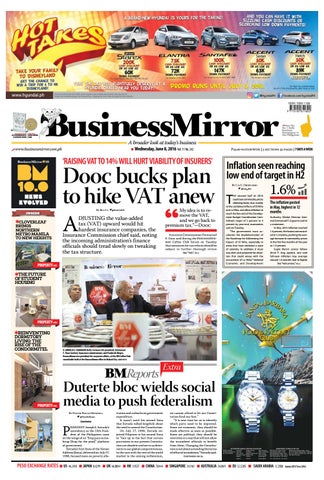
‘RAISING VAT TO 14% WILL HURT VIABILITY OF INSURERS’
Dooc bucks plan to hike VAT anew A By Rea Cu
INSIDE
DJUSTING the value-added tax (VAT) upward would hit hardest insurance companies, the Insurance Commission chief said, noting the incoming administration’s finance officials should tread slowly on tweaking the tax structure.
Cloverleaf brings northern Metro Manila to new heights
property
@ReaCuBM
My idea is to remove the VAT, and we go back to premium tax.”—Dooc
Insurance Commissioner Emmanuel F. Dooc said during the BusinessMirror Coffee Club forum on Tuesday that measures for tax reform should be subject to further thorough review See “Vat,” A12
E1
P25.00 nationwide | 5 sections 32 pages | 7 days a week
Inflation seen reaching low end of target in H2 By Cai U. Ordinario @cuo_bm
T
he second half of 2016 could see commodity prices climbing faster, due mainly to the combined effects of El Niño and La Niña, and allow inflation to reach the low end of the Development Budget Coordination Committee’s target of 2 percent to 4 percent by year-end, economists said on Tuesday. “The government must accelerate the implementation of the Roadmap for Addressing the Impact of El Niño, especially in areas that have declared a state of calamity. In addition, it must stay alert and prepared for disasters that could ensue with the occurrence of La Niña,” National Economic and Development
1.6%
The inflation posted in May, highest in 12 months Authority (Neda) Director General Emmanuel F. Esguerra said in a statement. In May 2016 inflation reached 1.6 percent, the fastest rate recorded in 12 months, pushing the average increase in commodity prices in the first five months of the year to 1.3 percent. Eagle Watch senior fellow Alvin P. Ang agreed, and said full-year inflation may average around 1.6 percent due to higher See “Inflation,” A12
The future of Student housing
property
E2
Reinventing dormitory living: The rise of the condormitel
D. Arnold A. Cabangon (left), Fortune Life president; Emmanuel F. Dooc (center), Insurance commissioner; and Frederick Alegre, BusinessMirror vice president for corporate affairs, at the BM Coffee Club roundtable held at the BusinessMirror office in Makati City. NONIE REYES
BMReports
property
E1
Continued on A2
Duterte bloc wields social media to push federalism By Psyche Roxas-Mendoza @PsycheRoxas
Conclusion
P
resident Joseph E. Estrada’s ascendancy as the 13th President of the Philippines came on the wings of an “Erap para sa mahirap [Erap for the poor]” platform of government. Estrada’s first State of the Nation Address (Sona), delivered on July 27, 1998, focused more on poverty alle-
PESO exchange rates n US 46.2410
viation and cutbacks on government expenditure. It wasn’t until his second Sona that Estrada talked lengthily about the need to amend the Constitution. On July 27, 1998, Estrada enjoined Filipinos in his second Sona to “face up to the fact that certain provisions in our present Constitution are obsolete and serve as deterrents to our global competitiveness. In the race with the rest of the world market to the coming millennium,
we cannot afford to let our Constitution bind our feet.” “It is now time for us to identify which parts need to be improved. Some are economic; they should be made effective as soon as possible. Some are political; they should be rewritten in a way that will not allow the incumbent officials to benefit from them. Changing the Constitution is not about extending the terms of office of incumbents,” Estrada said.
Continued on A2
n japan 0.4299 n UK 66.8044 n HK 5.9537 n CHINA 7.0444 n singapore 34.1161 n australia 34.0611 n EU 52.5205 n SAUDI arabia 12.3306
Source: BSP (7 June 2016 )
A2 Wednesday, June 8, 2016
BMReports BusinessMirror
www.businessmirror.com.ph
Duterte bloc wields social media to push federalism Continued from A1
In his speech, Estrada told Filipinos “not to allow paranoid fears to block the convening of an appropriate assembly or convention to rewrite our Charter. Let us not prejudge its outcome. Our citizens can always make their voices heard during the amendment process. And, ultimately, they will exercise the power, in a plebiscite, to ratify the new Charter or to reject it. Our Constitution must be made to adapt to the dynamics and imperatives of global realities.” The “appropriate assembly or convention” Estrada referred to was later divulged as CONCORD, or the Constitutional Correction for Development.
Public consultations, road shows
As reported in the media, a Preparatory Commission on Constitutional Reforms (PCCR) was formed under the CONCORD. The PCCR was headed by former Chief Justice Andres Narvasa. Its task was to study and make recommendations on amending the provisions of the 1987 Constitution and to “hold public consultations and road shows to inform the people on the proposed economic reforms of the Estrada administration.” Unlike the PIRMA, espoused by Estrada’s predecessor Fidel V. Ramos, the CONCORD proposal, its proponents said, “would only amend the ‘restrictive’ economic provisions of the Constitution that is considered as impeding the entry of more foreign investments in the Philippines.” Still, the CONCORD, like Ramos’s PIRMA, met stiff opposition from militants, the religious and opposition politicians. The CONCORD campaign, however, was cut short by Edsa II, which ousted President Estrada in 2001, less than two years after his administration mounted CONCORD. Both Ramos and Estrada launched their bid for Charter change (Cha-cha) on the last years of their administration. It is a pace that will also characterize the administration of Estrada’s successor, President Gloria Macapagal-Arroyo.
More consultations
It was also during a Sona that then-President Arroyo would publicly declare her administration’s move to effect Cha-cha. One year after winning a hotly contested presidential elections, Arroyo announced in her July 25, 2005, Sona the creation of the Consultative Commission (ConCom) on Cha-cha. ConCom, as explained by Arroyo, would propose revisions to the 1987 Constitution. The proposal would be submitted to the president before transmitting it to Congress, which will then deliberate on the matter. It was also in her 2005 Sona that Arroyo equated Cha-cha with federalism. This, however, will be achieved by way of a “transition to a unicameral parliamentary system” In their study “Federalism and Multiculturalism,” authors Elyzabeth F. Cureg and Jennifer F. Matunding mentioned that Executive Order 453 (2005) defined the ConCom’s principal mandate, which is “to conduct consultations and studies and propose amendments for a shift from the Philippines’s present presidential-unitary system to a parliamentary-federal form. Also among the ConCom’s mission is to refocus and review economic policies in the Constitution to further the country’s goal of global competitiveness.” “To do this, the ConCom will hold nationwide consultations with various sectors, such as farmers, fishermen, workers, students, lawyers, professionals, business, military, academic, ethnic, including the different leagues of local government units and members of Congress and the Judiciary,” the study added. According to the study, the establishment of a federal government was mentioned only in the latter part of the Transitory Provisions of the report (Sections 15 and 16). After the adoption of a parliamentary system of government, autonomous territories will be created. These will eventually become federal states in what will later be called the “Federal Republic of
the Philippines.” Arroyo, as with her predecessors, also failed to push for Cha-cha. Her administration, seen by political observers as the most maligned and riddled with charges of corruption, was forced to drop its campaign for federalism in the face of mounting oppostion. The thwarting of Arroyo’s federalism effort was further hastened when the Supreme Court (SC) issued a temporary restraining order against the signing of a memorandum of agreement on ancestral domain (MOA-AD), which the Arroyo administration had been poised to sign with the Moro Islamic Liberation Front. The SC later deemed the MOA-AD as unconstitutional.
Expert revival
Some of the government officials who played a major role in the peace and order and federalism efforts during the Arroyo administration are now tasked to do the same duties under the Duterte administration. They include Press Secretary Jesus Dureza, who is now peace process adviser; Arroyo’s Peace Adviser Hermogenes Esperon Jr., who is now national security adviser. Esperon also served as Armed Forces of the Philippines chief of staff during Arroyo administration. Among the criticisms to the previous Cha-cha efforts was the lack of sufficient consultation. In the time of President Duterte, social media can be the ultimate public information tool. According to Google, the Philippines has a very tech-savvy population. About 34 percent of online Filipino users visit the Internet every day, while 45 percent of online users go online at least once a week. There are 39.8 million Internet users in the country, or four out of every 10 Filipinos. An 11.3-percent Internet growth rate is projected until 2016. More than half, or 59 percent, of Filipinos will be Internet users by that time. Some 48 percent of Filipinos between the 20 and 29 age group will be Internet users by then.
BMReports BusinessMirror
news@businessmirror.com.ph
Wednesday, June 8, 2016 A3
Piñol eyes palm-oil regulatory body
L
By Mary Grace C. Padin
700,000 MT
@ _enren
ocal palm-oil producers threw their support behind the plan of incoming Agriculture Secretary Emmanuel F. Piñol to put up a regulatory body that will oversee the development of their industry. Philippine Palm Oil Development Council Inc. (PPDCI) Vice President Erwin Garcia said on Tuesday a bill calling for the creation of the Philippine Palm Oil Development Authority is now being crafted by Piñol’s team. “Piñol said his first move is to create a separate body that will look into oil-palm production in the country. He said they are drafting a bill now, so that it can be taken care of immediately once he assumes office on July 1,” Garcia told the BusinessMirror. Currently, the palm-oil industry is being regulated by the Philippine Coconut Authority (PCA), an attached agency of the Department of Agriculture (DA).
“How will the [PCA] help oilpalm growers, when their priority is coconut?” Garcia asked. He said the creation of a separate agency for oil palm would hasten the industry’s development and “unlock” the potential of palm-oil production, which is badly in need of government support. All efforts to sustain the palmoil industry in the Philippines have so far been led by the private sector, he added. Dr. Rolando Dy, executive director of the University of Asia and the Pacific’s Center for Food and Agribusiness, urged the incoming DA chief to expand the coverage of the proposed agency. “It should be expanded and
The volume of palm oil being imported by the Philippines every year
Indonesia’s palm oil. Bloomberg News
named Tree Crops Development Authority to cover not just oil palm but also coffee, cacao and rubber,” Dy told the BusinessMirror. He said the development of the oil palm industry, as well as other tree crops, is key to poverty reduction, particularly in Mindanao. “Mindanao has a very high poverty incidence at over 40 percent. Tree crops development is key to reducing it, not rice,” Dy said.
Road map
Aside from the creation of the agency, Garcia called on the government to put in place a “concrete”
plan to help oil-palm producers. “The government should have a clear vision on how they will help the farmers,” he said. The PPDCI said it proposed an industry-development road map to the government, but the outgoing administration “just sat on it.” According to Garcia, the proposed 10-year road map outlined the challenges faced by the industry, as well as the strategies to overcome these. One of the targets set in the road map, he said, is to address the shortage in oil-palm production in the country.
“Right now, we have to plant around 200,000 hectares of oil palm just to be self-sufficient. This is enough to wipe out our importation of palm oil. But, we are planting palm oil in only 5,000 hectares per year,” Garcia said. According to industry estimates, the current local demand for palm oil is at 800,000 metric tons (MT). However, Garcia said the country produces only an average of 100,000 MT a year. This means the Philippines imports as much as 700,000 MT of palm oil from Indonesia and Malaysia just to meet local demand. “Imagine how much money are we giving to other countries, instead of ma k ing su re t h is money goes to local farmers? We have a lot of vacant, unutilized land,”Garcia said. “There should be a plan [to achieve this]. You cannot plant that as soon as possible. Also, by
the time that you finish planting 200,000 hectares, local demand might have already changed. We are growing at a rate of 10 percent in terms of demand,” he added. Garcia also urged the government to provide farmers with free planting materials to encourage them to go into oil-palm production. Data from the PPDCI showed that the country’s crude palmoil production in 2014 increased by 10.67 percent to 135,000 MT, from 122,000 MT in 2013. Garcia said production last year grew slightly to 137,000 MT, as the low price of oil palm discouraged farmers from planting the crop. “Nobody wanted to plant, because they were discouraged by the price. Nobody imported seeds and there were only a few takers of seedlings from nurseries,” Garcia said. Last year the price of oil palm (fresh fruit bunch) reached P3,400 per MT, lower than the “comfortable” price of P5,000 per MT. Garcia said the inventory was high, but the demand for palm oil declined last year, causing prices to fall.
BMReports BusinessMirror
A4 Wednesday, June 8, 2016
news@businessmirror.com.ph
Senators eyeing mining-sector probe as group calls on DENR to declare Manicani Island ‘no-go zone’
T
By Butch Fernandez & Jonathan L. Mayuga
butchfBM @jonlmayuga
at the same time, assess the kind of support to be extended to key players in the industry.
he Senate, taking the cue from President-elect Rodrigo R. Duterte’s stand against “illegal and irresponsible” mining activities, is set to firm up initiatives to protect the environment, while ensuring fair and rational sharing of profits among all stakeholders in the mining industry. “As a starting point, there must be a faithful implementation of the Mining Act and the small-scale mining law,” Sen. Juan Edgardo M. Angara said. He told the BusinessMirror that the incoming Duterte administration “will be in such a position, as to punish violators who do not fulfill the conditions set forth in their mining arrangements with the government.” “Perhaps, going forward, Congress can look at how it can further strengthen capabilities for enforcement on the ground,” Angara added.
Full-blown hearing
Senate Deputy Minority Leader Vicente C. Sotto III pushed for a “ full-blown” Senate inquiry prior to crafting remedial measures that would merge the interests of business/job creators,
Chamber’s stand
represented by members of the Chamber of Mines of the Philippines (COMP) and, on the other, the government’s duty to protect the environment. “First of all, the Senate Committee on Environment must call [for] a full-blown hearing, which should include all stakeholders,” Sotto said. “Then we can assess the necessary legislation to control and safeguard the different concerns.”
Damage
Comebacking Sen. Richard U. Gordon prodded the Department of Environment and Natural Resources (DENR) and the Mines and Geosciences Bureau (MGB) to quickly assess the reported damage to the environment, “if [there’s] any.” In a brief interview, Gordon also stressed the need for a regular oversight of all mining operations and,
This, even as big players in the mining industry earlier assured Duterte that they do not condone illegal and irresponsible miners. The COMP has affirmed it does not tolerate illegal and irresponsible mining, including the supposed “small miners” reportedly being condoned by some local government units (LGUs). In a news statement issued early this week, the chamber also assured the government it continues to look for ways to provide social development and management programs “to include indigenous peoples and environment enhancement.” The COMP, which is composed of large-scale mining firms, likewise, affirmed its commitment to work with the Duterte administration in addressing concerns of the mining industry, in order to “promote true inclusive growth” in the country. Duterte earlier warned major players in the mining industry to shape up and stop harming the environment. He suggested that the mining industry be run like a cooperative, in which even small players would benefit.
Manicani Island case
IN a related development, the
antimining group A lyansa Tigil Mina (ATM) on Tuesday urged the DENR to stop mining operations on Manicani Island, in the tow n of Guiuan, Easter n Samar. Stopping the operations of the Hinatuan Mining Corp. (HMC), according to the ATM, should include the hauling and transport of mineral ores from the island to be processed elsewhere. The island is part of the Guiuan Bay Protected Landscape and Seascape (GBPLS), a key biodiversity area (KBA), by virtue of Presidential Proclamation (PP) 469. The proclamation states that mining operations in KBAs and protected areas (PAs) should be stopped, and that no-go zones map should be updated and be fully implemented. Many KBAs in the Philippines remain unprotected, despite their status as a PA covered by the National Integrated Protected Area System (Nipas) Act. According to the Philippine Misereor Partnership Inc., a network of over 250 non-governmental organizations, the poor implementation of the Nipas Act is to be blamed for the deterioration of some PAs, such as Manicani island. Manicani Island is covered by the GBPLS by v ir tue of PP 469, signed by former President Fidel V. R amos, who declared the coastal areas of Guiuan and the neighbor ing islands, such as Manicani, Candu lo, Su luan, Tubabao, Calicoan and Homon-
[President-elect Rodrigo R. Duterte] will be in such a position as to punish violators who do not fulfill the conditions set forth in their mining arrangements with the government.”—Angara
hon and t heir sur round ing reefs, as protected landscape and seascape in 1994. Manicani Island’s ecosystem has been severely damaged by the operation of a large-scale nickel mine for almost two decades. Despite the declaration as a PA and an order stopping large-scale operation on the island in 2002 by the DENR, people on the island complain that hauling of nickel stockpiles by the mining company persists. According to the ATM, Manicani is a small island with only over 3,000 farmers and fishermen residents. The island has a fragile ecosystem, and is already facing the impacts of damaged environment. The situation on Manicani Island, the ATM added, is aggravated by the impacts of climate change during the onslaught of Supertyphoon Yolanda in November 2013. Manicani residents have earlier called on the DENR-MGB to issue an order canceling the mining permit it issued to extract
mineral ores on the island.
Call of the communities
THE ATM believes that the government agencies must listen to the call of the communities for the cancellation of mining permit on their island. According to the ATM, the hauling of nickel ores since May 15 was condoned by the MGB Region 8 without consulting the affected communities. The same incident happened in June 2015, when employees of HMC attempted to haul its nickelore stockpile. The ATM said communities, led by Save Manicani Movement that set up barricades in the periphery of the stockpile, continue to cry foul over the DENR and the MGB’s inaction to support miners and demand justice for the destruction and impact caused by mining. The ATM proposes that the Manicani Island, among many small island ecosystems in the country, be declared as a “no-go zone.”
Goldman Sachs comes out bullish on a strong-willed Duterte
G
oldman Sachs Group Inc. says the hard man of Philippine politics could prove a boon for the nation’s economy. President- elect Rod r igo R . Duterte’s election on a mandate to boost infrastructure spending, cut red tape for business and invest more in farming could lift the country’s potential growth rate, the US bank’s analysts concluded after recent meetings in Manila. That’s an added boost for an economy already viewed as one of the world’s best performers, with growth exceeding China’s in the first quarter, at 6.9 percent. “We believe that these proposals, provided they are successfully implemented, could further brighten our already positive macroeconomic outlook for the Philippines,” Matthieu Droumaguet, an economist at Goldman, wrote in a report. Duterte, the maverick 71-year-old who comfortably won the presidential election held on May 9, has shaken up the Philippine political scene with his brash style and often vulgar
We believe that these proposals, provided they are successfully implemented, could further brighten our already positive macroeconomic outlook for the Philippines.”—Droumaguet speech. He earned votes by vowing ruthlessly to crush crime and corruption—going so far as threatening to kill 100,000 criminals and feed their bodies to the fish in Manila Bay.
‘Strong’ will
IN the meetings in Manila, Goldman representatives were told Duterte was “decisive” with “a strong political will,” yet also “keen to delegate.” Goldman said the new president’s promised policy mix should stoke business confidence and, over the medium term, could raise the economy’s potential expansion rate, and pose upside risks to the bank’s mediumterm forecasts. “ H i s i ncom i ng ad m i n i st r a -
tion sketches an economic agenda conducive of market-friendly growth-oriented policies, which are likely to continue to fuel the secular growth story of the Philippines,” the bank said. “The Cabinet formation, optimism of the business community and early pronouncements are all indicative that the upcoming administration will conduct growth-oriented and business-friendly policies.” Goldman expects potential growth of about 6.7 percent, with a possible increase to 7 percent early in the next decade fueled by investment, demographics and productivity. Duterte, scheduled to take office on June 30, inherits an economy
that won its first investment-grade sovereign rating under outgoing President Aquino, and has ample fiscal room for the new government to boost spending. Incoming finance chief Carlos G. Dominguez has sought to reassure investors that his new boss is a pragmatic leader and that Duterte plans to continue the policies that spurred the rating upgrade. The incoming government targets spending the equivalent of 5 percent of GDP on infrastructure. There are risks to the outlook, too. Goldman says much will depend on the execution of the promised changes. Investors will need to keep an eye on indicators, such as the pipeline of approved public-works projects, how lawmakers respond to planned tax changes, the World Bank’s rankings on ease of doing business and any improvement in crop yields. “As is often the case, the speed and extent of implementation remains highly uncertain,” the bank said. Bloomberg News
Clinton clinches Democratic nomination, making history on eve of California primary
R
acing from close quarters to mass rallies, Hillary Clinton and Bernie Sanders churned across California on Monday as the former secretary of State made history—becoming the first woman ever to clinch a major party’s presidential nomination. T he A ssoc i ated P ress, wh ic h closely tracks the delegate count, said late Monday that enough of the uncommitted had swung behind Clinton to give her the nomination. She declined to claim the prize, however, so as not to dampen Tuesday’s turnout. “According to the news, we are on the brink of a historic, historic, unprecedented moment, but we still have work to do, don’t we?” a beaming Clinton told supporters at a boister-
ous rally in a basketball gym at Long Beach City College. “We have six elections tomorrow and we’re going to fight for every single vote, especially right here in California.” The Sanders campaign issued a statement accusing the media of a “rush to judgment” and insisted the nomination would not be settled until the Democratic National Convention next month in Philadelphia. The result was a rare moment of political congruity in the testy nominating fight: Neither side wanted to acknowledge the contest was over, though for different reasons. Sanders hopes to keep his campaign alive. Clinton wished not to seem presumptuous and risk an embarrassing defeat in California that would tarnish
her path-breaking achievement. After falling short in 2008, Clinton is poised to do something no woman has ever done, bear the presidential standard of the oldest political party in America. The former diplomat, first lady and US senator from New York spoke to the moment after visiting with senior citizens Monday morning at a community center in nearby Compton. “My supporters are passionate,” Clinton told reporters. “They are committed. They have voted for me in great numbers across our country for many reasons. But among the reasons is their belief that a woman president will make a great statement, a historic statement about what kind of country we are, what we stand for.”
President Barack Obama could endorse his former secretary of State as early as Wednesday, according to aides familiar with conversations between the White House and the Clinton camp. After victories over the weekend in Puerto Rico and the Virgin Islands, Clinton entered the day just shy of the 2,383 delegates it takes to win the Democratic nomination. Much of Monday’s back-and-forth between the Democratic front-runner and her insurgent opponent centered on when—and whether—Clinton should lay claim to the nomination. Six states will vote on Tuesday in the penultimate voting day of the Democratic primary season: New Jersey, Montana, North Dakota, South Dakota, Montana and California. MCT
news@businessmirror.com.ph
AseanWednesday BusinessMirror
Indonesia’s tax amnesty may unlock property gains
O
ne of the biggest winners from an Indonesian tax amnesty may turn out to be the shares of realestate developers, as funds get channeled into investments in the nation’s houses and apartments. Bank Indonesia estimates about 560 trillion rupiah ($42 billion) of undeclared income will be repatriated as a result of the reprieve. In a country where less than 0.2 percent of people own stocks, a chunk of this is likely to, eventually, be spent on real estate, according to PT Manulife Aset Manajemen Indonesia. The amnesty, together with a relaxation of mortgage rules and falling lending rates, may feed a resurgence in property stocks. “Regulations are being sorted out, interest rates are easing and liquidity may increase once the tax amnesty happens,” said Alvin Pattisahusiwa, the Jakarta-based chief investment officer at Manulife, whose Indonesian unit oversees around $3.3 billion. “One by one, the keys are being turned.” PT Summarecon Agung has led a rally in real-estate shares over the past four weeks amid signs the tax reprieve, first proposed in early 2015, is getting closer. The amnesty program is expected to spur an apartment market that Colliers International said was subdued last quarter after “dismal sales” in 2015. Homeowners will be able to take out loans to purchase a second property off the plan, the central bank announced on May 24. The Jakarta Construction Property and Real Estate Index has jumped 6.8 percent from a two-month low on May 10. That’s pared its loss over the last 12 months to 2.3 percent, compared with a 3.4-percent decline in the Jakarta Composite Index. Summarecon Agung has surged 20 percent since May 10 and PT Ciputra Development is up 14 percent.
Under the draft amnesty bill, a 2 percent-to-6 percent tax rate will be paid on declared assets and this will drop to 1 percent to 3 percent if the money is brought back from offshore. The reprieve, which will apply to company and personal taxes, will last six months. It’s likely to be implemented in July, Soepriyatno, the deputy chairman of the house’s financial commission, told the Detik web site on May 26. Bank Indonesia estimates the amnesty, which is aimed at plugging a hole in the government’s budget to fund infrastructure development, will boost 2016 economic growth by 0.3 percentage point to as much as 5.4 percent. That compares with a six-year low of 4.79 percent in 2015. Only 27 million Indonesians are registered taxpayers and less than a million of them paid what they owed in 2014. Indonesians favor investing in property, as they believe it’s safer in the long run, said Rainier Gunawan, a principal for Ray White Indonesia in Jakarta. Some 466,250 Indonesians had brokerage accounts at end-2014, according to the Indonesian Stock Exchange, out of a population of 256 million. “In recent months purchases of properties for investment reasons have ground to a halt,” Gunawan said. “My clients are telling me they want to wait for clarity on the tax-amnesty regulation.” Residential sales should rise by around 10 percent this year as a result of the tax reprieve, mortgage rule and easier credit conditions, said Anthony Yunus, a property analyst at Nomura Holdings Inc. in Jakarta. It will be positive for developers, and those with the most exposure to the residential market, such as Summarecon, PT Bumi Serpong and Ciputra Development, will benefit the most, he said.
Bloomberg News
Editor: Max V. de Leon • Wednesday, June 8, 2016 A5
Singapore bond frenzy cuts Asean credit costs
C
orporate-bond offerings by some of Singapore’s biggest companies are drawing such strong demand from investors that they are artificially lowering borrowing costs for weaker borrowers, according to S&P Global Ratings. Recent offerings from issuers, such as state investment company Temasek Holdings Pte., port operator PSA Corp. and electricity distributor Singapore Power Ltd., were “well oversubscribed” amid heightened threat of nonpayments by riskier borrowers across Southeast Asia, analysts Bertrand Jabouley and Xavier Jean wrote in an e-mail interview. Banks have also been supporting some companies in the troubled oil-services industry, easing default pressure, it said. Singapore’s bond market suffered its first defaults since 2009, when PT Trikomsel Oke missed payments on two bonds with S$215 million ($158 million) of face value in late 2015. Fishery group Pacific Andes Resources Development Ltd. reneged on a S$200-million note in January, while recent debt failures across the region have included PT
Credit risk has looked ill-priced in Asean.” —Jabouley and Jean Berau Coal Energy and 1Malaysia Development Bhd. “In an environment of perceived rising risks, flight to quality has been a bit irrational,” the Singapore-based analysts wrote. “Issuance of highly creditworthy corporates and the frenzy they trigger do not revive the market but simply artificially adjust the cost of credit to the downside, as everyone raising bonds benchmarks their cost of funding against them.”
‘Limited differentiation’
The phenomenon isn’t unique to Singapore’s debt market. Standard & Poor’s (S&P) study shows there’s “limited differentiation” across capital structures among 150 prominent listed entities in Southeast Asia. Their median cost of funding has fluctuated in a band of 100 basis points, or 1 percentage-point, regardless of their balance-sheet quality or leverage levels, the analysts said. “It is not much more onerous to finance a levered balance sheet,” Jabouley and Jean wrote. “Credit risk has looked ill-priced in Asean.” PSA Corp. sold $500 million of 10-year bonds in April, attracting about $1 billion of orders, according to Bloomberg-compiled data, while Temasek’s offerings of euro-denominated notes in February also drew large bids. Singapore Power got orders double the size of its $700-million sale of 10-year notes last November. “As more defaults happen in the domestic-bond markets, we think the market will gradually differentiate credit risk better by raising the funding costs for the more leveraged corporates,” the S&P analysts wrote.
Oil services bonds
There are about S$1 billion worth of bonds issued by energy, oil and gas, and shipping companies— including from Swiber Holdings Ltd., Otto Marine Ltd. and Rickmers
Trust Management—due for maturity over the next 12 months, according to iFast Corp. Some restructuring may be on the cards, it said. “Investors perceive some difficulty in refinancing” based on the secondary bond prices, said Terence Lin, assistant director of bonds and portfolio management at the Singapore-based fund researcher iFast. “In practice, pricing on the interbank market is highly indicative, with wide bid-ask spreads observed and limited liquidity.” Swiber Holdings Ltd., an offshore oil-and-gas services group, repaid S$130 million ($96 million) of bonds due on Monday, it said in a stockexchange filing. The company has another S$75 million of notes maturing on July 6 and S$100 million notes due on October 10, according to Bloomberg data. The group had $122.6 million of cash and cash equivalents minus pledged cash placed with banks at the end of the first quarter, according to its financial statement. “Banks have been supporting a number of companies, both rated and unrated, especially in the oil services industry, as precipitating a default helps no one around the table,” Jabouley and Jean said. “The liquidity of corporates with more bank exposure is likely more solid today compared to that of corporates relying more on capital markets.” Bloomberg News
A6
The World BusinessMirror
Wednesday, June 8, 2016
news@businessmirror.com.ph
Adviser’s serial firings show ‘big problem’ at brokerages
S
In this file photo dated February 1, 2013, London Mayor Boris Johnson poses as he looks out over London. From the international banks in the skyscrapers of Canary Wharf to the traditional home of Britain’s financial industry in the City of London, bankers and money managers across the capital are watching the upcoming June 23 referendum on European Union membership with trepidation. AP
London financial hub braces for possible EU exit ‘nightmare’
L
ONDON—Gina Miller needs to look no further than her own small investment firm to decide that leaving the European Union (EU) would be bad for Britain.
She has an analyst who is Italian: would he need a visa? She has customers who are British retirees living in Spain: will they return home to keep access to health care and liquidate their euro investments? Her firm, SCM Direct, works closely with French bank Societe Generale: would that relationship continue? “It would be a nightmare,” she said, suggesting the impact could be similar to the 2008 financial crisis. “Why would we do this to our country again? And this time it would be of our own making.” From the international banks in the skyscrapers of Canar y Wharf to the traditional home of Britain’s financial industry in the City of London and the hedge funds of Mayfair, bankers and money managers across the capital await the June 23 referendum on EU membership with trepidation. Many fear a vote to leave would undermine London’s position as the world’s preeminent financial center and damage an industry that underpins the British economy.
Uncertainty
JAMIE Dimon, chief executive of US banking giant JPMorgan Chase, underscored those concerns last week when he appeared alongside UK Treasury chief George Osborne to make the case for remaining part of the EU single market, which with 500 million people is the world’s biggest economy. In case of a British exit, or Brexit, from the EU, JPMorgan would have to move staff to the continent to ensure it could continue to serve clients who want to invest there, Dimon said. Other global banks with customers in the rest of the EU would be in a similar situation. “A vote to leave would be a terrible deal for the British economy,” he said. “At a minimum, a Brexit will
500M The total number of people composing the EU single market, the world’s biggest economy
result in years of uncertainty, and I believe that this uncertainty will hurt the economies of both Britain and the European Union.”
Luster
BRITAIN has been the gateway to the EU for many banks, brokerages and fund managers for decades. In addition to having a trusted legal system and institutions that operate in English, the language of international finance, London is in the right time zone to access most of the Earth during its working day and has a reputation for delivering top-notch financial services. T he i ndu st r y i s a l so su r rounded by an ecosystem of expertise—law yers, accountants and consultants—to support it. Some 60 percent of all European headquarters of non-EU firms are based in the UK, according to TheCityUK, which lobbies on behalf of the financial industry. The UK hosts more headquarters of nonEU firms than Germany, France, Switzerland and the Netherlands put together. London’s advantages are such that people in favor of leaving the EU, such as Peter Hargreaves, cofounder of brokerage firm Hargreaves Lansdown, think it will retain its luster no matter what. He poured scorn on the notion that it could be easily replicated. “In addition to the cost of building the infrastructure for a rival to the City of London, one has also got to work out whether
people will want to live in another financial center,” he said. “They certainly wouldn’t want to live in Paris—although Paris is a pretty city—purely because of the tax rates and, in all honesty, they wouldn’t want to live in Frankfurt because, actually, there isn’t even the housing there to house them. People want to live in London.”
‘Passporting’
LONDON’S financial sector has complained about a number of EU rules, such as limits on bankers’ bonuses and an attempt to impose a tax on financial transactions. Those considerations, however, are largely trumped by concerns that leaving the EU would make access to the other 27 EU countries more difficult, many analysts say. The principle of “passporting” currently allows any firm registered in one EU country to operate in any other member-state without facing another layer of regulation. It’s the same principle that allows exporters to ship their goods to any EU country free of tariffs. Losing that freedom is a particular concern for the many foreign firms, who use London not only as a financial hub, but as an entry point into the EU. “I can treat a customer in France or Germany or Italy exactly the same way I can treat a customer in Birmingham. That is extremely rare,” said Phillip Souta, head of UK public policy at the global law firm of Clifford Chance.
Predicted
WHILE the UK could probably negotiate a new arrangement for trade in goods, it would be much more complicated to hammer out a deal on services, said Angus Armstrong, chief of macroeconomics at the National Institute of Economic and Social Research. The situation has no precedent—no country the size of the UK has ever left such an integrated economic union—so the outcome of any talks can’t be predicted. And anything that curtails Britain’s financial industry has implications for the UK economy as a whole, not just the bankers who were pilloried for taking
home m i l l ion- pou nd bonuses, wh i le t hey f ueled t he globa l f ina nc i a l cr isis. TheCityUK notes that the sector supports the economy by providing financing for businesses, overseeing retirement savings, providing mortgages and making insurance payments. Related professional services include legal, accounting and management consulting firms. The financial sector accounts for 11.8 percent of economic out put and employs 2.2 mil lion people, or 7 percent of the nation’s work force, according to T heCityUK .
Question
THE industry’s importance is even more obvious in Britain’s trade figures. While the country posted an overall trade deficit of £34.4 billion ($50 billion) in 2014, it generated a £72-billion surplus from exporting financial and related services. “I don’t think people quite understand what goes on in the city,” said Vicky Pryce, an economist and former joint head of the UK government economic service. “A strong financial sector employs a lot of people and is vital for the health of the economy.” T he C it y of L ondon — t he square mile roughly bounded by the walls of the original Roman city—has been the financial heart of Britain since the 17th century, when merchants meeting at local coffee houses formed Lloyd’s of London and the London Stock Exchange. It has survived wars, famines and fires and would likely survive any outcome from the EU vote. The question is in what form.
Irreversible
JEFFREY Evans, the Lord Mayor of the City of London, whose office has promoted the city as place to do business since the Magna Carta was signed in 1215, says leaving the EU in not a risk worth taking. Speaking in an opulent drawing room that feels more like a museum, with Dutch masters lining the walls, Evans noted that leaving the EU would be irreversible. “It’s a very important matter,” he said. “This is a decision that will affect future generations.” AP
COTRUN, Pennsylvania—He was fired from one company, then another, then another. And still, Anthony Diaz continued handling other people’s money. The smooth-talking securities salesman affiliated with 11 different investment firms in 15 years, getting booted from five of them and resigning from another amid customer complaints and rules infractions. Yet, his checkered employment history never seemed to slow him down on his way to earning millions by pushing high-fee, high-risk “alternative investments.” Now under federal criminal indictment for fraud—he has pleaded not guilty—and with dozens of former clients lodging complaints, Diaz illustrates what can go wrong when investment firms hire problem brokers. It happens with alarming frequency. An academic study from March found that 15 percent to 20 percent of the brokers at some of the largest financial services firms in the country, including one that employed Diaz, have disciplinary records. Moreover, nearly half of financial advisers fired for misconduct find a new job in the industry within a year—and are at greater risk of reoffending, according to researchers at the universities of Chicago and Minnesota. The researchers also found that brokers with a propensity for ripping off their customers tend to migrate to certain firms, suggesting the firms “specialize” in misconduct and “cater to unsophisticated consumers.” “A lot of these guys are real hustlers,” said Jacob Zamansky, a securities lawyer who represents investors, explaining why firms would take a chance on an unethical broker. “It’s all about the money, and it’s a risk-reward. This is a big problem, perhaps, one of the biggest.”
Seeking answers
DEMOCR ATIC Sen. Elizabeth Warren, of Massachusetts, and Republican Sen. Tom Cotton, of Arkansas, have asked Wall Street’s self-policing body to address what it’s doing about firms that routinely employ brokers with a history of fleecing clients. The Financial Industry Regulatory Authority has until June 15 to respond, but agency chief Richard Ketchum has already warned investment firms that routinely employ highrisk advisers to expect “searching questions” about “the special supervisory steps they have taken to ensure no further bad actions.” New federal regulations, meanwhile, would require brokers to put their clients’ interest ahead of their own when giving retirement investment advice. Wall Street lobbying groups sued last week to block the rules, arguing they’re too burdensome and subject brokers to too much liability. Even with so many rule-breaking brokers still in business, Diaz’s serial firings stand out. He’s the only one of the nation’s 650,000 licensed brokers to have been fired more than three times, according to an analysis conducted for The Associated Press (AP) by Securities Litigation and Consulting Group Inc. Why was he able to land on his feet so many times? “It’s about greed,” said lawyer Albert Murray Jr., who represents about 30 former clients of Diaz. “Here’s a guy who’s making lots of money and has a big portfolio of clients all over the country. That’s why they did it.” Diaz’s attorney, Darren Gelber, said his client rejects the allegations. “It is his very, very strong and fervent belief that everything he did was proper and legal,” Gelber said.
‘A total, total rip-off’
PENNSYLVANIA retiree Vincent Sylvester, 69, said he invested nearly all of his $500,000 nest egg with Diaz after the financial
adviser guaranteed him returns of 8 percent and more. Sylvester said Diaz inflated his net worth to qualify him for the investments, didn’t explain the risk and failed to tell him his money would be tied up for years. Now he and his wife are making barely $400 a month on their savings—a return of less than 1 percent—and their retirement is less comfortable than it might have been. Sylvester is dealing with bladder cancer on top of his financial stress. “The whole thing was a total, total rip-off,” said Sylvester, who worked in the real-estate department of a homebuilder. “It took me a lot of years to save this money, and a lot of hard work and, unfortunately, you’ve got guys like him who don’t really care.” Federal prosecutors allege Diaz advised his clients to put their money in real-estate investment trusts and equipment-leasing partnerships, types of higherrisk, illiquid “alternative investments” geared to wealthier, more sophisticated investors. He had them sign blank documents; then he falsified their net worth, income and risk tolerance to make it appear they met the suitability requirements of the products, according to a grand jury indictment. “I had no idea they were super high risk,” said Bruce Kilby, 67, of Scotrun, a retired pharmaceutical company worker who invested about $350,000 with Diaz. The financial adviser, Kilby said, “was a very fast talker, and when you asked questions that he didn’t want to answer, he more or less talked down to you.” Kilby won a $220,000 arbitration award against Diaz, who has challenged it in state court. First Allied Securities Inc., the firm with which Diaz was affiliated when prosecutors say he began committing fraud a decade ago, said in a statement that it thoroughly vets prospective hires and expects them to be ethical and professional. But the company routinely employs advisers who have been disciplined for misconduct—nearly one in five, according to the Chicago and Minnesota researchers. First Allied called the study flawed.
Why hire him?
AFTER First A llied permitted Diaz to resign in 2009, Diaz was fired from several other firms before his last stop at IBN Financial Services, a brokerage in Liverpool, New York. Its CEO, Richard Carlesco, said in an interview that Diaz’s big roster of clients made him an attractive hire. Given his employment history, “it was a stretch for me,” said Carlesco, whose small brokerage had a squeaky-clean record. “I’d not had a rep like this before.” But Carlesco said he thought Diaz had been terminated by his earlier firms for “stupid reasons” that largely related to issues of customer service, not because he was selling clients on bad investments. At the time of his 2012 hire by IBN, Diaz had no open consumer complaints against him, Carlesco said. He said he ca l led Finra, the industr y regulator, about Diaz, and Finra officials advised Carlesco to put Diaz on “ heighte ne d s up e r v i s ion .” C a rle s co insta l led a staffer in Diaz’s office in the Pocono Mountains and sent his compliance officer there ever y week. “Trust me, I just didn’t jump into this blind,” he said. In retrospect, Carlesco said, he regrets getting involved. The financial adviser cost the firm more in legal and compliance fees than it earned from his clientele, Carlesco said. Most of the other companies that affiliated with Diaz after he resigned from First Allied did not return messages from the AP. AP
www.businessmirror.com.ph
The World BusinessMirror
Wednesday, June 8, 2016
A7
Trump campaign wasting precious time—GOP critics
W
ASHINGTON—Donald Trump is wasting precious time. By now, Republican Party critics argue, the party’s presumptive presidential nominee was supposed to have stationed senior staff in battleground states, moderated his fiery message to attract new supporters and begun raking in big money.
Instead, he’s spending more time right now picking fights and sett ling scores than delivering a message that might he lp d r aw voters. Five long week s si nce he defeated h is last remaining GOP rival, Republicans fear the New York billionaire has squandered his head start. As Democrat Hillary Clinton eyes her party’s nomination, Trump’s campaign has been roiled by infighting, his battleground strategy is lagging and his fundraising operation is barely off the ground.
“I am getting bad marks from certain pundits because I have a small campaign staff. But small is good, flexible, save money and number one!” Trump insisted on Monday on Twitter. Some wouldbe Republican supporters also fear his unwillingness to budge from a flame-throwing formula targeting immigrants and Muslims that worked so well in the GOP primary. Case in point: Trump’s recent comments about the Mexican heritage of the judge presiding over a case against his now-defunct
Trump University. The Republican businessman has refused to back down from his claim that the judge’s ethnic background creates a conflict of interest, drawing scorn from across the GOP, as well as the legal community.
Inappropriate comments
REPUBLICAN South Dakota Sen. John Thune said on Monday, “It’s not a good place to be” for Republicans to have to repeatedly explain their presumptive nominee’s statements. “There are, I think, conversations going on with the campaign and, hopefully, that message is being clearly conveyed,” Thune said. “But yeah, he’s going to have to adapt. This is not working for him. They were inappropriate comments.” Trump also has been slow to adapt to other contours of an expansive general election. Since Texas Sen. Ted Cruz dropped out of the race last month, he has spent precious little time in the battleground states that w ill likely decide the election. He has ignored Florida and Ohio, preferring to spend the bulk of the past two weeks in California— a state that hasn’t supported a
Republican presidential candidate in nearly three decades.
Unfilled positions
THE ongoing rivalry between aides loyal to Trump’s campaign manager Corey Lewandowsk i and to campaign Chairman Paul Manafort appears to affect virtually all aspects of the campaign. Two weeks ago, political director Rick Wiley was fired in the midst of a battleground hiring effort. While the campaign hoped to have senior staff in place across 15 states by June 1, the ex-political director did not finalize a single hire before leaving, according to an aide with direct knowledge of the hiring who was not authorized to speak publicly. The positions remained unfilled, as the factions pushed separate candidates to step in as Trump’s political director. Two campaign aides said Manafort appeared to win that battle, getting Trump to hire Jim Murphy, a Republican operative who was involved in Bob Dole’s failed presidential campaigns. The aides insisted on anonymity because they were not authorized to discuss the hiring.
Bad deals
BUT Murphy’s hiring was a surprise to others in Trump’s inner circle, underscoring the level of confusion. “Never heard of him,” Hope Hicks, the only communications staffer on Trump’s payroll, wrote in an e-mail on Sunday night after The New York Times reported Murphy’s hire. Lewandowski rejected the idea his candidate is wasting time, arguing that Trump has been delivering a message that appeals to everyone, with numerous trips planned in the coming weeks. “I think what we’re talking about is jobs and security and bad trade deals,” Lewandowski said, describing the end-of-May deadline as a false one. He said the campaign is constantly hiring and has state directors all over the country left over from the primary season.
Communication breakdown
A F T E R C l i nt o n d e l i v e r e d a scathing foreign policy speech last week, which doubled as a takedown of Trump’s qualifications to be commander in chief, Trump responded only with a tweet mocking her reliance on
teleprompters—ig nor i ng t he former secretary of state’s record as the nation’s chief diplomat during intensifying international conf licts. The dysfunction reached new heights on Monday during a conference call, first reported by Bloomberg Politics, in which Trump instructed some of his most visible supporters to ignore talking points sent out by his own campaign and to continue focusing on the Trump University case and US District Court Judge Gonzalo Curiel, according to two people on the call. The memo warned supporters not to speak about the case, because it concerned Trump’s business ventures. But Trump said he “absolutely wants us to talk about the case,” said one participant, who spoke on the condition of anonymity because the person was not authorized to discuss a private call. Barry Bennett, a Trump adviser who was also on the call, described the disagreement as a “communication breakdown.” He said Trump told his supporters his attacks against Curiel had “nothing to do with skin tone, it’s about his bad judicial work.” AP
A8
The World BusinessMirror
Wednesday, June 8, 2016
China aims to cut glut in steel, avoid race to devalue yuan–US
B
EIJING—China has agreed to try to slash excess output of steel, avoid competitive devaluations of its currency and to wind down unprofitable “zombie enterprises,” US Treasury Secretary Jacob Lew said on Tuesday, as the two countries wrapped up annual high-level meetings in Beijing.
The commitment to persist with reforms to make China’s economy more balanced included specific steps for opening its financial sector wider to US companies, Lew told reporters. “It is clear from our discussions that China’s leaders recognize the
need to reform China’s economy and its growth model,” he said. The two-day annual Strategic & Economic Dialogue, a meeting of Cabinet-level foreign affairs, trade and other officials from both sides, is meant to head off conflict. It rarely produces agreements on
major issues, but allows officials to air disputes, clear up misunderstandings and share experiences. The US agenda included pressing Beijing to move faster in shrinking its bloated industries including steel, which its trading partners complain is flooding their markets with unfairly cheap exports. Lew said the two sides were unable to “come to common understanding” on the issue of excess production of aluminum, another trade flashpoint for the two countries, but agreed to continue discussing the problem. Beijing also agreed there is no reason for a sustained weakening of its currency, the yuan, Lew said. He said Chinese officials reaffirmed a commitment to not engage in “competitive devaluations and not target the exchange rate for competitive purposes.”
Aluminum and steel are among major Chinese exports that its trading partners complain are hur ting their ow n producers and threatening jobs. Washington has imposed anti-dumping tariffs on steel, and European officials say they have launched a trade investigation. Beijing announced plans this year to slash the size of its stateowned steel and coal industries at a cost of millions of jobs. But plans for other bloated sectors, including aluminum, glass and solar panels,
have yet to be announced. Speaking at the event’s opening ceremony, Chinese President Xi Jinping promised action on reducing overcapacity but announced no new initiatives. On the environment, envoys from both sides pledged to ensure the Paris agreement is ratified and to persuade other governments to put it into action This year’s event is led by Secretary of State John Kerry and Lew on the US side and Vice Premier Wang Yang and State Councilor Yang Jiechi on the Chinese side. AP
It is clear from our discussions that China’s leaders recognize the need to reform China’s economy and its growth model.” —Jacob Lew
Woman breaks silence among Fukushima thyroid-cancer patients
K
ORIYAMA, Japan—She’s 21, has thyroid cancer, and wants people in her prefecture in northeastern Japan to get screened for it. That statement might not seem provocative, but her prefecture is Fukushima, and of the 173 young people with confirmed or suspected cases since the 2011 nuclear meltdowns there, she is the first to speak out. That near-silence highlights the fear Fukushima thyroid-cancer patients have about being the “nail that sticks out,” and thus gets hammered. The thyroid-cancer rate in the northern Japanese prefecture is many times higher than what is generally found, particularly among children, but the Japanese government says more cases are popping up because of rigorous screening, not the radiation that spewed from Fukushima Dai-ichi power plant.
Meltdowns
THE government has ordered medical testing of the 380,000 people who were 18 years or under and in Fukushima prefecture at the time
HK teen activist acquitted over 2014 China protest
H
ONG KONG—A Hong Kong court on Tuesday acquitted teen pro-democracy leader Joshua Wong of obstructing police at a protest two years ago against China’s tightening hold on the city. Wong tweeted that he and three others were found not guilty. It’s the first verdict in a number of court trials Wong is facing. The 19-year-old activist captured world headlines when he led pro-democracy street protests in late 2014 against Beijing’s decision to restrict elections in Hong Kong, a semiautonomous Chinese region. The obstruction charges, which carried a maximum two-year sentence, stemmed from a separate protest months earlier in which Wong and the others set fire to an oversized cardboard prop representing a “white paper” policy document issued by China’s communist leaders. “The result of this trial is already proof that it’s just a political prosecution,” Wong tweeted after the verdict. The document angered many in Hong Kong because it asserted Beijing has “comprehensive” authority over Hong Kong. It also said that many Hong Kongers had a “lopsided” view of the “one country, two systems” principle that outlines the former British colony’s relationship with Beijing. Prosecutors said police officers moved in to try to douse the flames with bottles of water but were blocked by Wong and another student protest leader, Nathan Law, according to local media reports. However, the defense team argued that they were pushed from behind by the crowd and couldn’t hear police, the reports said. AP
Car bomb attack targeting police kills 11 in Istanbul
I
Stigma
TO be seen as challenging that view carries consequences in this rigidly harmony-oriented society. Even just having cancer that might be related to radiation carries a stigma in the only country to be hit with atomic bombs. “There aren’t many people like me who will openly speak out,” said the young woman, who requested anonymity because of fears about harassment. “That’s why I’m speaking out so others can feel the same. I can speak out because I’m the kind of person who believes things will be OK.” She has a quick disarming smile and silky black hair. She wears flipflops. She speaks passionately about her new job as a nursery-school teacher. But she also has deep fears: Will she be able to get married? Will her children be healthy? She suffers from the only disease that the medical community, including the United Nations Scientific Committee on the Effects of Atomic Radiation, has acknowledged is clearly related to the radioactive iodine that spewed into the surrounding areas after the only nuclear disaster worse than Fukushima’s, the 1986 explosion and fire at Chernobyl, Ukraine. Though international reviews of Fukushima have predicted that cancer rates will not rise as a result of the meltdowns there, some researchers believe the prefecture’s high thyroid-cancer rate is related to the accident.
www.businessmirror.com.ph
In this May 28 photo, a young woman, who requested anonymity because of fears about harassment, speaks to The Associated Press in a town in Fukushima prefecture, northeast of Tokyo. She is among 173 people diagnosed with thyroid cancer in Japan’s Fukushima, but she’s the first to speak to media more than five years after the nuclear disaster there. AP
of the March 2011 tsunami and quake that sank three reactors into meltdowns. About 38 percent have yet to be screened, and the number is a whopping 75 percent for those who are now between the ages of 18 and 21. The young woman said she came forward because she wants to help other patients, especially children, who may be afraid and confused. She doesn’t know whether her sickness was caused by the nuclear accident, but plans to get checked for other possible sicknesses, such as uterine cancer, just to be safe. “I want everyone, all the children, to go to the hospital and get screened. They think it’s too much trouble, and there are no risks, and they don’t go,” the woman said in a recent interview in Fukushima. “My cancer was detected early, and I learned that was important.”
Indiscernible
THYROID cancer is among the most curable cancers, though some patients need medication for the rest of their lives, and all need regular checkups. The young woman had one cancerous thyroid removed, and does not need medication except for painkillers. But she has become
prone to hormonal imbalance and gets tired more easily. She used to be a star athlete, and snowboarding remains a hobby. A barely discernible tiny scar is on her neck, like a pale kiss mark or scratch. She was hospitalized for nearly two weeks, but she was itching to get out. It really hurt then, but there is no pain now, she said with a smile. “My ability to bounce right back is my trademark,” she said. “I’m always able to keep going.” She was mainly worried about her parents, especially her mother, who cried when she found out her daughter had cancer. Her two older siblings also were screened but were fine.
Unrelated
MANY Japanese have deep fears about genetic abnormalities caused by radiation. Many, especially older people, assume all cancers are fatal, and even the young woman did herself until her doctors explained her sickness to her. The young woman said her former boyfriend’s family had expressed reservations about their relationship because of her sickness. She has a new boyfriend now, a member of Japan’s military, and
he understands about her sickness, she said happily. A support group for thyroid-cancer patients was set up earlier this year. The group, which includes lawyers and medical doctors, has refused all media requests for interviews with the handful of families that have joined, saying that kind of attention may be dangerous. When the group held a news conference in Tokyo in March, it connected by live video feed with two fathers with children with thyroid cancer, but their faces were not shown, to disguise their identities. They criticized the treatment their children received and said they’re not certain the government is right in saying the cancer and the nuclear meltdowns are unrelated.
Insignificant
HIROYUKI Kawai, a lawyer who also advises the group, believes patients should file Japan’s equivalent of a class-action lawsuit, demanding compensation, but he acknowledged more time will be needed for any legal action. “The patients are divided. They need to unite, and they need to talk with each other,” he told the Associated Press in a recent interview. The committee of doctors and other
experts carrying out the screening of youngsters in Fukushima for thyroid-cancer periodically update the numbers of cases found, and they have been steadily climbing. In a news conference this week, they stuck to the view the cases weren’t related to radiation. Most disturbing was a cancer found in a child who was just 5 years old in 2011, the youngest case found so far. But the experts brushed it off, saying one wasn’t a significant number. “It is hard to think there is any relationship,” with radiation, said Hokuto Hoshi, a medical doctor who heads the committee.
Fears
SHINSYUU Hida, a photographer from Fukushima and an adviser to the patients’ group, said fears are great not only about speaking out but also about cancer and radiation. He said that when a little girl who lives in Fukushima once asked him if she would ever be able to get married, because of the stigma attached to radiation, he was lost for an answer and wept afterward. “They feel alone. They can’t even tell their relatives,” Hida said of the patients. “They feel they can’t tell anyone. They felt they were not allowed to ask questions.” AP
STANBUL—A rush-hour car bomb attack targeting a bus carrying riot police killed 11 people and wounded 36 others on Tuesday, Istanbul’s governor said. Speaking at the scene of the blast in the district of Beyazit, Istanbul Gov. Vasip Sahin said the dead included seven police officers and four civilians. At least three of the wounded were in serious condition. The explosion was caused by a bomb placed inside a car and was detonated as the police vehicle was passing by, Sahin said. The police bus was overturned from the force of the blast, which also damaged nearby buildings, including a hotel whose entrance appeared gutted and windows, were blown out. The hotel, however, was closed and had no guests. Several cars were also wrecked. The blast occurred on a busy intersection near an Istanbul University building, forcing officials to cancel exams. Foreign Minister Mevlut Cavusoglu condemned the attack, which occurred on the second day of the holy Muslim month of Ramadan. “They are cold-heartedly exploding bombs on a Ramadan day,” Cavusoglu said in a television interview. Prime Minister Binali Yildirim was meeting with the country’s interior minister to discuss the attack. There was no immediate responsibility claim and Sahin would not comment on who may be behind the attack. Tuesday’s attack was the fourth major bombing in Istanbul this year. Two of them targeting tourists and two hitting security forces. The spike in violence has led to a sharp dip in tourism, a mainstay of the economy. The rebels of the Kurdistan Workers’ Party, or PKK, have been targeting police and military personnel with bombs since July, when a fragile peace process between the rebels and the government collapsed. The Islamic State group has also been blamed for a series of deadly bombings in Turkey, which is part of the US-led coalition against IS. An estimated 500 Turkish security personnel have been killed in attacks or in conflict with the Kurdish rebels, according to the military, which claims to have killed 4,900 PKK militants in operations in Turkey and northern Iraq, where the group has a major bastion. Turkish warplanes regularly raid PKK bases in northern Iraq. Limited access to conflict areas in the southeast has made it difficult to verify casualty figures. AP
ExportUnlimited
Editor: Efleda P. Campos • www.businessmirror.com.ph
BusinessMirror
Wednesday, June 8, 2016
A9
Efficient transport and logistics to raise competitiveness of PHL enterprises PRIVATE-SECTOR partners (on the left) join officials of the Department of Trade and Industry (DTI) during the soft launch on June 6 of the first Negosyo Center Plus Innovation Hub in the DTI International Building, along Gil Puyat Avenue in Makati City. Leading the launch is Trade Secretary Adrian S. Cristobal Jr. (ninth from left); Trade Undersecretary Nora K. Terrado (10th from left); and Undersecretary Zenaida C. Maglaya (not in photo). Joining them are DTI Export Marketing Bureau (EMB) Director Senen M. Perlada, Director Edgar Garcia of the Technology Application and Promotion Institute of the Department of Science and Technology, DTI-EMB Assistant Directors Agnes Legaspi and Anthony Rivera and Deputy Executive Director Emmarita Mijares of the Export Development Council. ALYSA SALEN
By Meneleo Carlos
DTI opens first of 4 innovation hubs for business start-ups, SMEs I
T
By Catherine N. Pillas
c_pillas29
HE Department of Trade and Industry (DTI) is looking to set up three more innovation hubs catering to start-ups this year, offering coworking spaces to technology-based micro, small and medium enterprises (MSMEs). This was announced at the soft launch of the DTI’s first “Negosyo Center Plus: Innovation Hub”— an iteration of the agency’s onestop shop Negosyo Centers—that specifically caters to start-ups, at the DTI International Building in Makati City on Monday. The project is done through the Export Marketing Bureau (EMB), an attached office of the DTI, in support of the SlingshotMNL initiative to create an “innovation ecosystem” nationwide. Trade Secreta r y Ad r ia n S.
Cristobal Jr. said the hub provides space for start-ups to meet with prospective clients, network with government-agency experts and conduct businesses, under the guidance of concerned government agencies. EMB Director Senen M. Perlada said that enabling innovation is a key goal in the Philippine Export Development Plan (PEDP), the export component of the PEDP. The PEDP underscores that having a National Innovative System (NIS) plays a part in enhancing
the innovative capacity of the export sector. Part of the NIS is providing an avenue for interaction and collaboration between and industries, which is what the innovation centers provide. The innovation centers will serve as venues where technology-based start-ups can meet and pitch ideas to investors, as well as collaborate with similar start-ups. Aside from the EMB, the DTI’s “Innovation Circle”—DTI agencies and bureaus tasked to spur innovation in their program—is spearheaded by the Philippine Trade Training Center and the Intellectual Property Office of the Philippines. It is also assisted by the Department of Science and Technology. This group is led by Trade Undersec ret a r y for Indu st r y Promotion Nora K. Terrado, who envisions opening three more innovation centers in Cebu, Mindanao, and the Philippine Trade Training Center. Terrado said opening centers nationwide is the agency’s target, as it pursues the goal to cre-
ate an “innovation ecosystem” as stated in the government’s PEDP 2015-2017. “We are progressing in our talks with stakeholders who will partner with us in running this place. As the first innovation hub, this will be used as a template for the three other Innovation hubs that we will target to establish this year,” Terrado said. The three-year PEDP, the government’s primary blueprint for development, details government agencies’ specific goals and projects for the medium term to achieve growth. The DTI considers the establishment of these innovation centers—essentially Internetenabled venues for collaboration of “technopreneurs” with limited resources—to fulfill the PDP’s goal for industry developments. The DTI has set up a total of 180 Negosyo Centers nationwide that aid small and medium enterprises in business registrations, provides business advisory, and business information and advocacy.
US FDA issues final food-defense regulation
T
HE United States Food and Drug Administration has finalized a new foodsafety rule under the landmark, bipartisan FDA Food Safety Modernization Act (FSMA), which will help prevent wide-scale public-health harm by requiring companies in the US and abroad to take steps to prevent intentional adulteration of the food supply. While such acts are unlikely to occur, the new rule advances mitigation strategies to further protect the food supply. Under the new rule, both domestic and foreign food facilities,
for the first time, are required to complete and maintain a written food-defense plan that assesses their potential vulnerabilities to deliberate contamination where the intent is to cause wide-scale public-health harm. Facilities now have to identify and implement mitigation strategies to address these vulnerabilities, establish food-defense monitoring procedures and corrective actions, verify that the system is working, and ensure that personnel assigned to these areas receive appropriate training and maintain certain records.
“Today’s final rule on intentional adulteration will further strengthen the safety of an increasingly global and complex food supply,” said Stephen Ostroff, MD, incoming deputy commissioner for foods and veterinary medicine, FDA. “The rule will work in concert with other components of FSMA by preventing food-safety problems before they occur.” Food manufacturers are required to comply with the new regulation within three years to five years after publication of the final rule, depending on
the size of the business. The FDA has now finalized all seven major rules that implement the core of FSMA. The Intentional Adulteration final rule builds on the Preventive Controls rules for human food and animal food, the Produce Safety rule, Foreign Supplier Verification Program rule, Accred itation of T hird-Par t y Certification rule and the rule on Sanitary Transportation of Human and Animal Food. These seven rules will work together to systemically strengthen the food-safety system and better protect public health.
DTI pushes for global marketing of PHL education services
T
HE Department of Trade and Industry Export Marketing Bureau (DTI-EMB) is opening more opportunities for local schools, as the country starts to tap global markets for the country’s education services. Local universities, including representatives from Enderun Colleges, WCC Aviation Co. Inc. and Asian Institute of Aviation, recently discussed and assessed opportunities for the country’s education sector after their participation at the World Education Expo Festival (WEEF) 2016 in Jakarta, Indonesia, on February 20 and 21. During the WEEF 2016, Philippine universities and colleges had the opportunity to showcase the country’s premier education services to over 10,000 participating students in Indonesia’s largest education expo. WCC Aviation Co. already noted that over 10 Indonesian students are seeking higher education at their institution and
several agencies already tapped Asian Institute of Aviation for possible partnerships. DTI-EMB sees positive feedback from the participation as an opportunity for the country to further its efforts in promoting and strengthening marketing strategies for the country’s education services. EMB seeks to further tap regional and preferential-trading agreements to expand market access within existing trade partners to boost exports in the services sector other than the business-process outsourcing (BPO) industry. According to the Philippine Chamber of Commerce and Industry (PCCI), the Philippines can be the next higher education hub within the region. They noted that this ambitious plan is attainable since factors considered by foreign students for studying overseas are already present in the Philippines. In 2012 the Philippines reached
a total of 7,776 foreign students in higher education institutions, according to the Commission on Higher Education (Ched). Among the top foreign nationals studying in the Philippines are Korean, Iranian, Chinese, American and Indian. In the increase of foreign nationals seeking to study in the country, the Bureau of Immigration noted that this trend may be due to the proficiency of Filipino teachers in English and the use of English as a medium of instruction in the educational institutions. I n a su r ve y conduc ted by Global English Corporation in 2012, Philippines ranked first with a Business English Index (BEI) of 7.11 among 76 countries represented worldwide. The Philippines is the lone country categorized under intermediate level and was followed by Norway (6.54) and Estonia (6.45). Anthony Rivera, DTI-EMB assistant director said, “Schools and
other institutions can coordinate with DTI’s initiatives to maximize different government-sponsored outbound business missions in tapping global markets. These are opportunities that we can use to strengthen other exports sector of the country.” DTI-EMB said many local US aviation schools have recognized local universities’ instructional materials and curriculum being globally compliant. One of the top nationals getting higher education courses in aviation are students from Australia. EMB said universities could tap the growing Middle East market for the country’s educational services. The Bureau of Immigration (BI) emphasized that schools accredited by the Department of Education, the Ched, the Technical Education and Skills Development Authority, and Federation of Accrediting Agencies are only authorized to accept foreign students.
Chairman, Networking Committee on Transport and Logistics, Export Development Council
Business Beyond Borders
N the May 25 issue of Export Unlimited, raising the productivity and competitiveness of Philippine enterprises focused on the labor productivity. This time, we will focus on the efficiency of transport and logistics under the Philippine Export Development Plan (2015- 2017) to enhance the competitiveness of Philippine exports. The Export Development Council ’s Networking Committee on Transport and Logistics has identified programs that can help improve the efficiency of our country’s infrastructure services. The major program is the National Logistics Master Plan spearheaded by the National Competitiveness Council (NCC) to advance Philippine competitiveness through an efficient logistics sector. The master plan was developed to serve as a guide for the national government in developing a seamless intermodal logistics corridor. It will assist the government in identifying the key transport and logistics bottlenecks, both on soft and hard infrastructure. It will also provide direction in future infrastructure developments and policy issuances the government will make and will serve as catalyst for better project coordination and implementation among the lineagencies, particularly for the projects identified under the plan. A major logistics concern is the traffic congestion near Manila ports. Hence, the Terminal Appointment Booking System (TABS) is implemented by port operators in Manila to help ease port traffic. TABS regulates the number of trucks plying Metro Manila, going to and from the ports, avoiding the recurrence of port congestion and addressing corruption and extortion of some brokers/fixers. TABS is a collaborative solution of the Metro Manila Development Authority (MMDA) and supply-chain stakeholders, in partnership with Australia’s One-Stop Connections Pty. Ltd., in response to the truck ban and road policies introduced
by the local government in 2014 to combat the congestion in Manila. Trucks registered under TABS are exempted from the MMDA truck ban at limited hours. To further reduce logistics costs in the domestic shipping, the efficiency of the roll-on, roll-off (Roro) network will be enhanced by the recent approval of Executive Order 204, expanding the Roro network policies to chassis Roro (Charo). With Charo, the cost of cargo handling will be lesser by 15 percent to 20 percent. It will allow truckers to be more productive since their trucks will not go with the container in the Roro vessels anymore. Further, export and import cargoes from and to local ports can now be coloaded by foreign ships under the newly approved Foreign Ships Co-Loading Act, or Republic Act 10668, and its implementing rules and regulations. This will eliminate costs for the transfer of these foreign cargoes from international vessels in international ports to domestic interisland vessels in local ports. For air transport, the Dual Airport Policy, such as Ninoy Aquino International Airport (Naia) and Clark Airport, will be pushed to the next administration. Also, the lighting of secondary airports will spread flights to late night or predawn hours to decongest air traffic in three terminals of Naia. The creation of the proposed National Transportation Safety Board will be endorsed to the 17th Congress. The proposed board is tasked to conduct special studies concerning transportation safety and recommending improvements in transportation safety. Last, air transport and logistics need the strengthening of the Civil Aviation Authority of the Philippines as the airport and aviation regulatory authority, separating its operational functions from development functions. n Send your feedbacks or comments to exportunlimited@dti.gov.ph.
upcoming events Complied by: Louise Kaye G. Mendoza | DTI-EMB Knowledge Processing Division
June 1-30
Event: Tarlac MSMEs at OTOP Makati Venue: DTI Main Building, #361 Sen. Gil Puyat Avenue, Makati City
June 9-11
Event: ONE DTI Roadshow Venue: Cebu City
June 9
Event: Doing Business in Free Trade Areas Information Session Time: 10 a.m. to 12 noon Venue: Fifth Floor, DTI International Building, #375 Sen. Gil Puyat Avenue,
Makati City
June 9
Event: Philippine Export Competitiveness Program Seminar on: Marine Stewardship Council and Aquaculture Stewardship
Council (MSC/AqSC) Certification Requirements and Compliance Time: 1:30 to 5 p.m. Venue: 5th Floor, DTI International Building, #375 Sen. Gil Puyat Avenue, Makati City
CLARIFICATION IN the June 1 issue of Export Unlimited, the main story “PHL exports halal products to Middle East countries” was attributed to another employee of the Department of Trade and Industry. The story was written by Abigael Mei Yaokana.
A10 Wednesday, June 8, 2016 • Editor: Angel R. Calso
Opinion BusinessMirror
editorial
Getting rid of the party-list system
T
he transformation of our present unitary structure of government to a federal one will be taken up in a constitutional convention to be called by President-elect Rodrigo R. Duterte at an appropriate time, but we know that other proposals will inevitably be taken up, as well, like the conversion of the current presidential system to a parliamentary one and the removal of restrictive economic provisions. We would add one more amendment: the abolition of the party-list system.
Article VI, Section 5 of the Constitution mandates that sectoral groups shall compose 20 percent of the House of Representatives. In implementing that mandate, Republic Act 7941 of March 3, 1995, stipulates that “the system shall provide representation to underrepresented community sectors or groups, including labor, peasant, urban poor, indigenous cultural women, youth and other such sectors.” In the course of time, the party-list system has grown by leaps and bounds. Party-list groups now include lesbians, gays, bisexuals and transgenders; security guards, farmers, scientists, citizens against corruption and senior citizens, among others. By present count, there are 57 seats in the House of Representatives occupied by party-list groups, with one group demanding that it be given one more seat. Given the diversity of the sectors represented by the party-lists, one wonders who the regular members of Congress, elected from the congressional districts, are representing. One good thing going for the abolition of the party-list system: The party-list groups have shown that they are absolutely useless, maintained by the people’s money at an enormous cost. What have these party-list groups done to justify their presence in Congress? Nothing, but push for ideas like: longer maternity leave, longer paternity leave with pay, higher social-security benefits, P1,000 minimum daily wage, condonation of farmer debts, free tuition at all levels and tax reduction. Nothing wrong with these, but they are all populist ideas intended to court “the people’s” support. Only a benighted super-rightist will oppose the idea of helping the poor overcome their poverty. The statement that those who have less in life must be given more in law has been quoted ad nauseam. The idea behind the progressive income tax to transfer income from the rich to the poor dates back to times long before the appearance of self-appointed champions of people’s rights. The expansion of the budgets of departments of Health, Education and Social Welfare are all efforts to mitigate the income-inequality-creating forces of our system of capitalism. But the idea of subsidizing all kinds of activities of so-called marginalized people has been shown to be misplaced, merely promoting dependence. In proposing the abolition of the party-list system, we are not suggesting that these groups be dumped into the dustbin of history, only that they enter into regular congressional elections, there to be elected or rejected on the basis of their political platform. Who knows, perhaps, these groups can give us one original idea of social uplift before they pass away unlamented from the political scene.
Since 2005
BusinessMirror A broader look at today’s business
06082016
SSS accomplishments during the last six years–meaningful protection beyond a lifetime Susie G. Bugante
All About Social Security Part One
T
hrough the stewardship of the Social Security Commission (SSC), led by Chairman Juan B. Santos and the Social Security System (SSS) Management, headed by president and CEO Emilio S. de Quiros Jr., the SSS, during the last six years, centered its priorities to be transparent, consultative and more service-focused to better respond to the needs of the members. And as committed public servants, the entire work force concentrated on fulfilling their sworn responsibilities to provide effective, responsive and member-focused services. The past six years were marked by reforms and innovations that have made the institution stronger and more stable.
✝ Ambassador Antonio L. Cabangon Chua Founder
Publisher Editor in Chief Managing Editor Associate Editor News Editor City & Assignments Editor Senior Editors
T. Anthony C. Cabangon Jun B. Vallecera Max V. de Leon Jennifer A. Ng Dionisio L. Pelayo Vittorio V. Vitug Lorenzo M. Lomibao Jr., Gerard S. Ramos Lyn B. Resurreccion, Efleda P. Campos
Online Editor Social Media Editor
Ruben M. Cruz Jr. Angel R. Calso
Creative Director Chief Photographer
Eduardo A. Davad Nonilon G. Reyes
Chairman of the Board & Ombudsman President VP-Finance VP-Corporate Affairs VP Advertising Sales Advertising Sales Manager Group Circulation Manager
Judge Pedro T. Santiago (Ret.) Benjamin V. Ramos Adebelo D. Gasmin Frederick M. Alegre Marvin Nisperos Estigoy Aldwin Maralit Tolosa Dante S. Castro
BusinessMirror is published daily by the Philippine Business Daily Mirror
HOM
Publishing, Inc., with offices on the 3rd floor of Dominga Building III 2113 Chino Roces Avenue corner De La Rosa Street, Makati City, Philippines. Tel. Nos. (Editorial) 817-9467; 813-0725. Fax line: 813-7025. (Advertising Sales) 893-2019; 817-1351, 817-2807. (Circulation) 893-1662; 814-0134 to 36. E-mail: news@businessmirror.com.ph.
www.businessmirror.com.ph
regional offices n DXQR -93dot5 HOME RADIO CAGAYAN DE ORO E-MAIL ADDRESS: homecdo@yahoo.com ADDRESS: Archbishop Hayes corner Velez Street, Cagayan de Oro City CONTACT NOs.: (088) 227-2104/ 857-9350/ 0922-811-3997 n DYQC -106dot7 HOME RADIO CEBU E-MAIL ADDRESS: homecebu@yahoo.com ADDRESS: Ground Floor, Fortune Life Building, Jones Avenue, Cebu City CONTACT NOs.: (032) 253-2973/ 234-4252/ 416-1067/ 0922-811-3994 n DWQT -89dot3 HOME RADIO DAGUPAN E-MAIL ADDRESS: homeradiodagupan@ yahoo.com ADDRESS: 4th Floor, Orchids Hotel Building,
Rizal Street, Dagupan City CONTACT NOs.: (075) 522-8209/ 515-4663/ 0922-811-4001 n DXQM – 98dot7 HOME RADIO DAVAO E-MAIL ADDRESS: home98dot7@gmail.com ADDRESS: 4D 3rd Floor, ATU Plaza, Duterte Street, Davao City CONTACT NOs.: (082) 222-2337/ 221-7537/ 0922-811-3996 n DXQS -98dot3 HOME RADIO GENERAL SANTOS E-MAIL ADDRESS: homegensan@yahoo.com ADDRESS: 2nd Floor, Penamante Clinic Tiongson Street, General Santos City CONTACT NO.: 0922-811-3998 n DYQN -89dot5 HOME RADIO ILOILO E-MAIL ADDRESS: homeiloilo@yahoo.com
ADDRESS: 3rd Floor, Eternal Plans Building, Ortiz Street, Iloilo City CONTACT NOs.: (033) 337-2698/ 508-8102/ 0922-811-3995 n DWQA -92dot3 HOME RADIO LEGAZPI E-MAIL ADDRESS: homeradiolegazpi@ yahoo.com ADDRESS: 4th Floor, Fortune Building, Rizal Street, Brgy. Pigcale, Legazpi City CONTACT NOs.: (052) 480-4858/ 820-6880/ 0922-811-3992 n DWQJ -95dot1 HOME RADIO NAGA E-MAIL ADDRESS: homenaga@yahoo.com ADDRESS: Eternal Garden Compound, Balatas Road, Naga City CONTACT NOs.: (054) 473-3818/ 811-2951/ 0922-811-3993
Printed by brown madonna Press, Inc.–San Valley Drive KM-15, South Superhighway, Parañaque, Metro Manila
The SSS is mandated to care for private-sector workers. Republic Act (RA) 1161, as amended by RA 8282, details the social contract that binds the institution to its members, who now, after 58 years, number close to 34 million. Social insurance provides a guarantee of protection against sickness, old age, disability and death. With just a single contribution, the member is afforded minimum protection that could go beyond the member’s lifetime if he or she continues to contribute and accumulates at least 36 months of contributions. The SSS provides the kind of protection that is passed on to the legal beneficiaries upon the demise of a member—thus, a kind of protection that lasts beyond a lifetime. With reforms implemented to
improve SSS’s financial health, benefit programs were gradually enhanced, and annual benefit payments saw a trending increase over the past five years. From P77.2 billion in 2010, benefit payments for 2014 increased by 33 percent to P102.6 billion. By end of 2015, benefit payments reached P112.6 billion. Without jeopardizing the financial viability of the pension fund, the SSS was able to implement the following benefit enhancements during the period: n A 5-percent across-the-board increase in pensions, granted on June 1, 2014, for some 1.8 million disability, death and retirement pensioners. n Increase in the amount of SSS funeral benefit, from a fixed amount of P20,000 to a variable amount ranging from a minimum of P20,000 to a
maximum of P40,000, depending on a member’s number of contributions and average monthly salary credit. The increase became effective on August 1, 2015. While the SSS has never failed to give members their benefits—the largest percentage of which are for retirement and death claims—it also continues to undertake measures to strengthen controls in benefit payments and to prevent fraud in benefit claims. A crucial part of the benefits program is ensuring that benefits due are paid to eligible members and the rightful beneficiaries. Not only do benefit control procedures protect the system from fraud, they also guarantee that funds are used as intended. n Resumption of Annual Confirmation of Pensioners (Acop) Program. After its suspension in 2006, the Acop Program was reinstated in 2012 to safeguard the system from fraudulent claims. Under the Acop, pensioners are required to visit any SSS branch or their depository bank to validate their continuing eligibility for pension. For easier recall, the schedule of Acop compliance was moved from the contingency month to the member’s birth month. Pensioners unable to make a personal appearance—such as retirees with poor health, under confinement, or based overseas—are given special consideration and can submit their required documents via mail or through their designated representative. Plans are also under way to allow Acop compliance through Skype or video calls. n Partnership with the Philippine Statistics Authority (PSA,
Bring on the blockchain future
C
ould the technology behind bitcoin, the alternative currency much loved by anarchists and drug dealers, make the world less vulnerable to financial disasters?
Surprisingly enough, it could. In the eight years since the crash, regulators have made some progress in strengthening the global financial system, but the structure is still not as robust as one might wish. In principle, new technologies—including blockchain, the idea that underlies bitcoin—could help fix some of this fragility. It’s a possibility well worth pursuing. In what way is the system still weak? Crucial functions—such as payments and trading—remain concentrated in large, undercapitalized banks or other central hubs; despite regulators’ efforts, losses at those institutions could still have economywide repercussions. To make matters worse, the authorities don’t yet have a clear real-time picture of what’s happening in financial markets or where risk is concentrated.
Blockchain technology is capable of addressing both issues. Finance is all about trust: Essentially, financial institutions evolved to enable transactions with strangers. Centralized intermediaries of various kinds solved that problem, keeping track of who owns what and who owes whom. But centralized intermediaries also create points of systemic vulnerability. Regulators continue to wrestle with this underlying— and hitherto unavoidable—dilemma. Blockchain establishes trust in a new way. It creates a so-called distributed ledger, which maintains a complete history of all participants’ transactions —a history that’s verified and recorded across a network of computers spread around the world. There’s no need to trust a single source. The record resides in so many places that it can’t be lost
or tampered with. Now imagine all financial transactions—from paychecks to derivative contracts—residing on a public distributed ledger. Everyone, including regulators, would be in a much better position to see (and to head off) dangerous exposures. If a major bank ran into trouble, authorities wouldn’t have to worry about the impact on vital payment or ledger systems. Governments would be more able to let large financial institutions fail, restoring market discipline to risk-taking and allowing financial regulation to be much simpler. Technically, this seeming utopia is within reach. The question is how to make it happen. Big banks and exchanges are participating in various projects to build private blockchain systems, including ones aimed at processing trades in credit derivatives, stakes in private companies and Australian equities. The spur is greater efficiency and lower back-office costs. This kind of closedarchitecture innovation, welcome as it may be, is unlikely to be transformative
formerly National Statistics Office). In February 2014 a data-matching program, which regularly scans the civil registry for deaths and marriages of pensioners to verify their continued eligibility to pension, was implemented. Through this partnership, the SSS no longer required the Acop visit or submission of documents for pensioners aged 80 and above, and instead, checked their current status using PSA records. n Automatic review of denied benefit claims. With the welfare of members and beneficiaries in mind, the management established the Benefits Review Committee (BenRC) and the Medical Claims Review Committee (MedCRC). Both committees are composed of senior officials tasked to further review and evaluate the claims denied by the branches or processing centers, as well as medical claims rejected by medical specialists. The committee members deliberate on the merits of the denied claims and may either sustain or reverse the denial based on existing laws and policies. Since it started in 2014, the BenRC has received 322 benefit claims, while the MedCRC has accepted 327 medical claims for review and evaluation. To be continued For more details on SSS programs, members can drop by the nearest SSS branch, visit the SSS web site (www.sss.gov.ph), or contact the SSS Call Center at 920-6446 to 55, which accepts calls from 7 a.m. on Monday all the way to 7 a.m. on Saturday. Susie G. Bugante is the vice president for public affairs and special events of the SSS. Send comments about this column to susiebugante.bmirror@gmail.com.
in itself. It’s aptly known as blockchain on “training wheels.” Independent start-ups are working on public blockchain applications, which have greater potential—but current financial regulations put them at a disadvantage. For example, any company that moves money must be registered in each country where it operates and must comply with all their separate rules. In the US the requirements are state by state. This makes experimentation needlessly expensive. It might be enough to suffocate, or at least seriously delay, a technology whose most promising uses are global. The UK Financial Conduct Authority has found an elegant solution: A “regulatory sandbox,” where companies can test new concepts without submitting to the full compliance burden. This approach needs to go international, with different jurisdictions agreeing to allow experiments with cross-border blockchain applications. If the US took the lead in this effort, others would sign up for fear of being left behind. Bloomberg View
Opinion BusinessMirror
opinion@businessmirror.com.ph
Duterte must back Koop, not co-opt ways
Command and control in the West Philippine Sea Sen. Edgardo J. Angara
Michael Makabenta Alunan
on the contrary
O
wing to President-elect Rodrigo R. Duterte’s unorthodox management style and bold radical pronouncements that are welcomed with unabated breath by some, but causing shivers and reservations to others, he all the more needs the broadest support, particularly the Koop sector, which epitomizes the organized expression of the “means and ends of genuine development.”
Koop sector’s strength
IF Duterte is serious in uplifting the masses by reducing poverty, he must not focus solely on busting crime and corruption, but must also go developmental by tapping, for one, the Koop sector, a self-reliant organized sector that can serve as a strong support group toward genuine development. Cooperative Development Authority (CDA) Administrator Nelon Alindogan says, “The strength of the Koop sector cannot just be ignored because of its huge contribution to the economy.” “As of 2015, the Koop sector had a total membership base of about 15 million people, including their families, involving some 25,611 registered cooperatives, a combined asset base of P148.56 billion and gross revenues of about P27.586 billion,” Alindogan said. In terms of employment, he added that the Koop sector generated a total of 520,760 in direct employment and 1.923 million in indirect jobs. On accusations Koops are used by some individuals to evade taxes because of the Koop’s tax-exemption privileges, he said “this is not entirely true, as the entire Koop sector paid a total of over P3.951 billion in taxes in 2015.”
Reforms on Koop tax exemption
HE admits, though, that there are a few who abuse this tax-exemption privilege for Koops with less than P10 million in accumulated capital reserves. At P10 million and above, Koops now have to pay the same rate as corporations. Being a simple nominal cut-off capitalization level, it can easily be circumvented by tax dodgers, but can also unfairly penalize Koops with big numbers. To explain this point, let’s take a hypothetical case, a Koop of 15 rich people from Forbes Park, the minimum number required to form one Koop, with, say, an accumulated capital of P9.9 million. This Koop is exempted from taxes, despite its high P660,000 per capita in accumulated capital reserves (P9.9 million divided by 15 cooperators). In contrast, a Koop with P10 million in capital reserves involving 5,000 members from the poor is no longer exempted, which means this unfairly penalizes its poor members, whose per capita in accumulated capital is a measly P2,000, as against the rich men’s Koop of P660,000.
It’s not “fine” to overpenalize
Despite the intention to empower the poor through cooperatives, not all is working fine in the Koop sector, particularly the micro cooperatives, which are often fined for delays over the difficulty of complying with tedious reportorial requirements. Koops are required to submit five tedious documents every year: 1) the Compliance Annual Performance Report (CAPR); 2) audited financial statements; 3) Social Audit Report; 3) listing of new set of officers; and 4) list of Koop trainings attended. Koops are penalized P100 a day of delay per document, thus it is common for micro Koops to be slapped thousands, or even a few hundreds of thousands, in accumulated penalties. This is ridiculous and grossly unfair, in contrast to the Securities and Exchange Commission’s (SEC) maximum penalty of P10,000 a year
of even for the biggest corporations and huge multinational corporations. Luckily, the CDA, led by its Chairman Orly Ravanera, waived these penalties for micro cooperatives of less than P3 million. Nonetheless, this stark difference is still an ironic policy aberration and a violation of the intent of the law on cooperatives, which is supposed to provide incentives, benefits and support for cooperatives.
Penance over at finance?
THE CDA’s aggressive taxation thrust is a result after it was transferred from the Office of the President to the Department of Finance (DOF) under ex-President Gloria Macapagal-Arroyo’s Executive Order (EO) 332, issued on July 16, 2004, although it was the creation by a higher law placing it under Malacañang, as per Republic Act 6939 creating the CDA on March 10, 1990. Understandably, the DOF, which supervises the revenue-raising agencies, like the Bureau of Customs and the Bureau of Internal Revenue, will tend to treat the CDA similarly. Apparently, the CDA is paying penance for just being under the finance department. It is lamentable to note that while the cooperative sector contributes significantly to the economy, the CDA’s budget for 2015 is a measly P320 million. This budget is even smaller than the Philippine Carabao Center’s budget of P621.97 million, plus another supplemental budgetary support, all totaling to about P908 million as of December 2013. (Check Page 24 of the link Carabao Center’s budget.)
Empower Koops, not favored foreigners
Foreigners are given incentives for bringing investments and creating jobs, but they are insignificant compared to the contributions of the local Koop sector. In fact, one such incentive is the September 2007 EO 666, a number representing something unholy to Christians, which gives power subsidies to a single company, Texas Instruments, at its factories in Clark and Baguio City economic zones. This has been expanded to benefit four companies, says a published report by Party-list Rep. Neri J. Colmenares and Carlos T. Zarate of Bayan Muna. For the 2016 budget, Texas Instruments allegedly gets P2.1 billion, with Hanjin Heavy Industries and Construction, Samsung and Phoenix Semiconductor Philippines Corp., sharing the balance, for a total subsidy of P5.86 billion for the year. It is said the government’s hands are tied down to a commitment to grant these power subsidies over a 10-year period, ending in June 2017, in exchange for Texas’s $1-billion investments. If Duterte is really serious in breaking the corrupt system, rather than be co-opted by the system itself that has taken root in the culture, he must gain alliances, inspiration from its models and, thus, support the Koop sector, which many Koop advocates claim is a blend of capitalism and socialism, given the free open and voluntary membership, but the socialist sense of equality with the one man, one vote and limits on ownership control for the common good. You may reach Michael Alunan at e-mail mikealunan@yahoo.com.
Wednesday, June 8, 2016 A11
L
ast Friday Dr. Aileen Baviera of the University of the Philippines Asian Center delivered a public lecture on the impact of the West Philippine Sea (South China Sea) maritime dispute on domestic stakeholders. Hers was the first presentation from this year’s batch of UP President Edgardo J. Angara fellows—UP scholars and researchers awarded individual grants to study some key policy issues. Her lecture primarily centered on how the ongoing maritime disputes have affected defense and law-enforcement agencies, including the Philippine Navy, Philippine Air Force, Philippine Coast Guard (PCG), PNP Maritime Group and the Bureau of Fisheries and Aquatic Resources (BFAR). Through interviews and focus
group discussions, Baviera found that many of the frontline agencies’ concerns relate to their capability to deal with issues, given the mismatch between their respective mandates and resources placed at their disposal. These frontline agencies also are faced with a lack of clarity on the nature and geographic scope of their missions, as well as unclear rules of engagement and “gray zones” created by the activities of foreign forces. For instance, there is uncertainty on whether the PCG or the BFAR should intervene if Chinese
These frontline agencies are faced with a lack of clarity on the nature and geographic scope of their missions, as well as unclear rules of engagement and “gray zones” created by the activities of foreign forces. For instance, there is uncertainty on whether the PCG or the BFAR should intervene if Chinese fishermen are the ones encroaching on the Philippines’s exclusive economic zone.
fishermen are the ones encroaching on the Philippines’s exclusive economic zone. The confusion is confounded by what Baviera described as the “immaturity” of our maritime governance bureaucracy, demonstrated by lack of central guidance on policy and strategy. Alarmingly, a deeper ambiguity is felt by local government units (LGUs)—particularly in Palawan, Zambales and Pangasinan. Some LGUs, Baviera said, appear to be disinterested and disengaged from
the country’s broader foreign-policy goals, preferring to toss the maritime disputes to the national government—even though they are in the best position to address the negative effects of the disputes on the ground. The most seriously affected appears to be fisherfolk. For instance, one National Coast Watch Center study estimated that up to 50 percent of the local fishermen in Masinloc, Zambales—which is very close to Bajo de Masinloc—lost their livelihood, with many having to rely on food rations provided by the municipal government, some even placing the blame on the Philippine government. This stakeholder analysis points up to the need for a clearer commandand-control setup. As Beijing has openly expressed it will disregard whatever ruling of the Permanent Court of Abritration, the next administration must urgently prepare the domestic constituency to tackle the eventuality.
E-mail: angara.ed@gmail.com.
Putin devotes oil windfall to guns, not butter Leonid Bershidsky
BLOOMBERG VIEW
T
he recent rise in oil prices—almost 80 percent from their mid-January low—is a sudden gift to the Russian economy and government. Yet, officials act as if the country is as squeezed financially as it was earlier this year: There’s no sign of expanded social spending, despite approaching parliamentary elections and worrying poll results. The Kremlin has other plans for any extra money. In early April the Economy Ministry issued a forecast for the year based on an average oil price of $40 per barrel. That seemed optimistic at the time, when the year-to-date average price hovered around $35. At the beginning of June, the average has almost reached $40, and it could rise because the current price is $50 and the rally shows no signs of letting up. Russia added $20 billion to its international reserves between January and April. Inflation has been stable at 7.3 percent (on a year-on-year basis) for three consecutive months—the slowest price growth since 2014, creating conditions for an interest-rate cut, perhaps even this week. Things are clearly looking up on the macroeconomy front. The government’s recent $1.75-billion bond sale proved that it can borrow overseas if needed, though investors with Russian roots apparently bought most of the issue. At the same time, Russia will hold parliamentary elections in September, and polls show that only 42 percent of
voters approve of the current legislators’ work—since last November, the parliament has not had majority approval. The government’s approval is at its lowest since before the annexation of Crimea. Even President Vladimir Putin’s support is at a mere 80 percent, the lowest since March 2014. Yet, late last month, when retirees in Crimea complained to Prime Minister Dmitry Medvedev that their pensions were too low and asked when they might be indexed to inflation—as the government is supposed to do every year—he gave a reply that has since turned into a meme on the social networks and forced Putin to half-apologize: “We just don’t have the money. If we find money, we’ll do an indexation. You hang on in there. All the best, don’t be sad, stay healthy.” This sounded openly mocking—especially in Crimea, where the desire to qualify for relatively high Russian pensions was one of the main drivers of the high pro-Russia vote in the March 2014 referendum that formalized the peninsula’s secession from Ukraine.
Putin sensed it: He said a few days later that Medvedev’s phrase must have been taken out of context—it wasn’t—and that the government wouldn’t renege on its social obligations. Some economists, including Sergei Guriev, a Russian emigre who is taking over as chief economist of the European Bank for Reconstruction and Development in the fall, agree that the government doesn’t have much money. Guriev says that the country’s Reserve Fund, which is specifically intended for covering the budget deficit, has shrunk by $31 billion this year. The remaining $45 billion would be slightly more than enough to cover this year’s estimated shortfall. That, according to Guriev, makes a countercyclical policy all but impossible. “The Russian government cannot sharply increase spending,” he wrote in a blog post. “Increasing the deficit by 2 percent of GDP would lead to the Reserve Fund’s being exhausted before the end of 2016.” Formally, Guriev is right: The budget deficit is meant to be covered from the Reserve Fund if other sources are not available. Yet, Andrei Illarionov, a former Putin economic adviser and now a Cato Institute fellow who has criticized the Russian president, points out that the entirety of Russia’s financial reserves could be used to offset the deficit, and that these reserves have been growing. Illarionov has a better explanation of why the Russian government has lacked the money to continue buying the support of poor and government-dependent Russians by increasing social benefits when it was politically helpful, as it did throughout the Putin years. The funds have been spent on security and defense at unprecedented levels. From January
The shadow looming over China By Christopher Balding Bloomberg View
O
F all the topics sure to be come up in Sino-US economic talks this week—from the problem of excess capacity to currency controls— the health of China’s financial sector will no doubt feature high on the list. Especially worrying are the multiplying links between the country’s commercial and “shadow” banks—the name given to a broad range of nonbank financial institutions from peer-to-peer lending platforms to trusts and wealth-management companies. All told, the latter now hold assets that exceed 80 percent of China’s GDP, according to Moody’s— much of them linked to the commercial banking sector in one way or another. That poses a systemic threat, and needs to be treated as such. There’s nothing inherently wrong with shadow banks, of course. Largely owned by the government, China’s commercial banks focus primarily on directing capital from savers to stateowned enterprises, leaving Chinese households and smaller private enterprises starved for funds. Shadow banks have grown to meet the demand. At their best, they allocate capital more efficiently than state-owned lenders
and keep afloat businesses that create jobs and growth. The line between good shadow banks and dodgy ones is increasingly fuzzy, however, as is the divide between shadow and commercial banking. Traditional banks often assign their sales teams to sell shadow products. This gives an unwarranted sheen of legitimacy to schemes that are inherently risky. Buyers trust that the established bank will make them whole if their investment goes south. Shadow banks are also selling more and more products directly to commercial banks. Wealth-management products held as receivables now account for approximately 3 trillion yuan of interbank holdings, or around $500 billion—a number that’s grown sixfold in three years, as Bloomberg Gadfly’s Andy Mukherjee pointed out recently. According to Autonomous Research, as much as 85 percent of those products may have been resold to other shadow banks, creating a web of crossownership with disturbing parallels to the US mortgage-securities market just before the 2008 crash. In total, the big four state-owned banks hold more than $2 trillion in what’s classified as “financial investment,” much of it in trusts and wealth-management products.
Some smaller banks even seem to have adopted the risk-taking approach of shadow bankers. Although banks are no longer required to lend only at official (and artificially low) rates, they tend to do so anyway. Some buy wealth-management products, instead, to achieve higher rates of return. As a bonus, they can record the risk weighting of these “loans” to financial institutions at pretty much whatever they want, rather than the 100-percent weighting assigned to traditional loans.The potential for disaster is significant. In a country with no credit-reporting bureau and many doubts about the enforceability of contracts, wealth-management products aren’t for the faint of heart. Online peer-to-peer lending platforms give little thought to the creditworthiness of borrowers; several have collapsed in the past year. The sector has earned such a bad reputation that one platform felt it necessary to employ the motto, “Honestly, we won’t run away.” Given that most shadow lending is short term in nature, typically under three months, there’s a risk that a small-scale panic could rapidly turn into a liquidity crisis that sweeps the industry. And liquidity crunches are the drivers of financial crises. The increasing ties between shadow and commercial
through April, Russia’s defense expenditure was 15 percent higher than for 2015. In constant prices, it increased 75 percent compared with 2010, while Russia’s economic output only grew 5.4 percent in the same period. Russia is spending 4.6 percent of its GDP on defense this year—the highest in Putin’s entire tenure. “The promised 8-percent pension indexing costs half-a-trillion rubles,” Illarionov wrote, “about as much as this year’s actual growth in military spending.” Putin recently showed an interest in plans to get Russia out of recession. Two teams—one led by former Finance Minister Alexei Kudrin, the other from the Stolypin Club, backed by Russia’s medium-sized business lobby—recently presented proposals. Kudrin’s centered on fiscal tightening and improving the business climate. The Stolypin Club’s called for quantitative easing. Yet, neither called for cuts to military and security spending: These are Putin’s sacred cows, and the drafters of plans to revive growth know that. Putin is even willing to risk the ratings of his closest political allies (his own can stand losing a few points) to keep funding military adventures like the one in Syria. He appears to believe that the post-Crimea explosion of patriotism and anti-Western hysteria is still strong enough that he doesn’t need not to change these priorities. That probably isn’t too risky in the short run, polls show, but the growing militarization is sucking resources out of private business, whose ability to borrow is impacted by Western attempts to isolate Russia’s regime. Russian companies’ debt levels are already the lowest since 2010, and they are constantly squeezed for more taxes.
lenders raise the risk of spillover into the larger financial sector. The government appreciates the threat and has taken some initial steps to rein in risks, forcing banks and asset managers to recognize their loans and risky capital differently. However, Chinese financial engineers have proved adept at creating new structures and products to keep a step ahead of regulators. The government’s unwillingness to push borrowers to deleverage means the threat is only going to keep growing. What’s needed above all is greater transparency and visibility into the sector. The government can begin by building a sound, up-to-date regulatory framework, one that properly defines the roles and responsibilities of nonbank financial institutions. That means forcing shadow banks to provide more detailed information about their products, in particular the types of assets they hold. It also means defining more clearly who’s liable in case of a default. Not that long ago, China was handing out suspended death sentences for entrepreneurs who solicited deposits outside the banking system. There’s no need for such draconian measures. But China would be wise to bring its shadow banks into the light before risks to the financial system mount much further.
2nd Front Page BusinessMirror
A12 Wednesday, June 8, 2016
PHL seen failing to hit goal in global rankings
T
By Cai U. Ordinario
@cuo_bm
he incoming Duterte administration will face a daunting challenge to improve the country’s global competitiveness following the Department of Trade and Industry’s (DTI) pronouncement on Tuesday that the Philippines is seen failing to hit its 2016 target in the global rankings.
Trade Secretary Adrian S. Cristobal Jr. told reporters that increasing the country’s Ease of Doing Business (EODB) ranking to at least 63rd in 2016 will be challenging. The Philippines is currently ranked at 103rd out of 189 economies in the EODB report. The EODB rankings are produced and released by the International Finance Corp. (IFC), the World Bank’s privatesector arm. “I think, to reach the upper third this year, it’s a bit of a stretch now, but we knew it was an ambitious target. [But] since 2012, we’ve made big strides—45 notches—so we continue to try to land on the upper third. It’s going to be a bit challenging,” Cristobal said. One unintended consequence of this failure to meet the competitiveness target is the worsening traffic situation, particularly in Metro Manila, the center of Philippine commerce. National Competitiveness Council (NCC) Private Sector Co-
103rd The current ranking of the Philip-pines out of 189 economies in the Ease of Doing Business report by the International Finance Corp.
Chairman Guillermo M. Luz said as much as 25 percent of the traffic in the megacity can be attributed to the cumbersome procedures in doing business in the country. Luz said this is the reason the NCC, DTI and its partners have been working on streamlining procedures and processes to lessen the going back and forth of business owners from one agency to another to complete registrations, secure permits and close their business, among others. However, these
efforts are not sufficient. Luz said the NCC needs to go from one agency to another in introducing reforms and streamlining procedures. “If you are wondering why there’s so much traffic in Metro Manila, wonder no more. Just count how many pieces of paper, how many agencies you need to go through to take that form or document to get signed or make payment from agency to agency. That’s probably about 25 percent of Metro Manila’s traffic I estimate just to [get] one piece of paper to move and get signed,” Luz explained. Between 2011 and 2016, the Philippines’s ranking suffered downgrades in starting a business; registering property; protecting minority investors; paying taxes; trading across borders; and enforcing contracts. Data presented by the NCC showed the largest decline was in trading across borders, where the country posted a 34-notch downgrade, to 95th from 61st out of 189 economies between 2011 and 2016. The NCC also said major downgrades were seen in protecting minority investors and enforcing contracts, at 23 notches and 22 notches, respectively. The country’s ranking declined to 155th from 132nd out of 189 in protecting minority investors and 140th from 118th out of 189 in enforcing contracts. To address these issues, the EODB Task Force launched its Gameplan 4.0, which aims to continue instituting reforms. These include the Terminal Ap-
pointment Booking System (TABS) issued by the Metropolitan Manila Development Authority (MMDA), which fast-tracks booking of containers, while status/updates can all be done through mobile devices anytime, anywhere. This will help improve the country’s ranking in trading across borders, which was severely affected by the port congestion that occurred in 2014. Further, efforts to improve the country’s ranking in enforcing contracts include the revised rules and regulations for Small Claims Courts, which increased the amount to P200,000 from P100,000 to allow ordinary Filipinos to litigate money claims in an inexpensive manner. “We do this not because of the annual World Bank report or any international report. These are just convenient tools in measuring governance. We do not do this to attract your foreign investments, so that will be one of the benefits, nor do we do this purely because of business. The fundamental or the real reason we [push for] reform in the regulatory regime is for the small guy, the entrepreneur,” Cristobal said. Meanwhile, the Philippines has posted significant improvements in resolving insolvency, dealing with construction permits, getting electricity and obtaining credit. The country jumped 100 notches to 53rd from 153rd in resolving insolvency between 2011 and 2016. It also improved 57 notches to 99th from 156th in dealing with construction permits.
Inflation. . . Continued from A1
inflation in the second semester. Ang said inflation is expected to breach the 2-percent mark in the October-to-December period due to base effects. Further, the last quarter of the year usually sees a spike in consumption spending in preparation for the holiday season. “Inflation will increase due to base effects. This will also be affected by higher oil and commodity prices,” Ang said. Esguerra said the higher inflation recorded in May 2016 was largely due to election spending and the effect of El Niño on commodity prices. The May 2016 inflation is above the market expectation of 1.4 percent, but
Vat. . .
Continued from A1
before they are implemented or undertaken by the administration of President-elect Rodrigo R. Duterte, as the nonlife insurance industry would suffer a direct hit. And to help the insurance sector, Dooc said the government should remove the VAT imposed on insurers and revert to the imposition of premium tax. The Department of Finance (DOF) has prepared a comprehensive tax-reform study proposing an increase from the current 12-percent VAT to 14 percent. Dooc said the increase will hit the insurance industry hard because the 12-percent VAT excludes taxes on document stamp tax (DST), fire tax and local government taxes. “The major issues there [proposal] is one, reduction or lowering of the income-tax rate both to the individual and the corporate,” Dooc said, adding that the proposal is to cut the rate from 30 percent or 32 percent to 25 percent. “But to compensate for the loss in the income tax, they mentioned
www.businessmirror.com.ph
RAZON LIKES WHAT HE’S HEARING FROM DUTERTE ON CHINA K
nown for his foul-mouthed tirades against criminals, Philippine President-elect Rodrigo R. Duterte is taking a more diplomatic approach to China. That’s pleasing the Southeast Asian nation’s biggest casino mogul, who relies on high rollers from the mainland. Enrique Razon, the chairman and founder of Bloomberry Resorts Corp., said a plan by Duterte to hold bilateral talks with Beijing over territorial disputes in the South China Sea and the presidentelect’s description of Xi Jinping as a “great president” should be good for business. Mainland visitors account for about 40 percent of the VIP customers at Bloomberry’s casinos, he said. “Even if nothing is agreed on during the bilateral talks, it will thaw relations,” Razon told reporters in Manila on Tuesday, after the company’s annual general meeting. “I think relations will dramatically improve” and Duterte’s anticrime approach augurs well, he said. Duterte, who takes office on June 30, told US President Barack Obama that he may break ranks with Washington and enter bilateral talks with China “if there’s no wind to move the sail.” The Chinese ambassador to the Philippines was also among the first people the presidentelect met after his May 9 election victory. China’s corruption crackdown has meant that an anticipated increase in visitors to Philippine casinos hasn’t eventuated, said Razon.
‘Good catalyst’
Bloomberry’s share price jumped as
much as 9.6 percent on Tuesday after Razon’s comments, before closing up 4.7. It’s risen 17 percent so far this month, compared with a 4.2-percent gain in the benchmark index. Better relations with China will be a “good catalyst” for Bloomberry and other gaming companies, said Jonathan Ravelas, chief market strategist at BDO Unibank Inc. in Manila. Travellers International Hotel Group Inc., operator of Resorts World Manila, rose 1.8 percent in its steepest advance in almost a month. Belle Corp. climbed 4 percent and Leisure & Resorts World Corp. advanced 3.2 percent. The two companies are partners in the City of Dreams Manila casino. Bloomberry is committed to protecting the Philippines’s reputation and that’s why it banned 18 Chinese gamblers and a junket operator that were linked to the $81-million cyber heist of money from Bangladesh’s central bank, said Razon. The audacious theft put the spotlight on the Southeast Asian nation after it was revealed the money had been routed through a Philippine bank and then to local casinos. “We remain stringent with our financial and security processes” and continue to be vigilant on transactions in our gaming operation, he said. Bloomberry isT still doing business with Kim Wong, one of the operators linked to the heist who returned $15 million of the stolen funds, because he “brings business,” Razon said.
Even if nothing is agreed on during the bilateral talks, it will thaw relations.”—Razon within the Bangko Sentral ng Pilipinas’s forecast of 1.1 percent to 1.9 percent for the month. Core inflation, which excludes volatile prices of energy and food, slightly increased at 1.6 percent as compared to the previous month and the 1.5 percent in May 2015. “The increase in inflation can be attributed to higher demand due to election spending and partly to supply constraints in agriculture because of the residual effects of the weakening El Niño,” Esguerra said. Prices of commodities in the food subgroup rose to 2.3 percent in May 2016. The Philippine Statistics Authority (PSA) said the increase was due to the 12.7-percent inflation recorded in the prices of vegetables. Other commodities that contributed to the increase included cereals, flour, ce-
real preparation, bread, pasta and other bakery products. Rice prices, meanwhile, posted a year-on-year decline of 0.8 percent and food products not elsewhere classified a contraction of 1.2 percent. “The timely importation of rice to offset domestic-production losses due to El Niño mitigated the possible skyrocketing of rice prices,” Esguerra said. Inflation in the nonfood group inched up by only 0.1 despite an increase in all subgroups except for education, which remained stable at 3.6 percent. Also, oil prices surged in May, particularly for gasoline (4.83 percent); liquefied petroleum gas (3.21 percent); diesel (15.07 percent); and kerosene (7.61 percent). The Neda attributed this to cutbacks in the production and exploration of international energy firms.
increasing the VAT. So if you add up the DST, the VAT, the fire tax, the local government tax, a nonlife [insurance firm] will be paying 28.5 percent plus local government tax every year,” Dooc said. He noted that only the nonlife segment is subject to tax burdens, totaling to as high as 27.5 percent. “What business is exposed to such onerous tax burden? Only the nonlife. If you add up the commission cost, the overhead expenses and others, what will be your margin of profit?” Dooc said. “Unless, of course, you make a profit out of your investment. But who is making profit from investment? Ano pa ba ang kikitain mo sa bank deposits mo, there is none.” Dooc said he is aware incoming Finance Secretary Dominguez is wary of the DOF proposal for a VAT increase. “Secretary-designate Dominguez expressed his displeasure during these past few days,” Dooc said. “Ang sabi niya he does not favor increasing the VAT, he wants to just skip it. But he is in favor of lowering both corporate and individual income tax.” He added he plans to ask the 17th
Congress to pass a proposed bill to reduce VAT for the nonlife industry. Dooc noted that compared to other Asian countries, the Philippines remained the country with the highest taxes imposed on non-life insurance products. He said Singapore offers a low 8 percent. Dooc further explained that with the removal of the VAT, the industry will then go back to premium tax to help in decreasing the high burden coming from the payment of taxes. “My idea, and I hope the industry supports it, is to remove the VAT and we go back to premium tax. Because the life [insurance sector] pays premium tax at 2 percent, compare that to VAT at 12 percent,” Dooc explained. “Because the VAT generally applies to all services, so hindi pwede na iba ang VAT sa insurance. Kahit na ibaba mo ’yan sa 10 percent, 10 percent lahat ’yan. Pero kung sa premium mo ibabatay, bababa sa 2 percent, that’s very helpful and it will incentivize the nonlife.” The proposed bill for the lowering of taxes for the nonlife industry remained pending in the recently adjourned 16th Congress.