broader look »A6-A7
SOCIOECONOMIC PROSPECTS: YEAR 2 OF PRESIDENT DUTERTE
media partner of the year
United nations
2015 environmental Media Award leadership award 2008
BusinessMirror A broader look at today’s business
www.businessmirror.com.ph
n
Thursday, July 27, 2017 Vol. 12 No. 287
I
@joveemarie
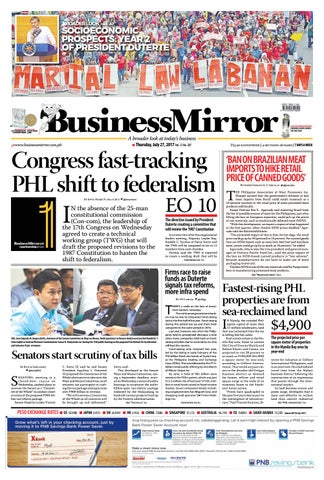
n the absence of the 25-man constitutional commission (Con-com), the leadership of the 17th Congress on Wednesday agreed to create a technical working group (TWG) that will draft the proposed revisions to the 1987 Constitution to hasten the shift to federalism.
‘BAN ON BRAZILIAN MEAT IMPORTS TO HIKE RETAIL PRICE OF CANNED GOODS’
EO 10
The directive issued by President Duterte creating a committee that will review the 1987 Constitution
In an interview after the congressional leaders meeting, Majority Leader Rep. Rodolfo C. Fariñas of Ilocos Norte said the TWG will be composed of six to 12 members from each chamber. Fariñas said the TWG is expected to create a working draft that will be Continued on A2
Firms race to raise funds as Duterte signals tax reforms, more infra spend By VG Cabuag
@villygc
T
Sotto said. This developed as the Senate Ways and Means Committee, eyeing a September deadline, started on Wednesday a series of public hearings to scrutinize the multibillion-peso tax-reform package endorsed by the Malacañang to bankroll various projects lined up by the Duterte administration. See “Tax bills,” A2
Continued on A2
Senators start scrutiny of tax bills By Butch Fernandez
S
@butchfBM
enators, meeting in a c l o s e d - d o o r c au c u s o n Wednesday, pushed plans to convene the Senate as a “Committee of the Whole” to conduct closer scrutiny of the proposed P900-billion tax-reform package. Senate Majority Leader Vicente
C. Sotto III said he and Senate President Aquilino L. Pimentel III proposed the Committee of the Whole alternative to take over the Ways and Means Committee, so all senators can participate in crafting the tax package aiming to raise over P900 billion in revenue. “We will convene a Committee of the Whole so all concerns will be brought up and addressed,”
PESO exchange rates n US 50.6980
T
By Jasper Emmanuel Y. Arcalas
@jearcalas
he Philippine Association of Meat Processors Inc. (Pampi) warned that the government’s decision to ban meat imports from Brazil could result inasmuch as a 15-percent increase in the retail price of some processed-meat products sold locally. Pampi Director Rex E. Agarrado said removing Brazil from the list of possible sources of meat for the Philippines, just after lifting the ban on European exporters, could jack up the prices of raw materials, such as mechanically deboned meat (MDM). “With this development, we expect a repeat of what happened in the first quarter, when chicken MDM prices doubled,” Agarrado told the BusinessMirror. “The estimated impact of this is that, for hot dogs, the retail price could go up by 10 [percent] to 15 percent. For canned goods that are MDM-based, such as meat loaf, beef loaf and luncheon meat, prices could go up by as much as 10 percent,” he added. Agarrado, who is also the vice president and general manager of Century Pacific Food Inc., said the price impact of the ban on MDM-based canned products is “ less adverse”, because manufacturers do not have to make use of more packaging materials. Chicken MDM is one of the raw materials used by Pampi members in manufacturing processed-meat products. See “Brazilian meat,” A12
HERE’S a smile on the face of investment bankers nowadays. The mirth among investment bankers may be due to companies’ fund-raising tack in the first half of the year. Fund-raising during this period was up and more brisk compared to the same period in 2016. Last year, however, was when the Philippines held its presidential elections, a time when many companies hold back on fundraising activities due to uncertainty on who will lead the country. Fund-raising only resumed this year, led by the listing in early February of the P10-billion fixed rate bonds of Ayala Corp. at the Philippine Dealing and Exchange Corp. (PDEx). This was followed by the P7.5billion initial public offering by end-March of Wilcon Depot Inc. By June, a total of P82 billion were raised at the PDEx system, which was just P23.3-billion shy of last year’s P105.3 billion in total funds raised at fixed income market. Seven companies listed, including conglomerates San Miguel Corp. and shopping mall operator SM Prime Holdings Inc.
Sen. Juan Edgardo M. Angara (left), chairman of the Senate Committee on Ways on Means, fields questions to Finance Undersecretary Karl Kendrick T. Chua (right) as Internal Revenue Commissioner Caesar R. Dulay looks on during the 11th public hearing on the proposed Tax Reform for Acceleration and Inclusion Train. ROY DOMINGO
business news source of the year
P25.00 nationwide | 4 sections 28 pages | 7 days a week
Congress fast-tracking PHL shift to federalism By Jovee Marie N. dela Cruz
2016 ejap journalism awards
Fastest-rising PHL properties are from sea-reclaimed land
I
n Manila, the crowded Philippine capital of more than 12 million inhabitants, land that was reclaimed from the sea is selling like hot cakes. Real-estate values in the Manila Bay area, home to casinos like City of Dreams Manila and Solaire Resort and Casino, are projected to rise 30 percent to as much as P250,000 ($4,900) a square meter by year-end, according to Colliers International. That would surpass values in the decades-old Ortigas business district as demand for homes, offices and retail spaces surge in the wake of an economic boom in the Southeast Asian nation. “Prices have quadrupled in the past five years due in part to the convergence of infrastructure,” Paul Vincent Ramirez, di-
$4,900
The projected price per square meter of properties in the Manila Bay area by year-end
rector for valuation at Colliers International Philippines, said in an interview. He cited reduced travel time from the Makati business district following the construction of an expressway that passes through the international airport. As land becomes scarcer and prices surge, developers find it more cost-effective to reclaim land than convert industrial See “PHL properties,” A2
n japan 0.4531 n UK 66.0494 n HK 6.4926 n CHINA 7.5086 n singapore 37.2232 n australia 40.2339 n EU 59.0834 n SAUDI arabia 13.5205
Source: BSP (26 July 2017 )
A2 Thursday, July 27, 2017
BMReports BusinessMirror
www.businessmirror.com.ph
Congress fast-tracking PHL shift to federalism Continued from A1
deliberated upon by Congress when it convenes into a constituent assembly (Con-ass). Earlier, Speaker Pantaleon D. Alvarez said the 17th Congress will convene as Conass early next year. “We are going to prioritize the rev ision of the Constitution. We discussed that if we cannot wait for the constitutional commission being created by the President, both Houses of Congress will form a technical working group to present proposed amendments or revisions to the Constitution,” Fariñas said. “The technical working group will be the one to make inputs for us to have a working draft that we are going to deliberate when Congress convenes into a Constituent Assembly,” he added. Last December, President Duterte sig ned E xec ut ive O rder 10, c reat ing a committee that will review the Constitution. The committee will be composed of 25 different experts from the country. All amendments to the 1987 Constitution are expected to be drafted by the Con-ass. However, President Duterte has yet to name members of the body.
But House Committee on Constitutional Amendments Chairman and PDPLaban Rep. Roger Mercado of Southern Leyte said the lower chamber has already conducted its information campaign on the proposal shifting the country’s form of government from presidential to a federal system through Con-ass. Mercado said the campaign seeks to educate the public on the workings and benefits of federal system. He also said the measure filed in the lower chamber limits its scope on the mode of Charter Change, which is Con-ass. Con-ass is cheaper compared to the estimated P8 billion that will be spent for a constitutional convention. Mercado said the manner of voting, which may be done separately by the House and the Senate, can be introduced as an amendment to the measure during the plenary proceedings. Since the proposal is in the form of a bill, Mercado said the process is that after the House passes the measure, it will be submitted to the Senate. T hen if it w i l l be approved in t he S e n at e , t he re w i l l b e a b ic a me r a l conference. A f ter t hat, t he bi l l w i l l be subm it ted to t he P resident for his approva l.
Common bills
The leadership of the House of Representatives and the Senate also identified 38 measures that will be passed in to law during the second regular session of the 17th Congress. Fariñas said leaders of the both chambers have agreed to pass these measures into law after their meeting on Wednesday. Present during the meeting are Senate President Aquilino L. Pimentel III, Majority Leader Vicente C. Sotto III, Minority Leader Franklin M. Drilon, Alvarez, Fariñas, Minority Leader Danilo Suarez and House Committee on Ways and Means Chairman Dakila Carlo E. Cua of Quirino. The measures that will be approved by the both houses of Congress this month until October are: ■ Amendment to Republic Act (RA) 8178, or the Agricultural Tariffication Act. Amending RA 8178 is needed to scrap the quantitative restriction and convert it into tariffs; ■ Amendments to Government Procurement Reform Act to allow negotiated procurement “before, during, or after a calamity”; ■ The proposed Agrarian and Agricultural Credit Condonation Act; ■ The National Land Use Act, which
would seek to classify land use into four functions: protection of land, productionland use, settlements development and infrastructure development; ■ The first package of the Comprehensive Tax Reform Program (CTRP), which was already approved by the House ■ Traffic and Congestion Crisis Act; ■ End of Contract/Anti-Contructualization Act; ■ Salary Standardization Law IV; ■ Ease of Doing Business Act/Fast Business Permit Act; ■ Corporation Code of the Philippines ■ Bill that would prohibit the conversion of irrigated lands; ■ National ID System; ■ Enhanced Universal Health Care Act; ■ Estate Tax Reform Act; ■ Social Security Act Amendments; Coconut Farmers and Industry Development Act; ■ Allowable/Recoverable System Loss Act (electricity); ■ Community Service in lieu of Imprisonment for the penalty of arresto menor; ■ Free School Feeding/Pagkaing Pinoy para sa Batang Pinoy Act; ■ One Town: One Doctor Act; ■ Expand Coverage of Local Absentee Voting Act;
■ Family Code of the Philippines Amendment (default property regime: complete separation of property); ■ Amendment of Fair Election Act; ■ Antiterrorism Law (National Security Act); ■ Antihazing law amendments; and ■ Proposal creating the Department of Disaster Response (Public Safety). ■ Measures that will be approved between November and December are amendments to Public Service Act; ■ Bill creating the Department of Housing and Urban Development; ■ Anti-Discrimination Act; ■ Unified Uniformed Personnel Benefits; and ■ Pension Reform Act and criminal Investigation Act. In Januar y to March 2018, both houses are eyeing to approve a measure requiring legislative franchise for operating railways; a bill creating the Mindanao Railway Corp./Authority; and a measure extending the corporate life of the Philippine National Railways to another 25 years. Also identified as priority bills are the proposed revisions to the Constitution and Bangsamoro basic law and minimumwage law.
Firms race to raise funds as Duterte signals tax reforms, more infra spend For the equities market, a total of P107 billion were raised, including the follow-on offering of lenders BDO Unibank Inc. and China Banking Corp. and of fruit canner Del Monte Pacific Ltd. Adding to the kitty were proceeds from the initial public offering of three firms. The funds raised from these trading activities were almost double compared to the P56 billion fetched at the PSE last year.
the year that resulted to more fund raising activities. Still, Ocampo, FMIC’s executive vice president, said the market is still liquid, making it a right time for firms to raise funds during the second half. “For bond issuers, we see that it’s still a very good time to tap the fixed-income market while we anticipate an upward inclination for rates but it’s pretty much benign,” he said. However, there came a curve ball from the economic team of President Duterte.
Curve ball
Recalculating mode
Continued from A1
COMPANIES are racing to raise money as interest rates started to rise likewise with the US’s as the economy of the world’s largest economy showed signs of recovery. According to data from First Metro Investments Corp., coupon rates for the five-year debt paper increased to 5.0449 percent 93 basis points higher than last year’s 4.1133 percent. The seven-year paper also increased to 5.2463 percent from last year’s 4.59 percent, while the 10-year debt rose to 5.4931 percent from 4.6334 percent. According to Justino Juan Ocampo of investment bank FMIC, there were predictable “moving parts” during the first half of
THE Duterte administration has proposed to use more of the official development assistance (ODA) on many infrastructure projects. “The fact remains that we have an infrastructure deficit in this market,” Ocampo said. “We anticipate, however, that with a new model, with a hybrid PPP [publicprivate partnership] model, conglomerates are in recalculating mode. This is like Waze [a traffic application in mobile phones]; this is like recalculating, navigating where to go with a new paradigm.” It may still be a liquid market but FMIC, which has been active in major fund-raising deals in the country, believes there should
be more creativity on how to package and raise money to bankroll a project. Conglomerates may now be looking at unsolicited proposals or PPPs in partnership with the local government units. “Also in terms of creativity, probably for private sector like us, maybe there could be room to explore equity,” Ocampo said. He cited as example an infrastructure fund “where you could put together a consortium of infrastructure inclined companies or groups to take part in the infrastructure growth.” “And as conglomerates, we anticipate growing in existing infrastructure assets in terms of mergers and acquisitions.” Ocampo added. “There could be consolidation and acquisitions.”
Better scheme
FOR Dante Tinga Jr., BDO Nomura’s senior vice president and head of research, the ODA approach to fund infrastructure projects maybe a better scheme. “We’re not talking about building projects in the most efficient and cost effective way, right? We’re talking of building projects quickly,” Tinga told the BusinessMirror. “The government had always borrowed cheaper than the private sector. The
government doesn’t have to worry that these projects have adequate rates of return. The government doesn’t have to worry about regulatory risks. Those are the three things that are problematic in PPPs.” Tinga explained this is different with the private sector. “They have their own shareholders to worry about. The shareholders will demand that these projects will get their rates of their return, that projects be protected from regulatory risks,” he said. “So in general, everything else equal, ODAs will get projects built faster because government funded [these] cheaper.” Tinga said investors are willing to invest in the Philippines because of the long-term growth prospects of the country.t “When we go to clients, we have to provide them good growth stories. The Philippine index is trading at a priceearnings multiple that is higher than other parts of Asia. The simple message here is Philippines is not cheap. That’s one problem we have when pitching ideas to clients,” Tinga added. “They like the growth story for Philippines but they worry about the valuation.” Stock price, in relation to its earnings
ratio or multiples, is the typical valuation that investors use when they look at stocks to invest in.
Tax and investments
PART of bankers’ pitch to investors is the ability of the Duterte administration to pass the Tax Reform for Acceleration and Inclusion (Train) bill. “With regards to the impact on stocks, we generally take a conservative view on outlook for Philippine equities,” Tinga said. “We have yet to assume the implications of tax reform and accelerating infrastructure spending in our numbers.” Tinga recommends investing on property firms, mid-cap companies, smallcap consumer firms, conglomerates and industrials if tax reform ensues. Meanwhile, Cristina Ulang, assistant vice president and head of research of FMIC, picked conglomerates as her stock pick saying these offer higher dividends. “We like the banking industry, because GDP is strong, loan growth is strong and running at 20 percent and it is expected to be sustained in two years’ time,” Ulang said. “So the banks are going to benefit from a very strong economic growth.”
Tax bills. . .
Continued from A1
Under scrutiny by the committee chaired by Sen. Juan Edgardo M. Angara are various administrative reforms embodied in House Bill 5636, also known as Tax Reform for Acceleration for Acceleration and Inclusion. These include: mandatory fuel marking and monitoring system to curb oil smuggling; mandatory issuance of electronic receipts for transactions above P25; mandatory interconnection of large and medium firms through the use of cash register machine/ point-of-sale machine of all establishments with the Bureau of Internal Revenues (for real-time reporting of sales and purchase data); mandatory use of Global Positioning System locks when transporting cargo from ports to economic zones and free ports; and relaxation
of bank-secrecy laws for fraud cases. Angara said he is looking to wrap up a committee report endorsing the tax package for plenary debates in the Senate by September. He intends to conduct public hearings on the money measure “twice a week, if necessary”. “Although that may be difficult, I think, we are acceding to President Duterte’s request for Congress to tackle the bill and make it a priority,” Angara told reporters. “We will have to see,” he added, noting that the House of Representatives already passed amendments relaxing bank secrecy in certain cases. The senator explained his committee is looking to craft “not just a new tax measure but one that will also ensure its efficient administration and tax collection .” Angara added that the committee will also “take a closer look at the details of the tax proposals so it won’t be just a new tax but administration of tax reforms”.
PHL properties. . . estates for mixed-use development, Ramirez said. Among the five major reclamation developments in the bay area is the 407-hectare New Manila Bay City Pearl project of UAA Kinming Group Development Corp. and its foreign partners. The project will feature a driver-less monorail, an 8,000-seat multipurpose stadium and an 18-hole golf course, according to Colliers. Another proponent, Manila Goldcoast Development Corp., is embarking on a P24-billion project that will reclaim 148 hectares and develop the land into an entertainment hub that will house the country’s first
Continued from A12
international cruise-ship terminal. Companies in industries from business-process outsourcing to advertising, construction and online shopping are expanding in the Philippines as the economy grows more than 6 percent, among the fastest in the world. Office-space vacancies in the Makati City and Fort Bonifacio business districts stood at 1 percent to 3 percent, according to Colliers. While reclaimed land prices in Manila Bay are now as much as 15 times the cost of land reclamation, they’re still 40 percent cheaper than in nearby business districts. Bloomberg News
Our heartfelt greetings to the
IGLESIA NI CRISTO ON ITS 103
RD
ANNIVERSARY
JULY 27, 2017 Greetings from
CABANGON FAMILY ALC GROUP OF COMPANIES
Economy
A4 Thursday, July 27, 2017 • Editors: Vittorio V. Vitug and Max V. de Leon
BusinessMirror
DENR chief vows ‘strict’ enforcement of mining law
A
By Jonathan L. Mayuga
@jonlmayuga
pparently taking the cue from President Duterte, Environment Secretary Roy A. Cimatu on Tuesday vowed to prioritize environmental protection over mining interest. In a news statement released on Wednesday, Cimatu said Duterte made a very strong point in his second State of the Nation Address (Sona) with his pronouncement that the protection of the environment must be made a priority over benefits derived from mining. “I know for a fact that, in a number of cases, weak and irresponsible mining practices result to environmental destruction, contaminating farmlands and poisoning our rivers and seas. Miners better refrain from despoiling our watersheds, forests and aquatic resources,” Cimatu said. To ensure responsible mining, he said the DENR will strictly enforce mining and environmental laws. M i n i n g o p e r at ion s fou nd violating laws, rules and regulations, Cimatu added, would
have to pay the price for dama ges c au sed , through payment of fines, suspensions or outr ight closure. Mo r e o v e r, he said, listed cimatu officials will also be held responsible for inimical acts committed by an association, corporation or partnership, ranging from penalty or imprisonment, at the discretion of the courts. According to Cimatu, mining in the Philippines can only be responsible if the development of the country’s mineral resources will be on the basis of technical feasibility, environmental sustainability, cultural and social acceptability, and
financial viability. The absence of one will not render a mining project as responsible. The Chamber of Mines of the Philippines (COMP), which represents the local mining industry’s big players, earlier welcomed Duterte’s Sona pronouncement against “irresponsible” mining. Through its vice president for policy and legal, the mining chamber, however, said the current mining law is enough to promote responsible mining although it respects Duterte’s pronouncement supporting the enactment of a new mining law. “We share the President’s frustration against illegal-mining practices and support his desire for mining companies to be responsible in paying taxes as
stewards of the environment,” Recidoro said. COMP has consistently vowed to support the Duterte administration and its policy to promote responsible mining, even as the chamber was at loggerheads with environmental advocate and former Environment Secretary Regina Paz L. Lopez. The chamber strongly opposed Lopez’s appointment before the bicameral Commission on Appointments leading to her rejection in May. COMP is now hoping for Cimatu to reverse Lopez’s controversial policy declaration and orders, including the closure and suspension orders of 28 large-scale mines, 75 minerals production sharing agreement, and ban on open-pit mining method.
I know for a fact that, in a number of cases, weak and irresponsible mining practices result to environmental destruction, contaminating farmlands and poisoning our rivers and seas. Miners better refrain from despoiling our watersheds, forests and aquatic resources.”—Cimatu
news@businessmirror.com.ph
Cimatu pushes for ‘stronger’ Asean cooperation on environment, people
T
he country’s top environment official on Wednesday called for stronger cooperation among member-countries of the Asean, which is home to more than 600 million people. In a statement issued for the ongoing 28th meeting of the Asean Senior Officials of the Environment (Asoen) at the Philippine International Convention Center (PICC) in Pasay City from July 23 to 29, Secretary Roy A. Cimatu of the Department of Environment and Natural Resources (DENR) urged member-countries “not to lose sight” of the fact that environmental protection and conservation is “not for their own sake, but for our people to live better lives in harmony with nature”. The Asoen meeting is in preparation for the high-level Asean Ministers’ Meeting on the Environment to be held in the country in September, as part of the Philippines’s chairmanship and hosting of the Asean Summit this year. The event coincides with the 50th founding anniversary of the regional intergovernmental organization. “We cannot protect the environment and not protect life. Let us give our children a world better than we found and what we have,” Cimatu said. The Asean collectively comprise the seventh-largest economy in the world with a combined population of 600 million people, a situation that, according to Cimatu, “exerts considerable challenges in providing clean air, clean water and ecological management of solid waste”. Cimatu said the 10 countries comprising the Asean now face common problems on air and water quality, ecological management of solid waste, forest degradation, reduced water supply and biodiversity loss, among other environmental issues. “Like haze and forest fires and illegal trading in wildlife, they do not stop at national borders,”
said Cimatu, a former chief of staff of the Armed Forces of the Philippines. “We share the air that we breathe, the seas around us, our forests, and the animals that travel across our countries,” he stressed. According to Cimatu, the population pressures also put to test the sustainable use of the region’s rich natural resources. The region’s environmental problems, which transcend political and territorial boundaries, can best be solved through cooperation, sharing of experiences and expertise, and joint efforts between and among Asean member-states, he said. Hence, he added Asean is vital in resolving environmental concerns, which have grown in magnitude and complexity over time, to include biodiversity loss, sustainable cities, chemical and waste, water resources, coastal and marine resources, climate change and haze pollution.” The DENR chief also underscored the need for Asean member countries to work together in coping with climate change, which he described as the “most pervasive of all the environmental problems in the region”. He cited the environmental group Germanwatch’s Global Long-Term Climate Risk Index that named four Asean members— Myanmar, Vietnam, Thailand and the Philippines—as among the 10 countries in the world most affected by extreme weather events from 1995 to 2014. “This underscores the urgency of the situation we face,” Cimatu said. Southeast Asia is rich in biodiversity. It is home to 18 percent of all known plant and animal species on Earth that are unique to the region and cannot be found anywhere else. Southeast Asia also boast of almost one-third of the planet’s coral reefs and 35 percent of all mangroves. The region’s forest cover is 48 percent of its land area. Jonathan L. Mayuga
Imee not off the hook yet Commissioners on fund-diversion case to Palace: Fire Salazar from A top ERC post fter giving “elusive and unsatisfactory” answers, Ilocos Norte officials, led by Gov. Imee R. Marcos, will be subjected to another round of congressional questioning in the next hearing of the House Committee on Good Government and Public Accountability on August 9, leaders of the lower chamber said on Tuesday. House Committee on Good Government and Public Accountability Chairman Johnny Pimentel of Surigao del Sur and House Committee on Justice Chairman Reynaldo Umali of Oriental Mindoro said Marcos may have been afflicted with “amnesia” herself. The six employees of the provincial government office, dubbed as the Ilocos 6, finally admitted during a congressional probe they were aware of cash advances amounting to P66.45 million to procure 115 vehicles for the province using proceeds from excise taxes on Virginia-type cigarettes. During the hearing, Marcos said she could not remember details of the transactions, saying she was not particular about the dates in the documents presented during the investigation. “While the provincial capitol officials dubbed in the media as the ‘six amnesiacs’ had suddenly regained…[their] memory one after the other in the course of Tuesday’s hearing, it was the turn of Governor Marcos to be surprisingly afflicted with amnesia in claiming to have forgotten details of the transactions whenever committee probers had pointed out violations of Republic Act [RA] 7171, and of the Commission on Audit’s [COA] procurement rules,” Pimentel said. For his part, Umali said, “this makes Governor Marcos the ‘amnesia queen’ in this narrative on the highly irregular purchase of P66.45 million worth of vehicles in violation of RA 7171 and COA Circular 98-382.” Also, Marcos said she could not remember details of the transaction and trusted the employees of the provincial office to follow the right procedures. “I did not notice any irregularity. We were just trying to speed up the purchase since our farmers are in urgent need of their own vehicles,” Marcos said. Meanwhile, despite the release of Ilocos Six, Marcos still has a lot of explaining to do, Pimentel said. He said his committee will conduct another hearing next month to continue its investigation into the alleged irregular procurement of P66.45 million worth of vehicles by the provincial government. “The release of the six officials does not mean that we are already terminating the proceedings. We will have another hearing on August 9 because there are still many questions that need to be answered,” Pimentel said. Marcos made her appearance before the House of Representatives on Tuesday after receiving a subpoena for repeatedly snubbing the House panel’s previous invitations. Six provincial executives were detained at the lower chamber since May 29 “for their contemptuous act of giving evasive answer, tantamount to refusal to answer” questions about the money meant for the benefit of tobacco farmers, but supposedly misused as cash advances for thee purchase of motor vehicles sans the benefit of public bidding. These six Ilocos Norte provincial officials in the House probe are Josephine Calajate, Ilocos Norte’s provincial treasurer; Encarnacion Gaor and Genedine Jambaro, both working at the Provincial Treasurer’s Office; Evangeline Tabulog, the provincial budget officer; Eden Battulayan, OIC-accountant; and Pedro Agcaoili, chairman of the Bids and Awards Committee and the Provincial Planning and Development Office. Jovee Marie N. dela Cruz
By Lenie Lectura
T
@llectura
he four commissioners of the Energy Regulatory Commission (ERC) have asked Malacañang to remove the agency’s chairman, who had been placed on a 90-day preventive suspension from office. ERC commissioners Alfredo Non, Gloria Victoria Yap-Taruc, Josefina Patricia Magpale-Asirit and Geronimo Sta. Ana formally asked the Office of the President to order Jose Vicenter Salazar’s removal from office with finality. “Respondent Salazar ought to be found guilty of charges mentioned in his suspension order and, as a consequence, should be removed from office,” the commissioners said in their 42-page formal reply to Salazar’s comments on the administrative charges filed against him. “His actions and utter disregard for the rule of law placed the ERC in chaos, its operations extremely jeopardized with the problems brought about by the irregular procurements and illegal appointments,” the commissioners’ filing dated July 3 stated. The commissioners, when sought for comment, on Wednesday affirmed that they submitted their formal reply to the Office of the Executive Secretary. “The ERC commissioners have submitted the pertinent and relevant documents to the Office of the Executive Secretary. In this regard, the commissioners defer to the sound discretion of the Office of the President in its exercise of authority over the ERC to address and resolve the issues. In the meantime, and despite administrative challenges, the ERC assured all stakeholders that it will remain focused on performing its responsibilities and functions in fulfilling its mandate under the Epira,” they said. Salazar came under fire when he was linked to the death of ERC director Francisco Villa, who took his own life last November 9. Villa accused Salazar of preselecting a bidder to undertake an audio-visual presentation project. The commissioners initiated an internal inquiry after Salazar went on a personal leave for a month. However, the inquiry did not sit well with Salazar, who confronted the commissioners and demanded to stop the said inquiry. This strained the relationship between the commissioners and Salazar.
Agriculture/Commodities BusinessMirror
news@businessmirror.com.ph
Editor: Jennifer A. Ng • Thursday, July 27, 2017 A5
DA to probe sale of smuggled carrots Govt extends SURE loans to farmers in Marawi City
T
he Department of Agriculture (DA) has provided P10 million worth of “Survival and Recovery” (SURE) loans to farmers and fishermen in Marawi City who are adversely affected by the continuing firefight between government security forces and local terrorists. Agriculture Secretary Emmanuel F. Piñol said the DA is also planning to seed the 35,000-hectare Lake Lanao, which straddles the city, with 5 million indigenous fish fingerlings. The DA turned over P10 million on July 22, the DA chief said, in a bid to spur recovery of local farmers and fishermen from economic losses inflicted by the battle to flush out ISIS-linked terrorists from the city. The turnover was led by Agriculture Undersecretary Ranibai Dilangalen, Piñol said in a statement. Each Marawi farmer identified by the regional DA office could avail himself or herself a loan of P25,000 at zero interest, of which P5,000 has already been distributed to farmers, according to Dilangalen. “The DA is the first agency to distribute cash relief to the
Marawi farmer-evacuees under the Task Force Bangon Marawi approved by President Duterte for the recovery of Marawi,” Dilangalen said. The DA also delivers weekly relief goods to the Departments of Social Welfare and Development and the Department of the National Defense (DND) for distribution to evacuees from the city and soldiers battling the insurgents, Piñol said. He said the DA expects to receive a fresh donation of 100,000 ready-to-eat halal food packs from Ana’s Breeder Farm, owned by the Suy family of Davao City, for distribution to the affected farmers and soldiers. The Suy family has already made an initial donation of halal-certified food packs. The DA has coordinated with the DND to identify the safe and best area in Lake Lanao to sow the fingerlings, Piñol said. “Most fishermen in Lanao del Sur and Marawi are currently unable to fish in the lake because of security concerns.” Piñol said the DA would also distribute 500 new fiberglass fishing boats to fishermen in Lanao del Sur.
T
By Jasper Emmanuel Y. Arcalas @jearcalas
he Department of Agriculture (DA) will investigate the sale of carrots believed to be smuggled from China after Agriculture Secretary Emmanuel F. Piñol made a surprise inspection of a market in Batangas. Piñol on Wednesday said he found Chinese carrots being sold in Tanuan City, Batangas, at a “very low” price of P35 per kilogram. He added that traders may have been able to bring in the carrots by misdeclaring their cargo. “When I confronted the young Chinese trader where he got the carrots, he said it came from importers in Nueva Ecija. I assume that the volume is not small because it reached Tanuan,” he said in his Facebook post on July 26. “There could only be one explanation and that is smuggling,” he added. Piñol said he has already instructed DA officials to conduct an investigation into the presence of smuggled carrots in local markets. Currently, traders are not allowed to source carrots from China. “I assure our farmers that heads will roll. If Bureau of Plant Industry [BPI] officials or other agriculture officials are involved, I will make sure they will be punished severely,” he said.
BPI Officer in Charge Vivencio R. Mamaril said it is “highly probable” that the carrots discovered by Piñol were smuggled, as the Philippines buys it only from the US and Australia. “We do not import carrots from China because it is prohibited. As of now, China is not included in the list of countries allowed to export to us,” Mamaril told reporters in an interview. Currently, Mamaril said four local trading firms import as much as 500 kilograms of carrots from the US and Australia. He said these are sold and distributed to institutional customers, such as hotels, restaurants and airline companies. “The port of arrival of all imported carrots is the Ninoy Aquino International Airport, which means the cargo is delivered by plane, so the landed cost is high,” he said. “Because if those imports were transported via plane and underwent clearance procedures, will a businessman sell that at P35 per kg? That’s too low. So our assumption is that
the carrots were smuggled,” he added. Mamaril said the carrots believed to be sourced from China entered the Philippines with import clearances from the BPI, as it was not declared as an agricultural product. He said the BPI will start investigating the matter by meeting with the four local importers of carrots. “We will also check the actual arrival of imports. We’re already gathering the data of all the
carrots that arrived.” As of the first week of July, the prevailing retail price of carrots in the National Capital Region and Region 4 is at P50 per kg, according to data from the Philippine Statistics Authority (PSA). PSA data also showed that the country’s carrot production in 2016 declined by 1.56 percent to 65,986.86 metric tons (MT), from 67,036.96 MT recorded in 2015.
TheBroa Socioeconomic prospects: Y
Business
A6 Thursday, July 27, 2017
By Dr. Rene E. Ofreneo | Special to the BusinessMirror
T
HE popularity of Asia’s newest and most colorful strongman keeps soaring. The Social Weather Station (SWS) reported that 78 percent of the population gave President Duterte positive satisfactory rating in June 2017; Pulse Asia, SWS’s rival in public opinion polling, submitted an even higher percentage: 83-percent approval and trust rating. These figures have stunned and puzzled the Filipino and foreign critics of the President and his “war on drugs”. The war, carried out by the police force and a shadowy group of antidrug vigilantes, has resulted in thousands of killings, both legitimate and “extrajudicial”. Most of the victims come from poor families who can ill afford to seek legal redress. But why is Duterte highly popular among the masses? The reasons are not difficult to find. First, the drug war has brought peace of mind for the non-drugusing majority in most communities. Second, he has created the image of an honest leader working hard for his people as reflected in his non-ostentatious lifestyle, his visits to injured soldiers and police in various camps and his trips to various Asian countries to promote trade relations and strengthen protection for the Overseas Filipino Worker (OFW) communities. Third, his irreverent language, outlandish jokes and endless curses against the “enemies” of the state are endearing to a large majority of the public. Even the perfumed members of Congress were so enthralled at the manner the President delivered his second State of the Nation Address (Sona), uttering expletives every now and then in a two-hour reporting on his administration’s achievements and plans, war on drugs, Marawi crisis and the rationale for martial law in Mindanao and so on and so forth. Fourth, he is seen as a graftbuster who does not allow friendship to stop or sway his campaign against corruption. In fact, he did not think twice in firing very close associates because of their reported involvement in some shady business transactions. Finally, the economy also happens to be cooperative. GDP growth for 2016 was 6.8 percent. This sustains the high GDP growth rate for 2010 to 2015, which averaged 6.2 percent and which puts the Philippines in the Asian league of dynamic economies that includes China, India and Vietnam. Statistics on employment tend to support these data on GDP growth. The Philippine unemployment rate, one of the highest in Asia, went down from 6.3 percent in 2015 to 5.5 percent in 2016. This is projected to go down further to 4 percent in 2017. So what are the social and economic prospects for the Philippines in the next five years of the Duterte administration? Some areas are worth examining.
Dividends from an ‘independent foreign policy’
INSTEAD of stopping Duterte in prosecuting the war on drugs, the criticisms by the US and the Eu-
ropean Union (EU) provided the President a platform to launch his “independent foreign policy”. His public rants against the USEU tandem were accompanied by his friendly gestures toward China and Russia, the traditional “enemies” of the Philippines during the Cold War era of the 1950s to 1970s. In pursuing warmer relations with China, Duterte set aside an international arbitral ruling issued by The Hague declaring that China has no historic title and sovereignty over the disputed islands and waters separating China from the Philippines and other Asian countries, notably Vietnam and Malaysia. In return, China rewarded Duterte with pledges worth $24 billion in deals, promised assistance in building a railway system in Duterte’s home island of Mindanao and announced China’s readiness to buy more products from the Philippines. As to Russia, the President enthusiastically welcomed the visit of Russian naval ships in the Philippines. He went to Moscow in May to ink trade agreements on oil, agriculture and purchase of munitions, as well as promotion of tourism. Not to be outdone by China, Japan, the country’s largest source of official development assistance (ODA), offered to fund a number of big-ticket infrastructure and development projects. Japan pledged $8.8 billion to support three major rail projects in congested Luzon. In January Japan Prime Minister Shinzo Abe had a friendly twoday visit in Duterte’s home city of Davao, during which he was given a tour of Duterte’s modest house by the President himself. Duterte’s livid curses against the US and EU did not affect the level of trade the Philippines has with them, except for reports that some American and European would-be investors have shied away from the Philippine market. There are no reports of American and European divestment. Moreover, US President Donald J. Trump’s threat to bring back outsourced jobs to America has not stopped the continuing expansion of the Philippine call-center and business-process outsourcing (BPO) sector. The BPO sector is fueled largely by the A mer ican, European and Australian demand for the numerous outsourced information and communications technology (ICT)-based services the industry provides, such as payroll, accounting, reservations, telemarketing and so on. New BPO buildings in “new wave” cities or ICT sites in the archipelago keep on sprouting. The sector employs roughly 1 million Filipinos and has not stopped hiring. Finally, Duterte took his job as the chairman of the Asean for 2017 with great enthusiasm. He
renewed ties with all the Asean member-states by personally visiting each country, renewing government-to-government ties and meeting with the communities of OFWs based in the region. He has also maintained high visibility in the various activities lined up by the Asean bloc, which is marking its 50th this year. In summary, there is more than a grain of truth in the observation in a magazine editorial: “In foreign policy, it seems it pays to quarrel with your longtime friends and allies and to make friends with what were once perceived to be your enemies.”
Drivers of Philippine growth process
NONETHELESS, it cannot be denied that the main drivers of economic growth are still the OFW remittances and the callcenter/BPO sector. Both continue to grow despite Trump’s “America First” policy, the Brexit crisis in the United Kingdom, the rising xenophobia in the EU and the tensions in the divided Middle East. Proof No. 1: The Philippine balance of trade continues to be in the red. The country imports more than it exports every year. And yet, the country’s gross international reserves keep growing and now amount to $12 billion, enough to cover a year’s imports. Proof No. 2:Growth continues to be consumption-led. A study by nonprofit group Labor Education and Research Network shows that consumption accounts for the bulk of the GDP. Who then does the consuming? The OFW families and the call-center/BPO workers. The latter gets compensation higher than the minimumwage earners. A nd where do the bu lk of consu mpt ion good s, suc h a s personal and household items, come from? Imports. In short, the structure of the economy is still basically dependent on two legs: OFW remittances and call-center/BPO earnings. The capacity to consume of Filipino families connected to these two legs keeps growing year by year. This is spurring the growth of service industries. This has not escaped the attention of the Japanese International Cooperation Agency (Jica), which is advising the Philippines to develop industries tied to the growing purchasing power of the rising Filipino “middle class”.
Neda’s long-term vision
ECONOMIC pessimism is in short supply in the Duterte administration. In a Social Development Summit in Davao last year, the National Economic Development Authority (Neda) formally declared that the Philippines shall barge into the ranks of developed countries by 2040. Accordingly, the 2016 per capita GDP of $3,500 shall rise to $4,100 in 2022 and, eventually, to $12,000 by 2040. Poverty shall be reduced to 14 percent by 2022 from the present 21.6 percent. By 2040, extreme poverty shall be just a bad memory. AmBisyon 2040 means the Philippines shall become a middleclass society by 2040. In turn, a middle-class family is defined as one with at least one family car, a medium-sized house of their own, college education for the children and a decent living standard. However, environmentalists question the harsh impact if every Filipino family shall have a car or two. As it is, the country is drowning in the pollution caused by carbon-emitting vehicles of all types. A Jica study put the daily economic loss from traffic conges-
tion at P2.4 billion in 2012 (now estimated to be over P3 billion daily). The nightmarish traffic, in turn, is rooted in the absence of an efficient and affordable public mass-transport system. The bigger question, however, is how would the Philippines attain the developed country status. To note, the World Bank has declared the Philippines as a middle-level developing country as far back as 1975. Today, it is still a middle-level developing country. It has been bypassed in the development process by its neighbors— first by Japan in the 1960s, then by the original Asian tigers (Hong Kong, Singapore, South Korea and Taiwan) in the 1980s, followed by China, Malaysia and Thailand in the 1990s. The Philippines has been caught in what the Asian Development Bank (ADB) calls the “middle-income trap” for over four decades.
More CCT, economic liberalism and infra spending
AS the foundation for AmBisyon 2040, the Neda crafted a 300page Philippine Development Plan (PDP) 2017-2022, which amplifies the original 10-point socioeconomic agenda released by the administration in 2016. In essence, the agenda and the PDP preach continuity from the previous PDP 2011 to 2016. Under the PDP of the Aquino administration, growth was anchored on how to maintain the macroeconomic framework that promotes openness in the economy based on continuing adherence to the structural adjustment program (SAP), introduced by the World Bank in the 1980s, and to the various trade and economic liberalization commitments of the country to the World Trade Organization (WTO), Asean Economic Community and a number of regional and bilateral free-trade agreements. To hasten the growth process, the Aquino administration’s technocrats pushed for the more forceful promotion of privatization. They sought not only the privatization of public services and government assets but also the greater involvement of big private corporations in infrastructure construction and maintenance. Hailed as public-private partnership (PPP), the infra privatization component enticed big private investors to build various projects, such as expressways and airports, with assurance of profitable returns by giving them the opportunity to collect tolls and other forms of payment for a guaranteed period of time. PDP 2011-2016 also simply institutionalized and expanded the Conditional Cash-Transfer (CCT) Program. The CCT was adopted by former President Gloria Macapagal-Arroyo following the advice of the World Bank, which helped develop the Latin American “Bolsa de Familia”. Is the Duterte administration deviating from the above development framework outlined in the Aquino PDP? The answer is No. The three policy thrusts— maintaining the macroeconomic liberal framework, expanding the PPP Program in infrastructure development and extending CCT to the poorest—remained. In the case of the CCT, a monthly rice allowance of 20 kilos has been added to the monetary package, as suggested by Duterte himself. The government is also mulling over how certain vulnerable sectors, such as displaced OFWs, can be integrated into the program. As to the overall macroeconomic framework, the Philippine commitment to economic openness in trade and investment has
Various Militant Group march along Commonwealth Avenue in Quezon City during the 2017 State of the Nation Address of President Duterte. NONOY LACZA
been reaffirmed in the Duterte administration’s 10-point agenda and in the PDP 2017-2022. This openness is being further widened with proposals for the further shortening of the short “negative list” of areas where foreign investors are not allowed to have 100-percent full ownership or equity, specifically in the ownership of media and operation of public utilities. These may entail Constitutional changes because the charter sets limits on foreignequity participation in areas included in the negative list. As to the PPP-driven infras t r u c t u re d e v e lo p me nt , t he gover nment has transfor med it into a “ hybrid ” one, meaning PPP financing is now complemented with ODA funding and straight government budgetary a l locat ion. T he rat iona le: to speed up infrastructure development and to increase total national infra spending to at least 5 percent of the GDP so that the countr y’s high GDP growth trajector y can be sustained at 7 percent or even higher. The trillion-peso infra program—called “Build!, Build!, Build!” or 3Bs— is now considered the country’s high-growth path leading eventually to AmBisyon 2040.
A work in progress
BUT will the Duterte administration’s macroeconomic framework and 3Bs bring about the unrealized industrial and agricultural transformation of the economy? On the industrial front, there are promising initiatives. The Department of Trade and Industry (DTI) has continued the manufacturing revival program instituted by the previous Aquino administration. From 40, there are now around 200 “industry road maps” toward global competitiveness. A Comprehensive National Industrial Strategy (CNIS) emphasizes niching in the global market and interindustry linkages, such as bigger auto assembly targets to promote more auto parts manufacturing. In addition, Trade Secretary Ramon M. Lopez of the Duterte administration has been advocating entrepreneurship among the youth and the micro, small and medium entrepreneurs (MSMEs).
President Duterte delivers his second State of the Nation Address in Quezon City. ALYSA SALEN
However, much more needs to be done. Some doables include: 1) the development of consumer and light industries keyed to the domestic market as outlined in a strategic Jica paper; 2) the development of industries aimed at improving life and commerce in the country’s long coastal areas, such as a boatbuilding industry; and 3) extending assistance in value chain upgrading to homegrown industries, MSMEs and agricultural producers of various crops. Of these, there are two major doables. First is decisive government action ala-Duterte to end or reduce smuggling and the high cost of Philippine electricity, which is virtually equal in cost to that of Japan. Second is the mobilization of OFW savings for productive investments. In the case of the latter, imagine the transformation of at least 10 percent of the $30 billion or so remitted annually by the OFWs into productive capital. This is much higher than the productive
aderLook
sMirror
www.businessmirror.com.ph | Thursday, July 27, 2017
A7
Year 2 of President Duterte was promptly turned down by the economic cluster of the Cabinet. The fuller implementation of the various programs on agricultural modernization, competitiveness enhancement, small farmer development and sustainable farming are also work in progress, even if they have been instituted years or decades ago. One concrete example: The 2010 law promoting organic agriculture has been carried out only in around 2 percent of the total farming area. In the meantime, there are two major challenges on the agricultural front. First, what to do with the sugar industry given the collapse of the world sugar price due to the flood of cheaper highfructose corn syrup from the US and Latin America and the availability of cheaper sugar from other Asian producers, such as Thailand and Australia? Second, how to proceed with the tarrification of rice, after two decades of postponement based on negotiations with the WTO and failures in making the country rice sufficient.
Mesmerizing infra program amid debt fears
investment brought in by foreign capital, usually a fraction of the total foreign direct investment (FDI) inflows consisting mainly of “hot monies” invested in shortterm security investments. As to agriculture, the tasks are enormous. The sector accounts for 8.5 of the GDP, a third of what it used to contribute in the 1980s. And yet, about one-third of the labor force are in agriculture. The resulting low income per capita explains why poverty wears a predominantly rural face. The Philippine dependence on agricultural imports has been growing since 1995, the first year of Philippine membership in the WTO. So what can be done? Again, there are promising developments. The secretary of the Department of Agriculture (DA) has insisted on the importance of the rice-sufficiency program and the extension of more assistance to farmers, such as free irrigation and palay-price support. To help farmers adjust to market demand
and climate-change challenges, the government put in place a national “color-guided” map on soil and crop suitability. However, the Neda and the DA do not see eye to eye on the role of the National Food Authority, which is supposed to buy high from the farmers but sell low to consumers. The former believes in agricultural sufficiency through the freemarket mechanism; the latter, through a guided market and enhanced productivity. Also, the full implementation of the 30-year-old Comprehensive Agrarian Reform Program (C ARP) is still an unfinished business, particularly its thorny land-distribution component. Duterte did not even mention the Carp in his Sona. Rafael V. Mariano, the Department of Agrarian Reform secretary nominated by the Communist Party of the Philippines-New People’s Army, proposed a sweeping ban on the conversion of agricultural land for nonagricultural uses. This
THE infra projects mentioned in the country’s f lagship 3Bs program are huge and mesmerizing: railway upgrade and expansion in Luzon, railway development in Mindanao, expressways and bridges connecting major urban and commercial areas, provincial airport modernization and bus rapid transit projects. But so is the total amount that these projects would cost. Accordingly, infra spending is projected to reach 5 percent to 7 percent of the GDP annually, or twice the annual rate in the last three decades. For 2017, the government budget for infra spending is P847.2 billion. Budget Secretary Benjamin E. Diokno describes it as “down payment to our grand plan to spend some P8 trillion to P9 trillion—roughly $160 to $180 billion—for the next six years.” The problem, however, is that the 3Bs invites comparison to the big infra push in the 1970s pushed by another strongman in a martial-law setting (1972-1985). After the World Bank declared the Philippines as “an area of concentration”, huge amounts of infrafocused ODA provided by ADB, Jica, United States Agency for International Development and various credit institutions under the Paris Club flowed into the country. The Marcos administration used these ODA money to build new dams, bridges and ports, including the country-wide Pan-Philippine Highway. ODA funds were also used to propagate the “Green Revolution” in rice production, which enabled the country to achieve rice sufficiency in 1977 to 1980. However, not all the ODA funds were used wisely and efficiently, as there were numerous allegations of corruption under the Marcos regime. Above all, the assurances made by the Marcos technocrats that the infra ODA loans could easily be repaid with the expected expansion of the economy did not happen. The labor-intensive export-oriented industrialization program did not take off. Instead, a full-blown debt crisis erupted in the first half of the 1980s, which led to the collapse of numerous firms and the termination of the Green Revolution in rice production. This debt-economic crisis was compounded by the assassination of opposition leader Benigno S. Aquino Jr. in 1983. In the end, the debt-economic-political crisis contributed to the downfall of the Marcos administration in 1986.
Thus, numerous questions are now being raised as to how the 3Bs shall be financed. Will the 3Bs become debt-debt-debt? Anders Corr of Forbes Asia (June 2017) wrote that the total projected budget spending of $167 billion for the 3Bs hall more than double the present national government debt of $123 billion to $290 billion. If interest is included, the total debt could reach as high as $452 billion, “bringing Philippines’s debt/GDP ratio to 197 percent, making it the second worst in the world.” Corr also singled out China, a major infra creditor listed by the government, as the worst possible source of loans because China loans are more expensive than those offered by the World Bank and other creditors. He warned the Philippines’s inability to pay loans could be used by China to extract economic and political concessions in the future, such as more Chinese rights in the exploitation of the disputed sea territory of the Philippines. The government dismissed the above fears by explaining that 80 percent of the total borrowing shall come from domestic sources, not foreign. Instead of higher debt/ GDP growth, the Department of Budget and Management (DBM) projects a declining ratio. Also, the government explained that the borrowings shall be complemented by “higher revenue efforts resulting from tax policy and tax administration reforms”. These tax reforms were dubbed initially as the ‘Comprehensive Tax Reform Program (CTRP)’ but they are now renamed as the Tax Reform Acceleration and Inclusion (TRAIN).
TRAIN: To reduce or deepen inequality?
AS to the TR AIN, the government expects to earn additional revenues of more than P1 trillion from the new taxes in the next five years. In turn, the Train shall be able to support the massive “Build, Build, Build” program and social spending for the poor such as the CCT, universal health insurance and education, as well as improvements in public services, such as public transport. The government also claims the TRAIN is redistributive in favor of the poor. Low-income earners shall have reduced taxes. The more capable car owners shall pay higher excise taxes for their vehicles and the gas and diesel that they use. Sugar-sweetened beverages, deemed consumed largely by the elite, shall, likewise, be given higher excise taxes. Debates over the Train have become intense. The call-center/BPO sector claims the expanded value-added tax (VAT) threatens its growth if the VAT exemption on gross sales or rentals on office units is removed. Similarly, there is a howl of protest from builders of low-cost and socialized housing, particularly targeting OFW families. Civil-society organizations (CSOs) assert the oil and sugar taxation will affect prices of transport, food, drinks, liquefied petroleum gas, electricity and other basic goods and services. Finally, there is the contentious lower estate and donor’s taxes, which is considered a gift to the ultra-rich. One financial analyst wrote that the wealthiest 0.1 percent of the families in the Philippines, roughly around 23,000 households, shall benefit from this tax “reform”. The economic argument for this tax cut for the rich is similar to the argument raised by Arthur Laffer in support of the tax cuts made by fromer US President Ronald Reagan and now by Trump—reduce the taxes of the
wealthy so that they can invest more and create more jobs.
Climate change and mining
CARE for the environment and regulation of the mining sector are two other contentious areas. At the beginning, Duterte himself had vague policy positions on how to deal with the two. In the case of climate change, environmentalists were disappointed when Duterte declared h i s o p p os it ion to t he Pa r i s Agreement binding UN members to a global commitment to reduce their individual carbon emissions. The President’s argument: the agreement prevents the country from further industrializing. But after hearing the wise counsel of his own officials and the appeals of various CSOs, he reversed himself and signed on to the agreement in February 2017. Obviously, he saw the great advances and potentials of renewable energy in the country and the threats of global warming on the archipelago. As to the mining sector, Duterte made a bold decision by appointing to the Department of Environment and Natural Resources (DENR) a well-known anti-mining activist in the person of Regina Paz L. Lopez. This did not sit well with the Chamber of Mines of the Philippines which launched a blistering campaign against her confirmation by the Committee on Appointments (CA). The CA nonconfirmation of Lopez was widely interpreted by some quarters that Duterte surrendered to the mining lobby with a failure to sway the CA to vote for her. However, the doubting CSOs were surprised, when in the Sona on July 24, the President spent considerable time castigating mining companies for despoiling the environment. He also declared a policy in support of value-adding mining, meaning promoting the establishment of processing and manufacturing plants to create more jobs and values. This means he is adopting an Indonesian-style ban on the export of raw ores.
To slay inequality, poverty and social unrest
GIVEN the foregoing outline of the country’s overall socioeconomic program, can the Duterte administration sustain high GDP growth and reduce poverty and inequality as envisioned in the PDP 20172022 and AmBisyon 2040? The answer is uncertain and doubtful. On inequality, it should be pointed out that the Philippines has one of the most unequal distribution of wealth in Asia. In 2012 the top 20 percent of families had a 46.8-percent share of the total income of the country, while the bottom 20 percent shared a mere 6.8 percent. Among the rich, the 40 richest Filipinos on the Forbes list had the lion’s share ($13 billion, or 76.5 percent) of the overall income growth ($13 billion) in 2011. With the Train favoring lower taxes for the ultra-rich, this pattern of inequality, which has been the pattern since the country acquired political independence in 1946, is likely to be maintained, if not deepened. With the construction and development of the bigticket infras under the 3Bs likely to be auctioned off to the members of the 40 families, this pattern of inequality will be further reinforced. It should be noted that the identification of urgent infrastructures needed by the urban- and rural-poor communities is hardly mentioned. Hence, there is no list of priority infra for them under past and present administrations.
Neither are the people consulted on what are the most important infrastructures for their survival, growth and development. On poverty reduction, the 3Bs, once it gets fully under way, can, indeed, spur growth and help create more jobs. However, the challenge to the Duterte Administration is how to avoid a debt-driven infra development as what happened in the 1970s. Industry and agriculture must grow at a similar pace as that of the 3Bs. The truth is that the poverty situation is much more serious than what the official statistics seem to suggest. For 2015, the poverty rate for the country was estimated to be 21.6 percent. However, the poverty threshold was fixed at a very low P60 per capita, or roughly $1.15. This amount is not enough to buy one piece of chicken at a Jollibee restaurant. While the unemployment rate went down by a full percentage point, labor participation rate also went down. In short, unemployment remains big. More important, the huge informal economy, the catch basin for almost two-thirds of the labor force, has remained and continues to expand in absolute number. The huge unemployment and the bigger underemployment problem, especially among the informal sector, explain why the endo system of short-term hiring has flourished and will continue to flourish for some time. The point is that poverty reduction requires not only faster infra development and FDI mobilization. Poverty reduction also entails the implementation of bold social and economic measures, such as asset reform (land, housing and so on) and various capacity-building programs aimed at their own economic empowerment. Unfortunately, little was said on this in the Sona and even in the PDP 2017-2022. This brings us to the twin issues of social unrest and armed rebellion. The Philippines has a long history of rebellion led by various ideological groups, which keep on sprouting in the country. The latest is the rise of the ISIS-inspired Maute armed force, which took over the city of Marawi and which engaged the Philippine military in a war that has lasted for more than two months. A deeper analysis of the base of the Maute Group reveals that most of the armed partisans are young, idle and out-of-school Muslims. This shows that the root causes of rebellion, whether launched in localized areas like Marawi or nationwide, like what the New People’s Army has been doing, are still poverty, unemployment and inequality. In response to the ISIS and other similar threats, Duterte promised to purchase modern weaponry that the military and the police need to wipe out rebellion anywhere in Mindanao and the rest of the archipelago. But where are the weapons to wipe out unemployment, poverty and inequality? Where are the programs to help empower the idle, the outof-school youth, the poor and the marginalized to become productive citizens of an independent Republic they can all be proud of? The challenge to the Duterte administration is how to revisit its 10-point agenda, PDP 2017-2022, AmBisyon 2040, TRAIN, its peacemaking framework and its overall program to contain rebellion by the various alienated members of the population. It should determine whether all these programs fully meet the needs of the country and the yearning of the people for a just and lasting peace, as well as sustainable human development.
Banking&Finance BusinessMirror
A8 Thursday, July 27, 2017 • Editor: Jun B. Vallecera
Budget, current-account deficits seen risking credit downgrade
T
he economic managers have drawn a macroeconomic program anticipating a deficit in both the fiscal or budget balance, as well as on the country’s current account, an aggregate that for 15 years told the story that the Philippines is a net lender to the rest of the world. But with the budget deficit seen to equal 3 percent of local output or the GDP this year in addition to another anticipated shortfall in the current account, the $305-billion Philippine economy could take a turn for the worse and complicate things for President Duterte and the Cabinet economic cluster. The economic managers anticipate a budget deficit as wide as P482.1 billion this year but seen
even wider to P523.6 billion next year. The numbers equal 3 percent of GDP. The country’s current account, on the other hand, was seen widening from 0.2 percent of GDP this year, or some $600 million, to 0.5 percent of GDP, or $1.6 billion. An expanding current-account imbalance typically weakens the local currency and such weakening comes at a time when Finance Secretary Carlos G. Dominguez III
and colleagues at the Cabinet economic cluster are funding an ambitious multibillion dollar public infrastructures buildup program. This year alone, the budget planners crafted a spending program where the exchange rate ranges from P48 to P50 per dollar and wider next year from P48 to P51 per dollar. A potentially weaker peso puts additional pressure on capital imports the country needs to underwrite its “Build, Build, Build” program. At the moment, the spending program projects a trade imbalance widening to $$39.7 billion this year and even wider next year to $44.9 billion as necessary imports outpace exports. Worse, the trade deficit widens some more down the line to $49.8 billion in 2019 and $56.5 billion in 2020. Analysts at the Dutch financial
services giant ING Group in Manila said forecast inflows from overseas Filipino remittances and from outsourcing of some $57 billion “would barely cover the trade deficit”. A further complication from such a deficit other than potentially more expensive capital goods imports include capital flight that also discourages capital inflows, said Joey Cuyegkeng, senior economist at ING Manila. The imbalance does not yet factor prospectively higher fiscal deficit borne out of the Build, Build, Build program, seen widening to P575.6 billion in 2019 and to P633.7 billion by 2020. All these numbers in the aggregate could tell on the country’s credit stature rated investment grade at the moment by Moody’s Investor Service, Standard and Poor’s, as well as by Fitch Ratings.
Banks buying more GS than BSP term deposits
T
he various lenders would rather spend their money on government securities (GS) than invest them on term deposits offered by the Bangko Sentral ng Pilipinas (BSP). This was obvious in latest results from the Central Bank’s term-deposit facility (TDF) auction on Wednesday when both the
short- and long-term tenors attracted far less interest than expected. In particular, tenders by banks and trust entities on seven-day TDFs hit P35.05 billion, covering only 87.63 percent of the P40-billion offering. On 28-day TDFs, the total tendered hit P106.19 billion, covering only 75.85 percent of the P140
billion offered for the week. The deposit rates were exact opposites of the other, with the shorter-tenor TDF posting higher rates for the week at 3.308 percent, from the 3.2597 percent in the previous week and the 28-day rate slightly down 3.4929 percent this week, from the 3.4948 percent in the week previous.
By Cai U. Ordinario
T
NOMINATE YOUR CFO NOW! Deadline for nominations: 31 August 2017
Past Awardees: Danny Yu (2016), Luis Juan Oreta (2015), Ysmael Baysa (2010), Sherisa Nuesa (2008), Jaime Ysmael (2011), Delfin Gonzalez Jr. (2007), Jose Jerome Pascual III (2014), Jose Sio (2009), Felipe Yalong (2013), and Jeffrey Lim (2012)
MEDIA PARTNERS:
+632 811 4052
mbvinluan@finex.org.ph
The challenge for association management
I
n my column on April 27, “Association and Corporate Management: Differentiating Factors”, I mentioned that association management and corporate management are not exactly similar fields and that there are at least eight aspects that distinguish them. In this column, I wish to share with you a recent blog by Jennifer Barrell, director of Content, Branding & Buzz at Aptify, an association and membership-management softwaresolutions provider based in the US. In her blog, Ms. Barrell said, “Association management is not typically something that is thought of as especially fast-moving or agile. However, in recent years, advances in technology and data analysis for associations have started to quicken the pace of innovation and change in our industry.” The rest of her article is in the next four paragraphs. Certainly, there will be changes to association management this year, but what about two years from now? What adjustments will associations have to make over the next few years to be successful? Aptify sees three main areas that associations will need to make a priority of in order to see long-term success. First is strategy, which is at the core of any long-term success. Associations will need, not just to think about their current needs and the immediate needs of their members, but think ahead on how members’ needs and interests might change. This means staying on top of industry best practices, as well as associations aligning themselves with partners and collaborators that are forward thinking. Second is technology. Association management has come a long way in the last decade. Associationmanagement systems (AMS) are now able to provide valuable data analytics to help associations to recruit, engage and retain members. AMS are becoming more configurable, allowing associations a la carte options instead of having
Association World Octavio Peralta to purchase full systems. Keeping up with AMS technology will give organizations a headway of things to come. Third is execution. No matter how much strategy and technology knowhow you have, it’s all for naught if you don’t know how to execute. Successful associations know that technology and strategic guidance are irrelevant if the everyday work of running an association doesn’t get accomplished. Associations will need to learn how to execute their day-to-day operations that make their organization what it is while continuing to think ahead and adjust to advancements and trends. I have yet to see and hear of any association in the Philippines using AMS in the three years that the Philippine Council of Associations and Association Executives (PCAAE) has existed. I hope I am wrong, but I guess not having these systems is one of the reasons association management here is still so 20th century. Or, perhaps, it is simply the case of “if it ain’t broke, why fix it?” mentality that may seem to bear out why many associations here are merely “coasting along”.
The column contributor, Octavio “Bobby” Peralta, is concurrently the secretarygeneral of the Association of Development Financing Institutions in Asia and the Pacific (ADFIAP) and the CEO and founder of the PCAAE. The PCAAE is holding the Associations Summit 5 (AS5) on November 22 and 23, at the Philippine International Convention Center (PICC), which is expected to draw over 200 association professionals here and abroad. The two-day event is supported by the ADFIAP, the Tourism Promotions Board and the PICC. E-mail inquiries@ adfiap.org for more details on AS5.
Surigao lender extends ADB-supported cloud banking for microentreprenuers
The Agile CFO: Enabling Change
FINEX SECRETARIAT:
“TDF results continue to demonstrate that one, banks have been funding more loans and investment in government securities and two, short-dated placements are preferred by the market,” Central Bank Deputy Governor Diwa C. Guinigundo told reporters Wednesday. “This is after all expected by the BSP because we want excess funds of the banks to be channeled to financing productive economic activities, including infrastructures,” the BSP official added. Guinigundo further said the BSP will “continue to assess” the various features of the interest rate corridor, including the volume of its weekly auction. Currently, the BSP offers P40 billion for its 70-day TDF and P140 billion for the 28-day TDF. The volumes were in place since May this year. Bianca Cuaresma
news@businessmirror.com.ph
www.ingfinexcfooftheyear.com
@cuo_bm
he Manila-based Asian Development Bank (ADB) will be piloting a cloudbased banking project as a first step toward improving financial inclusion nationwide. In a statement on Wednesday, the ADB said Cantilan Bank, in partnership with Oradian, will pilot cloud-based core banking technology. The ADB is extending a $150,000- (P7.5-million worth) grant to Cantilan for the project. Oradian, an SaaS financia-services provider, will provide Cantilan Bank with its flagship core banking platform product, Instafin, which enables microfinance institutions and rural banks to manage and improve their dayto-day operations. “Financial technology is revolutionizing finance. Recent innovations in digital and mobile-phone technology have made it easier to expand access to financial services to people and small businesses in hard-to-reach areas,” ADB Technical Advisor for Finance Lotte Schou-Zibell said. Schou-Zibell added this software will allow Cantilan clients to save, make a payment, get a small business loan, send a remittance or buy insurance. The ADB said these services have the potential to serve as a pathway for the poor and underserved, as well as skip traditional barriers to financial inclusion. Cantilan Bank President Tanya Hotchkiss said the new software will allow the bank to reduce its major informationtechnology (IT) capital expenses
because all it needs to operate the system is an Internet connection. “Cloud technolog y can upgrade the competitiveness of rural banks and enable them to provide affordable, high-quality financial services. With this in mind, we are excited to support and observe the collaboration of [the] ADB, Cantilan Bank and Oradian,” Central Bank Governor Nestor A. Espenilla Jr. said. The cloud-based core banking-technology pilot project will be implemented in five stages, including the full migration of Cantilan Bank’s data and information to the cloud infrastructure. It will also allow mobility enhancement of loan officers in the field through mobile applications linked to the core system. The software will also integrate with third parties and include payments and remittance services; enable clients to have direct digital access of their finances; and measure
impact on financial access. The ADB said the pilot project will make Cantilan Bank the first bank in the Philippines to use cloud-based core banking technology in its operations. “[This] can set the tone for the future use of the model in other parts of the Philippines and the region in the future,” the ADB added. The ADB is celebrating 50 years of development partnership in the region. It is owned by 67 members, of which 48 are from the region, including the Philippines. Cantilan Bank is based in Cantilan, Surigao del Sur, and provides financial services through 42 branches and offices and 24 automated teller machines that are strategically located across Caraga region, Misamis Oriental, Compostela Valley, Davao provinces and Southern Leyte. Oradian is an SaaS provider headquartered in Zagreb, Croatia, with specialist teams in the Philippines, Nigeria and South Africa.
Case clippings
By Justice S J Ranada Jr. DANGEROUS DRUGS—chaint of custody rule While the “chain of custody rule” demands utmost compliance by police officers, Section 21 of the Implementing Rules and Regulations of Republic Act 9165, as well as jurisprudence, nevertheless, provides that noncompliance with such rule will not automatically render the seizure and custody of the items void, provided: a) there is justifiable ground for such compliance; and b) the evidentiary value of the seized items are properly preserved. Belmonte v. People GR 224143 28 Jun 2017 Perlas-Bernabe, J
AseanThursday BusinessMirror
news@businessmirror.com.ph
Malaysia Air seeks partners for Hajj-focused service via A380
Editor: Max V. de Leon • Thursday, July 27, 2017 A9
Architect of Indonesia postcrisis economy urges more tax reform
O
ne of the chief architects of Indonesia’s postcrisis economy says local governments must be given more autonomy to help overcome a revenue gap hampering Southeast Asia’s biggest economy.
BELLEW
M
alaysia Airlines Bhd. is in talks with potential investors for new charter flights to carry Muslim travelers on the annual Hajj pilgrimage, a service planned to give a new lease of life to surplus A380 superjumbos at the unprofitable carrier. The carrier will apply for a license with Malaysian authorities this quarter and expects the service—a separate venture from the main airline—to be fully operational in about a year, CEO Peter Bellew said in an interview on July 24. Malaysia Airlines has held talks with parties in Asia and the Middle East involved in the tourism and aviation industries, he said. The airline, taken private by sovereign wealth fund Khazanah Nasional Bhd. following two fatal air crashes in 2014 that sank demand, is looking for additional revenue steams after cutting jobs and unprofitable long-haul routes to keep the business afloat. About 2 million Muslims journey to Islam’s holiest city of Mecca during the Hajj each year and carriers, including Saudi Arabian Airlines lease dozens of jets to cater to them. “We think there is a great sustainable business” which would be profitable and put the A380s to good use, Bellew said in Kuala Lumpur. “It is not just specifically money that we are looking. We are looking for somebody who can bring something to the business.”
Seat configuration
Bellew had said planes used for the Hajj would accommodate as many as 700 people in a single class —modified from their current 494seat layout with Malaysia Airlines —the densest configuration of any superjumbo. Malaysia Airlines also faces additional costs from the ringgit, which has weakened more than the company had expected, the CEO said in the interview. The currency fell 7.8 percent against the dollar in the last quarter of 2016 and earlier this year reached the lowest level since 1998. The Malaysian currency was trading at about 3.2 to the dollar when Khazanah unveiled a 6-billion-ringgit turnaround plan for Malaysia Airlines in 2014. The ringgit currently trades around 4.28 to the US currency. The strength of the dollar will increase costs by about 300 million ringgit ($70 million), more than what was projected, Bellew said. Still, the ringgit’s weakness won’t derail Malaysia Airlines’s goal to break even in 2018 and list on the local stock exchange the following year. The company should be cashpositive in the second half of 2018, he said. Forward bookings from the international segment continue to be strong, while those for domestic flights are slightly lower from a year ago because of intense competition, Bellew said. The airline is focusing on business class and premium cabins, as well as transporting passengers, from other carriers to increase revenue, the executive said. China, India, Japan and Taiwan are its growth markets, and the airline will add more routes to these destinations over the next few years, he said. The carrier needs six more aircraft next year and a similar number in 2019 to serve its busiest routes across Asia, Bellew said. Malaysia Airlines is studying leasing options and new purchases and will wait for a “good price” since it isn’t in a hurry, he said. Bloomberg News
Dorodjatun Kuntjoro-Jakti, a former adviser to five presidents, said while Indonesia had undertaken “courageous” reforms in the wake of the Asian financial crisis two decades ago, it needs to do more to give regional administrations the power to attract investment. Indonesia is facing a fiscal squeeze with the government’s budget deficit close to breaching a mandated ceiling of 3 percent of GDP, a cap that Kuntjoro-Jakti helped introduce in 2003. While the economy is expanding at 5 percent, tax revenue is low at 10.3 percent of GDP—below the 15percent threshold the International Monetary Fund estimates countries should achieve for faster growth and development. “The increase in the tax-to-GDP ratio in so many countries, including many in the OECD [Organisation for Economic Co-operation and Development], is not done just by the central government, it’s done by the local government,” Kuntjoro-Jakti, 77, said in an interview in Jakarta. For countries in the OECD, “the
rise in tax-to-GDP revenue is actually coming more and more in those countries from the local government,” the former economy minister to President Megawati Soekarnoputri said. The provincial and local governments received almost 60 percent of their total revenue of 1,032 trillion rupiah ($77 billion) last year from the central government, according to official data. Indonesia’s budget deficit is projected to widen to 2.7 percent of GDP this year from 2.4 percent forecast in August. President Joko Widodo is seeking hundreds of billions of dollars to finance an ambitious infrastructure agenda and to boost growth to 7 percent. The government will need to boost revenue or cut spending to keep the budget deficit under control.
Aging population
Kuntjoro-Jakti also warned that Indonesia will face demographic pressures as the proportion of the population above 65 years will be-
A view of a heavily congested road in Jakarta, Indonesia, where an infrastructure project is ongoing. Bloomberg
gin to rise significantly compared to those of working age. “As we are moving toward the early stage of aging, the end of the bonus demographic, we have this problem. This is going to be a longterm liability,” he said. A legacy of the Asian financial crisis is that “many of the elderly will find their savings are not enough,” he said. More than a fifth of Indonesia’s
population of 260 million are below the age of 15, while 8.7 percent are older than 65, according to data from the US Census Bureau. Kuntjoro-Jakti—who served as Indonesia’s ambassador to the US under Presidents Suharto B.J. Habibie and Abdurrahman Wahid during and after the Asian crisis—downplayed the protectionist threat of President Donald J. Trump after he
pulled the US out of a Pacific trade deal and Indonesia was included in a list of nations being probed for potential trade abuse. “For me, his ‘America first’ is just a vision. I haven’t seen any strategy,” Kuntjoro-Jakti said. “When you continue with vision and no clear strategy, then we just stick to what is presented by the market as reality.” Bloomberg News
Thailand’s ex-prime minister vows to fight negligence charge
Y
ingluck: “I will stay strong and I will continue to prove my innocence to the best of my ability in the closing statements…I will look to the moral support from all of you as it will give me the much-needed strength and patience to fight on.” Former Thai Prime Minister Yingluck Shinawatra, whose bank accounts were frozen this week, says she will fight to prove her innocence, as a trial that could put her in prison for 10 years enters its final stages. Yingluck was ousted as prime minister in 2014 when a court ruled that a personnel transfer involved nepotism. The action against her, widely considered politically motivated, came shortly before the army ousted her government in a coup. A court on August 25 is to issue a verdict on whether she was criminally negligent as prime minister in implementing a rice-subsidy policy, which allegedly caused the government billions of dollars in losses. An administrative ruling holding her responsible for about $1 billion of the losses led to her accounts being frozen. Her assets were listed in a statutory declaration in 2015 as being worth 611 million baht ($18
Former Prime Minister Yingluck Shinawatra of Thailand receives flowers from her supporters during her arrival at the Supreme Court for the last day of the hearing in Bangkok, Thailand, on July 21. Yingluck has been tried on charges that while prime minister she mismanaged a rice subsidy program for the country’s farmers, costing the government billions of dollars. AP
million) in total. She is to give her closing statement to the court on August 1. Yingluck has also been banned from political office for five years, after the national assembly appointed by the military government impeached her. Her supporters believe she is being persecuted by the army and
by other political opponents of her brother, former Prime Minister Thaksin Shinawatra. Thaksin, a telecommunications mogul, was ousted in a separate 2006 military coup after demonstrations accused him of corruption, abuse of power and insulting the then-monarch, late King Bhumibol Adulyadej. Thaksin’s ouster set off
sometimes-violent battles for power between his supporters and opponents, including the military. He has been in self-imposed exile since 2008 to escape a prison sentence on a corruption charge. His supporters say the country’s political establishment opposes him because his electoral popularity threatens their entrenched privileges. “The government has chosen to exploit its power to freeze my assets without waiting for the Administrative Court’s ruling. The timing of their decision comes a few weeks before the Supreme Court’s [SC] verdict on the Rice Subsidy Scheme case. It seems to me that this is a desperate attempt by the government to do everything that it can to influence the case prior to the final verdict,” Yingluck wrote in a statement posted on Tuesday on her Facebook page. She said she filed a petition challenging the freezing of her accounts. “I will stay strong and I will continue to prove my innocence to the best of my ability in the closing statements this coming August 1, because I know that I have done nothing wrong,” she wrote. “I will
NoKor sends envoy ahead of Asean talks in PHL By Recto Mercene @rectomercene
N
orth Korea has sent a senior diplomat to the Philippines ahead of a high-profile security talks that will be held in Manila next week. “A delegation from the Democratic People’s Republic of Korea [DPRK], led by Vice Foreign Minister Choe Hui Chol, visited Manila yesterday,” Foreign Affairs Spokesman Robespierre Bolivar said on Tuesday. The visit came amid an ongoing threats of punishment from by President Donald J. Trump, who vowed to confront North
Korea “very strongly”, following its latest missile tests. He urged nations to show Pyongyang there would be consequences for its weapons program. Bolivar said the North Korean official met with Foreign Undersecretary for Policy Enrique Manalo on Wednesday morning. The diplomat was scheduled to depart Manila the same day. “The purpose of the visit is to discuss preparations for Foreign Minister Ri Su-yong’s participation at next week’s meeting of the Asean Regional Forum,” Bolivar told journalists. Bolivar did not give other details about the visit.
Trump earlier declared that he will use all options, including a military strike against Pyongyang, for threatening the US and its regional allies. The threats were carried out following successful missile tests that Korea said could reach the US mainland, including their capability to carry nuclear warheads. Asean leaders in April expressed “grave concern” over North Korea’s nuclear tests, saying Pyongyang’s actions cause instability in the region and beyond. The leaders ask DPRK to exercise self-restraint to ease tension. This is not the first time that North Korea sent an emissary to
the Philippines. During the Asean summit in April, North Korea’s Bangkokbased nonresident envoy to Manila met with Philippine officials to ask them “not to put North Korea under pressure” in Asean meetings, including the Asean Regional Forum (ARF), where US Secretary of State Rex Tillerson is likely to attend in early August, diplomatic sources previously said. The ARF, the region’s largest security forum, is attended by foreign ministers of Asean member-states and their dialog partners that include the US, Japan, China, Russia, South Korea and North Korea.
look to the moral support from all of you as it will give me the muchneeded strength and patience to fight on.” Last Friday Yingluck was greeted by almost 1,000 supporters at the most recent hearing of her case at the SC. Prime Minister Prayuth Chanocha, who led the coup that toppled her elected government, warned her supporters on Tuesday to tread carefully. “The court and judicial process are looking at it, you cannot be offensive or speak ill of the courts. I’m telling you,” he said. “The government will not prevent people from going, but everyone must show restraint and ask themselves, ‘Why am I going, what will I get out of this?’” “Whether there are lots of people or just a few people that go, or if a situation arises, it would not make a difference in the verdict. Then why would you go? Let the court decide,” Prayuth said. AP
A10 Thursday, July 27, 2017 • Editor: Angel R. Calso
Opinion BusinessMirror
editorial
Rebuilding Marawi
I
In his speech, the Chief Executive said he values human life the way he values his own life. His words: “Each life that is snuffed out translates into future generations lost. It is like cracking the acorn from which an oak tree grows—which, in turn, produce the seeds to complete the cycle of [life in] perpetuity.” To protect the hostages, the President ordered the military to wait it out. “If we have to wait there for one year, let us wait for one year,” he told the media. Duterte’s decision to wait it out, however, does not mean the military is not capable of wiping out the remaining militants cornered in two barangays. They will continue to hunt down the terrorists, but not at the expense of the hostages. Most everyone hopes that peace will return to Marawi soon. In the meantime, the government must focus its attention to the needs of thousands of Marawi evacuees. We need to remind government officials involved in long-term planning to give those displaced a voice in the rebuilding of Marawi. This is one good way to ensure that local resentments do not make the area an even more fertile ground for IS recruitment and prevent extremist teachings from finding fertile ground. Duterte certainly wants lasting peace to reign in Mindanao. That’s why he is expected to push for the passage of the Bangsamoro basic law, which aims to establish a new region for the Bangsamoro, a collective term for Filipino Muslims, to replace the Autonomous Region in Muslim Mindanao. As he said in his recent Sona, the President has learned that the economy only grows when there is peace and order prevailing in places where investors can pour in their capital and expertise. “I have learned from my experience in Davao City that investor confidence is bolstered and fortified only if a potent force and mechanism for the protection of local and foreign investments are in place,” he said. Duterte earlier gave his word that he would see to it that Marawi would rise from the ruins of war. The President said Task Force Bangon Marawi will help fast-track recovery efforts, as he promised a P50-billion budget for the rebuilding program. The Bangsa Moro Federal Business Council Inc. said the sheer extent of the damage to the city’s infrastructure would open opportunities for the business sector once the reconstruction process gets under way. Urging the government to use homegrown labor in the reconstruction of Marawi once it has been rid of the IS terrorists, the group said utilizing the city’s mostly Maranaw labor force in rebuilding Marawi will also help hasten the healing process, because many of them now find themselves jobless in the wake of the terrorist attack. With Duterte’s success in securing Congressional approval to extend martial law in Mindanao, we believe the IS militants holding out in Marawi will soon face defeat. We hope this will come sooner than expected because we have damaged roads, bridges, hospitals, as well as private-and public-school buildings, among others, to rebuild. Since 2005
07272017
n his second State of the Nation Address (Sona) on Monday, President Duterte said the occupation of Marawi by Islamic State (IS) militants should have been resolved by now, but he has ordered the troops not to launch an all-out assault to protect some 300 hostages even if that prolongs the siege. He said pounding their remaining territory by air strikes might prompt the extremists to kill their hostages.
Stock investing; it’s a business John Mangun
OUTSIDE THE BOX
M
ost people fail at the business of stock-market investing because they do not have understanding of what makes a profitable business in the first place. The principles that go into making a successful business are the same as those in successful investing. Perhaps, the worst business venture that you could possibly go into is the restaurant business. A study from Ohio University in 2016 found that 60 percent of newly opened restaurants close in the first year, and 80 percent fail within five years. Yet, a successful restaurant over time is a business with one of the highest cash flows possible and one of the most profitable in terms of net margins. But if you read any of the multitudes of books on why restaurants fail, the most common answers are bad customer service, bad food, bad ambience, not enough working capi-
Duterte’s Sona: Where’s the beef?
BusinessMirror A broader look at today’s business
Val A. Villanueva
Businesswise
✝ Ambassador Antonio L. Cabangon Chua Founder Publisher
T. Anthony C. Cabangon
Editor in Chief
Jun B. Vallecera
Managing Editor Associate Editor City & Assignments Editor
Max V. de Leon Jennifer A. Ng Vittorio V. Vitug
Senior Editors
Lorenzo M. Lomibao Jr., Gerard S. Ramos Lyn B. Resurreccion, Efleda P. Campos Dennis D. Estopace
Online Editor Social Media Editor
Ruben M. Cruz Jr. Angel R. Calso
Creative Director Chief Photographer
Eduardo A. Davad Nonilon G. Reyes
Chairman of the Board & Ombudsman President VP-Finance VP Advertising Sales Advertising Sales Manager Group Circulation Manager
Judge Pedro T. Santiago (Ret.) Benjamin V. Ramos Adebelo D. Gasmin Marvin Nisperos Estigoy Aldwin Maralit Tolosa Dante S. Castro
BusinessMirror is published daily by the Philippine Business Daily Mirror Publishing, Inc., with offices on the 3rd floor of Dominga Building III 2113 Chino Roces Avenue corner De La Rosa Street, Makati City, Philippines. Tel. Nos. (Editorial) 817-9467; 813-0725. Fax line: 813-7025. (Advertising Sales) 893-2019; 817-1351, 817-2807. (Circulation) 893-1662; 814-0134 to 36. E-mail: news@businessmirror.com.ph.
www.businessmirror.com.ph
Printed by brown madonna Press, Inc.–San Valley Drive KM-15, South Superhighway, Parañaque, Metro Manila MEMBER OF
tal, bad management, bad location and bad promotion. Sometimes buried near the end of the discussion is the core reason almost all businesses fail—bad pricing. T he same is tr ue for the stock market. The failed business operator usually whines about having a great product or service that for some totally unknown reason, not enough people wanted to buy. It is like I have said many times before; ultimately it is the buyers that determine the price and the sales of everything. Of course, unlike in the “real”
world of people buying something that they intend to actually use— like food from a restaurant—the financial markets run primarily on speculation. That is, buying something with the intention of selling to someone at a higher price in the future. But when you think about it, that is exactly what your neighborhood retail operation, whether it is clothes at a department store or food in a supermarket, is engaged in. As much as the department store would like to sell a t-shirt for P10,000, the successful owner must lower the price to a level where buyers come in. And that is exactly how the stock market works. Unfortunately, most investors find that unreasonable and hard to believe, thinking that a company’s “value” should—by some magic formula -- determine the price. The only magic formula is what buyers are willing to pay. Metrobank has dominated the news because of the fraud, and there is great wailing and gnashing of teeth that the price has gone from P95 to P86. But the price of Metrobank has always gone from P95 to P86 and lower even when there wasn’t any fraud. Metrobank could not sustain
I
was expecting to see a president comforting a nation which has been pummelled by insurgency and an unfinished war in the South; a president who will lay down to the public his economic blueprint in accord with his announced theme, “A Comfortable Life for All”. Instead, I saw a blubbering, angry old man giving a winding, mindless talk loaded with expletives as if it were the only language he knows. And he even ups his vulgarity ante by using maglulo, a Visayan term for masturbation, to his already profanity-laden speech. Never in the history of the Philippines has the august hall of Congress been made a pulpit to foment hatred and crudity before the general public, the diplomatic community and the rest of the world as his audience. He lashed out at dissenters, and labeled the opposition, the media, the public and those he perceives to be critical of his administration as enemies of the state. What is more appalling is the sight of House Speaker Pantaleon D. Alvarez (a perfect caricature of a jester) and the rest of his Congress gofers gleefully cheering on the President, much like juveniles jerking off on the President’s every curse and obscene joke. The President made a lot of fuss
about the Balangiga Bells, three church bells taken by the US Army from the town church of Balangiga, Eastern Samar, in the Philippines as war trophies. He angrily demanded that Americans turn over the bells, while conveniently glossing over the brazen encroachment of China into our territories in the West Philippine Sea. “It’s akin to a bad open-mic performance,” Sen. Risa HontiverosBaraquel of the minority bloc says. “Same old material. Bloody war on drugs, martial law, death penalty and wanton disregard for democracy and human rights…All sound and fury, lacking in achievements for the bold promises he made.” His ally, Sen. Richard J. Gordon, was expecting the President to discuss plans for the rehabilitation of the conflict-torn Marawi City: “There were mixed signals there. We’re not going to attack. Just die on the vine.” The President also openly threatened Sen. Juan Edgardo M. Angara
to pass the tax-reform bill or face penalty of losing in the next election. The senator is up for reelection. Any senator worth his salt would think otherwise. If they thoughtlessly support the tax-reform measures, there is a high probability that the public will find it unpalatable. The fate of Sen. Ralph G. Recto, who buoyed the tax measures of former President Gloria MacapagalArroyo and lost reelection, is still too fresh to be forgotten. Sen. Joseph Victor Ejercito also says Duterte lacks plans for infrastructure and economic strategy. His marching order for Congress to effect the swift passage of the tax-reform bill to bankroll economic activity also needs to be thoroughly studied. “I have apprehensions on the proposed comprehensive tax reform in its present form,” he says, adding: “Definitely, I will not be voting in favor of the comprehensive tax measures in its present form.” Duterte did not let his monologue pass without hitting detained Sen. Leila M. de Lima whom he called, in not in so many words, a woman of ill-repute. But the feisty senator retorts: “Let me return the favor and ask Duterte the same questions. Do you think you even have the moral values and credible standing, after that garbage of a speech you have unloaded before us and the foreign diplomatic corps?” Businessmen see that things they consider most urgent came last in Duterte’s priorities. “If you condense the message in the economic side of the speech, it
P95 in May 2013, and fell to P70. In April 2015 P95 failed and P68 was the bottom. It happened again at P95 in April 2016 and the price recovered at P71. Once again in 2017 P95 was the top two weeks ago. Buyers were not willing to pay more than P95 when the earnings were P8.02 per share, P7.15, P5.70 or P5.60. Metrobank did not need a scandal to lose P18 billion of market value. Buyers took care of that for the past four years. For investors that are looking for the Holy Grail of Fundamental Analysis, P95 was the top when the Price Earnings Ratio was 11, 13 and 16. Investors would like to believe that there is some sort of real, or intrinsic value, of a company that should be reflected in share price. But even the hard assets of a company are based on market value. Once again, the “price” of everything is determined by how much the buyer is willing to pay.
E-mail me at mangun@gmail.com. Visit my web site at www.mangunonmarkets.com. Follow me on Twitter @mangunonmarkets. PSE stockmarket information and technical analysis tools provided by the COL Financial Group Inc.
is still adhering to the policies that were set during the “Sulong Pilipinas” last year, wherein Duterte relayed the 10-point socioeconomic agenda,” says George Barcelon, president of the Philippine Chamber of Commerce and Industry, who believes that the speech is wanting especially in agriculture. He also believes that Duterte should have provided a timeline for the improvement of the information and communication technology in the country, which was constantly hounded by problems caused by slow Internet. For John Forbes, senior adviser to the American Chamber of Commerce of the Philippines: “It was a very forceful speech in which the President took a very strong stance on his policy concerns, including drugs and rebellion. However, it was not, as predicted by his spokesman, much about a ‘comfortable life for all’. We would like to have heard about his top legislative priorities and reforms to create more jobs, more details about ‘Build, Build, Build,’ and more priority measures than those he had already mentioned.” Has change really come? I’m reminded of a 1984 burger commercial “Fluffy Bun”, in which actress Clara Peller upon receiving her order of a burger with a massive bun, exclaimed: “Where’s the beef?” when she finds out that it contains a tiny patty. That, in essence, is the true state of our nation. For comments and suggestions, e-mail me at mvala.v@gmail.com
Opinion BusinessMirror
opinion@businessmirror.com.ph
Facts and figures on the death penalty Cecilio T. Arillo
database
I
N the event Congress pushes through its revival of the death penalty, strongly endorsed by President Duterte in his second State of the Nation Address (Sona), here’s the global data culled by Database to guide our lawmakers that at least 1,032 people were executed worldwide last year, lower by 602 than the 2015 Amnesty International (AI) record of 1,634 executions, with most renditions took place in China, Iran, Saudi Arabia, Iraq and Pakistan, in that order. AI said China remained the world’s top executioner—“but the true extent of the use of the death penalty in that country is unknown, as this data is considered a state secret; the global figure of at least 1,032 excludes the thousands of executions believed to have been carried out in China.” Excluding China, 87 percent of all executions took place in just four countries—Iran, Saudi Arabia, Iraq and Pakistan, AI said. For the first time since 2006, the US was not one of the five biggest executioners, falling to seventh behind Egypt. The 20 executions in the US was the lowest in the country since 1991. Twenty-three countries, AI said, or about one in eight of all countries worldwide, are known to have carried out executions in 2016. This number has decreased significantly from 20 years ago (40 countries carried out executions in 1997). Belarus, Botswana, Nigeria and authorities within the State of Palestine resumed executions in 2016; Chad, India, Jordan, Oman and the United Arab Emirates—all countries that executed people in 2015—did not report any executions last year. Two countries, Benin and Nauru, abolished the death penalty in law for all crimes in 2016. In total, 104 countries have done so—a majority of the world’s states. Only 64 countries were fully abolitionist in 1997. “Commutations or pardons of death sentences were recorded in 28 countries in 2016. At least 60 people who had been sentenced to death were exonerated in nine countries in 2016: Bangladesh (4), China (5), Ghana (1), Kuwait (5), Mauritania (1), Nigeria (32), Sudan (9), Taiwan (1) and Vietnam (2),” AI said. AI recorded 3,117 death sentences in 55 countries in 2016, a significant increase on the total for 2015 (1,998 sentences in 61 countries). Significant increases were recorded in 12 countries, but for some, such as Thailand, the increase is due to the fact that the authorities provided AI with detailed information. At least 18,848 people were on death row at the end of 2016. The following methods of execution were used across the world: beheading, hanging, lethal injection and shooting. Public executions were carried out in Iran (at least 33) and North Korea. Reports indicated that at least two people who were under 18 at the time of the crime for which they were sentenced to death were executed in 2016 in Iran. In many countries where people were sentenced to death or executed, the proceedings did not meet international fair trial standards. In some cases, this included the extraction of “confessions” through torture or other ill treatment, including in Bahrain, China, Iran, Iraq, North Korea and Saudi Arabia. AI data further stated that, “For the eighth consecutive year, the US was the only country to carry out executions in the Americas region with 20 people executed in 2016 (eight fewer than in 2015). This was the lowest number of executions recorded in a single year since 1991. This rate of executions is half that of 2007, a third that of 1997. “Five states executed people in 2016 compared to six the previous
Twenty-three countries, AI said, or about one in eight of all countries worldwide, are known to have carried out executions in 2016. This number has decreased significantly from 20 years ago (40 countries carried out executions in 1997). Belarus, Botswana, Nigeria and authorities within the State of Palestine resumed executions in 2016; Chad, India, Jordan, Oman and the United Arab Emirates— all countries that executed people in 2015—did not report any executions last year. year. The number of executions carried out in Georgia almost doubled compared to the previous year (from five to nine); while the figure almost halved in Texas (from 13 to seven). Together these two states were responsible for the 80 percent of all executions in the country during the year. However, 2,832 people were still on death row in the US at the end of 2016. “The number of death sentences in the US also decreased from 52 in 2015 to 32 in 2016 [38-percent decrease]. This is the lowest number recorded since 1973. “Only three other countries in the region—Barbados, Guyana and Trinidad and Tobago—imposed death sentences in 2016. Two Caribbean countries—Antigua and Barbuda and Bahamas—commuted their last remaining death sentences. In Asia Pacific at least 130 executions were carried out in 2016 in 11 countries, down from at least 367 executions in 12 countries in 2015. This was mainly due to Pakistan, where executions decreased by 239 (73 percent). The figure for Asia Pacific does not include executions carried out in China, where executions were still in the thousands. But the true extent of the use of the death penalty in China is unknown, as this data is treated as a state secret. “New information about executions in China, Malaysia and Vietnam exposed the extent to which governments are keeping their use of the death penalty secret. Pressured by parliament, Malaysia revealed that it had executed nine people in 2016, and that, as of April 30, 2016, 1,042 people were under sentence of death. “New data from Vietnam showed that it was one of the world’s biggest executioners. According to a report of the Vietnam’s Ministry of Public Security, which became public in February 2017, 429 prisoners were executed between August 6, 2013, and June 30, 2016. Only China and Iran executed more people during that period. “At least 1,224 new death sentences were imposed in 18 countries across the region, a noticeable rise from at least 661 in 2015 [an 85-percent increase]. This is linked to considerable increases in these figures for Bangladesh, India, Indonesia, Pakistan and Thailand, with the Thai authorities providing a full figure of 216 new death sentences for the first time in recent years.” To reach the writer, e-mail cecilio.arillo@ gmail.com.
A rare find and a good buy Msgr. Sabino A. Vengco Jr.
Alálaong Bagá
T
he twofold parable of the treasure found in a field and of the invaluable pearl discovered by a merchant, plus the parable of the net filled with good and bad fish, round up three Sundays of comparisons for the kingdom of God, teaching us as much about God’s reign as about ourselves (Matthew 13:43-52).
A treasure and a super pearl The parables of the treasure and of the pearl complement each other and are not merely different versions of the same theme. The first refers to some treasure found perchance buried in a field and by a laborer, while the second is about a pearl of great price sought by a merchant. One employs list in hiding again the treasure he has tumbled upon and buys the field with its secret treasure; the other openly searches for fine pearls and negotiates to buy the extraordinary one he has finally located. Both have made a surprising and joyous discovery. And both sell all they have in order to acquire their wonderful finds.
Finding alone is not enough; one must take it into one’s life. Both persons boldly invest all they own in exchange for their special acquisitions. Is it a wise move to sink all of one’s capital into a single transaction? Usual business principles no longer apply when the investment deals with eternal consequences and is about the kingdom of God. To acquire the life-giving relationship with God, one must be free and ready to give up all and any possessions in this world. God’s reign is inestimable and requires all a person is and has.
A dragnet
The concluding parable pictures “a
Thursday, July 27, 2017 A11
net thrown into the sea, which collects fish of every kind.” A dragnet (like our own pukot or panalikop), after one end has been paid out into the sea in a loop then slowly hauled ashore by a team of men working both ends of the net, usually collects all sorts of fish, even garbage. The process of sorting out the catch on the shore dramatizes the mixed kinds of people God’s saving plan has to deal with. When the dragnet is pulled ashore, good fish are put into baskets, while the bad ones are discarded. When the fishermen finally land the net on the shore, people crowding around register amazement or disappointment at the catch, even as their families joyfully gather the good fish, while the worthless ones get thrown away. The parable of the wheat and the weeds comes to mind. In our world, there is the thriving together of the good and the bad. At the end comes the divine judgment and the evil ones are disposed of while the good are gathered. The dragnet fishing selected by Jesus in teaching his parable illustrates to his followers that as “fishers of men” they work as a team. They are sent to go out and gather all into the embrace of God’s saving
Tax incentives for socialized housing Atty. Rodel C. Unciano
Tax Law for Business
I
N 1992 Republic Act (RA) 7279, or the Urban Development and Housing Act of 1992, became a law. Among the salient features of the law are the provisions of incentives for private sector participating in socialized housing, including provisions for tax incentives. Among the tax incentives provided under the said law are the exemption from the payment of project-related corporate or individual income taxes, capital gains tax on sale of raw lands, value-added tax for the project contractor, and donor’s tax for lands donated for socialized housing purposes. These incentives were provided to encourage greater private-sector participation in socialized housing and reduce the cost of housing units for the underprivileged and homeless citizens.
This is in line with the State’s policy of uplifting the conditions of the underprivileged and homeless citizens in urban areas and in resettlement areas by making available to them basic services, employment opportunities and decent housing at affordable cost. More than two decades after RA 7279 became a law, the country still
faces the same housing shortage as it was in 1992, when the said law became part of the law of the land. Decent, adequate and affordable housing is far from reality. While condominium projects are sprouting everywhere in Metro Manila and other urban centers, these projects remain unaffordable to many citizens. Thousands of urban
No exit strategy for Japan
F
By Daniel Moss | Bloomberg View
or a central bank that doesn’t want to talk about an exit strategy, the Bank of Japan (BOJ) sure is talking a lot. The message: When you raise the subject, make sure you say you aren’t even considering discussing the possibility of tightening monetary policy. It’s the unwinding debate that isn’t a debate. In minutes published this week of their June meeting, BOJ officials devoted a meaty paragraph to the dangers of communicating an exit strategy. The public simply won’t understand, they warned, and, in any case, the prospect remains a ways off and circumstances can change. If the bank had to change its narrative later, that would be even worse. A couple of brave souls disagreed and said “it was important for the bank to thoroughly explain and gain a better understanding among the people of its thinking on monetary-policy management.” For their trouble, they earned this retort from a colleague that appears as the document’s last word on the matter: Even if the bank explained its exit strategy in advance, it was possible that the actual steps of an exit would differ from earlier explanations, as in the case of the Federal Reserve (the Fed), and therefore, careful preparations and thorough explanations
were needed in communicating with the market. Just in case the message somehow wasn’t clear, two new BOJ board members repeated the point in their debut news conference. Nobody at the BOJ is going anywhere near an exit anytime soon, they declared. “Somewhat risky,” said Hitoshi Suzuki, whose five-year term began on July 24. So with inflation above zero but well below the BOJ’s 2 percent, why is this nondiscussion even rearing its head? It’s because Japan is really standing alone among its developed-world peers in not even countenancing the concept of exit from ultra-loose monetary policy. The BOJ was first in, a pioneer of quantitative easing. It looks set to be last out. And it’s starting to feel a bit self-conscious. The Fed is pretty well-advanced in removing accommodation, with some officials suggesting there isn’t
word, rich and poor alike, ensuring none slips through the net of redemption. The task of separating permanently the wicked from the righteous belongs to God’s angels, followed by the endless wailing and grinding of teeth by the wicked ones in their frustration and self-accusation. Alálaong bagá, wise are the people concerning God’s kingdom when they have learned in actual living what Sacred Scriptures teach. Such a believer is like the head of a household who knows how to care for his loved ones, as well as for himself by bringing out as needed the guidance from the Gospel in application to the challenges of life. Our evangelizers today need to concentrate on guiding and inspiring all, without being diverted to merely pulling weeds and putting down worthless fish. Rather, we are to proclaim in word and by example the fascinating, joyous meaning and purpose of life in God’s love— discovered like a treasure in a field or a pearl of great price. People love a rare find and a good buy. Join me in meditating on the Word of God every Sunday, from 5 to 6 a.m. on dwIZ 882, or by audio streaming on www.dwiz882.com.
projects under RA 7279 qualified for tax incentives by submitting to the BIR a regularly updated master list of socialized housing projects of the national government. The NHA shall indorse the application of the contractor for the issuance of certificate of tax exemption and assist the BIR in the evaluation and verification of documentary requirements to be attached to the application. Housing problem in the country is, indeed, a serious concern that cannot be taken for granted. For it is in good home where responsible citizens are minted. With all our government agencies working together in unison, I remain hopeful that one day, affordable and decent housing is within easy reach.
dwellers remain homeless. Late last year the Bureau of Internal Revenue (BIR), taking its part in addressing this concern, forged an agreement with the Housing and Urban Development Coordinating Council (HUDCC) and the National Housing Authority. The BIR recently circularized this agreement in Revenue Memorandum Circular 58-2017 dated July 21, 2017. Under the agreement, the BIR forged its commitment to prioritize and expedite the processing and issuance of certificate of tax exemption for transfers of raw land to NHA intended for the families affected by calamities, clearing of waterways, esteros, government infrastructure projects and those living in dangerous areas. Also, the BIR has committed itself to streamline the processing for the issuance of certificate of tax exemption by reducing and/or eliminating unnecessary documentary requirements. Further, request for the issuance of the certificate of tax exemption shall be processed directly with the Office of the Commissioner. For its part, the HUDCC shall assist the BIR in identifying and monitoring socialized housing
The author is a senior associate of Du-Baladad and Associates Law Offices (BDB Law), a memberfirm of WTS Global. The article is for general information only and is not intended, nor should be construed as a substitute for tax, legal or financial advice on any specific matter. Applicability of this article to any actual or particular tax or legal issue should be supported, therefore, by a professional study or advice. If you have any comments or questions concerning the article, you may e-mail the author at rodel.unciano@ bdblaw.com.ph or call 403-2001 local 140.
much work left to do to get to a neutral interest rate—that is, a rate of interest that is neither stimulative nor restrictive of economic life. Don’t let European Central Bank (ECB) President Mario Draghi’s constant mention of “a very substantial degree of monetary accommodation” mislead you; the ECB will almost certainly begin to taper its quantitative-easing program in the next few months. The Bank of Canada has already raised rates and the Bank of England might do so as soon as next month. Japan is hardly a disaster. Its economy has been expanding for five quarters—not an easy feat when a shrinking population means a low potential growth rate—and forecasts last week predicted a few more years of pickup. But the recovery just isn’t translating into large pay gains or a spike in inflation. While prices are no longer declining, the BOJ remains a long way from its target— much further than its peers. That’s not something bank officials want to dwell on. Ironically, the BOJ minutes aren’t entirely despairing about wages, which are critical to the notion that inflation will climb, ultimately, to the bank’s target. The big story in the current global expansion is that very low unemployment has failed to translate into the
meaningful wage gains that, in turn, are supposed to push inflation up to the central banks’ targets, generally around 2 percent. For their part, BOJ policy-makers draw a couple of distinctions. The first is between part-time and full-time employees; the second is between small firms and large firms. Governor Haruhiko Kuroda and his board sound more upbeat on the first of each of those two categories. The minutes note approvingly that part-time wage growth is relatively high at 2.5 percent to 3 percent. And in employers’ annual wage negotiations with labor unions, employees at small firms did markedly better than large companies. Then there’s the dwindling labor market. If bosses don’t hang onto workers, they may not be able to find replacements. “One member said that, due to the tightening of labormarket conditions, an increasing number of firms would raise wages of regular employees with the aim of securing the labor force.” So it’s not all bad for Japan. It’s just that, after multiple false dawns the past three decades, officials probably can’t quite believe that enough progress will be made to warrant a true exit. That’s reason enough to keep their cards close.
2nd Front Page BusinessMirror
A12 Thursday, July 27, 2017
www.businessmirror.com.ph
Govt’s rightsizing program to affect Office of the President first–DBM
T
By Elijah Felice E. Rosales & Jovee Marie N. dela Cruz
@alyasjah @joveemarie
he chief of the Department of Budget and Management (DBM) on Wednesday said agencies under the Office of the President are the immediate candidates for abolition under the government’s rightsizing program.
In a news briefing, Budget Secretary Benjamin E. Diokno said the President’s arm agencies will be the first to undergo rightsizing once House Bill (HB) 5707 is passed into law. “There are many offices under the Office of the President that are candidate for rightsizing,” Diokno added. HB 5707, or the Rightsizing the National Government Act, intends to abolish executive offices whose functions are deemed to be either redundant or antiquated. It also provides for the optional adoption of the rightsizing program by the Legislature, the Judiciary, the Constitutional Commissions, the Office of the Ombudsman and local government units. Voting 230-6, the House of
DIOKNO: “There are many agencies that we have identified that are duplicative in nature, task forces created over the last 30 years, and [rightsizing] gives us an opportunity to once and for all clean up the government.”
Representatives approved HB 5707 on Wednesday. The bill covers all agencies of the Executive branch, including departments, bureaus, offices, commissions, boards, councils and all other entities attached to or under their administrative supervisions and government-owned or -controlled corporations (GOCCs) not covered by Republic Act 10149, or the
GOCC Governance Act of 2011. In his 2017 budget message, President Duterte said the national government has 186 departments, agencies and other offices, from just 176 in 2000. He said the government work force currently stands at 1.5 million positions compared to just 1.1 million in 2000. House Committee on Appropriations Chairman Rep. Karlo Alexei B. Nograles of the First District of Davao City, a principal author of the bill, said the bill aims to improve the quality and efficiency of government service delivery by minimizing duplication and improving performance through the rationalization of service delivery and support systems and organization structure and staffing. Under the bill, the President of the Philippines is granted the authority in the rightsizing of the operations of the Executive branch to pursue functional shifts/modifications; to undertake organizational actions; to undertake other functional/organizational actions as necessary, consistent with the policies, principles, frameworks and standards of the Act; to develop and provide safety nets, including their implementation strategies, for employees of departments/ agencies who may be affected by the government’s rightsizing
efforts; and to formulate an organizational development program to strengthen the institutional capacity of the agencies and improve productivity of employees. It provides for the creation of the Committee on Rightsizing the Executive Branch to oversee the implementation of the Act. Diokno said a number of agencies and task forces under the Office of the President can be dissolved without affecting executive operations. “There are many agencies that we have identified that are duplicative in nature, task forces created over the last 30 years, and [rightsizing] gives us an opportunity to once and for all clean up the government,” Diokno added. Diokno, however, preferred not to name executive offices that are up for rightsizing because their personnel might get “alarmed and distressed” by the thought of abolition. But if there is one agency the budget chief is itching to dissolve, it is the Presidential Commission on Good Government (PCGG), which he branded as “irrelevant” due to “functions that are no longer useful”. The PCGG was created by latePresident Corazon C. Aquino through Executive Order 1, Series of 1986. Under the supervision of the Department of Justice, the PCGG is mandated to recover the
ill-gotten wealth accumulated by the Marcos family and its close associates during the administration of late-President Ferdinand E. Marcos. Diokno said rightsizing can also be done through fusion or splitting of affected agencies, not just through abolition. He cited as example the Department of the Interior and Local Government, which he said can be cracked into two, local government and homeland defense—similar to the framework of the United States government. The departments of Public Works and Highways, and Transportation can be merged into one, Diokno said, since they both roll out public infrastructure. The budget chief said “there are a lot of possibilities” to streamline governmentservice delivery, support systems, organization structure and staffing once the government’s rightsizing program is enacted into law. Duterte, in his State of the Nation Address on Monday, told Congress to expedite the passage of HB 5707. “We’ll rightsize the national government. Let us trim the excess fat and add more muscle through the expeditious passage of the Act Rightsizing the National Government to Improve Public Service Institute. I, therefore, urge Congress to pass this at the soonest,” Duterte said.
T
@jrsanjuan1573
he warming diplomatic ties between Manila and Beijing did not translate to slack enforcement of immigration rules for visitors from China, as the Bureau of Immigration (BI) reported that Chinese nationals ranked first among foreigners who were barred entry into the country in the first half of the year. In a statement, the BI said a total of 2,717 foreigners were prevented from entering the country during the first six months of the year as part of the agency’s bid to strengthen border security and thwart the entry of undesirable aliens. Of the total, 1,594 were Chinese nationals, followed by Indians, 127; South Koreans, 117; Americans, 106; Vietnamese, 101; and Indonesians, 43. Immigration Commissioner Jaime H. Morente said of the 2,717 aliens who were ordered to return to their countries from January to June, 2,421 were intercepted at the Ninoy Aquino International Airport, while the remaining 296 arrived in the airports of Cebu, Davao, Clark, Iloilo, Kalibo, Laoag and Puerto Princesa, and the Zamboanga seaport in Zamboanga City. The number of aliens denied entry during the first semester, according to Morente, was 39 percent higher compared to the 1,948 aliens who were turned back in the same period last year. “We shall continue to exercise utmost vigilance in screening arriving foreign-
2,717 The number of foreigners who were denied entry to the Philippines in the first quarter of 2017
ers by seeing to it that they are properly documented and are not likely to become public charges while they are here,” the BI chief said. “It is our job as gatekeepers of the country.” He said the bulk of the aliens sent home were considered public charges, or aliens who would depend on the government for subsistence and become social burdens due to lack of financial capacity to support their stay in the country. According to BI Port Operation Division Head Marc Red Mariñas, a foreigner may also be denied entry if—based on the immigration officer’s assessment—his or her presence here is inimical to the national interest or a threat to public health and safety. “That is why among those we have turned away are registered and conv icted sex of fenders, f ug itives f rom justice, suspected terrorists, previously deported aliens and those who are in our blacklist of undesirable aliens,” Mariñas said. He added that the list also includes foreign passengers who did not have entry visas or are not properly documented to enter the country.
PHL drops in global population ranking By Cai U. Ordinario @cuo_bm
T
he Commission on Population (Popcom) is seeing gains in the country’s efforts to limit its population growth, with the Philippines’s ranking slipping on the list of the world’s most populated countries.
104.92M
The estimated Philippine population this year
CHINESE NATIONALS TOP LIST OF VISITORS SENT HOME BY IMMIGRATION By Joel R. San Juan
“I am reiterating my directive to all government agencies [with] front-line services to our people, from womb to tomb, to further streamline their respective services to make these truly efficient and people-friendly. We want to ensure that our people receive the quality services that they surely deserve minus the delays by the bureaucratic red tape. I expect speedy reforms along this line,” Duterte added.
DIKE CRUISE Sen. Cynthia A. Villar (second from right), together with Public Works Secretary Mark A. Villar (left) and Environment Secretary Roy A. Cimatu (second from left), led the inauguration of Phase 3 of the Zapote River Drive, which is expected to help ease traffic congestion and reduce the incidents of flooding in the area. The Phase 3 covers a full kilometer of flood-control structures and improvements covering Pegasus Street, Moonwalk, Talon 5 to M. Alvarez Avenue and an additional 500 meters that extends to San Isidro Subdivision and Pamplona 1. The maintenance road will be an alternative route for private vehicles, thus greatly reducing the volume of vehicles along the Alabang-Zapote road. ROY DOMINGO
Brazilian meat. . . Agarrado, a former Pampi president, also appealed to the Department of Agriculture (DA) to reconsider its zero-tolerance policy for salmonella in raw meat. “We support 101 percent that there should be zero tolerance for salmonella for finished products, but not for raw materials that undergo a kill process,” he said. On July 25 Agriculture Assistant Secretary for Livestock Enrico P. Garzon Jr. said they will inspect some 25 meat establishments in Brazil next month, following the temporary ban the DA imposed earlier on meat imports from the Latin American country. Garzon said the DA will lift the export ban on meat-packing plants that will be cleared by the inspectors. Earlier, Agriculture Secretary Emmanuel F. Piñol said the ban
Continued from A1
was imposed to ensure the safety of Filipino consumers. He added that his directive would pave the way for government’s inspection of Brazilian meat-packing plants. Meat Importers and Traders Association President Jesus C. Cham urged the government to expedite its investigation, as any delays in the process could result in higher meat prices. “To minimize the impact, we urge [the] DA to inspect the plants expeditiously, at the same time adhering to the standards of the international Codex Alimentarius Commission, of which the Philippines is a member,” Cham told the BusinessMirror in an earlier interview. Based on the list of the National Meat Inspection Service (NMIS) posted on its web site, as of September 2016, a total of 56 accredited Brazilian meat establishments are
allowed to export meat and meat products to the Philippines. However, the NMIS noted that the accreditation of all 56 meat establishments in Brazil is “for revalidation”. Data obtained from the Bureau of Animal Industry (BAI) showed the Philippines imported 20,716.616 metric tons (MT) of meat and meat products from Brazil in January to May. Beef imports accounted for 31.62 percent, or 6,551.453 MT, BAI data showed. Chicken imports accounted for more than half of the meat and meat products purchased from Brazil, or about 62.64 percent. The Philippines imported 12,977.167 MT of chicken meat and products from Brazil during the five-month period. In 2016 Brazil exported a total of 55,581.853 MT of meat and meat products to the Philippines. This was 5.86 percent higher than the 52,505.429 MT recorded in 2015.
The Philippines is currently deemed the 13th-largest country in the world and second biggest in the Asean, with an estimated population of 104.92 million this year. On July 1 Popcom said Ethiopia overtook the Philippines in terms of population size based on data from the United Nation. Egypt, ranked 14th worldwide, is also expected to overtake the country in the near-term. “Based on the UN data, Egypt, with a higher population growth rate of 1.9 versus our country’s 1.5, placed 14th this year, which brings up the possibility that they will eventually overtake us in terms of population in the coming years,” the Popcom said in a statement. Popcom Executive Director Juan Antonio A. Perez III said managing the country’s population will improve the lives of the future generation of Filipinos. Through an effective population policy, households can better provide for the financial and socioeconomic needs of children. This means sending them to better schools and ensuring their health. On July 27, 2014, the Philippines welcomed its 100 millionth citizen, Chonalyn, born at the Fabella Hospital in Manila. She is the chosen representative from the National Capital Region. Her birth was witnessed by officials from the Department of Health, Philippine Health Insurance Corp. and Popcom. Based on the 2015 Census of Population, the Philippine Statistics Authority estimated the country’s population at around 101.56 million. In 2015 the population was composed of 51.23 million males and 50.33 million females. In 2017 these numbers increased to 52.93 million males and 51.99 million females. The Philippine population is projected to increase to 106.6 million next year; some 108.27 million in 2019; and 109.95 million in 2020. Based on these estimates, the number of males is expected to continue dominating the number of females in the Philippines. The male population will grow to 55.46 million by 2020, from 53.77 million in 2018, while the female population will reach 54.49 million in 2020, from 52.83 million in 2018.