media partner of the year
United nations
2015 environmental Media Award leadership award 2008
BusinessMirror A broader look at today’s business
www.businessmirror.com.ph
n
Monday, July 24, 2017 Vol. 12 No. 284
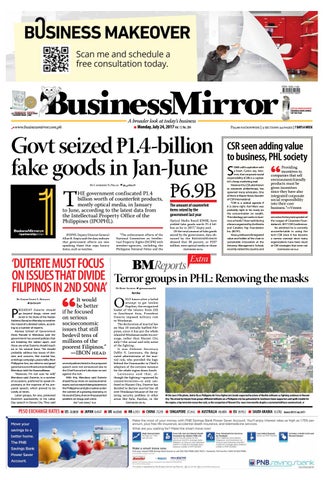
Govt seized ₧1.4-billion fake goods in Jan-June ₧6.9B T By Catherine N. Pillas
@c_pillas29
he government confiscated P1.4 billion worth of counterfeit products, mostly optical media, in January to June, according to the latest data from the Intellectual Property Office of the Philippines (IPOPHL).
IPOPHL Deputy Director General Allan B. Gepty said the data indicate that government efforts are now spooking those that copy luxury items, such as watches.
“The enforcement efforts of the National Committee on Intellectual Property Rights [NCIPR] with member-agencies, including the Philippine National Police and the
The amount of counterfeit items seized by the government last year
Optical Media Board [OMB], have yielded fake goods worth P1.4 billion so far in 2017,” Gepty said. Of the total amount of fake goods seized by the government, data obtained by the BusinessMirror showed that 38 percent, or P537 million, were optical media or those Continued on A2
2016 ejap journalism awards
business news source of the year
P25.00 nationwide | 5 sections 34 pages | 7 days a week
CSR seen adding value to business, PHL society
S
OME call it capitalism with a heart. Cynics say, however, that corporate social responsibility (CSR) is a capitalist’s cheap marketing tool. However it is, CSR, also known as corporate philanthropy, has spawned many advocates. One of them is Wayne Visser, founder of CSR International. “CSR is a radical agenda if it is done right. Karl Marx was probably right in his study on the concentration on wealth. This ideology pervades in business schools,” Visser said during a forum organized by the Benita and Catalino Yap Foundation Inc. (BCYF). Visser, professor of integrated value and holder of the chair in sustainable innovation at the Antwerp Management School, recently visited the country and
Providing incentives to companies that sell environment-friendly products must be given incentives since they have also integrated corporate social responsibility into their core business.”—Visser served as the keynote speaker of the League of Corporate Foundations’s 2017 CSR Conference. He admitted he is currently uncomfortable in using the term CSR since it has become a narrow concept since many organizations have been stuck at CSR strategies that were not Continued on A16
‘DUTERTE MUST FOCUS BMReports ON ISSUES THAT DIVIDE Terror groups in PHL: Removing the masks FILIPINOS IN 2ND SONA’ It would O be better if he focused P on serious By Rene Acosta
@reneacostaBM
Part One
By Elijah Felice E. Rosales
several policies listed in the prepared speech were not announced due to the Chief Executive’s decision to rant against the rich. With this, Mendoza said Duterte should focus more on socioeconomic issues, such as ease of doing business in the Philippines and job creation under the context of a growing economy, in his second Sona, than on the purported problem on drugs and crime.
NLY hours after a failed attempt to get Isnilon Hapilon, the recognized leader of the Islamic State (IS) in Southeast A sia, President Duterte imposed military rule in Mindanao. The declaration of martial law on May 23 initially baffled Filipinos, since it has put the whole island of Mindanao under its coverage, rather than Marawi City only—the actual and only scene of the fighting. It wa s Defense Sec ret a r y Delfin N. Lorenzana, the designated administrator of the martial rule, who provided the logic behind the Commander in Chief’s adoption of the extreme measure for the whole region down South. L ore n z a n a s a id t h at , a l though the fighting—spawned by counterterrorism—is only confined in Marawi City, Duterte has decided to declare martial law all over Mindanao because of the existing security problem in other areas like Sulu, Basilan, in the
See “2nd sona,” A16
Continued on A2
@alyasjah
r e s i d e n t Duter te should go beyond drugs, crime and terror in his State of the Nation Address (Sona) on Monday to weather the mood of a divided nation, according to a number of experts. Ateneo School of Government Dean Ronald U. Mendoza said the government has several policies that are breaking the nation apart, and these are what Duterte should touch on in his second Sona. “He should probably address key issues of division and concern, like martial law, antidrugs campaign, peace talks, West Philippine Sea, tax reforms and good governance on infrastructure buildup,” Mendoza told the BusinessM irror. “However, I’m not sure he will,” Mendoza said. Duterte, in a number of occasions, preferred to speak impromptu at the expense of his prepared speech, which proved to be costly at times. Labor groups, for one, protested Duterte’s spontaneity in his Labor Day speech in Davao City. They said
socioeconomic issues that still bedevil tens of millions of the poorest Filipinos.” —IBON head
PESO exchange rates n US 50.8830
In this June 9 file photo, debris fly as Philippine Air Force fighter jets bomb suspected locations of Muslim militants as fighting continues in Marawi City. The attack by Islamic State group-affiliated militants on a Philippine city has galvanized its Southeast Asian supporters and spells trouble for the region, a top terrorism researcher said, as the occupation of Marawi City nears two months despite a sustained military counterattack. AP
n japan 0.4547 n UK 66.0360 n HK 6.5151 n CHINA 7.5293 n singapore 37.2442 n australia 40.4876 n EU 59.1922 n SAUDI arabia 13.5702
Source: BSP (21 July 2017 )
BMReports BusinessMirror
A2 Monday, July 24, 2017
www.businessmirror.com.ph
Terror groups in PHL: Removing the masks Continued from A1
Zamboanga peninsula, Central Mindanao and Davao region. Decoding the defense secretary’s statement, he maybe referring to the security problems posed by the Abu Sayyaf Group (ASG) in Sulu and Basilan, the Bangsamoro Islamic Freedom Fighters (BIFF) in Maguindanao and North Cotabato and the New People’s Army (NPA) in Davao provinces. Lorenzana also revisited Duterte’s constant pronouncements that if ever the latter would impose martial rule in Mindanao, he would finish “once and for all” the island’s security problem. As the martial-law administrator, Lorenzana subsequently issued two special arrest orders containing the names of more than 200 individuals touted as members or supporters of the Maute-IS Group, the terrorist band that is challenging the government in Marawi.
Purpose defeated
UNLESS a miracle happens until July 23, which was supposed to be the end of the 60day period of the martial law, the extreme measure adopted for Mindanao will just be a failure, defeating its very basic purpose.
As explained by Lorenzana, the purpose of the martial law and the whole idea behind it was not only to quell or neutralize the Maute-IS Group in Marawi City but should even address or end the security problem posed by other terrorist or threat groups in the region. By July 23 martial law should have been over with one of its specified tasks accomplished—granting that it has killed or neutralized all members of the Maute-IS and cleared Marawi by that time. Duterte has asked the House of Representatives to extend military rule for five years. However, Lorenzana said martial law is only called and implemented once special conditions call for it, although the decision still relies on the President. Nevertheless, he added the soldiers can be relied upon and fully trusted to implement it once it is extended.
High number
SHOULD the government succeed in quelling the challenge put up by the Maute-IS group—and it must—it would still be contending with similar forays by other terrorist groups, if not in the next couple of years, in the distant future,
as it has not dealt with them under the martial law. Aside from the terror groups ASG, BIFF and the NPA—declared and considered politically by the government as terrorist groups—there are almost 20 other terror groups, most of them, if not all, operating or based in Mindanao. Before the Supreme Court bought the constitutionality of martial rule, Solicitor General Jose C. Calida identified 20 terror groups that have been affiliating themselves with the IS. Calida was even tempered in his disclosure when he branded these groups as “sleeper cells” of the Arab-based international terrorist group. Sleeper cells are secret group that are dormant but not active. According to the solicitor general, these groups are the A nsar Daw iah Filibbin; Rajah Solaiman Islamic Movement; Al Harakatul Islamiyah Battalion; Jama’at Ansar Khilafa; Ansharul Khilafah Philippines Battalion; Bangsamoro Justice Movement; Khilafah Islamiyah Mindanao; the Abu Sayyaf Group (Sulu faction); Syuful Khilafa Fi Luzon; and the Ma’Rakah Al-Ansar Battalion. They also included the Dawla Islamiyyah
Cotabato; Dawlat Al Islamiyah Waliyatul Masrik; Ansar Al-Shariyah Battalion; Jamaah Al-Tawhid Wal Jihad Philippines; Abu Dujanah Battalion; Abu Khubayn Battalion; Jundallah Battalion; Abu Sadr Battalion; Jamaah Al Muhajirin Wal Anshor; and the Balik-Islam Group. But Rommel Banlaoi, an author and expert on counterterrorism issues, said Calida’s list of sleeper cells in the country are actually active terror groups. “Those groups listed by Solitor General Calida are active groups already,” Banlaoi said during a recent television interview.
Great surprise
FOR those who have not been following counterterrorism issues, Calida’s revelation comes as a great surprise, since the Armed Forces has merely busied itself during the past years containing the threat coming mainly from the BIFF, the ASG, the NPA or even the Moro National Liberation Front and the Moro Islamic Liberation Front. All five groups were principally the focus of the operations of the military. In claiming that sleeper cells are active, Banlaoi, the chairman of the Philippine Institute for Peace, Violence and Terrorism
Govt seized ₧1.4-billion fake goods in Jan-June Continued from A1
where digital content can be stored. These include hard drives, CDs, DVDs and USB drives. “Optical media are regulated products. These cannot be manufactured, imported or distributed without the permits from the optical media board (OMB), and they can conduct an investigation on their own,” Gepty said. “This is unlike other goods as intellectual-property [IP] owners and rights holders have to submit a complaint first before the agencies can secure a warrant for seizures,” he added. The second-most pirated item was footwear, which accounted for 29 percent, or P414 million, of the government’s haul. Handbags (P282 million) and apparel and accessories (P126 mil-
lion) were the other counterfeit goods confiscated by the government during the period. The most faked item in 2016— watches and jewelry—was markedly absent from the profile of seized products this year. The amount of pirated watches and jewelry—considered as luxury items—seized last year alone were worth P2 billion. Gepty said the valuation was based on the original items’ price. The value of bogus confiscated cigarettes and alcohol, a main concern in 2016, as it was the second-most pirated item, reached only P1 million in the January to June period. Last year the government’s haul amounted to P1.6 billion. However, this may be due to the possibility that other agencies, such as the Bureau of Customs (BOC),
have yet to provide the IPOPHL with updated data. Earlier the BOC reported that it confiscated at least P1-billion worth of cigarettes with bogus tax stamps from the Bureau of Internal Revenue. In January to July last year IPOPHL reported t h at t he gover n ment sei z ed P2.8 billion worth of fake products. For the whole of 2016 the g o v e r n m e nt ’s h a u l r e a c h e d P6.9 billion. Gepty, however, said the value of fake goods confiscated by the government fluctuates every year and depends on the type of products. “There are a lot of factors that trigger how much we seize in a year.” While he did not set a target for this year, Gepty added the Philippines has a “good chance” of staying out of the US Trade Rep-
resentative’s 301 Watch List, an annual review of nations’ compliance in protecting IP rights (IPR). The Philippines was first delisted in 2014, after almost two decades of being in the report, gradually easing out of its “Priority Watch List” category to the regular “Watch List” until it was finally removed in 2014. The USTR’s Special 301 Report aims to push countries to better adhere to IPR standards; trade sanctions can be imposed by the US government on countries it has designated as a “Priority foreign country” that has consistently committed IPR violations. “Our intel lectua l-proper t y [IP] regime is still very strong. We’ve passed the necessary rules to ensure IP rights, and we have a good interagency task force,” he said.
Red tape. . .
Research, also said Calida made a “double entry” and may have misbranded a peaceful group as a sleeper cell. Banlaoi added the Rajah Solaiman Islamic Movement is already inactive, but its members have joined and transformed themselves into what is now known as Syuful Khilafa Fi Luzon. He also claims that the Balik-Islam Group, whose members are former Christians who have converted into Muslims, is a “moderate” and “peace-loving” group. Regardless of Calida and Banlaoi’s statements, a security analyst said the government should have maximized the being observed martial rule by running after or neutralizing all terror, lawless and threat groups in Mindanao. “Remember that President Duterte wanted martial law in Mindanao because, according to him, he wanted to end the security problem there,” said the analyst who requested anonymity for security reasons. “He got the martial law, and so what has been achieved or what is being achieved? Maybe the Maute-ISIS, which is confined in Marawi City.” “What about the rest of those threat groups, the rest of Mindanao?” the analyst opined. To be continued
Continued from A16
permits and licenses in the LGUs [local government units] and government agencies results in corruption and day-to-day under the table transactions,” he added. Nograles said there are a number of pending bills that have long-term benefits that need to be passed. These measures, Nograles said, are “An Act Rightsizing the National Government to Improve Public Service Delivery” and “An Act to Reform the Budget Process by Enforcing Greater Accountability in Public Financial Management, Promoting Fiscal Sustainability, Strengthening Congress’ Power of the Purse, Instituting an Integrated PFM System and Increasing Budget Transparency and Participation, and for Other Purposes”. Nograles added the Duterte administration can also push the “Zero Hunger” bill and bills providing for universal health care, establishing free basic medicine assistance, the Traffic Crisis Act and the Universal ID System Act. House Committee on Appropriations Vice Chairman and Party-list Rep. Luis Raymund Villafuerte of Camarines Sur said the shift to a federal form of government is the “missing link” in President Duterte’s inclusive growth agenda. Villafuerte said the Duterte administration’s vision for the Philippines to eradicate poverty and grow into a high-middle income economy by 2040 can—and will—happen with the shift to the “growth-friendlier” federal system of government. “Malacañang is on the right track in pursuing its multitrillion peso ‘Build, Build, Build’ agenda that aims to fill our decades-old infrastructure backlog. But redistributing wealth to the country-
side requires a bold makeover—as envisioned by President Duterte,” he added. House Deputy Speaker Gwendolyn Garcia of Cebu said topping the House agenda are the proposed 2018 General Appropriations Act, supplemental fund for the Marawi City rehabilitation and charter change and civil union bill. Majority Leader Rodolfo Farinas of Ilocos Norte said leaders of the 17th Congress will still meet on Wednesday to set the final agenda for the second regular session. The second regular session will open at 10 a.m., which will be followed by the singing of the National Anthem then by the invocation and then be adjourned until 4 p.m. for the President’s Sona.
All set for Sona
House Secretary-General and Task Force Sona 2017 Chairman Cesar Strait Pareja said the lower chamber is ready for the second Sona of Duterte. The theme of the second Sona is “A comfortable life for all Filipinos” with a focus on prosperity for all, law and order and peace.” Pareja added the chamber has addressed all matters pertaining to internal and external security and safety, protocol arrangements, reception, media coverage, parking and other necessary engineering needs among others, to ensure a safe, secure and orderly holding of the Sona this year. “We are very much prepared for the Sona. So far, there are no major hitches in the Sona preparations,” Pareja said. “Our security forces are very prepared. It was discussed during the meeting to hope for the best, but you prepare for the worst,” Pareja added.
American tourists. . . T he US is t he second top market for visitor arrivals in the Philippines, accounting for some 15 percent of the 2.9 million total arrivals in the first five months of the year. From January to May, visitor arrivals from the US grew by about 12.8 percent to 428,767. In the same DOT 2016 survey, a copy of which was obtained by the BusinessMirror, it showed that almost 30 percent of the visitors from the US spent their time shopping in the Philippines. Other top activities in the countries by these tourists include sightseeing (18.4 percent), beach holiday (7.5 percent), visit friends and relatives (2.7 percent),
Continued from A16
sports (1.9 percent), nature and adventures (1.5 percent) and scuba diving (1.1 percent). Only half of one-percent were in the Philippines for investment opportunities. Of the American visitors who went shopping, some 47 percent went to the department stores, while 30 percent went to the tourism duty-free stores, and 17 percent purchased goods in souvenir shops. The same DOT survey also showed visitors from the US spent the most of shopping money on fashion accessories (59 percent), clothes (46.5 percent), art and crafts (32 percent), food and delicacies (18.3 percent), leather goods (10.1 percent) and paper/ paper goods (9.1 percent).
Economy
A4 Monday, July 24, 2017 • Editors: Vittorio V. Vitug and Max V. de Leon
BusinessMirror
news@businessmirror.com.ph
HUDCC to scrutinize govt housing projects
T
By Cai U. Ordinario
@cuo_bm
he Housing and Urban Development Coordinating Council (HUDCC) will conduct an audit of all government housing projects to eliminate inefficiencies and corruption. HUDCC Chairman General Eduardo del Rosario told the BusinessMirror that he has created an audit team and instructed the various shelter agencies to look into government housing projects. “I have directed the implementing agencies under the HUDCC to conduct the investigation, we’ll wait for the result,” del Rosario said via SMS over the weekend. The HUDCC and shelter agencies will undertake the audit and investigation amid reports that there are substandard government housing projects. Del Rosario said those “involved in anomalous contracts will be aggressively pursued and penalized to the fullest extent of the law”. Apart from this, del Rosario also encouraged the public to report
housing anomalies through the government’s 8888 Citizens Complaint Hotline. Based on HUDCC data, the housing need is around 5.56 million as of the end of 2016. Some 1.4 million are considered informal settler families and 40 percent of them are residing in Metro Manila. The HUDCC also estimates that slum areas grow by 3.4 percent annually, making access to affordable housing a key development challenge for the Philippines. In the past six years the government has only allocated 1.135 percent of the national budget for housing, or around P23 billion annually. The allocation is only 0.12 percent of GDP annually in 2000 to 2014, the lowest among Southeast Asian countries.
Children of informal settlers play on the sprawling government mass-housing project for the police and the military in Pandi, Bulacan. File photo
Govt eyes set up of advanced coating plant for e-jeepneys By Catherine N. Pillas @c_pillas29
T
he Department of Trade and Industry (DTI) is planning to put up a multimillion-dollar electro-dipping coating facility to entice manufacturers to join the government’s Public Utility Vehicle (PUV) Modernization Program. During the Board of Investments (BOI) Job Fair recently, Trade Undersecretary and BOI Managing Head Ceferino S. Rodolfo Jr. bared the agency’s plan to remove a key hurdle in manufacturing the “modern Filipino jeepney” locally. “We have to make a contribution to this endeavor, too, just like in the Comprehensive Automotive Resurgence Strategy [CARS] Program,” Rodolfo said, referring to another government program encouraging the local production of passenger cars. “For this, we’re thinking of a fixed investment support, it can be in the form of a electro-dipping coating facility to make the electric jeepney rust-proof, just like most vehicles today. It can be a shared
service facility that can be used by participants, and they can attract suppliers of other parts to locate in the same area,” he added. The BOI sees electro-coating as the most expensive industrial process for possible participants that may hinder them from participating in the program. The target participants of the PUV Modernization Program, unlike the CARS Program, will not be car assemblers but truck body build-
ers, such as Centro Manufacturing Corp., Almazora Philippines Corp. and Santarosa Motorworks. According to Rodolfo, this doesn’t exclude truck assemblers, such as Isuzu or Mitsubishi, from participating in the PUV Modernization Program. Aside from the electro-dipping coating facility, the BOI may also provide additional incentives. The DTI official said a “variable incentive support” may be given de-
pending on how many units will be replaced by locally made ones. “We’re not sure of the incentive mix yet, and we don’t know how many of the estimated 200,000 units of jeeps due for phase-out will be replaced by the locally manufactured modern jeep,” Rodolfo said. To prove to the public the feasibility of the locally made e-jeepney, the BOI is encouraging truck body builders to come up with a prototype that will ply the roads within the year. Earlier, the government decided to reallocate the P9 billion for the third slot of the CARS Program to the PUV Modernization Program. The BOI, one of the many agencies contributing to the Department of Transportation’s (DOTr) Jeep Modernization Program, has already crafted the design for the locally made Filipino jeepney. The DTI wants the units to adhere to the highest environmental fuel standard, accommodate more than 20 passengers and have standard vehicle parts. With the DOTr targeting to phase out old jeepneys in three years, Rodolfo said local manufacturers must be given time to build their capacity.
Pinoys bear triple burden of disease–PIDS report
F
ilipinos carry the “triple burden of disease” that has caused the deaths of many and hiked the medical costs borne by the government and households, according to a report from the Philippine Institute for Development Studies (PIDS). In a report titled “July Economic Issue of the Day report”, PIDS senior research specialist Danica Aisa P. Ortiz and research fellow Michael R.M. Abrigo discussed the impact of high incidences of communicable (CD) and noncommunicable diseases (NCD), as well as injuries, substance abuse and mental illness in the country. Ortiz and Abrigo said taken together these diseases and hea lth conditions create the triple burden of disease. “The triple burden of dis-
ease is a serious public-health concern. It is a costly burden that impacts both families and governments,” the authors said. “Promoting healthy lifestyles and preventive health measures may be cost-effective solutions. As the adage goes: an ounce of prevention is worth a pound of cure,” they added. Ortiz and Abrigo explained CDs are diseases caused by direct or indirect spreading of diseasecausing bacteria, virus or other microorganism. NCDs, meanwhile, are lifestylelinked diseases, such as diabetes, cardiovascular diseases, cancer and chronic respiratory diseases. T he aut hors sa id hea lt h cond it ion s s u c h a s i nj u r ie s caused by accidents in highly urbanized and industrialized locations have resulted in long-term medical conditions that need therapy or treatment. Of the three, Ortiz and Abrigo said NCDs and health conditions have been brought about in part by high economic growth, urbanization, food availability, employment and technology.
The authors, citing data from the Philippine Statistics Authority (PSA), said in the Philippines accidents were the fifth-highest cause of death in 2014, higher than diabetes, chronic respiratory diseases or tuberculosis. “In ma ny countr ies where prevalence of CDs and NCDs are both high, afflictions related to rapid urbanization and industrialization (e.g., injuries, substance abuse and mental illness) are also increasing, which create the triple burden of disease,” the authors said. Or tiz and Abr igo said the affliction of household members to CDs, NCDs, and other health conditions can put a toll on families through the loss of life and/ or skyrocketing out-of-pocket expenditures. The authors said data in 2015 showed that for every million Filipinos around 580 years of life have been lost due to heart disease and stroke. For every million Filipinos, nearly a century or 95 and 75 years of life were lost due to Tuberculosis and interpersonal
violence, respectively. Apart from the loss of life, households and the national government spent around P465 billion to finance current health expenditures (CHE). “Two-thirds of this amount was borne directly by households through out-of-pocket payments,” the authors said. By classification of diseases/conditions, NCDs account for more than half of the 2012 CHE, followed by CDs at more than a quarter. Injuries, meanwhile, constitute about 6 percent, or P30 billion. Ortiz and Abrigo said there is a need to improve the health system, particularly effective service delivery, as well as functional and strategically located health facilities. Also crucial, the authors said, is the adequate human resource that will deliver the necessary services to the afflicted. The authors said the government should implement an effective health insurance program to ensure that Filipinos will be able to get the health care they need.
Cai U. Ordinario
CA finds Vitangcol administratively liable for $30-million extort try By Joel R. San Juan @jrsanjuan1573
T
HE Court of Appeals (CA) has affirmed the order issued by the Office of the Ombudsman, which found Al Vitangcol III, former Metro Rail Transit Authority (MRTA) general manager, administratively liable for attempting to extort $30 million from Czeh firm Inekon. In a 23-page decision penned by Associate Justice Pedro Corales, the Court’s Eight Division denied the petitioner for review filed by Vitangcol seeking the reversal of the Ombudsman’s joint order issued on February 12, 2016, and June 14, 2016. The assailed decision found Vitangcol guilty of two counts each of grave misconduct, serious dishonesty and unlawful solicitation, and imposed upon him the penalty of dismissal from service with cancellation of eligibility, forfeiture of retirement, benefits and perpetual disqualification from holding office. The appellate court did not give credence to Vitangcol’s defense that the Ombudsman has lost disciplinary authority over him, as he was no longer a public officer at the time the complaint was filed and the case was rendered moot and academic by his resignation prior to its filing. Vitangcol resigned from his post on May 27, 2014, while the complaint against him was filed on June 23, 2014. The charges are in relation to the awarding of the contract for the P3.7-billion ($80.16-million) MRT 3 expansion project in 2012. The appellate court also dismissed Vitangcol’s claim of political persecution for exposing anomalies committed by some officials of the Department of Transportation and Communications (DOTC) in connection with the operations of MRT 3. It held that Vitangcol’s attempts to extort money from Inekon and compel the company to enter into a joint venture agreement were sufficiently
proven by Czech Ambassador Josef Rychtar and Inekon representative Joseph Husek’s sworn statements. It noted that the statements sufficiently detailed how the m e e t i n g s w e r e c o n du c t e d , the proposals made and the amount asked by Vitangcol for the contract. “Husek and Rychtar would not have normally thought about these details if they were not telling the truth,” the CA said. “Besides, Husek and Rychtar’s statements are notarized documents accorded with the presumption of regularity as to their due execution. Only clear and convincing evidence can overturn this presumption but non is extant in the records,” it added. The CA noted that Vitangcol failed to present any evidence to counter the declarations of Huses and Rychtar. The appellate court also did not give weight to Vitangcol’s claim that he had been cleared from liability during the investigation conducted by the National Bureau of Investigation (NBI). It explained that the petitioner failed to present official issuance from the NBI clearing him from extortion attempts “Finally, we stress that no exceptional situation, including the alleged persecution rather than good faith prosecution, appears here. There is no showing of any grand design or other manifestation of ill will that unduly impelled the finding of administrative liabilities herein assailed,” the CA noted. “Similarly, there is no indication that Vitangcol’s dismissal from service was motivated by spite or ill will, or merely a part of a political propaganda. Not a scintilla of proof was presented to substantiate all these allegations,” it added. Concurring with the ruling were Associate Justices Celia LibreaLeagogo and Amy Lazaro. Inekon is a Czech company engaged in the supply of light rail vehicles.
AseanMonday BusinessMirror
news@businessmirror.com.ph
PM Najib ups battle for Malaysian farmer votes with big aid package
M
alaysian Prime Minister Najib Razak raised the stakes in his efforts to secure the votes of palm-oil farmers, announcing hundreds of millions of dollars in aid ahead of an election that could come within months. Farmers who come under the auspices of the Federal Land Development Authority, or Felda, will get cash handouts from the end of August, and have some debts erased, Najib said in a speech last Sunday. The package, which includes grants for replanting, totals about 1.6 billion ringgit ($373 million). Felda, the world’s largest crude palm-oil producer, has been hit by financial scandals and the share price of its unit Felda Global Ventures Holdings Bhd. (FGV) has fallen, causing upset among farmers, long the mainstay of the ruling coalition. Many of them took out loans to buy Felda shares. They have also expressed frustration about late assistance payments from the statebacked company. Najib needs those farming votes if his coalition is to extend its 60-year grip on power. While the next election is not due until mid-2018, politicians and analysts have indicated it could come by the end of this year as Najib seeks to capitalize on an opposition in disarray. Felda farmers make up the majority of voters in 54 out of 222 federal seats, and Najib’s coalition, known as Barisan Nasional, won all but six of those seats in the 2013 election, according to a ruling party lawmaker. Najib highlighted the symbiotic relationship between the farmers and the government in a speech at the tail end of a three-day carnival for Felda families in Putrajaya, the country’s administrative capital. The families, known as settlers, were given land decades ago during Malaysia’s independence. “Felda’s agenda is close to my heart,”
Najib said. “Without the Felda community, it’s not possible that Putrajaya would be held by the government. And without the government, what place would Felda settlers” have in a wider scheme of things, he said. Felda traces its roots to a 1956 grant from the World Bank and is virtually synonymous with government aid to rural Malaysia. About 95,000 settlers will get 5,000 ringgit in cash, Najib said, a move that will cost the government almost 475 million ringgit. He said about 986 million ringgit will be allocated to provide grants and forgive debt incurred during replanting activities. FGV is about 62 percent below its listing price in 2012. Najib last Sunday said settlers who took loans to buy shares will see part of their outstanding debt forgiven. That is expected to total 128.1 million ringgit and benefit almost 78,000 farmers. Those who had repaid their loans will get about 1,800 ringgit. “If there are any shortcomings, we will fix them together,” Najib said. “We are determined, no matter what, we will defend Putrajaya.” FGV has been wracked by graft probes and a leadership struggle in recent months. The Anti-Corruption Commission is probing several cases involving FGV and the company’s board ordered CEO Zakaria Arshad to go on leave pending an internal probe. Zakaria, who denies wrongdoing, has urged the antigraft agency to examine alleged improprieties at FGV and said he often disagreed with then-Chairman Isa Samad on how the company was managed. Isa resigned last month. Zakaria, a planter’s son, is popular among farmers. FGV has announced that Khairil Anuar Aziz—born and bred on a Felda settlement—will take over CEO duties as an officer in charge.
Bloomberg News
Editor: Max V. de Leon • Monday, July 24, 2017 A5
Indonesia central bank’s decision puzzles analysts By Karlis Salna and Lilian Karunungan | Bloomberg News
B
ank Indonesia blamed a swearing-in ceremony at the nation’s financial regulator for the delay of its interest-rate announcement to close to midnight in Jakarta on Thursday. The timing of the decision left analysts puzzled and spurred speculation the central bank might have been waiting for European Central Bank (ECB) President Mario Draghi’s monetary policy news conference that came hours beforehand. The Indonesian authority held its benchmark rate at 4.75 percent, as predicted by all 19 economists surveyed by Bloomberg. It last cut the rate last October. Bank Indonesia Spokesman Arbonas Hutabarat said last Friday the meeting was delayed because several central bank board members had attended a ceremony at the Financial Services Authority, or OJK, earlier in the afternoon. There was “no linkage to the ECB,” he said. There’s no specific time for Bank Indonesia’s monthly news conference where the rate decision is disclosed, but in recent months it’s come before 6 p.m. local time. “Quite why the decision took so
long is unclear—the decision was exactly what everyone had expected,” said Gareth Leather, a senior Asia economist at Capital Economics Ltd. in London. “The policy statement offers no clues to why the meeting dragged on so late into the evening.”
Dovish Draghi
Bank Indonesia cut interest rates six times last year and eased reserve limits on lenders in July to help spur lending and support economic expansion. The monetary authority said last Thursday that inflation— which has ticked up recently because of rising food and electricity costs— will remain within it’s 3-percent to 5-percent target band, while the rupiah has stabilized. The Indonesian decision came after dovish comments from ECB President Draghi, which may continue to underpin foreign inflows into emerging markets, like Indonesia.
The ECB may not make a decision on tapering its bond-buying program until October, euro-area officials familiar with the matter said. The timing of Bank Indonesia’s rate announcement after the ECB’s “showed BI’s concerns regarding external risks emanating from policy normalization among the major central banks,” Mohamed Faiz Nagutha, an economist at Merrill Lynch Asia Pacific Ltd., said in a note. Europe-based funds account for “almost half” of the foreign holdings of Indonesian government bonds, Wisnu Wardana and Anton Hendranata, economists at PT Bank Danamon in Jakarta, wrote in a note last Friday. “We have reason to believe that there may be greater impact to local bond and currency when the ECB starts its quantitative tightening,” they wrote. The yield premium Indonesia’s
benchmark 10-year bonds offer over US Treasuries has widened 18 basis points from a 2013 low of 450 reached on July 5. Against similar-maturity German bunds, the spread is near the least since 2014 at 641. Foreign funds have sold a net 6.4 trillion rupiah ($481 million) of Indonesian debt so far in July. The rupiah has gained 1.1 percent in 2017 and was up 0.2 percent to 13,314 per dollar as of 2:41 p.m. in Jakarta last Friday. Indonesia’s economy will probably expand at a slightly faster pace in the second quarter at about 5.1 percent, Assistant Governor Dody Waluyo told reporters in Jakarta. There are early signs that retail sales growth is improving, he said. “We were very surprised it was so late,” said Ho Woei Chen, an economist at United Overseas Bank Ltd. in Singapore. The decision was a “nonevent”, she said.
Vietnam’s drinkers are giving world’s biggest breweries beer goggles By Luu Van Dat, John Boudreau, & Mai Ngoc Chau Bloomberg News
H
o Chi Minh called alcohol a poison peddled by French imperialists. Half a century later in the Vietnamese city that bears the revolutionary founder’s name, young women in short skirts haul cases of Tiger Beer and buckets of ice to wooden tables crowded with young men. “Drinking beer is essential in Vietnam,” shouts Nguyen Nhat Truong, a 26-year-old researcher, over techno music. He and his friends are regulars at “123-Zo”— an outdoor eatery in suburban Ho Chi Minh City named after a regional refrain for “bottoms up!” Here glass-mugs of lager cost less than 50 cents. “We have a lot of free time and there isn’t a lot of other entertainment, so we drink beer.” Vietnam, where a beer-swilling culture is stoking concern about binge-drinking, will be “the next key battleground for brewers”, market researcher Euromonitor International said in a report this month. The planned sale of the government’s majority stakes in the nation’s two largest domestic beer companies leaves “wide open” the door for foreign rivals, it said. “There aren’t many markets left that have the growth potential Vietnam has,” said John Ditty, managing partner of KPMG Vietnam’s deals advisory unit. Sabeco, from Ho Chi Minh City, and Hanoi-based Habeco will submit plans to the government this month for the process, with the stakes slated to be sold later this year, an official at the Industry and Trade Ministry told local media last week. The stake-sales will create an opportunity for international companies to expand geographically, especially those still without a presence in Vietnam, Ditty said. An expanding Vietnamese middle class and youthful population helped drive a 300 percent surge in beer demand since 2002, according to Euromonitor, which estimates the market was worth 147.2 trillion dong ($6.5
billion) in 2016. It predicts per-capita consumption will reach 40.6 liters (11 gallons) this year, making Vietnam the biggest consumer of the amber fluid in Southeast Asia.
‘Market to watch’
“Vietnam will be the market to watch,” Euromonitor said in a July report on the beer market in the Asia-Pacific region. “Thanks to the strong street consumption culture and rapid urbanization, Vietnam is forecast to see the largest volume growth over 2016-2021.” As competition intensifies among brewers, more aggressive promotions and new product launches will lead to even higher demand for beer, the report said. The Netherlands’s Heineken NV and Denmark’s Carlsberg A/S have been fighting for share in Vietnam, driving beer sales “through the roof,” it said. Heineken, Anheuser-Busch InBev NV, and Japan’s Asahi Group Holdings Ltd. and Kirin Holdings Co. are among about half a dozen foreign companies that registered interest in a Sabeco stake, its former chief executive officer Le Hong Xanh said last Thursday.
company. Heineken doesn’t comment on speculation, said Michael Fuchs, a company spokesman. “AB InBev is committed to Vietnam and to growing our business for the long term,” said Marianne Amssoms, the company’s New York-based vice president of global communications, adding that it doesn’t comment on “rumors or speculation”. The Ministry of Industry and Trade valued its 89.59 percent share of the nation’s top beer-maker, also known as Saigon Beer Alcohol Beverage Corp., at $1.8 billion last August. The government’s 82 percent holding in Habeco, or Hanoi Beer Alcohol Beverage Corp., was worth $404 million, the ministry estimated.
Right of refusal
Sabeco shares have increased 11 percent in the past week on news of the timing of the privatization process, while Habeco has jumped 8.7 percent. Carlsberg, which owns
‘Focus markets’
“Asia and Oceania are the focus markets for our company, and we are interested in investing in Vietnam as we see growth in the market,” said Naomi Sasaki, a spokesman for Kirin Holdings in Tokyo. Asahi Group continues to be interested in acquiring shares in the Vietnamese brewer, said Takuo Soga, a spokesman for the Tokyo-based
17.51 percent of the Hanoi-based brewer and says it has a first right of refusal for the stake, has been in tense talks with the Ministry of Industry and Trade about the sale. “We are hunting to get it,” Carlsberg President and CEO Cees’t Hart said of the Habeco stake on a conference call with analysts and investors in May after three trips to Vietnam in the previous six weeks. The Danish company’s share of the Vietnamese beer market by volume has slipped the past four years as Heineken expanded, Euromonitor data show. The Dutch brewer’s 2016 sales volumes jumped at least 10 percent, spurred by Tiger Beer, Chairman and CEO Jean-François van Boxmeer told the company’s annual shareholders meeting in April. Vietnam drove an almost 27-percent surge in operating profit from the Asia region, he said. Vietnam will represent half of Sapporo Holdings Ltd.’s overseas beer sales in the next decade, according to Mikio Masawaki, general director of Sapporo’s Vietnamese brewing unit, which began about six years ago. Annual beer consumption will probably eclipse Japan’s 6 billion liters in a few years, he said.
‘Weaken our race’
It wasn’t always like this. Revolutionary Minh criticized French colonizers’ efforts to “weaken our race” with alcohol in Vietnam’s 1945 Declaration of Independence. Now, the country’s communist leaders see the
A delivery man with boxes of imported beer in Hanoi.
potential to capitalize on the popularity of booze. At the same time, officials are recognizing the trade-off with public health. About a third of men and twothirds of women in Vietnam are lifetime alcohol abstainers, according to the World Health Organization. The men who do drink, tend to drink a lot and 8.7 percent suffer some form of alcohol dependence or disorders, compared with 4.6 percent across the Western Pacific region. The government is now trying to slow the liquor flow. A special consumption tax aims to increase the excise tax rate on beer annually to reach 65 percent in 2018. The National Assembly is considering proposals to turn off beer taps during lunch hours and the late evening. It’s also weighing whether to prohibit the sale of alcohol to pregnant women and to ban government employees from drinking during work hours. “There often is tremendous pressure from the financial side—both within and outside the government—to grow the market,” said David Jernigan, director of the Center on Alcohol Marketing and Youth at the Johns Hopkins Bloomberg School of Public Health in Baltimore, Maryland. The school was renamed in 2001 in honor of Bloomberg LP founder Michael Bloomberg, a major donor.
Suicides, drownings
Habeco brewery in Hanoi
“The revenues are very visible, but the costs are much less visible: increased drinking and driving, increased alcohol-related violence, domestic violence, suicides, drownings,” Jernigan said.
Even if the government does tighten alcohol regulations and curbs beer sales, foreign investors won’t be deterred, KPMG’s Ditty said. “Every global company involved in the alcohol industry is extremely conscious of responsible drinking,” he said. For now, the amber liquid is being poured unabated. At 11 a.m. on a July Friday the tables were filling up at Lan Chin, a restaurant serving 5-liter chilled glass containers of bia hoi, or fresh beer. The eatery, located across the street from an office of the Hanoi People’s Committee and about 3 kilometers (2 miles) from the Ho Chi Minh Mausoleum, draws government officials and workers until 2 p.m. before overflowing again in the evening.
Happy hours
“When we drink beer, we feel relaxed,” said loan officer Nguyen Nam, 27, sitting at a long table covered with plates of chicken, pork, vegetables and beer glasses. “I can still work in the afternoon even though I am a little bit tipsy, but some people need naps.” At night, Vietnamese flock to street-side establishments with plastic chairs and young female beer attendants in form-fitting dresses displaying the logos of local and international brewers. Business is conducted amid clinking beer mugs, with each downed glass moving the meeting closer to a deal, said Hanoi banker Nguyen Phu Quy, 26, gulping beer and vodka chasers with colleagues. “I learned this from my bosses and my bosses learned this from their bosses,” he said.
A6
Monday, July 24, 2017 • Editor: Lyn Resurreccion
The World BusinessMirror
www.businessmirror.com.ph
Trump asserts he has ‘complete power’ to pardon
W
ASHINGTON—President Donald J. Trump said last Saturday that he has “complete power” to issue pardons, an assertion that comes amid investigations into Russian interference in last year’s presidential election. It was one of many topics that appeared to occupy the president’s mind as the day broke. On a day when most people are ready to forget about the issues that nagged them during the week, Trump revved up. In an early morning flurry of 10 tweets, he commented about pardons, former presidential rival Hillary Clinton, son Don Jr., health care, the USS Gerald Ford, the attorney general and other issues. Trump said in one of his 10 messages: “While all agree the US President has the complete power to pardon, why think of that when only crime so far is LEAKS against us. FAKE NEWS.” The Washington Post recently reported that Trump has inquired about the authority he has, as president, to pardon aides, relatives or even himself, in connection with the widening investigation into Russian interference in the election and whether any Trump associates were involved. The president has long criticized
10 The number of tweets US President Donald J. Trump sent last Saturday morning
leaks of information about the investigation, and has urged authorities to prosecute leakers. Trump maintains that no crimes have been committed. One of Trump’s attorneys, Jay Sekulow, said the president has not discussed the issue of pardons with his outside legal team. Sekulow reiterated that point
last Saturday evening. Speaking to reporters at the site of the Western Conservative Summit in Denver, he said that Trump’s private legal team is “not researching it because it’s not an issue.” “I don’t know where this came from. There is nothing to pardon,” said Sekulow, who added that “what’s going on in Washington is an attack on the president.” Next week Trump’s eldest son, Donald Trump Jr.; his son-in-law and White House adviser, Jared Kushner; and Paul Manafort, his former campaign chairman, are scheduled to appear before Senate committees investigating Russian meddling. Trump defended his son in one of the tweets, saying he “openly gave his e-mails to the media & authorities whereas Crooked Hillary Clinton deleted [& acid washed] her 33,000 e-mails!” Trump’s namesake has become a focus of the investigation after it was revealed that he, Kushner and Manafort met with Russian representatives at Trump Tower in June 2016. Trump Jr. later released e-mail exchanges concerning the meeting on Twitter, after learning that The New York Times was about to publish them. The FBI investigated Clinton for using a private e-mail server as secretary of state. She turned over thousands of pages of e-mails to the government, but deleted thousands of others that she said were personal or unrelated to her work
President Donald J. Trump waves as he boards Air Force One on July 22 in Andrews Air Force Base, Maryland, en route to Naval Air Station Norfolk, in Norfolk, Virgnia, to attend the commissioning ceremony of the aircraft carrier USS Gerald R. Ford. AP/Carolyn Kaster
as the nation’s top diplomat. Trump also complained last Saturday about a Washington Post report that the Russian ambassador to the US said he discussed electionrelated issues with Jeff Sessions when the men met during the 2016 presidential race. Sessions, now the attorney general, at the time was a US senator and foreign policy adviser to Trump. Trump tweeted: “A new INTELLIGENCE LEAK from the Amazon
Ivanka received at least $12.6M since 2016
I
vanka Trump or her trust has received at least $12.6 million since early 2016 from her various business ventures and has an arrangement to guarantee her at least $1.5 million a year even as she serves in a top White House position, according to her first ethics disclosure made public late last Friday. The report was released alongside an updated filing by her husband, Jared Kushner, who is also serving as a top adviser to President Donald J. Trump. It shows that the couple benefit from an active business empire worth as much as $761 million to them, an arrangement that ethics experts warn poses potentials for conflicts of interest as the couple have been given a wide-ranging portfolio of government responsibilities. Ivanka Trump, who resigned from nearly 300 leadership positions at various entities within the family real-estate businesses and at her fashion brand, has continued to receive millions of dollars from both streams, including more than $2.4 million from her stake in the Trump International Hotel in Washington and more than $2.5 million in salary and severance from the Trump Organization. Trump received about $1.7 million in payments from T International Realty, the family’s luxury-brokerage agency, as well as two other real-estate companies for various management, consulting and licensing work, the documents show. Those payments, for work done in 2016, were based on the companies’ performance. But going forward, she will receive fixed payments—a change that her advisers say was developed in consultation with the Office of Government Ethics to minimize her potential conflicts by removing her interest in how well her family’s business performs. In total, Trump will receive $1.5 million in fixed payments from the same three real-estate entities. She stands to earn additional income from her stake in the hotel in Washington. The disclosures provided less specific figures for Trump’s earnings from her fashion brand, which were reported in ranges. From the start of 2016 to May 31, she or her trust earned at least $6 million from sales of her clothes, shoes and other accessories. Trump rolled her brand into the trust, which is overseen by Joshua Kushner and Nicole Meyer, her brother-in-law and sisterin-law, in March. The income reported by Trump does not reflect expenses associated with the underlying businesses. Those payments will keep coming, albeit
Washington Post, this time against A.G. Jeff Sessions. These illegal leaks, like Comey’s, must stop!” The Post last Friday cited anonymous US officials who described US intelligence intercepts of Ambassador Sergey Kislyak’s descriptions of his meetings with Sessions. The Justice Department said Sessions stands by his previous assertion that he never had conversations with Russian officials about any type of interference
with the election. Trump also said “Republican Senators must step up to the plate and, after 7 years, vote to Repeal and Replace” the Obama-era health-care law. An effort to advance legislation collapsed in the Senate earlier this week, after several Republicans said they wouldn’t vote for the bill. Trump ended the tweet with “Tax Reform and Infrastructure. WIN!” AP
Scaramucci purges Twitter of anti-Trump messages
A
Ivanka Trump and her husband Jared Kushner in the Rose Garden, at the White House in Washington, on June 26. Doug Mills/The New York Times
into the trust. Trump also receives regular reports on the performance of her brand, which is overseen by its president, Abigail Klem. Although the documents show Trump’s personal assets, income and liabilities, they do not disclose her brand’s fashion licensing partners, for example, or real-estate clients. Such information is not required, demonstrating the limits of such disclosures for government officials with vast business interests. “There still may be financial ties that we don’t know about,” said Lawrence M. Noble, a former general counsel and chief ethics officer of the Federal Election Commission. “These really weren’t meant to deal with a situation where somebody’s going to keep a major business interest.” Kushner divested his interests in some assets owned by his family’s real-estate firm, Kushner Cos., but he remains heavily invested in the bulk of the businesses. The disclosures provide another clue into how active the multibillion-dollar Kushner family real-estate business remains. Since March, companies in which he remains invested have closed several realestate deals across the country, including the sale of properties in Toledo, Ohio, for $5 million to $25 million and a purchase in Brooklyn, New York, also worth as much as $25 million to him. Kushner discussed the scope of his business in his first ethics report in March. In the amended filing released last Friday, he disclosed the existence of dozens of subsidiaries he had not reported previously, generally connected to entities he mentioned in that first report.
In the first report, he stated that the couple’s holdings were worth about $736 million, about $25 million less than in the updated report. The documents also offered tidbits about less significant sources of Trump’s income. She received $50,000 for helping to oversee a trust belonging to children of Rupert Murdoch, the executive chairman of 21stCentury Fox, and his former wife Wendi Deng, her close friend. Trump resigned as a trustee last year. She also received $787,500 as an advance for her book, Women Who Work, although it is not clear what portion of her total advance that represents. In total, the couple reported as much as $212 million in income since early 2016, according to new and previous filings. The bulk of that number comes from Kushner’s holdings. Ethics experts say the extensive holdings of the two pose potential conflicts of interest. Unlike Donald Trump, who is exempt from federal ethics laws, Kushner and Ivanka Trump are prohibited by those laws from taking any government action that might benefit their financial holdings. Kushner and Trump both “walk a very fine line in having to step aside and recuse themselves from certain discussions and give advice if it would benefit them and their business personally,” said Scott H. Amey, general counsel at the Project on Government Oversight, a nonprofit organization. “And we won’t know if they are taking necessary steps to recuse themselves because, unfortunately, the ethics process requires a lot of self-policing,” he added. New York Times News Service
nthony Scaramucci h a s purged his Twitter account of previous criticisms of President Donald J. Trump, saying he didn’t want to be a “distraction” for the White House in his new role as communications director. Among the missives that disappeared into the digital ether last Saturday were a post referring to Trump’s campaign as a “spectacle,” another in 2012 imploring Democrat Hillary Clinton to run for president, and a tweet calling Trump ally Newt Gingrich, the former House speaker, an “odd guy.” “Full transparency: I’m deleting old tweets,” Scaramucci posted to the social-media network. “Past views evolved & shouldn’t be a distraction. I serve @ POTUS [president of the United States] agenda & that’s all that matters.” Among the casualties: a post saying he found the number of people who still believe climate change is a hoax “disheartening,” as well as a tweet arguing “walls don’t work” as immigration tools. Scaramucci, 53, also deleted a tweet voicing support for “strong gun-control laws” that had drawn the ire of a spokesman for the National Rifle Association, which offered the president a key endorsement during the campaign. Conser vative commentator Dana Loesch, in a post that itself has now been deleted, said she found it “concerning” that Scaramucci “has a contrary position” on Second Amendment rights from the president. “You’re talking about someone responsible for presenting President’s message to public,” she said in a second post that remains on the social-media network.
Death penalty
While Scaramucci has removed many posts critical of the president or contrary to White House policies, others remain. That includes a tweet praising Attorney General Jeff Sessions for recusing himself from the probe into Russian meddling in the election—a move Trump said this week made him regret appointing Sessions to lead the Justice Department. Scaramucci has also left up posts critical of the death penalty, which the president supports. The new communications director was
Incoming White House Communications Director Anthony Scaramucci blowing a kiss after answering questions during the news briefing in the Brady Press Briefing room of the White House in Washington on July 21. AP/Pablo Martinez Monsivais
asked about his previous criticism of the president—and a particularly memorable moment when he called Trump a “hack politician”—during his first spin at the briefing room podium last Friday. “I should have never said that about him,” Scaramucci said, adding that Trump brings it up to him “every 15 minutes.”
Humble apologies
“Mr. President, if you’re listening, I personally apologize for the 50th time for saying that,” he continued, chalking the transgression up to political inexperience. Trump, for his part, seemed undisturbed by the prior criticism from the new leader of his communications team. “In all fairness to Anthony Scaramucci, he wanted to endorse me 1st, before the Republican Primaries started, but didn’t think I was running!” Trump wrote. Scaramucci initially endorsed Wisconsin Governor Scott Walker and former Florida Governor Jeb Bush over Trump during the 2016 Republican primaries. The New York financier and former host of Fox News’s revival of Wall Street Week has logged over 16,000 tweets since joining Twitter in March 2009—the same month as Trump, whose tweet count now exceeds 35,000. Bloomberg News
www.businessmirror.com.ph
The World BusinessMirror
Monday, July 24, 2017
A7
Congress OKs to sanction Russia; Trump in a bind
W
ASHINGTON—Con– gressional leaders have reached an agreement on sweeping sanctions legislation to punish Russia for its election meddling and aggression toward its neighbors, they said last Saturday, defying the White House’s argument that President Donald J. Trump needs flexibility to adjust the sanctions to fit his diplomatic initiatives with Moscow. T he new legislation would sharply limit the president’s ability to suspend or terminate the sanctions—a remarkable handcuffing by a Republican-led Congress six months into Trump’s tenure. It is also the latest Russiatinged turn for a presidency consumed by investigations into the Trump campaign’s interactions with Russian officials, including conversations between Trump advisers and Russian officials about prospective sanctions relief. Now, Trump could soon face a decision he hoped to avoid: veto the bill—a move that would fuel accusations that he is doing the bidding of President Vladimir Putin of Russia—or sign legislation imposing sanctions his administration has opposed. “A nearly united Congress is poised to send President Putin a clear message on behalf of the American people and our allies,” said Sen. Benjamin L. Cardin of Maryland, the top Democrat on the Senate Foreign Relations Committee, “and we need President Trump to help us deliver that message.” The bill aims to punish Russia not only for interference in the election but also for its annexation of Crimea, continuing military activity in eastern Ukraine and human-rights abuses. Proponents of the measure seek
to impose sanctions on people involved in human-rights abuses, suppliers of weapons to the government of President Bashar al-Assad in Syria and those undermining cybersecurity, among others. The agreement highlighted the gap between what Trump sees as the proper approach to a resurgent Russia and how lawmakers—even Republicans who broadly support Trump—want to proceed. While Trump has dangled the possibility of negotiating a deal to lift sanctions, Putin’s top objective, the congressional response is to expand them. The White House did not respond publicly to the legislation. But two senior administration officials said they could not imagine Trump vetoing the measure in the current political atmosphere, even if he regards it as interfering with his executive authority to conduct foreign policy. But as ever, Trump retains the capacity to surprise, and this would be his first decision about whether to veto a significant bill. Congress has complicated his choice because the legislation also encompasses new sanctions against Iran and North Korea, two countries the administration has been eager to punish for their activities. There are still hurdles to clear
House Minority Leader Nancy Pelosi (left) of California, with House Democrats Rep. David Cicilline (from left), Rhode Island; Rep. Bonnie Watson Coleman, New Jersey; Rep. Maxine Waters, California; and Rep. Bill Pascrell, New Jersey, speaks during a news conference on Capitol Hill in Washington on July 14, renewing a call for a vote on an independent commission to investigate Russia’s election meddling and ties to the Trump administration and also says that presidential adviser Jared Kushner’s security clearance should be revoked. AP/J. Scott Applewhite
A nearly united Congress is poised to send President Putin a clear message on behalf of the American people and our allies.”—Cardin in a Capitol where the Republican majorities have been reticent to confront Trump. Some party leaders were silent about the agreement last Saturday, including Sen. Mitch McConnell of Kentucky, the majority leader, and Sen. Bob Corker of Tennessee, chairman of the Senate Foreign Relations Committee. Others took care to note the misdeeds of all three countries being targeted for sanctions. In a statement from two California Republicans—Kevin McCarthy,
the House majority leader, and Ed Royce, the chairman of the House Foreign Affairs Committee—the lawmakers said, “North Korea, Iran and Russia have in different ways all threatened their neighbors and actively sought to undermine American interests.” They added, “The bill the House will vote on next week will now exclusively focus on these nations and hold them accountable for their dangerous actions.” A spokesman for Speaker Paul Ryan, AshLee Strong, said the
bill “would hold three bad actors to account.” A sanctions package had stalled in the Republican-led House for weeks after winning near-unanimous support in the Senate last month. Democrats accused Republicans of delaying quick action on the bill at the behest of the Trump administration, which had asked for more flexibility in its relationship with Russia and took up the cause of oil and gas companies, defense contractors and other financial players who suggested that certain provisions could undercut profits. The House version of the bill includes a small number of changes, technical and substantive, from the Senate legislation, including some made in response to concerns raised by US energy companies.
Those tweaks—and the addition of North Korea sanctions to a Senate package that included only Russia and Iran, months after the House approved sanctions against North Korea by a vote of 419 -1—helped end the impasse. The House version of the bill was set for a vote on Tuesday, according to McCarthy’s office. The agreement comes at a particularly uncomfortable moment for the White House. Sanctions are central to the mystery over Donald Trump Jr.’s meeting with a Russian lawyer and others last June 9, where he said the topic of adoption came up. That was a reference to Putin’s decision to ban US adoptions of Russian children in response to sanctions Congress passed over human-rights issues. The discussions that the president’s former national security adviser, Michael Flynn, held with the Russian ambassador to the US during the transition were also said to be about sanctions, including former President Barack Obama’s decision, in his last weeks in office, to evict Russia from two of its diplomatic compounds in the US. Trump must soon decide whether to return them. For months, lawmakers have agreed on the need to punish Russia, separating the issue from others, such as immigration and health care, that have been mired in partisan wheel-spinning. The unity has placed Republicans in the unusual position of undercutting their own president on a particularly awkward subject. Yet politically, the collaboration delivers benefits to members of both parties. Democrats have sought to make Russia pay for its 2016 election interference, which many of them believe contributed to Trump’s triumph over Hillary Clinton. And Republicans, who have long placed an aggressive stance toward Russia at the center of their foreign policy, can quiet critics who have suggested they are shielding the president from scrutiny by failing to embrace the sanctions. New York Times News Service
Clinton-era memo adds new layer to question of a Trump indictment W
ASHINGTON—A newfound memo from Kenneth W. Starr’s independent counsel investigation into former President Bill Clinton sheds fresh light on a constitutional puzzle that is taking on mounting significance amid the Trump-Russia inquiry: Can a sitting president be indicted? The 56-page memo, locked in the National Archives for nearly two decades and obtained by The New York Times under the Freedom of Information Act, amounts to the most thorough governmentcommissioned analysis rejecting a generally held view that presidents are immune from prosecution while in office. “It is proper, constitutional and legal for a federal grand jury to indict a sitting president for serious criminal acts that are not part of, and are contrary to, the president’s official duties,” the Starr office memo concludes. “In this country, no one, even President Clinton, is above the law.” Star r assig ned Rona ld Rotunda, a prominent conservative professor of constitutional law and ethics whom Starr hired as a consultant on his legal team, to write the memo in spring 1998 after deputies advised him that they had gathered enough evidence to ask a grand jury to indict Clinton, the memo shows. Other prosecutors working for Starr developed a draft indictment of Clinton, which The Times has
also requested be made public. The National Archives has not processed that file to determine whether it is exempt from disclosure under grand-jury secrecy rules. In 1974 the Watergate special counsel, Leon Jaworski, had also received a memo from his staff saying he could indict the president, in that instance Richard M. Nixon, while he was in office, and later made that case in a court brief. Those documents, however, explore the topic significantly less extensively than the Starr office memo. In the end, both Jaworski and Starr let congressional impeachment proceedings play out and did not try to indict the presidents while they remained in office. Starr, who had decided he could indict Clinton, said in a recent interview that he had concluded the more prudent and appropriate course was simply referring the matter to Congress for potential impeachment. As Robert S. Mueller III, the special counsel in the latest inquiry, investigates the Trump campaign’s dealings with Russia and whether President Donald J. Trump obstructed justice, the newly unearthed Starr office memo raises the possibility that Mueller may have more options than most commentators have assumed. Here is an e x planation of
the debate and what the Starr office memo has to say.
Why do some argue that presidents are immune?
Nothing in the Constitution or federal statutes says that sitting presidents are immune from prosecution, and no court has ruled that they have any such shield. But proponents of the theory that Trump is nevertheless immune for now from indictment cited the Constitution’s “structural principles,” in the words of a memo written in September 1973 by Robert G. Dixon Jr., then the head of the Justice Department’s Office of Legal Counsel. This argument boils down to practicalities of governance: The stigma of being indicted and the burden of a trial would unduly interfere with a president’s ability to carry out his duties, preventing the executive branch “from accomplishing its constitutional functions” in a way that cannot “be justified by an overriding need,” Dixon wrote. In October 1973 Nixon’s solicitor general, Robert H. Bork, submitted a court brief that similarly argued for an “inference” that the Constitution makes sitting presidents immune from indictment and trial. And in 2000 Randolph D. Moss, the head of the Office of Legal Counsel under Clinton, reviewed the Justice Department’s 1973 opinions and reaffirmed their conclusion.
What was the Starr office’s stance? In laying out his case, Rotunda played down arguments that permitting a president to be indicted would cripple the executive branch. Instead, he placed greater emphasis on immunity issues that the Nixon— and, later, Clinton—legal teams dismissed. Among them, he noted that the Constitution’s speech-or-debate clause explicitly grants limited immunity to lawmakers for certain actions. “If the framers of our Constitution wanted to create a special immunity for the president,” he argued, “they could have written the relevant clause.” He also wrote that the 25th Amendment, which allows for temporary replacement of a president who has become unable to carry out the duties of the office, created a mechanism that would keep the Executive branch from becoming incapacitated if the president was on trial. And he noted if indictments had to wait until a president’s term was up, some crimes would become untriable—such as those where the statute of limitations had run out. That could happen for crimes that do not rise to an impeachable offense, he wrote, citing the example of a president who punches an irritating heckler. “No one would suggest that the president should be removed from office simply because of that assault,” he wrote. “Yet the president has no right to assault hecklers. If there is
no recourse against the president, if he cannot be prosecuted for violating the criminal laws, he will be above the law.”
What has the Supreme Court said?
The Supreme Court has never addressed the question of whether a sitting president can be indicted and tried. But in a landmark 1997 ruling, Clinton v. Jones, it permitted a lawsuit against Clinton for unofficial actions—accusations of misconduct before he became president—to proceed while he was in office. In his 2000 memo Moss dismissed this ruling, emphasizing that the burdens of being a criminal defendant were greater than the burdens of being sued by a private litigant. But in the Starr office memo, Rotunda deemed the ruling far more significant for the criminal question. “If public policy and the Constitution allow a private litigant to sue a sitting president for acts that are not part of the president’s official duties [and are outside the outer perimeter of those duties], and that is what Clinton v. Jones squarely held,” he wrote, “then one would think that an indictment is constitutional because the public interest in criminal cases is greater.”
Could Mueller go where no prosecutor has before?
Even if Mueller were to uncover sufficient evidence to indict Trump, decide that the legal arguments in the Starr office memo were correct
and conclude that he wanted to ask a grand jury for an indictment while Trump is president—all big ifs—yet another uncertainty would loom: whether he must accept the Office of Legal Counsel’s analysis, even if he disagreed with it. The Justice Department’s regulations give Mueller, as a special counsel, greater autonomy than an ordinary prosecutor, but still say he must follow its “rules, regulations, procedures, practices and policies.” They also permit Deputy Attorney General Rod J. Rosenstein to overrule Mueller if he tries to take a step that Rosenstein deems contrary to such practices. There is no guiding precedent about whether Office of Legal Counsel memos would fall into that category, or if a special counsel is free to reach his own legal judgments. But as Mueller’s office investigates, the ambiguity about the rules could influence calculations in the Trump camp about how much to cooperate and how much to fight, said Renato Mariotti, a former federal prosecutor turned defense lawyer. “I would be surprised if Mueller indicted the president for the same prudential reasons that swayed Starr,” Mariotti said. “But the specter that he might do that could have an impact on things. If I were on the president’s team, I would say, ‘I don’t think it’s likely that he would, but it’s possible,’ depending on what the facts are.” New York Times News Service
A8
Monday, July 24, 2017
The World BusinessMirror
www.businessmirror.com.ph
No winners in Gulf feud as Saudi and Qatari assets converge on oil
I
nvestors aren’t taking sides in the biggest political crisis in the Gulf in decades because their focus has already returned to oil. Seven weeks after Saudi Arabia led a coalition of Arab states in cutting ties with Qatar over allegations that it supports terrorism, holders of both countries’ stocks and bonds are paying almost identical risk premiums. Their five-year credit default swaps converged for the first time in two years, stocks are valued at an average 13.8 times’ projected earnings over the next 12 months, and their international bonds traded level last Friday at 3.39 percent. The Gulf dispute remains in stalemate after Qatar denied the charges and rejected the Saudi bloc’s demands, which include rolling back ties with Iran and shutting the Al Jazeera news channel. Meanwhile, the feud is taking a back seat to oil for investors, said analysts including Saad Siddiqui at JPMorgan Chase and Co. The price of crude is languishing under $50 a barrel, far below the level many Gulf producers need to balance their budgets.
Tide of oil
Oil is “still the biggest macro driver, it’s the tide which lifts or sinks all boats,” said Siddiqui, JPMorgan’s London-based director of emergingmarket local markets strategy. As long as the Qatar situation remains frozen and without additional measures from the Saudi-led alliance, “attention goes back to market fundamentals,” he added. The crisis has come at a time of economic headwinds in the region. Saudi Arabia reported its first quarterly economic contraction in at least six years and a sixth month of deflation, while the United Arab Emirates (UAE)—a member of the Saudi-led bloc—is dealing with slowing growth amid lower oil revenue. In Qatar the disruption has weighed on stocks and driven consumer inflation higher, though it is also relatively well-placed to weather the diplomatic crisis. The world’s largest exporter of natural gas does most of its trade
with Asia—transactions unaffected by the Saudi-led action. “Given the high correlation of the Gulf macro story to energy prices, one always has to look at the region from a top-down point of view,” said Simon Quijano-Evans, an emergingmarket strategist at London-based Legal and General Investment Management Ltd., which oversees about $1.2 trillion of assets. Even so, local investors will be key to how asset prices develop because they tend to increase exposure when the geopolitical situation deteriorates, he added.
Qatar emir open to dialogue
Meanwhile, Qatar’s ruler said his country is open to dialogue—if sovereignty is respected—to resolve the Gulf dispute, in his first remarks since a Saudi-led bloc cut diplomatic ties and transport links last month. In a televised speech, Sheikh Tamim bin Hamad Al Thani said last Friday that Qatar isn’t afraid of identifying and correcting errors, and that while the Saudi-led alliance has violated international law by trying to isolate his country, the crisis has also helped the emirate to identify shortcomings. “The phase that Qatar is going through is very significant in terms of opportunities not only to build, but to fill gaps and correct mistakes,” Sheikh Tamim said, speaking in calm, measured tones. “As you know, we are not afraid to analyze a mistake and correct it.” The address came hours after the UAE welcomed Qatar’s move to amend its counterterrorism laws as a “positive step” toward addressing some of the demands at the heart of a spat that has divided the Gulf for nearly two months. That struck a rare optimistic note since his country, Saudi Arabia, Bahrain and Egypt moved to isolate Qatar on June 5, after accusing it of funding extremism and being too close to chief Saudi regional rival Iran. Anwar Gargash, the UAE’s minister of state for foreign affairs,
Emir of Qatar Sheikh Tamim bin Hamad Al Thani talks late on July 21 in his first televised speech since the dispute between Qatar and three Gulf countries and Egypt, in Doha, Qatar. Qatar’s ruling emir says the embattled Gulf nation remains open to dialogue with four Arab countries that have isolated it, but that, and resolution to the crisis, must respect his country’s sovereignty. Qatar News Agency via AP
qualified that position last Saturday, saying on Twitter that while dialog is important, it should be based on a Qatari “review of actions.” US Secretary of State Rex Tillerson voiced optimism last Friday, telling reporters in Washington that the US is “satisfied with the effort” Qatar is making and urging its neighbors “to consider as a sign of good faith lifting this land blockade.”
‘Forceful, not insulting’
The emir’s speech “was forceful, defiant, steadfast but not aggressive or insulting,” said Rami G. Khouri, a professor at the American University of Beirut and a syndicated columnist. It also included “significant seeds” that coincide with some of the six broad principles that the Saudis and Emiratis have laid out, Khouri said,
while adding some of his own: Any agreement should be negotiated and not infringe on a country’s sovereignty and freedom of expression, and any accord should apply to all the countries party to it. Sheikh Tamim said Qatar is willing to take part in a dialogue to find solutions to the disputes, and that he hoped Kuwait’s efforts at mediation would succeed. He also reiterated his government’s stance that it is “fighting terrorism relentlessly and without compromises.” Kamran Bokhari, a senior analyst at Geopolitical Futures, said the government in Doha didn’t want to appear intransigent. “By being flexible, Qatar is trying to make the other side look bad.” “In many ways, this has been the Qatari position all along: they will
not compromise on their right to pursue an independent foreign policy but are willing to reach a negotiated settlement,” Bokhari said by phone from Washington. The emir also hailed his people for their spirit of solidarity, harmony and defiance. He denounced the Saudi bloc’s measures as an aggression against Qatar and called for an opening of the economy, saying this is no longer a “luxury” but an obligation. “I don’t want to underestimate the pain and suffering that the blockade has inflicted, and I hope that such an approach in dealing with brothers ends,” Sheikh Tamim said. “This approach has harmed all of the Gulf Corporation Council’s countries and their image in the world.” Bloomberg News
Venezuelans protest Maduro’s plan to rewrite Constitution
C
AR AC AS, Venezuela—A few thousand protesters attempted to reach Venezuela’s Supreme Court (SC) last Saturday before clashing with national guardsmen and largely dispersing by late afternoon—a disappointing turnout for opponents of President Nicolas Maduro eight days before he launches the rewriting of the country’s constitution. The opposition said millions participated in a symbolic vote last week against the constitutional rewrite, and millions more in a nationwide strike last Thursday. Last Saturday’s showing, however, was a faint echo of the hundreds of thousands who once showed up for marches against Maduro, who says the remaking of the constitution will not be stopped. The government also appeared to strike back against another challenge to its authority, detaining one of the 33 people named to the supreme court by the country’s opposition-controlled congress. Congressional leader Julio Borges said on Twitter that Saturday’s detention of Angel Zerpa was part of a “persecution by the dictatorship” of Maduro.
The socialist government had not said why Zerpa was detained. Congress last Friday voted to replace the entire government-stacked SC with 33 new judges, including Zerpa, as part of a growing challenge to the government’s legitimacy. The court and the government said the replacement is invalid and unconstitutional. Organizers had hoped that Saturday’s demonstration would send a forceful message to Maduro to cancel a July 30 election for delegates to an assembly to overhaul the constitution. The opposition fears Maduro and his backers will use the assembly to eliminate all checks and balances on the ruling socialist party. Several people were injured during the demonstration, including violinist Wuilly Arteaga, who has become a symbol of nearly four months of antigovernment protest. Images broadcast on local television showed emergency workers tending to the young musician as he bled from the nose and left cheek. His shirt and baseball cap with the red, yellow and blue colors of the Venezuelan flag were also stained with blood.
Wuilly Arteaga plays his violin during an antigovernment march attempting to reach the Supreme Court (SC) to support new magistrates named to the government-dominated SC by opposition-led National Assembly, in Caracas, Venezuela, on July 22. The young violinist, who became a symbol of antigovernment protest in Venezuela, was injured during march. AP/Fernando Llano
“Whatever happens, we are going to continue in this fight,” he said later in a video posted on his Twitter account, his lip swollen and face bandaged. A few thousand turned out in
opposition strongholds in Eastern Caracas, and elsewhere in the city there were hundreds or dozens. National guard troops launched tear gas in at least one location in Caracas, blocking protesters with
clouds of white gas and rows of officers on motorcycles. Demonstrators threw rocks and firebombs at the national guard. Venezuelan authorities have routinely used tear gas and rubber bullets against nearly four months of street protests, during which at least 97 people have died and thousands have been injured or detained. Demonstrators are also demanding new presidential elections in light of the nation’s triple-digit inflation, food shortages and soaring crime. Maduro has shown no sign of giving in, saying the constitutional rewrite will help solve Venezuela’spolitical standoff and dire economy. I n Wa sh i n g ton P res ide nt Donald J. Trump’s administration threatened this week to take “strong and swift economic actions” if Maduro proceeds with the constitution rewrite. More than 7.5 million Venezuelans voted in an unofficial opposition referendum rejecting Maduro’s plan last Sunday, leaders said. Last Thursday a 24-hour strike paralyzed much of the country. AP
Japan captures more photos of melted nuclear fuel
A
trove of new images captured in the past few days show what is likely to be melted nuclear fuel from inside one of Japan’s wrecked Fukushima reactors, a potential milestone in the cleanup of one of the worst atomic disasters in history. Tokyo Electric Power Co. Holdings Inc., (Tepco) Japan’s biggest utility, released images last Saturday of mounds of black rock and sand-like substances at the bottom of the No. 3 reactor containment vessel at Fukushima, which is likely to contain melted fuel, according to Takahiro Kimoto, an official at the company. A survey last Friday found black icicles hanging from the above pressure vessel, which was “highly likely” to contain melted fuel. Kimoto noted it would take time to confirm whether this debris contains melted fuel. “The pictures that we have gained will assist us in devising a plan for removing the melted fuel,” Kimoto told reporters last Saturday night in Tokyo. “Taking pictures of how debris scattered inside of the reactor was a big accomplishment.” If confirmed, these pictures would be the first discovery of the fuel that melted during the triple reactor accident at Fukushima six years ago. For Tokyo Electric, which bears most of the cleanup costs, the discovery would help the utility design a way to remove the highly radioactive material. The pictures were taken by a Toshiba-designed robot the company sent to explore the inside of the reactor for the first time from July 19. The robot, 30 centimeters long that can swim in the flooded unit, was tasked with surveying the damage inside and also finding the location of corium, which is a mixture of the atomic fuel rods and other structural materials that forms after a meltdown.
Exact location
“It is important to know the exact locations and the physical, chemical, radiological forms of the corium to develop the necessary engineering defueling plans for the safe removal of the radioactive materials,” said Lake Barrett, a former official at the US Nuclear Regulatory Commission who was involved with the cleanup at the Three Mile Island nuclear power plant in the US. “The recent investigation results are significant early signs of progress on the long road ahead.” Because of the high radioactivity levels inside the reactor, only specially designed robots can probe the unit. And the unprecedented nature of the Fukushima disaster means that Tepco, as the utility is known, is pinning its efforts on technology not yet invented to get the melted fuel out of the reactors. The company aims to decide on the procedure to remove the melted fuel from each unit as soon as this summer. And it will confirm the procedure for the first reactor during the fiscal year ending March 2019, with fuel removal slated to begin in 2021.
Forty years
Decommissioning the reactors will cost ¥8 trillion ($72 billion), according to an estimate last December from the Ministry of Economy, Trade and Industry. Removing the fuel is one of the most important steps in a cleanup that may take as long as 40 years. Similar to the latest findings in the No. 3 reactor, Tepco took photographs in January of what appeared to be black residue covering a grate under the Fukushima Dai-Ichi No. 2 reactor, which was speculated to have been melted fuel. However, a follow-up survey by another Toshibadesigned robot in February failed to confirm the location of any melted fuel in the reactor after it got stuck in debris. Bloomberg News
news@businessmirror.com.ph
The World BusinessMirror
Monday, July 24, 2017 A9
UK planning a full transition for softer Brexit
T
heresa May’s UK government is drawing up plans to extend the timetable for negotiating and completing the Brexit process, which could see a long transition period lasting until 2022, according to an official familiar with the matter. While she failed to win the bigger majority she’d hoped for, the prime minister’s decision to call a snap vote last month bought her more time at the end of the exit negotiations in 2019 by pushing back the next scheduled election from 2020 to 2022. Key ministers, including Chancellor of the Exchequer Philip Hammond and Brexit Secretary David Davis, have persuaded her to use this breathing space before the heat of a new domestic political campaign begins to ensure the UK has a soft landing as it departs from the EU, the person said, speaking anonymously because the plans aren’t public. The transition planning will be welcomed by businesses who want May to smooth the UK’s path out of the European Union (EU) single market and customs union to avoid a “cliff edge” change in their trading conditions on Brexit day. Business leaders asked May to prioritize transitional arrangements in negotiations with the EU at a summit in her offices last Thursday. Two newspapers reported last Friday that transition planning would allow continued free movement of people into the UK during the bridging period after Brexit happens in March 2019.
Four years?
The UK Cabinet will accept the free movement of EU citizens for up to four years after Brexit as part of a transitional deal, the Guardian reported, citing an unidentified senior member of the Cabinet. The Times of London also said EU migration would continue—for up to two years, under plans devised by Hammond.
The snap election put the timetable for approving the project by three or four months, he said, but the House of Commons transport committee should return to deliberations in the fall with a full vote of lawmakers set for the first half of 2018, paving the way for a national policy statement enshrining the decision. Virgin Atlantic Airways Ltd. said that while the strategy consultation is welcome, the focus must be on the needs of the consumer and enhancing competition. What the carrier called “the world’s highest long-haul flying tax” should be reduced and new slots at Heathrow, where capacity will be expanded to 135 million passengers a year, should be allocated in a way that makes British Airways less dominant, it said in a statement.
$21B
The cost to build a third runway at London Heathrow airport According to the official who spoke to Bloomberg, May’s own close advisers now see a fuller, more wideranging transitional phase, rather than a piecemeal series of individual implementation measures for individual sectors as being the most likely outcome of negotiations. What is less clear is how long such a transition phase will last, and the form it will take. Questions remain over whether the UK will still be in the single market and customs union during this phase, which would mean accepting European immigration and the rule of the European Court of Justice—breaching two of May’s Brexit red lines. But even the Cabinet’s most hard-line Brexit supporters are dropping their opposition to a post-Brexit transitional period, with Liam Fox, the euro-skeptic trade secretary, now publicly open to the idea. While Fox can’t legally finalize any trade deals with countries outside the bloc until after Brexit, he’s ready to wait longer if a bridging period from EU membership to the UK’s new trading status will help businesses. The details of the new post-Brexit free-trade agreement Britain wants with the EU may have to wait to be thrashed out until the transition period after Britain has formally quit the bloc.
Pinch points
Pedestrians walk past the Big Ben in London. Bloomberg
“We continue to think that there is a high likelihood that Brexit is ultimately delayed beyond the March 2019 date by at least six to nine months,” said Malcolm Barr, JPMorgan Chase economist. “Even when Brexit does occur, the UK will likely move into a time-limited transitional arrangement which retains much of the status quo.”
UK aviation plan
Britain’s strategy for boosting the aviation sector will seek to enhance international connectivity as the UK quits the EU, tighten noise and pollution curbs, tap new antiterrorist technologies and improve the travel experience with everything from personal baggage collection to smoother border controls. The plan would also seek to safeguard Britain’s aerospace manufacturing base, advance the development of a homegrown space industry and encourage new developments, such as drones and personal “flying taxis”, while maintaining a rigorous regulatory regime, according to a call for evidence issued by the Department for Transport (DfT) last Friday. At the heart of the strategy, intended to guide policy making to
2050 and beyond, is a commitment to build a £16 billion ($21 billion) third runway at London Heathrow airport. The study will also consider how best to utilize spare capacity at other hubs before the new strip opens in 2030, especially as Britain seeks to safeguard and extend air links before quitting the EU. “In the short term, post-referendum, the government is focused on the 44 countries, including EU member-states, the US and Canada, where our market access is via EUnegotiated agreements,” the DfT document says, adding that “new arrangements are a top priority for the government.” Britain has the world’s biggest air transport and aerospace sector after the US, worth £22 billion annually to the economy, while London has the busiest airport system, with flights to more than 370 cities in 100 countries. Also under consideration is the impact of the UK’s air-passenger tax on competition, whether the system for allocating operating slots at busy airports might be improved, and if current rules on state aid are “correctly balanced.” UK Transport Secretary Chris Grayling, who launched the public
Infra plan, a cornerstone issue for Trump, falls by the wayside
W
ASHINGTON—As a candidate, President Donald J. Trump billed himself as a new breed of think-big Republican, pitching a $1-trillion campaign pledge to reconstruct the nation’s roadways, waterworks and bridges— along with a promise to revive the lost art of the bipartisan deal. In the White House, Trump has continued to dangle the possibility of “a great national infrastructure program” that would create “millions” of new jobs as part of a public-private partnership to rival the public-works achievements of Franklin Delano Roosevelt and Dwight D. Eisenhower. He chastises anyone who forgets to include it near the top of his todo list, telling one recent visitor to the Oval Office, “Don’t forget about infrastructure!” But an ambitious public-works plan, arguably his best chance of rising above the partisan rancor of his first six months in office, is fast becoming an afterthought—at precisely the moment Trump needs a big, unifying issue to rewrite the narrative of his chaotic administration. Infrastructure remains stuck near the rear of the legislative line, according to two dozen administration officials, legislators and labor leaders involved in coming up with a concrete proposal. It awaits the resolution of tough negotiations over the budget, the debt ceiling, a tax overhaul, a new push to toughen immigration laws—
A worker installs cable for a high-speed Internet project in rural North Blenheim, New York, on March 8. Though President Donald J. Trump continues to dangle the possibility of a “great national infrastructure program”, it has become something of an afterthought, administration officials and legislators say. Nathaniel Brooks/The New York Times
and the enervating slog to enact a replacement for the Affordable Care Act (ACA). Trump’s team has yet to produce the detailed plan he has promised to deliver “very soon,” and the president has yet to even name any members to a new board he claimed would green-light big projects. The collapse of his health-careoverhaul effort seemed to clear one item out of the way. But it also raised serious doubts about the ability of Republicans to pass anything other than regulatory rollbacks or routine spending bills. “The president would have been better off beginning his agenda with a major infrastructure package,”
said Sen. Susan Collins, RepublicanMaine, who has been working with the White House on the issue. “It would give him a win on an important agenda item for him,” Collins said. “It would have been better received by Democrats, Congress and, frankly, citizens across the country.” Sen. John Thune, RepublicanSouth Dakota, who is leading infrastructure efforts in the Senate, said consideration of a proposal could slip into 2018. “They’re supposedly going to submit some sort of plan in the fall, so we’ll see,” Thune told reporters this month. “We’re sort of waiting on the administration to tell us what it is exactly they want to do.” Unlike the transformative 20th-
century efforts the president likes to cite at his rallies, any plan that eventually emerges will not rely exclusively on federal funds. Instead, it will try to use $200 billion in federal spending to attract an additional $800 billion in investment from private investors and local governments over the next 10 years. Its hybrid nature is its greatest virtue. It’s also a drawback. Democrats and centrist Republicans remain skeptical of its limited scope. House conservatives remain hostile toward any big, new federal funding program. As a result, Trump’s top advisers and Republicans on the Hill are uncertain how to proceed and unsure what is even possible given the party divisions exposed by the Obamacare repeal effort. Gary Cohn, chairman of Trump’s National Economic Council, along with the president’s legislative affairs director, Marc Short, banked on one possible political workaround: linking the plan to the administration’s push for a tax overhaul. The approach appealed to Trump. “Infrastructure is in my opinion very popular,” the president said in April. “It’s going to be bipartisan. And I’m going to use it in another bill. That’s an important bill.” To get it done, Trump and Cohn, a lifelong Democrat and a political novice, are open to increasing the federal share well beyond $200 billion, according to officials. New York Times News Service
discussion at Manchester Airport in northern England, said the consultation will seek to gauge opinion on how to approach further runway developments after the decision to expand Heathrow was delayed for decades by the lack of a political consensus. A key consideration is whether infrastructure proposals should be regarded as national decisions or local ones, especially for airports serving specific geographical regions. “One of the areas we’d like a view on is how should we handle airport expansion in the future,” Grayling said in an interview. “There are airports around the country that have expansion plans. And the Airports Commission said that after the expansion of Heathrow they thought there was a case for a second runway to be planned and developed about a decade afterward.”
Backing Heathrow
The minister added that the government remains firmly behind the Heathrow third runway and that the lack of a Conservative majority and the return to Parliament of prominent lawmakers opposed to the plan won’t hold it up.
Airports and airlines should seek to alleviate so-called pinch points in the travel experience, according to the proposals. That could include luggage portering, with bags collected from the passenger, and in-town check-in, both already on offer in Asia. The Hong Kong Airport Express lets travelers drop luggage at the station two days before flying and collect it at journey’s end. Manchester Airports Group CEO Charlie Cornish said in an interview that a coherent aviation-policy framework has been lacking in the UK for 20 years or so. At the same time, the new strategy needs to form part of a wider industrial approach that also delivers adequate road and rail links to airports. Faster travel times to terminals—as should be offered by the High Speed 2 rail project—would change the debate about where future runways should be built, he said. Manchester airport has commenced a £1-billion program to double the size of Terminal 2 in a push to increase annual passenger numbers from 27 million to 45 million. Cornish said MAG welcomes a suggestion in the 82-page DfT document that there could be an easing in planning caps, which limit passenger numbers regardless of runway capacity, something that could aid growth at London Stansted, which it also owns. Bloomberg News
William and Harry remember final call with Princess Diana
L
ONDON—It was a typical phone call between two boys and their mother, who was on vacation in France. It was brief—the boys wanted to get back to playing with their cousins, not spend time on the phone chatting. The brevity of that 1997 call haunts Prince William and Prince Harry to this day—for their mother, Princess Diana, would die in a car crash that night. “Harry and I were in a desperate rush to say goodbye, you know ‘see you later’... If I’d known now obviously what was going to happen, I wouldn’t have been so blase about it and everything else,” William says in a new documentary. “But that phone call sticks in my mind, quite heavily.” Harry tells the filmmakers the final chat is something he will regret until the end of his days. “Looking back on it now, it’s incredibly hard. I’ll have to sort of deal with that for the rest of my life,” Harry said. “Not knowing that was the last time I was going to speak to my mum. How differently that conversation would have panned out if I’d had even the slightest inkling her life was going to be taken that night.” The ITV documentary Diana, Our Mother: Her Life and Legacy is airing on Monday on British TV. Excerpts from the film, and new family photographs, were released last Sunday. The show is one of a series of tributes
This photo from the personal photo album of the late Diana, Princess of Wales, shows the princess holding Prince William while pregnant with Prince Harry, and features in the new ITV documentary Diana, Our Mother: Her Life and Legacy. The Duke of Cambridge and Prince Harry/ Kensington Palace via AP
to Diana expected as the 20th anniversary of her death on August 31, 1997, approaches. It is only in the last year that William and Harry have spoken openly in public about their feelings about the sudden loss of their mother. William—second in line for the British throne after his father Prince Charles—was only 15 at the time. Harry was only 12. The documentary chronicles Diana’s charitable works, including her historic outreach to AIDS victims and her campaign to ban land mines. AP
news@businessmirror.com.ph
Banking&Finance BusinessMirror
It gets worse for Mighty Corp.
T
By Rea Cu
@ReaCuBM
he Department of Finance (DOF) said some P30 billion, including value-added tax (VAT), may be collected from Mighty Corp. should the government approve the settlement offer of the homegrown tobacco firm on its tax liabilities.
But according to Finance Secretary Carlos G. Dominguez III, should the government approve the settlement offer, criminal charges may still be filed by the Bureau of Internal Revenue (BIR), as the matter is not subject to a compromise. “If we accept, the total tax is around P30 billion, slightly in excess of P30 billion. [The] criminal cases cannot be compromised,” Dominguez told financial reporters.
On Thursday the DOF received P3.44 billion from Mighty Corp. as initial payment for its tax liabilities. The finance chief reiterated the DOF will receive the initial payment representing a portion of Mighty Corp.’s tax liabilities but said the receipt should not be taken as a settlement offer. Japan Tobacco International (Philippines) Inc. (JTI) issued last Thursday a
Case clippings
By Justice S J Ranada Jr. CIVIL PROCEDURE–waiver of defenses If a defendant fails to raise a defense not specifically excepted in Section 1, Rule 4 either in a motion to dismiss or in the answer such defense will be deemed waived, and defendant estopped from relying thereon. Thus, in a complaint for specific performance relative to a construction contract, plaintiff‘s failure to raise the issue of non-execution of a sworn statement required in the construction agreement is a waiver. Edron v Government 05 Jun 2017
GR 220211 Perlas-Bernabe, J
manager’s check for P3.44 billion that covered Mighty Corp.’s excise-tax liabilities, with the balance of P21.5 billion to be paid on or after the proposed deal with JTI is sealed. Dominguez also said the finance minister and deputy prime minister of Japan wrote him a letter in May asking him to meet with officials from JTI. “They [the Japanese finance minister and deputy prime minister] wrote me a letter asking me to talk to the JTI people. I did. You know, when your colleague or counterpart asks you to do something, of course, you do it. So I said yes, we will meet with the JTI guys,” he said. Earlier, in a letter sent to BIR Commissioner Caesar R. Dulay dated July 10, Mighty Corp. offered to settle its tax liabilities amounting to P25 billion, representing deficiency excise tax of P3.5 billion and the internal-revenue tax of the manufacturer and its shareholders amounting to another P21.5 billion. In March the BIR filed a P9.56-billion tax-evasion charge against Mighty Corp. before the Department of Justice (DOJ) over the company’s reported use of fake tax stamps. It was also charged for unlawful possession of articles subject to excise tax and for possessing false, counterfeit, restored or altered stamps in violation of Sections 263 and 265 (c) of the National Internal Revenue Code of 1997. The Bureau of Customs (BOC) and the BIR estimated revenue losses for nonpayment of excise taxes amounting to P1.1 billion, based on the value of the seized products. The operation in Zamboanga City yielded 400 master cases of counterfeit smuggled cigarettes, with an estimated street value of P13.5 million. For the raid in General Santos City, the authorities seized 11,044 master cases of assorted cigarettes, with approximate street value of P215 million. In the Pampanga raid, 62,000 master cases, containing over P1.957 billion worth of assorted cigarettes, were seized.
Perspectives Governments’ role in the evolution of fintech
G
overnments globally are recognizing the emergence of financial technology (fintech) as a means to deliver social and economics outcomes more effectively and efficiently. To some, governments seem to be allowing fintech start-ups free rein while saddling traditional financial services with everincreasing regulatory burdens. To others, government support is necessary for the healthy development of the fintech sector, which can potentially revolutionize financial-services products, services and delivery mechanisms worldwide, as well as deliver social and economic outcomes more effectively and efficiently. How can governments strike the right balance—and how can fintech and financial services industry players alike shape this ongoing conversation?
Divergent approaches with a common goal
Looking at developments worldwide, it is clear that there is no consensus on how or where government support should play into the evolution of the fintech sector and, in turn, its role more broadly within the financial-services industry and national economy. For example, the UK government has focused on supporting the fintech sector through financial incentives, such as grants and tax incentives, including a recently announced £2-billion government investment in businesses conducting technology research and development. In Singapore the Monetary Authority of Singapore (MAS) established a dedicated fintech office with funding from across government entities to drive the development and promotion of Singapore as a fintech hub, and has recently announced the easing of regulations surrounding venture capital investment in early-stage start-ups. Not only do different governments have divergent views on the proper role of legislation and regulation with regard to fintech innovation, but considerable points of divergence can even be seen between some countries’ federal regulations and those applied at the state, province or territory level. This is particularly evident in the US, where the complexity, lack of regulatory uniformity across states and varying state legislation can pose significant roadblocks for fintech companies. States like California and New York are strong fintech hubs due to loan programs, tax credits, grants and more, while many other states lag behind. Variations in countries’ approaches to
policy and regulation will always exist; however, the current diversity in approach may speak more to uncertainty surrounding the impacts and implications of new technologies than it does to differences in political ideology. Regardless, it is clear that governments internationally believe that fintech is key to the future of the financial services industry, and that their support is necessary to guide the sector’s development for the good of consumers, businesses and the global economy.
Government motivations in supporting fintech
At its most basic level, the role of the industry remains the same, regardless of the presence of new technologies: to provide access to necessary financial services to individuals, businesses and other organizations. Yet, while the core goals remain the same, the mechanisms by which these goals may be achieved are undergoing significant transformation. Governments are now asking the same questions that are on the minds of many financial-services executives: What are the risks and benefits of these technologies, and how can we embrace and encourage change without courting disaster? By supporting and promoting fintech, governments are broadly looking to achieve four core goals: 1. Increase financial inclusion and access. Fintech provides new opportunities to expand the reach of financial services to the un/under-banked and the un/under-insured, with potentially substantially positive impacts for the public good. In developing markets, fintech can provide the mechanism by which millions, or even billions, of people can gain safe access to basic financial services, especially in remote areas. In developed markets where access is less of an issue, fintech solutions can provide financial-services institutions with a greater wealth of data that can, for example, allow a bank to underwrite credit to an individual who lacks a sufficient traditional credit profile. 2. Improve efficiency. Governments must ensure that the country’s financial system is efficient and sufficiently robust, which makes enabling technologies and solutions, such as real-time payments, open application programming interfaces and blockchain, especially appealing. In addition, efficiency gains will increasingly require greater levels of public- and private-sector collaboration. For example, regulators working with industry participants and fintech companies to pilot KYC (know your customer) utilities
in their effort to remove a major inefficiency in current practices. 3. Stimulate competition. Healthy competition is always a motivating factor, and it is clear that new fintech players in the market are already a driving force for competitive change. One area where governments’ impacts can be seen is through the authorization and bank licensing processes for new entities. For example, regulators and policy-makers in the UK and Germany have been assisting fintech start-ups to obtain banking licenses, supporting the rise of a number of so-called challenger banks, many of which are mobile-only entities. Other directives, such as the EU’s second payment services directive (PSD2), also fit under this broad umbrella. 4. Ensure stability. Finally, governments wish to ensure the stability of the financialservices system as a whole by managing any emerging bubbles and potential systems risk areas. In relation to fintech and the disruption it poses to the industry, this goal can initially seem counterintuitive; however, fintech’s potential to foresee larger, systemic risk areas through cognitive systems and artificial intelligence (AI) outweighs the effect of short-term industry disruption. Core areas of government interest in this regard include using technology to gain a clearer line of sight on emerging risk areas surrounding conduct, credit, residential mortgages and more, as well as providing access to tools and techniques that will allow better management of that risk or more efficient means to comply with regulatory obligations (a subset of fintech referred to as regtech).
Turning goals into action
In working to achieve these goals, much of government activity worldwide is understandably focused on modifying existing regulatory frameworks and enacting new legislation where there are acknowledged gaps or shortcomings. This can range from providing class exemptions and introducing new regulations, such as PSD2, to providing guidance around areas such as data management, blockchain and robo-advice. Yet, changes to policy and regulation only come following periods of learning and consultation. To support this activity, government actions can be broadly described by the “three Es”: 1. Engage. Engagement with both the fintech start-up community and the broader financial-services community is essential to develop an understanding of current trends,
Editor: Jun B. Vallecera • Monday, July 24, 2017 A10
Ex-officio MB members may not have additional allowances By Joel R. San Juan @jrsanjuan1573
T
he Supreme Court (SC) has denied the petition of the Monetary Board (MB) to grant its ex-officio members with allowances they already have from concurrent posts in government. In a 10-page recent decision penned by Associate Justice Noel Tijam, the SC junked the petition of the policy-making body of Bangko Sentral ng Pilipinas granting extraordinary and miscellaneous expenses (EME) for its ex-officio members. The SC instead affirmed the notices of disallowance issued by the Commission on Audit (COA) in August 2010 and in August 2014 on EMEs received by Monetary Board member Peter Favila and former member Romulo Neri from 2007 to 2009. The SC rejected the claim of the Monetary Board that the COA committed grave abuse of discretion and violated their constitutional right under the equal protection clause and instead affirmed the COA ruling that ex-officio members of the Monetary Board “shall not be entitled to additional EMEs other than that appropriate for him or her under the GAA [General Appropriations Act] as a Cabinet member.” “In the absence of grave abuse of discretion, the factual findings of the COA, which are undoubtedly supported by the evidence on record, must be accorded great respect and finality. The COA, as a duly authorized agency to adjudicate money claims against government agencies and instrumentalities has acquired special knowledge and expertise in handling matters failing under its specialized jurisdiction,” the Court said. The petition was filed by the sevenmember Monetary Board under its former chairman and Bangko Sentral ng Pilipinas Governor Amando M. Tetangco Jr., who retired earlier this month and was replaced by Nestor A. Espenilla Jr. The SC ruling also held MB officials who
use and risks of emerging technologies, and other developments. Core government engagement activities include setting up digital innovation hubs and forming advisory committees. Some government representatives are also taking less formal approaches, including attending meet-ups and visiting fintech accelerators to expose themselves firsthand to these industry developments. 2. Educate. Understanding the complex issues surrounding the fintech sector and the technologies that drive it is critical to being able to create effective regulations and good fiscal policy. Building on the “engagement” activities above, governments are also actively working to better educate themselves on the complexities of this rapidly changing industry. Such actions can include talking to other government entities within the country, as well as internationally; conducting research; and speaking to industry experts. 3. Experiment. Given the potential impacts and consequences of certain changes, safe experimentation is important to maintaining stability during a period of rapid change. This is why governments are frequently seen doing things like setting up sandboxes and running hackathons. In some places, like Australia, sandboxes are only made available to start-ups, whereas in countries like Canada and Singapore, sandboxes are open to all industry players. Such actions can thus also work as a litmus test for the government’s perceived role in the development of the fintech sector in the local market. Governments may also consider how they can experiment and affect changes to policy in a more accelerated time frame than traditionally the case, helping to test and learn themselves. Outside of regulation, government actions designed to attract capital—such as attractive taxation policies and providing access to government grants—can also have a significant impact on fintech’s development. For example, Singapore recently announced a number of new incentives specifically designed to attract venture capital (VC) investment into their local technology ecosystem, including fintech VC support. In addition, policies surrounding the mobility of talent and attracting skills through work visas can also help or hinder local entrepreneurial activity. As an example, passporting, visas and the availability of talent to support technology and financial-services companies in the UK and the US have been areas of growing concern since Brexit in the UK and the new Trump
approved of the EMEs liable under Republic Act 8791 (general banking law) that requires the “highest standards of integrity and performance”. The Court also dismissed the defense of presumption of good faith by the Monetary Board members in approving the EMEs. The Court anchored its decision on the GAA that limits the grant of EMEs; the September 1997 memorandum of COA for enforcement of Section 13, Article VII of the Constitution that prohibits double compensation in government service; and the irregularity of additional compensation to ex-officio members of bodies. “Indeed, the petitioners-approving officers’ disregard of the aforementioned case laws, COA issuances and the Constitution cannot be deemed as a mere lapse consistent with the presumption of good faith,” the SC stressed. The SC also specifically pointed to the liability of Favila, who argued that the COA ruling became final only in 2014 and should, therefore, not cover the EMEs he received in 2007 and 2008 when he was concurrent Monetary Boaard member and trade secretary. “His liability arose from his receipt of the subject allowances in 2008, when he was ex-officio member of the board. Hence, good faith did not favor him only because he had failed to exercise the highest degree of responsibility, but also because as a cabinet member he was aware of the extent of the benefits he was entitled to,” the court said. Favila has returned to the Monetary Board on the basis of his reappointment to the board by President Duterte last month. Apart from Espenilla and Favila, the other current members of the Monetary Board are former Philippine Deposit Insurance Corp. President Valentin Araneta, former Socioeconomic Planning Secretary Felipe Medalla, former BSP Assistant Governor and General Counsel Juan de Zuñiga Jr., former Metrobank President Antonio Abacan Jr. and Finance Secretary Carlos G. Dominguez III.
administration came into office in the US. Finally, governments themselves are large procurers of technology capabilities and there are opportunities for them to engage with fintech companies to help government in areas such as data and analytics, digital identity, payments and transactional banking. More progressive governments will be opening up data, in a safe and controlled manner, for start-ups to innovate and create new forms of value.
Shaping the conversation
Government influence is an important factor in the financial-services industry. However, while legislative and regulatory change is needed not only to support and promote fintech but for the health of the industry as a whole, some would argue that this support can go too far, providing fintech start-ups with an unfair competitive advantage. A careful balance must be struck, with regulations providing necessary protections and encouraging start-up innovation without hindering the development of traditional institutions’ products, services and platforms. This is why the input and feedback of all industry players is critical during this time of change. Active engagement with government, whether through formal feedback mechanisms, such as advisory committees or more ad hoc opportunities and conversations, can help shape the future of the industry for the benefit of all stakeholders. Unlike VC investors, government’s involvement in fintech or any industry shouldn’t be in “picking winners” or backing particular ideas. Rather, government should work to promote both start-ups and established entities within the sector, help to invest in education and research, enable appropriate infrastructure and explore opportunities for engaging fintech companies themselves. The insight, guidance and feedback of industry specialists is key to achieving these goals. The article “Governments’ role in the evolution of fintech” by Ian Pollari, KPMG International, was taken from KPMG’s publication entitled The Frontiers in Finance. © 2017 R.G. Manabat & Co., a Philippine partnership and a member-firm of the KPMG network of independent member-firms affiliated with KPMG International Cooperative (KPMG International), a Swiss entity. All rights reserved. For more information on KPMG in the Philippines, you may visit www.kpmg.com.ph.
Agriculture/Commodities BusinessMirror
news@businessmirror.com.ph
Editor: Jennifer A. Ng • Monday, July 24, 2017 A11
Rice output likely grew 11% in Q2 By Jasper Emmanuel Y. Arcalas
T
@jearcalas
he country’s palay production in the second quarter likely expanded by 11 percent to 4.1 million metric tons (MMT), from 3.69 MMT recorded a year ago, according to the latest report of the Philippine Statistics Authority (PSA).
In its latest report, titled “Updates on April-June 2017 Palay and Corn Forecasts”, the PSA attributed the increase to the expansion in areas planted with rice. “Palay production for AprilJune 2017 may slightly increase to 4.104 million MT [metric tons] , 0.23 percent above the April 2017 round forecast of 4.095 million MT and 11.1 percent higher than the previous year’s output of 3.7 mil-
lion MT,” the report read. “Harvest area may increase by 0.02 percent from 0.94 million hectares. Likewise, yield per hectare may improve to 4.39 MT, from 4.38 MT,” it added. The PSA said the planting interventions of the government and the private sector boosted unmilled rice production in the April to June period. “The probable increment in
palay production may be attributed to: higher yield to be brought about by extensive program on subsidized seed by the DA [Department of Agriculture] and free urea fertilizer from the Food and Agriculture Organization in Nueva Ecija,” the report read. Other interventions rolled out by the government were the use of high-yielding varieties distributed through the High Yielding Technology Adoption program of the DA in Kalinga and the distribution of seeds and fertilizer from the Office of Provincial Agriculturist in Bulacan and Davao del Sur. The PSA added sufficient water supply in irrigated and rainfed farms during the growth and reproductive stages of the crop in Cagayan, Zambales, Bohol and Surigao Norte allowed farmers to increase their output. The PSA noted about 815,910 hectares of the updated standing crop have been harvested. As of June 1 about 55.7 percent, or almost 430,430 hectares, of the farmers’ planting intentions for the July-to-September period
File photo
have materialized. “Of the 549,830 hectares standing palay crop, 57.5 percent were at vegetative stage; 20.8 percent, at the reproductive stage; and 21.7 percent, at maturing stage,” the PSA said. As for corn, the agency added production in the second quarter likely grew by 42.7 percent to
1.288 MMT. The figure is higher than its previous forecast of 1.285 MMT. “Corn production for AprilJune 2017 may increase to 1.288 MMT, 0.2 percent higher than the earlier forecast of 1.285 MMT, and may be 42.7 percent higher than previous year’s level of 900,000 MT,” the PSA said.
Despite the slight decrease in areas planted with corn, yield per hectare rose to 3.36 MT from 3.26 MT. “The probable increase in corn yield may be the result of sufficient rainfall during the growth and reproductive stages of the crop in Sultan Kudarat, Bukidnon, Negros Occidental, Ilocos Norte, Kalinga and Quezon,” the report read. “The use of hybrid seeds in Mindoro Occidental and lesser incidence of pests and diseases in Sultan Kudarat and Mindoro Occidental may contribute to higher output. In Nueva Ecija, some farmers opted to plant corn due to the renovation and construction of irrigation canals which may bring production to increase,” it added. As of June 1 the PSA said about 300,050 hectares of the upd ated st a nd i ng c rop h ave been h a r vested. A lso, about 69.2 percent, or 647,820 hectares, of farmers’ planting intentions for the third quarter have been realized.
Govt to put up ₧4-B research facility in Benham Bank–Piñol
T
EMPOWERING MORE VEGGIE FARMERS
SM Foundation’s Kabalikat sa Kabuhayan Farmers’ Training Program was launched in Kabankalan City, Negros Occidental; Malabon City; and Tuguegarao to empower more members of the marginalized in the country. Two more are scheduled to be launched in Ormoc and Tacloban. In Kabankalan City 206 vegetable farmers and Pantawid Pamilyang Pilipino Program (4Ps) beneficiaries registered as participants of the program. An orientation program was held with Congresswoman Mercedes Alvarez, representative District 6; Jeffrey Tobola, city councilor, chairman on Agriculture and Cooperatives; Rosemarie Caungca, representing the office of Gov. Alfredo Marañon and former Department of Interior and Local Government provincial director; Oscar Abahon, Barangay Bantayan chairman; Fernando Alabado, provincial head for SLP; Regina Dativo, provincial head for 4Ps; Floressa May Castro, SM City Bacolod PR manager; and Arnel Moso, SM Savemore Kabankalan assistant store manager were in attendance. Arsenio Bacerlona, president of Harbest Agribusiness Corp. gave the training overview. Project overview was discussed by Cristie Angeles, SM Foundation assistant vice president for Outreach and Livelihood Programs. SM Foundation Inc.
he Department of Agriculture (DA) is planning to construct a P4-billion rig, which will serve as a multipurpose facility, in the shallowest portion of the Philippine Rise next year. Agriculture Secretary Emmanuel F. Piñol said the DA is seeking an additional budget of P4 billion for its attached agency, the Bureau of Fisheries and Aquatic Resources (Bfar), which will oversee the construction of the facility in Benham Bank. “In our revised proposal, we are requesting about P4 billion to be included in the 2018 budget because I received the go signal from the President to explore this. The idea is to set up a facility in the shallowest portion of the Philippine Rise which is the Benham Bank,” Piñol told reporters in an interview. The agriculture chief said the proposed P4-billion facility would feature a research station, a helipad, a docking area for Philippine ships and boats. “This will serve as our advanced command post for research and monitoring. It has a
similar design of a jack-up rig but of bigger size and scope.” Piñol added that the plan to construct a rig is Manila’s way of strengthening its territorial claim to the 13-million hectare undersea plateau. “We’re putting this up to show to the world that [Philippine Rise] is ours and to make sure we are able to protect it from the exploitation of other people who tried to go there,” he said. The DA chief added Sen. Loren Legarda, chairman of the Senate Finance Committee, is keen on granting his request for additional budget. “Actually, I have talked to Legarda because this was not part of the budget approved by the Department of Budget and Management. In principle, the senator endorsed the idea,” Piñol said. Piñol also said he would rather see Philippine Rise as the country’s food-supply zone than explore the area for minerals. “I’m not against mining per se, but we have to balance every-
thing. You have to understand that the exploration of minerals actually is a finite operation,” he said when asked about Environment Secretary Roy A. Cimatu’s pronouncement that he wants to fast-track geological investigation and mineral exploration in Philippine Rise. “We look at Philippine Rise as a source of endless food supply. If the marine resources will be managed well, then this will become an infinite source of food by just allowing the fish to spawn during the spawning season and they will be able to sustain life,” he added. In May Piñol lead a team from the DA and the Bfar for a threeday expedition to Philippine Rise to survey the area’s potential for food production. Philippine Rise is a 13-million hectare underwater plateau that is around 5,000 meters deep from the sea surface and accounts for 43 percent of the total fish catch landed at Dinahican Port in Infanta, Quezon, according to the DA. Jasper Emmanuel Y. Arcalas
Pope Francis donates Future farms to be promoted financially by APP to FAO for drought, I conflict-stricken E. Africa
R
OME—As an unprecedented gesture, Pope Francis has donated €25,000 to the UN Food and Agriculture Organization’s (FAO) efforts supporting people facing food insecurity and famine in East Africa. Pope Francis said the funds are “a symbolic contribution to a FAO program that provides seeds to rural families in areas affected by the combined effects of conflicts and drought.” The Pontiff ’s remarks were contained in a letter addressed to FAO Director-General José Graziano da Silva by Msgr. Fernando Chica Arellano, permanent observer of the Holy See to the UN food agencies in Rome. Pope Francis’s gesture stemmed from a pledge he made in a message to FAO’s Conference on 3 July and was “inspired also by the desire to encourage Governments”, Msgr. Chica stated in the letter.
Famine was declared in parts of South Sudan in February and while the situation has eased after a significant scaling up in the humanitarian response, some 6 million people in the country are still struggling to find enough food every day. Meanwhile the number of people in need of humanitarian assistance in five other East African countries— Somalia, Ethiopia, Kenya, Tanzania and Uganda— is currently estimated at about 16 million, which marks an increase of about 30 percent since late-2016. Pope Francis, who has made solidarity a major theme of his pontificate, is set to visit FAO’s headquarters on 16 October to mark World Food Day. This year the event is being held under the slogan: “Change the future of migration. Invest in food security and rural development.” Inter Press Service
t is pretty obvious that thinking about expanding agricultural production alone is no longer good enough. So many experts in the Philippines and in other parts of Asia, including the Asian Development Bank, have clearly outlined that farming needs to undergo a complete transformation. But this will require massive adaptation by farmers. It will have to address the severe issue that most farmers in the Philippines today oversee family-owned and -run subsistence farms and lack money and know-how to improve productivity and, finally, profits. From a European perspective, we have always strongly believed in cooperatives. They have made European agriculture, the financing of farming and the marketing of farm products, what European agriculture stands for today. Europe and other parts of the world have moved on from the old-style of collectivized farming; today’s cooperatives are thoroughly commercial, prioritizing supply- and valuechains, efficiency and profits. As I and many others have
Henry J. Schumacher
europe Beat mentioned before, increased agricultural productivity would necessitate improving the security of property rights by amending the antigrowth and development provisions in the Comprehensive Agrarian Reform Law and removing the restrictions on sale and conveyance on agricultural land patents. Nobody will invest in agriculture if land titles are not available. If Agricultural Productivity and Profit (APP)—the (needed) heavy budget allocation for APP—will happen, there will be more investments in agriculture, farmers will get easier access to finance, there will be lower unemployment and supply/value chains will be created. The easiest way to achieve that will be through modern cooperatives.
In modern cooperatives, agricultural enterprises as well as farmers pool their resources to create economies of scale, reduce costs and lift incomes. While cooperatives can buy farm inputs, like fertilizers, seeds and equipment, at lower prices, cooperatives also cooperate in planting, add value during and after harvest and get involved in postharvest activities, from crop cleaning to drying from packaging to storage to transport. Cooperatives can also help farmers manage the effects of climate change and play a strong role in getting crop insurance going, and make climate-smart technologies more affordable. Cooperatives could, with the support of government financing, buy greenhouses to prolong their production season and shield crops against erratic weather. Let’s have a look what happens in other Asian countries with regard to cooperatives. China is already modernizing farms through cooperatives and by using e-commerce platforms to tap into high-value markets. In Vietnam, a cooperative program has
improved the quality of produce for urban consumers and lifted tea, fruit and vegetable revenues by nearly one third. There are encouraging example of cooperative movements in Bangladesh, India and Nepal also. However, although cooperatives are gradually catching on in Asia, they will need much more support. Most of the region’s cooperatives are fragile, informal arrangements. But, with the right legal framework in place and good managers running cooperatives, they could become far more efficient and durable. For the Philippines, a modernized cooperative system would be ideal. More emphasis should be put on this movement. There is plenty of expertise available locally (a number of good cooperatives exist) and European expertise has been offered/is still being offered. I suggest that the Department of Agriculture form an interagency technical working group, involving the private sector, to get this going. Comments are welcome; contact me at Schumacher@mca.com.ph.
Green Monday BusinessMirror
A12 Monday, July 24, 2017
www.businessmirror.com.ph • Editor: Lyn Resurreccion
Republican lawmakers give California climate law a boost
S
ACRAMENTO, California— When California lawmakers backed a landmark law that seeks to combat global warming, the key support came from a surprising group of legislators: Republicans. As the GOP nationally looks to roll back climate policies, a contingent of California Republicans is tentatively embracing them in defiance of much of their party’s base and its congressional leaders. California’s top Republican Assemblyman and a handful of his colleagues are looking to put a conservative imprint on climate policy and a new face on their party, which has seen its influence steadily decline in the state. “California is different from the rest of the country, and California Republicans are different,” said Chad Mayes, the Assembly GOP leader. “The truth is, there are a large number of California Republican constituents who believe that we have to do something about climate change.” Mayes, 40, the son of a preacher, has had a fast rise in Sacramento, where he became the GOP leader during his first term. He has tried to put a fresh face on the party, steering clear of President Donald J. Trump, who is unpopular in California, and looking to engage—from a conservative perspective—on issues like climate and poverty that are often seen as Democratic priorities. Mayes said he began working with Brown’s administration and Democratic leaders when a dozen GOP Assembly members expressed interest in it. They were concerned that a California law enacted last year—which requires the state to meet aggressive goals for carbon reduction—would lead to much more costly regulations if cap and trade was allowed to expire. But the eight Republicans who jumped on board are now seeing backlash from constituents who are frustrated they engaged on a
10 The number of years added to the five-year cap-andtrade program on carbon emissions
policy that many in the party view as a stealth tax hike. “A lot of conservative activists and donors work hard to elect our Republican legislators with the expectation that they’re going to hold the line against tax increases,” said Jon Fleishman, former executive director of the California Republican Party. “I feel taken advantage of.” Enough Republicans voted for the cap and trade bill that some vulnerable Democrats were able to abstain or vote against the measure, Fleishman added, who runs a conservative blog. That could help them keep their seats in swing districts. They also got pressure from Washington. Four Republicans in California’s congressional delegation—including Kevin McCarthy, the US House majority leader—wrote a letter to their GOP counterparts in Sacramento last week urging not to vote for cap and trade. Assemblyman Marc Steinorth, a Republican from a swing district
Assembly Republican Leader Chad Mayes, of Yucca Valley, discusses the passage of climatechange measure during a news conference in Sacramento, California, on July 17. Mayes and several other Republicans voted to extend California’s cap-and-trade program despite opposition from much of the GOP base. AP/Rich Pedroncelli
in Southern California who voted for the bill, said he received more than 60 calls on his cell phone last Tuesday about cap and trade. He shared the number on his Facebook page. He said he thinks much of the backlash is in response to misleading criticisms of the bill on conservative talk radio and blogs. The GOP lawmakers joined most Democrats last Monday night to approve a bill that keeps California’s cap-and-trade program alive for another decade. The five-yearold program, which was set to expire in 2020, puts a cap on carbon emissions that’s reduced each year. Businesses, such as oil refiners, cement producers and food processors, must obtain permits for each ton of carbon they emit. Republicans have a long history with cap and trade, which was developed through legislation signed in 2006 by-then Gov. Arnold Schwarzenegger, a Republican. It was conceived as a marketbased approach to reducing greenhouse gases, giving businesses flexibility to figure out on their own how to reduce their carbon footprint or to choose not to, albeit at a price. “I hope Republicans around the country can learn from the example of Assemblyman Mayes and his fellow Republicans that we can fight for free-market policies to clean up our environment for our children at the same time we fight for a booming economy,” Schwarzenegger wrote on Facebook last Monday night.
To win over Republicans, Democrats agreed to continue a series of expiring tax breaks and repeal a controversial fire-protection fee paid by rural landowners. They passed another measure that may give Republicans more of a say in how to spend money collected through cap and trade in the future. And they included provisions that will make it easier for oil, agriculture and other industries to comply. Many business groups, including the California Chamber of Commerce, came out in support of the deal. The Western States Petroleum A lliance called the deal a “ balanced approach” between limiting emissions and protecting jobs. The concessions—and the hint of involvement by the oil industry—sparked a rebellion on the left that nearly tanked the legislation. Environmental justice advocates said the program was a gift to the oil industry and should be far more aggressive. But Brown and lawmakers who backed the bill argue California’s bipartisan approach is one that can be replicated elsewhere. California is “the leader that’s going to show other states and other countries how you can use a market-based system to reduce carbon and how you can change your economy to be a green economy so that we can protect this earth”, said Assemblyman Rocky Chavez, an Oceanside Republican. AP
World’s plastic waste could bury Manhattan 2 miles deep
W
ASHINGTON—Industry has made more than 9.1 billion tons of plastic since 1950, and there’s enough left over to bury Manhattan under more than two miles of trash, according to a new cradle-tograve global study. Plastics don’t break down like other man-made materials, so three-quarters of the stuff ends up as waste in landfills, littered on land and floating in oceans, lakes and rivers, according to the research reported in Wednesday’s journal, Science Advances. “At the current rate, we are really heading toward a plastic planet,” said study lead author Roland Geyer, an industrial ecologist at the University of California, Santa Barbara. “It is something we need to pay attention to.” The plastics boom started after World War II, and now plastics are everywhere. They are used in packaging, like plastic bottles, and consumer goods, like cell phones and refrigerators. They are in pipes and other construction material. They are in cars and clothing, usually as polyester. Study coauthor Jenna Jambeck of the University of Georgia said the world first needs to know how much plastic waste there is worldwide before it can tackle the problem. They calculated that of the 9.1 billion tons made, nearly 7 billion tons are no longer used. Only 9 percent got recycled and another 12 percent was incinerated, leaving 5.5 billion tons of plastic waste on land and in water. Using the plastics industry’s own data, Geyer, Jambeck and Kara Lavender Law found that the amount of plastics made and thrown out is accelerating. In 2015 the world created
Indian rag pickers look for reusable materials at a garbage dump littered with polythene bags in Lucknow, India. A new massive study finds that production of plastic and the hard-to-breakdown synthetic waste is soaring in huge numbers. The study says that, since 1950, industry has made more than 9 billion tons of plastics. That’s enough to cover the entire country of Argentina ankle-deep. AP/Rajesh Kumar Singh
448 million tons of plastic—more than twice as much as made in 1998. China makes the most plastic, followed by Europe and North America. “The growth is astonishing, and it doesn’t look like it’s slowing down soon,” Geyer said. About 35 percent of the plastic made is for packaging, like water bottles. Geyer said his figures are higher than other calculations because he includes plastics material woven into fibers like polyester clothing, including microfiber material. An official of a US trade group said the plastics industry recognizes the problem and is working to increase recycling and reduce waste. “Plastics are used because they are efficient, they are cost effective and they do their jobs,” said Steve Russell, vice president
of plastics for the American Chemistry Council, an industry association that represents manufacturers. “And if we didn’t have them, the impact on the environment would be worse.” Using alternatives to plastics for packaging and consumer goods, such as glass, paper or aluminum requires more energy, Russell said. The world still makes more concrete and steel than plastic, but the big difference is that they stay longer in buildings and cars and degrade better than plastic, Geyer said. Except for what is burned, “all the plastics that we made since 1950 are still with us,” he said. “The fact that it becomes waste so quickly and that it’s persistent is why it’s piling up in the environment,” said Chelsea Rochman,
a professor of ecology at the University of Toronto. She wasn’t part of the study but, like other outside experts, praised it for thoroughness and accuracy. “At some point we will run out of room to put it,” she added in an e-mail. “Some may argue we already have, and now it’s found in every nook and cranny of our oceans.” Plastic waste in water has been shown to harm more than 600 species of marine life, said Nancy Wallace, marinedebris program director for the US National Oceanic Atmospheric Administration. Whales, sea turtles, dolphins, fish and sea birds are hurt or killed, she said. “It’s a huge amount of material that we’re not doing anything about,” Wallace added. “We’re finding plastics everywhere.” AP
ACB marks Asean’s 50th year with new HQ
T
he Asean Centre for Biodiversity (ACB) will inaugurate its new building on July 29 at the University of the Philippines Los Baños in Laguna. The activity forms part of Asean’s golden anniversary celebration. “We dedicate the new ACB building to the present and future generations. It is a hallmark of our commitment to sustain efforts toward biodiversity conservation. We at [the] ACB hope that this building will become a venue for all sectors, groups and individuals to come together and solidify initiatives to inspire everyone to take action for the web of life,” ACB Executive Director lawyer Roberto V. Oliva said. The new building—which was designed and built using the principles of sustainable construction—is a testament to the long-standing commitment of the 10 Asean member-states to the conser vation of biological resources in the region. The ACB sees the new building as a staging platform to fur ther amplify its message of conser ving biodiversity. O li va exp res s ed a p pre ci at io n to the government of the Philippines for supporting the construction of the building through the Department of Environment and Natural Resources. The Philippines is the host country of the ACB by virtue of a host country agreement signed in 2009. Dignitaries from the 10 Asean memberstates, Asean S ecretariat, dialogue partners, private-sector partners, local government partners and other friends of biodiversity will join the ACB in celebrating its new headquarters. Besides the formal launch of the
building, one of the highlights of the event is the signing ceremony between the ACB and the European Union for t h e B i o d i ve r s i t y Co n s e r vat i o n a n d Management of Protected Areas in Asean, a five-year mission (2017 to 2022) that aims to improve the management of protected areas in the Asean, develop and mobilize knowledge and scientific basis for biodiversity conservation, mainstream biodiversity into the education system and strengthen the regional capacities. The ACB will also launch the Second Edition of the Asean Biodiversity Outlook, which provides a midpoint assessment of the implementation of the Strategic Plan for Biodiversity 20112020 and the Aichi Biodiversity Targets in the Asean region. The inauguration marks another milestone for the ACB, which traces its roots to 1999 with the creation of the European Commission (EC )-funded A sean Regional Centre for Biodiversity Conser vation (ARCBC). The ARCBC fostered strong collaboration among the Asean members t a t e s a n d b e t we e n A s e a n a n d E C partner-institutions, gradually gaining recognition in the regional and global biodiversity arena. Stakeholders agreed on the need for a permanent institution, as against a mere time-bound instrument. This promptly translated to the creation of the ACB—a center that facilitates cooperation and coordination among the Asean member-states and regional international organizations on the conservation and sustainable use of biodiversity, and the fair sharing of benefits arising from the use of such natural treasures.
Smart, Ericsson ink partnership to protect mangroves
P
LDT w ireless subsid iar y Smart Communications and Ericsson recently formalized an agreement to develop an Internet of Things solution to help in the protection and conservation of mangroves in the Philippines. Smart and Ericsson officials sign a memorandum of understanding (MOU) for the Connected Mang roves project in the Philippines. Signing the MOU are Smart Vice President and Head of Technical Operations Center Pierre de los Reyes, PLDT-Smart Public Affairs Head Ramon Isberto, PLDT-Smart Senior Vice President for Network Planning and Engineering Mario Tamayo, Ericsson Country Unit Head Sean Gowran and Ericsson Vice President and Key Account Manager Anthony Valdez. Under the agreement, Smart will be the exclusive mobile-network partner of Ericsson for a potential Connected Mangroves project, which uses wireless connectivity to capture data relevant to mangroves’ survival, such as water level, humidity, soil moisture and temperature and other hazards in the environment. The information, which is collected by waterproof solar-powered sensors attached to mangroves, will be transmitted over a cloud system to a dashboard accessible to concerned stakeholders, such as local authorities and farmers. The globally recognized project was initiated by Ericsson in Malaysia, where mangroves are a vital part of the ecosystem. However, illegal logging, fires, pollution and sea farms, among other hazards, have reduced mangrove coverage by more than 85
percent in the last 10 years. The project has shown great success, with mangroves that reach maturity increasing from 20 percent to 40 percent prior to the project to 70 percent to 80 percent after its implementation. “It is very important for this Connected Mangroves project that we have coverage, and Smart has been our prime partner in the Philippines for various projects,” Gowran said. “By helping i mprove t he hea lt h of m a ngroves, we reinforce protection for the coastline, increase and help conserve the biodiversity of the marine population and benefit the local community.” “This project can help farmers and authorities track the growth of the mangroves,” Isberto said. “It can also help residents in other areas who may be affected by flooding and other environmental threats. Since the Philippines faces a lot of typhoons every year, it is important to make efforts to mitigate the effects of these weather disturbances.” Mangrove forests help protect seaside communities from typhoons, flooding, erosion and other coastal hazards, and is the habitat of various aquatic life forms. However, it is estimated that only 20 percent of the planted mangroves reach adult stage due to various environmental risks. Both partners will be assessing the viability of different mangrove forest locations for the project in the next few weeks. Sm a r t suppor ts m a ng rove conservation and protection as part of its environmental, livelihood and disaster-preparedness initiatives.
Biodiversity Monday BusinessMirror
Asean Champions of Biodiversity Media Category 2014
Monday, July 24, 2017 A13
Editor: Lyn Resurreccion • www.businessmirror.com.ph
Public urged: Help rescue wildlife I
By Jonathan L. Mayuga
@jonlmayuga
can commune with nature. It has a man-made lagoon, an aquarium, a playground, botanical garden and, interestingly, a place for a variety of animal wildlife, including those classified as critically endangered or in the brink of extinction.
f you see stray dogs or cat in your neighborhood, call the city pound. But if it’s a wild animal like an eagle, a python, or by chance, a monkey or a marine turtle, whether it is roaming free or locked in cage, it is best to call wildlife experts.
Help rescue wild animals and be a biodiversity champion, the Department of Environment and Natural Resources (DENR) urges the public. To protect the country’s threatened wildlife, the DENR is appealing to the public to help protect and conserve the country’s rich biodiversity by reporting illegal wildlife trade. Better yet, call the DENR’s Wildlife Rescue Center (WRC). For those living in Metro Manila, the DENR-Biodiversity Management Bureau (BMB) receives call through the following numbers: (02) 9246031 to 35, local 239 or 245. For those outside Metro Manila, the WRC advises the public to call the nearest DENR satellite office.
Illegal wildlife trade
Director Theresa Mundita S. Lim of the DENR-BMB said illegal wildlife trade remains a serious threat to the country’s rich biodiversity. Republic Act 9147, or the Wildlife Resources Conservation and Protection Act, defines wildlife trade as “the act of engaging in the exchange, exportation or importation, purchase or sale of wildlife, their derivatives or by-products, locally or internationally.” The DENR, through the BMB, is the primary agency tasked to implement and enforce the law, which includes running after illegal wildlife traffickers and rescuing threatened wildlife. The Philippines, one of the biologically diverse countries in the world, is also a biodiversity hotspot because of the rapid rate of biodiversity loss caused by several factors, including massive habitat loss, human encroachment of wildlife habitats, pollution and rampant illegal wildlife trade. The illegal trade of wildlife involves harvesting, transporting, selling or buying wildlife— whether plants or animals—for food, medicine, hide or shells, or derivatives, including internal organs for medicinal use. Buying and selling animals for pet is prohibited without permit from the DENR-BMB.
Rich biodiversity, poor law enforcement
Illeg al w i ld l i fe t raders t a r ge t t he Ph i l ip p i ne s b e c au s e of it s r ic h b iolo g ic a l d i v e r s it y — a nd p o or e n forc e me nt of e nv i ron me nt a l l aw s . Just last July, elements of the Philippine National Police (PNP) encountered a boat loaded with 70 dead marine turtles. The hawksbill marine turtles
are targeted for their shells, fins, internal organs and meat. Even their eggs are not spared in some areas, like Tawi-Tawi, an area considered to be Southeast Asia’s largest marine turtle conser vation site. Illegal wildlife traders also catch rare species of birds—including falcons and eagles, lizards and spiders, which are sold for pets in gross violation of the Wildlife Act. According to reports, illegal wildlife trade for pets has become a way of life and is a lucrative business for erring businessmen. It was learned that rare animals caught in the wild can cost up to P100,000. A sparrow hawk and falconet, or young falcon, costs P10,000. A baby eagle costs around P15,000. A Sulcata tortoise can be bought up to as high as P100,000, a red iguana at P15,000, while a tiger cub costs P300,000. A myna is sold at P4,000, while a civet, or musang, is sold at P3,000. The sale of any of these animals can provide food for the table for upland farmers or mountain dwellers, and the demand is increasing—including the cost— depending on the “pet’s” conservation status. The harder to catch, the more expensive the animals are. Despite the efforts to fight illegal wildlife trade, lack of budget and resources to finance operations, including manpower to monitor areas prone to wildlife trafficking, such as Tawi-Tawi, Palawan and remote islands and hard-to-reach mountainous areas, remain a major problem. Patrolling the vast ocean to deter poaching of marine wildlife, like marine turtles, require gasoline for motorized bancas and allowance for Bantay Dagat (Sea Patrol) volunteers who act as multipliers of law enforcers, such members of the Philippine Coast Guard and PNP-Maritime Group.
No let up
Lim told the BusinessMirror in a telephone inter view last week that the campaign against illegal wildlife trade in the Philippines has no let up, despite the difficulties encountered. Last year the DENR, then headed by Regina Paz L. Lopez, has pushed for the creation of the National Anti-Environmental Crime Task Force (NAECTF) to launch a campaign against large-scale environmental crimes, including illegal mining, logging, fishing and wildlife trade. With the rejection of Lopez’s appointment by the powerful
Wildlife Rescue Center
This juvenile Philippine eagle was turned over to the office of the Department of Environment and Natural Resources in Dingalan, Aurora province, to the Biodiversity Management Bureau in June last year. The eagle was rescued from a forested area in Barangay Diteki in San Luis, Aurora province. DENR-Strategic Communication and Initiatives Service
Commission on Appointments in May, the NAECTF, headed by former Undersecretary Arturo T. Valdez, became inactive. Lopez’s successor, Environment Secretary Roy A. Cimatu, has yet to name a replacement for Valdez. Illegal wildlife trade, whether large scale or small scale, is rampant because of poor law enforcement. The DENR-BMB has its own small wildlife law-enforcement unit but, despite having no badge and guns, they rely on the help and support of the PNP, National Bureau of Investigation and other law-enforcement agencies to combat illegal wildlife trade.
Pet registration
The DENR encourages registration of pets in the wake of the intensified campaign against illegal wildlife trade. Buying of pets, whether native or exotic animals, according to the DENR, should only be done by the public in registered pet shops that have animals registered with the DENR. Acquisition, possession, transport and trade of species are subject to permit from the DENR, in accordance with the provisions of the Wildlife Resources Conservation and Protection Act of 2001. There are corresponding fees for nonthreatened species. This includes any species that is not at the brink of extinction for the issuance of Certificate of Wildlife
Registration, depending on the number of pets involved. The DENR also issues permit called Wildlife Local Transport Permit, which can be secured also from the DENR, for the transport of pets from Metro Manila to other areas. Bringing wildlife outside of the country also need a Wildlife Export Certification for NonConvention on Inter nationa l Trade in Endangered Species of Wild Fauna and Flora (CITES) and CITES Export Permit for CITES-listed species.
Potential threat
Meanwhile, the DENR-BMB caution pet lovers from releasing their pets—especially exotic pets that are imported—into the wild without proper permit. Exotic animals can become invasive alien species and cause harm not only to the environment but to other animals, potentially causing imbalance in an ecosystem. T he Convention on Biolog ica l Diversit y defines invasive a lien species as species whose i nt r o du c t i o n a n d /o r s p r e a d outside their natura l past or present distr ibution threatens biolog ica l diversit y. Invasive alien species is a major driver of biodiversity loss. In the Philippines, a DENR news release cited that 170 invasive alien species or nonendemic species of plants, animals and
insects have been recorded as causing damage to agriculture and local biodiversity. These include water lily, golden apple snail or golden kuhol, tilapia, janitor fish and, lately, the dreaded knife fish that has invaded the Laguna de Bay. Pet lovers are known to release their exotic pets after some time. This, according to the Lim, can cause potential harm to the environment and other native species. Invasive alien species—whether plants or animals—in the end overcome and cause the extinction of native species, such as in the case of tilapia, janitor fish and knife fish.
Ninoy Aquino Park
The DENR-BMB maintains a Wildlife Rescue Center (WRC) within the Ninoy Aquino Park and Wildlife Center (NAPWC) along the Elliptical Road in Quezon City. The 22.7-hectare zoological and botanical garden is one of remaining patches of green in Quezon City. The park houses indigenous plants and animals—such as monkeys, water monitors or bayawak, Philippine dear, wild pigs and several varieties of birds—and a couple of rescued tigers. For a weekend getaway from the everyday traffic, pollution and noise associated with city living, the park in the heart of Quezon City, one of Metro Manila’s busiest cities, offers a place where people
The WRC is a temporary shelter where confiscated, retrieved, donated, sick, abandoned and injured wild animals—mammals, reptiles, birds, including raptors—are given care by experts. There are 1,142 animals currently under its care. Among them are injured animals rescued from illegal wildlife traders and pet shops. There are also instances when pet lovers voluntarily surrender their exotic pets—including monkeys and pythons—to the WRC for safekeeping. “Most of the animals there are monkey and pythons,” NAPWC Protected Area Superintendent Nelson Castillo told the BusinessMirror in a telephone interview last Sunday. At the park, some of the animals form part of the attraction and can be viewed by visitors. “Not all animals are open for public viewing. Some are in the quarantine area and some are simply off limits,” Castillo said. T he anima ls are being fed by 18 trained w ild life keepers and are reg u larly checked by veter inar ians. According to Castillo, it costs around P100,000 a month to feed the animals at the WRC. This means the DENR’s annual budget requirement to run the rescue center—for food alone—costs around P1.2 million. “The operational costs goes up as more animals come in. Naturally, we need to feed them. If they get sick, we have to treat them,” Castillo said. Those that can be released back into the wild are being rehabilitated and transported to an area where they are fit to be released, he said. Those who will not survive, sadly, will have to stay longer, or worse, “put to sleep” for good. “Recently, we hired two more veterinarians to take care of our animals. Before, we only have one veterinarian, now, we have three to make sure that our animals are properly attended,” Castillo added. Lim is batting for the establishment of wildlife rescue centers in various parts of the country. Currently, she said the DENR partners with private sector or non-governmental organizations for the care of rescued or confiscated wildlife to accommodate more animals. T he DENR-BMB, according to Lim, recognizes biodiversity champions for their contribution in the protection and conservation of wildlife. “We encourage the people to help fight illegal wildlife trade and inform authorities to rescue trapped or captured wildlife,” she said. Reporting to authorities, she added, can help save the lives of threatened wildlife and, eventually, from the extinction of the species, she said.
environment office releases wildlife animals in Nueva Ecija forest By Ashley Manabat Correspondent
C
IT Y OF S A N FERN A ND O — S even wildlife species have been successfully returned to their natural habitat into the wild in Pantabangan watershed in Nueva Ecija, environment
officials here announced on Wednesday. Alfredo Collado, head of the provincial Department of Environment and Natural Resources (DENR) in Nueva Ecija, said four serpent eagle, t wo reticulated python and a pond turtle have been released in their original habitat after almost five years of captivity in the
DENR regional wildlife rescue center in Palayan City. “The rescue center has been their temporary shelter. They had undergone care and rehabilitation after being rescued by our wildlife officers under various circumstances. And now they are released back in their natural home,” he said.
Collado also said it is important that the captive animals are released back to the wild after their captivity to regain their natural life and learn to live and hunt on their own. “The wildlife species were declared fit for release after the diagnosis made by the provincial veterinarian to ensure that
they are healthy and free from any form of disease,” he said, adding that the biggest threat to the survival of wildlife is the exploitation of local communities. He appealed to the public to report to the nearest DENR office any suspicious w i l d l i fe t ra d i n g a c t i v i t y, i n c l u d i n g illegal hunting.
“Let us be vigilant in the protection of our animals. They play a crucial role in human survival and are an important part of the ecosystem,” he said. Earlier, the DENR has also released 12 bramminy kites, five monitor lizards and 30 box turtles in the 62,300-hectare Angat Watershed Forest Reserve in Bulacan.
A14 Monday, July 24, 2017 • Editor: Angel R. Calso
Opinion BusinessMirror
editorial
Doomsday Filipino style
W
ith all attention on President Duterte’s State of the Nation Address today—especially in light of the extension of martial law by the Congress—some are convinced that doomsday is rapidly approaching. Maybe they know something that the rest of us do not. Certainly, there is a fear in some quarters that North Korea may soon have the capability of committing an Electromagnetic Pulse attack on the United States that would send that part of the world back to the technological Stone Age. But the real “doomsday” events in recorded history have always been more natural than man-made. We might say that the Black Death—one of the most devastating events in human history, peaking in Europe around 1350 with 30 percent to 60 percent of the population killed—was sort of caused by human trade. But the root source was still found in nature. Two 1998 movies—Armageddon and Deep Impact—spoke of the possibility of a potential Life Extinction Event by a major asteroid hit on the planet. In fact, an asteroid named 2017 AG13 just missed impacting Earth—by an astronomically infinitesimal 129,000 miles. Had it hit, the blast of the meteor burning up in the atmosphere would be about 30 times as powerful as the atomic bomb dropped at Hiroshima. In the US, attention has been on the Yellowstone Caldera, which is part of a supervolcano. Scientists estimate that if an eruption occurs—as the last one did 174,000 years ago—most of the Western US would be uninhabitable for a long time and we might see a global “nuclear winter”. So much for global warming worries. Just so we do not feel left out, Taal Volcano is considered the ninthmost dangerous volcano in the world after others, such as Mount Vesuvius in Italy and Mount Merapi in Indonesia. But don’t let that stop you from buying a new condo in Tagaytay. Our greatest worry comes from much farther south. The Toba Caldera in North Sumatra, Indonesia, is the only supervolcano in existence that can be described as Yellowstone’s “big sister” and blew her top only 74,000 years ago. However, something may be going on that justifies all the doomsday worries. In an article last month, Forbes Magazine reported that the world’s billionaires are spending if not billions, at least many millions, on doomsday bunkers. A company called Survival Condos has turned unused nuclear missile silos into underground “high-rise” condominiums at $3 million per floor. The 300-square-meter Penthouse unit goes at $4.3 million. The Vivos Europa One complex in Germany has been sold out by invitation only and is billed as having five-star amenities and protection. Needless to say, if you have to ask the price, you cannot afford it. But the doomsday bunker for the fabulously wealthy is located in an unnamed Eastern European nation. A buyer is given the location after the purchase is made. It is accessible only by personal airplane or helicopter and is designed to be entirely self-sufficient for 100 residents— and their pets, of course—for five years. Only having money will not get you in the door. The developer has made clear that the Kardashians need not apply. While that all sounds exciting, most of us will gladly ride out doomsday Filipino style. Good friends, good sisig and good Philippine beer. The billionaires do not know what they are missing. Since 2005
BusinessMirror A broader look at today’s business
The antidote to fake news Atty. Jose Ferdinand M. Rojas II
RISING SUN
A
popular idea has been circulating on the Internet for some time now—that of the amusing argument that the earth is flat. I suppose it comes on the heels of another ridiculous pronouncement that climate change is a hoax. This despite the recent report by the scientists at the University of Swansea and the British Antarctic Survey that one of the biggest icebergs on record has broken away from Antarctica. Based on satellite monitors, it was confirmed that the 1 trillion ton iceberg, measuring 5,800 square kilometers broke off from the Larsen C Ice Shelf in Antarctica sometime between July 10 and 12. It does not help that the current American president appears to support the no climate-change idea. All of these put some scientists, and their work of many years, into question. While truth remains at the heart of every study or research, some individuals and organizations continue to proliferate fake news and spread fear and confusion among the public at large. In an article by Michael Bowen, NMHRC Doherty biomedical fellow and
senior lecturer at the University of Sydney, published on June 22 he said scientists must fight the culture of fake news with informed, evidencebased debates. To my mind, this advice may be good for combating fake news, in general, which is something that the local media is dealing with on a regular basis—especially at this time when social media seems
Criminalizing ‘not singing with fervor’!
✝ Ambassador Antonio L. Cabangon Chua Founder Publisher
Jun B. Vallecera
Managing Editor Associate Editor City & Assignments Editor
Max V. de Leon Jennifer A. Ng Vittorio V. Vitug
Senior Editors
Lorenzo M. Lomibao Jr., Gerard S. Ramos Lyn B. Resurreccion, Efleda P. Campos Dennis D. Estopace
Online Editor Social Media Editor
Ruben M. Cruz Jr. Angel R. Calso
Creative Director Chief Photographer
Eduardo A. Davad Nonilon G. Reyes
Chairman of the Board & Ombudsman President VP-Finance VP Advertising Sales Advertising Sales Manager Group Circulation Manager
Judge Pedro T. Santiago (Ret.) Benjamin V. Ramos Adebelo D. Gasmin Marvin Nisperos Estigoy Aldwin Maralit Tolosa Dante S. Castro
BusinessMirror is published daily by the Philippine Business Daily Mirror Publishing, Inc., with offices on the 3rd floor of Dominga Building III 2113 Chino Roces Avenue corner De La Rosa Street, Makati City, Philippines. Tel. Nos. (Editorial) 817-9467; 813-0725. Fax line: 813-7025. (Advertising Sales) 893-2019; 817-1351, 817-2807. (Circulation) 893-1662; 814-0134 to 36. E-mail: news@businessmirror.com.ph.
www.businessmirror.com.ph
Printed by brown madonna Press, Inc.–San Valley Drive KM-15, South Superhighway, Parañaque, Metro Manila MEMBER OF
Atty. Lorna Patajo-Kapunan
T. Anthony C. Cabangon
Editor in Chief
to be at the forefront of journalism and communication. Bowen cited the Andrew Wakefield case as a “notorious example” of a breakdown of the researchers’ Code of Ethics. Wakefield was the scientist who published a paper based on falsified data about the link between autism and measles, mumps and rubella (MMR) vaccine. He called for a suspension of this life-saving procedure. Despite his eventual retraction based on a “plethora of evidence” that proved him wrong, people continued to believe the myth. The result? A major outbreak in Minnesota and a sharp increase in new cases and major outbreaks in Europe, “with the populations of France, Germany, Italy, Poland, Romania, Switzerland and Ukraine now all believed to have fallen below the critical 95-percent immunization threshold. If not for the careless research and the spread of fake news, these places would not be having this problem at this time because measles had already been eradicated from America. Bowen says the principles at the core of the Code must be upheld at
legally speaking
T
he House of Representatives approved on third and final reading by a unanimous vote of 212-0 House Bill (HB) 5224, which updates, among others, the rules on the rendition of the National Anthem, expressly repealing Republic Act 8491 on the “Flag and Heraldic Code of the Philippines”.
HB 5224 ostensibly has the laudable objective to “inculcate in the minds and hearts of people a just pride in their native land, fitting respect and affection for the national flag and anthem, and the proper use of the national motto, coat-ofarms and other heraldic items and devices” (Section 2, Declaration of Policy, HB 5224). I was surprised to learn that we have a national motto—“MakaDiyos, Maka-Tao, Makakalikasan at Makabansa” (Section 40, HB 5224), which was also found in the old Flag Law, Republic Act 8491, Section 40. I have not seen this national motto displayed prominently anywhere, not in Malacañang, the official residence of the President, not in government-owned structures or offices, Philippine embassies and consulates anywhere. It would have been a better
House Bill if the prominent display of our national motto were made mandatory in all official government structures and offices as a reminder to our elected and appointive public officials of their duty to serve God, People, Environment and Country. HB 5224 further prescribes not only the recital of the Pledge of Allegiance (Section 23) (“Panatang Makabayan” in my childhood school days) but also adds an Oath of Patriotism to the Philippines (Section 24), which shall be recited by students in all levels in addition to the Pledge of Allegiance to the Philippine Flag. Furthermore, HB 5224 specifically provides for the correct rendition and manner of singing of our National Anthem, to wit: n Section 2. Declaration of Policy. It is hereby declared the policy of the State that reverence
and respect shall, at all times, be accorded the flag, the anthem, and other national symbols, which embody the national ideals and traditions and which express the principles of sovereignty and national solidarity. The heraldic items and devices shall seek to manifest the national virtues and to inculcate in the minds and hearts of our people a just pride in their native land, fitting respect and affection for the national flag and anthem, and the proper use of the national motto, coat-of-arms and other heraldic items and devices. n Section 36. Rendition of the National Anthem. The rendition of the National Anthem shall be in accordance with the musical arrangement and composition of Julian Felipe, in 2/4 beat when played; and within the range of 100 to 120 metronome, in 4/4 beat when sang. The National Historical Commission of the Philippines (NHCP), in coordination with the proper government agency, shall disseminate an official music score sheet that reflects the manner in which the national anthem should be played or sung. n Section 37. Manner of Singing the National Anthem. When the national anthem is played at a public gathering, whether by a band or through the playing of a recording in any format, the attending public shall sing the national anthem. The singing shall be mandatory and must be done with fervor.
all times: researchers and the organizations that represent them must engage with the public, pursue the truth, maximize benefit and minimize harm, engage with decisionmakers, support diversity, become mentors and be accountable. For the record, the consensus among 97 percent of climate scientists is that man’s activities are changing the global climate. “This is equivalent to the consensus among health professionals that smoking causes lung and cardiovascular disease.” When one denies climate change and other truths based on cold, hard facts, one is denying clear consensus information coming from experts. The media, social media included, carries the responsibility of accurately representing the consensus view. So the next time you are tempted to spread a hilarious, shocking, ridiculous piece of fake news, think about all the hard work that our scientists are going through and the huge sums of money being spent on research. Researchers and scientists are being called to become responsible. I think the public, in general, has equal responsibility.
As a sign of respect, all persons shall stand at attention and face the Philippine Flag, if there is one displayed, and if there is none, they shall face the band or the conductor. At the first note, all persons shall execute a salute by placing their right palms over their left chests. The military and those in military training and security guard in uniforms shall give the salute prescribed by their regulations. The salute shall be completed upon the last note of the anthem. Individuals, whose faith or religious beliefs prohibit them from singing the National Anthem, must, nonetheless, show full respect when the anthem is being sung or played on record by standing at attention. The National Anthem shall not be played and sung preceding events of mere recreation, amusement or entertainment purposes except on the following occasions: a) International competitions where the Philippines is the host or has a representative; b) National or local sports competitions; c) During the “signing off” and “signing on” of radio and television broadcasting stations; d) Before the initial and last screening of films and before the opening of theater performances: Provided, that the owners and management of the establishments shall be mandated to enforce proper See “Kapunan,” A15
Opinion BusinessMirror
opinion@businessmirror.com.ph
Corporate governance for the start-ups
Peace, man! Siegfred Bueno Mison, Esq.
THE PATRIOT
Filbert Tsai
DEBIT CREDIT
C
orporate governance concepts are crucial for the longterm success of a business. Listed companies are even required by most regulatory bodies throughout the world to adopt a code of governance that complies with the minimum requirements of the listing country. This just highlights the importance of corporate governance. While it sounds intimidating, governance per se simply means establishing and maintaining a set of systems or processes to direct and control the business. The typical governance concepts heavily focus on the role of the board of directors. These people are typically referred to as those charged with governance in most professional texts. The board of directors, in their capacity as those charged with governance, represents the interest of the shareholders of the company in the business. This mechanism provides a check-and-balance between the management (i.e., c-suite and below) and the shareholders (as represented by the board of directors). Most start-ups are initially structured with peers working together to develop a product and do not necessarily involve external parties. Although there are several companies that are externally funded (e.g., through venture capitals or angel investors), these only represent a small portion of the start-up population. Start-ups that do not have a formal board structure and established practices in good governance are at risk of failing. Several start-up postmortem reports show that around nine out of 10 start-ups fail for various reasons. Corporate governance global best practices generally follow the following principles: n Accountability n Transparency n Probity n Focus on sustainable success Accountability refers to the board’s overall responsibility on the nature and extent of risks taken by the company to achieve its strategic objectives. Transparency refers to the full disclosure of potential conflicts of interest between the board and the company. It also applies to the decision-making process of the board. Setting the tone at the top should not be just on the management level; probity and ethics should be
Kapunan. . .
continued from A14
decorum and implement the pertinent provisions of this Act; and e) Other occasions as may be allowed by the NHCP. The wrong rendition and manner of singing “Lupang Hinirang” is not only a ground for administrative discipline of all government officials and employees (Section 38), but any person can go to jail of up to one year and/or pay a fine of not less than P50,000 nor more than P100,000 if convicted (Section 49, HB 5224). This is an amendment to the old flag law, where the penalty was “public censure, which shall be published at least once in a newspaper of general circulation” (Section 48) imprisonment of not more than one year and/or a fine of not less than P5,000 and not more than P20,000 (Section 50). Public reaction in social media by netizens went viral. To quote a few (Facebook addresses withheld): “What utter idiocy is this? Why should it be mandatory to sing the anthem? What about senior citizens who are suffering from memory lapses or Alzheimer’s disease? How can you compel them to sing a song if they
the driving force that the board of directors should represent. And last, sustainable success provides the big picture of corporate governance. Governance at its best is not about taking excessive risks (even to the extent of fraud) but making sure that the business can continue long term. The lack of a formal board structure presents a unique challenge for start-ups. Governance mechanisms for start-ups begin with establishing a system to ensure trust and confidence that the founders do their fair share of work. This is the foundation for the owner-founder structure; a breach of trust can mean the collapse of the business itself. The process of establishing governance mechanisms is usually waived due to strong relationships among the founders. But failing to draw a clear line between work and personal relationships can cause future misunderstandings within the founding group. Implementing internal governance involves at least a clear delineation of the following: Individual roles and responsibilities of founders: n Scope of work n Payment schemes for founders and employees n Agreement on crucial business processes (e.g., recruitment, procurement and business development) Establishing a clear governance policy upfront might sound a bit uptight. But making sure that business relationships are well-managed provides a solid ground for a sustainable business. Filbert Tsai is a Filipino accounting advisor in the UK with global and public-sector experience. His key areas of interests are start-ups and MSMEs. His blog and page, Ask the Accounting Advisor, provide relevant insight for start-ups and MSMEs in the Philippines. This column accepts contributions from accountants, especially articles that are of interest to the accountancy profession, in particular, and to the business community, in general. These can be e-mailed to boa.secretariat.@gmail.com.
cannot remember the lyrics? Useless and worthless congressmen, we have.” “More nonsense being perpetuated by the House.” “To our lawmakers: Coming up with stupid legislation does not count as output! You are a waste of taxpayers’ money.” I am inclined to agree this time with our netizens. For indeed, how is patriotism instilled by criminalizing the wrong singing of the National Anthem? How can Congress mandate singing with “fervor”? How do you even measure “fervor”? How can our Congress legislate “pride in our native land” and “national virtues in the minds and hearts of our people”? Perhaps, rather than legislate ineffectual legislation, our lawmakers should just be reminded of our national motto “Maka-Diyos, MakaTao, Makakalikasan at Makabansa”. I dream of the day when a peoples Congress would mete out not only a P100,000 fine and one-year imprisonment, but a lifetime in jail for all legislators (and public officials) who violate public trust by not living out our national motto. For me, that is a hideous crime more serious than singing the National Anthem without fervor!
A
s of the third week of July, the siege in Marawi City has cost the lives of 39 innocent civilians and 100 gallant soldiers. Over 900 have been wounded since the fighting began.
Dr. Lucio Tan recently donated P2 million to Armed Forces of the Philippines soldiers who have been engaged in a monthlong battle in Marawi City. In his acceptance speech, the deputy chief of staff, Vice Adm. Narciso Vingson, said, “Perhaps, the most prayerful man is the soldier. He sets his mind and heart focused in the direction of the divine for he never would know when it is his time to go. And each passing moment that he realizes he is still alive, the soldier is most grateful to the Almighty for the life he enjoys thus far.” Before conducting combat operations, I have seen soldiers pray for their families and loved ones. As each soldier prays for himself, he also prays for peace. General Douglas MacArthur said, “The soldier, above all others, prays for peace, for it is the soldier who must suffer and bear the deepest wounds and scars of war.” As the soldier keeps on fighting
and praying, who prays for them? It is said that, during the First World War, a British colonel ordered his men to recite Psalm 91 every day. Since his unit allegedly suffered little casualties, Psalm 91 became known as the Soldier’s Prayer. Accordingly, Psalm 91:2 says, “I will say of the Lord: He is my refuge and my fortress, my God, in whom I trust.” In verses 3 and 4, it speaks of saving them from the snares of the enemy and covering them in God’s wings. In verses 5 and 11, it asks God to give them peace during serious danger and to send angels to guard them. I was not a prayerful person when I was in public service. I wish I were. In making the book, 7 Attributes of a Servant Leader in Public Service, I discovered that I could have acted with less fear if I reinforced my plans and actions with reflection and prayer, not only for myself but for others. I should have met Gary Galvez much earlier in life so I could
Monday, July 24, 2017 A15
appreciate the value of praying for others. He was an academic achiever, a gifted musician and an accomplished marketing executive. He earned his millions at a young age, but squandered all his money due to his vices, joined a violent gang as a teenager, fathered many children with different women and served time in prison for a drug offense. Gary even pretended to become a Christian just to show others that he has reformed. He eventually became a legitimate Christian and a pastor while in the National Bilibid Prison. He has countless of uplifting stories to share about the power of prayer. He reveals how God allowed a series of highs and lows to mold him into what he is now, but he gives so much credit to his prayerful wife. Gary’s conversion from a drug dependent to a pastor was made possible only through the prayers by his loved ones. In turn, such transformational prayer led Gary to always pray for others. Whenever we part ways, he would intercede and pray on my behalf as if he was my spokesman to God. Author Harold Sala said intercession, praying for another, allows us “to accomplish what God wants rather than what you want done”. In 1 Timothy 2:1, the Bible tells us, “Therefore I exhort, first of all that supplications, prayers, intercessions and giving of thanks be made for all men.” On July 7 the Pasa Lord Movement, composed of representatives from various
faiths and denominations, including Catholics, Muslims, Protestants, Evangelicals and Charismatic Christians, initiated a prayer rally where over 1,000 people gathered in Quezon City to pray amid the crisis in Marawi City. Other groups around the country also prayed simultaneously at around 12 noon on that day. Lourdes “Bing” Pimentel, the movement’s founder, encouraged everyone, regardless of religion, to habitually pray for a minute every day at 12 noon until peace reigns in our country. During that Pasa Lord event, Gary Galvez sang in his rap music voice, “Halina’t pagsamahin pagyakapin ang kamay. Itapat sa puso mo at sa ami’y sumabay, Yumuko pumikit manalanging may pagasa. Lahat ng iyong problema sa Diyos na lang ipasa…. Ipasa Lord!” Aside from praying for our loved ones, we must pray for the people who keep our country free and safe —the men and women in the AFP and Philippine National Police. Let’s intercede on their behalf, especially when they face fear and death in the battlefield. On top of Psalm 91, we can always refer to my favorite Psalm 23:4, which says, “Even though I walk through the valley of the shadow of death, I will fear no evil, for you are with me; your rod and your staff, they comfort me.” To all the peace loving men and women in Marawi City and in the rest of our country, cast your fears to Him. Peace, man…Pasa Lord.
If Duterte loses to terror and drugs, so does Asia Ricardo Saludo
DIPLOMASIA
I
T is Asia’s battle of the coming decade. The Philippines fights for its future as a functioning, law-abiding state against enemies foreign and domestic. And if it loses—make no mistake about it—so does the region.
Just imagine: The most strategically situated nation in East Asia—straddling major sea and air routes, with hundreds of thousands of citizens in homes, offices, shops and factories across the region; plus the fifth-longest coastline among nations, stretching 36,289 kilometers for secret landings and shipments — taken over by extremists, narco-syndicates and communist insurgents. That is what East Asia faces if President Duterte and his security forces lose to Islamic State-driven terrorists, international narco-syndicates and leftist insurgents. Jakarta-based Institute for Policy Analysis of Conflict has warned that the IS-spurred siege of Marawi City in central Mindanao in the south has inspired extremists to mount more attacks in the region. The conflict still raging after over two months likely also lured more youths to extremism, and spurred more IS and other funding. But that’s not the only threat facing the Philippines and the region. Despite Duterte’s bloody war on drugs, narcosyndicates still thrive, even returning
to the national penitentiary—showing it is also resurgent across the land, where law enforcement is far less formidable than in prison. Further stretching security forces are escalating attacks by the rebel New People’s Army (NPA), ordered by the Communist Party of the Philippines (CPP) after Duterte imposed martial law on Mindanao on May 25 over the Marawi assault. The half-century-old CPP-NPA never ceased offensives and extortion, despite peace talks.
Triple threats to the Philippines
Can the 125,000-strong Armed Forces of the Philippines (AFP) and the Philippine National Police, with 170,000 personnel, augmented by the border-control agencies, Philippine Coast Guard, Bureau of Immigration and the Bureau of Customs, defeat terrorists, syndicates and communists—all with substantial political and financial support from here and abroad? Last month Indonesian Defense Minister Ryamizard Ryacudu estimated IS-linked terrorists in Mindanao
at 1,200, both actual IS fighters and local ones who pledged allegiance to the Middle East extremist group pejoratively called Daesh. The AFP counts 250 to 400 IS members. Two major IS-driven groups, the lead Marawi attackers Maute and the Bangsamoro Islamic Freedom Fighters (BIFF), were founded by former members of the 11,000-strong Moro Islamic Liberation Front (MILF), the country’s largest rebel group now in peace talks. MILF members have kith and kin among Daesh-linked terrorists. Add to the bloody cabal the Abu Sayyaf Group (ASG), the self-styled IS “Philippine Province”, which has perpetrated kidnappings, bombings and beheadings since 1991. Despite major government offensives against ASG, Maute and BIFF for months under Duterte, they were still able to assault Marawi. Compounding challenges for security forces and border watchdogs are the 5,000-strong NPA (estimate 1969) and the P120-billion-a-year narco-trade. In rural hinterlands, leftist insurgents attack police and army units, and extort “revolutionary taxes” from companies and communities, and “campaign fees” from election candidates. The communists’ political action arm, National Democratic Front, and its affiliates conduct protests and propaganda, yet receive hundreds of millions of pesos in congressional funds for its party-list representatives. Local politicians in rebel-influenced areas also give support, if only to get backing during elections. On narcotics, the Philippine Drug Enforcement Agency estimates annual illicit revenues at P120 billion. Traffickers continue operating despite nearly 90,000
arrested under Duterte, nine drug labs and 152 narco-dens closed, 1.3 million pushers and users surrendered and P12.6 billion worth of methampethamine seized. Some 20,000 of 42,000 barangay villages are drug-affected and addicts top 3 million by official data. The President says syndicates corrupt many officials, including 40 percent of village or barangay chiefs. Most drug supplies and raw materials come from China, and two-thirds of foreigners arrested for drug offenses are Chinese. Mexico’s Sinaloa cartel is here, too, seeking to use the Philippines as a trafficking hub for Asia- and US-bound drugs. A December 2013 raid in Batangas, south of Manila, netted three Sinaloa men and 82 kilos of meth, valued at P420 million.
Asia must help the Philippines
All this must take top agenda billing at the Asean 50th anniversary summit next month. Asean must get a full briefing, then figure out what its members and other Asian states can do to help the Philippines beat terrorists, rebels and narco-syndicates. Help should include ongoing joint sea patrols with Indonesia and Malaysia, Chinese and Singapore military training and equipment, Japanese and US surveillance planes and patrol vessels, and tech assistance for border and banking controls. Asia must also stand with Duterte against Western critics with zero idea what grave threats the Philippines and Asia face, which has now prompted Indonesia to also employ lethal force against drugs. Terrorists, rebels and narco-hoods are ganging up on the Philippines. Asia must also unite against them.
How to win the online war against Islamic State
O
N the ground in Iraq and Syria, Islamic State (IS) is on the brink of military defeat. Online, however, the group continues to incite its followers to violence, and victory there will take the same kind of sustained effort that antiterrorist forces brought to the battlefield. The foremost challenge is to identify individuals susceptible to the terrorists’ messages and intervene before they’re radicalized. US and European officials should enlist the help of local leaders, the private sector and credible voices in Muslim communities. Over the last two years, there has been quiet progress in reducing the volume of pro-IS content on the Internet. The military campaign against the organization has certainly damaged its ability to generate propaganda— some of it by as much as 75 percent,
according to a West Point analysis. Technology companies have also begun to police their platforms more aggressively, in part due to pressure from European regulators to combat hate speech. The problem is that they’re often chasing ghosts. IS operatives are adept at creating social-media accounts that remain dormant, and undetectable, until the moment they’re activated. Jihadists forced off Twitter and Facebook increasingly communicate on encrypted platforms, such as Telegram and WhatsApp. And even successful efforts to remove terrorist postings are short lived. Last year Operation Glowing Symphony, conducted by the National Security Agency and US Cyber Command, wiped out troves of IS videos and social-media handles—but most of the content reappeared within days. What can governments do? They
can push technology companies to continue to share with each other the “digital fingerprints” of suspected terrorist accounts. But they should resist imposing mandates on the industry, which could discourage smaller companies from participating. Governments should also focus not just on reducing the volume of terrorist propaganda but also on supporting compelling alternatives to it. One example is Black Crows, a 30-part television drama highlighting women’s resistance to IS, which aired during Ramadan on MBC 1, the most-watched satellite network in the Arab world. Western governments should stay out of the business of creating or even directly underwriting this kind of content; doing so instantly reduces its credibility with the target audience. They should focus, instead, on facilitating partner-
ships, training and exchange between the media and entertainment industries and content creators in majorityMuslim societies. Counter messaging also needs to be integrated with programs that address the radicalization process, which still largely takes place offline—in gyms, schools, prisons and mosques. These are best carried out at the local level, through initiatives, such as the Strong Cities Network, which helps mayors and community leaders from 200 localities around the world share data and strategies on how to detect signs of radicalism. Unfortunately, the current administration eliminated the Department of Homeland Security’s funding for such community-based efforts in its 2018 budget proposal. Bloomberg View
2nd Front Page BusinessMirror
A16 Monday, July 24, 2017
‘Prioritize bills seeking to cut red tape, hike foreign investments’
L
By Jovee Marie N. dela Cruz
@joveemarie
awmakers last Sunday urged the leadership of the 17th Congress and President Duterte to focus on measures that will promote the Philippines as a “business-friendly economy” and allow the country to attract more foreign investments.
Villafuerte: Redistributing wealth to the countryside requires a bold makeover— as envisioned by President Duterte.
House Committee on Suffrage and Electoral Reforms Chairman and Party-list Rep. Sherwin Tugna of Cibac, House Committee on Appropriations Chairman and Rep. Karlo Alexei Nograles
of Davao City and House Committee on Trade and Industry member and Rep. Yedda Marie Romualdez of Leyte made this pronouncement on the eve of the President’s second State of the Nation Address (Sona). “[I am hoping] President Duterte will mention measures that will make it easier to do business in the Philippines in his second Sona,” Tugna said. “Simple and widespread red tape and slow action in processing See “Red tape,” A2
CSR seen adding value to business, PHL society Continued from A1
transformative in nature. As a result, the programs pursued a lot of companies failed to inject substantial changes in the lives of the stakeholders. However, Visser noted things have changed among CSR practitioners in the 2010 to 2016 period when many “thought leaders” were influenced by economist Michael Porter’s concept of creating integrated value, also known as CIV.
CSR, CIV SOME advocates note that CSR was a born on a theory called CIV, a concept and practice borne out of a lengthy study on the role of business in society. These ideas developed primarily along two elements called by streams of consciousness: the responsibility stream and the sustainability stream, according to Visser, a fellow at the Cambridge Institute for Sustainability Leadership. “More than a new concept, CIV is a methodology for turning the proliferation of societal aspirations and stakeholder expectations—including numerous global guidelines, codes and standards covering the social, ethical and environmental responsibilities of business—into a credible corporate response, without undermining the viability of the business,” Visser explained in his paper, “Creating Integrated Value: Beyond CSR and CSV to CIV.”“Practically, CIV helps a company to integrate its response to stakeholder expectations [using materiality analysis] through its management systems [using best governance practices] and value chain linkages [using life cycle thinking].” Visser further pointed out that CIV played an important role in the formation of the corporate responsibility and sustainability movement. He said CIV combines many of the ideas and practices already in circulation—like CSR, sustainability and creating shared value (CSV) signals some important shifts, especially by focusing on integration and value creation. Visser pointed out the integration is applied across vital processes in the business, such as governance and strategic planning, product/service development and delivery and supply- and customerchain management. Finally, he said CIV intends to be a tool for innovation and transformation, which will be essential if business is to become part of the solution to the global challenges, rather than part of the problem.
Integration of CSR VISSER recognized the fact that CSR is generally a challenge and reality to reckon with. In the Philippines a CSR component has been traditionally established either by the matriarch or daughter of a family, he said. In short, CSR is just being
AMERICAN TOURISTS PLACE PHL AS 4TH TOP FAVORED DESTINATION 428,767 By Ma. Stella F. Arnaldo
@akosistellaBM Special to the BusinessMirror
T
HE Philippines ranks fourth among the favored destinations of tourists from the US. This was revealed by Tourism Secretary Wanda Corazon T. Teo in a speech before some 40 travel agents representing Asian destinations during the recent Philippine Business Mission in San Francisco and Los Angeles. In her speech, Teo encouraged the travel agents to take advantage of the growing interest in Asia Pacific as a tourism destination. “There is no better time than now to leverage on the dawning of the Asian century. As early as 2014 the other side of the world, like the United States, began discovering and rediscovering the Philippines, placing us on the top 4 preferred destinations, along with China, India and Japan,” she noted. The participating travel agents represented Vietnam, Thailand, Hong Kong, China and Taiwan. “Asia Pacific is considered an ‘exotic area’, and everybody now is looking at the region as their new destination, particularly most Americans who have been to Europe and South America. And it is only now that they are able to discover the Asia-Pacific region,” she said. The United Nations World Tourism Organization, in its report on Asia Tourism Trends in 2016, acknowledged that “Asia and the Pacific is the second-most visited region in the world after Europe and has been one of the fastest growing in recent years. It received 279 million international tourists
2nd Sona. . . Continued from A1
Indira Kartallozi, director of Cambridge-based media company Kaleidoscope Futures, and Wayne Visser, professor of integrated value and holder of the chair in sustainable innovation at the Antwerp Management School, at the forum organized by the Benita and Catalino Yap Foundation Inc. on July 20 at the Manila Polo Club. NONIE REYES relegated into the background and will only get exposure when there is a formal announcement of a donation or a turnover of goods from a wealthy benefactor. On the broadside, Visser said this structure led to failures. “So long as CSR sits on the side, it will fail,” Visser added. “It failed in the last 50 years for not using the core business to make the transformation.” Meanwhile, Jeremy Moon, professor of CSR and director of the International Center for CSR at Nottingham University Business School, pointed out that a lot of companies experience challenges in integrating CSR in their operations. “If they excel in their communities and other sectors, running across all operations remains a challenge to many companies,” Moon said in a video presentation. He added leadership is also a factor in the implementation. If the leadership is not engaged as expected, then expect a failure to achieve the objectives and goals of CSR in the organization,” Moon explained.
Tapping core business VISSER noted the corporate sector has learned to make their core business a part of their CSR. He cited as example the Dutch-British manufacturing firm Unilever Corp. that developed a CSR “to create a positive difference”. Under its “Sustainable Living Plan”, the company collaborates with business, governments, non-governmental organizations and other entities to ensure it is developing products that are sustainable and create a social impact to the community, Visser added. As far as the Philippines is concerned,
some companies recognized the fact that using the core business in their CSR programs bring good results to the business, he said. Human Nature, established by Anna Meloto-Wik in the year 2000, is a good example how a social enterprise has used its core business to be the platform of their CSR program, according to Visser. The company was born when Meloto-Wik and her husband Dylan noticed a demand for affordable, natural, eco-friendly and ethically made products entering the mainstream market. They brought the concept to the Philippines because of the country’s rich source for the firm’s raw materials.
Human Nature HUMAN Nature sourced several raw materials, such as citronella, coconut oil and lemongrass, at above-market prices from rural low-income communities and provided them with livelihood training, farming and processing equipment. At the same time, the brand rapidly expanded its line of effective, safe and environmentally sustainable products from ingredients that can be grown locally. Although the Philippines is rich in agricultural products, the majority of the farmers remain poor with an average daily wage of P156.80, according to the National Statistical Coordination Board. Meloto said farmers must go beyond planting rice. “Human Nature aims to help change this by creating demand for high-value essential oils instead, as well as programs that invest in skills training, sustainable technology, infrastructure and values formation to improve the farmers’
output and quality of life,” Meloto added on the firm’s web site. As firm believers in fair trade principles, Meloto said Human Nature buys products at “a fair price” from their community-based suppliers. Sometimes, she said, they buy these even above market prices if the price is not enough to provide a good quality of life for the farmers.
Juan’s store Echostore (environment, community, hope and organization), founded by CSR advocate Pacita Juan, is one of the examples of CSR ingrained in a business. Together with her partners Reena Francisco and Jeannie Javelosa, Juan led Echostore to include micro-, smalland medium-scale enterprises in their supply chain. The store said it taps cultural communities and small farmers for supply of rice, coffee, coconut sugar and other staples, raw materials used in making products positioned in the health-conscious market segment. “We also make sure that farmers get only from sustainable sources that do not deplete resources,” Juan said. Further, they conduct training on packaging and product development for producers. These sessions are funded by the Philippine Commission on Women. Visser said the latter shows the important role the government plays to ensure the corporate sector can push their CSR agenda into the market. “Providing incentives to companies that sell environment-friendly products, such as hybrid vehicles and electric cars, must be given incentives since they have also integrated CSR into their core business,” Visser said at the BCYF CEO roundtable. Rizal Raoul Reyes
www.businessmirror.com.ph
IBON Foundation Executive Director Jose Enrique A. Africa agreed with Mendoza, saying the Sona is an opportunity for Duterte to tackle issues that directly hit the stomach of the poor. “The antidrugs and antiterror rhetoric [of Duterte] is calculated to project the image of a benevolent strongman and, in effect, to justify greater authoritarianism and martial law,” Africa told the BusinessMirror. Mindanao is currently under martial law until December 31, after Congress approved Duterte’s appeal to extend military rule in the island last Saturday. Some lawmakers opposed the extension, but were overwhelmed in the voting by Duterte’s so-called supermajority. “It would be better if he focused on serious socioeconomic issues that still bedevil tens of millions of the poorest Filipinos,” Africa said. IBON Foundation last Saturday questioned the government’s agenda of change, saying basic reforms, such as ending contractualization and enacting better wages for workers, were facing rough sailing under Duterte. Africa added it would be“reassuring to hear” from the Chief Executive if he would reopen peace talks with the National Democratic Front, which the government panel canceled last Wednesday following attacks made by communist rebels on security forces. In a text message to the BusinessMirror, political economist Maria Ella C. Oplas of the De La Salle University said Duterte’s economic strategy is “sound and consistent” with his personality of “doing it now”, and he should highlight this in his second Sona. Under Duterte, the government is dead set on completing bigticket public infrastructure across major urban centers in Metro Manila and Central Luzon. Dubbed the “Build, Build, Build” campaign, the government intends to increase infrastructure-to-GDP ratio to 7.4 percent to roll out ambitious public infrastructure, such as the North Luzon Expressway Harbor Link, Luzon Spine Expressway, Philippine National Railway North and South Rails and the Metro Manila Subway. In its P3.767-trillion proposed
The number of American tourists who visited the Philippines in January to May
in 2015, nearly one-fourth of the world’s total. It added that between 2005 and 2015, the region “outperformed all world regions in terms of growth, with arrivals increasing at an average of 6 percent per year, compared to the world average of 4 percent…. Over half of all international tourist arrivals recorded in Asia and the Pacific are in Northeast Asian destinations [142 million arrivals], while Southeast Asia accounts for 37 percent [105 million], South Asia for 7 percent [18 million] and Oceania for 5 percent [14 million] in 2015”. Citing a DOT survey in 2016, Teo said travelers from the US to the Philippines usually connect through Hong Kong, while some of them fly via Singapore. She added these US travelers also prefer Bangkok and Kuala Lumpur as layovers before heading to the Philippines. “It is also interesting to note that 15.8 percent of these travelers from the US consider other traditional domestic destinations, such as Cebu other than Manila; Palawan [9.3 percent], while 6.6 percent of them go to Pampanga—which has strong affinity with Clark, Subic and La Union, especially among former US servicemen of American-Asian descent —and 6.5 percent still consider Boracay a favorite choice,”the DOT chief said.
See “American tourists,” A2
budget for 2018, the Department of Budget and Management has allocated more than P940 billion for infrastructure spending. Aside from discussing the country’s d i re c t i o n u n d e r t h e g ove r n m e nt ’s infrastructure blitz, Oplas said Duterte should disclose what is taking the military so long in securing Marawi City, Lanao del Sur. “I really wish that he talks about the prospects of extending martial law in Mindanao. What is really happening there? [Why] is [it] taking so long?” Oplas added. However, if political analyst Ramon C. Casiple of the Institute for Political and Electoral Reform is to be asked, the Chief Executive simply needs to do one thing on his second Sona: keep it basic. “At this point, it’s almost impossible to have a unifying approach. It’s better that he address the problems of the people at the grassroots, which include poverty, jobs and education,” Casiple told the BusinessMirror. The labor movement has displayed a growing discontent over Duterte in the past months, saying he is taking too long in fulfilling his campaign promise of abolishing contractualization. The Associated Labor Unions-Trade Union Congress of the Philippines, for one, is expecting a “surprise gift” from Duterte in his second Sona, which is an executive order banning all forms of fixedterm employment. Duterte is scheduled to deliver his second Sona late-afternoon on Monday. His report to the nation is expected to be met with a protest rally outside of the Batasang Pambansa complex, as militant groups have announced they will be trooping to the streets to counter Duterte’s Sona. According to Presidential Spokesman Ernesto C. Abella, the Chief Executive’s second Sona “will be rendered in broad strokes reviewing past achievements, stating the present situation and announcing future prospects”. Abella said the speech is written in English to accommodate Duterte’s language preference and, if read straight, should take about 50 minutes. “On the whole, it will be frank, challenging, realistic but hopeful,” Abella added.