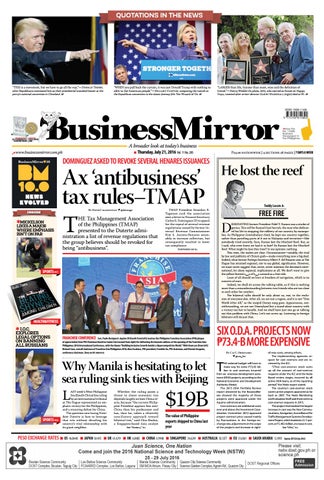
“This is a movement, but we have to go all the way.”—Donald Trump, after Republicans nominated him as their presidential standard-bearer at the party’s national convention in Cleveland. AP
media partner of the year
United nations
2015 environmental Media Award leadership award 2008
“When you pull back the curtain, it was just Donald Trump with nothing to offer to the American people.”—Hillary Clinton, comparing the tumult at the Republican convention to the classic fantasy film The Wizard of Oz. AP
“Larger than life, funnier than most, wise and the definition of friend.”—Henry Winkler (in photo, left), who starred as Fonzie on Happy Days, tweeted after writer-director Garry Marshall (right) died at 81. AP
BusinessMirror A broader look at today’s business
www.businessmirror.com.ph
n
Thursday, July 21, 2016 Vol. 11 No. 285
DOMINGUEZ ASKED TO REVOKE SEVERAL HENARES ISSUANCES
Ax ‘antibusiness’ tax rules–TMAP T By David Cagahastian
INSIDE
he Tax Management Association of the Philippines (TMAP) presented to the Duterte administration a list of revenue regulations that the group believes should be revoked for being “antibusiness”.
mickelson likes a major where emphasis isn’t on par
sports
@davecaga
TMAP President Benedict R. Tugonon said the association sent a letter to Finance Secretary Carlos G. Dominguez III to appeal for the repeal of several revenue regulations issued by former Internal Revenue Commissioner Kim S. Jacinto-Henares ostensibly to increase collection, but consequently resulted in lower tax compliance. Continued on A2
c1
health&Fitness
I.O.C. explores legal options on banning all Russians
FRANCHISE CONFERENCE Sen. Paolo Benigno A. Aquino IV (fourth from left) receives the Philippine Franchise Association (PFA) plaque of appreciation from PFA Chairman Emeritus Samie Lim (second from right) for delivering the keynote address at the opening of the Franchise Asia Philippines 2016 International Conference, with the theme “Building Inclusive Growth Amidst a Hypercompetitive World.” With them are (from left) Richard Sanz, overall chairman of Franchise Asia Philippines 2016; Alan Escalona, PFA president; Franklin Go, PFA chairman; and Vicente Gregorio, conference chairman. Story on A4. Nonie Reyes
P25.00 nationwide | 4 sections 28 pages | 7 days a week
He lost the reef Teddy Locsin Jr.
free fire
D
esignating former President Fidel V. Ramos was a stroke of genius. This will be Ramos’s last hurrah, the man who dedicated his life to stopping the robbery of our country by monopolies. As Philippine Constabulary chief, he kept our country together, rather than parceling parts of it out to Malaysia and terrorists—like somebody tried recently. Sure, Ramos lost the Mischief Reef. But, as I said, who even knew we had it to lose? So Ramos lost the Mischief Reef. What might he lose this time? In my opinion: nothing. This time, the stakes are clear. Circumstances—notably, the trial by law and publicity of China’s grab—make everything now a big deal. Indeed, what former Foreign Secretary Albert F. del Rosario won at The Hague has attained regional, not to say global, significance. However, we must never suggest that; never, never mention the decision’s international, let alone regional, implications at all. We don’t want to give the yellow-livered s__s of b__s around us a free ride. Least of all should we hint at freedom of navigation, which is no concern of ours. Indeed, we shall sit across the talking table, as if this is nothing more than a misunderstanding between two friends who are too close to each other for comfort. The bilateral talks should be only about us, moi, to the exclusion of everyone else. After all, we are not a region, and it is not “One World After All,” as the insipid Disney song goes. Appearances, notwithstanding, we are not Disneyland but a stand-alone country with a victory too hot to handle. And we shall have just one go at talking out this problem with China. Let’s not screw up. Listening to foreign kibitzers will do just that.
SIX O.D.A. PROJECTS NOW P73.4-B MORE EXPENSIVE By Cai U. Ordinario
Why Manila is hesitating to let T sea ruling sink ties with Beijing
L
spOrts
C4
ast week’s West Philippine Sea (South China) Sea ruling by an international tribunal at The Hague represented an emphatic victory for the Philippines, and a stunning defeat for China. The question now facing President Duterte is how to leverage that win without derailing his country’s vital relationship with its giant neighbor.
PESO exchange rates n US 46.8440
Whether the ruling poses a threat to closer economic ties depends largely on how China reacts, because “the current Philippine President appears less antiChina than his predecessor and has, thus far, taken a relatively conciliator y approach toward bilateral ties,” said Chia Shuhui, a Singapore-based Asia analyst See “Manila,” A2
$19B The value of Philippine exports shipped to China last year
@cuo_bm
he national budget will have to make way for some P73.43 billion in cost overruns incurred from six overseas development assistance (ODA) projects, according to the National Economic and Development Authority (Neda). The 2015 ODA Portfolio Review report obtained by the B usiness M ir ror showed the majority of these projects were approved under the Aquino administration. Cost overruns are additional costs over and above the Investment Coordination Committee (ICC)-approved project contract price caused mainly by fluctuations in the foreign-exchange rate, adjustments in the scope of the projects and increase in right-
of-way costs, among others. The implementing agencies request for cost overruns and are reviewed by the ICC. “[The] cost-overrun stock sums up all the amount of cost-overrun requests under the ICC and the Neda Board review stages, incurred by all active ODA loans, as of the reporting period,” the Neda report stated. The country’s cost-overrun stock covers active projects approved as far back as 2007. The Neda Monitoring and Evaluation Staff said there were no cost-overrun requests in 2015. The project that booked the largest increase in cost was the New Communications, Navigation, Surveillance/Air Traffic Management Systems Development Project, which booked a 22.1-percent, or P2.402-billion, increase in cost.
n japan 0.4415 n UK 61.4219 n HK 6.0405 n CHINA 6.9948 n singapore 34.6249 n australia 35.1377 n EU 51.6361 n SAUDI arabia 12.4951
See “ODA,” A2
Source: BSP (20 July 2016 )
A2 Thursday, July 21, 2016
BMReports BusinessMirror
www.businessmirror.com.ph
Ax ‘antibusiness’ tax rules–TMAP Continued from A1
Among the administrative reforms on taxation that TMAP proposed are the return of the informal conference stage in the tax-assessment process; the reinstatement of the administrative mode of obtaining value-added tax refunds; and revocation of regulations that impose taxes even in cases wherein income has not yet been realized by the taxpayer. Henares, when asked to comment on TMAP’s appeal to the new administration, questioned why it was only now that the TMAP had raised these issues. Tugonon said these issues were formally raised before the Bureau of Internal Revenue (BIR) in the past, but were left unheeded.
Informal conference
TMAP wants the informal conference stage of the tax-assessment process to be reinstated to give due process to taxpayers. In 2013 Henares removed this portion in the assessment process on suspicion that the meetings between BIR examiners and taxpayers
ODA. . .
Continued from A1
The project’s cost increased to P13.272 billion from the ICC-approved P10.869 billion in 2009 due to “changes in scope and increase in customs and tax duties.” Another project that booked a large increase was the Laguindingan Airport Development Project, with a total cost increase of P2.315 billion. In 2007 the project increased its cost by 45.82 percent, or P2.468 billion. This brought the project’s total cost to P7.853 billion, from the ICC-approved P5.386 billion. However, in 2013 the final cost of
The solution against corruption is…to strengthen the legal department of the BIR.”—Tugonon
before the issuance of a Preliminary Assessment Notice (PAN) were a hotbed for corruption. But Tugonon said the process could be corrupted at any stage for as long as there are willing taxpayers and examiners who will take part in it. “The solution against corruption is not to remove the informal conference but to strengthen the legal department of the BIR,” Tugonon told the BusinessMirror. He explained that the legal processes in the BIR should be strengthened in such a way that a taxpayer contesting an assessment during the informal conference with the BIR examiner would be allowed to elevate the protest to the commissioner or his or her representative. “Then if the commissioner would up-
hold the examiner in that appeal, then there would be many times wherein the taxpayer would already voluntarily pay,” he said.
Preliminary Assessment Notice
TMAP also wants to repeal the BIR’s current practice of peremptorily dismissing the taxpayers’ reply/protest to the PAN. Tugonon explained that the Tax Code provides taxpayers with the opportunity to reply to the PAN, which should be considered on the merits by the BIR examiners instead of being ministerially dismissed. In practice, instead of considering the merits of a taxpayer’s reply to the PAN, the BIR examiner would ministerially dismiss the reply and proceed directly to the issuance of the Final Assessment Notice (PAN), oftentimes without even reading the contents of the reply. “I don’t think our legislators intended that the PAN is treated as a mere formality. The wisdom of the law is to give the taxpayer time to explain his side through his reply to the PAN before the FAN is issued,” Tugonon said.
DISASTER-RESILIENCY FORUM FOR PWDs Engr. Bien Mateo, SM vice president for Operations and director of SM Cares Program on Person With Disability; Annie Garcia, president of SM Supermall; and Metropolitan Manila Development Authority Chairman Emerson Carlos inspect the equipment being readied for disasters that are currently on display at the SM Cares’ “Disaster Resiliency Conference for PWDs and Senior Citizens” at the SMX Mall of Asia in Pasay City. The aim of the conference is to provide adequate information to persons with disabilities and senior citizens on the gravity of a strong earthquake and other disasters happening in Metro Manila. ROY DOMINGO
Manila. . .
Continued from A1
P7.853 billion saw a decrease of 1.95 percent, or P153.29 million. This resulted in a final project cost of P7.7 billion. Another project that recorded high cost overruns was the Pasig-Marikina River Channel Improvement Project 2, with a 20.24-percent, or P932.81-million, increase. The project, which was approved by the ICC in 2012 at P4.609 billion, now costs P5.542 billion. “[The increase was due to] additional works along [the] Malacañang area and repair of damaged structures,” the Neda said. The country’s total ODA portfolio as of December 2015 amounted to $15.71 billion. It consisted of 73 loans worth
$12.66 billion, or 81 percent of total portfolio; and 460 grants worth $3.05 billion, or 19 percent of the total. Japan has the largest share in the portfolio representing 35 percent, or $5.53 billion. It is followed by the World Bank, with 22-percent share at $3.46 billion; Asian Development Bank, with 21-percent share, or $3.28 billion; and the combined assistance of the Millennium Cha llenge Cor p. and the United States Aid for Internation al Development, with 8 percent at $1.27 billion. Assistance from these top 4 development partners amounted to 86 percent of the portfolio, or $13.54 billion.
at BMI Research. “Any retaliatory economic measures are more likely to be undertaken by China against the Philippines instead of vice versa.” China said it was prepared to engage in talks if the Philippines was willing to manage differences, according to a statement by the Chinese foreign ministry on an informal meeting between the two nations’ top diplomats at an international gathering in Mongolia last week. Here are three charts showing why China matters so much to the Philippines: China is the Philippines’s largest trading partner, buying a quarter of its exports last year, worth $19 billion. And with the Philippines looking for partners to explore oil-and-gas reserves off the Reed Bank, the BMI analyst said the country might consider restarting talks with China National Off-
shore Oil Corp. that stalled in 2012, to gain Chinese expertise. Eduardo Araral, vice dean of the Lee Kuan Yew School of Public Policy in Singapore, said there’s significant room for expanded economic ties between the two countries. “China needs food and the Philippines can supply some— raw and processed,” he said. “Export of solar panels from China to the Philippines should grow. Property investments from the mainland has the potential to grow, especially as the property market in the Philippines is fast growing. The Philippines needs Chinese agriculture machinery and irrigation equipment.” With visitors from mainland China increasing rapidly over the past five years, Araral sees the tourism sector as another with major upside. “Tourism is one with huge potential, especially tied to casinos in Manila,” he said. “Retail department stores, especially owned by ethnic Filipino Chinese, would also benefit from good relations with China.” Bloomberg News
BMReports BusinessMirror
A3
Thursday, July 21, 2016
news@businessmirror.com.ph
Neda: 2 ‘problematic’ ODA projects caused loan-availment delays By Cai U. Ordinario
T
@cuo_bm
HE National Economic and Development Authority (Neda) named two “problematic” official development assistance (ODA) projects that caused the government to extend the loan-availment period due to delays and other implementation issues. In the 2015 ODA Portfolio Review obtained by the BusinessMirror, the Neda said these projects contributed 50 percent of the country’s availment backlog in 2015. The availment backlog reached $888.27 m i l l ion in ca lend a r year 2015. Some $444.47 million were attributed to these ODA projects. “Availment rate is defined as the cumulative actual disbursements as a percentage of cumulative scheduled disbursement, both reckoned from the s t a r t of i mple me nt at ion up to the reporting period,” the document stated. “A project that is about to close, but still registers a comparably low availment rate, reflects that it has a large backlog and may require loan validity extension subject to ICC [Investment Coordination Committee] action,” it added. The Neda said projects on the initial stages register a close-tozero availment rate. A project with an availment rate closer to 100 percent signifies it is on track or catching up with its scheduled availment. With this, these projects are included in the list of “at-risk ” projects under the Neda Monitoring and Evaluation Staff (MES) Alert Mechanism. The Alert Mechanism f lags
$444.47M The availment backlog caused by two ODA projects projects that require priority monitoring and facilitation by classifying them into potential a nd ac t u a l problem projec ts based on certain criteria, such as timetable and cost. Actual problem projects are further classified into two alert levels: Level I, which is the Early Warning Stage; and Level II, which is the Critical Stage. The project with the highest contribution to the availment backlog among the “at-risk” projects is the Market Transformation through the Introduction of Energy Efficient Electric Vehicles Project, or e-trike project, with an availment backlog of $179.13 million. The project’s disbursement rate is below 50 percent; it has a negative physical slippage of at least 10 percent; and it encountered delays in major activities for at least six months, such as the prolonged procurement of 3,000 e-trike units. “A thorough market study for innovative technologies is necessary to ensure social acceptability and sustained interest from LGUs [local government units]
and stakeholders,” the Neda recommended. This was followed by the Jalaur River Multipurpose Irrigation Project, Phase II (NIA/ K EDCF) w ith an availment backlog of $91.06 million. The project’s disbursement rate is below 50 percent for at least one year and the difference between time elapsed, which is based on revised loan closing dates, and utilization rate is more than 30 percent. Like the e-trike project, it also has a negative physical slippage of at least 10 percent and there is at least six months of delay in its major activities. “The Writ of Kalikasan, a legal case filed against the project, caused serious delay in project start-up. But this was resolved in September 2015,” the document stated. Ot her “at r isk ” projects with large availment backlogs include the Agrarian Reform Communities Project II with $54.4 million; Road Improvement and Institutional Development Project, $50.23 million; and Integrated Natural Resources and Environmental Management Project, $32.72 million. The list includes the National Irrigation Sector Rehabilitation and Improvement P rojec t w it h a n ava i l ment backlog of $19.6 million; Mindanao Sustainable Agrarian and Agriculture Development Project, $9.48 million; Provincial Towns Water Supply Program III, $7.84 million; a nd Met ro M a n i l a Wa ste water Management Project, $0.01 million. Projects that did not have availment backlogs were Participator y Irrigation Development Project; CommunityBased Forest and Mangrove Management Project; and Italian Assistance to the Agrarian Reform Community Development Support Program.
Shift to EMV-enabled cards still a challenge
T
he biggest hindrance to the regulatory mandate to shift to Euro MasterCard Visa (EMV)-enabled automated teller machine, as well as credit and debit cards, from the now obsolete magnetic-strip technology is not the technology itself but the humans who use it, according to Bankers Association of the Philippines President Nestor V. Tan. EMVs pertain to the proprietary cards whose embedded chip security features have been touted as superior to the magnetic-strip variety now prevalent. “It’s not the system that will be the problem. It will be our ability to reach out to all of our customers and replace the cards,” Tan told the BusinessMirror at the sidelines of the Bangko Sentral ng Pilipinas’s (BSP) 2016 Awards Ceremony and Appreciation Lunch for Stakeholders. The BSP has worked with key industry players since 2013 to come up with practical ideas to help the financial institutions transit successfully to EMV technology with minimal disruptions to the consuming public. The mandate was for all the banks to upgrade and make compatible their ATM cards with EMV chip-enabled cards. The mandate applies to debit and credit cards, as well. These cards are the international standard for chip-based credit and debit transactions, and is considered more secure than the magnetic-stripe technology used in most bank-issued cards in the country. According to Tan, the difference between the now obsolete magnetic stripdriven ATM, as well as credit and debit cards, lies in where the data is placed and stored. In what most cards in the country have, data is detected through a black magnetic strip found at the back of each old technology cards. An EMV card, however, carries a microchip where the data becomes flexible and dynamic that allows for the structure of the data to change, making it impossible to copy. All banks in the country should already be compliant by January next year. According to data from Euromonitor International, there are, at present, 7.36 million credit cards in circulation in the Philippines last year. Some 35.36 million more are debit cards. “I think what will happen here is that most banks will be able to comply with the mandate. But probably, we’ll request
the BSP to understand that the recarding will take time,” Tan said. Earlier reports by the BusinessMirror cited several banks as confident in making the migration from magnetic-strip technology to EMV. The Bank of the Philippine Islands has wrapped up its migration of 1.3 million credit cards even as the upgrading of its debit cards is still under way. Security Bank also said their own migration is on schedule. Tan, who is also president and CEO
of BDO Unibank, said they have since made provisions for the migration. “We’re ready. The only outstanding thing that we have really is the issuance of cards since we have so many cardholders,” he said. BDO holds the most card brands in the Philippines being the issuer of Visa, MasterCard, American Express, JCB and UnionPay. The bank also acquired the Diners Club International franchise from Security Bank in June. Mia Mallari
PHL JOINS MOURNING FOR NICE VICTIMS
French Ambassador to the Philippines Thierry Mathou lights a candle at the foot of the replica of the Eiffel Tower to honor the victims of the truck attack on Bastille Day in Nice, France, in Makati City on Monday. The tribute was done simultaneously with the minute of silence that was observed all over France at the end of the three-day official mourning. AP
Tugade’s first 100 days at DOTC: Improved service for NCR commuters By Lorenz S. Marasigan @lorenzmarasigan
C
OMMUTERS who suffer from chronic traffic congestion—from rails, to roads, to ports—can expect relief with better public-transportation services and slightly lighter situations along major roads toward the end of 2016. There are more than a dozen items in Transportation Secretary Arthur P. Tugade’s to-do list for his first three months in office that, he said, would help ease the messed-up traffic situation in the Philippines.
Rails: Increase capacity, lessen queues
IN 100 days, Tugade hopes to improve the capacity of the Metro Rail Transit Line 3, by optimizing the use of train cars and increasing the number of operating coaches from 48 to 60, which will, hopefully, run from 40 kilometers per hour (kph) to 50 kph. He also plans to reduce the headway from five minutes to fourand-a-half minutes. “The net result of this is the increase of passengers per hour per
direction, from 14,184 to 15,760,” he said in a business forum late on Tuesday. He also plans to fix the delay in the procurement of additional trains for the Light Rail Transit Line 1. The bidding for the P30billion train supply deal has been delayed, according to for mer Transport Secretary Joseph Emilio A. Abaya, due to the World Olympics in Japan in 2020. “We also want to address the issue on right-of-way. We hope to deliver the right-of-way to address the extension delays,” Tugade said. He was referring to the delayed delivery of the needed easement for the construction of the train line’s extension to Cavite. Light Rail Manila Corp., the concessionaire for the railway’s extension and management, is ready to implement the project, but still has issues on land use. Aside from these, Tugade also plans to stop the endless queues at ticketing offices in train stations by selling train tickets on other outlets, such as malls and stalls. He also wants to install “waiting spaces” inside the train stations by providing clean toilets, free
Internet access and increased police presence.
Roads: Map out secondary routes, expand choices
COMMUTERS can also expect lighter traffic situations along major arteries, as Tugade plans to enforce stricter traffic rules and fully implement existing ones. In his first three weeks in office, he has already created a traffic-management team composed with the Metropolitan Manila Development Authority, the Highway Patrol Group, the Land Transportation Office and the Land Transportation Franchising and Regulatory Board. “We are also sustaining traffic enforcement on choke points and are enforcing a ‘no parking policy,’ an ‘anticolorum policy’ a nd a n ‘a nt i s mok e - b e lc h i ng policy,’ in the first 100 days,” Tugade said. During the three-month period, he will also order the synchronization of traffic lights; improvement of traffic signs and markings; the mapping out of secondary routes; and conduct consultations with various stakeholders, such as local gov-
ernments and public-transport operators. “Starting August, we will be expanding the point-to-point bus services, and we’ll also be deploying more premium airport shuttle buses,” Tugade added. By end-September, Tugade will start encouraging schools to employ transport-demand management measures, and will push for an electronic tolling interpretability among operators.
Airports: Clear roads, optimize runway
GRIDLOCKS at the Ninoy Aquino International Airport will also be addressed in the next few months, Tugade assured. Aside from allowing regular taxi services at all airport terminals, Tugade also plans to address the road congestion at the Naia Complex through a traffic-management scheme. “We plan to man key intersections and clear illegally parked vehicles and road obstructions to help lessen congestion in the airport roads,” he said. He also plans to implement the recommendations of the National Air Traffic Services, the leading
air navigation service provider in the United Kingdom, on runway optimization to decongest flight arrivals and departures. Aside from these, he plans to regulate general aviation during peak periods, and provide reliable free Internet in major airports in the Philippines.
For serious study
TUGADE will also study, in the first 100 days in office, the construction of a bus rapid transit system that will run from Fairview in Quezon City to Makati City via C-5 to reduce commuters on Edsa by 120,000 passengers. Likewise, he will also study the possibility of deploying point-topoint bus services in residential areas in Makati, and the provision of double-decker bus. Aside from these, he will also look into the proposed construction of a pontoon bridge that will pass through the Pasig River near Circuit Makati, and the deployment of container-rail services from Laguna, Batangas, or Sangely Point to Manila. He s a id he i s “ser iou sly ” look ing into the prospect of building a cable-car system to
ease traffic congestion, and the development of Sangley Air Base to immediately transfer general aviation to the military base.
‘Change starts with me’
ALL these plans, Tugade said, should materialize over time. But plans will remain to be mere proposals if Filipinos will remain uncooperative and responsive to change in transport values and culture. “Plans remain plans, but I will do things by changing values and culture. I’m starting with my office,” he said. Tugade pointed out he will be needing extraordinary powers in order to efficiently implement these proposals. “Especially with this traffic situation, I want you to help us convince the authority that more than ever, this country now needs what we call special laws and emergency power to address the trafficsituation crisis,” he said. The transport chief has tagged the chronic traffic congestion in the Philippines as a plague that has caused the lives of Filipinos to be messed up—or in a harsher, more Filipino way, “nababoy.”
BMReports BusinessMirror
A4 Thursday, July 21, 2016
news@businessmirror.com.ph
Cusi: PEMC should pursue case vs Aboitiz
E
By Lenie Lectura
@llectura
NERGY Secretary Alfonso G. Cusi strongly believes that the Philippine Electricity Market Corp. (PEMC) should pursue the case against a subsidiary of Aboitiz Power Corp. for alleged breaches in the Wholesale Electricity Spot Market (WESM).
“They should pursue [the case]. They know their duties,” Cusi said in a text message. The PEMC Board is chaired by the energy secretary. For more than 10 years, Cusi served as director in the shipping business of the Aboitiz group. As such, his appointment as DOE chief has raised concern, given his ties with the Aboitiz family, whose power business accounts for 70 percent of Aboitiz Equity Ventures Inc.’s earnings. Cusi also dismissed any possible conflict of interest. “Let us put it this
way. They are my competitors. I have been out of Aboitiz since 1990. I have been on my own business since 1991. I believe they are the last one to know about the DOE post,” Cusi earlier said. Cusi was referring to the Batangasbased shipping company Starlite Ferries Inc. He served as chairman of the shipping company. He emphasized that he will ensure a level playing field for energy-related projects. “Puro big players ’yan, they know what they are doing. We have to make the playing field level para sa lahat. Wala naman siguro ’yung fa-
voritism na ’yan,” Cusi said. PEMC recently asked the Supreme Court (SC) to review a court decision that junked its appeal to impose a P235-million fine against Therma Mobile Inc. (TMO). PEMC’s filing before the SC came after the Court of Appeals (CA) upheld in December last year the April 2015 decision of Branch 157 of the Regional Trial Court in Pasig City. PEMC later on filed a motion for reconsideration with the CA, but the latter denied it on April 22, 2016. ThecourtcasestemmedfromaPEMC investigation that found TMO to have
withheld its capacity during the November and December 2013 supply period. As a result, the agency penalized TMO. Under the must-offer rule, generation companies registered in the WESM must declare and offer the maximum generating capacities of their power facilities in the spot market. “When it comes to PEMC, our concern is only breaches in WESM rules. When it comes to anticompetitive rules… this is for ERC [Energy Regulatory Commission] to find out. It’s beyond [our] jurisdiction,” PEMC President Melinda Ocampo said.
Tycoon Okada’s Universal wages biggest bet in $4-B Manila casino
K
azuo Okada, Universal Entertainment Corp. chairman and former Steve Wynn partner, plans to challenge Macau in wooing Chinese gamblers to his Manila casino resort that could cost $4 billion and is scheduled to open in November. Okada, 73, wants his casino, featuring a 100-meter (328-foot) dancing water fountain and indoor beach, “to compete with what is in Macau” and other parts of Asia, said Takahiro Usui, COO at Universal Entertainment’s Tiger Resort Leisure and Entertainment Inc. “This project will promote Manila as a destination in the region and the world.” Universal Entertainment rose 9.6 percent to ¥2,597 in Tokyo trading on Wednesday, the biggest gain since
June 2013. The benchmark Topix was little changed. The Manila resort could cost $3 billion in its first phase and reach $4 billion when three more phases are built, making it the tycoon’s “biggest investment,” Usui said in an interview on Tuesday in Manila. That would be about twice the ¥208.3-billion ($1.96billion) market capitalization of Universal Entertainment, the Tokyobased maker of gambling machines in which Okada Holdings controls a 68-percent stake. Manila is aspiring to become the next Asian gambling hub, as high-stakes Chinese gamblers increasingly abandon Macau amid the Chinese government’s crackdown on corruption. Okada’s project is one of
four casino resorts the Philippines wants built on a 120-hectare property along Manila Bay, dubbed the Entertainment City, as the nation seeks a larger share of Asia’s gaming and tourist revenue. “The gaming industry in the Philippines should have the best performance ever in the second quarter ended in June, as more gamblers are leaving Macau amid its stricter gaming regulation,” CLSA Ltd. analyst Marcus Liu said on Tuesday. The large investment “underscores Okada’s commitment and confidence in the Philippines’s gaming market,” he said. Okada is embroiled in a high-profile lawsuit against Wynn Resorts Ltd., after the company accused the Japanese tycoon of making improper
payments to Philippine gambling regulators and forcibly redeemed his 20-percent stake in the casino operator in 2012. Okada has denied the allegations, and the suit is ongoing. Okada Manila will be the third casino resort to open in the Entertainment City and the largest, with over 26,000 square meters of gaming space. It will compete with a project by Philippine billionaire Enrique Razon’s Solaire, and City of Dreams Manila, a venture between Melco Crown Entertainment Ltd. and the Philippines’s richest man, Henry Sy. The fourth property, a project by Philippine billionaire Andrew Tan and Malaysian tycoon Lim Kok Thay, is expected to open in the fourth quarter of 2020.
Traffic at Okada Manila, which is built on 44 hectares facing Manila Bay’s sunset, will initially be a mix of 30-percent foreigners and 70-percent locals. The casino wants half of its clientele to be overseas visitors, including Chinese, Japanese and Koreans, after a year, as the resort conducts marketing among travel agents and gambling promoters, Usui said. Shares of Bloomberry Resorts Corp., owner of Solaire, sank 4.5 percent in Manila, heading for the biggest loss in three weeks. Travellers International Hotel Group Inc., operator of Resorts World Manila, slid 0.8 percent, halting a five-day gain, while Melco Crown Philippines Resorts Corp. slumped 5 percent to a three-week low.
“Okada is coming to town, a grim reminder to investors of the oversupply facing an industry that is already competitive,” said Jonathan Ravelas, chief market strategist at BDO Unibank Inc. “This is a serious property, and the question is who among the existing players will get hit the most. This is the time to capitalize on gains.” The 500-gambling table Okada Manila will be a jump-off point for other resorts the Japanese businessman plans to build in other parts of the country, said Antonio Cojuangco, Okada Philippine partner in the Manila project. Sites are being scouted in the provinces of Palawan and Davao, with development likely to start in the next two years, he said. Bloomberg News
Franchisers told: Be tech savvy to be competitive By David Cagahastian @davecaga
P
hilippine franchisers must continually cope with the advancement of technology to finally realize the goal of making the Philippines a hub for franchising in Asia, participants at the Franchise Asia Philippines 2016 conference said. At the opening ceremonies of the four-day conference in Manila on Wednesday, overall chairman Richard Sanz said “keeping abreast with technological advances, marketing practices and trends worldwide are vital in keeping Philippine franchises competitive.” “In this era of global competitiveness, it’s not an option but a necessity,” he stressed. Sanz said franchising can be an important tool in achieving inclusive growth by allowing the wealth to be created by micro, small and medium enterprises (MSMEs), which can trickle down to the poor
Keeping abreast with technological advances, marketing practices and trends worldwide are vital in keeping Philippine franchisers competitive.”—Sanz
through job generation. In one of the breakout sessions during the conference, Ipsos Philippines Managing Director Marie Lee discussed the importance of the digital technology in the future of retail. Franchise Asia Philippines 2016 is the longest-running franchise exposition in Asia, and aims to transform the Philippines into regional hub for franchising. Key note speaker Sen. Bam Aquino said Philippine franchisers and the vibrant MSME sector make competition in the Philippines very intense and, thus, conducive to innovation and growth. “Competition is alive and well in
our country, except in some industries, because of the vibrant MSME sector,” Aquino said in his speech. He added that Congress would like MSMEs to become even more competitive not only among themselves, but also among their counterparts in the Asia-Pacific region through legislation that will provide incentives to start-ups. Aquino is advocating two bills in the Senate to help MSMEs, one of which will provide tax incentives to start-up businesses, and another to reform the tax regime imposed on micro and small businesses, and also to provide them with tax perks to encourage them to comply with tax laws.
Meat processors ask Duterte administration to defer circular issued by previous Cabinet
T
he Philippine Association of Meat Processors Inc. (Pampi) has asked the Duterte administration to defer the implementation of a joint circular issued by former Cabinet officials on the eve of the turnover of their responsibilities. Pampi, which counts among its members the largest meat-processing companies, sent a letter on July 4, requesting Agriculture Secretary Emmanuel F. Piñol, Health Secretary Paulyn Jean B. Rosell-Ubial and Executive Secretary Salvador Medialdea to defer Joint Administrative Circular 02 issued by former Cabinet officials on June 29. Former Secretary Proceso J. Alcala of the Department of Agriculture (DA) and Secretary Janette P. Garin of the Department of Health (DOH) signed the joint circular transferring the functions of DA’s National Meat Inspection Service (NMIS) to DOH’s Food and Drug Administration (FDA) to implement provisions of Republic Act (RA) 10611, or the Food Safety Act. “We believe and in fact herewith request that the joint order to immediately implement RA 10611 be
deferred to give time for the present administration to study the same and establish the reasons for the haste by which it is being recommended to be undertaken,” Pampi President Felix O. Tiukinhoy Jr. said in the letter. Tiukinhoy said Pampi had opposed the transfer of the functions in the regulation of processed meat because it would only add another layer in the bureaucratic process of issuing permits for food products. “There will be an increase in the bureaucracy of handling processed and prepackaged food products, whether locally produced or imported, including meat products. There will be two Cabinet departments involved in a single issue. Consequently, there will be layering of costs, which will affect the Filipino consumers,” Tiukinhoy said. RA 10611 proposes the transfer of the supervision and regulation of processed and prepackaged meat products from NMIS to FDA, “for reasons unclear and consistently objected to by industry mainly because of the duplication of functions,” according to Tiukinhoy.
Tiukinhoy said because of the objections gathered during the period of consultations, the implementation of RA 10611 and the formulation of the implementing rules and regulations were delayed and remained unfinished. “Yet, the former secretaries have resolved to implement RA 10611 much ahead of the legal prescribed period of implementation starting February 2017,” he said. “In this regard, we would like to be clarified if the said joint order should be given effect, considering that there is already a change of administration and the tenets and proposed objectives of the new administration may not support this transfer of responsibility, given that there will be new policies this administration will be adopting in the best interest of agriculture, agribusiness and food safety and security,” Tiukinhoy said. He said it appeared that the past administration was railroading the direction that agriculture should take, rather than to give way and respect the new directions the Duterte administration will take to revolutionize agriculture.
Asean
BusinessMirror
www.businessmirror.com.ph
EU and the world: Staying ahead of competition Asean-EU Perspective
HENRY J. SCHUMACHER
I
nnovation takes place within the global context. On a global scale there are few saturated markets. This is especially true with regard to the international exchange of goods. It took 80 years to bring global per-capita exports to $437 (1900 to 1980). In the following 20 years, they more than doubled, and since 2000 they almost tripled again to reach $2,634 in 2013. This “explosion” has taken place in spite of a rapidly growing global population. In 1990 the world’s population was 1.6 billion, today we are 7.3 billion. We can assume that global trade will continue to grow faster than national GDPs. Each company and each country that is innovative and participates in this accelerated globalization can profit enormously. There are some obvious questions: What makes certain countries strong in exports and others weak? What role do innovativeness and manufacturing play? And how does company size relate to export performance? It should be noted that countries do not export; only companies export. An excellent export performance by a country proves that the country has strong, internationally competitive enterprises. Most people assume that export performance depends on the prevalence of large corporations. For most countries there is, indeed, a strong correlation between the number of large firms and exports. But there are two exceptions to this rule: China and Germany. And it is precisely these two exceptions that are the leading export nations in absolute terms. What do they have in common and what distinguishes them from the other countries? It is the share of exports contributed by mid-sized firms. Sixty-eight percent of Chinese exports come from companies with less than 2,000 employees. In Germany mid-sized companies (the Mittelstand) contributes 70 percent to exports. This suggests that in order to achieve truly exceptional export performance, a country needs both large corporations that are strong in exports, and a broad foundation of small- and medium-sized exporters. Research, undertaken by Simon-Kucher & Partners, shows that the export success in many countries is due to Champions. What is a Champion? It is a company that is one of the top three in its global market, has less than $5 billion in revenue, and is little known in public. And Champions are highly innovative. The key question is: what can entrepreneurs, companies, academics and politicians learn from these Champions? Champions set extremely ambitious targets for themselves related to market leadership and growth; Champions focus (we only do one thing, but we do it right); Closely connected with focus is a deep value chain; Champions are extremely hesitant about outsourcing core competencies; Champions combine specialization in product and know-how with global selling and marketing. Globalization is the growth booster for them; One does not become a world-market leader by imitation, but only by innovation. Innovation starts with spending on research and development (R&D). R&D spending by the Champions is twice as high as in the average industrial company. Even more important is their output. Champions have five times the number of patents per thousand employees than patent-intensive large corporations. Closeness to customer is the greatest strength of the Champions— even ahead of technology. Their strategies are value-oriented, not priceoriented. The Champions hold strong competitive positions. Advice and system integration are innovative advantages that create higher barriers to entry for others. Champions have more work than heads, highly qualified employees and low turn-over. The ultimate explanation for the unusual success of the Champions lies in their leaders. They are characterized, first and foremost, by a very strong identity of person and mission, meaning they totally identify with what they do. Champions are true role models of innovation, strategy and leadership.
Vietnam’s legislature convenes to elect leaders
V
ietnamese Communist Party-dominated National Assembly on Wednesday opened its first session following May elections to elect the country’s top leaders. The 494 deputies are widely expected to reappoint President Tran Dai Quang, Prime Minister Nguyen Xuan Phuc and the assembly Chairman Nguyen Thi Kim Ngan. They were elected to their positions by the outgoing assembly in April. Only 20 of the deputies are not members of the ruling Communist Party. The May elections for the rubber-stamp parliament are held every five years. Speaking at the opening of the 14th National Assembly, Communist Party General Secretary Nguyen Phu Trong called for greater efforts for the country’s
development. He said the assembly begins its tenure at a time “when the world and regional situation has seen complicated...while domestic situation is intertwined between opportunities and difficulties and challenges, which require our whole people and the military to have greater efforts, determination and unity to bring our country out of difficulties for sustainable development.” The Vietnamese economy of 92 million people has moderated in the first half of this year, expanding 5.5 percent, compared with 6.3 percent growth in the same period last year, according to the World Bank. The World Bank report released on Tuesday attributed the slower growth to the impact of a severe drought on agricultural production and slower industrial growth. AP
Editor: Max V. de Leon • Thursday, July 21, 2016 A5
Singapore to become global debt-restructuring center
S
ingapore is seeking to enhance its position as a center for debt restructuring by giving its insolvency law some of the powers of the United States bankruptcy code’s Chapter 11, just as companies worldwide default on bonds at the fastest pace since the global financial crisis.
The government has “broadly accepted” 17 recommendations submitted by a committee after a yearlong review, the Ministry of Law said in a statement. These include offering automatic stay of legal and enforcement actions for debtors, creating a bench of specialist judges for its bankruptcy court and increasing rescue-financing capital by enticing distressed-debt funds and private equity firms to set up shop in the city-state. “We have all the basic building blocks for dealing with restructuring and we see that Singapore will be able to fill this space,” Indranee Rajah, senior minister of state for law, told reporters on Wednesday. “Singapore should not just be a debt-restructuring place for Singapore companies and businesses, but a global debt-restructuring center, much in the way as New York and London. We should be playing that role to the region and beyond.” There have been 100 bond defaults globally this year through July 15, compared with 62 failures at this time last year, according to S&P Global Ratings, the worst since the fallout from the demise of Lehman Brothers Holdings Inc.
Singapore should not just be a debt-restructuring place for Singapore companies and businesses, but a global debt-restructuring center, much in the way as New York and London.”
—Indranee Rajah In Singapore, nonpayments by PT Trikomsel Oke and Pacific Andes Resources Development Ltd. from November marked the first defaults since 2009.
Stay of enforcement
“The recommendations are progressive,” said Ashok Kumar, a director at BlackOak Llc., a restructuring and insolvency-law firm in Singapore.
SHAOLIN IN SINGAPORE In this July 13 file photo, Shaolin monks, who are part
of a 20-member cast, perform during a media preview of their new show Shaolin in Singapore. The show combines traditional Shaolin kung fu and choreographed moves to music, and is inspired by martial-arts experts from the Shaolin Temple, said to be the birthplace of kung fu. AP
“The market needs it, as over the next couple of years, things are going to be rough in some sectors as the risk of debt default rises.” A Chapter 11 bankruptcy petition protects the debtor from legal and enforcement action worldwide. Singapore’s Companies Act offers two ways of restructuring via judicial management and schemes of arrangement, legal procedures that follow the English law. The former provides automatic protection. In the latter way, a moratorium on legal actions by creditors may be given subject to adequate disclosure of information under the proposed reform.
Singapore protection
A slump in global commodity prices in the past three years has pushed Asian coal miners, including PT Bumi Resources and PT Berau Coal Energy, to seek protection in Singapore and US courts, while
fishery group Pacific Andes Resources made a move locally. Singapore’s legal review may also introduce so-called prepackaged restructuring—a negotiated deal between the debtor and its major creditors that may be presented for court approval before any formal legal proceedings. The intent is to save time and cost in debt-restructuring efforts. To attract more distressed financing capital, the legal reform will allow the local court to grant investors so-called super-priority lien status —or seniority in claims over existing creditors—when funding companies in bankruptcy, the ministry said on Wednesday. The government plans to propose the amendments to the Companies Act by year-end, and a plan to house all its relevant restructuring and bankruptcy procedures under a new law is a long-term target, Rajah said. Bloomberg News
Malaysia’s opposition-led state mulls over snap polls
A
n opposition-led state in Malaysia is mulling early elections for local seats, even as a corruption scandal engulfs its chief minister—a high-stakes gamble that risks backfiring and boosting Prime Minister Najib Razak’s ruling coalition. The Democratic Action Party (DAP) is considering snap polls in Penang, the Star newspaper reported on Tuesday, citing officials it didn’t identify. The leader of the People’s Justice Party, a coalition partner of the DAP, said late Tuesday her party isn’t convinced yet of the need for an early vote. Penang’s chief Minister Lim Guan Eng, who is also the DAP’s secretarygeneral, was charged last month with graft and abuse of power over property deals. He has pleaded not guilty and is free on a 1-million-ringgit ($249,000) bond. He didn’t reply to calls or text messages seeking confirmation that his party is mulling a ballot soon for its state assembly. Malaysia’s opposition parties are in disarray, having splintered amid policy differences in the aftermath of the last general election in 2013. With one leader in jail, and Lim facing charges that could potentially put him behind bars, it’s becoming more challenging for the opposition to mount a coherent front against Najib, who has weathered graft allegations of his own and efforts by a former leader to remove him.
‘Lukewarm support’
Malaysians generally are experiencing political fatigue and this may translate to a poorer performance for the opposition in Penang should
there be snap elections, said Ooi Kee Beng, deputy director of the ISEASYusof Ishak Institute, a research center in Singapore. “The point of calling for early elections is to show strong support,” Ooi said. “Lukewarm support will not do. Weakening support for the opposition will be demotivating for their supporters in the rest of the country.” Najib has secured recent victories in local polls in Malaysia’s biggest state of Sarawak on Borneo island in May and two federal by-elections last month. Leaders in his United Malays National Organisation party are watching his ability to shake off a year of political turmoil and focus on boosting a slowing economy. With opposition parties holding three quarters of seats in the Penang assembly, the chances of the ruling Barisan Nasional (BN) regaining power in the state it lost control of in 2008 are low.
Opposition infighting
Still, racial and religious issues are widening the divide between opposition parties, and infighting has made it easier for BN to claim bigger majorities in recent elections. Should it gain votes in Penang—even it fails to win more seats—that could embolden Najib and his allies as they head toward general elections that must be held by mid-2018. Lim became Penang’s first chief minister from an opposition party in 36 years after winning in 2008. He is Malaysia’s only ethnic-Chinese state leader. Penang, the country’s second-smallest state, is one of its largest contributors to GDP and
home to foreign electronics companies, including Intel Corp. “Voters’ support should not be taken for granted and there must be a public explanation from DAP to state their reasons for the state elections,”
the Coalition for Clean and Fair Elections said in a statement on Tuesday. Any elections use public funds and “are time-consuming and frustrating when voters do not know what the election is for.” Bloomberg News
The World BusinessMirror
A8 Thursday, July 21, 2016
Brexit uncertainty leads IMF to trim growth forecast for global economy
W
By Jim Puzzanghera | TNS
ASHINGTON—Britain’s vote to leave the European Union has led the International Monetary Fund (IMF) to trim its forecast for global economic growth through 2017, but, so far, the impact has not been as severe as initially feared. World economic output will increase 3.1 percent this year, the same as it did in 2015, and improve to 3.4-percent growth next year, the IMF said on Tuesday. The forecasts for 2016 and 2017 each were a tenth of a percentage point lower than in the organization’s April World Economic Outlook. If not for the British vote, dubbed “Brexit,” the IMF said it would have left its forecast for this year unchanged because “better-thanexpected economic activity” in the euro zone had offset “disappointing US first-quarter growth.” The forecast for next year would have been increased by a tenth of a percentage point from the April estimate. But the result of last month’s referendum in Britain “creates a wave of uncertainty amid already-fragile business and consumer confidence,” the IMF said.
“The Brexit vote has thrown a spanner in the works,” IMF chief economist Maury Obstfeld said, using a British term for wrench. Britain’s economy now is forecast to expand 1.7 percent this year— down 0.2 percentage points from the IMF’s April estimate—and just 1.3 percent in 2017. The forecast for next year is nearly 1 percentage point lower than the April estimate. “The vote in the United Kingdom in favor of leaving the European Union adds significant uncertainty to an already-fragile global recovery,” the IMF said. “The vote has caused significant political change in the United Kingdom, generated uncertainty about the nature of its future economic relations with the European Union and could heighten political risks in the European Union itself,” the report said. The uncertainty is expected to
Oil halts slide near $45 as US crude stockpiles seen declining
O
il held near $45 a barrel as US industry data showed a drop in crude stockpiles, paring a surplus in the world’s largest fuel consumer. Futures were little changed in New York after dropping 1.3 percent on Tuesday to a two-month low. Inventories declined by 2.3 million barrels last week, the American Petroleum Institute was said to report. While government data on Wednesday is forecast to show supplies fell for a ninth week, stockpiles will still be more than 100 million barrels above the five-year seasonal average. Oil has f luctuated between about $44 and $52 a barrel since early June after almost doubling from a 12-year low in February as supply disruptions and falling US output trim a global surplus. Prices should rebound to about $60 a barrel next year and accelerate the return of drilling rigs, Pioneer Natural Resources CEO Scott Sheffield said in Washington. “North America has experienced the largest production declines,” Barclays Plc. analyst Miswin Mahesh in London said in a report. “The oil market is on the cusp of rebalancing
within the next year.” West Texas Intermediate (WTI) for August delivery, which expires on Wednesday, was 8 cents lower at $44.57 a barrel on the New York Mercantile Exchange as of 9:08 a.m. London time. Prices fell 59 cents to $44.65 on Tuesday, the lowest close since May 9. The more-active September future was 3 cents lower at $45.42. Total volume traded was about 37 percent below the 100-day average.
U
hurt investment and confidence. But the growth revisions caused by the British vote were concentrated in advanced European economies, and the Brexit should have “a relatively muted impact elsewhere,” the IMF said. The IMF increased its forecast for growth in the euro zone this year by a tenth of a percentage point to 1.6 percent from the April estimate. But the group cut its forecast for 2017
to 1.4 percent, down 0.2 percentage points from April. The US economy is expected to expand 2.2 percent this year, down 0.2 percentage points from the April estimate. The 2017 forecast of 2.5-percent growth is unchanged. The IMF warned that the Brexit effect on the global economy could be even worse. A severe-impact scenario—envisioning “intensified financial stress,
particularly in Europe, a sharper tightening of financial conditions and a bigger blow to confidence”— would cause global growth to fall to 2.9 percent this year and 2.8 percent next year. But the IMF said that scenario, and a less extreme downside forecast, have become less likely after financial markets stabilized following initial sharp declines after the Brexit vote.
BOJ can correct policy ‘big lies’ at July meeting–former official
US stockpiles
Brent for September settlement was 3 cents higher at $46.69 a barrel on the London-based ICE Futures Europe exchange. The contract closed 0.6 percent lower at $46.66 on Tuesday. The global benchmark traded at a premium of $1.24 to WTI for September. Crude stockpiles at Cushing, Oklahoma, the delivery point for WTI and the biggest oil-storage hub, dropped by 84,000 barrels last week, the API said on Tuesday, according to a person familiar with the figures. Nationwide supplies probably fell by 2 million barrels, according to a Bloomberg survey before the EIA report Wednesday. Bloomberg News
US seeks to seize $1-B assets tied to 1MDB S federal prosecutors plan to seek permission as early as Wednesday to seize more than $1 billion in assets purchased with money allegedly misappropriated from a Malaysian state investment company, the New York Times reported. The Justice Department is leading the potential asset seizure that it will allege was laundered in the US, and which would be its largest such case, the paper said, citing an unidentified person familiar with the plan. Money said to have been embezzled from 1Malaysia Development Bhd. (1MDB) was hidden in the US in real estate, art and other luxury goods, the New York Times said. 1MDB, whose advisory board was headed by Malaysian Prime Minister Najib Razak until it was dissolved recently, is embroiled in multiple global probes related to allegations of money laundering and embezzlement. Najib’s
People exchange their currency in London on July 14. The Bank of England kept interest rates on hold and refrained from injecting more money into the British economy last Thursday, despite some clear evidence of the initial economic damage caused by the country’s decision last month to leave the European Union. AP/Adela Suliman
family has been entangled in various alleged links to 1MDB funds, alongside a separate donation scandal that has caused more than a year of political tensions in Malaysia. The Justice Department’s Kleptocracy Asset Recovery Initiative unit will name Najib’s stepson Riza Aziz, Malaysian financier Jho Low and Khadem Al Qubaisi, former managing director of Abu Dhabi’s International Petroleum Investment Co. in its court filing, the paper said. The department’s public affairs office couldn’t be reached by phone outside US office hours. Relatives or associates of Najib have invested millions of dollars in real estate and art in the US, the New York Times previously reported. It isn’t clear what assets will be confiscated but it will likely include properties, the Wall Street Journal said separately in a report on Wednesday. Bloomberg News
Hayakawa
T
he Bank of Japan (BOJ) should add stimulus at its policy meeting next week and use that opportunity to correct “two big lies” about monetary policy, a former BOJ executive director said in an interview. “It’s a major problem that the BOJ has continued with two big lies,” said Hideo Hayakawa, referring to the statements about unlimited policy space and achieving its inflation target in a time frame that has been repeatedly delayed. The BOJ should scrap its references to reaching 2 percent within about two years and also concede that it will have to start tapering bond purchases, he said. Governor Haruhiko Kuroda said as recently as last month that having a time frame is important to show the BOJ’s strong commitment to reaching the price goal soon, while in April he restated his view that his monetary policy doesn’t face limits. The central bank declined to comment on Hayakawa’s remarks. The BOJ has repeatedly pushed back when it forecasts inflation reaching its target and prices have been falling since March, with little sign of improvement. With the BOJ already buying the equivalent of more than 90 percent of Japan’s newly issued debt each year, many
economists say there are physical limits on how many bonds it could buy. “Getting to 2 percent is, I think, very unrealistic,” Derek Halpenny, the London-based European head of global markets research at Bank of Tokyo-Mitsubishi UFJ Ltd, said on Bloomberg Television. “Is it a lie? I think it’s a failure, perhaps.”
Balance sheet
Analysts at Goldman Sachs Group Inc. and JPMorgan Chase & Co. are among many in predicting additional easing later this month. The BOJ’s bond purchases have seen its balance sheet to swell to more than 80 percent of Japan’s GDP, much larger than the equivalent 25 percent in the US. “There is no way that markets will trust the BOJ if it remains bullish,” Hayakawa, who retired in 2013, said in an interview on Tuesday. “Everybody knows that 2-percent inflation won’t happen in a near future and that there is a limit for easing tools, so I don’t think acknowledging these facts will cause a big impact.” However, changing its commitments will be seen as “backing down” if it isn’t accompanied by additional stimulus, Hayakawa said. Among easing options are expanding purchases of exchange traded-
funds, a further cut in the negative interest rate applied to some funds parked at the BOJ and even offering negative rates in a loan support program, Hayakawa said.
Inflation projection
The BOJ will probably cut its inflation forecast to around 1.3 percent for the fiscal year starting in April 2017, said Hayakawa, who was also former chief economist at the BOJ. The bank is currently projecting 1.7 percent for this period. Hayakawa’s own view is that it won’t go above 1 percent in fiscal 2017. Japan’s consumer prices excluding fresh food dropped 0.4 percent in May, and haven’t risen this year. The 13-percent appreciation of the yen against the dollar in 2016 will cut into inflationary pressures by lowering import costs. Hayakawa isn’t the only former BOJ executive in calling for a more flexible policy stance. Kazuo Momma, whose time at the central bank overlapped with Hayakawa, said last month that the BOJ should drop its two-year time frame. Board member Takahide Kiuchi, who dissents from the current stimulus program, has proposed aiming to reach the price target in the mid-long term. Bloomberg News
news@businessmirror.com.ph
Taiwan’s Tsai urges structural overhaul to jump-start economy
T
aiwanese President Tsai Ing-wen said monetary and fiscal policy have limited impact and that structural reforms were the best way to fix Taiwan’s slowing economy. “If there were only conventional monetary and fiscal policies, that would have very limited impact on improving the economy, and may even further worsen the structural problem,” Tsai said at a financial forum on Wednesday in Taipei organized by Bloomberg LP, the parent company of Bloomberg News. She said financial and industrial reforms must “go hand in hand for a fundamental change in the domestic economic structure.” The former law professor and trade negotiator cited excessive savings, falling corporate investment and decreasing interest rates on time deposits among the indicators of the current state of the economy. Tsai said Taiwan needed to improve the function of capital markets and increase domestic investment. She reaffirmed her effort to boost innovation in five key industries: defense, green energy, biotechnology, smart machinery and the Internet of Things. Tsai, 59, who assumed leadership of the export-dependent island in May, faces the task of reversing three consecutive quarters of economic contraction while following through on pledges to cap debt and balance the budget. Her challenges include a slower iPhone sales, weak petrochemical prices and strained ties with China, which has cut off communications over her refusal to accept both sides are part of “one China.” While the government projects Taiwan’s economy to expand 1.06 percent this year, a state-funded research institution warned last month that growth could slow to less than half that pace. After cutting rates for the fourth straight meeting, the central bank cautioned that reductions in government spending risked “serious consequences” for the already weak economy. Tsai said she supported Taiwan’s development of its financial technology, or fin-tech, industry, but said the government must give the sector close oversight. “We can’t refrain from reform because we’re afraid of risk,” Tsai said. “We should do all the preparation, so as to minimize the risk brought by the reform.” At the forum, Tsai reaffirmed Taiwan’s desire to join multilateral trade deals, such as the Regional Comprehensive Economic Partnership (RCEP) and the US-led TransPacific Partnership (TPP). She must contend with China’s diplomatic and economic clout as she seeks to expand ties elsewhere, including the 10-member Association of Southeast Asian Nations. Although China still considers Taiwan a province and remains a military rival, the two saw ties improve under former President Ma Ying-jeou. Tsai, whose Democratic Progressive Party officially supports independence, has pledged to uphold relations, but angered the Communist Party by not accepting its one-China negotiating framework. “Taiwan has to actively link-up with international society,” Tsai said. “Apart from signing bilateral free-trade agreements and fighting to join TPP and RCEP, the government will also initiate the New Southbound policy, deepening Taiwan’s economic connection with Asean and South Asian countries.” Taiwan Stock Exchange (TWSE) Chairman Shih Jun-ji said at the forum the bourse operator planned to ease rules on listings and trading to expand its market and help local companies. Shih also said TWSE planned to strengthen ties with exchanges across the region, including those in Singapore, Japan and Korea. Bloomberg News
news@businessmirror.com.ph
The World BusinessMirror
KFC, Apple in China hit by South China Sea spat
In this photo taken on Tuesday, and released by Guo Lu, motorists watch people gather to protest outside a KFC restaurant outlet in Baoying county in east China’s Jiangsu province. In an apparent attempt to head off large-scale street demonstrations, Chinese state newspapers have criticized scattered protests against KFC restaurants and other United States targets sparked by an international tribunal’s ruling that denied Beijing’s claim to virtually the entire South China Sea. AP
B
EIJING—To the challenges facing KFC and Apple in China, add a surprise backlash from Beijing’s spat with the Philippines over the South China Sea. Nationalists are protesting at KFC outlets and calling for a boycott, spurred by government accusations that Washington encouraged Manila to oppose Beijing’s claims to vast tracts of ocean. Photos circulated online show young Chinese wearing scarves with patriotic slogans smashing Apple iPhones in protest. State media have fanned public anger with a torrent of criticism of last week’s ruling by a United Nations tribunal, which found no legal basis for Beijing’s claim to most of the South China Sea. “The Chinese public, as optimistic and positive as they are, are deeply patriotic and nationalistic, especially people who are younger,” James Roy of the research firm China Market Research Group said. KFC and Apple “are just very closely associated with the United States, and you are seeing people picking the closest symbol they can think of to demonstrate against.”
The protests are a reminder of the political risks for global brands in China, where they regularly become targets of nationalist sentiment, often stirred up by official media. In 2012 sales of Japanese autos plunged when Tokyo and Beijing were in a dispute over control of uninhabited islands in the East China Sea. The Chinese leadership has tried to tamp down this week’s protests with demands in state media to leave foreign companies and their customers alone. “This is not the right way to express patriotism,” the government’s Xinhua News Agency said. The China Daily newspaper called the protests “jingoism that does a disservice to the spirit of devotion to the nation.” Some KFC customers have responded by posting photos of themselves online with a bucket of chicken, axes or other weapons and signs reading, “patriotic hooligans, try harassing me and I’ll take you out.” Phone calls to spokesman for KFC in China and written messages sent through the company web site weren’t answered. A man in the eastern city of Yangzhou, northwest of Shang-
hai, said he watched a protest on Tuesday morning after seeing a note online appealing to people to take part. He said it also told protesters to boycott Japanese and Korean goods. “A group of more than 20 people, including children broke into the restaurant and shouted at customers to leave,” the witness, Guo Lu, said by phone from Yangzhou. He said police arrived quickly and pushed the protesters out of the restaurant. The timing is unusually bad for KFC, which is China’s biggest restaurant chain with more than 5,000 outlets, but is overhauling its struggling business after a food scandal and marketing missteps. KFC’s owner, Yum! Brands Inc., is preparing to spin off its China unit, which also includes Pizza Hut restaurants, as a separate company in October, in hopes of improving its performance. KFC has long been an all-purpose target for protests about US issues, especially in areas outside big cities with few other foreign symbols. In 1999 after North Atlantic Treaty Organization jets bombed the Chinese Embassy
in Belgrade, protesters wrecked KFC restaurants. The company and other foreign chain restaurants in China also face an upheaval, as customers migrate to fast-growing local competitors they say offer more nutritious meals. For its part, Apple has faced a series of legal hurdles this year in China, its second-biggest market. In April it suspended its iBooks and iTunes Movies services, reportedly due to an order by Chinese regulators. The next month, an intellectual property tribunal ordered Apple to stop selling its iPhone 6 and iPhone 6 Plus in Beijing, after finding they look too much like a model made by a small Chinese brand. Apple was allowed to continue sales while it appeals. Also in May, a court ruled a Chinese company is allowed to use the iPhone trademark on bags, wallets and other leather goods. An Apple spokesman responded to a request for comment by pointing to CEO Tim Cook’s positive comments in April about the company’s future in China. Cook said Apple was “really optimistic” and planned to open five more stores in China during the current quarter for a total of 40. AP
Turkish jets strike rebels in Iraq following failed coup
A
NKARA, Turkey—Days after a failed coup attempt in Turkey, the country’s jets carried out crossborder strikes against Kurdish rebel targets in northern Iraq, killing some 20 alleged militants, state media reported on Wednesday. F-16 jets pounded targets belonging to the outlawed Kurdistan Workers Party, or PKK, in Iraq’s Hakurk region, Anadolu Agency reported. The Turkish military has been regularly hitting suspected PKK hideouts and position in Iraq since last year, but Wednesday’s strikes were the first since the July
15 botched takeover attempt by a faction within the armed forces, in which several F-16 pilots were involved. It came as the military was reeling from the failed putsch and appeared to be an attempt to show that the forces are on top of security matters. Authorities have rounded up close to 9,000 people—including 115 generals, 350 officers and some 4,800 other military personnel—for alleged involvement in the coup attempt. Tens of thousands of civil-service employees, including teachers, accused of ties to the plot or suspected
of links to a United States-based cleric whom authorities accuse of being the behind the plot, have also been fired. The purges were intended to blunt the influence of the cleric, Fethullah Gulen, a rival of President Recep Tayyip Erdogan. The coup has led to public anger and calls for the government to reinstate capital punishment, while the state-run religious affairs body declared no religious rites would be performed for the coup plotters killed in the uprising. Capital punishment was abolished in 2004 as part of Turkey’s bid to join the European Union, and
several European officials have said its reinstatement would be the end of Turkey’s attempts to join. Officials on Wednesday raised the death toll from the violence surrounding the coup attempt to 240 government supporters. At least 24 coup plotters were also killed. Turkey’s Nationa l Secur it y Council—the highest advisory body on security issues—was holding an extraordinary meeting followed by a previously unscheduled Cabinet meeting on Wednesday, after which Erdogan said an “important decision” would be announced. AP
Thursday, July 21, 2016
t
A9
Defense, foreign ministers to plan next steps VS I.S. W
ASHINGTON—Defense and foreign ministers from more than 30 nations are gathering in Washington to plan the next steps in the fight against the Islamic State (IS) and to determine what more they can do, as the fights for key cities in Iraq and Syria move forward. Defense Secretary Ash Carter will meet with his counterparts on Wednesday to discuss how they can accelerate the campaign and build on some of the momentum, particularly in Iraq. The meeting comes as Iraqi security forces, aided by the coalition, are preparing to encircle and eventually attempt to retake the key northern city of Mosul. The meeting of defense ministers at Joint Base Andrews just outside Washington, D.C., will be the fourth time that Carter has convened an anti-IS coalition meeting. Pentagon press secretary Peter Cook said Carter will talk about the military campaign, and how it can be accelerated. On Thursday, for the first time, Secretary of State John F. Kerry will host a joint meeting of defense and foreign ministers in the counter-IS coalition. They are expected to talk about the coordination of political and military efforts, including counterterrorist financing, combating the flow of foreign fighters, and the stabilization of cities and towns that have been freed from IS control. “We are succeeding on the ground in Iraq and Syria but we have a lot of work to do,” said Brett McGurk, the president’s special representative to the counter-ISIL coalition. “This is an enormous challenge that will be with us for years to come.” He told reporters that the situation in Libya and a rise in the number of foreign fighters there will be one major focus of the meeting on Thursday.
“Libya is incredibly complicated to say the least,”he said, noting that until six months ago the country was without a functioning central government. “We have some momentum, the discussion will be how to build on this momentum.” The gathering comes on the heels of the Nato summit in Warsaw earlier this month, when allies agreed to boost support for the anti-IS mission. Nato agreed to start a training and capacity-building mission for Iraqi armed forces in Iraq, and the allies agreed in principle that alliance surveillance aircraft would be able to provide direct support to the US-led coalition fighting IS in Syria and Iraq. The alliance will also begin flights by Airborne Warning and Control System surveillance planes this fall and will set up an intelligence center in Tunisia, a major recruiting ground for IS. The US has announced that it will send 560 additional troops to Iraq, to transform a newly retaken air base into a staging hub for the long-awaited battle to recapture Mosul from ISe militants. The new American forces should arrive in the coming days and weeks. Most of the engineers, logistics personnel, security and communications forces will concentrate on building up the Qayara air base, about 40 kilometers south of Mosul. The extremist group captured Mosul in the summer of 2014. It is the second largest city in Iraq, and has been used as the group’s main headquarters since. The coalition is also looking to reinforce the fight in Syria, where US-backed forces are in a tough fight for the town of Manbij. Manbij lies on a key supply line from Turkey to the Islamic State’s de facto capital of Raqqa. Ousting the militants from Raqqa is a key goal for the coalition. AP
Outnumbered and outmuscled, dump-Trumpers nixed by GOP
C
LEVELAND—After weeks of planning and one ferocious outburst that upstaged nearly everything on the Republican National Convention’s (RNC) first day, conservatives’ feisty but always improbable effort to deny Donald Trump the GOP presidential nomination succumbed to multiple causes of death. The lack of vital signs grew daily, culminating during Tuesday’s roll call of the states that formally put Trump over the top. That vote saw a fizzling of what conservatives hoped would be an effort by some delegates to brazenly ignore state party rules and back the candidate of their choice, not Trump. “Whatever may or may not have been planned, apparently it didn’t happen,” Colorado delegate Kevin Grantham said. He said party leaders wanted to “make sure that Donald Trump is the nominee, regardless of what the states said, regardless of what the delegates say.” The anti-Trump conservatives unified with another faction trying to alter party rules to shift power from the establishment Republican National Committee to grassroots
activists, including many supporters of Texas Sen. Ted Cruz, a defeated presidential hopeful. But they were badly outnumbered by Trump delegates and party regulars who believed, like him or not, he’d won this year’s GOP primaries. Also weighing against them— the rebels’ lack of an alternative candidate, vigorous lobbying by an alliance between the Trump campaign and the RNC and a growing sense that it was time to unite against presumptive Democratic pick Hillary Clinton. “You can stand your ground until the point comes when you would be compromising the country or the state,” said Steve House, chairman of the Colorado GOP, whose delegation was loaded with dissidents and Cruz supporters. “The team said, ‘Let’s stand up and support the nominee.’” On the other side of the arena, the Utah delegation gamely announced that it was casting its 40 votes for Cruz. But the presiding officer awarded all those delegates to Trump because of a quirk in Utah GOP rules that allow votes only for active candidates at the convention —and Trump was the only one. AP
A10 Thursday, July 21, 2016 • Editor: Angel R. Calso
Opinion BusinessMirror
editorial
How to stop swindling in government offices
O
ne sign that most everyone has given up hope on the bureaucracy is the proliferation of “fixers” in government offices. Until President Duterte came and ordered all agencies to banish these leeches, nobody believed that public service in this country is ever going to improve. Government offices are corrupt and inefficient—that’s the general perception. Of course, this is grossly unfair to our public servants, especially to the thousands of honest government employees who labor away at inglorious tasks without much recognition. But the bad image is there because of the arrogant behavior of the rotten few who are in the government by virtue of their political connections. These unprincipled bureaucrats have been pulling down the government’s reputation for bad service to rock bottom.
Thankfully, we now have a President who knows what ails our frontline services. Mr. Duterte has repeatedly proclaimed his desire to change the way the government does business to keep up with the people’s expectations. His advocacy of transparency, openness and accountability in public service needs our unconditional support. In a few months we expect Malacañang to roll out the 8888 hot line of the government. This instant-feedback system will allow the public to air complaints against erring government employees. The President assures quick action. And all complaints will be immediately investigated and acted upon. Last week President Duterte started the campaign to improve the delivery of services in government offices. He said government employees who have the habit of extending their lunch breaks to take a trip to shopping malls, or elsewhere, and stay away from work would face dismissal from service. The President’s order was clear: One o’clock on-the-dot, government employees must be back to work. No extended lunch breaks. Mr. Duterte has a name for this kind of misdemeanor: Swindling. He said civil servants are paid salaries from taxpayers’ money to work eight hours a day. Failing that, they are swindling the people. The President added: “Technically, when you are not there to serve the people and you ask them to come back repeatedly, you are committing estafa.” President Duterte hates seeing taxpayers being made to go back repeatedly to government offices to secure permits or documents. His explanation: “The rationale of our job is, we are paid by the people to work eight hours a day. So, if you refuse the people, and you are not in your office after lunch break and you are seen in the malls, if that happens again, I will dismiss you.” Mr. Duterte’s campaign to purge undesirable civil servants will certainly give dignity back to public service. The President is certainly trying to create a positive view of our civil servants when he said he wanted to provide more incentives to attract brilliant people in the private sector to work for the government. We wish him well in this endeavor, which will surely have a telling impact on the morale of all government employees. In the end, these are the people who could help make our life a bit better—all 1.4 million of them.
Since 2005
BusinessMirror A broader look at today’s business ✝ Ambassador Antonio L. Cabangon Chua Founder
Publisher Editor in Chief Managing Editor Associate Editor News Editor City & Assignments Editor Senior Editors
T. Anthony C. Cabangon Jun B. Vallecera Max V. de Leon Jennifer A. Ng Dionisio L. Pelayo Vittorio V. Vitug Lorenzo M. Lomibao Jr., Gerard S. Ramos Lyn B. Resurreccion, Efleda P. Campos
Online Editor Social Media Editor
Ruben M. Cruz Jr. Angel R. Calso
Creative Director Chief Photographer
Eduardo A. Davad Nonilon G. Reyes
Chairman of the Board & Ombudsman President VP-Finance VP-Corporate Affairs VP Advertising Sales Advertising Sales Manager Group Circulation Manager
Judge Pedro T. Santiago (Ret.) Benjamin V. Ramos Adebelo D. Gasmin Frederick M. Alegre Marvin Nisperos Estigoy Aldwin Maralit Tolosa Dante S. Castro
BusinessMirror is published daily by the Philippine Business Daily Mirror
HOM
Publishing, Inc., with offices on the 3rd floor of Dominga Building III 2113 Chino Roces Avenue corner De La Rosa Street, Makati City, Philippines. Tel. Nos. (Editorial) 817-9467; 813-0725. Fax line: 813-7025. (Advertising Sales) 893-2019; 817-1351, 817-2807. (Circulation) 893-1662; 814-0134 to 36. E-mail: news@businessmirror.com.ph.
www.businessmirror.com.ph
regional offices n DXQR -93dot5 HOME RADIO CAGAYAN DE ORO E-MAIL ADDRESS: homecdo@yahoo.com ADDRESS: Archbishop Hayes corner Velez Street, Cagayan de Oro City CONTACT NOs.: (088) 227-2104/ 857-9350/ 0922-811-3997 n DYQC -106dot7 HOME RADIO CEBU E-MAIL ADDRESS: homecebu@yahoo.com ADDRESS: Ground Floor, Fortune Life Building, Jones Avenue, Cebu City CONTACT NOs.: (032) 253-2973/ 234-4252/ 416-1067/ 0922-811-3994 n DWQT -89dot3 HOME RADIO DAGUPAN E-MAIL ADDRESS: homeradiodagupan@ yahoo.com ADDRESS: 4th Floor, Orchids Hotel Building,
Rizal Street, Dagupan City CONTACT NOs.: (075) 522-8209/ 515-4663/ 0922-811-4001 n DXQM – 98dot7 HOME RADIO DAVAO E-MAIL ADDRESS: home98dot7@gmail.com ADDRESS: 4D 3rd Floor, ATU Plaza, Duterte Street, Davao City CONTACT NOs.: (082) 222-2337/ 221-7537/ 0922-811-3996 n DXQS -98dot3 HOME RADIO GENERAL SANTOS E-MAIL ADDRESS: homegensan@yahoo.com ADDRESS: 2nd Floor, Penamante Clinic Tiongson Street, General Santos City CONTACT NO.: 0922-811-3998 n DYQN -89dot5 HOME RADIO ILOILO E-MAIL ADDRESS: homeiloilo@yahoo.com
ADDRESS: 3rd Floor, Eternal Plans Building, Ortiz Street, Iloilo City CONTACT NOs.: (033) 337-2698/ 508-8102/ 0922-811-3995 n DWQA -92dot3 HOME RADIO LEGAZPI E-MAIL ADDRESS: homeradiolegazpi@ yahoo.com ADDRESS: 4th Floor, Fortune Building, Rizal Street, Brgy. Pigcale, Legazpi City CONTACT NOs.: (052) 480-4858/ 820-6880/ 0922-811-3992 n DWQJ -95dot1 HOME RADIO NAGA E-MAIL ADDRESS: homenaga@yahoo.com ADDRESS: Eternal Garden Compound, Balatas Road, Naga City CONTACT NOs.: (054) 473-3818/ 811-2951/ 0922-811-3993
Printed by brown madonna Press, Inc.–San Valley Drive KM-15, South Superhighway, Parañaque, Metro Manila MeMBer of
Change came and many missed it John Mangun
OUTSIDE THE BOX
T
here are two groups of people in the world. One is ignorant and intends to remain that way. One is ignorant and is learning not to be.
Actually, we are all in both of those groups from time to time, switching back and forth. But, unfortunately, there are hard-core members of “Remain Ignorant.” You can easily notice them; they talk a lot, rarely listen and strongly believe that the world is constant. Ancient Greek philosopher Heraclitus wrote, “The only thing that is constant is change.” Having studied the global asset and financial markets since 1970, I now tend to live from quarter to quarter at most. People that would prefer not to
remain in the comfort zone of ignorance observe changes in real time so that they are not caught off guard. However, the problem of the ignorant is they read headlines and not the details. The now classic tabloid headline “Woman gives birth to mudfish” of 25 years ago has been replaced by people posting five-yearold news stories on social media and no one bothers to look at the date. In April I wrote that the Philippine stock market was going higher and it is up 10 percent. I also said that the major global markets were
in an unsustainable rally that would eventually reverse down and it will, probably when the Dow Jones Industrial Average reaches around 20,000. Then it will rally as it did between 1933 and 1937 when it gained 300 percent. Change is coming so quickly. In the last three months, Britain voted to leave the European Union and has a new prime minister, the first woman since 1990. A man who no one ever considered for the presidency until eight months before the election now leads the Philippines. Another man who has never held elected office is statistically tied in the polls with a woman who has been running for US president since 2008. Japan is looking for ways to drop cash money out of helicopters to stimulate its economy, while Germany—one of the strongest economies —is now issuing government bonds at negative interest rates to keep its economy from deteriorating. The total amount of government bonds in the world that have negative yields is now $13 trillion, up from $11.7
Regular Juan and ordinary Juana Siegfred Bueno Mison, Esq.
THE PATRIOT
I
n the context of servant-leadership, “relevance,” while synonymous with “importance,” is never about getting special treatment, as in a red-carpet welcome or a 21-gun salute. Relevance in public service is about doing what one is expected to do. A public servant, particularly one occupying a high-level position, such as head of agency or department, should not be concerned or preoccupied with the title of his office. Given the opportunity to lead, he becomes more by being less. A leader becomes relevant not because of designation; he earns relevance by reason of his actions or deeds.
When he took over as the head of the entire Roman Catholic Church, Pope Francis’s actions departed markedly from what people expected of a leader of the Vatican. As he preached a life of modesty, Pope Francis eschewed all luxuries in all aspects of his life. For instance, while abroad, the pope shunned riding in late model cars or sport-utility vehicles (SUVs) and preferred the Fiat 500L, a compact car for getting around. While in Rome, the Pope uses his old reliable Ford Focus. This simple way of life tells us that the Pope sees himself as an ordinary person like the rest of us. By being little, Pope Francis shows us how to
be great, how to be relevant. Our country is fortunate to have elected two servant-leaders—President Duterte and Vice President Ma. Leonor G. Robredo. These two leaders exemplify that relevance begins with how one sees himself or herself as a leader. Ralph Waldo Emerson said, “A great man is always willing to be little.” Both President Duterte and Robredo have chosen to be “little.” On a recent trip to Davao, President Duterte traveled onboard Philippine Airlines, economy class. He followed airport-security procedures, and even fell in line, while waiting for his turn to go through the x-ray machine. “Blue-collar” in style,
Our country is fortunate to have elected two servantleaders—President Duterte and Vice President Ma. Leonor G. Robredo. These two leaders exemplify that relevance begins with how one sees himself or herself as a leader. Ralph Waldo Emerson said, “A great man is always willing to be little.” Both President Duterte and Robredo have chosen to be “little.” he has worn maong and khaki pants during formal ceremonies. And just like Pope Francis, President Duterte believes that government officials should set the example in leading modest lives, and has required all public officers to use an Asian utility vehicles (Innova), instead of an SUV, for their service vehicles. Rightly so, as public officers should be examples of modesty and humility and not of extravagance or arrogance. Robredo, on the other hand, has embraced the tsinelas (slippers) as her brand, a symbol of her humility, modesty and down-to-earth approach in life. Her late husband Jesse Robredo was known to have worn tsinelas while performing his duties as mayor. It is widely-known that Robredo prefers to take public
trillion just over two weeks ago. That increase is more than the size of the total Russian economy. The Remain Ignorant people like to see themselves as the progressive thinkers, when, in fact, they are the ones stuck in the past, with ideas that do not work anymore. A gentleman asks me, “Why does ‘XYZ’ company seem to be a favorite among investors although it shows a P/E [Price/Earnings] ratio of negative 1,183, with poor fundamentals?” Ask the “experts,” but, in truth, it’s simple. The investing paradigm and models have changed as the world has changed. Having lots of credit cards used to be a sign of status. Now it’s a sign of stupidity. What worked yesterday does not work today, and today’s’ ideas will be obsolete tomorrow. Change came and many missed it and they will remain ignorant.
E-mail me at mangun@gmail.com. Visit my web site at www.mangunonmarkets.com. Follow me on Twitter @mangunonmarkets. PSE stockmarket information and technical analysis tools provided by the COL Financial Group Inc.
transport for her trips back and forth from Naga City to Manila. When I was in government service, part of my conscious effort to remind me that I was more of a servant than a boss was the title I used in my business card, in the name card by my office door, and in my office desk nameplate. They all read Public Servant instead of Associate Commissioner or Commissioner. While on business trips abroad, my business card was always an instant but positive topic with my foreign counterparts. I explained to them that although I am the head of the agency, I am first a servant. No one ever stays on top forever. When a famous climber successfully reached the peak of Mt. Everest, he said that being on top of the world gave him a temporary exhilarating feeling. But he remained grounded and humble knowing fully well that coming down from the summit was mandatory. Those who humble themselves shall be exalted. The simplicity of President Duterte and humility of Robredo have set the standard, which the present crop of government officials should emulate. It is high time that public employees cease to see their government positions as an opportunity for self-promotion and entitlement, but rather, as a privilege to be relevant by rendering selfless service to the Filipino people.
Opinion BusinessMirror
opinion@businessmirror.com.ph
We need a new international airport now!
Trusting in God’s kindness
it to completion by the day of Jesus Christ” (Philippians 1:6).
Msgr. Sabino A. Vengco Jr.
Alálaong Bagá Val A. Villanueva
Businesswise
T
he temporary closure of the main runway of the Ninoy Aquino International Airport (Naia) due to emergency pavement repairs on Monday underscores the urgent need for the country to have a new international airport. The Naia’s age and years of sloppy maintenance have made traveling in and out of the facility a virtual nightmare for local and foreign travelers. In that singular incident alone, some 10 international and domestic flights had to be diverted to the Clark International Airport in Pampanga, resulting in delayed or canceled flights all over the country. To say that such inconvenience is causing irreparable damage to the country’s image in the international community is an understatement. The Duterte administration has to act fast to put an end to the hardship air travelers have had to endure inside the dilapidated structure. In our last column, we detailed the proposal of Dennis Wright, president of Peregrine Development International, to build a new world-class airport in Clark Freeport, explaining that it is currently the only location that can immediately host a new airport. In a nutshell, Wright is saying that his proposal doesn’t mean the government should focus on the Clark Freeport alone, clarifying that the country still needs the Naia and another airport. In this respect, I believe that the proposal of San Miguel Corp. to construct an airport on the reclaimed area on Roxas Boulevard is still viable, going by Wright’s belief that the Philippines needs at least three major airports servicing its people and visitors. The main beef of those against having the Clark Freeport as a host to the new airport is its distance from Metro Manila, which is admittedly a myopic view, considering that not all air travelers reside in the metropolis. They are saying that a high-speed railway to connect Clark to metro center is not only expensive, but problematic, as well, since right-of-way issues are bound to hound its construction. There is a lot of misconception related to the benefits of high-speed rail transport. Wright says no one should be advocating for the Naia’s closure. He explains that countries need more than one major airport. In effect, anyone living in Makati and nearby areas could still use the Naia, in much the same way that a resident in Washington, D.C., can use National, Dulles or Baltimore Washington International Airport, or an individual living in New York could use the John F. Kennedy International Airport, La Guardia or Newark Airport. Furthermore, rail transportation is not necessary between the two airports, because airlines generally do not link routes between sister airports in the same city. For example, no one flies into Narita and connects out of Haneda, or flies into O’Hare and out of Midway. So passengers rarely need or would use a rail connection between the airports. While there are some benefits to building high-speed rail, it is not a prerequisite. One should look into what the high-speed rail is supposed to do. Some say that it will connect the Naia and Clark with stops in Bonifacio Global City and/or Makati and, perhaps, North Edsa. But this benefits only a few, and does not address the needs of millions living outside the metropolis.
Clark catchment basin
Here is Wright’s point of view:
Thursday, July 21, 2016 A11
“Airports generate jobs, expand the tax base and stimulate the economy. Times have changed; the economy has changed. If [the country’s leaders] could understand the demographics and effects of urbanization, they would quickly realize that Clark needs to be more aggressively marketed and developed—now!” “There are over 23 million people living in the Clark catchment basin. This catchment basin is easy to understand. Do you live, timewise, closer to Clark or the Naia? The catchment is comprised of those who live in Regions 1, 2, and 3, Cordillera Administrative Region, and the northern environs of Caloocan, Malabon, Navotas and Valenzuela (Camanava). Now, consider how each of these 23plus million residents will be forced to travel on Edsa to get to the Naia, when they could more easily fly in and out of Clark? Similarly, the $6 billion in exports from Clark, not to mention other shipments going to or from the catchment basin, by and large, go in and out of the Port of Manila because of insufficient use of the Port of Subic (where similar situations can be found in the Port of Batangas and Southern Luzon). “For every passenger and truck in the catchment basin, diverting to Clark or Subic would be one less on the already overcrowded Metro Manila infrastructure. And the cost to the government is nothing more than political will—just promote the airport at Clark (and the ports of Subic and Batangas, as well). There is no downside to the expansion of the Clark airport (or either port). Quite the contrary, its growth would provide a variety of benefits, including a second major international gateway in Luzon as an alternative to the Naia [which would serve as] a major metropolitan center to help alleviate Metro Manila congestion and an economic stimulus to the national economy. It would be a huge economic multiplier.”
Economic impact
Airports are a great economic stimulant. We’ve seen how they arouse and drive economic development worldwide. Dr. John Kasarda and Greg Lindsay, who collaborated in their recent book Aerotropolis—The Way We Live Next are two of the most preeminent scholars, authors and experts on airports, urbanization and the economic impact of airports. Wright says Kasarda and Lindsay have documented that Class A office space in and around new airports often exceeds that of comparable space in the metropolitan cities they support, and that retail-shopping space returns revenues per square meter of floor space up to six times that of comparable malls in the nearby cities. He concludes: “Airports generate jobs, expand the tax base and stimulate the economy. Times have changed; the economy has changed. If [the country’s leaders] could understand the demographics and effects of urbanization, they would quickly realize that Clark needs to be more aggressively marketed and developed—now!” For comments and suggestions, e-mail me at mvala.v@gmail.com
I
n His everlasting kindness God does not forsake the work of His hands, for He is attentive to the lowly and answers anyone who calls on Him (Psalm 138:1-2, 2-3, 6-7, 7-8). Prayer is a relationship that trusts all to the Father who has given us all, and a basic confidence that looks ahead with hope to a glorious union by the Holy Spirit (Luke 11:1-13).
The love that endures forever The psalmist with all his heart directly praises and thanks God for His loving kindness. Specifically, the reason for this thankfulness is the fact that God has heard his prayers, the words of his mouth, apparently during his time of great distress. He called for help and God answered him and built up his strength within him. Now he places the Lord God before all others; in the court of heaven he will sing God’s praise in the presence of the angels, and in the holy temple he is set to worship God and give thanks to the divine name. God’s faithfulness to His covenant with the people is behind the
manifestation of His goodness and truth as personally experienced by the psalmist. God is exalted and lifted high in glory, yet He looks with love upon those who are lowly and “raises the poor from the dust” (Psalm 113:7), but not those who are high and proud. The psalmist ends with a note of confidence that God’s love and faithfulness will endure forever, and hopefully, God will never forsake His creatures, the work of His hands. God’s steadfast love is also in His commitment to the future fulfillment of His beloved. In Paul’s echo of the same hope: “I am confident of this, that the One who began a good work in you will bring
The prayer of Jesus
The Lord’s prayer sets a pattern to follow in praying. The invocation: “Father” is intimate and childlike, indicative of a special loving relationship of deep trust and confidence. Wishing that appropriate honor be given God and that God’s reign be realized, the petitions for daily bread, for forgiveness of sins, and for help that one be not overwhelmed by temptation to evil, all point to the acknowledgment of the divine primacy and the humble recognition of one’s continuing need for God in the ongoing struggles of life. Characteristic of the Christian prayer is constant dependence on and trust in God. One should pray with persistence, like the man who woke up his sleeping friend in the night for some bread. He got what he needed because he was insistent enough. To one who is asking, God is willing to give. To one who seeks, God is willing to share and reveal. To one who knocks on the door, God is willing to open it. To one who prays faithfully, God is willing to answer prayers. “From the lesser to the greater”— if a human father does not give
harmful things to his children but rather things that are good for them, how much more will God, our heavenly Father, give us the good things we need, especially His gift to us par excellence, the Holy Spirit? Alálaong bagá, just as the psalmist in his trusting prayer experienced God’s steadfast love and was deepened in his hope and confidence, so also we, as followers of Jesus, recognize in prayer that we are a dependent and needy people, and only God Almighty can adequately meet our needs. Prayer is faith in God’s power and love. Prayer is the confidence that in and through Jesus Christ we have, indeed, been raised to a new life of communion with God who, in the Holy Spirit, guarantees us of the final glory. We should not be deterred by any obstacle. We persist in prayer, not to change the mind of God who is our Father, but to personally discover God’s mind and loving design in our regard. Perseverance in prayer can change us to acknowledge that all things are in the hands of God who knows best what is for our good. Join me in meditating on the Word of God every Sunday, 5 to 6 a.m. on dwIZ 882, or by audiostreaming on www.dwiz882.com.
72116
Transfer taxes Atty. Ayesha Hania B. Guiling-Matanog
Tax Law for Business
A
S the name suggests, transfer taxes are impositions on the transfer of property from the owner to a buyer, beneficiary, donee or transferee. When one hears the words “transfer taxes,” what immediately comes to mind are the estate and donor’s taxes. An estate tax is levied upon the transfer of the net estate of a decedent to his heirs.
The estate-tax return, if required, shall be filed within six months from the decedent’s death. Meanwhile, a donor’s tax is imposed upon the transfer of a property by way of a gift. A donor’s tax may also be imposed if the property, other than real property classified as capital assets, is transferred for less than an adequate and full consideration of money’s worth. In this case, there shall be a deemed gift that is subject to donor’s tax. The donor’s tax return, if required, shall be filed within 30 days from the
date the gift is made. Both estate and donor’s taxes due shall be paid at the time the return is filed. However, many may not be aware that there is another kind of transfer tax, albeit not imposed pursuant to the National Internal Revenue Code (NIRC). This is the transfer tax that is contemplated under the Local Government Code (LGC). It is a tax imposed on the sale, donation, barter, or on any other mode of transferring ownership or title to real property. While estate and do-
Many may not be aware that there is another kind of transfer tax, albeit not imposed pursuant to the National Internal Revenue Code. This is the transfer tax that is contemplated under the Local Government Code (LGC). It is a tax imposed on the sale, donation, barter, or on any other mode of transferring ownership or title to real property. While estate and donor’s taxes cover the transfer of any kind of property, whether it be real or personal, the transfer tax imposable under the LGC only covers transfers of real property.
District Office, where the decedent or donor is domiciled. On the other hand, transfer tax under the LGC is to be paid at the Treasurer’s Office where the property is located. The person liable for the payment of both kinds of transfer taxes is the donor, transferor, executor/administrator and the seller, in case of onerous transfer of real property. Moreover, in all instances, late payment of the taxes due is subject to surcharges and penalties. Last, both taxes must be paid first, because evidence of payment of these taxes is required by the Register of Deed before issuing a transfer certificate of title if real property is involved.
nor’s taxes cover the transfer of any kind of property, whether it be real or personal, the transfer tax imposable under the LGC only covers transfers of real property. Further, estate and donor’s taxes essentially involve gratuitous transfers but transfer tax under the LGC may be onerous, as it is also imposable on sale or barter of real property. Transfer taxes under the NIRC are generally paid at the Bureau of Internal Revenue Regional
The author is a junior associate of Du-Baladad
and Associates Law Offices (BDB Law), a memberfirm of World Tax Services (WTS) Alliance. The article is for general information only and is not intended, nor should be construed as a substitute for tax, legal or financial advice on any specific matter. Applicability of this article to any actual or particular tax or legal issue should be supported, therefore, by a professional study or advice. If you have any comments or questions concerning the article, you may e-mail the author at ayesha.matanog@bdblaw.com. ph or call 403-2001 local 170.