BMReports
Pinoys hope Duterte keeps campaign promises in Year 2 By Cai U. Ordinario
@cuo_bm
Part Three
P
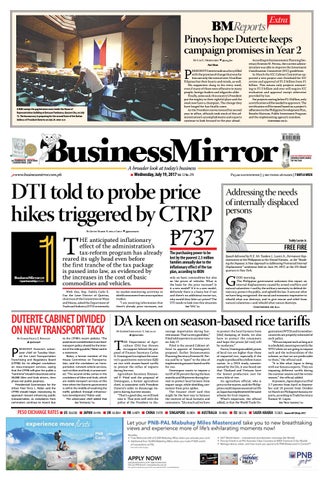
RESIDENT Duterte rode on a ferry filled with the promise of change that won for him not only the votes of over 15 million Filipinos but their hearts and minds, as well. His supporters clung to his every word, even if many of these were offensive to many people, foreign leaders and oligarchs alike. Finally, some said, this country’s President put the mighty in their rightful place and the weak now have a champion. The change they have longed for has finally come. As the President moves toward his second year in office, officials took stock of this administration’s accomplishments and experts continue to look forward to the year ahead.
A man sweeps the gap between seats inside the House of Representatives building at Batasan Pambansa, Quezon City, on July 13. The bureaucracy is preparing for the second State of the Nation Address of President Duterte on July 24. NONOY LACZA
media partner of the year
United nations
2015 environmental Media Award leadership award 2008
Continued on A2
BusinessMirror A broader look at today’s business
www.businessmirror.com.ph
n
Wednesday, July 19, 2017 Vol. 12 No. 279
DTI told to probe price hikes triggered by CTRP
T
By Jovee Marie N. dela Cruz
@joveemarie
he anticipated inflationary effect of the administration’s tax-reform program has already reared its ugly head even before the first tranche of the tax package is passed into law, as evidenced by the increases in the cost of basic commodities and vehicles. With this, Rep. Dakila Carlo E. Cua the Lone District of Quirino, chairman of the Committee on Ways and Means, asked the Department of Trade and Industry (DTI) to intensify
DUTERTE CABINET DIVIDED ON NEW TRANSPORT TACK By Elijah Felice E. Rosales @alyasjah
P
According to Socioeconomic Planning Secretary Ernesto M. Pernia, the current administration was able to improve the Investment Coordination Committee (ICC) guidelines. In March the ICC Cabinet Committee approved a new project cost threshold for ICC review and approval of P2.5 billion from P1 billion. This means only projects amounting to P2.5 billion and over will require ICC evaluation and approval except otherwise provided by law. For projects costing below P2.5 billion, only a certification will be needed to approve it. The certification will be issued based on a project’s adherence to the Philippine Development Plan, Results Matrices, Public Investment Program and the implementing agency’s mandate.
resident Duterte’s urbanpoor chief on Tuesday blasted the Land Transportation Franchising and Regulatory Board (LTFRB) for its alleged crackdown on mass-transport services, saying that the LTFRB will give the public a “hard time” should it deactivate some 50,000 Uber and Grab drivers, then phase out public jeepneys. Presidential Commission for the Urban Poor Terry L. Ridon said the LTFRB should begin reassessing its approach toward enhancing public transportation, as complaints from commuters continue to mount due
to the LTFRB’s recent policies. “The paramount consideration in our landtransport policy should be the interest of the riding public,” Ridon said in a statement. Ridon, a former member of the House Committee on Transportation, said the crackdown on transportation network vehicle services, such as Uber and Grab, is unwarranted. “The second strike comes in the crackdown of Uber and Grab, which are viable transport services at this time when the Duterte government is still in the middle of resolving the traffic gridlock through infrastructure development,” Ridon said. The urban-poor chief added that See “Duterte,” A2
PESO exchange rates n US 50.6330
its market-monitoring activities to shield consumers from unscrupulous traders. “I am receiving information that there’s already price increases, not
₧737 The purchasing power to be lost by the poorest 2.3 million families annually due to the inflationary effect of the tax plan, according to IBON
only on basic commodities but also on the prices of vehicles. What is the basis for the price increase? Is it a new model? If it is a new model, definitely there is a basis; but if not and there’s no additional excise tax, why would they hike car prices? The DTI needs to look into this situation See “DTI,” A2
2016 ejap journalism awards
business news source of the year
P25.00 nationwide | 5 sections 28 pages | 7 days a week
Addressing the needs of internally displaced persons Teddy Locsin Jr.
free fire Speech delivered by H.E. Mr. Teodoro L. Locsin Jr., Permanent Representative of the Philippines to the United Nations, at the “Breaking the Impasse: A New Approach to Addressing Protracted Internal Displacement” conference held on June 29, 2017, at the UN Headquarters in New York.
G
ood morning. The Philippine government welcomes this report on internal displacements caused by armed conflicts and natural calamities—and by the military necessity to defend democracy, protect the public, and uphold the law. It sets out what we have long recognized: the social and economic imperative to rebuild what war destroys, and to give rescue and relief from natural calamities—and rebuild what nature destroys. Continued on A11
DA keen on season-based rice tariffs By Jasper Emmanuel Y. Arcalas
T
@jearcalas
he Department of Agriculture (DA) has thrown its support behind the proposal of Finance Secretary Carlos G. Dominguez’s to replace the country’s quantitative restriction (QR) on rice with season-based tariffs to prevent the influx of imports during harvest. Agriculture Secretary Emmanuel F. Piñol said the proposal of Dominguez, a former agriculture chief, is consistent with President Duterte’s order to discourage imports during harvest season. “That’s a good idea, we will look into it. That jives well with the policy of the President to dis-
courage importation during harvest season. That’s a very good idea,” Piñol told reporters in an interview on July 17. Piñol is the second Cabinet official to approve of Dominguez’s proposal. Earlier Socioeconomic Planning Secretary Ernesto M. Pernia said he is “open” to the idea of implementing season-based tariffs for rice. Dominquez wants to impose a tariff of 35 percent during the lean months and 50 percent during harvest to protect local farmers from import surge, while shielding consumers from price spikes. The finance chief said this might be the best way to balance the interest of local farmers and consumers. “[As much as] we have
to protect the local farmers from [the] dumping of foods, we also have to protect the consumers and hope the prices [of rice] will be moderate.” Fact is, Dominguez added, prices of local rice are higher than those of imported rice, especially if the staple is produced by a fellow Asean nation. In a 2015 study, commissioned by the DA, it was found out that Thailand and Vietnam have the lowest production cost for every kilo of rice. An agriculture official, who is privy to the matter, said the Philippines could impose seasonal tariffs as Japan has implemented the same scheme for fruit imports. What’s important, the official added, is that the World Trade Or-
ganization (WTO) and its membercountries are properly informed of such policy. “We can impose such as long as it is scheduled, meaning we notify the WTO when we are going to impose such and the technicalities of the scheme, so that we are predictable to them,” the official said. “It is like what Japan is doing with our banana exports. They are imposing different tariffs during the summer season and the winter season,” the official added. At present, Japan slaps a tariff of 2.7 percent from April to September and 18 percent from October to March on Philippine banana exports, according to Trade Secretary Ramon M. Lopez. See “Rice tariffs,” A2
n japan 0.4496 n UK 66.1064 n HK 6.4879 n CHINA 7.4770 n singapore 36.9854 n australia 39.4836 n EU 58.1216 n SAUDI arabia 13.5025
Source: BSP (18 July 2017 )
A2 Wednesday, July 19, 2017
BMReports BusinessMirror
Pinoys hope Duterte keeps campaign promises in Year 2 Continued from A1
The Neda said the certification will also be based on performance indicators approved by the Department of Budget and Management (DBM), among other requirements. The higher threshold for projects entering the ICC will hasten the implementation of “smaller” projects. The ICC process usually takes about six weeks to complete. The length of the process is usually on top of the post-approval time needed to undertake contracts and bidding period. Only after projects are bid out and contracts are awarded will the projects start contributing to the economy. “It’s an institutional reform; the way we approved projects is much faster than previous administrations and we have also streamlined the processes,” Pernia said. “The social discount rate has been reduced from 15 percent to 10 percent and the threshold for projects that will go through the ICC and the Neda Board has been raised from 1 billion to 2.5 billion.”
Important bills
ACCORDING to Pernia, the Duterte administration has also played a hand in the reform of the National Food Authority (NFA) and the lifting of the country’s rice- import waiver or quantitative restriction (QR) on rice. In terms of priority bills, Pernia said the current administration is pushing for important bills, such as the amendment of the Tariffication Act and the Public Service Act. The amendment of the Tariffication Act will enable the country to set a tariff on rice imports while the changes in the Public Service Act will pave the way for the government to liberalize public utilities. “There’s a move to revise the Public Service Act so that utilities, like telcos, can be redefined so that they will not be in the negative list. Public utilities kasi are in the negative list,” Pernia said. The Neda earlier said the LegislativeExecutive Development Advisory Council Executive Committee (Ledac-Execom) identified the conversion of the QR on rice into tariff and 12 other bills as measures that the President must certify as urgent. The Ledac-Execom’s list includes the
Duterte. . .
Continued from A1
“there is no point for the government to defy the wisdom of the public”, which, he said, experiences the traffic situation of Manila. “The work of the government should not force a standoff, but to provide real, workable solutions for the benefit of the public.” For Ridon, the solution to the growing tension between the LTFRB and commuters relying on network-vehicle services is the imposition of “regulatory infrastructure” that would ensure public safety. Transportation Secretary Arthur P. Tugade, however, defended the land-transport agency
Rice tariffs. . .
Continued from A1
proposed Unified National Identification System Act, Security of Tenure Bill (end of contractualization), utilization of the coconut-levy fund; National Transport Act to address transport traffic crisis, Budget Reform Act, National Land Use Act and Rightsizing of the National Government. Also tagged as requiring urgent certification were the Amendments to the Anti-Cybercrime Act; Amendments to the NIA Charter to provide free irrigation; Amendment to Public Service Act; Ease of Doing Business Act/Fast Business Permit Act; and Government Procurement Reform Act amendments. The Ledac-Execom comprises the leaders of both chambers of Congress, the executive secretary, the socioeconomic planning secretary as overall head of the Ledac Secretariat and the presidential Legislative adviser. It convenes council meetings and allows opportunities to expeditiously address issues and concerns relating to priority Legislative measures.
gressive consumption taxes” included in the Comprehensive Tax Reform Program (CTRP) should be repealed. Terosa said the tax on sugar-sweetened beverages must be removed. Under the House of Representatives version of the CTRP, these beverages will have a P10-a-liter excise tax.
Development Monitoring Facility] of PPPC [PPP Center] for project preparation for competitive tender later,” Llanto said.
Social agenda
ACCORDING to Pernia, the government ensured that its infrastructure push w ill also not be stopped by temporar y restraining orders (TROs) that threaten to delay the implementation of these projects. “Other efforts have to do with infrastructure projects. Projects that are of national significance will not be exposed to TROs except from the Supreme Court. So lower courts will not be able to issue TROs,” Pernia said. But while these efforts have been significant, economists believe there is more to be done as the President embarks on his second year in office. Local economists agree about the tax-reform program. Rene Ofreneo, UP School of Labor and Industrial Relations (Solair) faculty member, said the tax reform should be progressive and fair to all socioeconomic classes. “[We should have] a tax-reform program that is truly progressive at all levels,” Ofreneo said. “[A] tax [system] that will not squeeze the lower and middle classes.” University of Asia and the Pacific School of Economics Dean Cid Terosa said the “re-
THE government wants to impose the excise tax on sugar as a health measure that will discourage Filipinos from consuming sugary products that can be a cause for lifestyle diseases, such as diabetes. Based on data from the Philippine Statistics Authority (PSA), diabetes milletus is the fifth-most deadly disease that inflicts and kills Filipinos. In 2013 some 27,064 Filipinos died of diabetes. But food manufacturers opposed the tax, saying it could be detrimental to consumers, manufacturers and the agriculture sector. The Philippines is one of the world’s largest sugar exporters. Meanwhile, Philippine Institute for Development Studies President Gilberto M. Llanto said the government must continue its infrastructure push but must use publicprivate partnership to complement Official Development Assistant funding. Ofreneo agreed and said the government cannot repeat the mistakes of the 1970s, which he referred to as “build-borrow-buildborrow-build-borrow” scheme. This was the reason for the country’s debts under the martial-law period. Llanto said it is important for government to ensure that when these projects are undertaken, the contracts are honored. This will assure investors and local businessmen of the stability of the rule of law in the country. He added the government must avoid unsolicited proposals, which he considers a “poison pill” for infrastructure projects. Instead, he said the government should encourage agencies to create and prepare their own infrastructure projects. “[The government must] enjoin all agenc ies to go for sol ic ited, whic h means continue to build capacity among these agencies for identifying and preparing feasibility studies, etc.—which also implies using the PDMF [Project
IN terms of labor, Ofreneo also said the government should also allow free-trade unionism and collective bargaining to allow companies and workers to find common ground on what they need and are capable of delivering. Ofreneo also hopes that the government supports returning Filipino scientists and talents who have the knowledge and experience to innovate companies and products that will help grow the economy. The former Labor Undersecretary also said the President should draft a social contract with the top 50/100 companies/ conglomerates to ensure they observe ethical hiring arrangements for workers. “[The] top 50/100 companies/conglomerates [should] sign on to a social contract with Digong [President Duterte] on how to observe ethical, professional hiring arrangement, thus setting good examples to the rest of the corporate world,” Ofreneo said. Llanto also said the continuation of social safety nets, such as the Conditional Cash Transfer Program and the universal health insurance, will help the poor get an education and safeguard their health. He added the government must also help businesses by revoking cumbersome regulations and high costs of doing business through effective regulatory reforms. For h i s pa r t , Ateneo de M a n i l a EagleWatch Senior Fellow Alvin Ang said many of these reforms will rest on improved coordination among agencies and local governments. Ang said the government must solve coordination issues and challenges that prevent reforms from reaching citizens. “All of these are doable but not for the faint of heart,” Llanto said. Indeed, the Duterte promise of change is not something that can be delivered on its first year. Clearly, there is more to be done. What is needed is the tenacity and commitment of this administration to achieve its goals. To be continued
on the issue, saying all it ever wanted is to get cab drivers under network-service vehicles registered and franchised by the LTFRB. “The [network-service vehicles scheme] is in the concept and nature of a public utility,” Tugade said in a news briefing on Tuesday. “Hindi ho ba nararapat lang na saklaw ng regulatory function ng LTFRB ito? ‘Pagkat ‘yung mga sasakyan ngayon, una, kailangan ma-assure kami na maayos [Is it not right for them to be under the regulatory function of the LTFRB? We need to be assured, first and foremost, that these cabs are properly working],” Tugade added. Some 50,000 Uber and Grab drivers have been ordered deactivated by the land-trans-
port agency for operating without government franchise, causing online outrage from commuters who claim to rely on their services. Beginning July 26, the LTFRB will apprehend Uber and Grab drivers operating without a certificate of public convenience or provisional authority. R idon said the LTFRB’s “first strike” was on the jeepney sector, with its insistence “to phase out the cultural icon” and replace them by green vehicles under the government’s Public-Utility Vehicle Modernization Program. “We are certain that the so-called green jeepneys cannot service the long, winding roads toward resettlement sites around the
country, as the supporting infrastructure for these vehicles are inexistent. Also, we have to remember that, for our poor communities, jeepneys are not only passenger transport, but also a cargo vehicle for the distribution of goods,” Ridon said. Ridon added the old jeepneys remain to be “a cheap and reliable mass-transport vehicle for the public” and it should stay on the road until a “realistic, alternative jeepney system is developed”. In a previous statement, the urban-poor chief called on the LTFRB and the Department of Transportation to exercise solicitude for jeepney drivers and operators, saying most of them belong to the informal sector, which do not earn a stable income.
Progressive tax
Bittersweet
The official said only the WTO dispute-settlement body is the lone entity that could determine whether such tariff scheme is disallowed under the WTO rules and regulations.
However, Philippine Institute Development Studies senior research fellow Roehlano M. Briones cautioned against applying seasonal tariffs on rice. Briones said a season tariff scheme is considered “variable import levies”, which is not allowed under the WTO’s Agreement on Agriculture (AoA). “Variable import levy is regarded as other than import custom duties. Ordinary customs duties meant you’re just going to pay the tariffs, regardless of the rate and the season,” he told the BusinessMirror. Under Article 4 Paragraph 2 of the WTO AoA member-countries “shall not maintain, resort to or revert to any measures of the kind which have been required to be converted into ordinary customs duties, except as otherwise provided for in Article 5 and Annex 5.” These measures include QR, variable import levies, minimum import prices, discretionary import licensing, nontariff measures maintained through statetrading enterprises and voluntary export restraints, among others.
16 bidders. . .
Continued from A12
The NFA has scheduled the proper bidding process on July 25. The NFA is spending P5.637 billion for the importation of the 250,000 MT of rice to prop up its dwindling buffer stock during the lean months, when rice harvest goes down significantly. On July 6 the NFA published the terms of reference (TOR) for the purchase and supply of 250,000 MT of 25-percent broken well-milled long grain white rice of omnibus origin under G2P. Under the TOR, the NFA said prospective bidders will bid for the imported volume on a lot basis. “Prospective bidders may bid for any of the lots, provided that the bid must be the minimum/maximum of the imported rice allocated per lot, but the maximum quantity to be awarded per supplier must not be higher than 50,000 MT,” it read. The NFA divided the delivery of the 250,000 MT of rice into two periods: August and September. The NFA said 120,000 MT of rice should arrive within August, while the remaining 130,000 MT should arrive by September.
www.businessmirror.com.ph
DTI. . .
Continued from A1
since it is within their mandate. That’s a big issue that needs to be investigated by the DTI and such unscrupulous practice must be curbed, as it will affect our consumers,” Cua said. Manufacturers and sellers of cars and basic goods, Cua said, cannot just increase the prices of their products. “So what does this mean, are they already imposing [excise taxes]? Does the government receive remittance from this? There is still no enacted law on this matter. I am urging the DTI to closely monitor the prices of commodities, not just the basic ones, all commodities, because that’s their primary mandate, as well as to make sure that the prices of goods remain stable in the market,” he added. According to Cua, he would file a resolution to conduct a congressional investigation on the reported price increases. “I think we need to observe the possible issue of profiteering. What is profiteering? Profiteering involves people who are engaged in an opportunistic business by taking advantage of the situation to increase their profits at the expense of the market,” the lawmaker said. The Senate is currently deliberating the first package of the Comprehensive Tax Reform Program (CTRP) of the Duterte administration. The House-approved CTRP includes a P6 tax additional on petroleum products that could cause prices of basic goods to rise. The P6-per-liter excise-tax increase will come in three tranches of P3, P2 and P1, respectively, in three years starting 2018. It also provides new schedules and brackets for auto excise tax. The Department of Finance (DOF) is pushing for the excise tax on vehicles to address the worsening traffic congestion in the country. Under the proposal, the excise tax would be implemented in two schedules. For the lower bracket, if the net manufacturer’s price/importer’s selling price is P600,000, the excise tax would be 3 percent by 2018, then increase to 4 percent by 2019. For the higher bracket, if the net manufacturer’s price/importer’s selling price is over P3.1 million, the excise tax would be P1,468,000 plus 90 percent of the value in excess of P3.1 million in 2018. For 2019, if the net manufacturer’s price/importer’s selling price is over P3.1 million, the excise would be P1,824,000 plus 120 percent of the value in excess of P3.1 million.
Anti-poor
The development gave Party-list Rep. Carlos Isagani Zarate of Bayan Muna, more reason to ask Congress not to allow “this anti-poor tax-reform bill to be passed”. “The passage of this measure would greatly affect the purchasing power of lower-income groups and the poor, who buy noodles and canned sardines,” Zarate said. “While this tax-reform measure is giving more incentives to the rich, it is, on the other hand, burdening even more the ordinary consumers and the poor who will bear the brunt of the impact of the proposed new taxes.” The lawmaker, citing the studies of IBON Foundation, said the DOF bill will, in effect, take away P737 annually from the pockets of the poorest 2.3 million families with an average monthly household income of just P5,214 in 2018. “P980 from the next poorest 2.3 million families with monthly income of P8,315; P1,163 from families with monthly income of P10,691; P1,374 from the next poorest families with monthly income of P13,015; P1,687 from the families with monthly income of P15,746; and P2,088 from the families with monthly income of P19,269,” said Zarate, quoting the IBON Foundation. He said the passage of the measure into law means that the poorest 60 million Filipinos will pay more taxes under the proposed tax package due to higher prices of food, drinks, LPG, transport fares, electricity, housing and other basic goods and services they consume. “It will, in effect, take away P737 from every rice farmer; P980 from every farmworker; P1,163 from every construction worker; P1,374 from every privateschool teacher; P1,687 from every bookkeeper; and P2,088 from every machine tool operator,” he added. The figures from a DOF table supposedly computing the change in annual take-home pay in 2018 are likely even underestimated, Zarate said. For instance, he added, the DOF has also estimated that the oil-excise tax alone will increase a fisherman’s fuel expenses by P1,089, and of a farmer’s expenses by P1,210, with the VAT and inflationary impact even coming on top of these.
The Nation BusinessMirror
news@businessmirror.com.ph
Editor: Vittorio V. Vitug • Wednesday, July 19, 2017 A3
Lorenzana seeks tighter regional collaboration in fight vs extremists
D
By Rene Acosta
@reneacostaBM
efense Secretary Delfin N. Lorenzana said on Tuesday that violent extremism is a regional problem that requires countries in the region to collectively and collaboratively work together in fighting it.
Soldier farmers Army Commanding General Glorioso Miranda (left) and
Tarlac Heritage Foundation Cofounder Isa Cojuangco-Suntay hand over a basketful of fresh vegetable harvest to an army trooper at the Headquarters Support Group in Fort Bonifacio on Tuesday. The campaign to grow vegetables inside idle military camp lands is a joint civilian-military undertaking for the benefit of military personnel and their dependents.
NONIE REYES
SC defers action on Imee’s bid to stop House probe on fund-diversion case By Joel R. San Juan
@jrsanjuan1573
T
HE Supreme Court (SC) has deferred action on the petition of Ilocos Norte Gov. Imee R. Marcos and the six detained provincial officials seeking to stop the House of Representatives’s inquiry into the alleged misuse of the province’s tobacco excise funds. The SC was supposed to tackle the case during its regular en banc session on Tuesday, but three magistrates decided to inhibit from the petition, including the justice to whom the case was assigned. This prompted the High Tribunal to order the reraffling of the case to determine which magistrate will be assigned as member in charge. The case was initially raffled to Associate Justice Diosdado Peralta, but he inhibited himself from participating in the case for being a relative of one of the respondents, House Majority Leader and Rep. Rodolfo C. Fariñas of the First District of Ilocos Norte.
Purchasing multicabs, buses and minitrucks, which they have yet to prove have benefited farmers in Ilocos Norte, is not the law’s intent.”—Herrera-Dy The justices then decided to reset deliberations on the case to their next session on July 25. Chief Justice Maria Lourdes A. Sereno and newly appointed Associate Justice Andres B. Reyes Jr. also inhibited from the case. SC Spokesman Theodore O. Te did not disclose the reasons for their inhibition.
‘Real hostage’
Meanwhile, Party-list Rep. Bernadette Herrera-Dy of Bagong Henerasyon said the real “hostage” in the ongoing legal impasse involving the “Ilocos Six” is the truth that has long been held captive by Marcos with her continued refusal to testify before the congressional probe. “Only the testimony of Governor Marcos will set the truth free. The governor has kept the truth hostage with her continuing resistance to the committee’s efforts to unearth the facts behind the questionable procurement of vehicles by the Ilocos Norte provincial government on her watch,” she said. Marcos, meanwhile, claimed that the job of Congress is to craft laws and not to initiate investigations supposedly for political purposes. Under Republic Act 7171, the share of provinces from the taxes should only be used for certain projects that will promote the welfare of tobacco farmers. Herrera-Dy said, “Purchasing multicabs, buses and minitrucks, which they have yet to prove have benefited farmers in Ilocos Norte, is not the law’s intent.” She added that on top of Marcos’s refusal to cooperate in the ongoing inquiry by the House Committee on Good Government and Public Accountability into the anomalous vehicle purchases, her subordinates at the provincial capitol, also dubbed derisively as the “six amnesiacs”, have all conveniently forgotten the details of these transactions and have chosen to keep mum about them. With Jovee Marie N. dela Cruz
Lorenzana issued the statement during his meeting with Singapore Defense Minister Ng Eng Hen, who is in the country for a two-day official visit. “Indeed, this is a problem that we all share and our efforts should, likewise, be collaborative,” he told his Singaporean counterpart, whose last visit in the country was in 2014. Lorenzana recognized that Islamic extremism has grown in the region, as shown by the Philippines’s ongoing battle with members of the Maute-
Islamic State group. The terrorists are joined by fighters from Malaysia, Indonesia and Singapore. “Violent extremism has certainly taken stride and our own fight against it is taking place as we speak,” Lorenzana said. The defense chief thanked his counterpart over Singapore’s support to Manila’s efforts against terrorism. During the meeting, Lorenzana also told Ng that the country could learn from Singapore’s experi-
ence in dealing with Islamic militants. “We could certainly learn from Singapore’s own approaches in countering violent extremism, specifically in the way you deal with Islamic schools and returning foreign fighters,” Lorenzana said. “We are certainly interested in your methods of proactively preventing your citizens from imbibing radical views and in reforming those that have been radicalized. I look forward to further discussing this during our bilateral meeting,” he added.
Economy
A4 Wednesday, July 19, 2017 • Editors: Vittorio V. Vitug and Max V. de Leon
BusinessMirror
PSA sets 2017-2018 retail prices survey
T
By Cai U. Ordinario
@cuo_bm
he Philippine Statistics Authority (PSA) is spending over P18 million to conduct surveys on retail prices and overseas Filipino workers (OFWs).
The bulk of the amount, which will be allocated for conduct of the 2017-2018 Survey of Retail Prices of Household Shop Items for the 2017 International Comparison Program (ICP), will amount to P18.8 million. The PSA said the survey will collect prices of select food and nonfood items, also known as household shop items, based on ICP requirements. “ICP was established to provide purchasing power parity [PPP] as an alternative to direct conversion based on exchange rates to compare per-capita GDP levels between countries,” the PSA said. “PPP provided comparisons that are based on prices of hundreds of items divided into 155 categories of GDP, thus avoiding the deficiencies of fluctuating currency exchange
rates,” it explained. The survey will be conducted on a monthly and quarterly basis. It will cover 320,533 retail establishments. The PSA said 144 sample outlets per price quotation will be from Metro Manila, while there will be 60 sample outlets per price quotation per province in areas outside the National Capital Region. Meanwhile, the 2017 Survey on Overseas Filipinos (SOF) will cost P10,000 to conduct. The PSA said the other funding for the survey will be coming from the budget for the conduct of the Labor Force Survey (LFS). The SOF is a rider survey to the October 2017 LFS. The 2017 SOF is a nationwide survey that seeks to gather information on Filipino citizens, including
workers who left abroad during the last five years. It aims to obtain the national estimates on the number of overseas Filipinos, including overseas workers, their socioeconomic characteristics, and the amount and mode of remittances, in cash and in kind, received by their families. In the 2015 SOF, there were 2.4 million OFWs who worked abroad at anytime during the April-to-September 2015 period. The overseas contract workers, or those with existing work contract, comprised 97.1 percent of the total OFWs during the April- toSeptember 2015 period. The rest, or 2.9 percent, worked overseas without contract. The total remittance sent by OFWs during the April-to-September 2015 period was estimated at P180.3 billion. These remittances included cash sent home worth P135.6 billion; cash brought home, P37.3 billion; and remittances in kind, P7.4 billion. The majority of OFWs sent their remittance through banks (62.2 percent), while the rest sent theirs through agencies or local offices (4 percent), door-to-door delivery (2.4 percent), friends or coworkers (0.1 percent) or through other means.
news@businessmirror.com.ph
21 hurdle tough certification exams for wealth advisors T he Wealth Management Centre for Communicators and Research Inc. (WMC) recently announced that 21 graduates of its Certified Wealth Planner and Certified Estate Planner Philippines course had successfully hurdled the centre’s Revalida Examinations leading to the designation of Certified Wealth Planner (CWP) and Certified Estate Planner Philippines (CEPP). The prestigious designations are jointly conferred by the Insurance Institute for Asia and the Pacific (IIAP) and WMC. This batch of conferees include the following topnotchers: Rachelle Silva of Sunlife Financial (84.5 percent); Celine Tabin-Pelayo of Insular Life (83 percent); Danny Tan Zinampan of Manulife (82 percent); Harold Gardon of Prulife (81 percent); and Willison Yu of Prulife (80 percent). Other conferees, who can now carry the designations CWP and CEPP, are Guinevere Tolentino, Nunnatus Cortez Jr., Raymund Camat, Anthony Jacalne, Janette Tan Lee, Edlyn Salgado, Virgie Callangan, Erlinda de Guzman, Eden Luzano, Jamie Kong, Alexander Puray, Karen Yulo, Marinneth Ngo, Marlo Flores, Edna Dacaymat and Marilou Tan. The following have fulfilled the requirements for CEPP designation: Marie Agnes Inocencio, Giela Sarmiento, Salvador Palanca Jr., Angela Flores, Joana Christina La-
groso and Barbara Marrian Sujide. WMC introduced the Certified Wealth Planner and Certified Estate Planner Philippines courses in 2014 with the mandate to play a leading role in elevating and professionalizing the practice of financial advisory in the Philippines. With the country’s economy in the upswing and with the Asean integration looming ominously in the background, WMC recognized the need to equip and empower the Filipino financial services professional to do business and compete in what was going to be a massively altered business landscape. Since its inception in 2014, the CWP and CEPP courses have admitted over a thousand enrollees in both formats with a majority of the students coming from the country’s most prestigious insurance, banking and financial institutions. The CWP and CEPP courses from the outset assumed a holistic course design that was anchored on a deep and thorough understanding of a changing world order and its unique impact and applications to the local economy and to the Filipino. This resulted in a course that, while globally responsive and competitive, remains uniquely Filipino in both its flavor and its value. CWP and CEPP enrollees gain access to principles, ideas, insights and practices that significantly enhance the quality and professionalism of their
practice given the practical and applicable conversion of principles to action and solutions. The unique structure of the course integrates the otherwise disparate subjects of investments, insurance and estate planning into a singular and seamless management protocol under the segmented banner of wealth creation, wealth protection and wealth conservation. This approach lends itself very nicely to an industry whose practitioners seek to create a measurable impact on a clients’ life beyond and above the growth of his money and well into the sustainability and preservation of his family’s way of life. In the final reckoning, WMC recognizes that the value of its courses lie in its ability to focus its students on the things that truly matter. That beyond the numbers and the technical aspects of wealth management, the practices that it seeks to teach and encourage are inevitably anchored on making a palpable contribution to the achievements of client hopes and aspirations. Graduates of the CWP/CEPP course emerge from the program not just better advisers and better practitioners but better people. Better people who have a keen appreciation of the role they play in nation-building and a deeper sense of responsibility for the mission that they perform for the country and the Filipino.
The Regions BusinessMirror
news@businessmirror.com.ph
Editor: Efleda P. Campos • Wednesday, July 19, 2017
A5
Marine turtles poaching alarms DENR exec By Jonathan Mayuga @jonlmayuga
A
n official of the Department of Environment and Natural Resources (DENR) on Tuesday expressed alarm over the resurgence of illegal wildlife trade in the country.
“It’s annoying and embarrassing,” said DENR Biodiversity Management Bureau (BMB) Director Theresa Mundita S. Lim, referring to the recent confiscation of dead marine turtles by authorities in Palawan. The Philippines, she noted, will be hosting an international meeting for the protection and conservation of migratory wild animals next year. “Recently, we received numerous reports about marine turtle poaching. The Philippines is a migratory pathway of marine turtles and we have many nesting sites here,” she lamented. Hawksbill turtles are in demand by jewelers for their scale. Green
turtles are hunted for meat, while olive ridleys [also known as Pacific ridley sea turtle], which are abundant in West Philippine Sea, are also hunted for their meat, shell and internal organs. “I will report this [illegal wildlife trade] to [Environment] Secretary [Roy A.] Cimatu. There is recent resurgence of marine t u r t les poac h i ng...a nd ot her wildlife,” she said. Lim noted the confiscation on July 6 in Dumaran town of 70 dead hawksbill turtles by elements of the Philippine National Police while patrolling the coastal waters of Palawan, the country’s so-called last ecological frontier. Police said the confiscated
hawksbill turtles came from Barangay Maytegued, Taytay, Palawan. The suspects, Rico Gonzales Jr., who owns and operate the boat transporting the confiscated marine turtles, and a certain Kim Aristotiles, his companion, were on their way to Balabac Island, where a supposed trade was supposed to happen. Hawksbill turtles are critically endangered according to the Red List of Threatened Species of the International Union for Conservation of Nature (IUCN). Republic Act 9147, or the Wildlife Resources Conservation and Protection Act, prohibits wildlife trade, especially wildlife that are in the brink of extinction. Lim said the confiscation of the dead marine turtles recently only means unscrupulous traders are back in business, buying and selling marine turtles and their by-products within the country’s territory. Lim expressed concern that unscrupulous traders are taking advantage of poor law enforcement in open seas in connivance with locals who are familiar with the areas where targeted species can be caught without being
LIM detected by authorities. “They [wildlife traffickers] can only do that with the help of locals who earn a living by catching wildlife,” Lim said. Last year former Enviroment Secretary Regina Paz L. Lopez created the National Anti-Environmental Crime Task Force dedicated to combatting largescale environmental crimes. With Lopez’s rejection by the Commission on Appointments, the Task Force’s designated head, former Undersecretary Arturo T. Valdez, also stepped down.
Cimatu has yet to name a replacement for Valdez. Lim is confident that Cimatu, being a former chief of staff of the Armed Forces of the Philippines, will know what to do to fight illegal wildlife trade. The BMB official is scheduled to meet Cimatu to give an update of the bureau’s ongoing programs for the protection and conservation of the country’s rich biodiversity. “I hope we can touch other wildlife issues, including our recent confiscation [of turtles] in Palawan,” she said. Wildlife trafficking is a serious issue, especially because it has become a way of life to many Filipinos, said Lim. Lim said the BMB is compiling information on illegal wildlife trade in the country. Rep. Josephine Y. Ramirez Sato of the Lone District of Occidental Mindoro last week called the attention of Cimatu on the issue of marine turtle poaching, citing the recovery of dead marine turtles in Palawan. Sato said Occidental Mindoro, which belongs to the same region as Palawan, is also vulnerable
to marine turtle poaching. She urged the DENR chief to take a more proactive response to illegal wildlife trade. Lim said the Philippines remains strongly committed to the global effort to protect marine w i ld l ife, par ticu larly mar ine turtles. Five of the seven known marine turtle species are found in almost all Philippine seas. These are green, hawksbill, olive ridley, loggerhead and leatherback turtles. Most marine turtles are in the list of threatened species of the IUCN. The Philippines is a party to several international treaties aimed at protecting and conserving marine wildlife, such as marine turtles, such as the Convention on International Trade in Endangered Species of Wild Flora and Fauna and Convention on the Conservation of Migratory Species of Wild Animals or the Bonn Convention, an environmental treaty under the aegis of the United Nations Environment Program, which provides a global platform for the conservation and sustainable use of migratory animals and their habitats.
Quezon provincial council questions DOH continues to serve power firm’s foreshore construction Marawi City evacuees By John Bello Correspondent
L
UCENA CITY—The Sangguniang Panglalawigan (SP) of Quezon on Monday assailed the continuous questionable foreshore construction of structures by the San Buenaventura Power Ltd. Co. (SBPL), a 500-megawatt coal-fired power project being put up inside an existing power facility in Barangay Cagsiay 1, Mauban, Quezon. At the joint hearing of the SP Committees on Energy, Laws and Environment, SP members Donaldo Suarez, Ferdinand Talabong and Sonny Ubana, SP majority floor leader and chairman of the SP Committee on Ways and Means, respectively, took turns in questioning the SBPL on the alleged temporary structures being built beyond the shorelines, which they claimed has no permit. “What is the basis of the temporary structures when you are encroaching on the sea already? Any construction on the sea, whether temporary or permanent, must have a basis,” said Ubana, who insisted that SBPL is using up a portion of the sea for its ongoing construction of structures. Chuckie Rivera, community relations manager of the existing 440-MW Quezon Power Ltd. (QPL) coalfired power plant and apparently the spokesman of SBPL, showed on the screen update on the construction, particularly photos of the structures being built as he claimed they are all covered by the Environmental Compliance Certificate issued by the Department of Environment and Natural Resources (DENR). Rivera even offered to invite SP members to see the actual construction of the SBPL facilities at the shorelines to appease their anxieties, saying the structures are just temporary and to be removed once the construction of the seawater intake pipelines of the power plant is completed. Frank Thiel, general manager of SBPL, narrated in brief about the start of the SBPL construction in 2016, the kind of power-generating facilities they are putting up and the safety measures they are adopting to protect the environment. Thiel and Rivera were accompanied to the SP committee hearing by two SBPL lawyers—Sheryl Balot and Rachelle Lim-Magtanggol. Suarez, chairman of the SP Committee on Energy, asked why the DENR has not attended the hearing to explain about the SBPL shorelines construction and moved to hold the memorandum of agreement (MOA) on the advance financial assistance being offered by the SBPL to the province allegedly amounting to P110 million. “I move that the MOA on financial assistance be put aside and returned to the governor until after the issue of the SBPL shorelines construction is finally settled,” Suarez, an older brother of Gov. David C. Suarez, told participants of the hearing, which included board members Dominic Reyes, Rhodora Tan, Jerry Talaga and Jose Erwin Esguerra. Suarez earlier questioned the “unusual” ownership of both QPL and SBPL and claimed the latter powerplant facility is a brand new entity being built inside the QPL. He also said that both power plants must ensure to have supercritical process of generating power to protect the environment of the host province. Suarez and Ubana declined the offer to visit and see
the actual construction of the facilities, saying this would compromise the SP as it seeks to get into the bottom of the issue. The SP committee hearing ended up to call another joint committee hearing on August 7, and to invite the DENR to shed light on the controversial issue. Later, in the afternoon regular session, the SP was in disarray for several minutes as several absent members during the joint committee hearing claimed they were not notified that the hearing was reset from 1 p.m. to 10:30 a.m. and they also stressed that it was an en banc committee hearing and not just a hearing of the three committees on energy, laws and environment. SP member Hermilando Alcala Jr. asked why they were not informed of the reset of the joint committee hearing with his fellow board member from the second district, Elizabeth Sio. Another SP member, Aileen Buan of the province’s first district, also complained that she was not aware of the change of time, and insisted that the committee hearing was clearly set at 1 p.m. Earlier QPL and SBPL invited last Saturday several media practitioners to the site of the foreshore construction and stressed the structures will be removed in July next year in preparation for its commercial operation scheduled in 2019. “What we have here are just temporary structures for the construction of our intake pipelines, but they would be gone by July next year with the completion of the power project,” Rivera told the media led by Janet Buelo, public information officer of the provincial government. Rivera said they don’t reclaim any land and that they have foreshore permits from the Philippine Ports Authority. He added that what they build is a causeway for intake pipelines of seawater for use in generating power. The media were also shown the ongoing construction of other SBPL facilities, such as chimney erection, boiler area, pulverizer foundation and shoreline protection, among others. Rivera presented informations about the QPL and SBPL and how they have benefited the province, town and host barangay, and what they are doing to integrate into the lives of the community through their community development programs on health, education, environment and livelihood. He showed the QPL has paid real-property tax worth P3,457,673,989.98 from 1999 to 2016 to the provincial government, and P93,015,134.86 for first and second quarter of 2017. For the host municipality of Mauban, QPL has paid its mayor’s permit worth P1,264,677,531.55 from 1997 to 2017.
By Claudeth Mocon-Ciriaco Correspondent
T
he Department of Health (DOH) continues to provide services to almost half a million people displaced by the Marawi siege, including 16,411 evacuees that were treated in health facilities after two months of clashes between government troops and the Maute terrorist group. Health Secretary Paulyn Jean B. Rosell-Ubial also said that a total of 882 patients from evacuation centers have been referred to hospitals for treatment. Ubial said the overall affected population is about 465,692 persons, as she expressed confidence that Marawi City will soon be freed from the terrorists. Composed of 96 barangays, Marawi City has been occupied by the insurgents since May 23. Temporary shelters were set up in 87 evacuation centers (ECs) to accommodate 26,991 internally displaced persons (IDPs). Those living outside ECs, or the home-based IDPs, added up to 97,788 families or 438,701 individuals. Families staying at ECs were provided with insecticide-treated bed nets (2,170), jerry cans (15,123), hygiene kits (9,581) and dignity kits to women (2,174). In these times of conflict, the DOH said it recognizes the significance of addressing mental-health issues of affected people. Thus, part of its services given to them include psychological first aid, psychosocial processing and coping with stress mechanisms. A Wednesday’s Children’s Party Day was also instituted, and LED TVs for education and health messages, as well as entertainment, during evenings were
provided at ECs. Special supplementary feeds for malnourished children and “an egg a day keeps the doctor away” intervention for young children were likewise conducted. A host of medical services is continuously being provided amid the siege, including routine vaccinations for infants and children, treatment for tuberculosis, diabetes mellitus and hypertensive patients, health-care services for pregnant and lactating women, deworming and nutrition in emergencies, such as vitamin A supplementation for under-5 children and senior citizens. Other services also include provision of wheelchairs to persons with disabilities, and family planning counseling to women of reproductive age. Taking into account the safety of water being consumed in ECs, the Water, Sanitation and Hygiene services are also provided. Regular water testing is being conducted to ensure its safety prior to consumption. Construction and installation of toilets, bathing and washing facilities, and provision of hygiene kits and water disinfectants are also essential part of government services. In terms of logistics and funding, the DOH has allotted a total of P55,200,000 for cash and P30,479,408.94 worth of logistics, or a total of P85,679,408.94. “The DOH is really hopeful and, at the same time, incessantly praying for Marawi City. Let us continue to hold on to our vision that one day, peace will once again reign in the city; that Marawi will stand up and be resilient against all forces of evil brought about by this senseless terrorism,” Ubial said.
A6
Wednesday, July 19, 2017
The World BusinessMirror
www.businessmirror.com.ph
Microfinance rebound shows rural India recovering from cash ban
I
ndia’s vast rural hinterland— which makes up 70 percent of the South Asian country’s population— is showing signs of recovery from last year’s cash crunch, boosting optimism that increased spending will help the broader economy regain its vigor. The microfinance industry is rebounding, real rural incomes are rising and unemployment is falling, according to brokerage Motilal Oswal Securities Ltd. and an Indian unit of HSBC Holdings Plc. in analysis that contrasts to the distress that’s swept the farming sector. “We believe repayments and improved collection trends have increased the confidence of companies to start disbursing loans at a healthy pace again,” Mumbai-based Alpesh Mehta and colleagues wrote in a report from Motilal Oswal. India’s microfinance industry, which provides small loans to entrepreneurs and business owners who have little collatera l, was slammed when the gover n me nt w it hd re w h i g h denomination bank notes from circulation late last year in a bid to stamp out corruption. And while farmers have taken to the streets across India to
98% The percentage of loancollection rates in Uttar Pradesh, India’s largest and most populous state
protest plunging food prices, laborers who get paid a wage to work the land have actually seen their incomes rise after last year’s good monsoon, the HSBC economists wrote. Loan-collection rates in Uttar Pradesh, India’s largest and most populous state, are largely back at about 98 percent levels, up from less than 50 percent after denomonetization, Mehta, Piran Engineer and Subham Banka said
A farmer in India Bloomberg
in their July 3 note. Other major states, such as Karnataka are displaying “much improved collection trends,” they said. Microfinance disbursements, which grew 13 percent last year compared with 80 percent the prior year, are expected to return to preban levels in three to six months, according to Motilal Oswal. Gold loan company Manappuram Finance Ltd. has risen 68 percent from its low after demonetization in November, and Bharat Financial Inclusion Ltd., India’s largest listed microfinance firm, has rebounded 64 percent over the same time frame. However, the Indian state of Maharashtra, home to India’s financia l capita l, Mumbai, is lag g ing other states and continues to face delinquency pressures, w ith about 20 percent of loans unpaid 90 days past due,
according to Motila l Oswa l. Interactions w it h microf inance companies reveal no expectation of disruption from the rise of farm loan waivers in Indian states but, instead, a focus on the effects of demonetization, the report said. M ic rof i n a nce I n st it ut ion s Network—India’s largest group of microfinance firms—reported that “demonetization severely impacted the microfinance business in multiple ways, including slowing down of growth due to nonavailability of cash for a few months.” Motilal intends to observe delinquency trends for a few more quarters before reaching conclusions over the impact of waivers on microfinance. Maharashtra, Punjab, Uttar Pradesh have all announced, waiver programs. The rise in credit growth at
the microfinance level is complemented by a rise in rural incomes and purchasing power, according to HSBC Securities and Capital Markets (India) Pvt. “Macro indicators have improved ” in rural India, HSBC economists Pranjul Bhandari, Aayushi Chaudhury and Dhiraj Nim said in their July 10 note. T he plu nge i n i n f l at ion h a s helped boost annual real-income growth to just under 4 percent from contracting levels a year ago, while rural unemployment has sunk from about 9 percent last September to around 4 percent, according to HSBC. Normal rains so far in 2017 and a bumper crop in 2016 after a twoyear drought have generated more jobs for rural Indians who work the land—some 70 percent of rural households who are “landless”, according to HSBC. That’s help pushed up twowheeler sales and the production of consumer nondurables in this segment, according to the HSBC report. Shares of companies with substantial rural customer bases are experiencing steady growth. While falling farm prices have hit many rural Indians hard, they have also boosted purchasing power and consumption among the population which could help a broader recovery in the Indian economy that’s suffering from a slowdown in growth, soured loans and weaker manufacturing sector. Bloomberg News
California lawmakers extend landmark climate-change law
S
ACRAMENTO, California— California lawmakers voted on Monday to extend a climate-change initiative that Gov. Jerry Brown holds up as a model for states and nations looking to lower carbon emissions. Brown’s signature will add another decade of life to the state’s cap-and-trade program, bolstering the Democratic governor’s quest to portray California as a leader in the fight against climate change at a time when President Donald J. Trump is pulling back. “Tonight, California stood tall and once again, boldly confronted the existential threat of our time,” Brown said in a statement after the vote. “Republicans and Democrats set aside their differences, came together and took courageous action. That’s what good government looks like.” Brown portrays the initiative, which would have ended in 2020, as essential for the survival of civilization. Extending it has been one of his highest priorities as he nears the end of his fourth term, but critics say it fails to aggressively combat pollution. The legislation was fiercely opposed by some environmentalists who say it’s too timid for progressive California, especially those who work to clean up the notoriously smoggy air in parts of Los Angeles, the San Francisco Bay Area and the agricultural Central Valley. Conser vatives also fought the measure, saying it will raise costs in an already expensive state. But Brown and Democratic lead-
The stacks from the Valero Benicia Refinery are seen as a pedestrian walks in a nearby neighborhood on July 12 in Benicia, California. AP/Rich Pedroncelli
ers were able to cobble together the two-thirds support needed in both chambers to extend the law through 2030. Cap and trade puts a limit on carbon emissions and requires polluters to obtain permits to release greenhouse gases. Some permits, known as allowances, are given away while others are auctioned, generating billions of dollars in revenue for the state. The extension was part of a three-bill package, which passed. One measure aims to improve local air quality, and helped bring some Democrats on board with the cap-and-trade deal. Republicans, however, favored a
third bill that may give them more of a say in how to spend the money collected through cap and trade. Brown sounded an apocalyptic tone in a rare personal appeal before a Senate committee last week, telling lawmakers that failing to pass the extension would lead to fires, disease and mass migration, not to mention higher costs for food and gasoline. Republicans likened the bill to a tax that will hit Californians at the gas pump and the grocery store. The nonpartisan legislative analyst said last year that the existing cap-and-trade program accounted for an 11-cent-per-gallon increase in gasoline prices. The
office has not analyzed the extension proposal. “We could shut down the entire state of California and it would have absolutely no effect on the global climate,” said Sen. Andy Vidak, a Republican from Hanford in the agricultural Central Valley. “But what is measureable is the effect this tax will have on the poorest of the poor in my district and across California.” The bill was supported by national environmental groups and business interests, which echo Brown’s refrain that cap and trade is the most affordable way for California to meet its ambitious climate goals.
State law requires California to reduce greenhouse-gas emissions 40 percent, from 1990 levels by 2030—among the most aggressive mandates for carbon reduction in the world. Without cap and trade, state regulators will be forced to enact restrictive mandates on polluters that would be burdensome for businesses and significantly more expensive for consumers, Brown said. The fight over the legislation showed the divisions between environmentalists who work nationally, focusing on reducing global carbon emissions and creating a policy that can be replicated elsewhere, and environmental justice advocates who work locally. The latter group said cap and trade allows polluters to keep fouling the air around major sources of pollution like oil refineries and objected to concessions Brown made to the oil industry and other polluters in a bid to win support from Republicans and moderate Democrats. Brown’s urgency to extend a program that doesn’t expire for another two-and-a-half years drew questions from some lawmakers. The governor says the move would give businesses the certainty they need to plan. A quick extension also would bolster Brown’s global advocacy for climate action. He made a highprofile trip to China last month, plans to attend a climate summit in Germany in November and will host a climate conference next year in San Francisco. AP
Brexit talks resume with UK, a hotbed of political intrigue
U
.K. Brexit Secretary David Davis resumed divorce talks with the European Union (EU), while back in London a fight over the future of Prime Minister Theresa May was turning ugly. In Brussels Davis sat down with the EU’s chief negotiator, Michel Barnier, to hash out the rights of the EU citizens in the UK and Britain’s financial obligations. He left after three hours—leaving technical talks to a team of 98 British officials—and plans to return on Thursday when a clearer picture will form on whether progress has been made on the priority issues identified by the bloc. In a tacit acknowledgment that last month’s opening of negotiations had achieved little, Davis said that it was crucial to now “get into the substance of the matter.” The rush to move talks forward comes as open divisions in the Cabinet back home make it hard for Europe to know what Britain wants. Davis, touted as a potential successor to May, is at the center of the political intrigue. A Sunday Times photo montage illustrated her tenuous grip on power with an image of 68-year-old Davis, Chancellor of the Exchequer Philip Hammond and Foreign Secretary Boris Johnson aiming pistols at each other. The Daily Telegraph repor ted an unidentified Cabinet minister using expletive -filled language to accuse Hammond of treating colleagues who supported the Leave campaign, such as Davis, like “pirates who have taken him prisoner.” The plotting hasn’t escaped May, who will remind her Cabinet colleagues on Tuesday of the need to keep their meetings private, according to her spokesman, James Slack. Davis will be at that meeting, at which his colleagues will be chided over a series of leaks from the weekend newspapers that took shots at Hammond and talked of a groundswell of support for Davis.
May’s mutiny?
“She’ll be reminding them of their responsibilities and making the point that ministers across government need to be focused on getting on with delivering for the British public,” Slack told reporters in London on Monday. Amid dismay at May since she lost the government’s parliamentary majority in last month’s general election, some 30 Conservative Party lawmakers would back a leadership bid by Davis, the Sunday Telegraph reported, citing unidentified allies of the Brexit secretary, including two former top ministers. May’s Brexit point person is among the members of her Cabinet said to be unhappy about the prime minister’s policy toward the EU. He has warned May repeatedly that the uncertain fate of citizens after the UK’s withdrawal in 2019 was souring his meetings with member-states, two people familiar with the matter told Bloomberg this month. Even so, she rejected his pleas to make an unconditional pledge on their rights.
Standing firm
The EU has made much of the early running by agreeing its positions on the issues up for debate, as well as forcing the UK into its schedule of discussing divorce issues, such as citizens’ rights and financial obligations before moving on to a future trade arrangement. Those areas were discussed in detail on Monday and are scheduled to continue on Tuesday alongside the more technical topics of nuclear-energy cooperation, what to do about UK and EU goods placed on the market before Brexit day, and administrative procedures. “Both sides have today got round the table and started the serious business of working through our positions in a number of areas,” a spokesman for Davis’s Department for Exiting the EU said in an e-mailed statement at the conclusion of Monday’s discussions. “We recognize that this will be a complicated and technical process and we look forward to coming back tomorrow to make progress on the work we have begun today.” Bloomberg News
www.businessmirror.com.ph
The World BusinessMirror
Wednesday, July 19, 2017
A7
Oil snaps winning streak as doubts over Opec cuts weigh on price O
il slid in New York as the market searches for more evidence that Organization of the Petroleum Exporting Countries’s (Opec) cuts are working. Futures declined 1.1 percent, snapping last week’s 5.2-percent gain. O pec’s i mplement at ion of output cuts slipped to 92 percent in June, from 110 percent in May, according to a person familiar with the matter. Doubts on the effectiveness of the group’s deal to reduce output remain, even as US crude and gasoline stockpiles drop. The Energ y Information Administration sees crude output at major US shale plays reaching 5.58 million barrels a day in August, an all-time high. “It seems like we’ve kind of found a new value range around $45” and the market is hunting for its next real driver, Gene McGillian, market research manager at Tradition Energy in Stamford, Connecticut, said by telephone. Recent declines in US supplies suggested that Opec’s cuts might be working, “but we need more evidence of that to really boost prices. There’s a little skepticism developing that these draws in US crude inventories are related more toward a pick-up in seasonal demand,” he said. Prices in New York have languished below $50 a barrel on concerns elevated global supplies
29.89M The number of oil barrels the 11 Opec members pumped a day in June, up from 29.69 million in May
will offset output curbs by the Opec and its allies. Citigroup Inc. cut its oil-price forecasts for this year and next as Opec members Nigeria and Libya restore previously halted supplies and American output climbs. US shale drillers added two oil rigs last week for a second week of renewed growth after drillers snapped a 23-week stretch of increases at the end of June. We s t Te x a s I nt e r m e d i at e (W TI) for August deliver y fell 52 cents to settle at $46.02 a barrel on the New York Mercantile Exchange. Total volume t raded w a s about 4 percent a b o ve t he 10 0 - d ay ave r a ge. Prices gained $2.31 to $46.54 a barrel last week.
Opec pumps
Brent for September settlement declined 49 cents to end the session at $48.42 a barrel on the London-based ICE Futures Europe exchange. Prices climbed 4.7 percent last week. The global benchmark crude traded at a premium of $2.19 to September WTI. Total volume traded was about 32 percent below the 100-day average. The 11 Opec members bound by t he November 30 out put agreement pumped 29.89 million barrels a day in June, up from 29.69 million in May, according to a person familiar with the matter, citing the group’s secondary sources data, revised to include all figures from all parties. An Energy Information Administration report last week showed that US crude supplies declined 7.56 million barrels in the week ended July 7, the biggest drop since September. Gasoline inventories fell 1.65 million barrels. Crude inventories decreased 1.5 million barrels in the week ended July 14, according to a forecast compiled by Bloomberg. China, the world ’s secondlargest economy, expanded by 6.9 percent in the second quarter from a year earlier, compared with the 6.8 percent median estimate in a Bloomberg survey. “The Chinese economic data is pretty good, but not great,” Michael Lynch, president of Strategic Energy and Economic Research in Winchester, Massachusetts, said by telephone. “We are in the summer doldrums. There hasn’t been any real strong political news or strong fundamentals to drive us either way.”
An Iraqi worker operates valves at the Rumaila oil refinery, near the city of Basra, 550 kilometers southeast of Baghdad. Iraq’s prime minister says his country will agree to cut production to boost oil prices. AP/Nabil al-Jourani
Libya’s oil output is said to increase to 1.1 million barrels a day, according to a person with direct knowledge of the matter, who asked not to be identified. Investors pulled $92.6 million from the US Oil Fund last week, following a $357.6-million outflow the week before, data compiled by Bloomberg show. That’s the largest two-week outf low since early-December. Oil equipment makers and oilfield-service companies are warning that a Senate-passed sanctions bill will do little damage to Russia—”and may even help it”—while harming US businesses working around the globe. Bloomberg News
GOP’s health bill collapses as 2 more senators defect
W
A S H I N G T O N —Tw o more Republican senators declared on Monday night that they would oppose the Senate Republican bill to repeal the Affordable Care Act (ACA), killing, for now, a seven-year-old promise to overturn President Barack Obama’s signature domestic achievement. The announcement by Sens. Mike Lee of Utah and Jerr y Moran of K ansas left their leaders at least two votes short of the number needed to begin debate on their bill to dismantle the health law. Two other Republican senators, Rand Paul of Kentucky and Susan Collins of Maine, had already said they would not support a procedural step to begin debate. With four solid votes against the bill, Republican leaders now have two options. They can try to rewrite it in a way that can secure 50 Republican votes, a seeming impossibility since the defecting senators are not suggesting small changes to the existing bill but a fresh start. Or they can work with Democrats on a narrower measure to fix the flaws in the ACA that both parties acknowledge. Sen. Mitch McConnell, the Republican leader, conceded on Monday night that “the effort to repeal and immediately replace the failure of Obamacare will not be successful.” But he said he would move to pass a measure to repea l t he AC A now, t hen work on a replacement over the next two years. That has almost no chance to pass, either, since it cou ld leave mi l lions w ithout insurance and leave insurance markets in turmoil.
But President Donald J. Trump was not ready to give up. He immediately took to Twitter to say: “Republicans should just REPEAL failing ObamaCare now & work on a new Healthcare Plan that will start from a clean slate. Dems will join in!” In announcing his opposition to the bill, Moran said it “fails to repeal the ACA or address health care’s rising costs.” “There are serious problems with Obamacare, and my goal remains what it has been for a long time: to repeal and replace it,” he said in a statement. In h is ow n st atement, L ee sa id of t he bi l l, “In add it ion t o not re p e a l i n g a l l o f t he Obamacare ta xes, it doesn’t go fa r enough in lower ing prem iums for midd le-c lass fami lies; nor does it create enough f ree s pace f rom t he most cost ly Oba maca re reg u l at ions.” By defecting together, Moran and Lee ensured that no one senator would be the definitive “no” vote. House Republicans, after their ow n fits and star ts, passed a bil l to repea l the AC A in May, a difficu lt vote that was supposed to set the stage for quic k Senate action. But w ith conser vative and moderate Republicans so far apar t in the Senate, the g u lf proved impossible to br idge. Conservatives wanted the ACA eradicated, but moderates worried intensely about the effects that would have on their most vulnerable citizens. The Senate Democratic leader, Chuck Schumer of New York, responded to t he a nnou nce ment on Monday by urging his Republican colleagues to begin
anew and, this time, undertake a bipartisan effort. “This second failure of Trumpcare is proof positive that the core of this bill is unworkable,” Schumer said. “Rather than repeating the same failed, partisan process yet again, Republicans should start from scratch and work with Democrats on a bill that lowers premiums, provides long-term stability to the markets and improves our health-care system.” Roughly 20 million people have gained coverage through the ACA. Repealing the law was a top priority for Trump and Republicans in Congress, who say it has driven up premiums and forced consumers to buy insurance they do not want and cannot afford. The opposition from Paul and Collins to the latest version of the Senate bill was expected, so McConnell had no margin for error as he unveiled it. But he managed to survive through the weekend and until Monday night w ithout losing another of his members—though some expressed misgivings or, at the very least, uncertainty. McConnel l h ad wa nted to hold a vote t h is week , but he w a s forced to aba ndon t h at pl a n a f ter Sen. John McC a in, Republ ica n-A r i zona, had su r ger y l a st we e k to re move a blood c lot f rom above h is lef t eye. T hat u ne x pected setbac k gave t he forces t hat opposed t he bi l l more t ime to pressu re u ndec ided senators. Already, McConnell was trying to sell legislation that was being assailed from many directions. Last Fr iday the hea lth insurance lobby, which had been
largely silent during the fight, came off the sidelines to blast as “unworkable” a key provision allowing the sale of low-cost, st r ipped- dow n hea lt h pl a ns, saying it would send premiums soaring and undermine protections for people with pre-existing medical conditions. McConnel l has now fa i led twice in recent weeks to roll out a repeal bill and keep his conference together for it. He first wanted to hold a vote in lateJune, only to reverse course after running into opposition. House Republicans in competitive districts who supported their version of the bill will now have to explain themselves—and Democrats are eager to pounce. “Make no mistake, Paul Ryan can’t turn back time and undo the damaging vote he imposed on his conference,” said Meredith Kelly, a spokesman for the Democratic Congressional Campaign Committee. “House Republicans all own a bill that would strip health care from 23 million Americans and raise costs for millions more, and it will haunt them in 2018.” Lee, one of the most conservative members of the Senate, was part of a group of four conser vative senators who came out against the initial version of McConnell’s bill after it was unveiled last month. He then championed the proposal to allow insurers to offer cheap, bare-bones plans, which was pushed by another of those opponents, Sen. Ted Cruz of Texas. But the language ultimately added was not quite what Lee had been advocating, his office said after the new bill was released. New York Times News Service
A8
Wednesday, July 19, 2017
The World BusinessMirror
www.businessmirror.com.ph
Japan: Time to raise pressure on N. Korea
U
NITED NATIONS—Japan called on Monday for increased pressure on North Korea, saying this is not a time for dialogue. Gover nment spokesma n Nor io Mar uyama sa id Nor t h Korea reached “a new level ” with its latest launch of an intercontinental ballistic missile (ICBM) as Americans celebrated Independence Day on July 4. The test marked a significant step toward the goal of North Korea’s young leader Kim Jong Un to develop a missile with a nuclear warhead capable of reaching the United States. The ICBM reportedly landed in Japan’s exclusive economic zone in the Sea of Japan, where previous North Korean ballistic missile launches have also landed. Despite condemning t he ICBM test, South Korean President Moon Jae-in on Monday offered talks with North Korea, ind icating for the f irst time since his inauguration in May that he wants to use dialogue to defuse the international standoff over the North ’s nuclear and missile programs. Maruyama said the Japanese government is “aware of the announcement,” but made clear
that immediate talks aren’t the approach it supports. “This is not a time for dialogue, it’s a time for pressure,” he said. Maruyama explained that raising pressure now is essential “in order to be able to conduct a serious dialogue” with North Korea in the future. “Dialogue for the sake of dialogue is meaningless,” he stressed. He reminded Seoul of the joint statement issued by Moon, US President Donald J. Trump and Japanese Prime Minister Shinzo Abe after a meeting on the fringes of the Group of 20 summit in Hamburg, Germany, on July 6 on a “common understanding” on how to deal with North Korea T he joi nt st atement commits the three leaders to work together to counter the threat from North Korea and “to apply maximum pressure” on Pyongyang “to change its path, refrain from provocative and threatening actions, and take steps necessary to return to serious denuclearization dialogue.” The three leaders also agreed
People dance in Kim Il Sung Square in Pyongyang, North Korea, on July 6 to celebrate the test launch of North Korea’s first intercontinental ballistic missile (ICBM) two days earlier. The North’s ICBM launch, its most successful missile test to date, has stoked security worries in Washington, Seoul and Tokyo as it showed the country could eventually perfect a reliable nuclear missile capable of reaching anywhere in the US. AP/Jon Chol Jin
to press for early adoption of a new UN sanctions resolution to demonstrate to North Korea that “there are serious consequences for its destabilizing, provocative and escalatory actions.” In response to the ICBM test, the US has circulated a resolution with proposed new sanctions to the other permanent veto-wielding Security Council members—China, Russia, Britain and France—UN diplomats said last week.
No details have been released. But US Ambassador Nikki Haley told the council earlier this month that if it is united, the international community can cut off major sources of hard currency to North Korea, restrict oil to its military and weapons programs, increase air and maritime restrictions and hold senior officials accountable. When pressed about possible restrictions on oil sales, Maruyama said, “we are considering” tougher
UN sanctions. But he also stressed that, “we need to see what sanctions are most successful.” He urged all countries to implement UN sanctions, and called on other nations to follow Japan’s move to bar North Korean ships from Japanese ports and impose additional sanctions. What is important, Maruyama stressed, is to stop the flow of people, commodities and currency to North Korea. China, North Korea’s neighbor
and closest ally, is responsible for 90 percent of trade with the country. Maruyama said Japan is encouraging China to play “a greater role” in pressuring North Korea to halt its provocative actions and comply with Security Council resolutions. He said Russia also has “an e x t remely impor t a nt role to play in dealing with the North Korean problem and we w i l l encourage Russia to play some even greater role.” AP
After war, Colombian farmers face a new test: Peace
L
OS RÍOS, Colombia—Every three months or so, Javier Tupaz, a father of six, heads downhill from his clapboard home to work in his cocaine laboratory. Under a black tent in the jungle, he shovels coca leaves into a giant vat with gasoline, then adds cement powder—the first steps in his cocaine recipe. Like everyone in his village, Tupaz depends on coca for cash and has survived decades of war in Colombia. He churned out his product during the seemingly endless conflict between the rebels and the government, which tried many times to destroy his coca plants. He simply replanted. But there is one thing that Tupaz says his crops may not survive: Peace. The peace deal signed late last year bet ween t he government and the main rebel g r o u p — t h e R e v o lut i o n a r y A r med Forces of Colombia, known as the FARC—was never just about ending the Americas’ longest-running conflict. The Colombian government also sees peace as its biggest chance in decades to uproot the rebel-controlled drug trade and replace it with crops that are legal, though admittedly less lucrative. “We celebrated the deal; after all, the conflict was over,” Tupaz said next to one of his large drug vats. “But on the other hand, the FARC had control here—you could grow coca, have a lab and you were protected.” Peace means that soldiers no longer have to shoot their way into rebel-held territory to pull up coca plants or dismantle drug labs. Now the FARC, which formally disarmed last month, is joining forces with the government to wean farmers off coca—one of the first collaborations ever between the old enemies. Outside Tupaz’s village, Los Ríos, the rebels now appear in civilian clothes alongside government officials, selling farmers on crops, like black pepper and heart of palm. “Without the war with the FARC, we have a great opportunity ahead,” said Vice President Óscar Naranjo, a retired general
who spent much of his career fighting the rebels. There is a clear urgency to the effort. Even as the government and the FARC were negotiating peace, coca cultivation in Colombia soared last year, with a record amount of land being used to grow the crop, according to the White House Office of National Drug Control Policy. Now, as part of its reconstruction plan for Colombia’s war-ravaged countryside, the government is promising money to the first 50,000 cocagrowing families that take the offer: a monthly payment of about $325 for the first year that farmers give up coca, followed by subsidies to plant new crops and education on how to grow them. But with the carrot comes sticks, Naranjo warned. “Not everyone will want to substitute their crops,” particularly those with deep ties to the drug industry, he said. “And for them, there will be forced, manual eradication.” From the tiny plot near his village, Tupaz says he has seen this before. He recalls the early 2000s, when the government gave every family here two cows to ease them off coca production, which led to plummeting prices for cattle when people sold them. Or, when officials came with a plan to grow vanilla, which failed because no one knew how to grow vanilla in Los Ríos. There was even the time in 2010, after so many fumigations of his coca plants, that Tupaz simply gave up on drug cultivation and trekked down a muddy path to the bank in town, taking out a loan to plant 2 acres of cacao, which is used to make chocolate. “They were just this size when they were sprayed, too,” he said, raising his hand a few feet off the ground as he recounted how military planes dropped chemicals that ended up killing his legal crops. The fumigations were eventually halted in 2015 because the herbicide used, glyphosate, was linked to cancer by the World Health Organization. When the spraying stopped, US officials
have argued, coca cultivation increased. (Colombian officials dispute that conclusion, citing other factors, like the falling price of gold in recent years, that made coca farming more attractive.) For many rural Colombians, the issue is one of simple math: The coca plant used to make cocaine is far more profitable than anything else that could be grown here. Los Ríos, with 32 families, sits more than an hour’s hike through mud and rivers, cut off from hospitals, markets and virtually every industry, except drugs. Its residents say peacetime leaves them with a choice between the criminality of coca and the even deeper poverty they would face by planting something else. “We have accepted it: We will earn less with other crops,” said Edward Cuaran, 23, a coca grower who returned to Los Ríos, despite having attained a university degree, because he could not find work. “But what choice is there?” A lready, coca prices have dropped because so much coca was planted and fewer rebels are involved in the drug trade, leaving many growers without a buyer. Meanwhile, the government has taken marijuana, long trafficked by rebels, and legalized it for medical production, largely by corporations. Few licenses have been granted so far, and many small farmers complain they have been shut out. That has left difficult choices in places like Corinto, a town 300 miles north of Los Ríos, at the foot of mountains threaded with marijuana bushes and the light bulbs they grow under. At a meeting of dozens of farmers, a woman opened with the Lord’s prayer and urged God to “to help us all substitute illegal crops with legal ones.” Edward García, the mayor, outlined a government package for townspeople on a whiteboard. “They won’t wait forever for us to sign up,” he said, warning that the military was already patrolling the edges of the town. New York Times News Service
ExportUnlimited BusinessMirror
Editor: Efleda P. Campos • Wednesday, July 19, 2017 A9
DTI-EMB promoted PHL food products at recent Thaifex 2017 H
Lopez on Asean: There is unity in diversity
EMB Director Senen M. Perlada (fourth from left) of the Department of Trade and Industry’s Export Marketing Bureau speaks with visitors of the booth of KSK Food Products, a Philippine participant during the Thaifex World of Food Asia held from May 30 to June 4 in Bangkok, Thailand. By RD Velasco | Market Innovation Division, DTI-EMB
D
UBBED as the “Kitchen of the World”, Thailand enjoys the continuous growth of its food-production and -processing sector because of its investment and continuous research and development (R&D) in the food and related sectors, specifically packaging and labeling. For this reason, The Department of Trade and Industry’s Export Marketing Bureau (DTI-EMB) and the Philippine Trade and Invest-
ment Center (PTIC) in Bangkok, Thailand, organized an Outbound Business Mission (OBM) for food packaging and labeling in conjunc-
tion with the Philippine participation in Thaifex—World of Food Asia held from May 30 to June 4 in that city. The OBM included several visits to packaging institutions, R&D institutes, food processors and traditional and contemporary retail-distribution channels to learn how Thailand developed its foodproduct packaging technology. EMB Director Senen M. Perlada met with officials of the Thai Packaging Centre, a R&D institution for packaging; Thai Packaging Association, a business-support organization; and faculty members of the Department of Packaging and Materials in Kasetsart University. He noted that “the food-packaging and -labeling industry has been
relatively successful in Thailand because of the tight linkage among its stakeholders in the private sector, the government and the academe.” Meanwhile, the EMB, the PTICBangkok and the Philippine Food Exporters Confederation have partnered to organize the Philippine participation in this year’s edition of Thaifex, the largest food and beverage trade fair for exporters in Thailand that attracts international buyers from all over the world, making it a good avenue of international exposure for Philippine food products. The Philippine Pavilion featured 22 companies, namely, Agrinurture Inc., Brandexports Philippines Inc., Celebes Coconut Corp., Eau De Coco, Fisher Farms Inc., Ksk Food Products, Kwality Philfood Inc., Mama Sita’s (Marigold Manufacturing Corp.), Marikina Food Corp., Mega Global Corp., Pixcel Transglobal Foods Inc., Q Phil Products International, See’s International Food Manufacturing Corp., Sinlikas Import-Export Packaging Packaging Inc., SL Agritech Corp., Super Q, Universal Canning Inc., WL Foods, Yearluck Food And Industrial Corp., Glorious Industrial And Development Corp. and La Carlota Food Enterprise. As of date, they have generated combined indicative sales of at least $21 million (P1.05 billion) during the five-day exhibition. Thaifex 2017 featured around 2,000 exhibitors from over 40 countries and registered an attendance of around 55,000 visitors from 130 countries, a 30-percent increase from last year.
Company urges use of virtual reality in schools
ONG KONG—In the midst of calls for protectionism and global economic developments, the Asean stands ready to respond to issues affecting trade and investment, drawing strength from its integrated economies. Speaking at the Hong Kong East Asia Summit on July 11, Asean Economic Ministers Chairman and Philippine Trade Secretary Ramon M. Lopez discussed current integration efforts in the Asean and how these would eventually translate to regional complementation. “Each economy will be differentiating its products to complement those of other economies. Economies may not necessarily compete, but they may complement each other through product specialization and market segmentation,” Lopez said. He added regional integration has resulted in a wider array and selection of products and services offered to Asean consumers. “Regional integration will end up to regional complementation. [The]Asean can lead the way, and believes in the benefits of regional collaboration. It may work slowly, but surely,” he said. “[The] Asean shows how integration becomes plausible despite differences in background, culture and stages of development. With all these, we believe there is unity in diversity,” Lopez added. As one of the fastest-growing regions the Asean is the seventhlargest economy in the world with a population of over 622 million people. It is also a marketplace with a relatively young, growing labor force and an emerging middle class. On the benefits of economic integration, Lopez said the Asean Economic Community (AEC) affords Asean a bigger role and a more prominent voice in dealing with fellow global-economic players. He added with the AEC, the region’s connectedness combined with its diversity becomes strength, as the variety in the Asean pulls investors in, mindful of the region’s stake in open global markets. The Asean Community 2025 Blue-
print guides the Asean with measures to address emerging challenges and to attain region-wide inclusive growth. Lopez recognized the role played by micro, small and medium enterprises (MSMEs) in the region’s integration efforts. To attain inclusive economic growth that leads to shared prosperity, MSMEs need to take on a stronger role in boosting the region’s economies as creators of wealth and providers of jobs and livelihoods for the people. He said by heightening innovation, technology research, and human-resource development, Asean MSMEs can also move up the globalvalue chains. “The big challenge, really, is how big companies can integrate MSMEs in their value chains—to empower them and make them more competitive and part of the equation, because it is only then [that] we [can] talk about inclusive growth,” he added. Lopez also cited the need for MSMEs to embrace the digital economy through e-commerce, which provides an innovative platform to market, sell and research. In this respect, technology becomes an equalizer. Citing the withdrawal of the US from the Trans-Pacific Partnership and the Brexit, Lopez reiterated the benefits of substantially concluding the Asean-led Regional Comprehensive Economic Partnership (RCEP) agreement by the end of 2017. The move toward RCEP means looking at a mega-trade deal, wherein Asean ties up with its dialogue partners Australia, China, India, Japan, Korea and New Zealand, unlocking a huge integrated market base of 3.2 billion people or “one half of the world’s population and one third of the world’s economy.” “The Asean-Hong Kong freetrade agreement [FTA] definitely will be a major FTA too, [which] will allow us to use Hong Kong as a gateway to China. This will be a huge benefit for Asean,” he said. The Asean-Hong Kong FTA and the Asean-Hong Kong Investment Agreement are expected to be signed in November 2017 in Manila.
DTI-EMB presented Asean MSME opportunities on multisector forum in Benguet on June 30
By Verna Mae Barrozo and Mariel Amor Vargas Special to the BusinessMirror
T
O better teach 21st-century learners, a company advocates for virtual reality (VR) be integrated and utilized in the Philippine educational system. Paolo Espiritu, CEO and cofounder of Haraya Labs, a VR platform-building company, shared in a networking event sponsored by the Department of Trade and Industry (DTI) that is time for the country to introduce VR as a great tool in engaging students and helping them keep up with the other countries’ standard in education. “We’re very much behind in education, and what you’ve seen with virtual reality, you can see how we can keep up with, if not surpass, other countries,” he said last Tuesday, at the QBO Hub in the DTI’s International Building along Gil J. Puyat Avenue in Makati City. Citing a study by Seamo Innovation that found that Filipino students spend about twice the amount of classroom time in studying science as some of our Asian neighbors, the young CEO added laboratory experience should follow, and VR can be an alternative. “If we’re already spending twice the amount of time in the classroom, what’s the problem? Well, that’s exactly the problem,” Espiritu said. “We’re spending too much time in the classroom and very little time in laboratories.” Haraya Labs is a start-up company that “builds virtual-reality platforms where students can experience laboratories, interactive laboratories, for students to learn science and technology.” A robotics kit usually costs a few hundred dollars, while space educa-
DUTERTENOMICS EXPLAINED AT ASIA PACIFIC FORUM
Representing the Philippines as the partner country for this year’s Asia Pacific Forum (APF) in Nuremberg, Germany, on July 5, Trade Secretary Ramon M. Lopez introduced the Dutertenomics paradigm of economic resurgence and inclusive growth before an assembly of 400 private-sector players from German business chambers and companies with current Philippine trade engagement. Organizers said this had been the largest gathering so far for an APF that features a partner country. Lopez reported on the country’s sound macroeconomic fundamentals, strong investor confidence and good governance under President Duterte. Dutertenomics aims to widen the gains of development, address inequality and uplift the quality of life of Filipinos. To this end, the Philippine government focuses on empowering micro, small and medium enterprises, maintaining enabling policies and increasing competitiveness and the ease of doing business. He encouraged Germany to partner with the Philippines in sectors of food, home furnishing and accessories and IT-BPM. The trade chief is still on a trade and investment mission speaking in organized business fora and round-table gatherings in key areas in Germany.
tion requires billions of pesos. Espiritu added VR solves the affordability issues of learning through physical laboratories and equipment. The company sells VR kits for P500; these already contain the hardware and contents on robotics, chemistry and space education. It also eliminates the hazards of learning chemistry, the CEO said. “In virtual reality, students don’t need to be exposed to these elements, to these corrosions and burns,” he added. The first educational VR platform in the country recently started selling to about 1,000 customers in homeschools and are in talks with private schools to integrate it into their curriculum. Espiritu plans to eventually present this to the Department
of Education (DepEd) once they get enough support from schools. “We’ll start with private schools. If we have enough schools, we’ll approach [the] DepEd. What we’re hoping is we’ll have the subsidy grant from [the] DepEd, such that our tech would be free for all,” he said. Espiritu acknowledged the hurdle of making VR a norm among traditional school administrators and educators using blackboards and textbooks as the only teaching method. “The challenge in normalizing VR in the Philippines is really convincing the school administrators on the benefits of VR,” Espiritu said. “What we have to do is show [that], in today’s age of modern technology, we have to evolve with the times and use modern
tools and teaching methods, like VR, to fully capture the students’ attention and boost their learning capability.” As far as the company’s VR kits are concerned, Haraya Labs plans to convince academic institutions that the quality of the kits’ current and future contents are worth investing in. “We’re depending on our content, so we’re making a world-class curriculum so that once they see the curriculum, they can see the instant benefit of it. So really, in other words, the platform is good; it’s worth it,” he said. Espiritu was part of the “Wildcard QLITAN: Integrating Virtual Reality into our Daily Lives!” session that featured VR professionals from Veer Immersive Technologies, and VR Philippines, as well.
AGNES Perpetua Legaspi, assistant director of the Department of Trade and Industry’s Export Marketing Bureau, speaks during the Asean multisector forum held on June 30 at the Provincial Capitol of Benguet. She discussed opportunities in Asean for micro, small and medium enterprises, as well as free trade and investments.
L
A TRINIDAD, Benguet—As the Philippines holds the chairmanship of the Asean this year, the Public Information Agency (PIA) of the Cordillera Administrative Region organized a multisector forum on Asean on June 30 at the Benguet Provincial Capitol. The forum was led by the PIA in partnership with the Benguet provincial government as part of the information campaign to spread awareness on the Asean Economic Community at the grassroots level. UP Associate Professor Arellano Colongan said, “The impact of [the] Asean is just around us, perhaps closer than we may realize. There are challenges, but there are also good things.” The forum brought more than 300 participants from various sectors in the province of Benguet. Assistant Director Agnes Perpetua Legaspi of the Trade and Industry’s Export Marketing Bureau
(DTI-EMB) was invited to discuss micro, small and medium enterprises (MSME) opportunities on trade and Investments under the Asean Economic Pillar. In her presentation, Legaspi underscored the value of being part of the Asean not only economically, but also politically and socially. She said, “The three pillars of [the] Asean all tie together. It is important we work on these three pillars to achieve the quality of life that we want for Filipinos.” The other two pillars of Asean, namely, the Political-Security Community and Socio-Cultural Community, were also discussed by speakers from the regional government offices. The resource speakers presented the size, characteristics and scope of these markets where exporters can take advantage from, considering the preferential tariffs these countries provided. RD Velasco
A10 Wednesday, July 19, 2017 • Editor: Angel R. Calso
Opinion BusinessMirror
editorial
Lifting farmers out of poverty
T
he Duterte administration has announced its intention to cut the national poverty rate to 13 percent by the time the President steps down from office in 2022. To achieve this, the government must be able to reduce poverty incidence by 1.5 percentage points annually. This means lifting around 1 million Filipinos out of poverty every year.
This poverty-reduction goal would not be attainable if the national government neglects the agriculture sector. The latest available data from the Philippine Statistics Authority (PSA) indicated that farmers and fishermen continue to live in the poorest basic sectors of Philippine society. Data from the PSA showed that poverty incidence for farmers and fishermen were at 34.3 percent and 34 percent, respectively. Finance Secretary Carlos G. Dominguez, a former chief of the Department of Agriculture (DA), said earlier the government must focus on the countryside, as the “severely poor” are mostly found in rural areas. Unfortunately, other officials do not seem to have the same mindset, as indicated by the national government’s spending priorities for 2018. Instead of getting a hefty raise in its 2018 budget, the DA’s allocation was pegged at P52.4 billion. The DA had been hoping to get a budget of P213 billion for 2018. While P52.4 billion is not exactly peanuts, the DA’s budget for next year would only allow the agency to sustain its existing activities, projects and programs. It would not give the department enough elbowroom to put in place new initiatives that would boost the production of other crops. It would not even enable the DA to significantly improve existing programs and projects. What’s strange is that the President himself has approved the initial budget proposal when it was presented to the Cabinet, according to Budget Secretary Benjamin E. Diokno. Agriculture Secretary Emmanuel F. Piñol had said earlier that the President had promised him a budget that is on a par with what is being given to the departments of Public Works and Highways (DPWH) and Education. The P52.4 billion approved for the DA is way below the P643.3 billion given to the DPWH for next year. Diokno said the hike in the DPWH’s budget is in line with the Duterte administration’s goal of ushering in the so-called golden age of infrastructure in the Philippines. There is nothing wrong with the government’s infrastructure push, as it is obviously the fastest route to providing job opportunities to skilled laborers. But the government must also accord the agriculture sector the same importance it has given to the DPWH in its spending priorities. Unless economic managers have made up their minds to just let the Philippines buy all its produce and food from abroad, there should be not let up in government efforts to strengthen the agriculture sector. The Philippines continues to lag behind its neighbors in Southeast Asia in terms of farm exports. Filipino farmers are also getting old and many young Filipinos who should be taking the place of their parents would rather go abroad than work in the farms. Investing in the agriculture sector is not a onetime solution but the rewards will be worth the cost. Government support must be sustained if the Duterte administration is serious about lifting millions of Filipinos out of poverty and ensure food security. The President and our lawmakers should listen to Piñol and increase the DA’s budget for 2018. Since 2005
BusinessMirror A broader look at today’s business ✝ Ambassador Antonio L. Cabangon Chua Founder Publisher
T. Anthony C. Cabangon
Editor in Chief
Jun B. Vallecera
Managing Editor Associate Editor City & Assignments Editor
Max V. de Leon Jennifer A. Ng Vittorio V. Vitug
Senior Editors
Lorenzo M. Lomibao Jr., Gerard S. Ramos Lyn B. Resurreccion, Efleda P. Campos Dennis D. Estopace
Online Editor Social Media Editor
Ruben M. Cruz Jr. Angel R. Calso
Creative Director Chief Photographer
Eduardo A. Davad Nonilon G. Reyes
Chairman of the Board & Ombudsman President VP-Finance VP Advertising Sales Advertising Sales Manager Group Circulation Manager
Judge Pedro T. Santiago (Ret.) Benjamin V. Ramos Adebelo D. Gasmin Marvin Nisperos Estigoy Aldwin Maralit Tolosa Dante S. Castro
BusinessMirror is published daily by the Philippine Business Daily Mirror Publishing, Inc., with offices on the 3rd floor of Dominga Building III 2113 Chino Roces Avenue corner De La Rosa Street, Makati City, Philippines. Tel. Nos. (Editorial) 817-9467; 813-0725. Fax line: 813-7025. (Advertising Sales) 893-2019; 817-1351, 817-2807. (Circulation) 893-1662; 814-0134 to 36. E-mail: news@businessmirror.com.ph.
www.businessmirror.com.ph
Printed by brown madonna Press, Inc.–San Valley Drive KM-15, South Superhighway, Parañaque, Metro Manila MEMBER OF
Duterte’s new SSS Commission Art Amansec
All About Social Security
T
he Social Security System (SSS) is a government-controlled corporation that offers and provides social-security insurance to workers in the private sector. Premiums are deducted from the workers’ wages by their employers, which pay the same to the SSS. The SSS is run by career vice presidents who manage its various operational departments, foremost of which are its administrative, collection and investment departments. What it collects as insurance premiums are paid back to members in the form of sickness, maternity, disability, retirement, funeral and death benefits. Members also enjoy salary- and calamity-loan privileges. Its surplus funds are invested in government securities, banks, real estate and private corporations. SSS has over P499 billion in assets, thanks to the expertise and dedication of its management team currently headed by Executive Vice President and investment wizard Rizaldy Capulong, making it one of the biggest corporations in the Phil-
ippines today, with active branches all over the country and overseas. As of this writing, the SSS has about 34 million members. President Duterte handpicked and appointed the nine members of the SSS Commission. The present chairman is Law Dean Amado D. Valdez, an illustrious legal practitioner. vice chairman and president/CEO is lawyer Emmanuel Dooc, a seasoned insurance persona. The commission provides policy direction and checks management actions. To date, it has encouraged a no-nonsense endeavor to provide maximum service to the public and its members and to run after delinquent employers or those who collect but fail to remit premiums and those who refuse to enroll their employees
as SSS members. It has also directed the augmentation of SSS funds by wise investments. The secretary of labor is an exofficio member of the commission. The commission activated a number of study committees in order to facilitate and enhance the performance of its multifarious concerns. These are the Coverage, Collection and Related Matters (headed by Comm. Gonzalo T. Duque), Investment (Commissioner Jose Gabriel M. La Viña), Audit (Commissioner Anita Bumpus-Quitain), Risk Management (Commissioner Michael G. Regino), Investment Oversight and Information Technology (Commissioner Diana Pardo-Aguilar) and Governance, Organization and Appointments (Commissioner Arthur L. Amansec) Committees. Duque is a Bachelor of Arts and Bachelor of Laws graduate from the San Beda College. He holds a PhD in Educational Management, meritissimus, from the University of the Visayas and a PhD in Humanities, honoris causa, from the University of Baguio. He belongs to the prestigious political and philanthropic Duque clan of Pangasinan. La Viña earned his Bachelor of Arts degree in Philosophy, magna cum laude, from the Ateneo de Manila University. He holds a Master in Entrepreneurship, superior perfor-
High cost of Chinese ODA? Edgardo J. Angara
P
UBLIC Works Secretary Mark A. Villar recently announced that the government will soon be breaking ground on a new bridge over the Pasig River, connecting Ortigas and Fort Bonifacio. This will be the first of 12 new Pasig River roadways envisioned to help decongest and ease traffic across Metro Manila. The construction of two of these bridges will be financed through a P3.6-billion (RMB 500-million) official grant from the Chinese government, agreed to and signed by Finance Secretary Carlos G. Dominguez and his counterpart in Beijing in May. These two bridges signal the burst of big-ticket infrastructure projects under the Duterte administration’s “Build, Build, Build” initiative. Several of these projects will be funded from the $24 bilion worth of investment, infrastructure and official development assistance (ODA) pledges from China that President Duterte was able to obtain in October 2016. Last week Hardeep Puri, chair-
man of India-based think tank, the Research and Information System (RIS) for Developing Countries, sounded a cautionary call on the Philippines and the rest of the Asean. In his warning, Puri, a former permanent representative of India to the United Nations, cited the cases of Sri Lanka and Lao PDR who have both received substantial ODA from China for major infrastructure projects, but are now experiencing immense difficulties coping with heavy debt burdens. In 2016 Sri Lanka offered to swap some of the $8 billion it owes to China for equity in some major infrastructure projects that Beijing had financed, including the Mattala
International Airport (known as the “world’s emptiest airport”) and the $1.4-billion Colombo Port City project. Colombo committed to Beijing that Sri Lankan companies would sell significant stakes to their Chinese counterparts. According to a recent Quartz.com article, Sri Lanka is so heavy in debt it devotes up to 95.7 percent of government revenue to debt service. In the case of Laos, analysts are nearly unanimous in doubting the economic feasibility of a 417-kilometer high-speed railway, which broke ground last December and is expected to run from the Chinese border to Vientiane, the capital of Laos. The project is being financed through a loan from China’s ExIm Bank. As early as 2013, when the project was first proposed, the Asian Development Bank (ADB) described it as “unaffordable”. The project cost is $5.8 billion—nearly half of Laos’s 2015 GDP of $12.3 billion. A source interviewed for a recent Financial Times article said, “The high-speed railway through Laos makes little economic sense… China’s goal is clearly to find a land route to move goods from Western China to mainland Southeast Asia. But with Laos’s small population and economy, little of this
mance, from the Asian Institute of Management. A successful entrepreneur, he has written award-winning songs for OPM artists and was the social-media director of Duterte’s presidential campaign. He was editor in chief of The Guidon. Regino holds a Bachelor of Science degree, major in Economics, cum laude, from Ateneo de Zamboanga University. He obtained his Masters degree in Business Administration from the Ateneo de Manila University. He is a board member of Agata Mining Ventures Inc., Kingking Mining Corp. and other corporations. A former SSS branch manager, Quitain is a Bachelor of Science in Elementary Education (BSEEd) degree holder from the University of Mindanao. She undertook Bachelor of Science in Commerce, major in accounting and Masters of Business Administration studies in the same institution. She is married to Undersecretary Melchor Quitain, a caretaker governor whenever President Duterte is abroad. Aguilar is a computer studies graduate from the De la Salle University and holds a masters in business administration, major in International Business and Finance with honors from Pepperdine University in Malibu, California. She is a board consultant of Security Bank and See “Amansec,” A11
trade would stay in Laos and Laos would ship very little to China on the railway.” On the other side of the Asian mainland is Venezuela in South America. The oil-rich Latin American country is undergoing deep turmoil in part because it agreed between 2007 and 2014 to pay down its $65-billion debt to China through oil—whose price has plummeted drastically since 2016. These cases appear to be the latest in decades-long pattern of China’s “checkbook diplomacy”. Developing countries are offered seemingly generous amounts of development assistance, but ultimately sink into a debt crisis. Philippine Ambassador to China Chito Sta. Romana recently said not a single contract has been signed yet regarding the ODA and investments Beijing have pledged to Manila. Under an independent foreign policy, the Philippines rightly cultivates close friendships with all nations—even those it may have deep disagreements with. The ultimate goal of an independent foreign policy is to look after the country’s own interest, first and foremost. E-mail: angara.ed@gmail.com| Facebook & Twitter: @edangara
Opinion BusinessMirror
opinion@businessmirror.com.ph
When the water problem gets ‘too big’
Addressing the needs of internally displaced persons Teddy Locsin Jr.
Free fire
Michael Makabenta Alunan
on the contrary
M
any may not realize it but the water crisis is increasingly getting too big with the entire governance over the country’s water resources appearing to be in total shambles, making it difficult to address the impending water crisis. n Over 30 agencies involved in H20? Do you know that there are over 30 national and local agencies involved in overlapping water and sanitation concerns? This is one of the many issues raised during the recent Water Pre-Summit held on July 12, which is the seventh in a series of public consultations held in Davao, Bohol, Pampanga and elsewhere over the past months to gather ideas for a “Comprehensive National Plan for Water Security”. Each summit tackled one of specific sectors affected, namely, environment, economy, households, urban communities, resilience, agriculture and governance. The last presummit held in Metro Manila focused on governance, where every one agreed that, indeed, “more than 30 government agencies are involved in water-related concerns, and that all are disunited and uncoordinated,” said Ernesto M. Ordoñez, one of the leaders of the Agriculture Fisheries Alliance, which was among those tasked to organize the series of water presummits. In a classic case of “too many cooks spoil the broth”, studies done by the Asia Development Bank (ADB) in 2013 and 2016 rank the Philippines at the bottom quarter of 48 economies in the Asia Pacific. The ADB declared that water problems in the Philippines are mainly caused by “inappropriate management practices, rather than physical scarcity of water”. n Lacks teeth, needs “molar support”? There is a general consensus to rationalize the current organizational clutter into one apex body, although a similar centralized apex body already existed during the Marcos regime, but for some reason or the other this did not work effectively, thus its functions were chopped down subsequently as the trend then after Edsa 1986 was toward more deregulation and decentralization. Today, the National Water Resources Board is also structured like an apex body, representing many key agencies and mandated to coordinate with every related agency involved in water. The problem with a policy coordinating body is that it lacks the teeth to implement what it plans because when member-agencies are back, they will only prioritize their respective mandates and neglect water again. Some want another super body, or even a Department of Water, on the argument that if the water problem is not addressed, the threat of war over water becomes more imminent, said James Fergusson in his 2015 Newsweek article. And because the direction is toward more teeth into the new body, it therefore needs more molar support. n Paradox of shortage amid plenty. Lamentably while the entire water governance is trapped in indecision, political turf bickering and the confusing pendulum policy swings, the water-shortage problem is creeping unnoticed. Metro Manila’s demand for water is increasing steadily and is now 96-percent dependent on Angat Dam. Sadly, plans over two decades ago to build either the Laiban Dam or Wawa Dam to supplement Angat were aborted.
Amansec. . .
continued from A10
other corporations. A former labor arbiter, Amansec holds an Bachelor of Arts in Political Science degree from the University
Despite being a tropical archipelago visited by 21 typhoons and a high rainfall, we experience pockets of droughts resulting into the Kidapawan riots and deaths mainly because we only harvest 4 percent of rains compared to India’s 60 percent, Ordoñez says. Moreover, due to the lack of water, about 55 Filipinos die daily because of dirty water. The National Sewerage and Septage Management Program itself reports that 55 Filipinos die daily because over 90 percent of sewage is not collected or treated. And only 10 percent of the population has access to pipedsewage systems. n When irrigation projects don’t hold water? It is also said there is massive corruption at the National Irrigation Administration, which allegedly tends to rehabilitate existing irrigation canals more than build new canals. Perhaps, it is easier to figuratively drown anomalies, unlike when you build new ones that show physical proofs. This needs to be probed, and if true, we can say these irrigation projects do not figuratively hold water. Agriculture Secretary Emmanuel F. Piñol is right when he declared at a news conference favoring Small Water Impounding Projects and catch basins over big dams that take years to build. In fact, former President Corazon C. Aquino signed in 1989 Republic Act 6716 mandating Department of Public Works and Highways to build 100,000 catch basins and small dams, but since this was not the agency’s priority, much less than 1 percent was achieved, with the responsibility passed on years later to local governments, which also gave it low priority. n A users’ tax on water? On my suggestion to slap a users’ tax on Maynilad, Manila Water and water districts, National Economic and Development Authority Director General Ernesto M. Pernia said it is worth studying. This can go to a special fund for massive water and sanitation projects. A mechanism transparent to the public and jointly managed by the government and the private sector can be done. These minidams or catch basins can reverse soil erosion on denuded mountain slopes, thus allowing for contour farming, agro-forest growth, upland crops, vegetable farming and livestock raising that could bail out mountain farmers from total poverty. As these store rainwater, raising fish becomes possible, and all it takes is technology transfer from experts. All this can wipe out hunger and poverty in the countryside, and reverse the massive urban-to-rural migration owing to the lack of opportunities in agriculture. Building maybe a few hundreds of thousands of minidams or catch basins will not only generate massive jobs in the countryside, but it will also be the best climate-change adaptation strategy to prevent soil erosion and water run-offs, thus minimizing flashfloods while keeping water in the watersheds and contributing to underground aquifers. E-mail: mikealunan@yahoo.com.
of the Philippines and a Bachelor of Laws degree from San Beda College. He holds a Masters of Laws degree from University of New South Wales, Sydney. A published poet, he was editor in chief of The Bedan. He is Duterte’s law classmate and fraternity brother.
Wednesday, July 19, 2017 A11
Continued from A1
P
arallel tracking has informed government decisions in this area for a long time now. In emergencies arising from unexpected events, the civilian arms of the national government are the first to respond. In conflict, the Armed Forces bear initially the brunt of responsibility, of course. Our peaceful people power revolution restored democracy but it brought about a long largely uninterrupted peace. A long peace dulls the edge of defense; hence the time it is taking to recapture Marawi from in part drug-financed and foreign-inspired terrorism. For displacements caused by conflict, our peace and development parallel program is Payapa at Masaganang Pamayanan (Pamana), which extends development interventions in isolated and hard-to-reach communities suffering or vulnerable to conflict. It improves governance, the inadequacy of which makes communities helpless. It reduces poverty, which invites conflict by sustainable rural development, community infrastructure and the focused delivery of social services. It empowers communities by strengthening their capacity to address issues of conflict through activities that heal social divides and promote social cohesion. Pamana provides insurance, scholarship grants, livelihood opportunities, and builds infrastructure to improve community access to facilities. With regard to disaster-induced displacements, the Report recognizes that we have sophisticated laws and practical systems regarding
recovery and building resilience. In both cases, our goal is to address short and long-term needs by reducing risk and vulnerability as quickly as possible, and by addressing structural and economic issues faced by persons displaced by conflict and by the host communities that take them in. There is also our enduring social cohesion, which has, from one end of the country to the other, absorbed into their extended families the more than 10,000 schoolchildren displaced by the fight to retake Marawi from terrorism. As many have been absorbed that way within the Autonomous Region in Muslim Mindanao. Of the 83,045 families, or 383,420 persons displaced, 68,565 have been absorbed by their extended families in seven regions of the country. And 3,764 families have been taken into 89 Evacuation Centers, where the UN reports the presence of the illicit-drug trade. We have had greater success with
less hand-wringing than the horror stories coming out of the Middle East and the Mediterranean. But we look to understand deeper by going beyond impressions of success. This entails having “quantifiable and measurable” results or impacts. That goes into availability of data, which is key to formulating targets that address real needs instead of platitudes. Our aim is, first, the person displaced; his or her immediate rescue and relief; and the rebuilding of former lives or better ones yet. To design successful mechanisms and coordination structures to address internally displaced persons (IDP) issues, we have used data from Disaster Assistance and Family Access Cards and from the National Household Targeting System for Poverty Reduction. More capacity building in this area is needed. The road to hell is paved with good intentions. The road gets wide and smooth when good intentions conflict. Therefore, a collective outcome approach must respect the principle that the national authority has the primary responsibility to protect and provide, promote and produce durable solutions for IDPs. Nobody else and their ideas can conceivably substitute for national judgment. While that principle has been misused by other democratic governments, it has not by ours. International humanitarian agencies, other states, and the UN’s Resident and Humanitarian Coordinator will work in line with priorities identified by the national government or at least not get in its way as happened in the aftermath of Typhoon Haiyan. On the specific recommendations of the Report: 1. On the draft IDP bill: This has been refiled in both Congress and
the Senate and is under consideration at committee level. We are working with legislators on it. 2. On developing a durable solutions strategy: our current Development Plan identifies “attaining just and lasting peace” as a foundation for sustainable development. The emphasis is on “just”. We won’t buy peace at the price of accepting societal arrangements and groups historically prone to tyranny. It incorporates the needs of IDPs in development strategies. It recognizes that IDPs and host communities must participate in decision-making processes. It is their lives. 3. On developing a national housing policy: We have long had a national shelter program, dating even from the dictatorship and improving over time. 4. On capacity-building for LGUs: We have been doing this for sometime now because local government units are “front liners” in addressing displacement. But it needs more work and a greater trust in local governance, which is reflected today in the desire to move to a federal system. 5. On stocktaking: This is imperative. To know where else to go, we need to know where we are, and where everybody else happens to be—especially foreign agencies. Hence our insistent call that all technical assistance projects be coordinated with the national government and aligned with our priorities. Collective outcomes are best achieved by coordinated efforts, national, local and foreign, and on the part of empowered IDPs and their assisted hosts. This report will be carefully studied for its insights in national planning, social welfare and education. Thank you.
The Middle East’s new peacemaker: Israel By Zev Chafets | Bloomberg View
The president scored another win with the partial cease-fire in southwestern Syria he negotiated with Russian President Vladimir Putin on the sideline of the Group of 20 talks in Germany. The truce probably won’t last, but it marked a significant moment. Yet history has a warning here. A century ago, in the midst of World War I, Great Britain and France set about dividing the Ottoman Empire between themselves. They did not consult with their allies, much less the people who lived in the lands from the Persian Gulf to North Africa. The Trump-Putin confab in Munich signaled that the contemporary superpowers are able to work together. The American press has demonized Russia, partly in the cause of bringing down Trump, but the US and the Kremlin are not really enemies. They are rivals, yes, but both sides understand that cooperation is preferable to an unscripted, wholly disastrous military confrontation over some worthless real estate in the Middle East. So there needs to be a deal. And for that, there must be a broker. China isn’t interested. The Western Europeans are too interested. The Saudis and the Iranians are busy with their medieval blood feud. The Arab League is a joke. The United Nations is, as always, useless. Enter B e nja m i n Net a ny a hu , matchmaker. The Israeli prime minister is acceptable to both sides. The American-Israeli strategic partnership is long-standing and, under the new administration,
highly valued. During his visit to Jerusalem in May, Trump declared his love and respect for Israel. Love is an unreliable emotion in international relations. Respect matters, especially when it derives from the sort of military, economic, technological and diplomatic assets that Israel has, coupled with its willingness to act independently when it feels the need. Putin, like Trump, respects Israel, for the same reasons. He has demonstrated it during his Syrian intervention by keeping an open line to Netanyahu and Defense Minister Avigdor Lieberman (who was born and raised in the former Soviet Union and whose first language is Russian). The Russian president’s attitude was also on display last summer, when he celebrated the 25th anniversary of the renewal of diplomatic relations between Russia and Israel by hosting Netanyahu and his wife Sara at a gala performance of the Bolshoi Ballet. Putin praised the intimate connection between Israelis and Russians (roughly 25 percent of Israeli Jews have Russian ancestry), but the relationship is based on much more than kinship, or tactical coordination. At the Bolshoi, Putin proclaimed that the two countries enjoy “a solid foundation of trust and understanding to rely on as we make plans for the future”. Netanyahu’s consistently realistic appraisal of the Middle East contributes to the confidence both sides have in him. In the late-1970s, long before he entered politics, he presciently warned that Arab terrorism against Israel, if tolerated by the West, would eventually morph into a
worldwide epidemic. Twenty years later, he correctly dismissed the Oslo Accords as an effort to paper over insuperable differences between Israel and the Palestinians, and predicted it would lead to bloodshed. As prime minister, Netanyahu recognized that the “Arab Spring” was nothing more than media euphoria that would lead not to democracy but to disaster. He called out the Obama administration’s misguided policy of supporting a Muslim Brotherhood government in Cairo (today even the Saudis concede that the Brotherhood is a terrorist organization). He has been right in insisting that Iranian aggression is the most acute problem in the Middle East; and when the Saudis and the other Sunni Arab states reached the same conclusion, Netanyahu reached out behind the scenes to construct a de facto front against Teheran. Of course, the prime minister is not a disinterested party. He has his own agenda. It includes retaining Israeli control of the territory west of the Jordan River, the Golan Heights and East Jerusalem; striking a peace deal with the Arab world that does not involve establishing a fully sovereign Palestinian state; getting Iran out of Syria and Lebanon; and reestablishing strong sanctions that will stick until the Iranians stop supplying the Lebanese terrorist group Hezbollah with weapons, drop their genocidal rhetoric against Jews, and abandon their attempt to build missiles and nonconventional warheads capable of hitting Israel. This agenda is not identical to American or Russian policy, but does not conflict with the basic interests of the two powers. The US, no matter who is in the White House, wants primarily to protect its allies and their oil fields, to obliterate terrorist organizations, and to keep a lid on the region—all goals Israel shares. The Russians want to project themselves as a superpower, support Syria’s ruling Assad family (in whom they have
Valdez obtained his Bachelor of Arts degree from Manuel L. Quezon University and his Bachelor of Laws degree from the University of the East. He attended special studies in International Business Law at the National University of Singapore and completed academic requirements for
a masters degree in Business Economics at the University of Asia and the Pacific. He holds a PhD in Humanities from the Laguna State Polytechnic University and a PhD in Philosophy from Akamai University, Hawaii. Dooc earned his BSEEd degree from Mabini Colleges and his
Bachelor of Laws degree from San Beda College. He holds a certificate of teaching for the visually impaired from the Philippine Normal College. Dooc is a graduate of the Executive Management Program for Senior Government Officials course from the John F. Kennedy School of
T
he liberation of Mosul in Iraq and the imminent collapse of the Islamic State’s Syrian capital of Raqqa are wins for President Donald J. Trump. He was elected on a promise to pound the terrorists into submission, and that is happening. Trump is a believer in hard power, which is the only kind that works in the Middle East.
a 50-year investment), get their share of the oil in Iraq, fight terrorism they think may inspire their own restive Muslim population and, most of all, keep its Mediterranean naval base in Tartus, Syria. All this is of a piece with Russian strategic aspirations since the time of the Czars. Israel can live with Russia achieving these goals, especially if Syria is broken into independent spheres of influence and Assad is confined to a fiefdom in Syria’s northwest. And so, Netanyahu finds himself in the role of the acceptable man, a gobetween respected by both Putin and Trump (or, if worse comes to worst for the US president, Mike Pence). He is, in a word, necessary. This has not escaped the world’s attention. Earlier this month, Indian Prime Minister Narendra Modi visited Jerusalem, called for an alliance against terrorism, glaringly omitted any mention of a Palestinian state in the West Bank (a cause India, which has the world’s second-largest Muslim population, has fervently supported for decades) and issued a “warm invitation” to Netanyahu to visit. Such an invitation would have been considered geopolitical science fiction only a few years ago. A similar change has come over the French government. Ten days after Modi’s visit to Israel, Netanyahu traveled to Paris to participate in a ceremony commemorating Vichy complicity in the Holocaust. The newly elected French president, Emmanuel Macron, used the occasion to proclaim that “anti-Zionism is a reinvention of anti-Semitism”—a startling statement of Netanyahu’s oftmocked mantra. Washington and Moscow will be the deciders in the Middle East; that’s how it works. But no one wants to be left out of a once-in-a-century reshuffle—and if that means staying on the right side of the Israeli matchmaker, it is a price the second-tier powers of the world will very likely be willing to pay.
Government, Harvard University, US. He was a former general counsel of Philamlife and General Insurance Co. He is an Outstanding Bedan and Ulirang Ama awardee. Commission secretary is the friendly and hardworking lawyer Sonny Agdeppa.
2nd Front Page BusinessMirror
A12 Wednesday, July 19, 2017
www.businessmirror.com.ph
‘P-Noy administration failed to attain nearly half of development goals’ By Cai U. Ordinario @cuo_bm
T
he Aquino administration missed nearly half of the 190 targets specified in its socioeconomic blueprint, dubbed as the Philippine Development Plan (PDP) 2011-2016, according to a report from the Philippine Statistics Authority (PSA). The PDP 2011-2016 had 190 targets, of which only 148 had 2016 data. Of this figure, data from the PSA showed that 90 targets were not met, while 58 were attained. “The statistical indicators in the PDP 2011-2016 released by the PSA clearly show the complexity of catalyzing growth and
development,” National Economic and Development Authority (Neda) Undersecretary Rosemarie G. Edillon told the BusinessMirror via e-mail. Edillon said there were a number of factors that prevented the government from meeting its targets in the last six years under the
Aquino administration. The Neda official said the country’s economic growth targets were mainly affected by the “muted demand” from the rest of the world. While the country’s GDP growth exceeded 6 percent from 2011 to 2016, the PSA said this was still below the 7.5-percent to 8.5-percent target for 2016. Edillon said there were also delays in the implementation of various programs and projects. “The ‘misses’ include the number of vehicular accidents in Metro Manila per day, the number of domest ic a nd i nte r n at ion a l flights, and classroom-to-pupil ratio,” the PSA said. “However, there were also ‘hits’ which include four out of the five social infrastructure indicators [classroom-to-student ratio, water
190 The socioeconomic targets indicated in Philippine Development Plan 2011-2016
and sanitation facility to pupil and student ratios, and the percentage of local government units served by sanitary landfill],” it added. Despite the drop in crime rate, Edillon noted that the Philippines continues to face other peace and order issues. Data showed that crime solution efficiency exceeded its target of 38 percent in 2016 but the number of private armed groups and other
16 bidders to vie for NFA’s rice supply deal @jearcalas
S
See “16 bidders,” A2
ing more investments and greater competitiveness so it would be able to attain its targets in the PDP 20172022. “Effort must be undertaken to address capacity constraints in the government and the private sector,” she said. The Neda official also said there is a need to conclude peace negotiations, as well as the continuation of social-protection programs. The PSA data is based on the 2016 Statistical Indicators on Philippine Development (StatDev). StatDev is a statistical indicator system that compares actual sectoral accomplishments with corresponding targets indicated in the PDP 2011-2016 Results Matrices). It also captures the midterm updates, many of which were provided by respective agencies, for easier appreciation by planners, evaluators and other stakeholders.
FACEBOOK, TWITTER BEING MANIPULATED BY ‘CYBER TROOPS’ G
By Jasper Emmanuel Y. Arcalas
tate-run National Food Authority (NFA) on Tuesday said there are already 16 foreign suppliers that are keen on selling rice to the Philippines for its bufferstocking needs. NFA Spokesman Marietta Ablaza told the BusinessMirror that as of July 17, there are an additional five importers from the initial 11 foreign rice exporters who joined the prebid conference for the food agency’s importation of 250,000 metric tons (MT) of rice through an open tender. “Sixteen bidders have already bought bid documents as of yesterday [July 17],” Ablaza said in a text message. “[These are] Phan Min Investment Production Trading Services, Hiep Loi Food [Joint Stock Co.], Thuan Minh Import Export Corp., Wilman Trading—all from Vietnam—and Thai Capital Crops Co. Ltd.” There have already been 11 interested private exporters that bought bidding documents costing P75,000 on July 13 for the food agency’s importation of rice under a government-to-private (G2P) procurement scheme. T he 11 interested foreig n suppliers include five Thailand-based companies, namely, Ponglarp Co. Ltd., Thai Hua Co., Capital Cereals Co. Ltd., Asia Golden Rice Co. Ltd. and Thai Granlux International Inc. Meanwhile, four rice-exporting companies from Vietnam will participate in the bidding process: Gentraco, Gia International Corp. and state-owned Vietnam Northern Food Corp. (Vinafood I) and Vietnam Southern Food Corp. (Vinafood 2). Also keen on supplying the country’s rice requirement are Singaporean Olam International Ltd. and Dutch company Louis Dreyfus Co. Ablaza said they are welcoming all interested exporters until 30 minutes before the proper bidding conference on July 25. The NFA said exporters that bought bid documents from them could participate in the bidding process.
threat groups increased to 83 in 2016, from 76 in 2015. Edillon also said health targets were not met due to an “ineffective governance structure”. The PSA said the National Health Insurance Program (NHIP) had low enrollment and coverage rates. However, Edillon said poverty targets and unemployment targets were partly met mainly due to the expansion of the Conditional CashTransfer Program and the K to 12 Program, which took 15 to 17 year olds out of the labor market. “Some targets were, perhaps, too ambitious, for example, targets on NHIP coverage, or perhaps not well determined, for example, the number of seniors given social pension,” she said. Edillon said the Duterte administration must work hard to grow the domestic economy by encourag-
CULTURE’S FUTURE Two young guests appreciate the work of Filipino artist Juan Luna during the National Culture Consciousness Week on July 3. Luna’s Spolarium is one of the highlights at the National Museum in Manila and considered one of the most viewed by visitors. With violence in the southern Philippines islands, local cultural sites and assets, like the Spolarium and the National Museum, have become very important as terrorists in other countries have attacked cultural assets. NONIE REYES
Palace to solons: Extend martial law in Mindanao until December By Jovee Marie N. dela Cruz @joveemarie
& Elijah Felice E. Rosales @alyasjah
M
artial law in Mindanao might last for the rest of the year as President Duterte has appealed to lawmakers to allow the extension of military rule on the island until December 31. In a news briefing on Tuesday, Presidential Spokesman Ernesto C. Abella said the President wrote a letter to Congress asking for almost a half-a-year extension of Proclamation 216, which imposes martial law and suspends the privilege of the writ of habeas corpus in the whole of Mindanao. The executive proclamation is due to expire on Saturday, or 60 days after it was issued on May 23. Under Article 7, Section 18 of the Constitution, the President is given the power to declare martial law and suspend the privilege of the writ of habeas corpus for a period of not more than 60 days. In his letter to Congress, Duterte said his motion to extend martial law is upon his individual review of the conflict in Marawi City,
Lanao del Sur, and other parts of Mindanao. Abella said the possible martial-law extension is intended to “deal with local terrorist groups and anything that threatens public safety in Mindanao”. “The primary objective of the possible extension is to allow our forces to continue with their operation and to focus more on the liberation of Marawi City and its rehabilitation and rebuilding,” Abella said. In a text message to the BusinessMirror, Mindanao Development Authority Deputy Executive Director Romeo M. Montenegro said he is certain the President assessed the situation well before making such appeal to Congress. “The President has certainly considered key elements in calling for the extension, noting the need to completely quell rebellion in parts of Mindanao,” Montenegro said. Business is as usual in Mindanao, he added, in spite of the declaration of martial law in the whole of the island and extremist threats in Marawi City. “The overall business mood for the rest of Mindanao had remained normal notwithstanding, except perhaps for some sectors, as
heightened security weighed in on travel movements,” Montenegro said.
‘Justify extension’
Lawmakers on Tuesday asked the Philippine National Police (PNP) and Armed Forces of the Philippines (AFP) to justify the proposed extension of martial law in Mindanao. While they support the extension of martial law, Rep. Luis Raymund Villafuerte of Camarines Sur, Partylist Rep. Harry Roque of Kabayan and Party-list Rep. Alfredo Garbin Jr. of Ako Bicol said there’s still a need for the AFP and the PNP to prove that the extension is warranted. Majority Leader Rodolfo C. Fariñas of Ilocos Norte said Duterte has called on the Congress to conduct a special session at 9 a.m. on Saturday to consider the extension of martial law. House Speaker Pantaleon D. Alvarez vowed for the passage of the measure extending martial law. However, Rep. Teddy Baguilat of Ifugao, a member of Magnificent 7 and petitioner of martial law before the Supreme Court, asked the Palace and the leadership of Congress to give lawmakers more time to study the situation before considering the extension.
overnments around the world are enlisting “cyber troops” who manipulate Facebook, Twitter and other socialmedia outlets to steer public opinion, spread misinformation and undermine critics, according to a new report from the University of Oxford. Adding to growing evidence of government-sponsored efforts to use online tools to influence politics, researchers found 29 countries using social media to shape opinion domestically or with foreign audiences. The tactics are deployed by authoritarian regimes, but also democratically elected governments, the authors said. “Social media makes propaganda campaigns much stronger and potentially more effective than in the past,” said Samantha Bradshaw, the report’s lead author and a researcher at Oxford’s Computational Propaganda Research Project.“I don’t think people realize how much governments are using these tools to reach them. It’s a lot more hidden.” Online behavior of the government-backed groups varies widely, from commenting on Facebook and Twitter posts, to targeting people individually. Journalists are harassed by government groups in Mexico and Russia, while cyber troops in Saudi Arabia flood negative Twitter posts about the regime with unrelated content and hashtags to make it harder for people to find the offending post. In the Czech Republic the government is more likely to post a factcheck response to something they see as inaccurate, said the report. Governments also use fake accounts to mask where the material is coming from. In Serbia fake accounts are used to promote the government’s agenda, and bloggers in Vietnam spread favorable information. Meanwhile, government actors in Argentina, Mexico, the Philippines, Russia, Turkey, Venezuela and elsewhere use automation software— known as “bots”—to spread socialmedia posts in ways that mimics human users. “Cyber troops are a pervasive and global phenomenon,” said the report published by the group that is studying how digital tools
are being used to manipulate public opinion. Propaganda has long been a dark art used by governments, but digital tools are making the techniques more sophisticated, according to Bradshaw. She said governments over the past several years have taken note of the way activists have used social media to spread a message and build support, and are adopting some of the same methods. Online tools such as data-analytics software allow governments to more effectively tailor a message for specific groups of people, maximizing its impact. Bradshaw said that, while Russia and authoritarian regimes get most of the attention for manipulating social media, Western democracies have been using similar techniques. In the UK the British Army created the 77th Brigade in 2015, in part for psychological operations using social media. Bradshaw said democratic governments aren’t forthcoming about their digital propaganda efforts. “They are using the same tools and techniques as the authoritarian regimes,” she said. “Maybe the motivations are different, but it’s hard to tell without the transparency.” Following the US election, Facebook and Twitter have been criticized for not doing enough to filter out fake news and offensive content. Facebook, which had no immediate comment on the report, has hired more human curators and partnered with fact-check organizations in an attempt to keep misinformation out of people’s feeds. Twitter Spokesman Ian Plunkett referred to a June blog post that said the company “should not be the arbiter of truth”, and that others on the site do a better job of highlighting wrongdoing. The company has taken steps to crack down on the use of bots. Bradshaw said there isn’t an easy solution when balancing the benefits of sharing information across the Internet against the problems with spreading propaganda. She said one improvement would be tools that make it clearer when a government is involved. “There’s a fine line”, she says, “between free speech and censorship“. Bloomberg