CHINA
Territorial waters claimed by China
Hong Kong
Hanoi
U.N. 200 nautical mile exclusive economic zone
a
Taiwan says Beijing has deployed anti-aircraft missiles on disputed South China Sea island
HAINAN
Disputed islands
S
THAILAND
Paracel Islands
LAOS
e
Woody Island
Scarborough Shoal
a
VIETNAM
i
n
CAMBODIA
C
h
Ho Chi Minh City
Spratly Islands
h t
PALAWAN (PHILIPPINES)
u o
200 km
S
200 miles
MALAYSIA
BRUNEI Source: U.S. State Department, CIA World Factbook, Javier Zarracina, Lou Spirito - Los Angeles Times Graphic: Tribune News Service
Philippine Marines raise the Philippine flag on the first day of their deployment on the dilapidated navy ship LT 57 BRP Sierra Madre at the disputed Second Thomas Shoal, locally known as the Ayungin Shoal, in this March 30, 2014, file photo. An international tribunal ruled unanimously on Tuesday that there is no legal basis for China’s “nine-dash line” claiming rights to much of the South China Sea. Story below. AP/Bullit Marquez
media partner of the year
BusinessMirror
United nations
2015 environmental Media Award leadership award 2008
A broader look at today’s business
www.businessmirror.com.ph
n
Wednesday, July 13, 2016 Vol. 11 No. 277
MANILA CALLs RULING A ‘MILESTONE DECISION’
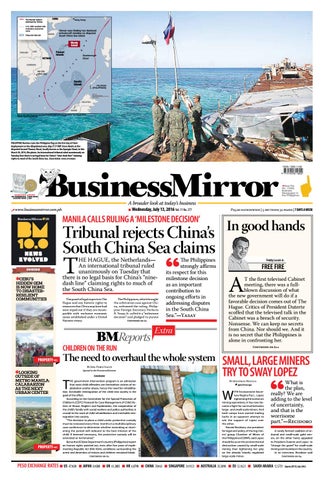
Tribunal rejects China’s South China Sea claims
T
HE HAGUE, the Netherlands— An international tribunal ruled unanimously on Tuesday that there is no legal basis for China’s “ninedash line” claiming rights to much of the South China Sea.
INSIDE
Cebu’s hidden gem is now home to disasterresilient communities
The panel of legal experts in The Hague said any historic rights to resources that China may have had were wiped out if they are incompatible with exclusive economic zones established under a United Nations treaty.
The Philippines, which brought the arbitration case against China, welcomed the ruling. Philippine Foreign Secretary Perfecto R. Yasay Jr. called it a “milestone decision” and pledged to pursue Continued on A2
The Philippines strongly affirms its respect for this milestone decision as an important contribution to ongoing efforts in addressing disputes in the South China Sea.”—Yasay
BMReports
CHIldren on the run
property
E1
The need to overhaul the whole system By Joel Pablo Salud
Special to the BusinessMirror
property
T
E1
Conclusion
he government intervention program is an admission that most child offenders are themselves victims of exploitation and/or abuse, hence the need for rehabilitation. Inevitable reintegration of the child into society is the goal of the effort. According to the Committee for the Special Protection of Children’s (CSPC) Protocol for Case Management of Child Victims of Abuse, Neglect and Exploitation, the cooperation of the child’s family with social workers and police authorities is crucial to the work of child rehabilitation and inevitable reintegration into society. “The decision to place a child under protective custody must be reviewed every three months in a multidisciplinary case conference to determine whether extending or shortening the period will redound to the best interest of the child. If deemed necessary, the protective custody will be extended or terminated.” But as the US State Department’s country (Philippines) report on human rights pointed out, even after five years of implementing Republic Act (RA) 9344, conditions surrounding the arrest and detention of minors and children remained bleak: Continued on A2
PESO exchange rates n US 47.1630
In good hands Teddy Locsin Jr.
free fire
A
T the first televised Cabinet meeting, there was a fullblown discussion of what the new government will do if a favorable decision comes out of The Hague. Critics of President Duterte scoffed that the televised talk in the Cabinet was a breach of security. Nonsense. We can keep no secrets from China. Nor should we. And it is no secret that the Philippines is alone in confronting her. Continued on A11
SMALL, LARGE MINERS TRY TO SWAY LOPEZ By Jonathan Mayuga @jonlmayuga
W
alysa salen
Looking outside of Metro Manila: CALABARZON as the next urban center
P25.00 nationwide | 5 sections 32 pages | 7 days a week
ith Environment Secretary Regina Paz L. Lopez tightening the screws on mining operations, it has now become a fight for survival between large- and small-scale miners. And both camps have started trading barbs in an apparent attempt to win the support of Lopez over the other. Ronnie Recidoro, vice president for legal and policy of the big miners’ group Chamber of Mines of the Philippines (COMP), said Lopez should focus on the environmental destruction caused by small-scale mining than tightening her grip on the already heavily regulated large-scale mines.
What is the plan, really? We are adding to the level of uncertainty, and that is the worrisome part.”—Recidoro A newly formed coalition of artisanal and small-scale gold miners, on the other hand, appealed to President Duterte and Lopez to “change the game” for small-scale mining communities in the country. In an interview, Recidoro said Continued on A4
n japan 0.4588 n UK 61.2883 n HK 6.0798 n CHINA 7.0463 n singapore 34.9123 n australia 35.5090 n EU 52.1623 n SAUDI arabia 12.5731
Source: BSP (12 July 2016 )
A2 Wednesday, July 13, 2016
BMReports BusinessMirror
www.businessmirror.com.ph
CHIldren on the run
The need to overhaul the whole system Continued from A1
“Many child suspects were detained in extended periods without access to social workers and lawyers, and were not segregated from adult criminals […] NGOs [nongovernmental organizations] believed that children held in integrated conditions with adults were highly vulnerable to sexual abuse, recruitment into gangs, forced labor, torture and other mistreatment.” RA 9344’s Declaration of Policy (Rule 2 [d]) is clear: “Pursuant to Article 40 of the United Nations Convention on the Rights of the Child, the State recognizes the right of every child alleged as, accused of, adjudged, or recognized as, having infringed the penal law to be treated in Implementing Rules and Regulations of RA 9344 a manner consistent with the promotion of the child’s sense of dignity and worth, taking into account the child’s age and desirability of promoting his/her reintegration. Whenever appropriate and desirable, the State shall adopt measures for dealing with
such children without resorting to judicial proceedings, providing that human rights and legal safeguards are fully respected. It shall ensure that children are dealt with in a manner appropriate to their well-being by providing for, among others, a variety of disposition measures, such as care, guidance and supervision orders, counseling, probation, foster care, education and vocational training programs and other alternatives to institutional care.” This is in conjunction with the final statement in its Declaration of Policy: “The State shall apply the principles of restorative justice in all its laws, policies and programs applicable to children in conflict with the law.”
The law in conflict with children?
With the worsening global poverty crisis, it is estimated by the United Nations Childrens Emergency Fund (Unicef) that the world’s street children have now reached 100 million, more than half are vulnerable to criminal syndicates and abuse. “Street children have been harassed or
beaten by police and often find themselves in conflict with the law. Some have been rounded up, driven outside city limits and left there. Other have been murdered by vigilantes in the name of ‘cleaning up the city,’ often with the complicity or disregard of local authorities,” the Unicef said. In the United States it has been reported that thousands of children in detention face life sentences without parole (Amnesty International’s 157-page report, “The Rest of Their Lives: Life without Parole for Child Offenders in the United States,” in 2005). According to Human Rights Watch, “In 26 states, the sentence of life without parole is mandatory for anyone who is found guilty of committing first-degree murder, regardless of age.” True, children today are different from 10 years ago, what with numerous technological advancements under their fingertips. Helsinki, Finland, boasts of the youngest hacker at 10 years old. The US archives the story of a 6-year-old boy who killed his friend with his father’s shotgun
over a piece of scrap iron. A serial rapist in Johannesburg, South Africa, and one of three accused in Delhi’s gang rape in the past year, were both 17 years old when they committed the crime. Most crimes involving children, like sexual assaults between minors and younger siblings, go largely unreported. The Philippine situation is no different. Based on Philippine Drug Enforcement Agency (PDEA) statistics, 40 percent of minors have been arrested for drug possession in 2014. The PDEA also reported its first apprehension of a 6-year-old child, the youngest minor allegedly involved in illegal-drugs trafficking. Ages 12 to 17 formed the bulk of apprehended minors of the same year. Drug trade in the Philippines has reached a whopping $10-billion industry.
The question of rehabilitation
While the intention of Rep. Pantaleon D. Alvarez’s House Bill 002 remain laudable, the question of rehabilitation for
the purpose of reintegration of children in conflict with the law may prove our biggest challenge yet. Revelations by the Duterte administration on the involvement of police top brass and high ranking officers of the Philippine National Police in the trade of illegal drugs, topped with a countrywide dearth in major rehabilitation facilities, could put child offenders—who often belong to the poorer strata—at risk of further abuse and exploitation. Lowering the age of criminal liability, without fixing a highly flawed juvenile care system, will only worsen the already grim situation. Nevertheless, reservations surrounding the lowering of the age of criminal liability are nothing compared to the bigger social ill that crosses all socioeconomic boundaries: the lowering of the standard of care, education and discipline in the home. Joel Pablo Salud is currently the editor in chief of the Philippines Graphic newsweekly magazine.
■
Tribunal rejects China’s South China Sea claims Continued from A1
a peaceful resolution of its territorial disputes with China. “The Philippines strongly affirms its respect for this milestone decision as an important contribution to ongoing efforts in addressing disputes in the South China Sea,” he said. How Beijing responds to the ruling in the case filed by US ally the Philippines could chart the course of global power relations in an increasingly dangerous hot spot. It comes as the US has ramped up its military presence in the region and could seek to marshal world opinion to pressure Beijing into complying with the verdict. A new Philippine leader who appears friendlier to Beijing could also influence the aftermath of the ruling. China drafted its so-called nine-dash line to demarcate its claims to virtually the entire South China Sea. Manila brought the case because China’s claims infringe upon its own 200-mile exclusive economic zone.
The dispute centers on waters through which an estimated $5 trillion in global trade passes through each year and are home to rich fishing stocks, and a potential wealth of oil, gas and other resources. China, which boycotted the case, summoned its demobilized sailors and officers for training drills in exercises that apparently started just days ago. The People’s Liberation Army Daily newspaper said on social media late Monday that Chinese navy reserves have been called up to perform “functional tasks.” The post followed online rumors that reservists in central Chinese provinces were called up for an unspecified mission from July 10 to 22. In the Philippines more than 100 leftwing activists marched to the Chinese Consulate in metropolitan Manila, yelling, “Philippine territory is ours, China get out.” They called their campaign to push China out of the South China Sea “CHexit” or “China exit now.” Vietnam, meanwhile, accused Chinese
vessels of sinking a Vietnamese fishing boat in disputed waters. Nguyen Thanh Hung, a local fisheries executive in the central province of Quang Ngai, said two Chinese vessels chased and sank the Vietnamese boat around midday on Saturday, as it was fishing near the Paracel islands. The five fishermen were rescued by another trawler around seven hours later. China has argued that the tribunal has no jurisdiction and says it won’t accept the ruling. It has insisted that bilateral talks between Beijing and other claimants is the only way to address the dispute. Findings of the tribunal are binding on the parties, including China. But the court—without police or military forces or a system of sanctions at its disposal—can’t enforce its ruling, so its potential impact remains unclear.
Rule of law
President Duterte convened a Cabinet meeting on Tuesday night following the
arbitration court’s ruling to discuss the possible scenarios in trying to enforce it. Presidential Spokesman Ernesto C. Abella said the security cluster of the Cabinet will study the arbitration ruling before Mr. Duterte issues a statement regarding the territorial dispute in the South China Sea. “Everything will be subject to a discussion. Everything will have to be subject to a discussion. After all, it’s going to be a lengthy decision and there will be a number of details that need to be properly threshed out before any decision is made publicly,” Abella said in a news conference ahead of the promulgation of the verdict. Outgoing Senate President Frank M. Drilon welcomed the ruling, saying it “puts clarity to the claims of both the Philippines and China in the West Philippines Sea.” Drilon also noted that the Philippines has stated it will comply with the ruling and expects China, as a party to the United Nations Convention on the Law of the Sea, to also comply.
“I call on other nations to respect the ruling and help maintain the rule of law,” he said. “We hope that the decision puts to rest any tension, mend strained relations and restore goodwill among countries in the region.” Sen. Francis N. Pangilinan also lauded the tribunal’s decision, saying fishermen can now fish “without fear” in the West Philippine Sea. “The decision of the Permanent Court of Arbitration can serve as a reboot in the stalled China-Philippines diplomatic relations,” Pangilinan said, noting “it gives the Philippines a more equal footing in the inevitable bilateral talks with China, who should not lose face.” “I suggest we remind China of the centuries’ old people-to-people interactions between our nations, and of the similar historical indignities we faced as colonies of foreign powers,” he added. Pangilinan said bilateral talks should ensure two things: that the corals and the maritime ecology in the South China Sea are not destroyed and that Filipino fishermen are able to fish in their traditional fishing grounds without fear. Sen. Paolo Benigno Aquino IV congratulated the Philippine delegation that worked on the case, saying, “It is not easy to face off with a country that is bigger and more powerful.” But, law expert and Kabayan Rep. Harry Roque warned that the Philippine government should be ready to face the economic impact of the tribunal’s ruling against China. “China may implement economic or trade reprisal as result of foreign policy differences. However, trade reprisal is prohibited by the WTO [World Trade Organization],” Roque told the BusinessMirror. “Trade could be used as an instrument of foreign policy. When China prohibited the entry of bananas from the Philippines, the government should have gone to the WTO,” he added. In 2012 China blocked the entry of Philippines bananas supposedly due to crop diseases amid the Scarborough Shoal standoff. “We should strengthen our position and go to WTO or UN General Assembly in case the decision will result in trade reprisal,” he added. In a separate statement, Party-list Rep. Carlos Isagani Zarate of Bayan Muna said the favorable ruling “strengthens and solidifies the Philippine position in future bilateral talks with China, especially now that their expansionist nine-dash line theory is declared without legal, historical and moral basis.” Zarate also called on the international community to step in and pressure China to “deescalate” the situation in the West Philippine Sea and should stop militarizing the area. “China has already reclaimed at least seven of our reefs, such as the Panganiban [Mischief], Mabini [Johnson South], Gavin [Gaven], Calderon [Cuarteron], Hughes [Kennan], Malvar [Eldad] and Kagitingan [Fiery Cross] Reefs,” he said. AP, with reports from Butch Fernandez, David Cagahastian and Jovee Marie N. dela Cruz
BMReports BusinessMirror
news@businessmirror.com.ph
Wednesday, July 13, 2016 A3
Philippines alarmed by IUCN’s ‘endangered’ listing of ‘butanding’
T
By Jonathan L. Mayuga
@jonlmayuga
HE latest Red List assessment of the International Union for Conservation of Nature (IUCN) has put the whale shark and two other species at an increasing risk of extinction. While whale sharks and winghead sharks are now listed as “endangered,” the Bornean orangutan is now listed as “critically endangered,” according to the IUCN. An official of the Department of Environment and Natural Resources (DENR) said the report is a cause for concern. Director Theresa Mundita S. Lim of the DENR’s Biodiversity Management Bureau (BMB) said there is a need for stronger cooperation among countries to ensure the global protection of not only the whale sharks and winghead sharks, but all migratory marine mammals that are threatened with extinction. Environmental advocates, likewise, said the report is alarming, especially for the country, which fought for the listing of whale sharks, locally called butanding, in the Convention on International Trade in Endangered Species (CITES) of Wild Fauna and Flora, also known as Washington Convention. The CITES is a multilateral treaty to protect endangered plants and animals. The Philippines is a known migratory route of marine mammals, particularly the whale sharks, or butanding. These gentle giants tend to stay longer along coastal areas, where they feed undisturbed. Scientists say whale sharks feed on phytoplankton, macroalgae plankton, krill and small nektronic life, such as small squids. The Philippines is rich with these whale-shark diets, according to scientists, explaining why they tend to feast in the country longer than in any other place in the region. Over the past decades, however, the number of visiting butanding, even in Donsol, which has the highest concentration of these marine mammals, was observed to be decreasing. According to Lim, whale sharks are important in maintaining a balanced marine ecosystem. As they feed, whale sharks become an agent that controls the population of the food they eat; as they move,
they also leave behind feces that help fertilize the sea, allowing marine plants and other microorganisms to survive, completing the food chain. The seasonal migration of these gentle giants made whale watching a popular tourist attraction in many areas, boosting the ecotourism industry that provides jobs and livelihood opportunities to people in coastal communities blessed by this natural phenomenon. A report posted on the IUCN official web site revealed that the number of whale sharks, scientifically known as Rhincodon typus, the world’s largest living fish, has more than halved over the last 75 years. T his was attributed to fishing, which targets whale sharks, and accidental deaths caused by ship propellers. The IUCN report recognized the conservation action in the Philippines, along with India and Japan, which ended large-scale fishing of whale sharks in the said countries. However, whale sharks continue to be fished in other locations, including southern China and Oman. “Although conservation actions in India, the Philippines and Taiwan have ended large-scale fishing of whale sharks in these countries, they continue to be fished in other locations, including southern China and Oman. As whale sharks and tuna are often present together, they are frequently caught by fishers targeting tuna,” the report said. Lim said the IUCN’s latest Red List assessment report will be more relevant, as the country plays host to the Conference of Parties 12 from October 22 to 28, 2017. She said the Philippines can set the tone and reiterate the call for stronger cooperation among member-countries of the United Nations for the protection of migratory wild animals. Lim said whale sharks are highly migratory species, hence its protection is not dependent on one particular country alone, but other countries within the range or the
migratory route of the species. “ T h i s me a n s t he re i s a need for stronger cooperation to protect them,” Lim told the BusinessMirror in an interview. “On our part [the Philippines], we should ensure that whale sharks are allowed to move freely, to allow them to interact with other whale sharks and reproduce,” she said. She said there is a need to revisit practices that promote whale watching for ecotourism purposes. “It is really a cause for concern knowing very well, like in the Philippines, we are not treating the butanding, the whale shark, in the way that we should,” said Gloria Estenzo Ramos, vice president of Oceana Philippines, an international ocean-conservation advocacy group, citing as example the practice in Oslob, Cebu, wherein butandings are being “domesticated”. She said tourism authorities appear to allow tourists to feed the whale shark as part of the package. “I am not surprised, however, because of the many factors that cause the fish and other marine species to vanish or decline in number. It is happening around the world, and also in the Philippines,” she said. She said the latest IUCN listing of butanding as endangered should serve as a wake-up call for authorities to ensure that all migratory species are taken care off. “I know that the practice of feeding whale sharks was already reported to the Bureau of Fisheries, but there was no positive response from the Philippine government,” she said. According to Ramos, there should be a management framework that focuses on the protection of butandings, as well as other marine wildlife, like dolphins, sharks and marine turtles. In Oslob, she said that because the whale sharks are now accustomed to being fed by tourists, they have been domesticated. There were also incidents that whale sharks are accidentally injured, as
they tend to go after boats as tourists feed them. “The local government should also look into this practice,” Ramos he said. She said there is a need for massive educational campaign on the need to protect the butanding. Civil society and academe should pitch the call for the urgent need to protect this threatened marine wildlife, Ramos said. AA Yaptinchay, founder and director of Marine Wildlife Watch of the Philippines, meanwhile, expressed dismay that the global population of butanding is declining, despite the successful campaign in the Philippines. He noted that the Philippines, which has started the campaign to protect butanding in 1998, was able to increase awareness about whale sharks after 18 years. “I think we are doing well in the Philippines. It is disappointing that even if we are successful in our initiatives in the Philippines, to think that the whale shark is now in the P100 bill, which means our awareness campaign is successful, the population is still declining,” he said. According to Yaptinchay, this is because of the fact that whale sharks are highly migratory. “Even if we have protection in the Philippines, if they go beyond our borders, their population will be affected. We still don’t know the population of whale sharks whether it is regional or global. Apparently, one of the threats to butanding is the fishery in China, which is very close to us. This means that the number of butandings visiting the Philippines will be affected,” he said. “We are not talking only of fisheries. There are many global problems, like pollution, climate change and ocean acidification, which affect not just whale sharks but all marine mammals,” he said. According to Yaptinchay, the declining population of butandings should pose a challenge to the Philippines to work harder
It is really a cause for concern knowing very well, like in the Philippines, we are not treating the butanding, the whale shark, in the way that we should.”—Ramos
Meralco expands prepaid power service to Bulacan consumers By Lenie Lectura
T
@llectura
h e M a n i l a E le c t r ic Co. (Meralco) is expanding its prepaid retail-electric service (Pres) in a bid to help marginalized consumers who may lack the means to pay their regular monthly power bills. Meralco Head of Utility Economics Lawrence Fernandez, in an interview, said the expansion involves opening the service to more areas aside from Manila and Rizal. “We’re now deploying to the NHA [National Housing Authority] developments in San Jose del Monte, Bulacan,” Fernandez said. “To help marginalized consumers, we are expanding our prepaid electric service, for which a customer is not required to provide a deposit for electric service, while giving the consumer more con-
trol over their electric billing,” he added. Pres enables customers to monitor their electricity consumption, balance, credit-purchase history and account information. Customers may purchase credit denominations of P100, P200, P300, P500 or P1,000 for every single purchase. Loading is available at Meralco business centers, Bayad Center outlets, sari-sari and convenience stores, drug stores and department stores. “At the same time, we have the lifeline discount for marginalized consumers. For the half-a-million households consuming 20 kilowatthour or less, they pay only a minimal fee for electric service, plus taxes and universal charges,” Fernandez said. “We also note that, thereafter, the consumer has the obligation to pay his or her monthly electric bills not later than nine days after
27,000
The prepaid meters installed out of the 40,000 units initially approved for rollout by the Energy Regulatory Commission
receipt of their monthly bill [Article 32 of the Magna Carta] [or] else, their service may be disconnected,” Meralco official added. Earlier, Energy Secretary Alfonso G. Cusi said his office would want to focus on providing electricity to marginalized communities, adding that he has tasked the National Electrification Administration (NEA) and National Power Corp. (NPC) to closely look into
this. Both the NEA and NPC, on the other hand, expressed willingness in the endeavor. Meralco has so far installed some 27,000 prepaid meters out of the 40,000 units that were initially approved for rollout by the Energy Regulatory Commission (ERC). Cusi, in a recent meeting with Meralco officials, also recommended to check on the “relocation sites, because these are potential fire hazards.” “Let us not wait for the local government units to resolve problems. Let us help, especially the marginalized. I want the general public to feel that the government is doing something to better their lives by providing adequate electricity with lower rates, so they will be able to afford other necessities, such as more food on the table,” Cusi said.
for their protection. “We should engage our neighboring countries, like China, Vietnam and Taiwan, to ensure stronger protection,” he said. He also said tourism promotion showcasing whale watching should also be revisited. Yaptinchay said tourism is an effective conservation tool, citing the success of the whale-watching attraction in Donsol, Sorsogon. The change in behavior of whale sharks, such as the “domesticated” butanding in Oslob, Cebu, appears to be an emerging threat to these
gentle giants, Yaptinchay said. He noted that the domesticated whale sharks in Oslob now follow boats, because they are accustomed to being fed. This, he said, allows fishers to easily catch whale sharks. “What if the boats go outside the Philippines, say to China?” Yaptinchay said authorities should step in to check this practice and move to strictly enforce laws that are supposed to protect marine mammals against harm through global collaboration and cooperation.
BMReports BusinessMirror
A4 Wednesday, July 13, 2016
news@businessmirror.com.ph
No end in sight for exports drop this year
T
By Cai U. Ordinario
@cuo_bm
he lackluster performance of the country’s exports in the international market is expected to continue for the rest of the year, according to the National Economic and Development Authority (Neda). This, after the Philippine Statistics Authority (PSA) reported that exports in May 2016 continued its decline by posting a contraction of 3.8 percent. The country’s merchandise export earnings declined to $4.711 billion in May 2016, from $4.899 billion recorded in May 2015. “The growth of exports is expected to remain muted for the rest of 2016 with the slow recovery of the global economy. Given the soft demand, export-oriented firms may need to refocus their strategies to consider nontraditional markets, which have shown healthier appetites in recent months,” Socioeconomic Planning Secretary Ernesto M. Pernia said. He cited, for instance, the growth of exports to European countries. Exports to France and Switzerland grew by 37.8 percent and 72 percent, respectively, for the first five months. On the other hand, exports to traditional markets, such as Germany and the Netherlands, declined by 18.8 percent and 10.6 percent, respectively. Exports to European Union membercountries, with a 12.4 percent share to total merchandise exports, amounted to $584.67 million. It recorded a 5-percent decline from
$4.711B The merchandise export earnings in May, down 3.8 percent
$615.43 million recorded in May 2015. “It would also be important to increase the flexibility of export firms to cater to the domestic market, given robust domestic demand. We also need to keep government spending on track to ensure that domestic demand continues to provide a cushion to mitigate the impact of the country’s weak exports growth,” said Pernia, who is also Neda director general. PSA data showed that total receipts from the top 10 exports decreased by 1 percent in 2016 and reached $3.972 billion, or 84.3 percent of the total exports. The country’s top seller, Electronic Products, accounted for 48 percent of the total exports revenue in May 2016. Receipts from the export of this commodity reached $2.263 billion, a 4-percent contraction from $2.357 billion registered in May 2015.
Of these electronic products, the top seller are Components/Devices (Semiconductors). In May 2016 it accounted for 33.4 percent of all electronic product exports. However, PSA data showed, it posted a contraction of 11.8 percent to $1.574 billion in May 2016, from $1.785 billion in May 2015. Meanwhile, total export receipts from the country’s top 10 market destinations for the month of May 2016 was valued at $3.857 billion. These accounted for an 81.9-percent share of the total export receipts. The top 3 export markets in May 2016 were Japan, which accounted for 22.1 percent; the United States, 14.9 percent; and Hong Kong, 10.9 percent. Exports to Japan amounted to $1.041 billion, a 1.5-percent growth from $1.026 billion in May 2015. The Neda said it posted an average growth of 1.3 percent in the January-to-May period. Shipments to the United States amounted to $703.54 million in May 2016. It recorded a decrease of 3.7 percent, from $730.57 million in same month last year. The country’s exports to Hong Kong were valued at $513.67 million in May 2016. It contracted by 2.5 percent, from $526.82 million recorded in the same month last year. Meanwhile, among seven selected Asian economies, only Vietnam posted positive export growth of 4.9 percent in May 2016, although lower than the previous month’s 7.5 percent. The country’s exports to Asean membercountries comprised 14 percent of the total exports in May 2016 and was valued at $659.71 million. This, however, registered a decrease of 10.2 percent, from $734.68 million posted in same month a year ago.
Group to govt: Honor UCPB stocks issued to coco farmers By David Cagahastian
@davecaga
A
group pressed the government on Tuesday to honor the shares of stock issued to coconut farmers decades ago, representing their share in the governmentcontrolled United Coconut Planters Bank (UCPB), in keeping with President Duterte’s vow to honor past government commitments. Kilusang Magbubukid ng Pilipinas (KMP) Chairman Joseph Canlas said the coconut farmers, which their group represents, would “gladly accept” if the Duterte administration would honor the shares of stocks held by farmers in UCPB. The shares were rendered worthless by the Supreme Court (SC) decision in 2012, which said these shares are bought using public funds and, thus, belong to the government. KMP does not have the exact number of its members who were among the coconut farmers issued shares of stocks in UCPB, but claims to represent some 2 million coconut farmers who all have a stake as to how the Duterte administration would distribute coco-levy funds. “If President Duterte would offer to honor those shares of stock in UCPB, then the farmers would gladly accept it as part of the process of returning the coco-levy funds to the farmers,” Canlas told the BusinessMirror. According to the SC decision in January 2012, there are some 1.4 million coconut farmers who have been issued shares of stock in UCPB as their private property. Those farmers
are still stockholders on record in the books of UCPB, but they are now regarded merely as “beneficial owners” of the shares of stock, with the government holding those in trust for the benefit of the coconut industry as a whole. Farmers who are still stockholders on record in the books of UCPB also still receive notices to attend certain events to effect transactions where the approval of stockholders is required under the law. However, they are not allowed to vote during those events since the government, which holds the stocks in trust votes in their stead. Agriculture Secretary Emmanuel F. Piñol, who earlier announced Mr. Duterte’s directive to release the coco-levy funds, said a group within the Duterte Cabinet is handling the matter. “I can’t make a comment on the [cocolevy] issue because there is a group handling that,” he said. Former President Benigno S. Aquino III had tasked the Governance Commission on Government-owned and -Controlled Corporations (GCG) to conduct an inventory of the assets bought using coco-levy funds, but this inventory-taking was for the purpose of privatizing these assets. Piñol declined to comment on whether it is still the GCG, which will decide on how to distribute the coco-levy assets, nor on the composition of the group handling the issue within the Duterte Cabinet.
Small, large miners try to sway Lopez continued from a1
Lopez’s Memorandum Order 2016-01, which imposes a moratorium on new mining projects and orders an audit of mining operations, does not mention about small-scale mining, which, he noted, is more destructive and, in fact, vastly unregulated by the Department of Environment and Natural Resources (DENR). Lopez could not be reached for comment. She, however, earlier told the BusinessMirror that the audit to be conducted on mining will be “holistic” and would include non-metallic mining operations, as well as small-scale mines. She also vowed to put them under strict regulatory process and would not hesitate to stop their operations if their operations are environmentally destructive and cause people in the communities to suffer. “I am looking at the memorandum order now. She said the audit will be conducted in accordance with the Mining Act, EO [Executive Order] 79 and DAO [Department Administrative Order] 2015-07. We take this to mean that she will be implementing existing regulations relative to mining,” the COMP official said.
‘Reveal review results’
HE said EO 79 already imposed a moratorium subject to a review of the performance of existing mining operations. “We were hoping and, in fact, it was our call to Secretary Lopez for her to reveal the result of that first review undertaken by the MGB [Mines and Geosciences Bureau]. There is already an ongoing review, now here comes another review?” Recidoro lamented. Recidoro said members of the COMP have not seen the result of the first review. “What is the plan, really? We are adding to the level of uncertainty and that is the worrisome part.” He added that the order does not mention anything about small-scale mining operations. “To our mind, that is the more serious matters she should look into. Large-scale mines are heavily regulated already. In fact, when the DENR imposed the ISO 14001 [International Organization for Standardization] certification requirement, everyone complied.Most of our members have already secured their ISO 14001 certification,” he said. On the other hand, he added that the smallscale mining sector is unregulated. In fact, he said most small-scale mines are operating illegally. He noted that there are only five declared Minahang Bayan in the country, where smallscale mining should be conducted as mandated by EO 79. “Where is the audit there? Where is the regulation there?” he said.
Too focused on large miners
According to MGB estimates, he said around
40 percent of the country’s gold output may be credited to small-scale mining. “Our appeal to the secretary is for her to look into that, too.” He said the DENR chief is too focused on large-scale mining. There are two sectors in the mining sector, he said—large-scale mines, which operate under the law, and small-scale mines, which operate outside Minahang Bayans. The DENR chief, Recidoro said, should stop small-scale mining operations that are illegally operating in various parts of the country before tightening her grip on large-scale mining operations that are compliant with existing mining and environmental laws. “She should stop the illegal-mining operations in Paracale, in Diwalwal and the illegal operations in Zamboanga. Those are definitely destroying the environment,” he said. “In fact, President Duterte even announced that he plans to appoint a military man to the DENR to stop illegal-mining operations and he knew that is a priority.”
COMP statement
IN an official statement sent to the media meanwhile, the COMP, through its Executive Vice President Nelia Halcon, said Lopez’s first order as DENR chief “impedes on the otherwise positive investment environment created during the recent business forum in Davao City.” The COMP noted that the mining sector then submitted its inputs to the Duterte administration’s 10-point economic agenda stressing the implementation of responsible mining is crucial in driving investments in rural areas. “Since 2010, the Mines and Geosciences Bureau has been undertaking an assessment of all mining permits and agreements in its ‘Use it, lose it’ policy in a bid to purge the system of nonmoving mining applications. Section 3 of EO 79 also called for a review of the performance of existing mining operations and a continuation of the cleansing of nonmoving mining-rights holders. The EO stated, “The review shall be based on the guidelines and parameters set forth in the specific mining contract or agreement and on other pertinent laws, rules and regulations, such as the Mining Act of 1995 and the Labor Code.” According to COMP, after six years of review, it is now incumbent upon the MGB to report the results to the new secretary before another comprehensive review is undertaken. “A continuing moratorium on new mining projects only breeds more confusion and uncertainty, particularly on capitalintensive and risky mining business,” the statement added. MGB has earlier indicated “frequent violators” of mining rules and regulations, and has
named companies that have not secured ISO 14001 certification. Out of the 42 companies listed by the MGB, only half, or 21, are members of the Chamber of Mines of the Philippines and of the 21 members, 17 have fully complied with ISO 14001, with the remaining four waiting to be certified anytime soon. “We are now calling on MGB to release the list of cancelled mining applications in the spirit of transparency,” COMP said. COMP maintains that it relies on the President’s directive to the DENR to “just implement the Mining Act of 1995 and ensure responsible mining” in the country.
Small-scale miners speak up
But leaders of the Philippine National Coalition for Artisanal and Small-scale Mining said they are hoping that the new administration can fix the problems besetting the artisanal and small-scale mining, or the ASM sector. The coalition is represented by 15 ASM leaders from six major provinces in the Philippines. The ASMs are engaged in goldpanning activities and use mercury, a toxic heavy metal. They said, for a long time, the sector has existed and operated illegally because of government neglect. According to members of the coalition, they are ready and willing to cooperate with the new administration in realizing common goals that will lead to a progressive, healthy and sustainable ASM community. “This coalition hopes to change the game for small-scale mining communities in the country,” said Evelyn Cubelo, development program manager of BAN Toxics. “With proper support, it can be the best vehicle for miners to look at more responsible mining practices, end poverty and call for mercury-free methods of mining. This is a step toward a more sustainable ASM community.” Among the coalition’s goals is to ensure the government’s support for projects that aim to uplift and transform the ASM sector. The ASM sector and its miners have long been neglected and regarded as illegal, despite the fact that the sector consists of roughly 350,000 people per DENR estimates and benefits around 2 million people. About 28 tons of gold, or 80 percent of the country’s annual gold production, were produced by this sector in the past decade. Because it is considered illegal, the ASM sector has largely been ignored and unrecognized by the government. ASM communities, particularly their indigenous peoples, women and children, frequently lack valuable support from the government, they said.
AseanWednesday BusinessMirror
news@businessmirror.com.ph
Editor: Max V. de Leon • Wednesday, July 13, 2016 A5
Timeline: The China-PHL sea dispute
A
n arbitration panel in The Hague, the Netherlands, issued a ruling on Tuesday in a longrunning dispute between the Philippines and China over the South China Sea. The Philippines has asked the tribunal to declare China’s claims and actions invalid under the United Nations Convention on the Law of the Sea (Unclos). Beijing has refused to join the case, rejecting the tribunal’s jurisdiction, and says it will not accept the decision.
A look at how the dispute has unfolded: 1947: China demarcates its South China Sea territorial claims with a U-shaped line made up of eleven dashes on a map, covering most of the area. The Communist Party, which took over in 1949, removed the Gulf of Tonkin portion in 1953, erasing two of the dashes to make it a nine-dash line. 1994: The 1982 Unclos, under which the Philippines has taken China to arbitration, goes into effect after 60 countries ratify it. The agreement defines territorial waters, continental shelves and exclusive economic zones. The Philippines joined the convention in
1984, and China in 1996. The US has never ratified it. 1995: China takes control of disputed Mischief Reef, constructing octagonal huts on stilts that Chinese officials say will serve as shelters for fishermen. The Philippines lodges a protest through the A ssociation of Southeast Asian Nations. 1997: Philippine naval ships prevent Chinese boats from approaching Scarborough Shoal, eliciting a protest from China. The uninhabited reef, known as Huangyan Island in China, is 230 kilometers (145 miles) off the Philippines and about 1,000 km (600 miles) from China. In ensuing years,
IN this July 7, 2015, image provided by the Permanent Court of Arbitration (PCA), the case regarding the Philippines and China on the South China Sea is heard at the PCA at The Hague, the Netherlands. An arbitration panel in The Hague, the Netherlands, was scheduled to issue a ruling on Tuesday, in a longrunning dispute between the Philippines and China over the South China Sea. The Philippines has asked the tribunal to declare China’s claims and actions invalid under the UN Convention on the Law of the Sea. Beijing has refused to join the case, rejecting the tribunal’s jurisdiction, and says it will not accept the decision. AP
the Philippines detains Chinese fishermen numerous times for alleged illegal fishing in the area. 2009: China submits its ninedash line map to the United Nations, stating it “has indisputable sovereignty over the islands in the South China Sea and the adjacent
waters.” The submission came in response to applications by Vietnam and Malaysia for recognition of extended continental shelves, which would give them resource rights. The Philippines, Vietnam, Malaysia and Indonesia protest the Chinese claim.
2011: The Philippines files a diplomatic protest after a chartered ship searching for oil and gas and in Reed Bank near the Spratly Islands complained of being harassed by two Chinese patrol boats, forcing it to change course. 2012: China takes effective
control of Scarborough Shoal after a tense standoff between Chinese coast guard ships and a Philippine naval vessel that had stopped a Chinese fishing boat to inspect it. 2013: The Philippines brings its dispute with China to the Permanent Court of Arbitration in The Hague, angering Beijing. A fivemember panel of international legal experts is appointed in June to hear the case. 2014: n The Philippine government summons China’s top envoy in Manila in February to protest what it said was the firing of a water cannon by a Chinese government vessel to drive away Filipino fishermen from Scarborough Shoal. China ignores the protest and calls its sovereignty there “indisputable.” n China issues a position paper in December, arguing that the panel does not have jurisdiction over the case, because it concerns issues of sovereignty and boundary definition, which are not covered by the UN convention, and that the Philippines and China had agreed to settle their dispute only through negotiation. 2015: The arbitration panel in The Hague rules in October that it has jurisdiction over at least seven of the 15 claims raised by the Philippines. A hearing on the merits of the claims is held in November. China does not participate. 2016: The Permanent Court of Arbitration announces the arbitration decision. AP
Singapore Rocks, reefs and recriminations: A South China Sea glossary Rock court jails 4 A Bangladeshis linked to IS Island Spratly Islands
F
our Bangladeshi workers, who allegedly planned attacks linked to the Islamic State (IS) group in their own country, were sentenced on Tuesday to jail terms of up to five years. Prosecutors said the men, who pleaded guilty, had contributed part of their salary to buy food, arms and weapons, like knives and pistols, to launch attacks in Bangladesh. The amounts ranged from S$60 ($42) to S$1,360 ($1,000). They were part of a group detained in April under the country’s Internal Security Act, which allows for detention without trial in cases where public safety is threatened. The Ministry of Home Affairs has said the group’s suspected leader, Rahman Mizanur, possessed guides on making weapons and bombs, as well as radical material from the IS group and al-Qaeda that he used to recruit the others. Rahman, 31, pleaded guilty and was convicted of two charges of financing terrorism by inviting group members to contribute funds and handling the money to facilitate plans. In sentencing Rahman to five years in jail, District Judge Kessler Soh emphasized that a deterrent sentence and “much stiffer punishment is warranted.” “He was the mastermind. He was the one who started this whole outfit,” the judge said. Rahman was shackled as he arrived in court and looked down when the sentence was passed, surrounded by heavy police guard. He had earlier addressed the court in English, putting forth a lengthy plea for mitigation. “I wanted to learn my religion. [My friends] showed me the wrong way, the wrong activities,” Rahman said. “This is my very big mistake sir. I am very remorseful.” The three other men convicted were Miah Rubel, Muhammad Jabath Kysar Haje Norul Islam Sowdagar and Sohel Hawlader Ismail Hawlader. They were sentenced to two-and-a-half years and two years in jail, respectively. The maximum sentence for financing terrorism is 10 years in jail and a fine of S$500,000 ($370,309). AP
n international Court issues its ruling on Tuesday on a challenge brought by the Philippines to China’s claim to more than 80 percent of the South China Sea. The report by the tribunal in The Hague—which will decide on at least seven of 15 Philippine submissions—is likely to be filled with jargon related to maritime disputes. The ruling is expected after 11 a.m. local time in The Hague. To help you prepare, here is a glossary of the key terms and acronyms:
Asean
The 10-member Association of Southeast Asian Nations (Asean) ranges from small states, like Lao PDR, to bigger economies, like Indonesia. China and Asean have agreed to develop a code of conduct for the South China Sea, but progress has been minimal. Asean operates by consensus, and China has lobbied countries under its influence to block communiqués that may criticize its behavior, according to diplomats.
EEZ
States may claim an exclusive economic zone (EEZ) of up to 200 nautical miles (370 kilometers) around their territory, where they have the sole right to exploit resources. They must allow the innocent passage of foreign vessels through these zones, according to the United Nations Convention on the Law of the Sea (Unclos). China and countries, including India, argue they have the right to regulate foreign military activity within an EEZ.
FONOP
The US conducts so-called freedom of navigation operations (Fonop) to demonstrate its right to fly and sail through what it considers international waters and airspace. It has performed three transits by warships within the 12-nautical mile territorial sea area near China’s claimed features since October, plus a number of flyovers.
Innocent passage
UNCLOS provides for the passage of foreign vessels—military or commercial—through an EEZ, or 12-nautical mile territorial sea. If a ship engages in activity that threatens the security of the coastal state, the passage is no longer considered innocent. All three
of the US FONOPS have been innocent passages. Some US defense analysts argue that by not engaging in other activities, the US warships gave credibility to the zones around the reefs China claims.
A naturally formed land mass that’s above water at high tide and can sustain human habitation. An island generates a territorial sea and an EEZ.
Itu Aba
The largest natural feature in the Spratlys and occupied by Taiwan. Taipei is worried the tribunal might rule on whether Itu Aba—also known as Taiping—is an island, even though it’s not named in the Philippine submissions. Taiwan and China’s claim to the South China Sea are based on the same map published before the Nationalist government fled to Taipei and the Communists won China’s civil war.
Low-tide elevation
A feature exposed at low tide but submerged at high tide. It doesn’t generate a territorial sea.
Nine-dash line
China’s claim is based a dashed line drawn on a 1940s map, although more recent maps include 10 dashes. The line is shaped like a cow’s tongue and loops to a point about 1,800 kilometers south of the coast of China’s southern Hainan Island. Beijing has never clarified whether it claims all the sea or just the land features within it. The dashed line was first drawn by officials of the Republic of China before they were defeated by the Communists and fled to Taiwan in 1949.
Observers
Countries allowed to send representatives to the tribunal’s closeddoor hearings on the case, including Australia, Indonesia, Japan, Malaysia, Singapore and Vietnam. A US application to attend was rejected as it hasn’t signed Unclos.
PCA
The Permanent Court of Arbitration (PCA) in The Hague has been appointed arbitrator in the case under the provisions of Unclos. Its ruling is final and can’t be appealed, but there’s no mechanism to enforce it.
A feature that’s above water at high tide but can’t sustain human habitation or economic life. Rocks generate 12-nautical mile territorial seas, but not EEZs.
More than 100 small islands and reefs set in rich fishing grounds and potentially sitting on oil-and-gas deposits. The chain, known as the Nanshan Islands to China, is claimed in entirety by China, Taiwan and Vietnam. The Philippines claims part of them, as does Malaysia. China occupies eight features, including Fiery Cross Reef, Mischief Reef, South Johnson Reef and Subi Reef. It’s turned seven into artificial islands. Fiery Cross is equipped with a 3-km airstrip capable of landing military aircraft. Airstrips are being built on Subi and Mischief. Vietnam occupies 21 features in the Spratlys, nine of them above water at high tide and 12 low-tide elevations. The Philippines occupies eight features. The largest, Thitu, has a 1-km airstrip. Malaysia occupies seven features and runs a naval base on Swallow Reef. Taiwan occupies Itu Aba and one smaller feature. Brunei claims an EEZ that takes in a southern reef, but hasn’t made any formal claim to it.
Scarborough Shoal
China seized the shoal from the Philippines in 2012. Its coast guard periodically shoos off Philippine fishing boats nearby. Should China build on the shoal, it could gain a potential military outpost right on the Philippines’s door.
Territorial sea
The 12-nautical mile territorial belt measured from the baseline of a coastal state. The baseline refers to the low water mark of the coast.
Unclos
The treaty that has since 1994 defined the rights and responsibilities of nations with respect to the world’s oceans. In particular, it defines the territorial zones generated by maritime features. China and the Philippines have signed and ratified it. The US says it follows its provisions. Bloomberg News
A6
The World BusinessMirror
Wednesday, July 13, 2016
news@businessmirror.com.ph
House passes bill to boost airport security, reduce lines
W
ASHINGTON—The House passed an aviation bill on Monday aimed at boosting airport security, reducing screening lines and refunding fees to passengers whose luggage is lost or arrives late. The bill also extends the Federal Aviation Administration’s (FAA) programs for 14 months at current funding levels. It was approved by a voice vote. The Senate is expected to vote later this week. Action is required by on Friday, the day the FAA’s current operating authority expires, to avoid a partial shutdown of the agency. House and Senate lawmakers had reached an agreement last week, clearing the way for passage after Rep. Bill Shuster, Republican-Pennsylvania, chairman of the House transportation committee, agreed to temporarily drop his effort to remove air traffic-control operations from the FAA and place them under the control of a private, nonprofit corporation. The plan ran into opposition from other powerful committee chairmen opposed to ceding Congress’s authority over aviation matters to a corporation. Segments of the aviation industry that feared a corporate board would be dominated by large airlines also opposed the plan.
‘Insider threat’
THE aviation bill will provide stability to the nation’s aviation system, and “includes limited but critical and time-sensitive provisions to improve aviation safety and security,” Shuster said. The bill authorizes a doubling of Transportation Security Administration (TSA) teams that stop and search suspicious passengers in airport public areas that are outside the security perimeter, often using bomb-sniffing dogs. The provision responds to airport attacks in Brussels and Istanbul this year. The bill would toughen the security clearance for airport employees who have access to secure areas, expand random employee inspections and require reviews of perimeter security. That is a response in part to the “insider threat” problem raised by the destruction last year of a Russian Metrojet airliner over Egypt. Investigators suspect a bomb was smuggled aboard. A separate bill also passed by the House requires the TSA to update a national risk assessment of airports within
90 days, conduct more frequent risk assessments of airport access points and perimeter security, and to develop better perimeter security strategies. An investigation by The Associated Press identified 345-perimeter security breaches from the start of 2004 through mid-February of this year at 31 of the nation’s busiest airports, with an average of one every 10 days starting in 2012.
With children
THE aviation bill also authorizes the TSA to donate unneeded security equipment to foreign airports with direct flights to the United States. It directs TSA to establish a pilot program at three to six airports to reconfigure and install security systems that increase efficiency and reduce vulnerabilities in airport terminals. The bill also requires TSA to ensure precheck screening lanes are open during high-volume travel times. And the measure authorizes a trial program to develop and test more efficient passenger and luggage screening systems. Airlines would have to refund checked bag fees to passengers whose luggage is lost or is delayed 12 hours or more for domestic flights, or 15 hours or more for overseas flights under the bill. It also requires airlines to generally ensure that children 13 years of age or under are seated adjacent to an adult or older child traveling with them.
Drone flights
THE bill would test programs to handle the hazards of drone flights near airports and other critical infrastructure and to research traffic management for drone flights similar to the FAA’s air traffic-control system for manned aircraft. One provision would require drone manufacturers to provide consumers with safety guidelines for each unit sold and information on drone laws, while another would begin the process of interagency discussions to allow for drones to assist in firefighting operations. A separate provision would institute a $20,000 fine for anyone who “knowingly or recklessly” flies a drone near emergency responders. Authorities recorded 20 incidents in which drones flew too close to wildfires last year, with more than half hindering firefighting efforts. It has happened again at least nine times so far this year. AP
U.S. sending 560 more troops to Iraq as Mosul push intensifies
B
AGHDAD—The United States will send 560 more troops to Iraq to transform a freshly retaken air base into a staging hub for the long-awaited battle to recapture Mosul from Islamic State (IS) militants, Defense Secretary Ash Carter said on Monday. The new American forces should arrive in the coming weeks. Most of the engineers, logistics personnel, security and communications forces will concentrate on building up Qayara air base, about 40 kilometers south of Mosul. They will assist Iraqi forces planning to encircle and eventually retake the biggest city anywhere that has fallen under IS’s control. The extremist group captured Mosul in the summer of 2014. It has used the city as a main headquarters since. “These additional US forces will bring unique capabilities to the campaign and provide critical enabler support to Iraqi forces at a key moment in the fight,” Carter said on an unannounced visit to the country. Lt. Gen. Sean MacFarland, the top US commander in the fight against the IS
group, said they have already received warning orders to deploy and will flow in “relatively soon.” Carter announced President Barack Obama’s decision as he met about 120 troops in a building at Baghdad’s airport, shielded from scorching desert hovering near 100 degrees Fahrenheit. It is Obama’s second US troop increase in Iraq in the last three months, and it brings the total US force authorization there to 4,647. Asked how long America will continue to send more forces to the fight, Carter said that the US is determined to defeat IS, and if commanders need for more troops, “I’ll ask the president for them.” He also said he has offered Iraqi leaders additional help in learning how to detect and counter explosives and roadside bombs in order to enhance security in Baghdad, where there have been several recent deadly attacks. Carter told reporters that US advisers are prepared to accompany Iraqi battalions in operations, as those units begin the Mosul siege. AP
In this June 8 photo, a Transportation Security Administration officer candidate passes through a body scanner as she plays the part of an air traveler during a training session in an airport security-checkpoint simulator at the Federal Law Enforcement Training Center in Brunswick, Georgia. AP
Cuba quietly opens 1st bulk goods store; wholesale still elusive
H
AVANA—Cuba has quietly opened a first-ofits-kind store specializing in bulk goods in Havana: “Zona +,” a high-ceiling space with racks stacked with large tins of tomato sauce, toilet paper and cooking oil by the gallon. It’s not quite Costco, and it falls short of satisfying long-standing calls for a wholesale market to support the growing class of small-restaurant and -cafeteria owners who have set up shop under President Raul Castro’s economic reforms begun six years ago. But it could help relieve the pressure that those entrepreneurs have been putting on other retail stores by snapping up huge quantities of goods, leaving regular customers in the lurch. On a recent afternoon, Naidi Carrazana pushed a shopping cart loaded with cases of beer, bottled water and soft drinks she needs to stock her small cafeteria nearby. She acknowledged that business owners like her who make big purchases have been emptying market shelves of things like flour, chicken and tomato paste, and said
500,000
The estimated number of small-business owners and employees, many of whom are working in the foodservice sector in Cuba
the new store can help with that. “A place like this allows you to buy in bulk, and that’s a benefit for us and a benefit for the people,” Carrazana said. Located in the upscale western suburb of Miramar, Zona + launched a little over a week ago with zero fanfare. Manager Javier Munoz said shoppers are allowed to buy unlimited quantities, but he declined to comment
further because he was not authorized to do so by the store’s staterun parent company.
Like a seed
EMPLOYEES said business has been good despite the lack of publicity, as word of the opening spread mouth to mouth. One customer showed up in a car and bought 50 3-kilogram cans of tomatoes to supply a restaurant. Similar stores are being planned for other parts of the city, they added. In Cuba government entities are the only ones able to import and acquire goods at wholesale, and wholesale access has been a crucial demand of the 500,000 or so smallbusiness owners and their employees, many of them working in the food-service sector. The government has promised to set up wholesale markets for private entrepreneurs, but that has yet to materialize and their only option has been the same retail stores where the general population shops. Although goods at Zona + are bulk, that doesn’t entail a price break. For example, a kilogram of high-end Serrano coffee costs $14.45 there, while the same kilo was $14.40 on the same day at a regular store elsewhere in Havana. “The place is pretty, the service is good, but it’s still the same price as retail. In truth, it doesn’t resolve our problems,” Carrazana said. “I hope this is like a seed for a wholesale market where we, entrepreneurs, can buy at a different price.” AP
Exceptions to the rule: Big cities where homes remain affordable
S
AINT LOUIS—Until recently, Christina Brouk was living with her parents. Now, still in her early 20s, she’s living the American dream of home ownership—the same dream that’s grown elusive for many young adults since the housing bubble peaked 10 years ago. Homes in many areas of the United States have become so costly that few, but high earners, can afford them. Rising rents have made it hard to save enough to buy. Cities that offer plentiful jobs for educated young adults—New York, Boston, San Francisco, Seattle, Washington—have become prohibitively expensive home markets.
Then there are the exceptions. Saint Louis, near where Brouk lives, is one. So are Minneapolis, Pittsburgh and Kansas City, Missouri. In those areas, homes remain comparatively affordable relative to local incomes. An improved US economy has fueled job and pay growth. Throw in historically low mortgage rates, and ownership is still within reach—even for those just entering their careers at modest salaries. “You really live to do this,” Brouk, a 24-year-old medical secretary who, along with her fiancé Derek Schmittgens, bought a three-bedroom ranch home in the Saint Louis suburb of
Imperial, Missouri, last December. “It’s what you work for.”
Full brunt
THE Saint Louis metro area, situated squarely in the Rust Belt, might seem an improbable place for a stable housing market. The local economy is far diminished from its peak decades ago as a hub of muscular industrial giants. Many corporations, like brewing giant Anheuser-Busch that once were based here closed, moved or merged. This year the National Football League’s Rams cited rosier economic opportunities in Los Angeles as a reason for
their decision to return to the West Coast. Yet, having never experienced the heights of the housing bubble, Saint Louis never absorbed the full brunt of the bust, either. Its economy has remained reasonably steady compared with turmoil elsewhere in the country where foreclosures caused demand for rentals to surge.
Attracting jobs
A TECH corridor in the city’s Central West End is attracting some higherpaying jobs at companies like Square, a mobile payment company founded by Jack Dorsey, a Saint Louis native who cofounded Twitter.
Jobs in health care and finance continue to grow, economists say. The metro area’s unemployment rate is just below the national level of 4.9 percent. And home prices remain roughly in line with area incomes. Nationally, home ownership is near a 48-year low. A key reason is that surging rents and home prices have made it next to impossible for many people to save enough to buy— even though today’s ultralow mortgage rates have the effect of lightening housing bills. An analysis by The Associated Press found that monthly housing payments have dropped in the past decade while rents have climbed. AP
briefs
rights activists allege prisoner disappearances SANTIAGO, Chile—Human-rights activists have presented a criminal complaint in Chile for the alleged disappearance of some 100 political prisoners, who were reportedly kept at an enclave of German immigrants called Colonia Dignidad during the country’s 1973 to 1990 military dictatorship. Relatives of the alleged victims took advantage of the visit to Chile of German President Joachim Gauck to call on the two countries to work together in clearing up what happened inside the enclave that was founded in 1960 about 400 kilometers southeast of Chile’s capital, Santiago. AP
U.N. to debate human rights UNITED NATIONS—The United Nations will take two days to focus on how to best ensure human rights in the face of rising terrorism, populism, state repression and other abuses of power, the president of the General Assembly said on Monday. Mogens Lykketoft said the high-level debate among 193 member-states beginning on Tuesday will focus on the relationship between development, peace, security and human rights. “This event, of course, [is] taking place at a time when the values that underpin all the declarations and conventions on human rights are under attack across the world,” Lykketoft said. AP
Japanese messaging app raises $1.1B in I.P.O. NEW YORK—Japanese messaging app Line’s initial public offering (IPO) has raised more than $1.1 billion despite a lukewarm IPO market. Shares priced at ¥3,300 each, or $32.84 per US-traded share, on Monday, the top of the predicted range. That suggests strong demand. Renaissance Capital, an IPO research firm, says it’s the biggest US IPO of the year. The stock will begin trading on the New York Stock Exchange on Thursday and on the Tokyo Stock Exchange on Friday. Line is based in Tokyo and owned by Naver Corp., South Korea’s biggest Internet-search engine. AP
U.S. web site detects activity at N. Korea nuclear-test site WASHINGTON—A US web site that monitors North Korea says satellite imagery shows a high level of activity at the isolated nation’s nuclear-test site. The web site 38 North said on Monday the commercial imagery taken on July 7 appears to show supplies or equipment near a tunnel entrance at Punggye-ri, where North Korea has conducted four underground nuclear-test explosions since 2006. There is also a vehicle at a nearby support building and what may be mine-ore carts. The web site says it is unclear whether this activity is for maintenance, excavation or preparation for a fifth nuclear test. AP
The World BusinessMirror
news@businessmirror.com.ph
Wednesday, July 13, 2016
A7
Life on the line in Venezuela as economic crisis worsens
C
In this May 3 photo, Adelaida Ospina shades herself with her bag as she waits in line outside a supermarket to buy food in Caracas, Venezuela. The average Venezuelan spends 35 hours waiting to buy basic goods each month. Ospina said she arrived at 5:40 a.m. AP
EU seeks clarification over future after Brexit
B
RUSSELS—The European Union (EU) warned on Monday that Britain’s economic growth could be 2.5 percent lower than previously forecast through next year, as a result of the negative effects from the country’st decision to leave the bloc.
the British economy. There have also been signals from businesses that they are putting investment decisions on hold as they try and gauge what the post-Brexit economic landscape will look like. Most important, they want to know whether Britain will have the same sort of access to the EU’s single market. Moscovici also said Brexit could reduce economic growth forecasts in the 19-country euro zone by between 0.2 percent and 0.5 percent through 2017.
In a preliminary assessment of the costs of a so-called Brexit, the EU’s economic affairs commissioner Pierre Moscovici said the increased uncertainty related to the June 23 vote to leave the EU will reduce Britain’s GDP between 1 percent and 2.5 percent by 2017, compared to where it would have been had the country voted to stay. The evidence has been piling up that the decision to leave has already taken its toll on the British
Unofficial forecast
economy. Aside from the volatility the decision ignited in financial markets, there are signs that the decision has jolted consumers and businesses. A recent survey from market research firm GfK found that consumer confidence took a dive in wake of the referendum. The decline, which it said was the sharpest in 21 years, is important, as consumer confidence is fundamental for household spending, a key ingredient of
HOWEVER, Moscovici insisted that these weren’t official forecasts and could be changed “if we are capable of limiting uncertainty and delivering the proper policy response.” Moscovici said he was encouraged by the fact that the political landscape in Britain has been resolved far more quickly than anticipated. It was revealed on Monday that Theresa May will become the country’s new prime minister on Wednesday after the
only other candidate to lead the governing Conservative Party withdrew from the race. The contest was initially expected to last until early September. Moscovici urged May to clarify Britain’s situation with the EU “as soon as possible.” He said the British government should notify its intention to leave under the so-called Article 50, which provides the framework for a departure. Once Article 50 is triggered, there is a two-year timetable for a country to leave. “This is a precondition for any negotiation to start on its future relationship with the EU, either formal or informal,” he said. “The longer the uncertainty lasts, the costlier it will be for the economy.” Most economists expect the Bank of England to look to stimulate the British economy at this week’s policy meeting. Some expect the central bank to reduce its benchmark interest rate to a new record low from the current 0.5 percent, where it has been since March 2009. AP
Environmentalists, utilities eye Richmond coal-ash trial
R
ICHMOND, Virginia—Potentially cleaner rivers or possible higher electric prices. That is what’s at stake in an upcoming federal court ruling in Virginia that could have farreaching effects on how energy companies dispose of the waste known as coal ash, left over from decades of burning coal. Spurred by high-profile coal ash spills and new federal regulations, utilities are grappling with the disposal of vast amounts of the heavy-metallaced waste. In a federal courtroom in Richmond last month, Judge James A. Gibney Jr. heard four days of arguments and complex testimony from numerous experts about what should be done at a Dominion Virginia Power coal-ash site along the Elizabeth River in southeast Virginia. He hasn’t said when he will rule. Central to the case are questions about the scope of the Clean Water Act and whether it applies to tainted groundwater
connected to rivers and other surface waters.
Appeal
THE lawsuit, according to industry and legal experts, is the first of its kind to go to trial in the US, and its outcome could help shape future fights over coal ash ponds and the extent to which certain federal regulations apply. “It’s always been a real gray area the extent you need a Clean Water Act permit for situations where there’s leeching of toxics materials into groundwater,” said Robert V. Percival, director of the environmental law program at the University of Maryland. W h ic he ve r w ay he r u le s, experts said, Gibney’s decision is likely to be appealed. But the case could lead to a definitive ruling that affects coal ash disposal around the country. “This has Supreme Court written all over it,” said Patrick Parenteau, a professor at Vermont Law School who specializes in environmental law.
Environmentalists and utilities are often at odds on what coal ash disposal should look like, with environmental groups pushing for excavating unlined coal ash sites near waterways and moving millions of tons of ash to lined landfills, which are less prone to leeching toxic chemicals.
Prominence
ELECTRIC companies say that a one-size-fits-all approach is unreasonable and that there are less expensive alternatives. Utilities argue that capping coal ash sites in place with rainproof liners and other methods can still protect water quality. Jim Roewer, executive director of the Utility Solid Waste Activities Group, a Washington-based trade group, said the cost of a mandatory coal-ash excavation and transportation to lined landfills could easily top a trillion dollars. “If you had to clean-close all these facilities it would have a huge impact on the industry,” Roewer said.
There are coal ash sites around the country, but the issue is of particular importance in the Southeast, which has a disproportionate number of coal-ash sites near waterways. Coal ash disposal has gained prominence after a breach of a Duke Energy coalash impoundment site in February 2014 caused a major spill on the Dan River, which flows in both Virginia and North Carolina. Last year Duke pleaded guilty to federal environmental crimes and agreed to pay $102 million in fines and restitution for years of illegal pollution leaking from coal-ash dumps at five North Carolina power plants.
Displeasure
IN Virginia the state’s largest electric utility has argued that excavating all of its coal-ash ponds would be uneconomical and impractical. Dominion plans to excavate some of its 11 coal-ash ponds at four power stations and consolidate them into six closed ponds by 2019, according to spokesman Robert Richardson. AP
ARACAS, Venezuela—The people waiting for hours in front of the drugstore were dazed with heat and boredom when the gunmen arrived. The robbers demanded a cell phone from a 25-year-old in black shorts. Instead of handing it over, Junior Perez took off toward the entrance to the pharmacy. Eight shots rang out, and he fell face down. The dozens of shoppers in line were unmoved. They held their places as the gunmen went through Perez’s pockets. They watched as thick ribbons of blood ran from the young man’s head into the grooves of the tiled walkway. And when their turns came, each bought the two tubes of rationed toothpaste they were allowed. “These days, you have to put the line above everything,” said pharmacist Haide Mendoza, who was there that morning. “You make sure you get what you need, and you don’t feel sorry for anyone.” A s Venez ue l a’s l i nes h ave grown longer and more dangerous, they have become not only the stage for everyday life, but a backdrop to death. More than two dozen people have been killed in line in the past 12 months, including a 4-year-old girl caught in gang crossfire. An 80-yearold woman was crushed to death when an orderly line of shoppers suddenly turned into a mob of looters—an increasingly common occurrence as Venezuela runs out of just about everything.
Import dependence
THE extent of the country’s economic collapse can be measured in the length of the lines snaking through every neighborhood. The average Venezuelan shopper spends 35 hours waiting to buy food each month. That’s three times more than in 2014, according to the polling firm Datanalisis. “As the economy breaks down, life is telescoping to be just lines,” said Datanalisis President Luis Vicente Leon. “You have masses of people in the streets competing for scarce goods. You’re inevitably going to get conflict, fights, tricks, you name it.” Venezuela’s vast oil wealth once fueled a bustling economy. But years of mismanagement under a socialist government ground much of the nation’s production to a halt, and the country grew ever more dependent on imports. The supply chain broke down— first slowly, then all at once, as a steep drop in the price of oil left no money to pay for even some of the most basic necessities. Shortages now top voters’ lists of concerns, surpassing even safety. That’s stunning in a country with one of the world’s highest homicide rates.
Fueling violence
DESPERATION fuels the violence. Medical student Maria Sanchez looked as timid and absent as anyone else in a Caracas line for flour, but when a woman tried to cut in front of her and her mother, she threw the first punches. She didn’t let up until the would-be intruder limped away. Sanchez passed the rest of the wait with her lips pressed together, her mother quietly weeping. “You have to go out with your batteries fully charged or people take advantage,” Sanchez said. “Need has an ugly dog’s face.” The need is everywhere. On Wednesdays residents of one of Caracas’s wealthiest neighborhoods line up with empty 5-gallon jugs, hoping to catch a truck that comes through weekly with potable water. Poorer people wait at the foot of the green mountain that towers over the city, competing to siphon water from its springs. On Fridays bank lines grow long because ATM limits capped at $8 daily have not kept up with the world’s highest inflation, and the machines are not restocked
35
The average number of hours a Venezuelan shopper spends waiting to buy food each month
on Saturdays or Sundays. Venezuelans now mostly avoid using cash, and even sidewalk orange juice pedd lers have acquired credit card machines. On Mondays and Tuesdays the lines outside immigration offices spill down the street as if people suddenly decided over the weekend that they could not handle one more week standing around while life passes them by.
Short supply
EACH night, men push broken-down gas guzzlers along a river to line up at a warehouse that sells car batteries, but always runs out of stock by midmorning. All Venezuelans, including children, are assigned two shopping days a week based on their state ID number. They line up before supermarkets open, guided by rumors and where they’ve had luck in the past. Some use fake IDs to score extra shopping days. Pregnant women and the elderly get their own priority lines, and everyone is limited to two units of whatever is on offer. The longest lines are for what is in the shortest supply: food. Nine out of 10 people say they can’t buy enough to eat, according to a study by Simon Bolivar University. Prices have been driven impossibly high by scarcity, hoarding and black market resellers. Venezuelans line up again and again for subsidized goods, not always knowing what they’ll get when they finally reach the front. When supply trucks arrive, workers throw open the doors, game-show style, to reveal whether shoppers will be taking home precious pantry staples, or a booby prize like dog food. Sometimes the disappointment is too much to bear. Hundreds of people stormed a market in Caracas last month after the food truck they spent hours waiting for was diverted. “We’re starving,” they cried as shopkeepers lowered metal gates over their doors and windows.
Food riots
QUEUES thousands of people long are targets for muggers, who will sometimes work their way down person by person. Soldiers armed with tear gas and assault rifles often stand guard over supermarkets and supply trucks to maintain order. But the National Guard has killed three people and arrested hundreds this summer while trying to control nationwide food riots. A few blocks away from where Perez died in the toothpaste line, shoppers waiting to buy groceries watched a mob set fire to an accused thief. After the man was taken away in an ambulance, some of his assailants got in line to do their shopping.
Love stories
KIDS do homework on the curb. Some young men use the empty hours to meet women and score phone numbers. More often, though, love stories end in line. Sasha Ramos broke up with her boyfriend of five years amid a spat over a blocks-long line for razors. He’d spent the morning complaining that they were hardly moving, which only underlined that he never helped with the shopping. They argued and he stormed away, leaving her staring at the ground next to strangers who had heard it all. AP
The World BusinessMirror
A8 Wednesday, July 13, 2016
Obamacare 2.0: Obama calls for revisiting the public option
W
ASHINGTON—President Barack Obama is laying out a blueprint for addressing unsolved problems with his signature health law, including a renewed call for a “public option” to let Americans buy insurance from the government. Obama’s assessment of the Affordable Care Act comes in an eight-page article in the Journal of the American Medical Association, a peer-reviewed publication. The article debuted on Monday on the journal’s web site, and Obama plans to echo the themes in public events and speeches in the coming weeks. Replete with academic-style citations, the article is largely a self-congratulatory look at what Obama sees as the accomplishments of his law: millions of Americans who have gained coverage, slower growth in overall health costs and better coordination of care to improve quality. Yet, it’s also a memo for Democrat Hillary Clinton on how she can build on his legacy if elected president. Obama’s latest ideas are likely to be dismissed by Republicans, who remain committed to repealing the health-care law. In polls, “Obamacare” continues to divide the public. Despite progress under his administration, “too many Americans still strain to pay for their physician visits and prescriptions, cover their deductibles or pay their monthly insurance bills,” Obama wrote. Others struggle to navigate the “bewildering” health system. Too many still lack insurance coverage, he added. Obama urged lawmakers to “revisit” the public plan, especially in areas of the country where there is little or no competition among private insurers participating in HealthCare.gov and state-run marketplaces created by the law.
Public option
MANY experts consider that at least three insurers are needed for a competitive market. But many small towns and rural areas have only one option. The problem is growing, as some commercial insurers scale back their participation in the health law’s markets, and more than a dozen nonprofit insurance co-ops have collapsed. Kristie Canegallo, White House deputy chief of staff, said Obama will keep making his case for a public option to voters, but he doesn’t plan to send the Republican-run Congress new legislation to implement it. “This Congress is not going to act on a proposal like that,” Canegallo said. During hard-fought negotiations in Congress before Obama signed the law in 2010, liberals pushed vehemently for a public option, in which Americans could opt for a government-run plan similar to Medicare. It was scuttled to secure enough votes from moderate Democrats to pass the bill. Now, Obama aims to influence the debate about health care in the presidential election.
Something better
A public-health insurance option would stop well-short of the government-run system that Vermont Sen. Bernie Sanders turned into a rallying cry. But some liberals believe it could be a stepping-stone. Clinton has said if elected she’d work with interested governors to implement statebased versions of the public option. Republican Donald Trump has said he’d end Obamacare and replace it with something better, though he’s been vague on the specifics. A recent nonpartisan analysis found that the plan Trump has outlined would make 18 million people uninsured. In a counterpoint to Obama’s article published on Monday by the same medical journal, a conservative policy expert called for an overhaul of the health-care law. Stuart Butler of the Brookings Institution think tank did not advocate repeal, but said the system is too complicated for many consumers, and subsidies for moderate-income families are inadequate. Butler said states should take advantage of a provision in the law that would allow them to redesign coverage starting in 2017. “Core parts of the ACA need to be reassessed and revised,” Butler wrote.
Historic low
THE health-care law has been the major driver in reducing the nation’s uninsured rate to about 9 percent, a historic low. It provides subsidized private health insurance to people without workplace coverage across the country, and offers a Medicaid expansion that states can use to cover more low-income residents. AP
Europeans worry migrants may increase terror threat
news@businessmirror.com.ph
Black doctor’s conflict: Save officers, don’t trust police
D
ALLAS—When officers who’d been shot by a sniper in downtown Dallas started showing up at Parkland Memorial Hospital, trauma surgeon Dr. Brian H. Williams went to work, pushing aside the inner conflict he faces every day as a black man who’s fearful when encountering police. He sees the news about black men dying at the hands of police. He sees the aftermath of those killings and recoils when the victim is demonized or defamed. He’s had his own encounters with the police in which he thought he might die. But he also knows the sacrifices that police officers make putting their own lives on the line each day. His voice quivering as he expressed regret on Monday at the officers’ deaths at the storied hospital, Williams also gave voice to the intense racial turmoil roiling the country. “All I wanted to do was save those police officers. And we did everything but we couldn’t do it,” he said with a deep sigh. “I admit I have my own burdens that I carry when I deal with law enforcement, but that was not an issue for me at that time. These were my patients.”
Prayers
In this February 6 file photo, a woman holds a placard during a Pegida demonstration against immigration and Islamisation in Amsterdam, Netherlands. The refugee crisis and the threat of terrorism in Europe are very much related to one another in the minds of many Europeans, according to a survey conducted by the Pew Research Center across the continent. AP
B
ERLIN—The refugee crisis and the threat of terrorism in Europe are very much related to one another in the minds of many Europeans, according to a survey conducted across the continent. Monday’s poll by the Pew Research Center found that, in eight of the 10 European nations surveyed, half or more believe that the influx of migrants increases the likelihood of terrorism in their country. Many Europeans also worry that migrants will become an economic burden and take away their jobs and social benefits. The survey covered the European countries of Germany, Sweden, the Netherlands, Britain, France, Spain, Italy, Greece, Hungary and Poland. It was conducted from April to May—before the British referendum to leave the European Union (EU) and the extremist attack at Istanbul’s Ataturk Airport last month. The continent saw an overwhelming influx of more than 1 million migrants in 2015—with the majority arriving from Muslim countries, such as Syria, Iraq and Afghanistan. Almost all of them applied for asylum in the EU, with Germany and Sweden as their top destinations.
Avoiding detection MEANWHILE,
populist
parties
76%
The percentage of people surveyed in Hungary who said they’re concerned that refugees will increase the likelihood of terrorism in their country all over the continent successfully increased their numbers by campaigning against Muslim migrants, including the National Front in France, the UK Independence Party, the right-wing Alternative for Germany and Austria’s Freedom Party. Europe has recently suffered several major terrorist attacks, including the assaults by the Islamic State (IS) group on Paris and Brussels that killed scores of people. Many of the attackers were Europeanborn, but some are believed to have
traveled to Syria to join IS before returning to carry out the attacks—a few of them by mixing in with migrant flows to avoid detection on their way home. Some 76 percent of people surveyed in Hungary said they’re concerned that refugees will increase the likelihood of terrorism in their country, followed by the Polish with 71 percent. Majorities in all other surveyed countries shared this belief—with the exception of Spain and France.
Insistent voice
CITIZENS of both Hungary and Poland also worried more than other Europeans that refugees would be a burden to their countries because they would take their jobs and social benefits. “It is important to note that worries about refugees are not necessarily related to the number of migrants coming to the country,” the report states. It said Poland, where 73 percent say refugees are an overall major threat, has had only several thousand asylum applications, while just 31 percent of Germans are generally concerned about refugees after seeing their country register almost 1.1 million asylum-seekers last year. German Chancellor Angela Merkel has made the successful handling of the refugee crisis her top priority and has told Germans time and again that “we will manage this.” The government of Hungary, on the other hand, has been an insistent voice against migrants, especially against Muslims.
Prevailing attitude
GERMANY and Sweden—which took in the second most asylum seekers in 2015—are the only countries where at least half say refugees make their nations stronger because of their work and talent. When asked more generally, whether having an increasing number of people of many different races, ethnic groups and nationalities in their country makes the society a better place to live in, only few Europeans said diversity has a positive impact. At 36 percent, Sweden registers the highest percentage that believes diversity makes their country a better place to live. The prevailing attitude in France, Germany, the Netherlands and Spain is that diversity is neither a plus nor a minus in term of quality of life. At the same time, 63 percent in Greece and 53 percent in Italy believe that growing diversity makes their country a worse place to live. These attitudes stand in a stark contrast to the US There, some 58 percent of Americans said having more people of many different races, ethnic groups and nationalities makes the US a better place to live. Only 7 percent said increasing diversity makes life worse, according to a Pew Research Center poll conducted in March. The poll was conducted from April 4 to May 12 among 11,494 people in Europe and the United States. Data from the US was mostly used for comparisons. The margin of error ranged from 3.1 to 4.6 percent. AP
Israel passes law targeting human-rights organizations
J
ERUSALEM—Israel’s parliament passed a controversial law on Monday that increases the regulation of many Israeli human-rights organizations. The law approved by a vote of 57 to 48 targets groups that receive more than half their funding from foreign governments or political organizations. In practice, the law will affect liberal groups almost exclusively, because hawkish groups in Israel largely rely on donations from wealthy individuals, which are exempt. The law requires organizations to state that they rely on foreign funding in all communication with public officials and on TV, newspapers, billboards and online. Representatives of these groups must also
declare they depend on foreign contributions to the heads of parliamentary committees when participating in meetings. Failure to comply will result in fines. Israeli Prime Minister Benjamin Netanyahu has strongly supported the legislation, saying there is nothing antidemocratic about requiring transparency so the public is aware of the role of foreign governments in funding these groups. Opponents of the law argued that the Netanyahu government was trying to target liberal human-rights organizations that are critical of Israel’s policies toward the Palestinians. Lawmaker Robert Ilatov of the hardline nationalist Israel Beitenu party said
he cosponsored the law because “intervention in Israel’s internal affairs is not acceptable.” Previous versions of the bill would have labeled the groups as foreign agents and allowed Israel to tax donations received from foreign governments. One particularly contentious proposal that was later dropped would have required representatives of these groups to wear identification tags while they were in Israel’s Knesset, or parliament. During a debate late Monday that lasted several hours, Israeli opposition lawmakers heaped criticism on the legislation even though it had been toned down. Opposition lawmaker Nachman Shai
of the Zionist Union party said, “We will pay for this damage for many generations.” Other opposition lawmakers compared the measure to authoritarian policies in Russia and Saudi Arabia. The so-called NGO law was approved despite strong criticism from abroad. German lawmaker Volker Beck, chairman of the German-Israeli Parliamentary Friendship Group, wrote on Facebook on Monday that the law would “tarnish the reputation” of Israel. Israeli media has reported that nearly all of the Israeli groups that receive more than half their funding from foreign governments are human-rights organizations identified with the left. AP
IT was near the end of what had been a peaceful protest against recent fatal police shootings that a 25-year-old man wielding a semiautomatic rifle fired on officers who were patrolling the demonstration. The first call came about an officer being shot; moments later, there were a flurry of notifications that even more victims were on the way. It quickly became evident that something catastrophic had happened. Five officers were killed, nine others were injured, as well as two civilians: the deadliest attack on police since 9/11. The hospital’s hallways were abuzz with activity, the usual rings and beeps of machinery, the doctors and nurses moving in and out of treatment rooms, police lined up in the hallways praying for their wounded colleagues. Williams reckons he walked back and forth in front of the crowd of officers dozens of times. “I, certainly, during that time, felt the despair they were going through. I knew that they were angry at this assailant. It was palpable and I felt it,” Williams told the Associated Press. “But I also had a personal understanding of where that [anger against the police] all came from. Not that I condone what happened. I certainly abhor the results. But I can see where the roots of that have been laid. “
Mindful
THE gunman, Micah Johnson, was a black Army veteran who followed black militant groups online. His parents said his military service changed him and he became a hermit. A self-described military brat who moved around a lot as a child, Williams turned to medicine after spending six years in the Air Force as an aeronautical engineer. He got his medical degree from the University of South Florida in 2001, did his residency at Harvard’s Brigham and Women’s Hospital in Boston, and a fellowship at Emory University’s Grady Memorial Hospital in Atlanta before joining Parkland—the same hospital where President John F. Kennedy was brought after he was shot—six years ago. He’s married with a 5-year-old daughter. He’s been stopped by the police himself over the years and said he is mindful each time that he must act and speak in a way that doesn’t seem threatening. He lives each time in fear that he could be killed. He sees the news about other black men killed by the police.
Encounters
IN one traffic stop, he ended up “spread eagle” on the hood of the cruiser. In another, when he was stopped for speeding, he had to wait until a second officer arrived. Just a few years ago, he was stopped by an officer and questioned as he stood outside his apartment complex waiting for someone to pick him up and drive him to the airport. He doesn’t have such encounters every day but when he does, he’s on his guard and, “I’m always just praying for the encounter to end.” As Friday morning turning into Friday night, the trauma unit’s efforts came to an end. They had done all they could and it was time to bring the bodies of those they were unable to save to the medical examiner. AP
news@businessmirror.com.ph
ExportUnlimited BusinessMirror
New DTI chief pledges to expand potential of small-time businesses
Editor: Efleda P. Campos • Wednesday, July 13, 2016 A9
DTI: PEDP 2015-2017 strategies to help exporters By Nora K. Terrado
Undersecretary, Industry Promotion Group Department of Trade and Industry
T
Business Beyond Borders
HE global landscapes for supply chains and tariffs have changed over the years. With the advent of advanced regulatory measures, which are widely implemented in the regions, nontariff measures (NTMs) have become a challenge to traders, including importers and exporters worldwide.
ABREA Consulting Group Founding President and Chief Strategy Officer Raymond A. Abrea, CPA, MBA, presents to attendees of the Micro, Small and Medium Enterprise Development lecture held on July 1 at the Philippine Trade Training Center in Pasay City. ALYSA SALEN
By Sandra Sendingan and Dale Calanog
W
Special to the BusinessMirror
HILE micro, small and medium enterprises (MSMEs) perform an important function in supporting long-term economic growth, small-time entrepreneurs still undergo various challenges, as they try to develop and take their businesses to the global economic scene. As of November 2015, SME contribution to the country’s GDP accounted for more than a third, or 35 percent, of the GDP. More than playing an integral role in sustaining the country’s economic performance, SMEs also generate employment, accounting for 4,930,851 people, or 64.9 percent, of total employment in the Philippines in 2012, according to the National Statistics Office (NSO) and Bureau of Micro, Small and Medium Enterprise Development (BSMED). However, before MSMEs can develop to participate in global-production networks, they first have to survive entering a highly competitive environment against larger firms while dealing with a myriad of other issues, such as problems in microfinancing and raw materials access; gaps in technology and technology transfer; and weak support system manifested by strict regulatory policies that characterize this country’s business climate.
“We realize the struggles, the difficulty as we promote entrepreneurship. The real story is it’s a difficult thing to get into business,” newly appointed Trade Secretary Ramon M. Lopez said to the hundreds of aspiring MSMEs gathered at the Philippine Trade and Training Center on July 1. The Micro, Small and Medium Enterprise Development (MSMED) Week 2016 is the first public event for Lopez as secretary of the Department of Trade and Industry (DTI). This year’s MSMED Week carried the theme “Developing Innovative and Resilient MSMEs,” and opened workshops on branding, online marketing and photography, among others. Lopez, who was the former executive director of Go Negosyo, an organization advocating entrepreneurship among Filipinos, admits his background gives him better insight into the needs of growing MSMEs and the assistance they need both from the
government and the private sector. Providing market access is just one government initiative that could help address the short-term woes of MSMEs. The trade secretary said in his first official function that he has made headway in securing the commitment of market providers or commercial structures to provide space for MSME retailers to display and sell their merchandise on a regular basis. Lopez also bared the proposal for the drafting of a law or a department directive that will encourage government personnel to purchase products in bulk orders from MSMEs. Whether it’s government shirts, pants or socks for its staff from the national to the regional levels, product preference should always fall on MSME merchandise to foster a supply-and-demand relationship between the two entities. The government should also improve industrial policy by providing MSMEs with access to newer technologies and service facilities to pave the way for more innovative practices in product and process development. All these programs and initiatives remain in line with President Duterte’s recent pronouncements on the reduction of bureaucratic redtape in government transactions for greater ease of doing business. In his inaugural speech, Mr. Duterte called on all government agencies to subject all department procedures —from application forms to the processing time—to extensive review and revision in an effort to simply and streamline business processes. Trade Undersecretary for Regional Operations roup (ROG) Zenaida Cu-
sion-Maglaya said, along with strengthening MSMEs, to become more competitive in the world market, the program also is in line with President Duterte’s employment agenda for the poor. “The new DTI chief further emphasized that we have to push further the development of more MSMEs to help alleviate poverty, which is really the program the President wants: To give jobs to the poor and give them income,” said Maglaya, who accepted the offer to continue her work with the DTI under the same position. Maglaya said the DTI is also looking at streamlining their business processes to lessen the number of delays in securing permits and certification. “We want the Philippine Business Registry [PBR] upgraded and enhanced to make sure that when you get to PBR, you get all five agencies in one application,” Maglaya said. There have been improvements in their registration procedures, in particular in their business-name registration, which only takes 15 minutes to accomplish, as compared to the whole-day processing required before the digitization of the application. The trade secretary said he has a tough job ahead, but remains optimistic that by providing MSMEs with “all the support that the government could give” from machines to market access, enterprise development and global integration would soon follow. “We have to really put in our hearts [that] as long as we have that passion, knowing the market, being smart entrepreneurs, tayo pong lahat ay magtatagumpay. Ang DTI ay para sa bayan, tagumpay para sa lahat,” he said.
Korea issues advisory on foreign food-facility registration
T
HE Special Act on Imported Food Safety Management was issued by the Republic of South Korea and took effect on February 4, enforced by the Ministry of Food and Drug Safety (MFDS) with the grace period until August 3. It is mandatory for foreign food manufacturers or food importers to register overseas food facilities of the product to MFDS, at least 7 days prior to their fist importation. The registration should be renewed every two years. The food products from foreign facilities that fail to register may be refused to be imported to Korea by MFDS. For successful registration, manufacturers should fill out the form to provide correct information to Importer to satisfy the registration
requirements. It is required to have the agreement of MFDS inspection by the foreign facility for importer. The advisory said that, if there are any manufacturers who are not willing to provide the facility information to the importer, they can also directly register to the MFDS System (http://impfood.mfds.go.kr). A person who intends to import food into Korea or a person who establishes and operates a foreign food facility (importers) under Article 5 (1) of the Act shall register each of the following matters with the minister of Food and Drug Safety via the Internet or mail in accordance with the Application for Registration of Foreign Food Facility in attached Form 1 by no later than seven days before he or she files an import declaration under
Article 31 (1): Provided, that where a foreign food facility has already been registered and maintained effectively under Article 5 (10) of the Act, the foregoing shall not apply. T he follow ing information should be included when filling out the registration form: Name, location, representative, phone number and e-mail address of the facility; Type of business, whether a food-safety management system has been applied type of food; Where the minister of Food and Drug Safety deems it necessary, the person shall agree on visits to and inspections on his or her facility; Confirmation that information to be registered does not differ from facts; and
Confirmation that the person who establishes and operates a foreign food facility has agreed to obtain registration (This is limited to where a person who intends to import files an application for registration. Foreign Food Facility Registration is a separate registration from those foreign food facility described in previous imports report. That means foreign food facility reported during the previous imports must be registered separately. It is a separate registration process. The validity period of registration is two years and shall be renewed before the expiration of seven days prior to registration. It is possible to register by mail or online. The full text of the Act is available for download in this link: https://goo.gl/Cs6I7s.
Recently, results of a survey, conducted by the International Trade Centre (ITC), showed that close to three-quarters of exporters and importers in the Philippines suffer from NTMs, a clear validation of the findings of the Export Development Council (EDC) led by the Department of Trade and Industry (DTI). T he s u r v e y re p or t e d t h at approximately 70 percent of most exporting and importing companies in the Philippines face difficulties in complying with foreign-technical requirements and confor mit yassessment procedures, which are often followed in developed countries. Technical requirements include compliance with fumigation a nd l a b e l i n g , a mon g ot he r s. Conformity assessment includes product certification, testing and other related assessments, such as inspection, quarantine, traceability a nd re g i s t r at ion . S o m e a l s o experience unnecessary costs and delays in domestic institutions when processing required documents. The DTI sees strategies included in the Philippine Export Development Plan(PEDP)2015-2017 asinstrumental in addressing exporters’ and importers’ concerns on the said results. Streamlining processes for local exporters and importers have been the agenda of the agency for the past six months. Consultations and awareness campaigns have been the primary initiatives of the DTI to actively seek for solutions and inputs from different sectors affected by regulatory bottlenecks. The DTI has also been in the forefront in addressing exporters’ concern specifically to shorten the processing time and administrative requirements. Setting the legislative priorities for the 17th Congress, especially for transport and logistics to have a more competitive export industry, is also among the bold strategies being tapped. Specifically, Strateg y 2 of the PEDP 2015 2017, which states the removal of the unnecessar y reg u lator y impediments to the movement of goods and delivery of services, hopefully, will be instrumental in addressing these concerns. As part of the initiatives in the execution of Strategy 2 of PEDP 2015-2017, EDC, with the DTI as the lead agency and the Export Marketing Bureau, initiates action plans geared toward easing the processes for exporters.
A joint Department Administrative Order 001, Series of 2016, was issued on May 16 for the implementation of the amended cabotage law, which w il l ease logistics concern. The departments of Finance, Transportation and Communication, Trade and Industry, and Justice collaboratively signed the administrative order stating the implementing rules and regulations (IRR) of the said law, which took effect on May 31. The DTI, Board of Investments and EDChave also led the streamlining of the procedures of the Philippine National Police in the issuance of license and permits in the possession, importation, export, movement, transport, deal and purchase of regulated chemicals. The lists of regulated chemicals have been trimmed down from 101 to 32. As a result, an IRR of Republic Act 9516 was issued on June 9. T he EDC a l so recom mend s legislative priorities for the 17th Congress to have a more competitive export industry, specifically, for transport and logistics. Some of t he recom mend at ions i nc lude the amendment of the Philippine Ports Authority and Civil Aviation Authority of the Philippines Charter in order to separate the regulatory and operator functions of both agencies. There is also a proposal to repeal Presidential Decree 1221 that requires mandatory dry-docking in the shipyards registered with the Maritime Industry Authority. Just recently, EDC welcomed the signingoftheCustomsModernization and Tariff Act (CMTA), which enables full customs automation and will make processes easier for exporters, importers and traders to comply with complex customs procedures. With CMTA, the Philippines will now be compliant to the Revised Kyoto Convention. The DTI and EDC had been in the forefront of forwarding CMTA into law. The DTI will be in constant dialogue with other government agenciesincludedintheMemorandum Circular 91 to further simplify their respective procedures and face up the challenge of synchronizing programs, activities and projects conducive for trade. At the earliest opportunity, we hope to convene to further discuss next action plans to further address this concern. n Send your feedbacks or comments at exportunlimited@dti.gov.ph.
upcoming events Compiled by Louise Kaye G. Mendoza | DTI-EMB Knowledge Processing Division
JULY 14
Event: Philippine Export Competitiveness Program Time: 1 p.m.-4:30 p.m. Session 1: Overview of EMB Services and Export Procedures Session 2: How to Avoid Cybercrime in Export Transaction Venue: Penthouse, DTI International Building, 375 Sen. Gil Puyat Avenue, Makati City
Event: Doing Business in Free Trade Areas Venue: AV Room, DTI International Building, 375 Sen. Gil Puyat Avenue, Makati City
JULY 20 Event: DBFTA AEC 2025 Venue: Koronadal City
JULY 21
Event: DBFTA AEC 2025 Venue: Cotabato City
A10 Wednesday, July 13, 2016 • Editor: Angel R. Calso
Opinion BusinessMirror
Obama gives Afghanistan a fighting chance
T
wo years after President Barack Obama declared he would bring the war in Afghanistan to a “responsible end,” he has canceled the planned withdrawal of 4,300 troops and said the US will keep a force of 8,500 in the country indefinitely. Perhaps, he realized what a huge mistake it was to leave no soldiers behind when he “ended” the war in Iraq in 2011, an error that has been critical to the rise of Islamic State (IS). Afghanistan is, likewise, at risk of collapsing into anarchy, and again becoming a safe harbor for terrorist groups plotting attacks against the West. The US needs to keep its force in place. Given the enemies that the Afghan government faces—the Taliban, the Haqqani network, al-Qaeda and now an IS faction—one may wonder how a few thousand US troops can make any difference. But they can: A relative handful of highly qualified Americans can go a long way toward organizing counterinsurgency campaigns and training Afghan security forces. And the elite special forces units deployed in Afghanistan are suited to taking out terrorist leaders. Obama and his generals have recently strengthened the anti-insurgency campaign by intensively bombing Islamic State’s allies in the east of the country, and by relaxing the rules of engagement so that US forces can bomb Taliban warriors to protect Afghan forces, whether or not Americans themselves are in danger. Nevertheless, even after years of training and billions in US spending, Afghan forces are not yet ready to stand alone. Last year Afghan troops fled before a Taliban assault that briefly took the city of Kunduz. One main problem is that Afghanistan has enlarged its army and police force so much, there are too many soldiers and officers to sufficiently train and supply. The government needs to be convinced that war isn’t a jobs program and that, when it comes to defense, less can be more. Another problem is widespread corruption. The Pentagon’s special inspector general for Afghanistan has identified billions of dollars wasted and siphoned off by officials over the years. Surveys have shown that Afghans widely distrust the police—whose job is to maintain control in places freed from Taliban control—and a fifth don’t trust the military. The Pentagon shares some responsibility for the slow progress: It’s been reluctant to let US trainers accompany Afghan forces into battle—another mistake also made in Iraq—and it’s been providing too little air support for Afghan ground operations. Last year the number of sorties dropped to 5,700, from 35,000 in 2011. Perhaps, the US and other Western supporters would find it easier to help if the political situation in Afghanistan were more stable. President Ashraf Ghani and Chief Executive Abdullah Abdullah have yet to resolve their own feud, ease tensions among ethnic groups and crack down on corruption enough to ensure that parliamentary elections can be held in October. But Obama’s surprise troop announcement sends a strong message to the Afghan people and their leaders that the US is not abandoning them. To have any hope of fending off their many foes, the Afghans need to know the world remains on their side. Bloomberg Editorial
Since 2005
BusinessMirror A broader look at today’s business ✝ Ambassador Antonio L. Cabangon Chua Founder
Publisher Editor in Chief Managing Editor Associate Editor News Editor City & Assignments Editor Senior Editors
T. Anthony C. Cabangon Jun B. Vallecera Max V. de Leon Jennifer A. Ng Dionisio L. Pelayo Vittorio V. Vitug Lorenzo M. Lomibao Jr., Gerard S. Ramos Lyn B. Resurreccion, Efleda P. Campos
Online Editor Social Media Editor
Ruben M. Cruz Jr. Angel R. Calso
Creative Director Chief Photographer
Eduardo A. Davad Nonilon G. Reyes
Chairman of the Board & Ombudsman President VP-Finance VP-Corporate Affairs VP Advertising Sales Advertising Sales Manager Group Circulation Manager
Judge Pedro T. Santiago (Ret.) Benjamin V. Ramos Adebelo D. Gasmin Frederick M. Alegre Marvin Nisperos Estigoy Aldwin Maralit Tolosa Dante S. Castro
BusinessMirror is published daily by the Philippine Business Daily Mirror
HOM
Publishing, Inc., with offices on the 3rd floor of Dominga Building III 2113 Chino Roces Avenue corner De La Rosa Street, Makati City, Philippines. Tel. Nos. (Editorial) 817-9467; 813-0725. Fax line: 813-7025. (Advertising Sales) 893-2019; 817-1351, 817-2807. (Circulation) 893-1662; 814-0134 to 36. E-mail: news@businessmirror.com.ph.
www.businessmirror.com.ph
regional offices n DXQR -93dot5 HOME RADIO CAGAYAN DE ORO E-MAIL ADDRESS: homecdo@yahoo.com ADDRESS: Archbishop Hayes corner Velez Street, Cagayan de Oro City CONTACT NOs.: (088) 227-2104/ 857-9350/ 0922-811-3997 n DYQC -106dot7 HOME RADIO CEBU E-MAIL ADDRESS: homecebu@yahoo.com ADDRESS: Ground Floor, Fortune Life Building, Jones Avenue, Cebu City CONTACT NOs.: (032) 253-2973/ 234-4252/ 416-1067/ 0922-811-3994 n DWQT -89dot3 HOME RADIO DAGUPAN E-MAIL ADDRESS: homeradiodagupan@ yahoo.com ADDRESS: 4th Floor, Orchids Hotel Building,
Rizal Street, Dagupan City CONTACT NOs.: (075) 522-8209/ 515-4663/ 0922-811-4001 n DXQM – 98dot7 HOME RADIO DAVAO E-MAIL ADDRESS: home98dot7@gmail.com ADDRESS: 4D 3rd Floor, ATU Plaza, Duterte Street, Davao City CONTACT NOs.: (082) 222-2337/ 221-7537/ 0922-811-3996 n DXQS -98dot3 HOME RADIO GENERAL SANTOS E-MAIL ADDRESS: homegensan@yahoo.com ADDRESS: 2nd Floor, Penamante Clinic Tiongson Street, General Santos City CONTACT NO.: 0922-811-3998 n DYQN -89dot5 HOME RADIO ILOILO E-MAIL ADDRESS: homeiloilo@yahoo.com
ADDRESS: 3rd Floor, Eternal Plans Building, Ortiz Street, Iloilo City CONTACT NOs.: (033) 337-2698/ 508-8102/ 0922-811-3995 n DWQA -92dot3 HOME RADIO LEGAZPI E-MAIL ADDRESS: homeradiolegazpi@ yahoo.com ADDRESS: 4th Floor, Fortune Building, Rizal Street, Brgy. Pigcale, Legazpi City CONTACT NOs.: (052) 480-4858/ 820-6880/ 0922-811-3992 n DWQJ -95dot1 HOME RADIO NAGA E-MAIL ADDRESS: homenaga@yahoo.com ADDRESS: Eternal Garden Compound, Balatas Road, Naga City CONTACT NOs.: (054) 473-3818/ 811-2951/ 0922-811-3993
Printed by brown madonna Press, Inc.–San Valley Drive KM-15, South Superhighway, Parañaque, Metro Manila MeMBer of
Loan-restructuring program for delinquent SSS borrowers Susie G. Bugante
All About Social Security
S
tarting April 28, 2016, the Social Security System (SSS) launched the Loan Restructuring Program (LRP) for members with past due calamity and other short-term loans who reside or work in calamity areas declared by the national government or the National Disaster Risk Reduction and Management Council. Members have until April 27, 2017, or one year, to avail themselves of the program. The LRP will give members the chance to clean up their overdue loans (principal and interest) either in full or installment payments under a restructured term depending on their capacities to pay. Both payment schemes offer condonation of loan penalties. This program is SSS’s response to the clamor of members to alleviate their burden after suffering from natural and man-made calamities that have made it difficult
for them to pay for their loans. It covers calamity-loan borrowers in the 1990s following the 1990 earthquake and the 1991 Mount Pinatubo eruption, and members with past due short-term loans in declared calamity areas after the onslaught of tropical storms and typhoons Ondoy in 2009; Sendong in 2011; Pedring, Quiel and Pablo in 2012; Labuyo, Maring, Santi, Yolanda and Agaton in 2013; Glenda, Mario, Ruby
and Seniang in 2014; Lando and Nona in 2015. Also included are the Zamboanga armed conflict and the Bohol-Cebu earthquake, which both occurred in 2013. SSS short-term loans include salary loan, salary loan early renewal program (SLERP), emergency loan, calamity loan, voc-tech loan, Y2K loan, investments incentive loan, studynow pay-later plan and the previously offered educational loan, which is different from the education assistance (Educ-Assist) loan program. Stock investment, privatization fund and Educ-Assist loans are excluded from the LRP as these loans have their own ongoing liquidation program. To qualify under the program, the loan must be past due for at least six months and the member must be living or working in declared calamity areas as of the date of the disaster, attested through an Affidavit of Residency. LRP applications may be filed at any SSS branch, including those overseas. Member-borrowers who are unable to personally apply for LRP due to working or living overseas or for
some other reason, must issue a special power of attorney duly notarized and authenticated by the Philippine Embassy or Consulate office (in the case of overseas Filipinos) to enable their authorized representatives to apply for the LRP on their behalf. Members who have been granted their final benefit claims prior to the start of the program and those who have committed fraud against the SSS are disqualified from joining the program. Six months after their past due loans are fully paid, members will be able to exercise their loan privileges once again. However, they can no longer participate in future loan restructuring or loan condonation programs. For more details on SSS programs, members can drop by the nearest SSS branch, visit the SSS web site (www.sss.gov.ph), or contact the SSS call center at 920-6446 to 55, which accepts calls from 7 a.m. on Mondays all the way to 7 a.m. on Saturdays. Susie G. Bugante is the vice president for public affairs and special events of the SSS. Send comments about this column to susiebugante.bmirror@gmail.com.
China’s control freaks are becoming a drag
I
By Justin Fox | Bloomberg View
nke is a Chinese start-up that enables users to stream live video. It’s doing pretty well—in April, mobile analytics firm App Annie said it was the seventh-highest grossing smartphone app on the planet. The company does face some costs that Internet companies elsewhere in the world don’t, though. This is from a Bloomberg article last week on China’s live-streaming boom, and the government’s concerns that it could get out of hand:
The official scrutiny has forced companies to hire teams of censors; at Inke 1,000 people screen every showroom for content that’s critical of the government, pornographic or violent. There are lots of people with jobs like this in China. How many? Well, here are a few estimates I found: In 2013 the Beijing News reported that the government was paying 2 million people to monitor what their fellow citizens were saying on social media. Hundreds of thousands more are employed to leave pro-government comments on social media—at a rate of 448 million posts a year, according to a recently published study by US academic researchers. Another, older estimate from Amnesty International has it that 30,000 to 50,000 “cyber police” are employed maintaining China’s Great Firewall, which restricts access to Internet content, especially foreign content. As many as one of every 100 Chinese is involved in some way with the government’s propaganda
apparatus, Evan Osnos reports in his book on China, Age of Ambition. From 2011 through 2013, the Chinese government reported spending more on “public security” than on defense (it likely still does, but no longer breaks out the numbers publicly). One big question is whether this vast campaign to restrict what the Chinese people read, hear and see can actually keep working. I don’t have a good answer for that. At least since the Tiananmen Square massacre of 1989, outside observers have been predicting that the Chinese Communist Party’s grip on power couldn’t last. They’ve been, uh, kinda wrong. The Party has at times loosened its control over public discourse (in the 1980s, and again from 1998 to 2009). But those periods of opening have so far always been followed by crackdowns—and the country is in the midst of a doozy of a crackdown now. Pouring all that time and talent into keeping China’s Internet and media under control must exact some sort of economic cost. Given all the estimates above, it doesn’t seem un-
reasonable to speculate that China spends 1 percent, or even 2 percent, of gross domestic product on its information-control effort—an expense that other major economies don’t face. Then again, the US spends 3.3 percent of GDP on its military, while, according to the World Bank, no other top-10 economy spends more than 2.4 percent. This hasn’t exactly killed the US economy. In fact, you could argue that high military spending has actually had a benefit. Defense spending on research and development has brought all sorts of positive spillovers—such as the Internet —while the relative global stability provided by US military dominance since World War II has surely delivered economic gains, as well. In China, I guess the positive argument would be that political stability born of repression has allowed the government to follow a consistent approach to development that’s delivered the most spectacular economic gains ever seen. With the economy growing at about 10 percent a year for years on end, spending 1 percent of GDP a year to guarantee stability seems like a pretty good deal. The economy isn’t growing that fast anymore, though, and even the Chinese government acknowledges that the straightforward recipe of investment, exports and urbanization that drove growth for decades is mostly played out. Now the country’s leaders are counting on innovation to drive the economy forward. Here’s
Premier Li Keqiang, from a speech in Tianjin late last month that I actually sat through: We will guide economic transformation and upgrading through innovation. Innovation is the primary driver of development and an important part of supply-side structural reform. We need to further implement the innovation-driven development strategy, and step up efforts to build an innovation-driven country and a strong country in science and technology, so as to provide robust support for economic transformation and upgrading. At the same time, the crackdown on free expression continues. This is from a recent People’s Daily essay by a top media regulator: We must connect the adherence to correct guidance to every aspect of our work, implementing it in every element, in every position, in every procedure, through every responsible person, absolutely without leaving any hidden dangers or dead ends. Can you really square innovation and transformation with a vast government effort to shape, obscure and suppress all information that doesn’t adhere to “correct guidance”? To some extent you can, clearly—Inke and China’s legions of other, often quite-inventive Internet companies are testimony to that. But it still seems like, as information becomes ever-more important to China’s economy, the economic drag exerted by the state’s information-control apparatus is only going to grow.
Opinion BusinessMirror
opinion@businessmirror.com.ph
Government losing its institutional memory due to contractual workers
In good hands Teddy Locsin Jr.
Free fire
Michael Makabenta Alunan
on the contrary
I
t is high time the Duterte administration makes good its promise to reverse the law on “labor contracting,” which has long been the complaint of many employees and wage workers, whose erratic short-term temporary jobs have only caused undue havoc to their families.
Labor laws need revisiting. While the Duterte administration seems to be so much focused on the war against illegal drugs and criminality, it must also highlight its solid programs on fighting poverty. After all, it is also poverty that is partly breeding criminality and drug abuse. It must, therefore, also start reviewing all the numerous past programs and laws, which were pushed supposedly to trigger economic development. One such law is “no labor contracting,” which was enacted originally with the intent to prevent workers from losing their jobs, particularly those working in factories highly vulnerable to market forces, like the seasonality of export markets and to foreign currency fluctuations. Unfortunately, this law has been bent back too far to accommodate the interests of private companies, who have resorted massively to labor contracting to circumvent another labor law requiring that once a worker is employed beyond six months, he will have to be hired permanently and granted all due benefits, like Social Security System, Philippine Health Insurance Corp., etc. Perhaps, it is high time that the Duterte administration mobilizes the government with academe to study the social and economic impact of labor contracting on what difference it has really made. Paradox of the law’s intent. It is ironic to note, while the law was originally intended for the worker to keep his job, over the long run, by protecting certain industries and factories from total collapse by allowing intermittent hiring based on seasonal operations, labor contracting has now become the norm, even for malls and establishments with regular business all year round. Obviously, the law has triggered its own negation that may have deleterious repercussions on the economy, social lives, and the lifestyle and culture of ordinary breadwinners and their families. Again, let the sociologists and economists study them in anticipation of this policy reform, which not only President Duterte has declared, but was also the campaign promise of all presidential candidates. As an old saying goes, “the road to hell or perdition is paved with good intentions.” This paradox is very much true in real lif, as laws of men are often bent by either the lawmakers or the law enforcers themselves, who succumb to temptations that crop up because of the weakness of the law itself. And even some law keepers of the court, who are supposed to follow the symbolic Lady of Justice in blinders, also bend the law backward when certain interests court them. It reinforces patronage politics? While many politicians and government officials have talked much about the abuses of labor contracting, even making it their campaign issue, they do not realize the government is now the biggest and worst contract labor employer in the country. There may now be scores of thousands or maybe a few hundreds of thousands of contract workers in the government, both at national and local government levels. They are called “job orders” that they jestingly say is an acronym for “joke only.” They sadly or lamentably laugh about it, which is again another paradox. They claim they are allegedly not taken seriously so in return, “why
It is ironic to note, while the law was originally intended for the worker to keep his job, over the long run, by protecting certain industries and factories from total collapse by allowing intermittent hiring based on seasonal operations, labor contracting has now become the norm, even for malls and establishments with regular business all year round. should we also take our jobs seriously.” Magnify this on a mass scale, and you have a very serious problem. The government contract workers will never ever develop loyalty and dedication to public service, as they are constantly vulnerable and fear losing their jobs. They, therefore, would tend to kowtow to the political whims and caprices of their superiors, thus reinforcing patronage politics. It’s horrific when jobs are erratic. Having no system documenting contract workers, it is difficult to quantify the extent of their problems. But one thing is sure, many couples, including contractual overseas Filipino workers (OFWs), find difficulty in paying their housing loans, many even losing their dream houses, owing to job instability. It also causes undue stress to pregnant women and couples worried on how to feed their growing families with most jobs being erratic. While it is true we cannot expect fidelity to public service with work instability, what is more horrific is hiring people just to provide employment, even if they are useless and unproductive, like pushing elevator buttons. In fact, contract workers have bloated the bureaucracy and have created a rigmarole of convoluting procedures and red tapes, creating unnecessary jobs from managers tasked to manage supervisors, hired to oversee inspectors, in turn, assigned to watch over checkers, etc. Having no permanent records, contractuals have conveniently become excuses to cover the presence of ghost employees, which ironically means the absence of employees. Instead, put them into more productive jobs. Government losing institutional memory. But the worst thing that is happening to the government because of labor contracting is losing its institutional memory and built-in skills, which are the accumulated repercussions of the labor attrition law initiated during Corazon Aquino’s administration. Although aimed to reduce the bloated unproductive bureaucracy, it only resulted in the early massive retirement of the best and brightest, who sought greener pastures in the private sector or abroad. If a person afflicted with amnesia or memory loss, he becomes rudderless and can never move forward. The same goes with the government, which is losing its institutional memory of past accomplishments, from which it could build on forward. Paradoxically, however, we must not rely totally on past accomplishments. After all, in the final analysis, what is more important are directions, or knowing where we are headed, and not distance, or how much ground we have covered or have accomplished. E-mail: mikealunan@yahoo.com
Continued from A1
A
sean is worse than useless and the United States has said it will not take sides in territorial disputes. So, for sure, the Philippines will not gloat over China’s discomfiture and at China’s expense. Mr. Duterte has made it clear: he will consider all options soberly, because even a favorable decision will not be favorable in a meaningful sense. No power on Earth can enforce it. And the decision will decide nothing enforceable. Our case merely asks for a clarification of Philippine right and not for a declaration of Chinese wrong. There won’t be a breath of suggestion that punishment is called for, which no power on Earth can inflict on China. It is the second military power on the planet. And it cannot be crushed by the first without self-destruction. It is a power with which we shall have to live—and at whose hands we will surely die, while our neigh-
bors watch and offer to share in the spoils of a Chinese victory. The US is in no position to get into another, this time an equal war with a nearly equal power across an ocean. Oh sure, there are large discrepancies in war-making capabilities but on both sides. China cannot strike at the US mainland; the US cannot fight on the Asian mainland. Beyond a certain level of destructive power, it doesn’t matter how many more times one power can destroy the other.
Wednesday, July 13, 2016 A11
Mr. Duterte has made it clear: he will consider all options soberly because even a favorable decision will not be favorable in a meaningful sense. No power on Earth can enforce it. And the decision will decide nothing enforceable. Our case merely asks for a clarification of Philippine right and not for a declaration of Chinese wrong. Mr. Duterte has made it clear that he will talk to China after the decision comes out—and even before, it seems. And it is right that he telegraphs his punch. He will talk to China if the ruling is favorable. He hopes China will talk to us if it is not. He prays that China will talk to us if the ruling is namby-pamby. President Duterte wants to keep all our options open, including those that haven’t presented themselves yet. That is why he is wise not to attend a summit of Southeast Asian
sure losers in a confrontation over the South China Sea. With such paltry claimants, we have nothing in common and everything against. If we must affirm solidarity it may, as well, be with China. We can afford to do that because we are separated from China by the stopping power of water: the South China Sea. On confronting China, our Asean neighbors want to pass the buck to us, so they can measure China’s retaliatory power and decide when to strike—a separate peace with her. Our Asean neighbors have land borders with china. Within 72 hours, Chinese troops can be in any one or all of their capitals. As Mexicans like to say, Pobre Mexico; tan lejos de dios tan serca de los Estados Unidos. So we say, Pobre Asean tan lejos de America tan serca de China. But we don’t face the same threat from China. If the entire mainland fell to China, our country and the only other archipelago, Indonesia, would be prime locations for investment and trade with a greater China. Duterte is right. A favorable decision would be nice, but only as a bit of leverage and a prelude to talks with China.
Demutualization in the insurance industry Atty. Dennis B. Funa
INSURANCE FORUM
W
hile sections 268 to 279 of the Amended Insurance Code provide for the rules on the mutualization of stock life-insurance companies, Section 280 pertains to the demutualization of mutual life-insurance companies by complying with the requirements of Title 17 of the Amended Insurance Code. The insurance commissioner is authorized to issue such rules to carry out the provisions on demutualization. While the Insurance Code does not mention the possible motivations for mutualization, one interesting reason behind mutualizations is simply to fend off takeovers. With the ownership in the hands of policyholders, it cannot be easily acquired. Demutualization is the “process of converting a mutual life-insurance company, which is owned by its policyholders, into a publicly traded stock company owned by the shareholders, who may or may not be policyholders.” To distinguish a mutual company from a stock company, the “mutual traditionally raises capital from its customer members in order to provide services to them (for example building societies, where members’ savings enable the provision of mortgages to members). It redistributes some profits to its members. By contrast, a joint stock company raises capital from its shareholders and other financial sources in order to provide services to its customers, with profits or assets distributed to equity or debt investors.” It should be pointed out, however, that mutual companies may own a stock corporation. Thus, a mutual company may own a subsidiary, which is a stock company. An example is New York Life Insurance Co., which wholly owns a subsidiary, the New York Life Insurance and Annuity Co. Mutual companies may also own stock companies listed in the stock exchange. An example is the Nationwide Mutual Insurance Co. owning stock companies listed in the stock exchange. As a result of demutualization, eligible policyholders become shareholders in the stock company. They receive newly issued stocks or cash. In return, the rights and interest of all members are extinguished. They, however, retain their interests as policyholders. Their rights as customers, with respect to their insurance coverage, policy values, premiums and policy dividends, remain unchanged. The insurance policy is modified only as to the name of the issuing company and the elimination of the voting and liquidation rights.
What is the driving force toward demutualization? As a stock company, it will be easier to raise capital and to be more competitive. It can effect mergers and acquisitions, or be acquired. It can attract and retain employees through the use of stock options. In other jurisdictions, it has been observed that the tax advantages of a mutual insurer have been eliminated, thus triggering interest in demutualization. In the process of demutualization, we see all the accumulated profits of the mutual company returned to the policy owners. They are returned in the form of cash, stocks or as policy credits. There are cases when some policy owners are unresponsive and, thus, the existence of unclaimed demutualization compensation. Metropolitan Life accumulated unclaimed demutualization compensation of 60 million shares worth about $2 billion. Prudential Life was unable to locate 1.2 million policyholders entitled to receive 110 million shares worth over $3.025 billion. Not every policyholder is entitled to receive compensation, only those who are eligible. Eligible policy owners are generally those paid-up and in force on or before the date of demutualization, including their heirs. And they must be participating policies. There have been several demutualizations around the world. The biggest among them took place in the United States, Canada and Japan. In the US more than 200 mutual life-insurance companies have demutualized since the 1930s. Among these are Prudential Life, John Hancock Mutual Life Insurance Co., Mutual of New York and Phoenix Mutual. Metropolitan Life Insurance Co. of America (MetLife) demutualized in 2000. By 2006, there were less than 80 mutual life insurers in the US. New York state
As a result of demutualization, eligible policyholders become shareholders in the stock company. They receive newly issued stocks or cash. In return, the rights and interest of all members are extinguished. They, however, retain their interests as policyholders. Their rights as customers, with respect to their insurance coverage, policy values, premiums and policy dividends, remain unchanged. The insurance policy is modified only as to the name of the issuing company and the elimination of the voting and liquidation rights. passed a demutualization law in 1988. Other states adopted varying demutualization laws. Illinois, Pennsylvania and Iowa passed different methods. In Canada, with the passage of legislation in March 1999 allowing demutualization, four life-insurance companies have recently demutualized. These are Canada Life Insurance Co., Manufacturers Life Insurance Co. (Manulife), Sun Life Assurance Co. of Canada, Clarica Life Insurance Co. (formerly the Mutual Life Assurance Co. of Canada). Manulife’s initial public offering (IPO), following its demutualization, of C$2.5 billion broke all previous all-time record. In Japan the biggest was the demutualization of Dai-ichi Mutual Life Insurance Co. on April 1, 2010. Dai-ichi is the third-largest insurer in Japan, after Postal Life, which is government-owned, and Nippon Life. Today it is known as Dai-ichi Life Insurance Co. It was the largest demutualization since demutualization was allowed in 1996. Dai-ichi had total assets of $366 billion as of March 31, 2010. It subsequently undertook an IPO. Dai-ichi was established in 1902 as Japan’s first mutual insurance company. For its demutualization, Dai-ichi issued 10 million shares. Allocation was done “in proportion to their contribution.” Eligible policy was defined as participating policies in force on March 31, 2009. Accordingly, “of the 8.2 million members with eligible policies, 7.4 million, or 90 percent, were allocated shares. Of those, 3.1 million received one or more shares, and others received less than one share.” Allocation of fixed number of shares per member or policy is not allowed in Japan. There are generally three recognized methods to demutualization: 1) Full demutualization (also known as New York method); 2) Sponsored demutualization; and 3) through a mutual holding company (also known as the Iowa method or partial demutualization). In a full demutualization, the mutual company converts to a stock company under a regulator-supervised process pursuant to a conversion plan. The stock company then transfers its own stock or cash or policy credits to the members, thus
converting the members to stockholders. No mutuality is preserved in any form. In effect, the entire company’s value, including all accumulated profits, are distributed to all eligible policyholders. The demutualized company is then usually publicly listed in the stock exchange to raise new equity capital. One reason for the IPO is the realization of its true economic value. Demutualization unlocks the economic value of the company. “First, the policyholders’ surplus (largely retained earnings) under mutual is transformed into marketable shares through creation and distribution of stock to existing policyholders, as well as an IPO; this, stockization liquefies what has been illiquid. Also, stockization of mutual life-insurance companies broadens the set of available securities for investors and this it ‘completes the market’”. In a sponsored demutualization, “mutuality is essentially bought by a stock corporation. Instead of receiving stock in the formerly mutual company, stock in the parent company is granted instead.” Demutualization through mutual holding company is where membership rights are transferred to mutual holding company, which owns a newly formed subsidiary stock lifeinsurance company. It is also known as the Iowa method because in 1995 Iowa, passed legislation authorizing the formation of mutual insuranceholding companies. Under the Iowa mutual insurance-holding company law, the mutual insurance company is reorganized so that the policyowners’ membership interests are automatically converted into membership interests of a mutual insuranceholding company and the mutual insurance company is reorganized into a stock subsidiary, which is 100-percent owned by the mutual insurance company or an intermediate stockholding company. Under Iowa law, the mutual holding company must own at 0.51 percent of the newly formed subsidiary stockinsurance company. Dennis B. Funa is currently the deputy insurance commissioner for Legal Services of the Insurance Commission. E-mail: dennisfuna@ yahoo.com.