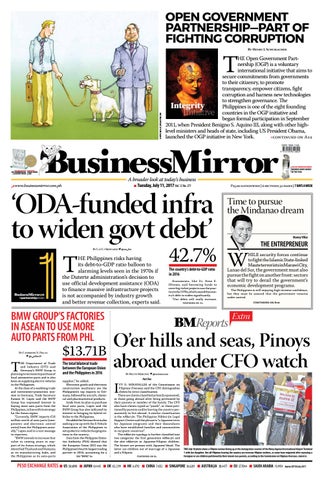
Open Government Partnership—part of fighting corruption
Rawpixelimages | Dreamstime.com
T
media partner of the year
United nations
2015 environmental Media Award leadership award 2008
he Open Government Partnership (OGP) is a voluntary international initiative that aims to secure commitments from governments to their citizenry, to promote transparency, empower citizens, fight corruption and harness new technologies to strengthen governance. The Philippines is one of the eight founding countries in the OGP initiative and began formal participation in September 2011, when President Benigno S. Aquino III, along with other highlevel ministers and heads of state, including US President Obama, »continued on A12 launched the OGP initiative in New York.
BusinessMirror A broader look at today’s business
www.businessmirror.com.ph
n
Tuesday, July 11, 2017 Vol. 12 No. 271
‘ODA-funded infra to widen govt debt’ By Cai U. Ordinario
T
@cuo_bm
he Philippines risks having its debt-to-GDP ratio balloon to alarming levels seen in the 1970s if the Duterte administration’s decision to use official development assistance (ODA) to finance massive infrastructure projects is not accompanied by industry growth and better revenue collection, experts said.
BMW GROUP’S FACTORIES IN ASEAN TO USE MORE AUTO PARTS FROM PHL By Catherine N. Pillas
T
By Henry J. Schumacher
@c_pillas29
he Department of Trade and Industry (DTI) said Germany’s BMW Group is planning to increase its purchase of local automotive parts and is also keen on supplying electric vehicles to the Philippines. At the close of a weeklong trade and investment-promotion mission to Germany, Trade Secretary Ramon M. Lopez said the BMW Group has expressed interest in buying more auto parts from the Philippines, in line with its strategy for the Asean region. “Currently, BMW imports €16 million worth of auto parts [components and electronic control units] from the Philippines annually,” Lopez said in a text message to reporters. “BMW intends to increase that value in coming years in support of its Asean strategy, which identified Thailand and Malaysia as its manufacturing hubs, and the Philippines as its auto-parts
$13.71B The total bilateral trade between the European Union and the Philippines in 2016
Economists, like Dr. Rene E. Ofreneo, said borrowing funds to cover big-ticket projects was the practice in the 1970s, which caused the country’s debt to widen significantly. “Our debts will really increase.
Time to pursue the Mindanao dream Manny Villar
THE ENTREPRENEUR
hile security forces continue to fight the Islamic State-linked MauteterroristsinMarawiCity, Lanao del Sur, the government must also pursue the fight on another front: sectors that will try to derail the government’s economic development programs.
The Philippines is still enjoying high investor confidence, but they must be assured that the government remains under control.
Continued on A2
Continued on A10
BMReports
O’er hills and seas, Pinoys abroad under CFO watch By Recto Mercene
@rectomercene
Part Two
supplier,” he added. Electronic goods and electronic construction machinery are the Philippines’s top exports to Germany, followed by aircraft, chemical and pharmaceutical products. Aside from its plan to purchase local auto parts, Lopez said the BMW Group has also indicated its interest in bringing its hybrid vehicles to the Philippines. He added the German firm is also seeking a tie-up with the E-Vehicle Association of the Philippines to set up electric-vehicle charging stations in the country. Data from the Philippine Statistics Authority (PSA) showed that the European Union (EU) was the Philippines’s fourth-largest trading partner in 2016, accounting for a
VY D. Miravalles of the Commission on Filipinos Overseas said the CFO distinguishes clients by strict classification. There are clients classified as family sponsored, or those going abroad after being petitioned by their parents or member of the family. The CFO also have clients typed as “youth”, or those petitioned by parents and/or leaving the country permanently to live abroad. A similar classification is the nikkei-jin. The Philippine Nikkei-jin Legal Support Center said the phrase is “a Japanese term for Japanese emigrants and their descendants who have established families and communities in recipient countries”. The nikkei-jin typology is further classified into two categories: the first generation nikkie-jin and the shin nikkei-jin or Japanese-Filipino children. The former are persons with Japanese blood. The latter are children out of marriage of a Japanese and a Filipino.
See “BMW,” A2
Continued on A2
PESO exchange rates n US 50.6090
business news source of the year
P25.00 nationwide | 6 sections 32 pages | 7 days a week
42.7% W
The country’s debt-to-GDP ratio in 2016
2016 ejap journalism awards
I
This July 10 photo shows a Filipino woman lining up at the immigration counter of the Ninoy Aquino International Airport Terminal 1 with her daughter. Not all Filipinos leaving the country are overseas Filipino workers, as some have migrated after marrying a foreigner or are children petitioned by their mixed-race parents, according to the Commission on Filipinos Overseas. NONIE REYES
n japan 0.4445 n UK 65.2299 n HK 6.4792 n CHINA 7.4352 n singapore 36.6201 n australia 38.4477 n EU 57.7044 n SAUDI arabia 13.4954
Source: BSP (10 July 2017 )
BMReports BusinessMirror
A2 Tuesday, July 11, 2017
www.businessmirror.com.ph
O’er hills and seas, Pinoys abroad under CFO watch Continued from A1
The fourth classification is the Exchange Visitor Program (EVP). Miravalles, officer in charge of the CFO Migrant Integration and Education Div ision, said the EVP stems from an agreement between the United States and the Philippines wherein the former welcomes participants of exchange cultural programs. She sa id t he Phi l ippines actively participates in this program, sending students to the US to pursue specific academic courses. The program includes teachers, researchers, doctors and engineers. Miravalles explained the US has stipulated persons accepted in the program must return to the Philippines “to transfer the skills and technology they learned to internationalize the education system”. Under this rule, Miravalles said, “The US has imposed a twoyear ban where the applicant cannot apply for visa to go to the
US unless they have spent the required two-year transfer of skills and technology they learned in the US to the Philippines setting.”
‘Au pair’
A similar program available in Europe is called Cultural Program, which is open to an au pair, or domestic assistant. Those who qualify are given the chance to stay anywhere in Europe from one year to two years—depending on the country—to live with a host family. An au pair is typically a woman who helps with housework or child care in exchange for room and board. According to the CFO, an au pair is a young Filipino citizen, 18 to 30 years of age, unmarried and without any children and placed under a cultural exchange arrangement with a host family for a maximum stay of two years. Registration and attendance in the “Countr y Familiar ization Seminars” is held at the CFO’s Manila office (there is a CFO branch in Cebu), on a first-
come, first-served and walk-in basis. The CFO said it will only accept a n au pair w it h complete registration requirements. Clients are asked to come to the CFO Manila office an hour before the session starts. The requirement for registration includes: original valid passport, original valid visa; one identification card with photograph, original contract of engagement or letter undertaking to engage, duly authenticated, notarized and translated by the Philippine Embassy or Consulate in the European country of destination. The CFO charges P400 ($7.91) as registration fee. Miravalles said a person accepted into the program would be given an all-expense paid tenure and give the au pair the opportunity to experience European culture, “and to learn the language of the particular country where [he or she] stayed”. So, aside from English, they have the chance to learn Italian, French, Greek, German and other European languages, she added.
“Again, the stipulation is that the au pair must go back to the Philippines after their tenure is over.”
Mixed marriage
MIR AVALLES said the CFO is the only government agency that provides guidance counseling for those who will marry or are about to marry a foreigner. For Filipinos who have acquired another citizenship and wanted to marry a Filipino, “we classify them as no longer Filipinos because they have acquired the citizenship of their host country”, she explained. They, too, undergo CFO counseling, Miravalles added. The CFO said the law is quite strict in this regard, requiring them to follow three strict decrees. The first is the Passport Act, which requires “every Filipino who married a foreign national, and who will secure a passport, to go to the CFO to attend the guidance and counselling program.” The second is the Anti-Human Trafficking Act—enacted in 2003
as Republic Act (RA) 9208 and amended in 2012 as RA 10364. These laws mandate the CFO to have “a predeparture program, specifically, guidance and counseling program for marriage migrants, or those who married other race.” The third is RA 6955 or the Anti-Mail-Order-Bride Act, which prohibits the business of organizing or facilitating marriages between Filipino women and foreign men, or mail-order brides. “So, strictly speaking, those we have mentioned are potential clients of the CFO, who must undergo different counseling programs specific to their needs,” Miravalles said.
Guidance, counseling
FOR the past three decades, the CFO has implemented the Guidance and Counseling Program (GCP) for fiancées, spouses and other partners of foreign nationals or of former Filipino citizens. “ The main objective of the program is to assist the integra-
‘ODA-funded infra to widen govt debt’ Continued from A1
That’s the lesson of the infrastructure binge of the 1970s. We have to make sure industry grows side by side with infrastructure development,” Ofreneo told the BusinessMirror. National Economic and Development Authority (Neda) Undersecretary for Investment Programming Rolando G. Tungpalan, however, assured that the country is in a “sound” financial position and can accommodate more ODA loans.
Tungpalan told the BusinessMirror that both Neda Secretary Ernesto M. Pernia and Budget Secretary Benjamin E. Diokno even said the country’s debt-to-GDP ratio will improve to 30 percent under the current administration despite the shift to ODA loans for infrastructure projects. The Neda official also said the benefits of these projects to the economy are significant, as using ODA loans will allow the government to implement projects “swiftly and efficiently”. “Infrastructure investments
increase our capacity to grow [t hereby] un leashing g row t h potent ia ls of t he reg ions by addressing bottlenecks,” Tungpalan said. He said earlier that over the last six years, the debtto-GDP ratio has improved to 45 percent in 2015, from 52 percent in 2010. While the government has decided to increase its deficit to 3 percent of GDP, Tungpalan said the deficit will be financed largely by local lenders at a ratio of 80:20, in favor of domestic borrowing. With the expected expansion
of GDP by more than 1.5 times by 2022, the government’s debt is expected to decline to 35.4 percent of GDP, from 42.7 percent last year. To ensure that the Philippi nes wou ld not be s add led w it h debt s, Fi rst Met ro I n vestment Corp. (FMIC) President Rabboni Francis Arjonillo said the government should see to it that the Comprehensive Tax Reform Program (CTRP) is properly implemented. Arjonillo said reforming the country’s tax system can prevent the Philippines from once
more joining the ranks of heavily indebted countries, which experienced skyrocketing inflation and interest rates. Apart from this, he said the CTRP would also allow the government to increase its investments in health, education and other social programs. “I think there is room for borrowings to grow if the tax take is not successful but at the expense of a very strong balance sheet, which is the basis for any credit rating upgrade forthcoming,” Arjonillo told the BusinessMirror.
tion of Filipinos in their host countries by counseling them on the realities of international migration and preparing them to meet the practical, cultural and psychological challenges in cross-cultural marriage and migration,” Miravalles said. While she admits the CFO does not have actual statistics of mailorder spouses, the agency does have an Assistance-to-National program and a hotline (1343) where these cases are reported. Since the counseling program is mandatory, no amount of evasion is sufficient to exempt anybody from attending, Miravalles added. However, many of the potential candidates for counseling oftentimes are hesitant to attend or delay going to the CFO, she said. Miravalles blames candidates for not showing up for counseling appointments, citing reasons as being too busy or referring to the program as just a waste of time. Some are just too lazy to attend the seminars, according to Miravalles. To be concluded
BMW. . .
Continued from A1
9.7-percent share of total trade last year. Bilateral trade between the EU and the Philippines reached $13.71 billion in 2016. Of the total bilateral trade between the Philippines and the EU last year, Germany accounted for the biggest share at 31.8 percent, or $4.53 billion. Shipments to Ger ma ny amounted to $2.3 billion, while payments for imports reached $2 billion. The Philippines enjoyed a trade surplus of $301.32 million with Germany last year. Lopez said his meetings with German business chambers focused on “Dutertenomics” and the government’s efforts to achieve inclusive growth.
UNWTO. . . Continued from A12
These, along with unconfirmed reports of Islamist jihadists infiltrating Palawan, pushed the Department of Tourism (DOT) to get Rifai and other UNWTO officials to visit provincial destinations, and declare the Philippines as a safe place to travel. The UNWTO group also visited Balesin Island Club in Quezon, to recognize its sustainable tourism project. The UNWTO officials visited the 8.2-kilometer Puerto Princesa Underground River, a subterranean river declared as a Unesco World Heritage Site. It also won an accolade in 2011 as one of the New Seven Wonders of the World. They, along with executives of the DOT led by Secretary Wanda Corazon T. Teo, also visited the indigenous community of Sitio Sabang, Barangay Cabayugan, which lives near the underground river. The group planted mangrove seedlings and interacted with the residents who make their living as tour guides, souvenir craftsmen and boatmen. At a news conference, Teo revealed that the DOT will earmark P5 million to train various tourism stakeholders in the Mindoro-MarinduqueRomblon-Palawan region. The DOT, she added, has worked closely with the Palawan provincial government and the Palawan Tourism Council “to compile best practices that we could share and replicate to the rest of the country”, because of the province’s stellar record in tourism governance. “In fact, many benchmarking programs by local governments and other organizations are being done in this province,” she noted. The UNWTO officials were in the Philippines to attend the UNWTO International Conference on Tourism Statistics at the Marriot Ballroom in Pasay City. (See, “UNWTO Conference concludes with Manila ‘call for action’,” in the BusinessMirror, June 27, 2017.)
Economy
A4 Tuesday, July 11, 2017 • Editors: Vittorio V. Vitug and Max V. de Leon
BusinessMirror
news@businessmirror.com.ph
ERC top execs face new raps before Ombudsman
T
By Lenie Lectura
@llectura
op officials of the Energy Regulatory Commission (ERC) are facing another set of charges before the Office of the Ombudsman. A group calling itself the Laban Konsyumer Inc. (LKI) on Monday said it had filed criminal and administrative charges against the suspended chairman of the ERC and three commissioners, docketed as OMB-C-C-17-0242 and OMB-CA-17-0212, respectively. The consumer group, headed by lawyer Victor Mario A. Dimagiba, alleged that ERC Chairman Jose Vicente B. Salazar, who remains under preventive suspension, and commissioners Josefina Patricia MagpaleAsirit, Gloria Victoria Yap-Taruc and Geronimo Sta. Ana violated their
mandate to ensure the adequate promotion of consumer interests under Section 41 of the Electricity Power Act, in relation to the recent power-rate hike brought about by the scheduled 20-day shutdown of the Malampaya natural-gas facility, which supplies 40 percent of Manila Electric Co.’s (Meralco) power requirements, early this year. The gas plants fueled by the Malampaya facility had to resort to alternative fuel, which is more expensive than gas. The cases alleged corrupt practices committed by the ERC execu-
tives, as well as violation of the Code of Conduct governing public officials, through manifest partiality, evident bad faith and gross inexcusable negligence when they awarded benefits to Meralco by granting a petition to collect a total of P1.7 billion in March, April and May 2017 from Meralco consumers. This has resulted in an increase of P0.2211-per-kilowatt-hour rate hike in the three months. LKI accused the ERC officials of violating the Corrupt Practices Act (Republic Act 3019 Section 3e), the Code of Ethics of Government Officers (RA 6713 Section 5a) and the Revised Penal Code (Articles 204, 205 and 206). The original complaint was filed on March 30, wherein the complainant was issued subpoena in Fact Finding (FF)–C-17-0417, and was ordered to execute a supplemental affidavit complaint to include administrative liability. The consumers’ group challenged the ERC order, dated March
6, as biased, against the consumers’ interest and against the law, when the commissioners granted provisional authority in favor of Meralco using the force majeure provisions of the Meralco Power Supply Contracts, where force majeure is defined as all forms of fuel-supply interruption. T he com m issioners deter mined an announced and schedu led preventive maintenance shutdown as force majeure and allowed Meralco to pass on all added costs of fuels to the consumers, instead of ordering these added costs to be absorbed by the natural-gas supplier, said Dimagiba, former trade undersecretary. Dimagiba added the gross inexcusable negligence and bad faith of the commissioners in the discharge of their duties is aggravated by the fact of the collective absences of the commissioners in the hearings on the merits of the case (March 14, 17 and 27), wherein the consumer
group pleaded with the commission to suspend, reverse or recall the provisional authority. The above hearings were presided over merely by a hearing officer, whereas, on the other hand, and as revealed by their own records, the commission en banc had met twice with Meralco on the subject matter even before the filing of their petition, LKI said. The Ombudsman will now proceed with the preliminary investigation of the criminal case and the adjudication of the administrative case in accordance with Rules and Procedures of their Office. These rules also authorized the Ombudsman to order preventive suspension from office of all commissioners for up to six months during the pendency of the investigation. Earlier, Sanlakas, Freedom from Debt Coalition and Heidi Nicodemus alleged in another complaint filed before the Ombudsman that the ERC commissioners opted to
delay the mandatory implementation of the competitive selection process (CSP). As a consequence, the complainants said the commissioners allegedly gave unwarranted benefits, advantage and preference to different distribution utilities (DUs), including Meralco and generation companies (gencos), with expiring power-supply agreements (PSAs). As a result, the DUs and gencos were free to negotiate new PSAs under their own terms, caused undue injury to the public who now have to suffer higher electricity rates from the disadvantageous PSAs entered into by the DUs and gencos, the complaint stated. The complaint alleged that the commissioners deliberately adjusted the rules and implementation of the CSP, enabling Meralco to push through with its PSAs without a transparent and public bidding.
₧100-M UNDP, Australian govt loan for 40 social enterprises By Cai U. Ordinario
T
@cuo_bm
he United Nations Development Programme (UNDP) and the Australian government are extending a P100 million worth of loans for social enterprises (SEs) in the Philippines. The grant, which will be sourced
from Australia’s Social Impact Fund (SIF), aims to assist around 40 social enterprises in the next five years. “The project is designed to close gaps by providing selected, highpotential start-up SEs with funding and technical support to enable them to grow their operations and attract investments from global and local
impact investors. It will support SEs that have a proven concept or ‘blueprint’ and a plan for growth with increased impact that is aligned with the Sustainable Development Goals [SDGs],” UNDP Philippines Country Director Titon Mitra said. UNDP said a local bank will provide loans as financial assistance
of up to $150,000 or around P7.5 million per social enterprises over three years. The UN agency added that these loans will have a repayment period of five to six years based on current business lending rates. In addition to funding support, international and Philippine experts will also provide technical assistance to help social enterprises to further develop their business models and expand operations. “The Australian Government
encourages the development of innovative social enterprises in the Philippines as a pathway to economic growth. This project is among the exciting aid investments Australia is supporting as part of our new approach to development cooperation. We are investing more in innovative programs that offer science and technology-based solutions to address some of the most pressing social and environmental issues, reach underserved communities and contribute to the SDGs,” Australian Embassy
Deputy Head of Mission Mat Kimberley said. The SIF in the Philippines is aligned with and supports the broader initiative of UNDP to encourage increase in private investments to sustainable development and help achieve the SDGs. UNDP in the Asia Pacific, through its regional SIF, has been engaging financial and social capital stakeholders to create or expand socially responsible businesses, especially growing, small and medium-sized enterprises.
Solon renews push for creation of independent disaster agency
R
ep. Joey S. Salceda of Albay recently renewed his urgent call for Congress to create an independent disaster authority that will exclusively handle the task of risk reduction upfront and reconstruction and recovery at the backend, and thus, redirect efforts and emerging “policy drifts” among agencies handling various aspects of the program. The call timely jibes with the current disasters brought about by the Marawi crisis and the destructive earthquake that hit communities in Leyte. Salceda has a pending bill in Congress, House Bill (HB) 1648, filed last year, titled “An Act Further Strengthening the Philippines Disaster Reduction and Management System by Institutionalizing the Framework and Plan and Establishing the National Disaster Risk Reduction and Management Authority (NDRRMA), a high level institution and an independent body under the Office of the President, dedicated to predisaster risk reduction and postdisaster reconstruction. Speaking at the Rappler Agos Summit on Disaster Preparedness at Samsung SM Aura mall in Taguig
City over the weekend, Salceda said the measure will be the country’s legal infrastructure in reducing the effects of catastrophic climate change, and will be “the world’s best approach to disaster risk reduction [DRR]. The NDRRMA is envisioned to radicalize the country’s disaster response and management system. HB 1648 is a result of “action research, sharing of experiences and dynamic discussions among various stakeholders from national and local government agencies, organizations and communities.” Salceda describes it as a “product of comparable international experiences. If we want this thing to really take off, we need this legislation,” he said, adding that “policy drifts” and disagreements in the program of reducing the impacts of climate change can lead to more serious consequences and expensive damages in terms of loss of lives and properties.” The measure also aims to amend R A 10121, the country’s DRR law enacted in 2010, and further strengthen calamity response by “institutionalizing the framework and plan with NDRRMA.” It had
gained wide and popular support among community-based and globally known DRR advocates and practitioners following its filing last year. Among the groups that have vowed support for the measure was the Disaster Risk Reduction Network Philippines (DRRNetPhils), a broad national coalition of civil-society organizations (CSOs), people’s organizations, and practitioners and advocates of community-based disaster risk reduction and management (CBDRRM), which held a consultation meeting with Salceda at his office in Congress in September last year. Conceptually, NDRRMA will be tasked to undertake, monitor and ensure realization of the objectives of disaster risk reduction and management (DRRM) nationwide, and perform oversight functions, as well. It will be equipped with the necessary competency and resources “to engage new actors, particularly in the fields of risk transfer and insurance, and built-in structures to manage broader governance arrangements and oversee DRRM efforts toward sustainable development goals.” PNA
CBCP, Tesda partnership seeks to improve livelihood skills
T
O help them get closer to the church and uplift their livelihood, the Technical Education and Skills Development Authority (Tesda) and the Catholic Bishops’ Conference of the Philippines (CBCP) have joined forces to improve the lives of Filipino families through the agency’s skills training on family enterprise. Based on the memorandum of agreement (MOA) signed between the Tesda and the CBCP dated July 7, the target beneficiaries of the skills training on family enterprise are members of the Basic Ecclesial
Communities (BEC). They will be taught on how to promote and grow their businesses. Director General Secretary Guiling Mamondiong represented Tesda, while Most Rev. Socrates Villegas represented the CBCP during the MOA signing. It was also witnessed by officials from both groups. The CBCP formed the Committee on Basic Ecclesial Communities composed of seven to eight families. Through the Training for Work Scholarship Program (TWSP) of Tesda, participants would be given the chance to form a BEC and pro-
vide skills training depending on the course that they have chosen. In line with this, the program, dubbed “Skills Development Towards Family Enterprises”, will be launched in Cagayan de Oro on July 19. One of the suggested family enterprises was the setting up of carinderia (roadside eatery) in which members are expected to promote their business and help it grow. The Tesda also said participants to the program will receive a national certificate after they have completed the skills training, which is free of charge. Claudeth Mocon-Ciriaco
www.businessmirror.com.ph
BusinessMirror
Tuesday, July 11, 2017
A5
A6
Tuesday, July 11, 2017
The World BusinessMirror
www.businessmirror.com.ph
Iraqi forces reclaim Mosul; IS routed
M
OSUL, Iraq—Dressed in a military uniform, Prime Minister Haider al-Abadi arrived in Mosul last Sunday to congratulate Iraq’s armed forces for wresting the city from the Islamic State (IS). The victory marked the formal end of a bloody campaign that lasted nearly nine months, left much of Iraq’s second-largest city in ruins, killed thousands of people and displaced nearly 1 million more. While Iraqi troops were still mopping up the last pockets of resistance and could be facing guerrilla attacks for weeks, the military began to savor its triumph in the shattered alleyways of the old city, where the IS, also known as Islamic States in Iraq and Syria (ISIS), or Islamic State in Iraq and the Levant, put up a fierce last stand. Hanging over the declaration of victory is the reality of the hard road ahead. The security forces in Mosul still face dangers, including IS sleeper cells and suicide bombers. And they must clear houses rigged with explosive booby traps so civilians can return and services can be restored. Mosul was the largest city in either Iraq or Syria held by the IS, and its loss signifies the waning territorial claims of a terrorist group that had its beginnings in the aftermath of the US invasion of Iraq in 2003. The group is also threatened with the loss of its de facto capital, the Syrian city of Raqqa, which is encircled by Arab and Kurdish fighters supported by the US. But the end of the IS’s hold on Mosul does not mean peace is at hand. Other cities and towns in Iraq remain under the militants’ control, and Iraqis expect an increase in terrorist attacks in urban centers, especially in the capital, Baghdad, as the group reverts to its insurgent roots. “It’s going to continue to be hard every day,” said Col. Pat Work, commanding officer of the 2nd Brigade, 82nd Airborne Division, which is carrying out the US advisory effort here. “Iraqi security forces need to be on the top of their game, and we need to be over their shoulder helping them as they move through this transition to consolidate gains and really sink their hold in on the west side,” Work said as he rolled through the streets of western Mosul recently in an armored vehicle. “ISIS will challenge this.” The victory could have been
1M The estimated number of Iraqis displaced in the ninemonth government military campaign against Islamic State terrorists
sweeter as the Iraqis were denied the symbolism of hanging the national flag from the Grand al-Nuri Mosque and its distinctive leaning minaret, which was wiped from the skyline in recent weeks as a final act of barbarity by IS militants who packed it with explosives and brought it down as government troops approached. It w a s at t h at mosque i n June 2014 where Abu Bakr alBaghdadi strode to the top of a pulpit and declared himself the leader of a caliphate straddling the borders of Iraq and Syria, a vast territory where for three years Islamic extremists have governed with a strict form of Islamic law, held women as sex slaves, carried out public beheadings and plotted terrorist attacks against the West. This past week, as fighting raged nearby, Iraqi soldiers took selfies in front of the stump of the minaret and posed at the spot where al-Baghdadi made his speech. Destruction surrounded them, as did the stench of decaying bodies of IS fighters, left to rot in the blazing sun. The battle for Mosul began in October, after months of planning between Iraqis and US advisers, and some Obama administration officials had hoped it would conclude before they left office, giving a boost to the departing president’s efforts to defeat the IS. Instead, it lasted until now, and
Iraqis celebrate in Tahrir square while holding national flags as they wait for the final announcement of the defeat of the Islamic State (IS) militants in Baghdad, Iraq, last Sunday. Backed by the US-led coalition, Iraq launched the operation to retake Mosul from IS militants last October. AP/Hadi Mizban
it was far more brutal than many expected. With dense house-tohouse fighting and a ceaseless barrage of snipers and suicide bombers, the fight for Mosul was some of the toughest urban warfare since World War II, US commanders have said. Iraqi officers, whose lives have been defined by ceaseless war, said the fighting was among the worst they had seen. “I have been with the Iraqi army for 40 years,” said Maj. Gen. Sami al-Aradi, a commander of Iraq’s special forces. “I have participated in all of the battles of Iraq, but I’ve never seen anything like the battle for the old city.” He continued: “We have been fighting for each meter. And when I say we have been fighting for each meter, I mean it literally.” Even as al-Abadi arrived here outfitted in the black uniform of Iraq’s elite counterterrorism service, Iraqi forces were pressing to erase a pocket of IS resistance by the Tigris River. Speaking from his base in the old city, Lt. Gen. Abdul-Wahab alSaadi, a senior commander in that service, said the militants’ enclave was about 200 yards long and 50 yards wide and that he expected it to be taken later in the day or on Monday. After arriving, al-Abadi met with the federal police, who have taken significant losses in the battle, and went to visit the joint command overseeing the operation. But in an acknowledgment that the
victory he had come to proclaim was not completely sealed, Iraqi officials said the prime minister would not make a public statement until the last patch of IS territory in Mosul was cleared. Earlier in the day, a post on alAbadi’s official Twitter account stated that he had come to Mosul “to announce its liberation and congratulate the armed forces and Iraqi people on this victory”. Some militants had sought to escape by swimming across the river, but al-Saadi said his soldiers had shot them. The general said he had planted the Iraqi flag on the banks of tin which he reflected on the many soldiers he had lost in the long battle. The retaking of the city, by all accounts, came at a great cost. Sensitive to the mounting casualties, the Iraqi government does not disclose how many of its troops have been killed. But deaths among Iraqi security forces in the Mosul battle had reached 774 by the end of March, according to US officers, which suggests the toll is more than 1,000 now. Even more civilians are estimated to have been killed, many at the hands of the IS and some inadvertently by US air strikes. At least seven journalists were killed, including two French correspondents and their fixer, an Iraqi Kurdish journalist, in a mine explosion in recent weeks. The Iraqis and their international partners will be confronted by the immense challenge of
restoring essential services, like electricity and rebuilding destroyed hospitals, schools, homes and bridges, which were wrecked in the ground combat or by the air strikes, artillery fire and Himars rocket attacks carried out by the US-led coalition to help Iraqi troops advance. “When the fighting stops, the humanitarian crisis continues,” said Lise Grande, deputy special representative for Iraq for the UN secretary-general. Western Mosul, especially its old city, where the IS made its last stand, was hit particularly hard, becoming a gray and decimated landscape. As the combat has drawn to a close, thousands of civilians have begun to return. But 676,000 of those who left the western half of the city have yet to come back, according to UN data. It is not hard to see why. Of the 54 neighborhoods in western Mosul, 15 neighborhoods that include 32,000 houses were heavily damaged, according to data provided by Grande. An additional 23 neighborhoods are considered to be moderately damaged. The cost of the near-term repairs and the more substantial reconstruction that is needed in Mosul has been estimated by UN experts at more than $700 million, she added. In the heart of the old city, craters littered intersections and roadways, marking the places where bombs pu m me led t he
ground, dropped from coalition warplanes. Street after street was covered in soaring piles of rubble, with rebar poking out of shattered masonry. In a church used as a weaponsmaking factory by the IS, mortars were lying on the ground next to a pink backpack decorated with a picture of a kitten. When troops unzipped the backpack, they found plastic sachets of a white explosive powder, which they identified as C4 used in militants’ bombs. The military victory in Mosul has come without a political agreement between Iraq’s two largest communities, Sunni and Shiite Arabs, whose stark sectarian divisions led to the rise of the IS. For many members of Iraq’s minority Sunnis, the IS was seen as a protector against abuses they had suffered under Iraq’s Shiiteled government, especially under the former Prime Minister Nuri Kamal al-Maliki. After the IS seized Mosul in 2014, many Sunnis welcomed them. A l-Maliki was then removed from office, replaced by al-Abadi, a more moderate and less sectarian leader, but one widely viewed as weak. Under a l-A bad i, t here h a s been no meaningful reconciliation. “I will leave Mosul because it has become a destroyed city,” said Aisha Abdullah, a teacher who endured life under the IS. “In every corner of it there is memory and blood.” New York Times News Service
Trump Jr. met Russian lawyer amid promise of Clinton info P
resident Donald J. Trump’s eldest son, Donald Trump Jr., was promised damaging information about Hillary Clinton before agreeing to meet with a Kremlin-connected Russian lawyer during the 2016 campaign, according to three advisers to the White House briefed on the meeting and two others with knowledge of it. The meeting was also attended by his campaign chairman at the time, Paul Manafort, and his son-in-law, Jared Kushner. Manafort and Kushner recently disclosed the meeting, though not its content, in confidential government documents described to The New York Times. The Times reported the existence of the meeting last Saturday. But in subsequent interviews, the advisers and others revealed the motivation behind it. The meeting—at Trump Tower on June 9, 2016, two weeks after Trump clinched the Republican nomination—points to the
central question in federal investigations of the Kremlin’s meddling in the presidential election: whether the Trump campaign colluded with the Russians. The accounts of the meeting represent the first public indication that at least some in the campaign were willing to accept Russian help. While Trump has been dogged by revelations of undisclosed meetings between his associates and the Russians, the episode at Trump Tower is the first such confirmed private meeting involving his inner circle during the campaign—as well as the first one known to have included his eldest son. It came at an inflection point in the campaign, when Trump Jr., who served as an adviser and a surrogate, was ascendant and Manafort was consolidating power. It is unclear whether the Russian lawyer, Natalia Veselnitskaya, produced the promised compromising information
about Clinton. But the people interviewed by The Times about the meeting said the expectation was that she would do so. When he was first asked about the meeting last Saturday, Trump Jr. said that it was primarily about adoptions and mentioned nothing about Clinton. But last Sunday, presented with The Times’s findings, he offered a new account. In a statement, he said he had met with the Russian lawyer at the request of an acquaintance from the 2013 Miss Universe pageant, which his father took to Moscow. “After pleasantries were exchanged,” he said, “The woman stated that she had information that individuals connected to Russia were funding the Democratic National Committee and supporting Mrs. Clinton. Her statements were vague, ambiguous and made no sense. No details or supporting information was provided or even offered. It quickly became clear
that she had no meaningful information.” He said she then turned the conversation to adoption of Russian children and the Magnitsky Act, a US law that blacklists suspected Russian human-rights abusers. The 2012 law so enraged President Vladimir Putin of Russia that he halted US adoptions of Russian children. “It became clear to me that this was the true agenda all along and that the claims of potentially helpful information were a pretext for the meeting,” Trump Jr. added. Two people briefed on the meeting said the intermediary was Rob Goldstone, a former British tabloid journalist and the president of a company called Oui 2 Entertainment, who has worked with the M iss Universe pageant. He did not immediately respond to messages seeking comment. Mark Corallo, a spokesman for the president’s lawyer, said last Sunday that
“the president was not aware of and did not attend the meeting.” Lawyers for Kushner referred to their statement a day earlier, confirming that he voluntarily disclosed the meeting but referring questions about it to Trump Jr. Manafort declined to comment. In his statement, Trump Jr. said he asked Manafort and Kushner to attend, but did not tell them what the meeting was about. Political campaigns collect opposition research from many quarters, but rarely from sources linked to foreign governments. US intelligence agencies have concluded that Russian hackers and propagandists worked to tip the election toward Trump, in part by stealing and then providing to WikiLeaks internal Democratic Party and Clinton campaign e-mails that were embarrassing to Clinton. A special prosecutor and congressional committees are investigating the Trump
campaign’s possible collusion with the Russians. Trump has disputed that. On Sunday morning on Fox News, the White House chief of staff, Reince Priebus, described the Trump Tower meeting as a “big nothing burger”. “Talking about issues of foreign policy, issues related to our place in the world, issues important to the American people is not unusual,” he said. But Rep. Adam B. Schiff of California, the leading Democrat on the House Intelligence Committee, one of the panels investigating Russian election interference, said he wanted to question “everyone that was at that meeting”. “There’s no reason for this Russian government advocate to be meeting with Paul Manafort or with Mr. Kushner or the president’s son if it wasn’t about the campaign and Russia policy,” Schiff said after the initial Times report. New York Times News Service
The World BusinessMirror
www.businessmirror.com.ph
N. Korea, central bank fears put pressure on Asia investors
N
orth Korea’s latest missile test and renewed concern over faster-than-anticipated tightening by the Federal Reserve (the Fed) have ratcheted up the tension for Asia investors at the start of the second half. The MSCI AC Asia Pacific Index lost 0.7 percent last Friday and 1.2 percent for the week, its worst performance since the beginning of March. Global investors have been whipsawed by a range of factors that also include a US technology share selloff and talk of the European Central Bank exiting from unconventional stimulus. North Korea’s success in firing an intercontinental ballistic missile (ICBM) was a particular worry. “Geopolitics has become more important for Asia than we’ve seen in the last five years,” Ross Cameron, Tokyo-based portfolio manager at Australia’s Northcape Capital Ltd., said in a phone interview. “Specifically for Asia, what has really been an issue is North Korea. There’s no easy solution to the problem that’s a headwind for markets that wasn’t there in the first half.” The US last week threatened trade ties with China and other countries that continue to do business with North Korea following Pyongyang’s ICBM test. “If China doesn’t properly enforce economic sanctions on North Korea, that would have a material impact on US-China trade,” Cameron said. T he unlikely d iplomatic friendship of President Donald J. Trump and Chinese President Xi Jinping seemed to hold firm as the pair met last Saturday on the sidelines of the Group of 20 meetings in Hamburg. Fit zgera ld Ac lan, v ice president i n t he mone y m a n a ge m e n t u n i t o f P h i l i p p i n e s ’s BDO Uniban k Inc., sa id prof itt a k i ng h a s been t r ig gered i n pa r t b y geopol it ic a l concer n s over Nor t h K orea’s g row i ng nuc lea r a mbit ion s. S out h K ore a’s b e nc h m a rk Kospi index fell 0.5 percent for the week. T he gauge fell 0.3 percent last Fr id ay. Cosmetics firms—a driving force for the South Korea brand in the reg ion— cont inued to suf fer. Meanwhile, the number of Chinese tourists declined 67 percent in April. Receding interest in US technology shares following a sharp rally is another reason for bearishness in Asia, as investors opt to cut back on their regional counterparts. The MSCI Asia gauge of technology shares fell 1.6 percent last week, one of the biggest decliners among the region’s industry groups.
Tech stocks
“Technology companies will continue their correction after
valuations reached unprecedented levels,” Narongsak Plodmechai, chief investment officer at SCB Asset Management Co., which manages about $35 billion in assets, said in an interview. He expects further correction in the sector to “a reasonable level”. Never theless, Narongsa k a nd ot her f u nd ma nagers a re opt im ist ic about t he infor mat ion tec hnolog y sector in A si a over t he longer ter m, as va luations remain cheap compared to t hose of US compa nies. T he sector’s presence in t he equ ities market is ex pected to grow as tec hnolog y evolves a nd impacts indust r ies ra ng ing f rom ma nu fact u r ing to f ina nce. “The investment theme going forward will be picking the winners and losers,” Narongsak added. “The winners will be those who can survive as the world transforms into a digital economy.” In the near term, investors in the broader Asia market look poised to gauge their bets based on how the US equities perform, particularly with another Fed rate hike expected later this year. Monetary tightening, a global trend with the exception of Japan, has spooked some investors. In Europe Bundesbank President Jens Weidmann said last Thursday, “The continued economic recovery is opening the perspective of a monetary-policy normalization.” Mea nwhi le, recent sets of economic data have sent mixed s i g n a l s .“Cent r a l ba n k s h ave been very hawkish even though economic numbers are actually slowing,” said Hao Hong, chief strateg ist at Bocom in Hong Kong. “There isn’t a very strong case for substantial tightening and shrinkage of balance sheets.’’ Japan’s benchmark Topix Index lost 0.3 percent last week, while China’s Shanghai Composite Index rose 0.8 percent. Hong Kong’s Hang Seng Index, the region’s biggest decliner last week with a 1.6 percent fall, was up 0.8 percent at 10:25 a.m. local time last Monday. Internet giant Tencent Holdings Ltd., which has a 10.1 percent weighting on the gauge, spearheaded last week ’s retreat a f t e r C h i n a ’s g o v e r n m e n t owned People’s Daily newspaper blasted one of the company’s games, saying it harmed children in the pursuit of profit. Equity gauges in Australia and Taiwan were down 0.3 percent and 0.9 percent, respectively. Te c h nolo g y he av y w e i g ht s across the region contributed most to the week’s losses on the broader market amid a selloff in the sector. Tencent sank 3.7 percent, Japan’s Nintendo Co. slumped 6.7 percent, while Taiwan Semiconductor Manufacturing Co. slid 1.2 percent. Bloomberg News
Tuesday, July 11, 2017
A7
Trump plan for cybersecurity force with Russia criticized
H
ome from the Group of 20 (G20) meeting in Germany, President Donald J. Trump tweeted that he discussed creating a cybersecurity unit with Russian counterpart Vladimir Putin— drawing howls of criticism from fellow Republicans, as well as Democrats.
“It’s not the dumbest idea I’ve ever heard, but it’s pretty close,” Republican Senator Lindsey Graham of South Carolina said in response on NBC’s Meet the Press. At the same time, Trump was signaling a desire to move beyond Russian hacking in the 2016 presidential election, Secretary of State Rex Tillerson said at a briefing in Kiev that sanctions on Russia will remain in place until Moscow meets its commitments on Ukraine under the Minsk agreement. Trump’s tweets followed a New York Times story late Saturday that the president’s son, son-inlaw and then-campaign manager met in 2016 with a Russian lawyer who has connections to the Kremlin—the latest sign of contacts between top levels of the Republican’s team and Russia that’s the focus of numerous investigations. Last Sunday the newspaper reported the lawyer had promised compromising information on Democratic presidential candidate Hillary Clinton. Trump later played down the idea of working with Russia to create an “impenetrable” cybersecurity unit. “The fact that President Putin and I discussed a cyber security unit doesn’t mean I think it can happen. It can’t—but a ceasefire can, & did!” Trump told his 33.5 million Twitter followers last Sunday, citing the ceasefire in parts of Syria that was announced after he met with Putin at the G20. Trump had earlier said that sanctions on Russia weren’t discussed during his talks with Putin. “Nothing will be done until the Ukrainian & Syrian problems are solved!’’ he wrote on Twitter. The statements sent conflicting signals as Trump continues to seek better US relations with Russia that have been stymied as the president’s critics question his support for Putin and investigations continue into his campaign’s contacts with Russia. Trump, who didn’t give closing remarks or hold a news conference at the G-20, said on Twitter that he’d raised election meddling
with Putin twice, and that the Russian president “vehemently denied it. I’ve already given my opinion”. Trump has said that, while he thinks Russia was involved in the hacking, other countries also could be to blame.
‘Makes no sense’
Trump doesn’t believe Putin’s denial, Chief of Staff Reince Priebus said on Fox News Sunday, while Treasury Secretary Steven Mnuchin, who was part of the president’s entourage in Hamburg, said on ABC ’s This Week that it “makes no sense” to provide the content of the Trump-Putin meeting. The president’s critics mocked Trump’s comment on Putin having “vehemently denied” Russian meddling, and questioned the president’s demeanor in his first face-to-face meeting with his counterpart. “When pursuing a corrupt politician, mobster or murderer on strong FBI [Federal Bureau of Investigation] evidence, if he ‘vehemently denied it’, we just dropped it usually,” former US Attorney Preet Bharara tweeted. For mer Centra l Intel ligence A genc y d i rec tor Joh n Brenna n sa id he doubted whet her Tr u mp pressed P ut in ha rd on t he elect ion hac k ing. “I seriously question whether Mr. Putin heard from Mr. Trump what he needed to about the assault on our democratic institutions of the election,” Brennan said on Meet the Press. “He said it’s an honor to meet President Putin. An honor to meet the individual who carried out the assault against our
A woman sits backdropped by a real-time cyber attacks world map, at the headquarters of Bitdefender in Bucharest, Romania, on June 28. A new, highly virulent strain of malicious ransom software that is crippling computers globally appeared to have been sown in Ukraine, where it badly hobbled much of the government and private sector on the eve of a holiday celebrating a post-Soviet constitution. AP/Vadim Ghirda
election? To me, it was a dishonorable thing to say.”
‘Quite concerned’
Russia’s interference in the US election is an obstacle to improved ties between the two countries and must be dealt with to assure Americans that it doesn’t happen again, Tillerson said on a visit to Ukraine last Sunday. Tillerson, who attended the meeting with Trump and Putin along with his Russian counterpart Sergei Lavrov and translators, was asked to confirm whether Russia’s account of the meeting was true: that Trump accepted Putin’s denial that Russia interfered in the elections. “In all candidness, we did not expect an answer other than the one we received,” Tillerson said. “The point was made that this was an issue that really has the American people quite concerned and again it too stands as an obstacle to our ability to improve our relationship between the United States and Russia and it needs to be addressed.”
Critics pounce
The remarks struck a slightly more confrontational tone than those Tillerson made to reporters in Hamburg after the meeting, when he said relitigating the past wouldn’t be helpful and it was time for the US and Russia to move on. Trump’s initial comment about “forming an impenetrable Cyber
Partnering with [Russian President Vladimir] Putin on a ‘Cyber Security Unit’ is akin to partnering with [Syria’s President Bashar al-Assad] on a ‘Chemical Weapons Unit’.”—Rubio
Security Unit’’ with Russia to guard against future election interference also raised eyebrows. “Partnering with Putin on a ‘Cyber Security Unit’ is akin to partnering with Assad on a ‘Chemical Weapons Unit’,” Republican Sen. Marco Rubio of Florida said on Twitter. Former Defense Secretary Ash Carter said on CNN’s State of the Union that suggesting such a unit with Russia “is like the guy who robbed your house proposing a working group on burglary”. Graham said Trump has a “blind spot” when it comes to Putin, and that Trump is only empowering the Russian president and hurting himself. “This whole idea about moving forward without punishing Russia is undercutting his entire presidency,” Graham said.
‘Dangerously naïve’
Rep. Adam Schiff of California, the top Democrat on the House Intelligence Committee, said Russia couldn’t be a credible partner in any cybersecurity unit. “That would be dangerously naïve,” Schiff said on State of the Union. “If that’s our best election defense, we might as well just mail our ballot boxes to Moscow.” Meanwhile, representatives of Donald Trump Jr. and Jared Kushner confirmed that the 2016 Trump Tower meeting with Russian lawyer Natalia Veselnitskaya had taken place as reported by the New York Times. Priebus dismissed the meeting as “a nothing burger” that h e s a i d w a s a b o ut R u s s i a’s pol ic y on foreig n adopt ions. “It was a nothing meeting,” he said. Asked why such high-level Trump officials would have a meeting about Russian adoption policy, Priebus said, “You’re going to have to talk to them.” Mark Corallo, a spokesman for Trump’s legal team, said in a statement last Sunday that “the president was not aware of and did not attend the meeting”. Bloomberg News
Last hurrah for China factory prices impairs world reflation C
hina’s inflation rebound is turning into a false dawn. For the world economy, that’s sobering news. Rising factory prices in the world’s second-biggest economy had been touted as a possible circuit breaker for anemic global inflation, which continues to defy accelerating economic growth. The thinking was that higher costs in China would drive up the price of everything from footwear to electronics, which, in turn, would help lift profits and wages. Yet, those hopes appear to be fading. While China’s producer price index (PPI) held up in June, much of the support came from higher commodity prices as companies restocked their inventories. That support is already fading as activity in the property and construction sectors remains soft and oil and raw materials prices decline, keeping factory prices lower. At the same time, a move by China’s regulators to curb risk in the financial system by targeting leverage will also act as a brake on the economy. So instead
of spurring price gains China could become a source of global disinflation, according to Michael Every, head of financial markets research at Rabobank Group in Hong Kong.
‘Last hurrah’
“It’s inevitable that PPI will go off of a cliff in the second half and into 2018,” Every said. “This is a last hurrah before deflation raises its ugly head again.” Such a scenario would be quite a reversal for China. The nation was held up as a beacon of the global reflation trade that kicked off in late 2016 after its factories escaped a more than four-year run of falling prices. China’s PPI rose 5.5 percent in June from a year earlier, in line with the estimate in a Bloomberg survey, as well as the reading in May—but well off the 7.8 percent reading four months earlier that increasingly looks like a peak. Economists forecast factory inflation at 5.3 percent at the end of this year and 2 percent at the end of 2018. Inflation has been a key ingredient missing from an
otherwise robust recovery. The International Monetary Fund in April raised its world growth forecast for to 3.5 percent this year, up 0.1 percentage point from January. US inflation hasn’t been responding to the long-term decline in unemployment, and analysts worry there are few signs of it doing so. Euro-area inflation slowed in June to its weakest pace this year and Japan continues to be dogged by years of tepid price gains. China producer price inflation steadies as demand remains robust. Still, there are upsides. Manufacturing price inflation rose in June after three months of declines, to 5.4 percent. Signs of slowing growth could prompt greater fiscal spending, more central-bank stimulus, or both. Steady PPI inflation is a positive signal for the economy that suggests reflation continues, and it’s consistent with rising input and output price gauges in June’s purchasing manager index data, said Fielding Chen, an economist at Bloomberg Intelligence in Hong Kong.
‘Major swings’
“ H i g h e r P P I i n f l a t i o n l o we r s re a l interest rates, makes debt repayment easier and boosts corporate profits,” he wrote on Monday. “Even so, with the major swings in prices confined to a few sectors, and more cyclical than structural, the effect on the economy could be limited.” Central bankers around the world are still scratching their heads over why inflation still isn’t responding to better growth performances. So it fits that in China, despite a strong first half, isn’t delivering faster price gains. The nation’s moderating price gains provides little evidence that situation is likely to change anytime soon, said Rob Subbaraman, chief economist for Asia ex-Japan at Nomura Holdings Inc. in Singapore. It’s “yet another sign that inflation remains dormant in the world economy, despite pretty decent growth,” Subbaraman said. Bloomberg News
Chinese workers on a suspended platform clean window of an upscale shopping mall reflecting construction buildings at the Central Business District in Beijing on June 27. AP/Andy Wong
A8
The World BusinessMirror
Tuesday, July 11, 2017
Abe support slumps to record low as Japan’s public loses faith
S
upport for Japanese Prime Minister Shinzo Abe slumped to record lows in three media polls over the weekend, as public trust in the premier evaporated, amid a stream of scandals, while a former minister called for him to be replaced. The Yomiuri newspaper, generally seen as supportive of Abe’s government, found support for Abe’s Cabinet had fallen 13 percentage points from a survey last month to 36 percent. Polls conducted by NTV and the Asahi daily found similar drops in approval. Abe appears to have switched into crisis-management mode. After his ruling party’s worst ever performance in Tokyo elections last weekend, he has cut short a trip to Europe and expedited a Cabinet reshuffle in a bid to restore public support. He faces potential challengers in a party leadership race next year and must hold a general election by December 2018. “We want to accept the recent fall with sincerity as the opinion of the people, as the prime minister has also said,” Chief Cabinet Secretary Yoshihide Suga told reporters in Tokyo on Monday. “We want to press ahead with humility, keeping economic revival as our top priority.” Until recently, Abe boasted of stable support rates that made him look likely to become Japan’s longest-serving prime minister, but he has stumbled over his handling of a cronyism scandal, involving one of his own close friends. He’s also faced opposition to his plan to rush through a revision of the pacifist Constitution.
36%
The percentage of support for Japanese Prime Minister Shinzo Abe’s Cabinet, after it has fallen by 13 percentage points based on Yomiuri newspaper poll
Senior party lawmakers, including Foreign Minister Fumio Kishida and former Defense Minister Shigeru Ishiba, are growing increasingly critical of Abe, with local media saying they are likely to emerge as leadership rivals. “We have no choice but to change our leader,” former administrative reform minister Seiichiro Murakami, a Liberal Democratic Party lawmaker, said in an interview last week. He laid the blame for the Tokyo election humiliation at the premier’s door, saying it would be “impossible” for Abe to restore confidence. While his position is safe for now, Abe has much work to do to prevent his rating dropping into the danger zone.
Japanese Prime Minister Shinzo Abe (left) and Finnish President Sauli Niinist look at each other during their joint news conference at the Presidential Palace in Helsinki, Finland, on Monday. Jussi Nukari/Lehtikuva via AP
Analysts, led by Daiju Aoki at UBS Group AG, said he could start facing pressure from within his party to resign if his numbers fall under 30 percent. Such tensions could generate ner ves in the market about the continuity of Abenomics, they said in a report. Abe’s support dropped below 30 percent before he resigned from a previous stint as prime minister in 2007.
Grown arrogant
More than two-thirds of respondents to the Yomiuri survey said Abe’s administration had grown arrogant after being in power for an extended period, while 72 percent said more explanation was needed about the scandal involving a veterinar y school run by his friend. A former bureaucrat who spoke out about the issue is giving testimony in parliament on Monday. Abe’s policies attracted little support in the polls. About 75 percent of respondents to the NTV poll said they felt he had
not done enough to deal with the threat posed by North Korea. Respondents were d iv ided over a trade agreement with Europe and a plurality disagreed with his plans to change the pacifist Constitution. The prime minister has brought forward a planned Cabinet reshuffle to early August in a bid to restore the electorate’s trust, NHK said. Finance Minister Taro Aso and Suga are likely to remain in their posts, while Defense Minister Tomomi Inada is set for replacement after coming under fire over gaffes, the broadcaster said. Former defense minister Gen Nakatani called for a thorough overhaul of personnel in comments broadcast by Fuji television. While the ruling Liberal Democratic Party suffered its worst-ever defeat in the Tokyo assembly election on July 2, there is little coherent opposition in the national legislature and scant appetite for Tokyo Gov. Yuriko Koike’s political group to take a national role, the polls showed. Bloomberg News
In Istanbul, ‘March for Justice’ aims to deliver message to Erdogan
I
STANBUL—Hundreds of thousands of protesters turned out for a massive rally in Istanbul last Sunday evening, cheering the leader of the opposition as he concluded his three-week “March for Justice” and threw down a challenge to President Recep Tayyip Erdogan to institute changes or face a “revolt against injustice”. “Nobody should think this march has ended; this march is a beginning,” Kemal Kilicdaroglu, the leader of the Republican People’s Party, known as CHP, said as he walked onto a stage to rippling cheers. “This is a rebirth for us, for our country and our children. We will revolt against injustice.” The march, organized by politicians from Turkey’s largest opposition party to protest the government crackdown against thousands of its opponents, drew tens of thousands of people, who trekked, beginning on June 15, from the capital, Ankara, to Turkey’s first city, Istanbul, which is about 250 miles to the northwest. More than 1 million people attended the rally last Sunday evening, police told CHP organizers, as youth groups and other opposition parties joined in. Marchers wearing t-shirts and carrying signs with the word adalet, or justice, called for the return of an independent judiciary and swift and fair justice for the tens of thousands of people arrested or suspended from their jobs since Turkey’s failed coup last year. Despite their differences, however, the government and opposition leaders appeared to be taking great pains to prevent a major confrontation as the march reached its culmination. The rally last Sunday could have easily been prohibited under the state of emergency that has been in force since the coup attempt. Large numbers of police officers escorted the marchers but did not interfere. In a symbolic gesture, but also perhaps in an effort to manage the crowds, Kilicdaroglu walked the last 2 miles to the rally on his own. A former civil servant, Kilicdaroglu,
Supporters of Kemal Kilicdaroglu, the leader of Turkey’s main opposition Republican People’s Party, shout slogans as they gather for a rally following their 425-kilometer “March for Justice” in Istanbul on July 9. AP/Lefteris Pitarakis
69, has captured the imagination of many supporters with his mild manner and his insistence on a peaceful march, in the spirit of Mahatma Gandhi. “This is not an antigovernment protest,” Samet Akten, communications director for the march, said in a statement last Sunday. “It is important to recognize the exceptionally peaceful nature of this process, as well as its very specific goal. We will be expressing a collective, nonpartisan desire for an independent and fair judicial system, which has lately been lacking in Turkey.” Though the government allowed the march and rally to proceed despite security concerns and its evident criticism of Erdogan’s authoritarian leadership, it is the largest sign of opposition since the failed coup in July, which resulted in the deaths of 249 people. Politicians, including members of the CHP, rallied behind the president after the coup attempt, but differences over the scale of his crackdown have since emerged. Erdogan has ordered
the arrests of 50,000 people accused of links to the coup plotters, and organized a referendum that granted him greater powers, including over the judiciary. In an interview with the German daily Die Zeit last week, Erdogan insisted the judiciary in Turkey was independent and defended the widespread arrests, saying many of those detained, including journalists, face terrorism charges. “If it turns out that they are innocent, the judiciary will release them,” he said. “But if they are guilty, the judiciary will rule accordingly.” Last Sunday’s rally passed without incident. Kilicdaroglu commended his supporters for completing the march peacefully and thanked the security forces for their management of the crowds. But he was forthright in his accusations against Erdogan’s government, calling on him to immediately lift the state of emergency and release two hunger strikers who are seriously ill. He also urged judges to resist government pressure or resign. “I am telling
him directly from here, ‘Your justice will not crush us,‘” he said. He presented a 10-point statement demanding that changes in the constitution be reversed, that last year’s coup attempt be fully investigated and that journalists, members of parliament and army privates be released and civil servants reinstated. “Justice is a right, we want our right back,” he said. “We millions here demand a new social contract.” Dursun Cicek, a CHP member of parliament and a former political prisoner, said the rally marked the opening of a campaign by opposition parties to challenge Erdogan’s government before the presidential election in 2019. “If they change, then OK,” he said. “But if they don’t change, we will gain power—in a democratic way.” Erdogan, who was at the Group of 20 meeting in Hamburg, Germany, last week, and met with Rex Tillerson, the US secretary of state, in Ankara last Sunday, did not react to Kilicdaroglu’s challenge. New York Times News Service
Editor: Lyn Resurreccion • www.businessmirror.com.ph
Oil gains after weekly loss; Libya, Nigeria may be asked to cap output
O
il rebounded after a weekly loss as Kuwait said Libya and Nigeria may be asked to cap supply to help rebalance the market. Futures climbed as much as 1.1 percent in New York after declining 3.9 percent last week. The African producers, exempt from the Organization of Petroleum Exporting Countries (Opec)led agreement to cut output, have been invited to a July 24 meeting to discuss the stability of their production, Kuwait’s Oil Minister Issam Almarzooq said in Istanbul. US crude drillers increased the rig count by seven to 763, Baker Hughes Inc. said last Friday. Oil in New York and London remain in a bear market, amid concern rising global supply will offset curbs by the Opec and its partners, including Russia. It is premature to talk about deeper output cuts, Opec Secretary-General Mohammad Barkindo said in Istanbul. “There’s a long way to go before talk about Libya and Nigeria limiting output gets translated into positive action, but there is logic to the proposal given they have made substantial increases,” said Ric Spooner, an analyst at CMC Markets in Sydney. “Prices are unlikely to be too volatile in the coming weeks and range between the low $40s and high $40s.” West Texas Intermediate (WTI)
for August delivery added as much as 49 cents to $44.72 a barrel on the New York Mercantile Exchange, and was at $44.58 at 12:40 p.m. in Hong Kong. Total volume traded was about 3-percent below the 100-day average. Prices lost $1.29, or 2.8 percent, to $44.23 last Friday. Brent for September settlement rose 36 cents, or 0.8 percent, to $47.07 a barrel on the London-based ICE Futures Europe exchange. Prices slid 2.5 percent last week. The global benchmark crude traded at a premium of $2.32 to September WTI. Deepening production cuts is not on the agenda for the July 24 meeting in Saint Petersburg, Russia, said Kuwait’s Almarzooq, who is chairman of the committee monitoring compliance to the curbs. If Libya and Nigeria are able to stabilize their output at current levels, they will be asked to cap supply as soon as possible, he added. The tussle for supremacy between Opec and US shale drillers is killing off older oil fields at the fastest pace in almost a quarter century, according to consultant Rystad Energy AS. A group of communities in Nigeria’s Niger River delta demanded a stake in an oil block it said it was promised when Royal Dutch Shell Plc. sold its share to a local company six years ago. Bloomberg News
Lawmakers quiz Trump’s stake in subsidized housing complex
W
A S H I N G T O N —Tw o congressional Democrats are demanding more information about President Donald J. Trump’s potential conflicts of interest stemming from his part ownership of the nation’s largest federally subsidized housing complex, which they say could benefit financially from decisions made by the Department of Housing and Urban Development. Trump stands to make millions from his 4-percent stake in Starrett City, a sprawling affordable housing complex in Brooklyn, according to a 10-page letter written by Rep. Elijah E. Cummings of Maryland, the House Oversight Committee’s top Democrat and Rep. Hakeem Jeffries of New York, whose district includes the complex. The lawmakers sent the letter last Friday to the president’s eldest son, Donald J. Trump Jr., and Allen H. Weisselberg, the Trump Organization’s chief financial officer, who oversees a trust that holds the president’s business assets. The letter was also sent to Ben Carson, the secretary of the housing department and Rep. Trey Gowdy, Republican-South Carolina and the chairman of the oversight committee. “Many real-estate companies receive government subsidies to support affordable housing, but unique conflicts exist with regard to Starrett City because the president is on both sides of the negotiations,” the letter said. “He oversees the government entity providing taxpayer funds and he pockets some of that money himself.” Cummings and Jeffries said Trump’s financial disclosures show the president’s stake in Starrett City is valued at $5 million to $25 million, while the complex as a whole is probably valued at more than $625 million. The letter, citing a Washington Post report, said Starrett City’s owners have received more than $490 million in rent subsidies since May 2013. The congressmen also pointed out that about a decade ago, the owners of Starrett City had reached an agreement to sell the
complex for $1.3 billion, and that Trump had praised the deal, which would have made him about $52 million. However, that deal and others to sell the complex were blocked by the housing department because federal officials were concerned that the buyers might not be able to maintain the apartments as affordable. The lawmakers said they are now concerned that Trump’s “representatives”, through the department, could increase his profits from the complex by approving its sale, raising rents or putting “a thumb on the scales to benefit the president and his business partners when Starrett City is refinanced during the president’s term in the office”. The men added that they also worr y that Trump’s proposed budget would make steep cuts to many housing programs but “would leave the type of federal aid that flows to the owners of Starrett City mostly intact”. The congressmen are requesting a number of documents related to Trump’s stake in Starrett City, including communications between the Trump Organization and partners of the complex, as well as communications with banks or lenders, about the complex since Trump’s election. They also want communications the Trump Organization has had with the White House or the department about the complex, and records related to how much federal housing assistance Starrett City has received in the past and how the president’s potential conflicts of interest will be managed. Cummings and Jeffries are also concerned about the appointment of Lynne Patton, a longtime Trump family associate, to lead the department’s New York and New Jersey office. Patton, a former event planner who had no housing experience before Trump took office, was the vice president of the Eric Trump Foundation and worked on the president’s campaign, before she became the senior adviser and director of public engagement for the housing secretary. New York Times News Service
The Regions BusinessMirror
news@businessmirror.com.ph
78 centers in operation for Marawi evacuees By Rene Acosta @reneacostaBM
A
TOTAL of 78 evacuation centers have been put up in Mindanao to serve the thousands of families who have been displaced by the ongoing battle in Marawi City. The evacuation centers, serving at least 3,982 families or 18,335 persons, were put up to attend to the needs of internally displaced persons from the war-torn city since the siege by the Maute-Islamic State group began on May 23. Lt. Col. Jo-ar Herrera, spokesman of the Army’s 1st Infantry Division, said, of the 78 evacuation centers, 43 are in Lanao del Sur. These government-run centers are located in Bacolod-Kalawi, Balindong, Balabagan, Calanogas, Ditsaan-Ramain, Kapatagan, Madalum, Madamba, Mulondo, Pagayawan, Picong, Poona Bayabao and Saguiran. In Lanao del Norte five evacuation centers were put up in Iligan, 11 in the municipality of Baloi and 17 in Pantao Ragat. Herrera said an evacuation center was also put up in Cagayan de Oro in Misamis Occidental. “As the troops of the Western Mindanao Command intensify the offensives against the remaining terrorist group in Marawi, government agencies also continue to generate means and programs in order to support the displaced persons in all evacuation centers,” he said. Meanwhile, Armed Forces Western Mindanao Command commander Lt. Gen. Carlito Galvez said they are already preparing to take on the huge role of helping the rehabilitation of Marawi City. Engineering units from the military will be made to augment government engineering manpower that will work on the rehabilitation of the city. “While our forces are clearing Marawi, more than half of the AFP's engineering capabilities will be deployed for the reconstruction, rebuilding and rehabilitation of the Marawi City,” Galvez said. “This is part of the rehabilitation plan of the national government to fully bring back the vibrant economy of Marawi,” he said. The AFP engineering units will construct projects in conflict-affected areas or places which civilian construction companies cannot penetrate. “This is a testament of the government's resolve to fully rehabilitate Marawi and help our Maranao brothers and sisters stand and rebuild the city,” Galvez said.
Villar to file charges against BPI for failing to check garlic prices
S
By Butch Fernandez
@butchfBM
EN. Cynthia A. Villar, chairman of the Senate Committee on Agriculture, is poised to file charges against Bureau of Plant Industry (BPI) officials for failing to crackdown on cartels accused of manipulating the prices and supply of garlic.
At a Senate hearing on Monday, Villar grilled BPI officials, led by Director Vicencio Mamaril, as the committee opened an inquiry into the implication of the sudden rise
of garlic prices, ranging from P140 to P200 per kilo in local markets. The committee is also checking reports that local production of garlic, particularly in Ilocos Norte,
S
@llectura
OME 40 megawatts (MW) of electricity will be transported from Cebu to Samar, Leyte, Biliran and Bohol once the National Grid Corp. of the Philippines (NGCP) is able to successfully conclude testing of the TabangoOrmoc bypass line. As of 3 p.m. on July 10, testing resumed at NGCP’s Ormoc Substation. Testing was temporarily halted first by heavy rains and again by a strong aftershock felt in the area. The ongoing trial is necessary before power is allowed to flow through the bypassed line, which was completed Sunday. NGCP assured the public it was continuously monitoring the situation and would provide more updates as new information is available. Officials are working hard to
has decreased due to lack of planting material. Villar said the BPI announced last November it was accepting “applications for the import clearance of fresh garlic and fresh onion, provided that every importer has completed the necessary documents for submission.” The senator also cited a subsequent report by the Department of Agriculture that more than 57,000 metric tons of imported garlic was given import clearance by the BPI, noting that as of May 2017 only 12,000 metric tons were officially recorded as having been delivered to local markets. She said the combined local production of garlic was reportedly ranging from an average of 9,000 metric tons (MT) a year or 6 per-
cent of the annual demand pegged at 139,77 MT that Villar noted to be “barely a month’s garlic requirement of the country”. Villar invoked Republic Act 10623, also known as the Price Act of 2012, that provides “protection to consumers by stabilizing the prices of basic necessities and prime commodities”. The same law, she said, also prescribed “measures against undue price increases during emergency situations and like occasions”. The senator specifically cited Section 5 of the law, which listed illegal acts of price manipulation that, she said, “included cartel, which is any combination of or agreement between two or more persons engaged in the production, manufacture, processing, storage,
supply, distribution, marketing, sale or disposition of any basic necessity or prime commodity designed to artificially and unreasonably increase or manipulate its price”. Villar also noted findings in earlier Senate hearings on garlic importation last 2014, which uncovered price manipulation by certain traders “by jacking up the selling price of imported garlic”. The senator warned BPI she herself would file graft charges against its officials on behalf of local farmers, if the bureau fails to stop the garlic racket involving smugglers and local cartels. Villar added she will, likewise, authorize the Commission on Competition to conduct a separate inquiry into the racket.
5.4-magnitude tremblor shakes confidence of Leyte residents By Elmer Recuerdo Correspondent
R
EELING from the strong earthquake that rocked the province on Thursday last week, Leyte was again jolted by a strong aftershock that sent employees and students scampering for safety. Classes in elementary and high schools in Tacloban were suspended to ensure the safety of children from another possible aftershock. A 5.4 magnitude aftershock was recorded at 9:41 a. m. on Monday. The quake was recorded at magnitude 5 in Ormoc City and magnitude 4 in Tacloban and the towns of Mayorga and Leyte in the province. Employees at the Department of Education (DepEd) Leyte Division, who were working without electricity, immediately left the building to their holding area when the earth started to shake. Rodelia Abin, chief of School Governance Division at DepEd Leyte, said employees left the building calmly after they had undergone many earthquake drills in the past. The Philippine Institute of Volcanology and Seismology (Phivolcs) said the strong aftershock lasted for five seconds. Swaying of cables on electric posts, however, lasted more than 30 seconds. Senior-high student Zoe Pacure said they were sent home to ensure their safety in case another aftershock hit. She said no advice was given to them if classes would
Students of Leyte National High School wait for a ride home when classes were abruptly suspended on Monday morning due to strong aftershock recorded at 5.4 magnitude.
resume on Tuesday. In Ormoc City two people staying in a hotel reportedly jumped out of the window from the hotel’s second floor when the quake hit. They sustained minor injuries. Many injuries were also reported in different hospitals due mainly to panic.
40 MW of power to supply 4 provinces once NGCP completes testing of bypass line By Lenie Lectura
Editor: Efleda P. Campos • Tuesday, July 11, 2017 A9
restore power in affected areas after a 6.5-magnitude quake recently hit the Visayas. Geothermal power plants (GPP) of Lopez-led Energy Development Corp. (EDC) were damaged. Energy Undersecretary Felix William Fuentebella said 300 MW of power-generating capacity from EDC’s plants could be restored in at least six days. In particular, the 120-MW Tongonan plant could deliver 42 MW in seven to eight days. Another 42 MW, he said, can be delivered by September 1 and the delivery of the last 42 MW could take 50 days. Earlier, officials from the Department of Energy, led by Energy Secretary Alfonso G. Cusi, inspected the affected plants. These are the 180-MW Mahanagdong GPP; 230 -MW Malitbog GPP, 120-MW Tongonan GPP and
120-MW Upper Mahiao GPP. These power plants have seven other optimizing plants in their system with an additional generation of 50 MW. As of July 9, EDC said one unit each of both the Tongonan and Malitbog power plants will need to be on extended outage for repair works on damage to the structures of their respective cooling tower units. In addition to the plants, visible damage to a number of circuit breakers, current transformers and other ancillary switchyard equipment in EDC’s marshaling station have been noted. The needed spares are already on site and restoration work for the facility has commenced over the weekend. Cusi said his office is focusing on the immediate restoration of power in affected areas.
Over 600 aftershocks had been monitored since the strong quake on July 6. As of press time, except for seven towns in Leyte, the rest of Eastern Visayas, including the cities of Tacloban and Ormoc, were still without electricity, four days after the 6.5-magnitude quake hit Thursday afternoon.
The National Grid Corp. of the Philippines (NGCP) is conducting a test to check the viability of transmitting electricity from Cebu through a temporary line that will provide power to the rest of Eastern Visayas. In a statement, NGCP said that, when testing is completed and successful, power will flow through the
Tabango-Ormoc bypass line that will energize Leyte, Biliran and Samar islands. The testing was halted last Sunday evening due to heavy rainfall in the area. The NGCP’s Ormoc-Tongonan 138-kilovolt line is ready to receive power from Tongonan plant as soon as supply becomes available.
Quezon gov launches health program for kids, mothers By John Bello | Correspondent
L
UCENA CITY, Quezon—Quezon Gov. David “Jayjay” Suarez has embarked on an expanded province-wide program for maternal and child nutrition and health services in an effort to produce healthy and smart children to ensure a holistic development of the province’s future generation. Suarez disclosed this during the validation process of the Quezon First 1,000 Days of Life (Q1K) program conducted by the Galing Pook Foundation (GPF) on Wednesday last week at the Bulwagang Kalilayan here. “The Q1K is a life-changing program and best sound investment for the future so I am now implementing this for the whole province to give a fair chance to the next generation of Quezonians,” Suarez told participants at the gathering, which included his wife Party-list Rep. Anna Villaraza-Suarez of Alona; mayors Ferdinand Llamas of Mau-
ban, Erick Wagan of San Antonio, Ramon Preza of Tiaong, Vice Mayor Medy Rivera of Buenavista; Lilian de Leon of GPF, Dr. Grace Santiago, Q1K executive director; provincial administrator Rommel Edaño; several provincial government department heads; municipal health and social welfare officers; barangay officials; project beneficiaries; and various stakeholders. Around 1,000 young, poor and pregnant women, starting at 19 years old, were the first batch of beneficiaries covered by the program. Suarez said he is also considering now to include pregnant teenagers younger than 19 years for the expansion of the program in the 39 towns and 2 cities of the province. Conceptualized in 2014 and launched on July 8, 2015, with 12 pilot municipalities pledging commitment to the program, Q1K is now undergoing thorough program and site validation by the GPF for possible national recognition and replication
with other local governments. The first 12 municipalities of the province initially covered by the program were Mauban, San Antonio, Tiaong, Buenavista, Catanauan, General Nakar, Jomalig, Lopez, San Francisco, San Andres, Unisan and Tagkawayan. Santiago said the province’s poverty incidence at 22.8 percent of the total population; high maternal death rate at 75 for every 100,000; high infant mortality at 78 for every 100,000; and high malnutrition at 11.14 in her presentation of the Q1K program. Santiago said the program has three components for both mother and child: food and nutrition, health care and sanitation and social care, which included regular prenatal checkups for the mother and vaccinations of the baby up to 2 years. She said Q1K coordinators from every municipality undertake orientation and training and various agencies are tapped to insure the program proceeds smoothly.
A10 Tuesday, July 11, 2017 • Editor: Angel R. Calso
Opinion BusinessMirror
editorial
Save lives now
G
iven that the location and timing of earthquakes cannot be predicted even with the latest technology, only good preparation, proper engineering and the absence of construction-related corruption are our best defenses against the loss of lives and properties. During the recent Agos Summit on Disaster Preparedness that was organized by MovePH, Rappler’s civic engagement arm, Philippine Institute of Volcanology and Seismology (Phivolcs) geologist Charmaine Villamin said the earthquake that hit Leyte on Thursday, July 6, would be “almost the same magnitude that we are going to expect, the most probable earthquake that will happen here in Metro Manila.” There is much to be learned from the Leyte earthquake, Villamin said in the Rappler story about the summit. The post-disaster photos alone point to substandard architecture for disaster, she said. Indeed, deaths and destruction could be minimized through proper engineering and preparedness. The Department of Public Works and Highways (DPWH) has been conducting earthquake inspections on bridges and buildings in Metro Manila. Among the structures the DPWH previously found needing repairs were the South Superhighway Bridge, the Philippine General Hospital and a few public schools. Local governments should do their part and have their own inspectors examine buildings and other structures in their jurisdictions to make sure these comply with building codes and ordinances. Many local governments have additional ordinances and codes that modify or add to the national regulations. Homeowners should also do their own inspections. Most older homes may not have the reinforcement needed to protect against a big earthquake. It might cost some money to have homes reinforced but it would be an expense well worth it because it will save lives. The Philippines sits along the Pacific Ring of Fire and is vulnerable to frequent earthquakes and volcanic eruptions. Earthquakes pose a serious threat to our country. We have seen this in Bohol, Surigao and Leyte. We share the same fault line as many of the other countries that have recently been hit by earthquakes, like New Zealand, Japan, Taiwan, Indonesia, Myanmar and Nepal. It is extremely important to prepare ourselves in case the so-called Big One strikes Metro Manila. Even if it’s impossible to make a structure 100-percent earthquake-proof, the enforcement of strict building codes undoubtedly saves many lives, as it does in Japan and California. While our building codes in the country may be up on a par with international standards—it states, for instance, that structures should be able to withstand intensity-9 earthquakes—the big question is, do we strictly enforce it or does corruption come into play? According to a study by Prof. Benito Pacheco of the Institute of Civil Engineering of the University of the Philippines, more than 35 percent of low-rise residential buildings in Metro Manila may not be complying with current government standards for construction. Also, more than 25 percent of mid-rise buildings and more than 10 percent of high-rise buildings or those above 30 stories, which are relatively new, may also be noncompliant with current standards. In a previous story published in this paper the United Filipino Consumers Council (UFCC) also warned against the proliferation of substandard construction materials. The UFCC said the proliferation of substandard or even fake building materials has been a long-standing controversy because of the unchecked smuggling of steel products into the country. Tax evasion and uncollected duties due to the illegal entry of the substandard steel products are only part of the problem, the group said, adding that threat of damage to structures and loss of lives would be a much bigger problem. Importers who smuggle into the country substandard steel bars and evade product inspection in complicity with public officials should be held responsible for violation of the National Building Code, or Republic Act 6541. The government must crack down on bribing and taking bribes to have building permits passed and on smuggling and overpricing of substandard materials that could cost thousands of lives. We have to constantly ensure public safety with such actions and preparations, and we must do this not in reaction to earthquakes but before earthquakes happen. It is much better to do the difficult things now and have that peace of mind rather than regret the damage or loss of lives that may come when an earthquake strikes.
Since 2005
BusinessMirror A broader look at today’s business ✝ Ambassador Antonio L. Cabangon Chua Founder Publisher
T. Anthony C. Cabangon
Editor in Chief
Jun B. Vallecera
Managing Editor Associate Editor City & Assignments Editor
Max V. de Leon Jennifer A. Ng Vittorio V. Vitug
Senior Editors
Lorenzo M. Lomibao Jr., Gerard S. Ramos Lyn B. Resurreccion, Efleda P. Campos Dennis D. Estopace
Online Editor Social Media Editor
Ruben M. Cruz Jr. Angel R. Calso
Creative Director Chief Photographer
Eduardo A. Davad Nonilon G. Reyes
Chairman of the Board & Ombudsman President VP-Finance VP Advertising Sales Advertising Sales Manager Group Circulation Manager
Judge Pedro T. Santiago (Ret.) Benjamin V. Ramos Adebelo D. Gasmin Marvin Nisperos Estigoy Aldwin Maralit Tolosa Dante S. Castro
BusinessMirror is published daily by the Philippine Business Daily Mirror Publishing, Inc., with offices on the 3rd floor of Dominga Building III 2113 Chino Roces Avenue corner De La Rosa Street, Makati City, Philippines. Tel. Nos. (Editorial) 817-9467; 813-0725. Fax line: 813-7025. (Advertising Sales) 893-2019; 817-1351, 817-2807. (Circulation) 893-1662; 814-0134 to 36. E-mail: news@businessmirror.com.ph.
www.businessmirror.com.ph
Printed by brown madonna Press, Inc.–San Valley Drive KM-15, South Superhighway, Parañaque, Metro Manila MEMBER OF
Time to pursue the Mindanao dream Manny B. Villar
THE Entrepreneur Continued from A1
T
his is why I look now at the election of President Duterte in 2016 as timely and overdue. Timely because, as I said in last week’s column, he is the kind of chief executive and commander in chief we need to deal with the Marawi siege—decisive and able to respond promptly to threats to national security, and overdue because Mindanao has long needed a leader who will give priority to its development to realize its long-touted promise. With its own son as president, the southern island group now has the biggest chance at achieving that goal. Under the Constitution of the Philippines, as well as under the laws of many democratic countries, martial law is a last resort to preserving the peace and system of the government. It is shunned by economists and the private sector because it disrupts economic activities at the very least. For citizens, the term alone is synonymous to repression and loss of freedom. The imposition of martial law in Mindanao is the exception to the negative impression of martial law. Filipinos, in general, are supporting
it as a necessary measure to defeat the Maute Group’s attempt to establish a terrorist enclave in Mindanao. The business sector, if its activities can be used as gauge, also indicates favorable reaction to the President’s decision. After all, what businessman would like to operate in an environment of terror? Businessmen and analysts see the Marawi siege as a temporary setback and will not affect the private sector’s plans and activities for the growth of their businesses in the Philippines. Hotel developers say the
impact of the terrorist attack was confined to Mindanao, but the overall domestic market remains robust. Major players in different industries also continue their expansion plans. For instance, integrated property developer Vista Land & Lifescapes Inc. recently announced its plans to expand its tourism and hospitality business in the next three years to complete its residential, commercial and office-leasing portfolio. The company is also looking at developing industrial estates in the next five years. Metro Pacific Investments Corp. (MPIC), a local unit of Hong Kongbased First Pacific, has submitted a proposal to build an expressway that would link Cavite, Tagaytay and Batangas. The project is estimated to cost P25 billion. Economists, both the government and private, say the Marawi siege will not significantly affect the economy’s upward trajectory. In a report that was released only on July 1, the World Bank predicted continued robust growth for the Philippines. It expects the country’s economy to expand by 6.8 percent this year, slightly lower than the earlier projection of 6.9 percent, and retained the 6.9-percent growth forecast for 2018. While the Marawi siege is not expected to have a significant adverse effect on the economy, this is not to
say that Mindanao should be dismissed as a least-priority sector of the economy. Let’s not forget that for many years, it has been dubbed the “Land of Promise” because of its huge wealth of natural resources—from fertile lands to rich forests to fisheries and minerals. No one can deny Mindanao’s potential to become a key factor in propelling the economy and lifting Filipinos from the clutches of poverty. Yet, the promise has remained a promise unrealized, a dream unfulfilled, because the power to set the mechanism was for many years lodged in what Duterte calls imperial Manila. Mindanao, until the 2016 elections, never received the amount of attention it needed to turn its dream into reality. When the Marawi siege is over and the rebuilding of the city begins, the biggest challenge for the government, as well as the private sector is to aggressively pursue the development not only of Marawi but of the whole of Mindanao. After all, promoting investments, generating employment and raising the people’s standard of living is still the most effective way to prevent the rise of dissent. For comments, e-mail mbv.secretariat@gmail. com or visit www.mannyvillar.com.ph.
PSE: Is foreign buying/selling important? John Mangun
OUTSIDE THE BOX
T
his is the kind of information you might be getting and operating on from reading the newspaper headlines. “Stocks weaken on foreign selling”. “Foreign selling drags down index anew”. “PSEi plunges as foreign selling continues”.
Logic is not necessarily a strong characteristic of stock-market analysis. However, in this case, the logic is clear. “Put your money away Filipino investor. We—the foreign money men—control your stock prices”. But in fact, that is not what the foreigners are saying. That is what the Filipinos are thinking, in line with the dreaded disease of “financial colonial mentality”. No matter how many Philippine Independence Days come and go, too many cannot shake off the mentality that a foreign power—mainly the US but now also China, Russia and perhaps Zimbabwe—are looking to control the country. We still talk of President Duterte having to watch
his back lest the US Central Intelligence Agency puts in a leader more accommodating to US interests. It is highly unlikely—no, impossible—that the US really wants a new Philippine president that would immediately bring back the US bases which would be also immediately met with millions of Filipinos carrying torches and pitchforks holding “Death to the USA” signs. The US has enough of that in other countries. These are the facts as it relates to foreign money in the Philippine stock market. If the total 773,187 stock brokerage accounts (end 2016), 28.8 percent of the active accounts are
foreign owned. That is not to say that total foreign ownership of Philippine Stock Exchange (PSE)listed issues in only 28.8 percent. It is, of course, higher when you include the fact, for example, that as of March 31, 2017, 24.58 percent of Ayala Corp. shares are held by foreigners. Likewise, 12 percent of Emperador is in foreign hands, as is 23 percent of Bloomberry Resorts Corp. But these are longer-term investments that are not going to be moving in and out to cause “Stocks fall on foreign selling”. It is true that foreign trading accounts for about 40 percent of the total trading volume. But what does that really mean? Not much in terms of moving the PSEi index around or the total market in general. For example, this Monday by the lunch recess, the trading in Metrobank shares was this: Foreign brokers UBS Securities and Deutsche Regis accounted for 37 percent of the selling. But foreign brokers JP Morgan and Macquarie Securities accounted for 39 percent of the buying. That is how and why we have large volume transactions from the foreigners. As of June 30, 2017, foreigners own 32 percent of Metrobank, which
is virtually unchanged from March 31 at 31 percent. And the stock price is up 9.4 percent in that period. So, apparently, the price went up without virtually any increase in foreign holdings. Maybe Filipino buying brought the price up. What the experts do is look at periods when there was large foreign buying (first quarter of 2015) as the market went higher (up 9.8 percent) or when there is strong foreign selling (second quarter of 2015) with the market down (4.7 percent) and make a false correlation. Yes, the market went up when foreigners were buying, and yes, the market went down as foreigners were selling. But guess what? Filipinos were buying the up move and selling the down move also. This goes against all that is holy and sacred in local stock-market wisdom, but maybe the conversation in the foreign trading room goes something like this. “Hey guys, the Filipinos are selling/buying. Time for us to get out/in”.
E-mail me at mangun@gmail.com. Visit my web site at www.mangunonmarkets.com. Follow me on Twitter @mangunonmarkets. PSE stockmarket information and technical analysis tools provided by the COL Financial Group Inc.
Opinion BusinessMirror
opinion@businessmirror.com.ph
Why President Marcos declared martial law
Can government give a higher minimum wage? Ernesto M. Hilario
ABOUT TOWN
Cecilio T. Arillo
database Conclusion
P
RESIDENT Ferdinand E. Marcos was deeply alarmed with the landing of such a large quantity of weapons into the country. The public, too, was jolted. Calls for punitive action swelled. Many quarters openly suggested the declaration of martial law. But Marcos calmed the public. He said, “The situation is no cause for hysteria. There is no reason to panic. The government is on top of things. There is no need for martial law to deal with the problem.” The Liberal Party called the MV Karagatan incident a palabas. The Manila Chronicle declared it a “hoax”. Marcos said, “All I can say is that I wish the Liberals would go into the area and do some fighting instead of talking. And I wish they would help the country instead of trying to protect the communists. And they should be glad that there are some of us who are still ready to fight the communists.” The Karagatan incident was a vital and tragic error of the Communist Party of the Philippines-New People’s ArmyNational Democratic Front (CPP-NPANDF). That event mortally derailed the communist movement in the country. After that incident, the CPP, its military arm, the NPA, and its united front, the NDF, were never able to recover from that disaster. The MV Karagatan event also affected President Marcos immensely. He wasted no time to convene a military conference where he said, “The Karagatan presents a new and serious dimension to the insurgency problem of the country. It means the subversive elements have succeeded to open a supply line to support their operations.” He asked the command conference to reassess all military plans. Ominously he said, “I will not allow the problem to go out of control. I will nip it in the bud.” “I never saw or heard President Marcos talk or act that way before. He was grave, firm and resolute. On my way out of that command conference, the thought flashed in my mind that martial law was nigh,” Enrile said. True enough, not long after, he convened another command conference. This time, he ordered the preparation of a plan for the declaration of martial law. No one in that command conference asked any question or raised any objection. Meanwhile, as if providence was with Marcos, the destructive typhoon that battered the MV Karagatan at Digoyo Bay brought a huge flood in Central Luzon. Lingayen Gulf and Manila Bay became one vast expanse of water from end to end. That natural calamity added more severity to the misery and distress of the people. Foodstuffs dwindled, hoarding became rampant, prices of goods and commodities soared, and food riots became clear and present danger. In Mindanao violence among Moslems, Christians and indigenous tribes rose to a high pitch. Individuals were forcibly driven from their lands. Families were rendered homeless. In Luzon and some parts of the Visayas, the struggle and bloodshed between the communists and government forces continued without let up. And this was especially true in the Cagayan Valley where the CPP-NPA transferred their main base and operations. In Metro Manila bombings occurred randomly. Armed groups paraded proudly their high-powered weapons. Chronic anarchy became a daily experience for the beleaguered residents of the metropolis. On September 12, 1972, Marcos announced that he was studying the use of “extraordinary presidential powers” to arrest the communist threat to the country. Enrile said that announcement triggered a shockwave throughout the land. “The media, the political opposition and the United States embassy badgered me with anxious questions. But, I kept my mouth shut.” After that, Marcos called a meeting of the National Security Council (NSC). He wanted the NSC to know the gravity of the security situation in the country. The members of the NSC at that time included representatives from the two main political parties.
Enrile was the chairman of the Executive Committee of the NSC, being the secretary of defense. Marcos invited the leaders of the opposition to the national security meeting. But the opposition leaders did not heed his invitation. None of them attended the meeting. Instead, heated verbal exchanges exploded between Marcos and the leaders of the Liberal Party—especially Sens. Gerardo D. Roxas, Benigno S. Aquino Jr., Jovito R. Salonga and Ramon V. Mitra Jr. On September 22, 1972, before 6 o’clock in the evening, Maj. Roland Pattugalan, an Aide de Camp of Marcos, arrived in Enrile’s office. He brought three sealed brown envelopes, which contained the martial-law documents that Enrile drafted earlier. “After he delivered the documents to me,” he said, “The President wants you to convene the Chief of Staff, the J-Staff, and the commanding generals of the Army, the constabulary, the Air Force and the Navy. The President wants you to tell them that the operation shall proceed as scheduled, and that starting tonight, at 9 o’clock, the country will be under martial law.” Marcos based his declaration of martial law on Section 10, Paragraph 2, of the 1935 Constitution, which provided that: “The President shall be the commander in chief of all Armed Forces of the Philippines, and, whenever it becomes necessary, he may call out such Armed Forces to prevent or suppress lawless violence, invasion, insurrection, or rebellion or imminent danger thereof, when the public safety requires it, he may suspend the privilege of the writ of habeas corpus, or place the Philippines or any part thereof under martial law.” In their quest for social, economic and political control of the country, the CPP, the NPA and the NDF exploited and used every means and every opportunity to inflict disruptions, destructions and bloodshed in the country to induce a revolutionary situation—an indispensable element that was sorely lacking in their bloody quest for power. “But they did not succeed,” Enrile said, adding that, “The overwhelming majority of Filipinos just did not believe and support them. More than that, our organic law had in it—like all legitimate and well-organized social systems on the planet—an embedded legal safeguard to make our country exist and persist beyond the lifetime of any of its members.” Enrile told a Wednesday Forum held on February 15, 2017, at the Cosmopolitan Church of Christ in the Philippines: “What I presented to you briefly this afternoon is the story of why and how martial law was declared in our land. Martial law is a neutral concept. It is neither good nor bad per se. It is used as an instrument of national policy when necessity demands it. Whether it is beneficial or destructive will depend on a variety of circumstances.” “In our case,” he continued, “the question that will always remain unanswered with clear certitude is this: If President Marcos did not declare martial law, what could or might have happened to the country? I am sure every one of us has an individual opinion about that.” “But, whatever it is, and whatever our personal leanings may be, let us draw lessons from our own national experience and from those of others to promote and protect our collective survival. This, to me, is the underlying imperative of our existence as a people, as a nation, and as a social system,” Enrile concluded.
To reach the writer, e-mail cecilio.arillo@ gmail.com.
Tuesday, July 11, 2017 A11
S
everal labor groups are asking for an increase in the minimum wage in the National Capital Region (NCR), saying workers need higher pay to be able to afford basic goods for their families. The Associated Labor Unions (ALU) wants a P184 pay increase, while the Trade Union Congress of the Philippines (TUCP) wants a higher adjustment of P259, for a total daily pay of P750. The Association of Minimum Wage Earners is asking for a lower P185 adjustment but paid in four consecutive tranches, equivalent to a P700 increase. This, it said, would bring the minimum wage closer to a “living wage” of P1,200, “to provide for the family’s food and nonfood expenditures, with sufficient allowance for savings and investments for social security”. The main argument of labor federations is the erosion of the minimum wage as a result of prices of basic goods climbing much faster than their pay. The labor groups assert that previous pay increases, already measly, have been overtaken by higher power and water rates, as well as health
and education costs. The TUCP says the wage increase “isn’t just about restoring purchasing power. It should be about raising living standards, too”. But we’re pessimistic that the Regional Wage Board would grant their petition. For instance, the Employers Confederation of the Philippines has asked the government to dismiss all three petitions, saying an across-theboard wage hike is beyond the jurisdiction of a Regional Wage Board. Moreover, the employers say the so-called living wage has no legal definition. According to the Regional Wage Board for the National Capital Region, the key factors to consider when computing minimum-wage adjustments are the state of the economy, the poverty threshold, and employment and price movements in the metropolis. In other words, it would look not just how much is
being asked but also at how much can be given. All that means that the workers’ struggle for higher pay at this time would most likely be an uphill climb. What they’re asking, after all, is an additional P184 in their daily pay. If granted, that would bring the minimum wage to P675 from the present P491. The Regional Wage Boards across the country will have to balance the demand of workers for higher pay and the need to keep business establishments on even keel amid the current economic environment.
Can we end the usurious ‘5-6’ scheme?
Early on, the Duterte administration vowed to put an end to endo (end of contract), a form of labor contractualization that keeps workers from becoming regular employees and obtaining security of tenure. Parallel with this, it is now engaged in a campaign to drive the “5-6” loan sharks out of business. The Department of Trade and Industry (DTI) is spearheading the campaign and will soon roll out on a broader scale what it calls the Pondo Para sa Pagbabago at Pag-Asenso (P3) Program. With an initial funding of around P1 billion, this is expected to lead to a drop in interest rates charged by usurers. The agency has been monitoring the regions and provinces where it has distributed the loans. It said the interest cost of the 5-6 has gone
down to 5 percent a month whereas before, it was 20 percent per month. Sometimes, it was even 20 percent per day or per week, depending on the borrower’s needs. The P3 Program aims to provide microenterprises with an alternative source of funding. Borrowers can take out a loan of P5,000 to P100,000 with no collateral and with a maximum monthly interest rate of 2.5 percent. The DTI wants to increase the program’s funding to P30 billion, which is the estimated total amount lent by “loan sharks” in the country. So far, the DTI has committed close to P1 billion in funds, but it says it has to get more funds to support what would eventually cover the entire country. President Duterte wants the program to allot at least P1 billion per region. But for the DTI, the seed capital of P1 billion at present is a good start, with efforts being made to expand the program and cover all of the country’s 81 provinces. The government’s move to wean Filipinos away from the usurious practice of 5-6 is a positive development. The usurius lending thrives because of the high poverty incidence in the country. But with better economic opportunities ahead, resulting from government efforts to spur growth and create more jobs, then we can reasonably expect fewer people to depend on the 5-6 scheme in the coming years.
E-mail: ernhil@yahoo.com.
The Trump-Putin talks are good for the world Ricardo Saludo
DIPLOMASIA
W
ith the so-called bromance between Presidents Vladimir Putin of Russia and Donald J. Trump of the United States at last week’s G20 summit of industrialized nations, relations between the superpowers have certainly come a long, long way since the October 1960 shoe-banging at the United Nations General Assembly by then-Soviet President Nikita Khruschev, triggered by Philippine delegate Lorenzo Sumulong. Sumulong had lambasted the Union of Soviet Socialist Republics (USSR), the communist predecessor state of today’s Russian Federation, for having “swallowed up” Eastern Europe and “deprive [it] of political and civil rights”. Between 1945 and 1990, the USSR exercised political control over several East European nations, including Poland, Hungary, Czechoslovakia (now Czech Republic and Slovakia) Romania and Bulgaria. Khruschev waved Sumulong away contemptuously and branded him “a jerk, a stooge, a lackey” and a “toady of American imperialism”. The Soviet leader then took off his right shoe and, by some accounts, banged it on the podium table. Others dispute the banging, and said Khruschev just waved his footwear at Sumulong, an uncle of the late democracy icon and Philippine President Corazon C. Aquino.
From diarchy to undominance
Whatever fate befell the shoe
and Sumulong, things have certainly changed immensely for the former global diarchy of USSR and the US of A. Today, the Soviet empire’s Russian core has shed not just its East European satellite states, but its surrounding republics of Estonia, Latvia, Lithuania, Belarus, Ukraine, Georgia, Kazakhstan, Kyrgistan and Uzbekistan. Plus, its technological lead over most of the world, which, among other firsts, once put the first satellite and the first astronaut in space. America, meanwhile, is retreating from global leadership, partly because it is now the world’s biggest debtor-nation, endlessly spending hundreds of billions of dollars more than what it earns, burning through mountains of cash borrowed at home and abroad decade after decade. So, China is now the top trading partner of most economies, and with its Belt and Road Initiative to build
a global transport network, the leading source of new aid and investment for many countries. And now Trump has won a mandate to put America first and stop being the world’s policeman and cheerleader in freer trade and cleaner ways of living and making a living. Thus, at the G20 summit, Trump was content to let Europe and Japan forge closer trade ties. And a month ago, he pulled the US out of the Paris climate-change accord and ceded green leadership to China and Europe. Is that why the leaders of America and Russia are becoming good friends: both nations have become less globally dominant? Sure, their guns still make the difference where wars rage or threaten. Last week Trump and Putin agreed to a limited cease-fire in Syria, to better target Islamic State. Yet, in the other big world security concern—North Korea’s aim to build intercontinental ballistic missiles (ICBM) able to nuke America, helped by its ICBM test last week—the nuclear superpowers stand on opposite sides, with Moscow joining Beijing in pressing Washington to avoid armed action against Pyongyang.
When blocs turn into bilaterals
All this is disconcerting to many geopolitical and diplomatic watchers, especially those long comfortable with the certainties and conventions of the 1945-1990 Cold War. Then, allies and enemies were mostly clear, and can even be plotted on the map, with the USSRruled “East” in red divided by the
Italy’s migrant crisis is Europe’s problem
S
ummer makes it easier for migrants to cross the Mediterranean, so Italy is struggling to cope with another influx of refugees. And like before, its European partners are doing too little to help. The Italian government is asking for a new approach, and it’s right: The European Union (EU) should see this as a pan-European issue, requiring a pan-European response. More than 84,000 migrants have arrived in Italy by sea in the first six months of this year, nearly 20 percent more than in the first half of 2016. In future, the pressure on Italy’s southern shores will
only increase, as the demographic boom in Africa and Asia leads more young people to risk their lives for a brighter future in Europe. The EU’s Dublin Regulation says the country in which an asylumseeker first enters the union must process his or her case. This shouldn’t mean leaving that country to bear nearly all of the costs. In practice, it’s meant something close to that. Granted, the EU has taken some steps to share the expense. Frontex, the agency patrolling the common border, has seen its budget increase from less than €20 million in
2006 to €300 million this year. Last week the European Commission approved a financial package with another €35 million for Italy to deal with the new surge of migrants, and €46 million to help the authorities in Libya, a main point of departure. Still, this is only a fraction of what Italy is spending and will continue to spend each year. The commission has graciously allowed Italy to cover this cost by borrowing more than the EU’s deficit rules would otherwise permit —adding more debt to a pile that’s already one of Europe’s biggest. Italy’s taxpayers might reasonably see that as adding insult to injury.
totalitarian “Iron Curtain” from the US-led “West” in blue. But today, Western solidarity in defense and trade is fraying, and so is the Arab-American alliance, with Trump claiming to have instigated the Saudi-led transport and trade boycott of Qatar over its links with Islamist groups suspected of extremist leanings. Even Washington’s longstanding rivalry with Moscow and Beijing is softening, to gain support for the US agenda in Europe, the Middle East and East Asia. For sure, there is the old saber-rattling—threats to shoot down Western planes in Syria, US carriers and bombers nearing North Korea—and even some actual shooting, with recent attacks on a Syrian air base and the shooting down of a Syrian jet. But the overarching drive is not alliance interests, but national ones: American and Japanese fears of North Korean nukes, the Western and Russian war on jihadist terror, and China’s need for the North Korean buffer state, and for expanded trade and transport links too many and vast to interdict in war. So, is this brittle new world better or worse than the rigid, tightly run Cold War camps? Maybe this is wishful thinking, but Trump and Putin doing deals last week and making sure they don’t give each other reason to play hard ball is more reassuring than a Soviet presidential shoe being hammered before the United Nations over the speech of an imperialist lackey. Unlike Cold War ideologues, dealmakers won’t incinerate the world.
The EU should set up a sizable common fund, which member- states can use to cover costs relating to the migrant crisis. Permitted spending could range from rescuing ships at sea to helping refugees into the labor market. The fund should be able to borrow, with a joint EU guarantee, and with the European Commission overseeing how the money is used. Many of Italy’s EU partners still see the migrant crisis as not their problem. That’s grossly unfair—and from Italy’s point of view, unaffordable. If European solidarity means anything, the EU will finally, belatedly, put this right. Bloomberg View
2nd Front Page BusinessMirror
A12 Tuesday, July 11, 2017
www.businessmirror.com.ph
UNWTO chief calls out US, Europe for ‘unreasonable’ travel advisories By Ma. Stella F. Arnaldo
A
@akosistellaBM Special to the BusinessMirror
GLOBAL tourism expert called out the United States and other European countries for allowing their government bureaucracies and politicians to dictate the issuances of travel bans, thus, penalizing many destinations, especially in the developing world. At the same time, Taleb Rifai, secretary-general of the United Nations World Tourism Organization (UNWTO), also urged these countries to “have more courage” and not bow down to terrorists,
who want to curtail people’s freedom to travel, and share in each other’s cultures. At an interview with reporters in Palawan recently, Rifai said while the US and several countries in Eu-
rope have signed on to the global tourism organization’s resolution on issuing location-specific and time-bound travel advisories, in most cases they do not follow it. “The resolution was agreed on by all 193 countries of the world [who are members of the UN]. Anyone who accepts the resolution should be held accountable. Unfortunately, some countries, like the United States or Europe, do not observe closely the resolution,” he observed. The resolution, adopted in Senegal during the UNWTO General Assembly from November 28 to December 2, 2005, provides: “Public announcements of travel threats and risks that are contained in advisories should, whenever possible, be specific about the geographical location of the problems and include maps and indications of distance.” The resolution adds that the travel advisories “should be under
193 The number of countries that signed a UNWTO resolution on the issuance of locationspecific, time-bound travel advisories often not observed by the US and European nations
constant review and in each case should specify the date of their publication”. Rifai acknowledged the need for such travel advisories, as every country has a right “to protect its citizens when there’s trouble somewhere in the world.
But when you do that, you should do it in an intelligent and responsible way. You should be geographically, location-specific: ‘You can go to this city, not to other city…’ and should be time-specific. Unfortunately, there are some bureaucracies in some ministries that put travel advisories on their web site and forget about it. Six months after the situation has changed, the advisory is still there. It’s still legally binding.” He said many countries fail to implement the resolution mainly due to politics. “The US, like every country in Europe, they listen but when they go back to their constituency, they worry about political ramifications. The politicians there are scared; if something happens, ‘how could I face my own people?’ I’m sorry, but it [terrorist attacks] can happen anywhere, even in your own country.”
Rifai called on global political leaders “to have more courage. You can’t punish the victim and reward the aggressor by imposing travel bans. These terrorists do no want people to travel. They want us to hate each other. Travel brings us together. What agenda are we serving, and who’s agenda are we serving [by imposing these travel bans and issuing travel advisories].” The Philippines became the subject of travel advisories from the US, the United K ingdom, Japan and Australia when elements of the Abu Sayyaf, a local jihadist group, attacked a remote village in Bohol. In Marawi City, Lanao del Sur, attacks by a local Islamist group with ties to jihadists on military troops have forced President Duterte to declare martial law in the entire southern island-region of Mindanao. See “UNWTO,” A2
SSS GETS TO KEEP P1.4-B PASAY PROPERTY FOR NOW By Joel R. San Juan @jrsanjuan1573
T
LANDMARK PROJECT Federal Land Inc. (FLI) has partnered with two of Japan’s top property firms—Nomura Real Estate Development Co. Ltd. and Isetan Mitsukoshi Holdings Ltd. — for the Sunshine Fort landmark project, a retail and residential complex at the Bonifacio Global City. Jointly unveiling the scale model of Sunshine Fort are (from left) Nomura Real Estate Development Co. Ltd. Chairman Eiji Kutsukake, Isetan Mitsukoshi Holdings Ltd. President and CEO Toshihiko Sugie, GT Capital Holdings Inc. Group Chairman George S.K. Ty and FLI Chairman Alfred V. Ty. Story on B1. ALYSA SALEN
HE Supreme Court (SC) has issued a status quo ante (SQA) order enjoining the National Grid Corp. of the Philippines (NGCP) from taking possession of a portion of the Social Security Service (SSS) property worth P1.4 billion at the Financial Center area in Pasay City. The SQA order was issued through a resolution issued by the SC’s Third Division, chaired by Associate Justice Presbitero Velasco Jr. on June 21, 2017, and signed and promulgated by Division Clerk of Cour t Wilfredo Lapitan. “The Court further resolves to grant petitioner’s prayer for the issuance of status quo ante order and/or writ of preliminary injunction and to issue a status quo ante order effective immediately as of this date and continuing until further orders from this court,” the SC document reads. The Court also directed the respondents NGCP to file its comment (not a motion to dismiss) within a nonextendible period of
10 days from notice. The NGCP, in a statement, said: “We will answer the allegations of SSS as directed by the Supreme Court.” “NGCP conducts its business in full compliance with applicable laws, rules and regulations, and in accordance with the concession agreement and its franchise under Republic Act 9511. We are confident that the Supreme Court will see this and rule accordingly.” The SSS sought the issuance of an SQA order and/or a writ of preliminary mandatory injunction to enjoin Judge Gina M. Bibat-Palamos, acting presiding judge of the Pasay City Regional Trial Court (RTC) Branch 108, from implementing its orders issued on March 2 and April 24. In its March 2 order, the RTC in Pasay granted NGCP’s urgent motion for the issuance of a writ of possession of the 60,872-squaremeter property of the SSS in Pasay City valued at P1.46 billion, pending resolution of its complaint for expropriation. The RTC in Pasay denied the SSS’s motion for reconsideration in a resolution issued on April 24.
Open Government Partnership— part of fighting corruption Continued from A1
The Steering Committee, made up of representatives from the government, civil society and the business community, leads the OGP process in the Philippines. The Steering Committee serves as the consultation and coordination forum on the status and implementation of action plan commitments. The Good Governance and Anti-Corruption Cluster (GGACC) of the President’s Cabinet is the coordination unit responsible for OGP activities in the Philippines, though in practice the OGP secretariat, housed in the Department of Budget and Management, coordinated commitment implementation and served as the communication center for the Steering Com-
mittee. The Integrity Initiative is part of the Steering Committee. OGP Process Countries participating in the OGP follow a process for consultation during development of their OGP action plan and during implementation. Following recommendations from the previous IRM report, the PHOGP Secretariat intensified efforts to create awareness about OGP. Though the consultation in the third action plan was broadened, the breadth of participation is still limited when compared to the civilsociety organizations(CSOs) in the Philippines that are working on broader and strategic governance responsiveness and accountability and constrained to the immediate networks of those already involved in PH-OGP. The PH-OGP Steering
Committee also serves as the permanent multistakeholder forum for OGP in the Philippines. In anticipation of the 2016 election, the third Philippine action plan sought to institutionalize existing OGP participatory mechanisms and largely continued expanding the scope of activities from previous action plans. While general awareness of OGP remains low, the passage of an executive order (EO) on freedom of information and inclusion of new commitments on improving public-service delivery indicate sustained energy on areas with immediate impact on citizens’ lives. It was good to see that the Duterte administration passed an EO in July 2016 prov id ing g u idel ines for t he
public’s access to information in the Executive branch. Implementation of transparent disclosure policies at the local government level remains varied in the Philippines. This commitment is carried forward from the previous two OGP action plans, which sought to increase compliance rates for disclosure of budgets by local government units (LGUs). The commitment aims to increase the number of LGUs in compliance with full disclosure policy (FDP) and encourages CSOs to develop products using data from the centralized FDP portal. The government surpassed its target numbers for bringing more LGUs into compliance with FDP, though efforts by the Budget Advocacy Group (BAG) to produce
reports and data visualizations using the FDP portal data stalled due to lack of funds. In this context, the Integrity Initiative and the implementers of an ambitious “Integrity for Jobs” (I4J) project are happy to report that 60 LGUs have joined the I4J project, have created transparency and are actively taking part in “Integrity Circles” that are composed of representatives of the LGU, business and civil society. While the Philippine economy has steadily grown in the past five years, the country’s poverty incidence remains high at approximately 25 percent since 2012. The Aquino administration tried to address this problem with pro-investment policies aimed at improving competitiveness. The
commitment to the OGP aims to bring Philippine competitiveness rankings from the bottom third to the top third in the world by 2017 in Ease of Doing Business Sur vey by implement ing t he Gameplan on Competitiveness, which includes per for mancebased incentive system of all government agencies concerned with business-process related services. The Duterte administration is even more courageous and wants to bring the Philippines to the top 20 countries in the Ease of Doing Business Ranking. The National Competitiveness Council, backing this dream, will have to create massive change to make this possible. The OGP will be happy to recognize such an achievement by the Philippines!