media partner of the year
United nations
2015 environmental Media Award leadership award 2008
BusinessMirror A broader look at today’s business
www.businessmirror.com.ph
n
Friday, January 27, 2017 Vol. 12 No. 107
EXPERTS SAY 2017 GROWTH CAN EASILY TOP 2016’S 6.8%
‘Global gloom won’t dampen PHL growth’ 6.6 percent D By Cai U. Ordinario
The pace of the economy’s expansion in Q4, the slowest in 2016
In a briefing on Thursday, Socioeconomic Planning Secretary Ernesto M. Pernia said the government is “very confident” that GDP growth for 2017 would fall within its 6.5-percent Continued on A2
business news source of the year
P25.00 nationwide | 5 sections 32 pages | 7 days a week
Scrap Special Education Fund Make Sense Dr. Jesus Lim Arranza
@cuo_bm
espite global economic uncertainties, the National Economic and Development Authority (Neda) said on Thursday that Philippine economy is wellpositioned to again grow by more than 6 percent this year.
2016 ejap JOURNALISM awards
I
t’s the period for real-property tax (RPT), payments are once again being collected by local government units (LGUs). This tax is due on or before the 31st day of January each year if paid annually, and on or before March 30, June 30, September 30 and December 31 of the year if paid quarterly. Most people do not know that the Special Education Fund (SEF) is being collected simultaneously with RPT. The SEF is an additional 1-percent tax imposed by LGUs on the assessed value and levy of real properties. The RPT is 1 percent of the assessed value of the property in the provinces and 2 percent in Metro Manila. So, effectively, if your property is outside Metro Manila, your RPT is being doubled because of the SEF levy.
inside
Continued on A11
going the distance with honda’s new wanderer
Broiler output to grow 17% this year–Ubra
going the honda with Cr-z: distance honda’s new Fabulous wanderer motoring
By Jasper Emmanuel Y. Arcalas @jearcalas
T
e1
ride and drive with the new strada
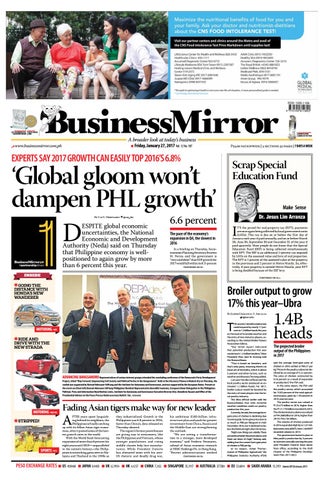
ADVANCING BANGSAMORO Representatives of various interest groups attended the concluding conference of the Democratic Party Development Project, titled “Way Forward: Empowering Civil Society and Political Parties in the Bangsamoro”. Held at the Discovery Primea in Makati City on Thursday, the confab was organized by Konrad-Adenauer-Stiftung and the Institute for Autonomy and Governance, and was supported by the European Union. Present at the event are (from left) Konrad-Adenauer-Stiftung Philippines Resident Representative Benedikt Seemann, European Union Delegation to the Philippines Political, Press and Information Head Mattias Lentz, Institute for Autonomy and Governance Executive Director Atty. Benedicto Bacani and Office of the Presidential Adviser on the Peace Process Undersecretary Nabil A. Tan. ALYSA SALEN
motoring
e2-E3
stripped!
Sports
C1
Fading Asian tigers make way for new leader
A
fter years spent languishing behind its neighbors, the Philippines is finally catching up with its fellow Asian tiger economies, after it posted some of the fastest growth rates in the world. With the World Bank forecasting expansion of more than 6 percent for eight years until 2019—unparalleled in the nation’s history—the Philippines is mimicking gains seen in Malaysia and Thailand in the 1990s as
PESO exchange rates n US 49.8460
they industrialized. Growth in the Philippines was 6.8 percent in 2016, faster than China’s, data released on Thursday showed. The region’s former powerhouses are giving way to newcomers, like the Philippines and Vietnam, whose younger populations and rising middle classes help lure manufacturers. While President Duterte has alienated some with his antiUS rhetoric and deadly drug war,
his ambitious $160-billion infrastructure plan and push for greater investment from China, Russia and the Middle East are strengthening the outlook. “We are seeing a transformation to a stronger, more developed economy,” said Frederic Neumann, cohead of Asian economic research at HSBC Holdings Plc. in Hong Kong. “Recent administrations worked Continued on A2
He country’s broiler production could expand by nearly 17 percent to 1.4 billion heads this year on the back of favorable weather and the entry of new industry players, according to the United Broiler Raisers Association (Ubra). “Our initial report indicated that potential production this year could reach 1.4 billion broilers,” Ubra President Elias Jose M. Inciong told the BusinessMirror. “That is based on breeders, and that’s only gross, meaning there’s no input yet of mortality, which is about 5 percent and other factors, such as weather and diseases,”Inciong added. Last year the Ubra official said the local poultry sector produced an estimated 1.2 billion heads. For 2017, broiler output would be boosted by the entry of more players into the local poultry industry. The Ubra official earlier told the B usiness M irror that only extreme weather condition could cut poultry production this year. Currently, he said, the average farmgate price of chicken is declining due to oversupply. Farm-gate price rose to as much as P80 per kilogram in midDecember 2016, but it declined to below the P60 mark right after Christmas. “Right now things are volatile. There are weeks wherein the price is down, and there are times it’s high,” Inciong said, adding that the current farm-gate price of chicken is P80 per kg. In its report, titled “Per formance of Philippine Agriculture,” the Philippine Statistics Authority (PSA)
1.4B heads The projected broiler output of the Philippines in 2017
said the average farm-gate price of chicken in 2016 settled at P89.27 per kg.“Prices in the poultry subsector declined by an average of 5.22 percent. The price of chicken contracted by 9.26 percent as a result of expansion in production,” the PSA said. In the same report, the PSA said the poultry sector, which accounted for 15.03 percent of the total agricultural output, grew by 1.39 percent in 2016 year-on-year. The poultry sector was valued at P123.473 billion in 2016, higher than the P121.776 billion recorded in 2015. The chicken industry alone was valued at P94.508 billion in 2016, higher than 2015’s P93.736 billion. The volume of chicken produced in 2016 expanded slightly to 1.67 million metric tons (MMT), from 1.66 MMT recorded volume in 2015. The government bared its plan to hike poultry production by 3 percent to 4 percent annually starting this year, until President Duterte steps down from office, according to the draft chapter of the Philippine Development Plan 2017-2022.
n japan 0.4403 n UK 62.9954 n HK 6.4257 n CHINA 7.2432 n singapore 35.2917 n australia 37.7384 n EU 53.6044 n SAUDI arabia 13.2951
Source: BSP (26 January 2017 )
A2 Friday, January 27, 2017
BMReports BusinessMirror
www.businessmirror.com.ph
‘Global gloom won’t dampen PHL growth’ Continued from A1
to 7.5-percent target. Pernia made the statement after the Philippine Statistics Authority (PSA) announced that the economy grew 6.8 percent in 2016. GDP in the fourth quarter alone expanded by 6.6 percent. “Overall, given this growth in 2016, we believe that attaining the target of 6.5 percent to 7.5 percent for 2017 is highly likely,” Pernia said. Former Neda Secretary Cielito Habito told the BusinessMirror that he supported the government’s view on the economy, adding that strong domestic economy will continue to boost growth this year. Habito said the domestic economy, which is driven by consumption and, more recently, investment, has saved the country from falling prey to external risks. The uncertainties in the global economy have given export-oriented countries difficulties in recent years.
Pernia credited the government for its foresight, which saved the Philippines from encountering trade problems related to the withdrawal of the United States from the Trans-Pacific Partnership (TPP). “The global slowdown has not impacted the Philippines as much as it did our highly export-dependent neighbors. Add our growing consumption and the increase in government spending on infrastructure and you still have the corresponding stimulus for sustained growth of around 7 percent ahead,” Habito said. However, University of Asia and the Pacific School of Economics Dean Cid Terosa said the shortfalls in public infrastructure spending, coupled with “external headwinds”, would make it difficult for the government to meet its growth targets. For 2017, Terosa had projected GDP growth to fall within 6 percent to 6.5 percent. He noted that there was “no guarantee” that the government’s planned infrastruc-
ture spending, which is over P850 billion this year, would be realized. Terosa added that shifts in Washington’s policies will also affect the country. The US is a major trade partner of the Philippines and most of the clients of businessprocess outsourcing firms in the country are based there. “Also, the growth of remittances from overseas Filipino workers has followed a downward trend, although it will continue to support consumption spending,” he said.
2016 GDP
Despite posting its slowest quarterly growth in the fourth quarter, the Neda said the Philippines is still among the fastest-growing economies in emerging countries in Asia. In the fourth quarter alone, Pernia said Philippine economic growth was the third best in the region, after China’s 6.8 percent and Vietnam’s 6.7 percent. For the whole of 2016, he said the country’s GDP growth
could be the second fastest after China’s 6.7 percent. Vietnam only grew by 6.2 percent last year. The Neda chief also said the country’s full-year growth in 2016 allowed the country to increase its seven-year moving average real GDP growth to 6.3 percent, the highest since 1978. Pernia attributed the country’s economic growth to the government’s construction spending, which grew 23 percent in the fourth quarter. “This is attributed to high consumer confidence, modest inflation and interest rates, and improving labor-market conditions.” PSA data showed that private consumption growth slowed to 6.3 percent in the fourth quarter, from 6.5 percent in October to December 2015. Full-year growth, however, remained robust at 6.9 percent, higher than the 6.3 percent recorded in 2015. Among the major economic sectors, the PSA said Industry had
the fastest growth at 7.6 percent, higher than the previous year’s 6.5 percent. Services declined by 7.4 percent, compared with the 7.8percent growth in the fourth quarter of 2015. PSA data also showed that agriculture declined further by 1.1 percent. In the same period of the previous year, it dropped by 0.2 percent. Pernia said this was mainly due to the ill effects of typhoons Karen and Lawin, which hit the country in the fourth quarter of 2016.
New growth leader
After years spent languishing behind its neighbors, the Philippines is finally catching up with its fellow Asian tiger economies as it posts some of the fastest-growth rates in the world. With the World Bank forecasting expansion of more than 6 percent for eight years until 2019— unparalleled in the nation’s history—the Philippines is mimicking gains
seen in Malaysia and Thailand in the 1990s as they industrialized. Growth in the Philippines was 6.8 percent in 2016, data released on Thursday showed. The region’s former powerhouses are giving way to newcomers, like the Philippines and Vietnam, whose younger populations and rising middle classes help lure manufacturers. While President Duterte has alienated some with his antiUS rhetoric and deadly drug war, his ambitious $160-billion infrastructure plan and push for greater investment from China, Russia and the Middle East are strengthening the outlook. “We are seeing a transformation to a stronger, more developed economy,” said Frederic Neumann, cohead of Asian economic research at HSBC Holdings Plc. in Hong Kong. “Recent administrations worked hard to ensure macroeconomic stability, which serves as its anchor.” With a report from Bloomberg News
Fading Asian tigers make way for new leader Continued from A1
hard to ensure macroeconomic stability which serves as its anchor.” T he Phi l ippine economy— now about $292 billion—was more t han t w ice t he size of Malaysia’s and 10 times bigger than Singapore’s in 1960. A steady decline since then got it the label “the sick man of Asia”, while its peers expanded rapidly. The nation’s resurgence begun with former President Benigno
Simeon Aquino III, who took office in 2010, raised revenue, curbed corruption and won the nation’s first-ever investmentgrade credit ratings. By the end of this decade, the Philippines can achieve upper middle-income country status with per capita income of at least $4,126, the Asian Development Bank (ADB) forecasts, joining the likes of China, Malaysia a nd Thailand. Even with the strong growth
outlook, financial markets have been mixed. While the government last week sold $2 billion of global bonds at the tightest spread ever, the peso is among the worstperforming Asian currencies in the past six months and stocks have faltered.
Manufacturing, FDI
The ADB has said boosting manufacturing is key to creating more jobs. The Philippines is among the least reliant on exports in the
region, depending, instead, on a youthful and growing consumer base. Household spending, which makes up about 70 percent of the GDP, rose more than 6 percent for an eighth quarter. “ T he economic takeoffs of countries, like Thailand and Malaysia, were built on their manufacturing prowess, and this is where the government must redouble their efforts,” Neumann said. “This is a tough nut to crack. It will require infrastructure im-
provements and attracting more foreign direct investment to turn that into a reality.” FDI to the Philippines surged more than five times to $5.8 billion between 2010 and 2015, but that still pales in comparison to Thailand ’s $9 billion and Malaysia’s $11 billion. To compete, Duterte is planning to boost infrastructure spending to 7 percent of GDP from the previous administration’s goal of 5 percent. He is also pushing for changes
to tax laws to boost revenue and amend the Constitution to shift to federalism. “If they manage to push through tax reforms and boost infrastructure spending, manufacturing will now become its next leg of growth, adding to remittances and outsourcing,” said Michael Wan, an economist at Credit Suisse Group AG in Singapore. “This will boost the growth potential to at least 7 percent in the years ahead.” Bloomberg News
Edca. . .
Continued from A12
and it took them so many months until October last year, also for the funding to be approved,” Lorenzana said. But there’s already a “go signal” for this year, according to the defense chief. D ut e r t e, w ho h a s e a rl ie r stopped all military exercises with the US, except those that deals on counterterrorism and humanitarian assistance and disaster response, is aware of the plans of the Americans. “Edca is okay, because he has already said we will honor all agreements that we have entered into by the previous government; so it is okay with him,” Lorenzana said. Meanwhile, the defense secretary said he would sign military agreements with Russia when he accompanies Duterte in his visit to Moscow in April this year. “One of the things that we will do…we hope to sign a MOU [memorandum of understanding], it is a military-to-military engagement with the Russians that will allow visitations, observations. Visitation of troops and, maybe, ships coming here,” he said. “They could observe our exercises, we could also observe their exercises there and exchanges of students in our schools…maybe later on, we could also go into joint exercises, but that will be in the future,” he added. Lorenzana said they would also consider buying Russian drones, noting that Moscow has even offered to sell ships, submarines, aircraft and helicopters. “We will look into that because we should buy in accordance with our modernization plan. I told our men here who are in charge with the modernization that we will buy smart,” he added. However, he said they were also seriously considering buying sniper rifles from Russia.
news@.businessmirror.com.ph
BMReports BusinessMirror
Friday, January 27, 2017 A3
Imposition of excise tax on petroleum products needs further study–TMAP
T
he Tax Management Association of the Philippines (TMAP) has asked the House of Representatives to conduct more studies on the proposal of the Department of Finance (DOF) to impose excise tax on petroleum products. TMAP President Malou Lim, during the hearing of the House Committee on Ways and Means on Wednesday, said lawmakers should consider the economic impact of the tax increases on oil products, particularly on diesel and liquefied petroleum gas (LPG), before approving it. “We recognize that other countries impose excise tax on diesel. However, what needs to be considered is the overall economic impact [to] the cost of business and price of commodities. Further study should be made for this purpose,” Lim told lawmakers. Imposing excise tax on gasoline as compensating revenue measure, on the other hand, “may not adversely
impact the poor and marginalized sectors of the society,” she added. “We acknowledge the need to index excise tax on gasoline. The revised proposal already provides staggered increase, which will cushion impact to taxpayers, since fuel prices are expected to stay low for at least several years,” Lim said. Earlier, House Committee on Ways and Means Chairman and PDP-Laban Rep. Dakila Carlo Cua of Quirino filed the revised tax-reform package submitted by the DOF. The revised tax package seeks to restructure the tax rates and exempt individuals earning a gross annual income of P250,000 and below.
However, the bill also includes the imposition of excise tax on fuel as compensatory measure for the foregone revenues due to the lowering of income tax. The bill proposes a staggered increase of P6 per liter of diesel, kerosene and LPG within a three-year period. The bill also includes the relaxation of the Bank Secrecy Act, imposition of excise taxes on automobiles and taxing Philippine Charity Sweepstakes numbers’ game and lotto winnings. The tax-reform package would entail foregone revenues of around P200 billion, but will also generate around P206.8 billion for the government in the first full year of implementation.
Automatic increase
Meanwhile, Lim also asked the lower chamber to reconsider a provision in the tax-reform package increasing by 4 percent every year, starting January 2020, the excise tax on petroleum products. “The proposal under the bill is to increase by 4 percent every year. TMAP’s counterproposal is that increase should be based on inflation, and be done on a periodic basis rather
than annually,” she added. Under the tax package, tax rates for petroleum products shall be increased by 4 percent every year thereafter, effective January 1, 2020, through revenue regulations issued by the secretary of finance.
Poor In a statement, Party-list Rep. Antonio Tinio of ACT Teachers said the proposed excise taxes on fuel products are new levies that will be shouldered by low-income earners and poor families. Tinio said the leaded and unleaded premium gas will be slapped with an excise tax of P7 per liter (from P5.35 and P4.35, respectively) in July 2017, P9 in 2018, then P10 in 2019. Products with zero excise, like kerosene, diesel, LPG and bunker-fuel oil, will be taxed with P3 in 2017, P5 in 2018, then P6 in 2019 per volume capacity. “This proposal will actually impose taxes where currently there are none, in the case of kerosene, diesel, LPG and bunker fuel,” Tinio said. “The DOF has yet to explain to the public: What is its justification for introducing new taxes, when the existing regime has seen it fit not to
tax these products?” he said. According to Tinio, the new excise taxes will greatly hit the low-income earners and poor families. “In rural areas, for instance, the common mode of transportation are motorcycles, or habal-habal. They also need generators for electricity—these all use the products that the DOF now wants to tax,” he said. “The DOF has yet to present hard data to substantiate its claim that the impact of new excise taxes will only be on the rich or high-income earners. We should realize that while P9,000 to a high-income family is insignificant, P160 for the poor spells the difference between food on their plates and hunger for the family,” the lawmaker added. He noted that the DOF earlier informed the House panel that its proposal will be borne more by the rich, with them paying P4,000 to P9,000 per year in excise taxes compared to poor families, who will pay only P160. “The DOF also admitted that a significant share of expected revenue from the new excise taxes will come mostly from diesel, from 25 percent to 50 percent,” he said.
Tinio also argued that the proposal for lower personal income taxes should be “unbundled” from the tax-reform package, saying there are no opposition to the income-tax reform, unlike the other reforms it has proposed, such as the excise taxes and VAT. “We want income taxes to be lowered without any precondition, and we don’t want income-tax relief for the people to be a hostage to more controversial proposals. The lowering of income tax might not push through if other taxes will not be approved. We all know that the lowering is urgent and necessary. I, therefore, suggest that the committee should proceed with, and approve, lower income taxes separately,” Tinio said. The DOF, meanwhile, has assured the public that the government will provide subsidies to the affected sector. Besides imposing new taxes on fuel products, the agency said the bill also provides that 40 percent of the first incremental revenues generated from the petroleum excise tax shall be allocated to fund highly targeted transfer programs and subsidies to public-utility vehicles for one year. Jovee Marie N. dela Cruz
A4
Friday, January 27, 2017
The World BusinessMirror
www.businessmirror.com.ph
May-Trump meeting to test UK-US ‘special relationship’
L
Border patrol agent Eduardo Olmos walks near the secondary fence separating Tijuana, Mexico, (background) and San Diego in San Diego. US President Donald J. Trump will direct the Homeland Security Department to start building a wall at the Mexican border. AP/Gregory Bull
Trump orders wall built at Mexican border, crackdown on immigrants
W
ASHINGTON—President Donald J. Trump on Wednesday began a sweeping crackdown on illegal immigration, ordering the immediate construction of a border wall with Mexico and aggressive efforts to find and deport unauthorized immigrants.
He planned additional actions to cut back on legal immigration, including barring Syrian refugees from entering the United States. At the headquarters of the Department of Homeland Security, Trump signed a pair of executive orders that paved the way for a border wall and called for a new force to sweep up immigrants who are in the country illegally. He revived programs that allow the federal government to work with local and state lawenforcement agencies to arrest and detain unauthorized immigrants with criminal records and to share information to help track and deport them. He also planned to clamp down on legal immigration in another action expected as early as Thursday. An eight-page draft of that executive order, obtained by The New York Times, would indefinitely block Syrian refugees from entering the US and bar all refugees from the rest of the world for at least 120 days. W hen the refugee program re s u me s , it w ou l d b e mu c h smaller, with the total number of refugees resettled in the US this year more than halved, to 50,000 from 110,000. It would also suspend any immigration for at least 30 days from a number of predominantly Muslim countries—Iran, Iraq,
50K
The number of refugees who would be resettled in the US this year, which is halved from 110,000
Libya, Somalia, Sudan, Syria and Yemen—while the government toughened its already stringent screening procedures to weed out potential terrorists. W h ite House of f ic i a ls de clined to comment on the coming plan, but in a wide-ranging interview that aired on Wednesday on ABC, Trump acknowledged that it aimed to erect formidable barriers for those seeking refuge in the US. “It’s going to be very hard to come in,” Trump said. “Right now, it’s very easy to come in.” He also said his administration would “absolutely do safe zones in Syria” to discourage refugees from seeking safety in other countries, and chided Europe and Germany in particular for accepting millions of immigrants. “It’s a disaster, what’s happening there,” Trump said.
Taken together, the moves would turn the full weight of the federal government to fortifying the US border, rounding up some of the 11 million people who are in the country illegally and targeting refugees, who are often among the world’s most vulnerable people. It is a n ag g ressive use of presidential power that follows through on the nationalistic vision Trump presented during his presidential campaign. “A nation without borders is not a nation,” Trump said on Wednesday at the Department of Homeland Security, where he signed the orders alongside the newly sworn-in secretary, John F. Kelly. “Beginning today, the US of America gets back control of its borders.” The plans are a sharp break with former President Barack Obama’s approach and what was once a bipartisan consensus to devise a path to citizenship for some of the nation’s unauthorized immigrants. Obama, however, angered many immigrant groups by deporting millions of unauthorized workers, largely during his first term. But Trump, whose campaign rallies were filled with chants from his supporters of “build the wall,” has vowed to go much further. He has often described unauthorized immigrants as criminals who must be found and forcibly removed from the US, as he did again on Wednesday. “We are going to get the bad ones out—the criminals and the drug dealers and gangs and gang members,” Trump said. “The day is over when they can stay in our country and wreak havoc. We are going to get them out, and we are going to get them out fast.” The president had invited the families of people killed by unauthorized immigrants to watch him sign the orders alongside Homeland Security employees, and he asked each of them to stand
in turn, telling of the deaths of their relatives, which he said had inspired his policies. “We hear you, we see you, and you will never, ever be ignored again,” Trump said, contending that they had been “victimized by open borders”. The immigration orders drew furious condemnation from civil rights and religious groups as well as immigrant advocacy organizations. The groups described them as mean-spirited, counterproductive and expensive and said the new policies would raise constitutional concerns while undermining the American tradition of welcoming people from around the world. “They’re setting out to unleash this deportation force on steroids, and local police will be able to run wild, so we’re tremendously concerned about the impact that could have on immigrants and families across the country,” said Joanne Lin, senior legislative counsel at the American Civil Liberties Union. “After today’s announcement, the fear quotient is going to go up exponentially.” Lynn Tramonte, the deputy director of America’s Voice Education Fund, an immigration advoc ac y g roup, sa id Tr u mp was “wasting no time taking a wrecking ball to the Statue of Liberty”. She called the orders “a dramatic, radical and extreme assault on immigrants and the values of our country.” The orders also rankled officials in countries around the world. President Enrique Peña Nieto of Mexico, who had planned to travel to Washington next week to meet with Trump, let it be known that he was considering canceling his trip, senior Mexican officials said. Trump has claimed that Mexico will ultimately pay for the wall, but officials there have repeatedly said they have no intention of doing so. New York Times News Service
ONDON—Br it ish Pr ime Minister Theresa May has won the race to be the first foreign leader to meet US President Donald J. Trump in Washington. But her trip to the US capital is anything but a victory lap. May’s staff worked feverishly to secure the two-day trip, which inc ludes a meet ing w it h t he president on Friday at the White House. British officials hope it will help cement the UK’s place as a preeminent American ally and provide proof of what Britons—more often than Americans—call the trans-Atlantic “special relationship.” But May faces the challenge of persuading a president who has vowed to put “America first” of the benefits of free trade with Britain and the vital role of the 28-nation North Atlantic Treaty Organization (Nato) military alliance. And she must build a working relationship with a populist president whose protectionist outlook and loose way with facts have alarmed many European politicians, including some of May’s own allies. May insists she’s up to the task of being America’s steadfast but plain-speaking friend, tel ling Br itish law makers on Wednesday, “I am not afraid to speak frankly to a president of the United States”. Her message in the US will include elements of gentle history lesson, as she urges the two nations to “ lead together”. In a speech to Republican legislators in Philadelphia on Thursday, May plans to say that the trans-Atlantic relationship “made the modern world” and built the institutions that have underpinned the global order since the end of World War II. Linking Britain’s vote to leave the 28-nation European Union with the win of political outsider Trump, she’ll say that “as you renew your nation just as we renew ours, we have the opportunity— indeed the responsibility—to renew the special relationship for this new age”. Excerpts from the speech were released in advance by May’s office. She’s likely to get a warm welcome at the Republican retreat and in the White House. Tr u m p h a s a l r e a d y p r o nounced Britain “ver y special!”
in one of his tweets. He has also has restored to the Oval Office a bust of Britain’s World War II Prime Minister Winston C hu rc h i l l t h at w a s removed while Barack Obama was president, to the chagrin of some patriotically minded Britons. May’s office says she intends to admire the bust when she visits the White House. She’ll also give Trump, whose mother was born in Scotland, a Quaich, a traditional Scottish cup of friendship. Victoria Honeyman, a politics lecturer at the University of Leeds, said the effusive tone com i ng f rom Tr u mp’s W h ite House marked a change from the Obama years. “Obama has been a more AsiaPacific-focused president, so this is a return—at least in rhetoric— to the good old days of the US-UK special relationship,” she said. “But it’s very difficult to know exactly what Theresa May is going to get out of this other than warm words.” B r it a i n n e e d s mo r e t h a n words from the United States as it prepares to start divorce talks with the European Union. May has said the UK will be leaving both the bloc and its single market in goods and services, which now stretches over 28 countries including Britain and involves half a billion people. By leaving, the UK is gaining the opportunity to strike new trade deals around the globe, and the US, as the top destination for British exports, is one of the biggest prizes around. While Obama warned that Britain outside the EU would go to the “back of the queue” for a US trade deal, Trump told the Times of London newspaper that a trade deal could be done quickly. But any talks in Washington this week will be preliminar y, since Britain is barred by EU r ules from substantia l negotiations on new trade agreements until it actually leaves the bloc—which is likely to be in 2019 at the earliest. And May will face strong domestic opposition to any deal that forces Britain to bring its standards into line with the US on things like genetically modified food—currently banned under EU rules—or the private sector’s role in health care. AP
Cuba can work with Trump if sovereignty respected–Castro
B
AVARO, Dominican Republic—President Raul Castro expressed Cuba’s willingness to continue negotiations with President Donald J. Trump’s new administration, but warned that his country would not concede any of its sovereignty. Castro made the comments at a summit of Latin A mer ican and Car ibbean leaders in the Dominican Republic that was dominated by ta lk of Tr ump’s immigration and trade policies, and his criticism of the detente bet ween Cuba and the United States that was promoted by Tr u mp’s p re d e c e s s or i n t he presidenc y, Barack Obama. “Cuba and the US can cooperate and live together in a civilized manner,” Castro said on Wednesday in a speech at the summit of the Community of Latin American and Caribbean States. He said Cuba was willing to continue normalizing relations with Washington but his country would not “make concessions inherent to its independence and sovereignty” to achieve this. The leaders veered off the expected script for the summit after Trump signed executive actions calling for construction of a border wall and stripping
support for so-called sanctuary cities. Many of the leaders also warily anticipated his support for protectionist measures. Salvadoran President Salvador Sanchez said his countr y would take action to confront the changes, while other leaders pledged to reject the criminalization of immigration and defend the rights of migrants. Ecuadorean President Rafael Correa called upon everyone to “assume a clear position in defense of migrants, not only from Latin America and the Caribbean, but the entire world”. C h i le a n Fore i g n M i n i s te r Heraldo Muñoz said that during the group’s first meeting, which was held behind closed doors, an attitude opposing protectionism and closed borders prevailed. “Latin America and the Caribbean have taken a stand in favor of the integration, in favor of the opening, in favor of the preservation of the advances that have been made in the matter of free trade,” he said. The presidents of Chile, Mexico and Colombia announced at the last minute that they would not be attending the summit, which only drew 10 presidents and two prime ministers. AP
The World BusinessMirror
www.businessmirror.com.ph
Friday, January 27, 2017
A5
After Trump rejects Pacific trade deal, Japan fears repeat of 1980s T
OKYO—President Donald J. Trump’s decision to pull the US out of the Trans-Pacific Partnership (TPP) trade deal should have been good news for Hitoshi Kondo, a Japanese rice farmer. T he sweeping 12-nat ion agreement, negotiated by the Obama administration and formally rejected by Trump on Monday, would have opened swaths of Japan’s highly protected agricultural sector, and was bitterly opposed by farmers. Now, without US involvement, the deal looks as good as dead. Kondo isn’t celebrating, though. “It’s actually scarier, because what comes next will be a lot harsher,” he said on Wednesday, as Japanese leaders scrambled to find a coherent response. What comes next, many in Japan believe, could be a bruising showdown between Tokyo and Washington. They fear a return
to the trade wars of the 1980s and early 1990s, when many Americans saw Japan as an untrustworthy economic adversary. T he U-tur n is a setback for Japan’s Pr ime Minister Shinzo Abe. Abe v iewed the TPP as a way to advance t wo cher ished goa ls: draw ing the US closer to Japan and other fr iend ly Pacific R im countr ies (the trade dea l does not include China, the region’s increasingly bristly super power) and bolstering Japan’s lack luster economy. Such is Abe’s enthusiasm for the deal that his government finished ratifying it on Friday, just before Trump’s inauguration, despite Trump’s promise to withdraw.
Trump has repeatedly said he wants to alter the US trade relationship with Japan, in which Japan sells far more goods to the US than it buys in return. In a meeting with executives from Ford Motor Co. and other US manufacturers this week, the president again said such an imbalance was “not fair.” And Trump said he wants to pursue trade agreements with individual nations, in lieu of group deals, like TPP, which would have included countries comprising as much 40 percent of the world’s economic output. Japa n h a s lon g pre fe r re d mu lt i l ate r a l r u le - m a k i ng to head-to-head deals, but pressure to go along with Trump’s approach will be strong. “Japan may eventually agree to bilaterals with the US to ensure that the US stays engaged in Asia—both economically and to provide a security counter to China,” said Glen S. Fukushima, a former US trade official who is now a senior fellow at the Center for American Progress, a think tank in Washington.
Officially, Japan has not given up on the pact, or on keeping the US involved. The day after Trump signed his executive order committing to withdrawal, Abe said in parliament he would “resolutely continue to seek understanding” from Washington of the deal’s strategic and economic importance. Abe’s advisers express hope that members of Trump’s Cabinet with business and national security ex perience w ill lend their voices to the effort. Saday uki Sakakibara, chairman of Keidanren, the lobbying group representing Japan’s largest cor porations, encouraged Abe this week to ta ke a t wo-pronged approach. Abe, he said, should try to keep the deal alive while engaging the US directly, if necessary, “with the goal of eventually broadening negotiations to a multilateral level.” Bar r ing a drastic change in Tr ump’s v iews on trade, however, that could mean stringing matters out for years—possibly until the next administration, if not longer. The TPP’s demise doesn’t pose
an immediate threat to Abe, whose poll numbers remain high. About as many Japanese voters favored the trade deal as opposed it. But none of Japan’s other trade options serve Abe’s goals the way the pact does. Japan and others could move on without Washington, which would require changing a condition that requires the US to ratify the deal before it can take effect. Pr ime Minister Ma lcolm Turnbull of Australia said on Tuesday he had been promoting that idea to Abe and several other leaders. Japan, with the second-largest economy in the group, after the US, would be a crucial participant. But it cou ld be politica l ly awkward for Abe, who sold the deal on the merits of US involvement. Even on narrow commercia l g rounds, he wou ld have some explaining to do: Accepting more agricultural imports was supposed to be the price Japan paid for cheaper access to the vast US market for cars and other manufactured goods. With the US out of the picture,
Abe could be accused of selling out farmers for little gain. Japan is negotiating other deals. One, with the European Union, predates Abe’s embrace of the TPP, in 2013, but talks had been put on hold. European negotiators want concessions on agriculture, too—another reason Japanese farmers are not breathing sighs of relief. In at least one area, dairy products, European demands go beyond what Japan agreed to in the TPP. Japan is also part of an Asian trade initiative, the Regional Comprehensive Economic Partnership. But that effort is being led by China, which has that partnership’s largest economy. China’s rise represents, perhaps, the biggest change from the US-Japan trade battles of a generation ago. For Japan, it is both an added risk and a potential buffer. Many in the Abe administration hope that Trump will target China first, making Japan a lower priority, said a senior government official involved in trade matters, who asked for anonymity to discuss a sensitive issue. New York Times News Service
A8
The World BusinessMirror
Friday, January 27, 2017
www.businessmirror.com.ph
Lawyer: Prosecutors threatened Park’s confidant during probe
S
A worker takes a picture of a giant rooster sculpture resembling US President-elect Donald J. Trump on display outside a shopping mall to celebrate the upcoming Chinese Year of the Rooster in Taiyuan in north China’s Shanxi province on January 28. Chinatopix via AP
China releases new list of items banned for export to N. Korea
B
EIJING—China has released a new list of items banned for export to North Korea, following a new round of United Nations sanctions and complaints from President Donald J. Trump that Beijing was not doing enough to pressure its communist neighbor. A statement from the Commerce Ministry late on Wednesday said the items included dualuse technologies that could aid the North’s programs to develop nuclear, chemical and biological weapons as well as the missiles to deliver them. While largely comprising specialty chemicals and rare alloys, the list also included computer software, machinery, high-speed cameras, aircraft engines and sixaxle truck chassis. The ban on “dual-use measures related to weapons of mass destruction and their means of delivery” takes effect immediately, the announcement said.
There was no evidence that the extensive list of items covered by the ban was prompted by anything other than the UN Security Council resolution passed last November in response to the North’s missile test last September. However, the official Communist Party newspaper Global Times suggested the timing had to do with the upcoming week-long Lunar New Year holiday, a period during which North Korea last year staged a missile test and in 2013 held its third underground nuclear test. The announcement “is also a warning for the North Korean side not to conduct another round
of nuclear testing during China’s Spring Festival this year,” it quoted Yanbian University expert Jin Qiangyi as saying, using another term for the Lunar New Year. China is the North ’s largest source of trade and aid, but has grown increasingly frustrated by Pyongyang’s defiance of the UN’s demands to end missiles tests and the development of nuclear weapons. A lthough generally dismissive of sanctions, Beijing has signed on to successive rounds under the UN Security Council, while continuing to advocate a resumption of six-nation nuclear negotiations hosted by China that have been on ice since North Korea withdrew in 2009. Beijing’s unique relationship with the North’s hereditary dictatorship has generated expectations that it holds the key to ending the threat from Pyongyang, something Chinese officials and scholars call a vast exaggeration. China also firmly opposes any measures that could lead to the toppling of Kim Jong Un’s regime, something it fears would lead to a massive wave of refugees crossing into China and the presence of South Korean and US troops
along its border. Despite that, Trump complained in a tweet earlier this month that China “won’t help with North Korea,” even while it benefits from commercial links with the US. Trump’s nominee to be secretar y of state, Rex Tillerson, has spoken in starker terms. He accused China of making “empty promises” on North Korea and warned of US sanctions on Chinese companies found to be violating UN Security Council resolutions, recently beefed up to tighten restrictions on North Korean coal imports. “If China is not going to comply with those UN sanctions, then it’s appropriate for the United States to consider actions to compel them to comply,” Tillerson told the Senate Foreign Relations Committee earlier this month. T he US is concer ned t h at Pyongyang may already be able to arm short-range and mid-range missiles with atomic warheads, threatening US allies South Korea and Japan, and American forces in each country. Some experts believe the North is likely to have the capability to strike the US mainland before Trump’s four-year term is up. AP
EOUL , South Korea— A l aw ye r for t he ja i le d woma n at t he center of the biggest South Korean political scandal in decades said on Thursday that prosecutors threatened to “annihilate” her family and used other abusive language during questioning. Prosecutors denied the accusations and expressed strong regret over them. The woman, Choi Soon-sil, a longtime friend of President Park Geun-hye, has been arrested for allegedly interfering in state affairs and extorting money from businesses. Park was impeached last month over the scandal and the Constitutional Court is reviewing whether to formally end her rule. Choi created a stir on Wednesday by shouting out accusations about prosecutors when she was brought to the office of prosecutors. Choi screamed out to reporters that the investigation was unfair and said she had been forced to confess untrue things about her relationship with Park. There is huge pressure on prosecutors amid widespread fury in South Korea over the charges against Choi and Park. Millions of South Koreans have taken to the streets to protest what prosecutors have described as collusion with Park that allowed Choi to pull government strings from the shadows. But on Thursday, her lawyer accused prosecutors of questioning Choi without informing him late on Christmas Eve in what he called a violation of a law that guarantees the right to counsel.
During questioning that he said lasted until 1 a.m. on Christmas Day, the lawyer, Lee Gyeong-jae, said prosecutors used “very shocking” language that abused Choi’s human rights. He said they threatened to “annihilate” Choi’s family and make “Choi and even her grandson live [in shame] so that they cannot hold their faces up.” Lee said the threats to destroy a person’s family was similar to the feudal language used during the Joseon dynasty, which ruled the Korean Peninsula for 518 years before it was colonized by Japan in 1910. Lee accused prosecutors of trying to induce Choi to confess to things she had not done. His conference was disrupted at the last minute with a middle-aged woman shouting and urging him not to speak in defense of Choi. “Do you think she should be treated well while being investigated?” the woman shouted. The office of special prosecutors investigating the scandal said later Thursday that one of their senior prosecutors met Choi on Christmas Eve for an informal interview but did not use any of the abusive language cited by Choi’s lawyer. Spokesman Lee Kyu-chul said prosecutors have not tried to induce Choi into making any false confessions. Lee said Choi’s lawyer was told in advance of the December 24 meeting and that it did not last until the next day. =Prosecutors said on Wednesday they plan to question Park and search her office by early next month. Park has said she would cooperate with the investigation. AP
Final toll for Italy avalanche stands at 29 as recovery ends
P
ENNE , It a ly—T he f i na l death toll from Italy’s devastating avalanche stands at 29 after the remaining bodies were pulled out of the rubble of a hotel crushed by tons of snow, firefighters said on Thursday. Firefighters issued the update after a week of search efforts at the isolated Hotel Rigopiano in central Italy. Nine people were pulled out alive in the first days of the rescue. Premier Paolo Gentiloni acknowledged delays and “malfunctioning” in the initial rescue effort after local authorities brushed off the first alarms about the avalanche. But Gentiloni told parliament on Wednesday that now wasn’t the time to find scapegoats. Prosecutors say that autopsies on the first six bodies examined showed most died from the initial physical trauma of the hotel collapsing, with some also showing signs of hypothermia and asphyxiation. In his briefing to parliament,
Gentiloni stressed the unprecedented perfect storm that unfolded last week as more than two meters of snow fell within 72 hours on the isolated hotel, followed by four powerful earthquakes that shook all of central Italy. T he ensuing landslide and avalanche dumped upwards of 60,000 tons of snow, rocks and uprooted trees on top of the resort, burying the 40 people inside. Nine were pulled out alive, including all four children. Two people escaped and called for help, but the Pescara prefect’s office brushed off the alarm thinking it was a joke and that the hotel was safe. The rescue operation only got underway an hour or two later, and it took some eight hours for the first crews to reach the site, on foot, because the roads were impassable. Gentiloni told law-makers a criminal investigation underway would ascertain responsibilities. AP
Smog pushes Beijing residents to innovate to protect family, world
B
EIJING—Beijing residents concerned about breathing the capital’s thick gray air are adapting, inventing and even creating businesses to protect the health of their families and others. Some of their efforts could help people around the world. Already this year the smogshrouded capital has suffered particularly hazardous bouts of pollution caused mainly by coal burning and vehicle emissions. Like other Chinese cities, Beijing is trying to tackle the problem: City authorities say they will spend $2.7 billion this year to help replace coal with natural gas, close heavily polluting factories and take older vehicles off the road. Official figures show improvement since 2013, but Beijing has a long way to go. With no quick fix
available, many residents developing their own partial solutions. Here are some of their ideas:
Shooting the sky
For the last four years Zou Yi has diligently captured the sky’s change in colors from the window of his central Beijing apartment, where he can—usually— see the landmark Beijing Television tower. The background in his photos runs from dirty brown to deep gray, interspersed with one or more days of cobalt blue. On the worst days, nearby buildings can’t be seen. A 10-day period of particularly heavy pollution inspired his project. The government had just started publishing data on levels of PM2.5—tiny particulate matter that can clog lungs— and a taboo on state media’s
discussion of the sensitive topic had just been lifted. “I couldn’t go out, I couldn’t open windows, I couldn’t see the building next to me because the smog was so bad,” he said. Zou shared the photos on the Twitter-like Sina Weibo and the smartphone messaging app WeChat. He found his fr iends had similar feelings of frustration and recr uited his building manager to ta ke the pictures when he was out of tow n. “They wanted me to share a photo with them every day, so I did it every day, every month,” said Zou, 50. Hundreds of thousands of people have seen his photos on social media. What started as a way to complain has morphed into his full-time passion. This month, Zou set up the non-governmental organiza-
tion BeijingAirNow to work with scientists on technology to read pollution levels from around the world by analyzing the tint in the images rather than using expensive monitoring equipment to collect air particles. He says he is handing over more than 300,000 photos for computer analysis.
Purified home
Wang Jiang, 42, and her family had eight air purifiers at home, yet found that the indoor-air quality was still not good enough on heavy pollution days. Then they decided to take their efforts up a notch. B ut s e a l i n g w i ndo w s a nd doors and turning on the purifiers caused carbon dioxide levels to spike, leaving Wang to wake up last year with headaches while pregnant with her second daughter. So now they
have installed a $5,000 industrialgrade filtration system that sucks in outdoor air, cleans it via three filters and distributes it around the house through newly fitted pipes. They filled in vents from their building’s central heating system and installed their own. While some might find that extreme, it’s an increasingly popular solution. Filter manufacturer Yuanda said their customers range from the ruling Communist Party’s Central Committee to homes and about 1,000 kindergartens and schools. A marketing representative, who only gave his surname, Hu, said their purifying systems often go out of stock. “If you order one today, it won’t get installed until March,” Hu said. Now Wang, a coffee importer, can exercise on a living room treadmill when
pollution is bad without worrying about her health. He r hu sba nd , Fre nc h m a n Ludovic Bodin, 38, said he thinks every house should have an air filtering and ventilation system preinstalled. “At least if you cannot secure outdoors because it takes time...at least try to secure the house inside,” he said.
Crowdsourcing data
Frenchman and long-ter m Beijing resident Yann Boquillod wanted to know what kind of air his five children were breathing at home, so he developed a portable air quality monitor. It also tells users when carbon dioxide levels are high from sealing rooms too tightly, and advises that they should open windows for 10 minutes even if there is pollution outside. AP
The World Friday, January 27, 2017
A9
Is Ivanka Jewish? In Israel, she has a trump card
P
ETAH TIKVA, Israel—Is Ivanka Trump really Jewish? Last summer, Israel’s religious authorities issued a ruling that raised doubts about her conversion to Judaism. But since her father was elected president, they have changed their tune, raising eyebrows among activists who have long lobbied the rabbinical establishment to be more tolerant toward converts. President Donald J. Trump’s daughter converted to Judaism under a prominent Orthodox rabbi in Manhattan before her 2009 marriage to Jared Kushner, an observant Jew. In their ruling last July, an Israeli government religious court rejected the legitimacy of another conversion by the same rabbi. Although it didn’t directly affect Ivanka Trump, it raised questions as to whether Israel’s powerful religious establishment would recognize her as being Jewish. But in early December 2016, just weeks after Trump’s election victory, Israel’s chief rabbis said they would work to change the rules for recognizing conversions performed abroad—and they singled out Ivanka Trump. “According to the new proposed plan...her conversion will be certified without the need for additional checks,” the announcement said. Israeli activists say the sudden policy change appears to be an attempt to curry favor with the new US president. Ivanka Trump’s husband has been appointed a senior adviser to Trump and is expected to focus on Israeli-Palestinian peace efforts. An Israeli rabbinic committee has already met several times to discuss conversion policy, a speedier pace than usual, activists say. “ The timing is certainly suspicious,” said Rabbi Seth Farber, director of ITIM, an organization that represents converts seeking recognition from the rabbinate. “My biggest fear is that the rabbinate will find some way to find Ms. Trump kosher, to recognize her conversion, but leave thousands of other converts behind, simply say ing they’re not Jew ish enough for us.” The Jewish Week, a New York newspaper, quoted an anonymous source with ties to Trump’s presidential transition team as saying high-ranking aides had expressed concern to Israel regarding the legitimacy of Ivanka Trump’s conversion, and that Israeli efforts to recognize her conversion would foster a closer relationship between the Trump family and Israel. A spokesman for Trump did not return a request for confirmation, and Rabbi Levi Shemtov, a rabbi in Washington who is close to Ivanka Trump, declined comment. A spokesman for one of Israel’s chief rabbis said the proposed changes were a long time coming and not a direct result of Trump’s election. “Even before Ivanka Trump, it was talked about,” said Spokesman Pinchas Tennenbaum, adding that the media attention “added problems, and we take it to heart.” Since Ivanka Trump does not live in Israel, for her, the issue is largely hypothetical. But for converts in Israel, the rabbinate’s ruling affects their daily lives. If they are not recognized as Jewish, they are not permitted to marry in Israel, and they are technically ineligible for a religious burial when they die. Israel’s Orthodox establishment does not recognize conversions performed by the more liberal Reform and Conservative streams of Judaism, to which most American Jews belong. But immigration officials have more relaxed guidelines
Ivanka Trump and her husband Jared Kushner dance at the Freedom Ball, in Washington on January 20. AP/Evan Vucci
and do allow Reform and Conservative converts to gain citizenship in Israel as Jews. These days, many Israelis simply wave off the rabbinate as irrelevant. Secular Israelis often wed in civil ceremonies abroad to avoid the rabbinate, while many ultra-Orthodox Jews dismiss the rabbinate’s certification of kosher food as too lax. Some Israelis perceive the rabbinate as corrupt: A former Israeli chief rabbi was sentenced to three-and-a-half years in prison this week following charges of corruption and bribery. “The rabbinate is a fossil of an institution that does not succeed in grappling with modern needs,” said Nahum Barnea, a leading Israeli columnist. “Most Israelis see the recognition of Ivanka Trump’s Judaism, or lack of recognition, as a joke.” Under the proposed reform, the rabbinate would establish clear guidelines for which rabbis abroad are deemed fit to perform conversions, rather than the current practice of evaluating each individual convert. All foreign-born Jews seeking a marriage license in Israel must first be checked by the rabbinate to ensure they are indeed Jewish. Between 2013 and 2015, some 5,000 people asked the rabbinate to recognize them as Jews, according to rabbinate figures. Critics say Israeli rabbinical courts reject dozens of converts each year, claiming their Orthodox conversions were not stringent enough and, in some cases, questioning their motives and levels of observance. The issue reached a boiling point last year when an Israeli rabbinical court refused to recognize the conversion of a 31-year-old American, Nicole Zeitler. W hile working in New York, she converted to Judaism after a year and a half of study that included Hebrew lessons, a weekly questionnaire on Jewish topics and twice-aweek meetings with Rabbi Haskel Lookstein, a senior rabbi in the US Orthodox community who also oversaw Ivanka Trump’s conversion. “It was intense. I learned it and I lived it,” Zeitler said. She moved to Israel and became engaged to an Israeli, but a rabbinical court would not grant her a marriage license, dismissing Lookstein’s credentials. The move created an uproar in Israel, with the speaker of the Israeli parliament and head of Israel’s Labor party, who know Lookstein personally, petitioning the rabbinate to reconsider. In the end, the supreme rabbinical court persuaded Zeitler to undergo a quickened conversion by reciting a special declaration of faith, rather than recognize Lookstein’s conversion. AP
A10 Friday, January 27, 2017 • Editor: Angel R. Calso
Opinion BusinessMirror
editorial
Do not sabotage genuine tax reform
I
T seems that if the government was in charge of the ordinary problems of life, if you needed an auto mechanic, it would send you a carpenter. Too often, decisions are made that affect the lives of all citizens by people who do not have any real-world experience to be able to make those decisions.
Certainly, you can learn some necessary skills from a book. But there is no substitute for experience. Career politicians, attorneys and those who have success in other fields of endeavor can bring something to government. But it is always comforting to see the term “businessman” or “businesswoman” on an elected or appointed official’s résumé. There is no substitute for having to meet your employees’ monthly payroll or figuring out how to run a profitable business. One important bit of wisdom that you can only learn from the “University of Operating a Business” is realizing that a change in one area runs through the entire company. Do you raise profits by reducing costs or by raising prices? What is the optimum salary for optimum employee productivity? These concepts and dilemmas are strange to most elected officials. While we have written that the proposed draft of the taxreform program makes good economic sense, the politicians cannot get past pandering to certain groups. Further, as they pander to these groups, they deliberately ignore that the goal is a comprehensive tax reform, not simply piece-by-piece changes. We start with the proposal that those earning not over P250,000 annually will be exempted from paying income tax. This is a big deal. Some are constantly pushing the mantra of “fair share”. What exactly is the fair share of the lowest-income working poor? It is unlikely that any low-income tricycle driver whose wife might sell barbecue is paying any income tax at all, and that is perfectly acceptable. It is also acceptable and necessary that this group be given every opportunity for inexpensive, if not free, health-care services. You hear politicians say that the government’s plan to impose a P6-per-liter tax on diesel is “heartless”, “unreasonable” and a “burden to the Filipino people”. Guess what? All taxes are a financial burden on the people, and that “P6 per liter” is actually staged in: P3 per liter in 2017, P5 in 2018 and P6 in 2019. Looking at the complete tax-reform package—which apparently is difficult for these legislators to do—a family with two children making P250,000 annually would see their net income increase by P32,000 per year. Even if these other taxes cost them P1,000 more per month, they would still have P1,000 per month more disposable income. The Philippine people and the Philippine economy desperately need genuine tax reform. This cannot be derailed by picking and choosing which voting group will benefit. As the rising tide lifts all boats, so also will a stronger economy be better for all. Since 2005
BusinessMirror A broader look at today’s business ✝ Ambassador Antonio L. Cabangon Chua Founder
Publisher Editor in Chief Managing Editor Associate Editor News Editor City & Assignments Editor Senior Editors
T. Anthony C. Cabangon Jun B. Vallecera Max V. de Leon Jennifer A. Ng Dionisio L. Pelayo Vittorio V. Vitug
Ruben M. Cruz Jr. Angel R. Calso
Creative Director Chief Photographer
Eduardo A. Davad Nonilon G. Reyes Judge Pedro T. Santiago (Ret.) Benjamin V. Ramos Adebelo D. Gasmin Marvin Nisperos Estigoy Aldwin Maralit Tolosa Dante S. Castro
BusinessMirror is published daily by the Philippine Business Daily Mirror
HOM
Publishing, Inc., with offices on the 3rd floor of Dominga Building III 2113 Chino Roces Avenue corner De La Rosa Street, Makati City, Philippines. Tel. Nos. (Editorial) 817-9467; 813-0725. Fax line: 813-7025. (Advertising Sales) 893-2019; 817-1351, 817-2807. (Circulation) 893-1662; 814-0134 to 36. E-mail: news@businessmirror.com.ph.
www.businessmirror.com.ph
Printed by brown madonna Press, Inc.–San Valley Drive KM-15, South Superhighway, Parañaque, Metro Manila MEMBER OF
Siegfred Bueno Mison, Esq.
THE PATRIOT
N
ot all actions or movements are beneficial for a leader or an organization. Imagine a rocking horse that sways back and forth. It has so much action, but it never goes anywhere. Imagine a baby walker that goes all over the place. It has much action; it goes somewhere (everywhere, in fact), but never to a certain destination. So, for things to move forward, there must be a plan. As former US President Abraham Lincoln said, “I walk slowly, but I never walk backward.” For most companies, such plan is anchored on a vision statement. In any situation, a leader must be prepared. And planning is an integral part of being prepared. Whenever we fail to plan, we plan to fail. On the part of Philippine Airlines (PAL), the plan is, simply put, “Get that Star [GTS].” The company aims to achieve a five-star rating by year 2020 from Skytrax, the leading international airline-rating system classifying airlines by the quality of frontline product and staff-service standards. In 2017 PAL intends to be a four-star airline, then a fivestar airline by 2020. Among others, the GTS plans for this year include the construction/renovation of airport lounges in Cebu, Davao, Iloilo, General Santos, Bacolod, including a new Mabuhay and transit lounge at the Ninoy Aquino International Airport (Naia) 2; tie up with existing lounges in Naia 3 due to lack of spaces in that terminal; introduce self-service check-in kiosks; enhance the PAL web site to make it more user-friendly; enhance meal choices and appearance in all classes (down to the type of coffee and
salt-and-pepper shaker availability in business class); improve the inflight entertainment (IFE) by way of content and systems upgrade, and elevate service standards through more soft-skills training. Living up to the service attributes of magaling, maasahan, maalaga, magalang and malambing, the plan is not only to aim for higher Skytrax ratings, but to simply showcase the true “heart of the Filipino” to all customers of PAL. As in any other industry leader, there is a need to differentiate the company culture through attitude and action. A positive attitude is magnetic. It draws well-intentioned people and productive things to you. Every time we use our talents and abilities to serve others, we draw positive things back to ourselves. We are rewarded many times over, especially if we do things from deep in our hearts. There is so much goodness to share,
Leaders need to have the heart to do good and genuinely care for others. Leaders must have the balls to dare go where only a few have tried. Heart and balls—they don’t seem to go together. But when they do, the combination is a recipe for prosperity. despite all the madness around us. And the best attitude in any organization is not only to stay positive, but also not to be weary in doing good things. For, at the proper time, we will reap a bountiful harvest if we keep on sharing the goodness to all people, friends and enemies alike. In Ephesians 4:16, Paul, referring to the Church as the Body of Christ, tells us that “the whole body, joined and held together by every supporting ligament, grows and builds itself up in love”. Stressing the importance of caring, sharing and daring, former President Fidel V. Ramos reminds us that we are all one team, one family, one country, one people. What we do or not do affects those around us. A decisive action finishes what the plan sets out to do. Remember, planning is just a third of the effort. When leaders get stuck in the planning mode and fail to take any concrete action toward it, nothing is accomplished. Remember the rocking horse or the baby walker? The success of any vision statement lies in the execution of the plan. Bestselling author John Maxwell said: “Leaders not only know where they are going; they also know how to get there.” Servant leaders, anticipating the possible repercussions or worstcase scenario, put faith in the plan
The value of networking for business Chit U. Juan
Lorenzo M. Lomibao Jr., Gerard S. Ramos Lyn B. Resurreccion, Efleda P. Campos
Online Editor Social Media Editor
Chairman of the Board & Ombudsman President VP-Finance VP Advertising Sales Advertising Sales Manager Group Circulation Manager
Heart and balls
Women Stepping UP
P
eople ask me why I’ve been attending summits and conferences ad libitum, maybe for about eight years now. More specifically, most of the meetings I attend are women’s summits or women-centric business conferences. And there are quite a few happening annually and biannually. For the annual ones, I have attended the Global Summit of Women (GSW, www.globewomen.org) many times since 2008, and have enjoyed all of them in locations like Athens, Istanbul, Paris, Kuala Lumpur and Vietnam, to name a few. The biggest draw besides the substantive content is founder Irene Natividad’s ability to take the attendees to private museums and places of historical interest for the welcome dinners. We were also hosted at the Palace in Malaysia and in an ancient water-
works cultural place in Athens. You could not go to these places if not for the summit. And I’m glad I did. Irene has been doing the GSW for over 25 years now. After the summit, there usually are postevent tours; some took us to Rodos or Rhodes in Greece and to Bordeaux in France. And I’m looking forward to the postevent after the Tokyo GSW coming up in May. If you are interested to network at the summit and enjoy the visits to the stock exchange and other
post-event tours, sign up now. The hotel rates are special and so are the rates, especially for non-governmental organizations. It’s always good to see old friends from around the globe, even if it is just for once a year. It’s enough to keep the communication lines open—and with technology like Viber, WhatsApp and e-mail, you forget the distance and continually connect with these friends. People sometimes complain they have too many groups on Viber—I don’t—it’s nice to keep your friends connected with you. You need not chat all the time, but knowing you have a friend from as far as Cairo or Rhodes or as near as Bali makes a lot of difference. You know you’re only a message away from someone in your network. Besides the Global Summit, there is the Women’s Forum in Deauville, which I totally enjoyed last year. Then there are the Apec and Asean meetings, too. For those of you who have not been to one of these summits, check out the Tokyo event. It’s not very far from the Philippines, and the rates are too good to resist. Go to www.globe-
and make adjustments along the way, when necessary. They decide to put whatever plan into action, take risks and trust their team to carry on. They have the guts and the courage to be decisive. This is what a seemingly hopeless entrepreneur did when he started out his shoemaking business. Together with his college track coach Bill Bowerman, Phil Knight started importing and distributing Onitsuka shoes from Japan to the US. Their initial storage space was in Knight’s father’s garage in Portland, Oregon, and their initial research and development department was inside the University of Oregon, where Phil ran as a middle-distance runner. When the operations gradually expanded, problems, especially in cash flow, cropped up compounded by a growing distrust in the relationship with the Japanese principals. Phil eventually took the courage to launch his own brand, Nike, and the rest is one successful story of guts and glory. His memoir, Shoe Dog, released only in April 2016, serves to inspire leaders to be flexible enough to decide amid uncertainties, both personally and professionally. In the words of US Gen. George Patton, “A good plan implemented today is better than a perfect plan implemented tomorrow.” Leaders need to have the heart to do good and genuinely care for others. Leaders must have the balls to dare go where only a few have tried. Heart and balls—they don’t seem to go together. But when they do, the combination is a recipe for prosperity. Xin nian kuai le! For questions and comments, e-mail me at sbmison@gmail.com.
women.org and register now. Take your friends along. Or your spouses. Men are most welcome to join, as the GSW features many male champions of diversity and inclusiveness. Visit www.globewomen.org. I hope we get a pretty good number in our delegation, as Irene always makes each delegation stand up to be recognized. China, Vietnam, Spain and Mongolia always bring more than 50 women each year—no matter where the summit is held. Let’s show the world that the Filipina can. Come along and listen to our Filipinas, like Doris MagsaysayHo of Magsaysay Lines, among the other global guests, such as heads of state and government officials, heads of global businesses and so much more. Chit U. Juan is president of ECHOstore Sustainable Lifestyle and the International Women’s Coffee Alliance-Philippines chapter. She is also chairman of the Asean Women Entrepreneurs Network. She is a social entrepreneur who has founded many start-ups, and may be reached through the ECHOsi Foundation (echosi.foundation@gmail.com or www.echosi.org).
Opinion BusinessMirror
opinion@businessmirror.com.ph
Call for donations for flood-affected communities Rev. Fr. Antonio Cecilio T. Pascual
SERVANT LEADER
L
ast week a low-pressure area (LPA) and a tailend of a cold front caused heavy rainfall equivalent to a onemonth rain volume poured only in four hours. It resulted in a massive flooding affecting 23 barangays in the City of Cagayan de Oro and the province of Misamis Oriental. According to the report from the Social Action Center of the Archdiocese of Cagayan de Oro, 331 houses were totally damaged and 860 partially damaged, and parishes outside CDO reported a total of 63 totally damaged houses. The residents require relocation, as they are unable to return to the areas where they lived before, since these are now considered high risk or “danger zones”, and the people do not have the capacity (financial means or technical expertise) to adequately rebuild their homes. Also, a report from the Diocese of Butuan stated that about 312 houses were totally damaged in La Paz, Agusan del Sur. The diocese is in immediate need of food, medicines and potable water. Meanwhile, the Social Action Center of the Archdiocese of Cagayan de Oro is asking for our help for their Transitional Housing Project. Based on the cost estimate and model houses prepared by volunteer architects and engineers, one unit of transitional shelter for a family of five and above would cost P30,000. Caritas Manila and Radio Veritas appeal for prayers for Divine protection and to help alleviate the sufferings through our donations, in cash and in kind, for the relief and rehabilitation needs of our kababayan in the affected areas. Donations can be made online via http://ushare.unionbankph.com/ caritas/ or by bank deposit: n Banco De Oro—Savings Account No. 5600-45905 n Bank of the Philippine Islands—Savings Account No. 30635357-01 n Metrobank—Savings Account No.: 175-3-17506954-3 For dollar accounts: n Bank of the Philippine Isl a nd s— Sav ings Accou nt No. 3064-0033-55 n Swift Code—BOPIPHMM n Philippine National Bank— Savings Account No. 10 -856 660002-5
Caritas Manila and Radio Veritas appeal for prayers for Divine protection and to help alleviate the sufferings through our donations, in cash and in kind, for the relief and rehabilitation needs of our kababayan in the affected areas. Swift Code—PNBMPHMM Donations can also be made via Cebuana Lhuillier (free of charge) or dropped off at Caritas Manila office: 2002 Jesus Street Pandacan, Manila, or at Radio Veritas on West Avenue corner Edsa, Quezon City. For proper acknowledgment of your donations, kindly fax copy of deposit slip to 563-9306 or e-mail a scanned copy to cm@caritasmanila.org.ph or caritas_manila@yahoo. com. Please indicate your name and complete address. Caritas Damayan is one of the programs of Caritas Manila, the social-development ministry of the Archdiocese of Manila. Through its Disaster Risk Reduction and Management Program, Caritas Manila has put in place a disaster-management program that allows for quick response relief operation and effective crisis intervention. Thank you, and may God bless your generosity.
90 years Tito Genova Valiente
annotations
M
y mother is 90 years old now. When I tell people her age and she overhears it, she would say “91”. A response from me would be, “not yet, Ma”. I think, she knows March is not that far off, and that is the month of her birthday. She is claiming that age now. For the last three years, after her bad fall, her memory has been failing. There are days when she requests that I bring her home. When I am in a good mood, I ask her to describe where that home is. The place varies. It could be the big house behind the old church, or a house at the end of the road. Those were residences we left years and years ago. The days with my mother are full of clarifying prescriptions. My orbit revolves around antidepressants and sleeping pills. I look into adverse effects, and the realization itself is a collapsed wisdom much too awesome for someone like me who is not young
like the K to 12 and the Conditional Cash- Transfer Program, are components of an overall push to improve the quality and quantity of education in the country. The granting of free tuition at SUCs is simply another intervention that, like the others, has efficiency and equity dimensions that must be carefully considered. Let us examine the equity issue. The economist John Roemer discusses two principles that pertain to the “equality of opportunity”. The first principle, he terms as “leveling the playing field”. According to Roemer, this involves making sure that policies that neutralize advantages or favorable circumstances are in place during the formation stage, such as when a person
payment and adjustment of salaries of public-school teachers under and by virtue of RA 5168 and all the benefits in favor of public-school teachers provided under RA 4670; purchase and/or improvement, repair and refurbishing of machinery, laboratory, technical and similar equipment and apparatus, including spare parts needed by the Bureau of Vocational Education and secondary schools offering vocational courses; the undertaking of education research, including that of the Board of National Education; and the granting of government scholarships to poor but deserving students under RA 4090, among others. Meanwhile, education officials are reminding and urging their local officials to refrain from using the SEF for programs to finance unauthorized purposes. Local officials should prioritize spending their SEF on projects that will improve the standard of education, the education officials said. According to University of the Philippines College of Education Dean Dina Ocampo Cristobal, some local officials distribute school supplies and bags bearing their names
to students during the opening of classes. “We must shield education from politics,” Cristobal said during a short TV interview. I have called on concerned government agencies before to conduct a thorough review and audit of SEF funds. But my voice seems to have fallen into deaf ears. I have yet to see real change in the handling of SEF by LGUs. It would be best that Congress now considers amending the law that allows LGUs to collect SEF. Education has already the biggest allocation in the current year’s General Appropriations Act. And, in the meantime, collection of SEF by LGUs can be suspended while an amendment to RA 5447 is being worked out. This would not only stop the corruption of SEF, but it would also reduce the annual RPTs, and reduce the burden of property owners. Education is among the basic foundations to help spur economic prosperity. It is where the country’s professional and technology bases are developed. Fortunately, we now have a president who understands the urgency to keep our quality of education and technology
competitive with that of the Asean community and the world. President Duterte’s 2017 government budget reflects his priority for education by giving the Department of Education (DepEd) the biggest slice at over P545 billion. Thus, even without the SEF, the DepEd’s comprehensive-education program should be able to address the requirements of LGUs. We have seen dramatic changes in the country even during the first semester of Duterte’s presidency. Our people are closely watching the changes and reforms being undertaken by the new administration in the education sector. The reforms are crucial. For, after all, as the legendary Nobel Prize and Bharat Ratna awardee former South African President and anti-apartheid activist Nelson Mandela once said, “Education is the most powerful weapon which you can use to change the world”.
EAGLE WATCH
D
uring the Christmas season of 2016, students of state universities and colleges (SUCs) in the Philippines got a rather surprising gift from the government. It was announced that starting the school year 2017, students in SUCs do not have to pay tuition. As it turns out, the government has enough money in the national budget to make this possible. This is undoubtedly good news for the parents of these students. However, let’s “unwrap” this present, and see exactly what is involved.
Dr. Jesus Lim Arranza
MAKE SENSE Continued from A1
A
S envisioned by Congress, the SEF would fund projects to enhance the government’s education programs. Effectively, property owners are helping fund LGUs with education programs as LGUs have the authority to appropriate and disburse such funds. of several corruption charges filed against local government officials at the Office of the Ombudsman, as well. Since the enactment of RA 5447, trillions of pesos have already been collected by LGUs for their SEF through the RPT scheme. However, a significant amount of these funds have been misused by some local government officials. For instance, the Commission on Audit (COA), after conducting an audit on an LGU in Pampanga, found that only P13,460,315.97, or 23.1 percent, of an LGU’s SEF was
incurred on expenses authorized under RA 7160, while P44,786,660 was spent for unauthorized expenditures. According to the breakdown of expenses provided in the report, the sum of P26.223 million was released as “other bonuses and allowances”. The COA also declared as irregular the payment of P9.712 million for electricity bills, P4.226 million for water usage and P3.75 million charged as “training expenses”. Only a measly sum of P117,387 was declared spent for the “repair of a school building”, but verification showed the amount was paid for the purchase of various electrical materials delivered to a school in Angeles City. And of the P3.75 million in “training expenses”, auditors traced P3 million being utilized for “food and hotel accommodations” at an international hotel during an induction program conducted by the said LGU. The law is very specific on where the SEF can only be spent. Among those are for the organization and operation of extension classes whenever needed; construction and repair of school buildings, including the acquisition of school sites;
E-mail: titovaliente@yahoo.com.
policy at the tertiary level is to pay closer attention to the distribution of effort among the students within each school. Public policy-makers who introduce new interventions must also pay close attention to efficiency. First, from a social standpoint, it is inefficient to provide the transfer to those who will avail themselves of the good anyway even without the transfer. This suggests that it may be socially wasteful to apply the free-tuition policy to “magnet” schools. Second, since the transfer applies only to those attending SUCs, there is an extra conditionality that creates a price effect in addition to the income effect. This price distortion can affect choice behavior, especially if people care about “transactions utility”. For example, an individual keen on pursuing a certain field in another institution can revise his plan in response to the price differential just to get more transactions utility. One potential problem is irreversibility. If, for some reason, the transfer turns out to be transitory, the individual has been locked in due to the presence of switching costs. This suggests that there must be a commitment on the part of the government to continue providing the transfer. There are still many other issues regarding the equity and efficiency implications of this policy. Right now, we can say that it is a welcome development for the many students who stand to benefit from it.
Dr. Noel de Guzman
The rationale for public funding of education across all levels, not just tertiary, is the anticipated positive externality it generates. An educated citizen not only does well individually, but also contributes increased well-being for others. For example, educated citizens are presumably more cooperative members of society. They can also become more entrepreneurial and can generate jobs in the future. Not surprisingly, there is a large literature on the growth-enhancing effect of education. This is why, in an ideal setting, free public education should be made available to as many people as possible, regardless of ability. The Philippines, for the most part, is on the right track when it comes to education reform. Earlier initiatives,
of rest are you referring to?” This morning, she was not looking for any of the homes or gardens we had abandoned. She was smiling, and looking at me when she said: “I want to go home.” There is too much of metaphor and medicine in my mind. I do not know how to deal with my mother anymore. There are moments when I tell her how each night my sleep has been interrupted. But she asks: “Why? Who wakes you up?” Life and death have ceased to be fundamental mysteries; they are realities that sit with me at the breakfast table, with my cup of coffee and a conscience stirred with lots of love and gratitude. My brother and I had talks of, perhaps, bringing my mother to a good elderly home, just for day care. But my brother reminds me it is going to be a tough decision. I do not think we will come around to bringing my mother to any of those institutions. I look at her, in despair and great impatience and exhaustion, and I know I will miss and love her long after a hundred years have gone.
is still in school. The second principle is what he calls “non-discrimination”, wherein once a person competes for positions, only relevant attributes matter, such as whether a candidate is the best person for a certain job. The tricky part is where the first principle ends, and where the second principle starts—or what he terms as “the starting gate”. The initiative to make tuition free in our SUCs is an example of the first principle. If the students in these institutions are, indeed, disadvantaged, through no fault of their own, then the recent reform is a form of compensating mechanism for equal opportunity. However, the equity question is more complicated than this. In his proposal, Roemer proposes that equality be promoted across types of individuals, but not necessarily between individuals belonging to the same type. The reason for this novel suggestion is that within each type there is a distribution of effort, and these distributions may vary across types. In fact, in this proposal, equal compensation should be given to persons, not because they belong to the same type, but because they occupy the same centile in their respective distributions. The centile a person occupies serves as a measure of effort. In the present case, enrollment in a state college or university is de facto considered to be a certain type and, as far as public funding is concerned, there is equal treatment of all members of this particular type. A more sophisticated way to implement an equal opportunity
n
To know more about Caritas Manila, visit www.caritasmanila.org.ph. For your donations, call our DonorCare lines 563-9311, 564-0205, 0999-7943455, 0905-4285001 and 0929-8343857. Make it a habit to listen to Radio Veritas 846 in the AM band, or through live streaming at www.veritas846.ph. For comments, e-mail veritas846pr@gmail.com.
When my mother was born, the inventor of all of these technologies around us were not yet born. When she was born, there was no telephone in her town. When she got married, she, with my father, meant the union to be forever. No one laughed at the thought. No one made fun about her concept of eternal love. My mother sleeps at about 8 in the evening and wakes up at 1. The caregiver who sleeps at the foot of her bed wakes up every 20 or 30 minutes, because my mother calls her. She asks the caregiver to do many things: to fix her blanket, to rearrange the pillows, to check if the windows are already closed. In the afternoon, before her nap, she drives away young children that she tells me are playing around her bed. I tell her not to mind them. Sometimes, she urges the caregiver to ask the person lying beside her to leave. When these things occur, I tell her, “Mama, you are dreaming”. Perhaps, I do not love her much, because I already told her to pray that God let her rest. In fact, she told me once, she has been praying for that, too—that God allow her to rest. After making that remark, she turned to me and asked, “What kind
Equality in public tertiary education
Scrap Special Education Fund
Unfortunately, though, the SEF has been exploited by some LGU officials for their personal gains. Created by virtue of RA 5447, or the “Act Creating a Special Education Fund to be Constituted from the Proceeds of an Additional Real Property Tax and a Certain Portion of the Taxes on Virginia-type Cigarettes and Duties on Imported Leaf Tobacco Defining the Activities to be Financed, Creating School Boards for the Purpose and Appropriating Funds Therefrom”, the SEF has not only been politicized, but the subject
anymore. One pill calms her down, but results in insomnia a day later. Then we give her something, that, according to her doctor, will “make her feel good”. The first time I heard that, I actually wondered if I could also take those pills, so I could feel good about my role. Every day I love my mother, but every day is also a trial for me to lose that love, for crankiness and regret to take over. It is like living under an administration where the one ruling is never your choice. It is not the fault of my mother that she is old, that she has reached this age of 90.
Friday, January 27, 2017 A11
Dr. de Guzman is the assistant professor in Economics Department.
Dr. Arranza is the chairman of the Federation of Philippine Industries and Fight Illicit Trade, a broad-based, multisectoral movement intended to protect consumers, safeguard government revenues and shield legitimate industries from the ill effects of smuggling.
2nd Front Page BusinessMirror
A12
Friday, January 27, 2017
www.businessmirror.com.ph
Duterte seeks to lift 6M Pinoys out of poverty during his term P2.8-B BUDGET FOR NEW CLARK TERMINAL READY FOR RELEASE–Cauguiran
T
he transportation department will soon release the initial P2.8-billion budget for the construction of a new passenger terminal building at Clark International Airport, a senior official said. Clark International Airport Corp. President and CEO Alexander Cauguiran added that with this amount, the airport will have an increased annual passenger capacity of 8 million by 2020. “Essential to the decongestion of Metro Manila is to further develop Clark Airport,” he said in a statement. This development came concurrent to the announcement of Philippine Airlines with regard to the opening of two additional domestic routes to the southern Philippines via Clark. Cauguiran said the nation’s flag carrier will launch in formal ceremonies the Clark-Cebu route on January 30 and the Clark-Davao route on February 1. He said this development is seen to further strengthen operations at the premier airport north of Manila. “Travelers and tourists from the Northern and Central Luzon who wish to travel to Cebu and Davao will surely choose Clark because of its proximity, convenience and worldclass facilities,” Cauguiran said. Lorenz S. Marasigan
T
By Cai U. Ordinario
@cuo_bm
he Duterte administration aims to lift an average of 1 million Filipinos out of poverty annually until the time the President ends his term in 2022. In a briefing on Thursday, National Economic and Development Authority (Neda) and Socioeconomic Planning Secretary Ernesto M. Pernia said this will be possible if the economy meets the 7-percent to 8-percent growth target set by the economic team after 2017. By growing the economy by 7 percent to 8 percent annually, the income of Filipinos could increase by 50 percent in real terms, while per capita income will increase by over 40 percent. “This should bring us to the upper-middle income category standing by 2022. More important, we hope to reduce the poverty incidence to 14 percent by 2022, thereby lifting about 6 million Filipinos out of poverty,” Pernia said. He said increasing the Gross National Income (GNI) per capita in real terms in the Philippines by 50 percent will see each Filipino’s income reach $5,500 to $6,000 a year from
the current estimate of $3,700. To achieve these goals, Pernia said the government has a long list of policies and programs to develop the agriculture sector and make it resilient to shocks. This will help reduce the cost of food, particularly of rice, the country’s staple. It can be noted that food accounts for more than half of the household spending of the bottom 30 percent of the population. Per n i a added t h at t here is also a need to raise agriculture productivity by helping farmers transition to higher-value crops and improving farmers’ access to technological innovations. The Neda chief said there is also a need to nurture entrepreneurship and attract investments to improve the quality and quantity of jobs within and outside Metro Manila. The government will also champion innovation and diversification
in the industry sector and improve the regulatory system to make it easier for businesses to operate in the country. “Such investments will require a truly secure and stable economic and political environment. This will require that policy statements are consistent and predictable with each branch of government or, at least, not logically inconsistent across the three branches of government,” Pernia said. He added that all these mediumterm strategies have been included in the 2017-2022 Philippine Development Plan (PDP), the country’s socioeconomic blueprint under the Duterte administration. This PDP, Pernia said, provides a holistic and comprehensive approach to equipping the economy to accommodate higher growth in the following years. He added that it is also peoplecentered, since it is anchored on the people’s aspirations for the long
term,asarticulatedinAmBisyonNatin 2040. Pernia said the government’s priorities for the next six years are infrastructure development, human capital investment and regional development. The Duterte administration also aims to focus on social protection and humanistic governance in order to lay the foundation for inclusive growth, a high-trust society, resilient communities and a globally competitive knowledge economy. Last week the Neda said it has pushed back the public presentation of the Duterte administration’s PDP. The Neda said the country’s medium-term socioeconomic blueprint will be submitted to the Neda Board for approval in the second week of February and will be released to the public soon after. Pernia added that the Neda intends to complete the PDP by January 31 and present it to the Neda Board for final approval within the second week of February.
We hope to reduce the poverty incidence to 14 percent by 2022, thereby lifting about 6 million Filipinos out of poverty.”—Pernia
Ernesto M. Pernia, socioeconomic secretary and National Economic and Development Authority director general, fields questions at the Fourth Quarter 2016 Report on the Philippine economy press briefing on Thursday at a hotel in Pasig City. NONOY LACZA
Edca still a go as Pentagon sets upgrade of 3 military camps By Rene Acosta
D
@reneacostaBM
espite the scuttling of military exercises with the United States, the Enhanced Defense Cooperation Agreement (Edca) is still on, with the Trump administration ready to upgrade at least three military camps in the country. This was disclosed by Defense Secretary Delfin N. Lorenzana during a news briefing with reporters on Thursday, saying the defense agreement with the US, which is part of the US pivot to Asia put forward during the administration of former US President Barack Obama, will push through as planned. “Edca is still on, and according to the Pentagon, they will start constructing some facilities in the Edca-chosen camps—Basa Air Base, Bautista Air
Base in Palawan and Lumbia Airport,” Lorenzana said at the briefing, where he answered wide-ranging issues on defense and security. “I think the first camp that they will develop, the facilities, are in Basa,” he added. The defense agreement with the US was put forward by the former Obama administration as part of the stronger presence of American forces in the Asia-Pacific region and was conceived to counter Chinese military influence in Southeast Asia, including its occupation and development into military bases of seven reefs in the South China Sea. Despite President Duterte’s pivot to the East, or his preference for China and Russia and away from the US, Lorenzana said the Edca will push through, noting it should not affect the country’s relationship with Beijing.
“I think it’s separate; what the US will do is separate. For us, we deal with the Chinese the way we want it to be done for the benefit of our people, and also with the Americans since we are still military allies, and we’ll just see, we’ll see,” the defense chief said. Lorenzana added that, other than developing Basa’s runway, the US will also put up facilities for American troops and their equipment runway. The defense secretary, however, could not say when the construction would begin. “We don’t know; it depends on the US because they couldn’t appropriate [money] allegedly. That’s what they told us last year, they couldn’t appropriate money until the issue of Edca is ruled by the Supreme Court. So the Supreme Court ruled last year… See “Edca,” A2