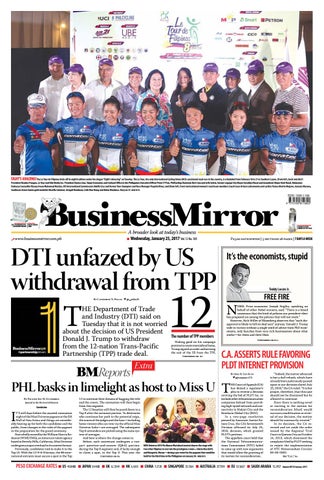
EIGHT’S AMAZING! The Le Tour de Filipinas kicks off its eighth edition under the slogan “Eight’s Amazing” on Tuesday. The Le Tour, the only International Cycling Union (UCI)-sanctioned road race in the country, is scheduled from February 18 to 21 in Southern Luzon. (From left, back row) Air21 President Reuben Pangan, Le Tour and Ube Media Inc. President Donna Lina, Taipei Economics and Cultural Office in the Philippines Executive Officer Peter CY Pan, PhilCycling Chairman Bert Lina and wife Sylvia, former Legaspi City Mayor Geraldyn Rosal and incumbent Mayor Noel Rosal, Malaysian Embassy Counsellor Rizany Irwan Muhamad Mazlan, UCI International Commissaire Adolfo Cruz and former Tour champion and Race Manager Paquito Rivas; and (from left, front row) national women’s road team members Coach Cesar Arturo Lobramonte and cyclists Tomas Martin Mojares, Genesis Marana, Southeast Asian Games gold medalist Marella Salamat, Avegail Rombaon, Irish Mae Nong and Aidan Mendoza. Story on C3. Nonie Reyes
media partner of the year
United nations
2015 environmental Media Award leadership award 2008
BusinessMirror
www.businessmirror.com.ph
A broader look at today’s business
n
Wednesday, January 25, 2017 Vol. 12 No. 105
DTI unfazed by US withdrawal from TPP
T
By Catherine N. Pillas
@c_pillas29
he Department of Trade and Industry (DTI) said on Tuesday that it is not worried about the decision of US President Donald J. Trump to withdraw from the 12-nation Trans-Pacific Partnership (TPP) trade deal.
12
The number of TPP members
Making good on his campaign promise to create more jobs at home, Trump signed an order authorizing the exit of the US from the TPP, Continued on A2
Special to the BusinessMirror
I
Conclusion
T’S still days before the awaited coronation night of the Miss Universe pageant at the SM Mall of Asia Arena and things are considerably heating up for both the candidates and the public, from changes in the rules of the pageant to the preparation for the grand ceremony. Now wholly owned by the William Morris Endeavor (WME/IMG), an American talent agency based in Beverly Hills, California, Miss Universe undergoes a major overhaul in its contest format. Previously, candidates vied to make it to the Top 15. With the 12-9-6-3 format, the 86 international entrants must secure a spot in the Top
PESO exchange rates n US 49.8480
12 to continue their dreams of bagging the title and the crown. The coronation will then begin from this segment. The 12 beauties will then be pared down to a Top 9 after the swimsuit portion. To determine who continues her path to the potential reign, the scores of the judges and the fans—including home viewers who can vote via the official Miss Universe links—are averaged. The subsequent Top 6 contenders are picked using the same system of averages. And here is where the change comes in. Before, each contestant undergoes a twopart question-and-answer (Q&A) portion: during the Top 6 segment and, if lucky enough to claim a spot, in the Top 3. This year the Continued on A2
Miss Universe 2015 Pia Alonzo Wurtzbach (center) shares the stage with two other Filipinos to ever win the prestigious crown—Gloria Diaz (left) and Margarita Moran—during a pre-event for the pageant that would be held for the third time in the Philippines on January 30. Nonie Reyes
business news source of the year
P25.00 nationwide | 5 sections 28 pages | 7 days a week
It’s the economists, stupid
Teddy Locsin Jr.
free fire
N
obel Prize economist Joseph Stiglitz, speaking on behalf of other Nobel winners, said: “There is a broad consensus that the kind of policies our president-elect has proposed are among the policies that will not work.” However, Rich Miller of Bloomberg observes that “such disapproval is likely to fall on deaf ears” anyway. Donald J. Trump rode to victory without a single word of advice from PhD economists, only hunches from very rich businessmen about what works—for them and their likes. Continued on A11
C.A. ASSERTS RULE FAVORING PLDT INTERNET PROVISION
BMReports PHL basks in limelight as host to Miss U T By Pauline Joy M. Gutierrez
2016 ejap JOURNALISM awards
By Joel R. San Juan @jrsanjuan1573
HE Court of Appeals (CA) has denied a regulator’s plea to reverse a decision reviving the bid of PLDT Inc. to exclude other telecommunication companies (telcos) from providing high-speed network and connectivity in Makati City and the Bonifacio Global City (BGC). In a two-page resolution penned by Associate Justice Ramon Cruz, the CA’s Seventeenth Division affirmed its July 25, 2016, decision, which granted PLDT’s petition. The appellate court held that the National Telecommunications Commission (NTC) failed to come up with new arguments that would allow the granting of its motion for reconsideration.
“Indeed, the matter advanced is but a dull rehash, which have already been judiciously passed upon in our decision dated July 25, 2016,” the CA ruled. “It is but proper, therefore, that this case should not be dismissed but be allowed to continue. Since there is nothing novel or exciting in the motion for reconsideration [that] would warrant a modification or reversal of our decision, the motion should be summarily treated.” In its decision, the CA reversed and set aside the order issued by the Regional Trial Court in Quezon City on October 14, 2013, which dismissed the complaint filed by PLDT seeking to enjoin the implementation of NTC Memorandum Circular 05-05-2002.
n japan 0.4408 n UK 62.3349 n HK 6.4265 n CHINA 7.2728 n singapore 35.1364 n australia 37.7399 n EU 53.5667 n SAUDI arabia 13.2957
See “C.A.,” A2
Source: BSP (24 January 2017 )
A2 Wednesday, January 25, 2017
BMReports BusinessMirror
www.businessmirror.com.ph
PHL basks in limelight as host to Miss U Continued from A1
ladies are slightly relieved of that pressure by having only one Q&A segment, which is during the Top 6. The last stage, the Top 3, features the Final Look. The Miss Universe official web site writes that here, “ judges and viewers are asked to make a decision based on their overall performances through the Final Look.” “Rather than score, this segment is ranked, meaning the judges and home viewers base their vote on who they think should win the title,” the web site article explained.
“Ganda” problems
RECENT predictions and roster of favorites by beauty-pageant web site Missosology.org places up-andcoming countries, such as Nicara-
gua and Barbados, alongside the previously mentioned mass producers of beauty queens. As for the Philippines, the country has garnered a total of six awards since 2010, including Pia Alonzo Wurtzbach’s iconic Miss Universe title, making a total of 20 placements and three crowns. With this setting, the billiondollar question rings loud and clear. Will Miss Philippines Maxine Medina bring home the crown again for a back-to-back victory? The 26 -year-old Philippine delegate is not new to the business in front of the crowd and the camera. Having had product endorsements, commercials and runway modeling gigs, Medina already has a taste of the world of pageantry. In addition, her parents were also involved in the same scene in their younger
years. Medina is also a freelance interior designer who graduated from the De La Salle College of Saint Benilde and the Philippine School of Interior Design. Despite an arsenal of things to be proud of under her belt, Medina has not escaped the eyes of the grammar Nazi netizens during the Q&A portion of Binibining Pilipinas, the national tilt that serves as a springboard to the international pageant. Moreover, she received a rather candid results prediction from none other than the country’s first queen of the universe: Gloria Diaz. The former beauty queen clarified her prediction of a one-in-amillion chance for Medina to snag the crown, saying it was not an issue with the candidate but with the political correctness of the bestowing of award.
“We’re the host. Parang can you imagine if we make our representative win? ’Eh di magwawala lahat ng candidates and also their countries, their ambassadors,” [Could you imagine—if we make our representative win, all the other candidates and also their countries, their ambassadors would then make a racket?] she told ABS-CBN News’s Marie Lozano. “And they would think that we are unfair.” She also insisted that Medina get an interpreter, should she feel that she could express herself better in Filipino. People’s Television (PTV) quoted her on social media, saying that “the first thing [Diaz] will tell her is to get an interpreter if she feels that she can better express her thoughts using our vernacular language.” On the other hand, pageant coach Jonas Gaffud, who has
DTI unfazed by US withdrawal from TPP Continued from A1
calling it a “bad deal”. (See related story on A6). Trump also said he will “return to these countries [TPP members] oneon-one,” and has expressed his preference to engage US allies through bilateral talks. “The Philippines was not part of the first round of talks for the TPP, so in a way, that’s good for us. Even when we started last year, our focus has always
been to strengthen on our existing trade arrangements,” Trade Secretary Ramon M. Lopez told the BusinessMirror. “We understand the decision by President Trump. He wants to review existing trade agreements rather than start new ones,” he added. Lopez said the Philippines intends to take full advantage of the Asean Economic Community, the Philippine-Japan Economic Partnership Agreement, and its free-trade agreement (FTA) with the European Free Trade Association. Manila is also holding discussions with the European Union for a possible FTA. The Philippines also enjoys tariff privileges under the US Generalized System of Preferences (GSP) and the EU’s GSP Plus scheme. The US-GSP is a special trade arrangement meant to promote economic growth in developing countries. Through it, a portion of Philippine exports to the US enjoys duty-free treatment.
However, the US-GSP is hinged on the development of a country, depending on the attainment of a particular level of national income or competitiveness. The Philippines may graduate from this scheme in a few years’ time. Asked if the Philippines is open to initiating, on its own, bilateral discussions with the US considering the temporary status of the US-GSP, Lopez said: “Yes, we want to focus and strengthen existing [deals], like our bilaterals with Japan, and the EU.” Aside from the fact that the Philippines is not a member of the TPP, the Duterte administration’s renewed focus on strengthening bilateral ties with China has apparently diminished the importance of the trade deal. Former US President Barack Obama had wanted to engage trade partners via expansive deals. The Aquino administration had expressed interest in taking part in the TPP, seeing it as a way to strengthen the country’s ties with its longtime ally.
PCSO. . .
trained the likes of reigning queen Wurtzbach, Miss International 2016 Kylie Versoza and Miss World 2013 Megan Young, bets higher for Medina. “Well, I am aiming for the Top 3. Gusto kong makapasok sa Top 3 si Maxine,” [I want Maxine to be included in the Top 3] he said. For her part, Medina echoes the same drive and determination of her coach, not paying any mind to the bashers—and even to Diaz’s suggestion—as she gears up to answer in English and boldly claims a back-to-back win.
All the PHL’s a stage
SET in the “eye-conic” SM Mall of Asia Arena this January 30, the coronation night will soon reveal who really rises above the rest to receive the legendary crown and the title of Miss Universe. Back on
Continued from A12
“Collection mo jueteng. You are a corporation. Laro mo jueteng. Gawa. Your collection is jueteng. Gawa. But you are a small town lottery,” he said. “Now, magloloko ka pa kaya? [Would you go illegal.)” Eh kung magloko ka [If they persist] then that will be forfeited in favor of the government,” he added.
Top recreational activity
Based on the final results of the 2013 Annual Survey of Philippine Business and Industry (ASPBI) for the Arts, Entertainment and Recreation Sector, the Philippine Statistics Authority (PSA) said 38.9 percent of 3,099 establishments, or 1,207 establishments in the sector, were engaged in gambling and betting activities. Businesses engaged in gambling and betting employed the most with 25,560 employees, representing 51.1 percent of the 49,998 people employed in the sector in 2013. Across industry group, gambling and betting activities also paid the highest average annual compensation of P497,000 per employee. Gambling and betting firms also generated the most income in the sector worth P66.6 billion, or 80.4 percent of the total P71.4 billion in 2013. But in terms of expenses, gambling and betting firms also recorded the highest in the sector at P41.2 billion. This represented 74.8 percent of the total expense of the sector at P55.1 billion.
the stage for better or for worse, depending on the spectators’ taste, is comedian and host Steve Harvey (best remembered for his very comical mistake). He is joined by Ashley Graham, well-known American model, as the backstage host. Meanwhile, social-media personality Bretman Rock and Binibining Pilipinas 2014 & Miss Universe 2010 4th Runner-up Venus Raj will cohost the Miss Universe Red Carpet event. Performers are yet to be announced, although Flo Rida already confirmed that he will be performing for this year’s show. All in all, the 65th Miss Universe boils down to more than just an annual spectacular display of feminine curves and beauty. It is a platform for elevating the candidates’ advocacies and celebrating cultural diversity.
CA. . .
Continued from A1
The regulator’s order was titled “Rules and Regulations on the Provision of High Speed Networks and Connectivity to the IT Hub Areas”. Instead, the appellate court, reinstated the case filed by PLDT and remanded the same to the RTC in Quezon City for further proceedings and for it to resolve the issues “with dispatch.” The NTC memorandum declared as “free zone” parts of Makati City, specifically the BGC and Rizal Commercial Banking Corp. (RCBC) bounded by Sen. Gil Puyat Avenue, Edsa, Kalayaan Avenue, Lawton Avenue, Mc Kinley Road (Edsa), Arnaiz Avenue (Pasay Road) and Chino Roces (Pasong Tamo). These free zones are described as areas where any telco with a valid franchise can be allowed to provide related services. In its complaint before the trial court, PLDT asserted the NTC memorandum is void as it contradicts Republic Act 7925, which mandates the NTC to give priority to the areas that are not yet served in cases of expansions of telecommunications network. Likewise, PLDT said the NTC ruling’s implementation is“unfair and arbitrary” because the IT Hub areas were declared as“free zones”sans the benefit of public hearing and consultation. PLDT added the NTC order violates the Manuel V. Pangilinan-led firm’s memorandum of agreement with Fort Bonifacio Development Corp. (FBDC) in 2002 for the acquisition of Smart Communications Inc. and FBDC’s shares in Bonifacio Communications Corp., a communications infrastructure provider. The MOA between the FBDC and PLDT for the acquisition of FBDC’s shares in BCC provides a condition that PLDT will be “the sole provider of basic telecommunication and related services in the areas declared by NTC as free zones. Despite the agreement, BCC said it discovered in 2007 that Globe Telecom Inc. subsidiary Innove installed and constructed their own communications infrastructure within the area reserved for BCC. To assert its rights under the deal, the BCC said it sent several demand letters to FBDC, Globe and Innove to desist from impairing the contractual rights of BCC. This prompted Innove to bring the matter to the NTC asking that the latter enforce MC 05-0502002 within the BGC. PLDT then questioned NTC ’s decision alleging the government regulator sided with Innove. The telco filed a complaint before the RTC in Quezon City with a prayer for the issuance of a temporary restraining order (TRO) against the implementation of the circular. The RTC in Quezon City, however, dismissed PLDT’s complaint for being premature. The lower court held that PLDT failed to exhaust the administrative remedies before elevating the matter before the court. Concurring with the ruling were Associate Justices Marlene GonzalesSison and Henri Jean Paul Inting.
The Nation BusinessMirror
news@businessmirror.com.ph
Editor: Dionisio L. Pelayo • Wednesday, January 25, 2017 A3
Fear grips Korean community in Angeles By Ashley Manabat | Correspondent @ashleymanabat
A
NGELES CITY—“Where is the mayor?”
Worried Koreans asked this question in the midst of continuing reports on the kidnap-killing of former Hanjin executive Ji Ick-joo last October 18. Reports of the incident only came out in the media recently, after the victim’s wife came to seek justice for the disappearance of her husband and to reveal the cotinuing demand for ransom of his abductors. Even the Korean Community Association Central Luzon Inc. (KCACLI), whose officers are known to speak out against the atrocities committed against their compatriots, won’t talk this time. During a visit made by the BusinessMirror at the KCACLI office in Barangay Anunas here, the Koreans manning the office only said: “Our association only provides services to Korean tourists.” Questions from persistent reporters were only met with worried looks and blank stares. A Korean in the building speaking in halting English and Tagalog said the Koreans in the country “are afraid, angry, upset and confused”. “We don’t know whom to trust anymore,” he said, as he reiterated that only Angeles City Mayor Edgardo Pamintuan can somehow calm their nerves. “Angeles has become a really dangerous place for Koreans,” he lamented. Pamintuan is attending the third round of the peace talks with communist rebels in Rome as adviser to the government panel. Reports indicate that Pamintuan learned about Ji’s kidnapping last November, after the top official of a Korean company went to see him and asked for his help to find Ji. It was also reported that on November 20, 2016, the Korean official asked for updates and Pamintuan mentioned the recovery of the bodies of three Koreans from the FVR Megadike in nearby Bacolor town last October 11. But the Korean clarified that these victims were not associated with Ji. Some of the killings of Koreans here include: On February 19, 2014, Korean Her Tae-suk, 65, was shot dead while walking with three other Koreans toward Prism Hotel on Clarkview Avenue. On September 17, 2015, Korean hotel owner Park Youn-jae, 60, was shot dead inside his office on Friendship Highway here. Policemen allegedly preying on Koreans surfaced in January when a woman accused eight Koreans of gang-rape. But the alleged gang-rape victim was seen on closed-circuit television with her Korean companion hopping from one restaurant to another having a good time at the time of the alleged gang-rape. On Tuesday, the National Police is investigating yet another case involving alleged rogue cops and South Korean victims in this city. Chief Supt. Aaron Aquino, Central Luzon police commander, said seven cops from the Angeles City Police Station 5 and their com-
Recto to ‘Bato’: Focus on Natl Police reforms if you are not resigning By Butch Fernandez
S
@butchfBM
INCE he would not go ahead with earlier threats to resign as National Police chief, Senate Minority Leader Ralph G. Recto prodded Director General Ronald “Bato” M. dela Rosa to focus his efforts on reforming the police organization. Recto suggested that dela Rosa must “adopt as his birthday wish to himself the firm resolve to rid the police organization of scalawags, like the ones who choked to death inside Camp Crame the Pampanga-based Korean trader they had abducted earlier.” Recto pointed out that the 55-year-old dela Rosa has “exactly one more year before he retires to do some serious house cleaning.” In a statement, the senator suggested that dela Rosa’s battle plan for the next 365 days should be “to leave behind a PNP purged of the crooks who give the whole organization a bad name.” Recto added that if dela Rosa manages to stay in office despite mounting calls from influential personalities for his resignation, “then he should dedicate his every waking hour thereafter to disprove his critics and to show that he deserves his continued stay in his post.” The Senate minority leader hastily clarified he was not joining calls for dela Rosa to quit or be fired. But Recto added: “If you are not ordered to resign, then reform the National Police.” Recto recommended that the National Police chief could start by “acknowledging that problems do exist; then, follow it up with an action plan on how to solve them.” “Don’t answer with excuses or alibis. This is not the time to be a denial king,” he advised the country’s top policeman. Recto acknowledged, however, that “considering the gravity of the problem, any plan can only be a radical one. The people would immediately know if you’re applying a Band-Aid solution.” He added: “Heads must roll. Consider a major reshuffle and ignore the political patrons of officers. Your motto should be: ‘Bato bato sa langit, ang matanggal huwag magalit.’” Recto noted that dela Rosa should also acknowledge that the current controversies and problems embroiling the National Police are “institutional” in nature. “The bad press you’re getting is due to bad cops. Thus, it can’t be solved by diversionary tactics, but by taking out deeply rooted reasons.”
mander have been placed under restrictive custody and are now facing administrative charges and dismissal from the service after three Koreans claimed that they were “arrested” and “illegally detained” inside the police station for seven hours. The policemen who are assigned to the Angeles City Police Station 5, Aquino said, raided a house at Friendship Plaza Subdivision—the same subdivision where Ji was taken last October 18—and arrested several
Koreans without warrant for allegedly conducting illegal online-gambling operations. The cops allegedly took the Koreans’ shoes, golf clubs, jewelry and cash amounting to P150,000. Then they took them to Station 5, where the policemen asked for more money. It was reported that the Koreans were released after they allegedly paid P300,000 to the policemen. But the policemen also allegedly took P10,000 from the wallets of the Koreans before they were released.
The incident happened on December 30, 2016, and the victims filed a complaint at the South Korean Embassy on January 5. “This is the first time they visited the Philippines. They just went here to play golf. It was a traumatic experience,” Aquino was quoted in the report as saying. According to Aquino, there were no complaints against the Koreans or even a blotter entry documenting the “arrest”.
Economy
A4 Wednesday, January 25, 2017 • Editors: Vittorio V. Vitug and Max V. de Leon
Only a third of CCs have chosen RES, DOE exec says By Lenie Lectura @llectura
T
he number of contestable customers (CCs) who have chosen their supplier of electricity has only reached nearly 500. Latest data from the Energy Regulatory Commission (ERC) showed that out of the total 1,595 CCs, only 491 have chosen their retail electricity supplier (RES). “As of November 2016, the total number of CCs is 1,595, 491 of which already with RES. Per submission to ERC, usual reason is lack of offer from RES and price,” ERC Spokesman lawyer Rexie Digal said in a text message on Tuesday. In a bid to entice more CCs, the agency is planning to launch a campaign to raise awareness. “The ERC is doing continuous information dissemination. There is a plan to conduct info campaign in Luzon and the Visayas,” the ERC official added. Under the retail competition and open access (RCOA) policy, CCs are allowed to choose their supplier of electricity to encourage competition in the generation and supply sector. Under the rules, the implementation of mandatory migration for CC with 1 megawatt (MW) and up average peak demand is on February 26. Energy Undersecretary Felix William B. Fuentebella has said the agency is mulling over the possibility of imposing this on a voluntary basis, though the schedule will push through. “It is pushing through because it is mandated. The schedule will push through. What we are looking at is to make it optional,” Fuentebella said. He said the DOE, together with the ERC, is currently evaluating this. The ERC spokesman said this matter has yet to be decided. “We are looking at the mandatory aspect. How about the contestable customers that were notofferedaRES?[Energy]Secretary[AlfonsoG.] Cusi wants to revisit this policy so there maybe an adjustment,” Fuentebella added. Cusi, he said, is open to enforcing this on a voluntary basis. “He is open in making it not mandatory, only optional so as to strengthen this policy and for consumers to have more the choices,” Fuentebella said. Based on existing rules, an end-user with an average monthly peak demand of at least 1 MW is mandated to enter into a Retail Supply contract with a RES by its mandatory contestability date of December 26, 2016.
BusinessMirror
news@businessmirror.com.ph
Domestic trade transactions posted double-digit jump in Q3 last year
C
By Cai U. Ordinario
@cuo_bm
ommodities traded across the Philippines posted a double-digit growth in the third quarter of 2016, according to the Philippine Statistics Authority (PSA). Based on the latest Commodity Flow report, the PSA said domestic trade transactions via water and air increased by 21.4 percent to 4.09 million tons in the third quarter of 2016, from 3.37 million tons in 2015. In terms of value, commodities
that traded within the country reached P149.14 billion during the third quarter of 2016, representing a 65-percent growth, from P90.40 billion in the same period of 2015. “Data on the inflow and outflow of commodities in the different regions of the country are
₧149.14B The value of commodities traded within the country during the third quarter of 2016, representing a 65-percent growth, from P90.40 billion in the same period in 2015
used to construct interregional and interindustry relation tables,” the PSA added. Around 99.8 percent of domestic trade was done through water and the rest was done via air.
The top commodities traded within the country were led by machinery and transport equipment. Shipments of this commodity amounted to P47.31 billion, representing 31.7 percent of the total value of commodities traded nationwide. This was followed by food and live animals and mineral fuels, lubricants and related materials, which amounted to P36.53 billion and P21.42 billion, respectively. Metro Manila or the National Capital Region (NCR) accounted for the lion’s share of domestic trade at 22.7 percent, or P33.85 billion. This was followed by Western Visayas, with P31.70 billion, or 21.3 percent, followed closely by Northern Mindanao with P18.19 billion, or 12.2 percent.
“Calabarzon contributed the least share in value of domestic trade amounting to only P210.9 million, or 0.1 percent of total,” the PSA said. Domestic trade statistics are compiled from coasting manifests and coastwise passenger manifest collected from Philippine Ports Authority and from airway bills from the Philippine Airlines collected by the PSA. Commodity flow or domestic trade statistics are generated from these administrative-based documents to record flows of goods through air, rail and water transport systems in the country. One limitation of this set of statistics is rail mode of transport is not covered in the compilation.
Pinoy netizens spend 4+ hours a day on social media–report
D
STREET roast A street entrepreneur uses a huge pan and a long ladle to roast chestnuts in Binondo district ahead of the Chinese New Year revelry at the predominantly Filipino-Chinese enclave in the heart of the country’s capital city Manila. ROY DOMINGO
briefs exact change for buyers, consumers Business establishments are now mandated to give exact change to consumers with the Department of Trade and Industry’s (DTI) enforcement of the No Shortchanging Act. The implementing rules and regulations (IRR) of Republic Act (RA) 10909, or the No Shortchanging Act of 2016, was released last December and took effect on Tuesday. Under RA 10909, all business establishments, including sari-sari stores, and government-owned and -controlled corporations and agencies performing proprietary functions, are mandated to give exact change to consumers and prohibited, as well, from giving other forms of change. “With the issuance of the IRR, we hope that the giving of exact change to consumers of goods and services will finally be institutionalized and become everybody’s responsibility,” DTI Undersecretary for Consumer Protection Teodoro Pascua said in news statement. Under the law, the following are expected from business establishments to give the exact amount of change without waiting for the consumer to ask for it; use price tags, when appropriate, in goods and services being offered for sale; issue official receipts and sales invoices, as may be applicable; post notices to remind cashiers to give exact change; and, provide DTI documents pertaining to the establishments’ gross sales of the day for confirmation of any alleged violation of the Act and to determine the penalty imposable. Consumers should report to the business establishment’s consumer welfare desk any act of shortchanging or to file a complaint with the DTI within 10 days after a violation has been committed. Business establishments found to have violated the provisions of the Act face the penalty ranging from P500 to P25,000, or 3 percent to 10 percent of gross sales on the day of violation, whichever is higher. Catherine N. Pillas
zero waste month celebration slated from jan. 26 to 29
The Department of Environment and Natural Resources-Environmental Management Bureau (DENR-EMB) and the National Solid Waste Management Commission (NSWMC) will lead this year’s celebration of Republic Act 9003, and the Zero Waste Month from January 26 to 29 in Quezon City. Also known as the Ecological Solid Waste Management Act of 2000, the law promotes proper solid-waste management and mandates local government units (LGUs) to implement solid-waste management programs that will address the looming garbage crisis. With the theme “Engaging Response to the Changing Environment”, the DENREMB, NSWMC and zero waste advocates will showcase various ways to reduce, reuse and recycle (3Rs) solid wastes during the one-day event. January of every year is declared as Zero Waste Month.
The DENR-EMB, which serves as the secretariat of the NSWMC has prepared an array of activities, including exhibition, bike run/fun-ride, symposia, stage play and concert next week, starting on Thursday, January 26, at the Quezon Memorial Circle. The event hosted by the Quezon City government is held in partnership with the Metropolitan Manila Development Authority, Climate Change Commission, and the departments of the Interior and Local Government, Science and Technology, and the Philippine Information Agency. Mayor Herbert Bautista, Sen. Cynthia Villar, Environment Secretary Regina Paz L. Lopez are expected to lead the event, with other government officials and nongovernmental organization leaders. Exhibitors include the EMB Central Office, EMB Regional Offices (NCR, Region 3 and Region 4A), the Quezon City government, the NSWMC, Climate Change Commission and Zero Waste and Recycling Movement of the Philippines, among others. Ely Ildelfonso, executive director of the NSWMC Secretariat, said there are a number of ways to reduce garbage produce by as much as 75 percent through recycling and composting alone. The official said LGUs will learn a lot from the three-day event to help address their respective localities’ garbage woes. Jonathan L. Mayuga
b.o.c. eyes to earn p16m in auction of seized goods The Bureau of Customs (BOC) is looking to earn P16 million additional revenue with sale of 23 lots of abandoned and/or seized goods, including luxury vehicles, at the Manila International Container Port later this month. In a statement released on Tuesday, the bureau said they will be earning a total of P16,160,649.62 on the public auction, which is scheduled on January 30 at the said port. The shipments up for sale include four units of Cadillac Escalade and one unit of Lincoln Navigator with a floor price of P2,250,000; two units of used car pegged at P600,000; two containers of 40 footer bicycle parts and accessories pegged at P1,474,000; five containers of 40-footer color sandwich panels color plate pegged at P2,963,438.62; and one container of 40-footer e-bike parts and accessories priced at P1 million. Also included in the bidding are 48 containers of 20-footer bunker/slop oil with a floor price of P1,096,035; two units used Hyundai Starex Ambulance 2003 pegged at P600,000; two containers of 40-footer Mizuno golf bags and shoes, pegged at P989,100; one unit used Kawasaki motorcycle without key, and one unit Valiant rescue boat with key, all valued at P130,000; and three units IAC 250 series mini sound shelter pegged at P150,000. The merchandise that will be for sale includes damaged bags, wallets and shoes; garments; foamboard; Chumpo e-bike; structural accessories for window covering; sacks of white salt; used household goods; sacks of Portland cement; donated medical supplies and religious books/leaflets. PNA
espite poor network availability, Filipinos spent the most time on social media globally, according to the latest Hootsuite and We Are Social report. Based on the Digital 2017 report, Filipinos spent an average of 4.17 hours on a social media a day, topping netizens from five other Asian countries as of January this year. Rounding up the top 5 in the world in terms of time spent on social media were North and Latin American countries, namely, Brazil, Argentina, Mexico and the United States. “One of the greatest opportunities of a digitally connected world is the ability to have immediate conversations, wherever and whenever customers want. Social media not only enables organizations to amplify its brand, but also build trust, credibility and human relationships at scale. It is now as much the responsibility of the top executive as the socialmedia manager,” said Roger Graham, senior director, Growth and Marketing for Asia Pacific (Apac) region, Hootsuite. Data showed that as of January 2017, there were another 13 million Filipinos who used the Internet, a 27-percent growth from January 2016. Another 12 million Filipinos became active social-media users in January 2017, a 25-percent yearon-year growth and 13 million more Filipinos who became active mobile social-media users, a 32-percent growth from January 2016. Data also showed another 2 million Filipinos became unique mobile users in January 2017, a 3 percent growth from last year. In terms of share of Web traffic by device, more than half, or 56 percent, of Filipinos who used the Internet accessed it through laptops and desktops. However, this was a 13-percent decline from January 2016. There was, however, a rapid increase of 31 percent among Filipinos who used mobile phones to access the Internet. Around 38 percent of Filipinos users who ac-
cessed the Web did so via mobilephone devices. Only 6 percent of Filipino Internet users used tablets and 0.02 percent used other devices. There was a 7-percent decline among those who used tablets, while there was a 100percent increase in the use of other devices to go online. “Half of the world’s population is now online, which is a testament to the speed with which digital connectivity is helping to improve people’s lives. The increase in Internet users in developing economies is particularly encouraging,” said Simon Kemp, We Are Social. “Given this latest data, it’s probably time for us to stop referring to social as ‘new media’, and integrate it more seamlessly into our day-to-day activities.” Examining data from 238 countries, the sixth annual report finds 50 percent of the world is now connected to the Internet and examines the opportunities that increasing connectivity has for organizations worldwide. In the Apac region, mobile data traffic leads significantly over other regions, with 4.12 billion gigabytes consumed, compared with 1.24 gigabytes from North Europe, Middle East and Africa. Social-media growth rates increased by over 50 percent year-onyear. More than 1.5 billion people across the Apac region now use social media on a monthly basis, 95 percent of whom access social via mobile devices—the highest ratio in the world. As a result, organizations in Apac should plan to transform their communications strategy to increase customer engagement and real-time interaction across the customer journey. The report compiles data from the world’s largest studies of online behavior, conducted by organizations, including GlobalWebIndex, GSMA Intelligence, Statista and Akamai, in a comprehensive state of social-media reference. The 2016 report has seen nearly 70,000 downloads and 2.5 million reads on SlideShare to date. Cai U. Ordinario
Agriculture/Commodities BusinessMirror
news@businessmirror.com.ph
Editor: Jennifer A. Ng • Wednesday, January 25, 2017
A5
SRA hikes sugar allocation for local market By Jasper Emmanuel Y. Arcalas
T
@jearcalas
he Sugar Regulatory Administration (SRA) said it has increased its sugar allocation for local consumers and industries this year to stabilize prices and supply. The SR A, an attached agency of the Department of Agriculture (DA), has issued Sugar Order (SO) 1-A, which authorized the reallocation of locally produced sugar in crop year (CY) 2016-2017. SO 1-A amended SO 1 issued by the SR A on August 31, 2016. Under SO 1-A, the SRA hiked the allocation for “B” (domestic) sugar to 94 percent from 92 percent. “A” sugar, which is exported to the US, has been reduced to 6 percent from 8 percent. The agency pegged the domestic sugar demand for the current crop year at 2.15 million metric tons. “The domestic sugar market remains as the priority market for locally produced sugar, and to maintain a comfortable buffer or carry-over volume of ‘B’ sugar during the end of season and for the start of the crop year for stable supply and price,” SRA Administrator Anna Rosario V. Paner said in SO 1-A. The Philippines exports sugar to the US under the tariff rate quota (TRQ) scheme. The TRQ allows countries to export specified quantities of a
product to the US at a relatively low tariff. “Our US quota is only 136,000 metric tons [MT]. The sweetness of our sugarcane should be first enjoyed by our kababayans,” Paner said. For CY 2016-2017, Washington said it will allow the Philippines to ship 142,160 MT raw value or 136,201 MT of sugar to the US. Paner also made an assurance that, should Washington decide to increase the country’s sugar allocation, the Philippines would be able to deliver the additional requirement of the US. “We have to watch how US and Mexico relations will pan out. Mexico wants to export more [sugar] but I think the US is noncommittal. So if the US doesn’t allocate any quota to Mexico, then other sugar-producing countries like the Philippines may be considered for additional allocation,” she said. The SRA projected that sugar output in the current crop year could reach 2.25 MMT, higher than the 2.236 MMT produced in CY 2015-2016.
Bloomberg photo
NIA to publish list of ongoing, proposed irrigation projects
T
he National Irrigation Administration (NIA) said it will publish all its ongoing and proposed irrigation projects for 2017 in line with the agency’s efforts to promote transparency. NIA Administrator Peter Tiu Laviña said he has ordered central, regional and project offices of the agency to make a list of the ongoing and proposed irrigation projects. Laviña added that this is part of the Duterte administration’s thrust to inform the public about the current initiatives of the NIA, which is attached to the Office of the President.
Environment group: Mining law needs proper implementation, not repeal
R
epealing the Mining Act of 1995 could only encourage illegal-mining activities that do not respect government regulations, according to an environment group. The Philippine Business for Environmental Stewardship (PBEST) warned against moves by Congress to repeal the Mining Act and replace it with proposed legislation collectively referred to as alternative mining bills (AMBs). PBEST said the Committee on Natural Resources of the House of Representatives had started conducting technical working group meetings to deliberate on the AMBs. “The law has technically been just in operation for less than eight years, and a cycle in the mining industry spans more or less 20 years. There is no need to repeal the mining law. The real problem is implementation,” said Prof. Dindo Manhit, convenor of PBEST and president of Stratbase-Albert del Rosario Institute. The Mining Act—or Republic Act 7942— faced constitutional challenges, while Executive Order 79 in 2012 effectively stymied its implementation. Changing the rules in the middle of the game may just foster illegal-mining activities that do not follow environmental regulations, Manhit said.
He added that, while the goals set in amending the Mining Act or creating new mining regulations are in the best interest of the country, the proposed methods may not be the most effective. Some of the proposals include limiting the raw metals the country will produce to only serve the local market. PBEST said this will not jump-start industrialization as envisioned, but may even kill the mining industry. Proposals to extend the no-mining zones over what are already covered under the Mining Act and the National Integrated Protected Areas System Act are practically tantamount to a nationwide mining ban. Lawyer Ysan Castillo, secretary-general of PBEST, said despite the group’s opposition to the law’s amendments, PBEST does not think that the existing law is perfect. “There is still a lot of room for improvement, such as the transparency and dissemination of data concerning environmental programs, findings and mineral production,” he said. Castillo said additional funds should be dedicated to environmental protection, the increase of waste-generation fees and some form of substantial guarantee fund for natural hazards.
“I would like to make available to the public the lists of projects in their areas of jurisdiction,” he said in a statement. Laviña added that this transparency effort is in support of the current government’s aim to “regain the trust and confidence of the public”. “This will help promote open and transparent governance and, likewise, dispel speculations that NIA is keeping the list to favor certain contractors,” he said. The NIA chief also directed all regional managers to post all the irrigation projects for bidding on Phil-
ippine Government Electronic Procurement System and encourage more contractors to join project/s bidding. The agency’s budget has seen increases in recent years owing to the government’s bid to achieve rice selfsufficiency and wipe out imports. NIA’s budget had breached the P20billion mark during the term of former President Benigno S. Aquino III. For this year, the agency’s total budget reached more than P38 billion, including the P2.3-billion additional allocation for free irrigation. Former officials of the Department of Agriculture had pushed for
an expansion in irrigated areas in the country to enable farmers to produce more paddy rice. According to the Philippine Statistics Authority (PSA), paddy-rice output in the January-to-June period could reach 8.54 million metric tons (MMT), 11.68 percent higher than the 7.65 MMT recorded a year ago. The PSA said natural calamities, such as strong typhoons, caused rice farmers to incur losses last year. Its data showed that 2016 production settled at 17.63 MMT, 2.88 percent lower than the 18.15 MMT recorded in 2015. Jasper Emmanuel Y. Arcalas
Vietnam rice exports set to face another tough year
H
o Chi Minh City—Despite facing difficulties, Vietnam will strive to achieve rice exports of more than 5 million tons (MT) this year, the Vietnam Food Association (VFA) has said. Speaking at a meeting to review the VFA’s performance last year in Ho Chi Minh City on Monday, its secretary, Hu`y nh Minh Huê, said last year only 4.89 MT were exported for $2.12 billion, a 25.5-percent fall in volume and a 20.57-percent decline in value. There was excessive supply in the global market last year, and there has been a recent trend of major importing countries increasing domestic production to reduce imports, he said. Vietnam’s rice exports are likely to face another difficult year, as supply outstrips demand and global competition intensifies, he said. He quoted the US Department of Agriculture as saying global rice output in 2016/2017 is estimated to increase by 1.6 percent from last year to 480 MT due to an expansion in the area under rice in many countries, including Australia, Myanmar, Brazil, India, Indonesia, North Korea, Pakistan, Thailand and the US, he said.
Global exports are expected to rise by 1 MT, or 2.6 percent, to 40.6 MT, he said. Stockpiles have been increasing for the last three years and are expected to reach the highest levels since 2001/2002 crop, he said. Hu`y nh Thê Năng, VFA chairman, said despite the hurdles, rice businesses would strive to export higher volumes than last year to ensure farmers can sell off as much of their outputs as possible. In the long term the domestic rice sector targets exports of high-value rice to affluent markets, he said. He said the Plant Protection Department and other relevant agencies should take measures to improve the hygiene and food safety of Vietnamese rice to enable more exports to choosy markets. The association said rice exporters should meet hygiene and food-safety standards and strengthen linkages with farmers to ensure a steady source of the grain to meet market demand. Hue called on the Ministry of Agriculture and Rural Development to build an international standard laboratory in Can Tho to help exporters check their rice quality, especially look for plant protection chemical residues, instead of
sending to other countries for analysis as is done now. Năng said authorities in rice-growing localities need to do more to instruct farmers in producing rice meeting safety standards, encourage them to use more certified rice seedlings, and improve technical and financial support systems. Do Hà Nam, chairman and general director of Intimex Group Joint Stock Co.—one of the country’s 10 largest rice exporters—said while exports of other kinds were down, exports of Japonica and sticky rice went up by 136.95 percent and 96.59 percent. “But farmers have [since] rushed to grow more sticky rice, which [poses a] risk.” He said the government should work with China to facilitate exports of Vietnamese rice to that country. “We face severe competition in terms of price from Pakistan and India. There may be difficulties, but if we choose to invest in varieties like fragrant rice and sticky rice, there will be opportunities.” Lê Thanh Tùng of the Crop Production Department said Vietnam has the potential to boost exports of sticky, fragrant, Japonica and high-quality rice varieties. PNA/VNS
A6
Wednesday, January 25, 2017
The World BusinessMirror
Trump’s withdrawal from trade pact viewed as boon for China
U
Nited STATES President Donald J. Trump’s withdrawal from a long-planned Pacific trade pact creates a political and economic vacuum that China is eager to fill, potentially damaging American prestige in Asia.
With Trump making good on his campaign pledge to nix a deal that was the centerpiece of predecessor Barack Obama’s Asia policy, China’s leaders are already ramping up support for globalization and free trade. In a speech last week to the World Economic Forum at Davos, President Xi Jinping likened protectionism to “locking oneself in a dark room.” Trump opposed the pact because he said it could hurt American jobs. But the impact of his decision is likely to go beyond trade, giving more leeway to Xi to position China as an economic and military anchor in the western Pacific. Since coming to power, Xi has sought to expand China’s trade ties with its neighbors and begun an ambitious infrastructure project designed to reinvigorate ancient trading routes to the Middle East and Europe. T he fa i lu re of t he US -led Tr a n s - P a c i f i c P a r t n e r s h i p (TPP)—which would have covered 12 nations and about 40 percent of global GDP—will see China step up its advocacy for an alternative pact first conceived by Southeast Asian countries. That deal doesn’t currently include the US and contains fewer measures to tack le nontar iff barriers to trade. The TPP was contentious in part because it addressed issues like environmental and labor protections. “ The US is now basically in a position where we had our horse, the Chinese had their horse— but our horse has been put out to pasture and is no longer running in the race,” said Eric Altbach, vice president at Albright Stonebr idge Group in Washing ton and former deputy assistant US Trade Representative for China Affairs. “It’s a giant gift to the Chinese because they now can pitch themselves as the driver of trade liberalization.” Under Obama, the US used its Asia “pivot” to push back against China, which threatens over time to displace decades of US domi-
40%
The percentage of world GDP that Trans-Pacific Partnership would have covered
nance. While China has grown in clout it has also unnerved neighbors with its military expansion and its behavior over disputed areas of the East China Sea and South China Sea. The TPP was seen as a way to further bind countries, including smaller Southeast Asian nations, to the US—and act as a buffer.
Aircraft carrier
China is concerned alongside other nations that Trump will pursue protectionist policies, Zhang Jun, an economic affairs official at the foreign ministry, said on Monday in a briefing before the TPP announcement. “If China has taken up a leadership role, it is because the front runners have stepped back, leaving that place to China,” Zhang said. Sen. John McCain, an Arizona Republ ic a n who c ha irs the Armed Services Committee, ripped Trump’s decision. Obama’s last defense secretary, Ash Carter, once said the TPP would be more strategically valuable than another aircraft carrier battle group in the Pacific. The US withdrawal “will create an opening for China to rewrite the economic rules of the road at the expense of American workers,” McCain said. “And it will send a troubling signal of American disengagement in the Asia-Pacific region at a time we can least afford it.” “It’s arguable that the US would have, in fact, benefited more from the TPP than Asia as average tariff levels are higher in Asia than the
President Donald J. Trump shows the executive order that he signed withdrawing US from the Trans-Pacific Partnership. Bloomberg News
US,” said Shane Oliver, the Sydneybased head of investment strategy at AMP Capital Investors Ltd. “Bilateral deals could ultimately have the same impact but will take a long time to reach,” he said. “I think the focus will now shift to regional deals involving China.” The 16-nation Regional Comprehensive Economic Partnership (RCEP) being championed by China takes in Southeast Asia countries, plus Japan, South Korea, Australia, New Zealand and India. Some leaders from TPP nations signaled after Trump’s election they’d shift their attention to the RCEP, with the next round of talks due to be held as soon as next month in Japan. While some TPP leaders have indicated they might try and push on without the US, the pact looks to have run its course, said Victor Gao, director of the China National Association of International Studies who was a translator for late leader Deng Xiaoping. “In China, we have an old saying: if a ship idles by the river bank by itself, other ships will keep sailing forward, and will leave the idled ship behind,” he said. Obama regularly warned that failure to pass the TPP would let Beijing replace Washington in driving the rules of global trade. And his Council of Economic Advisers estimated the passage of RCEP would lead to the loss of market share among US industries that now export more than $5 billion in goods to Japan.
Economic Impact
But the TPP never had overwhelming support in Congress, where many Democrats applauded Trump for withdrawing from it. “I am glad the Trans-Pacific Partnership is dead and gone,” Sen. Bernie Sanders of Vermont, who campaigned for president as a Democrat on a promise to scrap the deal, said in a statement. The biggest economic impact
will likely be on apparel and footwear importers who would have seen tariff savings, according to Bloomberg Intelligence analyst Caitlin Webber. And it will likely be harder for US companies to penetrate Asian supply chains in the future. Beyond trade, Asian leaders are stung after investing political capital in the deal. Killing TPP “really undermines the United States” in the eyes of Asian allies, according to Ian Bremmer, president of the Eurasia Group. “They put a lot of effort into it, and now they feel like they can’t rely on the United States.” Still, influence in Asia appears less important to the new president than his ability to deliver on a campaign promise and burnish his image as a champion of American workers. At his signing ceremony on Mond ay i n t he O v a l O f f ice, Trump called the move a “great thing for the American worker, what we just did.” And it may not be smooth sailing for China even if the TPP is finished. “China will tr y to fill the gap now, and yet, China is a colossal net exporter, not importer,” said Michael Ever y, head of financial markets research at R aboban k Group in Hong Kong. “Caveat Emptor for Asia if it rushes from TPP to RCEP.” Beijing could find challenges now rallying other nations behind it, according to Barr y Naughton, a professor of Chinese economy at the University of California in San Diego. “They are not in position to take their ow n interests and merge that with a set of global interests and make the kind of sacrifices necessary to bring allies closer to them,” he said on Bloomberg Television. “If we look at their record over the last couple of years, we have to say they are not up to the challenge yet.” Bloomberg News
Meeting with top lawmakers, Trump repeats an election lie
W
ASHINGTON—President Donald J. Trump used his first official meeting with congressional leaders on Monday to falsely claim that millions of unauthorized immigrants had robbed him of a popular vote majority, a return to his obsession with the election’s results even as he seeks support for his legislative agenda. The claim, which he has made before on Tw it ter, h a s been judged to be untrue by numerous fact-checkers. But the new president’s willingness to bring it up at Monday’s White House reception in the State Dining Room is an indication that he remains focused on his election even after assuming power. Tr u mp appea rs to rem a i n concerned that the public will view his victory—and his entire presidency—as illegitimate, if he does not repeatedly challenge the idea that Americans were
deeply divided about sending him to the White House to succeed President Barack Obama. Trump won 304 electoral votes to capture the presidency, but he fell almost 3 million votes short of Hil lar y Clinton in the popular vote. T hat rea lit y appears to have bothered the president since Election Day, prompting h i m to re peated ly compl a i n that adversar ies were tr y ing to under mine him. Moving into the White House appears not to have tempered t hat a n x iet y. Severa l people familiar with the closed-door meeting on Monday night, who asked to remain anonymous in discussing a private conversation, said Trump used the opportunity to brag about his victory. As part of that conversation, Trump made the assertion about unauthorized immigrants voting in huge numbers for Clinton. That is similar to a Twitter message he
posted in late November 2016 that said he would have won the popular vote “if you deduct the millions of people who voted illegally.” Voting officials across the country have said there is virtually no evidence of people voting illegally, and certainly not millions of them. W hite House officials did not respond to requests for a comment on Trump’s discussion of the issue. Rep. Steny Hoyer, DemocratMaryland, who attended the meeting, said on CNN that Trump also talked about the size of the crowd for his Inauguration Address. “It was a huge crowd, a magnificent crowd. I haven’t seen such a crowd as big as this,” Hoyer told CNN, quoting Trump. He added that Trump did not “spend a lot of time on that, but it was clear that it was still on his mind.” T he president ’s comments about the election results and his inauguration came as he gathered
the bipartisan leadership of Congress for a White House reception. He also sought to build support for an ambitious legislative agenda despite days earlier castigating the very institution he needs to approve it. Trump has said he intends to press Congress to move quickly on a repeal and replacement of Obama’s health-care law, a large investment in the nation’s infrastructure, changes to the country’s immigration laws and an overhaul of the tax system. Sen. John Cornyn, RepublicanTexas, called the meeting a “good sort of get-to-know-you session” and noted that “relationships count for a lot in this business.” Cornyn said he thought such sessions would be more frequent during Trump’s time in office than it was during Obama’s tenure. Obama famously disliked spending social time with members of Congress. New York Times News Service
Editor: Lyn Resurreccion • www.businessmirror.com.ph
Call to create jobs tests Trump’s sway P
resident Donald J. Trump summoned the titans of American business to the White House on Monday for what was billed as a “listening session”, but it was the new president who delivered the loudest message: Bring back domestic manufacturing jobs, or face punishing tariffs and other penalties. The contrast between Trump’s talk and the actual behavior of corporate America, however, underscored the tectonic forces he was fighting in trying to put his blue-collar base back to work in a sector that has been shedding jobs for decades. Many of the chief executives Trump met with have slashed domestic employment in recent years. What is more, their companies have frequently shut factories in the United States even as they have opened new ones overseas. Trump said he would use tax policy, among other means, to deter companies from shifting work abroad. “A company that wants to fire all of its people in the United States and build some factory someplace else, then thinks that product is going to just flow across the border into the United States,” he said, “that’s just not going to happen.” But while union leaders, with whom Trump met on Monday afternoon, often ascribe the shift of manufacturing jobs abroad to “corporate greed,” the migration is a result of a more complex corporate calculus. Wall Street is pushing industrial companies to increase earnings at a doubledigit rate when the US economy is growing by only 2 percent, and the quickest way to deliver higher profits is by reducing labor costs, whether through automation or by moving jobs to cheaper locales, like Mexico or China. In some cases, Gordon Gekkolike hedge-fund managers are to blame, but much of the time, it is the drive for bigger returns on 401(k) accounts, pension plans and other retirement vehicles that depend on steadily rising corporate profits and, in turn, a buoyant stock market. Just as significant is the desire by multinational corporations to go where the growth is, and many emerging-market economies, as well as China, are growing at more than twice the rate of the US. “Global capital doesn’t have a social conscience”, said Kevin W. Sharer, who teaches corporate strateg y at Har vard Business School and served on the boards of 3M, Northrop Grumman and Chevron, in addition to running the biotech giant Amgen. “It will go where the returns are.” A case in point is Dow Chemical, whose chief executive, Andrew N. Liveris, leads a panel on manufacturing that Trump created and was at the White House on Monday. At the end of 2015, Dow employed 49,500 people, about half of them in the US, nearly 5,000 fewer than it did at the end of 2012. During the same period, the number of domestic Dow manufacturing locations fell to 55, from 58, but increased by five in Latin America and Asia. Not that Liveris is necessarily to blame—he and the company were targeted in 2014 by the activist investor Daniel S. Loeb, who called for splitting the company in two to bolster profits and ousting Liveris. After a multiyear battle, Loeb essentially prevailed, and Liveris will exit Dow after it completes a merger with DuPont later this year, with a breakup to follow. Dow is hardly the only company to reduce its head count in recent years. International Paper, whose chief executive also attended the White House meeting, had its work force in the US fall to roughly 34,000 in 2015, about 2,000
fewer than at the end of 2010. The final piece of the manufacturing jobs puzzle is technology, said Bill George, who formerly ran Medtronic, a producer of pacemakers, stents and other medical devices, and who now teaches at Harvard Business School. George noted that Ford Motor Co., which Trump has tangled w ith and whose chief executive was at the White House on Monday, employs a fraction of the workers it did two decades ago because its production lines were now highly automated. Even boosters of the factory sector, like Scott Paul, president of the Alliance for American Manufacturing, an advocacy group, reacted cautiously to Trump’s initial approach on Monday. “It’s easy to get CEOs to come in on the first day of his presidency and warn them they are on watch,” Paul said. “I believe a lot of the CEOs in that room want to do the right thing and create jobs in America, but the realities of Wall Street pressure and a globalized economy leads them to offshore a lot of these jobs.” Paul added that “there are a lot of villains to go around” and that he hoped Trump would send a similar message to Wall Street chiefs like Stephen A. Schwarzman, chief executive of Blackstone, and Jamie Dimon of JPMorgan Chase, both of whom sit on an advisory panel of private-sector leaders Trump created last month. Trump made clear on Monday that his plan to reshape the economy and revive the manufacturing sector went beyond exhortations, however. Taxes are up next, he suggested, and when it comes to tax policy, one of his top priorities is to punish US companies that move jobs abroad. To curb such behavior, Trump said, he plans to impose a “substantial” border tax on such firms. In the past, he has said the tariff could be as high as 35 percent. The logistics of such a tax continue to befuddle both Republicans and Democrats. Many wonder what penalties companies, such as General Motors, which already has a plant in Mexico, might face, or what would happen to a technology giant, such as Apple, that has contracts with manufacturers in China but does not manufacture there itself. It also remains unclear whether the threat would be carried out as part of a broader tax overhaul or would be imposed through executive powers. While Congress generally sets tax policy, the president does have authority to impose tariffs under certain circumstances. Michael R. Strain of the conservative American Enterprise Institute said Trump’s idea to punish companies for sending jobs abroad was a protectionist proposal and that he anticipated corporate backlash if it came to fruition. “Everything he’s said about this has been so vague and ill defined, it’s hard to think about it sensibly,” Strain said. “It could be that the business community really starts pushing back against this stuff and it becomes a broader fight.” During the meeting on Monday, Trump also made the case that building in the United States would soon become a more costeffective proposition because of his plans to cut the corporate tax rate to 15 percent or 20 percent and reduce regulations. He pointed to onerous environmental regulations as one area where changes could be on the way, and he insisted that, despite the more lax regulatory environment, protections would improve under his administration. “There will be advantages to companies that do indeed make their products here,” Trump said. New York Times News Service
www.businessmirror.com.ph
BusinessMirror
Wednesday, January 25, 2017 A7
A8
Wednesday, January 25, 2017
The World
Talks on Syria’s civil war off to a rocky start
A
STANA, Kazakhstan—Talks between the Syrian government and representatives of rebel factions got off to a rocky start on Monday after their first face-to-face meeting in Kazakhstan that marked a major shift in the war’s dynamics and confirmed Russia’s role as regional heavyweight. The gathering in Astana, the Kazakh capital, is the latest in a long line of diplomatic initiatives aimed at ending the nearly six-year-old civil war, which has killed hundreds of thousands of people and displaced half of Syria’s population. The talks are focused on shoring up a shaky cease-fire declared last December 30, not on reaching a larger political settlement. Syria’s bitter divide was on vivid display as the delegates emerged from a closed, hourlong session marked by cold glances and sharp exchanges. Syria’s UN envoy Bashar Ja’afari said the opposition delegation represented “terrorist armed groups”, and denounced the opening address delivered by the chief rebel negotiator, calling it “provocative” and “insolent”. The head of the rebel delegation, Mohammad Alloush, had described Syrian President Bashar al-Assad’s government as a “terrorist” entity. He called for armed groups fighting alongside it, including the Lebanese Hezbollah, to be placed on a global list of terrorist organizations, according to a video leaked by opposition delegates. “The presence of foreign militias invited by the regime, most notably the Lebanese Hezbollah and the Iraqi Hezbollah...contributes to the continuation of bloodshed and obstructs any opportunity for a cease-fire,” Alloush said. Such outfits were no different, he added, than the Islamic State (IS) group, which is excluded from the cease-fire. After an opening ceremony, both sides
split and did not meet face-to-face again. The meeting later concluded until Tuesday. Still, it was a significant departure from past meetings, given the fact that Syria’s government delegation sat opposite representatives of more than a dozen armed factions it describes as terrorists. UN envoy Staffan de Mistura mediated the talks, which are to be followed by more negotiations in Geneva next month. A year ago he was shuttling between government and opposition delegations in separate rooms in Geneva, in talks brokered by the US and Russia that led nowhere. The talks in Astana, a former Soviet republic, reflected the shifting dynamics in Syria since then, with Russia emerging as the main power broker and the US relegated to the role of observer. The Trump administration is not directly involved because of the “immediate demands of the transition”, the State Department said on Saturday. The US ambassador to Kazakhstan, George Krol, attended Monday’s session at the luxury Rixos President Hotel, a Turkish-owned chain. “The United States remains committed to a political resolution to the Syrian crisis, which can bring about a more representative, peaceful and united Syria, free of terrorism and extremism,” State Department Spokesman Mark Toner said. The two sides were brought to the table by Russia and Iran, which have provided crucial support to Assad, and Turkey, a leading sponsor of the opposition. Turkey, whose president is embroiled in troubles at home, has recently improved ties with Moscow, raising hopes for a breakthrough. A political figure from the Army of Islam, a Saudi-backed group once singled out by Moscow as a terrorist group, leads the opposition delegation made up heavily of rebel factions, also a first. AP
BusinessMirror
Editor: Lyn Resurreccion • www.businessmirror.com.ph
Banned from boats in Myanmar, Rohingya fish on rafts of junk
T
HA PYAY TAW, Myanmar— Every day before sunrise, dozens of fishermen, shivering against the cold, shove out onto the Bay of Bengal on makeshift rafts made out of plastic jugs, bamboo and twine, just steps away from the sturdy and much safer wooden boats they had used for years.
They were barred from using their boats three months ago by Myanmar authorities who say they’re tr ying to prevent insurgents from entering or leaving the countr y by sea. The ban is one small part of a sweeping and violent counterinsurgency campaign in Rakhine state, home to the long-persecuted Rohing ya Mu sl i m m i nor it y, where authorities have been accused of widespread abuses. Desperate to feed their families, Rohingya fishermen in the coastal villages that dot Rakhine’s Maungdaw district skirt the ban by setting out on dangerous, jerry-rigged
rafts that use yellow cooking oil jugs to keep them afloat. The vessels are not technically boats, and therefore not technically illegal. “What is the difference for us?” asks 35-year-old Mohammed, a Rohingya fisherman and the father of four children in Tha Pyay Taw village. “We will die in the village from starvation if we don’t go out, or we can risk our lives to get some fish and fill our stomachs. We have nothing to eat.” The Associated Press is identifying Mohammed only by his first name out of security concerns. As long as the villagers leave their big boats on the shore, the police allow them to bob along the choppy waves—for a price. As noon approached on a recent day, dozens of villagers paddled their plastic rafts back to shore, fresh fish in tow. As they unloaded the day’s catch, a policeman holding a sack approached and demanded some fish. The fishermen described the transaction as typical. “We have to give it to them or they won’t allow us to go again to the sea,” said Kalumya, a 40-yearold fisherman who uses only one name. The police officer refused to speak to The Associated Press. Muslims in an over whelmingly Buddhist nation, the Rohingya have long faced persecu-
Rohingya fishermen sell fish caught from makeshift rafts made from recycled plastic containers in Maungdaw, western Rakhine state, Myanmar. Their usual, sturdy fishing boats were outlawed three months ago when Myanmar authorities launched a sweeping and violent counterinsurgency campaign in Rakhine state, home to the long-persecuted Rohingya Muslim minority. AP/Esther Htusan
65K The estimated number of Rohingya who have fled Myanmar across the border to Bangladesh in the past three months
tion in Myanmar, where most are denied citizenship. The latest outbreak of violence was triggered by October attacks on guard posts near the Bangladesh border that killed nine police officers. While the attackers’ identities and motives are unclear, the government launched a massive counterinsurgency sweep through Rohingya areas in western Rakhine state. Most of Myanmar’s more than 1 million Rohingya live in Rakhine, which borders Bangladesh. Tha Pyay Taw was not directly affected by the violence, which occurred in villages a two- to threehour drive away. But “for reasons of regional security, the fishing boats were banned from going out
on the sea,” said Hashim Ulah, the government-appointed village administrator in Maungdaw. Mohammed said the villagers have no good options. “There is the risk of getting shot by the navy in Myanmar or Bangladesh if we go out in our boats,” he said. “Or we may get caught in a storm on our rafts. There is no choice for us.” The fishermen have managed to keep safe so far, though they take their makeshift vessels far enough out to sea that from shore, they look like mere dots on the horizon. The United Nations estimates that 65,000 Rohingya have fled Myanmar across the border to Bangladesh in the past three months to escape the government’s “clearance operation”. Rohingya villagers and activists say hundreds of civilians have been killed. The number cannot be verified because authorities have limited aid workers’ and journalists’ access to areas where the deaths occurred. Recent satellite images released by the group Human R ights Watch showed thousands of houses were burned. “Even in the future, only trouble awaits the Rohingya,” Mohammed said. “I don’t see any improvement in our lives anymore.” AP
Pet pigeons fly in Iraq’s briefs Mosul as militants retreat
$221M sent to Palestinians in Obama’s last hours
M
OSUL , Iraq—For the first time in over two years, flocks of white and gray pigeons can be seen circling Mosul’s rooftops. Among the many rules imposed by the Islamic State (IS) group when it seized the northern Iraqi city was a ban on breeding or flying the birds, which many Iraqis keep as pets or raise for food. The extremists feared young men practicing the hobby would neglect their religious studies or spy on female neighbors from the rooftops. Many Mosul residents slaughtered their f locks or confined them to cages, fearing detention or death if they were found out— but 17-year-old Mustafa Othman couldn’t bring himself to do it. “I couldn’t bear locking them up, my heart wouldn’t allow me to do it,” he said. “ They were created to f ly.” Othman would sneak upstairs to feed his birds. He couldn’t clap or yell to fly them in formation, but he left the hatches open so they could come and go. “Every time he came up here, he risked his life,” said his brother, Afan. “It’s crazy, but he loves them.” Othman’s father gave him his first birds when he was just 11 years old. He always loved animals, and the pigeons were one of the few pets his family allowed him to have in their small home. Their rooftop and the balconies betrayed other secrets kept from IS militants, who overran Mosul in the summer of 2014
and imposed their harsh version of Islamic law. The Othmans threw a blanket over a satellite dish near the pigeon coop, so they could keep up with the news. They hung thick curtains across balconies so that women in the family could water plants and hang laundry without wearing the all-encompassing veils mandated by the extremist group. When Iraqi forces at last drove IS from the neighborhood earlier this month, Othman celebrated their liberation by releasing his birds into the smoke-filled sky. “All I felt was happiness,” he said. Today, the birds share the skies with US-led warplanes and Iraqi helicopters, as Iraqi forces work to drive IS out of the remainder of the city. Over the last three months, they have fought their way from the east to the Tigris River, which divides the city in two, but IS still rules western Mosul. “Sometimes, birds we don’t know land on our roof and they have cigarettes tied to their ankles,” said Younis Fathi, Othman’s uncle. He assumes the birds are used by smugglers to reach ISruled neighborhoods, where smoking is forbidden. The streets below Othman’s rooftop betray the heavy toll the war has taken on the city. Buildings are flattened, walls are pockmarked and bridges destroyed. Just across the street, the bodies of two IS militants have been left to rot in a building destroyed by an airstrike. AP
WASHINGTON—Officials say the Obama administration in its waning hours defied Republican opposition and quietly released $221 million to the Palestinian Authority that GOP members of Congress had been blocking. A State Department official and several congressional aides said the outgoing administration formally notified Congress it would spend the money on Friday morning. The official said former Secretary of State John Kerry had informed some lawmakers of the move shortly before he left the State Department for the last time on Thursday. The aides said written notification dated January 20 was sent to Congress just hours before Donald J. Trump took the oath of office. In addition to the $221 million for the Palestinians, the Obama administration also told Congress on Friday it was going ahead with the release of another $6 million in foreign-affairs spending, including $4 million for climate-change programs and $1.25 million for UN organizations, the congressional aides said. The aides and the State Department official weren’t authorized to speak publicly on the matter and demanded anonymity. AP
Israeli PM accepts invitation from Trump to visit U.S. in Feb
JERUSALEM—Israel’s prime minister on Sunday accepted an invitation to visit the White House next month in hopes of forging a “common vision” for the region with President Donald J. Trump that could include expanded settlement construction on occupied territories and a tougher policy toward Iran. Prime Minister Benjamin Netanyahu announced his plans to head to Washington in early February hours after delaying a vote on an explosive proposal to annex one of the West Bank’s largest settlements, apparently to coordinate his policy toward the Palestinians with the new administration. AP
ExportUnlimited BusinessMirror
Editor: Efleda P. Campos • Wednesday, January 25, 2017 A9
PHL champions MSMEs, youth, women entrepreneurs for Asean 2017 Business and Investment Program
T
By Kathleen Joyce Bondoc
HE Philippines, through the Department of Trade and Industry (DTI), on Tuesday unveiled business programs that champion the promotion of micro, small and medium enterprises (MSMEs), youth and women entrepreneurship at the Asean 2017 Business and Investment Program (ABIP) launch at the Rizal Ceremonial Hall in Malacañang. The development of MSMEs is among the priority areas in terms of Asean’s policy focus and resources. Asean Economic Community (AEC) 2025 Pillar 4 (“Resilient, Inclusive, People-Oriented and PeopleCentered Asean”) reinforces the MSME-oriented mandate and supports the significant work of Asean in providing an enabling environment for MSME development and internationalization. “The Philippines, through the DTI, wants to highlight business pro-
grams and events that will complement the Asean efforts to champion the inclusion of micro, small and medium enterprises in the international trade, and the strengthened promotion of youth and women entrepreneurship,” Trade Secretary Ramon M. Lopez said. During the Asean Business and Investment Program launch, Lopez shared programs developed that provide the business component of the priority themes and policies the Philippines is advo-
cating under the AEC pillar with an Asean perspective. The following programs were developed by the DTI as chairman of the Asean 2017 Committee on Business and Investment Promotion: Asean MSMEs-Mentors Conference 2017; Asean Creative Cities Forum and Exhibit; Asean at International Food Exposition Philippines 2017; Asean Women’s Business Conference; Inclusive Business Summit; Second Asean Young Entrepreneurs Carnival; Creative Marketplace; Slingshot Asean; and Asean MSME Summit. Through the priority agenda of “inclusive, innovation-led growth”, the Philippines is poised to champion the MSME mandate in the Asean through the following strategic measures: increasing trade and investment; integrating MSMEs in the digital economy; and developing an innovation-driven economy. High on the Philippines’s hosting agenda for the economic pillar are deliverables geared toward instituting an enabling environment that allows MSMEs to develop and internationalize through policies that ease the cost of doing business and through support activities that nurture their continuous growth. “As Asean, we are highly aware of the need to increase participation from all sectors to ensure the
CROSS-BORDER TRADE AND INVESTMENT CONFERENCE Trade Undersecretary Nora K. Terrado (left panel, second
from left) and Export Marketing Bureau (EMB) Director Senen M. Perlada (left panel, third from left) met with the team of the Bank of China on January 24 at the Department of Trade and Industry-Industry Promotion Group boardroom, DTI International Building in Makati City, to discuss the upcoming Philippines-China SME Cross-Border Trade and Investment Conference to be held in March.
benefits of integration are fully realized and shared by everyone in the region,” Lopez said. As chair for Asean 2017 Committee on Business and Investment Promotion (CBIP), the DTI formed an interagency committee
2016: A year of strengthening partnerships and promoting trade and investments By Alma Argayoso
Foreign Trade Service Corps Department of Trade and Industry
W
ITH the Asean theme for 2017 “Partnership for Change, Engaging the World,” PTIC-Jakarta’s engagements in 2016 will continue to pave the way for strengthening the Philippines’s presence in Asean and taking advantage of the Asean Economic Community.
Promoting education
ACCORDING to a report by Dr. Christopher Stevens commissioned by various stakeholders to initially map out the country’s education service sector export road map, the Philippines could generate an annual revenue target of $1 billion by pushing for the promotion of Philippine education services globally. The Philippines is considered an excellent choice, with its affordable tuition and cost of living, cultural similarities and high-quality education with English as its primary medium of instruction. It also provides a multicultural learning atmosphere
combined with fun and an enjoyable stay in the country. Taking advantage of this opportunity, the Department of Trade and Industry (DTI) participated for the first time in the biggest education expo in Jakarta, the World Education Expo Indonesia, to further promote the country’s premier education services.
Globalizing retail brands
INDONESIA presents huge opportunities for Philippine franchise businesses. According to the Indonesian Franchise Association, there are about 400 overseas franchises in Indonesia, comprising 70 percent of the nation’s total franchise revenues of Rp120 trillion in 2011. Indonesia’s franchise sector recorded a 21.6-percent growth in 2011. Food and Beverages is the most popular and has the greatest potential. According to the Indonesia Franchising and Licensing Society, the foodand-beverage sector had always been dominant in the franchise business, accounting for more than 35 percent of the total market. Other high-potential sectors include education products and ser-
Doing FTAs with the European Union
By Jose Antonio Buencamino | Commercial Counselor, Philippine Trade and Investment Center (PTIC)-Brussels and Jeoffrey Houvenaeghel | Trade Assistant, PTIC-Brussels
A
Part Two
customs union is a freetrade area or trading bloc where regional barriers to trade (tariffs and nontariff barriers) are reduced or removed and members of the bloc have a common external tariff and external trade policy. A partnership and cooperation agreement is a bilateral framework that further defines the political
and economic relations between the two parties, but it does not (yet) reduce or eliminate tariffs.
vices (education franchises for kids, manpower training, and shortterm courses on travel and hospitality), bakery and retail brands related to apparel or garments. In recent years the Philippines had some success with the launch of our Filipino fashion retail brands Karimadon and Rusty Lopez, after the Center for International Trade and Expositions and Missions (Citem) embarked on a Philippines in Brands Motion Project in 2014, in partnership with the Philippine Franchise Association, Philippine Retailers Association, and our trade office. Since then, eight Karimadon outlets and nine Rusty Lopez outlets have opened with more stores and more brands in the works. Citem said many brands from the Philippines are starting to venture overseas and our top brands will help in building a strong image and develop international awareness of the capability of Philippine manufacturers in producing products and brands on a par with global standards.
Enhancing connectivity
THE Davao/General Santos-Bitung (D/ GB) route has been selected as one of
The status of the EU’s FTAs
THE following link provides an overview of all the current free-trade agreements (FTAs) (with 65 countries) and agreements that have been concluded but still need to be implemented (32 countries): http://philembassy.be/images/stories/files/fta.pdf. Looking back, the European Union (EU) concluded five trade agreements in the 1970s, but none in the 1980s, likely because the EU took a step back from bilateral-trade agreements in the 1980s to concentrate on the Uruguay Round of multilateral- trade negotiations, which led to the creation of the World Trade Organization (WTO) (1986 to 1994). The EU resumed bilateral freetrade negotiations in the 1990s and concluded trade agreements with eight countries by the end of that decade. This trend continued in the period from 2000 to 2005, when the EU concluded trade agreements
the three pilot areas for roll-on, roll-off (Roro) operation under Jica’s Feasibility Study on the Establishment of the Asean Roro network as set out under the Master Plan on Asean Connectivity. Since then, all the stakeholders have been working hard for the opening of the D/GB Roro route, which is set for launching in April 2017, in time for the Asean Summit in the Philippines. The D/GB Roro route is expected to boost trade, investments and tourism between the Philippines and Indonesia and the entire Brunie Darussalam, Indonesia, Malaysia, Philippines-East Asean Growth Area, as it will facilitate a faster and cheaper way of transporting goods from Mindanao to Sulawesi region and vice versa.
Moving forward in 2017
AS we welcome 2017, there is much work to be done. With the continued collaboration of the entire DTI team and our various stakeholders—government agencies, industry players, small and medium enterprises, overseas Filipino workers and investors, we look forward to a successful new year as the Philippines takes on the Asean chairmanship.
with nine countries. In 2006 the EU drastically invigorated its external trade policy to strengthen its global competitiveness by establishing newly defined objectives, priorities and approaches outlined in the EU’s communiqué “Global Europe: Competing in the World.” This resulted in an immediate impact where the EU from 2006 to 2010 concluded trade agreements with 30 countries. Since 2011, the EU has concluded trade agreements with 19 countries, and 32 more countries will follow in due course as they await formalities before implementation of their trade agreements. One possible explanation for the EU’s momentum since 2006 is probably the void left by the lack of progress in the WTO Doha round of multilateral trade negotiations, which was launched in 2001. To be continued
established by the Philippines’ 2017 Asean National Organizing Committee. The CBIP is responsible in engaging the international business community, government, and other parties; and as well as in organizing business and investment-
related activities. The Philippine chairmanship of Asean 2017 was formally launched last January 15 at the SMX Convention Center in Davao City with the theme “Partnering for Change, Engaging the World.”
DTI unveils Asean Business Program for 2017
T
HE Department of Trade and Industry (DTI) as chairman of the Asean Economic Ministers (AEM) and as chairman for the Committee on Business and Investment Promotion (CBIP) unveiled the business programs for the year that will complement the Philippines’ priorities under the Asean Economic Community (AEC) Pillar. The Asean MSMEs-Mentors Conference 2017 from April 12 to 25 will be a platform to bring together Asean mentors who can equip Asean local community enablers with the necessary information on access to capital; access to markets and Asean industries; and access to innovation. The Asean Creative Cities Forum and Exhibit from April 15 to 23 will further promote the creative and innovative Asean. It will feature initiatives of 10 Asean countries in making culture and creativity a driving force for sustainable development and urban regeneration. “Taste Asean” as the Philippines holds the International Food Exposition from May 19 to 21 will showcase the best food brands from Southeast Asia and its partner countries. As the Philippines aims to increase Asean SME participation in the global production and value chains, the 10 member countries comprising the Asean, as well as the Asean Dialogue Partners, will actively participate in the country’s biggest international trade exhibition on food and food-related products. The Asean Women’s Business Conference from August 28 to September 1 will be a strategic dialogue between Asean, the private sector, and dialogue partners in addressing issues and concerns on women’s entrepreneur-
ship. It will focus on market access and finance and the identification of innovative business models which support the Asean’s vision of a stronger, more inclusive, and integrated economic community. The Inclusive Business Summit on September 7 will put emphasis on the role of the government in sharing best practices on implementing Inclusive Business Strategies and to recognize exemplary inclusive business models through the Asean Inclusive Business Awards. It shall advocate the promotion of partnership among businesses - both small and big. The second Asean Young Entrepreneurs Carnival on September 8 will strengthen the network among young entrepreneurs from Asean and other countries capturing the fastpaced developments on key sectors such as food, agriculture, Information Technology, Fin Tech, Logistics, business-processing outsourcing, start-ups, and Internet of Things. The commitment of our young entrepreneurs strengthened ties, cooperation and linkages will be reinforced through the formal launch of Asean Young Entrepreneurs Association Charter. Slingshot on October 20 will help create a regional network of Asean ecosystem players including start-ups, angel investors, incubators, mentors, academe, coworking spaces and industry experts. It shall showcase investment-ready start-ups for potential local and international investors as well as facilitate easy access of information between governments running start-up development programs in the region.
upcoming events Compiled by Louise Kaye G. Mendoza DTI-EMB Knowledge Processing Division
JAN. 26
Time: 8:30 a.m.-4:30 p.m. Event: Department of Finance Services for Exporters • Returned Shipment: Requirements and Procedure • Duty Drawback, Refund and Abatement • Abandonment: Kinds, Effects and Treatment • Value-Added Tax Refund • Exporters’ Accreditation under the Export Development Act of 1994 (Republic Act 7844) Venue: Penthouse, DTI International Building, 375 Sen. Gil Puyat Avenue, Makati City
A10 Wednesday, January 25, 2017 • Editor: Angel R. Calso
Opinion BusinessMirror
editorial
Helping farmers benefit from free-trade pacts
T
he recent state visit of Japanese Prime Minister Shinzo Abe yielded a number of concrete gains for the Philippines, which include investment pledges and much-needed official development assistance (Oda). Abe is the first head of state to visit the Philippines after President Duterte won the May 2016 national elections.
Finance Secretary Carlos G. Dominguez estimated that Oda obtained by Manila from Japan, which remains as the country’s top trading partner, reached nearly P500 billion. Taking into account the assistance extended by China during Duterte’s state visit last year, total Oda from the two countries alone has reached a record P1 trillion. The package of assistance include the ¥4.9-billion loan Japan is extending to the Land Bank of the Philippines (LandBank) to boost Mindanao’s agriculture sector. The amount will fund the Harnessing Agribusiness Opportunities through Robust and Vibrant Entrepreneurship Supportive of Peaceful Transformation (Harvest). Under the five-year project, LandBank will finance eligible investments of agribusiness enterprises, farmers’ organizations or cooperatives, and micro, small and medium enterprises in support of agriculture and fisheries production and related services in the Autonomous Region in Muslim Mindanao (ARMM). The Japanese loan is a welcome development, as this would benefit farmers and entrepreneurs in the ARMM, where some of the poorest provinces in the Philippines are located. The assistance will also boost government efforts to turn Mindanao into the food basket of the Philippines. As the southern part of the country is not usually hit by strong typhoons, unlike Luzon, the Duterte administration is keen on significantly increasing the production of rice and other cash crops in Mindanao. The government, however, should not stop at helping Mindanao farmers increase their farm output. The Duterte administration should see to it that farmers and agribusiness enterprises would be able to further expand their incomes by tapping the export market. Apart from providing production support, the government must also boost farmers’ capability to meet the stringent requirements of importing countries. To maximize farmers’ benefits from the export market, the government should familiarize local enterprises with the numerous opportunities afforded them by free-trade agreements (FTAs), such as the Philippines-Japan Economic Partnership Agreement. In a paper published in 2014, the Asian Development Bank noted that more than half of the firms surveyed in the Philippines and Malaysia surprisingly reported lack of awareness as the common reason for their nonuse of FTAs. The previous government has already started efforts to raise the awareness of local firms about the benefits of FTAs. In November 2010 the Department of Trade and Industry launched an FTA promotion program, dubbed as “Doing Business in Free-Trade Areas.” The program was conducted with the participation of other government agencies, such as the Bureau of Customs, Tariff Commission and the National Statistics Office, as well as the private sector, including the Philippine Chamber of Commerce and Industry. The Duterte administration should continue and expand this kind of activity to make it easier for agribusiness entrepreneurs to earn dollars by tapping the export market. Since 2005
BusinessMirror A broader look at today’s business
The crackdown begins Susie G. Bugante
All About Social Security
O
ne of the often heard advise to the Social Security System (SSS) is to go after erring employers who fail to remit the contributions of their employees. Since there is a clamor for benefits to be increased, the pressure to collect from delinquent employers in order to have sufficient funds for the added benefit has more than doubled. Unknown to many, going after violators of the social-security (SS) law is a constant effort being done by the agency. In fact, the Social Security Commission (SSC) is a quasijudicial body empowered to decide on cases pertaining to violations of the SS law. Thus, aside from the regional trial courts, the SSC also hears cases on social-security matters. From 2010 to the first semester of 2016, about 41,000 employers were found delinquent and were sent demand letters and those who failed
Things can only get worse Paul Krugman
✝ Ambassador Antonio L. Cabangon Chua
new york times
Founder
Publisher Editor in Chief Managing Editor Associate Editor News Editor City & Assignments Editor Senior Editors
T. Anthony C. Cabangon Jun B. Vallecera Max V. de Leon Jennifer A. Ng Dionisio L. Pelayo Vittorio V. Vitug Lorenzo M. Lomibao Jr., Gerard S. Ramos Lyn B. Resurreccion, Efleda P. Campos
Online Editor Social Media Editor
Ruben M. Cruz Jr. Angel R. Calso
Creative Director Chief Photographer
Eduardo A. Davad Nonilon G. Reyes
Chairman of the Board & Ombudsman President VP-Finance VP Advertising Sales Advertising Sales Manager Group Circulation Manager
Judge Pedro T. Santiago (Ret.) Benjamin V. Ramos Adebelo D. Gasmin Marvin Nisperos Estigoy Aldwin Maralit Tolosa Dante S. Castro
BusinessMirror is published daily by the Philippine Business Daily Mirror
HOM
Publishing, Inc., with offices on the 3rd floor of Dominga Building III 2113 Chino Roces Avenue corner De La Rosa Street, Makati City, Philippines. Tel. Nos. (Editorial) 817-9467; 813-0725. Fax line: 813-7025. (Advertising Sales) 893-2019; 817-1351, 817-2807. (Circulation) 893-1662; 814-0134 to 36. E-mail: news@businessmirror.com.ph.
www.businessmirror.com.ph
Printed by brown madonna Press, Inc.–San Valley Drive KM-15, South Superhighway, Parañaque, Metro Manila MEMBER OF
to settle were eventually charged in court. Some 34,000 delinquent companies either fully or partially paid their liabilities resulting in a collection of close to P1.4 billion. Some 41 employers had been convicted since 2010 with a corresponding collectible delinquency of P61.66 million. Other cases are still pending in court. With the increased pressure to collect more, the SSS has stepped up its efforts to go after erring employers. Last week the owner of a
I
F America had a parliamentary system, Donald J. Trump—who spent his first full day in office having a temper tantrum, railing against accurate reports of small crowds at his inauguration— would already be facing a vote of no confidence. But we don’t; somehow we’re going to have to survive four years of this.
And how is he going to react to disappointing numbers about things that actually matter? In his lurid, ghastly inaugural address, Trump portrayed a nation in dire straits—“American carnage”. The real America looks nothing like that; it has plenty of problems, but things could be worse. In fact, it’s likely that they will, indeed, get worse. How will a man who evidently can’t handle even the smallest blow to his ego deal with it? Let’s talk about the predictable bad news. First, the economy. Listening to Trump, you might have thought America was in the midst of a fullscale depression, with “rusted-out factories scattered like tombstones across the landscape of our nation.” Manufacturing employment is, indeed, down since 2000; but overall, employment is way up, and the unemployment rate is low by historical standards. And it’s not just
one number that looks pretty good: Rising wages and the growing number of Americans confident enough to quit their jobs suggest an economy close to full employment. What this means is that unemployment probably can’t fall much from here, so that even with good policies and good luck, job creation will be much slower than it was in the Obama years. And since bad stuff does happen, there’s a strong likelihood that unemployment will be higher four years from now than it is today. Oh, and Trumpist budget deficits will probably widen the trade deficit, so that manufacturing employment, in particular, is likely to fall, not rise. A second front on which things will almost surely get worse is health care. Obamacare caused the percentage of Americans without insurance to fall sharply, to the lowest level ever. Repeal would send the numbers right back up—18 million
publishing company was arrested and is now in jail for nonpayment and nonremittance of employees’ social security and employees’ compensation contributions after the agency started an intensified campaign with the Philippine National Police to run after delinquent employers. Another arrest warrant was supposed to be served against one other employer but he managed to elude the law enforcers. The police are now searching for the offender. SSC Chairman Dean Amado D. Valdez warned all employers that no one is above the law and the SSS will no longer tolerate blatant disregard for social-security protection of its member-workers. He said last week’s public arrest is only the beginning of the crackdown against erring employers. “We will not stop until employers learn the value of registering and reporting their employees and paying their monthly contributions with the SSS, otherwise, they face civil and criminal charges for violation of the SS law,” Valdez said. Early this month, Valdez announced that the SSS will conduct
operation Tokhang as a contribution collection mechanism. Under this mechanism, the SSS will issue a show cause order among delinquent employers to give them a chance to comply with the SS law. Otherwise, a legal case would be filed against them. The SSS is also set to name the top 20 delinquent employers in the National Capital Region and publish the list in major newspapers as part of its shame campaign. It looks like the pension fund has had enough of playing nicey-nicey and is now showing some teeth. Delinquent employers are better off heeding the warning and settling their liabilities. Otherwise, charges will be filed against them in court.
newly uninsured in just the first year, eventually rising to more than 30 million, according to Congressional Budget Office estimates. And no, Republicans who have spent seven years failing to come up with a real replacement won’t develop one in the next few weeks, or ever. On a third front, crime, the future direction is unclear. The Trump vision of an urban America ravaged by “the crime and the gangs and the drugs” is a dystopian fantasy: Violent crime is, in fact, way down despite highly publicized recent murder increases in a few cities. Crime could, I suppose, fall further, but it could also rise. What we do know is that the Trump administration can’t pacify America’s urban-war zones, because those zones don’t exist. So how will Trump handle the bad news of rising unemployment, plunging health coverage and little, if any, crime reduction? That’s obvious: He’ll deny reality, the way he always does when it threatens his narcissism. But will his supporters go along with his fantasy? They might. After all, they blocked out the good news from the Obama era. Two-thirds of Trump voters believe, falsely, that the unemployment rate rose under Obama. (Three-quarters believe George Soros is paying people to protest Trump.) Only 17 percent of self-identified Republicans are aware that the number of uninsured is at a historic low. Most people thought crime was rising even when it was falling. So maybe
they will block out bad news in the Trump years. But it probably won’t be that easy. For one thing, people tend to attribute improvements in their personal situation to their own efforts; surely many voters who gained jobs over the past eight years believe that they did it despite, not thanks to, Obama policies. Will they correspondingly blame themselves, not Trump, for lost jobs and health insurance? Unlikely. On top of that, Trump made big promises during the campaign, so the risk of disillusionment is especially high. Will he respond to bad news by accepting responsibility and trying to do better? Will he renounce his fortune and enter a monastery? That seems equally likely. No, the insecure egomaniac-inchief will almost surely deny awkward truths, and berate the media for reporting them. And—this is what worries me—it’s very likely that he’ll try to use his power to shoot the messengers. Seriously, how do you think the man who compared the Central Intelligence Agency to Nazis will react when the Bureau of Labor Statistics first reports a significant uptick in unemployment or decline in manufacturing jobs? What’s he going to do when the Centers for Disease Control and the Census Bureau report spiking numbers of uninsured Americans? You may have thought that last weekend’s temper tantrum was bad. But there’s much, much worse to come.
For more details on SSS programs, members can drop by the nearest SSS branch, visit the SSS web site (www.sss.gov.ph), or contact the SSS call center at 920-6446 to 55, which accepts calls from 7 a.m. on Monday all the way to 7 a.m. on Saturday. Susie G. Bugante is the vice president for public affairs and special events of the SSS. Send comments about this column to susiebugante. bmirror@gmail.com.
Opinion BusinessMirror
opinion@businessmirror.com.ph
Abandoning trade will make the poor poorer
W
It’s the economists, stupid
By Michael Schuman | Bloomberg View
ithout question, the most exciting economic story of the past half century has been the dramatic, and probably unprecedented, decline in global poverty. In a recent study, the World Bank estimated that in 2015, just over 700 million people remained trapped in desperate poverty, or 9.6 percent of the world’s population. Those sound like big numbers until you compare them to 1990, when nearly 2 billion people languished in poverty—a staggering 37 percent of the global populace. Such progress has raised the real possibility that extreme poverty can be eradicated in the not-too-distant future. That prospect could now be in jeopardy. After the Brexit vote and election of Donald J. Trump, a more virulent economic nationalism has begun to spread through several Western capitals; as one of his first acts, Trump formally withdrew US support for the Trans-Pacific Partnership (TPP) trade pact. If taken to its logical extreme, this vision could give rise to policies that set back the world’s war on poverty, with potentially dire consequences for rich and poor alike. Any serious rollback of global trade would threaten precisely the same economic forces that have created great gains in wealth in the emerging world. Economic history since World War II has proven that the best way for countries to move from poverty to prosperity is to join the global trading system. Poor countries simply don’t possess the capital and spending power to develop industry and boost welfare on their own. Only by tapping into demand in the US and other wealthy nations can these countries foster the jobs and growth necessary to increase incomes. That’s why exports lifted China, South Korea and other fast-growing Asian Tigers out of poverty. Now more countries, from India to Ethiopia, are striving to replicate their success by linking themselves more tightly to flows of international trade and investment. Their hopes depend on the survival of free trade. Ultimately, the US and other advanced economies deserve much of the credit for the recent gains in global welfare. By opening their markets to imports from poor nations, the world’s richest nations created jobs in the world’s poorest—jobs that saved millions from lives of misery. Wider trade liberalization would further aid efforts to rescue the millions who remain impoverished. A 2015 study by the World Trade Organization and the World Bank concluded that “a sustained effort to deepen economic integration and further lower trade costs is essential for ending poverty.” Ironically, however, the very success we’ve had eliminating poverty has put further progress at risk. By drawing the world’s poorest countries into the global supply chain for smartphones, blue jeans and other goods, international trade stiffened competition between the low-wage workers of the developing world and the high-cost workers of the developed world for the same jobs. It is a contest that some in the US, Europe and Japan have lost, as assembly lines shifted to cheaper emerging economies. The result is widespread anger in many rich countries toward free trade. All
those jobs that lifted poor Chinese and Mexicans from poverty, their citizens believe, have been “stolen” from them by “unfair” trade. Trump successfully appealed to this anger during the campaign, railing against free trade, claiming pacts like TPP and the North American Free Trade Agreement are disasters for American workers and vowing to protect them from the evils of foreign competition. We don’t yet know what more he’ll try to do, or how high he may or may not raise protectionist barriers. The business community continues to press Trump to keep vital trade flowing. But he has already threatened to slap a 45-percent tariff on Chinese imports, and warned companies, like Carrier and Toyota, he’d impose a hefty border tax on anything they manufacture in Mexican factories for sale in the US. Such steps could quickly degenerate into a global trade war. Officials in both China and Mexico have said they’d retaliate if Trump imposed barriers to their exports. Such policies would cut off the world’s poorest people from the jobs they need to escape poverty. And a trade war between major economies would also dampen overall global growth, dealing another blow to the needy. International Monetary Fund (IMF) Managing Director Christine Lagarde warned last year that sluggish growth in the emerging world was already taking a toll on the poor. Incomes in the developing world are converging with those in advanced countries at less than two-thirds the pace the IMF had forecast a decade ago. Some readers are probably thinking: Too bad. In a dog-eat-dog world, the US has to worry about its own, not some destitute families in Bangladesh or Nigeria. That thinking is short-sighted. Alleviating poverty is not just a moral imperative but an economic one. With societies across the developed world aging and many, from Japan to Italy, struggling to grow at all, US companies and the Americans they employ will be able to sell more airplanes, cars and insurance policies only if more poor in the emerging world join the global middle class. And even if you could care less about other countries’ poor, what about your own? A study by the National Foundation for American Policy figured that the types of tariffs Trump has threatened to impose on goods from China and Mexico would cost the poorest 10 percent of US households as much as 18 percent of their after-tax income, or some $4,670 over five years. That’s an extra burden none of us can afford.
Teddy Locsin Jr.
Free fire Continued from A1
‘T
rump pledged to accelerate growth and create millions of well-paid jobs through more government spending and less taxes,” as well as fewer regulations of the kind that would stop a repeat of the 2008-2009 global financial crisis, which was triggered by a worldwide bank robbery pulled off by the world’s big banks—an inside job. Trump also wants to renegotiate trade deals, like Nafta, which anyway Mexico found to be useless. While Columbia Prof. Edmund
Phelps said “singling out individual companies for abuse or praise,” as Trump has been doing, “could end up discouraging newcomers with
O
ne of the most striking features of the early Trump administration has been its political uses of lying. The big weekend story was the obviously false claim of Donald J. Trump’s press secretary, Sean Spicer, that Trump pulled in the largest inauguration crowds in American history. This raises the question of why a leader might find it advantageous to promote such lies from his subordinates. First and most obviously, the leader wishes to mislead the public, and wants to have subordinates doing so, in part because many citizens won’t pursue factchecking. But that’s the obvious explanation, and the truth runs much deeper. By requiring subordinates to speak untruths, a leader can undercut their independent standing, including their
standing with the public, with the media and with other members of the administration. That makes those individuals grow more dependent on the leader and less likely to mount independent rebellions against the structure of command. Promoting such chains of lies is a classic tactic when a leader distrusts his subordinates and expects to continue to distrust them in the future. Another reason for promoting lying is what economists sometimes call loyalty filters. If you want to ascertain if someone is truly loyal to you, ask them to do something outrageous or stupid. If they balk, then you know right away they aren’t fully with you. That, too, is a sign of incipient mistrust within the ruling clique, and it is part of the same worldview that leads Trump to rely so heavily on family members. In this view, loyalty tests are especially frequent for new hires and at the
innovative ideas.” The abuse signals “don’t go there;” the praise signals, “don’t go where a favored company is ahead of you” and has caught the president’s loving eye. Trump’s plans for big tax cuts while increasing spending “runs the risk of an explosion of public debt and a serious loss of confidence and a deep recession,” Phelps said. There you go, killing three American birds with one stupid stone. Other presidents ran big budget deficits and depended on foreign buyers of US debt to do so, another economist observed. But “Trumps America First policy will discourage foreigners from buying more US debt.” Angus Deaton of Princeton said “he was less worried about the American economy than about international relations, particularly
when it comes to China—which i s fac i ng econom ic d i f f ic u lties at home” that China will try to deflect by getting more aggressive abroad. Twenty years ago, Clinton told his presidential rival, “It’s the economy, stupid.” The pro-business Economist editorialized that Clinton is right: the economy is the main political issue. But it added that when it comes to the economy, one should listen only to economists and never to businessmen, who know something about making money but nothing about economies—least of all the part of the economy where they are raking it in at the expense of the entire economy. In short, a great part of governing countries and economies cannot be left to gut instinct or business-savvy.
Clean-air corruption kills 10x more than war on drugs? Michael Makabenta Alunan
on the contrary
T
he pervasive culture of corruption that prevents the implementation of genuine clean-air programs under the Clean Air Act is resulting in cardio-vascular and respiratory diseases that are effectively killing over 60,000 Filipinos, about 10 times the 6,000 recorded deaths so far under President Duterte’s aggressive campaign against illegal drugs.
Deaths, health costs are rising. Despite almost 17 years now of the Clean Air Act, emission levels have not dropped substantially and may have worsened with more vehicles on the road, sharing 93 percent of total air pollution in Metro Manila, up from over 70 percent three decades back. Moreover, deaths from cardiovascular and respiratory diseases resulting cumulatively and indirectly from air pollution have risen, while costs on health and lost economic opportunities have ballooned from $2.2 billion in 1990 to $2.8 billion, says a study by the World Bank (WB) and the Institute for Health Metrics and Evaluation (IHME) as reported in the press. Deaths of Filipinos caused by air pollution have, likewise, soared over a 23-year period from 38,676 in 1990 to 57,403 in 2013. Local mortality figures may be higher if we include the total of 85,000 who die from all kinds of respiratory diseases, like bronchitis, emphysema, pneumonia, asthma, etc., which are all aggravated by air pollution. Although these deaths are directly caused by respiratory diseases, the contributory effects of emissions cannot be denied. World Bank’s publication Enviroment Monitor 2002 cited a University of the Philippines Institute of Public Health study, saying jeepney drivers recorded the highest in chronic obstructive pulmonary diseases at 32.5 percent and pulmonary tuberculosis at 17.5 percent. Although men were more
vulnerable as they smoke more than women, the correlation with emissions is high, as streetchildren recorded the second- highest incidence. More diseases linked to air pollution. The World Health Organization (WHO) has confirmed that even cardiovascular diseases, such as strokes and ischaemic heart disease, and lung cancer are already caused mainly by outdoor and indoor air pollution. WHO said outdoor air pollution results in ischaemic heart disease, or 40 percent of total; stroke, another 40 percent; chronic obstructive pulmonary disease (COPD), 11 percent; lung cancer, 6 percent; and acute lower respiratory infections in children, 3 percent. Indoor air pollution induces strokes by 34 percent; ischaemic heart disease by 26 percent; COPD, 22 percent; acute lower respiratory infections in children, 12 percent; and lung cancer, 6 percent. These new findings double previous mortality estimates, thus, premature deaths have now hit about 7 million every year as of 2014, thus confirming air pollution as the world’s largest single environmental health risk. World Bank posted a lower mortality of 5.5 million people killed in 2013, and estimated resulting health costs, foregone labor income and lost opportunities of $225 billion. About 90 percent of the affected population are the poor from low- and middle-income countries, which have lax clean-air programs
Why President Donald Trump’s staff is lying By Tyler Cowen | Bloomberg View
Wednesday, January 25, 2017 A11
beginning of new regimes, when the least is known about the propensities of subordinates. You don’t have to view President Trump as necessarily making a lot of complicated calculations, rather he may simply be replicating tactics that he found useful in his earlier business and media careers. Trump’s supporters are indeed correct to point out that previous administrations also told many lies, albeit of a different sort. Imagine, for instance, that mistruths come in different forms: higher-status mistruths and lower-status mistruths. The high-status mistruths are like those we associate with ambassadors and diplomats. The ambassador is reluctant to tell a refutable, flat-out lie of the sort that could cause embarrassment, but if all you ever heard were the proclamations of the ambassador, you wouldn’t have a good grasp of the realities of the situation. Ambassadors
typically are speaking to more than one audience at once, a lot of context is required to glean the actual meaning, and if they are interpreted in a strictly literal manner (a mistake), it is easy enough to find lots of misdirection in their words. Most of all, ambassadors just won’t voice a lot of sensitive truths. Arguably, those diplomatic proclamations are not lies, but they do bear quite an indirect relationship to the blunt, bare truth. Ambassadors and diplomats behave this way because they seek maximum flexibility in maintaining delicate coalitions of support over the longer run. And indeed, it is correct to think of every incoming (and ongoing) administration of doing lots of “lying”—if that is the right word—of this sort. These higher-status lies are not Trump’s style, and thus, many of his supporters, with some justification, see him as a man willing to voice important
and enforcement measures. Measuring, missing and messing up. Locally, despite almost 17 years now of the Clean Air Act, maybe 99 percent of the Department of Environment and Natural Resources’s (DENR) budgets through the years were spent and limited to just measuring pollution in the air. This is lopsided and even flawed for three reasons. For one, measuring pollution levels in ambient air does not even diagnose yet the problems and sources of pollutions, what more identifying effective solutions. Second, unlike many continental countries, which have more stagnant air, as an archipelago, we experience regular sea breeze and air turbulence that could dilute air-pollution concentrations, making ambient air measurements inaccurate, a study by expert Dr. Emman Anglo says. More so, as most of the DENR’s air-monitoring stations cannot make minute-per-minute real-time readings and have high 25-percent margins of errors, compared to the 2.5 percent for more modern technologies. Thus, they could not measure up, and often miss measuring accurately. Third, everything has been messed up, as most equipment are allegedly not functioning. In 2003 the DENR bought 10 of these units worth $10 million, another four units in 2006, four more in 2010, 10 units in early 2013, five more a little later, and again 17 more units in 2013. Not contented yet, again in 2013, 10 more units were bought for other regions, which did not report any performance nor were their locations publicly known. By 2015, seven more units were purchased, while 37 units more worth P370 million were for bidding in 2016. In all these transactions, Electrobyte was the sole supplier, says Manny Galvez of Air Philippines and the Coalition of Clean Air Advocates. Anomalous “nonappearance” testings? Another problem is the pervasive practice of nonappearance emission testings, involving most of the 1,400 private emission testing centers, says CCAA, led by
its Chairman Leo Olarte and President Jojo Verano and Spokesman Dr. Mike Aragon. At P350 per emission testing and assuming all 9 million registered vehicles undergo nonappearance testing, that is a potential business or anomaly of over P3 billion. Another source of corruption is the mismanagement of Anti-Smoke Belching Units (ASBUs) of the local government units. Some erring ASBUs conduct road apprehension with apprehension after striking protection deals with fleets, bus companies and transport groups, which realize that not being educated on how to reduce emissions, they have no choice but to maintain bribery retainer fees so they could continue plying their routes without getting apprehended for smoke-belching. Education, not penalties, will reduce emissions. But no amount of penalties nor frequency of arrests will reduce emissions, nor will a vehicle or engine replacement under a proposed transport modernization affecting jeepneys will really reduce emissions. Section 46 of the law requires that apart from penalties, violators must undergo seminars on emission reduction. Section 11 mandates the government to make available all the information, best practices, techniques and technological options on pollution control, thereby empowering motorists on making more intelligent choices, not only in theory but in practice. This can’t be done fully as Section 15 on Air Pollution Research is not implemented and funded, despite the untapped ballooning P8.5-billion Special Vehicle Pollution Control Fund, from 7.5 percent of the road users’ tax. It is high time the Duterte administration puts its money and political will where they will count the most. Otherwise, by tolerating corruption on programs that do not have any impact anyway, motorists will continue to “do dirty” the air and cause the slow but mass killings of thousands of innocent Filipinos every year.
truths. If Trump’s opponents don’t understand that reality, and the sociological differences between various kinds of misdirection, they are going to underestimate his appeal and self-righteously underestimate how much they are themselves mistrusted by the public. Trump specializes in lower-status lies, typically more of the bald-faced sort, namely, stating “x” when obviously “not x” is the case. They are proclamations of power, and signals that the opinions of mainstream media and political opponents will be disregarded. The lie needs to be understood as more than just the lie. For one thing, a lot of Americans, especially many Trump supporters, are more comfortable with that style than with the “fancier” lies they believe they are hearing from the establishment. For another, joining the Trump coalition has been made costlier for marginal outsiders and ignoring the Trump coalition is
now less likely for committed opponents. In other words, the Trump administration is itself sending loyalty signals to its supporters by burning its bridges with other groups. These lower-status lies are also a short-run strategy. They represent a belief that a lot can be pushed through fairly quickly, bundled with some obfuscation of the truth, and that long-term credibility does not need to be maintained. Once we get past blaming Trump for various misdeeds, it’s worth taking a moment to admit we should be scared he might be right about that. So the overall picture is this: The Trump administration trusts neither its own appointees nor its own supporters, and is creating a situation where that lack of trust is reciprocal. That is, of all things, a strategy for getting things done, and these first 100 days are going to be a doozy.
E-mail: mikealunan@yahoo.com
2nd Front Page BusinessMirror
A12
Wednesday, January 25, 2017
www.businessmirror.com.ph
PCSO sees bigger income with expanded STL @cuo_bm
fter the war on drugs comes the war on gambling, as the Duterte administration aims to raise higher revenues for the government through the expanded small town lottery (STL) operations, according to the Philippine Charity Sweepstakes Office (PCSO). In a briefing at the Malacañang on Tuesday, PCSO Chairman Jose Jorge E. Corpuz said the government aims to increase STL revenues to around P30 billion a year. This can be done by increasing the number of STL authorized agent corporations (AACs) to 56 this year from 18. In 2016, with only 18 STL corporations, the government was able to collect P6.7 billion, with the last three months of the year generating P900 million worth of revenues each. “W hen I assumed as PCSO chairman, the President gave [me an] instruction, [to] prepare the ground for war against illegal gambling. You heard that already. ’Di ba sinabi na po ng ating Pangulo? [The
₧30B a year The STL revenue increase with the PCSO’s decision to raise the number of STL AACs from 18 to 56 President had mentioned that.] The next war will be against illegal gambling, after drugs, he said that. Sinabi na rin po ni Bato [This was also mentioned by National Police chief Ronald “Bato” dela Rosa],” Corpuz said. “We are just sending out a warning to them [illegal-gambling operators] that if you want to be still illegal, that’s your problem. Nan-
PCSO WEB SITE
A
By Cai U. Ordinario
didiyan po ang ating mga law enforcement [We have the police to handle that matter],” he added. The agency said from January to September of 2016, STL’s A ACs remitted an average sales of P400 million a month to the PCSO. But, under the Duterte administration, the AACs’ remittance almost doubled. The increase in PCSO revenues, Corpuz said, will help the agency finance the medical and social programs of the government. Among these programs are the Individual Medical Assistance Program (IMAP), which is the flagship program of the PCSO. The IMAP funds are being used to help all Filipinos, regardless of socioeconomic class, with medical expenses, such as hospitalization
and medicine expenses. The PCSO also uses its funds to procure medical equipment, such as those for magnetic resonance imaging and x-ray devices needed by government hospitals.
‘Make it legal’
Corpuz advised jueteng, mashao, last two and other operators of illegal-numbers games nationwide to form a corporation and pay the government’s fees to legally operate as an STL. These fees include a performance cash bond and an authorization fee, which represents 25 percent of the performance cash bond. The performance cash bond is the presumptive monthly return receipts (PMRR), which is computed
as 30 percent of the voting population multiplied by the bet of P2.50, multiplied by the three draws per day and multiplied by 30 days. Corpuz explained that one PMRR could cost P225 million. This means the authorization fee could reach around P60 million for a total of P285 million a month worth of revenues from one operator alone. “[STLs are composed of] illegal operators [that] formed a corporation. They formed a corporation, started paying the PCSO with their monthly presumptive retail receipt. They become now legal. What do you call that? If you’re in Luzon, that is small town lottery. If you are a mashao operator in the Visayas, you pay your taxes to the government, you are a corporation, you’re sanctioned, you are run by the PCSO.
What do you call that? That is small town lottery,” Corpuz said. Corpuz hoped that with the high cost of operating an STL, the government can be assured that no STL operator would dare risk using it as a front to continue operating illegal-numbers games in their respective areas. He added that today’s “bookies” and kubradors (bet collectors) should not fear that they will lose their livelihood because they can be employed by the companies running STLs. This is possible since the STLs are operated similar to illegalnumbers games in the country. Corpuz said if a person bets P1, the player can win as much as P800, similar to jueteng. See “PCSO,” A2
Pafmil scores Turkish millers for questioning antidumping duty imposed by govt in 2014 T
he Philippine Association of Flour Millers (Pafmil) lashed back at the Turkish Flour, Yeast and Ingredients Promotion Group (TFYI) for questioning the antidumping duty imposed by the government on Turkish flour. Pafmil Executive Director Ric M. Pinca said in a statement that the Philippine government imposed the antidumping duty in November 2014 and is effective for five years. “The dumping duty was imposed more than two years ago, so why are they questioning it only now, when they could have appealed their case immediately?” Pinca asked. “The TFYI should not feign i n nocence of t h i s du mpi ng duty imposition because it took part in the Philippine Tariff Commission(TC) hearings on this issue and was found dumping flour,” he added. Pafmil said the issue of Turkish flour dumping was raised with the TC and that the group was able to prove its points and justified their claims with appropriate data. “We won our case,” Pinca said. “The TFYI was there with their battery of international trade lawyers who argued their case quite well, but in the end, the truth won.” The TC said in its decision that “the [Turkish] threat of material injury to the domestic industry is imminent, [and] hereby orders that antidumping duties be imposed on the imports of wheat flour originating and exported from the Republic of Turkey for a period of five years.” Dumping duties were imposed on the following Turkish flour millers: Unay Gida Nak San Vetic (16.19 percent), Dost Gida Sanayi
(15.43 percent), Tekinak Gida Sanayi (13.72 percent), Tekirdag Un San Vetic (12.6 percent), Karahan Degimencilik (7.91 percent), Akduy Gida tarim (5.90 percent), Erisler Gida sanayi (5.07 percent), Eksun Gida Tarim (4.72 percent), Turun Gida San Vetic (4.6 percent), Kale medencilik (3.55 percent), Doruk Marmara (3.12 percent), Ulusoy Un Sanayi (3.04 percent), Ulas Gida Un teksil (2.87 percent). An “All Others” dumping duty of 16.19 percent was imposed on other Turkish exporters.
‘Challenging year’
Pafmil earlier said the Philippine wheat flour milling industry faces a challenging year with higher raw material prices and new competitors geared to establish their strong presence in the local flour business. The wheat commodity futures market has consistently moved up in recent days due to strong demand from foreign markets. “On the upside, though, is a dynamic flour market which grew by 4.6 percent last year fueled by a robust economy and higher purchasing power from the consumer sector,” Pinca said. The Philippines imported 2.6 million metric tons (MMT) of wheat last year, 4 percent higher than 2015’s importation of 2.5 MMT. Flour consumption, including imports, reached 84.6 million bags, 4.6 percent higher than the previous year’s flour usage. Each bag of flour weighs 25 kilograms. The Philippines imported 95.2 percent of its wheat requirements from the United States last year. The US is the only consistent supplier of hard and soft wheat varieties local millers prefer due to their consistent quality. Highprotein hard flour from the US
spring wheat is used to produce loaf bread and pan de sal, while soft flour is for the production of cookies, pastries and cakes, among others. W it h st rong compet it ion from new flour mills, the industry expects to import more wheat this year, thus assuring a stable supply of flour for a growing and more sophisticated bakery industry. Pafmil noted that the dumping duty imposed on Turkish flour reduced Turkish flour imports from over 600,000 metric tons (MT) annually to only 450,000 MT this year. The government imposed the dumping duty after it found Turkish flour being exported to the Philippines at FOB prices lower than in local Turkish market. The first eight local flour mills were established in the 1960s. These were RFM Corp., General Milling Corp., Wellington Flour Mills, Pacific Flour Mills, Pilmico Foods Corp., Philippine Flour Mills, Liberty Flour Mills and Universal Robina Corp. In the 1990s San Miguel Corp., Philippine Foremost Milling Corp., Morning Star Flour Mills and Delta Milling Corp. joined the fray. In the past years new mills have joined the industry and made competition a lot stronger. These are Monde Nissin Corp., Atlantic Grains Corp., Asian Grains Corp., Agri-Pacific Rebisco Flour Mills, Great Earth Industrial Corp., New Hope Flour Mills, North Star Flour Mills and Big C Agriflour Corp. Late this year a multinational joint venture between the Salim family of Indonesia and Australian CBH group is expected to open their latest flour milling venture in Asia, the Mabuhay Interflour Mills in Subic Bay.