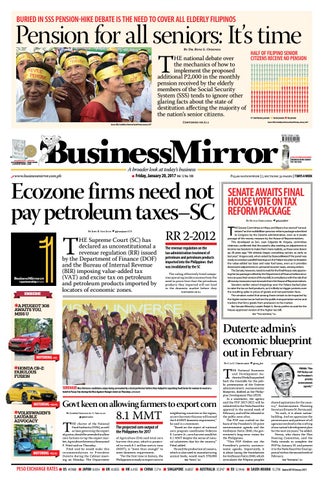
BURIED IN SSS PENSION-HIKE DEBATE IS THE NEED TO COVER ALL ELDERLY FILIPINOS
Pension for all seniors: It’s time T
By Dr. Rene E. Ofreneo
he national debate over the mechanics of how to implement the proposed additional P2,000 in the monthly pension received by the elderly members of the Social Security System (SSS) tends to ignore other glaring facts about the state of destitution affecting the majority of the nation’s senior citizens.
Source: COSE, Feasibility of Universal Social Pension, January 2017
media partner of the year
United nations
2015 environmental Media Award leadership award 2008
Half of Filipino senior citizens receive no pension
n Contributory pension n Social pension n No pension
Continued on A12
Source: COSE, Feasibility of Universal Social Pension, January 2017
BusinessMirror
www.businessmirror.com.ph
A broader look at today’s business n
Friday, January 20, 2017 Vol. 12 No. 100
Ecozone firms need not pay petroleum taxes–SC
T
By Joel R. San Juan
@jrsanjuan1573
HE Supreme Court (SC) has declared as unconstitutional a revenue regulation (RR) issued by the Department of Finance (DOF) and the Bureau of Internal Revenue (BIR) imposing value-added tax (VAT) and excise tax on petroleum and petroleum products imported by locators of economic zones.
inside
P25.00 nationwide | 5 sections 32 pages | 7 days a week
SENATE AWAITS FINAL HOUSE VOTE ON TAX REFORM PACKAGE By Butch Fernandez
@butchfBM
The revenue regulation on the tax-administration treatment of petroleum and petroleum products imported into the Philippines that was invalidated by the SC
The ruling effectively freed companies operating inside ecozones from the need to prove first that the petroleum products they imported will not land in the domestic market before they Continued on A2
he Senate Committee on Ways and Means has started “consultations”on the multibillion-peso tax-reform package submitted to Congress by the Duterte administration, even as it awaits passage of the money measure by the House of Representatives. This developed as Sen. Juan Edgardo M. Angara, committee chairman, confirmed that the panel is also working on adjustments in income-tax brackets to make them more realistic, as these were drawn up 20 years ago. “We already began consulting sectors as early as last year,” Angara said, when asked by BusinessMirror if the panel was ready to conduct parallel hearings on the Palace tax plan to broaden the value-added tax base and raise fuel taxes, even as it provides downward adjustments in personal income taxes, among others. The Senate, however, needs to wait for the final House vote approving the tax package crafted by the Department of Finance before senators can pass their version of the tax bill, in compliance with the rule that all money measures must emanate from the House of Representatives. Senators earlier voiced misgivings over the Palace-backed plan to raise the tax on fuel products, as it is likely to trigger protests over the resulting spike in prices of goods and transportation fares. The senators noted that among those certain to be impacted by the higher excise tax on fuel are the public transportation sector and truckers that ferry goods from producers to the market. But Senate Minority Leader Ralph G. Recto prefers to wait for the House-approved version of the higher tax bill. See “Tax reform,” A2
motoring
Duterte admin’s economic blueprint out in February
e1
By Cai U. Ordinario
honda Cr-z: Fabulous fusion serenade Miss Universe candidates enjoy being serenaded by a local performer before they helped in repacking food items for women in need at a hotel in Pasay City during the Rise Against Hunger event on Thursday. ALYSA SALEN e2-E3
Volkswagen’s laudable advocacy
motoring
business news source of the year
RR 2-2012 T
A Peugeot 308 awaits you, Miss U
motoring
2016 ejap journalism awards
Govt keen on allowing farmers to export corn By Jasper Emmanuel Y. Arcalas
T e2-E3
@jearcalas
he charter of the National Food Authority (NFA), as well as laws governing the export of grains, should be amended to allow corn farmers to tap the export market, Agriculture Secretary Emmanuel F. Piñol said on Thursday. Piñol said he would make this recom mend at ion to P resident Duterte during the Cabinet meeting on Monday. The Department
PESO exchange rates n US 49.7600
8.1 MMT The projected corn output of the Philippines for 2017
of Agriculture (DA) said total corn harvest this year, which is projected to reach 8.1 million metric tons (MMT), is “more than enough” to meet domestic requirement. “For the first time in history, the Philippines is ready to export corn to
neighboring countries in the region, as corn harvests this year will exceed the 5.6 MMT domestic requirement,” he said in a statement. “Based on the report of national corn program coordinator Federico E. Laciste Jr., corn harvest would hit 8.1 MMT despite the series of natural calamities that hit the country,” Piñol added. He said the production of cassava, which is also used in manufacturing animal feeds, would reach 570,000 See “Govt,” A2
T
@cuo_bm
he National Economic and Development Authority (Neda) has pushed back the timetable for the public presentation of the Duterte administration’s socioeconomic blueprint, dubbed as the Philippine Development Plan (PDP). In a statement, the agency said the PDP 2017-2022 will be submitted to the Neda Board for approval in the second week of February, and will be released to the public soon after. The PDP was crafted on the basis of the President’s 10-point socioeconomic agenda and the AmBisyon Natin 2040, the government’s long-term vision for the Philippines. “This PDP fleshes out the President’s priority socioeconomic agenda. Importantly, it is about laying the foundations for AmBisyon Natin 2040, which articulates the Filipino people’s
Pernia: “This PDP fleshes out the President’s priority socioeconomic agenda.”
shared aspirations for the country,” Socioeconomic Planning Secretary Ernesto M. Pernia said. “As such, it is about nationbuilding. And we appreciate the perseverance and patience of all agencies involved in the crafting of our nation’s development plan for the next six years,” he added. Pernia, who chairs the Plan Steering Committee, said the Neda intends to complete the PDP by January 31 and present it to the Neda Board for final approval within the second week of February.
n japan 0.4354 n UK 61.0555 n HK 6.4155 n CHINA 7.2714 n singapore 34.8557 n australia 37.3747 n EU 52.9446 n SAUDI arabia 13.2718
See “Duterte,” A2
Source: BSP (19 January 2017 )
A2 Friday, January 20, 2017
BMReports BusinessMirror
www.businessmirror.com.ph
Ecozone firms need not pay petroleum taxes–SC Continued from A1
could avail themselves of the taxexemption privilege. In a 20-page decision penned by Associate Justice Arturo D. Brion, the SC en banc denied the petition filed by the DOF and the BIR seeking the reversal of the order issued by Regional Trial Court (RTC) in Angeles City that declared Revenue Regulation (RR) 2-2012 “unconstitutional and without force and effect.” The RR prescribes the taxadministration treatment of petroleum and petroleum products imported into the Philippines, including those coming in through freeport zones and economic zones, and registration of all storage tanks, facilities, depots and terminals. The case stemmed from the
Govt. . .
Continued from A1
metric tons (MT) this year. This, he said, would further stabilize corn and animal-feeds supply in the country. “In 2016, despite the sevenmonth drought which ravaged the country’s agricultural areas, the country harvested 7.5 MMT of yellow and white corn, while cassava production reached 536,000 MT,” Piñol said. The NFA oversees the regulation and stabilization of grains prices and supply in the country. Before farmers could export grains, such as corn, the interagency NFA council must first declare that there’s a surplus, according to Presidential Decree (PD) 4. “In the exercise of this power, the Authority shall directly undertake the exportation of rice,
complaint filed by former Pampanga First District Rep. Carmelo Lazatin and Ecozone Plastic Enterprises Corp. (Epec), a locator at Clark Freeport Economic Zone (FEZ). In junking the petition filed by the DOF and the BIR, the SC upheld the arguments of the respondents that RR 2-2012 is invalid and unconstitutional, as it illegally imposes taxes upon FEZ enterprises that enjoy tax-exempt status under RA 7227, or the Bases Conversion and Development Act of 1992, as amended by RA 9400. The imposition of the regulation, according to the High Court, also amends RA 7227, thus, an encroachment of the duty and powers of the legislative branch. “Finally, the state’s inherent
corn and other grains and/or their substitutes and/or by-products/ end-products whenever there is an excess in production and/or supply, or it may allocate export quotas among certified and licensed exporters,” PD 4 read. “Provided, however, that the council shall first certify after to such excess production and/or supply after proper consultation with the Office of the President,” it added. Exporting yellow corn, Piñol said, would help stabilize the farm-gate price of the produce. He said he is eyeing to export corn to Malaysia, Taiwan and South Korea. Data from the (PSA) showed that the average farm-gate price of corn fell to P10.85 per kilogram in December 2016, from P11.50 per kg recorded a year ago. Based on the report of the PSA on the country’s food sufficiency, corn self-sufficiency ratio (SSR) was pegged at only 91.35 percent
power to tax is vested exclusively in the Legislature…. Thus, the imposition of taxes, as well as the grant and withdrawal of tax exemptions, shall only be valid pursuant to a legislative enactment,” the SC ruled. “A s R R 2-2012, an e xecutive issuance, attempts to withdraw the tax incentives clearly accorded by the Legislative to FEZ enterprises, the respondents have arrogated upon themselves a power reserved exclusively to Congress, in violation of the doctrine of separation of powers. In these lights, we hereby rule and declare that RR 2-2012 is null and void,” it pointed out. The Court explained that under RA 9400 and its implementing rules, Clark FEZ is considered
in 2015, the lowest since 2011. The SSR shows the extent to which a country’s supply of commodities is derived from its domestic production, according to the PSA. Philippine Maize Federation Inc. (PhilMaize) President Roger V. Navarro told the BusinessMirror that a supply glut is not possible if imported feed wheat and corn would not be taken into account. “What [the government] did was to include imports with local production. The DA combined imports with local production so there will really be a surplus,” Navarro said. The PhilMaize chief noted that local corn is not being bought because of imported feed alternatives, such as feed wheat. The group has been asking the government for years to allow them to export corn, particularly when farm-gate prices are low due to a supply glut.
a customs territory separate and distinct from the Philippine customs territory. Thus, it added importations into and establishments within the Clark FEZ enjoy special incentives, including tax and duty-free privilege, as opposed to importations into and establishments in other customs territory. The SC did not give credence to the argument of the DOF and the BIR that RR 2-2012 simply implements the provisions of the Tax Code on collection of internal revenue taxes, more specifically VAT and excise tax, on the importation of petroleum and petroleum products. The petitioners further argued that FEZ enterprises enjoy a qualified tax exemption, such that they have to pay the tax due on the im-
portation first, and may later claim a refund, which shall be allowed only upon showing that the goods were not introduced to the Philippine customs territory. However, the High Tribunal agreed with the respondents that RR 2-2012 imposes taxes on FEZ enterprises, which, in the first place, are not liable for taxes. It upheld the argument of the respondents that the tax incentives under RA 9400 apply automatically upon the importation of the goods, and that the proper taxes on the importation shall only be due if the enterprises can later show that the goods were subsequently introduced to the Philippine customs territory. “We cannot agree with the view that FEZ enterprises have the duty
Tax reform. . .
Continued from A1
Sen. Recto was among the first to register opposition to the Palace fuel tax-hike plan when it was initially floated for public discussion, noting there was “no fiscal crisis” to justify imposition of higher taxes that will eventually be passed on to commuters and consumers. Recto said that, instead of burdening these sectors with the fuel tax-hike scheme, Duterte administration officials should first curb smuggling and improve tax-collection efficiency.
Duterte. . .
Continued from A1
In its third meeting on January 17, members of the Plan Steering Committee, consisting of several Cabinet members, had a daylong discussion on the draft chapters of the PDP 2017-2022. Chairmen and representatives of the 11 Planning Committees (PC) presented the strategic frameworks, results matrices and strategies of their respective PDP chapters. The body was invited to give comments after the presentation, for the discussion and approval of the PSC, which has 16 national government agency members.
to prove their entitlement to tax exemption first before fully enjoying the same; we find it illogical to determine whether a person is exempted from tax without first determining if he is subject to the tax being imposed,” the SC pointed out. “We have reminded the tax authorities to determine first if a person is liable for a particular tax, applying the rule of strict interpretation of tax laws, before asking him to prove his exemption therefrom. Indeed, as entities exempted on taxes on importations, FEZ enterprises are clearly beyond the coverage of any law imposing those very charges. There is no justifiable reason to require them to prove that they are exempted from it,” it added.
Moreover, the Senate Minority Leader suggested that the administration, before imposing higher taxes, should spend the budget first—the government has underspent the past few years—to spur economic growth, noting that the government earns more revenue when the economy is growing. Other senators also raised misgivings over the administration’s tax-hike scheme, but said they would first study the Palace proposal. Sen. Francis G. Escudero earlier indicated that when the Senate panel opens hearings on the Palace tax-hike plan, he intends to ask Duterte administration officials to first provide proof they were able to collect existing taxes and have spent the collected funds, recalling its track record on “low absorptive capacity.” Initially, the Neda intended to submit the country’s socioeconomic blueprint to the President by the end of January 2017. Documents obtained from the Neda showed the country’s PDP will also be submitted to the Legislative-Executive Development Advisory Council this year. The plan has seven parts, divided into 22 chapters, which include: Introduction (with Overview and Framework), Enhancing the Social Fabric (Malasakit), Reducing Inequality in Economic Development Opportunities (Pagbabago), Increasing Potential Economic Growth (Kaunlaran), Enabling and Supportive Economic Environment, Foundations for Inclusive and Sustainable Development and Moving Forward.
news@.businessmirror.com.ph
BMReports BusinessMirror
House panel to review common-station MOA
T
he House of Representatives will review the memorandum of agreement (MOA) signed by the government and private players for the common terminal linking Light Railway Transit (LRT) Line 1 and Metro Rail Transit (MRT) Lines 1 and 7. Speaker Pantaleon D. Alvarez said the MOA on the common MRT-LRT station should undergo close scrutiny in Congress because it would cost the government an estimated P2.8 billion. Alvarez added that he wants to ensure that construction of the common station would be beneficial to the riding public and not merely for big businesses involved in the project. The agreement was signed on Wednesday by Transportation Secretary Arthur P. Tugade and Public Works Secretary Mark A. Villar with LRT Authority Administrator Reynaldo Berroya, SM Prime Holdings Inc. Executive Chairman Hans T. Sy, Light Rail Manila Corp. (LRMC) Vice Chairman Manuel V. Pangilinan, San Miguel Corp.
ALVAREZ: “Is that common station beneficial to the riding public or just for the interest of big businesses?”
President and COO Ramon S. Ang and North Triangle Depot Commercial Corp., represented by Ayala Land Inc. Vice Chairman Jaime Augusto Zobel de Ayala. Among other concerns, Alvarez said the so-called win-win solution under the MOA would necessarily entail additional cost for the government. “This is bad news because it
would cost the government billions of pesos. Now, my question—is that common station beneficial to the riding public or just for the interest of big businesses?” Alvarez asked. According to Alvarez, the common-station project was delayed because of the conflicting interests of big private players. The project grounded to a halt when, in 2014, SM Prime obtained a temporary restraining order from the Supreme Court to stop the DPWH from transferring the originally planned location of the common station in front of SM North Edsa to a location near TriNoma mall. SM Prime sued the previous transportation department for changing the location of the common station even with an existing naming rights contract with the government. Former transportation officials decided to move the location due to its cost benefits. “The government should prioritize the interest of the public and not the interest of the big businesses,” Alvarez said. Alvarez added that House Transportation Committee Chairman and PDP-Laban Rep. Cesar V. Sarmiento of Catanduanes, who has been closely following developments in the common-station project, was sur-
prised by the reported MOA signing. “Congressman Sarmiento was surprised by the signing. The House Committee on Transportation will conduct a hearing on the matter [soon],” Alvarez said. The common station will be a 13,700-square-meter facility with three key areas. Area A is where the platform and concourse for the LRT 1 and MRT 3 will be located. The cost for the construction of this portion—pegged at around P2.8 billion—will be shouldered by the government. Area B, on the other hand, will connect Area A to Area C, which is where the platform for the MRT 7 will be located. The second area will also boast of an atrium that can accommodate up to 40,000 passengers per day. Based on the contract signed with LRMC, the common station should be finished by April 2019. Currently, the government is working on bidding out the detailed engineering and design contract for the project. Construction should start by December. The Department of Transportation said the design of the common station, which will bear the name of SM, will put into consideration a traffic-management plan that will be approved by the traffic-crisis body. Jovee Marie Dela Cruz
Friday, January 20, 2017 A3
GOVT, COMMUNIST REBELS RESUME TALKS IN ROME P
hilippine negotiators and communist guerrillas are set to resume peace talks in Rome on Thursday, with the Maoist insurgents warning that alleged government violations of an accord on human rights may prompt them to end a monthslong cease-fire. The presidential adviser to the talks, Jesus Dureza, said the government is optimistic “with managed expectations” about the resumption of the Norway-brokered negotiations in the Italian capital. “These issues, although difficult, are surmountable with both sides sharing common aspirations for peace,” Dureza said in a statement. Rebel chief negotiator Fidel Agcaoili was less optimistic, saying the guerrillas have raised a number of complaints, including alleged government breaches of a 1998 accord on respecting human rights and another pact on the safety of guerrilla consultants. Agcaoili said the complaints, including the failure to release nearly 400 detainees the rebels consider political prisoners, made extending a five-month cease-fire “untenable”. The guerrillas also expressed concern over President Duterte’s brutal crackdown on illegal drugs, which have left thousands of drug suspects dead, and his decision to allow the burial of dictator Ferdinand E. Marcos in a heroes’ cemetery last
November, Agcaoili said. Innocent people have been killed in Duterte’s crackdown “due to brutal, reckless and indiscriminate methods employed by the police in its antidrug operations,” Agcaoili said. Duterte must shift his priority to solving the larger problem of poverty through social and economic reforms, which are the main focus of this week’s round of talks, he said. The guerrillas have accused government troops of violating a ceasefire by occupying schools, village halls and other civilian areas, and conducting illegal searches, questionings and surveillance of suspected rebel supporters. The military has denied the allegations. Founded in 1968, the rebels’ Communist Party has held peace talks with six Philippine presidents, including Duterte, whose rise to power last June sparked rebel optimism due to his searing anti-US rhetoric and populist pro-poor stance. Battle setbacks, surrenders and infighting have weakened the rebel group, which is blacklisted as a terrorist organization by the US. A confidential Philippine government assessment obtained by The Associated Press says the number of guerrillas declined to 3,800 with more than 4,500 firearms in the first half of 2016, with about 700 of the country’s 42,000 villages affected by the insurgency. AP
A4 Friday, January 20, 2017 • Editor: Max V. de Leon
AseanFriday BusinessMirror
Singapore to benefit from Hong Kong housing curbs
S
ingapore’s three-year decline in home prices could see relief from an unexpected quarter in 2017: Hong Kong.
So says Cushman & Wakefield Inc., which expects the slide in the city-state’s home prices to end this year, as foreign investors turned off by Hong Kong’s move to increase the stamp duty for overseas buyers look to Singapore instead. Desmond Sim, head of research for Singapore and Southeast Asia at CBRE Ltd., said Singapore house prices are approaching their trough, with a forecast price move of flat to minus 2 percent. Savills Plc. forecasts Singapore prices will rise 1 percent on average this year. “The fallout from the stamp duty could be beneficial for Singapore,” said Sigrid Zialcita, managing director for Asia-Pacific research at Cushman & Wakefield. “Singapore is always seen as a place where you can preserve capital and we are expecting interest from foreign nationals to come back.” Hong Kong’s November 2016 increase in stamp duty to 30 percent for foreigners makes Singapore’s 18-percent rate more attractive to overseas buyers, particularly mainland Chinese who are seeking investments abroad to help shield them from a further weakening of the yuan. That will help limit the decline in Singapore property values to about 1.5 percent this year, according to the average estimate of five analysts surveyed by Bloomberg. Home prices have fallen 11 percent since 2013, when the island-state’s government implemented the strictest of its own cooling measures.
The outlook for Hong Kong is more bearish, with prices in the secondary-housing market seen dropping 8 percent, according to the average of seven analyst forecasts. While figures for new homes aren’t available for Hong Kong, early indications are that prices in this segment will be more resilient as developers offer incentives to offset higher stamp duties.
Office space
The markets for Grade-A office space in Asia’s two competing financial hubs are set to diverge further in 2017. Scarce supply in Hong Kong’s Central district and strong demand from Chinese
Singapore is always seen as a place where you can preserve capital and we are expecting interest from foreign nationals to come back.” —Cushman & Wakefield
financial companies for premium office space could push rents up as much as 5 percent in what is already the world’s most expensive office market according to Knight Frank Plc. That contrasts with a forecast of an average 6.2-percent drop in
Singapore due to ample supply and an uncertain economic outlook.
Retail rents
Retail rents in both cities will also remain challenging this year. Singapore mall owners are bracing for another weak year as the sluggish economy weighs on retail activity and consumers shop online more. In Hong Kong a two-and-a-half year slump in mall rents may continue as retail sales remain subdued. Marcos Chan, head of Hong Kong, Taiwan and Southern China research at CBRE, sees prime mall rents falling as much as 5 percent, amid declining tourist arrivals and softer domestic demand. “We see no particular reason why the retail market or retail property will rebound anytime soon,” said Chan, who still expects rents to stabilize by midyear. “We will have to wait for some other triggers for the retail market to pick up before retail rents go back to an upward trend.” Bloomberg News
news@businessmirror.com.ph
Malaysia says OIC will push Myanmar to halt Rohingya crisis
M
alaysia’s foreign minister said on Wednesday the Organization of Islamic Cooperation (OIC) is expected to call for a halt to violence against Myanmar’s Rohingya Muslim minority and for the safe return of refugees. Malaysia, which has urged Myanmar to stop what it calls a policy of genocide toward Rohingya, is hosting a meeting of foreign ministers from OIC nations in Kuala Lumpur on Thursday to discuss the crisis. Security forces in Buddhist-majority Myanmar are accused of widespread abuses against Rohingya—including killings, rape and the burning of thousands of homes—that have driven an estimated 65,000 Rohingya to flee across the border to Bangladesh in the past three months. Malaysian Foreign Minister Anifah Aman said the matter is worrying to the OIC because it was established to protect the Muslim community. He said the OIC envoy for Myanmar, Syed Hamid Albar, will brief the ministers from the 57-member OIC about the crisis. A communiqué to be issued at the end of the one-day meeting is expected to call on Myanmar to “abide by its obligations under international law and prevent the worsening of what is now an acute humanitarian crisis” in its Rakhine state, where most Rohingya live, he said. It will also urge Myanmar to ensure the safe return of displaced Rohingya, he said. Anifah said Malaysia will push for Myanmar to allow “unimpeded access for humanitarian assistance to reach the Rohingya.” Myanmar’s army began a crackdown in Rakhine last October after nine policemen were killed in attacks along the border. The government and the army have rejected accusations of abuses and killings, saying they have simply been conducting a “clearance operation” in the region. Rohingya villagers and activists say hundreds of civilians have been killed.
1M
The Rohingya population in Myanmar
The number cannot be verified because authorities have limited access for aid workers and journalists to areas where the deaths occurred. Recent satellite images show thousands of houses were burned. Despite living in Myanmar for generations, an estimated 1 million Rohingya are barred from citizenship in the nation of 50 million, and instead, live as some of the world’s most persecuted people. More than 100,000 Rohingya are living in squalid internal displacement camps. There have been expressions of serious concern by international human rights groups, UN agencies and Western governments about treatment of the Rohingya. In Myanmar there was a rare show of solidarity for the Rohingya cause on Wednesday as more than 40 civil-society groups announced their support for an independent investigation into the situation in Rakhine. Prejudice against the Rohingya is widespread in Myanmar, with ultranationalist Buddhist monks spearheading campaigns against the minority. Those showing sympathy for the Rohingya have sometimes been harassed themselves. “Despite concerns voiced by governments and human-rights organizations...the situation across Rakhine state continues to worsen, and tensions continue to rise,” the groups said in a statement. They called for a “commission of inquiry to fully assess the totality of the situation in Rakhine state and provide clear recommendations for the current government to effectively address and prevent further problems.” AP
Two weeks, one country and a world of wonders in Thailand
T
Elephants
rudging up a lush mountainside to a remote village, plunging through a swift-moving river in the footsteps of elephants and cruising Bangkok’s gleaming luxury malls—with each step, I walked into different worlds, each one beautiful, all in Thailand. Don’t forget glittering temples, bustling night markets and world-famous Thai massages to soothe weary muscles.
I wanted to enjoy these majestic creatures, iconic in Thailand but often exploited, in an ethical way. The Elephant Nature Park allowed us to travel alongside them, not on their backs. We kept them moving through the jungle by thrusting bananas and melon into their eagerly outstretched trunks. It was surreal and a bit unnerving, as we led four mostly blind and elderly female elephants on a muddy, uneven path, trying to keep our balance while avoiding their feet. In another part of the sanctuary, we got a peek at a baby elephant.
Bangkok
The capital’s malls and markets are endless, from Siam Paragon, filled with designer brands and an upscale food court, to stands of cheap goods where souvenirseekers haggle over the price of utensils, bracelets and trinkets. After dark, the night markets come alive, bustling with shoppers grabbing cheap sunglasses and shoes while families and friends enjoy soups and curries in more bearable heat. Bangkok is also famous for its opulent temples, including Wat Pho, Temple of the Reclining Buddha, with its stair-step monuments to royalty called chedis, similar to stupas. The centerpiece is a massive horizontal Buddha, its gold girth touching the temple walls from end to end. Next door at the white-walled Grand Palace complex, black-clad mourners waited in snaking lines to pay their respects to King Bhumibol Adulyadej. The beloved leader died last October after a 70-year reign—his image ubiquitous on billboards and shrines. The complex also houses Thailand’s most sacred temple, Wat Phra Kaew, or Temple of the Emerald Buddha, with sparkling, golddecked buildings. The surprise was the size of the famed Buddha figure, carved from jade and dressed in gold, but just 26-inches high.
Chiang Mai
Chiang Mai’s walled old city houses more famous temples, including Wat Chedi Luang. Its towering red brick is worn to black, its steps have all but crumbled, but stone dragons still stand guard.
Phi Phi Islands
IN this December 5, 2016, photo, long-tail boats sit near a small beach on Ko Phi Phi Leh, an island off the southwestern coast of Thailand. The smaller of the Phi Phi Islands is a tourist hot spot for its beautiful water, party atmosphere and famed Maya Bay, where the movie The Beach was filmed. AP
My favorite temple, moss-covered Wat Pha Lat, is tucked in a forest just outside Chiang Mai. From the university, I got there by hiking Monks Trail, which is marked by strips of orange fabric. Head farther up the mountain to popular Doi Suthep temple or hail a songthaew, a shared taxi. Hungry after hiking? Hit the street vendors and restaurant options that abound back in the tourist center: vegetarianfriendly green curried rice, fried mushrooms and pad thai, plus plenty of beef and pork speared on sticks for meat-eaters. To cool
off from the heat or spice, try fresh-cranked pomegranate juice or or coconut ice cream.
Trekking
Chiang Mai is the jumping-off point for trekking, elephant tours and other outdoor adventure. A friend and I booked an ecotour trek and overnight home stay in a village some four-and-a-half hours away in the Mae Hong Son region. The Karen ethnic group lives there, farming rice and cabbage on vibrant green hillsides. Our guides cut down wild passion fruit for us to sample, pointed
out spiders as big as a hand and chopped bamboo to whittle into cups. After reaching the mountaintops near the Myanmar border and making it to the village, we used those cups to slug homemade rice liquor. We set up a bed of blankets on the wooden floor and rested between bags of rice as our hosts cooked dinner in a hearth built into the floor. Sleeping in a home open to the elements was the only time I got cold on the trip, and the only place I skipped a shower, passing up a tub of chilly water in an outhouse with a squat toilet.
After trekking, we looked forward to decompressing on an other worldly beach on the Phi Phi Islands—pronounced “pee pee”. But rain was falling as we arrived and promised not to let up. Instead of the party-hearty main town on Ko Phi Phi Don, the largest island, we opted for a secluded resort. A long-tail boat plowed through choppy waters to get us there, leaving us windblown and wet from ocean spray and rain as we tried to photograph the greentopped rock rising from the Andaman Sea. The weather cooperated enough the next day for a group tour to the smaller island, Koh Phi Phi Leh, and its hot spot, Maya Bay, which is breathtaking but overrun after the movie The Beach made it famous. Even early in the day, it was tough to find a spot free of people posing with selfie sticks. Nearby, we reveled in an empty swath of sand framed by cliffs before winding through rock formations to the Blue Lagoon, a green-walled swimming hole packed with tourist boats. After the beaches and long days in the devout atmosphere of temples, without blinking, our nights turned to buying knockoffs of favorite overpriced sandals, swigging 70baht ($2) beer and watching men in elaborate makeup and sequined ball gowns perform a dance in a packed outdoor market. That’s Thailand, country of contrasts. AP
The World
www.businessmirror.com.ph • Editor: Lyn Resurreccion
BusinessMirror
Friday, January 20, 2017
A7
Davos elite debates inequality
D
AVOS, Switzerland—You have, perhaps, noticed that in many countries, historyaltering numbers of people have grown enraged at the economic elite and their tendency to hog the spoils of globalization. This wave of anger has delivered Donald J. Trump to the White House, sent Britain toward the exit of the European Union, and threatened the future of global trade. T he people gat hered here this week in the Swiss Alps for the annual World Economic Forum (WEF) have noticed this, too. They are the elite—heads of state, billionaire hedge fund managers and technolog y executives. They are eager to talk about how to set things right, soothing the populist fury by making globalization a more lucrative proposition for the masses. Myriad panel discussions are focused on finding the best way to “reform capitalism,” make globalization work and revive the middle class. W hat is striking is what generally is not discussed: bolstering the power of workers to bargain for better wages and redistributing wealth from the top to the bottom. “That agenda is anathema to a lot of Davos men and women,” said Joseph E. Stiglitz, a Nobel laureate economist and author of numerous books on globalization and economic inequality. “More rights to bargain for workers, that’s the part where Davos man is going to get stuck. The stark reality is that globalization has reduced the bargaining power of workers, and corporations have taken advantage of it.” Davos is—at least rhetorically—consumed with worries about the shortcomings of globalization. About the deepening anxieties of the middle class in many developed economies. About the threat of trade protectionism and its attendant hit to economic growth. About the fear that robots are on the verge of sowing mass unemployment. It is a conversation fueled in part by fear: If the world is, indeed, in the throes of a populist insurrection, the pitchforks could do worse than to point here. The Davos elites have enjoyed outsize influence over economic policies in recent decades as a growing share of wealth has, perhaps not coincidentally, landed in the coffers of people with a need for bank accounts in the British Virgin Islands, while poor and middle-class households have seen their earnings stagnate and decline.
Yet, the solutions that have currency seem calculated to spare corporations and the wealthiest people from having to make any sacrifices at all, as if there is a way to be found to tilt the balance of inequality while those at the top hang on to everything they have. More e nt re pre neu r i a l i sm , mindfulness training and education focused on the modern ways of technolog y: These are the sorts of items that tend to get discussed here as the response to the plight of those left behind by globa lization. That, perhaps, private equity overseers should not be paid 1,000 times as much as teachers while availing themselves of ta x breaks is thinking that gets little airing here. At a dinner on Monday evening as the forum got under way, Ian Goldin, a professor of globalization and development at Oxford University, celebrated the connectedness of the global economy and the technological advancements that have liberated humans from disease, poverty and the drudgery of manual labor. “There’s never been a better time to be alive and, yet, we feel so glum,” Goldin said. “So many people feel anxious. So many people feel that this is one of the most dangerous times.” He denounced the frightened retreat from globalization manifest in Trump’s threats of a trade war with China, and in Britain’s abandonment of Europe, commonly known as Brexit. “You can’t stop managing an entangled environment by disconnecting,” he said. “This is the fundamental mistake of Brexit, of Trump, and of so many others. We are not simply connected. We are entangled. Our lives, our destinies are intertwined. What happens in China, what happens in Indonesia, what happens in India, what happens across Europe, and what happens in North America, across Africa and Latin America will affect all of us in dramatic new ways. The idea that somehow we can forge our future in an insular way, even for the biggest countries like the US, is a fantasy.”
COO of Facebook Sheryl Sandberg (right) speaks next to Christine Lagarde, managing director of the International Monetary Fund, during a plenary session in the Congress Hall during the 47th annual meeting of the World Economic Forum in Davos, Switzerland, on Wednesday. Laurent Gillieron/Keystone via AP
And yet, Goldin said, if the benefits of globalization are not spread more equitably, the world could be in for a replay of the Renaissance, an extraordinary period of scientific progress, commercial growth and artistic creativity in Europe that ultimately yielded popular resentment. The gold leaf landing on cathedrals was not bettering the lot of the peasantry. The spices coming in from Asia were too expensive for most. The Medici family that ruled Florence was sent packing by the mob. Intellectuals were persecuted and books burned. “We need to learn these historical lessons and realize that this is the most precious moment in human history,” Goldin said. “We need to make the choices to ensure that globalization is sustainable, that connectivity is sustainable, that we deal with the intractable problems that are worrying people.” But Goldin’s comments were merely the prelude to a conversation that was supposed to be about how to pull that off. The answers from the corporate executives who comprised a panel could be crudely boiled down to this: The people who have not benefited from globalization need to try harder to emulate those who have succeeded. Abid a l i Neemuchwa l a, t he chief executive officer of Wipro, the global information technology and consulting company that hosted the event along with The Financial Times—and who last year earned some $1.8 million plus stock grants worth an additional $2 million or so—said working people would have to pursue training for the jobs of the future. “People have to take more ownership of upgrading themselves on a continuous basis,” he said. No one can reasonably argue against the merits of training (or entrepreneurialism, for that matter). The jobs of the future have not yet been invented. New skills will be required to seize them. But nowhere in the discussion was there a mention of tax policy, or addressing the soaring costs of gaining higher education, or access to health care. At a panel on Wednesday morning, Christine Lagarde, managing director of the International
Monetary Fund, injected a rarely heard word into a conversation about the crisis for middle-class households: redistribution. “There are things that can be done,” she said. “It probably means more redistribution than we have at the moment.” But then the conversation moved on to other subjects. Ray Dalio, founder of the American investment firm Bridgewater Associates—who took home $1.4 billion in compensation in 2015—suggested the key to reinvigorating the middle class was to “create a favorable environment for making money.” He touted in particular the “animal spirits” unleashed by stripping away regulations. For years, economic inequality has ranked as one of the most discussed issues at Davos, both in the formal conference agenda and in the conversations that fill hallways and the private parties and dinners held throughout town. For years, little to nothing has changed. “People talk about inequality, how it’s a major problem, the greatest threat to globalization and the global economy,” Stiglitz said. “You have to recognize that the way we have managed globalization has contributed significantly to inequality. But I have not yet heard a good conversation about what changes in globalization would address inequality.” That is not an accident, he surmised. Any sincere list would have to include items that involve transferring wealth and power from the sorts of people who come to Davos to ordinary workers via more progressive taxation, increased bargaining rights for labor unions and greater protections for labor, in general. Same as every other year, Davos is again plastered with the slogan of the WEF: “Committed to Improving the State of the World.” But whatever improvements are supposed to be made, one can safely assume they will not conflict with those in attendance continuing to enjoy the state of the world as it is now, with canapés and aged Bordeaux and private jets at the ready. Which means that the global populism insurrection is unlikely to lose momentum anytime soon. New York Times News Service
Earth reached highest heat record in 2016 M
arking another milestone for a changing planet, scientists reported on Wednesday that the Earth reached its highest temperature on record in 2016— trouncing a record set only a year earlier, which beat one set in 2014. It is the first time in the modern era of global warming data that temperatures have blown past the previous record three years in a row. The findings come two days before the inauguration of a US president who has called global warming a Chinese plot and vowed to roll back his predecessor’s efforts to cut emissions of heat-trapping gases. In reality, the Earth is heating up, a point long beyond serious scientific dispute, but one becoming more evident as the records keep falling. Temperatures are heading toward levels that many experts believe will pose a profound threat to both the natural world and to human civilization.
In 2015 and 2016 the planetary warming was intensified by the weather pattern known as El Niño, in which the Pacific Ocean released a huge burst of energy and water vapor into the atmosphere. But the bigger factor in setting the records was the long-term trend of rising temperatures, which scientists say is being driven by increasing levels of carbon dioxide and other greenhouse gases. “A single warm year is something of a curiosity,” said Deke Arndt, chief of global climate monitoring for the National Oceanic and Atmospheric Administration (NOAA). “It’s really the trend, and the fact that we’re punching at the ceiling every year now, that is the real indicator that we’re undergoing big changes.” The heat extremes were especially pervasive in the Arctic, with temperatures in the fall running 20 degrees Fahrenheit to 30˚F above normal across large stretches of
the Arctic Ocean. Sea ice in that region has been in precipitous decline for years, and Arctic communities are already wrestling with enormous problems, such as rapid coastal erosion, caused by the changing climate. “What’s going on in the Arctic is really very impressive; this year was ridiculously off the chart,” said Gavin A. Schmidt, head of the Goddard Institute for Space Studies in Manhattan, a unit of National Aeronautics and Space Administration (Nasa) that tracks global temperatures. But Arctic people were hardly alone in feeling the heat. Drought and starvation afflicted Africa. Last May 19 the people in the town of Phalodi lived through the hottest day in the recorded history of India, 123.8˚F . El Niño has now ended, and climate scientists almost universally expect 2017 to be cooler than the year before. But the scale
of the heat burst has been startling to many of the experts, and some of them fear an accelerated era of global warming could be at hand over the next few years. Even at current temperatures, billions of tons of land ice are melting or sliding into the ocean. The sea is also absorbing most of the heat trapped by human emissions. Those factors are causing the ocean to rise at what appears to be an accelerating pace, and coastal communities in the United States are beginning to spend billions to fight increased tidal flooding. Their pleas for help from Congress have largely been ignored. The finding that a record had been set for the third year in a row was released on Wednesday by three government agencies, two of them American and one British, that track measurements made by ships, buoys and land-based weather stations. New York Times News Service
A8
The World BusinessMirror
Friday, January 20, 2017
Editor: Lyn Resurreccion • www.businessmirror.com.ph
Iraq military: Troops have ‘full control’ of eastern Mosul
B
An Egyptian newspaper vendor holds a copyof a local newspaper fronted with a picture of President-elect Donald J. Trump with Arabic headline that reads, “Trump era”, at a traffic stop, in Cairo, Egypt, on November 10, 2016. AP/Amr Nabil
Mideast expects big changes under Trump’s administration
C
AIRO—Donald J. Trump’s allbut-dismissal of human rights as a foreign-policy principle could land like an earthquake across a Middle East landscape beset by warring factions and beleaguered governments, with some players eyeing the prospect of once unimaginable new alliances. Syria is the foremost test of Trump’s promise of a return to a hard-headed realpolitik and cou ld qu ic k ly show whet her America is truly abandoning promotion of democracy and the rule of law in a way that could reshape much of the region’s post-Cold War, post-9/11 order. Trump has raised the possibility of a broad new US partnership with V ladimir Putin’s increasingly authoritarian Russia and has even hinted at aligning with Syrian President Bashar alAssad, which would amount to a dramatic reversal from years of the Obama administration calls for Syrian President Bashar alAssad ’s ouster. Trump seems to calculate that their shared enemy in the Islamic State (IS) is more important than shared values. “When it comes to civil liberties, our country has a lot of problems, and I think it’s very hard for us to get involved in other countries,” Trump explained last July, as Turkey was punishing tens of thousands of people seemingly unconnected to a failed coup attempt. “We need allies,” Trump said in a New York Times interview. “I don’t know that we have a right to lecture.” When Barack Obama declared a new beginning with the Muslim world in a landmark speech eight years ago, he mentioned democracy six times and broached the subject of human rights on a dozen occasions. Trump has barely mentioned these as foreign policy principles, extolling instead deal-making, diplomatic and economic and championing the fight against IS. “Human rights will not be his top priority,” concluded Mustafa Alani, the director of the security and defense department at the Geneva-based Gulf Research Center. Some believe the change will in the end be largely a matter of style, noting that Obama has fought jihadism all over the region, as well. Aaron David Miller, a Mideast adviser under five American presidents, expects Trump to prove “risk-averse” and remain consistent with Obama’s own reluctance to interfere in other countries’ af-
60
The number of nations in the US-led campaign against Islamic State in Syria fairs, use military force, remain engaged in Iraq or get truly involved in Syria’s civil war. But it’s clear that several longstanding allies in the Middle East are relishing an end to what they saw as moralizing rhetoric, confused signals and unfulfilled red lines, and favoring a Trump pivot to counterterrorism and security. Egypt’s President Abdel Fattah el-Sissi is still waiting for a White House invitation, having been shunned by Obama for his bloody crackdown on the Muslim Brotherhood. Saudi Arabia is expecting a renewed push from Washington on its archrival Iran, instead of Obama’s more neutral stance and its accompanying criticism of the kingdom’s treatment of women and killing of civilians in Yemen. And Israel’s nationalist leadership has made almost a public celebration of Trump’s imminent arrival, confident that its grief for how it treats the Palestinians is over. Here’s a look at how Tr ump’s pol ic ies cou ld sh a ke up t he Midd le East:
Syria and Islamic State
The US-led campaign against IS, more than 60 nations-strong, has lacked in Syria the one thing it needs most: a partner on the ground capable of reclaiming and holding territory, as the Iraqi government is doing in its areas. Widespread evidence of torture, chemical weapons attacks and even war crimes by Assad’s forces had made a partnership infeasible to Obama and most of America’s foreign policy establishment. Meanwhile, Russia’s intervention since September 2015 has
dramatically shored up Assad’s position. If Assad and Putin now take on IS in its strongholds in northeastern Syria, it is less difficult to imagine Trump accepting perhaps a tacit partnership. Trump has said Assad may be “bad” but the rebels fighting to topple him “could be worse.” He has said the US has no idea who its allies in the country are and has appeared most concerned about containing the exodus of Syrian refugees, fearing they’ll spread terrorism. Assad recently suggested the US and Syria could be “natural allies”. Such a shift would have consequences. America’s Sunni allies in the Persian Gulf will chafe at any outcome they see as strengthening the hand of Assad’s other main partner, Shiite Iran.
Israel and Palestine
Years of contentious relations between Obama and Prime Minister Benjamin Netanyahu culminated last month in a UN Security Council resolution declaring illegal the Jewish state’s construction of settlements on occupied land the Palestinians seek for a future state. Obama’s decision to not veto the resolution followed bitterness in Israel over the 2015 nuclear deal with Iran. Trump has vowed to heal the wound, apparently by embracing parts of Netanyahu’s nationalist agenda. He has appointed a prosettlements ambassador, vowed to move the US embassy from Tel Aviv to more controversial Jerusalem and spoken of renegotiating and even dismantling the Iran deal. Whereas much of Obama’s disapproval of Netanyahu was expressed in moral terms, Trump has steered wide of any such thing. “He is against this kind of moralism and political correctness,” said Eytan Gilboa, an expert on USIsrael relations at Israel’s Bar-Ilan University. “He is a businessman. If there is a potential for a deal between Israel and the Palestinians, he will do it. If there is no potential for a deal, he will not do it.” Many fear overreach by Israel that could trigger a new Palestinian uprising. And some note the situation could turn if the confident Netanyahu ever provoked the mercurial Trump as he has did Obama. “Within a year, they’ll be annoying the hell out of each other,” Miller predicted.
The Gulf and Iran
If there is one authoritarian country unlikely to enjoy the fruits of Trump’s human rightsfree foreign policy, it’s Iran. The president-elect regularly chastised Obama for agreements that provided new funds to a US-designated terror sponsor and left it only several years away from
potentially returning to nuclear weapons capacity. Beyond the talk of a nuclear renegotiation, Trump also has promised to get American prisoners released and threatened to shoot Iranian boats out of the water if they provoke US Navy vessels in and around the oil-rich Persian Gulf. Ayatollah Ali Khamenei, Iran’s supreme leader, has said if the US tears up the nuclear accord, “we will light it on fire”. But Iranian President Hassan Rouhani on Tuesday dismissed the possibility that Trump could undo the nuclear deal, likening it to turning a finished shirt back into cotton. The president-elect’s tough talk on the deal was “mainly slogans,” he said. Officials in Saudi Arabia, Iran’s regional rival, are nonetheless pleased with a president who might focus more on Iran than its own human-rights violations. Although its rights record routinely ranks among the world’s worst, Rex Tillerson, Trump’s choice for secretary of state, wouldn’t call the key US ally a rights violator.
Egypt
El-Sissi, Egypt’s general-turnedpresident, isn’t hiding his hopes in Trump: “There is appreciation [by Trump] for Egypt’s regional role and there will [be] more coordination with the US going forward,” he said this week. Government circles in Cairo widely see Obama as naive about the true intentions of political Islam and excessively idealistic about liberal democracy. Championing the popular protests of the 2011 Arab Spring, Obama urged the stalwart US ally Hosni Mubarak to step down and welcomed the ascendancy of the country’s first elected president, Islamist Mohammed Morsi. After el-Sissi led a 2013 coup replacing Morsi, Obama’s administration struggled for months over whether to call it a coup and later suspended some arms sales to Egypt. It has routinely criticized the government’s police brutality, mass trials of Islamists and the crackdown on liberal dissent, drawing charges from el-Sissi that the US supports Morsi and other religious hard-liners. Under Trump, “there will be a lot of capacity for less friction and more engagement,” said Michael W. Hanna, an Egypt expert at the New York-based Century Foundation.But given Eg y pt’s dire economic condition and internal instability, el-Sissi may have little to offer a deal-oriented US president in return. How important that turns out to be will help show whether the new American compass will truly be about the quid pro quo. AP
AGHDA D — US -bac ked Iraqi government troops a nnou nced on Wed nes day they were in “ full control ” of eastern Mosul after routing Islamic State (IS) militants from that part of the northern city, three months since the major operation started. The achievement was a “big victory”, said Iraqi Army Lt. Gen. Talib Shaghati, who commands the counterterrorism forces, describing the success of the Iraqi forces as “unprecedented”. Shaghatai, who spoke to reporters in the town of Bartella, just east of Mosul, said plans were now being drawn up to retake the western part of the city. He did not elaborate on when that part of the operation would begin. Wednesday’s advance came after Iraqi troops over the past days intensified their push into the last IS-held neighborhoods in Mosul’s eastern sector, closing in on the Tigris River, which roughly divides the city. Stiff resistance by the militants, thousands of civilians being trapped in their houses by the fighting and bad weather had in the past slowed the advances of the troops. Ho w e v e r, s k i r m i s he s a nd clashes continued in some pockets along the Tigris in eastern Mosul, according to Iraqi special forces Maj. Ali Hussein, who said his unit was still pushing into the Ghabat area along the river bank. Small arms fire could be heard and at least one civilian was wounded by mortar fire. Also, some commanders on the ground disputed Shaghati’s claim of “full control” of eastern Mosul, with Lt. Gen. Abdul-Amir Raheed Yar Allah saying the eastern side “has not been fully liberated...and the advance is still continuing.” Yar Allah, who commands army
operations in Ninevah, where Mosul is the provincial capital, said the special forces “have done their duty” in eastern Mosul. Prime Minister Haider al-Abadi issued a statement, posted on his web site, saying that “work is under way to liberate” Ghabat and the area housing Saddam Hussein’s former presidential palaces in eastern Mosul. He also vowed to liberate the western side of the city. But the prospect of retaking western Mosul looms heavy on Iraqi forces, despite all the support they have by the US-led coalition, as well as Sunni and Shiite volunteer militias. The western half of the city is home to some of Mosul’s oldest neighborhoods, with narrow streets packed with buildings that will further complicate the urban fight. So far in the Mosul offensive, Iraq’s counterterrorism forces, which are by far the military’s most battle-seasoned unit, have done most of the fighting, advancing from east of the city. Regular Iraqi army troops are pushing from the city’s southeast and northern edges, and the federal security forces from farther to the west. Mosul—Iraq’s second-largest city and the IS group’s last urban stronghold in the country—fell to IS in the summer of 2014, when the militant group captures large swaths of northern and western Iraq. The operation has also left more than 148,000 people homeless, according to the United Nations. Nearly 12,500 people have been forced to flee their homes just over the past week, the UN said. More than 1 million people were estimated to still be living in Mosul in October, when Iraqi forces launched the operation to retake the city. AP
From IS to government control, Syrians left with few choices
S
AFIRA, Syria—Carrying her 4-yearold son, Elham Saleh walked all night behind a smuggler, navigating land mines through Islamic State (IS) group- and rebel-held territory in northern Syria. Finally, they reached relative safety in Safira, a government-controlled village on the southern edge of the city of Aleppo, where they have been staying for the past two weeks. Saleh’s husband, once a rebel fighting to topple Syrian President Bashar al-Assad, had joined IS but she couldn’t bear living under the group’s brutal rule any longer. “Once he joined Daesh, I fled with my son, and Daesh began searching for me,” said Saleh, using the Arabic acronym for IS, while sitting on a couch on the floor of a house that she and her relatives are using in this village southeast of Aleppo. She, like thousands of others who escaped, paid 60,000 Syrian pounds ($120) per person for smugglers to help them flee IS territory. As IS-controlled areas in northern Syria come increasingly under attack by an assortment of groups attacking from the air and on the ground, thousands of civilians have been risking their lives to make the perilous journey out, paying smugglers to escape both the shelling and the extremist group. Many of them, initially opponents of Assad, are now opting to go to governmentcontrolled territory—the most stable option in a war that has turned opposition-held territory into ruins and IS-held areas into large prisons where militants enforce their radical interpretation of Islamic laws. “Daesh is taking residents as hostages and not allowing anyone to leave,” said Youssef Younes, a volunteer who has been helping families displaced from the northern, IScontrolled Deir Hafer region. Younes said he has registered 1,600 families who fled Deir Hafer alone over the past few months. Younes said most of those displaced are women and children, adding that no one can leave without using smugglers who have good tribal connections and know what tracks to take through mined desert areas. The extremist group has lost large areas
it once controlled in Syria, as US-backed Kurdish-led Syria Democratic Forces and Turkey-backed Syrian rebels push ahead in separate offensives that have left hundreds of people dead on both sides. Turkish-backed rebels are now trying to capture the town of al-Bab, the largest IS-held town in Aleppo province. Assad has long portrayed the Syrian war as a choice between his rule and that of the extremists, and has maintained a veneer of normalcy in areas under his control throughout the war, now in its sixth year. While the country has been torn into several areas of control and opposition-held territory is pounded by air strikes, areas controlled by the government have been largely spared the massive destruction and bombings. Saleh, who fled with her son Abdullah, decided to run away last year after her husband joined IS, a group that she says she hated because they mistreat women and are notorious for their public killings. She currently makes a living by making loofahs, which she and her relatives sell for 20 pounds (4 cents) a piece. Saleh first fled to her sister’s house, shortly before the two began the journey along with other relatives that took weeks, staying for a few days at a time in one village after another so that IS fighters would not notice they were fleeing. Once they reached a front line between IS and other rebel groups, they paid the smugglers who took them to the rebel-held town of Azaz. From there, they drove to government-controlled territory. Saleh does not know where her husband is. When her son asks about his father, she tells him: “He is in heaven.” Wearing a face veil that revealed only her eyes, she spoke about IS brutality—recalling one day when they shot seven men in the head and crucified them in the square of Deir Hafer for three days in order to scare the town’s residents. The victims had been found guilty of raising Syrian flags on some buildings, Saleh said. “I was shaken and ran away when I saw the swollen bodies,” Saleh said. AP
www.businessmirror.com.ph • Editor: Lyn Resurreccion
The World BusinessMirror
Friday, January 20, 2017
A9
China cancels 103 coal plants, mindful of smog, wasted capacity C hina is canceling plans to build more than 100 coal-fired power plants, seeking to rein in runaway, wasteful investment in the sector while moving the country away from one of the dirtiest forms of electricity generation, the government announced in a directive made public this week.
The announcement, made by China’s National Energy Administration, cancels 103 projects that were planned or under construction, eliminating 120 gigawatts of future coal-fired capacity. That includes dozens of projects in 13 prov inces, most ly in China’s coal-rich north and west, on which construction had already begun. Those projects alone would have had a combined output of 54 gigawatts, more than the entire coal-fired capacity of Germany, according to figures compiled by Greenpeace. The cancellations make it likelier that China will meet its goal of limiting its total coal-fired power-generation capacit y to 1,100 gigawatts by 2020. That huge figure, three times the total coal-fired capacity in
13 The number of provinces where dozens of projects are located
the United States, is far more than China needs. Its coal plants now run at about half of capacity, and new sources of power, such as wind, solar and nuclear,
A delivery man looks back during a polluted day in Qianan in northern China’s Hebei province on December 30, 2016. Faced with choking smog in the Chinese capital, Chinese media and policy circles often point to a list of culprits: the central government’s inability to shut down polluting steel mills, the middle class’s insatiable demand for cars and the poorer segments of society’s insistence on burning coal. AP/Ng Han Guan
are coming online at a fast clip. Nevertheless, China’s capacity would have surged well past the 1,100-gigawatt mark by 2020 had it not begun canceling coalfired plants in the works. The new announcements are in addition to cancellations detailed last year. “The key thing is that yes, China has a long way to go, but in the
past few years China has come a very long way,” said Lauri Myllyvirta, a researcher for Greenpeace in Beijing. Electr icit y generated from coal is the biggest source of the greenhouse gases that lead to global warming, and pollution from such plants contributes to the miasma of smog that has blanketed much of China this
w inter. But despite t he vast amount of capacity added in recent years, China’s coal use has been on the decline since 2013. St i l l, C h i n a’s st ate - ow ned power companies remain politically powerful. Grid operators of ten favor power generated from coal plants over that made by wind and solar, and despite the cuts, China is still building
Obama vows he won’t be going silent W W
President Barack Obama stands with White House Press Secretary Josh Earnest during his last press briefing on January 17 in the briefing room of the White House in Washington. AP/Evan Vucci
first president to stay in Washington after leaving office since Woodrow Wilson. Obama did say he was looking forward to some quiet time and does not plan to stay involved in the hurly-burly of politics. He has told advisers and friends that he wants to be careful not to become such a regular public critic of Trump that he alienates the mercurial new president. Since the election, the outgoing president has tried to forge a relationship of sorts with his successor and hopes to keep lines of communication open to privately influence Trump to the degree that he can. Obama also used his final formal meeting with reporters in the White House to defend his lameduck decisions to commute the prison sentence of Chelsea Manning and rescind a preferential immigration policy for Cubans. He sent what he called “a wakeup call” to Israel to make peace with the Palestinians and warned against lifting sanctions against Russia unless it reversed its inter-
New York Times News Service
Amid packing boxes, tears, staffers leaving White House
At his final news conference ASHINGTON—W hen President Barack Obama arrived in office eight years ago, the departing President George W. Bush essentially withdrew from public life, declaring that his successor “deserves my silence”. It was an approach that Obama greatly appreciated but does not intend to follow. At the final news conference of his presidency, Obama made clear on Wednesday that he finds some ideas advanced by President-elect Donald J. Trump so alarming that he laid out markers that would draw him back into the fray. “There’s a difference between that normal functioning of politics and certain issues or certain moments where I think our core values may be at stake,” Obama told reporters in the White House briefing room. He continued: “I put in that category if I saw systematic discrimination being ratified in some fashion. I put in that category explicit or functional obstacles to people being able to vote, to exercise their franchise. I’d put in that category institutional efforts to silence dissent or the press. And for me at least, I would put in that category efforts to round up kids who have grown up here and for all practical purposes are American kids, and send them someplace else, when they love this country.” All of his red lines seemed to refer to positions taken in the past by Trump, foreshadowing the possibility of a periodic clash of ideas over the next four years between current and past presidents. Unlike Bush, who retreated to Dallas, Obama plans to move just two miles from the White House after Friday’s inauguration, the
far more capacity than it needs. In contrast, utilities in the United States have only four coal-fired plants set to go online through 2020, with a combined capacity of less than 1 gigawatt, according to the Energy Information Administration. The US retired more than 13 gigawatts of coal capacity in 2015 as the country shifted toward natural gas, wind and solar. Despite the government announcement, it is far from clear that the Chinese jurisdictions most affected by the directive, including Inner Mongolia, Shanxi and Xinjiang, will actually take the politically costly move of halting construction, laying off workers and canceling contracts, said Lin Boqiang, director of the China Institute for Studies in Energy Policy at Xiamen University in southeastern China. “Some projects might have been ongoing for 10 years, and now there’s an order to stop them,” he said by telephone. “It’s difficult to persuade the local governments to give up on them.” But Lin and Myllyvirta said one factor that made the directive likelier to succeed was its specificity. It names each project set for cancellation, putting provincial and other local officials on the spot and making it harder to continue the projects.
vention in Ukraine. He weighed in one more time on gay rights, race relations and war with the Islamic State. The encounter had a last-dayof-school feel to it, as history wrapped up one chapter and prepared to open a new one. Reporters packed the White House briefing room, filling every one of the 49 permanent seats and crowding alongside young W hite House staff members into the aisles, craning to see Obama present his final thoughts from behind a podium with the presidential seal. A few of the president’s stillremaining aides sat wistfully on the side of the room, taking a break from packing their belongings and sending out their personal e-mail addresses and cellphone numbers. Most planned to leave the West Wing for good on Thursday afternoon, making way for their successors in the Trump administration. Obama faced the cameras and the bright lights for exactly 59 minutes, cracking a small smile occasionally as he methodically
worked through his list of reporters and answering their questions one last time with a sense of melancholy. He ignored several reporters who tried to shout out questions, and paid little attention to the inevitable cell phones that interrupted. Having spent more than a decade pursuing, and then occupying, the White House, Obama appeared to realize that the spotlight was finally swinging away from him: “I’m looking forward to being an active consumer of your work rather than always the subject of it,” he told the reporters. But he also seemed like a man all too aware that a part of his life was ending—perhaps the most invigorating part. Obama leaves with rising approval ratings but an eight-year legacy that is already under attack even before Trump is inaugurated. He declined to comment on the decision of dozens of congressional Democrats to boycott Trump’s inauguration. “All I know is I’m going to be there,” he said. “So is Michelle.” Playing to the audience in front of him, Obama used the occasion to implicitly urge Trump not to impose harsh new restrictions on the news media. Trump has had a volatile relationship with reporters for years, and his aides suggested recently that they might move journalists out of the White House briefing room, but they have since backed away from the idea for now. While needling reporters for their foibles, Obama said their presence inside the West Wing was important for democracy. “Having you in this building has made this place work better,” he told the reporters. “It keeps us honest.” New York Times News Service
ASHINGTON—They line up near the Oval Office, down the hallway toward the Cabinet Room, trailed by their spouses and young kids in their finest clothes. When it’s their turn, the White House staffers enter for a few private moments with President Barack Obama, a photo and a farewell hug from the boss. There’s a mass exodus underway this week at the White House. As Obama holds his last news conference on Wednesday, his staff is busy packing up their offices and turning in their BlackBerrys. For some who joined Obama’s team right out of college, it’s the end of the only professional experience they’ve ever known. The finals days of any president’s administration are always bittersweet and heavy on nostalgia, as officials face the transition back to being “civilians” who will no longer have their hands on the nation’s levers of power. Yet, there’s added sadness this time for Obama staffers who are mostly horrified by the incoming administration of President-elect Donald J. Trump. “You’re always aware that it’s a special privilege to work there and not something to take for granted,” said Nate Lowentheil, who worked on Obama’s National Economic Council for the last three years. “It’s particularly hard knowing the next wave of people coming are going to be working to reverse the things you were working to advance until your very last hour.” There were tears on the faces of some White House aides on Tuesday as Press Secretary Josh Earnest appeared in the James S. Brady Press Briefing Room for his final press briefing—his 354th as press secretary, Earnest said. Even former staffers were invited to return to the White House witness Earnest’s last round of jousting with reporters. “I’m going to miss it,” Earnest said. “It will take some getting used to seeing somebody else standing up here doing it.” “Or not,” he added, in a nod to the prospect that Trump’s team may make changes to the daily briefing. In between closing out final projects and typing up reports on the work they’ve done, White House staffers are packing away their knickknacks, coffeemakers and photos. The boxes stack up in offices already
vacated by staffers who have departed over the past few weeks. By Thursday night, all must be gone to make way for Trump’s team. Before they leave the building for the final time, they’ll go through a checklist that completes their formal separation from the White House: cell phones handed in, computers locked and papers properly filed to be archived. The last step, aides said, is the hardest: handing in the badge that provides access to the complex day or night. Then they depart the building and make what for many is a jarring transition from 18-hour workdays and little personal time to unemployment. Lowentheil said that since his last day less than two weeks ago, he’d read three novels, slept 10 to 12 hours a night and, for the first time in years, didn’t set a morning alarm. E-mails announcing a staffer’s last day stream in at a faster and faster pace as January 20 approaches. They share with colleagues a personal e-mail address and cell phone number, a thank you and maybe a brief reflection on their time at the center of it all. “It’s been an honor to be a part of it. And yeah, I’m interested in what happens here. And I’ll continue to follow it,” Earnest said. “But I will be relieved to not have the burden to follow it as closely as this job has required over the last two-and-a-half years.” A few White House staffers have found new jobs already, but most are taking some time off to ponder next steps. Some are going home to visit family they haven’t spent much time with in years. One said he was spending two months driving across the country, unsure of what he’d do next. Others are taking long vacations to places like New Zealand and Iceland, unencumbered by the need to constantly check in with the office. “This is the only world I’ve known,” said Clay Dumas, who took time off from college to work for Obama’s 2008 campaign, then interned at the White House before being hired four years ago. He said he was searching for a job that would allow him to continue advancing values and policies he worked on in the White House. “Whatever I do next will be a huge continuation of that.” AP
A10 Friday, January 20, 2017 • Editor: Angel R. Calso
Opinion BusinessMirror
editorial
HB 4774: Rational tax reform or not?
T
he Tax Reform for Acceleration and Inclusion Bill Act, or House Bill 4774, is probably the closest we can expect to come to sensible tax collection, as there are provisions that will make everyone unhappy. The problem for legislators writing tax laws is that most people’s idea of perfect “tax reform” is “less taxes for me; more taxes for them”. We cannot have it both ways. The ultimate question in taxation policy is how much taxes should be levied on income, and how much should be placed on spending. While you are trying to figure out the answer, how should taxes be apportioned through the economic classes? And the politicians have to do all this while thinking about the next election. The best place to start is with the income-tax provisions, which should make everyone happier. Those earning not over P250,000 annually will be exempted from paying tax. This is long overdue, as P20,000 a month is barely sustainable in 2017. The next tax bracket—over P250,000 but not over P400,000—would pay a fixed tax of 20 percent of income in excess of P250,000. This would provide significant after-tax cash in the pockets of the middle class, and that is what the economy needs for sustainable growth. We talk about how the middle class is the foundation of economic growth, yet that is the group most burdened by taxes. These families are the ones who are trying to get ahead for a better future. They are also the ones who are most inclined to invest for that future. The other problem with income tax is that earnings tend to rise over time due to inflation, which constantly pushes people into higher tax brackets even as purchasing power is reduced. As of 2020 onward, income over P250,000 but not over P400,000 would pay a fixed tax of 15 percent of the income above P250,000. On the spending side, taxes will be increased. Unleaded premium gasoline will have excise taxes go from P4.35 to P7 per liter in 2017, P9 in 2018 and P10 in 2019. Diesel fuel will increase from P0.00 to P3 per liter in 2017, P5 in 2018 and P6 in 2019. Everyone is going to complain about fuel prices going higher. But there is no free lunch. We cannot afford to have government finances go back to the mess they were in before the Arroyo administration tried to balance the books. Maybe higher fuel costs might finally get Filipinos to be more fuel-conservation conscious and encourage carpooling and other schemes. Likewise, the excise tax on automobiles will increase. Maybe then we will push harder for reliable, safe and cost-effective public transportation. If you are thinking of avoiding all income taxes by playing the lotto, you are out of luck. Under the bill, a final tax rate of 20 percent will be imposed on all lotto winnings. But then again if you do hit one of those P100-million wins, your heirs will be better off when you pass on. The estate tax will be reduced from the current maximum rate of 20 percent to 6 percent. The Department of Finance computations show a net revenue gain of P162.5 billion in the first year of implementation. That will help pay for the desperately needed infrastructure programs. But along with tax reform, we had better also receive spending reform from the government. Since 2005
BusinessMirror A broader look at today’s business
Know elections better James Jimenez
spox
O
N Wednesday the Education and Information Department (EID) of the Commission on Elections (Comelec) conducted its first voter-education session to be broadcast on Facebook Live. By the time the broadcast ended, the roughly hourlong session had reached 298,097 people. I may not fully understand the complexities and nuances of Facebook’s Reach metric, but close to 300,000 people do not seem like a bad number to start with. The session rolled out a new voter-education module—under an umbrella program called Know Elections Better (KEB)—designed by the women and men of the EID, and it was designed to connect specifically with millennials (my delivery of the material notwithstanding). As such, the module sought to present wellestablished concepts in more modern terms, using a mix of both Filipino and English, formal language and
Listen to understand (and respect) Siegfred Bueno Mison, Esq.
✝ Ambassador Antonio L. Cabangon Chua
THE PATRIOT
Founder
Publisher Editor in Chief Managing Editor Associate Editor News Editor City & Assignments Editor Senior Editors
T. Anthony C. Cabangon Jun B. Vallecera Max V. de Leon Jennifer A. Ng Dionisio L. Pelayo Vittorio V. Vitug Lorenzo M. Lomibao Jr., Gerard S. Ramos Lyn B. Resurreccion, Efleda P. Campos
Online Editor Social Media Editor
Ruben M. Cruz Jr. Angel R. Calso
Creative Director Chief Photographer
Eduardo A. Davad Nonilon G. Reyes
Chairman of the Board & Ombudsman President VP-Finance VP Advertising Sales Advertising Sales Manager Group Circulation Manager
Judge Pedro T. Santiago (Ret.) Benjamin V. Ramos Adebelo D. Gasmin Marvin Nisperos Estigoy Aldwin Maralit Tolosa Dante S. Castro
BusinessMirror is published daily by the Philippine Business Daily Mirror
HOM
Publishing, Inc., with offices on the 3rd floor of Dominga Building III 2113 Chino Roces Avenue corner De La Rosa Street, Makati City, Philippines. Tel. Nos. (Editorial) 817-9467; 813-0725. Fax line: 813-7025. (Advertising Sales) 893-2019; 817-1351, 817-2807. (Circulation) 893-1662; 814-0134 to 36. E-mail: news@businessmirror.com.ph.
www.businessmirror.com.ph
Printed by brown madonna Press, Inc.–San Valley Drive KM-15, South Superhighway, Parañaque, Metro Manila MEMBER OF
slang, visuals and thought exercises —anything, in short, to get the message across in the most effective and efficient manner. The module was divided into three parts, tracing a sort of narrative arc, where the new voter is first introduced to basic voter-education concepts (Why are elections important? What are a person’s voting rights and responsibilities? Why is every individual’s vote essential to
democracy?). The new voter is then guided through many possible reasons for choosing one candidate over another, and is introduced to a model decision-making framework—the Parish Pastoral Council for Responsible Voting’s “5 Cs of Voting”—and one designed specifically for the KEB module. The third part of the module encourages the new voter—or, in this case, prevoters—to register and to assist in the nonpartisan task of voter education themselves. “What’s the use of learning all these things,” they were asked, “when you keep it all to yourself?” This is in line with KEB’s belief that voter education is a task to be shared by all in the community of voters. The pilot audience was composed of Grade 11 students from a college in Manila, both male and female, accompanied by two very supportive teachers. The session was attended by the EID staff who will eventually roll out the new module to other schools, as well as representatives from the various offices of the commissioners, including the Office of the Chairman.
T
he advent of social media has exponentially facilitated how ordinary people can communicate. Social-networking sites, initially designed to be just that, have been the primary medium for most “millennials” to be updated with current events and be exposed to topics open for debate. The interactive nature of social-networking sites has also encouraged the free flow of ideas and “facts”, including deceptive ones, unfortunately.
One blogger who has gained social-media popularity is a doctor by profession, daughter of a retired judge, and wife of a Philippine Military Academy classmate. Her more than 25,000 followers in Facebook can see her various posts, including her steadfast advocacy in helping children in a Samar town; her intelligent discourse about government officials; and her absolutely humorous stories about anything under the sun. The more recent posts of Dr. Lorraine Badoy about President Duterte, Vice President Maria Leonor G. Robredo and Sen. Leila M. de Lima have garnered close to 10,000 likes, and shared roughly about 1,000 times. I noticed that most of the comments in her threads allow for academic dialogue and intelligent debate. However, she also gets her share of hate comments to which she replied one time, “No matter if what they show you is,
‘I think you’re evil for supporting Rodrigo Duterte/leaving the Catholic Church.’ Oh, please. Honor that loss if you must. But don’t be moping around for ages. Ok na ang 2 seconds of silence. Then off ya go.” She truly knows how to manage both the likers and the haters. Some prefer to strengthen their social-media links rather than make enemies via Facebook. Not Badoy. She has unequivocally expressed her opinions on how Duterte is running the country, rightly or wrongly. Much as she criticized the decision to bury the Marcos remains at the Libingan ng mga Bayani, she also defended the decision to remove Robredo from the Duterte Cabinet. Badoy monitors her thread, reminds her followers of GMRC (good manners, right conduct), and faithfully engages both pro- and anti-Duterte
individuals in a lively, oftentimes witty, discussion. It has been said that the friend of my enemy is my enemy. Not Badoy. Referring to Duterte as her “Digongmylabs”, she criticizes both the Marcoses and the Aquinos when warranted. She says being a pro-Duterte does not mean you must be pro-Marcos, and that being pro-Aquino does not mean you should be anti-Marcos. In an article published in a major daily, a certain Irish Dizon wrote about her encounter with Badoy. When asked why she voted for Duterte despite her being a self-confessed anti-Marcos, Badoy responded that she voted and still supports Duterte because he’s propoor. In her own words, Badoy said: “He has the heart for the ones who have been forgotten forever…. I know he’s for them, and it’s not press release. It’s for real.” There are reasonable rules of conduct in posting replies and comments as “regulated” by the content administrator of Facebook and other socialnetworking sites. None of these rules, however, teach us discernment and better judgment. The Light in the Heart author Roy Bennett said, “The greatest problem of communication is we don’t listen to understand. We listen to reply”. We have to develop greater empathy skills to curiously listen and better understand what’s behind the words of the communicator. Having listened (or read) whatever is seen on our Facebook feeds, we have the option to “like”, “comment” or “share”. This is where the problem lies. A mere like or sharing a comment
Wednesday’s voter-education session was simply the EID’s first step toward rolling out the KEB program in its entirety. Beyond lectures, KEB represents a multichannel approach to the task of speaking to voters that puts a premium on promoting comprehension of the underlying dynamics of elections, over mere information retention. KEB seeks to achieve this goal by paying particular attention to the changing currents of popular communication, taking advantage of available technology, and using a “language” far removed from more traditional models. In this way, KEB intends to demystify elections as a way of both minimizing the necessity for blind speculation and equipping the electorate with the kind of comprehensive understanding needed to resist the allure of fake news. And like I said, reaching almost 300,000 people on the first day of the program isn’t a shabby start. James Arthur B. Jimenez is director of the Commission on Elections’s Education and Information Department.
can be interpreted differently by the reader. There is a need for all users of social-networking sites to be more responsible, more discerning and more judicious in posting, liking and sharing whatever is found online. Some people, however, forget that doing nothing is also an option. Especially when the posts are from unverified sources, it might be best to do nothing. Patent lies and falsehoods do not even deserve a like, much more a share. It can only get worse if people will engage in a discussion by placing a comment in posts that will only fuel the fire of gossipers and trolls. In a memo released to the Ateneo community, President Jose Ramon T. Villarin said, “Social media equates popularity with goodness or quality. What is controversial garners shares, likes, tweets, infamy. What is loud and popular does not necessarily lead to wisdom or the greater good. The Book of Kings has Elijah looking for God in noisy and awesome events, e.g., a mighty wind, an earthquake, a great fire. But the Lord was in none of these. Instead, after all the drama, from the silence of a cave, there was only a whisper, a still small voice. Before joining the cacophony of online space, we do well to listen first to that still small voice.” Such small voice will be faint for some who listen to reply, but the same small voice will be loud enough for those who listen to understand. For questions and comments, e-mail me at sbmison@gmail.com
opinion@businessmirror.com.ph
Opinion
Missing Obama already
Catholic Church to Wacom 4 delegates: ‘Be merciful’
BusinessMirror
Rev. Fr. Antonio Cecilio T. Pascual
Nicholas Kristof
SERVANT LEADER
New york times
B
arack Obama’s legacy is being systematically unraveled even before he leaves office, with The Wall Street Journal scoffing that he “has been a historic president but, perhaps, not a consequential one.” Historians will also note that the Democratic Party is in far worse shape today than when Obama took office: It has lost its House and Senate majorities, as well as 13 governorships and more than 900 state legislative seats. More broadly, the sunny Obama optimism of “Yes, we can” has faded into a rancorous miasma of distrust and dysfunction. One example of that rancor is unfolding at the Woodmont Country Club outside Washington, where hawkish proIsraeli members are campaigning to deny Obama membership—even though there’s no official indication he will even apply. Yet, here’s my prediction: America and the world will soon be craving that Obama Cool again. Voters are fickle and promiscuous, suffering an eight-year itch for a fling with someone who is the opposite of their last infatuation. Sick of Bill Clinton, we turned to a Texas governor who was utterly different. Eight years later, weary of George W. Bush, we elected his polar opposite, a liberal black law professor. And now we’ve elected Obama’s antipode. Polls suggest that voters are already souring on Donald J. Trump, in ways that may soon create nostalgia for Obama. Newly elected presidents usually enjoy a honeymoon, but Gallup says Trump’s approval is at the lowest level the pollster has recorded in a presidential transition. Mostly, I think we journalists overdo the personal and pay insufficient attention to policies—such as those that led Obama’s presidency to enjoy the longest streak of consecutive private-sector job creation in the 78 years the statistic has been recorded. But while Obama’s policy legacy is being whittled away, he also has an important personal legacy that Trump inadvertently burnishes. A president inevitably is not just commander in chief, but also a role model, a symbol of American values around the world. We won the Cold War not only with American missiles, but also with American “soft power”, and one element of our soft power arsenal is a president who commands respect and admiration at home and abroad. We want our children and the world to admire our president—and that is where Obama is strongest and Trump weakest. Trump spews emotional tweets impetuously and vindictively, lacing his venom with misspellings or grammatical mistakes. We’ll be craving Obama’s prudence, intellect and reserve. The personal differences between them aren’t just that Obama was an
African-American son of a single mom, while Trump was the scion of a real-estate tycoon. It’s more the behaviors they model. Trump has had five children by three wives, has boasted of his infidelities, has shrugged at conflicts of interest and is a walking scandal. “He will never, ever, let you down.... Donald is intensely loyal,” we were told at the Republican convention—by his third wife. In contrast, Obama has the most boring personal life imaginable and is the rare president who got through a second term without significant scandals. That seems to be because of extreme caution. When Obama won the Nobel Peace Prize, he solicited a 13-page memo from Justice Department lawyers verifying that there was absolutely no conflict in accepting it. And then he donated the money to charities. Whatever our views of Obama’s politics, we should be able to agree that he is a superlative family man. For eight years, this family has made us proud. The graciousness that the Obamas displayed toward the Trumps, even as in private they must have been beating their heads against the wall, exemplified class. When Obama gave his farewell address in Chicago this month, he was accompanied by Michelle and his older daughter, Malia, but 15-yearold Sasha was missing. Twitter was abuzz, and #WheresSasha was soon trending. It turned out that she wasn’t in a drunken stupor or staying away in an angry teenage sulk. Rather, it seemed that the Obamas had Sasha stay home to study for an exam the next morning. If I were Sasha, I’d be annoyed: “C’mon, Dad! You coulda written me a note!” But I’m proud of a first family that so values education and is so averse to asserting privilege. We can argue about Obama’s policies. For my part, I deplored his passivity on Syria. But even on issues that I disagreed with him on, I never doubted his integrity or intelligence, his decency or honor. Trump may dismantle Obamacare and pull out of the Paris climate accord. But he cannot undo Obama’s legacy of dignity and old-fashioned virtue, and the impression he made on all of us. And if, as I fear, we see the White House transformed into a bog of scandals flowing from an unprincipled narcissist, we as a nation will be more appreciative of a first family that set an impeccable example for all the world.
WeChat’s app revolution Adam Minter
BLOOMBERG VIEW
T
he biggest long-term threat to the iPhone isn’t Android, Samsung Electronics Co. or China’s bevy of cheap phone makers. Instead, it’s a deceptively simple idea: Apps work better if you embed them in a single program, rather than let them proliferate across your home screen. WeChat, China’s leading social-media app, just launched a new platform with exactly that idea in mind. It has the potential to reconfigure smartphones as radically as anything since the first iPhone was released. The company calls the concept “mini programs,” and the idea is that users can call up useful features from third parties—photo filters, language tools, ride-sharing services— within the WeChat app and use them
instantly, with no downloading or installation required. Although that sounds like a modest innovation, it solves two crucial problems plaguing the app model. First, the average size of an app
T
he Philippine Catholic Church is urging the people to be merciful amid the social and moral issues in society on the Fourth World Apostolic Congress on Mercy (Wacom).
Manila Archbishop Luis Antonio Cardinal Tagle, who opened the international congress on Monday, encouraged delegates to continue sharing Jesus to the world and become disciples of God’s mercy. “So many people today experience pain with violence, vices and human trafficking that lets mothers cry at night with the loss of their children. That is why whenever a mother cries, it is the hour of Jesus; the hour of mercy. Therefore, it is important to become signs of God’s mercy, this is only possible with remembering and keeping God’s acts of mercy, ‘for it is not our work, but
the work of Jesus,’” Cardinal Tagle said in his homily at the Manila Cathedral on the first day of Wacom 4 on January 16. Cotabato Archbishop Orlando Cardinal Quevedo also expressed the importance and urgency of building communion with God and with one another. “In this social, moral, religious context, it is especially now that the Holy Spirit is urgently calling the whole Church to be a communion in the Lord Jesus. We have to build communion with one another. We are to reach out to our neighbors, to our parishes and communities, to the wider society and in love
Friday, January 20, 2017 A11
and mercy, reconcile broken relationships, bring peace to families and communities broken by crimes and drugs, hostility and faction, biases and hatred,” Cardinal Quevedo said on his talk on the second day of Wacom at the University of Santo Tomas. On that same day, Lingayen-Dagupan Archbishop Socrates Villegas posed a challenge to Catholics not to be afraid to be merciful. “We need mercy, and yet we are afraid to show mercy. Instead of mercy, there is terror. Instead of mercy, there is anger. Instead of mercy, there is death penalty. Instead of mercy, there is revenge,” Villegas said in his homily. Meanwhile, Novaliches Bishop Emeritus Teodoro Bacani encouraged the faithful to proclaim life and reject the merciless ways in dealing with the most miserable in his talk on the third day of the international event at the National Shrine of Padre Pio in Santo Tomas, Batangas. “Even as we proclaim the mercy of God, let us with boldness also uphold the rights of human beings, even of the most miserable. As we proclaim
The BPO industry: Thrive in transition Gervy James Biagtan
EAGLE WATCH
L
ast year I discussed the growth of the business-process outsourcing (BPO) industry and the notion of the midnight sun that would never set. That sun is now facing some potential and imminent headwinds in the next nine months, within the next three to five years and within the next six to 12 years.
The Duterte and Trump effect
business. With the attractive cost arbitrage of offshore outsourcing, US companies can be lured to look for loopholes and workarounds to outsource amidst the call for “bring back jobs to America”. Last, both Reyes and Coates asserted that we have to wait and see when Trump becomes president. As for President Duterte, his statements against the West initially sounded worrisome to the BPO industry. As such, key leaders in the industry, like Tonichi Achurra-Parekh (vice president and head of operations-Startek Philippines), had to assure clients (both prospective and incumbent) that the President’s statement may not necessarily lead to a fallout between the country and its partners. Reyes and Coates also observed that there has been no significant policy shifts in international business relationships under the Duterte administration. Furthermore, in the President’s message to the outsourcing industry in November 2016 signified that the government is keen on helping bolster the Philippines’s competitiveness in BPO industry (10-point agenda). Hence, there is no immediate risk of weakening in the BPO industry.
life, let us boldly reject unmerciful ways, merciless ways of dealing with the most miserable, including our drug addicts,” Bacani said. On his part, Lipa Archbishop Ramon Arguelles made an appeal to every community and individual to become merciful to others, as they are also recipients of mercy. “Every community and every individual therein, ordained or lay can and must be witnesses and bearers of mercy after and while remaining incessantly recipients of mercy,” Arguelles said. Wacom 4 will conclude today, January 20, at the Diocese of Balanga, Bataan, with a mission sending ceremony by the sea, where all the delegates will gather to receive the mandate to spread and proclaim the unfathomable mercy of God.
To know more about Caritas Manila, visit www. caritasmanila.org.ph. For your donations, please call our DonorCare lines 563-9311, 564-0205, 0999-7943455, 0905-4285001 and 0929-8343857. Make it a habit to listen to Radio Veritas 846 in the AM band, or through live streaming at www.veritas846.ph. For comments, e-mail veritas846pr@ gmail.com.
in the Philippines, including India, may be at the “end of the line” due to technological enhancements of an organization’s labor-saving or labor-substituting capital (e.g., interactive voice response). As such, labor-market forces will once again demand for a new kind of labor that will complement the state-of-theart capital. Thus, the labor force in the contact center niche of the BPO industry will need to evolve toward producing services that are at the higher end of the “valueadded” chain. The government is aware of this. In Duterte’s message to the IT-BPM last year, he anticipates that within the next six years, nearly three-fourths of the labor force in the industry will be in the knowledge-process outsourcing (KPOs are jobs related to animation and design, R&D, financial market services and legal services). Once more, both India and the Philippines will compete for the “smarter” jobs that will be outsourced. This is because even Western countries lack the adequate manpower to handle knowledge-based processes. The question is—are we ready for this transition? Fortunately, the Information Technology and Business Process Association of the Philippines (IBPAP) has developed the Philippine IT-BPM Roadmap 2022. This requires an extensive effort for stronger partnerships between IBPAP other key stakeholders—from academe, to the infrastructure-building sectors—ensuring that the Philippines will remain the outsourcing destination of choice for the next six years.
Much discussion has been made across both mainstream media and social media about the implications of the Duterte and the Trump administrations in the BPO industry. Since Donald J. Trump started campaigning for the presidency, his key economic themes already revolved around “Making America Great”— some of which can even be associated to autarky or self-reliance. He calls for big tax cuts, steady wages, repeal of Obamacare and massive tariffs on countries that are seen taking American jobs. Such steps have serious repercussions to “source” countries, like Mexico, China, India and the Philippines. Nearly 80 percent of the outsourced work in the Philippines comes from the North American market (77 percent), while the rest comes from European and AsiaPacific regional markets. However, these expected policies of the Trump administration (from an outsourcing standpoint) may not hold. First, his policies are mainly directed toward the manufacturing industry specific to the businesses in Mexico and China, and not necessarily a crackdown
on the BPO industry. Second, even if jobs come back to America, he cannot stop other Western countries from producing overseas. As a result, not only would the other Western countries become more competitive versus their US counterparts, but also these “outsourced” products and services will still get exported to the US. The worst that could happen but is very unlikely is a tariff war between the US and its western allies. Third, implementing his “bring back jobs to America” can be complicated. Both Dan Reyes (country head of genpact Philippines and IBPAP chairman of the board of trustees) and Travis Coates (managing director of TelePhilippines) shared the same perspective: it’s not that easy just to migrate jobs back to America. With the robust infrastructure and skillset of running the contact centers in the Philippines, migrating back the jobs to America simply cannot be performed overnight. There will also be issues of being able to distinguish, which are outsourced jobs versus which jobs are the byproducts of overseas growth of the
Since the entry of the “BPO startups” nearly 20 years ago, the business environment has changed dramatically with the emergence of advances in technology, such as cloud computing, automation, online support and customer support via social media. In an article published by The Economist online (http://www.economist. com) in Febuary last year, it was mentioned that the contact-center jobs
Biagtan is a lecturer in Economics Department, Ateneo Center for Economic Research and Development, Ateneo de Manila University.
has been increasing as developers pack in more features and media to take advantage of better screens and hardware. That’s not a problem if you have unlimited data and a brand new iPhone 7. But in emerging markets, where smartphone use is growing quickly, consumers tend to use capped data plans and older phone models with less memory. So big apps aren’t just inconvenient— they’re less likely to be downloaded in the first place. The second problem is one shared by users worldwide: Registering an app is annoying. E-commerce apps, in particular, require usernames, passwords, payment information and e-mail addresses before they’ll work. Inputting all that is aggravating on a small screen, and worrisome at a time when identity theft is rising (especially in China). And how often do you really use that pizza-ordering app that
holds all your personal info? Mini programs, by contrast, aren’t found in an app store. Users get links to them from friends or groups in a chat, or by scanning a QR code in real life (at a restaurant, say). Because they operate from the cloud, there’s no bandwidth-eating downloads. Because they accept payments from WeChat’s wallet, there’s no need to register or divulge payment information. Even better, on Android the mini programs can be pinned to the home screen. They work just like regular apps, in other words, only without all the hassle. WeChat isn’t the only service to experiment with mini programs, but it’s better positioned than any other to succeed. For one thing, it has 768 million daily users, half of whom spend at least 90 minutes per day on the service. It’s increasingly synonymous with the Internet in China: Drop into a subway train and
everyone you see is using it. Those users aren’t just chatting or sharing vacation photos with friends. They’re also interacting with “official accounts” run by companies, which appear in a user’s timeline and push news and merchandise. WeChat facilitates payments made to those accounts through its wallet. (Unlike with Apple Pay, it doesn’t require a phone with a fingerprint reader.) Users get access to promotions, products, services and even tools to pay their utility bills, all in a format that makes commerce an inherently social activity. That convenience, in turn, makes WeChat a powerful shopping destination— even a lifestyle—which keeps users in the ecosystem. WeChat had already morphed beyond its roots as a chat service to become a one-stop app for everything, from banking to shopping to dating to dining. With each
new feature and service it adds, users have fewer and fewer reasons to leave it, or to download other apps. Mini programs may eliminate the need altogether. In short, WeChat is starting to look quite a bit like a mobile operating system. As it becomes more powerful and self-contained, Chinese phone consumers will stop asking what phone and operating system they should buy, and start contemplating what phone best runs WeChat. That’s a long-term threat to iOS and Android, as well as any company that makes phones to run them. Apple Inc. isn’t taking this development lightly. It even prohibited WeChat from using the term “app” as applied to mini programs. But the challenge to the App Store might be the least of Apple’s worries. For now, WeChat is changing smartphones in China. One day soon, its impact will be felt worldwide.
Facing the next six years
Perspective BusinessMirror
A12 Friday, January 20, 2017
www.businessmirror.com.ph
BURIED IN SSS PENSION-HIKE DEBATE IS THE NEED TO COVER ALL ELDERLY FILIPINOS
Pension for all seniors: It’s time Most SSS retirement pensioners Most retirement pensioners most sssSSS retirement pensioners receive low or modest pensions receive lowlow or or modest pensions receive modest pensions C hart T itle
50
C hart T itle
% of S S S retirement pens ioners
% of S S S retirement pens ioners
50 45 45 40 40 35
35 30 25 20 15
30 25 20 15 10
10
5 0
1,2001,999 Males0 29 1,200F emales 1,999 44 5
Males F emales
29 44
2,0002,999 18 2,00018 2,999
3,0003,999 24 3,00016 3,999
4,0004,999 7 4,0005 4,999
5,0005,999 5 5,0004 5,999
18 18
24 16
7 5
5 4
6,0006,999 4 6,0003 6,999
4 3
7,0007,999 3 7,00027,999
8,0009,00010,000+ 8,999 9,999 3 2 5 8,0009,0002 8,999 2 9,999 5 10,000+
3 2
3 2
2 2
5 5
Share of SSS retirement pensioners by benefit level and sex Source: Authors’ calculations based on SSS administrative data (September 2015).
Share of SSS retirement pensioners by benefit level and sex
A universal pension would help to ensure P3,000 a month) and the failure of the government to grant immethat all Filipinos live their diately the full pension increase The macro-economic impact of a universal pension would be of P2,000 monthly (instead of the old age with dignity and staggered schedule of P1,000 this particularly large for agricultural activities and for boosting year and the other P1,000 in 2020). autonomy. As to the “social pension” of P500 household consumption
Source: Authors’ calculations based on SSS administrative data (September 2015). Source: COSE, Feasibility of Universal Social Pension, January 2017.
Universal pension for all, universal social protection for all
THE majority of Filipino elderlies do not enjoy a life of dignity and productivity. This is why many SSS pensioners are angry over the low levels of pension (many receiving only between P1,000 and
Indigent refers to any elderly who is: “frail, sickly or with disability, and without pension or permanent source of income, compensation or financial assistance from his/her relatives to support his/her basic needs”.
Themacroeconomic macro-economic impact pension would be the impactofofa11.33 auniversal universal pension particularly large for agricultural activities and for boosting would be particularly large for agricultural activities household consumption and for boosting household consumption
12.00
10.00
8.00
11.33
12.00
6.00
10.00
4.00
8.00
P opulation 000's
monthly, this paltry amount is a good pantawid for only a few days or purchasing a few medicines. There are also complaints about irregularities in the listing of those covered and the inefficiency of the system of determining the qualified indigents. As to those not covered by the SSS, GSIS and the social pension, “bahala na ang Diyos at pamilya [let’s leave it to God and family].” It is against this background that Cose and other citizens’ organizations, such as the multisectoral coalition called Dignidad (Buhay na may Dignidad para sa Lahat), have been waging a campaign, not only for higher pension benefits for SSS members, but also for adequate social pension for all Filipino seniors, members or not of the SSS. According to Cose and Dignidad, a universal social pension is part of a universal “social floor” or social protection for all that the United Nations has been advocating for all member-states. In June 2012 the International Labor Conference issued the “Recommendation Concerning National Floors on Social Protection”, which provides guidance to members on the need to “(a) establish and maintain, as applicable, socialprotection floors as a fundamental element of their national social-security systems; and (b) implement social-protection floors within strategies for the extension of social security that progressively ensure higher levels of social security to as many people as possible.” The recommendation enumerates the basic social-security guarantees for all that should comprise socialprotection floors, namely: “(a) access to a nationally defined set of goods and services, constituting essential health care, including maternity care, that meets the criteria of availability, accessibility, acceptability and quality; “(b) basic income security for children, at least at a nationally
P opulation 000's
Continued from A1 According to the Coalition of Services of the Elderly (Cose), majority of the elderly are not enrolled in the SSS nor covered by the Government Social Insurance System (GSIS). Those excluded were not able to participate in the contributory insurance system run by the SSS and GSIS in their younger working years, simply because they had limited earnings and savings. They were either in the huge informal sector of the economy, where incomes are marginal and work generally unregulated, or were part of the army of short-term casual workers in the formal labor market, many of whom could not complete the 120 monthly contributions that the SSS requires for pension entitlement. Per study by COSE, only 29 percent of the elderly population in 2016 were covered by the SSS, GSIS and other pension systems. Another 17 percent enjoyed a cash transfer of P500 a month as stipulated by RA 9994 of 2010, the law that mandates the government to provide “social pension” to the poorest or most indigent elderlies. The rest, or 54 percent, of those aged 60 and above, had no pension at all and were virtually dependent on their children or extended family. Those who want to work even in their 60s or beyond the mandatory retirement age of 65 face difficult challenges: first, the labor market is generally selective in favor of those below 60; second, aging saps the capacity of the seniors to log long hours for continuous work; and, third, various ailments further weaken their ability to do productive work. Many end up doing “apostolic” work caring for grandchildren, or idle away their time sitting near the windows watching the world pass by, day by day.
6.00
2.00
1.95
1.03
1.54
0.79
0.92
Agriculture 2.00
1.95
-
Indus try
1.03
Agriculture
C ons truction
T rans port
1.54
Activities
0.79
0.92
1.00
0.04
4.00
-
1.21
1.21
C ons truction
T rans port
1.00
0.66
1.03
T otal output
Univers al pens ion
C ons truction
Source: COSE, Feasibility of Universal Social Pension, January 2017.
Table 1. The cost of a universal pension based on benefit level C ons truction
Univers al pens ion
Coverage: all people aged 60 and above Benefit Level
500
750
1,000
1,500
2,000
Cost (B Peso)
48.0
72.0
96.0
144.0
192.0
% of GDP
0.32
0.48
0.65
0.97
1.29
% of budget
1.60
2.40
3.20
4.80
6.39
Source: COSE, Feasibility of Universal Social Pension, January 2017.
lived in Sweden, Denmark and Norway for a number of years. But the situation in Scandinavia and other developed welfare states is vastly different, budget-wise, compared to developing countries with a free-wheeling market economy like the Philippines. A closer model for the Philippines would be Thailand, where those with access to formal social insurance constitute only 20 percent of the work force. Concerned about the poverty and destitution
Is a universal social pension affordable?
Has the government the means to finance a noncontributory universal social-pension system? In the welfare states of Scandinavia, the social pension or “basic pension” is state-funded and is given to all citizens and other nationals who have 100% 90%
17
80%
70%
22
60%
22
40%
10%
20
Economic activity
15 32
17 10
30% 20%
Pensions
20 32
18
50%
6
25
8 8
7 18
26
32
Children
22
0%
60-69
70-79
90+
By age group
1.17 T otal output
S ervices
Activities
defined minimum level, providing access to nutrition, education, care and any other necessary goods and services; “(c) basic income security, at least at a nationally defined minimum level, for persons in active age who are unable to earn sufficient income, in particular in cases of sickness, unemployment, maternity and disability; and “(d) basic income security, at least at a nationally defined minimum level, for older persons.” (underlining supplied)
1.17
S ervices
0.04
Indus try
1.03
0.66
All older people
Children (within country)
Children (abroad)
Work
Family business and farm
Pension
Other sources
Children arenotnot main source of income Children are thethe main source of income for older for older people, even at oldereven agesat older ages people, Source: COSE, Feasibility of Universal Social Pension, January 2017.
affecting the excluded elderlies (mostly in the informal sector), the Thai government instituted in the 1990s a tax-funded “old-age” pension for the indigent seniors, which is similar to the Philippines’s social-pension scheme of P500 a month for the poorest seniors. However, the system of “targeting” the qualified beneficiaries for old-age pension was found to be too bureaucratic, inefficient, errorprone and discriminatory. Only a minority of informal and indigent elderly workers benefited from the system. This selective system was abandoned in 2009 in favor of a “universal social pension” for all Thai workers. The ensuing universal social pension of 1,000 baht (in 2012), or roughly P1,400 a month, has become a big social-protection pillar for the 30 million informalsector workers who are not covered by the contributory social-security system. The universal social pension is credited for the sharp reduction of poverty among the Thai elderlies and the overall stability of Thai society and economy. Incidentally, Thailand is also the pioneer in the development of a universal health insurance scheme, which the Philippines, through its PhilHealth, and other Asian countries are trying to emulate.
So can the Philippines afford to “universalize” social pension? Aura Sevilla, project officer of Cose, and her advocacy partners from HelpAge International, Charles Knox-Vydmanov and Daniel Horn, wrote that this is doable. In an exhaustive research report, titled “The Feasibility of Universal Social Pension in the Philippines” (January 2017), the authors pointed out that the various simulation and estimation studies conducted by a team of Filipino and foreign economists and statisticians show that a universal social pension can reduce the poverty level among the elderlies by 1 percent to 3 percent depending on the benefit level. If a benefit level of P1,500 is given to those 60 and above, the overall cost for the Philippine government would be P144 billion, which would represent roughly 1 percent of the GDP and 5 percent of the national budget. In the two-year study conducted by Sevilla et al., it was found out that pension matters for the ordinary pensioner and his/her family because the pension constitutes a third of the household income, although the level of benefit is extremely low for those receiving P500 a month of social pension. Of course, the situation for those not receiving any pension at all, more than 50 percent of the elderly population, is dire. It is abundantly clear that the country’s policy-makers, both in the Executive and Legislative branches, need to take a more comprehensive view of how to handle the task of formulating appropriate pension policies for all Filipino citizens. The SSS-managed contributory system, established in 1954, needs a thorough review regarding its operations and probably even an overhaul. The simplistic tack of raising pensioner benefits by raising the premium contributions of younger members should indeed be questioned. There should be a rigorous assessment of the operations of the SSS and GSIS by benchmarking their performance with the other contributory systems in Asia and in the world. So, why, in the first place, has a succession of well-paid SSS commissioners failed to do a similar feasibility study of the universal pension study done by Cose, and what have they done to ease the plight of lowly paid SSS pensioners? On the other hand, Dignidad and Cose are raising a fundamental question: How can the government assist the excluded majority in the elderly population? The excluded include the following: the millions of informals, the “unpaid family workers”, the “housewives” and “househusbands” who do work at home but are classified by labor statisticians as “not working”, the millions of overseas Filipino workers, and the majority of those listed by the SSS as “members” and yet are excluded from the pension system because of their failure to complete the 120 monthly premium contributions.
Dignidad is right
“Instead of simply rejecting the clamor of aging SSS members and retirees for higher pension rates, the government should acknowledge the stark reality—the existing SSS pension and benefit system, which is woefully inadequate for the qualified SSS members, excludes the vast majority of the country’s work force, particularly those in the informal economy. The country needs an overhaul of the whole system of social protection so that all workers, SSS- and non-SSS-enrollees alike, especially the poor, unemployed and vulnerable, can have minimum social security in life and a sense of dignity as Filipino citizens.” Dr. Ofreneo is a former dean of the University of the Philippines School of Labor and Industrial Relations. He has written extensively on Asean and Asia-Pacific labor and social issues.