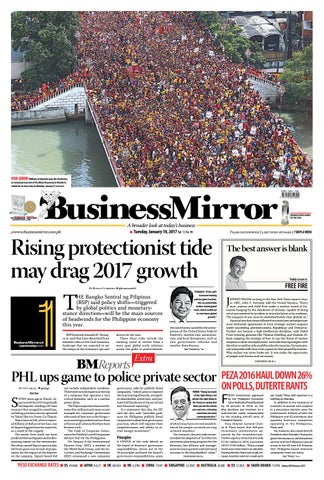
VIVA SEÑOR! Millions of devotees join the Traslacion, an annual procession of the Black Nazarene in Manila to celebrate its feast day on Monday, January 9. ALYSA SALEN
media partner of the year
United nations
2015 environmental Media Award leadership award 2008
BusinessMirror
www.businessmirror.com.ph
A broader look at today’s business n
Tuesday, January 10, 2017 Vol. 12 No. 90
Rising protectionist tide may drag 2017 growth T By Bianca Cuaresma
@BcuaresmaBM
he Bangko Sentral ng Pilipinas (BSP) said policy shifts—triggered by global politics and monetarystance direction—will be the main sources of headwinds for the Philippine economy this year.
BSP Governor Amando M. Tetangco Jr. said they have identified three foreseen risks to the local economic landscape that are expected to set the tempo of the economy’s ups and
downs for the year. These three risks include the seeming trend of retreat from a more open global trade relations across the globe to protectionism;
TETANGCO: “If the shift to inward-looking policies gains traction, this can potentially further shrink global trade, which could lead to even lower global growth.”
the uncertainty caused by the anticipation of the United States Federal Reserve’s interest-rate normalization; and local disruptions, such as new gover nment refor ms a nd weather disturbances. See “Growth,” A2
BMReports
S
@villygc
Part Two
EVEN years ago in March, Japan was hit by a 9.0-magnitude earthquake, sending a 45-foot tsunami that ravaged its coastlines, including a nuclear reactor operated by Tokyo Electric Power Co (Tepco). Tepco later on fell, after it reported billions of dollars of net loss, one of Japan’s biggest loss ever reported, as a result of the tragedy. The power firm could not have predicted the earthquake and its devastating impact on the community. But what caused Tepco’s spectacular fall from grace was its lack of preparation for the impact of the disaster on the company. Tepco’s board did
not include independent members. There were no risk experts at the top of a company that operates a very critical business, such as a nuclear power plant. The Tepco experience has now become this millennium’s most recent example for corporate governance advocates of how not to do things— as accounting scandals such as those of Enron and Lehman Brothers have become stale. The Code of Corporate Governance for Publicly Listed Companies did just that for the Philippines. On January 3 the International Finance Corp. (IFC), a member of the World Bank Group, and the Securities and Exchange Commission (SEC) announced a new corporate
PESO exchange rates n US 49.4660
governance code for publicly listed companies, “which aims to improve the functioning of boards, strengthen shareholder protection, and promote full disclosure in financial and non-financial reporting.” In a statement that day, the IFC said the new code “provides guidance for Philippine publicly listed companies to adopt best governance practices, which will improve their competitiveness and ability to attract foreign investment.”
Principles
A CHUNK of the code delved on the board of directors’ governance responsibilities. Seven out of the 16 principles outlined the board’s governance responsibilities, some
business news source of the year
P25.00 nationwide | 5 sections 28 pages | 7 days a week
The best answer is blank Teddy Locsin Jr.
free fire
J
EFFREY Frank writing in the New York Times reports that, in 1961, John F. Kennedy told the United Nations, “Every man, woman and child lives under a nuclear sword of Damocles hanging by the slenderest of threads, capable of being cut at any moment by accident or miscalculation or by madness. The weapons of war must be abolished before they abolish us.” A partial test-ban treaty followed two years later and important arms limitation agreements to limit strategic nuclear weapons under succeeding administrations, Republican and Democrat. Nuclear war became a high-intellectual discipline, with Nobel Prize-winning geniuses like Thomas Schelling and Graham Allison mapping the strategy of how to use the threat of nuclear weapons to deter its employment, each side sharing insights with the other so neither side would be taken by surprise. Far more precise and predictable than even a game of chess played by masters. Why nuclear war never broke out. It was under the supervision of people with brains and not money. Continued on A11
PHL ups game to police private sector By VG Cabuag
2016 ejap journalism awards
PARDO: “Doing too much of the right thing is not always the right thing to do. I keep on saying that when you do the reform over and over, reforming sometimes becomes counterproductive.”
of which may have stirred sensibilities of the people currently serving as board members. For instance, the new code recommended the adoption of “an effective succession planning program for the directors, key officers and management to ensure growth and continued increase in the shareholders’ value.” Continued on A2
PEZA 2016 HAUL DOWN 26% ON POLLS, DUTERTE RANTS
F
resh investments approved by the Philippine Economic Zone Authority (Peza) slumped by 26 percent in 2016, as the May elections put investors on a wait-and-see mode, compounded by the ensuing anti-US rants of President Duterte. Peza Director General Charito B. Plaza bared that full-year investment commitments ap proved by the investment-promotion agency amounted to only P218.1 billion in 2016, way below 2015’s P295 billion. “This is a usual trend every time there’s an election. During election there was a halt, because investors were on a wait-and-
see mode,” Plaza told reporters in a briefing on Monday. In addition to the hesitance of investors to pursue new projects in a precarious election year, the protectionist rhetoric of both the Philippine and US presidents also spooked American companies operating in the Philippines, Plaza said. He, however, also noted that US President-elect Donald J. Trump has given the assurance, via his business partner and the Philippines special envoy to the US Jose E.B. Antonio, that Philippine-based American companies need not worry.
n japan 0.4227 n UK 60.6354 n HK 6.3784 n CHINA 7.1349 n singapore 34.3920 n australia 36.085 n EU 52.1025 n SAUDI arabia 13.1916
See “Peza,” A12
Source: BSP (9 January 2017 )
BMReports BusinessMirror
A2 Tuesday, January 10, 2017
PHL ups game to police private sector Continued from A1
“This should include adopting a policy on the retirement age for directors and key officers as part of the management succession and promote dynamism in the corporation,” it added. In a separate memorandum issued in March last year, the SEC has issued term limits for independent directors, allowing them to serve only for five years starting in 2012 through 2017, and a two-year cooling-off period shall start to kick in. He can serve for four more years after the cooling-off period. The said memo mainly recommends that board members should only serve up to nine years, after which he or she is barred for reelection for the same position in the same company. In the Philippines the SEC mandates that the board shall be composed of at least five, but not more than 15, members elected by shareholders. Public companies shall have at least two independent directors or such independent directors shall constitute at least 20 percent of the members of such board, whichever is lesser. It is a common practice in the Philippines, however, that a director of one company can also serve in another. It has also become a practice that even a former SEC chairman served in many of the listed firms’ board as independent director. Previously, there were also talks at the SEC of placing age limit of 80 years old on board members. This provision, however, could hurt people, like former Prime Minister Cesar Virata, who is now 86, and Washington Sycip, now 96. Both Virata and Sycip also hold positions in boards of several companies.
Balance
IN a recent interview, Jose Pardo, who served and advised several Philippine Presidents since the 1980s, said there should be balance in every reform. “Doing too much of the right thing is not always the right thing to do,” Pardo said. “I keep on saying that when you do the reform over and over, reforming is sometimes, it becomes counter-productive.” Pardo said he remained quiet before “because I would be affected.” “I am not affected now—I’m on the age of retirement—but in five
Photo shows the façade of the Securities and Exchange Commission (SEC) along Edsa, Ortigas, San Juan. On January 3 the SEC announced a new corporate governance code for publicly listed companies. According to the SEC, companies do not have to fully comply with the code, but they must state in their annual corporate governance reports whether they comply with the code provisions, identify any area of noncompliance and explain the reasons for noncompliance. NONOY LACZA
years time I will be.” He added that the Philippines “cannot just blindly adopt practice in the West and make it respond in a third world.” “Think global; act local,” said Pardo, who is the chairman of the Philippine Stock Exchange, banks and several other companies and educational institutions. The code, which the SEC admitted follows the Organisation for Economic Cooperation and Development principles, wants to end all the practices Pardo insinuated, because it is frowned upon in other markets.
Compliance
AN official of the SEC who requested anonymity said “the code is now a ‘comply or explain’ basis.” “Technically, companies’ board can serve more than nine years, they just need the justification and seek approval
of their shareholders during the annual stockholders’ meeting,” the official said. “We want this to be less regulated. If they will be penalized, let the market do that. The companies are now accountable to their shareholders.” The official added this is practiced in more mature markets. The new code also recommends that the positions of chairman of the board and CEO should be held by separate individuals and each should have clearly defined responsibilities. It is a common practice in the country that the two positions are just being performed by just one person, as many companies in the Philippines are family owned. The code explained that it needed to recommend such an action “to avoid conflicts or a split board.” The code said it also recommends the separation of
the positions to foster an appropriate balance of power, increased accountability and better capacity for independent decision-making. “This type of organizational structure facilitates effective decisionmaking and good governance,” according to the Code, a copy of which was provided to the BusinessMirror by the IFC. “In addition, the division of responsibilities and accountabilities between the chairman and CEO is clearly defined and delineated and disclosed in the Board Charter.” The said separation of the positions of chairman and CEO could see many organizations, such as the Institute of Corporate Directors, celebrating. But the main question remains: Is it doable in a country like the Philippines where many companies are still dominated by few wealthy families? To be concluded
www.businessmirror.com.ph
Growth. . .
Continued from A1
“We are mindful of these global market volatilities because the Philippines is not immune to the repercussions of global headwinds. In addition, we also have home-grown risks and ‘noise’ to deal with. Indeed, the evolving nature of uncertainty in both the global and local environments require that we be vigilant,” Tetangco said in a recent speaking engagement. In view of the seeming trend of retreat from a more globalized trade relations, the BSP chief said policymakers’ focus on so-called inward-looking policies, or their decision to close their economy from outside trade, could dampen the outlook for overall economic growth. “We are seeing the rise of populist sentiment around the globe. Brexit and the Trump win are manifestations of this trend. In addition, both of these events reflect a preference for protectionist policies. Some analysts have called the latter a ‘retreat from multilateralism’. With continued global growth weakness, this retreat from multilateralism is encouraging countries to also look more toward domestic sources of growth,” Tetangco said. “If the shift to inward-looking policies gains traction, this can potentially further shrink global trade, which could lead to even lower global growth,” he added. Closer to home, Tetangco said the “retreat from multilateralism” could disrupt the country’s overseas Filipino workers’ (OFW) deployment and remittances, as well as cause slowdown in the business-process outsourcing (BPO) sector, thereby hurting domestic consumption. Latest data from the central bank showed the money sent home by OFWs declined by 3 percent last October to hit $2.1 million for the month, falling from the $2.16 million in the same month in 2015 and the $2.38 million last September. The weaker value of the peso during the period pushed Filipino migrant workers to send fewer dollars, with the total remittance flows last October registering a contraction for the third time in 2016. The second risk Tetangco mentioned comes from the US Fed’s future policy-rate actions. In its latest meeting, the Fed made hints that it would raise rates three more times in 2017. “If the Fed veers from this, volatility in both the global and domestic foreign-exchange and fixedincome markets could rise,” Tetangco said. The local currency has already been under pressure in the last quarter of the year, owing to the confluence of several factors, including investor concerns over local and international politics, as well as the shifting monetary policy in the world’s largest economy. The peso, in particular, touched the 50-territory in 2016, which prompted local economic managers to adjust their peso assumption for 2016 to 48 to 50 to a dollar from the earlier 45 to 48 against the greenback. “Third. In addition to these external risks, we also have risks emanating from the domestic front, such as political noise and adverse weather disturbances. Moreover, while the administration has committed to ramp infrastructure spending, they could be forced to cut back on this, should revenues from the proposed tax-reform package fall short of expectation, as indicated by the secretary of finance,” Tetangco said. “If critical infrastructures are not built on time, this could hold back the country’s current economicgrowth momentum,” he said.
PHL strong enough
No matter the risks, the governor—who is scheduled to end his term in mid-2017—remains optimistic of the prospects for the economy for the year. “Should the risks I mentioned earlier materialize, we have ample policy space to respond. There is enough room for monetary policy to support the economy,” he said. “Given the external headwinds, our defense system is reliable. Our flexible exchange-rate policy provides us with a tested tool to shield the economy from temporary gyrations, while our adequate reserves and sustained current account surplus fundamentally anchor our external position,” he added.
DTI. . .
Continued from A12
“Fund delivery to microenterprises shall be carried out in either by wholesale lending to nonbank financial institutions, like MFI-NGOs, and cooperatives which shall on-lend the fund to beneficiaries or by direct lending by SB Corp.,” Lopez said in a statement. Priority beneficiaries include microenterprises and entrepreneurs that do not have easy access to credit, or are accessing credit at very high cost, such as microentrepreneurs, market vendors, agri-businessmen and members of cooperatives, industry associations and cooperators. Loanable amount per end-borrower can range from P5,000 for start-ups to as much as P300,000, with a maximum interest rate of 26 percent, per annum with no collateral requirement. This is below the 20 percent per day/week/month charged by “5-6” lenders. It is also lower than what is charged by most MFIs. MFIs may opt for portfolio guarantee cover of up to 15 percent of their P3 loan portfolio from SB Corp. at a guarantee fee of 0.4 percent. The guarantee feature is seen to help MFIs address the P3 program’s inherent risk. The guarantee fund will be sourced from the P3 fund. P3 allocates P100 million for direct lending by SB Corp. Target loan beneficiaries are the small enterprises in priority and emerging industries, start-up businesses and technology innovators. The minimum loan amount will be P300,000, with interest rate capped at 10 percent per annum, with or without collateral cover.
BusinessMirror
Students assail Duterte’s veto of free tuition in state schools By Marvyn N. Benaning Correspondent
T
HE League of Filipino Students (LFS) on Monday protested President Duterte’s veto of the free-tuition policy in state universities and colleges (SUCs), and said the Palace is again reneging on its promise to grant relief to students. “Our right to education is nonnegotiable. We reject all forms of conditionalities that will obstruct the path in having a free public education in all levels for every Filipino youth,” LFS Spokesman JP Rosos said during a protest at the University of the Philippines Diliman (UP Diliman). LFS leaders took turns lambasting the veto at the Palma Hall lobby before marching to the office of the Commission on Higher Education (CHED) on Carlos P. Garcia Avenue within the 524-hectare campus. “For decades, Filipino students have been fighting against tuition increases and other school fees. Having free tuition in public tertiary-education institutions is a welcome development. It is horrible that Duterte has vetoed such a progressive move,” Rosos lamented. “President Duterte is dead wrong when he said that free tuition in SUCs should not
be available to all undergraduate students. It is unacceptable that the highest official in the land does not want our right to be respected,” he added. Rosos insisted it is the duty of the state to provide universal education and spend for the intellectual growth of succeeding generations. No condition should be attached to the enjoyment of free tuition in public tertiary-educational institutions, which serve those who are not wealthy but are intelligent and capable of serving the intellectual and economic needs of the country, Rosos added. “Free tuition is only the first step in realizing the youth’s aspiration for a free public education for all. It is unacceptable that the regime is already blocking the path to such aspiration,” Rosos said. He pointed out that having conditions in the enactment of free tuition is no different from the fine print of the socialized tuition system being implemented at UP. “Duterte’s conditions that students who can afford tertiary education must pay and those who are poor, but academically inclined, are the only ones subsidized is the same premise of UP’s socialized tuition system. But it cannot fool us. We have seen how such premise translates to tuition increases and imposition of other school fees,” Rosos said.
Senate set to investigate data breach at Comelec S By Butch Fernandez
@butchfBM
ENATORS are moving to dig deep into reports on the alleged hacking and potential misuse of vital information contained in the voters’ data base supposedly secured by the Commission on Elections (Comelec). Sen. Leila M. de Lima confirmed over the weekend that the Senate Committee on Electoral Reforms, which she chairs, is poised to conduct a thorough inquiry into the breach owing to its serious implications. “In fact, I plan to file a resolution [calling for an investigation into the Comelec data leak],” she said in a text message to the BusinessMirror on Sunday. Senate Majority Leader Vicente C. Sotto III, rules committee chairman, affirmed support for a full-blown investigation into the Comelec data-hacking case, indicating he will readily refer the resolution to de Lima’s committee when senators reconvene regular sessions next week. The plenary referral will pave the way for Senate investigators to summon Chair-
man Andres D. Bautista and other Comelec officials, as well as poll watchdog groups, to testify and update senators on the voters’ data-hacking case. Sen. Sherwin T. Gatchalian suggested that the Senate needs to look into the matter in order to “make sure that other government organizations have the capability to protect our privacy and proprietary information.” “This [Comelec hacking case] is cause of concern for all of us who share persona l infor mation to gover nment,” Gatchalian added. Apart from Comelec officials, Senate investigators are keen on hearing testimonies from officials of the National Privacy Commission, which earlier found Bautista liable for the data breach by still-unidentified hacker suspects last March. Bautista, however, remained unfazed daring victims of the so-called Comeleak to try and impeach him for failing to take protective measures to prevent the hacking case involving a major breach of the poll body’s voter-data base ahead of the May 9 national elections.
Clark agencies hit over hot-air balloon festival
cal miles away from the Clark airport. Why insists on holding it in Clark, where normal flight operations will be affected,” Cruz pointed out. The PGKM chairman also assailed Ciac Officer in Charge Alex Cauguiran for allowing the holding of the PIHABF. Cruz said the PIHABF is a private entity, and should not be subsidized by government funds.
Outside Clark
C
By Ashley Manabat | Correspondent
LARK FREE PORT—The Pinoy Gumising Ka Movement (PGKM) has once again assailed the holding of the Philippine International Hot Air Balloon Fiesta (PIHABF) in this former US Air Force base. The PIHABF is set here from February 9 to 12, but the Clark International Airport Corp. (Ciac) said this could be the last hot-air balloon festival in this free port. PGKM Chairman Ruperto Cruz is now calling on President Duterte to intervene for the sake of the development of the Clark International Airport (CIA), which he promised in his first State of the Nation Address. Cruz described as “callous” the insistence of the Clark Development Corp. (CDC) and the Ciac to hold the PIHABF at this free port, especially at this time, when more flights are starting to come in to the CIA. He said it is also both “dangerous and a hindrance” to the development of the CIA to hold the PIHABF here. Cruz noted that the holding of the PI-
E
moments during Sunday’s celebration of the Feast of the Epiphany at Plaza Español on Teodoro M. Kalaw Street in Ermita, Manila. The Feast of the Epiphany, or the Feast of the Three Kings, is celebrated on the Sunday following New Year’s Day under the new Roman Catholic calendar. PNA
HABF will require a special permission from the Civil Aviation Authority of the Philippines (Caap), which will then issue a corresponding notice to airmen (Notam) to the CIA affecting normal flight operations at the Clark airport. Flight diversion and delays of at least two hours are expected to be experienced by airline passengers of the CIA owing to the Notam. The PGKM has, time and again, assailed the holding of the PIHABF here, citing the development of the CIA to attract more flights. “We cannot compromise the development of the Clark airport just to give way to the hot-air balloon fiesta,” Cruz said. “There is already a place for hot-air balloons in Lubao, which will not affect flight operations in Clark because it is 33 nauti-
HOWEVER, Ciac management has recommended that next year’s PIHABF be done outside Clark. Hence, this year's hot-air balloon festival might be the last inside the complex. Citing the “full support” of Duterte and Transportation Secretary Arthur P. Tugade for the immediate development of the air hub, Cauguiran said his group will recommend the relocation of the tourism activity outside the airspace of the airport. “While we also subscribe to the objective of the hot-air balloon fiesta to promote local tourism around Clark, priority must be given to the increasing number of commercial airlines at Clark,” he said. Cauguiran added, “More commercial flights at Clark would mean a limited window of hours that hot-air balloons may fly around Clark free port.” Airport authorities revealed that the three-year memorandum of agreement entered into in 2014 by the CDC Philippine International Hot Air Balloon Fiesta Foundation and the CIA will expire this year. This year’s hot-air balloon fiesta would not affect any commercial flight, assured Ritche Nacpil, manager for airport operations at the airport. No balloon will take off until the only commercial flight scheduled to depart at 7 a.m. takes off. “During the past 20 years that the balloon fiesta was held at Clark, no commercial flight has been delayed due to this event,” Nacpil said. The Notam that Caap regularly issues during the balloon fiesta “is a standard measure for the information, guidance and safety of all concerned,” he added. “But, as always, airport operation is the top priority,” Nacpil said. With Lorenz S. Marasigan
Group backs plan to ‘shame’ local Film shooting execs who tolerate illegal fishing fatal to 2 students By Jonathan L. Mayuga
Season’s end Residents dressed as Gaspar, Melchor and Balthazar, or the Three Kings, share some light
Editor: Dionisio L. Pelayo • Tuesday, January 10, 2017 A3
file photo
news@businessmirror.com.ph
The Nation
@jonlmayuga
NVIRONMENTAL group Greenpeace is supporing the plan of Agriculture Secretary Manuel F. Piñol to penalize erring local officials who fail to stop destructive and illegal fishing in their respective municipal waters. In a statement, Vince Cinches, Oceans campaigner of Greenpeace Southeast AsiaPhilippines, called on Piñol to prioritize towns within the 10 fishing grounds identified by the National Stocks Assessment Program of the Department of Agriculture (DA) as overfished or heavily exploited, and to give an ambitious timeframe of six months to allow these fishing grounds to recover. “To address the high poverty incidence among municipal fishers and coastal communities due to destructive and illegal fishing, it is important for the Duterte administration to allocate significant and necessary resources from the national budget to enable a multi-stakeholder body to comprehensively end the scourge of unsustainable fishing practices in the country,” Cinches said. Pang ing isd a Nat in Gaw ing Tama (PaNaGaT), a network of fisheries organizations, also supports Piñol’s plan and urged the agency to work with the Department of the Interior and Local Government, and establish a transparent reporting mechanism to ensure swift justice against erring officials. The group issued a Declaration of Support backing the plan to go after local officials who who are doing nothing to stop destructive and illegal-fishing activities in their respective localities. “We strongly urge Agriculture Secretary
Manny Piñol to effectively enforce Republic Act 10564 initiate other needed reforms in order to further develop a sustained and equitable fishing industry in the Philippines. We believe that coastal and marine resources should be managed in an ecosystem-based approach where areas and habitats are interconnected. Illegal fishing can be curbed if cooperation between and among local governments is promoted. In addition, we ask the DA to strengthen local fishery lawenforcement groups or the volunteer Bantay Dagat by providing equipment, training and social protection, such as insurance and other social benefits, among others,” PaNaGat said in a Declaration of Support. Meanwhile, the Pambansang Lakas ng Kilusang Mamamalakaya ng Pilipinas (Pamalakaya) urged the Bureau of Fisheries and Aquatic Resources (Bfar) to assist fisherfolk in Samar who have been affected by the red tide for months now. To recall, the Bfar raised a red-tide alert in the coastal waters of Irong-Irong, Cambatutay and Daram in Western Samar, as well as in Matarinao Bay in Eastern Samar, and coastal waters of Leyte and Calubian Bay in Leyte. According to the Bfar, the red tide has started mid last year, affecting the livelihood of the fisherfolk for the Bfar has immediately issued shellfish ban since the red tide occurred. “The Bfar should immediately mobilize its calamity fund to assist red-tideaffected fishers in the form of economic aid and relief. They should also release its assessment on the numbers of fishers affected by this natural calamity,” Fernando Hicap, Pamalakaya chairman, said in a statement.
N
ORZAGARAY, Bulacan—Two students of the Bulacan State University (BulSU) drowned on Saturday while shooting a movie for a school project at Bakas River, Sitio Kanyakkan, Barangay Matictic, Norzagaray, Bulacan. Supt. Rizalino Andaya, acting Norzagaray police chief, identified the victims as Jaycie Ronwill Balitaosan, 19, of Meycauayan City, and Jericho Burgos, 17, of Bulakan town. Senior Supt. Romeo Caramat Jr., acting Bulacan police commander, said initial investigations indicate that Balitaosan invited Burgos to join him and his Journalism Society Group of BulSU to a location shooting for a short movie that will be entered in the Sine Bulacan Film Festival. Caramat said when the victims and their companions arrived at the Bakas River, the residents advised them that the waterway was treacherous, but ignored the warning and instead went swimming. However, the v ictims were swept away by the strong current, and were later going under the water at the deep portion near what the locals called Tres Maria’s Rock. The operatives of Norzagaray police, led by Andaya, together with the Norzagaray Rescue Team, were immediately dispatched to conduct search-and-rescue operation, but failed to retrieve the bodies of victims owing to high water level and strong current of the river. It can be recalled that in 2014, another drowning incident occurred, wherein seven tourism students of BulSU also drowned during a field trip in Magnum River in San Miguel town. Catherine Joy Maglalang
Economy
A4 Tuesday, January 10, 2017 • Editors: Vittorio V. Vitug and Max V. de Leon
BusinessMirror
news@businessmirror.com.ph
ADB financial, technical aid reach ‘all-time high’ in 2016 By Cai U. Ordinario
@cuo_bm
A
pproved loans, grants and technical assistance extended by the Manila-based multilateral development bank Asian Development Bank (ADB) increased 17 percent in 2016. Based on preliminary data released on Monday, the ADB’s financial and technical assistance increased to “an all-time high” of $31.5 billion in 2016, from $26.9 billion in 2015. These also included other financial assistance, such as cofinancing. The ADB said its assistance in the region has been growing steadily over the years, as development needs in the region continue to rise. “Asia is growing at a steady pace, but more needs to be done to achieve development that is both sustainable and inclusive,” ADB President Takehiko Nakao said. “The ADB will continue to improve by becoming a stronger, better and faster bank to help the region achieve its development objectives.” For the period covering 2017 to 2020, the ADB said the replenishment of the Asian Development Fund (ADF) in May 2016 will allow the ADB to substantially increase support to the region’s poorest countries. The ADB added that the replenished ADF will enable the bank to provide grant resources for disaster-risk management and regional health initiatives. The increase in its financing in the region in 2016 was largely due to the approvals of loans and grants for sovereign (government) and
ERC issues COC, COE to 17 solar-power providers under 2nd round of FiT scheme $31.5B
The ADB’s financial and technical assistance to Asian countries last year
nonsovereign (primarily the private sector), which reached a record $17.5 billion, a 9-percent increase from $16 billion in 2015. Nonconcessional loans from the ADB’s Ordinary Capital Resources (OCR) amounted to $14.4 billion, while concessional loans and grants from the ADF reached $3.1 billion, with $2.6 billion going to loans and $518 million to grants. Technical assistance, meanwhile, increased by around 20 percent to $170 million, from the $141 million posted in 2015. “The strong showing of the ADB’s operations was based on the larger financing capacity generated by the anticipated merger of the bank’s two main financial instruments—ADF and OCR—which formally took effect on January 1, 2017. With this innovative reform, the ADB’s annual approvals of loans and grants will increase up to $20 billion by 2020,” the ADB said. The Philippines is the ADB’s host country and one of its founding members. The country is the bank’s 11th-largest shareholder. As of December 31, 2015, the ADB’s cumulative assistance to the Philippines has reached 206 publicsector loans worth $15.3 billion and 27 grants worth $75.6 million.
T
By Lenie Lectura
@llectura
HE Energy Regulatory Commission (ERC) has issued certificates of compliance (COCs) to solar-power providers under the second round of the feed-in-tariff (FiT) scheme.
“We already completed the issuance of COCs for the solar-power plants covered by the second round of FiT rate, which is P8.69 per kilowatt-hour [kWh]. Pursuant to the ERC rules, the power plants issued COEs [certificate of endorsements] by the DOE [Department of Energy] were correspondingly issued their FIT-COCs,” according to ERC spokesman Rexie Digal. T he fol low ing solar-power projects were endorsed by the DOE to the ERC. the 23-megawatt (MW) San
₧0.1240 per kWh The current FiT-All rate, which is up eight centavos from the previous rate of P0.0406/kWh Carlos solar-power project of San Carlos Solar Energy Inc.; the 6.23-MW Centrala solar project of NV Vogt Philippines Solar Energy One Inc.; the 13.14-MW Pampanga solar
project II of Raslag Corp.; the 2.66-MW Burgos solar project II of Energy Development Corp.; the 50.07-MW Tarlac solar project of PetroSolar Corp.; the 14.15-MW Hermosa solarpower project of YH Green Energy Inc.; the 10.26-MW Cabanatuan solar project of First Cabanatuan Renewable Ventures Inc.; the 63.3-MW Calatagan solar project of Solar Philippines Calatagan Corp.; the 20-MW Currimao solar project of Mirae Asia Energy Corp.; the 8.5-MW Valenzuela solar project of Valenzuela Solar Energy; the 2.04-MW Lian solar project of Absolut Distrillers Inc.; the 18-MW Bais solar project of Monte Solar Energy Inc.; the 22.33-MW Clark solar project of Enfinity Philippines Renewable Resources Inc.; the 10.49-MW Kibawe solar project of Asian Greenergy Corp.; the 5.02-MW Palauig solar project of SPARC Solar Powered Agri-
Rural Communities Corp.; the 15-MW Bulacan III solar project of Bulacan Solar Energy Corp.; and the 132.5-MW Cadiz solar project of Helios Solar Energy Corp. These solar projects, except for NV Vogt Philippines Solar Energy One Inc., secured COCs from the ERC in early December of 2016. The FiT-Allowance (FiT-All) serves as an incentive to renewableenergy (RE) developers to ensure the viability of their projects. RE includes wind, run-of-river hydro, solar, geothermal and biomass. Consumers are the ones who shoulder the FiT-All, a separate line component in the power bill. The distribution utilities are the ones that collect the FiT-All from end-consumers. They will remit this to the National Transmission Corp., which was tasked by the ERC to administer the FiT-All fund. The current FiT-All rate is P0.1240 per kWh, up eight centavos from the previous rate of P0.0406/kWh.
PCUP head slams DOF spokesman over SSS pension increase statement By Marvyn N. Benaning Correspondent
New lab boosts DENR capacity to asses, control lethal pollutants By Jonathan L. Mayuga @jonlmayuga
W
ith a dioxins/furans laboratory in place, the Department of Environment and Natural Resources-Environmental Management Bureau (DENR-EMB) now boasts of an enhanced capacity to assess and control persistent organic pollutants (POPs). As a party to the Stockholm Convention on Persistent Organic Pollutants, the Philippines needs to develop its local capability to assess and control POPs, including polycholorinated dibenzo-pdioxin and polychlorinated dibenzofurans or dioxins. “We now have a dioxins/furans laboratory to do that. We are currently in the process of capacitybuilding and training our EMB personnel,” DENR Undersecretary for Special and Foreign Assistant Projects Jonas Leones said. The establishment of the dioxins/furans laboratory started in 2015. It has a total estimated cost of P95 million. A brainchild of Leones during his stint as director of the DENR-EMB, the laboratory is the last of a number of laboratories needed to make the Philippines capable of assessing all POPs and meet its obligation under the Stockholm Convention. Dioxins are among the most toxic chemicals known to science and are detectable in almost all compartments of the global ecosystem in trace amounts, according to Fatima Molina, supervising science research specialist and chief of the DENR-EMB’s Laboratory Services. The DENR-EMB recently acquired a High-Resolution Gas Chronomatograph Mass Spectometer to do the job of assessing the presence of dioxins/furans. “We are in the process of calibrating our laboratory equipment and hopefully, by the first quarter, it will be ready for use,” Molina said. A deadly POP, dioxins do not serve any useful purpose. These
are formed as byproducts of numerous industrial activities and all combustion processes, such as exhaust gases, solid and liquid residues and effluents. Burning of household trash and forest fires can also result in release of dioins and furans into the environment. According to experts, dioxins are persistent in the environment. They accumulate in animal fat and can travel long distances. Member-countries of the Stockholm Convention, such as the Philippines, are giving priority to dioxin/ furan management through the conduct of activities that cover national inventories, source reduction and control strategies. According to Leones, the establishment of a dioxin/furans laboratory also boosts the plan of the DENR to push for wasteto-energy projects in partnership with other countries. With a dioxin/furans laboratory in place, the DENR-EMB can now generate data to support policy and decisions on the adoption of appropriate approach in the management of POPs from national inventories, source reduction and control strategies, and in order to support the enforcement of the provisions on dioxins in the Clean Air Act, or Republic Act (RA) 8749, and the Solid Waste Management Act or RA 9003. The Philippines is currently implementing the Integrated Persistent Organic Pollutant (IPOPs) project to assist the country in meeting its obligation under the Stockholm Convention. The project also aims to boost the country’s capacity for the sound management of chemicals. With its enhanced capability to assess dioxins and furans, the DENR-EMB can also now provide evidence that will support its decision-making process. It can also now provide data that would be used in the formulation of criteria for dioxins and furans in water, soil, fish, sediments and biota.
C
racks in the Duterte administration have surfaced, as the chief of the Presidential Commission on the Urban Poor (PCUP) slammed the mouthpiece of the Department of Finance (DOF) for claiming that the increase in the Social Security System (SSS) monthly pension is good only for pogi points. PCUP Chairman Terry Ridon said “calling the SSS pension hike and the land-use conversion moratorium mere short-term populist initiatives for pogi points is an unacceptable slight aimed squarely at millions of income-poor pensioners, farmers and urban poor.” Finance Spokesman Paola Alvarez claimed the pension hike and land-use moratorium are mere “populist proposals willy-nilly just to earn political pogi points for the Duterte administration.” Ridon ridiculed the Alvarez tack that taxpayers may be forced to fund the proposed P2,000 increase in SSS pensions without corresponding adjustment in members’ contributions with SSS itself, saying it has the funds to support the increase. “It might be incorrect to say that revenue will take a hit by approving the pension hike, because as soon as the President gives his approval, it becomes state policy to provide funds to the pension fund. It is no different from the budget given to the other propoor programs of the administration,” he added. Ridon, who previously sat as member of the committee on ways and means in the 16th Congress, said the government should look somewhere else to raise the revenue it needs for infrastructure spending in the next six years. “If additional revenues are the concern, a most basic initiative would be to raise the level of efficiency in tax collection, both in the BIR [Bureau of Internal Revenue] and Customs, and not to flatly reject clearly pro-poor programs of different agencies.” Ridon said he feels personally slighted by the statement that the pension hike and land-use moratorium merely “panders to short-term populist initiatives.” “The President was swept to power on the strength of his support for the pension hike, and his clear concern for the day-to-day problems of our people. This was not something made up just to grab the headlines of the evening news,” he noted.
Candle for a prayer
An enterprising woman displays her inventory of candles to passersby and devotees at the Quirino Grandstand in Manila a day before the Feast of the Black Nazarene. The woman says the candle to be lit by a devotee depends on the prayer intention being asked for. ALYSA SALEN
briefs asean summit hosting to attract trade, investments
The Philippines stands to benefit from hosting the Asean Summit this year through increased trade and investments in the region and high economic growth in the next few years, the country’s foremost economist said. In an interview, Dr. Bernardo Villegas, professor at the University of Asia and the Pacific, said Filipino companies are opting to protect domestic market, while a few of them have led in expanding their businesses toward the Asean region. “I hope that more and more companies will think of integrating their businesses all over the 650 million consumers in the Asean,” he said. “We have to get more and more of our businesspeople to think beyond Philippine shores.” Villegas said the Asean meetings here will open up a lot of networking opportunities for businesses in the region. He stressed that the country’s hosting of the Asean Summit can also create investment opportunities among member-countries. “A lot more Filipino corporations [have to] leverage their relationship with Asean companies so that they can invest here and vice versa. We can open up markets in the Asean countries,” he added. The economist believes its hosting can also pave the way for the Philippines to fully maximize the benefits of the Asean Economic Community, especially on a countryto-country agreement on services. “We can just send our lawyers, our engineers, architects, unless we agree with the respective governments. That is the competitive advantage of the Philippines. Filipino professionals are among the most sought-after in the Asean,” Villegas said. PNA
u.s. university, usc in cebu, foundation to aid microentrepreneurs CEBU CITY—A university based in California, US has collaborated with a Cebu-based university and a foundation to design and implement programs that will help sustain and improve microentrepreneurs in Cebu and alleviate poverty in the province. The academic collaboration was formed by the Santa Clara University of California, the School of Business and Economics of the University of San Carlos (USC) in Cebu City and the Ramon Aboitiz Foundation Inc. (RAFI), which is also based in Cebu City. Fr. Michael Engh of Santa Clara University said they were impressed with the practicality of USC’s current microentrepreneur-focused programs, and that they were giving their full support on implementing the project. The academic collaboration will be a community-based program wherein students, faculty and alumni of the economics and business departments of USC and Santa Clara University will participate on helping and sustaining microentrepreneurs in Cebu. Fr. Dionisio Miranda, USC president, said they invited representatives from Santa Clara University to discuss with them how community extensions of microentrepreneur programs in California in the United States can be used to aid the improvement of microentrepreneurship in Cebu, and ultimately “alleviate the poverty situation.” “Their programs serve as benchmarks on how to further sustain microentrepreneurship,” Miranda said. Dr. Challoner Matero, dean of USC’s School of Business and Economics, said their department, together with RAFI, would do extensive research to make sure the microentrepeneurship program from Santa Clara University, which are designed for a first-world country, would be applicable for a third-world country like the Philippines. The team will also research on the poverty situation in Cebu before launching the project. PNA
Agriculture/Commodities BusinessMirror
news@businessmirror.com.ph
Editor: Jennifer A. Ng • Tuesday, January 10, 2017 A5
‘Corn output in 2016 likely declined by 10%’ PHL slaps ban on poultry meat from 4 countries
T
he government has imposed a temporary ban on the importation of poultry meat, day-old chicks, eggs and semen from some areas in four European countries. The Department of Agriculture (DA) said it made the decision after the governments of England, France, Poland and The Netherlands confirmed to the World Organization for Animal Health (OIE) the outbreaks of the highly pathogenic avian influenza (HPAI) virus in their respective countries. “[The ban is being imposed] to prevent the entry of HPAI virus to protect the health of the public and the local poultry population,” Agriculture Secretary Emmanuel F. Piñol said in Memorandum Orders (MO) 33, 36, 37, 38 and 39, copies of which were obtained by reporters on Monday. The United Kingdom’s Department of Environment, Food and Rural Affairs in London reported to the OIE on December 17, 2016, that there was an outbreak of H5N8 HPAI virus in South, East Lindsey, Lincolnshire, England, affecting house turkeys, as confirmed by its Animal and Plant Agency (APHA). The Netherlands, France and Poland also reported the outbreak of the same virus in some of their provinces. The Netherlands’s Ministry of Economic Affairs in The Hague reported to OIE last December 14 that there was an outbreak of HPAI in Abbega, Friesland, the Netherlands, affecting laying hens as confirmed by its national laboratory. T here were H5N8 HPA I virus outbreak in Almayrac, Tarn and Monbahus, Lot-etGaronne, France, affecting birds as confirmed by ANSES National Reference Laboratory for Avian Influenza and Newcastle Disease in Ploufragan last December. Meanwhile, Poland’s National Veterinary Research Institute confirmed that there were H5N8 HPAI virus outbreaks in Deszczno, Gorzowski, Lubuskie and Przemyski, Pordkarpackie last mid-December 2016. With the ban in place, Manila has suspended the processing, evaluation of the application and issuance of sanitary and phytosanitary import clearance of domestic and wild birds and poultry products from the four European countries. The DA warned that it will confiscate all shipments of the banned commodities originating from HPAI-affected areas in the four European countries. The ban does not cover heattreated products. “Frozen poultry meat with slaughter/process date of 21 days prior to the HPAI outbreaks are allowed to enter the country subject to veterinary quarantine rules and regulations,” Piñol said. Manila usua l ly imposes a temporary ban on poultry products from areas where there are HPAI outbreaks as a preventive measure. Currently, the Philippines is one of the few countries in Southeast Asia that remains free from the dreaded avian influenza virus. The virus, which resurfaced in Asia in 2003, crippled poultry industries in neighboring countries, such as Vietnam. Jasper Emmanuel Y. Arcalas
Photo taken from www.gov.ph
T
By Jasper Emmanuel Y. Arcalas @jearcalas
he country’s corn production last year likely went down by as much as 10 percent to 6.8 million metric tons (MMT), compared to the 7.52 MMT recorded in 2015, according to the Philippine Maize Federation Inc. (Philmaize).
Philmaize President Roger V. Navarro attributed the drop in output
to the lingering effects of El Niño and the strong typhoons that ravaged
the country, such as Lawin (international code name Haima). “The projected 10-percent cut is the maximum. Corn production last year may have declined by a minimum of 5 percent,” Navarro told the BusinessMirror. Citing Philippine Statistics Authority (PSA) data, Navarro said the country’s corn production from January to September reached only 5.49 MMT, 1.77 MMT short of the agency’s projected output of 7.26 MMT in 2016. “I don’t think we produced 2 MMT of corn in the fourth quarter,” he said. “The highest output in the fourth quarter could be around 1 million. We hope that total production will
not be 10 percent lower compared to 2015 but the way we see it, we were really affected by the typhoons,” Navarro added. Another factor that would contribute to the reduction in corn output, he said, is the decision of farmers not to plant the crop due to the continuous drop in farm-gate prices. “The farmers were really discouraged because they feel they are not being supported by the government. The government did not do its part in supporting the farmers, particularly in stabilizing their productivity and their income,” Navarro said. He said the importation of feed wheat and corn by feed millers, hog farmers and poultry growers contributed to the drop in farm-gate prices.
“If the feed millers and livestock sector filled their warehouses with imported feed wheat and corn, then there won’t be any space for the local harvest anymore,” Navarro said. The PSA projected that corn output in the October-to-December 2016 period will reach 1.74 MMT, 0.5 percent higher than last year’s record of 1.73 MMT. “Harvest area may contract to 614,650 hectares from 619,930 hectares. Yield may decrease to 2.83 metric tons (MT) per hectare, from 2.86 MT per hectare,” the PSA said in a report. The PSA said corn output in the provinces of Apayao, Kalinga, Mount Province, Cagayan, Nueva Vizcaya, Aurora, Zambales, Cavite and Camarines Sur may have been reduced by typhoons Karen and Lawin. The report noted that farmers have already harvested corn planted in 216,860 hectares. Also, around 238,340 hectares, or 34.8 percent, of the planting intentions for the January-to-March 2017 period have materialized. Based on farmers’ planting intentions, output in the first quarter of the year could go up by 18.23 percent to 2.27 MMT, from 1.92 MMT recorded a year ago. “The problem on the ground right now is that the price is down. So, naturally the planting intentions—because the farmers see it as prices decline—will also go down,” Navarro said. “The government should help corn farmers so they would be encouraged to plant more,” he added. The Philmaize chief noted that the Mindanao corn farmers, who will harvest their second crop in February, are concerned about the low farmgate price of corn.
House bill calls for reverting unused fishponds to forestlands
By Jovee Marie N. dela Cruz @joveemarie
T
he House Committee on Natural Resources has endorsed for plenary approval a measure allowing the Department of Environment and Natural Resources (DENR) to revert to forestlands fishponds that have been unutilized or abandoned for three years. Party-list Rep. Carlos Isagani T. Zarate of Bayan Muna, chairman of the panel, said House Bill (HB) 854,
authored by Rep. Linabelle Ruth R. Villarica of Bulacan, seeks to amend Section 43 of Presidential Decree (PD) 705, titled Swamplands and Mangrove Forests. “Mangrove and other swamps released to the Bureau of Fisheries and Aquatic Resources [Bfar] for fishpond purposes which are not utilized or which have been abandoned for three years from the date of such release shall revert to the category of forest land,” the bill read. “The Department of Agriculture
[DA] and the Department of Environment and Natural Resources shall determine in a set of joint guidelines, abandoned, undeveloped or underutilized fishponds covered by Fishpond Lease Agreements (FLAs),” it added. For her part, Villarica, chairman of the House Committee on Foreign Affairs, said environmental laws must be attuned to the demands of climate change, as well as the socioeconomic needs of the increasing number of people living in communities.
Villarica, however, said PD 705, or “The Revised Forestry Reform Code of the Philippines” requires that for the DENR to revert fishponds with FLAs to forestlands, the fishponds must have been unutilized and abandoned for five years from the time these were released for such purposes. “The five-year period is deemed too long for such fishponds to be utilized for purposes other than what they were intended for, such as for mangrove propagation, to address
the devastating effects brought about by climate change or for promoting eco-tourism activities,” Villarica said. To effectively implement the provision on the reversion of fishponds, as well as the FLAs issued by the Bfar covering fishponds, Villarica said the DA should prepare with the DENR joint guidelines in determining abandoned, undeveloped or underutilized fishponds. The bill was filed during the 16th Congress, but was not taken up due to time constraint.
From 150 eggs a week to 0: Price surge drives Koreans crazy
I
N a packed stall in one of Seoul’s traditional eateries, patrons feast on egg-rich Korean pancakes washed down with beer. Despite the booming business, the owner of the restaurant, Kim Kang-ock, looks on in dismay. “Soaring egg prices are driving me crazy, as it’s about to kill my business,” the middleaged South Korean street-food vendor says as she dips vegetables in yolk before frying them. “Look at my menu, almost everything here needs an egg, not only the pancakes, but noodles, as well. I can’t run my business if I don’t have eggs.” A few blocks down the road, 44-year-old Jeon Min-jeong stands in the middle of a discount supermarket, staring at a shelf stacked full of eggs while debating whether she can afford them. The housewife usually buys 150 eggs a week to feed her family of four, including a fitness-fanatic husband who relies on the protein-rich foodstuff. Now she fears an eggless Lunar New Year awaits them. The two ladies are among millions of South Koreans reeling from the spread of bird flu, which has gripped the nation in its most serious outbreak. The country raised its threat level to its highest ever, and has culled more than 31 million birds in farms across the land, making it one of the worst affected in the world. As fear of consuming chickens sent the price slumping, the converse has happened to eggs, with costs expected to more than double in the first half of this year. South Korea isn’t alone in its suffering. Countries, including Germany, France and Japan, have also discovered cases of avian influenza, while China, which also reported an outbreak,
BLOOMBERG PHOTO
halted poultry imports from bird-flu hit countries last month. But South Korea has felt the most damage from the H5N6 flu strain, with authorities culling about 17 percent of its national flock of chickens and 28 percent of ducks as of January 8, compared with 0.3 percent of poultry in Japan. “This is the first time we are dealing with the H5N6 virus and it’s spreading extremely quickly,” Ji Seon-u, a hens and eggs researcher at
Korea Rural Economics Institute, said by phone. “The impact of avian influenza has never been this bad and with the Lunar New Year coming close, egg consumption will increase, which could further push up prices.” Used in traditional Korean dishes, like Pajeon—a pan-fried egg-based pancake with scallions and green onions—South Koreans are relatively big egg eaters, with about 250 eggs consumed per person in 2014, compared with
63 per capita in India and 150 in South Africa. The average price of eggs sold by South Korean farmers soared 50 percent to 1,551 won ($1.30) for 10 standard-sized eggs last December from a year earlier, while the average retail price rose 21.4 percent to 2,207 won, according to the Korea Rural Economics Institute. Farm prices could surge as much as 110 percent in the first half of 2017 due to the shortage of hens, the researcher said. Meanwhile, chickens, which the country typically consumes more of per capita than Japan and China, has fallen 8 percent in price last December from before the outbreak last October. To ease the price hike, the government in Seoul has removed tariffs on 98,600 tons of imported eggs and egg products for the first half of this year. The nation plans to import the commodity from five countries, including the US, Australia and Spain, an official at the agriculture ministry, who asked not to be identified, said by phone. But that may feel too late for eatery owner Kim, who says she hasn’t passed on the eggprice increase to her customers for fear of losing business. What’s more scary, she says, is the upcoming Lunar New Year on January 27, a time when she can use as much as 1,800 eggs a day and is usually the peak of her pancake sales. For high egg consumer Jeon, the upcoming celebration is also causing anxiety. “I am very worried about how we will survive the Lunar New Year because prices will probably remain high,” Jeon said. “If the prices go even higher, there’s a high chance that we may go eggless, which is a very odd thing for my household.” Bloomberg News
The World
BusinessMirror ‘To upgrade stature of our [U.S. and Taiwan] bilateral relations’ A6
Tuesday, January 10, 2017
Editor: Lyn Resurreccion • www.businessmirror.com.ph
GOP leaders meet with Taiwan prexy
H
OUSTON—Texas Sen. Ted Cruz and Gov. Greg Abbott said they met on Sunday with Taiwan President Tsai Ing-wen while she was passing through Houston on her way to Central America. The Republican senator said in a news release that, during his meeting with Tsai, they “discussed our mutual opportunity to upgrade the stature of our bilateral relations” in a talk that addressed arms sales, diplomatic exchanges and economic relations. “Furthering economic cooperation between our two nations must be a priority; increased access to Taiwanese markets will benefit Texas farmers, ranchers and small business owners alike,” he said. A news release from Abbott, also a Republican, said he and Tsai dis-
cussed energy, trade relations and commercial ties between Taiwan and Texas. He said they talked about “how our two economies can expand upon our a lready prosperous trade partnership.” An official with Republican President elect-Donald J. Trump’s transition team has said neither Trump nor transition officials would be meeting with Tsai. Her stop in the US was scrutinized by Beijing for any signs that Trump’s team would risk its ire by further engaging with the self-ruled island that China considers its territory.
Beijing officials complained after Trump last month breached diplomatic protocol by speaking by phone with the Taiwanese leader. Trump raised further concerns in Beijing when he questioned a US policy that since 1979 has recognized Beijing as China’s government and maintains only unofficial relations with Taiwan. US lawmakers often meet with Taiwanese presidents when they transit through the US. Tsai, who departed Taipei on Saturday, pledged to bolster Taiwan’s international profile as she set off on the trip to reinforce relations with diplomatic allies in Central America. Cruz said in his news release that shortly before his meeting with Tsai, the Houston congressional delegation had gotten a “curious” letter from the Chinese consulate asking members of Congress not to meet with Tsai. Cruz said China “needs to understand that in America we make decisions about meeting with visitors for ourselves.” AP
Taiwan’s President Tsai Ing-wen delivers a speech before traveling to visit Central American allies, including a US transit, on Saturday at the Taoyuan International Airport in Taouyuan, Taiwan. Tsai pledged to bolster Taiwan’s presence on the international stage on her visit to four Central American allies on a trip that includes the US and looks set to raise China’s ire. Central News Agency via AP
GOP: New health-care law to be enacted quickly
W
ASHINGTON—Top Republicans said on Sunday they’ll move quickly to enact a new healthcare law, but they won’t say how long that might take or what might replace President Barack Obama’s version. Questions surrounding the future GOP plan have unnerved key parts of the health-care industry, including hospitals and insurers that have warned Congress against uncertainty. “We will be replacing it rapidly after repealing it,” said Senate Majority Leader Mitch McConnell, Republican-Kentucky. He declined to provide a more specific timeline. The 2010 health law, which passed without Republican votes, became a lightning rod in US politics. President-elect Donald J. Trump campaigned on a promise to repeal it. Congressional Republicans are in agreement it should be replaced. But they’re at odds over how to do it, particularly over how to pay for popular provisions, including coverage for preexisting conditions and the ability for parents to keep children on their plans until age 26. A key GOP focus has been to do away with the individual mandate requirement that all Americans have insurance or pay a fine. But absent that requirement, insurers have warned it’s not financially viable to force them to accept people with existing medical problems.
Former President Akbar Hashemi Rafsanjani waves to journalists, as he registers his candidacy for the upcoming presidential election, with his daughter Fatemeh (second from right) at the interior ministry, in Tehran, Iran, on May 11, 2013. Rafsanjani has died at age 82 after having been hospitalized because of a heart condition. He served as president from 1989 to 1997. AP/Ebrahim Noroozi
Another concern for some GOP lawmakers is scrapping a law that’s covered 20 million people without offering them an alternative. GOP Sen. Rand Paul of Kentucky tweeted late on Friday that he spoke with Trump and that the president-elect “fully supports” a repeal only when there’s a viable substitute. McConnell said the first step would come this week, when the Senate will vote to repeal the law. With GOP majorities in both the House and Senate after the November election, the repeal bill is expected to pass both chambers before reaching Trump, who takes office on January 20. Trump’s incoming chief of staff, Reince Priebus, said he doesn’t want to get into specifics other than to say the goal is to act quickly. “I will tell you that it would be ideal if we could do it all in one big action,” Priebus said. “But look, it may take time to get all the elements of the replace in place.” When asked about Paul’s tweet, Trump aide Kellyanne Conway said: “I can confirm that he is committed to replacing Obamacare with something that actually is affordable and accessible and allows you to buy health insurance over state lines and allows people to have health savings accounts,” she said. McConnell and Priebus were on CBS’s Face the Nation. Conway spoke on CNN’s State of the Union. AP
Death of Iran’s Rafsanjani removes influential voice against hard-liners
T
EHR AN, Iran—With the death of Ayatollah Hashemi Rafsanjani on Sunday, Iran’s political factions knew immediately that any space by reformers to maneuver had just significantly decreased. Change had come, and it did not favor those seeking to turn Iran into a less revolutionary country with more tolerance and outreach to the West—especially the United States. Rafsanjani, a former president who helped found the Islamic republic, had been the one man too large to be sidelined by conservative hard-liners. Now he was suddenly gone, dead from what state media described as cardiac arrest—and with no one influential enough to fill his shoes. Iran’s long-marginalized reformists and moderates, who would use Rafsanjani ’s regular calls for more personal freedoms and requests to establish
better relations with the US to advance their political agendas, suddenly felt exposed and weakened. Who would now warn publicly against “Islamic fascism,” when the hard-liners sought to inf luence elections? W ho would state openly that there should be a nuclear compromise? Rafsanjani said things others would not dare to say, and his voice had at least created some tolerance for debates. “Hard-liners will be happy, but this is the start of a period of anxiety for many,” said Fazel Meybodi, a cleric from the holy city of Qum who supports reforms in Iran. “His death disturbs the fragile balance we had in Iran.” There simply are no replacements for Rafsanjani, analysts from all factions say. His death also reflects the dwindling number of leaders from the generation that overthrew the shah nearly four decades ago. Most are now in their 1980s or even older.
“It is a very powerful reminder that Iran is at the beginning of a major leadership transition that will play a very psychological role in Iran’s politics,” said Vali R. Nasr, a Middle East scholar who is dean of the Johns Hopkins School of Advanced International Studies. “I think this in some ways rattles Iran’s political system, in that it underscores the fact that with everything else going on—Syria, the nuclear deal—there will be a passing of the baton to the next generation,” Nasr said. Two of Rafsanjani’s most important proteges—Hassan Rouhani, the current president, and Mohammad Khatami, a former president—both owe their political careers to him. But Rouhani, up for reelection this year, is fighting for his political life. Khatami, who has been sidelined by conservative adversaries for years, is now even weaker. Rouhani managed to create a
coalition to win the elections in 2013, with Rafsanjani’s support. Having successfully negotiated a nuclear agreement with the US and other big powers, partly from encouragement by Rafsanjani, Rouhani promised a bright economic future for Iran—which has yet to happen. With the demise of his mentor and protector, Iran’s president will find it hard to gather the same level of support he received four years ago with the backing of Rafsanjani, analysts say. “He was a very powerful figure for Mr. Rouhani to rely upon,” said Mohammad Marandi, a professor at Tehran University who is close to Iran’s leaders. “Many worked with him because of that support. The passing of Mr. Rafsanjani complicates the president’s position and makes his reelection less certain.” Khatami won presidential elections in 1997 after having received Rafsanjani’s support, and led Iran
through an era of greater personal freedoms and Western outreach that was quashed by unelected, hard-line centers of power. “It is Mr. Khatami who should take on the burden of the late Ayatollah Hashemi-Rafsanjani’s responsibility,” said Mohammadreza Shamsolvaezin, a former reformist politician and activist. But Khatami is all but paralyzed politically. The hard-line-dominated judiciary has ordered all Iranian media not to carry his picture or even quote his web site. Besides appearances at theater plays, religious gatherings and art exhibitions, Khatami has remained silent. Rafsanjani could speak more freely than others, not only because of his revolutionary credentials, but also his friendship with Ayatollah Ali Khamenei, whom he helped become supreme leader in 1989. Khamenei, who has skillfully played all Iranian factions, would
never go as far as to completely isolate Rafsanjani, even when he supported protests that followed the disputed 2009 presidential election. While presidential candidates Mir Hossein Mousavi and Mehdi Karroubi were placed under house arrest in 2011 for their criticisms, Rafsanjani was stripped of several functions but never purged. In a statement, Khamenei lamented the passing of Rafsanjani. Still, it was clear to many that K hamenei regarded him not only as a friend but a rival, whose absence could now make the role of supreme leader even more powerful. “The loss of a comrade and ally, with whom I share a friendship that dates back to 59 years ago, is difficult and heart-rending,” said a statement posted on Khamenei’s web site on Sunday. He also referred obliquely to their disagreements. New York Times News Service
Editor: Lyn Resurreccion • www.businessmirror.com.ph
The World BusinessMirror
Tuesday, January 10, 2017
A7
Guangzhou auto seeks to be first Chinese carmaker to crack US G
uangzhou Automobile Group Co. (GAC), which produces cars in China with Fiat Chrysler Automobiles NV, plans to start exporting its own brand of automobiles to the US next year and become the first Chinese carmaker to begin retail sales to American consumers. GAC, which created its Trumpchi brand in 2010 after being a production partner for foreign carmakers for more than a decade, will start a research and development center in Silicon Valley in
the first half of this year to prepare for the company’s entry to the US, the company’s President Feng Xingya said. “Exporting to the US is a key part of our efforts to become a
global player and success in North America is a vital yardstick,” Feng said in an interview in Detroit on January 8. “We won’t ship our cars here before we are fully confident that our cars would nail it.” Chinese automakers have set their sights on breaking into
380K The estimated number of exported Trumpchi vehicles in 2016 owing to the popularity of its GS4 and GS8 sport-utility vehicles
the US retail market with their own brands for a long time, with Warren Buffett-backed BYD Co. and Volvo Cars owner Zhejiang Geely Holding Group Co. declaring their American ambitions at least nine years ago. Neither has been able to meet that target, though BYD has begun to sell electric buses to fleet owners in the US and Volvo Cars is exporting made-in-China vehicles to American showrooms. For GAC, a successful entry will mark the culmination of at least five years of preparation. The Guangzhou, China-based company is working to develop models tailored for the US market to ensure their cars will appeal to local consumers and meet all regulatory requirements, Feng said.
GAC ’s export plan comes as competition in China intensifies, with demand expected to grow at a slower pace. W hile Chinese automakers, like Great Wall Motor Co. and Chongqing Changan Automobile Co., have been exporting to overseas markets, GAC would be the first to take a brand to developed markets with stricter emission and fuel-economy rules. T he compa ny a l most doubled its deliver y of Trumpchi vehicles last year to more than 380,000 units on the popularity of its GS4 and GS8 sportutility vehicles. The automaker expects to have about 10 percent of Trumpchi sales from overseas markets by 2020. “Trumpchi’s success in China
is giv ing them confidence to march into the US market,” said Fu Yuwu, president of the Society of Automotive Engineers of China. “Chinese automakers haven’t done enough to become global companies and they won’t have better understanding of markets overseas unless they actually sell cars there.” GAC plans to use the research center in Silicon Valley to speed up research into connected cars, recruit talent and deepen its knowledge about local consumer preferences and government regulations, Feng said. The research center will also help the company identify acquisition targets that may help with the company’s development of advanced technologies, he said. Bloomberg News
May signals UK to leave single market to win immigration curbs
U
A road in India Bloomberg Photo
Modi flying blind into budget as India’s GDP a guessing game
P
rime Minister Narendra Modi’s administration will probably have to prepare India’s $300-billion budget in the dark. With less than a month to go before the annual presentation, his Statistics Office has refused to estimate the impact of Modi’s unprecedented cash clampdown on GDP. All it said on Friday was that growth would slow to a three-year-low before the effects of the ban start to show. “If the budget has to be tabled by Februar y 1, the papers will have to go for printing by January 20. This would indicate that they won’t get any more data,” said Pronab Sen, who was India’s national statistician until 2010. The Statistics Office correctly used available data to offer an estimate of what the economy would look like without demonetization, and left the Finance Ministry to fill in the blanks, he said. “How much they will shave off, no one can guess.” Sen estimates GDP will expand about 6 percent in the year through March 2017, compared with a median 6.8-percent projection in a Bloomberg survey. There isn’t enough evidence “to
say anything about demonetization, one way or the other,” Chief Statistician TCA Anant told the Business Standard newspaper. The government has sufficient data to prepare the budget, Finance Ministry Spokesman D.S. Malik said by phone on Sunday, without elaborating. Yet, there were only a handful of indicators available to the Statistics Office that capture the economy after Modi’s November 8 decision to invalidate 86 percent of currency in circulation, such as farm output and sowing, government ex penditure and sales tax. Cor porate results won’t be f i led before ea rly Febr u a r y, said Dharmakirti Joshi, chief economist at Crisil Ltd., the local unit of S&P Global. The government will be handicapped in estimating recovery timelines for various sectors, he added, complicating an already fraught budget-making process. A credible view on growth is essential for the government to project revenues and spending in a nation where a million people enter the work force each month. The 2017 announcement is of special importance because it’ll
be followed by a series of crucial state elections. To further muddy the waters, Modi’s move will disproportionately be felt in India’s vast shadow economy, which relies on cash and employs more than 90 percent of India’s workers. These effects won’t be directly captured in the GDP data, according to Gita Gopinath, economics professor at Harvard University. Human suffering in the form of job losses risks flying under the radar, or showing up indirectly as an antiseptic dip in consumption as daily wage earners defer nonessential spending. Modi had touted the move as India’s biggest step against tax evasion and graft. While critics decry it as short-sighted, supporters praise Modi for his boldness. “No economist worth his salt should comment on the longterm impact demonetization is going to have on the Indian economy,” said Abhay Aima, country head, private banking group, retail liabilities, digital banking and international consumer business at HDFC Bank Ltd. “There has been no precedence of something like this. You never know how this is going to turn out.”
Tax collections in the year through March will exceed the government’s estimates as demonetization forces members of the shadow economy to declare unaccounted incomes, Finance Minister Arun Jaitley told reporters in New Delhi on Thursday. Windfall gains from the exercise will be between zero to 1 percent of GDP, according to Standard Chartered Plc. It predicts the government will retain its target of narrowing Asia’s widest budget deficit to 3 percent of GDP in the year starting April 1 though a deviation to 3.3 percent can’t be ruled out. Apart from “forecasting challenges,” the government will also probably overhaul the format of its budget, removing a historical distinction between so-called plan and nonplan spending that was a relic of Soviet-style fiveyear plans, Standard Chartered analysts, including Anubhuti Sahay, wrote in a report on Friday. “ The finance minister will face new—and probably more significant—challenges than in recent years when he presents the budget,” they said. “Don’t miss the forest for the trees.” Bloomberg News
NITED Kingdom Prime Minister Theresa May signaled regaining cont rol of i m m i g r at ion a nd law ma k ing are her Brexit pr iorities even if that means quitting Europe’s single market. In her first televised interview of the new year, May told Sky News on Sunday that leaving the European Union (EU) will be about “getting the right relationship, not about keeping bits of membership.” “We are leaving. We are coming out. We are not going to be a member of the EU any longer, so the question is what is the right relationship for the UK to have with the European Union (EU) when we are outside,” she said. “We will be able to have control of our borders, control of our laws, but we still want the best possible deal for UK companies to be able to trade in and within the EU and European companies to operate and trade in the UK.” The comments suggest that with time running out before her own March 31 deadline to file for divorce, May is willing to gamble Britain’s trading relationship with its biggest market in return for greater sovereignty. Being part of the EU requires the UK to allow free movement of labor and to accept the jurisdiction of the European Court of Justice.
No prior planning
Her E.U. counterparts have repeatedly warned that she will not be allowed to “cherry pick” and that membership of the tariff-free single market requires her maintaining free movement of goods, services, capital and labor. May’s hope will be that they will still be willing to strike a free-trade deal with the UK to safeguard their own economies. May used the interview to deny the government’s plan to exit the bloc is “muddled”, saying she’ll unveil details of her strategy in the coming weeks. In doing so, she defended herself against an allegation by Ivan Rogers, Britain’s envoy to the EU who quit last week, that her government lacks an effective strategy for leaving the bloc. She said no plan for Brexit was drawn up by her predecessor, David Cameron, and she needed to assess the situation and work out the correct way to act once Article 50 of the Lisbon Treaty is invoked, starting two years of talks. “There hadn’t been any plans made for Brexit so it was important for us to take some time to look at the issues, look at the complexity of the issues,” May said. “Our thinking on this isn’t muddled,” she said, “I will be
setting out some more details in coming weeks as we look ahead to triggering Article 50.”
Free movement
Steve Baker, who leads a grouping of about 60 Euroskeptic lawmakers from May’s Conservative Party, said the premier’s comments were “great news for the UK.” “This is welcome clarification of a sensible position by the prime minister,” Baker said in an e-mail. “The best outcome for the UK is an ambitious trade deal plus control of our laws, trade policy and borders.” While Baker’s support will be welcomed by May, it will fuel allegations from opposition parties that the prime minister’s attempts to balance the competing factions in her party mean she is not acting in the interests of the rest of the country. “My worr y is that Theresa May, instead of behaving like a prime minister should, is putting the leadership of her own deeply divided party ahead of her responsibilites as prime minister,” Scottish First Minister Nicola Sturgeon told the BBC. May is “trying to appease the increasingly right wing Brexiteers in her own party instead of prioritizing what would be a sensible solution for the UK to stay in the single market for example,” Sturgeon said. “The interests of the country in these next few months have to come to the fore.”
Worked methodically
Education Secretary Justine Greening offered a glimpse of the intense work being done by the prime minister as she seeks to refine the strategy for leaving the 28-nation bloc. May, who has a growing reputation among ministers and civil servants for her eagerness to be involved in policy detail, has personally overseen discussions on the issues, Greening said. “She’s worked through methodically with Cabinet colleagues the many, many areas we have to have clear thinking in place on,” Greening said in an interview with BBC TV. “The prime minister will take her own decision about how much she wants to disclose.” May pledged to use the Brexit vote to drive a change in the relationship between people and the government, saying the state should be willing to step in to solve “burning injustices”. Writing in the Sunday Telegraph of her vision for a “shared society”, she said there is “more to life than individualism and self-interest” and rejected the idea that government should get out of the way. Bloomberg News
A8
Tuesday, January 10, 2017
The World BusinessMirror
US, N. Korea trade warnings over potential ICBM test
P
YONGYANG, North Korea— With Donald J. Trump getting ready to take office as president, North Korea is talking about launching a newly perfected intercontinental ballistic missile (ICBM).
Officials in Washington are saying that if Pyongyang launches anything that threatens the territory of the US or its allies, it will be shot down. North Korea has not explicitly said it will conduct an ICBM test in the immediate future, and it is safe to assume US policy has always been to shoot down any missiles that threaten its territory. But the recent barb trading could suggest Pyongyang and Washington are feeling each other out ahead of President-elect Trump’s inauguration on January 20. A successf u l ICBM l au nc h would be a major step forward for North Korea and a serious concern to Washington and its allies. Kim Jong Un announced in his annual New Year’s address that the country had reached the “final stages”
of ICBM development. Trump himself responded with a tweet two days later, saying the possibility of the North developing a nuclear weapon capable of reaching the US “won’t happen!” Upping the ante, the state’s KCNA news agency quoted a North Korean Foreign Ministry spokesman as saying on Sunday that Pyongyang reserves the right to conduct a test whenever it sees fit. “The ICBM will be launched anytime and any where determined by the supreme headquarters of the DPRK [Democratic People’s Republic of Korea],” the unnamed spokesman was quoted as saying. A lso on Sunday, on Meet the Press, US Defense Sec ret a r y Ash Carter called the North ’s missile and nuclear weapons
In this January 1 photo, South Koreans watch a TV news program showing North Korean leader Kim Jong Un’s New Year’s speech, at the Seoul Railway Station in Seoul, South Korea. AP/Ahn Young-joon
development a “serious threat”. He sa id t he US m i l it a r y wou ld shoot dow n a ny m i s si les l au nc hed by t he Nor t h t h at appea red to be headed towa rd A mer ic a n ter r itor y or t he ter r itor y of a ny US a l l ies. Beyond the rhetoric, however, the KCNA report suggested P yong ya ng is hopi ng Tr u mp will take a new approach toward relations. Throughout his tenure, President Barack Obama followed a policy of “strategic pat ie nce”, wh ic h esse nt i a l ly focused on punitive sanctions
while ruling out any significant talks or contacts until North Korea made the first move toward denuc lea r i z at ion. T he KCNA report slammed US Deputy Secretary of State Anthony Blinken for saying last week that sanctions must be maintained to keep the pressure on Pyongyang. “A nyone who wants to deal w ith the DPR K would be well adv ised to secure a new way of thinking after hav ing a clear u nderst a nd i ng of it ,” KC N A quoted t he foreig n m in ist r y official as say ing. AP
Castle attack exposes Jordan’s vulnerability to IS threat
K
ARAK, Jordan—Bullet marks on the thick walls of a Crusader fortress and shattered windows of nearby tourist restaurants—damage from a recent shooting rampage—bear witness to Jordan’s vulnerability to attacks by Islamic extremists. Some say the assault on Karak Castle by Jordanian followers of the Islamic State (IS) group could signal a more aggressive campaign to destabilize the pro-Western kingdom. A senior security official said the Karak attackers had planned multiple attacks in Jordan on New Year’s Eve. The government dismisses IS as a fringe phenomenon and says Jordan’s security forces can contain any threat—but the December 18 shooting set disconcerting precedents. It marked the first time IS claimed an attack on a civilian site in Jordan, a spot popular with tourists. A Canadian woman and two local residents were among 10 people killed. The four shooters were sons of Jordanian tribes, traditionally a pillar of support for the monarchy. Local media said they were college-educated men in their late 20s and early 30s, underscoring the appeal of IS ideology among some Jordanians. The security establishment, meanwhile, faced rare criticism over its failure to prevent the attack, with more than one-third of parliament members calling for a vote of no-confidence in the interior minister. Mar wan Shehadeh, an exper t on militants, said the Karak shooting signaled “a remarkable change” in IS tactics. “The year 2017 will be the year of great security challenges in Jordan,” he said. Government spokesman Mohammed Momani said Jordan, a member of the US-led military coalition against IS, is a target, but has countered threats because of social cohesion and what he said are well-trained security forces. “We know we have been successful in stopping them on many other occasions,” he said. “If you look at what is happening in countries around us...you see our ability to preserve our stability and security.” Jordan’s confrontation with IS goes back to 2014, when the kingdom began carrying out air strikes as part of an international campaign to dislodge IS from neighboring Syria and Iraq where the militants captured large areas. But Jordan’s military strikes have not kept the militants from its borders, and have made the kingdom a target. Last year seven IS supporters and a Jordanian officer were killed in a shootout during an arrest raid.
Tourists walk near the entrance to Karak Castle, Jordan, on January 4. The recent Islamic State shooting rampage at Karak Castle, a popular tourism site in Jordan, where 10 people were killed, could signal a more aggressive campaign by the extremist group to destabilize the pro-Western kingdom. AP/Raad Adayleh
$1.6B The amount of US economic and military support to Jordan in 2017
Last June IS sent a car bomb from Syria that killed seven Jordanian troops. Lone gunmen carried out three separate attacks at Jordanian security installations, with five Americans among the dead. Jordanian officials have remained silent about the attackers’ motives. As IS comes under growing pressure in Syria and Iraq, a gradual retreat there might generate an even stronger incentive for the group to carry out mass attacks elsewhere to affirm its relevance. Jordan is a logical target because of the visible presence of Western installations and foreigners, said David Schenker of the Washington Institute for Near East Policy. The US is providing $1.6 billion in economic and military support to its beleaguered ally in 2017. Still, any US concerns about Jordan may be overshadowed by the turmoil next door, said Schenker. “The narrative here in Washington is that the threat is pretty large, but that Jordan can handle it,” he said.
Jordan has clamped down on suspected IS sympathizers since 2014, with several hundred serving prison terms and five recently sentenced to death. After the Karak shooting, security forces detained dozens more people. Twenty-two hard-line preachers who refused to pray for the Karak victims will be punished, said Religious Affairs Minister Wael Arabiyat. Critics say Jordan fails to address the wider causes of the militants’ appeal among Jordanians, hundreds of whom have been fighting in the ranks of IS in Iraq and Syria. Musleh Tarawneh, a Karak legislator who led the recent push in parliament to dismiss the interior minister, noted that unemployment in his district has risen to 25 percent and that university graduates can’t find jobs. “ [ I S ] f o u n d a way t o e n t e r t h e Jordanian tribes through poverty and unemployment,” he said. The rise in unemployment is a result of long-term trends that could take years to reverse, including an economic slump caused in part by regional instability. The Karak shooting dealt another setback to an already struggling tourism industry, once a vital sector of Jordan’s economy. Last week damage inflicted by the gunmen in Karak was still visible. Glass shards from a window shattered by gunfire covered the floor of the Shehab Restaurant at the castle gate. Linda Vatcher, a retired Canadian teacher, had stood in front of the restaurant when the
white pickup carrying the four assailants screeched to a halt near her and assailants opened fire, killing her, said Jamal Saoub, a witness. At nearby King’s Castle restaurant, four tourists from France and Italy were eating lunch when the shots rang out, with at least two bullets piercing the glass door of the dining room, said waiter Abdel-Al Ibrahim, 52. The attackers held off the security forces for hours, firing from slits in the castle walls before they were killed. There has been speculation that the K arak cell targeted the c astle spontaneously, after its hideout was discovered earlier that day. Atef al-Saoud, the head of the Public Security Directorate, said last week that the cell had planned to carry out New Year’s Eve attacks with five explosives belts. Individual tourists from the United States, Italy and Switzerland seemed undeterred, walking outside the castle last week, a day before it reopened. They said they felt safe since the probability of a second attack in the same spot is low. They also said that attacks by militants can happen anywhere, pointing to recent incidents in Berlin and Istanbul. Emily Clymer, 31, a US academic from Bethlehem, Pennsylvania, said she feels safer in the Jordanian capital, Amman, where she works, than in the United States. Jordanian security forces “take precautions, they react quickly,” she said. AP
Editor: Lyn Resurreccion • www.businessmirror.com.ph
Russia strikes IS to aid Turkey, threatening to sideline United States
W
ASHINGTON— Russian warplanes have carried out air strikes to support Turkey’s offensive in northern Syria against the Islamic State (IS), an important evolution in a budding Russi a n-Tu rk ish pa r t ner sh ip. T he deepen ing t ies threaten to marginalize the United States in the struggle to shape Syria’s ultimate fate. The air missions, which took place for about a week near the strategically important town of Al Bab, represent the Kremlin’s first use of its military might to help the Turks in their fight against the militant group. The Russians seized an opening to tr y to build a military relationship with Tu rkey, a Nor t h At l a nt ic Treaty Organization (Nato) member, as the United States has sought to keep the emphasis on taking Raqqa, the IS’s self-declared capital. The Russian bombing is a remarkable turnabout from November 2015, when a Turkish F-16 fighter jet shot down a Russian Su-24 attack plane that had violated Turkey’s airspace. Russia and Turkey had been involved in a joint effort to establish a cease-fire in Syria—one that does not involve the United States. At the same time, ties between the United States and Turkey have come under growing strain as the Turkish president, Recep Tayyip Erdogan, has become increasingly alarmed about the Kurdish forces known as the YPG. The United States has aligned itself with those forces to combat IS in Syria and capture Raqqa. Some analysts say Russia appears to have arrived at an accommodation in which the Turks are moving to establish a security zone in northern Syria to preclude Syrian Kurds from setting up an autonomous region. In return, the Turks appear to be backing off their efforts to unseat President Bashar alAssad of Syria, who, with Russian help, is strengthening his hold on the country’s major cities to the south. “The Russian-Turkish rapprochement is largely tactical,” said James F. Jeffrey, a former US ambassador to Turkey. “Russia can live for now with a Turkish enclave in northern Syria if it does not threaten the Assad regime. And it allows Russia to exploit the US shift to Turkey’s rival, the YPG, by providing air support to the Turks against the IS, which the US inexplicably is not providing.” President-elect Donald J. Trump has spoken positively, though in vague terms, about the possibility of cooperating with Russia in the fight against the IS, also known as Islamic State in Iraq and Syria or Islamic State in Iraq and the Levant. But the Obama administration’s efforts to forge a common political and military strategy with the Kremlin on Syria collapsed after Russia supported Syrian forces and Iranian-backed fighters with its air power in the brutal retaking of Aleppo. Turkey began the operation at Al Bab, east of Aleppo, w it hout coord inat ing with the United States and without the benefit of US air strikes. “This is something that they’ve decided to do
independently,” Col. John Dorrian, spokesman for the US-led operation against the IS, said last November. Turkey appeared to have assumed it would make short work of the IS fighters there. But the fighting has been stiff. In late November the Turkish military’s problems were compounded when three of its soldiers were killed in what Turkish forces said was a Syrian air strike. Erdogan later spoke by phone with Vladimir Putin, the Russian president, who assured him that Russia had not been involved in the air attack, according to Turkish news reports. The improving ties between the two autocratic leaders opened the door to greater cooperation. The Turkish military spoke publicly about the Russian role in a January 2 statement that noted that Russian warplanes had struck targets the previous day about 5 miles south of Al Bab. US officials, who asked not to be identified because they were discussing intelligence, said Russian air strikes in the Al Bab area began at the end of December, and Russian aircraft were flying near Al Bab as recently as Friday. The effectiveness of the Russian air operations, which have mainly involved dropping “dumb”, or unguided, bombs, is unclear. As Turkey’s casualties have mounted in the Al Bab operation, Turkish officials have complained about the lack of US air support and have even made veiled threats that Turkey might suspend allied combat flights against the Islamic State in Iraq and Syria from its major base at Incirlik, which would be a major blow to the US-led air campaign. US officials suggested that the holdup in carrying out allied air strikes in recent weeks was related to a Turkish decision to ban the Americans from flying reconnaissance drones in and around Al Bab to help identify and confirm targets, as well as bad weather. The Turkish military said that measure was needed to ensure that no potentially hostile aircraft flew over its troops, but it has hampered the United States’s ability to carry out air strikes without endangering civilians. O perat ing w it hout t he benefit of precise intelligence, the United States recently engaged in what officials called a “show of force” operation in which US aircraft flew low over Al Bab and dropped flares. But last week the Turks agreed that the United States could fly drones and other aircraft to gather intelligence, which paves the way for the US-led coalition to carry out air strikes against the Islamic State in Al Bab, US officials said. The United States regards the Kurdish forces as some of the most effective fighters in the campaign against the IS in Syria. But in deference to Turkish sensitivities, the Americans have declined to arm them directly. The Turks, however, regard them as nothing more than an arm of the Kurdistan Workers’ Party, an insurgent Kurdish group in Turkey and Iraq. Attacks linked to the group have killed dozens of Turkish security forces in recent weeks. New York Times News Service
news@businessmirror.com.ph
AseanTuesday
East Timor plans to restart border talks with Australia
E
ast Timor plans to negotiate a larger share of the oil and gas wealth in the seabed between the impoverished Southeast Asian nation and Australia by restarting talks on a maritime boundary. East Timor and Australia said in a joint statement on Monday the tiny half-island country plans to give its wealthy neighbor three months’ notice that a bilateral treaty on sharing Timor Sea oil and gas will be terminated. That 2006 treaty also suspended negotiations on a maritime boundary for 50 years. By reverting to a 2002 treaty, East Timor plans to restart negotiations and hopes to persuade Australia to accept a boundary midway between the countries, Deakin University expert on Southeast Asia Damien Kingsbury said. Australia has long maintained that the border should extend beyond it large continental shelf and much closer to the East Timorese shore, but has failed to reach agreement on the subject with East Timor or with Indonesia, which controlled the province before the East Timorese voted for independence in 1999. Instead, Australia has shared the energy wealth of the disputed seabed within an area known as the Joint Petroleum Development Area. East Timor currently collects 90 percent of royalties from the area, which go into a national fund. Kingsbury said East Timor stood to gain 100 percent of those royalties, as the oil and gas fields in the Timor Sea were drying up over the next decade. Australia confirmed its commitment to negotiate a maritime boundary and said in the joint statement that it recognized East Timor’s right to terminate the 2006 treaty. East Timor Ambassador to Aus-
It’s quite welcome for Australia to take this step and for us to deal with this issue once and for all. It’s very important for both countries in our bilateral relations, as well as regional stability and security.”—Guterres
tralia Abel Guterres said he expected Australia to accept international law in deciding where the boundary should lie. “It’s quite welcome for Australia to take this step and for us to deal with this issue once and for all,” Guterres said. “It’s very important for both countries in our bilateral relations, as well as regional stability and security.” East Timor and Australia opened conciliation on the maritime boundary last year before a panel of five experts at a conciliation commission in The Hague convened under an international treaty governing the laws of the sea. The acrimonious dispute has long soured relations between East Timor and Australia, which played a pivotal role in helping East Timor gain independence after a long occupation by Indonesia. AP
BusinessMirror
Editor: Max V. de Leon • Tuesday, January 10, 2017 A9
Resurgent Asean stocks may weather Trump-China spat
A
rally in Southeast Asian stocks may persist even if a Trump-induced trade spat with China erupts, as strategists see the region offering shelter from any global fallout.
After taking a dive as expectations for faster US interest-rate hikes damped their appeal, Asean’s emerging share markets have rebounded sharply in the past couple of weeks. The Philippine Stock Exchange index has led the way, surging 10 percent since December 23, 2016, followed by a 6.1-percent increase in the Jakarta Composite Index. Thailand’s benchmark gauge rose to the highest since March 2015, while Malaysian shares reached a two-month high. President-elect Donald J. Trump’s appointment of China hawks to key positions in his administration has investors bracing for rising trade tension between the world’s two biggest economies. With large domestic markets and less reliance on exports, strategists and fund managers see Southeast Asian economies and companies as better placed to cope than their north Asian counterparts. “The tension between China and the new US administration should benefit Southeast Asian countries,” said Win Phromphaet, the Bangkokbased chief investment officer at CIMB-Principal Asset Management Co., which oversees around $3 billion of Thai assets. “Foreign investors may choose to shift their investments in the region from China to avoid trade barriers.” Win said he had been advising
clients to add to equity holdings in Southeast Asia because of the region’s strong economies and corporate earnings growth. Indonesia, which has a population of 258 million, looks like a good place to take shelter from the turbulence, according to Clive McDonnell, the Singapore-based head of emergingmarkets equity strategy at Standard Chartered Plc. “Given the uncertainties over President-elect Trump’s policies on trade, we would like to be in markets that are more defensive,” he said. Indonesia stands out as it has a lower export-to-GDP ratio and a higher weight toward domestic-oriented industries in its stock market, he said. McDonnell said he was most positive on the country, along with India, in developing Asia.
Fed minutes
The MSCI South East Asia Index, which also includes Singaporean stocks, fell more than 6 percent in the four sessions after Trump’s shock victory last November 8. It then recouped around half of those losses before dropping again in the two weeks through December 23. The gauge has rebounded 5.5 percent since then. US Federal Reserve (the Fed) minutes released last week showing the US central bank may be
The tension between China and the new US administration should benefit Southeast Asian countries. Foreign investors may choose to shift their investments in the region from China to avoid trade barriers.”—CIMBPrincipal Asset Management Co.
more dovish than previously thought are also improving sentiment toward the region. The Jakarta Composite Index fell 0.3 percent as of 11:07 a.m. in Jakarta, the Malaysian benchmark declined 0.2 percent, while the Philippine measure was little changed. Thailand’s SET Index lost 0.3 percent. While thin trading over the holiday period may have exacerbated the stock moves, it looks like a relief rally based on a more dovish Fed, said Sean Quek, the head of equity research at Bank of Singapore Ltd. in the city-state. The impact from USChina trade tension might be less severe on Southeast Asia but it still
wouldn’t be positive, he said. The trade issue, along with rising US borrowing costs and currency vulnerability, were the main reasons Bank of Singapore was maintaining the underweight call it put on Asia ex-Japan stocks shortly after the US election, Quek said. “If things do get very negative on the trade front, I think it’s hard to see anyone in the region not being affected,” he said. Foreign funds pulled almost $4 billion from the Indonesian, Thai, Malaysian and Philippine share markets last November and December, according to exchange data. The flows have started to reverse with $226 million of inflows so far this year, as a Bloomberg gauge of the dollar’s strength had its first backto-back weekly decline since September 2016. “It’s all about the pullback in the dollar” and robust economic growth rates in Southeast Asia, said Frederico Ocampo, the Manila-based chief investment officer at BDO Unibank Inc., the largest money manager in the Philippines. The declining share prices pushed the 12-month price-to-earnings ratio on the MSCI South East Asia Index to as low as 14.2 last December 23 from a high of 15.3 last August. The gauge is now trading at the smallest premium to the MSCI World Index since 2008. “The fundamentals of many companies in Asean remain solid and valuations are getting more attractive,” said Voravan Tarapoom, the Bangkok-based CEO at BBL Asset Management Co., which oversees around $16 billion. “If the US economy fails to meet market expectations, there would be a good chance that capital could flow back into Asean.” Bloomberg News
Latest in South China Sea dispute: China makes waves with aircraft carrier
C
hina says it was routine combat drills, yet, the deployment of the aircraft carrier Liaoning’s battle group in the Western Pacific and into the South China Sea has made neighbors jittery about Beijing flexing its muscles. The Defense Ministry says J-15 fighter jets and sea-borne helicopters practiced takeoffs and landings on the carrier’s deck in “complex hydrological and meteorological conditions in the South China Sea.” It says a cold front posed some challenges but the drills provided important experience in the building of combat capability of the country’s largest warship. China’s first and only carrier, which was commissioned in 2012 and declared combat ready in November, for the first time sailed into the Western Pacific through the Miyako Strait south of Okinawa, then passed through the Bashi Channel separating Taiwan from the Philippines as it entered the South China Sea. Japanese and Taiwanese surveillance aircraft and ships closely monitored its progress. “These latest drills provide our first insights into how China will likely be using their aircraft carrier in the near future. Rather than extended power projection in far-off waters, the Chinese appear more likely to use the carrier, at least initially, as a demonstration of regional muscle—sending a message that they are willing to back up talk, policy, or rhetoric with a show of strength,” Eric Wertheim, author of Combat Fleets of the World, told the US Naval Institute News. Chinese Foreign Ministry Spokesman Hua Chunying says the Liaoning should enjoy rights in accordance with freedom of navigation as set by international law. However, Japanese officials ac-
companying Prime Minister Shinzo Abe on his trip to Hawaii for talks with President Barack Obama said the two leaders affirmed that movements by the Chinese carrier “warrant close attention from midterm and long-term perspectives.” Fox News reported this was the first time since World War II that no US aircraft carrier was at sea anywhere in the world. The USS Carl Vinson battle group began deploying in the Western Pacific last week and will relieve the USS Ronald Reagan as the only carrier in the Asia-Pacific region based at Yokosuka Naval Base in Japan. “We have a presence in the South China Sea and the Asia-Pacific, significant presence at all times,” Defense Department Spokesman Peter Cook said. “And it would not be unusual for us to have an aircraft carrier or any other kind of ship in that part of the world.”
disputed waters was a serious concern, then the United States should have led the way and stopped it “right at the beginning, when the first spade of soil was tossed out to the area that was being reclaimed.” “Why raise an issue putting the countries into distress or under stress when you are not going to do anything, when it is you who have the arms?” he said.
Gunboat diplomacy in full swing
Duterte dangles arbitration ruling before china
President Duterte, who has warmed up to Beijing away from the country’s traditional reliance on the US, says he will bring up an international arbitration ruling that invalidated most of China’s claims in the South China Sea if Beijing starts extracting oil or gas from the disputed waters. At the same time, the Philippines is studying the possibility of joint exploration of resources with China, according to Philippine Ambassador to Beijing Jose Santiago Santa Romana. Asked under what circumstances he would insist on the July tribunal ruling that China refuses to recognize, Duterte replied: “When the minerals are already being siphoned out.” If that happens, he said, he will tell China: “I thought we’re friends? We share economic bounties...so how
In the above January 6 file photo, President Duterte (center) watches as Russian navy officers show the weapons onboard the Russian antisubmarine Navy vessel Admiral Tributs in Manila. A flurry of goodwill visits by ships and submarines has marked the new year in the South China Sea. At right, in this undated file photo released by China’s Xinhua News Agency, China’s aircraft carrier Liaoning berths in China port. AP
about us? I have this title, so what do you think? Don’t you think we should talk now?” Duterte has previously said he would set aside the arbitration ruling as he seeks to mend ties with China. He also criticized Washington, telling CNN Philippines that if China’s construction of islands in the
A flurry of goodwill visits by ships and submarines has marked the new year in the South China Sea. In the Philippines two Russian warships docked in Manila for a fiveday visit in a showcase by Moscow to demonstrate what it can offer to a traditional US ally. Rear Adm. Eduard Mikhailov, deputy commander of Russia’s Pacific Fleet, said anyone can choose how to cooperate with the US or Russia. “But from our side, we can help you in every way that you need.” “We are sure that in the future we’ll have exercises with you. Maybe, just maneuvering or maybe use of combat systems and so on,” he told reporters. Meanwhile, three Japanese warships, led by the destroyer JS Inazuma, visited Subic Bay, a former US naval base near Manila. Also, Malaysia hosted two submarines from China in Sabah state facing the South China Sea. The Royal Malaysian Navy said the visits by the CNS Chang Xing Dao and the CNS Chang Cheng are part of regular navy-to-navy interactions. The Diplomat reported that last year Malaysia and China began annual military exercises and China secured access to the port of Kota Kinabalu following a visit by Chinese navy commander Adm. Wu Shengli. AP
A10 Tuesday, January 10, 2017 • Editor: Angel R. Calso
Opinion BusinessMirror
editorial
Risky business
T
here might have been controversies regarding the selection of entries, one film may have gotten in trouble for the alleged slaughter of a real dog, and this festival may not have gotten even half the earnings of its predecessors.
Still, we can’t help but commend the 2016 Metro Manila Film Festival (MMFF) for its efforts to encourage creative films and develop audiences for them by providing venues for exhibition. Film festivals all over the world are able to offer smaller productions an opportunity to tell their unique stories and not lose their shirts in the process by offering certain incentives. The 2016 MMFF did this well. Not many people are aware what a risky business filmmaking is. To recoup expenses, a film has to gross at least three times its budget just to break even. For a small market like the Philippines this is very tough, especially when you consider the competition coming from Hollywood films, particularly the big-budget spectacles, and the economic convenience provided by movie piracy. The local film industry is also one of the most overtaxed in the world. The government imposes a 20-percent amusement tax, a 12-percent value-added tax (VAT) on materials used in production and postproduction processing, another 12 percent VAT on gross ticket sales, income taxes and other fees, charges, licenses and permits, all of which easily eat up anywhere from 45 percent to 52 percent of production costs and ticket sales. The government has found a cash cow in the film industry, but it has offered little or nothing in return other than the occasional incentives filmmakers get from film festivals like the MMFF. Then there’s TV. Filipino audiences have been marching away from cinemas in droves, lured by the comforts of TV and its free channels, cable and Internet offerings, which people can watch in their living rooms or now even on their tablets and mobile phones. No wonder there is lack of financing for local movies. It is really a losing venture odds-wise, and only the big film companies can afford flops, and maybe not even them. The advent of digital filmmaking has somewhat leveled the playing field, cutting costs significantly and allowing independent productions to be able to make their films. But the costs are still considerable, and access to theaters has always been problematic. Without disclosing final figures, MMFF organizers recently admitted its film entries failed to hit the P1-billion total gross it earned in 2015 or 2014. Various media reports have estimated this year’s gross at P373 million plus, with the organizers hoping that the last extension of theater exhibitions ending today, January 10, will further boost earnings to at least P500 million. Indeed, it would be sad if most Filipino moviegoers will start flocking to cinemas again for the usual Hollywood and local fare without having seen at least one or two of the eight films included in the festival. These entries all prove that film is still a powerful medium, with its ability to inspire, entertain, challenge and inform audiences. Film shapes the way we see and understand the world, and it shapes the way the world and others see and understand us. It can promote our culture and nationality in ways no other medium can. For instance, in Sunday Beauty Queens, a documentary about Filipino domestic help working in Hong Kong (the first documentary to ever be included in the MMFF), one wealthy, elderly Chinese employer candidly admits how much Hong Kong residents depend on Filipinos, to the extent that Hong Kong’s economy could be in trouble if the Philippine government decides to stop sending our citizens to the Chinese territory. There’s an inner poetry in the bare faces of the Filipino domestics (all college graduates) in Sunday Beauty Queens that can say much more than any dialogue. When one cannot even begin to explain in words why she cannot go home to attend a son’s graduation or another can’t send anything to an expectant daughter because she just got fired from work after missing her employer’s curfew. Their stories are better than any script can contrive. Indeed, all of the real-life characters are too bluntly honest, flawed and heroic, at the same time, which makes them all the more compelling to watch. The film, adjudged the festival’s Best Picture, is too good to pass up, although you could say as much for its fellow entries: Saving Sally, Seklusyon, Kabisera, Oro, Die Beautiful, Vince & Kath & James, Ang Babae sa Septic Tank 2: #ForeverIsNotEnough. They may not be perfect, or as stereotypically “entertaining” as the Vic Sotto or Vice Ganda starrers that MMFF patrons have been used to in past years, but they are significant films that educate, provoke thought, just as capable of stirring something in their audiences. The audiences may have been small so far but these films are still worth seeing. You should while you still can.
Since 2005
BusinessMirror A broader look at today’s business ✝ Ambassador Antonio L. Cabangon Chua Founder
Publisher Editor in Chief Managing Editor Associate Editor News Editor City & Assignments Editor Senior Editors
T. Anthony C. Cabangon Jun B. Vallecera Max V. de Leon Jennifer A. Ng Dionisio L. Pelayo Vittorio V. Vitug
Ruben M. Cruz Jr. Angel R. Calso
Creative Director Chief Photographer
Eduardo A. Davad Nonilon G. Reyes Judge Pedro T. Santiago (Ret.) Benjamin V. Ramos Adebelo D. Gasmin Marvin Nisperos Estigoy Aldwin Maralit Tolosa Dante S. Castro
BusinessMirror is published daily by the Philippine Business Daily Mirror
HOM
Publishing, Inc., with offices on the 3rd floor of Dominga Building III 2113 Chino Roces Avenue corner De La Rosa Street, Makati City, Philippines. Tel. Nos. (Editorial) 817-9467; 813-0725. Fax line: 813-7025. (Advertising Sales) 893-2019; 817-1351, 817-2807. (Circulation) 893-1662; 814-0134 to 36. E-mail: news@businessmirror.com.ph.
www.businessmirror.com.ph
Printed by brown madonna Press, Inc.–San Valley Drive KM-15, South Superhighway, Parañaque, Metro Manila MEMBER OF
Manny B. Villar
THE Entrepreneur
M
etropolitan Manila, consisting of 17 local government units (originally four cities and 13 municipalities), was created by Presidential Decree (PD) 824 in 1975, or about 40 years ago, to ensure a “simultaneous and unified development” of the contiguous communities, which were already experiencing rapid population growth at that time, resulting in an increasing demand for social services and economic growth. Republic Act (RA) 7924, enacted in July 1994, created the Metropolitan Manila Development Authority (MMDA), which replaced the Metropolitan Manila Commission under PD 824, but retained the original objective of supervising the development of the special administrative region. However, the original geographical composition of Metro Manila has not been changed. Although only one— Pateros—remains a municipality, the region still comprises 17 local government units (LGUs): Pateros plus 16 cities. Metro Manila is unique among the country’s regional groupings, for several reasons: it is the fastest-growing region, accounting for a large share of the economy’s output; it is the center of commercial, industrial and residential development; and it hosts the largest population of informal settlers, among others. Officially, Metro Manila has a total population of 12.877 million as of August 1, 2015, based on the 2015 Census of Population. Because the metropolis
accounts for a large share of employment, its population swells above the official figure during the day, when residents of communities outside the region come in to work during the day, and return to their homes outside Metro Manila at night. The rise of the business-process outsourcing (BPO), which employs residents from Metro Manila and nearby cities or towns, also contributes to the National Capital Region’s (NCR) population at night. Increasing household incomes as a result of remittances from overseas Filipinos and BPO employees fueled the development of many residential communities beyond the borders of the NCR, such as in Meycauayan, Marilao and San Jose del Monte in the north; Antipolo, Cainta and Rodriguez in the east; and Bacoor, Imus and Dasmariñas in the south. The new communities, in turn, spurred the creation and expansion of transportation infrastructure and services, which effectively linked work sites
within Metro Manila with residential communities outside the region. Rush hour used to refer to the period from 6 to 9 in the morning, when workers and students compete for rides to work or school, and from 5 to 8 in the evening when they go home. Hours before midnight, Edsa is almost an empty thoroughfare, because few vehicles are still on the road. Today rush hour on Edsa starts as early as 4 a.m., and extends throughout the day until maybe just before midnight. The continuing expansion of the road infrastructure is no longer limited to the contiguous LGUs that make up Metro Manila. The government, mainly through the Department of Public Works and Highways, continues to widen, lengthen and expand road networks within Metro Manila, as well as in neighboring areas. The expansion of the elevated and on-the-ground rail systems also shows the direction of development: Light Rail Transit expansions to Cavite and Antipolo, a new elevated rail system going to Bulacan and the Mega Manila North South commuter rail. The Japanese International Cooperation Agency (Jica) completed in 2014 a study, titled “Roadmap for Transport Infrastructure Development for Metro Manila and Its Surrounding Areas”. The study, which has been approved by the National Economic and Development Authority, proposes the development of new growth centers in Central and Southern Luzon through numerous projects lasting up to 2030. Right now, however, authorities are already grappling with the traffic problem in Metro Manila, which has been tagged as a crisis. Several measures are being undertaken to ease traffic
Donald, not Santa, came to town
Lorenzo M. Lomibao Jr., Gerard S. Ramos Lyn B. Resurreccion, Efleda P. Campos
Online Editor Social Media Editor
Chairman of the Board & Ombudsman President VP-Finance VP Advertising Sales Advertising Sales Manager Group Circulation Manager
The real Metro Manila
John Mangun
OUTSIDE THE BOX
M
ost Philippine stock-market investors wait like patient children around the Christmas tree for the December “Santa Claus Rally” to occur.
First noted by stock-market “cyclist” Yale Hirsh in 1972, this “December Effect” calls for a rise in stock prices during the slow trading week between Christmas and the beginning of the New Year. While many experts attribute this to the mythical “window dressing” of institutional funds buying shares of good-performing issues to show in their portfolios at year-end, it is mainly the result of US tax laws. As a stockbroker on Wall Street, we started looking at poorly performing issues at the end of November, singling out those near or at the yearly low. Capital-gains taxes in the US are
computed on a net basis, gains minus losses for the taxable amount. So if you are holding losing positions, it is wise to sell before year-end to offset the tax liability on your gains. Therefore, the “loser” issues tend to go down more than sensible near the end of the year as this tax-selling takes place. However, US investors then park their liquidated funds in those issues that have been performing well, usually causing a gain in the stock market creating the “Santa Claus Rally”. Further, those losing issues that were sold off at the end of December also tend to be bought back after
the first of the year. Smart stockbrokers—wanting to pick up some extra cash—would buy the losers during the sell-off in December and liquidate for profit in January as they were bought back. This year, though, it was not Santa Claus who came to the Philippines but Donald J. Trump. The US Federal Reserve Open Market Committee raised interest rates on December 14, 2016. The Philippine Stock Exchange Composite Index (PSEi) closed at 6,928 that day. The PSEi continued to fall to 6,563—365 points, or 5.3 percent—reaching that low on December 23. Then—supposedly because of Santa Claus—the PSEi has gone higher to the current 7,200 level. But it was not Santa who came to town to bring foreign and local money back into the stock market. It was Donald Trump. A Fed rate increase was supposed to be bad for our stock market. At least, that is what the experts have been telling us for months. But the minutes from that December 14th meeting reveal a major change in thinking. A few days ago in a speech, Fed
congestion, and the government is seeking emergency powers to accelerate its efforts. Experts and observers agree that management (of traffic and other areas) is a key to easing Metro Manila’s current problems while waiting for long-term solutions. Present reality shows that Metro Manila, based on the links established by road networks and new communities, is already too small and is no longer limited to the 17 LGUs. Thus, planning for Metro Manila is no longer adequate if the adjacent areas are excluded. For purposes of more effective planning and management, I suggest that Metro Manila be expanded to include nearby areas like Bacoor, Dasmariñas, Imus (all in Cavite); and San Pedro in Laguna; Antipolo in Rizal; and Meycauayan, Marilao and San Jose del Monte in Bulacan. Amending the law to include these areas to Metro Manila and expanding the jurisdiction of the MMDA will improve planning and coordination. Actually, the Jica study proposes the integration of the metropolis with areas outside its current boundaries. The proposed development of new growth areas in Central Luzon and in Cavite, Laguna, Batangas, Rizal, Quezon (Calabarzon) is okay, but translating it into reality is not within the near future. On the other hand, expanding Metro Manila to include adjacent cities only requires amending RA 7924. This should serve as an added tool for a more comprehensive and effective planning and management by the MMDA and other agencies.
For comments, e-mail mbv.secretariat@gmail. com or visit www.mannyvillar.com.ph.
Governor Jerome Powell said: “We may be moving more to a more balanced policy with what sounds like more business-friendly regulation and possibly more fiscal support”. In other words, a Trump administration may actually have positive policies to improve the US economy, instead of relying only on zero interest rates and hoping that the banks would lend the easy money to increase economic activity. While the Fed is still talking about rate increases, Powell also said, “New policies could also ease the Fed’s burden”. The Fed’s “burden” is that they have had absolutely no clue if a rate increase might hurt the US economy or not. If the US government now begins to have sensible spending and business policies under Trump, the critical question of whether to raise rates becomes less important. Maybe Trump is not so bad for the Philippines after all.
E-mail me at mangun@gmail.com. Visit my web site at www.mangunonmarkets.com. Follow me on Twitter @mangunonmarkets. PSE stockmarket information and technical analysis tools provided by the COL Financial Group Inc.
Opinion BusinessMirror
opinion@businessmirror.com.ph
Why only a West Philippine Sea?
A post-truth world Edgardo J. Angara Cecilio T. Arillo
database
W
HILE there’s a West Philippine Sea (WPS), how come there are no equivalents to the east, north and south of the Philippines? Did our policy-makers in government overlook this?
I ask these questions, because it’s in the east, north and south Philippine seas where large deposits of mineral resources, far greater than oil and gas deposits in WPS and South China Sea. I am referring to the vast Deuterium (a kind of green energy) deposits, worth trillion of dollars, in Southern Leyte and the Mindanao Deep. I will write a series of articles on this in my succeeding columns. The WPS is that portion of the South China Sea, off the western seaboard of the Philippines and within our country’s exclusive economic zone (EEZ) and continental shelf, which was named as such by President Aquino’s Administrative Order (AO) 29 on September 5, 2012. Distinguished constitutionalist Fr. Joaquin Bernas, SJ, one of the framers of the 1987 Constitution of the Philippines, observed: “It is basic that, for a country to secure the integrity of its territory, it must have a clear idea of the extent and limits of that territory. “Unhappily, however,” said the late Dr. Galileo C. Kintanar, “because of contemporary needs, usually for economic resources, some countries assert or revive claims to areas based on smoke ancient map, document or legend not recognized by other states. Such unilateral bases are insufficient.” Bernas explains: “For purposes of settling international conflicts… a legal instrument purporting to set out the territorial limits of the state must be supported by some recognized principle of international law.” The 1935 Constitution of the Philippines did invoke three specific international instruments as bases for determining the territory of the Philippines: the Treaty of Paris of December 10, 1829, between the US and Spain; the Treaty of Washington of November 7, 1900, also between the US and Spain; the treaty of January 1930 between the US and Great Britain. But the 1935 Constitution also added what we may call an “elasticity clause”—and all territory over which the present government of the Philippine Islands exercises jurisdiction”—which was intended particularly for the inclusion of the Batanes Islands, which were left out of the three treaties. The 1973 Constitution also had an elasticity clause: “and all other territories belonging to the Philippines by historic right or legal title.” The records of the 1971 Constitutional Convention show that this clause was intended to cover the claim to Sabah and possible claims to Freedom Land in the Marianas Islands. The order also reiterated that “the Philippine exercises sovereign jurisdiction in its EEZ with regard to the establishment and use of artificial islands, installations and structures; marine scientific research; protection and preservation of the marine environment and other rights and duties provided for in the United Nations Convention on the Law of the Sea [Unclos].” Section 1 of AO 29 defined the
coverage of the WPS as including “the Luzon Sea, as well as the waters around, within and adjacent to the Kalayaan Island Group [KIG] and Bajo de Masinloc, also known as Scarborough Shoal.” Unlike the KIG, the Bajo de Masinloc, also locally known as the Panatag Shoal, is entirely submerged. The KIG and the Bajo de Masinloc were categorically declared to be under Philippine sovereignty and jurisdiction by Republic Act 9522 (March 2009). They were classified as “regimes of islands,” consistent with Article 121 of the Unclos. The KIG was made a municipality of Palawan on June 11, 1978, by President Ferdinand E. Marcos through Presidential Decree (PD) 1596. At the time, the Philippines had been sending troops to the area for a decade already, starting in 1968. In 1971 the islands occupied by the Philippines were named collectively as the Kalayaan Island Group, and the KIG’s occupation by the Philippines was made public through a presidential communiqué. It was also in 1971 that administration of the KIG by the Philippine government started. In 1978, declaring that the KIG “are vital to the security and economic survival of the Philippines,” and noting that “these areas do not legally belong to any state or nation but, by and control established in accordance with the international law, such areas must now be deemed to belong and subject to the sovereignty of the Philippines,” Marcos constituted the islands as a municipality of Palawan, under the name “Kalayaan”. PD 1596 noted that, “while other states have laid claim to some of these areas, their claims have lapsed by abandonment and cannot prevail over that of the Philippines on legal, historical and equitable grounds.” Some of the “features” in the area covered by PD 1596 have subsequently been determined to be beyond the 200mile limit of the exclusive economic zone, but the Recto Bank, Chineseoccupied Mischief Reef (Panganiban Reef). And Philippine-occupied Pagasa Island, Patag Island, Lawak Island and Ayungin Shoal are within the EEZ. In early-1995 China occupied the erstwhile unoccupied Panganiban Reef (Mischief Reef). That May, two Chinese fishing boats, backed by frigates of the Chinese navy, taunted a Philippine Navy vessel. Although the two sides signed that August 1995 a “Joint Statement on the South China Sea and on Other Areas of Cooperation,” China by 1998 had developed “fisherman’s shelters” into a military garrison. The upside of the incident was that it prompted the Senate to approve the Philippine defense-modernization plan and paved the way for the rebuilding of security ties with the US that had been virtually scuttled after the closure of the US military bases in the Philippines in 1991.
To reach the writer, e-mail cecilio.arillo@ gmail.com.
I
N November 2016 Oxford Dictionary declared that the international word for the year was “post-truth”—an adjective relating to or denoting “circumstances in which objective facts are less influential in shaping public opinion than appeals to emotion and personal belief”. The dictionary explained that the word’s usage across various media increased in 2016 by roughly 2000 percent compared to 2015, saying the spike came in the context of the Brexit referendum in the United Kingdom and the US presidential elections. Donald J. Trump’s election and Brexit are among the most significant political upheavals of 2016, not just because pundits and pollsters failed hugely to predict them. They also demonstrate the very real dangers of the emerging posttruth world. During the Brexit campaign, Nigel Farage, leader of the UK Independence Party, and Boris Johnson, former mayor of London, repeated vigorously that if the UK left the European Union (EU), up to £350 million a week could be allocated for the National Health Service—England’s publicly funded, single-payer health-care system. The amount
would supposedly come from what the UK sends to Brussels every week, as part of its membership to the EU. Various quarters proved that claim to be false. For instance, the Guardian calculated that the actual figure is £100 million, and does not consider how much the EU spends on the UK. No amount, in fact, is actually “sent” to the EU headquarters from Britain. However, many still voted “Leave,” in part, because they believed that UK money earmarked for the EU could be better spent on UK matters, like England’s health-care system. Even before he ran for the presidency, Trump openly questioned the US citizenship of President Barack Obama and pushed the assertion that the Commander in Chief is a Muslim. As early as 2011, he led the so-called birther movement, pressuring Obama to release his birth certificate and prove his faith and commitment to the US.
The best answer is blank Teddy Locsin Jr.
Free fire Continued from A1
L
ast week Donald J. Trump tweeted, “Let a new nuclear arms race begin.” “On a drive-by cable TV show” he added, “We will outmatch them at every pass and outlast them all.”
No one outlasts a serious nuclear arms race—if one side is led by a crazy person. He went back on Twitter and tweeted, “North Korea is in the final stages of developing a nuclear weapon capable of reaching the United States. It won’t happen.” Why not, especially if you keep speaking out of turn about nuclear war—to put it mildly? A preemptive nuclear strike? Fat boy in Pyongyang is sure to think that. Frank, citing Eric Schlosser, writes that “the risks of nuclear catastrophe are greater today than ever before, and the safeguards are alarmingly inadequate. Yet, a president in waiting,” he says, “uses Twitter and a drive-by cable TV moment to kiss off the excruciatingly difficult history of nuclear strategy and arms-limitation treaties. “This raises questions that go beyond policy to competence and rationality,” Frank wrote. What if a “President loses Control” is the title of his New York Times piece. “The American constitution provides for impeachment. That requires a high crime or misdemeanor, a House bill and a Senate trial.” All of which take time. Meanwhile, the president is talking crazier by the minute.
Eighteen months before the end of his term, Woodrow Wilson fell mortally sick. His wife Ethel quietly took over. No one disputed her role. American class. David Eisenhower suffered a stroke. His attorney general asked Supreme Court Justice Felix Frankfurter what to do. The justice answered, “The framers of the Constitution purposely ignored the issue. They believed that any solution created its own problems.” I would add: and invited a palace coup as a shortcut to power. “So the matter,” Frankfurter went on, “was best left to the pressure events when the contingency arose.” In short, no answer is the wisest one. Frankfurter observed “that there were no keener, more resourceful drafters than Alexander Hamilton and James Madison, yet they left it blank, preferring to leave the matter in the undefined form in which it now stands.” Ike recovered. “Two months later he asked his Vice President, Richard Nixon, to sort out the problem. Ike proposed that Nixon could make the call that the president was incapacitated, while Eisenhower retained the power to declare himself recovered.” Ike did not like Nixon but he re-
Tuesday, January 10, 2017 A11
The claim was, of course, false, as Obama was clearly born in Hawaii and had earlier professed his Christian faith. But even in the face of definitive evidence, many of his political opponents—including Trump—rallied support against him by creating skepticism, if not outright belief, in the fiction. President-elect Trump eventually conceded the truth during the campaign. But by then, he had already clinched the Republican Party’s nomination and was well on his way to become Obama’s successor to the White House. So effective was the fiction-peddling that, even though the birth certificate had already been released, one NBC News|SurveyMonkey poll in late-June and early-July 2016 found that up to 72 percent of registered Republican voters still doubted Obama’s citizenship. In fact, up to 40 percent of Republicans reported to have high political knowledge disagreed that he was born in the US. These developments reflect what one author, Ralph Keyes, once wrote in 2004: “In the post-truth era, we don’t just have truth and lies, but a third category of ambiguous statements that are not exactly the truth, but fall short of a lie.” Social media and faster telecommunications play a significant role in such an unreal world. Huge amounts of information are available at people’s fingertips. News items can spring up from anywhere, greatly disrupting the position of
E-mail: angara.ed@gmail.com, Facebook and Twitter: @edangara
spected the office of vice president. American class. Nothing personal, everything is duty to country. Ike’s personal solution was a personal letter to Nixon on what he should do. That letter would control the situation should it arise again—but only with respect to Ike himself. Future presidents would make their own arrangements. “In 1965 the 25th Amendment passed. The vice president with a majority of the Cabinet or of Congress may inform the House Speaker and the Senate president pro temp that the president is unable to discharge the powers and duties of his office. The vice president takes over as acting president. But if the president objects and declares that no inability exists, the vice president and a majority of the Cabinet or of Congress can tell the Speaker and the Senate president pro temp that the president cannot do his job. Then it is up to Congress, which has 48 hours to meet, 21 days to decide and then vote by a 2/3 majority, whether to give the president’s powers to the vice president.” That requires both parties to work together. This is impossible in a highly partisan era, Frank observes. And yet, I observe that in the US, president and vice president are elected as a pair from the same political party. Still, Frank wonders who will cross party lines for the sake of country? He must be thinking of Trump’s unique case, because Trump was elected despite sniping from Republican Party stalwarts, who suspect him of being a secret Democrat. A suspicion not without basis, because how do you get as rich as Trump without making deals with people of all colors, creeds, social and economic classes, and political persuasions, so long as they have the money he wants.
Eisenhower, like Hamilton and Madison, recognized the problem, the danger, and yet the wisdom of leaving things unsaid. Ike did not impose his solution on succeeding occupants of the office but restricted it to his own case. And Ike admitted of his solution—by personal letter recallable by him—that “if a man were so deranged that he thought he was able,” that he was still up to the job, “but the consensus was that he was not able, there would have to be something else done.” In the silence of the constitutional lacuna, some Americans would step up to the plate and take the lunatic away to where he can do no harm. If no one steps up, the country takes the consequences it deserves. In 1983 Filipinos stepped up to the challenge of a dictatorial succession by staging in 1986 people power for a democratic restoration. My interest is in the refusal of the Founding Fathers to provide a solution other than full faith and confidence in the people to save their country—with or without authority of Congress or article of law. If that confidence is not merited and no one steps up to the challenge, then the people do not deserve a country of their own. It makes perfect sense. If a country does not deserve to exist, it should not. Even God did not protect His Chosen People but let them to be led into Babylonian captivity when they fell short of His expectations. Americans believe they are God’s chosen people. They should know that is not a privilege, but a responsibility. So, whether you like it or not, we must always look to America—at her best or at her worst—for solutions conducive to human flourishing. Certainly, not to Russia and China.
Everybody loses in Trump’s war on intelligence agencies
O
n Thursday the US intelligence community struck back. Not at Russia, which it accuses of hacking the Democratic National Committee to destabilize American democracy and swing the 2016 presidential race, but at President-elect Donald J. Trump, whose recent tweets have called into question not just the agencies’ findings, but their competence.
It’s entirely appropriate, Director of National Intelligence James Clapper told a Senate committee, for the president to express a “healthy skepticism” about intelligence. But, he added, “there’s a difference between skepticism and disparagement.” What he didn’t add is that the president has crossed that line—and in a typically public way. Clapper acknowledged that,
because of the need to protect secrets and sources, the full case against Russia hasn’t been made public. But he said an unclassified report with more details would be released next week, and that the intelligence community’s belief in Russia’s responsibility was only getting “more resolute.” He also pointed out that hacking is only part of a Kremlin game plan of “classical
propaganda, disinformation [and] fake news” to undermine Western democracies. Admiral Michael Rogers, head of the National Security Agency, was admirably succinct about the necessary response: “We have got to get faster.” But that response is not sufficient—and both the president and the intelligence community appear to agree on the need to rethink the
entire approach to cyber security. There remains great confusion, for example, over which agency would be atop the chain of command in the event of a systemwide attack on US civilian infrastructure. How Trump’s reported plans to restructure the intelligence agencies figure into this plan remains to be seen. This week he selected former Sen. Dan Coats as his Director of National
established media institutions as information gatekeepers. Such greater access to information has not necessarily made it easier, however, for people to arrive upon more rational and wellinformed opinions. In fact, people now appear to make weighty, sometimes life-changing, decisions (as with the polls) more on perception than reality. They gravitate toward echo chambers online—spaces where other people mirror their sentiments and beliefs, with sometimes bigoted, very dangerous consequences. Facts matter less today, as false information and demagoguery become dominant. Unscrupulous individuals can say outrageous things that “feel” true, but aren’t necessarily true, to score political wins. Politicians are now free to stoke popular support on mere conjecture, if not outright fiction—with impunity. Keyes, in his book The Post-Truth Era, described this as a sign of the “routinization of dishonesty,” where people get away with lying, even if they get caught doing so. Susan B. Glaser, founding editor in chief of Politico, wrote in a Brookings Institution article that a lot more transparency may have been achieved in today’s journalism, but not necessarily with the accountability that was supposed to come with it. Without such accountability, how then shall our democracies thrive?
Intelligence, a position he reportedly considered abolishing earlier. A public spat between the incoming president and the intelligence community helps neither side. It can only result in greater politicization of intelligence issues, recalcitrance from the agency’s professional staffs, and a loss of public faith in the ability of the executive branch to protect the nation’s vital interests. Bloomberg View
2nd Front Page BusinessMirror
A12
Tuesday, January 10, 2017
Military gives self six months to eliminate 3 threat groups
T
By Rene Acosta
@reneacostaBM
Lorenzana told reporters that the Armed Forces will do its utmost to neutralize the Abu Sayyaf Group (ASG), the Bangsamoro Islamic Freedom Fighters (BIFF) and the Maute Group by June. “That is our target. In fact, [let us see] what the [Armed Forces] chief of staff, Gen. [Eduardo] Año [can do] in the next six months. Let’s see if we can do it in six months. If not, then we will extend the six months until the end of the year,” Lorenzana said. Lorenzana used the six-month time frame that Año has set for the military to defeat the ASG, the BIFF and the Maute Group, which President Duterte wanted eliminated the soonest. The President’s directive was issued during the traditional New Year’s call to the President by top military and police officials last week. Año said he is confident the military could “significantly defeat” the ASG and other bandit groups operating in Mindanao within the six-month period in time for the reassessment of Development Plan Kapayapaan. Kapayapaan, which replaced Internal Peace and Security Plan Bayanihan, is the Duterte administration’s blueprint for internal security operations, which was launched last week. “A campaign plan is assessed
Peza. . .
Continued from A1
“I’ve talked to Ambassador Antonio, our special envoy, and he’d been able to talk to President Trump already and relayed the concerns of American companies in the Philippines. He said President Trump conveyed to American companies that it is business as usual,” Plaza added. Since taking office, President Duterte has candidly criticized America’s involvement in
AÑO: “Significant defeat, meaning we have rendered them, their capabilities very minimal.”
every six months, so we would time it for our assessment in June. We should have significantly defeated the Abu Sayyaf [by that time],” Año said. “Significant defeat, meaning we have rendered them, their capabilities very minimal,” he added. Año said each of the three bandit groups have their own signature activities. “The groups that we are watching have their own peculiarities, the Abu Sayyaf is kidnapping, while the Maute Group wanted to be recognized by the Isis [Islamic State in Iraq and Syria] that is why they do bombings…use IEDs [improvised explosive devices],” Año said. “The other group [BIFF]…is [involved in] a combination of extortion and terrorism. But for us, the Maute Group really needs to be watched more, since it plans to conduct terroristic activities in the cities,” he added. domestic affairs, and has, on more than one occasion, cursed top US government officials. In terms of exports, the January-to-October period in 2016 saw the investment promotion agency recording $38 billion. Direct employment generated during the same period is 1.3 million. Despite the slump in overall investment pledges, Peza approved some 61 new economic zones in 2016, which contributed P70.5 billion to the total amount. This is in addition to the 358 existing Peza-approved economic zones. Thirty more ecozones will open soon, pending the approval of the Chief Executive. Catherine N. Pillas
ALYSA SALEN
HE military will focus on the elimination of three lawless groups in the next six months, Defense Secretary Delfin N. Lorenzana said on Monday.
Huge Catholic procession held under heavy security in Manila
A
massive crowd of mostly barefoot Filipino Roman Catholic devotees on Monday joined an annual procession of a centuries-old statue of Jesus Christ held under tight security, due to fears of a possible attack following the killing of a suspected Islamic extremist leader. The US and British embassies asked their citizens to take precautions, and the police warned that local Muslim militants trying to align themselves with the Islamic State group may try to attack the procession of the wooden Black Nazarene with a cross along Manila’s streets. National Police chief, Director General Ronald M. dela Rosa says authorities have not monitored any specific threat but warned that followers of a Muslim extremist leader killed in a clash with the police last week may retaliate by attacking the procession. Mohammad Jaafar Maguid, leader of a small, but violent, Islamic group called Ansar Al Khilafah Philippines, died in a gunbattle on Thursday in Sarangani province in the country’s south. Three of his companions were captured. On Saturday a suspect linked to Maguid’s group and a Filipina were killed when they allegedly tried to lob a grenade at policemen on Saturday to evade arrest in Sarangani. Maguid’s group has been linked to a failed plot to bomb Rizal Park and the nearby US Embassy in Manila last November. Authorities have imposed a gun ban, prohibited drones and backpacks, and jammed cell-phone signals along the vicinity of the procession, which was
guarded by thousands of police and troops. Despite the fears and heavy security, the police said about 470,000 people gathered overnight to be able to touch the life-size statue at the Rizal Park, then joined the start of the raucous procession at daybreak. It was not possible to confirm the crowd estimate. Devotees jostled around a carriage carrying the statue and threw small towels at volunteers on the carriage to wipe parts of the cross and the statue, in the belief that the Nazarene’s mystical powers to cure ailments and provide good health and fortune will rub off on them. Benjamin Tayzon, a 64-year-old businessman, brought some of his children and grandchildren, to one of Asia’s largest religious gatherings, although he lost two toes in 1990 when the wheels of the carriage carrying the Black Nazarene ran over his left foot. The accident, he said, may have been God’s way of telling him that he has committed too many sins. “It’s a remembrance, like a tattoo that can never be erased,” Tayzon told The Associated Press as he walked barefoot, carrying a small replica of the statue on his head. The life-size statue, crowned with thorns and bearing a cross, is believed to have been brought from Mexico to Manila on a galleon in 1606 by Spanish missionaries. The ship that carried it caught fire, but the charred statue survived. Some believe the statue’s survival from fires and earthquakes through the centuries, and intense bombings during World War II, is a testament to its mystical powers. AP
www.businessmirror.com.ph
DTI to launch P19-B fund for MSMEs in 3 provinces By Catherine N. Pillas
T
@c_pillas29
he Duterte administration’s P19-billion microfund scheme will be piloted in three of the country’s poorest provinces this month, according to the Department of Trade and Industry (DTI). The DTI said the credit facility for micro, small and medium enterprises (MSMEs) will be rolled out in Mindoro, Leyte and Sarangani, which will represent Luzon, the Visayas and Mindanao.
₧1B The initial amount allocated by the government for the P3 program
The financing initiative, dubbed as Pondo sa Pagbabago at Pag-asenso (P3) program, will release an initial P1 billion, which was already appropriated in the 2017 General Appropriations Act. The P19-billion financing initiative for micro and small businesses is seen as an alternative to the “5-6” money lending system and will be spread out over the next five years. “This alternative funding dedicated for micro and small enterprises is meant to discourage the 5-6 money lending system in our country,” Lopez said, adding that, through the established microfinance institutions (MFIs), the government aims to reach even the smallest of entrepreneurs in the country. The program’s fund will be lent out in the business centers of the poorest provinces (based on poverty incidence), where the participating microfinance institutions and the Small Business Corp. (SB Corp.) can operate. An attached agency of DTI, SB Corp. will administer the P3 Program, including the creation of a Program Management Office (PMO), which will open a separate back account for the P3 Program, to oversee the management and monitoring of fund. See “DTI,” A2
Uber hopes to appease cities with new traffic-patterns tool
U
Ber Technologies Inc. is hoping to win brownie points with some cities by opening up a small sample of its ridership data. The San Francisco ride-hailing company introduced a traffic dashboard called Uber Movement, saying the tool is designed to help city leaders, urban planners and civic communities. The project is rolling out with traffic information curated by Uber’s data whizzes for three cities: Manila, Sydney and Washington. The company hopes it will cover dozens of cities by mid-February. “By delivering these insights to cities, we can give back to the community,” said Andrew Salzberg, head of transportation policy at Uber. However, Uber Movement doesn’t answer many of the questions officials have been asking. The web site doesn’t provide details on individual trips, vehicles or passengers. Movement won’t enable regulators to figure out, for example, which drivers are illegally taking fares at the airport or working extended shifts. Uber said the data are anonymized on purpose to protect customers’ privacy. New York City’s transportation regulator wants access to more granular data, which could let it analyze driver fatigue or illegal activity. The city held a public hearing on the matter last
week. Uber and Lyft Inc. have resisted providing information on when and where passengers are dropped off, and they oppose proposed rules that would require them to do so. Several of Uber’s international competitors took steps last month to make more of their data public. Easy Taxi, Grab and Le Taxi, which, together cover more than 30 countries, are working with the World Bank to publish traffic information from their drivers as part of the Open Transport Partnership. It follows a project the World Bank launched last April compiling GPS coordinates from more than 500,000 Grab drivers in the Philippines to monitor traffic in the country. Uber is positioning Movement as its version of Google Trends, which lets anyone analyze what the population is searching for online. Instead of providing street-level information, Uber Movement breaks each city into zones and shows the travel time between those sectors during various times of day. City planners could use the dashboard to compare traffic at different times of the year or in certain parts of the city during events, showing, for instance, how a concert venue affects gridlock. “We fully intend to build this out over time,” said Jordan Gilbertson, product manager for Movement. Bloomberg News