media partner of the year
United nations
2015 environmental Media Award leadership award 2008
BusinessMirror
www.businessmirror.com.ph
A broader look at today’s business n
Monday, January 2, 2017 Vol. 12 No. 82
2016 ejap JOURNALISM awards
business news source of the year
P25.00 nationwide | 2 sections 12 pages | 7 days a week
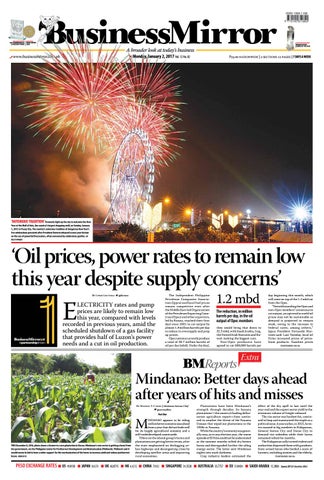
‘NOTORIOUS TRADITION’ Fireworks light up the sky to welcome the New Year at the Mall of Asia, the country’s largest shopping mall, on Sunday, January 1, 2017, in Pasay City. The country’s notorious tradition of dangerous New Year’s Eve celebrations persisted after President Duterte delayed to next year his ban on the use of powerful firecrackers, often worsened by celebratory gunfire. AP/ Bullit Marquez
‘Oil prices, power rates to remain low this year despite supply concerns’
E
By Lenie Lectura
@llectura
lectricity rates and pump prices are likely to remain low this year, compared with levels recorded in previous years, amid the scheduled shutdown of a gas facility that provides half of Luzon’s power needs and a cut in oil production.
The Independent Philippine Petroleum Companies Association (Ippca) said local fuel prices remain competitive even after the Middle East-led Organization of the Petroleum Exporting Countries (Opec) and other exporters, led by Russia, reached their first deal since 2001 to cut output by almost 1.8 million barrels per day to reduce in oversupply and prop up prices. Opec nations currently produce a total of 33.7 million barrels of oil per day (mbd). Under the deal,
1.2 mbd The reduction, in million barrels per day, in the oil output of Opec members
they would bring that down to 32.5 mbd, with Saudi Arabia, Iraq, the United Arab Emirates and Kuwait making the biggest cuts. Non- O pec producers h ave agreed to cut 600,000 barrels per
day beginning this month, which will come on top of the 1.2 mbd cut from the Opec. “Notwithstanding the Opec and non-Opec members’ consensus to cut output, an uptrend in world oil prices may not be sustainable as demand is projected to remain weak, owing to the increase in federal rates, among others,” Ippca President Fernando Martinez said. Last Tuesday, local oil firms increased prices of petroleum products. Gasoline prices Continued on A2
BMReports
Mindanao: Better days ahead after years of hits and misses By Manuel T. Cayon | Mindanao Bureau Chief @awimailbox
M This December 8, 2016, photo shows a farmer in a corn plantation in Davao. Mindanao’s corn sector is getting a boost from the government, via the Philippine Center for Postharvest Development and Mechanization (Philmech). Philmech said it would renew its bid to have a wider support for the mechanization of the farms to increase yield and reduce postharvest losses. Nonie Reyes
PESO exchange rates n US 49.8130
Part One
INDANAO appears to be riding well on better economic seas ahead from a year that did not bode well for its largely agricultural economy and a still-underdeveloped countryside. Tillers on the island-group’s farms and plantations are getting better terms, after the state emphasized on declogging urban highways and decongesting cities by developing satellite areas and improving rural economies.
Plantations have been Mindanao’s strength through decades. Its banana plantations—the country’s leading dollarearner agriculture export—have continued to weather the threat of the Panama Disease that wiped out plantations in the 1950s in Panama. While the country’s economy was generally rosy, as in any election year, the worse episode of El Niño could not be understated as the summer months wilted dry brown farms and downgraded further the ailing energy sector. The latter sent Mindanao nights into stark darkness. Crop industry leaders estimated the
effect of the dry spell to last until the year-end and the export sector yield to the minimum volume of freight onboard. The rice sector was hardest-hit, continued to limp and maintained the staple as a political issue. A year earlier, in 2015, farmers massed in big numbers in Kidapawan, General Santos City and Davao City to demand rice subsidies while their farms remained wilted for months. The Kidapawan rally turned violent and authorities dispersed them with gunshots. State armed forces who herded a score of farmers, including women and the elderly, Continued on A2
n japan 0.4251 n UK 60.8715 n HK 6.4212 n CHINA 7.1612 n singapore 34.3538 n australia 35.7757 n EU 51.8404 n SAUDI arabia 13.2806
Source: BSP (29 December 2016 )
BMReports BusinessMirror
A2 Monday, January 2, 2017
www.businessmirror.com.ph
Mindanao: Better days ahead after years of hits and misses Continued from A1
faced criminal charges. Another staple, the banana, saw yields lower and only improved slightly by December. But better preemptive preparations have staved off the dreaded impact of the El Niño across all sectors.
Boosting power
COMPARED to the worse energy crisis in the early 1980s and at least two times in the 1990s, the impact of the dry spell phenomenon to Mindanao in 2016 was tapered a little, as initiatives mounted by local governments and the energy sector paid off. General Santos City, for instance, which used to sustain six to eight hours of power outage, experienced continued supply throughout the entire El Niño episode due to the installation of new power generation facilities. Davao del Sur, likewise, boasted steady power via solar energy. Forty other power producers were already issued with certificates of endorsement by the Department of Energy. The northern Mindanao provinces of Misamis Oriental and Lanao del Norte have fewer problems with power because many bigmegawatt generation sources were in those areas. But Davao City, which for years had steady power due to five standby and additional power-supply contract with the Davao Light and Power Co., was hit this year with as long as four hours of outage. In Lanao del Norte high electric-
ity bills hit residents. Some were dumbfounded as the Mindanao grid’s main source, the Agus River, was in their locality. Western Mindanao and Eastern Mindanao were still the badly hit areas in terms of steady electricity supply. Two provinces, Davao del Norte and Compostela Valley, were hounded by the political leadership tussle hounding the Davao del Norte Electric Cooperative that forced unsteady electricity even during the years when there was no El Niño. The resort island of Samal was cut off from electricity supply when its submarine cable, which carries electricity, was severely damaged by a cargo ship anchor dropped at the channel off the Davao City wharf.
Farm prospects
WITH emergency funds in place at the regional Department of Agriculture (DA) offices and farm preparations months earlier, the dry spell surprisingly was not too harsh on farmers. Farm subsidies though were insufficient and have sent farmers from the Davao region to mass up at the regional DA office to demand rice support. Violence was prevented however, after regional officials and leaders of farmers reached a consensus at rice distribution. Farm inputs, seeds and other planting materials, have to be given to this day to farmers. The Pilipino Banana Growers and Exporters Association (Pbgea), which groups 33 big plantation companies and foreign-food exporters, have expressed bigger
global supply glut and competition from other banana exporting countries as their concern. A Pbgea document pointed to China as a major market for Philippine Cavendish banana. The world’s second-largest economy has already ventured into opening up its own plantations in the agriculturebased Asian nations. Its two foreign exporters have also established plantations in South America. While the volume of harvests may not be threatening Mindanao banana exports yet, these moves came at a period when the Philippines’s toughest rival exporters from South America have already began courting the traditional Philippine markets in Asia and the Middle East. The group also wanted the Duterte administration to strike another working peace process with the communist-led revolutionary group to prevent multimillion-peso losses to attacks of their plantation facilities. Pbgea pointed at the relative easing up of pressure at the banana plantations in Colombia after its government agreed to a peace pact with the FARC guerrillas. A Philippine mission went to East Europe to seek new markets for the Philippine bananas. But Pbgea said it was still to be apprised of the result of the mission. One country visited by the mission was the Vladivostok, part of former Russian federation. The DA has also recently included cacao among the cash crops to be supported, as industry leaders persuaded the government with its potential to supply a market se-
verely handicapped with supply to satisfy even the national demand.
Fund infusion
BY mid-2016, the DA allotted P49 million to rehabilitate senile and unproductive cacao trees in the Davao region, which accounts for 80 percent of national production. The rehabilitation would involve pruning and application of fertilizers to arrest the declining production output of cacao, the DA-High Value Crops Development Program (HVCDP) said. Farmers would be provided with “a package of technical assistance and training and provision of pruning equipment and fertilizers.” Of the rehabilitation fund, P42 million would be used to buy fertilizer, P6 million to acquire pruning shears and pruning saws and P1 million for the budding knife. T he Phi lippine Center for Postharvest Development and Mechanization (Philmech) said a national development program for cacao was also upgraded to end by 2022, instead of the year 2020. If achieved in the target date of 2022, the additional export earnings may well erase by 150 percent the national annual import expenditure of purchasing cacao beans from other countries. The cacao industry profile prepared by the cacao industry cluster coordinator of the Department of Trade and Industry said the Philippines exported in 2011 cacao beans worth $5.2 million, but imported more of what the country lacked by as much as $102.67 million in the same year.
Cacao, coffee
BY that time and about 1 million more cacao trees planted annually, “at least 50 million cacao trees [would be] producing 2-kilogram dried beans equivalent to one tree. Its support machineries to the cacao development would help the industry generate 2 kilogram of dried beans per tree.” Coffee industry leaders were also looking down South to many areas in Mindanao to rejuvenate coffee growing and to entice former coffee planters to renew their interest. A recent national conference has pointed out that the country was draining about $7 billion in coffee imports. The other country’s staple, corn, was also getting new attention, as the Davao regional DA office subjected a new Filipino-designed compact corn mill to a final operation orientation with agricultural engineers and local government agricultural technicians. The units would be distributed later to farmers’ cooperatives in the region. The testing would validate the prospects of reducing wastage of corn grains during postharvest processing. Earlier tests at Philmech, which designed the implement, indicated a grains-recovery rate of up to 64 percent. The DA said the rate “is a competitive recovery level for the production of corn grits.” Philmech said it would renew its bid to have a wider support to the mechanization of the farms to increase yield and reduce postharvest losses. The fisheries sector, likewise,
got a boost to the livelihood of fishermen as the new agriculture chief gave 400 motorized boats to indigent fishing families in the cities of Tagum, Panabo and Samal last August. Three hundred of such fiberglass boats, which costs P70,000, and fitted w ith fishnets and fishing rods, were also given to Davao fishermen. The beneficiaries would be required to join the anti-illegal fishing and coastal cleanup efforts under the Bantay Dagat program. The Davao del Norte and Davao City donations would be part of the national distribution of 200,000 boats to fishing communities.
Hub creation
THE unresolved air-traffic congestion at the Ninoy Aquino International Airport (Naia) has begun to yield blessings to provincial airports as the country’s flag-carrier, Philippine Airlines, was expected to finalize its plan to make Davao City its other hub. PAL said it was pursuing expansion plans outside of the Naia to skirt the congestion there. It said it would be mounting a possible Japan-Davao City route when the hub project would be done. But the Davao City government has already tasked the local Civil Aviation Authorities of the Philippines to improve the facilities at the Davao airport, while local business and government leaders would be awating the Congressional approval of a proposal to transform the management at the airport into an authority. To be continued
‘Oil prices, power rates to remain low this year despite supply concerns’ Continued from A1
went up by P0.50 per liter, while diesel prices jacked up by P0.25 per liter. This was the sixth consecutive week price hike for gasoline and the fifth for diesel. Martinez said local fuel prices are still lower by as much as 30 percent to 40 percent lower compared to the price of petroleum products in June 2008, where gasoline and diesel prices reached
as much as P60 per liter and P50 per liter, respectively. Emmanuel de Dios, a former undersecretary of the Department of Energy (DOE), shared the same view. “Fuel prices are still low compared in previous years. Also, from the looks of it, shale producers may pump up additional crude in the coming months amid Opec decision to curb oil output,” he said. Meanwhile, prices at the Wholesa le Electr icit y Spot Market
(WESM) would continue to remain low this year. In 2016 WESM prices have been on a downtrend. This is expected to continue in the early part of 2017 as cooler temperature will continue in January and February, said Melinda Ocampo, president of the Philippine Electricity Market Corp. (PEMC). PEMC is the operator of WESM, the country’s trading floor for electricity. Ocampo also cited an
adequate capacity power producers, particularly from renewableenergy (RE) projects, which would keep prices low. “You can see that there is a lot of available capacity at this time. RE also has a big impact on lowering prices, because of the must dispatch and priority dispatch [order],” she said. Ocampo said the Malampaya gas facility shutdown from January 28 to February 16 would not lead to a
repeat of the November 2013 incident because existing mitigating measures are put in place to prevent abnormal price spikes. A previous Malampaya 30 day shutdown incident led to the controversial high WESM prices, which led to reforms in the WESM. “There is a threshold that will prevent higher WESM prices,” she said. WESM’s primary offer cap was originally set at P62 per kWh but regulators lowered it to P32 per kWh starting December 2013 in a bid to prevent excessive price spikes. Besides the primary cap, the Energy Regulatory Commission (ERC) also ordered the implementation of a secondary cap to further protect consumers from excessive price spikes triggered by supply tightening. Called the price threshold mechanism, the P6.245 per kWh secondary cap kicks in the market once an average threshold of P9 per kWh is reached over a 168-hour period. The thresholds were computed based on historical prices, with allowance for three intervals hitting high market clearing prices. With these measures, the Manila Electric Co. (Meralco) said rates may not reach the record-high levels. “We don’t expect price spikes like in November and December 2013 supply months because of the lower primary cap in the WESM and the secondary cap,” Meralco Head for Utility Economics Lawrence Fernandez said. The natural gas plants fueled by Malampaya provide around 40 percent of Meralco’s supply requirements. The rest are sourced from bilateral contracts with generation companies and WESM. Fernandez said demand for power in the Luzon grid is typically low at this time of the year, because the weather is cool. “For the Meralco area, the months of low demand has historically been January, February and March,” Fernandez said. Besides this, he cited Meralco’s Interruptible Load Program (ILP) meant to prevent power outage incidents. ILP works by calling on
business customers with loads of at least 1 megawatt to run their own generator sets, if needed, instead of drawing power from the grid. With the ILP, power supply from the grid that will not be consumed by participating customers will be available for use by other customers within the franchise area. Through this, the aggregate demand for power from the system will be reduced to a more manageable level, helping ensure the availability of supply. “My directive was clear—the Malampaya maintenance activities should pose no substantial impact to supply of electricity by using all available resources and remedies, because power is a basic necessity for our countrymen,” Energy Secretary Alfonso G. Cusi said. He added that plans and alternative modes should be in place and ready before the actual shutdown. “We have to ensure that the program works for Malampaya is within the prescribed schedule given to the DOE. Historically, [Shell Philippines Exploration] completed its maintenance period on time. It is expected that it will do the same this time.” Cusi said preparatory activities among industry stakeholders have started. These activities, he said, is meant to safeguard energy consumers from possible impact on supply and prices of electricity. On the power situation outlook, the National Grid Corp. of the Philippines (NGCP) was tasked to simulate the possible powersupply scenarios, while PEMC will conduct a simulation on the WESM prices during the Malampaya shutdown. “The simulations will be submitted to the DOE for review and evaluation, so that we will be able to accurately respond to any unwarranted power market behavior,” Cusi said. “We assure the public that we will continue coordinate all the activities of those affected by the Malampaya shutdown to avert any situation leading to the worst case scenario and to maximize the protection for the energy consuming public.”
news@businessmirror.com.ph
The World BusinessMirror
Modi offers subsidies for India’s farmers as cash shortage bites
I
ndia’s Prime Minister Narendra Modi offered interest waivers for farmers and cheaper housing loans for the poor in a bid to shore up his popularity, a day after his deadline for exchanging banned notes expired. In a televised speech that stretched close to three-quarters of an hour, Modi praised citizens for bearing the hardship caused by the cash clampdown, and announced the government will pay the interest cost on farm loans for a period of 60 days. He also offered 4-percent interest subsidy on home loans of up to 900,000 rupees ($13,242) and 3 percent for 1.2 million rupees. “Patience, discipline, resolve displayed by 1.25 billion Indians will play a critical role in shaping future of the nation for years to come,” Modi said in a special broadcast, defending his November 8 move to withdraw 86 percent of the currency in circulation. “There is no precedent globally to what we have done.” Modi, who had pledged to end hardship caused by the withdrawal of the 500 rupee and 1,000 rupee notes within 50 days, in his address reassured people that the move would benefit the economy in the long term. His sops for the poor, small businessmen and farmers—sections most affected by the cash withdrawal—comes weeks
before crucial state elections. Modi, in his speech on Saturday, didn’t give any details on the amount of unaccounted money seized by authorities during the drive, which was originally aimed at seizing illegal wealth. “It was like a poll-oriented speech,” said N. Bhaskara Rao, chairman of the New Delhi-based Centre for Media Studies, a policy research group. “People’s exceptions were more. He just announced some minor reliefs by advancing some budget proposals.” The damage from the so-called demonetization—on farmers, workers, small shopkeepers, low-income households and businesses—is yet to ease. There continues to be queues at banks and daily stories of rural distress. The government will double the credit guarantee offered on loans offered to small businesses. Senior citizens will be offered an assured 8-percent interest rate on their bank deposits of up to 750,000 rupees, Modi said, with the tricolor national flag in the background. Although Modi’s credibility has been dented, the jury is out on the long-term economic and political fallout. So far, his public support remains strong, with some standing in lines waiting to access cash still voicing their approval of his decision to target unaccounted wealth.
Bloomberg News
Editor: Lyn Resurreccion • Monday, January 2, 2017
A3
China factory gauge steadies near post-2012 high as prices jump
C
hina’s official factory gauge stabilized near a post-2012 high last December, capping a year of steady improvement and signaling policy-makers have leeway to curb financial risks while keeping growth humming. The services gauge remained elevated. Input prices jumped. Manufacturing purchasing managers index (PMI) stood at 51.4 last month, compared with a median estimate of 51.5 in a Bloomberg survey of economists and 51.7 the prior month. Nonmanufacturing PMI was at 54.5 versus 54.7 last November; numbers higher than 50 indicate improving conditions. Factory input prices rose to a five-year high of 69.6 and services input prices rose to a three-year high of 56.2.
The gains add to evidence of yearend strengthening that’s giving authorities room to pursue economic rebalancing. Early private indicators for December show large and small firms saw stronger momentum as sentiment among executives improved. China’s expansion picked up to about 7 percent last month, a monthly tracker by Bloomberg Intelligence shows.
51.4
The rate of manufacturing purchasing managers index last December “Improving external demand and a weaker yuan are supporting businesses, and the reading suggests stronger growth in the last quarter than previous months,” said Ding Shuang, chief China economist at Standard Chartered Plc. in Hong Kong. “Big companies usually recover sooner than small ones when the economy stabilizes, which eventually will transmit to all kinds of businesses, though this year could be a mixed picture for small firms, as greater fiscal support benefits large companies more.” The manufacturing gauge eased “largely due to softer output and lower inventories,” Zhou Hao, an
economist at Commerzbank AG in Singapore, wrote in a report. “Today’s PMI figures suggest that the change of policy tones has taken its toll, as the authorities are seriously concerned about the asset bubbles.” November factory PMI matched a post-2012 high. The data indicate improving market demand, stronger momentum in technology and robust consumption before the new year, the National Bureau of Statistics (NBS) said on Sunday in a supplementary statement. The cost of raw materials and logistics is the highest in recent years and is certain to impact business operations as rising corporate costs are squeezing profits, the NBS said. Large companies remain the main support for stabilization, while the indicators for medium- and smallscale businesses have slumped below 50, the NBS said Steel industry PMI fell to 47.6, from 51, as output, new orders and new export orders all fell from November. Bloomberg News
A4
The World BusinessMirror
Monday, January 2, 2017
39 dead in New Year’s attack on Istanbul club
Medics carry a wounded person at the scene after an attack at a popular nightclub in Istanbul, early on Sunday. IHA via AP
I
STANBUL—An assailant believed to have been dressed in a Santa Claus costume opened fire at a crowded nightclub in Istanbul during New Year’s celebrations, killing at least 39 people and wounding close to 70 others in what the province’s governor described as a terror attack.
Gov. Vasip Sahin said the attacker, armed with a long-barreled weapon, killed a policeman and a civilian outside the club at around 1:45 a.m. on Sunday before entering and firing on people partying inside. He did not say who might have carried out the attack. “Unfortunately [he] rained bullets in a very cruel and merciless way on innocent people who were there to celebrate New Year’s and have fun,” Sahin told reporters. Private NTV news channel said the assailant entered the Reina nightclub, in Istanbul’s Ortakoy district, dressed in a Santa Claus outfit. Interior Minister Suleyman Soylu said the man was still on the run,
adding: “efforts to find the terrorist are continuing.” “Our security forces have started the necessary operations. God willing, he will be caught in a short period of time,” the minister said. At least 16 of the dead were foreign nationals, Soylu said, without providing information on their nationalities. Five of the victims were identified as Turkish nationals, while authorities were still trying to identify 18 of the victims. At least 69 people were being treated in hospitals, four in serious condition, Soylu said. Some customers jumped into the waters of the Bosporus to escape the attack, the report said. Sinem Uyanik was inside the club with her husband
70
The estimated number of people wounded
who was wounded in the attack. “Before I could understand what was happening, my husband fell on top of me,” she said outside Istanbul’s Sisli Etfal Hospital. “I had to lift several bodies from top of me before I could get out. It was frightening.” Her husband was not in serious condition despite sustaining three wounds. Police with riot gear and machine guns backed up by armored vehicles blocked the area close to the Reina nightclub, one of the most popular night spots in Istanbul. Several ambulances flashing blue lights arrived on the scene, some taking wounded to hospitals. The White House condemned what it called a “horrific terrorist attack” and offered US help to Turkey. White House Spokesman Eric Schultz said President Barack Obama was briefed on the attack by his national security team and asked to be updated as the situation developed. Obama is vacationing in Hawaii this
week with his family. National Security Council Spokesman Ned Price said the attack on “innocent revelers” celebrating New Year’s shows the attackers’ savagery. “Our thoughts are with victims and their loved ones. We continue to work to prevent these tragedies,” European Union foreign-policy chief Federica Mogherini tweeted. An estimated 600 people were celebrating inside the club that is also frequented by famous locals, including singers, actors and sports stars. Several shocked revelers were seen fleeing the scene after the attack and the music fell silent. The country has been rocked by a series of deadly attacks in 2016 carried out by the Islamic State group or Kurdish militants, killing more than 180 people. Last December 10 a double bomb attack outside a soccer stadium—located near the Reina nightclub—killed 44 people and wounded 149 others. The attack was claimed by Turkeybased Kurdish militant group, the Kurdish Freedom Falcons. Nine days later, an off-duty Turkish riot policeman assassinated Russian Ambassador Andrei Karlov at a photo exhibition in the capital, Ankara. The government has suggested that a movement led USbased Muslim cleric Fethullah Gulen was behind the killing—an accusation the cleric has denied. AP
Russian hacking code found in Vermont power company
C
omputer code connected to Russian cyber attacks by US intelligence agencies has been found in a laptop computer at a Vermont electric utility, a development that emerged a day after the Obama administration hit Russia with sanctions for hacking during this year’s US election. The laptop wasn’t connected to the power grid at the time, the Burlington Electric Department said in a statement last Friday. It said it scanned its computer network and found the malware after the US Department of Homeland Security sent out an alert about the code to owners and operators of critical infrastructure. “We took immediate action to isolate the laptop and alerted federal officials of this finding,” utility spokesman Mike Kanarick said in the statement. “Our team is working with federal officials to trace this malware
and prevent any other attempts to infiltrate utility systems. We have briefed state officials and will support the investigation fully.” Such a breach has long been a concern for the US because knocking out a power grid could cause widespread disruptions and hamper police, fire and medical responders. For that reason, computers at utilities are routinely checked for intrusions. Vermont elected officials denounced the Russian hacking.
‘Manipulate the grid’
“This is beyond hackers having electronic joy rides—this is now about trying to access utilities to potentially manipulate the grid and shut it down in the middle of winter,” Sen. Patrick Leahy said in a statement last Friday. “That is a direct threat to Vermont and we do not take it lightly.” Gov. Peter Shumlin and Rep. Peter
Welch also issued statements. There was no indication of compromise to customer information or to the security of its system, Burlington Electric General Manager Neale Lunderville said in a note on the municipally owned utility’s web site. Burlington Electric serves about 16,000 residential customers and more than 3,600 commercial customers in Vermont’s largest city. US intelligence agencies have identified the code that the utility found as one used in what they call operation “Grizzly Steppe”, a far-reaching Russian operation to interfere with November’s presidential election. President Barack Obama’s administration on Thursday slapped sanctions on Russia for the intrusion and ordered the expulsion of 35 Russian operatives. While lawmakers of both parties have backed Obama’s actions, Presi-
dent-elect Donald J. Trump has expressed skepticism at the conclusion of intelligence agencies that Russia was behind the hacking and release of e-mails in an effort to damage his campaign opponent, Democrat Hillary Clinton. “I just want them to be sure because it’s a pretty serious charge,” Trump said on Saturday night in Palm Beach at his Mar-a-Lago resort’s New Year’s Eve party. “When you look at the weapons of mass destruction—that was a disaster and they were wrong, and so I want them to be sure. I think it’s unfair if they don’t know.” Trump has pledged to improve relations with Russian President Vladimir Putin, whose government has denied it was behind the hacking. He praised Putin on Twitter last Friday for not retaliating against the US sanctions, saying “I always knew he was very smart!” Bloomberg News
news@businessmirror.com.ph
UN backs Russian-Turkish Syria cease-fire efforts
B
EIRUT—The UN Security Council unanimously adopted a resolution on Saturday supporting efforts by Russia and Turkey to end the nearly six-year conflict in Syria and jump-start peace negotiations, as a fragile country-wide cease-fire wavered. The resolution also calls for the “rapid, safe and unhindered” delivery of humanitarian aid throughout Syria. And it anticipates a meeting of the Syrian government and opposition representative in Kazakhstan’s capital Astana in late January. The resolution’s final text dropped an endorsement of the Syria cease-fire agreement reached on Thursday, simply taking note of it but welcoming and supporting Russian-Turkish efforts to end the violence. Western members of the council sought the last-minute changes to the draft resolution to clarify the UN’s role and the meaning of the agreement brokered by Moscow and Ankara. US deputy ambassador Michele Sison said the Obama administration strongly supports a cease-fire and “unfettered humanitarian access,” but she expressed regret that additional documentation to the agreement brokered by Russia and Turkey with details about its implementation have not yet been made public. Meanwhile, on the ground in Syria, rebels warned on Saturday that cease-fire violations by progovernment forces threatened to undermine the two-day-old agreement intended to pave the way for talks between the government and the opposition in the new year. Air strikes pounded oppositionheld villages and towns in the strategically important Barada Valley outside Damascus, activists said, prompting rebels to threaten to withdraw their compliance with a nationwide truce brokered by Russia and Turkey last week. The air strikes let up in the late evening, but rebels nevertheless staged retaliatory attacks against government-held areas in other parts of the country, according to the media arm of the Lebanese militant group Hezbollah, which is fighting alongside the government in Syria. Hezbollah military media reported a barrage of rebel rocket fire on the twin Shiite villages of Foua and Kfraya in northern Syria, which have remained loyal to the government in the otherwise rebel-dominated Idlib province. The government’s side has rallied thousands of Shiite militia fighters from across the Middle East on the grounds of defending the sect in Syria. The Britain-based Syrian Observatory for Human Rights monitoring group also reported the attacks. It added that pro-government forces had advanced against rebels in the eastern Ghouta region outside Damascus, in a clear violation of the cease-fire. Rebels also accused the government of signing a different version of the agreement to the one they signed in the Turkish capital of Ankara, further complicating the latest diplomatic efforts to bring an end to six years of war. Nearly 50,000 people died in the conflict in 2016, according to the Britain-based Syrian Observatory for Human Rights, which maintains networks of contacts on all sides of the war. More than 13,000 of them were civilians, according to the Observatory. Various estimates have put the war’s overall toll at around 400,000 dead. If the truce holds, the government and the opposition will be expected to meet for talks for the first time in nearly a year in the Kazakh capital of Astana in the second half of January. Those talks will be me-
diated by Russia, Turkey and Iran, though Russia’s UN Ambassador Vitaly Churkin has said other key players, including the United States, are welcome to participate. Churkin said after Saturday’s vote that the Astana talks would be the first face-to-face negotiations between the Syrian government and opposition. He expressed hope that 2017 would see a political settlement of the conflict that has claimed over 250,000 lives. Syrian Foreign Minister Walid Moallem and Maj. Gen. Ali Mamlouk, head of the National Security Bureau, were in Tehran on Saturday to discuss developments with their Iranian counterparts, according to Iranian state media. They met with Foreign Minister Mohammad Javad Zarif and Ali Shamkhani, Secretary of Iran’s Supreme National Security Council. The Kremlin, meanwhile, said Russian President Vladimir Putin and Iranian President Hassan Rouhani confirmed their commitment to negotiations in Astana, in a phone conversation between the two leaders. Iran and Russia have provided crucial military and diplomatic support to Syrian President Bashar al-Assad throughout the conflict, while Turkey has served as a rear base and source of supplies for the opposition. T he developments fol low months of talks between Ankara and Moscow that culminated in a cease-fire agreement that went into effect on Friday at midnight. But in a statement issued by a coalition of 11 rebel factions, including the powerful Army of Islam group operating in the Damascus countryside, rebels said they could not abide by the cease-fire if the government continued its assault on Barada Valley. The statement also complained that the government’s version of the agreement signed in Ankara last week had deleted “a number of essential and non-negotiable points.” It said the opposition had agreed to a cease-fire encompassing the whole of Syria, without any exceptions to region or faction. The Barada Valley Media Center said Lebanese Hezbollah militants were firing on villages and towns in the water-rich region as Russian and government aircraft carried out raids for the 10th consecutive day on Saturday. The Lebanese militant group is a key ally to Assad’s forces. The Barada Valley is the primary source of water for the capital and its surrounding region. The government assault has coincided with a severe water shortage in Damascus since December 22. Images from the valley’s Media Center indicate its Ain al-Fijeh spring and water-processing facility have been destroyed in air strikes. The government says rebels spoiled the water source with diesel fuel, forcing it to cut supplies to the capital. The Observatory reported at least two civilians and five militants have been killed in battles over opposition-held Eastern Ghouta and Barada Valley regions around Damascus, since the truce came into effect last Thursday at midnight. The Syrian military on Friday denied attacking the valley, saying it respected the Russian and Turkish brokered truce. Meanwhile, Turkey’s state-run Anadolu news agency reported the death of an Islamic State commander in a Turkish air strike near the north Syrian town of al-Bab on Friday. The truce does not cover operations against the Islamic State group or al-Qaeda’s Syria affiliate, the Fatah al-Sham front. Anadolu identified the commander as Abu Ansari. The report could not be independently verified. AP
The World BusinessMirror
news@businessmirror.com.ph
Monday, January 2, 2017
A5
Revelers say hello to 2017, good-bye to a year of conflicts Britain had a tumultuous year, with a June vote to leave the European Union followed by the resignation of the prime minister, but Warren Male and Natasha Lewis said they looked back on 2016 with fondness. “Because we’ve been together,” Lewis said.
Paris
Tourists and French revelers swarmed along Paris’s illuminated Champs Elysees Avenue on a frosty night, admiring the laser display from the Arc de Triomphe and lines of trees sparkling with lights. “It’s so magical to be here in Paris, on what people say is the world’s most beautiful avenue,” said Maureen O’Reilly, a visitor from Belfast, Northern Ireland. Some people were happy to say good-bye to 2016. “It’s been such a horrible year, with all these [entertainment celebrity] deaths, Syria, Brexit and Trump. I say: good riddance,” said Karine Dublot, from Lyon.
The Vatican
Fireworks explode over the Kremlin in Red Square, which was blocked by the police during New Year celebrations in Moscow, Russia, on Sunday. New Year’s Eve is Russia’s major gift-giving holiday, and big Russian cities were awash in festive lights and decorations. AP/Alexander Zemlianichenko Jr.
A
S 2016 draws to a close, revelers around the world are bidding a weary adieu to a year filled with political surprises, prolonged conflicts, deadly attacks at gatherings and deaths of legendary celebrities. Here’s a look at how people are ushering in the new year:
New York City
An estimated 1 million people ushered in the New Year in Times Square, screaming and kissing as the glittering crystal ball dropped. New Year’s Eve revelers began to fill Times Square hours before midnight. They braved cold temperatures and strong winds at the Crossroads of the World to greet 2017 amid heavy police protection. Maria Raimilla, from New Jersey, said 2016 was rough. “Everything is going to be new,” she said at midnight. “I just want to find happiness this year and leave all the bad things behind.” Lori Haan, from Tucson, Arizona, and her husband were on their first trip to New York. She said she’s looking forward to what 2017 brings. “This is a great start to the new year,” she said. “We are doing something new and exciting, and I hope that it’s a theme for the rest of the year.” Dozens of 20-ton sanitation trucks weighted with an extra 15 tons of sand blocked off streets leading to the celebration zone to avoid the possibility of a truck attack like those in Germany and France in recent months. About 7,000 police officers, along with specially armed counterterrorism units and bombsniffing dogs, were on guard.
Mariah Carey was the headline performer in Times Square for “Dick Clark’s New Year’s Rockin’ Eve with Ryan Seacrest” on ABC.
Australia
Sydney sent up a dazzling tribute to 2016’s fallen icons with a New Year’s Eve fireworks display honoring the late singer David Bowie and late actor Gene Wilder, becoming the first major city to bid a bittersweet adieu to a turbulent year. The glittering display over Sydney’s harbor and bridge featured Saturn- and star-shaped fireworks set to “Space Oddity”, the classic song by Bowie, among the seemingly endless parade of beloved entertainers who died in 2016. Wilder was honored as the bridge lit up in a rainbow of colors while a song from his film Willy Wonka and the Chocolate Factory played.
Turkey
New Year’s celebrations turned deadly when an armed assailant believed to have been dressed as Santa Claus opened fire at a nightclub in Istanbul, killing dozens of people. Istanbul’s governor said at least 35 people were killed and 40 others were wounded. Security measures had been heightened in major Turkish cities, with the police barring traffic leading up to key squares in Istanbul and the capital, Ankara. In Istanbul, 17,000
police officers were on duty, some camouflaged as street vendors. Ankara and Istanbul have been targeted by several attacks in 2016 carried out by the Islamic State group or Kurdish rebels, killing more than 180 people. Neslihan Dogruol, a restaurant owner in a chic Istanbul neighborhood, said she hopes for peace in 2017 following a year filled with “unrest and death.” “[The year] 2016 affected everyone badly,” she said.
Brazil
More than 2 million people have welcomed 2017 at Rio de Janeiro’s Copacabana beach. Twelve minutes of fireworks amazed many of the more than 860,000 tourists who traveled to Rio for the party. The event was more modest than last year due to the city’s recession. Still, tourists and Brazilians enjoyed a festival of sounds, including two sets of drums from popular samba schools.
Las Vegas
A decked-out bride and groom walking to a chapel and photo-happy tourists from halfway around the world were among the estimated 300,000 visitors turning out to celebrate the New Year Las Vegas style. The city’s celebration features some of the biggest names in music headlining nightclubs and a fireworks show launching from the tops of half-adozen high-rise casinos. Local police joined forces with the National Guard, the Secret Service and FBI agents to protect Sin City on one of its biggest nights of the year.
Germany
In Berlin the mood was more somber than celebratory. “I don’t like the way politics is going,” Daniel Brandt said. “Fears are being fanned, and people are so
angry with each other.” The tone of public debate in Germany has become shriller over the past two years with the influx of hundreds of thousands of migrants. Walking by the Reichstag, Germany’s Parliament building, Hamed Noori said 2016 had been a good year. “I came to Germany from Afghanistan,” he said. “Life is better here.” Nicole Durand-Nusser, originally from France but living in Berlin for almost 50 years, said 2016 had been a difficult year: “Brexit, Trump, Erdogan—it’s all getting worse.” Later, the police said they arrested a man who shouted “bomb, bomb, bomb” at Berlin’s massive open-air New Year’s party.
Russia
President Vladimir Putin invoked a bit of seasonal enchantment in his New Year’s Eve remarks to the nation. “Each of us may become something of a magician on the night of the New Year,” Putin said in a short televised address broadcast in the closing minutes of 2016 in each of Russia’s 11 time zones. “To do this we simply need to treat our parents with love and gratitude, take care of our children and families, respect our colleagues at work, nurture our friendships, defend truth and justice, be merciful and help those who are in need of support. This is the whole secret.”
London
A beefed-up security presence throughout London and Britain’s other major cities did nothing to squelch raucous New Year celebrations highlighted by a breathtaking fireworks display over the River Thames that began just after the Big Ben tower chimed midnight. The police had added overt and covert personnel to patrol crowded areas, and some barriers were put in place to prevent vehicle attacks.
May calls for unity in 2017 as divided UK prepares for Brexit
P
rime Minister Theresa May said opportunities for the UK are “greater than ever” and called for the country to unite in 2017 as she prepares to formally trigger two years of talks to withdraw Britain from the European Union. In a New Year’s message, the premier said she would bear in mind the interests of both the 52 percent of voters who backed Brexit and the 48 percent who opposed it when she negotiates a deal with her 27 EU counterparts. May quoted murdered opposition Labour Party lawmaker Jo Cox, who
said: “We are far more united and have far more in common than that which divides us.” “We all want to see a Britain that is stronger than it is today; we all want a country that is fairer so that everyone has the chance to succeed. We all want a nation that is safe and secure for our children and grandchildren,” May said in the video message. “When I sit around the negotiating table in Europe this year, it will be with that in mind— the knowledge that I am there to get the right deal, not just for those who voted to leave, but for every single
person in this country.” May aims to invoke Article 50 of the EU’s Lisbon Treaty, the formal trigger for two years of divorce proceedings, by the end of March. Polls show few Britons have changed their minds on Brexit since the June referendum, and the prime minister is under pressure from “Leave” campaigners who want a clean break with the EU and “Remain” supporters who want to retain close ties with the bloc. May said she would aim to remove barriers to aspiration and secure a “better deal” for working people. At the same time, she said the country’s
“shared interests and ambitions can bring us together.” “The referendum laid bare some further divisions in our country— between those who are prospering, and those who are not; those who can easily buy their own home, send their children to a great school, find a secure job, and those who cannot; in short, those for whom our country works well, and those for whom it does not,” May said. “This is the year we need to pull down these barriers that hold people back, securing a better deal at home for ordinary, working people.” Bloomberg News
Pope Francis has called on the faithful to help young people find a place in society, noting the paradox of “a culture that idolizes youth” but has made no place for the young. Francis said during vespers marking New Year’s Eve that young people have been “pushed to the margins of public life, forcing them to migrate or to beg for jobs that no longer exist, or fail to promise them a future.”
Japan
Temple bells echoed at midnight as families gather around noodles and revelers flock to shrines for the biggest holiday in Japan. Kami Miyamoto, an economics student at Meiji University in Tokyo, traveled home in Hakusan, Ishikawa prefecture, for the holiday. Miyamoto’s mother was preparing soba noodles, a standard New Year’s Eve dish in Japan, except in their home it will be filled with green onions and shrimp. As the new year rolls in, the entire family, including her younger
brother and sister, will drive to a nearby shrine, which, like temples all over Japan, will be filled with those praying for good fortune in the Year of the Rooster, according to the Chinese zodiac.
China
Residents in Beijing and Shanghai, China’s two largest cities, passed New Year’s Eve quietly in a relative state of security lockdown, according to Chinese media reports citing the police. The Bund waterfront in Shanghai had no celebrations, authorities announced this week, while the sale, use and transportation of fireworks in central Shanghai will be prohibited. Large buildings that often display light shows also stayed dark. More than 30 people died two years ago in a deadly stampede on Shanghai’s waterfront, where 300,000 people had gathered to watch a planned light show. Chinese President Xi Jinping said in his New Year’s Eve address his government will continue to focus on alleviating poverty at home and resolutely defending China’s territorial rights.
South Korea
Hundreds of thousands of South Koreans ushered in the New Year with a massive protest demanding the resignation of disgraced President Park Geun-hye. It was the 10th straight weekend of protests that led to Park’s impeachment on December 9 over a corruption scandal. The evening rally was planned to overlap with Seoul’s traditional bell-tolling ceremony at the Bosinkgak pavilion at midnight, which was also expected to be a political statement against Park. The city’s mayor, Park Wonsoon, invited as guests a man whose teenage son was among more than 300 people who died during a 2014 ferry sinking and a woman who was forced into sexual slavery by Japan’s World War II military. Park came under heavy criticism over the way her government handled the ferry disaster. AP
A6
Monday, January 2, 2017 • Editor: Angel R. Calso
Opinion BusinessMirror
editorial
No predictions for 2017
W
E polished our crystal ball to see what might happen in 2017. However, the purpose of a newspaper is to report the news and offer our analysis of the impact of current events, not to look into the dark abyss across future days. We are also in the “business” business, more concerned with forecasts for future economic development and those factors that affect the lives of every Filipino on a daily basis, like oil-price trends and job creation. Yet, we, too, are interested in what the soothsayers are thinking, the most famous of which is probably Nostradamus. The problem with Nostradamus’s look into the future is understanding what he meant using his 16th-century French. Further, with the inherent bias of most people to see something that may or may not be there, it is much easier to say a typo error caused this famous French physician to write “Hister” instead of “Hitler,” perhaps, after a night drinking too much cognac. Of course, no one bothers to read his Almanac for 1554, where he explains that Hister is the Latin name for the Danube River. The deceased blind Bulgarian mystic and herbalist Baba Vanga is also a popular source of information about the future. And who wants to criticize an 85-year-old woman—at her death—known in the Kozhuh Mountains as “Grandmother Vanga”? Apparently, one of Baba Vanga’s predictions would be that Barack Obama would be the last US president. If that is true, then the day after January 20—the date of Donald J. Trump’s inauguration— is gong to be interesting. But she is said to have also foretold that Europe would cease to exist in 2016 with all that remaining being empty spaces and wasteland. Maybe she was seeing the “ToDo” list of a young KGB officer named Putin or the result of the “Brexit” vote. Maybe the best predictor of the future is based on the idea of “putting your money where your mouth is”. While the British bookmakers were completely wrong on the outcome of Brexit from the total amount of money bet on “Remain”, there were more total bets on “Leave”. In other words, the “Big Boys” with the money who voted Remain were outnumbered by the bettors who voted Leave. Should we mention the same conditions existed for the Trump presidential win? While certainly not an exact comparison, there is some similarity to the performance of the Philippine Stock Exchange (PSE) in 2016. The PSE Composite index (PSEi) finished 2016 down 1.63 percent from the 2015 closing. Yet, the All-Share Index—which is composed of all the issues on the PSE—was up 4.15 percent for the year. Through all the hand wringing and wailing, our stock market was virtually unchanged. Of course, we all would have preferred it to gain significantly. But the foreign money moving out of the PSE was primarily on the PSEi issues. Maybe the little guy knows something about the PSE—as they did with the Brexit and Trump vote—that the “smart” money does not. While we will not make any 2017 predictions, we will continue to bet on the future of the Philippines. We all do this every day at our jobs, when we follow the rules, and when we make decisions on the interests of the nation, not just for ourselves. Happy New Year. Since 2005
BusinessMirror A broader look at today’s business ✝ Ambassador Antonio L. Cabangon Chua Founder Publisher Editor in Chief Managing Editor Associate Editor News Editor City & Assignments Editor Senior Editors
Max V. de Leon Jennifer A. Ng Dionisio L. Pelayo Vittorio V. Vitug Lorenzo M. Lomibao Jr., Gerard S. Ramos Lyn B. Resurreccion, Efleda P. Campos Ruben M. Cruz Jr. Angel R. Calso
Creative Director Chief Photographer
Eduardo A. Davad Nonilon G. Reyes Judge Pedro T. Santiago (Ret.) Benjamin V. Ramos Adebelo D. Gasmin Marvin Nisperos Estigoy Aldwin Maralit Tolosa Dante S. Castro
Publishing, Inc., with offices on the 3rd floor of Dominga Building III 2113 Chino Roces Avenue corner De La Rosa Street, Makati City, Philippines. Tel. Nos. (Editorial) 817-9467; 813-0725. Fax line: 813-7025. (Advertising Sales) 893-2019; 817-1351, 817-2807. (Circulation) 893-1662; 814-0134 to 36. E-mail: news@businessmirror.com.ph.
www.businessmirror.com.ph
Printed by brown madonna Press, Inc.–San Valley Drive KM-15, South Superhighway, Parañaque, Metro Manila MEMBER OF
PPP Lead
A
S we begin this New Year, we must reflect on “PPP”. Aside from public-private partnerships, what are the other meanings of the initials “PPP”? Do these have any relevance or indicate some truth about public-private partnerships? What are the seven truths or half-truths about PPPs?
(1) Public-private partnerships. PPP, in the broad sense, is a contract between a government agency and a private-sector proponent for an infrastructure, development and/or public-service project. (2) PowerPoint presentations. PPPs are jokingly referred to as this type of PPP. PowerPoint presentations are needed to explain and market ideas, but this is just the first step. Creation should not end in the mind with several studies and audio-visual presentations. (3) Perpetually pending projects. This type of PPP is like the previous PPP. Projects either remain
pending in the minds of public servants or remain stuck in the award phase. At the end, people suffer because their needs are not timely addressed. Projects can remain stuck in the paper stage if government reneges on its commitments, when right-of-way obligations cause delays to project construction and completion or when regulatory approvals are not forthcoming. (4) Post-president projects. The project life of infrastructure PPPs goes beyond the term of the sitting president, local chief executive or general manager. Projects on roads, power, water, bridges, recla-
May 2017 bring more publicprivate partnerships for the people and not become pahirap sa pamilyang Pinoy or pasapasa problema. Let PowerPoint presentations and perpetually pending projects come to fruition despite post-president projects. And, before we all start to work tomorrow, let us pungko pamati pauli. Happy New Year to everyone!
mation and rail are long-term projects, which may run up to 50 years. Under the current set-up, there can be eight presidents, 16 governors or mayors and 50 heads of government corporations who can either continue, modify or, in some cases, cancel awards made by the previous administration. (5) Pahirap sa pamilyang Pinoy (Burden for Filipino families). Every time there is an upward adjustment on toll fees, water or power rates, environmental degradation or social injustice, consumers, civilsociety organizations and taxpayers rally against PPPs. Some even file
Happy expanding horizons 2017
Jun B. Vallecera
BusinessMirror is published daily by the Philippine Business Daily Mirror
HOM
By Alberto Agra
T. Anthony C. Cabangon
Online Editor Social Media Editor
Chairman of the Board & Ombudsman President VP-Finance VP Advertising Sales Advertising Sales Manager Group Circulation Manager
A PPP can be a PowerPoint presentation, etc.
Joel L. Tan-Torres
DEBIT CREDIT
T
he entire Board of Accountancy (BOA) and the accountancy profession are all set to meet the challenges of the New Year. Just before the past year ended on December 20, 2016, the entire BOA met invited leaders of the accountancy profession. Over 35 Certified Public Accountants (CPA), coming from Philippine Institute of Certified Public Accountants and other sectoral accounting organizations, the accountancy councils, the accountancy affiliated certification organizations attended the fourth Accountancy Stakeholders Forum. BOA has been holding this gathering since May 18, 2016, when a select group consisting of leaders of the accountancy profession gathered to discuss with the entire BOA the most important issues and developments in the profession. In this forum, as chairman, I discussed the following priorities for 2017: n Six-Point Expanding Horizons Strategic Plan n Future is NOW
n
midst
Globalization trends in our
n Major structural changes ongoing n Revisions of accountancy law n Forthcoming accounting learning and examination tracks n New ex panded Auditors Report n Certificate of compilation services in preparation of financial statements n High impact reg u lator y Direction n Project repeal n Collaboration among regulators n Taxation of professional n Audit thresholds discussion
n Quality assurance review full steam ahead n Engagement reporting n Posting list of accredited CPAs n Delegation of approval of accreditation n Noncompliance with rules and laws reporting n Schedule of fines and penalties n Accreditation of government CPAs n Accreditation of partners and professional staff under injunction n Inspection of offices of CPAs in public practice n Governance, integrity and ethics n PGS—the next steps n Code of ethics—for updating n Integrity pledge—what’s next? n ISO certification of organizations n Continuing professional development directions n Case development program n Internship program n Sectoral, CPA tracker and IFAC survey n BOA Publications n Inspection of schools n Su m m it of a c cou nt i n g
cases enjoining the implementation of projects. (6) Pasa-pasa problema (Compounding problems). PPPs are not devoid of risks, problems, conflicts and disputes. If and when the government extends subsidies, guarantees loans, waives revenues or taxes, assumes the responsibility of relocating settlers, pays the concession fees, defends a project before the courts or passes on to the consumers certain costs, problems are compounded. (7) Pungko pamati pauli (Sit, listen and go home). These Ilonggo terms are also relevant when we deal with PPPs. We must all sit to work, meet with people and study about PPPs. We must listen, be open to ideas, learn, sometimes unlearn and relearn. After all these, we go back to the core, our homes, and be ready for another round of PPP. May 2017 bring more public-private partnerships for the people and not become pahirap sa pamilyang Pinoy or pasa-pasa problema. Let PowerPoint presentations and perpetually pending projects come to fruition despite post-president projects. And, before we all start to work tomorrow, let us pungko pamati pauli. Happy New Year to everyone!
schools stakeholders n Strengthening the professional and sectoral organizations n BOA volunteer program n I am accountant n 2017 calendar of events These activities are included in the Six-Point Strategic Expanding Horizons Strategic Plan (EH Strategic Plan) that is focused in uplifting the Filipino accounting professional and accountancy profession to levels that exceed global standards. With the support and cooperation of the stakeholders of the profession, this vision is very much attainable. To know more about the EH Strategic Plan, go to the BOA web site at www.boa.com.ph. Definitely, with all of these initiatives in place or soon forthcoming, an exciting and Expanding Horizon New Year is expected for fellow accountants and profession. Chairman Joel L. Tan-Torres is the chairman of the Professional Regulatory Board of Accountancy. He is a Certified Public Accountant who placed No. 1 in the May 1979 CPA Board Examinations. He is concurrently a tax partner of Reyes Tacandong & Co., CPAs. He was the former commissioner of the Bureau of Internal Revenue from 2009 to 2010. This column accepts contributions from accountants, especially articles that are of interest to the accountancy profession, in particular, and to the business community, in general. These can be e-mailed to boa.secretariat.@gmail.com
Editor: Jun Lomibao • mirror_sports@yahoo.com.ph
Sports BusinessMirror
Monday, January 2, 2017 A7
HONORING THe DUBIOUS AND HILARIOUS
THE 2016 BREWSKIES T
By Rick Olivares
HE year has just ended and you know what that means—it’s time to hand out the Brewskies awards for the dubious and hilarious and WTF moments in sports for 2016. And let me tell you, the past year was really one for the books.
CURSES FOILED AGAIN AWARD
HEADING into the World Series, all the chatter between the two protagonists—the Chicago Cubs and the Cleveland Indians—was which club was cursed the most in their baseball history and how the loser will feel more cursed. The Cleveland Indians took a 3-1 series lead and only needed one more win to wrap it up. Shockingly, they lost the last three matches including an 8-7 heartbreaker in 10 innings during Game Seven. Rocky Colavito lives and continues to be cursed in Ohio.
DUBIOUS ACHIEVEMENT AWARD
THE Golden State Warriors join the Seattle Mariners and the New England Patriots as the teams with the all-time season-best record, only to lose when it matters either in the playoffs or the finals. The Warriors broke the Chicago Bulls’ 20-year record of 72-10 by winning one more game. Yet, unlike those Bulls and the 1972 Miami Dolphins who led the National Football League’s only perfect season, they won the championship. And to paraphrase the 1996 Bulls’ Ron Harper, “73-9 [don’t] mean a thing without a ring.”
HITMAKER OF THE YEAR
THIS ain’t no Motown chart-topper! Draymond Green of the Golden State Warriors takes this home for the cheap shots of the year to Steven Adams (twice), LeBron James, James Harden, Blake Griffin, Michael Beasley and, most recently, Phoenix Suns rookie Marquese Chriss. Sorry but unnatural me butt. Green is Bruce Bowen dirty.
THE TRUTH IS OUT THERE AWARD
RYAN LOCHTE and the Brazilian police. The American
The Golden State Warriors join the Seattle Mariners and the New England Patriots as the teams with the all-time season-best record only to lose when it matters either in the playoffs or the finals.
swimmer came out with a story of how they were held at gunpoint one night during the Rio Olympics. A succeeding investigation showed that the swimmer and some friends might have not been telling the truth. Lochte was pilloried worldwide as an ugly American, adding fuel to the fire of all the problems of the Rio Olympics. But a succeeding USA Today investigation and a Brazilian witness showed that the Brazilian police also exaggerated their tale of the Americans destroying a bathroom in a gas station (it wasn’t destroyed at all) and that they demanded money from Lochte and company. An unfortunate incident that shouldn’t have happened. As it is, it didn’t do any party any favor at all. Everyone’s reputation took a further hit.
THE MOUTH THAT ROARED AWARD
Sam Allardyce and Hope Solo. The former lasted only 67 days as England manager and after he was caught during a sting operation for unsavory practices in football. On the other hand, former US Women’s National Team goalkeeper Solo couldn’t keep her mouth shut once more when she uttered that the Swedish team that bounced them from the Women’s World Cup were a bunch of cowards. USA Soccer suspended her for six months, effectively ending her time in a national jersey.
PUT YOUT MONEY WHERE YOUR MOUTH IS AWARD
AMERICAN golf fan David Johnson foreshadowed the United States’s win at the Ryder Cup for this year when he was dared to sink a 10-foot putt by Rory McIlroy after he heckled McIlroy, Henrik Stenson, Andy Sullivan and Justin Rose, after all four pro golfers all missed their putts. Rose bet a crisp new $100 bill that Johnson couldn’t make it. But the American did. And he did the chicken wing dance after as he got hugs from all the golfers. Plus, signed golf balls
YOUNG LAURENTE
and the hundred-dollar bill.
IF LOOKS COULD KILL AWARD
THIS one goes to Michael Phelps whose death stare was caught as rival South African swimmer Chad Le Clos looked blissfully unaware. It only served to add to Phelps’s legend.
Diver of the Year Award
Shaunae Miller of the Bahamas was on the verge of losing the gold medal to American Allyson Felix during the Olympics’ 400-meter dash when she dove toward the finish line—yes, she extended her arm and threw herself across—to win by .07 of a second! While “diving” is legal in the sport, people frowned over the act of desperation. While she isn’t the first to do it, you can say that people are still used to winning by blazing through standing up.
PROTEST OF THE YEAR
MORE controversy from the Olympics! After Mongolian wrestler Ganzorigiin Mandakhnaran lost the bronzemedal match to Uzbekistan’s Ikhtiyor Navruzov when the judges awarded a penalty point after the finish of the match, the former’s two coaches, Tserenbaatar Tsogtbayar and Byambarenchin Bayaraa, threw a challenge flag. When the judges explained the call couldn’t be challenged, they ran out onto the mat stripped down in protest—one removing his shirt, and the other removing both his shirt and pants, leaving on only his underwear. It sure was a tough loss and I totally sympathize with them (I believe it was an ill-timed and bad call), maybe these coaches could receive a Hanes endorsement for their efforts.
CHANT OF THE YEAR
“Will Grigg’s On Fire” that fan chant “created” by
Wigan Athletic fan Sean Kennedy (to the tune of “Freed by Desire” by Gala) for striker Will Griggs became an Internet sensation. A top of the cart song, and a massive stadium chant for Wigan and Northern Ireland in the European Championships. The funny thing too was when those lovable and incredible Irish fans were singing it during the Euros, Will Grigg was on the bench!
JORDAN CRYING MEME
THE picture for this internet meme was during basketball great Michael Jordan’s induction into the Basketball Hall of Fame in 2009. The meme generated a lot of publicity in use following the Golden State Warriors’ failed 2016 NBA campaign; the loss of Jordan’s alma mater, the University of North Carolina, to a Villanova buzzer-beater for the 2016 National Championship; and when US President Barack Obama awarded basketball’s GOAT with the Presidential Medal of Freedom citing that he was “more than just an Internet meme.”
THE BLACK COFFEE AWARD
GOES to Conor McGregor after he repeatedly insulted Nate Diaz during a CNBC television interview for UFC 196. McGregor twice told Diaz to “bring me my coffee” during the interview and the latter responded with a few choice expletives. Diaz had the last laugh when he forced McGregor to submit via rear naked choke during the match. The fighting Irishman got his revenge when he won in UFC 202 via a majority decision.
BIZARRE CALL OF THE YEAR
SWEDISH football Adam Lindin Ljungkvist, who suits up for Jarna SK, was shown a red card for farting during a match against Pershagen SK. According to referee Dany Kako, he cautioned then sent off Ljungkvist for releasing gas. “I perceived it as deliberate provocation. He did it on purpose and it was inappropriate. Therefore, he received a yellow card.”
BEST MUSIC VIDEO OF THE YEAR
FORMER French international footballer Eric Cantona for singing “Will Grigg’s On Fire” during his incredible home video of his dissection of the European championships. It is both hilarious and amusing.
HONORED IN ASIA SIXTEEN-YEAR-OLD Criztian Pitt Laurente is cited as Best Junior Boxer in Asia for 2016.
T
By Ramon Rafael Bonilla
HE Asian Boxing Confederation (ASBC) named three Filipinos—Criztian Pitt Laurente, Patricio Gaspi and Maria Karina Picson—as among the winners of the Asia’s Best in Boxing Awards for 2016. The Alliance of Boxing Associations in the Philippines (Abap) discovery Laurente, only 16, was cited as Best Junior Boxer in Asia for 2016 for his spectacular gold-medal performance in the Children of Asia Tournament in Yakutsk, Russia, last July. Laurente won the only gold medal for the Philippines in the competition where Filipinos competed in nine different sports. Laurente comes from a family of boxers in General Santos City. His father, Cristino, is one of General Santos City’s foremost boxing coaches, elder brother Criz
Sander is also a national team member and his mother Rosalinda is an Abap National RefereeJudge. Longtime Abap Head Coach Gaspi was acknowledged as the Best Asian Coach. A former national boxer, he is the chairman of the ASBC Coaches Commission and is a certified International Amateur Boxing Association 3-Star Coach (the highest level) and Coaching Instructor and a member of the International Boxing Association (Aiba) Coaches Commission. Picson was named Best Supervisor in Asia. She passed the International Technical Official Course and Examinations in Antalya, Turkey, in 2011 and the Aiba Supervisor’s Course and Examinations in 2015 in Almaty, Kazakhstan. Picson is also certified for all three Aiba programs—Open Boxing, Olympic program and World Series of Boxing (a team tournament fought
in five rounds) and the Aiba Pro Boxing (fought over 12 rounds). She is also a member of the Aiba and ASBC Women’s Commissions. Abap President Ricky Vargas congratulated the awardees, calling them “Asia’s best, Philippines’s pride,” and he encouraged them “to continue to strive for excellence in their respective roles and to inspire everyone in Abap to do the same.” The other awardees named by ASBC President Serik Konakbayev of Kazakhstan were Kazakhstan’s Danita Yeleussinov (Best Male Elite Boxer), China’s Yu Jin Hua (Best Woman Elite Boxer), Japan’s Hayato Tsushima (Best Youth Boxer), Uzbekistan’s Asian Shakhram Giyasov (Discovery of the Year), Macau’s Kuok Veng Vong (Best Asian ITO) and Kazakhstan (Best Asian National Federation). Laurente earned 82 percent of the votes to win by
a mile over Kazakhstan’s Damir Toybay (6.4 percent) and Uzbekistan’s Timur Merzhanov (3.9 percent). “The Philippines’s top talent was incredible in the junior level in 2016, and secured his nation’s first-ever title in the boxing tournament of the Children of Asia Games,” the ASBC said in a statement. Laurente told the BusinessMirror that the award will serve as his inspiration to perform well in international competitions, as he tries to qualify for the Tokyo 2020 Olympics. “I thank God for this award. I also want to extend my gratitude to my Abap family,” Laurente said. “I will now focus on the world championships and to qualify for the Olympics.” Gaspi won 62 percent of the votes ahead of Kazakstan’s Galym Kenzhebayev (13.1) and Japan’s Hiroaki Tanaka (8.5). Picson, on the other hand, garnered 50.2 percent, beating Chinese Yue Yan (33) and Kazakh Aslan Igubayev (7.9).
Ray Roquero raymundo.roquero@yahoo.com
THE SCORECARD
Senator, world champion, Sir!
G
ILAS Pilipinas’s bid for the Olympics crashed, adding yet to the 44-year misery of basketball fans pining to see Filipino dribbles in Olympic basketball. I had that marked as the year’s biggest sports story, not Hidilyn Diaz’s miraculous Rio Olympics silver in weightlifting’s 53-kg division. But Manny Pacquiao staged a swashbuckling ring comeback in Las Vegas in November, and that changed everything. The boxer he beat was not patsy but a world champion 10 years his junior, and with a significant height and reach advantage. I wrote a column after watching the fight at the Thomas & Mack Center amid 16,000 mostly Pacquiao die-hards who shouted themselves hoarse in the fight that went the distance. My column missed Manila’s deadline by a few hours. This is my top story of the year—and I wish our readers to feel the same excitement that gripped the arena when the Pacman added another win to his legend. The great world heavyweight champion Muhammad Ali, reminiscing about the legendary “Thrilla in Manila” in 1974 years later, told the writer Mark Kram: “We went to Manila as champions, Joe [Frazier] and me, and we came back as old men.” Jessie Vargas, who wore the World Boxing Organization world welterweight belt like it was a badge of courage for a young champion, surely has never read this line. And Manny Pacquiao, with thunderbolts of jabs and hooks that bloodied the champion’s eyebrows, floored him once, sent Vargas home feeling like an old, stricken man in the ring. Dewey Cooper, the trainer of Vargas, had boasted the night before the fight, “You know we have [a big punch awaiting Pacquiao], of course. And when it lands, good night!” Vargas did slip in some punches, of which I counted perhaps half-a-dozen heavy ones that landed on the jaw and head of Pacquiao. But his best punch, a right straight uncoiled as a counter punch, was not wicked. It sure could hurt—but not stop dead on his tracks an opponent who was quicker throwing left jabs. While easily Jessie’s punch could make a dent on a punching bag, on the jaw of Manny, it landed like a million other punches that have tattooed the legendary boxer in a 67-fight career but could not floor him. When he was in his prime, in exactly Vargas’s age at the moment, Pacquiao could drill his opponents, who were some of the best boxers of this generation, de la Hoya, Cotto and Marquez, to name a few, with heavier blows and more savage jabs. Remember how he sent Ricky Hatton sprawling helplessly on the canvas with a vicious left hand in May 2009? “I didn’t have to count,” said the ring’s third man, Kenny Bayless. Hatton lay on the canvas while doctors tended on him for several minutes before he got up and left the ring with a wry smile. Vargas displayed that smile too in the early rounds, even after Pacquaio had sent him on all fours in the second round. The titleholder wore that forced smile still in the middle rounds every time Pacquiao stung him or rocked his head. But that smile looked to me so much like a fragile psychological shield meant to mask his inner doubts and anxieties. But after the eighth round, that smile was wiped out. Pacquiao, “very fast and sharp” in Vargas’s own words, drew blood from the champion’s right eyebrow with a vicious combination. Backed against the ropes, Vargas was in a panic mode. He knew it with every jab that peppered his nearly closed right eye. In the 10th round Pacquiao rocked the champion again with a combination, and Vargas was about to kiss his title good-bye. “I still have the speed, power and hunger,” the Pacman said in a prefight interview. His trainer Freddie Roach insisted he liked “this Manny” a lot. “Manny is the old Manny now,” Roach declared. One ring commentator who observed a reenergized Pacquiao, said, “Manny is like a shark who smells blood.” The analogy seemed apt, but I had the urge to call Pacquiao the way I remembered him best from the old days—as the Pacman who never knew how to pause, who was always running after his target, gunning at him at full speed. By the time Pacquaio walked into the middle of the ring in the 12th round, the fight was all over but the shouting. He bathed in the adulation and chanting of a rabid Filipino crowd in the smokey night, and then he closed the fight with the look of a champion. Pacquiao climbed into the ring chasing a piece of history. More than the prize money, more than the chance to be himself again—the warrior in the arena enjoying what he does best, which is to destroy opponents—his greatest motivation was to be a senator and world boxing champion simultaneously. It was a feat no one else has attempted, or pulled off, before. “What I’m trying to do—being a senator and fighting for a world title—is history,” he told fans before the fight. He owns that piece of history now, he holds a piece of the world welterweight title, and he is richer by $4 million simply by being the Manny Pacquaio of old, still hungry for ring glory. It was not Pacquiao’s best fight. But I liked what I saw in him, the boxer who was thoroughly methodical but could still flash a grin, maybe a savage one, in the middle of such clinical destruction of his opponent. He has never let defeat and age stand in the way of more conquests. Hail to the senator-world champion!
Sports
STEVE KERR speaks about the death of his father and his family’s deep roots in Lebanon and the Middle East.
BusinessMirror
A8 | M
onday, January 2, 2017 mirror_sports@yahoo.com.ph Editor: Jun Lomibao
WHY KERR SEES LIFE BEYOND THE COURT T
By John Branch New York Times
HE last time Steve Kerr was in Beirut, his birthplace, with the bombs pounding the runway and the assassination of his father six months away, he left by car. The airport was closed. There was talk of taking a cruise ship to Cyprus, or accompanying an ambassador on a helicopter to Tel Aviv, Israel, or even crossing into Israel on a bus. A military plane headed to Cairo had an empty seat, but it went to someone else. Finally, a hired driver took Kerr over the Lebanon Mountains and across the Syrian border to Damascus, then on to Amman, Jordan. It felt like an escape. “I’m fearful that all this uncertainty and inconvenience, not to mention even a sense of physical danger, has not done Steve’s image of Beirut much good, and in his present mood he wonders what any of us are doing here,” his father, Malcolm H. Kerr, the president of American University of Beirut, wrote to other family members that day in August 1983. A few months later, Malcolm Kerr was shot twice in the back of the head outside his university office. Steve Kerr was 18 then, quiet and sports-obsessed. He was a lightly recruited freshman at the University of Arizona, before it was a basketball power. It took a vivid imagination to see him becoming a National Basketball Association (NBA) champion as a player and a coach, now leading the Golden State Warriors. But, perhaps, it should be no surprise that, at 51, Kerr has found his voice in public discourse, talking about much more than basketball: heavy topics, such as gun control, national anthem protests, presidential politics and Middle East policy. With an educated and evenhanded approach, he steps into discussions that most others in his position purposely avoid or know little about, chewing through the gray areas in a world that increasingly paints itself in bold contrasts. In a rare, and sometimes emotional, interview this fall, Kerr spoke about the death of his father and his family’s deep roots in Lebanon and the Middle East. Some of the words sounded familiar. “Put yourself in someone else’s shoes and look at it from a bigger perspective,” he said. “We live in this complex world of gray areas. Life is so much easier if it could be black and white, good and evil.” Providing commentary on the state of today’s politics and culture is not a prerequisite for Kerr’s job. There are sports fans, maybe the majority of them, who wish athletes and coaches would keep their nonsports opinions to themselves—stand for the anthem, be thankful for their good fortune, express only humility, and provide little but smiles and autographs. Kerr understands that. Sports are a diversion for most who follow them, “only meaningful to us and our fans,” he said. In a sports world that takes itself too seriously, that perspective is part of the appeal of Kerr and the Warriors. They won the 2015 NBA championship, were runners-up last season and remain a top team this season. They seem to be having more fun than anyone else. But Kerr also knows that sports are an active ingredient of American culture. He knows, as well as anyone, that players are complicated, molded by background, race, religion and circumstance. And Kerr is, too: a man whose grandparents left the United States to work in the Middle East, whose father was raised there, whose mother adopted it, whose family has a different and broader perspective than most. The Kerrs are a family touched by terrorism in the most personal way. Malcolm Kerr was not a random victim. He was a target. That gives Steve Kerr a voice. His job gives him a platform. You will excuse him if he has a few things to say. “It’s really simple to demonize Muslims because of our anger over 9/11, but it’s obviously so much more complex than that,” he said. “The vast majority of Muslims are peace-loving people, just like the vast majority of Christians and Buddhists and Jews and any other religion. People are people.” He delved into modern Middle East history, about World War II and the Holocaust and the 1948 creation of Israel, about the Six-Day War in 1967, about peace accords and the Israel-Palestine conflict and the Iraq War and the United States’s scattered chase for whatever shifting self-interest it has at any particular time. “My dad would have been able to explain it all to me,” Kerr said. Instead, he absorbed it as a boy and applies it as an adult. “He at least gave me the understanding that it’s complex. And as easy as it is to demonize people, there’s a lot of different factors involved in creating this culture that we’re in now.” Malcolm Kerr was a professor at University of California, Los Angeles for 20 years, and the sprawling ranch house where the family lived in Pacific Palisades, California, has a flat driveway and a basketball hoop bolted to the roof above the garage. Steve Kerr spent countless hours in the driveway practicing the shot that would give him the NBA record for career three-point percentage that still stands. Kerr was in high school when his father was named president of AUB in 1982. It was Malcolm Kerr’s dream job. But the appointment came as Lebanon was embroiled in civil war. Yasser Arafat’s Palestine Liberation Organization, expelled from Syria, had its headquarters in Beirut. Iranian Shiites, followers of Ayatollah Ruhollah Khomeini, had moved into Lebanon and given voice to the impoverished Shiite minority there. The Christian population was shrinking, and Lebanon was in the middle of a tug of war between Israel and Syria. Steve Kerr went with his mother and brother Andrew to Beirut in the summer of 1983, before he went to play at Arizona for first-year Coach Lute Olson. A few months before, militants had bombed the US embassy in Beirut, killing 63, including 17 Americans. But the visit fell during what felt like a lull in the war. The trick was leaving. The Kerrs pondered options for getting Steve out. They learned that a private plane of diplomats was going to the US Marine base and there might be an available seat on the flight back out. Steve spent hours waiting, talking to Marines. In the end, there were no seats. The Kerrs eventually made arrangements for a university driver to take Steve over the mountains, through Syria to Jordan. (The driver, a longtime friend of the family, was killed by a sniper in Beirut in 1985.) In the middle of a night, on January 18, 1984, Kerr got a call in his dorm room from Vahe Simonian, a family friend and a vice president at AUB who was based in New York. Simonian told Kerr that his father had been killed. Kerr credits his father for his demeanor on the sideline as an NBA coach: calm and quiet, mostly, and never one to berate a player. Kerr was not always that way. His father, Kerr said, was what every Little League parent should be. The talks would come later, casual and nonchalant, conversations instead of lectures. The night before the Warriors visited President Barack Obama to celebrate their 2015 NBA championship, Steve had dinner with Andrew, who works for an architectural design and residential builder in Washington. They discussed what Steve might say to the president. Andrew recommended complimenting him on his efforts toward gun control. Kerr did. Since then, Kerr has become a go-to voice in sports for matters of bigger meaning. It surprises his family in some ways, knowing that he was probably the quietest of the siblings as a child. In November, after the presidential election, Kerr was among the NBA coaches, including Popovich, who criticized the state of political discourse in the age of Presidentelect Donald J. Trump. “People are getting paid millions of dollars to go on TV and scream at each other, whether it’s in sports or politics or entertainment, and I guess it was only a matter of time before it spilled into politics,” Kerr said. “But then all of a sudden you’re faced with the reality that the man who’s going to lead you has routinely used racist, misogynist, insulting words.”