media partner of the year
United nations
2015 environmental Media Award leadership award 2008
BusinessMirror
www.businessmirror.com.ph
A broader look at today’s business n
Sunday, February 26, 2017 Vol. 12 No. 137
Security and law enforcement in Duterte’s first 7 months
2016 ejap journalism awards
business news source of the year
P25.00 nationwide | 2 sections 16 pages | 7 days a week
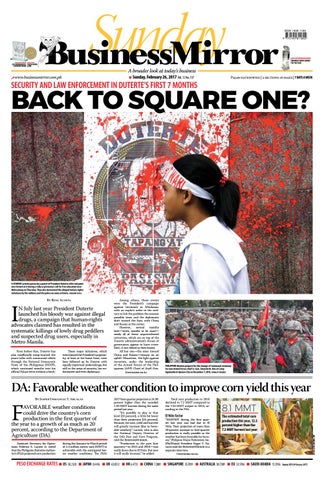
Back to square one?
A student activist passes by a poster of President Duterte after red paint was thrown at it during a rally as protesters call for free education near Malacañang on Thursday. They also denounced the alleged human-rights violations by the military and the police on some activists. AP/Aaron Favila
I
By Rene Acosta
n July last year President Duterte launched his bloody war against illegal drugs, a campaign that human-rights advocates claimed has resulted in the systematic killings of lowly drug peddlers and suspected drug users, especially in Metro Manila.
Even before that, Duterte has also unofficially jump-started the peace talks with communist rebels through the National Democratic Front of the Philippines (NDFP), which continued months into his official Palace term without a hitch.
These major initiatives, which even buoyed the President’s popularity, at least at the home front, were later followed up by Duterte with equally important undertakings, but still in the areas of security, law enforcement and even diplomacy.
Among others, these events were the President’s campaign against terrorism in Mindanao, with an explicit order to the military to lick the problem the soonest possible time; and the diplomatic shift toward the East, with China and Russia at the center. However, several months later—seven months to be exact— nearly all of these unprecedented initiatives, which are on top of the Duterte administration’s thrust of governance, appear to have crumbled, if not ebbed to their lowest. All but one—the steer toward China and Russia—remain on an uphill. Meantime, the fight against terrorism, under the leadership of the Armed Forces of the Philippines (AFP) Chief of Staff Gen. Continued on A2
Philippine Marines prepare for the change-of-command ceremony for new Armed Forces chief Lt. Gen. Eduardo M. Año at Camp Aguinaldo in Quezon City on December 7, 2016. AP/Bullit Marquez
DA: Favorable weather condition to improve corn yield this year avorable weather conditions could drive the country’s corn production in the first quarter of the year to a growth of as much as 20 percent, according to the Department of Agriculture (DA). Assistant Secretary for Operations Federico E. Laciste Jr. noted that the Philippine Statistics Authority’s (PSA) projected corn production
during the January-to-March period of 2.4 million metric tons (MMT) is achievable with the anticipated better weather conditions. The PSA’s
PESO exchange rates n US 50.2320
2017 first-quarter projection is 24.98 percent higher than the recorded 1.92-MMT harvest during the same period last year. “It’s possible to play at that level [20 percent], a little bit lower than their projection [25 percent]. Because, for sure, yield and harvest will greatly increase [due to favorable weather],” Laciste, who is also the National Deputy Director of the DA’s Rice and Corn Program, told the BusinessMirror. “Production in the past first quarters—in 2015 and 2016—was really down due to El Niño. But now it will really increase,” he added.
Total corn production in 2016 declined to 7.2 MMT compared to the 7.52-MMT output in 2015, according to the PSA.
El Niño factor
“Harvest during the first quarter last year was bad due to El Niño. Their projection of more than 20-percent increase in first-quarter production is really possible as the weather has been favorable for farmers,” Philipine Maize Federation Inc. (PhilMaize) President Roger V. Navarro told the BusinessMirror in a separate interview.
8.1 MMT The estimated total corn production this year, 12.5 percent higher than the 7.2-MMT harvest last year Branex | Dreamstime.com
F
By Jasper Emmanuel Y. Arcalas
Continued on A2
n japan 0.4456 n UK 63.0512 n HK 6.4733 n CHINA 7.3081 n singapore 35.7091 n australia 38.7389 n EU 53.1706 n SAUDI arabia 13.3956
Source: BSP (24 February 2017 )
NewsSunday BusinessMirror
A2 Sunday, February 26, 2017
Back to square one? Continued from A1
Eduardo M. Año, is still painstakingly attempting to punch a hole. It was not a joke—to borrow the phrase of the President, who had admitted two in every five statements he issues are wisecracks—to see the administration’s core programs lose traction and wither. After all, these historic developments could have assured Duterte a place in the country’s history—the popular leader who has ended the decades-old communist insurgency, put back law and order in the country and ended the pestering problem of terrorism.
Peace talks with the Left
Unless the government and the NDFP, the umbrella organization of democratic forces and all left-leaning groups in the country, goes back to the negotiating table—for which the latter must also do its share—the country’s security landscape will remain in tatters. As it is now, the conflict with the New People’s Army (NPA), the armed wing of the Communist Party of the Philippines (CPP), will revert the military to its original three internal campaign focus—the Moro rebellion, terrorism in the South and the communist-inspired insurgency. Never mind the territorial issue with China, as the Commander in Chief has already lost interest in it. Until the moribund talks with the NDFP was resuscitated by the Duterte administration, the AFP listed the CPPNPA-NDFP as the No. 1 threat group in the country, followed by the Moro rebellion and terrorism in Mindanao in that order. Both Defense Secretary Delfin N. Lorenzana and Año have expressed readiness by the government to reengage the NDFP in peace negotiations, but without preconditions from the latter. They said rebels must also stop their attacks. Lorenzana even said the government could start back-channeling talks with NDFP negotiators. The Left has taken up the challenge by ordering the release of its six prisoners of war that it snatched in various operations around the country, days after and even before the collapse of the talks. And in response to the call of Lorenzana for a cease in their attacks, the rebels also called for a halt to the military’s massing of troops or at least their presence un-
der the pretext of civil-military operations in areas where the rebels are located. But Malacañang said the talks cannot be continued unless the Commander in Chief sees any reason. While anticommunist hawks in the military maintained that the AFP could fight a three-pronged conflict, of which it has been doing for the longest time, it could not be denied that the “silencing of the guns” with the rebels could free it up from the main bulk of its operational focus, just like in the case of the Moro Islamic Liberation Front. When the government notched the initial peace agreement with the MILF, soldiers were given the opportunity to principally focus on running after terrorist groups in Mindanao, including the Abu Sayyaf Group (ASG), the Bangsamoro Islamic Freedom Fighters (BIFF) and the Maute Group. While these terrorist groups were solely contained in Mindanao, NPA rebels are scattered across the country. Before the collapse of the talks with the rebels, both the government and the Left were so optimistic the negotiations would finally show the exit of the region’s longest insurgency movement. In fact, Duterte, who has built a good relationship with top communist leaders, even exclaimed the rebels will die for him, as some of their legal groups were joining and spearheading rallies and protest over issues they could not agree with the government. In the AFP, its campaign plan for internal-security operations under the six-year term of its current Commander in Chief, the Development Support and Security Plan (DSSP) Kapayapaan, which replaced the IPSP Bayanihan, was geared toward the peace negotiations and shifted the soldiers’ focus to the security problem in Mindanao. It was the first time the insurgency was given less emphasis in the campaign plan of the military. Principally, the DSSP Kapayapaan mandated the AFP to carry out sustained operations in order to neutralize foreign and local terrorist organizations; actively support the Philippine National Police in the war against illegal drugs; chip in to the promotion of peace; and contribute to nation-building. “The leftists have nothing to worry about. In fact, we expect them to cooperate with us, so that we can work out the attainment of a permanent and lasting peace,” Año even said then.
www.businessmirror.com.ph
In fact, Arevalo said that, when the DSSP Kapayapaan was crafted and unveiled, it factored in any possibilities, any contingencies over the negotiations with the Left. Over the past few weeks, the military killed ASG members in Sulu and TawiTawi, but the terrorist group responded by threatening to behead its 70-year-old German captive by February 26 unless a P30million ransom is met. Early this week a Vietnamese vessel was also attacked by armed men, believed to be ASG members, and killed one of its crewmen and abducted seven others.
Drug campaign Communist rebel negotiator Fidel V. Agcaoili (left) and chief Philippine negotiator Silvestre H. Bello III shake hands after signing a joint statement on what has been achieved in the third round of talks in Rome on January 25. AP/Alessandra Tarantino
The termination of the talks with the NDFP led to the increase in the number of encounters with the NPA, which not too long ago was already on its way to being considered as a spent force by the military. Lorenzana said the lull in the negotiations has been used by the NPA to recruit and increase its armed members to 5,000, although the military leadership has pegged it at 3,700. On the other hand, Año said at least 30 firefights with rebels have also occurred since the talks were terminated on February 4.
Antiterror drive
The government’s resumption of hostilities with communist rebels now raises
skepticism whether it could end the terrorism problem with the ASG, the BIFF and the Maute Group, which are all now working under an ISIS flag under Commander Isnilon Hapilon, since forces would be spread thinly and distract the military’s operational focus. The AFP has a six-month deadline to “strategically” defeat all the terrorist groups, with the self-imposed time frame having been sketched before the termination of the negotiations with the communists. But military public-affairs office chief Col. Edgard Arevalo said the deadline was drawn by the military, regardless of the outcome of the talks with the communist rebels.
Of all the initiatives that were initiated by the government, it was the drive against illegal drugs by the PNP, which occupies the core focus of the Duterte administration, that received the most beating. Literally, it did not only raise criticisms, but it was dropped in an instant by Duterte after it was implemented for seven months. Last July the President set a deadline of six months to lick the country of its narcotics problem through the PNP, but he extended it for another six months. The campaign, however, had been mired by police scalawags, prompting Duterte to declare it will cover his entire term. In the meantime, the antidrugs drive has been solely given to the Philippine Drug Enforcement Agency, with the military tasked to support the effort. As the President goes back to square one in all of his initiatives, the country spins into a declining “Philippine team,” as former President Fidel V. Ramos has declared.
DA: Favorable weather condition to improve corn yield this year Continued from A1
However, despite the favorable weather for planting, farm-gate price of corn has remained low for some time now due to the unregulated importation of feed wheat and corn, Navarro said. “We call on the feed millers and livestock sector to calibrate their importation. To make a balance [on the] volume of importation of feed wheat and corn in order not to hurt the local farmers,” Navarro said. Citing corn farmers from Koronadal and Palawan, Navarro said farm-gate price of corn has been in the P8-per-kilogram mark for quite some time. Latest PSA data showed farm-gate prices of both yellow- and white-corn grains in the second week of February were lower than those recorded a year ago. Farm-gate prices of yellow-corn grain and white-corn grain were pegged at P11.40 per kg and P12.18 per kg, 5.08 percent and 9.81 percent lower than prices recorded in 2016, respectively. “The P11-per-kg level should already trigger the price support of the National Food Authority [NFA]. So that means that the current farm-gate price is neither high nor favorable to farmers,” Navarro said. The NFA buys corn from farmers at a support price of P13 per kg. Data from the PSA, however, showed that the NFA’s corn purchases have been minimal. The food agency attached to the Office of the President is mandated to regulate and monitor the stability of corn supply and prices.
Corn export
Earlier, the DA has pronounced it is keen on exporting yellow corn this year as a measure to stabilize the local market price of corn. Based on reports, the DA said there would be a production surplus this year. The DA estimates total corn production this year would reach 8.1 MMT, 12.5 percent higher than the 7.2 MMT produced last year. “Our corn farmers’ interest in boosting corn production is actually dampened by the very low prices manipulated by the corn traders arising from oversupply. Exporting is one doable solution that will benefit all industry stakeholders, as well as expedite the growth of the corn-farming sector,” Agriculture Secretary Emmanuel F. Piñol said.
The DA is eyeing to export yellow corn to Malaysia, Indonesia, Taiwan, South Korea and even in Europe, Laciste said. “If the buyers will be from Malaysia and Indonesia, then we will get our exports from Mindanao, from the South. And if the importers would be from the northern side of the map, we would be exporting corn from Isabela,” Laciste said. Laciste said since the pronouncement of the DA to export corn this year, local buyers have been making moves to secure their share of the production. “Local yellow-corn buyers now are telling our farmers: ‘Don’t export your corn anymore, I will buy them at favorable prices,’” he said. “Now they are talking with our RFOs [regional field offices] to secure their corn production. In order not to export the crop, they are offering good prices to our farmers,” he added. The DA has formally asked President Duterte to amend the guidelines of the NFA to allow farmers to export yellow corn this year.
Export
In a letter addressed to the President, Piñol said shipping corn to other countries would stabilize domestic prices and boost farmers’ income. “The existing policy of the NFA before we could export corn is the 200-percent sufficiency benchmark; if only we could amend the policy and guideline reducing it to 100-percent sufficiency benchmark, then we could immediately export corn,” Piñol said in his letter dated February 2, a copy of which was obtained by the BusinessMirror. “In view of the urgency of the situation, I am respectfully and humbly recommending the immediate amendment of the policy guideline issued by the NFA, which is currently under the Office of the President,” he added. Piñol said the DA is implementing two interventions to hike the country’s corn production this year—the adoption of dripirrigation with solar-powered irrigation systems deployed in strategic areas, the use of hybrid-corn seeds and distribution of fertilizer to farmers. “Our country’s corn production during the next five years of your presidency shall double and allow us to finally export to our neighboring countries,” Piñol said,
adding the DA would soon launch a program, dubbed as Programang MA MAIS: Mas Marami, Mas Masagana!, to hike corn output. The NFA oversees the regulation and stabilization of grains prices and supply in the country. Before farmers could export grains, such as corn, the interagency NFA Council must first declare there’s a surplus per Presidential Decree (PD) 4. “In the exercise of this power, the authority shall directly undertake the exportation of rice, corn and other grains and/ or their substitutes and/or by-products/ end-products whenever there is an excess in production and/or supply, or it may allocate export quotas among certified and licensed exporters,” PD 4 read. “Provided, however, that the council shall first certify after to such excess production and/or supply after proper consultation with the Office of the President,” it added.
Sufficiency
Based on the report of the PSA on the country’s food sufficiency, corn self-sufficiency ratio (SSR) was pegged at only 91.35 percent in 2015, the lowest since 2011. The SSR shows the extent to which a country’s supply of commodities is derived from its domestic production, according to the PSA. Laciste said the DA is also eyeing to strengthen the research and development arm of the corn industry. “We have a research and development facility for rice—PhilRice [Philippine Rice Institute]—but we don’t have [a similar institute] for corn,” Laciste said. Laciste said they are looking at the possibility of teaming up with experts from Mexico-based crop-research institute CIMMYT for the development of the country’s corn research and development program. “I want to send some of our agriculturists to CIMMYT to learn the latest technologies and studies in corn planting,” he said. Earlier, the PhilMaize said there is a need to increase the country’s corn yield per hectare and to cut production cost to boost the competitiveness of local corn farmers. Navarro added the corn sector needs better market linkages and postharvest technology. “Our farmers need precise farming through technology provided by the Department of Agriculture and trainings provided by extension workers,” Navarro said.
A4
TheWorld BusinessMirror
Sunday, February 26, 2017
www.businessmirror.com.ph
North Korea’s palace intrigue
Was a brother’s poisoning a warning to dissenters?
S
By Jean H. Lee | New York Times News Service
EOUL, South Korea—After the 14th-century Korean ruler Taejo, founder of the Joseon dynasty, chose the youngest of his eight sons to succeed him, a spurned son killed the heir apparent and at least one of his other half brothers and eventually rose to the throne. Today, rumors of royal fratricide are again swirling, this time around the court of Kim Jong Un, the ruler of North Korea. Last week K im’s estranged older half brother, K im Jong Nam, died in Malaysia, the apparent victim of a poison attack in the Kuala Lumpur airport. The Malaysian police named several suspects, including a North Korean diplomat. Many South Koreans, without needing proof, are calling it a political assassination directed by Kim Jong Un. North Korea denies that. The Malaysian police may never be able to prove that the North Korean regime was responsible for the death. But the rampant speculation that Kim ordered the attack is enough to send a chilling message to the North Korean people: Kim Jong Un’s reach and power can extend to all corners of the earth.
A head of state ordering a hit on his brother may sound medieval to modern ears. But in many ways, North Korea still operates like a feudal monarchy. The Korean tradition of leaders slaying their enemies and exiling potential claimants to the throne flourishes in Pyongyang. K im Jong Un’s father, K im Jong Il, and grandfather both car r ied out dead ly purges in the early years of their rule. And K im Jong Il sent his half brother, K im Pyong Il, to ser ve as ambassador to North Korea’s embassies in distant Poland and the Czech Republic. Though he once appeared as the favorite to succeed his father, Kim Jong Nam began living abroad in exile after being caught in 2001
North Korean leader Kim Jong Un in an undated photo released by North Korea’s Korean Central News Agency in Pyongyang on December 11, 2016.
trying to enter Japan with a fake Dominican passport (the portly Kim used the name Pang Xiong, Chinese for “fat bear”, a detail that hints at his sense of humor). The elder brother was better known for gambling than for politics. His young son, K im Han Sol, affirmed that image in a 2012 interview in which he said, “My dad was definitely not really interested in politics.” St i l l , K i m Jong Na m h ad b e e n v o c a l i n h i s c r it i c i s m of t he Nor t h K orea n leader sh ip. I n 2010, a s K i m Jong Un w a s be i ng g roomed to become leader, K i m Jong Na m told T V A s a h i he opposed h i s f at her ’s d e c i s ion t o p a s s l e a d e r s h ip onto a t h i rd generat ion. A nd
i n a book publ i shed i n Japa n , K i m Jong Na m w a s quoted a s pred ic t i ng t h at Nor t h K orea wou ld col l apse w it hout eco nomic refor m. T hese were d a m n i ng word s f rom a son of K im Jong I l a nd cou ld be cause for pros e c ut ion for t re a son u nder Nor t h K orea n l aw. The 2013 execution of Kim Jong Nam’s uncle Jang Song Thaek was an omen. Jang, the husband of Kim Jong Il ’s sister who at one time was treated as a regent for the young Kim Jong Un, was accused of plotting to overthrow the regime. His execution was meant to send North Koreans a message about the dangers of crossing Kim Jong Un and ushered in an extended
purge. Kim Jong Nam was said to be close to his uncle. The state media haven’t mentioned Kim Jong Un’s name in the reports on the death of a North Korean citizen in Malaysia, but word of the assassination has most likely circulated among elites. While Kim Jong Nam has not appeared much in the state media since falling out of favor with the regime more than 15 years ago, he was well known among elites and North Koreans who have spent time abroad—diplomats and, of course, defectors. These are the people who Kim Jong Un may have wanted to reach. The death comes at a time when an unprecedented number of members of the North Korean
elite are defecting to South Korea, most notably Thae Yong-ho, the dapper former deputy ambassador to Britain. Thae had been making the rounds divulging the inner workings of the Kim Jong Un regime, a blow to Pyongyang and a coup for Seoul. As someone who traces her lineage to King Taejo, I have a personal interest in his long-ago palace drama. In 2013 I visited Taejo’s hometown, Hamhung, in North Korea, where locals shared details of the family legends. The feuding among Taejo’s sons, I was told, so disheartened the king that he abandoned his palace in Seoul and retreated to Hamhung. For years, he refused to meet with the murderous son who eventually ascended to the throne. Legend has it that envoys bearing entreaties from the son, who ruled as King Taejong, were ordered slain before they could deliver their messages. The murdered envoys were called Hamhung chasa—messengers who never made it back home. With his death, and all the speculation surrounding it, Kim Jong Nam has become a modern-day Hamhung chasa—a doomed man who never made it back home. And at least until we know more about the case, Kim Jong Nam’s demise will be seen as a warning to North Koreans of the fate they risk if they cross their leader. n Jean H. Lee, a former journalist for The Associated Press in Pyong yang, is a global fellow with the Woodrow Wilson International Center for Scholars.
News analysis: Why Venezuelans have lost hope life will change
C
ARACAS, Venezuela—Venezuela is so short on food that tens of thousands are going hungry or even starving. Its murder rate is among the highest in the world. Its economy is so crippled that the average shopper spends 35 hours a month waiting in line—three times more than in 2014. Yet, even as the country becomes increasingly unlivable, the socialist government is more entrenched than it has been in years. A sense of hopelessness has settled over what was once among the richest nations in South America, a belief that nothing will really change. To understand why people have given up, look at Jhorman Valero and his family. Three years ago Valero dragged his 24-year-old cousin, Bassil da Costa, to join thousands of others in a nationwide protest against the administration of President Nicolas Maduro. Hours later, Bassil was bleeding in his arms, the first of more than 40 people to be killed during weeks of unrest. Staring numbly at the floor, Jhorman recounts how he watched his cousin’s skull come apart under his baseball cap from a bullet shot by security forces. Now Valero and Bassil’s sister, Yenicer da Costa, no longer bother to protest, even on the anniversary of the 2014 protest. “What’s the point of protesting if they just kill you in the streets and, three years later, everything is even worse?” she said. The fear inspired by the 2014 crackdown weighs heavily on the present, with a government that is selectively repressive. Many of more than 100 political prisoners were arrested that year and remain in jail, according to human-rights groups. Most are being held incommunicado in the dungeons of El Helicoide, a spiral-shaped modernist landmark built as a shopping mall during the 1950s oil boom, which is now the headquarters of the all-powerful Sebin intelligence police. The creation last month of an “anticoup commando unit,” headed by the vice president, has stoked fears of more roundups. The unit already has arrested three members of the party of Leopoldo Lopez, the highest-profile prisoner, who led the protest at which Bassil was killed. As the price of oil has fallen and laid bare years of mismanagement,
In this file photo, a woman holds her head as she waits in line outside a supermarket to buy food in Caracas, Venezuela. Venezuela is so short on food that tens of thousands are going hungry or even starving. Yet, even as the country becomes increasingly unlivable, the government is more entrenched than it has been in years. AP
Maduro’s administration has responded by becoming more repressive. It has purged state institutions of potential traitors, kept out foreign repor ters, detained prominent businessmen and d e c l a re d n u l l a l l d e c i s i o n s by t h e opposition-controlled congress. As a result, the young people who would be the natural fuel for any streetprotest movement are not turning out. At demonstrations these days, there are more grandparents than youths. One reason is that so many young people have simply fled the country. The protest this month got off to an inauspicious start, with an older man shouting, “Where are all the students?” ‘’They didn’t come!” called back Diego Cerboni, student union
president at the private Santa Maria University. Many of the friends Cerboni used to rely upon to demonstrate have left Venezuela. Cerboni estimates 100 students are leaving Santa Maria each week, forcing p ro f e s s o r s to c o n s o l i d ate s e c t i o n s a n d c a n c e l u n d e r - e n ro l l e d c l a s s e s at the 12,000-student campus. One re ce nt s u r ve y fo u n d 8 8 p e rce nt o f young Venezuelans want to emigrate. Venezuelans accounted for more United States asylum requests than any other country last year—more than 18,000, compared to a few hundred in 2013. So many people are applying for passports that the government has run short of supplies and all but stopped issuing them.
“The government has a smart strategy. They keep us looking over our shoulder, keep us busy looking for food and medicine. You’re working on how to get out of the country, and you don’t have time to march,” Cerboni said. Protester Marcello Gonzalez, 69, said all his 15 grandkids and seven of his 10 children have left the country. “There’s a terror campaign here,” he said. “The government is using tear gas and arrests to intimidate the young people and make them stay home. We older people don’t have to worr y as much. We know we’re not the target.” To be sure, the streets are not always calm. Twice last year, the opposition rallied hundreds of thousands of people to protest the Maduro administration. But
while popular movements have helped topple governments in places like Egypt and Ukraine, Venezuela’s protests seem to have had little effect on the political calculus of those in power. “Ever since the fall of the Berlin Wall, a lot of people are walking around with this myth in our heads that if you get enough people into the streets, the government will fall. And that’s just not true,” said Steven Levitsky, a professor at Harvard University who specializes in Latin American politics. The loss of hope is also tied to the opposition’s failure to present a clear alternative to the government. It is perennially divided and absorbed by its own internal ego battles.
The government has successfully made use of legal loopholes to hobble the opposition without much international protest. For much of last spring and summer, the opposition appeared to be getting back on track, collecting some 2 million signatures—10 times the required minimum—to force a recall referendum against Maduro. Polls suggest 80 percent of the country want to vote him out. But after a mass demonstration with a million people lastwzw September grabbed international headlines, the government suspended the recall drive. The Obama administration then dispatched a top diplomat to walk back the opposition leaders and tempt them with a Vatican-sponsored dialogue, which has since collapsed. In hindsight, to many it felt like capitulation, with the only result being that Maduro was never punished for trampling on the constitution. Now, there is an effort underway to block opposition parties from competing in future elections altogether. The opposition may have found a more willing partner in US President J. Donald Trump, who abruptly broke with the Obama administration’s policy of relative restraint toward Venezuela. Trump met with protester Lopez’s wife in the White House and slapped drug sanctions on Maduro’s vice president within 30 days of taking office. But while such a display of bravado is red meat to opposition hardliners, it could alienate the vast majority of Venezuelans who still revere the late President Hugo Chavez. And it only increases the odds that corrupt officials will close ranks for fear of being hunted down themselves should they ever lose power. “It’s the exac t wrong thing. The opposition needs to convince the ruling elite that there’s life after Maduro; that if they allow a transition, they’re not going to end up in jail or exile. If the regime’s elite remains united, there’s nothing in a protest movement that forces them to leave,” Levitsky said. The protest to commemorate the 2014 deaths eventually grew to a few hundred people. Bassil’s mother, Jineth Frias, showed up, somewhat reluctantly, and marched with other parents in front of a sign that said, “We remember our young.” AP
www.businessmirror.com.ph
Israeli PM hopes to triple trade with Australia
S
Y D N E Y— I s r a e l i P r i m e Minister Benjamin Netanyahu said on Thursday he hoped to triple bilateral trade with Australia as the countries forge c loser tec h nolog y a nd aviation ties. Bilateral trade is currently worth about $1 billion a year, with Israel sending less than 1 percent of its exports Down Under and Australian products accounting for just 0.3 percent of Israel’s imports. “Our trade is $1 billion. It should be at least double or triple that,” Netanyahu said, as he sat for talks with Prime Minister Malcolm Turnbull and Australian government ministers in Sydney. “I’d like to encourage the Australian and Israeli companies to increase in trade,” he said. “If I did the schlep, they should do it, too,” he added, referring to the 14,200-kilometer journey between Sydney and Tel Aviv. Hi s com ment s c a me a f ter he a nd Tu r nbu l l oversaw t he signing of agreements for more c o o p e r at i o n b e t w e e n I s r a e l a nd Aust ra l i a on tec hnolog ica l innovation and air ser v ices du r ing t he second d ay of h is fou r- d ay v isit. Net a nya hu v isited Syd ney Jew ish school Mor iah Col lege, where he was mobbed by cheering primar y students, while his w ife Sara earlier shared mor ning tea w ith Luc y Tur nbu l l at Jesse’s kosher ba ker y. AP
TheWorld BusinessMirror
Sunday, February 26, 2017
A3
Opec still waiting for proof oil cuts are doing their job O
rganization of the Petroleum Exporting Countries (Opec) officials this week hailed the “excellent” and “unprecedented” implementation of their agreement to cut oil production, but were still waiting for solid evidence that the deal was fulfilling their key measure of success and shrinking the global glut. A reduction in the amount of oil held in storage around the world is the most important factor for the Opec, Qatar Energy Minister Mohammed A l Sada said at the IP Week conference in London on Wednesday. The pace of that decline will determine the group’s next move, including whether to extend the accord beyond its initial six-month term, according to Opec SecretaryGeneral Mohammad Barkindo. The most reliable data available so far on inventories—crude
held in commercial storage in the US—is going in the opposite direction. Stockpiles in the world’s largest oil consumer have risen every week since Opec began cutting on January 1, while data on global storage levels have yet to be published. “The market has been positively surprised by the high levels of compliance to this deal,” Jens Pedersen, senior analyst at Danske Bank A/S, said by phone. “The trend in inventories recently has been upward and quite relentless. The market will
be a bit careful to rally further if inventories are still building.” Brent crude has risen more than 20 percent since Opec agreed last year to cut production, a deal that was joined later by Russia, Mexico and several other nonmembers. Even as the group’s initial compliance with the accord exceeded expectations, the price rally stalled in the mid-$50s, as US crude stockpiles surged to the highest level in more than three decades and oil drillers deployed the most rigs since October 2015. Brent fell 1.6 percent to $55.73 a barrel at 4:56 p.m. in London on Wednesday.
Higher compliance
A five-nation technical committee meeting in Vienna on Wednesday concluded that Opec had achieved more than 90 percent of its promised cutbacks in January, and that the group’s partners implemented almost 60 percent, according to delegates familiar with the matter who asked not to be identified. The Opec agreement is working, compliance will increase to 100 percent and oil inventories will drop this year, Barkindo said.
“We are going to go for much higher levels of compliance because of the very high level of stocks that we have brought over with us from 2016,” Barkindo said in a Bloomberg Television interview in London on Tuesday. Oil is still far from an “equilibrium price” and inventories remained very high in January, but Opec’s not disappointed by the market reaction to its agreement. US crude inventories have expanded by more than 39 million barrels this year to 518 million, the highest level in data going back to August 1982, according to the Energy Information Administration. A further 3.25 million barrels were added last week, according to a Bloomberg survey before government data to be published on Thursday.
Extended cuts
That’s only a partial picture of the state of global oil supply, but the International Energy Agency (IEA) has yet to publish an estimate of how the first month of Opec cuts affected international inventories. Stocks held in rich industrialized countries—
including the US—were falling through the fourth quarter of 2016 and dropped below 3 billion barrels last December for the first time in a year. Meanwhile, stockpiles in China and other emerging economies, plus volumes of fuel held at sea were still growing, the IEA said on February 10. While solid supply data may be lacking, changes in benchmark oil prices do suggest Opec is succeeding. A pricing structure in Brent and West Texas Intermediate futures called contango—an indicator of oversupply where short-term prices are lower than long term—is weakening and shifting toward the opposite condition know n as backwardation—a sign of tighter supply. Global oil stockpiles are starting to decline, but it’s “truly premature” to say whether Opec will extend its output cuts into the second half, Qatar’s Al Sada said in a Bloomberg Television interview in London. Patrick Pouyanne, chief executive officer of French oil and gas producer Total SA, said Opec needs to do more if it really wants to eliminate the glut. Bloomberg News
Editor: Lyn B. Resurreccion
Science
BusinessMirror
Sunday
Sunday, February 26, 2017 A5
One-person households rising
U
A person supporting Planned Parenthood puts up a banner during Rep. Jason Chaffetz’s town hall meeting at Brighton High School in Cottonwood Heights, Utah, on February 9. Sixteen states ban abortions starting at about 20 weeks, according to Guttmacher Institute, a research organization that supports abortion rights. AP/Rick Bowmer
Experts: Science behind ‘abortion reversal’ is flawed
C
HICAGO—Lawmakers in several states are considering requirements for doctors to inform women seeking medical abortions about an unproven procedure called “abortion reversal”.
Doctors’ groups oppose the bi l l s b e c au se of f l awe d sc ience and ethical concerns. There is no evidence the procedure works and little infor mation about its safety. T he procedure involves shots of the hor mone progesterone g iven if a woman changes her mind after the first step of a medical abortion. Since 2015, Arkansas and South Da kota have enacted laws requir ing doctors to tel l women about it. A n A r izona law was cha l lenged in cour t and later repea led. Bil ls are under consideration in Colorado, Indiana, Nor th Carolina and Utah. “It ’s rea l ly concer ning t hat leg isl at u res a re passing l aws inter fer ing in t he doctor- pat ient re l at ion sh ip a nd forc ing t hem to tel l women about a n e x per iment a l t herapy t hat is u nproven,” sa id Dr. Da niel Grossma n, a professor in t he Depa r t ment of Obstet r ics, Gy necolog y and Reproduct ive Sc iences at Universit y of C a l ifor ni a, Sa n Fra nc isco.
60% to 70% The alleged percentage of success rate of abortion reversal that was claimed by Dr. George Delgado in San Diego, California What is medical abortion?
A bout a t h ird of women who seek abor t ions in ea rly pregn a nc y c hoose med ic a l abor t io n s , b e c au s e t he y w a nt a less invasive procedu re t ha n a su rg ica l abor t ion. In the United States medical abortion involves taking two drugs. The first—mifepristone— thins the lining of the uterus and loosens the connection between the embryo and the uterine lining. The second—misoprostol— softens and opens the cervix and causes contractions to push out the pregnancy. The second drug is taken at home hours to days
after the first drug. Women rarely change their minds before completing the treatment. Doctors are required to report such information to the manufacturer of mifepristone. Between 2000 and 2012, less than 0.004 percent of women taking mifepristone changed their minds, Grossman said. “Women are very sure of their decision by the time they go to the abortion clinic,” Grossman added.
What are the claims for ‘reversal’? Progesterone is legitimately used to prevent preterm birth in women who are at risk of early delivery. Some claim it can counteract the effects of an unfinished medical abortion. Dr. George Delgado in San Diego, Ca lifor nia, is the chief advocate. He is medica l director of Cu lt u re of L i fe Fa mily Ser v ices, descr ibed as “the ‘ f lip-side’ to Planned Parenthood ” on its web site. T he clinic “of fers tr ue reproduct ivehea lth care and abor tion a lter natives to women,” the web site says. Delgado published a paper in 2012 about six women who had taken mifepristone, the first medication in the two-part medical abortion, then had a series of progesterone shots. Four of the six women had healthy babies. The other two aborted. Delgado says he has given progesterone to several hundred other women who also changed their minds after starting a medical abortion. He says he has a 60
percent to 70 percent success rate and hopes to publish the results in a peer-reviewed journal. “If there’s a way to give them a second chance at choice, it will be a wonderful thing,” Delgado said.
What is the evidence?
Delgado ’ s st udy i s not considered h ig h- qu a l it y resea rc h bec au se it i s sm a l l a nd t here was no compa r ison g roup. R esea rc hers h ave quest ioned whet her t he women were g iven adequ ate i n for m at ion about t he e x p e r i me nt a l n at u re of t he procedu re. For women who change their minds after taking mifepristone, doing nothing and waiting to see what happens may be just as effective as progesterone shots. T h a t ’s b e c a u s e m i f e p r i s tone a lone doesn’t work ver y wel l w ithout the second dr ug. T hir t y percent to 50 percent of women who ta ke mifepr istone a lone w il l have continued preg nancies, according to the American Congress of Obstetricians and Gy necolog ists. (Delgado disputes this and says the sur v iva l rate of embr yos after mifepr istone is much sma ller.) Progesterone shots are generally safe but can cause swelling, irritation and other side effects. The cost of pushing an experimenta l procedure into w idespread use also raises ethical questions, Grossman said. The injections and doctor visits involved can cost up to $1,000. AP
DOST gives digital science library in Bulacan
P
ANDI, Bulacan—National and Bulacan officials of Department of Science and Technology (DOST) led recently the turn-over ceremony of the Science and Technology Academic and Research-based Openly Operated Kiosk Station (Starbooks) at the Virginia-Ramirez Cruz Memorial National High School in Barangay Siling Bata in this municipality. Science Assistant Secretar y Manny Galvez and Dr. Julius Caesar V. Sicat, DOST director in Central Luzon, led the event, together with Angelita Parungao, DOST-Bulacan provincial
director; school personnel and other guests. Emelita de Jesus, the school principal, accepted the unit on behalf of the school. Sicat said Starbooks is an award-winning innovative project developed by the Science and Technology Information Institute (STII). He said it is a virtual library in a box that contains thousands of digitized scienceand-technology resources in text, video and audio formats. It also contains the Encyclopedia Britannica, as well as videos of livelihood technologies. Its stand-alone format makes
it possible to access information even without an Internet connection making it ideal for adoption by public elementary and secondary schools, which cannot afford expensive Internet services. Local government units can also put up their own Starbooks in their public libraries, he added. Sicat said the event is hailed as a step toward improving science education in the country. He also expressed hope that the installation of Starbooks in the school would get more students interested in science research, as they now have a readily available source of information for their studies.
He a l so encou raged ot her schools to put up their ow n Starbooks. The DOST has already prov ided Starbook s to Santa Peregr ina High School and in seven barangays of Pulilan in Bulacan. Another two units will also soon be turned over to the General Gregorio del Pilar Elementar y School in the municipality of Bulakan. Besides Bulacan, Starbooks has also been installed in various local government units in the other provinces of Central Luzon and other parts of the country, as well as state colleges and universities, he said. Catherine Joy L. Maglalang
N I T ED NAT IONS — A significant global demographic change having farreaching consequences, yet receiving, scant attention is the rise of one-person households. Of the world’s 2 billion households, approximately 15 percent— or 300 million—are one-person households (OPHs). As is often the case with global averages, considerable variation exists in the incidence of OPHs across countries. The highest rates of OPHs occur in Europe. Among European countries OPHs of 40 percent or more are reported in Denmark, Finland, Germany and Norway. Other European countries with high rates of OPHs include Sweden (38 percent), Austria (37 percent), Switzerland (37 percent), the Netherlands (36 percent), France (35 percent) and Italy (33 percent). Moderate ly h igh le ve l s of OPHs are also observed in countries outside Europe, such as Japan (32 percent), the United States (28 percent), Canada (28 percent), South Korea (27 percent), Austra lia (24 percent) and New Zealand (24 percent). One notably lower proportion of OPHs among developed countries is Russia (19 percent). Developing countries generally have lower proportions of OPHs than developed countries. Some of the lowest rates of OPHs—less than 10 percent—are observed in India, Indonesia, Iran, Mexico, the Philippines and Vietnam. Other developing countries having levels of OPHs closer to the global average include China (15 percent), Turkey (13 percent) and Singapore (12 percent). A lt hou g h C h i n a’s prop or tion of 15-percent OPHs is well below the levels of developed countries, China has the world ’s largest number of OPHs— 66 million are registered—due to its enormous population size of 1.4 billion people. In second place with an OPH proportion of 28 percent is the US having approximately 35 million. The proportion of people who live alone has grown steadily over the recent past. Since the 1960s, for example, OPHs in many countries have increased substantially. In many European countries, as well as in Australia, Canada, China, Japan, South Korea and the US, the proportion of OPHs has more than doubled. Also in contrast to the recent past, in at least 25 developed countries OPHs have become more numerous than two-parent households with children. In several of those countries, such as Estonia, Finland, Germany and Japan, the proportion of OPHs has reached approximately twice that of couple households with children. Various factors account for the rapid rise in OPH. Economic development, increasing wealth and improved standards of living play major roles in the increased incidence of OPHs. Consequently, the levels of OPHs tend to be substantially higher in developed countries than in developing countries. With greater affluence people can afford to live alone and growing numbers are choosing to pay for their personal privacy, individualism and freedom to live as they wish. A lso, as women have become more socially and economically self-reliant, they are more able and apt to establish OPHs. With increased education, more employ ment a nd c a reer oppor tunities and improved gender equalit y, women are increasingly able to choose their life styles, including whether they would like to live independently on their own. Population ageing, increased longevity and improved health at older ages are also important factors giving rise to OPHs. With longer, healthier lives and the growing proportions of elderly persons, widows and widowers
are often choosing to live alone, especially in developed countries where governments generally provide old-age social security, assistance and health care. Urbanization with its high population densities, small living quarters and multitude of services, opportunities and freedoms permits a lifestyle that is conducive to living on one’s own. Whereas in 1960 two-thirds of the world’s population lived in rural areas, today the majority of the world ’s population (55 percent) lives in urban centers. In addition, the migration of the young single men and women from rural areas to urban centers often results with the elderly living alone and far away from family members. Another major reason for the rapid rise in OPHS among young people is delaying or eschewing marriage and family building due to higher education, professional training, career aspirations and personal goals. In addition to lower marriage rates and smaller family size, growing numbers are choosing to remain childless. Also contributing to the rise in OPHS are high levels of divorce and cohabitation dissolution, low rates of remarriage and changes in traditional values and family structures. The divorce rate in China, for example, has increased rapidly during the past 30 years, jumping from 0.4 divorces per 1,000 people in the mid-1980s to 2.7 divorces per 1,000 people today. Similarly among Organisation for Economic Co-operation and Development countries, the average divorce rate increased from 1.3 divorces per 1,000 people in 1970 to 2.1 divorces per 1,000 people in 2014. Modern communications, particularly the Internet, allows those wishing to live alone to be connected and engaged with family, friends and others. As often noted, living alone does not necessarily mean one is lonely. Relatively low cost, modern communications and social media have permitted OPHs to maintain intimate relationships, friendships, emotional support and social interactions. The rise of OPHs has consequences for consumption patterns, resource allocations and human mobility. The growing numbers of OPHs increase demand for housing, transportation, natural resources and energy. In addition, OPHs have implications for certain industries and businesses, such as housing, appliances, electronics, domestic goods, health care, food manufacturing, meal packaging, financial and personal counseling, travel, entertainment and home services. Also, the growth of OPHs has various societal and normative implications, including the well being of the individuals residing on their own. OPHs tend to be more vulnerable and, therefore, potentially more costly to society than those having a partner or companion. With a single and often limited source of income, OPHs are more precarious with lower median household incomes and generally face more difficulties when dealing with unemployment, injury, illness, adversity, disability, social isolation and loneliness. In addition, the increase in OPHs has government policy implications. OPHs often mean smaller savings for retirement and, therefore, potentially greater financial aid and assistance needed for the elderly in the future. Voting patterns are also likely to be impacted, with astute political leaders realizing that perhaps its time to expand their traditional focus on what is good for families with children to the needs of people living alone. IPS
Faith A6 Sunday, February 26, 2017
Sunday
www.businessmirror.com.ph • Editor: Lyn Resurreccion
Episcopal coronation of Our Lady of Mount Carmel
On the occasion of the 42nd Foundation of the National Shrine of Our Lady of Mount Carmel, the whole Carmelite family, the parishioners, pilgrims and devotees witnessed the episcopal coronation of the image of Our Lady of Mount Carmel on February 20. Most Reverend Honesto Ongtioco presided the celebration with a Mass. During the same occasion, it was declared that a plenary indulgence would be granted to all devotees who visit the shrine. A huge number of priests from the Order of Discalced Carmelites (OCD), various religious congregations, OCD nuns, secular Carmelites and the Diocese of Cubao graced the historic event. Samahang Men in Brown Facebook
Anti-Semitism is rising
own souls, be a mockery to their people by reason of contrast offered by worldliness” and followed the proper decorum of the religious. He wrote two treatises and several synodal decrees to improve the morality and theological knowledge of the clergy. In 970 Regularis Concordia, a Code of Monastic Conduct, which he wrote, was agreed upon and implemented. Two years later, Oswald went to Rome to receive from Pope John XIII a pallium, the symbol of full episcopal authority.
S
AIN T LO U I S — H a s a nt i - S e m i t i s m accompanied Donald J. Trump’s rise to power? Some organizations that monitor hate groups and hate crimes believe so, noting a rash of recent incidents. But data is elusive, and the president’s supporters note his family connection—a Jewish daughter, son-in-law and grandchildren—and his comments this week condemning hate and prejudice. Here’s a look at recent incidents targeting Jewish sites and anti-Semitism in the US:
Are hate crimes targeting Jews increasing?
Human-rights activists and organizations are convinced that Trump’s popularity and electoral victory created an acceptance into the mainstream of the “alt-right”, an offshoot of conservatism mixing racism, white nationalism and populism and, along with it, anti-Semitism. There have been reports nationwide in recent months of anti-Semitic incidents, including people yelling pro-Hitler comments at a rabbi on the street in Providence, Rhode Island, swastikas drawn in subway cars in New York City, and bomb threats at Jewish buildings in several cities. But determining whether such incidents have increased is difficult. The Southern Poverty Law Center, a nonprofit that monitors hate groups and extremists, reported last week that the number of hate groups operating in the US rose from 892 in 2015 to 917 in last year. But that’s still short of the all-time high of 1,018 hate groups in 2011. The organization also counted 1,094 bias-related incidents in the month following Trump’s November election victory, including 33 against Jews, 108 involving swastikas and 47 white nationalist fliers. New York City police keep a running tab of hate crimes. As of Sunday, 31 hate crimes have been reported against Jewish people this year—more than double compared to the same period of 2016. Official nationwide government data for the last year isn’t available. The FBI tracks hate crimes, but the most recent available data is from 2015.
What has increased concerns about anti-Semitism?
Among the most recent events were bomb threats phoned in to 11 Jewish community centers across the countr y on Monday, including in Chicago, Cleveland and Houston. No bombs were found and no arrests have been made, but the threats—along with similar threats over recent months at other centers—created fear and uncertainty among Jewish people. Also on Monday, roughly 200 headstones were found knocked over or broken at a Jewish cemetery in suburban Saint Louis. No arrests have been made for the damage at the Chesed Shel Emeth Cemetery in University City, Missouri. Investigators have not yet determined if it was a hate crime. Missouri Gov. Eric Greitens, who is Jewish, posted a statement on Facebook calling the vandalism “despicable” and “cowardly”. AP
Hagiography hailed him saint
Late-13th- to early 14th-century miniature of a bishop above a ram, and an abbot above a bull, from the part of the Ramsey Psalter in the Pierpont Morgan Library, New York. Wikimedia Commons
Saint Oswald, Archbishop By Corazon Damo-Santiago
‘V
ocation crisis may be a matter of smoke and mirrors. But the smoke and mirrors have very real consequences,” Andrew M. Greeley in A Calling in Crisis said. A s early as the ninth centur y, there was a lready a cr isis in relig ious vocations. Saint Oswald, a religious, shone as a “bright star of dignity”, an epitome of goodness, charity and morality for others. In his 31 years as a religious, eight popes sat on the chair of Peter, none of them was declared saint.
Advocate of moral reforms
Oswald is of Danish parentage and was bor n in Denmark but he was raised in Great Br itain by Saint Odo, the archbishop of Canterbur y. He became the dean of Secular Canons of Winchester. He considered the training lax and attempted to introduce reforms, which failed. T h in k ing t hat t he “ infa l l ible inst inct t hat g u ided sa ints du r ing cr it ica l t imes” was t he remedy, he t hought t he resto rat ion of monast ic l ife ca n be a solut ion. So he went to t he A bbey of F leu r y of Fra nce in 950 and took the habit of Saint Bened ict in 959. When he returned to England,
Saint Odo was a lready dead. Oswald turned to Oskytel, and the archbishop of York involved him in religious activities. Impressed, Archbishop Dunstan consecrated him as bishop of Worchester in 961. R e v. A lba n But ler, i n Index o f A l l S a i n t s, n a r r at e s t h at a f ter h i s con sec rat ion i n 9 62 by Sa i nt D u n st a n, Os w a ld be c a me D u n st a n’s st au nc h sup por ter to “pu r i f y t he C hu rc h f rom abu ses”. In 964 he was appointed archbishop of York. As archbishop he v isited dioceses; preached and introduced reforms; corrected abuses through fatherly admonitions, dialogues, fasting and prayers. Oswald was, likewise, t asked by t he Du ke of Aylw in, t he s up e r i nt e nd e nc y of t he Great Mon a ster y of R a m se y in Hu nt ingdonsh ire. Dunstan and Ethelwold of Winschester revived monastic practices. Religious who were not performing their religious vows were sent to a cathedral i n R ome a d m i n i s t e re d b y a body of religious. Sacred texts. com lists that disorderly clerics were deprived of benefits and replaced with regulars, and finding themselves isolated and their cathedrals deserted willingly d isc ipl ined t hemselves than continue to “ injure their
Enhancing the holiness of the people of God is never solely dependent on numbers but on the quality and spirit of priests. That the spirituality of a generation is one degree less intense than its advocate in Christ is an opinion expounded by Dom Jean Baptiste Chautard, Ocso, in Soul of Apostolate. “If the priest is a saint, the people will be fervent. “If the priest is fervent, the people will be pious. “If the priest is pious, the people will at least be decent. “If the priest is only decent, the people will be Godless.” Considered as a holy person during his time, Saint Oswald had a dozen people with him on the dining table, and washed and kissed their feet to nourish his humility and charity. It was chronicled that his progress to a life of perfect virtue was his belief in the fundamental maxim of eternal truth of Saint Bennet. “He who desires to give himself up to God must trample all earthly things under his feet, renounce everything that is not God and die to all earthly affection.” One of the three saints who revived English Monasticism, Oswald died on February 29, 992. He died while washing the feet of people. Immediately after his death, miracles were reported at his funeral and his tomb. A hagiographical life written after his death in 992 hailed him as a saint. n Santiago is a former regional director of the Department of Education National Capital Region. She is currently a faculty member of Mater Redemptoris Collegium in Calauan, Laguna, and of Mater Redemptoris College in San Jose City, Nueva Ecija.
Prelate praises mothers, stresses sacredness of life
T
ACLOBAN CITY—Praising mothers, Palo Archbishop John Forrosuelo Du urged last Sunday members of the Archdiocesan Federation of Medalla Milagrosa to go out and rally for the sanctity of life. The Dumaguete-native prelate expounded on the mother’s important role in nurturing life in the womb for nine months, but which, in these days, has become “cheap”. Du said mothers, who care for their children, are represented by the Blessed Virgin Mary, and should, in the same way, be Mary’s representatives on earth. He, however, lamented how life’s value is disregarded nowadays.
A mother’s weeping heart
“Her e comes deat h pena lt y, and life now has become very cheap,” said Du in his Homily at the Mass on the occasion of the 48th Annual Pilgrimage of Medalla Milagrosa Visita Domicillaria at the Redemptorist Church (Our Lady of Perpetual Help Parish) in this city. For sure, the prelate said, whenever a person is killed, a mother’s heart weeps, because the one she loves the most was not given a chance to reform his life. He noted how life has become “nothing”. Du exhorted the members of the federation to collectively cr y for the protection of life, which is “sacred and precious”. Even after President Duterte momentarily put on hold his hardline war against drugs following the sensational killing of a Korean businessman inside Camp Crame, extrajudicial killings have never stopped. On February 18 the Catholic Bishops’ Conference of the Philippines led thousands of Catholics in the Walk for Life at the Rizal Park to publicize the Church in the Philippines’s rejection of the proposed reimposition of death penalty, abortion, the unabated extrajudicial killings and corruption in government.
Chance to offer oneself
According to the prelate, life is from God, and no one has the authority to kill someone just because he is wrong.
Palo Archbishop John Du CBCP News
Du also underscored Jesus’ humility, who, despite being the Son of God, lowered Himself and became a poor man in order to save mankind. He emphasized the challenge to help others experience the fullness of life and to share the best one can offer to others. “Simply they cannot offer the best, because they are not given the opportunity because of the circumstances,” he commented. Du remarked, “Can you expect a child to grow up good and show his or her best when there is no food on their table and the parents are separated?” Posing the challenge, he said, “that is why a child needs love and support and assistance”. “The Lord is telling us ‘Give him the opportunity to make his life better and offer himself,’” he said. The prelate also reiterated God’s call to mankind to be holy and to live the fullness of life “ because life is beautiful”.
Dealing with evil
Emphasizing that Sunday’s Gospel he said, “If anyone presses you into service for 1 mile, go for 2 miles; we have to make extra effort to help our brothers and sisters who are being misled or lost in their lives.” Du also explained how a Christian should deal with evil. “Offer no resistance to what is evil. Don’t give what is evil another evil because there is no end to ‘evil, begets evil,’” he said. “If there is evil, share love; if there is wrong, forgiveness; be patient, because eventually you will get back that love you have offered to that person,” Du said. “But if you will kill the person, you will miss the point of the renewal, the transformation and the fullness, the best that he can offer to you, to your family and to our community,” he said. Eileen N. Ballesteros/CBCP News
Tourism& Entertainment BusinessMirror
Editor: Carla Mortel-Baricaua
Sunday, February 26, 2017
A7
A Feast for the Republic
Baustista ancestral house, a living museum
T
Marching band at Fiesta Republica
By Bernard L. Supetran
he Filipinos are known for their religious fervor, evident in the fiestas dedicated to patronal saints, where they put their best foot—and food—forward to celebrate them. But in recent years, a new fiesta has taken shape to pay homage not to a territorial patron, but to the birth of the First Philippine Republic, which is the culmination of the country’s libertarian ideals, which started with the 1896 Revolution. The so-called Malolos Republic was the fruition of the Malolos Congress convened by Gen. Emilio Aguinaldo in September 1898 to frame a constitution and democratic institution, which will be the first of its kind in Asia. It can be recalled that a few months earlier, he proclaimed independence from Spain in Kawit, Cavite, after defeating much of the colonial forces.
So, when the Republic was inaugurated on January 23, 1899, at Barasoain Church, the jubilant Filipinos threw a feast of pomp and pageantry, much like they would do in a typical patronal fiesta. But this auspicious event lost its luster over time, overshadowed by the grandiose national observance of the Independence Day and the Araw ng Kagitingan, which are among the country’s official holidays. To immortalize this momentous event, the city government of Malolos, led by Mayor Christian Natividad, hatched the Fiesta Republica in 2010, which will bring back the spotlight to the Republic, and edu-
Malolos Congress dish
cate the Filipinos about our forefathers’ vision for the nation. “We have fiestas and festivals for nearly every religious and cultural significance, but why aren’t we celebrating the very first Philippine Republic, which was founded here in Malolos?” Natividad asks. He noted that it was only on the said date that we were finally able to establish a Filipino-led government, which rightfully deserves to be the country’s “other” Independence Day, just like in other republican nations. “We were the first one to establish a Constitution in Asia and it was a milestone we all achieved as a nation. It was where our all the other fundamental rights and privileges that we enjoy today—our bill of rights and the freedom of the press, for example—emanated, so why are we not giving this date the same reverence that we’re giving to June 12, or the Araw ng Kagitingan?” he enthused. In 2013 the city’s initiative led to a presidential proclamation, declaring January 23 as Araw ng Republikang Filipino 1889, which made it a holiday in the Bulacan province. From a yearly ceremonial event, the commemorative events have since become a monthlong festiv-
Fiesta Republica street parade
ity. But Natividad and his Bulakeño kababayan are pushing the envelope further to have the date proclaimed by Congress as a national holiday. The locus of the fiesta is the Parada ng Republika from the Malolos Basilica, passing through Barasoain Church, and concludes at the Sports and Convention Center for the Dulansangan, a street dance-drama depicting the historic events leading to the formation of the Republic. During these times, locals also make it a point to recreate the fancied French-sounding dishes the delegates of the Malolos Congress feasted on during its inaugural session on September 29. Wonderfully designed by Arcadio Arellano, the 1898 menu is in the form of a Philippine flag containing a complete meal, from appetizers to liquors, and which historians and culinary experts interpret to be a coming of age for the freedom fighters who are on a par with the world’s best. While the dishes definitely sounds grander in French, the food is just basically a glorified version of what the middle-class Filipinos were already eating at that time, with a few added ingredients and elements to make it more glamorous.
Folk dance by Malolos youth
Meanwhile, the Pasiklaban ng mga Banda tilt showcased the city’s unique brass-band tradition, and provided a jovial atmosphere with their lilting marches and martial music as they paraded in their colorful regalia, led by the eye-candy majorettes. Fringe events included Kalutong Malolos, which showcases the rich variety in its cuisine through a culinary contest, and Hataw sa Sining, which rekindles the artistic prowess of Malolenyos in performance arts with dance and music competitions. As part of its sports tourism thrust, cyclists and bike enthusiasts were invited to the Malolos Bike Festival, which toured the quaint streets of the city.
Heritage town
Aside from the iconic Barasoain Church popularized in our P10 bill, Malolos is a proud host to an antiquarian heritage district, the Kamestizuhan, whose ilustrado abodes became the temporary offices of the Republic’s newly organized Cabinet. Many of these houses are in good shape and have become socalled living museums, among them the Antonio Bautista, Tansojuy and Cojuangco mansions.
Meanwhile, other Spanish bahay na bato of prominent families have found adaptive reuse as offices and shops. The Immaculate Conception Cathedral, the seat of the Catholic diocese in Bulacan and one of the country’s basilicas, became Aguinaldo’s presidential office and discussed the affairs of the new state under a telltale acacia tree. A noted historical landmark in the town proper is Casa Real Shrine, the colonial-era presidencia or municipal hall of Malolos, which later became the National Treasury and printing press of the revolutionary newspapers La Independencia and El Heraldo dela Revolucion. For a complete picture of the cultural heritage of Malolos, the local tourism office has mapped a tour circuit, which takes visitors to its points of interest, including the coastal fishery areas, crafts and ageold delicacies and kakanin, interspersed with historical and apocryphal narratives, age-old chismis and old wives tales, which make the visit more intriguing. Fiesta or not, Malolos in itself is definitely a feast for the senses worth coming home to.
Cagsawa Festival: An eruption of culture and adventure Harnessing innate Filipino
hospitality to build a dynamic Philippines hotel brand
S
Cagsawa Festival at Cagsawa Ruins Park Arnolf Lorcha
Cagsawa Trail Run
O
n February 1, 1814, Mayon Volcano registered its most destructive eruption killing over 1,200 persons in the town of Cagsawa in Albay, and destroying its poblacion, or town proper. The Cagsawa Ruins, where only the church belfry stands, is what remains of the Spanish-era town whose population relocated to higher and safer grounds in present-day Daraga. Since then, the perfect-coned volcano would erupt every decade or so, though of smaller magnitude. In a unique twist of fate, a cultural festival was crafted in 2012 by former Albay Gov. Joey S. Salceda to mark the 198th anniversary of the tragedy. Aptly called Cagsawa Festival, the event puts to the fore Daraga’s history, heritage and everything in between in a monthlong provincewide observance. The festivity showcases a wide array of entertainment shows, musical tilts, sports tournaments, sociocivic activities, pageants, culinary activities and special interest events. The town is at the core of Albay’s culinary tourism program with the presence of homegrown restaurants, such as Balay Cena Una, Alvi’s Café, Balay Bicol, Casa Lorenzo Food and
Culture and First Colonial Grill. The latter is home of the sili ice cream, an award-winning trademark dessert of Bicol. Salceda, who is now representative of Albay’s second district and a resident of Daraga, said the festival will highlight the fast-urbanizing first-class municipality as it aspires for cityhood. Now on its sixth year, the celebration’s locus is the cultural presentation and street-dance competition on February 21 from contingents depicting events surrounding the 1814 eruption. Bicol region’s iconic image and top tourist attraction, the Cagsawa Ruins was declared by the National Museum in 2016 as a National Cultural Treasure, the country’s highest designation for a cultural property. Two noteworthy extreme sports events are the Endurocross and the Trail Run, a motorcycle race and half marathon, which cut through Mayon’s rugged and challenging lava trail where the old Cagsawa village used to stand. Another exciting adventure activity around the area is driving the all-terrain vehicle on the beaten path near the foot of Mayon.
CASA Lorenzo
Mayon ATV adventure
Cagsawa Festival street dancing
et to expand in the next three years in various Philippine locations, the Ayala Hotels and Resorts Corp. hospitality brand Seda is counting on innate Filipino hospitality and international levels of service efficiency to maintain its overall guest satisfaction rating of 90 percent that it currently enjoys. The wholly owned Filipino brand has 817 rooms to date, spread over five properties in these locations: Metro Manila, Davao City, Cagayan de Oro City, Laguna, and Iloilo City. In 2017 it is scheduled to open Seda Vertis North in Quezon City (438 rooms), Seda Capitol Central in Bacolod (155 rooms) and Seda Lio in El Nido, Palawan (153 rooms). More Seda hotels will open in the succeeding years, including five more in key areas of Metro Manila and one in Cebu. Group Director of Human Resources Wilma Estaura discloses that in every location, Seda hires local talents who are eager to work in the hospitality industry and with the help of managers who have had extensive experience in international chains, a tried and tested training program transforms rank-and-file employees into brand ambassadors in a month. “Our recruitment philosophy is to hire them based on attitude and train them for skills. What is important is that they are enthusiastic and eager to learn, and exhibit innate Filipino hospitality, which will reflect in the way they deal with hotel guests. “We Filipinos are naturally humble and mapagpakumbaba; we have a genuine desire to take care of our guests and always give the best of what we can offer,” she explains. “Management’s role is to encourage our employees to cultivate these attitudes and take it a step further by training them to follow global service standards.” In almost every city it is in, a Seda hotel is likely to be competing for market share with hotels that carry an international brand. Estaura observes that this situa-
tion, in fact, motivates hotel employees to work harder to prove to guests that a Filipino brand can deliver the same, if not better, service than that provided by the global chains. This advantage is complemented by a superior and strategic location within the city and within an Ayala Land mixeduse development that ensures easy access to restaurants, shops and other modern conveniences. In the top travel web sites, like TripAdvisor, Seda is always one of the top 2 best rated hotel in the city, with guests expressing high satisfaction with the service—“the best reason clients are likely to return to a hotel,” according to Estaura—and a location close to everything they need. Estaura observes that Seda’s challenge is how to replicate its culture fast enough so that when the new properties open in the next few years, the service and the employees’ desire to delight the customer remains consistent. She notes that employees highly appreciate training that allows them to hone their skills and perform according to international service standards. The courses are further complemented by staff recognition programs, employee-engagement activities and other benefits. “We believe that happy employees provide the best service. We periodically run an Employee Climate Survey that measures their satisfaction in terms of pride in the company, compensation and benefits, training and development, and other aspects. We are proud to report that Seda’s employee-satisfaction index was 89 percent in 2016, exceeding the mean range of 80 percent to 85 percent worldwide,” according to Estaura. Employee happiness certainly begets customer satisfaction. In fact, Seda’s guest return rate is a high 42 percent, the best proof of its ability to systematically harness innate Filipino hospitality to deliver service that meets global standards.
A8 Sunday, February 26, 2017
Sports BusinessMirror
Editor: Jun Lomibao | mirror_sports@yahoo.com.ph
ROLL BALL, ANYONE? By Julhas Alam The Associated Press
D
HAKA, Bangladesh—If basketball and soccer had a baby and put it on skates, it might look like roll ball, a little-known sport whose top performers worldwide vied for the championship in Bangladesh over the past week. Played on a basketball court, with a small soccer-type goal in lieu of a basket, roll ball requires players on roller skates to dribble and pass a basketball-sized ball as they try to score. Some 750 competitors from 40 countries, including hosts Bangladesh, participated in the meet at three venues in Dhaka, the capital. Most were from Asia or Africa, but Europe, South America and the South Pacific island-nation of Fiji were also represented. All participating nations sent men’s teams and 27 sent women. Uganda had initially been expected to host the fourth Roll Ball World Cup, but Bangladesh stepped in after the African nation declined it, said Ahmed Asiful Hasan, general secretary of the Bangladesh Roller Skating Federation. “This is a little known game in the country. Hosting such a big tournament gives us an opportunity to make it known,” he said. “The amount of support we got from the government’s top level and the public is amazing.” Roll ball originated in neighboring India, as the results might suggest. In the finals on Wednesday, both the Indian men and women won their respective championships, in each
case defeating teams from Iran. Bangladesh’s men reached the semifinals, and team captain Mohammad Asif Iqbal said his country’s hosting of the tournament will help the sport grow. “Roll ball is now a known game in Bangladesh and it has good prospect in the future,” he said. Iran, meanwhile, proudly marched into the women’s final after wrecking reigning champion Kenya’s hopes. The Iranians notched a hard-fought 3-2 victory, amid stiff resistance from the East African side to defend its championship. The Kenyans got off to a strong start and opened scoring early in the match. The Iranians went forward after a goal and mounted a string of attacks and placed Kenya’s goal under pressure. The Iranians’ efforts finally bore fruit and the Persians drew level with the Kenyans. Iran will play the final against India, which won booked an emphatic victory against Senegal in the other semifinal, 8-3.
Aija Apsipe (left) of Latvia follows the ball during the Fourth Roll Ball World Cup quarterfinal match against India at Shaheed Sohrawardi Indoor Stadium in Dhaka, Bangladesh. AP
BASEBALL SHOULD SPEED UP GAMES
Pilipinas Run set next month
By Paul Newberry
K
P
ILIPINAS Run 2017 gets back on the road next month bearing the same advocacy of promoting health and wellness. Dubbed “Run With Purpose”, the March 12 event starts and ends at the Cultural Center of the Philippines in Pasay City and features 5K, 10K and the centerpiece event 16K races. Patterned after the London Marathon, organizers expect around 3,000 to 4,000 runners to join the cause. Police Chief Supt. Glibert Cruz led the formal launching of the event at the Philippine Sportswriters Association Forum early in the week at the Golden Phoenix Hotel in Pasay City. “The Philippine National Police [PNP] is in charge of the security preparation on the actual event, in coordination with the organizers of the event,” said Cruz, who added persons in drug-rehabilitation program have also been invited to join the event. Joining Cruz in the public sports program presented by San Miguel Corp., Accel, Shakey’s and the Philippine Amusement and Gaming Corp. were Mayen Santos of the Department of Tourism for Assistant Secretary Ricky Alegre, race organizer and director Philip Pacle and coorganizer Jones Campos. Campos added the run will also have education and sports tourism as additional advocacies. “We made this nationwide to boost more tourist spots in the country, even in the Visayas and Mindanao,” Campos said. “We’ve actually prepared tour packages for foreign visitors who are participating in the run.” Cash prizes and trophies will be given to the top-3 male and female finishers in each category, while medals and shirts will be handed out to finishers. The event also seeks to support deserving children, with special focus on orphans and abused children, with the Calvary Christian Life School, the education arm of the Bethesda Children’s Home in Itogon, Benguet, as one of the beneficiaries.
TEXAS Rangers’ Rougned Odor runs during spring training practice on Wednesday in Surprise, Arizona. AP
The Associated Press
ISSIMMEE, Florida—There are all sorts of ways to give baseball a muchneeded boost of speed. Unfortunately, those in charge of the game are going about it all the wrong way at the moment. Extra inning gimmicks? Seven-inning games? Automatic intentional walks? “All of it is stupid,” Atlanta Braves second baseman Brandon Phillips said on Wednesday. No argument there. Before we go any further, don’t consider that an endorsement of the status quo. We should all be in agreement that baseball’s glacier-like pace has transformed the national pastime into the sporting version of Ambien, sure to put even the most hard-core fans right to sleep. Over the last 35 years, the length of a regular-season game has increased by nearly a half-hour—much of that extra time consumed by batters stepping out of the box between every pitch for the always-thrilling helmet tug, enough meetings on the mound to bring about world peace, and so many pitching changes one can only assume managers are investing in companies that make bullpen door hinges. There’s no reason for a nine-inning game to take an average of three hours to play, but that’s exactly what’s happened two of the last three seasons. Major League Baseball chief, Joe Torre, signed
off on an experimental rule that may be used at entry-level leagues this season, placing runners on second base to begin each team’s at-bat in extra innings. But that change is unlikely to ever reach the majors and, even if it did, would only apply to games that get to the 10th inning, which aren’t really the problem. Toronto Blue Jays General Manager Ross Atkins came up with an idea that’s even more radical: cut out the last two innings of a regulation game. He told MLB.com he “would love to know” the impact over the course of a full season, but he might as well have proposed adding field goals, because such a change would alter everything from time-honored statistics to the makeup of rosters. On a more serious note, the players’ union agreed to a change that will actually be used in the major leagues this season. Intentional walks will be issued automatically, without requiring the pitcher to throw four pitches outside the strike zone. Yawn. Last year there were 932 intentional walks issued in the big leagues—roughly one every two-and-a-half games. In other words, don’t expect a big change in the length of games because of this new rule. The players’ association needs to go along with more significant changes, such as pitch clocks and a limit on trips to the mound. While we’re at it, ban hitters from stepping out of the box after each pitch to go through a numbing routine of twitches, stretches, practice swings and various uniform adjustments. “One of the things, I think, can be addressed is catchers’ trips to the mound,” Philadelphia Phillies Manager Pete Mackanin said. “Why they go out there so much? I get it. You want to make sure you have it right. But I think we should be well-versed enough and
practiced in giving signs. We shouldn’t have to go out there.” Given the power of the players’ union, those changes are a bit of a pipe dream. But the interminable replay system is something that can be addressed right now. Managers have learned to walk slowly onto the field to meekly argue any disputed call, which is nothing more than a ruse to give their replay assistants time to check out the play on screens in the bowels of the stadium. If a manager finally gets word that he should challenge the call, it can then take far too long for baseball’s central replay center to make a final ruling. “I know they were thinking about putting in a 30-second [limit] for managers to make a decision,” Cleveland Indians Manager Terry Francona said. “I actually wish they would. I think it would hustle it up and if we can’t tell in 30 seconds, maybe we shouldn’t be doing it anyway.” Miami pitcher Tom Koehler suggested that an extra umpire be assigned to each game, someone in the booth who can make a ruling right at the ballpark. “Just have each crew have five guys instead of four. They are watching the game. Call up. Out or safe?” he said. “There’s no reason that the NFL and college football can have these replays on these plays where guys are dragging their feet on the sideline take so much less time than an out or safe call.” Braves first baseman Freddie Freeman would do away with replay altogether. “They’re taking away 10 seconds for an intentional walk,” he said, “but you’re still going to have an instant replay for five minutes where we’re all just standing around.” Freeman had another suggestion: quit allowing teams to expand their rosters from 25 to as many as 40 players in the final month of the season.
Lady Maroons stake clean record vs Lady Eagles U NIVERSITY of the Philippines (UP) puts its unblemished record on the line against Ateneo de Manila today in Season 79 University Athletic Association of the Philippines (UAAP) women’s volleyball action at the Filoil Flying V Center in San Juan City. The vastly improved Lady Maroons, who in recent memory are in their best 4-0 start, face the Lady Eagles at 4 p.m. Defending champion De La Salle, meanwhile, tries to avoid the upset ax as it battles winless
T
University of the East (UE) at 2 p.m. Ateneo and De La Salle share second place with 4-1 win-loss records behind the Lady Maroons, who are reaping dividends with their aggressiveness and confidence. But the Lady Eagles, behind veteran spiker Michelle Morente, are upbeat about the UP match. “Of course, we’re up against a very good team. They’re undefeated team as of now and all of us are eager and excited to play against them,” Morente said. The Lady Maroons own a reputation of having upset
the Lady Eagles on the final season of superstar Alyssa Valdez last year. In men’s action, undefeated Ateneo eyes victory No. 6 against UP (3-1) at 10 a.m., right after the match between UE (0-5) and De La Salle (1-4) at 8 a.m.
Lance Agcaoili
ATENEO spiker Michelle Morente is excited about the University of the Philippines match.
Texans-Raiders game generates $45 million for Mexico City
HE National Football League (NFL) said the Texans-Raiders game in Mexico City last November generated an increase of $45 million in the city’s gross revenues. A league-commissioned study by the Sports Industry group of Ernst and Young used a range of sources, including the NFL’s postevent surveys of fans who attended the game and wider economic data on Mexico’s economy. It determined that the Monday night game that drew a crowd of 76,473 included 9,500 international visitors mainly from the United States, and 21,500 visitors who
traveled from elsewhere in Mexico. On average, each international visitor spent more than five days in Mexico. Total domestic and international tourist spending was $43 million, of which $32 million was incremental to the Mexico City economy. “EY’s research demonstrates the value to Mexico City from hosting the NFL game...”. said Mark Gregory, the group’s chief economist. “By leveraging the interest and excitement that the league generates, the city gained a significant boost to its economy; with around 31,000 visitors bringing additional income for local businesses,
supporting thousands of jobs and generating significant tax receipts for the national government.” EY handles assurance, tax, transaction and advisory services. Fan engagement around the game included 205,000 people attending the NFL Fan Fest in Chapultepec Park and more than 55,000 people taking part in other community events in the city during game week. The NFL, which had previously played a regular-season game at Azteca Stadium in 2005, will return to Mexico City next season when the Raiders host the Patriots. AP
Sunday, February 26, 2017 A9
Father is the Blood, Mother is the Wine»A1o
The Empty Northern Hemisphere O
By Dominic Dayta
nce upon a time in the early history of the Earth, the planet was almost completely covered by water. Jutting out from the blue on the northern hemisphere like birthmarks on an otherwise flawless skin were two small islands that, together, added up to just a little below the size of modern-day India. Back then, only two people lived on the Earth. There was a boy on the island closest to the equator, while three thousand and five hundred kilometers due directly north, on the other island, was a girl. Neither was aware the other existed. Both had spent their entire lives roaming their respective places, searching every corner of land while hunting for food, tracing every inch of coast when they went fishing, to find no one. They had looked into the tops of every tree, into the bottom of the last rabbit holes, only to make the painful conclusion that they were totally, helplessly alone.
Every night they would return to the same place to rest on the beach where they have built huts. Hers was on the southern coast of her island. His faced north. They would light a fire and eat dinner while looking out at the tides, seeing nothing but an ocean so infinite it touched the sky, unaware that had only the world been made flat, they would have been staring straight at each other. Here, their similarities came to an end. While she would come to embrace her solitude, he loathed his. On the beach she would reflect on how alone she was and tell herself, if this was what the gods had willed, what could she do about it? She had no more power over the specifics of her existence than did the lambs and the gazelles over the traps she set in the savannahs where she hunted. In fact, it was not by her choice that she came to exist on this empty planet, where even the most repellent rodents had someone with whom to share the winter nights. She would have chosen to not exist at all over this, but the fact of the matter was that she had no power, and she and the gazelles and the lambs and the rodents alike were all trapped under the whim of a cruel fate. With this, she came to accept her solitude. Like how an open wound hurts less when you relax your body, all tragedy becomes less oppressive at the absence of resistance. Her solitude lost all of its oppressive powers over her, and her loneliness became less pronounced. While she wasn’t exactly happy, she at least became content. One could say she
dug into to the roots of her loneliness and called it home. On the other hand, the boy had within him an infinite well of resistance, and so his solitude caused him infinite pains. He, too, admitted that he was trapped into the workings of a cruel fate, but where the girl reacted with total resignation, he rebelled against it. He espoused the belief that if he rebelled loudly enough, the gods would hear and let him have his way. He started having dreams of another island inhabited by people just like him. People who ate and slept together in communal homes. The elders would go off to hunt while the children played on the beaches. Then, at night, they would gather at the beach to prepare the food and they would have a feast complete with dancing and music. On the beach he would imagine the world as a big flat plane that ended where the oceans met the sky, and on the flipside was this other island. They had to know he was there—somehow. Maybe if they found out they would find a means to get him to join them. And he wouldn’t have to spend another night alone on this beach, where his only companion was his hunting dog— and even he had a wife and children to return to every midnight. His visions moved him to create rockets. He would make gunpowder by mixing serpentine, charcoal and sulfur, which at first he intended to use to make fires easier. But once he accidentally ignited the powder while filling them into a container he had fashioned from a bamboo chute, and the escap-
ing gases propelled the chute out of his hands and into his groin. The blinding pain from both his burnt hands and crushed nether regions gave him the idea that he could use it to send signals to the inhabitants on the other island. He had to make it stronger, however, strong enough to fly all the way to the flipside of the Earth. His first attempts were shoddy. They blew up on the ground, right where he lit them. When they started flying they would explode just overhead, sending sharp pieces of burnt bamboo everywhere. But the more he tried, the farther the rockets could reach. He would watch in awe as his rockets took to the sky, over the oceans, and explode in a dazzling show of green light and smoke—farther and farther each time, as if to prove that if he rebelled loud enough, he could make the gods give in to his wishes. After six months of trying, the gods gave in: the rocket flew all the way above the line where the sky met the ocean, and disappeared. Where it would show up next was at the horizon visible from the northern island, at the precise moment the girl was having her last meal for the day at her beach. A tiny yellow dot shot up to the sky and exploded into a bright explosion of green. It was so brilliant the girl stopped chewing on her roast chicken and only stared on into the night, to the smoke dropping to the tides and the last fading remnants of the green light. An important component to total resignation requires not having hopes for better circumstances. Otherwise it’s not resignation but merely quiet pro-
test—which is still a form of resistance. Thus, it never occurred to the girl that the green light she saw was a signal from another person, on another island, asking to be noticed. Instead she took it to be a natural phenomenon, like shooting stars and the occasional northern lights, something that had always been and she had only noticed now. But what put it on a rank higher than shooting stars and the northern lights was the fact that she enjoyed watching it. She would wait for it every month, and it never failed to come on time. Every month, during dinner, a faint yellow dot would shoot up to the sky from somewhere on the horizon and explode into a bright green light that for a moment
outshone the moon, and splattered vividly on the canvas of her world. For a moment everything would be green— her body, the sand, the waters, even her food. Perhaps the monthly light show was special to her, captured her poetic imagination, for every time it came on it reminded her of how alone she was. Though she had grown numb to solitude, when the explosion came on, she would think of how much more beautiful it would be were she watching it with someone, and she would look to her side and feel a sharp pang in her heart when she remembered there was no one. They would keep at it for the rest of their lives. Every month he would fire his rockets, and she would sit expec-
tantly at her spot at the beach for the lights show to begin. For the rest of the month he would wait in agony for the people on the flipside of the world to respond to his signals, dying each day no such response arrived. Meanwhile she would struggle through trying to rebury the loneliness the green light had exhumed at her feet. To the last days of their lives they remained unaware the other lived, and both died believing they were alone. But without their notice, the rockets had allowed them a connection. The rockets had brought them together in their solitude, and at last this empty northern hemisphere was empty no more. n For MYR
A10
Sunday, February 26, 2017
www.businessmirror.com.ph
Father is the Blood, Mother is the Wine
O
By Victor Fernando R. Ocampo
n the long, stifling nights when her father was out in the mines and her mother was defeated by sleep, the young Tagalog girl would feel her way towards a corner of their hut where a big storage basket was kept. When she was certain that nothing alive was awake— including the big grey gecko that lived just under the nipa rafters (whose loud “tookuu” noise upset her), she would carefully take out their family Anito.
On the outside the Anito was simple wooden figure, an indecorous carving of an ancestral spirit—primitive, primeval, powerful, scabbed over with dried blood and covered with a patina of grease from many lifetimes of foodofferings. But the girl knew that the Anito was far more than an ordinary statue. It whispered to her, when she scratched its skin with the ancient Alibata characters her father had taught her. It whispered to her in dreams, with words seeping like dampness to moss, suffusing into her mind during the soundless dark of sleep. Even though she’d lived only fifteen monsoons, the girl seemed to remember when the nights weren’t so black. Was that memory just a dream, or a story, she wondered? What happened to the red lanterns that lit every house? Why did the fireflies disappear with the thinning forest? Now the nights were empty and dark, save for the faint twinkling of leery stars and the beastly rictus of a pallid moon. She was certain she was not yet born when old Tundon was built on the nests of the crocodile gods, or when god-
bone was as plentiful as sand. Was it her parents or the Anito that had put these visions in her head? Why was her mind like a jug in the rain, spilling over with things she could not possibly know? Her father said that the Anitos had long fallen out of favour. No one believed in the power of household deities anymore. No one offered them sacrifice. The girl’s mother hated their Anito, calling it a horrid little golem that frightened children and superstitious adults. She’d long wanted to barter it with the merchants of Han, a trading people who sailed up the Ilog Agno every dry season, bearing fine silks and celadon as green as eel-grass. “That Anito is a nightmare. Damn your father and his stories. Dreams won’t help when you’re poor,” mother complained, “If your father never listened to his premonitions, we wouldn’t be so poor.” Father, however, could not bear to part with the only memento of his once-proud family. He said that this Anito had spoken to him in his youth, admonishing him to never abandon his patrimony, even in the face of all odds. He hid the Anito instead, storing it in
a basket of half-forgotten things, with his broken war oklop and wife’s wedding headdress. The girl had once asked him about the fate of Anitos that had been traded away. He told her that the Han merchants collected them for their ruler, a giant with eight immortal heads, whose skin was the color of ripe mangoes. This monster of a man lived many moons away, beyond the farthest shores of Mother Ocean. “Inside each Anito is a rontal written by the first Lakan of Tundon,” father said, “but no one save for the ruler of Han cares for knowledge, not in this ignorant age.” “What exactly are rontal?” the girl asked, watching him rub ocher on the words carved on his hand cannon: “To read is to master the ages”. “Rontal are little scrolls, fragile as you are,” explained her father, “made from slivers of river silver and the leaf of the Ta’al palm. They’re bound with abaca on one side, like the crown of a banana tree. The Han emperor collects the Anitos to learn their secrets. They say when people write the gods cry because the innermost workings of nature are revealed.” “Why? We are of this world. Shouldn’t they be our secrets?” she asked. “You are a clever girl,” he said, ruffling her long black hair. “I was trained to write on rontal, not to break my back digging for god-bone. There is great power in writing. This is why I have taught you everything I know.” “Father, our Anito whispers to me,” the girl confided. “What does it say?” he asked, furrowing his brow. “Feed me.”
A
few days later, after a Pintado raid on the mines, father came from a funeral cañao, reeking of tubà wine. He sat up until noon, cleaning blood from his weapons, unable to sleep. Instead, he told his daughter stories about the strange and wondrous
land of the Han, where people rode the winds of war on giant kites, and fabulous beings of bronze and jade guarded the city gates. A land, he noted with cautious pride that would not be quite so wondrous without the god-bone that he and his fellow miners provided. “Father,” she said, driving away the fruit flies that gathered around him, “I’ve tried feeding the Anito many things but nothing happens.” “I told you. I was able to manage,” he said sleepily. “But you better get it to work it soon. It only talks to the young.” “How did you do it?” “Did you try giving it tubà?” he asked. “We still have a few jars left.” “Yes, nothing happened.” “How about god-bone?” he suggested, letting out a wide yawn. “Can you spare any?” “I guess there is none left.” He said softly. “Have you tried blood?” Father dozed off before he could elaborate. The girl wondered if he was only pretending to sleep. “Tubà, blood and god-bone,” the girl thought. “Why didn’t he just say he offered a cañao?” Above them, strange rain-less clouds, the colour of collyrium, rumbled with hidden lightning. The girl thought about how Apo Natib, in the hazy distance, looked like a fresh, brown funeral mound.
O
n the first day of the waxing moon, father ordered her to clean their old abuhán. The girl protested loudly. Of all her chores, oven-cleaning was the one she truly detested. The piles of ash made her eyes sting and her throat itchy. She hated the smell of the baked mud. It reminded her too much of the earthy scent of old people, the scent of death and decay. After much hewing and hawing (as well as the threat of kneeling on mung beans from noon till sunset), the girl relented. Sifting through the ash and animal
remains she noticed a tiny fragment of god-bone lodged in a crack. She pried it out carefully and hid it in her tapis. That evening, she decided to offer a small cañao to the Anito. “Father did it,” she thought. “It would be nice to someone else to talk to.” As soon as mother fell asleep, she took their Anito out and placed it on a small dais. The girl made an incision on her forearm. She collected blood in a bowl, mixing it with a small libation of tubà. As soon as she dropped the godbone, the liquid began to glow with an eerie, opalescent light. “Grandfather,” she whispered, pouring the mixture into a hollow on the Anito’s head. “Mother is asleep and cannot trade you. Wake up, dear Grandfather. Tell me a story.” As soon as the liquid was fed, the mechanism inside the Anito whirred and chirped like a giant cicada, filling the room with the unsettling din of insect sounds. Suddenly, almost as quickly as the susurrations began, everything returned to silence and the Anito began to speak. “Once the gods walked among men,” it said, as if already in the middle of conversation. The Anito had a strange, disembodied voice, low and sonorous, like someone talking from a deep well, “…until the bat-winged Balatik warred with her brothers and returned to the Sky World. Listen if you have ears.” “Balatik the Huntress?” she asked, making the motion of plucking a bow. “She is of the stars that set in the West when the burning season starts.” “Balatik’s red wings raced across the heavens, smoking as it went,” the Anito answered, “but the sky became a darker place. She buried their bones inside the hills that were not hills, and the mountains that were not mountains. Listen child, her gift provided light to all your village-kingdoms, Old Tundon of the Ilog Pasig and PangAsinan in the Land of Salt. Yours was a proud and prosperous people. Even your humblest huts were lit by the fossils of gods, strung up on lanterns like fireflies. She gave
you light so you could read and write.” “I don’t understand,” she said. “I already know that god-bone makes the best fuel,” she added, trying to make sense of what the Anito said. “We had a red lantern that burned god-bone but we traded it away. It came from old Tundon I think. Mother talks about that place sometimes. Only crows and scorpions now live in the ruins. But father still mines the tomb of Apo Natib. He said you told him never to leave.” “He picks at bones, O child, he will be the blood,” the Anito said. “But he taught you to read and write, did he not? Did he not also tell you that the gods are made of words, and that words are made of light?” “What do you mean?” she asked. “Grandfather, are you saying that we’re from the stars? Are we blood kin to the gods?” “This was common knowledge to the ancients,” the Anito answered, “Alas, the days when words ruled, when the love of knowledge was paramount are long gone.” “Mother always says nothing lasts forever. We are like the rain.” “Yet there is much you can save when you capture thoughts on rontal,” the Anito declared. “Death surrounds you like an ocean to an island. At any time there is the threat of flood. Writing is the only salvation from the twin tides of infinity. Open your head, O child, before you are lost to the black milk of night.” “What is this darkness you speak of?” the girl asked. “I’m sorry, grandfather. Mother said Anitos speak nonsense. Is that why adults don’t listen to you? Is that why you won’t talk to them either?” But the wooden idol had fallen silent. The fragment of god-bone she had provided had burned itself out.
T
he next evening, her parents had a huge row. Mother demanded to leave the village again, warning they had dangerously little to trade. “There’s still god-bone to be had,” Father reassured her. “Many miners are
Sunday, February 26, 2017 A11
www.businessmirror.com.ph
Father is the Blood, Mother is the Wine abandoning their claims. If I can find a big seam, we can have everything we ever wanted. You can open a store. I can take in writing apprentices.” The mountain is rumbling,” she argued. “Everyone is leaving. We should have left during the last cold season.” “My father was the head of Tarukan. We are descendants of the first Lakan of Tundon,” he argued. “This is our land. My ancestors wouldn’t want us to leave.” “Your ancestors or your ancestral Anito?” mother asked. “That didn’t seem to stop your relatives from moving to Namayan. Our daughter has no prospects to marry here.” “You don’t understand. We need to stay here.” “Why? We can’t stay here for much longer!” she pressed. “What happens when the market closes down? I don’t even know if I can scavenge enough to pay for passage south.” “I just need to find more god-bone,” he countered, “If you want to go to Namayan, we have to pay for a boat and a guide to cross Kandáua swamp.” “You are risking our lives staying here. Apo Natib is restless.” “The mountain is always restless. I won’t get this chance again,” father said. “Look, if it doesn’t work out, you do realize that our only choice would be to go west, to Olo nin Apo,” mother said. “No!” father shouted. “It will never come to that.” The two of them argued for the entirety of their frugal meal. The girl, nibbled disinterestedly at the coconut meat and the few rhinoceros beetle grubs that mother had roasted. She usually liked uok. The outside of each pudgy larva was chewy and crispy while the insides were like melted fat. Tonight though, everything seemed to have no taste. She tried several times to say something, to tell her parents that the Anito had spoken to her. Instead she got shushed into silence. “Are these the dark days that grandfather warned me about?” she wondered. “I need to speak to him again. I need to find more god-bone.”
D
uring the next few days the girl searched around their house furiously. Despite diligently cleaning and re-cleaning their old abuhán, no more slivers could be found. “Good job,” father said, as he packed it up for trade. “This salted-mud oven was made in Olo nin Apo. One lump of god-bone the size of your thumb could keep it roaring for a whole mooncycle.” Mother wanted to sell the abuhán now that god-bone was so scarce. They began to cook their meals on a smaller, more practical wood-burning stove, as wood was easy to find. Apart from some coconuts by the shore and a thin stand of nipa by the stream, all the trees around their village were dead from the mining. Dry wood was everywhere and easy to harvest. “Olo nin Apo is a slave market,” mother mumbled, as she cooked the last of their mung beans for supper. “I don’t even want to think about what could happen if we go there.” The girl nodded, staring at the bowl of tubà that mother had taken from a ritual jar. She wanted to tell her about the Anito, but knew better than to open her mouth when mother was drinking.
W
henever there was trouble at the mines, father would prime his hand cannon and grab a basket of iron stones. Pintado pirates often raided from the coast, stealing virgins and god-bone. In the hot dry season, Zambali slavers would stalk the pine-barrens and pressganged anyone who wandered too far west. Because the hand cannon was both dangerous and expensive, father had explicitly forbidden her to touch it. The next afternoon, she pilfered her father’s weapon and stole two fists
full of black powder. Both god-bone and powder burned, she reasoned, one should be as good as the other. She gathered the grit on the Anito’s head and unwisely ignited it. A loud explosion ensued, followed by the billowing of a tremendous cloud of white smoke. Father jumped out of his sleeping mat to find his daughter motionless on the floor. She was completely enveloped by a web of strange iridescent mucus. Next to the girl lay the Anito. The statue’s head was cracked open at the skullcap, exposing an alien clock-work assemblage of shell, odd bits of silver, and throbbing jelly-like things burning with light. The Anito’s unearthly innards made his stomach churn, filling him with great fear. For three days and nights her parents tended to their child. Her fever swung up and down wildly, like a swift’s wayward flight. In the daytime, the girl would scratch herself until her skin bled. She screamed that words were crawling all over her, like an army of Alibata spiders. At night she would sing while dreaming, repeating the same plaintive song: “Father is the blood. Mother is the wine. Led home to oblivion, led home, syllable after syllable, word after word I am, I have become Tundon.” In the mornings her mat was always wet with the same rainbow-like secretions. On the fourth day she woke up as if nothing had happened. The girl had escaped certain death with no visible injuries. Father and mother were so relieved they spared her (and each other) from scolding and a whole architecture of punishments that had been building since the accident. Father put the headless Anito away and asked mother to sell it at the next available opportunity.
A
s each day passed, mother went farther and farther away to forage. The abuhán had been sold and the family had no useful thing left to trade. The moon had waxed and waned three times but Father had still not found any god-bone. Something in the girl had also changed. Whatever the Anito was, whatever knowledge and epiphanies it had, was now it her head. The realization made aware of the dissembling, the unknotting of her reality and the revelation of something wholly new and infinite. Yet she could not comprehend why her father did not want to leave a mountain devoid of god-bone or why her mother didn’t simply walk away from him. Their whole land was dying. Their entire village was empty. She was the last child left. During the previous monsoon, a harrowing plague had swept through the village. Many of her friends died suddenly from a violent fever that made eyes pop out of their sockets, and pass bloody guts in their stools. Many families left, fearing Tarukan was haunted by a monster that fed on children in their sleep. Each time her mother left to forage, the girl would have an uncontrollable urge to scribble what she remembered of her friends on the floor’s bamboo slats. She would take her father’s knife and inscribe, etch and carve all her memories until every piece of bamboo was a map of sondered stories. She wrote about who played patintero with whom, which young man could hurl a spear the farthest, which young girl was in love, and what she knew about what boys did in a secret cave behind where the waterfalls used to be. Mother was deeply troubled by this strange new compulsion but father told her to do nothing. “She does what she must,” he insisted, “leave her be.” A few nights later, mother came from scavenging empty-handed, save for some stunted sea snails and the wasting fruit of a pandan dagat she’d found half a day’s trek away. “The shoreline is barren. There is nothing else,” she said quietly, as she served the boiled, bitter-sweet dish. “The market has moved down south.”
“Tomorrow, I will try one last time to find god-bone,” he promised. “Before our last neighbors left, they gave me all their black powder. I will use it to dig deeper, perhaps I can find a new seam.” Mother shook her head. “If you don’t find any god-bone then it means that the gods have decided for us,” Mother said grimly. “On the fourth day of the waning moon we will go west to the Lakan of Olo Nin Apo. You should ask him for a place in the mines of Apo Namalyari. Offer him your hand cannon to seal the deal.” “What happens if that’s not enough?” he asked. “What happens to you and our daughter? The Zambali are slavers.” “Then you will beg for the two of us to become aliping namamahay,” she answered. “Even if we are sent to work the fields, at least we will still be together.” “Won’t he take me for a wife?” the girl asked. Father became an agitation of hands. “Shhhhh…” mother hushed. She turned to her daughter and said: “Everything will be alright. I will pray hard to Bathala, to the Huntress Balatik, to Idiyanale, maybe even to our useless household god for the Lakan to be kind.” Father had stopped talking. He started cleaning his bamboo cannon once again. “The Lakan said that you will be the blood,” the girl said absent-mindedly. “What are you talking about?” mother asked, “The Lakan of Olo nin Apo?” “The gods demand a cañao,” she declared, before falling into a faint. Her parents put their child on her sleeping mat, worried that she was still ill. In the morning, mother decided to travel to the edge of Kandáua to find a medicine man. After walking for an entire day, she found no one. All the villages around Apo Natib had been abandoned. That night the girl slept fitfully. A dream opened up and swallowed her inside its silent abyss. She found herself lifeless, folded like a leaf, wrapped snugly in a burial blanket. In the swirling darkness Balatik the Huntress descended from the Sky World, along with a thousand-strong host of winged Anitos, each one with flaming pools of stars for eyes. Balatik called the girl’s betrothed from the land of the dead, and he gave birth to an egg that glowed brighter than the moon. The next morning, she woke up as if nothing had happened, but a strange plan seemed burned into her head. The girl waited until mother had gone and father had fallen asleep before leaving to thread a nimble path to where the abandoned huts lay rotting. The first few she visited had been burned down or completely fallen apart. The ground was covered by a carpet of fallen leaves and air stank with the sickly-sweet smell of death. Draped all over the ruined houses and the sea of skeleton trees were strips of white cloth, a warning of plague. A few of the sturdier trunks carried the hanging coffins of children. Once in a while, a small bony hand, hastily mummified by smoke would stick out, making the girl’s heart and feet quicken. She went through six houses that had remained intact. All were empty of valuables, save for broken offering bowls and old baskets. Eventually she came upon a very large tree that hid a familiar house in its bare branches. It was the home of her wealthy uncle, the father of the boy with whom her marriage would have restored her family’s prestige. Her husband-to-be had been three seasons older. A tall and handsome boy, he had been the best hunter in the village. However her betrothed was also a boastful and arrogant youth, who was rumoured to be a lover to many a lady in the villages around Apo Natib. They had never gotten along. When he died, she could not find it in her heart to be unhappy.
The girl shook her head to silence her stray thoughts. She checked to see if the floor was intact before climbing a notched log that served as its ladder. The oneroom dwelling was simple but had been well-maintained before it was abandoned. The air inside was musty and smelled of dust and animal dung. The nipa thatching was fraying but had not yet collapsed. She spied a torn grain basket and an old ceremonial box tucked away in one corner. There were no other traces of its previous owners. The only other thing left was a dead spider, still hanging on its pale white web. The rice basket was empty. The ratgnawed ceremonial box was covered with dried blood. Inside she found a sacrifice to the aswang—the decayed remains of a black chicken and a tiny piece of god-bone, as small as a child’s tooth. Disappointed there was nothing else, she went outside and surveyed the perimeter. On the eastern side of the house was a hanging coffin, tied to a low branch like a giant chrysalis. Instead of running away, the girl was seized by an intense curiosity to see what death had done to her oncepromised. She found a long, sturdy stick and pried the wooden lid open. His corpse tumbled to the ground noiselessly, doubled-up and still wrapped in its burial blanket. She sat still for a long time, staring at the bundle that used to be someone she knew. Absentmindedly, she began counting the geometric figures that had been woven onto the blue cloth. Each one was supposed to represent an animal that he had killed. She wondered how much of that number was true. Suddenly, all the hair behind her neck rose on their ends. Somewhere in the distance, she heard the beating of mighty wings. The doom-noise was loud and menacing, like the sharp crack of buffalo leather or the rippling of banana leaves in a storm. The sharp smell of iron filled the air, followed by a putrid stench bearing the odour of rotting meat and the muskiness of wet fur. Try as she might, she could not move. She could not run. It was as if her legs had been rooted to the ground. She could not even scream. From the crown of a dead tree, a naked girl with gigantic bat-like wings, swooped down to the ground and began unwrapping the dead boy’s burial blanket. The girl stared at the creature’s face. Except for its eyes (which burned like pinewood embers) and crocodile fangs for teeth—she and the aswang shared the exact same face. They also shared the same body, except the monster’s every orifice was bleeding with some kind of iridescent goo. The aswang ripped off the shroud until the young man’s naked body was revealed. It dug her bony hands into the smoked-leather flesh of his torso, as if feeling for something inside. The girl watched in horror as it peeled away his skin, revealing the outline of a strange glowing object inside the boy’s well-salted innards. Something snapped inside the girl’s head. She grabbed the stick she’d used to open the hanging coffin. She shut her eyes and began to pummel the aswang with all her might. She kept hitting and hitting until she could no longer feel any resistance. When she opened her eyes, the aswang had disappeared. There was no sign that a struggle had taken place. Her bare hands were inside her cousin’s stomach. Instead of a stick, she was holding a piece of god-bone the size of her head. It had been left inside the young man’s stomach as an offering. The girl ran home quickly, wrapping her new-found treasure in the burial blanket. She arrived to find her mother had returned early, slumped near the outhouse. Their last ceremonial tubà container lay on its side, empty save for a few last drops.
T
hat evening, with her mother still lying outside, the girl retrieved their broken Anito. To her surprise, the head was gone but the hole in the neck had been castellated in scabs, as if the ebony wood had been skin. Gathering some blood, the small tooth-sized piece of god-bone and the last drips of tubà. She continued with her cañao. “Grandfather, wake up,” she said, feeding the glowing mixture. “Father is away in the mines and mother sleeps like a frog.” “Please speak,” the girl demanded. There was a sound of whirring and clicking as the headless Anito somehow began to speak: “An egg, once broken, is never the same egg, listen O child of Tundon. Your distant ancestor, the first Lakan of the Tagalogs laid the foundations for his new kingdom near the delta of the Ilog Pasig. He chose a spot where crocodiles, the old gods of the river, slept on nests they had built from thousands of nila plants. In his wisdom he named it ‘Tundon’, after Balatik’s favourite hunting bow, her ‘tundok’. The first thing he built was a large hall to house his collection of rontal, which contained the universe and everything Balatik had given him about the true nature of life. Every summer, he would send a balangay boat loaded with god-bone and beeswax across Mother Ocean to the Kingdom of Han. In exchange, they gave him brass ingots, porcelain and silks—as well as lifesized mechanical trees made from wood, silver and the leaf of the Ta’al palm. Over time, the Han demanded more god-bone, needing more and more for their machines of war. The Lakan of Tundon tasked his people to mine the tombs of Apo Arayat, Apo Makiling and Apo Taal to fill the holds of the merchant chuán ships that docked at its wide harbor. The trade proved so profitable that most people in Tundon gave up being scholars, babaylan-priests, farmers, hunters and fisherman to try their luck at the mines. Apo Arayat was completely excavated and everything north of Tundon turned into a dry and dusty wasteland. Rain became scarce and the wind gods, Amihan and Habagat refused to come down from the Sky World. Yet the people of Tundon refused to stop. Year after year, they mined the remains of dead gods. Year after year, the emperor of the Han sent the more trade goods and new trees. Until one day the metal trees had grown into a small forest. The village-kingdom itself had crumbled, reduced to a greedy market that knew only how to mine god-bone and sell them to the highest bidder. There was so much desperate avarice, so much strife, that the grove of metal trees was the only place the Lakan could find repose. Every day he would sit in its dim light, shaded by innumerable leaves of wafer-thin silver and Ta’al. Each blade turned this way and that, as if moved by the missing winds. He realized that that no matter how rich his kingdom had become, nothing was real anymore and its destiny was death. The Lakan decided to find a way for Tundon to move on. He began copying every book he owned into one of the miniature leaves, vowing to offer a cañao to Balatik when everything was finished. In the Sky world, the HuntressGod took pity on the Lakan and his people, sending them a rare squall of rain. The Lakan became filled with regret. He listened to the huntress’ song as it flowed, dulcet, through the thousands of raindrops kissing the metal trees and the dry earth. The Lakan of Tundon rounded up his loyal men and ordered the mines closed. He dismantled his forest of automations and ordered his hacedores to use them to build us— his Anitos. Each held the contents of one precious book. The Lakan provided one Anito to every loyal
Tundon family, admonishing them to keep them safe. The final Anito was the most special one. In it the Lakan hid the entire contents of his library—the very secrets of the universe itself inside a fossilized fragment of an elder god’s brain. But the Han merchants demanded their due. To re-open the mines they sent a war chuán in the shape of a giant fish called a K’un—a fish armed with huge brass cannon and protected by shields of buffalo hide. Once it reached Tundon’s harbor, the ship released a hundred Peng, man-carrying kites which bombarded the kingdom with fiery rockets of paper, black powder and god-bone. Tundon was destroyed, along with its library and its ruler, the Lakan of the Tagalogs, First and Last of his Line, and Loyal Servant of Balatik the Huntress. Listen if you have ears child, or be fed to the leeches. Listen and write. You are the heir of the first Lakan of Tundon. Aim your tundok straight.” The girl sat silent and very still, with her eyes shut tight. Something that looked like liquid starlight began pouring from her nose, her mouth and her sex, staining her old tapis. Her mind was weaving words and dreams as if they were a burial blanket for generations—the aphorisms, riddles, tales, myths and legends from a time beyond time—the contents of a seemingly infinite number of rontal leaves that had been compressed into the Anito’s diminutive form had now been transcribed in her head. “I am the Lakambini of New Tundon,” she declared, opening her eyes— as if for the very first time. “There must be a cañao to the gods.” Before the girl could say anything else, an earthquake of terrible force struck without warning, throwing the headless Anito to the floor. This was followed quickly by the sound of a distant explosion, louder than anything she had ever heard in her life. Something exploded outside their hut. The girl rushed out to see her mother and the outhouse had been crushed by a giant, flaming boulder. Above her the night sky burst with carmine luminescence. From out of Apo Natib’s head was a giant bridge of smoke and fire, reaching past the clouds towards the Sky World itself. The deadly lights were beautiful, bloody red with incandescence, rising up and falling down without restraint. The remains of her entire village were entirely obliterated by the hail of burning stones. She wanted to run. She wanted to scream in anguish, in pain and terror, but no sound would come from her mouth. It was as if she was caught in some fevered dream, her eyes blank and her limbs were once again immobile. The night sky was no longer black. The mountain was burning with light, strung up like a lantern of fireflies. Her father, she realized in horror, had found his seam of god-bone after all. Before the fires could reach her, a hard rain began to fall, filling the air with the smell of brimstone and wet earth. “We are like the rain,” the girl thought bravely, trying not to look at the quivering heap that her mother had become. “I have a piece of god-bone as big as my head. I will go to the south. I will build a new Tundon and I will write on rontal,” she promised, as the wind around her seemed to fill with a growing din of clockwork cicadas. “In my stories, father does not disappear into the mines forever. Mother does not get drunk outside. Their new bones will be made of words. My mother and father will be made of light.” That night, no one around the length and breadth of Mother Ocean could sleep. The skies were bleeding with a strange phosphorescence. Everyone, from the smallest child in Namayan to the Han Emperor in his mighty palace, seemed to hear the beating of mighty wings. n
A12
Sunday, February 26, 2017
www.businessmirror.com.ph
All the Meanings of Blood
Blood Collected Stories by Noelle Q. de Jesus. Singapore: Ethos Books, 2015. 239 pp.
T
here are two types of stories in Blood Collected Stories, Noelle Q. de Jesus’ wrenching first collection of fiction: there are pieces of flash fiction that contain often startling revelations into fragile and familiar humanity, and there are short stories of regular length that become a dissection, thorough and bloody, of much of the same. Both are specifically interested in traversing the sexual battlefield, its scarred landscape often magnified by the alienation brought about by immigration—and to this end, the book truly deserves its title.
Because no matter how you choose to read that title—a colon in Blood: Collected Stories or a hyphen in Bloodcollected Stories (and part of the genius of the book is how it limns the blurring of these different readings)—the impression remains that these are blood-soaked tales, their distillations into fiction being a reservoir of their bloody droppings. And what can “blood” mean? Only the richest metaphors can be obtained. Blood, as in the thickness of familial relations. Blood, as in the female monthly discharge. Blood, as in what curls when anger boils us. Blood, as in what connects us to where we come from, especially if you are stranded in a strange land. Blood, as in the biological substance that sustains life. Blood, as in what is spilled from a dagger-thrust. The book is all these. That told though, there is a sense that all of these stories collected together—there are 25 in all—may be a little bit too much blood to drink in. The despair, the sense of hopelessness, the desperation that settle the themes of much of these stories may signal too much emotional carnage for one book: it certainly was not an easy read for me, and plowing through the volume often entailed stopping once in a while to catch my breath, to come to terms with a terrible insight, to commiserate with the people within its pages who are brimming with so much delusions and pain. And yet this is not a book one can easily tear oneself away from; the appeal is almost masochistic, and reminds me much of Hanya Yanagi-
hara’s A Little Life, a tome of similar persuasions and hold. The flash fiction pieces are to be expected in De Jesus’s first collection. She is a pioneer of the form in the Philippines, and edited Fast Food Fiction, the first major anthology of flash fiction in the Philippines. Here, she shows her mastery of the form by wielding it like a slap: they are often cold, and exacting, and in this regard can rightfully be considered as domestic horror stories, usually depicting the brutal upending of female expectations. Consider “Merienda,” the second story in the collection, which allows us the initial space to understand how most of the stories in the book handle the prickly relationships between men and women, often involving infidelity. A chef dotes on a woman, a former model, and expresses his love for her by
feeding her with an endless stream of delicious morsels of his own making— until he commits a betrayal she has no way of fathoming. In “Déjà Vu,” a former mistress, now happily married, mulls the prospect of her old (secret) lover coming back to town with his wife in tow. When she makes some attempt at flirtation over dinner, she gets a startling wake-up call. In “Games,” another woman likes playing “games” with her married lover, calling his office several times a day using the silliest of made-up names. One call she makes, however, eventually underscores the bitter seriousness of her dalliance. But perhaps the template for these domestic bloodletting can actually be found in its purest form in “A Happy Marriage,” a very quick read that lays bare the irony of marital union and the inescapable fact that in all manners of relationships, people lie to each other. Occasionally, there are the happy flash fiction pieces, like “The Dress,” which is about a woman on the brink of cheating on her husband, but who suddenly finds a compelling reason not to push through with that temptation. But the story does come off like a parable— reminding us once and for all that in the universe of men and women in De Jesus’s stories, falling into temptation, and being subsequently undone by it, is the unfortunate norm. It is not always about marital lies though. Sometimes the lies can spring from the twin despairs of immigrant woes and economic difficulties, as with the Filipina caregiver in America suffering from loneliness in “Passport,” eyeing her employer’s titular document with nefarious intentions. Here, the lies are the outpourings of a carefully-wrought revenge by one whose sorry lot in life is insignificant to those who are more privileged. In the story, our angry narrator gives a direct confession: “So I lied to you. I looked you in the eye, and told you nothing had come… There is an ocean of difference between you and me; we each live on separate planes that orbit the sun. But you are a mother. You do everything for your children. Me, I left them. I send all my money back. We do what we need to do. I took it.” That theme of immigrant pain running through the rest of the short stories in the book is the beating heart of De Jesus’s fictional world, albeit a brutalized one. When it crosses over to her theme of gender battles, it adds a deeper layer of consideration that becomes more complex, and more engaging. What to make of the Filipino grandmother in “A Small Consolation,” whose voice occupies the narrative of this story about her Americanized granddaughter and her American husband in New York, for
example? Their small lives get upended one day when Therese, the granddaughter, rescues an abandoned black baby, which stirs her husband Ken once more to attempt to have a baby—and is ultimately dismayed by his wife’s refusal. The grandmother observes the unraveling in the marriage—but quietly roots for the American husband, and she cannot begin to understand why this must be so. Cultural misunderstanding is a staple in immigrant stories, and we find that a lot in Blood. (Often it is concretized—such as the invading cold that shatters the self-possession of the Filipino characters in the winter wonderland of their final immigrant destination. Shivering from the “cold” gets a lot of mention in the book.) Katrina, the Filipino graduate student in “Cold,” simply cannot adapt to America, her abhorrence of winter becoming symbolic of the cultural gap she cannot transcend. In the very satisfying “Equivalents,” the Filipina wife of a foreign man struggles to close the cultural gap regarding sexual expression. In “Blood,” a young girl, half-American and half-Filipino, struggles with her new adolescent reality of having menstruation, then clashing with her superstitious mother who insists on following traditional beliefs about it. But De Jesus also provides us with counterparts to this narrative of misunderstanding: the mail-order bride in “Klein” thinks about the unhappiness she feels as lonely housewife to a German farmer, until a concert she goes to exquisitely reminds her she must reconsider her plight, and what it means to learn to love the people who are kind to us. The book could have skipped some stories though. “Children’s Stories” and “Mirage,” with their tonal difference, specific trajectories, and special genres, do not seem to belong with the rest, and “Overcoming,” a strange story about a woman who wants sex but actively tries to shut down all signals to succumb to the urges, does not have the sophistication of the other stories, and reads like a work from an earlier dalliance in fiction-writing. But this is nitpicking. To be sure, De Jesus has amply demonstrated that she knows the queasy details of Filipina lives, often those in the diaspora—their dreams, their delusions, their dalliances, their deadends. Her language is a distillation of the suffocating politics of female wants and female bodies. Blood Collected Stories is a bloody chronicle of the female emotional landscape, and for all its startling revelations, it deserves to be celebrated. n
Ian Rosales Casocot is a novelist and teaches film, literature, and creative writing in Silliman University in Dumaguete City, Philippines. He has won several Palanca Awards and the FullyBooked/Neil Gaiman Philippine Graphic/Fiction Prize for his fiction. His books include Old Movies and Other Stories (NCCA, 2005), Beautiful Accidents: Stories (University of the Philippines Press, 2011), Heartbreak & Magic: Stories of Fantasy and Horror (Anvil Publishing, 2011), First Sight of Snow and Other Stories (Et Al Books, 2015), Don’t Tell Anyone: Literary Smut (Anvil Publishing, 2017), and Bamboo Girls: Stories and Poems From a Forgotten Life (Ateneo de Naga University Press, 2017). He was Writer-in-Residence for the International Writers Program of the University of Iowa in the United States in 2010. He also does graphic design, and has produced the film documentary City of Literature, directed by the Chinese filmmaker Zhao Lewis Liu. He is the Founding Coordinator of the Edilberto and Edith Tiempo Creative Writing Center in Silliman.
Pagbibisikleta By Kid Orit “Sa ikauunlad ng bayan, bisikleta ang kailangan” —Ariel Ureta Kapag natutuha’y di na nalilimot. Kahit matagal nang di nakakapadyak, tuloy lang ang gulong sa kanyang pag-ikot. Nais mong mamasyal, kahit na pagsubok sa aking balanse itong pag-aangkas, noong natutuha’y di na nalilimot. Mahigpit ang kapit, may kaunting takot, ang mga kamay mong nanlamig ang balat— tuloy lang ang gulong sa kanyang pag-ikot. Kung sa’n man abutin ang ating paglibot, ang mga mata mo’y may ningning at galak— isang alaalang di na nalilimot. Tinuruan kita kung pa’no itukod ang paa mo, bago sumemplang. Gumasgas tuloy itong gulong sa kanyang pag-ikot. Di ko naiwasang matisod, mahulog sa mga tuhod mong nagkasugat-sugat. Nasasaktan tayo nang di makalimot kahit pigilan pa ang gulong. Iikot.
Astronomy By Marian Leanna “Aya” T. De La Cruz We peer furtively at smiles, bent wrists and it smacks of mortality. We imagine—nebulae in the irises of a stranger, like they bear stories waiting for the optimum mass of hydrogen, us counting on fusion. The wish to witness the immortal is a prayer written by the finite. A folly—we are born into time, but construct our yearnings for beyond it, the smile now an impetus for entanglement, the wrist the crest of a wave to take at leisure. I had miscalculated in the past— tagged luminous beginnings where instead were clusters of dying stars, a cornea clouded by defect. Trained my sight across a wrist which, in the end, rushed back to the ocean, never to return the same wave it was. The way I made much of a smile, a bent wrist smacks of ignorance. Because you are not just your smile, or your wrist, or your eyes. You are mathematical, a galaxy spinning your way through time, with your forces, and your vacui, and I am fortunate to derive.