media partner of the year
United nations
2015 environmental Media Award leadership award 2008
BusinessMirror
www.businessmirror.com.ph
A broader look at today’s business n
Saturday, February 11, 2017 Vol. 12 No. 122
2016 ejap journalism awards
business news source of the year
P25.00 nationwide | 12 pages | 7 days a week
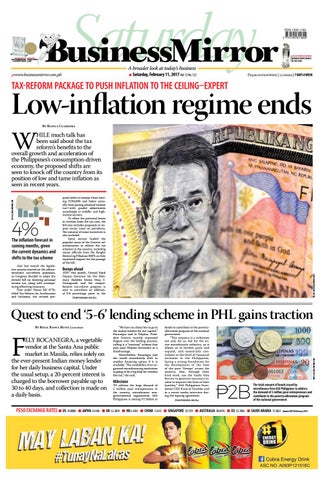
Tax-reform package to push inflation to the ceiling–expert
Low-inflation regime ends W
By Bianca Cuaresma
4%
The inflation forecast in coming months, given the current dynamics and shifts to the tax scheme Just last month the legislative process started on the administration’s tax-reform proposals, as Congress decided to adopt the revised bill on lowering personal income tax, along with accompanying offsetting measures. Now under House Bill 4774, titled Tax Reform for Acceleration and Inclusion, the revised pro-
posal seeks to exempt those earning P250,000 and below annually from paying personal-income tax—with graded adjustments accordingly to middle- and highincome earners. To offset the potential losses in revenue from the tax cuts, the bill also includes proposals to impose excise taxes on petroleum. The removal of some incentives is also included. Some sectors lauded the populist move of the Duterte administration to reform the tax schemes in the country, including senior officials from the Bangko Sentral ng Pilipinas (BSP), as they expressed support for the passage of the bill.
Bumps ahead
Just this month, Central Bank Deputy Governor for the Monetary Stability Sector Diwa C. Guinigundo said the comprehensive tax-reform program is seen to contribute an additional 0.6 percentage point to the Continued on A2
Nelson Ching/Bloomberg News
Jrcasas | Dreamstime.com
hile much talk has been said about the tax reform’s benefits to the overall growth and acceleration of the Philippines’s consumption-driven economy, the proposed shifts are seen to knock off the country from its position of low and tame inflation as seen in recent years.
F
By Rizal Raoul Reyes | Contributor
ely Bocanegra, a vegetable vendor at the Santa Ana public market in Manila, relies solely on the ever-present Indian money lender for her daily business capital. Under the usual setup, a 20-percent interest is charged to the borrower payable up to 30 to 40 days, and collection is made on a daily basis. PESO exchange rates n US 49.8880
“We have no choice but to go to the money lenders for our capital,” Bocanegra said in Filipino. President Duterte recently expressed disgust over the lending practice, calling it a “usurious” scheme that puts poor Filipino borrowers at a disadvantage. Nevertheless, Bocanegra said she would immediately shift to another financing option if it is available. “The availability of an organized microfinancing institution is going to be a big help for vendors like me,” she said.
Milestone
To address the huge demand of 2 million poor entrepreneurs in the country, microfinance nongovernmental organization ASA Philippines is issuing P2 billion in
bonds to contribute to the povertyalleviation program of the national government. “This issuance is a milestone not only for us, but for the entire microfinance industry, as it allows us to further grow and expand, and essentially contribute to the level of financial inclusion in the Philippines, laying a strong foundation for the development of the lives of the poor ‘Nanays’ across the country, who, through their hard work, use the funds they borrow to generate necessary income to improve the lives of their families,” ASA Philippines Foundation CEO Kamrul Tarafder said in a recent media interview during the signing agreement. Continued on A2
Micha360 | Dreamstime.com
Quest to end ‘5-6’ lending scheme in PHL gains traction
P2B
The total amount of bonds issued by microfinance firm ASA Philippines to address the demand of 2 million poor entrepreneurs and contribute to the poverty-alleviation program of the national government
n japan 0.4406 n UK 62.3849 n HK 6.4304 n CHINA 7.2643 n singapore 35.1374 n australia 38.0496 n EU 53.2006 n SAUDI arabia 13.3063
Source: BSP (10 February 2017 )
News Low-inflation regime ends BusinessMirror
A2 Saturday, February 11, 2017
Continued from A1
country’s growth this year and 0.2 percent for next year. The government’s target growth rate for this year is at a band of 6.5 percent to 7 percent, while it is at 7 percent to 8 percent starting 2018 up until 2022. While positive for growth, the tax-reform package may spell out problems for the already rising inflation rate upon implementation, as proposed higher taxes on oil will coincide with the projected rise of petroleum prices in the global market. For the past two years, inflation has been missing its target on the downside, with the low rate of expansion of consumer prices in the country being largely attributed to the sharp drop in oil prices worldwide. However, starting the fourth quarter of 2016, inflation started
to rise back to above 2 percent, with most recent data putting inflation at 2.7 percent in January 2017.
Upward push
“Given the current dynamics, the shifts in the tax scheme will probably push inflation up toward the upper end of the target with inflation probably knocking on the ceiling of 4 percent in a matter of months,” a local analyst told the BusinessMirror. The Central Bank has its inflation target placed at 2 percent to 4 percent for this year and the next. The last time inflation hit above 4 percent was in October 2014. It was also around that period when the BSP last decided to hike its interest rates. “The excise tax on fuel will definitely lead to an acceleration in inflation given the weight of transport in the CPI [consumer price
index] basket. Add to that the second-round effects—as transports costs will push the cost of doing business across the board—and you have a recipe for some nasty inflation to bite you in the back,” the analyst warned. “Mind you that oil prices have recovered and inflation was expected to trend higher even without the impending additional excise taxes on fuel,” the analyst, who refused to be named, further discussed. Adding to that, the analyst said lowering the income taxes for lower income bracket earners may aggravate inflation on the demand pull side as it frees up more disposable income for consumption and investment, speeding up economic activity. Further, inflation is on the way to breach the 4-percent market if the country has trouble with the rice-importation track and fails to keep a lid on food prices.
Tax shifts
Earlier, the International Monetary Fund (IMF) also said the growth of the country in the middle term is dependent on the government’s ability to pass the tax-reform package, as it will be crucial to the funding of the also-promised infrastructure-spending acceleration by the government. The analyst explained to the BusinessMirror that the shifts in the tax system are designed to fund the “ambitious” infrastructure-spending program of the government and to enact an equally ambitious overhaul of the social landscape by championing the working class. Accordingly, evident in all of the populist moves that the President is taking, including the entire tax-reform package, is aimed to level the playing field and skew benefits to the
www.businessmirror.com.ph
lower-income classes. “Even the new taxes on fuel and automobiles are designed to have the lower-income earners bear the least burden, while the ultrarich and middle-income earners are seen to be left with the shortest sticks,” the analyst said.
‘Ambitious’
While the end goal of the reforms is better infrastructure and a more equitable distribution of wealth, the analyst warned that if not administered properly, we may end up with faster inflation, credit downgrades as the fiscal house falls apart and, ultimately, slower economic growth. “It’s ambitious. You only enact something as game changing as this by stepping on some toes. The end results are either very good or very bad. There will be, sadly, no middle ground,” the analyst said. In an interview with report-
ers, Guinigundo recently said one of the inflation upside risks include the tax-reform package being proposed by the government. Latest BSP data put its forecast for 2017 inflation to rise to an average of 3.3 percent, from the earlier forecast of 3 percent. For 2018, inflation is seen to hit 3 percent, also up from the November forecast of 2.9 percent. Also just recently, the Land Transportation Franchising and Regulatory Board approved a P1 hike to minimum jeepney fares—a direct result, according to Guinigundo, of the adjustment in oil prices. This, Guinigundo added, has a minimal effect on inflation overall. The Central Bank gave its latest inflation forecast, including adjustments for power-rate movements and the tax-reform proposal in consideration, in its monetarypolicy meeting on February 9.
Quest to end ‘5-6’ lending scheme in PHL gains traction Continued from A1
The issuance is the largest by an individual microfinance institution (MFI) so far, and will largely be used to fund ASA’s expansion and related projects through 2021. BPI Capital is the lead arranger of the issuance, and its initial bondholders are BPI, Land Bank of the Philippines and the Philippine National Bank. The Credit Guarantee and Investment Facility (CGIF), a guarantee facility established by the Government of the Philippines together with China, Japan, South Korea and the Asian Development Bank, is partially guaranteeing the bonds, which will have a fiveyear maturity period and an interest rate based on PDST-R2, plus a credit spread mutually agreed between the parties. “This issuance marks a significant step in ASA’s corporate maturity, graduating from purely bank financing to a capital markets issuer, and extending the duration of its liabilities to more closely match its investment profile,” Eric
Luchangco, head of Debt Capital Markets for BPI Capital, said. “We were honored to have been given the opportunity to arrange this deal for ASA.” “The partial credit guarantee for ASA demonstrates that bonds have a catalytic role to play in financing MFIs as a viable alternative longer term funding source to short-term bank loans,” said Kiyoshi Nishimura, chief executive of CGIF. “The successful issuance further supports the Philippine government’s priority initiatives toward poverty reduction and financial inclusion.” ASA Philippines was established in 2006, after receiving donations from the Assisi Development Foundation and the Ninoy and Cor y Aquino Foundation. In November 2007 the PLDT Smart Foundation became its third benefactor. Since its inception 11 years ago, ASA Philippines claims it is the first MFI in the country to achieve a milestone of having over 1 million active borrowers.
Women power
As far as ASA Philippines is concerned, women hold the sky, so to speak, in microfinance. “Absolutely, women are more responsible borrowers. They are more responsible, more diligent, more loyal and good payers. It is a global
A woman sells chili peppers and spices in the market district of Divisoria in Manila on January 6, 2014. To address the huge demand of 2 million poor entrepreneurs in the country, microfinance non-governmental organization ASA Philippines is issuing P2 billion in bonds, to contribute to the poverty-alleviation program of the national government. Julian Abram Wainwright/Bloomberg
trend. That is why we give them preference,” Tarafder said. Boosted by the recent growth, Tarafder says ASA Philippines now needs to look more toward the capital markets to fuel its expansion. From its humble beginnings in 2004, ASA Philippines has, by the end of last year, grown to employ 5,964 full-time staff catering to 1,273,136 borrowing clients. By 2021, the organization—already present in 850 locations across all 82 provinces— projects an increase of an estimated 700,000 borrowers to its base, and a corresponding growth of 100 percent in its portfolio. As of 2016, ASA Philippines has disbursed P91.6 billion in loans, and recorded a recovery rate of 99.92 percent. It has also spent close to P760 million for benefits and activities, including death, hospitalization, disability and health-care benefits, child feeding, scholarship and business development programs, which directly impacted over a million Filipinas and their families.
Requisites
First, the borrower should be a woman. Loans are evenly divisible by a thousand (example P1,000, P2,000, etc.) and no up-front deductions. Initial loan ranges from P6,000 to P10,000, depending on the borrower’s business capacity to pay. Service charge is 15 percent for six months. Payments are made
weekly in the amount of P50 for each thousand pesos borrowed. Beneficiaries should be between 18 and 60 years old. Nevertheless, Tarafder said they can also grant a loan to women who are still active at 65. “If she can run the business, she will be given a chance.” To determine the viability of a microenterprise, ASA Philippines will require a borrower to submit a summary of the business plan to the microfinance officer (MFO) for evaluation. “It will not require a PowerPoint presentation, but just a simple summary what items a sarisari store will carry,” Tarafder said. Meanwhile, the MFO will also go to the borrower’s residence to personally collect the payment. “They don’t need to go to [the] bank. The difference is that in microfinance, service is at your doorstep. Everything is inexpensive,” he said. It is also part of the knowyour-client (KYC) process of ASA Philippines, according to Tarafder. With already over a million Filipino women as clients, ASA Philippines is now seeking medium-term bonds for the services it offers to its entrepreneur-borrowers. In addition to traditional microloans for business, these services include financing for water and sanitation products, housing improvements and solar-energy systems for homes; as well as providing scholarships, health-care benefits
and business-development training. “We will be expanding our loan portfolios for corporate social responsibility projects as part of helping the people,” said Tarafder. ASA Philippines will be embarking on a bolder step soon, as it plans to be the go-to facility in microfinance and replace the traditional money lenders. But Tarafder acknowledges it is a huge challenge. “We have to provide good service to beat them,” he pointed out. As part of their KYC approach, ASA Philippines will also use the mobile phone for documenting their clients. The MFI will take the photo of a client and send all the information to its main office for data filing.
Market access
Providing market access to products produced by women entrepreneurs, such as processed food and woven fabrics, remains a challenge, according to Pacita Juan, chairman of Aszean Women Entrepreneurs Network. Fortunately, the establishment of the Great of the Gender Responsive Economic Actions for the Transformation of Women program of the Philippine Commission on Women (PCW) and DFAT Canada, together with ECHOsi Foundation as privatesector partner, is in its full steam on its second phase. Juan said accessing markets entails collaboration between
ECHOsi and PCW conducting market-matching between microentrepreneurs and small, medium enterprises. “They can be components of a bigger or fancier product, or simply a product that will be brought to more sophisticated markets they never met before,” she said. Juan said they opted to focus on women because several of them are performing work at home, and cannot or may not have the time to seek out customers or markets for what they do. “Many women work part-time on crafts, while also taking kids to school or doing housework. These part-time producers will not even have time to sell their products at the right price or at the right venues,” she noted. To give them market access, ECHOsi and private investors established the Great Women Café and Showroom. “We need to give them a show room,” said Jeannie Javelosa, head curator and boss of the GW Showroom. “I have been working with these women for many years now and it helps that we now have one place for their crafts and weaves,” she added GW also plans to expand in Asean, as many of their counterparts in the region look at Great Women as a good program for accessing markets, even for tribes in Myanmar and Thailand, Lao PDR and Cambodia, whose cultures are like the Philippines.
Perspective BusinessMirror
www.businessmirror.com.ph
Saturday, February 11, 2017
A3
Duterte’s last hurrah: On the road to martial law
L
By James Fenton | New York Times News Service
anding last December at the Ninoy Aquino International Airport in Manila, Philippines brought back memories of Ninoy Aquino himself arriving from the United States in 1983 on the tarmac that was to be christened with his blood.
He was the leading figure in the opposition to the dictatorship of Ferdinand E. Marcos, president of the Philippines from 1965 until 1986. Aquino had been imprisoned by Marcos for seven years and seven months. His health had suffered; he had been on a hunger strike until his family pleaded with him to stop, had gone to the US for treatment for a heart condition and now, hearing that Marcos was seriously ill and sensing that this was the moment he must act, he was coming back out of self-imposed exile, bearing a false passport under the name Marcial Bonifacio. This return is made most vivid by a TV report, which can be found on YouTube. Ninoy knew his best chance would be to be placed under house arrest. Next best: back to solitar y confinement. T he worst option: to be shot then and there. A number of press people accompanied him, and the hope was that their presence might guarantee his immediate safety. The plane lands. A group of soldiers comes onboard and asks Ninoy to accompany them. He gets up out of his seat in a manner that for all the world might seem to indicate resignation to some tedious task ahead. The soldiers escort him off the plane. The press moves forward, trying to follow. Nine seconds later there is gunfire, and four seconds after that there is another longer burst. The first shots are the ones that kill Ninoy. The second are aimed at Rolando Galman, a supposed assassin who would take the posthumous blame for Ninoy’s death. In the first nine seconds, the soldiers take Ninoy onto the jet bridge and then down a service stair. On one recording you can hear a soldier saying: “I’ll do it. I’ll do it.” The bullet enters the top of the back of Ninoy’s head and exits through his nose. Its downward trajectory indicates that the killer shot Ninoy from above, that is, while the group was still on the service stair. And as soon as Ninoy was dead, someone else turned and shot the patsy Galman. It seemed a crude piece of theater at the time. You had to be a diehard Marcos loyalist to be remotely convinced by it. And the killing, indeed, marked the beginning of the end of the dictatorship, even though that last act took another three years to play out. L o ok e d at no w, ho w e v e r, in the era of 1,000 killings a month, the murder of Ninoy seems to belong to a society in some respects more refined than that ushered in by the election of Rodrigo R. Duterte as president in 2016. Martial law under Marcos lasted from 1972 to 1981. Over 3,000 people were killed, many of them cases of “salvagings”—bodies found tortured and mutilated, dumped at the roadside, much like the victims of today’s extrajudicia l k il lings—only far fewer of them, of course. Indeed, twice as many have been killed during Duterte’s first six
months, starting last June, as in the decade of martial law. Still, in the case of Ninoy, a certain lip service was paid to due process. An alibi was carefully prepared. Ninoy was warned against returning to the Philippines—warned by one of Marcos’s top men that he faced the risk of assassination. And an assassin was found and sacrificed, as it were, at the scene of the crime. W hen the postmortem contradicted the official story, an alternative post-mortem was sought and found. There was some sense lingering in Marcos’s circle of what a respectable outcome would look like, even if respectability was not achieved. Today by contrast the pretense of due process is impossible, because the man at the top simply blows it away. One of Duterte’s chief selling points as a leader is that he doesn’t care. So, when he gets in front of any crowd, he will say whatever he thinks will make an impact at that very moment, and it is striking that most of the most shocking things we have learned about Duterte have come from his own mouth. For instance, it was Duterte who compared himself to Hitler: “Hitler massacred 3 million Jews. Now there is 3 million, what is it, 3 million drug addicts [in the Philippines] there are. I’d be happy to slaughter them. At least if Germany had Hitler, the Philippines would have [me]. You know my victims. I would like them to be all criminals, to finish the problem of my country and save the next generation from perdition.” It was Duterte who revealed that he had been abusing fentanyl, the sy nthetic opioid— the drug involved in the deaths of both Michael Jackson and Prince, which is supposed to be a hundred times more powerful than morphine. He needs painkillers to combat both his daily migraines and the pain from a motorcycle accident, which damaged his spine. However, when he saw the reaction to this revelation, he thought again. “Fools,” he said, “I just made up that story and you believed it.” Addicted or not, he has, on his own admission, four concurrent illnesses: acute bronchitis, regular migraines, Barrett’s esophagus and Buerger’s disease. But, as he is careful to point out, not cancer. His mortality, however, does seem to weigh upon him and he often alludes to it. Speaking to members of the Filipino community in Cambodia last December, he said: “ This is my last hurrah. After this, 77. I am not sure if I will still be around by the end of my term.” So far, Duterte’s war has been largely against the softest of targets—drug users and smalltime pushers, pedicab drivers and the like, whose families are too poor to hit back in any way. None of them can afford to sue the police or to mount any kind of campaign on behalf of the victims. It is out of the question. Continued on A4
President Duterte reviews the troops during flag-raising ceremony to commemorate the 120th death anniversary of the country’s National Hero Dr. Jose P. Rizal on December 30, 2016, in Manila. AP/Bullit Marquez
A4
Saturday, February 11, 2017
Perspective BusinessMirror
www.businessmirror.com.ph
President Duterte inspects troops during the 81st anniversary of the Armed Forces of the Philippines at Camp Aguinaldo military headquarters in Quezon City on December 21, 2016. AP/Aaron Favila
Duterte’s last hurrah: On the road to martial law Continued from A3
Of course, a campaign that is largely a war on the poor is going to be short on credibility, so Duterte has recently been raising his sights a little and increasing his attacks on the mayors who are said to be involved in the “shabu,” or “crystal meth”, trade. In January this year he was quoted as saying: “As long as I’m president, these big ‘shabu’ dealers will die, and the next batch would really be these mayors. I will call them and lock them up.” He has a thick dossier that he regularly displays during such speeches. “I will talk to them,” he said. “With the thick document I showed you, I will tell them, ‘Look for your name there, you son of a bitch. If your name is there, you have a problem. I will really kill you.’” One mayor who has, indeed, been killed is Rolando Espinosa, of Albuera, on an island some 350 miles from Manila. Duterte said on this same occasion, “He was killed in a very [questionable way], but I don’t care. The policemen said he resisted arrest. Then I will stick with the story of the police because [they are] under me.” (Espinosa was shot in a police cell, early in the morning. He was already in detention.) Duterte continued: “I might go down in history as the butcher. It’s up to you.” And then: “Since I have nothing to show, I just use extrajudicial killing. [That’s because] I have no credentials to boast about.” The meaning of the last two sentences may be a little opaque, but the essential implication is quite clear—clear enough for Duterte’s spokesman, Ernesto C. Abella (whose job it is to go on air and say: This never happened, he never said what you heard him say), to remind the public that this kind of violent rhetoric is merely a reflection of the president’s sincerity in his efforts to wipe out the drug menace. Abella said: “It is…a matter of the leadership style and the messaging style of the President.… This is his messaging style to underline his intention. He is serious about it.... However, it’s just meant to underline his seriousness in making sure that nobody is corrupt and involved in criminality.”
Well, yes, it is Duterte’s messag ing st yle t hat is at issue here, if you like, but the message he is putting over is that if the police say a man resisted arrest, he, Duterte, is going to believe them, even in the face of contrar y evidence from the National Bureau of Investigation (NBI), and even if the case they make is “questionable”. As far as the crucial issues of life and death are concerned, you are living in a police state. It doesn’t always feel like a police state. People talk freely and there is a vocal, critical press. There is an opposition, although it seems as yet ineffective. One’s instinct (remembering the forces that eventually combined to overthrow Marcos in 1986) is to wonder, where are all the clergy, where are the nuns? Where is the left? The answer seems to be that, for as long as Duterte’s extraordinary popularity holds up, there is a feeling that “now is not the time”, but that the time will come. Meanwhile, Duterte operates with such impunity that he doesn’t seem to need the full trappings of a police state. Take the case of Espinosa, who was said to be one of the narcomayors and was being held in the subprovincial jail in Baybay, Leyte. At around 3 a.m. on November 5 last year, 18 members of the police Criminal Investigation and Detection Group (CIDG) came ostensibly to search his cell for drugs and guns. To acquire their search warrant, one of them claimed to have seen Espinosa holding a gun, sitting on his bed in jail, while an inmate, Raul Yap, was repacking “shabu” in another cell. On the morning of the search there was they said—an exchange of gunfire, at the end of which Espinosa and Yap lay dead. A month later, the NBI, a civilian body that answers to the Department of Justice (DOJ), announced its findings. The police story had fallen to pieces on examination. The officer who claimed to have seen the gun and the drugs had not been to the prison on the day he claimed. The forensic evidence and the testimony of other inmates in the cells at the time told a different story. Espinosa, on the arrival of the police in his cell, had first welcomed them, then
pleaded for his life and told them not to plant anything on him. The prisoners in the same cell as Yap were ordered to get out, leaving Yap alone. After two bursts of gunfire, a policeman wearing gloves and carrying a gun was observed entering Espinosa’s cell. When he came out again he no longer had the gun. It was, said the NBI, a rub-out, not a shootout. The 18 members of the CIDG group who killed Espinosa and Yap were charged with multiple murder and (some of them) with perjury. Six other officers were also charged. The group had been accompanied by the prison superintendent, Marvin Marcos, who had previously been removed from office after being associated with the drug trade. But he had been reinstated, according to the director general of the Philippine National Police, Ronald M. dela Rosa, at the request of “a friend.” This friend turned out to be Duterte himself. As soon as the NBI announced that it was br ing ing charges against the policemen, Duterte publicly rose to their defense. “I will not allow these guys to go to prison,” he said, “even if the NBI says it was murder. After all, the NBI is under me, the Department of Justice is under me.” As usual, though, there was an element of ambiguity, for he went on: “But to tell you, I do not interfere. They have findings, good. File the case but I won’t leave the policemen implicated in the killing.” This kind of carte blanche must be comforting for the police to receive. Duterte said: “Whatever the police say, that’s the truth for me. The NBI said it was murder. The police said, ‘Sir, he fought back.’ I believe the police. Why would I sacrifice the police for that?” Once again, a highly placed figure was on hand to explain that the President’s words did not mean what they appeared to mean. The DOJ secretar y, Vita liano N. Ag uir re II, said Duterte’s remarks were mere “exaggerations” and “hyperbole” in the exercise of his “right to freedom of expression”. He said, “The President has not and will not interfere in the preliminary investigation to be conducted by the DOJ. He does not micromanage any department. As a matter
of fact, he has not even for once [given me orders on what to do].” The crucial, ominous subject on which Duterte has expressed his discontent is the Constitution of 1987 and its provisions for the declaration of martial law. The government of Cor y Aquino, Ninoy’s widow, came to power through the revolution of 1986 and found the Marcos constitution so compromised that it would have to be replaced. So for her first year Aquino was a revolutionary, but the constitution that she introduced was designed to prevent a repetition of oneman rule. In particular, the new Constitution reinstated single six-year terms for the Office of the President and stipulated that, in case of rebellion or invasion, when the public safety required it, the president might, for a period of 60 days, suspend habeas corpus or place the country, or any part of it, under martial law. But there was this restraint. The president was and is obliged to submit a report to Congress within 48 hours of declaring mar tia l law, in person or in writing. Congress can revoke martial law or the suspension of habeas corpus. Furthermore, the Supreme Court must review a petition filed by any citizen of the Philippines questioning the factual basis for either the suspension of habeas corpus or the introduction of martial law. And the court is obliged to make a decision within 30 days of the filing of the petition. You c a n see why D uter te doesn’t like these provisions. What he argued just before Christmas was that the safeguards are an “almost reck less reaction” to the rule of Marcos. Only the president should be directing the show. “If I declare martial law and there is an invasion or war, I cannot proceed on and on, especially if there is trouble. I have to go to Congress, I have to go to the Supreme Court if anybody would file a complaint to look at the factual [basis of the declaration].” But the “factual basis” of what he has done so far is, to say the least, wobbly. And if, as would appear, the key to Duterte’s fanatical persecution of drug addicts and dealers is that these unfortunates
are the modern equivalent of Communist rebels, the new “enemy within,” then it is up to Duterte’s fantasy to decide when the state is in danger. Facts hardly come into it. The framers of the Aquino constitution made an attempt to envisage what might justify martial law: an invasion, they said, or a rebellion. Well, there’s no invasion, and as for rebellions there has hardly been a time since World War II when there hasn’t been some sort of rebellion bubbling away somewhere in the country. In January of this year Duterte returned to the subject. “If I wanted to,” he said, “and if it will deteriorate into something really very virulent, I will declare martial law.… No one can stop me. My country transcends everything else, even the limitations.” In other words, his feelings for his country will override the Constitution. He said: “The 60-day limit will be gone.” That is, martial law will last as long as he wants it to. “And I’ll tell you now, if I have to declare martial law, I will declare it —not about invasion, insurrection, not about danger. I will declare martial law to preserve my nation—period.” That is, he has already declared the 1987 Constitution null and void. But here’s how Salvador S. Panelo, the presidential chief legal counsel, defended Duterte: “ The President’s statement that he would declare martial law should the problem in the illegaldrugs trade become virulent—effectively threatening the institutions of the republic and putting in grave peril the integrity and survival of the nation—is but a dramatic and graphic presentation of an exercise of presidential power and duty imposed on him by the Constitution.” This is precisely the opposite of what has happened. Duterte is saying he will defy the “duty imposed on him by the Constitution.” There is evidence that not everyone in the police force relishes working under Duterte. Here is Francisco S. Tatad, writing in The Manila Times last December 9: “The sense of moral revulsion and outrage from the community and even from the police has grown, and is growing. Among the young policemen there is some
deep questioning about the morality of killing. This is especially so among those who have tried to bring in as many drug users as possible for detention and rehabilitation, only to be told that the chief implementor of the drug war would like to see more dead bodies, not merely useless users.” Because of this, more and more young policemen have applied for schooling in order not to get involved in the killings. Police sources say there are more policemen applying for schooling than at any other time before, and those who are already there are in no rush to complete their schooling. Their effort to find a “crevice in the rock”, as it were, where they could hide their heads while the storm blows, appears to find encouragement and support in their elders, usually retired policemen who happen to be their fathers or friends of their fathers. Things will get worse this year if Duterte has his way. The death penalty, abolished a decade ago, will be restored, and the age of criminal liability will be lowered from 15 to nine. After that, Duterte has said, he envisages executing five or six criminals a day. At the police Christmas party, dela Rosa, addressed the Almighty in rueful terms. “Sorry, Lord, forgive us, but all I can say is we’re doing this not for ourselves or for whatever purpose—not for our personal gain, but for the future of our nation.” He said policemen who kill drug suspects also need prayers. “The Christmas gift we’re w ishing for policemen is prayer for the Lord’s forgiveness. Even if those who have died are bad, they are still people, they are still human beings and they still deserve to live, and we have no right to take their lives—but things happen, because we don’t have complete control of the situation.” Having got that off his chest, he went on to pose for “groupies” in a floppy and adorable four-star Santa hat. n James Fenton is a British poet and literary critic. From 1994 until 1999, he was Oxford professor of poetry; in 2015 he was awarded the PEN Pinter Prize. He lived in the Philippines from 1986 until 1989.
Editor: Jun Lomibao | mirror_sports@yahoo.com.ph
Sports BusinessMirror
Saturday, February 11, 2017 A5
WALES’S goalkeeper Jason Brown deflects a shot by Mexico during the first half of an international friendly in East Rutherford, New Jersey, in 2012. Brown is hoping to combat any stigma still attached to those in soccer with mental-health issues by speaking out about the depression that struck as his playing career came to an end in 2015. AP
WHEN CAREER ENDS, DEPRESSION HITS By Rob Harris
L
The Associated Press
ONDON—On the training pitches at Arsenal is where Jason Brown feels at peace. Coaching academy players, the retired goalkeeper feels unburdened of the mental anguish. “This is my distraction,” Brown, who played internationally for Wales and in the Premier League for Blackburn, told The Associated Press. “I honestly feel if I didn’t have this distraction [at Arsenal] I might not be having this conversation with you right now.” Instead, Brown is hoping to combat any stigma still attached to those in soccer with mental-health issues by speaking out about the depression that struck as his playing career came to an end in 2015. Like many professional athletes, Brown reveled in the adulation of fans in packed stadiums and the elevated status he held in the local community. He also craved the structure in his life: Training, rest, matches. “As silly and naive as it might sound you, never think there is going to be an end,” the 34-year-old Brown recalled. “You never think when you retire what it is going to be like.” Then the limelight did fade. No longer was there a routine to follow. And the psychological issues mounted for a player who said he previously never encountered symptoms during his professional career.
“I suffer from depression and it’s nothing to be embarrassed about,” Brown states frankly. “I’ll never be cured.” Now it is about trying to cope. A few months ago Brown felt he could not while in his car on a motorway near London. “That probably the lowest I was...the first real time that I made an attempt to actually, where I considered just killing myself,” Brown said. “I was so down. I was driving along the M1 and I put my foot down and I didn’t take my foot off. And I then I realized that it’s not only me I that I am going to be hurting but possibly others. That was a real low, low day my life.” It was also part of an acceptance that he needed professional help . Then sitting with his counsellor in October, came a profound and important moment in his post-playing life. “It sounds crazy. I still had the mentality, ‘I am a footballer,’” Brown said. “It didn’t sink and one day it did sink in, sitting with my counsellor...and I realized I am no longer a football player anymore. It was quite surreal because all I have known and seen myself as is a football player.” Brown isn’t alone. It’s just that few footballers feel comfortable publicly discussing depression or even seeking help in private. England’s Professional Footballers’ Association (PFA) is trying to break that taboo, hoping to convince their members that talking about mental-health problems is not a sign of weakness but strength. “We want to change that mindset,” said Michael Bennett, the PFA’s head of welfare. “It’s important for players to talk about the emotional side of things.” Welsh players, including Brown, had to deal with the distress of national team manager Gary Speed dying of hanging in 2011. A coroner later ruled there was insufficient evidence to prove that Speed had committed suicide. In 2009 Germany goalkeeper Robert Enke ended his life by stepping in front of a train. “We as football have a duty of care,” said Bennett, whose union backed the #TimetoTalk Day in Britain last week. “We spend a lot of time on the physical aspects of things for the players. I think we need to spend more time on the emotional side. If a player has emotional issues, it doesn’t matter how fit they are mentally, if they are not in the right place they can’t perform.” And times are changing. Bennett points to the
outpouring of support and sympathy last year for the survivors of sexual abuse he helped. They received private counseling through the PFA, and support in their decision to waive their anonymity to raise awareness of the crimes going on in football and the suffering of victims. Going public with mental-health problems is not an obligation, with the PFA assuring members of complete confidentiality. “There are concerns, at times, ‘Where is this information going, will it go back to the club and will it affect me playing?” Bennett said. Brown turned to the PFA after searching for help online
at 3 a.m. one day after struggling to cope with depression that was exacerbated by the breakup of his marriage as he retired from playing in 2015 and his father dying. “You become very paranoid, you become very anxious, you don’t know who to trust,” said Brown, a father of three. “It got so bad when I didn’t sleep for five days on the trot. I just had no sleep. “I wasn’t eating. I lost a lot of weight...I went on this crazy health kick that you would probably associate with someone who was anorexic.” Brown has a message for active and retired footballers needing help with their emotional well-being and coping
RUNNING WINNERS
Winners of the recent 7-Eleven Run 2017 are honored on stage during the awarding ceremony at the Filinvest City in Alabang. Shown above are (from left) Aizel Fleur Dalawampu (Asia Brewery Inc.assistant brand manager), Kristine Mae Regalario (Asia Brewery Inc. business development officer), Ping-Hung Chen (7-Eleven vice president for finance and admin), Azlan Pagay (42K third placer, Filipino male), Rafael Poliquit (42K champion, Filipino male), Rafael Pescos (42K runner-up, Filipino male), Maricar Camacho (42K third place, Filipino female), Lizane Abella (42K runner-up, Filipino female), Lany Cardona (42K overall female champion), Luigi Robles (Asia Brewery Inc. business development manager) and Boy Ramos (host).
LADY SPIKERS EYE NO. 2 D
DE La Salle Coach Ramil de Jesus says his team is a work in progress.
EFENDING champion De La Salle takes on a payback-seeking University of Santo Tomas (UST) side at the resumption of Season 79 University Athletic Association of the Philippines (UAAP) women’s volleyball action on Saturday at the Filoil Flying V Center in San Juan City. The match is set at 4 p.m. with the Lady Spikers targeting win No. 2 that would put them alongside early leader National University (2-0). University of the Philippines (UP), meanwhile, eyes the same goal when it tests the mettle of vastly improved University of the East (UE) at 2 p.m. The Lady Maroons mauled Adamson University, 25-18, 25-11, 2518, in their season opener but they have to be wary of the Lady Red Warriors, who put up a gallant stand against the Lady Bulldogs as they lost steam in the end. “The players of UE are tall and we cannot underestimate their net defense. We will be ready,” UP Head Coach Jerry Yee said. De La Salle opened its title-retention bid by beating Far Eastern University (FEU), 29-27, 25-22, 25-23. Head Coach Ramil de Jesus
with life after their playing careers end. “Don’t feel that you are weak. It makes you far from weak,” Brown said. “Someone who is willing to admit they have a problem is stronger than any type of person who is preparing for a competition. “With my depression what I’m trying to make people aware of is: Don’t be ashamed. There are more people who have depression...you can live with it.” It’s led Brown to a job coaching Arsenal’s emerging talent. “My work colleagues are very supportive,” Brown said. “I openly speak about everything I have been through because that’s part of my job and what I want to do—try to help people.”
admitted that the team is still a work in progress. “We’re still in the process of building the team’s character because we are rebuilding after losing our core from last season,” said de Jesus, who will be banking on skipper Kim Fajardo, Kim Dy, Majoy Baron and Dawn Macandili, and youngsters Des Cheng, Aduke Ogunsanya and Tine Tiamzon. UST started on the wrong foot after falling to Ateneo, 20-25, 21-25, 22-25, last week. Tigresses Cherry Rondina and EJ Laure could not hide their frustration, but vowed to recover lost ground. “We really lacked communication that time. It’s like we didn’t have leadership,” Laure said. “I hope that we could resolve that.” Rondina took the blame and admitted she still lack the qualities of a leader that could guide her team. “We will work on it and forget what happened in our first game,” Rondina said. “We will begin again and execute it right. I will be a better leader the next time.” In men’s play, UP (1-0) goes up against UE (0-1) at 8 a.m., followed by the 10 a.m. clash between La Salle (0-1) and UST (0-1).
J
Gayoso scores, assists in Ateneo’s win over NU
ARVEY GAYOSO scored a goal and assisted another as Ateneo picked up its second straight win, 3-0, against a National University that was reduced to 10 players in the University Athletic Association of the Philippines Season 79 men’s football tournament at the Moro Lorenzo Field on Thursday night. Rookie Sam Lim found the back of the net from a Gayoso assist just before halftime to put the Blue Eagles ahead. Gayoso then converted the penalty two minutes after the start of the second half, as NU defender Ross Lawagan was given a straight red. Picking up from where he left off in last Sunday’s 4-0 victory over Adamson, Gayoso has hiked his goal total to three.
Mario Ceniza made it 3-0 for Ateneo with the 78th-minute strike to seal the deal. The Eagles now have a maximum of six points to solidify their hold on top of the league table. Later, defending champion University of the Philippines grabbed solo second with a 4-0 drubbing of University of the East. The Fighting Maroons moved up to four points, while the Red Warriors and the Bulldogs stayed at one point. “Talagang nag-focus kami sa defending. Talagang there’s no reason para mag-concede kami kasi ayun ang pina-practice namin,” Ateneo Coach JP Merida said. The Eagles lost Carlo Liay early in the match after being carried off the pitch due to injury and was replaced in the 15th minute.
BusinessMi
A6 Saturday, February 11, 2017 | Editor: Jun Lomibao
VICENZO NIBALI will be out to defend his Giro d’Italia crown.
Watch 200 days of cycling on Eurosport
E
UROSPORTS remains the place to be for all passionate cycling fans, as exclusive and extended Giro d’Italia coverage and additional races have been confirmed from 2017—that means cycling fans can enjoy more than 200 days of live cycling this year. The news follows a new long-term agreement covering all major Italian races, Flanders Classics and a number of Tour events around the world. The races form part of an unrivaled calendar of cycling on Eurosport, including all three of the Grand Tours and all five Monuments. Fans could look forward to the first Grand Tour of the season and all major Italian races, including Il Lombardia and Milan-San Remo,
the first classic of the season, on Eurosport. For the Giro d’Italia, the new agreement includes more coverage than ever before and four hours of every stage live. “If you’re passionate about cycling, Eurosport remains the only place to be. Eurosport’s community of cycling fans is among the most loyal and committed you can find and they appreciate that Eurosport really is the Home of Cycling,” Eurosport CEO Peter Hutton said. “We are proud to serve these fans and excited to offer them even more of the live action they love. “While we’re proud of Eurosport’s great heritage in cycling, the exclusive and extended coverage of the Giro d’Italia, and additional races added to our calendar, demonstrates there is much more to come. In 2017, for the
RONDA PILIPINAS
ACCOM
first time, Eurosport will show over 200 days of live cycling in a calendar year,” Hutton added. The new four-year extension offers more exclusivity to Eurosport in Europe and Australia, as well as including a wide range of additional races available on Eurosport and the Eurosport Player. The new races now available exclusively include the six Flanders Classics single-stage races—including the iconic World Tour race Gent-Wevelgem, Tour of Romandie, Tour of Britain, Tour of Utah and Tour of Alberta. Eurosport secured rights for this cycling package through IMG, a global leader in sports, events, media and fashion. The agreement will mean Eurosport’s annual coverage of the Giro d’Italia will pass 20 years, having first shown the race in 1998.
MEMBERS of the Philippine Navy-Standard Insurance team are showing the way in the Ronda Pilipinas.
EYES ON NAVYMAN JAN PAUL P
HILIPPINE Navy-Standard Insurance’s Jan Paul Morales has started paving his way to becoming the first back-to-back champion of the LBC Ronda Pilipinas. Making up for a subpar start, Morales, 31, came roaring back by seizing the Vigan City Stage Two criterium and the Angeles CitySubic Stage Three to get himself into title contention as he jumped from a low 23rd in the general classification (GC) to third place. In Stage Four on Thursday, Morales missed out on a sprint finish that saw Kinetix Lab-Army’s Cris Joven winning the short 137-kilometer stage. Also beaten in the mad dash to the line was Ryan Serapio of Ilocos Sur. Another big finish could propel Morales to the top and shove teammates Rudy Roque and Ronald Lomotos from their 1-2 spots in the GC. Interestingly, Morales made his move on the same route that paved the way for his dominating Stage Three win. And the Calumpang (Marikina City) native has no plans of slowing down. “If I’ll get that chance, I will go for it again,” Morales said. For Navy racing team captain Lloyd Lucien Reynante, he’s happy three Navymen are occupying the top three. “I want Jan Paul [Morales] to win, but I don’t mind if another rider prevails for as long as he’s from our Navy team,” Reynante said.
MARK GALEDO sets off in the time trial prologue.
Ronda chief judge Froilan Dayco, however, thinks the young riders could derail Morales’s titleretention bid. Roque and Lomotos are young and capable of seriously challenging Morales for the crown. Roque is 25 years old and have placed ninth overall in the first Ronda edition six years ago, when he was barely out of his teens. Lomotos is only 22 years old and boasting of potentials. Bike Extrme’s Jaybop Pagnanawon, son of 1986 Marlboro Tour king Rolando, and Joven are also on the radar to make a serious title run. They are both in the top 20 and within striking distance. In the end, Morales’s experience, sprinting power and new-found climbing skills should propel him to the top. The Ronda Pilipinas raced in Ilocos Sur, Angeles City and Subic, and will go south to Lucena City (February 12), Pili (February 14 and 16), Daet (February 17), Paseo in Santa Rosa (February 19), Tagaytay City and Batangas City (February 20), and Calamba and Antipolo (February 21), before wrapping up with two stages in Iloilo City (March 2, 3 and 4).
Measures to control vehicles out F
THE safety of cyclists is always a primary concern.
OLLOWING the string of collisions between riders and vehicles from the convoy that accompanies races, the Union Cycliste International (UCI) published a 38-page document full of guidelines it will now expect drivers to follow, along with sanctions under existing regulations for those who do not. The measures follow the shocking on-camera collisions between a car at the 2011 Tour de France and Johnny Hoogerland and Juan Antonio Flecha, Jesse Sergent and a neutral support car in the Tour of Flanders in 2015, Greg Van Avermaet in San Sebastian, and a medical motorbike and Stig Broeckx in Kuurne-Brussel-Kuurne in 2016. Others accidents not televised include a separate incident with a motorcycle in the Baloise Belgium Tour that left Broeckx with a severe traumatic brain injury, and the fatal incident in Gent-Wevelgem between a motorbike and Antoine Demoitie. The UCI’s rules apply to vehicles between the lead commissaire’s car and the broom wagon and relate to
race preparation, traffic in the race, special measures for motorbikes, what to do in the case of a crash and time trials. The guidelines also call for drivers to take personal responsibility to be sufficiently rested, abstain from using mobile phones while driving, having a “considerate, prudent attitude rather than overconfidence”, and be prepared to avoid risks “even if pressured by an insistent passenger”. The UCI stated that the new document has the support of the Security and Technical Regulations working group, which is made up of representatives from the UCI, Professional Cycling Association (CPA), International Association of Professional Cycling Groups (AIGCP) and International Association of Cyclo-Cross Organizers, as well as federation, riders, teams and organizers. In addition to each driver being required to hold a UCI license issued by a national federation, they are now required to follow the guidelines or face penalties under road rules that were modified in
irror CYCLING
mirror_sports@yahoo.com.ph | Saturday, February 11, 2017 A7
FOR GALEDO AND 7-ELEVEN ROAD BIKE TEAMMATES
MISSION
MPLISHED! I T was a dream ride come true for three gritty Filipino riders who raced alongside, who else, but three-time Tour de France winner Chris Froome. The event? The Herald Sun Tour, a fivestage International Cycling Union (UCI) Category 2.1 race in Australia that has been running since 1952 and has continually attracted the best cyclists in the world. This time, it’s Froome, who came to defend his crown only to give way to Orica-Scott’s Damien Howson, one of the top Aussies in the field. But no regrets for Froome, he came to kick off his campaign to repeat as The Tour’s champion for a third consecutive year. But for this piece, the accolade lands on the 7-Eleven Road Bike Philippines cyclists who fought pedal-for-pedal against more seasoned opponents and wound up planting the Philippine flag not only in Australia but on the world cycling community. “Mission accomplished!” top Filipino cyclist Mark Galedo said last Sunday, as the 94 surviving cyclists, from an original start list of 104, completed the 121-kilometer KinglakeKinglake Stage Four. “The experience was different, it was wonderful,” said the 31-year-old Galedo, who has raced dozens of professional events in Southeast Asia and Asia and added to his collection a general classification victory in the 2014 Le Tour de Filipinas and 2013 Myanmar Sea Games. “We proved to the world that we Filipinos could ride with the world’s best and make a name for ourselves,” he added. “Had we acclimatized early on and eliminated hitches in our visas, then we could have prepared much better.
It was the first time that a Philippine team was invited to the Herald Sun Tour, a strictly by-invitation only event, and for a major international racing event for that matter. And impress Galedo and his Filipino teammates, Felipe Marcelo and Rustom Lim, did. Felipe finished 52nd in the general classification—25 minutes and 18 seconds behind Howson (15:25:13); Lim was 68th, some eight minutes further back; and Galedo was 77th, 38:05 behind the Australian champion. 7-Eleven Road Bike Philippines, the country’s only UCI continental team, sent a mixed team in Australia. It tapped Australia’s Jesse Ewart (30th, 12:34 behind), Spain’s Edgar Nohales Nieto (70th, 34:12) and another Aussie, Josh Berry (83rd, 443:06). Their seventh man, Craig Evers, crashed along with several other riders in the final stage and did not finish. Froome? He was one of the boys, although he came threateningly close to retaining the crown at sixth place, only a little over a minute behind Howson. The team classification was a tough one, though. But 7-Eleven Road Bike Philippines did not totally disappoint and finished second to last at 14th place, close to an hour behind winner Team Sky (46:17:34). “Obviously, we are happy that our riders competed well, despite little preparation and the difficult course that we had to endure,” Team Manager Ric Rodriguez told BM Cycling. And the good news? Rodriguez revealed that Race Director John Trevorrow asked the team to return in 2018. “Because that’s the case, we will return to
Australia a tougher and more-equipped team,” Rodriguez vowed. “Preparing for the Herald Sun Tour is not easy. Some of the teams have arrived in Australia as early as December, spending their holidays Down Under.” The 7-Eleven Road Bike Philippines cyclists did not only impress the organizers. Columbian Esteban Chaves of Orica-Scott, known as the “Smiling Assasin” who finished second in the Giro d’Italia and third in the Vuelta a Espana last year, reaped praised for the team. “Felipe is a strong rider,” Chaves told Nieto after the Kinglake finish. Felipe, who in Stage Four finished nine places ahead of Froome, put that statement to heart and vowed to do better. Next stop for the 7-Eleven Road Bike Philippines riders are two major Asia Tour races—the February 18 to 21 Le Tour de Filipinas and the February 22 to March 1 Le Tour de Langkawi in Malaysia. The Herald Sun Tour veterans will be split for the two races with Galedo and Lim competing in the Philippines’s only UCI race and Felipe leading another squad in the Malaysia competition. Nieto and Arjay Peralta will also race in the Ube Media Inc.-organized Le Tour de Filipinas. Completing the team to Malaysia are Dominic Perez, Nelson Martin, Bonijoe Martin, Ewart and Berry. “With this Herald Sun Tour experience, the cyclists have become stronger both mentally and physically,” said Rodriguez, who bared that Galedo vowed to himself to go all out for his second Le Tour de Filipinas crown.
Ramon Rafael Bonilla
‘EIGHT’S AMAZING’ LE TOUR UNFURLS FRENCHMAN Thomas Lebas wants to win another Le Tour de Filipinas title.
M
ARK GALEDO sets out on a campaign to win his second Le Tour de Filipinas crown—and keep the title on Philippine soil—but out to challenge the topnotch Filipino rider are 74 other cyclists, including 2015 champion Japan-based Kinan Cycling Team’s Thomas Lebas of France. But to do that, Galedo has to sacrifice a stint in another Asia Tour race, the Le Tour de Langkawi, which sets out a day after the country’s only International Cycling Union (UCI) road race ends. “I am really focused at again winning the Le Tour de Filipinas,” the 31-year-old Galedo told BM Cycling. “I have set my mind on this and have trained hard with my team.” Galedo won the race in 2014, the second local rider to do so after Baler Rabina in 2011. After seven editions of the Le Tour, different nationalities hoisted the biggest trophy—Ireland’s David McCann in the 2010 inaugurals, Iran’s Rahim Emami (2011) and Ghader Mizbani (2013), and Kazahstan’s Olegzemlyakov (2016). Galedo rides for 7-Eleven Road Bike Philippines, also the country’s sole continental team, and according to his team manager, Ric Rodriguez, the 2013 Southeast Asian Games time-trial gold medalist is in his prime anew for another conquest. “He [Galedo] and we want him to win the Le Tour. This is a race that will happen before our countryman and we don’t want to let them down,” Rodriguez said. Fifteen teams will again race in this year’s Le Tour de Filipinas, including the Philippine national squad. Bicol and part of Quezon will again host the four-stage race, but unlike last year, the route will travel northward. Stage One on February 18 of the race, again presented by AIR21 and especially produced by Ube Media Inc., will be from Legaspi City to Sorsogon City covering 164.5 kilometers. The majestic feature of Mayon Volcano will send the riders off and the mystique of Mount Bulusan will stare at them heading toward the Sorsogon finish. Stage Two on February 19 of the race that has Philippine Airlines as official airline partner will again be a technical ride from Sorsogon to Naga City—all of 177.35 km marked by the second King of the Mountain point at Tiwi’s hilly coastal road entering Camarines Sur via Sagnay town. With the MVP Sports Foundation, Smart Communications and Petron as principal sponsors of the race also ran by officials of the PhilCycling, led by Tagaytay City Rep. Abraham Tolentino, the Le Tour will embark on a relatively flat 177.35km Stage Three on February 20 from Naga City to Daet, Camarines Norte. Stage Four of the race—supported by Advance Solutions Inc., Cargohaus,
Inc., CCN Sports Philippines, Nague Malic Magnawa & Associates Customs Brokers (NMM), Phenom Sportswear and Unionbank—on February 21 is the longest at 207.35 km marked by a Category 2 climb over another enchanting Quezon landmark, Atimonan’s Tatlong Eme. The total distance to be covered is 726.55 km. And aptly for this year’s edition, Ube Media Inc. will carry the theme “Eight’s Amazing!” “For the eighth edition, we decided to reverse the route—from south to north,” said Donna Lina, president of UBE Media Inc. “The route is more technical this time because of the gradual upward gradient from Sorsogon to Lucena City.” Heads of local government units in the Bicol region has thrown their full support behind the race—Legaspi City Mayor Noel Rosal, Albay Gov. Al Francis Bichara, Sorsogon City Mayor Sally Lee, Sorsogon Gov. Robert Lee Rodrigueza, Naga City Mayor John Bongat, Tigaon Mayor Pamela Rinah Fuentebella, Camarines Sur Gov. Miguel Luis Villafuerte, Daet Mayor Benito Ochoa, Camarines Norte Gov. Edgardo Tallado, Lucena City Mayor Roderick Alcala and Quezon Governor David Suarez.
2017 LE TOUR DE FILIPINAS TEAMS 1
TEAM UKYO
JAPAN
2
NICE CYCLING TEAM
SWITZERLAND
3
KINAN CYCLING TEAM
JAPAN
4
BRIDGESTONE ANCHOR CYCLING TEAM
JAPAN
5
OLIVER’S REAL FOOD RACING
AUSTRALIA
6
TERENGGANU CYCLING TEAM
MALAYSIA
7
LX PRO CYCLING TEAM
SOUTH KOREA
8
UZBEKISTAN NATIONAL TEAM
UZBEKISTAN
9
CCN CYCLING TEAM
LAOS
10
KEYI LOOK SPORT CYCLING TEAM
CHINA
11
UAE NATIONAL TEAM
UNITED ARAB EMIRATES
12
ATTAQUE TEAM GUSTO
CHINESE TAIPEI
13
SAPURA CYCLING TEAM
MALAYSIA
14
7-ELEVEN RBP
PHILIPPINES
15
PHILIPPINE NATIONAL TEAM
PHILIPPINES
Riders show off new tech, custom gear Down Under
T
THE proud members of the 7-Eleven Road Bike Philippines—(front row, from left) Edgar Nohales Nieto, Rustom Lim, Felipe Marcelo and Mark Galedo; and (back row, from left) Jesse Ewart, Josh Berry and Craig Evers.
2016. Fines can range from immediate exclusion from the race to a one-year ban, and fines from 200 Swiss Francs to 10,000 Swiss Francs. The UCI stated in its press release regarding the convoy guidelines that cases of violations would go to the UCI Disciplinary Commission, and that “several cases are currently in progress”. “The guidelines for vehicle circulation in the race convoy is an easily accessible reference document that is useful for both experienced and less-experienced drivers. It is a muchappreciated initiative that is part of the growing professionalism of our sport over the last 10 years,” AIGCP President Iwan Spekenbrink said. Gianni Bugno, president of the CPA, which has worked closely with the UCI on behalf of the riders, stated, “The CPA is proud to have contributed to these directives and will continue to work on this guide alongside the UCI.” In 2013 the UCI began organizing training courses for drivers, and in 2016, appointed “a team of on-the-ground technical advisers made up of former professional riders Robbie Hunter and Thomas Rohregger, as well as former rider and race director in the organization of the Tour de France, Jean-François Pescheux”, to identify “potential shortcomings in the organisation and security, and ensure necessary improvements
are made before the event”, according to the UCI press release. The new guidelines build upon those efforts, providing detailed rules for drivers on their behavior, most important, on when and how to pass riders. Vehicles are not allowed to overtake a rider, the breakaway or peloton in the 5-km before an intermediate sprint, final 2-km of a climb or in the 2-km before a feed zone, in any dangerous zones announced by Radio Tour, during the final 5-km of feeding from the team cars (between 25 and 20 kms) from the finish, and in the last 10 km of the race. “This guide for vehicle circulation in a race is an important step forward which reflects the concrete efforts made by the UCI and all stakeholders to improve the safety of riders at competitions,” UCI President Brian Cookson said. “We call on the drivers’ sense of responsibility to guarantee the safety of riders. This document backs up our regulation, which was strengthened last year, and will serve as a reference for commissaires and organizers, as well as anyone working at a race. This guide is proof of our determination to assume our responsibilities in the face of a capital issue: the security of our sport and our athletes.” UCI News
THE Tour Down Under was not only a race among some of the world’s best riders, but a showcase of the latest in bike technology. CYCLINGNEWS
HE Tour Down Under was the first chance for riders to test and race on the latest kit, bikes and equipment. With all but one wild-card team entry, the Tour Down Under peloton was racing in new team colors for the first time, with Trek-Segafredo only unveiling its new kit in the days leading up to the race. The new kits saw new colors, see-through shorts and some riders wearing Sportful’s Fiandre winter range in the heat of the Australian summer. The trend of the Tour Down Under in past years has been a chance for the WorldTour teams to showcase their full bikes for the upcoming season. However, with Shimano Dura-Ace 9100 series groupsets deliveries delayed, we only saw a scattering of the latest and greatest from Shimano on Team Sky, FDJ and Bahrain-Merida’s bikes. Even so, not a single team had the full groupset and full delivery of the groupset to the teams is not expected until the spring Classics. As well as the new groupset from Shimano, we had to wait until the final day of racing to get a glimpse of the new Dura-Ace 9100 wheels. Danny van Poppe was the only rider to use the wheels in the race and sprinted to fourth place in the final stage.
The strangest tech on show was without doubt Scott’s new Revo Via chain lubricator. The device lubricates the chain continually while riding and, although this may be useful during some of the wet and muddy spring Classics, the 40-degree Celsius heat in Adelaide made the device a slight novelty and was not raced on. Luke Durbridge (Orica-Scott) joked before the race began by saying “the first thing Mat Hayman said when he crossed the line first in the Roubaix Velodrome was that his chain was too dry”. Continuing the trend of novelty, Team Dimension Data was spotted racing on KMC’s X11SL DLC chain in the team’s greenand-black colors. Lotto-NL-Jumbo debuted the new Shimano S-Phyre clothing line, and although the S-Phyre shoes were first spotted at last year’s Criterium du Dauphine, the whole team was equipped with the shoes paired with the “integrated sock system” for added comfort. The team was also wearing Shimano eyewear, as well as Lazer helmets, which were bought by Shimano Europe last year. Team Sky was racing on the brand-new Pinarello Dogma F10 and while each member of the team had the new frameset, there were
several Dogma F8s from last season seen upon the team cars as spare bikes. The opening stage of the Tour Down Under saw temperatures rise to the mid-40s. With this, several riders were spotted ahead of stage 1 with ice-vests, while other teams opted for the tried-and-tested ice cubes in stockings technique as they rolled out of the Adelaide suburbs. The bright sun and clear skies also gave some of the riders the chance to showcase their latest sunglasses. Peter Sagan had a new pair of 100% shades for each stage of the race and several riders were seen with custom-painted frames from Optiek Van Gorp. Quick-Step Floors’ new signing, Jack Bauer managed to position himself in the breakaway on the final three stages of the race. The New Zealander was brought in to help replace Tony Martin, after the German’s departure to Katusha-Alpecin. While Bauer put in three stellar performances during the race, the team seem to want to remind him that he has replaced Martin by putting a German flag next to his name. Specialized gave Peter Sagan an extensive collection of custom gear. Sagan’s helmet and bike frame featured a pearlescent gray with a flash of the Bora-Hansgrohe green. Sagan also had custom white S-Works 6 shoes with gold BOAs and a pearlescent heel cup. The luxury gear doesn’t stop there. Riding for the UniSA-Australia wild-card team, Cam Meyer was seen using Lightweight Meilenstein Obermeyer wheels for the final three stages of the race and successfully made the breakaway in the first of those. Miles Scotson (BMC Racing) also had a touch of luxury, with TAG Heuer handing the 22-year-old a special green-and-gold watch to celebrate his national’s victory earlier in the month. A tech gallery wouldn’t be complete without some carbon curiosity from Adam Hansen. The Grand Tour veteran was seen wearing his homemade “Hanseeno” branded shoes. Constructed from one piece of carbon and featuring just one BOA ratchet, the cleats are held in place by dyneema cord. Hansen’s 2017 Ridley Helium SLX weighed in under the UCI weight limit and had to have weights stuck to the downtube of the frame.
Cycling News
OurTime BusinessMirror
A8 Saturday, February 11, 2017 • Editor: Efleda P. Campos
news@businessmirror.com.ph
Shrinking worker pool puts pressure on programs for older folks worldwide
T
HE world’s working-age population is shrinking faster than expected, leaving fewer people to support a growing number of seniors, according to the Bloomberg Sunset Index.
Conventional measures of oldage dependency calculate the ratio of people ages 65 and older with those of working age: 15 to 64. But many people stop working well before 65: Men in 66 percent of the 178 countries Bloomberg evaluated and women in 78 percent can begin receiving retirement benefits earlier. So the Bloomberg index calculates dependency based on each country’s statutory pensionable age, revealing substantial differences in some places with 2016 estimates from organizations including the World Bank and the United Nations. Nigeria, with a statutory pensionable age of 50, has only 4.8 workers supporting each senior, compared with 19.4 as indicated by conventional measures. Russia has 2.4, instead of 5.1; and Colombia has 4.5, instead of 9.4. As seniors increasingly outnumber people still in the work force, pressures rise on investment pools, medical systems and funds to build economies for future generations. “The demographics cannot be ignored, but there are solutions,” said Suzanne Kunkel, director of the Scripps Gerontology Center at Miami University in Oxford, Ohio. “Those solutions need to be cultural, political, economic. There is no magic answer. The reality is China will deal with it differently than Italy.” Asia could be facing the toughest choices in allocating resources. The
Asia-Pacific Risk Center estimates the region’s elderly population will rise 71 percent by 2030, compared with 55 percent in North America and 31 percent in Europe. The retirement age in China — with almost 22 percent of the world’s 65-plus population—is 60 for men and 55 for women. The Bloomberg Sunset Index shows 3.5 workers supporting each senior there; conventional calculations indicate 7.3. Seniors in France, where the retirement age is 61.6, and Singapore, at 55, are the least supported, with a ratio of about two workers to each retiree, the index shows. In the US the ratio is 4.4 to one. Americans can start receiving Social Security at 62, with a sliding scale for full retirement benefits from 65 to 67, depending on the year of birth. In June the Social Security Administration estimated the program’s trust fund will run out of money in 2034, though the timeline could be extended by raising the retirement age even more. “There are other-than-alarmist views about population aging,” said David Ekerdt, director of the Gerontology Center at the University of Kansas. “Advanced economies face rather different challenges depending on the social provisions they have promised and the declines in fertility that have occurred in these nations.” The US, for example, has “very high health-care costs for all citi-
Launch of Kahupayan Center for abused women, children set February 14
D
UMAGUETE CITY—The Diocese of Dumaguete has created its Kahupayan Pastoral Care and Counseling Center to provide a venue for women and girls seeking counseling and other forms of attention and help. The center, located inside the Cathedral of Saint Catherine of Alexandria compound in Dumaguete City, is scheduled for blessing and inauguration on February 14 at 3 p.m. The Kahupayan Center, similarly patterned after the one in Cebu City, is a brainchild of Dumaguete Bishop Julito Cortes, said lawyer Florence Tangente, who has been tasked to head the facility, along with Fr. Ramonito Torres and initially with a core group of volunteers. The center envisions “a society incarnating God’s will for women to live life to the fullest,” while its mission or aim is “to create a space for trust and respect for women to be aware of, to share and to continue to encounter Jesus’ love and faithfulness,” Tangente said on Thursday. Tangente said the center will be a venue not just for abused women and girls, but also for those who are seeking counseling and even simply “someone to talk to”. Some distressed women, according to Torres, want more than just receiving the Sacrament of Confession. Torres said there is limited time at the confessional box, and many women need extra time to unload the burdens they are carrying. Pastoral and trauma counseling and referral of cases to the proper government agencies and non-governmental organizations/groups are among the services to be initially rendered to those who would be coming to the center, Tangente said. The Kahupayan Center in Cebu, which Cortes established when he was still auxiliary bishop there, is somewhat different in that it is a holding center and provides accommodation for its clients. Tangente said that would be replicated in the future. For now, the center in Dumaguete would only be operating on certain hours throughout the week. The center will start with 25 volunteers, to include three religious and 23 laypeople who are asked to allocate a few hours each day to attend to the needs of the clients, as well as run the operations of the center. PNA
BAGUIO CITY FLOWER FESTIVAL Punong Barangay Conchita Rillera, 79, of Saint Joseph Village joins the parade during the celebration of the Baguio flower festival 2017. mau victa zens,” he said. “I would also say, politically, that it’s a large leap to assume that social spending, if reduced for one group, would be applied to another group.” Other countries also raised retirement thresholds in the past four years. In France it’s now 61.58,
up from 60. For Greek men, it’s 67 instead of 65. For Italian women, it’s 65.58, up from 62. The National Social Security Fund in Kenya, the country’s largest pension fund, is turning to private equity and seeking investments abroad to boost returns.
The Bloomberg index shows 11.7 workers supporting each senior there, compared with 19.4 by conventional calculations. In Japan, where many people work beyond the statutory pensionable age of 65, payments from the government-run pension system
account for more than 10 percent of GDP. Last December parliament approved a bill allowing for smaller payments if consumer prices and wages decline. Taking it a step further, Japan replaced silver sake cups it gives new centenarians with cheaper silver-plated ones. Bloomberg News
On deck with China’s last junk builders, masters of an ebbing craft
P
EARL RIVER DELTA, China— As Wong Kin-kao stands on the deck of the traditional Chinese wooden junk, he is building in Shenwan, a cluster of fish ponds and factories in the Pearl River Delta of southern China, he shouts to be heard over the shriek of metalwork from steel ships being worked on nearby. “It’s like a piece of art,” said Wong, a bronzed 54-year-old with stony hands and a quick grin, describing what he loves about the scimitarshaped boats with the batwing sails that he so rarely gets to build. A native of the delta region, Wong in 1982 swam for two hours from nearby Zhuhai, on China’s mainland, to what was then the Portuguese colony of Macau to escape China’s strict communist government. Once there, he set up an early incarnation of Yi Hap Shipyard, a builder of wooden junks, which symbolize the delta and the maritime culture that drove China’s early growth. “Not many people are hand-making wooden junks anymore,” Wong said. “I wish more people would.” Within the next few months, the junk, the Dai Cheung Po—also known as the Aqua Luna II—will unfurl its blood-red sails above its high stern and low bow and join its smaller sister, the Cheung Po Tsai, or the Aqua Luna I, already in Victoria Harbor in Hong Kong, to offer parties and dinners. It is one of a few of these traditional ships with sails being made by one of the last remaining junk builders in China. “The building tradition is more or
less moribund,” said Stephen Davies, a former director of the Hong Kong Maritime Museum. Yet, the style remains traditional, “insofar as they are still doing what Grandpa did, and before him,” he said. The new junk is made of Southeast Asian ironwood and teak and costs about $1.3 million to build. It was commissioned by a restaurant group in Hong Kong, which lies about 50 miles east of Shenwan on the edge of the delta where the river’s silty water turns ocean blue. Also in Hong Kong is the Dukling, a classic, red-sailed junk that dates from 1955. It sank once and was recently refurbished. Since June, its owners have offered tours of Hong Kong’s waters, reflecting how junks today are used mostly for tourism and private parties. They are three of only a handful of junks that remain in the delta, replaced long ago by stouter wooden fishing vessels without sails, speedboats and huge container ships. The 19th-century pirate Cheung Po Tsai, or Cheung Po “the Kid”, who crisscrossed the delta pillaging and later joined the Qing dynasty imperial navy, sailed a ship that looked similar to his namesakes, though its sails may have been a yellow woven bamboo, not red. The red color is largely a flourish, Davies said. The life of the delta is partly interlaced because of junks, which were once numerous with their fanlike silhouettes, trading down into Southeast Asia and up the coast of China.
New York Times Syndicate
FRESH ‘BUKO’ ON THE ISLAND An elderly man sells fresh buko juice for P50 each on Shimizu Island in El Nido, Palawan. Fresh buko is patronized by tourists who visit the island.
FAYE PABLO
The Millennials
Editor: Dennis Estopace • corp@businessmirror.com.ph
BusinessMirror
Saturday, February 11, 2017
A9
Peak millennial? Cities can’t assume a continued boost from the young
D
By Conor Dougherty
turn around, subdivisions continued to expand. Have millennials ended that trend? Here’s one thing we know: People get older. Another is that people’s tolerance for entry-level jobs and small urban apartments is highest when they are young adults. So while many things affect the increasing popularity of city living, including lower crime rates and a preference for walkable neighborhoods, one of the biggest factors is simply the number of people who are around 25.
New York Times News Service
URING the past decade, many US cities have been transformed by young professionals of the millennial generation, with downtowns turning into bustling neighborhoods full of new apartments and pricey coffee bars. But soon, cities may start running out of millennials. Demographers, along with economists and real-estate consultants, are starting to contemplate what urban cores will look like now that the generation—the United States’s largest—is cresting. Millennials are generally considered to be those born between the early-1980s and late-1990s or early2000s, and many in this generation are aging from their 20s into the more traditionally suburban child-raising years. There are some signs that the inflow of young professionals into cities has reached its peak, and that the outflow of mid-30s couples to the suburbs has resumed after stalling
during the Great Recession. Dowell Myers, a professor of demography and urban planning at the University of Southern California, recently published a paper that noted US cities reached “peak millennial” in 2015. Over the next few years, he predicts, the growth in demand for urban living is likely to stall.
Contours, caveats
THE flow of young professionals into Philadelphia has flattened, according to JLL Research, while apartment rents have started to soften in some big cities because of a glut of new construction geared toward urban newcomers who haven’t arrived. Apartment rents in San Fran-
Huge bubble
LINDSEY LOUIE, with her dog Biggie Griffon, at a happy-hour event for some of the area’s social-media stars, in San Francisco on June 23, 2014. San Francisco is among the cities where rent increases have moderated in the past year, according to Zillow. There are signs that the inflow of young millennial professionals into cities has reached its peak, and that the outflow of mid-30s couples to the suburbs has resumed after stalling during the Great Recession. PRESTON GANNAWAY/THE NEW YORK
cisco, Washington, Denver, Miami and New York are moderating or even declining from a year ago, according to Zillow. “Certainly, the softening of rents is one sign that they are not coming in at the pace that people thought they would,” said Diane Swonk, an independent economist in Chicago. The debate is full of contours and caveats, but it really boils down to this: Are large numbers of millennials really so enamored with city
living that they will age and raise families inside the urban core, or will many of them, like earlier generations, eventually head to the suburbs in search of bigger homes and better school districts? Their choices—and it will be at least a few years before a definitive direction is clear—will have an effect on city budgets and gentrification fights. It could change the streetscape as businesses shift. It will affect billions of dollars’ worth of
new apartments built on the premise that the flood of young people into cities would continue unabated.
Trend’s end?
THE choices millennials make could also have a big effect on the US landscape more generally. For the past half-century, the trend toward suburbanization has continued with no real opposition. Even in the 1990s and 2000s, when urban areas were starting to
RIGHT now, that number is as high as it has been in decades. Another big driver of urban demand, immigration (both authorized and unauthorized), has been roughly constant since 2000. That number could change with policy, but given the political climate, immigration seems unlikely to go up. The last time the nation had a huge bubble of 25-year-olds was the late-1970s and early-1980s. Then, like now, an influx of people in their early 20s moved into cities. There were newspaper articles about young professionals gentrifying urban neighborhoods; “Changing San Francisco Is Foreseen as a Haven for Wealthy and Childless,” a New York Times headline said in 1981.
GIFTED MILLENNIAL SHARES ART Young mom takes up tech TO HELP SHINE LIGHT ON AUTISM to become ‘digital parent’ Story &photo by Rizal Raoul Reyes
A
S
AMANTHA KASPAR, the 19-year-old Filipino-Swiss artist, brings a beautiful and heartwarming perspective to the local art scene. What makes Samantha’s works special is the inspiration she brings to special children to harness their potential. Through the support of parents Martin and Mitzi and the Center for Possibilities, Samantha auctioned off around 30 to 40 artworks in her self-styled exhibit on January 28 at the RCBC Plaza in Makati City. Some were shawls, while others were her paintings. She uses several media for her work. “We wanted to show the gamut of her abilities,” Mitzi said. “Samantha works primarily on piña silk using silk paints. She also uses acrylic paint on canvas sometimes.” According to her father Martin, Samantha has “a consistent style with a lot of edges and lines”. “Her artworks can be very linear,” he said. “She also has this certain way of giving shapes to her images, which aren’t necessarily realistic but are more cartoonish.” Samantha promotes her roots by painting Filipino-themed artworks. She will present a component of local culture when she heads to the Philippine Center in New York for the Fashion Arts Autism Benefit (FAAb) on April 7. The FAAB serves as a venue to showcase the artistic talents of children with special needs. Samantha, diagnosed with autism when she was 18 months old, is one of eight artists chosen to present their paintings on piña silk to be translated into clothing by featured designers for the fashion show by Patis Tesoro and Anthony Legarda. Master weaver India Legaspi is credited for teaching the artists the technique of piña silk painting. Samantha hopes to fund her trip with the proceeds of her auction. After the auction, the Manila Symphony Orchestra (MSO) under the baton of Arturo Molina, conducted the concert Soundtracks and Symphonies. Annotated by Jeffrey Solares, the MPO concert paid trib-
our lifesaver. Our go-to whenever we want to know something, when we’re bored, when we want to communicate with friends, relatives and clients. In fact, when I gave birth to my eldest daughter Zoey, I have always relied on YouTube videos and Google for information about parenting, like how to properly bathe a newborn, how to breast-feed the right way and how to overcome post-partum depression.
FTER working as a social-media manager, content writer and an online English teacher to Korean children, Cheryl Lynne Azarraga, 35, decided to work freelance to give more time to her two daughters. The Internet has been a big help for the gregarious morena in balancing her act as a doting mother and part-time blogger. Azarraga shares her experiences on digital parenting and other related stuff in an e-mail interview with the BusinessMirror.
How do you define digital parenting? Cheryl Lynne Azarraga (CLA): Digital parenting can be defined as having the knowledge about the usage and limitations of digital media for our kids. As a parent, it’s always best to guide our children on what application (app), social-media platforms and web sites to use. It’s about giving precautions and finding strategies on how to put restrictions on certain apps. [Digital parenting is] educating them verbally about the pros and cons of using the internet.
What are the challenges of parenting in the digital age?
SAMANTHA KASPAR focuses on her artwork.
ute to John Williams, as well as featured pieces from music greats, such as Beethoven, Mozart and Bach. The concert is for the benefit of Special Education (SPEd) centers that have been the focus of the Center for Possibilities recent efforts. The SPEd centers promote learning to indigent persons with special needs. Each center is operated by a teacher trained in the SPEd division of the Reach International School. The Sagada SPED Center is now open and aims to introduce a series of livelihood and vocational programs that will be teaching skills for income-generating activities. “Caring for special kids is very taxing, because it’s usually just a one-income household so we also
need to help the parents improve their finances,” CFP founder Dolores Cheng explained. Cheng said they plan to install more facilities in each center. She added they are also in the process of doing due diligence by determining the number of special children in all the barangays relevant to Norzagaray, Bulacan. “Next will be an orientation for all the parents within the community,” she said, adding the CFP also plans for the provision of testing, diagnosis and analysis for the children with special needs. Cheng hopes people will appreciate more the creativity of people like Samantha and the support of her parents Mitzi and Martin.
Being a parent in the digital age can be both convenient and challenging. [My eldest] Zoey, who’s 13, usually spends her time watching YouTube videos [that are] mostly about fun facts, DIY tutorials and some music videos. She used to get very obsessed watching Pewdepie, and I told her to stop watching too much of it because this guy loves cussing, and I don’t like them hearing such inappropriate words. Apart from YouTube, she loves using Google for various research for her school homework, which I don’t have a problem with. On the other hand, Savannah, 9, loves Minecraft so much that during weekends she’s glued all day on her tablet. I get frustrated sometimes whenever I caught them picking up their tablets, instead of doing their homework—and that’s where the challenge comes in. I try to talk to them very openly and make sure that the messages are sent across. Another [challenge today] is that it’s quite [difficult] to reinforce rules, especially being a single parent. They are not afraid of me so most of the time, they will just ignore my reminders and carry on with what they’re doing. As much as possible, I stand firm when I should implement something. You don’t want your kids stumbling upon an adult
In your perspective, could you describe or explain how technology has aided you in helping your children in their assignments?
web site, so the best thing is building an open and honest communication with them. The good thing about parenting in the digital era is that it’s less stressful when it comes to helping them with their assignments. All information that they need are just a click away, unlike when I was young (and that was during the 1980’s), you should buy a lot of books to do research. I have observed, as well, that millennial kids have the initiative to learn and discover things on their own.
Technology plays a huge part in helping kids with their studies. Gone are those days when you should carry a heavy encyclopedia just to look for answers. There are hundreds of apps and web sites you can go to with just a click of your mouse or a tap of your finger. Also, there are some schools where they provide tabletS for their students, which are usually included in the tuition payment. Teachers using PowerPoint slides during lectures are an advantage, too. It’s less of a burden to students. I don’t get stressed when my kids ask for help with their assignments and projects. It’s more like a walk in the park kind of thing [for them]. We all just rely on the internet!
How do you use the Internet in teaching your daughters in their studies?
Is the internet a big factor in your decision to go into freelancing and blogging?
Yes. Actually, what I do is a combination of sharing my experiences when I was a teen [with] some information from books and articles I have read from the internet. To be honest, there’s a downside of depending too much on the Internet. Like my eldest, she is being too fascinated with Nazi Germany. She did research and read some information about it through the Net.
Yes. It has been the easiest source of income to many. A lot of jobs online are posted in Jobstreet but it takes some skills to determine which ones are legitimate. Upwork and freelancer are just some of the sites I go to when looking for an online job. I have been into freelancing for two years, and it has sustained our daily needs. I also like the idea of getting paid weekly from different clients. I also like how you can learn different online jobs through free courses being offered out there like Udemy. I have learned building a web site, data mining and SEO optimization through these free courses. It’s an advantage if you know a few additional skills, because there are so many companies out there looking for these types of jobs. As with blogging, this is more of a hobby to me than a job. Blogging has evolved in so many ways, and you can get paid just by posting and writing a review. You can also earn through ads and affiliate programs being offered by some companies too, like Lazada and Zalora. Rizal Raoul Reyes
YOUNG mother Cheryl Lynne Azarraga and her daughter Zoey wield technology as they grow their family. CHERYL LYNNE AZARRAGA
How do you balance parenting and career? As far as you are concerned, do you think the internet is a big help in parenting? As a freelancer, parenting is manageable. It’s a matter of learning to prioritize, dividing your time for the needs of your kids, daily errands and work. Keeping a planner or journal also helps as I can keep track of all my daily activities. Being a blogger has its advantages too. I often bring [my children] with me to some of my events, so I wouldn’t really have to worry about who’s going to look out for them. The children and I practically live and breathe the Internet. It has always been
A10
BusinessMirror
Saturday, February 11, 2017
2017: Creative workstations, IoT execs and a self-healing future
N
EW YORK—The fight against fake news is not just being waged by Google, Facebook and big media companies.
They are joined in the battle by academics and data scientists who started work on the subject years before bogus news stories were suspected of helping sway the 2016 presidential election. Their work has yielded tools that help track how “alternative facts” spread, and others that let you identify fake stories or block them altogether. Some of these are stil l baby s t e p s , b ut t he y ’re a k e y, i f largely unsung, par t of the effor t to tamp dow n the spread of fa ke stor ies. And the researchers were there first. For Giovanni Luca Ciampaglia, a research scientist at Indiana University, the phenomenon first caught his eye during the Ebola crisis in 2014. “We started seeing a lot of content that was spreading, completely fabricated claims about importations of Ebola, [such as] entire towns in Texas being under quarantine,” he says. “What caught our attention was that these claims were created using names of publications that sounded like newspapers. And they were getting a lot of traction on social media.” So he helped create a tool tracking how unsubstantiated claims spread online.
Deciphering Twitter rumors
Tanushree Mitr a, a doctoral student at the Georgia Institute of Technolog y, began a project three years ago to see how misinformation and fake news spread through Twitter. At the
time, she says, “companies, like Facebook and Twitter, were not paying much attention.” W hat attracted her to the project was the preva lence of fa ke news that spread online fol low i ng n at u r a l d i s a sters, such as Superstor m Sandy in 2012. W hen she saw that people were shar ing a lot of incorrect or misleading information about the events, Mitra decided to track both big stor ies and sma l ler r umors w ith the goa l of creating an app that cou ld help ordinar y people sor t fact from fiction so they can ma ke decisions that cou ld be cr ucia l to their wel lbeing. Mitra and her fellow researchers scanned 66 million tweets l i n ked to nea rly 1,4 0 0 rea lworld events to identify words and phrases linked to perceived levels of credibility. Looking at tweets surrounding news events in 2014 and 2015—including the Ebola crisis, the Charlie Hebdo attack in Paris and the death of Eric Garner in a confrontation of police officers in New York City —they asked people to judge tweets based on how credible they thought the posts were. Words such as “eager”, “terr if ic” and “undeniable” were linked to more credible posts, while words such as “ ha”, “grins” and “suspects” were the opposite. A computer matched the humans’ opinions 68 percent of the time. The next step, an app, could help people rate the credibility of tweets and other social-media posts.
Tracking hoaxes
A group of resea rc hers at Ind i a na Universit y have created a n on l ine tool c a l led Hoa x y t h at seek s to v isu a l i ze “t he spread of c l a ims a nd rel ated f a c t c h e c k i n g o n l i n e ”. A l though it’s stil l a work in progress, Hoa x y ca n t race t he or ig in of, for inst a nce, t he fa lse c l a im t hat m i l l ions of votes in t he 2016 president ia l elect ion were cast by “ i l lega l a l iens”. Ty pe in you r sea rc h ter ms a nd Hoa x y w i l l repor t bac k w it h stor ies t hat spread t he c la ims, as wel l as fact- c hec k ing a r t ic les t hat debu n ked it. In this instance, the claim goes back to a November 2016 article from Infowars.com that wa s sh a red 17,961 t i mes on Tw itter and 52,200 times on Facebook, according to Hoa x y. The site only tracks actual links people shared, so it misses anyt h i ng t h at ’s pa raph ra sed or posted without a link. A d at a v i s u a l i z at ion to ol shows the intertwined web of Twitter users who spread both the claims and the fact checks, and how they are connected to one another. The researchers focused on Twitter because the ser vice makes more data available to the public, which makes it easier to use in data-tracking tools than Facebook.
Lead a horse to water
Tools, like Hoaxy, or rumoridentification apps are only helpful if people use them. The same goes for another approach—using a Web browser plug-in to identify or block fake-news stories. For instance, the Chrome extension “Fake News Alert” ,created last year, says it will tell you when you are visiting a site “known for spreading fake news”. But there are a few drawbacks. Many people aren’t willing to go
N
EW YORK—The company behind Snapchat, a teenoriented social network famous for its quickly disappearing messages, has filed for what could be one of the largest tech initia l public of fer ing (IPOs) in years. Snap Inc. said on Thursday it is seeking up to $3 billion in an IPO, a figure that could shift based on investor demand. That demand will help determine the price per share sought by Snap in the upcoming weeks. Snapchat has millions of users, and Snap has built a thriving ad business on it. But the company has also made a lot of money— nearly $900 million—disappear in the past two years.
Snap, crackle, pop
THE fast-growing social network for the younger set boasts 158 million daily users. It lets people send photos, videos and messages that disappear a few seconds after viewing. It was created in 2012 by Evan Spiegel, who dropped out of Stanford University just three classes shy of graduation to focus on the app. Spiegel, 26, is poised to become a multibillionaire, along with his former fraternity brother at Stanford, Robert Murphy, 28, who is also a company cofounder. Each man owns 227 million shares of Snap stock, which was valued at $30.72 per share nine months ago when the company raised $700 million from a group of investors, according to its IPO documents filed on Thursday. If Snap can fetch the same price in its IPO, Spiegel and Murphy each
In this October 24, 2013, file photo, Snapchat CEO Evan Spiegel poses for a photo in Los Angeles. Snap Inc., owner of the ephemeral message service Snapchat, seeks to raise up to $3 billion in an initial public offering. AP
will be worth $7 billion. Snapchat could have died a quick death as a “sexting app”, but Spiegel showed a knack for adapting to users’ whims and demands, just as Facebook has over the years. This, as both companies have discovered, is key to outlasting social-media fads. Snapchat is no longer just about disappearing messages. Over the years, it has added a “Discover” section where a diverse group of publishers—including People, the Wall Street Journal, CNN, Vice and Food Network— post video-heavy stories aimed at millennials. Another feature, “Stories”, lets people create a narrative from messages, videos and photos from the past 24 hours. It’s so popular that Facebook’s Instagram now has a version of it, too.
And then there’s goofy “Lenses”, which lets people add animated overlays to photos and videos—animals, for example, or flower crowns and sparkly eyes. The company came under fire a couple of times for adding filters many saw as racist. One had slanted eyes and buck teeth commonly associated with negative Asian caricatures; another, which Snap called a “Bob Marley” filter, darkened people’s skin. Snap later got rid of the offending filters.
Big money
THE highly anticipated IPO is expected to be the one of the l a rgest si nce A l ibaba Group went public in 2014. But Snap is better known than the Chinese e-commerce company, and so draws comparisons to the IPOs
to the trouble of adding new extensions to their browser. And such extensions only work on the desktop version of Chrome, not its mobile counterpart. Fake News Alert also uses a widely circulated, but oft-criticized, list of fake and misleading news sites assembled by a Merrimack College professor. The list casts a very broad net and includes some established, but highly partisan sites such as the right-wing Breitbart News and the left-wing Occupy Democrats. A final obstacle: While fake news has been in the real news a lot, many people simply aren’t that aware of it. “A lot of consumers are not savvy about it,” says Larry Chiagouris, a marketing professor at Pace University who follows the fake-news phenomenon. “And of those that are—and it’s a small number—not a lot of them add plug-ins to browsers.”
Educate the people
Chiagouris believes we are at the “beginning of the beginning” when it comes to defining just what fake news is and how to combat it. But he and other experts say technological solutions, like apps and plug-ins, are unlikely to get to the root of the problem. The real solution, he says, will start in school: “not college, grammar school.” The better educated and informed the public is, the more likely they are going to be “asking questions and exploring alternative sources of information,” says Mike Posner, cofounder and codirector of the NYU Stern Center for Business and Human Rights. “What you really want is people saying they want to see different sides of an issue, looking at things by people who don’t agree with me, so one [part of the solution] is public education.” AP
of Facebook and Twitter. Facebook raised $16 billion when it went public in 2012. If its IPO matc hes t he $30.72-per-share price obtained in its last round of financing, Snap would have a market value of about $30 billion, based on the quantity of outstanding stock listed in its IPO documents. Investors who snap up the IPO will be taking a gamble on a Los Angeles-based company that has lost $1.2 billion so far while growing rapidly. Snap had revenue of $404.5 million in 2016, up from $58.7 million in 2015. Its net loss was $514.6 million last year, up from $372.9 million the year before. Facebook, on the other hand, was profitable in 2011, the year before its IPO, with net income of $1 billion. Twitter has never turned a profit. Snap stockholders must also evince near-complete trust in the business acumen of Spiegel and Mur phy. T he cofounders will have controlling power over all matters at Snap through a special class of stock that gives them 10 votes for ever y share they own. The stock being sold in the IPO has no voting power, while another class has one vote per share. The discriminating classes of stock designed to give final say to the company founders is similar to setups at Facebook, where CEO Mark Zuckerberg holds all the power, and Google parent Alphabet, where Larry Page and fellow cofounder Sergey Brin can override all other shareholders. Barbara Ortutay/AP
Ronnie Latinazo
I
F you could predict the future, how would you do things differently? When we polled business decision-makers around Asia Pacific, 70 percent said competition from digital start-ups is incentivizing them to invest in their information-technology infrastructure and digital skills leadership. Understandably so. The last couple of years have been tumultuous to say the least. All industries, sectors and businesses are transforming. Expect even more disruption to come down the pike. Established companies are being out-maneuvered and out-innovated by digital start-ups across the world. More than half of the businesses we surveyed don’t even know whether they’ll be around inthree to five years’ time. But amid the disruption is opportunity—and lots of it. Here are seven significant trends for 2017. No doubt some of these will change the way you do business, from the edge, to the core, to the cloud.
Prediction 1: Immersive creativity goes mainstream THE year 2017 w ill signal the democratization of immersive creativity. Builders and architects will walk onto project sites and use their dev ices to see full-scale models of buildings before any work has even begun. High-performing, efficient and simple infrastructure w ill be essential to easily and quick ly access the data needed to v isualize these creations.
Prediction 2: Other worldliness OVER the next few years, expect virtual reality/augmented reality (VR/ AR) to reach a tipping point. According to International Data Corp. (IDC), across Asia, 30 percent of consumerfacing companies will experiment with AR/VR as part of their marketing efforts in 2017. In the Philippines ZipMatch provides a 360-VR service that enables real-estate brokers to show potential buyers property in a more experiential and immersive way, without the need for an actual visit. Singapore is fast becoming a major hub for VR content creation with companies, like TaKanto, Hiverlab and VizioFly. “Pokémon Go” may be adding around 700,000 new players a day, but VR/AR are ripe for much more than just gaming.
Prediction 3: Secure your HVAC Expect the attack perimeter to widen this year and encroach upon other areas of the business beyond the IT network. Understanding that it’s not just your data that needs to be protected, but also items like your heating, ventilation and airconditioning infrastructure, is going to be a critical awakening for businesses going forward. In fact, Asia Pacific’s “Cyber Five”—Singapore, South Korea, Australia, New Zealand and Japan—appear nine times more vulnerable to cyber attack than other Asian economies according to Deloitte’s 2016 AsiaPacific Defense Outlook.
Prediction 4: 5K blah THIS isn’t the generation who settles for second-best. Why not? Because we’ve gotten used to progress at 100 miles per hour. Research and development teams are constantly working-up a sweat to surprise and delight their customers. And just when people thought 5K resolution would supplant 4K as the next industry standard, rumors of large displays with double the resolution are starting to circulate. In 2017 people’s experiences of living in technicolor will be upgraded further, until the real-world will look dim in comparison.
Prediction 5: Chief IoT officer BUSINESS chiefs are popping-up a l l over t he place. chief d ig ita l Officers were all the rage but now there’s a new kid on the block, in the shape of the chief Internet of things (IoT) officer. W hy do we need them? Because companies will experience mounting pressure to bridge the gap between operations and IT. In fact, IDC research suggests that by 2020, one quarter of the C-level business executives in Asian companies will have spent at least three years of their career in a technology leadership role. They’ll be the change agents, responsible for pulling their firms into the Fourth Industrial Revolution, a world that will pulse to the rhythm of nearly nine billion connected devices across Asia Pacific by 2020.
Prediction 6: Prevention is better than a cure ANY doctor will tell you that prevention is better than a cure. And now, thanks to machine learning, we can tell when a piece of technology is about to break before it does, and address the issue quickly. With self-hea ling technolog y, companies can deploy talent on more strategic IT projects vs spending time on break/fix services. Cloudbased analytics platforms will provide near real-time intelligence and predictive analytics capabilities to proactively monitor, manage, and provide device health. IDC predicts by 2020, nearly 20 percent of operational processes will be self-healing and self-learning. This represents far fewer fires to put out.
Prediction 7: Machines and their crystal balls IT ’S no secret that companies— and people—are struggling to cope w ith the tremendous amount of data now online. But brace yourselves—large-scale data w ill soon help machines understand things in brand new ways. In fact, Ovum research suggests machine learning will be the biggest disruptor for big data analytics in the coming year. Increasingly embedded in enterprise software and tooling for integ rating and prepar ing data, machine learning is enabling enterprises to predict and collaboratively solve problems. For i n st a nce, t he M a ssac hus e t t s I n s t i t u t e o f Te c h n o l o g y (MIT ) is doing some rea l ly cool st u f f a rou nd pred ic t i ng hu m a n b e h av ior. T he M I T rese a rc he r s believe machine perception w i l l re volut ion i z e i ndu s t r ie s w he re insight can be acquired f rom d ata at sca le. For ex ample, computer v ision may prov ide an af ford able, more accurate procedure to screen people for med ica l issues. In time, machines will start to apply their learning across modalities and domains—making it possible to learn from text or virtual worlds. Exciting stuff. Maybe I’ll let the machines write these predictions in a few years’ time. Ronnie Lat inazo is the countr y manager of Dell Technolog ies Inc. T he views ex pressed by Lat ina zo in this column do not necessar ily ex press those of the BusinessMir ror’s.
BusinessMirror
Saturday, February 11, 2017
A11
briefs
Nexperia exits as chips-maker
F
5 Networks Inc. noted that the acceleration of cloud adoption is creating increased demand for security application services. The latter includes Web application firewall (WAF), domain name system security extensions (DNSSec) and distributed denial of service (DDoS) protection. Citing its 2017 State of Application Delivery report, F5 Networks said as an increase in app services
often requires additional resources, respondents also indicated a shift toward DevOps (software development and information technology operations) methodologies to gain operational efficiencies through automation and programmability.
This need for scalability replaces speed to market as the prime driver of DevOps adoption, according to F5 Networks. “Applications are becoming central to Asia Pacific’s business strategies as the on-demand economy increasingly calls for speed and efficiency,” Emmanuel Bonnassie, F5 Networks Asia Pacific senior vice president, was quoted in a statement as saying. “More than ever, the study shows that a new dynamic has emerged, as this shift toward faster, smarter and safer customer experiences means that businesses are
increasingly relying on a mobile and application centric IT for a tech-savvy work force.” The report revealed security as the No. 1 priority and the increasing sophistication of attacks is the top challenge. “Security teams are expanding beyond traditional firewalls and the legacy enterprise perimeter as a response to hackers increasingly targeting the application,” F5 Networks said. The report further revealed the top security ser v ices being planned for deployment are DDoS mitigation (21 percent),
DNSSEC protection (25 percent) and WAF services (20 percent). According to the survey, companies—including those identifying as cloud-first organizations—that are most confident in their ability to withstand an application-level attack have a WAF installed. F5 Networks’s study came as the International Data Corp. said by next year, cyber security will become a tier-1 business priority receiving fixed-capital spending for 30 percent of the top 1,000 companies in the Philippines. Oliver Samson
2017 trends: The synthesis of mobile and digital tech
E
ACH year brings a crop of new tools and technology that gets marketers excited. But even with digital now being an imperative rather than an option, many innovations of the past few years have not taken hold in the way that early adopters of virtual reality (VR), wearables, or the Internet of Things (IoT) first imagined. Many touted technologies are, per Gartner’s Hype Cycle for Digital Marketing and Advertising 2016, either at their peak in terms of inflated expectations, or entering a “trough of disillusionment” as marketers struggle to find a good use for these. Whether hampered by expensive hardware or unclear metrics, marketing trends are often just that: trends that are replaced by new buzzwords as quickly as they arise. “Digital, with all the surrounding talk about disruption, is in constant flux,” Rica Oquias, M2.0 Communications Inc. operations director and head of digital, was quoted in a statement as saying. “While the supposed ‘death’ of digital did not happen as some predicted, we will need to reexamine how online tools are being deployed and whether these actually meet the strategic needs of organizations.” At the same time, 2016 revealed how the democratizing potential of social media can be undone by its pernicious use in spreading misinformation and reinforcing social divides, Oquias added. “The jarring political events of last year were fueled by the proliferation of fake news, troll mills and bot accounts—the final expression of decades of cynicism and distrust that the communications practice is in large part responsible for. Faced with this strange new reality, marketers now must reclaim the trust of consumers lost through years of spin, embellishment and overpromising. The biggest question now is not what new techniques should be used, but how the full promise of the tools we have can be realized, and true value for both clients and consumers can be created. Four trends that should fire up the marketing world this year are the following:
n Total experience
T HI S approac h goes be yond om n i - c h a n ne l m a rk et i ng b y encompassing breadth of experience through multiple touchpoints and depth of experience through personalization. While multichannel marketing and integrated agencies have around for years now, the idea of creating a total experience stands in contrast with the standard of many companies of separating
digital from traditional, marketing from sales, and PR from social media. Most organizations have still not found effective ways of combining these strategically, consigning marketing to the creation of leads rather than the evolution of customers. As more success stories in total marketing integration come to the fore, marketers will realize that their work, in fact, straddles platforms online and offline, sales and product design, customer experience and feedback. When this happens, expect organizations to become more channel-neutral, and apply digital as the tactical decision that it should be. n Dark social
FIRST coined in 2012 by Alexis Madrigal of The Atlantic, “dark social” refers to the social sharing of Web links that can’t be tracked by online analytics. A study by RadiumOne revealed that, globally, 70 percent of online referrals is made on dark social: one-to-one messages sent through native mobile apps, mobile messaging apps, and e-mail and SMS. With the growing popularity of mobile messaging, it is likely that this number is even higher today. Anyone on Viber should be familiar with the act of copying and pasting a link and sending this to a friend or peer. These impressions lack referral tags, and so are counted as direct traffic—as if the recipient of the link typed the URL in her browser herself. This means that marketers and advertisers, who often live and die by analytics tools, are unable to know just how well their initiatives are doing. Resources may be devoted to activities with poor ROI, while companies miss out on a means of driving buzz that is likely as inf luential as word-of-mouth. A s or g a n i z at ion s b e come smar ter about parsing c lickthrough numbers, we can expect to see more initiatives that either encourage sharing through trusted platforms, like messenger apps, or that reward the use of sharing buttons and the like. n Digital transformation
WITH the bewildering pace at which new technology is introduced, organizations are finding it hard to adapt their own processes, models, competencies and structures to stay ahead of the curve. This has led to greater focus on what is being called digital transformation—the transformation of businesses to keep pace with the digitization that is all around us. Executives and technologists get rightly excited when learning about innovations, such as conversational UI, machine learning,
artificial intelligence and mobile productivity. Often referred to as “disruptive technologies,” these innovations are often positioned as heralds of great shifts in the way companies do business. In the realm of marketing, digitization has quickly changed customer behavior and expectations. Now that everyone can be a publisher of content, consumers are no longer beholden to companies to provide news, information and entertainment. The digital movement also means that individual consumer activity is more easily tracked, allowing for better datadriven, highly personalized communications. In a climate of general distrust toward corporations, marketing departments will need to work more closely with their peers in IT, customer service and sales to figure out how to harmonize what are still commonly treated as disparate business functions. n Socially responsible marketing
and posttruth fallout
MARKETERS must deal with the repercussions of relentless false advertising, spin and half-truths that have been the hallmark of the practice for decades. Robert Philips, former EMEA CEO of Edelman, has said “communications had itself become a fundamental part of the problem”. “Clever communications was being used to prop-up bad leadership in business and politics— thereby fueling the crisis of leadership and, in turn, the crisis of trust,” Philips said. “We thought we could spin our way out of everything, even if that spin was only lightly or innocently applied.” This led to the posttruth world in which we now find ourselves— a world where fact and objectivity bow down to naked lies delivered emotively. Social media has become the principal vehicle for dangerous, antidemocratic ideas, as well as a vicious space for mudslinging and hate speech. Because marketers and advertisers played a big part in bringing all this about, the industry should take a sober look at the manipulation and cynicism that has set down on the communications practice. Last year showed just how powerful communications can be, and why it must be wielded in positive, socially responsible ways. Beyond g reenwa sh i ng a nd CSR, marketers are now being asked to look for new ways by which the greater social good can be ser ved by their work. Na r r at ives of i nc lu sion a nd overcoming, rather than those that prey on people’s fears and insecurities, should become the currency of marketers’ work, as should the truth.
Maya Barkay
A
CCORDING to eMarketer’s latest proximity mobile-payment forecast, mobile-payment transactions in the United States alone are expected to double to $62.49 billion in 2017, as digital technology advancements drive more consumers to use phones for point-of-sale payments.
With mobile-payment systems altering how people all over the world transact, mobile-payment providers should adopt the latest mobile and digital-technology trends to stay ahead of the pack. Here are three digital trends expected to revolutionize mobile financial services (MFS) in 2017.
Virtual currencies THE bitcoin has been a volatile currency since its conception in 2008. In spite of its instability, however, more than 100,000 bitcoin transactions are taking place every day. The bitcoin is emerging to have the largest impact on the global remittance market, particularly in developing countries, such as the Philippines, where remittances help support families and communities. Overseas Filipino workers (OFWs) reportedly sent home a total of $22.12 billion in the first 10 months of 2016 alone, with total monthly bitcoin remittances estimated by the Bangko Sentral ng Pilipinas (BSP) at $2 million. The growing popularity of bitcoins in the Philippines has even prompted the BSP to draft new regulations on bitcoin remittances. With hefty charges eating up 7.60 percent of the total remittance value and the transfer process taking up five to six days, migrant workers are forced to look for alternative ways to send money to their home countries. This is where the bitcoin comes in. Bitcoin transactions can be verified, settled and signed within an hour without charges. The virtual money can then be converted back into conventional currency at a competitive exchange rate for recipients withdrawal through their mobile phones or a bank account.
Wearable technologies MANUFACTURERS are taking the mobile-payment process a step further by enabling payment using wearable technology. In recent years, technology companies have been piloting and launching a wide range of innovative solutions that utilize multiple types of near-field communication (NFC)-enabled form factors, including rings, fobs and stickers in addition to wristbands and smart watches, as vehicles for mobile payments. The
wearable technology sector exceeded $2 billion in 2015 and is expected to reach a staggering $34 billion by 2020 as the industry irons out issues, such as availability of NFC-capable payment terminals, supply of NFC-enabled wearables and consumer comfort with wearable solutions. While some industry experts see smartphones continuing to dominate the mobile-payment process, others believe wearables will eventually overtake smartphones as the preferred payment vehicle by 2020.
Biometrics WITH more people initializing digital transactions across a growing number of mobile channels, the value of customer verification has significantly increased. Regulators are working to ensure security and transparency in mobile transactions. The bigger challenge lies, however, in making the process as simple as possible for a wide range of customers, including both smartphone-savvy millennials and the unbanked market at the bottom of the economic pyramid, while remaining compliant with the Philippines’s antimoney laundering and know your customer regulations. The Biometrics Research Group projects that implementing new biometric technologies in the banking industry can potentially cut a financial institution’s operational risks by at least 20 percent over the next 10 years. In this light, financial institutions across the Philippines have started to consider ways to incorporate biometrics in their operations. This year the MFS industry will be shifting its focus from functionality to a customer-driven approach that places customers’ needs and expectations at the center, as virtual currency (block-chain technology), wearable tech and biometrics drive digital transformation in more financial institutions. As 2017 continues, we are positive we will see more companies leaning toward these technologies. Indeed, the future of MFS lies in being truly digital. Maya Barkay is the mobile financial services product marketing manager of Amdocs Ltd. The views expressed by Barkay in this edited column do not necessarily reflect those of the BusinessMirror’s.
DUTCH firm Nexperia SRL announced on February 8 the formal completion of its launch as an entity separate from NXP Semiconductors N.V. headquartered in Nijmegen, the Netherlands, and backed by a consortium of financial investors consisting of Beijing Jianguang Asset Management Co. Ltd. and Wise Road Capital Ltd., Nexperia is a stand-alone firm focused on discrete and logic semiconductor chips and metaloxide semiconductor field-effect transistors. Nexperia said it will produce around 85 billion devices a year. The automotive sector is very strong for Nexperia, the company said. Other important markets include portable devices, industrial, communications infrastructure, consumer and computing. Rizal Raoul Reyes
ViewSonic rolls out full I.P.S. LCD lineup
VISUAL solution product provider ViewSonic Corp. recently unveiled new in-plane switching (IPS) screen technology LCD monitors. “Whether for gaming, entertainment, or professional design, users can choose from ViewSonic’s monitor lineup to suit their multiple needs and preferences,” ViewSonic Marketing President Bonny Cheng was quoted in the statement as saying. Rizal Raoul Reyes
Samsung, U.P. Diliman launch Smart classroom
SAMSUNG Electronics Philippines Corp. (Sepco) and the University of the Philippines-Electrical and Electronics Engineering Institute (UP-EEEI) recently launched the latest Samsung SMART classroom in UP Diliman. “This partnership reinforces Samsung’s commitment in promoting quality education and youth empowerment in the country,” Sepco said in a statement. The company said it provided the UP-EEEI with smartphones and virtual-reality headset “to enable students raise the bar in virtual reality development and experience”. The firm added the classroom will serve as the main venue for the firm’s key corporate citizenship program for 2017. Rizal Raoul Reyes
Lenovo rolls out new device model
LENOVO Corp. recently launched mobile device it calls the “A6600 Plus”. In a statement, the company said the device is positioned for prospective buyers of smartphones at a specific price point. The device features a 64-bit 6735p quad-core 1.0GHz processor and 2GB RAM. It is preinstalled with the Android 6.0 Marshmallow operating system and has a 5-inch display with 800:1 contrast ratio. The device has a 8-megapixel autofocus rear camera with flash. It has an expandable memory and 16 gigabytes internal storage. It retails at Lenovo stores and authorized sellers nationwide for P5,999 ($120.19). Rizal Raoul Reyes
Fortinet extends security fabric protection into IoT
FORTINET Inc. announced on February 2 the extension of its solution called “Fortinet Security Fabric” (FSF). The company claims a security fabric is necessary to defend against the massive volume and scale of the Internet of Things (IoT). “Recent IoT-based attacks have revealed the sheer volume and ease by which billions of devices can be weaponized and used to disrupt the digital economies of entire countries and millions of users,” the company said. “These issues are compounded by the lack of basic security features and management capabilities in many IoT devices.” This is a major challenge for enterprises today that data needs to remain secure as it traverses many types of devices and environments, from tablets to cloud applications. Rizal Raoul Reyes
A12 Saturday, February 11, 2017
BusinessMirror
Selfies for profit, nation-building D
By Leony R. Garcia
O you want to make a profit out of your selfie habit? Do you want to join an advocacy for social change out of that seemingly fun and innocent, yet powerful, self-photo trend? With the aim to make useful of this habit, especially among the millennials, lawyer Arthur C. Corpuz came up with a social-network
site intended solely for Filipinos. Recently launched after more than five years of trial and error but now fully operational is TayoNa.
ph. The site’s Filipino name, which means “Let’s Go,” urges Filipinos to take a more active participation in nation-building, and help elevate the socioeconomic standing of the country. We’re a social advocacy, according to Corpuz. “We’re hoping to turn the ‘selfie’ generation into ‘selfless’ generation for better Philippines.” Corpuz said he thought of making the most out of the common belief that Filipinos are known to top in posting selfies and its variations—“helfie,” a photo of one’s
own hair; “belfie,” a snapshot of one’s own backside; “welfie,” a selfie taken while working out. Corpuz said he is eyeing at least 10 percent, or 4.4 million of the 44 million Filipinos spending an average of six hours per day on the Internet. If they embrace the foundation spirit of TayoNa, “that will make it easier to accomplish [our] mission,” Corpuz told the BusinessMirror. He explained that members of the site can enjoy for free the usual features of social sites, such as chatting, video and photo upload
and wall postings, etc. They may also use the site to promote their businesses or as a tool for socioeconomic empowerment. “More than that, [we are promoting] TayoNa.ph to support noble causes, such as regular and sustained scholarship program with the ‘Selfie For A Cause’ campaign or salute to Filipino workers [local and overseas] using the ‘Sipag Pinoy’ campaign,” he explained. Corpuz added the site’s other feature is e-gift giving or sharing, where the gift giver automatically receives “wish gems” that can be
used to “wish for prizes, such as educational assistance,” plane ticket and gadgets, etc. At the same time, the gift recipient gets automatically credited with points that can be used to send e-gifts in order to earn wish gems, Corpuz said. An ongoing contest on the site is called “Kayganda ng Pilipinas”, which features members’ selfies with the various tourist destinations of the Philippines. Corpuz is asking users to join the contest that he said “costs nothing and provides benefits for yourself, your family and community all for free”.
Krops: Bringing farmers’ fare into digital age
T
HE Filipino folk song “Magtanim ay Di Biro” says it all about farming: it’s no laughing matter. Farmers doing back-breaking work receive lowest pay or, at best, gain a miniscule from tilling the land. Moreover, a huge part of what people pay for the farmers’ harvests goes to the cost of marketing. Farmers also have to contend with the costs involving the purchase of new equipment, maintenance of existing ones and securing farm animals. The number of middlemen in-
volved and the farm-to-market costs paid the price of the products to a considerable degree, but actually leave very little for farmers. Indeed, for sheer inability to transport goods to the market themselves, many farmers are often forced to sell crops at a bargain price, barely enough to provide food on their own tables. Such is the condition viewed by the people behind mobile application Krops. Developed by Calata Corp., the app aims “to bridge the gap between the farmers and the market, and bring
the farmers’ fare into the digital age”. CEO Joseph Calata explained the app accords users an efficient, simple and affordable way to access products and buyers alike. In short, Krops is a digital marketplace where farmers can display their products for consumers to easily find what they’re looking for, whether it’s harvested crops or poultry, Calata explained. It enables the farmers to market their own products and fix their own prices, ensuring that what they will get for their hard work is a fair and reasonable price, he added.
The app uses a sophisticated search engine that not only identifies products similar to what you are looking for, but also directs you to suppliers nearest to your location, Calata explained. “This is important, because a lot of the costs come from farm-tomarket expenses,” Calata said. “The farmers’ lack of access to farm-tomarket roads and even the unavailability of trucks and delivery vehicles all add up to operational costs, which are virtually reduced by using the app.” Leony R. Garcia
Photo courtesy of Calata Corp.