media partner of the year
United nations
2015 environmental Media Award leadership award 2008
BusinessMirror
www.businessmirror.com.ph
A broader look at today’s business n
Friday, February 10, 2017 Vol. 12 No. 121
motoring
Goods hoarding likely as price hikes loom
T
he government should implement proactive measures to prevent the hoarding of some basic necessities, which could become more expensive due to a number of factors, including the impending removal of the quantitative restriction (QR) on rice in June.
business news source of the year
P25.00 nationwide | 5 sections 30 pages | 7 days a week
REMOVAL OF RICE QR, HIGHER OIL PRICES TO PUT PRESSURE ON INFLATION
By Catherine N. Pillas @c_pillas29 & Jasper Emmanuel Y. Arcalas @jearcalas
2016 ejap JOURNALISM awards
EO190
shell launches energy efficiency campaign »E1
The directive that authorized the reduction of tariff rate on offal and MDM “Hoarding is always a possibility whenever prices of commodities go up by a big percentage. That will happen only if manufacturers favor certain retailers or wholesalers,” Steven Cua, president of the Philippine Amalgamated
foilacar introduces another innovation »E2-E3
Continued on A2
porsche redefines courage »E2
POLICY RATES KEPT STEADY AMID RISING INFLATION EXPECTATIONS By Bianca Cuaresma
A
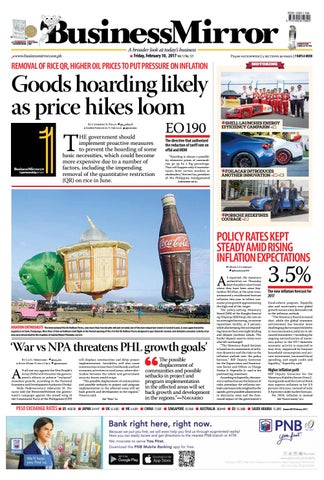
aviation enthusiasts The International Hot Air Balloon Fiesta, now more than two decades old and certainly one of the more important events in Central Luzon, is once again hosted by organizers in Clark, Pampanga. More than 25 hot-air balloons took flight at the formal opening of the 21st Hot Air Balloon Fiesta designed to spur domestic tourism and stimulate economic activity of an area once devastated by the eruption of nearby Mount Pinatubo. MAU VICTA
‘War vs NPA threatens PHL growth goals’ By Cai U. Ordinario @cuo_bm & Jovee Marie N. dela Cruz @joveemarie
A
n all-out war against the New People’s Army (NPA) will threaten the government’s efforts to achieve “inclusive” economic growth, according to the National Economic and Development Authority (Neda). Neda Undersecretary Adoracion M. Navarro told the BusinessMirror the government’s campaign against the armed wing of the Communist Party of the Philippines (CPP)
PESO exchange rates n US 49.8230
will displace communities and delay project implementation. Instability will also cause communities to lose their livelihoods and halt economic activities in rural areas, where skirmishes between the rebels and government security forces would erupt. “The possible displacement of communities and possible setbacks in project and program implementation in the affected areas will set back growth and development in the regions,” Navarro said. See “War,” A2
The possible displacement of communities and possible setbacks in project and program implementation in the affected areas will set back growth and development in the regions.”—Navarro
@BcuaresmaBM
s expected, the monetary authorities on Thursday kept the policy rates frozen where they have been since September 2014 but, at the same time, announced a recalibrated forecast inflation this year to reflect consumer price growth approximating the high end of the target. The policy-setting Monetary Board (MB) of the Bangko Sentral ng Pilipinas (BSP) kept the rate on its overnight borrowing, or reverse repurchase facility, at 3 percent, while also keeping the corresponding rates on their overnight lending and deposit facilities steady. The banks’ deposit reserve ratios were also left unchanged. “The Monetary Board decision is based on its assessment of inflation dynamics and the risks to the inflation outlook over the policy horizon,” BSP Deputy Governor for the Supervision and Examination Sector and Officer in Charge Nestor A. Espenilla Jr. said in his postmeeting statement. According to Espenilla, the monetary authorities see the balance of risks attendant the inflation outlook continues to be weighted to the upside, given possible adjustments in electricity rates and the firstround impact of the government’s
3.5% The new inflation forecast for 2017
fiscal-reform program. Espenilla also said uncertainty over global growth remain a key downside risk to the inflation outlook. “The Monetary Board stressed that, while the global economic environment has become more challenging due to expected shifts in macroeconomic policies in advanced economies—including the ongoing normalization of monetary policy in the US—domestic economic activity is expected to stay firm, supported by buoyant household consumption and private investment, increased fiscal spending, and ample credit and liquidity,” Espenilla said.
Higher inflation path
BSP Deputy Governor for the Monetary Stability Sector Diwa C. Guinigundo said the Central Bank now expects inflation to hit 3.5 percent this year, instead of only 3.3 percent under earlier forecast. For 2018, inflation is instead See “Policy rates,” A12
n japan 0.4447 n UK 62.4282 n HK 6.4209 n CHINA 7.2507 n singapore 35.1560 n australia 38.0448 n EU 53.2608 n SAUDI arabia 13.2893
Source: BSP (9 February 2017 )
BMReports BusinessMirror
A2 Friday, February 10, 2017
www.businessmirror.com.ph
Goods hoarding likely as price hikes loom Continued from A1
Supermarkets Association Inc., told the BusinessMirror. Cua also said economic factors point to an “expected” increase in the prices of fast-moving consumer goods. “These include the weakening of the peso, which would translate into higher prices of raw materials and intermediate and finished goods. The continuous increase in oil prices would also be factor.” The passage of the proposed tax reform would also put pressure on inflation, as this would hike the prices of some consumer items, such as sugar sweetened beverages. “As the cost of doing business go up, businesses potentially lose out on market share and margins, thus resulting in their decision to
Aguirre. . .
Continued from A12
Wally Sombero, Lam’s alleged bagman, for snubbing committee summons to appear before the Senate inquiry, after learning that Sombero managed to leave the country despite an immigration lookout bulletin order (Ilbo). Sen. Leila M. de Lima said she would move to cite Sombero in contempt should he fail to appear at the next hearing. Senators learned Sombero flew to Singapore for medical checkup, but later took another flight to Vancouver, Canada. Gordon, however, deferred committee action on de Lima’s motion to cite Sombero
increase prices to protect both,” Cua said.
‘Retain existing tariff’
To maintain the stable prices of some basic necessities, the Meat Importers and Traders Association (Mita) urged the government to make permanent the existing 5percent tariff on pork offal and mechanically deboned meat (MDM). Mita President Jesus C. Cham made this appeal to the CabinetCommittee on Tariff and Related Matters (CTRM), which has decided to remove the rice-import quota. “We strongly recommend to the CTRM to seriously consider delinking MDM from the QR on rice and make the present tariff rate permanent. This way Filipino consumers can benefit through nutritious and affordable meat products,” Cham told in contempt even as Gordon required immig ration o f f i c i a l s t o e x p l a i n ho w the former policeman was allowed to leave despite the lookout bulletin. In the same hearing former Immigration Associate Commissioner Al C. Argosino confirmed Jack Lam’s P50-million pay off following the raid in his casinos, with P48 million allegedly for BI officials and P2 million for Sombero. Argosino, claiming he was doing a case buildup, also admitted to senators holding on to the money for two weeks without telling his superiors. But Gordon pointed out that if there was a case buildup “there should be a spot report” and asked that it be submitted to the committee.
the BusinessMirror. “We will petition to the CTRM to make permanent [the 5-percent tariff on pork offal and MDM]. We hope that the CTRM will consider the plight of consumers,” he added. Cham’s remarks came after Agriculture Secretary Emmanuel F. Piñol said the government is looking at the possibility of extending the validity of Executive Order (EO) 190 signed by former President Benigno S. Aquino III. EO 190 allowed the reduction in the tariff of MDM to 5 percent, from 40 percent, in keeping with Manila’s commitment to the World Trade Organization for allowing the Philippines to retain the QR on rice. Under EO 190, tariffs on offal and MDM would revert to 40 percent once the QR on rice expires on June 30 this year.
“The concession entered by the Philippine government shall cease to exist upon the expiration of the waiver,” Section 2 of EO 190 read. Cham said the possible hike in the tariff of MDM could increase the price of raw materials used by meat processors by 35 percent. “From the traders’ side, all things being equal, and you are just passing on the cost to the customer, you are talking about a 35-percent increase in prices,” Cham said. He said retaining the low tariff on MDM makes sense as the local hog raisers failed to produce the materials needed by the meat processing industry. “It’s been 10 years [since the tariff rate was reduced], yet local producers are not producing [what the market needs] even if they aware of it,” Cham said.
War. . .
House resolution
Neda Secretary Ernesto M. Pernia said an all-out war against the NPA would also “endanger” the government’s goal of bringing down poverty incidence to 14 percent by 2022, from 21.6 percent in 2015. Eradicating poverty and reducing inequality is part of the first goal on the list of 17 Sustainable Development Goals (SDGs). The global goals, adopted in September 2015, need to be met by 2030. “No war can ever be beneficial,” Pernia said. In a press briefing on Tuesday, Defense Secretary Delfin N. Lorenzana said the government has declared an all-out war against the CPP-NPA-National Democratic Front of the Philippines (NDFP). Lorenzana said the government considers the NPA as terrorists, just like members of the Abu Sayyaf Group who kidnap individuals to extort money
One hundred three members of the House of Representatives on Thursday filed a resolution urging President Duterte to continue the peace negotiations between the government and the NDF. In House Resolution 769, 30 party-list solons, 20 congressmen from Mindanao, 11 from the Visayas and 42 from Luzon also asked the President to consider the“unprecedented and significant advances”made on the substantive agenda of the negotiations for the benefit of the Filipino people. The lawmakers said it should be emphasized, as compared to previous administrations, that the peace negotiations under the Duterte administration have reached “remarkable and unparalleled headway”. “Terminating the [peace talks] would only put to waste the unprecedented, positive and substantial gains the peace talks
Continued from A1
from their kin or the government.
He revealed that the price of MDM in the international market rose by at least 40 percent due to the tightness in supply caused by the bird-flu outbreak in some European countries. “Today the price of MDM compared to last quarter or two months ago has moved up by 40 percent because of the bird flu in Europe. So, the European supply are not coming because they have been banned while the approved [meat import] sources are raising their prices” Cham said. “Even today the price is increasing, so if the processors have not increased prices yet, it means that they are absorbing the additional costs or they are still using their previous inventory,” he added. Last month the government imposed a temporary ban on the importation of poultry meat, day-old
have reached,” they said. In fact, the solons said it is expected in the fourth round of talks that major points will be agreed upon that will lead to the signing of Comprehensive Agreement on Socioeconomic Reforms (Caser). The lawmakers noted the termination of the peace talks was announced barely two weeks after a “successful” third round of talks held in Italy last month, with both panels achieving significant advances in the major issues listed on their January 18 agenda. These include: ■ Breakthrough in the discussion on the Caser, a landmark document that shall address the country’s chronic poverty situation, with both parties reaching an agreement in principle on the first four items of the draft, which includes free land distribution to landless farmers; ■ Agreement to form bilateral working teams of Reciprocal Working Com-mittees in order to accelerate the
chicks, eggs and semen from some areas in four European countries. The Department of Agriculture said it made the decision after the governments of England, France, Poland and the Netherlands confirmed to the World Organization for Animal Health the outbreaks of the highly pathogenic avian influenza virus in their respective countries. Latest data from the Bureau of Animal Industry (BAI) showed that from January to October last year, chicken MDM imports reached 134,630 metric tons (MT), slightly higher than the 133,027 MT imported in 2015. BAI data also showed that MDM pork purchased abroad during the 10-month period jumped to 2,425 MT, from 703.28 MT imported in January to October 2015.
drafting of Caser; ■ Exchange of drafts and initial discussion on political and constitutional reforms; ■ Signing of a supplementary agreement for the operationalization of the Joint Monitoring Committee for the implementation of the Comprehensive Agreement on Respect for Human Rights and International Humanitarian Law; and ■ Agreement of both parties to discuss GRP’s proposal for a bilateral cease-fire from February 22 to 25, in the Netherlands; On February 5 Duterte announced the peace negotiation between the NDFP and the government is terminated, “unless there is a compelling reason that will benefit the nation”. The President said the killing of three soldiers and abduction of two more in Mindanao by NPA rebels, the CPP’s subsequent cancellation of its unilateral ceasefire and the NDFP’s demand for the release of some 400 political prisoners prompted him to terminate the peace talks.
The Nation BusinessMirror
news@businessmirror.com.ph
Alvarez insists on passage of death-penalty reimposition By Jovee Marie N. dela Cruz
D
@joveemarie
ESPITE strong opposition from lawmakers and different groups, Speaker Pantaleon D. Alvarez said he would still push for the passage of the death-penalty bill in March. Alvarez said he wants his House Bill 4727, or the measure reviving the death penalty, to be passed on third and final reading before Congress goes on break on March 15. “I want to finish [the capital-punishment bill] before Congress takes a break in March,” he said. “There is no arm twisting here. Am not forcing anyone to go with me,” he added. Alvarez, meanwhile, maintained that all deputy speakers, even former President and now Lakas Rep. Gloria Macapagal-Arroyo of Pampanga, have to go if they will vote against the revival of the deathpenalty bill. Alvarez served as transportation secretary during the Arroyo administration. Arroyo abolished the death penalty during her term in 2006. Besides Arroyo, Deputy Speaker and PDP-Laban Rep. Rolando G. Andaya Jr. of Camarines Sur and the administration’s ally, the Makabayan bloc, have also expressed strong opposition to the death-penalty bill. Alvarez said committee chairmen and vice chairmen, and members of the PDP-Laban also have to relinquish their posts if they will go against his bill. There are at least 100 members of the PDP-Laban in the House of Representatives.
Meanwhile, Alvarez said, the super majority agreed, during a caucus, not to make death mandatory in the death-penalty bill. The Speaker said under the bill the judges have now options to impose life imprisonment or death penalty. Also, during a caucus, Alvarez said they decided to remove plunder from the list of crimes punishable by death under the measure. “We agreed not to touch the plunder law, because it is already imposing capital punishment,” Alvarez explained. Under the death-penalty bill, crimes that are punishable by death through hanging, firing squad or lethal injection are treason, qualified piracy, qualified bribery, parricide, murder, infanticide, rape, kidnapping and serious illegal detention; robbery with violence against or intimidation of persons; destructive arson; importation of dangerous drugs and or controlled precursors and essential chemicals; sale, trading, administration, dispensation, delivery; distribution and transportation of dangerous drugs and or controlled precursors and essential chemicals; and maintenance of drug den. Also punishable by death are manufacture of dangerous drugs and/or controlled precursor and essential chemicals; possession of dangerous drugs; cultivation or culture of plants classified as dangerous drugs; unlawful prescription of dangerous drugs; criminal liability of public officer for misappropriation; misapplication or failure to account for the confiscated seized or surrendered drugs; criminal liability for planting evidence and carnapping.
Editor: Dionisio L. Pelayo • Friday, February 10, 2017 A3
‘Tugade is missing link in Lam case’
A
By Ashley Manabat | Correspondent
NGELES CITY—The ongoing Senate hearing on the Jack Lam case should include Transportation Secretary Arthur P. Tugade, who was described as “the missing link” by the Pinoy Gumising Ka Movement (PGKM). (Related story on A12
PGKM pointed out Tugade was the Clark Development Corp. (CDC) president and CEO for more than two years, beginning with his appointment on December 18, 2012, until his resignation on April 26, 2016. Tugade, now secretary of transportation, should be included in the Senate investigation, PGKM Chairman Ruperto Cruz said. Cruz said Tugade should not feign innocence in the Lam case involving illegal online gaming, human trafficking and bribery at the Fontana Leisure Parks and Casino, because he was at the helm of CDC during Lam’s heyday. There are even talks that one of
Tugade’s children reportedly got married at Fontana, with Lam as one of the godfathers. “He knows Clark more than anybody else, that is why he should be investigated to determine his liability, since he is the former CDC president and CEO, and Fontana is a locator in Clark,” Cruz pointed out. “There was a rush of Chinese nationals in Clark [during Tugade’s watch], and he does he not know about it?” Cruz asked. All foreigners who want to work in Clark and apply for permits pass through the CDC,” he said. “The Senate investigation should not be closed, unless Tugade is in-
vestigated, otherwise everything is just for show and the real culprits will not be exposed and held liable,” he added. Tugade should not be spared from this hearing, he said. Cruz also said Lam should be considered as an “undesirable alien”, instead of allowing him to return and pay back taxes to the government, even if it runs in billions. “Economic sabotage should be punishable with capital punishment,” he added. PGKM said the two immigration associate commissioners who figured in the multimillion-peso bribery scandal should not only be dismissed, but be placed behind bars and disbarred and their licenses to practice law revoked. Meanwhile, Cruz said Justice Secretar y Vita liano N. Ag uir re II’s five-month stint at the CDC legal department should also be uncovered thoroughly, so that no stone is left unturned in the investigation. “He [Aguirre] must know about Fontana’s illegal activities,” he said. Cruz also said Dennis Uy, president of Converge ICT, the Internet provider of Fontana Leisure Parks and Casino, should also be included in the Senate investigation.
Economy
A4 Friday, February 10, 2017 • Editors: Vittorio V. Vitug and Max V. de Leon
DTI says ‘5-6’ lending scheme has breached P2-billion value
T
he Department of Trade and Industry (DTI) is bent on phasing out the “5-6” lending scheme, the operation of which is estimated to reach as much as P2.4 billion, but will allow for a transition period for the underground foreign money lenders to legalize their resident status and register their business with the Securities and Exchange Commission (SEC). In a news statement, the DTI said it held an interagency meeting last week where it was bared that the total operations of the 5-6 lending system—essentially a “20-percent add-on-rate” loan system—has totaled to P2.4 billion. In the meeting, the Indian Chamber of Commerce said there are around 30,000 operators of the scheme in the Philippines. The DTI is enjoining these operators to register their businesses with SEC, leaving microbusinesses to seek funding from the government’s “alternative lending scheme” and other legal microfinance institutions. “After the prescribed transition period, [the] 5-6 scheme must stop and microbusinesses must shift to P3 or other legal microfinancing facilities,” said Lopez in a statement, referring to the government’s flagship microfinancing initiative Pondo Para sa Pagbabago at Pag-asenso or P3. The P3 extended a P19-billion microfund scheme for micro, small and medium enterprises (MSMEs), first piloted to three of the country’s poorest provinces last month. An initial tranche of P1 billion is already appropriated in the 2017 General Appropriations Act, with the rest of the fund to be spread out for the next five years. Loanable amount per end-borrower range from P5,000 for startups to as much as P300,000, with maximum interest rate of 26 percent per annum with no collateral requirement. Based on 2014 figures provided by the Philippine Statistics Authority, there are 946,988 establishments in the Philippines. Of these, 99.6 percent (942,925) are MSMEs and the remaining 0.4 percent (4,063) are large enterprises. Catherine N. Pillas
BusinessMirror
Economic managers back UniFAST mode on grant of free tuition to college students
P
By Cai U. Ordinario
Established in 2014, through Republic Act 10687, the UniFAST is designed to unify and harmonize all modalities of publicly funded student financial assistance programs, such as scholarships, grants-in-aid and student loans, for tertiary education. The law provides full financing to deserving students, which generally favors the poor.
from the AmBisyon Natin 2040, college education is among the most important among Filipinos nationwide. “We recognize college education is important for Filipinos, based on the results of the focus group discussions and survey on AmBisyon Natin 2040,” Pernia said. “Many employers also prefer college graduates. However, we need to carefully study our options for helping people achieve their aspirations for higher education, considering other needs,” he added. Tuition does not comprise the biggest share of college-education cost. Based on the grant structure of the government’s Student Grants-In-Aid Program for Poverty Alleviation (SGP-PA), tuition constitutes merely one-third (P20,000) of the annual cost of P60,000 per student covered by the grant. The bigger chunk of college education cost is for living expenses (at P35,000 for 10 months) and instructional materials (P5,000).
Top priority
Possible exodus
@cuo_bm
resident Duterte’s economic team has expressed support to proposals to fund the Unified Student Financial Assistance System for Tertiary Education (UniFAST) as an alternative to providing free tuition in all state universities and colleges (SUCs).
In a position paper signed by Socioeconomic Planning Secretary Ernesto M. Pernia, Finance Secretary Carlos G. Dominguez III and Budget Secretary Benjamin E. Diokno, the economic team backed the findings of a Philippine Institute for Development Studies (PIDS) study on freetuition bills filed in Congress. “The proposed free-tuition policy will benefit largely the nonpoor students who predominate in SUCs. In 2014 only 12 percent of the students attending SUCs belong to the bottom 20 percent of the family income classification based on the Annual Poverty Indicators Survey,” the economic managers said.
Pernia said supporting UniFast will help the country accelerate its effort toward achieving Filipino’s aspirations in the next 25 years. As indicated in the data obtained
The economic managers pointed out possible adverse implications of an across-the-board free-tuition policy, including the exodus of students to SUCs from private higher-
@joveemarie
L
awmakers are now moving to amend the economic provisions of the 1987 Constitution that limits on foreign investment in public utilities. The current initiatives are centered on proposals to redefine the term “public utility” by amending Commonwealth Act 146, or the public-service law. Under House Bills 4389, 4468, 4501 and 4787, filed by Reps. Gloria Macapagal-Arroyo, Joey S. Salceda, Arthur C. Yap and Feliciano R. Belmonte Jr., respectively, public utilities will be limited to electric-power transmission and distribution, water distribution and sewerage systems. All other public services, including electric-power generation and supply, crude oil and petroleum, transportation, broadcasting, telecommunications and value-added services, are excluded from the definition of public utilities. However, Party-list Rep. Antonio L. Tinio of ACT Teachers has expressed alarm on these renewed efforts in Congress to remove restrictions on foreign investment in key sectors of the economy. But in explaining her bill, Arroyo said consumers often experience high prices and poor quality of basic
educational institutions (HEIs), which would eventually affect the overall quality of graduates given that a number of private HEIs perform better than SUCs. “The government should implement its mandate of promoting quality and accessible education within the limits of fiscal prudence, and with the use of appropriate tools and targeting mechanism. The UniFAST is better designed to ensure a more efficient and effective use of government funds,” the economic managers said.
On Wednesday PIDS senior research fellows Aniceto C. Orbeta Jr. and Vicente B. Paqueo said payment of tuition of students in SUCs will benefit mostly rich students. Orbeta and Paqueo said the bulk of students studying in public HEIs are mostly from higher-income groups. Data from the Philippine Statistics Authority showed students from the poorest and second-poorest income households only account for 11 percent in 1999 and 12 percent in 2014 of enrollees in HEIs.
The government should implement its mandate of promoting quality and accessible education within the limits of fiscal prudence, and with the use of appropriate tools and targeting mechanism. The UniFAST is better designed to ensure a more efficient and effective use of government funds.”—Economic Managers
ATM, green groups: Mines closure not without basis By Jonathan L. Mayuga @jonlmayuga & Rea Cu @ReaCuBM
E
Mag-wheels fever
A car-accessory show worker presents an inventory of mag wheels at a shop in Makati City early this week. Car enthusiasts invest on mag-wheel rims to modify the look and improve the performance of their cars. Alyssa Salen
Solons renew bid to amend foreign-investment provision in 1987 Charter By Jovee Marie N. dela Cruz
news@businessmirror.com.ph
services in the Philippines, because only a few local players or oligarchs effectively control the market. “Competition and foreign investment are inhibited, because limitations that should only apply to the operation of a public utility are usually also applied to all public services. This situation is cause[d] by [the] ambiguity in the definition of public utility that is often used interchangeably with public service under the Commonwealth Act 146, or the Public Service Act. The key to fixing this problem is to develop a clear statutory definition of a public utility by amending the Public Service Act,” Arroyo said. For his part, Salceda said the Public Service Act is a law that was crafted in 1936 to govern public services in the Philippines. “Understandably, it no longer sufficiently addresses the changes in the economic framework brought about by globalization and rapid technological innovation. Hence, there is a need to adjust the provisions of the law to bring it to the 21st century and enable it to fulfill its purpose of truly serving the public,” he said. Notwithstanding numerous amendments, Salceda said this 80-year-old law is still a good law in terms of protecting the public interest, albeit outdated in certain aspects, particularly the transfer of the func-
tions of the Public Service Commission to various administrative agencies; the definition of public service, which is often used as a proxy for public utility in reference to the 1987 Constitution; and the applicable penalties and fees for public services. Yap, for his part, said the measure proposes to further amend the Public Service Act to effect the necessary changes in the antiquated provisions of the law to increase its relevance to contemporary concerns, in the interest of providing the general public with more choices, better services and lower prices. “This legislative reform will significantly contribute to increasing competition, as well as protecting the public interest. More competition among providers would result in lower prices and improved quality of basic services in the Philippines, creating a more competitive economy toward a better quality of life for all,” Yap added. This bill also prescribes a 12-percent cap on rate of return and prohibits income tax as operating expense for rate-determination purposes for public services, including public utilities, consistent with administrative and judicial pronouncements.
Alarm
Tinio said that, while past efforts focused on congressional initiatives
to amend the economic provisions of the 1987 Constitution that impose limits on foreign investment in public utilities and other key sectors of the economy, current proposals in the House of Representatives are aimed at circumventing the restrictions by changing the legal definition of public utility. “Since past efforts to amend the protectionist economic provisions of the Constitution have failed spectacularly, the proponents of unfettered foreign investment are now taking a different approach,” Tinio said, after the House Committee on Economic Affairs held its first hearing on the bills last Tuesday. “Cha-cha [Charter change] has so far proved unsuccessful, so now they’re trying to do it in reverse. They aim to amend the law in order to subvert the intent of the Constitution,” he added. According to Tinio, such redefinition would effectively circumvent Section 11 of Article XII of the Constitution, which states that “No franchise, certificate, or any other form of authorization for the operation of a public utility shall be granted except to citizens of the Philippines or to corporations or associations organized under the laws of the Philippines, at least sixty per centum of whose capital is owned by such citizens.”
nvironmental and antimining groups on Thursday welcomed Malacañang’s directive to give due process to mining companies affected by the closure and suspension orders issued by Environment Secretary Regina Paz L. Lopez. They maintained, however, that Lopez’s decision is not without basis, citing the massive environmental destruction caused by mining operations in violation of various mining and environmental laws. Clemente Bautista, national coordinator of Kalikasan-People’s Network for the Environment (Kalikasan-PNE), said it is the inherent right of mining companies to contest the closure and suspension orders. However, he added, the Department of Environment and Natural Resources (DENR) and related agencies should implement first the orders on what he described as “abusive mining companies”. “Malacañang should not only respect, but help, Secretary Lopez and the DENR people to do their jobs. Mining [companies] could raise their appeal during this process. The orders will be for naught if Malacanang will intervene and halt [the] implementation [of closure orders],” Bautista said. He expressed hope that President Duterte and his Cabinet will not side with the mining companies that already caused “so much environmental destruction and depleted our resources”. Cabinet members, meanwhile, have expressed support behind Duterte’s decision to observe due process before implementing a directive of the DENR to shut down or suspend 28 mining sites across the country, according to a news statement issued by Palace Spokesman Ernesto C. Abella. “The President and his Cabinet collectively decided to observe due process with regard to the mining issue. The DOF shall have further discussions with the DENR in their capacities as concerned government agencies of the Mining Industry Coordinating Council,” he added. Jaybee Garganera of Alyansa Tigil Mina (ATM) said social justice and
human rights comprise the broader basis of closing the mines. W hile ATM welcomes Malacañang’s directive to give due process to mining companies affected by the closure and suspension orders, Garganera said the results of the mining audit are “credible”. “Our impression is that the decision to close and suspend the mines relied on a whole set of references and evidence—the mining audit, the report of the Technical Review Committee, the local reports of NGOs [non-governmental organizations] and LGUs [local government units) submitted as addendum to the mining audit, news coverage, documents from legal cases in various courts and quasi-judicial bodies, LGU resolutions and ordinances against mining projects, aerial surveys of mining areas, and ground interaction by DENR officials in the miningaffected communities,” he said. He added: “The Chamber of Mines of the Philippines wrongly maintains a narrow viewpoint when they insist that the mining-audit report was the sole basis for the closures and suspensions.”
“Malacañang should not only respect, but help, Secretary Lopez and the DENR people to do their jobs. Mining [companies] could raise their appeal during this process. The orders will be for naught if Malacañang will intervene and halt [the] implementation [of closure orders].” —Bautista
Agriculture/ Commodities BusinessMirror
A5
Editor: Jennifer A. Ng • Friday, February 10, 2017
PHL abaca production grew 5.7% in 2016
File photo
F
By Jasper Emmanuel Y. Arcalas
@jearcalas
armers expanded their abaca output by 5.7 percent to 62,008.64 metric tons (MT) in 2016, from 58,665.81 MT in 2015, to take advantage of the demand for the crop in the country’s major export markets. Data from the Philippine Fiber Industry Development Authority (Philfida) showed that the Bicol region maintained its status as the top producer of abaca, accounting for nearly 39 percent of total output last year. The region’s output expanded by 12.3 percent to 24,034.48 MT, from 21,393.35 MT in 2015. The Davao region remained as the second top abaca producer, accounting for 17.7 percent of the country’s output. Davao produced 10,995.18 MT, 8.5 percent higher than the 10,129.49 MT recorded a year ago. The Western Visayas region posted the highest growth in output at 59.4 percent in 2016. The region’s abaca production expanded to 2,124.86 MT, from 1,333.275 MT last year. Philfida data also showed that Soccsksargen’s abaca output rose by 35.2 percent to 1,731.63 MT, from 1,280.63 MT in 2015. According to Philfida, export receipts from abaca in January to September last year reached $101.780 million, 17.3 percent higher than the $86.740 million recorded in the same period in 2015. Abaca pulp accounted for the lion’s share of the earnings at 69.1 percent. Exports receipt from abaca pulp grew by 20.3 percent to $70.30 million, from $58.46 million posted in 2015. The United Kingdom and Germany were
the top two importers of local abaca pulp during the nine-month period, accounting for 37 percent and 32 percent of purchases, respectively. Abaca-pulp exports to the UK grew by 45.6 percent to 6,376.639 MT, from the 2015 record of 4,378.446 MT. However, during the nine-month period abaca-pulp exports to Germany declined by 23.9 percent to 5,504.594 MT, from 7,237.483 MT recorded in 2015. Local abaca pulp bought by the US in the nine-month period jumped to 2,101.503 MT, from 581.370 MT recorded in 2015. Philfida data also showed that export receipts from abaca fiber in the Januaryto-September period expanded by 21.2 percent to $18.41 million, from the yearago level of $15.20 million. The UK and Japan were the top two importers of local abaca fiber during the nine-month period, accounting for 47.5 percent and 38.8 percent of the total exports, respectively. However, shipments of local abaca fiber to the two countries declined, according to Philfida data. Abaca-fiber exports to the UK dipped by 1.2 percent 4,726.86 MT, while Japan’s purchases fell by 1.9 percent to 3,867.36 MT. The Philippines accounts for 85 percent of global abaca production. Abaca is known worldwide as Manila hemp.
₧126-M tilapia destroyed in Lake Sebu fish kill; state of calamity declared
G
ENERAL SANTOS CITY—Officials of Lake Sebu town in South Cotabato have placed the entire area under the state of calamity due to a recent massive fish kill that destroyed around P126 million worth of tilapia. Roberto Bagong, action officer of the Lake Sebu Municipal Disaster Risk Reduction and Management Office (MDRRMO), said on Thursday the municipal council issued the calamity declaration in a session on Wednesday. He said the move was based on a recommendation from their office and the MDRRM Council, headed by Mayor Antonio Fungan. But he said the council has set conditions that they need to accomplish in line with the declaration, among them the immediate submission of some documentary requirements. Three barangays—Poblacion, Takonel and Bacdulong—were earlier placed under the state of calamity due to the impact of the fish kill from January 27 to February 4. The fish kill, which is considered the worst in Lake Sebu so far, destroyed around 1.4 million tons of tilapia from 4,944 fish cages owned by 464 operators. Bagong said based on their latest assessment, the estimated damage value has reached over P126 million. The average farm-gate price for tilapia in Lake Sebu is at P90 per kilo. As next move following the calamity decla-
ration, the official said they will convene the town’s fish-cage operators and other stakeholders on Monday next week for a dialogue and consultation. He said they will introduce to local fishing stakeholders various recommendations made by the Bureau of Fisheries and Aquatic Resources (BFAR) and the provincial government of South Cotabato to help address the recurrent fish kills at the lake. These include the enforcement of the 10-percent limit of the lake’s area for aquaculture development as set in Republic Act 8850, or the Philippine Fishery Code of 1998. Around 20 percent of the 354-hectare lake are presently occupied by fish cages or way higher than its carrying capacity. “They also recommended the setting of a regular closed season for fishing and a moratorium of two to five years for fish-cage operations,” he said. On the part of the municipal government, he said they will push for the immediate cleanup of water hyacinths or water lilies in parts of the 354-hectare lake. Bagong said they will also forge memorandums of agreement with fish-cage operators for the conduct of regular cleanup in areas that they occupy. He added they will tap the participation of the barangays in the cleanup activities to ensure that they would be sustained. PNA
A6
Friday, February 10, 2017
The World BusinessMirror
www.businessmirror.com.ph • Editor: Lyn Resurreccionph
UK’s May has reasons to worry despite her Brexit law victory
T
heresa May’s latest Brexit victory should leave her happy—but might ultimately come at a price. Late on Wednesday, the prime minister persuaded the House of Commons to back her original 137-word draft law to start the withdrawal from the European Union. Her only concession to lawmakers was that Parliament should get an early vote on the final pact.
Weak hand?
In that worst-case scenario, May and her European counterparts would have to decide if they really wanted to see World Trade Orga n i zat ion t a r if fs erected on their trade. “W hether that is really the choice available will depend on the political mood at the time,” sa id A l a n Renw ic k f rom t he Constitution Unit at University College London. “Given a strong desire, in the UK and across the EU, to avoid hard and disorderly Brexit, strenuous efforts to find an alternative would follow any parliamentar y vote against the deal.” According to Renwick, May’s gover nment “might wel l collapse” if lawmakers reject the f i n a l d r a f t a g r e e m e nt . T h e government “will therefore do all it can to deliver a deal that parliament will accept,” he said. The EU is also adept at stepping back from the brink of disaster at the last moment. “We also know from the euro zone crisis the skill with which the EU can teeter on cliff edges without quite falling off,” Renwick added.
Lords next
MAY
The question now as the House of Lords prepares to begin debating the legislation is whether that move amounted to nothing more than a sop to buy off rebels in May’s ruling Conservative Party, or will prove a significant concession that could derail her Brexit strategy down the line. May’s team argued she merely confirmed that lawmakers will get the choice between accepting
will simply crash out’ that would be a reckless act,” Keir Starmer of the Labour Party told the BBC Radio on Wednesday.
her handiwork or quitting the EU with no deal at all. Brexit Minister David Jones warned that the premier would never return to the negotiating table to ask EU leaders for a better pact. The main opposition’s Brexit spokesman thinks the government is bluffing. “The idea the prime minister would seriously say in 2019: ‘Well, rather than go back and see if I can improve and satisfy parliament I
In less than two weeks, the bill will face the House of Lords— where the government does not have a majority. W hile it could receive tougher treatment in the unelected chamber, the draft law is unlikely to be blocked, leaving May ample time to meet her deadline to trigger Article 50 by March 31. A s for what happens later in the process, the timing of Parliament’s vote on the final
deal is also significant. British and EU negotiators are aiming to have the agreement ready to send to the European Parliament in October 2018, six months before the UK will automatically leave the bloc under the legal timeline set out by the EU’s Lisbon treaty. By giving the UK Parliament a say before the deal goes to European lawmakers for approval, May has handed British legislators a potential six-month window in which they can pressure her to go back to Brussels and ask for something better. All this hinges on opponents of May’s Brexit accord being organized enough to win a vote in Parliament. This week’s showing suggests they have a long way to go.
Labour crisis
L abour remains in disarray over how to handle Brexit, and it showed this week. Jeremy Corbyn, the party leader, faced renewed speculation over his own position while shadow business secretary Clive Lewis resigned rather than follow orders to vote in favor of May’s bill to trigger Brexit. T he r u l ing Conser vat ives, meanwhile, have problems of their own. May took a risk when she sacked most of David Cameron’s cabinet as soon as she won power last July. This week two of the victims—Nicky Morgan and George Osborne—defied May’s order to support her in Commons voting. In all, seven Conservatives voted against May on Tuesday, in the closest act of defiance yet. Ultimately, the state of the economy over the next two years could dictate the direction of Brexit. A sharp economic downturn has the potential to make voters think again about leaving the EU, handing May’s enemies a chance to hit back. Bloomberg News
World’s biggest shipping company voices alarm at Trump trade war
A
.P. Moller-Maersk A/S, the owner of the world’s biggest container shipping line, is paying particular attention to noises coming from the US that suggest the new administration is moving closer to a trade war with China.
$1-B The Projected increase in profit from freighting goods that Maersk expects in 2017
Maersk expects the global shipping market to grow about 2 percent to 4 percent this year, but a full-fledged trade war between the US and China could make a mockery of such forecast. Bloomberg
President Donald J. Trump’s rejection of trade agreements w ith the rest of Nor th A mer ica and Europe have done litt le to unsett le Maersk ’s management. “But when the talks come to a potentia l trade war w ith China, we sit up and listen,” Soren Skou, the CEO of the Co penhagen-based company, said in an inter v iew on Wednesday. “ T hat wou ld have a ver y negative effect on our business.” Maersk, which is trying to split off its energy operations in order to focus entirely on a transport division led by its container shipping line, saw its shares sink on Wednesday after reporting a full-year loss when analysts had predicted a profit. Though much of the result was due to one-time impairments, the projection for 2017 also disappointed some investors.
The company expects the global shipping market to grow about 2 percent to 4 percent this year, helping it increase its profit from freighting goods by at least $1 billion. But a full-fledged trade war between the US and China could ultimately make a mockery of such forecasts. Trump’s rhetoric so far suggests he’s ready for battle, with accusations of currency manipulation being hurled at China. Goldman Sachs analysts estimate that if Trump were to impose tariffs against China of up to 10 percent, the country’s exports to the US would fall by as much as 25 percent. That could erode China’s economic growth by as much as 1 percentage point. The problem with such strategies is that they often provoke retaliation. The Goldman analysts predict a Chinese response could
shave as much as a quarter of a percentage point off US gross domestic product. In other words, the world’s two largest economies would suffer significant trade-related losses that would undoubtedly have a knock-on effect across the globe. Maersk, whose most important route is container traffic coming from Asia and bound for Europe, has taken advantage of a consolidation wave in the industry to spread its geographic reach. But even that strategy might prove futile if the whole world sinks into a trade war. “Nationalism has become a g loba l i z ed phenomenon a nd that’s a very ugly development for shipping,” said Peter Sand, chief shipping analyst at Bimco, the world’s biggest shipping organization. Though a global trade war isn’t the main scenario, “it’s
already clear that we’re seeing an increase in protectionism”. Sand notes that there are already plenty of signs that trade barriers are an issue. Of the rough ly 3,0 0 0 t rade rest r ictions put in place since 2008, the 164 members of the World Trade Organization (WTO) have only removed 740, according to a report published by Genevabased W TO in December. While the fallout of Trump’s trade policies looks alarming to Maersk, the company is more positive on what it’s hearing on tax proposals coming from the White House. “The new administration in the US wants lower taxes and it’s also planning huge investments in infrastructure,” Skou said. “And that will, without a doubt, mean more imports for the US, which is good for our business.” Bloomberg News
In this November 11, 2016, file photo, Ivanka Trump, daughter of President Donald J. Trump, arrives at Trump Tower in New York. Nordstrom shares sunk after Trump tweeted that the department-store chain had treated his daughter “so unfairly” when it announced last week that it would stop selling Ivanka Trump’s clothing and accessory line. AP/ Evan Vucci
Trump vs Nordstrom: The latest bout raising ethical concerns
N
EW YOR K—Dona ld J. Trump just can’t seem to separate the presidency from his family’s businesses. Whereas other presidents took pains to avoid even the appearance of using their office for private gain, Trump is pushing the limits. He met with Indian business partners before his inauguration, and decided to hold on to his company, while expanding his hotel brand. On Wednesday, he added to a string of presidential firsts, and drew fire from ethics lawyers, with a Twitter attack on Nordstrom. The Seattle-based retailer earned Trump’s ire by dropping his daughter Ivanka’s clothing and accessory line. The implication, intended or not: Hurt my daughter’s business and the Oval Office will come after you. “ My d au g hte r Iv a n k a h a s been treated so unfairly by Nordstrom,” the president tweeted. “She is a great person—always pu sh i ng me to do t he r ig ht thing! Terrible!” Posted first on his personal account, it was retweeted more than 6,000 times in less than an hour. It was also retweeted by the official @POTUS account. Though Trump has tweeted about companies such as Boeing, Carrier and General Motors, ethics experts say this time was different: It involved a business run by his daughter, which raises conflictof-interest concerns. Trump’s tweet follows revelations that First Lady Melania Trump expected to develop “multimillion-dollar business relationships” tied to her presence in the White House, according to a suit she filed on Monday. Ethics experts have criticized Trump’s plan to separate himself from his sprawling real estate business by handing managerial control to his two adult sons. The experts want him to sell his company. Most modern presidents have sold their financial holdings and put the cash raised in a blind trust whose investments remained unknown to them. Kathleen Clark, a government ethics expert, said the Nordstrom tweet is problematic because other retailers may think twice now about dropping the Ivanka Trump brand for fear of getting criticized publicly by the president. She said it was especially disturbing that Tr ump retweeted his message on the official W hite House account. “The implicit threat was that he will use whatever authority he has to retaliate against Nordstrom, or anyone who crosses his interest,” said Clark, a law professor at Washington University in Saint Louis. Clark defended the president’s right to use his personal Twitter account to express his views, however. She noted that government workers recently set up alt-EPA accounts to criticize the president’s policies. “A government employee,
even a president, is allowed to tweet in his personal capacity.” White House Spokesman Sean Spicer said Trump was responding to an “attack on his daughter” when he posted the tweet and that “he has every right to stand up for his family and applaud their business activities, their success”. One of the president’s fiercest ethics critics, Norman Eisen, described the tweet differently—a “bullying” tactic beneath the dignity of the president’s office. “This is a shot across the bow to everybody who is doing business with Trump or his family,” said Eisen, who was President Barack Obama’s chief ethics counselor. “It’s warning them: Don’t withdraw their business.” Eisen joined with other legal scholars and lawyers to sue the president last month for allegedly violating a clause in the Constitution that prohibits government officials from accepting gifts or payments from foreign governments. Though other legal scholars disagree, Eisen said such payments include foreign diplomats staying at Trump’s new Washington, D.C., hotel and holding events there and at the other Trump venues. Trump and his top aides have repeatedly said that Americans do not care about what Eisen and other ethics critics say. “Prior to the election it was well known that I have interests in properties all over the world,” Trump wrote on Twitter last November 21. Two surveys released in January show that’s not entirely the case. A Quinnipiac University poll found that about 60 percent of registered voters were at least somewhat concerned that the president would “veto a law that would be good for the country because it would hurt his business interests.” And a Pew Research Center poll found that 57 percent of American adults were at least somewhat concerned that Trump’s businesses could “conflict with his ability to serve the country’s best interests.” Yet, Trump seems to have calculated that his base of supporters forgives—and maybe even encourages— his protective bluster about his family businesses. Nordstrom reiterated Wednesday that its decision was based on the brand’s performance, not politics. The company said sales of Ivanka Trump items had steadily declined over the past year, particularly in the last half of 2016, “to the point where it didn’t make good business sense for us to continue with the line for now.” Retailers drop brands all the time because of poor performance, said brand consultant Allen Adamson. But given a highly charged political environment, perception is reality for loyal Trump fans. “It is clearly hard for Nordstrom to tell the story that it is dropping [the brand] for business reasons,” said Adamson, founder of the firm Brand Simple. AP
Editor: Lyn Resurreccion • www.businessmirror.com.ph
The World
Trump issues belated well wishes to China on holiday
B
EIJING—President Donald J. Trump has issued belated well-wishes to China for the Lunar New Year, the most important holiday in the world’s most populous nation, saying he hoped to work with his Chinese counterpart Xi Jinping to build a “constructive relationship”. Trump had been the only US president in recent years not to have issued greetings when the holiday fell on January 28, triggering speculation in China as to whether it was an oversight or an intentional slight. A statement from the White Hou s e l at e We d ne s d ay s a id Trump wrote to Chinese President Xi Jinping wishing the Chinese people greetings for the new year and the Lantern Festival that falls on Saturday. “President Trump stated that he looks forward to working with President Xi to develop a constructive relationship that benefits both the United States and China,” the statement said. Trump has accused Beijing of unfair trade practices and currency manipulation, criticized China’s military buildup in the South China Sea and accused Beijing of doing too little to pressure neighbor North Korea over
its nuclear and missile programs. He also upended four decades of diplomatic protocol by speaking by phone with Tsai Ing-wen, the president of Taiwan, which China claims as its own territory. Beijing decried the phone call with Tsai and has rejected the other accusations. China has in fact been spending heavily from its pile of foreign-currency reserves to prop up the value of its currency, which would make its exports less competitive. The prospect of a militar y confrontation over the South China Sea had also been raised by Trump’s chief strategist Steve Bannon when he hosted the conservative Breitbart News Daily radio show in 2015 and 2016. Bannon said he envisioned the possibility of a US-China war over the strategic waterbody within five to 10 years. China, which claims the sea virtually in its entirety, has been building man-made islands in the area and equipping them with airstrips and military installations. Despite Trump’s confrontational image, Chinese Internet users were warmed by a brief video clip of Trump’s granddaughter singing in Chinese that circulated on the Web earlier this month. AP
Impeached South Korea leader cancels questioning over scandal
S
EOUL, South Korea—South Korea’s impeached president has scrapped plans to let officials question her on Thursday because of anger over leaks to the media, prosecutors said. The sudden rejection of what would have been the first prosecutor ia l questioning of a sitting president is t he latest in a ser ies of standof fs bet ween President Park Geun-hye and prosecutors d ig g ing into her alleged involvement in the biggest politica l scand a l in Sout h Korea in decades. The scandal saw millions take to the streets in protest and led to Park ’s December 2016 impeachment. The Constitutional Court is holding a trial to deter mine whether to for ma lly end Park ’s rule or reinstate her presidential powers. Prosecutors said both sides agreed not to disclose the exact time and place of the questioning until it was over. But the SBS
TV network reported on Tuesday that Park would be questioned by a group of prosecutors on Thursday at the presidential Blue House. SBS didn’t say how it obtained the information. Prosecution Spokesman Lee Kyu-chul said on Thursday Park’s lawyers told his team they were pulling out of the questioning after accusing prosecutors of leaking information about it. Lee said his office did not leak the information. He said prosecutors still want to question Park but added that nothing has been determined about when to interview her. Park faces allegations that she let her longtime confidante Choi Soon-sil pull government stings from the shadows and extort an enormous amount money from companies in collaboration with presidential officials. Choi and several of Park’s former presidential aides have already been investigated over the scandal. AP
BusinessMirror
V
F r a n c i s h a s f r e q u e n t l y i n v o ke d the “bridge not walls” appeal in urging countries to welcome migrants, including when he returned from a visit last year to the US-Mexico border. On that occasion, he was asked about Trump’s campaign pledge to build a border wall and said anyone who wants to build a wall is “not Christian”. The Vatican has in recent weeks come out strongly and directly to criticize the Trump immigration policy, with a senior official saying the Vatican was indeed concerned and the Vatican newspaper, L’Osservatore Romano, saying the recourse to walls and travel bans was against US economic interests. In his remarks on Wednesday, Francis also appealed for prayers for members of Myanmar’s Muslim Rohingya ethnic minority, who face official and social discrimination in Buddhist-majority Myanmar, also known as Burma. “These are good people, peaceful people,” Francis said. “ They ’re not Christians, but they’re good, our brothers and sisters. And they have been suffering for years. They’ve been tortured and killed, simply because they are continuing their traditions, their Muslim faith. Let us pray for them,” he said. AP
A7
Trump slams the courts, his court nominee hits back
W
ASHINGTON—President Donald J. Trump’s extended criticism of the judiciary prompted a rebuke on Wednesday from his nominee for the Supreme Court, who told a senator that the president’s comments were “demoralizing and disheartening”.
Judge Neil Gorsuch, who was nominated by Trump to the nation’s high court last week, made the comments after Trump accused an appellate court considering his immigration and refugee executive order of being “so political ”. During the weekend, the president labeled a judge who ruled on his executive order a “so-called judge” and referred to the ruling as “ridiculous”. Gorsuch ’s comments came at the end of his first full week of meetings in the Senate, which is considering his nomination. His response may have been aimed at drawing a line of separation from the new president, who has been politically polarizing figure among Democrats in a highly charged partisan fight over the court. Prior to the judge’s meeting on Capitol Hill, Trump slammed the court that is deliberating his immigration and refugee executive order, telling a group of police chiefs that his immigration order was “done for the security of our nation.” He quoted from the portion of the immigration law that he said gave him the power to enact the ban, calling it “beautifully written” and saying “a bad high-school student would understand this”. “Courts seem to be so political and it would be so great for our justice system if they would be able to read a statement and do what’s right,” he added. “And that has to do with the security of our country, which is so important.” Trump’s comments came as the 9th US Circuit Court of Appeals is weighing the appeal of his executive order on immigration, including a temporary travel ban on people from seven
641
The number of refugees from 13 countries that arrived in US since a federal judge in Washington ruled against the government
Muslim-majority countries. In a hearing on Tuesday, judges on the appeals court challenged the administration’s claim that the ban was motivated by terrorism fears, but also questioned an attorney’s argument that it unconstitutionally targeted Muslims. Si nce a lower - cou r t jud ge bloc ked t he order l a st wee k , Tr u mp h a s a ss a i led t he dec is ion , le a d i n g le g a l e x p e r t s , Democ rat s a nd some R e pub licans to question whether t he president ’s rema rk s m ight jeopa rd i z e t he i nde pendence of t he jud ic i a r y. O t hers h ave ex pressed fears he may be at t e mp t i n g t o u s e p o l it i c a l i n f luence to s w ay t he cou r t s. Gorsuch joined the criticism in a meeting with Sen. Richard Blumenthal of Connecticut. Blumenthal, a former state attorney general, said Gorsuch described the president’s comments about the judiciary as “demoralizing and disheartening”. Gorsuch ’s confirmation team confirmed the judge’s comments. Blument ha l told repor ters that he had told the judge he would need to condemn Trump’s
President Donald J. Trump speaks to the Major County Sheriffs’ Association and Major Cities Chiefs Association on Wednesday, in Washington. AP/Evan Vucci
attacks on judicial independence publicly. “It needs to be a strong condemnation and that kind of public condemnation is important to establish his independence,” Blumenthal said. “Other wise, the American public will conclude that he is more likely to be a rubber stamp.” In his speech, Trump sought to link his comments about the court battle over his executive order to the law enforcement community in attendance. “We have to allow you to do your job,” he said. “And we have to give you the weapons that you need, and this is a weapon that you need and they’re trying to take it away from you.” The president has repeatedly said people are “pouring in” since the ban was put on hold and suggested that blocking the order would be dangerous for US citizens. On Wednesday morning he tweeted, “Big increase in traffic into our country from certain areas, while our people are far more vulnerable, as we wait for what should be EASY D!” The administration has not provided any information to support his claims. Customs and Border Protection, the agency in charge of screening people who arrive at US ports, including air ports, has not responded to multiple requests to detail how many visa holders from the seven designated countries have been allowed into the US since a federal judge temporarily blocked the government from implementing the travel ban.
Pope repeats ‘bridges not walls’ after Trump travel ban ATICAN CITY—Pope Francis repeated his appeal for people to build bridges of understanding, not walls as he marked a feast day of a Sudanese immigrant amid a global uproar over the Trump administration’s attempts to impose a travel ban on seven mostly Muslim countries. The pope didn’t refer to President Donald J. Trump in his comments. But at the end of his audience, he noted that Wednesday marked both the church’s day of reflection for young victims of human trafficking and coincidentally the feast day of Saint Josephine Bakhita. She was a 19th-century Sudanese slave who, after migrating to Europe, became a nun. Sudan is one of the seven countries on the US travel ban list. “In the social and civil contex,t as well, I appeal not to create walls but to build bridges,” he said. “To not respond to evil with evil. To defeat evil with good, the offense with forgiveness. A Christian would never say ‘you will pay for that.’ Never. “That is not a Christian gesture. An offense you overcome with forgiveness. To live in peace with everyone.” Francis made the reference during his weekly Wednesday catechism lesson, dedicated to the general Christian precepts of hope and forgiveness in forging peace.
Friday, February 10, 2017
Pope Francis is surrounded by faithful, including one holding a poster against human trafficking, during his weekly general audience in Paul VI Hall, at the Vatican on Wednesday. The Vatican has been hosting a conference on human trafficking as part of Francis’s efforts to crack down on trafficking in humans and organs. AP/Andrew Medichini
The State Department previously said fewer than 60,000 visas were provisionally revoked after the order was signed and those people would now be allowed to travel to the US Trump’s order banned travel to the US for people from Syria, Sudan, Iraq, Iran, Somalia, Yemen and Libya. It also suspended the country’s refugee global program. As of Wednesday afternoon 641 refugees from 13 countries, including five whose citizens were barred from the US under the travel ban, had arrived since a federal judge in Washington ruled against the government. During his meeting with police leaders, Trump also continued his promises to reduce violence in Chicago, saying “no one in America should be punished ” because of their birthplace. He pledged to provide resources to police departments and promised “zero tolerance” for violence against law enforcement. Trump also promised to work on combating drug abuse and said there should be resources to deal with a “mental-health crisis”. Hundreds of members of the Major Cities Chiefs Association and Major County Sheriff ’s Association were in the standing room crowd, some in uniform but the majority in plain clothes. T hey snapped photos w ith their phones as the president spoke, but clapped spar ingly when he asked whether they were in agreement with his views on the immigration ban. His comments about combatting drug abuse and the targeting of police officers drew a more unanimous response from the crowd. AP
A8
The World BusinessMirror
Friday, February 10, 2017
Northeast US bracing for powerful snowstorm
B
OSTON—The northeastern US is bracing for a powerful, fast-moving storm that is expected to bring more than a foot of snow in some places. Forecasters say the Thursday snowstorm likely will snarl workday commutes across the densely populated region. It has the potential to be the most powerful storm that some areas have seen in a mostly snow-free winter. The National Weather Service predicts that the Boston area and eastern Maine will get 12 to 18 inches of snow, New York City could see 8 to 12 inches and the Philadelphia area 4 to 8 inches. Near whiteout conditions are possible, with the snow expected to fall at a clip of 2 to 4 inches per hour at its peak. Officials also are warning of high winds, coastal flooding and power outages. A number of school systems already have canceled Thursday classes, including New York City, Philadelphia and Boston. Airlines scrapped thousands of flights by late Wednesday as a precaution. The storm comes a day after much of the Northeast enjoyed a brief glimpse of spring, with temperatures hitting 60 degrees in some places. Thursday’s storm is expected to last six to 10 hours, said Carl Erickson, a senior meteorologist with AccuWeather in State College, Pennsylvania. It will hit eastern Pennsylvania and northern New Jersey with rain early Thursday morning, before changing over to snow in time for the morning rush, he said. New York City could see the first flakes by 3 a.m., while Boston and other parts of New England should expect the snow to start around 5 a.m. AP
www.businessmirror.com.ph • Editor: Lyn Resurreccion
CNN journalist braces for backlash after clash with Trump adviser
A
fter a contentious interview on Tuesday in which Kellyanne Conway, the presidential adviser, and Jake Tapper of CNN clashed over whether the White House or the media was more indifferent to facts, the journalist was bracing on Wednesday for a backlash from the right. While the 25-minute interview touched on issues like the confirmation of Betsy DeVos as eduction secretary and President Donald J. Trump’s relationship with President Vladimir Putin of Russia, the bulk of it focused on Trump’s scathing criticism of the media and the administration’s penchant for repeating falsehoods. The interview was frequently testy, and Tapper’s performance was widely praised by those seeking a more aggressive approach to fact-checking the Trump administration. But then Axios, citing an anonymous source, reported that Tapper would now likely be a target for “hit pieces” from at least one conservative news site.
The New York Times was unable to independently verify the report. Tapper appeared to welcome the critics, posting on Twitter that he would just wait for “attack dogs” to come at him. Conway’s CNN appearance came amid growing questions about her credibility after she falsely spoke of a “Bowling Green massacre” that never happened and used the phrase “alternative facts” to justify the administration’s view of the truth. She repeatedly corrected the Bowling Green error and apologized for it Tuesday, but reports later emerged that she had previously invoked the nonexistent episode in an interview with Cosmopolitan magazine (which
did not print the quotation) and with TMZ. Some critics are calling on cable news outlets to bar her from appearing on air, and CNN declined to have her on as a guest on Sunday. Trump added to tension with the press by accusing news organizations of playing down or declining to cover terrorist attacks. The White House on Monday issued a list of what it said were 78 underreported attacks; but several news organizations, including The New York Times, provided evidence to the contrary. On Tuesday Conway questioned the focus and tone of more recent news coverage. Without citing examples, she criticized descriptions of Trump that lacked “a certain respect for and recognition of the dignity for the office of the president.” She asked for “more complete coverage” of Trump’s executive orders, instead of a focus on the travel ban affecting seven Muslimmajority countries. Tapper countered that the executive order had caused chaos at airports across the globe and was a major story deserving coverage. He added that Trump has also spread false information that the president accuses the media of not reporting. In one example cited by Tapper,
Trump said on Tuesday the murder rate was “the highest it’s been in 47 years” and that “the press doesn’t tell it like it is.” The facts: While the rate spiked in 2015, multiplefact checks found that the murder rate is actually near a 45-year low.
78
The Number of underreported attacks that the White House issued, but news organizations, including The New York Times, provided evidence to the contrary. “Facts are stubborn things,” Tapper said, “and to say that we’re not reporting something that happens not to be true, therefore we’re not to be trusted, that’s a problem.” When Conway suggested that t he med i a h ad pl ayed dow n some attacks because people
had become “ inured to terrorist attacks”, Tapper protested. “Well, your spin about the idea that we don’t want to be inured to that, that’s a lovely spin, but that’s not what he was saying, Kellyanne,” he said. “He was saying the media does not cover these stories because we don’t want to cover them because we have some sort of agenda.” “That’s what he was suggesting,” he added, “and it’s offensive given the fact that CNN and other media organizations have reporters in danger right now in war zones covering ISIS, and I just don’t understand how the president can make an attack like that.” On Wednesday, after the report that he would be targeted, Tapper appeared to be enjoying the #TapperDirtFile Twitter hashtag that had been created in his honor. Users professed to expose damaging, but made-up, tidbits to be used in a hit piece about him, such as liking Nickelback or the time he ordered a “large coffee” at Starbucks. He even added his own “dirt” on Twitter, posting that he listened to the Billy Joel Channel on SiriusXM radio and that he had seen every Final Destination movie—“Yes, all five of them.” New York Times News Service
Air strikes on opposition-held Syrian district kill 9 civilians
B In this February 6 photo, Carlos Ariel Amigo (left) arrives in Miami as part of a group of Cuban doctors who were allowed to enter the United States through Miami International Airport. He and other Cuban doctors arriving in Miami this week, under the Cuban Medical Professionals Parole, said they’re relieved to be arriving, during an uncertain time for immigrants to the US under President Donald J. Trump, but concerned about colleagues left behind. Carl Juste/Miami Herald via AP
Last Cuban doctor defectors arrive in US after policy change
M
I AMI—Yoandri Pavot applied just in time for a visa under a recently scrapped US policy that had long welcomed doctors from Cuba who defected while on assignment in third countries. Pavot and other Cuban doctors arriving this week in Miami under the now canceled policy called the Cuban Medical Professionals Parole said they’re relieved to be arriving despite uncertain times for immigrants under the Trump administration. But they’re anxious about colleagues left behind. “I still can’t believe it. Pinch me. Pinch me. I can’t believe I am here,” Pavot, 35, said after arriving on Monday at Miami International Airport holding a small American flag. “I wish they would give the ones left behind a chance because they are also fighting for freedom.” The program—begun in 2006 by then-President George W. Bush—allowed Cuban doctors, nurses and other medical professionals to defect to the US while on their government’s mandatory assignments abroad. Pavot said he had applied after the Cuban government dispatched him
to a crime-ridden area of Venezuela, where many coworkers were attacked. The waning administration of President Barack Obama canceled the doctors’ policy on January 12. It also eliminated the better-known “wet foot, dry foot” policy that gave any Cuban who makes it to US soil a path to become a legal resident. The moves lined up with Obama’s push for a more normalized relationship with communist Cuba. But doctors who already applied for visas before January 12 are being allowed in, and the final wave of those accepted are arriving on flights to Miami this week, said Julio Cesar Alfonso, director of a nonprofit that helps Cuban doctors resettle in the US. O n Mond ay a fe w w a l ked through glass doors past Customs to loud cheers and hugs from close and distant relatives carrying f lowers and balloons. They cried and took photos. Alfonso said 20 professionals arrived on Monday and more are expected on f lights this week. Some critics of the doctors’ policy have said it amounted to a more than decadelong brain drain
for Cuba. But proponents said the doctors were forced by the Cuban government to toil overseas under often-grueling conditions and deserved to be liberated. The repeal of the “wet foot, dry foot” policy was welcomed by many in the Cuban exile community who accused certain recent arrivals of abusing privileges by claiming federal benefits and then traveling back to Cuba. But many of the same criticized the cancellation of the medical defectors program; they’re urging the Trump administration to restore it. Under the policy, qualifying medical professions could immediately apply for work permission and apply for residency after one year. President Donald J. Trump has not established what, if anything, will change regarding Cuba policy. Press secretary Sean Spicer said last week the administration is reviewing its position with Havana. Cuba’s doctors abroad program has earned praise from the World Health Organization for responding to the Ebola outbreak in Africa and to natural disasters such as Haiti’s 2010 earthquake. AP
EIRU T—A ser ies of a i r strikes on an oppositionheld district in the Syrian city of Homs, presumably carried out by Russia or Syria, killed at least nine civilians on Wednesday, local activists said. Progovernment forces shelled the city’s al-Waer neighborhood with tank and artillery fire in conjunction with the airstrikes, the Local Coordination Committees, an activist network, reported. Gover nment forces h ave kept the opposition-held neighborhood under siege since 2013, according to t he Wa sh i n g ton - ba s e d Sie ge Watc h . A n e st i m ate d 75,0 0 0 p e o ple a re t r ap p e d i n s ide. The local Civil Defense searchand-rescue team, also known as the White Helmets, said the air strikes hit one of its centers in alWaer, wounding one volunteer. The government and its allies have regularly targeted hospitals and first responder positions in the course of the Syrian civil war, which is approaching its seventh year. The Britain-based Syrian Observatory for Human Rights also reported that nine civilians were killed in the raids. Homs is Syria’s third-largest city. Government forces retook most of the city in 2014, effectively ending an anti-government protest movement that had gripped Homs since 2011. T he a l-Waer a ssau lt c a me one day after presumed Russian or Syrian government aircraft bombed the rebel-held city of Idlib and marked the second major violation of a month-old cease-fire between the government and rebels in as many days. The Observatory said 24 civilians were killed in seven strikes across Idlib on Tuesday. The Idlib Civ il Defense said 26 people were killed. The December 30 cease-fire was brokered by Russia and Iran, both of which are key allies of Syrian President Bashar Assad, and Turkey, which supports the
In this still image made from video provided by opposition operated Step News Agency, which is consistent with independent AP reporting, a man views scenes of destruction inside a banquet hall in Deir Qanoun, Barada Valley, Syria, on January 15. Pro-Syrian government troops shelled a village in a rebel-controlled area near Damascus on Sunday, killing at least 12 civilians and injuring several others who were taking shelter in a banquet hall. Step News Agency, UGC via AP
opposition. Each side has accused the other of repeated violations. UN-sponsored talks on Syria are scheduled to start in Geneva on February 20 and invitations to the discussions will be issued “in the coming days”—not on Wednesday as expected, United Nations Spokesman Stephane Dujarric said. He said UN special envoy Staffan de Mistura and his team are continuing discussions and the invitations will go out once they reach “a position of comfort.” De Mistura had said invitations would be issued around February 8 and if the Syrian opposition wasn’t united, he would select the delegation and ensure that it is as inclusive as possible. Dujarric declined to say whether talks were still going on with opposition groups or whether de Mistura is choosing the opposition delegation. Late in the day, the Pentagon said two US air strikes near Idlib last week killed 11 al- Qaeda operatives, including one with ties to Osama bin Laden and other senior al-Qaeda leaders. Nav y Capt. Jeff Davis said an air strike on Friday killed 10 operatives in a building used as an al-Qaeda meeting site and a strike the next day killed Abu Hani al-Masri, who US officials
say oversaw the creation and operation of al-Qaeda training camps in A fghanistan in the 1980s and 1990s. Davis said alMasri had ties to bin Laden and to Ayman al-Zawahiri, who became the top leader of al-Qaeda when bin Laden was killed by US forces in 2011. Turkey, meanwhile, is in talks with Russia to coordinate troop movements around nor t her n Syria to avoid any encounter with the Syrian military, Turkish President Recep Tayyip Erdogan’s spokesman told private NTV television on Wednesday. Syrian government forces and Turkish-backed opposition fighters are in a race to seize the town of alBab from the Islamic State group. Turkish and Syrian forces have so far avoided direct conf lict, despite hostile rhetoric between Erdogan and Assad. The twin offensives put the two forces within 3 kilometers (2 miles) of one another, on opposite sides of al-Bab. Erdogan spokesman Ibrahim Kalin said Turkish troops had reached the center of a l-Bab and were fighting to secure it, but the Syrian Observatory for Human Rights, which relies on a network of activists inside Syria, said the Turkish force was still at the town’s outskirts. AP
AseanFriday BusinessMirror
news@businessmirror.com.ph
Singapore Air extends jet-fuel hedging as Opec cuts sway oil
Thailand holds rate to shield growth as trade risks mount
T
hailand’s central bank held its key interest rate near a record low to shield the nation’s economic recovery, as the threat of trade protectionism mounts.
S
ingapore Airlines Ltd., Southeast Asia’s biggest carrier, extended some of its fuel-hedging contracts to as long as five years, betting on an upswing in crude oil prices amid production cuts implemented by the Organization of the Petroleum Exporting Countries (Opec) and renewed tensions between the US and Iran. The marquee airline, which reported a 36-percent drop in profit for the three months through December 2016, said on Tuesday it has entered into longer-dated Brent hedges with maturity extending to 2022. Earlier, the company used to hedge only for a maximum period of 24 months, according to Spokesman Nicholas Ionides. “Clearly, they are taking a view that oil prices will gradually go up,” said Mohshin Aziz, an analyst at Maybank Investment Bank Bhd. in Kuala Lumpur. “It’s out of their norm as they usually do it 18 months forward. I don’t think it’s a bad move.” Singapore Air, which is battling overcapacity and aggressive pricing by budget airlines in the region, is seeking to cut costs, as passenger yields—a key measure of profitability in the industry—continue to be under stress. Jet fuel accounted for 26 percent of the company’s total expenditure last quarter, making it the single biggest cost. Brent crude, trading at $54.76 a barrel, has gained about 8.5 percent since major oil-producing nations agreed last December to trim output, while policies of US President Donald J. Trump have fueled uncertainty over prices. Shares of the airline rose 0.8 percent to S$9.80 in Singapore on Wednesday, paring their losses in the past year to 12 percent. “Fuel prices have trended upward since the last quarter and are expected to remain volatile as uncertainty lingers around global oil production,” Singapore Air said in a statement on Tuesday. “The group regularly reviews and adapts its fuelhedging policy to manage volatility in fuel prices.” For the current quarter, the airline said it has hedged about 37 percent of its jet-fuel requirements in Singapore Jet Kerosene at a weighted average price of $67 a barrel. Its longer-dated Brent contracts extend to 2022, covering between 33
S$365.9M Singapore Air’s losses from fuel hedging last October to December percent and 39 percent of its projected annual consumption at an average $53 to $59 a barrel. “Only time will tell, but I think they did it in a safe manner,” Maybank’s Mohshin said. “It’s only onethird. If they are wrong, they’re only partially wrong. They’re not humongously wrong.” US policies on trade, new tensions with Iran and doubts whether major oil producing nations will curb output as pledged have kept investors on tenterhooks. Brent crude may fluctuate between $52 and $62 a barrel this year, according to Kho Hui Meng, the head of the Asian arm of Vitol Group, the world’s biggest independent oil trader. Singapore Air, Cathay Pacific Airways Ltd. and other carriers have reported losses from hedging on fuel, as well, because they locked in contracts at prices that were much higher than the market. Carriers try to smooth fuel-price swings with advance purchase contracts linked to the cost of crude.
Hedging losses
Losses from fuel hedging for Singapore Air were at S$365.9 million in the three quarters through December 2016, following an annual loss of S$1.17 billion in the fiscal year through March 2016. The airline reported a net income of S$177.2 million last quarter after a S$79-million writedown due to the rebranding of Tigerair. It predicts 2017 to be another challenging year amid “tepid global economic conditions and geopolitical concerns”. Cathay Pacific said last month that it will eliminate some positions as part of a business review, with key changes set to kick in by midyear. “The group will maintain vigilance over its costs, and its strong balance sheet positions it well to weather the many challenges ahead,” Singapore Air said in Tuesday’s statement. Bloomberg News
UN chief ‘horrified’ at alleged abuses by Myanmar forces
T
he United Nations says Secretary-General Antonio Guterres “was horrified” at the recent report on alleged sexual abuses by security forces in Myanmar against the Muslim Rohingya ethnic minority. UN Spokesman Stephane Dujarric gave the UN chief’s reaction on Tuesday to the report by US-based Human Rights Watch. The rights group alleged that soldiers and Border Guard Police took part in rape, gang rape, invasive body searches and sexual assaults
while conducting counterinsurgency operations in western Rakhine state from October through mid-December 2016. Human Rights Watch urged Myanmar’s government on Monday to back an independent international investigation. The estimated 1 million Rohingya face official and social discrimination in Buddhist-majority Myanmar. Most are regarded as illegal immigrants from Bangladesh. Many fled home during communal violence in 2012 and over 100,000 live in refugee camps. AP
Editor: Max V. de Leon • Friday, February 10, 2017 A9
The one-day bond repurchase rate was left at 1.5 percent, with monetary-policy committee members unanimously in favor, the Bank of Thailand said in Bangkok on Wednesday. All 22 economists surveyed by Bloomberg predicted the decision. “Monetary policy should remain accommodative,” the central bank said in a statement, citing US economic and trade policies among risks. Policy-makers stand ready to use tools to ensure monetary conditions are conducive to the economic recovery, while ensuring financial stability. Thailand’s economic growth is lagging peers in Southeast Asia, with the International Monetary Fund forecasting expansion of 3.3 percent this year. Rising protectionism in the US is clouding the outlook for the nation’s exports, which account for more than half of the
Indonesia ends military spat with Australia, accepts apology
T
he Indonesian military has accepted an apology from Australia’s army chief over a purported insult to Indonesia’s state ideology that caused a spat between the two countries. An Indonesian military statement released on late Wednesday after Australian army chief Lt. Gen. Angus Campbell met with Indonesian military head Gen. Gatot Nurmantyo said the Australian Defense Force would sanction personnel involved in the incident. It quoted Campbell as saying the sanctions would affect the careers of those penalized. Indonesia’s military partially suspended cooperation with its Australian counterparts in earlyJanuary. The rift developed after an Indonesian military officer raised concerns last November about teaching materials for army language training at a special-forces facility in western Australia. Indonesian media reported that Pancasila, the state ideology based on five principles, including a unitary state and belief in one God, was renamed “Pancagila”, in effect calling it crazy in Indonesian, in laminated training materials. Referring to the incident, Nurmantyo said in the statement that Indonesians have died to defend Pancasila. “Especially for the soldiers, it is very sensitive and it hurts us,” he said. The neighboring nations, though close partners in areas, such as trade and counterterrorism, have long had a turbulent relationship. Tensions have repeatedly flared over Australia’s policy of turning back boats to Indonesia that are carrying asylum-seekers from other countries. Indonesia’s use of the death penalty, which Australia opposes, has also strained ties, particularly in 2015 when Indonesia executed two Australians for drug crimes. In 1999 the relationship suffered one of its most serious blows after Australia led a UN military force into the former Indonesian province of East Timor following a bloody independence ballot. AP
economy and barely grew last year. Private investment remains weak. “Looking ahead, the Bank of Thailand will want to keep monetary policy accommodative to support the economy,” said Krystal Tan, an economist at Capital Economics Ltd. in Singapore, who forecasts rates will remain unchanged this year. “The central bank ’s private consumption and investment indicators both weakened in the fourth quarter, while a recent crackdown on cheap tour packages has hurt the tourism sector.” US President Donald J. Trump’s policies pose high risks to growth, both on the upside and the downside, and the central bank will conduct analyses of how those scenarios may play out, Assistant Governor Jaturong Jantarangs said at a briefing after the decision. Policy-makers will review their economic growth
Monetary policy should remain accommodative.” —Bank of Thailand
forecasts for 2017 and 2018 at the next meeting. The recent strength of the baht might not be good for the economic recovery, the central bank said. The currency has risen about 1.8
percent in the past month, among the best performers in Asia. Consumer prices rose 1.55 percent in January from a year earlier, the fastest in 28 months. The central bank aims to keep inflation in a range of 1 percent to 4 percent this year. The Bank of Thailand is “likely to maintain its accommodative policy stance for as long as the growth recovery remains tentative,” Gundy Cahyadi, an economist at DBS Group Holdings Ltd. in Singapore, said before the decision. “Exports have contributed very little to growth. Domestic demand, particularly investment is still going to be slow.” Bloomberg News
A10 Friday, February 10, 2017 • Editor: Angel R. Calso
Opinion BusinessMirror
editorial
The presidency of the...
T
he man was an unlikely candidate for the highest office in the land from the beginning. It was a single event that catapulted him to a position to seriously consider running for president. In a sense, he was at the right place at the right time. From both his time in the private and the public sectors, his accomplishments were thin. As a younger man, he could claim he had been involved in situations and had had experiences that gave him the necessary worldview for the job. But still, his private-sector track record was not of much note. By the same token, his time in elective office produced no memorable results. He was a candidate more for reasons of who he was, rather than what he had done. However, he touched the electorate with a “freshness” that voters believed would make a positive break from the past and the politicians whom they had become used to. The man was likable, and that is important for a politician. The political campaign itself was driven by a single slogan that effectively resonated with the electorate. This was particularly true as he faced a group of opponents that were the heart and soul of the “political establishment”. His administration inherited many problems from his predecessor that the people expected to be changed and solved. And while there were successes, there were also failures. Some accomplishments were in areas that—in retrospect—left a bittersweet feeling in some peoples’ minds. But one undeniable legacy was that his failures were often blamed on others, and executive responsibility and accountability were often ignored. At the end of his term of office, he still had high approval ratings, but there was also a feeling it was time to move on. The next election for his successor saw an even more unlikely candidate enter the political scene. From the first day of his announcement to seek the presidency, there was controversy. His language was coarse for a public figure, and he was repeatedly counted out because of the statements he made. This candidate received scorn not only domestically, but also from abroad, which was highly unheard of. This candidate also was going against the political establishment and ingrained elite. Every time the press said he was completely finished, he came back even stronger, hitting a deep nerve. He spoke of issues that other candidates avoided or seemed unwilling to address forcefully. His solutions were initially often universally rejected. The niceties of political campaigning were dropped in favor of head-on attacks against his opponents, which shocked many and were fully embraced by others. From the first day of his administration, the “President” was still the “Candidate”. The title may have changed, but the man behind the title was the same. And the astonishment continued not only because he was doing exactly what he said he was going to do when he got into the office, but because he is still the same as people had seen him in the months before the vote. The President’s supporters are still behind him. But his detractors are even more in opposition. However, one thing is abundantly clear: The successors to Benigno Simeon Cojuangco Aquino III and Barack Hussein Obama II have taken charge to move their respective countries in the direction that they think is best. Since 2005
BusinessMirror A broader look at today’s business
Narrative and the woke voter James Jimenez
spox
H
ow do you differentiate one candidate from another? Everybody complains that politicians are “all alike”. And they’re not completely wrong. One of the hallmarks of Philippine politics seems to be how remarkably alike each political party defines itself and its mission to be. This has made switching parties too easy, leaving voters with no practical recourse other than to vote on the basis of personalities. Thus, most candidates have increasingly turned to political narratives, both as a means to set themselves apart from others and as a way to appeal to voters. Given the rising prevalence of this strategy, voter education should take the time to instruct voters on political narratives; specifically, on what it is, how it works and, when necessary—as Hemmingway put i—how to activate their bullshit detectors. A political narrative is essentially a story told in a way that is intended to help voters understand certain
Six-percent interest on deficiency tax Reynaldo M. Prudenciado Jr.
✝ Ambassador Antonio L. Cabangon Chua Founder
Publisher Editor in Chief Managing Editor Associate Editor News Editor City & Assignments Editor Senior Editors
Max V. de Leon Jennifer A. Ng Dionisio L. Pelayo Vittorio V. Vitug Lorenzo M. Lomibao Jr., Gerard S. Ramos Lyn B. Resurreccion, Efleda P. Campos
Online Editor Social Media Editor
Ruben M. Cruz Jr. Angel R. Calso
Creative Director Chief Photographer
Eduardo A. Davad Nonilon G. Reyes
Chairman of the Board & Ombudsman President VP-Finance VP Advertising Sales Advertising Sales Manager Group Circulation Manager
Judge Pedro T. Santiago (Ret.) Benjamin V. Ramos Adebelo D. Gasmin Marvin Nisperos Estigoy Aldwin Maralit Tolosa Dante S. Castro
BusinessMirror is published daily by the Philippine Business Daily Mirror
HOM
Publishing, Inc., with offices on the 3rd floor of Dominga Building III 2113 Chino Roces Avenue corner De La Rosa Street, Makati City, Philippines. Tel. Nos. (Editorial) 817-9467; 813-0725. Fax line: 813-7025. (Advertising Sales) 893-2019; 817-1351, 817-2807. (Circulation) 893-1662; 814-0134 to 36. E-mail: news@businessmirror.com.ph.
www.businessmirror.com.ph
Printed by brown madonna Press, Inc.–San Valley Drive KM-15, South Superhighway, Parañaque, Metro Manila MEMBER OF
Tax Law for Business
T. Anthony C. Cabangon Jun B. Vallecera
political realities, and—more important—to define the characters affecting that reality. They have three main elements: two protagonists and a problem that needs to be solved. The narrative presents the problem (such as poverty, for instance) as a burden to one protagonist (the voter) and to introduce the other protagonist (the politician) as the one who is uniquely
suited to be the hero fighting the problem, and who will dive into that role with zeal. In other words, narratives are intended to put the candidate’s best foot forward. Unfortunately, this structure, by its very nature, only tells part of the story—the one that best serves the interest of the storyteller. But the incompleteness of the narrative is actually its genius. Once the flow of the narrative is established, people who accept it as true are now free to remix the story by adding in elements that are personally resonant with them. In other words, people who buy into the narrative can make it their own. And that sense of ownership is powerful mojo. On the downside, an effective narrative tends to induce a kind of tunnel vision in voters, reducing the wide range of issues and concerns an elected official has to address to a handful of bullet points and slogans. This predisposes voters to accepting blanket assurances and motherhood statements from elected officials, on those other issues. Worse, voters might not even have any idea what
I
T has been said that the imposition of interest on unpaid taxes is but a just compensation to the State for the delay in payment of taxes and for the concomitant use by the taxpayer of funds that rightfully should be in the government’s hands. Thus, the Tax Code speaks of 20-percent interest for the delay in the payment of taxes.
Decisions involving assessment for unpaid taxes had consistently imposed a single 20-percent interest. And this was imposed only on the unpaid basic tax due. In recent years, however, the decisions of the Tax Court saw the emergence of a new computation of interest on unpaid taxes. There is now the imposition of two distinct interests—the 20percent deficiency interest [Section 249(B)] and the 20-percent delinquency interest [Section 249(C)]. A review of some of the recent cases would show there are some variations on how these two distinct interests were imposed. But it seems that the trend is that the deficiency interest is to be computed from the date prescribed for the payment of the tax until its full payment. On the other hand, the delinquency interest is to be computed from the date of the Assessment Notice (AN) or the Final Decision on Disputed
Assessment (FDDA), if one was issued, until its full payment. With the imposition of both the deficiency and delinquency interests, these two 20-percent interests run simultaneously from the issuance of the AN or the FDDA up to the date of payment of the amounts due. This is not even a simple 40 percent of the basic tax due. Note that the delinquency interest is computed on the amounts due as computed in the AN or FDDA, which includes the basic tax, the surcharges and the interests computed in the AN/FDDA. In effect, the imposable interest is more than 40 percent of the basic tax. As a result, taxpayers may find themselves being required to pay for an immense amount of interest, which could increase exponentially or a hundredfold higher than the deficiency tax itself. One may think the imposition of interest is no longer compensatory but “penal” in character.
A recent decision of the Supreme Court (SC) (in GR 175651) may somehow provide relief to taxpayers. In this case, the taxpayer was issued FDDA, finding the taxpayer liable for basic deficiency taxes, plus surcharges and interest. When this was elevated to the Tax Court, the latter reduced the amount of basic taxes and, correspondingly, the amount of surcharges and interests were also reduced. In addition, however, the taxpayer was also ordered to pay a 20-percent “delinquency interest” per annum on the total reduced amount (inclusive of the surcharge and interest), which interest is to be computed from the date of the FDDA until full payment. The reduced amount of deficiency tax was affirmed by the SC. But, at the same time, it made modification on the imposable interest. The SC applied the legal interest of 6 percent per annum, reckoned from the finality of its decision until the taxpayer’s full satisfaction of the amount. In imposing the 6-percent legal interest, the SC cited previous decisions on the payment of legal interest. It was laid down in its previous rulings that “when the judgement of the court awarding a sum of money becomes final and executory, the rate of legal interest shall be 6 percent per annum from such finality until its satisfaction, this interim period being deemed to be by then an equivalent to a forbearance of credit”. It is not clear, however, whether
positions their elected representatives will take! Yes, a good narrative will help the voter tell politicians apart. But because narratives are so powerful and potentially misleading, woke voters must not simply accept the narrative, but assess them as objectively as possible. Reject narratives that are too narrowly focused on one or two subjects—remember, once in office, an elected official will be called upon to work on many things beyond just his pet peeves. Be wary of narratives that are being used to redefine reality, rather than simply articulating some aspects of it—remember, the narrative only tells part of the story, not the whole thing. And, finally, voters must not surrender their own judgment no matter how loud the chorus gets, whether you’re actually in the choir—remember, your election-day choices have ramifications that go beyond your personal interests and biases. James Arthur B. Jimenez is director of the Commission on Elections’s Education and Information Department.
the 6-percent legal interest is in lieu of the deficiency and delinquency interests or at least in lieu of the delinquency interest only. Or was the legal interest imposed on top of both the deficiency and delinquency interests. A reference to the facts of the case would indicate that what is being required to be paid by the taxpayer is the reduced amount per FDDA, which includes the deficiency interest computed up to the issuance of the FDDA and the 6-percent legal interest to be computed from the finality of the SC’s decision until it is finally paid. The deficiency interest was computed only up to the issuance of the FDDA and the delinquency interest is taken out of the picture. Some would say the delinquency interest is still to be imposed from the date of the FDDA until the finality of the Court’s decision. But whether this should be the case or not, there should be no simultaneous application of deficiency and delinquency interests. The author is the senior associate of DuBaladad and Associates Law Offices (BDB Law), a member-firm of WTS Global. The article is for general information only and is not intended, nor should be construed as a substitute for tax, legal or financial advice on any specific matter. Applicability of this article to any actual or particular tax or legal issue should be supported, therefore, by a professional study or advice. If you have any comments or questions concerning the article, you may e-mail the author at reynaldo.prudenciado@bdblaw.com.ph or call 403-2001, local 390.
Opinion BusinessMirror
opinion@businessmirror.com.ph
Review of policy on international labor migration crucial Leonardo Lanzona Jr.
EAGLE WATCH
A
long with Mexico, the Philippines is one of the top migrant origin in Asia-Pacific Economic Cooperation (Apec). Furthermore, the country receives the highest remittance inflow in the region. Because of these reasons, the Philippines is considered a global model in managing international labor mobility. While this perception may have its merits, there are, however, certain weaknesses in the country’s labor mobility governance that need to be recognized and which a regional framework can address. In the labor market, information problems have two main consequences on workers’ quality and their contribution to total output. First, since employment contracts rarely specify all aspects of the workers’ level of effort, employers cannot measure fully the productivity of workers on which their payments are based. If workers decide not to reveal their true productivity and if the workers’ efforts are unverifiable, employers face a moral hazard problem in setting out the proper wages. Second, because of worker heterogeneity, their potential productivity is unknown to the employer. Workers can then be misallocated to tasks and sectors. This may lead to adverse selection, if the average wage rates offered drive out the more productive workers. While the moral hazard problem may be solved by adopting piece-rate or share-rate arrangements, employers can only mitigate the second problem by distinguishing the workers through their characteristics. With this process, the workers with more experience and exposure in the market will be preferred. Consequently, the supply of workers who do not have these qualities, such as the women, may be reduced, and their wages may be lower. Asymmetric information, as the adjective indicates, refers to situations in which some worker in a transaction possesses information which employers involved in the same trade do not. This rather self-evident assumption has, nevertheless, revolutionized modern economic thought since the 1970s. Take, for example, one major result in the economics literature, the first fundamental theorem of welfare economics and the Modigliani-Miller theorem. The first welfare theorem states that in a competitive economy with no unintended consequences, wages would adjust so that the allocation of resources would be optimal in the sense where nobody is made worse-off. A key assumption for the theorem to hold is that the characteristics of all workers in the country of origin should be equally observed by all employers. When such assumption fails to hold, i.e., when information is asymmetric, wages are distorted to account for the uncertainty and do not achieve optimality in the exchange. Standard government interventions, such as regulation of workers to limit unwanted migration, or subsidies to alleviate the effects of adverse consequences, are no more sufficient to restore optimality. Fortunately, there are solutions to the problem of asymmetric information. Among these solutions, the establishment of labor market systems that increases the access to information is paramount. Giving employers greater access to information directly addresses the problem of asymmetric information. It is nearly impossible to provide every employer with all the information they need to make an informed decision in each instance, but if they can obtain enough information to make an educated decision, overall worker efficiency can be increased, along with aggregate employer satisfaction. Consider the value of issuing skills certification, such as those
offered by the Technical Education and Skills Development Authority (Tesda). An employer without access to any external information would most likely have to rely on the word of the recruiters. Access to this information helps address the problem of asymmetrical information. Employers abroad may be able to check a worker’s certificate on a web site or they could find a list of local workers who may have earned a similar certification. If previous employers are able to post comments on the web site, new employers may be forewarned about an unscrupulous dealer selling lemons. Consumers could even educate themselves regarding basic training and quality assurance provided by Tesda. However, such solutions may be out of reach to groups of unskilled workers (e.g., domestic helpers) who are nonetheless qualified and motivated to work. Based on available data, the outflow of unskilled workers has increased disproportionately since the 1990s and has proliferated in the Asean region, as well as the rest of the world. Based on 2007 records, the proportion of unskilled labor to total migrants in the world is 72 percent. In this case, because of the difficulty of collecting information for these workers and its nature of being temporary, various informal (nonmarket) contractual arrangements have emerged, resulting in greater opportunities for unscrupulous recruiters. Abuses of the overseas Filipino workers continue and are not expected to decrease. It is then crucial to review our policy on informal and unskilled labor migration. Other than creating a law that makes illegal recruitment a crime and punishable, the Philippine government has actually taken no action on regulating the flow of unskilled workers. In fact, there is an implicit policy of promoting it because of potential remittances that have been the source of much of the country’s foreign reserves. The migration of unskilled labor rightly or wrongly remains one of the best options of most poor workers to move out of poverty. Indeed, despite its dangers and instability, unskilled labor migration has greater impact than skilled labor on efficiency and distribution. It is then prudent on our part to keep this option available. However, because of the current protectionist and discriminatory policy of the United States and other developed countries, a clamp on skilled and, more particularly, unskilled labor is expected. The challenge is to try to regulate these flows without necessarily discouraging labor mobility. This also provides us an opportunity to consider our domestic labor policy and to expand the job opportunities here since much of unskilled labor migration may remain illegal and socially inefficient. More important, we will need all our diplomatic skills to get the support of the receiving nations in keeping this flow legitimate and ensuring the safety of our workers. Leonardo Lanzona Jr. is a professor of Economics at the Ateneo de Manila University and a senior fellow of Eagle Watch, the school’s macroeconomic research and forecasting unit.
Friday, February 10, 2017 A11
Teaching film Tito Genova Valiente
annotations
W
hat films do you watch? What was the last film you viewed that you like very much? These were some of the basic and simple questions I asked of the teachers, with some students, who were there to participate in the Film Faculty workshop. The Film Development Council of the Philippines (FDCP), under the able leadership of Liza DiñoSeguerra, had scheduled the first of these events in Davao. I had the honor on February 3 to initiate the discussion with individuals who share with the FDCP mainly the wisdom and strategy of using cinema for pedagogy. Heading the team was FDCP Executive Director Will Fredo, a filmmaker now trying nobly to work as a bureaucrat, and quite succeeding. The event brought me back several years ago, when, upon my return from a fellowship in Tokyo, the late Dr. Lydia Yu-Jose, a pioneering scholar in the field of PhilippineJapan relations, asked me to draft a syllabus for a course on Japanese cinema. Lydia shared her inspiration behind the idea: teach Japanese culture employing Japanese films. This was in the mid-1980s. Japanese cinema had already a place of honor among other national cinemas, like those of the French and
Italian. The Filipino indie cinema was but a speck in the embryo of the Filipino filmmakers’ imagination. By this time, you could mention Kurosawa, Ozu and Mizoguchi, along with Fellini, Truffaut and Bergman. Actually, there was another practical reason for the desire to have a course focusing on Japanese cinema: in our steel cabinet were prized VHS copies of the films of Kurosawa and Ozu: No Regrets For Our Youth, Yojimbo, Seven Samurai, Ran, and many others from Kurosawa; Tokyo Story, Late Autumn and Late Spring, among many other titles from Ozu. I was teaching “high” culture of the Japanese articulated in the concepts of giri or responsibility, to cite one aspect. The students were enamored with what was then considered the lovely empty spaces and minimalism. The sources of
my lessons were films, considered for a long time as belonging to “low” culture. After a few years, I felt the films selected fossilized Japanese culture in a certain way. Outside of Ozu and Kurosawa, there were other directors, like Shinoda Masahiro, who was interested in the underbelly of Japanese culture. There was, of course, Oshima Nagisa with his two fabulous masterpieces that blurred the line between pornography and art: In the Realm of the Senses and In the Realm of Passion; Older, Oshima produced Gohatto or Taboo. This disturbed my students who could not believe a story where samurai were into each other. Good-bye to stereotypes of machismo and welcome to gender fluidity. And this was the 1990s. The lessons from those classes I conducted for more than 30 years are very clear: All films are cultural; all
films are political. Back in Davao, we showed short films. These were works done by filmmakers in their 20s and 30s. They are teaching us about realities of varied forms. They make films that are not necessarily classics, but raw depictions of the everyday life. These filmmakers may not be outright candidates for National Artists but they articulate the local that is always lost in artists that belong to the center—the Manila of the arts—but are full of exotic illlusions about the periphery. Some of these films do not reflect any societies in the country but are subversions of the many political ideals of the land. In Davao (and soon in Naga and Zamboanga) we talked about films that made us laugh and cry and also caused us to think. We are referring to films that teach.
E-mail: titovaliente@yahoo.com.
Cardinal Tagle’s statement on death penalty Rev. Fr. Antonio Cecilio T. Pascual
SERVANT LEADER
H
is Eminence Luis Antonio Cardinal Tagle, DD, invites the Catholic faithful to reflect, pray and act against the restoration of the death penalty.
On his statement released on February 2, Cardinal Tagle shared some points why the Catholic Church is standing firm against capital punishment. “Through the centuries there have existed differing opinions on the authority of the state to administer the death penalty for heinous crimes. In these past years many nations have abandoned the use of the death penalty, including the Philippines. They try instead to find other means to suppress crimes while giving offenders the chance to reform. I would like to share some reasons why recent Catholic teaching
opposes the death penalty. I invite you to study and reflect on them as guides for prayer and action. “1). Studies worldwide show that the death penalty has not lessened violent crimes. The threat of punishment by death has not reduced criminality. The best approach is to address positively and comprehensively the roots of crime of which offenders have probably been victims themselves: the loss of moral values, injustice, inequality [and] poverty; lack of access to food, education, jobs and housing; proliferation of weapons, drugs [and] pornography; loss of respect for
Powerful women dream Kristine S. González
Women Stepping UP
T
here’s a saying that every woman must hold close to her heart: Let your faith be bigger than your fear. A wise and strong woman knows that it takes determination, inner work and a lot of courage to face the psychological and emotional clutter accumulated over the years. But the first step we often ignore, and even sometimes avoid, is the most basic—to reconnect to our dreams and to dream big. Our dreams are an important part of who we are. For women, we are divinely gifted with the ability to create and nurture. Two powerful things that are much needed in today’s times, made more phenomenal when fulfilled and made to reality. When we follow our dreams, we share with others our hopes and our desires to put forth a seed of an idea that may impact or greatly contribute the world. Many of the greatest innovations, artworks and even the medical cures that we see around us and enjoy were sparked by a dream. Niña Terol, AVP for one of the large
advertising firms in the country, and a member of the Business and Professional Women-Makati chapter, conducted her “Dream, Do, Dare: The Workshop” to her fellow women tribe (and a few men), and guided them in a dream board creation session. During the meditative, and sometimes time-pressured session, participants were seen flipping through glossy magazines, cutting, tearing and gluing images and words in the provided illustration boards. The process took an afternoon of looking at images and words that resonated with, if not revealed, the
sexuality; and many others. The death penalty has not reduced crime because it does not solve criminality from its roots. To help solve these roots of criminality, the Church and the state need to protect and strengthen the basic unit of society, which is the family. “2). There is a danger that the death penalty might legitimize the use of violence to deal with every wrongdoing. We affirm that victims of crimes need justice and healing. An honest and upright judicial and penal system assures the victims and society of protection and renewal. There is real danger that the death penalty might be applied to an innocent person. We need to reform institutions so they would safeguard justice while preventing the spread of a culture of violence. Penalties are not imposed for vengeance but for the correction of offenders and the good of society. A culture of violence dehumanizes. A culture of justice, integrity and hope heals. “3). As Christians, we believe that human life is God’s gift. Every human being is created in God’s image and likeness. Every human being is saved by Jesus Christ.
This is the reason for forgiveness, hope and salvation. This is the reason why an ethic of life, a culture of life, is inconsistent with abortion, euthanasia, human trafficking, mutilation, and violence against innocent and vulnerable persons. Before God the source of life, we are humble. We cannot pretend to be gods. “I offer these thoughts for your serene study and prayer. If you share these convictions, you should make them known to your elected representatives. I commend you, our Archdiocese, and our beloved country to God who sent Jesus to the world ‘not to condemn the world but so that the world might be saved through him (John 3:17).’” We rely on the prayers and protection of Our Mother Mary, our life, our sweetness, and our hope.
participant’s deepest desires. The results are stories yet untold. These are dream boards after all: They are road maps of making the unknowns known. A dreamboard maker since 2009, Terol started putting pictures of her visions together when she was just 15. Now 37, she has lived the results of her visual life maps. She will be conducting the same workshop to a global community of nearly 1,200 CEOs. “I never imagined I would be designing a workshop for a global audience in San Francisco this early in the year. And this was actually in a dreamboard,” she said. Terol, who has been a storyteller since her childhood years, is one example of how women can dream big and live them. She is now on her way to attend the Hive Global Leaders Program in San Francisco. A Google search will show other women leaders who created an empire of their own or made a difference in the lives of others by following their dreams. Whether it’s a childhood dream of putting up a dance school, an adult dream of building a sustainable fashion label, or even shining light to a movement or a heartfelt cause, there’s a reason we were made to dream. Most important, by fulfilling our dreams we become truth-tellers about our own lives. We become authentic to
our own calling and purpose, and we align ourselves to a universal scheme that we sometimes cannot see or hear when we’re busy with the small mundane things in our cubicled lives. With sleepless nights and the eyebags to prove it, Terol repeats a favorite line from Joreen Navarro, cofounder of the social enterprise design firm Works of HeArt, and another young fearless female: “Dreams are free. Hustle sold separately.” The universe will always conspire to those who work and commit to their dreams, and will provide the right space and time to those who overcome their fears and take that first step before the leap. To dream is to unselfishly inspire others. As we explore and realize our dreams and become the highest versions of who we are, we understand that all we needed to become the powerful woman we were meant to be was within us all along.
To know more about Caritas Manila, visit www. caritasmanila.org.ph. For your donations, please call our DonorCare lines 563-9311, 564-0205, 0999-7943455, 0905-4285001 and 0929-8343857. Make it a habit to listen to Radio Veritas 846 in the AM band, or through live streaming at www.veritas846.ph. For comments, e-mail veritas846pr@ gmail.com.
Kristine González is a former ballerina, advertising executive and freelance writer. She is on leave from her masters in guidance and counseling at the University of the Philippines. She handles human resources at Drink, a sustainability communications agency. She is a certified Ashtanga Yoga Teacher with Yoga Manila and is working on her MetaCoaching Certification. Kristine is also a member of the Business & Professional Women Makati.
2nd Front Page BusinessMirror
A12
Friday, February 10, 2017
www.businessmirror.com.ph
NHA to use ‘usufruct’ in next projects T
he National Housing Authority (NHA) is mulling over the use of an ownership scheme that will prevent beneficiaries of future government housing projects from selling their units. Called “usufruct”, the scheme gives the right to individuals to use the property of another for all intents and purposes except to sell. In the NHA’s plan, the government will continue to be the owner of the land hosting the housing projects. This will prevent grantees from selling the property or even using it as collateral for their future financial requirements. NHA General Manager Marcelino P. Escalada Jr. told the BusinessMirror using usufruct in other models will prevent housing grantees from selling their property. “I’m also studying the possibility of using usufruct in all other models so they cannot sell it. [So that] if we go back to our inventory, if there are violations, we can immedi-
ESCALADA: “I’m developing that concept, but the NHA board will decide on it. It’s more sustainable because grantees cannot dispose it.”
ately recall it [and] give it to someone more qualified,” Escalada said. Escalada said the common problem faced by the government when relocating or rehabilitating housing facilities is the practice of grantees to immediately sell their units once these are transferred to them. He said that, in some instances, grantees sell their units as early as the day after they re-
ceive them. This has already been done in the rehabilitation of housing facilities in provinces within the so-called Yolanda corridor. “I’m developing that concept, but the NHA board will decide on it,” Escalada said. “It’s more sustainable because grantees cannot dispose it.” On Wednesday, the President announced that the government will render all the housing units built by the government for the victims of Supertyphoon Yolanda free of charge. This means that those who will receive housing in Yolanda-affected provinces will not be charged any fee. Escalada said this will also be the policy of the Duterte administration for all future housing projects for typhoon victims. “The pronouncement is very clear, because we already approved that in the recent board of the NHA. We recommended to the President that all Yolanda projects will be full grant, so that would mean all beneficiaries in
Increasing idle-land tax to spur more economic activities–Neda
I
By Cai U. Ordinario
Section 236
@cuo_bm
f the President wants to increase idle land taxes, the government must first amend the Local Government Code (LGC) of 1991, which will subsequently push landowners to immediately find economic uses for their unused properties, the National Economic and Development Authority (Neda) said.
lier this week, this will push landowners to find other economic uses for their property, Navarro noted. Also, Philippine Institute for Development Studies Vice President Marife Ballesteros told the BusinessMirror the higher tax on idle lands may “improve the efficiency of land markets”. She recognized, however, that the “threat of squatting” generally already shortens the period of keeping lands idle for about 10 to 20 years. Further, Ballesteros said, before turning the President’s pronouncements into an actual policy or law, there is a need to revisit the existing idle land tax law, which
economic growth and development in rural areas; the earnings from the idle-land tax is only secondary”. If idle taxes are doubled or even tripled, as per the President’s pronouncement ear-
FILE PHOTO
Neda Undersecretary Adoracion Navarro told the BusinessMirror the idle-land tax rules should be revisited to turn them into strong incentives for landowners. “It’s that incentive that will primarily impact
The provision in the Local Government Code that allows LGUs to levy idle lands
is not that popular among local government units (LGUs). He added that in the entire Metro Manila, only Marikina collects the tax. “The President’s statement on ‘doubling’ or ‘tripling’ idle-land tax is right now only a threat and not yet a policy, so let’s not nitpick on his cited numbers. But, probably, such threat can have the same effect of incentivizing landowners to find productive use for their land,” Navarro said. An idle-land tax is an ad valorem tax levied annually on the assessed value of a real property that remains uncultivated and unimproved by a property owner. Based on Section 236 of Republic Act 7160, or the Local Government Code of 1991, an LGU within the Metropolitan Manila Area may levy an annual tax on idle lands at the rate not exceeding 5 percent of the assessed value of the property, which shall be in addition to the basic real-property tax. Government data showed that Marikina City posted a total collection of P243.1 million from 2002 to 2009 from idle-land tax.
Policy rates. . . Continued from A1
expected to hit 3.1 percent, from the 3 percent assumed earlier. Guinigundo said the events compelling the monetary authorities to recalibrate the inflation path include higher oil prices and the depreciation of the peso in the last quarter of 2016.
Lower reserve requirement ratio in the ‘near term’ Guinigundo, likewise, said the cut in the banks’ deposit reserves will always be a part of the recalibration formula, the Monetary Board will continue to monitor the different indicators of liquidity and demand pressures. While the monetary authorities recognize the impact on the cost of intermediation of prospectively higher deposit reserves, Guinigundo said there is a need for the BSP to send a clear signal to the market.
Yolanda of Samar, Leyte, Tacloban, Palawan, Cebu, Panay, Iloilo and Antique are all free,” Escalada said. This full grant of around P50 billion covers 205,000 houses and 205,000 beneficiaries. The grant will be financed through the national budget. Escalada said this is a significant help to victims of the typhoon because it has been difficult for them to cope and get back on their feet. He added that this is the same thing the government did for victims of Typhoon Pablo in Davao Oriental and Davao del Norte. To date, there are 131,000 housing projects being constructed. This leaves some 74,000 more that need to be started. Escalada said the government aims to complete housing projects, whose contracts were awarded last year, by December 2017. Those contracts granted this year will have until December 2018 to be completed.
Cai U. Ordinario
Aguirre eyes sequestration of Jack Lam’s casino assets AGUIRRE: “If Lam is unable to pay off, the government will initiate sequestration proceedings.”
By Butch Fernandez @butchfBM
T
HE government is mulling over sequestration proceedings against Macau-based gaming tycoon Jack Lam’s casino assets at the Cagayan Economic Zone Authority and Clark Field in Pampanga to cover his unremitted revenue shares to the government. This was disclosed at a Senate hearing on Thursday by Justice Secretary Vitaliano N. Aguirre II, after Philippine Amusement and Gaming Corp. (Pagcor) Chairman Andrea Domingo told senators that Lam’s casino operations owed Pagcor at least P13.9 billion in total liabilities. “If Lam is unable to pay off, the government will initiate sequestration proceedings,” Aguirre said. He, however, admitted that the justice department needs to wait for Pagcor and the Bureau of Internal Revenue to compute the total liabilities and back taxes Lam owed the government. For instance, Domingo disclosed that Lam’s Fontana operations is only paying Pagcor shares of 10 percent of revenue from high rollers and 1 percent from junket bettors. Other casino operators pay Pagcor 25 percent from high rollers and 10 percent of gross revenue from junket operators. “If there is no settlement, his [Lam] assets will be sold at public auction,” Aguirre added. At the same time, Domingo informed the Senate Blue-Ribbon Committee hearing, chaired by Sen. Richard J. Gordon that Pagcor is in talks with auditors to examine the books of Lam’s casino operations. “There is an ongoing process to engage third-party auditing service to avoid leakage,” Domingo said, reporting that Pagcor had also served revocation of Lam’s license for other “infractions”. She added that additional charges can also be filed against Lam for “harboring illegal aliens” as workers in his casino operations. This developed as Gordon threatened to move for the revocation of the passport of retired Police Supt. See “Aguirre,” A2