United nations
BusinessMirror
www.businessmirror.com.ph
A broader look at today’s business n
Thursday, February 9, 2017 Vol. 12 No. 120
PIÑOL SAYS SCRAPPING OF RICE QR NEED NOT HURT OTHER INDUSTRIES
Govt to retain low tariff on offal, MDM 5% M By Jasper Emmanuel Y. Arcalas
2016 ejap JOURNALISM awards
business news source of the year
P25.00 nationwide | 4 sections 26 pages | 7 days a week
the broader look
@jearcalas
anila said it will maintain the existing tariffs on offal and mechanically deboned meat (MDM), even after the expiration of the quantitative restriction (QR) on rice on June 30, Agriculture Secretary Emmanuel F. Piñol said on Wednesday.
The existing tariff on mechanically deboned meat
Skypixel | Dreamstime.com
media partner of the year
2015 environmental Media Award leadership award 2008
While the Cabinet Committee on Tariff and Related Matters (CTRM) has abandoned plans to extend the rice-import quotas, Piñol said the Continued on A2
BYCF inspires PHL innovation through honoring trailblazers »A6-A7 Filipino First
The road not taken Rene E. Ofreneo
laborem exercens
I
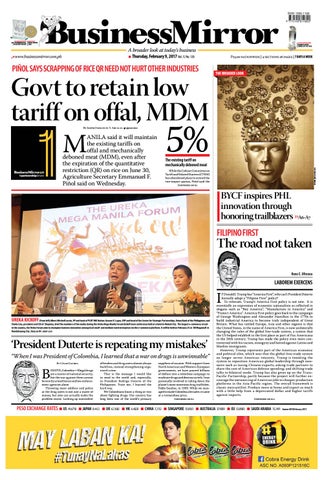
UREKA kickoff (From left) Albert Mitchell Locsin, VP and head of PLDT SME Nation; Genaro V. Lapez, EVP and head of the Center for Strategic Partnerships, Union Bank of the Philippines; and Sheila Lina, president and CEO of Shopinas, brief the members of the media during the Ureka Mega Manila Forum kickoff news conference held at a hotel in Makati City. The largest e-commerce circuit in the country, the Ureka Forum aims to champion business innovation among local small- and medium-sized enterprises via the e-commerce platform. It will be held on February 25 at SM Megamall in Mandaluyong City. Story on B4. NONOY LACZA
‘President Duterte is repeating my mistakes’
“When I was President of Colombia, I learned that a war on drugs is unwinnable”
B
By César Gaviria
OGOTÁ, Colombia—Illegal drugs are a matter of national security, but the war against them cannot be won by armed forces and law-enforcement agencies alone. Throwing more soldiers and police at the drug users is not just a waste of money, but also can actually make the problem worse. Locking up nonviolent
PESO exchange rates n US 49.6710
offenders and drug users almost always backfires, instead strengthening organized crime. That is the message I would like to send to the world and, especially, to President Rodrigo Duterte of the Philippines. Trust me, I learned the hard way. We Colombians know a thing or two about fighting drugs. Our country has long been one of the world’s primary
suppliers of cocaine. With support from North American and Western European governments, we have poured billions of dollars into a relentless campaign to eradicate drugs and destroy cartels. I was personally involved in taking down the planet’s most notorious drug trafficker, Pablo Escobar, in 1993. While we managed to make Colombia a bit safer, it came at a tremendous price. Continued on A2
f Donald J. Trump has “America First”, why can’t President Duterte formally adopt a “Filipino First” policy? To reiterate, Trump’s America First policy is not new. It is essentially an expression of economic nationalism as reflected in slogans such as “Buy America”, “Manufacture in America” and “Protect America”. America First policy goes back to the campaign of George Washington and Alexander Hamilton in the 1770s to build industrial America to become truly independent of Great Britain. What has rattled Europe, Asia and other regions is that the United States, in the name of America First, is now unilaterally changing the rules of the global free-trade system, a system that the US helped establish in the first place as part of Pax Americana in the 20th century. Trump has made the policy even more controversial with his racism, misogyny and hatred against Latino and Muslim immigrants. However, Trump represents part of the American economic and political elite, which sees that the global free-trade system no longer serves American interests. Trump is tweaking the system to reposition American global leadership through measures such as taxing Chinese exports; asking trade partners to share the cost of American defense spending; and shifting trade talks to bilateral mode. Trump has also given up on the TransPacific Partnership, partly because the project will further encourage the outsourcing of American jobs to cheaper production platforms in the Asia-Pacific region. The overall framework is classic mercantilist: Produce more at home and export as much with a little help from a depreciated dollar and higher tariffs against imports. Continued on A11
n japan 0.4422 n UK 62.1682 n HK 6.4020 n CHINA 7.2132 n singapore 35.0561 n australia 37.9039 n EU 53.0983 n SAUDI arabia 13.2491
Source: BSP (8 February 2017 )
A2 Thursday, February 9, 2017
BMReports BusinessMirror
www.businessmirror.com.ph
Govt to retain low tariff on offal, MDM Continued from A1
government is not keen on immediately lowering tariffs on raw materials used by meat processors. “The option discussed during the CTRM was for the extension of Executive Order [EO] 190, which prescribes the tariff of 5 percent on offal and MDM,” he told reporters in an interview. “Nothing would change until Republic Act [RA] 8178 is amended.
Even if the QR on rice expires by June 30, there cannot be unregulated entry of imported rice until it is scrapped by amending the law,” Piñol added. The World Trade Organization (WTO) has allowed the Philippines to implement the rice QR until June 30. As a concession, Manila had to lower the tariff on MDM to 5 percent, from 40 percent, for the duration of the extension. Hog producers also said the gov-
ernment lowered tariff on pork offal to a range of 5 percent to 10 percent to retain the rice-import quotas. Under EO 190, signed by former President Benigno S. Aquino III, the Philippines will restore its tariff on MDM to the original rate of 40 percent on July 1 this year. Piñol also said the CTRM has decided to formally request the WTO to give the Philippine government more time to amend RA
8178, which allowed the QR on rice. Under WTO rules, the rice QR would have to be replaced by tariffs upon its expiration. “In view of the lack of time to negotiate for the rice QR extension, the government would have to let it go. But we will ask the WTO to be patient as we have to observe democratic processes,” Piñol said. Earlier, the National Economic and Development Authority (Neda) said it is no longer possible
to amend RA 8178 before June 30. Neda Assistant Secretary Mercedita A. Sombilla said the agency has already prepared a draft bill, but it has yet to be subjected to consultations. Piñol said some representatives from the Neda met with him earlier and asked him to endorse the bill amending RA 8178. “The Neda asked me to endorse the bill, but I cannot endorse it because our position [to extend the QR] has been consistent.”
According to the WTO General Council Ruling released in July 2014, the Philippines should subject rice imports to ordinary customs duties right after the QR waiver extension expires on June 30. Under the QR scheme, rice imports within the minimum access volume (MAV) of 805,200 metric tons per year are slapped with a lower tariff of 40 percent, while imports in excess of the MAV are slapped a higher tariff of 50 percent.
‘President Duterte is repeating my mistakes’ Continued from A1
My gover nment and ever y administration since threw everything at the problem—from fumigating crops to jailing every drug pusher in sight. Not only did we fail to eradicate drug production, trafficking and consumption in Colombia, but we also pushed drugs and crime into neighboring countries. And we created new problems. Tens of thousands of people were slaughtered in our antidrug crusade. Many of our brightest politicians, judges, police officers and journalists were assassinated. At the same time, the vast funds earned by drug cartels were spent to corrupt our executive, judicial and legislative branches of government. This heavy-handed approach to drugs did little to diminish the drug supply and demand in Colombia, much less in markets like Western
Europe and the United States. In fact, drugs, such as cocaine and heroin, are as accessible as ever from Bogotá to New York to Manila. The war on drugs is essentially a war on people. But old habits die hard. Many countries are still addicted to waging this war. As Colombia’s current president, Juan Manuel Santos, said, “We are still thinking within the same framework as we have done for the last 40 years.” Fortunately, more and more governments also concede that a new approach is needed, one that strips out the prof its that accompany dr ug sales, while ensuring the basic human rights and public health of all citizens. If we are going to get drugs under control, we need to have an honest conversation. The Global Commission on Drug Policy—of which I am a founding member — has supported an open, evidence-
based debate on drugs since 2011. We strongly support reducing drug supply and demand, but differ fundamentally with hard-liners about how this should be achieved. We are not soft on drugs. Far from it. What do we propose? Well, for one, we do not believe that military hardware, repressive policing and bigger prisons are the answer. Real reductions in drug supply and demand will come through improving public health and safety, strengthening anticorruption measures—especially those that combat money laundering—and investing in sustainable development. We also believe that the smartest pathway to tackling drugs is decriminalizing consumption and ensuring that governments regulate certain drugs, including for medical and recreational purposes. While the Filipino government has a duty to provide for the secu-
rity of its people, there is a real risk that a heavy-handed approach will do more harm than good. There is no doubt that tough penalties are necessary to deter organized crime. But extrajudicial killings and vigilantism are the wrong ways to go. After the killing of a South Korean businessman, Duterte seemed as if he might be closer to realizing this. But bringing the army in to fight the drug war, as he now suggests, would also be disastrous. The fight against drugs has to be balanced so that it does not infringe on the rights and wellbeing of citizens. Winning the fight against drugs requires addressing not just crime, but also public health, human rights and economic development. No matter what Duterte believes, there will always be drugs and drug users in the Philippines. But it is important to put the problem in perspective: The Philippines al-
ready has a low number of regular drug users. The application of severe penalties and extrajudicial violence against drug consumers makes it almost impossible for people with drug-addiction problems to find treatment. Instead, they resort to dangerous habits and the criminal economy. Indeed, the criminalization of drug users runs counter to all available scientific evidence of what works. Taking a hard line against criminals is always popular for politicians. I was also seduced into taking a tough stance on drugs during my time as president. The polls suggest that Duterte’s war on drugs is equally popular. But he will find that it is unwinnable. I also discovered that the human costs were enormous. We could not win the war on drugs through killing petty criminals and addicts. We started making positive impacts only when we changed tack, des-
ignating drugs as a social problem and not a military one. A successful president makes decisions that strengthen the public good. This means investing in solutions that meet the basic standards of basic rights and minimize unnecessary pain and suffering. The fight against drugs is no exception. Strategies that target violent criminals and undermine money laundering are critical. So, too, are measures that decriminalize drug users, support alternative sentencing for low-level nonviolent offenders and provide a range of treatment options for drug abusers. This is a test that many of my Colombian compatriots have failed. I hope Duterte does not fall into the same trap. New York Times News Service ■ César Gaviria was president of Colombia from 1990 to 1994 and the secretary-general of the Organization of American States from 1994 to 2004.
news@businessmirror.com.ph
The Nation BusinessMirror
Comelec: 10% of Pcos defective By Joel R. San Juan @jrsanjuan1573
T
HE Commission on Elections (Comelec) has discovered that around 8,000 units of the old Precinct Count Optical Scan (Pcos) machines, are defective in an ongoing diagnostic examination being conducted by the poll body. Comelec Chairman Andres D. Bautista told reporters the number represent 8 percent to 10 percent of the 81,896 Pcos units. He said among the defects found are having nonfunctioning parts that would be needing replacements. “All of these still have to be validated, though,” Bautista said. Bautista said they expect the diagnostics project of the 81,896 units of Pcos machines
to be completed by March. Earlier, the commission en banc had approved the budget, amounting to P10.6 million, for the diagnostic examinations of the voting machines that were used in the 2010 and 2013 polls. The diagnostics project is being undertaken by the Comelec-Information Technology Department and the Department of Science and Technology in a bid to determine if they can still be used in the 2019 polls. Bautista said once the Pcos machines are completely diagnosed, the commission will submit the report to the Comelec Advisory Council (CAC). “With that data, we can already consult with others and, of course, with the CAC, which is mandated to recommend the appropriate technology we should use,” the poll chief added.
Quimbo hits energy commissioners
D
EPUTY House Speaker Romero S. Quimbo on Wednesday berated four officials of the Energy Regulatory Commission (ERC) for ganging up on their superior. “Bakit ngayon lang kayo nag-iingay e iyong dating chairman na dawit sa scam na billions of pesos ang involved. Damay ang ERC sa mata ng publiko. Not a whimper from you four. It seems to me that you are selectively choosing what matters you cry for justice. This makes me feel like there is a deep-seated resentment among the commissioners against the current chairman [Jose Vicente Salazar],” Quimbo said during the joint hearing of the Committees on Good Government and on Public Accountability and on Energy, noting the absence of a similar outcry from them during Zenaida Ducut’s tenure. Quimbo was addressing Commissioners Josefina Asirit, Gloria Victoria Yap-Taruc, Geronimo Sta. Ana and Alfredo Non, who attended the congressional inquiry looking into corruption allegations that supposedly led to the suicide
of ERC Director Francisco Villa Jr. in November 2016. The four ERC commissioners spoke of a “cloud of mistrust and fear”, and at certain points accused Salazar of conflict of interest and having demanded a stop to an internal inquiry into alleged corruption in the agency. Quimbo cited their silence when Ducut, the former ERC chief, was being asked by lawmakers both in the House and the Senate to either take a leave of absence or resign from the ERC after being implicated in the P10-billion porkbarrel scam engineered by Janet Lim-Napoles. Ducut at the time represented the Second Congressional District of Pampanga (1995 to 2004). In 2008 she was appointed ERC chairman by then-President Gloria Macapagal-Arroyo. Quimbo said if the commissioners, who were already with the ERC when Ducut was chairman, were so concerned by allegations of corruption, then why did they not raise any objections to Ducut’s tenure in the ERC and her involvement in the multibillion-peso scam? Jovee Marie N. dela Cruz
Editor: Dionisio L. Pelayo • Thursday, February 9, 2017 A3
Alvarez threatens congressmen who will vote vs death penalty
S
By Jovee Marie N. dela Cruz
@joveemarie
PEAKER Pantaleon D. Alvarez on Wednesday said there will be no conscience vote among lawmakers on the controversial death-penalty bill at the House of Representatives.
Alvarez, in an interview, said House leaders and members of the ruling PDP-Laban who will vote against the reimposition of the capital punishment should resign. According to the Speaker, the same rule will also apply on committee chairmen and vice chairmen at the Lower House. Alvarez added that House leaders who will not support the Duterte administration and the House’s priority bill will be replaced. “They are free to resign from the party. I will not force them, of course,” Alvarez said. “[Ang mga] deputy speakers na hindi sasama doon sa administration bill, papalitan po natin. Kasi awkward na deputy speaker ka and then you don’t agree with the leadership,” he said. Earlier, Alvarez said he has enough votes to approve the capital punishment in 30 days, as the so-called super majority will vote in favor of the death-penalty bill. But lawmakers opposing the deathpenalty bill continue to raise the issue of quorum as a dilatory tactic.
Under the death-penalty bill several crimes are punishable by death through hanging, firing squad or lethal injection, but Alvarez said the lower chamber may change the scope of the death-penalty bill as the House may focus only on illegaldrugs-related crimes. Among the deputy speakers who are against the capital-punishment bill are Lakas Rep. Gloria Macapagal-Arroyo of Pampanga, Liberal Party Rep. Romero S. Quimbo of Marikina, and PDP-Laban Rep. Rolando Andaya Jr. of Camarines Sur. “I spoke with President Duterte about that, it’s alright with him if I oppose the death penalty,” Arroyo said in an earlier news conference.
Drilon warns vs trade sanctions
SENATE President Pro Tempore Franklin M. Drilon warned against moves to restore death penalty for heinous crimes, voicing concerns it could trigger trade sanctions against the Philippines. Drilon pointed out potential backlash,
citing “clear international treaty obligations that we cannot reimpose the death penalty domestically.” “Maraming repercussions iyan, as the Department of Justice said, it can always be cited, for purposes, say, denying us a preferential trade treatment in other countries,” Drilon said. For instance, he cited the European Union (EU). “Mayroon tayong General System of Preference kung saan walang tariff ang ating mga produkto. Now, if we violate our international treaty, then it could be reviewed, and that can be the basis for withdrawing the benefits.” Drilon further warned that, “more important, we will be isolated from the international community, because we cannot even be trusted to honor our treaty obligations. Malaking bagay po iyan sa international arena na mabansagan tayo na hindi tumutupad sa ating international commitments.” He added: “Namatay po ang death penalty dahilan sa maliwanag naman na hindi natin puwedeng maibalik ’yung parusang pagpatay dahilan sa ating treaty commitment. Ang isang tratado po ay kasama sa ating batas, at iyan po ay ating ni-ratify dito sa Senado, ni-ratify ng Pangulo ng ating bansa, at sinang-ayunan ng 2/3 ng Senado, at iyan po ay naging part of the law of the land. Doon po ay bawal maibalik ang death penalty, kaya hindi ko alam kung paano ijustify na ipapasa ang death-penalty bill in the face of this clear international treaty obligation that we cannot impose the death penalty domestically.” With Butch Fernandez
Economy
A4 Thursday, February 9, 2017 • Editors: Vittorio V. Vitug and Max V. de Leon
@lorenzmarasigan
C
argo traffic at the country’s ports rose by more than a 10th last year, thanks to the strong performance of Philippine exports in 2016, Data from the Philippine Ports Authority (PPA) showed the country’s cargo volume increased by 12 percent to 249.567 million metric tons (MMT) in 2016, from 223.672 MMT the year prior. PPA General Manager Jay Daniel R. Santiago attributed the growth to higher export cargoes, which now comprise 49 percent of the total cargo volume handled by the different ports nationwide. It increased by 23 percent for the entire 2016 period, from 60.855 MMT to 74.822 MMT registered a year earlier. Import volume, on the other hand, contributed 51 percent to the total, after posting a 4-percent increase to 76.781 MMT, from 73.765 MMT in 2015. “These are very encouraging figures, particularly the export data, which suggests that the sector is very healthy,” Santiago said. Of the total cargo volume last year, foreign cargoes accounted for 151.604 MMT, or an increase of 12.62 percent versus the 134.620 MMT handled in 2015, while domestic cargoes contributed 97.963 MMT, from 89.051 MMT, or an improvement of 10 percent. “Trade imbalance has been glaring the past couple of years in favor of imports, and in 2016 we saw that both sector is almost on equal footing,” Santiago said. “Nonetheless, the PPA is committed to continue streamlining procedures in favor of the cargo owners in our bid to lure them to bring in and ship out more cargoes, this year,” he added. Container volume, meanwhile, also posted positive figures, rising 12 percent to 6.574 million twenty-foot equivalent units (TEUs), from 5.861 million TEUs handled in 2015.
news@businessmirror.com.ph
249.567 MMT
Free tuition in SUCs to benefit mostly affluent students–PIDS
The total cargo volume registered by the PPA in 2016, from 223.672 MMT the year prior. Passenger traffic, on the other hand, increased by 8.51 percent to 68.101 million, owing primarily to increasing number of cruiseship arrivals in the country.
aying for the tuition of students in state universities and colleges (SUCs) will benefit mostly rich students, according to the Philippine Institute for Development Studies (PIDS).
PPA: Cargo traffic in local ports rose 12% last year By Lorenz S. Marasigan
BusinessMirror
Foreign containers grew by 14.11 percent to 3.973 million TEUs, while domestic boxes rose 9.28 percent to 2.6 million TEUs. Total import boxes is at 2.005 million TEUs, while export containers is at 1.968 million TEUs, wherein both posted increases of 15.4 percent and 12.8 percent, respectively. Among the ports that registered strong performance include the Manila International Container Terminal and the Manila South Harbor for international cargoes, North Harbor for domestic cargoes, as well as Cagayan de Oro, Davao and Iloilo. Passenger traffic, on the other hand, increased by 8.51 percent to 68.101 million, owing primarily to increasing number of cruise-ship arrivals in the country. Foreign passage volume went up by 8.678 percent to 33.221 million, while domestic passage traffic inches up by 8.34 percent to 34.879 million. Santiago attributed the increase to the “government’s ecotourism programs encouraging leisure travel to tourist destinations, such as Boracay, Puerto Galera, Coron, El Nido, and other emerging tourism sites”.
P
By Cai U. Ordinario
In a policy note, PIDS senior research fellows Aniceto C. Orbeta Jr. and Vicente B. Paqueo said the bulk of students studying in public higher-education institutions (HEIs) is mostly from higher-income groups. Data from the Philippine Statistics Authority (PSA) showed that students from the poorest and second-poorest income households only account for 11 percent in 1999 and 12 percent in 2014 of enrollees in HEIs. “This trend had not changed much through the years, despite the expansion of enrollment in public HEIs, from 35 percent in 1999 to 52 percent in 2014. Thus, giving free tuition to enrolled students in SUCs will benefit mostly the richer students,” Orbeta and Paqueo said.
Antipoor
Apart from being antipoor, paying
@cuo_bm
₧33B The annual allocation for tuition subsidy, which can only help 197,828 poor students, or 12 percent from the bottom 20 percent of households
for the tuition of SUC students will not guarantee these students will complete their degrees, because the biggest expense in collegiate education is living allowance, and not the tuition itself. The authors said under the Students’ Grants-in-A id Program for Povert y A llev iation (SGP-PA), which desig ned to
provide full funding for college students belonging to Pantawid Pamilyang Pilipino Program (4Ps) beneficiary-families, provides P60,000 annually. This amount consists of P20,000, or P10,000 per semester, for tuition; P35,000, or P3,500 per month for 10 months, for living allowance; and P5,000, or P2,500 per semester, for instructional materials. “It is clear that the biggest cost item is living allowance. Tuition, which the proposed bill will only cover, is just a third of the total cost. Partial financing is problematic, because only the richer households have the resources to finance the rest,” the authors said.
the government fails to sustain financing, particularly when demand for free tertiary education in SUCs increases. Targeting the poor with full financing using the grants-in-aid program under the UniFast law will clearly benefit more poor students than an untargeted general tuition subsidy for students of SUCs,” Orbeta and Paqueo said. A subsidized college education may also exacerbate income inequalities. If it is not targeted to the poor, who usually have lower qualifications, they will lose out to students with better backgrounds who are usually from richer households,” the authors said.
The choice
Proposals
The authors said the annual budget of the tuition subsidy, worth P33 billion, can only help 197,828 poor students, or 12 percent from the bottom 20 percent of households. If the budget is instead used for the Unified Student Financial Assistance System for Tertiary Education (UniFast), using the SGP-PA estimates, the budget can help as much as 549,522 students from poor households nationwide. The authors said under the SGPPA, which was designed to provide full funding for college students belonging to 4Ps beneficiary-families, provides P60,000 annually. There are also dangers in case
Currently, there are several proposals in Congress, among which are House Bill 5905 and Senate Bills 1304, 158, 177 and 198, which aims to provide free tuition for students enrolled in SUCs. These bills’ rationale cites the constitutional prov ision that mandates the state to “protect and promote the right of all citizens to quality education at all levels” and “take appropriate steps to make such education accessible to all. The 2017 General Appropriations Act already includes a budget of P8.3 billion for SUCs that have been barred from collecting tuition in the coming school year.
Naia privatization spooks airport workers
T
he reported proposal to privatize the operation and maintenance of the four Ninoy Aquino International Airport (Naia) passenger terminals was met with resistance, as hundreds of employees of the Samahan ng Manggagawa sa Paliparan ng Pilipinas (SMPP) embarked on a silent protest on Thursday morning. SMPP President Fering Lopez said the recent move to privatize five government-operated airports across the country is a prelude to the privatization of the Naia terminals. Lopez said the Department of Transportation (DOTr) had invited interested bidders to bid for the operation and maintenance of the BacolodSilay International Airport, Iloilo International Airport, Davao International Airport, New Bohol (Panglao) Airport and Laguindingan Airport. “We are afraid that the Naia terminals will also be privatized in the coming months by the national government, after it has invited bidders to bid the operations and maintenance projects of the five airports,” Lopez said. The DOTr earlier announced it is inviting bidders to improve services in key regional airports by giving their operations to concessionaires, including the enhancement of airside and
landside facilities. “We also heard that the next move of the government is to bid the Naia terminals, Lopez told the BusinessMirror. He said the SMPP and Naia employees have not been consulted regarding the proposed privatization. “That is why we have mounted this silent protest. We are serving notice that we are aware of the moves being made by the government, which would soon deprived us of our source of livelihood,” Lopez added. However, Manila International Airport Authority General Manager Ed Monreal said that, so far, he is yet to receive any instruction or guidance from the national government on plans to privatize Naia terminals. “We will let the Naia employees know if any directives will reach my office regarding the privatization,” he added. Lopez added that former airport General Manager Jose Angel Honrado rejected moves to privatize the Naia terminals during his tenure because “these terminals have remitted some P24.4 billion to the national government from 2010 to 2015.” Lopez quoted Honrado as saying: “Bakit ko ipa-privatized ang Naia eh
kumita naman ito. Nag-contribute ang airport ng P24.4 billion sa gobyerno from 2010 to 2015.” Honrado allegedly blocked Malacañang’s move to privatize the premier airport terminals from going into private hands, which perhaps explains why Naia remains untouched during former President Benigno S. Aquino III’s term. “Forget this privatization project,” Honrado reportedly told Mr. Aquino. Lopez added they tried to communicate with the Office of the President in October 2016, “but until now we have not received any response from them.” Lopez also said the SMPP has 641 members, 400 organic airport policemen, 140 organic rescue and firefighters and some 5,200 contracted manpower. But the policemen and firefighters, including the contracted manpower who are classified as nonorganic employees, are not allowed to join the SMPP, Lopez said. He added that the silent protest was mounted by the terminal workers this early, fearful that they may soon lose their jobs as a consequence of the privatization. Records show that there are some 7,500 organic and nonorganic employees of the Naia. Recto L. Mercene
NEA eyes ₧35.57 billion for SEP this year By Lenie Lectura
T
@llectura
he National Electrification Administration (NEA) needs P35.57 billion to energize over 23,000 sitios nationwide this year. Congress, the NEA said on Wedensday, will partly guarantee funding for the Sitio Electrification Program (SEP). “The NEA is thankful to the President, and the members of the Senate and the House of Representatives, for guaranteeing funding support for the program with the inclusion of some P1.8 billion in the approved 2017 General Appropriations Act [GAA] for the electrification of 2,410 sitios for 2017.” The NEA has identified around 23,713 sitios for energization this year, which requires P35.57 billion, or P1.5 million per sitio. In 2016 the NEA and the electric cooperatives (ECs) have succeeded in energizing 3,335 sitios nationwide, 185 more than its target for 2016. About P2.7 billion was spent to electrify 100,050 more households in the 3,335 sitios nationwide. “The continued intensification of rural electrifi-
cation is in line with the administration of President Rodrigo Duterte’s thrust of aggressively pursuing socioeconomic programs that would reduce, if not eliminate, poverty incidence in the rural areas of the country through the provision of reliable, efficient and affordable electricity,” NEA Administrator Edgardo Masongsong said. To improve service reliability to member-consumer-owners of the ECs, the NEA has also undertaken line enhancement in 181 barangays last year with a total budget of P1.031 billion. Most of these projects were within the coverage areas of Samelco I, Esamelco and Norsamelco in Region 8 with 54 barangays for line enhancement. Biselco, Omeco, Ileco III, Noneco, Boheco II and Surseco II upgraded their distribution system through submarine cable facilities, benefiting 11 barangays in their respective areas, with an aggregate project cost of P271.77 million. “The NEA is committed to be the vanguard of the country’s rural electrification program. We are one in ensuring that every single Filipino in the remotest areas enjoys the benefits of electricity,” Masongsong added.
Railway cruise
A group of high-school students enjoys an economical and leisurely commute onboard a human-powered wooden trolley along the railway tracks of the Philippine National Railways in Santa Mesa, Manila. Nonnie Reyes
House panel approves bill for creation of national performing-arts companies T
he House Committee on Culture has recently approved House Bill (HB) 4783, filed jointly by Albay and Samar Reps. Joey S. Salceda and Mel Senen Sarmiento, respectively, which provides the framework and criteria for designating the country’s national performing-arts companies, recognizing their contribution to the preservation of Philippine arts and culture, and providing financial subsidies. Chaired by Sorsogon Rep. Evelyn S. Escudero, the House Committee on Culture also created the technical working group for HB 4783, titled Philippine National Performing Arts Companies Act. The measure designates one national performing-arts company from vari-
ous performing arts genres, as follows: National Ballet/Contemporary Dance Company, National Theater Company, National Orchestra Company and National Choral Company. The framework is based on contestability and capacity building. HB 4783 also establishes the selection committee for the national performingarts companies, composed of 15 members, chosen from panels of experts in the artistic and technical aspects of the performing arts, and designated by the National Commission for Culture and the Arts (NCAA) and the Cultural Center of the Philippines. The committee is tasked to draw up guidelines for the selection of the national performing-arts companies,
involving the following procedures: call for applications of performing arts companies based on set guidelines and criteria; first screening for assessment by the Secretariat; and second screening and evaluation by the Selection Committee. The final selection will choose one qualified applicant each for orchestral music, theater, ballet/contemporary dance and choral music. The bill proposes that an additional 12 or three from each of the next most qualified applicants from each of the performing arts cited shall be chosen for a separate subsidy program. The results of the final selection shall be ratified jointly by the NCAA Board of Commissioners and the CCP Board of Trustees. PNA
16thPre-need Consciousness Week “Pre-Need: Kaagapay ng Bawat Pilipino”
A BusinessMirror Special Feature
www.businessmirror.com.ph
Thursday, February 9, 2017
A5
A worthy investment
I
T was straight out of a scene in the movie: A woman (Nova Villa) was grieving, wailing even, at the grave of what could be gleaned was her son. All of a sudden a man (Nonie Buencamino), 40 at most, materialized from the background and came to her rescue. Roughly three minutes into the conversation they were both grieving, and the woman revealed he could not take it anymore she wanted to die. Still weeping, the man said: “You want to die? Boy, we got something for you. Brand X Life Insurance, Nandito, Kapag Kailangan Mo.” A gale of laughter and for the briefest of hours we all could relate to it. You haven’t lived long enough if you haven’t been disrupted by a faceless somebody who comes knocking at your door at high noon and egging you on to buy a policy. Too much inconvenience in such a hectic time; you’re off to water the plants and take out the dirty laundry. “Do I even need that?” You say. “Do you even need this? Oh c’mon,” he says. A minute worth of chacha and marketing spiel, and the next thing you know is that you have let the man in your house as if you’re in a trance. “Everyone should have health insurance? I say everyone should have health care. I’m not selling insurance,” says American politician Dennis Kucinich, who introduced a bill in Congress that would provide all coverage for everyone, all medically necessary procedures, plus vision care, dental care, mental-health care and long-term care. But this is not just about health insurance as this, as universal as basic health care as it should be, talks more about addressing specific financial needs on specific time, be it college education, retirement; specific contingencies such as illness, disability or a a place to nestle (if not in heaven!), unfettered by gaping costs and debts that your children would inherit when you die to get you to your grave: life insurance.
What is preneed
THE pre-need industry took roots in the Philippines with the introduction of the memorial plan in 1966. Very few realized that the industry would soon flourish into one of the economy’s vital and productive pillars. Public acceptance of a life plan was not easy to come by, largely because the product was untested, if not viewed as a morbid program. Slowly but gradually, however, people saw the wisdom of planning for the future via the preneed plan which is best described as a “contractual arrangement between an individual and the plan issuer to provide at some future date the services contracted for in exchange for payment of said services in lump sum or installment at the present time and at current market prices.” The demand for pre-need plans began to expand that various concerns where saving for
the future is an essential became a target for companies. Thus, education and pension plans followed. Even the insurance sector and health maintenance organizations have come to accept the business opportunities offered by the industry. The growing popularity of pre-need plans is mainly due to the public trust established by the various pre-need companies with a strong network of sales people all over the country who push pre-need products with all their positive features. The industry also benefits greatly from the country’s improved economy enabling people to have more resources to buy pre-need plans as a form of security especially in times of instability. They know that with pre-need plans, they have guaranteed funding or adequate savings for future needs as education for their children, for their retirement years or when the inevitable comes.
PFPPCI and the 16th Preneed Consciousness Week
UNDERLYING the success of preneed companies is public trust which must be upheld and protected at all costs. The rapid increase in the number of firms offering various pre-need products and services posed a real and positive threat to the industry’s public trust. It, therefore, became imperative to establish an umbrella organization to facilitate the smooth delivery of pre-need products and services in addition to the pre-need firms’ stringent selfpolicing of their ranks. Thus, in October 16, 1990 the Philippine Federation of Pre-Need Plan Companies, Inc. (PFPPCI), was formed at the instance of the Securities and Exchange Commission (SEC). This pioneering pre-need federation brought together three earlier formed pre-need organizations.” The Philippine Association of Memorial Life Plan Companies, Philippine Association of Pre-need Plan Companies Inc. and the Philippine Association of Pension and Education Plan Companies. The top 30 pre-need companies that control 90 percent of the market were initially represented. With the establishment of this umbrella organization, two objectives were satisfied: first, the strengthening of the industry; and second, and more important, upholding the protection of plan-holder interests and trust within the industry. This week, PFPPCI celebrated in style its 16th Pre-need Consciousness Week, conducting a series of activities that foster unity among PFPPC membercompanies and promote the pre-
PHILIPPINE FEDERATION OF PRE-NEED PLAN COMPANIES, INC. Directors and Officers Alberto M. Albano Catalino Marius A. Guingon Elmer M. Lorica Jaime B. Dizon Joseph S. Tanayan Josephine C. De Leon Rene P. Roy Elmer M. Lorica Rene P. Roy Elizabeth J. Tan Catalino Marius A. Guingon Jaime B. Dizon Maria Pia Caterina M. Manguiat
need concept of preparation and planning for a better future. This year’s theme being “Preneed: Kaagapay ng Bawat Pilipino,” specifically the federation hosted, among others, a forum on preneed and fellowship at Makati Shangri-La Hotel, not to mention an outreach activity for the benefit of the Bago Bantay Quezon City Graces (formerly known as Golden Acres Home for the Aged). With the view of making indispensable and fundamental life insurance is to a sound financial plan, PFPPCI was formed 16 years ago to standardize everybody in the game and closely monitor preneed companies in the Philippines for good corporate governance principles. The growth of the industry still largely spurred by such adherence, the intent is to improve the industry on an individual firm level. By virtue of the Circular Letter 2015-2017 issued in 2015 by then-Insurance Commissioner (IC) Emmanuel F. Dooc, all preneed companies are mandated to become a member of the PFPPCI to promote such standards, the mandatory membership being a requirement for the issuance or renewal of a Certificate of Authority to do business in the preneed industry, which is issued by the IC. “To promote the interest of the preneed industry and foster cooperation, discipline and harmony among preneed companies, this commission hereby directs all preneed companies
Himlayang Pilipino Plans , Inc. St. Peter Life Plan, Inc. Eternal Plans, Inc. Philplans, Inc. Cocoplans, Inc. First Union Plans, Inc. Trusteeship Plans, Inc. President Eternal Plans, Inc. Vice-President Trusteeship Plans, Inc. Secretary Ayala Plans, Inc. Treasurer St.Peter Life Plan, Inc. Auditor Philplans, Inc. Legal Adviser Paz Memorial Services, Inc.
authorized to transact business in the country and those intending to do preneed business to become a member of the federation,” the circular said.
Preneed still a desirable investment for Filipinos
A NEWS organization reported that, based on the data by the IC, the preneed industry is getting back up from a near collapse, this, after 15 licensed companies ratcheted up sales of nearly 184 billion plans (which translates to P7.359 billion) in the first quarter last year. This feat reflects a net worth of P18.792 billion, as per IC data. It can be recalled that more than 70 companies went to a downward spiral at the wake of the Education Act of 1992, which deregulated the financial cost of education. Other companies made the cut and continued operating by diversifying their product lines aside from education plans, such as memorial and pension plans. PFPPCI makes sense of tweaks and management tools, fine-tuning and calibrating them and phasing out outrightly unprofitable plans and replacing them with more promising ones. Innovative products were provided for to its clientele, and complying with the law as well as exercising self-regulation strengthened and expanded the preneed companies’ role to the financial sector. Micro-preneed products were pushed, benefitting ordinary wage earners.
TheBroa
Business
A6 Thursday, February 9, 2017
BCYF inspires PHL innovation
I
By Rizal Raoul Reyes
NNOVATION is one of the current buzzwords in today’s modern world. There are the Ubers and the Grabs that cause major disruptions in the transport industry. They have shown that an entrepreneur does not need to have a fleet of taxis or physical vehicles to enter the transport industry.
Meanwhile, in the theater scene, the highly successful and much-acclaimed musical Hamilton has made history by introducing rap music and hip-hop beat on Alexander Hamilton, an American statesman and one of the founders of the American financial system. Lin-Manuel Martinez introduced a drastic innovation by casting actors with Latino and AfricanAmerican roots in lead roles. Hamilton won 11 awards in the recent Tony Awards.
Innovation appetite
THE Philippines is not far behind, with Silicon Valley-based technopreneur Diosdado Banatao proving that Filipinos have what it takes to become a premier innovator. The Cagayan Valley-born engineer is credited for developing the single-chip graphical user interface accelerator that enabled computers to have stronger processing power. Banatao’s invention enabled users to utilize graphics for commands and veer away from the usual typed commands in older computers. Then we have Antonio Yap who, unlike Banatao, opted to stay within the country’s borders. Yap could be described as an individual with a voracious appetite for innovation. The chairman of the Benita and Catalino Yap Foundation (BCYF) emphasized that innovation is the key to achieve significant change in the Philippines. Yap placed his money where his mouth is. To promote innovation in the country, he established the BYCF Innovation Awards (BIA). The BIA is searching for Filipinos who Yap hopes would inspire innovators in agri-business, government services and small and medium business. “As far as the award is concerned, we are focusing on government services, education, small-medium enterprise and agri-business,” Yap told the BusinessMirror. “What we are trying to recognize are all ‘successful attempts’ in the last five years who have attempted to do things a little better.”
Old order
YAP said the people that BCYF has awarded in the past have shown innovation and viability. The group’s partners also reflect such gravitas: the University of Asia and the Pacific (UAP),
the Department of Science and Technology, the Department of Trade and Industry and the Junior Chamber International (JCI), among others. Local governments of Taguig City and Davao have also lent support to the BIA. Above all, Yap said, the people behind these institutions believe that pushing innovation is significant. “We all want to show Filipinos that innovation can be pursued in any field of endeavor, whether in business, education or politics,” he told the BusinessMirror, one of the media partners of the BIA. “These innovators will always seek and yearn for change to uplift and improve the conditions of society.” Just like change, innovation is a continuous process and perhaps permanent, Yap said. “Furthermore, the people are always in constant search for change, because people want to improve the old order, whether in a micro or macro scale,” he said. “The search for something better on a continuous basis is what defines individuals and organizations.”
Simple hope
YAP said the BCYF and its partners want to impart to the Filipinos that they must continue to be optimistic and never lose hope, “because these are important parts of change.” In undergoing innovation, Yap said people must learn along the way from their mistakes, “because committing the same mistakes will be a waste of effort to achieve change.” The BCYF also wants to spread the gospel of innovation not only to boost inclusive growth but to motivate Juan de la Cruz that he can also be an agent of change. “My hope is very simple,” Yap said. “The average person, whether they are leaders or followers, believes each one can make a difference.” For Yap, innovation does not need to be done in a science laboratory, university campus, factory or the corporate boardroom. “[Innovation] can be extended to the family, society’s basic unit, as its members can exchange views on what’s best for them,” he explained. “You can also talk to people who you don’t like. When you begin to talk like that, then there is true hope.”
“The Department of Agriculture supports the position of tobacco farmers. I will direct the NTA [National Tobacco Administration] administrator to explain why the agency is taking a position that is not supported by stakeholders.”— Agriculture Secretary Emmanuel F. Piñol
aderLook
sMirror
www.businessmirror.com.ph | Thursday, February 9, 2017
A7
n through honoring trailblazers
(From left) Roel Sancho, Department of Science and Technology (DOST) planning officer; Jerry Clavecillas, Department of Trade and Industry director, Bureau of Small and Medium Enterprise Development; DOST Secretary Fortunato de la Peña; Antonio Yap, Benita and Catalino Yap Foundation (BCYF) chairman; Benjamin de Guzman, BCYF trustee; Antonio Villarosa, BCYF executive officer; and Miguel Puyat, BCYF trustee. ROY DOMINGO
Yap: “We must show there are people supporting innovation. The process of interactivity distinguishes innovation with good ideas, good thoughts and good aspiration.” ROY DOMINGO
Andreus | Dreamstime.com
Dreams, pragmatism
ALTHOUGH dreaming is good for change, Yap points out pragmatism should be included in the equation. “You have to consider the basic things. My family needs to eat, I need to get promoted to advance on the social ladder,” he explained. “You also need to buy an automobile to give you greater mobility, or a plane ticket either for travel or vacation.” Nevertheless, Yap stressed execution is going to be a key to the success of the objective. “When you start executing and start to learn, then you would realize that, like most things in life, you must temper things with reality without giving up on strong ambition for a better future.” Yap does not agree that innovation must be applied to repair the country’s so-called damaged culture. The perception that the Philippines has a damaged culture originates from the beliefs of people in their sociopolitical and economic life. “I think it is about people and societies experiencing change when they choose bad leaders and
[there is a] breakdown in the social fabric,” he explained. “These challenges, however, present opportunities to people, such as going out or staying in the country. If they opted to stay, they must obey the laws of the country, such as the tax laws, business laws and criminal laws.”
Failures, mistakes
YAP said an innovator pursuing change should be prepared to fail, because innovation is born from many mistakes, and even the best inventions are not exempted from blunders. Since people have committed these mistakes, they can have a better perspective and in a better position to tell and teach young people the value of patience. “Innovation can come from the heart, family and institutions, as well as products and services.” Yap said innovation is a challenge and originates from many mistakes. Innovators must be like soldiers going to war, he said. “They should be organized and
flexible to be prepared for any given situation,” Yap said. “Those of us who pause and look at the situation are in a better position; we’re more patient to see it.” Moreover, he reminded that people who are better organized, open for change and criticism and open to ideas will do great in innovation whether they do it in giant steps, baby steps or, sometimes, by crawling. Yap said he expects the BIA to be a vehicle for the Filipinos to continue to show concern for the country and society that is not solely anchored on economics but with empathy and compassion. “We must show there are people supporting innovation. The process of interactivity distinguishes innovation with good ideas, good thoughts and good aspiration.” Again, he emphasized that innovation will play a big role in bringing the country to the promised land. “The dream of a better Philippines would be great,” Yap said. “Without innovation, people would be doing the same mistakes repeatedly.”
BIA finalists
AFTER extending the deadline for five days, the BCYF received a total of 104 nominations for the BIA. Seven were nominated for the agri-business category, 60 for government services, 25 for the small and medium enterprise category and 12 nominations for the technical-vocational category. Of the total nominations, only 32 submitted documentation of their respective innovation. The total nominees were further shortlisted to 11 on February 7. One of these is OneLab, or the One Stop Laboratory Services for Global Competitiveness, which integrates all laboratories under the DOST.
Lab integration
DOST Undersecretary for Regional Operations Brenda Nazareth-Manzano said the integration of the DOST laboratories is a step in the right direction to make it easier for clients to get quick access to services they need. “It would be a horrible experience for clients if they cannot find the service they are looking for in
our site,” Nazareth-Manzano said. “Our integration is the best move for DOST.” Since the laboratories are all in the network, she said DOST can refer a client to a unit that can serve their need. “Now we can tell our client you can leave your sample here and we can refer to the proper laboratory and pick up the result later.” The payment system of OneLab is done through banks. Moreover, the DOST is working on its online payment facilities to make transaction easier for clients. Manzano said each laboratory has developed a unified laboratory information system which manages the transactions of the laboratories within the system. For the DOST system alone, there are 21 laboratories, which include the regional units and research and development institutes. An interesting element of the site is that the DOST opened it for nonDOST entities both from the government and the private sector. “We do realize there are other tests that the private sector is already capable of doing, and nonDOST employees who specialize in competence in testing,” she pointed out.
Service delivery
LAUNCHED in August 2014, OneLab is an innovation in service delivery that virtually integrates 21 regional and research institute laboratories of DOST, as well as seven other non-DOST laboratories all over the country into a network. The aim is to provide easyaccess and wide-ranging service offerings to the manufacturing industries and the general public at a single touch point. Moreover, the network members are internationally recognized and accredited to ISO 17025:2005 “General Requirements for the Competence of Testing and Calibration Laboratories.” With a P256-million funding from the DOST, the OneLab Team crafted the project framework and proceeded with its implementation. There are two major innovative IT solutions that were implemented: the Unified Laboratory Information Management System (ULIMS) and the Referral System. Manzano noted the ULIMS
rationalized the transaction management of the 21 DOST laboratories in the network—from sample receiving, transaction traceability and data and report generation. Since all laboratory transactions are automatically logged in a database, the voluminous information can be utilized by the DOST to craft programs for rationalizing support for upgrading of testing laboratories and in the harmonization of systems, procedures and test fees. Last year, a total of 101,225 samples and 144,329 tests and calibration transactions were recorded. The use of ULIMS boosted the speed of transaction in the laboratory by 66 percent on the average, compared to the manual system prior to the implementation of the project, from 15 minutes per transaction to 5 minutes.
Seamless handling
THE system allows for seamless handling of samples from receiving, referral, transport and analysis to the prompt delivery of calibration and testing reports, no matter where the customers are in the country. This results into a seamless experience for customers because they don’t need to shuttle from one laboratory to another to have access to all their testing and calibration needs. Having international-accredited ratings, Manzano said customers are assured of getting accurate and complete instructions regarding their testing requirements, as well as online access to track the status of their test requests through the customer portal. The portal is available on three platforms (Web, Android and iOS), and can be accessed through the domain onelab.ph. Since the referral system went online in October 2015, Manzano said it has facilitated 153 referrals of 434 samples across the country requiring 575 tests and calibration. The DOST OneLab Team ensured sustainability of the project by institutionalizing the system in the DOST organization through Administrative Order 007 Series of 2015 issued by then Secretary Mario G. Montejo. OneLab and the other finalists would be honored in a BIA ceremony on February 20.
A8
Thursday, February 9, 2017
briefs
Syrian leads Pledge at citizenship event
CHICAGO—Rohi Atassi was among 117 immigrants to become the newest American citizens during a Chicago naturalization ceremony on Tuesday, but the Syrian dentist stood out among his peers. The 29-year-old was unexpectedly asked to lead immigrants from 37 countries in reciting the Pledge of Allegiance. Federal Judge Sara Ellis, who oversaw the ceremony, asked for a Syrian volunteer after delivering an impassioned speech about the difficulties immigrants face. While she never specifically mentioned President Donald J. Trump’s executive order barring immigration from seven predominantly Muslim countries, including Syria, Atassi said her words resonated with him. “I’m very happy that a Syrian who just became an American had a chance to lead the pledge,” he said. AP
El Salvador top court OKs civil trial for its former chief
SAN SALVADOR, El Salvador— El Salvador’s Supreme Court has ordered a civil trial of the body’s former president on suspicion of illicit enrichment. Tuesday’s ruling comes in the case of Agustin Garcia Calderon, who was Supreme Court chief magistrate from 2000 to 2009. He is alleged to have been unable to justify the origin of some $165,000 in personal accounts. Garcia Calderon has not made public statements about his case. If he were to lose in the civil trial, he would not face any criminal penalty. But he could be ordered to forfeit the money and be barred from holding public office for 10 years. AP
Iranian baby with heart defect admitted to Oregon hospital
PORTLAND, Oregon—An Iranian infant in need of life-saving heart surgery arrived on Tuesday at a Portland hospital with her family after being temporarily banned from coming to the US by President Donald J. Trump’s immigration orders. Iranian doctors told Fatemeh Reshad’s parents weeks ago that she needed at least one urgent surgery to correct serious heart defects, or she will die, according to her uncle, Samad Taghizadeh, a US citizen who lives in Portland. The family previously had an appointment in Dubai to get a tourist visa. But it was abruptly canceled after Trump announced his executive order banning the entry of people from seven countries with Muslim majorities. The girl and her parents had to return to Iran. AP
Huge numbers tune in to listen to court on Trump travel ban
SAN FRANCISCO—Huge and possibly unprecedented numbers of people tuned in on Tuesday to hear appeals court arguments over President Donald J. Trump’s travel ban. The San Francisco-based 9th Circuit Court of Appeals livestreamed the audio arguments between lawyers for the state of Washington and from Trump’s Department of Justice over the suspension of the nation’s refugee program and immigration from seven mostly Muslim countries. On YouTube alone over 136,000 people listened to the livestream at its peak. But the audio was also streamed on the Facebook and web pages of news outlets, and carried at least in part on CNN and MSNBC. Immediate figures for all those sources are not available, but they likely took the number of listeners well past a million. AP
The World BusinessMirror
www.businessmirror.com.ph • Editor: Lyn Resurreccion
Appeals court panel appears skeptical of Trump’s travel ban
I
t was a lively but technical hearing on an issue that has gripped much of the country’s attention—and that of foreign allies and Middle East nations—for the past week.
Issued without warning on January 27, a week after Trump took office, the executive order (EO) disrupted travel and drew protests at the nation’s airports by suspending entry for people from seven predominantly Muslim countries and limiting the nation’s refugee program. No matter how the 9th US Circuit Court of Appeals rules—in an order that is expected within days—an appeal to the US Supreme Court (SC) is likely. That court remains short-handed and could deadlock. A 4-4 tie in the SC would leave the appeals court’s ruling in place. “This is a traditional national security judgment that is assigned to the political branches,” said August E. Flentje, the Justice Department’s lawyer, who defended the travel ban. He urged the court to issue an emergency stay, saying the EO was plainly constitutional and beyond the power of the court to second-guess. Later, Judge Michelle T. Friedland pressed Flentje on that point. “Are you arguing, then, that the president’s decision in that regard is unreviewable?” Friedland asked. Flentje paused. Then he said yes. Several courts around the nation have blocked aspects of Trump’s order, but the broadest ruling was the one at issue in Tuesday’s arguments in front of the 9th Circuit. The three-judge panel was considering an earlier ruling by Judge James Robart of the US District Court in Seattle, which allowed previously barred travelers and immigrants to enter the country. Another judge, Judge William C. Canby Jr., asked, “Could the president simply say in the order, ‘We’re not going to let any Muslims in?’” Flentje said the two states, Washington and Minnesota, that have sued over Trump’s EO would be powerless to challenge such a hypothetical. He added others might be able to sue on religious
4-4
The possible number of votes in the US Supreme Court on Trump’s order suspending entry of people from seven Muslim countries discrimination grounds. The attorney for Washington state, Noah G. Purcell, fared little better in fending off questions from Judge Richard R. Clifton, who said the states’ evidence of religious discrimination was thin. The case, State of Washington v. Trump, is in its earliest stages, and the question for the appeals court on Tuesday was a narrow one: Should it stay Robart’s temporary restraining order and reinstate the travel ban while the case proceeds? The argument, which lasted about an hour, was conducted over the telephone and was livestreamed on the web site of the appeals court. In a media advisory issued before the argument, the court said that “a ruling was not expected to come down today, but probably this week.” T he gover nment a lso was pressed about whether the EO was supported by evidence of real and new threats. “Has the government pointed to any evidence connecting these countries to terrorism?” asked Friedland, who was appointed by President Barack Obama. Flentje said the government had not had an opportunity to present evidence in court given the pace of the litigation. With that, Friedland responded
Demonstrators outside the US Court of Appeals for the Ninth Circuit in San Francisco, where a threejudge panel heard arguments over the Trump administration’s travel ban on February 7. The judges voiced skepticism over the Justice Department’s broad defense of the ban. Jim Wilson/The New York Times
that the government’s appeal might be premature. Still, Flentje said the travel ban was well within Trump’s legal authority. A federal statute specifically gave presidents the power to deny entry to people whose presence would be “detrimental to the interests of the United States,” he said. He added that the court should not probe Trump’s motives, confining itself instead to “the four corners of the document.” “It’s not an order that discriminates on the basis of religion,” Flentje said. Purcell, the Washington state attorney, responded that the underlying purpose of the executive order was based on religious discrimination. As a candidate, Purcell said, Trump had “called for a complete ban on the entry of Muslims into the country.” More recently, Trump has said he meant to favor Christian refugees. “The court can look behind the motives,” Purcell said. As he closed his argument, Flentje, perhaps sensing that he was unlikely to achieve a complete victory, offered the court a middle ground. He asked, at a minimum, for the court to reinstate the part of the order that applied to people who have never been in the US,
calling this a “really key point.” Reading from a brief, he said that at most the EO should be blocked as to “previously admitted aliens who are temporarily abroad now or who wish to travel and return to the United States in the future.” Clifton said the administration might be in a better position to narrow its EO. “Why shouldn’t we look to the executive branch to more clearly define what the order requires?” he asked. Purcell also said it was hard to tell precisely what distinctions the government meant to draw. “They’ve changed their mind about five times” since the EO was issued, he said. Friedland said that if the order violated the Constitution’s ban on government establishment of religion, the court could block it completely. But Clifton, who was appointed by President George W. Bush, said that only a small fraction of the world ’s Muslims were affected by the order, suggesting that he was unconvinced that its effect was religious discrimination. C l if ton added t hat t he seven countr ies covered by the order “a re a concer n f rom a ter ror ism perspect ive.” The judges also questioned
whet her t he t wo states t hat brought the challenge had suffered t he sor t of d irect a nd concrete harm that gave them standing to sue. The SC has said that states suing the federal government to defend their interests are entitled to “special solicitude in our standing analysis”. In 2015 an appeals court ruled that Texas had standing to sue the Obama administration to challenge an immigration initiative. But the case did not seem likely to stall on the threshold issue of standing. Canby, who was appointed by President Jimmy Carter, appeared to indicate that the harm to state universities was enough to meet that standard. Nor were the judges much interested in another technical question pressed by Purcell. Robart issued a temporary restraining order, an interim measure, and Purcell argued that it was not subject to appeal. In court papers, the Justice Department argued that the order amounted to a preliminary injunction, which can be appealed. Proceedings before Robart are continuing. On Tuesday he asked for briefs on the question of whether he should issue a preliminary injunction. New York Times News Service
Trump visa crackdown threatens US search for medical miracles
F
rom tiny start-ups to global giants, the companies that sustain the $324-billion US biotech industry are increasingly alarmed as President Donald J. Trump considers following his controversial travel ban with restrictions on skilled foreign immigrants. To crank out discoveries, US biotech firms, such as Amgen Inc. and Gilead S c i e n ce s I n c. , a s we l l a s ove r s e a s companies with stateside operations, rely on the world’s best scientists and lowerlevel researchers with scarce expertise. A crackdown on visas for these workers could set back research, including the treatment of cancer, executives said. It also comes as companies, hospitals and universities struggle with the aftermath of Trump’s immigration ban from seven Muslim-majority counties, which has for now been blocked in court. “There’s a real crisis of science going on in this country,” said Cedric Francois, CEO of Apellis Pharmaceuticals, a start-up based in Crestwood, Kentucky, that is working on immune-therapy drugs. About half of Apellis’s staff come from abroad, largely brought in on the kind of visas, called H-1B, that allow temporary residence for skilled foreign workers. “Most, if not all of our people who are
on a green card started off on an H-1B,” said François, who is Belgian. “Including me.” The Trump administration is considering changes to the scope of the H-1B program, one of the main routes through which US employers sponsor skilled staff for immigration, White House Spokesman Sean Spicer told reporters last week. The administration may push to require companies to try to hire Americans first, and make it more difficult for lower-paid roles to qualify for the visas, “in order to serve, first and foremost, the US national interest,” according to a draft executive order seen by Bloomberg. So far, no such changes have been announced, and the White House hasn’t confirmed any details. Broader changes might require an act of Congress.
Infosys Ltd. and Wipro Ltd., are among their largest users. Silicon Valley giants, including Google Inc. and Facebook Inc., are also major H-1B sponsors, and have lobbied for years to make the category more flexible. The Trump administration didn’t respond to requests for comment. Trump has said it’s necessary to restrict travel from the seven countries because of the risk of terrorism. US bioscience firms employ about 1.7 million people, according to an industrybacked study, including a rising number of foreigners. Fewer than half of biomedical scientists in the US in 2014 were native-born citizens, according to the journal Nature, and a third were noncitizens. Meanwhile, thousands of foreign scientists travel to the US every year for specific projects.
Outsourcing concerns
The chief executives of two companies with US operations, Roche Holding AG, Europe’s largest drug-maker, and London’s AstraZeneca Plc, assailed the restrictions. “Science doesn’t have any borders, so anything that gets in the way of a borderless science exchange doesn’t help,” said Pascal Soriot, CEO of AstraZeneca, which has US headquarters in Wilmington, Delaware, and research and manufacturing sites in Massachusetts and Maryland. “We want to
Politicians in both parties, as well as labor unions, have criticized the H-1B program because they say it lets companies undercut American wages. Some Democrats have also sought to restrict H-1B visas, including through a bill introduced by US Representative Zoe Lofgren of California that would raise the minimum pay for such visa holders to $130,000. India-based outsourcing firms, such as
‘Borderless’ science
be able to move our people and our scientists around the world.” Trump’s first executive order on immigration gave companies an early hint of what could become broader struggles. At Monrovia, California-based Xencor Inc., which works on drugs for immune diseases and cancer, one employee had to cancel a trip for fear of being stranded and another abandoned hope of a visit from an elderly relative overseas, according to CEO Bassil Dahiyat.
Cancer research
Xencor relies on its non-American staff, Dahiyat said: “I can think of several off the top of my head who are absolutely pivotal.” Olivier Elemento, a computational biologist at Weill Cornell Medical College in New York, runs a cancer systems lab where two researchers have H-1B visas. The lab works on computational biology, where researchers analyze complex patient gene data to help find targets for new precision drugs—an approach that has led to recent breakthroughs. “Our research would suffer without a doubt,” Elemento said. “A lot of discoveries we would make maybe wouldn’t happen.” The immigration battle marks the second between drugmakers and the president. Last month Trump accused the companies of
“getting away with murder” by charging high prices for medicine and threatened to use the purchasing muscle of the federal government to drive costs down. While the pricing debate has cooled, much of the medical industry is now up in arms over the immigration issue. In a commentary published on February 1 in the New England Journal of Medicine, top doctors at seven major medical centers, including the Harvard University-affiliated Massachusetts General Hospital, wrote that policies preventing “the best from coming to train and work” will harm “America’s position as a world leader in health care and innovation.”
Crisis doctors
Medical leaders point to the central role of foreign doctors in the kinds of crises Americans fear. When the Boston Marathon bombings tore the city apart almost four years ago, a Greek doctor led Massachusetts General’s response: George Velmahos, chief of trauma surgery. Mass General and its affiliated Brigham and Women’s Hospital have 100 people with visas from the seven countries targeted by Trump’s order, according to Katrina Armstrong, Massachusetts General’s physician in chief. Bloomberg News
Asean
BusinessMirror
www.businessmirror.com.ph
Customer behavior changing fast in Asia Pacific Asean-EU Perspective
HENRY J. SCHUMACHER
T
he economic importance of the Asia-Pacific region has increased enormously in recent years, and especially after the arrival of Trump at the White House in Washington. And the success story is expected to continue. Countries like China and India, as well as the whole Southeast Asian region, will very likely continue to grow at rates faster than the global average. Consumers in Europe and in Asia Pacific not only behave differently, but their behaviors are also changing quickly. With a steadily increasing number of mobile devices and growing acceptance of mobile shopping, the Asia-Pacific market is rapidly moving from e-commerce to m-commerce (mobile commerce). Digitalization, mobility and connectivity are currently the major trends and drivers of innovation. Consumers in the Asia-Pacific region are shifting from desktop-based surfing to smartphone-led mobile Internet use as demand for convenience and speed grows. The rise of m-commerce offers significant growth opportunities—between 40 percent and 75 percent annually—to domestic and foreign enterprises. However, fast-changing trends also make the market extremely volatile. Companies are highly innovative in creating new apps to offer customers more opportunities and services at a very fast pace (hope executives from the Philippine telcos read this and deliver connectivity and speed!). Continually connected consumers—and all of us are—are turning to their mobile devices to research and complete their purchases while on the go (or sitting in traffic on the way to the office of home). With the trend increasing steadily year on year, and 3G and 4G connectivity continually improving worldwide (in the Philippines also?), it is expected that mobile devices will become an indispensable shopping tool for consumers globally. Consumers are actively using their smartphones to purchase goods and services or transfer money. New and growing areas in the service sector, including finance, education and health, are currently being developed. Companies are aiming to be a one-stop provider, combining various functions. The “WeChat” app, for instance, is much more than a messaging platform. Consumers can use other functions, including online shopping, flight and taxi booking services, etc. Mobile commerce acceptance levels (2015): China 70 percent India 60 percent US 27 percent Japan 24 percent
What are the challenges ahead? Highly innovative companies can reach out to millions of new users within a matter of weeks to quickly build a customer base. Although foreign companies may find entry into this fastchanging market difficult (because of equity restrictions, like in the Philippines), opportunities do exist in niche markets. Adjusting to tomorrow’s customers—as well as new regulations, certification and product accreditation requirements—will be among some of the biggest challenges foreign companies potentially face within the region, including the Philippines.
Qatar’s bank sees Southeast Asia as next growth target
Q
atar National Bank (QNB) SAQ is turning its focus to Southeast Asia for growth after hitting expansion goals for Africa and the Middle East three years earlier than planned. “We believe this region, the Middle East, Africa, Southeast Asia, gives us the best growth opportunity,” CEO Ali Al Kuwari said in an interview with Bloomberg TV at his office in Doha on Tuesday. “The business environment in Southeast Asia is great for us.” While QNB isn’t actively pursuing a large acquisition at the moment, the Middle East’s biggest bank will make use of opportunities as long as they fit the lender’s strategy, he said. With operations across 30 countries, QNB is boosting its presence in India, Indonesia, Vietnam and Myanmar, and turning its Singapore operation into an Asian hub, adding staff there and introducing Islamic finance products. It also plans to open a branch in Riyadh, Saudi Arabia’s capital, this year. QNB has almost doubled its assets to $198 billion over the past five years by increasing lending in its home market, and through acquisitions, buying 77.2 percent of Société Générale SA’s Egypt unit in 2012, about 20 percent of Togobased pan-African lender Ecobank Transnational Inc. in 2014 and its $3-billion purchase of Turkey’s Finansbank AS last year. After reaching its ambitions of having operations in the Middle East and Africa before a
The business environment in Southeast Asia is great for us.” —QNB
2017 goal, the lender’s plan will extend to Southeast Asia as its focal point until 2020, the CEO said. Al Kuwari, who has led the bank since July 2013, is presiding over an era of oil prices that have almost halved since mid-2014, and strains in two of its main markets, Egypt and Turkey. “Looking at Egypt and Turkey, the banking systems have been resilient to any problems and issues,” Al Kuwari said. “There is a promising future for the banking systems in both countries. We have a long-term commitment.” In Qatar an increase in oil prices of more than 20 percent over the past six months will add liquidity to the country’s financial system, the CEO said. There also haven’t been any signs of a slowdown in major projects, and companies and contractors are meeting their obligations, he said. “What we promised our shareholders is 15-percent return on equity,” Al Kuwari said, referring to a key measure of profit for banks. “But for us we will do our best to maintain 20 percent. As we diversify to mature markets, this number becomes a challenge.” Bloomberg News
Editor: Max V. de Leon • Thursday, February 9, 2017 A9
Ringgit crackdown saps volatility, deters investors
M
alaysia’s crackdown on currency speculators has come at a cost. While it has successfully reduced ringgit volatility, it is threatening to discourage overseas investors.
The central bank’s steps to curb trading in offshore nondeliverable forwards (NDFs) last year made it harder for global funds to hedge their exposure to Malaysia, according to Macquarie Bank Ltd. Global funds cut holdings of Malaysian debt by a combined 25.2 billion ringgit ($5.7 billion) last November and December, the biggest two months of outflows since 2008, central-bank data show. The difference between onshore and forward prices for the ringgit jumped to a record last November, spurring the central bank to crack down on NDF trading. Since then, the currency’s volatility has dwindled to the lowest in four years, while the ringgit slid to the weakest since 1998, even as oil prices stabilized and the central bank dismissed speculation it was about to impose capital controls. “The initial imposition of the NDF restrictions did lead to talk of the potential of further restrictions and even capital account closure,” said Julian Wee, a senior market strategist at National Australia Bank in Singapore. “These sort of measures tend to lead to a loss of confidence in the market, which was already jittery. However, the overall direction and movement in the dollar-ringgit has been due to the overall dollar trend in addition to BNM’s [Bank Negara Malaysia] inability to resist it.”
A measure of one-month volatility for the ringgit has tumbled since mid-November, when the central bank warned foreign banks not to engage in NDF-related transactions, turning the currency into emerging Asia’s least volatile, from the most. Volatility dropped to 2.5 percent last week, the lowest since December 2012.
Development needed
“While the foreign-exchange spot market liquidity has consistently been supportive and able to serve the needs of participants, forward market liquidity requires further development,” BNM said in a statement in response to questions from Bloomberg. “The recent liberalization measures, both for domestic and foreign investors, will improve overall market liquidity over time.” The ringgit has fallen 2.1 percent since November 15, the region’s worst performer after the yen, and reached 4.5002 per dollar on January 4, the weakest since the Asian financial crisis. The currency was at 4.4373 as of 4:50 p.m. in Kuala Lumpur on Tuesday. Not everyone is pessimistic. United Overseas Bank Ltd. (UOB) predicts the ringgit will strengthen to 4.35 per dollar by June 30, as it regains a positive correlation with crude oil. Oil-related products are Malaysia’s second-largest export. “The ringgit’s previously high-
AN employee uses a money counter at a Malaysian bank. BLOOMBERG
beta or sensitivity to dollar moves is clearly diminished,” said Peter Chia, a currency strategist at UOB in Singapore. “Factors in favor of a firmer ringgit include our estimated fair value of 3.90 and a return of the positive correlation to firmer oil prices.” B a n k Neg a r a bl a me d t he “opaque” offshore NDF market for worsening the pressure on the ringgit and said the currency’s pricing should never be disconnected from real economic activities in the onshore market.
Traders wary
Traders remain wary even after central bank Governor Muhammad Ibrahim allowed for greater hedging flexibility in the onshore currency market in an attempt to discourage the use of NDFs. In measures that took effect last December, Bank Negara pledged to ensure there would be “continuous liquidity of foreign currency” in the onshore market, and placed a cap on the amount of export proceeds companies can hold in foreign currency. The central bank said on Tuesday 16 fund managers, including foreign companies, overseeing a total of 46.8
billion ringgit had registered under its flexible hedging framework. Bank Negara has been engaging with international fund managers and industry associations to ensure smooth implementation of the initiatives to facilitate access to the onshore market, it said. Malaysia’s dwindling foreignexchange reserves mean it has less power to defend its currency. Reserves were $95 billion at the end of January, down from as high as $141.4 billion in May 2013. They have dropped in each of the past four years. The ringgit is poised to end this year at 4.80 per dollar, close to the record low of 4.8850 reached in January 1998, according to Nizam Idris, head of foreign-exchange and fixedincome strategy at Macquarie Bank Ltd. in Singapore. The NDF crackdown has done some harm for market players, he said. “While Bank Negara can say the onshore USD/MYR deliverable forward market could provide that hedge option, it is less liquid, certainly for after-hours trades. The cost of hedging for foreign investors has definitely risen at the margin.” Bloomberg News
Malaysia seizes brushes with pig hair as Muslims complain
M
alaysian authorities have seized thousands of paintbrushes suspected of containing pig bristles, after consumers in this Muslim-majority nation demanded a crackdown, officials said on Wednesday. Pigs and dogs are considered unclean by many Muslims, who make up some 60 percent of Malaysia’s 30 million people. It is illegal in the country to sell products made from any part of a pig or a dog, unless the goods are labeled and kept separately. Zarif Anwar, an enforcement
official with the domestic trade and consumer ministry, said that since Tuesday, officials nationwide have been inspecting shops selling paintbrushes for art and commercial use. He said the brushes seized were not labeled and found to have a different texture from other brushes and frayed ends, signs that they could be made from pig bristles. In some cases, the brushes had a halal certification that had expired, he said. The halal tag is issued by an Islamic government body to certify products safe to be used by Muslims.
The seized brushes will be sent to a lab to be examined, Zarif said. “We want to protect consumers and we want traders to be aware of the religious sensitivity involved. This is a big offense,” Zarif told The Associated Press. He warned that traders who flout the rule face up to three years in jail, a fine of 100,000 ringgit ($22,522) or both. Conservative attitudes have been on the rise in Malaysia. A wide range of products have been certified halal, from mineral water to a newly
launched internet browser, to appeal to Muslims. The Muslim Consumers Association of Malaysia called for stricter enforcement not just for paintbrushes, but for other products as well. An official from the group, Nadzim Johan, said the association also received complaints culinary brushes used in eateries may also contain pig bristles. “The key issue here is about labeling,” he said. “We want Muslim consumers to be forewarned. It’s not fair to deceive them.” AP
UN urges Thailand to stop banning insults to monarchy
A
n outside expert for the United Nations humanrights office is urging Thailand’s government to halt the use of laws that make it illegal to criticize the monarchy, calling them “a political tool to stifle critical speech.” Special rapporteur for freedom of expression David Kaye says international human-rights law is incompatible with Thailand’s lese-majeste provisions, under which people can be jailed for three to 15 years for insulting, defaming or threatening the royal family. Kaye’s call on Tuesday comes as a law-student activist is awaiting trial for defaming the crown, the first such case under Thailand’s new king Vajiralongkorn Bodindradebayavarangkun. Thailand’s military government
wants neighboring Laos to send back about half a dozen Thai citizens who have reportedly taken refuge there to escape being arrested for insulting the Thai monarchy. Thailand’s king, meanwhile, has named a new supreme patriarch to head the country’s Buddhist order, ending a deadlock that left the position empty for more than three years. Prime Minister Prayuth Chanocha said on Tuesday King Vajiralongkorn Bodindradebayavarangkun has appointed 89-year-old Somdej Phra Maha Muniwong to be the 20th supreme patriarch. His predecessor died in 2013 at age 100. Muniwong is the abbot of Wat Ratchabophit, a Bangkok temple closely associated with the royal family.
The Sangha Supreme Council, the ecclesiastical governing body, in January 2016 had followed legal procedure and tradition in nominating its most senior member to the position. However, Prayuth refused to endorse the council’s nominee, Phra Ratchamangalacharn, who has been accused of links to the prominent but controversial Dhammakaya sect as well as tax evasion. The law was changed in December to allow the king sole authority to appoint the supreme patriarch. The issue also appeared to be tangled up in secular politics. The Dhammakaya sect is considered sympathetic to former Prime Minister Thaksin Shinawatra, who was ousted by a 2006 coup and is the archenemy of Prayuth’s military government. AP
IN this file photo, Thailand ‘s new King Maha Vajiralongkorn Bodindradebayavarangkun delivers a speech after accepting the throne at the Dusit Palace in Bangkok. AP
A10 Thursday, February 9, 2017 • Editor: Angel R. Calso
Opinion BusinessMirror
editorial
Back to square one
I
T started at a most auspicious moment, full of hope and optimism that the solution to the government’s perpetual war against communist rebels has finally been found. That was the time when President Duterte declared in his first national address an immediate cease-fire in the military’s battle against the New People’s Army (NPA), the armed unit of the Communist Party of the Philippines (CPP). Duterte’s statement was positively received: “To the rebels, let us end these decades of ambuscades and skirmishes. We are going nowhere. And it is getting bloodier by the day. Let me make this appeal to you: If we cannot, as yet, love one another, then in God’s name, let us not hate each other too much. We express our willingness to go to the negotiating table, and yet we load our guns, fix our sights, pull the trigger. It is both ironic and tragic—and it is endless.” The President raised hopes of bringing an end to the communist insurgency that has stunted development for decades when the rebels reciprocated in kind and also declared a cease-fire. To advance the peace talks with the rebels, Duterte freed more than 20 communist leaders and consultants from prison so they could join the peace talks. The government even asked the US State Department to remove the rebel movement’s Netherlands-based founder and leader, Jose Maria C. Sison, from its terrorist blacklist to move negotiations forward. Then, on August 22, 2016, the peace talks between the government and communist rebels resumed in Oslo, Norway, aimed at ending one of Asia’s longestrunning rebellions that has claimed more than 150,000 lives to date. Sadly, before the peace negotiators can agree on any meaningful program, the CPP declared they are terminating their unilateral cease-fire, after accusing the government of failing to release all political prisoners and encroaching on rebel-held areas. The military, however, disagreed, saying the NPA violated the cease-fire agreement when NPA rebels killed three soldiers who were earlier reported missing, but whose bulletriddled bodies were found later on in Bukidnon. The incident angered Duterte, who announced last week that the government was scrapping a cease-fire with the NPA, saying the terrorist group was making huge, unacceptable demands despite government concessions. The President rejected the demand on the release of 400 political detainees, saying it is tantamount to granting amnesty. Following the breakdown of the talks and as both sides traded accusations of truce violations and negotiating in bad faith, gun battles erupted between the military and the rebels, killing a soldier and a rebel, and wounding six others. Duterte has since labeled the communists as terrorists, and no different from the Abu Sayyaf group that extorts and demands ransom from victims. The President said he had walked the extra mile to bring peace by ordering the resumption of peace talks and freeing rebel leaders, but all his efforts were not reciprocated in kind by the communists who took advantage of the situation to recruit fighters and extort money. Duterte then ordered an all-out war against the rebel forces, which means the government will use all available assets of the military to accomplish its mission, which is “to defeat the New People’s Army”. Sadly, we are back to square one. However, despite Duterte’s fierce rhetoric, the leftists in his administration praised his political will and urged all parties not to give up on the peace process that the President himself initiated on his first day in office. Since 2005
BusinessMirror A broader look at today’s business
What is wrong with the youth? John Mangun
OUTSIDE THE BOX
C
ultural pundits have spoken negatively for decades about modern society’s obsession with youth. There is a good reason for that “obsession”. While you may (or may not) see the wisdom of experience in my eyes, the 24-year-old man has the vitality and maybe even more vision.
The world has always and properly depended on the young to lead the way into a better future. Bill Gates was 20 years old and his partner, Paul Allen, was 22 when they founded Microsoft Corp. Gregorio del Pilar was leading Filipino soldiers when he was 24 and died at the Battle of Tirad Pass. Dr. Jose Rizal wrote Noli Me Tángere at 26 and El Filibusterismo at 30 years of age. Frenchman Blaise Pascal invented the mechanical calculator at 19 years old and countryman Louis Braille was 15 years old when he invented Braille Reading. British play-
Mining industry gasps for breath
✝ Ambassador Antonio L. Cabangon Chua
Val A. Villanueva
Founder Publisher Editor in Chief Managing Editor Associate Editor News Editor City & Assignments Editor Senior Editors
Max V. de Leon Jennifer A. Ng Dionisio L. Pelayo Vittorio V. Vitug Lorenzo M. Lomibao Jr., Gerard S. Ramos Lyn B. Resurreccion, Efleda P. Campos
Online Editor Social Media Editor
Ruben M. Cruz Jr. Angel R. Calso
Creative Director Chief Photographer
Eduardo A. Davad Nonilon G. Reyes
Chairman of the Board & Ombudsman President VP-Finance VP Advertising Sales Advertising Sales Manager Group Circulation Manager
Judge Pedro T. Santiago (Ret.) Benjamin V. Ramos Adebelo D. Gasmin Marvin Nisperos Estigoy Aldwin Maralit Tolosa Dante S. Castro
BusinessMirror is published daily by the Philippine Business Daily Mirror
HOM
Publishing, Inc., with offices on the 3rd floor of Dominga Building III 2113 Chino Roces Avenue corner De La Rosa Street, Makati City, Philippines. Tel. Nos. (Editorial) 817-9467; 813-0725. Fax line: 813-7025. (Advertising Sales) 893-2019; 817-1351, 817-2807. (Circulation) 893-1662; 814-0134 to 36. E-mail: news@businessmirror.com.ph.
www.businessmirror.com.ph
Printed by brown madonna Press, Inc.–San Valley Drive KM-15, South Superhighway, Parañaque, Metro Manila MEMBER OF
Businesswise
T. Anthony C. Cabangon Jun B. Vallecera
wright George Bernard Shaw may have thought the “Youth is wasted on the young”. However, it is the young who have challenged the existing order and status quo thinking to move humanity to a better place. While the methods and strategies have not always been correct, and sometimes the arguments were simply wrong, from global issues, such as the environment and poverty to education and technology, the youth has continually built the future. Perhaps, now something has changed, and not for the better. In a global survey conducted last
November asking, “Is your country moving in the right direction?”, only Canada of all the Western countries had a majority answering “Yes” and that was by a narrow margin. In the US, 65 percent said “No”. Sweden, the “happiest nation on earth” according to one set of parameters, also said “No” by a 78 percent-to-22 percent “No” vote. An amazing 87 percent of South Koreans felt their country was moving in the wrong direction. American Ted Malloch is President Donald J. Trump’s nominee as ambassador to the European Union. He served on the executive board of the World Economic Forum, which hosts the annual Davos meetings in Switzerland. However, he recently said in a television interview, with regard to the push for continued globalization of politics, economics and societies: “The Davos Man is dead.” The last decade has seen an economic disaster fall on the heads of the young, worldwide. The “liberaloriented” Economic Policy Institute posts these statistics for the United States. “Among blacks, 51 percent of high-school graduates and 23 percent of college graduates
W
ith over $1.4 trillion worth of minerals waiting to be excavated from identified mining areas, who could fault those who compare the Philippines to a poor man sitting on a pot of gold? But that pot of gold is looking more like wishful thinking or an unfulfilled dream with what I believe is a reckless move by the Department of Environment and Natural Resources’s (DENR) head, Regina Paz L. Lopez, to shut down 23 and suspend five mining operations in what was described in the industry as coming from an emotional, rather than a rational, mind. Lopez, who has yet to be confirmed as DENR secretary by the Senate’s powerful Commission on Appointments, apparently made the move on her own, ignoring the recommendations of the Mines and Geosciences Bureau (MGB). Her basis: these mining companies operate in “functional watersheds”. In fact, the Chamber of Mines of the Philippines (COMP) believes that the closure of the 23 mining operations “may not have been based on the review conducted by the MGB.”
According to Neila Halcon, COMP executive vice president, reports that reached them “said MGB personnel were even banned from her [Lopez’s] press conference,” where she announced her decision. Lopez said the Philippines could live without the expected revenues from the industry. She also refused to reveal the MGB recommendations, but said she would be willing to share them with President Duterte if asked. Thus, with one fell swoop, Lopez has put at risk 67,000 jobs and ignored the potential for the industry to generate about P66.6 billion worth of annual production. By disregarding a thorough vetting process, she has cost the government some P16.7 billion in tax revenues. Of the mines facing closure, 17 are involved in nickel production. These firms represent about half of the country’s annual nickel output, with the country being the world’s
biggest supplier of nickel since 2012, in the aftermath of Indonesia’s ban on mineral exports. Most of these nickel miners are located in Zambales. Documents show, however, that those responsible for environmental degradation in Zambales are seven Chinese companies that had gouged out the area, using nickel mining as pretext. Apparently, the responsible mining companies that have been shut down were not the cause of the large-scale environmental ruin in that province. Last year the Office of the Ombudsman has found probable cause to charge Zambales Gov. Hermogenes Ebdane Jr. with graft and usurpation of duty in connection with the alleged anomalous issuance of permits to a small-scale mining firm. The permits allegedly paved the way for the illegal hauling and shipping of chromite, valued at more than P211 million, from the province. In a 32-page resolution, the Ombudsman Special Panel for the Environment concluded that Ebdane had usurped the functions of the Provincial Mining Regulatory Board by issuing several small-scale mining permits to Geoking Asia Mining Corp. to haul chromite from the site of the Coto Chromite Project in Sitio Coto in Masinloc, Zambales, despite the existing agreement between the provincial government and largescale mining company Consolidated Mines Inc.
are currently unemployed. Among Hispanic high-school and college graduates, unemployment was at 36 percent and 22 percent, respectively, with whites coming in at 33 percent and 13 percent.” Yet, polls conducted globally by Pew Research show by an overwhelming majority those same young people support virtually all of the initiatives from the “Davos men and women”. According to the Strauss-Howe generational theory as described in the 1997 book The Fourth Turning by authors William Strauss and Neil Howe, which should be required reading, the “Crisis” period that we may be into sees the emergence of the “Grey Champion/s” to lead rather than the younger “Nomads” and “Artists”. But note this also, “Each time the Grey Champion appeared marked the arrival of a moment of darkness, and adversity, and peril, the climax of the Fourth Turning.” E-mail me at mangun@gmail.com. Visit my web site at www.mangunonmarkets.com. Follow me on Twitter @mangunonmarkets. PSE stockmarket information and technical analysis tools provided by the COL Financial Group Inc.
The resolution said Ebdane’s action constitutes a violation of Section 3 (e) of Republic Act (RA) 3019, which prohibits government officials from using their positions to give unwarranted benefits, advantage or preference to private party, as well as Usurpation of Official Functions under Article 177 of the Revised Penal Code. Aside from Ebdane, also indicted for Theft of Minerals under Section 103 of RA 7942 or the Philippine Mining Act of 1995 were four individuals from Geoking. What’s even more puzzling is the closure of OceanaGold’s Didipio operations in Nueva Vizcaya. The company is a “poster boy” for responsible mining, with no less than President Duterte conferring on it the award of being a model company in the extraction industry. OceanaGold Philippines Inc. Chairman Joey P. Leviste Jr. told BusinessWise in an interview that he was shocked upon learning that his company was one of those ordered closed, saying that such order has no legal leg to stand on. Leviste told BusinessWise that the Didipio operation is not in violation of any laws, rules or regulations, and does not pose any threat to public health and safety. To be continued For comments and suggestions, e-mail me at mvala.v@gmail.com
Opinion BusinessMirror
opinion@businessmirror.com.ph
Knowing oneself Is plant-based diet the solution to hunger problem? Msgr. Sabino A. Vengco Jr.
Alálaong Bagá
Ariel Nepomuceno
DECISION TIME
W
e don’t need a diploma on Abraham Maslow’s hierarchy of human needs to assert that food and water undisputedly top the list of people’s daily demand to live. Without these, all else in the pyramid that leads to a person’s self-actualization won’t stand a chance.
Let’s talk nutrition for now. And have a brief break from the politics and raging issues that beset everyone without exemption. The peace talks with the decades-old leftist insurgents just collapsed, although some luminaries and activists, such as Rep. Carlos I. Zarate, are trying to save what’s left of the historic efforts to achieve peace. The transport sector is up in arms. Inflation is just around the corner, and would strike anytime. The exchange rate is a bit alarming. Thus, let’s have a respite. Let’s find a humble contribution to address the issue on hunger and malnutrition. In the recent survey of Social Weather Stations, an estimated 3.1 million families are said to have experienced involuntary hunger at least once in the fourth quarter of 2016. This is 13.9 percent, or 2.2 points, slightly higher than the same period in 2015 (11.7 percent, or 2.6 million families). According to the survey agency, the 13.9 percent stands for the combined rate of those who said they experienced “moderate hunger” (those who experienced hunger “only once” or “a few times” in the last three months) and those who said they experienced “severe hunger” (those who experienced it “often” or “always” in the last three months). While factors that contributed to the country’s current self-rated hunger state are not mentioned in the study, a recent article by Barbara Unmuessig, president of the Heinrich Böll Foundation, offers plantbased solution to hunger. Her postulations deserve a closer look from concerned government agencies and advocacy groups. Unmuessig raises the correlation between meat-dependent consumption and its toll on poverty, malnutrition and hunger. Because meat production requires animal-feed production, agricultural lands are being inefficiently used to accommodate such demand in levels detrimental to humans. It argues that more plant-based food is needed to feed livestock than we would need to feed ourselves directly through a plant-based diet. “Animal-feed production, and the intensive cultivation of agricultural land that it requires, is not only destroying ecosystems and reducing biodiversity; it is also fueling climate change,” Unmuessig further claims. Going down to numbers, the head of an agency whose tenets are ecology and sustainability, democracy and human rights, self-determination and justice, Unmuessig cites that
the competition for land between humans and livestock is itself a fight for survival. She explains that land access, which is more unevenly distributed than incomes, is a deciding factor in whether someone suffers from malnutrition: 20 percent of households that experience hunger do not own land, and 50 percent of people who experience hunger are small-scale farmers. How can the Philippines respond to the challenge of addressing hunger through agriculture? At a time when a growing number of Filipinos consider themselves suffering from involuntary hunger, it would be wise to seriously look into the possibility of addressing the dire problem through the route of plantbased consumption. For instance, Moringa oliefera, also known locally as malunggay, is renowned worldwide for being the most generous and nutritious tree on the planet. According to the Food and Nutrition Research Institute of the Philippines, it is one of the world’s most useful plants. It is used as food, antibiotic, source of oil and even coagulant for turbid waters. Meanwhile, senior scientist Andreas W. Ebert, gene-bank manager and global theme leader of AVRDC —The World Vegetable Center, underscores moringa’s value as a vegetable tree for improved nutrition, health, and income of smallholder farmers. In his presentation at the First International Symposium on Moringa in Manila in 2015, he also emphasizes the high value of malunggay for sustainable food production and nutritional security, even amid various climate-change scenarios. Clinical pharmacologist Dr. Monica Marcu, one of the most referenced scientists on the study of moringa, supports the claims on its high nutritional value. She affirms that it is an extraordinary plant, and it comes very close to be a perfect source of nutrients in terms of variety and concentration. More than 3 million Filipino families are hungry, yet our rich soil can bountifully yield malunggay, which is scientifically proven to address malnutrition and hunger. With due support from the government in terms of policies, programs and funding, this miracle tree just might do the wonder for low-income families. And our people won’t have to go hungry again. For comments and suggestions arielnepo.businessmirror@gmail.com.
J
esus continues to give instructions to His disciples on the mysteries of the kingdom of God. In the Sermon on the Mount, we are led to search our mind and heart, and come to self-knowledge around a few crucial issues (Matthew 5:17-37) that illustrate a righteousness transcending a mere legalistic stand.
Yourself in relation to others Jesus calls for a higher righteousness that goes beyond the externals, as “scribes and Pharisees” are known for, as they aim to be “seen by others” (Mathew 6:5) calling attention to themselves. One becomes oblivious of the real needs of people, when one is ego-centered obsessing with the letter of the law, which is easier to measure up to than the more demanding spirit of the law and its innate connection with justice, love and compassion. This is very well demonstrated by the law “You shall not murder”. This act of aggression has an inside to outside dynamics; there is anger and contempt inside the murderer,
database
Y
es, blame also the policy-makers in Congress, officials of the National Police Commission (Napolcom), the head of the local governments and the armchair generals in Camp Crame.
They cannot escape responsibility why we have policemen involved in heinous crimes and other criminal activities, because the police budget passes through them from the congressional committees (the
House and the Senate) to the plenary sessions before the budget is authorized and appropriated and from there, to the local governments, Napolcom, the police headquarters and, finally, to the last police unit
allowed to prosper. Evil is not only at the final act; to see it fully and to handle it correctly, one must start where it begins.
You before God
Jesus uses strong, symbolic language to impact his listeners. The proper and needed attitude is to do whatever it takes, a radical decision to engage in the difficult inner work needed to truly stand against evil and obey God’s commandments. First, external rituals even in the liturgy do not substitute for the necessary and more difficult act of seeking reconciliation with the persons we have wronged. “Leave your gift there before the altar and go....” You can only tell God you are really sorry, if you also do to and for others what you should do in truth and in repentance, as the case may be, by way of reparation or restitution. Second, “if your right eye...[or] right hand causes you to sin, cut it off”. A part is only a part, for which the whole should not be sacrificed. It is the other way around: Get rid of and stop any portion that causes trouble to the entirety. For instance, lustful, aggressive, exploitative attitudes toward women or men must be tracked down to its roots and causes; our sexual desires cannot dominate
our whole life and bring it to ruin. A person’s sexual drives must be integrated into our life values and goals. Third, swearing to guarantee the truthfulness of one’s words or actions is bloated speech that betrays one’s insincerity and bluster. Swearing by God’s name is presumptuous, as if we can co-opt God to do our bidding. Alálaong bagá, to belong to God’s reign in communion with Jesus, we need to take the path of self-discovery, because only in the truth of who we really are and how we operate or behave, on the basis of our self-knowledge, can we earnestly walk in the light. Silence is the mother of integrity; only in the silence of our heart can we observe its fluttering and the machinations of our minds. Being fixated with externalities and satisfied with outside things can throw us entirely off balance and fragmented. Only when we are in touch with our feelings and thoughts and can bring them forward, can we be integral, in the delight of wholeheartedness, harmony and integrity, and for us Christians, in the light of Jesus. Join me in meditating on the Word of God every Sunday, 5 to 6 a.m. on dwIZ 882, or by audio-streaming on www.dwiz882.com.
Filipino First: The road not taken
Araneta, Gonzalo Puyat and Joaquin Elizalde, behind the Nepa mission of informing the Filipino people of “the progress of our industrialization and of the Filipino participation in business”. Nepa was warmly received by the government. Then-Finance Secretary Manuel Roxas wrote: “ The only workable economy possible under present conditions is a nationalistic economy on a producer-consumer basis. Every nation has adopted it to a greater or lesser degree…we must endeavor to supply as much of our requirements as practicable with our own production.” And yet, nothing happened. President Manuel L. Quezon and Secretary Manuel Roxas were not in a position to steer the country toward industrialization given the free-trade regime with the US, a trade arrangement that promoted Philippine reliance on a few agricultural exports (sugar, abaca, etc.) and industrial imports from America. This situation was further
compounded by the limited power of the “transition” Commonwealth government, the financial and economic crisis bred by the Great Depression, and the massive social unrest the crisis engendered. The second historic moment happened in 1958, when the National Economic Council, under the administration of President Carlos P. Garcia, came up with Resolution 202, promulgating a “Filipino First” policy. The resolution provided guidelines on how to give preferential treatment to Filipinos, particularly in the allocation of dollars and in their entry in any field of business. Dollar allocation was a thorny issue then. Because of the foreignexchange controls, domestic industries, mostly import-substituting in character, had to queue for dollars to be able to import needed industrial raw materials, machines and other inputs. The resolution was shortlived, because the Garcia administration retreated in the face of Chinese and American business opposition. The latter called the resolution a “fascist slogan”. Under the “parity” agreement of 1946, American businessmen could own land and operate freely in any area of the Philippine economy. However, they were angry they could not remit freely their dollar earnings because of the foreignexchange controls, and angrier that they had to play second fiddle to Filipino importers in the proposed allocation of dollars. The third historic episode took place in 1969. Then-Speaker Jose B. Laurel succeeded in shepherding through both chambers of Congress a joint resolution, entitled Joint Resolution 2, otherwise known as the “Magna Carta of Social Justice
and Economic Freedom”. Drafted by a group of nationalist economists, headed by Emmanuel Yap of the Congressional Economic Planning Office, and signed into law by President Ferdinand E. Marcos, the resolution calls for an overhaul of economic governance. It provides, among others, for the following policy guidelines: “The government shall vigorously push through a program of industrial and agricultural pioneering and development”; “the disposition of the nation’s foreign exchange shall be subjected to a rigorous system of priorities”; and “basic and integrated industries essential to change the structure of the economy” shall be established. In his sponsorship speech, Laurel thundered: “Only by industrializing the economy, through the establishment of basic industries, particularly those that will utilize indigenous raw materials, can we hope to resolve the perennial problem of mass unemployment and marginal income that hound the lives of our people”. Unfortunately, Resolution 2 was never given the full backing by Marcos, who dilly-dallied in its implementation, because of his back-door negotiations with the International Monetary Fund for a Philippine loan and the criticisms raised against the resolution by the liberal economic technocrats hired under the Presidential Economic Staff. When martial law was declared in 1972, Resolution 2 became one of the first casualties. In brief, Filipino First has never been truly enshrined as a national policy. The tragedy is that, seven decades after independence, the Philippines is still debating on how to build/rebuild its industrial base.
there for two years. If you get out alive, you can return here. If you die there, I will tell the police not to spend anything to bring you back here but to bury you there,” Duterte told them. “I will keep a battalion to keep track of your movements, because it has been the sad experience of this country that the most vicious criminals are mostly ex-police or exmilitary men.” Before this, Duterte, obviously angered by the killing by policemen of a South Korean businessman, lambasted the police as “corrupt to the core” and, at the same time, abruptly suspended the antidrug operations. Sad to note many of these especially trained Special Action Force (SAF) units ended up as drivers and
security guards of politicians. If one looks at the economic side of maintaining a force with improper delineation of functions and responsibilities, all he has to do is vet the overhead expenses in maintaining the regional commands and other overlapping units, which run into billions of pesos. Parts of this huge money could be saved and rechanneled to provide our policemen with living salaries and allowances to minimize corruption in the organization. Congress should look at the organization of the Philippine National Police (PNP) and its command and control structure, which is top heavy with a general headquarters in Camp Crame, 18 regional commands, a
large SAF, task forces and other units with overlapping functions and responsibilities that are very expensive to maintain. Since the funding of the PNP is formulated first at the PNP headquarters before it goes to the Department of the Interior and Local Government, Napolcom and the Department of Budget and, finally, Congress for its inclusion in the national budget, our lawmakers should thoroughly scrutinize the police budget, how it’s allocated to various commands and units, particularly funds for recruitment, training and education.
Rene E. Ofreneo
LABOREM EXERCENS Continued from A1
N
ow back to the Filipino First policy. This is not a new idea. Filipino cause-oriented organizations, past and present, have been advocating economic nationalism to free the country from foreign economic stranglehold and wipe out mass poverty through an integrated program of industrialization. This demand incidentally is included in the ongoing government-Communist Party of the Philippines peace talks related to a proposed “comprehensive agreement on socioeconomic reforms”.
But had there been no efforts on the part of our government to adopt a Filipino First policy? The answer is there were sporadic efforts. In fact, there were at least three historical moments where the Filipino First was formally enthroned, at least on paper, as the guiding governance framework. The first happened during the Commonwealth period, when colonial Philippines was given some elbow room by America for self-government. The impoverished situation of the country under the free-trade agreement with the United States, especially in the wake of the 1929-1933 Great Depression, prompted some emerging Filipino businessmen to call for self-reliant industrialization to end poverty and underdevelopment. A National Economic Protectionism Association (Nepa), led by a shoe entrepreneur, Toribio Teodoro of Ang Tibay, was formed in 1934. Nepa succeeded in mobilizing budding businessmen, such as Salvador
Don’t just blame the erring cops Cecilio T. Arillo
overflowing into abusive speech, and ending in vicious murder. Focusing on this final act is insufficient. Jesus focuses on the origin and growth of the evil thought, on extirpating the violent seeds in the heart, to stop murderous acts. The same process works regarding the commandment “You shall not commit adultery”. Adultery begins in the heart, with lust of the eyes. The famous adultery story of King David (2 Samuel 11) started when he saw from the palace roof a woman bathing; that evil imagining led to unjust force, coercive rape, deceit and eventual murder and elaborate cover-up. That was no love story, but a case of evil
Thursday, February 9, 2017 A11
for budget allocations. One crucial area of concern is the recruitment, training and education of our policemen. Who at the top are in charge of these? Specifically, who are the officers tasked in recruiting policemen, and who allocate their budget for training and education? These questions are valid, because it appears that the officials in the police chain of command have been recruiting the wrong applicants to the police force as shown, for example, by the hundreds of policemen lined up in the Malacañang grounds this week, all of them under investigation for various crimes, whom President Duterte condemned as “foolish, idiots and sons of bitches”. “I will send you to Basilan, live
To reach the writer, e-mail cecilio.arillo@ gmail.com.
2nd Front Page BusinessMirror
A12
Thursday, February 9, 2017
www.businessmirror.com.ph
Malacañang vows to observe due process in mine closures
P
By Jonathan L. Mayuga
@jonlmayuga
resident Duterte and his Cabinet have agreed to allow companies affected by mining closures to air their side, Palace Spokesman Ernesto C. Abella said on Wednesday. During the Cabinet meeting on Tuesday, Abella said one of the agenda of the Cabinet meeting was the evaluation of the environment and natural-resources sector “in the context of social justice”. “The President and his Cabinet collectively decided to observe due process with regard to the mining issue,” he said in a statement. “This means companies affected by mining closures for violations of environmental laws and regulations will be given the opportunity to respond or dispute with the audit, or make the necessary remedies
to ensure compliance with government standards,” Abella added. He said the Department of Finance (DOF) will have further discussions with the Department of Environment and Natural Resources (DENR) in their capacities as concerned government agencies of the Mining Industry Coordinating Council (MICC). Abella made the pronouncement on the day Environment Secretary Regina Paz L. Lopez declared that the closure and suspension orders for 28 mining companies that failed the mine audit
28
The number of large-scale mines that were shuttered by the DENR have been released. “It was an omnibus directive. It was prepared for all mining companies, and our lawyers have decided it should be issued to individual mining companies. That’s why there’s been a delay in its release,” Lopez said on Wednesday. She added the audit conducted by the DENR was “fair”, and “within the bounds of the law”. Lopez said the audit was undertaken “to protect the present and future generations as enshrined in the mining law and the Philippine Constitution.” On February 2 the DENR ordered the closure of the iron-ore mine of Ore Asia Mining and Development Corp. in Bulacan; gold and nickel
mine of Benguet Corp. in Benguet; and the nickel mine of BenguetCorp., Nickel Mines Inc., Eramen Minerals Inc., Zambales Diversified Metals Corp. and LNL Archipelago Minerals Inc. in Zambales. On Homonhon Island in Eastern Samar three mining companies were issued closure orders—Mount Sinai Mining Exploration and Development Corp. and Techlron Mineral Resources Inc. On Dinagat Islands, an islandprovince in Mindanao, seven of the nine mines were covered by the closure order. They are AAMPHIL Natural Resources Exploration, Kromico Inc., SinoSteel Philippines H.Y. Mining Corp., Oriental Synergy Mining Corp., Wellex Mining Corp., Libjo Mining Corp. and Oriental Vision Mining Philippines Corp. In Surigao del Norte the DENR ordered the closure of seven operating mines. They are the Adnama Mining Resources Corp., Claver Mineral Development Corp., Platinum Development Corp., CTP Construction and Mining Corp., Carrascal Nickel Corp., Marcventures Mining and Development
Corp. and Hinatuan Mining Corp. The DENR also issued suspension orders against five mining firms—Berong Nickel Corp., Citinickel Mines and Development Corp., Lepanto Consolidated Mining Corp., OceanaGold Phils. and Strong Built Mining Development Corp. Of the 41 large-scale mines, only 12 passed the mine audit based on Lopez’s set of criteria, which is anchored on social justice. The audit criteria included the environmental, biodiversity and social aspects of mining.
‘Initial victory’
The Chamber of Mines of the Philippines (COMP) hailed President Duterte’s decision, saying it is an “initial victory” for the stakeholders in the mining industry, as it meant that the “arbitrary” closure and suspension orders issued by Lopez are not final. Ronald S. Recidoro, vice president for legal and policy of COMP, said Malacañang’s statement only means Duterte and the members of his Cabinet recognize the gravity of the situation.
Mining companies, Recidoro added, will finally have legal remedies to contest the closure and suspension order. “We are relieved that finally the government, somebody in the administration, is taking charge of this whole affair. The statement of the Palace said that they will be reviewing the actions of Lopez,” he said. According to Recidoro, the mining industry will rely on Malacañang’s statement that the Duterte administration will review the decisions of Lopez. “We are hoping that the Cabinet will reverse the decision of Lopez.” “The game is not over. We will not take this lightly. This is about the livelihood of thousands of Filipinos. Not just for the companies, but for the men and women who rely on mining, because the immediate impact will be on them,” he added. COMP said Lopez’s “arbitrary” decision to close the 23 operating mines and suspend the operations of five other mines “will condemn 1.2 million miners and their family to hunger and poverty”.