BMReports
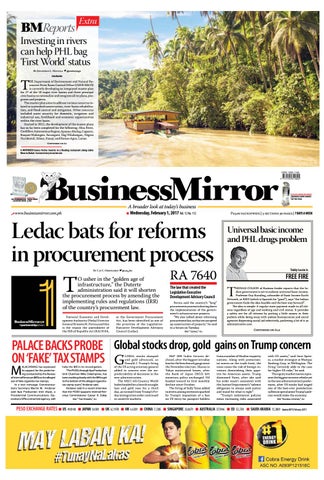
Investing in rivers can help PHL bag ‘First World’ status By Jonathan L. Mayuga
T
@jonlmayuga
Conclusion
HE Department of Environment and Natural Resources-River Basin Control Office (Denr-Rbco) is currently developing an integrated master plan for 17 of the 18 major river basins and three principal river basins to rationalize and integrate all its plans, programs and projects. The master plan aims to address various concerns related to watershed conservation, river-basin rehabilitation, and flood control and mitigation. Other concerns included water security for domestic, irrigation and industrial use, livelihood and economic opportunities within the river basin. Started in 2012, the development of the master plans has so far been completed for the following: Abra River, Cordillera Autonomous Region; Apayao-Abulug, Cagayan; Buayan-Malungon, Sarangani; Ilog-Hilabangan, Negros Occidental; Jalaur, Panay; and Ranao-Agus, Lanao. Continued on A2
A motorized banca ferries tourists in a floating restaurant along Loboc River in Bohol. Travnikovstudio | Dreamstime.com
media partner of the year
United nations
2015 environmental Media Award leadership award 2008
BusinessMirror A broader look at today’s business
www.businessmirror.com.ph
n
Wednesday, February 1, 2017 Vol. 12 No. 112
Ledac bats for reforms in procurement process RA 7640 T By Cai U. Ordinario
National Economic and Development Authority (Neda) Director General Ernesto M. Pernia said this is the reason the amendment of the IRR of Republic Act (R A) 9184,
or the Government Procurement Act, has been identified as one of the priorities of the LegislativeExecutive Development Advisory Council (Ledac).
Universal basic income and PHL drugs problem Teddy Locsin Jr.
free fire
The law that created the Legislative-Executive Development Advisory Council
Pernia said the country’s “long” procurement process is slowing down the implementation of the government’s infrastructure projects. “We also talked about reforming procurement law, so that we can speed up construction of projects,” he said in a forum on Tuesday. See “ Ledac,” A2
business news source of the year
P25.00 nationwide | 5 sections 30 pages | 7 days a week
@cuo_bm
o usher in the “golden age of infrastructure,” the Duterte administration said it will shorten the procurement process by amending the implementing rules and regulations (IRR) of the country’s procurement law.
2016 ejap journalism awards
T
HOMAS Colson of Business Insider reports that the Indian government is set to endorse universal basic income. Professor Guy Standing, cofounder of Basic Income Earth Network, or BIEN (which is Spanish for “good”), says “the Indian government finds the idea feasible and the best way forward”. The idea is simple: A regular state payment made to all citizens regardless of age and working and civil status. It provides a safety net for all citizens by putting a little money in their pockets while doing away with useless bureaucracies and social agencies dispensing social aid selectively, pocketing a lot of it as administrative cost. Continued on A10
PALACE BACKS PROBE Global stocks drop, gold gains on Trump concern ON ‘FAKE’ TAX STAMPS G
M
alacañang has expressed its support for the probe being conducted by the Bureau of Internal Revenue (BIR) on the alleged use of fake cigarette-tax stamps. In a text message, Communications Secretary Martin M. Andanar said Apo Production Unit (Apo), a Presidential Communications Operations Office attached agency, will
help the BIR in its investigation. “The PCOO, through Apo Production Unit Chairman Mike Dalumpines, has been working closely with the BIR to get to the bottom of the alleged cigarettetax stamp scam,” Andanar said. Andanar said in a recent interview that the PCOO supports Internal Revenue Commissioner Caesar R. Dulay See “ Tax Stamps,” A2
PESO exchange rates n US 49.8140
lobal stocks slumped and gold advanced, as Donald J. Trump’s firing of the US acting attorney general added to concern over the unpredictability of decisions in the new administration. The MSCI All-Country World Index headed for a fourth straight loss and gold rose for a third day, as turmoil from Trump’s Friday immigration order continued to unsettle markets.
S&P 500 Index futures declined, after the biggest intraday loss for the benchmark gauge since the November election. Shares in Tokyo maintained losses, after the Bank of Japan (BOJ) left monetary policy unchanged. Oil headed toward its first monthly decline since October. The firing of Sally Yates added to jitters among investors sparked by Trump’s imposition of a ban on US entry for passport holders
from a number of Muslim-majority nations. Along with protectionist moves on the trade front, the news raises the risk of foreign investors diminishing their appetite for American assets. Trump dismissed Yates, after she said his order wasn’t consistent with the Justice Department’s “solemn obligation to always seek justice and stand for what is right”. “Trump’s isolationist policies mean increasing risks associated
with US assets,” said Imre Speizer, a market strategist at Westpac Banking Corp. in Wellington. The firing “certainly adds to the case for higher US risks,” he said. The equity market moves represent the biggest investor rebuke yet to the new administration’s preferences, after US stocks had staged one of the best-ever postelection rallies on speculation Trump’s policies would stoke the economy. See “Global stocks,” A2
n japan 0.4381 n UK 62.1978 n HK 6.4209 n CHINA 7.2385 n singapore 35.0679 n australia 37.5946 n EU 53.2761 n SAUDI arabia 13.2869
Source: BSP (1 February 2017 )
A2 Wednesday, February 1, 2017
BMReports BusinessMirror
www.businessmirror.com.ph
Investing in rivers can help PHL bag ‘First World’ status Continued from A1
A master plan has also been completed for the Tagoloan River, Misamis Oriental, the 13th-largest river system in the Philippines in terms of watershed size, as classified by the National Water Resources Board. Other rivers with completed master plans include the Tagum-Libuganon, Davao del Norte; Iloilo-Batiano, Iloilo; and the Marikina River. According to Denr-Rbco Deputy Executive Director Donna M. Gordove, the government is hoping to complete the master plan for the Agno River, Pampanga River and the Agusan River. While apathy of stakeholders led to the current “sorry state” of many rivers, poor enforcement of environmental laws both by the national and local governments aggravated the situation. The National Solid Waste Management Commission estimates that more than 20 percent of Metro Manila’s 9,000 tons of waste, or around 1,800 tons find their way in creeks, canals, esteros and rivers passing through the National Capital Region. “In some areas, like in Metro Cebu and Metro Davao, uncollected waste that goes into the river is
Tourism. . .
Continued from A12
The increasing interest in the Philippines encouraged the DOT to mount a selling mission to Barcelona, the second-biggest source of visitors from Spain, after Madrid. She described the promotion activity on January 16 a success, with many of the Philippine travel companies and tourism operators securing contacts among Barcelona tour and travel agencies. “This was an initial selling mission, so no sales were actually booked. These were more business-to-business meetings,” Buensuceso explained. To further push the Philippines as a fun destination, the DOT also participated in the International Tourism Fair (Fitur) in Madrid from January 18 to 22, and Europe’s premier gastronomy event, Madrid Fusión 2017, from January 23 to 25. Philippines’s Tourism Attaché for London Gerardo Panga, who also oversees Spain, said “there were numerous joint promotions proposals from tour operators, travel agents and airlines during our product presentations and business networking in Barcelona... and at Fitur 2017.” He added that the marketing activities in Barcelona and at Fitur were attended by “11 companies from the Philippines specializing in the Spanish/European markets to help expand our travel trade network and overall consumer reach in Spain.”
more severe,” said Ely Ildelfonso, executive director of the NSWMC Secretariat.
ON Januar y 18 Env ironment Secretary Regina Paz L. Lopez made a policy pronouncement vowing to intensify the campaign against the indiscriminate dumping of garbage and operation of open dumps, and even sanitary landfills, to water bodies. Lopez had ordered Quezon City Mayor Herbert Bautista and Cebu City Mayor Tomas Osmeña to shut down their respective city’s sanitary landfills. The Payatas Sanitary Landfill is near the La Mesa Watershed, where water from Angat and Ipo dams are processed before distribution. The Inayawan Sanitary Landfill in Cebu City, meanwhile, is on a reclamation area. Underscoring the importance of protecting the country’s watersheds, Lopez said she will sign an order to close not only open dumps, but sanitary landfills situated near water bodies. Environment Undersecretary Arturo Valdez said a lot of open dumps and sanitary landfills are near river banks, threatening to
contaminate the country’s freshwater supply. Destructive human activities, Lopez said, compromise water sources, which she vowed “will not happen under my watch”. She also vowed to ban all development projects near watersheds that she said are “destructive”. The Denr said there are ongoing programs that aim to rehabilitate the country’s open, degraded and denuded forests, including critical watersheds. These programs include the National Greening Program (NGP) of 2010 to 2016 and the Expanded-NGP 2017-2028. The Denr-Environmental Management Bureau (EMB) implements public-private partnership projects in its effort to rehabilitate and protect the country’s rivers through the Adopt-an-Estero Program. So far, the DENR-EMB has listed a total of 480 esteros adopted, and had signed a total of 640 memorandum of agreements with its privatesector partners. The DENR-EMB also monitors water quality and puts under strict management regimes specific water bodies declared as water quality management areas (WQMAs). Republic Act 9275, or the Philippine Clean Water Act of 2004,
In a separate interview, Jose Mari Bernardino, sales and marketing director for El Nido Resorts, said it was heartwarming to see how the Philippines and the resort have achieved a much higher awareness level in the Spanish market. “We went from being virtually unknown [as a tourism destination], but after four years [of constant promotion], they are now looking for us,” he said after attending Fitur 2017. He added that Fitur was also an opportune time to tell the tour operators here about Lio, which is a more affordable alternative for other Spanish tourists. “Some are also looking for a less-expensive alternative to El Nido, so it’s timely because now we can tell them about Lio.” Lio is an ecotourism estate also owned by the Ayala Hotels and Resorts Corp. (AHRC). It is in mainland El Nido town, and will host hotels and bed-andbreakfast accommodations, along with commercial establishments and restaurants. AHRC’s Seda Hotel is scheduled to be completed this year. Other tourism establishments that participated in Fitur were Baron Travel Corp., Annset Holidays, Indochina Strip Philippines Plc., Corporate International Travels and Tours, Intas Destination Management, Travel Exports Inc., Sharp Travel Service, Sheridan Beach Resort and Spa, Henann Group of Resorts and Club Agutaya Inc. Fitur Madrid has become one of the world’s largest travel trade fairs
and the most important on the Iberian Peninsula. In 2016 there were 222,551 visitors to Fitur, which featured some 11,000 company exhibitors from at least 165 counties. For her part, Buensuceso said the Philippines’s attendance in Madrid Fusión, as well as the holding of Madrid Fusión Manila, has helped increase the awareness in Spain about the Philippines as a tourism and cuisine destination. “The chefs who have made presentations in the Philippines, for instance, said they tell all their friends about the Philippines all the time,” she enthused. At the Philippine booth on Monday, the first day of Madrid Fusión, for example, four young Spanish chefs made a beeline for the adobo samplers being served. Philippine cuisine is now being heralded as the new best cuisine by foreigners, being constantly written about by prestigious food magazines like Saveur, and newspapers, like the New York Times. The “third serving” of Madrid Fusión Manila (www.madridfusionmanila) will be from April 6 to 8 at the SMX Convention Center in Pasay City. An array of Michelin-starred chefs, along with popular Filipino chefs, will again make presentations during the International Gastronomy Congress. There will also be a monthlong Flavors of the Philippines activities that involve dining destinations around the Philippines playing up their local cuisine. (See “DOT launches Madrid Fusión Manila 2017,” in the B usiness M irror , January 30, 2017.)
Protecting sources
mandates the DENR to designate certain areas as WQMAs using appropriate physiographic units, such as watershed, river basins or water resources regions, to effectively enforce its provisions and improve the water quality of water bodies. “Keeping our river basins clean is important,” DENR-EMB Acting Director Jacqueline Caancan said. “That is why the DENR has adopted the ridge-to-reef approach in protecting our rivers.” The declaration of water bodies as WQMAs puts identified water body under strict management regime and under the control of a governing board to better protect them against pollution and other threats. “Under the WQMA system, the water body is placed under the control of a governing board that involves various stakeholders, including LGUs,” Caancan said. The governing board serves as a planning, monitoring and coordinating body. It also reviews the WQMA action plan prepared by the EMB. So far, the DENR had declared a total of 31 water bodies as WQMAs.
Problem of consciousness
LOPEZ said the problem besetting the country’s rivers is a problem
Ledac. . .
Continued from A1
The Neda chief said the IRR will be modified and revised to shorten the time needed to implement projects. He said this will be done by removing unnecessary provisions in the IRR, which he did not detail. This is also in keeping with one of the President’s primary directives to cut red tape and streamline government processes when he assumed office. “[The revision will focus on] changes that would speed up the procurement process. [We will cut the] time. There area some provisions that are unnecessary. The idea is to reform and speed up,” Pernia told reporters. Apart from streamlining the procurement process, Pernia said the government will revise the composition of the Ledac. Pernia said the Ledac will soon be called the Lejac to reflect the addition of the Judiciary in the council. “We want to invite the Judiciary to this council so that it will be a conversation among the three branches
Global stocks. . . Continued from A1
Meantime, the BOJ’s decision to keep its key policy tools unchanged came as little surprise, with all 42 economists surveyed by Bloomberg this month having predicted no change. The Federal Reserve announces its policy decision on Wednesday. Like the BOJ, it is expected to leave lending rates where they are, though the Fed’s statement will be parsed for any reading on Trump’s impact on the world’s largest economy. Trump plans to announce his nomination to the Supreme Court on Tuesday, a move likely to dominate headlines and perhaps delay the presentation of further details on spending policies. Apple Inc., Facebook Inc. and Amazon.com Inc. are among the major US companies due to report results this week. Of the S&P 500 names to report so far, 73 percent have topped profit estimates. Here are the main moves in markets on Tuesday:
Tax stamps. . . Continued from A1
in his efforts to improve tax collection nationwide. The President himself, Andanar added, has stressed the importance of improving tax collection, particularly because of the need to finance various infrastructure projects. The government estimates that it is losing over P10-billion in taxes due to
of consciousness, which directly translates into structural defects. “Rivers are not seen as a conduit of life—to be revered and protected. In Manila, for example, structurally, sewerage is dumped into our esteros and the Pasig River,” she said. “It’s a structural problem that emanates from a consciousness problem.” According to Lopez, rivers have the potential to bring life, to be functional means of transportation, “to bring joy and beauty and economic well-being to forge unity and harmony in our societies”. “It is much harder to fix a problem once there are structures that strengthen this consciousness malaise,” Lopez said. “What results is disease, and the blocking of the economic potential of the city.” According to Lopez, the solution to this problem is political will and people working together. “There must be a shift in consciousness, and this can happen if the leaders make this happen,” she said. A mix of the leaders making decisions and getting citizens of the place to partake will heighten consciousness about the importance of rivers. “But, definitely, money has to be spent and rules and regulations imposed strictly to enforce the right
consciousness. Structural defects have to be fixed, because they aggravate the problem,” she said.
of government and we have made overtures already to Chief Justice [ Maria Lourdes] Sereno,” Pernia said. The Ledac is currently composed of the President, the Vice President, seven Cabinet Secretaries—Finance Secretary Carlos G. Dominguez III; Transportation Secretary Arthur P. Tugade; Public works Secretary Mark A. Villar; Defense Secretary Delfin N. Lorenzana; Presidential Peace Adviser Jesus Dureza and Pernia. The council also includes Speaker Pantaleon D. Alvarez; House Majority Floor Leader Danilo E. Suarez; Senate President Pro Tempore Franklin M. Drilon; and Senate Majority Floor Leader Vicente C. Sotto III, among other legislators. Once the judiciary becomes a member, the Lejac will have an executive committee that will meet every month while the Lejac will meet once every quarter. “That is now serious we are about trying to coordinate the different branches of government for a more effective governance,” Pernia said. Meanwhile, as a member of the Ledac, Vice President Maria G. Leonor Robredo said she has also put forth her proposed priority bills.
These are the National Food Security bill; Freedom of Information bill; People Empowerment bill; and the Land Use bill. She also proposed to include the On-site, In-city or Near-city Bill; Department of Housing Bill; UDHA Amendments on Eviction; and Anti-Discrimination Bill. “Our Office will submit in writing more detailed comments, including pushing for some measures which she considers to be most important for national development,” Robredo said in a statement. The Neda serves as the Secretariat of the Ledac, which was created through RA 7640 approved by then-President Fidel V. Ramos on December 9, 1992. The Council shall serve as a consultative and advisory body to the President as the head of the national economic and planning agency for further consultations and advice on certain programs and policies essential to the realization of the goals of the national economy. It also serves as a venue to facilitate high-level policy discussions on vital issues and concerns affecting national development.
Stocks
Currencies
Stakeholders’ roles
THE DENR, which is implementing the Expanded-NGP, is eyeing to enhance partnership with communities to promote agro-forestry and ecotourism in NGP areas. Lopez wants NGP partners to benefit from activities that are “environmentally sound,” such as rehabilitating open, degraded and denuded forests, including watersheds riverbanks and turn NGP areas into income-generating ecotourism area, similar to the La Mesa Ecopark. The park, Lopez claims, is now earning P30 million a year from ecotourism. According to her, for the Philippines to achieve the status of a first-world economy, everybody has to play a role. “LGUs have to be superstrict with rules. Businesses should not be allowed to pollute waterways,” she said. “The private sector should not pollute the ways, and the communities need to inculcate discipline in not polluting the waterways.” In the end, she said, reverence for the country’s rivers will help jack up the economy.
Futures on the S&P 500 dropped 0.3 percent as of 8:11 a.m. in London. The benchmark gauge fell 0.6 percent on Monday, declining as much as 1.2 percent for the biggest intraday drop since November 1, before staging a late-day comeback. It’s still up 1.9 percent for January and is higher by 6.6 percent since Trump’s election. The Stoxx Europe 600 index was little changed, with banks and insurers posting the biggest declines while retailers gained. Japan’s Topix fell 1.4 percent, with almost all its losses coming before the BOJ decision. NEC Corp. tumbled 17 percent, the most ever, after cutting its full-year profit forecast. Sony Corp. lost 2.3 percent after taking a $1 billion writedown in its movie business. The MSCI All-Country World Index is headed toward a fourth-straight drop, its longest losing streak since November. The MSCI Asia Pacific Index fell 0.8 percent, poised for the biggest retreat since December 15, after reaching the highest level since September on Monday. China, Hong Kong and Vietnam markets remained closed for the Lunar New Year holiday.
The Bloomberg Dollar Spot Index fell 0.1 percent. The gauge is trading near the lowest level in two months, and is down 2 percent for the year. The euro climbed 0.2 percent to $1.0713. The yen rose 0.1 percent to 113.65 per dollar, paring an earlier advance of 0.5 percent. The currency jumped 1.2 percent in the previous session. The BOJ left its inflation forecasts largely untouched, as it waits to see the impacts of a recent decline in the yen and the policies ofTrump’s administration.
the illicit trade and the proliferation of counterfeit cigarette-tax stamps. “Susuportahan sila ng Presidential Communications Operations Office. Ayon na rin sa direktiba ni Presidente Duterte, kailangang tumaas ang ating koleksyon ng buwis para makatulong sa pag-unlad ng ating bansa at mapondohan ang mga proyekto na tinutulak ng iba’t ibang ahensya tulad ng DPWH at DOTr,” Andanar said. On Monday Federation of Philippine Industries (FPI) Chairman Jesus
L. Arranza cautioned senators from being associated with HB 4144, as the lone company that supported it in the House is now embroiled in a taxevasion probe. Last week the BIR chief said the agency is investigating Bulacan-based cigarette maker Mighty Corp. for allegedly using fake-tax stamps on its products. Dulay said the BIR received reports that there were fake internal revenue stamps affixed on cigarette packs. With a report from Cai U. Ordinario
Commodities
West Texas Intermediate crude slipped 0.5 percent to $52.38 a barrel, after losing more than 1 percent during each of the previous two sessions. Crude is heading for a monthly drop of 2.7 percent as signs that US supply is expanding offset Opec’s production curbs. Gold added 0.4 percent to $1,200.59 an ounce, after rising 0.4 percent the previous session.
Bonds
The yield on 10-year Treasuries dropped one basis point to 2.48 percent. Bloomberg News
news@businessmirror.com.ph
The Nation BusinessMirror
DOJ secretary asks Ombudsman: Why did you absolve Aquino in massacre of SAF commandos? By Joel R. San Juan @jrsanjuan1573
J
USTICE Secretary Vitaliano N. Aguirre II has questioned the Ombudsman’s decision to absolve former President Benigno S. Aquino III in the Mamasapano clash that resulted in the killing of 44 police commandos in January 2015. The culpability of Aquino in the Mamasapano massacre was raised anew, as the administration of President Duterte is set to conduct an independent reinvestigation on Oplan Exodus that led to the killing of the Special Action Force (SAF) men by gunmen belonging to the Moro Islamic Liberation Front, the Bangsamoro Islamic Freedom Fighters and private armed groups. “The BOI [Board of Inquiry], as well as the Senate, has found his [Aquino’s] liability. That’s why I really wonder why he was not charged [by the Ombudsman] now that he doesn’t have immunity [from criminal suits] anymore,” Aguirre said in an interview. “Why was the official who gave the order absolved when those who just followed it are the ones charges in court now?” he stressed. Aguirre recalled that the Senate inquiry led by Sen. Grace Poe has
established that Aquino was “ultimately responsible” for the Mamasapano mission, as he himself authorized the operation that targetted Malaysian terrorist Zulkifli bin Hir, alias Marwan. The Senate report in March 2015 only did not contain any specific recommendation to file charges against Aquino because he was still immune from suit at that time. But after the end of Aquino’s term in July last year, Ombudsman Conchita Carpio-Morales has not filed any charge against the former president. Morales is an appointee of Aquino, who pressured Morales’s predecessor, Merceditas N. Gutierrez, to resign under pain of impeachment. In the second anniversary of the encounter last week, Morales’s office filed cases only against former National Police chief Alan Purisima and former SAF commander Getulio P. Napeñas Jr. for graft and usurpation of public functions. The anticrime watchdog Volunteers Against Crime and Corruption (VACC) has already pushed for the impeachment of Morales for her supposed failure to investigate and prosecute those found liable for the death of the SAF 44.
The group criticized Morales for her alleged inaction on the multiple homicide charges filed by families of some of the policemen who were killed in the incident. VACC said the Ombudsman should be impeached for criminal negligence, betrayal of public trust and culpable violation of the Constitution. Aguirre has insisted that Aquino’s liability in the Mamasapano clash had already been established in previous investigations. The DOJ chief, a relative of Napeñas who served as his lawyer in previous inquiries, specifically cited the text message exchanges between Aquino and Purisima a night before the actual operation. “That is what he always says, but he is lying.... He claimed he wasn’t talking to someone on the phone about it because its battery was dead for two hours. But that’s impossible. It was a very important operation and you can’t expect him to let his phone off for that long,” Aguirre argued. Thus, the DOJ challenged the former president to submit his mobile phone for examination of the independent commission to be created for the reinvestigation.
Editor: Dionisio L. Pelayo • Wednesday, February 1, 2017 A3
Eastmincom raises alert as NPA heightens attacks
D
AVAO CITY—The Armed Forces Eastern Mindanao Command (Eastmincom) has alerted all its units, after a series of attacks, abduction and killings in the Caraga and Davao regions perpetrated by the communist New People’s Army (NPA), despite a standing unilateral cease-fire and the ongoing peace talks with the National Democratic Front. The Eastmincom chief, Lt. Gen. Rey Leonardo Guerrero, on Tuesday ordered all units under the command to be on alert against possible atrocities in the future, as he reminded troops to remain committed and observe the suspension of offensive military operations as part of the unilateral cease-fire. “In the meantime, we will continue to abide by our own cease-fire declaration, and observe the suspension of offensive military operations. We will,
however, continue to exercise/perform our mandate of protecting the people and the communities against attacks by armed threat groups,” he added. Gunmen believed to be NPA guerrillas fired at the Peace and Development Teams (PDTs) that were stationed in Mat-i, Surigao City, in the midnight of January 30. The attack lasted about 15 minutes, and caused the wounding of three Army troops.
Shortly after midnight, three more attacks took place in the villages of San Isidro, Mahayahay and Hinambangan, all in Kitcharao, Agusan del Norte, against the PDTs deployed in these areas. Guerrero said the atrocities ran contrary to the spirit of the peace process, especially in the delivery of basic services to support far-flung communities. He said the PDTs are stationed in depressed communities to facilitate the delivery of basic government services in collaboration with different government agencies. “Let us condemn these atrocities, which target our soldiers who are performing noncombat missions. These tactical offensives by the NPAs are inconsistent with their cease-fire declaration, and could imperil the ongoing peace negotiation. These acts of violence also bring misery and suffering to the affected communities. We call on the Communist Party of the Philippines-NPA-NDF to show sincerity in their peace talks with the government by directing their armed members to immediately desist from committing atrocities,” Guerrero said. PNA
Economy
A4 Wednesday, February 1, 2017 • Editors: Vittorio V. Vitug and Max V. de Leon
DOE closely monitoring power use of govt offices
T
he Department of Energy (DOE) is requiring 140 government entities to submit their electricity consumption report from 2015 to 2016. “We are closely monitoring their energy consumption so that we can provide strategies to help them become more energy efficient in their daily operations,” Energy Secretary Alfonso G. Cusi said. Under the agency’s Government Energy Management Program (GEMP), the DOE has enlisted government agencies with available power-generating units that can be enrolled for the Interruptible Load Program (ILP) to augment power- supply capacity in times of red-alert status or when power-supply reserves are thin. “The ILP seeks to convince big load customers of distribution utilities and electric cooperatives to register so they can run their stand-by generation sets in times of energy- supply deficiency to preventpower outages,” Cusisaid.“Based on our GEMP survey, about 100 government buildings have operational generator sets, and these total to 85 megawatts of power-supply capacity,” he added. “Other energy-efficiency measures that the DOE enjoins government agencies to adhere to include setting the thermostat of air-conditioners to no lower than 25°C; opting for inverter-type air-conditioning units; and switching fluorescent lamps with light-emitting diode (LED) lights. Aside from requesting government institutions, the DOE asked nearly 70 malls nationwide to set their cooling system’s temperature to 25°C as a way to temper their huge buildings’ demand for electricity. Lenie Lectura
BusinessMirror
news@businessmirror.com.ph
NPC seeks regulatory approval for recovery of UCME shortfall
T
By Lenie Lectura
@llectura
HE National Power Corp. (NPC) is seeking regulatory approval to recover P1.11 billion by collecting P0.0134 per kilowatt-hour (kWh) for a year from electricity end-consumers.
The amount represents a collection shortfall in the Universal Charge Missionary Electrification (UCME) for 2015. “The amount proposed for recovery is already an incurred cost of NPC, and within the reasonable cost of servicing the consumers in the missionary areas considering the nature of operation and the level of demand in the off-grid areas,” the NPC said in its 11-page application dated January 12. The application was posted on the web site of the Energy Regulatory Commission (ERC) on Tuesday. NPC is the implementing agency for missionary electrification function, and shall be funded from the revenue from sales in missionary areas and from the UC to be collected from all electricity end-users. “The total shortfall that NPC proposes to recover from the UCME is equivalent to P1,111,902,576.28. It has an equivalent proposed monthly
briefs mabalacat city lgu to lead land-titling program CITY OF SAN FERNANDO—The local government unit (LGU) of Mabalacat City in Pampanga will take the lead in the government’s land-titling program after it forged a memorandum of partnership agreement with the Department of Environment and Natural Resources (DENR), environment authorities here said in a news statement issued on Tuesday. DENR Regional Director Francisco Milla Jr. said he will seek to expedite landtitling activities in the city and has committed to integrate land administration in the LGU activities to fast-track the processing and distribution of land titles in their jurisdiction. “Local government played a vital role in contributing to the effective development, administration and management of the country’s land resources, hence, this partnership agreement,” Milla said. Mabalacat is the second LGU in Pampanga that partnered with the DENR in the LGU-led public land-titling program after the town of Minalin. Under the agreement, municipal assessors and planning officers, and staff from the environment or other offices may be deputized as public land investigators after undergoing an intensive training, Milla said. The next step is to establish a land management office in Mabalacat City and to train the LGU staff in land management, he added. For his part, Mabalacat City Mayor Marino Morales, who is presently in the United States, expressed his gratitude for the support and technical assistance extended by the DENR in addressing his city’s environmental issues. Ashley Manabat
DOLE’s ossco served 300k ofws in first 6 months of operation The One-Stop Service Center for OFWs (Ossco) of the Department of Labor and Employment (DOLE) had served close to 300,000 overseas Filipino workers (OFWs) in its first six months of operation. Labor Secretary Silvestre H. Bello III reported on Monday that, from August 15, 2016 to January 6, 2017, a total of 281,900 OFWs benefited from the Ossco at the Philippine Overseas Employment Administration (POEA) main office in Mandaluyong City. “They have sought assistance from and were promptly assisted by the various government agencies at Osscos,” he said in recent news statement. The POEA assisted the biggest number of clients at 65,492, a majority of whom sought the services on the documentation of workers on leave or the balik manggagawa (BM). Followed by the Overseas Workers Welfare Administration, which served 57,922 OFWs, most of them renewed or applied for membership. A total of 38,808 OFWs were assisted by the Home Development Mutual Fund, they applied for Pag-IBIG membership, loyalty card, STL and provident benefit claim. The clients numbering to 34,545 who registered and amended their membership data, applied for benefit loan claim, verified their loan or contribution status, and enrolled for their Unified Multi-purpose ID Card under the Social Security System. Those who lined up for Philippine Health lnsurance Corp. (PhilHealth), totaling to 25,492 paid for their PhilHealth contribution, applied for or renewed their membership and inquired about other PhilHealth-related concerns. The Osscos were established to help OFWs or those looking to work abroad to secure necessary employment requirements in one location. PNA
₧1.11B The amount that the NPC seeks to recover from power consumers by collecting P0.0134 per kilowatt-hour for a year
rate of P0.0134/kWh based on the 12-month recovery period,” said the state firm in its application. If approved, the proposed rates are to be collected over and above existing UCME rates. “The recovery of shortfall within one year would be reasonable and timely in order for NPC to augment its financial requirements and to provide up-to-date recovery and adjustment of the ensuing years’ subsidy requirements,” it added.
Yeoman’s job
A market worker delivers boxes of plastic toys to different stores and shops in Divisoria, Manila. Prices of toys and other consumer items are known to be cheaper in Divisoria, dubbed as the country’s bargain-sale capital, compared to outlets elsewhere. NONIE REYES
House eyes review, revision of BOT law By Jovee Marie N. dela Cruz @joveemarie
T
he House of Representatives has vowed to prioritize the review of the build-operatetransfer (BOT) law. Majority leader, and PDP-Laban Rep. Rodolfo Fariñas of Ilocos Norte said the BOT law, which govern the public-private partnership program, should undergo a thorough review amid concerns related to an airport project and railway station deals that are allegedly “disadvantageous” to the government. Fariñas said they will review and question the constitutionality of some provisions on the BOT law, which, he said, seems to violate the Constitution. “We met with our Senate counterpart [recently] and we categorize several bills...the lower chamber is the one that will amend the BOT law,” he said. “During the meeting between the Senate and the House, we were looking at being expressive about the securing of a franchise for railway. The BOT law seems to have given the DOTr [Department of Transportation] a carte blanche authority on concession agreements without legislative franchise,” Fariñas said. Earlier, Speaker Pantaleon D.
During the meeting between the Senate and the House, we were looking at being expressive about the securing of a franchise for railway. The BOT law seems to have given the DOTr a carte blanche authority on concession agreements without legislative franchise.”—Fariñas Alvarez asked officials of the DOTr to review their agreements with private concessionaires and big businesses, and ensure the deals are advantageous to the government, or the public officials could face serious consequences. Alvarez was referring to the deal to build a common Light Rail Transit (LRT)-Metro Rail Transit (MRT) common station between SM North Edsa and TriNoma in Quezon City, and several airport-project deals. Last week Alvarez questioned the legality of the memorandum of agreement (MOA) signed by the government and private players for the common terminal linking LRT Line 1 and MRT Lines 3 and 7. According to Alvarez, private
companies involved in the project have to secure legislative franchise from Congress before they could be allowed to operate. Alvarez also questioned the announcement of the DOTr inviting bidders for the development, operations and maintenance of five unbundled airport projects, namely, Bacolod-Silay, Davao, Iloilo, Laguindingan and New Bohol (Panglao) under the PPP scheme. Alvarez said the winning bidders won’t have to spend much to maintain and develop these airports built using government funds, especially those which are still relatively new. However, according to the Public Private Partnership Center web site, “Republic Act [RA] 6957 as amend-
ed by RA 7718 [commonly known as the BOT] and its implementing rules and regulations is the legal framework when the government enters into PPP.” “These are the reasons we want to revisit the PPP law, because this is disadvantageous to the government,” Alvarez said. He added that the scheme would grant winning bidders the exclusive right to operate and maintain the airport for 30, and even up to 35 years, which is much longer than the 25year franchise granted by Congress. Alvarez also reiterated that the winning bidders must secure a franchise from Congress to legally operate the airports, brushing aside the contention of the DOTr that under the BOT law the grant of such franchise is deemed automatic. Article XII, Section 11 of the 1987 Constitution provides that “No franchise, certificate, or any other form of authorization for the operation of a public utility shall be granted except to citizens of the Philippines or to corporations or associations organized under the laws of the Philippines, at least sixty per centum of whose capital is owned by such citizens; nor shall such franchise, certificate, or authorization be exclusive in character or for a longer period than fifty years.”
Solon presses Congress inquiry into state of computer education
A
LEGISLATOR from the Bicol region has issued an urgent call for a congressional inquiry into the state of the country’s informationtechnology (IT) and computer-science education and its impact on the software industry, as he noted the low-quality graduates,byglobalstandards,thatthese courses have been churning out lately. PDP-Laban Rep. Joey S. Salceda of Albay recently filed House Resolution 772, urging the House Committees on Higher and Technical Education and on Information and Communication Technology to immediately formulate
measures to improve the quality of learning in these fields. The lawmaker said enrollment in Bachelor of Science in Computer Science (BSCS) and Bachelor of Science in Information Technology (BSIT) have registered a disturbing downtrend and the quality of education tested dismally poor, affecting the state of the software industry in the country and its global competitiveness. Computer science and IT are frontier development disciplines in which the Philippines should be able to develop on a par, if not ahead, of
other countries especially the Asean community, he said. Salceda filed the resolution following reports of the alarming decline in enrollments in these courses since 2005 and the K to 12 Program’s reduced enrollments for school year 2015 and 2016. Enrollments during the two school years “will not rebound until 2018, resulting in a 90-percent decrease in the number of graduates in school years 2019, 2020 and 2021,” he noted. As of January 25, Salceda said, there are only 370,923 students enrolled in BSCS and BSIT in both public and pri-
vate schools excluding those with the Technical Education and Skills Development Authority (Tesda), or slightly over 10 percent of the 3.66 million student population in the country. Recent assessments on BSCS and BSIT students, using PROXOR tests, showed these results: 53 percent could not code at entry-level programming as against 35 percent of global students; 43 percent could not code at entry-level programming skills versus 47 percent of global students; and only 4 percent possessed excellent programming skills against the global 18 percent figure.
Agriculture/Commodities BusinessMirror
news@businessmirror.com.ph
Editor: Jennifer A. Ng • Wednesday, February 1, 2017
A5
PHL dairy imports up 50.39%–NDA By Jasper Emmanuel Y. Arcalas
T
@jearcalas
Massive fish kill hits Lake Sebu anew, state of calamity mulled
he country’s dairy imports from January to September 2016 expanded by 50.39 percent to 2.07 million metric tons (MMT) in liquid milk equivalent (LME), from 1.38 MMT-LME recorded in 2015, according to the National Dairy Authority (NDA). The latest NDA data showed that the figure has even surpassed the total volume of milk imports in 2015, or 15.47 percent, higher than the 1.79 MMT-LME recorded that year. It also surpassed the agency’s forecast of 1.85 MMT. NDA figures also revealed that the country’s milk imports rose by 4.44 percent to $598.81 million (P28.11 billion), from $573.36 million (P25.82 billion) recorded in 2015. Half of the milk and milk products imported by the country were skimmed milk powder, reaching 1.044 MMT-LME, valued at $250.14 million, according to NDA data. The volume was more than half, or 77.57 percent, higher than the 587,960 MT-LME of skimmed milk powder imported in 2015. The bulk of the country’s dairy impor ts was purchased from New Zealand, which accounted for 31.24 percent, which was followed by the United States (28.33 percent), according to NDA data. The expansion of the Philippines’s dairy imports during the period could be attributed to growing local demand, particularly the rapid expansion of the food-processing sector and the prevailing low price of dairy in the global market, according to a Global Agricultural Information Network (Gain) report in end-
November last year. The Gain report prepared by the US Department of Agriculture office in Manila estimated that the total dairy imports of the country in 2016 would reach 2 MMT-LME. NDA data also showed the country’s outbound shipments of dairy products from January to September expanded by 75.47 percent to 178,460 MT-LME, from the 101,710 MT-LME registered in 2015. Export receipts from milk products reached $77.86 million, 57.56 percent higher than the $49.42 million posted from January to September 2015. Milk and cream products accounted for the bulk of country’s total dairy exports, or nearly 79 percent, according to NDA data. The figure is more than half, or 61.84 percent, higher than the $47.95 million worth of milk and cream products exported in the previous year. Whole-milk powder was the most bought dairy product from the Philippines, reaching 174,049 MT-LME, valued at $71.48 million, according to the NDA. Malaysia remained as the top importer of Philippine dairy products, accounting for 55.36 percent of the exports share. Malaysia bought 98,792 MT-LME of dairy products, valued $37.51 million, from January to September.
G
Bloomberg Photo
Farmers disagree on handling of ₧75-billion coco-levy fund F
armers’ groups urged the House of Representatives and the Senate to determine whether a trust fund committee or a government-owned and -controlled corporation (GOCC) would handle the disposal of the P75-billion coconut-levy fund. “We think it would take time for lawmakers to settle the issue on whether a committee or a GOCC should handle the coco-levy fund,” said Jansept C. Geronimo, spokesman of Kilusan para sa Repormang Agraryo at Katarungang Panlipunan (Katarungan), in a forum held in Quezon City. For Confederation of Coconut Farmer’s Organizations of the Philippines (Confed) Executive Director Charlie Avila, the government should create a coconut trust-fund corporation instead of a committee to shield the fund’s use from “political influence”. “The coco-levy fund will not need a mere committee but a full-fledge GOCC that has the requisite characteristics of stability, flexibility, autonomy, transparency, accountability and, therefore, the capacity for good and effective governance,” Avila said in the same forum. However, Geronimo said a GOCC may hinder the participation of coconut farmers in the management of the coco-levy fund.
“Our position right now is to give farmers the right to participate and representation. We are cautious in the creation of the corporation as it may not allow representation of coconut farmers in its board,” Geronimo said. “That’s why we are pushing for a committee wherein at least half of its members would be coconut farmers. The GOCC may put in place requirements which farmers could not meet,” he added. Lawmakers have yet to agree on whether a trust fund committee or corporation would handle the cocolevy fund. In November 2016 the Senate Committees on Agriculture and Finance approved Senate Bill (SB) 1233, or “An Act Creating the Coconut Farmers and Industry Fund, Providing for its Management and Utilisation and for Other Purposes,” which seeks to create an 11-man Coconut Farmers and Industry Trust Committee. The committee will be attached to the Office of the President and will comprise six representatives from the coconut sector and the heads of the departments of Finance, Agriculture, and Trade and Industry; the National Economic and Development Authority (Neda), and the Philippine Coconut Authority.
Various bills related to the handling of the fund have also been filed at the House of Representatives. House Bill (HB) 62 seeks to create a 15-man Philippine Coconut Farmers Welfare and Industry Development Corporation, while HB 102 calls for the set up of a 15-man Coconut Farmers and Industry Trust Fund Committee. Earlier, Sen. Francis N. Pangilinan urged the House of Representatives to fast-track the discussion on the cocolevy trust fund bill rather than focusing on the revival of death penalty in the country. The Duterte administration is bent on using the coco-levy funds to aid coconut farmers, according to Neda Director General Ernesto M. Pernia. Pernia said this was one of the major discussions in the last meeting of the Legislative Executive Development Advisory Council. “We want to use it during this administration in terms of improving agriculture, especially [the] coconut sector,” he said. “The farmers who really should be benefitting from [it] would be able to get some benefits out of coco-levy funds.” Pernia said the government is bent on doing this, especially now that there are no legal impediments preventing the release of the funds. Cai U. Ordinario and Jasper Emmanuel Y. Arcalas
Pervasive charcoal trade getting major rethink in Haiti
In this January 25 photo, a truck overloaded with bags of charcoal travels to the capital of Port-au-Prince, Haiti, where a majority of families use the fuel made in the countryside to cook every meal. AP/David McFadden
M
ANICHE, Haiti—Pungent wood smoke wafts daily across the hinterlands of Haiti’s southern peninsula, where villagers stack smoldering wood beneath dirt mounds to make the charcoal that nearly all the urban households in the country use to cook every meal. For decades, authorities and development workers have denounced such rural charcoal makers for stripping the nation’s forests, sending topsoil to sea and helping make Haiti the poorest country in the Americas. The stigma is so great that few openly admit their involvement. But this view is starting to change due to a growing body of research suggesting much of the blame for Haiti’s deforestation lies elsewhere—and that a regulated use
of wood-based charcoal might be able to provide livelihoods without decimating mangroves and other remaining natural forests. “Charcoal doesn’t need to be the enemy. We know how to make it without killing the land,” said Victor Moise, leader of a rural collective in southwest Maniche, where last year’s Hurricane Matthew split mature trees like matchsticks and devastated crops while sparing young, fast-growing trees intended for charcoal. Members of Moise’s collective harvest cassia and acacia trees while leaving the roots to regrow in rows intercropped with beans and yams. That helps hold topsoil that can be washed down steep slopes when only erosive food crops such as corn are grown.
New studies suggest that lots like these have actually increased tree cover in some areas and charcoal is not the “environmental scourge it has been made out to be,” said Chris Ward, director of a reforestation initiative called Haiti Takes Root that is part of Hollywood actor Sean Penn’s J/P Haitian Relief Organization. “We believe that charcoal can actually be part of the solution to Haiti’s deforestation problem,” said Ward, whose nonprofit is co-funding a World Bank-led report to analyze the amount of charcoal brought to the capital of Port-au-Prince and pinpoint where it originates to assist policymakers. Some influential Haitian off icia ls, such as Env ironment Minister Simon Desras, advocate creation of a regulated, orderly charcoal sector, with a network of “energy forests” planted to produce wood for charcoal and firewood and strengthened surveillance to protect zones where wood cutting is off-limits. “Charcoal can be sustainable if we’re growing fast-growing trees and building many energy forests,” Desras told The Associated Press. “We also must change the behavior of the people so they respect the protected areas.” Similar experiments are well under way in other charcoal-burning countries struggling with deforestation, including Tanzania and Kenya. Haiti has long had a reputation as an environmental wasteland, with numerous published reports
asserting that the local charcoal industry has transformed the impoverished country into a moonscape of bedrock, with forest cover of only 2 percent to 4 percent. But while there is no shortage of stripped hillsides, researchers analyzing satellite and aerial images in recent years have debunked that grim statistic and now say forests still cover about a third of the mountainous country. The long-standing assertion that charcoal production is responsible for Haiti’s denuded forests and must be eliminated to spur reforestation is misguided, according to a recent World Bank report. “Much evidence exists that the charcoal trade in Haiti occurred after much of the deforestation of original forests and that charcoal practices are currently meeting urban energy needs,” the report says. One thing is certain: Haiti has been dealing with deforestation for most of its history. French colonizers destroyed tens of thousands of acres of virgin forest to plant the cane that once made Haiti the world’s largest sugar producer. More wood was cut to fuel mills. Entire forests were shipped to make furniture of mahogany and red dyes from a spiny shrub called campeachy. After rebellious slaves defeated Napoleon’s army and Haiti became the globe’s first black republic in 1804, great plantations were divided up. Haitian administrations granted timber concessions as hardwoods were cut for US and European
markets. In the 20th century, dictator François “Papa Doc” Duvalier contributed by clearing border forests he feared would provide cover for guerrillas. Hungry peasants cleared mountainsides in desperate search of farmland. Clearing slopes for crops and letting grazing animals eat saplings are the primary factors behind recent deforestation, said John Dale Zach Lea, an agricultural economist working with Catholic Relief Services. “Once the land has been cleared and farmed it’s highly unlikely it is going to be able to be reforested,” said Lea, who argues the government should encourage charcoal industry solutions rather than simply ignoring or opposing it. Charcoal production in managed fuel-wood plots can both reduce pressure on remaining forests and fragile environments while providing income, according to Haiti’s office of the United Nations Environment Program. It advocates a sustainable charcoal system in southern Haiti with fast-growing trees and more efficient kilns, among other goals. Even though propane can be a bit cheaper, nobody sees imported gas or other energy sources replacing charcoal anytime soon in Haiti because of cooking traditions and practical realities. The homegrown energy sector, despite a history of toothless bans against it, saves cash-strapped Haiti sig nificant amounts of foreign exchange. AP
ENERAL SANTOS CITY —The municipal government of Lake Sebu in South Cotabato is planning to declare the area under the state of calamity due to another major fish kill that already destroyed around P6.5 million worth of tilapia. Zaldy Artacho, Lake Sebu municipal agriculture officer, said on Tuesday the ongoing fish kill started late last week in portions of the lake, after its dissolved oxygen dropped to critical levels anew. He said the phenomenon, known locally as kamahong, came after almost a week of sporadic heavy rains in the area. The official said several fishcage operators initially reported on Friday afternoon that some of their tilapia appeared gasping for air. “By nighttime, the fish kills already started in a number of fish-cages,” Artacho said in a radio interview. Citing their initial assessment, Artacho said a total of 72,335 kilos of tilapia have been destroyed as a result of the incident. T he prevailing far m-gate price for tilapia in Lake Sebu is P90 per kilo. Artacho said this figure only came from 19 affected fish-cage operators in barangays Poblacion and Takonel. He said the validation and assessment is presently ongoing for the other affected fish-cage operators, which were earlier estimated at more than 300. Some operators were forced to conduct massive emergency harvests over the weekend in their bid to save the remaining tilapia, he said. As a result of the incident, Artacho said Mayor Antonio Fungan ordered their office and the fish kill-hit barangays to prepare the necessary data for the declaration of a state of calamity. He said the mayor specifically directed the affected barangays to fast-track their calamity declarations. Fishery officials had blamed the fish kills in Lake Sebu to the occurrence of kamahong, a phenomenon caused by the sudden rise in the water’s temperature. Kamahong, which usually occurs during the rainy season, triggers the rise of sulfuric acid in the lake’s waters that eventually caused the massive fish kill. The Office of the Provincial Agriculturist said the phenomenon occurs when cold rainwater, which is heavier than warm water, settles at the abyssal zone of the lake. It causes the upturn or upwelling of warm water carrying silts, sediments and gases, such as hydrogen sulfide, ammonia, sulphur and methane gas, produced by the decomposing organic matter, such as fish feeds. Such situation results in the reduction of dissolved oxygen in the water, “forcing fishes to take in oxygen directly from the atmosphere and eventually die,” it said. Last year the municipal government of Lake Sebu recorded at least eight fish kills that destroyed around P1.4 million worth of tilapia. The major fish kill in the area was in 2014. PNA
The World
BusinessMirror In an escalating crisis for his 10-day-old administration A6
Wednesday, February 1, 2017
Editor: Lyn Resurreccion • www.businessmirror.com.ph
Trump fires acting atty general who defied his immigration EO W ASHINGTON—President Donald J. Trump fired his acting attorney general on Monday night, removing her as the nation’s top law-enforcement officer after she defiantly refused to defend his executive order closing the nation’s borders to refugees and people from predominantly Muslim countries.
In an escalating crisis for his 10-day-old administration, the president declared in a statement that Sally Q. Yates, who had served as deputy attorney general under President Barack Obama, had betrayed the adm i n i st rat ion by a n nou nc i ng that Justice Department lawyers would not defend Trump’s order against legal challenges. The president replaced Yates with Dana J. Boente, the US attorney for the Eastern District of Virginia, saying he would serve as attorney general until Congress acts to confirm Sen. Jeff Sessions of Alabama. At 11:42 p.m., in his first act as the acting attorney general, Boente announced that he was rescinding Yates’s order. Citing the earlier finding by the Justice Department’s Office of Legal Counsel that the immigration order was “lawful on its face and properly drafted,” he said. “I hereby rescind former Acting Attorney General Sally Q. Yates on January 30, 2017, guidance and direct the men and women of the Department of Justice to do our sworn duty and to defend the lawful orders of our president.” White House officials said Boente was sworn in at 9 p.m., but it did not provide details about who performed the ceremony. In a statement, Boente pledged to “defend and enforce the laws of our country.” At 9:15 p.m., Yates received a hand-delivered letter at the Justice Department that informed her that she was fired. Signed by John DeStefano, one of Trump’s White House aides, the letter informed Yates that “the president has removed you from the office of Deputy Attorney General of the United States.” Two minutes later the White House officials lashed out at Yates in a statement issued by Sean Spicer, White House press secretary.
31
The number of years Dana J. Boente has been a prosecutor, who President Trump appointed as acting attorney general to replace Sally Q. Yates “Ms. Yates is an Obama administration appointee who is weak on borders and very weak on illegal immigration,” the statement said. The firing of Yates came at the end of a turbulent three days that began last Friday with Trump’s signing of his executive order. The action stranded travelers around the world, led to protests around the country and created alarm inside the bureaucracy. Yates, like other senior government officials, was caught by surprise by the executive order and agonized over the weekend about how to respond, two Justice Department officials involved in the weekend deliberations said. Yates considered resigning, but said she told colleagues she did not want to leave it to her successor to face the same dilemma. By Monday afternoon, Yates added to a deepening sense of anxiety in the nation’s capital by publicly confronting the president with a stinging challenge to his authority, laying bare a deep divide at the Justice Department, within the diplomatic corps and elsewhere in the government over the wisdom of his order. “At present, I am not convinced that the defense of the executive order is consistent with these responsibilities, nor am I convinced
French business failures drop to 8-year low
F
ewer French businesses failed last year than at any time since the 2008 financial crisis, the latest sign that the euro area’s second-largest economy is strengthening, a report published on Tuesday showed. A total of 57,844 French companies filed for protection for creditors, entered receivership or went bankrupt in 2016, according to Altares, which analysis corporate data. That’s down 8.3 percent from 2015. The number of jobs threatened by insolvencies fell 15 percent to 200,000. With interest rates at record lows and a drop in energy costs increasing disposable incomes, construction and real-estate services are recovering from a slump and consumer spending is improving. While terrorist attacks hurt tourism and a poor grain harvest hurt farm output, full-year growth probably exceeded 1 percent for the second straight year. National statistics office Insee publishes 2016 GDP at 7:30 a.m. on Tuesday. “The 2016 growth, while weak, has
helped to put 2017 on the right track,” Thierry Millon, director of studies at Altares, said in an e-mailed statement. “The order books have been replenished, confidence is returning.” The pace of business failures should decline again this year, falling to around 54,000, Millon added. In the construction industry, failures fell 13 percent. For trading companies, a 9.5-percent drop was led by a recovery for vendors of machinery, construction equipment and home-improvement goods. In manufac turing and processing, insolvencies declined 8.3 percent, with a better performance for suppliers of wood and construction materials, metallurgy and mechanical materials, and textile, clothes and leather. Not all areas of the economy did better, with insolvencies for people-transport companies jumping 31 percent, mainly in the taxi business, according to Altares. In agriculture, the number of insolvent livestock farmers increased 7.8 percent. Bloomberg News
Sheila Warren (center) and Martha Lackritz-Peltier, lawyers waiting to provide legal assistance to families dealing with the aftermath of President Donald J. Trump’s executive order, are in the international arrivals area of San Francisco International Airport on January 30. Lawyers affiliated with refugee organizations or acting on their own were at about a dozen airports countrywide to file petitions for refugees and other immigrants after Trump’s order banned immediate entry into the US by people from several predominantly Muslim countries. Jim Wilson/The New York Times
that the executive order is lawful,” Yates wrote in a letter to Justice Department lawyers. Trump’s senior aides huddled together in the West Wing to determine what to do. They decided quickly that her insubordination could not stand, according to an administration official familiar with the deliberations. Among the chief concerns was whether Sessions could be confirmed quickly by the Senate. After Reince Priebus, White House chief of staff, received reassurances from Sen. Mitch McConnell of Kentucky, the Republican leader, that the confirmation was on track, aides took their recommendation to Trump in the White House residence. The president decided quickly: She has to go, he told them. The official statement from Spicer accused Yates of failing to fulfill her duty to defend a “ legal order designed to protect the citizens of the United States”
that had been approved by the Justice Department’s Office of Legal Counsel. “It is time to get serious about protecting our country,” Spicer said in the statement. He accused Democrats of holding up the confirmation of Sessions for political reasons. “Calling for tougher vetting for individuals traveling from seven dangerous places is not extreme. It is reasonable and necessary to protect our country.” For mer Justice Depar tme nt of f ic i a l s s a id t he pre s i d e n t ’s a c t i o n w o u l d s e n d a d e e p s hu d d e r t h rou g h a n a ge nc y t h at w a s on e d ge a s of f ic i a l s a nt ic ip ate d a n id e o log ic a l o ve rh au l once S es s ion t a kes over. O ne for mer sen ior of f ic i a l s a id de pa r t me nt l aw yers wou ld be u n ner ved by t he f i r i n g. Democrats, meanwhile, hailed Yates as a principled defender of what she thought was right. Sen. Chuck Schumer of
New York, the Democratic leader, said in a statement that the “attorney general should be loyal and pledge fidelity to the law, not the White House. The fact that this administration doesn’t understand that is chilling.” Boente has told the W hite House that he is willing to sign off on Trump’s executive order on refugees and immigration, according to Joshua Stueve, a spokesman for the US attorney’s office in Alexandria, Virginia, where Boente has served as the top prosecutor since 2015. Boente, who has been a prosecutor with the Justice Department for 31 years, had no hesitation about accepting the acting attorney general’s job given his “seniority and loyalty” to the department, Stueve said in a telephone interview on Monday night. As acting attorney general, Yates was the only person at the Justice Department authorized to sign applications for foreign surveillance warrants.
Administrations of both parties have interpreted sur veillance laws as requiring foreign surveillance warrants be signed only by Senate-confirmed Justice Department officials. Boente was Senate-confirmed as US attorney and, though the situation is unprecedented, the White House said he was authorized to sign the warrants. Yates’s decision had effectively overruled a finding by the Justice Department’s Office of Legal Counsel, which had approved the executive order “with respect to form and legality”. Yates said her determination in deciding not to defend the order was broader, however, and included questions not only about the order’s lawfulness, but also whether it was a “wise or just” policy. She also alluded to unspecified statements the White House had made before signing the order, which she factored into her review. New York Times News Service
China’s nuke-power fleet seen overtaking US within decade
C
hina’s rapid nuclear expansion will result in it overtaking the US as the nation with the largest atomic power capacity by 2026, according to BMI Research. The world ’s second-biggest economy will almost triple its nuclear capacity to nearly 100 gigawatts by 2026, making it the biggest market globally, analysts said in a note dated January 27. The nation added about 8 gigawatts of nuclear power last year, boosting its installed capacity to about 34-million kilowatts, according to BMI. C h i n a h a s c o m m it t e d t o boosting nuclear power, which accounted for about 1.7 percent of its total generation in 2015,
to help reduce reliance on coal, which accounts for about twothirds of the country’s primary energy. The nation has 20 reactors currently under construction, according to the International Atomic Energy Agency. Another 176 are either planned or proposed, far more than any other nation, according to the World Nuclear Association. “We expect growth to continue and China to emerge as one of the largest nuclear markets globally in terms of total installed capacity over the coming decade, as the huge pipeline of reactors that are planned, proposed or under construction gradually comes online,” Georgina Hayden, head of energ y
and renewable research at BMI, said by e-mail. ‘’Furthermore, by expanding its own domestic nuclear sector, the country will develop the expertise to export nuclear capabilities and nuclear technology abroad.”
Exporting technology
China Genera l Nuc lear Power Cor p., a long w it h it s fe l low st ate -r u n nuc lea r g i a nt C h ina Nat iona l Nuc lea r Cor p., is seek ing to sel l a nd bu i ld nuc lea r power pl a nts across t he globe as pa r t of t he cou nt r y ’s ef for ts to e x por t tec hnolog y and sur plus product ion capacit y as it copes w it h a slow ing domest ic economy. Coa l ’s sh a re i n t he n at ion’s
energ y mi x w ill gradua lly f a l l t o j u s t u nd e r 5 4 p e rc e nt b y 2026 f rom it s c u r re nt 70 p e rc e nt , a c cord i n g t o BM I . “Nuclear additions are unlikely to slow in terms of absolute amount given the urgent priority to shift the generation mix away from thermal coal, today still over two thirds of output,” Joseph Jacobelli, an a n a ly st at Bloomberg I nte lligence, said by e-mail. “Unlike solar and wind, where the construction cycle is ty pically short, nuclear’s longer planning and construction timing allows for the nation’s grid to better prepare the network and ensure dispatch and stability.” Bloomberg News
www.businessmirror.com.ph
BusinessMirror
Wednesday, February 1, 2017 A7
A8
Wednesday, February 1, 2017
The World
Boy Scouts will admit transgender kids
D
ALLAS—A New Jersey woman whose son was asked to leave his Boy Scouts troop after leaders found out he’s transgender said she has mixed emotions after the organization announced it will allow transgender children who identify as boys to enroll in its boys-only programs. The Boy Scouts of America made the announcement on Monday. The organization said it made the decision to begin basing enrollment in its boys-only programs on the gender a child or parent lists on the application to become a scout. The Boy Scouts had previously held a policy that relied on the gender listed on a child’s birth certificate for those programs. The organization’s leadership considered Joe Maldonado’s case in Secaucus, New Jersey. The 8-year-old had been asked to leave his Scout troop after parents and leaders found out he is transgender. But the statement issued on Monday said the change was made because of the larger conversation about gender identity going on around the country. “For more than 100 years, the Boy Scouts of America, along with schools, youth sports and other youth organizations, have ultimately deferred to the information on an individual’s birth certificate to determine eligibility for our single-gender programs,” the statement said. “However, that approach is no longer sufficient, as communities and state laws are interpreting gender identity differently, and these laws vary widely from state to state.” Kristie Maldonado, Joe’s mother, said she had mixed emotions Monday night when a Boy Scouts representative called to tell her the organization would allow her son to reenroll in his troop after he was asked to leave last fall. Maldonado said she would like her son to rejoin the Secaucus troop, but only if the scout leader who made the previous decision leaves.
She said Joe, who will turn 9 on Wednesday, has spoken publicly about the incident. She called him a “ham” and noted he had a big birthday party on Saturday with the mayor of Secaucus in attendance. “I’m so grateful. I really am that they’re accepting and that there won’t be any issues. They [other transgender youth] won’t have to go through what my son went through,” Maldonado said when reached by phone on Monday. “It’s a big change for everybody that all are accepted now.... I’m so delighted that they finally called and they did say this, but I’m still angry.” Maldonado said the earlier decision to remove her son from the troop made him feel different, and she wanted to make sure he knew the troop made a mistake. The Boy Scouts said the enrollment decision goes into effect immediately. “Our organization’s local councils will help find units that can provide for the best interest of the child,” the statement said. Zach Wahls, cofounder of the groups Scouts for Equality, called the decision historic. “The decision to allow transgender boys to participate in the Cub Scouts and the Boy Scouts is an important step forward for this American institution,” he wrote in a statement posted to social media. “We are incredibly proud of Joe Maldonado—the transgender boy from New Jersey whose expulsion last year ignited this controversy—and his mother Kristie for their courage in doing what they knew was right. We are also proud of the Boy Scouts for deciding to do the right thing.” Boy Scouts of America leaders lifted a blanket ban on gay troop leaders and employees in July 2015 amid intense pressure. The group had, after heated internal debate, decided in 2013 to allow openly gay youth as scouts. The national Girl Scouts organization, which is not affiliated with the Boy Scouts, has accepted transgender members for years. AP
BusinessMirror
Editor: Lyn Resurreccion • www.businessmirror.com.ph
Tech firms fight Trump immigration order in court
S
EATTLE—Technology executives have for days assailed President Donald J. Trump’s executive order suspending immigration from seven mostly Muslim countries, framing their arguments largely in moral terms. On Tuesday two tech companies—Amazon and Expedia— stepped up their opposition to the order with filings that were part of a lawsuit in federal court against the Trump administration, arguing that the order will hurt their businesses. The filings represent an escalation of the technology industry’s efforts to push back on the order signed by Trump last Friday night. There was little sign of the outcry over the order diminishing throughout the industry, as employees at Google staged demonstrations in the San Francisco Bay Area and beyond. Amazon and Expedia made declarations
supporting a lawsuit filed against the Trump administration in federal court on Monday night in Seattle by Washington state’s attorney general. The lawsuit, part of a growing wave of legal challenges to the immigration ban across the country, asked the court to declare key parts of the executive order unconstitutional. Expedia argued that the executive order hurt its ability to recruit employees from overseas, and it also could undermine the core of the company’s business as an Internet travel company. “Expedia believes that the executive order jeopardizes its corporate mission and could have a detrimental impact on its business and employees, as well as the broader US and global travel and tourism industry,” Robert Dzielak, the company’s general counsel, wrote in the filing. As of Sunday, at least 1,000 Expedia customers with passports from one of the seven countries, which includes Iran, Iraq, Libya, Somalia, Sudan, Syria and Yemen, have made travel plans that involve flights to, from or through the US. Dara Khosrowshahi, Expedia’s chief executive, was born in Iran and fled the country with his parents after the Iranian revolution in 1978. “The president’s order represents the worst of his proclivity toward rash action versus thoughtfulness,” Khosrowshahi said in a statement. “Ours is a nation of
immigrants. These are our roots, this is our soul. All erased with the stroke of a pen.” Amazon said it was aware of 49 employees out of its US work force of 180,000 who are from one of the countries identified in the executive order, nearly all of whom hold citizenship in another country. Seven job candidates, all of them originally from Iran but citizens of other countries, have received employment offers from Amazon. The company is considering jobs for the candidates in other countries. The company cited one senior Amazon lawyer it did not identify who was born in Libya but is a citizen of Britain. The employee had planned to travel to the US in February for work, but Amazon instructed her to stay in Britain rather than risk being denied entry. In a n e -ma i l to A ma zon employees, t he c h ief e xec ut ive, Jef f Bezos, sa id t he compa ny had e x pressed its opposit ion to t he order to senior ad m ini s t r at ion of f ic i a l s a nd con g ressiona l leaders. He sa id t he compa ny was e x plor ing “ot her lega l opt ions, as wel l.” “For tech leaders, it’s a work force issue,” said Michael Schutzler, the chief executive of the Washington Technology Industry Association, a trade group representing the state’s technology companies. “We have a huge shortage of talent. We create jobs 10 times faster than the state can produce talent. Reducing our ability to recruit talent to the state essentially concedes the field to our international competitors.” Tec hnolog y compa nies a re bracing for another executive order, expected to be signed by Trump soon, that could affect them further with changes to the system for issuing visas to foreign workers. Technology companies are big users of H-1Bs and other forms of visas for hiring engineers from overseas. At Google’s headquarters in Mountain View, California, hundreds of employees crowded into
a quad near the main cafeteria to protest the order. Employees carried signs, like “Trump, Don’t Be Evil” and “Silicon Valley: Built by Immigrants,” while others chanted “No Ban, No Wall ” into a megaphone. It was a scene more fitting for a college campus than a gathering of employees at one of America’s most valuable companies. Google offices in other cities, like Seattle, San Francisco and New York, held similar rallies. Sundar Pichai, Google’s chief executive, told employees at the rally that immigration was “core to the founding of this company.” When the Google cofounder Sergey Brin, who attended the protests at the San Francisco airport on Saturday, was introduced, the crowd broke into chants of “Sergey, Sergey, Sergey.” Brin noted that he came to the US as a 6-year-old refugee from the Soviet Union when nuclear tensions between the two countries were at their peak. “Even then, the US had the courage to take me and my family in as refugees,” he said. “I wouldn’t be where I am today or have any kind of life I have today if this wasn’t a great country that stood up and spoke for liberty,” Brin added. Soufi Esmaeilzadeh, a Google product manager who is an Iranian national w ith Canadian citizenship who resides in the US with a green card, said Google’s immigration team initially recommended that she not return home from a business trip in Switzerland after the order was signed last Friday. “My life is in the US, I felt angry, scared and, honestly, rejected,” she said. “I don’t feel free or at peace.” But after the stay won by the American Civil Liberties Union, Google told her that she might have a small window to return but needed to leave immediately. Flying through Dublin, she said four immigration officers pored over her paperwork. She eventually arrived in San Francisco on Sunday. New York Times News Service
US military flailing in online fight against IS
T
AMPA, Florida—A counterpropaganda program aimed at thwarting Islamic State (IS) recruiting over social media is plagued by incompetence, cronyism and skewed data, an Associated Press (AP) investigation has found. Known as “WebOps”, the program was launched several years ago by a small group of civilian contractors and military officers assigned to the information operations division at United States Central Command’s headquar ters in Tampa. B ut internal documents and interviews with more than a dozen people knowledgeable about WebOps suggest a program that appears aimed more at enriching contractors than thwarting terrorism. The people interviewed by AP requested anonymity because they are prohibited from speaking publicly about WebOps due to the sensitive nature of the work and they fear professional repercussions. WebOps relies on dozens of Arabicspeaking analysts who scour Twitter and other social-media platforms for people whose postings suggest they are vulnerable to the IS’s siren call. Using fictitious identities, the civilian analysts then reach out to these potential recruits and urge them not to join the extremists. B u t c u r re n t a n d f o r m e r We b O p s employees cite examples of analysts who had scant experience in counterpropaganda, couldn’t speak Arabic fluently and had so little understanding of Islam that they were no match for the IS’s online recruiters. The program ran into problems at times when the online targets noticed the lack of linguistic skills, the employees said. “One of the things about jihadis: they are very good in Arabic,” said an Arabic specialist
who previously worked on WebOps. It’s hard to establish rapport with a potential terror recruit when—as one former worker told the AP—translators repeatedly mix up the Arabic words for “salad” and “authority”. That’s led to open ridicule on social media about references to the “Palestinian salad”. Four current or former workers told the AP that they had witnessed WebOps data being manipulated to create the appearance of success and that many other employees were aware of the problem. Yet, the companies carrying out the program for Central Command have dodged attempts to implement independent oversight and assessment of the data. The information operations division that runs WebOps is the command’s epicenter for firing back at the IS’s online propaganda machine, using the Internet to sway public opinion in a swath of the globe that stretches from Central Asia to the Horn of Africa. Early last year, the government opened the bidding on a new counterpropaganda contract—separate from WebOps—that is worth as much as $500 million. Months after the AP started reporting about the bidding process, the Naval Criminal Investigative Service (NCIS) told AP it had begun an investigation. NCIS Spokesman Ed Buice said the service is investigating a whistle-blower’s “allegations of corruption” stemming from how the contract was awarded. The WebOps program is run by the Alabama-based Colsa Corp., which uses specialized software that mines social-media accounts. Colsa referred questions about the program to Central Command. Central Command Spokesman Andy Stephens declined repeated requests for information about WebOps and the new contract, and did not respond to detailed
questions the AP sent on January 10. The whistle-blower’s complaint alleges multiple conflicts of interest that included division officers being treated to lavish dinners paid for by a contractor. The complaint also alleges routine drinking at the office where classified work is conducted. The drinking was confirmed by multiple contractors, who spoke to AP and described a frat house atmosphere where happy hour started at 3 p.m. One of the most damning accusations leveled by the whistle-blower is against Army Col. Victor Garcia, who led the information operations division until July 2016, when his tour at Central Command ended and he moved into a new military assignment. The whistle-blower alleges that Garcia used his influence to steer the contract to a team of vendors that included a close friend’s firm. The AP obtained a screen grab from a Facebook page that shows Garcia and the friend at a tiki bar in Key Largo two weeks before the winning team was officially announced. The photo was also turned over to NCIS investigators by the whistle-blower, who contended the photo created a “clear impression and perception of impropriety.” Garcia, a West Point graduate and decorated officer, denied any wrongdoing, describing the complaint as “character assassination”. Garcia, who moved to his new post two months before the contract was awarded, said he scrupulously avoided any discussions about the contract with his friend and his former deputy, who served on the five-member panel that reviewed all of the bids. “Because I was aware of these conflicts of interest, I intentionally kept myself out of that process, with any of these contract processes,” Garcia said. AP
ExportUnlimited BusinessMirror
Local biz urged to tap opportunities in Asean
H
OME to more than 600 million people, the Asean offers many opportunities for the Philippines with its diverse markets, urbanized population with increasing incomes, growing services sector and dynamic growth trajectory. The region ranges from First World to lower-middle-income countries that present a wealth of prospects for varying cost structures and comparative advantages. Brunei Darussalam and Singapore are high-income economies. Malaysia and Thailand are upper-middle-income countries and Cambodia, Indonesia, Lao PDR, Myanmar, Vietnam and the Philippines have lowermiddle-income status. While the region is now a single market under the Asean Free Trade Area, the diversity in culture, language, religion and the level of socioeconomic development and political systems also poses a challenge. The size of the consumer market in Asean varies significantly among membercountries. The four largest are Indonesia, Malaysia, the Philippines and Thailand, requiring different strategies from the smaller markets. Philippine businesses need to do their homework and understand the challeng-
es of being in particular markets. Starting and expanding entrepreneurs should focus on investing time and effort to acquire in-market knowledge, expertise and relationships. The Philippine Department of Trade and Industry-Foreign Trade Service Corps (DTI-FTSC), through the Philippine Trade and Investment Center (PTIC), has offices in Asean, specifically in Bangkok, Jakarta, Malaysia and Singapore. The PTIC provides infor mation, adv ice and assistance on trade preferences, market opportunities, introduction to importers, buyers and investment partners. The PTIC also serves Filipinos living and working abroad who are interested in business opportunities in the Philippines, particularly in their hometowns.
Editor: Efleda P. Campos • Wednesday, February 1, 2017 A9
Doing FTAs with the European Union By Jose Antonio Buencamino | Commercial Counselor, Philippine Trade and Investment Center (PTIC)-Brussels and Jeoffrey Houvenaeghel | Trade Assistant, PTIC-Brussels
Part Three
The EU’s process to start FTA negotiations
THE European Union can act alone to initiate and negotiate international trade agreements, as trade policy is an exclusive competence of the EU. The European Commission (EC), European Parliament (EP) and Council of the EU discuss any potential plan to negotiate a trade deal with a country. The EC starts a public consultation on the substance of the potential trade agreement and conducts an assessment of the impact of the agreement on the EU and a third country. Afterward, the EC starts an informal dialogue process known as a scoping exercise to determine the substance and feasibility of the agreement with the third country. The EC then obtains formal authorization from the council (with tacit approval from the EP) to start the negotiations with the third country. This authorization is also known as negotiating directives, which set the main objectives of the negotiations. The negotiation process is led by Directorate General for Trade of the European Commission by a chief negotiator and his team with support from the rest of directorate-generals. Based on the analysis of the Philippine Trade and Investment Center in Brussels, the typical length for negotiations to be completed is three years to five years. It generally takes around six years to conclude an FTA with the EU, from the scoping exercise to provisional application.
The general substance of the agreement
EVERY trade agreement concluded by the
EU is unique and does not cover the exact substantive content as other EU bilateral trade agreements, because it depends on the level of ambition and development of the countries involved, as well as the economic capacity of both partners. For example, an FTA with a developed country would be economically focused, whereas that with a developing country could be focused on development, as well. The topics generally covered during the negotiations but may vary from agreement to agreement are: Market access for goods and services, trade remedies, technical barriers to trade, sanitary and phytosanitary measures, customs and trade facilitation, nontariff barriers to trade, investments, government procurement, intellectual property, competition and dispute settlement.
The EU-Canada Comprehensive Economic and Trade Agreement (Ceta)
ONE recent FTA negotiation concluded by the EU that caught the attention of international business, politicians and media was that with Canada. The Comprehensive Economic and Trade Agreement (Ceta) between the EU and Canada was finally signed on October 30, 2016, during the EU-Canada Summit in Brussels. But Ceta was not without plenty of drama from the launch of negotiations in 2009, to its near demise in mid-October, when the tiny Belgian region of Wallonia blocked the Belgian vote for the trade deal. This required marathon negotiations be-
tween the EC, Canada, the federal government of Belgium and the Walloon regional government. On October 27, 2016, Wallonia lifted its rejection of the trade deal, and Belgium was eventually able to join Ceta’s unanimous approval by the 28 EU member-states last October 30. The climax in the Ceta drama started to build up in early September, when the EC conceded to the member-states’ demand this trade deal was one with “mixed” competences, particularly in matters that deal with investments, social protection and public transport. In short, in these areas, each EU member-state has a say in their implementation. And in the case of Belgium, the federal timber requires consensus among its three regional governments (Flanders, Brussels Capital Region and Wallonia). While there were also reservations from other EU member-states over certain provisions of Ceta, the commission was able to secure their acquiescence by crafting a joint interpretative instrument that became a legally binding part of Ceta. As provided in the text of Ceta, the Council of the European Union approved the provisional application on February 17, 2017 of the provisions of the agreement where there is “EU competences,” provided the European Parliament (EP) gives its consent for its conclusion. The matter has been tabled for voting by the EP’s International Trade (INTA) Committee on December 5, 2016, and then for Plenary voting (under a single reading to formalize consent for conclusion) on February 14, 2017.
To be continued
A10 Wednesday, February 1, 2017 • Editor: Angel R. Calso
Opinion BusinessMirror
editorial
Ensuring continuity of govt programs
T
he changing of the guards in government sometimes involves the junking of the previous administration’s programs regardless of how desirable or beneficial they are. This has happened at various government offices before, including the Department of Agriculture. Those who are taking over the reins of governance seem to follow the mind-set that it is always better to start from scratch. That’s why they pay no attention to the programs and initiatives crafted by former officials. It is noteworthy that the current chief of the Department of Agriculture (DA) has proposed the legislation of a 10-year road map for the farm sector to ensure the continuity of government programs. Knowing that the problems plaguing the country and the farm sector need sustained solutions, Agriculture Secretary Emmanuel F. Piñol is pushing for a long-term strategy to increase food production and improve farmers’ income. In pushing for the legislated road map, Piñol noted the lack of political will and “clashing interests” among government officials, which serve as stumbling blocks to the development of the local farm sector. By legislating the national and fisheries plan, for example, Piñol hopes to discourage future officials from abandoning programs and initiatives launched during the term of President Duterte. Piñol has yet to give details about his proposed road map, and how it would complement Republic Act (RA) 8435, or the Agriculture and Fisheries Modernization Act, which was enacted in 1997. One of the most significant provisions of RA 8435 is its mandate of providing specific allocation for the farm and fisheries sector. If the DA chief is serious about putting in place a new legislation to further improve the farm sector, he should consider mandating the allocation of funds for meaningful programs and initiatives—particularly those that would ensure the country’s food security and increase the income of farmers. In the past, the DA has crafted many road maps for various cash crops, such as cocoa and rubber. Despite this, the targets indicated in the road maps have yet to be realized. The cocoa road map, for instance, calls for increasing the crop’s output to 100,000 metric tons to meet domestic requirement. Achieving this goal requires the planting of thousands of cacao trees. But the government appears to be unable to encourage farmers to go into planting cacao. Cacao and rubber may be considered “unpopular” crops, as these are not considered critical to the country’s food security. However, farmers would get the income boost they need if the government is successful in hitting the targets indicated in the road maps. Piñol should see to it that his proposed legislated road map would allow farmers to get the support they need, so they can consider planting other crops that would supplement their income. For example, it takes three to five years before farmers can benefit from planting coffee or cacao, so they need support while waiting for their yield. But the gains are enormous, as coffee and cocoa are some of the most expensive commodities in the international market today. The DA chief should also make good on his promise to pursue mechanization and build the necessary infrastructure needed by farmers and fishermen, such as fish-distribution centers, cold-storage warehouses and ice-making facilities. There’s a lot more that needs to be done to make the farm sector economically viable. Ensuring the continuity of government programs that help uplift the lives of millions of Filipino farmers is a good start.
Universal basic income and PHL drugs problem Teddy Locsin Jr.
Free fire Continued from A1
C
ritics say it will make people lazy. Nonsense. Basic income gets a person started if only nutritionally—to look for work and do the work if he or she finds any. It is never enough to keep him or her alive if he or she can’t find work.
In pilot projects in one Indian state, every man, woman and child across eight villages was given a modest basic income for 18 months. Welfare improved dramatically, particularly nutrition among children, health care and sanitation, and school attendance and
✝ Ambassador Antonio L. Cabangon Chua Founder
Publisher Editor in Chief Managing Editor Associate Editor News Editor City & Assignments Editor Senior Editors
T. Anthony C. Cabangon Jun B. Vallecera Max V. de Leon Jennifer A. Ng Dionisio L. Pelayo Vittorio V. Vitug Lorenzo M. Lomibao Jr., Gerard S. Ramos Lyn B. Resurreccion, Efleda P. Campos
Online Editor Social Media Editor
Ruben M. Cruz Jr. Angel R. Calso
Creative Director Chief Photographer
Eduardo A. Davad Nonilon G. Reyes
Chairman of the Board & Ombudsman President VP-Finance VP Advertising Sales Advertising Sales Manager Group Circulation Manager
Judge Pedro T. Santiago (Ret.) Benjamin V. Ramos Adebelo D. Gasmin Marvin Nisperos Estigoy Aldwin Maralit Tolosa Dante S. Castro
BusinessMirror is published daily by the Philippine Business Daily Mirror
HOM
Publishing, Inc., with offices on the 3rd floor of Dominga Building III 2113 Chino Roces Avenue corner De La Rosa Street, Makati City, Philippines. Tel. Nos. (Editorial) 817-9467; 813-0725. Fax line: 813-7025. (Advertising Sales) 893-2019; 817-1351, 817-2807. (Circulation) 893-1662; 814-0134 to 36. E-mail: news@businessmirror.com.ph.
www.businessmirror.com.ph
Printed by brown madonna Press, Inc.–San Valley Drive KM-15, South Superhighway, Parañaque, Metro Manila MEMBER OF
sense of human dignity and justice that is the best incentive for trying. His own monumental Theory of Justice, John Rawls himself admitted, makes no practical sense unless everyone has all his or her basic needs provided for. Imagine that. I bet the better off among us never imagined that people need something to get started, like a bit of food in the belly and a little money in the pocket to get a productive day started. That universal basic income is hard to achieve and costly is no reason not to think seriously about a universal basic income and push hard for it. Finland just announced that it is adopting universal basic income across all of Finland. T__a. Bakit hindi tayo sa Pinas? However, a universal basic income will only go to drug lords in the Philippines if the country’s drug problem does not find a final solution first.
Trump’s travel ban is an attack on religious liberty Noah Feldman
BLOOMBERG
Since 2005
BusinessMirror A broader look at today’s business
performance. A startling discovery was made: that if a child is starving he cannot focus on lessons. Imagine that. Who would think that you need to eat to think—or to live for that matter. So, why am I always on a diet and yet still so smart? The unintended effects were even more
striking. The poor pooled some of the money. Guess for what? To pay down their debts. Studies even here showed that, while most poor Filipino farmers (numbering 35 million) paid back their Masagana loans leaving an unpaid balance of P5 billion, big businessmen left unpaid debts amounting to over P500 billion in 1970s pesos, and that was in only two government-owned and controlled corporations, Sonny Dominguez dryly noted in Cory’s time. In the pilot areas, women took control of their lives, no longer having to depend on the hopeless drunks they married. “The general tenor of all those communities has been remarkably positive,” Prof. Standing said. He does not expect the Indian government to go all the way but just a start in the direction of universal income will go a long way, particularly in developing that
P
resident Donald J. Trump’s executive order barring the United States entry of refugees from seven majority-Muslim countries—while prioritizing refugees who are religious minorities, namely, Christians—is a shameful display of discrimination against people who are by legal definition innocent and in danger of their lives. It also violates the constitutional value of equal religious liberty. W hether the constitutional violation could be used by a court to strike down the order is a more difficult question. Classically, the courts haven’t interpreted the Constitution to protect the rights of noncitizens living outside the US. To get into court to challenge the order, its opponents will need to argue that it violates the rights of people physically in the US. That will take some ingenuity, but it’s a hurdle that could be overcome. The trick will be to claim that visa holders from the seven countries who are lawfully in the US—for example, people on student visas—can sue because the order blocks them from leaving and returning as they would otherwise be able to do. As for the Constitution, the 14th Amendment prohibits the government from denying anyone the equal protection of the laws. It was designed to combat racial discrimination. But it also extends to unjust discrimination based on religion. The First Amendment contains two separate guarantees, both of which the order also violates. The free exercise clause has been interpreted to bar the government from
preventing a group’s religious practice out of religious animus. And the establishment clause prohibits government action that endorses one religion over others. It also bars the government from disfavoring one religion over others. The executive order invidiously treats Muslims differently from nonMuslims. That burdens Muslims’ expression of their religion, violating both the equal protection and free exercise clauses. It does so in the first instance by singling out majorityMuslim countries for targeting— without a basis in national security as it claims. And it also singles out Muslims by prioritizing Christians. As written, the order doesn’t reach all majority-Muslim countries or all countries that produce terrorists. It conspicuously omits Saudi Arabia, from which 15 of the 19 September 11 attackers hailed. It also doesn’t use the word “Muslim” or “Christian”, instead referring to religious minorities in the seven countries. But the president himself has clarified to the Christian Broadcast Network and on Twitter that he intends the order to give
preference to Christians. The government, therefore, can’t hide behind the order’s text, as seemingly neutral as it is. Trump’s explanation also shows why the order endorses Christianity over Islam. It would be all right in theory to prioritize persecuted religious minorities for protection. But Trump’s explanations reflect a symbolic preference for Christian refugees. This is analogous to declaring the US a Christian country. Indeed, the other countries that overtly prefer Christian to Muslim refugees— Poland, Bulgaria and Slovakia, for example—make no bones about saying they are Christian countries with a preference for their coreligionists. Trump will certainly assert that Congress has full authority over immigration under the Constitution and that it has authorized the president to bar immigrants whose entry he considers to be “against the interests of the United States.” That’s the basis for his whole order. But this authority can’t override the Constitution or the rights of people who are protected by it. For these constitutional problems to get before a judge, there must a plaintiff who is within the reach of the US Constitution. And the plaintiff must have standing to sue because he or should would be harmed by the law. A Muslim visa applicant from Iraq who has been denied access to the US while a Christian Iraqi has been allowed to enter can certainly say he’s been injured by the order. The problem is that because he is a non-US citizen outside the country, he doesn’t (according to the courts) fall under the protection of the Constitution. The solution is to find someone already in the US who is injured by the order. Even noncitizens have
religious liberty and equal protection rights when they are inside the borders. The best bet would then be for the order’s opponents to bring suit on behalf of a plaintiff who is in the country lawfully but is hurt by the ban. The injury could be the lack of opportunity to leave the country and return. Provided the plaintiff has bought a plane ticket and really plans to travel home and back, not being able to return would count as an injury. There’s a subtle twist. The order’s ban on immigration from the seven countries is separate from its prioritization of Christian refugees. The latter is supposed to happen only “upon the resumption” of refugee admissions, which the order currently bans for 120 days. The plaintiff in the US could almost certainly challenge the first part. But the second part is harder to challenge, because the person in this country would be on a lawful visa, not someone being denied refugee status. One possibility would be to have a plaintiff who was here in the US on a lawful visa who was then also denied refugee status. Another would be for a plaintiff to try to challenge the whole order even though only part of it affects him by saying the whole thing is cut from one antiMuslim cloth. Regardless, the legal goal for opponents will be to find a way to get a court to rule on the religious liberty dimensions of the order. It’s not an open-and-shut case by any means. But vindication of the American tradition of religious liberty is a highstakes proposition—and courts should be prepared to consider the rights of any valid plaintiff to make that happen.
Opinion BusinessMirror
opinion@businessmirror.com.ph
Philippine Dealing and Exchange Corp.
Proposed traffic, transport laws are antipoor
T
Modernization is welcome, but profit must not rule over public service, but the draft order unwittingly allows just that. It requires jeepneys to install GPS, which is ridiculous as they have fixed routes; and Wi-fi facilities, which are unnecessary as most jeepney passengers are not Internet-savvy anyway.
n Experts can’t see elephant in room? It is ironic, but true, that while over 80 percent of the traffic volume is accounted by private cars, the blame or brunt of the burden of HB 4334 and transport modernization is on public transportation. It, therefore, appears that our lawmakers, decision-makers in government, and even experts from the academic research institutions can’t seem to see the figurative “big elephant in the room,” as they tend to look at problems from the lens of car-riding motorists, who are literally sitting on the problems. And yet, a private car carries mostly only the driver-owner, or an average of only 1.2 passengers per car, says Japan International Cooperation Agency, which also estimated that as much as P2.4 billion is lost daily due to traffic in foregone labor income, fuel wastage and lost opportunities. This could balloon further if traffic worsens. Unlike more developed countries, where cars are restricted from using public roads, here we are penalizing more the public-utility vehicles (PUVs). In Singapore, for instance, apart from high excise taxes on car ownership, parking fees alone are as much as about $6 billion. n Culprits are cars, but transport penalized? Benjamin Pabia, chairman of the Pasay Transport Service Cooperative, made a sharp observation saying (in Filipino), “How come HB 4334, which is supposedly aimed to solve the traffic crisis, is silent on the huge contribution of private cars to traffic, but puts in five provisions with controversial onerous implications on public transport.” Section 14 calls for a “Route Rationalization” of PUVs; Section 15 on the “Revocation and Modification of PUV Franchises and
etc. In short, you can attain the efficiency of the economies of scale, but still maintain small ownership structures. n Drivers make more sense than experts? HB 4334, which was introduced by Speaker Pantaleon D. Alvarez and Reps. Rodolfo C. Fariñas and Cesar V. Sarmiento, and the DOTr’s program must have been backed by experts from academe, like the University of the Philippines National Center for Transport Studies, which often have ivory-tower views not grounded on reality. It can also be recalled that even experts at the Philippine Institute for Development Studies declared in 2015 that “there are too many buses, or 12,595 buses, operating within Metro Manila, including provincial buses, that are run by 1,122 operators, a contrast to the four private-bus consortia and the government’s Metro Manila Transit Corp. in the 1970s. Partly blaming buses for the traffic, they recommend limiting the number of buses. It is ironic that the same brand of economists recommended three decades back the liberalization of public transport that led to what they now blame for the “road-traffic anarchy”. Benjamin Fabia, chairman of the Pasay Transport Service Cooperative, argues, “Why blame public transport for the worsening traffic, when franchises on new PUVs have long been restricted in many routes?” In contrast, over 350,000 private vehicles and close to 1 million motorcycles are sold every year. For Fabia, “It is common sense that private cars eat up more road space and yet, the proposed laws are soft on private cars, but are harsh on PUVs.” At 20 passengers per jeepney, this is equivalent to about 16 cars of road space. For buses with a seating capacity of 60 passengers and 10 to 20 passengers standing on the aisle, that’s about 50 to 60 cars of
Michael Makabenta Alunan
on the contrary
Atty. Dennis B. Funa
INSURANCE FORUM
T
he Philippine Dealing and Exchange Corp. (PDEx), Philippine Depository and Trust Corp. (PDTC), Philippine Securities Settlement Corp. (PSSC) and the PDS Academy for Market Development Corp. (PDSA) are the subsidiaries of the Philippine Dealing Systems Holdings Corp. (PDS Group). PDEx was incorporated in 2003, and licensed by the Securities and Exchange Commission (SEC) in April 2004 as an exchange, pursuant to the Securities Regulation Code (SRC, Republic Act 8799). The ownership structure of PDS, as of April 2016, is as follows: the Philippine Stock Exchange (PSE), 21 percent; Bankers Association of the Philippines (BAP), 28.9 percent; Singapore Exchange Ltd., 20 percent; Tata Consultancy Services Asia, 8 percent; Philippine American Life and General Insurance Co., 4 percent; San Miguel Corp. (4 percent); Financial Executives Institute of the Philippines (Finex), 3.1 percent; Social Security System, 1.5 percent; Investment House Association of the Philippines, 1.1 percent; and the Golden Astra Capital, 0.4 percent. It serves as the country’s sole and exclusive electronic trading platform for fixed-income securities and foreign-exchange markets. In other words, it is a “bonds exchange” or a “fixed-income [FI] exchange”. The FI securities include both government (the majority) and corporate securities. Government securities refer to Treasury bonds and Treasury bills. As such, over-the-counter (OTC) trading of government securities passes through this trading system. PDEx is one of the two major stock exchanges in the country, the other is the PSE, which is limited to equities. Its electronic system, dubbed X-Stream, has been pronounced as state-of-the-art and high performance. It was developed by Computershare Markets Technology. The involvement of PDEx in the government securities market has been challenged before the Supreme Court. It has been alleged that there “is a usurpation of the government’s role in the trading of Treasury bills and bonds by a private institution” and creation of
“monopoly”. It has also been alleged that “exorbitant” fees are being imposed on trading participants, mostly banks, brokers and traders. Nonetheless, PDEx has been touted “as the venue for an efficient, stable and secure market for the trading of securities by providing a centralized fixed-income trading facility. This infrastructure will promote price discovery and transparency; provide businesses equitable access to public funds; create a deeper investor based; and promote an active secondary market for fixed-income securities”. It began its trading operations in government securities in March 2005. Among other things, PDEx is also responsible for the calculation of the Philippine Dealing System Treasury Reference Rates (PDST Rates). PDEx has been granted a selfregulatory organization status by the SEC. PDEx has the Automated Debt Auc t ion P rocessi ng Systems (ADAPS) that allows the government to sell securities to government securities eligible dealers. ADAPS is linked to the Bureau of the Treasury (BTr) terminals. An OTC transaction is where the BTr sells government securities to limited investors, such as government-owned and controlled corporation, local government units and tax-exempt institutions. Bids through OTC are noncompetitive. Today (2017) the value turn-over of PDEx is much higher than that of the PSE. Dennis B. Funa is currently the deputy insurance commissioner for Legal Services of the Insurance Commission. E-mail: dennisfuna@yahoo.com.
he Traffic Crisis Act, or House Bill (HB) 4334, and the Department of Transportation’s (DOTr) transport modernization, a program carried over from the previous administration, appear to be antipoor and biased against ordinary public-transport operators and drivers.
Trump’s dumb war on Nafta
H
ostility to supposedly bad trade deals was a main theme of President Donald J. Trump’s campaign, and he seems to mean business: Not only has he withdrawn the US from the Trans-Pacific Partnership (TPP), but he also confirmed his intention to renegotiate the North American Free Trade Agreement. His exact plans for Nafta, however, aren’t clear. Nafta could stand some improvement. The problem is that every way to make it better would, from Trump’s point of view, make it worse. That’s why his apparent sincerity is so disturbing. America’s trade pact with Mexico and Canada reshaped all three economies, creating a highly integrated and competitive economic zone. The evidence is clear that, in the aggregate, this helped American workers—and not just because Nafta and other free-trade agreements make goods cheaper and promote US exports. A subtler point is equally important: When a US firm takes advantage of Nafta by moving jobs abroad, those investments spur demand for workers at home. This surprising and little-understood benefit isn’t theoretical speculation. On average, the evidence shows, when US manufacturers create 100 new jobs in Mexico, they create roughly 250 new jobs at home. US manufacturing employment has declined over the years—but, as one study of
Nafta puts it, more manufacturing jobs are lost from companies that don’t invest abroad. When US companies build foreign plants, they not only hire more US workers, they also invest and spend more on research and development—at home. This striving for success in a connected global economy is disruptive: Some workers lose in the process, even as others (in larger numbers) gain. So the US needs a stronger social safety net, better schools, more support for training and worker mobility, subsidies for low-wage employment and other measures. Sheltering US firms from competition with import barriers, or blocking their foreign investments with threats or other interventions, will make them less competitive—and make Americans overall worse off. A true “America First” trade policy would combine help for the victims of disruption with efforts to promote, not restrict, international competition and improve US competitiveness. It so happens an excellent blueprint for this exists: the aforementioned TPP, which included both Mexico and Canada and which would have strengthened labor and environmental standards, among other things. But Democrats in Congress disowned this hard-won plan, and Trump declared it dead upon taking office. Nonetheless, the best hope for the coming Nafta renegotiation is
Wednesday, February 1, 2017 A11
that some of those TPP ideas can be rebranded and revived. This might not be out of the question. The president is no stickler for consistency, and his thinking on economics may be sufficiently unformed to absorb these pro-trade ideas even as he takes credit for ditching TPP. A different approach would be to pursue some of the changes proposed by critics, such as the AFL-CIO: Dismantling the system for resolving disputes between investors and governments, for example, or tightening rules of origin (to make it harder for companies to sell goods made with components sourced from outside Nafta). Measures of this kind are unwise, because they’re meant to inhibit rather than promote competition, but applied with restraint, they needn’t wreck the agreement. More forceful efforts, such as the border tax Trump has mentioned, could do just that. Precisely because Nafta has created such an integrated market, new barriers to trade could be enormously harmful to consumers, producers and workers. So by all means, Mr. President, feel free to continue to boast about being a tough negotiator, and to make tweaks to Nafta while calling them radical changes. And take better care of workers hurt by the agreement. But make no mistake: Nafta is working. Don’t ruin a good thing. Bloomberg View
Permits;” Section 16, “Suspension of PUV Franchising Authority previously granted to local government units (LGUs); Section 17, “Government Takeover of Franchises; and Section 18, “PUV Operator Obligations and Responsibilities,” which include a proposal converting drivers into paid minimum monthly salaried employees. Transport leaders—including jeepney and autonomous underwater vehicle drivers—fear this will edge them out of business, as HB 4334 reinforces DOTr’s transport modernization, replacing public transport’s small-operator structures with fleet management systems along big corporate business models. Specifically, it will require taxi and AUV franchise operators a minimum capitalization of P12 million and 10 units. For public utility jeepneys (PUJs), a minimum capital of P7 million and 10 jeepney units, starting this year if the DOTr order is finally signed and a minimum of 20 units by the end of 2018, and 40 units by end 2019. Most jeepney operators own just one or two units, and only a sprinkling few own over 10 units. Many of them were former overseas Filipino workers (OFWs), thus, the signs like “Katas ng Saudi” (Sap of Saudi work) on their tail flaps. And for those with many units, these are distributed evenly to their children. This policy thrust only allows the takeover by moneyed big businesses of the transport business at the expense of small operators, many of whom are drivers themselves. It is ironic that in more developed countries like Australia, taxi drivers, for instance, own the units they drive, but are just linked together under a form of cooperative or association that services their communication needs with customers, takes care of their insurance and pension plans,
Make China great again By David Leonhardt New York Times News Service
A
merica’s rivals and enemies have enjoyed a very good 10 days. One clear beneficiary has been ISIS, which has spent years trying to persuade Muslims that the United States is at war with Islam. Islamic State of Iraq and Syria (ISIS) wants to eliminate the world’s “gray zone”, the places where Muslims, Christians, Hindus and Jews live in harmony. No wonder that ISIS-affiliated social media gleefully posted President Donald J. Trump’s executive order this weekend, as Rukmini Callimachi of The Times reported. Trump’s call for a Muslim ban, like his unsubtle attempt to implement one, plays right into ISIS’ desire to eliminate the gray zone. The president of the US himself now seems to agree that Muslims and non-Muslims can’t live together. Besides the immorality and apparent illegality of Trump’s order, it’s worth weighing the strategic effects, as well. Yes, it is conceivable that barring visitors from Iran, Iraq, Libya, Somalia, Sudan, Syria and Yemen would keep out a future terrorist. But it’s highly unlikely. They are already intensely vetted, and previous attackers have generally come from other countries. “The end result of this ban will not be a drop in terror attacks,” as dozens of US diplomats wrote, in a dissenting draft memo that leaked. Instead, “it will be a drop in international good will toward Americans and”—because of the chilling effect on travel— “a threat toward our economy.” So any strategic benefits are tiny, while the costs are substantial: Trump has just helped ISIS recruiters. He has angered Iraq, France and others battling ISIS. He’s started a new argument in the Middle East, which long distracted
the US. Most alarmingly, he has undercut our claim to stand for larger principles—freedom, rule of law, even basic competence. This undermining of both US values and interests has been an early theme of the administration. And the ultimate beneficiary is not likely to be ISIS. Although it poses serious threats, it is not a serious rival to the US. The ultimate beneficiary is instead likely to be America’s biggest global rival: China. China remains far less powerful than the US. But it has come a long way. Its economic progress and its ambitions, combined with the size of its population, mean that China has become the world’s only other potential superpower. Some degree of a rising China is inevitable— and welcome, given the continued reduction in poverty that will happen. The big unknown is whether China will change as it rises, to become freer and more respectful of the rule of law, or whether China will mold the rest of the world in its current closed and authoritarian image. Here, too, the Trump administration has set back US interests. In another executive order, Trump pulled the US out of the Trans-Pacific Partnership. Whatever you think about the deal’s economic effects (and there has been a lot of silliness on both the left and the right), they were likely to be modest. The US already has few barriers to Asian imports, which is why some combination of your car, television, computer, phone and clothing comes from Asia. The pact was more about geopolitics than economics. It was, as the Australian academic Salvatore Babones wrote in Foreign Affairs, “primarily a tool for spreading US interests abroad.” Much of the Pacific Rim, including Australia, Vietnam and Malaysia, welcomed it, too. They welcomed it because they want a
road space, excluding the space in between cars. In fact, when you restrict cars, you will need more public transport, and even absorb all the “colorum” units. n Small treat or threat the small? Ishmael Ace Sevilla, chairman of the NCR Toda Coalition of 17 Metro Manila Toda federations, claims he could not also understand why franchises of tricycles and pedicabs will be revoked within six months upon publication of HB 4334 once enacted into law (Section 15), when the traffic is on major roads like Edsa, where tricycles are banned anyway. Tricycles only service the secondary and tertiary roads. The bill is aimed to ease traffic as a small treat, perhaps, to commuters and motorists complaining about traffic, but it appears it’s more a threat to small guys, who only earn a few hundred pesos a day. n When profit rules over service. Modernization is welcome, but profit must not rule over public service, but the draft order unwittingly allows just that. It requires jeepneys to install GPS, which is ridiculous, as they have fixed routes; and Wifi facilities, which are unnecessary, as most jeepney passengers are not Internet-savvy anyway. On emissions reduction, the DOTr program calls for total vehicle or engine replacement, when there is no assurance a new vehicle or engine will reduce emissions. The DOTr defines vehicles for modernization, a euphemism for replacement, based on the oldest part of at least 15 years old. The problem here is that many parts do not depreciate much, like the chassis that can last for decades or more, and which have nothing to do with emissions, so why change the entire thing if you can achieve cleaner emissions, focusing solely on parts prone to high wear and tear that directly cause emissions. In short, emissions can be reduced through cheaper and more direct technological intervention that will improve lubrication, fuel quality, attain ideal air-to-fuel ratios and a lot more that will wipe out emissions. And through rehab and repainting of bodies, there is no need to really change the entire vehicle or engine, but if the DOTr still insists on vehicle replacement, then the objective is not really public service and cleaner air, but profits in making sales of vehicles and engines. E-mail: mikealunan@yahoo.com
strong US presence to offset Chinese power in Asia. These countries have close commercial ties with China, but they are afraid of becoming merely moons that orbit Beijing. They tend to prefer the US model to the Chinese model. That’s why they were willing to adopt USstyle rules on intellectual property, pollution and labor unions, even though those rules created some political tensions in those countries. Now that Trump has rejected our would-be Asian allies, China is trying to put together a different trade pact with some of the same countries. If China succeeds, it will gain more sway in Asia, as will a more bare-knuckle economic system in which copyrights, worker rights, product safety and the environment aren’t taken very seriously. Meanwhile, Beijing will be able to point to Trump’s extralegal stances as proof that the US is just another self-interested, transactional nation. After all, the US also threatened a trade war when it was unhappy with one of its neighbors and also mistreats its ethnic minorities. The early pattern of Trump foreign policy is to take actions that have the veneer of strength but are actually weak. It’s a kind of anti-Teddy Rooseveltism. Instead of speaking softly and carrying a big stick, the White House is screaming loudly to hide insecurity about the strength of its stick. The people with the most ability to limit the damage are Republicans who see themselves as advocates of a strong America. Bob Corker, John McCain, Marco Rubio and other members of Congress have enough leverage over the administration, in any number of ways, to influence it. The question they should be asking themselves is: How do our enemies and rivals feel about the Trump administration so far?
2nd Front Page BusinessMirror
A12
Wednesday, February 1, 2017
SPAIN SEEN AS NEXT MAJOR TOURISM MARKET FOR PHL By Ma. Stella F. Arnaldo
M
@akosistellaBM Special to the BusinessMirror
ADRID—Warm weather. White beaches. Culture. These are just some of the reasons the Spaniards are making a mad dash to the Philippines, said Director for Market Development Verna Esmeralda Buensuceso of the Department of Tourism (DOT), in a briefing with select journalists from Manila. While the arrivals from Spain appear to be small at 32,097 in 2016, she pointed out that this figure represents an increase of some 32 percent year-on-year. “[Spanish tourists] like a combination of the sun and the beach and the culture. For our beaches, they go to El Nido and Bohol. We also get a lot of divers. Then they also visit Sagada and Vigan for the culture,” she said. “Unlike other tourists, the Spaniards don’t like crowded areas, so they hardly go to places like Boracay, for instance.” In a separate interview with the BusinessMirror, the DOT official said they just want to “maintain the 30-percent growth,” or at least 41,700 visitor arrivals from Spain for 2017. Most of the Spaniards who come to the Philippines are in their mid-40s and professionals, she added. Spain is the sixth-biggest tourism market in Europe for the Philippines, with Madrid being the largest source of arrivals. Buensuceso said most of the visitors from Spain travel from Madrid to Manila via Hong Kong aboard Cathay Pacific. They then connect from Manila to the provincial destinations using Philippine Airlines and Cebu Pacific. She added that the current showing of the Spanish film Los Ultimos de Filipinas, which depicted the siege of Baler in 1898, “has also heightened the interest of Spaniards in the Philippines.” See “Tourism,” A2
www.businessmirror.com.ph
Envoy calms fears Trump’s travel EO to affect Filipinos
N
By Catherine N. Pillas
@c_pillas29
ewly appointed United States Ambassador to the Philippines Sung Y. Kim assured Filipinos that their visa applications will continue to be processed, amid concerns that Washington’s ban on nationals of seven Muslim nations may affect even the deployment of Philippine nationals. “I would like to emphasize that despite many rumors out there, we continue to welcome Filipino visa applicants,” Kim said at the general membership meeting of the Makati Business Club. Last Saturday US President Donald J. Trump issued an executive order (EO), titled “Protecting the Nation From Foreign Terrorist Entry Into the United States”. It notes the crucial role of the visaissuance process in detecting individuals with terrorist ties. The EO effectively barred entry into the US of citizens from Iran, Iraq, Somalia, Syria, Sudan, Libya and Yemen for 90 days. It also suspended all refugee admissions for
KIM: “I would like to emphasize that despite many rumors out there, we continue to welcome Filipino visa applicants.”
120 days with case-by-case exceptions and suspended entry of Syrian refugees indefinitely. Kim, in a speech before the giants of the Philippine business community, however, could not definitively say if the vetting process for other countries, including the Philippines, may also be tightened in the future. “Regarding the EO, there has been confusion and a lot of concerns on the
exact parameters of the EO. Unfortunately, it will take some time for the details to be refined and my hope is over the next coming days there will be clarity on the exact parameters of the EO,” Kim said. This ambiguity is due to the fact that, while Trump’s EO only initially bans the seven Muslim countries detailed in the US’s Immigration Nationality Act (INA) Section 217 (a)(12), another section of the EO states that the US Homeland Security, the secretary of State and the director of National Intelligence will conduct a review of “any country” to see if additional information is needed from these countries so the US agencies can adjudicate if they can avail themselves of benefits under the Immigration Nationality Act. The review of the countries and the information they will provide to avail themselves of the INA will be done in 30 days. A list of countries that will provide “inadequate” information will also be submitted to the US president in the same period. Upon receipt of the report on the information needed for adjudications, the secretary of State will request foreign governments that do not supply such information to start providing them w ithin 60 days upon notification. After the additional 60 days, more countries could be recommended
by the three agencies to be included in the presidential proclamation to also block their citizens from entering the US. After this, entry from the identified banned nations will be done on a case-by-case basis. Still, the US envoy said economic ties between the Philippines and the US remain strong. American engagement in the pillars of the Philippine economy, namely, the business-process outsourcing (BPO) industry, overseas Filipino workers and the semiconductor industry is deeply embedded. Convergys, the single-largest employer in the Philippine BPO sector, is an American firm. About 70 percent of the outsourced works of Filipino BPO workers are for American clients. The semiconductor industry, on the other hand, takes up more than half of Philippine goods exports, and several American firms can be credited for this, including Texas Instruments, the largest semiconductor exporter in the country. OFWs send more than $25 billion a year to the Philippines, and US-based Filipinos account for a third of those remittances. T his was echoed by newly elected MBC Chairman Edgar O. Chua, who noted that the US is the Philippines’s third-largest trading partner and third-largest source of tourists.
Senators doubt BI execs’ version of bribery case By Butch Fernandez @butchfBM
S
ENATORS on Tuesday tore through the claim of two former associate commissioners of the Bureau of Immigration that they were on a legitimate investigation when they met with—and got P50 million in cash from—Macau gaming tycoon Jack Lam’s bagman Wally Sombero. However, lawyers Al Argosino and Michael Robles, both members of the San Beda Law School Lex Talionis Fraternity to which President Duterte and Justice Secretary Vitaliano N. Aguirre II belong, stuck to their version and said they were framed by the former BI intelligence chief and by Sombero,
a retired police general. At the blue-ribbon committee’s second hearing on the bribery scandal that arose from the BI’s November 2016 crackdown on alleged illegal gaming involving Chinese nationals at Fontana Leisure Park in Clark Field, Pampanga, the panel chairman, Sen. Richard J. Gordon, said he would actually “welcome Jack Lam coming here” to testify, so Senate probers can get to the bottom of the mess. This, as the panel tried to sort out directly conflicting versions from the protagonists: Argosino and Robles who claimed they were trying to entrap Sombero and Lam in a bribery case; and ex-BI intelligence chief Charles Calima, also a retired police general, who said the
two then-associate commissioners extorted P50 million from Lam through Sombero, and were trying to cover their tracks by claiming a “legitimate investigation”. Gordon said having Lam testify could shed light on one puzzling aspect: why, if he’s been in business for 10 years now, did previous officials at immigration and labor not bear down on him. Turning to Argosino and Robles, Sen. Francis G. Escudero led senators in demanding a legal basis for the “investigation” he sought to conduct—with Robles claiming to be a “passive” coworker—even after the BI had already done its mission to raid Lam’s Fontana enclave, arresting 1,316 illegal Chinese workers.
P4.7B worth of controlled substances seized since July By Manuel T. Cayon
D
Mindanao Bureau Chief @awimailbox
AVAO CITY—The war on drugs in the Philippines has already netted P4.7 billion from the time President Duterte assumed power until it was stayed last week, when the Chief Executive ordered an investigation into what he called a corrupt police“to the core”. Senior Superintendent Albert Ignatius Ferro, chief of the Anti-Illegal Drugs Group (AIDG), said the estimated value covers the various controlled and essential substances used in the manufacture of methamphetamine hydrochloride (shabu), the shabu laboratory facilities and confiscated shabu crystals and other banned substances. The amount maybe miniscule if compared to the P216-billion estimated size of
the illegal-drugs industry in the country. Ferro said in an interview over the government-ran dxRP Radyo ng Bayan on Tuesday the seven months of operation was able to dismantle 10 designed shabu laboratories. In these facilities or in separate operations, the police and AIDG operatives confiscated 596,818 grams of shabu, 14,260 liters of liquid shabu, 43,000 grams of cocaine and 166 ecstasy tablets. Among the controlled substances, also confiscated were 24,470 grams of ephedrine. “These items, including the shabu laboraties and facilities, are worth P4.7 billion,” he said. Duterte stopped the anti-illegal-drugs operation for the meantime, as he ordered an internal cleansing of the police following the killing inside the National Police headquarters in Camp Crame of a Korean businessman. National Police chief Director Gen-
eral Ronald M. dela Rosa said Korean businessman Jee Ick-joo was kidnapped by police officers to extract ransom from the family. While anti-illegal-drugs operations already arrested 31 foreign nationals, 17 of them killed during police operations, Ferro said the slain Korean national was not on the list of high-value targets, nor was he linked to illegal drugs. “These men [police suspects] were not only planning to kidnap Jee Ick-joo, they were already bent on killing him,” he said. He added that the seven-month war on drugs has arrested 100 high-level drug personalities, including the 31 foreign nationals. Forty cases were filed. He said he would wait for further directives from dela Rosa and the President, but he appealed to the public to continue supporting the war on drugs. “Just trust us, the police,” he said.