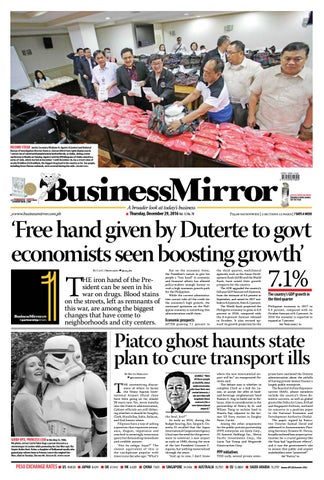
record stash
Justice Secretary Vitaliano N. Aguirre II (center) and National Bureau of Investigation Director Dante A. Gierran (third from right) display nearly 1 metric ton of seized methamphetamine hydrochloride, or shabu, during a news conference in Manila on Tuesday. Aguirre said the 890 kilograms of shabu seized in a series of raids, which started on December 1 until December 26, has a street value of nearly P6 billion ($120 million), the biggest drug haul in the country so far. Ten people, including three Chinese nationals, were arrested during the raids. AP/Aaron Favila
media partner of the year
United nations
2015 environmental Media Award leadership award 2008
BusinessMirror A broader look at today’s business
www.businessmirror.com.ph
n
Thursday, December 29, 2016 Vol. 12 No. 78
2016 ejap journalism awards
business news source of the year
P25.00 nationwide | 2 sections 12 pages | 7 days a week
‘Free hand given by Duterte to govt economists seen boosting growth’ 7.1% T By Cai U. Ordinario
@cuo_bm
he iron hand of the President can be seen in his war on drugs. Blood stains on the streets, left as remnants of this war, are among the biggest changes that have come to neighborhoods and city centers.
But on the economic front, the President’s nature to give his people a “free hand” in economic and financial affairs has allowed policy-makers enough leeway to craft a high economic growth path for the Philippines. While the current administration cannot take all the credit for the economy’s high growth, the continued optimism on the Philippine economy is something this administration could claim.
Economic prospects
After growing 7.1 percent in
the third quarter, multilateral agencies, such as the Asian Development Bank (ADB) and the World Bank, have raised their growth prospects for the country. The ADB upgraded the country’s full-year GDP forecast to 6.8 percent, from the estimate of 6.4 percent in September, and raised its 2017 outlook to 6.4 percent, from 6.2 percent. The World Bank projected the Philippine economy to grow at 6.8 percent in 2016, compared with the 6.4-percent forecast released in October. It also revised upward its growth projection for the
The country’s GDP growth in the third quarter
Philippine economy in 2017 to 6.9 percent, compared with its October forecast of 6.2 percent. In 2018 the economy is expected to expand at 7 percent. See “Free hand,” A2
Piatco ghost haunts state plan to cure transport ills By Recto Mercene
T
good-bye, princess leia In this May 23, 1980,
file photo, actress Carrie Fisher hugs a person dressed as a stormtrooper in London while promoting the Star Wars epic The Empire Strikes Back. Fisher, a daughter of Hollywood royalty who gained pop-culture fame as Princess Leia in the original Star Wars, died on Tuesday. She was 60. Story on B2. AP/Dave Caulkin
PESO exchange rates n US 49.8120
@rectomercene
HE unremitting discussions of where to locate the Ninoy Aquino International Airport (Naia) clone have been going on for almost 30 years now. Yet, seven months into the Duterte administration, Cabinet officials are still dithering whether it should be Sangley, Clark, Manila Bay, Subic, Bulacan, and God knows where. Filipinos have a way of asking a question that expresses annoyance, disgust, impatience and couched in seemingly innocuous query but demanding immediate and credible answer: “Ano ba talaga, kuya? ” T he c losest equ iva lent of t h is is the catchphrase popular with Americans decades ago: “What’s
ALVAREZ: “With all these people at the DOTr, these undersecretaries who have their own vested interests, I am sure they will negotiate these contracts [for a new international airport].”
the beef, bro?” As early as 2014, during the budget hearing, Sen. Sergio R. Osmeña III recalled that the Japan International Cooperation Agency (Jica) saw the need for the government to construct a new airport as early as 1989, during the term of the late President Corazon C. Aquino, but nothing materialized through the years. “And up to now, I don’t know
where the new international airport will be,” an exasperated Osmeña said. The debate now is whether to complete Clark as a hub for Luzon, or accept the offer of foodand-beverage conglomerate head Ramon S. Ang to build one in Bulacan. Also in consideration is the partnership of Henry Sy Sr. and Wilson Tieng to reclaim land in Manila Bay, adjacent to the former US Navy station in Sangley Point, Cavite. Among the other proponents for the public-private partnership (PPP) enterprise are Ayala Corp., JG Summit Holdings Inc., Metro Pacific Investments Corp., the Lucio Tan Group and Megawide Construction Corp.
PPP initiatives
THIS early, several private enter-
prises have cautioned the Duterte administration about the pitfalls of having private money finance a largely public enterprise. The Board of Airline Representatives (BAR), whose members include the country’s three domestic carriers, as well as global giants like Delta Air Lines, Etihad and Singapore Airlines, outlined its concerns in a position paper to the National Economic and Development Authority (Neda). The paper, signed by Executive Director Samuel David and addressed to Socioeconomic Planning Secretary Ernesto M. Pernia, broadly outlined how airport privatization for a crucial gateway like the Naia had “significant effects”, and it was the government’s role to ensure that public and airport stakeholders were “protected”.
n japan 0.4241 n UK 61.1442 n HK 6.4201 n CHINA 7.1631 n singapore 34.3436 n australia 35.7551 n EU 52.0834 n SAUDI arabia 13.2797
See “Piatco,” A2
Source: BSP (28 December 2016 )
News
BusinessMirror
A2 Thursday, December 29, 2016
www.businessmirror.com.ph
A bloody year and altered defense course for PHL T
By Rene Acosta
@reneacostaBM
HIRTY. As it was the last two numbers of President Duterte’s code (DU30), this was the least number of drug suspects that are being killed—in shootouts with the police or being summarily executed— on a daily basis since Duterte undertook the vicious war against illegal drugs in July.
Indeed, it was a bloody year for the country and a bloody war for the President, whose extraordinary measures in dealing with the illegal-drugs problem has made him even more popular—a positive approval for most of the Filipinos, but a disdained or even fearful figure for much of the democratic states abroad. However, regardless of its outcome and acceptance, both locally and abroad, Duterte is determined to make his centerpiece program as the defining moment of his sixyear presidency. That is, if he would
Free hand. . . Continued from A1
Economists believe, however, that the economic success of the country under the Duterte administration comes from the fact that seven out of the zero to 10-point agenda of the government came from the previous administrations. Ateneo School of Government Dean Ronald U. Mendoza told the BusinessMirror that the continuation of economic policies, such as maintaining macroeconomic stability, boosting infrastructure spending, reinvigorating the agricultural sector and strengthening the country’s socialprotectionsystem,particularlytheConditional Cash-Transfer Program, is a good sign. Mendoza said this is unique to the current administration since the tendency of new administrations is to abandon all economic policies espoused by the previous administration to make its mark. “That seven of the 10 economic policy priorities will seek to build stronger results from the previous six years is a good sign, since the evidence suggests that policy design is often not the problem in the Philippines—it’s policy execution and implementation all the way to the local government level that’s necessary,” Mendoza said. The optimistic projections of multilateral development banks and many local economists rest mainly on the recent economic policies set by the Duterte administration, particularly on infrastructure spending. University of Asia and the Pacific School of Economics Dean Cid Terosa said the Duterte administration’s plan to push greater infrastructure spending and tax reform are key factors in raising and sustaining economic growth. Terosa said the goal of the current administration to increase infrastructure spending to 5 percent of GDP is unprecedented in the Philippines. Data from the Neda showed that the country’s infrastructure spending to GDP ratio has steadily increased to 5.1 percent in 2016, from 1.8 percent in 2011. Prior to 2016, the
Piatco. . .
Continued from A1
“The PPP [project] to operate and maintain airports, especially where a majority of tourists transit, can succeed only if the government exercises adequate regulatory powers in ensuring the interest of passengers, airlines, other airport stakeholders
finish his term, barring no health problems.
English-like campaign but with killing potency
IN launching his anticriminality campaign with principal focus on drugs, Duterte rode high on the promises he made during the election campaign early this year, wherein he vowed to prioritize the country’s peace and order problem. Ironic or not, the election sloganturned administration’s thrust—although a been done that for Duterte country’s highest spending for infrastructure projects reached only 4 percent of GDP. This, despite the setting a target to raise infrastructure spending to GDP to 5 percent under the Arroyo and Aquino administrations. The goals were set based on the recommendation of local economists and multilateral development banks who said the Philippines was already lagging behind its Asean neighbors in terms of infrastructure spending. “I believe these policies should continue because they are unprecedented. The country has never spent at least 5 percent of GDP on infrastructure and has not comprehensively planned tax reforms that include lowering personal- and corporateincome taxes,” Terosa said.
‘No micromanager’
The free hand given by the President has also affected the way agencies are being run. Socioeconomic Planning Secretary and National Economic and Development Authority (Neda) Secretary Ernesto M. Pernia is thankful that the President is not a micromanager. Pernia said micromanaging the economy sustaining over 100 million Filipinos would result in slow progress in the medium term. Pernia said the changes in the Neda, an oversight agency that is tasked to evaluate various public projects, as well as advice the President on economic policy and planning, is a testament to the “positive impact” of the President on the economy. “I think things are moving faster in the Neda and it’s because the President is not a micromanager,” Pernia said. “I think there’s been a quantum change in getting projects to the Neda Board.” Pernia said the first Neda Board meeting lasted only 15 minutes, while the second meeting was only an hour and 50 minutes long. The first Neda Board meeting was chaired by Pernia because the President was in a meeting, while the second meeting was attended by Duterte. The Neda secretary said once the presentations were made, Duterte only asked questions pertaining to economic rates of return for certain projects
and the surrounding communities are protected,” the BAR said.
BAR position THE BAR position paper was asking the Neda to look closer into three aspects. First, it wanted the government to guarantee that controls were in place to prevent any “monopolistic” practices in terms of services being rendered to airlines or passengers by
as a mayor of Davao City—was akin to the campaign theme of equally popular former United Kingdom Prime Minister Tony Blair. Both Blair and Duterte, who are also both socialists, were elected into the highest offices in their respected countries on the basis of their strong anticrime stance. Like Blair, who had “tough on crime, tough on causes of crime” slogan, Duterte went on to pursue his strong and hardline anticrime advocacy, but less of Blair’s formula, by adding it up with a dosage of killing, sending chills down the spines of drug lords, addicts and pushers. While Blair dealt with the perceived causes of crime that include unemployment, poor education and drugs, Duterte set out his own formula as he announced he would not allow the country to become another Mexico just to emphasize how serious is the drugs problem. In his subsequent trips abroad, he also told adoring overseas Filipino workers that he was looking forward to the day when no Filipino would no longer be forced to leave the country in pursuit of economic opportunities, underscoring his government’s effort to generate jobs.
Duterte list
IN unveiling his anti-illegal drugs drive, Duterte began with the
statistics of more than four Filipinos who are already drug addicts, while revealing his first list of government and police officials who into the illicit business. It was soon followed up by a so-called drug matrix, wherein the President named five former and active police generals as drug protectors, and later widened it by naming one senator as a recipient of drugs money. Duterte also has second and third listings of other officials and even movie personalities who are into the drugs business, but he was prudent this time not to reveal names, as law-enforcement agencies carry out their duties of thoroughly validating them. In between those actions of the President, bodies of drug suspects incessantly turned up on the streets around the country through the Philippine National Police’s “Oplan Double Barrel” and “Oplan Double Barrel Alpha.” The administration, however, maintained they died because they shot it out with law enforcers, although Duterte keeps on announcing he will not hesitate to kill, underscoring the need for the campaign to succeed. The President has even admitted he has killed drug suspects himself while being the mayor of Davao City.
that were being discussed. Pernia said once these questions were answered to the President’s satisfaction, the projects were already approved by the Neda Board. In sum, the Neda Board approved a total of P392.93 billion worth of new projects. This estimate does not include Operation and Maintenance (O&M) contracts for five public-private partnership (PPP) projects, which amount to P108.18 billion. These five PPP airport O&Ms are for the Iloilo, Bacolod, Laguindingan, Davao and New Bohol (Panglao) Airports. Neda Undersecretar y Rolando G. Tungpalan told the BusinessMirror that faster project approval and implementation is a change that is needed particularly in project approvals. Tungpalan said under the Aquino administration, only around 30 percent of the projects that were evaluated and approved were implemented and completed. This trend was also seen in the number of PPP projects that were completed. Of the 12 projects that were awarded, only three were completed—Daang Hari-Slex Link Road (Muntinlupa-Cavite Expressway) Project; PPP for School Infrastructure Project (PSIP) Phase I; and the Automatic Fare Collection System (AFCS). The Naia Expressway (Phase II) Project was completed under the current administration. “During the previous administration, we had a lot of projects approved but it never got off the ground. [I estimate] only 30 percent of projects were implemented,” Tungpalan said. “[In terms of its effect on underspending], 2014 was the most alarming. Maybe it was a confluence of events. No. 1, the number of approved projects [went] beyond the capacity of agencies to take on, and then second, agencies did not implement projects.” The Aquino administration, through the Neda Board, approved a total of 115 projects worth P1.64 trillion in six years. Based on Neda data obtained by the BusinessMirror, the Aquino administration’s project approvals were P3 billion more than those made in the last six years of the Arroyo administration. The largest project approved by the Neda
Board was the P170.7-billion-worth NorthSouth Railway Project (NSRP)-South Line, while the smallest was the P231.21-million Local Government Units Investment Program Supplement 3 project.
the eventual PPP deal winner. Moreover, the board said airlines should be free to either “self-handle” airport operations or select their service provider as long as these comply with government-set guidelines. The aim is to ensure a level-playing field and free market rates to the airlines and the traveling public. The BAR said “concessionaires should be allowed to operate under equal terms,
including their length of service, without one concessionaire being granted undue privileges at the expense of others.” A final request made by the board was for the government to reserve authority to regulate prices for airport services, making sure these are “reasonable” to all stakeholders.
Work plan for 2017
While the current administration currently enjoys the approval of economists in terms of economic policies, there is much work to be done. Mendoza said some of the “key reform battles in 2017” for the Duterte administration include overhauling the tax system, including corporate- and income-tax reforms, as well as restoring the “progressivity and fairness” of the tax system, particularly for the middle class. One of the key reform issues in tax progressivity and fairness is the removal of “bracket creep”in the personal-income tax (PIT) system. Since the PIT has not been updated since 199, this resulted in what is called“bracket creep”, where low-income taxpayers “hurt more” than their high-income counterparts. Bracket creep, Philippine Institute for Development Studies (PIDS) Senior Research Fellow Rosario G. Manasan earlier explained, has occurred because of the “nonindexation” to inflation of PIT brackets. This means that the coverage of each tax bracket does not take into consideration the current value of the peso. Mendoza also said that, apart from tax reform, the Duterte administration will be faced with the expiration of the quantitative restriction (QR) on rice in the middle of 2017. With majority of the economic managers keen on the nonextension of the QR, Mendoza said this should prompt for a better foodsecurity strategy since this could be the “most important poverty-reducing policy of the Duterte administration.” Terosa added that, given the importance accorded by the government for socioeconomic policies, particularly those that aim to boost rural, agricultural and industrial productivity, these must be implemented aggressively. He also said there is a need to improve transparency, accountability and control of
Tugade vs. Alvarez THE Department of Transportation
Big operations were also carried out, yielding both drugs and so called high-value targets, including the late Albuera, Leyte Mayor Rolando Espinosa, who subsequently died in police operations inside the province’s jail. The killings, as rights groups claimed, fished out negative reactions, most from governments abroad, prompting Duterte to issue a rejoinder of his own with cussing words. Amid the anti-illegal drugs operation, the government was also pursuing the mother campaign of anticriminality, by pursuing even local terrorists in Western Mindanao that triggered the declaration of a nationwide state of emergency.
IF the ways the President confronted the country’s drug problem were controversial and unprecedented, his critics claimed it was also the same in the case of the Armed Forces of the Philippines, wherein, as the Commander in Chief, he altered the priorities of soldiers and sullied the orientation of the whole defense establishment as an organization. From a previous war plan of combined internal and territorial defense postures—the reason the military is painstakingly attempting to modernize through the acquisition of modest assets and
armaments—the Commander in Chief has scaled it down and solely focused it to internal defense. He was also in the process of reorienting the defense and military establishments by steering them toward China and Russia in pursuit of his anti-West diplomacy. While Duterte’s lines that China is not an enemy and he would never go into war with Beijing are blurring the soldiers’ pro-West doctrine, the President has been prodding them to better acquaint themselves in handling weapons, firearms at least, from the country’s nontraditional allies. It was a stance, that whether the soldiers would like it, they would have to live with it, at least for the next five years. Not that China has been categorized earlier by military planners as a threat due to the territorial tiff in the Spratlys. The cadence toward China and Russia, the latter headed by comrade Vladimir Putin, who is Duterte’s idol, was carried out in the backdrop of a striking tone with the United States against whom Duterte has threatened to cut military ties. Amid these developments, the President struggled to bring the country into terms with the Communist Party of the Philippines and its armed wing, the New People’s Army, and the Moros through peace agreements.
corruption. “A direct and incisive war on poverty, income inequality and unemployment has to outshine the war on drugs in the near future,” Terosa said. Pernia earlier said the significant increase in food prices, particularly rice, pushed the poverty line up by almost 30 percent over the last six years. The rapid pace of population growth, with additional 10 million Filipinos in just six years, has also made poverty reduction a steep challenge. Apart from these, Pernia said the Neda is keen on continuing the change it has introduced, particularly the Three-Year Rolling Infrastructure Program (TRIP); Public Investment Program Online System (Pipol); AidData Project; and streamline Investment Coordination Committee (ICC) review procedures. Pernia said the TRIP is a consolidated list of all infrastructure programs of the government, identifying immediate priorities to be undertaken in three-year periods. A joint project with the Department of Budget and Management, it will also assure that once an infrastructure program has been planned and rolled out, it will continue to receive funding from the government. Pipol, meanwhile, is an online database for government projects. Included in this database are comprehensive details of government projects, plus their status updates. Pernia said that in September, United States Agency for International Development officially turned over to the Neda the AidData Project, a Web-based mapping tool that monitors the distribution and impact of donor assistance to government programs and projects in the Philippines. With regard to efforts to streamline ICC review procedures, minor changes in scope, design, cost and extension of implementation or grant validity of projects will now be delegated to the level of the ICC, the Department of Finance and the Neda Secretariat, as applicable, based on existing laws, rules and regulations. “I don’t think we can move faster than [this], otherwise, we’re going to suffer health-wise. We [now] have a long laundry list of projects to present to [funders like] China,” Pernia said.
In terms of projects and project approvals, the Neda intends to play a more proactive role next year and in the coming years. Tungpalan said some of the major changes that they will institute is for Neda to do milestone monitoring of projects. Tungpalan said previously, projects are monitored on a period basis. But this usually results in unforeseen delays and problems that cost the Filipino taxpayer. He said under milestone monitoring, projects will be monitored according to the targets and accomplishment dates they have set. This will help fast-track projects and help prevent future delays and problems. Tungpalan said the goal of the Neda now is to have a special focus on results and mutual accountability. He said there is a need to break away from a compartmentalized approach to project planning, evaluation and monitoring. Another key reform that the Neda will undertake starting next year is to also monitor the cost overruns incurred by PPP projects. Under the current set up, Neda only monitors big-ticket projects funded by official development assistance. Tungpalan said with the availability of new technology, such as drones and satellite maps, the government can better monitor projects. “Our mind-set is to hit the ground running, do things 24/7 [and] have the sense of urgency [since we lost] so many years, six years,” Tungpalan said. A little over five months is not enough time to say that an administration has done well or not, especially if the President’s campaign promise of bringing change will be the barometer. But what is certain is that, as the year draws to a close, the Duterte administration is facing major headwinds. Efforts to reform the system, bring life back to sectors long neglected, such as agriculture, and order in infrastructure will be among the most challenging but need to urgently addressed. After all, livelihoods and lives are on the line. Lifting millions of Filipinos from poverty remains to be the main goal. The only question now is how to move forward.
(Dotr) has yet to formally invite bidders for the P74.6-billion PPP contract to modernize and operate the Naia, considered the “crown jewel” of Philippine airports. For all of DOTr’s planning, Arthur P. Tugade’s post as transportation secretary seems precarious, given that the Speaker of the House, Pantaleon D. Alvarez, wants him replaced. Also included are the various groups who want him ousted for his
alleged link with gaming tycoon Jack Lam. This once more makes the decisionmaking on the future site of the Naia duplicate uncertain. In November Alvarez called for the dismissal of Tugade for delaying the bidding of multibillion-peso priority projects for these to be included in the emergency powers package pending in Congress.
Recharted defense direction
www.businessmirror.com.ph
The World BusinessMirror
After 15 big mall fights, police see a culprit: Teenage boredom
O
fficer Tamara Valle of the Fort Worth Police De pa r t ment i n Te x a s received a call on Monday: A fight had broken out in the food court of the nearby Hulen Mall, and 200 teenagers were running, screaming and fighting. Shopkeepers were going into lockdown, slamming their gates shut with customers still inside. As Valle drove to the mall, she received another message: At least four or five similar scenes were unfolding hundreds of miles away, on the East Coast. By night’s end, at least 15 fights had broken out in shopping centers from Connecticut to Arizona. Videos posted to social media showed throngs of teenagers twisting like tornadoes through malls in Tennessee and Ohio as bystanders uploaded the images to the world. Officers at several police departments suspect that the episodes were loosely organized on social media, though they cannot prove it yet. In Aurora, Colorado, the police heard through an anonymous tip that a Facebook post had told of a fight at the Town Center mall. “We haven’t actually seen the post,” Sgt. Chris Amsler, a spokesman for the Aurora Police Department, said in an interview. “We don’t know whether that’s true— whether or not that exists.” O t her of f icers, l i ke C apt. Gary Haba of the Beachwood Police Department in Beachwood, Ohio, believe the more likely common thread is that teenagers have too much time on their hands during the holiday break from school, and just enough freedom to head to the nearest shopping center—especially if they think they will encounter a lively scene. “I don’t think there’s Dr. Evil sitting around in some chair somewhere directing everybody to do this,” Haba said on Tuesday. “It just seemed like kids showed up and they were waiting to start seeing some mayhem.” The day before, Beachwood police officers had responded to a fight at Beachwood Place, an upscale shopping mall. They estimated that around 500 people, mostly teenagers, were involved. Police officers from at least three jurisdictions worked for more than an hour to corral people and push them outside. At least one officer used pepper spray to subdue people who were fighting, and one juvenile was arrested, accused of pushing a police officer, Haba said. About 560 miles away, a similar situation was unfolding at the Shoppes at Buckland Hills in Manchester, Connecticut. Hundreds of
teenagers were mobbing the mall, forcing it to close early. “Even the officers that were up there sensed that something was different” before a fight broke out, Capt. Christopher Davis, a spokesman for the Manchester police, said in a phone interview. “They just sensed that something was in the air, per se, that something didn’t seem right.” Davis said that so many teenagers had arrived to the Shoppes at Buckland Hills that additional city buses had to be called in to take all of them home. Five juveniles and two adults were arrested on charges of fighting or interfering with police officers, he said. The day after Christmas is one of the busiest shopping days of the year, with people returning unwanted presents, using new gift cards and searching for afterholiday sales. Some police officers said the chaos had the characteristics of so-called f lash mobs, gather i ngs loose ly orga n i z ed on social media. The police also speculated that unseasonably warm weather in some places may have played a role, too. It was around 65 degrees in Indianapolis, where fights broke out at Castleton Square mall. It is not uncommon for mayhem to occur on December 26. On that day in 2013, more than 300 teenagers gathered in Brooklyn at Kings Plaza mall, where they fought, yelled and slammed shop doors. T h i s yea r m a l l employees across the country were busy on Monday night posting to Facebook, advising that hours had been changed and that stores had closed. Requests to companies that own or lease several of the malls, including Simon Property Group, CBL & Associates Properties and General Growth Properties, did not respond to requests for comment on Tuesday. Fights were reported in at least a dozen states, with two episodes in Connecticut and three in Tennessee. Fights were also reported at malls in Pennsylvania, North Carolina, Illinois, Ohio, Arizona, New Jersey, Indiana, Colorado and Texas. And a fight that broke out at Roosevelt Field Mall on Long Island resulted in more than 70 calls placed to 911 by people who mistakenly thought they had heard gunshots, according to a CBS affiliate in New York. A little bit of mischief can escalate into a full-scale police response: In Fort Worth reports of shots being fired coincided with the mobs and fights, Valle said, leading to responses from the SWAT team and the gang investigation unit. But no one was arrested, and about an hour later, the chaos had subsided. NYTNS
Thursday, December 29, 2016
A3
As populists won 2016 ballots, world’s richest made $237B
I
n a year when populist voters reshaped power and politics across Europe and the US, the world’s wealthiest people are ending 2016 with $237 billion more than they had at the start.
Triggered by disappointing economic data from China at the beginning, the UK’s vote to leave the European Union in the middle and the election of billionaire Donald J. Trump at the end, the biggest fortunes on the planet whipsawed through $4.8 trillion of daily net worth gains and losses during the year, rising 5.7 percent to $4.4 trillion by the close of trading on December 27, according to the Bloomberg Billionaires Index. “In general, clients rode through the volatility,” said Simon Smiles, chief investment officer for ultrahigh-net-worth clients at UBS Wealth Management. “2016 ended up being a spectacular year for risk assets. Pretty remarkable given the start of the year.” The gains were led by Warren Buffett, who added $11.8 billion during the year as his investment firm Berkshire Hathaway Inc. saw its airline and banking holdings soar after Trump’s surprise victory on November 8. Buffett, who’s pledged to give away most of his fortune to charity, donated Berkshire Hathaway stock valued at $2.6 billion in July.
Berkshire bonanza
The US investor reclaimed his spot as the world’s second-richest person two days after Trump’s victory ignited a year-end rally that pushed Buffett’s wealth up 19 percent for the year to $74.1 billion. “2016’s been event-driven with global news driving prices rather than fundamentals,” said Michael Cole, president of Ascent Private Capital Management, which has about $10 billion of assets under administration. “The belief that Trump is going to come in and deregulate big parts of the economy is driving the markets right now.” The individual gains for the year were dominated by Americans, who had four of the five biggest increases on the index, including Microsoft Corp. cofounder Bill Gates, the world’s richest person with $91.5 billion, and oilman Harold Hamm. The country’s richest were largely opposed to a Trump presidency during the elections, including
Dallas Mavericks owner Mark Cuban, who told the media in May that stocks could fall as much as 20 percent if Trump were to win the election.
Wealth administration
U.S. billionaires—including Buffett—favored Trump’s rival Hillary Clinton. Still, they profited from his victory when they added $77 billion to their fortunes in the postelection rally fueled by expectations that regulations would ease and American industry would benefit. The New York real-estate mogul is building a Cabinet heavy on wealth and corporate connections, and light on government experience, a mix that hedge fund billionaire Ray Dalio said last week would unleash the “animal spirits” of capitalism and drive markets even higher. Dalio is the world’s 63rdrichest person with $14.1 billion. Investors and executives welcomed Trump’s picks, including billionaire Wilbur Ross to lead the Department of Commerce and former Goldman Sachs Group Inc. executive Steven Mnuchin as his Treasury secretary, who have a combined net worth of at least $5.6 billion, according to the index. “You know, I was not opposing Tr ump as muc h as most people,” Saudi Arabian billionaire Mohamed Bin Issa A l Jaber said in a December 11 interview. “He’s capable and—as a businessman—he’s shrewd about t he bottom l ine. T he people he’s surrounding himself with have baggage but they’re also successful and shrewd.” France’s Bernard Arnault was the sole non-American representative among the five best performers, adding $7.1 billion to take his fortune to $38.9 billion. His LVMH Moet Hennessy Louis Vuitton SE said the Chinese luxury-goods market is improving. Gates remained the world ’s richest person throughout the year. Amancio Ortega, Europe’s richest person and founder of the Zara clothing chain, was in second place on the index for most of the year until he ceded it to Buffett in
November. Ortega, who dropped $1.7 billion in 2016, is the world’s third-richest person with $71.2 billion. Wildcatter Hamm’s fortune was propelled by a strengthening oil price and expectations a Trump administration will slash fossil-fuel regulations. Hamm added $8.4 billion to more than double his fortune to $15.3 billion. He led the 49 energy, metals and mining billionaires, who were the best-performing category on the ranking, adding $80 billion and reversing the $32-billion fall they had in 2015. Billionaire brothers Charles and David Koch each dropped $2 billion after Koch Industries reported on its web site that annual revenue is estimated to be “as high as $100 billion,” compared with the estimate of “as much as $115 billion” that the conglomerate published on the site previously. Company Spokesman Rob Carlton stated in a November 17 e-mail that Koch revenue fluctuates with the price of commodities. Technology fortunes were the second-best performing on the ranking, with 55 billionaires adding $50 billion to their fortunes over the year, despite worries that a Trump presidency might introduce policies that could hurt their companies. “I think we’ll have to see what the policies of the administration are,” Google cofounder Sergey Brin told the media gathered on the red carpet of the annual Breakthrough Prize gala in Silicon Valley in December. “I certainly hope they will be pro-science, pro-technology and all the things this world has really benefited from.” Amazon.com Inc. founder Jeff Bezos, who doubled his fortune to $60 billion in 2015, led gains among technology executives again this year, rising $7.5 billion in 2016 on robust sales growth at the online retailer. He was followed by Facebook Inc. cofounder Mark Zuckerberg, who added $5.4 billion.
Hidden wealth
Some of the industry’s biggest relative gains went to the founders of the world’s leading startups, such as Uber Technologies Inc.’s Travis Kalanick and Snap Inc.’s Evan Spiegel. The so-called unicorn billionaires, which include Spotify Inc. cofounder Martin Lorentzon, who was identified as a billionaire for the first time in 2016, secured a series of mammoth funding rounds while moving closer to testing their fortunes on the public markets. Other billionaires uncovered
by the Bloomberg index in 2016 included the father and son behind Jose Cuervo tequila, New York real-estate developer Axel Stawski and Kosovo construction tycoon Behgjet Pacolli. The index also unveiled 11 surviving family members of reclusive Thai entrepreneur Chaleo Yoovidhya, the inventor of Red Bull, whose heirs share a combined $22 billion net worth, the world’s largest energy-drink fortune. Three billionaires emerged in Argentina, including the country’s first technology billionaire Marcos Galperin, as markets rose on enthusiasm for President Mauricio Macri’s finance-friendly economic policies. Most fortunes outside of the US didn’t get the same boost from Trump’s victory, and were hurt by fluctuating commodities prices and the rise of the dollar, the currency used for the Bloomberg ranking. Nine of the 10 biggest decliners in 2016 were from outside the US, led by China’s secondrichest person, Wang Jianlin, who lost $5.8 billion. Wang ended the year as the world’s 21st-richest person with $30.6 billion. Nigeria’s Aliko Dangote, the richest person in Africa, lost $4.9 billion or one-third of his wealth as the combined effect of falling oil prices and the June devaluation of the naira pushed him to No. 112 with $10.4 billion. Dangote was the world’s 46th-richest person in June. Saudi Arabia’s Prince Alwaleed Bin Talal Al Saud fell $4.9 billion, a 20-percent drop. Alwaleed said in November that all of his stakes in public companies, including Citigroup Inc., are potentially for sale, reversing a longstanding policy that some of his most prized shareholdings were “forever”.
Chinese downturn
Wealth creation in China turned negative for the first time since the inception of the Bloomberg index five years ago, with the country’s richest losing $11 billion in 2016 amid a slump in the Shanghai Shenzhen CSI 300 index and a 7-percent decline for the yuan against the dollar. Alibaba Group Holding Ltd. founder Jack Ma closed the year with $33.3 billion, adding $3.6 billion in 2016. He dropped in and out of his place as Asia’s richest person for the first four months of the year before claiming it for good in May after Alibaba’s finance affiliate, which is laying the groundwork for an initial public offering expected as soon as next year, completed a record $4.5-billion equity fundraising round. Bloomberg News
Cuba sees economy shrink 1 percent despite détente with US H AVA N A — C u b a a n nounced on Tuesday that its economy shrank this year for the first time in nearly a quarter century as a plunge in aid from Venezuela overwhelmed a surge in tourism set off by detente with the United States. Economy Minister R icardo Cabr isas a nd President R au l Castro told Parliament that the island’s GDP fell nearly 1 percent after seeing average annual growth rate of nearly 3 percent from 2011 to 2015. Cabrisas blamed the slump on Venezuela’s troubles and a decrease in revenue from Cuba’s few exports, which include sugar, refined gasoline and nickel, whose price has dropped in recent years. “In spite of the drop in GDP, the free social services that our popu lation enjoys have been preserved, defying predictions that the Cuban economy would collapse and upsetting blackouts
Cuba’s President Raul Castro addresses the National Assembly in Havana, Cuba on December 27. Ladyrene Perez, Cubadebate via AP
would return,” Castro said. The two men spoke to Cuba’s rubberstamp National Assembly, which also passed a law announced by Castro last month banning public memorials to his brother Fidel,
the revolutionary leader who died on November 25 at age 90. The last time official figures showed a fall in Cuba’s GDP was in 1993 after the Soviet Union collapsed, abruptly stripping away
much of the island’s aid and trade. A global drop in petroleum prices has slammed Venezuela’s oil-dependent economy, forcing it to reduce shipments of heavily subsidized crude oil to Cuba, with
exports dropping from 115,000 barrels daily in 2008 to 90,000 in recent years to 40,000 in the past few months. In addition, the number of contracts for Cuban professional services with Venezuela has dwindled and some payments have not been made, Cabrisas said. A large number of Cuban doctors have long traveled to Venezuela, with their salaries going directly to Cuba’s government. “ This confirms what we had said about Venezuela’s situation leading to a recession,” Cuban economist Pavel Vidal, a professor at a university in Colombia, told The Associated Press (AP). Cabrisas, whose speech was partially transmitted on public TV, also blamed the economic slump on US sanctions on Cuba, with officials previously saying that the 55-year-old embargo has cost the island $125.9 billion, including $4.6 billion last year.
Tourism, however, has been thriving since US President Barack Obama ordered the restoration of diplomatic relations between Washington and Havana two years ago. Overall visitor numbers rose more than 15 percent in 2015 and again this year. Cabrisas said he expects the island’s GDP to grow 2 percent next year if the government cuts costs, increases exports and finds alternatives for certain imports. Vidal said he was surprised by the prediction. “They’re thinking things are going to improve in Venezuela,” he said. “And they’re relying on fiscal spending without backing from revenue.” Other economic experts told the AP that possible solutions could include boosting the private sector and dereg u lating portions of the public sector, excluding areas such as health or education. AP
A4
Thursday, December 29, 2016
The World BusinessMirror
Qualcomm fined $853M by S. Korean antitrust agency
S
outh Korea’s antitrust regulator slapped a record 1.03-trillion-won ($853-million) fine on Qualcomm Inc. for violating antitrust laws, the latest in a string of government actions that threaten the US chipmaker’s most profitable business. The South Korean Fair Trade Comm ission (K F TC) sa id on Wednesday the company licensed its key patents only to mobilephone makers and didn’t properly negotiate the terms of its licenses. The agency also said Qualcomm coerced its customers into signing patent license contracts when selling its chips used in mobile phones in the country, and it didn’t fairly pay for the use of patents held by other phone makers. The decision from the home countr y of Samsung Electronics Co. adds to investor concern that the San Diego-based chipmaker, which is also the subject of investigations in the US and Europe, may struggle to defend its lucrative licensing business. Qualcomm gets the majority of profit—$6.5 billion in its most recent f i n a nc i a l yea r — f rom selling the right to use technolog y that’s fundamental to all modern phone systems. Qualcomm, calling the decision “unprecedented and insupportable,” said it will appeal the decision in Seoul ’s High Court. The KFTC ruling doesn’t go into effect immediately and Qualcomm will seek a stay from the cour ts while it appea ls, said Don Rosenberg, the company’s general counsel. “The KFTC ruling will not just benefit local handset makers but other global chipset makers, too, so today’s ruling from the commission seems a bit broader and stronger than that of the China’s last year,” said Jung Dong-joon, a patent lawyer at SU Intellectual
Property. “Qualcomm sales accounts for about 20 percent in the Korean market and that’s a significant market for Qualcomm.” For Samsung, the world’s biggest phone maker, and LG Electronics Inc., the ruling opens up the possibility they may be able to pay lower rates to Qualcomm. When Qualcomm settled an investigation by Chinese regulators last year, it accepted a lower rate charged on phones sold in that country. Samsung is Qualcomm’s second-l a rgest c ustomer, accounting for about 11 percent of its sales, according Bloomberg’s supply chain analysis. The US company also designs and sells chips that are the main component in smartphones. “Qualcomm, a holder of standard-essential patents, as well as a monopolistic service provider of modem chips from manufacturing to sales, has violated its agreement to license patents on fa ir reasonable a nd nondiscriminator y terms, known a s FR A ND,” t he comm ission said in a statement. Qualcomm offers the rights to use all of its standard-essential patents, some of which cover the core technology behind modern wireless systems, in a combined package. Some of those inventions are used in industry standards. Aside from the fine, the commission wants Qualcomm to let chipset-makers access its key patents, and refrain from imposing unfair conditions on customers when signing contracts. The Korean agency also said Qualcomm
should make standard-essential patents available for separate licensing rather than bundling them with chipset sales. And the US company should accord greater value to other companies’ patents when accounting for them in crosslicensing agreements, the commission said. Qualcomm stock was mostly unchanged in afterhours trade. Samsung was down less than 1 percent at the close in Seoul, while LG was up 1.2 percent. As in other cases that Qualcomm has won, the company expects the courts to side with it because its licensing business follows industry practices that have been in place for decades, Rosenberg said. Profits from licensing fees are crucial to funding its industryleading research and design efforts and maintaining Qualcomm’s competitive edge. “We’ve seen time and again that those who actually apply the rule of law to this, come to the conclusion that nothing is wrong,” Rosenberg said. “We’re going to fight this the way we fought all of them. We think we’ll have a much better time with the Korean courts than we had with the Korean Fair Trade Commission. We have a lot of faith in the independence of the courts.” In 2009 the commission separately fined Qualcomm 260 billion won for deterring competition through discriminatory charges.
KFTC ordered the chipmaker to stop charging higher royalties to customers who buy chips from rivals and to cease offering rebates to handset makers who buy products mainly from Qualcomm. That case is under appeal with the Korean Supreme Court. The US chipmaker has grappled with regulatory challenges around the world. It was fined $975 million last year by China, ending an inquiry that threatened the US company’s growth in the world’s biggest mobile market. T he European Commission sent antitrust objections to Qualcomm last December, saying the chipmaker had paid “significant amounts” since 2011 to an unidentified major smartphone and tablet manufacturer in return for using Qualcomm’s chipsets exclusively in its products. It may also have sold chipsets below cost from 2009 to 2011 to crush smaller competitor Icera, now owned by Nvidia Corp., the commission added. Resolving patent wrangles remains key to shoring up Qualcomm’s business. Last month the chipmaker delivered a sales forecast for the December quarter in line with analysts’ estimates, saying it’s managed to sign technology-licensing agreements with smartphone manufacturers in China that had previously held back payments. Bloomberg News
www.businessmirror.com.ph
Icahn sees doubts about ethanol mandate among advisers of trump
B
illionaire C a r l Ica hn, a specia l adv i s e r t o D o n a l d J. Trump and a skeptic of the US ethanol mandate, said there are others on the president-elect’s team who have even deeper criticisms of the program. Icahn repeated criticism of the credit trading program that regulators and refiners use to track compliance with federal biofuel consumption quotas. While he hasn’t expressed opposition to renewable fuel use, “there are people on the Trump team that believe ethanol itself does very little” in helping the environment, Icahn said on Tuesday in a telephone inter view, while declining to provide further details. “It’s a black cesspool of trading if there ever was one,” Icahn said. Last week Trump said he tapped Icahn as a special adviser on regulations. Icahn, 80, owns a majority stake in CVR Energy Inc., an independent oil refiner, and has dubbed trading in biofuel credits, known as Renewable Identification Numbers, or RINs, the “mother of all short squeezes.” T he US passed reg u l at ions i n November mandating record biof uel use, and prices for the credits had surged in anticipation of the new quotas. Ic a hn sa id t h is mont h that he helped Trump pick Ok la homa Attor ney General Scott Pruitt to head the Env ironmental Protection A genc y (EPA). Pr u itt has criticized increased ethanol use. W hile the presidentelect hasn’t disclosed specific plans for the EPA, the Pruitt choice sent the price of RINs tumbling the most in at least a year. Icahn has said the agency’s leadership change won’t end the mandate. Instead, he’s confident
Pruitt will shift the burden of compliance further down the distribution chain, to fuel blenders.
‘No reason’
“There’s no reason” for companies who aren’t required to participate in the program to be trading RINs, Icahn said in the interview on Tuesday. Petroleum ref iners a re required to blend renewable fuels, like ethanol, into gasoline as part of a 2007 energy law passed under President George W. Bush that sought to slow the pace of oil consumption and its carbon footprint. Each gallon is tracked by a unique, 38-digit RIN. Todd B ec ker, t he C EO of ethanol producer Green Plains Inc., on Tuesday dismissed Icahn’s complaints about the ethanol laws as being the result of a bad bet in the fuel market. “ T hese are complicated policies, and I don’t think you can just take one view of one person who’s on the wrong side of the trade to really reform a system that doesn’t need to be reformed today,” Becker said in an interview on Bloomberg Television. Icahn said reforming the program will change who’s obligated to show compliance and changes are needed to avoid refiner y bankruptc ies, pa r t ic u l a rly on t he East Coast. “It’s not a question of being on the right-side of a trade or on the wrong side,” Icahn said. The ethanol industry should support changes to the program to avoid potential refinery closures that could have larger consequences, he said. “Sometimes it’s smart to give a little to save a lot,” Icahn said. “Because when some of these refineries hit the wall themselves, there could be a crisis in gasoline prices.” Bloomberg News
Kachin rebels see more Myanmar attacks, no hope for peace L
AIZA, Myanmar—Ethnic Kachin rebels long at war with Myanmar troops say the government has only escalated fighting since Aung San Suu Kyi took over as leader, crushing the hopes that had led many ethnic minorities to support her party and leaving them with no confidence in the peace process that Suu Kyi has identified as a priority. Rebels and observers say government offensives, including air strikes, have increased since Suu Kyi and her National League for Democracy (NLD) party took control in March. Suu Kyi ’s government has said little about the attacks, and the Kachin Independence Organization (KIO) accuses her of cooperating with the military. “Suu Kyi tried so hard to gain this power for many years and she needs to make deals with the military in order to sustain her power,” said La Nan, the chief spokesman of the KIO. Rebels say they have been hit with air strikes in areas of northern Shan and Kachin states, including Mongo, a Shan town that was heavily bombed and suffered an unknown number of civilian casualties. Other fighting has occurred in Hpakant, center of Myanmar’s lucrative jade-mining region, and Laiza, headquarters of the KIO. Suu Kyi, who serves as state counselor and foreign minister
but effectively rules Myanmar, faces high expectations from ethnic groups and the international community. As opposition leader, the Nobel Peace laureate was held under house arrest by the former junta for years, but her landslide election victory in November 2015 ended more than half a century of military control. Though she has called the peace process her top priority, many local and international political analysts do not see significant achievements since t he NLD came to power, and say she has failed to cooperate enough with ethnic leaders. “National reconciliation cannot be built only between the government and the military,” said Yan Myo Thein, a prominent Myanmar political analyst. “There must be negotiation between ethnic parties, armed groups, the military and the government.” Ethnic Burmans form a majority in Myanmar, also known as Burma, but ethnic minorities make up about 40 percent of the population. Some of those groups have fought for greater autonomy for decades. Suu Kyi held a peace conference in late August attended by representatives of 17 of the 20 major ethnic groups, including the Kachin. The conference was intended to build on a cease-fire agreement that ethnic groups insist include a political
In this November 30 photo, a Kachin Independence Army (KIA) soldier sits with his dog named English inside a hut along the bunker at the frontline on a mountain near Laiza, the headquarters of KIA in Kachin State, Myanmar. AP/Esther Htusan
solution to their long-standing demands. Ethnic leaders have asked for political dialogue, but the peace conference met few of their expectations, and some may drop out of the next round, expected in February. The conference was dominated by short speeches from a wide range of stakeholders, leaving little time for more significant discussion. “There was really no substance at all,” said David Mathieson, a senior researcher of Human Rights Watch who has been researching civil conflict in Myanmar for a more than a decade. “How can Suu Kyi expect to bring peace if she is not sitting down with Kachin and Shan leaders and when she is not taking the grievances of human
rights abuses seriously?” Suu Kyi’s peace negotiator Dr. Tin Myo Win did not return phone calls from The Associated Press. Khin Maung Myint, an NLD upper house member of parliament from a constituency in Kachin state, blamed the military and army commander Senior Gen. Min Aung Hlaing. “Min Aung Hlaing is doing whatever he wants.... They are just trying to make NLD look bad,” he said. “They are bullying ethnic people, as well. The main problem with the military is that they don’t want a federal system.... This is just the bad inheritance from the bad dictatorship. The military doesn’t want to change.” Col. Wunna Aung, second secretary of
the Joint Monitoring Committee on Ceasefire, defended the army’s actions at a committee meeting on Thursday. “We are only fighting in the ethnic region to protect our own country,” he said. “We want to unite the country. I don’t think we have lost trust.” He said the army “always welcomes everyone for peace,” but that “the fighting happens because it is necessary.” Concerns about the prospects for Myanmar’s peace process were heightened further after the newly formed Northern Alliance, comprised of the KIO’s Kachin Independence Army, the Myanmar National Democratic Alliance Army, the Ta’ang National Liberation Army and the Arakan
Army, began a joint offensive in response to military attacks in the ethnic regions of northern Myanmar. These attacks are part of more widespread increase in fighting since the Thein Sein government launched the peace process in 2011. According to Bertil Lintner, a longtime Myanmar political analyst, fighting is now the heaviest that it has been in decades. The heavy fighting, combined with a stalled peace process, has created fears among some that the prospects for Myanmar’s peace process are dim. “If Suu Kyi can’t start a discussion with the ethnic leaders soon enough, the tension between the military and the ethnic armed groups will go higher and the possibility of cease-fire and peace process will be less,” said Yan Myo Thein, the analyst. Linter said, “It should be evident to anyone that an entirely new approach is needed ” that would “include a genuine political dialogue, not just meetings with dozens of ethnic representatives.” Rebel groups are not optimistic. “We ethnic people are not very happy even though there is a socalled democratic government. The new government is trying to hold, gain and sustain power and to get that they make deals together with the military,” said La Nan, the KIO spokesman. AP
www.businessmirror.com.ph
The World BusinessMirror
Thursday, December 29, 2016
A5
No happy new year in China as currency, liquidity fears loom
C
Examples of Ivanka Trump shoes on display in the showroom at the Huajian shoe factory in Dongguan, China, on December 5. If President-elect Donald J. Trump makes good on the promise of punishing overseas companies, he will take aim at his own brand, and his daughter’s, as well. Gilles Sabrie/The New York Times
For Trumps, ‘Made in USA’ may be tricky label to stitch
N
EW YORK—At Saks Off Fifth recently, an Ivanka Trump white polyester-andspandex blouse made in Indonesia was marked down to $34.99, from $69. A few racks over, her black-andwhite jacket came from Vietnam, while several blocks away, at Macy’s, her bootee manufactured in China sold for more than $100.
At the Trump Tower on Fifth Avenue, a $35 blue cotton cap embroidered with “Trump National Golf Club” was made in Bangladesh. A Trump Tower hoodie from Pakistan set tourists back $50. A majority of clothes these days are made anywhere but in the United States. And in this era of local pride and nationalistic fervor, that has become a political liability. The conflict is starkly evident in the apparel brands made and marketed by President-elect Donald J. Trump and his daughter Ivanka. Trump has cast companies that make goods in China and other foreign countries as economic pariahs, siphoning off jobs better left at home. He has blamed the system, a set of policies in the US that Trump acknowledged using for his own gain. And since being elected, he has continued to rail against global forces, threatening to punish companies with high tariffs if they don’t move production to the US. Should Trump make good on such promises, he would take aim at not only his own brand, but his daughter’s, as well. Trump doesn’t stand to lose much. While his goods are largely manufactured overseas, most of his retail ventures have gone the way of Trump vodka and steaks. Ivanka Trump’s company, by contrast, is the type of operation that Trump is squarely aiming for. Her shoes and dresses largely retail for less than $150. Coats cost as much as $400. Factored into those prices is the cost of materials and production, as well as shipping, tariffs, marketing and advertising. Cheap production overseas means more coin in the coffers of Ivanka Trump and the shoe, accessory and clothing makers that are her partners, among them
Marc Fisher footwear, the G-III Apparel Group and Mondani. (Ivanka Trump’s company, which is privately held, does not disclose its financials.) Almost all of her goods are made overseas, according to a New York Times review of shipments compiled separately by Panjiva and ImportGenius, two trade databases. ImportGenius tallied 193 shipments for imported goods associated with Ivanka Trump for the year through December 5, mostly Chinese-made shoes and handbags. Her dresses and blouses are made in China, Indonesia and Vietnam, according to a review of hundreds of clothing tags and financial documents filed by G-III. It is the harsh reality of the clothing business. Before Ivanka Trump started her shoe and clothing lines in the early-2010s, she did what any wellconnected New Yorker would, consulting corporate chieftains, fashion designers and department store executives. She ultimately decided to license her name. Since then, Ivanka Trump, 35, has pondered making some items in-house. Investors were consulted, and a business plan was drawn up —but the project was scrapped, said one person briefed on the discussions. It was costly and impractical, so suppliers continued to make her clothes overseas. “When I started my business, I recognized where my strengths were and knew that I didn’t have any experience in production and manufacturing,” Ivanka Trump said in a rare interview. “I am not a designer. I am an entrepreneur.” In retail, where margins are slim, overseas manufacturers are crucial to profits. Most of the clothing Americans buy at Wal-Mart, Macy’s and Target are made abroad, including 97 percent of apparel and 98 percent
of shoes, according to the American Apparel and Footwear Association. It is part of a long history of US garment manufacturers chasing cheap labor. They moved to China in the 1980s, then elsewhere in Asia. Even then, an overseas strategy does not portend survival, as Ivanka Trump’s experience shows. At Trump Tower on Fifth Avenue, the Trump Store is downstairs from the lobby, between a restaurant and an ice cream parlor. While a $65 white polo golf shirt from Lesotho in southern Africa was available, there was no sign of many of Donald Trump’s other items, like the dress shirt made in Vietnam on display upstairs. L ast year Mac y’s dropped Trump’s clothing line over inflammatory comments he made about Mexican immigrants. Now about the best place to find his ties, dress shirts and accessories is on Amazon.com—and even that stock is just a hodgepodge. The company that made Trump-branded comforters and sheets, Downlite, said it had ended its relationship with him last year. His beds, designed by Dorya, aren’t in stores, either. They are made to order overseas, according to the company. Trump said in campaign interviews that he would like to make his apparel in the US, but that it was hard to find companies that did. When George Stephanopoulos of ABC pressed him to explain, Trump said, “They don’t even make the stuff here.” That is not exactly true. BJ Nickol, president of All American Clothing Co., based in Arcanum, Ohio, said he employed 15 people, as well as subcontractors in about 20 states who cut, sew and ship shirts, jeans and sweaters. He estimated it cost All American $10 to $15 to manufacture a polo shirt, including fabric and labor. He sells them for about $28 to $38, or about half of what a polo shirt costs at Trump Tower. While the company mostly sells shirts to individuals, Nickol said he would welcome a big-time customer like Trump. Nickol said he had witnessed the impact on his community when apparel manufacturers moved away. “And the only way we could think of to fix that was to keep jobs here,” he said. While large-scale clothing manufacturing is unlikely to return to the United States, specialty items or high-end apparel has promise. Todd Shelton, a fashion designer who makes sleek separates and sells them online, sews his clothes at a factory in East Rutherford, New Jersey. But there are trade-offs, namely
price. A pair of women’s jeans made by Todd Shelton costs $200; an Oxford shirt is $180. And cost is only one factor. Fashion is another. Recently, Ivanka Trump tried to make a flip-flop in the US. She and one of her main partners, Marc Fisher, shopped a design to retailers, according to a person with knowledge of the venture. Buyers, though, didn’t like the design—and it never got made. With the Ivanka Trump brand, another variable now comes into play: politics. Ivanka Trump served as a more polished emissary of her father’s messages during the campaign, and she is under pressure to bring jobs home. And in a postelection era, her carefully crafted public persona, which is at the heart of the brand, is at risk. Ivanka Trump has found a way to commercialize female empowerment, selling petal pink sheaths and trendy shoes to young professionals on the go. Her brand’s hashtag #womenwhowork often accompanies pitches to buy her satchels and clothes. “She wants to make sure her reputation is unblemished,” said Marshal Cohen, a consumer behavior and retail analyst at the NPD Group, a research firm. Ivanka Trump is already facing some blowback. She was criticized for meeting with Prime Minister Shinzo Abe of Japan while completing a licensing deal with a company whose largest shareholder is wholly owned by the Japanese government. Consumers offended by her father’s inflammatory comments about minorities continue to boycott her line. She acknowledged the potential appearance of conflicts as her father prepared to move into the White House. She said she would step down as the head of her namesake brand if asked to become an adviser to her father and the Trump administration. “I would completely separate myself from my businesses,” said Ivanka Trump, who is also considering a leave of absence from the Trump Organization, where she serves as an executive vice president for development and acquisitions. Representatives for Donald Trump declined to comment. But it will not drastically change her company’s strategy. She and her team do not plan to move manufacturing back just to quell critics. “It’s great to say we want to do all of this, but we want to make responsible business decisions, too,” said Abigail Klem, president of the Ivanka Trump brand. “From a business perspective, we have to have longevity.” NYTNS
hina bulls could be facing a grim New Year’s Eve. The first day of 2017 is when an annual $50,000 quota to convert the yuan into foreign exchange resets, stoking concern there will be a rush to sell the local currency. With tax payments and a regulatory assessment also tightening liquidity in the money market toward year-end, January may bring scant relief as lenders prepare for stronger cash demand before Lunar New Year holidays, which are only a month away. China’s markets are seeing renewed pressure this month as the Federal Reserve projects a faster pace of rate increases for 2017 and its Chinese counterpart tightens monetary conditions to spur deleveraging and defend the exchange rate. The declines are capping off a tough year for investors during which bonds, shares and currency all slumped. “You have Chinese New Year quite early, and because of that one-month window, most of the banks will try to lock the money in a three-month cycle,” said Arthur Lau, Hong Kong-based head of Asia ex-Japan fixed income at PineBridge Investments. “The current situation in the bond market is partly because of year-end and because of Chinese New Year.” The weeklong Lunar New Year holidays are traditionally a time when people give out cash gifts and companies pay employee bonuses. China’s 10-year government bond yield has surged 21 basis points in December, poised for its biggest monthly increase since August 2013, and its first annual gain since that same year. The yuan’s 6.6-percent decline in 2016 puts it on course for its worst year since 1994, while the Shanghai Composite Index is headed for its largest drop in five years.
The three-month interbank rate known as Shibor rose for a 50th day, its longest streak since 2010, to an 18-month high on Wednesday. The overnight repurchase rate on the Shanghai Stock Exchange jumped to as high as 33 percent the day before, the highest since September 29. As banks become more reluctant to offer cash to other types of institutions, the latter have to turn to the exchange for money, said Xu Hanfei, an analyst at Guotai Junan Securities Co. in Shanghai. Bond and money markets may stabilize after Lunar New Year holidays—which start January 27 and end February 2—though they’re unlikely to return to levels before the latest rout owing to yuan weakness and tighter monetary policy, Lau said. The People Bank of China’s yuan position—a gauge of capital flows—dropped the most in 10 months in November amid expectations for faster US rate increases. The onshore yuan’s surging trading volume suggests outflows are quickening, according to Harrison Hu, chief greater China economist at Royal Bank of Scotland Group Plc. The daily average value of transactions in Shanghai climbed to $34 billion in December as of Monday, the highest since at least April 2014, according to data from China Foreign Exchange Trade System. “In the new year, the new foreignexchange purchase quota starts, so we expect yuan positions in January to drop significantly,” Liu Dongliang, an analyst at China Merchants Bank Co., wrote in a note this month.“Within the foreseeable future, the market will be pessimistic about funding conditions. It happens to be near year-end now, where money markets are tight, and after New Year’s Day it’s almost Chinese New Year.” Bloomberg News
Venezuela military trafficking food as country goes hungry
In this November 14 photo, a youth uses his pillow as a bag to collect rice from the pavement that shook loose from a food cargo truck waiting to enter the port in Puerto Cabello, Venezuela, the port that handles the majority of Venezuela’s food imports. AP Photo/Ariana Cubillos
P
UERTO CABELLO,Venezuela—When hunger drew tens of thousands of Venezuelans to the streets in protest last summer, President Nicolas Maduro turned to the military to manage the country’s diminished food supply, putting generals in charge of everything from butter to rice. But instead of fighting hunger, the military is making money from it, an Associated Press (AP) investigation shows. That’s what grocer Jose Campos found when he ran out of pantry staples this year. In the middle of the night, he would travel to an illegal market run by the military to buy pallets of corn flour—at 100 times the government-set price. “The military would be watching over whole bags of money,” Campos said. “They always had what I needed.” With much of the country on the verge of starvation and billions of dollars at stake, food trafficking has become one of the biggest businesses in Venezuela, the AP found. And from generals to foot soldiers, the military is at the heart of the graft, according to documents and interviews with more than 60 officials, business owners and workers, including five former generals. As a result, food is not reaching those who most need it. The US government has taken notice. Prosecutors have opened investigations against senior Venezuelan officials, including members of the military, for laundering riches from food contracts through the US financial system, according to four people with direct knowledge of the probes. No charges have been brought. “Lately, food is a better business than drugs,” said retired Gen. Cliver Alcala, who helped oversee Venezuela’s border security. “The military is in charge of food management now, and they’re not going to just take that on without getting their cut.” ‘What’s the problem?’ After opposition attempts to overthrow him, the late President Hugo Chavez began handing the military control over the food industry, creating a Food Ministry in 2004. His socialist-run government nationalized farms and food-processing plants, then neglected them, and domestic production dried up. Oil-exporting Venezuela became dependent on food imports, but when the price of oil
collapsed in 2014, the government no longer could afford all the country needed. Food rationing grew so severe that Venezuelans spent all day waiting in lines. Pediatric wards filled up with underweight children, and formerly middle class adults began picking through trash bins for scraps. When people responded with violent street protests, Maduro handed the generals control over the rest of food distribution, and the country’s ports. The government now imports nearly all of Venezuela’s food, according to Werner Gutierrez, the former dean of the agronomy school at the University of Zulia, and corruption is rampant, jacking up prices and leading to shortages. “If Venezuela paid market prices, we’d be able to double our imports and easily satisfy the country’s food needs,” Gutierrez said. “Instead, people are starving.” One South American businessman said he paid millions in kickbacks to Venezuelan officials as the hunger crisis worsened, including $8 million to people who work for the current food minister, Gen. Rodolfo Marco Torres. The businessman insisted on speaking anonymously because he did not want to acknowledge participating in corruption. In July he struggled to get Marco Torres’s attention as a ship full of yellow corn waited to dock. “This boat has been waiting for 20 days,” he wrote in text messages seen by AP. “What’s the problem?” responded Marco Torres. Although money was not mentioned, the businessman understood that he needed to give more in kickbacks. In the end, he told the general, the boat had to pull out because costs caused by the delay were mounting. Bank documents from the businessman’s country show that he was a big supplier, receiving at least $131 million in contracts fromVenezuelan food ministers between 2012 and 2015. He explained that vendors like him can afford to pay off military officials because they build huge profit margins into what they bill the state. For example, his $52-million contract for the yellow corn was drawn up to be charged at more than double the market rate at the time, suggesting a potential overpayment of more than $20 million for that deal alone. AP
A6 Thursday, December 29, 2016 • Editor: Angel R. Calso
Opinion BusinessMirror
editorial
Boomers just love the salt mines
I
N the Philippines 2017 will see millions more of Baby Boomers—Filipinos born between 1946 and 1964— reaching the traditional age of retirement. Most of these people are still productive and are not eagerly anticipating lives of disengagement from work.
Creaky-knee and all, Boomers just won’t fade into the twilight. For example, they continue to dominate Philippine business and politics, among others. Their vision and values still set the tone in their respective fields of endeavor. And they continue to influence the way 100 million Filipinos live their lives. These Boomers may be aging, but they do not see themselves as getting old. Although they act like they can live forever sometimes, they have no illusion that they can stop the clock. However, they have many ways and unlimited choices to delay aging. They know about stem-cell therapy, hormone treatments, nutritional supplements and wellness programs that can help prolong the pleasures of youth. For them, living longer is a gift of advanced science and modern medical technology, and they are availing themselves of these antiaging wonders. What has never changed about this particular generation is their youthful focus on self. As they have learned how to recapture youthful vitality by slowing many of the physiologic changes that are associated with aging, Boomers are reinventing their sense of self. For one, they believe they will live longer than generations before them. These Boomers intend to use their additional years on the planet to help make the country a better place for generations to come. Once described as reckless and carefree, the generation of kids that loved Rock ’n’ Roll and campus protests have always put more time, energy and thought into nonmaterial pursuits. Boomers never worried to the degree that their parents had about securing a comfortable material life. However, their search of the meaning of life took a more practical turn as they grew up. These rule-breakers started meeting all the challenges in their lives not by abandoning their focus on self, but by changing the kind of self on which they focus. As they look into the future, the limits they see next are those related to the dreaded effects of getting old. However, Boomers are natural fighters. They will fight for immortality no less than anything else that has ever concerned them. The new war they are waging is to change the definition of the word “old”. And the Boomers are to be congratulated for driving this mind-set. For the first time in our country’s history, an entire generation has decided it has better things to do than sit around and get old. For most Baby Boomers, age is irrelevant. What matters to them is their ability to contribute to nation-building. Their desire to stay healthy, fit and mentally alert inspires them to be more involved and stay productive. Passion is what they bring to the things that are important to them. As ever, Boomers believe individuals can make a difference for a better Philippine society. In the Philippines more and more Boomers are hesitant to retire. They want to continue working, which is good for the economy. By working longer, they will ease pressures on government programs for the elderly. Additionally, working Boomers naturally have more money to spend for many more years, thus adding to overall economic vitality and growth. What’s more, their continued involvement in the work force is certainly a most welcome development. It’s about time government officials must realize that our older workers are the country’s greatest underexploited resource. For the Boomers, they want to keep working because they want to continue to matter in their respective communities. This much we know: Baby Boomers will not retire from the salt mines. Since 2005
BusinessMirror A broader look at today’s business ✝ Ambassador Antonio L. Cabangon Chua
Stock market 2017: What might happen John Mangun
OUTSIDE THE BOX
M
OST people and especially stock market investors believe that there is a direct correlation between external factors and stock-price movement over the longer term. This is true only to the extent that externals influence and may even push capital flow among investment choices. However, the problem is that many of the “correlations” are wrong. With the Philippine Stock Exchange (PSE) having fallen approximately 16 percent from its weekly closing high this past July, the argument being pushed is that, eventually, stock prices will reflect economic fundamentals. Why then did the PSE index move from about 5,900 to about 7,500 in 2014, as economic growth moved from 7.9 percent in mid-2013 to 5.7 percent in mid-2014? In early 2015 the PSE was at about 7,200 and economic growth at that time was 5 percent. Now the market index is at 6,700 and the latest economic growth was 7 percent. If stock prices are supposed to reflect economic fundamentals, why isn’t
the PSE higher now than in 2015? In answer to that question, we are told that this is the proof that the market is not reflecting the fundamentals because of other external, like Philippine politics, US interestrate policy and China’s aggressive military action in the region for example. Fair enough. So that means economic fundamentals show up in stock prices, except when they don’t. Perhaps, stock prices follow economic growth. Or maybe the market leads the growth numbers. Not to worry. The Manila Stock Exchange was founded only 89 years ago and we are still working on the answer to that question, too. We want to think of the stock market like our local supermarket
Editor in Chief Managing Editor Associate Editor News Editor City & Assignments Editor Senior Editors
T. Anthony C. Cabangon
Lorenzo M. Lomibao Jr., Gerard S. Ramos Lyn B. Resurreccion, Efleda P. Campos
Online Editor Social Media Editor
Ruben M. Cruz Jr. Angel R. Calso
Creative Director Chief Photographer
Eduardo A. Davad Nonilon G. Reyes
Chairman of the Board & Ombudsman President VP-Finance VP Advertising Sales Advertising Sales Manager Group Circulation Manager
Judge Pedro T. Santiago (Ret.) Benjamin V. Ramos Adebelo D. Gasmin Marvin Nisperos Estigoy Aldwin Maralit Tolosa Dante S. Castro
BusinessMirror is published daily by the Philippine Business Daily Mirror
HOM
Publishing, Inc., with offices on the 3rd floor of Dominga Building III 2113 Chino Roces Avenue corner De La Rosa Street, Makati City, Philippines. Tel. Nos. (Editorial) 817-9467; 813-0725. Fax line: 813-7025. (Advertising Sales) 893-2019; 817-1351, 817-2807. (Circulation) 893-1662; 814-0134 to 36. E-mail: news@businessmirror.com.ph.
www.businessmirror.com.ph
Printed by brown madonna Press, Inc.–San Valley Drive KM-15, South Superhighway, Parañaque, Metro Manila MEMBER OF
Atty. Pierre Martin D. Reyes
Jun B. Vallecera Max V. de Leon Jennifer A. Ng Dionisio L. Pelayo Vittorio V. Vitug
where orderly buying—and selling —takes place for personal consumption. But that is not always the case. A private US organic foods company raised a few billion dollars. They used part of that money to send an army of paid employees out to buy their products from supermarket shelves to “prove” there was a public demand for their goods. Who was the biggest buyer of Japanese stocks in 2016? The Bank of Japan (BOJ). The Japanese central bank now owns almost 2.5 percent of the total market capitalization of the Tokyo Stock Exchange up from 0.5 percent in 2012. Likewise in 2016, about 2 percent of the New York Stock Exchange total market capitalization was purchased by companies buying back their own stock. Since when is the mandate of the BOJ to buy stocks? Why are US companies buying their stock instead of
using their money to expand and improve their core business to make more profits? Here in the Philippines—regardless of which factors you wish to blame—the potential for another 10-percent drop on the PSE index is strong. Stock-market sentiment—with compliments to the movie Animal House—is still around the “Remain calm-All Is Well!” stage. We need to find the “My advice to you is to start drinking heavily” level. But this is the Filipino Stock Exchange, where anything at all can happen. Prices could find a bottom at current levels and not go lower. But the immediate upside potential is limited to PSEi 7,350/7,400. A break and hold of that level on high volume then targets 8,000+. Regardless of externals—short of a major Manila earthquake or a major sovereign debt default—2017 will be a much better year for the local stock market. Just keep the politicians from ringing the PSE Opening Bell when we reach the next historic high in several months. E-mail me at mangun@gmail.com. Visit my web site at www.mangunonmarkets.com. Follow me on Twitter @mangunonmarkets. PSE stockmarket information and technical analysis tools provided by the COL Financial Group Inc.
Failure to protest and its effect on prescription
Founder
Publisher
Here in the Philippines—regardless of which factors you wish to blame—the potential for another 10-percent drop on the PSE index is strong. Stock-market sentiment—with compliments to the movie Animal House—is still around the “Remain calm-All Is Well!” stage.
Tax law for business
I
N tax assessments nothing is more settled than the rule that the assessment shall become final, executory and demandable if the taxpayer fails to file a valid protest against the Formal Letter of Demand and Final Assessment Notice (FLD/FAN) within 30 days from date of receipt of the said FLD/FAN. By failing to timely file a protest, the taxpayer can no longer dispute the assessment and its appeal to the Court of Tax Appeals (CTA) shall be dismissed for lack of jurisdiction. However, what if the taxpayer argues on appeal that the FLD/FAN was issued beyond the prescriptive period to assess? Will the assessment still remain to be final and unappealable?
To date, the Supreme Court (SC) has only been able to address the effect of the failure of the taxpayer to file a timely protest on the issue of prescription in relation to the collection of taxes, not the assessment thereof. In Commissioner of Internal Revenue (CIR) v Hambrecht and Quist (GR 169225, November 17, 2010), the SC ruled that the taxpayer’s failure to file a protest only means that the validity or correctness of the assessment may no longer be questioned on appeal. The issue of whether the right of the CIR to collect the validly assessed tax has prescribed is a sepa-
rate and distinct issue well within the jurisdiction of the CTA to decide. Insofar as the CTA is concerned, the jurisprudence is conflicting. In the recent CTA Case 8751, November 17, the Bureau of Internal Revenue (BIR) argued that the CTA has no jurisdiction over the assessment, considering that the taxpayer belatedly protested the FLD/FAN, making it final and executory. The taxpayer, on the other hand, argued that the FLD/FAN is void for being issued beyond the three-year prescriptive period. The CTA, citing the above-cited case of Hambrecht
and Quist, held that the fact that the assessment has become final for failure to file a protest within the time allowed only means that the validity or correctness of the assessment may no longer be questioned on appeal. However, the validity of the assessment itself is a separate and distinct from the issue of prescription. In the said case, the CTA found that the right of the BIR to assess the taxpayer had already prescribed as the FLD/FAN was issued beyond the three-year prescriptive period provided by law. In contrast, in a later case where the BIR likewise argued that the CTA had no jurisdiction, considering that the assessment has become final, executory and demandable for failure of the taxpayer to validly protest the assessment and where the taxpayer also raised that the BIR’s right to assess had already prescribed, the conclusion reached by the CTA was the diametrically opposite. In CTA Case 8433, November 24, the CTA ruled that it has jurisdiction over decisions of the CIR in cases involving disputed assessments and this does not cover an assessment which has become final, executory and demandable. Citing also Hambrecht and Quist, the CTA ruled that the fact that an assessment has become final for failure of the taxpayer to file a protest within the time allowed
means the validity or correctness of the assessment may no longer be questioned on appeal. Since the taxpayer failed to file a timely protest, the assessment has become final, executory and demandable. Hence, the CTA ruled that it was without jurisdiction to rule on the validity or correctness of the assessment. All told, it appears that the decision in CTA Case 8751 is the better rule and is more consistent with the Hambrecht and Quist case. However, in the absence of a clear-cut SC decision on the matter and given the conflicting jurisprudence, the more prudent course of action for taxpayers is to ensure that a timely protest to the FLD/FAN is filed, notwithstanding the fact that the BIR’s right to assess had already prescribed. The defense of prescription may be of no avail in case of a belatedly filed protest.
The author is a senior associate of Du-Baladad and Associates Law Offices (BDB Law), a member firm of World Tax Services (WTS) Alliance. The article is for general information only and is not intended, nor should be construed as a substitute for tax, legal or financial advice on any specific matter. Applicability of this article to any actual or particular tax or legal issue should be supported, therefore, by a professional study or advice. If you have any comments or questions concerning the article, you may e-mail the author at pierremartin.reyes@bdblaw.com.ph or call 403-2001 local 311.
Sports BusinessMirror
mirror_sports@yahoo.com.ph
S
Thursday, December 29, 2016 A7
By Will Graves The Associated Press
IMONE BILES tried to treat the 2016 Summer Olympics like just your average ordinary gymnastics meet. So what if the stage and the stakes were different? The floor was still the floor. The vault still the vault. The uneven bars still uneven. The balance beam still a 4-inch wide test of nerves. And the 19-year-old with the electric smile and boundless talent was still the best in the world. Maybe the best of all time. Over the course of 10 days in August, the biggest meet of her life ended like pretty much all the others in the four years that came before it: with Biles standing atop the podium, a gold medal around her neck and the sport she’s redefining one boundarypushing routine at a time staring up at her. Not that she remembers any of it. “It’s kind of a blur,” Biles said. Maybe to Biles, but not to the rest of the world. Her massive haul in Rio de Janeiro—a record-tying four golds to go along with a bronze for the dominant US women’s team— propelled her to stardom and rendered her last name superfluous. Now there’s one more honor to add to what on Twitter is known simply as #SimoneThings: The Associated Press (AP) Female Athlete of the Year. In a vote by US editors and news directors announced on Monday, Biles received 31 votes out of a possible 59 votes. US Olympic swimmer Katie Ledecky, who won four golds and a silver in Rio, finished second with 20 votes. Serena Williams, who won Wimbledon for the seventh time to tie Steffi Graf’s record of 22 Grand Slam titles, and three-time AP women’s NCAA basketball Player of the Year Breanna Stewart tied for third with four votes each. Biles became the fifth gymnast to win the honor, joining Olga Korbut in 1972, Nadia Comaneci in 1976, Mary Lou Retton in 1984 and Gabby Douglas in 2012. It’s company Biles joined while completing a run of dominance that included three straight all-around World Championships, an unprecedented run at the
GOLD CUP WINNER
The 19-year-old Simone Biles—with the electric smile and boundless talent—was still the best in the world. Maybe the best of all time.
Jockey Mark Alvarez (center) of winning horse Low Profile displays his trophy during the awarding ceremony of the recent 2016 Philippine Charity Sweepstakes Office (PCSO) Presidential Gold Cup Race at the San Lazaro Leisure Park. With Alvarez are (from left) Manila Jockey Club Inc. Chairman and CEO Alfonso Reyno Jr., Presidential Chief Legal Counsel Salvador Panelo and PCSO General Manager Alexander Balutan and Director Marlon Balite.
SIMONE BILES soars to the Associated Press Female Athlete of the Year award. AP
top in a sport where peaks are often measured in months, not years. The teenager from Spring, Texas, hardly seemed burdened by the outsized expectations. If anything, she embraced them. She opted out of a verbal commitment to compete collegiately at UCLA to turn professional so she could cash in on the lucrative opportunities afforded an Olympic champion, a bit of a gamble considering the window is so narrow and directly tied to success at the Games. Yet, Biles seemed immune to it. At least on the outside. Inside, there were more than
a few butterflies when she stepped onto the floor during team preliminaries on August 7. They vanished the moment she stepped onto the green and cream colored floor at Rio Olympic Arena as she and the rest of her “Final Five” teammates—Douglas, Aly Raisman, Laurie Hernandez and Madison Kocian—put on a clinic that showcased how substantial the gap between the Americans and the rest of the world has grown. Then again, the gulf between Biles and every other gymnast on the planet—even her good friends in red, white and blue— may be even wider.
“In prelims I did very well I kind of shocked myself,” Biles said. “I came in thinking, ‘I’ve been to three worlds.’ I knew the gist of it. Once I got [prelims] out of the way, I just kind of relaxed.” What followed was a run of brilliance: a team gold as a fitting send-off to retiring national team coordinator Martha Karolyi. Another in the all-around two days later, where her score of 62.198 bettered Raisman by more than two full points, the gymnastics equivalent of winning a football game by three touchdowns. A third gold came on vault, the first-ever by an American woman at the Olympics and Biles’s first in major international
competition to fill the only hole in her increasingly peerless résumé. A bronze on beam followed, thanks to a messy landing on a front flip, her only major form break in Rio. No matter, she put the exclamation point on her gold rush with a gravity-escaping floor routine that ended with Biles rushing to embrace longtime Coach Aimee Boorman as their long journey to this moment ended in triumph. The ensuing four months have been a whirlwind. Biles carried the US flag at closing ceremonies, published her autobiography, took part in a post-Olympic tour with her
teammates (including performing in eight shows despite a fractured rib) and hung out at the White House with the president. She remains open to giving it another shot in Tokyo in 2020. That’s for later. In January she’ll sit down and plot out her goals for the upcoming year. For the first time since she can remember, gymnastics won’t be on the list. It’ll be weird, sure. That’s not necessarily a bad thing. “I miss training with the girls and having a good time,” Biles said. “Whenever I go to the gym to visit them and I see them, I do not miss this part at all right now.”
Sports BusinessMirror
SPORTS PLUS
Ampon’s son holds clinics MEL AMPON, son of Filipino tennis legend Felicismo “Totoy” Ampon, will conduct a series of clinics for junior players at various clubs in Metro Manila to honor the memory of his father and at the same time inspire the youth and help in the development of the sport. “I’m putting up this series of clinics to honor the memory of my father,” said Ampon, the 1974 All Student singles champion and a former Davis Cupper who is currently the head pro of Northwestern University in the US. “I also want to show the young players that through hard work, right attitude and determination, they can achieve their goals.” Dubbed the Palawan Pawnshop-Palawan Express Pera Padala (PPS-PEPP) Mel Ampon Free Tennis Clinic, the four-stop circuit will kick off at the Olivarez Sports Center in Sucat, Parañaque, today (Thursday) and Friday. The posh Alabang Country Club in Muntinlupa will host the next stop on January 2, next year, before the Manila Polo Club in Forbes Park and the Valle Verde Country Club in Pasig stage the last two on January 3 and 4, respectively. The event is presented by PPS-PEPP, organizers of the biggest age-grouper and Open tournaments in the country, and backed by Ann Rhomberg, Babolat, Technifibre, Slazenger, Asia Traders Corp. and the Philippine Tennis Association and the host clubs. National coaches and former Davis Cuppers have also confirmed their participation to support the project, which is open to all junior players in intermediate, advance and elite levels.
OLYMPIAN Ian Lariba showcases Olympic form.
Lariba sees action in March IAN LARIBA displays the form that earned her a stint at the Rio de Janeiro Olympics when she competes in the Eighth Flexible Cup International Invitational Table Tennis Championship on March 25 and 26 at the Robinsons Place in Ermita, Manila. Lariba will lead the national team’s campaign against opponents from seven other countries, including defending champion Singapore. Table Tennis Association for National Development President Joey Sy said Lariba will be an added boost for the nationals when they battle the best paddle wielders from China, Malaysia, Indonesia, South Korea, Thailand and Hong Kong. China is currently the world No.1 in both the men’s and women’s divisions, while South Korea and Hong Kong are Nos. 4 and 6, respectively. Members of the national pool, meanwhile, will vie in the Interscholastic Table Tennis Tournament, which San Beda will be hosting on March 18 and 19 at its Manila campus. Ramon Rafael
A8 | T
hursday, December 29, 2016 mirror_sports@yahoo.com.ph Editor: Jun Lomibao Asst. Editor: Joel Orellana
RUSSELL’S IN CHARGE M
IAMI—Russell Westbrook took a charge in the final minutes with the outcome already decided, was diving for loose balls and grabbed more defensive rebounds than any four Miami Heat players did combined. Forget the triple-double. It was everything else that had Heat Coach Erik Spoelstra marveling. Westbrook scored 29 points, grabbed 17 rebounds—all defensive—and added 11 assists for his 15th triple-double of the season, and the Oklahoma City Thunder beat the Heat, 106-94, on Tuesday night for their fourth straight win. “He’s competing until the very end,” Spoelstra said. “Every single possession is the most important possession to him. Great, great lesson...from somebody that is really imposing a competitive will on every contest. He did what he does. What defines greatness is consistency, and that’s what you can book pretty much every night.” Elsewhere in the National Basketball Association on Tuesday, it was Boston 113, Memphis 103; Houston 123, Dallas 107; and Utah 102, LA Lakers 100. Westbrook nearly had the triple-double by halftime, falling two rebounds shy. He got those in the first 5:21 of the third quarter. “I thought our team did a great job of focusing in on what we do as a team and came out and put our foot down early,” Westbrook said.
Enes Kanter scored 19 and Steven Adams added 15— including a highlight-reel dunk in the first half—for the Thunder. Josh Richardson tied a career high with 22 points for the Heat. James Johnson scored 16 and Tyler Johnson added 15, both off the bench, for Miami. Oklahoma City’s frontcourt limited Miami center Hassan Whiteside to 12 points and eight rebounds, most of that coming in the fourth quarter. “They just used their strength,”Westbrook said. “Steven does an amazing job and Enes...those guys do an amazing job.” The Heat were without point guard Goran Dragic, sidelined by back spasms. Oklahoma City dominated in the paint, outscoring Miami, 58-32. And Westbrook scored 11 points in the fourth to help the Thunder close out the win. “He’s like an idol,” said Oklahoma City’s Alex Abrines, who scored 14 off the bench. “He goes 100 percent every play.” Westbrook grabbed the game’s final rebound, dribbled out the clock and then slapped high-fives with fans who waited until the end just to see him depart. “They see the numbers and what he does in games. They don’t get a chance to see behind the scenes,” Thunder Coach Billy Donovan said. “The one thing I admire about him is he practices every single day. He has great energy every single day. He comes to every shootaround and he practices. He puts the time in and that’s the reason he’s as successful as he is.”
Russell Westbrook gets his 15th tripledouble of the season halfway through the third quarter. AP
In Dallas James Harden scored 34 points and Houston completed a four-game season sweep of Dallas in a game marred by eight technical fouls. Harden had 24 points at halftime and finished with 11 assists without playing in the fourth quarter. The Rockets broke a 37-all tie in the second with a 16-0 run and improved to 13-2 in December. With two games left in the month, Houston can tie the franchise record of 15 wins from November 1996. Five of the technicals came during the third quarter, and another during the break before the fourth, when Houston’s Trevor Ariza was assessed his second technical and ejected. There were also two flagrant fouls, both against Dallas. Avery Bradley scored 23 points, Isaiah Thomas had 21 points and seven assists, and Boston held off Memphis. Gerald Green added a season-high 19 points and Jae Crowder scored 17 for Boston, which won for the sixth time in seven games and beat the Grizzlies for the second time in a week. The Celtics needed overtime and a career-high 44 points from Thomas for a 112-109 win in Memphis last Tuesday. Marc Gasol had 26 points and nine assists for Memphis. Zach Randolph scored 10 of his 16 points in the fourth quarter to help keep the Grizzlies close and pulled down 10 rebounds. Tony Allen had 17 points and eight rebounds for Memphis, which was coming off a 112-102 loss in Orlando the night before but hung with Boston until the final minute. AP
Alido-Wong tandem leads national golf doubles amateur tilt by 2 strokes
I
ra Alido and Paolo Wong stumbled at the finish to mar an otherwise solid start and carded a six-under 62 under the four-ball format for a two-stroke lead over three other pairs in the sixth National Golf Association of the Philippines National Doubles Amateur Golf Championship at Camp Aguinaldo Golf Club in Quezon City on Wednesday. Alido and Wong sizzled early in the best-ball, birdieing the first two par-5s
in impressive fashion then stringing up five straight birdies linking both nines, only to falter with a bogey on the last par-5 (18th) of the flat par-68 layout and settled for that 62. Still, their pair of 31s proved enough to net them the Group I lead in the 54-hole tournament for the needed momentum going to today’s tougher aggregate format, which requires consistency from both players.
The final round of the season-ending event of the National Amateur Golf Tour will be played under the two-ball foursome. While the Alido-Wong tandem wavered at the finish, siblings Jolo and Jonas Magcalayo banked on a fiery windup to fire an eagle-spiked 64 and tie the Raymart Tolentino-Carlo Villaroman and Ryan Monsalve-Lanz Uy tandems at second. The Magcalayos birdied the par-3 17th
and eagled the last hole to move in early contention in the annual event hosted by CAGC featuring the country’s top and upand-coming amateurs. Tolentino and Villaroman actually took the early lead with three straight birdies but bogeyed the next two to reel back. They birdied Nos. 8, 10 and 12 but bogeyed Nos. 16 and 17 before matching the Magcalayo’s eagle on 18th to bounce back. Monsalve and Uy also matched Alido
and Wong’s 31 start but settled for a twobirdie, two-bogey stint at the back. Bianca Pagdanganan and Diana Araneta held their ground against their male counterparts with the gutsy duo combining for a 65 for joint fifth with the Jerbert Gamolo-Gab Manotoc and Paqo Barro-Joseph Orbito pairs, while Carl Corpus and Yuto Katsuragawa turned in a 66, the same output put in by the sister pair of Missy and Mia Legaspi.