media partner of the year
United nations
2015 environmental Media Award leadership award 2008
BusinessMirror
www.businessmirror.com.ph
A broader look at today’s business
n
Saturday, December 24, 2016 Vol. 12 No. 73
2016 ejap journalism awards
business news source of the year
P25.00 nationwide | 8 pages | 7 days a week
PHL-China firearms deal leaves soldiers ‘perplexed’ and ponder...
Are we still the AFP or PLA?
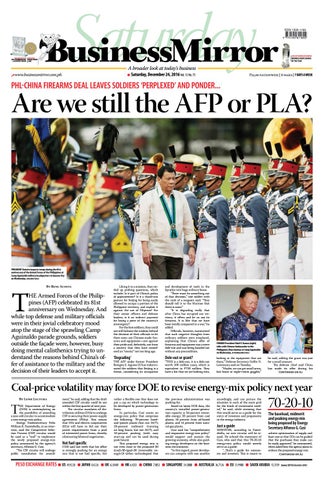
President Duterte inspects troops during the 81st anniversary of the Armed Forces of the Philippines at Camp Aguinaldo military headquarters in Quezon City on Wednesday. AP/Aaron Favila
T
By Rene Acosta
he Armed Forces of the Philippines (AFP) celebrated its 81st anniversary on Wednesday. And while top defense and military officials were in their jovial celebratory mood atop the stage of the sprawling Camp Aguinaldo parade grounds, soldiers outside the façade were, however, busy doing mental calisthenics trying to understand the reasons behind China’s offer of assistance to the military and the decision of their leaders to accept it.
Liking it to a mission, they rattled up probing questions, which include: Is it part of China’s policy of appeasement? Is it a thank-you gesture for Beijing for being easily allowed to occupy a portion of the Philippine territory, and exploit it against the use of Filipinos? For their senior officers and defense leaders, is it an indirect payment for losing a piece of the country’s sovereignty? For the foot soldiers, they could not still fathom the wisdom behind the decision of their officials to let them soon use Chinese-made firearms and equipment—not against their pride and, definitely, not from a country that they have considered an “enemy” not too long ago.
and development of reefs in the Spratlys into huge military bases. “There must be something out of that decision,” one soldier with the rank of a sergeant said. “They should tell it to the Marines that there is none.” “It is degrading really that after China has occupied our territory, it offers and let us use its firearms. It is like that we have been totally conquered in a war,” he added. Officials, however, maintained that such negative thoughts from ordinary soldiers were misplaced, explaining that China’s offer of firearms and equipment was a mere dole-out and was being handed out without any precondition.
‘Degrading’
Dole-out or grant?
The AFP under former President Benigno S. Aquino III has indoctrinated the soldiers that Beijing is a threat, considering its occupation
“This is a dole-out, it is a dole-out worth 100 million yuan, which is equivalent to P720 million. They have a list that we are looking into,
Former President Fidel V. Ramos (right) talks with Chinese Ambassador to the Philippines Zhao Jianhua at Camp Aguinaldo on Wednesday. AP Photo/Aaron Favila
looking at the equipment that are there,” Defense Secretary Delfin N. Lorenzana said on Tuesday. “Maybe, we can get small arms, fast boats or night-vision goggles,”
he said, adding the grant was just for a small amount. The defense chief said China has made its offer during his Continued on A2
Coal-price volatility may force DOE to revise energy-mix policy next year By Lenie Lectura
T
he Department of Energy (DOE) is contemplating on the possibility of amending a year-old circular to accommodate a new energy-mix policy. Energy Undersecretary Felix William B. Fuentebella, in an interview, said the Competitive Selection Process (CSP) circular would be used as a “tool” to implement the newly proposed energy-mix policy announced by the agency’s secretary, Alfonso G. Cusi. “The CSP circular will undergo public consultation for amend-
ment,” he said, adding that the draft amended CSP circular could be out within the first quarter of next year. The circular mandates all distribution utilities (DUs) to undergo CSP in securing their power-supply agreements (PSAs). This means that DUs and electric cooperatives (ECs) will have to bid out their power requirements from a pool of interested power firms, thereby eliminating bilateral negotiation.
Not fuel specific
Cusi said last week that his office is strongly pushing for an energy mix that is not fuel specific, but
PESO exchange rates n US 49.9220
rather a flexible one that does not put a cap on which technology to be developed by power-generation firms. In particular, Cusi wants an energy-mix policy that comprises the following: 70-percent baseload (power plants that run 24/7); 20-percent midmerit (running on long hours, but not 24/7); and 10-percent peaking (with easy start-up and can be used during peak hours). This proposed energy mix is not even close to the proposed 30 (coal)-30-(gas)-30 (renewable energy)-10 (other technologies) that
the previous administration was pushing for. Based on latest DOE data, the country’s installed power-generation capacity is 34-percent renewable energy; 33 percent from coal plants; 18 percent from oil-based plants; and 14 percent from natural-gas plants. Cusi said his “comprehensive and responsive energy-mix policy” would support and sustain the growing economy, while also guiding energy developers on the business environment. “In this regard, power developers can compete with one another
accordingly, and can picture the situation in each of the main grid for the kinds of investment needed,” he said, while stressing that this would serve as a guide for the entry of investors and proponents in the energy industry.
Just a guide
However, according to Fuentebella, no new circular will be issued. He echoed the statement of Cusi, who said that this 70-20-10 energy-mix policy would merely serve as a guide. “…That’s a guide for consumers and investors. This is meant to
70-20-10 The baseload, midmerit and peaking energy mix being proposed by Energy Secretary Alfonso G. Cusi
achieve optimization of supply and least cost so that DUs can be guided that the purchases they make can be easily approved,” he commented, when asked how the agency plans to enforce the proposed energy mix. Continued on A2
n japan 0.4226 n UK 62.0481 n HK 6.4333 n CHINA 7.1853 n singapore 34.5888 n australia 36.7126 n EU 51.9988 n SAUDI arabia 13.3139
Source: BSP (16 December 2016 )
A2 Saturday, December 24, 2016
News
www.businessmirror.com.ph
Are we still the AFP or PLA?
President Duterte (center) salutes with (from left) former President Fidel V. Ramos, Defense Secretary Delfin N. Lorenzana, Military Chief Lt. Gen. Eduardo Año and former President Gloria Macapagal-Arroyo during the 81st anniversary of the Armed Forces of the Philippines at Camp Aguinaldo in Quezon City on Wednesday. AP/Aaron Favila Continued from a1
meeting with China’s ambassador to the country on Tuesday night, the eve of the AFP anniversary. The meeting was also attended by President Duterte. The military is expecting the delivery of the equipment by the second quarter of next year, as the defense department will still have to send officials to China to check them. Aside from the grant, Lorenzana also said China has offered to provide the military with a soft loan of about $500 million. “They want to provide us about $500 million worth of loan, long-term soft loan if we still need equipment,” he said.
Nothing final yet
In providing the assistance, China wanted to help the country in its campaign against terrorism and illegal drugs. “They will help the President. He [Chinese ambassador] told the President, ‘I know your problem on terrorism, I know your problem on drugs, so we would like to help you,’” Lorenzana quoted the ambassador as saying.
The defense secretary admitted they did not discuss the territorial problem. Another soldier with a rank of technical sergeant said defense officials should always consider the country’s issue with Beijing every time they will agree to accept any assistance from China.
Fix
“Call it anything you want, but it is really some sort of fixing us. China has robbed us of a territory, a sovereignty, and yet here comes our officials accepting a measly sum in the guise of a dole-out,” he said. If the country cannot help but accept Chinese assistance, then at least it should not be in the area of defense. “It is as if we are being made a part of the People’s Liberation Army (PLA), and that is hard to accept; unacceptable,” he said. However, Defense Undersecretary for Finance, Munitions, Installations and Material Raymundo D.V. Elefante said nothing is final yet on the Chinese grant. “It is still in early stage, wherein nothing has been decided yet. In fact, we still have to talk. By the way, the offer being offered is
Armored personnel carriers join the celebrations of the 81st anniversary of the Armed Forces of the Philippines on Wednesday. AP/Aaron Favila
a grant for the military equipment, and not necessarily rifles,” he said. The territorial tiff with China is making the assistance from China a complicated issue for soldiers, even if it is being given free, and the absence of a clear position from the government—whether it is still interested in pursuing the
West Philippine Sea case or not—is not helping. In his pre-election message in February this year, Duterte said he is willing to talk with China for a joint exploration in the contested territory to resolve the dispute. Foreign Secretary Perfecto R. Yasay Jr. also said a couple of days
ago that while the country will pursue peaceful means in addressing the issue, “it cannot stop China at this point in time,” referring to the continued militarization of the territory by China. His statement followed a pronouncement made in July that the Philippines is willing to share
natural resources in the West Philippine Sea. However, Supreme Court Senior Associate Justice Antonio T. Carpio maintained that Duterte, as the Commander in Chief, is mandated to defend the country’s territory. Failing or refusing to do it is an abdication of his position.
Coal-price volatility may force DOE to revise energy-mix policy next year Continued from a1
He said some power-generation companies were already informed about this when a meeting was recently held to discuss the country’s demand profile. Fuentebella said he talked with representatives of Lopez-led First Gen Corp., which recently urged the Duterte administration to come up with an energy-mix policy in order to shield consumers from surging coal prices. “I spoke to them. Malinaw na sa kanila [It’s clear to them] that it’s per DU. On CSP, no problem naman,” the DOE official said. First Gen, which operates gas plants and utilizes renewable energy, aired the call, as prices of coal— the dominant fuel for power plants in the country—have turned volatile this year. “Prices of coal have more than doubled between January and October this year. Such price volatility should give us reason to pause and think of other fuels we can use to protect consumers from erratic
fuel-price movements. One solution is to cap the share of specific fuels we use to generate our electricity,” First Gen President and COO Francis Giles Puno said. First Gen cited June 2016 DOE data: coal-fired power plants accounted for 33 percent, or 6,666 megawatts (MW) out of the country’s 20,055-MW total generating capacity. But coal’s share in the mix is expected to drastically expand in the coming years.
Mixed views
Some industry players welcomed the proposed 70-20-10 energy-mix formula, saying this would definitely encourage competition. “I agree that it should not be fuel specific, but according to load curve,” Isidro A. Consunji, chairman and president of DMCI Holdings Inc., said in a text message. The power business of DMCI remains one of its most profitable businesses. Separately, Aboitiz Power Corp. President Antonio R. Moraza
said via text message that Cusi’s proposal is “great”.
Positive effect
“Our energy policy should be fuel agnostic, whatever is most competitive. The reality is that available technology will naturally follow this direction,” he said, when sought for comment. Meanwhile, a group composed of industry associations and manufacturing companies welcomed the DOE’s pronouncement toward a flexible energy mix. The Federation of Philippine Industries (FPI) said mandating a cap on certain technologies would only reduce market competition and with a positive effect on power rates in the country. It also said this would, indeed, promote a more competitive market, and eventually lower the power costs that consumers pay. FPI also agrees that the move of the DOE will ensure ample supply of power for the country, as it moves toward industrialization. “Secretary Cusi’s pronounce-
ments are consistent with FPI’s stand on certain issues, especially on supporting industrial growth by ensuring stable baseload power supply,” said Dr. Jess L. Aranza, chairman of FPI. FPI also recognizes the country needs diversified energy resources, but this can be achieved even without mandating a strict power-generation mix that will limit the technologies that will be developed by the private sector. FPI is against the call of several groups for an energy mix, with caps of 30 percent each for natural gas, coal and renewable energy, and 10 percent for other fuels.
Go for a good blend
To ensure technical and economic optimization, Alsons Vice President for Business Development Joseph C. Nocos said the energy mix should be a good blend of base load, intermediate, and peaking plants that matches the demand profile and provides adequate reserves. “Fuel options for each type of plant can vary, but typically base-
load plants are most economic if powered by coal or nuclear, intermediate by gas or hydro, and peaking by oil or renewable energy,” he said via text message. Based on current lineup of existing and committed power plants, Nocos said it appears that the country’s base-load needs are adequately supplied. However, in the near and medium term, investments in intermediate power plants would be required to achieve an ideal mix of power sources.” For Trans-Asia Oil and Energy Development Corp., company president Francisco L. Viray said, “This is my first time to see an energy mix not based on technology/fuel. So, I do not have any reaction, since I am not familiar with this energymix model.”
‘Tricky’
Jose Victor Emmanuel de Dios, GE Philippines CEO and former DOE undersecretary, said laying out an energy mix, whatever model it maybe, is “tricky”. “I think, what we really need
is our load profile. The fuel will follow…. Tricky iyan and, at the end of the day, the regulator will have to play a part,” he said in an interview. He also noted that alongside an important energy mix is a strong grid. “If the grid is compromised, then the very purpose for which you are mandated to serve, to ensure stable and reliable electricity, will be compromised,” de Dios added. The energy chief underscored the need for the National Grid Corp. of the Philippines to build reliable and interconnected transmission facilities across all three grids—Luzon, the Visayas and Mindanao—so that electricity will be distributed to DUs and ECs, which, in turn, are responsible for transporting power directly to the households. “We have power, but how can that be transmitted to the households if our grid is not reliable. Transmission is vital to this industry. It goes hand in hand with generation and distribution,” Cusi pointed out.
Sports
Editor: Jun Lomibao | mirror_sports@yahoo.com.ph
BusinessMirror
Saturday, December 24, 2016 A3
Nguyen
ROGER FEDERER has not played a match since July 8, when he lost in five sets to Milos Raonic in the semifinals at Wimbledon.
Sacrifices an MMA fighter has to make
A
WELCOMING THE END... OF A LAYOFF, NOT CAREER By Christopher Clarey
T
New York Times
HE Federer family has shared many a road trip, but in this unusually settled period, the patriarch and primary breadwinner has been fielding more and more questions. “The kids were asking, When are we leaving again?” Roger Federer said in an extended interview from Dubai recently. “Because they were happy to get back on the road. It was like, when are we going the next time to Australia or the next time to New York? And I’ve been saying, ‘Not for a while.’” But the next family business trip is now fast approaching. Federer is set to return to action next month in Perth, Australia, at the Hopman Cup team event, before returning in earnest at the Australian Open in Melbourne. Federer has not played a match since July 8, when he lost in five sets to Milos Raonic in the semifinals at Wimbledon. In the last set, he took an awkward and uncharacteristic tumble on the grass that was too easy to see as a metaphor for the decline of a great, balletic champion. February had required him to have surgery for the first time in his career, keeping him out for more than two months. Though he got up slowly at Wimbledon and finished the match, he did not finish the season. He even missed the Summer Olympics in Rio de Janeiro, which had long been one of his major, late-career targets. While his longtime rivals Andy Murray and Novak Djokovic duked it out for the No. 1 ranking and his Swiss countryman Stan Wawrinka won the US Open, Federer got a taste of retirement with his longest break from the tour since he turned professional in 1998. Now, he will try his hand at a staple of modern tennis: the comeback. And he will do so with a world ranking of No. 16, his lowest since 2001. “It actually felt like I had my first real comeback in April when I came back in Monaco, especially having had surgery, because I never had surgery before,” Federer said. “So that felt like a real comeback to me, but this one
KEGFEST WINNERS
Liza del Rosario (center) poses with her championship trophy she won in the recent Philippine Bowling Federation National Bowling Open Championships at the Coronado Lanes inside the Star Mall in Mandaluyong City. With del Rosario are (from left) former world champion Bong Coo, second-placer Liza Clutario, third-placer Alexis Sy and Alex Lim.
feels bigger obviously because two months is not like six months. Clearly this comeback is going to have a different place in my career for sure.” Federer, 35, has little left to prove. He has already won a record 17 Grand Slam singles titles and 71 lesser titles. He has maintained a standard of excellence for far longer than most tennis champions do. Although he said he has treasured his time away from the tour with his wife, Mirka, and their four young children, he insisted that no consideration had been given to making the break permanent. “Mirka is totally committed, totally happy,” he said. “The kids love it, and I’m still hungry, and now I’m even refreshed and rejuvenated.” The question of retirement never came up. For Federer, the question was instead, “Can I still do it? As a player, can my body still do it? Can my mind still do it?” Those are particularly intriguing questions at a moment when so much talent—both rising and established—seems to be converging in the men’s game. Federer, as much a tennis aficionado as a tennis maestro, is well aware of the story lines. The old guard on the men’s tour remains with Federer and Rafael Nadal, who at age 30 is returning from more injury problems of his own with a new coach in his team: Carlos Moyá.
The new wave is full of promise, led by Dominic Thiem, Alexander Zverev and Nick Kyrgios, all of whom have already beaten Federer. There are also many established stars in their primes: from Raonic, Kei Nishikori and Juan Martín del Potro to the multiple Grand Slam champions Wawrinka, Murray and Djokovic. Federer, even in absentia, said he kept checking the scores on his phone as Murray dueled with Djokovic down the stretch in November to secure the year-end No. 1 ranking. “I was very surprised just because when a guy starts a season the way Novak does, achieves his dream by winning the French and his fourth Slam in a row, of course there’s no way in the world that anybody, even the players, start thinking another guy could actually finish No. 1,” Federer said. “Novak, let’s be honest, actually didn’t play too bad in the second half. He won Toronto. He played finals in many other tournaments: US Open, the World Tour Finals. You would think that that’s going to be enough, but what it required was something extraordinary, and Murray was able to deliver that, and that’s where I take my hat off.” Federer did not experience a letdown in 2009 after winning the French Open, the only major singles title he had lacked. But he said he could certainly comprehend the perils of Djokovic’s emotional journey in 2016. “Maybe it’s only human and understandable that Novak
had a letdown, because he achieved everything he wanted to,” Federer said. “You have to maybe reinvent yourself or whatever you have to do. But it’s nice to see that maybe it doesn’t always come so easy for everybody for so long. “And I think it actually creates a great story for next year. Andy’s a great story. Novak’s a great story. Rafa obviously is always going to be a good story. Me coming back is hopefully going to be a nice story to follow, too. I think the beginning of the year, especially the Australian summer, is going to be epic.” Federer said his decision to end his season after Wimbledon was made out of a desire to get the most out of what remains of his career. “Maybe I could have, should have taken more time after the Australian Open once I had surgery,” he said. “Possibly, but I was well. I was training full on in Dubai.” After withdrawing from the French Open, ending his consecutive streak of Grand Slam appearances at 65, Federer came back for the grass-court season and Wimbledon knowing his knee was not quite right. “I don’t think it cost me the rest of the season by playing on the grass,” he said. “I just think the knee and the body needed a break, and taking six months off, I could take the time the body and knee required to heal. Now I can look back and say, ‘Look, if now it doesn’t go well, I did everything I possibly could. There are no regrets.’”
D
USTRALIAN standout Martin Nguyen is sacrificing family time during the holidays to prepare for his fight with former featherweight title contender Kazunori Yokota in the co-headliner of One: Quest for Power at the Jakarta Convention Center in Indonesia on January 14. “The life of a fighter is difficult, but I understand that in order to be the best, fighters have to make certain sacrifices. Spending time away from friends and family to train isn’t easy,” Nguyen (7-1 won-lost) said. For his high-profile bout against Yokota (25-6-3), Nguyen had to give up spending Christmas and the rest of the holiday season with his family to fully focus on his training. Nguyen admitted the most painful sacrifice is the separation from his family, but he knows that there is a reward waiting for him. “It’s part of being a professional fighter. A lot of sacrifices have been made. Training in December is one of them. I have to give up Christmas celebrations for this fight,” he said. “If I want to consider myself as a championshipquality fighter, I have to make that sacrifice. In the end, I will reap the fruits of my labor. Hard work cannot be denied forever,” Nguyen added. The 27-year-old Australian prospect believes that a win over Yokota will earn him a date with Marat Gafurov for the One featherweight world championship belt. “I think a win over Yokota should solidify my position for a title shot. To clarify, I am not in a hurry. I will let my bosses decide because they have the final say for that matter. If they will give me a shot at the One Featherweight World Championship title, I am ready to suit up,” Nguyen declared. Both men are no strangers to Gafurov. Nguyen fell short to the highly touted Russian combatant for the interim title in September 2015, while Yokota unsuccessfully challenged Gafurov this past May. Nguyen sees himself in a must-win scenario as the winner of the marquee matchup might get a rematch with Gafurov in 2017. “My mindset is the same every fight. Everyone is a title challenger, and everyone is capable of becoming a champion. It’s just a matter of who wants it more. I’m ready to put everything on the line to win this fight,” he said.
NO HOLIDAY FOR ALTAS
EFENDING men’s champion University of Perpetual Help will go all out to regain the lead the Altas yielded to San Beda when the elimination round of the 92nd National Collegiate Athletic Association volleyball tournament resumes on January 6 at the Filoil Flying V Center in San Juan City. The Altas, who are eyeing to become the second most successul team in the league with 11 titles—three less than front-runner Letran’s 14— will continue to train during the holiday season to focus on sustaining their form in time for the final games of the eliminations. The Altas are currently tied at third place with
Arellano University on a 4-1 (win-loss) record. They trail leader San Beda (6-1) and No. 2 College of Saint Benilde (5-1). Perpetual Help’s only defeat came at the hands of San Beda, 25-18, 29-27, 23-25, 27-29, 10-15, on November 20. The Las Piñas-based school’s final assignments will be San Sebastian on January 11 and Lyceum of the Philippines University on January 13. They wrap up their eliminations campaign against Jose Rizal University and Arellano University all in January. “We’re only taking a break on Christmas and New Year’s Day because we’ll be spending the rest of the days practicing and training,” Sammy Acaylar said.
BusinessMi
A4 Saturday, December 24, 2016
‘THE TOUR HAS BECOME SO BLAND’ P
IERRE ROLLAND is one of the modern peloton’s veterans of the Tour de FrancE, having ridden the last eight editions, but even he is growing tired of La Grande Boucle. It was revealed earlier this month that the Frenchman will relinquish all general classification (GC) ambitions at the 2017 edition in favor of hunting stage wins—and, perhaps, the polka dot jersey—and will return to the Giro d’Italia with the same aim. Despite enjoying what he describes as his “best start to a Tour de France” this year, before crashes derailed his campaign, he told Cyclingnews that the Tour has become formulaic, dull and simply not enjoyable for a GC rider. “With the Tour it has become almost mathematical,” he argued, speaking at Cannondale-Drapac’s winter training camp in Catalunya. “You could do a power test on all the riders and you’d come out with the exact GC, pretty much. It’s so bland.” The problem, he reckonED, began in 2012, the year Team Sky first truly clenched its iron fist and delivered Bradley Wiggins to a first British maillot jaune. Chris Froome has since taken up the mantle, winning three of the last four Tours, and although he’s arguably a more aggressive and open rider than Wiggins, Sky have continued to dominate proceedings with a stranglehold on the rest of the peloton. “You know exactly what’s going to happen beforehand,” Rolland said. “You know how a certain climb will be ridden, you know it’ll pick up, then a descent, then the final climb it will just be ramped up. It lacks a bit of dynamism.” “For the GC riders, yes, it has become boring– almost the only thing you can do is follow.” It is put to him that his compatriot Romain Bardet’s dramatic stage win in the Alps this year showed that there was still some room for manouevre, but Rolland isn’t all too convinced. “Sure, he had an opening, but because it was pouring down and there were crashes everywhere. If not there wouldn’t have been a leader who attacked. Ok, maybe in the final kilometer, but what’s the point then?” “One opening in the whole Tour.... Me, I don’t identify with that brand of cycling.” Rolland will still be on the start line when the Tour de France peloton descends on Dusseldoorf next July, but he’ll be there with a Giro d’Italia in the legs. The 30-year-old has only ridden the Italian Grand Tour once—in 2014—but he has happy memories, finishing fourth behind winner Nairo Quintana. “The GC at the Giro is different,” he said. “You can attack pretty much anywhere. At the Tour you have nine riders
from 20 teams and the 20 teams all come with the nine best riders they have. But in the Giro teams put maybe five top riders, one or two leaders, and two or three inexperienced riders doing their first Grand Tour, maybe. “It’s less controllable. The parcours also makes it more open; you have loads of small climbs everywhere on the route, rain, snow, maybe a stage on strade bianche, and the roads are generally worse. It’s less bland.” In 2014 Rolland backed up his fourth place in Italy with 11th in France—no mean feat given the well-documented difficulty of the Giro-Tour double. This year, however, the sole focus will be stage victories. “I just want to rediscover the feeling of winning,” said Rolland, whose last and only Grand Tour victories came in the 2011 and 2012 Tours. “I’ve finished in the top 10 at the Tour several times. I’ve been fourth at the Giro, as well. Another top 10 at the Tour, I don’t see what that brings to me.”
Everything changed
Despite his assertions that he doesn’t identify with what the Tour has become, Rolland isn’t a stick in the mud, rooted in the old school. Last winter, at the age of 29, he traded in all that was familiar to him for a new dawn at the American Cannondale-Drapac team. Rolland had spent the entirety of his career on French teams, turning pro with Credit Agricole and spending seven years at Jean-René Bernaudeau’s Europcar team (now Direct Energie). Hungry for a new challenge and to broaden his horizons, he traded in the traditional Gallic way of doing things to adopt a more modern, scientific approach. “It was a transition year,” he said, looking back on the 2016 season. “Everything changed.” “This year was a little complicated, in all aspects, getting used to the different interval training, working more with power, nutrition, as well.
Cyclingnews.com
PIERRE ROLLAND: With the Tour, it has become almost mathematical.
WORLD’S TOU JOSE SANTOS MIRANDA BANDON climbs the first steep hill on the second day of La Ruta de los Conquistadores. photos by New York Times
How else would cyclists riding in La Ruta de Los Conquistadores—a mountainbike race marketed, quite reasonably, as the world’s toughest—make it to the finish line in one piece? How else would they conquer a merciless route that includes steep climbs, choking humidity, muddy jungle trails and swiftmoving rivers that may or may not contain the occasional hungry crocodile?
M
By Juliet Macur New York Times
ATINA, Costa Rica—Just keep moving. Even if only an inch forward. That’s the key. How else would cyclists riding in La Ruta de los Conquistadores—a mountain-bike race marketed, quite reasonably, as the world’s toughest—make it to the finish line in one piece? How else would they conquer a merciless route that includes steep climbs, choking humidity, muddy jungle trails and swift-moving rivers that may or may not contain the occasional hungry crocodile? But first things first: If they did not press forward, how would they get off this bridge? The course on this, the third and final day of La Ruta, was flat, and the finish line beckoned from a soft-sand beach less than 20 miles down the road. But first, there was a cruel twist. Before they reached the beach, competitors had to traverse railroad tracks that crossed several high bridges, like this one, with murky rivers swirling ominously below their unevenly spaced wooden ties. The ties could be rickety, or slick with oil, or set wide enough apart for a human body to slip through—or all three. To cross, hundreds of cyclists had to carry their bikes, or roll them, as they stepped gingerly, silently and in single file, as if in a church procession. Not everyone could handle the stress. One racer near the front of the pack dared to look down between the wooden ties and froze, immediately creating a backup of riders who wanted nothing more than to keep moving, if only an inch, because momentum helped their balance. The rider, a Costa Rican, needed
to be rescued by a wooden cart that was kept handy to ferry “chicken people who don’t want to walk,” said the race’s founder, Román Urbina. But as the cart rolled away and the bottleneck cleared, the real question about the race was not how the riders would complete it. It was: Why did they start it?
EQUAL TO A CHALLENGE
IN the early days, according to Urbina, the race started at the Pacific Ocean and went clear across Costa Rica to the Caribbean Sea, following a compilation of routes taken by Spanish conquistadors in
the 16th century. But this country—famed for its raw beauty, with its lush foliage, multicolored macaws and fog-covered mountains—has grown much since La Ruta’s debut race in 1993. More buildings. More highways. More cars. More of everything, it seems, and that has meant fewer ways for cyclists to go all the way from coast to coast without bumping into something impassable for a person on two wheels. The race this year was a total of 135 miles, about the length of a long stage of the Tour de France. But it is the terrain, not the distance, that makes La Ruta so painful. Last year Urbina had to modify the race route to avoid La Ruta’s usual grueling trip up and over the Irazú and Turrialba volcanoes, a path covered with ash and riddled with sharp
Athletic, graceful and with lots of promise
S
CYCLING AT MOA The Mall of Asia grounds in Pasay City has become a favorite for cyclists—competitive, enthusiasts or health buffs—since
the complex was developed years ago. The early-morning breeze from Manila Bay adds to the enticing atmosphere to ride a bike and sweat it out. Cyclists, however, have to share the road with motor vehicles and are no longer advised to use the grounds’ roads come mall time at 10 a.m. ALYSA SALEN
HE is 23, athletic and graceful. Her third International Cycling Union (UCI) World Championships gold medal a few weeks ago confirmed her position among the best artistic cyclists in the world. Nicole Frybortova is also national champion of Slovakia and this year broke the country’s national record. While most people associate Slovakian cycling with Peter Sagan, Frybortova has her own considerable fan base, with videos of her gymnastic performances on her bike going viral. They no doubt contribute to a rising popularity and recognition of this lesser-known cycling discipline. Her bronze medal at the UCI Indoor Cycling World Championships in Stuttgart, Germany, at the beginning of December came after a silver medal last year and bronze in 2014. Only the gold medal is missing from her collection. However, she is quick to cite this year’s bronze as one of the highlights of 2016, particularly as her final preparation was hampered by a hand injury. Another highlight was her new Slovak record
(176.08), which she set at the second round of the Swiss Austria Masters in October. Behind these performances are many hours of meticulous work learning and perfecting tricks, which doesn’t mean that everything will necessarily go right on the day. Despite winning her national championships this year, Nicole Frybortova does not have good memories of the competition. “I spent more time on the floor than on my bike,” she rued. “If I fall, I have to continue and I try not to think about what happened because I can’t change it. “I think everyone is nervous before a competition and I am, too. How do I deal with it? I bang fists with my mom, then I try to concentrate on what I have to do and imagine that I am just in training.”
irror CYCLING
Saturday, December 24, 2016 A5
7-ELEVEN ROAD BIKE PHL GETS INVITATION AT DOWN UNDER’S HERALD SUN TOUR
‘chris FROOME, HERE WE COME!’ T
UGHEST RACE LOCAL children and teenagers watch, cheer and sometimes heckle the competitors, as they cross a potentially treacherous railroad bridge.
pumice. Turrialba had become too active, organizers decided. Instead, the course charted an alternative. But in typical La Ruta fashion, the detour was not easier; somehow, Urbina found something more challenging than scaling an active volcano on a bicycle. So, on November 2, the eve of this year’s race, Urbina gathered the riders and, in his usual calm voice, explained that this alteration had produced “probably the hardest stage we’ve had in 24 years.” He had added an improbable climb up the side of a mountain. The mouths of a few
of the riders nearly hit the ground. But not all of them. In the room that day was a curly haired, piston-legged banana picker named José Santos Miranda Blandon. Nearly everyone associated with La Ruta knows him as Tinker Tico. Blandon got his nickname more than a decade ago, when he was competing in La Ruta and met David “Tinker” Juarez,
a prominent American mountain biker and BMX racer. Juarez, a two-time Olympian, had long black dreadlocks. Blandon’s black hair looked similar. So someone—no one remembers who—branded him Tinker Tico, the Tinker Juarez of Costa Rica. The name stuck, mostly because Blandon wanted it to. He likes having an alter ego. In real life, Tinker Tico picks bananas for a living. He lives in dormitory-style housing on a banana plantation in the town of Siquirres, about 60 miles northeast of Costa Rica’s capital, San José. Now 40, he has lived there, in the exact same spot, for most of his life. A padlock on his door protects everything he owns. Tinker Tico was happy to show me around his home during the week of La Ruta. A bare light bulb on the ceiling cast a weak glow over the space—a room about 12 feet by 10, with plywood walls and a concrete floor. Along one wall was a twin bed with a thin mattress covered by threadbare sheets. Along another sat a dusty refrigerator, unused because it had long been out of Freon. On the dusty walls and ceiling were cycling posters and dusty blank CDs in silver, red and green. Tinker Tico had affixed them with glue years ago, a bachelor’s effort at home decorating. He is proudest of his cycling medals: about three dozen in all, hanging from a long, thin piece of wood nailed, slightly askew, to two of the walls. The medals are mostly from local races, but there are no finisher’s medals from La Ruta, even though he has completed the event every year since 2002. “I always give the medals away to people who helped me train or helped me with cycling gear,” Tinker Tico said. “I am very grateful that people help me and let me do what I really want to do with my life.” He reached behind a sheet that covered a bookshelf—his makeshift chest of drawers—and grabbed the two thin, dirt-stained T-shirts and the torn denim shorts that he wears in the banana fields. Then he shook his head. He dreams of leaving all this behind, for a life in cycling.
SLOVAK Nicole Frybortova’s third gold medal at the World Championships has confirmed her position among the best artistic cyclists in the world. UCI photo
Fitting many hours of training around studies, competitions and shows leaves little time for leisure. “I don’t have so much time to relax.... Indoor cycling is a really nice sport, but you have to train hard and a lot. All the athletes are getting better so I have to get better, too. I have to try new tricks.” Not only does the talented athlete travel to competitions throughout Europe, she also participates in exhibitions, which have taken her even further afield, such as to Abu Dhabi last October where she performed at the UCI Cycling Gala. “I really enjoy exhibitions and shows because I can see that people like artistic cycling. To have them applauding and giving standing ovations is a beautiful feeling.”
In Abu Dhabi, she performed as a pair with Yannick Martens, Men Singles Swiss Champion and bronze medalist at this year’s UCI Indoor Cycling World Championships in the Single Men competition. The glamorous duo are partners both on and off the bike. Nicole Frybortova acknowledges that her chosen sport comes with certain frustrations, not least having to bow to the jury’s decisions, which can sometimes appear unfair. She would also like indoor cycling to give her more financial stability: “All my equipment, training, travel [except to the UCI World Championships—financed by the Slovak Cycling Federation] and so on is financed by my mum. “You have to love this sport, because you don’t earn money with it and it costs so much time and money.” Even so, she would not change her sport for anything. UCI News
By Ramon Rafael Bonilla
HE Herald Sun Tour is a lure big enough for Filipino cyclists to let the opportunity pass. But with three-time Tour de France champion Chris Froome on the saddle in Australia’s biggest road race, the stakes have become extremely bigger. Champion rider Mark Galedo and his teammates at 7-Eleven Road Bike Philippines get that chance to compete against Froome— and learn much from the vaunted Team Sky organization—in the Herald Sun Tour, an International Cycling Union Category 2.1 race set from February 1 to 5. What makes it historic, and exciting for Philippine cycling, is the fact that the event is an invitation-only race in Victoria. 7-Eleven Road Bike Philippines Sports Director Ric Rodriguez announced recently on dzSR Cycle Lane that the team received an invitation from the Herald Sun Tour organizers, who took notice of the climbing prowess of the cyclists of the 7-Eleven team in its four years of existence as a continental team at Asian Tour 2.2 races. “The team is really excited. It is seldom that you get invitations to these races,” Rodriguez said. Only 16 teams are competing in the race organized by the biggest daily newspaper in Australia. Led by 2014 Le Tour de Filipinas
winner and 2013 Southeast Asian Games individual time-trial champion Galedo, the 7-Eleven team will also be composed of Rustom Lim, Marcelo Felipe and Spain’s Edgar Nieto. 7-Eleven is the first team from the Philippines to vie in the annual six-day, 624.2-kilometer race where Froome is defending his crown. Froome’s Team Sky is expected to face stiff opposition with archrival Orica, which is bannered by Esteban Chavez. The team, Rodriguez said, will make the most out of the stint Down Under. They are also competing in the New Zealand Cycling Classic from January 22 to 26, a seven-stage race that was first held in 1988 in the Wellington region. Rodriguez could not bring his hopes high in the Australian race, considering the strength of the field, but expressed confidence the experience will augur well for the country’s bid of qualifying a cyclist in the Tokyo 2020 Olympics. “We don’t expect to win in those races but we want the opportunity to gauge our Filipino riders against the best in the world and to showcase what Filipino cycling is all about,” he said. “This is a great experience and these rare chances will bring excitement for the entire Philippine cycling community and to our national federation, PhilCycling,” Rodriguez added.
UCI-Wanda ink deal in China
SPORTS director Ric Rodriguez (left) with 7-Eleven Road Bike Philippines members (from left) Edgar Nieto, Marcelo Felipe, Dominic Perez, Mark Galedo, Rustom Lim, Nelson Martin and Jesse Ewart. Not in photo are Arjay Peralta, Bonijoe Martin and Australians Josh Berry and Craig Evers.
HE Union Cycliste Internationale (UCI) and Wanda Sports has announced a groundbreaking agreement that will develop men’s and women’s elite and grassroots cycling across various disciplines in China. The agreement includes the creation of the Tour of Guangxi, a new UCI WorldTour race, taking the men’s professional road cycling peloton to one of China’s most popular tourism destinations. To be held in October, the race will pass through a mix of metropolitan areas and stunning countryside scenery over six days of racing. Starting from 2017, the Tour of Guangxi will run alongside a new women’s elite race which has applied for UCI Women’s WorldTour status as of 2018. Both races will incorporate mass participation events, enabling amateur cyclists of all levels and abilities to ride part of the elite course. A school cycling program will run in Guangxi Province, and a national promotional tour will help to spread the passion and excitement for the international event across the country. The Tour of Guangxi will receive extensive international and national TV coverage, including up to 150 minutes of daily live coverage featuring international graphics and English commentary. After the first two successful editions of the UCI Cycling Gala hosted by Abu Dhabi in
2015 and 2016, this celebration of cycling will move to China in 2017. The annual event rewarding the year’s greatest achievements in professional road cycling will take place in the mountain city of Guilin, venue of the Tour of Guangxi’s final stage finish. The first three editions (2017, 2018, 2019) of the brand-new UCI Urban Cycling World Championships will also take place in China at the end of October. Bringing together the very best of Mountain Bike Cross-Country Eliminator, Trials and BMX Freestyle Park, the innovative new concept is designed to inspire a whole new generation of urban cycling fans. To ensure the long-term development of cycling in China, Wanda Sports will build a cycling centre that will serve as a satellite to the UCI World Cycling Centre in Aigle, Switzerland. Opened in 2002, the UCI World Cycling Centre is an elite coaching and training center providing support to developing nations from all around the world. It offers training and development for around 100 athletes every year in all Olympic disciplines (road, track, BMX and mountain bike), as well as para-cycling and cyclo-cross. It has already welcomed more than 1,000 trainees from over 100 countries, including former Keirin UCI World Champion Guo Shuang of China, 2015 UCI BMX World Champion and Olympic Bronze medallist Venezuela’s Stefany Hernández, and UCI WorldTour rider Daniel
T
Teklehaimanot (Eritrea), the first black African rider to wear the polka dot best climber’s jersey in the Tour de France. The opening of a satellite center in China, where promising athletes will be supported and funded by Wanda Sports, represents an enormous boost to cycling. The center will include an international competition 250-meter indoor track, a BMX track and a road circuit, with the most talented young riders being selected to spend time at the UCI World Cycling Centre. Bike ownership in China has reached 600 million and the country is widely regarded as having huge growth potential for both recreational and competitive cycling. The world’s most populous country also has 10 million active cycling fans, 20,000 cycling clubs, 100 cycling events and 15,000 bike stores. Additionally, the size of the Chinese cycling sports market has grown to $1.5 billion with the industry expecting to reach a growth rate of 20 percent by 2023. UCI President Brian Cookson said: “We are absolutely delighted to announce this partnership with Wanda Sports which will provide a huge boost to cycling in China and I would like to thank Wanda Sports for their support and commitment to our sport. The UCI’s main role is to grow and develop cycling globally and China provides us with a wonderful opportunity to engage with literally hundreds of millions more people. UCI News
A6
Saturday, December 24, 2016
The World BusinessMirror
www.businessmirror.com.ph
Nokia sues Apple to escalate mobile-patent licensing battle
Apple Inc.’s iPhone 6s Bloomberg
N
Pierre Cardin Marlene Awaad/Bloomberg
Pierre Cardin won’t get out of bed for less than one billion euros
A
fter seven decades in the fashion industry, Pierre Cardin will have you know that he’s in no rush to get out.
His eponymous label has been for sale for a quarter of a century, though don’t bother haggling over the price: the fashion designer who pioneered brand licensing won’t entertain offers below €1 billion ($1.04 billion). “If you don’t have the money, then don’t buy it—nobody’s forcing you to,” the 94-year-old said in an interview at his cluttered Paris office opposite the Elysee presidential palace. “I can afford to die without selling it.” Cardin, the first designer to license his name for products ranging from mattresses to frying pans, first floated the idea of a sale in the late eighties. Over the years, he’s periodically revived the possibility—most recent at a fashion show in Paris this month celebrating the 70th anniversary of his design career. Yet, with earnings declining, the luxury industry generally struggling and the number of Cardin licenses less than half what they were at their high point two decades ago, the attractions aren’t what they once were. “One billion euros for the Pierre Cardin brand seems rich at first sight,” said Luca Solca, an analyst
at Exane BNP Paribas. Such a valuation for a licensing business would be at the higher end of the luxury sector, according to Bloomberg Intelligence analyst Deborah Aitken. Net income at Societe de Gestion Pierre Cardin, the arm, which gathers the designer’s license revenue, fell 13 percent to €3.3 million in 2015, according to Societe. com, a French clearinghouse of company information. Revenue was €32.5 million, it said. The number of Cardin licenses active worldwide is down to 350, from about 800 in the 1990s.
Maxim’s offer
Cardin, a self-made millionaire, declined to provide figures or to comment on market estimates. He said he recently received a €2.5 billion offer for his Maxim’s restaurant empire, though was in no hurry to seal a deal. In 1981 Cardin bought the historic Paris restaurant that in its heyday attracted Aristotle Onassis and Rita Hayworth, and set about expanding the brand worldwide. “It’s like a child you raised that wants to escape. I have never
needed money, you understand. I have always lived on my own dime,” said the designer, who trained as an accountant with the Red Cross during World War II and still signs every check himself. Cardin lives a stone’s throw from his office, where he arrives in the late morning most days and works alongside shelves lined with copies of the various books published about him. Even at 94, Cardin travels fairly regularly despite suffering from back pain, and decamps to his chateau in southern France most weekends. He still stages fashion shows, although not during the official fashion calendar, including one in July at the Lacoste chateau, which was once owned by the Marquis de Sade.
Casanova’s Palazzo
The Italian-born designer started his label in 1953 after stints at Paquin and Christian Dior and was the first couturier to offer ready-to-wear creations, heralding the advent of democratic fashion. Among his inventions are the bubble dress and the collarless men’s suit style popularized by the Beatles, and he also pioneered the “Space Age” look in the 1960s alongside Andre Courreges and Paco Rabanne. His Paris flagship store sells Sixties-style A-line dresses costing as much as €2,800, and his perfumes, including Innovation and Legend, are made by Five Star Fragrance
of the US, which also produces scents for Donald J. Trump and rapper Jay Z. Cardin is ranked 166th on the annual rich list published by French magazine Challenges, with an estimated fortune of €4 0 0 m i l l ion , t hou g h he wouldn’t comment on how much he’s worth. “It’s much more than people say and much less than they think,” he said. The youngest of 11 children, the designer has no shortage of surviving relatives. His greatnephew, Rodrigo Basilicati, is listed as an administrator of his holding company Pierre Cardin Evolution, though Cardin declined to say if Basilicati was his designated heir. In addition to his fashion and restaurant businesses, Cardin has a portfolio of properties including the French chateau and Casanova’s palazzo in Venice. Another of his assets is the futuristic Palais Bulles—the “Bubble Palace,” a collection of terracotta-colored domes that includes a 500 -seat amphitheater—on a hillside near Cannes. That’s currently on the market for 300 million euros, he said. Again, bargaining is not an option. “I don’t need to sell it,” Cardin said, leafing through photographs that showed him alongside luminaries from Fidel Castro to Nelson Mandela. “I’m not tempted by money—me, it’s all about success.” Bloomberg News
Researchers: Nearly 400 drug addicts helped in police effort
B
OSTON—A novel drug-addiction program developed in a small Massachusetts fishing town and since replicated in dozens of cities nationwide was able to place almost 400 addicts into treatment nearly each time they sought it during the first year of operation, researchers say in a report being published on Thursday in the New England Journal of Medicine. The team from the Boston Medical Center and Boston University’s School of Public Health say 376 addicts sought assistance 429 times from the Gloucester Police Department’s Angel program from June 2015 to May 2016. They received the help they needed nearly 95 percent of the time, researchers say. Davida Schiff, a Boston Medical Center doctor and lead author of the report, said that rate is far higher than the 50 percent to 60
percent for similar, hospital-based initiatives. Part of the reason, she said, is that Gloucester’s addicts were voluntarily coming to the police seeking help. “They were motivated individuals that came to the station ready to engage in care,” Schiff said. The report also notes that Gloucester police established a relationship with a local treatment center to make placement easier. Its officers were working roundthe-clock to secure the placements. And Massachusetts mandates health coverage for drug detoxification. Law-enforcement officials in communities that have adopted Gloucesterlike heroin initiatives say the report helps validate their work. “Police officers do not get to pick and choose who they help, and that puts us in a
position to make a major impact on the heroin and opioid epidemic,” said Frederick Ryan, police chief in the Boston suburb of Arlington. The Angel program has been replicated in some form by more than 150 police departments in 28 states since it was launched in June 2015. It gained notoriety after the then-police chief promised heroin addicts they could turn in their drugs at the police station without fear of arrest, so long as they agreed to start treatment. As part of the program, officers personally reach out to treatment centers on behalf of addicts, arrange their transportation to the facilities and, if needed, pair them with a volunteer “angel” for emotional support. David Rosenbloom, a professor at Boston University’s School of Public Health who helped write the report, suggested the
program’s success underscores the difficulty of accessing drug-treatment services. Roughly half of the participants in the program had prior drug-related arrests, he noted. “It says something when addicts are going to the police station for treatment,” said Rosenbloom, a founding board member of the Police Assisted Addiction and Recovery Initiative, a Massachusetts-based nonprofit that supports the Angel program and partly financed the research. “It’s a real condemnation of how the whole treatment system faces the public.” The next step for researchers is following up with first-year participants to see how they fared in treatment and beyond, he said. The researchers also hope to study similar programs nationally. AP
okia Oyj sued Apple Inc. saying the iPhone maker infringed several mobile patents, turning simmering tension between the companies into a bitter public legal battle on multiple fronts. The Espoo, Finland-based company said Apple agreed to license patented inventions in 2011 but has refused to extend those agreements that are now expiring. Nokia filed complaints with the German Regional Courts in Dusseldorf, Mannheim and Munich, and in federal court in Texas. “This is a big deal, especially for the future of licensing revenues on standard-essential patents,” Bloomberg Intelligence litigation analyst Matt Larson said, referring to patents that must be used to comply with technical industry standards, like Wi-fi. “Apple has regularly fought to keep royalty rates low, whereas Nokia is interested in getting as much value from its intellectual property as possible.” The dispute is rooted in Nokia’s demise as the world’s largest phone maker. Since selling its handset business, the company has focused on networking. It’s now tapping its patent portfolio as a source of income, rather than as a cross-licensing tool to protect its own products. Nokia’s intellectual-property business added patents through its Alcatel-Lucent acquisition, making it a more significant profit contributor. In the third quarter, Nokia’s technology unit, which licenses its patents, generated about 40 percent of the company’s total adjusted operating profit. Shares of Nokia fell 4.8 percent to €4.50 at 10:22 a.m. in Helsinki, extending their decline this year to 32 percent. Apple advanced 0.1 percent to $117.06 in New York.
‘Patent troll’
“Unfortunately, Nokia has refused to license their patents on a fair basis and is now using the tactics of a patent troll to attempt to extort money from Apple by applying a royalty rate to Apple’s own inventions they had nothing to do with,” Apple said in an e-mailed statement. “We are standing up for inventors everywhere by fighting this flagrant anticompetitive practice.” Nokia and its Alcatel-Lucent USA unit filed two lawsuits on Wednesday against Apple in federal court in Marshall, Texas, claiming patent violations related to products, including the iPhone, iPad, iPod, Apple Watch, Mac computers and digital media players, such as Apple TV. In the first complaint, Nokia said Apple “steadfastly refused ” to license its patents for video coding at established industry rates. Apple continues to use those inventions, which allow for higher quality transmission over cellular networks with lower bandwidth requirements, for its streaming services, according to the complaint. In that case, Nokia seeks damages for the
alleged infringement of eight patents by Apple.
Siri questioned
The second suit accuses Apple of infringing 10 patents, many of which deal with transmitting and amplifying radio signals. Apple is also accused of violating a patent for translating natural language inquiries into database queries. Apple’s Siri digital assistant also violates a patent in this area, according to the complaint. Nokia seeks damages equal to no less than reasonable royalties and a court order against Apple products found to infringe its patents. “Through our sustained investment in research and development, Nokia has created or contributed to many of the fundamental technologies used in today’s mobile devices, including Apple products,” Ilkka Rahnasto, head of Nokia’s patent business, said in a statement. “After several years of negotiations trying to reach agreement to cover Apple’s use of these patents, we are now taking action to defend our rights.”
‘Exorbitant revenues’
In 2011 Apple and Nokia settled a two-year battle over patent royalties for mobile phones. Nokia stopped making phones after that, but kept patents related to that business. Apple sued a group of patentholding companies on Tuesday in federal court in San Jose, California, over antitrust claims. Apple alleges the companies conspired with Nokia “as part of a plan to extract and extort exorbitant revenues unfairly and anticompetitively from Apple and other innovative suppliers of cell phones, and ultimately from the consumers of those products.” Core Wireless Licensing Sarl, one of the companies that Apple said is working with Nokia, last week won a $7.3-million jury verdict against the iPhone maker in San Jose federal court for infringing two patents. Apple has asked a judge to rule there was no infringement. Apple said that, after it entered into a cross-license agreement with Nokia in 2011, the Finnish company launched “secret plans to monetize” patents that weren’t part of the accord. Apple said Nokia has transformed itself out of desperation, based on its own “failure as a supplier of cell phones.” “It changed from a company focused on supplying cell phones and other consumer products to a company bent on exploiting the patents that remain from its years as a successful cell-phone supplier,” Apple said in the complaint. The Texas cases are Nokia Technologies Oyj v. Apple Inc., 16-cv01440 and 16-cv-01441, US District Court, Eastern District of Texas (Marshall). The California case is Apple Inc. v. Acacia Research Corp., 16-cv-07266, US District Court, Northern District of California (San Jose). Bloomberg News
www.businessmirror.com.ph
The World BusinessMirror
Prominent New York City antiquities dealer accused of selling stolen artifacts
N
EW YORK—One of New York ’s most prominent antiquities dealers was arrested on Wednesday on charges that she obtained millions of dollars in stolen artifacts from international smugglers and sold them illegally—often through major auction houses—by creating fraudulent documents to camouflage their history. In a complaint filed in Manhattan Criminal Court, prosecutors with the district attorney’s office say the dealer, Nancy Wiener, and several coconspirators have trafficked in illegal antiquities since at least 1999. Prosecutors say the charges arose from months of interviews with confidential informants, a study of thousands of e-mails and other seized documents, and years of investigations into international smuggling networks. The authorities raided her gallery in March. “Defendant used a laundering process that included restoration services to hide damage from illegal excavations, straw purchases at auction houses to create sham ownership histories and the creation of false provenance to predate international laws of patrimony prohibiting the exportation of looted antiquities,” according to the complaint. Wiener, who faces felony charges of criminal possession of stolen property and conspiracy, was released after posting $25,000 in bail. Wiener’s lawyer, Georges G. Lederman of Pearlstein McCullough & Lederman, said his client “surrendered voluntarily” and added, “We are examining the charges and will respond at the appropriate time.” Wiener and her mother, Doris, who died in 2011, are legendary among New York’s elite dealers. They are credited with helping kick off the market in Indian and Southeast Asian art, and sold works to John D. Rockefeller III,
Igor Stravinsky and Jacqueline Kennedy, among others, for nearly a half-century. Works from the Wiener gallery are in collections at the Metropolitan Museum of Art, the Norton Simon Museum of Art and the Brooklyn Museum, and in institutions around the world. No allegations were put forward suggesting that items in the US museums were suspect. In March 2015 Wiener reimbursed the National Gallery of Australia $1.08 million for a seated Buddha it had bought from her in 2007, after India said the item had been looted. The complaint provides a rare look at how smugglers, art dealers and others may conspire to plunder relics from Indian shrines or Cambodian jungle temples, ferry them into the United States, give them fake pedigrees and burnish them for sale as lawful imports. Prosecutors say that upon the death of her mother, Wiener inherited hundreds of illicit items at their gallery, discarded their records and arranged for inaccurate ownership histories. She then consigned 380 lots for sale at Christie’s, which auctioned them in March 2012 for $12.8 million, according to the complaint. In 2011 prosecutors say, Wiener bought a bronze Buddha stolen from Southeast Asia for $500,000 from an unidentified coconspirator, then arranged for sham papers indicating it was owned by the seller. Wiener is accused of shipping it to a restorer to patch up shovel marks and other signs of looting, and displaying it for sale for $1.5 million at her East 74th Street gallery, where the authorities seized it in March 2016 . The items she is accused of possessing include Indian antiquities said to have been smuggled here by Subhash Kapoor, a well-known Manhattan art dealer who is on trial in India. NYTNS
U
W
ASHINGTON—Presidentelect Donald J. Trump on Wednesday named a strident China critic, Peter Navarro, to lead a new White House office overseeing US trade and industrial policy, in the latest sign that Trump is moving to reshape relations between the world’s two largest economies.
Trump also said billionaire investor Carl Icahn would serve as a special adviser on regulatory issues, another area of economic policy in which the president-elect wants big changes. T he ap poi nt me nt s ref le c t Trump’s ambition to increase economic growth by hammering at what he regards as critical roadblocks. He has promised to ex pand US manufacturing by reducing federal regulation and by preventing what he has descr ibed as unfair competit ion f rom C hinese ma nufacturers. The choices of Navarro and Icahn also ref lect Trump’s manifest preference for advisers who are loyal and who do not have government experience. Navarro, 67, a professor at the University of California, Irvine, who holds a doctorate from Harvard, is the only credentialed economist in Trump’s inner circle. He is the author of a series of jeremiads, including a 2012 documentary film, Death by China, in which an animation of a Chinese knife stabs a map of the United States and causes blood to run freely. Navarro has said China is effectively waging an economic war by subsidizing
exports to the United States and impeding imports from it. Trump, influenced by Navarro’s work, described this on the campaign trail as “the greatest theft in the history of the world.” Trump has said he will persuade Beijing to change its policies by applying pressure, including designating China a currency manipulator; enforcing trade laws more vigorously; and, if necessary, imposing a 45-percent tariff on Chinese imports. In a statement, Trump described Navarro as “a visionary economist” and said he would “ de ve lop t rade pol ic ies t h at shrink our trade deficit, expand our growth and help stop the exodus of jobs from our shores.” A wide range of economists have warned that curtailing trade with China would damage the US economy, forcing consumers to pay higher prices for goods and services. Experts on manufacturing also doubt that the government can significantly increase factory employment, noting that mechanization is the major reason fewer people are working in factories. Navarro’s appointment reinforces a basic division among Trump’s
ride-hailing service in China this year, choosing, instead, to invest in a local incumbent, Didi Chuxing. It has also turned tail or reduced its presence in other markets, including some cities in Germany. A day before Uber began its pilot, state regulators were explicit about their demands that the company adhere to the rules. In a news statement on December 13 about the testing of autonomous vehicles, the Department of Motor Vehicles said: “We have a permitting process in place to ensure public safety as this technology is being tested. Twenty manufacturers have already obtained permits to test hundreds of cars on California roads. Uber shall do the same.” Nonetheless, as recently as Friday, Uber remained defiant. It said it had no intention of ending its test and that its self-driving cars were still on the road and picking up passengers. Uber officials contended that under the letter of California law, the company did not need a permit because the Motor Vehicles Department defined autonomous vehicles as those that drive “without the active physical control or monitoring of a natural person.” NYTNS
We’re now looking at where we can redeploy these cars but remain 100 percent committed to California, and will be redoubling our efforts to develop workable statewide rules.”—Uber
A7
Vocal China critic chosen to lead new US trade office
Uber ends its self-driving car experiment in San Francisco ber’s grand experiment of a self-driving car service in its hometown officially lasted only a week. On Wednesday Uber ended the autonomous car service in San Francisco after defying California officials who had told the company to stop the service because it was illegal. The company lacked the necessary state permits for autonomous driving, state officials have said. In a news statement issued on Wednesday, the company said it ended the pilot program after the California Department of Motor Vehicles revoked the registrations for its self-driving cars. “We’re now looking at where we can redeploy these cars but remain 100 percent committed to California, and will be redoubling our efforts to develop workable statewide rules,” the company said. Uber has tended to barrel into new markets by flouting local laws, part of a combative approach to expand globally. Uber began a pilot of its self-driving experiment in Pittsburgh in September, which is continuing. Yet, the defeat in California on self-driving vehicles is one of a growing number of setbacks. The company gave up on its own
Saturday, December 24, 2016
An Uber driverless car is displayed in a garage in San Francisco. Uber has pulled its self-driving cars from California roads. The ride-sharing company said on Wednesday California transportation regulators revoke registrations for the vehicles. AP
economic advisers. The people he has chosen to oversee trade policy, Navarro and Wilbur Ross, a billionaire investor, both favor increased trade restrictions. But Trump’s broader circle of advisers is dominated by proponents of free trade, including Icahn; Gary D. Cohn, the president of Goldman Sachs, who will lead the National Economic Council; Rex Tillerson, the chief executive of Exxon Mobil, who was tapped for secretary of state; and Gov. Terry Branstad of Iowa, Trump’s choice for ambassador to China. Trump is also considering the appointment of Larry Kudlow, a strong proponent of trade, to lead his Council of Economic Advisers. Trump has also promised to edit the federal rule book, removing what he has described as overly burdensome restrictions. He said last month the government would eliminate two regulations for each new rule it put on the books. For Icahn, who will not draw a salary, the new role formalizes his relationship with Trump, whom he advised on economic issues throughout the campaign. Icahn, 80, has no experience in government; like a growing number of Trump’s appointees, he was prized for his success as a businessman. Icahn, a brash New York billionaire who vocally supported Trump during the campaign, made his fortune as a corporate raider, buying stakes in corporations and demanding changes to reward shareholders. “Carl was with me from the beginning, and with his being one of the world’s great businessmen, that was something I truly appreciated,” Trump said in a statement. “His help on the strangling regulations that our country is faced with will be invaluable.” Icahn will also play a role in the
selection of a new chairman for the Securities and Exchange Commission, the regulator that serves as the referee for his battles with corporations. Icahn, the child of two New York schoolteachers, was not k now n for politica l activ ism before the 2016 campaign, and he has insisted that he wants to help the country, not himself. But Trump’s choice of a major corporate investor to play a role in rewriting regulations that could affect those companies renewed concerns about conflicts of interest in the next administration. “The corrupt nature of this arrangement cannot be understated,” Eric Walker, a spokesman for the Democratic National Committee, said in a statement about Icahn’s appointment. “Voters who wanted Trump to drain the swamp just got another face full of mud.” Navarro has built a quiet career as an academic economist, publishing papers on subjects like why businesses give to charity, electricity deregulation and the economics of trash collection. He also mounted four unsuccessful political campaigns as a Democrat between 1992 and 2001, including candidacies for mayor of San Diego and a House seat in Congress. He has said he started paying attention to China in the early 2000s because he noticed that graduates of the business school at California, Irvine, were starting to lose jobs as a result of globalization. In 2011 he wrote a letter to Trump about his book Death by China, which the movie was based on, and the men began to correspond. Over the past year, Navarro became an increasingly important campaign adviser on economic issues. But he and Trump had not met until September.
OurTime BusinessMirror
A8 Saturday, December 24, 2016 • Editor: Efleda P. Campos
news@businessmirror.com.ph
Japan changes pensions so they fall if prices or wages drop
T
HE bonus that millions of Japanese seniors enjoyed in recent years when their pension income remained the same while consumer prices and wages fell is about to end.
In an effort to make the pension system more sustainable as the elderly population swells, parliament approved a bill on Wednesday that will see payments drop when prices and salaries decline, not just rise when they go higher. The government expects to pay seniors ¥54.8 trillion ($476 billion) in pensions in the fiscal year through March, equivalent of more than 10 percent of the economy. With almost 40 million people receiving pensions, and the number increasing, while the working-age population contracts, pressure on Japan’s finances is growing. The Japanese system is divided into two main parts: A basic pension all workers, including the self-employed, pay into; and an additional scheme into which government and company employees make extra contributions. The first pays pensioners an average of ¥57,000 a month and the second, which is now compulsory for most workers, pays about an additional ¥100,000. Payments made into the system by workers currently fund 66 percent of payments going out to pensioners. The government covers about 23 percent of payments, and the rest is generated from the pension funds’ investments. The changes will come in steps and by 2021 it will be possible for the government to cut pension payments if wages or prices drop. The rub for the government is the importance of pensioners in supporting consumer spending and domestic demand in Japan, both of which are vital for economic revitalization. Bloomberg News
A KISS FOR SANTA
Sofia, 5, a day-care student, plants a kiss on the cheek of 84-year-old Santa Claus Nars Padilla during a Christmas party in Baguio City. MAU VICTA