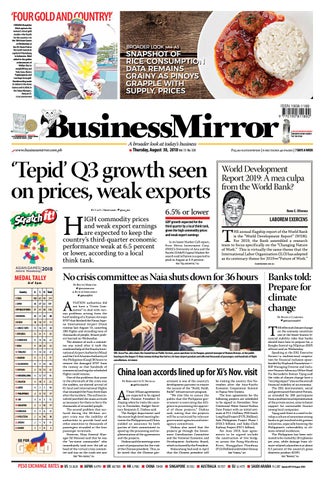
‘FOUR GOLD AND COUNTRY!’ Cebuana Margielyn Didal captures the women’s street gold medal—the fourth for the country—in the 18th Asian Games on Wednesday at the JSC Skate Park in the South Sumatran capital of Palembang in Indonesia. Didal added to the golden achievements of Hidilyn Diaz in weightlifting and Yuka Saso, Bianca Pagdanganan and Lois Kaye Go in golf. Skateboarding made its debut in the Asian Games and in 2020, in the Tokyo Olympics. Story on C3. PSC POC SECRETARIAT PHOTO
media partner of the year
BusinessMirror
United nations
2015 environmental Media Award leadership award 2008
A broader look at today’s business
www.businessmirror.com.ph
Thursday, August 30, 2018 Vol. 13 No. 320
n
‘Tepid’ Q3 growth seen on prices, weak exports
H
By Cai U. Ordinario
@cuo_bm
IGH commodity prices and weak export earnings are expected to keep the country’s third-quarter economic performance weak at 6.5 percent or lower, according to a local think tank.
Medal Tally As of 8 p.m.
Country
G
In its latest Market Call report, First Metro Investment Corp. (FMIC)-University of Asia and the Pacific (UA&P) Capital Market Research said inflation is expected to peak in August at 5.9 percent.
business news source of the year
P25.00 nationwide | 6 sections 40 pages | 7 days a week
World Development Report 2019: A mea culpa from the World Bank?
6.5% or lower
GDP growth expected for the third quarter by a local think tank, given the high commodity prices and weak export earnings
2016 ejap journalism awards
Rene E. Ofreneo
laborem exercens
T
he annual flagship report of the World Bank is the “World Development Report” (WDR). For 2019, the Bank assembled a research team to focus specifically on the “Changing Nature of Work.” This is virtually the same theme that the International Labor Organization (ILO) has adopted as its centenary theme for 2019—“Future of Work.”
See “Q3 growth,” A2
Continued on A7
No crisis committee as Naia shuts down for 36 hours Banks told: Prepare for climate A change By Recto Mercene
S B Total
1 China
100 65 49
2 Japan
50
47 62 159
3Republicofkorea
37
41 50
128
4 INDONESIA
30
22 36
88
5 iR iran
18
16 17
51
6 chinese taipei
13
16 21
50
7 dpr korea
12
8
9
29
8 Uzbekistan
11
15 16
42
9 India
9
20 23
52
10 thailand
9
13 35
57
11 Bahrain
9
3
5
17
12 KAZAKHSTAN
8
9 33
50
13vietnam
4
15 13
32
14 Hongkong,china
4
12 17
33
15 Malaysia
4
10 9
23
16 Qatar
4
3
3
10
17 Philippines
4
0 13
17
18 UAE
3
6
3
12
19 Singapore
3
4 10
17
20 mongolia
3
3
6
12
21 Kyrgyzstan
2
6 10
18
22 Jordan
2
1
8
11
23 Kuwait
2
1
0
3
214
@rectomercene
& Butch Fernandez @butchfBM
VIATION authorities did not have a “Crisis Committee” to deal with various problems arising from the hard landing of a Xiamen Airways B737 that blocked the Ninoy Aquino International Airport (Naia) runway last August 15, canceling 200 flights and stranding tens of thousands of people, Senate probers learned on Wednesday. The absence of such a committee was noted after it took the combined help of the Manila International Airport Authority (Miaa) and the Civil Aviation Authority of the Philippines (Caap) 36 hours to remove the damaged B737 from the runway so that hundreds of commercial and regular scheduled flights could resume. One of the problems that arose in the aftermath of the crisis was the sudden, un-slotted arrival of 61 local and international flights that swamped the Naia three days after the incident. The airlines involved justified the mass arrivals as necessary for them to ferry the thousands of stranded people. The second problem that surfaced during the 36-hour airport crisis was the inability of authorities to provide food and other amenities to thousands of passengers stranded at the four passenger terminals. However, Miaa General Manager Ed Monreal said that he was the “on-scene commander” who immediately took over the job as head of the virtual crisis committee and was on the crash site just
By Bianca Cuaresma
T Sen. Grace Poe, who chairs the Committee on Public Services, poses questions to Lin Huagun, general manager of Xiamen Airways, at the public hearing on the August 15 Naia runway mishap that led to a 36-hour airport paralysis and affected thousands of passengers and hundreds of flight cancellations. ROY DOMINGO
China loan accords lined up for Xi’s Nov. visit By Bernadette D. Nicolas @BNicolasBM
A
T least 10 loan agreements are expected to be signed by Chinese President Xi Jinping when he visits the country in November, Budget Secretary Benjamin E. Diokno said. The Budget department said the recent high-level meeting between the Philippines and China yielded an assurance by both parties of their commitment to speed up the processing and implementation of the agreements and the projects. Diokno said the meetings were a sort of preparation for the visit of the Chinese president. This, as he noted that the Chinese gov-
ernment is one of the country’s development partners to ensure the success of the “Build, Build, Build” infrastructure program. “We also like to assure the public that the Philippine government is exercising due diligence in processing the approval of these projects,” Diokno said, noting that the projects will be scrutinized by relevant government agencies and interagency committees. Diokno also noted that the projects go through the Investment Coordination Committee and the National Economic and Development Authority Board, which is chaired by the President. Malacañang had said in April that the Chinese president will
be visiting the country this November after the Asia-Pacific Economic Cooperation Summit in Papua New Guinea. The loan agreements for the following projects are scheduled to be signed in November: New Centennial Water Source-Kaliwa Dam Project with an initial estimate of P12.2 billion; PNR South Long Haul Project (P175.3 billion); Safe Philippines Project Phase I (P20.3 billion); and Subic-Clark Railway Project (P57.1 billion). For June 2019, loan agreements to be signed include the construction of five bridges across the Pasig-Marikina River, Manggahan Floodway (P13.6 billion) and Ambal-Simuay See “China,” A8
HE effects of climate change on the economy constitute one of the lesser-known financial stability risks that banks should learn how to prepare for, a Bangko Sentral ng Pilipinas (BSP) official said on Wednesday. Speaking at the ESG Executive Forum—a multisectoral cooperation for financial inclusion spearheaded by Maybank Foundation— BSP Managing Director and Inclusive Finance Advocacy Office Head Pia Bernadette Roman Tayag said the risks of climate change have a “very big impact” also on the overall financial stability of an economy. The ESG (environment, social and governance) Executive Forum, as attended by 200 participants from a multisectoral representation of the private sector, aims to boost support for sustainable finance among local companies. Tayag said there is a need to develop a culture of awareness among banks to get involved with greener initiatives, especially knowing the Philippines’s vulnerability to climate-related incidences. The Philippines has been estimated to be visited by 20 typhoons per year, while damage from climate-related calamities is at about 0.5 percent of the country’s gross domestic product (GDP).
See “No crisis,” A2
PESO exchange rates n US 53.3620
@BcuaresmaBM
n japan 0.4799 n UK 68.7303 n HK 6.7982 n CHINA 7.8439 n singapore 39.1332 n australia 39.1517 n EU 62.4175 n SAUDI arabia 14.2287
See “Banks,” A2
Source: BSP (29 August 2018 )
News
BusinessMirror
A2 Thursday, August 30, 2018
Palace supports ‘option’ to extend ML in Mindanao after Isulan blast
E
By Jovee Marie N. dela Cruz @joveemarie & Rene Acosta @reneacostaBM
xecutive Secretary Salvador C. Medialdea on Wednesday said the government is considering the extension of martial law in Mindanao following a deadly explosion in Sultan Kudarat.
The top Palace official said extending martial law and suspending the writ of habeas corpus remains an option. “It’s an option,” Medialdea told reporters in an ambush interview after the budget hearing of the Office of the President. “We’re trying to make it as easy as possible. But if such a thing happened, what will we do? Will we just sit around?” he added. Two people, including a 7-yearold girl, were killed, while 34 others were wounded on Tuesday night following the blast owned up by the Islamic State (IS), a claim still being investigated by security forces. The attack in the capital town of Isulan occurred almost a month after a suicide bombing carried out by a suspected Moroccan for the Abu Sayyaf Group ripped through Lamitan City, Basilan, killing 10 people and wounding 13 others. National Police (PNP) chief Director General Oscar D. Albayalde has put all police forces in Mindanao under red alert, although
No crisis. . .
Continued from A1
minutes after the accident. This elicited an outburst from Sen. Grace Poe, who chairs the Senate public services committee: “You mean the full resources[are focused] on the accident? No wonder.” Sen. Richard J. Gordon weighed in, saying the Department of Tourism could have provided the food. “You could have ordered from Jollibee and fed the passengers who will get mad, call the Department of Tourism and order their buses to bring the passengers [out of the airport].” He noted that other countries give free tickets to affected passengers. Gordon said the idea is that a crisis committee would be able to harness all the resources and talents of the various government agencies while working together. During the Marcos administration, when the Caap used to be called the Bureau of Air Transportation, Gen. (Ret.) Jesus Singson established a crisis committee to deal with airport problems following an aircraft accident, according to air traffic controller Alger Ramo. During an aircraft accident, within a 5-mile radius from the Naia, the Airport Crash and Rescue Unit,which has a complement of the most advanced type of aircraft firefighting equipment, takes jurisdiction in suppressing all types of fire, especially those generated by volatile aviation gas. However, he said subsequent aviation authorities disbanded the Crisis Committee, “because anything associated with former president Ferdinand Marcos was considered anathema or loathsome.” Senate President Pro Tempore Ralph G. Recto got the Naia’s General Manager Monreal to admit that the Miaa has P15 million cash on hand for contingency. “Yet, for all of this money, nothing was spent to address the thirst and hunger of the stranded passengers,” Recto fumed. Senator Sergio R. Osmeña III, former chairman of the Public
the region is still under martial law. Metro Manila was also put under heightened alert. The PNP chief said they were investigating whether the latest bombing, which was blamed by Malacañang on the Bangsamoro Islamic Freedom Fighters (BIFF), was a terror attack, adding they have prior reports about plans by jihadists to stage attacks in the region. The BIFF, through its spokesman, Abu Misry Mama, however, disowned any responsibility to the bombing, pointing it instead to the soldiers so that the blame would be put on the group. “None of us are involved there. The Bangsamoro Islamic Freedom Fighters do not commit acts that will hurt most people, that is why we do not have any involvement there,” Mama said. In an interview after a budget hearing at the House of Representatives, Albayalde also said he is open to the possibility of extending martial law for peace and security in Mindanao. Services committee, grilled Monreal on why the clearing of the runway took 36 hours, if the required type of crane was readily available on call. “In the meantime, you should have called the crane already,” Osmeña told the former Cathay Pacific station manager, who said he was busy addressing how to remove the disabled B737 after eight hours had already elapsed since the Xiamen Air skidded out of runway 24. “On hindsight,” replied Monreal. “No, no, no,” Osmeña said. “We have protocol, you don’t call the crane after the investigation, it took the investigators hours to finish.” Monreal said the protocol is not to bring in the crane right away, “because the airport has the inflatable lifting bags,” one of the several specialized aircraft-removal equipment required by the International Civil Aviation Organization. “Once the lifting bag is able to lift part of the plane off the ground, then we could slide [in] the slings to lift the plane for towing,” Monreal explained. Osmeña wanted to know what would have been the sequence of events from the moment the plane has been lifted and the slings slid underneath the disabled aircraft. “When you are able to lift the plane, and then what?” Monreral replied, “That’s the time to put the plane on a flatbed for towing.” To which, Osmeña repeated his question: “Why was the crane not called upon from the outset to speed up the job?” The airport manager said it was not that easy to do because “we have not fully evaluated [the situation], since the aircraft investigators still won’t allow us to come near the plane until their investigation is finished.” “But you can call the crane,” Osmeña persisted. “On hindsight, [maybe we should have called],” Monreal conceded. Monreal also explained that it was not that easy to mobilize the crane because, although they were initially able to put together the various parts at the crash site— consisting of weights and counter weights—after several hours, “one
“For me, nothing bad happened with the imposition of martial law there. I think, it’s part of peace and security in the area,” Albayalde said. “In fact, it has probably improved the economic development of the area.... Then why not?” the PNP chief said. Bayan Muna Rep. Carlos Isagani T. Zarate warned that floating the possibility of further extending martial law in Mindanao as early as August due to the bomb blast in Sultan Kudarat can be exploited to ensure the victory of administration allies in next year’s midterm elections. “The bomb explosion in Sultan Kudarat is definitely highly condemnable, but this should not be used to further the agony of the people of Mindanao, particularly the displaced Moro, lumads and peasants. This incident even showed martial law’s failure in solving the island ’s security problems; instead of extending, it should be immediately lifted,” said the Davaobased solon. “The bomb incident should be investigated, but at the same time we must ensure that this is not used by unscrupulous people for their own vested political interests,” Zarate added. With security officials citing that rebellion has not been quelled in the southern region, the 17th Congress last December voted to extend martial law in Mindanao for the entirety of 2018. Convening in a joint session, the Senate and House of Representatives—through Resolution of Both
Houses No. 13—granted President Duterte’s request for a martial law extension for a period of one year from January 1, 2018, to December 31, 2018. President Duterte signed Proclamation 216 imposing martial-law and suspending habeas corpus in Mindanao on May 23, 2017 following the attacks of IS-inspired Maute Group in Marawi City. Section 18 of Article VII of the Constitution empowers the President to declare martial law and suspend the writ of habeas corpus only “in case of invasion or rebellion, when public safety requires it.” Capt. Arvin Encinas, spokesman for the Army’s 6th Infantry Division), said the explosion occurred at around 8:30 p.m. infront of the H and J Marketing along the national highway right after two people whom security forces accosted left the area. The two men, whose identities were not ascertained, were accosted by roving militiamen after leaving a bag in front of the establishment. The bomb went off just as a military truck bearing soldiers was passing by. “More could have been killed or wounded had the side of truck not [been] armored plated,” he said, adding a militiaman and two soldiers were also wounded in the blast. The US-based SITE Intelligence Group, which monitors online the activities of terrorists and jihadists around the world, said the IS has claimed responsibility for the latest bombing in Mindanao.
of the stabilizers gave way.” This is part of the 500-ton telescopic crane that was called for the job, according to Monreal, who added that another 200-ton telescopic crane was also made available. “It took just one hour from the time the disabled plane was lifted onto the flatbed and towed out of the runway into the tarmac, but it took a total of 12 hours to assemble the crane,” Monreal pointed out. Despite these, Monreal said it took some time for the Aircraft Accident Investigation Board to collect the debris that fell from the B737 as part of the evidence following a full investigation. Gordon, meanwhile elicited from the Caap director general that the Xiamen Airways’s B737 is a total wreck and the insurance firm will absorb the losses. In that case, Gordon said, given the total unusability of the aircraft, the authorities should have shoved the wreckage out of the runway and on to the far side so that flights could resume. However, Sydiongco said that airport regulations stipulate that there should be a 150-feet clearance from the runway centerline all the way to the side before any aircraft can land or take off. Gordon questioned Monreal why the nine available firetrucks —which are equipped with fire retardants—were not called to stand by while they “bleed” the fuel tanks of four tons of fuel, following the latter’s claim that they could not move fast enough lest they trigger a sudden burst of fire, which could have killed the responders. Sen. Poe said modern jet engines use kerosene, which is not combustible or highly flammable like aviation gas. “From now on, you will have on call [the name of] company for heavy equipment, that’s looking forward.” “We have agreement that will be considered, moving forward. That’s a free pass for you, nobody wants an accident to happen,” Gordon added.
anew the idea that it may be time to consider an alternative gateway as Naia becomes more congested. Recto observed that Naia is “near if not past its peak,” leaving government no choice but to build a new gateway to the country, The Duterte government, the senator suggested, must now decide whether Naia’s decongestion will be through San Miguel Corporation’s aeropolis in Bulacan, the expansion of Clark Airport in Pampanga, or the proposal tendered by the socalled “Taipans’ consortium” to expand the Naia. Recto noted that Naia’s passenger volume doubled from 20.4 million in 2007 to 42 million passengers last year. “If it is increasing its passenger volume by 2.5 million passengers a year,” Recto said, citing the annual increase from 2016 to 2017, “then there is no way that the present facilities can handle 10 million additional passengers by 2022.” SMC’s New Manila International airport (NMIA) complex in Bulacan, earlier awarded an original proponent status, awaits approval by the Duterte government. The $15-billion project, proposed to be undertaken by SMC at no cost to the government, includes the construction of a sprawling airport covering 1,168 hectares and a city complex to be built on a 2,500-hectare area along Manila Bay in Bulakan town. It includes six parallel runways and an estimated initial annual capacity of 100 million passengers or over three times that of Naia’s current capacity. It was pointed out that the recent Naia-Xiamen Airlines fiasco was “the latest of several sobering wake-up calls” that can no longer be ignored, and Filipinos are now aware of the urgency of building a new, main international gateway. In turn, SMC proposed to undertake the new airport project in Bulacan under government’s buildoperate-transfer scheme. Its proponents say a vital component of the proposal is the construction of an expressway that will link its airport to the North Luzon Expressway in Marilao, Bulacan.
Alternate gateway
THE joint inquiry also surfaced
With Manuel T. Cayon
www.businessmirror.com.ph
SRA sees higher sugar output in CY 2018-2019 By Jasper Emmanuel Y. Arcalas
T
@jearcalas
HE Sugar Regulatory Administration (SRA) said it expects sugar output in the next crop year to recover and grow by nearly 6 percent to 2.225 million metric tons (MMT). The SRA issued Sugar Order (SO) 1, which sets the sugar policy for crop year (CY) 2018-2019. SO 1 estimated that total sugar output in the next crop year would reach 2.225 million metric tons, higher than the 2.1 MMT produced in CY 2017-2018. “We [hope for] more favorable weather this cropping season,” SRA Administrator Hermenegildo R. Serafica told the BusinessMirror via SMS when asked about the agency’s estimate. The decline in the country’s sugar output in CY 2017-2018 has been attributed to “unfavorable weather conditions,” particularly the increase in rainfall over some sugar-producing provinces. Rains affect the yield of sugarcane, as wet canes have lower sugar content. At the start of CY 2017-2018, the SRA estimated that sugar production would reach 2.38 MMT. In January the SRA revised its forecast downward to 2.266 MMT due to bad weather. “Weather, in fact, is unpredictable, but we are hopeful of a favorable weather condition for crop year 2018-2019,” SRA Sugar Board member Roland Beltran told the BusinessMirror.Serafica said favorable sugar prices would also encourage sugarcane farmers, to sustain planting and not shift to other crops during the crop year. “Prices should be able to cover for production inputs to sustain the farm operations of farmers otherwise they will be forced to abandon
Q3 growth. . . Continued from A1
The think tank also said the country’s export performance will recover sometime in the second half of the year and not immediately in the third quarter. “Third-quarter GDP expansion may remain tepid [i.e., 6.5 percent or less], unless inflation starts to slow down and exports begin to move to positive territory. With construction [especially infrastructure] and manufacturing remaining robust, the underlying growth momentum should hold up,”FMIC-UA&P Capital Market Research said. Inflation is expected to peak in August, the think tank said, because of the heavy rains and flooding that occurred due to the monsoon. However, the think tank said the increase in commodity prices will slow down because of rice harvests and the arrival of rice imports in September. It added that oil prices are expected to trade below $70 per barrel. Electricity rates are also expected to go down because many hydropower plants will operate at full capacity during the rainy season. The think tank also said the decision of the Monetary Board to raise interest rates by 50 basis points to 4 percent could help temper inflation. “We still believe that inflation will continue to lodge above the BSP’s [Bangko Sentral ng Pilipinas] target but will start to taper off once
Banks. . .
Continued from A1
Tayag said among the key expectations from the financial sector to push for a more “climate-friendly” environment include the banks’initiative to redirect capital toward climate finance, sustainable finance and investments of environment-preservation intitiatives. Banks are also expected to influence client firms to comply with environmental standards. However, Tayag said regulators and banks alike are facing challenges in advancing this kind of thinking among the financial sector. These include the establishment of a clear business case for climate invesments, the lack of information, tools and expert advice to make financing decisions about green projects. The financial sector’s inadequate capacity and weak enforcement of environmental standards were also seen to hamper the financial sector’s growth on the sustainable finance. “This is a
sugarcane farming or move to other high-value crops,” he said. Sugar industry stakeholders said a “reasonable” sugar price level that would be acceptable to both farmers and consumers would be P1,500 per 50-kilogram bag (LKg). Prices of “B” sugar or those allocated for domestic market at the start of CY 2017-2018 averaged P1,350 per Lkg. Philippine Sugar Millers Association Executive Director Francisco D. Varua said his groups’ output estimate for CY 2018-2019 concurs with the forecast of the SRA. “That is also more or less the estimate of the PSMA,” Varua told the BusinessMirror via SMS. Beltran said Section 4 of SO 1 gives the SRA the flexibility to adjust the sugar allocation for CY 20182019 “considering the unpredictability of the weather or climate. “We can make adjustments depending on the prevailing circumstances,” he said. Section 4 of SO 1 indicates that the SRA “shall undertake periodic assessment” of sugar production and withdrawal. “And on the basis of such assessment, the [SRA] may, from time to time, adjust the percentage distribution of the different classes of sugar as provided in this Sugar Order and/ or take the necessary action to address the situation,” SO 1 read. Under SO 1, the SRA allocated 95 percent of the total estimated sugar output in CY 2018-2019, or some 2.114 MMT, for the domestic market. The remaining 5 percent, or around 111,250 MT, would be shipped to the United States. The SRA expects total area planted with sugarcane in CY 2018-2019 to reach 423,447.61 hectares, which would produce about 24.702 MMT of sugarcanes. supply-side factors [price upticks in rice and crude oil] start to stabilize in the third quarter,” FMIC-UA&P Capital Market Research said. However, the think tank said exports are expected to recover in the second half of the year on the back of higher growth in the United States, European Union and Japan. FMIC-UA&P Capital Market Research said exports growth will turn positive in the second semester, since there is a six-month lag between peso depreciation and improvement in exports. Earlier this month, Socioeconomic Planning Secretary Ernesto M. Pernia said, in order to attain the target of 7-8 percent GDP growth this year, the economy needs to grow by 7.7 percent in the second semester. In the second quarter, the Philippine economy only grew 6 percent, slower than the 6.6 percent posted in the first quarter this year and second quarter last year. In the January-to-June period, GDP averaged 6.3 percent, lower than the 6.6 percent recorded in the same period in 2017. Pernia said the country’s growth in the second quarter was adversely affected by the slowdown in the agriculture sector. The growth of the Agriculture, Fishery and Forestry sector only posted a growth of 0.2 percent. He said the harvest of palay, corn, sugarcane and mango harvests for the quarter “were dismal.” Pernia added that coconut, including copra, livestock and poultry production, also reported weak output. journey. It is a long way to go, but we want to see more banks really understand that this is something that is inevitable, that this is something that they have to start addressing and it is something that they have to start investing in,” Tayag said. Speakers in the forum also urged banks to use the“power of debt”to advance for climate-friendly initiatives, saying that banks—when extending credit to certain firms and companies—must also look at the businesses’ ability to follow environmental standards and not only focus on sole profitability. Maybank Philippines Inc. President and CEO Choong Was Hong said Maybank organized the event as part of its own sustainable finance initiative by spreading awareness to other local private companies about its importance. “As a responsible corporate citizen, Maybank is committed to ensuring good environmental, social and governance practices, including the promotion of sustainable finance. This is very much aligned to our mission of humanizing financial services,”he said.
Economy BusinessMirror
www.businessmirror.com.ph
Editor: Vittorio V. Vitug • Thursday, August 30, 2018 A3
House OKs bills on 4Ps, Consumer Act, workers’ leave
T
By Jovee Marie N. dela Cruz
@joveemarie
he House of Representatives on Wednesday endorsed for Senate approval three measures institutionalizing the Pantawid Pamilyang Pilipino Program (4Ps), strengthening the Consumer Act of the Philippines and increasing the yearly service-incentive leave of employees. Voting 196-6-0, lawmakers approved on third and final reading House Bill (HB) 7773 institutionalizing the 4Ps and giving the poorest families cash grants up to a maximum of five years. HB 7773 seeks to reduce poverty and promote human capital development in the country by breaking the intergenerational cycle of poverty, promoting gender equality and ensuring inclusive and equi-
table quality education. The 4Ps is a major anti-poverty program of the government that started during the term of former president and now Speaker Gloria Macapagal-Arroyo. It mandates the Department of Social Welfare and Development (DSWD) to select qualified households on a nationwide basis using a standardized targeting system to conduct a revalidation of targeting
of beneficiaries every three years. The measure also mandates the provision of a lump-sum Conditional Cash Transfer to be received by each qualified household-beneficiary equivalent to P2,200 per month for health/nutrition and education expenses, or the equivalent of P26,400 per qualified household-beneficiary per year. It also mandates DSWD to provide beneficiaries with direct and secured access to cash grants through any number of authorized government depository banks; and for localities not adequately served by AGDB, DSWD may contract the services of rural banks, thrift banks, cooperative banks and institutions engaged in money remittances duly accredited by the Bangko Sentral ng Pilipinas. Under the bill, conditionalities of coverage by the program include: Children aged 0 to 5 must receive regular preventive health checkups and vaccinations; children aged 1 to 18 must avail themselves of deworming pills twice a year, children aged 3 to 4 must attend day care or
preschool classes at least 85 percent of the time; pregnant women must avail themselves of prenatal and postnatal care and give birth with the assistance of a skilled or trained health-care professional in a health facility; at least one responsible person must attend the family-development session conducted by the DSWD, at least once a month; and at least one responsible person must join and complete at least two governmentrecognized or accredited nongovernment organization-sponsored skills training programs or must be engaged in livelihood activities. It also provides for a case-management system to be used to deal with beneficiaries’ noncompliance with set conditions. The appropriation shall continue until the program has covered 60 percent of the total number of extremely poor households in the country, as may be determined by the Philippine Statistics Authority at the time of the enactment of the act. The bill penalizes any person
MALIGAYANG KAARAWAN, + Amb. Antonio L. Cabangon Chua Sa iyong ikatlong kaarawan sa piling ng ating Poong Lumikha, inaalala namin nang may pagmamahal at pasasalamat ang lahat ng aral at kabutihang iyong idinulot sa amin. Mula sa
ALC Group of Companies Agosto 30, 2018
conspiring with public officials to receive the cash grant. The penalty is imprisonment of one month to six months, or a fine of P10,000 to P20,000, or both imprisonment and fine, at the discretion of the court.
Timbangan ng Bayan
Voting 199-0, the lower chamber also approved HB 7857, principally authored by Arroyo, which seeks to provide the establishment of a Timbangan ng Bayan Center in all public and private markets nationwide and penalize those who tamper weighing instruments after these are officially sealed. Arroyo said the establishment of Timbangan ng Bayan Centers will provide the buying public with an effective means of checking the accuracy of the weight and the quantity of the goods that they are buying. It will also discourage dishonest vendors to commit any irregularity because of the imminence of getting caught in flagrante delicto, said Arroyo. The bill will act as an amendment for a provision of the Consumer Act of the Philippines. The bill also gives the supervision of the proposed weighing scales to the market supervisors, giving them the responsibility to keep record on the products being weighed. The measure said Timbangan Ng Bayan scales will also be protected still by Chapter II Article 64 of the Consumers Act of the Philippines. Under the bill, alteration, tampering, violation and destruction of Timbangan Ng Bayan by violators will be penalized with a fine of at least P50,000 to P300,000 or imprisonment of at least one year to five years depending on the court’s ruling. It said violators for altering the official seal, sticker, paperworks and imitating Timbangan Ng Bayan Scales will be penalized with a fine of at least P50,000 to P300,000 or imprisonment of at least one year to five years upon the court’s ruling, which was an increase from the republic act’s penalizing of only at least P200 to P1,000 for the said violations. According to the measure, the Department of Trade and Industry and the Department of the Interior and Local Government will execute and manage the project of Timbangan Ng Bayan scales with the Union of Local Authorities of the Philip-
pines, League of Provinces of the Philippines, League of Cities of the Philippines, League of Municipalities of the Philippines and the appropriate stakeholders. The funds necessary for the establishment and maintenance of Timbangan Ng Bayan Centers shall be charged against the internal revenue allotment and other funds of the local government unit concerned, the bill said.
Service incentive
Also through 203-0 voting, a measure seeking to increase the yearly service-incentive leave of employees from five to 10 days has been approved at the House of Representatives. HB 6770 seeks to boost the workers’ morale, wellness and productivity. At present, Rep. Mark O. Go of Baguio City, principal author of the bill, said the Labor Code of the Philippines does not require employers to grant sick and vacation leaves, and what the law provides instead are service-incentive leaves. He said these work incentives are given based on the prerogative of the employers, either by expressed stipulation on the employees’ contract or through collective bargaining agreement. He added an employee who has rendered at least one year of service is entitled to a yearly service incentive leave of five days with pay. However, the same law provides that an employer who grants employees with a five-day vacation shall already be deemed compliant with the mandatory granting of the service-incentive leave. The bill seeks to amend Article 95 of Presidential Decree 442, as amended, otherwise known as the Labor Code of the Philippines. The proposed amendment provides that every employee who has rendered at least one year of service shall be entitled to a yearly serviceincentive leave of 10 days. The provision shall not apply to those who are already enjoying such benefit, those enjoying vacation leave with pay of at least 10 days, and those in establishments regularly employing less than 10 employees or in establishments exempted from granting this benefit by the labor secretary after considering the viability or condition of such establishment.
Senate probe sought to avert spread of Zambo rice crisis By Butch Fernandez
T
@butchfBM
wo senators on Wednesday sought an inquiry in aid of crafting remedial legislation to avert repeat of the recent rice crisis that hit Zamboanga City, and check the eight-month surge of staple prices in other parts of the country. Sens. Francis N. Pangilinan and Paolo Benigno A. Aquino IV filed Senate Resolution 868, paving the way for Senate hearings amid calls to hold the National Food Authority (NFA) accountable, asserting the need to see to it that cheap and quality rice is available in the market. “The NFA must explain the said shortage, the alleged hoarding and how the situation in Zamboanga City reached calamity level,” the two senators stressed. In moving to open an inquiry, Pangilinan and Aquino asserted the public’s right to be informed on “how the NFA is trying to solve the crisis situation so that unscrupulous traders and other influential forces in and out of government are not able to manipulate the procurement process and the availability of rice stocks.” The senators noted that, apart from Zamboanga City, also placed under a state of calamity was Isabela City in Basilan “due to rice scarcity.”
“The rice crisis is not limited to Zamboanga City, where prices reached P70 per kilo, as the Philippine Statistics Authority reported an upward streak in rice prices for 8 months now,” they added. Senate Resolution 868 also cited statistics recording year-on-year increases on: average wholesale price of well-milled rice at P43.18 per kilo, or 10 percent higher; average retail price of wellmilled rice at P4 5.7 1 per kilo, or 9 p e rce nt higher; average wholesa le pr ice of regularmilled rice at P4 0.0 8 per k i lo, or 13 percent higher; and average retail price of regularmilled rice at P42. 26 per kilo, or 11 percent higher.
A4
TheBroa
Business
Thursday, August 30, 2018 | Editor: Dennis D. Estopace
Snapshot of rice-consu grainy as Pinoys grapp By Cai U. Ordinario & Jasper Emmanuel Y. Arcalas
A
S Filipinos’ appetite for rice becomes as big as its politicaleconomic implication, a snapshot of data on its consumption remains grainy.
This is so because the government uses two data sets to estimate the amount of rice consumed by every Filipino. Having two data sets to compute for a single amount can result in data discrepancies that make rice demand and supply difficult to evaluate. The Philippine Statistics Authority (PSA) releases the Supply Utilization Accounts (SUA) of selected agricultural commodities and the results of the Food Consumption Survey (FCS). According to PSA Assistant National Statistician Vivian R. Ilarina, the SUA is based on production while the FCS is based on a survey that doesn’t separate the consumption of rice from other “cereals.” The SUA treats rice consumption as merely residual after computing rice stocks and removing exports and waste, among others. “You estimate first the stocks plus the stocks available at the beginning of the year plus the local production plus imports—some of that—less use and disposition like exports, waste, processing, feeds, seeds—everything—then you have the closing stock, which [also comes] from the survey of the PSA,” Ilarina said. “When you compare the left side equation to the right side, there is a residual. And this represents now the total consumption, which is available for food. This is not yet considered actual food consumption. In the survey of food demand, that is actual consumption,” she added. Evaluating actual consumption is important as some sectors are pushing for unbridled entry of rice into the system while its price is being marked by runaway increases and a possible phantom shortage.
Ingrained
RICH and poor households always have rice included in their budgets. It is the cheapest source of carbohydrates and is most compatible with Filipino dishes. Based on interviews conducted by the BusinessMirror, a lowincome family consumes three to four kilos of rice per week—around 12 kilos to 16 kilos per month— relative to the number of members and their appetite. Due to the recent increase in rice prices, households shell out more pesos to pay for goods. This is especially true for lower-income households, especially those at the bottom of the pyramid. University of the Philippines School of Statistics Dean Dennis S. Mapa said food items, including rice, account for 70 percent of the household budget of Filipinos earning less than average. About 39 percent of an average Filipino household’s budget is for food items. This makes the poor even more sensitive to increases in food prices, including rice, Mapa explained. Of course, we are affected by high rice prices, Reynaldo Teñuso, a resident of Malolos, Bulacan,
told the BusinessMirror. Teñuso added this becomes even more felt when the price of a kilo of rice increases P1 or P2 more. To save on costs associated with cooking at home, some households resort to buying cooked rice, usually at P10 per cup, from a store. For three meals a day, this means P30 ($0.56) per day and about P210 or nearly $4 per week. A more affluent household with five members can buy 25 kilos to 100 kilos a month. An affluent family of eight could buy 50 kilos of rice a month. This, even if richer families have more financial means to buy other sources of carbohydrates. Dagupan City resident Almira Chu, whose family owns a local hotel, said rice remains as their best daily source of carbohydrates. Apart from rice, the meals in more affluent households include vegetables and meat. This could be one key difference between rich and poor households—the ability to buy other commodities to accompany their meals. Unlike poor Filipinos who adjust their consumption just to make ends meet, rich families will continue to buy their set monthly consumption—no matter the price. “Even if the price of rice is increased, our consumption remains the same since rice is the most important for a Filipino family,” Josefina V. Castañeda, municipal mayor of Lingayen, Pangasinan, said.
All rice
RICE consumption levels also differ according to age and occupation. While older Filipinos would be content with half a cup or just a cup of rice per meal, students or those in their teens and 20s would consume more than double this amount. Some young Filipinos would consume two cups to as much as four to five cups of rice every meal. This has made many of them regular patrons of restaurants that offer unlimited rice. They also rely on the seemingly “unlimited” nature of rice supply at home. Jade, 19, said she usually consumes two cups per meal or six cups a day to as many as nine cups a day, thanks to “unlimited rice” offers by restaurants. Carlos, 21, said he consumes four cups of rice per meal or seven cups per day and would usually eat at home. “Nakasanayan din. Sa bahay ako madami kumain ng kanin [I’m used to it. I eat a lot of rice at home],” he said. Blue-collar workers such as delivery men, security guards and drivers are also patrons of restaurants that offer unlimited rice. Manuel, a 31-year-old delivery man, still consumes three cups of rice per meal or as much as eight cups of rice per day. Alvin, a 30year old security guard, eats as much as four cups per meal or eight cups of rice per day. Drop by those small, makeshift carinderias that usually sprout on the edges of major construction projects around the country. On
any given day, one invariably sees construction workers buying two to three plastic packs of rice and just one tiny plastic bag of viand. Understandable because the rice can go from just P5 to P8 a pack in such sites, while one order of viand averages between P25 and P40.
Guesstimates
THE exact rice consumption of Filipinos is difficult to predict and depends on demographics as well as other socioeconomic factors. Nonetheless, it is still important for the government to be able to provide an estimate. These estimates are crucial given the fact that the country is a net food importer. In previous years, the Philippines was even considered the world’s largest rice consumer. This puts a spotlight on the accuracy of rice estimates. National Economic and Development Authority (Neda) Assistant Secretary Mercedita A. Sombilla admitted to the BusinessMirror there are discrepancies when it comes to the use of the SUA and the FCS. Sombilla said policymakers have known such discrepancies for years. She added that harmonizing the data is close to, if not totally, impossible. She said that for one, it is only during the lean months when the SUA and FCS data actually match. Despite these concerns, Sombilla said that as policymakers, the government needs to recommend imports given that the country does not really produce enough rice for Filipinos’ consumption. She explained this is the reason for the quarterly inventory to go askew. “We can’t harmonize data,” Sombilla said. “We never did quarterly estimates of supply and demand during those times because they were not accurate.” Roehlano M. Briones, senior research fellow at the Philippine Institute for Development Studies, shared the same concern with the BusinessMirror about erratic rice inventory data. “[The] common complaint by industry stakeholders is smuggling. That is actually a reality that we do not deny. So that means there [is] more volume coming into your stocks than recorded,” Briones told the BusinessMirror. “I really cannot say if the rice inventory data [of the PSA] is that reliable. The National Food Authority (NFA) is probably accurate but for commercial stocks and household stocks, it is [difficult] for me to comment because the frameworks for those two surveys are based on an old survey way, way back during the National Statistics Office [the PSA predecessor] days,” he added.
Consumption
THROUGH the survey-based FCS, the government can estimate the country’s per capita rice consumption, while the SUA can estimate the country’s per capita net food disposable (NFD). According to the PSA, the NFD refers to the amount of food commodity available in its original or unprocessed form for human consumption. “This is usually equated or made equivalent to the quantity.” The government uses both per capita rice consumption and per capita NFD to decide on the volume of rice needed to be imported in order to augment the shortfall
THIS April 12, 2017, file photo shows different varieties of rice being sold at a local market in Manila. PHUONGPHOTO | DREAMSTIME.COM
in local supply, the Philippine Rice Research Institute (PhilRice) explained in its 2012 policy report. According to PhilRice, the FCS and the SUA framework are both used by the Bureau of Agricultural Statistics (BAS) to estimate per capita rice consumption. “FCS measures the amount of food actually consumed by sample households. Survey data are more accurate but availability is for selected years only because data gathering is expensive,” PhilRice added. PhilRice explained that the SUA provides the government with annual estimates of per capita rice consumption, thus, becoming a more convenient input in agricultural policy planning. Based on the FCS of the PSA, the country’s per capita rice consumption in 2015 to 2016 declined to 109.875 kg from 114.265 kg in 2012. Prior to those years, the country’s per capita rice consumption grew to an all-time high of 119.08 per kg in 2008 to 2009 from 105.768 kg in 1999 to 2000. This was at 104.273 kg in 1995.
However, during the same reference years, SUA estimates showed otherwise. In 1995 per capita NFD was pegged at 92.55 kg, while in 1999 it was at 99.68, subsequently breaching the 100-kg level in 2000 as it rose to 103.16 kg. The SUA estimates showed that per capita NFD in 2012 was at 118.87 kg, 4.605 kg more than its counterpart from the FCS. For the years 2015 and 2016, the country’s per capita NFD reached 111.62 kg and 107.84 kg respectively, according to PSA’s SUA estimates.
Vital statistics
HOWEVER, in 2012, PhilRice issued a policy report indicating that parameters under the SUA framework are already outdated, if not obsolete. “The SUA framework was developed by the FAO [Food and Agriculture Organization] and the estimates for SUA parameters were tailored based on the country’s utilization pattern,” it said in March 2012. “For the Philippines, these estimates
were determined by an interagency committee in the 1980s and are still being used up to this date.” Rolando T. Dy, University of Asia and the Pacific Center for Food and Agri Business executive director, pointed out that having an updated and validated data on the country’s rice supply and demand would help government policy-makers come up with prudent decisions. “For example, if situations are normal—just like in the past two years—the increase in the prices [of rice] will reflect the gap in the supply and demand,” Dy said. “And that means we lacked importation to augment our supply because the prices went up. That’s under normal circumstances,” he added. And one of the most valuable data or measurement needed by the government in monitoring the country’s rice supply and demand is the per capita rice consumption. The PhilRice explains the importance of per capita rice consumption simply as a critical variable used in estimating the rice requirement of the country.
aderLook
sMirror
www.businessmirror.com.ph | Thursday, August 30, 2018
umption data remains ple with supply, prices losses (drying to storage) for rice is 7.55 percent higher than SUA’s 6.5 percent, the PhilRice added.
Factor out babies, OFWs
THE government should thoroughly consider the estimated population in dividing the total rice demand, according to economists at the University of Asia and the Pacific (UA&P). For one, babies should not be counted in the country’s estimated population when getting the per capita consumption as they only consume the staple after about two years, Dy explained. For another, overseas Filipino workers are not in the Philippines and thus, they must not be included in computing per capita rice consumption, according to Senen U. Reyes, UA&P senior management specialist. The risk of underestimation or overestimation in the parameters of SUA could translate to higher or lower NFD, according to Briones. “If there are errors, the residual would just absorb them. If the errors of overstated and understated would cancel each other, that is hard to say,” he said. “That is why I have little confidence in SUA-based estimates. I am more partial to sample surveys.” The PhilRice said an error on the MRR is a crucial part in estimating the country’s per capita NFD. “An overestimated [or underestimated] MRR can result in overestimated [or underestimated] rice supply, hence, higher [or lower] per capita NFD,” it said. PhilRice added in its report the overestimated MRR translated into an additional 4 kg in per capita NFD, while the underestimated wastage equated to about 1.11 kilograms. Furthermore, the underestimated seeding rate meant a reduction of 0.04 kg. “If the substitution effect, overestimated MRR and underestimated allotments for seeds and rice wastage were adjusted, the NFD would have been 114.42 kg/ year in 2009, which is 4.6 percent or 5.5 kg lower than the reported amount of 119.92 kg/year,” it said.
Partnership
“Therefore, this has an impact on setting the import requirement of the country,” PhilRice said in a 2012 policy note aimed to improve the government’s decision-making on rice production. “Increased per capita rice consumption means more imported rice,” PhilRice added. Briones said the FCS is more reliable than the SUA estimates when it comes to the country’s per capita rice consumption. Briones said there are a lot of “flaws” in the SUA parameters of the government as well as other statistical frameworks used by the PSA in coming up with data on rice supply and demand.
Missing
FIRST, there is the case of the missing supply. The government must take into consideration the volume of smuggled rice into the country as part of its total staple supply, Dy said. Industry estimates that there is about 1 million metric tons of rice smuggled to the Philippines annually, he added.
Briones said the framework of the PSA’s production estimates is already outdated as it was last updated in 1990. “So much over time the sample for the survey becomes irrelevant,” he said. “The farther the current period from the original frame period, the more errors would be computed.” Citing anecdotes from local government units, Briones said the PSA usually understates its palay production estimates. “I have not seen a single LGU that said that the estimates of PSA are good,” he added. “The LGUs seem to imply that production [estimates of PSA] are understated. Real production tends to be higher than those reported by PSA, which are based on quarterly palay production surveys.”
Outdated
THE PSA employs various “outdated” parameters with its SUA that could lead to a huge difference in total rice supply and demand of the country, according to Briones. For one, the SUA sticks with
its average milling recovery rate (MRR) of about 65.4 percent, which, Briones said, is crying to be reviewed. “The milling recovery rate is problematic,” he said. “It has been used for decades now and has not been reviewed. A one percentage point [difference in milling recovery rate] could mean a hundred thousand metric tons.” Citing the survey conducted by the then Bureau of Agricultural Statistics (BAS), the PhilRice said the country’s average MRR stood at 62.85 percent in 2008, which is 2.55 percentage points lower than the MRR used in the SUA. PhilRice also noted that the average seeding rate and postharvest losses used in the current SUA are outdated. Based on the Palay Production Survey conducted by the BAS, the average seeding rate in 2009 is 76.55 kg/hectare, higher than SUA’s 75 kg/ha, it said. The Philippine Center for Postharvest Development and Mechanization (PhilMech) reports that the current estimate of postharvest
DY is urging the government to involve the private sector, particularly those in the rice trade business, in coming up with sound data on the country’s staple requirement. “Involve people from the private sector such as the grain millers and retailers. Because they are on the ground and they know the trends in buying and consumption of rice,” he said. “The government could discuss with the private sector at least twice a year to determine what is really the trend of the country’s rice consumption.” Reyes recommended the government create an interagency committee that would harmonize available datasets. Through the interagency committee and the private sector, the government could now come up with reliable and updated baselines on the country’s rice consumption, according to Dy. “That will remove inconsistencies in data and would save the government money [from conducting various surveys],” Reyes told the BusinessMirror. PhilRice recommended that the Department of Agriculture’s (DA) interagency Committee on Cereals “could set new estimates of SUA parameters, i.e., MRR, seeds,
processing, and feeds and waste, to derive a more realistic per capita NFD figure.” “The new estimates should then be endorsed to the National Statistics Coordination Board [NSCB] for approval and adoption,” it said in 2012. Briones said in an ideal situation where there is no budgetary restriction, the government should conduct annual FCS. However, if financial resources are limited, a biennial survey would suffice, he added. “Survey-based estimates are better as they allow people to respond to relative price changes— instead of estimates based on certain figures not driven by economic forces and dictated by political logic rather than economic logic,” Briones explained.
A5
pinos? Is it 114 kg per capita or 109 kg? That 5-kg difference is a big difference.” The agriculture chief said government targets to complete the FCQS before the year ends. Once completed, Piñol said the FCQS would be presented before an interagency coordinating committee comprising of pertinent government agencies on the country’s food trade. The FAO failed to reply to BusinessMirror’s request for comments before this story ran.
Confusion
GRAINS Retailers Confederation of the Philippines (Grecon) President Jaime O. Magbanua said they have been lobbying the government to allow private representation in the National Food Authority Council (NFAC) for so long now. The NFAC, the highest policymaking body of the NFA, also decides whether or not the government should import rice. “The representation of the rice industry at the NFAC is only up to the farmers’ level and there is no stakeholder from the traders, millers and retailers,” Magbanua said. “We are arguing that we should be represented at the NFAC as we are the ones who know the actual situation in the field.” Magbanua believes involving the private sector in the government’s policy-making process would result in more impartial and sound decisions. “The government should be really able to determine how much volume of rice goes into our trade. We should determine how much imports are coming and needed,” he said. “And that is possible if we have a strong private sector involved in the process because we will be the one giving our inputs so that there is balanced information for the government.”
ACCORDING to Piñol, having confusing data sets “affects our strategic planning.” He explained that having a solid data set on the country’s food consumption would be more critical in a post-QR rice regime as the President would need all pertinent and updated information to exercise his powers under the law. “Under the [tariffication] law, the President has a huge elbow room when it comes to tariffs. If he thinks the imported volume is already detrimental to the local rice industry then he could increase the tariffs,” he said. “That adjustment would still assure us of sufficient supply but ensure farmers are not hurt.” In order to address the issues with the SUA and the FCS, Ilarina said the PSA is now in the process of adopting the Food Balance Sheet (FBS) recommended by the FAO by December this year. According to the FAO, the FBS offers a comprehensive picture of the pattern of a country’s food supply in a particular period. An FBS is created per commodity or food item and details the number of processed commodities that are potentially available for human consumption. “The total quantity of foodstuffs produced in a country added to the total quantity imported and adjusted to any change in stocks that may have occurred since the beginning of the reference period gives the supply available during that period,” FAO said.
Futures
Nutrients
Representations
AGRICULTURE Secretary Emmanuel F. Piñol is cognizant of the importance of a sound database on the country’s food consumption. In fact, one of the 10 basic foundations of a sound agriculture and fisheries program under the Duterte administration is having a national food consumption quantification study (FCQS), according to documents from the Department of Agriculture (DA). “A nationwide survey will be conducted to determine the most consumed and in-demand foodstuff and agricultural commodities for all Filipinos,” the DA said. “This initiative will also establish the food consumption rate in relation to population growth of the country, allowing the government to think ahead and pursue programs and projects that address food concerns proactively,” it added. Thus, the DA partnered with the FAO last year to conduct the FCQS. The FCQS, a $300,000-funded FAO study, would determine the current trends in food consumption by Filipinos. “We want to get the data accurate,” Piñol told the BusinessMirror. “For example, this is a question for the longest time, what is the total consumption of rice per year by Fili-
THE FBS, Ilarina said, offers a lot more indicators when it comes to food consumption, such as nutrient content and energy content, which are not available in the SUA and the FCS. The FBS will also help make sense of the data on food sourced from the Food and Nutrition Research Institute (FNRI). Ilarina said the FNRI data is very detailed but only takes into consideration the nutrient content of the commodity consumed in the household. The methodology for obtaining this data is very tedious and invasive. In order to obtain the information, the FNRI visits specific households and measures the weight and nutrient content of all food consumed at home. Therein lies one of its limitations—it only accounts for food that is consumed at home. These limitations make the FBS a more attractive option for the PSA. Ilarina said the PSA already has an interagency committee (IAC) for the Task Force on Food Balance Sheet. When the IAC has approved the indicators for the FBS, this will be presented to the PSA board for approval and then adoption. With additional reports from Marc dela Paz, Pearl Anne Gumapos and Mauro Alfonso S. Mendoza, Interns
A6 Thursday, August 30, 2018 • Editor: Angel R. Calso
Opinion BusinessMirror
www.businessmirror.com.ph
editorial
US-China trade war can benefit PHL
A
mid an escalating US-China trade war, world leaders are alarmed that the Geneva-based World Trade Organization, the only global international organization dealing with the rules of trade between nations, could become irrelevant. To protect the WTO, the European Union decided to host trade ministers from the United States and Japan next month in Brussels in an effort to address China’s trade practices in a way that does not marginalize the WTO. The EU is working on a proposal to amend the composition of the WTO, as well as address about a half dozen US complaints.
The decision by the Trump administration to side-step the WTO when it unilaterally increased tariffs on $50 billion worth of Chinese goods has raised concern that the trade body could slide into obsolescence if steps aren’t taken to shore it up. The situation worsened when Beijing retaliated in kind with duties on $50 billion worth of US goods and pledged to respond if Trump follows through with his threat of levies on an additional $200 billion of Chinese products. After the collapse of a recent trade talks between US and China representatives, there’s a general consent that China’s leader won’t allow himself to be trumped by an obstinate American president, which is why this trade war will take longer to resolve than expected. Not a few economists have said an escalating trade war between the top two economic giants will stir up headwinds that will adversely affect their economic growth and those of their trading partners. The Philippines, however, could be one of the countries to benefit from a prolonged US-China trade war. Due to the country’s strategic location in the region, it could regain its status as an ideal production center among China locators. Now is a good time for us to remind investors that Filipinos are among the most educated and highly trainable labor force in Asia, not to mention that the Philippines is a largely English-speaking country. We have to move fast to attract investors to stop the bleeding in our industrial estates. The Philippine Economic Zone Authority recently reported that investment pledges fell 56 percent in the first half of the year to P53 billion, from P120.2 billion in the same period last year. The government can show investors our growth indicators and the policies laid out to boost the country’s economic gains. But more than figures and words, officials need to walk the talk. They can’t say investors are welcome when the Chief Executive does otherwise. If presidential advisers know that allowing others to save face is an Asian trait, they could have prevented the public humiliation of foreign investors involved in the planned construction of a $1.5-billion theme park by the Nayong Pilipino Foundation (NPF) and Landing Resorts Philippines Development Corp., a local subsidiary of Hong Kong-based Landing International. President Duterte earlier this month sacked the entire board of Nayong Pilipino over a lease deal that he found disadvantageous to the government. The firing was announced simultaneously with the groundbreaking of the NayonLanding casino resort, planned to feature a water park, resort, casino and office space for NPF. NayonLanding Chairman and Executive Director Yang Zhihui said the resort will generate more than 10,000 jobs. He said NayonLanding is estimated to add 2 million to 3 million tourist arrivals to the country. However, pending the review by the Department of Justice of NayonLanding’s contract, the project remains in limbo. This should teach us a lesson. The government must fix the system of giving out contracts if we don’t want a repeat of an incident that could send wrong signals to investors.
Since 2005
Stock Market 006: ‘Hype and dump’ John Mangun
OUTSIDE THE BOX
T
here are some people that are convinced that stock prices are manipulated. They are convinced that there is a supersecret Facebook group that if they could only join, they would become rich. Of course, many of these folks would jump at the chance to be first in on the next pyramid scheme. However, as an average investor, you need to know how to identify and not get burned by certain stock market trading situations. In the United States about the only fraudulent trading that will get you in trouble is buying or selling on insider information. The most famous case in recent memory was when television personality and businesswoman Martha Stewart went to prison. She received nonpublic bad news from her stockbroker. In the Philippines insider information is usually a joke as witnessed
by the several issues that have been absolutely guaranteed by the “highest sources in the government” to be “the third Telco.” However, “hype and dump” is common on the Philippine Stock Exchange (PSE) because we, local investors, love hot tips. It is embarrassing to name the names but Easycall Communications Phils. (ECP) went from $4 to P70 and now back to the P24 area where it has been for about five months. ECP is not even on the most recent list of companies who intend to submit a bid. Perhaps the ones who bought at P50 (and are still
Cecilio T. Arillo
✝ Ambassador Antonio L. Cabangon Chua
database
Founder
Editor in Chief Associate Editor News Editor Senior Editors
T. Anthony C. Cabangon
Lorenzo M. Lomibao Jr., Gerard S. Ramos Lyn B. Resurreccion, Efleda P. Campos Dennis D. Estopace
Online Editor Social Media Editor
Ruben M. Cruz Jr. Angel R. Calso
Creative Director Chief Photographer
Eduardo A. Davad Nonilon G. Reyes
Chairman of the Board & Ombudsman President VP-Finance VP Advertising Sales Advertising Sales Manager Group Circulation Manager
Judge Pedro T. Santiago (Ret.) Benjamin V. Ramos Adebelo D. Gasmin Marvin Nisperos Estigoy Aldwin Maralit Tolosa Rolando M. Manangan
BusinessMirror is published daily by the Philippine Business Daily Mirror Publishing, Inc., with offices on the 3rd floor of Dominga Building III 2113 Chino Roces Avenue corner De La Rosa Street, Makati City, Philippines. Tel. Nos. (Editorial) 817-9467; 813-0725. Fax line: 813-7025. (Advertising Sales) 893-2019; 817-1351, 817-2807. (Circulation) 893-1662; 814-0134 to 36. E-mail: news@businessmirror.com.ph.
www.businessmirror.com.ph
Printed by brown madonna Press, Inc.–San Valley Drive KM-15, South Superhighway, Parañaque, Metro Manila MEMBER OF
Part Four
Lourdes M. Fernandez Jennifer A. Ng Vittorio V. Vitug
initial price explosion in December, January, and February without a massive pullback. Some have started a second run, which might even be based in reality. If you bought one of these at the high and it turns out the company is selected, congratulations on your brilliant Nostradamus-like prediction. But the reason most of us are investors is to make money, not to be fortunetellers. That means buying the stock at a low price and selling high. Note this very clearly. Hype and dump is not an illegal situation. There is absolutely no indication or thought that the rise in the price of Easycall or any of those other issues was fraudulent or malicious. It is just that crowd psychology often creates unjustified and unwarranted price movement. It is the same mentality that has people wait an hour in line to “Buy1-Take1” for a product that they would not normally want or buy. E-mail me at mangun@gmail.com. Visit my web site at www.mangunonmarkets.com. Follow me on Twitter @mangunonmarkets. PSE stockmarket information and technical analysis tools provided by the COL Financial Group Inc.
PHL communist insurgency, ‘the most brutal in the world’
BusinessMirror A broader look at today’s business Publisher
holding) and the ones buying now are still getting their secret insider information. Buying into a hype and dump is great if you are not the last one in or the last one out. I promise you that it is easy to spot the beginning of the run and also the top and you do not need to be the illegitimate “close relative” of a high government official. Every stock market issue follows the same pattern. Ok, not “every” issue, but the few exceptions only prove the rule. The “smart money” comes in first followed by the “friends of the smart money” and finally at the top come the “suckers” that give the profit to the first two groups. You can see this like the morning sunrise welcomes the new day if you look at a price chart. Find first an obvious increase in volume. Then usually comes a quiet period, followed by the “friends” volume spike and the price takeoff. Finally, the biggest volume will come at or near the price top as the last of sucker money comes in. Then you know the fun is over. In the group of potential third telcos and those companies that may be used as a backdoor for the entry of a foreign partner, not one survived the
The legitimacy of the Aquino administration
T
HE lack of legitimacy haunts the Aquino administration from the day it unnecessarily usurped power from a duly elected president. According to a young and prominent lawyer from Batangas province who was murdered in front of the Manila Hilton sometime in May 1986, this lack of legitimacy was compounded by the summary dismissal of duly elected and often times popular local officials to provide space for Madame Aquino’s clients, the leftists.
Thousands of civil servants were similarly discharged on the pretext that they might have been loyal to her predecessor. The duly elected representative assembly—the Batasang Pambansa—to which 59 opposition members had been elected in 1984, was dissolved. Finally, Mrs. Aquino handpicked 48 men and women to write a new constitution. The constitution, together with Aquino’s tenure of office, was presented to the people in a referendum on February 2, 1987. Philippine newspapers reported that “Aquino seriously campaigned for its ratification.” She offered incentive packages for a “Yes” vote. “Public funds were utilized to buy the affir-
mative votes. In Bicol she announced the availability of P2.4 billion and in the Ilocos region she pledged some P5 billion of public works funds.” Leaders of the Kilusang Bagong Lipunan accused her of using public funds to bribe and buy votes to ratify the illegally drafted constitution. Sen. Arturo Tolentino and other KBL stalwarts accused Aquino of using people’s money for her personal triumphs. Not satisfied with using public funds to ensure ratification of her constitution, “Aquino was reported by the Philippine press, particularly the Observer, to have pressured civil servants to vote affirmatively, lest they end up with no means of livelihood.
On May 11, 1987, the Aquino administration conducted what the opposition called, a “fraudulent election.” The tone of irregularity was according to the Grand Alliance for Democracy party, set by Aquino in her speech in Batangas the day that marked the opening of the campaign, when she said “the new Congress should not seat a single opposition candidate.” Philippine newspapers carried news reports that the secretary for local government, the late Jaime Ferrer, ordered all local executives and officials to campaign for administration candidates under pain of dismissal from office. The message was that all the appointees and government employees were obliged under threat of dismissal to campaign for the administration. The Philippine media dubbed the May 11, 1987, election as “the most fraudulent and the most dishonest electoral exercise since the Philippines became independent.” Having gained control of Congress through rigged elections, the Aquino administration proceeded to hold local elections on January 21, 1988. The result was a massive duplication of the May 11, 1987, electoral exercise. The Philippine media reported massive vote buying, terrorism and cheating. The local elections also revealed that Aquino was not as popular as she and her followers perceived her to be. In crucial and major areas of the country, even Aquino’s relatives and candidates with her full
backing lost in the election. As noted by observers of the Philippine scene, “the Aquino government does not need deliberate acts of hostility, for it is already too destabilized. Instability was inherent in that administration from its day of inception. Nothing based on deceit, fire and sword can command the obedience of the people.” The Philippines is virtually back to the period when Marcos implemented martial law, wherein a handful of Filipinos (mostly naturalized citizens) owned and controlled almost the entire nation’s wealth. This group in less than a year and a half has intentionally built an almost indestructible barrier between Filipino politics and economics. It, therefore, ensured the continuing enslavement of the majority of the Filipinos by the possession of mostly unearned wealth. And because of the alliance entered into before the 1986 presidential snap election by the Aquino administration with the Left, as admitted by Press Secretary Teodoro Benigno in the June 12 to 17, 1988, issue of the Philippine Observer, and as evidenced by the “Declaration of Unity” document signed by Madame Aquino on December 26, 1984, Filipinos are enslaved both by retrogressive influence of a small handful of Filipinos and the repressive acts of government to conform to their unholy alliance. That day, Filipinos suffered from See “Arillo,” A7
Opinion BusinessMirror
www.businessmirror.com.ph
‘The proposed rules on initial coin offering’
Jesus Christ’s ‘kadiwa at kapuso’ Msgr. Sabino A. Vengco Jr.
Alálaong Bagá
Atty. Ronald S. Cubero
Tax Law for Business
I
nitial coin offering (ICO) is a new form of funding. The main idea is crowdfunding, using cryptocurrency (Wong, 2018). Recently, the Securities and Exchange Commission released the proposed rules on ICO. It covers start-ups or registered corporations organized in the Philippines and those conducting ICOs targeting Filipinos, through online platforms where convertible security tokens are issued. Typically, in the ICO life cycle process, the announcement of the desire to conduct an ICO would be the starting point to draw attention of the community toward backing the project. Closer to the ICO, a whitepaper will be published, and the core team goes on a road show to meet with potential investors (Momtaz, 2018). The whitepaper is similar to a business plan or prospectus in regular initial public offerings. In the proposed rules, however, the whitepaper has a technical meaning. It does not represent an offer to sell the tokens and is not interchangeable with a prospectus. Rather, it is simply a document that states the technology behind a blockchain project, including among others a detailed description of the system architecture with the users, and other technical details and the team and advisors behind the project. In view of the number of risks associated with investing in virtual currency projects, the proposed rules provide two-pronged assessment. These are the initial assessment and registration proper. Under the IA phase, start-ups and corporations are required to submit an IA request with attached whitepaper to prove that the tokens are not security tokens. Once the commission finds that the tokens are indeed security tokens, start-ups and corporations may proceed to registration proper. To ensure compliance with IA, the whitepaper must contain the
qualification of the issuer. Under the proposed rules, only start-ups or existing corporations duly registered with the commission may file an application for registration. In case of foreign corporations, the issuer must establish a branch office within the Philippines. In addition, the members of the team and the advisors of the ICO project should also possess all the qualifications and none of the disqualifications. Another interesting feature about the proposed rules is the power of the commission to conduct an ocular inspection of the Philippine office of the issuer and system walkthrough of the operating system. The order of registration and permit to sell can be issued only after these inspections. Overall, the proposed rules underscore investor protection. They are mainly intended to guide venture capitalists evaluate ICOs in a more structured and thorough manner, leading to more informed investment decisions. The author is a senior associate of Du-Baladad and Associates Law Offices (BDB Law), a memberfirm of WTS Global. The article is for general information only and is not intended, nor should be construed as a substitute for tax, legal or financial advice on any specific matter. Applicability of this article to any actual or particular tax or legal issue should be supported therefore by a professional study or advice. If you have any comments or questions concerning the article, you may e-mail the author at ronald.cubero@ bdblaw.com.ph or call 403-2001 local 350.
McCain’s farewell statement Sen. John McCain’s former campaign manager, Rick Davis, read a farewell statement on Monday in Phoenix, Arizona, on behalf of McCain, the Arizona lawmaker and war hero, who died Saturday at the age of 81. The following is a transcript of that statement, as released by McCain’s office.
‘M
y fellow Americans, whom I have gratefully served for sixty years, and especially my fellow Arizonans, Thank you for the privilege of serving you and for the rewarding life that service in uniform and in public office has allowed me to lead. I have tried to serve our country honorably. I have made mistakes, but I hope my love for America will be weighed favorably against them. I have often observed that I am the luckiest person on earth. I feel that way even now as I prepare for the end of my life. I have loved my life, all of it. I have had experiences, adventures and friendships enough for 10 satisfying lives, and I am so thankful. Like most people, I have regrets. But I would not trade a day of my life, in good or bad times, for the best day of anyone else’s. I owe that satisfaction to the love of my family. No man ever had a more loving wife or children he was prouder of than I am of mine. And I owe it to America. To be connected to America’s causes—liberty, equal justice, respect for the dignity of all people—brings happiness more sublime than life’s fleeting pleasures. Our identities and sense of worth are not circumscribed but enlarged by serving good causes bigger than ourselves. ‘Fellow Americans’—that association has meant more to me than any other. I lived and died a proud American. We are citizens of the world’s greatest republic, a nation of ideals, not
blood and soil. We are blessed and are a blessing to humanity when we uphold and advance those ideals at home and in the world. We have helped liberate more people from tyranny and poverty than ever before in history. We have acquired great wealth and power in the process. We weaken our greatness when we confuse our patriotism with tribal rivalries that have sown resentment and hatred and violence in all the corners of the globe. We weaken it when we hide behind walls, rather than tear them down, when we doubt the power of our ideals, rather than trust them to be the great force for change they have always been. We are three-hundred-and-twentyfive million opinionated, vociferous individuals. We argue and compete and sometimes even vilify each other in our raucous public debates. But we have always had so much more in common with each other than in disagreement. If only we remember that and give each other the benefit of the presumption that we all love our country we will get through these challenging times. We will come through them stronger than before. We always do. Ten years ago, I had the privilege to concede defeat in the election for president. I want to end my farewell to you with the heartfelt faith in Americans that I felt so powerfully that evening. I feel it powerfully still. Do not despair of our present difficulties but believe always in the promise and greatness of America, because nothing is inevitable here. Americans never quit. We never surrender. We never hide from history. We make history. Farewell, fellow Americans. God bless you, and God bless America.” New York Times News Service
Thursday, August 30, 2018 A7
W
ith the 22nd Sunday in Ordinary Time, we return again to Saint Mark for our gospel readings, as the regular evangelist of Cycle B. The gospel text (Mark 7:1-8.14-15.21-23) narrates the confrontation Jesus had with some Pharisees and scribes about clean and unclean according to the prescriptions of tradition. To be a follower of Jesus, one is called to be one heart and one spirit with him.
Questions on traditions The Pharisees and scribes wanted so much to bring up some charges against Jesus, because he was a challenge to their power and authority. Coming all the way from Jerusalem, they could not yet pin him down personally on anything, so they focused on his more vulnerable followers. These were observed eating with unwashed, therefore unclean, hands. They pounced on Jesus: “Why are they violating the traditions of the elders? Why do you allow this? Why don’t you reproach them?” The Jewish traditional practices of carefully washing hands when returning from the marketplace, and also of cups, jugs and kettles, were intended to purify persons and everyday
objects from all risk of legal impurity. Unknowingly one could have come into contact with a pagan or a person with some hidden infirmities, and so become impure oneself. One should be pure before God. This question of traditional religious practices indeed confronted the early Christians. Must they still abstain from blood and from meat from sacrifices and of strangled animals? Must converts from paganism be circumcised too? After the arduous debate in the so-called Council of Jerusalem (Acts 15:1-31), it was concluded that there should be no unnecessary burdens placed on the brethren. This issue of whether certain traditional practices are of permanent value is
historically a recurrent question among the faithful. Must evangelizers impose all their traditions on the evangelized? How do you show respect for the diverse cultures of people and avoid religious imperialism? How do you avoid the formalism that threatens certain religious practices? Or distinguish between mere human traditions and divine commands?
Jesus answers
Ritual washing is meaningful to the extent that it expresses the purification of the heart. External religious actions by themselves have value only when truthful, i.e., when one’s inner dispositions are in conformity with what they signify. No rite, however sacred and ancient, can replace the necessity of honoring God in our heart, which is essential. Jesus, citing the prophet Isaiah (29:13) on hypocrisy, captures it succinctly: “These people honor me with their lips, but their hearts are far from Me.” Turning to the crowd, Jesus explains to them that nothing from the outside can automatically defile a person, but what comes out from within a person can really be defiling and defiled already. One must succumb to evil, agreeing with it, before it can defile you. Jesus shares His wisdom with His disciples: “From within people, from their hearts, come evil
World Development Report 2019: A mea culpa from the World Bank?
force under globalization, which the WDR sees as the panacea to mass unemployment and poverty. It admits that there are winners and losers under the neo-liberal “structural adjustments” and stabilization measures being pushed then by the IMF-World Bank group and the Washington Consensus economists. But the 1995 WDR blames the downsides of globalization on the poor crafting and implementation of the structural adjustments and stabilization programs. There were no questions raised on the weaknesses of the theoretical assumptions underlying some of the adjustment programs, for example, that trade liberalization, privatization and economic deregulation automatically lead to more FDI, more exports, more jobs and greater welfare for everyone. They do not. The Philippine performance under the structural adjustment program (SAP) initiated by the IMF-World Bank in the late 1970s and continued by various administrations in the last four decades shows the weakness of the SAP economic modelling. If the country has been registering high growth in the last two decades, this is not due to the IMF-World Bank-inspired “structural reforms.” The economy is growing and expanding on account of the twin phenomena: the rise of the OFW nation of over 12 million, who remit over $30 billion a year, and the
Filipino lawyer, so egocentric that the majority of the people following their footsteps display a mentality dominated by greed and total self-concern.” As the events unfold before his eyes, President Marcos cannot but feel deep pain, shame and sorrow.
“At the same time, it gave me the unrelenting resolve to offer my life, fortune and honor to help lift up our people from the death throes of this misery. It is a resolve to do whatever is necessary before the backbone of Philippine society succumbed to the inevitable destruction,” he said.
Retrospect ively, President Duterte must charter a new strategic direction to safeguard the country from the perils of communism and terrorism.
Continued from A1
L
ike the corporate elites who attend the annual Davos Summit in Switzerland, the ILO’s tripartite social partners have been busy debating the impact on jobs worldwide of robotization, automation and endless digitization of various aspects of human endeavor under the Fourth Industrial Revolution. How will economies, in the developed and developing countries, cope with the social and labor instabilities that the “disruptive” technology revolution has been ushering in?
continued from A6
a complete lack of guidance, leadership and authority; one where the “self-appointed royalty” become in the words of a prominent
Join me in meditating on the Word of God every Sunday, from 5 to 6 a.m. on DWIZ 882, or by audio streaming on www.dwiz882.com.
those that will be displaced massively by robotization and automation. The cons are against it because having a job is central in according respect, recognition and dignity to a worker. The latter hasten to add: it is the duty of the government to ensure that all workers are able to get jobs. Duncan Green of Oxfam Great Britain quipped: It appears that “the Bank has moved massively on from the ‘state bad, market good,’ 1990s heyday of budget-slashing structural adjustment programmes.” At the same time, Green notes: the authors of the WDR are using the State-led social protection and Social Contract proposal as an excuse to promote what trade unions worldwide denounce vehemently—“labor market flexibility.” In the Philippines the trade unions call this flexibility “contractualization” or the endo system. In the WDR 2019, the research team questions the limited coverage of labor regulations, which generally encompass the narrow formal labor market to the exclusion of the huge informal sector. The team also cites “rigidities” in the labor market associated with minimum wage fixing and rules on employee retention and dismissals. In short, the WDR is still supportive of the neo-liberal “labor market deregulation” program of the 1980s and 1990s. Because of the foregoing, a World Bank document that seeks to erase its image as a pillar of neo-liberal ideology is still seen by trade unions and civil-society organizations as an anti-people organization, unable to address problems related to economic and social inequality in the world. The reality, however, is more complex. The WDR 2019 is a reflection of the anguish of many neo-liberals: their dogma is not working, and yet, they still hold on to standard neo-liberal policy recipes because they are not yet prepared to embrace other alternatives because they have been schooled in only one school of economic thought: neo-liberalism. Proof: neo-liberals do not want to be labelled neo-liberals, and yet, the solutions they dish out for various socioeconomic problems are still neo-liberal.
LABOREM EXERCENS
Arillo . . .
Alálaong bagá, it is imperative that we watch over our hearts, for spiritually we are as our hearts are. Our real thoughts and desires, our true values and commitments are of the heart. Saint Paul reminds us that on the Day of Judgment, the Lord “…will bring to light what is hidden in darkness and will manifest the motives of our hearts” (1 Corinthians 4:5). It is vital for us as Jesus’ disciples that we become and are of the same heart and mind with Jesus Christ, his “kadiwa at kapuso.”
unexpected boom of the call center/ business process outsourcing sector. The inability of the country to achieve industrial and agricultural modernization is the reason an exasperated Department of Trade and Industry official remarked in the early 2000s: “We have been throwing parties [meaning opening up markets], and yet they [the investors and markets] do not come.” Now back to the 2019 WDR. The report no longer bows to only one school of economic thought. The Keynesian ideas on the importance of government intervention in the economy and support to social protection are reflected all over the report. It even cites Karl Marx on the role of technology and social protection. A quotation from Vladimir Lenin on how the ruling class avoids taxation was cited verbatim: “The bourgeoisie are today evading taxes by bribery and through their connections, we must close all loopholes.” More strikingly, the WDR research team chose the mural painting of Diego Rivera, Mexico’s well-known Communist artist, as cover for the WDR 2019. The mural, Making of a Fresco, shows workers towering over bankers, architects and artists. In contrast to the pessimists who have been predicting a job meltdown under robotics and AI, the WDR is gung-ho over the capacity of the Fourth Industrial Revolution to create jobs, like those in tourism, health care and the sectors adopting the digital platforms, e.g., ride-hailing transport sector. And should the market not grow fast enough to create jobs for all, then the WDR suggests that the State must not only come in but should also play a central role. Specifically, the WDR calls for a “new social contract” and the delivery of the State of the three basic components of “universal” social protection, namely: a basic minimum (with social assistance at its core) for the unemployed, social insurance and adaptive labor market institutions. The WDR is even open to the idea of having a “universal basic income” (UBI) that is hotly being debated by the trade unions in Europe and America. The pros want it because they think not enough jobs can be created to replace
Dr. Rene E. Ofreneo
The June “draft” of the Bank’s WDR tries to answer this question in a positive way. It asserts that technology creates jobs and that the task of governments is to help workers adjust to the requirements of changing technology by “building human capital.” But the proposed WDR does more than this. The report gives the appearance that the Bank is abandoning its dogmatic adherence to a totally free market neo-liberal position. For example, instead of pushing for more privatization, the report is asking the State to take the lead in social inclusion through the promotion of “progressively” universal social protection as part of a Keynesian-style “New Social Contract.” In contrast, over two decades ago, at the height of the neo-liberal frenzy, the World Bank’s 1995 WDR, which was also focused on the global labor force (“Workers in an Integrating World”), intoned: “Big government is out of fashion. As countries around the world move toward open markets and less regulation, many are also reconsidering the role of the state in economic life. Although active government is necessary to support market-oriented, labor-demanding development, often this means less government.” The 1995 WDR hails the dawning of a “golden age” for the world’s labor
thoughts...theft, murder, adultery, greed, malice, deceit, licentiousness, envy, blasphemy, arrogance, folly. All these evils come from within and they defile.” Purity is not just about some external rituals, but must be of the heart. If the heart is already consumed with evil, as committing adultery in one’s heart (Matthew 5:28), what emanates from it would be dripping with evil, like acts of lasciviousness or sexual harassment. On the other hand, especially in a culture of “palabas at pakitang-tao” (show off for human respect), sheer good intention does not automatically mean, nor can it replace, good deeds.
To reach the writer, e-mail cecilio.arillo@ gmail.com.
2nd Front Page BusinessMirror
A8 Thursday, August 30, 2018
NFAC okays importation of rice for Zambasulta
T
By Jasper Emmanuel Y. Arcalas @jearcalas & Jovee Marie N. dela Cruz @joveemarie
HE National Food Authority Council (NFAC) on Wednesday approved the immediate importation of 32,000 metric tons (MT) of rice by the private sector via the minimum access volume (MAV) scheme to augment the supply of the staple in the Zambasulta area.
Agriculture Secretary Emmanuel F. Piñol said the NFAC gave its go signal during a special meeting on August 29. The meeting was requested by the Department of Agriculture (DA) to ease the tightness in rice supply in Zamboanga City, Basilan, Sulu and Tawi-Tawi (Zambasulta). “The NFAC has authorized the immediate procurement of 32,000 MT, which will be delivered within 15 to 20 days after its procurement process is completed,” Piñol told reporters after the NFAC meeting. “It would be good for two months.” To fast-track the delivery of the volume, National Economic and Development Authority Assistant Secretary Mercedita A. Sombilla said the National Food Authority (NFA) would not hold an open tender. Sombilla said the NFA would select from among the groups that
were allowed to import rice under the MAV. These groups would be chosen based on their capability to deliver the volume to the Zambasulta area. The DA will monitor the delivery of imported rice to ensure that the imports are not diverted to other areas. Apart from the 32,000 MT, Piñol said the NFAC also approved the purchase of another 100,000 MT of rice from the unutilized MAV allocation. The 132,000 MT represent the unused portion of the 805,200 MT MAV for rice. Sombilla said the NFA may conduct the bidding for the 100,000 MT of rice as early as next week. She said the food agency will adopt the same guidelines used in the open tender for the MAV held last June. “The arrival may take about two months,” she said in an interview after the NFAC meeting. “The awarding
SOUTHWEST MONSOON AFFECTING EXTREME NORTHERN LUZON as of 5:00 pm - August 29, 2018
₧29 per kg
The retail price at which a source said smuggled rice is sold, just P2 higher than the NFA rice being sold at P27 per kg alone takes about one month.” The government slaps a tariff of 35 percent for rice imported within the MAV and 50 percent for those outside of the quota. The NFAC, the highest policymaking body of the NFA, also approved the additional allocation of additional rice stocks for Zambasulta, according to Piñol. Last week the NFA sent some 100,000 bags of rice to Zamboanga City to serve as its buffer stock.
Smuggled rice
An industry source said Zamboanga City, Basilan, Sulu and Tawi-Tawi have long depended on smuggled rice because it was cheap and its quality was better compared to NFA rice. The source, who spoke on condition of anonymity, said smuggled rice is sold at a retail price of P29 per kilogram just P2 higher than the NFA rice being sold at P27 per kg. According to the source, small boats from Malaysia delivered small volumes of rice to the Zambasulta area daily. The volume, if added up, would be enough to supply the rice requirement of the area. The smuggled rice came from Vietnam, with the smugglers using Malaysia as a transshipment point to bring the staple to Mind-
anao. Some of the smuggled rice, the source said, reached Cagayan de Oro, Cebu and even Manila. “Even the farmers became dependent on smuggled rice and abandoned their farms a long time ago,” the source said. “They did not earn anything from planting palay because of smuggled rice.” Citing DA data, Piñol said the annual rice requirement of Zambasulta is pegged at 220,000 MT, of which 10 percent was locally produced. From 2010 to 2017, data from the Philippine Statistics Authority showed that the Zambasulta area posted an average palay output of 33,924.80 MT, which translates to about 22,186.82 MT of rice at a milling recovery rate of 65.4 percent. The DA chief said smuggled rice stopped entering the area after the Philippines and Malaysia agreed to strengthen border security.
‘Bukbok’, ‘galunggong’
The Makabayan bloc on Wednesday filed resolutions calling for an investigation into the NFA’s importation of 330,000 bags of rice infested with bukbok and the cancellation of an administrative order that allowed the importation of 17,000 MT of galunggong. In House Resolution 2107, the Makabayan bloc directed the Committee on Agriculture and Food to conduct an inquiry on NFA’s importation of rice infested with weevils, the delay in its distribution and fumigation of infested rice. According to the NFA, the imported rice at Subic Bay Freeport landed on August 2, but its unloading was delayed for a week due to heavy rains; the arrival of the shipment in Albay was not explicitly pronounced, but the discovery of the infestation was reported on August 21. As countermeasure, the NFA fumigated the infested rice stock and pronounced a 12-day quarantine, expected to be finished around end of August or early September. The bloc said the infestation was caused by the long delay of its unloading, as it usually occurs when rice is stocked for a long period of time. It added that carrying out of fumigation is a threat to public health, and the quality of rice is already downgraded, as rice kernel on where the rice weevil incubates its offspring and serve as food, naturally crumbles and becomes powdery. Earlier, House Committee on Agriculture and Food Chairman Jose Panganiban of ANAC IP party-list also filed a resolution to inquire into the shortage of NFA rice, as well as the reported price manipulation. The bloc also filed House Resolution 2106 calling for the rescission of the administrative order issued by the DA allowing the importation of 17,000 MT of galunggong. On August 17 Piñol issued an order allowing the importation of galunggong, or round scad, as a way of easing inflation. Pamalakaya-Pilipinas National Chairman and former Anakpawis Party-list Rep. Fernando Hicap contradicted the government’s justification and blamed that the decline in fish production is brought about by the implementation of the Fisheries Code and its amendments. The bloc and Hicap also attributed the increased cost of production in the fisheries sector to the enactment of Republic Act 10963, or the Tax Reform for Acceleration and Inclusion law, that it said triggered “ceaseless” price hikes of petroleum products.
www.businessmirror.com.ph
ARAB-BACKED FIRM SEES BLOCKCHAIN TECH AIDING CAMPAIGN VS. TERRORISM By Dennis D. Estopace Senior Editor
S
INGAPORE—The founder of Arab-backed firm Locus Chain Foundation Pte. Ltd. believes blockchain technology can help Asian countries like the Philippines fight terrorism and illegal migrants. “The element of transparency can be used by governments—it’s being used by Korea—to identify which citizen has a criminal record or, in this case, is engaged in terrorist acts,” SeJung Kim told the BusinessM irror after a news conference promoting the companysponsored inaugural summit here on Wednesday. SeJung explained a government can start a private blockchain technology to ensure its bona fide citizens are protected from criminals. She cited a project by Seoul that seeks to come up with pure information on the identity of its citizens and identify the identity of non-Korean citizens traveling in and out of its borders. “That is one application of blockchain technology: government can manage the entry and exit of people,” SeJung said. Doing so, she added, can make
“it much easier to protect people from terrorists and criminals.” During the news conference, Locus Chain Cofounder for EU and Middle East Division Khalfan Saeed Al Mazrouei said blockchain can also help governments to stop corruption, to run after companies that try to avoid paying taxes and to sustain development projects uplifting the lives of the poor. Al Mazrouei, who was former undersecretary for the private department of His Royal Highness Sheikh Zayed bin Sultan Al Nahyan, said this could be facilitated by the transparency factor in blockchain technology. A report by government think tank Philippine Institute for Development Studies (PIDS) defines a blockchain as “a digital ledger of transactions.” “This ledger is shared by a network of computers, making use of cryptography to secure the authenticity of the transactions,” the PIDS said. Locus Chain Foundation is one of the companies put up to develop a blockchain-based platform and related business. The platform is scheduled to be listed on the global exchange BiBox.
BTr awards full ₧15B as appetite for 3-year T-bonds is sustained By Rea Cu
@ReaCuBM
T
HE Bureau of the Treasury (BTr) has awarded the full P15 billion on offer for the re-issued three-year Treasury bond (T-bond) during its auction on Wednesday, with the auction committee seeing sustained market appetite for the three-year security. National Treasurer Rosalia V. de Leon said the auction committee of the BTr sees investor preference remaining within the three-year debt paper, pointing out that the tenor is a sweet spot for the market. “[The] three years, we see that there’s continued appetite in the market because it’s shorter than the front end of the curve also, so that’s a sweet spot for investors. So we decided to do a full award today,” de Leon explained. The re-issued three-year IOU was awarded a full P15 billion with bids for the security reaching as much as P26.287 billion and the average annual rate settling at 5.136 percent. Compared to the previous auc-
China. . .
Continued from A1
River and Rio Grande de Mindanao R iver Flood Control Projects (P39.1 billion). Other projects also in the first basket of projects to be financed by the Chinese government include the Chico River Pump Irrigation Project, the Binondo-Intramuros and Estrella-Pantaleon Bridges Construction Projects. The two bridges will be financed through grants collectively wor t h P6 bi l l ion. T he contracts for these were signed bet ween t he De pa r t ment of P ubl ic Work s a nd H ig hw ay s and the China Road and Bridge Corp. on April 27, 2018. Groundbreaking was held last July at
tion rate of 4.703 percent for the security, the current rate posted an increase of 43.3 basis points. Asked why the auction committee decided to fully award the government security even at a higher rate, de Leon said the market may be placing more buffers to weather shocks. “They provided for additional buffer, in case the market would also move.... Unlike in the Treasury bills where it’s short, here you still have the duration of three years, they would still provide that cushion, for purposes of avoiding marketto-market losses also,” she added. She explained that there is a very liquid market at the moment, which can be partially attributed to the maturities paid off by the government in terms of IOUs this month. Last August 18 a redemption of about P86 billion was recorded, and around P9 billion will be maturing this week. “First of all, there’s liquidity in the market and then inflows coming from offshore also. There’s liquidity, but the preference continues to be on the shorter part of the curve,” she said.
Intramuros, Manila. Target completion for the Binondo-Intramuros Bridge is December 2020, while the Estrella-Pantaleon Bridge is projected to be finished on May 2020. Aside from these projects, Diokno also noted that China is also interested in financing an establishment of a park in Clark Freeport and is also interested in cofinancing with the World Bank the rehabilitation of a power plant in Mindanao, operating at 40-percent capacity. Under the government’s massive infrastructure program, 75 infrastructure projects are expected to be rolled out with a total budget of around P8 trillion to P9 trillion to usher in what the Duterte administration calls the “golden age of infrastructure.”