OUT ON MONDAY
OUT ON MONDAY
media partner of the year
United nations
2015 environmental Media Award leadership award 2008
BusinessMirror A broader look at today’s business
www.businessmirror.com.ph
n
Friday, August 25, 2017 Vol. 12 No. 316
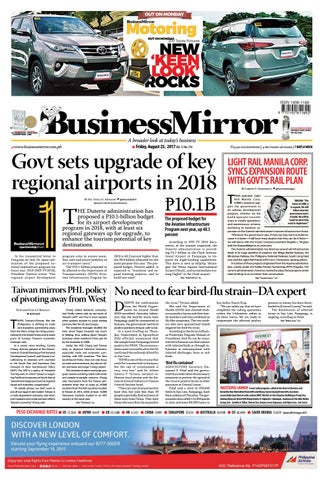
Govt sets upgrade of key regional airports in 2018 By Ma. Stella F. Arnaldo
T
@akosistellaBM Special to the BusinessMirror
HE Duterte administration has proposed a P10.1-billion budget for its airport development program in 2018, with at least six regional gateways up for upgrade, to enhance the tourism potential of key destinations.
In his transmittal letter to Congress on July 24, upon submission of the proposed national expenditure program for fiscal year 2018 (NEP FY2018), President Duterte wrote: “Our regional air port development
program aims to ensure seamless, safe and secure mobility of air-transport users.” The P10.1 billion proposed to be allotted to the Department of Transportation’s (DOTr) Aviation Infrastructure Program for
Taiwan mirrors PHL policy of pivoting away from West By Elijah Felice E. Rosales @alyasjah
T
AIPEI, Taiwan—Taiwan, like the Philippines, is shifting its trade and economic partnership away from the West, citing the rising protectionism in the United States and in some parts of Europe, Taiwan’s economic manager said. In a recent news briefing, Connie Chang, director general of the Department of Overall Planning of the National Development Council, said Taiwan is recalibrating its relations with countries in the South Asia and Southeast Asia through its New Southbound Policy (NSP). The NSP is a policy of President Tsai Ing-wen, in which Taiwan is targeting Pacific and countries in South Asia as “potential strategic partners for regional social and economic cooperation”. “In simple phrase, we don’t want to put all our eggs in one basket. Taiwan is a trade-dependent economy, [so] whatever happens to its trade partners affects Taiwan’s economy,” Chang said.
Chang added domestic consumption “really cannot take up too much of Taiwan’s GDP” and that it must explore other options outside its usual trading partners, like the US and Europe. The economic manager recalled the time when Taipei invested too much in Beijing; thus, pulling down Taiwan’s economy when mainland China got hit by the recession in 2008. Under the NSP, Chang said Taiwan aims to improve bilateral relations, especially trade and economic partnership, with NSP countries. “The New Southbound Policy does not only focus on trade and investment, but also on talent and labor exchange,” Chang added. This includes student-exchange program, resource sharing, talent cultivation and people-to-people contacts, Chang said. Documents from the Taiwan government show that as many as 29,000 students from the NSP countries studied in Taiwan in 2016, while at least 16,000 Taiwanese students studied in an NSP country in the same year.
PESO exchange rates n US 51.2020
See “Taiwan,” A2
2018 is 48.5 percent higher than the P6.8 billion allocated for the same purpose this year. The proposed budget, Duterte added, is expected to “maximize and expand existing airports, and to build new ones”.
₧10.1B
The proposed budget for the Aviation Infrastructure Program next year, up 48.5 percent
According to NEP FY 2018 documents, of the amount requested, the Duterte administration is prov iding P2.7 billion to the Clark International Airport in Pampanga to improve its night-landing capabilities. This move is seen as helping “decongest the Ninoy Aquino International Airport [Naia]…and accommodate evening flights” at the Clark airport. See “Airports,” A2
2016 ejap journalism awards
business news source of the year
P25.00 nationwide | 4 sections 28 pages | 7 days a week
LIGHT RAIL MANILA CORP. SYNCS EXPANSION ROUTE WITH GOVT’S RAIL PLAN By Lorenz S. Marasigan
@lorenzmarasigan
T
RAIN operator Light R a i l M a n i l a Co r p. SINGSON: “The (LRMC) vowed to supfuture of LRMC is port the government in to expand. We will its railway development follow what the program, whether via the government wants to build. We will be build-operate -transfer ready for what they route or merely operationswant to implement.” and-maintenance scheme, anchoring its business expansion on the Duterte administration’s massive infrastructure thrust. “Whatever the government says, if they say they want to build because it is faster—I still have many doubts that they can do it faster— we will dance with the music,” company president Rogelio L. Singson told the BusinessMirror in an interview. The Duterte administration has lined up several rail infrastructure deals in its huge pipeline of projects: the Mega Manila Subway, the Mindanao Railway, the Philippine National Railways South Long Haul Line and the Light Rail Transit (LRT) Line 2 Extension, among others. A number of these projects originated from the Aquino administration, mostly under the Public-Private Partnership (PPP) Program. The current administration, however, wanted to place these projects under state funding so as to hasten their construction. See “Light rail,” A2
No need to fear bird-flu strain–DA expert
D
espite the confirmation from the World Organisation for Animal Health (OIE)-accredited Australia laboratory that the bird-flu strain from Pampanga could be transmitted to humans, the government said local poultry products remain safe to eat. In a news briefing on Thursday, Department of Agriculture (DA) officials announced that the sample from Pampanga tested positive for H5N6. The announcement came two weeks after the DA confirmed the outbreak of bird flu in San Luis. “H5N6 is one of the strains that could be transmitted to humans, but the rate of transmission is very, very low,” said Dr. Arlene Asteria V. Vytiaco, national influenza focal person and the Bureau of Animal Industry’s Disease Control Section head. “There are a lot of countries that have this, but only less than 20 people reportedly died and most of them were from China. They were those who were directly exposed to
the virus,” Vytiaco added. She said the Department of Health (DOH) also checked workers in poultry farms and their family members and they exhibited no flu-like symptoms. The two workers who were quarantined tested negative for bird-flu virus. According to the Avian Influenza Protection Program Manual of Procedures, bird flu can be transmitted to humans via close contact with infected birds or through inhalation or contamination with infected discharges, feces or sick birds.
San Isidro, Nueva Ecija. “We can safely say that we have completed the culling operations within the 1-kilometer radius in all three towns. We are ready to compensate the affected poultry
growers as money has been downloaded to [Central Luzon],” he said. The disinfection of affected farms in San Luis, Pampanga, is ongoing, according to Piñol. See “Bird flu,” A2
‘Bird flu contained’
Agriculture Secretary Emmanuel F. Piñol said the government has undertaken the necessary measures to prevent the spread of the virus to poultry farms in other provinces in Central Luzon. Piñol said a total of 470,640 fowls in San Luis, Pampanga, have been culled as of Thursday. The government also culled 114,850 quails in Jaen and some 68,950 layers in
SUCCESSFUL LAUNCH A new radio program, called In the Heart of Business and hosted by Ron Merk (third from left) and Marou Sarne (second from left), has been successfully launched at radio station DWIZ 882 kH2 at the Citystate Building in Pasig City. Joining them are (from left) Bong Osorio; D. Edgard A. Cabangon, chairman of the Aliw Media Group; Sen. Cynthia A. Villar; Sharon Tan; lawyer Lorna Kapunan; and Elpie Cuna. RUDY ESPERAS
n japan 0.4697 n UK 65.5488 n HK 6.5432 n CHINA 7.6909 n singapore 37.6292 n australia 40.4598 n EU 60.4696 n SAUDI arabia 13.6539
Source: BSP (24 August 2017 )
A2 Friday, August 25, 2017
BMReports BusinessMirror
www.businessmirror.com.ph
Xianglu Dragon Group confirms investment plans in PHL
C
hinese international conglomerate Xianglu Dragon Group (XDG) confirmed on Thursday that its programmed investments in a petrochemical, oil refinery, cement and industrial complex in Western Pangasinan—dubbed as the largest ever in the Philippines—including a major tourism and information-technology (IT) services center and hotel in Metro Manila, will be officially submitted to the Philippine Economic Zone Authority (Peza). XDG made the announcement as it dismissed as political harassment the charges raised against the company’s chairman, You-Hao Chen, by the Taiwan Economic and Cultural Office (Teco).
Light Rail. . . Continued from A1
“The future of LRMC is to expand. We will follow what the government wants to build,” he said. “We will be ready for what they want to implement.” The railway company is already preparing to flaunt its qualifications for the future auctions. “We are gearing up. We are looking at setting a gold standard of excellence —not silver, not bronze. We worked for ISO excellence and luckily we were able to pass two: one for Quality management and another for environmental management,” he added. The operator of the Light Rail Transit (LRT) Line 1 passed the audit of TÜV Rheinland, with a recommendation or certification in Quality Management Systems (ISO 9001:2015) and Environmental Management Systems (ISO 14001:2015). ISO 9001:2015 is the international standard that specifies requirements for a Quality Management System (QMS). Organizations use the standard to demonstrate the ability to consistently provide products and services that meet customer and regulatory requirements. On the other hand, ISO 14001:2015 specifies the requirements for an Environmental Management System that an organization can use to continuously improve its environmental performance. It is intended for use by an organization seeking to manage its environmental responsibilities in a systematic manner that contributes to the environmental
Earlier, XDG said no less than Peza Chairman Charito B. Plaza and a seven-man Peza team a few weeks ago visited Xiamen City, Fujian, headquarters of XDG, for an ocular inspection. They pillar of sustainability. “We will receive our certifications in September, and these will make us the only rail operator with ISO certifications in the Philippines,” he said.
‘Correct policy’
Singson, a member of the Aquino Cabinet, noted that the Duterte administration’s policy on rail development is quite ideal, given that such a mode of implementation removes the burden of recuperating capital from user fees. President Duterte’s economic team are focused on executing infrastructure-development plans—many of which are in the rail sector—under the hybrid mode of implementation. In a nutshell, a project is considered a hybrid if the government pays for the cost to build it, and a private company will operate and maintain it. The main reason economic managers chose this particular mode of infrastructure development is the speed of construction, aside from seeing less legal hurdles. The Philippines has a long history of projects being delayed due to legal tussles. Take the construction of a simple common station, for one. It took the government almost a decade to settle the legal issue on such a small project—too small that it is too common in neighboring countries in the Asean—due to cases filed by the private sector. Hence, economic managers are pushing for hybrid projects under the Duterte administration’s flagship infrastructure program—the “Build, Build, Build”. “If they want to make the fares
confirmed XDG and Chen’s massive petrochemical complex and large hotel investments in Xiamen and nearby cities of Fujian province in southern China. In a statement, XDG said the proposed Philippine projects are part of the group’s thrust to further its reach in industrial, petrochemical and real-estate sectors outside China, where it is already a leading player in these fields. The group is also one of the large hotel and real-estate developers in California, Taiwan, Thailand and Japan. XDG noted that it has rapidly diversified its holdings abroad under the helm of Chen, a Chinese citizen who had been a subject of political persecution in Taiwan under the ruling Democratic Progressive Party political party. Taiwan’s then-President Chen Shuiban, now currently imprisoned for corruption and money-laundering
charges, initiated a w case that had been dismissed by the Taiwan Court against the XDG chairman because Chen allegedly withdrew support for his administration, and it is the former president who is now in prison. “Despite these political intramurals, which have not hindered XDG’s earlier investments in other countries, we stand ready to infuse our substantial financial, technical and technological resources to build a lasting and mutually beneficial partnership between the Philippines and China,” the XDG said. XDG added Chen is excited about the Philippine projects because of the strong ties between XDG’s headquarters, the city of Xiamen, and the Philippines. “I have strong sentimental and emotional ties to the Philippines because 90 percent of FilipinoChinese can trace their ancestry
affordable, that is the correct policy. The question there is if the government can execute—that is another issue that needs to be addressed,” Singson said. He explained that hybrids can effectively reduce the cost of user fees, as the government’s main mandate is not to make money, but to serve the people through public infrastructure. Also, government loans carry much smaller interest rates, making the facility more affordable to build. “If they will build the civil works and then privatize the facility, the fare will be based on maintaining, and not on the recovery of capital expenditures, which is ideal, because the government loaned the money at low interest rates,” the official added. The fare, then, will only cover the cost of operating the facility, and maintaining it. “It is even the obligation of the government to build it. But the operations and maintenance portion, that is what you can pass on to the users,” he said. This, he emphasized, is the ideal way of building infrastructure for the benefit of the public. He cited his own project during his stint as the chief of the public-works department as a concrete example. “I did this during my time in the public-works department. We built the Subic-Clark-Tarlac Expressway then privatized the operations and maintenance, which is the same with other countries, wherein the government will build, but will not pass the burden to the consumers. It really has to subsidize,” he said. Singson’s group is currently
working on the construction of the Cavite portion of the LRT Line 1, Southeast Asia’s oldest overhead railway system. Targeted for completion in about four years after the delivery of right of way, the 11.7-kilometer Cavite Extension will connect into the existing system immediately south of the Baclaran Station and run in a generally southerly direction to Niyog, Cavite. It will consist of elevated guideways throughout the majority of the alignment, except for the guideway section at Zapote, which will be located at grade. Eight new stations will be provided with three intermodal facilities across Pasay City, Parañaque City, Las Piñas City and Cavite. The new stations are Aseana, MIA, Asia World, Ninoy Aquino, Dr. Santos, Las Pinas, Zapote and Niyog. The intermodal facilities shall be located at Dr. Santos, Zapote and Niyog. The new stations will be accessible to and from nearby community facilities, such as shops, schools, stadium, park, etc., and be located to suit passenger flow routes from residential areas. Pedestrian access to all new stations will be direct, safe and easy. Details, such as lighting to distinguish access points, pedestrian-cross striping and curb cuts for handicapped access will also be provided. LRMC holds the concession for the operations, maintenance and the extension of the train line. It signed the agreement with the government in October 2014. The company will operate and maintain the oldest train system in the Philippines for 32 years.
back to Xiamen. This will be our way to further solidify our ancestral bond,” Chen said. XDG added the group stands ready to swiftly implement the projects in its investment applications with the Peza for the creation of a mixed-use tourism ecozone with a major IT component in Manila and a mixed-use special economic zone in Western Pangasinan. XDG will also partner with other Chinese companies to develop the Philippine
projects in line with China’s Belt and Road Initiative in support of the Duterte administration. XDG will also coordinate the creation of a consortium for investment in the Philippines with other leading Fortune 500-listed conglomerates in China that are engaged in commercial, residential and industrial development, port and petrochemical facilities, off-shore smart cities and industrial parks.
I have strong sentimental and emotional ties to the Philippines because 90 percent of Filipino-Chinese can trace their ancestry back to Xiamen. This will be our way to further solidify our ancestral bond.”—Chen
Airports. . .
Continued from A1
About P900 million has also been proposed for a new Legazpi International Airport in Daraga, Albay, which aims to make the province “an economic powerhouse by decongesting the crowded Legazpi airport and boosting tourist arrivals”. The Depar tment of Tourism (DOT) considers the Bicol Region as one of the top tourist destinations in the country. Total tourist arrivals (foreign and domestic) increased by some 27 percent to 2.8 million, from from January to June 2016. Of the total, 352,483 traveled to Albay, where the famous Mayon Volcano is. Other airports that will be constructed or scheduled to be rehabilitated next year include the New Bohol (Panglao) International Airport (P386 million); Kalibo Airport in Aklan (P920 million); Tacloban Airport (P716 million); Cauayan Airport in Isabela (P306 million); and the Zamboanga International Airport in Zamboanga del Sur (P221 million). Improved airport facilities in the country are seen as one of the keys in encouraging more foreign tourists to come to the Philippines, heading straight to tourism destinations, instead of passing through the congested Naia. The DOT projects foreign tourist arrivals to hit 12 million in 2022, from 6.5 million to 7 million in 2017. Duterte has also proposed a separate allocation of P1.7 billion “to modernize our ports and harbors nationwide and enhance their operational efficiency, thus, improving the movement of cargoes and vessels.” Among the seaport projects that will be undertaken in 2018 are: the Al-Barka Ports Cluster in Al-Barka, Basilan (P50 million); Volcano Island Port in Talisay, Batangas (P30 million); Agkawayan in Looc, Occidental Mindoro (P42 million);
Bird flu. . .
Continued from A1
The DA chief earlier lifted the ban on the shipment of poultry meat and other poultry products from areas outside of the 7-km radius in affected Luzon towns to the Visayas and Mindanao. Piñol said President Duterte will lead an event aimed at jump-starting the revival of the battered poultry sector. With the theme, “SamaSama, Tulong-tulong sa Pagbangon at Pagsulong”, it will be held in San
Taiwan. . .
Continued from A1
The same documents show that more than 1.5 million visitors from the NSP countries visited Taiwan in 2016, while as many as 2.2 million Taiwanese traveled in those countries. “Honestly speaking, Taiwan used to be not so friendly to immigrants, and we have since then wanted to change that. It is because there is a wave of laborers coming to Taiwan...and we saw they contribute well to our economy. The past years saw more and more immigrants from the NSP countries coming to Taiwan. And we believe that they are very good skilled workers for us, very good tourists for us,” Chang said. Chang also said it is better to invest in NSP
Taganak Port in Taganak, Turtle Islands, Tawi-Tawi (P71 million); San Roque Port in Palimbang, Sultan Kudarat (P17 million); Pangutaran Port in Pangutaran, Sulu (P20 million); and Dolores Port in Dolores, Eastern Samar (P50 million). “Ports serve as important gateways and major accelerators of economic growth. Yet, port traffic has become heavily congested in recent years,” Duterte said. The DOT has batted for the construction and rehabilitation of Philippine ports to encourage the arrival of more cruise ships bringing in foreign tourists. “As a key element of our [Cruise Tourism] strategy, we are determined to build new dedicated cruise facilities, most especially in Manila,” said DOT Undersecretary for Tourism Development Planning Benito C. Bengzon Jr., who also heads the Cruise Development Committee for the Philippines. “A superior cruise port and terminal in the capital, with its extensive airlift and ground facilities, will create a compelling reason for large ships to spend time in the Philippines. Once here, they can achieve outstanding port density with efficient cruising speeds.” He added, “Future growth in cruise tourism is guaranteed with strong support from the government and the private sector, a highly professional and experienced network of port agents and tour operators, plus growing awareness from major cruise lines of all the Philippine archipelago has to offer.” U n d e r t h e N a t i o n a l To u r i s m Development Plan for 2016-2022, the DOT aims to increase port calls in the country from and estimated 105 port calls, carrying an estimated 117,000 passengers in 2017, to 402 port calls with 456,164 passengers by 2022. The target markets for cruise passengers are China, Hong Kong, Taiwan, Japan, the United States, the United Kingdom, Germany and Australia. Fernando, Pampanga on Monday. “The President has agreed to join a boodle fight where he will partake of chicken barbecue, fried itik and balut. He agreed to eat balut,” he said. “This will be an exciting event. This will show people that is safe to eat chicken and balut,” Piñol added. The DA chief said Duterte will also award payments to farmers who agreed to cull their fowls as part of efforts to contain the birdflu virus. Soldiers and policemen who volunteered to help in the culling operations will also be recognized. countries nowadays, given the policy shift of the US and other European countries in favor of protectionism. Taiwan’s shift away from Western countries seemingly mirrors the so-called independent foreign policy of the Duterte administration, which aims to establish better bilateral relations with nontraditional partners, such as China and Russia. In a previous interview, President Duterte said he is deliberately distancing the Philippines from the US to build on an alliance with other superpowers. “I have nothing against America. They’re perfectly alright. Trump is my friend. But my foreign policy has shifted from the pro-Western one. I am now working on alliance with China, and I hope to start a good working relationship with Russia,” Duterte said.
The Nation BusinessMirror
news@businessmirror.com.ph
Editor: Vittorio V. Vitug • Friday, August 25, 2017 A3
Faeldon says Lacson’s son ‘smuggled’ 67 cement shipments worth billions
R
By Joel R. San Juan
@jrsanjuan1573
ESIGNED Customs Commissioner Nicanor E. Faeldon has turned the tables on Sen. Panfilo M. Lacson Sr. and accused the lawmaker’s son of being involved in smuggling activities.
Faeldon hurled the accusation during a news conference he called following Lacson’s privilege speech on Wednesday, accusing him of receiving P100 million as pasalubong (welcome gift) from smugglers when he assumed the Customs post last year. Faeldon also assured that he is open to any investigation and willing to sign any waiver that would allow scrutiny of his assets and bank accounts to prove that he is not corrupt as alleged by Lacson. “Yes, I will sign, ask what you want me to sign. I will have my lawyer notarize it. I will sign every waiver you want. I want [myself be] investigated. In fact, I [am] calling for an investigation to show that I don’t need to defend myself. My life speaks of who I am,” Faeldon said, adding that his net worth is just a little over P1 million. He also challenged Lacson’s supposed source of information on the corruption issue at the Bureau of Customs (BOC) to come forward and personally pinpoint the people receiving tara or grease money, to facilitate smuggling activities in the bureau. “I have not asked anybody to collect tara for me nor have I accepted any tara from anybody. Again, I have not done any form of corruption in my many years of government service nor tolerated those who tried to even in the form of request,” Faeldon said. Faeldon also called for a third-party investigation by a competent body on the issue in order “that justice will be served.” “Just like the honorable Sen. Lacson and the Filipino people, I want the truth to come out,” Faeldon said.
Lacson protecting son?
Faeldon noted that when he accepted the BOC post, he recommended only six persons for various positions out of 23 appointive posts. Faeldon said these officials, who were all named by Lacson as among those receiving grease money in the BOC, have reputable background. This prompted him to question Lacson’s motive in implicating them in the corruption in the BOC. According to Faeldon, he was surprised to learn that Lacson’s son, Panfilo “Pampi” Lacson Jr., has “questionable” dealings with the BOC. Faeldon said he just discovered that Pampi is the managing director of Bonjourno Trading, which reportedly made 67 importations of cement amounting to P4.6 billion since the company was put up in 2015. Faledon recalled that he started receiving questionable importations of the company on July 12, 13 and 15 for possible violation of the Tariffs and Customs Code of the Philippines and for undervaluation and possible misclassification. The broker for the said shipments was Ruby Ballesteros. Faeldon said he believes that the younger Lacson was the real
PAO chief to Hontiveros: Let go of Kian’s witnesses
P
UBLIC Attorney’s Office (PAO) Chief Persida Rueda-Acosta urged Sen. Risa Hontiveros-Baraquel on Thursday to turnover the custody of the three eyewitnesses in the killing of 11th grader Kian Loyd delos Santos by police authorities during an antidrug operation in Caloocan City on August 16. Acosta made the call as she revealed that murder charges against the policemen involved in Kian’s death will be filed before the Department of Justice (DOJ) today, August 25. The PAO is the one providing legal assistance to Kian's family. Rueda-Acosta echoed the statement of Justice Secretary Vitaliano N. Aguirre II that the witnesses should be under the custody of the witness protection program (WPP) of the DOJ as mandated by the law. “Senator Risa should now turn over their custody to the DOJ and NBI [National Bureau of Investigation] because the delos Santos family has chosen our office to handle their case,” she said in an interview. The PAO chief added that the custody of Hontiveros-Baraquel on the three witnesses, including two minors, was temporary. “The family of these witnesses initially sought her help, but the parents of the minors have already decided to recall the custody of the witnesses from the senator,” she said. Rueda-Acosta also revealed that the PAO has taken custody of the fourth witness in the killing of the boy. “We will apply for WPP coverage of the witness after the filing of the complaint for murder before the DOJ tomorrow [August 25],” she added. Aguirre, who has ordered the NBI to conduct a parallel probe on Kian’s death, earlier said that the witnesses should be transferred to the custody of the WPP. He also expressed concern that the continued custody of the witnesses by Hontiveros-Baraquel might “pollute” their credibility, considering that she is a vocal critic of the Duterte administration’s war on drugs. Expected to be charged with murder are Police Officer 3 Arnel Oares, and Police Officers 1 Jeremiah Pereda and Jerwin Cruz. It can be recalled that the three policemen insisted the Kian was killed after he shot it out with them during their antiillegaldrug operation. Witnesses, however, contradicted the policemen saying that the boy was already under their custody when he was told to hold the gun and run for his life. Joel R. San Juan
owner of the company, and that he suspects that the alleged general manager, Florencio del Rosario, could have been a dummy since it was the former who went to his office five times in July. The former Customs commissioner said the shipments were undervalued by less than 50 percent since Lacson’s son allegedly paid $8 per metric ton when the prevailing market price was between $16 and $20. After checking the background of Bonjourno, Faeldon said the BOC found that it only had a paid up
capital of P20,000 in 2015. “How can he afford P106 million in just three days? Three ships of shipment, but ladies and gentlemen, these are only initially three ships,” Faeldon said. Faeldon indicated that this could be the reason the senator is bent on removing them from their posts. “Is this what you are afraid of sir, because we are nearing, we are getting close to getting you to exposing you? We have now evidence,” Faeldon said. Faeldon also accused the senator’s son of trying
to bribe his staff when the latter went to his office carrying money. “Nagdala ng pera si Panfilo Lacson Jr…. Matagal na po ’yang importer…. Ano’ng ibig sabihin nito? [Lacson Jr. previously brought money and he has been a longtime importer. What does that mean] Is he trying to bribe my staff?” he said. “I am a responsible citizen. I don’t want to destroy the reputation of innocent people just for fame. They want us out they don’t want the truth to come out. They want all six of us to come out,” Faeldon lamented.
Economy
A4 Friday, August 25, 2017 • Editors: Vittorio V. Vitug and Max V. de Leon
BusinessMirror
news@businessmirror.com.ph
Maqcuarie investment, Mighty House panel bares ‘irregular’ cash advances under Imee sale to bring in ₧110-B FDI haul T
T
By Rea Cu
@ReaCuBM
HE Department of Finance on Thursday said that investments by foreign entities in the country’s energy-infrastructure sector is a vote of confidence on the Duterte administration and its socioeconomicreform agenda.
Finance Secretary Carlos G. Dominguez III said the recent decision by the Macquarie Infrastructure Management (Asia) Pty. Ltd. and Arran Investments to pump P65 billion into the Philippine energy sector is a vote of trust by foreign investors to the current leadership. “The credit goes to President Duterte, who inspires trust and confidence in the Philippines,” the finance secretary said. In August a consortium of investors comprising funds managed by Macquarie Infrastructure Manage-
ment and Arran Investments have formed the Philippines Renewable Energy Holdings Corp. and offered to acquire up to 31.7 percent of Energy Development Corp. (EDC) for about $1.3 billion, or P65 billion. Macquarie Infrastructure Management is a member of Macquarie Infrastructure and Real Assets, one of the world’s largest infrastructureasset managers, while Arran Investments is an affiliate of the GIC Pte. Ltd., which manages Singapore’s Sovereign Wealth Fund. The consortium is planning to
buy 6.6-billion to 8.9-billion common shares of EDC at P7.25 per share or a maximum total price of P64.525 billion, or $1.28 billion, according to First Gen Corp., the mother company of EDC, in its report to the Philippine Stock Exchange. Dominguez added that, along with the additional P45-billion investment in the local cigarette industry from Japan Tobacco International Inc. (JTI), following its acquisition of Mighty Corp., the total foreign direct investment (FDI) from the two sectors alone will amount to an estimated P110 billion. JTI, which is partly owned by the Japanese government, has sealed the deal to acquire Mighty Corp. for P45 billion, of which P25 billion will be paid to the government to settle Mighty Corp.’s tax liabilities. The value-added tax on the JTIMighty deal will bring in an additional P5 billion for the government, Dominguez said. This means the total tax haul for the Bureau of Internal Revenue (BIR) will amount to P30 billion. Mighty Corp., through JTI, already remitted to the BIR P3.44 billion on July 20, which represents
the initial tranche of its tax settlement to the government. The remainder of the settlement sum will be paid upon the approval by the Philippine Competition Commission of JTI’s acquisition of Mighty Corp. JTI earlier bared that it is targeting to sell cigarettes to emerging markets, veering away from the strategy of most cigarette players to develop smokeless products in adapting to the changing times. The company has paid about $936 million for the acquisition of Mighty Corp. This was then followed by the purchase of Indonesia’s PT Karyadibya Mahardhika for $677 million.
The credit goes to President Duterte who inspires trust and confidence in the Philippines.” —Dominguez
Group to DTI: Probe deep into proliferation of ‘expired’ cement By Catherine N. Pillas
@c_pillas29
A
consumer advocacy group is urging the Department of Trade and Industry (DTI) to conduct an investigation into the reported proliferation of “substandard” imported cement in the local market. The National Coalition of Filipino Consumers (NCFC), said it has discovered expired, mislabeled and unlabeled cement being sold both in Metro Manila and in the regions, among which are La Union, Davao and Caloocan City. “We were actually able to buy expired cement in La Union and in Davao, and that’s just an initial sampling. We’re sure there are more substandard cement in other parts of the country being offered to unsuspecting consumers,” NCFC Spokesman and Legal Counsel Oliver San Antonio said. The group has filed complaints before the Bureau of Product Standards, asking the office to look into the matter. San Antonio said the group found cement bags at the construction site of a Caloocan City high school with a label of the Buffalo Cement brand from Vietnam. The manufacturing date for the said cement bags reportedly goes back to December 2016, which is above the maximum six-month shelf life imposed by the DTI. The same expired Buffalo brand of cement was also being sold in La Union, when the group went to check consumer complaints there earlier this month, San Antonio added. Philippine National Standard 07:2005 states that “cement remaining in bulk storage at the plant/ storage silo prior to shipment for more than six months, or cement in bags in local storage in the hands of a vendor for more than three months, needs to be retested.” The consumer advocate group warned that “old cement” does not set well, and is likely to fail compression tests that are being done to determine whether a cement product is good enough to be sold in the market. Cement Manufacturers Association of the Philippines President Ernesto M. Ordoñez supported this view, saying the findings are “not surprising” as even the group have reported findings of old cement. “If one says ‘substandard’ that can mean old cement—those stored beyond six months. Those have to be retested,” Ordoñez said in a phone interview. Although total market estimates of old cement are uncertain, Ordoñez said reports received by his office showed that as much as 350,000 bags of old cement were found in La Union and distributed to different points under the name of Buffalo Cement, and Halong brand in Davao. In the Philippines, Halong Pilipinas is the exclusive distributor of both brands.
Precious cargo
A fruit delivery helper sits atop banana crates on board a customized tricycle while on a regular market delivery run along a busy road in Tondo, Manila. Nonie Reyes
PSA reports real-estate subsidy decline in 2015 By Cai U. Ordinario
S
@cuo_bm
ubsidies received by the real-estate sector from the government declined by 461.29 percent in 2015, according to the Philippine Statistics Authority (PSA). Based on the preliminary Real Estate Activities For Establishments with Total Employment of 20 and over data, the PSA said the sector’s subsidies declined to P27.9 million in 2015, from P156.6 million in 2014. “Subsidies are all special grants in the form of financial assistance or tax exemption or tax privilege given by the government to aid and develop an industry,” the PSA said. In 2015 only real-estate firms with their own or leased properties in Metro Manila, or the National Capital Region (NCR), received subsidy from the government. But in 2014 PSA said real estate firms in Central Visayas, NCR and Central Luzon received subsidies worth P80.8 million, P65.6 million and P10.3 million, respectively. Meanwhile, in terms of total income, real-estate firms earned P473.5 billion in 2015, an increase from the P389.8 billion posted in 2014. Real-estate activities with own or leased property contributed the major share at 97.3 percent, or P460.5 billion of total income. Data also showed that real-estate activities on a fee or contract basis accounted for a mere 2.7percent share, or P13 billion of the total. “Income or revenue refers to cash received and receivables for goods/products and by-products sold and services rendered. Valuation is at producer prices [ex-establishment] net of discounts
461.29% The drop in the real-estate sector’s subsidies, from P156.6 million in 2014 to P27.9 million in 2015, according to the PSA
and allowances, including duties and taxes but excluding subsidies,” the PSA said. Data showed that the real-estate activities sector in the formal sector of the economy had a total of 592 establishments with total employment (TE) of 20 and over. Between the two industries of the sector, real- estate activities with own or leased property, led the sector. A total of 525 establishments, or 88.7 percent of the total in the industry, were engaged in realestate activities with own or leased property. On the other hand, real-estate activities on a fee or contract basis recorded 67 or 11.3 percent of total establishments. The data collected from the survey will provide information on the levels, structure, performance and trends of economic activities of the formal sector of the economy for the year 2015. The survey was conducted nationwide in 2016 with the year 2015 as the reference period of data, except for employment which is as of November 15, 2015.
he House Committee on Good Government and Public Accountability has uncovered more cash advances allegedly approved by Ilocos Norte Gov. Imee Marcos on her watch amounting to P26 million in 2012 alone that are “unauthorized” under the rules and regulations set by the Commission on Audit (COA), which are on top of the illegal vehicle purchases totaling P66.45 million that she had also sanctioned in the same year. Majority Leader Rodolfo C. Fariñas Sr., at the same time, raised the possibility of a “conspiracy” between the Ilocos Norte provincial government and retired COA resident auditor Rizalino Franco after the congressman found out that Franco was allegedly receiving P20,000 a month in consultancy fees from the provincial government. “The COA is closing its eyes on all of these. Ayan na nga si Mr. Franco, tignan mo naghuhugas [kamay] sinasabi na ‘hindi naman ako ’yung nag-audit, ako lang ’yung supervisor…. Kaya you have been warned by the chairman because, sir, baka lumabas…conspiracy dito eh [in] all of these things, all the while you are the supervising auditor, and culminated when you were already the audit team leader, and the AOM [audit observation memorandum] of Mr. Viernes, which clearly shows all of these transactions, hindi lumabas sa annual audit report [Mr. Franco may be trying to wash his hands off the case...it may appear that there’s a conspiracy here.... And the AOM of Mr. Viernes didn’t come out of the annual audit report],” Fariñas said at this week’s resumption of the hearings on the irregular cash advances made by the Ilocos Norte government on Marcos’ watch. A House news statement that at the latest public hearing by the committee chaired by Rep. Johnny Pimentel, lawmakers found out that on top of irregular purchases worth P66.45 million using cash advances from the excise-tax proceeds from Virginia cigarettes, Marcos also approved another P26 million worth of cash advances by the Ilocos Norte government. These other questionable acquisitions, totaling P26,049,723.68, include the purchase of a portrait bust sculpture and services for the Paoay Museum (P2,986, 344), materials and installation of precast concrete for Paseo de Paoay (P4,838,191.68), purchase
of medicines and libspray 211 (P5,999,788), purchase of Panlabanan 5EC (P10,475,400) and another purchase of medicines (P1,750,000). The last three items were for distribution to different municipalities, according to an Audit Memorandum Circular (AMC) issued by the regional COA office in Ilocos Norte. “The grant of the cash advance for the above-mentioned purposes are not in accordance [with] the provisions of COA Circular 92-382 dated July 3, 1992,” according to the AOM signed by Franco. Party-list Rep. Alfredo Garbin Jr. of AKO-Bicol pointed out during the hearing that when Ilocos Norte signed the memorandum of agreement with the private contractor—Integrated Conservation Unlimited Inc.—on July 26, 2012, for the development of the Paoay Museum, this was also the time that the provincial government was drafting its acceptance and inspection report. “Pumipirma pa lang kontrata, pumirma na din ng inspection report at acceptance [The governor may have signed the contract the contract alongside the inspection report],” Garbin said. As for the purchase of medicines worth P5.9 million Rep. Anthony Bravo of Coop-Natcco Party-list, meanwhile, pointed out that the obligation requests for the transaction either contained no date and no payee and no signature of Marcos, and was sourced from the proceeds from the excise taxes on Virginia cigarettes. According to the COA’s AOM, the P26 million in cash advances violated Sections 9, 45 and 46 of the COA Circular, which stresses that: all disbursements shall be made by check except otherwise provided; cash payments shall be made only on duly approved payrolls/disbursement vouchers/liquidation vouchers out of regular cash advances or special cash advances; and regular cash advances are allowed only for salaries and wages, commutable allowances, honoraria and other similar payments to officials and employees, petty operating expenses, while special cash advances are allowed only on the explicit authority of the local government chief executive for confidential expenses and expenditures for the activities undertaken in the field when it is impractical to pay checks.
Proposed tax reforms to ensure funds for govt programs–Chua
A
Department of Finance (DOF) official remains hopeful that senators will approve the proposed tax reforms in its original form so that government can finance all its programs. Finance Undersecretary Karl Kendrick Chua said aside from the proposed programs of the various agencies for 2018, additional funds are needed to finance among others the tuition fee of students enrolled in the State Universities and Colleges (SUCs), local universities and colleges, and technicalvocational institutions starting academic year 2018-19. Republic Act (RA) 10931 or the “Universal Access to Quality Tertiary Education Act” was signed into law by President Duterte last August 3. Financing for the said expenditure is not included in the proposed Php3.767 trillion national budget for 2018. Under the proposed national budget for next year, the Department of Education will get P613.1 billion allocation, the Commission on Higher Education (CHED), P13.5 billion, and SUCs, P64.6 billion. Earlier, Budget Secretary Ben-
jamin Diokno said the proposed budget for next year also allocates P116 billion worth of allocation for various types of scholarships which can be tapped for the tertiary education law. Other programs that need funding include the pension of the military and the universal healthcare. “So if we don’t have enough revenues, none of them or part of them, cannot be provided. So we have to look at it from the big picture,” Chua said. The House of Representatives approved the first package of the tax reform bill last May 31 before members of the House took their break. The proposal is now being discussed in the Senate and DOF officials continue to explain to senators the necessity of approving the tax reforms in full. “We will explain and try to convince the people of the benefits of this tax package,” Chua said. Chua is hoping the Senate will approve the tax reform bill by October or November before the budget proposal for next year is tackled in the plenary. PNA
The World Friday, August 25, 2017
www.businessmirror.com.ph
A5
China: US probe ‘sabotages’ the global trade system
C
hina ratcheted up its opposition to the US investigation into its intellectual-property practices, accusing the Trump administration of sabotaging the international trading system and again pledging to defend its interests if necessary. At the same time, Ministry of Commerce Spokesman Gao Feng said at a briefing on Thursday in Beijing that the two nations have more shared interests than disputes and stressed that cooperation is the best way to address any differences. “The US investigation of China based on domestic laws sabotages the existing international trading system and has poured cold water on all parties that have been working to promote bilateral economic ties,” Gao said. He added China was strongly displeased by what
it called “unilateral and protectionist” action. The remarks took a sharper tone than the ministry’s statement following an announcement on Friday of the investigation by US Trade Representative Robert Lighthizer. The US is probing China’s practices on intellectual property, technology transfer and innovation to determine if the behavior is “unreasonable or discriminatory,” or restricts US commerce. President Donald J. Trump asked Lighthizer earlier this month to consider such a move. Gao said China hopes to work with the US to consolidate achievements from previous negotiations and to reach further positive outcomes. Trade tensions between the world’s two biggest economies have showed signs of heating up after a short honeymoon period.
Earlier this week the US asked the World Trade Organization (WTO) to set up a dispute settlement panel to examine China’s administration of tariff-rate quotas on agricultural products, including wheat, rice and corn, which could force the Asian nation to change its policies or face retaliation in the scenario of a US victory. China expressed regret at the US decision to move forward with the case, and will properly address the issue under the WTO rules, Gao said. The US asked China for consultations in December, and China has provided clarification and offered resolution, the spokesman said. He added that the recent antidumping reviews China launched on two types of optical fiber products made in the US were not retaliatory action against the US probe. Bloomberg News
Trump’s shutdown threat muddles Congress’s plans on debt ceiling P
r e si den t Don a ld J. Tr ump’s threats to shut down the government in October over border-wall funding triggered concerns on Capitol Hill and could complicate Congress’s job of raising the debt ceiling. Congress needs to pass a spending measure to keep the government open by September 30—the same time it’s facing a deadline to raise the nation’s debt limit. GOP leaders don’t have a plan yet for how they’ll proceed, but one likely scenario is to package the two measures together to get them to the president’s desk. Trump’s shutdown threat may just be part of the routine bluster he employs in negotiations, but it still raises the specter of a potentially market-shaking showdown if he decides to follow through on it. Tr ump has made clear for months he wasn’t happy with the last bipartisan spending deal in May because it didn’t fund a new wall on the southern border, his signature campaign promise. At the time, he tweeted that a “good” government shutdown may be needed to force Democrats to make concessions. House Speaker Paul Ryan told reporters on Wednesday that lawmakers aren’t interested in a government shutdown in October. “I don’t think a government shutdown is necessar y, and I don’t think most people want to see a government shutdown, ourselves included,” the Wisconsin Republican said in a news conference at Intel Corp.’s office near Portland, Oregon. He said Congress would likely need a short-term stopgap bill, since it needs more time to complete the appropriations this fall. The president has requested $1.6 billion for wall construction, which Democrats have widely rejected. While the House has passed a package of spending bills that contain wall funding, such a measure doesn’t have the support of the 60 senators needed to pass it in the Senate. Now, the president has suggested he would veto a spending bill that doesn’t fund the wall.
‘Building that wall’
“If we have to close down our government, we’re building that wall,” Trump said on Tuesday at a combative rally speech in Phoenix. “One way or the other, we’re going to get that wall.” The S&P 500 Index and Dow Jones Industrial Index both fell on Wednesday following Trump’s threats, while gold futures rose. Trump’s remarks were “unsettling,” Marc Chandler, global head of currency strategy at Brown Brothers Harriman and Co., wrote in a note on Wednesday. “Gover nment shutdow ns
Capitol Hill Bloomberg
$1.6B The amount of budget President Donald J. Trump has requested for the border-wall construction, which Democrats have widely rejected
a re not u nprecedented in t he US, of cou rse, a nd t hey t y pic a l ly a re m i ld ly d isr upt ive,” he w rote. “ T hey a re not good for t he invest ment c l imate.” Any connection to the debtlimit fight would heighten the stakes, he added. “While political maneuvering can lead to a shutdown, missing a debt payment is considerably more serious, and one that in this game of brinkmanship largely within the Republican Party neither side seems to want to risk,” he wrote. Congressional aides and Republicans outside of the government worry that Trump may not hesitate to veto a September stopgap-spending bill, known as a continuing resolution, even though congressional leaders worry that such a fight could threaten the wider Trump agenda, including a planned tax overhaul. Even before Trump’s threat on Tuesday night, Goldman Sachs
Group Inc. was warning clients t hat t here was a 50 -percent chance of a government shutdown. “A shutdown over the wall plays so well to the president’s base that I find it hard to believe that he will just simply cave and sign a true [CR],” said Steve Bell, a former Senate Budget Committee staff director for Republican Pete Domenici and now with the Bipartisan Policy Center. “I believe that a government shutdown seems inevitable.”
Debt limit
Because the debt limit must be raised this autumn, the feud over the border wall threatens even graver consequences than usual. Aides have said Republicans aren’t close to coalescing around a Republican-only debt-ceiling bill. Conservatives in the Republican Study Committee and House Freedom Caucus are pushing for deep cuts to entitlement tied to the debt ceiling that moderates in the party are not prepared to vote in favor of. That means Republicans will likely need to assemble a bipartisan vote that includes Democrats, who have rejected the idea of attaching any conditions to a debt bill. This may leave GOP leaders deciding that the best way to build support for the debt increase is to pare it with the mustpass stopgap-spending bill. If the two are attached, Trump’s veto threat becomes more significant, risking a partial shutdown on October 1 and a debt-payments default shortly thereafter.
Bell said that in light of Trump’s stance, the Senate may choose a different path for the debt ceiling. “A partial government shutdown prompted by failure to pass appropriations is one thing; a threatened default is in a different galaxy,” he added. “While no one has a real plan that I can understand, I would think that the Senate leadership would do all it could to avoid conflating the CR and the debt-extension language.” Congress could also temporarily lift the debt ceiling if it stalls on a longer-term measure. “In a divided government when two parties were fighting in 2011, that was not an option,” Daniel Clifton, head of policy research at Strategas Research Partners, wrote in an August 22 note. “In complete control government where leaders acknowledge that the debt ceiling has to be lifted, this is a viable option and why we are not too concerned.” “Investors will be looking for clues from Congress’s bandwidth to handle tax reform based on how the debt ceiling is handled,” Clifton added. Senate Majority Leader Mitch McConnel l of Kent uc k y sa id on Monday that there is “zero chance—no chance—we won’t raise the debt ceiling. No chance.” But he offered no details on how Republicans leaders plan to accomplish that. McConnell issued a statement Wednesday that made no mention of the wall or Trump’s shutdown threat and said, “We are committed to advancing our shared
agenda together, and anyone who suggests otherwise is clearly not part of the conversation.” Amid deepening tension between Trump and McConnell, the White House released a statement saying that the pair “remain united on many shared priorities” and will meet when Congress returns from its August recess.
Blame game
Republican leaders in Congress have little appetite for any shutdown fight, particularly since their party has taken the blame in recent governmentshutdown battles. It’s also nearly unprecedented for a shutdown to occur when a single party controls both chambers of Congress and the White House. “The market expectation is that all of this back and forth will be ugly to watch, but the policymakers will figure it out,” said Walter Todd III, chief investment officer at Greenwood Capital Associates. “We know we’ve seen this movie before. The government shutdown isn’t priced in.” Democrats immediately began the blame game on Wednesday. “ I f t he preside nt pu rsues this path, against the wishes of both Republicans and Democrats, as well as the majority of the American people, he will be heading toward a government shutdown that nobody will like and that won’t accomplish anything” Senate Minority Leader Chuck Schumer of New York said on Wednesday in a statement. Bloomberg News
Trump shifts tone to unity plea after attacking media, opponents
P
resident Donald J. Trump dramatically shifted tone to make a plea for national unity one day after delivering an extended diatribe against the media and political opponents. “It is time to heal the wounds that have divided us and to seek a new unity based on the common values that unite us,” the president said on Wednesday at the American Legion’s annual convention in Reno, Nevada. “We are one people, with one home, and one great flag.” The president’s remarks stood in stark contrast to his forceful defense on Tuesday of his response to violence in Charlottesville, Virginia. Addressing thousands of supporters at the Phoenix Convention Center, Trump accused media organizations of being “dishonest” and said many reporters don’t want the country to succeed. The president on Tuesday also attacked members of his own party, mocking Arizona’s two Republican senators. While not mentioning US Sen. John McCain by name, Trump criticized the Senate’s best-known veteran for his vote against healthcare legislation last month. McCain, an Arizona Republican and former Navy pilot, spent more than five years in a North Vietnamese prison known as the “Hanoi Hilton.” McCain was one of several Republicans who criticized Trump’s comments on Charlottesville after the president said there were good people marching alongside white supremacists at a rally that descended into violence. One counter demonstrator was killed, and 19 people were wounded. R abbinic bodies representing the Reform Jewish Movement, Reconstructionist Jewish Movement and Conser vative Jewish Movement issued a letter on Wednesday saying, in response to Trump’s Charlottesville remarks this year, that they won’t organize a traditional annual conference call for the president to offer greetings to American rabbis for the Jewish high holidays. The rabbinic groups said in the letter that Trump’s remarks were “so lacking in moral leadership and empathy for the victims of racial and religious hatred that we cannot organize such a call this year.” Top officers in the US military, which often celebrate its successful desegregation in 1948, have condemned the extremists in Charlottesville without criticizing their commander in chief. “ The Army doesn’t tolerate racism, extremism, or hatred in our ranks,” Gen. Mark Milley, the Army’s chief of staff, said in one such tweet on August 16, amid the uproar over Trump’s comments. “It’s against our values and everything we’ve stood for since 1775.” Bloomberg News
A6
Friday, August 25, 2017
The World BusinessMirror
www.businessmirror.com.ph
Trump’s olive branch to N. Korea opens slim path to negotiations
I
t’s now been 27 days since North Korea launched a missile. That’s equal to the longest stretch that Pyongyang has gone since February without firing off a rocket. The question now is whether this gap—and Secretary of State Rex Tillerson’s praise of North Korea’s “restraint”—opens the path for talks with Washington.
18 The number of missiles North Korea has tested since February 12 at the rate of two or three times per month
said by phone. “Maybe the issue of hostile acts has to be addressed by something like a peace treaty.”
Previous negotiations
Tillerson told reporters on Tuesday that North Korea hadn’t carried out “provocative acts” since the UN Security Council imposed new sanctions earlier this month, and said Pyongyang’s temperance might lead to negotiations “in the near future.” Kim Jong Un last tested a missile on July 28. W hat happens next is unclear. The two sides could be making initial contact through a secret channel in New York. Other countries in the region may seek to restart six-party talks that collapsed in 2009. Or K im could simply fire off another missile tomorrow, resetting the clock and raising tensions once again. North Korea has said it won’t place its nuclear program on the negotiating table unless the US drops its “hostile” policies. Earlier this month the North Korean leader said he will watch the US a bit more before carrying through with a threat to fire missiles near the US territory of Guam. President Donald J. Trump said on Tuesday that Kim is “starting
to respect” the US, adding that “maybe, probably not, something positive will come out of it.” The same day, however, the Treasur y Department slapped sanctions on businesses and individuals in China and Russia that it said are assisting North Korea’s development of nuclear weapons and ballistic missiles. China’s Foreign Ministry said it opposed the sanctions because they were outside the framework of the security council and risked damaging Sino-US ties. Joseph DeTrani, who helped broker a 2005 agreement on North Korea’s nuclear program, said he was “excited” by Tillerson’s statement and hoped it would be received well in Pyongyang. Initial talks could probably be limited to the US and North Korea before opening up to other countries later, DeTrani said. “In exploratory talks, you have to indicate where you want to go and deal with all of the issues that come in between,” DeTrani, a former senior adviser to the US director of national intelligence,
Inform a l discussions have worked before, leading to trilateral talks between the US, North Korea and China in 2003. That laid the foundations for si x- pa r t y t a l k s t h at st a r ted in August 2003 and involved North Korea, South Korea, the US, China, Japan and Russia. A fter those ta lks col lapsed, both sides have declined to talk until the other meets cer tain conditions. The US wants North Korea to commit to giving up its nuclear weapons, while K im’s reg ime wants A mer ica to stop t hreatening it w it h m i l it a r y action and end joint militar y exercises w ith South Korea. Still, those conditions are vague enough to allow both sides to get back to the negotiating table if they want, according to a South Korean government official who declined to be identified because the discussions are sensitive. South Korea is unaware of any concrete push for talks, and it’s too early to discuss what North Korea would demand in a negotiation, the official said. Since North Korea opposes restarting six-party talks, South Korea would back the US speaking directly with Kim’s regime as long as the discussions are closely coordinated, the official said. Moon Jae-in government is exploring options to cool tensions on the peninsular. In a message exchange on Thursday with Chinese counterpart Xi Jinping, Moon said he hoped to develop a “substantial, strategic-companion relationship” with China.
Relations between the two countries have been frosty since South Korea deployed a US defensive-missile system that China says threatens its internal security. Japan would probably also support initial bilateral discussions between the US and North Korea, according to Tsuneo Watanabe, a senior research fellow at the Sasakawa Peace Foundation in Tokyo. “Japan’s position is to ask the US for a stronger stance on North Korea, but will not rule out potential talks,” he said. China is likely to back any dialogue that eases tensions, according to Zhu Feng, dean of the Institute of International Studies at Nanjing University. For months, China’s government has pushed a so-called freeze-for-freeze proposal, in which North Korea would halt nuclear tests while the US stops military exercises. “I don’t think they will quickly agree on negotiations,” Zhu said of North Korea. “It’s still very hard to predict what Kim Jong Un’s real calculation is.” North Korea’s most recent prolonged pause in testing was between October last year and Febr u a r y, a 116 - d ay p e r io d t hat coincided w it h Tr ump’s election win and the impeachment of former South Korean President Park Geun-hye. The reg ime l ast tested a nuc lear device in September 2016, the fifth since 2006.
18 missile tests
Since Febr u a r y 12 t he reg i me h a s t e s t e d 18 m i s s i l e s at t he r at e o f t w o o r t h r e e t i m e s p e r mont h . T he l a st t wo te st s h a v e b e e n i nt e r c o nt i n e nt a l b a l l i s t ic m i s s i l e s . W he t he r t h i s i s “a not he r lull ” remains unclear, according to John Delury, an associate professor of Chinese studies at Yonsei University in Seoul. North Korea’s state media reported on Wednesday that Kim ordered more solid-fuel rocket engines, which would allow the regime to fire missiles with little preparation, and the regime later denounced US-South Korea military drills. “Tillerson is smart to try and break the cycle of ignoring them when they don’t do anything,” Delury said. “This shift strengthens the hand of those people in Pyongyang who make the argument that we should deal with the Trump people.” Bloomberg News
US is said to weigh Venezuela sanctions that may hit bonds
T
he US is preparing another round of sanctions to punish the government of Venezuela, and one potential tool under review would squeeze trading in the country’s debt, according to two people familiar with the deliberations. The next steps in a campaign to pressure President Nicolas Maduro are still being debated within the Trump administration, and no decisions have been made, one of the people said. US P resident Don a ld J. Trump is traveling outside of Washington, and the discussion is still going on at the State and Treasur y departments. One measure under consideration wou ld bloc k trades of Ve n e z u e l a n - h e l d d o l l a r - d e nominated notes sold by t he gover nment and Petroleos de Ve ne z u e l a S A ( PDV S A ), t he state-r un oi l company, according to anot her person. Bot h people spoke on cond ition of anony mit y because the actions are sti l l under deliberation.
The US has been escalating sanctions on Venezuelan officials and others connected to Maduro as the socialist government moves to increase its authority amid a crippling recession and months of violent protests. Secretary of State Rex Tillerson has labeled Maduro a dictator for arresting opposition leaders and seeking to revise the constitution. Vice President Mike Pence is applying another pressure point by meeting on Wednesday afternoon with Venezuelan exiles in Florida. “The United States of America will continue to bring the full measure of American economic and diplomatic power to bear until democracy is restored in Venezuela,” Pence said in remarks at a Catholic church in Doral, Florida. He noted the sanctions already imposed recently and said “there’s more to come.” The vice president earlier this month made stops in several Latin American countries to discuss additional measures that can be taken against Maduro’s government.
He was joined at the event with the exiles by Florida Republican Sen. Marco Rubio, who has been pressing the Trump administration to take aggressive action on Venezuela. Maduro said on Tuesday that Venezuela is prepared for any US sanctions and that the Trump administration is trying to create a “financial blockade” against the South American nation. He called relations with the US the worst in history. The sanctions against Maduro and his cabinet members in recent weeks have triggered concerns among investors about the potential for steeper economic penalties against the nation. Venezuela and PDVSA are due to pay $3.53 billion in bond payments in October and November. Bonds from the sovereign and its state oil company dropped on Wednesday, with some securities reaching an 18-month low, after the Wall Street Journal first reported that the US was contemplating restricting the
buying and selling of such notes. Stifel Nicolaus and Co. strategist Victor Fu said in a note that a ban on trading Venezuela and PDVSA bonds would be “impractical”, since it would hurt US financial institutions more than the Maduro government. The US, thus far, has refrained from imposing broader economic sanctions on Venezuela that would affect the country’s oil exports to the US. Home to the world ’s largest crude reserves, Venezuela produces a fifth as much crude as Saudi Arabia or the US as a wave of nationa lizations and payment delays have cut investment and maintenance at oil fields. Output had already fallen to a 14-year low in July. “ The whole machine is coming apart,” said Russ Dallen, a managing partner at Caracas C apit a l Ma rket s. “ It c reates more uncertainty about their ability to make a heavy debt payment in October and November.” Bloomberg News
With Chinese support, Pakistan can ignore Trump on Afghanistan
A
key plank of US President Donald J. Trump’s new strategy to turn around the 16-year conflict in Afghanistan will probably falter for a reason few of his voters would realize: China. On Monday Trump outlined an open-ended commitment to the conflict in Afghanistan that pledged more troops and diplomatic outreach to the Taliban. Important, Trump publicly tried to pressure Pakistan to end safe havens for terrorists who are striking at Afghanistan. A day later, US Secretary of State Rex Tillerson followed up Trump’s comments, adding that Pakistan “must adopt a different approach.” But this aspect of the Afghan strategy is likely to founder because of China’s increasingly close economic ties with Pakistan, which reduces American leverage. With more than $50 billion in planned infrastructure projects and strong diplomatic support for its positions, American threats to withdraw billions in military aid are becoming less worrying for the powerful army, which dominates foreign policy. With China’s role increasing, Pakistan’s forces have fewer incentives to stop covertly supporting insurgent groups that strike inside Afghanistan and archrival India, while targeting outfits that threaten its own domestic security. “China is the shield now behind which Pakistan can be expected to continue to play its double game,” said Harsh Pant, an international relations professor at King’s College London. “The more aid America will cut, Pakistan will be expecting China to fill the vacuum.” Pakistan has long denied that it harbors terrorists. But, despite rising frustration from US lawmakers over designated terrorist groups, such as the Haqqani Network— who strike Afghanistan allegedly from inside Pakistan—China’s support for its ally means Pakistan doesn’t need to alter course. In the last four fiscal years, China has directly invested $2.8 billion in Pakistan compared with the $533 million inflows from the US, according to Pakistan’s central bank. Chinese banks have also helped Pakistan plug its widening deficits. Pakistan received $848 million in loans from China in the six months through December 2016 to finance the country’s “growing current account gap,” according to the central bank. Pakistan’s foreign ministry released a defiant statement after Trump’s speech, saying China’s Foreign Minister Wang Yi “lauded Pakistan’s contributions and great sacrifices made in the fight against terrorism” and the “international community should fully recognize these efforts.” Later that evening, the foreign ministry released another statement calling Trump’s comments part of a “false narrative.” It also said Trump’s strategy will likely fail, as US military action hasn’t brought peace to Afghanistan in 16 years and probably won’t “in the future.” “China is, at the moment, supporting and helping Pakistan’s economic development and neutralizing part of the American argument” pressuring Islamabad, said Hasan Askari Rizvi, a political analyst based in Lahore.
Waning aid
Amounts paid out to Pakistan under a US coalition-support fund have fallen 62 percent, from $1.44 billion in 2013, with hundreds of millions blocked in the past year as American officials said Pakistan wasn’t doing enough to root out groups like the Haqqanis. Threats to withdraw US military aid entirely aren’t going to have much impact, since the US needs Pakistan for its broader efforts in South Asia, Rizvi said. Even if Washington chooses to get tough on Islamabad, “Pakistan can survive even without any American assistance.” On Wednesday Pakistan’s army chief, Qamar Javed Bajwa, told US Ambassador David Hale the military isn’t looking for funding, but wants recognition of its contribution in the fight against terrorism. At the same time, Pakistan’s government stressed it doesn’t want to alienate the US. We won’t “turn our back on the rest of the world on the back of Chinese support,” said Miftah Ismail, an economic adviser to Prime Minister Shahid Khaqan Abbasi. “We want to be friends with every country, and America has a role to play.” Some hope China might use its clout to end regional instability. In an interview this month, Omar Zakhilwal, Afghanistan’s ambassador to Pakistan, said he hopes Beijing will use its influence to push for a permanent peace deal. “China could only be genuinely interested in peace in Afghanistan for its investments in Pakistan,” Zakhilwal said. “Instability in any of these countries does not serve China’s interest.” And China has huge interests in Pakistan. The China-Pakistan Economic Corridor (CPEC) projects form the cornerstone of Chinese President Xi Jinping’s so-called “One Belt, One Road” Initiative. And the Chinese-funded port of Gwadar gives Beijing a deep-sea port in the Arabian Sea, close to mutual rival India—with whom China is currently engaged in a Himalayan-border dispute. There are also about 20,000 Chinese workers in Pakistan, double the number two years ago, and Pakistan’s military is firmly behind CPEC, said one senior Chinese official, who asked not to be named, as they aren’t authorized to speak to the media. “ P a k i s t a n’s p i v o t t o w a r d China, particularly under the CPEC initiative, has been clear for some time,” said Bilal Khan, a senior economist at Standard Chartered Plc. in Karachi. “It remains unclear what the future US-Pakistan economic relationship could look like.” After being spurned by Trump’s criticism, Pakistan is even less likely to agree to a US-directed policy, even if it is accompanied by threats. “It’s nothing new for US leaders to vow to get Pakistan to change its ways,” said Michael Kugelman, a senior associate for South Asia at the Washington-based Woodrow Wilson Center. “What remains to be seen is how Trump intends to compel Pakistan to alter its behavior. In all likelihood, Pakistan is unlikely to change its ways regardless of what threat or punishment Trump comes out with.” Bloomberg News
www.businessmirror.com.ph
The World BusinessMirror
Friday, August 25, 2017
A7
Egypt slams US aid cut over human-rights concerns
C
AIRO—Egypt reacted angrily on Wednesday to the Trump administration’s decision to cut or delay nearly $300 million in military and economic aid over human-rights concerns, a surprise move given the increasingly close ties that have bound the two allies since President Donald J. Trump took office in January.
Hours after the US announcement, Trump’s Middle East envoy, son-in-law Jared Kushner, arrived in Egypt as part of a Middle East tour to try to revive Arab-Israeli peace talks. He met with President Abdel-Fattah el-Sissi and later conferred with Foreign Minister Sameh Shoukry before leaving for Israel. In a statement, the Egyptian Foreign Ministry said Cairo regretted the US decision, calling it a “misjudgment of the nature of the strategic relations that have bound the two countries for decades.” The move, it said, “reflects a lack of careful understanding of the importance of supporting the stability and success of Egypt, as well as the size and nature of the security and economic challenges faced by the Egyptian people.” It warned that the cuts may have “negative consequences for the realization of common US-Egyptian interests.” It did not elaborate. However, an Egyptian presidential statement on Kushner’s meeting with elSissi made no mention of the aid cuts and delays, which totaled $290.7 million. El-Sissi, a general-turned-president who has repeatedly stated his admiration for Trump, showed none of the frustration expressed by the Foreign Ministry as he smiled while posing for a ceremonial photo with Kushner in the Egyptian leader’s opulent Cairo palace. El-Sissi spoke to Kushner and his delegation about “Egypt’s keenness to continue to work on strengthening the multifaceted relations that bind the two countries in various fields,” the statement said. Of the $290.7 million, $195 million was military aid that the State Department said US Secretary of State Rex Tillerson was not able to certify that Egypt had met the human-rights criteria set by Congress in order to receive it. But because Tillerson signed a so-called national-interest waiver, those funds will remain available to Egypt as long as it makes human-rights improvements. Had Tillerson not signed the waiver, the money would have been returned to the Treasury by September 30—the end of the current fiscal year. The remainder—$95.7 million in economic and military assistance—was cut from the Egypt account. Most of it had been held in escrow since 2014 as a result of the new aid conditions Congress set after el-Sissi’s 2013 ouster of Mohammed Morsi, Egypt’s first freely elected president. Of that, $65.7 million was foreign military financing and $30 million socalled “economic support funds,” basically a cash payment to the government. These funds will now go instead to “key security partners, without undermining Egypt’s security,” according to the State Department. In announcing the changes, the Trump administration cited Egypt’s poor human-rights record and its crackdown on civic and other nongovernmental groups. Prominent rights lawyer Gamal Eid said US demands for Egypt to improve its rights record were “ legitimate”, given what he said was a surge in violations. “The government must now convince its American friends that what it’s doing in the field of human rights serves democracy and stability,” Eid said. “It’s in a bind and anything it does now will be seen as a means to secure US aid.” Egypt is among the top recipients of US military and economic assistance, receiving nearly $1.5 billion annually. The $1.3 billion in military aid and $250 million in economic aid is linked to Egypt’s 1979 peace treaty with Israel, and underpins a US-Egyptian security relationship that is now mostly aimed at fighting terrorism. As defense minister, el-Sissi led the military’s 2013 ouster of Morsi, an Islamist whose year in office proved divisive. El-Sissi won a presidential election a year later, and has overseen a crackdown on civil society, particularly rights and pro-democracy groups. These groups were instrumental in the uprising that toppled autocrat Hosni Mubarak in 2011, but are presented by the media now as part of a foreign conspiracy against Egypt. As part of the crackdown, authorities have detained tens of thousands, most of them Islamist supporters of Morsi, but a number of prominent
Britain: Top EU court could still have role after Brexit
L
ONDON—The European Union’s (EU) highest court could still carry weight in Britain after Brexit even though the country will leave its “direct jurisdiction,” the UK government said on Wednesday. Prime Minister Theresa May’s government has repeatedly said Britain will no longer be bound by rulings of the Luxembourg-based European Court of Justice once it quits the bloc in 2019. May said on Wednesday that Britain’s Supreme Court “will be the arbiter” of British laws. The reality is more complex, and illustrates some of the challenges involved in disentangling the country from the EU. The 27 other EU states want the European court to retain authority over the interpretation and implementation of the Brexit agreement, and have oversight over the treatment of their citizens in the Britain. Alexander Winterstein, a spokesman at the EU’s Executive Commission, said on Wednesday that the bloc’s position was “transparent and unchanged.” The British government, however, said the EU’s proposal would not be “fair and neutral.” In a paper released on Wednesday, the Department for Exiting the European Union said a new committee or arbitration panel would have to be created to deal with disagreements over the interpretation and application of the Brexit deal. Outlining a series of precedents without recommending one in particular, it said one possible model was the one used by non-EU countries, such as Iceland and Norway, which requires that “due account” be taken of EU court rulings. Opponents of Brexit said the paper showed the government was softening its stance. Labor peer Andrew Adonis, a supporter of the pro-EU Open Britain campaign, said the paper made it clear that “European judges will still have considerable power over decisions made in the UK.” Britain is releasing a series of position papers on aspects of Brexit ahead of a new round of negotiations in Brussels at the end of August. AP
liberal and secular activists have also been jailed. Critics say the government is trampling on the country’s 2014 constitution, possibly the most progressive in Egypt’s history. Egypt maintains that reviving an ailing economy, fighting Islamic militants and creating jobs top its priorities. Trump made no public mention of human rights when he warmly welcomed
el-Sissi to the White House in April, an omission that many took as a sign that the issue was not a priority for the administration. But two months later, two Republican senators slammed as “draconian” a new Egyptian law that effectively bans the work of nongovernmental organizations (NGOs) and urged its repeal. The law, fiercely defended by Egypt,
sparked an international backlash and is believed to be the main cause for Washington’s move to cut and delay aid. “I believe the American decision was expected after Egypt adopted the NGO law,” rights campaigner Khaled el-Balshy said. “It’s an important but symbolic move, which will likely not lead to positive actions from the Egyptian government.” AP
A8
Friday, August 25, 2017
The World BusinessMirror
Qatar restores diplomatic ties to Iran amid regnl crisis
D
UBAI, United Arab Emirates— Qatar restored full diplomatic relations with Iran early on Thursday, disregarding the demands of Arab nations now locked in a regional dispute with the energy-rich country that it lessen its ties to Tehran. In announcing its decision, Qatar did not mention the diplomatic crisis roiling Gulf Arab nations since June, when Qatar found its land, sea and air routes cut off by its neighbors over Doha’s policies across the Mideast. However, the move comes just days after Saudi Arabia began promoting a Qatari royal-family member whose branch of the family was ousted in a palace coup in 1972. “Qatar has shown it is going to go in a different direction,” said Kristian Coates Ulrichsen, a research fellow at the James A. Baker III Institute for Public Policy at Rice University who lives in Seattle. “It could very well be calculated toward reinforcing the point that Qatar will not bow to this regional pressure placed upon it.” Qatar’s Foreign Ministry announced early on Thursday that the country’s ambassador would return to Tehran. Qatar pulled its ambassador in early-2016, after Saudi Arabia’s execution of a prominent Shiite cleric sparked attacks on two Saudi diplomatic posts in Iran, a move to show solidarity with the kingdom. “The state of Qatar expressed its aspiration to strengthen bilateral relations with the Islamic Republic of Iran in all fields,” a short Foreign Ministry statement said. Iranian state media acknowledged the development, without elaborating. Despite recalling its ambassador in 2016, Iran and
Qatar maintained their valuable commercial ties. Qatar and Iran share a massive offshore natural gas field, called the South Pars Field by Tehran and the North Field by Doha. That gas field’s vast reserves made Qataris have the highest per-capita income in the world, as well as funded the nation’s AlJazeera satellite news network and secured hosting the 2022 Fédération Inter nationa le de Football Association World Cup. Since the diplomatic dispute w it h A rab n at ion s bega n i n June, Iran has sent food shipments to Qatar. Shiite power Iran also has incor porated the crisis into its regular criticism of the Sunni-ruled Saudi Arabia, part of the two Mideast powers’ long-running prox y war. There was no immediate reaction from the Arab nations boycotting Qatar. On Wednesday the Central African nation of Chad announced it would close its embassy in Doha, accusing Qatar of trying to destabilize it from neighboring Libya. The diplomatic crisis began June 5, when Bahrain, Egypt, Saudi Arabia and the United Arab
Passengers of canceled flights wait in Hamad International Airport in Doha, Qatar, after Saudi Arabia and other Arab powers severed diplomatic ties with Qatar and moved to isolate the energy-rich nation. Qatar restored full diplomatic relations with Iran early on August 24, disregarding the demands of Arab nations now locked in a regional dispute with the energyrich country that it lessen its ties to Tehran. AP/Hadi Mizban
Emirates cut ties to Qatar over allegations, including it funding extremists and being too close to Iran. Qatar long has denied funding extremists. The boycotting countries later issued a list of 13 demands to Qatar, including that Doha shut its diplomatic posts in Iran. Qatar ignored the demands and let a deadline to comply pass, creating an apparent stalemate in the crisis. Attempts by Kuwait, the US and others have failed to make headway. In recent days, however, Saudi Arabia announced it would allow Qataris to make the annual hajj pilgrimage, which is required of all able-bodied Muslims once in their life. Saudi state media said that came in part due to an intercession by Qatari royalfamily member Sheikh Abdullah
Qatar has shown it is going to go in a different direction.” —Ulrichsen
Al Thani, who met with Saudi Crown Prince Mohammed bin Salman and later a vacationing King Salman in Morocco. But Sheikh Abdullah has no role in Qatar’s government and his last position was as head of the equestrian and camel-racing federation decades ago. Sheikh Abdullah ’s grandfather, father and brother were rulers of Qatar until a palace coup ousted his branch of the royal family in 1972 and a prominent Saudi columnist has sug gested the sheikh could be the start of a Qatari government in exile. Ulrichsen cautioned that, so far, the Saudi moves appeared to be more needling than anything else. “Given that a formal escalation in terms of sanctions is probably off the table for now, we’re seeing this informal pressure on Qatar...to try and perhaps stir the pot,” the professor said. “I think the informal pressure is increasing because of the lack of formal alternative measures they can realistically hope to place on Qatar.” AP
12 dead as strong typhoon floods Macau, south China
H
ONG KONG—The most powerful typhoon to hit the southern Chinese region in more than half a century left at least 12 dead as a sudden deluge swamped the gambling hub of Macau, submerging streets and stranding residents. Macau said on Thursday eight people were killed in the former Portuguese colony, including two men found overnight in a parking garage. Another 153 were injured amid extensive flooding, power outages and the smashing of doors and windows by the high winds and driving rain. “It’s a calamity, the losses are high and a lot of buildings need repair,” Macau lawmaker Jose Pereira Coutinho said, adding that he heard from many people who still had no water or electricity. Coutinho said the flooding was at its worst in the older parts of the city, where narrow lanes date back from Macau’s time as a Portuguese colony for more than four centuries. “People were just swimming, they cried for help. There were no boats. The water came so suddenly,” said Coutinho, who slammed the city government for a slow response. Residents waded in waist-high murky water and rows of city buses sat halfsubmerged on city streets, according to photos circulating among residents. China’s official Xinhua News Agency said four more people were killed in the neighboring province of Guangdong and one person remains missing.
Typhoon Hato roared into the area on Wednesday with winds of up to 160 kilometers per hour. It weakened into a tropical storm on Thursday as it moved farther west inland. Xinhua said almost 27,000 people were evacuated to emergency shelters, while extensive damage to farmland due to the heavy rain and high tides was also reported. Almost 2 million households lost power temporarily, while fishing boats were called back to port and train services and flights suspended, Xinhua said. “Compared to other typhoons, Hato moved fast, quickly grew more powerful and caused massive amounts of rainfall,” Wu Zhifang, chief weather forecaster at the Guangdong meteorological bureau, was quoted as saying by Xinhua. By Thursday a weaker Hato was moving into China’s Guangxi region. Flooding and injuries were also reported in Hong Kong, which lies across the water 64 kilometers from Macau, but there were no reports of deaths. Hato’s fierce gales blew out windows on skyscrapers in the Asian financial capital, raining shattered glass onto the eerily quiet streets below. Hong Kong’s weather authorities had raised the hurricane signal to the highest level for the first time in five years. The earlier deaths in Macau were men, aged 30, 45 and 62. One fell from the 11th floor of a building, one was hit by a truck and another was killed when the wind blew down a wall. AP
A collapsed wooden wall caused by Typhoon Hato sits on a street in Hong Kong on August 23. The powerful typhoon barreled into Hong Kong, forcing offices and schools to close and leaving flooded streets, shattered windows and hundreds of canceled flights in its wake. AP/Vincent Yu
www.businessmirror.com.ph
Victory over IS is near— Lebanon prime min.
B
EIRUT—Lebanon’s prime minister visited troops near the border with Syria on Wednesday, saying victory against Islamic State (IS) militants in the frontier region is near. Prime Minister Saad Hariri spoke to reporters in Ras Baalbek, where he inspected the command center for the ongoing military operation against hundreds of IS militants, which was launched last Saturday. “I never doubted the Lebanese army.” Hariri said. The US-backed Lebanese military is now preparing for the final phase of the operation. The military says it controls over 80 percent of the areas previously held by IS and has driven the militants from some 100 square kilometers. The Syrian army and its ally, the Lebanese Hezbollah group, have launched a simultaneous operation to clear IS from the Syrian side of the border in the western Qalamoun mountain range. Hezbollah has been fighting in Syria alongside President Bashar Assad’s forces since 2013. The operation has outraged IS sympathizers in Lebanon, including
extremists at the notoriously lawless Palestinian refugee camp of Ein el-Hilweh, known for harboring Islamist fugitives. Heavy fighting between security forces and radical Islamists erupted in the camp for hours on Wednesday, sending plumes of smoke over the settlement south of the capital, Beirut. Heavy gunfire and rocket-propelled grenades echoed across the camp’s a l-Ti r i neig hborhood , where small Islamic militant groups are based. Wednesday’s violence spilled beyond the camp’s borders with gunfire reaching buildings in the port of Sidon. A Palestinian security official said five people were killed, including one civilian, in the fighting which pitted the militants against the mainstream Palestinian Fatah Movement. Lebanese security forces stay out of Palestinian refugee camps in accordance with a longstanding agreement. The official spoke on condition of anonymity because he was not authorized to make comments to the press. AP
Iraqis cite progress vs IS from Tal Afar
B
AGHDAD—Iraqi forces said on Wednesday they have captured t wo neighborhoods on the edge of the Islamic State (IS)-held town of Tal Afar. Lt. Gen. Abdul-Amir Rasheed Yar A llah, who commands the operation, said special forces drove the militants from a lK ifah al-Janoubi on the southwestern edge of the town, and that the federal police and paramilitar y units took al-K ifah alShamali in the northwest. Iraqi leaders often declare areas liberated when some fighting is still underway. Last month Iraq declared victory over IS in Mosul, the country’s second-largest city, after a grueling nine-month campaign. The Tal Afar operation began last Sunday, and is aimed at driving IS from one of the last major pockets it controls in Iraq. A s in Mosu l, the US -led coa lition is
prov iding air strikes, as well as other for ms of suppor t to Iraqi troops and US and other specia l forces are operating near the front lines. British Maj. Gen. Rupert Jones, the coalition’s deputy commander, said Iraqi forces are off to a “really positive start” and are “closing the noose” around the militants. “The key is that they’ve broken into the city,” he told Pentagon reporters via videoconference from Baghdad. The extremist group has lost most of the territory it seized when it swept across northern and central Iraq in the summer of 2014, and has also suffered major losses in Syria. But the coalition estimates that the group still has some 2,000 fighters in Tal Afar and 2,500 in the Syrian city of Raqqa, where USbacked Syrian forces are fighting the group. AP
AseanFriday BusinessMirror
news@businessmirror.com.ph
Malaysian premier to meet Trump at White House
M
alaysian Prime Minister Najib Razak will visit Washington on September 12 at the invitation of President Donald J. Trump. A White House statement says the two leaders will discuss ways to bolster ties and expand regional cooperation. The visit marks the 60th anniversary of bilateral ties. Malaysia’s foreign ministry said on Thursday that national security, the global fight against terrorism and trade and investment are on the agenda of talks between the leaders. Malaysia is one of the US’s closest allies and trading partners in Southeast Asia. Relations with the US had warmed after Najib took office in 2009, but became strained following a massive corruption scandal two years ago that implicated Najib and a stateinvestment fund he founded. Billions of dollars are alleged to have been syphoned from the 1Malaysia Development Berhad (1MDB) fund through embezzlement and money laundering, and several countries are investigating. The US Justice Department acted last year to seize more than $1.5 billion in assets it said were purchased by Najib’s relatives and associates using stolen money from 1MDB, a fund intended to promote economic-development projects. Najib has denied any wrongdoing. The 1MDB case is the largest single action the Justice Department has taken under its Kleptocracy Asset Recovery Initiative, which seeks to recover foreign bribery proceeds and embezzled funds. Several other countries, including Singapore and Switzerland, are conducting investigations. AP
Thailand awaits verdict that could send former prime minister to jail
F
riends and foes alike of former Prime Minister Yingluck Shinawatra are anxiously awaiting a verdict on Friday by the Thailand’s Supreme Court on charges that she was criminally negligent in implementing a rice-subsidy program that is estimated to have cost the government as much as $17 billion and could now cost her 10 years in prison.
Supporters are expected to appear outside the courthouse to show support for Yingluck, but Thai authorities have threatened legal action against anyone planning to help transport her supporters to the scene. The verdict is generally seen as a political judgment as much as a criminal one. The case against Yingluck is the latest in a decadelong offensive against the political machine founded and directed by her brother, former Prime Minister Thaksin Shinawatra, who was ousted in a 2006 coup for alleged corruption and disrespect for the monarchy. Thaksin, a telecommunications mogul, has been in self-imposed exile since 2008 to escape a prison sentence on a conflict of interest conviction. The 2006 coup triggered years of sometimes-violent battles for power between his supporters, mainly the less well-off rural majority, who delivered him thumping election victories, and his opponents, royalists, much of the urban middle and upper classes and the military, who, in 2014, ousted Yingluck’s elected government as they had her brother’s.
Yingluck has appeared calm in the days leading up to the verdict, making merit at Buddhist temples and reportedly praying for a “victory” in Friday’s ruling. However the Supreme Court rules, the ruling junta is set to lose face, one analyst says. If the court rules not guilty, “the generals will have egg on their face”, said Paul Chambers, a political scientist at Naresuan University in northern Thailand, since the military’s reasoning for staging the 2014 coup that ousted Yingluck’s government was, in part, to rid the system of corrupt politicians. If she is found guilty, “then the generals will have to deal with what comes next, and that could be a martyr figure”. The rice subsidy was a flagship policy that helped Yingluck’s political party win the 2011 general election. The government paid Thai farmers about 50 percent above what they would have received on the world market, with the intention of driving up prices by warehousing the grain. Instead, other rice-producing countries captured the market by selling at competitive prices. Vietnam, as a result, replaced Thailand as the world’s leading rice exporter.
US chastises Cambodia for curtailing press freedom, ordering American group to leave
T
he US strongly criticized Cambodia on Wednesday for ordering an American democracy group to leave the country and pressuring dissenting news media—chastising a government whose leader says he shares President Donald J. Trump’s disdain for the press. State Department Spokesman Heather Nauert said the US is deeply concerned by “the deterioration in Cambodia’s democratic climate” in the past two weeks, as the government of longtime Prime Minister Hun Sen has moved to curtail press freedom and civilsociety groups. Hun Sen has an uneasy relationship with the US, claiming it supports his political opponents. He has held power for three decades, employing authoritarian methods in a nominally democratic framework. His efforts to rein in media and other public watchdogs come ahead of a 2018 national election, in which his ruling party is expected to face a strong opposition challenge. Nauert urged the government to allow that election to take place in a “free and open environment”. She called out Cambodia over an order on Wednesday expelling the Washington-based National Democratic Institute and the closure of Cambodia’s only oppositionaligned radio station. She also criticized tax investigations against a number of local human-rights groups and independent media, including US government-funded Voice of America and Radio Free Asia, and one of the few Englishlanguage newspapers in the country, Cambodia Daily.
Editor: Max V. de Leon • Friday, August 25, 2017 A9
Some publications had been faced with unfair and “exorbitant” tax bills, Nauert said. On Tuesday Hun Sen demanded that Cambodia Daily pay $6.3 million in alleged back taxes and interest by September 4 or face being shut down. Most of the groups targeted have asked for a clarification of their tax bills. But there is a wrinkle in Washington’s advocacy of a free press in the Southeast Asian nation. Hun Sen voiced his support for Trump before last year’s US election and has expressed his agreement with the US president’s disdain for news media. In February Hun Sen said both he and Trump view the press as anarchic. And, this month, he shared his opinion on CNN—a Trump nemesis—which the Cambodian leader complained had broadcast a misleading program about child prostitution in his country. “CNN television deserved to be cursed by President Donald Trump,” he said. “May I send a message to Donald Trump to praise you because your cursing CNN was fair and right, not wrong.” Nauert skirted questions on Wednesday about whether Trump’s comments on news media might diminish the State Department’s own message. “Our message won’t change. We care about freedom of the press,” she told reporters. Most Cambodian media, especially TV, are owned by the government or by businesses with close connections to the authorities. Voice of America and Radio Free Asia are among the few platforms where government critics have been able
to reach a large audience. They have both leased broadcast time from local radio stations. Two local stations were ordered shut on Wednesday. Moha Nokor leased program time to the American broadcasters and was also a rare outlet for the opposition. It received a letter from Information Minister Khieu Kanharith canceling its authorization to operate on the basis that it had violated the authorization and the law. The move against the National Democratic Institute (NDI), ordering its foreign staff out of the country within seven days, was foreshadowed last week by the appearance of a mysterious Facebook page that purported to display evidence that the US group was conspiring with the opposition Cambodia National Rescue Party against the government. The institute, affiliated with the US Democratic Party, promotes democracy and election monitoring worldwide. Its president, Kenneth Wollack, said he was “very saddened and surprised” by the government order and urged it to reconsider. He said NDI had been working in Cambodia for 25 years to build the capacity of parties across the political spectrum and had adhered to registration laws and operated transparently. Cambodia’s ruling party has participated in many of its activities, as well as the opposition. “We have always responded to requests and needs from the parties themselves. If we have conspired with the opposition, we have conspired with the ruling party as well,” Wollack told The Associated Press in Washington. AP
IN this August 1 file photo, Thailand’s former Prime Minister Yingluck Shinawatra receives flowers from her supporters on her arrival at the Supreme Court to make final statement of the hearing in Bangkok, Thailand. AP
The military government said on Wednesday that expected by next year to finally have sold off the stockpile of 17.8 million tons of rice the subsidy created. It has earned $40 million from the sales, but calculates the government lost billions because it couldn’t export at a price commensurate with what it had paid local farmers. Yingluck already has been held responsible for about $1 billion of the losses in an administrative ruling that froze her bank accounts. Prosecutors in the criminal-negligence trial argued that Yingluck ignored warnings of corruption in the subsidy program. “I think the designer of the program did not think carefully, did not understand the functioning of the rice market, particularly the world
rice market,” says Niphon Poapongsakorn, from the Thailand Development Research Institute, who gave evidence at the trial. “What they thought [about] was only the beneficial impact of the program, which is not a surprise because I believe the hidden agenda of the policy was to win a landslide election.” Yingluck was ousted as prime minister by a court ruling involving a nepotism case shortly before the coup ousting her government. Since then, she’s been impeached and banned from political office for five years. The court cases and possible criminal conviction aside, Yingluck retains great popularity with her base. Millions, like 51-year-old farmer Gaysorn Petcharat, suddenly saw
their incomes rise markedly. There was money to buy luxuries and to invest in their farms. Now, her income’s dropped back sharply. But her loyalty to Yingluck is unwavering. “If you ask any farmer if they like Yingluck, they all like Yingluck because she was willing to help us,” she says, pausing from harvesting her field in Chachoengsao province, outside Bangkok. “She did her best for us. All my life I’ve never sold rice at such a good price as when she was prime minister.” Yingluck denies the negligence charges. She told the court she was the victim of a “political game”, aimed at crushing the Shinawatra clan; first her brother Thaksin, and now her. Some analysts agree, and believe the prosecution’s approach sets a dangerous precedent. AP
Chinese-backed Singapore bourse seen getting regulator’s approval
A
sia Pacific Exchange Pte. (Apex) has received in-principle approval from the Monetary Authority of Singapore (MAS) to start a third derivatives exchange in the city, according to people with knowledge of the matter. Apex is now working on getting final approval from the city’s regulator, according to the people, who asked not to be identified because the information is confidential. The company, which has about 40 staff, plans to open its exchange with refined palm-oil contracts, the people said. The commodity will be priced in dollars, and physical delivery will be in Malaysia and Indonesia. Apex would be a new rival for Intercontinental Exchange Inc. and Singapore Exchange Ltd., which already operate in Southeast Asia’s
biggest derivatives market. The firm, which changed its name from Asia Investment Pte. on August 17, has also been filling out its board, adding KKR Inc. Senior Adviser Lim Hwee Hua as a director, according to corporate filings. Lim was Singapore’s first female minister and second finance minister until 2011. Former CME Group Inc. Asia Head Wong Chong Fatt and Mimi Ho, an ex-MAS official who oversaw securities and futures supervision, have also joined the board, the records show. “As a matter of policy, [the] MAS does not comment on our dealings with individual parties,” the regulator said in an e-mailed response. A representative for Apex declined to comment. Palm oil is the world’s most widely consumed vegetable oil, found
in goods such as ice cream, instant noodles and lipstick. Indonesia and Malaysia are the world’s top producers of the commodity, and futures on crude palm oil are most actively traded at Bursa Malaysia Derivatives Bhd. Apex said in an August 14 letter to Singapore’s Accounting and Corporate Regulatory Authority that it was in the process of working with the city’s financial regulator to get a license as an approved exchange. The company is majority-owned by Eugene Zhu Yuchen, a China markets veteran who’s served as head of the China Financial Futures Exchange and Dalian Commodity Exchange, as well as president of Shanghai Pudong Development Bank. Chinese hedge-fund manager Ge Weidong’s firm holds a minor stake, according to filings. Bloomberg News
Turkey, Vietnam look to deepen defense ties, double bilateral trade to $4B in next 3 years
T
urkey’s prime minister said on Wednesday that he wants to double trade volume with Vietnam to $4 billion in the next three years, as his country seeks to boost cooperation with the Southeast Asian country. Binali Yildirim was making his first visit to Vietnam as prime minister, accompanied by a large business delegation. “I believe that our bilateral trade volume will reach $4 billion by 2020 and that’s doable,” Yildirim told reporters during a briefing with his Vietnamese counterpart Nguyen
Xuan Phuc. The bilateral trade currently stands at $2 billion a year. Phuc told reporters the two committed to creating favorable conditions for businesses from both countries to promote mutual trade and investment. “There are special areas where our mutual cooperation can immediately be initiated, primarily the defense industry,” Yildirim said during talks with Vietnam’s prime minister. Details on defense cooperation were not immediately disclosed, but Vietnam has in recent years
sought to modernize its military with the purchase of six submarines and new jet fighters from Russia, its traditional weapons supplier, in the face of Chinese assertiveness in pressing Beijing’s territorial claims in disputed South China Sea waters. China claims most of the South China Sea, which is believed to sit on rich natural resources and occupies important international sea lanes. The two prime ministers stressed that disputes should be resolved through peaceful means in line with international law. AP
A10 Friday, August 25, 2017 • Editor: Angel R. Calso
Opinion BusinessMirror
editorial
Peso power
B
ritish Lord Acton was wrong. Power does not corrupt unless he meant “peso power”. The revelations by Sen. Panfilo M. Lacson about corruption at the Bureau of Customs (BOC) were shocking, but not surprising. Do an Internet search on “corrupt customs officers” and these are the headlines you will find: “Corrupt Customs officers exposed at Sydney Airport.” “El Paso, Texas: Corrupt customs employee sentenced to 20 years in prison.” “Former customs agent found guilty of corruption at Montreal Airport.” “Nigeria Customs Service sacks 29 senior officers for alleged corrupt practices.” “Bulgaria Probes Corrupt Customs Officers.” Why should the Philippines be any different? Perhaps, the first thing to look at is what the functions of a customs agency are for. The Philippine BOC is under the Department of Finance and, therefore, has the mandate “to assess and collect lawful revenues efficiently” and “to effectively curb illicit trade and all forms of customs fraud”. In other words, it is a tax-collection agency. The same is true in the United Kingdom for its Revenue and Customs Department, which also manages the administration and collection of direct taxes, including income tax and corporation tax. However, in the United States and some other countries, this type of agency is also for security. The US Customs and Border Protection is a law-enforcement organization “charged with keeping terrorists and their weapons out of the US, while facilitating lawful international travel and trade”. This agency is under the Department of Homeland Security. No matter what the function of “Customs” is, there is so much money involved that corruption is almost inevitable. But maybe more than that is the belief that customs corruption is a victimless crime. Certainly, allowing illegal drugs into the country may hurt some people, but once those drugs hit the street, that is a problem for the police. And maybe somewhere at sometime, a corrupt customs official thought that smuggled rice would actually be beneficial as this rice could be sold at a lower price to “poor consumers”. Since Lacson’s privilege speech, everyone has a solution to the problem from effectively eliminating trade tariffs so there would be less need for a customs agency to “death by hanging” for corrupt officials. We could probably add a few days of physical torture before the hanging and make the new investment slogan be “The Philippines: Where anything goes.” Some years back a local doctor anonymously wrote to the newspaper, justifying not paying any income taxes because “politicians just steal the money”. There probably should have been another letter: “I steal from my employer because my Doctor boss says it’s Ok to steal from the government.” A customs broker friend closed his business because he could not face another day of his personal corruption. He lost his large income but he said that, afterward, he could talk to his children about honesty without feeling like a fool. All the laws no matter how strong and strictly enforced can make a person understand and live a life of integrity. Respect for the rule of law is a personal choice. What’s that old saying? “Be honest, even if others are not, even if others will not, even if others cannot.” Until enough people live by that, Lacson is, unfortunately, wasting his time and effort fighting against the power of the peso. Since 2005
Anniversaries James Jimenez
spox
E
arlier this week, the Commission on Elections (Comelec) celebrated its 77th anniversary as a statutory body, anticipating by about four months its anniversary as a Constitutional Commission. Yes, that’s right; the Comelec celebrates two anniversaries. Here’s how that happened. Back before the Comelec existed, elections in the Philippines were conducted by a subdivision of the Ministry of the Interior. In other words, elections were run by the Executive branch. This naturally gave rise to fears of manipulation of election results by the party in power, and so it was eventually decided that an independent Constitutional Commission ought to be created to administer elections. The thinking was that such a Commission would be insulated from politics and, therefore, could be
Maire Carroline T. Magante
EAGLE WATCH
✝ Ambassador Antonio L. Cabangon Chua Founder
T. Anthony C. Cabangon
Editor in Chief
Jun B. Vallecera
Managing Editor Associate Editor City & Assignments Editor
Max V. de Leon Jennifer A. Ng Vittorio V. Vitug
Senior Editors
Lorenzo M. Lomibao Jr., Gerard S. Ramos Lyn B. Resurreccion, Efleda P. Campos Dennis D. Estopace
Online Editor Social Media Editor
Ruben M. Cruz Jr. Angel R. Calso
Creative Director Chief Photographer
Eduardo A. Davad Nonilon G. Reyes
Chairman of the Board & Ombudsman President VP-Finance VP Advertising Sales Advertising Sales Manager Group Circulation Manager
Judge Pedro T. Santiago (Ret.) Benjamin V. Ramos Adebelo D. Gasmin Marvin Nisperos Estigoy Aldwin Maralit Tolosa Rolando M. Manangan
BusinessMirror is published daily by the Philippine Business Daily Mirror Publishing, Inc., with offices on the 3rd floor of Dominga Building III 2113 Chino Roces Avenue corner De La Rosa Street, Makati City, Philippines. Tel. Nos. (Editorial) 817-9467; 813-0725. Fax line: 813-7025. (Advertising Sales) 893-2019; 817-1351, 817-2807. (Circulation) 893-1662; 814-0134 to 36. E-mail: news@businessmirror.com.ph.
www.businessmirror.com.ph
Printed by brown madonna Press, Inc.–San Valley Drive KM-15, South Superhighway, Parañaque, Metro Manila MEMBER OF
for the rest of the autonomous region. Although paper ballot-based (more popularly referred to as an optical-mark reader-, or OMRbased solution) systems weren’t new to Philippine elections, the Maguindanao touch-screen voting machines represented the first time electronic voting was introduced in the country. As it turned out, electronic voting wouldn’t have much of a future in the Philippines. Antedating other countries’ difficulties with the technology, the lessons learned from the 2008 automation experience led the Comelec to reject electronic voting, thus, putting the country ahead of the curve and defining the automatedelection system that would later on be rolled out in 2010. And yes, still speaking of anniversaries, the Comelec celebrated its own on the day after another date steeped in significance for democracy—the 21st of August. On that day, in 1983, events transpired that set in motion a renaissance of electoral democracy in the country. Heady days.
Gig economy and the commoditization of companionship
BusinessMirror A broader look at today’s business Publisher
relied upon by all parties to conduct free and fair—completely impartial—election. There was only a problem: In 1940 when this decision to create an independent Constitution was made, the Philippines could not even amend its own Constitution without the express consent of the United States congress. Luckily, there’s more than one way to skin a cat. The draft of the amendment to the Philippine Constitution was duly sent to Congress but, in the meantime, Philippine
lawmakers crafted a bill which created an independent Commission on Elections; and the bill became a law on August 22, 1940, a date now marked as the anniversary of the Comelec as a statutory, i.e., created by statute of law, body. Around four months later, however, the consent of the US Congress to the proposed Constitutional amendment came through. In short order, the Statutory Comelec shuttered operations and gave way to the emergence, on December 2, 1940, of the Constitutional Commission to be known thereafter as the Commission on Elections. And speaking of anniversaries, on this month, more than nine years ago, the Comelec embarked on a massive automation project in the Autonomous Region in Muslim Mindanao (ARMM) that eventually paved the way for the automation of 2010 National and Local Elections. The August 8, 2008, ARMM elections saw the deployment of electronic voting—using a touch-screen voting machine—in the province of Maguindanao, and a paper ballotbased automated counting system
I
N an age where establishing relationships has become increasingly difficult despite the plethora of social networks available, a company’s claim to fame is by offering companionship to men and women through the use of a mobile application.
The drill is simple, download the app, browse for their services (all of which are strictly nonsexual, according to the web site) and book the person based on your needs. Want a jogging buddy? Or, perhaps, someone you can take to your best friend’s wedding to avoid all “bakit single ka pa?” questions? You name it, they have it. Seems easy right? It is interesting to note the economic theory behind this recently in demand service. And, of course, the reason of such resurgence. Let’s start with the gig economy. In the recent years, working remotely has become highly popular. Who wants to get stuck in an 8 a.m. to 5 p.m. desk job when you can earn money from the comforts of your home, and even in pajamas? Gig economy is the dynamics between independent employers and freelance workers operating mainly on a short-term job. Gigs range from design, video and audio editing, admin work, writing, to more physical tasks, such as yard work, minor re-
pairs and even furniture assembly. These gigs are curated in different web sites, such as TaskRabbit, Fiverr and 199jobs where tasks needed to be done are posted, and you can bid for the job you want to do based on your skill. You can also advertise your skill sets and employers will be looking at you and your portfolio. The web sites, as a middleman, so to speak, earn a commission based on the total amount of the service you rendered. Works simple, right? But, of course, there is a catch. A study by the business and financial software company Intuit predicts that by 2020, 40 percent of Americans would become independent contractors. What makes these gigs attractive are the flexibility of working hours and, of course, the task at hand is short term. Finish the job, on your own time, and get paid. Easy. On the other hand, these gigs pose a lot of dangers, as well. You as the laborer have little or no protection at all from exploitation. If you have no negotiation skills to
fight for your rights as a temporary worker, you will surely be taken advantage of. And, of course, since the gigs are short term, job security is a big concern. No gig translates easily to no pay. Combining short-term tasks with companionship, as what the web site offers, one Nobel Prize winning Economist comes to mind—Gary Becker. Hailed by The New York Times as “the most important social scientist in the past 50 years”, he extended the realms of sociology to economics studying different facets, such as interaction, crime, discrimination, family organization and human behavior in nonmarket realms. How did Becker argue in the context of companionship? Let’s take marriage, the ultimate form of long-term companionship. He argued that people only get married because of the utility, in simpler terms, happiness, they get from it. How does this work? First, it is in their own volition that people get married. The parties involve, or the parents of the parties, see marriage as an instrument that can be used in “raising the utility level”. Second, since there is a demand for better or best marriage partners available, a certain market does exist. With rational thinking, a person would be on the hunt for the best marriage partner, sorting from the existing choices. They’d consider several characteristics, such as educational background and even wealth. Now that plausible or probable event of companionship is at hand, how can utility, or happiness, be
measured? Sure, you would not enter a relationship, short term or not, without considering the trade offs. Becker discussed these in great detail, complete with mathematical equations in A Theory of Marriage. One important crux of his theory is that benefits and losses are at stake. It is up to you to decide. So with regard to gig economies and companionship, the recent events showed a few important things. One, technology as facilitator for companionship. Sure, the current decade showed us breakdown of personal and social skills because of different social-media applications that erode actual companionship turning relationships in a realm that is majorly virtual. But the wind is taking us into a new direction, technology as a bridge in establishing or reestablishing actual, physical companionship that may or may not blossom to stronger network or connection. Second, the commodification of companionship, something that is morally priceless and nonphysical, was attempted to be economized. Of course there has been commodification of body parts, which in the past decades or so has been seen immoral. But companionship per se, a fleeting experience was given a price tag. If this is the case, then should we fear for the erosion of human relationships at an increasingly fast velocity? I am not particularly sure if these two observations are for the better, or worse, but it is quite interesting to see the dynamics of two fields, never have thought to coincide, now creating a world of their own.
opinion@businessmirror.com.ph
Opinion
BSP won’t let speculators hijack forex market–Espenilla
Ma. Lilia F. Realubit (1931-2017) Scholar, Writer, ‘Bikolista’
BusinessMirror
Val A. Villanueva
Tito Genova Valiente
Businesswise
T
he Philippine peso of late has been the subject of a slew of negative news, with most analysts equating its downward trend to the country’s economic health.
When compared to other currencies, it would seem that the Philippine peso is, indeed, the worst-performing in Asia this year. The US dollar appreciated by 3.7 percent against the peso; while those of our neighbors have remained resilient. As of this writing, the forex rate is 51.4 to a dollar. BusinessWise believes that the combination of the current account deficit, credit growth, low inflation and a Bangko Sentral ng Pilipinas (BSP) that is not about to change interest rates are weighing down on the peso’s performance vis-a-vis the US dollar. Analysts see the country’s current account deficit as the main cause of the peso’s decline. Having a deficit means that the value of our total imports exceeds total exports. The difference is often financed by debt. BSP chief Nestor A. Espenilla Jr. in a free-wheeling interview with BusinessWise says that, since the Philippines is an emerging market that’s growing quite fast, it’s but natural for such a market to have a current account deficit. “What’s important is the quality of that deficit. If you look underneath the numbers, it’s actually capital goods imports that are behind it. And this is going to improve productive capacity of the economy further.” He explains that “the current account deficit is not going to rise to more than 1 percent of GDP because the Philippines has good market access, low external debt.” This current account deficit, he notes, can be readily financed by the economy. With official inflation forecasts remaining just above its 3-percent target, he is, likewise, not worried that the peso’s fall might fuel price increases in the country. “Since we have shown credibility in our inflation targeting, the pass-through effects on inflation of exchangerate depreciation have become very markedly low.” Espenilla says that speculators are dead wrong in judging the economy merely on the basis of the slow depreciation trend of the peso compared against the mostly firm or appreciating trend of other regional currencies. “That’s narrow and shallow,” he clarifies. “They ignore the fundamentals that ultimately matter to people—sustainable growth, jobs and low inflation.” He says: “Every economy is unique
and should be implementing policies that suit its circumstances and needs. The Philippines is doing the correct thing in prioritizing investmentled economic growth. Allowing the peso to depreciate slowly in line with market conditions is fully consistent with that strategy. Espenilla, however, emphasizes that the BSP is mindful and will not allow speculators to exaggerate a healthy currency-adjustment process for their financial gain. The controlled depreciation of the peso will enable the BSP to keep its interest-rate policy settings focused on achieving the inflation target, while dampening consumption and supporting a more investment- and exportled growth. Small changes in the peso will allow investors to ride out uncertainty, and as the market recovers, so will the peso. Experts believe that overseas Filipino workers (OFWs) and the export sector benefit the most from a depreciated peso. OFWs rejoice because a weak peso means more food on the table for their respective families in the Philippines. There are two types of exporters. One imports raw materials, processes them and then exports the finished product. The other buys or produces the raw material locally, processes and then exports their produce. While the former exports labor, the latter exports labor and raw material transformed by labor into finished product. A weak forex means more pesos are spent to buy raw materials. The product is retailed to earn a strong dollar, while labor is paid in a weak peso. A strong peso means there will be less Philippine money spent in buying raw material. The produce is sold earning weak dollars. There will be more dollars needed to pay labor. The catch, however, is that our finished product may be unpalatable in the world market because a strong peso ultimately increases production costs. The cost of labor rises since there will be more dollars to be converted to pesos to be spent for each worker. The BSP argues that a weak peso is but temporary. Market forces will eventually force the peso to seek its own level. For comments and suggestions, e-mail me at mvala.v@gmail.com
annotations
T
here was a note on a stationery with pale flowers: “Please drop by. This is urgent”. The terse message came from Dr. Ma. Lilia F. Realubit, retired University of the Philippines professor and scholar of Bikol studies. The note was for Kristian Sendon Cordero, poet, translator and filmmaker, but it might as well have been for all those who write in the Bikol language and of Bikol histories and cultures. We have not seen Tia Lil, as we fondly called her, for quite awhile. In the rare times that she made appearances during book launches and forums, she looked more fragile than weak. It was time to visit her. Kristian who was on his way to Manila to fly to the US for a residency in the Iowa Writer’s Workshop, felt the urgency of her request. We also felt giddy at the thought that Tia Lil might turn over to us old manuscripts and documents. At six in the evening, Kristian was at the porch of the Realubit home. A few seconds after that he was running back to where I was to tell me “She is dead.” Dr. Realubit was the last of her generation of Bikolista, scholars and intellectuals who devoted their time and discipline to the study of Bikol region. That night, we found out the note was written three weeks ago. Tia Lil, always beating the deadline and reminding writers and scholars of deadlines, had reached her grand deadline. Her sister, Dr. Myrna Alanis, a
retired official of the Department of Education, confided to us, how, in Tia Lil’s last days, she asked where the writers are. Dr. Realubit, in her long career in the academe, was known for searching the field for and re-discovering Bikol writers (this columnist included). Last Sunday, the 20th of August, Frank Penones, a notable Bikolano poet, Dr. Paz Verdades M. Santos, a leading literary scholar and activist, and I hastily gathered writers for a simple tribute to Tia Lil. The three of us felt it was our duty as scholars and writer belonging to another generation to pay homage
Reflect, pray and act Rev. Fr. Antonio Cecilio T. Pascual
SERVANT LEADER
B
elow is the full text of the pastoral letter His Eminence Luis Antonio Cardinal Tagle released last Saturday, August 19 and was read in all masses in all parishes in the Archdiocese of Manila last Sunday, August 20, after communion. Dear Brothers and Sisters in the Archdiocese of Manila, On August 12 to 17, 2017, I participated in the meeting of Caritas Latin America held in El Salvador, a country where many people had been killed in a civil war. Until now it still contends with armed groups. In El Salvador I heard news of the increase of killings in our own country due to an intensified war against illegal drugs. I am inviting you to reflect, pray and act. First, all Filipinos agree that the menace of illegal drugs is real and destructive. We must face and act upon together, as one people. Unfortunately, it has divided us. Given the complexity of the issues, no single individual, group or institu-
tion could claim to have the only right response. We need one another. We cannot disregard each other. Let us invite families, national government agencies, local government units, people’s organizations, schools, faith-based communities, the medical profession, the police and military, recovering addicts, etc., to come together, listen to each other and chart a common path. The illegal-drug problem should not be reduced to a political or criminal issue. It is a humanitarian concern that affects all of us. The Archdiocese of Manila would be willing to host such multisectoral dialogue. Secondly, to understand the situation better, we need not only statistics but also human stories. Families with
The Reform the Armed Forces Movement Cecilio T. Arillo
database
Part Two
How it began
W
HEN then-Defense Minister Juan Ponce Enrile and Armed Forces Vice Chief of Staff Lt. Gen. Fidel V. Ramos, who later joined the RAM, flung the gauntlet at the Marcos monolith, they were not as vulnerable or as helpless as the nation and the world might have thought them to be. The people were clearly in a revolutionary mood. Almost daily, citizens by the hundreds were pouring into the streets to protest not only the subverting of their will at the presidential polls, but also the two decades of repression and oppression under the Marcos autocracy.
So, when Enrile and Ramos burst upon the scene, they had the people clearly behind them. But they could not have imagined using the people’s support as a weapon against the Marcos juggernaut, much less bank on it. They knew the people had only their indignation and hatred of Marcos to
Friday, August 25, 2017 A11
fight him with; the weapons of death that win wars and crush revolts were with the Marcos military. Enrile and Ramos had something else in mind—the Reform the Armed Forces Movement (RAM) both in the officer corps and the rank and file, whose membership had swelled to more than 4,000 since five young officers, led by Col. Gregorio Honasan, organized it on July 23, 1982. “The organization of the RAM was a reaction of the young and idealistic officers to the widespread corruption in the ranks, favoritism in farming out promotions, babying of long retirable generals that stunted their own careers, rampant abuses against civilians, discrimination in the allocation of supplies and the use of military units and paramilitary units to thwart the national will at the polls during elections,” says the best-selling book, Breakaway, authored by this writer, published in 1986 and republished by Amazon in 2011. To spread the gospel of reforms not only in the officer corps but also in the
rank and file, “Gringo” Honasan, as he was called, and the four other founding members—Air Force Lt. Col. Red Kapunan, Army Col. Felix Turingan, PC Lt. Col. Vic Batac and Navy Capt. Rex Robles—organized other groups that, in turn, inspired the organization of others that triggered a nationwide ripple effect. Honasan and his group traveled to the provinces and spoke with any number of their comrades-in-arms who cared to listen. They came back each time with glowing reports of how they were received with more than just idle curiosity, especially by junior officers, indicating the success of the movement. The task, nevertheless, was formidable. The men in uniform, especially those in the field, were engrossed in the grim business of fighting the communists and other enemies of the state. Their training compels them to obey orders first and complain later. It was difficult to make them understand that the nation they were defending with their lives was moving
to this pioneering academic. The private and charming joke about the passing of the torch or the manto, the cape of power, was coming true. As Tia Lil’s sister, Myrna, quietly responded to our fond remembrance, we looked around the circle of writers, all young, and some not having had the opportunity to talk with Dr. Realubit. But we know we need not worry. Myrna, her dear sister, need not worry about the loneliness of her sister. As Jayson (Dr. Jacobo of Ateneo de Manila and himself a scholar of Bikol literature and a film critic) put it as we step out of the home of Tia Lil, “thinking is a solitary act”. Thinkers “can be with others yet remain alone”. Up to the last days and hours, Dr.Realubit was thinking and working on manuscripts alone, as writers and scholars should. She, according to her sister, had placed documents in
various areas in the house, with the firm instruction that no one should touch and rearrange them. The materials were all ordered in her mind. That night, with the whitest of flowers and with writers surrounding her, the consolation could only come from the poem sent in by Marne Kilates, a Bikol writer of national renown. The poem, “Conversation”, opens with the stanza: We go places but we never leave./Who minds our journeys?/Who remembers we ever left?/In our absence are places ever less?/ What do our words mean/When everything has been said? Ending his “Conversation”, Kilates repeats the questions: So what do our words mean?/Who understands the rustling/Of the leaves? What was it you said?/We go places but we never leave. So, Dr. Realubit, with your writings and persistence about the myths and epics of the land, you really never have us left.
members who have been destroyed by illegal drugs must tell their stories. Families with members who have been killed in the drug war, especially the innocent ones, must be allowed to tell their stories. Drug addicts who have recovered must tell their stories of hope. Let their stories be told, let their human faces be revealed. We knock on the consciences of those manufacturing and selling illegal drugs to stop this activity. We knock on the consciences of those who kill even the helpless, especially those who cover their faces with bonnets, to stop wasting human lives. Recall the words of God to Cain who killed his brother Abel, “Your brother’s blood cries out to me from the soil” (Genesis 4:10). Those with sorrowful hearts and awakened consciences may come to your pastors to tell your stories and we will document them for the wider society. I call on all the parishes in the Archdiocese of Manila to mark the nine days from August 21 (Memorial of Saint Pope Pius X) to August 29 (Beheading of Saint John the Baptist) as time to offer prayers at all masses for the repose of those who have died in this war, for the strength of their families, for the perseverance of those recovering from addiction and the conversion of killers. Finally, let us conquer evil with good (Romans 12:21). Let us save the
lives of people most vulnerable to drug dependency: the youth, the poor and unemployed. Words of solidarity without tears and acts of compassion are cheap. I enjoin our parishes and vicariates to commit again to the parish-based drug-rehabilitation program of the Archdiocese of Manila called Sanlakbay in partnership with the local government and police. I ask the Basic Ecclesial Communities and other organizations of the lay faithful to care for our neighborhoods in coordination with our partners. “May the Lord bless you and keep you! May the Lord let His face shine upon you and be gracious to you! May the Lord look upon you kindly and grant you peace!” (Numbers 6:24-26)
to an undesirable direction, and that they were being used by unscrupulous politicians and corrupt businessmen to promote personal, rather than national, interest. A serious search for leaders of the small group was launched from among the more senior, only to find out from them a common reticence to lead. They were either too high to be nonpartisan (owing their positions to the powers that be), too comfortable to be interested, or too wealthy to care. Then came the shot that snuffed the life of a returning opposition leader at the Manila International Airport tarmac on August 21, 1983. Heard around the world, the shot that felled Benigno S. Aquino Jr. disturbed the conscience of the Filipino nation and awakened the armed forces. In one of their meetings, an 11-man steering committee which, by this time had been organized to put a direction to the organization, made an analysis of the Aquino assassination and came up with this conclusion: “Aquino could not have
been assassinated by a lone gunman without the go-signal by some influential people and those from the highest chain of command considering that the airport was fully secured by more than 1,000 highly trained men where infiltration was next to impossible!” The Reformists shared the feeling of Minister of Defense Juan Ponce Enrile, who exclaimed on seeing the body of Ninoy Aquino: “Nobody is safe in this country anymore!” Actually, Enrile himself was also targeted for assassination based on a report submitted to his office by the National Intelligence and Security Authority under Gen. Fabian Ver. In fact, Enrile’s own security men captured the man tasked to do it but died under mysterious circumstances after he was turned over to the Bulacan PC command for further investigation.
+Luis Antonio G. Cardinal Tagle Archbishop of Manila August 19, 2017 To know more about Caritas Manila, visit www.caritasmanila.org.ph. For your donations, call our DonorCare lines 563-9311, 564-0205, 0999-7943455, 0905-4285001 and 0929-8343857. Make it a habit to listen to Radio Veritas 846 in the AM band, or through live streaming at www.veritas846.ph. For comments, e-mail veritas846pr@gmail.com.
To be continued
To reach the writer, e-mail cecilio.arillo@ gmail.com.