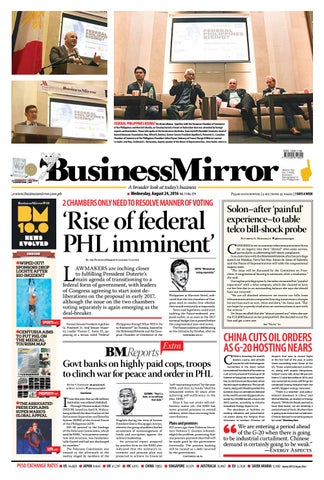
FEDERAL PHILIPPINES RISING? The BusinessMirror, together with the European Chamber of Commerce of the Philippines and Marriott Manila, on Tuesday hosted a forum on federalism that was attended by foreign experts and lawmakers. Those who spoke at the forum were (clockwise, from top left) Benedikt Seemann, head of Konrad Adenauer Foundation; Rep. Alfred B. Benitez; former Senate President Aquilino Q. Pimentel Jr.; Canadian Chamber of Commerce of the Philippines President Julian Payne; Embassy of France Chargé d’Affaires Laurent Le Godec; and Rep. Ferdinand L. Hernandez, deputy speaker of the House of Representatives. Story below. Nonie Reyes
media partner of the year
BusinessMirror
United nations
2015 environmental Media Award leadership award 2008
www.businessmirror.com.ph
A broader look at today’s business
n
Wednesday, August 24, 2016 Vol. 11 No. 319
2 CHAMBERS ONLY NEED TO RESOLVE MANNER OF VOTING
‘Rise of federal PHL imminent’
INSIDE
L
wiped out! Sponsors drop Lochte after Rio incident
sports
By the BusinessMirror Economic Cluster
awmakers are inching closer to fulfilling President Duterte’s main agenda of transitioning to a federal form of government, with leaders of Congress agreeing to start joint deliberations on the proposal in early 2017, although the issue on the two chambers voting separately is again emerging as the deal-breaker.
c1
centuria aims to put PHL on the medical tourism map
Former Senate President Aquilino Q. Pimentel Jr. And Senate Majority Leader Vicente C. Sotto III, appearing at a forum titled “Federal
cenTurIA lobby
cenTuruA clinic show unit
Centuria aims to put Philippines in the medical tourism map
A
By Rizal Raoul Reyes
@brownindio
“It is a realization of our vision to change the game in health care. Centuria Medical Makati addresses the country’s need for a point of reference when it comes to a medical tourism facility, as well as an elevated form of outpatient experience,” Century Properties Chairman and CEO Jose E.B. Antonio said recently in a press statement. According to Antonio, the soonto-open 28-story, 74,000-square-
meter facility aims to introduce game-changing methods in preventive health and outpatient care, the delivery of wellness services, as well as open greater opportunities for medical tourism in the Philippines. Although the Philippines is still a young player in the Asean region as far as medical tourism is concerned, Antonio said Century Properties believes it should be afforded with more attention.
With its natural beauty, the existence of top hotel chains and shopping centers, as well as an Englishspeaking population with some of the best health-care professionals in the world, who are known for their genuine brand of care or malasakit, he said the Philippines is already at an advantage. “A lot of medical tourism opportunities are sometimes a result of many patients’ desire to secure quality care at affordable prices while they enjoy their vacation. The Philippines is one such country that can cater to all these needs,” Antonio said. It also helps that the present government is keen on strengthening tourism as a whole, as can be seen in its landmark tourismpromotion efforts across the globe. He said the presence of a central facility for the patients to consider is a tangible way of securing a steady stream of patients to the country. As far as Century Properties is concerned, Antonio said the 28-year-old firm is the only developer that has a history of creating medical arts facilities, including Medical Plaza Makati,
Medical Plaza Ortigas, and the medical arts center of Asian Hospital in Alabang. Because of the success of Centuria and the demand for this kind of facility, he said Century is planning to expand to other cities nationally and regionally. Units are fully sold out. Moreover, Centuria is eyeing a 60-percent occupancy rate by the end of 2016.
Medical tourism hub
WHIlE the Philippines has been host to medical tourists for years through some of its hospitals, Antonio pointed out that it is only now that a facility is being dedicated to help sustain its growth as an industry. “One of the challenges that this sector faced years ago is the lack of proper infrastructure to house practices specifically geared to accommodate medical tourists,” Antonio said. As a response to the need, he said Century Properties is positioning Centuria as an aggregator of the best industry practitioners in medicine and wellness who will cater to both medical
Torre Lorenzo breaks ground in Batangas
T
ORRE lorenzo Development Corp. (TlDC) recently broke ground for Tierra lorenzo lipa—their first premier venture in lipa City, Batangas. The mixed-use development features three hotel and residential buildings, a sports club and specialty dining outlets, a business center and fitness complex, among many others. Touted as the first urban lifestyle center in Batangas, Tierra lorenzolipa is one of the company’s two mixed-use developments—with the other soon to rise in Pampanga that are precedents to a new standard in residential living in its re-
spective host communities. Tierra lorenzo is scheduled to have its first units available for turnover by the third quarter of 2018. Known as the pioneer of the Premium University Residences concept, TlDC has since expanded its property-development portfolio to include district and master-planned township developments across the country. Arch. Senen Salvacion (from left), president of Design coordinates Inc.; Michael Acusa, public and safety officer of Lipa city; Tomas Lorenzo, president of TLDc; Arch. rachel remulla-Shah, rachel remulla-Shah and Associates; and Lalaine regino, vice president of TLDc.
tourists and local residents. Abroad, Centuria aims to tap a market of Filipino expatriates and foreign nationals from Europe, North America, the Middle East and Asia Pacific through an international clientele network. locally, Centuria will serve Makati and nearby cities, including its immediate catchment area in Century City, which will have a total of eight residential and office/commercial towers upon completion, as well as nearby villages San Miguel, Bel-Air, San lorenzo and Urdaneta. Centuria will host centers of excellence in primary care, multispecialty surgery, dermatology and cosmetic laser treatment, multispecialty dentistry, cosmetic and facial surgery, obstetrics and gynecology, ophthalmology/laser eye surgery, oral and maxillofacial surgery, urology, physical therapy, chiropractic treatment, orthopedic, dialysis, podiatry, oncology/cancer treatment and wellness, and complementary medicine. To add even more premium on patient experience, Antonio said Centuria will implement a patient queuing system, as well as put in
place medical concierge services that can even assist with travel and accommodation bookings. Other locators in Centuria are going in the same direction: patient experience-centric. Advanced lab Solutions, for example, is implementing a laboratory Information System and a Bar-Coded Specimen system, to allow for accurate and systematic patient data archiving. Its clinic space and equipment, meanwhile, are sensitive to patients’ specific and actual needs with lowered MRI beds for patient convenience. Each floor with doctors’ clinics is designed with a lounge for the convenience of patients. Parking space is ample, and a mall next door—the Century City Mall, which is easily accessible both for additional parking needs, dining, watching a movie and shopping. Antonio said the company envisioned Centuria to provide worldclass outpatient health care that is on a par with medical tourism facilities in Singapore and Thailand. Century Properties is on the right track to the objective and it aims to open this year.
By Fil V. Elefante @elefantefil & Rene Acosta @reneacostaBM
SHDA holds housing fair
property T
HE Subdivision & Housing Developers Association Inc. (SHDA), the largest and leading organization of housing developers in the Philippines, will once again gather some of the most reliable home developers and suppliers in a huge one-stop shop for three days. SHDA’s third Housing Expo will be held at the Glorietta Activity Center in Ayala Center, Makati City, from August 25 to 28. John Paul Dy, committee chairman, said: “The Housing Fair is a much-anticipated event among prospective homeowners because we bring together under one roof the biggest companies that offer various products and services for their homes. It is a one-stop destination for everything and anything that they may need.” Among the featured exhibitors are 8990
Housing Devt. Corp., Axeia Devt Corp., Ayala Land, Boysen Phils., Breezewoods, Chinabank, CHMI Land Inc., Citihomes, Davies, DDC Land, DMCI Homes, Duraville, Filinvest, Hausland, Holcim, Homemark Inc., Honeycomb Builders, Jacinto Color Steel, James Hardie Phils., Lamudi Phils., Lumina Homes, Masaito, Matimco Inc., PA Properties, PDB Properties, Phinma Properties Prominence Properties, Property Company of Friends, Pueblo de Oro, Steeltech, Suntrust Properties and United Coconut Planters Bank. Aside from unifying Philippine home developers, SHDA partners with the government and other sectors in pursuit of its Roadmap to 2030 for better housing options for Filipinos from all strata of society. Visit www.shda.ph for more details.
E1
the associated Press explains: super mario’s global appeal
Life
Continued on A2
Govt banks on highly paid cops, troops to clinch war for peace and order in PHL
cenTurIA concierge
FTER establishing a solid reputation as a quality developer, Century Properties Group is set to make a difference in the healthcare industry when it launched Centuria Medical Makati, the country’s largest outpatient Information-technology-medical building in Century City, Makati.
Philippines at Marriott Hotel, indicated that the two chambers of Congress need to resolve first whether they would vote jointly or separately. Sotto said legislators could start tackling the Palace-endorsed proposal earlier, or as soon as the 2017 national budget law is passed before the congressional year-end recess. The House could start deliberating on the initiative by October, after its
BMReports
BusinessMirror
E1 | Wednesday, August 24, 2016 • Editor: Tet Andolong
cenTurIA Medical Makati
Philippines Rising? What Will It Do to Business?” on Tuesday, hosted by the BusinessMirror and the European Chamber of Commerce of the
SOTTO: “We insist on voting separately.”
D1
Conclusion
I
T was this year that an old military institution was ordered abolished. Through Memorandum Order (MO) 90, issued on April 8, Malacañang ordered the deactivation of the Retirement Separation and Benefits System (RSBS) of the Armed Forces of the Philippines (AFP). MO 90 pointed to the findings of the Feliciano Commission, which said the RSBS, “in its present conception and structure, was fundamentally flawed and had not discharged its mandate.” The Feliciano Commission was created in the aftermath of the mutiny staged by members of the
PESO exchange rates n US 46.6020
GAZMIN: “That’s a debt, so we will pay that debt.”
Magdalo during the term of former President Gloria Macapagal-Arroyo, wherein the group of soldiers hurled accusations of mismanagement of funds and corruption against the military leadership. An actuarial report prepared by another firm on the RSBS also indicated that the military’s retirement and pension plan was projected to achieve its financial
“self-sustaining status” by the year 2058, and that its funds “shall be exhausted within 32 years after achieving self-sufficiency in the year 2090.” Since it has not attain self-sufficiency status yet, the RSBS has never granted pensions to retired soldiers, other than returning their contributions.
Plans and promises
SIX years ago then-Defense Secretary Voltaire T. Gazmin acknowledged the problem, promising that any pension-payment shortfall will be made good by the government eventually. The pension backlog will be treated as a debt incurred by the government. Continued on A2
P25.00 nationwide | 5 sections 32 pages | 7 days a week
Solon–after ‘painful’ experience–to table telco bill-shock probe
C
By Lorenz S. Marasigan
@lorenzmarasigan
ONGRESS is set to summon telecommunications firms for an inquiry into their “dismal” after-sales service, particularly in addressing bill-shock complaints. In an interview with the BusinessMirror after her privilege speech on Monday, Party-list Rep. Emmi de Jesus of Gabriela said the House of Representatives will table the congressional inquiry soon. “The issue will be discussed by the Committee on Franchise. A congressional hearing is automatic after a resolution,” she said. During her privilege speech, the solon recounted her “painful experience” with a telco company, which she claimed to have cut her line due to an outstanding balance she says she should have not incurred. “We are all shocked whenever we receive our bills from telecommunications companies bearing unnecessary charges for services such as text, voice and data,” de Jesus said. “But our hope for a speedy resolution on contestations is met with the reverse.” De Jesus recalled that she “almost passed out” when she saw the P13,000 balance on her postpaid bill. She decided to cut the line and get a new one. See “Telco,” A2
CHINA CUTS OIL ORDERS AS G-20 HOSTING NEARS
C
hina is throwing the world’s leaders a party, and oil bulls may be hit with the hangover. Authorities in the Asian nation have ordered hundreds of factories to curb activity ahead of the Group of 20 Summit in Hangzhou in early September, in a bid to ensure blue skies when the red carpet is rolled out. The curtailments, along with flooding earlier this summer, may cut petroleum demand in the world’s second-biggest oil consumer by 250,000 barrels a day in the third quarter, according to industry consultant Energy Aspects Ltd. The slowdown at facilities including refineries and petrochemical plants along the Yangtze River threatens to weaken Chinese oil
imports that rose to record highs in the first half of the year, at some times exceeding even those of the US. Those unprecedented purchases, along with supply disruptions, helped crude rally about 80 percent from a 12-year low earlier in 2016, and any sustained recovery will hinge on continued strong demand from the world’s biggest energy consumer. “There is a weather- and policyinduced slowdown in China,” said Michal Meidan, an analyst at Energy Aspects. “While the floods seemed to have died down, we are entering a period ahead of the G-20 when there is going to be industrial curtailment. Chinese demand is certainly going to be weak.” Bloomberg News
We are entering a period ahead of the G-20 when there is going to be industrial curtailment. Chinese demand is certainly going to be weak.” —Energy Aspects
n japan 0.4645 n UK 61.2397 n HK 6.0112 n CHINA 7.0052 n singapore 34.5174 n australia 35.4967 n EU 52.7628 n SAUDI arabia 12.4302
Source: BSP (23 August 2016 )
BMReports BusinessMirror
A2 Wednesday, August 24, 2016
Arrivals. . .
Continued from A12
connectivity and infrastructure gap of the region. For her part, Marco Polo Davao new General Manager Dottie Viajar Wurgler-Cronin, who had a brief meeting with Secretary Teo at the sidelines of Kadayawan 2016, expressed confidence that “Davao and the entire Mindanao region would be given more attention now that we have a tourism secretary from the region.” Cronin said with Teo’s appointment to the DOT, she expects a “better understanding of what we have and can offer from this region,” and describing the DOT chief as a “perfect example of Mindanao tourism.” Teo was owner and president of Mt. Apo Travel & Tours in Davao before she assumed her post at the DOT.
Telco. . .
Continued from A1
But to her dismay, two days after her new number was onboard, her services were redirected due to an outstanding balance despite having settled the amount already. Her line was reactivated, but was quickly cut for the same reason. “I personally went to the store and filed a major complaint. But what is more depressing is the inconsistency of the answers of the different agents that I talked to,” she said. The root of the problem, according to her, was the number that was assigned to her was recycled. She now has a working line. De Jesus revealed that the telco she transacted with is Globe Telecom Inc. “But the hearing will not be exclusive to Globe. We will also ask Sun and Smart,” she said. The National Telecommunications Commission (NTC) refused to divulge the number of bill-shock complaints as of press time, with an official saying the officials “want to consolidate the data first.” Globe Spokesman Yolanda C. Crisanto was not available for comment. For his part, Smart Spokesman Ramon R. Isberto assured that his company is not taking customer complaints lightly. “We take such customer concerns very seriously and address them as quickly as possible based on our general policies and the specific circumstances of each case,” he said. Asked if his company is open to a congressional inquiry, he replied: “The NTC has an existing process for addressing such concerns. But it’s the legislators’ call if they hold a hearing.”
Govt banks on highly paid cops, troops to clinch war for peace and order in PHL Continued from A1
“That’s a debt, so we will pay that debt,” Gazmin said at the time, adding that the shortfall will be paid in due time. A longtime military pensioner told the BusinessM irror he and his fellow pensioners have heard of such promises before. But they would prefer to hear a concrete plan that would solve this problem in the shortest possible time. “We are not getting any younger,” the pensioner said, declining to be named for fear of reprisal. Gazmin said he is aware of his fellow former soldier’s woes. He assured his fellow pensioners that the shortfall will be paid. “We cannot pay you in full, all in one go.” By 2011, a technical working group ( TWG) was formed by the AFP and the Department of National Defense (DND) to look for solutions. They proposed to change the military retirement age from 56 to 58 years old. The group also recommended the increase in the minimum number of years of service before a soldier can avail themselves of retirement, from 20 years to 25 years. The TWG also proposed the deactivation of the RSBS and the creation of a dedicated pension fund for soldiers with an accompanying counterpart funding from the government. The group also recommended the recall of automatic pension hikes for military retirees whenever active military soldiers receive pay hikes.
Aquino’s Sona
THEN-President Benigno S. Aquino Iii
acknowledged the problem arising from the relationship of salaries and pension of the personnel of the AFP and the Philippine National Police (PNP). In his 2013 State of the Nation Address (Sona), Aquino said the true situation of the AFP and the PNP pensions is that “[n]o contributions have been made, but there are payments to make.” “Apart from this, the pensions of retirees have been indexed to the salaries of active personnel.” Aquino explained that the pension scheme as organized when he became commander in chief was part of the pensiondeficit problem. “This means that if the salaries of those in the service increase, so, too, will the pensions received by retirees or qualified families,” he said. “Yearly, there are more and more men and women retiring, so, naturally, the obligations that must be paid out also increase.” “We need a system that fulfills our civic obligations to our policemen and armed forces; and it is likely that we will request the assistance of the GSIS [Government Service Insurance System] in this regard,” Aquino said. The chief executive said that time his administration is “currently studying the feasibility of using reclaimed land to generate funds that will form part of the solution.” “After all, we cannot surprise the GSIS and ask them to account for the entirety of our needs, which is why an even more thorough study will be conducted to create a fair, sus-
tainable and clear mechanism for the pensions of PNP and AFP personnel.”
Escudero proposal
THE idea of bringing in the expertise of the GSIS came from Sen. Francis G. Escudero in 2011. Escudero has recommended that the GSIS handle the pension of all the government’s retired uniformed personnel, which includes soldiers, jail guards, policemen and firemen. “As government employees, it makes sense that the GSIS should handle their pension system,” Escudero had explained. In 2009 records obtained from the AFP Finance Center showed that the number of military pensioners increased by nearly 8,000, from 98,978 in fiscal year 2006 to 106,910 in fiscal year 2009. By 2015, the number of military pensioners has exceeded 120,000. In 2008 P12.832 billion was released for military pension payments. By 2009, it rose to P14.889 billion. By 2010, the budget allocated for pensions was P19.393 billion with about P16 billion, unpaid in benefits. By 2015, the pension backlog increased to P18 billion. What happened to the proposals designed to deal with this situation that was made by a TWG back in 2011? Shortly before the end of his administration, Aquino signed Memorandum Order 90 abolishing the RSBS. This action by Aquino meant that since 2011, only one suggestion became reality. The rest of the
‘Rise of federal PHL imminent work on the 2017 budget. The Senate would then do its part on the national appropriations law, with the passage of the new budget expected by December.
Ripe for the shift
Pimentel noted that in his last stint at the Senate, he was able to muster the support of 16 of his colleagues for the federalism initiative. However, there was little interest in the lower chamber to advance it. This time, he said both houses are willing to finally make the shift. Being espoused by a “rock star” President enjoying an unprecedented trust rating of 91 percent, Pimentel said the rise of a federal Philippines appears to be ripe. With this, he said President Duterte should devote the first two years of his term on revising the Constitution, and the remaining years for the transition process, if he wants to implement a federal system of government before his term ends. “There must be a streamlining of government, allowing concerned departments to transfer or realign themselves under the new system of government,” Pimentel said.
Bicameral consensus
Sotto confirmed a bicameral consensus is firming up in both chambers of Congress favoring early passage of legislation to start the process of amending the Constitution to shift to a federal system, as conveyed by House leaders in a recent meeting with their Senate counterparts. “There is strong support in the House for [the two chambers to convene as] a constituent assembly [Con-ass] to do the task” of amending the Charter, but Sotto admitted a possible deal-breaker would be on how members of the two chambers (300 congressmen and 24 senators) will vote to adopt the revisions leading to a federal system; with senators firm on separate voting. Sotto affirmed that on the part of the Senate, “we insist on voting separately.”
Voting separately
He pointed out that the 1987 Constitution contains four provisions,
www.businessmirror.com.ph
which specified the Senate and the House would vote separately, adding that the only time the two chambers would be voting jointly is when the President declares martial law, and lawmakers are called to “vote jointly in special session to revoke such declaration.” The Senate majority leader cited Article VI, Section 23 of the Constitution, which provides that “Congress by a vote of two-thirds of both Houses in joint session assembled voting separately, shall have sole power to declare the existence of a state of war.” Sotto added that Article VII, Section 4 of the same Constitution, likewise, states in part: The person having the highest number of votes shall be proclaimed elected, but in case two or more shall have an equal and highest number of votes, one of them shall forthwith be chosen by the vote of the majority of all members of Congress voting separately.” Moreover, Section 9 of Article VII also provides that in case of vacancy in the Office of the Vice President, the President shall nominate from among senators and congressmen “who shall assume office upon confirmation of a majority vote of all members of both Houses of Congress voting separately.” In addition, Sotto cited Section 11, which provides that if Congress is notified that the President is unable to discharge his duties, the members of Congress within 10 days of receipt of such notice shall “determine by two-thirds vote of both chambers voting separately” that the President is, indeed, unable to discharge his powers duties and the Vice President shall act as President.” Pimentel agreed that the Senate and the House should vote separately on the proposal to amend the Constitution to pave the way for a federal system he had long espoused as founding chairman of the Partido ng Demokratikong Pilipino-Laban ng Bayan (PDPLaban), which is also the party of President Duterte. Pimentel pointed out that the Senate and the House can deliberate jointly on the proposal to amend the Charter “but they
should vote separately.” “It stands to reason that the opinion of both the Senate and the House will be taken” in the process of amending the Constitution, he added.
‘Imperial Manila’
president and features some of the advantages of a federal form of government. “We’re honored to be referred to by your President as the model that should be emulated. But we would like to clarify that we are not a federal country at all, and we made the choice in the French Revolution that we will be a unitary country to unify the nation and destroy the old feudal powers,” Le Godec said.
The former Senate President pushed for the shift to a federal system, saying the “powers of government are too concentrated in Manila.” “For a long time, the powers reside in Manila...everything awaits approval of the government in Manila,” he said, adding that Metro Manila may remain the country’s capital of 11 federal states under his proposal. Pimentel, who has been advocating the shift to federalism since the 1980s, said amendments to the Constitution should be enacted to truly stimulate development in the countryside as the Local Government Code (LGC) on ly devolved powers from the departments of Agriculture, Health and Social Welfare and Development. Although these functions have already been devolved, he said there are still many instances where the national government asserts jurisdiction over these functions, especially during times of natural calamities. “There is talk to merely amend the LGC—to expand the powers to the other departments not covered by the original scope. But in that case, the central government can still do the same and arrogate the powers that have already been devolved. We have to move forward in addressing this by changing the fundamental law,” Pimentel said.
Canadian Chamber of Commerce in the Philippines President Julian Payne, citing the Canadian model, pointed out the need for provinces to put in place a system of checks and balances in line with the national government. “The federal government cannot make laws in areas of provincial jurisdiction, and second, it also cannot unilaterally change the Constitution. In both the US and Canada, the federal government is a check on some areas, such as education and health,” he said.
French model
Con-ass is the way
The forum speakers included representatives of foreign chambers and foreign governments. For the French model of government, French Embassy Chargé d’Affaires Laurent Le Godec gave an overview of the French model that President Duterte earlier referred to as the one that the Philippines should follow. Le Godec clarified the French government is not a federal form of government, but is a unitary form of parliament, which has a
‘It comes at a cost’
Konrad Adenauer Stiftung Head Benedikt Seemann, presenting the German model of federal system, said a federal form of government is not free. In the experience of Germany, there are various kinds of taxes that often become points of contention in the government. Seemann also said a federal government works well under a parliamentary system. Only the United States has been successful in having a presidential system in a federal government. “Actually, federalism comes at a cost. Federalism does not come for free,” Seemann said.
Checks and balances
Pimentel said a Con-ass “can do the job” to amend the constitution, as long as Mr. Duterte “keeps an eye on what Congress is doing.” Rep. Alfredo Benitez of the Third District of Negros Occidental said Con-ass is under the scrutiny of the public given the possible interference by the legislators’ personal agenda during the assembly. “There’s a trust issue perceived by the public that members of Congress will include their personal
proposals remained just words on paper.
Proposals revived
THE Duterte administration now has to carry the burden of solving the problem of the militarypension backlog. Once again, the idea of having the GSIS handle the military pensions has been revived. According to reports, Budget Secretary Benjamin E. Diokno said the Duterte administration was once again looking at this proposal, a suggestion forwarded by Escudero five years ago. Diokno acknowledged that integrating the military-pension system with the GSIS would require a massive infusion of funds. The amount would range between P2.04 trillion to as much as P5.5 trillion. Diokno said the Duterte administration was also looking at the possibility of repealing Presidential Decree 1638 and instituting a more sustainable military pension law, which was also another recommendation made in 2011. According to a study by the AFP in 2012, it was estimated that the amount needed to pay military-pensions would be P54.1 billion by 2017. Four years later, that estimate has already been exceeded. According to the Department of Budget and Management, under the 2016 national budget, about P56 billion of the DND’s budget of P177 billion will be used for its pension and gratuities fund. And the amount set aside for military pensions will continue to eat into the DND’s budget the longer the situation is left untended. With reports
culled from the Philippines Graphic magazine
Continued from a1
agenda than what’s good for the country in a Con-ass,” Benitez said. But he stressed that “the easier, faster and cheaper way of revising the Constitution” is the choice of the government. “Look at the end product. What are the provisions to be amended, and basically, it will end in the same format either through a convention or assembly,” Benitez said. “At the end of the day we are still going to have a referendum,” he added, referring to the final phase of constitutional revision, which would be the approval of the people.
Resource-sharing scheme
As for the sharing of the country’s resources, Pimentel proposed the 80-20 income-sharing scheme—80 percent of the state’s income is for them to keep, while the remaining 20 percent goes to the federal government. On top of the 80-20 scheme, Pimentel also said the government should also adopt an equalizationfund program that would aid the poorer states. In the equalization-fund scheme, the federal government shells out funds in form of loans to states that are in dire need of development funds, Pimentel said. “This will be administered by a loan commission composed of representatives from all the federal states,” Pimentel said. Benitez, chairman of the House Committee on Housing and Urban Development, also said the inclusive-growth goal has not been achieved, necessitating the Philippines need to change its government structure. “[Poverty and uneven development] are the reasons most of the Filipinos want to change the Constitution. When Filipinos don’t feel the benefit of economic growth down to the grassroots level then definitely we have people clamoring for change,” Benitez said. “Why do we need to amend the Constitution? Is it because the President wants it? Or are there other reasons like the delivery of social services and promotion of better life?” the lawmaker from Negros Occidental asked. According to Benitez, economic
development and delivery of basic social services are concentrated in Metro Manila. “For the past 30 years, the economy has been growing; but let’s look at it from where it is growing. As you can see, the Philippine economy has experienced steady growth, especially in recent years, becoming one of the fastest growing economies in Asia. However, you can see it [the results of this development] is really concentrated in one area [Metro Manila],” he added.
Laggard still
Deputy Speaker Ferdinand L. Hernandez, who represented Speaker Pantaleon D. Alvarez in the forum, said: “We are continuously lagging behind our neighbors” despite the country’s potential and the efforts of the best and brightest of Filipinos. “The Philippines is a curious case. It is overflowing with hardworking and talented people, more than 100 million to be precise, 10 percent of whom are overseas, working as part of the backbone of foreign economies,” said Hernandez, quoting the speech of Speaker Alvarez. “While currently our GDP is one of the strongest in the region, the size of the Philippine economy is more or less equivalent to that of Singapore, a country that is 430 times smaller than the Philippines, with hardly any natural resources, and a population of just around 5 million. There is an evident disconnect between our country’s potential and its actual performance,” he added. According to the lawmaker, the Duterte administration and the leadership of the 17th Congress are now trying to address the underdevelopment by changing the country’s form of government. “We have tried to solve this riddle of underdevelopment. Policies have been crafted and implemented. They started as promising but soon lost momentum and eventually died. Observers have reasonably asked if the Philippines is destined to repeat this cycle. This has led us to examine the present structure we have,” he said. Butch Fernandez, Jovee Marie N. dela Cruz, Cai U. Ordinario and David Cagahastian, Jasper Alcaraz, Catherine N. Pillas
BMReports BusinessMirror
news@businessmirror.com.ph
Wednesday, August 24, 2016 A3
Neda raises ICC project cost floor to ₧5B, prioritizes Mindanao rail
T
By Cai U. Ordinario
@cuo_bm
HE National Economic and Development Authority (Neda) has raised the Investment Coordination Committee (ICC) project cost floor to P5 billion.
Setting a project cost floor of P5 billion means all projects amounting to below P5 billion will no longer be under the purview of the ICC. In a briefing in Malacañang on Tuesday, Neda Director General and Socioeconomic Planning Secretary Ernesto M. Pernia said the agency also updated the Social Discount Rate to 10 percent from 15 percent. “Also, other reform initiatives on the process are currently proposed to fast-track the appraisal and approval process, while still ensuring the quality of infrastructure projects,” Pernia said. The ICC has already approved 10 projects costing P320 billion. It includes projects on rural development, regional hospitals, airport modernization and flood management. The list also includes the NorthSouth Railway-South Line project
(NSRP) and the Metro Manila Bus Rapid Transit (BRT)-Edsa project. “We have moved quickly to implement reforms to accelerate infrastructure development,” Pernia said. “The Neda Board, chaired by the President, will deliberate the approval of these projects in September and, thereafter, for implementation by agencies.” The last time the ICC revised its project cost floor to P1 billion from P500 million was in April 2013. The ICC evaluates the fiscal, monetary and balance-of-payments implications of major national projects. It also advises the government on domestic and foreign borrowings program. It is also tasked to submit a status of the fiscal, monetary and balance-of-payments implications of major national projects. The ICC consists of the secretary of finance as chairman and the Neda
director general, as cochairman. Its members include the executive secretary; the secretaries of the department of Agriculture, Trade and Industry, and Budget and Management; and the governor of the Central Bank of the Philippines. In another development, Pernia said the national government is prioritizing infrastructure projects and policies that seek to ease congestion in Metro Manila and boost economic development nationwide. Pernia said the interagency Infrastructure Committee (Infracom) has sought to prioritize the Mindanao Railway Project to boost growth in Mindanao, and five projects that aim to decongest traffic in Metro Manila. Infracom has also recommended six priority infrastructure policies to be submitted to the LegislativeExecutive Development Advisory Council (Ledac). “Guided by the 0+10 agenda of the President, we are carrying on macroeconomic policies, ramping up infrastructure spending, promoting rural development and investing in human-capital development. In the first 50 days, I can say we are on the right track and on a faster pace to make sure we reach our goals,” Pernia said. Pernia said the Mindanao Railway Project’s initial phase will be imple-
₧320B
The cost of the 10 projects the Neda’s Investment Coordination Committee has already approved mented in 2017, after securing the approval of the Neda Board this year. The Mindanao Railway System is a 2,000-kilometer railway. Its two segments will connect various provinces in Mindanao. Neda officials earlier said the feasibility study, currently being conducted by a local consortium composed of local firms Schema Konsult Inc., Edcop and Primex, will determine the mode of financing to be used in the project. The project can be financed through official development assistance (ODA), public-private partnership (PPP) or a combination of ODA and PPP, depending on the recommendation of the feasibility study. Meanwhile, the five measures prioritized to decongest Metro Manila includes the Bonifacio Global City-Ortigas Link Bridge. Once completed, Pernia said, it will divert 25 percent of Edsa traffic. The list includes the early reso-
lution of the common station for the Metro Rail Transit 3, Light Rail Transit 1 and MRT 7. Pernia added that the Department of Public Works and Highways will soon hand the final configuration of the station to the Department of Transportation. Pernia said the Infracom urged the use of the Batangas and Subic ports to decongest Manila ports. In 2014 the country’s export and import performance suffered due to port congestion at the Port of Manila. Two years ago the city of Manila imposed a truck ban that caused the slow inflow and outflow of goods within and outside Metro Manila. Pernia said other measures include the North-South RailwaySouth Line project and the Metro Manila Bus Rapid Transit (BRT) Edsa project. The NSRP is being funded through the PPP, and involves commuter and long-haul railway operations. Commuter railway operations will be between Tutuban and Calamba, and the long-haul operations between Tutuban and Legazpi City. The P68.26-billion Edsa BRT is 48.6 kilometers long and will traverse 63 stations on Edsa, Ayala Avenue, Ortigas-BGC and Ninoy
Aquino International Airport. Also, it will add accessibility infrastructure, like greenways, pedestrian walkways and bikeways. It will be implemented between 2017 and 2019. The Infracom has also identified measures to address institutional, legal and policy issues in relation to infrastructure programs. Part of the legislative agenda to be submitted to the Ledac include the creation of an apex body for the water resources sector, proposed to be the Department of Water Resources, and an independent economic and financial regulator for the water sector. The Infracom will also submit to the Ledac the creation of a National Transport Policy and amendments to the build-operate-transfer or law and its IRR; Electric Power Industry Reform Act; and the Water Code of the Philippines. “We have hit the ground running and we intend to do much more, in collaboration with other agencies, development partners and key stakeholders,” Pernia said. “We trust that in the next 50 days, we can mobilize more people and resources to accomplish even more and continue improving our processes that will benefit the Filipino people, especially the poor and those left behind,” he said.
BMReports BusinessMirror
A4 Wednesday, August 24, 2016
news@businessmirror.com.ph
Villar tells miners to integrate operations
S
By Jonathan L. Mayuga
@jonlmayuga
en. Cynthia A. Villar, chairman of the Senate Committee on Environment and Natural Resources, on Tuesday called for the development of more domestic processing facilities to boost mining’s contribution to the economy and generate more jobs in the countryside, as she doubts any ban will happen during President Duterte’s six-year term. Speaking before 100 local and foreign delegates during the kickoff ceremonies of the Mining Philippines 2016 Exhibition and Conference at the Mariott Hotel in Pasay City, Villar envisioned a mining industry for and by the Filipino people. Organized by the Chamber of Mines of the Philippines (COMP), the three-day conference came in wake of a campaign launched by the Duterte administration, through Environment Secretary Regina Paz L. Lopez, to tighten the screws on mining regulation. The event, which carries the theme Realizing the Potentials of the Mining Industry in a New Regime, highlights the challenge and stern warning hurled by the current administration to the mining industry “to shape up” and stop environmental destruction. Despite its potential, mining’s contribution to the economy in terms of GDP remains at less than 1 percent, mainly because of the strong opposition by various stakeholders,
including local governments, environmental advocates and community-based groups.
Challenges
COMP President Benjamin Philipp Romualdez, in his introductory speech, said notwithstanding the tremendous challenges, the mining industry remains committed to work with the Duterte administration in its thrust to raise the standards for all operating large-scale metallic mines. “We view the President’s appointment of a trusted friend and ally as DENR [Department of Environment and Natural Resources] undersecretary [to take] charge [of the] MGB [Mines and Geosciences Board [MGB] and EMB [Environmental Management Bureau] as a recognition of the mining industry’s tremendous impacts and its potential to contribute greatly to the country’s economy,” he said. Romualdez said members of COMP remain optimistic and “are kept afloat by our firm belief that
mining will, one day, achieve its full potential” to contribute to the nation’s economic growth. The level of participation of the industry’s various stakeholders in the conference and exhibition, he added, reflects the industry’s optimism of mining’s future under the Duterte administration, particularly because of its war against corruption. “A country rich in minerals run by a government bent on curbing corruption remains an attractive destination for resource development,” Romualdez said.
Audit
AN environmentalist, Lopez had added social, environmental and biodiversity considerations in the conduct of the mining audit on top of the usual technical or physical aspect of operations. So far, the ongoing mining audit led to the suspension of 10 large-scale mining operations.
Beneficiaries
Villar, in her brief keynote remarks, remained hopeful of an industry that will benefit the people. “What I want to see happening is the creation or development of more domestic processing facilities to generate more local employment,” Villar said. She said mining projects that prioritize local suppliers and contractors should be the priority since it can spell difference in inducing growth through responsible mining operations that can also increase mining’s gross value added. “The mining industry may look or continue to look into how it can promote and harness local industries through education and skills training. In the long run, doing so will also develop local experts and improve Filipino competencies,” she added.
The lawmaker said the country must not overlook how the industry enhances local services, which are indirect beneficiaries of mineralresource development. “These include retail trade, financial services, agriculture and manufacturing, among others, that can actually result in the growth of the local economy and again provide employment opportunities,” Villar said. While the industry’s growth and development may foster equitable distribution of the country’s natural wealth and translate to better quality of life for the future generations, Villar said, mining could never justify environmental destruction. “That is where, I believe, we should continue to draw the line as it has been clearly demarcated even before by existing policies, rules and regulations. “It is also in that context that I echo the pronouncement of President Duterte to do mining right or not to do it at all,” she stressed. Villar said the essence of sustainable mining development is in utilizing the wealth of the country to create more wealth so that future generations of Filipinos can benefit. “It does not, by any means, allow the destruction of our greatest wealth— our environment and natural resources. That is nonnegotiable. Let me end this by sharing my guiding philosophy in all of my environmental advocacy: “We do not inherit the Earth, we borrow it from our children,” she said.
Ban
“The industry is not that developed,” Vilar said, adding that domestic processing “is something we should look forward to in the future,” she said. The House of Representatives will tackle a bill seeking to ban ore exports as part of a broader plan to
A country rich in minerals run by a government bent on curbing corruption remains an attractive destination for resource development.”—Romualdez
revamp the mining sector and retain more of the country’s mineral wealth domestically, Rep. Carlos Isagani Zarate said last week. The country is the world’s biggest supplier of nickel ore used in stainless steel and the top supplier to China. Global nickel prices rallied to the highest in a year this month, after some mines were suspended amid an environmental audit and reports of the potential export ban. The law’s sponsors aim to develop a domestic processing industry, creating jobs and boosting tax revenue. A similar bill foundered in 2014 through lack of support.
Many models
Villar said she wants to see the “creation or development of more domestic processing facilities to generate more local employment,” similar to Indonesia, which halted ore shipments more than two years ago. “There are many models of mining policies that we can examine to see how it can apply to our country and benefit our people,” she said, citing Canada and Australia for their high safety standards. Villar’s son is the CEO of Saint Augustine Gold and Copper Ltd., the Toronto-listed operator of the planned King-king gold and copper mine in the southern Philippine province of Compostela Valley. The senator said mining shouldn’t come at the expense of the environ-
ment and she blamed small, illegal miners for bad practices. She said that, with only 0.3 percent of the nation’s area devoted to mining, she’s surprised that chamber members “are being blamed for environmental degradation.”
Mining crackdown
President Duterte and Lopez are spearheading the mining crackdown, ordering operators to comply with environmental rules or face closure. Lopez’s audit of miners is due to end this month. So far, 3 percent of the nation’s first-half output this year has been shuttered, according to Citigroup Inc. The bank said the impact on world supply has been limited and forecast that producers will respond to higher prices by increasing shipments. The nation’s miners aren’t against local processing of ores but instead of an export ban, the government should encourage investors to set up local plants by offering tax incentives, Nelia Halcon, executive vice president of the chamber, said on Monday. The government should also conduct a feasibility study on banning exports, she added. The Philippines’s growth would be as much as 10 percent had mining projects, worth $34 billion, been allowed to proceed in a timely fashion, Halcon said. The nation’s economy expanded at 7 percent in the second quarter. With Bloomberg News
news@businessmirror.com.ph
AseanWednesday BusinessMirror
Q&A: Energy markets steer path of Malaysian economy, currency
M
alaysia’s economy and financial markets are suffering for their close reliance on energy markets. The 57-percent slump in Brent crude from a 2014 peak has forced Prime Minister Najib Razak to lower the government’s economic-growth forecast for two years in a row. Making matters worse, the Malaysian ringgit tends to mirror the movements in oil prices. When Brent was trading at more than $100 per barrel in August 2014, the ringgit reached the year’s high of 3.1420 per dollar. In January when Brent was hovering around the $30 mark, the currency tumbled to a three-month low of 4.4285. 1. Why are Malaysia’s fortunes so closely tied to energy? Malaysia is the only net exporter of oil among Asia’s major economies and the second-largest liquefied natural-gas exporter in the world. The energy industry contributes to one-fifth of Malaysia’s GDP. Shipments of crude petroleum, liquefied natural gas and petroleum products accounted for about 14 percent of Malaysia’s total exports in the first six months of 2016. 2. How much does Malaysia produce? Malaysia produced 693,000 barrels of oil a day in 2015 and average output over the past five years was 654,000 barrels a day, according to the BP Statistical Review of World Energy 2016. Its total proved reserves dropped to 3.6 billion barrels in 2015, from 5.3 billion in 2005. Natural gas production stood at 68.2 billion cubic meters in 2015 and output has averaged 65 billion cubic meters since 2011. Total proved reserves halved in the past decade to 1.2 trillion cubic meters in 2015.
3. How much does Malaysia earn? Some 22 percent of government revenue was derived from oil-related sources in 2015 and the central bank forecasts the share to fall to 13 percent to 14 percent in 2016. That’s down from 41 percent in 2009, because the government has taken steps to wean the nation off its reliance on the commodity. Still, Najib said in April Malaysia stands to lose 450 million ringgit ($112 million) in annual income for every $1 drop in oil. 4. What is Malaysia doing about this? Declining reserves of oil and gas have prompted Malaysia to rejuvenate existing fields, develop marginal fields and intensify exploration activities. The nation also aspires to become the regional hub for energy services and equipment in Asia Pacific. Najib implemented a consumption tax last year that is expected to bring in revenue of 39 billion ringgit in 2016 and also levied a higher tax rate on the top 1 percent of income earners. 5. What’s the outlook? Malaysia’s crude oil production will fall to 635,000 barrels a day in 2024, as a prolonged spell of low prices limit deep-water exploration activities, according to Londonbased BMI Research, a part of the Fitch Group. The nation’s gas output is forecast to rise to 71.1 billion cubic meters by 2024 as production from new fields help to make up for the drop from older ones, BMI estimates. A story on slow growth in Malaysia. Oil isn’t the only bad news for the ringgit. BMI Research’s forecasts to 2024. Malaysia Ministry of Finance’s economic report for 2015-2016. Malaysia’s top 10 major export products. Bloomberg News
8 of 10 Filipinos prefer automated elections
A
bout 81 percent, or eight of 10 Filipinos, found the 2016 automated national elections successful and credible, according to an independent survey. The survey, commissioned by private think tank Stratbase ADR Institute, also shows that a record 74 percent of Filipino respondents highly trust the results of the recent elections. The survey was conducted by Pulse Asia from July 2 to 8 among 1,200 respondents nationwide. On the question of whether they were satisfied or dissatisfied with the automated polling system or the counting of votes through vote-counting machines, 81 percent said they were satisfied, 7 percent said they were dissatisfied and 12 percent gave a neutral response. Meanwhile, 74 percent, or nearly three of four Filipinos, said they had a“big trust”in the 2016 elections and only 5 percent said they had “small or no trust.” Another 21 percent gave a neutral response. This marked a record increase in Filipinos’trust in automated polls, from just about half, or 52 percent, who said they trusted the 2010 and 2013 elections. “The data show that Filipino voters have learned to adapt to automated elections and appreciate the convenience, speed and accuracy of the system,” said Claudette Guevarra, secretary-general of election watchdog Democracy Watch. “This is despite the so many changes that the Comelec [Commission on
Elections] had to accommodate,” Guevarra said. Guevarra added that the survey also proved that voters want to continue the automated elections despite what critics say. According to the Pulse Asia survey, 88 percent of Filipinos prefer the automated system in future elections. A measly 7 percent said no. Stratbase ADRI President and Democracy Watch Lead Convenor Dindo Manhit, said the think tank commissioned the study as a part of its advocacy for free and transparent elections, which is a fundamental requisite for the legitimacy of democratic institutions. “We wanted to probe into the experience of voters and how they compared the conduct of the 2013 and 2010 automated elections,” Manhit said. “The facts show that Filipinos have accepted the automated election system as a credible technology,” Manhit said. “Though no system is perfect, the Comelec should use the data to further enhance the security and transparency of the system.” Election watchdog Democracy Watch organized the briefing recently with Pulse Asia Chief Research Fellow Ana Tabunda presenting the findings, followed by reactions from Comelec Chairman Andres D. Bautista, Manhit, Parish Pastoral Council for Responsible Voting Chairman Henrietta de Villa and Consortium on Electoral Reforms Chairman Ramon Casiple.
Editor: Max V. de Leon • Wednesday, August 24, 2016 A5
Amid growth, Myanmar now cutting buildings’ size
media briefings, sporadic press releases and a lack of clarity about media access to government events, said Kyaw Swa Min, joint secretary of the Myanmar Press Council and general secretary of the Myanmar Journalists Association. “Compared with the previous government, for example, President Thein Sein gave monthly policy and strategy addresses to the public,” Kyaw Swa Min said. “The government should make more contact with the media, provide more information, and not control or restrict the flow of information if they want to strengthen democracy.” The NLD is working to improve transparency, according to Myo Myint Maung, deputy permanent secretary at the Ministry of Information. “Expectations from the public are very high,” he said. “Since people believe in the new government, I believe the tasks carried out by government will be a success.”
D Khin Maung Swe
eveloper Bo San had already sold all the units in his 12-story high-rise building in Yangon in Myanmar when he was forced to halt construction. Three months later he faces the task of having to remove two floors to comply with new height regulations, at a cost of $8 million. Since May, the regional government of Aung San Suu Kyi’s ruling National League for Democracy (NLD) has suspended work at 185 construction sites across Yangon, and ordered the number of floors to be reduced at a dozen previously approved buildings. “I understand and accept that the policy was changed when the government changed,” he said. “But the new policy should be imposed on new projects, without affecting previous projects.” The government says the old laws were written when Yangon had virtually no high rises and the approval process for new buildings was chaotic, but developers say the changes will cost millions and risk scaring off investment. It is some of the first public criticism of the NLD since it became the first democratically elected government in more than 50 years and raises questions about whether Suu Kyi and her party are up to the task of managing an economy in transition.
Deepening concerns
Projected to have the fastest economic growth in Southeast Asia this year at 8.4 percent, foreign direct investment surged to a record
$9.4B
The foreign direct investment attracted by Myanmar in the fiscal year ended March
$9.4 billion in the fiscal year ended March, and Myanmar’s kyat has outperformed most other Asian currencies this year. Yet, while the economy benefited as the military gradually relinquished power and sanctions were eased, much work remains to be done. Two-thirds of Myanmar’s 52 million people live in the countryside, many without electricity, and annual per-capita GDP is $1,200, on the low side for Southeast Asia. The government said late last month it would make a long-awaited announcement about its economic plan. But after hours of waiting for a promised media briefing, the NLD merely released a list of broad goals. “This is not an economic policy; it is the party’s general statement,” said Khin Maung Swe, chairman of the
National Democratic Force, formed from a split in the NLD six years ago. “They have to say how they will increase GDP and per-capita income, how they will manage inflation, how they will increase productivity. They have to tell us these plans. But now there is nothing.”
‘More detail’
The business community is also looking for more guidance, said Thein Tun, chairman of the Myanmar Banks Association. “We want more detail and specific economic policies,” he said. “I think this is important. When we know government policies, it is much better for us to work.” Some people are understandably disappointed by a lack of detail in the government’s economic program, but significant work is being done behind the scenes, said Sean Turnell, an associate economics professor at Macquarie University in Sydney who advises the NLD. “The NLD has not stepped into a well-oiled, well-practiced process,” Turnell said. “Rather, it has been handed the reins of a hitherto highly dysfunctional apparatus many parts of which were not geared so much to delivering social welfare, as to suppressing dissent and defending the privileges of a ruling elite.” He said people need to take into account that Myanmar, under the previous administration, was not a place where the opposition could securely prepare for running a government, and that before that, under the junta, NLD members were “hunted, imprisoned, harassed, impoverished and occasionally even killed.”
Media conferences
Suu Kyi’s government has faced criticism for holding too few
Skeptical investors
Moe Moe Lwin, director of the Yangon Heritage Trust, who sits on a committee formed in June by the Yangon regional government to review high-rise buildings, said the new height regulations are in the city’s better interests. “Under the previous government, projects were awarded without any long-term vision of the city.” Hundreds were approved without any city planning considerations, said Moe Moe Lwin, and lacked proper assessments except for structural safety. “The permit procedures and regulations applied haven’t been updated and scaled for where Yangon is headed. More surprising is that many of these projects did not comply even to basic design principles, let alone consider their environmental and other impact to their surrounding communities.” That might not be enough to convince investors, like Apichart Chutrakul, chief executive officer of Sansiri Pcl., neighboring Thailand’s second-biggest home builder by revenue. While there are property-investment opportunities in Myanmar, the risks outweigh the benefits, Apichart said. “We have looked, but it depends on the law itself,” he said. “For now I don’t think it is the right time.” Nor is it the right time for the hundreds of workers, who, three months ago, were rushing to finish Bo San’s Golden Dragon Condominium. Today, a lone security guard is on site. “People think whatever this government does is good,” said Bo San, who also voted for the NLD. “But in reality, there are problems and I think we need to give constructive criticism. But we are facing people that don’t like it if we give constructive criticism.” Bloomberg News
SGX said to consider dual-class share structures
S
ingapore Exchange Ltd. (SGX) is likely to allow dual-class weighted voting rights for listed companies, after the city-state amended its laws this year to allow such structures, according to two people familiar with the matter. The planned move comes after Hong Kong’s stock-exchange operator in October scrapped a similar proposal after opposition from its regulator. Hong Kong lost the listing of Alibaba Group Holding Ltd., the biggest US initial public offering on record, after refusing to allow its corporate governance structure. In the US, companies with more than one type of share, including Google Inc. and Facebook Inc., are subject to more stringent reporting requirements and shareholders have the ability to band together on lawsuits. Under the proposals, listing applicants will need to meet certain re-
quirements for dual-class shares, said the people, who asked not to be named because the discussions are private. “As we have previously said, the proposal for dual-class shares has been submitted to the Listings Advisory Committee for its consideration,” an SGX spokesman said by email. “We will leave it to the LAC to offer its independent advice.” The committee is expected to publish its annual report before SGX’s annual general meeting on September 22, the spokesman said. Singapore has introduced rules to try to attract more public companies, including allowing the listing of resource firms without an earnings track record, as well as dual-currency trading for stocks and exchange-traded funds. The Business Times earlier reported the Singapore Exchange’s plans. Bloomberg News
A8
The World BusinessMirror
Wednesday, August 24, 2016 • Editor: Lyn Resurreccion
www.businessmirror.com.ph
Thousands of Central American Brain injuries seen in domestic assaults children seek to enter US—UN C
U
NITED NATIONS—Thousands of children trying to escape gang violence and poverty in Central America have made their way to the United States this year—and there is no sign that the flow is letting up, the UN children’s agency said in a report released late on Monday.
In the first si x months of 2016, United Nation Children’s Emergency Fund (Unicef ) said almost 26,000 unaccompanied children were apprehended at the US border along with 29,700 people traveling as a family, mostly mothers and young children. Most are from El Salvador, Guatemala and Honduras, three countries with some of the world’s highest murder and poverty rates, the Unicef said. “It is heart-rending to think of these children—most of them teenagers, but some even younger—making the grueling and extremely dangerous journey in search of safety and a better life,” Unicef Deputy Executive Director
26k
The total number of unaccompanied children apprehended at the US border in the first six months of 2016, according to the Unicef
Justin Forsyth said in the report. “The flow of young refugees and migrants highlights the critical
importance of tackling the violence and socioeconomic conditions in their countries of origin.” The United States pressured Mexico to step up detentions of migrants after the number of unaccompanied children arriving at the US border soared to more than 44,500 in the first six months of 2014. Last year Mexican authorities apprehended nearly 36,000 children, more than half of whom were unaccompanied. By comparison, Mexico detained just 9,600 children in 2013. According to Mexican government figures quoted by the Unicef, more than 16,000 migrant children from El Salvador, Guatemala and Honduras were apprehended in Mexico during the first six months of 2016. But thousands still make it to the United States. While unaccompanied children apprehended in the US are guaranteed an immigration court hearing, they are not entitled to a courtappointed attorney. But the Unicef cited data showing that having an attorney makes a huge difference. A comparison of cases initiated in 2015 showed that by June, 40 percent of unrepresented children were ordered deported, compared
with 3 percent of children who had lawyers. “If deported, some of them could be killed or raped by the gangs they sought to escape in the first place,” Unicef said. The Unicef detailed the risks of trying to get to the US in the report entitled “Broken Dreams: Cent ra l A mer ic a n c h i ld ren’s dangerous journey to the United States.” They range from being trafficked, kidnapped or targeted by powerful criminal syndicates to dying in the desert heat. Many girls have reportedly been forced to work in brothels and bars in Mexico and Guatemala. The Unicef quoted an Amnesty International report saying as many as six out of 10 women and girls experience sexual violence during their journey. The Unicef said child migrants should not be detained and should have full access to health care and other services, and be allowed to live with their families whenever possible. With its partners, the Unicef said it is working to address the causes of migration. “ We mu st remember t h at children, whatever their status, are first and foremost children,” Forsyth said. “We have a duty to keep them safe in a healthy and nurturing environment.” AP
When mere paint won’t do it: Bike lanes around the world
B
OSTON— C it ies a re i ncreasingly changing bike lanes to make them safer in light of fatal crashes involving cyclists and cars. From Boston to San Francisco and New York to Tokyo, traditional bike lanes running alongside vehicle traffic are being replaced in favor of “protected” lanes or “cycletracks,” where physical barriers, like concrete curbs, planters or fences, separate cyclists from vehicle traffic. “For 50 years, we’ve just been putting down a stripe of white paint, and that was how you accommodated bikes on busy streets,” says Martha Roskowski, director of People for Bikes, a Boulder, Colorado-based advocacy group that’s calling for better designed bike lanes. “What we’ve learned is that simply doesn’t work for most.” Here’s a rundown of how bike lanes are evolving:
Where it’s happening
PROTECTED lanes have been sprouting up in the US since at least 2007, when New York started rolling them out on a wide scale. Today there are roughly 240 miles of lanes in 94 cities, according to People for Bikes. That’s an increase from about 100 miles of lanes in 32 cities in 2013, though still a tiny fraction of all bike lanes, Roskowski says. This year alone, at least two dozen cities have, so far, installed new types of lanes, the organization says. In Chicago Mayor Rahm Emanuel has promised to build 50 miles of the lanes over the next three years on top of 9 miles this year. And in Boston, where eight cyclists died earlier this year, a short stretch of Beacon Street leading to the Fenway Park area has been reconfigured. Rows of parked cars now serve as a buffer to cyclists, and there are plans to extend that path and incorporate the design on other major arteries.
Not created equal
DESIGNS for protected lanes vary by city, and not all have been warmly received. Along a short part of San Francisco’s famous Market Street, pavement nearest the curb was recently built up higher than vehicle lanes to create a distinct path for bikes.
HICAGO—There are no bomb blasts or collisions with burly linemen in Susan Contreras’s past. Her headaches, memory loss and bouts of confused thinking were a mystery until doctors suggested a probable cause: domestic violence. A former partner repeatedly beat her, she says. “He would hit me mainly in the head so that nobody would see the injuries. He’d hit me in the back of the head so the bruises wouldn’t show,” the Phoenix woman said. The abuse from her ex-partner took a heavy emotional toll, Contreras says. But even though he sometimes knocked her out, she hadn’t considered that her brain might have been as damaged as her psyche. “Honestly, there’s so many holes in my memory, thinking problems,” she said. “My memory is really gone.”
Undetected, untreated
BRAIN trauma in domestic violence survivors has been overshadowed by concerns about injuries in Iraq and Afghanistan war vets, and by effects of repeated head blows in football players. Experts believe many cases go undetected and untreated in abused women, making them vulnerable to problems with thinking, mood and behavior. Advocates say the injuries leave some survivors so impaired that they can’t manage their jobs and lives. Some even end up homeless. About one-quarter of US women and 14 percent of men have experienced severe physical assaults by a partner in their lifetime, including hitting, punching, being slammed against something hard or pushed down stairs, according to the federal Centers for Disease Control and Prevention. Head and neck injuries are among the most common, and data suggest that domestic assaults may cause traumatic brain injuries in at least 60 percent of survivors, according to a research review published this year in the journal Family & Community Health.
Downward spiral
In this August 16 photo, a cyclist enters a bike lane that is routed between parked cars and the sidewalk in Boston. Cities around the world are increasingly changing bike lanes to make them safer in light of fatal crashes involving cyclists and cars. AP
But Chris Cassidy, of the San Francisco Bicycle Coalition, says the city’s first test of a “raised” bike lane still leaves something to be desired because vehicles are still parking in the lane. In Washington, D.C., the bike lane along Pennsylvania Avenue between the Capitol and White House has proved popular since it was installed in 2010. But some cycling advocates grumble its design—located at the center of the broad thoroughfare—is impractical and unsafe. Greg Billing, head of the Washington Area Bicyclist Association, says the center-lane design won’t be repeated as the lane is extended past the White House. New rubber barriers were also installed last year to discourage cars from making risky and illegal U-turns through the bike lane.
Local opposition
AMONG the most bitter bike lane disputes is the ongoing, five-year legal battle waged by wealthy and powerful residents in Brooklyn, New York. Construction of a parked-carprotected bike path along Prospect Park required elimination of one vehicle lane in 2010.
Norman Steisel, a former deputy mayor, says he and other Park Slope residents simply dispute the traffic and safety data on which the city based its final decision. “You’ve got to be somewhat respectful for how you get these things done,” he says. In dow ntow n Phi ladelphia some two-lane roads are slated to lose a vehicle travel lane to accommodate new protected bike lanes. But Jonathan Broh, president of the city’s Washington Square West Civic Association, says he worries that stores will have a harder time receiving deliveries and that school bus and taxi pickups will snarl traffic.
Europe more advanced
PROTECTED bike lanes aren’t a novel idea in Copenhagen, Denmark; Amsterdam, and other European cities where they’ve been around for decades. But even cities with less of a biking tradition are embracing the lanes. L ondon not ably opened a number of “cycle superhighways” meant to eventually crisscross the city. Cyclists on these routes are separated from vehicle traffic at crucial segments by a curb.
The city has also seen lofty proposals for elevated bike highways spanning the Thames River or running above railway lines, as well as underground bike paths utilizing old subway tunnels.
Asia and beyond
TOKYO and other Japanese cities have long had a strong cycling culture, but some of their protected lanes are placed directly on sidewalks. That presents challenges as cyclists and pedestrians sometimes compete for the same space, says Mikael Colville-Andersen, CEO of Copenhagenize Design Co., a Danish firm that works with cities on bike infrastructure projects. Two of China’s largest cities, Guangzhou and Shanghai, are also investing heavily in protected lanes and other bike infrastructure, experts say, and India has made progress in improving its lanes. In South America the Argentinean capital of Buenos Aires has built nearly 90 miles of bike lanes, many of them protected, in just three years. “Cities are becoming more rational again, after the folly of car-centric planning,” ColvilleAndersen says. AP
TRAUMATIC brain injuries can result from even a single sudden blow to the head. The symptoms may be short term or long-lasting, and repeated assaults increase chances for permanent neurological damage. Whether that damage can cause the downward spiral that domestic violence survivors sometimes get caught in is unproven, but studies have found these brain injuries are more common in homeless people than in the general population. And there’s no dispute that they can cause life-changing disabilities. “ This population is not unlike that of our athletes,” said Dr. Javier Cardenas, director of a brain injur y program at Barrow Neurological Institute in Phoenix. He’s a trauma consultant for the National Football League (NFL) and also treats domestic violence sur vivors. Cardenas cited Baltimore Ravens’s running back Ray Rice’s 2014 attack on his then-fiancée, caught on an elevator video camera. Much of the public discussion about the incident was about whether brain injuries in football players may be linked to violent behavior off the field. It overlooked a far more obvious injury. “When Janay Rice was knocked out cold in the elevator, attention was all about how Ray Rice had previous concussions. Nobody mentioned that the woman in the elevator suffered a brain injury right in front of everybody’s eyes,” Cardenas said.
Sparse research
TR AUMATIC brain injuries include concussions and don’t always cause loss of consciousness or damage that can be detected on imaging scans. Sy mptoms
may not occur immediately but can develop over time, making it difficult sometimes to link them with previous abuse. The brain isn’t a hard, fixed organ. It’s more like jello, surrounded by cerebrospinal f luid that works like a shock absorber when the head is hit. A violent blow—f rom col l id ing w it h a linebacker’s helmet, from blast pressure after an explosion, or from a partner’s angry fist—can damage brain cells at the point of impact and slam the brain against the skull, sometimes bruising tissue, tearing nerve fibers, or causing bleeding. Repeated blows have been linked with a degenerative brain disease called chronic traumatic encephalopathy (CTE). CTE first made headlines several years ago when it was found in the brains of retired NFL players who had killed themselves. Research linking domestic violence with suicide is sparse, although several small studies have suggested that suicide attempts are much more common among battered women than among those who have not experienced partner abuse.
One case
CTE is linked with memory loss, confusion, mood changes, including depression, and eventually dementia. Some scientists think domestic-violence survivors might be at risk. “I have no doubt that there are many women who have been abused enough that some of them probably have CTE,” said Dr. Robert Cantu, a leading expert on football-related brain injuries and codirector of Boston University’s Center for the Study of Traumatic Encephalopathy. He said medical literature contains just one published case about probable CTE linked with domestic violence—a 1990 Lancet report about an autopsy on an abused 76-year-old British woman who had developed dementia. Her brain showed abnormalities resembling those seen in the brains of “punchdrunk” boxers. Sur v ivors often don’t seek immediate medical attention, or when they do, they often fear disclosing what caused their injuries. Some wait years, when troublesome symptoms persist or emerge, and then, many victims and doctors don’t connect the problems with domestic abuse, said researcher Jacquelyn Campbell, a professor at Johns Hopkins School of Nursing. Many physician groups recommend that doctors screen women for domestic violence in emergency rooms or doctor offices, and the Affordable Care Act says insurance plans should cover the screening with no copays. But when screening occurs, questions often don’t address traumatic brain injuries, and symptoms are sometimes thought to be a psychological reaction to abuse, so doctors don’t probe further, Campbell said.
Court victory
JENNIFER Kershaw, a Columbus, Ohio-area school teacher who won a court victory last year in an abuse lawsuit against her ex-husband, says she doesn’t remember doctors ever mentioning traumatic brain injury after her 2013 beating, despite her symptoms. “He put me in a headlock and punched me in the face I don’t know how many times,” she said. “Then he kneed me in the face.” She said she went to the emergency room with a black eye, broken cheekbone, nausea and dizziness, and still has difficulty concentrating. Though it’s not clear if she did have a concussion or other brain injury, her symptoms are among those many experts say should lead doctors to investigate further. AP
ExportUnlimited BusinessMirror
news@businessmirror.com.ph
Editor: Efleda P. Campos • Wednesday, August 24, 2016 A9
DTI-PTIC Singapore urges OFWs to become entrepreneurs By Kathleen Joyce Bondoc | Office of the Undersecretary for Industry
T
Promotion Group, Department of Trade and Industry
HE Department of Trade and Industry (DTI), through the Philippine Trade and Investment Center (PTIC) in Singapore, is urging new Filipino workers to become entrepreneurs through the recent orientation seminar on financial education and investment prospects at the Philippine Overseas Labor Office (Polo) in Singapore. Glenn Peñaranda, Philippine Commercial Counselor to Singapore, said the seminar aimed to emphasize among Filipino workers, the responsible management of money through savings, and to encourage entrepreneurship or investments while working abroad. Overseas Filipino workers (OFWs) were advised to explore opportunities in franchising, especially in the food industry, given its phenomenal
growth. Sixty percent of the franchise concepts in the Philippines are in the food sector. Peñaranda also discussed food trends in the country, saying food is the biggest part of the Filipino household consumption and offers many opportunities. For 2014, there were over 125,000 registered micro, small and medium enterprises (MSMEs) under the food and accommodation sector in
SINGAPORE Commercial Counselor Glenn Peñaranda during the seminar on entrepreneurship and financial literacy in Singapore. PTIC-Singapore
₧18-M sales expected to be generated in 3rd Coco Coir Summit
M
ORE than P18 million worth of orders of coco-coir products were booked during the business matching conducted by the Department of Trade and Industry (DTI)-Export Marketing Bureau (EMB) during the Third Coco Coir Summit in Davao City held on July 29. Local company Green Asia Inc. placed an order of P12 million and P6 million worth of coconets and coco peat, respectively, from four different companies and farmer cooperatives in Mindanao. The order totaled more than 10,000 rolls of 1x50 meters of coco geotextile and approximately 2,000 trucks of raw coco peat every month. Green Asia Inc. is one of the leading producers of coco geotextiles for soil-erosion control and river-rehabilitation projects in the country. The company also designs and installs geotextiles in slopes and roadside projects. Green Asia also sells coco peat to the export markets. Nena Eroy, the firm’s marketing manager, said they export more than 36 containers of peat to Korea, Japan and Malaysia. Coco peat is used as animal bedding material or soil medium for plants and ornamental horticulture. Another local buyer Exchequer Trade also booked an order of $3,800 a month of coco peat for a China buyer. The coir summit provided local companies the chance to meet with local and foreign buyers of nonfood products in a day of business-to-business meetings. Local buyers usually consist of consolidators, traders and contractors of projects for the Department of Public Works and Highways and the National Irrigation Administration. The coir summit is held every two years and is a project of the National Technical Working Group (NTWG) on Coco Coir, cochaired by DTI Undersecretary Zenaida C. Maglaya
Cocolink 2016: Nonfood coco products get positive reviews from foreign buyers By Ma. Melvin Joves | Product Officer, Coconut Sector Food and Agro-Marine Division, DTI-EMB
N
BUSINESSMAN Fakih N.P. (center) of the Dubai Fakih Group of Cos. speaks with Department of Trade and Industry-Export Marketing Bureau (EMB) Assistant Director Anthony B. Rivera (right), while EMB Food and Agri-Marine Division Assistant Chief Albino Ganchero looks on. The meeting took place at the EMB booth during the first International Coconut Conference in Davao City held on July 27 and 28. LIZA SELGA
and Philippine Coconut Authority’s Deputy Administrator Roel Rosales. Assistant Regional Director Marcelita Alcantara, head of DTI Coco Coir Cluster, leads the 2016 coir summit. This year’s event was dovetailed to Cocolink 2016 in order to enhance and give the first International Coconut Conference (ICC) a boost. DTI-EMB’s task was to conduct and manage the business meetings and invite foreign buyers as lead of the NTWG’s subcommittee on
market and promotion. The summit also presented a wide array of speakers from both the government and the private sector. DTI Assstant Secretary Rafaelita M. Aldaba provided insights on Asean Economic Integration. DTI-EMB Director Senen M. Perlada presented the Global Market Trends/Opportunities for Coco Coir Products in the Export Market. Ariel Aguirre, president of the Philippine Coconut Coir Exporters Associa-
tion Inc. (Philcoir), presented the Coco Coir Situationer and Performance. Businessman Fakih N.P., CEO of Fakih Group of Cos. in United Arab Emirates, provided the trends and prospects of coir products in the Middle East. Also discussed were opportunities in the domestic market for coco geotextiles as soil-erosion control material. There was also sharing of experiences from successful producers of coir products in the regions. Ma. Melvin Joves
ONFOOD products made of coir materials from Bicol received good feedback from both the United States and Dubai buyers attending the Cocolink 2016, the first International Coconut Conference (ICC) held on July 27 and 28 in Davao City. As a result of the three-day business matching conducted by the Department of Trade and Industry’s Export Marketing Bureau (EMB), markets for products like coco peat, coco pots, pet scratchers and coir litter boxes are starting to open. Dubai-based buyer Fakih N.P., CEO of Fakih Group of Cos., is particularly interested in garden products, such as coco peat and coco pots, from Cocotechnologies Corp. The Philippine company owns a medium-sized, cococoir processing plant in Bicol, which has been in operation since 1999. It is a pioneering company in bio-engineering coconet products designed for soil-erosion control and river rehabilitation. Cocotechnologies Corp. was also the first in making coirpet products manually as a new addition to their long list of product lines. Fakih said he intends to include garden, agriculture and pet products, like coir scratchers and rote ball, in their on-line selling outlet in Dubai. Nick Johnson, president and CEO of Asia Etc., a marketing company specializing in the US mainstream market, showed interest in promoting the coir litter box, locally branded as “Coco Crumble,” to pet shops in the US. He, however, stressed the importance of having the products registered under US certification agencies for pets, to avoid import issues in the future. He encouraged the local company to participate in the Global Pet Expo in 2017 in Florida. For garden products, like coco pots and peat, including mats and logs, the company must start processing their application to the US National Gardening Association, which sets the criteria for importing garden products. The company also received inquiries from Korea and Australia, according to Xerda Arboleda, the company’s marketing manager.
UAE mandates registration of imported halal products
perlada
aged exporters to register directly with the UAE-Esma. In a memorandum, Department of Trade a nd Indust r y (DTI)-Export Marketing Bureau Director Senen M. Perlada said the halal secretariat under the DTI is working closely with the Department of Foreign Affairs and the Philippine Accreditation Bureau for the country’s accreditation with the UAE. Perlada said the process is expected to take some time due to legal and diplomatic procedures plus technical procedures involved in harmonizing halal country standards. He assured
exporters the DTI will issue an advisory as soon as the country’s accreditation has been recognized and readily available for Philippine exporters. On May 24 Republic Act 10817, also known as “The Philippine Halal Export Development and Promotion Act of 2016,” was signed into law to encourage and support the establishment of a single umbrella organization of halal-certification bodies that can be tapped by standard setting and regulatory agencies to assist in the development and in monitoring the application of internationally accepted halal certification standards.
upcoming events Compiled by Louise Kaye G. Mendoza DTI-EMB Knowledge Processing Division
AUGUST 25
Event: Philippine Export Competitiveness Program Time: 1:30-4 p.m. Event: • Overview of EMB Services and Export Procedures • Doing Business in Free Trade Areas (DBFTA)
• Export Pricing and Costing Venue: Penthouse, DTI International Building, 375 Sen. Gil Puyat Avenue, Makati City
AUGUST 27
T
HE United Arab Emirates (UAE) has issued an advisory covering halal products entering that country. The halal products include food, beverages, cosmetics and pharmaceuticals, including production systems and services associated with these products. The advisory takes effect on January 1, 2017. Cabinet of Ministers Resolution 10/2014 requires products entering the UAE from abroad to be certified by the country’s Emirates Standardization and Metrology Authority (Esma). The resolution strongly encour-
the Philippines. He said putting money in farms is a viable venture now that agro-tourism is highly promoted by the Philippine government. “I am pleased to collaborate with Polo and the Philippine Embassy in Singapore in this ongoing effort of educating our Filipino workers on saving and entrepreneurship. Financial literacy is crucial to equip them with information and empower them to take greater responsibility for their future,” Peñaranda said. A side from this or ientation seminar, Polo organizes regular livelihood training activities, as well, for OFWs. The topic for July was on swine raising conducted by Singapore-based Filipino veterinarians (Beterinaryo SG). The DTI, with its core programs and initiatives, continues to encourage Filipinos in the country and abroad to explore business opportunities in the country and assist MSMEs in different industries. One of its programs catered to local entrepreneurs is the establishment of Negosyo Centers across the country. The center provides access to information, training, credit facilities and other forms of assistance.
Event: Doing Business in Free Trade areas • Effects of Asean Integration on Trade Relations at San Beda College Alabang Venue: San Beda College Alabang
A10 Wednesday, August 24, 2016 • Editor: Angel R. Calso
Opinion BusinessMirror
editorial
India’s central bank must stay independent
U
rjit Patel, the new governor of the Reserve Bank of India (RBI), has a hard act to follow. His predecessor and former boss at the central bank, Raghuram Rajan, was eminent at home and abroad, and set a high standard for talking truth to power—which could explain why he won’t be serving a second three-year term. Patel, Rajan’s quiet and well-respected deputy at the RBI, will need to display some of the same backbone. He, too, will face pressure to loosen monetary policy in an effort to spur growth. He ought to meet those demands the same way: by insisting that the RBI’s main job is to control inflation. Fortunately, he’s unlikely to need much convincing. He produced the report that led to the bank adopting its first formal inflation target. Consumer prices are currently rising at a rate close to the top of RBI’s target range of 2 percent to 6 percent a year. Patel will conclude there’s no scope for lower interest rates. The government, though, could give monetary policy more room to maneuver by pursuing reform in other areas. For instance, upward pressure on food prices, which figure prominently in India’s consumer-price index, is partly due to shortages caused by poor rural infrastructure, assorted supply-side bottlenecks and government incentives that encourage farmers to plant the wrong crops. The government has promised to do something about this. The sooner it does, the better. Stronger fiscal discipline would also help. The government has set demanding budget targets. If it meets them, monetary policy could be relaxed. It should look for other ways to control spending, as well—for instance, by gradually eliminating subsidies for kerosene, cooking gas and fertilizers. A new national goods-and-services tax is a potential breakthrough for fiscal management: It should help revenue collection, and could be rolled out as soon as next year, though implementing it effectively will be a challenge. Privatizing inefficient state companies would serve the dual purpose of raising money and making the economy more productive. Focusing on state-owned banks, responsible for 70 percent of lending, would yield particular benefits. Closing down or privatizing the most inefficient lenders would free up resources to recapitalize banks that have stronger foundations. Whatever else happens, it will be crucial for the government to respect the independence of the RBI and its new governor. Rajan’s departure has raised questions over this in the minds of investors. Patel is a well-qualified successor: The government made a good appointment, and should let the man it chose get on with his job. Meanwhile, it doesn’t lack tasks of its own. Bloomberg View Since 2005
BusinessMirror A broader look at today’s business ✝ Ambassador Antonio L. Cabangon Chua Founder
Publisher Editor in Chief Managing Editor Associate Editor News Editor City & Assignments Editor Senior Editors
T. Anthony C. Cabangon Jun B. Vallecera Max V. de Leon Jennifer A. Ng Dionisio L. Pelayo Vittorio V. Vitug Lorenzo M. Lomibao Jr., Gerard S. Ramos Lyn B. Resurreccion, Efleda P. Campos
Online Editor Social Media Editor
Ruben M. Cruz Jr. Angel R. Calso
Creative Director Chief Photographer
Eduardo A. Davad Nonilon G. Reyes
Chairman of the Board & Ombudsman President VP-Finance VP-Corporate Affairs VP Advertising Sales Advertising Sales Manager Group Circulation Manager
Judge Pedro T. Santiago (Ret.) Benjamin V. Ramos Adebelo D. Gasmin Frederick M. Alegre Marvin Nisperos Estigoy Aldwin Maralit Tolosa Dante S. Castro
BusinessMirror is published daily by the Philippine Business Daily Mirror
HOM
Publishing, Inc., with offices on the 3rd floor of Dominga Building III 2113 Chino Roces Avenue corner De La Rosa Street, Makati City, Philippines. Tel. Nos. (Editorial) 817-9467; 813-0725. Fax line: 813-7025. (Advertising Sales) 893-2019; 817-1351, 817-2807. (Circulation) 893-1662; 814-0134 to 36. E-mail: news@businessmirror.com.ph.
www.businessmirror.com.ph
regional offices n DXQR -93dot5 HOME RADIO CAGAYAN DE ORO E-MAIL ADDRESS: homecdo@yahoo.com ADDRESS: Archbishop Hayes corner Velez Street, Cagayan de Oro City CONTACT NOs.: (088) 227-2104/ 857-9350/ 0922-811-3997 n DYQC -106dot7 HOME RADIO CEBU E-MAIL ADDRESS: homecebu@yahoo.com ADDRESS: Ground Floor, Fortune Life Building, Jones Avenue, Cebu City CONTACT NOs.: (032) 253-2973/ 234-4252/ 416-1067/ 0922-811-3994 n DWQT -89dot3 HOME RADIO DAGUPAN E-MAIL ADDRESS: homeradiodagupan@ yahoo.com ADDRESS: 4th Floor, Orchids Hotel Building,
Rizal Street, Dagupan City CONTACT NOs.: (075) 522-8209/ 515-4663/ 0922-811-4001 n DXQM – 98dot7 HOME RADIO DAVAO E-MAIL ADDRESS: home98dot7@gmail.com ADDRESS: 4D 3rd Floor, ATU Plaza, Duterte Street, Davao City CONTACT NOs.: (082) 222-2337/ 221-7537/ 0922-811-3996 n DXQS -98dot3 HOME RADIO GENERAL SANTOS E-MAIL ADDRESS: homegensan@yahoo.com ADDRESS: 2nd Floor, Penamante Clinic Tiongson Street, General Santos City CONTACT NO.: 0922-811-3998 n DYQN -89dot5 HOME RADIO ILOILO E-MAIL ADDRESS: homeiloilo@yahoo.com
ADDRESS: 3rd Floor, Eternal Plans Building, Ortiz Street, Iloilo City CONTACT NOs.: (033) 337-2698/ 508-8102/ 0922-811-3995 n DWQA -92dot3 HOME RADIO LEGAZPI E-MAIL ADDRESS: homeradiolegazpi@ yahoo.com ADDRESS: 4th Floor, Fortune Building, Rizal Street, Brgy. Pigcale, Legazpi City CONTACT NOs.: (052) 480-4858/ 820-6880/ 0922-811-3992 n DWQJ -95dot1 HOME RADIO NAGA E-MAIL ADDRESS: homenaga@yahoo.com ADDRESS: Eternal Garden Compound, Balatas Road, Naga City CONTACT NOs.: (054) 473-3818/ 811-2951/ 0922-811-3993
Printed by brown madonna Press, Inc.–San Valley Drive KM-15, South Superhighway, Parañaque, Metro Manila MeMBer of
Rightful beneficiaries Susie G. Bugante
All About Social Security
O
ne of the often asked questions by the public about the Social Security System (SSS) pertains to who are the rightful beneficiaries of a member. Republic Act 8282, the law that governs the SSS, has very specific provisions on who the beneficiaries of a member should be. Section 8 (k) of the law defines beneficiaries as follows: a) primary beneficiaries who shall be entitled to benefits. They include 1) the dependent spouse until he or she remarries; 2) the dependent legitimate, legitimated or legally adopted and illegitimate children subject to the following conditions: that the share of the dependent illegitimate children shall be 50 percent of the share of the legitimate, legitimated or legally adopted children in the basic pension; and in the absence of the dependent legitimate, legitimated or legally adopted children of the member, his or her dependent illegitimate children shall be entitled to 100 percent of the benefits. In the absence of primary beneficiaries, the secondary beneficiaries shall be entitled to benefits. They include the member’s dependent parents, and in the absence of
dependent parents, any other person designated by the member. In the event of a member’s death, the death benefit is paid in accordance to the following order of preference: primary beneficiaries; secondary beneficiaries; any other person designated by the member as his or her beneficiary in member’s records (E-1/E4); and legal heirs of the deceased member. Section 8 (e) of the SSS law defines dependents as a) the legal spouse who is entitled by law to receive support from the member; b) the legitimate, legitimated or legally adopted and illegitimate child who is unmarried, not gainfully employed and has not reached 21 years of age, or if over 21 years of age, he or she is congenitally or while still a minor has been permanently incapacitated and incapable of self-support, physically or
In the event of a member’s death, the death benefit is paid in accordance to the following order of preference: primary beneficiaries; secondary beneficiaries; any other person designated by the member as his beneficiary in member’s records; and legal heirs of the deceased member. mentally; and c) the parent who is receiving regular support from the member. It must be stressed that the law specifically provides that the legal spouse is the one who is entitled to the benefit in case of the member’s demise and not the common-law spouse. Hence, the presentation of the marriage contract as a supporting document when filing a claim is very important. In the case of dependent children, the law provides that five minor children, starting from the youngest, are entitled to dependents’ pension equivalent to P250 per child, or 10 percent of the basic pension, whichever is higher. The supporting documents that should be presented are the birth certificates of the children. For children with congenital or permanent incapacity acquired while still a minor, the presentation of the appropriate medical records are needed, aside from the birth certificate. What if the member has no primary beneficiaries and the second-
Why no one trusts China’s markets
W
By Christopher Balding | BloombergView
hen China’s top securities regulator said recently it plans to delist Dandong Xintai Electric Co. for falsifying initial public offering (IPO) documents, it didn’t grab many headlines. But it suggested some far-reaching changes may be afoot. Xintai is the first company to be expelled from Shenzhen’s ChiNext board for such an offense, and one of only a handful that have ever been delisted in China. Its expulsion suggests that regulators are facing up to some unfortunate truths about China’s capital markets. Those markets are, in important ways, only superficially market-like. In the stock market, the government has intervened on a huge scale to prop up prices. Investment in the bond market is overwhelmingly directed to state-owned enterprises. There’s no derivatives market to speak of. Financial disclosures are often implausible, suspicions of insider trading are rife and doubts about corporate governance are widespread. All these are symptoms of a common ailment: a regulatory system focused not on disclosure and market mechanics, but on setting asset prices and allocating returns.
In most countries, when companies are considering an IPO, regulators require them to accurately disclose information, then let markets dictate prices. In China the reverse holds true: Regulators assess a company’s balance sheet and history, mandate an offering price, and then let the market figure out who might be lying or hiding things. The result is that investors, both domestic and foreign, have lost confidence in China’s markets. Foreign portfolio investment into China is down 60 percent year-over-year through July. MSCI Inc. has repeatedly declined to include China’s domestic equities in its benchmark indexes. Even the much-celebrated Chinese retail investor is staying on the sidelines: Individual investment accounts holding less than 500,000 yuan declined to 46.8 million last month, from 47.4 million in July 2015.
In most countries, when companies are considering an IPO, regulators require them to accurately disclose information, then let markets dictate prices. In China the reverse holds true: Regulators assess a company’s balance sheet and history, mandate an offering price, and then let the market figure out who might be lying or hiding things. This credibility deficit affects all areas of the markets. Major Chinese commercial banks have been trading at a price-to-equity ratio of about five—compared to an average of about 12 for commercial banks elsewhere—because investors think their loan portfolios are much worse off than they’re letting on. A newly approved Shenzhen-Hong Kong stock-trading link could give foreign investors access to some of China’s fastest growing tech firms, but they’ll stay away if they don’t trust the data. The delisting of Xintai suggests that regulators are finally taking
ary beneficiaries (i.e., parents) are no longer around, who will be entitled to the benefits in the event of the member’s death? If the member was a pensioner prior to his or her demise, his or her legal heirs (children above 21, brothers or sisters, etc.) shall be entitled only to the remaining pension within the five-year guaranteed period. If the member died while still actively contributing, and he or she has contributed at least 36 monthly contributions but has no primary beneficiaries, his or her secondary beneficiaries or his or her legal heirs will be entitled to a lump-sum benefit equivalent to 36 times the monthly pension. If the member has not paid the required 36 monthly contributions, his or her legal heirs shall be entitled to a lump-sum benefit equivalent to the monthly pension times the number of contributions paid to the SSS, or 12 times the monthly pension, whichever is higher. It might be a bit complicated, but it is important to understand ones rights under the law in order not to miss out on any benefits. For more details on SSS programs, members can drop by the nearest SSS branch, visit the SSS web site (www.sss.gov.ph), or contact the SSS call center at 920-6446 to 55, which accepts calls from 7 a.m. on Monday all the way to 7 a.m. on Saturday. Susie G. Bugante is the vice president for public affairs and special events of the SSS. Send comments about this column to susiebugante.bmirror@gmail.com.
these pernicious effects seriously. But there are a few things they still need to address. The first is to focus on creating high-quality markets, rather than setting low-quality prices. That means, above all, forcing companies to come clean about their finances in public disclosures. Accurate disclosure, in turn, means that bad news will come out, whether it’s recognizing higher levels of nonperforming loans or admitting to declining profitability. For regulators, that’s nothing to fear. Finally, China needs market mechanisms that support price discovery, transparency and trading. Too often, Beijing equates high prices with a well-functioning market. China will never become a dominant financial center if traders don’t trust that the playing field is level. Just as investors can no longer rely on double-digit economic growth to bail them out of bad decisions, China can no longer rely on ever-rising stock prices to attract new cash. If the crackdown on Xintai is any indication, China’s regulators are coming to accept an annoying fact about markets: To work, they have to go down, as well as up.
Opinion BusinessMirror
opinion@businessmirror.com.ph
The Great Hyde Ball of 1905
Build a ‘dam-nation’ vs damnation Michael Makabenta Alunan
on the contrary
Atty. Dennis B. Funa
INSURANCE FORUM
O
n January 31, 1905, James Hazen Hyde threw a spectacular costume ball in New York that supposedly cost more than $100,000. A huge amount in 1905. It was a coming-out party for his niece. The ball’s theme was French and Louis XV. The ballroom was decorated in the Versailles style with extravagant flower arrangements. Singers were flown in from Paris and music was performed by the Met’s 40-piece orchestra, while the Metropolitan Opera dancers performed. The party started at 11 p.m., and dinner was served at 3 a.m.
The party was well-covered in the press, and the Chicago Tribune wrote: “The 18th century ball given by James H. Hyde...altogether eclipsed in picturesque and entertaining qualities any entertainment, public or private, New York has known for years.” While the socialites of New York celebrated the event, eyebrows were raised in the insurance industry and among the insurance watchers. James Hyde was the son of the founder of Equitable Life Assurance Co.—Henry Baldwin Hyde, a former cashier at Mutual Life Insurance Co. of New York. He founded Equitable on July 28, 1859, in Manhattan, New York. By the end of the 19th century, Equitable had over $1 billion in insurance policies in force and assets of around $300 million. When Henry died in 1899, James gained control of the company. It was not long after the event that stories arose that company funds were used to pay for the ball. The New York Insurance Department soon started an investigation that revealed malpractices at the expense of policyholders. In late May 1905, investigators recommended the removal of Hyde and the mutualization of the company. Soon an investigation of the entire life-insurance industry in New York was also conducted by the New York Senate, led by State Sen. William Armstrong. This resulted to the Armstrong Committee Report of 1906. The subject of the investigation was the business practices of New York Life, Mutual Life and Equitable Life. In one exchange during the investigation, Richard McCurdy, president of Mutual Life, argued that an insurance business is a “great beneficent missionary institution.” To this Charles Evan Hughes, general counsel of the Armstrong Committee, retorted: “Treating it as a missionary enterprise, Mr. McCurdy, the question goes back to the salaries of missionaries.” Eventually, the committee concluded its investigation and published its report in February 1906. Many of its
The company eventually mutualized in 1925, but demutualized on July 22, 1992, to revert back to a stock company. In 1991 the French insurer AXA acquired Equitable Life. In 2004 the company was renamed AXA Equitable Life Insurance Co. By 2011, the assets of the company stood at $489 billion. recommendations are in effect today in various jurisdictions worldwide. Among the recommendations were limitations on investments and commissions; prohibition on tontine insurance; requirement of independent directors; the use of standard policy forms approved by regulators; and many others. It was a turning point in the history of insurance. Interestingly, another offshoot of the Hyde scandal is the writing of a novel that featured the excesses of the life-insurance business. In 1907, a novel, Light-fingered Gentry, was written by David Graham Phillips. It was serialized in Person’s magazine. It featured a fictional insurance company called the Mutual Association Against Old Age and Death. In the novel, Phillips described an insurance lawyer’s role—“the business of helping respectable scoundrels glut bestial appetites for other people’s property without fear of jail.” The insurance industry and insurance lawyers have, of course, come a long way since the time of James Hyde. The company eventually mutualized in 1925 but demutualized on July 22, 1992, to revert back to a stock company. In 1991 the French insurer AXA acquired Equitable Life. In 2004 the company was renamed AXA Equitable Life Insurance Co. By 2011, the assets of the company stood at $489 billion. Dennis B. Funa is currently the deputy insurance commissioner for Legal Services of the Insurance Commission. E-mail: dennisfuna@yahoo.com.
W
hen a problem gets TOO BIG, the solution is to proverbially douse it with water, just like what you do in stopping a fire from spreading.
Right now, the Duterte administration is fighting head-on a gruesome bloody war on drugs, which is now catching fire and threatening to become a conflagration. Duterte’s critics are crying foul over the spate of killings, now hitting over a thousand, and the emergence of problems like human-rights abuses and threats on democracy and the rule of law. But on the other extreme, supporters cite the success of the campaign, with over 600,000 surrendering, including 35,000 drug pushers, thus confirming earlier estimates of about 3.7 million Filipinos involved in drugs. Duterte apologists also note that the killings and robberies in previous administration that were drug related were allegedly even worse in numbers and in intensity, as they were more heinous and even victimized innocent civilians and families. n Poverty breeds crime and drugs. Either way, we have a problem of “damnation proportions,” but what is apparent is that most of the victims, as well as the suspects, of these crimes come from poor families. They resort to drugs, being mostly jobless, and are, thus, vulnerable to the temptation of money. Also plagued with too many economic and social problems, they acquiesce to peer pressures and resort to drugs as a form of escape, until they get hooked. And to finance
their cravings, they resort to theft and robbery, and being already psychologically disturbed, even end up in heinous crimes. If poverty or being idle and jobless is a major cause of criminality, then let’s address poverty that breeds crime. Records show that the worst poverty is in the rural areas. The National Statistical Coordination Board noted that in 2012, Lanao del Sur recorded the highest poverty incidence of 68.9 percent; Kalinga-Apayao, 59.8 percent; Eastern Samar, 59.4 percent; and Maguindanao, 57.8 percent. Metro Manila’s urban poor recorded a poverty incidence of only 3.8 percent. It is actually the widespread poverty in the countryside that is causing massive rural-to-urban migration, and triggering the steady rise in urban-poor population and all the attendant problems, like housing backlog, juvenile delinquency, prostitution, criminality and drugs and other social malaise, all combining into what may be called social “damnation.” The same joblessness and lack of opportunities are what also trigger some to seek greener pastures abroad, and explaining why there are now close to 12 million overseas Filipino workers (OFWs) abroad. n Dams you must do, damned if you don’t. One sure strategy of solving this so-called social dam-
T
he annual performance review seems to be on its way out at US corporations. Prominent companies have been ending the practice of numerically ranking employees, as well. Sounds great! Performance reviews are a pain, right? If you think getting rid of them might betoken a kinder, gentler, mellower approach to human resources, though, you might want to check out Lauren Weber’s story in Monday’s Wall Street Journal about household-products maker Kimberly-Clark: One of the company’s goals now is “managing out dead wood,” aided by performance-management software that helps track and evaluate salaried workers’ progress and quickly expose laggards. Turnover is now about twice as high it was a decade ago, with approximately 10 percent
of US employees leaving annually, voluntarily or not, the company said. The performance-management software that Kimberly-Clark uses is from Workday, the cloud-based HR-software company started by a couple of top PeopleSoft executives in 2005, after the latter was acquired in a hostile takeover by Oracle. Oracle and fellow software giant SAP are also big players in this space, and there are lots of upstarts that aim to make the process less clunky and, well, HR-y. Andreessen Horowitz-backed Reflektive, for example, offers an evaluation platform developed by former Disney Interactive game designers. Bloomberg’s Rebecca Greenfield described last year how it was being put to use at grocery-delivery start-up Instacart: Instacart uses a “real-time feedback” tool called Reflektive, which lets anyone working at the San Francisco startup leave real-time messages about any colleague’s
nation over the medium and long term is building thousands of minidams or catch basins—virtually making the Philippines a “dam-nation,” or a country of dams. Minidams or catch basins can solve multiple problems. For one, they help boost agricultural productivity, as these catch basins can harness rain that can be used for irrigation. This will be good in bailing out the agriculture sector, which has been performing dismally the last few years. In remote mountain regions, these catch basins can serve as ready source of water for house use, or even drinking water, provided it is treated or boiled. Third, with the presence of catch basins or minidams, surrounding areas become more fertile for agriculture, vegetable gardening and even miniforestry or orchard fruit-tree farming. Fourth, these minidams or catch basins can also be used to raise fish, which helps solve hunger and low productivity in the countryside. Moreover, building minidams or catch basins is good for the environment as the best climate, adaptation strategy, as it helps capture and harness rains, which is good during droughts but also prevent soil erosion, and the cascading of water into flashfloods downhill. And because the returns are manifold, why can’t national government, the local government units, the private sector and civil society launch a massive campaign to build hundreds of thousands of minidams or catch basins, even if it would only take pick and shovels, but this will, at least, create millions of jobs, similar to what US President Fraklin D. Roosevelt did when he created 4 million jobs in a month’s time at the height of the Great Depression in the 1930s, according to Nick Taylor in his book entitled When FDR Put the Nation to Work. If
Comelec must resolve election petitions MAIL
Please e-mail your letters to the editor to oped@businessmirror. com.ph. Letters chosen for publication in this section are edited for brevity and clarity. The people are wondering why the Commission on Elections (Comelec) continues to remain mum amid the protests from certain political quarters questioning specific results of the last elections. Perhaps, it is high time we nudged the honorable Comelec Chairman Andres Bautista, and tell him he needs to look into
these matters—and more important act on them—with urgency. Naturally, the most pressing case on his table is the dispute over the second-highest position in the land between Vice President Leni Robredo and Sen. Bongbong Marcos. Another matter getting the cold shoulder from the Comelec is the appeal of former MMDA Chairman Francis Tolentino against former Justice Secretary Leila de Lima. The two both ran for senator in May, and the latter is now sitting. Once more, the poll commission appears mum, if not defiantly immobile, on this. What we must remember is that swift resolution is expected not just by the contesting parties, but by the nation at large. In the final analysis, Filipinos want the rightful victors to take their deserved place, regardless of whether we voted for them or not, something the respectable Comelec
The age of the never-ending performance review By Justin Fox | BloombergView
Wednesday, August 24, 2016 A11
accomplishments. Feedback can be entered into a discrete web site or proffered on the fly using a special email plug-in. “It’s very of the moment,” said Shelby Wolpa, who is Instacart’s human-resource director. “Things that happened yesterday, as opposed to a traditional performance review, where you’re assessing a year’s worth of work and the manager can’t remember what you did two weeks ago.” That actually makes…sense. Among the complaints about periodic performance reviews are that they’re often perfunctory and almost always backward-looking. Real-time feedback is more likely to be substantive, and some organizations are taking steps to make it more futureoriented, too. At consulting and accounting firm Deloitte, Marcus Buckingham and Ashley Goodall wrote in the Harvard Business Review last year, team leaders are asked a set of forward-looking questions at the end of every project (or every quarter for
continuing projects): In effect, we are asking our team leaders what they would do with each team member rather than what they think of that individual. That makes sense, too! These are moves that seem aimed at actually helping employees perform better, rather than just checking off some compliance boxes. There’s also a pretty good chance that these new performance-management practices will have the desired effect, at some companies at least. For the past decade, Stanford economist Nicholas Bloom and a rotating crew of coauthors (most consistently MIT’s John van Reenen) have been documenting that the management best practices developed at high-performing companies and consulting firms and taught at business schools really do make companies more productive and profitable—and that HR practices that effectively identify and reward the most-productive workers are a big
we can’t build these mini dams, then we will be damned getting back to our problems at square one. n Importance is too big. It is often said there are three things more important in agriculture. One is water. Second is water, and the third is water. All the others, like fertilizers, planting varieties, etc., only come after water. Thus, constructing small waterimpounding projects, reservoirs, catch basins or minidams is very strategic and vital in agriculture and attaining productivity, and subsequently jobs and livelihood opportunities in the countryside. Indeed, records show that even without fertilizers, yields are better with irrigation. These catch basins are also strategic, as you can now teach farmers how to fish literally like hito, dalag or tilapia, for consumption, as well as for sale to the market as a livelihood. The fish, which feed on larva, can also prevent the spread of mosquitoes and ailments, like dengue. More important, the jobs created in the construction frenzy, if done seriously, and the agricultural and aquaculture productivity generated will, indeed, help eradicate poverty in the rural areas, among farmers and fisherfolk. And even if these minidams and catch basins are poorly built with inferior linings, the water seepage can still contribute to the surrounding soils and underground aquifers with its unintended drip irrigation. In short, let’s try to nip in the bud criminality and the damnation of the drug menace by addressing the problems before they even emerge— in agriculture where two-thirds of those living below poverty reside. As we have discussed earlier, damn it’s so simple—let’s just build dams all over the nation.
E-mail: mikealunan@yahoo.com
chairman and the rest of commissioners must be taken to task for. There is a local saying that goes—and we’re taking some translating liberties here—the nail won’t burrow itself; you have to hit it on the head. The proverbial hammer may come in the form of relentless Commissioner Rowena Guanzon, along with her colleagues in the commission, in hopefully pushing Mr. Bautista to move. Though the poll-related tiffs between Marcos-Robredo and Tolentino-de Lima—virtual stalemates that people have been losing patience over—admittedly need careful consideration, the same cannot be said of the more glaring inconsistencies in the party-list race. More specifically, the following entities are facing disqualification cases that are near-impossible to contest: ACTS-OFW, Cibac, 1CARE, 1-Ang Edukasyon and TUCP, first-
time offenders all, most of whom allegedly having questionable actions regarding their nominations and nominees. The biggest conundrum facing Chairman Bautista and his commissioners in the party-list race, however, is the Senior Citizens Partylist, which, after winning two consecutive elections—and facing disqualification charges during both—still enjoys its status quo position. Imagine: two victorious elections, no actual nominees taking up seats, their pitiful sector left to fend for themselves. These people should not be allowed to sashay casually back into the party-list arena next time. The Filipino people are watching how the Comelec will resolve these pending petitions.
part of what separates successful companies from the rest. So what’s not to like? Well, the sheer relentlessness of it does seem a little daunting. As the headline to the Rebecca Greenfield piece that I cite above menacingly put it, “What’s After Annual Performance Reviews? Never-Ending Performance Reviews.” In theory, frequent substantive feedback ought to be less fraught and more helpful than annual reviews and ratings. But coupled with other tools that enable employers to keep an ever-closer watch on how workers spend every second of their days, it’s easy to see how some workplaces could turn pretty dystopian pretty quickly. Of course, companies that turn themselves into unpleasant places to work will presumably drive away the best workers. But let’s say large swaths of corporate America really do get much better at both measuring performance and finding, keep-
ing and promoting the most valuable employees. Maybe it’s because I’m still under the influence of Michael Young’s The Rise of the Meritocracy, the classic 1958 satire that I read and wrote about last month, but that feels like it could have its dystopian side, too. The very best companies will hire the very best people and pay them the most money, and everybody else will be left by the wayside. Whaddya know: This is already happening. As HBR’s Walter Frick wrote in May: The best-performing companies seem to be pulling away from the rest, according to a growing body of research, and that fact explains a large part of the growth in inequality between individuals. The result, at least in developed nations, is a highly unequal corporate landscape, where some firms are incredibly productive and the amount of money a person makes is tied to the company they work for, not just the job that they do.
Cecille Lopez Barangay Maybunga, Pasig City
2nd Front Page BusinessMirror
A12
Wednesday, August 24, 2016
www.businessmirror.com.ph
Meralco reports 7-percent year-on-year jump on electricity sales volume in July
T
By Lenie Lectura
@llectura
HE Manila Electric Co. (Meralco) recorded a growth in electricity sales last month compared to the same period a year ago, mainly on account of a continued strong demand.
“For the whole month of July, there was a 7-percent growth yearon- year,” Meralco President Oscar Reyes said in an interview. For August, “we still have yet to compute, but we hope growth will continue.” Meralco’s total electricity sales volume at end-June this year grew by 11 percent yearon-year to 19,717 gigawatt-hour (GWh), with record peak demand at 6,748 megawatt (MW). The highest-ever single-month consolidated sales volume was recorded in June at 3,627 GWh. Reyes said temperature during the first half of the year was one of the main growth drivers, not-
19,717 GWh Total electricity sales volume The to end-June, up 11 percent ing that it “was higher compared to the previous two years.” The overall increase in electricity sales volume of 11 percent helped mitigate the effect of the 9-percent decline in average Meralco distribution rate; and lower first half 2016 contribution from certain subsidiaries due in part to seasonal factors affecting
their businesses. The utility firm recorded lower earnings in the first half of the year to P10.768 billion, from P11.747 billion. Meralco CFO Betty Siy-Yap said there was an absence of a onetime gain approved by the regulators in June last year. “Last year we had a regulatory approval of the GRAM [Generation Rate Adjustment Mechanism], which provided an income. There was a one-off item in 2015, which was not seen this year,” she said. Meralco’s revenues also dipped to P128.8 billion at end-June mainly on the account of lower distribution rate after the completion of the third regulatory period in June last year continued its decline in pass-through charges, and higher availability of the company’s contracted power plants. The distribution rate of Meralco for the first half of 2016 was at an average of P1.44 per kilowatt-hour (kWh) compared with P1.59 per kWh for the same period in 2015. The company anticipates a single-digit volume growth in the second half of 2016 “at circa 8 percent to 10 percent, absent destructive weather disturbances.”
Higher arrivals in Mindanao seen as Davao draws tourists By Ma. Stella F. Arnaldo
Special to the BusinessMirror
T
HE Department of Tourism (DOT) sees an increase in the number of tourists to Mindanao, with the renewed interest in Davao due to the election of Rodrigo R. Duterte, the city’s erstwhile mayor, as President. Tourism Secretary Wanda Corazon T. Teo made this bold prediction as she joined thousands of tourists and spectators that flocked to Davao City for the Kadayawan 2016 festivities last week. In a news statement, she also disclosed that one of the immediate plans of the agency is to push for the Samal-Davao City connecting bridge project to address the growing number
of visitors to the island. She added that the DOT “intends to make the current international attention on Davao a major turning point for Mindanao tourism.” Latest data from the DOT Region 11 indicated that Davao City recorded 1.7 million in visitor arrivals in 2015. Of these arrivals, 1.56 million were domestic tourists, while 128,333 were foreign visitors. Overseas Filipinos were recorded at 14,699. In August last year, visitors reached 161,339 visitors, of which 12,142 foreign tourists and 147,207 locals. The third week of August is when the Kadayawan celebration is held. It is regarded as a thanksgiving for an abundant harvest and brings together its various ethnic tribes and local residents in a celebration of cul-
ture through street dancing, fashion shows and a beauty pageant, among others. “The interest in Davao is really high these days, as people want to see how then-Mayor Duterte has managed the city,” DOT Mindanao Officer-in-Charge Eden Josephine David said, in reference to increasing visitor arrivals in Davao City at the onset of the Duterte presidency. The DOT projects a 10-percent increase in tourist arrivals in Davao this year, or close to 1.9 million. David added that the DOT is banking on the new administration’s plan to implement the Mindanao Logistics Infrastructure Network as part of its revitalized infrastructure spending, to help address the See “Arrivals,” A2