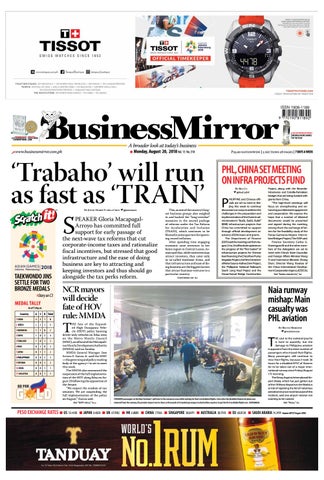
media partner of the year
BusinessMirror
United nations
2015 environmental Media Award leadership award 2008
A broader look at today’s business
www.businessmirror.com.ph
n
Monday, August 20, 2018 Vol. 13 No. 310
‘Trabaho’ will run as fast as ‘TRAIN’ S
taekwondo jins settle for two bronze medals
»Story on C3 Medal Tally As of 7:30 p.m.
Country
G S B Total
1 CHINA
4
3
1
8
2 KOREA
2
2
1
5
3 INDONESIA
1
1
0
2
4 TAIPEI
1
0
3
4
5 THAILAND
1
0
1
2
6 IRAN
0
2
0
2
7 JAPAN
0
1
1
2
8 PHILIPPINES
0
0
2
2
9 VIETNAM
0
0
2
2
10 INDIA
0
0
1
1
11 Malaysia
0
0
1
1
By Jovee Marie N. dela Cruz
@joveemarie
PEAKER Gloria MacapagalArroyo has committed full support for early passage of the next-wave tax reforms that cut corporate-income taxes and rationalize fiscal incentives, but stressed that good infrastructure and the ease of doing business are key to attracting and keeping investors and thus should go alongside the tax perks reform.
This, as one of the country’s largest business groups also weighed in and backed the “long-overdue” measures in the second package of reforms under the Tax Reform for Acceleration and Inclusion (TRAIN), which continues to be blamed in some quarters for spawning record inflation. After spending time engaging economic zone investors in her home region in Central Luzon, Arroyo said that, while incentives may attract investors, they cater only to so-called footloose firms, and that infrastructure and ease of doing business are the biggest factors that attract business ventures to a particular country.
PHL, CHINA SET MEETING ON INFRA PROJECTS FUND By Rea Cu
@ReaCuBM
P
HILIPPINE and Chinese officials are set to meet in Beijing this week to continue discussions on ways to address the challenges in the preparation and implementation of the Duterte administration’s “Build, Build, Build” (BBB) infrastructure projects that China has committed to support through official development assistance (ODA) loans and grants. The Department of Finance (DOF) said the meetings set from August 22 to 24 will include updates on the progress of the “first basket” of infrastructure projects for Chinese loan financing: the Chico River Pump Irrigation Project, the New Centennial Water Source-Kaliwa Dam Project, the Philippine National Railways’s South Long Haul Project and the Davao-Samal Bridge Construction
PESO exchange rates n US 53.4430
Project, along with the BinondoIntramuros and Estrella-Pantaleon bridges that are being funded with grants from China. “The high-level meetings will focus on strengthening and enhancing our bilateral engagement and cooperation. We express the hope that a number of bilateral documents would be presented and signed during the meeting, among them the exchange of letters for the feasibility study of the Panay-Guimaras-Negros Inter-Island Bridges Project,” the DOF said. Finance Secretary Carlos G. Dominguez III and the other members of the delegation are set to meet with China’s State Councilor and Foreign Affairs Minister Wang Yi and Commerce Minister Zhong Shan; Director Wang Xiaotao of the China International Development Cooperation Agency (CIDCA); See “Infra projects,” A2
Continued on A2
Naia runway mishap: Main casualty was PHL aviation
T
See “HOV rule,” A12
business news source of the year
P25.00 nationwide | 5 sections 28 pages | 7 days a week
NCR mayors will decide fate of HOV rule: MMDA
HE fate of the Expanded High Occupancy Vehicle (HOV) policy banning driver-only vehicles on Edsa rests on the Metro Manila Council (MMC), an official of the Metropolitan Manila Development Authority (MMDA) said on Sunday. MMDA General Manager Jose Arturo S. Garcia Jr. said the MMC —the governing and policy-making body of the agency—is set to meet this week. The MMDA also announced the suspension of the full implementation of the HOV along Edsa on August 23 following the opposition of the Senate. “We respect the wisdom of our senators. We are suspending the full implementation of the policy on August,” Garcia said.
2016 ejap journalism awards
By Recto Mercene @rectomercene
T
Stranded passengers at the Naia Terminal 1 spill over to the concourse area while waiting for their rescheduled flights. Even after the disabled Xiamen Air plane was removed from the runway, the premier airport was in chaos as thousands of stranded passengers rushed airline counters to get the first available flights out. RECTO MERCENE
HE cost to the national psyche is hard to quantify, but the damage to Philippine aviation is apparent from the sheer number of passengers who missed their flights. Many passengers still continue to miss their flights, because it took 36 hours for a disabled B737 of Xiamen Air to be taken out of a major international runway since Friday (August 17) morning. The Ninoy Aquino International Airport (Naia), which has just gotten out of the 10 Worst Airports in the World, is at risk of rejoining the list of notorious aerodromes once more because of this incident, said one airport veteran not wanting to be named.
n japan 0.4820 n UK 67.9902 n HK 6.8085 n CHINA 7.7566 n singapore 38.8479 n australia 38.7943 n EU 60.8128 n SAUDI arabia 14.2499
See “Naia,” A2
Source: BSP (17 August 2018 )
News
BusinessMirror
A2 Monday, August 20, 2018
Runway mishap sparks calls for new airport, Senate probe T
By Butch Fernandez
@butchfBM
HE latest runway mishap at the Ninoy Aquino International Airport (Naia) that canceled dozens of flights and stranded thousands of passengers has sparked fresh calls to rush an alternate airport outside Metro Manila, even as senators want a full inquiry on the matter. House Transportation Comm i t t e e C h a i r m a n C e s a r V. Sarmiento of Catanduanes on Sunday said mounting another major airport will help mitigate the impact of any crisis happening at the Naia, and reduce heavy traffic in Metro Manila. “My personal take on that is this: Even if we increase the capacity of the Naia, we will still encounter the same problem. Not necessarily on capacity but going in and out of Naia. So the most practical idea is to move out. Create another airport which will bring convenience and comfort and avoid traffic in Metro Manila,” he said in a radio interview. Sen. Grace Poe, who chairs the Senate Committee on Public Services, is seeking an explanation from airport authorities on the runway mishap. Poe is filing a resolution on Monday, August 20, to direct her panel
Naia. . .
Continued from A1
Legacy carrier Philippine Airlines (Pal) “had 68 flights canceled and 21 flights diverted, affecting a total of more than 24,000 passengers,” according to the airline’s spokesman, Cielo Villaluna. PAL clarified that the reopening of Runway 06-24 last Saturday and its subsequent impact on departures and arrivals “have made it necessary for PAL to make further adjustments in its operations”. “Philippine Airlines provided replacement flights for specific international long-haul operations which were cancelled due to the main runway closure.” “Affected passengers were also allowed to rebook/refund within 30 days from original flight dates with rebooking fees waived,” she added. Cebu Pacific (CEB), on the other hand, said 151 flights and 30,000 passengers were affected by the airport closure. It strongly advised those whose flights were delayed or rescheduled “not to proceed to the airport and avail themselves of the following options, without penalties: Rebook flights for travel within 30 days from original date of departure or convert into a Travel Fund for future use. “As we continue to recover the high volume of affected passengers, schedule changes are expected. To minimize any inconveniences, passengers flying to and from the Naia Terminal 3 between August 17-21, 2018, may rebook their flights for travel within 30 days, without penalties,” CEB said in statement. CEB Spokesman Charo Logarta-Lagamon said their priority “is to assist and fly out the over 20,000 passengers affected by flight cancellations and diversions.” She added the 20,000 “does not include passengers on severely delayed flights.” The airline firm said that while they are
Infra projects. . . Continued from A1
Chairman Hu Xiaolian of the ExportImport Bank of China (China EXIM); and Jin Liqun, president of the Asian Infrastructure Investment Bank (AIIB). The delegation is also set to pay a courtesy call on Vice Premier of Economic Cooperation Hu Chunhua during their threeday visit. According to the DOF, the “second basket” of infrastructure projects are also up for discussion: the Ambal-Simuay River and Rio Grande de Mindanao River Flood Control Projects, the PasigMarikina River and Manggahan Floodway Bridges Construction Project, the
to inquire into the operational procedures in responding to such emergency situations. She said it is important to know why it took about 36 hours to remove a Chinese passenger aircraft from the Naia’s main runway 06-24. “What is, or is there even, a standard operating procedure for accidents like this? This is not the first time that a plane has skidded off the runway and it certainly won’t be the last. Why did it take two days to restart operations at the Naia? Can’t this be done faster to ease the misery of thousands of passengers?” Poe asked. The Xiamen Airlines f light veered off while landing amid a heavy downpour on Thursday evening, shortly before midnight. “We will give time for airport authorities to have a complete report on the effects of the runway closure during and after the
incident,” Poe added. Transport Secretary Arthur P. Tugade, Manila International Airport Authority (Miaa) General Manager Ed V. Monreal, airline executives, as well as some affected passengers, will be invited to the hearing, Poe said. The hearing will also tackle Senate Resolution 782 filed by Sen. Sherwin T. Gatchalian on the status of Metro Manila airports and the government’s plans, if any, on modernizing them to meet growing demand. Poe said she also wants to know the status of the P350-billion plan of a private consortium composed of seven conglomerates to rehabilitate and upgrade the Naia submitted to the government in March. For the House Transportation Committee chief Rep. Sarmiento, finding a spot to build an ideal airport will not be a problem because building it outside the Metro is a possibilit y, citing Incheon Airport in South Korea as an example. He noted the capacity of the Naia a few years ago was 31 million passengers. “Then, two years ago or last year, it’s already 42 million. Next year it will be 47 million. In short the capacity of Naia is evidently crowded,” he said.
result in aquaplaning,” he said. The dictionary defines aquaplaning as “a motor vehicle [or airplane] [that] slides out of control on a wet road (or wet runway). The Thesaurus synonyms and related words are:...crash, crash-land, crash-landing, skid.” Aviation parlance prefers to use the word “hydroplane,” which means the same. When Xiamen Air B737-800 landed after a second try while heavy monsoon rains were pummelling the Naia, various accounts described the 66-ton airplane as “having a hard landing” before going out of control and into the muddy portion of runway 06-24. Meanwhile, Ramo said it is better to wait for the result of the investigation before giving any opinion to see“if the earlier theory is correct that Xiamen Air might have ‘hydroplaned’.”
Aviation issues
Sarmiento added it is wise to talk right away about plans to resolve other issues on aviation transportation. “In the recent happenings, it is imperative to have a hearing. We really have to find out how we can help in terms of legislation to avoid these incidents,” he said. He urged the Miaa to take countermeasures to avoid similar incidents from escalating into a crisis. “This time, Miaa should buy lifting cranes. It is quite expensive, but we have to consider the consquences of these events. So I think Miaa should seriously consider procuring a lifting crane or lifter to easily remove the obstacles on the runway,” he said. Sarmiento also said some airports other than the Naia are included the President Duterte’s “Build, Build, Build” program, yet the program itself will still be a long stretch to implement. “Because of what happened, it is imperative they have to move heaven and earth to implement this in soonest possible time. You know, accidents happen. We do not foresee accidents to happen. But of course, later this may still happen again. So we should avoid this from happening again,” he said. With a report by Mark Joseph B. Fernandez
doing their best to reaccommodate passengers at the earliest time possible, “we want to thank all our passengers for their continued patience and understanding.” “Our ticketing offices nationwide and reservation hotlines serve as avenues for rebooking or refunding of flights of affected passengers. “ A disabled aircraft on the runway is a nightmare that airport operators would not want to happen on their turf, said former pilot and now chief Naia 1 Ramp Control Alger Ramo. However, today’s sheer number of airplanes, translated into frequencies of flights, including the laws of probability, make it possible that a major “aircraft runway excursion” will occur, he said, using the aviation’s jargon for planes that exceed the runway boundaries. A veteran air traffic controller for the last 65 years, Ramo said that “during my time at Manila Tower, the practice was to ask the weather bureau for special hourly weather report during heavy rains and other inclement weather.” He said this is also true if the visibility is limited to only a few meters or “there’s zero visibility,” in which case, pilots are advised of the situation. The Naia office of the Weather Bureau, today’s Pagasa, is at a strategic part of the building where it has access to sophisticated instruments permanently placed on the building. It can also look out to the runway to visually check its condition. At the same time, Ramo said as Manila Tower in charge and someone who could visually see the runway, “I would also require a member of the Airport Crash and Rescue Unit to go out on the runway and determine whether rainwater is speedily drained or the sheer volume makes the runway waterlogged,” something he described as “a dangerous situation.” If a plane lands when the runway has too much water, Ramo explained, “it would
Meanwhile, the Naia has drawn flak because it took rescuers 36 hours to remove the plane. Manila International Airport Authority (Miaa) General Manager Ed V. Monreal said the rescue team had difficulty using the giant pillow-like rubber lifter, the equivalent of a car’s jack, “because the ground is too soft from the incessant rains.” He said they used several steel mattings on the ground where the pneumatically operated lifter could rest, “but it was a challenging situation which we’re dealing with, [the] weather which was the biggest issue, and the safety of the recovery team.” He said he and Caap chief, Jim Sydiongco “were on site all throughout. And we were calling the shots.” According to the Airport Service Manual, “A disabled aircraft on or adjacent to the movement area is a serious problem resulting in high costs to operators because of diversions, interruption of operations, and the consequent loss of revenues to the airport.” The manual said “serious volume of operations has increased and as heavier aircraft have been introduced into service,
it is economically impossible to store all the equipment necessary for the removal of disabled aircraft.” “To overcome the problem, the major airlines have already made arrangements so as to make specialized equipment available on short notice on a worldwide basis and the kits have been strategically placed around the world.” During a press briefing over the weekend, Sydiongco was quoted as saying the Caap (which has a yearly income of about P8 billion) would not buy the expensive aircraft removal equipment “because accidents like this very seldom happen.” The BusinessMirror asked Monreal if the Naia, which has a yearly income of P5 billion to P8 billion a year, is planning to buy the same aircraft removal equipment. “We might consider,” Monreal answered in a test message. Monreal said the Naia hired a giant crane which was able to lift the whole plane and brought it to the old Balagbag Terminal. Asked about the per-hour cost of the crane, Monreal said it “is still being assessed.” During a press briefing earlier, Monreal said he would take “drastic measures”if the airplane is not removed within 48 hours. “The Naia will cut the plane into small pieces,” he said when asked what he meant by drastic measures. The BusinessMirror asked Sydiongco whether the B737, which has lost one engine and had scraped its belly on the concrete pavement, is “structurally damaged,” and Sydiongco agreed that the plane is structurally damaged. Usually, a major structural damage would render the airplane unusable and it would be consigned to the junkyard. While the loss of one plane is something to sigh about, however, the bigger damage in this latest episode is to Philippine aviation and the country’s tourism. Until now, that—plus the cost to the national psyche—remains incalculable.
Subic-Clark Railway Project, the Safe Philippines Project Phase I and the Rehabilitation of the Agus-Pulangi Hydroelectric Power Plants Project. Aside from the finance chief, the Philippine delegation to China will also include Budget Secretary Benjamin E. Diokno, Socioeonomic Planning Secretary Ernesto M. Pernia, Transportation Secretary Arthur P. Tugade, Public Works Secretary Mark A. Villar; and Vivencio B. Dizon, president-CEO of the Bases Conversion and Development Authority (BCDA). Foreign Secretary Alan Peter S. Cayetano is also expected to join the Philippine delegation. In July the Binondo-Intramuros and Estrella-Pantaleon bridge projects
across the Pasig River broke ground, with both bridges expected to ease traffic in Manila’s heavily congested areas where major commercial hubs thrive. In April this year, Dominguez and Chinese officials signed a $62-million loan agreement in Hainan, China, to help fund the construction of the Chico River Pump Irrigation Project, and a separate accord on economic and technical cooperation providing for a $79-million grant for at least four other projects undertaken by the Philippine government in cooperation with China. Meanwhile, the Agreement on Economic and Technical Cooperation involves a 500 million Renminbi (RMB) grant equivalent to approximately $79 million or P4.13 billion to finance
the following projects and activities: the Binondo-Intramuros and EstrellaPantaleon bridges in Metro Manila of the Department of Public Works and Highways worth RMB 264.8 million for partial funding; the conduct of feasibility study for the Davao City Expressway Project of the DPWH worth RMB 25.83 million; the provision of radio and broadcasting equipment to the Presidential Communications Operations Office worth RMB 17.82 million; and the Philippine-Sino Center for Agricultural Technology-Technical Cooperation Program Phase III of the Department of Agriculture at RMB 27.52 million. The total grant for these four projects amounts to RMB 335.97 million.
Naia receives flak
www.businessmirror.com.ph
‘Trabaho’ will run as fast as ‘TRAIN’ Continued from A1
In Pampanga she said investors in San Simon Industrial Park (SSIP) did not place their businesses for the fiscal incentives but because of the good infrastructure and the support of the local government through measures fostering ease of doing business. “Investors can do without fiscal incentives,” she said. “The government realizes that there are businesses that need fiscal incentives and there are industries that invest not really because of incentives.” The Speaker said she would still push for the passage of the Trabaho law—for “Tax Reform for Attracting Better and Highquality Opportunities,” the name coined by members of the House for the second wave of reforms —once session resumes on August 27. She also allayed fears the proposed Trabaho law may scare away investors. “The tax reform, the rationalization of the fiscal incentives—that’s why I want to show here that it is not the most important thing. Infrastructure and the ease of doing business are the most important things, but anyway, it will begin the period of interpellation also when we resume,” she said. Arroyo, citing the Department of Finance, said they were not losing their export-related incentives as the government recognized that some locators are footloose and, thus, need to keep these incentives under the second tax-reform package. However, she said for most business enterprises, there is a need to implement more efficient and reasonable policies to enable the government to raise more funds for better services and infrastructure to enable people to grow and businesses to flourish in the country. Arroyo said the lower chamber will continue to listen to stakeholders of the proposed Trabaho law. These concerns include the rate and length of tax incentives, value-added tax and VAT refunding, among others.
FFCCCII backs TRAIN 2
Also at the weekend, the Federation of Filipino-Chinese Chambers of Commerce and Industry Inc. (FFCCCII) said it is in favor of the proposed TRAIN 2 as the contemplated reduction in corporate income-tax rates “will improve the competitiveness standing of domestic corporations, particularly in the Asean region, and allow them to reinvest the tax savings in their business.” The “lower taxes could make businesses pass on the tax savings to consumers by way of lower prices to stay competitive,” said the group in a statement. FFCCCII President Domingo Yap said, “We agree that rationalization
of fiscal incentives reform is long overdue. The regime of incentives must be well targeted to assist the more deserving, and be time-bound rather than indefinite. They must be performance-based to ensure they are attuned to the government’s objectives in generating employment and attracting investments.” Yap added, “We are with the consumers in expressing concern over the higher inflation being currently experienced and have urged our members to do their part by not unnecessarily raising prices.” He found it “unfortunate that TR AIN 1 took some time to legislate and, by the time it was passed into law, coincided with a weaker peso and much-higher fuel prices.” This is why TR AIN 1 was deemed “a contributory cause to inflation, although objective analysis shows otherwise.” Yap affirmed the group’s support for tax reform “to sustain fast and inclusive economic growth for the Philippines.”
More revenues
Meanwhile, Minority Leader Danilo E. Suarez of Quezon said the government may generate more revenues for social services if the lower chamber will prioritize the passage of proposed tax amnesty bill. He said almost P6 billion worth of revenues for social services were collected by the government from the previous tax amnesty law. Suarez was referring to the implementation of tax amnesty under Republic Act (R A) 9480 dated February 19, 2017, covering year 2005, which generated P5.902 billion, and accounted for 2 percent of the total income taxes collected. Suarez made a statement as he urged Congress to prioritize the passage of the tax amnesty bill, instead of the speedy passage of the proposed “Trabaho law.” According to Suarez, the passage of Tax Reform for Acceleration and Inclusion (TR AIN) 1 only worsened the condition of the economy despite the P1.41trillion total revenue collection in the first half of 2018, which was reportedly 9 percent higher than the target. Tax amnesty is Part B of the Package 1 of the TRAIN 1, which seeks to grant amnesty on all unpaid internal revenue taxes while relaxing the Bank Secrecy Law. The “Part B” will grant amnesty on all unpaid internal revenue taxes imposed by the national government for taxable year 2017 and prior years. The measure is now pending before the House Committee on Ways and Means. Meanwhile, the Trabaho law is now under plenary deliberations.
PHL seeks $1.96-B ADB funding for devt projects Continued from A12
It aims to enhance the Brunei Darussalam-Indonesia-MalaysiaPhilippines East Asean Growth Area (BIMP-Eaga) and IndonesiaMalaysia-Thailand Growth Triangle (IMT-GT) for regional integration in the Asean. The other regional project is the Green and Innovative Finance Initiative for Scaling-Up Southeast Asian Infrastructure, which will receive $2.5 million from the TASF. This project, to be implemented in all Southeast Asian countries, aims to improve the capacities of these countries to utilize innovative finance structures for green and bankable infrastructure projects. The last regional project is the Strengthening Integrated Flood Risk Management, the amount of which is still being determined. It will be implemented in Bangladesh, India, Indonesia, Myanmar, Nepal, Pakistan, the
Philippines and Vietnam. It a ims to streng t hen t he design and implementation of Integrated Flood Risk Management (IFRM) solutions, enhancing knowledge and application of IFRM strategies in developing member-countries. The technical assistance will provide targeted technical support for program and project preparation and promote more holistic IFRM solutions, including basin-scale and naturebased solutions. Based on the Country Operations Business Plan 2018-2020, the ADB will extend $4.73 billion worth of loans for various infrastructure projects in the country between 2018 and 2020. The largest lending program for firm pipelines is slated for next year with $1.4 billion; with the next biggest funding in 2020 with $1.36 billion, and in 2018, $968 million.
The Nation BusinessMirror
www.businessmirror.com.ph
Editor: Vittorio V. Vitug • Monday, August 20, 2018 A3
Duterte to kick off info campaign on federalism
P
By Bernadette D. Nicolas
@BNicolasBM
RESIDENT Duterte will lead the opening salvo of an information and advocacy campaign to promote the Consultative Committee’s (Con-com) proposed federal Charter.
Executive Secretary Salvador C. Medialdea made the announcement on August 18 during the closing ceremony before the Con-com met en banc for the last time. Before ending his speech, Medialdea said he, Chairman Reynato S. Puno and former Senate President Aquilino Q. Pimentel Jr. met with the President last Wednesday. “We informed him about the information drive, which we are going to do once our task here ends,” he said. “The President has expressed himself that he will be personally present at the opening salvo of the information drive.” Earlier, Presidential Spokesman Harry L. Roque Jr. confirmed an initial amount of P90 million was allotted for a “massive” information drive on federalism, which would be conducted by an intergovernmental task force. The task force will be composed of the Office of Executive Secre-
tary, Office of the Presidential Spokesperson, Presidential Communications Operations Office and the Department of the Interior and Local Government.
Not disappointing
IN its final session, the Con-com en banc approved resolutions expressing gratitude to Duterte “for the opportunity extended to its members to be of invaluable service to the nation in the crafting of a federal Constitution envisioned to bring about real and meaningful change, approving its journal and transcripts of proceedings, and designating the Presidential Management Staff, which served as secretariat, as custodian” of all Con-Com documents. Medialdea added in his speech the Con-Com’s 22 members, who the President handpicked, “did not disappoint.” “The draft constitution, which
you have produced after painstaking deliberations, has laid down the groundwork for Congress as it navigates through the largely unchartered territory of federalism. Moreover, it is a draft that echoes many of the proposed changes that large sectors of society have been clamoring for these past years,” Medialdea said. “Indeed you have all made an indelible mark in history.” For h i s part, Puno said the Con-com has done a “creditable job in preparing the s u b s t a nc e and shadow of the draft federal Constitution.”
Distinctly Filipino
A L THOUGH “proble m s to overhaul the system were many and hard to hurdle,”
Gatchalian: Allow rice imports, abolish NFA By Butch Fernandez
@butchfBM
T
HE chairman of the Senate Committee on Economic Affairs is mulling over an option to push passage of remedial legislation to abolish the National Food Authority (NFA). Sen. Sherwin T. Gatchalian is also thinking of asking the government to allow rice imports to stabilize rice-supply situation but under strict monitoring to avert smuggling. Gatchalian indicated over the weekend that he is inclined to support the recommendation of economic managers to let market forces determine rice prices given that the NFA is in the red. Citing reports reaching his committee that NFA’s accumulated losses add up to almost P150 billion, the senator suggested: “Let us just remember that, if one government agency is losing money, we are all paying for that.” “As taxpayers, we are the ones providing subsidy to losing government corporations,” he added. Gatchalian emphasized the need to quickly address the rice-supply situation, citing reports reaching his office that “lack of cheap rice” is triggering price increases, blaming this on the NFA for “not doing its job.” “We conducted our search in the markets for NFA rice but found none,” the senator said, recalling that during a previous public hearing the Senate committee was also informed there is “no monitoring scheme” to keep track of rice-supply situation.
Alternative proposals
GATCHALIAN indicated he favors an alternative proposal to “let the market dictate the
price of rice, like oil which was deregulated and allow importation.” “Let us also look at the abolition of the NFA and allow rice importation but continue monitoring to avoid those taking advantage,” he added, noting that “smuggling is caused by high price of local supply.” “If we allow the entry of imported rice, it will stop smuggling.” Gatchalian acknowledged that, out of 70 provinces, 40 of them are rice producing and already competitive. “That is why rice tarrification will aid the 40 to make them more competitive,” he added. At the same time, the senator indicated that the Senate Economic Affairs Committee was not “isolating” the Duterte administration’s Tax Reform for Acceleration and Inclusion, pointing out there are other factors pushing price increases of basic commodities. ”One of the problems that I can see [in the short supply and rising price of rice] could be traced to the operations of the NFA,” Gatchalian said. He disclosed that before conducting the Senate hearing, he directed added his staff to look for NFA rice in the markets “but found none. Wala silang nahanap na [They can’t find] NFA rice.” The Senator asserted that the NFA has two most important responsibilities: “first, price stabilization to ensure it does not jack up and, second, availability of rice; because it is important that they can buy it at prices that poor people can afford.” Gatchalian noted, however, that there appears to be “no monitoring scheme in buying NFA rice” based on testimonies during the Senate hearing.
such as the idea of federalism being novel to Filipinos, Puno said they were able to craft a draft Constitution that is “distinctly Filipino.” “To be sure, the draft we prepared is not perfect, not even fault-free, for none of us possessed a 20-20 vision that can dispense the mist of the present
and penetrate the veil of the future. But if there is anything to commend in our draft, it is the fact that it was prepared by people whose hearts palpitate with patriotism, who do not pander to the popular and whose minds cannot be shackled by the of the powers that be,” Puno said in his
speech. “Crafting a draft federal Constitution is a burden, but the bigger burden is overcoming the opposition.” Puno then told Con-com members that the second stage of their efforts is “to scatter the seeds of federalism to the hearts and minds of people.”
A4 Monday, August 20, 2018 • Editor: Vittorio V. Vitug
Economy BusinessMirror
www.businessmirror.com.ph
Study: Nearly half of total PHL population can become poor
N
By Cai U. Ordinario
@cuo_bm
EARLY half of all Filipinos are vulnerable to becoming poor due to various external shocks, according to a study released by the Philippine Institute for Development Studies (PIDS).
As of 2015, around 48.5 percent of Filipino households are vulnerable to income poverty and a third of which are highly vulnerable, according to PIDS Senior Research Fellow Jose Ramon G. Albert and Research Assistant Jana Flor V. Vizmanos. The study said when there are shocks such as labor and employment, price and demographic factors, these households are prone to become poor or fall deeper into poverty, Albert and Vizmanos wrote in their study, titled “Vulnerability to Poverty in the Philippines: An Examination of Trends from 2003 to 2015.” This could lead to still undetermined development losses. “When vulnerable households face shocks, development losses are often the result of the ad-hoc decisions and the lack of preparations for uncertainty,” the authors said. “In the face of limited resources and uncertainty, setting priorities and making constrained choices is unavoidable.” “Poor households, for instance, may decide to put more priority on addressing daily survival needs over investing in the education of their young members given limited daily income and uncertainties in opportunities,” they added.
Decrease
ALBERT and Vizmanos said that one-seventh, or 13.9 percent, of households nationwide is highly vulnerable and about a third, or 34.9 percent, are relatively vulnerable to shocks. The authors added that while the overall percentage of households vulnerable to shocks decreased, the decrease occurred at substantially lesser rates from 36.7 percent in 2003 to 34.5 percent in 2015. “[This was] on account of the increase in the proportion of poor households that are relatively vulnerable, which offset the decline in the proportion of non-poor households that are relatively vulnerable,” Albert and Vizmanos said. Among the basic sectors that are most vulnerable to shocks are fishermen, with 83.6 percent of them considered highly and relatively vulnerable. This was followed by farmers where 72.9 percent of households are highly or relatively vulnerable to shocks; children, 66.8 percent; self-employed and unpaid family workers, 60.8 percent; and women, 56 percent. The least vulnerable to shocks are individuals living in urban areas, with only 37.9 percent of households considered highly and relatively vulnerable.
“Many of the basic sectors have been targeted for specific social protection and other interventions but targeting systems for these programs have often been defective,” the authors said.
Variability
THE authors said that social protection can help manage these risks by helping households cope with income variability. This has been the aim of the national government for instituting the Pantawid Pamilyang Pilipino Program, or 4Ps. However, the 4Ps is not the only social protection program implemented by the government through the Department of Social Welfare and Development (DSWD). The DSWD also implements the SocPen (Social Pension), which is a social protection intended for indigent senior citizens who are not covered by any pension. Each beneficiary receives P500 to augment their subsistence and medical needs every month. This augurs well with the aim of the government to cut poverty and make Filipinos less vulnerable to shocks. Over a third, or 39 percent, of senior citizens are either highly or relatively vulnerable to shocks. This year the national government intends to increase not only SocPen beneficiaries to 3 million, but also the amount of cash assistance to P700 from P500. In 2019 and 2020, the authors said the monthly subsidies for the SocPen will increase to P800 leading to an annual stipend of P9,600 from P8,400 this year.
Subsidies
IN total, Albert and Vizmanos said the subsidies from the tax-reform law will effectively bring the total SocPen program budget to P26.5 billion in 2018 and P30.1 billion annually in 2019 and 2020. “The rapid increase in the government’s pension for indigent seniors needs safeguarding. In particular, more attention is needed to ensure SocPen’s povertyfocus and social protection objective are maintained,” the authors, however, said. Further, there are concerns regarding the source of the information needed for social protection programs such as the SocPen. The authors said most of the data is obtained from the Listahanan, which, they said, was “an incomplete list of the poor.” The DSWD, however, allowed the addition of beneficiaries through the Office of Senior Citizens Affairs
(OSCA) and the City/Municipal Social Welfare and Development Office (C/MSWDO). “But, the current lack of standardized operational guidelines for consistently screening program applicants has weakened the poverty focus of SocPen and the ability to achieve the main objective of extending protection to indigent seniors,” Albert and Vizmanos said. To address these concerns and ultimately reduce poverty, the authors said the government must encourage shared action and responsibility between local governments and other stakeholders.
SDGs
THE authors also said the government needs to create an action agenda that addresses all relevant risks to vulnerability, which takes into consideration synergies, trade-offs and priorities in policy responses, using all available resources, institutions and means of implementation across different contexts. “Risk resilience measures based on an examination of data on both poverty and vulnerability will allow vulnerable households to reduce the effects of adverse events [e.g., natural calamities, price shocks and idiosyncratic shocks] on their conditions but also empower them to seize the moment and take advantage of opportunities for improving their prospects for a better future today,” the authors said. Eradicating poverty by 2030 is the primary aim of the 17 Sustainable Development Goals (SDGs). The SDGs were adopted by 193 United Nation membercountries, including the Philippines in 2015. The SDGs have 169 targets and 233 indicators. The Philippines has data to monitor only 103 indicators while the rest are either inapplicable or are not available. The Global Goals aim to end poverty and hunger, promote universal health, education for all and lifelong learning, achieve gender equality, sustainable water management, ensure sustainable energy for all, decent work for all, resilient infrastructure and reduce income inequality between and among countries. The goals also include create sustainable cities, ensure sustainable consumption and production, take action against climate change, conserve and sustainably use oceans and marine resources, reduce biodiversity loss, achieve peaceful and inclusive societies, and revitalize global partnership for development.
Groups back bill exempting local sea salt from Asin law By Elijah Felice E. Rosales @alyasjah
F
OOD entrepreneurs and exporters want to make the noniodization of salt no longer a sin under the law. In a position paper, multisectoral group Competitiveness Currency Forum (CCF) rallied behind House Bill (HB) 4939, filed by Reps. Ron P. Salo of Kabayan and Virgilio S. Lacson of Manila Teachers. Salo and Lacson’s proposed law seeks to exempt local sea salt from mandatory iodization. Sea salt is required to be iodized under Republic Act 8172, or the Act for Salt Iodization Nationwide (Asin). “When the Asin law was enacted, mandatory iodization was recommended by the World Health Organization [WHO] to be the most costeffective method to address iodine deficiency disorder [IDD] of some children,” CCF said. “However, the law proved to be a trade impediment to the development of the Philippine sea salt industry and even led to its decline.” Citing a 2011 study by the American Nutrition Society, the CCF added that Filipinos are prone to iodine induced hyperthyroidism (IIH). It proposed that the Philippine National Health Research System be instructed to provide alternative measures in addressing IIH among the population, as well as make iodine supplementation targeted. The group argued mandatory iodization made it difficult for food entrepreneurs and exporters to move along the global culinary trend, which it claimed to favor natural sea salt over iodized. Currently, 80 percent of salt sold in the Philippines are imported from Australia, which shall remain iodized, according to CCF. “The imported Australian salt is less healthy because of its high sodium chloride purity,” the group said. The CCF noted that “global culinary trend favors natural sea salt because of the presence of other chlorides and trace minerals making it more flavorful.” “Philippine sea salt is akin to the
famous fleur de sel. The Philippines is among the few countries that can fill the growing demand,” CCF explained. “The other chlorides and trace minerals in Philippine sea salt can also address other mineral deficiencies.” In documents obtained by the BusinessMirror, Mama Sita Foundation Inc. President Clara R. Lapus conveyed to Trade Secretary Ramon M. Lopez the dilemma of food manufacturers brought about by the Asin law. Lapus told Lopez in a June meeting that dozens of local food products, such as sweet potato chips containing iodized salt, are barred from entering Japan, the country’s top export market. Native white cheese makers are also complaining about the chemical taste of iodized salt that alters the fermentation of their products, she added. Lapus seeks amendments to the Asin law to permit food producers to make use of natural sea salt not only for export goods but also for domestic consumption. “Just because the WHO thinks it is the cheapest way to solve the iodine deficiency of some Filipinos, even those who are not iodine deficient are forced to ingest iodized salt,” Lapus argued. “Why not develop seaweed snacks for those who need iodine?” She appealed to Lopez to back HB 4939, to which the trade chief reportedly gave his word to push for specific amendments in the law. HB 4939 seeks to reorder the Asin law and add Section 6 exempting Philippine sea salt from mandatory iodization. “Producers of sea salt shall register with the FDA [Food and Drug Administration], which shall inspect and assess samples of their products for the purpose of determining whether it falls within the definition of sea salt,” the proposed provision read. “The FDA shall issue guidelines and standards in identifying Philippine sea salts, maintain a registry of sea salt producers and issue the appropriate certificate or authorization for the producers’ continued operation. This certificate or authorization shall serve to protect sea salt producers from harassment of local authori-
ties and allegations of noncompliance with iodization requirements under this act,” it added. HB 4939, which is pending deliberations in the House Committee on Health, also intends to allow food manufacturers to use sea salt in their products. They are, however, required to prove that the use of sea salt enhances the quality of their food items. The measure defines Philippine sea salt as salt produced from the evaporation of seawater in any of the salt farms within the archipelago. The preparation of such must involve little to no processing. In their explanatory note, Salo and Lacson said several provisions of the 23-year-old Asin law have been contested in the past years, mostly for its adverse effect on local salt farmers. “The Philippines being a coastal country, a significant number of small-scale salt producers have been adversely affected by the implementation of the law,” the bill said. “The Department of Trade and Industry has pointed out that the local salt industry is finding it hard to compete with the global market of salt and food products with salt ‘due to the restriction for salt producers to offer a wide array of different salt types even in the domestic market.” “The Asin law is also seen to limit innovations on the type of salt that will fit the needs of a product, as well as leads to the loss of some nutrients during processing,” Salo and Lacson pointed out. “With this, small local salt farmers are unable to compete with large salt producers especially in the global market.” Last year the country imported 517,405.2 metric tons (MT) of salt amounting to $24.05 million, data from the Philippine Statistics Authority showed. This was higher than the 477,507.5 MT of salt procured in 2016. On the other hand, the country exported 439.326 MT of salt last year valued at $56,479. The volume might be higher than the 282.307 MT of salt traded outbound in 2016, but the value was 2.72 percent lower from the $58,062 collected that year.
Govt inks deal with co-ops for broadband link project
T
HE Department of Information and Communications Technology (DICT), National Electrification Administration (NEA) and the Philippine Rural Electric Cooperatives Association Inc. (Philreca) signed a memorandum of understanding last week to formalize an undertaking meant to provide high-speed and affordable broadband in remote and rural areas of the country. According to NEA Administrator Edgardo R. Masongsong, his agency and the DICT started exploring arrangements to bring broadband connectivity into the countryside by tapping the existing infrastructure of the electric cooperatives. He added the deal affirms the NEA’s full commitment and support to the National Broadband Project (NBP) of the government. The tripartite collaboration is meant “to realize the objectives of the NBP, including, but not limited to, the co-use of fiber optic cables,” Masongsong said. Under the agreement, the NEA and Philreca will coordinate with the electric cooperatives (ECs) regarding the NBP project. The DICT, on the other hand, shall be allowed to connect or access the ECs’ existing nodes so that it may link with other government agencies. The plan is for the government to piggyback on the infrastructure of the cooperatives to provide Internet service to their assigned areas. This is similar to the tripartite agreement signed among the DICT, National Transmission Corp. (Transco) and National Grid Corp. of the Philippines (NGCP). In its tripartite agreement with the NGCP and Transco on June 8, the DICT was given the right to use their dark fiber network. The planned framework will also include the financial arrangement with the ECs that have existing fiber-optic cables in their distribution lines and possible funding for power utilities, which do not have fiber on their grid. Lenie Lectura
The World Editor: Angel R. Calso
A5
Tariffs will hit US economy harder than rest of the world
T
he US economy will be hit many times harder than the rest of the world by an escalating global trade war, according the chief executive officer of A.P. MollerMaersk A/S.
Soren Skou, who runs the world’s biggest shipping company from Copenhagen, said the fallout of the current protectionist wave “could easily end up being bigger in the US.” Tariffs could slow global annual trade growth by 0.1 percent to 0.3 percent, though for the US the effect could be “perhaps 3 [percent] or 4 percent,” he said at Maersk’s headquarters on Friday. “And that would definitely not be good.” The company transports about 20 percent of the world’s seaborne consumer goods, putting it in a unique position to gauge the fallout of tariffs on trade flows. Maersk has in the past broken with its culture of steering clear of any political debate to criticize the trade policies of US President Donald J. Trump. Maersk focuses on trade flows between Europe and Asia and, so far, its industry hasn’t been directly hurt by tariffs. In fact, demand grew 4 percent in the second quarter. But Skou says that may change if the US starts targeting consumer goods. “The first thing the American importers would do if tariffs are put on Chinese consumer goods would be to buy in Vietnam, in Indonesia or elsewhere in Asia,” Skou said. “Big US consumer brands like Nike produce in all of Asia, not just in one country, so there will be a substitution effect.” The US put duties on $34 billion of Chinese goods last month, citing unfair trade practices by the world’s second-biggest economy. The Trump administration has said it will impose tariffs on a further $16 billion on August 23, and even signaled it won’t shy away from targeting the entire $500 billion in Chinese exports to the US. “The other factor is that there’s a lot of stuff that’s now imported into the US that just isn’t produced anywhere within the US,” Skou said. “You can’t get Nike sneakers or iPhones that are produced in the US. So it will end up being pushed on to the consumer.” Bloomberg News
Shops close as mega-currency devaluation roils Venezuela
M
any Venezuelan shops closed as a precaution as confusion reigned on Saturday following measures announced by President Nicolas Maduro aimed at fighting a historic economic crisis in the oil-exporting nation. The government will enact a massive currency devaluation and an increase in taxes, and will raise gasoline prices. A new version of the bolivar will trade roughly in line with where the black market was, and the government will raise the minimum wage more than 3,000 percent—a level that still only equates to $30 a month. Tying Venezuela’s currency to the value of its cryptocurrency, known as the Petro, effectively amounts to a 95-percent devaluation compared with last week’s central bank foreign-exchange auction results. “You won’t find the IMF’s claws or ill-gotten prescriptions here,” Maduro said in a speech on Friday on state television, referring to the International Monetary Fund. “No experts were involved who do not feel the clamor of the people.”
Sovereign bolivars
The new currency, set to enter circulation on Monday, will be called the sovereign bolivar and will be based on the Petro, now valued at $60 or 3,600 sovereign bolivars. The minimum wage will be set at 1,800 sovereign bolivars, Maduro said at the presidential palace, flanked by his economic team. The Petro, which will fluctuate, will be used to set prices for goods. Henkel Garcia, director of the Caracas consultancy Econometrica, said the announcements amounted to a head-scratcher. “This series of measures is a mix of incoherent and contradictory ideas,” he said by telephone. “It is a worrying contraption that generates a lot of uncertainty about how it will be executed.” Separately, Information Minister Jorge Rodriguez said on Saturday the government will open 300 currency exchange kiosks in hotels, airports and shopping malls as part of a bid to supersede the country’s black market. Maduro said on Friday that the central bank will increase the frequency of weekly foreignexchange auctions to three and eventually five.
Historic move
Friday’s devaluation ranks among Venezuela’s most significant. In 1983, President Luis Herrera Campins devalued the bolivar for the first time in 22 years after oil prices crashed on a day known locally as “Black Friday.” When in 1989 Venezuela raised gasoline costs, lifted foreign-exchange controls and let the currency plunge, prices soared 21 percent in one month, leading to the “Caracazo” riots that killed hundreds and paved the way for the leftist President Hugo Chavez’s rise to power. Bloomberg News
The World BusinessMirror
A4 Monday, August 20, 2018 A6
Worst flood in century displaces 800,000 in southern Indian state
A truck carries people past a flooded road in Thrissur, in the southern Indian state of Kerala, on Saturday. Rescuers used helicopters and boats on Friday to evacuate thousands of people stranded on their rooftops following unprecedented flooding in the southern Indian state of Kerala that killed hundreds, officials said. AP
C
HENGANNUR, India— Some 800,000 people have been displaced, and over 350 have died in the worst flooding in a century in southern India’s Kerala state, as authorities rushed to bring drinking water to the most affected areas, officials said on Sunday.
At least two trains carrying about 1.5 million liters (400,000 gallons) of water were moving to the flooded areas from the neighboring states of Madhya Pradesh and Maharashtra, Indian railway official Milind Deouskar said, according to the Press Trust of India news agency. Thousands of rescuers were continuing efforts to reach out to stranded people and get relief supplies to isolated areas by hundreds of boats and nearly two dozen helicopters, said P.H. Kurian, a top disaster man-
agement official in Kerala. He said weather conditions had improved considerably and expected the nearly 10,000 people still stranded to be rescued by Monday. An estimated 800,000 people were sheltered in some 4,000 relief camps across Kerala, Kurian said. Weather officials have predicted more rains across the state through Monday morning. The downpours that started on August 8 have triggered floods and landslides and caused homes and bridges to collapse across Kerala, a picturesque state known for its quiet tropical backwaters and beautiful beaches. Officials estimate that more than 10,000 kilometers (6,200 miles) of roads have been damaged. One of the state’s major airports, in the city of Kochi, was closed this past Tuesday due to the flooding. It is scheduled to remain closed until August 26. The Indian government said a naval air base in Kochi will be opened for commercial flights starting Monday morning. Prime Minister Narendra Modi inspected the flooded landscape from a helicopter on Saturday and met with the state’s top officials, promising more than $70 million in aid. While the central government has dispatched multiple military units to Kerala, state officials are pleading for additional help. Officials have put initial storm damage estimates at nearly $3 billion. At least 250 people have died in the flooding in a little over a week, with 31 others missing, according to Kurian. More than 1,000 people have died in flooding in seven Indian states since the start of the monsoon season, including over 350 in Kerala. AP
Saudi Arabia prepares for Muslim Hajj pilgrimage
M
ECCA, Saudi Arabia— Saudi Arabia is preparing to host the annual Hajj pilgrimage beginning on Sunday, as over 2 million Muslim faithful are ready to take part in the ultraconservative kingdom. The pilgrimage represents one of the five pillars of Islam and is required of all able-bodied Muslims once in their life. In recent weeks,
the faithful have arrived in Mecca from across the world, all chanting “Labayk Allahuma Labayk,” or “Here I am, God, answering your call. Here I am.” The Hajj offers pilgrims an opportunity to feel closer to God amid the Muslim world’s many challenges, including the threat of extremists in the Mideast after the Islamic State group was
beaten back in Iraq and Syria and the plight of Myanmar’s Muslim Rohingya minority. “My feeling is indescribable to perform the Hajj,” said Imad AbdelRaheem, an Egyptian pilgrim. “I also want to pray for all Muslim countries, for them to live free in all places, in Palestine and in Burma, in all places, in Afghanistan and in India.” Maj. Gen. Mansour al-Turki, the spokesman of the Saudi Interior Ministry, told journalists on Saturday that over 2 million Muslims from abroad and inside the kingdom would be taking part in this year’s Hajj. Men attending the Hajj dress in only terrycloth, seamless white
garments meant to represent unity among Muslims and equality before God. Women wear loose clothing, cover their hair and forgo makeup and nail polish to achieve a state of humility and spiritual purity. Since ar r iv ing, many have circled the cube-shaped Kaaba in Mecca—Islam’s holiest site. The Kaaba represents the metaphorical house of God and the oneness of God in Islam. Observant Muslims around the world face toward the Kaaba during their five daily prayers. Muslims believe the Hajj retraces the footsteps of the Prophet Muhammad, as well as those of the prophets Ibrahim and Ismail— Abraham and Ishmael in the Bible. A f ter prayers in Mecca, pilgrims will head to an area called Mount Arafat on Monday, where the Prophet Muhammad delivered his final sermon. From there, pilgrims will head to an area called Muzdalifa, picking up pebbles alongtheway for a symbolic stoning of the devil and a casting away of sins that takes place in the Mina va l ley for three days. AP
www.businessmirror.com.ph
Annan’s legacy of fighting for equality, rights lives on
IN this September 27, 2016, file photo, former United Nations Secretary-General Kofi Annan (second from left) listens to a Rohingya religious and community leader in the Internally Displaced People’s camps during a visit by the Rakhine Advisory Commission in Thetkabyin village, outside Sittwe, the capital of Rakhine state in Myanmar. Annan left the UN far more committed to combating poverty, promoting equality and fighting for human rights—and until his death on Saturday, August 18, 2018, he was speaking out about the turbulent world he saw moving from nations working together to solve problems to growing nationalism.
U
NITED NATIONS—Kofi Annan left the UN far more committed than it had been to combating poverty, promoting equality and fighting for human rights—and until his death on Saturday, he was speaking out strongly for nations working together to solve problems and worried about the rise of nationalism. As secretary-general of the UN from 1997 to 2006, Annan saw as his greatest achievements the programs and policies he put in place to reduce inequality within and between countries, to combat infectious diseases and to promote human rights and protect civilians from war crimes, including genocide. He launched the UN Millennium Development Goals at a summit of world leaders in 2000 to cut extreme poverty by half, promote equality for women, ensure every child has a primary-school education, reduce maternal and child mortality, and halt the spread of AIDS—all by 2015. Those goals—only a few of which were fully achieved—were succeeded by an expanded list of UN Sustainable Development Goals for 2030 that adds issues such as climate action, affordable and clean energy, and promoting peace and justice. The updated list is a major focus of the United Nation’s current agenda. As UN peacekeeping chief just before becoming secretary-general, Annan shared blame for the failure of UN troops he deployed to prevent the genocides in Rwanda in 1994 and in the Bosnian town of Srebrenica in July 1995. When he became UN chief, Annan launched a doctrine of “humanitarian intervention” to prevent governments and leaders from massacring their own people. At a summit in 2005, over objections from some countries, 191 nations endorsed what has become known as the “responsibility to protect” civilians and head off the world’s worst crimes, from ethnic cleansing to genocide. This doctrine is frequently cited— but to the dismay of UN officials, not often implemented. Annan also saw as a major achievement the expansion of the UN’s work into partnerships with businesses, foundations, universities and civil society. This led, for example, to the establishment of the Global Compact in 2001 where Annan asked corporate leaders to publicly commit to 10 principles in the areas of human rights, labor, the environment and anticorruption. More than 9,000 of the world’s leading CEOs have joined the compact, which continues to attract new members, and “corporate responsibility” has become a key feature of the business world. When Annan handed the reins of the UN to Ban Ki-moon, he said he would keep working on African is-
AP/Esther Htusan
sues, human rights, global warming and governance issues, and speak out from time to time when necessary. He told one farewell party: “You can take the man out of the UN, but you can’t take the UN out of the man.” Through his foundation and as a member and head of The Elders, the group of prominent former leaders founded by Nelson Mandela, Annan kept working—and speaking out. At an editorial board meeting with The Associated Press in May 2017, he worried aloud about lost jobs and said many people worldwide had lost trust in political and corporate leaders, and feared being left behind. He said it was time for mainstream leaders to explain that innovation and artificial intelligence are taking away jobs and tell those who have lost jobs they are going to be retrained for the new economy that’s coming. “If we don’t encourage leaders, first of all fresh people, to go into politics and we don’t encourage the leaders to lead, we will create a situation which is normal,” he warned. “When leaders fail to lead, the people lead and make them follow. But you don’t know where they’re going to lead you to—and they might even pull you back.” He also said US President Donald J. Trump’s go-it-alone foreign policy is weakening America, and stressed the importance of multilateralism and the perils of growing nationalism. Only last month, Annan was tweeting about his concerns with the current state of the world. “No nation can make itself secure by seeking supremacy over all others. We all share responsibility for each other’s #security, and only by working to make each other secure can we hope to achieve lasting security for ourselves,” he said in a July 3 tweet that appeared aimed at the United States. And on July 30, he tweeted: “Whether our task is fighting #poverty, stemming the spread of #disease or saving innocent lives from mass murder, we have seen that we cannot succeed without the #leadership of the strong and the engagement of all.” Annan believed in quiet, behind-the-scenes diplomacy, but wasn’t afraid to speak out when he thought necessary. He mentored a generation of UN officials including current Secretary-General Antonio Guterres and outgoing UN human-rights chief Zeid Ra’ad Al-Hussein. The Jordanian diplomat said in a statement he once told Annan how everyone was criticizing him, and the former UN chief responded: “You’re doing the right thing. Let them grumble.” “In a world now filled with leaders who are anything but that, our loss, the world’s loss, becomes even more painful,” Zeid said. AP
www.businessmirror.com.ph
Banking&Finance BusinessMirror
Three DOTr agencies among top remitters in 2017; GOCC dividends for January to July 2018 top P32B
DOF: Spain to fund PHL projects with $300-M ODA
T
President Duterte goes over the report on dividends remitted by state firms, as submitted by Finance Secretary Carlos G. Dominguez III, while DOTr chief Arthur P. Tugade looks on.
T
HREE state-owned agencies under the Department of Transportation (DOTr) were listed among the government-owned and -controlled corporations (GOCCs) with the highest amount of dividends remitted to the country’s coffers for 2017. Topping the list is the Civil Aviation Authority of the Philippines (Caap), while the Philippine Ports Authority (PPA) ranked as second, and the Manila International Airports Authority (Miaa) ranked seventh. In a ceremony in Malacañang on Wednesday, President Duterte recognized the efforts of Caap, which remitted P6.2 billion in dividends. Caap went from years of non-remittance from 2011 to 2015 to being the top contributing GOCC. For 2017 the total amount of dividends from the 125 GOCCs in the country is P30.46 billion. In the same Palace ceremony, Finance Secretary Carlos G. Dominguez III reported that, in the first seven months of 2018, dividends have already reached P32 billion, higher than the dividends for the whole of 2017. “Those dividends are for the government, for the people. These dividends will certainly auger well in achieving the objectives set by President Duterte in the service of the country and our fellowmen. So my reminder to Caap is, to give the government what is due to the government,” said Transportation Secretary Arthur P. Tugade in a mix of English and Filipino, as he received the Certificate of Acknowledgement on behalf of Caap and other members of the “Billionaire’s Club.” Caap’s remittance represents 68 percent of it’s net income for CY 2017 amounting to P3.22 billion, including P3 billion worth of unpaid dividend arrears. “Mahigpit po ang bilin sa atin ni Secretary Tugade. Caap was not only directed to start remitting dividends but also remit the unpaid dividends over the years. We will continue to do our share in improving the financial performance of the GOCC sector,” said Caap Director General Jim Sydiongco. “This achievement is not only for the Caap, but also an achievement we share with all the Caap employees
who worked hard to make this feat possible. The sacrifices and the dedication I see in them inspires and empowers me to continue doing our good work despite the challenges confronting us in the aviation industry. Likewise, we wish to commend our DOTr Sec. Tugade for his strong and decisive leadership that guided us all throughout the process,” Sydiongco added.
P3B from PPA
Meanwhile, the PPA, has remitted P3 billion worth of dividends. “We attribute this historical accomplishment to the men and women of PPA who have worked tirelessly for more than 44 years in order to make PPA one of the most professional and well-managed GOCCs. To our chairman, Sec. Art Tugade, without whose guidance in fiscal responsibility and good governance we would not have been able to overcome the operational and governance challenges which we faced during the past two years; and most especially to our President, who has inspired us to shy away from corruption and put the people’s welfare in the forefront of our daily tasks,” said PPA General Manager Jay Santiago. For his part, Miaa General Manager Ed Monreal, whose agency has remitted P2.01 billion to the national coffers, attributed the agency’s good financial performance to strong leadership. “Everyone is stepping up and doing their part. It’s actually inspiring. Definitely this goes to the hardworking men and women of Miaa who made sure that the revenues are properly guarded, and also created avenues to generate more funds in support of the objectives of President Duterte in the service of Filipino people,” Monreal said. Last April 13 the three agencies turned over the dividends to Finance Secretary Dominguez. Meanwhile, Tugade challenged the top grossing agencies to exceed their 2017 performance. “I extend my sincerest congratulations and appreciation to your staff—and my challenge for you to exceed our 2017 performance by 20 percent. It may be difficult but certainly not impossible,” Tugade said.
BPI unveils first dollar-denominated income fund in Philippine market
B
PI Asset Management and Trust Corp. (BPI AMTC) recently launched the BPI US Dollar Income Feeder Fund, the first dollar-denominated income fund in the country. BPI AMTC President Sheila Marie Tan said this is its first income-paying unit investment trust fund for investors who want to earn more from their foreign currency investments given the strength of the dollar and current market conditions. “The product is aimed at investors with an aggressive risk appetite who primarily seek income with secondary focus on capital growth to building their wealth,” said Tan. Designed to distribute attractive and regular income every June and December, the new fund feeds into its target fund, the Singapore-domiciled United Income Focus Trust. As such, it brings together the thought-leadership and collaboration among three fund house giants—UOB Asset Management as target fund provider, Wellington Management as target fund submanager and BPI AMTC as product provider of the new feeder fund.
Returns are derived from a diversified portfolio of global assets that looks beyond traditional sources of income in various asset classes. As of June 2018 the target fund holds 48 percent in global equities, 42 percent in global bonds and 10 percent in cash equivalents. In terms of its country allocation, more than half or 54 percent is invested in US assets. “The investment strategy for this fund takes into consideration multiple uncorrelated sources of return and income, which is why it is an opportune time for us to be introducing this product that has built-in resilience and flexibility, particularly in the current volatile market environment,” said Tan. Investors may buy into the BPI US Dollar Income Feeder Fund for as low as $1,000, with a holding period of 180 days. BPI AMTC manages a total of P570 billion in assets under management and makes available more than 25 UITFs through multiple distribution channels. For inquiries, BPI AMTC may be contacted at (02) 845-5041.
Monday, August 20, 2018 A7
By Rea Cu
@ReaCuBM
HE Department of Finance (DOF) has reported that it is already crafting a memorandum of understanding (MOU) with the Spanish government in line with its offer to the country of around $300 million in official development assistance (ODA). DOF Assistant Secretary Maria Edita Z. Tan told financial reporters that the Philippine government was offered an ODA by the Spanish government for funding of the Duterte administration’s various projects. “We have received another offer from an ODA partner, it’s from the Spanish government, for $300 million worth of ODA over the next three years. [For] this one we are still crafting the MOU, but the terms are very good.” Tan said. Tan explained that the Philippines was offered to either tap the
Spanish government’s euro- or dollar-denominated facilities, which offer a 0.25-percent interest rate over a 35 year period and a 1.15percent rate over a 20-year period, respectively. “We can either tap the euro facility or the US [United States] dollar facility. For the euro, it’s 0.25 percent over a 35-year period inclusive of a 10-year grace period, while the dollar facility is 1.15 percent over a 20-year period inclusive of a 10-year grace period. That could cover either project or
program loans,” she added. Spain is known to prefer funding projects in line with infrastructure, energy and telecommunications, among others. Tan pointed out that specific projects for funding by Spain have yet to be finalized. Discussions to tap the Spanish government’s ODA facilities started late last year, according to the DOF. But the MOU is being eyed for completion within the next two months. “I think within the next two months [to firm up the MOU],” she said. In July this year, the National Economic and Development Authority (Neda) reported that efforts to fast-track the government’s infrastructure spending have apparently borne fruit as the country’s ODA disbursement rate improved in 2017. The Neda said the country’s ODA disbursement rate grew 11.5 percent to $1.4 billion in 2017. As a percentage of target, the disbursement rate was at 67.21 percent in 2017. The Philippines’s total outstanding ODA portfolio for the full year of 2017 reached $14.72 billion. Based on the ODA Portfolio Review, this amount is composed of 70
loans worth $12.30 billion and 352 grants worth $2.42 billion. In the 2014-2017 Country Partnership Framework for Development Cooperation, the Spanish government extended 50 million euros in aid to the Philippines, with the cooperation focusing on financing projects such as social inclusion and the fight against poverty; gender development; promotion of human rights and democratic governance; environmental sustainability; and respect for cultural diversity. Based on Neda data, the Philippines has not received any loans from the Spanish government for 2017, with most of Spain’s projects in the country being financed by grants. As of December 2017, grant projects from Spain amounted to $10.99 million, while total ODA received by the country from Spain was $14.34 billion. The Spanish government has seven ongoing grant projects in the Philippines amounting to $9.18 million, with four of the projects being in the Governance and Institutions Development and three in Social Reform and Community Development.
Security Bank’s Naia Perspectives Moving toward a connected enterprise branches open Aug. 21
O
RGANIZATIONS become successful outperformers when they establish a customer agenda and take specific steps to align their capabilities behind it. The customer agenda is based on a deep understanding of who the customer is and what the customer needs and values, along with how the organization can deliver value to that customer while capturing value itself. No single Property & Casualty insurance proposition can adequately satisfy all market needs. Just as fast-food chains operate a different capability footprint and deploy different processes than three-star Michelin restaurants, P&C insurance companies must develop and deploy differentiated processes and capabilities based on their identified customer agenda (which is the foundation of their strategies and business models). Some customers may want to buy all their insurance from one company because it offers the insurance equivalent of fastfood, for example, or, alternatively, three-star Michelin service. Others may seek a fast-food equivalent from one insurer, or from one of its business units, and a more serviceoriented product from another business unit or from another company altogether. Any business—generically speaking—may have an online channel, or an analytics function, or a call center, or campaign management, or partnerships and alliances. However, the extent, maturity and prominence of these capabilities should be finetuned and “connected” as a function of the customer agenda, the business model and strategy deployed by that business or business unit. Why? KPMG commissioned Forrester Consulting to conduct a study to gain a better understanding of success factors in delivering against a company’s customer agenda. Our research shows that when companies move away from the limitations of operating in functional silos and toward what KPMG defines as a connected enterprise—an organization that is connected and aligned across businesses, functions and channels—they outperform their competitors.
Making customer centricity work
To succeed in winning the loyalty of 21st-century customers, insurers need an enterprise-wide approach that connects the capabilities of the front, middle and back offices—so they can appropriately focus on the customer agenda. A connected enterprise approach enables insurance companies to see and serve their customers as people with a wide variety of insurance needs and preferences, and not just as policyholders according to how their business units define them—as, for example, homeowners, vehicle owners, business owners or insured lives. While the theory of aligning business capabilities to one’s customer agenda and business model is not new and rarely disputed, our research has found that the P&C insurance industry as a whole is lagging other industries significantly in applying and extracting the value of this theory. What’s more, although P&C insurers place a higher priority on creating an interconnected and aligned organization than the average of all global industries surveyed (80 percent of P&C insurance respondents versus a study average of 77 percent), more than three-quarters of respondents say such efforts haven’t generated the returns they need. Insurance companies that seek to deliver on their customer agendas need to connect and align specific business capabilities to do so. KPMG’s connected enterprise approach highlights the capabilities on which insurers need to focus. It also identifies steps companies can take to create the desired connectedness across these capabilities and thereby generate sustainable value by aligning with the customer agenda. The excerpt was taken from the publication entitled Aligning behind your customer agenda. © 2018 R.G. Manabat & Co., a Philippine partnership and a member firm of the KPMG network of independent member firms affiliated with KPMG International Cooperative (“KPMG International”), a Swiss entity. All rights reserved. Printed in the Philippines. For more information on KPMG in the Philippines, you may visit www.kpmg.com.ph.
B
RANCHES of Security Bank Corp. (Security Bank) at the Ninoy Aquino International Airport (Naia) will be open during the national holiday on August 21 this year. In observance of Ninoy Aquino Day as per Republic Act (RA) 9256 and Eid’l Adha as per Proclamation No. 556, s. 2018, we wish to inform you that all other Security Bank branches, except for Naia and Naia Terminal 3 branches, will be closed, however, the bank said in an advisory at the weekend. Malacañang has declared Tuesday next week a special nonworking holiday to commemorate the Ninoy Aquino Day (RA 9256) and at the same time honor Eid’l Adha, the Muslim Feast of Sacrifice (Proclamation 556, s. of 2018). Security Bank advised clients to call the bank’s 24/7 hot line, 88-79188, or send e-mails to customercare@securitybank.com for any inquiries. PNA
Green Monday BusinessMirror
A8 Monday, August 20, 2018
www.businessmirror.com.ph • Editor: Lyn Resurreccion
Breeding tuna in PHL: Is it doable?
A
By Jonathan L. Mayuga
@jonlmayuga
fter successfully breeding bangus (milkfish) and tilapia, and at some extent, grouper or more commonly known as lapu-lapu, Department of Agriculture officials are now floating the idea of breeding tuna.
Is it doable? Best Alternatives Campaign, an environmental communications think tank, believes it is so. It views breeding tuna as the best alternative to the global problem of illegal, unreported and unregulated illegal fishing, particularly of the commercially viable tuna. Jonah van Beijnen, cofounder of Fins and Leaves, who endeavored to develop and successfully market one of the Philippines’s first grouper hatcheries 10 years ago believes that sustainable production and consumption of seafood is the key to ensuring a better world for all people. With tuna being highly migratory, making them agile and meaty, as they travel long distances, would breeding tuna not affect their natural taste and texture? Beijnen told the BusinessMirror via e-mail and social media that, indeed, tuna swim long distances constantly, which lowers their fat content.
Better-tasting tuna
However, he said, overall a tuna’s price is mainly determined by its fat content, as Japanese customers and sushi lovers prefer, which they say has better taste. “Tuna grown in cages overall have a higher fat content because they are fed well and don’t swim too far. Another big advantage is that you can harvest the fish and sell them immediately, while most fishing vessels go out for many days, storing fish on board an ice box. Except for sustainable handline-caught tuna, fresh tuna from a fishing boat is sometimes a week old before sold,” he said. Best Alternatives Campaign founder Gregg Yan believes that, despite lagging behind in terms of technical capacity compared to other countries, sustainable aquaculture and mariculture remains the best alternative for the Philippines, thereby supporting Beijnen’s analysis when he admitted that the Philippines is a bit behind with culturing marine finfish. Beijnen added: “Species like grouper, snapper and sea bass are already cultured in large quantities in Indonesia, Malaysia, Thailand and Vietnam. [The Philippines is somewhat left behind mainly because of local bureaucratic hurdles and a somewhat riskier investment climate].” He noted, however, the Philippines “has the best marine waters and water quality in Southeast Asia and is in the best position to make this [breeding tuna] work.”
Yan, a Filipino, said any tuna size for harvesting in fish cages is economically viable, because full-cycle mariculture is a means to reduce pressure on wild-capture fisheries. “Any size. Because eggs are produced, several tuna can quickly grow to several hundred,” Yan said.
Ideal breeding ground
With many islands and surrounding calm and productive waters, the Philippines, which sits at the center of the natural spawning grounds of wild yellowfin tuna, is ideal for breeding tuna. “Juvenile tuna love these warm and calm waters teeming with food. This might just give the Philippines a big advantage in the future closed-cycle culture of yellowfin tuna,” he explained. Realizing this potential, even the Philippine Bureau of Fisheries and Aquatic Resources (BFAR) on July 11 issued a statement announcing the plan to collaborate with the Japanese government to start yellowfin tuna-fattening operations in Samar. Juvenile tuna will be gathered there for farming from their spawning grounds in municipal waters. Beijnen added that cages for tuna are pretty large, but are very similar with cages that are used to farm milkfish or bangus at sea. This means that the Philippines has the resources for putting up tuna cages with available local materials
A lucrative business
According to Beijnen, at this time, it is not easy to peg how much would it cost to start tuna-breeding business but cautioned that hatcheries are not cheap to establish and require a long-term approach. “This is why we propose that the Philippine and the Japanese governments build a research station together. Successful private companies can start growing tuna after buying captive-bred juveniles from the research center and hatchery,” he said. He said there should also be a proper guideline that will take into consideration the situation that tuna is already overfished and that the global stock is depleted. “We have some concerns with the plan of BFAR to catch juvenile tuna for fattening purposes. We believe that the sea is already overexploited. A better alternative would be to focus on producing juvenile tuna from the eggs in captivity,” he said.
Atlantic bluefin tuna in cages at Instituto Españo de Ocenografia, or Spanish Institute of Oceanoghaphy, in Spain. The Philippines, however, trades mostly yellowfin tuna (de la Gandara, 2014). Best Alternatives Campaign
Major tuna exporter
A large predatory pelagic fish species, tuna is among the most important species for the Philippine fisheries sector, the country being a major exporter of fresh and processed tuna fish products. “The most commonly caught species, including skipjack, yellowfin and bigeye tuna, are taken using a variety of gear ranging from purse seine nets to circular handline reels. Tuna provides excellent income for fisherfolk and fishing companies, while generating thousands of jobs in vessels, canneries and other parts of the supply chain,” he said. According Beijnen, because of their high value in local and international sushi restaurants, many fishers focus on catching yellowfin tuna.
Depleted tuna stock
He noted that the rising number of fishers and large fishing vessels targeting this fish have depleted stocks, putting the livelihoods of Filipino fishers and other tunasector workers at risk.
“Besides promoting sustainable systems like handline fisheries, limiting fishing effort and improv ing enforcement, [t he use of] closed cycle aquaculture or breeding tuna can be a best alternative—especially for the Philippines,” he said. Owing to technical difficulties, most aquaculturists still think producing captive-bred tuna from eggs is impossible. Not anymore. Beijnen said much has changed in recent years.
Fattening operations
He said that, in Europe and Japan, the culture of tuna started many years ago with fattening operations. Specia l purse seiners in Eu ro p e a nd Japa n t a rge t w i ld j u v e n i l e a nd s u b - a du lt t u n a , w h i c h a r e c a r e f u l l y c a u g ht and towed back to specia l f at t e n i n g f a r m s . “Upon arrival, these tuna are transfer red to large f loating cages where they are fattened to attain better marketable sizes and to improve the fat percent-
Besides promoting sustainable systems like handline fisheries, limiting fishing effort and improving enforcement, [the use of] closed cycle aquaculture or breeding tuna can be a best alternative—especially for the Philippines.”—Beijnen
age of their meat. Fatter tuna fetch higher prices,” he said.
Feed options
Since pellet feeds for tuna are still under development in Europe, fresh fish like sardines and mackerel are used as feed, he said. The feed-conversion ratio of fresh fish fed to tuna is not yet very efficient and approximately 15 kilograms to 20 kg of other fish is used to produce 1 kg of tuna. About 10 years ago, with the number of fattening operations rising and most tuna stocks overfished or fished close to their maximum sustainable yields, a number of governments, nonprofit organizations and other stakeholders ex pressed their concer ns about the sustainability of these farming practices. This eventually drove the European Union and the Japanese governments to steer their aquaculture sectors away from fattening wild-caught juvenile fish and instead invest in developing technology for the sustainable closedcycle aquaculture of tuna.
Hatchery projects
According to Beijnen, hatchery projects for Atlantic bluefin tuna are already operating in Spain, Malta, Greece, Croatia, Egypt and Turkey. “Since 2014 many of these projects have successfully produced small quantities of fingerlings and some harvestable fish. The first tuna products from these efforts are already available in the Netherlands,” he said.
Beijnen added that, in Japan, scientists have been working hard to close the lifecycle of its closely related Pacific bluefin tuna, a species that is also found in the Philippines, especially around the recently protected Philippine Rise, east of Luzon. “After many years of trial and error, approximately 20 hatchery facilities are now producing Pacific bluefin tuna with an average survival rate estimated from 3 percent to 5 percent,” he said. In 2016 the hatcheries produced a total number of 500,000 fingerlings.
Commercial viability
The sales from grow-out operations using hatchery-produced Pacific bluefin tuna have lifted off as well, with 900 metric tons of sales in 2016 and over 1000 metric tons of sales in 2017— thereby proving beyond doubt that the closed-cycle aquaculture of bluefin tuna is viable, profitable and an excellent alternative to wild-capture fisheries. In the meantime, two projects in Panama (South America) and Bali (Indonesia) have been focusing on yellowfin tuna. Both projects have been able to produce plenty of eggs in captivity and some fingerlings. “A lt hou g h t he re a re s t i l l plenty of challenges in improving the sur vival of tuna lar vae and fingerlings, improving the s u s t a i n a b i l it y o f f e e d s a nd minimizing the environmental impacts of farming activities, the potential of the sector is clear,” he said.
‘Setting the pace:’ China establishes world’s 18th large-scale CCS facility
B
EIJING—China is continuing to set the pace in deploying carbon capture and storage as a vital climate-change technology with the announcement that the Jilin CCS facility has reached a storage capacity of 0.6 million tons of carbon dioxide (CO 2) per annum. T h is m a kes Ji l in CCS t he world’s 18th large-scale CCS facility in operation, joining the ranks of major commercial CCS facilities in the United States, Canada, Norway, Brazil, Saudi Arabia and
the United Arab Emirates. Global CCS Institute CEO Brad Page said this shows the speed at which China is accelerating CCS deployment and the commitment that national, regional and municipal governments are according the technology. “Over the past year, China has shown a massive resolve in deploying CCS technology, and there are now more than 20 projects in various stages of development. China recognizes that CCS “is the only clean technology that
can be applied to decarbonize major industries and has the added potential to create new revenue streams, which enable economic growth.” Page said CCS is now part of long-term, five-year strategic plans across China and acceleration has been aided by the rollout of an emissions trading scheme, with a carbon price about to be introduced. “ This is the type of policy confidence and predictability which we have long been advo-
cating. It shows that, w ith the r i g ht sup por t , col l a b or at ive p a r t i c i p at ion a nd e c onom i c instr uments, CCS can play its par t in helping the world meet climate-change targets.” PetroChina has placed a big attention on CCS development, and Jilin is one of two national CCS projects in its charge. The Jilin Carbon Capture, Utilization and Storage is in northeastern China and is capturing CO 2 from a natural-gas processing plant at the Changling gas field
and transporting it by pipeline to onshore injections sites. Dr. Liu Qiang, director of Strategy and Planning Department at the National Centre for Climate Change Strategy and International Cooperation, said injecting CO 2 into oil reservoirs for Enhanced Oil Recovery has been practiced by PetroChina Jilin on a pilot scale since 2006, creating the co-benefit of enhancing oil production while reducing anthropogenic CO 2 emissions to the atmosphere.
China is already developing two other large-scale CCS facilities— the Sinopec Qilu Petrochemical CCS facility in Zibo (Shangdong Province), and the Yanchang CCS facility in Xi-an (Shaanxi Province). These facilities will capture 400,000 tons, and 410,000 tons of CO 2, respectively. CCS has been proven as essential to a net zero future by preeminent research and analysis, including the Intergovernmental Panel on Climate Change and the International Energy Agency.
Biodiversity Monday BusinessMirror
Asean Champions of Biodiversity Media Category 2014
Monday, August 20, 2018
Editor: Lyn Resurreccion • www.businessmirror.com.ph
A9
Thinning forests resulting in fuelwood shortage
F
By Dr. Michael A. Bengwayan
ifty years ago, the Earth was annually losing forests the size of England. Today, the world loses 14 hectares of tropical forest every minute, mostly due to agriculture to support growing populations and fuelwood for cooking fires.
Yes, fuelwood is now a culprit in deforestation. In Africa, Asia, South Americ a— cont i nent s where l a rge populations rely heavily on fuelwood for cooking—women and children who bear the burden of looking for fuelwood, are walking longer hours just to search or cut trees for firewood.
Lack of fuelwood: The next energy crisis
Almost 2 billion rural people in developing countries do not have enough wood to cook their meals. Their number will grow to 2.5 billion by 2025. Fuelwood supply and demand are coursed through head loads, camel trains, donkey and bullock carts, bicycles and shoulder loads. Ultimately, fuelwood ends up in cooking fires. So says Earthscan, a Londonbased information think tank on environment issues citing United Nations Sustainable Report “Understanding Fuelwood” by Phil Barry Munslow and Phil Okeefe. “The fuelwood problem has been isolated as an ‘energy crisis’ issue. Interventions to date have concentrated on narrowly defined technical options for supply enhancement or demand constraint. But there has been a failure to understand the fuelwood problem correctly,” it said. “And unless developing nations adopt a serious and a nononsense approach to save its forests and wood lands, f uelwood will be the most serious energy crisis for the next 50 years,” it warned.
Rising fuelwood demand
The UN Food and Agriculture Organization (UNFAO) figures show that from 2000 to 2004, Southeast
Asian countries have been using more wood for cooking with Cambodia, Lao PDR, Indonesia, Malaysia and the Philippines as the top users, followed by Myanmar, Thailand and Vietnam. Forest loss is acute in these countr ies, the second of the world ’s great biodiversity hot spots. According to 2005 report conducted by the UNFAO, Vietnam has the second-highest rate of deforestation of primary forests in the world. More than 90 percent of the old-growth rainforests of the Philippines have been cut. Other Southeast Asian countries where major deforestation is ongoing are Cambodia, Indonesia and Lao PDR. Their combined fuelwood use is responsible in the deforestation of 72 percent of forests in the five-year span. In South Asia top fuelwood users are Bangladesh, Bhutan, India, Maldives, Nepal and Pakistan, accounting to 77 percent to 79 percent of total forest loss in the region, also in the five-year stretch. By region, South Asia, Southeast Asia and China are the top fuelwood consumers.
Culprits
It would seem unfair to blame housewives—particularly those who toil the land—because generally, women farmers are know n links to biological continuity. To dispel such notion, the UNFAO made a study and noted that until 1980, firewood demand was a minor cause of deforestation. Women and children were collecting and using mostly branches and twigs while leaving trees standing. But after that decade, due
Few trees are standing in the mountainous part of Nueva Ecija brought about by natural forest fire due to the effect of El Niño. NONIE REYES
to rapid population growth in the rural areas, trees, big and young, started to be cut purely for fuelwood. Often, young trees were the first to be cut, including those in reforested reservations and sanctuaries, UNFAO reported. When the small trees were consumed, fuelwood gatherers debranch bigger trees causing many to die. Eventually, when the big trees dry and die, they are cut, UNFAO concluded. The deplorable predicament worsens deforestation, and further aggravated by farmers clearing lands for livestock and crops. To this day, forests are fair game as forest fragments crumble to almost daily cutting and gathering for fuelwood. While not quite deforesting the globe, these problems are undermining the well-being of hundreds of millions of people in at least two continents—Asia and Africa. Fuelwood consumption exerts pressure on the resource base if it is increasing at a rate higher than the growth of trees.
Inefficient stoves compounding the problem
Mos t r u ra l fol k s i n poorer Third World countries cook over
open fires. The most common is the “three-stone fire,” the fire set between three stones bricks or whatever to support the cooking pot. But this open fire system is wasteful and inefficient. As more wood is burned and wasted, more fuelwood is gathered, more trees cut, more forests ravaged. To employ measures to improve fuel efficiency, there is a need to sustain a campaign for more efficient rural stoves. Traditional stoves used inside rural homes have to be replaced by more energy-efficient stoves that don’t soot homes and cause upper respiratory ailments to family members.
Using alternative resources and solutions
THE UNFAO’s Fuelwood Program said 43 percent of the Philippine rural population depend on fuelwood for energy but is seldom using other forms of biomass like plant matter and animal wastes. Until recently, most biomass consumers lived in rural areas. As populations have grown, and the number of trees has decreased, searching for fuelwood has indeed become a demanding task. In the Cordillera Adminis-
trative Region, the Cordillera Ecological Center (CEC) has developed an alternative fuel for cooking from the oil of native tree Pittosporum resineferum. CEC developed t his as t he reg ion’s f uelwood supply for r ura l homes in a l l si x provi nces h a s become so sc a rce. It is becoming scarcer ever y d ay. C re e pi n g de fore st at ion has lef t many tow ns w it h less t han 30 -percent forest cover. “ T he rate of deforestation is much faster than reforestation efforts. In many places, there is no deforestation to spea k of,” sa id Dobbe l s Wa l l a ng C EC ’s env ironment specia list. To many farmers, collecting firewood was a two-hour task 50 years ago. Today, it is almost an entire day expedition—every day. “There are less and less dead trees and branches to cut,” Wallang added. “You are lucky if you can bring home a body-load after a day’s hunt,” he added.
Answering with woodlots
Because of the seriousness of the problem, the CEC, is going around the rural areas training farmers on tree raising and tree planting by turning vacant spaces into woodlots.
The project calls for planting fast-g row ing nit rogen-f i x ing and multi-use tree species that yield branches fast and cut for firewood. These include Pinus kesiya, Alnus japonica, Flemingia macrophylla and Calliandra calothyrsus. More t h a n a hu nd red woodlot s h ave been est abl i shed i n at lea st si x tow ns t h at cont i nuou sly supply f ue l need s of r u ra l homes. CEC raises yearly thousands of trees that are distributed to farmers groups, schools and civic organizations that help in reforestation efforts through community-based approaches. In the Cordillera region indigenous forestry practices are being popularized to answer the shortage of fuelwood, such as the muyung or pinugo, lakon or batangan, tayan and lapat. These are traditionally inherited woodlot properties and are privately owned that serve as primary sources of fuelwood, construction materials, food and medicines. T hey are storehouses of f lo ra, containing from 100 to 264 tree and plant species, ma in ly indigenous, and endemic in the reg ion, 9 0 percent of wh ic h are usef u l.
250 environment leaders sign manifesto underscoring biodiversity conservation By Jonathan L. Mayuga
@jonlmayuga
A
ssai l ing i n e f f e c t i v e governance for the alarming rate of environmental destruction, various stakeholders have recently signed a manifesto calling for the consolidation of all efforts in protecting the country’s rich biodiversity. T he manifesto was sig ned by around 250 leaders and members of nongover n ment organizations, grassroots and indigenous peoples’ movement, youth and women’s groups and sma l l far mers and fisher men’s cooperatives. T hey attended a recent four-day Sma l l Grants P r o g r a m m e (S G P) N a t i o n a l Conference in Tagay tay Cit y. Together w ith nationa l government agencies and local government units (LGUs), national and international development agencies, media, academe and t he bu si ness sec tor, con fer ence par ticipants pitched the ca l l for a livable, hea lthy and climate-resilient env ironment as a human r ight. The manifesto, a copy of which was furnished to the BusinessMirror, said biodiversity conservation must be viewed within
the framework of inclusive development, social equity, justice and human rights. “The use of natural resources must not only be sustainable but everyone must equitably benefit from the blessings of nature. Biodiversity conservation and sustainable development are for all and by all recognizing that the rights of the people must be accompanied by their responsibilities as citizens of this country and as custodians of the planet for the next generations to come,” it said. T he m a n i festo c a l led for, among others, the effective and full implementation and enforcement of Republic Act (RA) 11038, or the Expanded National Integrated Protected Areas System Act of 2018 (E-Nipas), and RA 9147, or the Wildlife Conservation Management Act, by the national government agencies and LGUs. It said these government offices should guarantee the rights of indigenous and local communities to the management of their conservation areas and to participate in the management of E-Nipas. The manifesto also cited the i mp or t a nce of Bio d ive r s it y Friendly Enterprise (BDFE) as a social enterprise model that
promotes the sustainable use of biological wealth. The manifesto said it must be supported through the provision of free assisted developmentalrecognition scheme, which incorporates support on value-chain development, feasibility/valuation study, marketing linkage and policy development. T he manifesto also underscored the importance of government’s increasing investments in biodiversity-friendly livelihoods to support communities in biodiversity conservation areas. “A simpler and free certification scheme will boost community-based BDFEs,” the manifesto added. In particular, the gover n ment shou ld i nc rea se investment in research, studies, projects and programs on biodiversity assessment, conservation, ecosystem goods and ser vices, among others. P resident i a l P roc l a m at ion 489 (2018) declared a portion of the Philippine Rise within the exclusive zone of the Philippine Sea. It said the northeastern coast of Luzon Island, to be known as the Philippine Rise Marine Resource Reserve, is a strict protection zone covering 49,684 hectares. Meanwhile, an integrated
mar ine biodiversit y strategic sustainable development plan should be put in place and implemented immediately. T he four-day biod iversit yfocused conference aimed to encourage and sustain interaction among local stakeholders, especially the civil society, and help forge partnerships on technological and information exchanges, skills enhancement and policy development. The event was co-organized by the Biodiversity Management Bureau of the Department of Environment and Natural Resources and the Global Environment FacilitySmall Grants Programme of the of the United Nations Development Programme (UNDP). The document cited both the richness of Philippine biodiversity and the serious extent of its degradation. The Philippines is a megadiverse country that holds some of the richest terrestrial, coastal and marine environments in the world in its 7,641 islands and 36,000-kilometer coastline, the fifth longest in the world and the second-longest coastline per unit area. It hosts 52,177 described species of which more than half is found nowhere else in the world.
These vast resources provide the services and goods that the Filipinos are enjoy ing ever yday—including food, water, medicine, irrigation, clean air. The value of benefits from biodiversity is worth at least $24 trillion per year globally and $44 million for the Philippines. On the other hand, the Philippines is also known as a biodiversity hot spot. Deforestation overexploitation, unsustainable practices, encroachment in forested and coasta l areas, pol lution, over-fishing, poor land management and natural disasters exacerbated by climate change all contribute to the alarming rate of biodiversity degradation. The International Union for t he Con ser v at ion of Nat u re (IUCN) has categorized in its Red List of Threatened Species 540 animal and 245 plant species in the Philippines—as vulnerable, endangered or critically endangered—as of 2018. T he countr y ’s tota l forest cover is estimated at over 6.846 million hectares, or 24 percent of the original forest cover in the 1900s. It has only 1 percent of total coral cover remaining in excellent condition as of 2018. Meanwhile, less than 5 percent
of coral reefs remain in excellent condition and 30 percent to 50 percent of Philippine seagrass beds have been lost, according to Philippine Biodiversity Strategy and Action Plan 2014-2022. The country’s national bird, the Philippine eagle, and other iconic f lora and fauna—such as the tarsier, dugong, green turtle, Philippine hornbill; and the lauan and mangkono (ironwood) trees, and Rafflesia—are included in the IUCN Red List of Threatened Species. T he m a n i fe s to a l s o c it e d the inequitable distribution of wealth, a profit-driven economy, unemployment and the lack of livelihood opportunities, a consumerist lifestyle, ineffective governance and corruption as exacerbating factors. It noted that those who belong to the marginalized sectors of society like subsistence farmers and fisherfolks, the urban poor and indigenous peoples who depend most but receive the least benefit from the bounty of the natural resources, bear the most the brunt of disasters resulting from environmental destruction like f looding and landslides, and the impacts of climate change.
A10 Monday, August 20, 2018 • Editor: Angel R. Calso
Opinion BusinessMirror
www.businessmirror.com.ph
editorial
Who should we blame for ‘inflation’?
I
The first thing to consider is if the Philippine economy is even experiencing “inflation.” While it is true that we have experienced a general increase in prices for several months now, that does not necessarily mean that we are in an inflationary period by the genuine definition of the word. Inflation is being used like saying someone is like Hitler. Does that mean a person being like Hitler is a genocidal warmongering maniac or a vegetarian male with one testicle? The classic definition of inflation—going back to as far as the Roman Empire—was the debasement of the currency. This happens when the government either reduces the precious metal content of coins or by rapidly increasing the money supply. In 170 under Marcus Aurelius, the denarius contained 75 percent silver. By the time of Emperor Gallienus in 255, the coin was only 5 percent silver. Prices went up to reflect the devaluation of the money. The Venezuelan government increased the money supply in 2016 by 202 percent from a year earlier. In December 2017 alone an additional 14 percent was added to the economy in one week. Prices responded accordingly and that was the “hidden tax” of inflation that they talked about. However, a price hike outside of government currency manipulation—which is always for political purposes—is not inflation by the accurate definition. Current Philippine price increases are partly caused by additional taxes. No question about that. Current price increases are also partly caused by higher global oil prices and the depreciation of the peso. Philippine inflation is also much higher than Indonesia, Thailand and Malaysia. But this is what the commentators ignore: Malaysia’s government has allocated 3 billion ringgit (P40 billion) to subsidize pump prices until the end of 2018. Further, Malaysia is a net oil exporter and a major beneficiary of rising oil prices. Thailand’s Bt31 billion (P51 billion) State Oil Fund will absorb 50 percent of any increase in diesel prices. The government will cover 50 percent of the increase in the global price increase of crude oil. Prices of liquefied petroleum gas (LPG) are also capped, using funding from the Cooking Gas Fund that is expected to cost about Bt346 million (P58 million) per month. Indonesia’s fuel subsidy costs are estimated at 0.8 percent of gross domestic product, which in the Philippines is equal to P133 billion. Electricity costs in the Philippines are high; now the third highest in Asia, according to International Energy Consultants Managing Director John Morris. However, Morris also said, “Government subsidies continued to make power rates artificially low in markets like Thailand, Indonesia, Malaysia, Korea and Taiwan.” The lack of fuel and electricity price subsidies from the government is also an important reason prices are higher in the Philippines. Subsidies can obviously reduce prices in the country. But unless there is a magic money tree at Malacañan Palace, there are only two choices to fund subsidizes: Either taxes must be raised or the government must borrow more money. Certainly, we can point a giant finger at government corruption, incompetence and inefficiency. Yet those are only going to be solved with long-term action backed with the political will that reaches far beyond the Office of the President. That has not happened for decades and our elected leaders are to blame.
08202018
t would be great if we could have a sensible discussion about the current increases in consumer prices. Unfortunately, if you look at most of the commentary, it can be summarized in two thoughts: “Inflation bad. Government bad.”
In search of a new hero Atty. Jose Ferdinand M. Rojas II
RISING SUN
E
very time the 21st of August comes around, we remember Ninoy. The image of that figure in white, falling at the tarmac of the Manila International Airport, which was later renamed in his honor, is still clear in our minds. And whenever we think about Ninoy, we think about the famous message he has for us: “The Filipino is worth dying for.” If we are asked the question: “Who would you die for?” probably our answer would be, our children, our parents, some friends or even relatives. But it is not within the usual capacity of most Filipino citizens to die for people they don’t know, including those they don’t really like. Minor altercations on the road, for example, are blown out of proportion, with some people ending
Mixed signals
Since 2005
BusinessMirror A broader look at today’s business ✝ Ambassador Antonio L. Cabangon Chua Founder Publisher Editor in Chief Associate Editor News Editor Senior Editors
T. Anthony C. Cabangon Lourdes M. Fernandez Jennifer A. Ng Vittorio V. Vitug Lorenzo M. Lomibao Jr., Gerard S. Ramos Lyn B. Resurreccion, Efleda P. Campos Dennis D. Estopace
Online Editor Social Media Editor
Ruben M. Cruz Jr. Angel R. Calso
Creative Director Chief Photographer
Eduardo A. Davad Nonilon G. Reyes
Chairman of the Board & Ombudsman President VP-Finance VP Advertising Sales Advertising Sales Manager Group Circulation Manager
Judge Pedro T. Santiago (Ret.) Benjamin V. Ramos Adebelo D. Gasmin Marvin Nisperos Estigoy Aldwin Maralit Tolosa Rolando M. Manangan
BusinessMirror is published daily by the Philippine Business Daily Mirror Publishing, Inc., with offices on the 3rd floor of Dominga Building III 2113 Chino Roces Avenue corner De La Rosa Street, Makati City, Philippines. Tel. Nos. (Editorial) 817-9467; 813-0725. Fax line: 813-7025. (Advertising Sales) 893-2019; 817-1351, 817-2807. (Circulation) 893-1662; 814-0134 to 36. E-mail: news@businessmirror.com.ph.
www.businessmirror.com.ph
Printed by brown madonna Press, Inc.–San Valley Drive KM-15, South Superhighway, Parañaque, Metro Manila MEMBER OF
up injured or dead. Adults, due to extreme poverty and muddled thinking, sometimes hurt even their own children. An eye for an eye, a tooth for a tooth! How can one even think of dying for some stranger? And yet Ninoy, with the heart of a real hero who loves his people, said those words and meant them. We know he fulfilled the noble
Atty. Lorna Patajo-Kapunan
legally speaking
O
n August 14 at the launch in Malacañang of “Pilipinas Angat Lahat Alliance,” 30 business organizations pledged “to commit themselves to the mission of pursuing inclusive growth by harnessing public-private partnership endeavors geared toward micro, small and medium enterprises [MSMEs].” This alliance is at the initiative of the Office of the President through Joey Concepcion, Presidential Adviser for Entrepreneurship. The Magna Carta for MSMEs defines MSMEs (using asset size) as follows: Micro—up to P3,000,000; Small—P3,000,001-P15,000,000; and Medium—P15,000,0000 P100,000,000. Based on 2015 Philippine Statistics Authority data, MSMEs account for 99.5 percent of the total number of establishments in the Philippines, employ 62.8 percent of the total labor force, and their contribution to total value added is 35.7 percent. It is also noted that 60 percent of all exporters are MSMEs. The majority of MSMEs are in the Wholesale and Retail Industry (46 percent), Accommodation and Food Service Activity (14 percent), Manufacturing (13 percent). The remaining 20 percent are in various activities including agriculture, forestry and fishery, mining and quarying; electricity, gas, steam and air conditioning supply; water supply, sewerage-waste management and
remediation, construction, transportation and storage; real estate; professional, scientific and technical activities; administrative and support service activities, education, human health and social work; and arts, entertainment and recreation. In terms of distribution of MSMEs by region, the National Capital Region (NCR), Calabarzon and Central Luzon are the top 3 areas. Critical challenges to MSMEs are (1) business-enabling environment, (2) access to finance, (3) access to market and (4) productivity and efficiency (Data from microfinancecouncil.org). Members of the Pilipinas Angat Lahat Alliance have committed to “help champion the 3Ms of MSME development: Mentorship, Money and Market.” A Public-Private Partnership Strategy Framework aimed at Jobs Generation and Poverty Reduction was presented to President Duterte at Malacañang. This framework provides for the following:
When it is difficult to understand our neighbors, much more tolerate them; when it is difficult to be compassionate toward those who kill and harm and spread violence—we need to unleash the hero inside us so we could recognize the value of our fellowmen. Ninoy saw this value in every Filipino. meaning of his words. It wouldn’t hurt if we would take a little inspiration not only from his famous line, but also from his life and death, at this time in our country’s history. When it is difficult to understand our neighbors, much more tolerate them; when it is difficult to be compassionate toward those who kill and harm and spread violence—we need to unleash the hero inside us so we could recognize the value of our fellowmen. Ninoy saw this value in every Filipino. Otherwise, he wouldn’t have
1. Digitalization of Microentrepreneurs, particularly over 1.2 million sari-sari stores, market vendors and other nano-entrepreneurs “With the recently signed Philippine Identification System Act, as the fundamental requirement in digitalizing a country, National ID will jump-start an environment that will make room for unprecedented efficiencies and value adding. Digitalization will further propel MSME development in the country since more MSMEs nationwide will have access to mentorship by augmenting offline programs with online that can be done massively. In support of the Bangko Sentral ng Pilipinas’ goal of accomplishing 20 percent electronic financial transactions by 2020, traditional financial institutions and fintech innovators focus on digitalizing access to money through credit and payments, thereby improving transparency and efficiency in financial transactions, cash management and saving. Digitalization will also help micro and nano-entrepreneurs extend their reach to consumers through the integration of online marketplaces to offline marketplaces.” 2. Agribusiness Development (Angat Lahat in Agribusiness) “Help transform the Philippine agriculture sector by partnering with organizations with initiatives in pushing for competitiveness of Filipino farmers and agricooperatives. One such effort is the Angat Lahat in Agribusiness [Alab], an agribusiness incubation program that seeks to contribute to sustainable rural development
said those words. Now it is our turn to see the value in every Filipino. It is our turn to be the hero that this nation so badly needs. nnn
I would like to invite everyone to an art exhibit opening on August 25 at the Saturday Group of Artists Gallery, 4th level, Shangri-La Plaza East Wing. It will be an exhibition of Bahagi, a group of artists from the Saturday Group. I am part of this group and exhibit, together with the following artists: Amado “Ding” Hidalgo, Daisy Carlos, Inna NaanepVitasa, Mary Rose Gisbert, Nida Cranbourne, Rudy Lunod (Roma) and Tessie Picaña. We had our first group exhibit in 2011, and we are now ready to show to the world a new collection of artworks this month. I hope that you can come by and meet us on the 25th, or drop by the gallery while the artworks are still on display. Thank you very much for supporting Filipino artists and the local art community!
by providing access to mentorship through the deployment of technical mentors for innovation and comprehensive financial management. It will also provide financial assistance and market linkages by engaging money and market partners for the selected cooperative who will be part of the program.” 3. Island Tourism “Two-pronged development in tourism: infrastructure projects in line with the ‘Build, Build, Build’ program and MSME development anchored on 3Ms [Mentorship, Money and Market]. Island Tourism will focus on MSME as the main stakeholders on the tourism industry and other interlinked sectors present in the area such as food and agriculture, fisheries, handicrafts, transportation, health and wellness and other services by increasing their competitiveness and helping them become sustainable. As the Build, Build, Build program is the centerpiece of the government, tourism infrastructure-related projects is expected to generate more jobs and more local businesses in the different areas. With the digitalization of mentorship, access to finance and marketplaces, more micro entrepreneurs, agribusiness and service industries contributing to tourism industry, especially in the rural areas, will benefit from these initiatives.” Unfortunately, the Alliance’s optimism and bright outlook for the future was lost on the President who was all “gloom and doom” at the Malacañang launch. After reading only the last paragraph of his See “Kapunan,” A11
Opinion BusinessMirror
www.businessmirror.com.ph
Oil prices are down. Prices The foundation of trust at the gas pump aren’t
O
By Julian Lee | Bloomberg Opinion
il’s popularity isn’t what it used to be. It’s not just a looming global trade war. As I’ve written, not only will tariffs and retaliatory measures stifle the activity that normally stokes consumption, they’ll squeeze economies everywhere. That’s a good way to stifle demand. But that’s not the only problem the market faces. Recovering oil prices and weaker emerging-market currencies have combined to hit consumers’ pockets. The result could be a significant slowdown in the very countries expected to be the powerhouses of global growth. And this adds up to another reason for thinking growth in demand for oil is set to cool. Although dollar-denominated crude prices are currently around 40 percent below their level just before the 2014 price crash, the same is not true of retail gasoline or diesel prices, not even in the United States. American average premium gasoline prices peaked in June 2014 at a little over $4 a gallon before sliding below $2.50 in early-2015 and as low as $2.20 a year later. But since then they have staged a steady recovery, coming within a whisker of $3.50 in the run-up to this summer’s driving season. That was enough to prompt angry tweets from President Donald J. Trump and promises from Saudi Arabia and its allies in the Organization of Petroleum Exporting Countries (Opec), as well as from Russia, to boost oil supply. And though crude prices reacted sharply, gas prices eased only a little, remaining around $3.40 a gallon through the height of the driving season. The highest summer gas prices in four years have hit demand, and the picture has shifted from one of strong growth in the first three months of the year to a much more ambiguous picture in the second and third quarters. The more-accurate, though less-timely monthly numbers from the Department of Energy bolster this view. Stubbornly high gas prices have darkened the outlook for US demand. Elsewhere, the headwinds are even stronger. Here, the strengthening greenback has made oil more expensive when converted into local currencies. The knock-on effect on pump prices has been dramatic.
Kapunan. . .
continued from A10
prepared response, the President announced that he was thinking of stepping down from office as he “could even hardly make a dent” in his war against drugs and corruption. Acknowledging that graft and corruption “seems to be endless and has contaminated all government offices,” the President even encouraged a rumored “junta” to take over the remainder of his term. The President ruled out Constitutional succession,
In China motorists never saw the full benefit of lower crude prices passing through to the pump. Though the international market dropped by more than 70 percent, from mid2014 to 2016, retail gasoline prices in Beijing fell by about a quarter. And, while crude is still down around 35 percent from precrash levels, gasoline prices are back close to where they were at that time. The International Energy Agency (IEA) says China’s gasoline consumption in the second quarter dropped by 200,000 barrels a day, or around 7 percent, compared with the same period last year. Demand could continue to shrink, with rising sales of alternative-fuel vehicles and the growing popularity of bike-sharing arrangements for short-distance travel both denting demand for gasoline, according to Bloomberg Intelligence. In India drivers have been hit even harder. Here, retail gasoline prices are around 8 percent higher than they were in June 2014. Rising vehicle sales and steady economic growth are helping to underpin Indian gasoline demand, according to Opec. But the IEA notes that year-onyear growth rates in 2018 have been flattered by comparisons with weakness in 2017, which resulted from demonetization and the introduction of a new tax. The agency already sees growth slowing next year. That doesn’t bode well for global demand, given that India has overtaken China as the world’s fastest-growing oil market. The market has plenty of support on the supply side, from renewed sanctions on Iran to the continuing slide in Venezuelan production, uncertain stability in Libya, and an erosion of the world’s spare production capacity. With all these factors coming alongside solid growth in consumption, oil prices would be pretty well underpinned. But cracks in demand are starting to appear. detailing the incumbent vice president’s incompetence and ineptness to succeed—citing that Naga City where she hails from is a “hot bed” for drugs. It was an afternoon of mixed signals—the business community with its guarded optimism on its 3M Project towards job generation and poverty reduction on the one hand, and on the other, the President throwing in the towel in exasperation and seeming defeat. My personal message to the President: Don’t give up. This country is worth fighting for!
Siegfred Bueno Mison, Esq.
THE PATRIOT
U
nless there’s solid assurance, we usually find difficulty trusting anyone. Every time I apply for any changes in my credit card, mobile-phone line or bank accounts, the person on the other line will always ask for personal details to verify my identity. In the same way, whenever I interview job applicants, I will always check with their character references to validate what an applicant wrote in her résumé. In drafting contracts, lawyers grapple for the precise words and strong language to minimize risks due to lack of trust. Prior to the use of written contracts, however, a mere promise was sufficient to trust the other party. Today, it is considered idiotic for parties to seal a deal with a handshake! Background checks are indispensable, especially for critical transactions. For highly sensitive or confidential positions, applicants should be thoroughly screened and vetted. For human-resources managers to accept whatever is written in a usually self-serving résumé is tantamount to gross negligence. Common sense and the simplest due diligence would require verification in the recruitment process. In this digital age, where physical evidence can easily be forged or fabricated, trustworthiness of documents is always in question. For instance, when I recently applied for a visa, the consular office required the submission of an original certificate; a certified copy appears not to
be trustworthy enough. It is common for people to distrust others. It takes a genuine relationship, nurtured for some time, for trust to take place. And constant communication plays a major role in building relationships. Whether the relationship is between employer and employee, joint business venture or conjugal partnership, frequent interaction and communication leading to trust is crucial for its sustenance. In the workplace, trust in employee relationships can be enhanced through constant communications with a sincere objective of getting to know each other more. In Philippine Airlines (PAL), management engages the work force by way of quarterly town-hall meetings, annual team-building activities, periodic electronic surveys and daily email reminders about wellness and employee welfare. I suppose management—even those in government— will constantly find ingenious ways to build and strengthen their relationships with their work force.
Bloomberg Opinion
I
ndia’s political divides increasingly look unbridgeable. Yet, when former Prime Minister Atal Bihari Vajpayee died last Thursday, he was mourned even by those who had been his opponents in life, whether within or outside his Bharatiya Janata Party. His successor, Manmohan Singh, compared his vision to that of India’s first prime minister, Jawaharlal Nehru—the highest compliment a member of the Congress Party can give. And Narendra Modi, whom Vajpayee tried to sack in 2002 as chief minister of Gujarat after thousands died in riots there, walked behind his cortege as it rolled through quiet Delhi streets. As the first Indian prime minister not from the Congress Party to
complete a full term, Vajpayee’s place in history is assured. Behind the mourning was a certain nostalgia; many remember his time in office as an enchanted moment, the highwater mark of confidence in India’s future. The country declared itself a nuclear power and survived the sanctions that followed. It was opening itself to investment and seemed to have weathered the Asian crisis of the late-1990s. It seemed reasonable, then, to put India and China in the same basket as rising powers. Today, a decade and a half after Vajpayee was voted out, that optimism is a thing of the past. India has moved too slowly and let too many people down too often; many here now wonder if it has missed its moment entirely. You could blame Modi for this situation, or Singh. But, in fact, the foundations for this
Trusting others without assurance is perhaps the greatest folly of modern man, but trusting God even without it is the greatest wisdom of believers. In the Bible, Isaiah 55:9 tells us, “As the heavens are higher than the earth, so are my ways higher than your ways and my thoughts than your thoughts.” Trusting each other, developed through genuine interaction, would have significant benefits, as in the case of a PAL lawyer and an irate passenger who recently filed a complaint for damages against PAL. In his quest to settle the case amicably, Atty. Pieraz of PAL kept on reaching out to the passenger via e-mails and text massages. It came to a point where the passenger started feeling conciliatory and apologetic since he could not at times respond to Pieraz’s periodic yet persistent correspondence. I think the gesture of constantly keeping the irate passenger informed about the status of his complaint earned for Atty. Pieraz the complainant’s trust, such that the two of them now call each other by their first names. In due time, they agreed to resolve the complaint without going to litigation. On a side note, the recent runway closure at Ninoy Aquino International Airport has brought a tsunami of complaining passengers whose flights were delayed, cancelled or reset. I beg the indulgence of those who cannot be accommodated, or responded to at the very least, inasmuch as my colleagues in PAL contact centers, working on extra shifts and augmented by volunteers, simply
cannot take all calls by their sheer volume. Please trust that PAL is doing what it can to respond to your calls. In contrast, unwavering faith seems enough, though elusive at times, for believers to trust God despite little physical manifestation or no tangible evidence of His presence. The prerequisite, however, is to first believe as it is written in the Bible in Hebrews 4:2: “For we also have had the good news proclaimed to us, just as they did; but the message they heard was of no value to them, because they did not share the faith of those who obeyed.” To build on this initial foundation of belief, we have to know Him more, similar to how we build relationships with others. We must communicate to Him regularly either by reading His Word or praying to Him. In the process, we will trust Him more, especially during trying times. Trusting others without assurance is perhaps the greatest folly of modern man, but trusting God even without it is the greatest wisdom of believers. In the Bible, Isaiah 55:9 tells us, “As the heavens are higher than the earth, so are my ways higher than your ways and my thoughts than your thoughts.” There are just some things no science or logic can explain; only our relationship with Him can. All kinds of relationships are founded on communications. Trust is best earned through regular interaction. Over time, doubts are removed and risks are mitigated when we get to know more about each other. We just have to keep on communicating...and, eventually, trusting one another. For questions and comments, please e-mail me at sbmison@gmail.com.
How will trade war affect Chinese GDP? It won’t
A
By Michael Pettis | Bloomberg Opinion
nalysts are trying urgently to evaluate the potential impact of a full-fledged trade war on the Chinese economy. This typically involves estimating how much various tariff scenarios will reduce China’s gross domestic product (GDP) growth, with current estimates ranging from the minimal, 0.1 or 0.2 percentage points, to the substantial—as much as 2 percentage points.
This is probably the right way to evaluate the impact of external shocks on other countries. For China, however, it’s wholly inappropriate. The fact is that Chinese GDP will be unaffected by a trade war with the US, no matter how severe, because the government will do whatever it takes to meet its growth targets. That doesn’t mean higher tariffs won’t damage the Chinese economy. The pain will instead show up instead mainly in the form of a more rapid rise in debt. The harsher the war’s impact, in other words, the more debt China will need to achieve its growth target.
China’s debt bomb
To understand why, one needs to appreciate the difference between GDP growth as a system output and as a system input. In most
economies, GDP is a measure of output generated by the economy. At the end of every period, during which the economy does what it does subject to standard economic constraints, government statisticians measure the relevant changes in activity, and this is reported as the amount by which GDP expanded or contracted. This isn’t what happens in China, as even Chinese leaders will occasionally admit. In China the government sets the GDP growth rate early in the year at a level thought adequate to accommodate its social and political objectives, among which is to keep unemployment low. The political nature of the target modifies the standard economic constraints, encouraging local governments to generate whatever additional economic activity is required so that,
India’s most reformist leader took one wrong step By Mihir Sharma
Monday, August 20, 2018 A11
failure were laid during Vajpayee’s administration—and by his defeat in the polls. This isn’t to say that Vajpayee’s government wasn’t reformist: It had more market-friendly ministers than any government since. It opened up the telecommunications sector, invested in roads and highways, and defused the fiscal time bomb that India’s state pensions were becoming. But the one moment you can point to as emblematic of the opportunities that India missed came in early-2001. Vajpayee’s finance minister, Yashwant Sinha—now a trenchant critic of Modi—had proposed that India’s draconian labor laws be relaxed. Criticism was widespread, including from within his own party. Eventually, Vajpayee backed off, and the promise to amend labor law went unkept.
Vajpayee’s decisive turn away from reform of the world’s most restrictive market for labor—not to mention land and capital—is the biggest reason India went on to lose to China the race to become the world’s manufacturing hub. In the years since 2001, world trade in goods exploded, even as India continued to deindustrialize. It was just too difficult to run a decent-sized factory in India. Larger companies needed government permission to fire even one worker. India became an information-technology services superpower; trade and telecom fired up its growth rate. But the country signally failed to create the manufacturing jobs that became the foundation of the Chinese miracle. Under Vajpayee, India backed away from the only path that leads to prosperity. At the time, this was hard to
along with the economic activity of the private and real-estate sectors, the target is reached (within a few tenths of a percentage point). Two factors unique to China are critical for this system to work. First, till now local governments haven’t been subject to hard budget constraints. They can engage in nearunlimited amounts of nonproductive economic activity unconstrained by worries about remaining solvent. Second, and necessary for the first, local governments control most credit creation within the banking system. Because such loans are directly or indirectly guaranteed, banks don’t have to write down loans when the projects they fund cannot service the debt. This allows the banks to extend as much new credit as local governments need to meet their targets. If, as is widely acknowledged even by the government, the amount of debt written down in every period is less than the amount of noneconomic loans extended during that period, recorded GDP growth will rise, regardless of whether the underlying economy can or can’t generate enough activity on its own. As long as China has debt capacity, and the government
is willing to use it, China can achieve any GDP growth target it wants. Thus, while GDP numbers may tell us something about the government’s social and political priorities, they’re a poor measure of the underlying performance of the economy. They tell us even less about the impact of trade war on the Chinese economy. This doesn’t mean there’s no way to evaluate the adverse impact of a trade conflict. As any systems analyst knows, while an input can never tell you anything about the performance of a system, an output can. What analysts need to examine is the appropriate output data, such as the amount of new credit needed to generate additional economic activity. This will show how much unproductive activity is required to reach the growth target. There’s one silver lining. Chinese leaders seem determined to get debt under control, which will ultimately require either giving up the growth target or lowering it considerably. A trade war, then, could be used politically, to overcome internal resistance to allowing GDP to slow. Pain is inevitable. The only question is whether China seeks to hide it, or use it to its long-term advantage.
see: As I said, we all felt optimistic. Vajpayee tried to distill that energy into a single two-word slogan in his 2004 reelection campaign: “India Shining.” When he lost, many assumed it was because of a backlash to that reform-friendly rhetoric. That was never really an accurate explanation; indeed, Vajpayee himself said after the loss that the Gujarat riots were responsible. Yet the fear that economic reforms would be electoral poison has haunted Indian politicians ever since. Even Modi, with more political capital than Vajpayee ever had, has been overly cautious. One crack from his opponents that he was running a “suit-boot” government, too close to rich businessmen, was enough for him to turn into a red-blooded economic populist. Vajpayee’s biggest moment, perhaps, was when he took India nuclear
in 1998 and tended India’s economy through the sanctions that followed. Nobody can still argue now that India shouldn’t have openly admitted to its nuclear capability; it’s shown that it can be responsible about proliferation and nuclear doctrine. But, there’s another way of looking at it. The Chinese consciously decided to avoid rocking the geopolitical boat until they had the firepower to overturn it. Instead, they kept foreign investors and governments happy while they prioritized getting their domestic act together. When Vajpayee was giving up on fixing labor law because it was politically difficult, Chinese premier Zhu Rongji was fighting to reform state-owned enterprises, laying off millions in the process. Two decades on, it’s easy to see what India’s priorities should have been.
2nd Front Page BusinessMirror
A12 Monday, August 20, 2018
PHL seeks $1.96-B ADB funding for devt projects
T
By Cai U. Ordinario
@cuo_bm
HE Philippine government has proposed at least $1.96 billion worth of projects for financing by the Asian Development Bank (ADB) and other development partners.
Based on the available information on the ADB web site, while there are around 18 projects in the “proposed” pipeline for the country, only 14 are Philippinespecific projects. The Philippine-specific projects will be financed by ADB funds, as well as by the Agence Francaise de Developement or the French Development Agency and the Japan Fund for Poverty Reduction, which is managed by the ADB. The two largest Philippine-specific projects are the Metro Manila Transport Project, Phase 1, which
is set to receive a $500-million loan from ADB and the Inclusive Finance Development Program (Subprogram 1), which will receive a $300-million loan from the bank. The Metro Manila Transport Project, Phase 1 will i mprove a l l m ajor t ra nspor t modes along Edsa, Metro Rail Transport Line 3, buses and private vehicles, as well as improve pedestrian facilities. The Inclusive Finance Development Program (Subprogram 1) will also receive an additional assistance from the AFD worth
$174 million. It will support government efforts to increase financial inclusion by supporting high-impact, complex policy actions under the National Strategy for Financial Inclusion. Another Philippine-specific project that will receive funding is the Railway Project Implementation Support and Institutional Strengthening. The project will receive $2 million from the Japan Fund for Poverty Reduction. The project will support the construction of the 51-kilometer section of a new railway line connecting Metro Manila, and the regional center in Clark and the Clark International Airport, in the Central Luzon Region, around 100 kilometers north of Manila. The new railway line will provide affordable, reliable and safe public transport; reduce greenhouse-gas emissions; and cut the journey time by half to less than one hour. “It is [also] proposed that the project will be financed by a multitranche financing facility with an indicative amount of $2 billion
from regular ordinary capital resources,” ADB said. The financing for the project is still being drafted as of press time. Meanwhile, the ADB is also funding regional projects, including Strengthening Knowledgebase and Actions for Air Quality Improvement, which will receive $500,000, from ADB’s Technical Assistance Special Fund (TASF). This will be implemented in Bangladesh, Mongolia, Pakistan, the Philippines and Vietnam. It aims to help these countries develop policy actions and technological solutions for air-quality management. Another project is the Enhancing Effectiveness of Subregional Programs to Advance Regional Cooperation and Integration in Southeast Asia, which will receive $1 million from the TASF and $700,000 from the People’s Republic of China Poverty Reduction and Regional Cooperation Fund. The project will be implemented in China and all Southeast Asian countries except Singapore. Continued on A2
Asia ‘least represented region’ in International Criminal Court
M
OST Asian countries are “aloof” to international courts and international justice, said the Filipino judge Raul Pangalangan in the International Criminal Court (ICC). In a video message during a Stratbase ADRi forum on Friday, Pangalangan said he joined the
campaign to convince more states to join the court and sign the ICC charter, the Rome Statute and observed that Asia is the “least represented region among their member-states.” Asia had only 19 out of 53 countries who signed the charter, which runs pale to the number of
SOUTHWEST MONSOON AFFECTING WESTERN SECTION OF LUZON as of 5:00 am - August 19, 2018
countries that signed in Africa and Latin America, which had 33 out of 54 and 28 out of 33, respectively. Pangalangan pointed out that Asian states are averse to the international courts because they “hesitate to submit disputes to a neutral third party that will decide on the basis of fixed rules.”
“They prefer a mediator whose goal is the neutral appeasement of warring tribes who will massaged away toward a compromise,” he said. “The aim is to say what is acceptable rather than to tell right from wrong and to draw a bright line between the two.” Last March President Duterte ordered the country’s withdrawal from the Rome Statute, which created the ICC. The order followed the ICC’s announcement that it would conduct a preliminary examination on Duterte’s campaign against illegal drugs. The preliminary examination is done to determine if there is reasonable basis to proceed with an investigation according to the criteria established by the Rome Statute. ICC has jurisdiction on genocide, crimes against humanity and war crimes. The United Kingdom was also saddened with the country’s decision to withdraw from the ICC. “We regret that the Philippines has decided to leave the International Criminal Court—an institution that we consider to be a cornerstone of the Rules-Based International System, because it makes all people safer,” said UK Foreign Office Minister Mark Field in the forum. “We believe that it needs the support of the whole international community, and we are sure that the Philippines could make a great contribution,” he added. Pangalangan said the best way to strengthen the rule of law internationally is to first strengthen the rule of law domestically. “That is at the heart of what the Rome Statute calls the principle of complementarity, that national courts must have the first crack at a problem that national trials are closer to the victims and the witnesses, more familiar with their milieu, more accessible to the victims and the larger public and would then get a greater sense of ownership over the justice that they seek,” he said. “In this sense, the lesson that international courts can teach many counties in Asia is justice according to law is possible. That is one simple lesson we direly need,” he added. Bernadette D. Nicolas
www.businessmirror.com.ph
MALAMPAYA TEMPLATE PITCHED FOR JOINT EXPLORATION IN W.P.S. By Bernadette D. Nicolas @BNicolasBM
A
COMMERCIAL transaction on a joint exploration with China in the West Philippine Sea should adopt the Malampaya model and must be done according to the Constitution, former Foreign Secretary Albert del Rosario said. The Philippine government and the Malampaya consortium have a 60-40 sharing of revenues for the gas deposits off the shore of Palawan. Current Foreign Secretary Alan Peter S. Cayetano had earlier said that the Philippine government would not agree on a deal with China on possible joint exploration unless it is as good as or greater the Malampaya model. Cayetano announced this month that the President has approved “in principle” the establishment of a technical working group on the joint exploration. He said China was also ready with its own technical working group and is hoping that the framework agreement between Philippines and China could be signed in September. In a chance interview, del Rosario said having a commercial transaction follow the Malampaya template “would be very good,” even as he also warned that the country’s joint exploration with China must adhere to the Philippine Constitution. “I think if we can come up with a workable agreement that sovereignty is not an issue, that will be okay,” he said. Del Rosario preceded Cayetano at the DFA. Asked if the current administration is consulting him or anyone from the past administration to be part of the technical working group, del Rosario said he thinks that the current administration intends to talk to Paul Reichler, the lead attorney-interpreter of the legal team that brought the Philippines its historic victory in its case against China on the West Philippine Sea before a UN arbitral tribunal. “I think they are covering that base,” he said. Acting Chief Justice Antonio T. Carpio has also said that he has no objection to the joint development as long as it complies with the Constitution, and there is no waiver of sovereign rights under the arbitral ruling. In his opening remarks in a Stratbase ADRi forum on Friday, the former secretary reiterated that the arbitral ruling won by the country two years ago is not an “empty victory,” as he took a swipe
HOV rule. . . Continued from A1
“[But] the MMDA has no power to stop the policy because it is a resolution from the MMC. The MMC has the last say,” he added. The MMDA official said the agency is open to amending the guidelines of the policy that hopes to reduce the number of vehicles along Edsa while encouraging people to carpool. Garcia said the policy is not meant to cause inconvenience to solo drivers traversing Edsa but a “short-term solution” of the agency amid the simultaneous implementation of infrastructure projects under the government’s “Build, Build, Build” program. “We need to do something. We cannot just wait for these i nf ra st r uc t u re projec ts t h at would take three to four years,”
against Defense Secretary Delfin N. Lorenzana, who previously made the remark and has since clarified his statement. “Any person who views it as such carries the voice of China,” he said. More than two years since The Hague-based Permanent Court of Arbitration issued the landmark decision invalidating China’s massive claims to the West Philippine Sea, China still does not recognize the ruling. Nevertheless, del Rosario lauded the President for his statements on China that the Asian superpower should “temper” its behavior in the South China Sea. “Nine out of ten Filipinos would be encouraged and inspired by this manifestation of our President’s positive leadership,” he said. “If we truly adhere [to] and respect the rule of law, we should actively seek to end any unlawful and aggressive attack to the rules-based international system.” He said the country must regain the respect of responsible nations by clearly standing up for the rule of law, adding that opposing views that tend to undermine the country’s lawful rights and interests should not get in the way. “The Filipinos have the law on their side. We are in the right. Let us therefore speak with one voice —that adherence to the rule of law is the only way forward,” he said. Australian Ambassador to the Philippines Amanda Gorely also pointed out that a strong and effective Code of Conduct for the South China Sea should not prejudice the interests and rights of third parties, and this must be consistent with existing international rules, including the United Nations Convention on the Law of the Sea. “As a supporter of a rulesbased order, Australia believes the negotiation of a Code of Conduct for the South China Sea has the potential to help manage the disputes and decrease tensions,” Gorely said. She urged claimants to clarify their claims according to international law and to refrain from pursuing claims through unilateral actions that destabilizes the region, and increases militarization. “The Code of Conduct should reinforce existing regional architecture and Asean’s [Association of Southeast Asian Nations] centrality, and it should strengthen parties’ commitments to cease actions that would complicate or escalate disputes, particularly militarization,” she said.
said Garcia, adding that “Metro Manila’s traffic problems are already decades old. There is no overnight solution.” According to Garcia, several bridges in Metro Manila will undergo improvement works starting this year. “Set for repairs are Estrella Bridge, Rockwell Bridge and Binondo Bridge. We are facing a lot of problems. The Guadalupe Bridge will undergo rehabilitation next year,” he said. Based on the agency’s monitoring, the policy eased traffic flow on Edsa during the start of the weeklong dry run. On Wednesday Senate leaders called on the MMDA to suspend the policy. The establishment of HOV lanes on Edsa bans driver-only vehicles from traversing Edsa from North Avenue in Quezon City to Magallanes in Makati City during rush hour: 7 to 10 a.m. and 6 to 9 p.m. on weekdays. Claudeth Mocon-Ciriaco