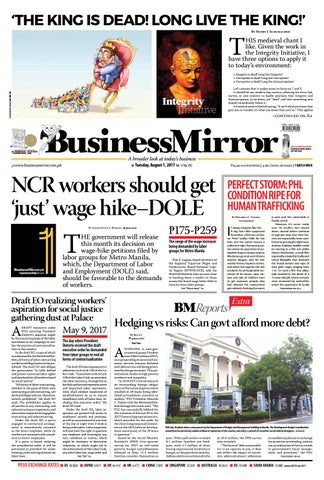
‘The King is dead! Long live the King!’
T
By Henry J. Schumacher
his medieval chant I like. Given the work in the Integrity Initiative, I have three options to apply it to today’s environment: 1. Integrity is dead! Long live Integrity! 2. Corruption is dead! Long live Corruption! 3. Corruption is dead! Long live Anticorruption!
Nuvolanevicata | Dreamstime.com
Let’s assume that it makes sense to focus on 1 and 3. It should be our modern-day mantra, allowing for every fad, survey, or new statistic to loudly proclaim that Integrity and Anticorruption, as we know, are “dead” and that something new should immediately follow it. A friend of mine is fond of saying, “It ain’t what you know that gets you in trouble; it’s what you know that ain’t so.” This applies
»continued on A2
media partner of the year
United nations
2015 environmental Media Award leadership award 2008
BusinessMirror A broader look at today’s business
www.businessmirror.com.ph
n
Tuesday, August 1, 2017 Vol. 12 No. 292
NCR workers should get ‘just’ wage hike–DOLE
T
By Elijah Felice E. Rosales
@alyasjah
he government will release this month its decision on wage-hike petitions filed by labor groups for Metro Manila, which, the Department of Labor and Employment (DOLE) said, should be favorable to the demands of workers.
Draft EO realizing workers’ aspiration for social justice gathering dust at Palace May 9, 2017 A dr aft executive order (EO) awaiting President Duterte’s approval might be the remaining hope of the labor movement in its campaign to outlaw the practice of contractualization in the country. In the draft EO, a copy of which was obtained by the BusinessMirror, all forms of labor contracting are declared illegal and strictly prohibited. The draft EO also obliges the government “to fully defend and protect universal labor rights and standards for all workers based on social justice”. “All forms of labor contracting, whether in the guise of labor-only contracting or job contracting, are declared illegal and are, therefore, strictly prohibited,” the draft EO read. The prohibition applies to all parties in any contracting and subcontracting arrangements, and also covers cooperatives engaged in contracting and subcontracting. Under the draft EO, a party engaged in contractual arrangement is immediately assumed as the direct employer, while its workers are automatically considered as direct employees. If a party is found violating the presidential order, it will be penalized as provided for under existing rules and regulations on labor laws.
The day when President Duterte received the draft executive order he demanded from labor groups to end all forms of contractualization
The draft EO also imposes strict adherence to Article 128 of the Labor Code. “Consistent with Article 128 of the Labor Code, as amended, the labor secretary, through his or her duly authorized representatives and deputized labor representatives, shall conduct inspection of establishments so as to ensure compliance with all labor laws, including this executive order,” the draft EO read. Under the draft EO, labor inspectors are granted full access to employers’ records and premises, as well as any personnel at any time of the day or night even if work is being undertaken. Labor inspectors will also have the right to question any employee and investigate any fact, condition or matter, which might be necessary to determine violations, or which might aid in the enforcement of the Labor Code, any other labor law, wage order and
PESO exchange rates n US 50.5820
See “EO,” A2
Kim S. Lagcao, board secretary of the Regional Tripartite Wages and Productivity Board-National Capital Region (RTWPB-NCR), told the BusinessMirror they are now close to handing down a verdict on three across-the-board wage hikes filed in June by three labor groups. See “Wage hike,” A2
business news source of the year
P25.00 nationwide | 4 sections 28 pages | 7 days a week
PERFECT STORM: PHL CONDITION RIPE FOR HUMAN TRAFFICKING By Rosabell C. Toledo
₧175-₧259 I The range of the wage increases being demanded by labor groups for Metro Manila
2016 ejap journalism awards
Correspondent
t always happens like this. A big fish—like suspected Australian child-sex predator Peter Scully—falls for the bait, and the nation heaves a collective sigh. Harrowing stories about his operation of pedophile rings in various cities in Mindanao go viral, and citizens express disgust, pity for the, mostly minors, hapless victims; and white-hot rage for the sick predator. As unimaginable narratives of his abuse, rape, torture and sale of children start to get exposed, people also feel relieved the mastermind got nabbed, thinking the worst
is over and the vulnerable is finally saved. However, it’s never really over. As Scully’s den closed down, several others continue to operate; only now their runners are expectedly more careful not to get caught. Right now, another helpless toddler could be starring in a film not unlike Daisy’s Destruction, a snuff film reportedly created by Scully and Liezyl Margallo that featured the brutal torture and rape of nine girls—ages ranging from 1 to 12—and a film that allegedly resulted in the death of a 12-year-old girl, whose remains were recovered by authorities under the apartment of Scully Continued on A14
BMReports
Hedging vs risks: Can govt afford more debt? By Rea Cu
@ReaCuBM
A
Part Two
CCORDING to non-governmental group Freedom from Debt Coalition (FDC), annual spending on social and economic services remains deficient with debt service still being prioritized by the government. This prioritization results to high poverty incidence and inequality. “In 2016 FDC’s initial research on outstanding foreign obligations of the national government resulted in 20 loans being identified as fraudulent, wasteful, or useless,” FDC President Eduardo C. Tadem told the BusinessMirror through electronic mail. “The FDC has successfully lobbied for the inclusion of Section 95 in the 2017 General Appropriations Act, which provides for the audit, by the Joint Congressional Committee on the ODA [official development assistance], of the 20 loans in question.” Based on the Social Weather Stations’s (SWS) first-quarter survey for 2017 on self-rated poverty, hunger and joblessness released in May, 11.5 million families consider themselves as
This July 30 photo shows a man passes by the Department of Budget and Management building in Manila. The Development Budget Coordination Committee has barred any sudden outflow of capital out of the country, and only 6.2 percent of securities can be held by foreigners. ALYSA SALEN
poor. Other poll results revealed 8.1 million families are foodpoor, with 2.7 million of them having experienced involuntary hunger in the past three months. Jobless adults are estimated to be
at 10.4 million, the SWS survey also revealed. “The focus of ‘debt sustainability’ is on capacity to pay, it does not reflect the impact of successive administrations’ adherence
to neoliberal policies in exchange for access for new lending, and are not an indication of future trends in government’s fiscal management and priorities,” the FDC Continued on A2
n japan 0.4571 n UK 66.4142 n HK 6.4772 n CHINA 7.5092 n singapore 37.2639 n australia 40.3644 n EU 59.4389 n SAUDI arabia 13.4882
Source: BSP (31 July 2017 )
BMReports BusinessMirror
A2 Tuesday, August 1, 2017
Wage hike. . . Continued from A1
“We finished consulting the workers and employers, and the final procedure now is to deliberate the wagehike petitions,” Lagcao said. The RTWPB-NCR is assessing the demands of the Association of Minimum Wage Earners and AdvocatesPhilippine Trade and General Workers Organization (AMWEA-PTGWO); the Associated Labor Unions (ALU); and the Trade Union Congress of the Philippines (TUCP). The TUCP is pushing for an across-the-board wage hike of P259, higher than the P184 demanded by the ALU and the P175 sought by the AMWEA-PTGWO. However, Lagcao added the wagehike petitions are facing rough sailing in the RTWPB-NCR due to a motion for dismissal from the Employers Confederation of the Philippines (Ecop). “The inputs gathered in the consultations and public hearing will be considered by the wage board in its deliberation. It is, however, premature to declare an amount on how much the wage hike would be, as we have yet to convene for the deliberation,” the labor official said. According to Lagcao, the deliberation will be conducted by a sevenmember committee composed of two labor representatives, two employer representatives and three government officials. Angelita D. Señorin of the TUCP and lawyer Herman N. Pascua Jr. of the ALU will represent the workers, while lawyers Alberto R. Quimpo and Vicente Leogardo Jr. of the Ecop will represent the employers. The government will be represented by Reynaldo R. Cancio of the National Economic and Development Authority, Anacleto C. Blanco Jr. of the Department of Trade and Industry and Henry John S. Jalbuena of DOLE. Lagcao said the RTWPB-NCR is aware of the urgency of the wagehike petitions and vowed it will fasttrack efforts to come to a decision the soonest time possible. Labor Undersecretar y Joel B. Maglunsod, for his part, said the RTWPB-NCR should know the gravity of its forthcoming verdict. “In my opinion, the wage board must approve a wage hike favorable to the demands of the labor groups,” Maglunsod told the B usiness M irror. Maglunsod added the government keeps on claiming Philippine economy is expanding, but workers have yet to receive their fair share from the purported growth. This is why the labor official said he will appeal before the RTWPB-NCR should labor groups find its decision “unjust to their needs”. “Our workers contribute to the expansion of Philippine economy, so let us not treat them like street scavengers begging for alms,” Maglunsod said.
EO. . .
Continued from A1
relevant rules and regulations. The findings of the inspection will be referred to the labor secretary for appropriate action and will be furnished to the unions within the company. The draft EO, citing Article 128 of the Labor Code, mandates the labor secretary to issue compliance orders immediately effective, unless restrained by a court order, to give effect to the labor standards provisions of the Labor Code and any other labor law. A crackdown on contractualization, the pending presidential order said, is necessary to uphold labor rights, particularly the right of all workers to security of tenure. The draft EO said, “Contractualization, the schemes involving precarious or temporary employment through middlemen contractors, and which enable the employers to avoid their obligations to workers, is now prevalent in the country.” The draft EO was received by the Office of the President at 3:45 p.m. on May 9. In the transmittal memo of the draft EO, the Nagkaisa Labor Coalition thanked President Duterte “for his steady resolve to curb the pandemic scale of contractualization and his commitment to
Hedging vs risks: Can govt afford more debt? Continued from A1
said. The FDC further pointed out that in 2016, 62 percent of the national government’s (NG) foreign debt is in the form of debt securities. The preference for the latter instrument is due to low cost of borrowings, since the Philippines improved its investment-grade credit ratings from major agencies, like Moody’s, Standard & Poor’s and Fitch, among others. According to Tadem, the FDC is still working on the institutionalization of a comprehensive debt audit. “One step toward this is Philippine Senate Resolution 253,” Tadem said. The Resolution directs the appropriate Senate committee to inquire, in aid of legislation, into the foreign loans contracted by the Philippine government within the Last 15 years through the conduct of a debt audit. It was introduced by Sen. Aquilino L. Pimentel III and Ana Theresia N. HontiverosBaraquel.
How much is owed
ACCORDING to Bureau of Treasury (BTr) data, total public debt as of 2016 stood at P5.01 trillion, with 58 percent coming from domestic markets and 42 percent from foreign lenders. The 2016 general government (GG) debt to GDP ratio is at 34.6 percent, almost nine-percent points lower than the 2010 level of 43.5 percent. “As of end-2016, nominal debt held by the GG stood at P5.016 trillion, 58 percent of which is accounted for by domestic borrowings and 42 percent from foreign creditors,” National Treasurer Rosalia V. de Leon said. The nominal GG debt of the country comprises the outstand-
CA. . .
To finance the 3-percent deficit earlier set by the Duterte administration, we forecast our gross borrowings to increase from P727.7 billion in 2017 to P888.2 billion in 2018.”—De Leon ing obligations of the NG, Central B a n k B oa rd of L iqu id ator s (CB-BOL), social security institutions, local government units less the intrasector debt holdings of government securities, according to the BTr. “For 2017 we expect our gross borrowings to amount to P727.7 billion, 75 percent of which is to be secured from domestic sources and the balance from external debt including ODAs,” de Leon added. The FDC pointed out that for 2016, total outstanding public debt or NG debt is P6.6 trillion, which includes government-guaranteed debt of P513.67 billion. While actual NG debt is P6.09 trillion: P3.93 trillion domestic debt and P2.16 trillion foreign debt.
Debt increase
DE Leon further explained that to finance the 3-percent deficit set by the Duterte administration, an estimated increase in gross borrowings amounting to P888.2 billion in 2018 will be targeted, with 2017 borrowings seen at P727.7 billion, still maintaining the 80:20 financing mix. “To finance the 3-percent deficit earlier set by the Duterte administration, we forecast our gross borrowings to increase from P727.7 billion in 2017 to P888.2 billion in 2018,” she said.
Finance Undersecretary Gil S. Beltran earlier pointed out that the government’s debt will naturally increase, since funds need to be spent on infrastructure programs. “It has to increase because we are building infrastructure,” Beltran said. “And savings have to be used for production, which means that you set aside a certain percentage of income for investment in goods that will allow us to produce more like building roads, airports and bridges.” A s to t he duration of t he pay ment of debt, the Nationa l Treasurer pointed out that the gover nment continues to engage in pr udent debt management w it hout sac r i f ic i ng its grow th objectives for the Philippine economy. “We will continue to engage in prudent and proactive debt management to meet our obligations without sacrificing our grow th objectives,” she said. “Moreover, improvements in our credit ratings, diversification in our investor base and generous f lows from ODA partners, debt will remain manageable and affordable.” De Leon added that the revenues from the Comprehensive Tax Reform Program of the Department of Finance will also provide additional buffers to bolster fiscal resiliency. To be concluded
‘The King is dead! Long live the King!’ Continued from A1
well to the concept of Integrity and Anticorruption as we know it. It’s not going anywhere, because real Integrity, as it is to be exhibited, is timeless. It’s not broken or inadequate, it simply needs a more specific focus and real attention to application and—in the end—implementation. We just don’t do it that well. Let’s unpack this a bit, fleshing out the realities of Integrity and Anticorruption as we know it compared with Integrity and Anticorruption as it should be. What I am driving at is that Anticorruption has to be more than lip service. As we clearly outline again and again that signing the Integrity Pledge is only the first step in a long adjustment process—from tone from the top, to a common code of conduct, from control measures throughout the organization to compliance programs and compliance training, from “validation” processes to certification. In the new anticor r uption environment, trust is a big deal. Trust has to be there until there is evidence of breach of trust. The new “King” wants a shift to focus on results over process. Management has to lead by example; remember, leading by example is not a choice—it has to be demonstrated daily. I liked the editorial in the BusinessMirror the other day: Make every day an
were not informed of the SEC investigation is patently erroneous,” it added. The CA noted that based on the records, the SEC, in light of its mandate to conduct investigation as it deems necessary, issued a notice of conference to the officers and directors of the PIPCC. After finding probable cause
formed of the SEC investigation,” the CA ruled. “Here, private respondents were not deprived of due process because they were afforded the opportunity to refute the charges against them before the DOJ. They were afforded the opportunity to refute the charges by filing their respective counteraffidavits,” it added. Concurring with the ruling were Associate Justices Leoncia Dimagiba and Henri Jean Paul Inting.
defend and protect the universal labor rights and standards for all workers based on social justice”. The draft EO was signed by Nagkaisa Chairman Michael C. Mendoza and was reviewed by National Anti-Poverty Commission Lead Convenor Liza L. Maza and Labor
Undersecretary Joel B. Maglunsod. The President on Labor Day requested labor groups to submit to his office a draft EO upholding the strict prohibition of contractualization for his review and approval. Duterte, during the election period, has vowed to prohibit
contractualization, which earned him the backing of several labor groups. However, a year after his election, labor groups were dismayed with the Chief Executive for failing to issue an EO outlawing all forms of fixed-term employment. Elijah Felice E. Rosales
anticorruption day! The new King (Anticorruption) expects much more involvement of management in anticorruption implementation. That involvement must lead to the appointment of compliance officers. The first big challenge coming up is for all organizations in the country to live with and comply with the data-privacy regulation. Why am I highlighting this? Breach of data privacy is a criminal offence! human resource managers will have be under stress, and lawyers will have a new source of income. Is your company using employee data ethically? Do we understand our company’s privacy comfort zone? Do we get guidance from our information governance committee? Do we share guidance with our team and encourage best practices? Do we invite feedback? In the end of the day: the new King wants everybody to have Integrity; I hope you remember the slogan of the Integrity Initiative: “Integrity starts with I”. We have to be honest, consistent and do what we say we will do! I forgot to comment on No. 2. Corruption is dead! Long live Corruption! Unfortunately, people involved in the many forms of corruption are continuously finding create new ways to benefit from this formula: Corruption = Monopoly + Discretion – Accountability. Anticorruption and having integrity is tough—wear a helmet!
Seda Vertis targets mice, weddings to boost revenues Continued from A14
that private respondents and their co-accused committed the acts charged, the SEC referred the case to the DOJ which conducted a preliminary investigation with the full participation of private respondents. The DOJ also f ound probable cause against the respondents and their co-accused. “There is no merit in private respondents’ allegation that they were denied their rights to due process when they were not in-
Continued from A14
www.businessmirror.com.ph
Owing to the newfound popularity of Quezon City as a corporate location, Seda Vertis North was designed “as the premier and biggest hotel catering to business travelers in the northern part of the metropolis”, Yniguez said. The hotel has an expansive lobby stylishly designed with colorful seating and art from a number of local artists and furniture designers, such as Vito Selma and Kenneth Cobonpue. Furniture from other Cebuano craftsmen and local art pieces also dot the many walls, nooks and crannies of the hotel. It also has a 250-seat full-scale international restaurant called Misto, featuring a show kitchen and impressive buffet that will change with the seasons and guests’ tastes. While the lunch buffet is currently priced at P1,350, BPI cardholders get a 50-percent discount on their meal until August 31, Yniguez added. Deluxe rooms and studio-style premier rooms are ideal options for individual travelers, Yniguez said, while the Suites (64 sq m), with a separate master bedroom and living room, “are perfect for families or guests who require more spacious accommodations”. The deluxe rooms are equipped with modern amenities in a comfortable 32-sq-m area with a 40inch LED HDTV, media panel with HDMI, USB and A/V connectivity, iPod docks and FM stereo. The deluxe rooms are priced from P4,760+ inclusive of breakfast. T he premier rooms, which start at P7,100 +, have the same amenities of the deluxe room in a more spacious 48-sq-m area, configured as a studio. Its bathroom is wider, and includes amenities, like a bathtub. In the next few months, the hotel will also be opening a Club Lounge, a presidential suite (160
sq m), a Chinese restaurant and Straight Up, Seda’s signature rooftop bar on the 24th floor, “which will offer expansive views of the city skyline”, she added. The Club Rooms, which are on the 21st to 23rd floors, will have access to the Club Lounge with daily Continental breakfast, afternoon tea and cocktails; all-day coffee, tea and nonalcoholic beverages; iMac stations; work tables; reading materials; a wide-screen LED HDTV with cable channels; and secretarial assistance. Currently operating are its fully-equipped fitness gym, adults’ and children’s pool, a spa with steam and sauna and an e-lounge on the ground floor with iMacs for hotel guests. Other Seda hotels are located at the Bonifacio Global City in Taguig, where a second tower is being constructed; Cagayan de Oro City; Nuvali in Laguna; and Iloilo City. Yniguez said, “over the next three years”, more Seda hotels will be opening in other parts of Metro Manila and other key destinations in the Philippines. Aside from the Seda brand, AHRC properties include: Fairmont Raffles Makati; Holiday Inn and Suites Makati; the Marriot Hotel in Cebu; resorts in El Nido, Palawan (Miniloc Island Resort, Lagen Island Resort, and Pangalusian Island Resort); Lio Estate, also in El Nido; and Apulit Island Resort in Taytay, Palawan. Vertis North is part of the P65billion real-estate development project committed by the Ayala Group to the Quezon City local government to reinvigorate the city as a prime central business district in Metro Manila. Along with Seda Hotel, the Ayala Group has also recently opened Vertis North Mall, which seeks to complement the current offerings of the Trinoma mall. Other projects in area include Alveo and Avida condominium developments, as well as office buildings, restaurants and green spaces.
The Nation BusinessMirror
news@businessmirror.com.ph
DENR taps VACC to ‘spy’ on corrupt execs, employees By Jonathan L. Mayuga @jonlmayuga
T
O fight graft and corruption within the Department of Environment and Natural Resources (DENR), Secretary Roy A. Cimatu is tapping the “expertise” of the Volunteers Against Crime and Corruption (VACC), with its members acting as “assets and informants”, spying on erring DENR officials and employees. Cimatu sig ned on Monday a memorandum of agreement with the VACC, represented by its founding chairman and president, Dante Jimenez, formalizing the partnership. In his brief remark, Cimatu said that, under his watch, the DENR should shed off its reputation “as one of the most corrupt government agencies”, adding that “I believe that the VACC will help us achieve that.” VACC is a not-for-profit organization campaigning against crime and corruption since the 1990s. According to Cimatu, the anticorruption campaign is in line with President Duterte’s promise to rid the bureaucracy of corrupt individuals. “The President has repeatedly stated that he will never tolerate corruption, and we are all too familiar with his unwavering stance against erring government officials and other law offenders,” Cimatu said. He added, “Anticorruption measures, both internally and as required by other agencies, such as Civil Service Commission [CSC] have been instituted and are being implemented continuously to achieve a corruption-free DENR.” With the help of the VACC, Cimatu said he expects that the campaign against corruption will be sustained. Under the agreement, the VACC will assist in gathering, reporting, referring and submitting names or evidence to the DENR pertaining to its officials and employees involved in anomalies, corruption and even crimes. The VACC also agreed to assist victims and witnesses against erring DENR personnel. For its part, the DENR will “deputize” the VACC, but shall not be allowed to conduct inspections without an official travel or investigation order, or deputation from the DENR. As DENR deputized officers, VACC members are required to undergo training on the prosecution of erring officials, the Revised Rules on Administrative Cases in the Civil Service, and environmental law enforcement in specific fields. The VACC will not be granted complete access to all of the records related to the administrative cases against DENR personnel. Access by the VACC should be through the freedom of information system of the DENR. VACC members are considered to be “assets and informants” of the DENR with a pledge to keep the information secured through the agreement in the strictest confidence.
Editor: Vittorio V. Vitug • Tuesday, August 1, 2017 A3
PNP says more ‘big fish’ in illegal-drugs trade to fall as DOJ issues Ilbo vs Espinosa, 7 others By Rene Acosta
N
@reneacostaBM and Joel R. San Juan
@jrsanjuan1573
ational Police chief Director General Ronald M. dela Rosa on Monday said the Duterte administration’s drive against illegal drugs would continue, as he assured that more “big fish” will fall in the coming days.
This developed as Justice Secretary Vitaliano N. Aguirre II has issued an Immigration Lookout Bulletin Order (Ilbo) against bigtime drug lord Kerwin Espinosa and several others he implicated in the well-entrenched drug trade in the country. Aside from Espinosa, those covered by the Ilbo include Peter Lim, drug convict Peter Co, Marcelo Adorco, Max Miro, Lovely Adam Impal, Ruel Malindangan and Jun Pepito. Lim was earlier tagged by Duterte as among those involved in the illegal-drugs trade in the country. Adorco and Miro are known top aides of the Espinosas, while Impal was identified by Kerwin as the supplier of illegal drugs in the Visayas.
Pepito, on the other hand, is one of Kerwin’s men who would allegedly transport the drugs from Matnog, Sorsogon to Ormoc, Leyte.
‘Justified’
Dela Rosa justified the operations against Ozamiz City Mayor Reynaldo Parojinog Jr., who was killed along with 14 others last Sunday dawn. “There are more, just wait,” he said, adding the death of Parojinog and his brother, Octavio Jr., during the operations showed there are no sacred cows in the illegaldrugs drive. Parojinog’s daughter and son, Ozamis City Vice Mayor Nova Princess Parojinog and Reynaldo Jr., who is a councilor of Ozamiz City,
were also arrested during the operations. They were brought to Manila on Monday for the filing of charges against them. “To be fair with these people… that should serve as a warning to everyone that there are no ‘sacred cows’ in the PNP’s [Philippine National Police] enforcement of the law. As far as law enforcement is concerned, we have no fear or favor. If you are needed to be operated upon, you will be operated upon,” dela Rosa said. He added that the PNP will continue its operations against those whose involvement in the illegaldrug trade would be established by ongoing case build up. “On a nationwide scale, there will be more…it depends on whose cases would be built up and applied with warrants,” he said. Dela Rosa maintained that the operations against Parojinog and members of his family, which also killed the mayor’s wife Susan, and led to the arrest of six others, were “legitimate”. The operations were backed by six search warrants, which when implemented by a composite police team at the residence of the Parojinog family in Ozamiz City, led to a reported shootout. “I know they are meant to be operated upon not to be liquidated. It
depends if they fight back, then there will be encounter, we have no control on that,” dela Rosa said. “Any time is legal time to serve search warrant. It is not stated in the search warrant that you need to serve it only during office hours. Meaning, you are commanded to serve the search warrant on avoid leakage of information…the evidence might be destroyed, then we have to do it on our time. We have to dictate the tempo, the schedule,” dela Rosa said.
Drug complaint
The Ilbo was issued following the filing of a drug complaint by the Major Crimes Investigation Unit (MCIU) of the PNP-Criminal Investigation and Detection Group (CIDG) against the listed individuals before the Department of Justice. S p e c i f i c a l l y, t h e M C I U , through Police Supt. R ichard Verceles, charged Espinosa and his alleged cohorts with violation
On a nationwide scale, there will be more [to fall]…it depends on whose cases would be built up and applied with warrants.”—Dela Rosa
Legislator, mayor junk terrorist link claim vs Fil-Turkish NGO
S
Environment Secretary Roy A. Cimatu (left); and Dante Jimenez, founding chairman and president of Volunteers Against Crime and Corruption (VACC), show the memorandum of agreement formalizing their partnership in combating corruption and environmental crimes held at the Department of Environment and Natural Resources (DENR) office in Quezon City on Monday. Under the agreement, the VACC will assist in gathering, reporting, referring and submitting names or evidence to the DENR, pertaining to its officials and employees who are involved in anomalies, corruption and crimes. The VACC also agreed to assist victims and witnesses against erring DENR personnel. PNA
Community building salient point in proposed Asean COC–DFA By Recto Mercene
F
of Section 26 (b) in relation to Section 5 of Republic Act 9165, or the Comprehensive Dangerrous Drugs Act, which prohibits the sale, trading, distribution and transportation of illegal drugs and essential chemicals. “In view of the gravity of the offense filed against the abovenamed individuals, there is likelihood that they might leave the country to place themselves beyond the reach of the lawful processes of the concerned offices,” Aguirre said in his memorandum. An Ilbo is different from a court-issued hold departure order since the former only directs the Bureau of Immigration to be on the lookout for the subject and to verify the status of a case against the subject person and not to restrict an individual from leaving the country. However, a person subject to the Ilbo should seek an allow departure order from the Department of Justice chief to be allowed to leave.
@rectomercene
oreign Affairs Spokesman Robespierre L. Bolivar said on Tuesday he is expecting Asean countries to come up with a code of conduct (COC) that will also embody community-building efforts in preparation for the Asean summit in November. “We have the joint communique of the Asean Ministerial Meeting [AMM], the chairman statements of the post ministerial conferences, the Asean Regional Forum [ARF], East Asia Summit [EAS] and the Asean, plus three and the framework to be endorsed on August 6,” he said in an interview. Beijing and its Southeast Asian neighbors have agreed to a framework for a COC in the South China Sea, a move that could reduce the risk of clashes in one of the world’s busiest waterways.
On the other hand, Bolivar said he expects the foreign ministers to endorse the framework agreement of the COC during the Asean-China meeting. “We expect that the joint working group will begin discussions on the actual code of conduct as soon as the approval of the framework is finished, hopefully within the first meeting of next year,” he added. As to the goal of the framework COC, Bolivar said: “For now we are waiting for the approval process to be finished. The ministers are expected to endorse it this week [on] Saturday. They will just issue a statement.” “The COC will take a bit of a time but the political will is there,” he added. According to Bolivar, the Minister’s endorsement is significant because it is about cementing the commitment. “That’s why it is being endorsed by the
ministers. There’s a political will if ministers will give their endorsement,” he said. Along with the framework, rival claimants China and the Philippines will start talks over their competing claims in the sea, according to senior diplomats from both sides. Among the possible issues to be discussed is the proposed joint development in the mineral-rich South China Sea, also called the West Philippine Sea. Asked whether the Philippines, as Asean chairman will initiate a meeting among parties to the North Korea talks, Bolivar said he hopes that the parties will be able to have some discussions, “but we cannot really say if that is possible at this point at the sidelines of the ARF. “We will definitely have to see but the ARF is a platform for discussions and we will take it from there,” he said.
Regarding Pyongyang’s “provocative” actions, Bolivar said he is sure several countries would like to discuss the Korean peninsula issue. Asked about the significance of the AMM and ARF, Bolivar has this to say: “We want to focus on community-building efforts because we are celebrating 50 years and we want to project another, the next 50 years and we want to take advantage of the presence of our dialogue partners and their commitment to help the Asean in their community building efforts for the next 50 years.” As to whether the statement on terrorism would be a standalone effort, he said: “Either in the EAS or the ARF…are [both] working on this statement on countering violent extremism if I’m not mistaken. But there are stand-alone statements of declarations that we are working on I’m not sure in which meeting.”
en. Joseph Victor Ejercito has joined religious organizations and the San Juan City government in expressing support for a non-governmental organization (NGO) operating schools in the country that the Turkish Ambassador had accused of having links to terrorism. In a news statement, Ejercito said the Integrative Center for Alternative Development Foundation, Inc. (ICAD) and its Fountain International School (FIS) in San Juan have proven to be steady partners of the city’s educational and sociocivic programs. “In my experience, the school here in San Juan is run well. They are also cooperative with the community,” said Ejercito, a former San Juan City mayor. His mother, incumbent San Juan Mayor Guia Gomez, likewise, issued a statement in support of the Filipino-Turkish NGO. “It is but worthy to extend our gratitude and support to the ICAD and Fountain International School with its hardworking officials, faculty and staff,” Gomez said. She added the San Juan government had partnered with the two institutions “on countless programs” to benefit the people of San Juan, including scholarships and tie-ups with the city-funded Polytechnic University of the Philippines—San Juan and outreach projects for the less privileged sector. Both elective officials followed statements of support issued last week by religious officials for ICAD and its sister NGO the Pacific Dialogue Foundation Inc. (PDF), which runs the Filipino-Turkish Tolerance School in Zamboanga City. The statements were issued by representatives from major Catholic and Muslim religious groups including the Catholic Bishops’ Conference of the Philippines and the Imam Council of the Philippines. Former Education Secretary and La Salle University President Brother Armin A. Luistro debunked the allegation made by Turkish Ambassador Esra Cankorur that the two NGOs and their schools had terrorist links. Meanwhile, Armed Forces Chief of Staff Gen. Eduardo M. Año told Malacañang reporters on Tuesday night that the militaty did not consider the NGOs as terrorist organizations, as he expressed belief that the ambassador’s accusation was due to internal politics in Turkey. Luisto said: “I have never had any doubt that both ICAD and PDF are legitimate foundations that share our Filipino values of peace through education and a deep respect for our common humanity despite differences in cultures, beliefs and traditions. Both ICAD and PDF have been working quietly in their own way to build such an environment through their educational programs here in the Philippines.” “I have never had any reason to link their operations here with alleged terror groups locally, as this would seem totally in conflict with their ongoing advocacies and programs on peace-building,” Luistro added.
Economy
A4 Tuesday, August 1, 2017 • Editors: Vittorio V. Vitug and Max V. de Leon
BusinessMirror
Philippines lags behind Asean-5 peers on WTO’s ’17 importers, exporters list
T
By Cai U. Ordinario
@cuo_bm
HE Philippines trailed behind its Asean-5 neighbors on the list of top world exporters and importers, World Trade Organization (WTO) data showed. In its World Statistical Trade Review for 2017, data from the Switzerland-based WTO ranked the Philippines 30th in terms of merchandise exports and 24th in terms of merchandise imports. “On the imports side, falling fuel prices continued to weigh down the value of its imports in 2016. Developed economies in Asia registered growth in exports value terms of 3
percent in 2016, following a decline of 13 percent in 2015, largely driven by a recovery of Japan’s exports,” the WTO said. The WTO estimated the Philippines’s exports amounted to $56 billion in 2016, or 0.4 percent of global merchandise exports. It posted a decline of 4 percent from 2015. In terms of merchandise im-
30th The PHL’s global ranking in terms of merchandise exports, and 24th in terms of merchandise imports
ports, the WTO estimated that the Philippines’s import bill reached $86 billion, or 0.7 percent of global imports in 2016. This represented a growth of 23 percent, the highest growth in global imports and the only double-digit recorded among 50 countries included by the WTO in the rankings. However, Asean-5 countries were
led by Singapore in terms of export earnings and import bill. Singapore ranked ninth among the world’s exporters and 10th among importers. Thailand was ranked 15th and 16th in terms of exports and imports, respectively, while Malaysia ranked 17th and 19th in exports and imports. Vietnam and Indonesia ranked 19th and 21st among the world’s exporters and 18th and 22nd in terms of imports, respectively. Based on data from the Philippine Statistics Authority, the country’s total trade in goods in 2016 was recorded at $141.514 billion, expanding by 8.9 percent, from $129.894 billion in 2015. This translated into a wider balance of trade in goods deficit at $26.702 billion in 2016, higher than the $12.240 billion recorded in 2015.
DENR’s Cimatu says miners’ motions for reconsideration still under review By Jonathan L. Mayuga @jonlmayuga
T
HE review of mine closure and suspension orders is still ongoing to give teams ample time to assess the legality of the controversial orders handed down by former Environment Secretary
Regina Paz L. Lopez as part of her crackdown against “irresponsible” mining companies. Environment Secretary and former Military Chief of Staff Roy A. Cimatu said the review teams need more time to complete the task at hand, citing the “voluminous” documents involved in every case. Each case,
he added, is unique and needs careful evaluation by the review teams. Speaking at a news conference highlighting the Department of Environment and Natural Resources’s (DENR) partnership with the Volunteers Against Crime and Corruption as part of the DENR’s anticorruption effort, Cimatu said the department
is currently reviewing 13 motions for reconsiderations filed by mining companies whose operations were ordered stopped or suspended by Lopez on account of a strict audit criteria that includes environmental, social and biodiversity considerations in every aspect of mining operations. He, likewise, told reporters that the policy declaring watershed areas “off limits” to mining and other “destructive” development projects will be upheld. “Definitely, there will be no mining in watersheds,” Cimatu assured. The review of the mine closure and suspension orders is being conducted by several teams working under the office of Environment Undersecretary for Legal Affairs Mara Paz Luna. Luna said, so far, only three of the 13 motions for reconsideration have been resolved and that the decisions will be submitted to the DENR secretary for final say and action. The DENR chief, for his part, said he had asked the review team about their report and was told they need more time to complete the review. “I’ve asked about the review of the audit, but it’s really very voluminous. Aside from request for consideration, we are also tasked to comment on cases being handled by the Office of the President. It divided our time, that is the reason why they are not able to complete it [expeditiously],” he said in a mix of English and Filipino. There are 28 mining companies facing closure or suspension after failing in the mine audit, but only 13 filed their motions before the DENR. O t he r m i n i n g c o mp a n i e s sought the help of the Office of the President, while others appealed before the Mining Industry Coordinating Council. “Because he [Cimatu] wants us to facilitate [the process], because the records are so voluminous at magkakaiba iyong [there are diverse] cases [unique in every aspect, we sought for another 30 days to undertake the review]. So it’s 30 days. That will be end of August,” Luna said. Cimatu was earlier quoted as saying that the decision on the motion for reconsiderations will be out by the end of July. Defending Cimatu, Luna said, “There appears to be a misunderstanding about.... We are getting reports from different sectors from within the DENR about that.” Nevertheless, she added, the review teams are committed to finish the review by the end of August. Luna said the review team decided to prioritize commenting on the motion for considerations referred by the Office of the President to the DENR. Every case, she added, has been assigned to two action officers looking into the documents the companies submitted in questioning Lopez’s alleged “harsh” penalty.
news@businessmirror.com.ph
House panel to start hearings on proposed 2018 budget on Tuesday
T
HE House Committee on Appropriations will scrutinize on Tuesday President Duterte’s proposed P3.767-trillion national budget for 2018. National Unity Party Rep. and Committee Chairman Karlo Alexei B. Nograles of Davao City said the budget hearings, expected to be attended by heads of government agencies, will last until August 24. “The appropriations committee and the House of Representatives will definitely exercise its sworn duty to determine the absorptive capacity of our government agencies. We must make sure that every penny of our people’s taxes are spent well and truly benefits our people,” Nograles said. Defending the 2018 national budget on Tuesday are the Development Budget Coordination Committee, which include Budget Secretary Benjamin E. Diokno, Socioeconomic Secretary Ernesto M. Pernia, Finance Secretary Carlos G. Dominguez III and Bangko Sentral ng Pilipinas Governor Nestor A. Espenilla Jr. Speaker Pantaleon D. Alvarez said the lower chamber is eyeing to approve the proposed 2018 General Appropriations Act in October. During his second State of the Nation Address, Duterte submitted before the joint session of Congress his administration’s 2018 P3.767-t r i l l ion budget, which will focus on education and its ambitious infrastructure program. In his 37-page budget message, Duterte said the country needs an “activist budget” to fulfill the longing of the people. The proposed budget represents a 12.4-percent increase on the general appropriations for 2017 at P3.35 trillion. The education will continue to receive the biggest appropriation at P691 billion, which is P41.7 billion more than the 2017 budget. As much as P1.097 trillion has been allocated for government infrastructure projects next year. It is 29.5 percent, or P249.8 billion, higher than the 2017 national budget’s allocation for public infrastructure. The Department of Public Works and Highways (DPWH) and Department of Transportation’s (DOTr) each have a hefty budget of P643.3 billion and P73.8 billion, respectively. As for budget allocation according to sector, social services will remain the recipient of the biggest budget, amounting to P1.45 trillion, or 38.5 percent of the proposed budget. Mea nwh i le, t he econom ic services sector comes second, with P1.15 trillion, 30.6 percent of the proposed budget. The budget for economic services in 2018 gets a generous increase of 25 percent, from the 2017 amount of P922 billion.
‘Build, Build, Build’
DUTERTE said the 2018 budget will focus on public infrastructure listed under the government ’s “ Bu i ld , Bu i ld , Bu i ld ” campaign. Duterte said the government’s P3.767-trillion proposed budget is “a budget that reforms and transforms”. He added among the objectives of the 2018 budget proposal is to accelerate strategic infrastructure under the government’s bid to sustain development. “My administration’s accelerated spending on infrastructure development is financially sound since the benefits it will provide over the course of time will far exceed the cost of financing and building,” he said. “In all, we plan to spend a total of P8.1 trillion for infrastructure development from 2017 to 2022,” Duterte added. Under the accelerated infrastructure spending, the government aims to improve road transport to spur trade movement, air transport to impel air mobility, sea transport to boost port activity and rail transport to ease urban congestion. In a bid to reduce logistics costs in Mindanao, Duterte said the Mindanao Logistics Infrastructure Network will receive a 10.3-percent increase in funding, from P21.4 billion in 2017 to P23.6 billion in 2018. “This amount will be used to improve linkage roads to key ports and production areas in Northern Mindanao, Southern Mindanao, Central Mindanao and Caraga,” Duterte said. Also, Duterte added the Aviation Infrastructure Program of the DOTr will obtain a 48.5-percent budget increase, from P6.8 billion in 2017 to P10.1 billion in 2018, “to maximize and expand existing airports and build new ones”. Duterte added the government provided some P2.7 billion for night-landing capabilities of the Clark International Airport to help decongest the Ninoy Aquino International Airport. Some P1.7 billion is also allocated for the modernization of ports and harbors nationwide, including the Al-Barka Ports Cluster in Al-Barka, Basilan; Volcano Island Port in Talisay, Batangas; and Agkawayan in Looc, Occidental Mindoro. Duterte said the government will also shell out P5.3 billion for maritime infrastructure program “to boost maritime-patrol capabilities”. On top of this, the rail-transport program will receive P26 billion under the 2018 budget proposal, of which P6.6 billion is allocated for the Mindanao Railway Project Phase 1. Jovee Marie N. dela Cruz and Elijah Felice E. Rosales
Expert lauds possible deployment of Filipino HSWs to affluent China
T
HE recruitment industry has lauded the possible opportunity for Filipinos, particularly household service workers (HSWs), to work in China. “The recruitment industry welcome the possibility of deploying HSWs to China due to the existing large market of foreign workers or expatriates working for many international companies and financial institutions,” said Emmanuel Geslani, recruitment and migration expert, in a news statement. He believes that good communication skills are among Filipino workers’ strengths why host countries prefer to employ them. “There is also demand from wealthy Chinese who want their chil-
dren to be exposed to Filipina HSWs who can speak and write in English,” Geslani added. At the same time, he said, the salary of some package amounting to some P100,000 per month, is also an encouragement since the majority of Filipinos working abroad are looking for better pay. “In addition, the possible salary of P100,000, or the equivalent of $2,000, is very attractive for many OFWs,” Geslani said. It was reported that China is looking to hire some 100,000 Filipino workers, according to the Department of Labor and Employment. The overseas Filipino workers will be deployed in five cities, including Beijing, the country’s capital and Shanghai. PNA
Agriculture/Commodities BusinessMirror
news@businessmirror.com.ph
Editor: Jennifer A. Ng • Tuesday, August 1, 2017
A5
‘Farm equipment makers need govt help’ By Jasper Emmanuel Y. Arcalas
T
@jearcalas
he government should provide financial or credit assistance to small- and medium-scale manufacturers of farm equipment to revive local postharvest machinery manufacturing, according to a policy study conducted by the Philippine Center for Postharvest Development and Mechanization (PhilMech). The study, titled “The Role of the Machinery Manufacturers and Distributors in the Grains Postharvest Mechanization”, also urged local manufacturers of farm equipment to form joint ventures to upgrade their capabilities. “In general, the local postharvest machinery manufacturing and distribution can be characterized as an ‘aging’ industry that needs to be revived,” the study read. At present, the study noted that the Philippines is a net importer of farm machines even if there are more than 400 local manufacturers of such equipment. However, small-scale industries dominate the local farm machinery fabrication industry and most of them employ the “cut and weld” method of fabrication, which shows
there is also a need to improve the manufacturing process of the companies. To ramp up the local farm equipment manufacturing industry, the study recommended the forming of joint ventures among local firms. “Among local manufacturers, a joint venture agreement should be established for the local manufacture of critical machines and machine parts, and to encourage mutual support and complementation of manufacturing and after-sales service,” the study read. It also noted that, because of the bias of the Department of Agriculture’s (DA) farm mechanization program in favor of large-scale manufacturers, selected few are able to participate because of the financial constraints of small- and
Locally manufactured corn seed planter Photo by PhilMech
medium-scale manufacturers. “Hence, to eliminate this entry barrier and to uplift the manufacturing and distribution of postharvest facilities in the country, the government should improve the financial/credit assistance to the small and medium manufacturers,” the study read. According to the study, the local manufacture of farm machinery is still labor-intensive, but its work force lacks any real training.
“Manufacturing of agricultural machinery is predominantly laborintensive with a work force that lacks formal educational background on machine fabrication and whose knowledge and skills were gained through experience”, the study read. “The most common fabrication equipment utilized are the welding machine, bar and sheet cutter, drill press, sheet bender, grinder, shaper, lathe machine, acetylene
and compressor,” it added. According to the study, manufacturing firms should also include distribution in their activities so they can generate higher sales and profit margins. “Efforts in manufacturing must be combined with distribution activities to gain some complementary effect. On the aggregate, a decreasing return to scale can be noticed that force firms within the industry either to specialize
or diversify their product lines, adopt cost-cutting measures or even downsize operations,” the study read. “Because of the downward trend in terms of performance of the industry, some of the key industry players are pessimistic about the future of the industry,” it added. PhilMech said it is currently taking steps to improve the state of the local farm machinery industry. These include learning from the experience of other countries and collaboration in research and development of agricultural mechanization (AgMech) technologies with countries that have most similar settings with the Philippines. The attached agency of the DA said it is also undertaking research and development of machinery suitable for Philippine farming conditions and increasing the technical capability of PhilMech engineers. Dr. Rodolfo Estigoy, director of PhilMech’s applied communication division, said the development of the local farm machinery manufacturing industry is mandated under Republic Act 10601, or the Act Promoting Agriculture and Fisheries Mechanization and Development in the Country. The law provides that “production of locally made engines and other machinery for agricultural and fishery purposes shall be promoted and encouraged by the DA in partnership with the private sector, and through joint venture agreements”.
PHL agri import bill up 22% in 2016–WTO Embryo transfer for cattle reproduction program T to start this month
he country’s agricultural import bill in 2016 grew by nearly 22 percent to $10.15 billion, from $8.332 billion recorded in 2015, according to the latest data from the World Trade Organization (WTO). In its annual report, titled “Trade Profiles 2017”, WTO data showed that wheat accounted for the bulk, or about 10.25 percent, of the total farm products purchased by the Philippines from abroad. The country’s wheat imports last year reached $1.041 billion, 6 percent higher than the 2015 record of $982 million, according to WTO data. Figures from the WTO also
showed that solid residues from soya-bean oil were the second most imported farm product, with payments reaching $937 million in 2016. This was 32.53 percent higher than the $707 million recorded in 2015. This was followed by other food preparations and animal/ vegetable fats and oils valued at $725 million and $610 million, respectively, WTO data showed. Milk and cream (concentrated) was the fifth most imported agricultural commodity by the Philippines in 2016. On an annual basis, payments went up by 25 percent percent to $431 million. Data from the WTO also showed
that the Philippines’s agricultural exports receipts in 2016 have recovered from a 33-percent decline during 2014-2015. Philippine out-bound shipments of agricultural goods last year reached $4.243 billion, 5.07 percent higher than the $4.038-billion recorded in 2015, according to WTO data. Coconut (copra) or palm-kernel oil remained as the country’s top agricultural export in 2016, accounting for nearly 27 percent of total earnings. Revenues reached $1.145 billion, slightly higher than the $1.123 billion worth posted in 2015. The second top farm export
winner in 2016 was banana, with shipments valued at $619 million, up 40.68-percent increase from the 2015 record of $440 million. Export receipts from products categorized under “plants’ parts otherwise preserved”, declined by 7.61 percent to $449 million, from $486 million in 2015. The WTO data showed that the Philippines’s total exports receipts in 2016 reached $56.313 billion, while the import bill amounted to $86.29 billion. Ex port receipts from farm products accounted for 7.53 percent, while agricultural imports accounted for 11.76 percent. Jasper Emmanuel Y. Arcalas
Researchers creating warning system for toxic algae in lakes
T
OLEDO, Ohio—Satellites in space and a robot under Lake Erie’s surface are part of a network of scientific tools trying to keep algae toxins out of drinkingwater supplies in the shallowest of the Great Lakes. It’s one of the most wide-ranging freshwater monitoring systems in the US, researchers say, and some of its pieces soon will be watching for harmful algae on hundreds of lakes nationwide. Researchers are creating an early warning system using real-time data from satellites that in recent years have tracked algae bloom hotpots, such as Florida’s Lake Okeechobee and the East Coast’s Chesapeake Bay. The plan is to have it in place within two years so that states in the continental US can be alerted to where toxic algae is appearing before they might detect it on the surface, said Blake Schaeffer, a researcher with US Environmental Protection Agency (EPA). “You don’t have to wait until someone gets sick,” said Schaeffer, one of the leaders of the project. Across the nation, farm runoff, sewage overflows and lawn fertilizers have washed into lakes and rivers and left behind unsightly algae blooms that can sicken people and pets and harm wildlife.
This September 1, 2015, file photo shows a warning sign for algal toxins on a beach in Maumee Bay State Park, located on Lake Erie in Oregon, Ohio. AP Photo/Haraz N. Ghanbari, File
But often the first reports of harmful algae on a lake come from boaters seeing something strange in the water, said Rick Stumpf, of the National Oceanographic and Atmospheric Administration. He began using satellites in 2008 to monitor algae on Lake Erie. That work took on a new urgency after a bloom near Toledo’s shoreline contaminated the drinking water for more than 400,000 people three years ago. The EPA in recent years has been testing using the satellite data to
watch for algae in lakes in California, Vermont, New Hampshire, Massachusetts, Connecticut and Rhode Island. Earlier this year, the data helped detect an algae bloom in a Utah Lake near Salt Lake City before officials on the ground knew about it. “That’s exactly what we we’re trying to accomplish,” Schaeffer said. The system in development will cast a wider net at a time when many states can’t afford to monitor every lake threatened by harmful
algae. The goal is to use the satellite data to watch for algae on 1,800 lakes across the nation and provide four different types of water quality measurements on close to 170,000 lakes. What satellites can’t measure is the amount of toxins in the water. That’s where samples gathered by researchers come into play. That too can be expensive so researchers have developed an underwater lab that sits at the bottom of Lake Erie and both collects water and tests the levels of toxins before sending the results back remotely. The whole process takes four hours—much less than the day or two it takes to test samples from a boat. “We call it the ‘lab in a can’”, said Tim Davis, a Great Lakes researcher with the National Oceanographic and Atmospheric Administration. T he f irst robot ic l ab wa s launched this summer and two more are in the works. While it’s still in the early stages, Davis said it could work in other lakes plagued by algae. Other researchers are testing drones on Lake Erie to see if digital images they capture can be effective monitoring the algae blooms. Already in use on the lake are buoys that measure algae in the water. AP
By Manuel T. Cayon
@awimailbox Mindanao Bureau Chief
D
AVAO CITY—The government is slated to start the national reproduction of cattle this month to ensure the regular reproduction of the breeding stock and gradually wean the country away from imports, according to a private dairy industry leader. The reproduction would be done through embryo transfer, a process of implanting the embryo into the reproductive tract of female cattle, said Isidro Albano, the current president of the Dairy Confederation of the Philippines. The embryo would be taken from the breed Gearolando, a cross from the Holstein Friesian and the Brahman Sahiwal, he said, which can be found in some private cattle ranches and farms in the country. The program would be rolled out following discussions among the private dairy farms, the National Dairy Authority (NDA) and Agriculture Secretary Emmanuel F. Piñol. According to Albano, Bukidnon’s Universal Harvest Inc. (UHI) would take the lead in doing the embryo transfer. He said it would take nine months to produce the first batch of female cattle. The success rate, he said, is at 30 percent. “We would be reproducing the female cattle all throughout the program to ensure the population of the breeding stock in the Philippines,” Albano said. While the program is focused on producing breeding stock, Albano said it also aims to increase the local milk supply. Albano said the current population of 27,000 heads produces only 180,000 liters of milk. The volume is only 1 percent of the total milk demand of the country.
Genetic improvement
Albano said the embryo transfer, though intended to ensure that the industry has adequate stocks of the breeder, would also “vastly improve” the quality of the local breeding stock. “Artificial insemination would still be done, along with other existing reproduction methods”, he added. A “game changer” here, he said, is the current initiatives of private cattle raisers and companies to import new and better cattle breeds outside “without waiting for government assistance”. “Of course, the Department of Agriculture has already assured us of financing, but even before it, there are companies already importing them,” he said. One raiser in Luzon, for instance, bought 250 heads and the UHI in Bukidnon imported around 2,000 heads. The Philippines commonly imports cattle from New Zealand and the Netherlands.
Milk production
The Dairy Confederation of the Philippines, which has 19 memberassociations and federations, has asked the Department of Education to implement a milk-feeding program for schoolchildren. “Aside from providing children with nutrient-rich milk, a milk-feeding program would also assure our dairy farmers of a ready market for their produce,” Albano said. The NDA has targeted to increase local production to 10 percent of the national milk demand. “In fact, with adequate support and patronage, our members could assure production higher than 10 percent,” he said. Albano and other dairy industry players attended the media launch of the Davao Agricultural Trade Exposition, which will be held this month.
A6
Banking&Finance BusinessMirror
Tuesday, August 1, 2017 • Editor: Jun B. Vallecera
news@businessmirror.com.ph
T-bill rates still unable to conquer inflation
D
omestic interest rates still have not caught up with inflation to encourage households and businesses to set aside a portion of their income for the proverbial rainy day, based on latest data from the Bureau of Treasury (BTr).
The real interest rate as of latest remain negative, providing no compulsion for savers across the $305-billion economy precious little incentive to save. At the auction of Treasury bills (T-bills) on Monday, the 91-day lending benchmark averaged 6.3 basis points lower to 2.176 percent, significantly lower than inflation averaging 2.8 percent in the June prices survey. W hat this means for the average
Filipino household is increased pressure to spend rather than to save, as the purchasing power of the peso is that much more diminished or eroded by inflation. Still, National Treasurer Rosalia V. de Leon was very happy with the auction results, as investor appetite for short-dated government securities has returned, allowing the BTr to award each tenor offering in full.
“We see again the appetite of the market, given that it’s on the short end of the curve,” de Leon said. She particularly noted the full appetite for the short-dated government IOUs came in the wake of the release of the minutes of the US Federal Open Market Committee (FOMC), and indications that interest rates in the world’s largest economy were to rise more moderately over time. The FOMC indications were boosted by similar signals from the Bangko Sentral ng Pilipinas that domestic interest rates were under no compulsion to rise as well. “The Central Bank said there’s no pressure to raise rates,” de Leon told financial reporters. The auction committee awarded the full P6 billion for the 91-day T-bills receiving more than double tenders totaling P15.801 billion, forcing a rejection of P9.801 billion. The 91-day T-bill rate was 1.3 basis
We see again the appetite of the market, given that it’s on the short end of the [yield] curve.”–De Leon points lower to 2.176 percent from 2.189 percent at the previous auction. “Also, the survey of economists on the inflation path was still below 3-percent. I think the market is pricing there will be a very muted inflationary environment. There’s no compelling reason to raise rates at this time,” de Leon said. The auction committee also sold all P5 billion worth of 182-day IOUs that attracted tenders reaching P7.940 billion and forcing a rejection of P2.940 billion. The six-month paper averaged 3.3 basis points higher to 2.529 percent, from 2.496 percent at the previous auction. “Of course, preference is still on the short end given that the US also sounded
they will soon start unwinding its bond holdings,” she added. The 364-day tenor was also awarded in full at P4 billion, with tenders doubling to reach P8.178 billion. A total of P4.178 billion was rejected. The one-year paper averaged 2.972 percent, which was lower by 2.3 basis points from 2.995 percent at the previous auction. “Average rates came in below secondary market levels across all tenors amid healthy market demand. The T-bill auction was more than twice oversubscribed, attracting total tenders of P31.9 billion compared to the P15-billion initial offering,” the BTr said. With a report by Rea Cu
M3 accelerates over six months Regulator reviewing transport accident insurance benefits L T iqui dit y acce le r ate d i n t he first six months, according to the Bangko Sentral ng Pilipinas (BSP), quickly adding that prevailing liquidity conditions remain supportive of economic growth. Domestic liquidity—broadly measured as M3—rose to P9.9 trillion in June this year, registering growth of 13.2-percent year-on-year. This was faster than the 11.3-percent revised expansion in the previous month. A growing cash supply is beneficial for the expanding economy as liquidity fuels its productive sectors and increases its capacity to grow. However, excessive cash-supply growth could be worrisome at it fans inflationary fires. Excessively slow cash-supply growth, on the other hand, may be bad, especially if it fails to provide financing that keep productive activities going. But even with accelerated money-supply growth, the BSP gave the assurance that cash-supply growth remains well within Central Bank expectations. “The expansion in M3 continues to be manageable and consistent with the BSP’s current outlook for inflation and economic activity,” the Central Bank said in a statement. “Moving forward, the BSP will continue to monitor monetary conditions
closely to ensure that overall domestic liquidity dynamics stay in line with the BSP’s price and financial stability objectives,” it added. According to the Central Bank, demand for credit remains the principal driver of money supply growth. In a separate report, the BSP said the growth of outstanding loans of banks also accelerated in June, mirroring developments in the countr y’s overall cash stream. In particular, the outstanding loans of commercial banks grew 19 percent in
June, up from only 18.7 percent in May. The loans helped finance production activities that accounted for more than 88 percent of the banks’ aggregate loan portfolio. Loans for household consumption, meanwhile, slowed to 22.5 percent in June, from 23.6 percent in May. The BSP said the growth in household loans was driven by growth in creditcard loans and other types of household loans, as well as sustained growth in auto loans and salary-based general purpose loans. Bianca Cuaresma
Case clippings
By Justice S J Ranada Jr. ESTAFA–ex delicto civil liability When the element of misappropriation or conversion is absent, there can be no estafa and, concomitantly, the civil liability ex delicto does not exist. In estafa (swindling), the fraud that the law considers as criminal is the act of misappropriation or conversion, which, if missing, there can be no estafa. In such case, there can be no civil liability, as there is no act or omission from which civil liability may be sourced. Estate v. Manzano 19 Jun 2017
GR 192391 Perlas-Bernabe, J
he Insurance Commission (IC) is currently evaluating the proposal further enhancing the Passenger Personal Accident Insurance (PPAI) program. According to Insurance Commissioner Dennis B. Funa, a lobby group is seeking the death benefits under the PPAI program be increased to P400,000 and increase the medical benefits to P100,000, among others. “The commission received a proposal from 1-Utak to double the amount of death benefits under the PPAI program from the existing P200,000 to P400,000. The proposal also seeks to increase the medical benefits to P100,000,” Funa said. Under the current program, the maximum medical-treatment benefits is only P5,000 without documentary support or receipts, and P20,000 if substantiated by receipts. The IC also said the transport group proposed that a full-education scholarship be established. “The educational assistance given to one child of the deceased driver and conductor is only a one-time educational assistance. The current proposal is for a full educational scholarship, meaning up to a four-year college degree,” he said. Aside from the increase in benefits under the program, the proposal also calls for the inclusion of family allowance and a drivers’ training fund.
“The proposed family allowance in the amount of P1,000 per day shall be given to the family for a period of 30 days, while the beneficiary is confined in the hospital or for a period of seven days in case of internment,” he added. The transport group also requested for the establishment of a drivers’ training fund to be administered by the Land Transportation Franchising and Regulatory Board (LTFRB), which will help operators who lack financial capacity to train its drivers in support of the LTRFB’s Drivers Academy Program. “These proposals are currently being evaluated. We are set to meet with the representatives from the nonlife-insurance industry and the two accredited insurance groups managed by Passenger Accident Management and Insurance Agency Inc. and SCCI Management and Insurance Agency Corporation Inc.,” Funa added. Relative to the Jeepney Modernization Program, it was likewise proposed that the lead insurers of the LTFRB-accredited management companies for the program be required to invest 50 percent of the funds derived from the program in a transport vehicle-modernization scheme. “The IC supports any increase in the benefits to be given under the PPAI program to afford more protection to passengers of public-utility vehicles, its drivers and conductors. Rea Cu
On health, wealth and focusing on the basics
I
get asked for investment advice often. Usually, those who consult me are people who recently received a large amount of money and don’t know where to put it. It’s easy to just recommend the stock market or pooled funds to them, but I don’t, because I believe such financ i a l dec i sion s shou ld be ba sed upon e a c h i n d i v i du a l ’s g o a l s a n d u n i q u e circumstance in life. So I try to get to know them better before I give any advice, and it’s too common for me to discover that most of them don’t even have an emergency fund to start with and, thus, making any investment suggestion dangerous and unnecessary. Because when they suddenly need money, their only source of funds would be the investments, which might not have had enough time yet to grow. Frequently, people seriously think about money management only when they are in deep financial trouble or, in this case, when they suddenly get a large sum of cash. When your finances are neither good nor bad, people tend to just course through life hoping that no financial disaster or emergency happens along the way.
Fitz Gerard Villafuerte
personal finance
Don’t just trust what you see and feel
I have a friend who looks healthy but, despite his well-built frame, he has hypertension. He doesn’t exhibit any symptoms, and he feels totally fine; then, one day, he had a mild stroke that gave him a wake-up call to his poor lifestyle. My friend spends a fair amount of time exercising, but his bad diet, frequent drinking and stressful work schedule have compromised his health—slowly but surely—over the years. If he only took the time to get regular medical checkups, then he could have managed his rising cholesterol level and bad lipid profile earlier.
So why am I telling you this? Because our financial health is the same. We often wait for symptoms to arise or cash emergencies to happen before we take the necessary steps to manage our finances. Just because things are going seemingly smooth for us doesn’t mean we’re not headed toward a financial disaster. It requires a regular study of our cashflow, analysis of our assets and liabilities and an examination of our financial habits to factually conclude if we are financially healthy.
First, focus on the basics
My friend is now living a healthier lifestyle and working toward finishing a triathlon by next year. It’s a big goal, that can only be achieved by starting with the basics—a balanced diet and regular exercise. Those are his focus now, and once that becomes a habit, he can progressively move toward building his skills, strength and endurance for the triathlon. We all want to retire comfortably rich in the future. But that can also only be achieved by focusing first on the very foundation of wealth—making sure that we do not spend more than what we earn. Start with learning the habit of saving and ensuring that you have adequate financial protection; once this is done, you can now progress toward investing and finding ways to leverage your time and money to build your wealth faster. That’s how it is properly done. That’s how it should be done. Fitz Villafuerte is a registered financial planner of RFP Philippines. Learn more about personal financial planning at the 63rd RFP program this July 2017. To inquire, e-mail info@rfp.ph or text <name><e-mail> <RFP> at 0917-9689774.
The World BusinessMirror
www.businessmirror.com.ph
Tuesday, August 1, 2017
A7
Putin orders: US must reduce diplomatic staff by 755
M
OSCOW—President Vladimir Putin announced last Sunday that the US diplomatic mission in Russia must reduce its staff by 755 employees, an aggressive response to new US sanctions that seemed ripped right from the Cold War playbook and sure to increase tensions between the two capitals.
In making the announcement, Putin said Russia had run out of patience waiting for relations with the US to improve. “We waited for quite a long time that, perhaps, something will change for the better, we held out hope that the situation would somehow change,” Putin said in an interview on state-run Rossiya 1 television, which published a Russian-language transcript on its web site. “But, judging by everything, if it changes, it will not be soon.” Putin said the staff reduction was meant to cause real discomfort for Washington and its representatives in Moscow. “Over 1,000 employees—diplomats and technical workers— worked and continue to work today in Russia; 755 will have to stop this activity,” he said. “That is biting,” Putin added. The measures were the harshest such diplomatic move since a similar rupture in 1986, in the waning days of the Soviet Union. It was also a major shift in tone from the beginning of this month, when Putin first met with President Donald J. Trump at the Group of 20 summit meeting in Hamburg, Germany. Trump had talked during his campaign of improving ties with Russia, praising Putin, and the Kremlin had anticipated that the face-to-face meeting of two presidents would be the start of a new era. The immediate assessment in Moscow was that the two leaders had set the stage for better relations. But then, in quick succession, came the expanded sanctions
455 The estimated number of diplomatic staff that would remain at the US embassy in Russia
passed by Congress, Tr ump’s indication that he would sign them into law and Moscow’s forceful retaliation. Washington’s response last Sunday was muted. “This is a regrettable and uncalled-for act,” the State Department said in a statement. “We are assessing the impact of such a limitation and how we will respond to it.” C on g re s s p a s s e d t he ne w sanctions to punish Russia for interfering in the 2016 election, including releasing hacked emails embarrassing to Hillar y Clinton’s campaign. Congress is also investigating the possibility of collusion between the Trump campaign and the Russian government, with Trump’s eldest son, Donald J. Trump Jr., recently confirming that he met with a Russian lawyer linked to the government who wanted to discuss removing an earlier round of sanctions. Putin has denied any Russian interference in the US election, saying that anti-Russian sentiment in the US was being used to drive an internal political battle.
Russian President Vladimir Putin arrives to attend the military parade during the Navy Day celebration in Saint Petersburg, Russia, on July 30. Maxim Shipenkov/Pool via AP
He said it was important not to let actions like the new sanctions go unanswered. Although the reduction in US diplomatic staff had been announced last Friday, Putin’s statement last Sunday was the first to confirm the large number of embassy personnel involved. Despite the sweeping size of the reduction, ordered to take effect by September 1, it seemed that Putin had not entirely abandoned the idea of better ties with Trump. A nalysts noted that diplom at ic reduc t ions a re a mong the simplest countermeasures possible. A nd in ma k ing the announcement, Putin noted at length areas where the US could continue or expand their cooperation, including space rockets, de-escalating the war in Syria and the long history of shared oil projects. “It is the least painful response that Russia could have come up with,” said Vladimir Frolov, a foreign-affairs analyst and columnist. “You can scale them up and scale them down.” Analysts also considered the timing of Putin’s action important,
Qatar crisis back to square one as economy shows the strain
T
he Saudi-led alliance that severed ties with Qatar reinstated a list of 13 demands that must be met before talks to resolve the eight-week crisis could start, just as fresh economic data highlighted the impact of the unprecedented boycott on the Gulf nation. The foreign ministers of Saudi Arabia, the United Arab Emirates, Egypt and Bahrain said there would be no compromise until Qatar ends its support for terrorism—a charge it has repeatedly denied. The bloc had initially dropped the conditions, which included shuttering Al Jazeera television, and, instead, referred to six broad principles it said Qatar must agree to, fueling speculation that the crisis could soon be resolved. Last Sunday’s announcement in Manama, Bahrain’s capital, deals a fresh blow to mediation efforts by Kuwait and US Secretary of State Rex Tillerson, who flew to the region this month and presented proposals aimed at preparing both sides to hold direct talks. Those efforts have reached an impasse, a Gulf official with direct knowledge of the matter said last week. “We are back to square one,” said Abdullah al-Shayji, a political-science professor at Kuwait University. “We have not progressed an inch because we were under the impression that the 13 demands were not only null and void but channeled into six principles. It seems that they are not budging and are escalating.” The four countries severed their diplomatic and transport links with Qatar
on June 5, accusing the government in Doha of backing extremist groups in the region. Qatar denies the charges and says the boycott is an attempt by Saudi Arabia to force smaller nations into submission.
Reserves drop
From the outset, some analysts said the coalition was betting that a prolonged isolation would extract enough economic pain that would force Qatari leaders to offer concessions. Net international reserves dropped 30 percent in June to 88.85 billion riyals ($24 billion), according to the central bank. Data released last week showed that foreign deposits at Qatar’s banks fell the most in almost two years last month as customers withdrew funds, pressuring liquidity available locally for businesses and the government. The decline in deposits squeezed liquidity, so the central bank used reserves to “ease the crunch and to preserve the riyal peg against the dollar,” said Mohamed Abu Basha, a Cairobased economist at EFG-Hermes, a regional investment bank. “But the drop is not that alarming in a wider sense” given that the reserves don’t include the foreign assets of the sovereign wealth fund, he said.
Imports slump
Qatar’s isolation has forced the nation to open new, more expensive, trade routes to import food, building materials and equipment. Imports also dropped 40 percent compared with the same month a year ago.
“The disruption of trade routes will weigh on non-oil economic growth, which was already on a slowing trend,” Abu Basha said. “But even the new trade routes are likely to be more expensive than the older ones, which will affect growth and public finances.” To be sure, Qatar still boasts one of the world’s largest sovereign wealth funds, whose holdings include stakes in companies, such as Glencore Plc. and real-estate landmarks, such as the Shard in London. The boycott hasn’t affected its exports of liquefied natural gas.
Stocks fall
Q atar ’s benchmark stock index dropped 1 percent at the close in Doha, the most in the Middle East before the announcement in Bahrain, signaling investors were expecting the Saudi-led alliance to escalate. The countries at the heart of the crisis are all US allies. Saudi Arabia has strong counter terrorism ties with the US and is a top customer for American weapons. Qatar hosts the regional headquar ters for US Central Command, which includes an air base the Pentagon depends on to target IS. “We’re not dropping any of our demands or changing any of our stances. It’s the same stance,” Bahraini Foreign Minister Khalid bin Ahmed Al Khalifa said. “But we’re telling the people who say there should be a dialogue, we’re ready for dialogue. But for it to succeed it has to be on solid, stable grounds on which there can be no backtracking.” Bloomberg News
coming after Congress adopted expanded sanctions but before Trump signed them into law. The Russian measures were announced at the most “convenient” moment, Alexander Baunov, an analyst at the Carnegie Moscow Center, wrote on Facebook, “immediately after Congress voted in favor of new sanctions but before Trump could sign off on them.” So it looks like a response to Congress and not Trump, he wrote. Russia does have additional options to pressure US interests, Putin warned, without going into details. “I hope it will not come to this,” he said. The number of US targets inside Russia for Kremlin retaliation is limited, particularly if Moscow is worried about damaging the investment climate or about other economic fallout just as it recovers from a recession. Outside its borders, however, is a different matter. Moscow might have shown some restraint in eastern Ukraine or in Syria because of the expectation of more favorable relations with Washington, but now, the Kremlin may be looking for places to challenge the US.
A lt hough t he init ia l news alerts in Russia said that Putin had ordered 755 Americans out of the countr y, he had actua l ly ordered a n overa l l st a f f re duction. Par t of the conf usion stemmed f rom t he fact t hat Putin used a Russian verb that can mean to “pack up,” when refer r ing to his action. In m a k i ng t he i n it i a l a nnouncement last Friday Russia said that the US diplomatic staff would have to be reduced to 455, matching the number of Russians employed at diplomatic missions in the US. Russia also seized two diplomatic compounds, a warehouse and a bucolic enclave used for barbecues, which mirrored the US’ seizing of two country estates in December that it said were used for espionage. Putin had made no secret of the fact that he hoped Tr ump wou ld retur n the estates as a fr iend ly gesture when the t wo met in Hamburg, but that did not happen. T he US gover nment has said the Russian proper ties it closed were not just recreational areas, but used for intel ligence gather ing.
The bulk of the 755 dismissed are likely to be Russian employees of the embassy in Moscow, as well as from the US consulates in Saint Petersburg, Yekaterinburg and Vladivostok. The US Embassy in Moscow has declined to specify the number of people on its payroll in Russia, and the Russian Foreign Ministry has also refused to say how it arrived at its count, but the numbers seemed to indicate that there are around 1,200 people employed. It is not clear how many Americans could be expelled, if any. Unlike Russian diplomatic missions in the US, which tend not to hire Americans, the US employs hundreds of Russians at the embassy who do tasks, like translation, processing visa applications, cooking and driving. “ They will have to fire the Russian citizens,” Frolov said. “It will create an enormous inconvenience for the US mission here, essentially slowing down the work but not affecting its core functions.” Last Friday, the US Embassy issued a short statement in which the departing US ambassador, John F. Tefft, expressed “ his strong disappointment and protest” over the cuts, which mirror one of the largest tit-for-tat expulsions of the Cold War. In August 1986 the US arrested Gennadi F. Zakharov, a physicist who was a Soviet employee of the UN, on espionage charges. A week later, Nicholas S. Daniloff, a correspondent for US News & World Report, was arrested in Moscow on espionage charges. That started an intense round of expulsions, with the Russians ordering the US diplomatic missions down to 251 people, the same number they had in the US at that time. The strict quota system was abandoned under a new treaty in 1992 after the Soviet Union collapsed. It remains to be seen whether the expulsions on both sides could escalate or stop at the current figures. The initial announcement from Russia’s Foreign Ministry about the cuts said that if the US responded to the latest measure with any further expulsions, Russia would match them. New York Times News Service
Japan stocks lag behind in Asia with Abe risk casting cloud
A
fter h a nd i ly be at i ng the rest of Asia for much of the past five years, Japa nese stoc k s a re l ag g i ng behind in 2017, w ith strateg ists now wor r y ing about the outside chance of the author of Abenomics stepping dow n. “If Abe quits, investors will be really done with Japanese equities,” said Naoki Iizuka at Citigroup Inc., representing the bearish extreme when it comes to concerns about Prime Minister Shinzo Abe’s deteriorating political position. “Abenomics was about fighting back pessimism over deflationary Japan. It’ll be dangerous without it.” For now, Iizuka is keeping his “overweight” call for Japan’s stocks given valuation levels relative to earnings that compare favorably with other markets, and still-solid earnings growth. But a number of strategists, including at Goldman Sachs Group Inc., have tempered their enthusiasm in recent weeks as key drivers for gains have faded. The record amounts of stock buybacks and dividend increases, propelled by Abe’s cor porate-governance reforms, have now subsided.
While the Bank of Japan (BOJ) is unlikely to tighten monetary policy before Abe’s handpicked governor, Haruhiko Kuroda, departs in April, no new stimulus is projected by economists. Corporate profits slipped from record levels this year, with gains in the yen this year weighing on earnings. The latest quarterly results are now being released, with the schedule kicking into high gear this week. Abe’s position poses the biggest danger for the market, after his election victory on a platform of massive monetary stimulus and structural reforms for Japan’s long-stag nant economy started juicing Japan’s stock market from late-2012. Foreign investors have been disappointed with reforms and are now more skeptical about Abe’s ability to push economic policies that lift corporate profitability, said Daniel Morris, a senior investment strategist at BNP Paribas Asset Management, in an interview in Singapore. He added Japan has always been a “very low profitability market” in his view, and is keeping an underweight stance on the country. A series of scandals has hit Abe’s Cabinet this year, and his
push to loosen the constitution’s restrictions on Japan’s armed forces has proved divisive, contributing to a slump in his poll ratings. The shift has raised questions whether Abe could stay on as head of the ruling party, after a long period when most anticipated him winning a third term starting September 2018. “The scenario had been for Abe to be reelected next September but that’s been shaken up—whether his policies will be sustained will be in question, and the market can’t help but reflect those risks,” said Makoto Yamaguchi, general manager for Bayview Asset Management Co. in Tokyo, who himself is still positive on Japanese equities. “Everything has been under the premise of Abenomics.” Even so, some analysts see little fundamental change in Japan’s policies even if Abe were to leave the scene, with few signs that potential successors are keen advocates of reining in the BOJ’s megastimulus program. Some have also speculated that Abe could embrace greater fiscal spending to shore up his position, something that could boost economic growth. The Topix’s relative valuation could also be a lure. Bloomberg News
A8
Tuesday, August 1, 2017
The World BusinessMirror
www.businessmirror.com.ph
Afghan children smuggled to Pakistan seminaries
K
An antigovernment demonstrator rests on the ground near a barricade in Caracas, Venezuela, on July 30. Venezuelans abstain in massive numbers in a show of silent protest against a vote to select a constitutional assembly giving the government virtually unlimited powers. Across the capital last Sunday, dozens of polling places were empty or had a few dozens or hundreds of people outside, orders of magnitude less than the turnout in recent elections. AP/Ariana Cubillos
Turnout in Venezuela assembly vote another point of conflict
C
ARACAS, Venezuela— Venezuelan electoral authorities said more than 8 million people voted to create a constitutional assembly endowing President Nicolas Maduro’s ruling socialist party with virtually unlimited powers—a turnout more than double that estimated by outsiders and by opponents who derided the announcement.
National Electoral Council President Tibisay Lucena announced just before midnight that turnout in last Sunday’s vote was 41.53 percent, or 8,089,320 people. Members of the opposition said they believed between 2 million and 3 million people voted and one well-respected independent analysis put the number at 3.6 million. The electoral council ’s vote counts in the past have been seen as reliable and generally accurate, but the widely mocked announcement appeared certain to escalate the polarization and political conflict paralyzing the country. Opposition leader Henrique Capriles, the governor of the central state of Miranda, urged Venezuelans to protest on Monday. Maduro said he would use the assembly’s powers to bar opposition candidates from running in gubernatorial elections in December, unless they sit with his party to negotiate an end to hostilities that have generated four months of protests that have killed at least 125 and wounded nearly 2,000. “ The people have delivered the constitutional assembly,” Maduro said on national television. “More than 8 million in the middle of threats...it’s when imperialism challenges us that
8M The estimated number of people who voted to create a constitutional assembly in Venezuela
we prove ourselves worthy of the blood of the liberators that runs through the veins of men, women, children and young people.” Across the capital, Venezuelans had appeared to be staying away from the polls in huge numbers in protest against the vote. Venezuela’s chief prosecutor’s office reported 10 deaths in new rounds of the clashes between protesters and the police. Seven police officers were wounded when a fiery explosion went off as they drove past piles of trash that had been used to blockade a street in an opposition stronghold in eastern Caracas. “If it wasn’t a tragedy...if it didn’t mean more crisis, the electoral council’s number would almost make you laugh,” opposition
leader Freddy Guevara said on Twitter. Maduro has threatened that one of the constitutional assembly’s first acts would be jailing Guevara for inciting violence. An exit poll, based on surveys from 110 voting centers by New York investment bank Torino Capital and a Venezuela public opinion company, estimated 3.6 million people voted, or about 18.5 percent of registered voters. “The results, thus, suggest that the government maintains an important loyal core of supporters that it can mobilize in both electoral and nonelectoral scenarios,” the report concluded. The same exit poll also noted Venezuela has an estimated 2.6 million government employees, “sug gesting that a large fraction of the votes cou ld have not been voluntar y.” Several nations—including Argentina, Canada, Colombia, Mexico, Panama, Paraguay, Spain, Britain and the US—said they would not recognize last Sunday’s vote. T he Trump administration again promised “strong and swift actions” against Venezuelan officials, including the 545 participants in the constitutional assembly, many of them low-ranking party members. The US did not say whether it would sanction Venezuelan oil imports, a measure with the potential to destabilize Maduro’s government and deepen the country’s humanitarian crisis. Maduro said he had received congratulations from the governments of Cuba, Bolivia and Nicaragua, among others. Across this capital of more than 2 million people, dozens of polling places were virtually empty last Sunday, including many that over the last two decades saw hours-long lines of thousands voting to keep the government in power. At the Poliedro sports and cultural complex in Western Caracas, several thousand people
waited about two hours to vote, many drawn from oppositiondominated neighborhoods where polling places were closed. But at least three dozen other sites visited by The Associated Press had no more than a few hundred voters at any one time, with many virtually empty. Opposition leaders had ca lled for a boycott of the vote, declar ing it r ig ged for the r u ling party, and by late afternoon t he y were dec l a r i ng t he ap parent low tur nout to be a resounding v ictor y. A head of the vote, the opposition organized a ser ies of work stoppages, as wel l as a Ju ly 16 protest vote that it said drew more than 7.5 mil lion sy mbolic votes against the constitutiona l assembly. “It’s ver y clear to us that the gover nment has suffered a defeat today,” said Ju lio Borges, president of t he opposit ioncontrol led but largely powerless Nationa l A ssembly. “ T his vote br ings us c loser to t he gover nment leav ing power.” Maduro called the vote for a constitutional assembly in May after a month of protests against his government, which has overseen Venezuela’s descent into a devastating crisis during its four years in power. Due to plung ing oil pr ices and widespread corruption and mismanagement, Venezuela’s inf lation and homicide rates are among the world ’s highest, and w idespread shor tages of food and medicine have citizens dy ing of preventable il lnesses and rooting through trash to feed themselves. The winners among the 5,500 ruling-party candidates running for 545 seats in the constituent assembly will have the task of rewriting the country’s constitution and will have powers above and beyond other state institutions, including the oppositioncontrolled congress. AP
ABUL, Afghanistan—It was a routine check. Two vans, both without license plates, were stopped earlier this month by police in Afghanistan’s Eastern Ghazni province, where Taliban hold sway in large swaths of the countryside. Inside, police found 27 boys between the ages of 4 and 15, all being taken illegally to Pakistan’s southwestern Baluchistan province to study in seminaries called madrassas, according to a police report acquired by The Associated Press (AP). The authorities told the AP that the children were being taken to Pakistani madrassas to educate a new generation in the ways of the Taliban, with the intention of returning them to Afghanistan to enforce the same rigid interpretation of Islam practiced by the radical religious movement until its ouster by US-led coalition forces in 2001. The police called it child trafficking and threw the drivers and the only other adults—two men who organized the convoy—into jail. But the parents said they wanted their children to study in Pakistan and had willingly sent them to Quetta, the capital of Pakistan’s sparsely populated Baluchistan province on the border with Afghanistan. Quetta is significant to Afghanistan’s Taliban, many of whom graduated from madrassas there. It is also considered the headquarters of the Taliban leadership council, which is widely referred to as the “Quetta shura.” An Afghan counterterrorism official, who spoke on condition of anonymity because revealing his identity could endanger him, said Afghan intelligence has identified 26 madrassas in Pakistan where it suspects future generations of Taliban are being trained and, in some cases, instructed in carrying out suicide bombings. Several of the 26 madrassas he identified were in Quetta. Sheikh Abdul Hakim madrassa was among the Quetta schools the Afghan official identified as a Taliban recruitment center. The AP went to the madrassa and was told the director, after whom the madrassa is named, was on a missionary sabbatical to preach Islam, but a teacher, Azizullah Mainkhail, said some students at the madrassa were from Afghanistan. The majority, however, he said are Pakistanis from villages throughout Baluchistan. He denied affiliation with the Taliban or Pakistan’s powerful intelligence agency known by the acronym ISI and accused by Afghanistan of supporting the Taliban. The madrassa is massive, surrounded by high walls that shelter several buildings of mud and cement. Mainkhail said 350 students live and study there. A separate attempt in Ghazni province to move children across the border, also for religious education, was foiled by police about two weeks ago, the Afghan official said. The 13 children, from neighboring Paktika province, were also destined for religious studies, this time in seminaries in Pakistan’s sprawling Arabian Sea port city of Karachi. Traffickers “wanted to take our innocent children to the terrorist centers on the other side of the border under the pretense of Islamic studies,”
Ghazni Police Chief Mohammad Mustafa Mayar said. War, pover ty, insecurity and a lack of understanding by families of the dangers awaiting their children all combine to drive the child-trafficking trade in Afghanistan, Mohammed Musa Mahmoodi of the Afghan Independent Human Rights Commission said. Each year there are at least three or four cases of children being smuggled from province to province or across the international borders, sometimes to be used as cheap labor, other times to be recruited by the Taliban under the guise of religious education and other times for sexual abuse, Mahmoodi says. Still, he added the problem is much greater than the few busloads of children intercepted would indicate, but corruption and a lack of training in the ways of child traffickers makes it a lucrative and fairly safe trade in Afghanistan. Several years ago, a child-trafficking ring that had taken children to Saudi Arabia to be used as cheap labor was busted, he recalled. “Parents often agree to send their children but they don’t know what is awaiting the child. Sometimes they are told they will be educated or will get a good job and be looked after,” Mahmoodi said. “But when they get there they are beaten, forced to work as cheap labor, taken by Taliban as new recruits.” Mohammed Naseer spent several weeks arranging for his son, a nephew and several other children from his district of Ander in Ghazni province to go to Quetta to study the Quran. His son Mohammed Yaseen is just 9 years old but he said he was excited to be going to Quetta. His dream: “I want to be a mullah [cleric].” Naseer, who wore a black turban and a long, black unkempt beard, said his son had studied three years in a village school but he still could neither read nor write, not even at a rudimentary level, in his native Pashto language. He said the village school even offers English lessons but the teacher doesn’t speak English. But even more worrying for Naseer is the lack of a quality Islamic seminary to school his son in Islam’s holy book. Several children from nearby villages were home on vacation from a madrassa in Pakistan and Naseer said he heard them recite the Quran and “their words were so sweet.” He decided then to send his son to Pakistan. Naseer said he wanted a madrassa with a dormitory that would house and feed his child. They don’t exist in his area, he added. He loaded his son along with 26 other children into the two vans, gave his son a change of clothes and gave some money to the men taking his child to Pakistan “but only for transportation.” But senior police official Fazlur Rahman Bustani in Kabul said the movement of children is a business and a dangerous one, regardless of whether parents willingly send their children. “Those involved in the transport of children are part of a dangerous network and it is a criminal act,” said Bustani. “It doesn’t matter if the parents approve.” AP
Sharif brod to carry tarnished Pakistan political dynasty T
o continue his family’s political dynasty ahead of next year’s vote, ousted Pakistani premier Nawaz Sharif is looking to his younger brother Shehbaz—widely seen as the more disciplined sibling with a reputation for forcing through economic reforms. Pakistan’s ruling party over the weekend was quick to nominate Shehbaz, the chief minister of Punjab province, to take over his brother’s old role. In the meantime, a caretaker prime minister will be appointed for 45 days to allow Shehbaz to contest Nawaz’s seat in a by-election. Nawaz was barred from office last Friday in a unprecedented ruling from the nation’s top court, which said
he had not been “honest” in his company disclosures, becoming the second world leader to be felled by last year’s so-called Panama Papers leak. To some, Shehbaz will be seen as a steady hand before elections next year with an ability to drive badly needed infrastructure projects as the nation’s current account deficit widens after years of steady economic growth. To others, his anointment is a cynical play by the Sharif family to cling to p o w e r, d e s p i t e b e i n g m u d d i e d b y numerous corruption allegations. Pakistan’s economy has been growing at an annual rate of above 4 percent since 2014, with Punjab contributing over half
the country’s GDP. In his latest term, Shehbaz has ushered in the construction of liquefied natural gas ( LNG) and coal power plants across the province, boosting elec tricit y generation and reducing the length of daily blackouts. Shehbaz, 65, is an efficient administrator who usually sleeps only four hours a night, according to two people with direct knowledge of his habits, who asked not to be named so they could talk freely about the politician. He starts meetings around 8 a.m., in contrast to laxer Pakistani working hours and his staff aren’t allowed to sleep until midnight so they can continue to field calls from him, the people said. He
can bulldoze through Pakistan’s usually ponderous bureaucracy and complete infrastructure projects in record time, they said, and often berates officials during meetings. The construction of a giant power plant in Sahiwal, for example, was completed in 22 months, ahead of the usual four years it usually takes for a plant that size. Shehbaz’s office didn’t immediately respond to a request for comment.
‘Losing billions’
“He is pragmatic,” said Hasan Askari Rizvi, a political analyst in Lahore. “He has a highly personalized way of ruling. He doesn’t believe in sharing—he needs to change
that style a bit, otherwise, there will be trouble for him running the system.” During an interview at his residence in Lahore last month, some of that irritation surfaced when asked questions Pakistan’s daily power blackouts. Tapping his table loudly when making a point, Shehbaz first spoke widely about progress made bridging Pakistan’s electricity gap, but grew impatient when asked about the poor state of the transmission network. H e l i s t e d h i s g o v e r n m e n t ’s achievements: building power plants, improving sec urit y and developing hospitals and schools and points to a beefed up road and bus network in Lahore and a metro railway line currently under
construction. Espousing pro-business credentials, he derided the bloated condition of state-owned companies, such as Pakistan International Airlines Corp. and Pakistan Steel Mills Ltd., both of which the Sharif administration has tried and failed to privatize in recent years. “We are losing billions and billions, and those billions should have gone to health, education, infrastructure advancement, securit y,” he said in the inter view. “Governments don’t run industry—the government’s job is to establish policy instruments, support private investment, be a catalyst, be a promoter through business-friendly policies.” Bloomberg News
The World BusinessMirror
www.businessmirror.com.ph
Something is rotten in Russia and that keeps rates elevated
T
he job of central banking isn’t supposed to include worrying about storage for potatoes. But for the Bank of Russia, the line is always blurry between the more mundane policy concerns and the issue of “nonmonetary” factors—from income inequality to utility tariffs. Which is where fruit and vegetable warehouses come into play. Unseasonably cold weather this year exposed a deficit of storage for staples, like cabbage, carrots and potatoes, sending price shockwaves that rippled through inflation expectations, which the central bank calls a “pillar” of its rate decisions. It’s such fluctuations in food costs that are forcing the Bank of Russia to keep borrowing costs higher than it would otherwise, according to Governor Elvira Nabiullina. Policy-makers interrupted their easing cycle last Friday after three straight rate cuts. Inflation expectations are especially sensitive to increases in the cost of what Citigroup Inc. terms the “ Borscht Collection” of produce because they disproportionately affect the many Russians who’ve become reliant on cheaper vegetables following a collapse in incomes and standards of living during a recession. At 12.4 percent, price growth as perceived by consumers is almost triple the headline number, rising in June for the first time since winter. Inflation expectations for a year ahead stalled at 10.3 percent. “The spike in prices is related to the lack of infrastructure, meaning farmers have to sell potatoes and cabbage for lower prices when they aren’t able to set them aside for storage,” Nabiullina said at a July banking congress in Saint Petersburg. “When the stockpiles run out, prices soar suddenly.” Without sufficient warehouse capacity, farmers risk losing as much as a third of harvested crops, according to Sergey Korolev, president of the National Union of Fruit and Vegetable Producers. The Agriculture Ministry says Russia needs to increase available storage space for produce by over 70 percent to limit the impact of seasonal cost surges.
Greater say
Formerly an economy minister and aide to President Vladimir Putin, Nabiullina has sought a greater say in shaping policies beyond the central bank’s purview. The biggest annual surge in the cost of fruit and vegetables since 2015 has now also put the shortage of warehouse space on the agenda. A recent government meeting led by Putin focused on the issue. The ministries of economy and agriculture are also working with the Bank of Russia on the possibility of channeling pension savings for investment to build up storage capacity because the budget doesn’t have enough funds. Adding to the challenges, a lot of the infrastructure developed in Soviet times has since been lost. “It still exists today, but it’s worn-out and outdated, most of it is closed and not in use,” Korolev said. “It’s a rather costly affair and today not everyone is ready to invest the money without state support.”
Not enough
An annual allocation in the budget provides about 1 billion rubles ($17 million) to subsidize storage construction. That’s only a fraction of the minimum of 45 billion to 50 billion rubles required by farmers to meet their most critical needs, according to Korolev, who puts the amount of vegetable warehouse capacity urgently lacking at about 3 million tons. The cost can be up to 50,000 rubles per ton of storage, he said. The Agriculture Ministr y is more downbeat. While Russia has 7 million tons of storage capacity for fruit and vegetables, an additional space of about 5 million tons is needed, with just half of it planned for construction by 2020. “It’s necessary to build more vegetable warehouses, which would make it possible to consume domestic goods until the summer harvest,” Agriculture Minister Alexander Tkachev told Putin this month. “We’ve never done this seriously.” Policy-makers remain confident of hitting their inflation target of 4 percent by the end of 2017. Still, the central bank’s research and forecasting department has already drawn attention to the risk of higher price pressures as a result of possible losses sustained by this year’s fruit and vegetable harvest, which it attributed to cold weather and a low level of stockpiles extending into next year. The insufficient storage may keep price growth slightly above 4 percent in the first half of 2018 and result in higher inflation expectations, according to its report. Bloomberg News
Tuesday, August 1, 2017
A9
Sessions intends to hold on to his job
S
AN SALVADOR, El Salvador— America’s top law-enforcement officer wandered through a Salvadoran jail, sizing up the tattooed gang members who sat with their backs to him on the concrete floors of their cells. His soft voice was barely audible over the downpour pelting the tin roof as he spoke to the local police. In the midst of a week when his role—and future—in President Donald J. Trump’s Cabinet was in serious doubt, US Attorney General Jeff Sessions could be found thousands of miles away from Washington, surrounded by concertina wire and soldiers with rifles. Belittled by his boss back home, he vowed not to loosen his grip on the job that he loves. For Sessions, leading the Justice Department is an opportunity to make tangible progress on issues he long championed, sometimes in isolation among fel low Republicans, dur ing two decades in the US Senate: hard-line immigration policies and aggressive prosecutions of gangs, drugs and gun crime. His priorities mark a depart u re for a depa r t ment t h at, during the Obama administration, increasingly focused on preventing high-tech attacks from abroad, white-collar crime and the threat of homegrown violent extremism. Yet Sessions’s policy focus is often overshadowed by the expanding investigation into Trump campaign ties to Russia. Sessions, whose own campaign contacts with Russia’s ambassador to the US have been questioned, has stepped aside from the investigation. That unnerved Trump, who subjected his attorney general to almost daily public humiliation this past week. Sessions was tr y ing to weather the stor m in San Sa lvador, where on a ba lmy afternoon his attention tur ned to the notor iously br uta l street gang MS -13, whose v iolence in the US has become a focal point in the immigration debate. Here was the former Alabama senator, traveling El Salvador’s streets in a motorcade alongside leaders of the Justice Department’s criminal division, buoyed
by reassurances from congressional Republicans in Washington after Trump’s tirade. The trip was planned before the firestorm, but Sessions hoped his work on MS-13 would help mend his tattered relationship with Trump. “It hasn’t been my best week for my relationship w ith the president,” Sessions told The Associated Press (AP). “But I believe with great confidence that I understand what’s needed in the Department of Justice and what President Trump wants. I share his agenda.” Sessions cut his teeth as a federal prosecutor in Mobile, Alabama, at the height of the drug war, an experience that has shaped his approach to running the Justice Department. Allegations of racially charged remarks cost him a federal judgeship, but he went on to become the state’s attorney general. He was elected to the Senate in 1996 and developed a willingness to break with fellow Republicans in ways that sometimes left him on the sidelines. He fought against efforts to overhaul the criminal justice system last year, a rare area where conservatives and liberals had found unity. He also was a leading opponent of the 2013 bipartisan bill that sought to ease immigration restrictions. That issue drew him to Trump. Sessions was the first senator to endorse the businessman-turnedpolitician. Trump rewarded that support by naming Sessions as attorney general. It was, Sessions has said, a job that “goes beyond anything that I would have ever imagined for myself ”. “In the Senate, you get paid for your words. But in the Department of Justice, ever y now and then you can actua l ly ta ke action and set pr ior ities and
US Attorney General Jeff Sessions looks at a cell during a tour of local police station and detention center in San Salvador, El Salvador, on July 27. AP/Pablo Martinez Monsivais
It hasn’t been my best week for my relationship with the president.”—Sessions see it actually take effect,” Sessions told A P in an inter v iew from inside the headquar ters of Pol ic i a Nac iona l C iv i l, El Sa lvador’s police force, where he had gone to build rappor t w ith the commissioner. “It’s kind of a real adjustment. I was a federal prosecutor for 12, 14 years, really. This is coming home to the Department of Justice I so much loved and still do. You can make things happen in the Department of Justice.” In moving quickly to put his own stamp on the Justice Department, Sessions continues to find himself at odds with both Democrats and members of his own party. His decision this month to revive a program that lets local American police seize cash and property with federal help prompted rebu ke from conser vative groups, such as the Koch-backed
Freedom Partners, which called it “unjust and unconstitutional”. Sessions told federal prosecutors to pursue the toughest charges against most suspects, a move that critics assailed as a revival of costly drug-fighting policies. He wants a crackdown on marijuana as a growing number of states work to legalize it. His escalating threats to withhold money f rom cities t hat refuse to cooperate with immigration authorities have made city leaders only more defiant. Timothy Heaphy, a for mer US attor ney for the Wester n District of Virginia who served under President Barack Obama, said the fast pace of Sessions’ changes is disturbing. “He came in clearly with an agenda to go back in time to a tough-on-crime and law-andorder approach,” Heaphy said.
“He’s ignoring all the progress we made.” During his final years in the Senate, Sessions began to gain g reater not ice f rom t he farright. He was a favorite of Breitbart, the website previously run by Steve Bannon, who now serves as Trump’s senior adviser. Other Sessions’s aides also serve in top administration posts, including Stephen Miller, the architect of several of Trump’s immigration proposals. Jenny Beth Martin, cofounder of Tea Party Patriots, said Sessions has a “warrior spirit” and is working on behalf of people whose voices haven’t always been heard in Congress. “He has had to take on battles before within his own party and against the opposition party, and he takes those on and he fights them,” she said. Sessions believes he is maki n g pro g re s s. “A nu m b e r of things we’ve done are just beginning to ripen,” he told the AP. “I’m pretty happy with the speed w ith which a lot of it is happening. Sometimes the American people may not know how effective that’s been.” AP
UK takes two steps forward, one back on Brexit transition plan
T
he semblance of unity behind a life-as-normal and business-as-usual Brexit didn’t last. With Prime Minister Theresa May away on holiday, her chancellor of the exchequer went out on a limb to say a consensus was forming around a three-year transition phase, during which little would change about Britain’s relationship with the European Union (EU) even past 2019, when the two sides formally break up. But that vision of harmony was shattered almost immediately. Trade Secretary Liam Fox used a Sunday Times interview to pour cold water on Philip Hammond ’s claims that he and other senior ministers had gone soft and agreed to allow the free movement of people to last beyond the two-year negotiations. It would “not keep faith” with voters’ decision to leave in the 2016 referendum, he said, adding pointedly: “I have not been involved in any discussion on that.”
‘Mice will play’
Former Brexit minister David Jones and Gerard Lyons, a proBrexit economist and one-time
adviser to Foreign Secretary Boris Johnson, also joined the attack in a sign that the war among the ruling Conservatives on the direction of Brexit is unresolved after a bad election put May’s own vision up for debate. “This is a classic case of when the cat’s away, the mice will play,” Jones—stripped of his job in the wake of the election—wrote in the Mail last Sunday. “No sooner is the prime minister on holiday and Parliament away for the summer, than europhile forces in Cabinet decide it’s a good time to go on maneuvers.” Fox’s comments were made in the US before Hammond hit the airwaves last Friday, yet they underscored the level of distrust that seems to pervade May’s Cabinet since she lost her party’s parliamentary majority in an election gamble in June. Before she went on her break, the political backstabbing had gotten so nasty some urged May to fire some ministers. May’s entire platfor m was founded on the premise of “getting on” w ith Brexit, but her election debacle left her fighting to stay in power and
paved the way for more temperate voices to be heard. People like Hammond, who had campaig ned to stay in the EU and wanted t he d ivorce to be as amicable as possible, are now more v isible.
Fragile consensus
Home Secretar y Amber Rudd is among those emboldened to soften the government’s stance. She fired the first salvo last Thursday, saying there would be no sudden clampdow n on EU migrants to Britain the day after Brexit. Hammond reinforced those comments a day later, telling BBC radio that “ it will be some time before we are able to introduce full migration controls” after Brexit, and that there’s “ broad consensus” in the cabinet for a transition of as long as three years. “While a consensus is emerging in Cabinet on a transitional period that lasts until the next election in 2022, there is no agreement on its nature, and certainly no acceptance that it will simply prolong the status
quo,” Mujtaba Rahman, managing director of Eurasia, said in an e-mailed note. “This consensus is fragile.” Any transitional arrangement “has to be an agreement by the cabinet,” said Fox, who has himself expressed support for the need for an interim deal in recent weeks. “It can’t just be made by an individual or any group within the Cabinet.”
Millennium bug
Hammond this week will visit Brazil as he seeks to build closer ties with a major developing economy ahead of Brexit. He’ll meet political counterparts in Brasilia, and business leaders in São Paulo. Johnson, for his part, has just concluded a similar mission to Japan, New Zealand and Australia, where he sought to dispel fears over Brexit with some of Britain’s trade partners by comparing them to the unjustified concerns approaching the year 20 0 0 — t h at a so - c a l led m i llennium bug would take down computer systems. Lyons reiterated the sentiment in his piece in the Sunday Telegraph newspaper, saying a
transition shouldn’t last as long as three years. “Many of the ‘risks’ being highlighted about Brexit are perceived risks, not real risks,” Lyons wrote. “And a two-year transition would alleviate many concerns.” Jones and Lyons both accuse Hammond of taking advantage of May’s absence to publicize his own views. May will resurface on Monday, one week into her three-week vacation, to attend commemorat ions in Belg ium for the 100th anniversar y of the Battle of Passchendaele, a key clash in World War I. She’s unlikely to use that occasion to say anything on Brexit, and instead could wait until September to make a “major speech ” on Europe, according to R ahman. “ This will update the government’s policy, including on the transitiona l per iod. It would mark a significant retreat from the hard Brexit she would have pursued had she won a majority in the June election,” R ahman said. “Until then, however, uncertainty will likely remain on what the transitional deal might involve.” Bloomberg News
A10 Tuesday, August 1, 2017 • Editor: Angel R. Calso
Opinion BusinessMirror
editorial
Rebellion against poverty
P
ouring money into the military to stamp out the communist insurgency is a myopic way of addressing an age-old problem that has its roots in poverty.
This is why we urge President Duterte to continue pursuing peace talks with leftist rebels. We also support his precondition, which he told a crowd of angry left-wing protesters after his last State of the Nation Address, for a little sincerity and mutual respect. He asked the New People’s Army (NPA) rebels not to attack him, referring to the recent ambush staged by suspected NPA rebels on the convoy of presidential guards in Arakan, North Cotabato. “You cannot ambush me and ask me to talk to you,” he said, somewhat echoing the words of the late rap artist Francis Magalona in his iconic song “Kaleidoscope World”: “You can’t talk peace and have a gun.” Any social scientist worth his salt acknowledges the connection between poverty and rebellion. Of course, it is not that simple. Not all poor people end up too frustrated that they resort to carrying out armed conflict against the government; and certainly, more than a few leaders of the local Leftist movement belong to the middle and upper classes. Still, the connection between conflict and poverty is there. The challenge, therefore, for any government, is poverty reduction and sustainable development. The economic integration of those in the margins is a powerful tool for breaking the nexus of poverty and conflict. Fill your people’s rice bowls, and you address the discontent that leads to rebellion. You go to the root of the problem to solve it. The military solution—using the might of arms to crush insurgency—may work for a while, but the problems would remain, and they will surely spawn a new batch of insurgents and rebels to replace the hundreds or thousands who would die in the conflict. Former Senator and Armed Forces Chief of Staff Rodolfo Biazon, a grizzled, battle-tested marine, once said any insurgency, any rebellion, cannot be quashed just by rounding up and killing the government’s “enemies”. “First of all, we can’t kill them all,” he added. “And for every one we kill, we create three or four or five new enemies.” He meant there would always be new recruits, men and women seeking revenge for relatives the military killed, leading to a cycle of violence that can only result in mounting casualties. No, there is no long-term military solution to the insurgency problem. Experience has already shown us that even after thousands of Filipinos have already been killed on both sides (excluding the thousands more who were caught in the cross fire), insurgency and rebellion are still very much alive in the countryside. Why? Because the same crippling poverty makes rebellion an ideal employment choice for men and women who have no stake in the status quo. There is one more decisive element though, aside from economic integration, and that is political integration. After ousting former President Ferdinand E. Marcos, the country has demonstrated quite encouragingly that if you welcome the causes of the Left in the open marketplace of ideas, it would help in nonradicalizing them, in moderating them. Exclusion from formal political participation plays a powerful role in radicalizing movements. When you give the Left an array of political opportunities, they would take advantage of these and respond to these positively. We have seen this in the way Bayan Muna and the other left-leaning organizations have moderated in order to enter electoral politics. They have been quite successful working for the changes they want through the political process rather than through the option of armed conflict. We saw this when Duterte appointed Left-leaning Rafael V. Mariano as his Agrarian Reform Secretary, Judy M. Taguiwalo as Social Welfare Secretary and Liza L. Maza as National Anti-Poverty Commission Secretary, giving them frontline responsibilities in the government so they can work for their progressive agendas. Indeed, the democratic process is also very important in removing the impetus for armed conflict. It is always better to have more democracy, not less.
Since 2005
BusinessMirror A broader look at today’s business ✝ Ambassador Antonio L. Cabangon Chua Founder Publisher
T. Anthony C. Cabangon
Editor in Chief
Jun B. Vallecera
Managing Editor Associate Editor City & Assignments Editor
Max V. de Leon Jennifer A. Ng Vittorio V. Vitug
Senior Editors
Lorenzo M. Lomibao Jr., Gerard S. Ramos Lyn B. Resurreccion, Efleda P. Campos Dennis D. Estopace
Online Editor Social Media Editor
Ruben M. Cruz Jr. Angel R. Calso
Creative Director Chief Photographer
Eduardo A. Davad Nonilon G. Reyes
Chairman of the Board & Ombudsman President VP-Finance VP Advertising Sales Advertising Sales Manager Group Circulation Manager
Judge Pedro T. Santiago (Ret.) Benjamin V. Ramos Adebelo D. Gasmin Marvin Nisperos Estigoy Aldwin Maralit Tolosa Rolando M. Manangan
BusinessMirror is published daily by the Philippine Business Daily Mirror Publishing, Inc., with offices on the 3rd floor of Dominga Building III 2113 Chino Roces Avenue corner De La Rosa Street, Makati City, Philippines. Tel. Nos. (Editorial) 817-9467; 813-0725. Fax line: 813-7025. (Advertising Sales) 893-2019; 817-1351, 817-2807. (Circulation) 893-1662; 814-0134 to 36. E-mail: news@businessmirror.com.ph.
www.businessmirror.com.ph
Printed by brown madonna Press, Inc.–San Valley Drive KM-15, South Superhighway, Parañaque, Metro Manila MEMBER OF
World War IV has begun John Mangun
OUTSIDE THE BOX
E
veryone assumed that World War III would be a nuclearweapons confrontation that might bring humans to the brink of destruction. This prompted a typical misquote to Albert Einstein that “I know not with what weapons World War III will be fought, but World War IV will be fought with sticks and stones”. Both of these ideas were wrong. Assuming the loose definition that a “world war” involves many nations around the globe that is prolonged by the large military powers of the times, World War III did not involve nukes or intercontinental ballistic missiles but were proxy and guerilla wars. The 1960s saw the USSR fight a proxy war against the US in Vietnam. The US returned the favor in the 1980s using Afghanistan. Prior to these battles as a part of World War III, both the USSR and the People’s Republic of China used their proxy of North Korea to wage war against a
UN coalition led by the US. Since the 1990s World War III took on a new set of players, and a guerrilla-warfare character between the “West” and radical Islam and within and against sovereign Muslim nations. By definition, guerrilla warfare may or may not involve legitimate nation-states, often includes smaller battlegrounds over a wide area and also often blurs the distinction of “civilian” and “military” combatants. Granted that all wars ultimately provide ill-gotten wealth to the victor, economic pressure against a
Satan in a Sunday hat
D
By Charles M. Blow | New York Times News Service
onald J. Trump’s foul-mouthed, preening, narcissistic flack, Anthony Scaramucci, made a string of jaw-dropping statements last week—including accusing chief strategist Steve Bannon of using the president for rapacious self-aggrandizement, comparing this impulse in Bannon to autofellatio—but, perhaps, none were more telling and important than this statement on White House leaks Scaramucci made last week on CNN:
“There are people inside the administration that think it is their job to save America from this president.” There are countless Americans — among them the nearly 74 million American voters who voted for someone other than Trump in November, and likely an increasing number of those who did vote for him—who have taken it as their mission to save America from Trump. But the idea that, in addition to liberals, progressives, resisters and, oh, I don’t know, anyone with an inkling of patriotism, this desire to protect the country may well exist among some rock-ribbed Republicans and may, in fact, extend all the way to the corridors of the White House offers some solace. Acknowledging this is by no means an act of exaltation or absolution. Quite the contrary: It illustrates these Republicans’ absolute depravity and ideological ambition. They know well that this man is unfit and ruinous and, yet, they remain his parasitic henchmen. They are willing to use Trump for gain, and leaks for leverage.
They may love the country, but not enough. They may be loyal to Trump, but not enough. They may relish their newfound power, but that power is also not enough. This White House is now a jungle of wild accusations, out-of-control egos, lurking bigotry and slithering strivers: The grass outside the Oval Office is full of snakes, and the person inside that office is no better, maybe even worse. Watching them turn on one another, devour one another, in what has become a grotesque, animalistic spectacle of dysfunctions, might for some bring a perverse pleasure because it exposes Trump and his supposed managerial acumen as an abject fraud. I am not one of those people. I take no joy in it; I am utterly embarrassed by it. But I also know that this war of West Wing rivals serves a beneficial purpose of distracting Trump from his disastrous agenda, undermining his efforts at obfuscation and outright lying and casting sunlight on the scheming that Trump would like to keep hidden from the media truth-tellers he
nation has been used as an excuse to start a war. The US under former President Franklin Roosevelt put enormous stress on Japan by curtailing its exports of raw materials and freezing Japanese assets held in the US. But this was also a response to the continued Japanese occupation of Chinese Manchuria. However, we may have entered a new era of primarily using economic force against other nations. Economic sanctions were implemented against Cuba in 1960. Trade sanctions against North Korea and Iran have been ongoing for two decades. Russia has been subject to European Union and US sanctions since 2014. But the game just took a new turn. With the potential signing of a US law to expand economic barriers to Russia by the US, we have entered the next phase. The bill would allow the US to sanction any company involved in the maintenance or development of Russia’s energy-export pipelines, including the natural-gas pipeline between Russia and Germany involving European investment and companies. And the EU is furious, as the negative effects will fall more on European financial
tries to defame and discredit. These leakers—whether they are people who are angling to harm a White House adversary and thereby increase their positions on this totem of travesties or actual moles animated by a sense of civic morality—have exposed this administration as a marauding band of incompetent, unprincipled, self-mutilating posers. You can’t transform mountebanks into menschen. Character is like concrete: You can make an impression when it’s freshly poured, in its youth, one could say, but when it sets, it’s impervious to alteration. Trump has always been vile, dishonorable and dishonest. That hasn’t changed even when draped by the history, majesty and pageantry of the presidency. The leakers continue to reveal this fact and Trump’s fraudulence, something that has sent mini-Trump Scaramucci into a fit of pique. This is why Scaramucci said in his profanitylaced interview with The New Yorker: “What I want to do is I want to fucking kill all the leakers, and I want to get the president’s agenda on track so we can succeed for the American people.” But there seemed to be one target in particular of Scaramucci’s bloodlust: Chief of Staff Reince Priebus. In that same New Yorker interview, Scaramucci said of Priebus, “Reince is a fucking paranoid schizophrenic, a paranoiac.” The reporter, Ryan Lizza, also wrote that Scaramucci said that Priebus will “be asked to resign very shortly”.
interests than on Russia. Europe has vowed strong retaliatory measures against the US if these new sanctions are put into law. World War I started in large measure because of overlapping military alliances that created a paradigm, “the friend of my enemy is my enemy”. While the EU has increased its military stance against Russia since its support of rebels in the Ukraine, the EU now finds itself in a situation of being on the same side as Russia against these new US sanctions. The outcome and response is not certain by any means. The US has told the EU not to worry. EU Chief Executive Jean-Claude Juncker told the US, “If our concerns are not taken into account sufficiently, we stand ready to act appropriately within a matter of days.” A new war in this age of interlocking global trade and investment looks not to be fought with sticks and stones but with economic sanctions. E-mail me at mangun@gmail.com. Visit my web site at www.mangunonmarkets.com. Follow me on Twitter @mangunonmarkets. PSE stockmarket information and technical analysis tools provided by the COL Financial Group Inc.
Last Thursday on CNN’s New Day, Scaramucci compared his relationship with Priebus to that of infamous biblical brothers: “Some brothers are like Cain and Abel. Other brothers can fight with each other and get along. I don’t know if this is repairable or not. That will be up to the president.” For the record, in the religious text, Cain lures Abel into a field and kills him. Last Friday as Scaramucci had foretold, Priebus was driven out as chief of staff. The accursed Cain wins again. It is clear that Scaramucci is trying to create a work environment of terror and timidity in which no one will talk to reporters without fear of extreme retribution. Whatever little trust had survived among the White House staff has been trampled by Scaramucci’s arrival. He is Trump’s mercenary, looking to pile up bodies on the White House funeral pyre. For Scaramucci, this is all about access, power and, oh yes, money. The only thing Scaramucci seems to care more about than what he makes is how people look—he oddly keeps making hair and makeup jokes, and he once asked, inappropriately and apropos of nothing, a female interviewer from New York magazine, “How old are you?” He continued, “You look good. No lines on your face. What are you, a Sagittarius?” No, Mooch, she’s a professional, and the sign is “stop”. This man is what we used to call a “Satan in a Sunday hat”.
Opinion BusinessMirror
opinion@businessmirror.com.ph
President Corazon C. Aquino’s PCGG
Let CHR do its job Ernesto M. Hilario
ABOUT TOWN
Cecilio T. Arillo
database Part One
The wholesale granting of immunity from prosecution
A
S talks of ridding the much-hyped and controversial Presidential Commission on Good Government (PCGG) are again in the air, abolishing it is certainly not enough. President Duterte, as ordained by the Constitution in Section 1, Article XI, must require the PCGG to explain in writing what it did to the more than 800 corporations, subsidiaries and other suspected ill-gotten wealth worth billions or, perhaps, trillions of pesos in today’s value.
In the 475 days since former President Corazon C. Aquino created the PCGG on February 28, 1986, up to July 26, 1987, the last day of her revolutionary government and beyond, more assets, including cash, jewelry, treasury bills, shares of stocks, trust funds, bearer certificates, real-estate properties, aircraft, vessels, buildings, condominiums, apartments, houses, newspapers, radio and TV stations, were quietly sequestered, confiscated and were surrendered. Subsequently, many of these assets either mysteriously disappeared or taken over by Aquino’s own relatives, friends and cronies. One of these corporations and conglomerates strangely took the Aquino administration a record time of one day, just one day, to investigate and settle the assets of billionaire and confessed Marcos crony and front man Jose Yao Campos. The hasty and injudicious settlement of the 99 corporations and subsidiaries worth billions of pesos in Vancouver, Canada, saw the PCGG inordinately acting as investigator, prosecutor and judge, rolled into one. Even more reprehensible, as detailed in the best-selling book, Greed & Betrayal, republished in 2011 by Amazon, one of the world’s largest publishing houses and authored by this writer, was the wholesale granting by the Aquino regime of immunity from civil and criminal prosecutions to scores of Marcos friends and cronies who should otherwise have been thoroughly investigated and indicted. Because of this, the PCGG earned the sobriquet “pestilential combination of graft and greed” as some of those empowered by the Aquino administration to sequester the alleged ill-gotten wealth of Marcos and his cronies transformed themselves, in just a few years, from virtual paupers—after emerging from their hideouts in the US and other places with empty suitcases—to veritable taipans and arrogant politicians, complete with mansions, expensive cars and millions of pesos in bank accounts. And while the number of poverty-stricken people increased by the day, their proud and bejeweled wives shamelessly flaunted their newly acquired wealth and often graced the TV channels and society pages of the country’s newspapers. The chairmanship of the PCGG in Aquino’s time had changed hands five times—from former Senate President Jovito R. Salonga, to Ramon A. Diaz, to Adolf S. Azcuna, to Mateo T. Caparas and to David M. Castro.
And yet, not one of them and Aquino had rendered to the nation a complete individual accounting of the purloined assets, despite the constitutional mandate in Section 1, Article XI, that: “Public officers and employees must, at all times, be accountable to the people, serve them with utmost responsibility, integrity, loyalty and efficiency, act with patriotism and justice and lead modest lives.” As of today, the PCGG, exactly 31 years after its creation, is still enmeshed in a web of legal controversies, onerous compromise deals and accusations of graft and corruption. The quasi-judicial body, with vast powers to sequester, issue summonses and grant immunity from prosecution, was also mandated to prevent concealment, destruction and dissipation of assets, investigate cases of corruption and adopt safeguards to ensure that the plunder shall not be repeated in succeeding administrations. To ensure success, the Aquino regime initially allotted P649 million for its recovery efforts, set up offices here and abroad, employed more than 1,500 foreign and local lawyers, accountants, intelligence agents, fiscal agents, asset monitors and gave the PCGG unhampered access to all branches of government. But what happened? In six years ending June 30, 1992, the PCGG recovered only P4,216,654,434.09 in cash, less than P10 billion in kind and $356 million in Swiss bank pledges out of the $10 billion the Aquino government claimed Marcos, his relatives, friends and cronies had plundered in 20 years. Despite the indispensable body of evidence, the availability of state witnesses and its awesome investigative and prosecutory powers, the Aquino regime failed to get a final conviction for any of the Marcoses and their more than 400 codefendants. Worse, there was no effort on the part of the Aquino government to correct this brazen irregularity as the Sandiganbayan began lifting the writs of sequestration on some multibillion-peso corporations and other assets for failure to implead them before the constitutional deadline and other violations, such as the issuance of writs of sequestration on the signature of just one commissioner. To be continued To reach the writer, e-mail cecilio.arillo@ gmail.com.
I
N a news conference after his second State of the Nation Address on June 24, President Duterte unleashed another tirade against the Commission on Human Rights (CHR): “Iyong CHR...you are better abolished. I will not allow my men to go there to be investigated.” According to Duterte, if the CHR wants to investigate members of the police and the military, the body should course its requests through the Office of the President. “The Armed Forces is under me and the police are under me. Kaya kapag kinwestiyon mo sila for investigation, dumaan muna sa akin,” he explained. We concur with the view of the CHR that Duterte seems to have a wrong understanding of the body’s mandate under the Constitution. The 1987 Constitution says the task of the CHR as an independent office shall be to “investigate, on its own or on complaint by any party, all forms of human-rights violations involving civil and political rights.” The Bill of Rights under the 1987 Constitution provides: “No person shall be deprived of life, liberty or property without due process of law, nor shall any person be denied the equal protection of the law.” And among the rights that should be pro-
P
hilip Lowe has been in office for a little less than a year and he’s treading into territory central bankers have traditionally feared to enter. The Reserve Bank of Australia (RBA) governor has decried weak 2-percent wage growth (he’s called the trend “insidious”), urged workers to demand higher pay and warned that year after year of mediocre compensation gains erodes support for “sensible economic policy”. The last comment is a not-sothinly veiled swipe at populism.
Something extraordinary is going here. What’s a central bank chief doing urging workers to rise up and save the economy? Normally, such officials are loath to discuss even banal technocratic matters outside their strict purview, such as budgets and taxes. A firestorm engulfs most of them when they do. Lowe still believes in models, such as the Phillips Curve, developed by economist William Phillips about 60 years ago, which links low levels of unemployment with pay and prices. The idea is that an ever-tightening job market must eventually translate into higher wages and inflation. Understandably, then, Lowe is frustrated that full employment isn’t
in a referendum-plebiscite called to determine whether they approve of a new Constitution, that would be a big tragedy as that would open the floodgates to human-rights violations by the agencies that should be the first to respect human rights: the police and the Armed Forces.
Bigger population spells trouble
Have you noticed that more and more, Metro Manila is getting overcrowded, with too many people bringing decades-old mass-transit systems to near-breaking point and exacerbating urban blight by living in slum communities where they have to cope with inadequate social services? That’s because the Philippines now ranks 13th among countries with the biggest population in the world, a notch above our previous 12th spot. As of July 1 this year, according to the Population Commission (Popcom), the Philippines has an estimated 104.3 million population. In 2014 the UN ranked the Philippines as the 12th-most populated country with 100 million people. That means in two-and-a-half years, our population increased by 4.3 million, or an annual population growth rate of 1.5 percent. That’s partly the result of too many families, especially from the economically disadvantaged sectors, lacking access to reproductive-health services because of a temporary restraining order (TRO) by the Supreme Court. We asked the executive director of the Popcom, Dr. Juan Antonio Perez III, to be one of our guests at
What if Hitler had invaded Britain?
F
By Timothy Egan | New York Times News Service
or more than a thousand years, the tribes of Europe have stared into the gunmetal-gray chop of the English Channel and thought of conquest. “We have six centuries of insults to avenge,” Napoleon said. I was just there, on the same spring week when the great bedraggled scraps of the French and British armies were cornered for slaughter by the Nazi war machine 77 years ago. Perhaps, many people did not know, as Donald J. Trump says about obvious things that he just learned about, that the miracle of the Dunkirk evacuation continues to prompt one of the great historical “what-ifs” of all time. Alternative history is all the rage now. One television series imagines a US under German and Japanese rule (The Man in the High Castle). Another series in development at HBO will ask us to envision an equally horrid new world: the slaveholding Confederacy continuing to the present day. Both scenarios are preposterous. But the question of whether the swastika could have flown over the Thames is much more than Hollywood fiction. Thanks to the film Dunkirk, an improbably intimate look at what Winston Churchill called “a colossal military disaster”, minds otherwise gone soft by the heartless current governing policies of the US can turn to a day when bigger minds guided Western democracies. Aside from slighting the French, the film is an energy drink of speculative fuel. Between May 26 and June 4, 1940, the British were able to evacu-
Are central bankers turning Marxist? By Daniel Moss | Bloomberg View
tected by the State is “the [inviolable] right of the people to be secure in their persons, houses, papers and effects against unreasonable searches and seizure, of whatever nature and for any purpose.” In short, the CHR’s mandate is to ensure that the government and agencies under it are held liable for violations of human rights. Duterte said he wants the CHR to investigate the New People’s Army’s (NPA) ambush on the Presidential Security Group in Cotabato last month. But cases such as this are beyond the mandate of the CHR, since the NPA, as a rebel organization, operates outside the ambit of the law. The proper organization to investigate cases of attacks by rebels and criminals is the Philippine National Police. By himself, Duterte cannot abolish the CHR. The Constitution needs to be revised if he wants the CHR to be abolished. If the CHR is abolished by the people themselves
Tuesday, August 1, 2017 A11
getting inflation up off the floor. The sentiment is shared by Janet Yellen, Mario Draghi and their peers around the world. It’s one thing for central banks to say, diplomatically, that fiscal policy needs to carry more of the burden of reviving growth and inflation. It’s entirely another to put the onus on labor. Given the decades-long decline in union membership, the increasingly globalized nature of the work force and the tendency of many employers to lay off staff at the first sign of a downturn or trouble with their business model, workers simply don’t have the clout necessary to force wages higher. And in any event, what can a central
ate more than 330,000 allied troops from the French beach at Dunkirk, aided considerably by a flotilla of fishing boats, pleasure craft and other small vessels. The troops had been routed; those who remained were sitting ducks for a fatal blow. Home, as the soldiers who queued up in the sand while the Nazis shelled and strafed them, was almost close enough to touch. By the close of summer of 1940, most of Western Europe was under German control or that of puppet states. Would England fall as well and usher in a Nazi empire, with its horrific Jewish genocide, that might have lasted well beyond the war’s end in 1945? The first big question is, why didn’t the Germans finish off the stranded forces of good? Shockingly, one day before the evacuation, the Blitzkrieg took a break. Historians say German troops needed rest, and wanted to consolidate their forces for a final push of the allies into the sea. Plus, there was concern about tanks getting bogged down, and the weather was less than ideal for aerial bombing. And the French, still ridiculed for letting Paris fall in barely a
banker do about it? He doesn’t control workplace regulation, he isn’t a union leader and he certainly can’t make tax changes or institute other incentives to encourage companies to raise wages. At most, he can keep interest rates relatively low in order to bolster business confidence, and the RBA is doing that. (Caveat: Unlike many of the biggest central banks, the RBA never went to zero rates, let alone negative rates, and didn’t have to resort to quantitative easing.) I checked with Stephen Jen, a classmate of Lowe’s at the Massachusetts Institute of Technology and a director of Eurizon SLJ Capital Ltd. in London. Jen gives Lowe credit for raising impor-
By the close of summer of 1940, most of Western Europe was under German control or that of puppet states. Would England fall as well and usher in a Nazi empire, with its horrific Jewish genocide, that might have lasted well beyond the war’s end in 1945?
our weekly Saturday Forum at Annabel’s last Saturday to brief us on this issue. At the outset, Perez disputed the pronouncement of Chief Justice Maria Lourdes A. Sereno that the June 2015 TRO on contraceptives covers only subdermal implants. He said Sereno was referring only to the second part of the TRO, which restrained the government from using contraceptive implants Implanon and Implanon NXT. Perez explained that the first part of the TRO “specifically ordered the Food and Drug Administration [FDA] to refrain from ‘granting any and all pending applications for registration and/or recertification for contraceptive drugs and devices.’” “[The] TRO affects not only implants but also pills, [which] also infringes on 700,000 women’s right to choose,” he added. Perez pointed out the “urgency of the situation and stressed that there is a burgeoning public-health emergency if the TRO will not be lifted.” “Because of the TRO, the FDA could not recertify 30 out of 47 contraceptives with expired registrations, and as long as the TRO persists, more and more contraceptives will lose their certificates of product registration,” Perez said. “The TRO, thus, affects almost 200,000 implant users and 500,000 POP users. The TRO, therefore, affects not only contraceptive implants, but also the POPs which are now out of stock in the Department of Health warehouses.”
E-mail: ernhil@yahoo.com.
month’s time, heroically held back the Germans for a few days at the Dunkirk perimeter. They may have saved upward of 100,000 lives with their rear guard action. Later, a German commander called the order to halt one of the biggest blunders of the war. Most of those rescued soldiers would live to fight another day, many landing at Normandy, when the Allies returned to retake the continent four years later. The fiasco at Dunkirk became a psychic triumph in England. But that brings up the second big question: At the height of their power, why didn’t the Germans cross the channel and march to London? “Hitler knows he will have to break us in this island or lose the war,” Churchill told his countrymen on June 18, 1940. “But if we fail, then the whole world, including the US, including all that we have known and cared for, will sink into the abyss of a new dark age made more sinister and, perhaps, more protracted by the lights of perverted science.”
And here we have the prospect of the Nazis developing an atomic bomb. Imagine the Germans controlling all of Europe to the Ural Mountains, giving the most evil of men enough time to develop the most lethal of weapons. As Churchill said, it was not just Britain at stake, but lands under imperial control, including the Middle East oil fields. The US, which had its own appeasement movement at odds with Franklin Roosevelt, was a long way from entering the war. Hitler’s generals drew up plans for an invasion of Britain, Operation Sea Lion. Before there could be an invasion, the Luftwaffe would have to destroy the Royal Air Force. England held—what became its “finest hour”, in Churchill’s bestknown phrase—because the Royal Air Force bested Hitler’s air force in the months-long Battle of Britain. Even if England were occupied, it’s fair to think a vigorous resistance movement would have forced Germany to keep a huge reserve of troops in place to hold down the island kingdom. And Hitler, of course, had other things in mind: the invasion of the Soviet Union. Walking along the sand of the English Channel, you can’t help seeing those shivering boys at Dunkirk, part of the World War II generation that will soon be gone entirely. Before they disappear into the churn of history, we owe them another deep thanks, for the speculation that can remain just that.
tant issues, but sees little or no role for central banks in resolving them. “When China and other EM [emerging market] economies truly entered the global economy in 2001, the world had to change in favor of the owners of capital and expense of workers in the West,” Jen wrote in an e-mail. “All of our models need to be recalibrated.” For workers, the key probably lies in growing more innovative and productive, rather than simply insisting on higher pay for the same work, unless you’re sure that you can’t be easily substituted for dozens of others who can do the same job. That’s especially true since increasingly, those others may
well be in another country offering their labor for less. That’s the price of the globalized economy. And it’s important to remember that there are many benefits, as well. Australia was able to rack up record exports of its commodities, as China underwent its period of truly rapid growth and wages—even for plumbers, welders and the like—skyrocketed. That leverage to the China boom also helped insulate the country from the downturn of 2007 and 2009. There’s no way to turn the clock back and no reason to do so. Workers and central bankers alike are simply going to have to find a new path forward.
Global Eye
A12 Tuesday, August 1, 2017 • Editor: Angel R. Calso
BusinessMirror
Thinking like an economist can make your next trip abroad cheaper
A
By Jay L. Zagorsky | The Ohio State University
Surge in tourists
A century ago, international travel was only for the rich. These days, almost anyone from an industrialized country can see a bit of the world on a budget. While people commonly complain about “high” airfares, the real cost of flying has never been less expensive—it’s half what it was in the early 1980s—or safer. And that’s one reason why a record 1.24 billion people visited another country in 2016. Naturally, financial firms have sought to capitalize on all of this wandering by inventing ever more ways to separate travelers from their hard-earned money.
Buying things abroad Tourists rely on credit, debit or ATM cards to pay for hotels, restaurant meals and local trinkets. A complex international computer network checks if a card is valid for the transaction and transfers the money. Traditionally, to help pay for this, banks and credit-card companies have charged customers a foreign-transaction fee. However, banks are now offering more cards with no foreigntransaction fees. At the same time, “free ATMs” are popping up around the world that don’t charge localtransaction fees (though your own bank may still do so). So how do banks cover the costs of these transactions if they are increasingly letting consumers use the system for free? One way is offering the option to pay in a user’s home currency. Even some bankers warn against consumers doing this because the exchange rate used is much worse than the one your bank would offer. For example, say you’re a Spaniard visiting New York City and shopping for some clothes at a department store. After scouring the store for the right sweater for your mother, you go to the cashier to pay the $50 bill (tax included). After you swipe your Spanish credit card (which boasts no foreign-transaction fee), the cashier asks if you’d like to pay in euros instead of dollars. If you stick with dollars, your bank would convert the price into euros at about the market rate, €43 at the moment. If you choose to pay in euros, however, the currency conversion includes a fee for the privilege, which may be as much as 10 percentage points. So you might end up paying about €47 instead. The same thing happens with ATMs. I was recently in London’s Heathrow Airport and needed some British pounds. In the old days, an ATM would simply offer a few
Buybacks back in Hong Kong stocks, giving rally extra boost By Justina Lee | Bloomberg
S
record number of tourists and business travelers visited another country in 2016, and this year is already on pace to exceed that tally. One thing you definitely need when traveling abroad besides a passport is local currency, such as euros in Europe, yen in Japan or rubles in Russia. In the past travelers would typically withdraw what they need from an automated teller machine (ATM) in the country they’re visiting or simply use a credit card, letting their bank calculate the cost in their home currency at roughly the market rate. There was usually also a foreigntransaction fee. Increasingly, however, retailers, restaurants and ATMs are offering travelers the option to pay or withdraw money in terms immediately converted into their home currency. Companiesoffering the service call it “dynamic currency conversion”. For example, an American tourist visiting Paris is able to use her credit card to pay for a fancy meal at a French bistro in US dollars, instead of euros. This may seem innocuous—or even convenient—but agreeing to use your home currency in a foreign land can significantly inflate the cost of every purchase. Thinking a bit more like an economist can help you avoid this mistake and save a lot of money.
news@businessmirror.com.ph
A woman walks past a fashion boutique at Ginza shopping district in Tokyo on Monday, July 31. When people travel to a country with a different currency, they often mentally keep track of their spending using their home currency, converting all prices in their heads as they shop and eat. AP
denomination options, issue me money and my bank at home would eventually calculate the cost in US dollars. Instead, the airport ATM asked me if I wanted to lock in the exchange rate and know exactly how many dollars would be debited from my bank account. I wanted £100 and tried two different ATMs. The currency rate offered in dollars ranged from almost 4 percent to 10 percent more than what my bank charged (or about $134 to $142). I rejected both offers, did the transaction in the local currency and ended up with a total charge of just $129 from my bank. I have observed numerous international travelers as they made this choice, such as an Italian family arguing about it at the next ATM, and most chose the dynamic conversion into their own currencies. So why do travelers pay more by accepting a worse exchange rate when they could simply say no?
Three functions of money
Economists consider any item as money if it performs three different functions: unit of account, store of value and medium of exchange. Two out of three explain why so many international travelers act the way they do. The first function of money is
a unit of account, which is how people post and keep track of prices. This is why banks and credit-card companies get people to agree to pay in the currency where they live, instead of using local money. When people travel to a country with a different currency, they often mentally keep track of their spending using their home currency, converting all prices in their heads as they shop and eat. If an ATM or credit-card terminal asks if you want to pay for something in the currency you use as your unit of account, your brain says yes. Money also acts as a store of value. Items used as money provide the ability to make purchases now and also in the future. At the end of a trip, travelers not planning on returning to a country tend to spend leftover money in airports buying things they don’t really want. They don’t want to hold onto foreign bills, since they are not a store of value. For the same reason, they prefer to be charged in their home currency when getting money from an ATM. Money is also a medium of exchange, which is anything readily acceptable as payment to buy or sell goods and services. This is why people have to convert money when they travel abroad. In New York City, a dollar bill is a medium of exchange
for food, drink or a ride on the subway. However, those dollars are not a medium of exchange in, say, China, where waving a wad of greenbacks would mostly get you stares. And that’s why travelers must convert money from one currency to another.
How to save money abroad
When faced with an ATM or creditcard machine that asks if you want to convert to your home currency, I recommend you decline, especially if you went to the pain and effort to ensure you have a card or bank with no extra foreign-exchange fees. Even if you don’t have one and your debt card charges a fee, in most cases, it still makes sense to use the local currency. An exception to this rule, of course, is if your bank or credit-card charges a very high, fixed foreign-exchange fee, and you need only a little bit of money. If this is your case, then saying yes might save you money, even if you get a poor exchange rate. The main thing is: Think it through! Resist your natural inclination to say yes just because it makes you feel comfortable. Don’t be fooled when asked if you want to complete a transaction using your home currency. Using the local currency can save you money, making your next trip abroad less costly. AP
hare buybacks are catching on in Hong Kong. Companies listed in the city have poured an estimated HK$25 billion ($3.2 billion) into repurchasing their own shares this year through July 25, the highest for the period since 2008. Corporations in the world’s fourthbiggest stock market are spending more on buybacks as nearly a decade of record-low interest rates looks poised to end. Just as they did after the global financial crisis in the US, the practice is giving a boost to Hong Kong’s equities, which are the cheapest among the world’s largest markets even after rallying every month of this year to a two-year high. “Compared with the rest of the world, Hong Kong stocks’ valuation has risen, but is still quite cheap,” said Philip Li, a money manager at Value Partners Ltd. who oversees two funds that seek stocks that pay back investors through buybacks or dividends. “Hong Kong companies are following what their global counterparts are doing and hoping to get a rerating.” He added the trend is likely to continue, and that it will give the market an additional boost. Steven Sun, head of China equity strategy at HSBC, wrote in a note this month that strong inflows from the mainland and increasing appetite among foreign investors for Chinese assets, as well as the buybacks, will support the Hong Kong market. The Hang Seng Index has advanced 5.7 percent in July, set for its biggest monthly gain since January. HSBC Holdings Plc. jumped as much as 3 percent to a two-and-a-half-year high in Hong Kong on Monday after saying it will spend up to $2 billion buying back stocks as profits beat estimates. The buybacks started recovering last year as companies took advantage of reduced valuations and a narrowing window of low borrowing costs, which made it cheaper to fund the purchases and less attractive to hoard cash. While ample liquidity has capped local interest rates so far, they are likely to rise soon, as Hong Kong’s currency peg to the US dollar compels the city to follow the Federal Reserve in raising borrowing costs. Even during the Hang Seng Index’s 24-percent rally this year, just three juggernauts have accounted for half of its gains. This may have encouraged some laggards to buy back shares, said Tony Chu, a Hong Kong-based fund manager at Victory Capital Management Inc. In the US, share repurchases jumped along with share prices from 2009 before peaking in 2015, when benchmark borrowing costs began to rise. Buybacks by S&P 500 stocks reached $548 billion in 2016, lifting the market to new highs but also fueling criticism that companies were artificially inflating share prices instead of investing in their businesses. Nevertheless, equities have extended their record highs.
Is Facebook beating Twitter in the battle of social networks? Ask the bots By Leonid Bershidsky Bloomberg View
J
udging from reported growth in user numbers, one could conclude that Facebook is beating Twitter in the battle of social networks. Problem is, it’s hard to know how real all those users are. Twitter reported this week that it had 328 million monthly active users at the end of June, the same as at the end of March. Facebook reported 2.01 billion monthly active users, up from 1.94 billion in March. Another measure that the companies now like to stress—the average number of users per day—also showed Facebook ahead. Twitter said its daily active users were up 12 percent in the second quarter from a year earlier, without naming an absolute number (Re/Code calculates it’s some 157 million). Facebook said it was up 17 percent to 1.32 billion. On the face of it, Twitter—the purveyor of news about what’s going on
in the world right now—appears to have lost out to Facebook’s concept of community-building. Forcing people to be concise and letting them see posts in chronological order proved less attractive than Facebook’s embrace of all kinds of content and insistence on using a nontransparent algorithm to form the news feed. This could prompt me—as someone who has quit Facebook and stuck with Twitter—to complain that people don’t want control over their information consumption, to mock them for being apathetic in the face of the intrusively irrelevant self-launching videos that have made Facebook such an uncomfortable place for me, to ask how they tolerate the proliferation of ads, mindless clickbait and fakes. But I’m not going to do that. Why? Because I don’t trust either company’s numbers. And unlike in the old days of newspapers, when circulations were audited, there’s no way for an outsider to verify them. To understand my skepticism,
consider a new report from the Atlantic Council’s Digital Forensic Research Lab on the Twitter commentary surrounding a New York Times column headlined, “Trump Is His Own Worst Enemy”. It features news bots, pro-Trump bots, anti-Trump bots, a commercial botnet and an online service that allowed users to automate their posts with an “if... then” routine—for example, retweet-
ing posts that contain a certain word or phrase. If any real people were involved in the discussion, they appear to have been heavily out-tweeted. A lot of the discussion on Twitter is exactly as described in the Digital Forensic Lab’s report. It’s close to impossible to determine with any accuracy how much traffic comes from fake accounts. One recent study, using a behavior-based
model, estimated that 9 percent to 15 percent of active accounts were bots (a lot more than Twitter has reported). That’s still a big range: Based on the company’s latest estimate of monthly active users, it adds up to anywhere between 29.5 million and 49.2 million bots. I assume good faith on Twitter’s part; it just can’t know what’s really going on. Botnet owners are smart. They’re constantly perfecting their techniques for imitating human behavior, staying a step ahead of efforts to detect them. So if, say, Twitter is seeing more growth in average daily users than in end-of-month users, it could simply mean that the bots are being used more intensively and efficiently. The trend doesn’t necessarily reflect any change in human usage. The same is true of Facebook. For all the academic interest in catching fake activity, for all the company’s own efforts to remove fake accounts, comprehensive policing is extremely difficult. “Our results indicate that many fake users are classified as real, suggesting
clearly that fake accounts are mimicking real user behavior to evade detection mechanisms,” Aditi Gupta and Rishabh Kaushal wrote in a recent report. One medium-sized botnet would be enough to account for all the 70,000 monthly active users that the company added in the last quarter. Nonetheless, advertisers and investors remain obsessed with user data. Facebook’s shares jumped and Twitter’s tanked after the companies announced their numbers. Billions of dollars in market value were gained and lost. It’s time to establish mechanisms for verifying social networks’ user data. As with TV ratings or circulation audit systems, external researchers should be able to check the companies’ claims and have a crack at working out the number of fake and duplicate accounts. They may never be perfect, but with a consistent and transparent methodology they could at least be comparable. Although investors and advertisers could be in for some surprises, they’d get a better sense of what’s really going on.
Global Eye BusinessMirror
news@businessmirror.com.ph
Tuesday, August 1, 2017 A13
Big data shows great promise in medicine
I
By Faye Flam | Bloomberg View
N handling some kinds of lifeor-death medical judgments, computers have already surpassed the abilities of doctors. We’re looking at something like promise of self-driving cars, according to Zak Kohane, a doctor and researcher at Harvard Medical School.
On the roads, replacing drivers with computers could save thousands of lives that would otherwise be lost to human error. In medicine, replacing intuition with machine intelligence might save patients from deadly drug side effects or, otherwise, incurable cancers. Consider precision medicine, which involves tailoring drugs to individual patients. And to understand its promise, look to Shirley Pepke, a physicist by training who migrated into computational biology. When she developed a deadly cancer, she responded like a scientist and fought it using big data. And
she is winning. She shared her story at a recent conference organized by Kohane. In 2013 Pepke was diagnosed with advanced ovarian cancer. She was 46, and her kids were 9 and 3. It was just two months after her annual gynecological exam. She had symptoms, which the doctors brushed off, until her bloating got so bad she insisted on an ultrasound. She was carrying six liters of fluid caused by the cancer, which had metastasized. Her doctor, she remembers, said, “I guess you weren’t making this up.” She did what most people do in her position. She agreed to a course of
Japan attempts first rocket launch to join SpaceX
chemotherapy that doctors thought would extend her life and offered a very slim chance of curing her. It was a harsh mixture pumped directly into her abdomen. She also did something most people wouldn’t know how to do—she started looking for useful data. After all, tumors are full of data. They carry DNA with various abnormalities, some of which make them malignant or resistant to certain drugs. Armed with that information, doctors design more effective, individualized treatments. Already, breast cancers are treated differently depending on whether they have a mutation in a gene called HER2. So far, scientists have found no such genetic divisions for ovarian cancers. But there was some data. Years earlier, scientists had started a data bank called the Cancer Genome Atlas. There were genetic sequences on about 400 ovarian tumors. To help her extract useful information from the data, she turned to Greg ver Steeg, a professor at the University of Southern California, who was working on an automated pattern-recognition technique called correlation explanation, or CorEx. It had not been used to evaluate cancer, but she and ver Steeg thought it might work. She also got genetic
By Naomi Schanen |Bloomberg
J
apan’s first privately funded rocket took off last Sunday from a small platform on the northern island of Hokkaido, as a group of entrepreneurs attempted to join an elite club of enterprises that have commercialized space. The 10-meter tall rocket, made by Interstellar Technologies Inc., failed to reach its target altitude of 100 kilometers and splashed into the ocean last Sunday, but its backers said they would try again. The start-up, founded by former Japanese Internet maverick Takafumi Horie, designed and built the rocket, called Momo. “The rocket got liftoff and flew, but, unfortunately, didn’t make it to space,” Horie said on his Facebook page. “But we were able to get valuable data and we’ll succeed next time.” Momo’s backers, including a crowdfunding initiative that began a year ago, are aiming to make space more accessible through cheaper rockets, spurring more research and experimentation. Elon Musk’s Space Exploration Technologies Corp. has pioneered such endeavors, sending payloads from National Aeronautics and Space Administration and
private companies into orbit with its Falcon rockets. Up until now, Japan’s space efforts have been led by the Japan Aerospace Exploration Agency (Jaxa). It reached an altitude of about 20 kilometers before the team on the ground lost contact, shutting down the engine 66 seconds into its flight. The launch had already been postponed from Saturday due to foggy weather and technical difficulties. Japanese media and spectators armed with Interstellar stickers and merchandise had gathered on a hill nearby Taiki Aerospace Research Field to watch the launch. Interstellar used widely available parts and its own technologies to drive down the cost of the launch to less than ¥50 million ($441,000). By comparison, Jaxa’s solid-rocket launches cost ¥200 million to ¥300 million. While Momo’s engines and capabilities aren’t as sophisticated as government or corporate-funded rockets, its backers are betting that its simplicity and low cost could make it a useful platform for aerospace experiments. Interstellar started working on rockets a decade ago, and in the aftermath of Sunday’s launch is setting its sights on a new goal: developing a rocket that can carry a small satellite by 2020.
damaging her kidneys. She stopped, not knowing whether her cancer was still there or not. To the surprise of her doctors, she started to get better. Her cancer became undetectable. Still healthy today, she works on ways to allow other cancer patients to benefit from big data the way she did. Kohane, the Harvard Medical School researcher, said similar datadriven efforts might help find side effects of approved drugs. Clinical trials are often not big enough or long-running enough to pick up even deadly side effects that show up when a drug is released to millions of people. Thousands died from heart attacks associated with the painkiller Vioxx before it was taken off the market. Last month an analysis by another health site suggested a connection between the rheumatoid arthritis drug Actemra and heart-attack deaths, though the drug had been sold to doctors and their patients without warning of any added risk of death. Kohane suspects there could be many other unnecessary deaths from drugs whose side effects didn’t show up in testing. So what’s holding this technology back? Others are putting big money into big data with the aim of selling us things and influencing our votes.
Why not use it to save lives? First there’s the barrier of tradition, said Kohane, whose academic specialty is bioinformatics, a combination of math, medicine and computer science. “Medicine does not understand itself as an information-processing discipline,” he said. “It still sees itself as a combination of intuitive leaps and hard science.” And doctors aren’t collecting the right kinds of data. “We’re investing in information technology that’s not optimized to do anything medically interesting,” he said. “It’s there to maximize income but not to make us better doctors.” Physicians aren’t likely to be replaced by algorithms, at least not right away, but their skill sets might have to change. Already, machines have proven themselves better than humans in the ability to read scans and evaluate skin lesions. Pepke ended her talk by saying that, in the future, doctors may have to think less statistically and more scientifically. Her doctors made decisions based on rote statistical information about what would benefit the average patient—but Shirley Pepke was not the average patient. The status quo is an advance over guessing or tradition, but medicine has the potential to do so much better.
The great corn clash is coming as US, Brazil farmers face off By Tatiana Freitas & Megan Durisin Bloomberg News
T
he world’s biggest corn exporters are preparing for a showdown. Brazilian farmers are in the midst of collecting their biggest corn harvest ever and American supplies are also plentiful—setting the stage for a stiff battle to win world buyers in the second half of the year. It’s a turnaround from just a year ago when US exporters were seeing sales boom as a drought plagued Brazil’s fields. This year, the South American growers enjoyed much-better weather and crop supplies have gotten so big that farmers are already short on storage after collecting a massive soybean harvest just a few months earlier. That’s giving exporters incentive to push corn shipments out quickly and could mean a squeeze for hedge funds that are betting on a price rally. “Buyers rule in the global corn market this season,” Pedro Dejneka, a partner at Chicago-based MD Commodities, said in telephone interview. “Competition between the two major exporters will be tough.”
The Momo rocket lifts off from a test site on July 30. Kyodo News via Getty Images
sequencing done on her tumor. In the meantime, she found out she was not one of the lucky patients cured by chemotherapy. The cancer came back after a short remission. A doctor told her that she would only feel worse every day for the short remainder of her life. But CorEx had turned up a clue. Her tumor had something in common with those of the luckier women who responded to the chemotherapy —an off-the-charts signal for an immune system product called cytokines. She reasoned that in those luckier patients, the immune system was helping kill the cancer, but in her case, there was something blocking it. Eventually she concluded that her one shot at survival would be to take a drug called a checkpoint inhibitor, which is geared to break down cancer cells’ defenses against the immune system. Checkpoint inhibitors are only approved so far for melanoma. Doctors can still prescribe such drugs for other uses, though insurance companies won’t necessarily cover them. She ended up paying thousands of dollars out of pocket. At the same time, she went in for another round of chemotherapy. The checkpoint inhibitor destroyed her thyroid gland, she said, and the chemotherapy was
Prices drop
December corn futures on the Chicago Board of Trade have dropped 2.2 percent in July to $3.83 1/4 a bushel as of 12:52 p.m. in Singapore. While the ample supplies and shifting US weather patterns dragged prices lower, the declines were a surprise to hedge funds, who were positioned for gains. Money managers increased their net-long position, or the difference between bets on a price increase and wagers on a decline, by 2 percent to 106,815 futures and options contracts in the week ended July 25, according to US Commodity Futures Trading Commission data. The next day, futures fell to the lowest in almost a month. Brazil’s corn production in the 2016-2017 season is forecast to surge 45 percent from a year ago to a record 97 million metric tons, according to the US Department of Agriculture. The agency estimates that the 2016 US harvest reached an all-time high and that the crop gathered this fall will be the second-bigger ever. The United States Department of Agriculture (USDA) will make its first survey-based estimates of US production in August.
Competition has ramped up for farmers in the US, the world’s biggest grower and exporter. Brazil, which barely shipped any corn just two decades ago, has since emerged as a significant competitor. Sales are also on the rise from Argentina, which reaped a record harvest this season. Brazil’s shipments normally climb at this time of year, the heart of the country’s winter harvest, and its expected exports are the highest ever, according to vessel lineup figures through 2013. US growers will collect their next crop between September and November.
Storage crunch
A storage crunch is adding pressure on the market to move grain quickly as the corn harvest advances. The bumper corn harvest has driven domestic prices to the lowest in two years, making supplies attractive to importers. Meanwhile, US corn shippers are seeing slow bookings for the coming marketing year, which starts in September. The 4 million tons of newcrop outstanding sales as of July 20 were 44 percent below last year and the lowest for the date since 2010,
USDA data show. “US exports probably will continue to flag lower, while South America’s continue push higher,” Don Roose, president of US Commodities in West Des Moines, Iowa, said in a telephone interview. “It’s going to be a real fight.” Still, even as Brazil’s shipments surge, the US is expected to remain the world’s top supplier. The South American country’s success in stealing market share partly depends on moves for the Brazilian real and how many farmers are willing to sell crops at low local prices, said Paulo Molinari, an analyst at Safras & Mercado consulting firm. The size of the 2017 US corn harvest also remains a key factor to determine the room Brazil can occupy in global trade. Fields are in the midst of the critical pollination phase and won’t be harvested for several more months. “When we get into the fall and beyond, when 2017-2018 corn supply is fully discounted, we’ll be looking more intently and trading more decisively off of the demand side of the equation,” said Richard Feltes, head of market insights at Chicago-based R.J. O’Brien & Associates.
New paper claims China did stimulus the wrong way By Noah Smith | Bloomberg View
W
hen the Great Recession hit, China didn’t hesitate to open up the fiscal taps. But the fast-developing country also embraced another form of stimulus that was a bit different from what John Maynard Keynes had recommended—it encouraged its banks to start lending a lot more. They lent money to corporations, local governments and a variety of private actors. Much of this lending was financed by the issuance of so-called wealth management products (WMPs)—basically, high-interest loans made by Chinese households to a variety of bank-affiliated lenders. A new paper by economists Viral Acharya, Jun Qian and Zhishu Yang provides a lot of detail about what happened. In China there are four really big banks owned by the central government—Agricultural Bank of China, Bank of China, China Construction Bank and Industrial and Commercial Bank of China. When the aftershocks of the Great Recession threatened the economy in 20092010, the Chinese government told its banks to lend more money, and they did so—the increase in lending from the Big Four banks during those two years totaled about 7 trillion RMB, or $1 trillion. But that put China’s smaller banks in a bind. In order to maintain regulatory loan-to-deposit ratios, the
big banks had to take more deposits from Chinese households, and they did this by offering better deposit rates and various other incentives. This created stiffer competition for smaller banks, forcing them to find some other source of financing. They couldn’t just offer higher deposit rates, since deposit rates are capped by the government. Their answer was WMPs, which they issued indirectly by creating a large system of so-called shadow banks, or lenders that operate outside of the regulated financial regime. As Acharya et al., document, the more local competition there was from the Big Four banks, the more WMPs the smaller banks issued. China watchers, including my Bloomberg View colleague Chris Balding, have long been worried about the risks posed by the WMPs and the shadow banking system that supports them. As the US experience in 2008 and many other episodes around the world have shown, large amounts of high-interest loans created by complex networks of shadowy, unregulated lenders can be the tinder that sparks a financial crisis. Acharya, et al., give some new evidence to justify this worry. They show that when WMPs mature, interbank lending rates go up—a scary indicator for anyone who remembers the American interbank freeze-up in 2008. Higher interbank lending rates,
in turn, cause Chinese bank stocks to fall, with banks that issued more WMPs falling by more. WMPs are, thus, creating risks for the entire Chinese financial system. But that’s not the only way China’s odd, unique form of stimulus created new risks. There’s also the issue of who received those loans. Another new paper, by economists Lin Cong and Jacopo Ponticelli, shows that the stimulus funneled money to low-productivity state-owned companies. From 2000 to 2008, everything seemed to be going right in Chinese industry. Lending kept shifting from less-productive companies to more productive ones, and from stateowned enterprises to the private sector. That’s a sign of a healthy economy. After 2008, though, that positive trend went into reverse. Cong and Ponticelli document how state-owned companies started taking a larger share of lending, and that businesses with lower rates of return on capital before 2008 borrowed more. Money flowing to less-productive companies is always bad news. But when combined with the increase in high-interest loans and interbank lending risk documented by Acharya, et al., it’s a recipe for a financial crisis. Low-productivity borrowers are less likely to repay their loans. So the quality of loans has gone down at precisely the same moment that systemic risk has risen.
Even more worrying, the lending binge didn’t stop after the Great Recession ended. A figure from Cong and Ponticelli’s paper shows how the money has continued to flow, supported by more shadow banking and corporate bond issuance: More borrowing, lower-productivity borrowers, slowing growth and greater systemic risk are all consistent with the story that China’s economy has become too dependent on cheap, plentiful often wasteful financing. Naturally, the Chinese government is aware of the risks, and is taking some steps to reduce them. For example, the authorities are pushing lenders to lower the rates of return they offer on WMPs, which promises to reduce risky lending. But these measures may be too little, too late. A huge stock of high-interest debt has been accumulated by low-productivity borrowers. It will take years to unwind. Those years will probably bring slower growth for China, even as the risk of a general Chinese financial crisis continues to be elevated. There’s a lesson here for future policy-makers. W hen recession threatens, forcing banks to lend money cheaply is a very dangerous form of fiscal stimulus. Countries would be well advised to stick with Keynes’s original idea, and simply have the government spend a bunch of money on infrastructure when the economy falters.
2nd Front Page BusinessMirror
A14 Tuesday, August 1, 2017
www.businessmirror.com.ph
MAKATI RTC ORDERED TO PUT ON TRIAL AGENTS OF A FIRM INVOLVED IN THE INVESTMENT SCAM
CA: Prosecute brokers in Ponzi scheme
T
By Joel R. San Juan
$250 million
@jrsanjuan1573
HE Court of Appeals (CA) has ordered the Regional Trial Court (RTC) in Makati City to prosecute seven agents and brokers of a firm involved in the $250-million investment scam known as Ponzi scheme.
In a 15-page decision penned by Associate Justice Ramon Garcia, the CA’s Fourteenth Division annulled the decision issued by the Makati RTC Branch 139 on May 16, 2016, which granted the motion
The total amount of investments reportedly amassed by PIPCC
to dismiss the criminal case filed against respondents for violating the Securities Regulation Code. Section 28 of the Securities Regulation Code prohibits any person from selling or offering securities
to the public without license issued by the Securities and Exchange Commission (SEC). Ordered to be put on trial were Barbara May Garcia, Herley Jesuitas, Anthony Kierulf, Jose Tengco III, Oudine Santos, Nicoline Mendoza and Maria Pamela Morris. The respondents were agent and /or brokers of Phi lippine International Planning Center Corp. (PIPCC), whose chairman and president, Michael H.K. Liew, disappeared on July 2007 along
with approximately $250 million worth of investments in the corporation. At least 31 investors of PIPCC have surfaced to file separate complaints against the respondents before the SEC Enforcement and Investor Protection Department (EIPD). The complainants alleged that PIPCC through the said respondents enticed them to place money in US dollars and euros in PIPCC with a promise of higher income ranging from 12-percent to 18-percent interest at a lower risk compared with tradition investments in banks and other financial institutions. The complainants added that the officers and agents of PIPCC made it appear that they had secured the proper licenses from the SEC to engage in the solicitation, offer and sale of securities.
Following its investigation, SECEIPD established that the PIPCC was not licensed to solicit or sell securities to the public. On the basis of its investigation, the SEC-EIPD found probable cause against the respondents for violation of Section 28 of the Securities Regulation Code (SRC) and subsequently filed a complaint before the Department of Justice (DOJ) in November 2007. In 2008 the DOJ filed information before the RTC in Makati City against the respondents for violation of the said provision of the SRC. However, eight years after the RTC in Makati City granted the motion to dismiss filed by the respondents on the ground of violation of their rights to due process because of the failure of the SEC to
Seda Vertis targets M.I.C.E.,weddings to boost revenues By Ma. Stella F. Arnaldo
@akosistellaBM Special to the BusinessMirror
T
HE newly opened Seda Hotel at Vertis North in Quezon City is targetting the weddings, social events and the MICE (Meetings Incentives Conferences Exhibitions) markets to enhance its profitability. Seda Vertis North Director of Sales and Marketing Cinty Yniguez said the Quezon City hotel is the only Seda property with a high-ceiling grand ballroom, which is ideal for banquets and conventions, and can be divided into three separate event venues. “Right now, we are getting a lot of government functions and wedding receptions,” she added. The Quezon ballroom is pillar-less and can seat about 500 persons, and up to 700 persons, stand ing , whic h
makes it the perfect venue for cocktail events. Since it opened in April, “Seda Vertis North has received 32 potential wedding business,” Yniguez said. Seda Vertis North is the sixth property of the Seda brand by Ayala Land Hotels and Resorts Corp. (AHRC), a fully owned subsidiary of Ayala Land Inc. (ALI) and focused on the development of tourism properties in the country. ALI’s investment in Seda Vertis North is part of its P15-billion Seda hotels expansion program, which also includes Seda Capitol Central Bacolod, Seda Lio Palawan, Seda BGC2, Seda Circuit, Seda Arca South, Seda Central Bloc Cebu and Seda Suites Makati and bay area. Still in its soft opening stage, Sed a Ver t is Nor t h will fully operate by end-August, with 438 guest rooms and suites. Continued on A2
himself. On July 28 17 female minors reportedly being exploited for sexual services in Caloocan City were rescued by the National Bureau of Investigation (NBI). Barely a month before that, three minors allegedly trafficked by their own relatives were rescued in Bacolod City. After each of these successful operations, the nation starts believing it is all over and all the fish have been caught—but every succeeding exposé only reveals how increasingly vast the ocean of sick paedophiles and opportunistic relatives really is. It is a difficult industry to take down, precisely because of how lucrative it is. The United Nations Childrens’ Fund estimates the human-trafficking market to be making $32 billion yearly, placing it as the second-largest criminal industry globally after the drug trade. Of course, it is hard to land on the actual number, but one can easily get an idea, knowing that each view of “Daisy’s Destruction” earned Scully $10,000, and that the 17 minors rescued in Caloocan were slated to be bought at P6,000 each. There is big money in the exploitation of live flesh, which is why it is no longer surprising (albeit it is utterly revolting) that industry players have long come before Scully, and will continue coming after. It also explains why a human-trafficking deal gets closed every minute.
Widening the net
D e spit e—and because —of the
See “CA,” A2
Govt moves to prevent clogging of Manila ports By Lorenz S. Marasigan @lorenzmarasigan
T
Seda Vertis North is the newest hotel in Quezon City. With 438 rooms and suites, a pillar-less grand ballroom, an all-day dining outlet, gym, spa, swimming pools for adults and children and other amenities, the 24-story hotel has reinvigorated the city’s MICE, social events and wedding markets. Stella F. Arnaldo
PERFECT STORM: PHL CONDITION RIPE FOR HUMAN TRAFFICKING Continued from A1
conduct its own preliminary investigation on the complaints. The RTC in Makati City held that the case was dismissible on the ground of lack of jurisdiction and for denial of the right of the accused to due process. In reversing the Lower Court’s decision, the CA held that the SEC complied with the requirements under Section 53 of the SRC with regard to investigation and prosecution of offenses. “In the case at bench, public respondent judge committed grave abuse of discretion amounting to lack of or excess of jurisdiction, when it ordered the dismissal of the criminal case against private respondents,” the CA said. “The finding of lack of jurisdiction on the ground that they were deprived of due process when they
gravity of the problem, nonprofit organizations abound in the country, each with unceasing hope of helping government agencies eradicate the illegal and immoral trade of humans. Called to Rescue Philippines (CTR-PHL) is a prime example. As the local arm of world-wide nonprofit Called to Rescue, CTR-PHL has a primary dedication to rescuing minor children from sex trafficking, violence and abuse. Anthony Pangilinan, officer in charge of CTR-PHL, admits that fighting the good fight against human trafficking is easier said than done. “Just the size of the problem and it’s many ‘tentacles’ [make fighting it very challenging]. Lots of abuse is going on even in homes, schools and streets,” Pangilinan told the BusinessMirror. However, Pangilinan clarified that the size of the problem is hardly the end of it, explaining how perpetrators get into the psyches of their victims, who are dehumanized and demoralized. As all hope starts to escape, the victims sink deeper and deeper into the system—making horrendous acts a part of their routine for survival. “Fear and submission are key elements [used] by perpetrators for every victim. They can be raped at once so they lose all sense of value and get discouraged from even thinking of going back. They are filled with shame. Then, they are sold to either individual buyers or to brothels. Then, they’re part of the system,” Pangilinan said. This is particularly the case for victims who are exploited or sold by
their own parents and close relatives. Since these are usually minors who have been fully dependent on the adults all their lives, they have full trust on the people who would go on betraying them in exchange for cold, hard cash. Pangilinan explains the Philippines is “in a perfect storm” when it comes to human trafficking, and enumerates the many factors that contribute to the proliferation of human trafficking in the country. “Poverty, weak laws, bad enforcement, corruption, the archipelagic nature of the country that makes it hard to monitor, the hospitable culture, Internet/mobile access, weakening family ties, calamities leading to relocation to unmonitored shelters and the migration mentality, which makes many Filipinos very welcoming of opportunities to live better lives abroad —these are the main factors that make the Philippines a hot spot for human trafficking,” Pangilinan said. Indeed, most traffickers nabbed in the country are foreigners, like the Australian Scully, with local cohorts, usually the very parents of the children subjected to abuse. Foreigners are also the main market in a largely untraceable portion of the World Wide Web—inaccessible through the usual browsers and channels—which serves as a virtual cybersex and trafficking den. Parents who exploit their own children by charging pay-per-view fees and forcing their own children to strip and perform sexual acts in front of the camera think it is not dangerous for their children if
done this way, since there is no physical touch involved. Most of the time, they are not aware of the emotional and psychological damage these operations leave on the children, especially since more money is paid when more abuse is inflicted on the victims during the live show.
Everyone is called to rescue
CTR-PHL engages in rescue operations in cooperation with local government agencies, such as the Philippine National Police (PNP), NBI, Department of Social Work and Development and local government units. In 2016 CTRPHL was able to succesfully bust and raid seven major “youth parties” all over Metro Manila through which kids were being primed through alcohol and sexually charged activities. Some organizers were apprehended by authorities in the process. However, not all efforts result in successful rescue stories. Talking about the worst case they have ever handled in CTR-PHL, Pangilinan said: “Let’s just say we rescued a child who was so damaged she is no longer with us today.” As a nonprofit, CTR-PHL relies largely on private donations and volunteers who are willing to take on tasks that could help the cause. Interested individuals could become trainers by undergoing a series of trainer workshops. Trainers work on educating and informing the public, especially the youth of all ages, together with their parents, in order to reduce their being “at risk” for human trafficking.
CTR-PHL is also committed to holistic recovery, which is why they have partnered with recovery centers, counseling offices and livelihood trainees, to ensure rescued victims get the chance to turn their lives around and away from the trauma they were forced to endure. Activities, like teaching art as a form of therapy for rescued kids, are also initiated. Acknowledging the magnitude of the problem, CTR-PHL urges the public to get involved, even just by spreading the word about their organization and what they are trying to do. Pangilinan also emphasized the need to break the spiral of silence, even in the face of uncertainty and fear. “Report cases, even when in doubt,” Pangilinan said. CTR-PHL’s hotline at +63917-5410287 is always open to receive reports of suspected human-trafficking cases, Pangilinan said. With each tip, every citizen gets the chance to work toward the eradication of this monster industry, no matter how painstaking, no matter how slow. More details on how to get involved beyond reporting on suspected incidents of human trafficking may also be found on their web site www.calledtorescue.com.ph and Facebook page www.facebook. com/Called2RescuePh/. The human-trafficking crisis seems to worsen endlessly, but with a government packed with political will, dedicated organizations, like CTR-PHL, and an involved public at the helm, lives and dignities could still be saved. “To this end, every one of us is Called to Rescue—we’ve got tons of fish to fry.”
o avert congestion at Manila ports, the transportation department and the customs bureau are now resolving differences in the interpretation of a draft administrative order on the jurisdiction over container yards and the facilitation of permits within the South Harbor and the Manila International Container Port. Transportation Assistant Secretary for Maritime Fernando Perez said the two government agencies have discussed their requirements and are working together to address the need of customs for an area where they can secure seized and abandoned cargoes, among other concerns. “The free flowing of containers in and out of the port is essential to prevent another port congestion. We don’t want a repeat of 2014. Therefore, it is necessary for all agencies to work together in crafting this customs administrative order,” he said on Monday. After their meeting, the two bodies agreed that the Bureau of Customs (BOC) has the mandate to regulate bonded container yards outside port terminals. Those inside port terminals, whether operated by Philippine Ports Authority (PPA) or by private operators, should be regarded as components of the entire terminals. Hence, these fall under the supervision of the PPA and should not be treated separately. The collection of fees and permits, as well as licensing within port terminals, shall be under the supervision of the PPA, while those outside shall be handled by the BOC. “As far as port terminals are concerned, that should still remain with the PPA, but in regard to container yards outside of the ports, that will be under the supervision of the BOC,” said Jay Daniel Santiago, who sits as the general manager of the port regulator. The previous draft of the order received several questions on the jurisdiction of ports and container yards. It previously allowed the customs bureau to establish temporary storage for overstaying and abandoned cargoes within container port terminals that are under the jurisdiction of the PPA. “We welcome this development as we continue to improve our system of storage and facilitation of trading goods in partnership with the PPA and our stakeholders,” Customs Project Management Office Manager Althea Acas said. The draft administrative order is currently being presented to stakeholders for further fine-tuning and amendments, and is pending approval of the finance department.