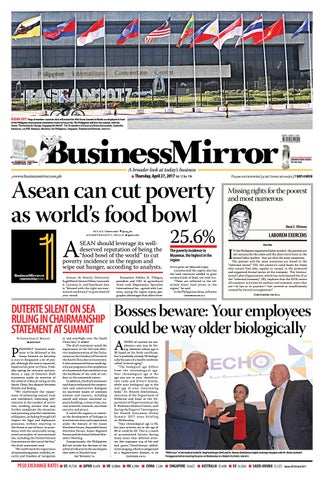
asean 2017 Flags of member-countries that will attend the 30th Asean Summit in Manila are displayed in front of the Philippine International Convention Center in Pasay City. The Philippines will host the summit, with the theme “Partnering for Change, Engaging the World”. The 10 members of Asean are Brunei Darussalam, Cambodia, Indonesia, Lao PDR, Malaysia, Myanmar, the Philippines, Singapore, Thailand and Vietnam. nonie reyes
media partner of the year
United nations
2015 environmental Media Award leadership award 2008
BusinessMirror A broader look at today’s business
www.businessmirror.com.ph
Thursday, April 27, 2017 Vol. 12 No. 196
Asean can cut poverty as world’s food bowl 25.6% A n
Ateneo de Manila University EagleWatch Senior Fellow Leonardo A. Lanzona Jr. said Southeast Asia is “blessed with the right environmental conditions” to grow food all year round.
DUTERTE SILENT ON SEA RULING IN CHAIRMANSHIP STATEMENT AT SUMMIT By Elijah Felice E. Rosales @alyasjah
P
resident Duterte’s statement to be delivered at the Asean Summit on Saturday is sure to disappoint a lot of people, although the tone is expected, based on his pivot to China. Probably opting for restraint and prudence, a copy of Duterte’s draft statement made no mention of the arbitral tribunal ruling on the South China Sea dispute between Manila and Beijing. “We reaffirmed the importance of enhancing mutual trust and confidence; exercising selfrestraint in the conduct of activities; avoiding actions that may further complicate the situation; and pursuing peaceful resolution of disputes, including through full respect for legal and diplomatic processes, without resorting to the threat or use of force, in accordance with the universally recognized principles of international law, including the United Nations Convention on the Law of the Sea,” the draft statement read. “We reaffirmed the importance of maintaining peace, stability, security and freedom of navigation
in and overflight over the South China Sea,” it added. The draft statement noted the importance of the full and effective implementation of the Declaration on the Conduct of Parties in the South China Sea in its entirety. It also announced Asean made significant progress in the completion of a framework that would serve as the backbone of the code of conduct in the contested waters. In addition, the draft statement said Asean welcomed the cooperation and constructive dialogues on maritime issues of common interest and concern, including search and rescue, maritime capacity building, crimes at sea, marine scientific research, maritime security and piracy. It noted the urgency to continue the development of linkages in maritime security and cooperation under the domain of the Asean Maritime Forum, Expanded Asean Maritime Forum, Asean Regional Forum and the Asean Defense Ministers’ Meeting. Conspicuously, the Philippines did not invoke the decision of the arbitral tribunal on the sea dispute that went to Manila’s way. See “Duterte,” A2
PESO exchange rates n US 49.7130
Economist Pablito M. Villegas, president and CEO of agricultural think tank Meganomics Specialist International Inc., agreed with Lanzona, saying the region enjoys geographic advantages that allow farm-
The poverty incidence in Myanmar, the highest in the region
ers to grow on-demand crops. Lanzona said the region also has the land resources needed to grow various kinds of food, not only rice. “These are reflected in the relatively lower food prices in the region,” he said. In the Philippines alone, inflation Continued on A12
business news source of the year
P25.00 nationwide |4 sections 26 pages | 7 days a week
Missing rights for the poorest and most numerous
Rene E. Ofreneo
By Cai U. Ordinario @cuo_bm & Jasper Emmanuel Y. Arcalas @jearcalas
SEAN should leverage its welldeserved reputation of being the “food bowl of the world” to cut poverty incidence in the region and wipe out hunger, according to analysts.
2016 ejap journalism awards
laborem exercens
I
Part One
n the Philippine segmented labor market, the poorest are not necessarily the endos and the short-term hires in the formal labor market. Nor are they the most numerous. The poorest and the most numerous are found in the “informal sector” (IS), the country’s catch basin for those who cannot find jobs, regular or casual, in the protected and organized formal sector of the economy. The International Labor Organization, which has rechristened the IS as the “informal economy” (IE), explains that the IS/IE covers all economic activities by workers and economic units that are—in law or in practice—“not covered or insufficiently covered by formal arrangements”. Continued on A11
Bosses beware: Your employees could be way older biologically A
word of caution for employers—you may be hiring someone whose age is 30 based on his birth certificate, but is probably already 50 biologically because of a health condition called “arterial aging”. “ The biological age differs f rom t he c h ronolog ic a l age. Your chronological age is the age you see in your identification cards and driver’s license, while your biological age is the rea l age of your functioning body,” Dr. Reuven Zimlichman, chairman of the Department of Medicine and head of the Department of Hypertension at the E. Wolfston Medical Center, said during the Experts’ Convergence for Hea lt h Outcomes (Ec ho) Su m m it 2017 ne w s br ief i ng on Wednesday. “Your chronological age is 60, but your arteries are in the age of 80 or could be 40. This is a result of accumulated factors during many years that affected arteries, like improper way of life and bad genes,”Zimlichman added. Arterial aging, which is categorized as a degenerative disease, is an Continued on A2
“Rock stars” of the medical world Dr. Siegfried Kasper (left) and Dr. Reuven Zimlichman (right) exchange thoughts with Dr. Maria Caridad P. Purugganan before meeting the press on Wednesday at a Makati City hotel. nonie reyes
n japan 0.4476 n UK 63.8066 n HK 6.3906 n CHINA 7.2204 n singapore 35.6672 n australia 37.4438 n EU 54.3363 n SAUDI arabia 13.2572
Source: BSP (26 April 2017 )
A2 Thursday, April 27, 2017
BMReports BusinessMirror
www.businessmirror.com.ph
Bosses beware: Your employees could be way older biologically Continued from A1
i ne v it a ble he a lt h cond it ion wherein arteries and blood vessels undergo series of functional and structural changes that occur with age, according to Zimlichman. BioFemme Medical Director Dr. Caridad Purugganan said if one’s arteries are getting older at an unprecedented speed or time at a young age, the person could suffer from cardiovascular diseases, like hypertension, myocardial infarction, stroke and renal failure, among others. Zimlichman identified several factors that could catalyze the aging of one’s arteries and blood vessels: genetics, smoking, alcohol drinking, lack of physical activities, mental stress and unhealthy diet. With this, Zimlichman said the government and private companies should be wary of the overall health conditions of their employees, particularly the individual’s biological age. “It has to be supported by the government, and the government must define a budget for it and a place where they would start. You cannot just start with the 100 million population, you have to start somewhere, say in a
specific company or work place,” Zimlichman said. “It’s been done by many companies; it’s been done all over the world, in many places, and it should be done everywhere. If you take care and examine the population in a specific company, then you will benefit because it’s cheaper to prevent a disease than treating it,” Zimlichman added.Zimlichman said the kind of work and environment that one belongs could also affect the rate that a certain person’s arteries age. “Farmers, for example, live a very different way of life, which has less stress and more physical activity, which makes their biological age younger than their chronological age, unlike those living in the cities,” he said. Zimlichman, who also serves as the director of the Brunner Cardiovascular Research Institute at TelAviv University, said companies should incorporate arterial-age testing in the annual medical checkup of their employees. Zimlichman said there are already available equipment and methods to determine the age of arteries. An equipment could cost from $1,500 to $50,000, depending on the needed information. “Because with this equipment
we can evaluate and monitor the status of the arteries. The status of arteries is determined by high lipids, high blood pressure, high cholesterol,” he said. “Because to technology is improving it would become cheaper in the future.” Unlike chronological age, Zimlichman said arterial aging, or the biological age, could be reversed through proper lifestyle check, balanced diet and medications. “Many people do not know these, but biological age can be made younger if somebody starts physical training, changes diet, takes medicines and normalizes many factors that were not in normal level before,” Zimlichman said. “Change what we eat, change the activity we do, change unhealthy things, like lifestyle, and change is whatever you define to be very difficult. Yes, you will add number to your chronological age but you will lower your biological age.” Citing data from the World Health Organization, Purugganan said between 2000 and 2050 the number of people aged 60 and above was expected to double; meaning by 2050, more than one in five people would be aged 60 or older. “Increasing life expectancy is good, but it depends on where you are. If you are in a develop-
ing country, it poses economic challenges,” Purugganan said. “There is a medical need to address chronic, degenerative diseases and improve quality of life. There’s no point in extending life expectancy if the quality of life is poor—it’s also important to improve the quality of life.” Chronic degenerative diseases, she added, are the most common and costly in terms of treatment, but the most preventable of all health problems. “Humans are like machines, there’s wear and tear.” “The body does not know its chronological age, it only knows its biological or functional age. You could be 60 years old but if you have a good diet then you will have a body of a 40-year-old and you might be 25 years old chronologically but your body is of that a 50-year-old,” she added. Dr. Siegfried Kasper, professor and chairman of the Medical University of Vienna Department of Psychiatry and Psychotheraphy, said the government should also focus on the growing case of depression, as this remains underreported, untreated and undiagnosed in most parts of the world. Kasper and Zimlichman are in the country to give lectures to at least 1,000 Filipinos doctors at the
ECHO Summit 2017 on April 27 at the Marriott Hotel. Kasper will share his knowledge on how diabetes and cardio metabolic syndromes lead to complicating factors, particularly mental disorders, like depression and anxiety, among diagnosed patients. Meanwhile, Zimlichman will focus on how to address arterial aging. Also with them are Dr. Rod Baber, Clinical professor of Obstetrics and Gynaecology at Sydney Medical school, and Dr. Paresh Dandona, a distinguished professor at the University of Buffalo and founder of the Diabetes-Endocrinology Center of Western New York. Baber will shed light on the importance of building up one’s bone mass, which defines the healthiness of a person’s bones, to prevent early brittleness of bone structure leading to osteoporosis. Meanwhile, Dandona will lecture on the latest breakthroughs on the effects of testosteronereplacement treatment in relation to people diagnosed with diabetes. T he ECHO Summit, which started in 2015, is part of Unilab’s efforts to support Filipino doctors and provide them a venue for excellent continuing medical education. Jasper Emmanuel Y. Arcalas
Duterte. . .
Continued from A1
The United Nations court decided in favor of the Philippines last July. The arbitral tribunal said Manila has exclusive sovereign rights over the South China Sea, invalidating China’s controversial “nine-dashed line”. For economist Emmanuel A. Leyco of the Asian Institute of Management, the Asean will go the right way if it chooses to resolve the sea row in a diplomatic manner. “Let’s be realistic, going into conflict with China will not benefit the Asean states one way or the other. We should know well how that will end,” Leyco told the BusinessM irror. “If this would be Duterte’s chairmanship statement for the region, then this is the most realistic statement, so far, of an Asean leader,” he added. He argued that the Asean is not yet politically united as a region, like the European Union, to assert with confidence its legal claims in the global arena. “Let’s remember the Asean is just an economic consultative body, and the nature of its alliance is not expected to be assertive, if not aggressive,” Leyco said. “We should further pursue diplomatic platforms to resolve the South China Sea dispute. Let’s be diplomatic rather than assertive, without having to surrender our right to free access to the navigation and exploration of the contested waters,” he added.
The Nation BusinessMirror
news@businessmirror.com.ph
Drilon tells warring Duterte Cabinet men: Cool it, relax
F
EUDING Duterte administration officials were told to stop the brewing Cabinet infighting and “get their act together” for the good of the country. This was the advice made on Wednesday by Senate Minority Leader Franklin M. Drilon amid reports on raging feuds pitting ranking members of the official family, citing reported rows involving Executive Secretary Salvador C. Medialdea and Environment Secretary-designate Regina Paz L. Lopez, and an alleged “power struggle” between Cabinet Secretary Leoncio B. Evasco Jr. and Special Assistant to the President Christopher Lawrence T. Go. Drilon also mentioned reported conflicts between Finance Secretary Carlos G. Dominguez III and Lopez, and that of Agriculture Secretary Manuel F. Piñol and Presidential Communications Secretary Martin M. Andanar. He noted “this was also the case of former Interior Secretary Ismael D. Sueño and three undersecretaries in the Department of the Interior and Local Government.” In a statement, Drilon lamented, “now more than ever, we need the government to give its undivided attention to issues that Filipinos actually care about—better basic services, improved disposition of justice and the rule of law, and peace and order—not
word wars between bureaucrats.” He suggested that brawling Duterte Cabinet officials quit fighting and settle their feuds behind closed door. “I urge the members of the Cabinet to confine their disagreements among themselves and resolve their disputes through meetings away from the public’s eye,” Drilon said. He added: “It is for the good of the country if they will stop bickering and criticizing each other in public, so that they can focus on the country’s most pressing concerns and challenges, as well as on the hosting of the Asean Summit 2017.” Drilon, who served as former President Corazon C. Aquino’s executive secretary, pointed out, “publicized clashes between Cabinet members and other Malacañang officials needlessly distract and hamper the government’s ability to address real issues directly affecting the lives of Filipinos.” He noted Palace officials need to “project the national government as a unified, stable and efficient institution of democracy”. He asserted, “The President must fulfill his leadership role, and that will largely rely on the government being focused and free from the squabbling that we have been seeing in the past few weeks.” Butch Fernandez
Senators to defy Duterte’s wish for death-penalty law
S
By Butch Fernandez
@butchfBM
ENATORS are set to defy President Duterte’s marching orders for Congress to revive the death penalty that was abolished in 2006 during the term of former President Gloria Macapagal-Arroyo.
Senate Minority Leader Franklin M. Drilon disclosed on Wednesday a recent head count of senators indicated that the death-penalty bill is “already dead in the Senate”. He noted that, with 13 senators signifying readiness to vote down the proposal restoring death penalty, the bill is facing imminent defeat. “By my own estimate, there are at
least 13 senators who will block the passage of the death-penalty bill, including the six-member minority group and seven from the majority block,” Drilon said. Drilon declared the Palace-endorsed death-penalty bill “is dead and the chances of resurrecting it before we even bring it to a vote are very slim, if not zero, at least in this Congress”.
Drilon added that, apart from him, other senators set to vote against restoring death penalty include: Francis N. Pangilinan, Leila M. de Lima, Benigno Paolo Aquino, Antonio Trillanes IV and Ana Theresia Hontiveros-Baraquel. Drilon said Senate President Pro Tempore Ralph G. Recto also signified intention to vote against the controversial measure. He, however, did not name the six other senators who have signified inclination to vote down the death-
penalty bill, even as he affirmed “we are ready to lead the fight against the death-penalty bill. We believe that a death-penalty law was not and will never be an effective deterrence against crime”. On the other hand, he counted only five senators openly supporting the death-penalty revival, including Senate Majority Leader Vicente C. Sotto III, Sen. Emmanuel D. Pacquiao, Sen. Joseph Victor G. Ejercito, Sen. Sherwin T. Gatchalian and Sen. Cynthia A. Villar.
By my own estimate, there are at least 13 senators who will block the passage of the death-penalty bill, including the six-member minority group and seven from the majority block.”—Drilon
More Abu bandits, members of lawless groups interested in surrendering–military
Troops start clearing operations, find bodies of 3 Maute fatalities
A
A
RMY troops sent to track down Maute Group bandits on Wednesday started clear up operations in Piagao, Lanao del Sur, where a series of gun battles occurred between the armed men and government forces. Brig. Gen. Rolando Joselito D. Bautista, commander of the Army’s First Infantry “Tabak” Division, earier ordered a systematic and extensive visual tracking by troops of the entire area to determine if any other cadavers, arms, ammunition, homemade bombs and the like were left behind by fleeing Maute bandits. Bautista also ordered the troops to turn over any cadaver found to the Piagapo police for forensic examination in order to determine their nationalities and identities. At least four of the reported 37 dead Maute bandits were reportedly foreigners—three Indonesians and one Malaysian—with ties to the Islamic State of Iraq and the Levant. At 8 p.m. on Monday, three unidentified men believed to be Maute bandits were seen in the vicinity of Tapucan, Piagapo, after an encounter with troops from the 103rd Infantry Brigade in Barangay Gacal also in Piagapo. A pursuit operation by the troops resulted in firefight that lasted for five minutes prompted the bandits to withdraw toward the northwest. There were no casualties on the government side, while no data on the side of the enemy was obtained. However, an M16 rifle bearing serial RP 250280 was recovered on the scene. The rifle was manufactured by a local company during the Marcos administration and was issued to the government’s armed services. Bautista advised the troops to be alert, remain patient and relentlessly pursue the bandits to prevent them from sowing further mayhem. On Tuesday afternoon the troops recovered two unidentified cadavers in Sitio Pagalongan, Barangay Gacap, Piagapo, while scouring the encampment abandoned by the Maute bandits. Meanwhile, efforts are ongoing to detect foreigners or Arab-looking personalities out to support bandit groups in Lanao del Sur and other parts of the country. Nonie Reyes with PNA
Editor: Dionisio L. Pelayo • Thursday, April 27, 2017 A3
BRIG. Gen. Rolando Joselito Bautista, commander of the Army’s First Infantry “Tabak” Division, talks with the troops who seized the encampment the Maute Group in Piagapo Complex, Lanao del Sur.
SIDE from Abu Sayyaf leader Radullan Sahiron, there are other lawless personalities in Sulu who have expressed willingness to surface and surrender to authorities. This was bared on Tuesday by Armed Forces Chief of Staff Gen. Eduardo Año, who said surrender feelers were actually sent by the bandit leader. “According to [Western Mindanao Command Chief] Lt. Gen. Carlito Galvez and Joint Task Force Sulu Commander Brig. Gen. Cirilito Sobejana, there are some personalities in Sulu who are reaching out and saying Sahiron wants to surrender because of health reasons, but as of now, there are still no talks [on the actual surrender of the bandit chief], only feelers,” he added. Aside from Sahiron, Año believes there are still a lot
PET sets preliminary conference on Marcos protest By Joel R. San Juan
T
@jrsanjuan1573
HE Supreme Court (SC), sitting as the Presidential Electoral Tribunal (PET) has set the preliminary conference on the electoral protest of former Sen. Ferdinand Marcos Jr. against Vice President Maria Leonor G. Robredo in June. SC Spokesman Theodore Te said the justices made their decision to grant Marcos’s request for the setting of the preliminary conference during their en banc session in Baguio City on Tuesday. “The PET granted protestant’s [Marcos’s] motion for the setting of the preliminary conference and has set this case for preliminary conference on June 21, 2017, at 2 in the afternoon, without prejudice to the Tribunal’s resolution of all remaining pending incidents,” Te said. However, the Tribunal in the same resolution also said it would conduct the preliminary conference on Robredo’s counterprotest at the same time. “Considering, however, that Rule 3 of the 2010 PET Rules mandate the rules are to be liberally construed to achieve a just, expeditious and inexpensive determination and disposition of every contest before the tribunal, the PET has deemed it proper to conduct the preliminary conference of both protests jointly, and the issues raised during the preliminary conference should include issues of the protest and the counterprotest,” the
resolution added. In line with this, the Court directed both camps to file their preliminary conference briefs with the PET and serve the same on the adverse party at least five days before the date of the preliminary conference. The PET said the preliminary conference briefs should contain the following: The possibility of obtaining stipulations or admissions of facts and documents to avoid unnecessary proof, the simplification of the issues, the limitation of the number of witnesses and the most expeditious manner for the retrieval of ballot boxes containing the ballots, elections returns, certificates of canvass and other election documents involved in the election protest. Marcos filed an election protest against Robredo in June 2016, contesting 39,221 clustered precincts, which are composed of 132,446 established precincts. Robredo, meanwhile, filed a counterprotest, questioning 8,042 clustered precincts, which are composed of 31,278 established precincts. On Tuesday the PET directed Robredo to pay the total cash deposit of P15.44 million for her counter protest covering 31,278 clustered precincts. Te said the Tribunal denied Robredo’s motion for reconsideration of its resolution issued on March 21. The PET ordered Robredo to pay the cash deposit within a nonextendible period of five
days from notice of resolution. “The PET denied Robredo’s motion for reconsideration of the resolution dated March 21, and directed protestee Robredo to pay the cash deposit as stated in the said resolution within a non-extendible period of five days from notice of resolution,” The PET, on the other hand, deferred action on the omnibus motion to dismiss counter-protest filed by Marcos, until Robredo complies with the directive to pay the deposit. In the March 21 resolution, Robredo was ordered to pay P8 million for the first installment and P7.43 million for the second, for a total of P15.44 million. Marcos on the other hand was directed to pay P66.02 million. He paid P36.02 million as his first installment with the second amounting to P30 million to be paid on or before July 14 this year. It will be recalled that Marcos filed an election protest against Robredo in June 2016, contesting 39,221 clustered precincts which are composed of 132,446 established precincts. Robredo, meanwhile, filed a counterprotest, questioning 8,042 clustered precincts which are composed of 31,278 established precincts. Marcos has assailed Robredo’s plea and asked the PET to dismiss her counter-protest since she failed to settle the first installment as directed by the Tribunal.
of lawless elements, and Abu Sayyaf bandits in Sulu are interested in giving themselves up to the authorities, adding that government officials involved in the campaign against bandits only need to reach the right people. “We believe there are also many others who may just want [to surrender], [we only need to reach the right people], As you know, there are lot of Abu Sayyaf members surrendering in Tawi-Tawi, Sulu and Basilan. They are seeing now that their fight against the government is useless, the long arm of the law will eventually catch up with them,” he said. Año called on the bandits that, “now is the proper time for Abu Sayyaf members, tired of the fight, to surrender, as the military will not stop its campaign against them until they are all eradicated”. PNA
BI deports 55 Chinese nabbed at Bataan free port By Recto L. Mercene
T
@rectomercene
HE office of the Bureau of Immigration (BI) at the Ninoy Aquino International deported on Tuesday night 55 Chinese who were arrested on April 18 at the Mariveles, Bataan, free port for various “economic crimes”. The 55 were arrested by the bureau’s Fugitive Search Unit (FSU). At least 38 were reportedly found involved in illegal online gambling inside the Bataan free port zone. FSU agent Muhammad Plawan said the 55 Chinese were deported to Beijing for not having valid immigration documents as their embassy canceled their passports. “They were taken to the BI detention center in Taguig City. All their passports have already been cancelled by the Chinese Embassy,” Muhammad said. Immigration agents arrested 17 other Chinese on Tuesday. The raid was conducted after the bureau received information that the foreigners were operating illegal online gambling at the free port zone, while the rest were arrested for other economic crimes, according to a Chinese intelligence agent who escorted them back to Guangzhou. Last year the BI has arrested 1,316 Chinese working in an illegal online gambling facility inside the Fontana Leisure Park in Clark Field, Pampanga.
Economy
A4 Thursday, April 27, 2017 • Editors: Vittorio V. Vitug and Max V. de Leon
BusinessMirror
Mining, steel industry to propel GDP growth beyond 7%, DOST exec says
T
he country will achieve growth rates surpassing the 7-percent mark by unleashing the huge potential of mining, and the revitalization of the steel industry, according to a ranking executive of the Department of Science and Technology (DOST).
Dr. C.P. David, DOST executive director of the Philippine Council for Industr y, Energ y and Emerging Technology Research and Development (DOSTPCIEER D), and concur rent ly, Stratbase ADR Institute (ADRi) trustee, said: “Inconsistent policies and the lack of a long-term de ve lopment agend a for t he country’s natural resources has delayed the efficient harnessing of an estimated $1.4 trillion in mineral reserves, hence we see the urgent need to partner, with the mining industry in a series of research projects to develop a long-term national road map that will integrate the development of mining, steel and other downstream industries,” David said. T he strategic role and potential of the mining industry issues blocking the revitaliza-
tion of vital industries, such as steel and manufacturing, were highlighted during the signing of a memorandum of agreement between the DOST-PCIEERD and the Chamber of Mines of the Philippines. The partnership was forged based on inputs from the mini n g i n d u s t r y, a c a d e m e a n d env ironmenta l advocates t h roug h con su lt at ion s organized by the Stratbase ADR i in partnership with the Philippine Bu si ness for Env i ron me nt a l Stewardship (PBEST). Mining is a recognized industry in the Philippines engaged in the extraction of natural resources, which, if done properly, has a vast potential in contributing to the country’s economic development. “Understanding the complex issues of mining while balancing the environmental protec-
tion and economic development must be based on sound scientific study and data. We need to tap the expertise and resources of the private sector to work closely with government to ensure that the government comes up with right policies,” said Ysan Castillo, secretary-general of PBEST and Stratbase ADRi fellow. Castillo said the objective of this partnership is to utilize the research and development arm of the government and the available talent and resources
of the mining industr y in the development of an integrated long-term strategic road map for t he ef f ic ient h a r nessi ng of the countr y’s rich natural resources in the context of responsible mining and environmental stewardship. Value adding in nickel laterite exports, black sand mining to revitalize the steel industry, waste management and environmental technologies are among the initial targets in a series of research partnerships.
Inconsistent policies and the lack of a long-term development agenda for the country’s natural resources has delayed the efficient harnessing of an estimated $1.4 trillion in mineral reserves, hence, we see the urgent need to partner with the mining industry in a series of research projects to develop a long-term national road map that will integrate the development of mining, steel and other downstream industries.”—David
news@businessmirror.com.ph
Cigarette makers told: Pay right amount of taxes to government
T
he Philippine Tobacco Growers Association (PTGA) reiterated on Wednesday the interest of tobacco farmers in the country will be best served if cigarette manufacturers that process their produce into finished products pay the right amount of duties and taxes. “The best way for the cigarette manufacturers to support the welfare of the country’s tobacco farmers is to pay the correct taxes to the government,” PTGA President Saturnino Distor asserted. On Tuesday Finance Secretary Carlos G. Dominguez III pointed out the Bureau of Internal Revenue (BIR) has acted with total responsibility in response to Mighty Corp.’s statement that the bureau’s pronouncements on the cancellation of its license to operate due to tax-evasion charges will impact its employees and tobacco farmers the most. Mighty Corp. also on Monday asked the BIR to reconsider its statement on the cancellation of its license over tax-evasion charges, as it will affect around 7,000 of its employees and 55,000 tobacco farmers. Mighty Corp. Executive Vice President Oscar Barrientos pointed out the bureau should “act more responsibly in making statements, and take into consideration the repercussions of a cancellation of the license of the company”. “Under the law, 15 percent of to-
tal revenues collected from excise taxes go to infrastructure projects and livelihood programs that help improve the lives of tobacco farmers and tobacco farming regions across the country,” Distor said. The finance chief pointed out citizens are duty bound to pay the right amount of taxes and duties, and that failure to do so may consequently affect employees and its stakeholders. “Really?! Goddamn it. Really, somebody doesn’t pay his taxes? Let’s say I don’t pay my tax, and say hey, don’t put me in jail, my maid will lose her job’, come on! Why don’t people think about those things. That is not your duty, that is your obligation to pay taxes. Why don’t you think about those things? Who is the one putting them out of a job? Their employees are at risk, of course, but who put them at risk?” Dominguez said. Earlier, the BIR has filed a P9.6billion tax-evasion case against the controversial tobacco firm at the Department of Justice (DOJ) after five of its warehouses in the Pampanga area were found to be housing cigarette packs bearing fake tax stamps. “ It i s you r res pon sibi l it y. And you have a responsibility to your stakeholders, you are a private company, and one of your obligations is to make sure that your stakeholders are safe,” Dominguez said. Rea Cu
BBB program funds Budget Secretary Benjamin E. Diokno reveals the various means on how the government can source funds for the different infrastructure projects under the Build! Build! Build! program during the second edition of the Dutertenomics Forum at Conrad Manila Hotel in Pasay City on Tuesday. Presidential Photo through PNA
DOLE: No work, no pay for workers on April 28
T
he Department of Labor and Employment said the “no work, no pay” principle will apply on Friday, which was declared a special nonworking holiday by President Duterte in connection with the country’s hosting of the 30th Asean leader’s summit this week. “If the employee did not work, the no work, no pay principle shall apply, unless there is favorable company policy, practice or collective bargaining agreement granting payment on a special day,” Undersecretary Claro Arellano said during a news conference for the Labor Day celebration on May 1. On the other hand, he noted that workers who will be reporting for work on Friday will receive an additional 30 percent plus their daily rate on the first eight hours of work
for that day. The other pay rules was included in the Labor Advisory 4, Series of 2017, or the Payment of Wages for the Special Nonworking Day on April 28, 2017, which are as follows: For work done in excess of eight hours (overtime work), he or she shall be paid an additional 30 percent of his or her hourly rate on said day (Hourly rate of the basic daily wage x 130 percent x number of hours worked); for work done during a special day that also falls on his or her rest day, he or she shall be paid an additional 50 percent of his or her daily rate on the first eight hours of work [(Daily rate x 150 percent) + COLA]; and for work done in excess of eight hours (overtime work) during a special day that also falls on his or her rest day, he or she
shall be paid an additional 30 percent of his or her hourly rate on said day (Hourly rate of the basic daily wage x 150 percent x 130 percent x number of hours worked). For his part, Labor Secretary Silvestre H. Bello III said the pay rules advisory was issued “for the guidance and compliance of both workers and employers”. He added the issuance of the advisory was pursuant to Proclamation 197 issued by Duterte on August 16, 2016, through Executive Secretary Salvador C. Medialdea on April 25, proclaiming Friday a special nonworking day. The Asean meeting, which is being held at the Philippine International Convention Center in Pasay City, started on Wednesday and will end on Saturday. PNA
Asean
BusinessMirror Editor: Max V. de Leon • Thursday, April 27, 2017 A5
www.businessmirror.com.ph
Asean leaders likely to go soft $718M on sea feud in Manila summit
Singapore sets innovation fund to boost economy
S
ingapore is creating a S$1billion ($718-million) fund to help innovative companies develop their businesses and expand overseas, part of the city-state’s drive to boost economic growth. The Makara Innovation Fund—a collaboration between the Intellectual Property Office of Singapore (IPOS) and local private equity firm Makara Capital Partners Pte. Ltd.— will invest S$30 million to S$150 million each in 10 to 15 companies with globally competitive technologies over the next eight years, IPOS said in a briefing on Wednesday. The measures are part of a strategy outlined in February by the Committee on the Future Economy, a government-led panel that seeks to chart Singapore’s growth path over coming years. The committee recommended that IPOS take a stronger role in driving innovation. “IPOS will build up from a regulator into an innovation agency,” IPOS CEO Daren Tang said. “This is a concrete and tangible way to show that Singapore can be a hub for intellectual-property [IP] commercialization.” Singapore ranked sixth in Bloomberg’s 2017 innovation index, ahead
The fund that Singaporean firms can tap for innovation and expansion overseas
of the US and Israel. The city-state has the third-largest number of patents granted per 1 million inhabitants, trailing only South Korea and Japan, according to Bloomberg estimates. Singapore had 10,814 applications for patents in 2015, the last year for which there is available data, the largest number of any Southeast Asian nation, according to the World Intellectual Property Organization. IPOS plans to double the number of IP experts in Singapore to 1,000 over the next five years and will train 4,000 people a year, Tang said. The agency will also assist companies in using IP as collateral for financing. These initiatives, he said, should add about S$1.5 billion in value to the city-state’s economy over the next five years. Bloomberg News
Thai government okays purchase of $393-M submarine from China
T
hailand’s government has approved the purchase of its first submarine in more than half a century, the country’s top defense official said on Tuesday, calling the $393-million deal with China necessary and a bargain. Defense Minister Prawit Wongsuwan said the navy’s purchase of a Yuan Class S26T submarine would be conducted transparently, responding to concerns about corruption. He said the vessel would be delivered in five to six years. Thailand’s navy has been seeking to buy submarines for almost a decade, having decommissioned its last one in 1951. The military government had said it also considered buying the vessels from Germany or South Korea, but last year announced plans to buy three from China at a total price of around $1 billion. The purchase won the final goahead only after Thailand’s military seized power in a May 2014 coup, even though a $15-million submarine base and training center was inaugurated shortly afterward, in July 2014. The purchase of such a major weapons system from China has political, as well as defense ramifications because the ruling junta has sought closer relations with China to balance traditional ties with the United States, which has been critical of Thailand ’s turn away from democracy. It will take about 11 years for all three submarines to be acquired, said Prawit, who is also deputy prime minister. It was not clear,
The submarine we are buying is not expensive and it will be very useful in the Andaman Sea in a 200-mile radius area that we’ve never explored,” —Prawit however, whether agreements have been finalized for the purchase of the second and third submarines. Government Spokesman Sansern Kaewkumnerd on Monday said details of further purchases were the navy’s business and would not be publicly announced as they involve security matters. Sansern said there was nothing shady about the deal, which drew attention because it was approved at the previous week’s Cabinet meeting without being announced. “The submarine we are buying is not expensive and it will be very useful in the Andaman Sea in a 200-mile radius area that we’ve never explored,” Prawit said. Prime Minister Prayuth Chanocha said last month that China had offered the cheapest deal, amounting to a “buy-two, getthree” bargain. AP
IN this April 21 photo, Defense Secretary Delfin N. Lorenzana (third from right), Armed Forces Chief Gen. Eduardo M. Año (fourth from right) and other officials tour the Philippine-claimed Thitu Island off the disputed South China Sea in western Philippines. AP
S
outheast Asian leaders will express serious concern over territorial disputes in the South China Sea when they gather in an annual summit in Manila this week, but a draft of a communiqué to be issued at the end of the meeting indicates they will adopt subdued language on a conflict that has increasingly alarmed Asian and Western governments. President Duterte, who has warmed once-frosty relations with China, hosts his counterparts in the Asean on Saturday. The sum-
mits have spotlighted the escalating conflicts involving four Asean member-states, Taiwan and China in recent years.
A draft of the “chairman’s statement” to be issued at the end of the summit obtained on Tuesday by The Associated Press, however, does not mention an arbitration decision last year that invalidated China’s claims to the strategic waterway and expresses serious concerns only “by some leaders” over the “escalation of activities in the area”. “We shared the serious concerns expressed by some leaders over recent developments and escalation of activities in the area, which may further raise tensions and erode trust and confidence in the region,” the draft statement said. The 20 -page draft devotes fewer paragraphs and repeats language of concern already used in past Asean communiqués. The statement issued by Laos last year, when it led the 10-nation regional
bloc, had a longer discussion of the territorial rifts and expressed concerns over “land reclamations”, a reference to China’s newly built islands in the disputed waters, although it did not mention the Asian superpower by name. Laos is an ally of China. China has steadfastly opposed the raising in international forums of its territorial disputes with five governments, including Asean members Brunei Darussalam, Malaysia, the Philippines and Vietnam. It prefers one-on-one negotiations with each of its rival claimants, in part to shut out the US, which it has accused of meddling in an Asian issue. Washington has remained one of the most vocal critics of China’s increasingly assertive actions in the disputed waters, including its construction of seven islands in the South China Sea’s hotly contested Spratly archipelago. The US Navy has continued patrols it says are aimed at ensuring freedom of navigation and overflight in one of the world’s busiest commercial sea lanes. Duterte, who took office last June, has moved to repair relations with China that have been strained by the territorial conflicts while taking a hostile stance toward his country’s treaty ally, the US, for criticizing his bloody crackdown on illegal drugs. He has set aside a July 12, 2016, international arbitration decision that declared China’s historic claims to virtually the entire South China Sea invalid under a 1982 maritime treaty, while seeking to revive trade ties and infrastructure financing from Beijing. Duterte said he would take up his country’s victory in the arbitration case at an unspecified time during his six-year term, a stance critics say may weaken the chances of Chinese compliance with the landmark ruling. AP
Watchdog says Asean must stand vs killings
A
n international humanrights watchdog is calling on Southeast Asian leaders to take a stand against the Philippines’s war on drugs that has left thousands dead under President Duterte, the host of this week’s regional summit. Amnesty International (AI) said leaders of the 10-member Asean must consider whether the killings amount to a serious breach of Asean’s charter, particularly its pledge to human rights. It said up to 9,000 people have been killed by the police or unknown armed persons since July 2016. Officials said not all deaths being reported are drug-related, while others were killed in legitimate police operations. “As the death toll mounts, so does evidence of the Philippines authorities’ role in the bloodshed,” said Champa Patel, Amnesty director for Southeast Asia and the Pacific. Patel said the Philippines’s chairing the Asean summit “is a scandal, and should prompt the government to make independent and effective investigations into unlawful killings an immediate priority”. In an open letter to Justice Secretary Vitaliano N. Aguirre II, AI also called on authorities to conduct a prompt and impartial investigation into all drug-related killings, and to press criminal charges against suspects, regardless of rank or status. Presidential Spokesman Ernesto Abella said “the so-called extrajudi-
Protesters wearing masks of (from left) Japanese Prime Minister Shinzo Abe, US President Donald J. Trump and Chinese President Xi Jinping link arms to protest their alleged control over the 10-member Asean, as they announce their protest plans for this weekend’s Asean Leaders’ Summit on Wednesday in Manila. AP
cial killings are not state-sanction or state-sponsored”. He said that the police conducting legitimate operations are required to follow protocols and those who breach them are made to answer before the law.
Abella said the Senate had conducted an independent investigation into the charges hurled against Duterte by a self-confessed assassin, and senators found no proof of state-sponsored killings.
On Monday a Filipino lawyer presented documents to the International Criminal Court, which he said contain evidence of Duterte’s alleged involvement in extrajudicial killings. AP
TheBroad
Business
A6 Thursday, April 27, 2017
As trade barriers teem, P By Cai U. Ordinario, Catherine N. Pillas & Jasper Emmanuel Y. Arcalas
A
LL the world’s a market and every country merely merchants. Trade barriers abound, too, and the Philippines is both victim and villain. Many times, shipments by merchants of Manila have failed to enter new markets. But other times, too, the country has also prevented goods, even from peers in the Asean, from entering the archipelago. Experts, however, consider this the natural order of things. Some of them point to tariff, nontariff measures (NTMs) and nontariff barriers (NTBs) as elements playing in this order. NTMs are based on science, such as sanitary and phytosanitary (SPS) measures that are put in place to prevent disease and infestation, and protect the country’s livestock and flora and fauna. But, as trade experts said, these NTMs can quickly become hurdles to trade known as NTBs. “NTMs cover a broad area, and a subset of that is NTBs,” Jayant Menon of the Asian Development Bank (ADB) told the BusinessMirror. “If these measures are abused and raise trade costs, then they become NTBs.” The Philippine Institute for Development Studies (Pids) distinguishes between NTMs and NTBs in goods trade. NTBs do not necessarily imply illegitimate measures nor are intended to have unnecessary restrictive implications on trade, as the World Trade Organization even allows some form of NTMs in some circumstances. Not all NTMs are seen as “trade discriminatory” or “trade restrictive”, the PIDS pointed out. According to the government think tank, some NTMs even encourage trade as it bolsters consumer protection and strengthens certification. NTMs that are implemented with protectionist aims, however, are considered NTBs. A PIDS study noted that, while tariffs have been near zero in Asean, a rising trend has been noted in the use of NTMs. “To be sure, a majority of these NTMs are intended for justified reasons, such as sanitation and health, environment, security and consumer protection,” read the study, titled “Review of IntraAsean Nontariff Measures on Trade in Goods”. “However, there are also legitimate concerns that these NTMs are effectively mainly NTBs, which are more protectionists in nature,” it added.
Trade victim
IN March 2017 the International Trade Center (ITC) surveyed 1,149 firms by phone and 305 of them were interviewed face-to-face. The results showed that 69 percent of around 750 NTMs considered by Philippine exporters as obstacles to trade are linked to the regulations set by the country’s trade partners. Around 29 percent are linked to conformity assessments, such as product certification and testing, while 27 percent pertain to technical requirements, such as fumigation and labeling. Certification and testing of products are hampered by the lack of facilities and, as such, are usually dependent on the accredited third-party entity. This
causes delays in shipments, additional costs and “excessive administrative burdens”. “These originate from partnercountries importing the goods, most commonly from the European Union [EU], for certification and testing, and the US, China and Asean for product certification, affecting processed and fresh-food products, furniture and handicrafts, and electronics products,” the report stated. Further, Filipino exporters who send complex products, such as electronics, encounter problems in dealing with original design manufacturer products. Philippine small and medium enterprises (SMEs) struggle with developing, testing and certifying that their “innovation is a significant roadblock to exporting homegrown products”. The ITC said that while the Department of Science and Technology’s (DOST) Electronic Product Development Center was created to address this issue, the facility remain “underutilized”. In terms of fumigation, this NTM is expensive but a “necessary evil” that exporters need to spend for. Exporters usually spend P5,000 to P10,000 per shipment of their products. There are also partner-countries, such as Australia, that require the use of their accredited fumigation companies, which often charge higher costs for their services. The study said that while labeling is subsidized or provided by clients, it is a problem because of the need to “develop, translate, produce and apply them,” which can be taxing on SMEs, particularly those exporting agriculture products. “Labeling and translation requirements for agri-foods exports to the US, the EU, the Middle East and Asean, as well as garments exports to Chinese Taipei, are a big concern,” the study stated. The study also said 24 percent are applied by the Philippines as export-related measures and mainly include clearance procedures, technical certifications and license permits. “Private standards are included in the survey results and comprise 7 percent of obstacles, even though they do not fit the standard definition of NTMs,” the study stated. Meanwhile, some 11 percent pertain to other burdensome regulations applied by the partner-countries, such as rules of origin (ROO). This refers to the need to certify that, indeed, a certain product is produced from a specific country. The study said Philippine garments and processed foods are particularly affected, especially when they are being exported to the EU, Japan, the US and Asean markets. Exporters, the study stated, encounter difficulties in complying with ROO documents, which cause delays and increases in shipment costs.
The ITC study stated that the Middle East, particularly Saudi Arabia, requires the certification and legalization of export-certification documents by the embassy. This sets back exporters by P4,000 per shipment. In order to cut their losses, some firms prefer to bite the bullet and pay bribes. Expediting the approval of ROO documents “demands informal payments” from exporters, the study noted.
Trade villain
THE ITC said the Philippines is not that innocent when it comes to imposing NTMs of its own. Burdensome NTMs in the Philippines
to imports are “skewed toward customs clearance procedures”. The study findings showed that 54 percent had to do with import/customs clearances and another 13 percent are focused on customs valuation. Both of these NTMs, the ITC said, are prone to bribe seeking. Import/customs permits, on average, takes three to four weeks to as long as three years to process, and “incurs many unnecessary penalties”. The ITC said there was one exporter they interviewed which had to pay a P100,000 worth penalty and waited two months before it obtained a permit. “Although it was intended to
curb smuggling and streamline the importing process by connecting all of the BIR’s [Bureau of Internal Revenue] internal departments together, it instead creates more red tape because each department now requires importers to submit additional requirements and previously unnecessary reports before the BIR approves the company for the certification,” the ITC said. In terms of customs valuations, the ITC found that many of the country’s importers complain that the Bureau of Customs (BOC) imposes arbitrary import tariffs on goods. There are also times when exporters from other countries are required to pay additional payments of
up to P2,000 to P3,000 per BOC inspector. The ITC added these inspectors come in pairs, or even in threes. The ITC said its staff interviewed a garments exporter who complained about the liquidation process for duty-free import of raw materials. The exporter lamented the process is “too tedious and involves too many documents, such as warehousing forms”. In terms of import permits, firms in the chemical industry experience the most difficulty. Data showed that ensuring imported chemicals are not part of the list of 41 highly regulated chemicals requires five to seven permits and security escorts.
derLook PHL plays victim, villain
sMirror
www.businessmirror.com.ph | Thursday, April 27, 2017
lem with the NTMs still lies on the lack of transparency. The Department of Trade and Industry (DTI) admitted as much when it said that NTMs are not readily available to the government, businessmen and the general public. Information about these measures, the DTI said, are “dispersed” across different offices and agencies. At best, businessmen and the general public can “mine data” in these agencies to create their own list. “In most instances, information may be available, but a lot of research and data mining would have to be undertaken to complete the whole list of regulations one has to comply with when trying to export,” the DTI said. “Regulations also change quite rapidly, and one has to be vigilant in monitoring these changes.”
Nontariff measures are based on science, such as sanitary and phytosanitary measures that are put in place to prevent disease and infestation and protect the country’s livestock and flora and fauna. But, as trade experts said, these measures can quickly become hurdles to trade known as nontariff barriers.
Skypixel | Dreamstime.com
Claims, assertion
“This regulation has been present for a long time, but has only been enforced and abused by certain agencies in recent years, with reports of astronomical informal payments,” the ITC said. Other NTMs imposed by the Philippines include “other entry” formalities, which comprise 13 percent; technical authorization, 9 percent; conformity assessment, 6 percent; and, other import measures, 5 percent. Technical authorizations are costly and tedious, since these are done on a per-shipment basis. This is because agencies, such as the BOC, Department of Agriculture, Department of Environment and
Natural Resources, and the Bureau of Fisheries and Aquatic Resources, require the notarization of supplier contracts from exporters. “Import clearance, other entry formalities and technical authorizations, as the most challenging NTMs by rank, involve all types of POs [procedural obstacles] led by delays, too much paperwork, red tape and informal payments,” the ITC said.
Classification
THE United Nations Conference on Trade and Development, together with the Economic Research Institute, launched in 2015 a project classifying and collecting the NTMs across Asean.
According to their database, NTMs most used by Asean are export-related measures, SPS and technical barriers to trade (TBT). Among these measures, the one that has been deemed as prone to become barriers by traders is the SPS. “Some countries in Asean, I won’t name them, are still practicing issuance of import licensing in protecting their commodities. Likewise, in fruits, for example, they have SPS policies that are not clear in most cases, and [those] serve as protection,” Donald G. Dee, honorary chairman of the Philippine Chamber of Commerce and Industry, said in an interview.
The stringent measures in the entry of goods in other Asean nations, coupled with the Philippines’s own, perceived lax entry requirements put the country’s agricultural produce on the losing end. “We’re more lax in fruit importation,” the businessman added. “We have to protect our fruit plantations and we’re trying to achieve some standards on this front, but we cannot achieve consensus.”
Transparency need
APART from the tedious process involved in meeting all the NTMs and the sometimes exorbitant costs they incur for both Philippine and foreign trader, the real prob-
TO promote transparency in NTMs, PIDS senior research fellow Erlinda M. Medalla and PIDS Project Development Officer Melalyn C. Mantaring recommended the creation of a comprehensive and updated database of the NTMs in the region and to establish a “robust mechanism” that will address the NTM issues, including harmonization of standards. They also said there is a need for capacity-building to help firms, especially SMEs, to comply with SPS and TBT measures. For exporters, they said the first step is awareness of the applicable SPS and TBTs. “The next is understanding how to comply with these requirements, and the third is where and how to proceed to comply. Capacity-building should, thus, include improvements, interesting laboratories and facilities, accreditation and certification,” the study read. “Initiatives in Asean for transparency allow us to deal with them as they arise or when they change over time,” Menon said. “A lot of the NTBs can evolve, so there’s a moving target. If you address one type, it doesn’t mean you solved the problem; a different kind can emerge to replace that.” At the Asean level, at least, there have been some headway in addressing NTMs and transparency, Menon, lead economist in the office of Regional Economic Integration at the ADB, asserted. “Asean is proceeding with the building of a repository of NTMs and it increases the transparency,” he added. “That’s a good measure.” The Asean trade repository initiative entails Asean membercountries to establish NTM databases in their respective countries in a bid to inject transparency on the “hidden” NTBs that countries may impose in trade. The Philippines is seen as having complied with the initiative by establishing a National Trade Repository led by the DTI-Bureau of Import Services. However, some sectors are asking for more action beyond Asean working groups and adapted by individual governments, especially now that the region is at the cusp of the Regional Comprehensive Economic Partnership (RCEP) agreement. “RCEP is all about focusing on harmonizing rules and regulations, and these can go a long way in addressing these NTBs in the process of regulatory convergence,” Menon said. “A lot of NTBs relate to regulations and harmonizing them would significantly reduce trade costs and address major NTBs.” But Dee said this is yet to be seen. “At the working group level, Asean countries may be cooperating but when they go back to their own governments, they follow their own rules.”
Sealing farmers
THE Philippines imposes NTMs,
A7
such as QRs, to protect its local industries from unfair foreign competition. For one, the Philippines has been instituting a QR on rice for more than two decades now to “seal” farmers from competition with cheaper rice produced abroad. “You’re ‘sealing’ Filipino farmers from foreign competition,” Undersecretary Segfredo R. Serrano told the BusinessMirror in an earlier interview. “We all know that the [global] trading environment is full of distortions. Do you think international markets are perfectly functioning?” According to Serrano, agriculture undersecretary for policy and planning, countries like Vietnam, the US and EU members are imposing “subsidization or what OECD calls market price support.” “If the foreign trade environment is like that—full of trade distortions—why will you not help the local farmers?” Serrano said. “Trade must be fair. Trade is not just a game of exchange of goods and services. It also has an impact on livelihoods.”
No guarantee
UNDER the General Agreement on Tariff and Trade (GATT), all forms of QRs must be eliminated by member-countries of the World Trade Organization (WTO). The elimination meant that WTO member-countries shall convert their respective NTMs into tariff rate equivalent which afforded the same level of protection or a process known as “tariffication”. Some forms of QRs include import prohibition, quota allocation, nonautomatic licensing, minimum price-based QR, “voluntary” export restraint, seasonal restriction of QRs and export restrictions, according to the WTO. However, Pids senior research fellow Roehlano M. Briones explained that converting a nontariff measure to a tariff rate equivalent will not really result in the same level of protection. Briones explained the difference between the two measures lies in their respective ability to respond to changes in demand and supply. “Tariff is an automatic mechanism to make the adjustments because you leave the decision to import in the hands of the importers and traders,” Briones said in an earlier interview. “You just give them a parameter called a ‘tariff’ and they make the choice if they are willing to pay the price in bringing in imported goods— whether it’s a million or a zero.”
NFA’s case
BRIONES explained that “a quota doesn’t have that”. “A quota is a quota,” he said. “When the demand surges or the supply falls short domestically, and there’s a need to reconsider whether more imports are needed, that option is gone…[precisely] because of the structure of the policy, which is a quota.” The case is true with the power vested on the National Food Authority (NFA). Under domestic laws, the NFA is the sole government authority mandated to regulate the importation and exportation of agricultural goods, particularly rice and corn. The NFA implements the minimum access volume (MAV) commitment of the country to the WTO. The NFA determines whether it will be the private sector or the government itself that shall utilize the MAV allocation. Furthermore, under Republic Act 7607 (Magna Carta of Small Farmers), the government prohibits all importation of agricultural products produced locally “in sufficient” volume. This means that the country could only import agricultural goods whenever there is an established “shortage” for a certain commodity, according to Briones.
A8
The World BusinessMirror
Thursday, April 27, 2017
Brexit risks opening Pandora’s box of trade disputes for Britain
A
s dawn broke on the UK’s decision to leave the European Union (EU) last year, Julian Braithwaite was awoken by a phone call from a fellow diplomat in Geneva. The message was more like a warning: Your world is about to change. The British ambassador to the World Trade Organization (WTO), until now a job more in name than practice, is tasked with something that’s never been done before: to navigate a seamless move from EU member at the WTO to an independent state. The trick will be to hammer out terms without triggering a vast chain of disputes among the organization’s other 163 members. With European leaders meeting this weekend to prepare their first response to Brexit, Braithwaite’s efforts will help determine what the UK can count on elsewhere. “What is at stake for Britain’s efforts here in Geneva is that upon exiting the EU, they have at least something minimal, but firm to fall back on in terms of trade relations with the rest of the world,” said Marc Vanheukelen, the EU’s ambassador to the WTO. B r a it hw a it e , 4 8 , cou l d n’t comment because of Britain’s election campaign. It’s unlikely he imagined trade would be his main preoccupation when he became the UK’s ambassador to Geneva-based international organizations, such as the United Nations and WTO in 2015. Before the Brexit vote, he spent about a 10th of his time at the WTO, where the EU or its precursors have represented the UK in trade talks for more than 40 years. Tod ay, Bra it hwa ite spends
10K The estimated number of products the United Kingdom will have to set its own import tariffs after it leaves the European Union
about half his time on trade issues, and he has been recruiting more negotiators. He’s also recalled his deputy from secondment with the UN. “What the UK is planning to do in the WTO has no precedent,” Braithwaite wrote on his blog. “We want the membership to be comfortable before we proceed, and we know that will take time and patience.” Essentially, each WTO member’s relationships are governed by a list of terms of trade, such as the tariffs it levies on certain goods. Currently, for example, the UK applies the EU’s 10-percent tariff on car imports. After Brexit, the UK will have to set its own import tariffs on 9,000 to 10,000 products, while agreeing also to deals on services. The easiest option may be to replicate the EU’s tariffs, something Braithwaite has said the country will do “as far as possible”.
The Parliament of the UK (right) in Westminster City, London. Bloomberg
Complex talks
The trouble is, it might not be straightfor ward to win approval from the rest of the W TO to do that. Members may link approval of the UK’s plan to wider issues, accord ing to R ic ha rd Corbett, a member of the European Parliament representing the opposition Labour Party. “India may say: ‘Fine, as long as our citizens get easier access to living in the UK’,” Corbett wrote on the ambassador’s blog. The UK and EU must also separate the tariff commitments that protect their farmers by limiting the amount of foreign lamb, poultry and beef their trading partners can sell. Countries, like Australia and Canada, want to cut a better deal for their farmers and may object to the UK’s approach if it lessens their access to British and European markets.
Losing clout?
On Saturday 27 EU leaders hold a n e x t raord i na r y su mm it i n Brussels to discuss their collective response to Brexit after the UK formally gave notice to leave last month and triggered the twoyear legal process. Prime Minister Theresa May has said she wants to negotiate a deal that gives Britain full control of trade and its borders, meaning
it will leave the single market and probably the customs union. Some in the pro-Brexit campaign said falling back on WTO rules wouldn’t necessarily be a problem for the world’s fifth-largest economy. T hat doesn’t mea n t he UK has t he sa me leverage as t he EU. W h i le a single W TO member ca n’t bloc k t he UK ’s pro posa ls, it can refuse to approve t hem. T hat wou ld n’t prevent t he UK f rom t rad ing , but it cou ld lead to a not her rou nd of protracted negotiations and potent i a l ly compensat ion de ma nd s, m ini-t rade wa rs a nd inter nat iona l d isputes. So whether at his Swiss residence over pre-Christmas champagne and fish and chips or around the negotiating table, it’s Braithwaite’s job to defuse those conflicts. Yet, the outcome remains uncertain, as each UK deal with one country has the potential to unsettle another. “As you can imagine, sometimes an outcome that is satisfactor y to those two is not satisfactor y to others so it is kind of a f luid negotiation,” WTO Director General Roberto Azevedo said in an inter view. “ This is a first so it is difficult to predict what kind of dynamics we will see.” Bloomberg News
Editor: Lyn Resurreccion • www.businessmirror.com.ph
Missile defense system takes shape in S. Korea as North holds drills
H
ONG KONG—The US and South Korea began installing key elements of an advanced missile-defense system in a rural southern county on Wednesday, a day after North Korea held huge artillery drills to mark the 85th anniversary of the founding of its military. Work on the Terminal High Altitude Area Defense (THAAD) system got under way in Seongju, 135 miles southeast of Seoul, while China, which strongly opposes the THAAD system, continued to try to tamp down tensions over signs that North Korea was preparing for a nuclear test. It remained unclear whether the installation was ahead of schedule; Washington and Seoul have said only they want THAAD operational “soon” or “within this year”. The deployment has become a key issue in the campaign for the May 9 election to choose the successor to former President Park Geun-hye, who had agreed to the deployment but was forced from office in disgrace last month. Moon Jae-in, an opposition leader who is leading the polls, has vowed to review Park’s agreement if he is elected. He accused the United States and South Korea earlier of rushing the deployment to make it “a fait accompli” before a new leader takes office in Seoul. North Korea’s long-range artillery drills were conducted near Wonsan, along the country’s east coast, according to the South Korean military. They coincided with military maneuvers by the US and its allies, as well as the arrival of the USS Michigan, a submarine armed with Tomahawk cruise missiles, in the port city of Busan, South Korea. The US Navy described the arrival of the submarine as “routine”, but its presence reflected the heightened military readiness on both sides of the Korean Peninsula. And on Wednesday, the Navy’s 7th Fleet said a strike group led by the aircraft carrier USS Carl Vinson was conducting exercises with Japanese forces in the Philippine Sea. In addition to holding joint naval exercises in the Yellow Sea, the US and South Korea have been staging military maneuvers in Pocheon, northeast of Seoul, demonstrating some of their latest weapons.
A North Korean state newspaper, Rodong Sinmun, said last week the joint maneuvers were taking the tense situation on the peninsula to the “verge of explosion”. North Korea often uses important national holidays, like the anniversary on Tuesday, to display its military might. On April 15—which would have been the 105th birthday of Kim Il Sung, the country’s founder—it held a large military parade, flaunting what analysts said could be new intercontinental ballistic missiles. The next morning, it launched a ballistic missile that failed after liftoff. The lack of a nuclear or long-range missile test as of Tuesday afternoon led to speculation that Kim Jong Un, the leader of the country, had instead decided to celebrate the anniversary with a large demonstration of conventional weapons. The South Korean news agency Yonhap, citing an unidentified government source, said the exercise involved 300 to 400 pieces of longrange artillery, of the same type deployed along the border north of Seoul. Seoul, a city of 10 million, lies in range of the North Korean artillery and could experience catastrophic damage if war broke out. Yonhap called the drill one of the largest live-fire exercises conducted by the North. South Korea said on Monday it had developed radar that can detect incoming artillery faster and more accurately than the radar it now uses. The Defense Acquisition Program Administration said the technology, to be deployed by 2018, would not enable the South to intercept the rockets but would allow the military to identify their source more efficiently and strike the launchpads. South Korea remains deeply divided over THAAD, which both Washington and Seoul say is intended to defend South Korea and US troops there from North Korea’s fast-growing nuclear and ballistic-missile threats. In Seongju fierce protests by local villagers and activists arose quickly on Wednesday. Sirens wailed to alert villagers as a convoy of US military vehicles carrying the radar, launchpads, interceptor missiles and other key parts of the THAAD system pulled into Seongju.
New York Times News Service
Trudeau’s ‘reward’ for courting Trump: Trade war on lumber J
ustin Trudeau has always played nice with Donald J. Trump. The refugee-hugging liberal bit his tongue, flooded Washington with envoys, feted Ivanka Trump on Broadway and relentlessly talked up Canada-US ties. It hasn’t worked. On Monday Trump teed off a fresh trade war by slapping tariffs of up to 24 percent on Canadian softwood lumber as battles brew over the North American Free Trade Agreement (Nafta) and the dairy industry. After winning praise for his Trump strategy, with Angela Merkel and others pressing the Canadian prime minister for advice, Trudeau finds himself a target—or an example. “Think of this as the violin Trump gets to play and set the mood of the place,” said Eric Miller, a former Canadian diplomat who is now a Washington-based trade consultant with the Rideau Potomac Strategy Group. “It’s a great way to underline America First to the Europeans, Japanese and others, if you actually take a hard line with Canada.” Canada is hardly a poster-child trade offender for Trump. It’s the No. 1 buyer of US goods with a largely balanced trade relationship (totaling $635 billion in 2016, according to US census data), a peaceful nextdoor neighbor and among the closest US allies. Trudeau moderated his message, recalibrated his domestic agenda to court Trump and even helped him dial back Group-of-20 commitments on
trade. Trump himself pledged only a “tweaking” of ties before turning on Canada this month.
Wooing the White House
Though Canada wasn’t an early Trump target and a softwood battle has long been expected, Trudeau’s government took nothing for granted. Trudeau appointed a new foreign minister, Chrystia Freeland, as his Trump lieutenant and set up a swat team in his office to manage ties. The core tenets of Trudeau’s strategy—revealed in multiple conversations with Canadian government officials—are simple enough: come to Trump’s doorstep, flatter him, court his top aides and find back-channel intermediaries. Those brokers included Fairfax Financial Holdings Ltd. Chairman Prem Watsa, Power Corp. CEO Paul Desmarais Jr., former newspaper magnate Conrad Black and former Prime Minister Brian Mulroney, according to the officials. “I said that Trump had nothing but goodwill toward Canada, and wished only slight changes to USCanada free trade, and that the two personalities would be entirely compatible,” Black said by e-mail last month. The early signs from the US were positive. A Trump adviser flew to Alberta in January to preach calm to Trudeau’s Cabinet. Canada’s ambassador, David MacNaughton, praised the White House, saying “they’ve been delightful to deal with.”
But it was early days. During one visit, MacNaughton arrived to a White House without staff, furniture or a full complement of televisions, according to two officials. He asked for a coffee and was told the White House didn’t have a coffeemaker yet. So Canada took that early optimism cautiously.
The first daughter
Even before inauguration, Trudeau had been dispatching chief of staff Katie Telford and Principal Secretary Gerald Butts for secret meetings with Trump aides, including strategist Stephen Bannon, son-in-law Jared Kushner, chief of staff Reince Priebus and economic adviser Gary Cohn. Rarely a day has since gone by without a Canadian minister in Washington. Trudeau’s office keeps an Excel spreadsheet of congressmen and governors, systematically aiming to meet each one to triangulate Canada’s case on trade—all while saying they live in fear they’ll wake up to a Trump tweet aimed north, as they did on Tuesday. Even Trump rivals are being lobbied, to be safe. Marc Garneau, Trudeau’s transport minister, met with political figures last week in Florida, including Jeb Bush. “He said, ‘you’re doing exactly what you need to be doing,’” Garneau later said. The Canadians have placed particular emphasis on the president’s daughter. When Trudeau visited the White House in February, Telford suggested holding a roundtable of women business leaders with Ivanka Trump.
She joined Trudeau again a few weeks later at a Canadian musical on Broadway—one, incidentally, based on the story of Canadians welcoming American travelers during the September 11 attacks. Trudeau’s officials privately say Kushner and Ivanka Trump are their go-to White House officials. Merkel is now wooing the first daughter, too. “You’re trying to build a relationship from scratch,” Richard Boucher, a senior fellow at Brown University and longtime US diplomat, said in an interview last month. “It just shows how back to square one we are—everyone is—with this president.”
‘Bad week’
Trump announced the countervailing softwood duties on Monday to conservative media outlets, a key conduit to the base of Trump’s America First message. A week earlier, Trump blasted Canada’s system of protectionist dairy quotas—even though the US still sells far more dairy to Canada than it buys. In a Bloomberg interview last week, Trudeau said Canada is not “the challenge” for US dairy producers—and that he finds Trump more flexible than some world leaders. “He will take a different position, if it’s a better one, if the arguments win him over,” Trudeau said. Speaking in radio interview on Tuesday, the prime minister called the US softwood spat “nothing new”. His natural resources minister also expressed confidence in
Canada’s prospects in any potential legal challenge. “We have prevailed in the past and we will do so again,” Jim Carr told reporters in Ottawa. There are reasons for optimism. Trump’s bark on trade is often worse than his bite, and some expected lumber duties to be higher. Monday’s move was largely predictable—“the rerun of a movie I have seen too many times,” former Canadian Ambassador Derek Burney said. Canadian lumber stocks rallied in early trading on Tuesday. Meanwhile, Trump remains cool to Paul Ryan’s border-tax proposal, which would be devastating to Canada. A softwood standoff isn’t surprising—Trudeau got along famously with Barack Obama, but couldn’t extend a deal that expired in 2015. But the manner of its announcement is sure to rattle the Canadians. Commerce Secretary Wilbur Ross’s statement on Monday night wrapped lumber, dairy and Nafta all into one. “It’s been a bad week for US-Canada relations,” said Ross, a friend of both Mulroney and Freeland. “This is not our idea of a properly functioning free-trade agreement.” Despite the US benefiting from the status quo—Canada often has a trade deficit with the US outside of oil, its lumber makes US homes cheaper, and the dairy market is tilted in the US’s favor—trade tensions are near a boiling point.
‘Sleeping with an elephant’
It’s also a cautionary tale for other
world leaders, such as Merkel, Theresa May and Shinzo Abe who have worked hard to strike up a good relationship with Trump after an election campaign that stirred fears about the president’s commitment to free trade and the western military alliance. Canada pledged legal action while criticizing the “unfair and punitive duty”, saying it will raise the cost of US homes. It’s also threatening to pivot away, responding to duties by highlighting efforts to sell more lumber to China. “Canada will continue to press their American counterparts to rescind this unfair and unwarranted trade action,” Freeland and Carr said on Monday night in a statement. “We remain confident that a negotiated settlement is not only possible, but in the best interests of both countries.” Canada looks set to stick to its play-nice strategy, and Trudeau had fair warnings on all this. His father, former Prime Minister Pierre Trudeau, famously described Canada-US relations as “sleeping with an elephant,” with Canada “affected by every twitch and grunt”. This elephant is now wide awake, but Trump’s commerce chief says the softwood dispute is strictly business. Describing Canada as “generally a good neighbor”, Ross distanced Trump from the softwood decision during a White House briefing on Tuesday. “I don’t think it has anything to do with the personal relationship between Mr. Trudeau and the president,” he said. Bloomberg News
www.businessmirror.com.ph • Editor: Lyn Resurreccion
The World BusinessMirror
Thursday, April 27, 2017
A9
Kushners are partners with one of Israel’s wealthiest families
A
member of one of Israel’s richest families is among the largest investors in the companies owned by the family of Jared Kushner, President Donald J. Trump’s son-in-law and senior adviser. Raz Steinmetz, whose family built its fortune as diamond traders, has been partnering with Kushner Cos. since at least 2012, and they now coown about 15 buildings in downtown Manhattan worth more than $150 million. Since then, the Kushner and Steinmetz families have also become coinvestors in the Trump Bay Street tower in Jersey City, which licensed the Trump brand from the president’s business organization. T he prev iously unreported business relationship between the Kushner and Steinmetz families illustrates how many key aspects of real-estate transactions between closely held companies aren’t required to be disclosed, and how little is known about the financial relations of Kushner Cos. at a time when Jared Kushner has been given immense political power. He has sold his stake in a number of his family’s assets to other family members to comply with government ethics laws and avoid conflict of interest. But the sweeping scope of his new role—he will oversee an attempt to resolve the Israeli-Palestinian dispute and consult on military strategy in Iraq, as well as relations with China, Mexico and Canada—has brought calls for him to sever his overseas business ties entirely. A White House spokeswoman didn’t immediately reply to a request for comment but has, in the past, said Kushner would recuse himself on any matters with a direct impact on his financial interests.
A firm named Gaia
Kushner Cos. lists a number of investors on its corporate web site, and for a few years, there was a reference to a firm named Gaia, but it was later removed. Gaia Investment Corp. is an Israeli company owned by Raz Steinmetz. A search by Bloomberg of real-estate documents revealed a Steinmetz-Kushner partnership. Asked about it, a spokesman for Kushner Cos. said, “Kushner Cos. has a long-standing relationship with Raz Steinmetz and Gaia, who have been terrific partners.” A spokesman for Gaia declined to answer questions about the par tnership, and defer red to Kushner Cos. Ga i a Invest ment l ists Shlomo Meichor and Assi Arev as principals. Meichor previously served as chief financial officer of Ampal-American Israel Corp., a New York-traded investment firm that Raz and his father Daniel bought a controlling interest in from Bank Hapoalim in 1996. Bank Hapoalim is among Kushner’s lenders. Ethics experts say the Kushner-Steinmetz par tnership highlights the weakness of federal-disclosure rules. Real-estate investors can remain anonymous through shell companies, allowing businesses, individuals and foreign officials the opportunity to curry favor secretly with the administration through a real-estate investment. Some members of the Steinmetz family have long drawn the attention of authorities for their business activ ities and their personal finances. Daniel is the brother and business partner of Beny Steinmetz, the Israeli diamond billionaire. Beny’s mining company has been the subject of a US grand jury investigation into whether tens of millions of dollars in bribes were paid to officials in the African nation of Guinea in exchange for rights to one of the world’s largest untapped iron-ore deposits.
Guinean mine
In the 1990s Beny and Daniel formed Steinmetz Diamond Group—now called Diacor International Ltd.—which is one of about 80 companies that can buy gems from De Beers SA. Authorities from the US, Switzerland, Guinea and Israel are investigating Beny involvement in a separate entity, BSG Resources, for the alleged bribes. Beny has repeatedly asserted his innocence. Earlier this month, BSG sued George Soros, saying the allegations and the company’s loss of mining rights in Guinea were the result of a Soros-funded defamation campaign. Beny accused Soros, who is Jewish, of long-standing animosity to Israel because of his support for human rights and the Arab minority there. Soros rejected the suit as frivolous and false. A spokesman for Beny didn’t return requests for comment. Rea l-estate transactions f requent ly i nvolve i nvestors who are undisclosed or identified only by inscrutably named subsidiaries. So while there are many widely recognized firms listed as partners on the Kushner company web site, there is no way of telling how many undisclosed partnerships the Kushners may be involved with. A Kushner Cos. spokesman declined to address the matter or answer many questions about the partnership with Gaia and the Steinmetzes, including whether they have other business dealings and if they have collaborated on political or charitable causes. A few relationships have come to light. On its web site, Kushner Cos. lists Stonehage Fleming as a partner. The firm oversees more than $40 billion of assets for about 250 undisclosed wealthy individuals and families, primarily in Europe, the Middle East and Africa. It promotes itself as a guardian of privacy for the wealthy. Stonehage declined to comment.
Downtown Manhattan
In late 2013 the Kushner-Steinmetz partnership sold at least six of the properties it had purchased in downtown Manhattan to joint ventures between Kushner and Stonehage Fleming, a Bloomberg review of real-estate and financial-disclosure documents shows. The sales netted the Kushners and Steinmetzes at least $4 million on properties they had bought less than a year earlier. In January The Real Deal, a real-estate web site, reported Soros had helped finance Cadre, an online platform for investing in real estate founded by Kushner and his brother Joshua. Institutions and wealthy investors use the platform to purchase stakes in property, mostly in major US cities, such as New York. Soros had provided the firm with a $250-million line of credit, the web site reported. He has supported Democratic candidates and liberal causes and traded caustic insults with the Trump administration. Other Kushner business moves h ave d raw n sc r ut i ny. Until last month, the Kushners had been negotiating a multibillion-dollar deal to partner with Anbang Insurance Group Co., whose owners have close ties to the ruling party in China, on their troubled tower at 666 Fifth Avenue. The plan was abandoned after details of the talks, with favorable terms for the Kushners, were published. The partnership between the Kushners and the Steinmetzes goes back at least to 2012 when the two families partnered to spend more than $50 million for smaller residential buildings in Manhattan’s downtown. Bloomberg News
Protesters close a freeway onramp at the new Immigration and Customs Enforcement offices in Los Angeles on February 9. A federal judge in California temporarily blocked the Trump administration’s efforts to withhold funding from cities that limit their cooperation with federal immigration enforcement in a ruling on Tuesday. Andrew Cullen/The New York Times
This time on his executive order to withhold money from sanctuary cities
Judge blocks Trump anew
A
judge in San Francisco on Tuesday temporarily blocked President Donald J. Trump’s efforts to starve localities of federal funds when they limit their cooperation with immigration enforcement, a stinging rejection of his threats to make so-called sanctuary cities fall in line. The judge, William H. Orrick of US District Court, wrote that the president had overstepped his powers with his January executive order on immigration by tying billions of dollars in federal funding to immigration enforcement. Orrick said only Congress could place such conditions on spending. The ruling, which applies nationwide, was another judicial setback for the Trump administration, which has now seen three immigration orders stopped by federal courts in its first 100 days. And as with the rulings halting his two temporary bans on travel from several predominantly Muslim countries, the president’s own words were used against him. Though Justice Department lawyers argued in the case that the government did not intend to withhold significant amounts of money, the judge noted that the president and Attorney General Jeff Sessions had suggested the punishment could be far greater.
“If there was doubt about the scope of the order, the president and attorney general have erased it with their public comments,” Orrick wrote. While the order is only a temporary injunction until the judge issues a broader ruling on the executive order’s constitutionality, he strongly signaled that San Francisco and Santa Clara County, the plaintiffs in the case, were likely to win a permanent victory. It was also an early verdict on the question of whether the White House can coerce cities and counties into helping federal immigration agents detain and deport immigrants who are not authorized to be in the country. Trump has criticized judges who have ruled against him, and late on Tuesday night, the White House released a statement saying, “Once again, a single district judge—this time in San Francisco—has ignored federal immigration law to set a new immigration policy for the entire country.”
Exactly what makes a city or county a sanctuary is a matter of interpretation, but most that present themselves as sanctuaries, including New York, Los Angeles, San Francisco and Houston, limit how much they cooperate with federal immigration authorities, often by refusing to turn over unauthorized immigrants from local jails, except under certain conditions or by preventing local police officers from asking about immigration status. In San Francisco’s case, the city argued that the executive order violated the Constitution by essentially trying to commandeer state and local officials to enforce federal immigration law. In practical terms, San Francisco’s filing said, forcing the city to cooperate with federal immigration agents would threaten public safety by breaking trust between local authorities and immigrants, who the city argued would become less likely to report crimes or serve as witnesses. The city estimated that it stood to lose more than $1 billion in federal funding as a result of the executive order. Santa Clara said about $1.7 billion, or more than a third of its revenue, was at risk. “This is why we have courts— to halt the overreach of a president and an attorney general who either don’t understand the Constitution or chose to ignore it,” Dennis Herrera, the San Francisco city attorney, said in a statement. “Because San Francisco took this president to court,
we’ve been able to protect billions of dollars that fund lifesaving programs across this country.” While the judge’s order temporarily stops the White House from placing new restrictions on federal funding without going through Congress, it does not keep the administration from enforcing existing rules on federal grants. In letters to several local governments last week, the Justice Department warned that several current grants could be in jeopardy. During his campaign and since taking office, Trump has repeatedly attacked sanctuary cities as harboring lawbreakers. Tr u mp a nd Session s h ave seemed particularly galled by San Francisco’s policies, pointing multiple times to the killing of Kathryn Steinle, who was shot in San Francisco in 2015 by an immigrant with a record of multiple deportations. Sanctuary cities “breed crime; there’s a lot of problems”, Trump told Fox News in February. “If we have to, we’ll defund. We give tremendous amounts of money to California—California in many ways is out of control, as you know.” But as former President Barack Obama was sometimes thwarted by conservative states and Republican-appointed judges, Trump has been stopped by liberal jurisdictions and, in this case, by an Obama appointee who had been a bundler for his 2008 campaign, according to OpenSecrets, a website run by the Center for Responsive Politics. New York Times News Service
Ivanka draws groans in Berlin for defending her father
I
vanka Trump encountered a rough reception from an audience at a women’s empowerment event in Berlin after calling her father “a tremendous champion of supporting families”. The president’s daughter drew groans as she made the remark during a panel discussion tied to Germany’s presidency of the Group of 20, where she shared the stage with German Chancellor Angela Merkel and International Monetary Fund Managing Director Christine Lagarde. T he e xc h a nge on Tuesd ay prompted a follow-up question
from the moderator about President Donald J. Trump’s attitude to women. “I certainly heard the criticism from the media, and that’s been perpetuated,” Trump told the audience. “But I know from personal experience, and I think the thousands of women who have worked with and for my father for decades when he was in the private sector, are testament to his belief and solid conviction in the potential of women and their ability to do the job as well as any man.” The encounter illustrates the pitfalls Trump’s eldest daughter
faces in reaching out to a broader audience, this one focused on global women’s issues and economic development, as she assumes the role of presidential adviser. While Merkel invited Trump to Germany, polls suggest that most Germans take a dim view of the administration’s policies. The crowd reacted with laughter when the German chancellor shrugged in response to a question about whether she’s a feminist. “The history of feminism is one where there are similarities to where I am, and also differences— and I don’t want to take on a title
that I don’t have,” Merkel said. The German leader first encountered Ivanka Trump when she visited the White House last month, and has begun a quiet effort to reach out to her as a backchannel in an effort to influence and moderate Trump’s policies. Ivanka Trump later told reporters in Berlin that the moderator’s line of questioning was “fine”. “Politics is politics, as I’m learning,” she said. “There are many different viewpoints, and people hold different opinions and perspectives. Ultimately, actions are what matter.” Bloomberg News
A10 Thursday, April 27, 2017 • Editor: Angel R. Calso
Opinion BusinessMirror
editorial
50 years of success
U
nder the chairmanship of the Philippines, the 30th Association of Southeast Asian Nations (Asean) Summit opened on Wednesday at the Philippine International Convention Center in Pasay City with the theme “Partnering for Change, Engaging the World”. This is the third time for the country to host the regional meet, after it was held in Manila in 1987 under President Corazon C. Aquino and in Cebu in 2007 under President Gloria Macapagal-Arroyo. The bloc’s chairmanship rotates annually, in alphabetical order of the names of the 10 member-states.
The country’s chairmanship coincides with a historic milestone for the regional bloc—the 50th anniversary of the founding of Asean. Established on August 8, 1967, in Bangkok, Thailand, with the signing of the Asean Declaration (Bangkok Declaration) by its founding fathers, namely, Indonesia, Malaysia, Philippines, Singapore and Thailand, Asean has since matured into a community focused on economic integration and growth. The other members are Brunei Darussalam, Cambodia, Lao PDR, Myanmar and Vietnam. When President Duterte accepted the country’s chairmanship of the 2017 Asean Summit in Vientiane, Laos, last year, he said the Philippines will highlight Asean as a model of regionalism and a global player with the interest of the people at its core. “We will pursue initiative and enhance cooperation with global partners to ensure Asean citizens live in peace, stability, security and growth,” Duterte said. Indeed, the Philippines is ready to steer and guide the 50-yearold regional bloc. But crucial to the realization of Asean’s goals is the cooperation and support of all member-states and their dialogue partners. Priorities in this year’s summit include people-oriented and people-centered initiatives; peace and stability; maritime security and cooperation; inclusive and innovative-led growth; Asean resiliency; and Asean Economic Community (AEC) as model of regionalism. The path ahead may bring another 50 years of prosperity, but Asean members need to fully harness their inherent strengths and collectively face unforeseen challenges. Asean counts among its strengths the region’s 630 million people, of whom more than half are under the age of 30. This presents a powerful demographic dividend that will sustain high rates of economic growth for years to come. Currently, Asean is both the world’s seventh-largest market and third-largest labor force, and has been projected to become the fourth-largest economic bloc by 2030. The forecast came after the group established the AEC last year to create a single market and production base—facilitating even closer economic, political, social and cultural cooperation. We look with excitement to the future as we celebrate Asean’s success for the last 50 years. On Saturday Duterte and nine other Southeast Asian leaders are scheduled to gather for the formal opening of the Asean Leaders’ Summit. The leaders are expected to tackle the progress of the implementation of the Asean Vision 2025 and the way forward, specifically Asean’s future direction. Discussions are expected to focus on closer cooperation and greater reforms to accelerate economic integration. As Duterte said, “Our theme—Partnering for Change, Engaging the World—captures our resolve to consolidate our community for our peoples with the sense of togetherness and common identity, ready and able to take our rightful place in the global community of nations.” Since 2005
BusinessMirror A broader look at today’s business ✝ Ambassador Antonio L. Cabangon Chua Founder
Publisher Editor in Chief Managing Editor Associate Editor News Editor City & Assignments Editor Senior Editors
Max V. de Leon Jennifer A. Ng Dionisio L. Pelayo Vittorio V. Vitug Lorenzo M. Lomibao Jr., Gerard S. Ramos Lyn B. Resurreccion, Efleda P. Campos Ruben M. Cruz Jr. Angel R. Calso
Creative Director Chief Photographer
Eduardo A. Davad Nonilon G. Reyes Judge Pedro T. Santiago (Ret.) Benjamin V. Ramos Adebelo D. Gasmin Marvin Nisperos Estigoy Aldwin Maralit Tolosa Dante S. Castro
Publishing, Inc., with offices on the 3rd floor of Dominga Building III 2113 Chino Roces Avenue corner De La Rosa Street, Makati City, Philippines. Tel. Nos. (Editorial) 817-9467; 813-0725. Fax line: 813-7025. (Advertising Sales) 893-2019; 817-1351, 817-2807. (Circulation) 893-1662; 814-0134 to 36. E-mail: news@businessmirror.com.ph.
www.businessmirror.com.ph
Printed by brown madonna Press, Inc.–San Valley Drive KM-15, South Superhighway, Parañaque, Metro Manila MEMBER OF
OUTSIDE THE BOX
‘T
he MSCI All-Country World Index, a gauge of global stocks, stormed to a fresh lifetime high for a second consecutive trading session.” “Dow Jones surges and Nasdaq smashes 6,000 for first time ever.” Keep those thoughts in mind. “The death toll from the collapse of a massive garbage mound near Sri Lanka’s capital rose to 22 last Sunday. The tragedy occurred last Friday evening as people were celebrating the local New Year.” Keep that thought in mind also. Coinciding interestingly enough when crude oil was trading for one year above $100 per barrel, 2013 became the “Year of Gloom-andDoom”, with nearly every selfproclaimed expert predicting an imminent economic and financial market crash and burn from New Zealand to Spain. Oil would go to $200, gold to $3,000 and stock markets to maybe as low as zero. Those who did not listen to the experts would eventually become marauding hoards searching for tree bark and dirt to survive.
One expert on the Philippines “proved” his forecast by relying on the fact that car sales in the Philippines has grown by so much for so long that this was obviously a bubble and car sales would soon disintegrate. After having spent almost three hours going from Parañaque to Makati during a rainy evening rush hour last week, I almost wished he had been right. However, the doomsayers have not gone away. Half of Americans, and maybe most of the world, firmly believe that US President Donald J. Trump is going to plunge the world into Armageddon equaled only at the lowest level of Dante’s 9 Circles of Hell. The UK leaving the European Union will undoubtedly see Viking Berserkers riding dragon-headed ships
No thoughtful observer can honestly believe that what we are seeing now in the markets is sustainable. However, this is the reality. “Short interest”—trading positions taken to profit if the stock market goes down—is at the lowest level since 2007. This is in the US equity market’s most liquid Exchange Traded Fund. invading from the North. Roman legions will come from the south. Perhaps, they will be right. No thoughtful observer can honestly believe that what we are seeing now in the markets is sustainable. However, this is the reality. “Short interest”—trading positions taken to profit if the stock market goes down—is at the lowest level since 2007. This is in the US equity market’s most liquid Exchange Traded Fund (ETF). At the beginning of 2016, when the Dow Jones Industrial Average was at 16,500 (now at 21,000), I said that the upside trend would continue to Dow 20,000. Even that was based on the possibility—not probability—of more US interestrate increases in 2016, which did not happen. Even now the US market will continue higher until rates get to 1.5 percent, from its current 1 percent.
But the stock market is like a dump, meaning it won’t go down significantly until we reach “maximum garbage”. Forget politics, geopolitical tensions and all that other “garbage”. Too much garbage for the stock market is when a superior alternative arises. Unsustainable high levels in the markets continue until money finds a place to invest that offers better profit potential. The experts thought it would come over the past four years and probably be in precious metals and commodities. So what do we see right now that looks to be a better investment than the stock market six months from now? Nothing short of a disaster (earthquake, nukes, or assassination) is going to stop the local stock market from an historic high at around 8,100. That is an easy call. This is also a slam dunk. A break and hold of the previous high takes us near 9,000. A failure takes us down 15 percent. “When” for the markets is a silly question. The real question is “why”. Right now, we are not near seeing the “why”. Stay tuned. E-mail me at mangun@gmail.com. Visit my web site at www.mangunonmarkets.com. Follow me on Twitter @mangunonmarkets. PSE stockmarket information and technical analysis tools provided by the COL Financial Group Inc.
Lessons from the world’s leading inclusive economy Cecilio T. Arillo
Jun B. Vallecera
BusinessMirror is published daily by the Philippine Business Daily Mirror
HOM
John Mangun
T. Anthony C. Cabangon
Online Editor Social Media Editor
Chairman of the Board & Ombudsman President VP-Finance VP Advertising Sales Advertising Sales Manager Group Circulation Manager
When will the markets crash?
database
N
orway, the Scandinavian country of 5 million people with a land area slightly bigger than the Philippines, is this year’s leading inclusive economy with a GDP per capita of $89,741, well above the average $44,656 of 30 other advanced countries in the World Economic Forum (WEF) latest inclusive economic index report shared to Database. How does this Nordic country, which is also known as the home of the Vikings, achieve this? Norway, a monarchy with a constitutional democracy, does not have a statutory minimum wage, but 70 percent of its workers are covered by collective agreements and 54 percent of paid workers are members of unions, compared to 25 percent in the UK and 11 percent in the US. Norway also tops the employment part of WEF index, both in terms of how accessible and stable employment is, and how well workers are paid. Inclusiveness in Norway, by the way, goes beyond employment, as other key factors are also inputted,
such as education, efforts to close the gender gap and the carbon intensity of its economy. On the educational front, Norway tops the Program for International Student Assessment’s Social Inclusion Index, a measure of how socioeconomically diverse its schools are. Compared to other advanced countries, the Norwegian government has prioritized education as a means to diversify its economy and foster higher and more inclusive growth by promoting science, technology, engineering and mathematics (STEM) subjects, along with vocational and entrepreneurial skills. This year it has launched five-year
master courses for teachers to raise the quality of teaching and upgrade the status of the profession. In business, the government runs a research-based innovation program by allowing companies to apply for research and development (R&D) grants as long as value is created not only for the company but also for the society. An incentive scheme also offers a tax credit to encourage R&D spending by Norwegian companies. On access to education, laborforce participation or income, Norway does consistently well at closing the gender gap: the ratio of women to men in the job market is 0.95, while the ratio of female to male earned income is 0.79. The country ranks fourth out of 30 advanced economies on both counts. In 2003 it obliged companies to ensure that at least 40 percent of board members were women. Compared to other advanced economies, Norway provides early childhood education and care for children from zero to five years of age, while parents are legally entitled to place their children in kindergartens from the age of 1. The state heavily subsidizes childcare, capping fees and using means-testing so that places are affordable, although some parents report in finding an
available place. Kindergartens focus on seven areas of learning, including language, numbers, creativity, nature and ethics. Since 2013, it has provided for 49 weeks of parental leave at full pay (or 59 weeks at 80 percent of earnings). Additionally, mothers and fathers must take at least 14 weeks after the birth of a child. On the environmental front, although Norway has historically benefited from selling fossil-fuel reserves, some 98 percent of its energy production currently comes from renewable sources, mainly hydropower. Other policies include support for electric vehicles, which means that half of all new cars bought in Norway are either electric or hybrid. The WEF report said: “Overall, Norway has identified the weaknesses that its economy is exposed to—such as oil-price shocks—and harnessed its natural strengths to deliver broad-based growth, employment and high living standards through long-term policies. “Calls for inclusive growth have mounted. While Norway is more fortunate than most, it does offer some valuable lessons to policy-makers from other parts of the world.” To reach the writer, e-mail cecilio.arillo@ gmail.com.
Opinion BusinessMirror
opinion@businessmirror.com.ph
Asean maps out region’s economic growth Val A. Villanueva
Businesswise
I
T was during the 27th Summit of the Asean in Kuala Lumpur, Malaysia, in November 2015, that the “Asean Community Vision 2025” was signed and endorsed by the leaders of the region.
In a nutshell, the Declaration charts the path for the consolidation of the Asean community over the next 10 years. This forwardlooking road map seeks to build an Asean community that is “politically cohesive, economically integrated and socially responsible”. The Asean 2025 Document is the result of years of planning and forceful deliberations, reflecting the resolve of member-states to forge ahead with the next phase of Asean’s evolvement. One of the key points of the vision underscores the wish of member-states to engineer a well-integrated and connected market-driven economy within the global economic system. The succeeding 28th and 29th summits held in Vientiane, Lao PDR, last year further refined and solidified the document. What the Asean leaders who are now meeting in Manila will do to polish such an ambitious endeavor is worth watching. Under the theme “Partnering for Change, Engaging the World”, this year’s summit will be held from April 26 to 29, with the Philippines as host. Focus will also be on President Duterte who has been in the global spotlight of late due to his controversial all-out war on drugs. As part of the economic integration agenda of the region, the Asean Economic Community (AEC), which debuted in December 2015, is slowly evolving to rival that of the European Economic Union. It would be interesting to see how Duterte will navigate the country in taking advantage of the region’s combined GDP of $2.65 trillion. This immense economic prospect under the AEC is simply too good to pass up, and the ball is now in Duterte’s court for his economic team to play or drop. The 10 member-nations of the Asean have ironed out the AEC’s fundamentals, but its full-scale rollout is still in its early stages. The AEC seeks to integrate the region into a single market and production base to transform Asean, and assimilate it into the global economy. Once fully implemented, the AEC foresees free trade in goods and services, investment liberalization and the free flow of skilled labor. The Philippines cannot afford to
The Asean 2025 Document is the result of years of planning and forceful deliberations, reflecting the resolve of member-states to forge ahead with the next phase of Asean’s evolvement. One of the key points of the vision underscores the wish of member-states to engineer a well-integrated and connected market-driven economy within the global economic system. miss out on the huge economic potential that the AEC brings. Without doubt, Duterte needs all the inputs of his foreign affairs and economic lieutenants to help him convey the country to socioeconomic progress that the AEC is envisioned to bring to the entire region. Unlike the European Union, the AEC seeks for an economic and financial integration bereft of a monetary union or political amalgamation. It is by far Asean’s grandiose undertaking, which is expected to boost the region’s GDP by 5 percent by 2030. The growth enhancement should be felt over the next decade, as contingencies are steadily being implemented through the AEC Blueprint 2025. This is the map that shows how the bloc will endure while working toward a unified economy between now and 2025. But what makes the AEC even more interesting is the Asean Single Window, a regional initiative to accelerate cargo clearance that has already been established by some Asean countries to help simplify the trade of goods. Financial integration and capital account liberalization will propel economic rebalancing within Asean toward the AEC’s goal of evenhanded and all-encompassing development. This coordinated approach might be tough to reach without political assimilation because the Asean has a much punier institutional framework to guarantee that requirements are met. Before the region realizes stronger integration and profit from it, the Philippines is expected to chime in its inputs on how best to implement improvements, not only to the AEC, but to Asean as a whole. For comments and suggestions, e-mail me at mvala.v@gmail.com
Present and recognized Msgr. Sabino A. Vengco Jr.
Alálaong Bagá
L
uke’s account about the appearance of the risen Christ to the two disciples on the road to Emmaus (24:13-35) is his powerful statement on the meaning and implications of the resurrection of our Lord. The apostles’ experience of seeing Jesus risen as the ultimate basis of others’ faith later, the needs and responsibilities of believers, and the necessary encounter with the glorious Lord being available now to all—are the issues here covered.
In the Scriptures Like representatives of humankind in need of further clarifications, the two disillusioned disciples on their way out following the debacle in Jerusalem received an exposition about the Messiah, “beginning with Moses and all the prophets”, from the stranger who was walking along the road with them. They were sorely disappointed in their expectations about Jesus the Nazarene, who they were hoping would be the one to redeem Israel. Not even the discovery of the empty tomb, and the angels’ announcement that Jesus was alive, and the women’s testimony were
sufficient to haul them out of their despondency. And their feet say it all: they were returning back to their old lives, after that let-down in Jerusalem, the city that had once more killed a prophet. The stranger (“the different one”) called the two disciples “foolish” and “slow of heart to believe” what the Scriptures say about the Messiah. It is here in the field of Scriptures that Jesus is buried like a treasure to be discovered, a field under the stewardship of the Christian believer, as Origen loved to point out already in the 3rd century. Scriptures allows us to understand the events concerning
Tax Law for Business
O
urs is a self-assessment system of paying taxes, where taxpayers determine their respective tax liabilities and pay them to the tax authorities. Revenue officers, however, through proper authorization, may conduct examinations after tax returns have been filed or should have been filed. The ultimate objective of the examination is to determine whether correct information and taxes had been reported and paid. If not, the tax authorities shall make a recomputation of the correct amount of taxes and require the payment of deficiency taxes. Since the objective of a tax examination is to determine the correct tax liability, ideally, the proper approach for every examiner is to consider all items that affect the computation of taxes—whether that item increases or decreases one’s tax liabilities. The tendency, however, for most revenue examiners is to include in their
recomputation only the items that increase the amount of taxes and disregard the transactions that have the opposite effect, such as additional deductions and tax credits. Thus, in most assessment cases, transactions that have the effect of lowering the amount of taxes, such as unreported expenses, overpayment of taxes and
Jesus, that it was necessary for Him to suffer in order to enter into His glory, and so recognize Him even now in our Liturgy of the Word. It is here that Jesus is present speaking to us on the roads we travel. The Church opens to us the Scriptures, so that our “burning hearts” can lead us to our risen Lord.
In the breaking of the bread
Intimately connected with the Word is the Eucharist. When the disciples saw the stranger take bread, say the blessing, break it and give it to them, “their eyes were opened and they recognized Him”. These familiar actions of Jesus triggered their transfer to another level of consciousness. In faith, they recalled what He did for the crowd in the wilderness (Luke 9:16), and the Passover meal that He “eagerly desired to eat” with His friends (Luke 22:14). He shared Himself with them then and He clearly wanted to continue giving Himself as their life. This is His way; He is here present and active in the midst of His friends to whom He gives Himself as the food of eternal life. In the Eucharist, Jesus crucified for love is recognized as the glorious and risen one keeping company with His loved ones. He chose to be recognized here and in this manner.
He whose flesh we do not see, nonetheless we eat, Augustine said. Jesus, who may seem to be gone, can actually be detained in our midst when we dare to say as the two disciples in Emmaus did: “Remain with us.” He personally wants to remain with us. It is really up to us, whether we want to sit down at table and enjoy communion with Him. Our encounter with and exposure to Jesus in Scriptures naturally lead us to the thanksgiving and communion of the Liturgy of the Eucharist. Alálaong bagá, in their faith experience with the risen Lord, the two reawakened disciples were confirmed by the apostles’ declaration that “the Lord has truly been raised and has appeared to Simon!” The testimony of the apostles authenticates our faith. Our own recognition of the Lord in the Scriptures and in the Eucharist is solidly founded on the faith of the apostles. And encountering and receiving Jesus means being on mission for the faith and for the benefit of others. Our life testimony can make the difference for others walking the same path. Join me in meditating on the Word of God every Sunday, 5 to 6 a.m. on dwIZ 882, or by audiostreaming on www.dwiz882.com.
Missing rights for the poorest and most numerous Dr. Rene E. Ofreneo
LABOREM EXERCENS Continued from A1
T
he IS/IE includes all unincorporated and unregistered enterprises, mostly informal own-account enterprises organized by workers or families who cannot find other sources of income from the small and narrow formal sector. For the Bureau of Labor and Employment Statistics (BLES) of the DOLE, the IS/IE includes the self-employed or own-account workers without any paid employees, plus the unpaid family workers. How many are the IS/IE workers? Estimates vary. The BLES-DOLE gives an IS/IE estimate of over 40 percent of the total labor force, or around 17 million of the 42 million labor force. BLES arrives at this figure by simply adding the total of the nonemploying self-employed and the unpaid or contributing family members. However, the Employers Confederation of the Philippines (Ecop) has been citing a much higher number, a whopping 75 percent to 77 percent of the employed by including in the summation the “underemployed”, who are assumed to be workers in the huge galaxy of micro, small and medium enterprises (MSME). The Ecop total is more realistic, if
one also includes the unemployed whose percentage share in the total labor force has consistently been in the range of 6 percent to 7 percent of the total. The Ecop’s percentage estimate is similar to the ILO estimates of the IS/IE labor force percentage shares in Indonesia, Thailand and Vietnam. In India, Pakistan and other South Asian countries, the IS/ IE constitutes over 80 percent of the total labor force. Perhaps, a more graphic way of identifying the informals is by listing the work that the informals do. In the proposed “Magna Carta for Workers in the Informal Economy” (MCWIE) filed in Congress by a number of legislators, the following workers
Tax credits against deficiency tax assessment Atty. Reynaldo M. Prudenciado Jr.
Thursday, April 27, 2017 A11
utilization of available tax credits are often disregarded. In fact, with respect to tax credits —unutilized input tax and unutilized creditable withholding taxes— carried over to the succeeding periods, it is the tendency of the revenue examiners not to allow the same in the year being examined. The usual reasoning as provided in most assessment notices is to recapture the benefit of carrying over to the subsequent period. Hence, these are usually disallowed as credits against the adjustment in taxes in the year the said credits were earned/incurred. In a number of cases decided by the Tax Court, it had been repeatedly explained that it is improper for the tax bureau to disallow from the total input tax or creditable withholding tax credit, the amount representing excess tax credits carried over to the next accounting period. According to the Court, the disallowance is improper inasmuch as any tax benefit derived from the carry-over redounds to the succeeding year, which is not the period covered by
the examination. Since the tax benefit will be in the succeeding year, at most, the taxpayer may only be assessed in the said succeeding year. With this ratiocination, in case the excess tax credit carried over to the next accounting period is higher than the adjustment or tax assessment, there should still be no deficiency tax to speak of since the taxpayer has sufficient tax credits to cover the additional taxes due. Having said that, in another case (Court of Tax Appeals [CTA] Case 7970) decided by the Tax Court, the taxpayer was assessed for deficiency value-added tax (VAT) on alleged unreported gross receipts. The taxpayer argued that it had sufficient unutilized input VAT that may be offset against the additional output taxes. The result is that it should not be made liable since the input taxes are more than sufficient to cover the adjustment in output taxes. The Court disagreed with taxpayer’s line of reasoning. First, the taxpayer was not authorized to automatically credit or offset unutilized input
are listed as belonging to the IS/IE: n Small farmers owning not more than 3 hectares, and rural and agricultural workers serving as tenants, sharecroppers or laborers; n Small fisherfolk/operators owning boats of 3 tons or less, and fisherfolk who have no fishing equipment; n Fish workers, porters and batillos (fish tub handlers); n Home-based workers who are independent producers of goods or services; n Industrial home-workers doing subcontracting work; n Self-employed engaged by other contractors to do subcontracting work; n Ambulant vendors or peddlers who ply their trades in search of buyers; n Street vendors who sell their merchandise on streets and sidewalks; n Vendors with stalls in public and private markets or with their own stores but with operating capitalization of not more than a million peso (roughly $23,000); n Transport drivers, including “barkers,” fare collectors, dispatchers and other workers, who share income with self-employed or unincorporated operators; n Transpor t operators (of jeepneys, pedicabs, tricycles, taxis, etc.) whose capitalization is not more than a million pesos; n Unregistered and unprotected
household domestic workers; n Noncorporate construction workers, referring to those hired informally or through subcontractors; n Small-scale miners doing their own processing, including those with capitalization of not more than a million peso; n Workers of Barangay Micro Business Enterprises; n Noncorporate cargo handlers and allied workers; n Waste pickers and recyclers; n Workers engaged in producing seasonal products; n Own-account workers doing repair and maintenance of equipment, appliances, etc., including beauticians, barbers and masseuses; n “On-call” workers in the entertainment, movie and media, such as bit players, stuntmen, makeup artists, etc.; n Volunteer workers in the government receiving only allowances or honoraria, such as the barangay health workers and volunteers in non-governmental or people’s organizations; n Unpaid family members, workers receiving allowances and seasonal workers in micro enterprises and unincorporated household enterprises; and n Other similar economic activities that are “not illegal, criminal or life threatening in nature”.
VAT, or any claims a taxpayer may have from the government, against a deficiency VAT assessment or any existing tax liability. Second, a record of excess and unutilized input VAT in the taxpayer’s books, sufficient to cover its tax liabilities, does not bar the Bureau of Internal Revenue from issuing deficiency VAT assessment/s. The CTA further held that the existence of sufficient unutilized input VAT and the matter having the same credited against or subtracted from the subject deficiency VAT assessment, can only be viewed, at most, as a probable mode by which the subject deficiency VAT assessment can be paid/settled. But it is not a valid ground that would warrant the nullification or cancellation of the assessment. As to the propriety of crediting the claimed input VAT against the subject deficiency VAT assessment to pay for/settle tax liability, the taxpayer needs to present and offer in evidence any VAT invoice or official receipt to support the claimed excess and unutilized input VAT.
This case is not actually adverse to the earlier cases mentioned. Excess tax credits that are carried over to the succeeding periods may still be utilized against any adjustment in taxes due in the year the tax credit was incurred. The taxpayer only needs to follow the usual requirement for substantiation, that is, proper documents should be presented to prove the existence of such tax credits. Taxpayers who are planning to bring their tax assessment cases to Court must be aware of this substantiation requirement to ensure the creditability of tax credits against tax assessments.
To be continued
The author is a senior associate of Du-Baladad and Associates Law Offices (BDB Law), a memberfirm of WTS Global. The article is for general information only and is not intended nor should be construed as a substitute for tax, legal or financial advice on any specific matter. Applicability of this article to any actual or particular tax or legal issue should be supported, therefore, by a professional study or advice. If you have any comments or questions concerning the article, you may email the author at reynaldo.prudenciado@bdblaw. com.ph or call 403-2001, local 390.
2nd Front Page BusinessMirror
A12 Thursday, April 27, 2017
www.businessmirror.com.ph
SOUTH KOREA STILL TOP SOURCE OF VISITORS, FOLLOWED BY U.S.
China helps lift visitor arrivals for Jan-Feb By Ma. Stella F. Arnaldo
C
@akosistellaBM Special to the BusinessMirror
HINA posted the secondhighest growth rate among the Philippines’s market sources for tourists in the first two months of the year, in keeping with the Beijing government’s commitment to send at least 1 million tourists to the country in 2017. Data from the Department of Tourism (DOT) showed arrivals from China jumped by 25.42 percent to 164,199 visitors in January and February this year. Tourism Secretary Wanda Corazon T. Teo told a news briefing recently that Beijing’s promise to send 1 million
tourists to the country made her confident that the agency’s original target of 6.5 million visitor arrivals this year would be exceeded, and hit 8 million. She said the numbers from China would also be boosted by the more relaxed visa requirements of the
Philippine government. “We now [issue] visas-on-arrival for Chinese tourists,” Teo said, although she did confirm that the same privilege is not given to Filipinos going on tours to China. The highest growth rate was posted by India, with visitors rising by some 28 percent to 19,246 for the two-month period. Ironically, arrivals have been growing even as direct flights between Manila and Mumbai have been scrapped by flag carriers from India and the Philippines due to low passenger demand. The DOT has pursued the Indian market aggressively, however, as it is still among the top 12 market sources for tourists. Last year the agency brought a strong delegation of hotels, resorts, spas and tour operators to its road shows in Kolkata, Mumbai, Bengaluru and Chennai. In a news state-
ment then, Francesca Alberto, vice president for domestic sales and marketing of Ark Travel Express, said: “The market has high potential for luxury and honeymooners. Quality of agents [in India] are good, and they are gaining more knowledge about the Philippines.” Thai Airways has 10 f l ights ser v ic ing t he Mumbai-Bangkok-Manila route, and was supposed to increase its frequencies last October. South Korea continued to top the major source markets of the Philippines, grow ing by 7.12 percent to 305,052 arrivals in January and February. “We have maintained and even increased figures from South Korea, and we expect to see further growth, as Korean tourists perceive our country as a distinctive global destination built on unique experiences and rich natural beauty,” Teo said in a news statement.
This was followed by the US at 179,898 (+15.47 percent); China; Japan, 105,473 (+14 percent); and Australia, 47,983 (+9.77 percent). Other major markets for January to February are Canada, 43,368 (+17.93 percent); Taiwan, 42,398 (+19.96 percent); UK, 30,973 (+9.7 percent); Singapore, 25,309 (down 10.81 percent); a nd Ma l aysia, 21, 550 (dow n 10.17 percent). Total visitor arrivals for the first two months of the year grew by 10.88 percent to 1.21 million. For February alone, 579,178 visitors were recorded, an increase of 27.81 percent over the past four years and 5.36 percent higher t han the same period last year, the DOT data showed. Among the top 12 markets, Germany registered the highest per-capita expenditure for February 2017. On average, a German visitor spent P60,260.45 while in
the country. The UK followed with per-capita spending of P47,533.15; Canada, with P43,761.75; South Korea, w ith P38,714.46; and France, with P37,354.40. Also, the Philippines welcomed a total of 8,176 cruise passengers through various ports in the country in February. Manila remained t he country’stop cruise destination, with arrivals of 2,785 passengers; followed by Boracay, with 1,145; Bohol, with 692 passengers; and Pangasinan, with 640 passengers. “ These numbers s how that cr uise tour ism is one of the fastest-growing segments in the Philippine tourism. This c ertainly gives us a positive outlook for the country’s cruise-tourism market for this year,” Teo said. The DOT is targeting cruise arrivals to reach 117,000 passengers from 105 port calls of cruise ships this year.
PHL CITIES HAVE YET TO GAIN UNESCO STAMP OF APPROVAL By Catherine N. Pillas
P
Insurance Summit (From left) Coastal Marine Asia Holdings Director Graham Clark, Insurance Commissioner Dennis B. Funa, Philippine Insurance and Reinsurance Association Deputy Chairman Michael F. Rellosa, National Reinsurance Corp. of the Philippines President and CEO Augusto P. Hidalgo and Overall Coordinator Raynaldo de Dios grace the morning session of the 14th Philippine General Insurance Summit held at a hotel in Makati City. This year’s summit is themed “Emerging New Risks, Pandemics, Demographics, Cyber Crimes, and Environmental Issues—Can Insurers Cope?“. ALYSA SALEN
Asean can cut poverty as world’s food bowl Continued from A1
in the past five years has been benign. The highest average inflation experience by the country was in 2014, at 4.1 percent, while the lowest was in 2015, at 1.4 percent. Inflation nationwide for Food and Nonalcoholic Beverages averaged 4 percent in March, lower than the 4.1 percent posted in February. In the region, based on the 2016 Asean Community in Figures (ACIF), inflation was highest in Indonesia ,at 3.4 percent in 2015; and lowest in Thailand, where there was deflation of 0.9 percent. Despite this, data from the International Food Policy Research Institute (Ifpri) showed that some 84.1 million people are considered hungry in Southeast Asia and the Pacific in 2010. In 2010 Ifpri said there were 32.4 million people who were considered hungry in Indonesia; some 12.9 million in Vietnam; 12.1 million
in the Philippines; 10.5 million in Myanmar; 6.2 million in Thailand; and 900,000 in Malaysia. Data from the Asian Development Bank also showed that apart from Brunei, Singapore and Timor-Leste, which had no available poverty data, the highest poverty incidence was in Myanmar, at 25.6 percent, and the Philippines, at 25.2 percent. This was followed by the poverty incidence in Lao PDR, at 23.2 percent; 13.5 percent in Cambodia; 11.2 percent in Indonesia; 10.9 percent in Thailand; 8.4 percent in Vietnam; and 0.6 percent in Malaysia. Villegas, who served as an international consultant in various Southeast Asian countries, said the agriculture sector holds a lot of promise for Asean developing member-countries seeking to wipe out poverty and hunger. “Some Asean countries can consider clustering small holdings and develop them through
strategic production zones and strategic fisheries aquaculture zones,” he said. “For example, the Philippines is behind Thailand in terms of agro-processing, they are more advanced than us. We can improve our production by really going into massive agro-industrialization, by developing the manufacturing and processing sector in relation to our agriculture sector,” Villegas added. He said this will also allow Asean to increase its exports to other countries and other regions of the world. ACIF data showed extraAsean trade reached $1.73 trillion in 2015. While this represented a 10.1-percent decline, it accounted for 76.1 percent of Asean trade. The share of extra-Asean trade to its total trade annually has been on the rise. In 2010 extraAsean trade accounted for 72.6 percent of total before increasing to 74.9 percent in 2011; 75.7 percent in 2012; 75.8 percent in
2013; and 75.9 percent in 2014. The Asean Summit and Related Meetings began in Pasay City on Wednesday. On behalf of the Philippine government, the National Food Authority hosted the 37th meeting of the Asean Food Security Reserve Board (AFSRB) in Makati City. AFSRB is an organization of 10 Asean nations that have committed a specific volume of rice stocks as food-security reserve under the Asean Emergency Rice Reserve system, because rice is a major staple throughout Asia. The Asean rice-reserve mechanism was created based on an agreement reached among member-countries in Bali, Indonesia, on February 24, 1976. Members of AFSRB meet every year, hosted by a member-country on an alphabetical basis, to discuss developments about their respective countries’ food-security situation and review the food situation in the Asean region, in general.
@c_pillas29
oor telecommunications and transportation infrastructure prevent t he inc lusion of Philippine cities in the United Nations Educational, Scientific and Cultural Organization’s (Unesco) network of “creative cities”. Trade Secretary Ramon M. Lopez said the lack of these facilities is a major factor that prevents the inclusion of cities to be recognized by the Unesco as a creative city. “We need to have good infrastructure, like in telecommunications. Internet infrastructure is critical, and even the physical infrastructure,” Lopez said on the sidelines of the opening of the Asean Creative Cities Forum and Exhibit held at the BGC Arts Center in Taguig City on Wednesday. The Asean Creative Cities Forum and Exhibit explored the concept of creative cities as a country branding to help governments attract more tourists and investments. “Cultural value, arts and creativity are beginning to be perceived with economic value,” Lopez said in his speech. “ The greater benefit is the revenue streams that can come out of those innovations, like if we produce a product that becomes famous and will become a revenue source for MSMEs [micro, small and medium enterprises],” he added. The Unesco Creative Cities Network (UCCN) is a project launched in 2004 aimed at encouraging countries to harness creativity across seven sectors: Crafts and Folk Art, Design, Film, Gastronomy, Literature, Music and Media Arts. In Asean only Singapore, Thailand, and Indonesia have cities included in the network. The creative industries in the Philippines include furniture, information technology, arts and crafts, design, film, and art; together, these have
Cultural value, arts and creativity are beginning to be perceived with economic value.”—Lopez at least a 10-percent contribution to the country’s GDP. Given the obstacles in infrastructure, the Department of Trade and Industry said it is hesitant to submit Philippine cities for application to the UCCN. Maria Rita Matute, deputy executive director for Value Creation and Promotions Department at the DTI’s Center for International Trade Expositions and Missions, said several local government units have expressed interest to have their locales recognized as creative cities. These include Cebu, Bulacan, Pampanga, Makati and Dumaguete. However, Matute said they have not yet decided if these cities will be submitted to Unesco consideration, as critical infrastructure is still not in the entire Philippines. In the absence of these “crucial factors”, Lopez said young entrepreneurs can still help the “creative” economy grow by supporting local, cultural hubs. The UCCN was created in 2004 to promote cooperation with and among cities that have identified creativity as a strategic factor for sustainable urban development. The 116 cities that currently make up this network work together toward a common objective: placing creativity and cultural industries at the heart of their development plans at the local level, and cooperating actively at the international level.