media partner of the year
United nations
2015 environmental Media Award leadership award 2008
BusinessMirror
www.businessmirror.com.ph
A broader look at today’s business
n
Sunday, April 23, 2017 Vol. 12 No. 192
2016 ejap journalism awards
business news source of the year
P25.00 nationwide | 2 sections 12 pages | 7 days a week
Thriving online gaming market surpassing BPO industry office requirements
‘New kid on the block’ T
By Roderick L. Abad | Contributor
Maxxyustas | Dreamstime.com
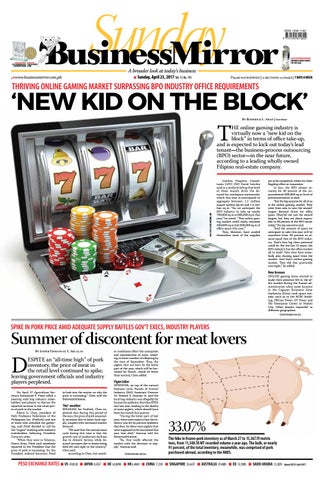
he online gaming industry is virtually now a “new kid on the block” in terms of office take-up, and is expected to kick out today’s lead tenant—the business-process outsourcing (BPO) sector—in the near future, according to a leading wholly owned Filipino real-estate company.
Leechiu Property Consultants (LPC) CEO David Leechiu said in a media briefing that both of them mainly drive the demand for workspace nationwide, which this year is anticipated to aggregate between 1.2 million square meters (sq m) and 1.5 million sq m. “So, we anticipate the BPO industry to take up maybe 700,000 sq m to 800,000 sq m this year,” he noted. “This online gaming market could easily consume 400,000 sq m [or] 500,000 sq m of office space this year.” They, likewise, have availed themselves most of the supplies
yet to be completed, either for their flagship office or expansion. In fact, the BPO almost accounts for 40 percent of the unprecedented 500,000-sq-m level of precommitments to date. “But the big surprise for all of us is the online gaming market. They went from zero to now the secondlargest demand driver for office space. [They’re] not just the second largest, but they are about equivalent to 50 percent of the BPO sector today,” the top executive said. “And the amount of space we anticipate to take this year will be anywhere from 50 percent to almost equal that of the BPO industry. That’s how big their potential could be. For the last 15 years, the BPO industry has the office market all to itself. Now they have somebody also chasing space from the market. And that’s online gaming market. They did this practically overnight,” he added.
New licenses
Online gaming firms started to make their presence felt in the office market during the Ramos administration when some locators in the Cagayan Economic Zone Authority (Ceza) took space outside, such as in the RCBC Building, PBCom Tower, GT Tower and The Enterprise Center in Makati City. Other players expanded in different geographies. Continued on A2
Spike in pork price amid adequate supply baffles gov’t execs, industry players
Summer of discontent for meat lovers
D
By Jasper Emmanuel Y. Arcalas
espite an “all-time high” of pork inventory, the price of meat in the retail level continued to spike, leaving government officials and industry players perplexed.
On April 17 Agriculture Secretary Emmanuel F. Piñol called a meeting with hog industry stakeholders and players to discuss the reported increase in the retail prices of pork in the market. Edwin G. Chen, president of Pork Producers Federation of the Philippines Inc. (ProPork) and one of those who attended the gathering, said Piñol decided to call for the “urgent” meeting with industry stakeholders following President Duterte’s order. “When they were in Talavera, Nueva Ecija, Piñol said somebody reported to the President that the price of pork is increasing. So, the President ordered Secretary Piñol
to look into the matter on why the price is increasing,” Chen told the BusinessMirror.
‘Hot’ weather
Speaking for ProPork, Chen explained that during this period of the year, the price of pork seasonally increases due to lower local supply, coupled with increased market demand. “We said that the normal meat cycle during this time is that the growth rate of production declines due to climatic factors, while demand increases due to feasts being held left and right in the country,” Chen said. According to Chen, hot weath-
PESO exchange rates n US 49.8120
er conditions affect the conception and reproduction of sows, resulting in lower number of offspring by the time of September. Thus, the piglets that are born by the latter part of the year, which will be harvested by March, would be fewer than normal, Chen added.
Piglet killer
However, on top of the natural business cycle, Bureau of Animal Industry (BAI) Assistant Director Dr. Simeon S. Amurao Jr. said the local hog industry was allegedly hit by porcine epidemic diarrhea (PED) late last year, leading to the deaths of some piglets, which should have been harvested this quarter. “During the latter part of last year, there were reports that the industry was hit by porcine epidemic diarrhea. So there were piglets that were supposed to be harvested this year that died,” Amurao told the BusinessMirror. “So, that really affected the market with the decrease in supply,” Amurao said. Continued on A2
33.07%
The hike in frozen-pork inventory as of March 27 to 15,367.19 metric tons, from 11,548.18 MT recorded volume a year ago. The bulk, or nearly 91 percent, of the total inventory, meanwhile, was comprised of pork purchased abroad, according to the NMIS.
n japan 0.4557 n UK 63.8490 n HK 6.4069 n CHINA 7.2359 n singapore 35.6437 n australia 37.4885 n EU 53.3985 n SAUDI arabia 13.2839
Source: BSP (21 April 2017 )
NewsSunday BusinessMirror
A2 Sunday, April 23, 2017
www.businessmirror.com.ph
Continued from A1
The increase in office take-up has since then continued. Most recently, they took up 83,960 sq m of the supply in Metro Manila over the last six months alone. The figure is seen to rise further, given that the Philippine Amusement and Gaming Corp. (Pagcor) alone has granted 35 new licenses. “These companies can subfranchise that to as much as eight other subfranchisees, and that’s the result of that. Each of these 35 companies will take anywhere between 10,000 sq m and 20,000 sq m of office space. Most of them will take space this year,” the CEO said. “I can just imagine how much space these guys can absorb from the market. So much so that there’s a possibility that between them and the BPO industry, they might wipe out all the space in the market,” he said. As a trickle-down effect, the online gaming industry has also contributed to the makeup of residential units in key sites of the metropolis. “This is because they’re flying in so much foreign talents and they need housing of all sort. So the amount of demand they generate as a whole, from the hotel sector to dormitories, expat housing, office space, and even restaurants, it’s fantastic,” Leechiu said.
BPO shift
SINCE most of the office spaces available in Metro Manila are mostly occupied as seen in low vacancy rates of 4 percent, there’s no way for the BPO players but to go outside. And where else do they often set up new facilities than
in Luzon and the Visayas, which together could deliver as much as 800,000 sq m of workspace in the next five years. For instance, the top seven information-technology (IT)-BPO firms in the country, which LPC did not name, have chosen to expand outside the metropolis by setting up offices in a number of other key cities nationwide. This indicates that companies continue to look for new and untapped labor markets, mostly in the countryside. Citing the Information Technology-Business Process Association of the Philippines Roadmap 2022, Leechiu bared that, while there’s a growing interest now to move to provincial or second-tier locations, the majority of the ITBPO labor work force will still remain in the metropolis, at 70 percent of the totality. Currently, there are 1.1 million people employed in the outsourcing field, and that’s anticipated to grow to 1.8 million people. “Seventy percent of that will continue to grow in Metro Manila. But a 30-percent block will continue to grow in the provinces. There’s a possibility that this ratio might even improve from a 70:30 to maybe a 60:40 ratio,” he said. Such growth level, according to him, will translate to basically a need of at least 3 million sq m of office space throughout the country, which merely fits the demand of the BPO sector alone. Current supply stands at 10.3 million sq m, of which Metro Manila accounts for 8.8 million sq m (85 percent) and provincial areas hold 1.5 million sq m (15 percent)
‘S
o we anticipate the BPO industry to take up maybe 700,000 sq m to 800,000 sq m this year. This online gaming market could easily consume 400,000 sq m [or] 500,000 sq m of office space this year.”—Leechiu
of the inventory. With the national government’s all-inclusive plan, it is seen to positively impact expansion in the rural areas. It is for this reason that provincial talents are estimated to grow by 60 percent in 2022. “The projected additional 200,000 employees in the prov-
inces translate to a demand for approximately 800,000 sq m of office space or the projected annual office take-up in Metro Manila for 2017,” he said. Moving further, a total of 5.4 million sq m of office space is expected to come on stream from now up to 2023 throughout the country, of which 4 million sq m (74 percent) is in Metro Manila, with the balance spread across Cebu, Calabarzon and other cities. In the next five years, the Queen City of the South is seen to hike its supply by 4 million sq m. Other key cities in the Visayas and Mindanao regions, led by Davao and Iloilo, will have an additional projected supply of 779,996 sq m. Meanwhile, Luzon, led by Cavite and Pampanga, will account for an estimated 541,981 sq m over the same period. “What’s making that possible? Of course, the conscious drive of this administration to push jobs, improve infrastructure, and ensure safety and security conditions in these provinces,” Leechiu said.
Other growth drivers
THE office segment of the realestate sector still has more rooms for growth. Other than the “sunshine” industry of BPO and the thriving online gaming field, banking and insurance also have spaces to fill in. The CEO recalls that the banking and finance industry was considered a “big driver” to office space back in the 1990s. The first boom happened 20 years ago—from 1992 to 1997— when they consumed bigger sizes fit for the facility of their respective companies, he said. “So they could be another big driver for office space again,” Leechiu bared. We’re quite interested with the banking and finance, because, as we all know, the liberalization in the banking industry happened a couple of years ago and, yet, we’re still waiting for the foreign banks to come in.” Given the country’s continuous economic growth, he is bullish they will find the Philippines as a
good market to invest in. “They will want to come [and] they will start coming in droves,” he noted. Insurance is another industry that LPC is expecting to require more office spaces, according to him. This is because the Philippines, with its young population at an average age of 23, is still one of the least-penetrated markets in the world for the surety sector. “If you look at the list, insurance companies before 1990 was something like less than 10. In the late 1990s—1998 and 1999—that list of 10 became close to 60,” he shared. When the global financial crisis compressed them, their numbers had dwindled and today is estimated to be between 30 and 40. “But there could be more and more companies operating. Usually, they are growing primarily due to the young, untapped growing market for the insurance industry,” Leechiu said.
Summer of discontent for meat lovers Continued from A1
Chen also said the increased volume of imported frozen pork in the country’s inventory also affected the meat’s retail price. “We told the secretary that the peso was weaker against the dollar, while the volume of pork imported by traders increased, reaching all-time high,” Chen said, citing data from the National Meat Inspection Service. “This is considering that last year was an election year, and usually during election period, importation increases,” Chen added.
Inventory
NMIS data showed that the country’s frozen-pork inventory as of March 27 increased 33.07 percent to 15,367.19 metric tons (MT), from 11,548.18 MT recorded volume a year ago. The bulk, or nearly 91 percent, of the inventory, meanwhile, was comprised of pork purchased abroad. Imported pork in inventory reached 13,961.58 MT, 43.81 percent higher than the 9,708.16 MT volume in same time period last year, according to NMIS data. Meanwhile, locally produced pork in the country’s inventory declined by 23.61 percent to 1,405.61 MT, from 1,840.02 MT a year ago. “In spite of the increased in inventory, the price of pork was still increasing. Because the importers re-
sorted to buy locally produced pork, and when that happens—when a certain commodity is bought by many—naturally the price will really increase,” Chen said. Citing data from the BAI, Amurao said the volume of imported pork in the January-to-March 2017 period declined by 7 million kilograms year-on-year. Amurao added the increasing price of pork in Europe due to stiff competition resulted in higher landed cost of the commodity in the country. “That’s why not a lot of consumers are not buying imported pork because it’s expensive,” Amurao said. The higher price of imported pork prompted traders and importers to buy from the local sector, thus, pushing also the value of locally produced meat, Amurao said.
Pork hoard
“So, it’s possible that despite the decline in imports, there is a big inventory of imported pork. Because, I think, the importers are not releasing their volume in cold storage due to discrepancy in price of local and imported meat,” Amurao said. Meat Importers and Traders Association President Jesus Cham said price of pork in Europe increased due to higher demand from China. “EU pork price did start going up in the fourth quarter of 2016, but by products it’s not
as much. China bought heavily and seems that the EU killed too much [hogs] to take advantage of higher demand and price,” Cham said in an e-mail. “Now, EU pork [supply] is short. On the other hand, USA pork production seems to be increasing,” Cham added. Based on the monitoring of the DA, the prevailing retail price of pork liempo in Metro Manila as of April 20 was at P220 per kilogram, higher than the usual P180/kg pricing. Meanwhile, average retrail price of pork ham in the same period was pegged at P200/kg. Chen said there were reports that the price of imported pork in the retail market hit as much as P250/kg. However, with the increase in retail price comes a bigger profit margin for local producers as farm-gate prices increase, as well, Chen said. He added the farm-gate price of pork in Luzon has reached P130 per kilogram liveweight, higher than the usual P90-to-P100/kg range. “But as a support for the government, I have announced to my members that they must maintain their present farm-gate prices,” he said. “This is the first time that the government cares for the hog industry, because the previous administration does not care what happens to the industry, what’s important to them was that the price of pork was cheap,” he added.
Welcomia | Dreamstime.com
‘New kid on the block’
www.businessmirror.com.ph
The World BusinessMirror
Sunday, April 23, 2017
A3
Major oil producers reach pact to extend output cuts
C
rude-producing countries reached an initial agreement to extend output cuts, Saudi Arabia’s oil minister said on Thursday, as persistently high stockpiles and resurgent output from United States shale fields weigh on prices.
T he Organization of the Petroleum Ex por ting Countr ies (Opec) and other major sup pliers have failed, after three months of limiting production, to achieve their target of reducing oil inventor ies below the f ive -yea r h i stor ic a l average, Saudi A rabia’s K ha lid A l-Fa lih sa id at a conference i n A bu Dhabi. T he producers pledged to reduce output for six months star ting in Januar y.
“Although there is a high level of commitment, we haven’t reached our goal, which is to reach the five-year average,” AlFalih said. “There is an initial agreement that we might be obligated to extend to get to our target.” Countries participating in the cuts have yet to reach a consensus on prolonging their agreement into the second half of the year, and an extension wouldn’t necessarily be for an
Although there is a high level of commitment, we haven’t reached our goal, which is to reach the five-year average. There is an initial agreement that we might be obligated to extend to get to our target.”—Al Falih
In this April 4, 2009, file photo, a gas-production facility is seen at Ras Laffan, Qatar. State-run Qatar Petroleum said on April 3 that it plans to boost production from a vast underwater natural-gas field by 10 percent, giving it the capacity to export some 2 billion cubic feet of gas per day from the North Field. Qatar is a small but wealthy member of the Organization of the Petroleum Exporting Countries that generates most of its income from natural gas rather than crude oil. AP/Maneesh Bakshi
additional six months, he said. Opec and other producers, including Russia, agreed last December to pump less oil in an effor t to counter a globa l glut. Out put shows sig ns of rebounding in the US, where ex plorers have added r igs for the past 13 weeks, data from Ba ker Hughes Inc. show. Opec w i l l dec ide at a meet i ng on May 25 whether to prolong its
pledged cuts into the second h a l f, t he g roup’s S e c ret a r yGenera l Mohammad Bark indo said on Wednesday in Abu Dhabi, the United A rab Emirates (UA E) capita l. Brent crude has gained about 15 percent since Opec decided to pare output, and the benchmark grade was 41 cents higher at $53.34 a barrel at 10:34 a.m. in London.
Gu l f Cooper at ion Cou nc i l (GCC) countries agreed to push for an extension of cuts in a meeting on Wednesday, Oman O i l M i n i ste r Moh a m me d A l Rumhy said in an inter view in Abu Dhabi. The GCC comprises Opec members Saudi A rabia, Kuwait, Qatar and the UAE, as well as Oman and Bahrain. GCC states are participating in the current deal to cap output.
I ra n a nd Vene z ue l a , bot h me mb e r s of O p e c , h ave e xpressed support for an extension of the production cuts, Al Rumhy said. Iran’s oil minister made a commitment to freeze output at 3.8 million barrels a day for the rest of the year on the assumption the cuts are extended beyond June, Kuwait Oil Minister Issam Almarzooq told reporters in Abu Dhabi. Bloomberg News
A4
The World BusinessMirror
Sunday, April 23, 2017
US steel seeks China trade probe amid political push
U
.S. Steel Corp., supported by Washington politicians amid a “Buy America” push from the White House, is asking a trade agency to revive claims that rival Chinese manufacturers colluded to keep prices low to undercut competitors in the American market. The US International Trade Commission (ITC) in Washington on Thursday will hear US Steel’s argument that an antitrust complaint it filed should be investigated. A trade judge last November had thrown out the claim, saying the agency didn’t have the legal authority to hear the allegations. From the beginning, the case has caught the attention of US politicians, as members of Congress from both parties wrote to the commission, asking it to hear the case in full. Questions about the future of the American steel industry have became a hot political topic, with President Donald J. Trump signing a “Buy America” order to buoy American steel producers by forcing projects, such as US pipelines, to use steel made in the country. Steelmakers in the Americas just capped their best collective stock performance since 2003 following a raft of successful trade cases levying tariffs against foreign metal. The key question before the commission is whether it has jurisdiction over the antitrust complaint. US Steel and other American steel producers have traditionally filed cases with the commission under antidumping laws that bar sale of goods priced at less than fair value or that are subsidized by foreign governments. The remedy usually involves imposition of tariffs that raise the prices on foreign products.
Unusual argument
In an unusual move, US Steel filed its latest case under a statute covering unfair-trade practices, which most often is used to protect domestic companies from patent infringement and theft of intellectual property. Under this provision, the commission could block carbon and alloy steel produced in China from entering the US.
The case, however, has been an uphill slog for US Steel. The complaint filed in April 2016 made three allegations. One was theft of trade secrets in connection with Justice Department allegations that Chinese officials hacked the Pittsburgh-based steel company. A second involved claims the Chinese companies were rerouting their products through other countries to hide the country of origin. The third—which is the one US Steel is seeking to revive on Thursday—involves antitrust violations that the companies improperly conspired to fix prices and control export volume. In February US Steel dropped the trade secrets claim related to hacking, citing “the inequities of the statutes that were enacted before the dawn of the internet age and the substantial threats posed by cyber espionage.”
Judge’s ruling
The judge, who dismissed the antitrust claim last November, later threw out a claim that the Chinese companies were routing their products through other nations to hide their country of origin. The commission in February ordered the judge to reconsider that part of the case. Amid all the legal setbacks, the case has fallen out of focus for US Steel investors, said Lee McMillan, an analyst at Clark-
Metal components for office cubicles and furniture are stacked in a storage area after being manufactured at the Roll Forming Corp. plant in Shelbyville, Kentucky, US in this January 6 photo. US factory orders last November rose 1.8 percent from the previous month, the Census Bureau reported. Luke Sharrett/Bloomberg
sons Platou Securities. “ The bigger problem is their continued over production drives down global steel prices,” McMillan said. “ This case isn’t seen by most as a cure for that, and thus other remedies are receiving more attention.” On the antitrust issue, Judge Dee Lord said the problem is that trade law and antitrust law are in conflict. Antitrust law as used in federal courts seeks to promote competition for the benefit of consumers, even if it harms competitive businesses, Lord wrote. She ruled that the ITC has to follow the standard used in the courts, so if the Chinese steel companies are selling at a lower price, that benefits consumers and thus is not an antitrust violation. The Chinese manufacturers, which deny the unfair-trade allegations, say Lord got it right. The only way US Steel’s case could survive is if it could prove “predatory pricing” that harms consumers and there’s no charge of that, they said.
‘Total blockade’
Baoshan Iron & Steel Co., China’s second-largest steelmaker, accused its American competitor of seeking an unprecedented “total blockade of steel trade from an entire countr y.” The
The bigger problem is their [China’s] continued overproduction drives down global steel prices. This case isn’t seen by most as a cure for that, and thus other remedies are receiving more attention.”—McMillan
company, along with other Chinese steelmakers, argue the case should go through the normal type of trade complaint, which the American steel companies have used extensively. “There are now virtually no steel imports from China, let alone unfairly priced imports,” the Chinese companies said in a filing with the agency. US Steel has the backing of the nation’s largest steel union and AK Steel Holding Corp. Following Lord’s reasoning would turn a statute to protect American markets into “a dead letter law”, the United Steel, Paper and Forestry, Rubber, Manufacturing, Energy, Allied Industrial and Service Workers International Union said in a filing. Members of Congress have also sided with US Steel. The 30-member Congressional Steel Caucus sent a letter saying “we assure you we will be carefully watching the progress of this case,” while a bipartisan letter from 47 members of Congress said they “strongly urge” the commission “to ensure that US Steel is permitted to present its case in full.” W hile US Steel may be counting on the Trump administration to help its business, any regulator y change could take years, according to Bloomberg Intelligence analyst Caitlin Webber. It also would likely lead to a challenge at the World Trade Organization and faces opposition from the pipeline operators who say it would increase costs and delay projects, she wrote in a note to clients. The commission has set a target to complete the investigation by April 2018. The case is In the Matter of Certain Carbon and A lloy Steel Products, 337-1002, US Intern at ion a l Tr a d e C om m i s s ion (Washington). Bloomberg News
Topsy-turvy French polls still has surprises in store
P
ARIS—A French presidential campaign that’s been filled with unprecedented twists and turns still has surprises in store heading into Sunday’s first-round vote. With voters in a rebellious mood and many hesitant to the end about their choices, the identities of the two candidates who will progress to a winner-takes-all May 7 runoff remain anyone’s guess. With 11 contenders—from far-left to far-right—for the 47 million registered electors to choose from, the election is a high-stakes test for the European Union and for populist leaders who would tear it down. Like Donald J. Trump in the United States, anti-establishment French populists Marine Le Pen and Jean-Luc Melenchon hope for an electoral electroshock by surfing to power on voter disgust with politics as usual. Failure by both to qualify for round two would signal a receding of the populist wave that crashed over the European Union (EU) with Britain’s vote last year to leave. The months-long French campaign only seemed to grow weirder and more uncertain
as polling day approached. A jobs-for-thefamily financial scandal that punctured the Mr. Clean image and campaign of one-time front-runner François Fillon fueled the raging distrust between voters and their elected representatives. The siren call of Le Pen’s ”France first” nationalist rhetoric, and Melenchon’s late surge left Europe’s second-largest country and third-biggest economy at a crossroads, with its future in the EU up for grabs. The implosion of the ruling Socialist Party, with outgoing President François Hollande too unpopular to run again, and the stunning success of his former economy minister, Emmanuel Macron, with an upstart middle-way grassroots campaign without major party backing, threatened to dismantle postwar France’s traditional left-right political divide. The threat of Islamic extremism after two years of attacks that killed more than 230 people, and with police thwarting what the government said was another planned attack this week, meant the vote was being held under heightened security, with more than 50,000 police and soldiers mobilized
for Sunday. A state of emergency has been in place since 2015. With the race too close to call, hesitant voters agonized over whether to follow their hearts or their heads in the first round, meaning either backing their candidate of choice or casting a strategic vote aimed at keeping out candidates they didn’t want to have to choose between on May 7. “It’s complicated,” real-estate agent Felix Lenglin said during his lunchtime break in a Paris park. “We have to vote to stop the extremes but among the moderates, it’s a really difficult choice.” The nightmare scenario for global financial markets is a second-round duel between the equally sharp-tongued Le Pen and Melenchon. Victory for either could, in the wake of the Brexit vote, deliver a possibly knockout punch to the stated EU ambition of ever-closer union between the peoples of Europe because both want to tear up agreements that bind together the 28 EU states. Melenchon says “the Europe of our dreams is dead”. He proposes “disobeying treaties from the moment we take power”
and negotiating new EU rules—followed by a referendum on whether France should leave the bloc it helped found. “We either change the EU or quit it,” Melenchon’s manifesto says. The “totalitarian” EU has also long been one of Le Pen’s pet hates and constant target for her virulent nationalist discourse. She wants an in-out referendum on France’s EU membership, a new French franc to replace the common euro currency, and reimposed French borders to staunch what she describes as out-of-control immigration. Like her father, National Front founder Jean-Marie Le Pen, in 2002, she hopes for an electoral coup by making the runoff. But pollsters suggest that, like him, she would likely lose on May 7 to any of the other top three opponents. Or, alternatively, voters could step back from the brink of such radical change and opt for the more moderate Fillon, a conservative former prime minister, and Macron, an electorally untested former investment banker unknown to voters before his two-year stint as Hollande’s business-friendly economy minister. AP
Editor: Lyn Resurreccion • www.businessmirror.com.ph
Fewer women are working amid India’s rising wealth
I
ndia’s robust economic expansion and rising wealth have come at a cost—fewer women are now entering the labor force. That’s putting at risk the nation’s much-vaunted demographic dividend. In socially conservative India, well-off families don’t send their women out to work, only those that can’t make ends meet from just a man’s salary do so. Today, just one in five urban Indian females are in the labor force. The bigger picture is this trend will diminish the boost India’s economy receives from its vast young population, Oxford Economics said in a report. India’s outlook is impressive: the International Monetary Fund this week forecast an average annual expansion of 9.9 percent over the next five years and that the nation will surpass Germany as the world’s fourth-largest economy in 2022. Yet, United Nations data show India’s overall labor participation rate declined to about 60 percent in 2011 from 68 percent in the 1980s; and more recent surveys from India’s Labor Bureau indicate the situation has remained static. “In the next couple of decades, India is expected to replace China as the country with the largest working-age population in the world,” said Priyanka Kishore, lead Asia economist at Oxford Economics. “But in the absence of a substantial pickup in the participation rates, the country appears ill-placed to take advantage of this demographic boom.” She added that unless the participation rate rose to between 70 percent and 75 percent, India’s labor force is unlikely to boost growth in a significant manner. The UN forecasts India’s working age population—those between 15 and 64 years—will reach 1.1 billion by 2050. But unless India’s economy grows at more than 10 percent consistently, it will be hard for the
9.9% The International Monetary Fund’s average annual growth forecast for India over the next four years, where it is forecast the nation will surpass Germany as the world’s fourthlargest economy in 2022
economy to absorb all those workers, analysts say. Between 1991—when India opened its economy—and 2013, the size of the working-age population increased by 300 million, while the number of employed people increased by just 140 million, a UN study showed. In other words, the economy absorbed less than half the new entrants into the labor market. In contrast, the number of jobs in China increased by 144 million between 1991 and 2013, while the working-age population grew by 241 million. Looking at the breakdown of India’s labor-force, while Oxford Economics finds the decline has been broad-based, involving both males and females, rural and urban workers, it’s the falling participation rate for women that is striking. Labor-force participation is highest among rural males at more than 80 percent and lowest among urban women at about 20 percent. “A less optimistic view is that employment opportunities have declined, particularly in urban areas and outside of agriculture in rural areas,” K ishore said. “Also, socio-cultural issues may have inhibited female participation in the labor-force, as rising household incomes have lessened the need to do so.” Bloomberg News
Beijing, EU push message of free trade, engagement
B
EIJING—Top diplomats from China and the European Union (EU) pledged to work together on issues including Syria and North Korea and cooperate more closely to advance free trade, striking a contrast with American economic nationalism being promoted by President Donald J. Trump. The statements came as China and the EU held their first high-level talks since Trump took office in January. EU foreignpolicy chief Federica Mogherini cochaired the Seventh EU-China Strategic Dialogue with State Councilor Yang Jiechi, China’s highest-ranking diplomat. “At present, the international situation is complex with many new developments, challenges and problems,”Yang told Mogherini at the outset. “Against this backdrop, for China and the EU to deepen cooperation and coordinate positions not only concerns the common interests of the two sides, but also is of great significance” for international relations, he added. Mogherini said China and the EU had “a big responsibility” during “times of uncertainty”. “We are looking forward to intensifying our cooperation on a positive agenda, what the EU and China can do together for the benefit not only of our citizens, but also of the world,” Mogherini said. The two sides discussed rising tensions on the Korean Peninsula as North Korea moves to accelerate its nuclear weapons development, and the war in Syria. Mogherini told reporters afterward that ending the war in Syria is a priority, and she and Yang discussed at length how to actively support the UN-led process while working to improve the humanitarian access into the country. The one-day talks come ahead of an EU-China summit scheduled for Brussels in June. On Tuesday Mogherini met with Chinese Premier Li Keqiang, who said that the
international community was looking at how China and the EU would work together to tackle challenges, including the world economic recovery, global conflicts and terrorism, and Britain’s pending withdrawal from the EU. Li said he was optimistic about the outcome of the talks based on “a stable China-EU relationship, with the consistency of our two sides toward multilateralism and free trade, and with our joint commitment to improving the international governance structure.” Unlike Trump, who was elected promising to tear up trade deals, impose new tariffs and bring jobs back to America, Chinese President Xi Jinping has cast his country as a champion of free trade and stability, and spoken out against protectionism. Mogherini said that such speeches by Xi “have raised high expectations that China and the European Union can work together on multilateralism, on rules-based global order” and trade. “Not only our people, but probably the multilateral system, need Europe and China to work together on some of the major global issues we are facing, from climate change to migration or counterterrorism, and also the many crises we have around us such as the tensions on the Korean Peninsula,” Mogherini told Li at the start of their meeting. Beijing and Brussels have disagreements on trade, however, including complaints by European and other foreign companies that they are blocked from acquiring Chinese assets while China’s companies are buying major global brands. They also say they are barred from or sharply restricted in telecoms, information technology, finance and other promising industries in violation of Beijing’s free-trading pledges. Beijing, meanwhile, wants the EU to grant it market economy status, which would make it harder for the EU to impose punitive tariffs on Chinese imports that it deems to be unfairly cheap. AP
Science
BusinessMirror
www.businessmirror.com.ph • Editor: Lyn Resurreccion
Sunday
Sunday, April 23, 2017
A5
PHL technology business Turning science into policy incubators being pushed PHL needs blue economy for growth Story & photos by Stephanie Tumampos | Special to the BusinessMirror
I
n the 2014 Philippine Statistics Authority poverty report, the Filipino fishermen remain the poorest among the nine basic sectors.
Participants in the “Training cum Writeshop on the Establishment of Agribusiness Technology Business Incubators” IDD-PCAARRD
M
ore than 50 officers and researchers from 10 state universities and colleges (SUCs) in the Philippines recently participated in a training-workshop to help them pursue their technology business incubators (TBIs). Titled “Training cum Writeshop on the Establishment of Agribusiness Technology Business Incubators”, it was spearheaded by the Philippine Council for Agriculture, Aquatic and Natural Resources Research of the Development of the Department of Science and Technology (DOSTPCAARRD) and held recently at the DOST-PCAARRD Innovation and Technology Center (DPITC) in Los Baños, Laguna. The DOST defines TBI as a facility, which hosts start-ups and provides business development services. The DOST-PCAARRD believes that helping SUCs establish or enhance their respective agribusiness TBIs can create jobs, develop entrepreneurs, and promote public-private partnerships for regional economic development. “ The PCA ARRD has always believed that strategic research and development activities facilitate growth and development of the agriculture, aquatic and natural resources sector of the country, especially if their outputs are effectively passed on to their intended users,” said Dr. Juanito T. Batalon, director of PCA ARRD’s Institution Development Division during the training-writeshop.
“Thus, the council, with the strong support of our mother agency, the DOST, is continuously improving its technology promotion and transfer programs to enhance client service and reach,” Batalon added. A number of TBIs have already been established in the country, some of which are based in SUCs. Three SUCs—such as Benguet State University, University of the Philippines Visayas and Visayas State Universit y—have shared insights on how they implement their respective business incubation programs during the workshop. Facilitated by the council ’s Technology Transfer and Promotion Division (TTPD), the training, besides the sharing of firsthand experiences, also presented the important concepts related to various modes of technology transfer, specifically on commercialization through the establishment of agribusiness TBIs. Through the workshop, the participants learned to draft viable technology-transfer proposals for possible funding support of the DOST-PCAARRD. Meanwhile, PCA ARRD Acting Executive Director Reynaldo V. Ebora reminded the participants that proposals for agribusiness TBIs should give emphasis on mature technologies. Ebora also highlighted that besides the ability of the facilities and equipment of the TBIs to attract incubatees, their sustainability should also be prioritized. S&T Media Service
Project set to check bats’ species, genetic diversity
L
OS BA ÑOS, Lag una—To protect bats and their habitats, understanding their basic ecological requirements is absolutely necessary. A program, titled “From Genes to Ecosystems: Understanding Fruit Bat Species and Genetic Diversity and Their Ecological Interactions with Plants in Tropical Lowland Forests”, addresses this concern. The Philippine Council for Agriculture, Aquatic and Natural Resources Research and Development of the Department of Science and Technology (DOSTPCAARRD) funded the program. A lthough fruit bats have a dynamic ecological role in maintaining the Philippines’s tropical lowland forests, information on fruit bat species and their genetic diversity is very limited. The program kicked off with an inception meeting at t he PCAARRD complex recently. Led by Dr. Perry S. Ong of the University of the Philippines Diliman (UPD), the program aims to generate more knowledge on fruit bats, resulting in the development of science-based solutions and strategies on how to better manage these biological resources and ultimately their conservation. The research program will be
conducted in the intact tropical lowland forests in Palanan, Isabela, one of the most endangered forest ecosystems in the country and elsewhere. The inception meeting served as a venue for the project team to present the program’s major accomplishments, work plan, budgetary requirements and expected outputs. Other updates on the recent activities of the program and its major accomplishments were also presented. The meeting also allowed UPD as the implementing agency and the PCAARRD as the monitoring and funding agency to weigh in the issues surrounding the program. Serving as PCAARRD’s Industry Strategic S&T Program (ISP) manager for Climate Change, Dr. Engelbert R. Lalican from the Forestry and Environment Research Division presented the Guidelines Governing PCAARRD-Grants in Aid (GIA) and PCAARRD-Monitored DOST-GIA Funded Programs and Projects. FERD Officer in Charge Dr. Leila C. America, together with Forester Faustina C. Baradas, ISP manager for Cacao and Watershed, clarified issues and concerns pertaining to the implementation of the project. S&T Media Service
The report said that, with 39.2-percent poverty incidence, the fishermen have been living with an average earning of P178 a day, with less to nothing to eat every day. Despite the countr y’s vast aquatic and marine resources and the numerous research done by the Filipino scientific community in these areas of discipline, the country has still a long way to go to establish a stable and sustainable fishing community that would not only benefit the economy but especially the fishermen. According to Dr. Ronald Mendoza, dean of the School of Government of the Ateneo de Manila University, during the Visayas R e g ion a l S c ie nt i f ic Me et i ng held in Cebu City on Wednesday, the conservative monetary value that the marine ecosystems should have contributed to the country’s economy is estimate at $970 billion to $1.5 trillion annually, roughly P74.6 trillion. The scientific meeting was led by the Department of Science and Technology and the National Academy of Sciences and Technology. With a huge amount of monetary value, it should have contributed, the question remains: How can the Philippines promote economic and env ironmenta l sustainability with the inclusion of improving the lives of our fishermen?
Blue economy
One of the biggest marine industries in the country is in tuna. In 2003 the Philippines became the fourth-largest producer of tuna and tuna-like species in the world, yet, Filipinos have been compensated less of what they need to earn. Records in subsequent years show the tuna sector slowly having been dubbed a “sunset industry”. Filipinos have slowly shied away from it, owing to declining catch. “You see a multibillion-peso industry like the tuna industry and a lot of poor Filipino working in the industry,” Mendoza said during his talk as he pushed for the growth of a blue economy in the country. “These are the important figures that we must figure out on how to correct the imbalance.” Mendoza defines “blue economy” as “a version of the green economy made relevant to seas and oceans”. He said, “What we want out of this [blue economy] is not just the extraction [of fishes], it’s actually the sustainable management of this particular resource.”
The Philippines is the secondlargest archipelagic country in the world and has the fifth-longest coastline. It is the center of marine biodiversity as it houses 70 percent of the coral triangle with more than 400 species of corals and over 2,200 species of fish. It is the 10th country in the world’s top fishing nations in a 2014 report from the Food and Agriculture Organization of the United Nations. Yet, with all these numbers, the country’s blue economy lies in a limbo.
The block along the way to blue economy growth
Mendoza said, “ The economic footprint of our maritime economy is very small at this point.” Just about 3 percent of GDP and a total employment of a little over 4.35 percent are being projected in this sector. There are two main problems. First, Mendoza said, there is not enough investment in this sector. He said scientists should not just use science and data but also use economics in communicating with politicians. “Tell them that if we invest in this sector, we can create a lot of jobs,” he said in Filipino. Second, the country should provide solutions so that scientists could translate the outcome of their research into planning and policy. In an interview with the BusinessMirror, Mendoza said, “The main hindrance is [that despite] all our good science, we are unable to translate them into policy and action”.
mendoza
He said, “We know a lot, have researched a lot, even foreign countries have already learned and picked up scientific findings from us and have made decisions out of them for their own growth”. He added: “Those kinds of studies [are the essentials] in making an industry…. If we are able to translate this into business and in the public sector in order for them to sharpen business and policy, that’s where we are missing.” He u rged t he sc ient ists: “ W ho w i l l t a k e it f o r w a rd , right? That is the area where we need to do a better job—translating it more on public polic y and on business strateg y.”
Philippine blue economy can take the lead in Southeast Asia
“We’re not good in extracting [our resources],” Mendoza told the BusinessMirror, comparing the Philippines to other countries in Southeast Asia that have used technology to create a sustainable maritime industry. “Our neighbors have been investing in heavily protecting [their areas and resources] and managing them well,” he said. To highlight his point, Mendoza showed two images during his talk where a Filipino boy carries
a 95-kilogram (kg) tuna on his shoulders and earns only a little fraction of the sale, while Singapore is into vertical farming of crabs and selling it at a high price of $35/kg. The use of technology has been a great benefit to countries who have used these to their advantage. Technologies, such as drone and growing marine resources in condominiums through vertical farming, are sustainable. Mendoza recommended that the Philippines needs to exert more effort to catch less fish, and use the research to attain optimum productivity. “Technology can improve our efficiency and also our ability to sustain our resource better if we only know how to use it,” he said. Mendoza told the BusinessMirror the Philippines can always take the lead in terms of blue economy since the country has the advantage. “Space is not a problem nor are the resources because the coral triangle [which area the Philippines occupies 70 percent] is there with us. This should be at the core of our national development plan.” “We are not that far,” Mendoza said, emphasizing the innovativeness of Filipinos. “This is more of a challenge for collective action on our part and clear planning and foresight—not just for six years but 50 years.” Stressing the need for collective action, Mendoza said, “If we don’t do the right thing, we will be left behind.” He said there is a lot of room for improvement and Filipinos need to realize the amount of work it carries. Commenting on the AmBisyon Natin 2040 by the National Economic and Development Authority, he said, “It is part of our long-term vision, and we just need to translate more of this into specific parts of a plan so that it would fall into place”.
Tuna fishes are displayed at the General Santos City Fishport where they are auctioned.
AI to fuel Amazon’s success, CEO says A mazon.com Inc. is embracing artificial intelligence (A I) to deliver goods more quickly, enhance its voice-activated Alexa assistant and create new tools sold to others through its cloud-computing division, CEO Jeff Bezos said in his annual shareholder letter. Changes ushered in by ar tificial intelligence and machine lear ning w il l help the companies that embrace them and put up barriers for those who don’t, the world ’s second-richest man w rote in a 1,700 -word letter released on Wednesday.
Bezos repeated fami liar themes, such as the need to operate a business like it’s always “Day 1” to keep a start-up mentality and the ability to act quickly on limited information to stay ahead, what he calls “high-velocity decision-making”. His emphasis on artificial intelligence and machine learning was the most concrete indication of areas in which the e-commerce giant will continue to invest. Machine learning is the science of getting computers to act without being programmed, and is used in autonomous cars,
speech-recognition and Internet search engines. The technology has influenced high-profile projects at Amazon, such as drone delivery, its popular Echo voice-activated speaker and the new cashier-less Amazon Go convenience store unveiled late last year in Seattle, Bezos wrote. “But much of what we do with machine learning happens beneath the surface,” he wrote. “Machine learning drives our algorithms for demand forecasting, product-search ranking, product and deals recommendations, merchandising placements, fraud
d e t e c t ion , t r a n s l at ion s a nd much more. Though less visible, much of the impact of machine learning will be of this type— quietly, but meaningfully, improving core operations.” A mazon Web Ser v ices, the company’s cloud-computing division, will offer affordable tools so clients can incorporate artificial intelligence and machine learning into their own operations. Such tools have already been used to detect diseases and increase crop yields, Bezos wrote. “Watch this space,” Bezos said. “Much more to come.” BloombergNews
Faith A6 Sunday, April 23, 2017
Sunday
www.businessmirror.com.ph • Editor: Lyn Resurreccion
‘Religious discrimination and fanaticism worsened’
R
OME/GENEVA—Religious discrimination, fanaticism and xenophobia have worsened in several countries in Europe, Asia, Africa, the Middle East and North America, thus, there is a need for alternatives to identify a common strategy to address these challenges, a Geneva-based think tank promoting global dialogue said. The issue has been top on the agenda of a meeting organized by the Geneva Centre for Human Rights Advancement and Global Dialogue recently at the United Nations Office in Geneva, during which representatives from the Muslim and Christian regions of the world exchanged views on the convergence between Islam and Christianity. William Lacy Swing, director general of the International Organization for Migration (IOM) who participated in the meeting, titled “Islam and Christianity, the Great Convergence: Working Jointly Toward Equal Citizenship Rights”, highlighted the importance of recognizing the convergences of the Abrahamic religions—Islam and Christianity—in order to overcome religious divisions. “We live today in turbulent and troubled times. There are many loud voices that take perverse delight in drawing attention to what divides and splits our global community. In these circumstances, it is all too easy to forget that Islam and Christianity—two of the world’s three ancient Abrahamic monotheist religious traditions—have more in common than in contention.” Prince Hassan bin Talal of Jordan underlined in a video message the importance of fostering religious tolerance and i nter fa it h h a r mony bet ween Christians and Muslims as well as intrafaith cohesion. Referring to the Brussels Declaration, titled “The Peace of God in the World Toward Peaceful Coexistence and Collaboration Among the Three Monotheistic Religions: Judaism, Christianity and Islam,” he underscored the importance of bringing peace to the world and
500
The number of members of World Council of Churches, a Christian group, from more than 110 countries worldwide the need for peaceful coexistence between religious groups. “All of our religions disapprove of religious justification of violence and inhumane actions. None of them approve of violence, terrorism or ill treatment of human beings,” he said. For his part, the Chairman of the Geneva Centre, Dr. Hanif Hassan Ali Al Qassim, highlighted the significance of garnering the support of Muslim and Christian leaders to restore relations between Islam and Christianity. “Today we have a tremendous opportunity to discuss the convergences between Islam and Christianity and to continue our joint efforts combining our strengths to promote equal citizenship rights”, he added. The Minister of State for Tolerance of the United Arab Emirates, Sheikha Lubna Khalid al Qasimi, emphasized the need for Christian-Muslim dialogue as a necessary condition for peace, tolerance and harmony. “Irrespective of national identity, all citizens need to be granted equally universal human rights. Our states need to protect these human rights. To grant equal protection, we need to rethink our Christian-Muslim dialogue. It is
God’s gaze: Infinite mercy By Corazon Damo-Santiago
G
od is all-merciful. As often as we sinners approach God with a contrite heart, humbling ourselves, God will forgive us. Inexhaustible is God’s mercy. Indeed, “merciful and gracious is the Lord, slow to anger, abounding in kindness” (Psalm 103:8). He does not lock anger for man’s sinfulness in His heart. When we approach Him with contrite heart, He declares: “I see only your love and your humility”. Aware that the world is in need of God’s unconditional and unfathomable mercy, Saint John Paul II declared the Second Sunday of Easter as Divine Mercy Sunday in 2000.
Preternatural gifts lost Women look at Islamic hijab (face-covering veils) and clothes displayed inside an exhibition hall at the France Muslim Annual Fair in Le Bourget, north of Paris, on April 15. The three-day event was organized by the ultraconservative Union of Islamic Organizations of France. It included merchant stalls, Quran readings, prayers and speeches by leading Muslim figures, as Muslims of France wanted to make sure their voices are heard in France’s presidential elections. AP/François Mori
only through engaging in dialogue and accepting the diversity of each other that we can reach a peaceful reconciliation”. Representing over 500 million Christians in more than 110 countries of the world, the General Secretary of the World Council of Churches, Reverend Dr. Olav Fykse Tveit said, “the nature of the relationship between these two faith communities is of vital significance for the welfare of the whole human family”. For his part, the former Minister of Foreign Affairs of Algeria, Lakhdar Brahimi, condemned the hijacking of religious faiths by violent and extremist groups, stating that the “majority of people in the so-called Muslim majority countries are horrified by the barbaric violence committed by groups who claim to serve Islam”. “Daesh [or the Islamic State group], Al-Qaeda, Boko-Haram and similar groups in our countries and in Europe are abusing Islam and gravely trying to destroy its values, its cultures and its civilization.”
Equal, inclusive citizenship rights
As part of the meeting’s agenda, the Executive Director of the Geneva Centre Idriss Jazair y presented a draft agenda for a forthcoming world conference titled “Religions, Creeds or Other Value Systems and Equal Citizenship Rights”, that will build on the discussions initiated during the meeting. The goal of the conference would be to initiate a structured dialogue that might lead to the obsolescence of the concept of minority, and to its replacement by that of a model of inclusive and equal citizenship rights. On the conference, the Former Acting Foreign Minister of Lebanon and
the current Director of the Issam Fares Institute for Public Policy and International Affairs in Beirut, Dr. Tarek Mitri, argued that states should be established on the principles of citizenship, equality and law to create an environment of plurality and tolerance. “Revitalizing the pact of citizenship necessitates the rebuilding of state institutions on the foundation of the rule of law. The state’s chief obligation is to protect its citizens, all its citizens. Politics of inclusion in fractured societies are a condition for equal citizenship,” he said. The former United States ambassador to the UN and former member of the US Congress, Dr. Mark D. Siljander, ascertained that the convergence and the commonalities between Islam and Christianity could lead to equal and inclusive citizenship rights, drawing on his long-time expertise as a diplomat and peacemaker. Pakistan’s ambassador Tehmina Janjua reminded the participants that the concept of equal and inclusive citizenship should go beyond religious affiliation. “If we are to address the issue of citizenship rights/minorities globally, then we need to go beyond the relationship of Christianity and Islam. We also need to go beyond viewing this issue from the perspective of religion alone.” The goal of the Geneva Centre’s initiative was to highlight the many convergences that exist between Islam and Christianity, to recognize the potential of a “great convergence” between both religions, and to mitigate and reverse the social polarization between affiliates of these two religions and the resulting marginalization of religious minorities, discrimination, xenophobia and violence. IPS
A “being capable of tasting” God’s eternal goodness, this is how God created Adam and Eve. God did not only endow them with intelligence and free will designed for every human being. He extended to them preternatural gifts—a “flawless natural knowledge of God, strength of will, per fect control of passions and senses—gifts on the spiritual level”. And, the supernatural gift—“a sharing by God of his own nature”, which we call sanctifying grace. On the physical level, He gave them perfect peace of mind, free from pain and suffering and the frightful alienation of the soul from the body in death. All these were gifts beyond human nature. Despite all these gifts, man’s first parents wanted to be God-like: They disobeyed His only request “, not to eat from the tree of knowledge of good and bad”, for if they do, they “are surely doomed to die” (Genesis 2:17). Eat the fruit, they did at the taunting of the serpent. So, for deliberately choosing self over God, the entire human race sinned. “The whole of human history is marked by the original fault freely committed by our first parents” (CCC 390).
God’s unfathomable mercy
Sin “depends upon the dignity of the one offended,” according to Rev. Leo J. Trese. That “God, the infinitely perfect being, likewise of perfect dignity,” is the benchmark of the gravity of the sin of Adam and Eve. Simply said, it has to take a God to atone for the sin. Man’s dilemma: “Since only God is infinite, only God would be capable of an act of atonement which would repair the infinite malice of sin.” The God of Infinite Mercy, He Himself solved man’s predicament. To atone for the human sin necessitates that God be “human if he were really to take our sins upon himself, really to represent us”, Trese explained. God then takes human nature, but not in sin. True God and true man except in sin. God the Father in His Infinite Mercy decreed that his own Divine Son, Jesus, would “unite himself to a human nature to represent us and act for us”. “Being genuinely God, also the least of his actions would be of infinite value— sufficient to atone for all the sins that ever had been or could be committed... But, Christ by His atonement did not take away,
Easter pilgrimage to Tarlac
P
ilgrims of Green Faith Travels celebrate the “greatest feast” among Christians, the resurrection of Jesus Christ, at its fifth Easter pilgrimage to Tarlac on April 29. The annual Easter pilgrimage is held during the seven-week liturgical season of Easter that began on Easter Sunday and will end on Pentecost Sunday. Pilgrims will pray at the Chapel of the Risen Christ in Monasterio de Tarlac in San Jose; San Sebastian Cathedral (Tarlac Cathedral) in Tarlac City; Diocesan Shrine of Saint Therese of the Child Jesus in Ramos; Diocesan Shrine of Saint Josemaria Escriva in Gerona; and either Our Lady of Ransom Parish Church in Tarlac City or Saint Catherine of Alexandria Parish in Gerona. Pilgr ims w il l venerate the sacred relic of the True Cross of Jesus Christ in Monasterio de Tarlac, the only one of its kind in Asia and is believed to be miraculous. The monastery of the
Servants of the Risen Christ also features a 30-foot statue of the Risen Christ. They will also pray before the relic of Saint Josemaría Escrivá, the first church in Asia dedicated to the founder of the Opus Dei. Considered one of the beautiful parishes in Tarlac, the church is also known to allow travelers to view and pray before the Blessed Sacrament any time of the day, or even at night, when the church is closed because of its “drivethrough” access. Meanwhile Green Faith Travels accepts reservation for its trip to Lucban, Quezon, to celebrate the Pahiyas Festival and feast of San Isidro Labrador on May 15. Pilgrims will also visit Kamay ni Hesus Healing Church and Shrine where the 50 -foot Ascending Christ image is enshrined. For inquiries, send messages to 0926-6152596, greenfaithtravels@ gmail.com and greenfaithtravels@ yahoo.com, or Green Faith Travels on Facebook.
Reflecting on Christ’s passion Holy Week is the usual time for retreats and recollection to reflect on the passion of Jesus Christ. Members of the Saint Edith Stein Community Makati of the Secular Order of Discalced Carmelites held their retreat at Balay ni Maria House of Prayer in Tuba, Benguet, last week. Lyn Resurreccion
the freedom of the human will”, Trese said in Faith Explained.
He first loved us
Calling a dozen men to know and witness His spirit at work, Jesus preached about the kingdom of God when the designated time was decreed. He healed the sick, fed the hungry, clothed the naked, drove away evil spirits in people, gave hope to the hopeless and aided those with bodily and spiritual needs. He taught men to pray, and suffer with dignity and have faith in a loving God. He reached out to lepers, prostitutes, handicapped, outcasts and even those who rebuked his presence. Suffering sanctifies: “Whoever does not carry his own cross and come after me cannot be my disciple” (Luke 14:27). In summation, he cautioned men that not in deeds, but great love, will he be judged: “You shall love the Lord your God with all your heart, and with all your soul, and with all your strength and with all your mind”(Luke 10:27). And “Love your neighbor as yourself. Love does no evil to the neighbor; hence love is the fulfilment of the law” (Romans 12:9-10).
Feast of Divine Mercy
The Feast of the Divine Mercy was instituted in obedience to the Lord’s instruction to Saint Faustina Kowolska. “It is my desire that it be solemnly celebrated on the first Sunday after Easter. Mankind will not have peace until it turns to the Fount of My Mercy.” It was also Jesus who appeared to Saint Faustina in a vision in 1931 to paint His image with the signature: “I trust in you. I promise that the soul that will venerate this image will not perish. I also promise victory over enemies already here on earth, especially at the hour of death. I, Myself, will defend it as My own glory. I am offering people a vessel with which they are to keep coming for graces to the fountain of mercy. I desire that this image be venerated throughout the world,” said in the Diary of Saint Faustina Kowalska. The Lord spoke to Saint Faustina on several occasions on the importance of deeds of mercy. Telling her not to excuse herself from doing acts of mercy, He said: “I demand from you deeds of mercy which are to arise out of love for Me”. The church lists the works of mercy. The corporal works of mercy: feed the hungry, give drink to the thirsty, clothe the naked, shelter the homeless, comfort the imprisoned, visit the sick and bury the dead. The spiritual works of mercy are: admonish the sinners, instruc t the uninformed, counsel the doubtful, comfort the sorrowful, be patient with those in error, forgive offenses and pray for the living and the dead.
n Santiago is a former regional director of the Department of Education National Capital Region. She is currently a faculty member of Mater Redemptoris Collegium in Calauan, Laguna, and Mater Redemptoris College in San Jose City, Nueva Ecija.
Tourism&Entertainment BusinessMirror
Editor: Carla Mortel-Baricaua
Sunday, April 23, 2017 A7
The calm and the storm: A five-day travelogue to the north Story & photo by Lorenz S. Marasigan
C
Conclusion
agayan Valley welcomed us with a breakfast of native food. I helped myself to two helpings of pawa—steamed ground glutinous rice filled with peanuts—and a few pieces of Ybanag longanisa, which is the local version of sausage filled with garlic, and eggs. The locals also served us sugarcane juice and fresh carabao’s milk. Cagayan is just a few hours’ boat ride to Batanes. Not much is known about the province in terms of tourism, but it has a lot of places to offer its visitors. It has a huge coastline, an extensive array of mountains and rich, lush vegetation. While it is widely known as the venue for two seasons of reality show Survivor, Cagayan is also noted for its rich Spanish culture. After breakfast, we took a quick ride to the Basilica of Our Lady of Piat, one of the 12 minor basilicas in the Philippines. Piat, known as the Pilgrimage Center of the North, is home to the black image of the Virgin Mary, which the locals believe has miraculous powers. It is housed inside a glass case, whose small window at the lower back portion is open for devotees to touch. The church’s façade is a bit mundane, but the interior is much more interesting. Stained-glass windows that depict the events leading to the arrival of the image to the Philippines decorate the whole church. After a quick prayer, and some snacks in between, we traveled to Cagayan State University, just a few minutes away from the basilica, to get our hands dirty. Inside the campus, we were able to try feeding goats and milking cows, which, I must say, is not an easy thing to do.
Chicha-what?
Braving a shower, we went to the Lighthouse Cooperative in Tuguegarao. This is where the locals make the famous chichacarabao, or their version of the chicharon. We witnessed how the snack was
made, from the removal of the beef ’s hair from the skin, to the cutting, to their first contact with oil, and then to the next and, ultimately, to quality control before packaging. I cringed at the sight of the carabao’s skin, and pledged not to try it. But, curiosity won, and I took a bite of the crunchy, airy, popped-skin snack, and quickly fell in love with it. The best one for me is the hot and spicy flavor. It’s a must-try! We continued to eat our takeaway chichacarabao in the bus, which was then headed to another church: the Tuguegarao Cathedral. The cathedral was originally built in the 1600s by the Dominican friars, and was heavily damaged during the Second World War. It was then rebuilt by Bishop Constance Jurgens. Its façade is made with bricks of different hues of red, and is decorated with pilasters. Inside, the church is decorated with intricate symbols that shine through two light holes from the roof.
Assembled noodles
Famished from all the activities we did for the first half of the day, we went to a local pancit batil patong stall to have our lunch. I was so hungry that I had a serving and a half of the noodle dish. Making it is painfully long. The ingredients are not cooked together, and had to be assembled on a plate before serving. It is made with miki noodles, sautéed vegetables, carabeef, poached egg and is topped with onions. On the side is a slice of toasted bread and a bowl of batil soup, which is incorporated with the
SPi Global fosters ‘malasakit’ in action on 2017 CSR Day
W
orld-leading technology-enabled content solutions company SPi Global held its annual CSR Day on March 18. Dubbed “E=mc2: I am the formula for change”, it was a collective movement envisioned to “inSPire”and improve the quality of life of their partner-beneficiaries. Headquartered in the Philippines with local operations in Parañaque, Laguna and Dumaguete; and sites in India, China, Vietnam, Nicaragua and the United States, SPi Global believes its host communities are its partners for growth. “CSR activities give us a wonderful opportunity to put our principles in action. Malasakit is one of our core values, and during CSR Day, we are able to go out and interact with various communities through the projects we support,” SPi Global CEO and President Ratan Datta said. The global CSR movement included shoreline cleanup, vegetable planting and free computer training to children with special needs in Laguna. Hospital walls were painted, livelihood seminars conducted and a feeding program was held in Parañaque. In Dumaguete classroom repairs, school cleanups and a medical mission were organized. In India sports activities and a marathon against child abuse were some highlights, while volunteers in China taught Chinese culture to incoming tourists. US employees collected books for disadvantaged children;
participants in Vietnam and Nicaragua donated school supplies and conducted fun activities with child-beneficiaries. Since 2012 the company has been performing their CSR Day in all its offices globally—a continuing program that promotes the spirit of volunteerism and, most important, making a difference in youth welfare and education. To date, it has generated a total of 245,424.23 volunteer hours, improving the lives of 69,106 beneficiaries in different parts of the world. Supporting sustainable initiatives that impact the lives of children in the grassroots and other marginalized groups, SPi Global’s CSR Day has been 100-percent employeedefined and initiated—from projects appraisal, fund-raising and outreach to various societal touchpoints. “We have more than 12,000 employees, but the only way we can make a difference is by doing it together,” stated Celeste Ilagan, SVP for Marketing and External Affairs. “At the end of the day, it’s about consciously putting our time, energies and effort that we know we are contributing to society. We really hope more people will be inspired to do the same.” SPi Global’s CSR Day has won three awards—from United Kingdom-based National and European Outsourcing Associations, and the highest award of excellence from the Philippine Anvil and Quill organizations.
The view from the first stop at Cape Engano
dry ingredients throughout the culinary experience. The best drink to be paired with this dish, in my opinion, is local beer.
Drunken night
Because it was raining, we had to cancel our trip to the Callao Cave, and decided to visit the local museum. Housed inside the capitol compound, the museum allows guests to relieve the history of the province, and even visit a replica of the Callao Cave. It was about five in the afternoon when we arrived in our resort hotel, Balai Carmela, and after a night without a bed, my body was longing for the comfort of soft, warm comforters and a hot shower. Unfortunately, I didn’t get the hot shower, nor the rest that I wanted. The group had other plans: drink until we are all drunk to talk about all the inanities in life. This is where we were all able to bond. We played charades, and competitive as we naturally are, we fought—with now addled minds— until the other group lost. By 4 a.m. we were inside our rooms, and clocked in a few hours of sleep in our bodies before heading off to the town of Iguig by 8 in the morning. The town of Iguig is where clay makers live. Unlike pottery made in other provinces like the ones in Vigan, Iguig’s clay masterpieces are mashed, kneaded, molded and sundried. In almost all of the houses that we passed by, men and women pound, mold and cut clay in their front yards. Cooking the clay was a different method, too. While its counter-
parts use giant kilns, clay in Iguig is cooked on an open fire. This method has been passed on from many generations to the next. Visitors can buy products from various stores in the town. Prices are so competitive that you can buy a small pot for P20! But seeing how the locals put so much effort in making clayware, I believe haggling is not an option. After an hour of walking and shopping for pots, we decided to move along to our next destination: the San Antonio de Galicia Church, which is also in the town of Iguig. Supported by a number of arcboutant, the church was built in the 16th century. It is neighbor to Calvary Hills, a series of rolling hills overlooking the Cagayan River, where lifesize Stations of the Cross are housed. After a few pictures and prayers, we hopped on to the bus to Alcala, Cagayan. Our first stop was the Saint Philomene Church, which was built in 1881. Its red-brick facade welcomes everyone through its mahogany doors, which are accentuated with golden leaves. Situated next to the church are a bell tower and a school. Before we went to Santo Domingo de Guzman Church in Lallo, Cagayan, we had a quick lunch at Seguro Snack Hauz in the town of Gattaran. I had a generous serving of pancit batil patong, fried chicken, vegetables and countless pieces of putoflan, which I would call the marriage of soft rice cakes and milk flan. Dedicated to Saint Dominic de Guzman, the church is the only one left of the three parishes in old Nueva Segovia, a town now
known as Lal-lo. What’s interesting about this church is that it has a huge shell resting on the altar, just below the foot of the whiteclothed image of Christ. To cap off our day of Visita Iglesia, we visited the Lyceum de Aparri Church, which has a regal feel to it when we arrived. The altar is a plain white structure with golden decorations, and the image of the crucified Christ at its center. The church also has a small museum where religious objects are kept and shown to the public. After that “ blessed” day, we checked in at our hotel, took a quick shower, ate dinner, drank a little and slept with the anticipation that our next day would be adventurous.
Tempestuous waves
The key to enjoying the islandhopping tour for a day is to wake up early. So we got up by 4:30 a.m., ate our breakfast in the bus and drove to the port of San Vicente. Several boats were waiting for us at the pier. We boarded our designated boat and started our journey to the first island: Anguib Beach, dubbed as the Boracay of the North. The waters were calm during the first 10 minutes. The revving of the engine was music to my ears, because of my love for the ocean. We sped up, and the cold wind started wrapping itself around my body. It was fine by me, but after a few minutes, we were cruising through tempestuous waves. Each one was different from the other, and it got bigger and bigger by the minute. We held on to the boat, securing our cameras, phones and other electronic devices to where the water won’t touch. We left the port dry. We arrived at the island wet. The moment I saw land, I felt excited. I’ve never longed for land in my life. It was a first. Fine, white sand on my feet was heaven after an hour of braving rough waters. Aside from swimming and snorkelling, guests can also pitch tents in Anguib Beach if they want to stay. It has a restaurant that serves local food, the best of which was the lumpiang shanghai paired with a perfectly seasoned vinegar dip. For those who just want to enjoy the view, colorful cradles were set up on a number of trees by the beach. After a few rounds of beer—yes,
beer in the morning—we boarded our boats to have our lunch at Jerolynda White Beach Resort in Santa Ana, Cagayan. On our way, we passed through a healthy mangrove shed whose waters were so clear we saw several fish swimming about the area. When we arrived at the resort, we were treated to an array of seafoods: steamed lobsters, seared fish topped with stir-fried tomatoes, seaweeds, adobo and lumot (moss). I had so much lobster, I felt stuffed. After a few minutes of resting our stomach, we braved another round of angry waves that were seemingly preventing us from arriving at Palaui Island.
Limits don’t exist
Almost an hour of tight grips on the railings of the boat had my arms pleading. We arrived to what the locals call paradise. The island was devoid of commercial development. For a traveler to stay in the island, he has to pitch his own tent, cook his own food and make do with what little modern comfort there is in the area. Palaui exudes the atmosphere of quietness—something that we constantly long for in the city. It is a not-so-quick escape to all the noise of Manila. Quiet, peaceful, calm— this was how I felt after multiple rounds of crashing waves, waters that turn white as they crash to stones and shorelines. Our guide promised us two things: an easy hike, and landscape and seascape that will get better and better as we move up. We took the easier trail. As we climbed the man-made flights, we immediately saw the pristine beach glimmering with the sun’s light. The sea was dancing, as I imagined the angels singing. The next stop had an addition to its picturesque view: cows grazing in the lush green grass, white caps fluttering from one portion of the sea to the next. By the time we arrived at the top of the mountain, we saw Faro de Cabo Engano, a 19th-century lighthouse that has been named a National Cultural Treasure. I gulped a huge amount of courage and started climbing the rusty stairs of the lighthouse. From one of its windows, I took a peek at the Dos Hermanas Islands. At that moment, I was refreshed. I was reminded of one of the principles I live by: Limits don’t exist.
Spirituality and sports gather cyclists to Bisikleta Iglesia 2017 By Carla Mortel-Baricaua
O
n April 8 140 cyclists pedaled their way to visit seven churches, completing this year’s edition of Bisikleta Iglesia. The heritage and pilgrimage tour that started early morning in Lima Park Hotel covered 52 kilometers of hilly and winding roads of Balete, passed through the busy streets of Lipa City and circled back to the starting point by lunch time. This year “Running Priest” Fr. Robert Reyes led the Bisikleta Iglesia and made it his personal mission to invite the roadsters inside the churches for personal contemplation and reflection. “Bikers are familiar with churches as their destinations. This time we took it one step further and encouraged them to actively participate in the Visita Iglesia by praying inthe churches. “Sports reconnects us with the well-being of our bodies. Spirituality reconnects our souls to the Lord. This pilgrimage on bikes gave us the opportunity to reconnect with the Church and with one another. The biking community is getting bigger because we can easily connect by having the same interest. Now, as a group, we share the experience by praying together to the Lord, and we
Santo Niño Church offer the event to the country and in pursuit of peace.” Visita Iglesia is a Lenten tradition practiced by pilgrims who visit and pray before 14 Stations of the Cross across seven churches. Bisikleta Iglesia 2017 toured the Santo Niño Parish Church in Marawoy; Sacred Heart Chapel in Marian Orchard; Divino Amor Chapel-Redemptorist, Lipa City; Parish of Mary, Mediatrix of All Grace, Our Lady of Mount Carmel Monastery; Metropolitan Cathedral of San Sebastian; and the Parish Church of Saint Therese of the Child Jesus. The Metropolitan Cathedral of San Sebastian serves as the seat of the
archdiocese of Lipa, dubbed as the “Little Rome of the Philippines”. “This is not a race. I echo what Father Robert said in one of our reflections; like Simon of Cyrene who helped Jesus Christ carry His cross, we look out for each other. The lesson here is helping each other so we can all finish the tour together. We had bikers who came all the way from Bulacan, Cavite and Manila who joined and completed the spiritual tour with us. Our youngest participant was EJ Yabut, 11 years old, while the oldest was Efren Evangelista, 67 years old,” said Lima Park Hotel Resident Manager Bong Evangelista, Jr.
For a minimal fee, bikers who joined the Bisikleta Iglesia 2017 availed themselves of breakfast, packed snacks and buffet lunch at Lima Park Hotel, a four-star business and leisure hotel in Batangas. They also received commemorative jersey shirts, special prizes and gift certificates that were given away in a raffle. A special promo rate was also made available to participants who opted for an overnight stay at the hotel. “We have been organizing the event for the past three years and we feel so blessed, because for the first time, a priest joined our Bisikleta Iglesia. Father Robert’s guidance and leadership really made the difference in making the event more meaningful for leading the prayers and stopover reflections,” said Rose Landicho, Lima Park Hotel director for Marketing and Corporate Communications. “We are also happy to share the news that Father Robert has committed himself to lead the cyclists next year.” “Lima Park will continue staging this event, and we are looking into involving more people and communities, including the different parishes in Batangas with the help of Father Robert, so we can share this type of spiritual experience on bikes,” Evangelista added.
A8 Sunday, April 23, 2017
Sports BusinessMirror
Editor: Jun Lomibao | mirror_sports@yahoo.com.ph
THEY’RE PLAYING VOLLEYBALL A
By William Broad
New York Times News Service
NALYST who examine satellite images of North Korea reported earlier this week that they had spotted some unexpected activity at the country’s nuclear test site: active volleyball games in three separate areas. The surprising images were taken on Sunday as tensions between the United States and North Korea seemed to spike. The Korean Peninsula pulsed with news that the North was preparing for its sixth atomic detonation and that US warships had been ordered into the Sea of Japan as a deterrent, even though the ships turned out to have sailed in the opposite direction. The volleyball games, played in the middle of that international crisis, were probably intended to send a message, analysts said, as the North Koreans are aware that the nuclear test site is under intense scrutiny. But what meaning the North wanted the games to convey is unclear. “It suggests that the facility might be going into a standby mode,” Joseph Bermudez told reporters on a conference call organized by 38 North, a research institute at the Johns Hopkins University School of Advanced International Studies. “It also suggests that these volleyball games are being conducted with the North Koreans knowing that we’ll be looking and reporting on it.” Bermudez, a veteran analyst, emphasized the ambiguity of North Korean
intentions. “They’re either sending us a message that they’ve put the facility on standby, or they’re trying to deceive us,” he said. “We really don’t know.” At a military parade on Saturday, Pyongyang displayed many missiles, and on Sunday, it fired one that exploded seconds after lift-off, raising suspicions that an American program to sabotage the test flights had struck once again. But at the Punggye-ri nuclear test site, in the mountainous wilds of the
North, teams of players that Sunday were engaged in a series of volleyball games, according to the image analysts. The game locations, Bermudez said, were the main administrative area, the guard barracks and the support area of the command center. “What we’ve seen,” he told reporters, “is somewhat unusual.” The resolution, or sharpness, of the satellite images was such that the players looked quite small, with no discernible features. Bermudez spoke with reporters on Tuesday, and the group
at any time upon receiving the order. North Korea recently staged its marathon and a horde of foreign fun-runners took to the streets of Pyongyang for the annual run that has become one of the capital’s most popular tourist events. Officially called the Mangyongdae Prize International Marathon, the race became an instant hit with tourists looking to run in possibly the world’s most exotic locale when it was opened up to amateur foreign runners in 2014. Like everything else in North Korea, the race has a
on Wednesday put out a report on the test-site developments. The authors, along with Bermudez, were Jack Liu and Frank Pabian, a scientist at the Los Alamos weapons lab in New Mexico, the birthplace of the atomic bomb. The report said the volleyball teams appeared to be “the normal six players on each side.” An additional image in the report showed what the analysts identified as a “possible volleyball net” near the command area. But no players were visible. Volleyball is a popular sport in North Korea, and satellite imagery often identifies games in progress. Previous images of the Punggye-ri nuclear test site have revealed personnel playing volleyball, but never before in three concurrent games. Bermudez is an adviser to AllSource Analysis, a Colorado company that analyzes satellite images and other information for government and commercial clients. The 38 North report said the rugged test site, despite the games, appeared able to conduct a sixth nuclear test
political backdrop. First held in 1981, it is part of nationwide festivities leading up to the April 15 “Day of the Sun”, a national holiday marking the birthday of the late Kim Il Sung, North Korean leader Kim Jong Un’s grandfather and the country’s “eternal president”. But for many a devoted marathoner, running in Pyongyang is more about bucket lists than politics.
This year more than 1,100 foreigners took part in the full road race, the half-marathon or the 10-kilometer run. The course took them past such Pyongyang landmarks as Kim Il Sung Square and the recently completed Scientists’ Street high-rise district. All runners finished in Kim Il Sung Stadium before tens of thousands of cheering North Koreans. While the runners were off on the streets, the crowd in the stadium was kept entertained by a soccer match. “I don’t know if you would say it was on my bucket list, but it was certainly something out of the ordinary,” said Philippe Sacher, a 38-year-old from Munich, Germany, who ran the half marathon. “I want to see for myself.” Curious Pyongyang residents lined the streets to look at the colorfully clad foreign throngs. Many yelled “Hurry! Hurry!” as the runners passed by. “I think many of them only know what they have seen in their media and have a mistaken image,” said Pyongyang retiree Choe Yong Su. “But seeing is believing.” The marathon also includes a race for elite runners recognized as a bronze label competition by the International Amateur Athletics Federation. Just a handful of elite runners joined this year, mostly from Africa, and North Koreans won the men’s and women’s marathon golds. To the delighted roar of the crowd, the first runner to enter Kim Il Sung Stadium was Pak Chol, who finished in two hours, 14 minutes and 56 seconds. Jo Un Ok, who took the bronze in last year’s Beijing Marathon, won the women’s race in 2:29:23. With AP
FAR Eastern University skipper Mary Remy Joy Palma (9) takes the action to the net against University of the East’s Angelica Dacaymat. NONOY LACZA
NO TOMORROW FOR TAMarawS
T
EAM captains Mary Remy Palma and Greg Dolor are expected to go all out as Far Eastern University (FEU) battles teams with twice-to-beat advantage in the Final Four of the Season 79 University Athletic Association of the Philippines volleyball tournament today at the Mall of Asia Arena. Palma and the Lady Tamaraws face the top-seeded Ateneo Lady Eagles at 4 p.m. hoping to extend their semifinals duel to a do-or-die match. Dolor and the Tamaraws, on the other hand, troop to the Pasay City Arena earlier in the day at 10 a.m. to take on men’s topnotcher National University Bulldogs. Palma and Dolor are playing the last season of their collegiate skills and vowed to go all out to keep their teams’ heads above water. “I don’t want to end my college career and our Final Four stint in just one game,” Palma said. “I am not contented with just a Final Four appearance. I will give everything that I could.
SUPPORT FOR VOLCANOES
Jollibee has partnered with the Philippine Rugby Football Union (PRFU) to support the Volcanoes’ campaign in international competitions. Shown sealing the partnership at the Jollibee Plaza in Ortigas Center are (from left) PRFU National Teams Head Jake Letts, Treasurer and Board Trustee William Bailey, Jollibee Global Brand Chief Marketing Officer Francis Flores and Brand PR and Communications Director Arline Adeva.
I don’t want to think that I only have one game left in me. I want more.” Dolor echoed Palma’s declaration. “The job is not yet done. This is my last playing year and I want to have a good and memorable exit in FEU,” said Dolor, who is graduating this season with setter Ronchette Villegas and Redijohn Paler. The Tamaraws booted out the University of Santo Tomas Tigers, 25-22, 27-25, 25-18, in the first phase of the stepladder semifinals last Wednesday. Dolor rose to the occasion and posted 13 points on 10 attacks and three service aces be highlighted with a gamewinning ace in that victory. The Ateneo Blue Eagles are the finalistin-waiting. They swept the eliminations and are seeking their fourth straight crown in
Color Manila Run hits streets of Cebu
C
OLOR Manila’s CM Challenge Run will be back in Cebu City on May 14 at the Cebu Business Park in Ayala Cebu. “We are more than excited to bring back the CM Challenge franchise to Cebu, and we are expecting thousands of participants once again to take part in our trademark colorful run,” Color Manila Vice President Justine Cordero said. Participants may choose among four race categories—3K, 5K, 10K and the Yakult-sponsored 16K race. They also have the option of choosing between the Deluxe and the Trooper race kit. The Deluxe kit, priced at P750, includes a white singlet, race bib, sunglasses, finisher’s medal and color packet, while the Trooper Kit, pegged at P1,050, includes a colored singlet, race bib, sunglasses, finisher’s medal, color packet, drawstring bag and headwear. Participants of the 16K would get a white singlet, race bib, sunglasses, color packet and Yakult finisher’s medal, finisher’s singlet and pillow. Tickets may be purchased at SM Tickets, Runnr Ayala Cebu and www. colormanilarun.com. Race kit could be claimed from May 11 to 13 at The Court Yard, Vibo Place. There will also be the CM Challenge-Laguna on June 25 and CM Challenge-Cavite on July 9. the best-of-three series. Palma is a Lady Tamaraw on a mission against the Lady Eagles, who are playing in the Final Four without superstar Alyssa Valdez for the first time in five years. The Lady Tamaraws almost made the championship last season when they extended their semifinal duel with eventual champion De La Salle to a knockout match. They made the finals eight seasons ago. The Lady Eagles, led by captain Jia Morado, are aware that the Lady Tamaraws could pull off a surprise. They were extended to five sets in both of their eliminations matches. “We’re not going to deny that FEU is a really strong team,” Morado said. “So we’ll just do our part in preparing for them.” Lance Agcaoili