media partner of the year
United nations
2015 environmental Media Award leadership award 2008
BusinessMirror A broader look at today’s business
www.businessmirror.com.ph
n
Wednesday, April 19, 2017 Vol. 12 No. 188
Govt holds off decision to import rice to fill gap
D
By Cai U. Ordinario @cuo_bm & Jasper Emmanuel Y. Arcalas @jearcalas
espite the warning of the National Food Authority (NFA) that it would not have enough rice stock during the lean season, the interagency NFA Council on Tuesday has put off making a decision to import the staple.
2016 ejap journalism awards
business news source of the year
P25.00 nationwide | 5 sections 28 pages | 7 days a week
A night of remembrance, a memorial to honor the late Sen. Letty Ramos-Shahani
250,000 MT
The volume of rice the NFA needs to import before July This could prove costly, as an importation cycle takes at least two months to complete from bidding to delivery, while a rice-supply lack is already expected by July. The NFA Council (NFAC) has taken into consideration President Duterte’s recent pronouncement that the Philippines will no longer import rice, according to an official privy to the meeting of the council on Tuesday. Continued on A2
Teddy Locsin Jr.
free fire
L
AST time I saw Letty Ramos-Shahani was at the beauty parlor where we both go. She was frail and being helped to the door. It was the one time I did not go to greet her. I would not have another chance. When I was lucky to be in the parlor at the same time I’d take the seat beside her, eager to learn from what she said and her way of saying it—a minimum of words and a maximum of impact. Elegance. Once, she told me to cool off. Chinese incursions are a matter for careful thought, not blowing off steam. It may not even be our national territory involved, as I so vehemently insisted. I did not argue, I listened, and thereafter steered clear of the South China Sea. Continued on A11
GOVT EYES ROLLOUT BMReports OF MORE ‘FLAGSHIP’ Power struggle: Solar, wind challenge INFRA PROJECTS coal as more affordable energy source
T
he government intends to undertake more flagship projects despite the uncertainties surrounding the time that would be needed to draft, evaluate and approve the projects, according to officials of the National Economic and Development Authority (Neda). After a joint infrastructure and Investment Coordination Committee
(ICC) meeting late on Monday, the government decided to undertake as much as 75 flagship projects under the current administration. Initially, the government wanted to just undertake 55 flagship projects, but it has recently become open to increasing this to 75. These are envisioned as “catalytic projects” that would See “Infra,” A2
I.C. grants Eternal Plans preneed license for 2017
Eternal Plans Inc. (EPI) has received its preneed license for 2017 from the Insurance Commission (IC) with Certificate No. PN-2017-02-R. The license authorizes Eternal Plans to offer life, pension and education plans, making it one of only three preneed companies that are licensed to offer all three preneed products. It is also a proof of the company’s compliance with regulatory requirements. Receiving the certificate from Insurance Commissioner Dennis B. Funa (fourth from left) is Eternal Plans Vice Chairman and CEO D. Antoinette Cabangon-Jacinto (third from left), witnessed by Elmer M. Lorica (second from left), EPI president and COO; Atty. Kristine Mari I. Reyes-Nolasco (fifth from left), chief of staff of the insurance commissioner; Amor B. Masigla (left), EPI senior assistant vice president for finance; and Rolando B. Bongalon, EPI senior assistant vice president for sales and marketing. T. Anthony C. Cabangon is Eternal Plans chairman of the board.
PESO exchange rates n US 49.5350
By Jonathan L. Mayuga @jonlmayuga
T
Conclusion
he Philippines’s renewableenergy (RE) potential is 200,000 megawatts (MW). But it needs a lot of power from cash to unlock such potential. Ocean current, admittedly, requires a huge investment, pegged at $5 million, according to Greenpeace Philippines climate and energy campaigner Reuben Muni. As for wind, the investment requirement is around $1.3 million for each megawatt. Muni added that for solar, the cost is $1 million per MW. Almost the same amount is needed for that in coal, he explained. “We now reached what we call parity for solar,” Muni said. “In some cases, the cost of constructing solar is lower than the cost of constructing coal-fired power plants.”
Solution sought
ENVIRONMENTAL-solutions provider World Wide Fund-Philippines (WWF-Philippines) recognizes the role of RE and energy efficiency in strategically altering the country’s overreliance on fossil fuels as the best ways to cut carbon emission and achieve energy security. “As a global organization, we have a target of achieving a 100-percent RE by 2050,” WWF-Philippines
Energy Project Officer Raphael B. Dorilag said. Dorilag said his group’s goal “is to attain a just transition toward a decarbonized global energy system and to provide universal energy access.” “In the midterm [2025], RE will provide 40 percent of global energy demand, supported by improved energy efficiency and fossil-fuel phaseout,” explained Dorilag, who worked at the University of the Philippines-Department of Science and Technology projects on RE assessment and deployment of RE technologies. “There is so much potential and opportunity for RE, especially in energy-poor areas.” WWF-Philippines works closely with the Department of Energy (DOE), local government units (LGUs), business sector, academe and other organizations in developing campaigns and policies to put more RE in the country’s energy mix and encourage more efficient energy use. The group is also developing knowledge products and information materials to highlight the benefits of RE to the country, to the environment and to the community. Continued on A2
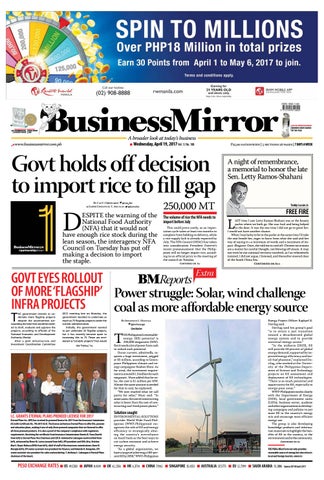
The Pililia Wind Farm not only provides renewable source of energy but also attracts local and foreign tourists. NONIE REYES
n japan 0.4549 n UK 62.2556 n HK 6.3734 n CHINA 7.1962 n singapore 35.4353 n australia 37.5773 n EU 52.7399 n SAUDI arabia 13.2086
Source: BSP (18 April 2017 )
BMReports BusinessMirror
A2 Wednesday, April 19, 2017
www.businessmirror.com.ph
Power struggle: Solar, wind challenge coal as more affordable energy source Continued from A1
Four years ago, the W W F launched a global campaign called “Seize Your Power”. The campaign aimed at major financial institutions and governments worldwide to divest from dirty fossil-fuel projects and support clean renewableenergy projects. Dorilag said in the Philippines, the campaign focused on Palawan and sought to stop a planned 15MW coal-fired power plant there. The WWF-Philippines was also involved in crafting the Palawan Island Power Development Plan, which helped craft an alternative energy scenario for the island province. This initiative is being continued in other off-grid islands in the country. Three years ago, the WWFPh i l ippi nes com m i ssioned a study, titled “Building Momentum for Low Carbon Development in the Philippines”, which found that the country can reduce its total emissions significantly between 2010 and 2050 relative to business-as-usual (BAU). The group said the country can achieve this by harnessing the Philippines’s
huge RE resources, through energy efficiency and increasing its carbon sink potential.
in promoting RE and energy efficiency and, of course, save on operation cost.”
Tech boost
Huge potential
THE WWF continues to push for RE technologies with its “Seize the Wind”, “Seize the Sun” and “Seize the Flow” campaigns through multisectoral engagements and information education campaigns. “ Through these campaigns, the WWF develops information materials on wind farms and solar farms, and explains RE to the public,” Dorilag said. He added his group also holds environmental education sessions in communities and schools and teach people the basics of climate change and energy. “We are also bringing in adaptive technologies and build capacities for sustainable food, water and energy in off-grid communities and help them improve their lives.” Currently, the WWF-Philippines launched an energy-efficiency initiative called “UPfront”, which includes the planned “solarization” of its office rooftop. The latter, Dorilag said, would enable the group “to walk our talk
THE WWF-Philippines said the country has huge RE potential waiting only to be tapped. They estimate energy potential from wind is pegged at 76,000 MW mainly due to the country’s prevailing monsoons, Dorilag said. It also has a whole year-round of good solar irradiation estimated to generate 5 kilowatt-hour per square meter (kWh/m2) per day in almost all parts of the country, he added. Meanwhile, mountainous tropical landscape provides a good source of hydropower estimated at 10,500 MW. The Philippines also has many volcanic islands rich in geothermal resources with an estimated 1,200 MW total power-generating capacity and vast oceans that could be tapped for ocean energy that could generate 170,000 MW of electricity, according to Dorilag. He explained that the National Renewable Energy Program (NREP) 2011 estimates the Philippines can triple its RE capacity from 2010
level to 15,304 MW. The upcoming update from the National Renewable Energy Board estimates there could be more, Dorilag said.
Greening time
ACCORDING to Dorilag, it is also high time that the country invest in RE, especially with the cost of technology continuously decreasing. Wind-energy cost has fallen 50 percent since 2009 and the cost for a solar PV module has fallen 80 percent since 2008, he said. Citing Bloomberg, Dorilag said the cost of solar energy has gone down to as much as $2.99/kWh in Dubai and wind has gone down to $0.3 cents/ kWh in Morocco. He added that solar developers in the Philippines have declared they have reached grid parity with transactions in the utility scale reaching P5.39/kWh. According to the DOE, the new solar facility in Tarlac is expected to offer solar energy at a price lower than that of coal.
Energy security
ACCORDING to the WWF-Philippines, the main motivation to pursue RE is that it provides energy
security to the country. “Renewable energy is an indigenous source of energy, meaning the resource is available locally and not prone to foreign influences and fuel-price fluctuations,” Dorilag said. “RE can be used to power remote islands with distributed energy systems, saving us the delivery of fuel to remote islands.” He added that RE also delivers quick alternative power in times of natural calamities, as well as empower energy-poor areas and increase economic activity.” “Globally, investment on RE has reached $286 billion in 2015,” a document by the WWF-Philippines said. “This is more than double the investment in new fossil-fuel generation.” Citing a study by the United States Agency for International Development in 2013, the WWF estimates the Philippines will need $25 billion in debt and equity investments to achieve the planned 15.3 gigawatts of additional capacity. “Presently, new renewable energies, which include solar, wind, biomass and run-of-the-river hydroelectricity, has a total installed capacity of more or less 1600 MW,” Dorilag said, adding that this will
be equivalent to about $4 billion of new investments since the passage of the RE law.
Investor confidence
ACCORDING to Greenpeace, there is growing investors’ confidence in RE in the Philippines. Muni said the Philippines now has its own local manufacturers of solar panels and battery that can supply needed materials, including components, for the construction of solar-power plants or even mini power plants on rooftops. “All solar panels, including battery for storage, are locally produced,” Muni said. This means, the Philippines do not only has the potential but the technological capacity to make the shift in investment from coal to RE like solar power, he added. Muni, however, explained the government should undertake a geographical assessment of the RE potentials. “Given the limited areas in the Philippines, what is viable is rooftop solar energy,” Muni said. “Metro Manila alone, he said, has a 270-MW capacity, enough to supply the entire energy requirement in the National Capital Region.”
Govt holds off decision to import rice to fill gap Continued from A1
“The agenda of the meeting is confidential. But we did not talk about rice importation. There are so many things to settle before we can decide on it, in light of the policy pronouncement of President Duterte,” the official told the BusinessM irror. While he did not confirm that the NFAC did not act on the NFA’s appeal to import rice, Socioeconomic Planning Secretary Ernesto M. Pernia said economic managers stand pat on its stance that the country needs rice imports. But Pernia said the economic team is more partial to letting the private sector import rice because the government does not want to spend. He said importing rice would mean adding to the debt of the NFA that currently stands at P211 billion. “[The economic team] is for timely rice importation because it’s not possible, at least in the near to medium term for the Philippines to become rice self-sufficient,” he told reporters on the sidelines of a forum held in Pasay City on Tuesday.
In January the NFA had sought the NFAC’s approval to import 250,000 metric tons (MT ) of rice to beef up its stocks for the lean season of July to September, when farmers do not usually harvest due to strong typhoons. The volume was part of the 500,000 MT standby authority approved by the NFAC in 2015 for buffer stocking. The NFAC is the highest governing body of the NFA. Earlier, economists said the pursuit of rice self-sufficiency was “one of the mistakes” of the previous administration. Former Agriculture Secretary Proceso J. Alcala made the pronouncement of attaining “zero imports” by 2013 under the Aquino administration when he was appointed in 2010. However, the target was not met and, recently, due to the prolonged dry spell brought about by El Niño, the outgoing administration had to import an additional 500,000 MT of rice to plug the gap in local output. The government’s rice self-sufficiency bid also put a strain on public funds for other crops. Philippine Institute for Development Studies Senior Fellow Roehlano Briones said the government’s rice spending reached P37.44 billion
in 2012, almost half of the government’s total agriculture spending for that year.
‘Messy data’
The Department of Agriculture (DA) on Tuesday said it would urge President Duterte to allow the mandatory inspection of all rice warehouses so the government could come up with a “more accurate” inventory. “I’ve been saying all along that [government] data and statistics are messy, really messy. Who can tell what is the actual, current rice inventory all over the country? No one, not even the Philippine Statistics Authority [PSA],” Agriculture Secretary Emmanuel F. Piñol told reporters in an interview on Tuesday. Piñol made the pronouncement amid the apparent indecision of the government regarding the mode by which it would prop up its own stockpile. He added that data from the PSA are “not accurate”, as the government’s major statistical agency did not take into account rice being smuggled into the country. Piñol said he will propose to Duterte the creation of an inter-agency task force that would conduct a mandatory inspection of all
rice warehouses in the country. “Of course, the inspection will factor in the smuggled rice. If we would like to establish a credible stock position then we should also factor in the smuggled rice,” he said. “That’s why we have to inspect the warehouses, all the warehouses—that’s the only way,” Piñol added. The envisioned task force, which will be spearheaded by the DA, would include the NFA, the Department of Trade and Industry, Bureau of Internal Revenue, the Bureau of Customs, National Bureau of Investigation, the Philippine National Police and the PSA, according to Piñol. “[The task force] will start working within the second quarter. Even the NFA warehouses will be checked,” he said. Piñol expressed confidence that the President will give his nod to the proposal to create the task force. “We don’t have tackle this anymore during the Cabinet meeting. All it needs is an executive order.” Briones, however, said policymakers are equipped with all the information they need to make the necessary decisions concerning the country’s rice policies, particularly importation. “The policy-making community related to food security has recent information about rice-stock inventory and other data that can be used for food-security planning,” he told the BusinessM irror. Compared to its Southeast Asian counterparts, the PSA is better in terms of providing reports and data on the country’s rice inventory
Infra. . .
level, Briones said. “We have to give credit to the PSA, as they have the best rice stock estimate in Southeast Asia. We have a monthly inventory data. Other Southeast Asian countries don’t have this kind of data,” he said. “In other countries, every time someone requests for a rice inventory data they would have to wait. Here in the Philippines, data from the PSA are readily available,” Briones added. Even if Piñol seeks to apprehend rice smugglers or hoarders through mandatory warehouse inspection, Briones said he would still have a hard time due to the lack of warehouse-specific inventory monitoring data. “If that is his intention, then that is flawed. You need to observe the behavior of warehouses and the traders for over a year, so you will have an idea of the [flow] of their stocks,” he said. “And we don’t have that kind of data because we don’t have the complete census of traders’ behavior, which is impossible. It would be a waste of money and time,” Briones added. The PSA issues a monthly report on the country’s rice and corn inventory. It includes the stocks held by households, commercial warehouses and NFA depositories. The agency uses data from its Palay and Corn Stocks Survey for household-held rice stocks and the NFA’s Commercial Stocks Survey, which is generated from registered grains businessmen. The NFA stocks are monitored from food agency’s warehouses and depositories.
ness M irror,
Continued from A1
help usher in the “golden age of infrastructure” in the country. “We have already streamlined the ICC process, and also even the Neda Board composition is smaller, so that it’s easier to convene,” Neda Secretary Ernesto M. Pernia said. Pernia earlier said the flagship projects aim to create more jobs and stimulate growth. Neda Undersecretary for Investment Programming Rolando G. Tungpalan told the BusinessMirror that speed, more than the funds, is the more pressing concern when it comes to flagship projects. Undertaking feasibility studies takes anywhere from three to 12 months, depending on whether previous work on the project has been done. The ICC project-approval period adds another six weeks to this process, while postapproval time needed to undertake contracts and bidding will take time to complete. Only after projects are bidded out and contracts are awarded will the projects start contributing to the economy. Getting loan approval from development partners will also take time. This will matter, considering the bulk of the 75 flagship projects will be funded through official development assistance. Based on documents obtained by the Busi-
of the 75 projects, around 13, worth P340.68 billion, have been approved by the Neda Board, the highest policy-making body chaired by the President. The Neda said the increase in the government’s infrastructure spending will create an additional 1.6 million jobs annually between 2017 and 2022. “[This is based on the assumption that] public infrastructure-spending baseline of 5.1 percent of GDP this year [and] gradual increase of public infrastructure spending to 7.4 percent of GDP by 2022,” Pernia said. The Neda estimated that the government’s public infrastructure spending will create 106,824 jobs in 2017; some 823,696 jobs in 2018; around 1.12 million in 2019; 1.23 million in 2020; 1.399 million in 2021; and 1.705 million in 2022. Data showed that additional GVA will be 0.3 percent in 2017; around 2.6 percent in 2018; some 3.5 percent in 2019; 3.9 percent in 2020; 4.4 percent in 2021; and 5.4 percent in 2022. These estimates have also taken into consideration the national government’s plan to spend P3.608 billion for the ongoing and new infrastructure projects between 2018 and 2020 under the Three-year Rolling Infrastructure Program. Pernia said the government will spend P1.134 billion in 2018; another P1.183 billion in 2019; and another P1.292 billion in 2020. Cai U. Ordinario
The Nation BusinessMirror
news@businessmirror.com.ph
Editor: Dionisio L. Pelayo • Wednesday, April 19, 2017 A3
Marcos’s friends, supporter raise P36 million for poll protest
I
N order not to delay further the election protest, friends and supporters of former Sen. Ferdinand R. Marcos Jr. had chipped in to enable him to post the initial P36-million cash deposit required by the Supreme Court, sitting as the Presidential Electoral Tribunal (PET).
In a letter submitted to the PET by Marcos himself, 40 friends and supporters of Marcos said they pooled their resources in order for the former senator to come up with the initial cash deposit, since the PET gave him only less than 48 hours to comply last week. Marcos, through his lawyer George Erwin Garcia, received the PET’s order dated March 21, 2017, only on April 10, requiring him to pay P66.223 million to cover for the cost of the retrieval of the ballot boxes and other election paraphernalia in his contested precincts. The Tribunal ordered him to pay in two installments—the first installment of P36.023-million cash deposit to be paid on or before April 14 (Good Friday) and the second installment of P30 million
Please release me, de Lima asks SC By Joel R. San Juan
D
@jrsanjuan1573
ETAINED Sen. Leila M. de Lima on Monday pleaded with the Supreme Court (SC) to grant her petition seeking to nullify the arrest warrant issued against her by a court in Muntinlupa City in connection with the illegal drug-trafficking charges filed against her and to order her immediate release from detention. In a 64-page memorandum, de Lima, through her lawyer, former Solicitor General Florin Hilbay, reiterated that her arrest and subsequent detention should be nullified for being in violation of her right to due process. Hilbay said de Lima’s right to be informed of the nature and cause of the accusation against her was violated when she was arrested and detained for drug trafficking, although the Office of the Solicitor General (OSG) manifested before the SC that her actual crime is mere conspiracy to commit drug trading. Hilbay noted that the OSG’s manifestation contradicts the information that was actually filed against her client before the Regional Trial Court (RTC) in Muntinlupa, which was illegal-drugs trading. “The postfiling alteration of the charge from illegal-drugs trading to conspiracy to commit illegal-drugs trading was resorted to because the records and the evidence lack the corpus delicti, i.e., the dangerous drugs traded—the single most important object evidence in prosecutions in violations under Section 5 of the Dangerous Drugs Act,” the memorandum read. “The amendment through manifestation only highlights the Department of Justice’s and the OSG’s postarrest-agreement about the nature of the charge against petitioner. With all due respect, it is the Honorable Court’s duty to invalidate this unprecedented statesponsored lawlessness,” it added. The senator added that the allegations and the facts presented in the information and in the DOJ joint resolution, which found probable cause to indict her for illegal-drugs trade inside the New Bilibid Prison during her term as justice secretary, do not allege the corpus delicti of illegal-drugs trading. “Petitioner was charged, arrested and continued to be detained for the wrong crime. The government needs to present the dangerous drugs as corpus delicti [evidence],” the memorandum stated. “This case reveals a clear pattern of persecution, not prosecution,” it added. De Lima’s camp also insisted it is the Sandiganbayan that has jurisdiction over the drug complaint filed against her and not the RTC in Muntinlupa City. In addition, de Lima said Judge Juanita Guerrero of Branch 204 of the RTC in Muntinlupa committed grave abuse of discretion in finding probable cause in issuing a warrant of arrest against her. De Lima noted that Guerrero issued the arrest warrant on February 23, despite the pendency of her motion to quash the information filed against her on the ground of the RTC’s lack of jurisdiction. She argued it is the Sandiganbayan that exclusively hears the criminal case of a public official with a minimum Salary Grade of 27, such as the DOJ secretary. The petitioner also justified her decision to immediately elevate the matter before the Court, despite the pendency of her motion to quash the information before the RTC in Muntinlupa. She said the policy on hierarchy of courts is “not an iron-clad rule” and “not inflexible” and the “Supreme Court has full discretionary power to take cognizance of certiorari actions filed directly with it for exceptionally compelling reasons”. “The instant petition is a matter of national interest and has serious implications, given the questions involved, which were triggered by the remarkably unusual positions taken by the legal departments of the government,” she stressed. “The instant petition clearly involves questions of law, the resolution of which will not only affect petitioner, but all citizens in the country,” she added. In its complaint, the DOJ alleged de Lima received around P10 million in drug payoffs from November 2012 to early 2013 through her coaccused, former Bureau of Corrections Officer in Charge Rafael Ragos. Ragos said he delivered the money to de Lima’s residence in Parañaque City, where it received by her former driver Ronnie Dayan.
on before July 14. The P200,000 filing fee initially paid by Marcos when he filed the protest had been deducted from the cost requirement. “Since Mayor Joseph Estrada declared Wednesday [April 12] a nonworking holiday for all government employees in Manila, the offices of the Supreme Court were closed on Wednesday [April 12], Maundy Thursday [April 13] and Good Friday [April 14]. Thus, if former senator Marcos were to comply with the
April 14 deadline, that would give him less than 48 hours to come up with P36 million. In order not to delay the proceedings any further, we decided to pool our resources so that the cash deposit of P36 million would be paid,” Marcos’s friends and supporters said in a statement. They added, “[W]e have done this, because it is our heartfelt wish that the election protest be resolved with dispatch.” They further noted that without their help, the
election protest, which has been ongoing for 10 months without the setting of a preliminary conference, will be further delayed. “Ten months is too long for this open wound to fester. This insecurity and instability is not good for the country,” they added. “We, thus, look to you—the esteemed members of the Supreme Court—to resolve the confusion and doubt that has plagued us since May 2016,” they also said. Joel R. San Juan
Economy
A4 Wednesday, April 19, 2017 • Editors: Vittorio V. Vitug and Max V. de Leon
PHL-Japan expected to sign P227-B Manila subway loan in Nov By Lorenz S. Marasigan @lorenzmarasigan
J
APANESE Prime Minister Shinzo Abe and President Duterte are expected to sign a bilateral loan commitment in November for the development of the first subway system in Metro Manila. Transportation Secretary Arthur P. Tugade said his group is finalizing all requirements of an official development assistance (ODA) loan commitment contract with Japan, just in time for the Asean summit, which the Japanese leader will attend in November. “We have set a target that we should finalize the deal by the time Prime Minister Abe arrives at the Asean summit. It means that we should be finished with the feasibility study, the detailed engineering and design and the financial packages—everything,” he said in an interview at the sidelines of the Dutertenomics Forum on Tuesday. The Mega Manila Subway System, which has a whopping P227-billion price tag, aims to connect Quezon City to Taguig through an underground masstransportation system.
Expected to serve around 370,000 passengers daily, the 25-kilometer facility will have 12 stations, namely, Mindanao Avenue in Quirino Highway, North Avenue, Quezon Avenue, East Avenue, Anonas, Katipunan, Ortigas North, Ortigas South, Kalayaan Avenue, Bonifacio Global City, Cayetano Boulevard and FTI. Currently, the feasibility study for the project is being conducted with the help of a grant from the Japan International Cooperation Agency. Its conceptualization started in 2015. “It is also important that we sign it this year, so we can have ample time to finish the project within the term of the President. It is a very ambitious project,” Tugade said. Tugade assured that traffic obstruction caused by the construction of the facility will be very minimal. “I went to Tokyo and saw that when you construct underneath, there is not much obstruction on the surface. This is what they call tunneling system. I wouldn’t agree that quickly if I knew that traffic congestion would be too much because of this project,” he said.
We have set a target that we should finalize the deal by the time Prime Minister Abe arrives at the Asean summit. It means that we should be finished with the feasibility study, the detailed engineering and design and the financial packages— everything.”—Tugade
BusinessMirror
news@businessmirror.com.ph
New Palace circular imposes tighter screening of govt deals MC 16 By Elijah Felice Rosales @alyasjah
P
resident Duterte has imposed a more stringent process on the negotiation, ratification and approval of international agreements, including deals on borrowings, guarantees and foreign grants, amid the reported growing interest of foreign states and investment firms in the country. Duterte issued Memorandum Circular (MC) 16, which requires all heads of departments, bureaus, offices, agencies and instrumentalities of the government, including state-owned or –controlled corporations and state universities and colleges, to coordinate closely with the Department of Foreign Affairs (DFA) for international agreements, and with the Department of Finance (DOF) for deals on borrowings, guarantees and foreign grants. Prior to the negotiation or signing of an executive or financial agreement, the lead or implementing agency has been required to first secure an authorization from the
Office of the President (OP), the DFA and the DOF. “Authorizations…shall be granted in writing through full powers, special authority, letter or memorandum signed by the President or by the executive secretary by authority of the President,” the circular read. It also directed government heads to strictly observe and comply with the complete staff work (CSW) requirement, stipulated under MC 68, Series of 2004, before securing an authorization from the OP. The CSW requirement covers basic documentary requirements with a covering memorandum containing a statement of justification,
legal basis, coordination done with other agencies, potential problems, fund availability and a draft action. On the other hand, the OP is mandated by MC 16 to evaluate and process the authorization for not more than 10 working days before the desired date of issuance by the lead agency. A c c o r d i n g t o P r e s i d e nt i a l Spokesman Ernesto C. Abella, the memorandum was intended to ensure the thorough evaluation of all agreements entered into by the government. “Considering the massive and growing interest of foreign governments and investors in the country, the OP has deemed it appropriate to issue MC 16 to ensure the effective and efficient coordination among government agencies.” Under Article 8, Section 20 of the Constitution, “the President may contract or guarantee foreign loans on behalf of the country, with the prior concurrence of the Monetary Board, and subject to such limitations as may be provided by law”. Executive Order 292, Series of 1987, or the Administrative Code of 1987, authorizes the DFA as the lead agency that shall advise and assist the President in planning, organizing, directing, coordinating and evaluating the total national effort in foreign relations. The DOF, following the abovementioned law, is tasked to undertake and super v ise the activities related to the negotiation, servicing and restructuring of domestic and foreign debt
The memorandum circular which requires all heads of departments, bureaus, offices, agencies and instrumentalities of the government, including state-owned or -controlled corporations and state universities and colleges, to coordinate closely with the DFA for international agreements, and with the DOF for deals on borrowings, guarantees and foreign grants.
incurred by the government and its instrumentalities. Notably, the enactment of MC 16 follows the dismissal of Interior Secretary Ismael D. Sueno, who was fired by Duterte two weeks due to “loss of trust and confidence”. Before his dismissal, Sueno was at loggerheads with three interior undersecretaries, who accused him of entering into a “dubious” foreign loan agreement for the purchase of Rosenbauer fire trucks. Sueno denied the allegation, claiming the deal was perfected into contract by the previous administration.
Lawmakers propose ‘win-win’ solution on mandatory PWD employment House measure By Jovee Marie N. Dela Cruz
T
Back to work
Workers resume the construction of a mixed commercial and residential edifice in Pasay City after the Lenten break. Construction is expected to reach its peak with in the next few weeks with the prevailing dry season. Alysa SalEN
EU shells out additional ₧200 million for Mindanao peace and development By Cai U. Ordinario @cuo_bm
T
he European Union (EU) is extending an additional P200 million for the Mindanao Trust Fund (MTF) to support the government’s effort to keep peace in Southern Philippines. In a news statement released on Tuesday, the EU said the newly approved contribution is intended to be spent for the next 18 months to help the government monitor the situation, diffuse tensions and create a more inclusive political platform in Mindanao. “EU is a reliable, impartial and committed partner in the pursuit of peace and development in Mindanao. It remains steadfast in its resolve to continue strengthening this partnership in the future,” EU Ambassador Franz Jessen said. The EU is also developing a comprehensive peace and development program to push for peace and development in Mindanao. Jessen said the EU is planning to step up
considerably its support to the region, and is currently preparing a new program to be signed next year. The program will be done in partnership with the Philippine government and aims to consolidate peace and development through confidence-building measures and inclusive growth. The MTF is a facility where various donors have agreed together to contribute to the socioeconomic recovery of conflict-affected communities of Mindanao. The EU is currently the main contributor to the multidonor MTF providing around 80 percent of its total amount. Over the past 11 years the program has delivered more than 500 community subprojects for over 650,000 people in 316 conflictaffected communities all over Mindanao, in an effort to demonstrate the benefits of reaping the dividends of peace. In 2015 the EU’s total official development assistance (ODA) to the Philippines reached $227.31 million. This accounted for 1.45 percent of the country’s total ODA worth $15.71 billion.
@joveemarie
he chairman of the House Committee on Metro Manila Development on Tuesday said Congress should grant incentives to businesses that will hire persons with disabilities (PWDs). Liberal Party Rep. Winston Castelo of Quezon City, chairman of the panel, said both chambers should pass a law providing a reward and punishment system for these companies. “There’s good reason for the apprehension of some employers on the proposal [mandating the hiring of PWDs]. However, we also need to address the problem of lack of opportunities and employment for PWDs,” Castelo said. Earlier Employers Confederation of the Philippines acting President Sergio Ortiz-Luis Jr. expressed reservation on the proposal mandating employment quotas on business for PWDs. Pending House Bills 1916, 2396, 4865 and 5058 require that a particular percentage of a company’s work force be filled by PWDs, under the pain of stiff penalties to violators. Moreover, Castelo said the government should determine first how many PWDs the Philippines have and what percentage of the labor force they represent. “That way, we can determine exactly also how many may be employed by businesses. Also, we can consider both giving incentives to businesses that hire PWDs, as well as imposing penalties to those who don’t. That makes it a win-win formula-reward and punishment system,” he said. Castelo is the author of a measure granting scholarship to children of PWDs and a resolution opposing any and all proposal to remove the exemption from value-added tax of senior citizens and PWDs. For her part, PDP-Laban Rep. Estrellita B. Suansing of Nueva Ecija is pushing for a measure institutionalizing a national employment facilitation service network for PWDs through the establishment of a PWD employment facilitation office in every province, key city and other strategic areas in the country. Suansing said her House Bill 1972 seeks to promote the employment opportunities for PWDs and strengthen existing employment facilitation service machinery of the government for PWDs, particularly at the local levels. The bill said the Person with Disability Employment Facilitation Office shall be community based and maintained largely by local government units, and non-governmental organizations. The measure added the office will provide a venue where PWDs could find and explore various employment options and seek training assistance for possible employment venture and serve as referral and information centers for the various services and programs being provided by the Department of Labor and Employment and other government agencies with respect to the welfare and employment of PWDs. “Through these employment opportunities being provided by the State, we will help not only boost the PWDs’ self confidence, but also, enable them to be self-reliant and become productive members of the community,” Suansing said. Suansing said her bill is still pending before House Committee on Social Services.
www.businessmirror.com.ph • Editor: Lyn Resurreccion
The World BusinessMirror
Wednesday, April 19, 2017
Planned Trump order will discourage hiring of low-wage foreign workers
W
ASHINGTON—President Donald J. Trump is expected to sign an executive order on Tuesday aimed at making it harder for technology companies to recruit low-wage workers from foreign countries and undercut Americans looking for jobs. Trump will also direct all federal agencies to systematically examine the effectiveness of government rules and trade agreements that require a preference for purchasing from US companies. The president will announce the order during a visit to the headquarters of Snap-on Tools in Kenosha, Wisconsin, senior administration officials told reporters during
a briefing on Monday afternoon. The officials spoke on the condition of anonymity to preview the president’s announcement. As a candidate, Trump often assailed the government’s H-1B visa program, under which the government admits 85,000 immigrants each year, mostly to work in high-tech jobs. Trump pledged to end the program,
80%
The percentage of immigrants who enter the US under the H-1B visa program are paid less than the median wage for workers
which he said was allowing companies to fire Americans and replace them with lower-cost foreign employees. The expected executive order falls far short of ending that program, but the administration officials argued on Monday that the changes Trump sought would radically change it. The officials said 80 percent of
the immigrants who enter the US under the current visa program are paid less than the median wage for workers in their fields. The president’s order seeks changes to the program that would require applicants and their potential employers to demonstrate that the visas are going only to “the most highly skilled workers” in their fields. As a result, the officials said, the H-1B visa would no longer be a cheap way for companies to replace US workers. But technology executives, who have argued that the program is vital to their ability to recruit talent, are likely to be frustrated by the change. Robert D. Atkinson, president of the Information Technolog y and Innovation Foundation, a research group sponsored by several tech companies, predicted in January that a crackdown on H-1B visas would be counter productive.
“The effect would end up being exactly the opposite of what Trump wants,” he said. “Companies would go offshore, like Microsoft did with Vancouver, Canada,” to seek talent. The changes Trump is seeking will take some time to carry out, the administration officials said. The order will call for a 220-day review of waivers and exceptions made to decades-old “Buy American” rules. Those waivers are at the heart of about 60 trade deals with foreign countries, the officials said. If the review finds that the waivers are detrimental to US workers, the trade deals could be renegotiated, they added. In addition, all federal agencies will be directed to strictly enforce “Buy American” rules, giving the highest priority to US companies when making purchasing decisions. New York Times News Service
Pence visits Japan, turning focus to trade with key ally
T
OKYO—US Vice President Mike Pence and Japanese leaders began talks on Tuesday expected to focus largely on trade with America’s anchor ally in the region, though tensions with North Korea loomed large. Pence reassured Prime Minister Shinzo Abe that the US considers its alliance with Japan to be a cornerstone of security in the region. “We appreciate the challenging times in which the people of Japan live with increasing provocations from across the Sea of Japan,” Pence said. “We are with you 100 percent,” he said, adding that the US “always seeks peace”. Pence reiterated that after years of North Korea testing the US and its neighbors in East Asia with its nuclear ambitions, the US “era of strategic patience is over”. Abe said Japan, likewise, hopes for peaceful dialogue with Pyongyang, “but at the same time, dialogue for the sake of dialogue is valueless.” Pressure on North Korea is crucial, he said. Pence is on a 10-day Asia trip
that will also take him to Indonesia and Australia. Concluding a visit to South Korea that was mostly focused on the North Korea problem, Pence told business leaders in Seoul earlier on Tuesday that the administration is taking a fresh look at trade agreements as part of its “America First” policy. “We’re reviewing all of our trade ag reements across t he world to ensure that they benefit our economy as much as they benefit our trading partners,” Pence told the American Chamber of Commerce in Korea. White House officials said the economic meetings in Tokyo, with Deputy Prime Minister Taro Aso and other officials, will help forge a framework for a new US-Japan economic dialogue launched by President Donald J. Trump and Abe during the Japanese leader’s visit to the US in February. Pence’s two main goals are to spur increased US access to Japanese markets and strengthen Japanese foreign investment, they said. While Japan’s trade surplus
with the US is much smaller than China’s, Trump has decried the imbalance, especially in auto exports. Both sides said they do not expect the talks in Tokyo this week to delve into sector-bysector talks on trade. With no US Trade Representative yet in office and other key negotiator positions still unfilled, such nitty-gritty discussions will have to come later. But the meetings could indicate how forcefully the US will pressure Japan to further open its farm and automotive sectors. Pence’s advisers said the vice president would make the case to Abe and Aso that the US rejection of the Trans-Pacific Partnership (TPP) under Trump does not signal a US withdrawal from trade and economic development in the region. The loss of US participation in the TPP was a blow to Japan following strenuous negotiations, especially over opening access wider to its long-protected farm sector. Chief Cabinet Secretary Yoshihide Suga told reporters over the
N. Korea: US creating situation for nuclear war
U
N I T E D N ations — North Korea’s deputy UN ambassador accused the United States on Monday of turning the Korean Peninsula into “the world’s biggest hot spot” and creating “a dangerous situation in which a thermonuclear war may break out at any moment.” Kim In Ryong told a news conference that “if the US dares opt for a military action,” North Korea “is ready to react to any mode of war desired by the US”. He said the Trump administration’s deployment of the Carl Vinson nuclear carrier task group to waters off the Korean Peninsula again “proves the US reckless moves for invading the DPRK [Democratic People’s Republic of Korea] have reached a serious phase of its scenario.” Kim stressed that US-South Korean military exercises being staged now are the largest-ever “aggressive war drill” aimed at his country. “The prevailing grave situation proves once again that the DPRK was entirely just when it increased in every way its military capabilities for self-defense and preemptive attack with a nuclear force as a pivot,” he said. Tensions have escalated over
North Korean moves to accelerate its weapons development. The North conducted two nuclear tests and 24 ballistic missile tests last year, defying six Security Council sanctions resolutions banning any testing, and it has launched more missiles this year, including a failed attempt this past weekend. The North’s Foreign Ministry said the missile launches are as part of a normal process of building up the country’s defenses and economy. Ministry official Kim Chang Min also said in the interview in Pyongyang that the UN, the Security Council and big countries ignored South Korean missile launches and Japanese surveillance satellites. “ This is the limit of double standards,” Kim of the Foreign Ministry said. “How can we have any dialogue to get any result with anyone who has this kind of approach?” On Monday US Vice President Mike Pence traveled to the Demilitarized Zone dividing the Koreas and warned Pyongyang that “the era of strategic patience is over.” After 25 years of trying to deal patiently with North Korea’s nuclear and missile ambitions, Pence said, “all options are on the table” to deal with threat.
Deputy UN Ambassador Kim sa id Nor t h Korea’s pol ic y is shaped by the Trump administration’s push for “high-intensity sanctions” against the country, deploying tactical nuclear weapons in South Korea and launching military action aimed at “beheading” the North’s leadership headed by Kim Jong Un. He said rolling back the hostile US policy toward the DPRK “ is the precondition to solving all the problems in the Korean Peninsula”. Kim called the news conference to “categorically reject” the US decision to hold an open meeting of the Security Council on April 28 on North Korea’s nuclear program, which is scheduled to be chaired by US Secretary of State Rex Tillerson. He called it “another abuse of authority” by the United States, which holds the Security Council presidency this month, and a violation of the DPRK’s sovereignty. Kim ignored questions about the DPRK’s relationship with China and reports that the government didn’t respond to requests from Chinese officials for a meeting. Instead, he reiterated two Chinese proposals that the US rejected. AP
weekend that Japan might push ahead with a revised, 11-nation version of the TPP despite the US rejection of the trade accord. For now, both sides seem keen to downplay potential for conflict. “My understanding is that our talks are premised not on friction but on cooperation,” Aso told reporters before Pence’s arrival. US Commerce Secretary Wilbur
Ross, who met with Japan’s trade minister, Hiroshige Seko earlier on Tuesday, said he hopes to soon begin talks on a free-trade agreement with Japan. As Indiana governor, Pence saw firsthand the impact of Japanese automakers Toyota, Honda and Subaru, whose factories employ thousands of people in his home state. AP
A5
Watchdog group expands lawsuit against Trump
W
ASHINGTON—A legal watchdog group is expanding a federal lawsuit filed earlier this year against President Donald J. Trump, accusing him of violating the Constitution by continuing to own and profit from his far-flung business empire. The amended complaint, to be filed on Tuesday in a federal court in the Southern District of New York, alleges that Trump has harmed an organization that represents more than 200 restaurants and nearly 25,000 employees. Its clients compete directly with restaurants that Trump owns or in which he has a financial interest, the new pleading alleges, and suffer from the revenue he reaps from his enterprises. The revised complaint by Citizens for Responsibility and Ethics in Washington (CREW) is an effort to address what some saw as a critical weakness in the group’s original lawsuit: the lack of a clear victim who could claim injuries resulting from Trump’s failure either to sell off his business holdings or to place them in a blind trust. It will be filed just days before the Justice Department is expected to respond to the lawsuit. Besides the restaurant organization, the complaint alleges that Trump’s actions have harmed a woman who books embassy and political functions in Washington. CREW’s initial complaint argued that the Constitution prohibits the president from accepting any economic benefit from foreign governments. The expanded lawsuit contends that Trump also cannot legally accept any financial benefit, besides his salary, from the US government. By failing to sufficiently distance himself from his companies, CREW has charged, Trump has violated clauses of the Constitution that ban the acceptance of any government-bestowed benefits, or “emoluments”, either at home or abroad.
New York Times News Service
A8
Wednesday, April 19, 2017
The World BusinessMirror
Ex-Afghan President: Massive US bomb was an ‘atrocity’
K
ABUL, Afghanistan—Former Afghan President Hamid Karzai said on Monday the United States is using Afghanistan as a weapons-testing ground, calling the recent use of the largest-ever nonnuclear bomb “an immense atrocity against the Afghan people”.
95
The number of militants killed when US forces dropped the GBU-43 Massive Ordnance Air Blast bomb in eastern Nangarhar province in Afghanistan last week
Last week US forces dropped the GBU-43 Massive Ordnance Air Blast bomb in eastern Nangarhar province, reportedly killing 95 militants. Karzai, in an interview with The Associated Press, objected to the decision, saying his country “was used very disrespectfully by the US to test its weapons of mass destruction.” The office of President Ashraf Ghani said following the bomb’s usage that there was “close coordination” between the US military and the Afghan government over the operation, and they were careful to prevent any civilian casualties. But Karzai harshly criticized the Afghan government for allowing the use of the bomb.
“How could a government of a country allow the use of a weapon of mass destruction on its own territory? Whatever the reason, whatever the cause, how could they allow that? It was just unimaginable,” he said. The strike was carried out on Thursday morning against an Islamic State (IS) group tunnel complex, carved into a mountain that Afghan forces had tried to assault repeatedly in recent weeks, according to Afghan officials. US and Afghan forces have been battling the Taliban for more than 15 years. But the US militar y unveiled the largest conventional bomb in its arsenal against the IS group, which has a far smaller but growing presence in A fghanistan. US President Donald J. Trump has publicly vowed to aggressively confront IS. Trump called the operation a “very, very successful mission” but Karzai had harsh words for the new US leader. “My message to President Trump today is that he has comm it ted a n immense at roc it y against the Afghan people, against fellow human beings,” he said. “If the American government sees us as human beings, then they have
committed a crime against fellow human beings, but if they treat us as less than human beings, well, of course they can do whatever they want.” K arzai added that one of the fundamental reasons that he ref used to sig n the bilatera l security agreement (BSA) with the US when he was the president was specifically to prevent such actions. “I told the people of Afghanistan in the Loya Jirga [Grand Assembly] we must not sign the BSA with the US, that we must not give them bases till the day they bring peace to Afghanistan,” he said. “Why would the Afghan people want to give the US bases? For what? To continue the war in Afghanistan, to become more insecure, to lose peace forever, to suffer, to receive more bombs, to receive a weapon of mass destruction? Or for security, for peace and for a better life?” The US National Security Adviser H. R. McMaster met with President Ghani during a visit to Afghanistan on Sunday. According to statement from the office of the president, the pair discussed mutual counterterrorism efforts, security and economic development. AP
Prince Harry shares emotional struggles after Diana’s death
L
ONDON—It is an image those who saw it will never forget: Prince William and Prince Harry—just boys, really— walking silently behind their mother’s cortege as the world mourned Princess Diana’s death in 1997. Now Harry has revealed for the first time that losing his mother when he was only 12 left him in emotional turmoil for 20 years, filling him with grief and rage he could only manage after he sought counseling. Breaking sharply with the royal tradition of maintaining a stoic silence about mental health, the 32-yearold prince told The Daily Telegraph in an interview published on Monday that he had nearly suffered multiple breakdowns since his mother’s death. It was by far the most frank interview of Harry’s life and gives the public a much fuller view of Harry and the inner turmoil he suffered growing up in the public eye after losing his mother. He told the newspaper he “shut down all his emotions” for nearly 20 years and had been “very close to a complete breakdown on numerous occasions”. He describes a long, painful process of refusing to face his sense of loss that only came to an end when he was in his late 20s and sought professional counseling to cope with the pressures and unhappiness. “My way of dealing with it was sticking my head in the sand, refusing to ever think about my mum, because why would that help?” he said of his teens and 20s, a period in which he embarked on a successful military career but also occasionally attracted unwanted headlines, notably for being photographed playing “strip billiards” in Las Vegas. In the interview, Harry said he had at times felt “on the verge of punching someone” and had taken up boxing as an outlet for the aggression he felt. He said the long suppression of his grief eventually led to “two years of total chaos”. He said he was pretending that life was great until he started counseling and faced his problems head-on. “All of a sudden, all of this grief that I have never processed started to come to the forefront and I was like, there is actually a lot of stuff here that I need to deal with,” he said. Along with his brother Prince William and sister-in-law the Duchess of Cambridge, Harry has worked with a charity that promotes mental health. AP
Editor: Lyn Resurreccion • www.businessmirror.com.ph
Trump effect on French polls: Anything is possible
P
ARIS—The impossible is now possible, French farright presidential candidate Marine Le Pen said in celebration after Donald J. Trump won the US presidency. But the Trump effect may not bring Le Pen the boost she had once expected. That’s in part because Trump has not turned out to be the soul mate Le Pen was counting on. Trump bombed Syria and abandoned suppor t for President Bashar al-Assad, whom Le Pen backs. He alienated Russia even as Le Pen consolidated her alliance with Vladimir Putin. And Trump’s administration has been fraught with internal troubles. French voters have learned at least one thing from Trump’s surprising victory and Britain’s surprising vote to leave the European Union: They need to be ready for a surprise. With only six days left before Sunday’s first-round vote, polls show the four leading French candidates are so close in popularity that there’s no clear front-runner. The top two candidates advance to a May 7 runoff. Le Pen, campaigning against immigration and Europe’s open borders, has a good chance of reaching the runoff but little chance of winning it—at least according to pollsters, who have suffered their own Trump effect after failing to predict his presidency. Populists elsewhere in Europe have had mixed success in elections since November. Dutch voters rejected firebrand Geert Wilders, favoring the status quo. Italians voted against the establishment, while Austrian voters rejected a far right presidential contender. In France Trump’s victory has given new focus to Le Pen’s rivals. Independent centrist Emmanuel Macron is framing himself as a bulwark against the nationalism and protectionism of Trump’s America and Putin’s Russia. “The world around us is changing. War, terrorist threat, the uncertainty on the other side of the ocean [a reference to Trump], the threat at our borders of several authoritarian regimes. Yes, we will have to be strong, uncompromising,” Macron told a big campaign rally on Monday. Other candidates are warning that Le Pen’s dreams of leaving the EU and the euro would wipe out voters’ savings and devastate the economy. French media pressured Le Pen last week for questioning whether the French state was really responsible for deporting tens of thousands of Jews to death in World War II during the Nazi occupation. Le Pen enjoyed a boost from the Trump phenomenon—the rise of anti-establishment sentiment, especially from working classes who
lost out from the globalization that transformed the world over the past generation. Le Pen has courted that electorate for years and saw Trump’s election as vindication of that strategy. Hours after Trump was elected, Le Pen said, “What happened tonight is not the end of the world, it’s the end of a [certain] world.” She called his victory and the Brexit vote “democratic choices that bury the ancient order and are as many stones to build the world of tomorrow”. She also plays to security fears after a string of deadly Islamic extremist attacks on France. But the Trump presidency has shown that implementing populist promises isn’t as easy as it seems. And Trump’s own reversals have frustrated Le Pen. “We have seen that Trump’s latest positions are so contrary to what Marine Le Pen had hoped,” said Thierry de Montbrial, president of the French Institute of International Relations. Nationalist candidates “no longer recognize themselves” in Trump anymore. L e Pe n d i s t a nc e d he r s e l f from Trump after the US missile strikes on Syria earlier this month, angry that he is trying to be “the world’s policeman.” Trump’s reversal on North A t l a n t i c Tr e a t y O r g a n i z a tion—which he once called obsolete—also frustrates Le Pen. She wants to pull France out of its command structure and sees the alliance as an unnecessar y threat to Russia now that the Soviet Union is defunct. “If there is a Trump effect on the campaign, it is that in many minds, it’s assumed that anything is possible,” said Emmanuel Riviere, director of Kantar Public’s polling in France. “It’s not unreasonable to have a victory of a candidate who is improbably excessive, and unexpected.” Le Pen’s electorate is not an exact mirror of Trump’s, though they both attract support from “white people whose social standing has fallen,” Riviere said. She doesn’t have a powerful party machine like that of Trump’s Republicans, and has less support from older generations who supported Trump. But Le Pen enjoys more support from youth. R iv iere sa id any l inger ing Tr u mp ef fect on t he Frenc h campaign could also favor other candidates, such as far-left Jean-Luc Melenchon, who rails against free trade. Or conservative François Fillon, who has adopted Trump-style criticism of the media and a justice system he said is conspiring against him. “We are in a very unprecedented moment in French politics,” Riviere said. “This presidential term will be something we have never seen before.” AP
Videos show suspect in Facebook killing
C
LEVELAND—The suspect in the random killing of a retiree posted on Facebook made his living mentoring teens in Cleveland, but his life appeared to be unraveling under the weight of gambling debts and trouble with his girlfriend. Rambling videos he shared showed his despair, saying he was out of options and wanted to kill as many innocent people as he could. While authorities have not found any evidence that he killed anyone else, the manhunt for Steve Stephens stretched into a third day on Tuesday and far beyond the neighborhood where police said he shot a 74-year-old man who was picking up aluminum cans on Sunday after spending Easter with some of his children. Stephens, 37, could be anywhere, authorities said, calling it a nationwide search. A $50,000 reward is being offered for information leading to his capture and prosecution. Stephens posted a video of himself killing Robert Godwin Sr., a former foundry worker who had 10 children, the police said. In it, he said, “I snapped, I just
snapped.” But police would not speculate on what was behind it. “Only Steve knows that,” Williams said. In the video, Stephens told Godwin a woman’s name and said, “She’s the reason that this is about to happen to you.” Godwin did not seem to recognize the name. The woman Stephens spoke of, Joy Lane, said in a text message to CBS that “we had been in a relationship for several years. I am sorry that all of this has happened.” She also said Stephens was “a nice guy” who was good to her and her children. Stephens filed for bankruptcy two years ago despite holding down a job as a counselor helping young people develop job skills and find employment. The behavioral health agency where he worked said an extensive background check before he was hired turned up nothing worrisome. In one video posted on Facebook, Stephens said that he gambled away everything and that he and his girlfriend had planned to marry but did not, without saying why. He blamed her for what was about to happen. AP
ExportUnlimited BusinessMirror
Editor: Efleda P. Campos • Wednesday, April 19, 2017 A9
PHL exports continue to grow, up 11% in Feb 2017
P
HILIPPINE exports posted an 11-percent increase on total sales of $4.782 billion for the month of February 2017, marking its third month of positive growth, a report released by the Philippine Statistics Authority (PSA) said.
For February 2017 eight out of 10 top major Philippine exported goods rose, with electronic products comprising 51.6 percent of the total exports revenue amount-
ing to $2.47 billion, compared to $2.131 billion registered in the same period last year. Other products that increased included cathodes and sections of
cathodes of refined copper (946.9 percent); other mineral products (107.5 percent); coconut oil (66.5 percent); electronic equipment and parts (64.9 percent); metal components (29.4 percent); other manufactures (20.1 percent); electronic products (15.9 percent); and chemicals (9.6 percent). The US topped other Philippine export destinations for the month, accounting for 15.6 percent to total exports with receipts valued at $745.22 million. It was followed by Japan, with a 15.25-percent share, with revenues amounting to $728.35 million. The increase in February 2017 exports lifted the cumulative value
DTI-EMB pushes promotion of PHL construction services Part Two
I
NFORMATION technologybusiness-process manangement (IT-BPM) includes construction and engineering services outsourcing. The Export Marketing Bureau (EMB) would like to help the Philippine construction sector to be the world’s leading provider of construction service. Loring said there is more value in providing nonvoice services, like software development and construction and engineering services. She said the services sector has no tariff, unlike goods. Participants were advised to expand their knowledge on the World Trade Organization (WTO), specifically its classification, the W120, to familiarize them to which subsectors they can engage to. Philippine exporters should maximize the benefit in accessing free-trade agreements (FTAs). They should be aware on how they would access FTAs, part of the EMB service to exporters. In the region, there is now the so called Asean Trade in Services Agreement. Statistics showed more than 70 percent of the world’s purchasing power is located outside the US. In services, there is a lot of construction opportunities, such as in Macau, Dubai and other Middle East countries building high-rise hotels and casinos. Loring said India is aggres-
sively moving commercialization by developing nonindustrialized areas, like Calcutta, and building a commercial complex and business zones, which the Philippine construction industry can also look into and take advantage of. In Calcutta there is a proliferation of global companies building their business centers from various parts of the world. The Philippine construction has an agreement mentioned in Asean-India for sewerage and environmental services related to construction and engineering. The Philippines also has construction and mining, financial and technical agreements with Korea. Negotiations under the Regional Comprehensive Agreement (RCEP) are ongoing. Loring said under the RCEP, Korea, China, Japan, India, Australia and New Zealand are added to the 10-member Asean who will be enjoying regional free trade. In New Zealand up to 100 citizens of each country aged 18 to 30 are already allowed to work or study in the country during a 12-month stay. The scheme would enable Filipinos holding tourist visas to work while on holiday in New Zealand. The primary challenge for the construction sector in regional economic integration is the recognition of professional licenses
and of competencies, now being negotiated under the qualit y framework of the Mutual Recognition Agreement; and high costs of taking the licensure examination for professionals in the Philippines. The Philippines is working on the alignment of qualifications framework with other partner economies so that Phi lippine ser v ice prov iders’ qualifications are aligned with theirs. The Philippines’s Technical Education and Services Development Authority qualifications and requirements are patterned after those of Australia, which is also considered a best practice in skills development. Loring said the construction industry can benefit from economies of scale. It can rise up the globalvalue chain by strengthening research and development (R&D) and investing in innovation. A step taken in this direction is by Philippine higher education, which now requires a continuing development program for engineers and other professionals to encourage R&D and innovation.
EMB services
THE EMB is mandated to oversee the development, promotion and monitoring of Philippine exports. It provides would-be exporters and exporters the enabling environment to make them globally competitive. To be continued
of merchandise exports by 17.36 percent for the first two months of 2017 compared to the same period in 2016, the PSA report said. Continued export growth can be attributed to the significant increase of Philippine electronic products by 13.24 percent in the first two months of 2017. This stemmed from the positive performance of six out of nine subsectors of the industry, which contributed a 96.74-percent share in the cumulative total value of the industry. The Department of Trade and Industr y’s Ex por t Marketing Bureau (DTI-EMB) noted the increasing efforts of the Phil-
ippines to strengthen ties with its Asean neighbors, including China, is expected to sustain the growth of the sector in the coming months. “Enhancing trade-promotion efforts to huge consumer markets is seen as a viable strategy in sustaining the performance of Philippine exports in the coming months,” DTI-EMB Director Senen M. Perlada said. As the Philippines serves host for this year’s Asean summit, the country is pushing for the conclusion of the Asean-led Regional Comprehensive Economic Partnership (RCEP) negotiations. The RCEP is the free- trade agreement
MARKET DEVELOPMENT UPDATE
Northbound policy Part One
T
HE Philippine Foreign Trade Service Corps recently had its planning conference for the year 2017. All of the country’s commercial attachés were asked to report to the the Philippine capital to get much-needed interaction with key home-based officials and be updated with the current situations and policies, especially pertaining to trade, industry and the economy as a whole. Of course, it was also a chance for us to feast on local cuisine, and soak in the warmth of the sun and of our friends and colleagues. Visiting home also showed us how much our country has developed in the past years, but at the same time, reminded us here is still much work to be done. Although our country has been posting remarkable economic growth, we continue to look for areas of improvement to sustain, if not accelerate, our growth pace. We are cognizant we must make our economic growth more inclusive and help our enterprises become competitive amid globalization. A major concern highlighted in our conference is our country’s rather shallow and narrow inventory of goods and services for export. Yes, we do have award-winning chocolates, Hollywood-worthy furniture and a steadfast business-process outsourc-
By Benedict M. Uy Director of Commercial Affairs, Manila Economic and Cultural Office in Taipei Foreign Trade Service Cops-DTI
ing industry, among others, but we need more. There are also gaps in the local manufacturing supply chain that dissuade the entry of some foreign manufacturing companies. Fundamental industries, such as steel and petrochemical, are still wanting. Our agriculture production and food processing also have plenty of room for improvement—in terms of productivity, efficiency, packaging, etc. Our micro, small and medium enterprises, while thriving, still need support, especially in innovation, capacity building and access to technology. All of these are not really new, but they remain relevant issues today. I am one of many who say that our government, like my mother unit—the Department of Trade and Industry—is doing a lot of great things to address or at least alleviate such concerns. This article is not a bible of solutions to the concerns mentioned above, not even close. Solving those would surely need collective and tenacious efforts
FILIPINO WOMEN IN GLOBAL BUSINESS
Office of the Director, DTI-EMB
N
O doubt about it: Food plays a huge part in the Filipino tradition, with the dining table becoming the heart of every Filipino home. In fact, a household feels empty when the family doesn’t eat together. No fiesta or even a small gathering is complete without scrumptious meals being served. Our love for food is undeniable; it is a love affair that every Filipino values. Clarita Reyes-Lapus is from the Reyes clan that established the beloved Aristocrat Restaurant and the famous Mama Sita products. Though a graduate of architecture, Reyes-Lapus didn’t pursue her field of study. She wanted to have a deeper involvement in the family’s food business. “The world is my kitchen,” she said of her decision. Her family’s passion for food is what led them to build an iconic business that has earned them loyal patrons for the past 80 years. She said her mother, Teresita Reyes, known as Mama Sita, developed an attachment for Filipino food. “It was in 1970s when we went to the United States and my mom saw our kababayan eating just junk food. This made her decide to bring Filipino food to them.” The matriarch founded a small company that sells ready-made food mixes after a brother-in-law, during a family gathering, commented on how making
an authentic sinigang sa sampaloc can be time consuming. Hence, the Marigold Manufacturing Corp. (MMC) was officially established in the 1980s with sinigang and kare-kare mixes as their first products. Coming from a family that has been in the food business for a long time, Reyes-Lapus wasn’t exempted in facing challenges after she took over the company. “I would personally drive to supermarkets to deliver
the products, but the long credit terms were not very ideal for a small company like ours,” she said. There were also problems with bulk buyers who didn’t pay her and in dealing with consolidators. “I remember seeing Mama Sita boxes displayed beside walis tingting, which were sold in retail stores,” she said. Just like everybody who wanted to expand their business overseas, she joined numerous trade fairs organized by the Department of Trade and Industry’s Export Marketing Bureau, where she met more buyers and distributors. With exports constituting 90 percent of its total business, Mama Sita products can be found in over 50 countries. “Our company still continues to innovate and develop new products,” she said. She added that the entire clan helped grow the business. “My husband is a biologist and is researching how to develop our local ube [purple yam], while my brother-in-law, an engineer, fabricated the machines we use today.” Her siblings also helped promote the products abroad by organizing cooking demos for the Filipino communities using Mama Sita products. Reyes-Lapus, who founded the Mama Sita Foundation with her husband, considered the secret to her success to be “supporting local farmers and the poor”. This she got from her mother, who grew up and learned invaluable lessons in kitchens and marketplaces, in farms and wayside eateries.
from major government departments and sustained support from the various stakeholders. Here, the writer would simply like to show some opportunities and solutions that can be found in Taiwan. Taiwan is just a few miles from the islands of Batanes, making her our closest neighbor to the north. A flight from Manila to Taipei would only take one hour and 50 minutes, almost like flying from Manila to Davao. The older downtown part of Taipei City feels like an oversized Binondo. Aside from the official language of Mandarin Chinese, most Taiwanese speak a language similar to the Tsinoy’s Hokkien. More and more Taiwanese are also able to speak English. Simply put, there are many similarities between Taiwan and the Philippines, making it easy for cross-border interactions, such as trade, investments, tourism, education and the answer to many of the issues presented earlier—technology. To be continued
upcoming events Compiled by Louise Kaye G. Mendoza DTI-EMB Knowledge Processing Division
APRIL 19
Time: 6 p.m.-9 p.m. Event: Startup Basiqs by QBO Venue: QBO Innovation Hub, G/F, DTI International Building, 375 Sen. Gil Puyat Avenue, Makati City
APRIL 21-23
Event: Manila FAME Venue: World Trade Center, Pasay City
Clarita Reyes-Lapus of Mama Sita By Abigael Mei Yaokana
being advocated by the Asean 10 member-states, with their six dialogue partners, including China, South Korea, Japan, Australia, New Zealand and India. “The RCEP is the chance to balance the country’s trade deficit, especially with China,” Perlada said. Among selected trade-oriented economies in Asia, the Philippines placed ninth in terms of exports growth, a decline after it placed third last month. Vietnam topped the list for February 2017 with 29.6-percent recorded exports growth, a significant increase after dropping to among the worst performers for January 2017. Kathleen Bondoc
APRIL 25
Time: 6 p.m.-9 p.m. Event: QBO Workshop with Financial Venture Firms Venue: QBO Innovation Hub, G/F, DTI International Building, 375 Sen. Gil Puyat Avenue, Makati City
APRIL 26
Time: 6 p.m.-9 p.m. Event: Wildcard Qlitan: Leadership through Innovation in the NBA Venue: QBO Innovation Hub, G/F, DTI International Building, 375 Sen. Gil Puyat Avenue, Makati City
APRIL 27
Time: 8:30 a.m.-4 p.m. Event: Philippine Export Competitiveness Program Uncitral Briefing on the UN Conventions on: 1.) Contracts for the International Sales of Goods and 2.)Use of Electronic Communications in International Contracts-Electronic Communication Convention Venue: QBO Innovation Hub, G/F, DTI International Building, 375 Sen. Gil Puyat Avenue, Makati City
A10 Wednesday, April 19, 2017 • Editor: Angel R. Calso
Opinion BusinessMirror
editorial
Analysis paralysis
F
or years, past administrations have relied on statistical agencies to provide the necessary data that would enable officials to make intelligent decisions concerning the rice supply-and-demand situation. Before the Philippine Statistics Authority (PSA) was set up, the Department of Agriculture (DA) had the Bureau of Agricultural Statistics (BAS), which churned out monthly data on national rice and corn inventory. The BAS and other similar units, such as the Bureau of Labor and Employment Statistics, were transferred under the supervision of the PSA after former President Benigno S. Aquino III signed into law Republic Act 10625 in September 2013. But, as far as Agriculture Secretary Emmanuel F. Piñol is concerned, the data on rice inventory from the national statistics agency cannot be trusted. The DA chief on Tuesday said he will urge the President to create a task force that will conduct the mandatory inspection of government and commercial-rice warehouses all over the country. The rationale behind this is to ensure that before the Duterte administration makes any decision concerning rice importation for the first time, the President and his men are armed with accurate data. There is nothing wrong with this, except that the timing is ill advised. For one, the lean season in the Philippines, when strong typhoons usually hit the country, will start in less than three months. Also, asking private traders to open their warehouses would require some “creative cajoling” on the part of the government for this to happen. And if this does not work, the courts may be the national government’s last resort to get this done. Unfortunately, the Duterte administration can no longer drag its feet when it comes to the country’s rice-supply situation, as the lean season will kick off in July. Until now, the President and his men are still unsure as to what should be done about the National Food Authority’s (NFA) pronouncement that it would need nearly 500,000 metric tons to beef up its buffer stock. This buffer stock is critical, particularly in areas that are prone to natural disasters. That some provinces in Luzon, the Visayas and Mindanao were rocked by earthquakes in recent weeks also make it difficult for people to trust the pronouncement of government officials that the country has enough food come the lean season. The availability of enough rice in government warehouses would ensure that unscrupulous traders would not be able to profit from the misery of their countrymen. It is part of the NFA’s mandate to stabilize rice supply and prices; hence, the need to import and buy rice from local farmers to increase its stockpile before the lean season kicks in. The NFA rice, sold at P27 per kilogram at any given time, also prevents price spikes that would make the staple inaccessible to Filipino consumers. The President and his men should urge lawmakers to fast-track the passage of bills aimed at amending the functions of the NFA if they want the government to get out of subsidizing imported rice. Fixing the problems besetting the farm sector, in general, would require an overhaul of many things, particularly the regulatory environment that has made it difficult for the agriculture sector to increase its contribution to the economy. It is good that the President understands the need to solve the root cause of the ills plaguing Philippine agriculture. But while the Duterte administration is working toward implementing structural changes, it should bear in mind that Filipinos confront everyday realities that they cannot put off, such as the need for affordable food. Since 2005
BusinessMirror A broader look at today’s business ✝ Ambassador Antonio L. Cabangon Chua Founder
Publisher Editor in Chief Managing Editor Associate Editor News Editor City & Assignments Editor Senior Editors
T. Anthony C. Cabangon Jun B. Vallecera Max V. de Leon Jennifer A. Ng Dionisio L. Pelayo Vittorio V. Vitug Lorenzo M. Lomibao Jr., Gerard S. Ramos Lyn B. Resurreccion, Efleda P. Campos
Online Editor Social Media Editor
Ruben M. Cruz Jr. Angel R. Calso
Creative Director Chief Photographer
Eduardo A. Davad Nonilon G. Reyes
Chairman of the Board & Ombudsman President VP-Finance VP Advertising Sales Advertising Sales Manager Group Circulation Manager
Judge Pedro T. Santiago (Ret.) Benjamin V. Ramos Adebelo D. Gasmin Marvin Nisperos Estigoy Aldwin Maralit Tolosa Dante S. Castro
BusinessMirror is published daily by the Philippine Business Daily Mirror
HOM
Publishing, Inc., with offices on the 3rd floor of Dominga Building III 2113 Chino Roces Avenue corner De La Rosa Street, Makati City, Philippines. Tel. Nos. (Editorial) 817-9467; 813-0725. Fax line: 813-7025. (Advertising Sales) 893-2019; 817-1351, 817-2807. (Circulation) 893-1662; 814-0134 to 36. E-mail: news@businessmirror.com.ph.
www.businessmirror.com.ph
Printed by brown madonna Press, Inc.–San Valley Drive KM-15, South Superhighway, Parañaque, Metro Manila MEMBER OF
Trade credit insurance and Tidcorp Atty. Dennis B. Funa
T
INSURANCE FORUM
here are instances when a specialized insurance business is given by law to a particular government corporation or agency to handle. Such is the case for trade credit insurance being offered by the Trade and Investment Development Corp. of the Philippines (Tidcorp). Aside from guarantees and direct lending, Tidcorp also provides credit insurance. It has two main products in this field. First, Export Credit Insurance (ECI) is insurance coverage to exporters against the risk of nonpayment by foreign buyers of export shipments on credit arising from political or commercial risks. Second, Domestic Credit Insurance, which is insurance coverage on receivables of a multinational’s subsidiary company against nonpayment of buyers in the subsidiary’s country.
Trade credit insurance “insures manufacturers, traders and providers of services against the risk that their buyer does not pay [after bankruptcy or insolvency] or pays very late. The trade credit-insurance policy will pay out a percentage of the outstanding debt. This percentage usually ranges from 75 percent to 95 percent of the invoice amount, but may be higher or lower depending on the type of cover that was purchased. In the absence of trade credit insurance, many trade transactions would have to be done on a prepaid or cash basis, or not at all. It is an essential credit-management tool and used to
control risks, improve payment behavior, obtain vital buyer information and monitor exposures.” Tidcorp (also known today as Philippine Export-Import Credit Agency (PhilExim) is a government-owned and -controlled corporation created by Presidential Decree (PD) 1080 on January 31, 1977, as amended by Republic Act (RA) 8494. Its chairman is the secretary of finance. The primary purpose of Tidcorp is to guarantee the foreign loans, in whole or in part, granted to any domestic entity, enterprise, or corporation, the majority of the capital of which is owned by Filipino citizens. It was
formerly known as the Philippine Export and Foreign Loan Guarantee Corp. (PhilGuarantee) under PD 1080, and also formerly known as the PhilExim and PhilGuarantee. In 1979 PhilGuarantee was granted the additional power to offer export credit insurance with the transfer of the functions of the defunct Philippine Export Credit Insurance and Guarantee Corp. to PhilGuarantee. In 1987 Executive Order (EO) 127 issued to empower PhilGuarantee to extend direct loans and export credit insurance. The EO abolished the Export Credit Corp. that was created under PD 1785, and transferred its functions to PhilGuarantee. On February 12, 1998, the name was changed to Tidcorp by RA 8494. EO 85, issued on March 18, 2002, designated Tidcorp, to be also known as the PhilExim. Under PD 1080, as amended by RA 8494, one of the primary purposes of Tidcorp is “to provide insurance cover, credits and appropriate services to facilitate the export of Philippine goods and services by any entity, enterprise or corporation organized or licensed to engage in business in the Philippines”; and “to guarantee or provide insurance cover for investments of any entity, enterprise or corporation organized or licensed to engage in business in the Philippines.” EO 85 affirmed the mandate of Tidcorp to provide service for “the provision of insurance cover and related services to
How to leave a mark on people
J
By David Brooks | New York Times News Service
oe Toscano and I worked at Incarnation summer camp in Connecticut a few decades ago. Joe went on to become an extremely loving father of five and a fireman in Watertown, Massachusetts. Joe was a community-building guy—serving his town, organizing events, like fishing derbies for bevies of kids, radiating infectious and neighborly joy. Joe collapsed and died while fighting a two-alarm fire last month. When Joe died, the Incarnation community reached out with a fierce urgency to support his family and each other. One of our number served as a eulogist at the funeral. Everybody started posting old photos of Joe on Facebook. Somebody posted a picture of 250 Incarnation alumni at a reunion, with the caption, “My Family”. Some organizations are thick, and some are thin. Some leave a mark on you, and some you pass through with scarcely a memory. I haven’t worked at Incarnation for 30 years, but it remains one of the four or five thick institutions in my life, and in so many other lives. Which raises two questions: What makes an institution thick? If you were setting out consciously to create a thick institution, what features would it include? A thick institution is not one that
people use instrumentally, to get a degree or to earn a salary. A thick institution becomes part of a person’s identity and engages the whole person: head, hands, heart and soul. So thick institutions have a physical location, often cramped, where members meet face to face on a regular basis, like a dinner table or a packed gym or assembly hall. Such institutions have a set of collective rituals—fasting or reciting or standing in formation. They have shared tasks, which often involve members closely watching one another, the way hockey teammates have to observe everybody else on the ice. In such institutions people occasionally sleep overnight in the same retreat center or facility, so that everybody can see each other’s real self, before makeup and after dinner. Such organizations often tell and retell a sacred origin story about themselves. Many experienced a moment
when they nearly failed, and they celebrate the heroes who pulled them from the brink. They incorporate music into daily life, because it is hard not to become bonded with someone you have sung and danced with. They have a common ideal—encapsulated, for example, in the Semper Fi motto for the Marines. It’s also important to have an idiosyncratic local culture. Too many colleges, for example, feel like one another. But the ones that really leave a mark on their students (Saint John’s, Morehouse, Wheaton, the University of Chicago) have the courage to be distinct. You can love or hate such places. But when you meet a graduate you know it, and when they meet each other, even decades hence, they know they have something important in common. As I was thinking about my list of traits, Angela Duckworth of the University of Pennsylvania shared with me a similar list, titled, “What causes individuals to adopt the identity of their microculture?” She had a lot of my items but more, such as a shared goal, like winning the Super Bowl or saving the environment; initiation rituals, especially those that are difficult; a sacred guidebook or object passed down from generation to generation; distinct jargon and phrases that are spoken inside the culture but misunderstood outside it; a
facilitate the export of Philippine goods and services”. RA 6424 created the Philippine Export Credit Insurance and Guarantee Corp. Under Section 19, the corporation had the “full authority to issue policies of insurance and certificates of guarantee against credit risks arising out of or in connection with export transactions”. It provided that “[s]uch insurance policies shall be limited in coverage to export transactions where there are reasonable expectations of repayment from the buyer, and to risks in the form of circumstances, happenings, or events which are outside of or beyond the control of the insured”. Moreover, Under Section 20, it may “[e]nter into a contract of insurance with any person, partnership, corporation, or any other juridical entity carrying on business or other activities in the Philippines that may agree after application to insure with corporation against risk of credit loss under or in respect of an export transaction.” As of 2017, the Insurance Commission has also allowed two other insurance companies to offer trade credit insurance. These are Malayan Insurance Co. Inc. and UCPB General Insurance Co. Inc. Atty. Dennis B. Funa is the current Insurance Commissioner. Atty. Funa was appointed by President Rodrigo R. Duterte as the new Insurance Commissioner in December 2016. E-mail: dennisfuna@ yahoo.com.
label, like being a KIPPster for a KIPP school student; and finally, uniforms or other emblems, such as flags, rings, bracelets or even secret underwear. Thick institutions have a different moral ecology. People tend to like the version of themselves that is called forth by such places. James Davison Hunter and Ryan Olson of the University of Virginia study thick and thin moral frameworks. They point to the fact that thin organizations look to take advantage of people’s strengths and treat people as resources to be marshaled. Thick organizations think in terms of virtue and vice. They take advantage of people’s desire to do good and arouse their higher longings. In other words, thin institutions tend to see themselves horizontally. People are members for mutual benefit. Thick organizations often see themselves on a vertical axis. People are members so they can collectively serve the same higher good. In the former, there’s an ever-present utilitarian calculus—Is this working for me? Am I getting more out than I’m putting in?—that creates a distance between people and the organization. In the latter, there’s an intimacy and identity borne out of common love. Think of a bunch of teachers watching a student shine onstage or a bunch of engineers adoring the same elegant solution.
Opinion BusinessMirror
opinion@businessmirror.com.ph
Wednesday, April 19, 2017 A11
A night of remembrance, a memorial to honor Agriculture biases, PAJ and the state of agri reporting the late Sen. Letty Ramos-Shahani Michael Makabenta Alunan
Teddy Locsin Jr.
on the contrary
T
he Philippine Agricultural Journalists Inc. (PAJ) recently held its Binhi Agricultural Journalism Awards, which celebrated the best and brightest in agricultural reporting in various fields, while lamenting the continued biases against agriculture, despite the unanimous chorus of economists that, if proper attention is only given to agriculture, massive poverty could be eradicated or reduced substantially. n Effects of agri biases on reportage. The biases against agriculture have also resulted in a dichotomized type of reportage between business stories and national issues. Many policy issues seldom become page-one material, being considered technical and relegated to the business sections, where they are drowned by “bigger” and preferred stories on banking, trade, capital markets and stories about top 100 companies. Stories about small farmers or their co-ops do not make news. Not all media outfits have agricultural sections. In fact, one big paper scrapped its weekly agri-business page, which may be understandable, as agricultural firms, like fertilizer companies, no longer advertise in publications that have more urban-based readers. For them, it is better to invest in point-of-sale promos aimed directly at farmers. Perhaps, there is a chance of taking a paradigm shift in reportage, like linking agriculture with industry, rural with urban development, producers with consumers, or the big fast-food chains and their big advertising budgets with farmer producers in interlocking supply chains, resulting from possible matching programs. The press itself is both a victim and a perpetrator of this dichotomized and biased view of agriculture. Journalists must, thus, be educated regularly, so they could play their indirect role as mediums and purveyors of change. n PA J ’s wea k ne s s i s it s strength? Despite these biases and other problems, PAJ has stood the test of time. Its inherent weaknesses have ironically become its strength. This explains why it has lasted for 40 years now, and probably the second-oldest local press club next to the National Press Club. With the fast turnover of journalists covering a beat or area of coverage, their beat-based press clubs die as fast as they are formed. This prevents them from gaining longer experience and deeper grasp of issues. Meanwhile, as information writers of government agencies make up the membership base of PAJ and considered less independent than mainstream journalists, they have ironically become PAJ’s strength for providing permanence and stability to PAJ. n Pressing media’s role. Media is usually considered as mere outlets of information, but as the mirror of public opinion and the most effective feedback mechanism, one cannot ignore its supportive role in the formulation of public policies, plans and programs, even starting in the initial stages of crafting ideas, research support, etc. Unfortunately, owing to the lack of transparency and the absence then of Freedom of Information, many plans and programs are often
incubated out of sight from public feedback through the press. It is, therefore, no wonder they incur strong public rebuke once announced for implementation. Perhaps, it is worth borrowing some ideas from the Japanese press, which may be among “the freest institutions”, while still maintaining the Japanese culture of consensus-building, that makes its press, ironically, more accommodating and responsible. However, allowing media access in every stage of policy-making, like in Japan, may be untenable here, owing to our prevailing culture of tribalism and lack of a sense of nationhood, although it’s not hopeless. We have this voyeurist culture and penchant of gossiping even trivial tribal stuff of what other groups are doing or not doing. Worse, we highlight the negative over the common good, whether one is with government or the opposition. Worst, we tolerate the wrongdoings of our own tribe or group. n Weak but still standing. Despite all the biases and internal problems, PAJ has hurdled everything. Ironically, it is perhaps because of these biases and the underdog mentality that PAJ has challenged itself to pursue its inherent strategic role and advocacy of reversing the biases against agriculture. Its members may carry individual interests of their respective agencies and industries, but these interests neutralize each other and are subsumed under a broader and more independent position that PAJ represents. It is encouraging that mainstream columnists now write about agriculture. Thus, PAJ honored them along with the 2017 Binhi Journalism awardees, namely, ex-Neda chief Dr. Cielito Habito of the Philippine Daily Inquirer (PDI); Dr. Rolando Dy of the University of Asia and the Pacific; former Undersecretary Dr. Ernesto M. Ordoñez of Alyansa Agrikultura, who writes for PDI; and former UP Chancellor Dr. Emil Javier of the Manila Bulletin. Sen. Cynthia A. Villar, chairman of the Senate Committee on Agriculture and guest speaker, echoed her support for PAJ’s advocacy, citing her many reforms. Notwithstanding its manifold problems, I take pride in PAJ not only because I was its five-time president over two decades ago, but more so for the loftier advocacy it has assumed unto itself. It now has four chapters; PAJ Calabarzon, headed by Johnny Goloyugo; PAJ Eastern Visayas, President Ray Junia of Opinyon; PAJ Cagayan Valley, Ding Fugaban; and PAJ Bicol, Juan Escandor of the PDI. Congratulations to all awardees and honorees. Thanks also to sponsors, led by San Miguel Corp. and SL Agri-tech, and to PAJ’s board, led by Roman Floresca, who has a “Roman empire” of friends.
E-mail: mikealunan@yahoo.com
Free fire Continued from A1
T
he seeming vindication of my fulmination came without help from me, even though it was our territory after all. But she was working quietly—I noisily—for the Philippine position. Was she wrong in her circumspection and I right in ranting? No. Her way was the diplomatic and correct approach.
A perusal of the High Tribunal ruling starts with our disclaimers of this or that assertion we could have made—but for the strategic decision to pare down our cause to the most basic requirements of the law. That, in part, explains our victory at The Hague. Less is more. That approach sustained us all the way, and it was Letty’s way. She acquired it as a young editor for a United Nations publication, where she learned the need for elliptical, even dense, expression—not to conceal the truth but make it easy to swallow. But the formalism did not come naturally, for we learn that beneath her formal demeanor see the passions for great causes—like the inherent dignity of womanhood without regard to circumstances as a stand-alone value. She broke ranks and violated protocol on at least two occasions, one earning her a lengthy rebuke from Carlos P. Romulo no less—but the respect and support of the UN nonetheless. And again when, without giving it more than a thought, she came out for Cory Aquino. She was sur-
prised at the astounding effect her declaration had on political events. It was a massive crack in the armor of the dictator, delivered by no less than his cousin, sister to a martial-law constabulary chief, and a widely honored diplomat. In speaking out, she had the attention of the world. She seemed born for the foreign service, as it must be done—with tact but never obsequiousness. Tact means doing the right thing without ruffling feathers. Doing the wrong thing just calls for deceit. A foreign service marked by a willingness to compromise but never on matters of morality. A foreign service aware of our modest capabilities but also with a correct estimation of our tall standing in the community of nations as a country that has never done wrong and done much exemplary good in the world—not least in the cause of advancing democracy. She was fortunate in her choice of a career that requires the highest intellectual and, therefore, the highest moral qualities in the public service. For mind and morals go hand
Workers at the gates MAIL
Last Friday (April 7), we organized a picket at the very gates of Malacañang, going farther than the traditional protests at the foot of Mendiola Bridge, to ask President Duterte to issue an executive order that would scrap the latest Department of Labor and Employment (DOLE) order on contracting, and subcontracting and enact a prohibition against contractualization. Dozens of workers dared to pass through Palace security all over the San Miguel district of the City of Manila; in a defiant display of resolve against a more-than-twodecade scourge that has wreaked havoc to the rights and welfare of Philippine labor. It was also a desperate reminder to Duterte that his promise of “contractualization must stop” and his mandate of “change is coming” remain unfulfilled. Ten months have passed in this populist administration that rode on the people’s disgust over neoliberal
policies, such as contractualization. Yet, nothing has changed, especially in the sphere of employer-employee relations. Workers are becoming restless. To the proletarian millions who voted him into power, the presidential rhetoric to end contractualization is turning out to be a mere Dutertean electoral gambit to win the presidency. No wonder his approval ratings at the surveys are falling! Presidential Spokesman Ernie Abella is proclaiming the recent DOLE order (DO174) by Secretary Silvestre H. Bello III as the fulfillment of Duterte’s commitment to end contractualization, a scheme that the Chief Executive once described as “antipoor”. However, Bello’s DO174 runs counter to Duterte’s public position against contractualization. It merely regulates, not prohibit, the contracting out of labor—even those that are “usually necessary or desirable” in the normal operations of a business. It also strengthens trilateral employment relationships, which has now dominated the workplace as opposed to the previous practices of direct hiring and regularization. Bello may argue that DO174 is for regularization, because agency workers could now be regularized under their contractors and subcontractors. He even described it as a “win-win” solution to the problem. But what kind of tomfoolery is this?!
Turkey takes a stride in the wrong direction
T
urkish President Recep Tayyip Erdogan’s victory in last weekend’s constitutional referendum moves his country further away from the Western model of liberal democracy and closer to one-man rule. It was a narrow and disputed victory, as well, which heralds continued instability and the measures needed to suppress it. Turkey is still moving in the wrong direction. The constitution’s new provisions will abolish the post of prime minister, subordinate parliament and let the president, in effect, control the
judiciary. It’s true that Erdogan had already expanded and entrenched his powers as president, but the new constitution makes it official: In Turkey the principle of separated powers is defunct. The referendum was held during a state of emergency, with the No campaign all but shut down. Yet, Erdogan’s margin was narrow. Just over 51 percent voted for the changes. The cities of Istanbul, Ankara and Izmir were all opposed. Turkey’s main opposition party has challenged the result, citing a decision to count millions of ballots that did
not bear the official stamp. Meanwhile, Turkey faces pressing economic needs, a resurgent conflict with Kurdish rebels, and instability in neighboring Iraq and Syria. These problems, deeply troubling for Turks, also have implications for the West. The partnership with Turkey has played a critical role in the Nato alliance, the fight against terrorism, and the struggle to manage the influx of refugees from Syria and elsewhere. Repairing that partnership won’t be easy. During the referendum campaign,
Erdogan said the governments of Germany and the Netherlands were Nazi-like. He talks of further votes on, among other things, restoring the death penalty—a proposal that would make Turkey’s eventual accession to the European Union (EU) even less likely, were that possible. Frustration over the EU’s endless equivocating on TurkishEU relations is understandable, but that hardly justifies moves that widen rather than narrow the differences. The economy will prove an early test of whether Erdogan, despite everything,
in hand there. The foreign service is the place from which the ability to speak out, which the weak possess in equal measure with the strong, can achieve the same publicity but with rather more credibility. And so it remains today. The first time I crossed her path professionally was when she proposed recognizing Palestine as a state as the first diplomatic initiative of the new democracy. Even in my rashness then, I could see the symmetry of her proposal: the country whose tie-breaking vote tipped the balance in favor of the admission of one country, cannot shirk the responsibility to restore the balance by voting to admit the other—at whose expense the first was established. But at the time we had just come from defeating a US-sponsored dictatorship. The Americans had lost. Why provoke them into becoming sore losers. Letty’s proposal would annoy them. So, I opposed it—with inelegance I regretted and never ceased to apologize for. But if I thought my vehemence carried the day it was she who had her way— Cory took her advice. The moral balance was restored in Philippine diplomacy. She should have stayed in the foreign service. She ended up in the Senate. She tried to bring to that contentious body the same uncompromising standard, yet also the same tact in sidestepping quarrels arising from pride and continuing with vitriol; opting rather for polite discourse proceeding with reason ineluctably toward the right. She was inflexible in the right. She was twice elected; the second time she survived the near wipeout of her brother’s senatorial slate,
having garnered nationwide admiration. She got bipartisan support for the position of Senate President pro-tempore, the first woman ever. But she deserved a different and a more exalted context in which to play a part—a moral realm where she could, in part, administer a wider effort, involving those of a shared caliber, in the pursuit of a common cause; a cause beneficial to everyone and hurtful to none. There one could behave, not like a politician nor even a diplomat, but like a public servant in a national government, except this one spans the globe: one government for all the peoples thereon; seeking conditions of sufficiency, well-being; justice, peace and lawful order that a public servant might work for in a national government. That is why we are not ambassadors representing our own to another country—but permanent representatives in permanent missions to the UN of which we are a charter member. That is to say that we are ambassadors to ourselves— in community with other peoples of the world’s nations united. All this toward a time when, to borrow the words of Tennyson, the war drum throbs no longer, and the battle flags are furl’d in the parliament of man, the federation of the world. there the common sense of most shall hold a fretful realm in awe, and the kindly earth shall slumber, lapt in universal law. Good-bye, Letty. I stand where you did, too, briefly and should have stayed. It is a well-deserved rest to which you go, with much regret and grief on the part of your colleagues, who have much yet to do—and far, far yet to go.
Regular workers in entities that have temporary contracts with principal employers! It is not only a contradiction in terms. It is a unanimous approval of an antiworker scheme, which is patently designed to create a cheap and docile labor force! Allow us to explain how parties in trilateral-employment schemes interrelate with each other: Who needs labor? The so-called principal employers. They need the labor of workers to create goods and services that have higher value than its nonmaterial inputs (materials, depreciation). Labor created such value-added, from whence comes profit, rent, interest and taxes. They are the buyers of labor. Who has labor? The property-less masses. They do not have any means of subsistence. They only have their brawn, brains, talents and skill. Because most of their needs and wants are commodities, they are in constant need for money. They sell their labor in exchange for wages to the propertied and moneyed few. What is the role of contractors and subcontractors in the transaction between the buyer and seller of labor? Nothing but to be a rentseeking leech! They act as a “middleman” between the two but pretend to be the employer of these workers. Their service is to provide cheap labor by denying seniority benefits for workers upon regular status with the “principal employers”. Their other
purpose is to create a docile labor force that is perpetually terrorized by unemployment via termination of contract, a threat that hangs over their heads like the proverbial sword of Damocles. Furthermore, Bello’s alibi that on the “legality” of trilateral-employment relationships is not only misleading but also unacceptably stupid. Duterte should remind his alter ego in the labor department that Article 106 does not only provide for the regulation of contracting and subcontracting schemes. It also gives to the labor secretary the choice to prohibit such schemes in order to protect the workers’ rights and welfare. But since it is being made to appear that the hand does not do what the brain is telling it to do, with Secretary Bello unable to fulfill the presidential promise to end contractualization, it is but logical that an executive order be enacted to prohibit contractualization, in accordance to Article 106 of the Labor Code, and if there is an iota of sincerity and seriousness in the words of President Duterte. We urge the readers of this good paper to join us in this reasonable and just demand.
might aim to be a unifying rather than divisive force. His early successes in reducing poverty and expanding economic opportunity made him popular. Recently, though, the economy has struggled. The government’s meddling in monetary policy has undermined confidence and allowed inflation, now at more than 10 percent, to get out of hand. Cronyism is rampant, and many Turks with money and skills have moved abroad. Growth has slowed, and has come to rely too heavily on consumption and foreign debt. However, much Erdogan talks up
Turkey’s relationship with Russia and his willingness to turn away from Europe, close economic relations with the EU remain crucial. Europe has played its full part in letting this relationship sour, and both sides should try harder to restore it. Even now Europe could help do that—for instance, by renegotiating the TurkeyEU customs union to allow free trade in a wider range of Turkish products. Binding Turkey’s economy more closely to Europe’s serves an immediate mutual interest and, in the longer term, will incline Turkey toward liberal politics.
Leody De Guzman National President Bukluran ng Manggagawang Pilipino 19 Mayaman Street, UP Teachers Village, Quezon City
2nd Front Page BusinessMirror
A12 Wednesday, April 19, 2017
IMF keeps 6.8% growth forecast for PHL on higher public spending
T
he Philippine economy is still projected to grow a tad below 7 percent this year, as bolstered by the country’s strong domestic demand and the recovery of its export numbers, the International Monetary Fund (IMF) said.
Following the release of its World Economic Outlook, IMF Resident Representative for the Philippines Shanaka Jayanath Peiris said they are retaining their 6.8-percent growth forecast for the Philippines this year. For next year, Peiris said they see the Philippines clocking in a 6.9-percent GDP growth. The IMF resident representative also said higher commodity prices will push up inflation to 3.6 percent in 2017, then slightly decelerate to 3.3 percent in 2018.
PEIRIS: “Public spending is expected to rise, as the fiscaldeficit target has been increased to 3 percent of GDP in 2017 and provide a stimulus to economic activity.”
Despite the forecast rise in the average growth of prices of basic goods in the country, the IMF’s projected inflation path is still
within the central bank’s target range of 2 percent to 4 percent. “Public spending is expected to rise, as the fiscal-deficit target has been increased to 3 percent of GDP in 2017 and provide a stimulus to economic activity,” Peiris said. “The external position of the Philippines will continue to be comfortable with ample international reserves and the lower currentaccount surplus related to higher capital goods imports and investment,” he added. The rosy picture expected by the IMF for the Philippine economy in 2017 mirrored its optimism on the global economy, as the IMF upped its growth forecast for the global economy to 3.5 percent in 2017, from the earlier 3.4 percent. It retained the 3.6-percent growth projection for 2018. The IMF said the expected growth improvements for this year and the next are broadly based, although growth remains tepid in many advanced economies, while the export industry
continues to struggle. With regard to risks to the country’s growth, the IMF said potential spillovers from lower growth in China or higher global financial volatility will be manageable for the Philippines, owing largely to its economic fundamentals, ample policy space and limited trade and financial linkages with the Asian economic powerhouse. “Nonetheless, the Philippines would be affected more strongly should growth for the region slow,” the IMF said. Meanwhile, the impact of tighter US monetary policies on the Philippines, according to Peiris, would depend on their ability to drive stronger US growth. “ P rote c t ion i st p ol ic ies i n advanced economies would have an overall negative impact in Asia, including the Philippines, but the magnitude of impact and channels would depend on the specific policies that are still uncertain,” Peiris said. T he I M F a l s o l au d e d t he
Philippines’s efforts to drive its high-growth numbers back to the masses. “Fiscal policy is correctly focused on more inclusive growth by increasing social and infrastructure expenditure, financed with additional borrowing and higher revenue,” the IMF said. “A tax-reform proposal, which covers personal income tax, VAT [value-added tax] and excises, is expected to be approved by Congress later this year and will be critical to finance the additional spending and preserve the lowborrowing costs,” Peiris said. “We also support the authorities’ initiatives to improve the Conditional Cash Transfer Program, raise investment in education and health, and increase agricultural productivity by removal of the quantitative restrictions on rice imports and promoting secure land titles in agriculture, which could be used as collateral for bank loans,” he added. Bianca Cuaresma
ASEAN NEEDS TO FOCUS ON TERRITORIAL ROWS DURING PHL MEETINGS
T
he Philippines should leverage on its chairmanship of the Asean this year to put on the spotlight Southeast Asia’s most pressing political and security challenges, including the territorial disputes involving multiple parties, think tank Stratbase ADR Institute (ADRi) said. “No stranger to the difficulties in the South China Sea, the Philippines is seeing new evolutions to its trials: first, in the form of Chinese vessels loitering in Benham Rise and, second, in the prospect of Chinese construction on Scarborough Shoal. In light of these events, the Philippines must continue to take pains to uphold its sovereign rights and defend its national interests against unlawful or unilateral action,” Stratbase ADRi President Dindo Manhit said. To jump-start discussions, Stratbase ADRi is gathering international-relations experts to present updates on the developments in the South China Sea, the Benham Rise and the role of the Asean in achieving stability in the region at a forum on April 25, titled “The South China Sea: the Philippines, Asean and their International Partners” at the Tower Club, Philam Life Tower in Makati City. Nine months after the Philippines’s success at The Haguebased Arbitral Tribunal, the government has taken on the task of working with fellow claimants and Asean members to finalize a framework for the long-awaited Code of Conduct for the South China Sea. “Thus far, however, the administration has not taken the opportunity to reaffirm the award nor address its significance to the region and the rules-based order that Southeast Asia has benefited from,” Manhit added. Manhit said the forum will bring together perspectives on the maritime challenges and on how the country can act independently and in unison with its neighbors and friends to build support for and uphold the rule of international law and to safeguard the stability of Southeast Asia.
The forum will feature five speakers to look at the state of play in the South China Sea, the progress of international cooperation, and the legal opportunities and challenges in moving forward in accordance with the 2016 ruling. Former Foreign Affairs Secretary Albert F. del Rosario will discuss the importance of promoting respect for the rule of international law to the Philippines’s and the region’s interests. Dr. Renato de Castro of the International Studies Department of De La Salle University and a trustee of Stratbase ADRi will discuss new strategic dynamics in the South China Sea. De Castro’s research interests include Philippine-US security relations, Philippine defense and foreign policies, US defense and foreign policies in East Asia and the international politics of East Asia. Political analyst Richard Heydarian, the author of Asia’s New Battlefield: The US, China, and the Struggle for Western Pacific, will turn to Asean specifically and address the importance of the group’s unity in handling the South China Sea disputes. Dr. Jay Batongbacal of the University of the Philippines Institute for Maritime Affairs and Law of the Sea will discuss the United Nations Convention on the Law of the Sea, the Philippine situation in Benham Rise and their importance to Philippine efforts with Asean this year. Batongbacal was the legal advisor of the technical team that prepared and successfully pursued the Philippines’s claim to a continental shelf beyond 200 nautical miles in the Benham Rise. Security and defense consultant Jose Antonio Custodio will discuss the changing military balance in the South China Sea and the importance of international partnerships. Custodio specializes in military history and has post-graduate studies in history from the UP. The speakers’ presentations will be followed by an open forum with the invited participants from academe, foreign embassies and respected experts on national security.
P1.5-B RUNWAY MANILA Alliance Global Group Inc. Chairman Dr. Andrew L. Tan (second from left) leads the ceremonial pushing of the unity buttons during the launch of the country’s first air-conditioned pedestrian bridge with moving walkways that links Ninoy Aquino International Airport Terminal 3 to Newport City. The bridge opens to the public just in time for the start of the 30th Asean Summit on April 26. The project, financed by Tan’s conglomerate, Alliance Global Group Inc., will be able to accommodate up to 2,000 persons passing through at any time. Also leading the launch are (from left) Alliance Global President Kingson Uy Shiok Sian, Public Works Secretary Mark A. Villar and Transportation Secretary Arthur P. Tugade. NONIE REYES
Incentives eyed for tourism, agri firms with microenterprises in value chain
L
arge agribusiness and tourism companies that incorporate small enterprises and their host communities in their value chain could enjoy fiscal incentives to be given to firms categorized under inclusive business (IB) in the 2017 Investment Priorities Plan (IPP). The draft 2017 IPP guidelines set the following requirements for agribusinesses that should be met within three years of operation: 25 percent of total cost of goods sold should be from m ic ro a nd sm a l l enter pr ises (MSEs); 300 farmer/individualbeneficiaries should be engaged in the business, with 30 percent of those 300 being women; and these beneficiaries should see at least 20-percent increase in average income per head from the first to third year. For tourism enterprises, the following must be met also within three years of operation: At least 25 percent of total cost of
goods/services sold to be sourced from MSEs; At least 25 direct jobs (regular) generated for individuals in the identified databases with at least 30 percent women; and at least 20-percent increase in average income per head for those MSE suppliers from the first to third year. In addition, the enterprise shou ld prov ide tec hnica l assistance or capacity building to MSEs to increase productivity and address specific knowledge gaps needed for the job. On top of that, the firm should facilitate access to finance. The IB model refers to core business models of companies that provide solutions to the problems of poor and lowincome communities. A salient point of the IB model is that the low-income communities act not just as a source of component to the big firm but also as a consumer base—completely integrated in the value chain of the company. If a firm qualifies as an IB model, they are entitled to fiscal perks, includ-
ing income-tax holidays. Also likely to get perks under the 2017 IPP are drug-rehabilitation centers outside of Metro Manila, as the Board of Investments (BOI) plans to expand the coverage of health-care facilities that will qualify for government incentives. In the previous IPP, the BOI stated that health-care facilities, particularly custodial-care facilities, are entitled to such incentives, “except for those for rehabilitation owing to substance abuse”. With the inclusion of rehabilitation centers, the BOI hopes to respond to the Duterte administration’s war versus illegal drugs. Also to be included are custodial-care facilities, diagnostic/ therapeutic facilities (not including clinical laborator y, drugtesting laboratory, laboratory for drinking-water analysis), geriatric care facilities and specialized out-patient facilities excluding In-vitro fertilization center and stem-cell facility. Catherine N. Pillas
www.businessmirror.com.ph
SC affirms decision on SEC’s 60:40 capital rules By Joel R. San Juan @jrsanjuan1573
B
AGUIO CIT Y—T he Supreme Court (SC) on Tuesday affirmed its decision issued last November denying a petition filed by a lawyer questioning the implementation by the Securities and Exchange Commission (SEC) of the High Court’s ruling in June 2011 imposing the 40percent limit to foreign ownership, particularly in the case of Philippine Long Distance Telephone Co. (PLDT). At a news briefing, SC Spokesman Theodore Te said the motion for reconsideration filed by lawyer Jose Roy III failed to raise new arguments that would warrant the reversal of its decision. “The Court voting 8-5, denied petitioner’s motion for reconsideration of the Court’s November 22, 2016, decision [which denied the petition and the petition in intervention] for not having raised any substantially new grounds to warrant a reconsideration,” the SC ruled. In its November decision penned by A ssoc i ate Just ice Alfredo Benjamin Caguiao, the SC en banc upheld the validity of SEC Memorandum Circular (MC) 8, Series of 2013, or Guidelines on Compliance with the FilipinoForeign Ownership Requirements Prescribed in the Constitution and/or Existing Laws by Corporations Engaged in Nationalized and Partly Nationalized Activities. In its petition, Roy questioned the constitutiona lit y of the memorandum for not conforming with the spirit and letter of the court’s decision in the case of Gamboa v Teves promulgated on June 28, 2011, and its resolution on the motions for reconsideration issued on October 9, 2012, on the limit to foreign ow nership under Section 11, Article XII of the Constitution. The petitioner argued that the SEC abused its discretion in issuing MC 8, wherein it omitted the uniform and separate application of the 60:40 rule in favor of Filipinos to each and every class of shares of a corporation. He added that the SEC erred when it held t hat t he constitutional prohibition has been complied with, specifically as far as the PLDT case is concerned. In the Gamboa decision, the Court held that the “capital” requirement in Article XII, Section 11 of the 1987 Constitution refers only to shares of stock entitled to vote in the election of directors. The court directed the SEC to apply this definition of the term “capital” in determining the extent of allowable foreign ownership in the case of PLDT, and if there is a violation of Section 11, Article XII of the Constitution, to impose the appropriate sanctions under the law. The Court, however, held that there was no abuse of discretion on the part of the SEC, as it was simply implementing the Gamboa decision and the Gamboa resolution. “The Court reviewed the Gamboa Decision and Resolution and reiterated that both defined ‘capita l ’ broad ly, but only to apply to shares of stock that can vote in the election of directors and that MC 8 simply implemented and is, thus, fully in accordance with Gamboa,” the Court ruled. The Court also declared that there was no conflict between the definition of “capital ” in the Gamboa decision and the Gamboa resolution.