BusinessMirror LOCALIZED PEACE TALKS WITH REDS: WILL IT REALLY WORK THIS TIME?
2016 EJAP JOURNALISM AWARDS
MEDIA PARTNER OF THE YEAR
BUSINESS NEWS SOURCE OF THE YEAR
UNITED NATIONS
2015 ENVIRONMENTAL MEDIA AWARD LEADERSHIP AWARD 2008
www.businessmirror.com.ph
C
A broader look at today’s business n
Sunday, July 8, 2018 Vol. 13 No. 267
P25.00 nationwide | 2 sections 18 pages | 7 DAYS A WEEK
By Rene Acosta
ITING a litany of reasons, the defense and military establishments have recommended to President Duterte the termination of peace talks with the leaders of communist groups through the National Democratic Front of the Philippines (NDFP). While the Commander in Chief pounced on the idea, defense and military officials have followed up their proposal by pushing for the holding of localized peace talks, a matter raised by Duterte several days later, or on Wednesday night to be exact. The notion of localized peace talks advanced as Duterte contemplates whether he should altogether scuttle the negotiations, which have been postponed for three months, to give the government time to conduct “grassroots” consultations and for the President to review all the previous agreements signed with the NDFP.
Local-level negotiations
IN pushing for the termination of the talks and its holding at the local level, Defense Secretary Delfin N. Lorenzana gave a number of reasons that mostly revolve around the alleged insincerity of the Communist Party of the Philippines (CPP) and its armed wing, the New People’s Army (NPA), in truly pushing lasting peace. Lorenzana’s indictment of the CPP and the NPA, which was supported by the Armed Forces of the Philippines (AFP), did not exempt the NDFP, which is their umbrella organization, along with all of the other existing democratic forces
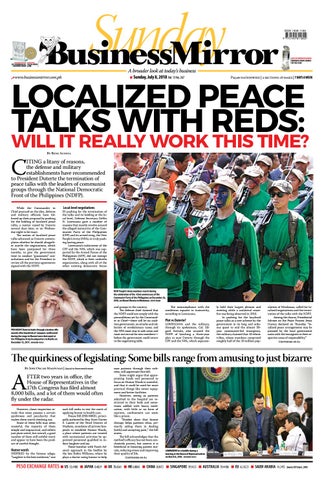
NEW People’s Army members march during the celebration of the 42nd anniversary of the Communist Party of the Philippines on December 26, 2010, on Mount Diwata in Mindanao. AP/PAT ROQUE
and groups in the country. The defense chief claimed that the NDFP could not comply with the preconditions set by the Commander in Chief—there will be no coalition government, no attacks and collection of revolutionary taxes; and the NPA must stay in safe areas and must not recruit for new members— before the government could return to the negotiating table.
PRESIDENT Duterte looks through a broken rifle muzzle after hundreds of weapons confiscated during the siege in Marawi were destroyed at the Philippine Army headquarters in Manila on December 13, 2017. AP/AARON FAVILA
The noncompliance with the conditions equates to insincerity, according to Lorenzana.
Plot vs Duterte?
LORENZANA and the military, through its spokesman, Col. Edgard Arevalo, also accused the NDFP of hatching a three-year plan to oust Duterte through the CPP and the NPA, which separate-
ly held their largest plenum and meeting while a unilateral ceasefire was being observed in 2016. In pushing for the localized peace talks as a new scheme by the government in its long and arduous quest to end the almost 50year communist-led insurgency, the military claimed that 18 ethnic tribes, whose members comprised roughly half of the 20 million pop-
ulation of Mindanao, called for localized negotiations and the termination of the talks with the NDFP. Joining the chorus, Presidential Adviser on the Peace Process Jesus Dureza declared on Thursday “localized peace arrangements may be pursued by the local government units with the insurgents in their respective areas of responsibility.” Continued on A2
The quirkiness of legislating: Some bills range from amusing to just bizarre By Jose Oscar Magpusao | Special to BusinessMirror
A
FTER two years in office, the House of Representatives in the 17th Congress has filed almost 8,000 bills, and a lot of them would often fly under the radar. However, closer inspection reveals that some possess a certain quirkiness and peculiarity that makes them worth checking out. Some of these bills may seem wasteful, the majority of them simple and impractical, and others just plain weird, but overall, a good number of them still exhibit merit and appear to have been the product of careful thought.
Humor wards
INSPIRED by the famous adage, “laughter is the best medicine,” one
such bill seeks to test the merit of applying humor to health care. House Bill (HB) 00631, principally authored by Rep. Scott Davies S. Lanete of the Third District of Masbate, mandates all private hospitals to establish Humor Wards, a place where patients are treated with recreational activities by appointed personnel qualified to induce laughter and joy. Those familiar with Patch Adams’s approach in the biofilm by the late Robin Williams, where he plays a doctor using humor to help
PESO EXCHANGE RATES n US 53.4100
ease patients through their sickness, will appreciate this bill. Some might argue that appropriating funds and personnel to focus on Humor Wards is wasteful, and that it could be used for more practical things like newer equipment and better facilities. However, seeing as patients admitted to the hospital are restricted to their beds and sometimes addled with heavy medication, with little or no form of reprieve, confinement can seem like a prison. “Studies show that humor therapy helps patients relax, primarily aiding them in dealing [with] and accepting pain,” the bill states. The bill acknowledges that the method’s efficacy has not been conclusively proven, but asserts it is beneficial in boosting patient morale, reducing stress and improving their quality of life. Continued on A2
LAWMAKERS in a huddle during a hearing at the House of Representatives on March 8, 2018. AP/AARON FAVILA
n JAPAN 0.4829 n UK 70.6561 n HK 6.8065 n CHINA 8.0472 n SINGAPORE 39.1425 n AUSTRALIA 39.4486 n EU 62.4523 n SAUDI ARABIA 14.2415
Source: BSP (July 6, 2018 )
NewsSunday BusinessMirror
A2 Sunday, July 8, 2018
www.businessmirror.com.ph
Localized peace talks with Reds: Will it really work this time? Continued from A1
“This ‘way forward’ in the stalled peace talks was decided following the consolidation of various positions expressed during the command conference convened by President Duterte last night in Malacañang,” he said.
Left rejects localized talks
THE holding of localized peace talks was rejected by the NDFP, which posited through its chief political consultant Jose Maria Sison that it would only be “re-arranged, controlled, surveyed and manipulated” by the government. “Such localized peace talks are obviously intended to deceive the people, spread intrigue against the revolutionary forces and, in fact, prevent genuine revolutionary forces from participating,” Sison told the BusinessMirror. Sison noted that, in the past, the military has already initiated and carried out local negotiations, but with the negotiating individuals being “fake surrenderers and military assets” who posed as rebels. Despite the stream of rebel surrenderers, which the military put at more than 7,000 by its latest count, Sison claimed that the NPA currently maintains more than 100 guerrilla fronts all over the country, with a total strength of 90 up to 120 fighters or a company-sized per region. “The NPA also has auxiliary forces like the people’s militia in every barangay under the local organ of political power and self-defense units in mass organizations,” he said.
According to the military, the NPA only has 3,700 fighters as of the end of last year, owing to rebel casualties, as a result of the continued operations by the military in the countryside. Lorenzana, however, pegged the rebel membership at not more than 5,000. If this is the fact, Sison said, then Lorenzana and the military have “slapped” their own faces since they have already “wiped out” the rebels for so many times through their false estimate of their number. “However, the NPA keeps on fighting, growing in strength and advance by using the strategy of protracted people’s war and tactics of rapid offensives in an extensive and intensive guerrilla warfare based on an ever-widening and deepening mass base,” he said.
Surviving the conflict
IF the government is hell-bent on ending insurgency by way of a military solution, Sison predicts that it will never achieve its objective, noting that the Armed Forces is already “overstretched” and “overstrained.” “It only has a little over 100 battalions deployed all over the country. Fifty percent of these are deployed against the NPA in Mindanao and 25 percent against the Bangsamoro. Only 25 percent are deployed against the NPA for Luzon and the Visayas,” he said. “At this time, the NPA and other revolutionary forces know the strong and weak points of their enemy. They are effectively
the tactics of extensive and intensive guerrilla warfare. The people’s participation and support for the people’s war keep the enemy forces blind and deaf over large areas of maneuver and the guerrilla units launch their offensives by relying on the guerrilla bases and zones,” he added. Intense, and now focused operations, as the military calls it, are being conducted by the AFP against the NPA, but Sison sees the rebels weathering the offensive as it did from the time of former President Ferdinand Marcos up to the time of Duterte’s predecessor. According to the NDFP chief political consultant, the “bad strategy” of Duterte and Lorenzana in dealing with the rebels is working against the government; and that the NPA would not even need a “foolish encounter” between soldiers and policemen to beat it.
Ouster plot, a tale
SISON belied the claims of Lorenzana that the CPP has put forward a three-year plan to oust Duterte, admitting the group and its armed wing cannot do it alone by themselves. “It is not true that the CPP has a three-year plan to oust Duterte by October 2018 [starting] since 2016. The militarists Lorenzana, [Eduardo] Año and [Hermogenes] Esperon are obviously misrepresenting the three-year plan of the CPP Central Committee to strengthen the CPP ideologically, politically and organizationally,” Sison said.
“The ouster of the Duterte regime cannot be effected by the CPP and the NPA all by themselves. The Duterte regime is now on the path of being ousted by a broad united front of patriotic and democratic forces and a growing number of AFP and PNP officers and men who are disgusted by the regime’s use of the AFP and PNP for criminal purposes, thus, criminalizing and corrupting them,” he added. Sison advised Duterte to be logically discerning, adding that it is the administration that is destabilizing itself. “The Duterte regime has destabilized itself by offending the people in the following horrible ways: mass murder of thousands in the fake war on drugs that benefits the Duterte-Peter Lim illegal-drugs empire, the costly military operations under Oplan Kapayapaan, the rising prices of basic goods and services, the rampant corruption of Duterte relatives and favorites, gross disrespect for the religious belief of the Catholics and Christians and the traitorous sell-out of the Filipino people’s sovereign rights over the trillions of dollars worth of oil and gas resources under the West Philippine Sea in exchange for a few billions worth of overpriced infrastructure projects controlled by China.” In the meantime, Sison claimed, “Duterte is subject to control and manipulation by the proUS militarists who are far more loyal to their imperialist masters in Washington than their Commander in Chief whom they, behind his
back, make fun of as a clown and nut crazed by Fentanyl and power.”
Tried and tested before, but failed
IF the localized peace talks that were carried out and implemented during the terms of former Presidents Arroyo and Aquino were to be the yardstick for the chances of success of the current tack of the Duterte administration in ending insurgency, then the prospects are dim. Both of Duterte’s predecessors tried and tested local negotiations in dealing with rebels on the ground, but they failed. During the time of Gloria Maapagal-Arroyo, the military worked to negotiate with supposed rebels on the ground, with particular emphasis in Mindanao, claiming that Sison and the “off-island” leadership of the NDFP no longer control their comrades in the regions. Military officials even claimed that the CPP and the NPA had been split between the leadership of Sison and couple Benito and Wilma Tiamzon—a narrative that streamed into the term of Aquino and is being repeated under Duterte. However, the Tiamzon couple has reappeared in all of the negotiations abroad between the government and the NDFP under Duterte, with an official working for the cease-fire committee of the government with the Left even declaring that it was the first time in the long history of the talks that he has seen such complete attendance of rebel leaders.
In 2013, or in the middle of Aquino’s term, the administration then also pushed for local peace talks, given that the negotiations were in an “on and off” mode,” but the NDFP issued a directive restraining rebels from joining the talks. As such, the move of the government failed, especially after the CPP declared that not a single unit of the NPA, and any leadership committee of the CPP, is allowed to participate in it.
Learning from lessons
THE government must learn this time from its peace initiatives with the Moros in dealing with communist rebels, and this is by way of addressing the root causes of insurgency, which Sison summed up as requiring genuine political, economic and social reforms. Both from the government and the rebels’ side, that seems more of rhetoric than anything else. While the Development Support and Security Plan Kapayapaan, the military’s road map in internal security operations, and even its forerunner, the Internal Peace and Security Plan Bayanihan, both talked about developments and a “whole-of-nation” approach in dealing with communism, it, however, still sticks by and large to what the soldiers know best, which is the body count. Given this, is it any wonder that floating the “localized peace talks” strategy is once again met with an abundance of skepticism? It’s worth watching in the next few days whether the doubters are wrong this time.
The quirkiness of legislating: Some bills range from amusing to just bizarre Continued from A1
Workplace daycare
THE conventional wisdom is that, unlike a school or a real day-care center, the workplace is no environment for children. Party-list Rep. Emmeline Aglipay-Villar of DIWA apparently thinks otherwise. Her Day Care Services Act, or HB 00739, requires all employers, including those headed by the national government, with at least 300 employees, to establish a day-care facility in business establishments for the employees’ children 5 years old and below, with qualified personnel tasked to oversee their care. Again, the argument against the proposal may be the misap-
propriation of resources and personnel that would have been much better utilized in other fronts. HB 00739, however, responds to a very obvious need: there is a dearth of day-care facilities in the Philippines, and parents should thus be given a chance to harmonize family obligations and work responsibilities instead of forcing them to sacrifice one. Establishing day-care centers in the workplace would allow employees to not worry about leaving their children when they go to work, and forcing them to entrust the children to others.
Volunteer dogs
DISASTERS and crisis situations
often bring out the best in people, sparking in them the urge to help those affected. Good Samaritans are common in the country, where the people are widely praised for being nurturing and caring. But who says only people can be volunteers or good Samaritans? The Canine Volunteer Law, or HB 04809, principally authored by Rep. Rozzano Rufino B. Biazon of the Lone District of Muntinlupa City, provides an avenue for dog owners to provide aid in a very unique way. This bill sets up a Canine Volunteer Program encouraging owners to register their canines to render services when called to disaster sites. Volunteers will be able to provide aid during search and rescue operations, with incentives to encourage participation. The Disaster Risk Reduction and Management Office (DRRMO) of all cities will hold registrations for volunteers and provide training along with the Armed Forces of the Philippines, Philippine National Police and other government agencies that have the capacity to train canines for such operations. Funds necessary for training and implementation will come from the local disaster risk and management funds of local government units.
Pipe down
IF you’ve ever lived a day in the country, you’ve undoubtedly been deafened by the loud noise generated by motorcycles with modified exhaust pipes. To the annoyed ones, the Antimodified Tail-Pipe Act of 2014, or HB 00649, introduced by Rep. Gavini C. Pancho of the Second District Bulacan offers relief. It bans any and all modifications of motorcycle exhaust pipes and penalizes those that do not conform. The bill deems the excessive noise of these motorcycles, particularly in metropolitan areas, as a serious threat to public health and welfare. The bill cites the World Health Organization’s warning that noise pollution has adverse effects on health: annoyance reaction, sleep disturbance, interference with communication, effects on performance and on social behavior, among others.
An assortment of medical issues as a consequence of noise pollution also arise, such as colds, blood pressure and other cardiovascular changes, problems with the digestive system and general fatigue, as well as prolonged exposure to any noise beyond 80 decibels causing permanent hearing loss. The Department of Transportation and Communications will be authorized to enforce the act and will apprehend those in violation.
Children banned
NOTING the common schooling schedule of children—mostly from 7 a.m. up to 5 p.m.—Rep. Rosenda Ann Ocampo of the Sixth District of Manila has authored HB 04792, which prohibits commercial establishments from accommodating children from ages 7 to 18. Establishments barred from accepting children include Internet cafes, computer or video shops, billiard halls, movie houses, malls, any place that sells alcoholic drinks and any establishment that operates for entertainment. Exceptions to the rule: a child accompanied by a parent or guardian, attending to an emergency, or having with them a permit or letter of authorization by the school that requires school assignments to be done in business establishments. Critics of the bill say it seems unfair to a large number of students, as class schedules can vary significantly, with later starts or earlier end of classes, or fewer days in a week in schools. The bill may also be unfair to students who may require something from any of the said establishments, say, a bookstore in a mall. Additionally, the Unsafe Hours for Children Act, or HB 07513, requires anyone below 18 years old to remain at home from 10 p.m. to 5 a.m. unless supervised by an appropriate figure of authority. Authors of the bill say it would greatly diminish the risk of children being involved in any dangerous situation from being used as an instrument of crime or being victim to it, while also promoting a sense of conformity and control that will help in their development.
One-stop government shop
PROCESSING in government agencies tends to be slow and tedious, and the fact that some different
agencies are spaced far from each other make the task of transacting with the extremely exhausting. “Our countrymen would always encounter unnecessary difficulties, which are brought primarily by the distance between the government agencies that issue these documentary requirements,” Rep. Wes Gatchalian of the First District of Valenzuela City, principal author of HB 04819, stated in his explanatory note. His bill institutes a “one-stop government shop” in all regions for the convenience of all Filipinos, with the emphasis on people empowerment by giving these easily accessible locations. Each shop will house a satellite office for government agencies that issue documentary permits and other usual requirements of people, including Bureau of Immigration, Commission on Higher Education, Department of Foreign Affairs, Home Development Mutual Fund, Maritime Industry Authority, National Bureau of Investigation, Overseas Workers Welfare Administration, Philippine Health Insurance Corp., Philippine Overseas Employment Administration, Philippine Statistics Authority, Professional Regulation Commission, Social Security System, Technical Education and Skills Development Authority, Tourism Infrastructure and Enterprise Zone Authority, and the Government Service Insurance System. Provinces, as well as each local government in Metro Manila, will have an office in the capitol building reserved for the one-stop government shop. All government agencies are required to participate in the shop by providing qualified personnel to man the offices.
Free toilet
THE common form of transportation in most regions is a bus, which means people usually travel for hours between locations. However, rest stops in the country are notorious for charging passengers unconscionably and denying them comfort. Many are discouraged to relieve themselves in dirty public toilets, and often opt to sleep it off or be forced to endure the stinking toilets while paying heavy fees. HB 00725, principally au-
thored by the late Rep. Maximo B. Dalog of the Mountain Province, seeks to change this. It prohibits sanitary facilities in terminals, stations, stops and rest areas from collecting fees from passengers. “Article 1755 of the New Civil Code of the Philippines states that a common carrier is bound to carry passengers safely as far as human care and foresight can provide, using the utmost diligence of very cautious persons, with a due regard for all circumstances,” the bill stated in its explanatory note. Additionally, the bill discusses Presidential Decree 856 or the “Code on Sanitation,” which emphasizes the accessibility of rest areas for passengers, with primary focus on comfort and convenience.
Secondhand cooking
IT’S in the nature of Filipinos to be resourceful, sometimes to ridiculous lengths. So it’s not surprising that they maximize the use of old things, including cooking oil. Used cooking oil is regularly sold for human consumption, and the Anti-Used Cooking Oil Act, or HB 00814, by Party-list Reps. Rodel M. Batocabe, Alfredo A. Garbin Jr. and Christopher S. Co of the AKO Bicol, says this practice poses a serious health hazard. Toxins are produced when used cooking oil is reheated, and because it is a lot cheaper than brand-new cooking oil, it is generally more sought after by the populace. This bill prohibits the sale of used cooking oil unless for industrial purposes, due to its high risk of diseases, such as hypertension, liver damage and cancer. However, the ban does not discourage the sale of recycled cooking oil, and instead encourages its use as fuel and other industrial purposes, effectively preserving the natural instinct of Filipinos while, at the same time, curbing an unhealthy practice. Indeed, from mandating free but clean toilet services in rest stops across the country where travelers usually seek relief, to banning recycled cooking oil and modified tail pipes, and setting up humor wards in hospitals, legislators have obviously given some thought to improving people’s quality of life. Some of their ideas may seem quirky but at least can draw an “A” for effort and good intentions.
The World BusinessMirror
www.businessmirror.com.ph
Where investors can stash their cash safely T he United States might be the trigger for escalating trade tensions with China, but it turns out that its currency could still be the best place for global investors to find safety as the dispute came to fresh crossroads on Friday with tariff increases set to take effect one after the other. That’s because the conflict is unfolding alongside what could be an even more powerful dynamic: US monetary-policy normalization. An appreciating dollar, propelled by expectations for stepped-up Federal Reserve tightening, has hammered a wealth of markets since April, when benchmark 10-year Treasury yields first pricked through 3 percent. That’s left some traditional havens—like gold—less of a buy, while offering pockets of value—such as Australian equities—in areas investors might not typically have considered. The ultimate refuge, investors and strategists say, is the greenback. Dollarbased money market funds are now offering rates of about 2 percent, a level above the yield on seven-year Treasuries as recently as last September. “The US dollar is now the most popular safe-haven asset,” said Cheuk Wan Fan, head of investment strategy for Asia at HSBC Private Bank. For a premium, the bank is recommending dollar-denominated emerging market debt, where yields have climbed in response to Fed tightening. President Donald J. Trump’s trade actions started unsettling investors in March, when he warned about imposing new tariffs on aluminum and steel imports, and investors have had several rounds of escalating tensions with China to gauge how assets respond. One of the standout observations is that a trio of typical havens haven’t been doing so well. Gold, a haven for millennia in times of turmoil, hasn’t been so hot the past three months, falling more than 5 percent. Japan’s yen, often a safe harbor, thanks to the country’s status as the world’s biggest net creditor, has dropped almost 3 percent in that period. Switzerland’s franc, another favorite for the cautious, is also down 3 percent. Behind the declines of all three has been the appreciation of the dollar, up more than 4 percent as measured by the Bloomberg Dollar Spot index. The acceleration in Fed normalization also played a role in the declines, with the US central bank rolling off $40 billion of its bond holdings a month at the current pace, and anticipating another half point in rate hikes this year. While the monetary-policy outlook has implications for Treasuries, they are still seen by some as a buffer if global equities get roiled by fears that a trade war will damage global growth.
Equities drop
“They are a safe haven even when shocks come from the United States,” Patrick Artus, chief economist at Natixis Securities, wrote of US government securities in a note this week. Hours ahead of the scheduled US tariff hike on $34 billion worth of Chinese products Friday, stocks were trading in positive territory after steep recent losses. The MSCI
Asia Pacific Index was up 0.4 percent as of 9:37 a.m. in Tokyo, still near the lowest level since October. China has pledged to retaliate against the American move, a response which Trump has indicated would then trigger an escalation in tensions. Trump has suggested higher tariffs could be imposed on as much as an additional $400 billion of Chinese imports.
More volatility
“Investors should expect volatility to continue,” said Mark Haefele, chief investment officer at UBS Global Wealth Management. “We recommend investors stay invested, but consider five actions: looking to alternatives, hedging equity exposure, improving credit quality, diversifying sector and country risks, and taking a longer-term view.” The other main combatant in the trade dispute has seen its own government bonds rally this year—in part thanks to moves by the People’s Bank of China to support liquidity in an effort to prevent a deeper hit to economic growth. Shaniel Ramjee, a senior investment manager at Pictet Asset Management in London, recommending yuan-denominated Chinese government bonds. The dollar’s strength in recent months has had the knock-on effect of boosting Australian shares, which have repeatedly offered a touch of green amid a picture of red for Asia-Pacific equities in recent weeks. James Audiss, a senior wealth manager with Shaw and Partners Ltd. in Sydney, says the Australian currency’s drop has bolstered the appeal of the country’s companies—even if a trade war could damage its exports.
Aussie Stocks?
“I’ve been talking to my guys on the desk saying, we’ve got to really watch the fact that we’ve seen the Aussie dollar come off— which is actually benefiting the Australian equities market,” Audiss said. Some investors, including Alex Treves, an investment specialist at JPMorgan Asset Management in Hong Kong, advise looking through the trade headlines and keeping focused on fundamental analysis. Treves likes emerging markets with solid growth prospects, such as India, where the S&P BSE Sensex Index is up about 2 percent since the end of the first quarter in dollar terms, compared with a 9-percent tumble for the MSCI Emerging Markets Index. For others, riskier assets can hold for later, once the storm blows over. “Liquidity management instruments such as money market funds” are good for investors to park cash in dollars, said Fan at HSBC. “When more attractive levels emerge, they can put cash back to work,” she said. And some still like the old stand-bys. “We’re not giving up on a view that the yen is a good hedge for further turmoil and a further rise in FX volatility,” Kit Juckes, a Société Générale SA strategist in London, wrote in a note to clients earlier this week. “It’s taking an age, driving us to distraction, but the cycle is rolling over in the yen’s favor. Short Aussie-yen has growing appeal given the trade dispute.” Bloomberg News
World’s largest crypto exchange eyes $1-billion profit amid rout
T
his year’s cryptocurrency crash has saddled bulls with billions of dollars in losses, but the world ’s largest virtual currency exchange is still making money hand over fist. Binance ex pects a net profit of $500 million to $1 billion in 2018, according to its chief e xe c ut ive of f ice r. Fi rst - h a l f revenue was about $300 million, Chang peng Zhao said in a n i nte r v ie w. Ave r a ge d a i ly turnover at his venue, which opened a year ago, is roughly $1.5 billion, and Binance now has 10 million users, he said. Zhao’s figures illustrate how some cr y ptocurrency exchanges are t hr iv ing despite a rout i n d ig it a l a ssets t h at ’s seen Bitcoin lose 52 percent of its va lue t his year as buyers pu l l bac k , venues a re re peated ly
hacked and regulators increase t heir scr utiny. Binance, which has had runins with authorities in Japan and Hong Kong, plans to soon allow customers at venues in Uganda, Bermuda and Malta to convert their virtual tokens to fiat currencies including the euro, as it looks to build on its rapid growth. Zhao has previously said that Binance had 2 million users at the start of the year. He started the venue in July 2017, opening 11 days after raising $15 million in an initial coin offering. A s the cr y pto frenzy peaked late last year, the exchange was hosting as much as $11 billion of trades a day. Binance topped Coinmarketcap.com’s ranking of e xchanges in t he past 24 hours, w ith $1.3 billion worth of trading. Bloomberg News
Sunday, July 8, 2018
A3
US industries: Worst is yet to come from Trump tariffs
U
nited States companies for months bemoaned the tariffs on Chinese imports that took effect on Friday. Now they fear the worst is yet to come in an escalating confrontation with Beijing over trade. Duties on $34 billion of Chinese goods will take effect just after midnight in Washington, President Donald J. Trump told reporters aboard Air Force One on his way to a rally in Montana on Thursday. China has promised to immediately impose retaliatory duties of a similar size on American goods. The US has also released a list of an additional $16 billion in products targeted for tariffs, and Trump suggested the final total could eventually reach $550 billion, a figure that exceeds all of China’s annual goods exports to the US. Companies, including General Electric Co. and trade groups such as the US Chamber of Commerce, say tariffs are the wrong way to address allegations of intellectual-property theft by China, and that firms are making contingency plans should a trade war ensue. Some businesses have tried to persuade the Trump administration to back down by saying they’d be left with no choice but to consider reducing production, firing workers and even shifting operations out of the US to account for the added costs from import tariffs. “With tariffs against China taking effect, American consumers are one step closer to feeling the full effects of a trade war,” Matthew Shay, president of the National Retail Federation, said. “Reining in China’s abusive trade policies is a goal shared by many countries, but a strategy based on unilateral tariffs is the wrong approach and it has to stop.” SEMI, which represents semiconductor companies and others in the manufacturing supply chain for the electronics industr y, est imates t hat t he initial round of tariffs will increase costs for its members by between $20 million and $35 million. The second list of $16 billion in goods—which is more heavily focused on technology
products—could produce a hit of at least $500 million, said Jay Chittooran, a public policy manager for the group. T he A m e r i c a n C he m i s t r y Council estimates that the second wave of promised tariffs will affect $2.2 billion in imports of chemicals and plastics from China and $5.4 billion in US exports to China from retaliatory duties, said Ed Brzytwa, director of international trade. The Trump administration did remove some products from an initial tariffs list after companies and businesses groups objected. The goods included electric and cordless snow blowers made by New Jersey-based Snow Joe Llc., said Joseph Cohen, the company’s chief executive officer. But the list of $16 billion in goods targeted for tariffs include Snow Joe tillers, garden cultivators and log splitters, and imposing duties only means higher prices for consumers and added cost and uncertainty for businesses, he said.
‘Tough thing’
“Tariffs are always a tough thing to look at because unfortunately the consumer does get hurt, business like mine get hurt unintentionally in the process,” Cohen said by phone.
Daniel Rogge, the chief executive officer of a closely held metalmachining equipment company in Waunakee, Wisconsin, said he may have to raise prices 5 percent to 10 percent to cope with tariffs that kick in Friday on Chinese-made tools for which there’s no USmade equivalent. Tormach Inc., with about 45 employees, sells some computer-controlled milling machines, lathes and other tools subject to the tariffs. “My fear is that all this uncertainty around the Trump administration and the trade war will result in less consumer confidence,” Rogge said. American soybean farmers— including from states that backed Trump in the 2016 election—are being particularly hard-hit by the retaliatory duties. China is the top export market for US soybeans, accounting for almost $14 billion in sales and representing nearly a third of total US soybean production in 2017, according to the American Soybean Association.
Farming pain
Farmers are already feeling the pain with canceled orders
With tariffs against China taking effect, American consumers are one step closer to feeling the full effects of a trade war. Reining in China’s abusive trade policies is a goal shared by many countries, but a strategy based on unilateral tariffs is the wrong approach and it has to stop.”—Shay
and falling commodity prices, w ithout any promised relief, said Max Baucus, a former Democratic senator from Montana and ambassador to China. He’s cochairman of Farmers for Free Trade, a nonprofit group. “For farmers across the country, the trade war is now getting real,” Baucus said in a statement. General Electric, one the largest US employers and exporters, tried unsuccessfully to have 34 product lines removed from the list of goods targeted for tariffs. The company has said imposing tariffs on products, such as aviation and medical parts, could hit American operations and jobs—including its Wisconsin-based facilities that employ 6,000 people. “We remain concerned that t he s e t a r i f f s cou ld m a k e it harder for US manufacturers to compete in the global economy, and will shrink rather than expand US exports,” the company said in a statement. “We will work with the administration to minimize potential impact to our businesses.” Companies and trade groups can submit comments on the list of $16 billion in goods targeted for tariffs and appear at hearing set for July 24 in Washington. Still, there aren’t high hopes the administration will change its approach, Brzytwa of the American Chemistry Council said. “ There’s a viewpoint that’s shared across the government, and certainly at the White House, that there’s going to be pain that US industry is going to have to suffer in order to change China’s behavior,” Brzytwa said by phone. “We think that you can change China’s behavior without shooting yourself in the foot.” Bloomberg News
Cult leader executed for Japan sarin-gas attacks still a mystery
T
OKYO—The execution of Japanese doomsday cult leader Shoko Asahara leaves unanswered questions about Aum Shinrikyo, the group behind the 1995 sarin-gas attack on the Tokyo subway that killed 13 people and sickened 6,000. Japanese government spokesman Yoshihide Suga confirmed that Asahara was executed last Friday. The authorities said six other cult members were hanged. Born Chizuo Matsumoto in 1955, Asahara founded Aum Shinrikyo, or Supreme Truth, in the mid-1980s. It attracted young people disillusioned with the modern materialistic way of life. With his shaggy hair and beard, the half-blind Asahara was the key figure in the stunningly random and lethal attack targeting Tokyo commuters. He used a mix ture of Hinduism, Buddhism, Christianity and yoga to draw followers. They took part in bizarre rituals, such as drinking his bathwater and wearing electrical caps they believed synchronized their brain waves with Asahara’s. Asahara chose doctors, lawyers and scientists from Japan’s top universities as his top aides, making them ministers of his pseudo-government of the Aum
empire. They worshipped him and carried out his orders. The group used donations from followers and earnings from yoga classes and health food businesses to amass cash to buy land and equipment. They made and bought conventional weapons in and outside Japan, while the scientists he had recruited developed and manufactured sarin, VX and other deadly chemical and biological weapons. During his trial, Asahara often used diapers and sat on a cushion intended to make his incontinence inconspicuous. He stopped communicating with his children and defense team. A c o u r t - a p p o i n t e d p s yc h i a t r i s t suggested he might be faking insanity to avoid punishment. The initial death sentence in 2004 became final after his defense team could not file an appeal citing his mental state. In a rare interview in 2006, two of Asahara’s four daughters told The Associated Press that never in dozens of visits to him in prison had they had a real conversation. Asahara just sat and at times fidgeted or grunted. The daughters’ repeated petitions for retrials were refused. They said his condition might have worsened since the
last being allowed to see him in 2008. Yoshihiro Yasuda, Asahara’s main lawyer during his trial, said the last time he was allowed to see Asahara at the detention center was in 2006. After that, the Tokyo detention center rejected requests for meetings with Asahara more than 400 times, citing the absence of a reaction from Asahara. Yasuda sought medical treatment for Asahara and said in April 2018 that he had appealed for his release. The reasons behind the sarin gas attack remain an enigma. Cult members have said they believed Asahara’s prophesy that an apocalypse was coming and they alone would survive it. Even before the attack, in 1989, lawyer Tsutsumi Sakamoto, who opposed the cult, his wife and baby boy were murdered by cult members. Tomomasa Nakagawa, a doctor also executed on Friday, and several other cultists broke into the Sakamotos’ apartment late at night, strangled them to death and buried them in the mountains. Cult activities escalated after the defeat of Aum members in the 1990 parliamentary election. During their bizarre election
campaign, Asahara and his top disciples sang and danced to the guru’s songs. In June 1994 the cult spread sarin gas in Matsumoto in central Japan, killing eight people and injuring more than 140 others, in an attack targeting residents who were protesting the cult’s presence in their neighborhood and court officials handling their legal disputes. Nakagawa and key members produced sarin at a cult compound and sprayed it from a van, in what was later regarded as an experiment for the subsequent subway gassing. Under intensifying scrutiny from the government, the cult plotted the larger sarin attack on the subways in Tokyo on March 20, 1995. Asahara guided the attack, according to testimony by his right-hand man, Yoshihiro Inoue, who also was executed on Friday. Inoue headed Aum’s intelligence unit and was one of the few cult members who later turned against Asahara. The five cultists who carried bags of sarin onto the trains targeted three subway lines converging at Kasumigaseki, Japan’s government and political center similar equivalent to Washington’s Capitol Hill. AP
A4
The World BusinessMirror
Sunday, July 8, 2018
Sounding Brexit alarm, British manufacturers brace for worst T
www.businessmirror.com.ph
Iran tells Donald Trump: Your tweeting is driving up oil prices
T
he British government is putting its industrial base at risk by failing to deliver a road map to its future economic relationship with the European Union (EU), according to the chief of the country’s main manufacturing lobby group. As Jaguar Land Rover became the latest industrial giant to warn the government against bungling Britain’s departure from the EU, EEF Chief Executive Officer Stephen Phipson said the United Kingdo,’s biggest manufacturers are all preparing for a no-deal Brexit that leads to increased bureaucracy and border delays. “People are starting to plan for the worst-case scenario,” Phipson said in an interview late Wednesday. “Just about everyone I’ve spoken to is starting to now go through this process.” The remarks ramp up the pressure on Prime Minister Theresa May to unify her warring Cabinet and devise a negotiating position that can advance stalled talks in Brussels. The premier convened a Cabinet meeting on Friday at her Chequers country retreat to take another stab at agreeing to a proposal on trade with the EU. The UK is due to officially leave the bloc in March 2019.
Investment woes
Get it wrong, the message from manufacturers is, and Britain will hemorrhage jobs and investment. A bad deal would jeopardize as much as £80 billion, or $106 billion, of spending over the next five years, JLR Chief Executive Officer Ralf Speth said late Wednesday. Extra costs and parts-delivery delays due to new trade barriers would cut profit
by £1.2 billion a year, according to the automaker. Industrywide, the figure would top £4.5 billion, according to automotive consultancy AutoAnalysis. Until now, large manufacturers have limited their pronouncements on Brexit, and the recent spate of warnings shows patience is wearing thin, according to Phipson. Airbus SE was the first major company to break cover last month, saying it may have to pull its UK investments in the event of a no-deal Brexit, which May refuses to rule out. The aerospace giant employs 14,000 people at 25 sites in Britain, and supports more than 100,000 jobs in its British supply chain. BMW then said it would be forced to rethink production at its four UK plants if products are
An employee works on the engine bay of a Jaguar automobile as it moves through the production line at Tata Motors Ltd.’s Jaguar assembly plant in Castle Bromwich, United Kingdom, on March 16, 2017. Jaguar Land Rover Chief Executive Officer Ralf Speth backed Nissan Motor Co.’s calls for extra funding for car-parts makers in the wake of last years Brexit vote, while cautioning that there must be “fair play” for all UK automakers. Simon Dawson/Bloomberg
stopped at the border after Brexit. May in March gave a speech outlining her vision, but has made little headway since then to unify both her party and her Cabinet, which are split between pro-Europeans who want to maintain as close ties as possible with the EU, and Brexiteers who are calling for a clean break that frees Britain from the bloc’s laws and allows it to strike its own trade deals. “A few months ago, manufacturers were rather hoping we’d be in a place now where it would all be clear,” said Phipson. “It’s really important we get some clear messages coming out of Chequers this week, and in the White Paper. What we do not want to see is just another set of aspirational objectives here. It needs to be quite detailed in order for people to use it for planning.” Businesses want there to as
A few months ago, manufacturers were rather hoping we’d be in a place now where it would all be clear... What we do not want to see is just another set of aspirational objectives here. It needs to be quite detailed in order for people to use it for planning.”—Phipson
much regulatory alignment with the EU as possible, so that they don’t have to produce products to two sets of specifications, which would be “uneconomic,” according to Phipson. They also want frictionless customs processes and the ability to move service engineers freely throughout the bloc to carry out maintenance work, he said. In a worst-case scenario, planes would lose their certification and “it’s not alarmist to say that aircraft will not fly,” Paul Everitt, chief executive officer of the aerospace and defense industry’s ADS Group said on Thursday at an event in London. “It’s the same for supply chains with parts certified in the UK.” Phipson said that large manufacturers are now all looking at how different Brexit scenarios will affect them and devising plans for what to do if border frictions increase, including whether to build warehouses and stockpile parts to avoid manufacturing delays, or whether to move abroad. “Most of them will be operating on a zero inventory basis at their manufacturing and assembly plants,” he said. “Any delays that are put into that process will mean that either they’ve got to hold inventory, which is a cost many businesses don’t build into their economic model, or there are going to be delays, in which case they’ve got to think does that mean we can continue this assembly operation in this country or do we do it somewhere else in Europe?” Bloomberg News
World’s biggest shipping market booms as trade war shrugged off
W
ill somebody please tell commodity shippers there’s a trade war going on? W hether it’s the price of hiring giant freighters to haul hundreds of millions of tons a year of iron ore and coal, or smaller carriers moving grains, there’s a theme emerging: dry-bulk shipping rates are rallying despite an escalating trade war that may yet damage China’s economy. “Freight traders don’t believe in that,” said Eirik Haavaldsen, a shipping ana lyst at Pareto Secur ities A S in Oslo. “ T hey don’t see that weakness. T hey are not afraid of China slow ing dow n, or a massive drawdow n in inventories.” There are two main reasons why commodity shipping markets aren’t yet feeling the pinch, accord ing to Espen Fjer mestad, who follows shipowners at Fearnley Securities in Oslo. The first is that China’s economy is so far proving resilient, the second is that direct trade between the US and the Asian country is relatively small within the context of overall commodity shipping demand.
Economic indicator?
L ast year the single big gest agricultural trade between the United States and China was soybeans, at 32.9 million tons, data from ITC Trade Map show. Dry bulk is the largest cargo set in the global shipping industry and will account for about 5.2 billion tons of trade in 2018, ac-
cording to estimates from Clarkson Research Services Ltd. Total seaborne trade—from oil and gas to containerized goods— will amount to just under 12 billion tons. Dr y-bulk shipping is often viewed as a leading economic indicator because the cargoes represent the very first building blocks for industrial product ion, whet her t hat ’s iron ore to make steel, cement to build roads, or coal to fire power plants. China, the highestprofile target of US President Donald J. Trump’s trade tariffs, is by far the world ’s big gest source of demand—and demand growth—when it comes to raw materials.
Infrastructure spend
The freight traders’ bullishness may also be because they take the view that China will invest in physica l infrastr ucture to prop up its economy if a trade war with the US does escalate, something that would be bullish, at least in the short term, for the f low of cargoes, according to Haavaldsen. So far at least, rates for smaller ships that haul agricultural products have been fairly immune from the spat too, despite signs they could take a bigger direct hit than the wider drybulk market, he said. Supramax carriers, typically about a quarter of the size of Capesizes and more commonly used for grain trading, earned an average of about $10,800 a
day since the start of 2018, the best rates they’ve commanded since 2011. Contracts for 2019 are higher, at almost $12,000. On Friday the US is scheduled to impose tariffs on $34 billion of Chinese goods. Beijing has said it will place tariffs on an equal value of US exports including agricultural and auto exports. While that might erode trade because China is a key buyer of US soybeans, shipments would likely be diverted elsewhere and probably wouldn’t drop to zero, said Jo Ringheim, an analyst at Arctic Securities A/S in Oslo. Spot shipping rates are normally a function of how many v e s s e l s t he re a re c o mp a re d with the amount of cargo, and forward prices are heavily inf luenced by what’s going on in the day-to-day charter market. T hat means vessel supply is a huge driver too, and consequently freight costs can rally when demand is unspectacular so long as enough carriers are being scrapped and new ones aren’t joining the f leet.
Tougher times
Other parts of the maritime market are hav ing a tougher time, albeit for different reasons. Returns for supertankers delivering Middle East oil to Asia averaged about $11,000, the lowest for a first half of a year since 2013, according to data compiled by Bloomberg. That market is being hurt by oil production curbs led by OPEC, which, despite being eased last
month, could still keep almost a supertanker a day of crude off the market for the remainder of this year. Shares of Hapag-Lloyd AG, the German container shipping line, plunged at the end of last month, leading similar companies lower, when it warned that overcapacit y in the industr y and rising fuel costs would put a squeeze on profit. It didn’t mention any impact on world trade from Trump’s measures. A total of 54.2 million boxes moved by sea in the first four months, a 4.6 -percent gain from a year earlier, World Liner Data Ltd. figures show. Investors in shipping stocks a re i n genera l more concer ned about t he i mpac t of a t rade wa r t h a n f reight t raders a re, sa id R i nghei m. Shares in A.P. Moller-Maersk A /S, the largest container line, dropped about 40 percent over the past year. T hose of Golden Ocean Group Ltd., a big dr ybulk shipow ner, are up just 7 percent this year in Oslo despite a 32-percent surge in forward freight agreements used to hedge, or bet on, Capesize rates in 2019. “What we have seen is that the dry-bulk FFAs, which we look at every day, have increased a lot,” said Ringheim. “So in my view, t he ma rket e x pect at ions for the long term have increased, rat her t h a n dec rea sed , even though this is a period where we’ve heard about a trade war.” Bloomberg News
he war of words over oil prices continues between US President Donald J. Trump and Iran, and the latest salvo from Iran is for Trump to stop tweeting. “Your tweets have driven the prices up by at least $10 per barrel,” Iran’s Organization of the Petroleum Exporting Countries (Opec) Governor Hossein Kazempour Ardebili said in a message to Trump, carried by Iranian Oil Ministry’s Shana news service. “Pls stop it, otherwise it will go even higher!” Trump tweeted on Wednesday that the Opec is “doing little to help” reduce US gasoline costs and “if anything, they are driving prices higher.” Despite that key member Saudi Arabia is affirming that the group and its allies will boost output, Goldman Sachs Group Inc. warned that oil is likely to lead a new rally as the market faces significant supply risks from Venezuela to Iran. “You are hammering on good guys in Opec,” Kazempour said. “You are actually discrediting them and under mining their sovereignty, we expect you to be more polite.” The clash over Opec policy and the resumption of US sanctions on Iran has been amplified this week as Trump continues to target the group which he blames for rising
prices. His latest was a reminder that the US defends many Opec members for “very little” money. “This must be a two way street. REDUCE PRICING NOW!” Iran’s deputy commander of the Sarollah Revolutionary Guards said on Wednesday that any attempt to thwart its oil exports will result in the closure of Strait of Hormuz, the narrow waterway at the mouth of the Persian Gulf, where the world’s biggest concentration of tankers carry about 30 percent of all seaborne-traded crude oil and other liquids during the year. Oil is trading near $78 a barrel, holding most of a rally that saw prices rise to the highest level in more than three years af ter Opec’s out put increase plan was overshadowed by supply d isr upt ions in Libya, Canada and Venezuela. W hile Opec is facing mounting pressure from Trump to do more, A merica’s sanctions on group members Iran and Venezuela are adding uncertainties, just as US tariffs on Chinese goods kicked in on Friday. “Opec has not defined oil prices for the past 30 years,” Kazempour said. “You impose sanctions on major producers, founders of Opec, and yet you are asking them to reduce the prices?! Since when did you start ordering Opec.” Bloomberg News
$4-billion shopping spree maps ambition of India’s richest man
Ambani Simon Dawson/Bloomberg
R
eliance Industries Ltd., India’s second-largest company by market value, has been on a shopping spree this past year, with a focus on expanding the draw of its consumer offerings. Helmed by India’s richest man Mukesh Ambani, the company has struck at least 12 deals over 12 months with an estimated tab of about 289 billion rupees ($4.2 billion), according to calculations by Jefferies Group LLC and Bloomberg. Ten of these are related to his consumer business. Ambani has also capitalized on India’s ongoing bad-debt issues with purchases of distressed or insolvent companies including a local textile-maker, a carbon-fiber firm and the wireless assets of an indebted telecom company. For a conglomerate better known for building massive projects including the world’s largest refining complex, this recent acquisitive streak reflects Ambani’s ambition to make his telecom, retail and media offerings as profitable as the legacy petrochemicals and refining businesses. It also traces his pivot toward building an integrated digital offering around carrier Reliance Jio Infocomm Ltd. with purchases in the entertainment and artificial intelligence-based education space. Some of these acquisitions are basically Reliance “trying to grab content,” said Deven Choksey, managing director at Mumbaibased KR Choksey Shares and Securities Pvt. “If they end up generating enough content, you can be reasonably sure that users will come on their network.”
Ambani has also been able to cherry pick debt-laden assets as local lenders scramble to resolve their $210 billion in stressed loans, Choksey said. W hen Ambani, 61, rises to address shareholders in Mumbai on Thursday analysts are expecting to hear more on how the group will further integrate retail and telecom. Clear e-commerce plans, possibly at the annual shareholder meeting, could become a driver for re-rating the stock, brokerage CLSA said in a July 3 report. Ambani may announce the commercial launch of JioFiber, the fibreto-the-home broadband service, Business Today reported. The service has the potential to alter the segment’s competitive landscape, credit rating company S&P Global Ratings has said. Reliance has committed about $1.3 billion to acquisitions in the two years through to March 31, 2019, Jefferies India analysts led by Somshankar Sinha estimated in a report on Tuesday. The count excluded the Rhea Retail Pvt. Ltd. deal and a proposed 173 billionrupee acquisition of spectrum, mobile-phone towers and fiber assets from Reliance Communications—the largest among recent transactions. Overall, Reliance has invested about $53 billion in a range of businesses from telecom, retail and petrochemicals to real estate. Telecom alone has sucked up more than $36 billion. Debt has climbed threefold over five years to about $32 billion at the end of March. Bloomberg News
Faith www.businessmirror.com.ph • Editor: Lyn Resurreccion
Sunday
LDS leader: ‘PHL very high in religious-freedom meter’
T
Story & photo by Stephanie Tumampos
here are thousands of religions in the world. Christianity, Islam, Hinduism and Buddhism dominate, with roughly 12 percent left for other religions and 14 percent for nonbelievers.
evolution of law throughout the ages and societies was such that it created the respect for the separation of state and religion. “Religious organizations can function in their sphere in matters of the spirit and the soul, and on people’s right to believe and act according to their belief. While the state, on the other hand, would act in its sphere as a government for the society but would not interfere with the conduct of religious organizations,” Christofferson added. “Creating that separation of state and religion over time has created the basis, I submit, for the rule of law.” There is mutual respect and clearer bounds between these two institutions, hence giving people the right to live lives according to their beliefs under a religion and be treated fairly under the law.
On women, LGBTQ and divorce
Elder D. Todd Christofferson, a member of the Quorum of the Twelve Apostles of The Church of Jesus Christ of Latter-Day Saints, speaks during the recent second International Forum on Law and Religion.
A demographic study conducted by the Pew Research Center, a nonpartisan fact tank on issues and trends, said that in 2050, the Muslims will nearly equal the number of Christians worldwide, India will still retain a Hindu majority and Buddhism will still be the same size as it was in 2010. While there is indeed a fluctuation and change of events, the issue also relies on how people perceive other religions apart from their own. Is there enough respect? How do people adapt to changes? And how do they practice religious freedom, where everyone can coexist peacefully and bring harmony to society?
Religious freedom
At the second International Forum on Law and Religion at the University of the PhilippinesBonifacio Globa l Campus on June 14, The Church of Jesus C h r i st of L at ter - d ay Sa i nt s’ (LDS) Elder D. Todd Christofferson discussed in his speech the issue of religious freedom. C h r i stof ferson, a member of the Quorum of the Twelve Apost les of LDS, sh a red h is views in an interview with the BusinessMirror. He said religious freedom is not just the right to be allowed to have
a religious opinion or practice one can conduct privately. Rather, “it’s the right to freely act in society on the basis of religious beliefs and values.” Despite the declaration of human rights by the United Nations in 1948, the right to freely express religion is not honored universally, he lamented. “We think it’s important to talk about it, to keep talking about it, encourage governments and institutions the value of religious freedom for their citizens, for all of society, and its benefits for nonreligious people, too, because it protects other rights like freedom of expression, freedom of the press, freedom of assembly and association”—all of these are supported by religious freedom, according to Christofferson.
On the evolution of law
Religion has shaped the society that we have today, he said. The
The Philippines is a right example of a robust, open society with a religious freedom and diversity.” —Christofferson
14th Sunday in Ordinary Time: ‘Mark 6:1-6’
Without honor at home Msgr. Josefino S. Ramirez SUNDAY GOSPEL IN OUR LIFE
T
here are two ty pes of people that amaze Jesus. Those who have great faith in what they know about Him and those who lack faith even if they have seen Him in action. He has performed several miracles all over places and yet people from Nazareth, His hometown, had doubts and questions about what He was teaching. Instead of being amazed in how He turned out to be, they rejected Him simply because they thought that He did not have the proper credentials to be performing miracles
“I believe religious freedom empowers women and men, all people,” Christofferson noted. For him, religious freedom means that one’s belief and practice should be respected. “It includes women, who, some time in history, have been denied basic freedoms that other citizens, men especially, have enjoyed,” he added. For the lesbian, gay, bisexu a l , t r a n s ge nd e r a nd q u e e r (LGBTQ ) community, the LDS Church has pursued in the state of Utah in the United States in 2015 the legislation for their equal rights as citizens, specifically for their protection, employ ment and housing. “For the religious people, the LGBTQ [issue does not only concern] respect but also [for them] to have the ability to practice their faith, their religion and their beliefs not just at home but in the public square,” he said. Christofferson noted there might be conf licts on principles but, if people provide accommod at ion, t here is h a r mony in society. If one accepts the equality that religious freedom provides, anyone can have the same opportunites and rights in civil society, careers and in other aspects of life. On family, Christofferson said
and preaching the truth. Today’s gospel provides a good lesson for those who focus on miracles. We would think that maybe, if Jesus displayed acts of healing, then perhaps it would have altered the people’s reception to His preaching. But it is not by miracles that Jesus wants us to believe. It is by hearing the word of truth. Jesus wants faith that rises out of hearing what He says and the work of redemption that He has done. The real blessing lies not in our hopes of a miracle sighting. Look
for it in the springing of faith in your heart. A kind of amazing faith that turns a bitter disposition into love and turns a despairing heart into one filled with hope. Jesus is the master carpenter. He is still fixing things. He is fixing broken hearts, broken homes and broken hopes. Jesus is the only person in any lifetime who claimed to be able to heal a broken heart. But for Jesus to fix what is broken in our life, we need to give Him all the broken pieces. However, faith in faith is worthless. You know how you have heard someone say to you, “Just have faith, and it will be alright.” Faith in what or who? Our faith is only as good as the object of our faith. When Jesus raised the dead girl, Jairus held his faith strong that Jesus could heal his daughter. Every one of us has faith, and we express it everyday. The question is, do we have faith that something will get better in our life, or do we
LDS has tremendous emphasis on family and marriage. “To us, it’s not just a good thing in society. To us, it is an eternal principle.” The LDS believe, Christofferson said, that heaven is organized in families, and when marriage is performed through the authority of a priest, the marriage can be eternal. “It is our highest goal to have families that are healthy and wholesome that would continue in eternity.” However, he recognized that it must also be respected that when a marriage is already abusive and no longer healthy, a decision has to be taken by both individuals to divorce.
Philippines, a shining light
“I would put the Philippines ver y high in the religious-freed om me t e r,” C h r i s t of fe r s on added. “ T he Phi lippines is a right example of a robust, open society with a religious freedom and diversity.” He noted that despite the religious conf licts troubling the country, it still has a higher state of religious freedom. He noted that, religious freedom does not automatically resolve conflicts, but said that it is very important and fundamental to an atmosphere where they can be resolved. Christofferson also said that there are some who use their religion as an excuse to have power. “Religious freedom eliminates coercion if it is observed. You can invite people, invite the faithful and share it. [But if] you start coercing, it’s not religious liberty,” he said. On religion’s contribution to the economy, Christofferson said studies have shown that when religious freedom is dutifully exercised, it adds to the economic development and well-being of the society. It creates a more peaceful environment where businesses can flourish. “Freedom of religion allows it to focus and inculcate among the people the values that support society. Indirectly, respect for hard work, honesty, civic engagements, opportunities would have an impact,” he said. LDS Elder Juan Uceda from Peru, who visited the Philippines for the first time, said during the forum that he observed that Filipinos have wonderful virtues and principles in life, such as resilience, which he finds amazing. “The Philippines is a nation with great potential,” Uceda said. “I have high hopes that you will continue growing as a nation.” have faith in someone who can make our life better? A mustard seed of faith in the right object is better than a mountain of faith in the wrong thing. Whenever we worry or fear because of what we face in life, do we have a feeble faith that makes us crawl and doubt God? Always remember that God is trustworthy. Rejoice that God will never reject us. We don’t have to crawl and cry; we can walk through life with full confidence that God will sustain us. That’s the kind of amazing faith God wants from us. Brothers and sisters, let us amaze the Lord by responding more often to His gentle calls of grace. Lord, we pray that we may recognize Your presence in the ordinary encounters of our day and notice the ways through which You desire to nourish us and give us life, because You are present in all things.
Sunday, July 8, 2018
A5
Saints Aquila and Priscilla, 1st-century martyrs
Saint Paul (left) in the house of Aquila and his wife Priscilla, while the family is making tents and Paul is writing. Engraving by J. Sadeler. Wikimedia Commons By Corazon Damo-Santiago
A
n exemplar of a couple whose depth of togetherness, in faith in and love for Christ, is Aquila and Priscilla. Saint Paul fondly called them “fellow workers in Christ Jesus.” The couple risked death to save Paul, but he added that all Gentile communities are indebted to them, as well (Romans 16:3-5). Their feast day is July 8.
Husband and wife
Aquila, a God-fearing Jew, and Priscilla, who is of Jewish heritage, are among the early Christian couples in Rome. W hen Emperor Cladius expelled the Jews for continuing disputes with non-Christians, the couple left for Corinth in Greece. They started a tent-making shop where Paul had a part-time work after his evangelization trip in Athens (Acts 18:1-3). The couple opened their house to Christian congregations or local churches, who listened to Paul. Aquila and Priscilla were baptized by Paul and were cited in the scriptures as among the 70 disciples of Christ. Paul brought the couple with him to Ephesus, an ancient Greek city, where they stayed, while Paul proceeded to Antioch in Turkey. Appolonius (Apollos), an Alexandrian Jew, preached in Epheseus. Many people came to hear the eloquent preacher. But his teachings about Jesus was in the context of the baptism and repentance taught by John the Baptist. The couple updated him on the ways of God (Acts 18:26). The Apostolic Constitution identifies Aquila and Nicetas as the first bishops of Asia Minor, currently known as Asian Turkey. The Epistle to the Hebrews is the only book in the New Testament with an unknown author. But Ruth Hoppins writes that Priscilla, the intelligent wife of Aquila, is the author of “Finding the Author of Epistle to Hebrews.” Gi l b e r t B i l e z i k i a n i n B e yond Se x R oles sa id t he book w it h aut hor a nony m it y wa s to “suppress fem a le aut horsh ip or prot e c t t he le t t e r s f rom suppression” publication w ise. After the death of Emperor Claudius in 54 AD and Emperor Nero’s reversal of Jewish expulsion decree, Priscilla and Aquila returned to Rome in 55. Paul instructed the church in Rome to welcome them on his behalf. The Great Fire on July 19 AD, which destroyed 10 of the 14 districts in Rome, was blamed on Christians. Aquila and Priscilla were martyred with other Christians.
Couple saints
An extensive research on husband-wife saints listed only 10 since the time of Christ. This is a little disheartening for marriage, like holy orders and joining religious life, is also a sacrament. Hagiographers said there are
more saints in religious communities, since theirs is a call to duties of perfection, holiness and sanctity. To pursue a God-centered life, self-denial is a must and worldly concerns are avoided. A mong mar r ied people, to nurture family life necessitates multitasking, besides economic concern for a comfortable family existence. So, attachment to worldly pursuits is a concern. Saints Joachim and A nna, mother of the Blessed Virgin Mary, and Saints Zachary and Elizabeth, parents of Saint John the Baptizer, lived during the early Christian era. Saints Herperius and Zoe were martyred during the reign of Emperor Hadrean in 135; Saints Basil the Elder (372) and Macrina (340) lived during the reigns of Saint Julius I to Saint Damscus I. Saints Gregory the Elder (374) and Saint Nonna (374) also lived during the reign of Saint Damascus I. Two couple saints from royalties became saints: King Edwin of Northumbria, England (633), and his wife Saint Ethelburga (647), then Henry II Emperor of Germany (1024) and Saint Cunigunda (1040). Saint Isidore, a farmer outside the city of Madrid, was canonized 492 years after his death on May 15, 1130. The reason it took this long was the scarcity of materials about him. Only 150 years after his death were information collated because many m a r ve lou s h ap p e n i n g s we re witnessed around his tomb, and his incorruptible body cannot be ignored by church authorities. His wife, Maria de Cabeza was canonized in 1697. The most recent couple saints to be canonized were Saints Louis and Zelie Martin. They inspired and nurtured their five daughters who became nuns—four Carmelites and one Visitandine. The parents of Carmelite Saint Therese of the Child Jesus, they were canonized on the same ceremony on October 18, 2015. Cardinal Angelo Amato, Prefect of Congregation for the causes of saints, remarked that the Martin couple is “an extraordinary witness of conjugal and family solidarity.” Even if there are many couples worthy to be canonized, the process of canonization is so tedious, according to Fr. Tim in Paths of Love.com. “ T he logistical process for a person to be canonized is long. T here should be someone or a team to follow it up, which can ta ke even a t housand years. A nd if the candidate is a religious, how much more difficult do you suppose it to be w ith a lay person? ” Damo-Santiago is a former regional director of the Department of Education National Capital Region. She is currently a faculty member of Mater Redemptoris Collegium in Calauan, Laguna, and of Mater Redemptoris College in San Jose City, Nueva Ecija.
A6 Sunday, July 8, 2018
Science
BusinessMirror
Sunday
www.businessmirror.com.ph • Editor: Lyn Resurreccion
‘phl has to address leaking pipe in women’s participation in research’
T
By Rizal Raoul S. Reyes
@brownindio
he Philippines must address the big gap in the “leaking pipe” to ensure more women get involved in studying and pursuing a career in scientific disciplines, a United Nations Educational, Scientific and Cultural Organization (Unesco) official said recently. During the L’Oréal and Unesco For Women in Science program forum in Makati City recently, Unesco Director and Representative Prof. Shahbaz Khan said the “leaking pipe” refers to women’s participation in research, and the incessant gap between men and women in doctoral studies and research. In recent decades, women have made huge progress in higher education. According to the 2015 Unesco Science Report, Khan said that in 2014 women made up a slightly larger share—53 percent—of graduates with bachelor’s and master’s degree. However, he said the number decreased abruptly at PhD level. At the doctoral level, he said, the share of female graduates dropped to 44 percent (compared to 56-percent share of men), and a mere 28 percent of researchers are women.
“This illustrates that the high proportion of women in tertiary education is not automatically translating into a greater presence in science and research,” he told the BusinessMirror in a recent e-mail interview. “This is relevant in the Philippines because it is important to point out that even though some of the ‘leaks’ are being fixed, there are still significant losses being recorded along the pipeline.” It is critical that those leaks or barriers to women’s participation in science and technology be studied, Khan said. As an example, in academic yea r 2015 -2016 a lone, K ha n said the Commission on Higher Education (CHED) reported that the total number of women who graduated with bachelor’s degree is 322,425. However, the total number of female graduates in Master’s
DOST secretary receives Doctor of Laws honorary degree from UP Mindanao
and PhD level were much lower, at 17,972 and 2,020, respectively. Furthermore, he cited a CHED report that for academic year 2016 -2017, women comprised only 43 percent of science, technology and mathematics (STEM) enrollments, which was lower than previous years and mostly in nonengineering or non-information technology fields. He pointed out that enrollment in STEM disciplines are essential, as these are the disciplines that can boost research and development. However, it should be noted that the number of researchers in the country are generally low. According to the 2017 Global Innovation Index Report, the Phi l ippines ra n ked 75t h out of 127 countries in terms of the number of researchers per million population (full-time equivalence), as examined by Insead and World Intellectual Property Organization. As of 2013, the country has a total of 36,517 R&D personnel, of which 26,495 are key researchers (scientific, technological and engineering personnel), and the
rest are technicians and support personnel. As a whole, there are only 270 researchers for every 1 million Filipinos, which fall short of the Unesco norm of 380 researchers per a million population, and the 1,020 researchers per million population average across developing economies of East Asia and the Pacific. On gender gap, Khan said that the Philippines had a good standing as it ranked 10th in the 2017 index, putting the country on top of the rankings for East Asia and the Pacific . The global gender gap is calculated through four indexes, and the education attainment index of the Philippines equals to one keeping the gap fully closed. In terms of science, according to the 2015 Unesco Science Report, Khan said the Philippines’s share of female scientists is at 52 percent. “ This is quite high as, globally, women account for only 28 percent of the total number of persons employed in R&D. T his inc ludes bot h f u l l-time and part-time,” he said.
This illustrates that the high proportion of women in tertiary education is not automatically translating into a greater presence in science and research.”—Khan
However, the general scenario in Southeast Asia presents a contrasting picture. For instance, while both the Philippines and Thailand have a share of 52 percent of women scientists, Khan said Japan’s percentage is only at 14 percent, and Republic of Korea is at 18 percent. He added Malaysia (48.8 percent) and Vietnam (41.7 percent) are close to achieving gender parity, but Indonesia and Singapore are still around the 30-percent mark. Cambodia trails its neighbors at 20 percent. In terms of the proportion of female tertiary graduates, Khan said the Philippines showed a high percentage of women in science, around 60 percent, along with Brunei Darussalam, Malaysia and Myanmar, while Cambodia is in a low of 10 percent. Khan said women comprised the majority of graduates in health sciences, from 72 percent in the Philippines to 82 percent in Myanmar, with Vietnam being an exception at 42 percent. “In general, women graduates in Southeast Asia are on a par with men in agriculture but are less present in engineering, Philippines [30 percent], Vietnam [31 percent], Malaysia [39 percent]. The exception is Myanmar with a 65 percent of share of female graduates in the field of engineering,” he added. In general, Khan said the Philippine situation, especially in research, is not encouraging, as the number of researchers in the country are generally low.
Youth Innovation Prize awaits senior HS students
S
en ior h igh- sc hool st udents are called to gear up for the battle for the Youth Innovation Prize. “Unleash your creativity to create, innovate and collaborate toward using your science and engineering potentials to help your community,” the Science Education Institute of the Department
of Science and Technology (DOSTSEI), the project proponent, said. “Join the imake. wemake, our own brand of makers movement. We will teach you the science of creating and innovating, as well as how collaboration can be a game changer. Get on board and hack the future with innovation!” DOST-SEI said.
A cash award of P50,000 awaits each of three teams who will win the Youth Innovation Prize. The deadline for submission of proposals is on July 31. Interested parties may send e-mails to imake.wemake@gmail. com or check the Facebook account of DOST-SEI or Facebook.com/ imake.wemake.
Scientists create hybrids in race to save rhino subspecies
B
Science Secretary Fortunato T. de la Peña (center) receives the Doctor of Laws honoris causa from University of the Philippines (UP) Mindanao. With him are his wife, Mariquit Banzon-de la Peña and UP President Danilo L. Concepcion. UP Mindanao Facebook page
S
cience Secretary Fortunato T. de la Peña was recently conferred with Doctor of Laws honoris causa during the 21st Commencement Exercises of the University of the Philippines (UP) Mindanao. The degree was conferred upon de la Peña to honor his contributions to UP where he served as director for the UP Institute for Small Scale Industries (1992-2001) and vice president for planning and Development for the entire UP System (1993-1999). The degree also honors de la Peña’s decades of service to the department of Science and Technology (DOST), as well as his contributions to national development. The citation reads: “Under his leadership, the DOST has
taken on Science for the People’ as its battle cry, actively seeking means by which science can best serve the needs and interests of the Filipino people and support the socioeconomic development of all Filipinos, particularly those in the neediest regions.” UP President Danilo L. Concepcion and the committee of honorary degrees recommended the conferment of the Doctor of Laws Honorary degree on de la Peña. The Doctor of Laws honoris causa is the highest degree that can be awarded to an individual. Prior to his leadership of the DOST, de la Peña had been undersecretary of the department under two previous administrations. S&T Media Services
ERLIN—Scientists say they‘re several steps closer to perfecting a method that could prevent the extinction of northern white rhinos, of which only two animals are known still to be alive. According to a paper published on Wednesday in the journal Nature Communications, researchers have succeeded in creating embryos using frozen northern white rhino sperm and eggs from a southern white rhino, a closely related subspecies. It’s the first time such hybrid embryos have been created, and the scientists from Germany, Italy and the Czech Republic say it could provide a pathway to saving the critically endangered northern white rhino after the last male, called Sudan, died in March. They plan to harvest the egg cells of the two surviving female rhinos soon and use preserved sperm to produce “pure” northern white rhino embryos. Since the females, a mother and daughter called Najin and Fatu, are unable to bear offspring themselves, the embryos would be implanted in a southern white rhino surrogate. In order to increase the supply of eggs and preserve the northern white rhino’s genetic diversity, scientists are also working on a second method that would coax frozen skin cells from deceased animals into becoming egg cells, a procedure that has already succeeded in mice.
Thomas Hildebrandt, of the Leibniz Institute for Zoo and Wildlife Research in Berlin, said researchers hope the first northern white rhino calf will be born in about three years. “We are quite confident with the technology we have developed,” he said during a telephone conference with reporters detailing the research. Saving the northern white rhino has become an international effort, with cooperation but also some rivalry among scientists and institutions around the world, including zoos in San Diego and Cincinnati. Some experts have criticized the effort, however, saying it comes too late. “I have no doubt that its purely scientific merit is laudable and it might have some application to endangered species conservation in the future,” said Richard Kock, a conservationist at Britain’s Royal Veterinary College who has worked extensively in Africa. “But I am afraid it is very much Nero fiddling after Rome is burning, with respect to [northern] white rhino.” Kock and fellow conservationists warned against focusing only on the northern white rhino sub-species, noting that its southern cousin has come back from the brink of extinction and now numbers some 21,000 individuals. Instead, they suggested, work should focus on saving other endan-
gered rhino species that can still be found in the wild. “Assisted reproductive technologies are very expensive, and their success is far from guaranteed. Meanwhile, we don’t have enough funding to conserve the other four rhino species, all of which are more threatened with extinction than the white rhino,” said Bob Smith, director of the Durrell Institute of Conservation and Ecology at the University of Kent, England. Hildebrandt insisted the effort is worthwhile. “The northern white rhino didn’t fail in evolution,” he said. “It failed because it’s not bulletproof. It was slaughtered by criminals, which went for the horn because the horn costs more than gold.” Northern white rhinos were once abundant across Central and East Africa, but conflicts and poaching wiped them from their natural habitat. The rhino’s disappearance has left a void in the region’s ecosystem that could have significant impacts in the future, Hildebrandt said. “We have the tools in our hands to correct that.” Cesare Galli, whose Italy-based company Avantea has lengthy experience with the artificial reproduction of horses, said recent advances in stem-cell technology could help the rhino-preservation effort. The team is hoping that, within a decade, scientists will be able to produce new rhino eggs from frozen skin cells. AP
3 GREAT scholars complete study program
A
fter 18 months of implementation, the Graduate Research and Education Assistantship for Technology (GREAT) Program has produced its first three graduates. The graduates are Renerio P. Gentallan, Jr., Jayson O. Fumera and Yaminah Mochica M. Pinca, who all graduated from the University of the Philippines Los Baños (UPLB). The GREAT Program is a collaborative project by the Philippine Council for Agriculture, Aquatic and Natural Resources Research and Development of the Department of Science and Technology (DOST-PCAARRD) and Science Education Institute. The program aims to provide both technical and financial support to qualified graduate students so that they can complete their graduate study program on time and with quality research that is anchored on innovative programs and projects for the advancement of the Agriculture, Aquatic and Natural Resources Sector. Gentallan was able to complete her Master of Science (MS) in Plant Genetic Resources Conservation and Management, two months before the end of the academic year. He worked with the PCAARRD-funded project, “Restoring Crop Diversity at the National Germplasm Repository: Genetic Diversity Assessment, Characterization and Conservation of Fruits and Nuts Genetic Resources” headed by Dr. Nestor Altoveros, who also served as his thesis adviser. Gentallan’s thesis focused on the digital morphometric characterization of nut-shape characteristics of pili for descriptor list formulation and diversity assessment. During the 2018 UPLB Graduate School Hooding and Recognition Ceremonies, Gentallan received the Academic Achievement Award for being one of the top graduating MSc class of the university. On the other hand, Fumera and Pinca both completed MS Agrometeorology under the technical assistance of the DOST-funded project, “Monitoring and Detection of Ecosystems Changes for Enhancing Resilience and Adaptation in the Philippines [Modecera] Program.” Fumera’s thesis was able to estimate corn (Zea mays L.) leaf area index through the use of specific remote sensing technology, while Pinca’s research studied the effects of organic fertilizer application on the soil physical properties and corn yield. Both were mentored by Prof. Moises A. Dorado, who served as one of the project leaders of the Modecera. The three are eligible to submit a reentry research and development proposal where they can apply the knowledge they have gained through their graduate education and, in particular, their involvement in the respective DOST and PCA ARRD-supported R&D programs. The program still has 24 ongoing MS and six PhD scholars who are studying at UPLB (19), UP Diliman (one), UP Visayas (five), Central Luzon State University (one), Visayas State University (one), and De La Salle University (three). The GREAT program is still accepting applications for the AY 2018-2019 until July 15.
S&T Media Services
Sports BusinessMirror
Editor: Jun Lomibao | mirror_sports@yahoo.com.ph
Sunday, July 8, 2018
A7
BECKHAM’S TARGET: GOLF COURSE IN MIAMI M
Chris Froome, seen here training with his Sky teammates, describes the upcoming Tour as the “greatest challenge of my career.”
‘A LINE IN THE SAND’ D
EFENDING champion Chris Froome, Team Sky head Dave Brailsford and the seven other riders who will support Froome in his bid to win a fifth Tour de France faced the press—with all questions directed to Brailsford and Froome in the wake of him being cleared in his salbutamol case. Before getting their pre-Tour press conference under way in the Vendée town of Saint-Mars-la-Réorthe, Team Sky played a promotional video for “Ocean Rescue,” an antiplastic campaign they are supporting with a special-edition team kit and rebranded vehicles. The waters surrounding the British team, however, still seemed far from clear on the eve of their ninth Tour. Despite being cleared of wrongdoing this week, Froome’s salbutamol case still lingers like a nondegradable plastic bottle. Before taking questions from the press, Froome gave a short speech in which he described the upcoming Tour as the “greatest challenge of my career,” touching as well upon the different challenge he has faced since learning of his adverse analytical finding (AAF) last September. “This has been a very challenging past nine months for me, for my family, as well, and for my colleagues, and obviously I’m extremely grateful now that all the facts have been established,
and to be able to draw a line under this episode and move on and focus on bike racing again,” he said. That soon proved slightly optimistic. All eight of Sky’s riders were assembled along the top table, but only Froome and team manager Dave Brailsford were called upon. Of the numerous questions asked, only one concerned the bike race per se. On three occasions, Froome used the image of “a line in the sand,” but the waves of salbutamol questions only washed it away. Asked whether the nine-month case, made public via a leak to newspapers last December, had damaged his reputation, Froome simply acknowledged: “Of course it has been damaging.” If the salbutamol case is lingering, it is perhaps due to the nature of the resolution which came five days ahead of the Tour’s Grand Départ, and a day after it emerged that Froome and Sky were appealing a decision from Tour organisers ASO to prevent Froome from taking part. Neither the International Cycling Union nor the World AntiDoping Agency (Wada) have published the Reasoned Decision or any of its finer details and, while Froome initially suggested the technical details would emerge in due course, Team Sky later clarified that they would not be making public the evidence they
submitted as part of Froome’s defence. On Wednesday Brailsford suggested that some aspects would be published in scientific journals but confirmed that Sky would not be sharing their dossier of data. Asked if he would like that information out in the open, Froome claimed that “most of it is in the public domain already.” “A lot of data about the case has been made public in the last few days. It’s very complicated data, but it is there nonetheless for people to see,” Froome said, insisting the damage to his reputation would be repaired as the data was digested. “I think people are getting there, as more information has been published over the last two days. I think it might take time for people to get their heads around the science because it’s very technical data. “As we’ve seen already from the responses, it’s not easy to understand, but that data is available, and as soon as people understand that more, I’d like to think they’d understand my reasoning to continue racing, knowing that I’ve done nothing wrong.” On Saturday Froome will start racing, and it’s easy to lose sight of what’s on the line. Last year he won his fourth
Joshua lines up Wembley fights in September, April
L
ONDON—World heavyweight champion Anthony Joshua’s next two fights are at Wembley Stadium in September and April. Joshua will defend his World Boxing Association, International Boxing Federation and World Boxing Organization (WBO) belts there on September 22, and return to Wembley on April 13. His promoter Matchroom was in negotiations with WBA mandatory challenger Alexander Povetkin for September after dealings for a unification bout with WBC champion Deontay Wilder stalled. An announcement is expected next week. Joshua’s successful challenge against Wladimir Klitschko at Wembley drew a British postwar attendance record of 90,000 in April 2017. He has since twice filled Principality Stadium in Cardiff, defending his belts against Carlos Takam last October before taking Joseph Parker’s WBO belt in March. Both events pulled in a combined 150,000 fans. “I am returning to Wembley after two mega fights in Cardiff,” Joshua said in a statement. “Being north London born and raised it is in my blood. The opportunity to fight in such an iconic stadium is normally a once-in-career opportunity, so to be given the chance to fight there again is amazing. Wembley just added a fourth lion to the den.” AP
World heavyweight champion Anthony Joshua is defending his three belts. AP
Football documentary screenings set in Davao, Tagum
T
HE Davao Aguilas Football Club (DAFC) has set screenings of the documentary Journeyman Finds Home: The Simone Rota Story next week in two major cities in Mindanao. The first screening will be on Tuesday at 4 p.m. at SM Lanang in Davao City and the second will be on Wednesday also at 4 p.m. at Citymall in Tagum City. Admission is free. The DAFC, SPEARS Films, Davao Football Association and North Davao Regional Football Association (DavNor RFA) Inc. are organizing the screenings. Viewers will have a chance to meet the DAFC players led
by Phil Younghusband, James Younghusband and Simone Rota, at the fan sessions after the screenings. Attendees will also be treated to invites to the Davao Aguilas match against Bacolod Ceres on July 14 at the Tagum City Sports Center. “I am looking forward to the screening and meeting the fans in Davao,” James Younghusband said. The film reveals Filipino-Italian footballer Simone Rota’s search for his roots. He was abandoned as a baby and adopted by an Italian couple. He grew up in Italy and learned to play football.
After stints in European clubs, Rota journeyed to the Philippines to search for his biological mother and try his luck with the Azkals. In spite of physical, cultural and personal difficulties, Rota achieved success that displayed his good heart and tenacity of spirit. Directed by Albert Almendralejo and Maricel Cariaga, the film has won numerous recognitions, including the Documentary Jury Prize at the 2018 Sinag Maynila Film Festival, where it was cited for its “rare depiction of the innate goodness in people, which comes less frequently at a time when the world is becoming more jaded and cynical.”
yellow jersey in the space of five years, and victory here would see him become only the fifth rider in history—after Eddy Merckx, Jacques Anquetil, Bernard Hinault and Miguel Indurain—to claim five titles. Already—after his victories in the most recent editions of the Giro d’Italia, Tour de France and Vuelta a España— one of seven riders to have won all three Grand Tours, and one of three to hold all titles at the same time, he could become the second rider, after Merckx, to win four in a row. “This year’s race is going to be the biggest challenge of my career,” Froome said. “Given this is the fourth Grand Tour I’m doing consecutively, it’s a massive goal for me, trying to target a fifth Tour de France victory, a fourth consecutive Grand Tour, on the back of a Giro, which I’ve never done before. So this is a complete unknown for me.” Indeed, Froome’s form is the other great question mark. An inconsistent Giro ended in a spectacular turnaround, but the tallest hurdle is doubling up in France: a feat last achieved by Marco Pantani in 1998, and one which has proven too much for Nairo Quintana and Alberto Contador in recent years. “It’s obviously a challenge I’ve got ahead of me. I don’t have answers to that, but I’m here to try,” Froome said. “Naturally, last year doing the Tour and Vuelta back-to-back, I learned a lot there in terms of periodization, when to be recovering, when to be training hard and pushing on. I’d like to think that’s put me in good stead, and I’ve learned a lot from that to come and attempt the Giro-Tour double this year.” Froome talked of the two contrasting phases of this Tour de France—the “Classics-style” opening nine stages in the north, followed by the mountainous terrain in the Alps and Pyrenees—and of the long list of rivals lining up to end his run of yellow jerseys. “I think we’re in for an exciting month ahead,” he added. It certainly won’t be dull, but, as has been the case for some time now, the turning of the pedals is only half the story. Cyclingnews.com
IAMI—David Beckham’s latest soccer plan for Miami might be decided by the city’s voters. His target: a golf course. Beckham is scheduled to appear before the Miami city commission next week as he and his partners aim to move closer to picking a stadium location for their Major League Soccer franchise. The Beckham group’s latest proposal calls for a 28,000-seat stadium on the site of what is now the Melreese Country Club, a public golf course owned by the city that sits near Miami International Airport. If commissioners approve, voters would decide on November 6 whether to change the city’s charter and allow what would be a no-bid deal to lease 73 acres at the Melreese site to the group. The deal Beckham is proposing calls for the city to collect nearly $140 million in rent payments over 39 years, a rate of roughly $3.5 million annually. Beckham’s group would pay an additional $20 million over 30 years to help fund a planned 58-acre park on the site. The former Manchester United, Real Madrid and LA Galaxy star and business partner Jorge Mas are listed on the city’s agenda for the July 12 meeting, described as scheduled to make a “personal appearance” and “special presentation.” They will ask commissioners to put the measure before voters, though it’s certain that not everyone at the meeting will be supporting the idea. Petitions are circulating to save the course, where Tiger Woods has appeared for clinics in the past. Longtime Ladies Professional Golf Association star Cristie Kerr, a Miami native, has voiced opposition to the Melreese plan in recent months, as has fellow Miami native pro Erik Compton. “Please help protect this beautiful green space, this public golf course and this home to amazing youth programs,” Compton wrote on Twitter. Beckham’s group also wants to bring a massive technology park to the site, as well as an underground parking facility, public soccer fields, 500 new hotel rooms, a conference center, retail stores, restaurants and more. The Beckham franchise, when it gets going, will also bring a training center and an academy focused on developing local players to the Miami area. The stadium-location quest is just the latest drawnout chapter in Beckham’s five-years-and-counting marathon to bring Major League Soccer (MLS) back to Miami. The Miami Fusion played from 1998 to 2001, folding because of poor attendance. Beckham and MLS announced in January that the franchise would be coming to Miami, but nearly every detail about the club remains unclear. There’s no definitive start date—2020 has been mentioned repeatedly, even though no new stadium could possibly be ready by then—as well as no team name, no logo, no colors, no coaching staff and no front-office personnel. More than a year ago, Miami-Dade County commissioners approved a deal to sell Beckham nearly 3 acres of county land for $9 million with the belief that it would be the last parcel he needed for a stadium site in the city’s Overtown neighborhood. But that site was never the preferred choice for Beckham and his group anyway, with the original hope being to build on the waterfront near the Port of Miami. The Overtown site now seems all but doomed, though it’s unclear what would happen if city commissioners or voters block the latest Beckham plan. David Beckham speaks at an event in Miami in January where it was announced that Major League Soccer is bringing an expansion team to Miami. AP
A8
BusinessMirror
Sunday, July 8, 2018
www.businessmirror.com.ph
Departures
Job ruzgal/BM GRAPhic
I
got to the bus stop three minutes before the bus arrived. There were two teens sitting on the bench, looking down at their phones. Their heads were bent like my granddaughter Clem’s dolls—soft, not budging. The boy glanced at me and the corner of his lips lifted. He looked like he was going to say something but he kept quiet. The neighbors’ kids were a puzzle to me.
Back in the Philippines, no one did the kind of things they did. Lisa told me that life in Australia was different. She used a word—radical. When I watched the news for the first time, she kept repeating it. When a senator
got elected after campaigning for birth control, she said, “Very radical of him.” When a kangaroo gave birth at someone’s backyard, she laughed and said, “So radical!” I thought then she meant great. When I saw the bus, I stood
up just like Albert, my son-inlaw, told me to. At the hospital the night before, he walked me through the process. I held my Myki tightly, ready for the performance. Get in. Say hello to the driver. Tap the card. Sit at the row of chairs against the wall. He said those were meant for people like me. I did not greet the driver. I settled on the blue chair. The boy in the pram across from me was making spit bubbles. He was old enough to walk, I thought. His mother was busy talking to an older man with a grey hat and large blue coat. He looked wise. He was saying something about microwaves, about how he could not imagine how people survived without it. I thought he was talking about me. Albert told me it would be quite a long ride, that I should be patient, take something with me to entertain myself. He said the
screen just above from where the driver was sitting would tell me where I was. Forty-six stops in all. I would know because people would be getting off at the shopping centre. Box Hill Central was the name. I have never been there before. Albert said I should be there at twelve noon so when I got tired of watching the screen change names, I took note of the time. I still had money left for the week so I decided to buy something for Clem. A dress, perhaps. Or ice cream. She loves ice cream. We haven’t talked much since I got here. She was always playing something on her iPad or watching some cartoons. I was mostly busy helping her mother. She asked me once if I was going to live with them forever. I said I don’t know. She was silent for a while. How about the tomatoes, she asked. But she did not wait for an answer. *** Clem did not look happy when
she saw me. She was with another girl who was a bit taller than her. She got her mother’s genes, my genes. She waved goodbye to her friend and walked towards me. “Where’s Papa?” Her voice was nasal. Air passed in the space where her two front teeth were missing. “Hospital.” I took her backpack and carried it on one shoulder, adjusting my own shoulder bag. I asked her if she wanted to know a secret. She looked up at me, waiting for the big reveal. “Nanganak na ang mama mo kagabi,” I said. She beamed at me and her mouth formed a cave. Her tonsils were in full view. Her tongue was yellow. She must have drunk the orange juice I packed for her that morning after all. “Are you serious?” She asked. Her eyes looked like
black pebbles. Lisa’s eyes, I thought. When Lisa announced her first pregnancy, I had always wondered if the baby would have blue eyes like Albert. Lisa corrected me during one phone call. It is cerulean, ‘Nay, she said. I did not know there were other words for “blue.” Clem was supposed to know about her brother’s birth when
BusinessMirror
www.businessmirror.com.ph we got home. Fifteen hours in labor and Lisa finally delivered a boy in the wee hours of the morning. They named him Darcy, from some book Lisa loved. He weighed no more than nine pounds and was hairy all over. Albert cried while driving me home. He said he did not cry like that when Clem was born. Clem could not hide her excitement. She was skipping as we walked down the street. I decided against taking the bus back to the shopping center just so I could watch her. Her pale legs strained with every leap. At times her short skirt would rise up and I would worry. I reminded myself that we were alone. Her ponytail was swaying left and right as she moved, her hands were cutting through the air as she passed by. Five years ago, her mother sent me a photo of her through the mail. It was right after they cut her umbilical cord. She was in tears, I could tell, but her face looked peaceful. She looked like she was home. *** At Box Hill Central I was so happy that I could not help myself. I thought I could buy some oranges for Lisa, so we went to Woolworths. The self check-out was one of my favorite things. Lisa showed me how to use it every time we went to buy our weekly groceries. I stood close to the machine and looked over my shoulder. The checkout lady was looking at me. My hands trembled. People were chatting everywhere. I thought the man beside me was speaking to me but Clem said he was not. She was getting impatient. “Paano nga ito?” I said, without really speaking to anyone. Now that I was in front of it, I could not remember how it worked. My cheeks felt hot. The voice kept asking me if I wanted to continue shopping. “Sandali lang.” My voice was higher, annoyed at some recording that could not answer me back. I slammed the oranges on top of it. The machine scanned the fruits without a sign of glitch, I pressed the “Pay” button and inserted a ten-dollar note in it. It churned the money and coughed out the change. When I looked at the lady again, she was smiling. After putting the fruits in the bag, I asked Clem if she wanted to look around. I thought it was a bad idea to carry our things while we shopped. I asked Clem to translate some words for me. “But you already know this, Lola. You talk to Dad in English.” I wanted to tell her it didn’t matter that I knew some words; I didn’t know how to say them to someone better
than me. I practiced for five minutes until I felt ready enough to approach the lady at the Services counter. “Hi, can you keep this? One hour, please,” I said, raising the bag of oranges. Her gaze moved from the bag to me to Clem. She raised her eyebrow and her mouth was slightly opened. “You want me to keep your oranges?” I nodded. “We’re not liable for your things if they get lost, I’m sorry,” she said. I apologized and thanked her. I ordered Clem to follow me and quickly got her an ice cream from the shop where I just pointed at the flavor that she wanted. I kept my mouth shut. I just kept walking, past the crowded food court, up the escalator, and to the same bay where the bus dropped me off. We got on the first bus that arrived and sat at the same place where Albert told me to sit. “Are you okay, Lola?” Clem asked. I just nodded and put our bags down. *** It had been over an hour when it dawned on me that we might be lost. The bus did not pass by the same places it passed by that morning. I could not recognize any of the names on the screen. There were a lot of students. I could not tell Clem what was happening. What would she think of me? I asked Clem to sit still, then I made my way to the driver. “Hello. Burrawong?” I asked. “Sorry?” The driver just gave me a quick look. He had a turban on and his accent was thick. He looked serious behind the wheel. “Careful, we’re moving.” “Bur-ra-wong,” I repeated. “I can’t understand you,” he said. “Do you mean Burwood? This bus goes to Burwood Highway.” Some students were watching this exchange. I went back to my seat and started rummaging through my bag. Clem was clutching my arms. “What are you doing, Lola?” She asked. “Where are we?” I told her it’s okay, that I’d get us home. So I took out my pocket dictionary and at the back of it were the words I had written down a month before I moved here. I made my way back to the driver. By this time the students stopped their chitchats, waiting for what would happen next. Clem looked like she wanted to cry. I read what I wrote. “Hi, my name is Trinidad,” I started. “I am seventy years old. I live at 3 Burrawong Court, Ferntree Gully. I have
“Hi, my name is Trinidad,” I started. “I am seventy years old. I live at 3 Burrawong Court, Ferntree Gully. I have a daughter. Her name is Lisa. I have a granddaughter. Her name is Clementine. I love the two of them.”
a daughter. Her name is Lisa. I have a granddaughter. Her name is Clementine. I love the two of them.” My voice broke. I knew what the words meant. I learned it while I was still in San Isidro, back in our small hollow-blocked house where I lived alone after my husband passed away. When Lisa called me to say she was taking me to another country, I bought a dictionary a day later. The driver had not moved from the last stop. He was looking at me like I was crazy but after making a call with his radio in a language that was not English, he got out of his seat and asked for my dictionary. He was studying it for a while as he was pressing on his phone keys. Clem looked tinier in her seat, her hair in a disarray and her hands were locked, stiff on her lap. All of the passengers were waiting. “I’ll drop you off at the next station and you can take the train back,” the driver finally said. “This is the wrong way. Do you understand?” He scratched his head through his turban, I could almost feel his finger going deep against the fabric. I only knew the words “station” and “train” but I nodded at him. “Thank you,” I whispered. “Is that Clementine?” He asked. He looked exasperated at me but he turned to Clem before I could answer. “Do you speak English?” “Sagot, Clem.” I urged her to speak up. “Yes.” Her voice was as little as ever. “You have to ride the train back home. Can you tell your granma that?” The driver asked. He apologized to me as he went back to his seat and started the engine. He was running behind schedule. Clem and I sat on our chairs, waiting for something, anything. I held the dictionary in my hand, stared at its spine as if there was a map there. It did not make sense because I could not read a map, anyway. She said she needed to use the loo. I told her to wait just a little bit more, we were getting close to home. *** The train station, according to the driver, was a tenminute walk from the bus stop. Clem was complaining about her shoes. I offered to carry her but she did not want me to. I’m a big girl now, she said. She meant to say she was heavy but she was not. I asked if she was hungry but she shook her head. She also refused to sit on the pavement to rest. There was no helping her. She was walking so quickly ahead of me that I could not keep up. My legs were shaking from all the walking. The bags were heavy on my back and I wished I did not buy so many oranges. I pretended I was back home, harvesting tomatoes at our small farm in the middle of summer. Around my waist would be a basket of the ripe ones, weighing at least fifteen kilos. There would be a table under a big guava tree just a few meters away from the end of the field. The flies would be swarming around the sacks
of tomatoes that were waiting to be picked up. It was easy to carry heavy things back home because they were familiar. “I need to pee, Lola,” Clem said, almost in tears. We walked through the path at the park and I told her I would watch for passers-by. There was no one around except for a man who was strolling with his dog on a leash. Moments later, a scream pierced through the silence. I immediately went to where Clem was taking a leak behind a bushy part of the park when she ran to my arms, crying. She pointed back to the bush. “I think the magpie’s dead.” Dead. I have read it the first time in our local newspaper when there was a report on my husband. LOCAL FARMER DEAD AT THE MILL. The boss said it was an accident. The machine was supposed to be broken so my husband checked on it. The boss was sobbing on the local television as he was giving his account. He said there was so much blood. The grain came out all bloodied that they could not even sell it. They lost five hundred thousand pesos worth of grain. My husband lost his arm. And then his life. When I looked over to see
Sunday, July 8 , 2018 what Clem was talking about, I saw a black and white bird almost as big as Clem’s bag. Its chest was heaving, its beak open, gasping for air. There was an open wound on its leg, and the blood tarnished its wings as well. It was not dead yet but it might as well be. “What should we do?” Clem asked. “What happened to it?” I was blankly staring at it. It was making an eerie noise as if there was someone cutting through a thin sheet of steel beside us. Clem started crying again. She was begging me to make it stop. I did not know what to do. I could smell both her pee and the bird’s blood on the grass. I was pretty sure Clem soiled her underwear. The bird’s eyes looked drowsy, bloodshot; I did not know birds sleep like that. It was quiet for a moment, and then it started that sharp noise again, only it was louder. Its chest rose and dipped, more violently this time, as if it was running, or flying, or both. Its wings were struggling to flap; its body was shivering on the soil. I could not look at it any longer. Clem’s hands were covering both of her eyes. So I picked up a large rock, twice the size of my hand, sharp on
A9
its edges. I asked Clem to turn around. And then with a swift, heavy motion, I slammed the rock on the magpie. Its cry was cut abruptly like someone pulled its plug. I could still see its wings, the white feathers peeking from under the rock, its legs lying motionless on the dirt. Fresh blood flowed through the cracks. There was no further resistance from it. It asked for an end, and I delivered. I led Clem out of the park after tidying her up. We saw the train station. I rang Albert and asked him to take us home. Anneliz Marie A. Erese recently completed her master's degree in Writing and Literature. Her work has been published in Verandah Journal and she has received a Special Mention from Fabula Press in the Aestas Short Story Competition 2017. Erese was also a class member of Express Media's Toolkits: Fiction Program last year. She is the founding editor of ALPAS Journal, a digital publication for Filipino creatives. Presently, she resides in Australia where she interns at Melbourne Writers Festival and Melbourne University Publishing imprint, Meanjin Quarterly.
Tourism&Entertainment A10 Sunday, July 8, 2018
BusinessMirror
Editor: Carla Mortel-Baricaua
Make your dreams come true in the heart of the Alps Ivan Breiter (left), Director for Southeast Asia of Switzerland Tourism, and Urs Eberhard, Deputy Chief Executive of Switzerland Tourism, at the Swiss Tourism VIP Reception.
U
nspoilt nature, majestic mountains with eternal snow and glaciers, tranquil lakes filled with fresh spring water and the air pure and crisp like nowhere else in the world. The medieval towns invite guests for a shopping spree, be it for a genuine SwissWatch, or for some culinary treats like Swiss cheese and Swiss chocolate. “Switzerland is a dream destination for many Filipino travelers. Since Switzerland Tourism started with a ‘fact finding’ mission in late-2014 and intensified its activities in the Philippines thereafter, the market grew from 23,081 annual overnights to 38,772 overnights. This represents an increase of not less than 67 percent,” said Urs Eberhard, executive vice president of the Swiss National Tourism Board. Philippine tourists travel independently and like to discover a destination more in depth. “Filipino travel agents cater to this trend and create Mono Switzerland Products. We see a big potential for incentive trips to Switzerland, which highlights the combination of Swiss quality and prestige, Swiss hospitality and efficiency, and hassle-free travel within the destination make Switzerland the ideal choice for a reward trip,” Eberhard said. Nowhere in the world will you have access with a single ticket. The Swiss Travel Pass covers the country’s 26,000 kilometers of rail, bus and boat routes. It covers rides on buses and trams of 75 towns and cities, trips on Swiss famous scenic routes, including the Glacier Express and the GoldenPass Line, and free entry to more than 480 museums where all accompanied children up to 16 years of age can travel completely free of charge. For self-drive or chauffeur drive vacation the “Grand Tour of Switzerland” is the ideal choice. It takes tourists on a 1,600-km road trip through the country’s most beautiful regions. Along the way, tourists can discover the four linguistic regions of Switzerland, five Alpine passes, 11 Unesco world heritage sites and 22 of the most beautiful lakes.
Food tourism
Food tourism has progressively developed into an ever more powerful trend among travelers around the world. Switzerland, even though famous for its cheese and chocolate, offers one of the largest varieties of European cuisines where every region has a wide array of specialties for all four seasons. Culinary sight-seeing tours with locals are also booming. For example, the Zurich Food Tour, a cultural hot spot of Zurich-West, features the background and history behind the city’s culinary revolution. Local delicacies feature different types of rich and organic vegetables, meat, seafood and local drinks.
Women-oriented
Eighty percent of travel decisions are made by women, whether married, single or divorced and regardless of the country of origin. Offers and itineraries focus on the decision-makers—women. The Geneva Girls’ Guide, for example, was compiled for women by women. The guide covered inputs from local female ambassadors who are passionate about their city and its incredible, cosmopolitan offering.
Alpine x urban
Guests, especially from long-haul markets, like to combine the urban lifestyle with the alpine/nature experiences. Combining trendy city hotels with the traditional rural hospitality of a chalet hotel is now a trend. Experiences with eternal snow, a Swiss handicraft, and a jazz or classical concert happening on the same day are what travelers are looking for. These are all in Switzerland, where distances are short and fantastically connected to the Swiss Travel System.
Destination gathering
There are students who study abroad and family members who live far away from each other due to work assignments. As a consequence, we see more and more of multi-generation families who combine gathering with a vacation. They prefer destinations where all members of the group and all ages can have fun and memorable holiday experiences. Where else in the world can you do that better than in Switzerland, where tourism attractions are just a stone throw away from each other?
Health and beauty
Recently, there’s the strong comeback of health and beauty tourism. At the start, visitors came to Switzerland to recover from health issues. The magic of our crystal-clear mineral water combined with the fresh clean mountain air saved many lives and made people feel better again. No wonder that nowadays, many generations later, visitors had rediscovered Switzerland as the must place to be for healthy and beautiful vacations.