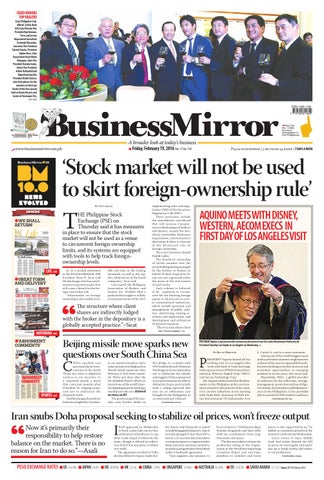
ISUZU HONORS TOP DEALERS Isuzu Philippines Corp. officials, led by (from left) Sales Division Vice President Koji Hanawa, Parts and Service Department Consultant Toshiyuki Watanabe, Executive Vice President Takashi Tomita, President Hajime Koso, Sales Department Head Hiroto Nakaguro, Sales Vice President Daisuke Inaba, Senior Vice President Arthur Balmadrid and Manufacturing Vice President Koichi Tamura, raise their glasses for the awardees in the Isuzu Dealer of the Year awards held at Solaire Resorts and Casino in Parañaque City. ALYSA SALEN
MEDIA PARTNER OF THE YEAR
BusinessMirror
UNITED NATIONS
2015 ENVIRONMENTAL MEDIA AWARD LEADERSHIP AWARD 2008
A broader look at today’s business
www.businessmirror.com.ph
■
Friday, February 19, 2016 Vol. 11 No. 134
P. | | 7 DAYS A WEEK
‘Stock market will not be used to skirt foreign-ownership rule’
T
INSIDE
HE Philippine Stock Exchange (PSE) on Thursday said it has measures in place to ensure that the stock market will not be used as a venue to circumvent foreign-ownership limits, and its systems are equipped with tools to help track foreignownership levels.
WE SHALL RETURN For our readers and us
D
EAR God, we pray for all our readers and us, that we may always be blessed with right directions, holy dispositions, acceptable behavior and have great aims toward the common good. May Your protection never leave us, may we all serve with dignity. May we be able to teach minds, touch hearts, transform lives and live Christ with others in a day-to-day activity. For all our leaders and us, may we be filled with grace and deep Faith. Amen. LOUIE M. LACSON, HFL Word&Life Publications • teacherlouie1965@yahoo.com
Editor: Gerard S. Ramos • lifestylebusinessmirror@gmail.com
Life
HERE’S SCIENTIFIC PROOF THAT YOUR DOG FEELS YOU D2
BusinessMirror
HISTORIC landmarks await the runners throughout the course, as well as majestic views of the mountains and the sea.
Friday, February 19, 2016
D1
BACK-TO-BACK runners Rey dela Cruz (from left), Desiree Vera, Krizelle Casta and Maui Daton show off their medals with Emmanuela Licayan (center) who ran the 21K.
We shall return
Going back to Corregidor for a back-to-back run BY REY DELA CRUZ Photos by Valerie Bulan
‘G
EORGE, keep the flag flying. I’m coming back.” These were the last words spoken by Gen. Douglas MacArthur before he boarded the boat that would take him and his family from Corregidor to Cagayan, after he was ordered to leave the country in March 1942. “I shall return” was spoken nine days later, in South Australia, as he changed trains on his way to what would become his new general headquarters. Like MacArthur, we also promised to return to Corregidor. This was after our first Corregidor International Half-Marathon (CIHM) experience in 2011, and we’ve been returning every year since. This year, the familiar statue of the late general once again greeted us as we disembarked on Corregidor’s North Dock, to once more join the renowned races on the island. This year marks the sixth anniversary of CIHM, and the third anniversary of its sister event, Corregidor Marathon (CM). For the mathematical geeks (and runners) out there, this was a significant double event because never again will CM celebrate an anniversary that is half as long as CIHM’s, which is half its distance. And so being the geeky runners that we are, we decided to become part of history by running in both events. This was our first 42K-21K back-to-back run. We also ran back-to-back last year, but we only participated in the 42K and 10K events. Two years ago, we ran 5K and 21K. Each year that we run, our experience surpasses that of the year before. And as our distances increased, so did the level of difficulty. But as it became harder,
the rewards became even greater. Waking up on the morning of January 9 brought us familiar feelings of excitement and anticipation as we prepared for the day’s marathon. Though we were a little more confident this time, having already finished CM once before, we were still nervous because we were aware of how difficult the journey ahead would be. This year we were joined by our friends who are first-time CM runners, and all of us were feeling the same giddy excitement combined with a little dose of gutwrenching tension. Running this year’s marathon was like saying hello to old friends who we haven’t seen or been with in a long time. Not only is this because most of the participants were already familiar to us, but also because we will be running the same route that we have come to love in Corregidor. And so while running, we said hello to our old friends, dark Malinta Tunnel, arid airport runway, scary mountainside trail, historic batteries, majestic ruins, and our bestest friend of them all, Killer Hill. We missed Killer Hill so much that we said hello to it three times. Kidding aside, we do love the CM route not only because of the challenge but also because of the sad beauty and the silent greatness that inform every part of the island. So many things happened here in the past, and we’ve heard so many tales of tragic heroism and selfless sacrifices that we couldn’t help but feel dwarfed by the virtues of the human spirit that the island represents. And as we passed by the ruins of Corregidor, we paid our quiet respects to the men and women who paid the ultimate price so that we may enjoy the freedom that many years ago was taken away from them.
We managed to finish the marathon, after a grueling eightand-a-half hours of running (and walking) up and down the island, from south to north and back again. Crossing the finish line of the CM was probably one of the most rewarding things that we’ve done so far this year, but at that point in time we couldn’t yet fully enjoy our accomplishment because there was still one more race that we had to finish the next day. Though we would run only half of the distance that we ran that day, we knew it would almost be as difficult, if not more, given that we had just finished running a full marathon. And we were right. With our legs still recovering from the impact of the previous day’s event, running CIHM was almost as hard and as painful. There were even moments when we thought we wouldn’t have the strength anymore to reach the finish line. But thankfully, we finished CIHM, too. As with our previous participation in the Corregidor races, the beautiful medals were not the only things that we brought home with us. We brought home a remarkable sense of accomplishment, for having gone through and finished Asia’s toughest marathon and Asia’s toughest half-marathon both in one weekend. We brought home a strengthened kinship with our friends who ran with us. And most important, we brought home lives that are more enriched with the experience of having done what we love to do. Our boat was scheduled to leave the dock that day at 2:30 pm. We hurriedly finished our meal right after the race, took our baths and packed our things. And as we passed by Gen. Douglas MacArthur’s statue, I said to myself, “Keep the spirit burning, Corregidor. We shall return.” ■
LIFE
D1
GREAT FORM AND DELIVERY
Motoring BusinessMirror
Henry Ford Awards Best Motoring Section 2007, 2008, 2009, 2010 2011 Hall of Fame
Editor: Tet Andolong
Friday, February 19, 2016 E1
GREAT FORM AND DELIVERY S R S. P
A
FTER the highly anticipated launch last month, it was finally time to experience the all-new Toyota Fortuner behind the wheel. Toyota Motor Philippines (TMP) recently invited select members of the motoring media for an exclusive test drive to showcase the capabilities of the new generation mid-size sport-utility vehicle.
Set on the grounds of the Clark International Speedway, TMP organized the entire event in order to demonstrate the vehicle’s wide range of dynamics. Several courses were adapted to mimic the different driving situations, subjecting the Fortuner to a comprehensive test. The first order of the day was the off-road ride encounter with the 2.8 4x4 V Diesel A/T variant.
Grouped with two other journalists, this writer boarded the topof-the-line Fortuner to bear the extreme road condition as passengers. Witnessing the plush interior during the introduction was one thing, but settling into the passenger compartment in broad daylight is even better, as intricate details of the cabin became more apparent. Leather-wrapped seats were cozy and ergonomic plus the
breezy air-conditioning system made us neglect the morning humidity. Hardly noticed were the rubble and dusts when we began entering the controlled outdoor environment, which proved the impressive noise, vibration and harshness suppression. The pilot initially made a brief halt to demonstrate the quick operation of the electronic drivetrain switch to enable the 4x4 mode. When we were about to roll on a short and steep path, transmission was shifted to first gear and without stepping on any pedal, the downhill assist control feature compelled the SUV to take directional management by intelligently applying brakes on its own. Running on 4x4 Low setting provided enough wheel tractions as we proceeded with the rough terrain wherein the ride was surprisingly comfortable with very minimal bounce considering the rocky trail. Momentarily, we reached the dried portion of the river bed to further stage the ability to slice through soft and sandy landscape. After tackling the ordeal, we immediately climbed a tight upward turn, which demonstrated remarkable angle of attack, turning radius, engine power and steering control overall. While it
happened in a swift manner, it was also perfectly executed and seamless for the top spec Fortuner. On our way back, the crawl function exhibited its ability to propel the vehicle slowly during ascents without stepping on any pedals while on first gear. The next stage took us to the racetrack proper for the on-theroad conditions with the mid spec 2.4 4X2 V Diesel A/T. This time, everyone was given seat time with the presence of an instructor as we took turns in going through numerous road simulations to mimic street driving with unexpected challenges. The initial stretch was intended to validate the vehicle’s behavior during sudden braking at high speed. This writer took the wheel and took off with notable force of acceleration reaching the targeted speed of 80 kilometer per hour. As soon as the braking was applied, the anti-
lock braking system, electronic brake distribution, and brake assist worked altogether to achieve short halting distance while keeping the vehicle in a straight direction. Also, warning lights continued to flash apart from the mechanical reverberations to keep the driver alert. We then proceeded with the short slalom highlighting the soft and responsive electronic power
steering, which made constant maneuvering at 40 kph with nominal body roll. After that, we progressed with a faster pace to go through pylons leading to several calculated turns with series of roundabouts, which, in turn, exhibited the superb handling. By the time we concluded all the runs, everyone was impressed with how the Fortuner showcased its unyielding delivery in various motorway conditions.
Sports
MANNY PACQUIAO’S discriminating comments about the lesbian, gay, bisexual and transgender community cost him the business partnership with Nike. STEPHANIE TUMAMPOS
C1
| FRIDAY, FEBRUARY 19, 2016 mirror_sports@yahoo.com.ph sports@businessmirror.com.ph Editor: Jun Lomibao Asst. Editor: Joel Orellana
C
POLITICAL TALK DIRTIES PACQUIAO’S BOXING GOODWILL Los Angeles Times
NIKE DROPS PACQUIAO IN WAKE OF ANTIGAY STATEMENTS
‘ABHORRENT COMMENTS’ B T D The Associated Press
M
ANNY PACQUIAO’S latest disparaging comments about gays have cost him a contract with Nike. It may not be the only endorsement Pacquiao loses, even as he and promoter Bob Arum scramble to contain the damage done by a television interview in the Philippines in which the boxer said gay people “are worse than animals.” “What he’s saying is diametrically opposed to what I believe,” said Arum, who is promoting Pacquiao’s upcoming fight with Timothy Bradley. “I’m in favor of gay rights and same-sex marriage. I’m apologetic personally to the gay movement in the United States.” Nike issued a brief statement on Wednesday, saying it was severing its ties with the boxer over his comments about gays. The company said it no longer will have any business dealings with the boxer.
“We find Manny Pacquiao’s comments abhorrent,” the statement said. “Nike strongly opposes discrimination of any kind, and has a long history of supporting and standing up for the rights of the lesbian, gay, bisexual and transgender [LGBT] community.” Pacquiao, a congressman who is now running for Senate in the Philippines, made the comments to a television station that was asking candidates about their views on same-sex marriage. “It’s just common sense,” Pacquiao said in the remarks posted online by the TV5 network. “Have you seen any animal having male-to-male or female-to-female relations?” Animals, he said, were better, because they recognize gender differences, and “if you have male-to-male or femaleto-female [relationships], then people are worse than animals.” Pacquiao’s remarks were criticized by several Filipino celebrities, and he responded by issuing an apology of sorts. In it, Pacquiao said he was still against same-sex marriage but loved all people. Arum told The Associated
Press that Pacquiao is an evangelical Christian who believes that homosexuality is wrong, and that he was trying to win votes in the Philippines, where the issue of same-sex marriage has not been decided. “What he said is completely for home consumption for Filipinos wrestling with the question of legalizing same-sex marriage,” Arum said. In addition to his campaign for the Senate, Pacquiao is currently training for the April 9 fight in Las Vegas against Bradley in what he says will be his last bout. Arum said he could lose some other fight sponsors because of the remarks. Pacquiao has not fought since losing to Floyd Mayweather Jr. last May in the richest fight ever. Pacquiao reportedly made more than $100 million for the fight, and is guaranteed $20 million to fight Bradley. Arum said he expects some people not to buy the fight on pay-per-view because of the comments, but that others might buy it because of them. “Instead of promoting
a fight with a fighter, I’m promoting a fight with a politician,” Arum said. “It’s like of Donald Trump was a boxer and I was promoting Donald Trump when he was running for president. I would be killed by the media for all the stupid statements he is making.” It’s not the first time Pacquiao has been involved in a furor over gay rights. In 2012 he was quoted as saying he was against same-sex marriage, because “It’s the law of God,” though he denied inferring that homosexuals should be put to death. The eight-time champion is the Philippines’s most famous person and the country’s most popular athlete. He has represented the Sarangani province in the Philippines’s House of Representatives since May 2010, though has drawn criticism for seldom showing up for legislative duties. Polls in the Philippines show he is a strong contender for the Senate seat, which many believe will eventually lead him to seek the country’s presidency.
hotel suite to be packed with visitors—friends, countrymen and others. He’s a people person. Pacquiao is beloved in his country and by many in the US because he made himself from nothing. He gave his mother his first boxing “purse” so she could buy rice. He sold items on the street to scrap by. Even when he started receiving world-championship money, he’d hand out cash to lines of people who swarmed his home in the Philippines. It didn’t matter then if someone he encountered was gay, just like it shouldn’t matter for a politician who has presidential ambitions and is supposed to represent every person in his district. Pacquiao has taken pride in working to build a hospital and help bring education to his congressional district in the country. Fair or not, his toxic words left the impression he’d rather those services not apply to people he holds such little regard for, a possibly destructive stance taken by such an otherwise kind man. Remember where you came from, Manny, to a place that embraced your happy, spirited and entertaining ways, even after you admittedly slipped in your personal life and were led to be reborn by some dubious religious leaders who apparently had you focus on the more divisive readings. Read this: Healing this will take more than an apology. Pacquiao, 37, has said his April 9 welterweight title fight against champion Timothy Bradley in Las Vegas will be his final bout before embarking on a demanding political career, with the Senate election in May. Too bad he couldn’t reach the finish line in sports without becoming just another politician who inspired our most positive thoughts before doing something that revealed him as something far less than most of us.
SPORTS
C1
AQUINO MEETS WITH DISNEY, WESTERN, AECOM EXECS IN FIRST DAY OF LOS ANGELES VISIT
S “S ,” A
Beijing missile move sparks new questions over South China Sea
BusinessMirror
B L P
able real time in the trading terminals, as well as the regular submissions of the listed companies,” Sicat said. Last month the Philippine Association of Brokers and Dealers Inc. (Pasbdi) filed a petition that sought to nullify certain provisions of the 2015
implementing rules and regulations (IRR) of the Securities Regulation Code (SRC). These provisions include the amendments introduced that will increase transparency in the dealings of brokers and dealers, mainly the beneficial ownership disclosure requirement, a move meant to determine if there is a breach in the 40-percent rule on foreign ownership. The court, however, denied Pasbdi’s plea. The beneficial ownership of stocks assumes that the stock holdings being managed by the brokers or dealers in behalf of their respective clients are not registered under the name of the real owners of said stocks. Such scheme is believed to be employed to circumvent the law limiting foreign equity to 40 percent in partly nationalized industries, which include operation and management of public utilities, advertising, mining activities and exploration, and development and utilization of natural resources. “The structure where client
E1
‘ABHORRENT COMMENTS’
O
In an e-mailed statement to the BM, PSE President Hans B. Sicat said the Exchange even has mechanisms to prevent trades that will cause a breach in the foreign-ownership rule. “Information on foreign ownership is also readily avail-
The structure where client shares are indirectly lodged with the broker in the depository is a globally accepted practice.”–Sicat
MOTORING
NE of the most endearing traits that lure the public to a politician is the idea that the person seeking elected office remembers where he came from. Manny Pacquiao, chasing a Senate seat in the Philippines, lost sight of that this week. Pacquiao, in a television interview in his home country, denounced gay relationships by saying if gays don’t understand how to distinguish male from female, “then [they are] worse than animals.” The former eight-division world-champion boxer was quickly and deservedly derided for the insensitive remarks, and he issued an apology on Twitter: “I’m sorry for hurting people by comparing homosexuals to animals. Please forgive me for those I’ve hurt. God bless!” He’s opposed to samesex marriage—a stance that unfortunately needs to be revealed in his political race—but also posted on his Facebook page that he is “not condemning lesbian, gay, bisexual and transgender people,” adding, “I’m praying for you.” Nevertheless, Pacquiao’s well-paying sponsor Nike has dropped him, and Jason Collins, the National Basketball Association’s (NBA) first openly gay player, tweeted, “Bigoted people like you [and, yes, you are one] should never hold an office in politics.” Having covered Pacquiao’s fights since 2006, I’ve known him to be one of the kindest, most generous athletes I’ve ever crossed paths with. And that’s not just with a Los Angeles Times reporter who helps Pacquiao build his audience. I’ve witnessed everyday people who ask for his time after a workout at Wild Card Boxing Club in Hollywood accommodated with a personal exchange. In the hours after his May loss to Floyd Mayweather Jr., Pacquiao allowed his
B VG C
HINA sparked new questions about its intentions in the South China Sea after it deployed surface-to-air missiles to a contested island, a move that came just months after President Xi Jinping promised not to militarize the disputed atolls. Satellite images showed two batteries of eight HQ-9 surface-
to-air missile launchers and a radar system were deployed on Woody Island sometime after February 3, Fox News reported. That’s just days after the US rebuffed China’s efforts to control one of the world’s busiest shipping lanes by sending a warship into the area. Related on story on B7. The positioning of the missiles casts further doubt on
Xi’s pledge at a summit with US President Barack Obama in Washington in late September not to militarize the islands and suggests China is prepared to escalate tensions in order to defend its claims, particularly with a ruling expected this year on an arbitration case brought by the Philippines to an international tribunal.
PRESIDENT Aquino is presented with an honorary doctorate from the Loyola Marymount University by President Timothy Law Snyder in Los Angeles on Wednesday. AP
P
B R M
RESIDENT Aquino kicked off his working visit to Los Angeles this week with back-to-back meetings with top executives of Walt Disney International, Western Digital Corp. (WDC) and Aecom Technology Corp. Mr. Aquino underscored the developments in the Philippine policy environment related to the growth of the country’s creative industries in his meeting with Andy Bird, chairman of Walt Disney International, US Ambassador Jose
L. Cuisia Jr. said in a news statement. Disney, one of the world’s biggest mass media and entertainment conglomerates and one of the most recognizable brands, has been looking to further invest in and maximize opportunities in emerging markets in recent years, the envoy said. Meanwhile, WDC, a global provider of solutions for the collection, storage, management, protection and use of digital content, has already established presence in the Philippines. It has provided jobs to around 10,500 workers and has a C A
C A
Iran snubs Doha proposal seeking to stabilize oil prices, won’t freeze output
Now it’s primarily their responsibility to help restore balance on the market. There is no reason for Iran to do so.”—Asali PESO EXCHANGE RATES ■ US 47.6580
I
RAN appeared on Wednesday to back a plan laid out by four influential oil producers to cap their crude output if others do the same, though it offered no indication that it has any plans to follow suit itself. The agreement reached in Doha the day before by Qatar, Saudi Ara-
bia, Russia and Venezuela is aimed at stabilizing global oil prices, which recently plunged to less than $30 a barrel, a 13-year low. But Iran is keen to ramp up exports to regain market share now that sanctions related to its nuclear program have been lifted under a landmark agreement. “Iran supports any measure to
boost oil prices,” Oil Minister Bijan Namdar Zanganeh said after talks with his counterparts from Iraq, Venezuela and Qatar. “The decision taken to freeze the production ceiling of the Organization of the Petroleum Exporting Countries [Opec] and non-Opec members to stabilize and boost
prices is also supported by us,” he added, in comments posted on the ministry’s web site late Wednesday. Iran’s envoy to Opec Mahdi Asali had earlier blamed the fall in prices on oversupply, and said it was up to Saudi Arabia and others to cut production.
■ JAPAN 0.4181 ■ UK 68.0938 ■ HK 6.1216 ■ CHINA 7.2994 ■ SINGAPORE 33.9662 ■ AUSTRALIA 34.2002 ■ EU 53.0338 ■ SAUDI ARABIA 12.7125
C A
Source: BSP (18 February 2016 )
BMReports BusinessMirror
A2 Friday, February 19, 2016
AQUINO MEETS WITH DISNEY, WESTERN, AECOM EXECS IN FIRST DAY OF LOS ANGELES VISIT C A
tie-up with about 400 local suppliers. Mr. Aquino, likewise, explored the possibility of expanding Western Digital’s business in the Philippines by increasing manufacturing lines and setting up a shared services facility. He briefed Stephen Milligan, the company’s CEO, on the growth of the manufacturing and IT-BPM sectors, stressing that the Philippines remains a leading destination for offshore investments due to its scalable and trainable talent pool, cost competitiveness and government support. In his meeting with Aecom Group President Michael Donnelly, Mr. Aquino discussed the government’s commitment to upgrading the country’s infrastructure as evidenced by the increased approved budget for infrastructure development to 5 percent of the GDP in 2016. Aecom previously provided engineering, procurement and management services for the San Roque Dam in Pangasinan, designed the North Luzon Expressway and the passenger terminal of the Mactan International Airport in Cebu. In February last year the Bases Conversion and Development Authority announced that Aecom won the open competition for the best optimized design of Clark Green City’s Conceptual Master Development Plan. The executives all praised their Filipino employees for their competence, talent and work ethic. Bird cited the Filipinos’ creativity and said that Disney would welcome more Filipino talent, particularly in the field of animation.
Similarly, Milligan assured Mr. Aquino that the Philippines remains high on Western Digital’s list when it comes to expansion plans, mainly because of their satisfaction with and continued confidence in the capabilities of their Filipino workers. Hu g h D o y l e , g l o b a l e m e r g i n g markets leader of Aecom, likewise, said that his company has had very good experience with their Filipino workers, most of whom are engineers. Aecom, Los Angeles’s largest employer, has around 130 Filipino employees working in the Philippines and approximately 1,200 deployed across the globe. Accompanying Mr. Aquino in the business meetings were Finance Secretary Cesar V. Purisima, Trade Secretary Adrian T. Cristobal, Defense Secretary Voltaire T. Gazmin, Secretary of the Cabinet Jose Rene D. Almendras, Economic Planning Secretary Emmanuel F. Esguerra, Communications Secretary Herminio B. Coloma Jr., Philippine Ambassador to the United States Jose L. Cuisia Jr., Consul General Leo M. Herrera-Lim and Secretary Julia Abad of the Presidential Management Staff. “Much of the economic resurgence that the Philippines is experiencing today is attributed to the President’s active economic diplomacy,” Cuisia said. “We have made remarkable strides in terms of restoring investor confidence, and the challenge to us now is in sustaining this momentum and building on the gains we have achieved. We continue to consider US businesses as key partners in this endeavor.”
Stock market. . . shares are indirectly lodged with the broker in the depository is a globally accepted practice and is designed as such to help facilitate the transfer of ownership from one client to another for stock-market
C A
transactions,” Sicat said. Despite an ongoing petition that seeks to annul some of the provisions of the IRR, the Securities and Exchange Commission (SEC) said more than half
news@businessmirror.com.ph
Beijing missile move sparks new questions over South China Sea C A
“There is evidence every day that there has been an increase of militarization of one kind or another,” US Secretary of State John F. Kerry told reporters in Washington on Wednesday when asked about the missile deployment. “My hope is that China will realize that it is important to try to resolve the jurisdictional issues of the South China Sea not through unilateral action, not through force, not through militarization, but through diplomacy and by working with the other countries.” The military and economic rebalance to the region is Obama’s signature foreign policy initiative, after previous administrations focused more on the Middle East and elsewhere. China sees the policy as an effort to contain its influence as its growing military clout tests the US Navy’s decades-long dominance of the western Pacific. If China militarizes “after saying they won’t, then that is significant for the US debate about what to do for the next phase of the rebalance,” said Michael Pillsbury, director of the Center for Chinese Strategy at the Washington-based Hudson Institute and an adviser to the Pentagon. “This deployment is crossing a red line and means regular military units from the Army, Navy or Air Force may now be deployed.” Under Xi, China has reclaimed land to bolster its claims to more than 80 percent of the waterway that hosts $5 trillion of international shipping a year, adding airstrips and lighthouses. Asked about the missiles at a briefing in Beijing, Foreign Minister Wang Yi said that limited selfdefense facilities on Woody are consistent
of the stockbrokers and trading participants have complied with the new requirements. The corporate regulator said of the 133 broker-dealers and trading participants of the PSE, about 88, or 66 percent, have already submitted the new requirements, while two broker-dealers requested and were
with China’s self-protection policies and international law. He described the report as Western media hype.
Island-building
NEWS of the missiles came as Obama and leaders from the Association of Southeast Asian Nations wrapped up a two-day summit in California, where they underlined their commitment to ensuring “maritime security and safety, including the rights of freedom of navigation and overflight and other lawful uses of the seas.” Four of the 10 Asean members also claim portions of the South China Sea. China has reclaimed 3,000 acres of land in the South China Sea over two years, warned US military planes and ships from going near areas it controls; and its ships have regularly clashed with Vietnamese and Philippine fishing boats. It is expanding its island-building in the Paracels, according to recent images posted on the web site of The Diplomat magazine. They show dredging and filling at two new sites in the island chain about 15 kilometers (9.3 miles) from Woody Island. The Paracels are also claimed by Taiwan and Vietnam. Taiwan’s Defense Ministry said it was aware of Chinese missiles being deployed there. Vietnam considers every effort to build or renovate facilities on the South China Sea islands without permission of the government to be “illicit,” Foreign Ministry Spokesman Le Hai Binh said in email response to questions.
‘Concerns me’
US Pacific Command chief Harry Harris, on a visit to Tokyo, said the presence of missiles on the island would signal a militarization
granted extension of time to comply with the new IRR of the SRC, which took effect on November 9, 2015. The new rules state: “Any registered broker-dealer operating prior to the effectivity of these rules shall, within 90 calendar days from these rules’ effectivity, comply with all the requirements provided under
of the area. The Chinese “have flown jet fighters out of the Paracels for a number of years now, and so it would not surprise me that they would add some measure of missile defense there, or offensive missiles for that matter,” Adm. Harris said at a briefing. Still, “it concerns me greatly.” The HQ-9 is a long-range, high-altitude, surface-to-air missile system developed and manufactured by China Aerospace Science and Industry Corp. It is designed to track and destroy air targets, including aircraft and cruise missiles, within a range of 300 km (185 miles) and as high as 7,000 meters (23,000 feet), according to the official Global Times newspaper. The cruising altitude of a commercial airliner is generally above 30,000 feet.
‘Into question’
“WHILE the Chinese Foreign Ministry could claim that the missiles are defensive in nature, their deployment certainly puts its claim that China wants to avoid further militarization of the South China Sea into question,” said Felix Chang, a senior fellow at the Foreign Policy Research Institute in Philadelphia. The deployment could pose a threat to US P8-A Poseidon surveillance aircraft patrolling the South China Sea. The Chinese Navy in May last year issued eight warnings to a P8-A flying over islands it claims in the Spratly Islands chain. The US has twice sent warships within what China considers its territorial waters, and Harris said “more complex” freedom-of- navigation operations were planned. The USS Curtis Wilbur passed near another island in the Paracel chain on January 30. Bloomberg News
these rules that are not otherwise included in its original registration.” This made the compliance with new requirements mandatory on February 9. In a letter dated January 8, 2016, the SEC directed the Capital Markets Integrity Corp., a unit of PSE, to remind trading partici-
pants and broker-dealers to comply with the said rule. Aside from the disclosure of beneficial owners, the IRR also mandates stockbrokers and dealers to submit detailed description of organizational and functional charts, the names and designations of the officers, including branch offices; risk-management manual and internal control procedures; and business continuity and disaster, recovery plan. It also requires stockbrokers, dealers and trading participants to subm it a compre hen sive information-technology plan. They were also ordered to submit an updated written supervision and control procedures, including procedures for establishing and segregating transactions, taking into consideration the requirements of the Anti-Money Laundering Act of 2001 (RA 9160, as amended), and the Revised Code of Corporate Governance. “The amendments introduced in the 2015 SRC IRR are designed to address varying concerns. They are intended to enhance investor protection, address regulatory gaps, strengthen the market and regulatory structures and adopt global best practices. I believe the final version faithfully implements the statutory requirements as mandated by SRC,” SEC Chairman Teresita Herbosa said in an earlier interview. Herbosa earlier said her agency is prepared to defend its position to require securities brokers and dealers of stocks to disclose the beneficial owners of shares in a move to maintain foreign ownership of firms in regulated industries to just 40 percent. “But since their application was denied by the court as they failed to establish that the IRR poses grave and irreparable injury to them, then the recently issued 2015 IRR stands,” Herbosa said. The said move is to allign the SRC with the Foreign Investment Negative List and Anti-Money Laundering Act. In an earlier ruling that took effect in 2015, the Supreme Court ordered the SEC, in the case of Gamboa v. Teves, to look into the beneficial ownership of corporations and ensure compliance with the limit on foreign ownership.
BMReports BusinessMirror
news@businessmirror.com.ph
Friday, February 19, 2016 A3
Malacañang asked not to veto PWD bill
A
B J M N. C
LAWMAKER and several persons with disabilities (PWDs) groups on Tuesday urged President Aquino to sign into law a measure exempting PWDs from the 12-percent value-added tax (VAT) on certain goods and services. This developed as the transport department launched new pointto-point bus units designed to ease the boarding of PWDs. Joy Garcia, COO of the Tahanang Walang Hagdanan, in a news conference, said the proposed law is a big help to PWDs and their families, as the measure exempts PWDs from paying VAT on top of the 20-percent discount they are currently entitled to on certain goods and services. “The measure will help PWDs who are facing financial difficulties. The PWDs also deserve to have these [tax] privileges, as we are not given the chance to work in the mainstream. So I am
asking President Aquino to give us a chance,” she said. State solicitor Jessica Magbanua, who is a PWD herself, said the tax privileges given to senior citizens should also be given to PWDs. “[By signing this bill] it will show that the government recognizes the plight of PWDs,” said Magbanaua, who is a member of Consultative Advisory Group, Sub-Committee on Accessibility and Telecommunications of the National Council on Disability Affairs and board secretary of AKAP-Pinoy, a federation of organizations of and for PWDs in the Philippines.
HB 1039
Approved version of the measure expanding the privileges of persons with disabilities
I hope the President will not veto the PWD bill as what he did when he vetoed the Social Security System pension-hike bill.”—Romualdez
According to the Census of Population and Housing, the Philippines has 3 million PWDs, or 3 percent of the country’s total population. House Independent Bloc Leader and Lakas Rep. Martin Romualdez of Leyte, the main author of the lower chamber’s version of the measure, or House Bill (HB) 1039, said the House is now readying the measure’s transmittal to the Palace for the signature of President Aquino. “I hope the President will not veto the PWD bill as what he did when he vetoed the SSS [Social Security System] pension-hike bill,” he said, adding, “Our PWDs are waiting for the measure to become a law because this would help their plight.” “Granting PWDs the exemption from paying VAT on certain goods and services is one of the
productive ways to help them and would surely help their living conditions,” Romualdez added. The measure seeks to amend Section 32 of Republic Act (RA) 7277, or the Magna Carta for Persons with Disability, as amended by RA 9442. T he proposed VAT exemp tion shall apply on the medical and dental services; purchase of medicines in all drugstores; public railways, sky ways and bus fare; admission fees charged by theaters, cinema houses, concert halls, circuses, carnivals and other places of culture, leisure and amusement; and all services in hotels and similar lodging establishments, restaurants and recreation centers. It also allows a relative of a PWD up to the fourth civil degree of consanguinity or affinity to claim a tax deduction of P25,000
in his annual income tax. The proposed tax breaks for the handicapped would align these with the privileges senior citizens are getting under the Expanded Senior Citizens Act of 2010. At present, under the Magna Carta for Disabled Persons, PWDs are entitled to a 20-percent discount on certain goods and services, such as medicines, hospital and laboratory works, hotel stay, local transport fares and theater admission. The bill added funeral services and burial expenses to the list of assistance to be given to PWDs. Meanwhile, the Department of Transportation and Communications has moved to make com mut i ng ea sier for PW Ds through the launch of new buses with modern tech such as a tap-and-go card payment system, free wireless Internet and
onboard security cameras. “PWDs, senior citizens and pregnant women will begin enjoying the convenience and comfort of this new class of city buses, which improve accessibility with low floors and foldable ramps. We are ridding our streets of dilapidated, poorly maintained and unsuitable buses,” Transportation Secretary Joseph Emilio A. Abaya said on Thursday. Other features of the new buses include: low floor height; hydraulic kneeling function to allow tilting toward the pavement; retractable or foldable boarding and alighting ramp; and global positioning system devices. “Eventually, this will push all public-utility buses to modernize,” Abaya said. Point-to - point buses were created last year under a department oder, which also stipulates that buses introduced under this category must also be compliant with Euro 4 emissions standards or better, or run on clean alternative fuels. T he ser v ice was conceived to cut travel time and provide convenient commutes, through fixed stops and schedules. With
Lorenz S. Marasigan
BMReports BusinessMirror
A4 Friday, February 19, 2016
news@businessmirror.com.ph
New policies on renewable energy out soon
T
B L L
HE National Renewable Energy Board (NREB) is crafting new policies aimed at stimulating investments in the renewable-energy (RE) sector, in line with the Department of Energy’s (DOE) thrust to reduce the country’s reliance on fossil fuel.
The NREB is the body tasked by the Renewable Energy Act of 2008 to recommend policies, rules and standards to govern the implementation of the law, which granted fiscal and nonfiscal incentives to RE projects. “The proposals will cover updates and new targets for the National Renewable Energy Program [NREP], FiT [feed-in tariff] rate options, installation targets, renewable portfolio standards [RPS] and net metering,” NREB Chairman Pedro H. Maniego Jr. told the BusinessMirror. The DOE has so far received the recommendation of the NREB on RPS, which will require powerindustry participants to source a certain percentage of their requirements from RE. Other proposals are still being finalized, before these are formally submitted to the DOE. “We have submitted our recommendations on the RPS late last year, and [we are] updating this month. FiT, net metering and NREP proposals are to be discussed and finalized by next month,” Maniego said. He stressed that the NREB’s primary role is “recommendatory” based on its mandate in the RE Act of 2008. “Until the DOE and the NREB have agreed on the way forward, any announcement will be premature,” Maniego replied, when asked to elaborate on the proposed policies. Energy Secretary Zenaida Y. Monsada confirmed that the NREB is coming up with proposals meant to ensure that RE would have its rightful place in the country’s energy mix. “According to the RE law, the NREB will recommend policies to the DOE. [The NREB] has just finished its strategic workshop that deals with the road map and what to do to further promote RE. We issued a circular promoting for a 30-percent minimum share of RE in the mix,” Monsada said. Under Department Circular 2015-07-0014, the share of RE in the energy mix should be at least 30 percent. The renewable sources of power include solar, wind, biomass, ocean and hydro.
Based on the 2014 DOE Power Statistics, 25.64 percent of the country’s total power generation is sourced from RE facilities, or equivalent to about 32.87 percent of the country’s
Clear policies, stringent regulation and commensurate incentives are equally important in the effective implementation of the renewable-energy law.”—Sy installed generating capacity. “To maintain the share of RE in power generation, the DOE hereby adopts a policy of adopting at least 30-percent share of RE in the country’s total power-generation capacity, through the holistic implementation of the FiT system and other pertinent provisions under the RE Act and RE IRR [Implementing Rules and Regulations],” the circular stated. To be sure that this policy is strictly enforced, the DOE will use the FiT installation targets: 250 megawatts (MW) for hydro, 250 MW for biomass, 400 MW for wind, 500 MW for solar and 10 MW for ocean. When these targets are met, a bidding will take place. The present system involves filling FiT allocation on a first-come, first-served basis. When the slots are filled, the DOE will then adjust the quotas to accommodate more RE developers. “Upon the full subscription of the existing FiT-installation target, the succeeding rounds for the installation targets for FiT-eligible resources shall be made through an auction system to be adopted by the DOE,” the circular stated. FiT is the per-kilowatt-hour (kWh) rate guaranteed to RE developers to ensure the viability of their projects. Consumers shoulder this under the FiT allowance (FiT-All) scheme, a separate line component in the power bills. They are now paying an additional P0.0406 per kWh.
Solar
UNDER the law and pertinent rules, it is the Energy Regulatory Commission (ERC) that sets the FiT rates, while the DOE is the lead implementing agency of the RE Act. It also approves the FiT eligibility of the RE plants, and sets the RE installation target to ensure the security of the power grid and electricity rates. The deadline for RE developers to avail themselves of the second batch of FiT rate for solar-power projects is set on March 15. The DOE has increased the capacity allocation of solar-power projects to 500 MW, from 50 MW, to attract more RE developers. The approved FiT rate for solar under the second round is P8.69 per kWh, lower than the P9.68-per-kWh solar FiT rate during the first round of solar-power allocation. However, based on latest data provided by the ERC, the 500-MW capacity allocation for solar projects under the FiT scheme is yet to be fully subscribed. “Based on the applications we received so far, the capacity of these solar projects vying for the second round of FiT rates haven’t reach the full 500-MW allocated capacity,” ERC Chairman Jose Vicente B. Salazar said. Based on latest data provided by the ERC, the second batch of offering for a guaranteed power rate for solar projects has only attracted about 360.41 MW of total capacity.
When asked if the figures reflect a low turnout of interested investors, Maniego said: “Actually, there are more than 500 MW of solar-power projects under construction. However, most of the developers have encountered delays. Thus, it is still not certain how many will finish their projects by March 15, 2016.” Energy Undersecretary Mario C. Marasigan said some RE developers may have difficulty meeting the deadline. The DOE official, however, is confident that the 500 MW would be fully subscribed soon.
Promoting RE
MONSADA said her office is aggressively fulfilling international commitments and promoting indigenous sustainable energy to entice RE developers to invest in more RE projects. “We are committed to increase our RE capacity and maintain a minimum of 30-percent share in the power-generation mix in the coming years,” Monsada said. Through this government intervention, the country will be able to achieve its undertaking to triple installed RE capacity by 2030, reflecting its 21st Conference of the Parties pledge and proactively responding to the Asia-Pacific Economic Cooperation’s aspiration of doubling RE capacities of member-economies from the 2010 level by 2030. “Aside from the proposals of the NREB, we are banking on the FiT system to promote the use of RE on a larger scale and to attract new investments for RE facilities,” added Monsada, when sought for comment. The DOE has so far awarded 657 RE contracts more than seven years after the RE Act of 2008 was enacted into law. At end-2015, the agency said these contracts have a potential
IT, legal, banking, marketing professionals command higher salaries than journalists B R L. A
J
OURNALISTS in the Philippines are still compensated well, although other professionals in the country, especially those in the banking and marketing sectors, have considerably better “market value.” Based on the Salary Report 2016 released on Thursday by JobStreet.com Philippines, the field of journalism is now outside the top 10 high-paying industries for junior executives with one to four years work experience. These employees are the likes of reporters in the trimedia—television, radio and newspaper—who are now ranked No. 12 from No. 7 the prior year. Replacing the journalists from their previous position are the junior executives in the banking or financial services, whose ranking moved up four notches from No. 11. They earn P26,275 monthly, compared to the average take-home pay of the press at P21,000. “[While] the journalism [industry]
₧38,149
Average monthly salary of information-technology junior executives in the country, the highest by sector is not on the top 10 [list], it’s still one of the biggest or highest paying [jobs in the country at present],” noted Philip Gioca, country manager of JobStreet. com Philippines. He told the BusinessMirror that it has, in fact, been consistently included on their list over the last three years. They might have been overtaken by the banking/financial services and marketing/business-development sectors, which are actually “new entrants” for this year’s list, because of the big demand in their respective fields. “But we have to remember, these are very close differences,” he said of the gap in these sectors’ salary range.
The 2016 JobStreet.com Salary Report is based on the actual salaries of all JobStreet.com job postings during the October-to-December 2015 period. All local jobs nationwide were considered, and information of 15,396 valid jobs for junior executives were used. The information-technology (IT) field led all other specializations in terms of salary offering, and covering not only the junior executives segment (with P38,149 monthly pay), but also other major ranks, such as supervisors (P63,485) and managers (P86,550). “The IT specialists continue to be the best-paid employees, with software specialists leading that group,” Gioca said, noting that these professionals have been dominating their reports for four years in a row. Coming in second is the law/legal services field, paying junior staff with P30,324 a month. Actuarial/statistics (P28,406), customer service (P27,890), training and development (P27,471), and public re-
generation capacity of 13,499.52 MW, as against the total installed capacity of 3,026.33 MW. Of the 616 RE projects awarded by the government, 352 are hydro power; 124 solar; 55 wind; 38 biomass; 41 geothermal; and 7 ocean energy. These 617 contracts were awarded for grid use. On top of these, there were 40 RE contracts awarded for selfgeneration of electricity for their own use. These include one for hydro and wind; 13 for solar; and 25 for biomass. The latest DOE data also showed that there are 273 pending RE projects, 193 of which are hydro; 56 solar; 2 ocean; 7 biomass; 10 wind; and two are geothermal. The potential generation capacity of these pending RE projects could reach 4,603.73 MW, as against an installed capacity of 207.91 MW. The DOE data also showed that there are 21 biofuel projects to date, 10 of which are bioethanol and the remaining 11 are biodiesel. The DOE aims to increase the country’s RE-generation capacity to 20,000 MW by 2030.
Government’s role in RE
NATIONAL Grid Corp. of the Philippines President and CEO Henry Sy Jr. earlier stressed the importance of the government’s role in reaping the benefits of the sevenyear-old RE law. He said the enforcement of government policies is equally important as the investments poured in by the private sector. “Much has been said about the benefits of RE, most especially in developing countries like the Philippines. However, for us to reap the benefits of RE, we need more than investments on power plants, transmission facilities and other infrastructure. Clear policies, stringent regulation and commensurate
lations/communications (P27,050), occupy the third to sixth slots, respectively. After banking and financial services, arts/creatives is ranked No. 8 with P26,204 salary. Finance-related jobs (P23,907), on the other hand, is the ninth high-paying job, or a little higher than 10th placer marketing/business development field (P23,790), formerly at No. 14. The 7-percent increase in the average salary across specializations from junior executives to supervisory and managerial ranks is reflective of the expanding economy of the Philippines, according to Gioca. “As shown in our report, the number of jobs grew. So, therefore, we can infer from that that the [growing] economy made it [possible]. It’s actually much better because we can afford to give more jobs,” he said, adding that the significant rise in the labor sector could also be attributed to the lowest unemployment rates seen by the country in the past few years and the resulting competitive pay in the job market.
incentives are equally important in the effective implementation of the RE law,” Sy said during the Philippine Energy Summit. Republic Act 9513, or the RE Act of 2008, also seeks to increase the utilization of RE resources by developing national and local capabilities in the use of RE systems, and promoting their efficient and effective application by offering fiscal and nonfiscal incentives. These incentives include income-tax holiday; duty-free importation of renewable machinery, equipment and materials; special realty-tax rates; net operating loss carryover; corporate tax rate of 10 percent; accelerated depreciation of plant, machinery and equipment; zero-percent value-added tax rate; tax exemption on carbon credits; and cash incentive for missionary electrification. Industry stakeholders, however, are still facing tough challenges, including high up-front cost and technologies, and inaccessible financial packages. Sy said open dialogue and exchange are very essential in an industry, such as the power sector, which is composed of varied stakeholders with different interests. “It is high time that industry players started the conversations going and worked toward cleaner and more sustainable energy sources, and toward a successful and competitive energy industry that is [on a] par with, if not better than, Asean counterparts,” Sy said. “Today we take a look at the opportunities that the Philippine power industry faces, starting with the rapidly changing global energy outlook; the possibility of one Asean grid; the prospects for gas and its emergent role in the generation sector; and the direction we need to take to improve and maximize the spot market,” he added.
Iran snubs Doha proposal seeking to stabilize oil prices, won’t freeze output . . .
He said the four nations that participated at the Doha gathering could stabilize oil prices on their own—if they cut their production by 2 million barrels a day. “These countries increased their production by 4 million barrels when Iran was under sanctions,” Asali was quoted as saying by the Shargh Daily. “Now it’s primarily their responsibility to help restore balance on the market. There is no reason for Iran to do so.” The four countries made their announcement following an unexpected meeting in the Qatari capital that pointedly did not include Iran. They agreed to act only if other producers made similar freezes. Iran has previously said it hopes to put another 500,000 barrels a day on the market. Figures from the International Energy Agency show it pumped 2.9 million barrels daily last December, before sanctions were lifted. Iran used to export 2.3 million barrels per day, but its crude exports fell to 1 million in 2012, when sanctions were tightened. On Tuesday Iran’s oil minister said it had no intention of giving up its share of the market. Zanganeh acknowledged that global markets are “oversupplied,” but said Iran “will not overlook its quota,” according to comments carried by his ministry’s Shana news service. Even with Iran’s cooperation, it was unclear if the Doha plan would be enough to put a floor under prices. The United Arab Emirates’ energy minister, Suhail Mohamed al-Mazrouei, refused on Wednesday to discuss the Doha proposal after giving a keynote address at a Dubai conference in which he mentioned low oil prices only in passing. “I will only talk about this conference,” he said, before smiling and walking away from reporters’ shouted questions. He later took to Twitter to say his country’s oil policy “is open to cooperate with all producers toward mutual interest of the market stability and we are optimistic on the future.” Kuwait, another Gulf Opec member, signaled it was willing to go along with the Doha plan. Anas al-Saleh, who is Kuwait’s deputy premier, finance minister and acting oil minister, said in a statement that his country was committed to the proposal if others join in. “Kuwait hopes the agreement would provide a positive atmosphere for oil prices, and for the market to regain balance, and calls on all to support stability of markets,” he said. AP
AseanFriday BusinessMirror
news@businessmirror.com.ph
Editor:
a
. de eon • Friday, February 19, 2016 A5
Malaysian growth slows less than forecast
M
ALAYSIA’S growth slowed less than expected after overseas shipments and factory output held up, providing some measure of support for an economy facing faltering investment and higher costs.
GDP rose 4.5 percent in the three months through December from a year earlier, after climbing 4.7 percent in the previous quarter, the government said in a statement on Thursday. That compares with a 4.1percent median estimate in a Bloomberg News survey. The economy grew 5 percent in 2015. The ringgit fell more than any other Asian currency against the dollar last year, making Malaysia’s goods more attractive to overseas buyers. That is countered by a slump in crude that has curbed government revenues and prompted Prime Minister Najib Razak to trim the growth
5%
Malaysia’s GDP growth in 2015
forecast for 2016, while rising costs crimp business investment. “We are far from upbeat about the prospects for Malaysia this year,” said Krystal Tan of Capital Economics
Ltd. “The effects of low commodity prices will continue to feed through into the real economy, curtailing investment in the energy sector, keeping commodity export income weak and hurting fiscal revenue.”
Ringgit gains
THE ringgit gained 1.3 percent against the dollar in Kuala Lumpur on Thursday, extending its advance after growth and the current-account surplus figures beat estimates. The Malaysian currency has appreciated about 3.2 percent against the US dollar this year, rebounding after a 19-percent decline in 2015. Bank Negara Malaysia left interest rates unchanged for a ninth meeting last month, while cutting the amount of cash banks must set aside as reserves for the first time since 2009 to boost funds in the financial system. The central bank on Thursday warned that the economy is expected to face a “challenging operating environment” with the domestic demand engine projected to slow down.
Structurally lower oil prices means that Malaysia will still be confronted with significant growth and fiscal headwinds.”—Australia & New Zealand Banking Group
“While the growth in income and employment continues to support private consumption, it is expected to moderate as households continue to adjust to the higher cost of living,” it said in a statement. “The downside risks to growth will, however, remain, given the continued uncertainty in the external environment and the ongoing reforms in the domestic economy.”
Slower expansion
GROWTH is now expected by the government to be 4 percent to 4.5 percent this year, compared with an earlier projection of as much as 5 percent. Inflation is projected to rise 2.5 percent to 3.5 percent this year, higher than an October forecast of 2 percent to 3 percent. A key consumer confidence gauge fell to a record low last quarter, and households are turning more negative in their financial outlook for the first half of 2016. The government agreed to delay a plan to double foreign worker levies after companies protested the move, saying it would raise the cost of doing business amid an already difficult operating environment. “Malaysia is unlikely to be able to sustain its mojo in 2016,” said Weiwen Ng, an economist at Australia & New Zealand Banking Group Ltd. in Singapore. “The balance of risks in 2016 is skewed toward growth disappointment and fiscal slippage with inflation pressures of second order concern. Structurally lower
oil prices means that Malaysia will still be confronted with significant growth and fiscal headwinds.”
‘Sturdy growth’
EXPORTS rose 3.7 percent in the fourth quarter from a year earlier, after gaining 3.2 percent in the previous three months, the statistics department said. Manufacturing expansion quickened to 5 percent, and electrical and electronic products had “sturdy growth,” it said. Private consumption expenditure climbed 4.9 percent last quarter from a year ago, accelerating from 4.1 percent in the previous period. Private investment growth slowed to 5 percent from 5.5 percent in the third quarter. “Private investment is projected to moderate to below its long-term trend, but will nevertheless be supported by the capital expenditure in the manufacturing and services sectors, as well as the implementation of infrastructure projects,” the central bank said. Bloomberg News
The World BusinessMirror
A6 Friday, February 19, 2016
news@businessmirror.com.ph
AS HE CRITICIZES MEXICO’S RULING CLASS
Pope has message of love for people, migrants
C
IUDAD JUAREZ, Mexico— Pope Francis wrapped up a five-day visit to Mexico with a message of love and compassion for the people of Mexico and the migrants who pass through it on their way to the United States. For their political and religious leaders, the trip was more a lesson in tough love.
The pontiff used his time here to criticize Mexico’s ruling class for failing to protect people from predatory criminal gangs and rampant corruption, and he lectured bishops to get closer to their flock and ease their suffering. He also visited some of the country’s poorest and most violent areas to shine a spotlight on residents’ harsh reality. The final day on Wednesday was the most symbolic and politically bold moment of Francis’s trip, with hundreds of thousands gathering for Mass at a Ciudad Juarez fairground, while an estimated 30,000 more watched via simulcast at a football stadium across the Rio Grande in El Paso, Texas. Francis also aimed a message north of the border at a time of increasingly tough presidential campaign rhetoric on immigration in the US. The pope appealed for governments to open their hearts to the “human tragedy” of forced migration. “No more death! No more exploitation!” he implored. Francis stopped short of calling outright for the US to open its borders, but he urged recognition that the multitudes fleeing gangland killings and extortion in their homelands are victims. “We cannot deny the humanitarian crisis which in recent years has meant the migration of thousands of people, whether by train or high-
way or on foot, crossing hundreds of kilometers through mountains, deserts and inhospitable zones,” he said. “They are our brothers and sisters, who are being expelled by poverty and violence, drug trafficking and organized crime.” “It’s a message directed at everyone, from the authorities to ourselves,” said Natalia Herrera Miranda, a Juarez resident who was at the Mass. “And Americans as well, so that they take immigrants in and see them for what they are—people just like everyone else.” Before the Mass, Francis paused at the border for a silent prayer in memory of migrants who died trying to reach the US. He also blessed several hundred migrants sitting on the other side of the fence. Angelica Ortiz, one of those invited to be on the US side, said she left Ciudad Juarez because drug traffickers threatened her son’s life and now lives in El Paso after being granted asylum. “I’m overcome by emotion,” Ortiz said afterward, practically speechless. “A lot of emotions.” It was the most poignant moment of Francis’s trip, but he began to turn heads even before his plane touched down in Mexico. Flying in from the Vatican on Friday he first landed in Havana for a historic meeting and embrace with Patriarch Kirill of the Russian
POPE Francis stands on a platform near the US-Mexico border fence along the Rio Grande in Ciudad Juarez, Mexico, on Wednesday as he blesses a group of migrants sitting along the border fence as seen from El Paso, Texas. AP/ERIC GAY
Orthodox Church, the first such encounter since the schism that divided Christianity a millennium ago. Once in Mexico, Francis appeared to go beyond the normally gentle criticism that popes make on foreign trips, holding the feet of Mexico’s powerful to the fire again and again. On his first full day in the country, Francis told President Enrique Peña Nieto and other members of the government in a speech at the National Palace that public officials must be honest and not be seduced by privilege and corruption. He followed that up with a
pointed address to his own bishops in which he admonished them to be true pastors, not career-minded clerics who spew inoffensive denunciations like so many “babbling orphans beside a tomb.” “We do not need ‘princes,’ but rather a community of the Lord’s witnesses,” Francis said. Moving on to the hardscrabble Mexico City suburb of Ecatepec, Francis condemned drug traffickers as “dealers of death” and urged Mexicans to shun the temptation of money, saying, “With the devil, there is no dialogue.” He repeated a similar message
two days later in the violence-torn state of Michoacan, telling young people that Jesus “would never ask us to be hit men.” In the poor state of Chiapas in southern Mexico, Francis denounced centuries of exploitation and exclusion of indigenous Mexicans. He also prayed before the tomb of a priest who had made it his mission to protect the indigenous, often irking the church hierarchy in the process. Observers said the pontiff ’s actions, words and choice of events showed he feels both the Mexican church and the government have
failed the country’s poorest and most vulnerable. “The pope literally believes that the devil is on the loose in Mexico, sowing death, misery and resignation, and he believes that the state, the church and the drug dealers are complicit,” said Andrew Chesnut, chairman of Catholic studies at Virginia Commonwealth University. “He believes that Mexico, with the secondlargest Catholic population in the world, is going through an acute moral and political crisis and that the church needs to become an active agent to build a more just Mexico.” AP
TRUMP LOSES HIS GRIP ON G.O.P. LEAD IN POLL
Hungary premier: Migrant flow is threat to Europe
ASHINGTON—For the first time in months, Donald Trump has lost the lead in a major national poll, falling behind Sen. Ted Cruz of Texas. Trump took the lead in national Grand Old Party surveys last July, surpassing former Florida Gov. Jeb Bush. He has dominated the race since then, except for a period in the fall during Ben Carson’s short boomlet. But the latest NBC/Wall Street Journal poll shows a significant shift: Cruz has the backing of 28 percent of the Republican primary voters surveyed, with Trump at 26 percent. Sen. Marco Rubio of Florida, at 17 percent; Gov. John Kasich of Ohio at 11 percent; Carson at 10 percent; and Bush at 4 percent round out the field. Primaries, of course, are fought out state-by-state, not in a single national ballot. But Trump’s support in the states so far has largely mirrored his national standing. Moreover, his steady lead in polls has been a major feature of his stump speech. Any individual poll could prove to be a fluke. But the NBC/Wall Street Journal survey, conducted by two longtime pollsters, Republican Bill McInturff and Peter Hart, a Democrat, is one of the most highly regarded in the field, so the results are likely to attract considerable attention. “When you see a number this different, it means you might be right on top of a shift in the campaign. What you don’t know yet is if the change is going to take place or if it is a momentary ‘pause’ before the numbers snap back into place,” McInturff said in a statement announcing the results. The poll also showed a decline by 9 points since January, in the share
O S C O W — H u n g a r y ’s prime minister vented his anger against the influx of migrants on a visit to Russia on Wednesday, saying that it threatens the identity of European Union (EU) nations and raises terror threats. Viktor Orban made the comments during a visit to Russia, speaking a day before a European Union summit where the migrant crisis is expected to feature prominently on the agenda. Orban said after talks with President Vladimir Putin that Hungary disagrees with those in the EU who see the flow of migrants as something good. “Europe’s largest nations now believe it’s mostly positive,” he said through an interpreter. “Our view is that it’s bad.”
W
26% favors Trump, while Cruz has 28 percent
of GOP voters who can see themselves supporting Trump, down to 56 percent from 65 percent. In hypothetical head-to-head matchups, Trump would trail Cruz 56 percent to 40 percent, and Rubio 57 percent to 41 percent, the survey found. The survey has a margin of error of plus or minus 4.9 percentage points. Meanwhile, a three-way feud among the Republicans’ leading White House contenders has escalated, with Cruz daring Trump to sue him and dismissing Rubio’s charges of dishonesty just days before South Carolina’s high-stakes primary. Yet, it was Rubio who may have scored the Wednesday’s biggest win as he secured the coveted endorsement of South Carolina Gov. Nikki Haley. The popular governor said she was tasked with identifying the best candidate as she surveyed the crowded Republican field. “If we elect Marco Rubio, every day will be a great day in America,” she said alongside the Florida senator during an evening rally in suburban Columbia. Haley’s endorsement did little to quiet the intensifying clash among Cruz, Trump and Rubio over alleged ethical violations in the days leading up to Saturday’s South Carolina contest. On the Democratic side, Hillary
Clinton, the former secretary of state, and Vermont Sen. Bernie Sanders face off during the Nevada caucuses on Saturday. The South Carolina primary for them is on February 27. Cruz has been trying to beat back charges of dishonesty from Trump and Rubio for weeks. He shifted his defense to the next level during an afternoon news conference that highlighted his extensive legal training. “You have been threatening frivolous lawsuits for your entire adult life,” said Cruz, a Harvard Law School graduate who served as Texas’s top lawyer, speaking directly to Trump. “Even in the annals of frivolous lawsuits, this takes the cake.” Trump threatened earlier in the week to bring a defamation lawsuit against Cruz over a television ad that attacks the Republican frontrunner’s conservative bona fides. Specifically, the ad features footage of the billionaire businessman in a 1999 interview supporting abortion rights. Trump now says he opposes abortion. Trump’s attorney sent Cruz a letter on Tuesday charging the ad was “replete with outright lies, false, defamatory and destructive statements” and saying Cruz could be held liable for damages if it’s not taken down. Cruz on Wednesday said a lawsuit against the ad has no chance, and said he would like to take Trump’s deposition himself. He also announced plans to run the contested ad more frequently. The prospective legal battle marks another extraordinary step in the turbulent 2016 Republican primary season. TNSandAP
M
Without naming Germany or any other EU member, Orban went on to assail those in the EU who see Hungary’s desire to protect its ethnic and Christian roots as a “voice from the Dark Ages.” In remarks heralding fierce debates at the EU summit, Orban said that for Hungary “Christian and national values will be as important in the future as they were in the past,” adding that his nation believes that “uncontrolled migration will cause more harm than good.” He went on to assail the EU mechanism requiring members to host migrants, saying that “no one can be forced to live with the people whom they don’t want to live with.” Asked about his view, Putin said that he wouldn’t weigh in on an EU
domestic issue, but praised Orban for his stance. “We sympathize with the stance of the Hungarian leadership, the prime minister of Hungary to defend the European identity, the identity of their country, their people” he said. Putin added that defeating extremism and rebuilding the fractured Mideast states are essential for stemming the migrant flow. The two leaders have developed close ties, and Hungary has pushed for the lifting of EU sanctions against Russia imposed over its actions in Ukraine. The EU has made the prospect of lifting sanctions contingent on the fulfillment of a peace deal for eastern Ukraine, but Putin emphasized on Wednesday that it’s up to Ukraine to fulfill its end of the deal. AP
Voting starts in Uganda presidential election
K
AMPALA, Uganda—Ugandans voted on Thursday in presidential elections seen as the toughest challenge yet for the country’s longtime president, who faces seven opponents. The voting has been marred by delays because of the late delivery of voting materials in many places, especially in the capital Kampala. President Yoweri Museveni faces a strong challenge from Kizza Besigye, who has called Museveni a dictator and told reporters earlier this week that he does not believe voting will be free or fair. More than 15 million people are registered to vote. Ugandans are also choosing lawmakers. There were long lines at many polling stations in Kampala, with people
complaining loudly about the delays. Some ballot boxes had missing lids, stranding voting officials who frantically made calls. “We are late simply because the lids for ballot boxes are not here. The boxes and the lids should have arrived at the same time,” said Moses Omo, an official who was presiding over voting at a Catholic church in the central Ugandan district of Wakiso. Despite the delays, which lasted over an hour at some polling stations, many potential voters said they would not leave without voting. “This is very disappointing but I am going to stay here under the sun until it is my turn to vote,” said Fred Mubiru, a taxi driver. “Nothing will discourage me.” Although opinion polls had shown
Museveni to be ahead of his opponents, analysts expect this election to be his toughest yet. Museveni, 71, remains popular in some parts of rural Uganda, where he is seen as a father figure and is beloved by those who remember his time as a guerrilla leader fighting a dictatorship. He came to power in 1986 and pulled Uganda out of years of chaos. He is widely credited with restoring peace and presiding over economic growth, and is a key US ally on security matters, especially in Somalia. Besigye, who is running for the fourth time against Museveni, campaigned on a promise to run a more effective government and vowed to stem official corruption, a key concern for many voters. AP
The World BusinessMirror
news@businessmirror.com.ph
Friday, February 19, 2016
A7
MERKEL: IT’S IN GERMAN ‘NATIONAL INTEREST’ FOR U.K. TO REMAIN IN E.U.
B
ERLIN—Chancellor Angela Merkel said on Wednesday that it’s in Germany’s national interest for Britain to remain in the European Union (EU), and she also pressed her fellow European leaders to work with Turkey to curb the migrant influx.
An EU summit on Thursday and Friday aims to reach an agreement on a package of measures to keep Britain in the 28-nation bloc, and Merkel hopes to make some headway toward an elusive European solution of the migrant crisis. Germany is the EU’s most populous—and economically powerful— nation and also has taken in the most refugees. But Merkel’s open-door stance to asylum-seekers has been under increasing pressure both from abroad and at home, including from within her own conservative bloc. In a speech to parliament, Merkel painted a largely positive picture of chances of an agreement on Britain’s EU reform demands, which she said are in many cases “justified and understandable.” British Prime Minister David Cameron hopes to secure a deal for a looser union with the bloc.
28
Nations in European Union He then plans to hold a referendum on whether Britain should stay in the EU. “Germany will make its contribution so that a result that satisfies everyone can be achieved, if possible already at the summit beginning tomorrow,” she said. “I am convinced that it is in our national interest for Great Britain to remain an active member in a strong and successful European Union,” she added. Merkel said Britain is an ally for
GERMAN Chancellor Angela Merkel delivers a speech about refugee policy and Europe a day before a European Union council meeting at the German parliament Bundestag in Berlin, Germany, on Wednesday. AP/MARKUS SCHREIBER
Germany in promoting competitiveness and free trade, and that “Europe needs Great Britain’s foreign and security-policy commitment to assert our values and interests in the world.” EU President Donald Tusk said late on Wednesday that the outcome of the talks was still on a knife’s edge. “Frankly, there is still no guarantee that we will reach an agreement,”
he wrote to government leaders in the wake of his whirlwind tour that took him to five capitals in little more than one day. In case the talks would still break down, he wrote, “it would be a defeat both for the UK and the European Union, but a geopolitical victory for those who seek to divide us.” On migrants, Merkel made clear that she won’t be pushing the con-
tentious subject of new quotas to distribute migrants around Europe. She reiterated that it would be “laughable” for Europe to approve such quotas when it has barely started to share refugees under existing agreements. Instead, she said, the key issue is to work with Turkey to try to stem the flow of migrants across the Aegean Sea to EU member Greece rath-
er than shutting down Greece’s northern border with Macedonia. Some 850,000 people made the sea crossing to Greece last year, with over 150,000 more arriving by boat in Italy and far smaller numbers elsewhere. “Our common goal is to drastically and lastingly reduce the number of refugees so as to better help those people who really need our assistance,” she said. Turkey hosts more than 2.5 million Syrian refugees. EU countries, keen to prevent more of them heading for Europe, last year pledged €3 billion ($3.3 billion) to help Syrian refugees in Turkey. “We as the European Union must learn to protect maritime borders,” Merkel said. “If we don’t learn, we won’t succeed next time with Italy, across the sea from Libya.” “A continent that doesn’t manage that and only reacts by sealing [borders] off just behind the maritime border, and says ‘we’re not interested in whoever is behind the fence’—I am convinced that can’t be the European answer,” she said. Despite all the difficulties, Merkel offered an optimistic outlook for this week’s meeting—though she said that “the discussion on both issues won’t be ended with the summit.” The meeting “is a stage on the road that, so far, has made Europe stronger after every crisis,” she said. “And I hope that can be the case this time, too.” AP
Japan slips back to deficit as exports tumble 13% Modi’s $89-B ‘Make-in-India’
haul masks new challenges
P
A PORT worker walks through piled containers in Tokyo on Thursday. AP/SHUJI KAJIYAMA
T
OKYO—Japan’s trade balance returned to deficit in January, with a shortfall of ¥646 billion ($5.65 billion) as exports fell 13 percent from the year before, led by an 18-percent plunge in the value of shipments to China. Customs data released on Thursday show exports dropped to ¥5.35 trillion ($46 billion), while imports plunged 18 percent to ¥6 trillion ($52 billion). The deficit compared with a surplus of ¥140.2 billion last December. China’s economic slowdown has taken much of the steam out of the
recovery of the world’s third-largest economy. A report by the Japan External Trade Organization, released on Wednesday, showed Japan’s total trade with China fell 12 percent last year from the year before. Exports of machinery to China fell 27 percent in 2015 from the year before, reflecting a slowdown in manufacturing investment, while exports of chemicals, iron and steel and vehicles also dropped, the report said. Overall, Japan’s exports to Asia also fell, by 18 percent. Japan’s exports to the US slipped
5.3 percent from the year before to ¥1.13 trillion ($9.8 billion) in January, while imports fell 9.7 percent to ¥584.8 billion ($5.1 billion). Exports of transport equipment rose 26 percent, with cars, trucks and ships showing strong growth. Machinery and chemicals exports also grew at a double-digit pace. Japan has mostly run trade deficits since it closed nuclear reactors following the 2011 accident at the Fukushima Dai-Ichi plant and stepped up imports of oil and gas. The plunge in oil prices has helped reduce energyrelated imports, which fell 45 percent
from a year earlier in January. Adjusted for seasonal factors, Japan posted a surplus of ¥119 billion ($1 billion). But imports fell 5 percent in volume terms, while exports fell 9 percent, Marcel Thieliant of Capital Economics said. He said the trade balance would likely improve in coming months as the most recent dips in oil prices are gradually reflected in trade data. “However, we expect crude oil prices to creep higher over the course of the year, so any further increase in the trade surplus should prove shortlived,” Thieliant said. AP
RIME Minister Narendra Modi’s glitzy campaign this week to showcase India as the world’s next manufacturing hub met with a few unpleasant realities of life in Mumbai: a fi re engulfed one of the event stages and a strike by rickshaw drivers paralyzed traffic in the financial hub. More worrying is the conflicting data and vague timelines that raise questions about Modi’s “Make-in-India” drive, which on Saturday he called “the biggest brand created in India.” By day three of the six-day event, organizers announced 6.11 trillion rupees ($89 billion) in investment pledges—39 percent more than what India has attracted through foreign direct investment since Modi came to office in May 2014. Whether any of that will materialize remains to be seen. Right now the campaign launched in 2014 is best known for its logo—a lion made of cogs—that has shown up on billboards from Hannover to San Francisco. “It hasn’t really taken off,” Radhicka Kapoor, a fellow at the Indian Council for Research on International Economic Relations, said of the campaign. “It’ll take a lot more than a flashy new web site, a new lion symbol, and catchy phrases to make India a manufacturing powerhouse and create productive jobs for its rapidly rising work force.” Modi is pushing to lure manufacturers that can create millions of jobs, allowing India to take advantage of a demographic dividend as its population surpasses China in the next decade. While India’s 1.3 billion people and high growth rate make it a standout among emerging markets, other indicators are grim—investment remains weak, exports have fallen for 14 straight months, borrowing costs are relatively high and trade deals have stalled. Modi’s efforts to make it easier to operate in Asia’s third-biggest economy have yet to show up in key external indicators. In the World Bank’s Doing Business index, for instance, India still ranks 130 of 189 economies—well short of Modi’s goal to crack the top 50 in two years. One of the problems of Make in India, Kapoor said, is that it fails to address the outsized influence of states—many governed by Modi’s opponents—on regulatory environments. Unions have opposed changes
to some of the world’s most rigid labor laws, and a fractious parliament has blocked a goods-and-services tax that would create a single market in India for the first time. “India is a difficult place to govern, and one needs to have patience,” said Nilmadhab Mohanty, a former civil servant and honorary senior fellow at the Institute for Studies in Industrial Development in Delhi. “But we don’t have much time—other countries are competing for this and investors will go elsewhere.” Some relief for manufacturers may be coming in Modi’s budget on February 29. Reports say the government is considering a range of tax incentives to allow exporters to add more workers, particularly in labor-intensive industries like leather, gems and jewelry. “Under the pressure of this campaign, the government machinery will be required to make a number of corrections on the policy front,” Modi said in the speech on Saturday, speaking to an audience that included his Swedish and Finnish counterparts. “We are committed to make India an easy place to do business.” Since Modi took office in 2014, foreign direct investment has increased 33 percent to $64 billion from the previous 20-month period, according to data from the central bank. Yet that mostly went into an e-commerce sector that heavily imports consumer electronics, while job-intensive sectors like construction and energy have either seen declining investments or muted flows, according to Emkay Global Financial Services Ltd. “The headline numbers gloss over the message emanating from the details,” the brokerage said in an October report. Adding the promises from Make in India this week, Modi has announced investment pledges of at least $288 billion since he took power—four times the amount that has come in so far. There’s reason to be skeptical that India will see the money. About 8 percent of nearly 40 trillion rupees ($584 billion) proposed at investment summits during Modi’s 11-year tenure as Gujarat chief minister was actually implemented, according to data from the state’s Directorate of Economics and Statistics. Modi, for one, knows the pressure is on to deliver. “There is no time for incremental changes,” he said last week. “We want a quantum jump.” Bloomberg News
A8
The World BusinessMirror
Friday, February 19, 2016
news@businessmirror.com.ph
N. Korea is preparing attacks, Seoul says
S
EOUL, South Korea—North Korean leader Kim Jong Un recently ordered preparations for launching attacks on South Korea, the South’s spy agency disclosed on Thursday, as worries about the North grow after its recent nuclear test and rocket launch. In a closed-door briefing to ruling Saenuri Party members, the National Intelligence Service (NIS) said Kim’s spy agency has begun work to implement his order to “actively muster capabilities” to carry out cyber and other attacks on South Korea, according to one Saenuri official who attended the meeting. North Korea has a history of attacks on South Korea, such as the 2010 shelling on an island that killed four South Koreans and the 1987 bombing of a South Korean passenger plane that killed all 115 people onboard. But it is impossible to independently confirm claims about any such attack preparations. The Saenuri official refused to say whether the briefing discussed how the information was obtained. The NIS, which has a mixed record on predicting developments in North Korea, said it could not confirm its reported assessment. During the briefing, the NIS, cited studies on past North Korean provocations and other unspecified assessments and said the attacks could target anti-Pyongyang activists, defectors and government officials in South Korea, the Saenuri official said requesting anonymity because he wasn’t authorized
115
Killed in South Korean passenger plane bombed by Pyongyang in 1987
to speak to media publicly. Attacks on subways, shopping malls and other public places could also happen, he said. The official quoted the NIS as saying North Korea could launch poisoning attacks on the activists and defectors, or lure them to China where they would be kidnapped. The current North Korea standoff isn’t expected to calm down soon, as Seoul and Washington are discussing deploying a sophisticated US missile defense system in South Korea that Pyongyang warns would be a source of regional tension. The allies also say their upcoming annual springtime military drills will be the largest ever. The North says the drills are preparation to stage a northward invasion. Seoul defense officials also said that they began preliminary talks
U.S. Forces Korea deputy commander and US Seventh Air Force commander Lt. Gen. Terrence O’Shaughnessy (left) listens to Lt. Gen. Lee Wang-kuen, Air Force commander, while speaking to the media near one of the four US F-22 stealth fighter after landing at Osan Air Base in Pyeongtaek, South Korea, on Wednesday. AP /LEE JIN-MAN
S. KOREA MULLS NEXT STEPS VS NUCLEAR-ARMED NORTH
S
EOUL, South Korea—Furious about North Korea’s recent nuclear test and long-range rocket launch, South Korea vows to hit back hard and says the shutdown of a jointly run factory park in the North will only be the start. But what’s next for Seoul as it looks to make its nuclear-armed northern neighbor hurt? Some experts say South Korea’s leverage began shrinking when it shut the industrial complex in Kaesong, North Korea, the last major symbol of cooperation between the rivals. But other ways South Korea can pressure the North are being discussed. A look at some of them:
Missile defense systems
IN response to North Korea’s recent locket launch, Washington and Seoul have begun preparatory talks on deploying an advanced US missile defense system in South Korea, despite opposition from Beijing. Seoul says the Terminal High Altitude Area Defense (THAAD), system would be intended to destroy North Korean missiles targeting the South. But China is worried the system could allow US radars to spot missiles in its territory. There is debate in Seoul about whether having the system is worth the fallout from angering China, South Korea’s biggest trading partner. THAAD is designed to intercept incoming targets at highaltitudes midflight. The system would be useless against North Korean short-range missiles that fly at lower altitudes, and which pose the biggest immediate threat to South Korea because
they could be fired quickly from mobile launchers. Still, it would be meaningful for Seoul, which has been developing its own missile-defense system to counter the North’s shorter-range arsenal, to acquire multiple layers of protection as Pyongyang continues to diversify its weaponry, said Jin Moo Kim, an analyst at the government-funded Korea Institute for Defense Analysis.
Tightening port controls
THE Kaesong complex, created in 2004 during a period of rapprochement between the rivals, was the lone exception when South Korea banned all southern trade and investment to North Korea in 2010 in retaliation for the sinking of a South Korean warship that killed 46 sailors. Seoul had already stopped joint tours to North Korea’s scenic Diamond Mountain resort two years earlier, following the shooting death of a South Korean tourist by a North Korean guard. With Kaesong now gone, perhaps for good, the last meaningful nonmilitary option the South could take against the North would be prohibiting thirdcountry commercial vessels from entering South Korean ports if they had previously visited North Korea, analysts say. It is unclear, however, how badly this could hurt the North. Japan after the recent rocket launch declared a complete ban on visits by North Korean ships to Japan, something the South already does at its ports. Experts say any new measures against North Korea need the backing of China, the North’s last major political ally and by far its largest trade partner. Beijing is seen as protecting the North over
fears of provoking a collapse in Pyongyang and a stream of refugees across their border.
South Korean nukes?
IT’S difficult to imagine South Korea acquiring its own nuclear weapons to counter the North Korean threat. But the idea has entered the political debate. Won Yoo Chul, the floor leader of President Park Geun-hye’s Saenuri Party, told Parliament on Monday that the time has come for South Korea to start considering the pursuit of its own nuclear weapons program, echoing some media outlets. Won also says the United States should bring back the tactical nuclear weapons it withdrew from South Korea in the early 1990s. The conservative Chosun Ilbo newspaper said in an editorial last month that it’s inevitable the South should begin discussions on acquiring nuclear weapons.
Cutting aid
SOUTH Korea in previous standoffs has maintained humanitarian aid to the impoverished North, including food and fertilizer shipments. It has also supported programs by international organizations to help North Korean children and the needy. Seoul now seems no longer willing to continue such aid. Jeong Joon-Hee, a spokesman for Seoul’s Unification Ministry, told reporters on Wednesday that a temporary suspension of humanitarian exchanges is inevitable considering the severity of the North Korean threat. South Korea has sent more than $3 billion in government and civilian aid to the North since the mid-1990s, according to President Park’s office. AP
on February 7 with the United States on deploying the Terminal HighAltitude Area Defense, the same day North Korea conducted what it said was a satellite launch but is condemned by Seoul and Washington as a banned test of missile technology. The talks are aimed at working out details for formal missile deployment talks, such as who’ll represent
each side, according to Seoul’s Defense Ministry. The deployment is opposed by China and Russia, too. Opponents say the system could help US radar spot missiles in other countries. The United States on Wednesday flew four stealth F-22 fighter jets over South Korea and reaffirmed it maintains an “ironclad commit-
ment” to the defense of its Asian ally. Last month it sent a nuclearcapable B-52 bomber to South Korea following the North’s fourth nuclear test. Foreign analysts say the North’s rocket launch and nuclear test put the country further along it its quest for a nuclear-armed missile that could reach the US mainland. AP
EXPLOSION IN ANKARA KILLS 28, WOUNDS 61
A
NKARA, Turkey—A car bomb went off in the Turkish capital on Wednesday near vehicles carrying military personnel, killing at least 28 people and wounding 61 others, officials said. The explosion occurred during evening rush hour in the heart of Ankara, in an area close to parliament and armed forces headquarters and lodgings. Buses carrying military personnel were targeted while waiting at traffic lights at an intersection, the Turkish military said while condemning the “contemptible and dastardly” attack. “We believe that those who lost their lives included our military brothers, as well as civilians,” Deputy Prime Minister Numan Kurtulmus said. At least two military vehicles caught fire and dozens of ambulances were sent to the scene. Dark smoke could be seen billowing from a distance. There was no immediate claim of responsibility, but Kurtulmus pledged that authorities would find those behind the bombing. He said the government had appointed seven prosecutors to investigate the attack, which he described as being “well-planned.” Kurdish rebels, the Islamic State (IS) group and a leftist extremist group have carried out attacks in the country recently. Last October suicide bombings blamed on IS targeted a peace rally outside the main train station in Ankara, killing 102 people in Turkey’s deadliest attack in years. Turkish President Recep Tayyip Erdogan condemned the bombing saying it exceeds all “moral and humane boundaries.” Turkey is determined to fight those who carried out the attack as
well as the “forces” behind the assailants, he said. “Our determination to retaliate to attacks that aim against our unity and future grows stronger with every action,” Erdogan said. “It must be known that Turkey will not refrain from using its right to self-defense at all times.” UN Secretary-General Ban Kimoon also condemned the explosion and “hopes the perpetrators of this terrorist attack will be swiftly brought to justice,” UN Spokesman Stephane Dujarric said. Wednesday’s attack comes at a tense time when the Turkish government is facing an array of challenges. A fragile peace process with Kurdish rebels collapsed in the summer and renewed fighting has displaced tens of thousands of civilians. Turkey has also been helping efforts led by the US to combat the IS group in neighboring Syria, and has faced several deadly bombings in the last year that were blamed on IS. The Syrian war is raging along Turkey’s southern border. Recent air strikes by Russian and Syrian forces have prompted tens of thousands of Syrian refugees to flee to Turkey’s border. Turkey so far has refused to let them in, despite being urged to do so by the United Nations and European nations, but is sending aid to Syrian refugee camps right across the border. Turkey, which is already home to 2.5 million Syrian refugees, has also been a key focus of European Union efforts to halt the biggest flow of refugees to the continent since World War II. Hundreds, sometimes thousands, of refugees leave every night from Turkey to cross the sea to
Greece in smugglers’ boats. North Atlantic Treaty Organization Secretary General Jens Stoltenberg strongly condemned the “terrorist attack” and offered his condolences to the families of the victims. Stoltenberg said there can be no justification “for such horrific acts” and that “Nato Allies stand shoulder to shoulder in the fight against terrorism.” German Chancellor Angela Merkel said: “In the battle against those responsible for these inhuman acts we are on the side of Turkey.” Washington also condemned the attack, according to a statement by Mark Toner, deputy spokesman of the US State Department. “We reaffirm our strong partnership with our Nato ally Turkey in combatting the shared threat of terrorism,” Toner said. After the attack, Turkish Prime Minister Ahmet Davutoglu canceled a visit to Brussels on Wednesday evening and attended a security meeting with Erdogan and other officials. Erdogan postponed a trip to Azerbaijan planned for Thursday. The government meanwhile, imposed a gag order which bans media organizations from broadcasting or printing graphic images of the dead or injured from the scene of the explosion and also banned reporting on any details of the investigation. Turkey has imposed similar bans after previous attacks. Last month 11 German tourists were killed after a suicide bomber affiliated with the IS detonated a bomb in Istanbul’s historic Sultanahmet district. More than 30 people were killed in a suicide attack in the town of Suruc, near Turkey’s border with Syria, in July. AP
The World BusinessMirror
news@businessmirror.com.ph
UN chief: Military action risks derailing Syria talks
SYRIANS gather inside a truck to protect themselves from the cold weather at the Bab al-Salam border gate with Turkey in Syria. Thousands of Syrians have rushed toward the Turkish border, fleeing fierce Syrian government offensives and intense Russian air strikes. AP/BUNYAMIN AYGUN
U
NITED NATIONS—Secretary-General Ban Ki-moon warned on Wednesday that escalating military activity in Syria and threats of further use of force risk derailing efforts to reconvene peace talks and finding a political solution to the five-year-old war. Ban delivered the warning in his first report to the Security Council on implementation of a council resolution adopted last December which endorsed a peace process for Syria, including a cease-fire and talks between the Damascus government and opposition. The resolution was supported by 17 key countries supporting opposing sides of the Syrian conflict who agreed on February 12 to a “cessation of hostilities” in Syria within a week. But that appears less and less likely as government forces, aided by
a withering Russian bombing campaign, are trying to encircle rebels in Syria’s largest city of Aleppo and cut off their supply route to Turkey. The secretary-general said in a 14-page letter to the Security Council obtained by The Associated Press that rarely have the international community and the council been presented with such a stark choice. On one hand, Ban said, they can implement the UN resolution, deescalate violence, fight terrorism and resume negotiations. On the other, he said, “the Syrian
17
Countries that support the UN Security Council resolution
parties and their supporters can continue to pursue the bankrupt logic of a military victory, which has already led to the deaths of over 250,000 Syrians, the greatest humanitarian crisis of our time, and the creation of safe havens for terrorist organizations” such as the Islamic State group and the al-Qaeda-linked Nusra Front. UN special envoy for Syria, Staffan de Mistura, halted the latest talks on February 5 because of major differences between the two sides, exacerbated by increased aerial bombings and military action on the ground. He said he hopes to resume the talks by February 25, but it’s unclear if either delegation will return—and Ban’s comments raise further doubts.
“The escalated military activity by several parties and the threats to resort to the further use of force risk derailing efforts to find a sustainable political solution and the ability of my special envoy to credibly reconvene the talks,” Ban said. Nonetheless, the secretary-general said the UN will do all it can to further the implementation of the Security Council resolution, but to be successful, it will need “genuine, committed and sustained backing” from the council and the 17 nations in the International Syria Support Group. The secretary-general also reiterated his call for the Security Council to refer the Syrian crisis to the International Criminal Court (ICC) for investigation of possible war crimes. “Those responsible must be held accountable for the appalling crimes that continue to be committed,” he said. An attempt in May 2014 to refer the Syrian crisis to the ICC was supported by 13 council members but vetoed by Russia, Syria’s closest council ally, and China—and a new attempt would likely see the same result. AP
STRUGGLING VENEZUELA HIKES GAS PRICES, DEVALUES
C
ARACAS, Venezuela— President Nicolas Maduro announced a currency devaluation and gasoline-price hike on Wednesday in an attempt to shield Venezuela’s oil-dependent economy from collapse and fend off mounting calls for his ouster. Gas prices will jump more than sixtyfold—the first increase of any kind in about 20 years. Yet, drivers will still be able to fill their tanks for pennies in this South American country where gasoline has long been so heavily subsidized that it is virtually free. The price of premium gasoline will rise from 0.1 bolivar a liter to 6 bolivars per liter, and regular gasoline will jump from 0.07 bolivar to 1 bolivar per liter. In contrast, a beer costs around 300 bolivars, while a basket of strawberries goes for 800 bolivars. Calculated at the widely used black market currency exchange
rate, the price per gallon will be a few US cents. Maduro said the increased gasoline revenue will finance the government’s social programs. “We must charge for gas,” he said. “I ask that the people welcome and support this new system.” Gasoline prices are a touchy issue in Venezuela, where memories are still vivid from 1989 riots in Caracas that erupted after the proposal of a series of austerity measures, including a hike in gas prices. Maduro also announced that the strongest of the country’s official exchange rates, used for essential goods like food and medicine, would be changing from 6.30 bolivars to the US dollar to 10 bolivars to the dollar. Meanwhile, the bolivar is worth about 1,000 to the dollar on the black market. The economic measures come as Maduro fights for his political survival.
Oil accounts 95 percent of Venezuela’s export earnings, and plummeting world prices have helped push its state-led economy into a deep recession, with chronic shortages, empty store shelves and soaring inflation. Opposition leaders took control of Congress in January for the first time in more than a decade and have been on a collision course with the socialist president ever since. Lawmakers are weighing several options for removing Maduro from office, including shortening his term, and calling a constitutional referendum. But many fear the Supreme Court, which has not ruled against the Executive branch since the late President Hugo Chavez took office in 1999, would simply overturn these efforts. Opposition leaders quickly dismissed on Wednesday’s measures as insufficient to right the
flagging economy. Earlier in the day, the opposition’s top vote-getter, two-time opposition presidential candidate Henrique Capriles, called for a presidential recall referendum. Maduro’s approval ratings have languished in the 20-percent range for most of his term, but a recall battle would be complicated. To force a recall referendum, the opposition would need to gather nearly 4 million signatures. And if a referendum was held, the president would be removed only if the number of anti-Maduro votes exceeded the number of votes he got in the 2013 election. A voter referendum might be a longer and more risky path than some of the other recall options, but Capriles said it was one the government would be forced to recognize. “Now is the time,” he said. “They will not be able to overturn a referendum.” AP
Editor: Lyn Resurreccion • Friday, February 19, 2016
A9
CALLS FOR NOFLY ZONE IN NORTHERN SYRIA REVIVED
D
AMASCUS, Syria—Germany revived calls on Wednesday for a no-fly zone in northern Syria—an idea that once might have greatly helped the beleaguered rebels and protected civilians from bombardment, but now is more complicated, dangerous and unlikely due to Russia’s air campaign supporting President Bashar al-Assad. The proposal came amid international efforts to coax at least a temporary truce and as the government allowed humanitarian aid to head for besieged areas around the country, part of an effort described by a Russian official as a first step toward implementation of an agreement reached among world powers in Munich last week. United Nations envoy Staffan de Mistura has been trying to secure aid deliveries and to improve the chances of restarting peace talks before the end of February. But those efforts have been clouded by a major government offensive north of Aleppo, where various forces backed by regional and international rivals are clashing over a crucial strip of land linking Syria’s largest city to the border with Turkey. The violence in Aleppo, which has sent tens of thousands of people fleeing toward the border, led to the collapse of indirect talks between the Syrian government and its opponents earlier this month. It appears also to have revived a long-standing proposal to establish a no-fly zone in northern Syria, which was floated repeatedly by Turkey and other Assad opponents throughout the five-year-old war. A no-fly zone would potentially create a safe haven for tens of thousands of displaced Syrians and help stem the flow of refugees to Europe. But Washington has long rejected the idea, fearing it would draw US forces further into the civil war. German Chancellor Angela Merkel expressed support on Tuesday for the idea and repeated it on Wednesday in parliament. She said it could be done by an agreement with Assad, his backers and the coalition fighting the Islamic State group—a proposal that analysts say is now unrealistic and more an attempt to appease Turkey. At a news conference, Merkel said such an agreement would be “a sign of good will,” suggesting she was referring to a more informal deal to halt aerial attacks, and that this could help lead to the overall cessation of hostilities agreed upon in Munich.
Enforcing a no-fly zone has become considerably more difficult since Moscow began its air campaign in Syria on September 30. Russia’s Deputy Foreign Minister Gennady Gatilov shrugged off Merkel’s proposal, saying it would require Damascus’s consent and UN Security Council approval. Asked by reporters about Merkel’s initiative, Russian Foreign Minister Sergey Lavrov snapped: “It’s not Merkel’s initiative, it’s Turkey’s initiative.” Kristian Brakel, an expert with the German Council on Foreign Relations, said Merkel’s idea could be directed at Turkey, which sees “all their stakes in the Syrian war are just floating away.” Olaf Boehnke, a political scientist with the Merics think tank in Berlin and former head of the Berlin office of the European Council on Foreign Relations, said the idea could even be more for a domestic audience in Germany, where Merkel has been under increasing pressure to slow the flood of asylum-seekers. “My gut feeling is there’s not even a lot of conceptual thinking behind it,” he said. “Maybe it’s even wishful thinking, because if you look into the technical details of a no-fly zone like we’ve seen in Libya, it’s quite complicated.” A US-led bombing campaign helped oust Libyan dictator Moammar Gadhafi in 2011, but that came with a resolution from the UN Security Council and agreement among North Atlantic Treaty Organization’s 28 members. Such a scenario is almost impossible to imagine in Syria. Moscow has made it clear that it won’t sign off on any such mission and has exercised its veto to block all efforts at the Security Council to sanction Damascus, its closest ally in the Middle East. Turkish President Recep Tayyip Erdogan criticized the US for not backing his country’s proposals, adding that a no-fly zone would have prevented Russia’s air campaign in the region and saved the lives of thousands of civilians. “Oh America! You did not say ‘yes’ to ‘no-fly zone.’ Now the Russian planes are running wild over there, and thousands and tens of thousands of victims are dying,” Erdogan said. “Weren’t we coalition forces? Weren’t we to act together?” His words reflected the resentment felt by Syrian rebels, who believe a no-fly zone would have robbed Assad of his biggest asset, the aerial bombardment. AP
COSBY SUES SEXASSAULT ACCUSER, LAWYER FOR CONTRACT BREACH
P
HILADELPHIA—Bill Cosby has filed a breach-of-contract lawsuit against a woman whose 2005 sexual-assault accusation led to his recent arrest. The lawsuit, filed a day before a key hearing in the criminal case against Cosby, names accuser Andrea Constand, her lawyer, her mother and the publisher of the National Enquirer. The lawsuit remained under seal on Wednesday, and Cosby’s lawyers declined to comment on the nature of the allegations in it. However, the defendants were all subject to confidentiality clauses that covered the settlement of lawsuits that Constand filed against Cosby and the tabloid, published by Boca Raton, Florida-based American Media Inc., in 2005. Constand accused Cosby of drugging and molesting her at his suburban Philadelphia home in 2004. Her complaint wasn’t prosecuted at the time, but new prosecutors reopened it last year and arrested Cosby last December, just before the 12-year statute of limitations expired. As part of their investigation, they interviewed Constand and her mother and obtained files from her lawyer. Dozens of other women in recent years have come forward and accused Cosby of sexual impropriety spanning decades. Cosby, who played Dr. Cliff Huxtable on The
Cosby Show from 1984 to 1992, and has been married for decades, has denied the women’s accusations. The statute of limitations has expired in most of the cases against him. Cosby filed the breach-of-contract lawsuit against Constand a day before a February 2 criminal court hearing that included testimony from her lawyer, Dolores Troiani. Troiani mentioned at the hearing that Cosby had sued her but did not elaborate. The judge warned Cosby’s lawyers not to accuse Troiani of breaking the confidentiality agreement through her testimony because she had received a subpoena to testify about her involvement in the case. Cosby sought the hearing to explore whether he had a promise from the prior district attorney that he would never be charged over the encounter with Constand, who was then a basketball team employee at Temple University, his alma mater. The judge rejected his bid to have the criminal case dismissed. Cosby is scheduled for a preliminary hearing on the felony case on March 8. The 78-year-old entertainer could face up to 10 years in prison if convicted. Troiani declined to comment on Cosby’s lawsuit. It was unclear who represents American Media, and after-hours telephone calls to its New York office went unanswered. AP
A10 Friday, February 19, 2016 • Editor: Angel R. Calso
Opinion BusinessMirror
editorial
West PHL Sea: A sad delusion
N
OTHING much has changed in the last 100 years. When the Great White Father in Washington calls, everyone comes running. The US-Asean special summit for leaders held this past week was billed as historic, because it was the first-ever stand-alone meeting with Southeast Asian leaders in the United States. It was showcased as a way for the Obama administration to “rebalance” toward the Asia-Pacific region. It was billed as a discussion of the pressing issues in the Southeast Asian region, and the relationship between the Association of Southeast Asian Nations (Asean) and the US. However, even the seating arrangement contradicted this and showed the truth. Discussions are usually held at a round table so that it is clear that all participants are equal without a dominant head. This meeting was held using a “U” or horseshoe-shaped table, with Obama clearly at the head. The summit was the US telling Asean leaders what the agenda in the region should be, and how the US intended to advance its own plans. Trade, economic relations, the Trans-Pacific Partnership and “assertiveness” in regional waters were the topics. But it is almost impossible to have a discussion about those issues when, officially, the “C” word—China—could never be mentioned. The official summit declaration committed to “shared commitment to maintain peace, security and stability in the region, ensuring maritime security and safety.” There is a need for “mutual respect for the sovereignty, territorial integrity, equality and political independence of all nations.” If there are any problems, then there is a “shared commitment to peaceful resolution of disputes, including full respect for legal and diplomatic processes, without resorting to the threat or use of force.” All of that is to be remembered, if and when Thailand decides to occupy Boracay Island or the Philippines starts drilling for oil in Indonesia. As the summit ended, China decided to mention itself by deploying a battery of advanced surface-to-air missiles on the disputed Woody Island in the Paracel chain. China has controlled this territory for 50 years since 1956. But now seemed like a good time to beef up the military hardware. We are told the Philippines must keep all its options open, particularly with the deployment of US military on our shores. We are told that we need the US military to help defend our land, sea and air. The US tells the Philippines that we are a most valued ally, and we can count on the US in time of need. In April 2012 the Philippines was kicked out of and banned from entering its own territory of Panatag Shoal. Barack Obama said at the summit, “The US will continue to fly, sail and operate wherever international law allows. We will support the right of other countries to do the same.” When the Philippines wins its territorial dispute case before the United Nations Permanent Court of Arbitration, we can then assume President Obama will assist the Philippines to eject the Chinese squatters from our land. But don’t hold your breath waiting for that to happen.
Audit James Jimenez
SPOX
H
OW are the results of automated elections audited? Simple answer: You count the ballots by hand and compare the results you get with the results generated by the vote counting machines (VCMs). If candidate Antonio Luna gets 700 votes based on the manual count and 700 votes based on the printed election returns, then your automated count can be considered accurate.
It’s when discrepancies emerge that the question of audit becomes slightly more complicated. When a variance is discovered between the manual count and the election returns, the most important question to ask is: Did the manual reviewers use the same ballot interpretation rules as the VCM did? VCMs count in a specific way and no other: A VCM will recognize a shaded oval as a valid vote only
when the oval is filled in by at least a certain percentage, known as the threshold. In the mock elections, this threshold was set to 50 percent. If the oval was shaded by less than that, the VCM will not count the mark as a vote. The only determinant of the VCM’s accuracy, therefore, should be whether it will count as a vote, all the marks that pass the threshold; and whether it will ignore all other marks that fall short.
A human reviewer, however, might rule on things quite differently. By default, a human reviewer will be more liberal in his interpretation of marks on the ballot. Thus, if someone were to encircle a voting oval instead of shading it in, the human reviewer would count that as a vote, whereas the VCM would totally ignore it. This is how the appearance of a discrepancy arises, despite the VCM not actually having been inaccurate. Assuming that the reviewers did scrupulously follow the same rules as the VCM, the next question is, have the ballots been tampered with? This is particularly relevant when the review of the ballots happens more than a day after the elections—as is typically the case in election protests. Under the rules, the filled ballot boxes are left in the keeping of the municipal treasurer, not the Commission on Elections (Comelec). So, the modus operandi goes something like this: tamper with the ballots; file a protest; and trumpet
the “discovery” of inconsistencies. To validate these “discoveries,” the Comelec has recourse to the encrypted images of the ballots. As each ballot is slid into the VCM on election day, the machine snaps pictures of both sides of the ballot. The images are encrypted and stored in the VCM’s memory cards, a permanent record of the ballot at its most trustworthy—untouched by anyone but the voter, bearing only the marks placed there by the voter himself. Because they were generated on election day and immediately encrypted—as opposed to ballots which are vulnerable to postelection- day tampering—encrypted images are the last word in a recount, more reliable than even the paper ballot themselves. Keep this in mind the next time you see scare headlines about elections being stolen, will you? James Arthur B. Jimenez is director of the Commission on Elections’s Education and Information Department.
Opinion BusinessMirror
opinion@businessmirror.com.ph
Friday, February 19, 2016 A11
An excerpt from ‘Too big Borges in Bikol to fail and bail, yet frail’
Tito Genova Valiente
Luis F. Dumlao
EAGLE WATCH
T
HE failure of Bear Stearns in March 2008 served as the harbinger to the 2008 US financial crisis. Bear Stearns, with its approximate asset of just over $300 billion, was equivalent to 2 percent of the US GDP and the Federal Reserve Bank of New York (FRB-NY), ended bailing it out. The failure of Lehman Brothers in September 2008, with its approximate asset of just under $300 billion, was also equivalent to 2 percent of the US GDP, yet, the FRBNY ended not bailing it out. Although then FRB-NY Head Timothy Geithner (Stress Test, 2012) recalled trying but failing to bail out Lehman Brothers, the US government started treating any financial institution of that size too big to fail. Are Philippine banks too big to fail in that if any fails, the government will need to bail out banks only to prevent the financial system from getting into crisis? The top 10 banks in the Philippines have combined assets of 67.6 percent of the GDP. Among the top 10, the biggest, which is BDO Unibank Group, and the smallest, which is Security Bank, have assets equivalent to 15 and 3 percent of the Philippine GDP, respectively. On this basis, one can argue that each of the top 10 banks in the Philippines is too big to fail. Based on the size and the mentality that cash is king, it would seem that banks are the strongest corporations. But lessons learned from the US financial crisis and the more recent European financial crisis say otherwise. Financial institutions, which were the biggest corporations, turned out to be the weakest corporations. Are Philippine banks too big, yet frail, in that their size makes them seem strong, but in contrast are comparatively frail? Consider comparing the financial positions of BDO and SM Investments Corp. Keep in mind that the two are owned and controlled by the same family. Thus, the two should have similar management, reputational and other idiosyncratic risks. Thus, most of their differences should have to do with the one being a bank and the other not. While BDO’s asset is worth P1.9 Trillion (with capital-T), SM’s is only P700 Billion (with capital-B). So at first sight, BDO’s sheer size makes it appear a financial powerhouse over SM. Now consider a nonalarmist scenario of a 3-percent decrease in the value of noncash assets. Here is what estimates show: While SM’s stock value will decrease by 6 percent, BDO’s will decrease by 25 percent. More so, among the top 10 banks, the least bad scenario is the case of the Philippine National Bank (PNB). A 3-percent decrease in the value of noncash assets of PNB will decrease the value of its stock by 15 percent. The rest of the other top 10 banks will see their stocks’ value decrease
more. On this basis, one can argue that each of the top 10 banks in the Philippines is too big yet frail. Are Philippine banks too big to bail in that if one fails, the cost of bailout would be too big that even the government cannot afford it? Take BDO as an example (only because it is the biggest but not necessarily the weakest). According to estimate as mentioned, a 3-percent decrease in the value of noncash assets will decrease the value of its stock by 25 percent. Since 25 percent is a significant decrease, panic can start, which will risk failure. If the government bails out the bank on the basis of too-big-to-fail argument, estimate shows the government will spend an initial P45 billion, which is equivalent to 2.4 percent of the entire government revenue. The government might seem to be able to afford to bail out the bank. But if the stress is only a manifestation of a bigger problem, the government’s ability to bail out banks diminishes. In the case of an economic slowdown, the government loses tax revenues and it often needs to spend to stimulate the economy. Hence, the government would lose revenue, spend P45 billion only for a single bank and spend even more for the rest of the economy. On this basis, one can argue that each of the top 10 banks in the Philippines is too big to bail. As what happened in recent crises, government debt explosions occurred immediately after banking crises. To name a few, this happened in the US, the UK, the PIIGS (Portugal-IrelandItaly-Greece-Spain) and the REBLL (Romania-Estonia-Bulgaria-LatviaLithuania). Gone are the days when governments mismanage finance and on their own get in trouble. In modern economic times, banks get in trouble; governments bail out banks; banks are saved; and governments get in trouble. Too big to fail and bail, yet frail is an Ateneo Center for Economic Research and Development paper delivered on February 19 at the Ateneo de Manila University.
ANNOTATIONS
J
OSE LUIS BORGES, the grand Argentine poet, is in Bikol. Some selected poems by the writer considered as the greatest in the world were translated by Kristian Sendon Cordero, who has many Palanca awards to his name, and published by the Ateneo de Naga University Press. Translation, as all writers and translators know it, is never easy. It is, however, always an exciting enterprise. Borges, himself, who traveled between the English and Spanish languages, translated at a very young age Oscar Wilde’s The Happy Prince. For the Filipinos who have read Borges, the possibilities of the poet’s sentiment and images are endless in any of our languages. This generation of readers and nonreaders have a word for the empathetic appeal of Borges’s words—hugot. Literally, the word connotes something that you draw out and you draw from—a metaphor for a wellspring of emotions, of references that strike at the heart of one’s hurt, of lines that bring you back to more lines or more lives.
Bloomberg View
T
HE most striking aspect of Apple’s message to customers on Tuesday wasn’t the rejection of US authorities’ demand that the company help them break the encryption of an iPhone owned by Syed Rizwan Farook, who was involved in the murders of 14 people in San Bernardino, California, last year. It was Apple’s admission that it has the technological capacity to help, despite previous statements to the contrary. In other words, Apple is acknowledging that it isn’t encryption that protects the personal data of its customers, but the company’s stubborn insistence on keeping its software proprietary and its refusal to accept open-source software. That, however, is hardly perfect protection. Last October Apple filed a response to a New York court’s order that asked about the feasibility of gaining access to private
data on an encrypted iPhone. It repeated numerous previous statements from Apple executives: For devices running iOS 8 or higher, Apple would not have the technical ability to do what the government requests —take possession of a password-protected device from the government and extract unencrypted user data from that device for the government. The Federal Bureau of Investigation (FBI), clearly, wasn’t satisfied with this answer. In the Farook case, presumably after trying all the other ways of getting at an iPhone user’s data, it actually provided the judge with a technical description of what it wanted Apple to do. Here it is, cited in Judge Sheri Pym’s order: Apple’s reasonable technical assistance may include, but is not limited to: providing the FBI with a signed iPhone Software file, recovery bundle, or other Software Image File (SIF) that can be loaded onto the Subject Device. The SIF will load and run from random access memory and will not modify the iOS on
the story of redemption and what if classrooms never dwelt on the essence and existence? The journey of Borges into the port of the Bikol language was celebrated in the launch of the book containing the translated poems. The work was made possible through the “ Programa Sur” translation program by the Republic of Argentina and as facilitated by the Embassy of Argentina in the Philippines. This brought to Ateneo de Naga the Ambassador of Argentina to the Philippines, Roberto Bosch. Bosch, a gentleman with an Old World charm, spoke before the gathering of his desire to forge
China’s empty malls get weirder
higher in China than in the US, France and Germany. Partly as a result, Chinese spent $183 billion abroad in 2015, accounting for an astonishing 46 percent of global luxury sales. Owners of empty malls on the mainland feel the pain. More consequential is e-commerce. The advent of online shopping has stunted brick-and-mortar retailing around the world. But China offers a unique example, thanks to the pervasive use of social media and the development of apps— in particular, WeChat—that seamlessly integrate shopping and messaging. WeChat’s 600 million monthly users can easily toggle between a message about a pair of shoes and a mobile store on the same app where those shoes are for sale. In China, where personal recommendations were crucial to driving commerce even before social
technically possible, because it is. Instead, in the message to customers, it talks about the absence of guarantees that the iOS version allowing for the unlimited electronic input of passwords will only be used once. The iPhone maker also accuses the government of asking it to hack its own customers, though technically, the FBI intends to do the hacking itself—it just needs an opening to do it. Those who think encryption protects their personal data from the government—or, for that matter, from anyone determined enough to invest the effort in a brute force attack—are naïve. Any encryption can be broken. Customer protection is entirely in the hands of the software companies that make household-name products, and they will pursue it only as long as that’s in their business interests. For now, Apple is in its customers’ corner. But I’m not sure it will stay there forever: Creating an iOS version with a backdoor is not its last line of defense. If Farook had used a device with the Google-designed Android operating
system, the FBI might not even be asking for court orders. Although user content is encrypted on Android devices, too, Android is open-source software. Theoretically, the government can produce its own version of the system that would make it possible to hack the encryption. By choosing a product from a company that is paranoid about patent protection, Apple customers have made their data somewhat safer—but still not completely safe. If Apple argues that compliance with the court order is “unreasonably burdensome,” it soon may be asked—and ordered—to produce the iOS source code so that the government may attempt to modify it independently. Courts have ordered source-code handovers in the past. One series of such cases involved breathalyzer test software that defense lawyers in drunk driving cases wished to inspect for errors. In 2009 Facebook was ordered to release its entire source code to Leader Technologies, which had sued it for
patent infringement (Facebook fought this and succeeded in having the Leader patent invalidated three years later). China is already asking US companies to show their source code to government experts to prove it doesn’t present security threats. IBM complied with such a request last year. Apple’s stand is now an election issue. “Who do they think they are?” Donald Trump asked. “They have to open it up.” According to Trump, this is only common sense; Apple executives may end up feeling that way, too, if the alternative is to hand over its fiercely protected code to the FBI. What if it leaks out? For now, Apple’s righteous fight for its customers is generating enough favorable publicity to eliminate the sour taste of the Error 53 “right to repair” scandal. At some point, however, the company might have to decide whether further resistance poses a danger for Apple’s closed ecosystem. Then, privacyminded iPhone owners may find themselves on their own.
T
HE Printemps department store outlet in Shanghai’s Pudong District would seem to have all the amenities necessary to succeed in modern Chinese retail: luxury brands, a venerable 150-year Parisian retailing history and an exclusive location.
the actual phone, the user data partition or system partition on the device’s flash memory. The SIF will be coded by Apple with a unique identifier of the phone so that the SIF would only load and execute on the Subject Device. The SIF will be loaded via Device Firmware Upgrade mode, recovery mode, or other applicable mode available to the FBI. As Apple explained in less technical language in its message to customers, this amounts to designing a special version of the iOS operating system that could be loaded onto Farook’s iPhone to give the FBI access to the data stored on it. The FBI and the court are not actually asking the company to decrypt the phone: They just want the custom iOS version to disable the feature that erases the data on the phone after 10 unsuccessful attempts to break the password. Disabling it would allow officials to just break the password by “brute force,” bombarding the phone with tens of millions of possible character combinations. Apple can no longer say that is not
E-mail: titovaliente@yahoo.com.
a rapidly urbanizing middle class. In 2009 planners in Shanghai set aside 70 acres for a $200-million mall modeled after, and slightly bigger than, the Pentagon (it currently stands empty). In 2014 44 percent of the world’s newly completed malls and nine of the 10 top cities for mall space under construction were in China, according to real-estate consultancy CBRE. Deloitte still predicts that China will have 10,000 malls by 2025, up from 4,000 today. China’s economic slowdown is destined to pinch that growth. But if the problem was simply tough times, Printemps wouldn’t be installing a dragon slide. Far bigger challenges, which should’ve been evident years ago, are undercutting the long-term case for brick-and-mortar shopping emporiums. The first is high taxes on imported luxury goods. A 2015 study found that prices on 37 big-ticket items were 40 percent to 68 percent
BLOOMBERG VIEW
Despite these advantages, however, the store’s management thought it was still missing something to attract customers. So next week they’re unveiling a gigantic, twisting, dragon-shaped slide that shoppers can use to drop from fifth-floor luxury boutiques to first-floor luxury boutiques in death-defying seconds. Social-media users are wondering, half-jokingly, whether the slide will kill anyone. But Printemps has a different concern. Chinese shoppers, once seemingly in endless supply, are no longer turning up at brickand-mortar outlets. Last August Dalian Wanda, the country’s biggest mall developer, announced it was shutting 40 of its 600 malls, sounding an ominous note for a once-buoyant sector. That’s a global trend, of course. But China’s urban planners have long made malls central to their designs, both to meet growing demand and to symbolize the aspirations of
Despite its current hardships, the Chinese shopping mall won’t ever go away completely. In the country’s increasingly cramped cities, malls will still serve as places to eat, be entertained and socialize. But repurposing these massive spaces for consumers who have other ways to spend their time and money is going to require a lot of creativity.
stronger ties with the Philippines. He said the diplomatic ties should begin with the two countries knowing each other more; after all, the ambassador said with humor, Argentina is more than just the musical Evita and tango and football. In his presentation, he talked of the urbanization of the country and its high literacy. Argentina, we learned, is about 30 hours from Manila. Distance both in time and space is never a problem with literature. Distance poses no threat to Borges who writes even of “the other horn of the unicorn.”
media, this kind of retail is transformational. According to a 2015 McKinsey survey, 38 percent of Internet users said they spent more time shopping online after joining a social media service. In Beijing, an extraordinary 82.6 percent of retail sales now occur online, according to the local government. Countrywide, official figures show online sales growing at roughly triple the rate of the in-store variety. To fix the shopping mall shortfall, China could lower taxes on imported luxury goods. But with so many shoppers going abroad, the impact would likely be limited (there’s a cache to buying your Louis Vuitton bag in Paris instead of Shenyang). Even if turning back the tide of e-commerce were possible, it wouldn’t be in the interest of rural Chinese consumers, many of whom don’t have access to brickand-mortar retail, or of urbanites who prefer to shop from home rather than fight some of the world’s worst traffic and pollution. Despite its current hardships, the Chinese shopping mall won’t ever go away completely. In the country’s increasingly cramped cities, malls will still serve as places to eat, be entertained and socialize. But repurposing these massive spaces for consumers who have other ways to spend their time and money is going to require a lot of creativity. A five-story dragon slide may not be a bad place to start.
Adam Minter
The Apple fight isn’t about encryption B L B
The crisis in the mind of Borges are the same trauma that seems to afflict the collective unconscious of the Filipino. Listen to how he thinks in his poem “Things that Might Have Been” as translated by A. S. Kline: Pienso en las cosas que pudieron ser y no fueron. (I think of things that weren’t, but might have been.) Then he talks of histories that could have shifted if some events did not occur or were made to happen: La historia sin la tarde de la Cruz y la tarde de la cicuta. (History without the afternoons of the Cross and the hemlock.) Indeed, what would have happened if Christ did not die on the Cross at 3 in the afternoon and what knowledge would we have if Socrates were not made to drink the poison? What if the West did not bring us
Now in the Philippines BusinessMirror
Turning Points: Global Agenda 2016 is a year-end package of opinion pieces and features, photos and cartoons covering events and trends in 2015 that will influence 2016 and beyond.
OUT NOW
To order, e-mail us at bmturningpoints@businessmirror.com.ph or call 893-1662, 814-0134 to 36