MEDIA PARTNER OF THE YEAR
UNITED NATIONS
2015 ENVIRONMENTAL MEDIA AWARD LEADERSHIP AWARD 2008
BusinessMirror
www.businessmirror.com.ph
D1
OBAMA AT MOSQUE
Sports BusinessMirror
F, F ,
mirror_sports@yahoo.com.ph sports@businessmirror.com.ph Editor: Jun Lomibao
WORLD
This is why the business community was generally disappointed after learning that this crucial piece of legislation that would have institutionalized the key infrastructure program of the Aquino administration was not passed during the last calendared session of Congress on Wednesday. Businessmen fear that delaying the PPP Act’s passage—even by a year—could prove costly for the Philippines. The bill was up for interpolation at the Senate. It initially hurdled the final reading at the House of Representatives, but was recalled on Tuesday evening following a
ress
—The last time the Broncos uniform, he th hands aloft, hold, and his right hand ory fist. He flashed t a few minutes later, Super Bowl trophy. tter what happened ne on to accomplish oments on a football n the biggest game of ave,” Elway said this look back and have a
e used to play for. In g, who, at 39, is even played his last game
own toward the end starts in 1998 with es. down a little bit,” Ele on him weren’t as displayed at times ons before going to last November were bounded and guided
SPORTS
C1
12 COUNTRIES SIGN PACIFIC RIM TRADE DEAL IN AUCKLAND
146
Number of votes needed by the proposed PPP Act to hurdle third reading at the House late appeal made by Senior Deputy Minority Leader and Bayan Muna Rep. Neri J. Colmenares. According to Colmenares, the approval of House Bill (HB) 6631 violated Section 28, Article VI of the 1987 Constitution, which, he said, clearly states that “no C A
B C M-C J R. S J
ESPITE still Zika-free, national and local health officials onhave ordered hospitals Sunday, Manning’s ability to set aside the glow of winning the title, andon to listen to candid advice, and doctors to remain alert, as will set the framework for his decision. His innercircle’s ability to give it to him straight will be every concern for the dengue-like virus bit as important for the quarterback, whose contract extends through next year. has burgeoned in the Northern “Typically, people at the top of the and pyramid, whether in sports, business, entertainment or wherLatin Americas. ever, tend to be their own worst self-evaluators, especially when it comes to this issue,” said David Heenan, whose book, Leaving on Top, breaks down “I know the doctors and health one of the toughest life choices that successful people have to make. workers already know what to “But Peyton’s clearly a very bright guy,” Heenan said. “His dad went through this. If anyone is emodo,” Department of Health (DOH) tionally and intellectually able to handle this kind of transition, he’d be [near] the top.” Spokesman and physician Lyndon And, yet, there have been other bright guys taken different routes. Lee-Suy told who’ve the BM For every Elway, Michael Strahan and Jerome Bettis, all of whom left after winning a title, there two or three Brett Favres, Joe Namaths and Joe on Thursday.are Montanas—all of them brilliant at their craft and decorated and successful, but all of whom stayed Lee-Suy said these medical proyears after the biggest wins were behind them. Where might Manning fall in that spectrum? fessionals’ knowledge about the Odds are he’ll take a brief break after the Super then decide if he’s ready to walk away from it Zika virus isBowl, honed, all.continuously If he’s holding the Lombardi Trophy on Sunday night, he’ll have a chance to join his boss in some as Health Secretary Janette L.rodeGavery rare company: Two Broncos who off into the sunset. “It’s easy to toe the linestaff and say, ‘I might retire,’” rin on Monday ordered from Elway said. “But to take the final step over the line is always very difficult. It’s step to take.” different hospitals toa hardundergo training in handling suspected cases of the Zika virus. The medical professionals ordered to undergo training at the Research Institute for Tropical
PESO EXCHANGE RATES n US 47.8820
Sometimes the presentation of suspected patients is only mild fever. So maybe it is just really a mild fever and not the Zika virus, so there is no need to confine the patient.” —Lee-Suy Medicine (RITM) are from the Baguio General Hospital, Vicente Sotto Hospital, Southern Philippines Medical Center, Lung Center of the Philippines and San Lazaro Hospital. Garin said the RITM currently has 1,000 testing kits for the Zika virus. C A
Remittance plunge not automatic as oil falls
W
HEN energy prices fall, consumption stocks in oil-importing economies should do well. Or that’s what economic theory says. But ever so often, the prediction falls flat, particularly in emerging and frontier markets. And that’s because of a roughly $100-billion-a-year variable that savvy investment managers tend not to overlook: worker remittances. The Middle East employs some 29 million immigrant workers in everything, from construction to retail trade and, of course, oil. Collectively, those workers sent $98 billion back to their home countries in 2014. Such inflows are a big deal for the receiving economies. Remittances from the energy-rich region add up to almost 5 percent of GDP in Pakistan and Lebanon. In Egypt emigrants send home more than three times the revenue from the Suez Canal, World Bank data show. A big chunk of that comes from the six countries of the Gulf Cooperation Council: Saudi Arabia, Kuwait, Qatar, Bahrain, Oman and the United Arab Emirates.
Govt hospitals, doctors told to get ready for Zika virus
A6
HARD STEP TO TAKE
P. | | 7 DAYS A WEEK
B L S. M
ARD STEP TO D TAKE
could be taking that Elway did. He has a er Bowl, peel off his back. n, the topic of Manbroached. versations won’t pick ks. Patriots Coach Bill xchange at midfield ht be his last rodeo. at, keeping with the y moment, and he’ll morrow comes. ything past Sunday,” kept it on this week, past the game.” ton will have an alln advice. It includes chie, who spent 14 League (NFL); their been one of Peyton’s Elway. Chances are, Elway sought when gtime scout and peruper Bowl title. talk to my dad about Because I didn’t want as seeing and what I
Friday, February 5, 2016 Vol. 11 No. 120
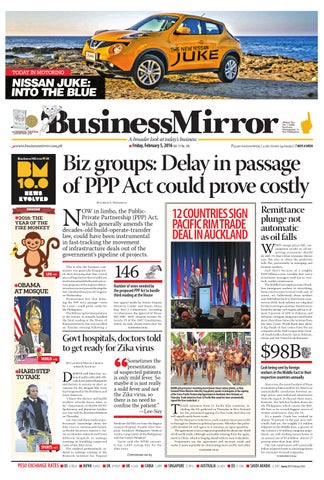
Biz groups: Delay in passage of PPP Act could prove costly
N
2016: THE YEAR OF THE FIRE MONKEY
C |
n
OW in limbo, the PublicPrivate Partnership (PPP) Act, which generally amends the decades-old build-operate-transfer law, could have been instrumental in fast-tracking the movement of infrastructure deals out of the government’s pipeline of projects.
INSIDE
LIFE
A broader look at today’s business
$98B
Cash being sent by foreign workers in the Middle East to their respective countries annually MAORI join protesters marching down Queen Street (above photo), as New Zealand Prime Minister John Key (top photo) speaks to delegates at the signing of the Trans-Pacific Partnership Agreement in Auckland, New Zealand, on Thursday. Trade ministers from 12 Pacific Rim countries have ceremonially signed the free-trade deal. AP
T
RADE ministers from 12 Pacific Rim countries, including the US, gathered on Thursday in New Zealand for the ceremonial signing of a free-trade deal they say will significantly boost trade. But for the pact to take force, each country must now ratify it through its domestic political process. Whether the politically divided US will agree to it remains an open question. The agreement covers a region responsible for about one-third of all world trade, although noticeably missing from the agreement is China, which is forging ahead with its own trade deals. Proponents say the agreement will increase trade and make it more equitable by eliminating most tariffs and other C A
Since even the nonoil output of these economies is lubricated by oil, there’s an unmistakable correlation between energy prices and outbound remittances from the region. In the past three years, however, the link has broken down for the Philippines, which counts the Middle East as its second-biggest source of worker remittances after the US. It’s a puzzle. Crude has crashed by almost 70 percent in the past year-anda-half. And yet, the roughly 2.5 million Filipinos in the Middle East, a quarter of the country’s 10 million emigrant population, are still sending money home at an annual rate of $5.8 billion, almost 17 percent more than June 2014. The risk remittances will eventually follow oil prices lower is a looming threat for consumer-focused companies. C A
n JAPAN 0.4063 n UK 69.9029 n HK 6.1406 n CHINA 7.2809 n SINGAPORE 33.8915 n AUSTRALIA 34.1404 n EU 53.1586 n SAUDI ARABIA 12.7685
Source: BSP (4 February 2016 )
A2 Friday, February 5, 2016
BMReports BusinessMirror
news@businessmirror.com.ph
Biz groups: Delay in passage of PPP Act could prove costly C A
law granting any tax exemption shall be passed without the concurrence of a majority of all the members of Congress.” Only 136 congressmen voted during the third-reading approval of the PPP bill on Monday. With the House of Representatives rolls showing a total membership of 291, HB 6631 needs to be passed on third and final reading by 146 congressmen. “It is sad that the PPP Act did not pass the Senate. However, everybody realizes that, without investments in infrastructure, the economy cannot continue to grow. The next president of the Philippines will be aware of this and will have to support the more effective infrastructure development implementation needed,” European Chamber of Commerce of the Philippines (ECCP) External Vice President Henry J. Schumacher said in a text message to the BM. With little hope left for proposed PPP Act passage in the 16th Congress, Makati Business Club (MBC) Executive Director Peter Angelo B. Perfecto said the next set of leaders should set up a legislative agenda that could push further growth to the country’s local output—infrastructure being one of the drivers of economic expansion. “I think what is needed is more inclusive public-private dialogue on PPP. In the next Congress, whoever the next president is, we must exert more effort toward charting better ways forward on a legislative agenda that will make our country more competitive while ensuring inclusive growth,” he said. But there is still hope—even a flicker —as lawmakers return in May to resume interpolation and amendments. “This legislation is important to accelerate needed infrastructure projects without which the country will be less competitive,” American Chamber of Commerce Senior Advisor John D. Forbes said. “There is a real
cost to waiting another year or two.” PPP Center Executive Director Cosette V. Canilao explained that Congress could still pass this so-tagged crucial piece of legislation. “We can still pass it, as there are still succeeding sessions in May,” she said. “But even without the PPP Act, we were still able to roll out a successful infrastructure program. We have awarded 12 projects, and we have a very healthy pipeline.” When approved, the PPP Act would institutionalize the Project Development and Monitoring Facility, the PPP Governing Board and the contingent liability fund. The proposed amendments include the separation of regulatory and commercial functions of government-owned and -controlled corporations, as well as the creation of a list of projects called “Projects of National Significance.” By virtue of being included on the list of projects of national significance, projects will be “insulated” from local laws, among others, by local government units (LGUs). The proposed amendments also include allowing time-bound temporary restraining order and the extension of the period for Swiss Challenge to six months from the current two-month period. “The PPP Act will address the issue of slow bidding and rolling out of projects. It will be to the benefit of the public if the PPP Act is passed because implementation, preparation and the whole bidding process will be much faster,” Canilao said. But there were also concerns raised over the current versions of the PPP Act. Former Justice Secretary Alberto C. Agra, a certified PPP specialist, said lawmakers must take a second look into the proposed measure, as it “recentralizes” the program instead of allowing LGUs a free hand to it for better implementation. Agra, a BM columnist, said solons should specifically be cautious of approving
There is a real cost to waiting another year or two.” —Forbes
the repealing clause of the PPP Act, which basically institutionalizes the PPP Program for sustainability. “There are two basic issues. One, the original draft wants to repeal all local government ordinances on PPPs—I see that as an attempt to recentralize rather than enhance the decentralization of PPPs,” he told the BM via phone. Both HB 6331 and Senate Bill (SB) 3035 state in the repealing clause that “Joint Venture Guidelines issued by LGUs, and PPP Codes issued by LGUs, are hereby repealed.” The measure is among the administration’s priorities and is being pushed by business groups.
Back to ‘imperial Manila’
THERE are now about 62 LGU PPP codes and over 30 ongoing or approved PPP projects at the local government level. On the contrary, there are currently only 12 approved PPP deals at the national level, with some of them still being challenged in court for various reasons. He said, by repealing these 62 LGU PPP codes, the initiatives that were introduced by local governments will deemed futile. “It’s really a setback from the local autonomy that is guaranteed by the Constitution. Why go back to the olden days of imperialist Manila, and instead empower LGUs?” Agra lamented. The decentralization of the PPP Program allows for the development of infrastructure outside the urban centers.
“This gives LGUs the authority to adopt their own PPPs, allowing them to develop other centers outside Manila,” he said.
PPP modes
ANOTHER issue that lawmakers should look into is the limiting of the modes of implementation from 24 possibilities to 11. “It will be a misnomer to call it a PPP Act if they will not include the possible 24 modalities,” he said. Modalities include the build-operatetransfer scheme, joint-venture scheme and build-lease-transfer scheme, among others. “If you repeal the ordinances, the status of contracts awarded under those ordinances will be under limbo,” Agra said. Cities with PPP ordinances include Manila, Quezon City, Parañaque, Cebu, Davao, Batangas and General Santos, among others. “By one sweep, all these will be deleted. There is an adverse impact on local economy,” he explained. Agra said the move signals that the national government lacks trust in local governments. He clarified, however, that he supports the other amendments to the law. Colmenares, on the other hand, said the PPP bill is prejudicial to LGUs, as the measure prevents local governments from collecting real-property taxes and other fees. “Under Section 20 [of the bill], or on the projects of national significance, all PPP projects are exempted from real-property tax. Local tax and fees and all necessary business permits will be automatically granted or issued to all projects of national significance. To sum up, the [PPP bill is] prejudicial because it removes the power of the LGUs to collect fees from PPP projects,” Colmenares said. Under the bill, upon certification and recommendation by the Investment Coordinating Committee, and prior consultation with the Department of the Interior
and Local Government, the President may classify certain projects, such as energy, toll road, mass transit, water, sewerage and such other projects undertaken under this act as projects of national significance, which shall be entitled to the following incentives: “All real properties, which are actually and directly used for the project, shall be exempt from any and all real-property taxes levied under RA [Republic Act] 7160, or Local Government Code. “All projects of national significance shall, likewise, be exempt from any and all local taxes, fees and charges. “Automatic grant or issuance of the necessary business permits, including renewals thereof, in favor of the winning proponent. Colmenares also questioned the mandatory approval of administrative franchise and license permit. “Under Section 13, once a PPP contract is duly executed, LGUs shall automatically grant in favor of the project proponent an administrative franchise, license permit. They have no more power to deny [permits],” Colmenares added. Section 13 of the bill provides that, once a PPP contract is duly executed, the regulator, licensing authority or LGUs shall automatically grant in favor of the project proponent an administrative franchise, license permit, or any other form of authorization required for the implementation of a PPP project subject to submission by the project proponent of the requirements by the regulator, licensing authority or LGU. Also, the bill said any provision of law to the contrary notwithstanding, it shall be mandatory on the part of the regulator, licensing authority or LGUs to accept and approve the application for administrative franchise, license or permit, saying failure to act on a proper and complete application thereof within 30 working days from receipt of the same shall be deemed as approval thereof.
12 countries sign Pacific rim trade deal in Auckland C A
barriers. But opponents say it will erode national sovereignty and hand too much power to US corporations. Many people in New Zealand remain opposed to the deal, and hundreds protested outside the Auckland venue where it was being signed, blocking traffic on some streets, while others protested in the capital, Wellington. In the US the agreement has been at the center of President Barack Obama’s trade agenda, but while it is supported by business groups and many Republicans, Senate Majority Leader Mitch McConnell has not yet backed it and has suggested Congress shouldn’t vote to ratify it until after the November elections. US Trade Representative Michael Froman said on Thursday he remained confident that US lawmakers would ultimately approve it. New Zealand Prime Minister John Key said his country was proud to be involved in helping negotiate the deal over five years. “The Trans-Pacific Partnership ultimately represents a giant vote of confidence in, and optimism for, the future prosperity of our economy and our people,” he said. As well as the US and New Zealand, the countries who have signed the deal are Japan, Canada, Mexico, Australia, Malaysia, Singapore, Peru, Chile, Vietnam and Brunei Darussalam. AP
BMReports BusinessMirror
news@businessmirror.com.ph
Govt employees could get first tranche of pay increase this year
M
B D C J M N. C
ALACAÑANG said on Thursday government workers could still get the first tranche of their pay hike this year, despite the failure of Congress to enact a bill that would increase their salaries over the next four years. Communications Secretary Herminio B. Coloma Jr. said the initial tranche of pay adjustments for 1.5 million government personnel amounting to P57.91 billion may be funded under the regular national budget for 2016. “The Department of Budget and Management [DBM] is preparing its recommendations to President Aquino on the possible implementation of the fi rst tranche of salary adjustments for government employees, as provided for in the proposed Salary Standardization Law 4 [SSL4],” Coloma said in a statement. Congress adjourned on Wednesday without passing the SSL4 bill, the enactment of which was expected
to be smooth sailing as it is the Aquino administration’s “pet” bill. However, a deadlock between the Senate and the House of Representatives over the inclusion of increases in the pensions of retired military officials caused the bill to be shelved. Party-list Rep. Antonio L. Tinio of ACT Teachers lambasted Sen. Antonio Trillanes IV for leaving the country in the midst of a deadlock between the Senate and the House on the final version of SSL4. Congress went on an extended break on Wednesday due to the upcoming elections. “Trillanes reportedly left for the United States on official mission last week,” Tinio said. “What sort of elected official goes
P57.91B First tranche of goverment workers’ pay hike
on a trip abroad in the middle of contentious bicameral talks, making it virtually impossible for Congress to pass the bill before the recess? This is gross dereliction of duty on his part,” he added. Tinio also criticized the leadership of the Senate for authorizing Trillanes’s departure and failing to resolve the impasse before the recess. “Is the Senate a collegial body where rule by majority prevails, or is it an exclusive club where the welfare of millions of Filipinos can be held hostage by the whims of one senator?” he asked. The bicameral conference between the two chambers of Congress was deadlocked after the Senate panel, led by Trillanes, insisted on a provision that would index the pension of military retirees to the salary increases provided in SSL4. Trillanes earlier said the Senate wanted to include the pension of veterans and retired military and uniformed personnel in the coverage of the bill, subject to availability of funds. The House panel objected because of lack of funding. The Senate
proposal would cost taxpayers an additional P18 billion for the first year of implementation. Aside from sourcing the first tranche of salary increases from the national budget, Coloma said the government will also include in its budget proposal for 2017 an allocation for the second tranche of pay hikes. Th is proposal would be turned over to the next administration. Earlier, House Majority Leader Rep. Neptali M. Gonzales of Mandaluyong City said the President will still have the power through an executive order to effect the same salary increase sans the SSL4. Budget Secretary Florencio B. Abad said the power of the President to allocate the first tranche of salary increases for government workers is in Section 13 of Presidential Decree 985, and Item 17 (iv) of Congress Joint Resolution 4, Series of 2009. These edicts authorize the President to periodically revise or update, upon the recommendation of the DBM, the government’s Compensation and Position Classification System. Abad said the salary increases will be retroactive from January 1, as earlier announced by Malacañang. If the pay adjustments will be effected through an executive order by President Aquino, the DBM said it will be funded through the P100-billion Miscellaneous Personnel Benefits Fund in the 2016 national budget.
Friday, February 5, 2016
A3
Govt hospitals, doctors told to get ready for Zika virus C A
“Another 1,000 will arrive in the coming weeks but they will only be used for those showing symptoms of the disease.” On Thursday, too, all the city-run public hospitals in Manila have been ordered to be on alert and to make necessary preparations following the outbreak of the socalled Zika virus, which has been linked to birth defects in the Americas. The World Health Organization (WHO) has declared an international emergency over the alarming spread of Zika virus, which means that all member states should cooperate and coordinate in addressing the problem. The WHO describes the Zika virus as a mosquitoborne disease that was first detected among rhesus monkeys in Uganda in 1947. “Sometimes the presentation [of suspected patients] is only mild fever. So maybe it is just really a mild fever [and not Zika] so there is no need to confine [the patient],” Lee-Suy said in an interview with the BUSINESSMIRROR. Manila Mayor Joseph Estrada said he has ordered the six public hospitals and the Manila Health Department (MHD) to prepare and be equipped for any possible Zika-related situation that might affect residents of the city. These are the Ospital ng Sampaloc, Gat Andres Bonifacio Hospital, Jose Abad Santos Hospital, Ospital ng Maynila, Santa Ana Hospital and the Ospital ng Tondo. “My directive to all the officials and personnel of our city hospitals, health centers and other related facilities is to always be prepared for any eventuality and always ensure the provision of free, prompt and complete health and medical services to all Manileños,” Mayor Estrada said. Phyisician Regina Bagsic, overall coor-
dinator for Manila’s hospitals, said they are doing all necessary preparations for any possibility of a Zika case. The Zika virus is mosquito-borne, same as dengue, Bagsic said in Filipino. Our main concern now “is that the mosquito is here and whether it contains the virus, we do not know. What we can and must do now is prevention. But we are prepared for dengue. Their symptoms are the same,” she added. Bagsic said they are in strict compliance to and close coordination with the Department of Health (DOH) and that they are now in the process of sending out information bulletins to the different city hospitals to raise awareness about Zika. For his part, Benjamin Yson, head of MHD, said his office is now monitoring developments from the DOH. The MHD is primarily overseeing the operation of the city’s 59 health centers. The DOH said the Philippines still remains free of Zika virus as there were no registered cases, but the Manila City health department is above the preparations. “We have precautionary measures like fumigation,” Yson said. He added in Filipino that they want to make sure the communities are clean and would not have areas where mosquitoes carrying the Zika and dengue viruses can breed. “Self-protection is really the key.” “Iwasan iyong maiikling damit and mag-apply ng mosquito repellant. We are ensuring the public that we are doing everything we can,” Yson added. The DOH on Friday said that the Philippines remains free of the Zika virus, but assured that they are ready to handle patients suspected to carry the disease. Lee-Suy reiterated that there is still “no suspected cases of Zika virus as of the moment.”
BMReports BusinessMirror
A4 Friday, February 5, 2016
www.businessmirror.com.ph
Manila wants US forces, assets in key areas
A
B R A
MERICAN forces and their assets and equipment would be strategically deployed around the country once Manila begins to host them under the Enhanced Defense Cooperation Agreement (Edca). This is apparent in the statement of Defense Secretary Voltaire T. Gazmin on Thursday, during the formal turnover to the military of 114 units of M113A2 armored personnel carriers (APCs) from the US. According to the defense chief, the Americans have eyed Fort Magsaysay, Lumbia Airfield, Basa Air Base and another military base in Cebu as bases for their forces and their stateof-the-art planes and ships. “That is still being negotiated; but there is a proposal for Lumbia, in Palawan, Fort Magsaysay, Basa Air Base and Cebu,” said Gazmin, when asked about the latest development on the Edca. Rating the possibility that these bases will become the temporary homes of the visiting US forces on a scale of 1 to 10, the defense chief put it at 5. The three military bases are strategically located across the country, with Fort Magsaysay in Nueva Ecija and Basa Air Base in Pampanga watching Luzon, and Palawan over the West Philippine Sea (South Chi-
na Sea), which is being disputed by the country’s neighbors, including the aggressive China. While Gazmin did not name the military base in Cebu, the Air Force, the Army and the Navy have bases in the province, with the Ebuen Air Force base and the Armed Forces Central Command watching or guarding the whole of the Visayas archipelago. The Edca, part of the military’s temporary territorial-defense strategy, was declared constitutional by the Supreme Court last month, with the ruling coming in the heels of China’s more assertive actions in the West Philippine Sea. Recently, China landed three civilian planes in the Fiery Cross Reef, provoking strong reactions from other countries, including the US and Australia, which are key allies of the country. The Philippines and Vietnam, on the other hand, lodged ensuing diplomatic protests. The Edca mandates the country to host a bigger number of US forces, their assets and equipment
THE US turned over 114 units of this M113A2 armored personnel carrier to the Philippine military on Thursday. CNN PHILIPPINES
There is a proposal for Lumbia, in Palawan, Fort Magsaysay, Basa Air Base and Cebu.”–Gazmin on a bigger scale, and increased frequency in selected military bases around the country.
On the part of the US, it forms part of its bigger presence in the AsiaPacific region, under what it called a
pivot or a rotational presence. The country has initially offered the Hulugan Bay in Palawan, Clark in Pampanga and Fort San Miguel in Zambales as hosts to the rotating US forces and their assets. Zambales considered the Scarborough Shoal, which has been occupied by China since 2012, as part of its territory. Meanwhile, Brig. Gen. Edgar
Gonzales, commander of the Army’s Mechanized Infantry Division, said some of the 114 APCs received from the US will be reconfigured and used for territorial defense. This means their armaments would be upgraded, including boosting their capabilities for anti-aircraft defense. The APCs were turned over by the US under its Excess Defense Article.
Socially active senior citizens still not Remittance plunge getting due recognition–BM president not automatic as Speech delivered by BusinessMirror (BM) President Benjamin V. Ramos at the Unilab’s Appreciation Lunch for Partners on Thursday at the Bayanihan Center in Mandaluyong City.
G
OOD afternoon to our friends in Unilab, which has been a good supporter of the BusinessMirror and our projects, through Ms. Claire de Leon-Papa and the office of Atty. Joey Ochave. And also, we are glad to be in the company of Unilab’s partners in its numerous corporate social responsibility (CSR) endeavors. It is certainly an honor for us to be in your midst today. Back in 2013, during one of our management meetings, the BusinessMirror Founder, Ambassador Antonio L. Cabangon Chua, instructed us to come up with another CSR project; but this time, something that is unique to the BusinessMirror. That time, we already have an Elderly page, which we have renamed starting last October to Our Time. It now comes out every Saturday. We are probably the only newspaper in the country that has a weekly special page for the elderly. Aside from that, we were also ordered by Ambassador Cabangon to think of an advocacy for our senior citizens, to help make sure proper attention and care are being given to them. So coming up with an annual awards for elderly care was an easy decision for us. It was also a fitting choice for us, because the anniversary month of the BusinessMirror is October, which happens to be the Senior Citizens’ Month. The next step was to find a partner, an institution or a group that already has extensive programs for the elderly. And, we thank God, we found Unilab. We learned that Unilab has a special unit called United Bayanihan Foundation (UBF), which not only takes care of the company’s retirees, but also extends its reach
RAMOS
These are the seniors at the grassroots level, generally unnoticed, but still persevering—despite their age and condition—to do good deeds for their fellow senior citizens.” to senior-citizen associations at the local government level, as well as institutions that have programs for the elderly. We had several meetings with
Ms. Claire and the team of UBF to firm up the partnership; and later on, RiteMed joined us. We have decided that UBF, through its network in the Office of Senior Citizens
Associations all over the country, will be the one to pick the winners. And so the 1st BusinessMirror Dangal Awards for Elderly Care was held, coinciding with the eighth anniversary celebration of the BusinessMirror in 2013. Since then, we have already recognized 17 senior citizens, some of them over 80 years old. These are the seniors at the grassroots level, generally unnoticed, but still persevering—despite their age and condition—to do good deeds for their fellow senior citizens. We have also given citations to nine senior-citizen associations and institutions. These are the groups with the best programs for their elderly constituents and, at the same time, are pushing their local government units to launch better programs for our seniors. Every time we sit down with these people, listen to their stories and see how passionately they share their works and their projects in their areas, we always wonder why these people are not being recognized that much at the national level. Up to now, I think we are still the only institution that is giving this kind of recognition at the national level. But we hope that would change soon. The BusinessMirror and Unilab Awards for Elderly Care needs more company. If the actors and actresses get to receive awards from numerous award-giving bodies for entertaining us, our senior citizens deserve more…they have not only entertained us over the years, they have also nurtured us and helped build the foundation of this society. Not only that, up to now, some of our senior citizens are still working for the benefit of others in their twilight years…truly these people are worthy of recognition. And thank you to Unilab for helping us ensure, at least in our own little way, the works of these senior citizens are not left unnoticed. Thank you.
oil falls. . . Property developers are at particular risk because a better family home is almost the first thing immigrant workers save for. Strange then there doesn’t seem to be any sense of panic among builders. SM Prime, the country’s biggest developer by market value, says it’s too early to assess the impact. Ayala Land, the No. 2 real-estate company, is still optimistic, and Robinson Land, which sells about 20 percent to 25 percent of its homes to Filipinos overseas, with the Middle East accounting for 20 percent of international sales, says it’s not “conclusive at this point’’ if the slide in oil will affect sales. There’s no news yet from marketing partners about overseas Filipinos being sent home, Robinson
C A
budget gaps forces these states to revive an old proposal to tax remittances. Also, research has shown that workers’ decision to send money home is at least based, in part, on their intuitive sense of whether they’re getting a good exchange rate. Thanks to their fixed values against the US dollar, the Saudi riyal and the United Arab Emirates dirham are among the world’s most overvalued currencies at present on an inflation-adjusted basis, according to Bloomberg data. That might be acting as an incentive for immigrants in the Middle East to send money out. If the currency pegs disappear, those fund flows might end abruptly. Above all, however, remittances
Crude has crashed by almost 70 percent in the past year and a half. And yet, the roughly 2.5 million Filipinos in the Middle East...are still sending money home at an annual rate of $5.8 billion. Land President Frederick D. Go told Bloomberg News reporter Clarissa Batino on Wednesday. Investors, though, aren’t taking chances. Robinson Land shares have lost a fifth of their value since the end of October, compared with a 7-percent decline in the Philippine Stock Exchange Composite Index. Are investors being unduly bearish? Maybe not. For one, there’s considerable pressure on governments in the Middle East to look for new sources of revenue. Oman is raising the corporate tax rate, and all GCC countries plan to adopt a value-added tax from 2018. It’s only a matter of time before the quest to plug widening
depend on what migrant workers make of their home country’s prospects. The Philippines, the former “sick man of Asia,” has become one of the region’s most promising economies, with stock values doubling since President Aquino began his six-year term in June 2010. As he prepares to leave, there’s considerable uncertainty about whether the country will stick to his reformist agenda or lunge again for populist policies. Low energy prices and high remittances might coexist for a while, but if the home country’s appeal dims, workers will stop showing up at Western Union offices. That’s when oil’s plunge will truly spill over. Bloomberg News
AseanFriday BusinessMirror
news@businessmirror.com.ph
Editor: Max V. de Leon • Friday, February 5, 2016 A5
Thailand grows old waiting for democracy
T
HAILAND is waiting for a new constitution, waiting for the restoration of democracy, waiting for the succession in its monarchy, waiting for an economic recovery and waiting for rain. While the junta says it is taking the time and steps needed to unify the Southeast Asian country’s polarized political factions, overseas investors have voted with their feet. Applications for foreign direct investment slumped 78 percent in the first 11 months of 2015. Exports have fallen for three straight years. “The turnoff of the coup-appointed military junta just makes it easy to write off Thailand for direct investment in the near term,” said Andrew Stotz, CEO of Bangkok-based A. Stotz Investment Research and former head of Thailand research at CLSA Ltd. “The economy has never been the key focus of the junta.” After years of street demonstrations, junta leader-turned-Prime Minister Pray uth Chan- Ocha preaches unity in his weekly TV show, Returning Happiness to the People. His long sermons range from strawberry farming to the moral responsibility of youth. Prayuth, who granted himself amnesty for overthrowing an elected government, presents himself as a reluctant leader who must save the nation from itself. “I am a soldier,” he said on January 15. “I was taught to fix the nation’s problems, make sacrifices to protect our sovereignty. Sometimes I ask myself who I protect this land for, when people I protect are fighting each other.” By the administration’s own measure, the public supports him. A recent nationwide poll of 2,700 people by the National Statistical Office found the government had a 98.6-percent approval rating, according to the Bangkok Post, albeit down from a 99.3-percent figure that was reduced after being mocked on social media. “It’s partly self-deceiving to legitimize their existence, and partly their loss of touch with reality,” said Puangthong Pawakapan, an associate professor of international relations at Chulalongkorn University in Bangkok. “The junta leaders do not see how people now are worried so much and struggling with economic hardship.”
that “the military can step in and try to interfere with politics any time they want,” he said. “They’re going to try to make sure that the old power like Thaksin or Yingluck or the Red Shirts will not get into power.” Still, China’s slowdown and an El Niño-induced drought have ratcheted up economic hardship, especially for the poor. Rice prices have slumped due to bloated stockpiles, hurting the ricegrowing northeast, the powerbase of the Shinawatras. In the south, home to many of the Shinawatra’s opponents, the junta has fallen back on the ousted government’s playbook and begun buying rubber directly from farmers to boost prices.
78%
Decline seen by Thailand in applications for foreign direct investment in the first 11 months of 2015
Food stalls
‘Just criticize’ GOVERNMENT spokesman Sansern Kaewkamnerd said officials were working to shore up the economy, including accelerating budget spending, pushing investment projects and launching stimulus measures for farmers and small businesses. Growth in Thailand is projected by the World Bank to slow to 2 percent this year. “We have to ask those critics whether they’ve managed the economy before or they just criticize,” Sansern said in an interview. “We should distinguish between those critics and those who work on the job.” Most of the political turmoil and the dozen military coups since democracy was introduced in 1932 revolve around trying to create a political system that ensures the army and historical ruling elite retain a grip on how the country is run. To that end, the junta is drafting the nation’s 20th constitution. It’s not going well. The first draft was rejected in September by the junta’s reform council, who feared it could lead to more protests. A new committee is due to complete a second attempt in March. Prayuth has promised to hold a referendum on the charter, but said if voters reject it he may just pick another. “Our efforts in drafting this charter are to prevent the problems we had to undergo in the past,” Prayuth said on his January 8 TV show. “We want the people to live and prosper peacefully, and not remain
SIRAWICH SERITHIWAT (center), also known as “Ja New,” arrives at military court in Bangkok, Thailand, on January 21. Authorities in Thailand have arrested members of a defiant student group opposed to military rule, including one snatched off the street at night and bundled into a vehicle that took him away. AP
deeply divided as politicians fight for power.” Problem is, politicians fighting for power is the bedrock of a democracy. “One thing that I think is missed in Thailand is about this idea of unity,” Stotz said. “The goal should not be unity, but rather creating and following a robust framework for politicians to fight it out.”
‘Never expected’
THAT balance has eluded Thailand for decades, producing a stop-start economy that gets derailed by politics. When the military took over in May 2014, it ended more than six months of unrest. “The main achievement of the military was achieved within 24 hours,” said Korn Chatikavanij, a former finance minister and a member of the Democrat Party, whose supporters largely cheered the coup. “Subsequent to that they haven’t achieved much. But then I never expected much.” Prayuth promised to hold an election in late 2015 but pushed that back because of a delay on the charter. The latest timetable calls for an election in mid-2017. Several factors could upset that schedule. The draft charter could be rejected again. The junta could
change its mind. Public protests could reignite. Or the king could die.
‘Main objective’
DISCUSSION of the royal succession is taboo in Thailand and criticizing the monarchy is a criminal offense. King Bhumibol Adulyadej is 88 and has been in Bangkok’s Siriraj Hospital since May 2015 after a series of lung infections. “I don’t believe Thailand will have an election until the succession is completed and the throne is stable,” Puangthong said at Chulalongkorn University. “This is the main objective of the 2006 and 2014 coups. If the king passes away—the mourning period will be at least one year. The junta will use it to condemn any politicians demanding an election.” Meanwhile, voters on both sides sit and wait. While they may not approve of the military running the country, there’s little sign that discontent will spill onto the streets again. “The public has not reached a tipping point,” said Ambika Ahuja, a London-based analyst with the Eurasia Group. “While the regime has done little by way of reforms or growth-positive policy delivery, the dissatisfaction isn’t enough to propel
change in leadership.” Opponents of military rule, such as a group known as the Red Shirts, may disagree. The Red Shirts backed Thaksin Shinawatra and his sister Yingluck, whose parties have won every open general election in the country since 2001. Both were ousted by coups. While Thaksin fled abroad to avoid a a jail term for corruption, his sister faces 10 years in prison over allegations she mismanaged a ricesubsidy program. The siblings say the charges are politically motivated. Since the coup, the junta has stepped up prosecutions of people accused of disrespecting the monarchy. Rights groups say the law can be used to target political opponents, with cases now heard in military courts that have meted out record sentences.
‘Old power’
THAN RITTIPHAN, 23, a student of international relations at Ramkamhaeng University in Bangkok and a member of the New Democracy Movement, which opposes military rule, says his friends have been arrested, harassed, beaten and charged with various crimes—including insulting the king’s dog. The new constitution will ensure
FARM subsidies have been restarted, and Prayuth drafted in former Thaksin ally Somkid Jatusripitak as deputy prime minister and economic chief. For much of Thailand, business goes on, sometimes despite government measures. The junta promised to clear Bangkok’s streets of illegal vendors, but many food stalls are still there. Infrastructure projects plod on, and the popularity of Thailand among Chinese tourists following the 2012 hit film Lost in Thailand, has sent visitor numbers to a record. That’s even as exports to China fell 9.5 percent on year in December. “Despite such a challenging economic environment in Thailand, you might be surprised to see that there are quality stocks delivering strong earnings growth,” said Soo Hai Lim, a Hong Kong-based money manager at Baring Asset Management Ltd. noting opportunities in tourism and health care. That may not be enough to offset concern that Thailand is falling behind its neighbors. “If you were a foreign investor, you look at the demography, you look at the educational standard, you look at the natural resources, you look at the size of the domestic market, do you go to Vietnam or do you come here?” Korn said. “There are so many challenges to our competitiveness. Unless we have a government that appreciates this soon we’re going to be leaving it too late.” Opponents of the coup say only a return to democracy will bring back investment and return the focus to the economy. “Wait, wait, wait,” said Than, the student activist. “This country is not a toilet that you can put up a sign saying ‘under construction.’ You cannot wait for democracy.” Bloomberg News
Asean rubber exporters to cut shipments Ministry encourages Indonesian pharma industry to capitalize on Asean market 615,000 MT T HAILAND, Indonesia and Malaysia agreed to cut shipments of natural rubber to boost prices trading near six-year lows amid a prolonged global glut. Futures rallied. The three countries, which account for more than 60 percent of global output, will cut exports by 615,000 metric tons in the six months to August 31, according to a statement from the International Tripartite Rubber Council (ITRC). Thailand will account for about a half of the total cuts, Chao Songarvut, the acting governor of the Rubber Authority of Thailand, said on Thursday in an interview before the announcement. The benchmark price in Tokyo jumped to the highest in almost two weeks. The joint effort comes after futures tumbled to almost a sevenyear low last month as slowing economic growth in China weakened demand from the biggest consumer. Global supplies have expended after a decadelong rally in prices encouraged top producers to plant more trees. “The move by the three countries is positive for rubber prices,” Naohiro Niimura, a partner at researcher Market Risk Advisory Co. in Tokyo, said before the announcement.
Volume of rubber exports that Thailand, Indonesia and Malaysia will cut in the six months to August 31
Last December the three countries had expressed concern about the slump in prices, which fell to below production costs, causing farmers to switch to other activities, according to a joint statement after ministerial meeting. They pledged to maintain supply-demand balance of natural rubber and planned to form a regional rubber market for better price transparency.
Thai move
THAILAND subsequently moved to support prices by agreeing to buy rubber from growers at above market prices last month. Physical prices in the country have risen 2.9 percent so far this year, halting five years of declines. “We are optimistic with joint implementation of these measures,
the rubber price will recover and continue to be fair and remunerative to all smallholders and other stakeholders in the natural rubber industry,” Thursday’s statement from the ITRC said. Futures jumped as much as 3.2 percent, the most since January 22, to ¥158.5 a kilogram, and were at ¥157.8 on the Tokyo Commodity Exchange by 12:25 p.m. local time. The export price of Thai ribbed smoked sheet No. 3 dropped 0.6 percent to 44.75 baht a kilogram on Wednesday. Global output will exceed use for two more years, with the surplus quadrupling in 2016, according to The Rubber Economist Ltd., a Londonbased industry researcher. World demand growth for natural rubber is estimated to slow to 1.3 percent to 12.6 million tons this year, while production expands 3.8 percent to 13 million tons, widening a glut to 411,000 tons, The Rubber Economist estimated in December. Stockpiles monitored by the Shanghai Futures Exchange rose for a ninth week to 271,371 tons last week, the highest since at least January 2003, according to bourse data. Futures on the exchange rose 2 percent to 10,355 yuan a ton on Thursday. Bloomberg News
T
HE Indonesian Ministry of Industry has urged the domestic pharmaceutical industry to capitalize on opportunities to boost sales to the Asean market of 650 million people. “The Asean market of 650 million people offers an opportunity for our existing advanced upstream pharmaceutical industry,” Director General of Chemical Industry of the Ministry of Industry Harjanto told Antara on Tuesday. Therefore, the government is preparing numerous policies to support investment in the pharmaceutical industry in Indonesia. Besides preparing the road map for the pharmaceutical industry, the government is also preparing the investment deregulation policy in the field of medicine. One of the formulated policies is to provide fiscal incentives such as tax allowance and tax holidays for investors who will invest in Indonesia. Harjanto also said the policy to ease the permit issuance process for pharmaceutical production and distribution is also important. “We have faced many obstacles in the path to ease the process of issuing production permits. It is important,
INDONESIAN workers make toffee-like sweet cake called dodol, one of the traditional delicacies served during Chinese New Year celebrations, in Tangerang on the outskirts of Jakarta, on January 31. Ethnic Chinese communities in the world’s most populous Muslim country are preparing to celebrate the start of the year of the monkey. AP
170
Number of pharmaceutical players currently operating in Indonesia
and the Ministry of Industry is not in charge of the provisions,” he noted. Currently, 170 pharmaceutical players are operating in Indonesia, with most of them producing ready to distribute medicines. The chemical, pharmaceutical and traditional medicine industry in Indonesia has become one of the drivers of the nation’s industrial growth. The domestic economy skyrocketed to 10.21 percent in the third quarter of 2015, as compared to the 1.12-percent growth recorded same period in 2014. PNA
A6
news@businessmirror.com.ph
The World BusinessMirror
Friday, February 5, 2016
Obama at mosque: We are one American family
B
ALTIMORE—President Barack Obama, speaking in Baltimore County on Wednesday during his first visit to a US mosque as president, urged Americans to embrace their “common humanity” and reject the “inexcusable political rhetoric” he said is emanating from the presidential campaign trail. Obama spoke of the role Islam has played in the nation’s history, and decried a rise in rhetoric and violence directed against Muslims since the deadly attacks in Paris and San Bernardino, California. He called on the religion’s leaders, meanwhile, to speak out against extremism. “We’re one American family,” Obama told an audience at the Islamic Society of Baltimore in Catonsville, one of the largest and most influential mosques in the Mid-Atlantic. “And when any part of our family starts to feel separate or secondclass or targeted, it tears at the very fabric of our nation.” Although Obama touched on the presidential election only tangentially, White House aides said he decided to speak at the mosque largely to counter statements and policies floated by Republican candidates in recent months. Billionaire Donald Trump, in particular, has stirred controversy by proposing to bar Muslims from entering the country. “Recently, we’ve heard inexcusable political rhetoric against Muslim Americans that has no place in our country,” Obama said. “We have to reject a politics that seeks to manipulate prejudice or bias, and
targets people because of religion.” The address mirrored Obama’s outreach to the Islamic world in 2009, when he stood at a pulpit in Cairo and sought to explain America to Muslims skeptical of Western values. On Wednesday, Obama tried to explain Islam to Americans, quoting Thomas Jefferson, Benjamin Franklin and other founding fathers who welcomed the ancient religion to the new nation. The mosque where Obama chose to deliver that message has grown from a small gathering of doctors at the Johns Hopkins University in 1969 into a massive campus near Catonsville with thousands of worshipers, a school, medical facilities and a Girl Scout troop. Obama described the Islamic Society of Baltimore as an “AllAmerican story.” The mosque has come under scrutiny from some conservative web sites since the White House announced the trip. Those outlets have focused on a former imam, Mohamad Adam El Sheikh, who was quoted by The Washington Post in 2004 as saying that suicide bombings might be acceptable in extreme circumstances. El Sheikh told The Baltimore Sun this week that he never condoned
PRESIDENT Barack Obama meets with members of Muslim-American community at the Islamic Society of Baltimore on Wednesday in Baltimore, Maryland. Obama is making his first visit to a US mosque at a time Muslim-Americans say they’re confronting increasing levels of bias in speech and deeds. AP/PABLO MARTINEZ MONSIVAIS
1%
The US population is composed of, Muslims
suicide attacks, and White House officials dismissed the stories as political attacks. “This is a faith community that regularly speaks out against extremism,” White House spokesman Josh Earnest told reporters before the president spoke. “If it elevates the president’s visit and
elevates the president’s message of protecting religious liberty…then our opponents should keep it up.” The society has been visited by Republican elected officials, too, with virtually no controversy. When Gov. Robert L. Ehrlich Jr. toured the campus in 2002, a year after the attacks of September 11, 2001, hardly anyone noticed. Muhammad Abdur-Rahman, who sits on the society’s school board, said the report of El Sheikh’s statements “was news to us.” “It’s not a part of our faith,” he said. “It’s not something that we tolerate.” Muslims are estimated to make up nearly 1 percent of the US population. Muslims and others say they
have seen discrimination and hostility increase after last year’s attacks in California and France. “I know that in Muslim communities across our country, this is a time of concern and, frankly, a time of some fear,” Obama said. “We’ve seen children bullied. We’ve seen mosques vandalized.” The event was a personal milestone for the president with an Islamic name, who was elected only after convincing Americans that he was a Christian, and not an adherent to the religion of his Kenyan grandfather. Polls show millions of Americans still believe, inaccurately, that Obama is a Muslim. Obama quoted from the Quran
to reinforce a point about religious harmony: “We have made you people of tribes,” he said, “so you may know one another.” A small group of onlookers gathered in the cold and rain outside to watch the president’s motorcade arrive. Mujahiddeen Mohammed, 31, brought his family from Philadelphia. He huddled under an umbrella with his sleeping son. He chose to see the drizzle as an auspicious sign. Muslims see rain on a funeral as washing away the sins of the departed, Mohammed said. He thought the rain and the president’s visit marked the death of racism and intolerance. TNS
Australia resists intl pressure Fewer children and families caught crossing US border to allow asylum-seekers to stay H
PROTESTERS against asylum-seekers being deported gather for a rally in Sydney, Australia, on Thursday. AP/ROB GRIFFITH
C
ANBERRA, Australia—Australia is resisting mounting international pressure not to deport child asylum-seekers, with a minister warning on Thursday that allowing them to stay could attract more refugees to come by boat. Australia’s three-year-old policy of paying the tiny Pacific nation of Nauru to accommodate asylum-seekers who attempt to reach Australian shores by boat survived a challenge in the High Court on Wednesday. The test case ruling means 267 asylum-seekers, most of whom came from Nauru to Australia for medical treatment or to support a family member who needed treatment, face potential deportation back to Nauru. Immigration Minister Peter Dutton said that asylum-seekers, including children, would be returned to Nauru once their medical needs had been met. “We have to be compassionate on one hand, but we have to be realistic about the threat from people smug-
glers,” Dutton told Australian Broadcasting Corp. radio. “We’re acting in the best interests not only of these children, but children that would follow them.” The government has all but stopped the trafficking of asylum-seekers from the Middle East and Asia in rickety Indonesian fishing boats during the past two years by refusing to allow new arrivals to ever settle in Australia. The government argues that the policy has saved lives because asylum-seekers were no longer drowning at sea during long and treacherous voyages from Indonesian ports. Human-rights agencies have called for the asylum-seekers to be allowed to stay, with most focus on the 54 children and 37 Australian-born babies among them. Several churches around Australia have declared themselves places of sanctuary for asylum-seekers facing deportation, a symbolic gesture that carries no legal consequences for authorities.
The UN High Commissioner for Human Rights Rupert Colville said amendments legislated by the government last year to safeguard its deal with Nauru against the High Court challenge “significantly contravenes the letter and spirit of international human rights law.” The United Nations Committee on the Rights of the Child reminded Australia that under the terms of the Convention on the Rights of the Child, the best interests of the asylum-seeker children should be a primary consideration in deciding whether to deport them. The Australian Human Rights Commission, a government-funded independent agency, reported that a medical team that had examined children held an immigration detention center in the Australian city of Darwin found that many had been severely traumatized by their experiences on Nauru. The government said this week it was investigating a doctor’s report that a 5-year-old boy currently in Australia had been raped on Nauru. AP
OUSTON—Amid controversy over immigration raids targeting families in the US illegally, the number of children and family members caught crossing the Southern border plummeted last month, according to newly released government figures. In January 3,113 unaccompanied child migrants were apprehended, down 54 percent from December. The number of people who were apprehended traveling in families fell 65 percent to 3,145. Jeh Johnson, the secretary of the Department of Homeland Security, cited those figures in a statement on Tuesday defending the raids and vowing to continue them. The implication was that the raids were deterring people from attempting to make the journey north. “While the one-month decline in January is encouraging, this does not mean we can dial back our border security efforts,” he said. The raids, which were launched on January 2, resulted in 121 people being taken into custody, primarily in Georgia, North Carolina and Texas. Advocates for immigrants, however, challenged the notion that the decline in border apprehensions can be attributed to the raids. “The time it takes a refugee to travel from Central America to the United States precludes making any connection between the raids and the number of people who have arrived since the raids,” said Jonathan Ryan, executive director of the San Antonio-based Raices immigrant legal advocacy group.
Illegal crossings on the Southern border traditionally decrease during the winter, and apprehensions also dropped between December 2014 and January 2015, though not as dramatically as this time. Overall, recent illegal crossings by children and families are soaring compared with a year ago. Over the last four months, 24,616 people crossing with families were taken into custody, nearly triple the number during the same period a year earlier. The number of unaccompanied children apprehended over those same months more than doubled to 20,455. The raids came in response to that increase and memories of 2014, when a surge of more than 68,000 children overwhelmed border shelters and holding areas. This year the government has already had to open emergency shelters for migrants at a New Mexico military base and Texas summer camps. Many of the migrants are fleeing escalating violence in Central America and have applied for asylum. Advocates and lawmakers have said the migrants should be treated like refugees instead of swept up in raids. Last month 150 Democrats in Congress sent a letter to President Barack Obama demanding that he halt the raids, insisting they have “generated widespread fear and panic in immigrant communities,” and that the practice “raises numerous due-process concerns, including meaningful access to legal counsel for mothers and children after apprehension.” On Tuesday, immigrant advocates
delivered a petition to the White House with more than 135,000 signatures calling on the president to end all deportation raids against refugee families from Central America and provide them temporary legal status. They also delivered a letter from 75 immigrant advocacy groups. “The Obama administration has sunk to a new low with these raids,” said Matt Nelson, managing director of the Latino advocacy group Presente.org. But Johnson defended the raids in his statement, released after the petition and letter were delivered on Tuesday. While the administration does not consider children and families priorities for deportation, he said, “Our borders are not open to illegal migration.” “If someone was apprehended at the border, has been ordered deported by an immigration court, has no pending appeal, and does not qualify for asylum or other relief from removal under our laws, he or she must be sent home,” he said. At the same time, he said that many migrants may be eligible for refugee status and that the Refugee Admissions Program is being expanded “to help vulnerable men, women and children in Central America.” But advocates said that’s not enough. Ryan said that of the dozen immigrants swept up in the raids whom his group has represented, all have been granted stays of removal. “The raids only exposed one fact: That these people are extremely vulnerable in this legal process and there is no legal defense network capable of providing them with representation,” he said. Los Angeles Times/TNS
Ukrainian official resigns, says reform efforts blocked
M
OSCOW—Ukraine’s government, already under strain from political infighting, a frozen conflict in the country’s east and a sagging economy, fell under scrutiny again on Wednesday when its economy minister handed in his resignation, saying the leadership routinely blocked his reform efforts. The country’s minister of economy
Aivaras Abromavicius said he and his team could no longer drive forward much-needed reforms and received pushback on their efforts from government leaders, including members of President Petro Poroshenko’s party. “My team and I have no desire to be a front for blatant corruption or puppets for people who want to take control over state
funds as they did in the old government,” Abromavicius told reporters at a news conference in Kiev. “It wasn’t just a lack of political will. [They were] actively seeking to paralyze our work in the government.” Abromavicius, a Lithuanian native and former investment banker, advocated deregulation and wide-scale privatization in Ukraine. AP
The World BusinessMirror
news@businessmirror.com.ph
Friday, February 5, 2016
A7
BIGGEST HUMAN MIGRATION TO GREET
YEAR OF MONKEY IS BOON FOR FUEL
STRANDED passengers wait outside the Guangzhou Railway Station after trains were delayed as they prepare going back to their hometown ahead of the Chinese Lunar New Year, in Guangzhou, south China’s Guangdong province. China’s travel rush ahead of Lunar New Year has been disrupted by rare snowfall in central parts of the country. COLOR CHINA PHOTO VIA AP
M
ORE than a billion people will travel for China’s New Year holiday in the world’s largest human migration, boosting fuel demand in the nation’s own driving season, according to Socété Générale SA (SocGen). The Chinese will make about 3.2 billion individual trips by road during the 40-day period known as
Chunyun, which this year marks the change in the zodiac from sheep to monkey, the bank said in
a report on Thursday. The travel, which for many in the nation will represent the only annual trip home, spurs a “significant” increase in gasoline demand, analysts, including Mark Keenan, said in the note. The Chinese New Year holiday, also known as Spring Festival, shuts down the world’s second-largest economy for a week. Apart from road trips, a total of 42 million individual voyages by air and 258 million oneway train journeys are taken over the period that started on January 24 this year, SocGen said, calling the numbers “incredible.” “The impact of Chinese New Year
3.2B Individual Chinese trips by road
on the apparent demand for Chinese oil products is significant and is increasing,” the analysts said in the report. “With the Chinese New Year being the largest human migration on Earth and with 88 percent
Tourism execs alarmed by Zika cases in Caribbean, Latin Am.
M
IAMI—With billions of tourism dollars at stake, Caribbean and Central American business and health officials are scrambling to protect an industry under threat from the Zika virus. The Pan American Health Organization on Monday added Jamaica and Costa Rica to the list of countries in the Western Hemisphere where the Zika virus has been detected, as officials warned pregnant women in particular not to travel to the area. Tourism accounts for nearly 30 percent of Jamaica’s economy and more than 12 percent of Costa Rica’s, according to the World Travel and Tourism Council. Adding to concerns about the spread of the mosquito-borne virus, which has been linked to birth defects, health officials in Dallas have reported a case of the virus being transmitted sexually by a person who had recently returned to Texas from Venezuela. “It’s a concern of everyone,” said Guadalupe Monge, a travel agent with Miami-based Costamar travel agency. “I’d say 100 percent of our customers are asking about Zika. They want to know how bad it is. Is it safe to travel? Can they change their tickets?”
20 percent of business lost
MONGE estimates that the agency, which organizes trips and tours throughout the Caribbean and Latin America, has lost about 20 percent of its business as news of Zika has increased. The timing is terrible, as Carnival season is picking up and spring break season is around the corner. Both draw tens of thousands to the region. Caribbean public-health officials
launched a new public awareness and health campaign last week geared toward protecting the region’s $29-billion industry. “We can never let our guard down where infectious diseases are concerned, and that is particularly so in our tourismdependent Caribbean region,” Dr. C. James Hospedales, executive director of the Caribbean Public Health Agency, said at a news conference in Trinidad and Tobago, another tourist-dependent nation. While supporting recommendations from the US Centers for Disease Control and Prevention (CDC) that pregnant women postpone trips to infected countries, officials in those countries say others shouldn’t be dissuaded. They advise taking standard precautions to prevent mosquito bites, including using repellant, sleeping inside and wearing long-sleeved shirts and long pants. “Don’t let the mosquito ruin your travel,” the Caribbean Public Health Agency says in a fact sheet on its web site. Tourism is important to economies around the world but especially so in the Caribbean and Central America, where millions depend on the industry for their livelihood. The Caribbean Tourism Organization reported that a record 26.3 million tourists and 24.5 million cruise ship passengers visited the Caribbean in 2014. They spent $29.2 billion, a record for Caribbean tourism. Nearly half of the visitors to the Caribbean, almost 13 million, come from the US.
Driving fears about Brazil Olympics
ZIKA is also driving fears about the Summer Olympics in Brazil, considered the
epicenter of the Zika outbreak. More than 4,000 babies in Brazil have been born with microcephaly, a rare neurological disorder associated with developmental problems that has been linked to the mosquito-borne virus. Since the first case was discovered in Brazil last May, Zika has been found in 27 countries and territories in the Americas. There have been cases in at least 11 states, including nine in Florida and four in Miami-Dade County.
Contracted through sex
ON Tuesday health officials in Texas announced they had identified a patient in Dallas who’d contracted Zika through sex. The patient, identified as Patient 1, is the first known case of the virus being transmitted in the US. Patient 1’s partner, identified as Patient 0, had recently returned to the state from Venezuela. Dallas authorities said Patient 1 had had no other possible exposure to the virus. “Now that we know Zika virus can be transmitted through sex, this increases our awareness campaign in educating the public about protecting themselves and others,” said Zachary Thompson, the director of Dallas County Health and Human Services. Not everyone is convinced that the virus can be transmitted through sexual contact. Dr. George Sealy Massingill, chairman of obstetrics and gynecology at John Peter Smith Health Network in Tarrant County, called the Dallas County sexual transmission a “postulated case.” “So far, that’s their best guess how this happened,” he told the Fort Worth StarTelegram on Tuesday. “It’s hard to go back and say that A caused B.”
But the CDC has endorsed the sexual transmission theory, a possibility that raises new concerns about the potential for rapid spread of a virus that until last May had been virtually unheard-of in the Americas. The Dallas County health department added using condoms to its list of recommendations for anyone returning from an infected area. The CDC already recommends that US doctors test newborns who show signs of the Zika virus, especially in states such as Florida, where mosquitoes are a daily nuisance. After receiving criticism that it was moving too slowly to address the virus, the World Health Organization on Monday declared the virus a publichealth emergency. The declaration allows for an organized international response to give countries resources and guidelines on what measures they should be taking. Caribbean officials have pressed local business and hotels to walk around their properties and eliminate any standing water, where mosquitoes can breed. They also recommend giving guests insect repellant and nets to sleep under, though the mosquito varieties that carry Zika bite primarily in the daytime. It’s a challenging situation for leaders. While local economies are dependent on travelers, officials also acknowledge they could have even greater problems if a traveler is infected with the virus during a visit and carries the virus back to the US, where others can be infected. Such a development almost certainly would motivate tourists to postpone or even cancel visits that are the region’s lifeblood. TNS
of movement occurring by road, the most pronounced impact occurs in gasoline.” Over the last five years, gasoline demand during the holiday period has increased 242,000 barrels a day above the annual daily average, according to the report. China’s apparent demand for the fuel was about 2.7 million barrels a day in 2015, according to data compiled by Bloomberg. The Asian nation is the world’s largest auto market and the second-biggest oil consumer. Demand for jet fuel increased an average of 75,000 barrels a day, SocGen estimates.
Car ownership
In the US, the world’s largest oil user, gasoline demand typically rises during the summer driving season that starts at the end of May. The most recent ownership data show there are 809 cars per 1,000 people in the US, compared with 128 in China, according to the bank. China’s population is about four times that of the US. “This, when combined with the recent record in December 2015 car sales of 2.4 million vehicles, suggests the Chinese driving season is likely to continue to grow significantly in importance and develop into a key price driver,” the bank’s analysts wrote. Bloomberg News
US service industries grow at slowest pace in 2 years
S
ERVICE industries expanded in January at the slowest pace in nearly two years, raising the risk that persistent weakness in manufacturing is starting to creep into the rest of the US economy. The Institute for Supply Management’s (ISM) non-manufacturing index fell last month to 53.5, the lowest since February 2014, from 55.8, the Tempe, Arizona-based group’s report showed on Wednesday. Readings above 50 signal expansion. The result was less than the 55.1 median forecast in a Bloomberg survey. The industries that account for about 90 percent of the economy may be adjusting expectations after consumers tempered spending and businesses cut back on investment in the fourth quarter. While service providers can be more insulated than their factory counterparts from sluggishness overseas and a stronger dollar, the January retreat reflected a sudden shift lower in sentiment about business activity. “Manufacturing weakness seems to be spreading to the services side of the economy,” said Thomas Costerg, a senior US economist at Standard Chartered Bank in New York. “There’s definitely no decoupling here. It’s a shaky outlook.” The ISM nonmanufacturing survey covers an array of industries including utilities, retailing, and health care, in addition to construction and agriculture. The group’s factory survey released on February 1 showed manufacturing shrank for a fourth straight month. The 48.2 reading for the index in January was little changed from 48 a month earlier, which was the weakest since June 2009. Ten nonmanufacturing industries re-
ported growth in January, led by finance and insurance, real estate and leasing. Eight sectors, including mining, education and transportation, reported contraction. While the majority of respondents had positive comments about conditions, the report showed there is concern about financial markets, global weakness and the effect on sentiment. “There seems to be a little bit of leveling off,” Anthony Nieves, chairman of the ISM nonmanufacturing survey, said on a conference call with reporters after the release. Even though the two reports are exclusive, “there’s a certain overlap” as factories are “suppliers to many of the nonmanufacturing companies.” Details of the services survey showed the business activity index dropped to 53.9 from 59.5 in the prior month, marking the biggest decrease since November 2008. The measure parallels the ISM’s factory production gauge. The services employment index fell to 52.1 in January, matching the lowest since April 2014, from 56.3 the prior month. The new orders measure decreased to 56.5 from 58.9, as the share of respondents indicating fewer bookings climbed to a two-year high of 23 percent. The index of prices paid dropped to 46.4, the first contraction in three months, from 51. The economy grew at a 0.7-percent annualized rate in the fourth quarter, Commerce Department data showed last week. Consumer spending, which accounts for about 70 percent of the economy, moderated to a 2.2-percent pace, while business investment fell at a 1.8-percent rate, the first drop since the third quarter of 2012. Bloomberg News
A8
The World BusinessMirror
Friday, February 5, 2016
news@businessmirror.com.ph
Syrian peace talks in ‘temporary pause’ N. KOREAN LEADER MEETS OFFICIALS OVER ABUSES
T
SYRIA’S High Negotiations Committee Spokesman Salem al-Mislet kisses pictures of the Syrian victims of the war displayed in front of the European headquarters of the United Nations in Geneva, Switzerland, on Tuesday where Syria peace talks were held. SALVATORE DI NOLFI/KEYSTONE VIA AP
G
ENEVA—The United Nations special envoy for Syria on Wednesday announced a pause in peace talks in Geneva, Switzerland, temporarily derailing the major diplomatic initiative aimed at ending the country’s almost fiveyear-old war. The UN envoy, Staffan de Mistura, told reporters in a surprise announcement in Geneva that he was calling a “temporary pause” in the talks, which he said would be scheduled to resume on February 25. “It is not the end and it is not the failure of the talks,” de Mistura told reporters. Still, the move was clearly a significant setback for a process that began less than a week ago and was backed by major powers on both sides of the conflict, including the United States and Russia. De Mistura expressed frustration that the “Syrian people” had not yet seen concrete humanitarian results from the talks, such as lifting of sieges and a reduction of bombardment—steps that the opposition has demanded before formal negotiations begin. He had
been pressing for such steps. “The talks would not be meaningful unless they were also accompanied by immediate tangible benefits for the Syrian people,” de Mistura said, adding that he had repeatedly made that point to the UN and countries backing the talks. The veteran diplomat, speaking under umbrellas in the rain outside a lakefront hotel in the Swiss city, emphasized that both sides—the government and opposition representatives—were committed to starting the peace process envisioned in the agenda of the Geneva talks. Supporters of the talks hope they will result in a cease-fire in the Syrian conflict, political reforms, a new Constitution and UN-backed elections. While experts said that achieving
such goals was a long way off in warravaged and deeply divided Syria, the talks were widely viewed as a potentially positive development in a conflict that has left more than 200,000 people dead, destroyed towns and cities, and sent refugees streaming throughout the region and into Europe. “Both sides insisted on the fact they are interested in having the political process started,” said de Mistura. The decision to postpone comes after days of uncertainty about the talks, which formally opened last Friday, though the major opposition delegation did not arrive until Monday. Uncertainty has plagued the process. While de Mistura has held meetings with both sides, the government and opposition delegations say no substantial talks have occurred, only preliminary discussions. The major opposition bloc, the Saudi-backed High Negotiations Committee, has repeatedly threatened to pull out of the talks if the Syrian government did not halt sieges and bombardment of rebelheld areas and release prisoners. Damascus said such questions should be dealt with as part of the negotiations and refused to consider “preconditions.” Meanwhile, Syrian government forces, backed by Russian air strikes, were making sweeping gains, including in the northern province of Alep-
200,000+ Syrians dead in the five-year war po, which is divided between opposition and government control. The Russian entry into the war last September 30, at the invitation of the Syrian government of President Bashar al-Assad, has helped turn the tide of the conflict on various battle fronts. On Wednesday the Syrian government said its forces had broken opposition sieges of a pair of northern towns, Nubul and Zahra in Aleppo province, that had been under opposition siege for more than two years. The two towns, with majority Shiite populations, are progovernment bastions and had been encircled by Sunni Islamist rebels, including al-Qaeda-linked forces. The Saudi-backed opposition delegation at the peace talks had called for an end to Russian bombardment on behalf of the Syrian government. But Russian Foreign Minister Sergei Lavrov said on Wednesday during a visit to Oman that the Russian aerial assault was targeting “terrorists” and would not stop. Los Angeles Times/TNS
OKYO—North Korean leader Kim Jong-Un presided over a meeting of senior ruling party officials aimed at rooting out corruption and abuses of power, ahead of a major congress to be held in May, its state media reported on Thursday, calling the gathering the first of its kind. The meeting this week focused on strengthening the ruling party and criticized “the practices of seeking privileges, misuse of authority, abuse of power and bureaucratism,” according to a report by the Korean Central News Agency (KCNA). It is unusual for North Korea’s state-controlled media to make note of such problems within the ruling Workers’ Party of Korea, which Kim heads and has been in power since the founding of North Korea in 1948. The two-day meeting, which ended on Wednesday and was “guided” by Kim, brought together members of the ruling party’s Central Committee and the Party Committee of the Korean People’s Army. Though the article did not elaborate on the problems or suggested solutions, outside experts have long speculated that corruption and power abuse within the party are widespread and have been worsening in recent years amid the growth of a quasi-legal capitalist-style marketization of the North’s officially socialist and centrally directed economy. In its annual report released last month, North Korea and Somalia were listed at the top of Transparency International’s Corruption Perceptions Index for the second-straight year as the most corrupt governments in the world, scoring only 8 points on a scale of 100. The meeting was held as world attention is focused on North Korea’s January 6 nuclear test, which it claims was the first of a hydrogen bomb, and its announcement that it will launch a rocket this month to put its second Earth
observation satellite in orbit. The UN Security Council is now discussing whether to slap new sanctions on the North over the nuclear test, which violated UN resolutions already in place. North Korea’s ruling regime, meanwhile, is heavily focused on preparing for the seventh Party Congress, a major event that will be closely watched for signs of new policies or priorities that could provide insights into how Kim— who assumed power after the death of his father, Kim Jong-Il, in late 2011—intends to deal with his country’s economy, domestic political issues and external relations. The KCNA article said the Congress, the first since more than 3,000 delegates gathered for the sixth Congress in 1980, will “be recorded as a new landmark in the history of the party.” It said Kim told this week’s gathering that the party is faced with “manifold difficulties and ordeals,” but added that he said “nobody in the world can block our way.” The marketization of the North Korean economy has been steadily growing since the famine years of the 1990s, when the breakdown of the state-run Public Distribution System that provided most North Koreans with food and basic necessities for free or at highly subsidized prices is believed to have forced many citizens to produce and sell goods on their own to make ends meet. As such economic activity, often conducted in cash, grew on the fringes and has become more mainstream, it created opportunities for some individuals to amass wealth and has led to what many see as a nascent middle class that is growing in the North and particularly in places like the capital, Pyongyang. But it is believed to have also opened up more avenues for officials in the party and the powerful military to seek bribes to look the other way or to demand kickbacks. AP
Assange to accept arrest if UN rules against him
L
ONDON—WikiLeaks founder Julian Assange says he will accept arrest by British police if a United Nations working group on arbitrary detention decides that the three years he spent holed up in the Ecuadorean Embassy does not amount to illegal detention. Writing on WikiLeaks’s Twitter account on Wednesday night, Assange said if the UN finds he has lost his case against the United Kingdom
and Sweden then he will turn himself into police at noon on Friday. “However, should I prevail and the state parties be found to have acted unlawfully, I expect the immediate return of my passport and the termination of further attempts to arrest me,” Assange added. Assange took refuge in Ecuador’s British Embassy to avoid extradition to Sweden where two women have accused him of sexual assault. AP
Judge refuses to throw out sexual-assault case against Cosby N
ORRISTOWN, Pennsylvania— A judge refused to throw out the sexual-assault case against Bill Cosby on Wednesday, sweeping aside a former district attorney’s claim that he granted the comedian immunity from prosecution a decade ago. Common Pleas Judge Steven O’Neill issued the ruling after a hard-fought two-day hearing, saying witness credibility was a factor. He did not elaborate. In another setback for the defense, the judge also denied a request to disqualify newly elected District Attorney Kevin Steele from the case. Cosby’s lawyers had accused Steele of making a “political football” out of Cosby during the campaign. Cosby, 78, was arrested last December and charged with drugging and violating former Temple University athletic department employee Andrea Constand at his suburban
Philadelphia home in 2004. The TV star could get up to 10 years in prison if convicted. Cosby held his head in his hands after the ruling, then left the courtroom, using a cane to descend the ornate marble staircase. He waved and smiled at supporters but had no comment. His lawyers put their arms on him to comfort him. The next step is a preliminary hearing on March 8 to determine whether prosecutors have enough evidence to put him on trial. The charges represented an about-face by the district attorney’s office. In 2005 then-District Attorney Bruce Castor decided the case was too flawed to prosecute. But Castor’s successors reopened the investigation last year after Cosby’s lurid, decade-old testimony from Constand’s civil suit was unsealed at the request of the Associated Press and after
dozens of other women came forward with similar accusations that destroyed Cosby’s nice-guy image as America’s Dad. Cosby’s lawyers tried to get the case thrown out with help from Castor, who testified at this week’s hearing that he intended to forever close the door on prosecuting the comedian. He said he considered his decision binding on his successors. Similarly, Cosby’s lawyers said they never would have let the TV star testify in the civil case if they didn’t believe criminal charges were off the table. “In this case, the prosecution should be stopped in its tracks,” Cosby lawyer Chris Tayback argued. “Really what we’re talking about here is honoring a commitment.” Steele challenged Castor’s credibility and questioned whether the former DA ever made such an agreement, since it was never put in writ-
ing on a legal document and the Cosby attorney with whom Castor dealt is now dead. Steele argued that, in any case, Castor had no legal authority to make such a deal. “A secret agreement that allows a wealthy defendant to buy his way out of a criminal case isn’t right,” Steele told the judge. At one point late in the afternoon, the judge signaled which way he intended to rule. “There’s no other witness to the promise,” O’Neill said. “The rabbit is in the hat and you want me at this point to assume, ‘Hey, the promise was made, judge. Accept that.’” On the stand, Castor defended his decision not to bring charges, citing among other things Constand’s yearlong delay in going to police, her continued contact with Cosby, and suggestions that she and her mother might have tried to extort the comic. The former DA said he made the
no-prosecution commitment in hopes of prodding Cosby to testify in Constand’s lawsuit without invoking his Fifth Amendment right against self-incrimination. In the end, Cosby testified, denying he assaulted Constand but admitting among other things that he obtained quaaludes to give to women he wanted to seduce. Constand eventually settled for an undisclosed amount. While more than 50 women have accused Cosby of drugging and sexually assaulting them since the 1960s, the statute of limitations for prosecuting the comic has run out in nearly every instance. This is the only case in which he has been charged. As the case goes forward, Cosby’s lawyers are expected to fight mightily to keep the deposition from being introduced at trial. Castor tried to make a comeback as DA last fall, but lost to Steele in a hotly contested race, during which
Steele ran ads criticizing Castor for not prosecuting Cosby when he had the chance. The tension between the two men was on display on Wednesday, when Steele accused Castor and the Cosby camp of engaging in “revisionist history.” Most of the back-and-forth in court hinged on the wording and interpretation of a 2005 press release, in which Castor announced he would not prosecute Cosby. Castor found himself sparring with prosecutors over many seemingly inconsistent statements he made over the years on whether Cosby could still be charged. The judge said he struggled to find similar cases where a suspect who was never charged received a promise that he would never be prosecuted. Normally, immunity is granted after a suspect is charged because he or she can provide testimony or information to prosecutors. AP
news@businessmirror.com.ph
The World BusinessMirror
Editor: Lyn Resurreccion •
A9
Pyongyang preparing rocket launch–Seoul
S
EOUL, South Korea—South Korea said on Thursday it has detected preparations by rival North Korea to fire a long-range rocket and warned that Seoul will shoot down any rocket parts flying over South Korean territory. North Korea told international organizations on Tuesday that it will launch an observation satellite aboard a rocket between February 8 and 25. South Korea, the United States and others call the plans a cover for a banned test of a missile that could strike the US mainland. The launch announcement follows an outpouring of global condemnation over the North’s fourth nuclear test on January 6. Seoul and Washington have also denounced the rocket-launch plan, but if North Korea’s past patterns are any clue, angry warnings probably won’t dissuade a coming launch. South Korean defense officials said on Thursday that the North is pushing ahead with the launch plans at its Tongchang-ri launch site on its west coast. They refused to provide details because they said they involve confidential intelligence on the North. Recent commercial satellite images showed an increased number of vehicles at North Korea’s Sohae launch station on February 1, compared to a week earlier. This suggests that North is preparing for a space launch in coming weeks, according to 38 North, a North Korea-focused web site run by the US-Korea Institute at Johns Hopkins School of Advanced International Studies. However, the web site said it was
impossible to tell from the satellite imagery whether a space launch vehicle was present. South Korean and US officials said a launch would threaten regional security and violate UN Security Council resolutions that ban the North from engaging in any nuclear and ballistic activities. Diplomats at the UN Security Council have already pledged to pursue fresh sanctions on North Korea over its recent nuclear test. South Korea’s president on Thursday called for strong UN sanctions that will make North Korea realize it cannot survive if it does not abandon its weapons programs. There are questions, however, over whether any sanctions will force real change in the North because China, the North’s last major ally and a veto-wielding UN Security Council member, is reluctant to join in any harsh punishment against the North. Beijing on Wednesday urged restraint over North Korea’s announcement of its launch plans, and expressed skepticism over the US calls for tough new sanctions. UN Secretary-General Ban Kimoon, a former South Korean foreign minister, said the announcement “will further aggravate the profound concerns that the international community already has in the wake of the recent nuclear test,” a spokesman said.
POLICE officers walk by a mock Scud-B missile of North Korea (left) and other South Korean missiles on display at the Korea War Memorial Museum in Seoul, South Korea, on Wednesday. South Korea warned of “searing” consequences if North Korea doesn’t abandon plans to launch a long-range rocket that critics call a banned test of ballistic missile technology. AP/AHN YOUNG-JOON
In South Korea and Japan, there are fears about falling debris, although nothing landed in their territories during the North’s most recent launches. Seoul officials estimated the first stage of the rocket would fall off the west coast of South Korea, more debris would land near the South’s Jeju Island, and the second stage would land off the Philippines’s east coast.
Moon Sang Gyun, a spokesman at Seoul’s Defense Ministry, said on Thursday that South Korea would fire missiles to intercept any fragments of the North’s rocket if they threaten to fall on its territories. Seoul issued similar plans before the North’s previous rocket launches in recent years. North Korea has spent decades trying to develop operational nuclear weapons along with missiles
capable of striking the mainland US. North Korea’s last long-range rocket launch, in December 2012, was seen as having successfully put the country’s first satellite into orbit after a string of failures. Each new rocket launch improves North Korea’s missile technology, which is crucial for its goal of developing a nuclear-armed missile capable of hitting the US mainland. North Korea, an autocracy run by
the same family since 1948, is estimated to have a handful of crude nuclear devices and an impressive array of short- and medium-range missiles, but it closely guards details about its nuclear and missile programs. This means there is considerable debate about whether it can produce nuclear bombs small enough to place on a missile, or missiles that can reliably deliver their bombs to faraway targets. AP
Scientists in Germany switch on nuclear-fusion research G €1.06B
Over 91,000 asylum-seekers arrived in Germany in Jan
REIFSWALD, Germany— Scientists in Germany flipped the switch on Wednesday on an experiment they hope will advance the quest for nuclear fusion, considered a clean and safe form of nuclear power. Following nine years of construction and testing, researchers at the Max Planck Institute for Plasma Physics in Greifswald injected a tiny amount of hydrogen into a doughnut-shaped device—then zapped it with the equivalent of 6,000 microwave ovens. The resulting superhot gas, known as plasma, lasted just a fraction of a second before cooling down again, long enough for scientists to confidently declare the start of their experiment a success. “Everything went well today,” said Robert Wolf, a senior scientist involved with the project. “With a system as complex as this you have to make sure everything works perfectly and there’s always a risk.” Among the difficulties is how to cool the complex arrangement of magnets required to keep the plasma floating inside the device, Wolf said. Scientists looked closely at the hiccups experienced during the start-up of the Large Hadron Collider in Switzerland more than five years ago to avoid similar mistakes, he said. The experiment in Greifswald is part of a worldwide effort to harness nuclear fusion, a process in which atoms join at extremely high temperatures and release large amounts of energy that’s similar to what occurs inside the sun. Advocates acknowledge that the technology is probably many decades away, but argue that—once achieved—it could replace fossil fuels and conventional nuclear fission reactors. Construction has already begun in southern France on Iter, a huge
Cost of the 20-year Greifswald project
GERMAN Chancellor Angela Merkel presses the start button next to Mecklenburg-Western Pomerania Gov. Erwin Sellering (right) at the Wendelstein 7-X’s nuclear-fusion research center of the Max-Planck-Institute for Plasma Physics in Greifswald, Germany, on Wednesday. BERND WUESTNECK/DPA VIA AP
international research reactor that uses a strong electric current to trap plasma inside a doughnut-shaped device long enough for fusion to take place. The device, known as a tokamak, was conceived by Soviet physicists in the 1950s and is considered fairly easy to build,
but extremely difficult to operate. The team in Greifswald, a port city on Germany’s Baltic coast, is focused on a rival technology invented by the American physicist Lyman Spitzer in 1950. Called a stellarator, the device has the same doughnut shape as a tokamak but
uses a complicated system of magnetic coils instead of a current to achieve the same result. The Greifswald device should be able to keep plasma in place for much longer than a tokamak, said Thomas Klinger, who heads the project. “The stellarator is much calmer,” he said in a telephone interview ahead of the start. “It’s far harder to build, but easier to operate.” Known as the Wendelstein 7-X stellarator, or W7-X, the €400-million ($435-million) device was first fired up in December using helium, which is easier to heat. Helium also has the advantage of “cleaning” any minute dirt particles left behind during the construction of the device. Over the coming years the device, which isn’t designed to produce energy itself, will slowly increase the temperature and duration of the plasma with the goal of keeping it stable for 30 minutes, Wolf said. “If we manage 2025, that’s good. Earlier is even better,” he said. Scientists hope that the W7-X experiment will allow them to test many of the extreme conditions such devices will be subjected to if they are ever to generate power. David Anderson, a professor of physics at the University of Wisconsin who isn’t involved in the project, said the project in Greifswald looks promising so far. “The impressive results obtained in the start-up of the machine were remarkable,” he said in an e-mail. “This is usually a difficult and ardu-
ous process. The speed with which W7-X became operational is a testament to the care and quality of the fabrication of the device and makes a very positive statement about the stellarator concept itself. W7-X is a truly remarkable achievement and the worldwide fusion community looks forward to many exciting results.” While critics have said the pursuit of nuclear fusion is an expensive waste of money that could be better spent on other projects, Germany has forged ahead in funding the Greifswald project, costs for which have reached €1.06 billion in the past 20 years if staff salaries are included. Chancellor Angela Merkel, who holds a doctorate in physics, pressed the button at Wednesday’s launch. “As an industrial nation we want to show that an affordable, safe, reliable and sustainable power supply is possible, without any loss of economic competitiveness,” she said. “The advantages of fusion energy are obvious.” The Polish government, European Union and the US Department of Energy also contributed funding for the project. The US contribution, which included crucial error-correcting coils and imaging equipment, gives American scientists a chance to help develop cutting-edge technology and participate in the experiment, said Edmund J. Synakowski, the agency’s associate director for fusion energy sciences. Although there are about a dozen stellarator experiments around the world, including in the US, Japan, Australia and Europe, scientists say the Greifswald device is the first to match the performance of tokamaks. “If the US isn’t at the table once scientists start asking questions that can only be answered here, then we’re out of the game,” Synakowski said. AP
B
ERLIN—More than 91,000 asylum seekers arrived in Germany last month, the government said on Thursday, underlining the pressure the country faces to diminish the influx of migrants. The Interior Ministry said 91,671 people were registered as asylum seekers in January, compared to 127,320 who arrived in December. Officials have said that winter weather was the driving force behind the decline. Germany, which has some 80 million inhabitants, has seen more migrants arrive than any other European country. Nearly 1.1 million came last year and officials are keen to ensure that the figures are lower this year. Chancellor Angela Merkel insists that diplomacy is the key to a solution, and has resisted pressure for unilateral measures, such as a cap on refugee numbers. However, the government has moved to toughen asylum policies and has gradually toughened its tone. Last weekend Merkel said Germany expects Syrians and Iraqis to return home when Syria’s civil war is over and the Islamic State group is defeated. On Tuesday the Cabinet approved a package of measures that include using special centers to quickly process migrants who have little realistic chance of winning asylum. It also means some Syrians may have to wait longer to bring relatives to Germany. Syrians were again the largest single group arriving in Germany in January, accounting for 35,822 of the total. They were followed by Iraqis and Afghans—more than 18,000 came from each country—and much smaller numbers of Iranians and Moroccans. The government plans to declare Morocco, Algeria and Tunisia safe countries of origin following a recent increase in new arrivals from North Africa, who have very little chance of being granted asylum. That would make it easier to return migrants to those countries, something Germany already did last year for several Balkan nations. AP
A10 Friday, February 5, 2016 • Editor: Angel R. Calso
Opinion BusinessMirror
editorial
Competition or government picking the winners and losers?
T
HE Philippine Competition Act, or Republic Act 10667, was passed and signed into law in July 2015. Newly designated Philippine Competition Commission (PCC) Chairman Arsenio M. Balisacan is now working on the implementing rules and regulations. There are several purposes of the act. It is to “enhance economic efficiency and promote free and fair competition” and to “prevent economic concentration which will control the production, distribution, trade, or industry that will unduly stifle competition, lessen, manipulate or constrict the discipline of free markets.” Further, this legislation is supposed to “ensure an efficient market competition in providing a level playing field among businesses engaged in trade, industry and all commercial economic activities.” There is no question that in almost all situations, free competition among a number of players in an industry benefits the consumer through increased innovation and through pricing. But how can the consumer be assured that the government can make the right choices? It is good to know that there are multiple suppliers of instant coffee and sardines, for example. But interestingly, the price competition for these two products seems to be based on the advertising expenditures of different companies, and not the product inside the can or sachet itself. Brands with greater promotion tend to be higher priced, as witnessed by supermarket “generic” items—without any advertising costs—being sold cheaper. On one hand, where multiple distribution systems, such as for water lines, would not make any economic sense, the government regulates the pricing. It might not be desirable for a single cell-phone provider, yet in some countries like Germany, a single provider does supply 90 percent of the cell-phone service. Japan, on the other hand, has many providers, without one player dominating the market with a majority share. The worry, though, is how far will the PCC be allowed to go? Some condominium buildings and gated villages have exclusivity contracts with one Internet service provider to avoid the inconvenience of multiple infrastructures like cables and wires. In return, subscribers in these buildings and villages receive a discounted rate. Several shopping malls have the same system. Will the PCC force these contracts to be voided in the interest of more competition? While there are literally hundreds of television cable companies in the Philippines, Metro Manila is dominated by one carrier. Many regional areas and towns are also dominated by one cable company. Do these situations fall under anticompetitive practices or simple free-market efficiency and economy of scale? The principles behind the Philippine Competition Act are sound, but when the government reaches too far into the marketplace, opportunities for both abuse and corruption increase.
Are you bothered? James Jimenez
SPOX
I
T bothers me that money is such a big part of winning elections. In 2013 the Commission on Elections (Comelec) tried to clamp down on candidate spending in several ways: first, by setting an aggregate political broadcast advertising time limit, as opposed to a per-station limit; second, by imposing what eventually came to be known as the “money ban;” and, most important, the Comelec even created a separate unit specifically to monitor campaign spending and disqualify overspending candidates.
None of those efforts seemed to have made a significant dent in the problem, not even the campaignfinance unit. Oh sure, hundreds of cases have been filed, but ultimately, the unit’s effectivity has been torpedoed by the loophole that effectively decriminalized premature campaigning. It bothers me that, 94 days before the elections, you can’t turn
on the television without seeing the advertisements of politicians telling you how awesome they are. But my discomfort at seeing these ads, this early, is overshadowed by the fact that they’ve been doing this sort of thing for almost a year now. We are no longer just the country with the longest Christmas season; we are in serious contention for the distinction of “country with the
longest campaign period.” Most likely, we are also a strong candidate for the dubious title of “country with the most expensive electoral exercises.” In a recent meeting with representatives of the major media networks and the various presidential campaigns, someone dropped this bomb: “P550,000 for 30 seconds.” The entire Comelec session hall fell deathly silent. Some in the room were probably trying to figure out how to deny that claim; others—like me—were feverishly doing the math in their heads. Let’s assume you see only one ad every night, but you see it six nights for a week, you’re looking at media spending that amounts to P3.3 million. Assuming further that this sort of exposure has been going on since November, you will arrive at a total expenditure of P39.6 million by the end of January. By the start of the campaign period, this oncea-night, six-nights-a-week spending pattern will have cost approximately P42.9 million. If you’re running for a
national office, that’s already more than a quarter of your total allowed spending; and we only computed for one ad per night, six nights per week. How often have you seen the ads of your favorite candidates? What’s worse is none of that spending will have to be reported in the candidate’s Statement of Contributions and Expenditures, because the expenditures were incurred before the start of the official campaign period. In other words, even if the candidate didn’t technically overspend during the campaign period, he still could have actually gone over the limit. All you need to do to prove that is to include precampaign period spending in your calculations—which is precisely what you can’t do. That bothers me. I’m sure it bothers you, too. The big question, however, is whether it bothers you enough. James Arthur B. Jimenez is director of the Commission on Elections’s Education and Information Department.
Opinion BusinessMirror
opinion@businessmirror.com.ph
The economy in 2016: Transition or follow through?
The butterflies of Larlina Tito Genova Valiente
ANNOTATIONS Alvin P. Ang
EAGLE WATCH
W
ITH less than 100 days before election day, Eagle Watch held its first economic briefing for 2016 on February 2 at the Ateneo Rockwell Campus. Together with Rose Fres Fausto, who gave her proposed guidelines on choosing the right candidates, we provided the economic direction for this year and the expectations after the elections. Below are the gist of our analysis.
We see the economy expanding within a range of 6.3 percent to 6.5 percent full year. This is due to our expectations that the first half of the year will be driven strongly by election spending being translated into consumer spending. This will be supported by the momentum of public and private infrastructure. Durable equipment growth and the rebound of imports in the second half of 2015 are expected to go online to help boost manufacturing and exports this year. This is despite the consensus view that agriculture will be a drag to overall growth because of the worst El Niño. The extended dry season will be an opportunity for construction and infrastructure to be sustained, thereby extending the highest level of infrastructure in the last five years. The second half, meanwhile, is seen slowing down as the new administration faces adjustment. However, we also see that the effects of the El Niño will start to taper off, allowing agriculture to positively contribute to the adjustment slack. Consumption, comprising about 70 percent of expenditure contribution to GDP, will remain as the key driver of growth. For the full year, we expect that consumption growth will not fall below 6 percent. Our forecast of weakening of remittance growth to 2.75 percent does not mean slowing consumption. Remittance per capita is set to slow down because of the changes in the structure of overseas Filipino workers (OFWs). More lowerskilled with lower pay now dominate the OFWs. However, in terms of actual number, there are now more lower-income families receiving remittances. Thus, we foresee this as also contributing to consumption growth. Furthermore, we are looking at the compensatory effect the sustained increase in business-process outsourcing (BPO) can contribute. The BPO sector is still likely to increase revenues by at least 10 percent this year. It could match the value of remittances in the next three to five years. It could be made faster if the share of higher value components, such as animation and the creative industries increase, as well. On the income side, increased, consumption will support growth in wholesale and retail trade, finance and real estate. On the external side, global challenges caused by the weakness of the Chinese economy has led to an overall weakness in emerging-market economies, including the Philippines. This is being reflected in the weak export performance in 2015, as the country is connected with the global supply chain, especially in electronics. On the
financial side, the weakness of China has been reflected in the downturn of the local stock market. From highs of close to 8,000, the market has now retreated to about 6,200. As it is dominated by foreign trades, the weakness of the market has also translated to the weakening of the peso. With the decline of the market of about 4.2 percent from 2015, the peso also reflected a decline of 5 percent. Nonetheless, we see the fundamental value of the peso to adjust to an average of about 48.50 to the dollar for the year. This is taking the view that the strong US dollar will continue to contribute to the peso’s general weakening. Meanwhile, an approach in volatile markets is to look at the listed firms’ net-income growth and GDP growth. Our investigation reveal that the average net-income growth of listed firms hem closely to the average GDP growth of about 6.2 percent. It suggests that current fundamental valuations are consistent with GDP growth. Hence, since we are expecting a higher GDP growth, part of it should be contributed by the listed firms. Under these conditions, the midyear turnover of the government will need to have serious thoughts on how to safeguard economic gains of the Aquino administration. The forecasted numbers assume that the new government will take a follow through stand. This is likely because we see the achievement of the investment grade status and the stable outlook the country has received under this administration are pressures for the coming government to ensure the parameters that have led to these are maintained or made better. To do this, all the candidates must lay down clearly a short-term and a medium-term priority list of economic policies. For the short term or within the first year of administration, candidates must spell out clearly their policies and programs to manage and respond to the international financial markets, the effects of El Niño and a management plan to solve Metro Manila traffic decisively. In the medium term, clear actions are needed on how to increase local manufacturing and agricultural links to the global supply chain; making growth connect with the poor through significant improvements in agricultural productivity; and continued investments in social protection to further improve health and education. The economic issues in this election must go beyond the usual inclusivity, anticorruption and antipoverty messages to ones that look specifically on the external, environmental and governmental demands in the next 25 years.
L
ARLINA PARRONE HALPIN does not raise butterflies; she rescues them. I first heard of the monarch butterflies of Larlina from my sister, Lilibeth. They are good friends from elementary school in the then-Colegio de Santa Isabel. Larlina is in Auckland, New Zealand, and my sister is in Tokyo. Technology has helped them bond despite the distance. Raising butterflies is not new, but my sister’s story was different: Larlina was helping monarch butterflies escape death and destruction. Here is Larlina’s story, which she calls “My Monarch Butterfly Experience”: “Husband brought home some swan plant or milkweed (Asclepias physocarpa/Gomphocarpus physocara). This is the plant that caterpillars feed on. The plant has a milky sap that caterpillars use to produce a stringy, elastic thread to which they hang on when detached from branches (like a spider on a web) and from where pupae or chrysalis suspends itself. With a fully grown swan plant and with the weather turning warm, a few monarch butterflies came a-visiting. They started laying eggs on the back of the leaves. A few days later, baby caterpillars were crawling on the leaves.” Then one day, according to Larlina, she saw a wasp “attacking and eating a helpless, plump caterpillar.”
That was when she decided to collect the baby caterpillars and eggs. With tips from Google and advice from neighbors, Larlina helped the caterpillar. First, she gathered branches of swan plant and fed them to the caterpillars. Then, she got a pot of swan plant and reserved all of it for her caterpillars. So far, Larlina has released some 40 butterflies. In helping in the birthing process, our butterfly woman has observed many things about caterpillars and butterflies. She noticed how some pupae were dead and how through the chrysalis, butterflies with deformed wings would emerge. One butterfly, Larlina observes, has remained inside her garden. She has dubbed it her resident butterfly. When Larlina sent me her notes through my sister, I noticed how devoid of emotions were her words. That made her description not only vivid but filled with such startling poignancy. This butterfly woman
L
AST week we were treated to a bout of speculation that Shigehisa Takada, CEO of Takata Corp., would resign after the companies’ faulty and lethal air bags led to a wave of auto recalls. Takada kept his job for the time being. But the focus on the possible resignation exposes deep flaws in Japan’s corporate and political culture—an overemphasis on punishment instead of prevention, and on individuals instead of organizations. As an example, take the wave of accounting fraud scandals that have swept Japan in the past several years. After Toshiba was found to have overstated profits by about $1.2 billion, CEO Hisao Tanaka resigned, along with eight board members. The same saga unfolded at camera manufacturer Olympus: a
$1.7-billion fraud scandal in 2011 led to the chairman’s resignation. The story is always the same. A similar phenomenon reigns in Japanese politics. Politicians’ standard response to the all-too-frequent corruption scandals is to apologize in public and resign. Witness the recent case of Akira Amari, who left his post as economy minister after it was revealed that he had accepted cash from a construction company in exchange for favors. It’s good for leaders to take personal responsibility, of course. There can be no doubt that the Japanese executives and directors who step down from their posts feel a deep sense of shame that will hound them for the rest of their lives. Politicians may not go to jail, but their career ambitions will be curtailed. The problem isn’t—as I sometimes hear people say—that Japanese leaders refuse
has intervened in the works of nature and, in her small way, participated in the process of creation and, yet, she was cool about it. The last time I saw Larlina was when I paid her a visit, upon the behest of my sister. That was the last day of her father’s wake in a massive funeral home. It is strange how we deal with the most sublime end of life with oppressive architectures. But where the family was, I noted
China sets a strategy you can dance to Noah Feldman
BLOOMBERG
T
HERE’S something mystifying about the animated pop video released this week by the Chinese Communist Party to illustrate President Xi Jinping’s “Four Comprehensives” policy a year after its announcement. If you’re expecting the loyalty dance of the Cultural Revolution, or the terrifying elegance of red flags being silently waved, you’re in for a surprise. The new video is cloyingly cute and almost self-consciously trivializing, without a shred of cultural pretension. To an outsider, the combination of old-fashioned propaganda phrases repeated incessantly to insipid-yetcontemporary music can seem almost incomprehensible. Yet, the Chinese Communist Party hasn’t run the world’s most populous nation for some seven decades without learning something about legitimation and public opinion. With some decoding, the video can teach us something about how Xi and his party are trying to maintain legitimacy in an era of declining economic growth and stock-market chaos. In the video, an animè-styled girl is instructed by a middle-aged man about the Four Comprehensives. They do a little dance, backed up by similarly animated young adults wearing the uniforms of different jobs. The production values are deliberately unslick—think
of something made for American kindergartners. If you can’t name all Four Comprehensives, don’t feel bad—neither can the little girl. If you can make it to the end of the video, I promise that you won’t be able to forget them. As introduced in February 2015 to encapsulate Xi’s national strategy priorities, they are comprehensively build a moderately prosperous society, comprehensively deepen reform, comprehensively govern the nation according to law and comprehensively strictly govern the party. The phrase Four Comprehensives is repeated ad nauseam, the way you’d repeat something you were teaching to a well-meaning child who was slow to catch on. But the key to the video is to explicate the relationship between the
Corporate Japan needs to do more than apologize B N S | Bloomberg View
Friday, February 5, 2016 A11
to lead, or that they get off with only a slap on the wrist. The reality is that individual punishment—whether public shaming or jail time—just isn’t an effective substitute for efforts to prevent these problems in the first place. Every Japanese executive and politician by now knows the consequences for shady dealings. And yet, the steady stream of accounting and corruption scandals continues. The existing incentives are just not doing the job. Some may suggest that the solution is harsher punishment. Politicians who resign for corruption are often simply appointed to different positions in the future, and executives rarely go to jail for fraud, so there is certainly a lot of room to increase the severity of penalties. Yet, very severe penalties can create a different but unwelcome set of incentives—they make honest leaders more
risk-averse. An executive can’t monitor all the accounting at his or her company, and accidents sometimes happen. If those accidents carry the risk of incarceration, executives may become so cautious that they spend more effort monitoring their accounting departments than they do expanding and improving their businesses. This was a major criticism of the Sarbanes-Oxley Act in the US, which made CEOs personally accountable for fraud at their companies and imposed harsh legal penalties. A better method is prevention—improving the incentives for leaders not to allow fraud or take bribes. Implementing better incentives is more about improving the system than punishing the individual. The answer is improved governance for both companies and government itself. The Financial Services Agency has already released a corporate governance
how people can make farewells bearable and possible. Larlina thanked me for my visit. Her mother, I recall, stood by the coffin and wept quietly before the body was wheeled out for cremation, the assurance that we are, indeed, mere bodies at death. That after dying, we sort of become something different. Like what happens to butterflies. E-mail: titovaliente@yahoo.com.
four elements of strategy—and their ultimate goal. The main point emerges upfront, when the girl asks, “Does it have something to do with the Chinese Dream?” The answer is a resounding yes. The Four Comprehensives lead directly to Xi’s master slogan of the Chinese Dream—which is, like most national dreams (the American Dream included), a protean, flexible concept empty of specific content. One gets the impression of a committee asking itself, “Do people understand the relationship between these four goals and an achievable, deliverable end state?” Worried that people don’t, the committee comes up with the idea of a video that’ll make the relationship explicit. In essence, the video is saying, if we achieve the Four Comprehensives, then the party will have succeeded in delivering what people need. Its most basic purpose is to define success—and to do so in an achievable way. So how does the video connect the four principles to the Chinese Dream? The logic runs like this: Prosperity is the ultimate goal. Reform is the “drive”— the way to get there. Rule of law is the “guarantee” that this will happen. And the party is the entity that can make it all take place. Not every one of the four principles is emphasized equally. Moderate prosperity, in particular, gets short shrift, maybe because both China’s economy and its stock market are in worrisome states. But a good deal of attention is focused on reform and the rule of law, interpreted with reference to the fight against
corruption—the party’s most serious long-term problem. The video tells viewers, “You think your dad can protect you? No way!” This is a direct reference to the widespread sense that children of influential party members can get away with anything. There’s even an expression that captures that impulse: “My father is Li Gang!” Supposedly uttered by a drunken driver fleeing the scene of an accident, the phrase represents impunity based on status. More pointedly still, the video says that both “flies” and “tigers” will be caught. Here the idea is that not only small-time corrupt officials, but also the big players will be arrested for corruption. Xi has brilliantly used anticorruption laws to eliminate senior political opponents—most of whom have been, almost certainly, thoroughly corrupt. Given the depth of corruption in the senior ranks of the party, it’s actually been pretty straightforward for Xi to combine anticorruption with consolidation of political power. Then there’s the Communist Party itself, mentioned but never visually depicted. The implicit and obvious assumption of the video, and of the policy, is that there’s no one else to make these changes. From a propaganda standpoint, this is little short of brilliant. Instead of focusing attention on the party, focus on objectives only the party can achieve. The underlying message, then, is that there are deliverables. Pollution is mentioned as a problem—then cleared up in, literally, a puff of smoke. The Chinese Dream can be delivered insofar as reform proceeds and bad guys are caught.
code, which will increase outside membership on company boards. That is good, but the number of outside directors on boards will be too small, so more should be done in this area. A free news media is also essential for the monitoring companies; unfortunately, Japan has been backsliding in this area. In order to improve public scrutiny of companies, the government needs to stop putting pressure on reporters and media executives to toe the ruling party line. If journalists feel that they can’t criticize the government, they will also naturally tend to avoid criticism of politically connected companies—in other words, of any large company in the country. Another positive change would be to reduce the hereditary nature of leadership positions. Notice that the chairman of Takata Corp. is named Takada—this is no coincidence, as he is the grandson
of the company’s founder. This is par for the course in corporate Japan, and is even more of a problem in politics. Dynastic leaders, rather than those chosen for merit, tend to emphasize continuity over effectiveness. When conditions change, they will be inclined to resist making the big changes necessary to meet the new challenges—and fraud is one way of resisting change. In politics, dynasties preserve long-term patronage arrangements, which pose the risk of evolving into corruption. So to stop the endless incidents of fraud and corruption, Japan should improve corporate governance, increase press freedom and reduce reliance on dynasties for leadership. These changes will take a lot of time and effort, but Japan has shown a powerful ability to improve its institutions in the past. It can do so again.
Now in the Philippines BusinessMirror
Turning Points: Global Agenda 2016 is a year-end package of opinion pieces and features, photos and cartoons covering events and trends in 2015 that will influence 2016 and beyond.
OUT NOW
To order, e-mail us at bmturningpoints@businessmirror.com.ph or call 893-1662, 814-0134 to 36