OS ANGELES—Maybe this “new” Los Angeles Lakers offense is exactly what D’Angelo Russell needed for his game to prosper and to reach career heights. Well, it’s really not so new for Russell and his young teammates, but these different sets the Lakers have been running the last two games led to a career night for the rookie guard. Russell scored a career-best 39 points to lead the Lakers to a 107-101 victory over the Brooklyn Nets on Tuesday night at Staples Center. He made a career-high eight three-pointers in a career-high 12 attempts in helping the Lakers end a losing streak at eight games. He made 14-of-21 shots overall. After the game, Russell mentioned how his father, Antonio Russell, sent him a rare text before the game. “He was just like, ‘Are you hungry? I was like, ‘Hungry?’ He was like, “Eat,’” said Russell, referring to his father wanting him to feast on the opponent. “I was like, ‘Ok. I know what you mean.’ I give credit to that.” Russell capped his impressive night by finishing off the Nets in style. He got a rebound off a Thaddeus Young miss and casually brought the ball up court, surveying the defense before pulling up for a three-pointer for a 100-94 Lakers lead with 53.2 seconds left. Russell ran down court with a smirk on his face, relishing his moment. But he wasn’t done. After Wayne Ellington made a three-pointer, Russell answered with a high-arching three-pointer with 30 seconds left that basically sealed the deal for the Lakers. Once again, Russell strolled down court and engaged the fans, pointing to his left arm—he’s left-handed. “I give credit to God, obviously,” Russell said. “And to be honest, I was running out of celebrations.” Russell is the first Lakers rookie since Elgin Baylor in 1959 to score at least 39 points in a game. Russell, Jordan Clarkson (16 points, seven rebounds, seven assists) and Julius Randle (14 points and 13 rebounds) were a part of the Lakers’ young care that ran some of the plays they now are running in the summer league in Las Vegas. Russell grabbed his right hand while shooting free throws midway through the fourth quarter, but stayed in the game, refusing to come out with the way his night was going and because the Lakers were shorthanded. Not having Kobe Bryant (sore right shoulder) for the second straight game allowed rookie Anthony Brown to start again. But Brown had just two points, missing five of his six shots. The Lakers lost reserve guard Lou Williams for the rest of the game in the second quarter to a strained left hamstring. He didn’t travel with the team after the game to Denver and will be examined on Wednesday. But that allowed Russell to get more playing time (35 minutes, 19 seconds) and it seemed to help him thrive that much more. “I was trying to pick and choose my spots,” Russell said. “It was just my night and it worked out good for me.” Los Angeles Times
L
Miami 129, Chicago 111
LA Lakers 107, Brooklyn 101
Golden State 109, Atlanta 105, OT
Dallas 121, Orlando 108
Portland 104, New York 85
O
The Oakland Tribune
B C S
AKLAND, California—Nope, Draymond Green is not a robot. Just a special, resourceful basketball player who rediscovered his long-range shot just in the nick of time. Just trying to survive a game in which the Golden State Warriors played without Most Valuable Player Stephen Curry and standout forward Andre Iguodala, Green’s desperation three-point shot with 40.2 seconds left as the shot clock was expiring gave the Warriors a four-point lead in overtime, and they held on for a 109105 victory over the Atlanta Hawks at Oracle Arena. The Hawks gave the Warriors all they could handle, but even without Curry and Iguodala, Golden State managed to extend its home winning streak to 43 games, just one short of tying the NBA record set by the Chicago Bulls over two seasons in 1995 and 1996. Leading 104-103 inside a minute in overtime with the shot clock running down, Green rushed up
a shot from the wing but swished it through for a four-point lead. The Hawks responded with two free throws by Dennis Schroeder with 33.4 seconds left, but Klay Thompson effectively sealed the game with a short jumper with 11 seconds left. Former Warrior Kent Bazemore’s three-point miss with five seconds left finished it. Thompson scored 26 points in the absence of Curry, who sat out with a sore left ankle, but made just eight-of-27 shots. He got plenty of offensive help, however, from unexpected sources. Andrew Bogut scored a season-high 19 points, while Leandro Barbosa and Marreese Speights combined for 21 off the bench with 11 and 10, respectively. Then there was Green, who had another brilliant all-around game with 15 points, 13 rebounds, eight assists and four steals. Paul Millsap led six Atlanta players in double figures with 19 points. After falling behind for the first time since the first quarter, 90-87, the Warriors responded with an eight-point run that appeared to seal the game.
Green converted a three-point play to tie it, Bogut made three-of-four free-throw attempts on back-toback possessions and Thompson hit a driving lay-up with two minutes left for a 95-90 advantage. But the game Hawks stormed right back to tie. Kyle Korver hit a three-pointer with 1:45 remaining, and Schroeder drove the lane for a tying lay-up with 1:22 to go. Millsap was fouled and made two free throws to give Atlanta a brief 97-95 lead, then Thompson did likewise at the other end to tie it at 97 with 47.6 seconds to go. Each team got a shot to win it from there. Millsap missed a three-point try with 24.3 seconds left, and holding the final possession, Thompson drove the key and got a good look on a fadeaway jumper that rattled out, Bogut had a desperation hook at the buzzer that missed and set the game into overtime. The Warriors were riding along comfortably with an 11-point lead, 73-62, after James Michael McAdoo made an offensive rebound put-back dunk with 3:12 left in the third quarter. But Golden State suddenly
hit a dry spell, and the Hawks reeled off eight straight points behind a pair of three-pointers from Schroeder to get back within three, 73-70, before Barbosa hit a baseline shot at the buzzer for a five-point advantage heading into the final 12 minutes. Atlanta continued to stay within striking distance early in the fourth quarter, and trailing 87-81, scored nine straight points for a 90-87 lead. Tim Hardaway Jr. hit a three-pointer to get the run going, Bazemore drove past Speights for a lay-up, Hardaway hit an 18-footer and Al Horford slammed home a breakaway dunk with 5:58 to go in the game. The Warriors performed just fine without Curry and Iguodala in the first half, racing out to an early 15-8 lead. The bench really came on strong early in the second period, with Barbosa continuing an offensive burst in which he scored nine points in just four minutes. Once the starters returned, Golden State then opened its biggest lead of the half, 58-44, when Bogut stuffed on a nifty pass from Thompson with 2:11 left before intermission.
www.businessmirror.com.ph
INSIDE
BED-ANDBREAKFAST, ITALIAN STYLE
LIFE
SHOW
SPORTS D1
THE OSCARS 2016: IT’S A RACE
D2
NICK OF TIME
C1
HEALTH&FITNESS n
T
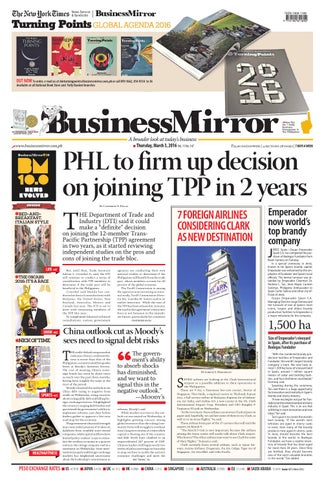
PHL to firm up decision on joining TPP in 2 years
T
PESO EXCHANGE RATES n US 47.3910 B C N. P
HE Department of Trade and Industry (DTI) said it could make a “definite” decision on joining the 12-member TransPacific Partnership (TPP) agreement in two years, as it started reviewing independent studies on the pros and cons of joining the trade bloc.
But, until then, Trade Secretary Adrian S. Cristobal Jr. said, the DTI will continue to conduct a series of consultations with TPP members to determine if the trade pact will be beneficial to the Philippines. Cristobal said Manila has conducted technical consultations with Malaysia, the United States, New Zealand, Australia, Mexico and Canada last year. The DTI is set to meet with remaining members of the TPP this year. To complement bilateral technical consultations, various government
HE credit-default swaps market indicates China’s creditworthiness is worse than that of the Philippines, a country rated five grades lower at Moody’s Investors Service. The cost of insuring China’s sovereign bonds has risen by about twice as much over the past three months, having been roughly the same at the start of the period. Moody’s lowered the outlook on its China debt rating to negative from stable on Wednesday, citing concerns about rising public debt and falling foreign- exchange reserves. It highlighted the country’s surging debt burden and questioned the government’s ability to implement reforms, just days before leaders gather to approve a five-year road map for the economy. The government’s financial strength may come under pressure if it takes on liabilities from troubled state-owned companies, while capital outflows have limited policy-makers’ scope to stimulate the weakest economy in a quarter century, the ratings company said in a statement on Wednesday. State intervention in equity and foreign-exchange markets has heightened uncertainty about the leadership’s commitment to
The government’s ability to absorb shocks has diminished, and we want to signal this in the negative outlook.” —M’
reforms, Moody’s said. While market reaction to the outlook cut was muted on Wednesday, it highlights growing concern among global investors that the ruling Communist Party will struggle to overhaul Asia’s largest economy at a time when capital is flowing out of the country, and debt levels have climbed to an unprecedented 247 percent of GDP. Chinese leaders will begin nearly two weeks of policy meetings on Saturday to map out how to tackle the nation’s economic challenges and meet the
S “C,” A
CRK.CLARKAIRPORT.COM
UNITED NATIONS
Charlotte 126, Phoenix 92
Just trying to survive a game in which the Golden State Warriors played without Most Valuable Player Stephen Curry and standout forward Andre Iguodala, Draymond Green’s desperation three-point shot with 40.2 seconds left as the shot clock was expiring gave the Warriors a four-point lead in overtime, and they held on for a 109-105 victory over the Atlanta Hawks.
IN THE
NICK OF TIME
GOLDEN STATE’S Draymond Green (center) fights for the loose ball against Atlanta’s Kyle Korver (left) and Kent Bazemore. AP
| THURSDAY, MARCH 3, 2016 mirror_sports@yahoo.com.ph sports@businessmirror.com.ph Editor: Jun Lomibao Asst. Editor: Joel Orellana
C1
BusinessMirror
Sports
2015 ENVIRONMENTAL MEDIA AWARD LEADERSHIP AWARD 2008 MEDIA PARTNER OF THE YEAR
NBA RESULTS
D’ANGELO RUSSELL scores a career-best 39 points to lead the Lakers to a 107-101 victory over the Nets on Tuesday. AP
BREAKOUT GAME FOR RUSSELL
BusinessMirror
OUT NOW To order, e-mail us at bmturningpoints@businessmirror.com.ph or call 893-1662, 814-0134 to 36 Available at all National Book Store and Fully Booked branches
BusinessMirror A broader look at today’s business Thursday, March 3, 2016 Vol. 11 No. 147
S
P. | | 7 DAYS A WEEK
7 FOREIGN AIRLINES CONSIDERING CLARK AS NEW DESTINATION
J
B L S. M
EVEN airlines are looking at the Clark International Airport as a possible addition to their operations in the Philippines. These are V-Air, a Taiwanese low-cost carrier; Jetstar of Singapore; Thai Smile, a regional carrier in Thailand; Rayani Aira, a full-service airline in Malaysia; Express Air of Indonesia; Air India; and Airline 4.0, a new carrier in the US, Clark International Airport Corp. President and CEO Emigdio P. Tanjuatco III said on Wednesday. “At the very most, these airlines can now see Clark airport on paper and, hopefully, we can lure some of them to try Clark, as well as to increase flights,” he said. These airlines form part of the 17 carriers that will visit the airport on March 5. “The March 5 visit is very important, because the airlines joining the Asian routes will surely talk about Clark airport. Who knows? The other airlines may want to use Clark for some of their flights,” Tanjuatco said. Clark currently hosts several airlines, such as Qatar Airways, Asiana Airlines, Dragonair, Jin Air, Cebgo, Tiger Air of Singapore, Air Asia Bhd. and Cebu Pacific.
Emperador now world’s top brandy company
agencies are conducting their own internal studies to determine if the Philippines will benefit from the trade pact, whose members account for 40 percent of the global economy. The Tariff Commission is among the agencies now initiating an internal study, Tariff Commission Director Ma. Lourdes M. Saluta said in an earlier interview. While the text of the TPP has been released in January, the road to the agreement’s entry into force is not foreseen in the immediate future, particularly for countries EREZ, Spain—Grupo Emperador Spain S.A. has completed the purchase of Bodegas Fundador from Beam Suntory on Tuesday. In a special ceremony in Jerez, known to be Spain’s brandy capital, Emperador was welcomed by the employees of Fundador and Spain’s local officials. The formal turnover was attended by Emperador Chairman Dr. Andrew L. Tan, Jerez Mayor Carmen Sanchez, Philippine Ambassador to Spain Carlos Salinas and other city officials of Jerez. Grupo Emperador Spain S.A. Managing Director Jorge Domeq said the turnover of one of Spain’s most iconic, largest and oldest brandy production facilities to Emperador is a major milestone for the company.
C A
China outlook cut as Moody’s sees need to signal debt risks
1,500 ha
Size of Emperador’s vineyard in Spain, after its purchase of Bodegas Fundador
“With the combined brandy-production facilities of Emperador and Fundador, the world’s largest brandy company is born. We now have almost 1,500 hectares of vineyard land in Spain, around 1 million square meters of cellar and bottling facilities, and four distilleries worldwide,” Domecq said. Speaking during the ceremony, Tan said there is a huge opportunity for innovation and creativity in Spain’s brandy and sherry industry. “A new era begins not just for Fundador, but the whole brandy and sherry industry in Spain. This is an era that will bring in more innovation and new ideas,” Tan said. Tan’s goal is to create the world’s best brandy. “If the world’s best whiskies are aged in sherry casks in Jerez, then many of the brandy products now aged in sherry casks in Jerez should become the best brandy in the world. In Bodegas Fundador, we have a sizable inventory of brandy that has been aged for more than 50 years. Once they are bottled, they should become one of the most valuable brandies in the world,” Tan added.
n JAPAN 0.4158 n UK 66.1152 n HK 6.0986 n CHINA 7.2313 n SINGAPORE 33.8507 n AUSTRALIA 33.9983 n EU 51.5140 n SAUDI ARABIA 12.6416
Source: BSP (2 March 2016 )
BMReports BusinessMirror
A2 Thursday, March 3, 2016
India, US, Japan to hold naval China… drills close to China’s waters
T
HE United States, India and Japan will hold joint naval exercises later this year in waters north of the Philippines, a move that’s likely to irk nearby China, as tensions rise over competing territorial claims in the region.
Adm. Harry Harris, head of US Pacific Command, confirmed the location of the annual Malabar drills while speaking at a conference in New Delhi on Wednesday. The proposed area lies just northeast of the South China Sea, where the US has spearheaded efforts to patrol wa-
ters near where China is building airstrips, lighthouses and ports to assert its claims. “By being ambitious, India, Japan, Australia, the United States and so many other likeminded nations can aspire to patrol together anywhere international law allows,” Harris said.
No nation should perceive the patrols as a threat, he added. China objected after an announcement last December that Japan would join the US and India as a permanent member of Malabar this year. “Relevant countries should not provoke confrontation and create tension in the region,” Chinese Foreign Ministry Spokesman Hong Lei said. “We all have a vested interest in ensuring our region remains secure, stable and prosperous,” Harris said, citing $5.3 trillion in trade that passes through the Indian Ocean and South China Sea each year. “How Indo-AsiaPacific nations employ naval forces to support these economic interests matters greatly.” Bloomberg News
PHL to firm up decision on joining TPP in 2 years… C
seeking membership in it. “All these 12 [countries] need to go through their own domestic processes: the US still has to pass it through its Congress before it enters into force, so it’s another year-and-a-half to two years. By that time, definitely, we should have a decision if we are joining or not,” Cristobal said. An accession protocol for new members will also have to be drawn up, and the Philippines will still need to undergo bilateral discussions with each of the 12 members in negotiating the schedule of tariff reductions, should it decide
to join the agreement. While the commitments, which may entail review of the Philippines’s foreign-equity restrictions are tough, the risks in not joining are substantial: the country is in danger of losing its market share to its two largest trading partners, the US and Japan, given that its close competitors (Malaysia and Vietnam) are already included in the TPP. “In fact, now, there are garment makers already making decisions in the US that since Vietnam is with TPP, they may go out of the Philippines to transfer,” Cristobal noted.
C
government’s goal of doubling percapita income by 2020. “The government’s ability to absorb shocks has diminished and we want to signal this in the negative outlook,” Marie Diron, a senior vice president at Moody’s, said in an interview on Bloomberg Television. Authorities “have stepped backward in their reform steps and so that is creating some uncertainty.”
Market concerns
THE concerns flagged by Moody’s, which also included the risk of capital outflows and shrinking foreignexchange reserves, have already manifested themselves in markets over recent months. The cost to insure Chinese government bonds against default for five years has climbed about 38 basis points, or 0.38 percentage point, since mid-November to 134 basis points. That exceeds the cost of credit-default swaps on the Philippines, which has a Moody’s rating five levels below that of China. Chinese stocks, meanwhile, have dropped 23 percent this year and the yuan has slipped 0.8 percent in onshore trading against the US dollar. In Wednesday trading, credit-default swaps were little changed, while the Shanghai Composite Index climbed 2.3 percent and the yuan rose less than 0.1 percent.
No quick fix
news@businessmirror.com.ph
“THE ratings haven’t been changed, so I expect market reaction to initially be muted,” said Andy Ji, a Singaporebased foreign-exchange strategist and economist at Commonwealth Bank of Australia. “There’s no new information here, just recognition of the issues we’ve known for years.” While Moody’s cut its outlook, the
ratings company also highlighted its rationale for affirming China’s longterm credit rating of “Aa3,” the fourthhighest investment grade. The large size of China’s economy contributes to its credit strength, while growth is still higher there than most of its peers. The country also has a moderate level of low-cost government debt, high domestic savings and substantial foreignexchange reserves, Moody’s said. The ratings company said it may downgrade China’s rating if the pace of reforms needed to support growth slows, while it would revise the outlook to stable if the nation reduces its liabilities by restructuring stateowned enterprises. “China has been moving toward some of the recommended measures that the ratings agencies have put forward, but the pace may not be what they expect,” said Tommy Ong, a managing director for treasury and markets at DBS Hong Kong Ltd. “It’s a long-term process, no quick fix.”
Growth target
THE Moody’s warning comes two week s af ter Stand ard & Poor’s (S&Ps) said in an interview with Bloomberg News that rising debt levels in China could pressure the country’s credit rating. A surge in new credit to a record 3.42 trillion yuan ($525 billion) in January, along with the central bank’s decision this week to cut banks’ reserve requirements, have fueled concern that bad debts will rise as companies find fewer profitable projects amid the economic slowdown. S&P, which has a China rating equivalent to that of Moody’s, declined to comment on Wednesday. Fitch Ratings, which grades China one notch lower, didn’t immediately reply to
questions on its outlook. Markets may be hopeful that the Moody’s cut “will push the Chinese government to do more by way of reforms,” said Vasu Menon, a Singapore-based vice president for wealth management research at Oversea-Chinese Banking Corp. “However, if other rating agencies follow suit, this could cause investors to turn cautious not just on China’s currency and financial markets, but also Asian markets too.” Premier Li Keqiang is expected to set a lower bar for economic growth at the upcoming National People’s Congress, with a 2016 target expansion range of 6.5 percent to 7 percent, compared with last year’s goal of around 7 percent. Economists predict policy-makers will keep leaning on credit growth to achieve that target, with seven out of 12 forecasters surveyed by Bloomberg last month seeing the debt-to-GDP ratio increasing through at least 2019 and four expecting a peak in 2020 or later. Debt will reach 283 percent of GDP, according to the median estimate of eight economists. Investors will keep a close eye on China’s foreign-exchange reserves and capital outflows in coming months to gauge prospects for the economy, according to Menon. The nation’s currency hoard shrank by $99.5 billion in January to $3.23 trillion, the lowest level since 2012. The central bank has been spending its reserves to shore up the yuan after investors increased bets against the currency at the start of this year. Moody’s “does not see the country as being in dire straits yet,” Menon said. “Nevertheless, concerns that China will devalue its currency against the US dollar remain a key global uncertainty.” Bloomberg News
BMReports BusinessMirror
news@businessmirror.com.ph
Thursday, March 3, 2016
A3
CA junks bid to stop ₧8-B LTO project
T
B J R. S J
HE Court of Appeals (CA) has junked a petition seeking to stop the Department of Transportation and Communications (DOTC) anew from bidding out the new information communications technology (ICT) infrastructure and database systems for the Land Transportation Office (LTO) with a budget allotment amounting to P8 billion.
In an 18-page decision penned by Associate Justice Carmelita Salandanan Manahan, the CA’s Eighth Division upheld the ruling issued by Reg iona l Tr ia l Cour t (RTC) in Quezon Cit y Branch 217, which “expunge and terminated proceedings” on the petition for declaratory relief with a prayer for the issuance of a temporary restraining order or a writ of preliminary injunction to enjoin the implementation of DOTC Special Order 2011-181. The petition was filed by a group led by Bonifacio Sumbilla, who claim to be the president of information-technology firm Stradcom Corp., to its rights as bidder under Republic Act 9184 or the Government Procurement Act, for judicial determination of the duties of the DOTC Bids and Awards Committee under the said
law, and to ascertain the legality of DOTC Special Order 2011-181. DOTC Special Order 2011181 was issued by former DOTC Secretary and now presidential aspirant Manuel Rox as A . II on September 13, 2011, which kick-started the process for the conduct of a public bidding for a new LTO ICT infrastructure and systems contract. However, in an order issued on February 6, 2013, the RTC in Quezon City granted the motion filed by another group led by Cesar Quiambao, who claim to be the true and lawful president of Stradcom, to junk the petition of the Sumbilla group because the latter has no legal authority to institute the suit. On November 23, 2013, the RTC in Quezon City also denied the motion for reconsideration
PHL-KOREA PARTNERSHIP THE Asean Korea Center (AKC), in partnership with the
Philippine Board of Investments (BOI) and the Philippine Trade and Investment Center in Seoul, hosted the Philippines-Korea Investment forum on February 23 at the Dusit Hotel in Makati. Photo shows Trade Undersecretary and BOI Managing Head Ceferino Rodolfo (right) exchanging insights with Ambassador Kim Young-sun, AKC secretary-general. BOI-INFOCOMMS
f i led by the Sumbi l la g roup, saying that the latter failed to prove that it has the legal or official management and control of Stradcom. It added that based on Stradc o m ’s g e n e r a l i n f o r m a t i o n sheets, t he Qu ia mbao g roup manages and controls Stradcom from the star t. In upholding the lower cour t’s r u ling, the C A denied the contention of t he Sumbi l la g roup t hat t he RTC in Quezon Cit y def ied the
Supreme Cour t’s resolution issued on August 23, 2011, which directed the reraff le of interpleader case involv ing the t wo groups to the Specia l Commercia l Cour t of Quezon Cit y in conjunction w ith its Januar y 24, 2012, resolution, which denied Quiambao group’s motion for reconsideration. The CA said that it agreed with the RTC in Quezon City Branch 217’s prouncement that the SC’s resolution pertains only to the
interpleader case pending before RTC in Quezon City Branch 222. It noted that in the said resolution, the SC neither made any pronouncement nor mentioned any special instruction in the disposition of Sumbilla group’s petition for declaratory relief. “[With the] absen[ce] of any proscription, the judicial prerogative of the trial court remains undisturbed. In the regular performance of its duties, the trial court may exercise its discretion and render judgment on all matters or controversies pending before it, provided that such exercise falls within the purview of its jurisdiction,” the CA said. “Indubitably, the exercise thereof includes the resolution of the controversy surrounding the Sumbilla group’s...legal interest and authority to initiate a petition for declaratory relief in behalf of Stradcom,” the CA added. Since there is no allegation that the interpleader proceeding
before the QC Special Commercial Court has finally terminated and that a decision has been rendered, the CA said, the trial court handling the petition for declaratory relief “cannot be held hostage to await the same, as no proscription on its part was imposed by a higher court.” “In the case at bench, the trial court finds that the Sumbilla group represented by Bonifacio Sumbilla, in his purported capacity as president and CEO of Stradcom Corp., and Jer B. Samson, in his purported capacity as corporate secretary, are not in legitimate control and management of Stradcom Corp.,” the CA said. “Accordingly, the trial court assailed orders which decreed the expunction of the petition for declaratory relief and the dismissal of the proceedings are in accordance with the procedural tenets in play,” it added. Concurring with the ruling were Associate Justices Japar Dimaampao and Franchito Diamante.
In the case at bench, the trial court finds that the Sumbilla group represented by Bonifacio Sumbilla, in his purported capacity as president and CEO of Stradcom Corp., and Jer B. Samson, in his purported capacity as corporate secretary, are not in legitimate control and management of Stradcom Corp.” –CA
Concierge start-up Magic follows Uber in offshoring jobs to Asia
M
AGIC Inc., a San Francisco start-up that offers concierge services via text message, promises to deliver customers anything they want, “as long as it’s not illegal.” How? Behind the curtain, Magic will rely partly on offshore labor in the Philippines. The start-up, a get-me-anything-now service staffed by humans and some automated processes, shot to popularity about a year ago during a stint with Silicon Valley business incubator Y Combinator. In the beginning, Magic’s founders and their friends answered requests day and night for food delivery, shopping, errands and gag gifts. Magic now
employs people in San Francisco dedicated to answering these requests, and it’s hiring more there, according to its web site. (The company calls them Magicians.) A job posting on Kalibrr Inc., a recruiting web site in the Philippines, reveals Magic’s plans for the future. The company is hiring full-time workers in Manila to staff its concierge services. The job pays P25,000 to P30,000 a month, which works out to less than $8,000 a year. “When a client asks you to deliver pizza while they’re on a boat or when a client asks you to get them a last-minute helicopter ride in Las Vegas, you find a way to make it happen,” the listing reads. “You will be
a part of the founding team in Manila, building the company of the future, and changing the world.” Technology companies have long turned to cheap labor in the Philippines, India, and elsewhere to handle menial tasks, such as labeling images, moderating web site comments and responding to customer-service inquiries. The recent wave of ondemand start-ups has been no exception. Uber Technologies Inc.’s ballooning ride-hailing business has come with an equally big pile of complaints and requests from customers, so it has moved much of its support operations to the Philippines in the past year— first by hiring workers through
Pagcor probes money laundering allegations T $100M H E go ve r n me nt i s training its sights on the gaming sector in a renewed push to curb the transmission of illicit funds. The Philippine Amusement and Gaming Corp. (Pagcor) has started investigating news reports that as much as $100 million of suspicious funds were remitted to three casinos’ bank accounts, according to a statement on Wednesday. The agency expects the casinos, which it didn’t name, to submit their comments on the allegation this week. T he gaming regulator’s comments come a day after Securities and Exchange Commission Chairman Teresit a Herbosa wa r ned t he country that it risks returning to the list of nations that aren’t doing enough to
Amount of suspicious funds reportedly remitted to bank accounts of three casinos
fight money laundering if laws aren’t strengthened to include sectors like casinos among institutions required to report suspicious transactions. If that happens, Philippine transactions, including overseas remittances that amounted to more than $25 billion last year, would be subject to increased scrutiny. “We already have warnings” from the Financial Action Task Force, Herbosa told reporters on Tuesday night.
“If the reports coming out were true, it really shows the consequences. I don’t think they have any reason now to oppose the bill that casinos should be covered.” Herbosa is a member of the country’s Anti-Money Laundering Council, which unsuccessfully lobbied lawmakers to include casinos in a 2012 amendment that added terrorism as a predicate crime for laundering. Casinos must stop cash transactions to prevent laundering, or at least impose a cap, Herbosa said. Apart from gaming, the property sector and art col lection shou ld a lso be included on the list of covered institutions on money laundering, Sen. Sergio R. Osmeña III said on Tuesday. Bloomberg News
a company called TaskUs, then by establishing its own centers. TaskUs, a firm with offices in Manila that advertises “ridiculously good outsourcing,” lists HotelTonight Inc., Groupon Inc., Whisper and Tinder as clients on its web site. In February a San Francisco customer-support employee at Yelp Inc.-owned food-delivery service Eat24 published an open letter to the CEO, saying she couldn’t afford groceries on her meager pay. In response, Jeremy Stoppelman, Yelp CEO, said the company was already relocating support to Arizona. “The reality of such a high Bay Area cost of living is entrylevel jobs migrate to where costs
of living are lower,” he wrote on Twitter. Uber rival Lyft Inc. and Postmates Inc. have established support teams in Nashville. As the venture capital environment has cooled over the last few months, investors are encouraging companies to cut costs where they can, and labor can be one of the biggest expenses for a start-up. Magic is somewhat unique in that customer service is its only business. The company advertises access to “top-tier executive assistants and concierges.” Operator, a shoppingcentric competitor to Magic in San Francisco, doesn’t employ any of its service staff outside the US. In January Magic began
to focus on its biggest spenders. It introduced a premium feature called Magic+ for $100 per hour, plus the cost of goods bought through the service. In addition to ordering products on a client’s behalf, Magic+ handles e- mail, scheduling appointments, travel planning and other tasks typically assigned to an executive assistant. While Magic’s service is available only in the US, CEO Mike Chen said having concierge staff in other countries can make the company more efficient. “Magic is very modular,” he said. “You break down requests into various parts, and different parts are handled by different parts of the organization.” Bloomberg News
A4
Banking&Finance
Thursday, March 3, 2016 • Editor: Jun B. Vallecera
BusinessMirror
news@businessmirror.com.ph
House leaders ask BIR to waive tax on uniformed personnel allowance
T
HE chairman of the House Committee on Labor on Wednesday asked the Bureau of Internal Revenue (BIR) to reconsider its decision to tax the new provisional monthly allowance granted to military personnel and officers. National Unity Party Rep. Karlo Alexei B. Nograles of Davao, in a statement, said the government would not lose much if the BIR were to waive the withholding tax on the provisional allowance granted by the Palace for military and uniformed personnel (MUP). “It would go a long way to
augment the meager salaries of our soldiers, most of whom are in the frontlines fighting not just the insurgents but also the depression that they have to go through being away from their families. This is a way of showing gratitude for the men and women who risk their lives every day to protect the country
BDO Private Bank adjudged best in PH
A
N international publication based in Hong Kong has recognized the strength of BDO Private Bank (BDOPB) in the area of private banking and wealth management, naming it the Best Private Bank in the Philippines for 2015. In the recently concluded Awards for Distinction by the Asian Private Banker, BDOPB was distinguished a pioneer in local private wealth management that “has seen its assets under management [AUM] soar by over 40-fold since the turn of the millennium, while similarly demonstrating excellence in other areas such as trust and succession plan initiatives.” BDOPB is a wholly owned subsidiary of BDO Unibank serving the affluent market. At the end of 2015, its AUM or market value of assets it manages on behalf of the clients reached P309 billion. Asian Private Banker commended the initiatives of BDOPB saying, “These are built on an onshore model that serves the market’s emerging wealthy all the way through to the UHNW [ultra-high net worth] segment; indeed, its services have been compared to that of its bigger global counterparts.” Private banking is still a developing market in the Philippines targeting a niche segment whose objectives are to grow personal investments, establish a stable family wealth plan and estate planning.
and its citizens,” he said. According to Nograles, the provisional allowance granted by President Aquino is an interim measure to supplement the total compensation of MUP, pending the passage of the pension reform measures that would rationalize their basepay schedule. Earlier reports claimed the BIR was adamant on collecting the tax on military allowances granted by President Aquino through Executive Order [EO] 201. Nograles said since the allowance is provisional in nature, the BIR, at its discretion, waive the tax on the provisional allowance granted to MUPs. “This is a gray area because it is a provisional allowance and is nowhere within the list of remunerations that are specifically listed
It would go a long way to augment the meager salaries of our soldiers, most of whom are in the frontlines fighting not just the insurgents but also the depression that they have to go through being away from their families. This is a way of showing gratitude for the men and women who risk their lives every day to protect the country and its citizens.” –N
as either taxable or non-taxable under Republic Act [RA] 9040,” Nograles said. Under RA 9040 or The AFP Tax Exemption for Pay and Allowances Act of 2001, MUPs are exempt from paying taxes on their
longevity pay, the cost of living allowance, personnel economic relief allowance and hazardous allowance; collateral pay, namely, specialist pay, combat pay, flying pay, air mechanic’s pay, sea duty pay, hazardous duty pay, instructor’s duty pay,
parachutist’s pay and hardship pay and collateral allowances, namely, special clothing allowance, cold winter’s clothing allowance and cold weather clothing maintenance allowance, winter clothing allowance, initial enlistment and reenlistment allowance and laundry allowance. MUPs are also exempt from paying taxes on their retirement benefits, pensions, death and disability benefits. The EO also increased the hazard pay of uniformed personnel from P290 to P390 a month. Nograles added the list as provided by RA 9040 “specified the items that are exempt from tax but did not specify the allowances subject to the usual tax. So I think that this provisional allowance can be tax exempted without any legal complication.” Jovee Marie N. dela Cruz
Central bank-initiated program now a law
T
HE Bangko Sentral ng Pilipinas (BSP) on Wednesday expressed satisfaction that the cooperative movement it helped jump-start some seven years earlier is now a law. This pertained particularly to the Credit Surety Fund (CSF) Cooperative Act of 2015 that promises “an enhanced financial landscape for Filipino entrepreneurs.” Formally known as “An Act Providing for the Creation and Organization of Credit Surety Fund Cooperatives to Manage and Administer Credit Surety Funds to Enhance the Accessibility of Micro, Small and Medium Enterprises, Cooperatives and Nongovernment Organizations to the Credit Facility of Banks and for Other Purposes,” the law institutionalized the CSF Program the BSP initiated in 2008 to help so-called unbankable MSMEs or micro- smalland medium- scale enterprises gain access to the formal sources of credit. The CSF is a credit enhancement
program helping small businesses obtain loans from banks. Some MSMEs experience difficulty in getting bank loans due to their lack of acceptable collateral, credit knowledge and credit history. The CSF dispenses with the difficulty by pooling cash contributions from participating institutions and use this as surety cover for borrowers who could not access such accommodation any other way. Data from the central bank show that as of December 31, 2015, aggregate pledged stakeholder contributions already total P713.2 million. There are at present 45 CSFs in 30 provinces and 15 cities nationwide. Of this number, 24 in Luzon, seven in the Visayas and 14 in Mindanao comprised of 630 cooperatives and 13 non-governmental organizations. “The law now provides juridical personality to the CSF and will be registered, along with existing CSFs as a CSF cooperative with the
Case clippings
E V I D E N C E Ð c i r c u m s t a n c e s n o t p r e s u m e d F a c t t h a t a c c u s e d t o o k a c e l l p h o n e f r o m t h e s c e n e o f t h e c r i m e d o e s n o t n e c e s s a r i l y p o i n t t o t h e c o n c l u s i o n t h a t i t w a s t h e c o m p l a i n a n t s Õ c e l l p h o n e , w h e r e n o o t h e r c o n v i n c i n g e v i d e n c e l i n k i n g a c c u s e d t o t h e t h e f t w a s p r e s e n t e d . I n t h e a p p r e c i a t i o n o f c i r c u m s t a n t i a l e v i d e n c e , t h e r u l e i s t h a t t h e c i r c u m s t a n c e s m u s t b e p r o v e d , a n d n o t t h e m s e l v e s p r e s u m e d . T h e c i r c u m s t a n t i a l e v i d e n c e m u s t e x c l u d e t h e p o s s i b i l i t y t h a t s o m e o t h e r p e r s o n c o m m i t t e d t h e c r i m e . F r a n c o v . P e o p l e 0 1 F e b 2 0 1 6
Cooperative Development Authority [CDA],” the BSP said. This CDA is responsible for the regulation and supervision of these cooperatives. “The BSP will continue to spearhead the promotion and organizational development of CSF Cooperatives and facilitate the acquisition by CSF
G R 1 9 1 1 8 5 R e y e s , J Cooperatives of technical assistance, such as training and seminars and other forms of technical assistance,” the central bank said. The CSF program has, thus, far benefited 15,248 MSMEs and extended loans aggregating P2.28 billion as of December 31, 2015. Bianca Cuaresma
World’s biggest pension fund may buy Offshore yuan falls as PBOC weakens fixing, $47 billion in Japan stocks after rout Moody’s cuts outlook
T
HE world’s biggest retirement fund has scope to buy $47 billion in Japanese shares after they tumbled this year, according to Daiwa Securities Group Inc. T he ¥139.8 -trillion ($1.2-trillion) Government Pension Investment Fund’s (GPIF)domestic equities probably fell to about 21 percent of assets at the end of February, short of the 25-percent goal for such investments, the brokerage wrote in a report published on Tuesday. That means the Japanese fund could purchase as much as ¥5.3 trillion in shares, it said. GPIF may cut domestic bonds by ¥11.2 billion as holdings probably exceed their target, according to Bank of America Corp.’s Merrill Lynch unit. The benchmark Topix index has dropped 13 percent in 2016, reducing the weighting of the fund’s equities relative to the rest of its assets. A Bloomberg gauge of the nation’s sovereign bonds has added 3.4 percent through Tuesday. While GPIF has leeway to deviate from its target levels, further stock buying from the fund could help support the local market. “GPIF investment in Japanese stocks might well underpin prices, even as stocks feel downward pressure due to concern about the global economy,” Merrill Lynch strategists led by Shuichi Ohsaki wrote in a report on Tuesday. If equities continue to weaken, GPIF “will probably have to further rebalance its portfolio.” GPIF held about 38 percent of its assets in domestic bonds at the end of December
C
and 23 percent in Japanese stocks, the fund said on Tuesday. The retirement manager targets 25 percent for domestic shares and 35 percent for local bonds, with a deviation range of 9 percent and 10 percent, respectively. T h e r e a r e s i g n s J a p a n’s p u b l i c retirement managers have already been
adding to holdings. Trust banks, whose clients include pension funds, purchased a record ¥500 billion in local stocks in the week ended February 19, a 13th straight week of net buying. Japan’s Topix index has risen 4.1 percent since the date used for Daiwa’s estimates.
HINA’S yuan weakened offshore after the central bank cut the reference rate to the lowest in four weeks and Moody’s Investors Service reduced its credit-rating outlook on the nation to negative. The yuan traded in Hong Kong declined 0.05 percent to 6.5521 a dollar at 10:24 a.m. The onshore exchange rate rose for a second day, gaining 0.03 percent to 6.5519, according to China Foreign Exchange Trade System prices. The People’s Bank of China (PBOC) lowered its reference rate by 0.16 percent. Moody’s cited concerns about rising government debt and falling currency reserves in its decision to reduce the outlook. “Its a little bit of a stalemate right now for China and the emerging markets story as the picture is mixed,” said Sim Moh Siong, a foreign-exchange strategist at Bank of Singapore Ltd. “What we saw with Moody’s was not a huge surprise.” The government’s financial strength may come under pressure if it takes on liabilities from troubled state-owned companies, while capital outflows have limited policy-makers’ scope to stimulate the weakest economy in a quarter century, Moody’s said in a statement on Wednesday. State intervention in equity and foreign-exchange markets has heightened
uncertainty about the leadership’s commitment to pushing through reforms, the ratings company said. The PBOC has been trying to restore stability to the yuan this year after capital outflows quickened following a surprise devaluation last August. China’s officials said there is no intention or need to devalue the yuan, according to US Treasury Secretary Jacob J. Lew, who spoke after meeting with Premier Li Keqiang. The nation’s leaders gather in Beijing this week to approve a fiveyear plan for the economy. The seven-day repurchase rate, a gauge of interbank funding availability, dropped two basis points to 2.25 percent, according to a weighted average from the National Interbank Funding Center. The 14-day rate fell 16 basis points, the most since February 6, to 2.55 percent. The PBOC suspended open-market operations for a second day because of ample liquidity in the banking system, according to a statement on its web site. The authority also reduced banks’ reserve requirements on Monday. “Though there’s a net withdrawal of liquidity in open-market operations, there is usually cash returning to banks after Lunar New Year,” said Cici Wang, a fixed-income analyst at Citic Securities Co. in Beijing.
Asean
BusinessMirror Editor: Max V. de Leon • Thursday, March 3, 2016 A5
www.businessmirror.com.ph
AEC: Top Asean companies by footprint
Feud with Najib leaves former premier ‘not proud’ of Malaysia
HE launch of the Asean community and the integration of regional economies through the free movement of products, services and people has challenged companies in Asean to expand into Asean markets to benefit from the opportunities the Asean Economic Community (AEC) offers. Let’s look at the footprint:
bad government where it doesn’t do anything that is good for the country, that it undermines the system.” Attorney General Mohamed Apandi Ali in January closed the door on the graft investigation into Najib, clearing him of wrongdoing. The premier returned $620 million in August 2013 that was not utilized, Apandi said. He did not specify what the rest of the funds were used for.
Active in Asean countries
‘Don’t accept’
Asean-EU Perspective
HENRY J. SCHUMACHER
T
PTT Public Co. Ltd.—Thailand Malayan Banking Berhad (Maybank)—Malaysia Ocean Glass—Thailand JG Summit Holdings Inc.—Philippines Universal Robina Corp.—Philippines CIMB Group Holdings Bhd.—Malaysia Bangkok Bank Public Co.—Thailand Minor International Public Co.—Thailand RHB Capital Berhad—Malaysia Neptune Orient Lines—Singapore OSIM International Ltd.—Singapore Regional Container Lines—Thailand
10 10 10 9 9 9 9 9 9 9 9 9
Top 3 listed Asean companies in key sectors, by revenue
Banking: DBS Group Holdings, Singapore; Kasikornbank, Thailand; Oversea-Chinese Banking Corp., Singapore Chemical and plastic products: PTT Global Chemicals, Thailand; Indorama Ventures, Thailand; Petronas Chemical Corp., Malaysia Communication and telecommunications: Singapore Telecommunications, Singapore; Axiata Group, Malaysia; OCK Group, Singapore Conglomerates, holding and investment: Sime Darby, Malaysia; Keppel Corp., Singapore; Sembcorp Industries, Singapore Construction and engineering: Singapore Technologies Engineering, Singapore; IJM Corp., Malaysia; PEC, Singapore Construction materials and equipment: Siam Cement, Thailand; UMW Holdings, Malaysia; Everygreen Fibreboard Group, Singapore Electrical appliances and electronics: Flextronics, Singapore; Venture Corp., Singapore; Telechoice Internationa, Singapore Energy: PTT, Thailand; PTT Exploration & Production, Thailand; SapuraKencana Petroleum, Malaysia Finance and insurance: Great Eastern Holdings, Singapore; Hong Leong Financial Corp., Malaysia; Censof Holdings, Malaysia Food and beverages: Wilmar International, Singapore; San Miguel Corp., Philippines; Olam International, Singapore Health care: IHH Healthcare, Malaysia; Bangkok Dusit Medical Services, Thailand; Kalbe Farma, Indonesia Hotels, restaurants and leisure: Jollibee Foods Corp., Philippines; Minor International, Thailand; MK Restaurant Group, Thailand Logistics and transportation: Neptune Orient Lines, Singapore; AirAsia, Malaysia; SATS, Malaysia Packaging: Kian Joo Can Factory, Malaysia; New Toyo International, Singapore; Teckwah Industrial Corp., Singapore Plantations: Felda Global Ventures, Malaysia; IOI Corp., Malaysia; Kulim (Malaysia), Malaysia Property: Capital Land, Singapore; City Developments, Singapore; UOL Group, Singapore Retail: Parkson Holdings, Malaysia; OSIM International, Singapore; YHI International, Singapore Trading and services: Interplex Holdings, Singapore; Tat Hong Holdings, Singapore; Frencken Group, Singapore Looking at these statistics, one will realize that Philippine business still have much to do to play a more important role in Asean. To transform Philippine growth from a consumptiondriven one to an investment-driven kind and to signal to the world that the country is really open for business, the Philippines must lift the constitutional restrictions on foreign ownership in mass media, advertising, educational institutions, land ownership, public utilities and the exploitation of natural resources, except as provided by law. Filipinos need not fear that they will lose out in competition by opening the economy; Filipino-owned enterprises have shown that they can compete with the best of them, like Jollibee, San Miguel Corp., JG Summit, Ayala Corp., and even thrive in foreign shores.
F
IN this January 25 file photo, Malaysian Prime Minister Najib Razak speaks at a conference in Kuala Lumpur, Malaysia. AP
ORMER Malaysian leader Mahathir Mohamad has lost pride in the country he governed for more than two decades, warning political tensions that have surrounded Prime Minister Najib Razak for months could hand a fractured opposition victory at the next election. In a wide-ranging interview, Mahathir, 90, renewed his months-long calls for the premier to step aside, saying Malaysia under Najib’s seven-year tenure had morphed from a stable, calm country where the economy was growing to a place that lacked tolerance. “There was a time when I go abroad, people talk highly of Malaysia,” Mahathir said in a Bloomberg Television interview in Kuala Lumpur on February 25. “Today, if we go abroad, we meet people, what they say is that ‘hey, what’s happening to your country?’ That’s what they say. And I am not proud because I can’t explain what’s happening in the country.” The feud between Mahathir and Najib has grown increasingly acrimonious in recent months, with Mahathir attacking Najib over a series of financial scandals and his economic record, and quitting the ruling party. Mahathir is under investigation for potential defamation and had another visit from police last week. While his influence has faded in recent years, the public sparring creates risk for the United Malays
National Organization (UMNO), which has ruled since independence in 1957, but whose broader Barisan Nasional coalition won the last election in 2013 with its slimmest margin yet.
Probes continue
THEIR dispute reflects a broader concern about a sense of drift in Malaysia: While an investigation into $681 million that authorities said was a personal donation in 2013 from the Saudi Arabian royal family to Najib has largely wrapped up, several probes continue into the finances of debt-ridden state investment fund 1Malaysia Development Bhd. (1MDB), whose advisory board Najib chairs. The Wall Street Journal reported on Tuesday that hundreds of millions of dollars also went into Najib’s accounts in 2011 and 2012. A 1MDB spokesman said the company has consistently maintained it hadn’t paid any funds to the personal accounts of the prime minister. The various affairs have raised fresh questions over transparency and doing business in Malaysia,
Any prime minister who has $681 million with him is not doing something right.” —M dented markets and helped spur a 21-percent slump in approved investment last year, all at a time economic growth is slowing. Najib has repeatedly denied any wrongdoing, saying he and Mahathir disagreed over economic policies and that no “individual, however eminent” should try to interfere with or hijack his leadership. He retains the backing of the bulk of UMNO’s powerful divisional chiefs and the opposition remains weak, its coalition having imploded after then-leader Anwar Ibrahim—a one-time deputy to Mahathir—was sent to jail again last year on a sodomy conviction, a charge he denies. Still, Mahathir said voters are worried enough to switch support from UMNO, while state institutions including the police and the Attorney General’s Office are being undermined by Najib’s actions after the revelation of the money in his accounts. Najib shouldn’t have accepted the funds as no leader “should have that kind of money,” he said. “When we talk to people, they are disgusted with the government,” Mahathir said. “On my blog, they say the same thing. They all feel this is a
“ANY prime minister who has $681 million with him is not doing something right,” Mahathir said from his office on the 86th floor of the world’s tallest twin towers. “Even if it is given to him by a foreigner, you still don’t accept.” Mahathir led Malaysia from 1981 to 2003, a period when the economy grew an average 6.3 percent annually. He was famous for rejecting an International Monetary Fund bailout for Malaysia during the 1998 Asian Financial Crisis, instead introducing capital controls and pegging the ringgit. He advocated a moderate brand of Islam and stressed modernization but had little tolerance for dissent and used sedition laws to curb it. He was a vocal critic of US policy in the Middle East and its invasion of Iraq while he was in power. Najib’s predecessor Abdullah Ahmad Badawi stepped down in 2009 as his popularity within UMNO faded, fueled in part by resignation calls from Mahathir.
Sidelining detractors
“DURING my time, we had problems of course, political problems,” Mahathir said. “But now what we are seeing is that, if anybody says anything against Najib, that is almost a crime.” Najib is sidelining detractors as he cements his grip on UMNO: the Supreme Council suspended party Deputy President Muhyiddin Yassin on Friday for undermining UMNO in his quest to remove the premier from office, weeks after Najib’s allies maneuvered the ouster of Mahathir’s son—another critic—as chief minister of a northern state. Mahathir said there is little way to tell how much public support he has. Divisional chiefs are “keeping quiet because they have to support the prime minister.” At the general level, “lots of people come up to me and say ‘we support you’ but that’s what they say. But they are also scared to be heard saying they support me.” Mahathir said voters were angry over rising costs from transportation to food as the government removes subsidies and after the implementation of a goods and services tax last year. Bloomberg News
Malaysian PM Najib denies fund gave him about $1 billion
M
ALAYSIAN Prime Minister Najib Razak rejected a new report on Tuesday that a state investment fund likely funneled close to a billion dollars into his personal bank accounts. Najib has been battling allegations of corruption and mismanagement for months over allegations that hundreds of millions of dollars was channeled into his accounts from indebted investment fund 1 Malaysia Development Bhd. (1MDB), which he formed in 2009. Malaysia’s attorney general cleared Najib of wrongdoing in January, saying $681 million deposited in the prime minister’s accounts was a donation from Saudi Arabia’s royal family. He said most of the money had been returned. The Wall Street Journal reported Tuesday that investigations into
1MDB have revealed that a total of more than $1 billion was deposited in Najib’s bank accounts—several hundred million dollars more than had been reported before—and that investigators believe most came from 1MDB through a complex web of transactions in several countries. Najib has repeatedly denied any wrongdoing. A statement issued by Najib’s office did not comment on the larger amount reported by the newspaper, saying only that “the funds received were a donation from Saudi Arabia.” It accused the newspaper of “relying solely on anonymous sources that may not even exist” and of “choosing to omit key known facts.” “This is unethical and against accepted journalistic practice,” the statement said. The Wall Street Journal said inves-
tigators, whom it did not identify, believe the money was transferred with the help of two former officials in Abu Dhabi, a country with which 1MDB has deep ties. 1MDB is mired in 42 billion ringgit ($10.1 billion) in debt and has been selling its assets to clear its books. Najib became embroiled in the scandal after documents were leaked last year suggesting that money deposited into his accounts may have come from entities linked to 1MDB. The prime minister’s office said Malaysian authorities have traveled to Saudi Arabia to review documents and interview members of the royal family, and confirmed that it was the source of the money. 1MDB separately said in a statement on Tuesday that it has never deposited money into Najib’s per-
sonal accounts. It also accused the Wall Street Journal of not offering evidence to back its claims and relying on anonymous sources. Former Malaysian Prime Minister Mahathir Mohamad told reporters earlier Tuesday that there must be some truth to the Wall Street Journal’s allegations because Najib has not taken any legal action against the newspaper. Mahathir, a fierce critic of Najib, quit the ruling party on Monday, saying it has been hijacked by Najib to protect his own interests. “I feel embarrassed that I am associated with a party that is seen as supporting corruption,” Mahathir told a news conference. “I decided that I cannot be a party to all these things, so the least I can to do is leave the party.” AP
TheBroa
Business
A6 Thursday, March 3, 2016
TO ATTRACT MORE FOREIGN CAP
PHL MAY NEED M B C O, J C D C
T
HE Philippines has had centuries of love-hate relationships with foreign capital. The country’s colonial past under Spain and the United States may have made it more averse to foreign ownership. In the past 46 years, including the Marcos years starting in 1970, the country’s foreign direct investments (FDI) have not even reached an annual average of $5 billion per administration. Data from the Joint Foreign Chambers (JFC) showed that FDI averaged $117 million annually under former President Ferdinand Marcos, between 1970 and 1986; and averaged $3.97 billion a year under President Aquino, between 2011 and 2015. These foreign capital flows have not helped improve the country’s standing among its Asean-6 peers, where it has been the laggard in FDI since 2003. JFC data showed this was the year Association of Southeast Asian Nations (Asean) membercountries Indonesia and Vietnam finally surpassed the Philippines in terms of FDI. “FDI inflows to other large EAP [East Asia and Pacific] economies remained generally robust in the first half of the year, rising in all large countries, except the Philippines, in year-on-year terms,” the World Bank said. “In the Philippines FDI has lagged, partly owing to regulatory restrictions.” As a result, millions of Filipinos have found it difficult to find jobs—most especially decent employment—that offer livable wages and other employee benefits.
What went wrong
BUSINESSMEN believe the biggest hindrance to entry of foreign investments to the country is the 60-40 rule limiting foreign ownership of assets. Th is rule is enshrined in the 1987 Constitution, ratified during the regime of the current President’s mother, Corazon C. Aquino. Under Article XII of the Constitution, foreign investors are prohibited from owning more than 40 percent of real properties and businesses, while they are totally restricted to exploit natural resources and own any company in the media industry. Apart from this provision, the country also has the Regular Foreign Investment Negative List (RFINL) that states where foreign investors cannot invest in. The list is updated every two years. “The restrictions to FDI exist in three levels,” Canadian Chamber of Commerce of the Philippines President Julian Payne said in a news conference on Wednesday. “The Constitution, of course, is the hardest to change. Then there’s the foreign negative list, which is supposed to be based on the Constitution, but there’s a significant number of items there [that] are not based on the Constitution.” Based on the 10th RFINL enshrined in Executive Order 184 and signed by Mr. Aquino in 2015, foreign investors are barred from plunking capital in 11 types of businesses. The list includes businesses like mass media, except radio; retail trade with paid-up capital of $2.5 million; cooperatives; private security agencies; ownership, operation and management of cockpits; and the manufacture
25%
Corporate and individual income-tax level recommended by the Joint Foreign Chambers of the Philippines to attract more foreign investors of firecrackers and other pyrotechnic devices, among others. Foreign nationals also cannot practice their professions in the Philippines if they are pharmacists, radiologic and x-ray technologists, criminologists, foresters and lawyers. However, there are businesses where foreign investors can invest in, but only up to a maximum of 20 percent, 25 percent, 30 percent and 40 percent. For example, foreign investors can only invest up to 20 percent in private radio communication networks; up to 25 percent in private recruitment for local and overseas employment and contracts for the construction of defense-related structures, among others; and 30 percent in advertising. Other kinds of businesses, such as gambling; businesses that require police and military clearance, such as those in the manufacture of weapons and similar goods, have a maximum limit of 40 percent. Th is cap is aligned with the constitutional provision on foreign ownership. However, the government has been making adjustments to the list in consultation with agencies such as the National Economic and Development Authority. One of the recent examples happened under the Arroyo administration, which increased the total foreign investment in gambling to 40 percent from zero. “At the regulatory levels, there are also some hindrances to FDI,” Payne said. The high cost of putting up businesses is especially prohibitive to foreign fi rms wanting to invest in, say, innovation incubators, such as those in information and communications technology and start-ups that are in need of capital to start operating or to continue operating. “Most of the really interesting innovators are rather small companies,” Payne said, adding that if a foreign company wishes to set up “a company here as a foreignowned company, it has to put up $200,000 [about P9.458 million] just to start.” “Th is is a big disincentive,” he added. American Chamber of Commerce of the Philippines Senior Adviser John D. Forbes added that high taxes also discourage foreign companies from investing in the country and bringing their money
to other countries in the region, like Singapore. It is no secret the Philippines is one of the countries in Asean that charge the highest in taxes. Income taxes in the country can reach up to 32 percent, while corporate taxes can reach around 30 percent. This is the reason the JFC recommends reduction in both corporate and individual income tax to 25 percent as an incentive for both companies and workers. Instead of taxing only incomes, the JFC recommended the increase in consumption taxes, such as increasing the value-added tax to 15 percent. “Sin” taxes should also be raised. “FDI has increased to a very dismal [level] that we are not getting, frankly, our fair share of it, and that means we’re not getting jobs and we’re not getting state revenue, which we could have a significant increase in FDI equivalent to
$200,000
The minimum cost to foreign investors seeking to put up a business in the Philippines that Canadian Chamber of Commerce of the Philippines President Julian Payne said is a “big disincentive” to foreign direct investments what other neighboring countries have,” Payne said.
Why it’s important
THE lack of FDI in the country has had a major impact on the kinds of jobs available in the country. Based on Labor Force Survey (LFS) data released in January, there were still over 9 million Filipinos either looking for a job or decent employment.
While others struggled and took their chances in obtaining vulnerable employment in the informal sector, many have become discouraged and applied as overseas Filipino workers (OFWs). Apart from the general lack of jobs, Forbes said being OFWs was also the solution seen by those laid off by big businesses that closed in the Philippines. While being an OFW was a noble profession,
Forbes said it cannot be a solution for jobless Pinoys in the long term. “When Ford Motors closed here, where did the workers go? They went to Thailand, take charge of the factories there. Same thing when Subic closed their shipyard, they [workers] went to Guam,” Forbes said. “The Philippines has 174 million people projected by 2050, that’s 72 million more people than today. Those people are going to work in Thailand, outside of your country? As maids? Or they’re going to work here? That’s the question for the next decade,” he added.
Dissatisfaction
ACCORDING to documents distributed during a forum organized by the JFC, the Philippines would need some $75 billion in FDI from 2010 to 2020, or an annual inflow of foreign investments of about $7.5 billion.
aderLook
sMirror
www.businessmirror.com.ph | Thursday, March 3, 2016
A7
PITAL AND CREATE DECENT JOBS,
MAJOR RETOUCH agencies,” Payne said. “I think that’s where there’s a huge potential to immediately ease restrictions.” House Committee on Ways and Means Chairman and Liberal Party Rep. Romero S. Quimbo of Marikina City said the next government should prioritize liberalization of FDI in industries that are currently restricted. “We can do it immediately within the first 100 days [of the next administration]. We don’t need to change the Constitution to do it. We can simply review the foreign negative list for starters,” Quimbo said. “We can also review definitions of utilities, which, under the Constitution, are reserved for Filipinos.” According to Quimbo, the Philippines can also allow foreign equity by a mere change of definition of a public utility, “noting that our public-service law, which defines what a public utility is, has not changed in the last 60 years.”
THE MOST PROBLEMATIC FACTORS FOR DOING BUSINESS
From the list of factors, respondents were asked to select the five most problematic for doing business in their country and to rank them between 1 (most problematic) and 5. The score corresponds to the responses weighted according to their rankings.
MANUFACTURING VALUE ADDED OF COUNTRIES, % OF GDP, 2010
What lawmakers plan
However, according to Forbes Magazine last year, the Philippines only garnered some $20 billion in investments from 2010 to 2015, with 2014 as the strongest year, with $6.5 billion in foreign investments which came in, but still below the required annual average. Although the inflow of foreign investments may have missed the targets set by the JFC, Malacañang said the increased business confidence in the Philippines will ensure that the flow of investments would increase in the coming years. “We believe that overall FDI into the country shall continue to follow an upward trend, in view of the economic reforms that the Aquino administration has put in place that bolstered the country’s macroeconomic fundamentals and improved overall business confidence,” Communications Secretary
Herminio B. Coloma Jr. said in a statement. Thus, the task of increasing the flow of FDI falls to the current crop of politicians seeking to bag the top public positions of the land. During the forum, representatives of candidates running in the presidential race presented their economic platforms. However, the contentious issues that discourage foreign investments remained unanswered. The representatives of these candidates also failed to satisfy Payne. “I wasn’t satisfied with the answers that the candidates gave as to addressing those issues on the foreign investments negative list, which can be removed without constitutional amendment, and that vast array of protectionist restrictions and regulations by the government and other regulatory
SPEAKER Feliciano Belmonte Jr. is warm to the idea of tweaking the 1987 Constitution, especially its economic provisions. “By amending the restrictive economic provisions of our Constitution, we empower Congress to enact laws that will attract the kind of investments that will reverse the deindustrialization and deagriculturalization of our economy,” Belmonte said. “Only then can we encourage locators and investors to expand our manufacturing sector, the area where the better-paying decent jobs can be created.” The House leadership did not push through with the expected voting on third and final reading of the economic Charter change (Chacha) in June last year, apparently due to lack of affirmative votes. The lower house needs the vote of at least two-thirds of its membership, or 217 affirmative votes, to pass the Cha-cha measure. The voting has also been affected by the Palace, particularly Mr. Aquino’s adverse stance against Cha-cha. The resolution, filed by Belmonte and Sen. Ralph Recto, is eyeing to amend economic provisions on the 60-40 rule. The resolution also seeks to include the phrase “unless provided by law” in the foreign-ownership provision of the Constitution, particularly land ownership, public utilities, natural resources, media and advertising industries. Meanwhile, House Committee on Climate Change Chairman and Party-list Rep. Rodel M. Batocabe of Ako Bicol said that, by amending the restrictive economic provisions of the Constitution, the government will prioritize the liberalization of the country’s investment climate. “This is the only way for us to attract blue-chip investors; ensure transparency and accountability; and cope with the challenges of trade liberalization, and the demands of economic integration and partnerships,” Batocabe said. “Let us strengthen job generation in industries where we have competitive advantage, such as BPO [business-process outsourcing]. Manufacturing can also be a bright spot, considering that labor costs in China are already skyrocketing. We might just, as well, attract other industries from China.”
What politicians think
CURRENTLY, there is a pending measure allowing foreigners to own 100 percent of adjustment companies, lending companies, financing companies and investment houses.
Source: Batungbacal, Roberto based on World Bank, Databank
PHL IT-BPM INDUSTRY REVENUE, BY SUBSECTOR, 2014
INFRASTRUCTURE COMPONENT RANKINGS, ASEAN 6, 2015-2016
Source: World Economic Forum 2015-2016 Global Competitiveness Report
The bill amends investment restrictions in specific laws governing adjustment companies, lending companies, financing companies and investment houses cited on the foreign investment negative list. “We will, likewise, overhaul the entire tax system, not just personal income tax, as that will be a piecemeal approach. By lowering corporate income tax, we make the country more competi-
tive,” Quimbo said. For their part, Nationalist People’s Coalition Rep. Sherwin T. Gatchalian of Valenzuela City, Party-list Rep. Sherwin N. Tugna of Citizens’ Battle Against Corruption and Liberal Party Rep. Ben P. Evardone of Eastern Samar said the next government should pass measures addressing corruption in the government to attract more FDI.
PHILIPPINES “Continue to fight corruption all the way down to the LGUs [local government units] and local level, streamline business processes at the local level by implementing automation in all LGUs; and massive infrastructure spending to improve quality of life and mobility,” he said. Tugna, meanwhile, said, “By reducing graft, corruption and red tape in our government bureaucracy, foreign investors will not be dissuaded from investing in our country.” Moreover, House Committee on Agrarian Reform Chairman and Liberal Party Rep. Teddy B. Baguilat Jr. of Ifugao said the next government must continue and intensify the path to reform. “We must be able to project a Philippines where graft and corruption is no longer the norm. Passage of the FOI [Freedom of Information] bill and streamlining of the bureaucratic process are crucial in this projection,” he said. “Also, there’s a need to infuse more investments in expanding our road network; upgrading our seaports and airports; and improving our telecommunications. Infrastructure support is still our main weakness. Tourism, manufacturing and IT sector, including BPO, should be our primary magnets for FDI,” Baguilat added. Meanwhile, Party-list Rep. Neri J. Colmenares of Bayan Muna said the next government should first develop the country’s own industries, “rather than rely on FDI.” “National industrialization should be our main engine of growth. I am not against FDI, but we must prioritize building our own industries. We should fully support the local businesses and industries,” Colmenares added.
A8
The World BusinessMirror
Thursday, March 3, 2016
news@businessmirror.com.ph
IS group in competition for recruits in Pakistan
K
CIVILIANS inspect the aftermath of a suicide bomb attack on Great Prophet mosque in the Shiite-populated Shulaa neighborhood in Iraq on February 26. At least nine people were killed and 15 wounded on Thursday when two suicide bombers blew themselves up at a Shiite mosque north of Baghdad, security sources said. AP
UN: Violence kills 670 across Iraq in February B
AGHDAD—Continuous violence has left at least 670 Iraqis dead in February, of whom about two-thirds were civilians, the United Nations (UN) said. In a statement issued on Tuesday, the UN Assistance Mission for Iraq, known as Unami, put the number of the killed civilians at 410, a figure which, according to UN methodology, includes the federal police, civil defense forces and personal security details. The rest were security forces, including Kurdish peshmerga and paramilitar y troops. It added that a total of 1,290 people were wounded, including 1,050 civilians. The worst affected area
Turkish man pleads guilty in $55-million cyberattacks case
N
EW YORK—A Turkish man who led three cyberattacks against global financial institutions that caused more than $55 million in losses pleaded guilty on Tuesday, prosecutors said. Ercan Findikoglu, 34, whose online nicknames included “Segate,” ‘‘Predator” and “Oreon,” entered the plea in Brooklyn federal court. Prosecutors said he used cashing crews worldwide to make fraudulent automated teller machine (ATM) withdrawals on a massive scale across the globe. In a February 2011 operation, Findikoglu’s cashing crews withdrew about $10 million through 15,000 fraudulent ATM withdraws in at least 18 countries, they said. The government said he hacked into computer systems of three payment processing companies. It said he and coconspirators accessed prepaid debit-card accounts, inflated balances and removed their withdrawal limits between 2011 and 2013. In a February 2013 attack, crews in 24 countries made 36,000 transactions, withdrawing about $40 million from ATMS, prosecutors said. During one operation, they added, crews in New York City withdrew approximately $2.4 million from nearly 3,000 ATM withdrawals during an 11hour period. His lawyer hasn’t commented. In a release, US Atty. Robert L. Capers called the cyberattacks massive. “By hacking into the computer networks of global financial institutions, the defendant and his coconspirators were able to wreak havoc with the worldwide financial system by simultaneously withdrawing tens of millions of dollars,” he said. Findikoglu pleaded guilty to computer-intrusion conspiracy, access devicefraud conspiracy and effecting transactions with unauthorized access devices. AP
was Baghdad, with 277 civilians killed and 838 wounded. Citing its local health authorities, the UN said at least four civilians were killed and 126 others wounded in the western province of Anbar, which has large areas under Islamic State (IS) extremist group control. The UN said it could not fully verify the Anbar figures due to the increased volatility of the situation on the ground and the disruption of services. In January overall causality
figures were at least 849 killed and 1,450 wounded. “This conflict continues to exact a heavy toll on the population,” UN Special Representative for Iraq Jan Kubis said in the statement. “ This is deeply worrying and disheartening. Civilians should not pay the price in this conf lict,” Kubis added. Februar y saw significant deterioration in Iraq’s security situation, with two massive bombings in as many days by the IS group in the town of Muqdadiyah and in Baghdad that killed at least 110 people. The IS group seized much of northern and western Iraq, including the second-largest city, Mosul, in the summer of 2014. The extremists have declared a caliphate in the areas of Iraq and Syria under their control and have imposed a harsh and
410 Total number of civilians killed in February due to continuous violence in Iraq according to the United Nations Assistance Mission for Iraq
violent version of Islamic law. With heavy backing from US-led coalition air strikes, Iraqi troops scored key victories against IS since last year. But a long-awaited campaign to retake Mosul, the main city held by the militants, has yet to begin. AP
Cardinal denies concealing knowledge of 2 pedophiles C A NBER R A , Australia— The lawyer for an Australian inquiry into child sex abuse suggested on Wednesday that one of Pope Francis’s top advisers was lying when he denied knowledge of criminal allegations swirling around two notorious pedophile priests decades ago. Australian Cardinal George Pell insisted he was telling the truth, testifying to the Royal Commission into Institutional Responses to Child Sexual Abuse that he had changed a culture of “crimes and cover-ups” within the Catholic Church. Pell, the pope’s chief financial adviser, told the royal commission in three days of evidence this week that he was deceived twice by church authorities about child-abuse allegations against priests Gerald Ridsdale and Peter Searson. Pe l l s a id , a s a n a ssi st a nt priest in the Australian city of Ballarat in the 1970s, Bishop Ronald Mulkearns had not told him that Ridsdale was repeatedly moved within the diocese because of pedophilia allegations. Pell also said that as an auxiliary bishop in Melbourne in the early 1990s, the Catholic Education Office and Archbishop Frank Little had concealed from
him accusations of pedophilia against Searson. “It’s a mystery, but in both cases for some reason, they were covering up,” Pell told the inquiry in Sydney via VideoLink from a Rome hotel. Commission Chairman Peter McClellan told Pell that his evidence of a Catholic Education Office cover-up “makes no sense at all,” because the office reported complaints about priests to the archbishop and vicar general. The lead counsel assisting the commission, Gail Furness, told Pell the same evidence was “completely implausible.” Pell’s evidence that he was deceived by church authorities in both Ballarat and Melbourne was an “extraordinary position,” Furness said. “Counsel, this was an extraordinary world. A world of crimes and cover-ups and people did not want the status quo to be disturbed,” Pell said. “I not only disturbed the status quo, but when I became archbishop, I turned the situation right around so that the Melbourne Response procedures were light years ahead of all this obfuscation and prevarication and deception,” he added, referring a program he initiated in 1996 to pay compensation to clergy-abuse victims.
Pell suspected church authorities kept him in the dark “because they would have feared that I would not accept the status quo.” “They realized very clearly I was not cut from the same cloth,” Pell said. “They might not have been certain I would take decisive action, but they would have been fearful that I would and pretty certain that I would have asked all sorts of inconvenient questions if I’d been better briefed,” he said. Furness put to Pell that he had known about allegations against Ridsdale and that he had been properly briefed by the Catholic Education Office about allegations against Searson. Pell denied both propositions. Furness accuses the 74-year-old cleric of denying knowledge about the pedophiles as an explanation for his lack of action. The royal commission—which is Australia’s highest form of investigation—is investigating how Pell dealt with abuse allegations as a priest, educator and adviser to Mulkearns, as well as how the Melbourne archdiocese responded to allegations of abuse, including when Pell served as auxiliary bishop. Mulkearns is dying and is too ill to testify to the royal commission. Little died in 2008. AP
ARACHI, Pakistan—Trying to lure him into the Islamic State (IS) group, the wouldbe recruiter told Pakistani journalist Hasan Abdullah, “Brother, you could be such an asset to the Ummah”—the Islamic community. Abdullah replied that he was enjoying life and had no plans to join the jihadis. “The enjoyment of this life is short-lived. You should work for the Akhira”—the Afterlife, the recruiter pressed. IS had its eye on Abdullah not because he adheres to any extremist ideology, but because, as a journalist, the group believed he could be a boon to its propaganda machine, Abdullah told The Associated Press (AP), recounting his meeting with the recruiter. His encounter was a sign of how the IS group is looking for sophisticated skills as it builds its foothold in new territory: Pakistan. It is courting university students, doctors, lawyers, journalists and businessmen, and using women’s groups for fund-raising. It is also wading into fierce competition w ith the countr y’s numerous other militant groups, particularly the Pakistani Taliban and al-Qaeda in the Subcontinent, the new branch created by the veteran terror network. Here in Karachi, Pakistan’s largest city, IS loyalists have set up their strongest presence, carrying out multiple attacks in the past year and setting up networks. The port city of some 20 million people on the Arabian Sea has always been a favorite for militants to operate. Wealthy districts running on the city’s profitable commerce hold potential for fund-raising, while the crowded, cramped poorer districts that have spread around the city provide recruits and places to hide. It also gives recruiters links to other parts of the country, since its population is full of people who have migrated from tribal regions or Afghanistan, looking for work. The Karachi police’s top counterterrorism official, Raja Umer Khitab, warns that IS has great potential to grow in Pakistan, not only because of its large reservoir of Sunni extremists, but also because of the virulent anti-Shiite sentiment among their ranks. Hatred of Shiites and attacks against them are a keystone of the IS group’s ideology and one source of its appeal among some hard-line Sunnis as it set up its self-declared “caliphate” in Iraq and Syria. IS first announced its presence in Pakistan with a bloody attack last May in Karachi in which gunmen boarded a bus carrying Shiites, ordered them to bow their heads, then opened fire, killing 45. The gunmen left behind a tattered piece of paper proclaiming, “Beware.... We have entered the battlefield for retribution and the implementation of Shariah.” Since then, it has killed more than 35 policemen in targeted attacks, attacked two schools and killed rights activist Sabeen Mehmud, who was gunned down in her car with her mother at her side. IS was able to expand into two tribal regions near the border with Afghanistan—Bajour and Orakzai—when Taliban leaders there switched allegiance to the IS group. The IS branch in neighboring Afghanistan is also aggressively trying to expand its presence, putting it in direct competition with the Taliban. The number of IS loyalists in Pakistan is not known. Government officials only recently admitted that they have a presence and insist loyalists here have no known operational links to the IS leadership in Iraq and Syria. Still, in one of the first warnings by an official about IS, intelligence chief Aftab Sultan told a Senate committee earlier this month that hundreds of Pakistanis have gone to fight in Syria, and some are now coming
home to Pakistan to recruit. One way IS militants are trying to recruit and build is through women. One academy for women in Karachi’s Baloch Colony neighborhood recruited women by playing IS videos in the classrooms, Khitab told the AP. The 20 female students then reached out to middle class and wealthy Karachi women, urging them to donate their religious tithes to the IS cause of establishing a caliphate. Several women were detained, including the wife of a suspected IS operative, and were released after questioning, Khitab said. IS recruiters have been stalking university campuses. For example, the suspected mastermind in the bus attack, Saad Aziz, was a graduate of the US-funded Institute of Business Administration in Karachi. A professor at the institute, Huma Baqai, said there are radicalized professors teaching in some of the country’s top universities. They “are using the classrooms to mold [students’] minds,” she said. “There is no scrutiny in what happens in the classroom.” An intelligence official told the AP that security officials have interrogated several university professors suspected of supporting IS and trying to recruit students. The official spoke on condition of anonymity because he is not allowed to talk to the press. “Finding people who are willing to strap on a suicide vest and blow themselves up is easy. There are hundreds, thousands,” said Abdullah, the journalist. But the educated are a bigger prize. He said he knows two other journalists whom IS tried to enlist. Abdullah said IS probably sought him because he was known from his work writing on extremism in the region and has met many militants personally. Abdullah said his courtship by IS began when he received a message on social media from someone offering information for him for a story. Abdullah didn’t hear from him again until weeks later, when a man using the same name approached Abdullah as he had lunch in a park outside his office. The man told Abdullah he closely followed his writings— then said he was from the IS group. Abdullah quizzed him about militants he knew to verify his claims. Near the end of the conversation, the man noted that many professionals were joining IS. “This was basically his invitation to me to join their rank,” Abdullah said. And the man made his pitch. Professionals can hold leadership posts or be involved in the group’s prolific and powerful propaganda machine, which includes sophisticated videos produced with the latest technology and vigorous use of social media. Al-Qaeda, in particular, is pursuing a similar caliber of recruits. Khitab said it isn’t clear who is winning the competition but there are known instances of al-Qaeda militants in Pakistan crossing over to IS. Most notably, Khitab said, al-Qaeda operatives Abdullah Yusuf and Tayyab Minhas defected to IS and are believed to have orchestrated much of the group’s violence in Karachi. The past stereotype of a militant as a tribesman from the mountains in traditional garb with bandoliers of ammo slung over his shoulder has been replaced, said analyst Bruce Hoffman, director of the Center for Security Studies at Georgetown University in Washington. The new generation comes from “well-educated, cosmopolitan, university educated Pakistanis from middle-class backgrounds who can navigate our globalized space whether virtually or physically with facility and confidence.” They can use social media, cross borders and fit “seamlessly into global societies.” AP
news@businessmirror.com.ph
The World BusinessMirror
Thursday, March 3, 2016
A9
More time needed for Argentina to seal agreements–US creditors
N
EW YORK—Lawyers for a majority of United States creditors settling with Argentina over longstanding debts asked a judge on Tuesday to keep orders protecting them in place, for at least a month, while a lawyer for the South American country urged the judge to let the orders expire, so Argentina can put a 15-year debt crisis behind it. The lawyers asked US District Judge Thomas Griesa in Manhattan to give them enough time that creditors holding about $8 billion in claims do not see deals reached over the last month with Argentina spoiled. They also urged the judge to move slowly enough that existing court orders continue to pressure Argentina to settle with remaining creditors, who represent about 15 percent, or less than $2 billion, of the claims that once totaled close to $10 billion. The settlements came after a decade of litigation initiated by bondholders, including large US hedge funds, who refused to trade bonds at a discount after Argentina defaulted on $100 billion of bonds in 2001. Griesa had issued orders banning Argentina from paying interest through US banks to 93 percent of its bondholders, who agreed to exchange their bonds for new bonds worth between 25 percent and 29 percent of their original value. Argentina, through attorney Michael Paskin, asked Griesa on Tuesday to continue with a plan to conditionally let his orders expire, as Argentina pays its creditors and moves aside legislative roadblocks to recent settlements.
Paskin said Argentina needed to access financial markets to raise money to pay settlements and to clear away legislative obstacles. He said the quests would be hampered by the uncertainty caused by leaving the judge’s orders in place. At worst, he added, refusing to lift the orders could threaten to “ blow up the entire global settlement.” Griesa called it a “remarkable afternoon” before he reserved decision. Among attorneys who spoke was former Attorney General Michael Mukasey, who represented a group of bondholders who were among the first to settle after Argentina announced weeks ago that it expected to pay about $6.5 billion to settle the claims protected by Griesa’s orders. Mukasey encouraged the judge to lift his orders, saying settlements had left “only a few creditors who are holding out for more.” But most lawyers representing bondholders who spoke at the hearing argued for the orders to stay in place for at least a month. Several attorneys said they represented individual bondholders who had not yet had a chance to be represented in negotiations with a court-appointed mediator. Attorney Michael Spencer said he represented individual and small-fund bondholders with about $800 million in claims, including a bondholder with a $10,000 note “who’s very nervous.” He said his bondholders include people in Argentina who bought bonds for patriotic reasons. “We are the people your honor has been trying to protect all these years,” he said. “We’re not greedy.” AP
Metals company owner accused of illegally sending Iran powder
N
EW YORK—The head of an inter nationa l metallurgical company has been arrested on charges he illegally exported to Iran a specialized powder used in aerospace and in building missiles, federal prosecutors said on Tuesday. Erdal Kuyumcu and other people at the company, Global Metallurgy Llc., conspired to obtain more than a thousand pounds of the cobalt-nickel metallic powder to send it without federal agency approval, prosecutors said. The powder is used as a thermal spray to protect surfaces against corrosion at high temperatures. It also has some nuclear applications, prosecutors said. Kuyumcu was accused of exporting the powder twice to Iran via Turkey, without first obtaining the required export control license. Prosecutors said he and others used coded language, calling Iran “the neighbor” when discussing sending the powder, according to court papers unsealed on Tuesday. If convicted, Kuyumcu of New York could face up to 20 years in
prison. Kuyumcu, 44, appeared in federal court on Tuesday and was put in home detention and ordered to wear an electronic monitoring bracelet, prosecutors said. His attorney didn’t immediately respond to a request for comment; a call to his company rang unanswered and an e-mail wasn’t immediately returned. According to Global Metallurgy’s web site, the company is a provider of specialty metal products, services and supply chain solutions. It operates in North and South America, Europe and Asia. Last month, four people were indicted on charges they conspired to violate trade sanctions by sending technical equipment to Iran. The arrests come after the breakthrough US-Iran nuclear deal, in which the US agreed to drop charges against 14 Iranian nationals, some of whom were accused of trying to send arms and electronic test equipment there. The landmark agreement brought about the lifting of international sanctions after the United Nations verified that Iran had curbed its nuclear activities. AP
A SOUTH Korean war veteran waves a South Korean national flag during a rally against North Korea’s rocket launch and nuclear test in Seoul, South Korea, on March 1. The United States has asked the UN Security Council to schedule a vote on Tuesday afternoon on a resolution that would impose tough new sanctions on North Korea, in response to Pyongyang’s latest nuclear test and rocket launch. AP
United Nations to vote on new North Korea sanctions
U
NITED NATIONS—The UN Security Council votes on Wednesday on a resolution that would impose the toughest sanctions on North Korea in two decades. Angola’s UN Ambassador Ismael Gaspar Martins, the current council president, said Tuesday that hopefully the resolution will be adopted “by consensus.” The United States and North Korea’s traditional ally China spent seven weeks negotiating the new sanctions—which include mandatory inspections of cargo leaving and entering North Korea by sea or air—in response to Pyongyang’s latest nuclear test and rocket launch. Both are in defiance of previous council resolutions. But Russia, which received the new draft on Thursday ,along with other council members, asked for time to study the lengthy text and suggested changes. The US wanted a vote on Tuesday afternoon, but Russia delayed it to Wednesday morning. The US, its Western allies and Japan pressed for new sanctions that went beyond the North’s nuclear and missile programs but China, Pyongyang’s neighbor, was reluctant to impose measures that could threaten the stability of North Korea and cause its economy to collapse. The final draft, obtained by The Associated Press, would eliminate loopholes in previous sanctions resolutions and impose new ones. But it stresses that the new measures are not intended to have “adverse humanitarian consequences” for civilians, the majority who face economic hardships and food shortages. White House Spokesman Josh Earnest said Tuesday that the US administration knows the North Korean people “have suffered for
90 days The number of days countries have to close all North Korean banks and terminate all banking relationships with North Korea, according to a draft resolution by the United Nations Security Council imposing new sanctions on North Korea far too long” because of decisions from their government. “And that’s why this sanctions regime is targeted more specifically at the North Korean elite.” For the first time, the draft resolution wou ld require the 192 other UN member states to inspect all cargo from North Korea or heading to the country for illicit goods, ban any sale or transfer of small arms and light weapons to Pyongyang and require all countries to expel diplomats from the North who engage in “ illicit activities.” It would also, for the first time impose significant sanctions on broad sections of the North Korean economy. The draft resolution would ban the export of coal, iron and iron ore that is being used to fund North Korea’s nuclear or ballistic missile programs—and it would prohibit all exports of gold, titanium ore, vanadium ore and rare earth minerals. It
would also ban aviation fuel exports to the country, including “kerosene-type rocket fuel.” Earnest said North Korea uses revenue from sectors like coal, iron, gold, titanium and rare earth materials to bankroll its nuclear and missile programs, and “the North Korean ruling elite” also benefits from those sectors. In the financial and banking sector, countries would be required to freeze the assets of companies and other entities linked to Pyongyang’s nuclear and missile programs. Under a previous resolution, they were encouraged to do so. The draft would also prohibit all countries from opening new branches, subsidiaries and representative offices of North Korean banks and ban financial institutions from establishing new joint ventures, or establishing or maintaining correspondent relationships with these banks. It would also order countries to close all North Korean banks and terminate all banking relationships within 90 days. North Korea is already subject to four rounds of UN sanctions imposed since the country’s first nuclear test in 2006. Under those resolutions, it is banned from importing or exporting nuclear or missile items and technology, as well as luxury goods. The new draft would expand the list of banned items—adding luxury items such as expensive watches, snowmobiles, recreational water vehicles and lead crystal. It would also add 16 individuals, 12 “entities” including the National Aerospace Development Agency, which was responsible for February’s rocket launch, and 31 ships owned by the North Korean shipping firm Ocean Maritime Management Company to the sanctions blacklist, which requires the freezing of assets, and, in the case of individuals a travel ban, as well. In addition to the mandatory
inspection of cargo heading to or from North Korea by air or sea, the draft resolution would ban Pyongyang from chartering vessels or aircraft and call on countries to “de-register” any vessel owned, operated or crewed by the North. While focusing on new sanctions, the draft resolution also demands that North Korea immediately comply with the Security Council’s previous bans on ballistic-missile launches, nuclear tests “or any other provocation.” It also reaffirms the council’s decisions that the North abandon all nuclear weapons and other weapons of mass destruction and its ballistic-missile program. As with previous resolutions, the test will be whether UN member states enforce the sanctions. A UN panel of experts monitoring the sanctions has repeatedly pointed out that enforcement in a significant number of cases has been weak. North Korea has ignored many demands and tried to circumvent others. It started off the new year with what it claims was its first hydrogen bomb test on January 6 and followed up with the launch of a satellite on a rocket on February 7. It was condemned by much of the world as a test of banned missile technology. The draft resolution reiterates “the importance of maintaining peace and stability on the Korean peninsula and in northeast Asia at large and expresses its commitment to a peaceful, diplomatic and political solution to the situation.” It calls for a resumption of sixparty talks leading to the goal of “the verifiable denuclearization of the Korean peninsula in a peaceful manner.” North Korea withdrew from the talks in 2008. It also expresses the council’s “determination to take further significant measures” in the event of another North Korean nuclear test or launch. AP
Will TV bills rise with channel choice? Canada to find out L OS ANGELES—Can you save money if you pay only for the TV channels you watch? The question will be put to a real-world test in Canada starting on Tuesday. T V executives in the United States and Canada have long argued that the best value for your money comes through packages of hundreds of channels. You might not want ever y football game or Korean drama, but you can usually find something to watch when you plop down on the couch. W hen ever yone buys a big package of channels, the cost of each is spread thin. Your monthly cable bill ref lects that lower per-channel cost, even if
you watch just a few channels. And though you might gripe about paying for all the channels you never watch, the price of each channel could rise a lot if fewer people chose to pay for each one individually. The industry has also resisted offering full choice because overall subscription and advertising revenue could decline. Some channels might not survive at all. “We don’t sell it alone right now because we generate more revenue by being in a larger package,” ESPN President John Skipper said at the recent Code Media conference. Asked if the leading sports network would cost too much on its own, given
the rising cost of sports rights, he replied that was “just a hypothetical and ultimately, specious mathematical problem.” Today, there are more alternatives to traditional TV than ever. Millions of US households have dropped big pay TV packages in the past few years and have turned to online services, such as Netflix, Hulu and HBO Now. The question is: Who will win and lose if every channel goes it alone? The first step in Canada’s government-mandated plan is partial. At first, pay TV providers only have to offer slimmeddow n basic pack age for $25, with theme packs like sports or
entertainment channels as addons. Some US cable and satellite companies are already starting to offer slimmer packages, such as Sling TV from Dish for $20 a month. Full channel choice, or a la carte, is due in Canada by the end of the year. In the US, you can only buy certain networks a la carte, like HBO, Showtime and CBS, which are offered online. A US regulatory push for an a la carte system died in 2007, but might be revived if the Canadian plan catches on. “We will find out as this whole system rolls out, are you really going to pay less money? Or are you going to pay a hell of a lot more for [sports network] TSN than you
thought?” said Lawson Hunter, a former Bell Canada executive who has criticized the unbundling plan. Ali Yurukoglu, a Stanford economics professor, coauthored an a la carte simulation paper in 2011. In it, TV customers cut the number of channels they received in half, to about 20. But after the surviving channels renegotiated deals with cable operators, consumers had to pay twice as much for each channel. People ended up paying 2-percent more overall. “Our predictions were that the average consumer would be no better and no worse off,” he said. Ahead of the Canadian rollout, major cable operator Rogers
Communications began offering two sports add-ons—TSN and Sportsnet—at $18 each, bringing a sports fan’s bill to a minimum $61 a month, not much below the $66 a month for a similar sports-included package that has 230 more channels. Unbundling might not be all bad, Rogers CEO Guy Laurence told analysts in January. Because people can pay less under a la carte, “we may see the return of some people who have left cable TV.” There have also been concerns that smaller, niche channels won’t survive. Yurukoglu believes that won’t matter much, because successful programs can migrate to the surviving channels. AP
A10 Thursday, March 3, 2016 • Editor: Angel R. Calso
Opinion BusinessMirror
editorial
‘Phubbing’: A distinctly 21st-century scourge
I
T all happened so fast. The mobile gadgets that are supposed to help us communicate better with family and friends have destroyed our personal relationships. Our smartphones irrevocably immersed us in our digital lives that we now prioritize the virtual world over anything else. Our meaningful interactions with those dear to us have all become virtual. Intimacy is gone, killed by smartphones that keep beeping with alerts, notifications and e-mail reminders. A constant distraction that has become so common it’s hardly noticed anymore, smartphones have come to replace bonding and intimacy. As we compulsively carry our mobile gadgets with us wherever we go, the virtual world is now our real world. Thus, we are inextricably attached to digital interactions that real-life communication has become secondary. If you are one of those who can’t live without a smartphone, read this carefully: Smartphones can cause communication breakdown, even among couples. Worse, these mobile devices can alter your public behavior and make you antisocial. Yes, Virginia, when it comes to smartphones and other mobile delights, many of us have the unfortunate tendency to behave like barbarians. We ignore people in front of us and prefer to pay attention to the touchscreen. There’s a name for our growing estrangement from fellow human beings in favor of our shiny mobile toys—“phubbing,” also known as phone snubbing. A recently minted word, phubbing means “to ignore a person or one’s surroundings when in a social situation by busying oneself with a smartphone or other mobile device.” The word phubbing was invented by Macquarie Dictionary to describe the growing phenomenon of ignoring people in a social setting in favor of a smartphone. Included in the newest edition of Macquarie’s print dictionary to boost sales, the term was popularized by the “Stop Phubbing” campaign created by an Australian advertising agency tapped to promote the dictionary. Tongues are firmly in cheeks when the anti-phubbing campaign cites a list of “disturbing stats”: “If phubbing were a plague it would decimate six Chinas”; “97 percent of people claim their food tasted worse while being a victim of phubbing”, and “92 percent of repeat phubbers go on to become politicians.” However, the intention behind the campaign is serious enough: To highlight the scourge of the digitally derived rudeness of the human race that’s going global. Some quarters say the emergence of Internet-ready mobile devices paved the way for the growing phenomenon of anti-people phone use. Others contend that such rude behavior comes from the fact that, insofar as mobile technology is concerned, users are all considered “adolescents.” They cite the fact that iPhones have only been in the market for nine years; and iPads just six. As we play the etiquette catch-up as adolescents armed with powerful mobile gadgets, it pays to remember that nothing can take the place of intimate face-to-face interactions with people. In all honesty, though, many of us are guilty of phubbing, at one time or another, by looking at our mobile phone instead of paying attention to the person in front of us.
How much tax should government take? John Mangun
OUTSIDE THE BOX
D
URING the 1928 presidential campaign, a circular was issued by the Republican Party on behalf of its candidate Herbert Hoover that promised, “A chicken in every pot and a car in every garage.” This promise was derailed seven months after Hoover took office with the stock-market crash and the Great Depression. Nothing much has changed in the intervening 88 years. Politicians still promise what they are unable to deliver. But during the campaign season, the voters seem not to care that paying for all the promises is almost impossible. In the current US presidential election, candidate Bernie Sanders promises that, “We are going to make public colleges and universities tuition-free.” Further, he proposes universal health care paid for by the government and generous governmentfunded paternal and maternal leave. The cost for just these programs would require a 50-percent increase
in government tax revenues. The same is true in the Philippines where the “candidate with the plan” has a generous list of programs for implementation. However, not a single cost estimate is given. Voters might be disturbed to know the actual price tag that they will pay for all this government “generosity.” The “Laffer Curve”—named for economist Arthur Laffer, but based on the writings of the 14th-century Tunisian historian Ibn Khaldun— theorizes how much taxes the government can levy. If the tax rate is zero percent, no revenues come in. If the tax rate is 100 percent of
income, no one will work also generating zero income for the government. The optimum is somewhere in between. The “Armey Curve” looks at how much government spending as a percentage of GDP generates the most economic growth. Here again, zero spending damages growth due to a lack of “collective infrastructure”. On the opposite end, too much spending as a percentage of GDP increases inefficiency and acts as a disincentive to the private sector as the government is now making too many economic decisions. The practical application of the Armey Curve is this: A study made between 1990 and 2003— before the global financial crisis—found that countries with spending above 50 percent of GDP had the lowest growth. Sweden and France spent more than 50 percent and economic growth averaged below 2 percent. The US and Australia spent less than 40 percent and averaged 3-percent growth. Of the 30 countries studied, the “50 percent spenders” averaged 1.8-percent growth, while the “less than 40 percent” group averaged 4.3-percent growth.
The Philippine government spent about 20 percent of the total GDP amount in 2015. We could probably increase government spending by 30 percent. That takes care of the Armey Curve. On the “Laffer Side”—while there is no hard rule as to optimum revenues as a percentage of GDP— the Philippine government taxed less than 20 percent of the GDP. Here is the conclusion based on these two economic models. The Philippine government could and probably should increase spending to increase economic growth. Further, the economy should be able to handle a comparable percentage increase in taxation. The problem on the taxation side is how to increase revenues without increasing the tax burden on wage earners and without creating disincentives for business. Now you see why politicians always talk about giving away “free stuff” and not how to pay for it. E-mail me at mangun@gmail.com. Visit my web site at www.mangunonmarkets.com. Follow me on Twitter @mangunonmarkets. PSE stock-market information and technical analysis tools provided by the COL Financial Group Inc.
Clinton’s actually pretty good at this
H
B J B |Bloomberg View
ILLARY CLINTON is the Democratic nominee, full stop. No, she didn’t formally clinch, and Bernie Sanders picked up victories in Colorado, Minnesota, Oklahoma and Vermont. But the overall numbers are clear. Clinton crushed Sanders in the states she figured to win, and has kept it close in most states she figured to lose. For example, FiveThirtyEight estimated she needed to win Virginia by 9 percentage points, but she was winning by almost 30. In Georgia, she needed to win by 27 points, but she was ahead by more than 40; and in Massachusetts, Sanders needed to win by 11, but she won it narrowly. Large leads are difficult to overtake in the Democratic presidential race because strict proportional allocation of delegates means that even a slumping front-runner continues to get closer to locking up a majority. Nothing in the election returns to date, or polls of future states, or anything else indicates any nomination trouble ahead for Clinton. A lot of people underrate her as a politician. I suspect it’s because she isn’t good at delivering speeches. I can’t think of a major-party nominee in the video era (say, from 1952 on) who was significantly worse than she is at it, and most have been better, some by a lot. Her effort on Tuesday night was as pedestrian as usual. But public performance is only one part of what politicians do, and speeches are only a part of that. She’s good at other parts of public performance, including debates, oneon-one interviews and grillings by
hostile congressional committees. And she has strengths we don’t see on the surface. No one just walks his or her way into a presidential nomination. She has earned it. Partly it was her success in cultivating strong ties with a wide variety of party actors: Some who supported her husband in the 1990s, some who had signed on for her in 2008, and still others who were new to her camp this time. It isn’t just about building relationships. Clinton has expertly positioned herself right in the mainstream of where Democrats are on public policy, leaving little room for anyone to challenge her. The challenge, it turned out, came from the fringe left of the party. While Bernie Sanders turned out to appeal to many voters, there has not been enough room between him and Clinton for him to win significant support from organized groups or high-profile individuals
CLINTON
within the party. Yes, she has benefited because many Democrats are eager to put a woman in the Oval Office. But that’s the game. You use what you have, and you try to minimize the disadvantages you’re stuck with (and we know from experience and can see from some media coverage of her campaign that Running While Female has challenges too). Her husband presents both opportunities and problems—this time around, at least so far, she has learned to exploit the former and limit damage from the latter. When she has had trouble—and all presidential candidates run into trouble—virtually no one dropped her. No, parties can’t snap their fingers and automatically anoint nominees (as the Republican side demonstrates). But they not only can give
a huge boost up to candidates the party actors favor; they also provide leeway for them when they stumble. The more the party is united behind a single candidate, the more those effects kick in. All this matters less in general elections, simply because the individual nominee is far less important then than in primary elections. Despite the strong feelings so many have about her, she will likely enter that contest as a generic Democratic candidate. And we can’t know for sure if the political skills we’ve seen so far would make her good at the job of president, if she gets the opportunity. All we know is that the great presidents were master politicians of one kind or another. And as we have just seen, Hillary Clinton is a very, very good politician.
Opinion BusinessMirror
opinion@businessmirror.com.ph
Antibusiness Tax Code provisions Atty. Benedicta Du-Baladad
TAX LAW FOR BUSINESS Part Three
Donor’s tax on business transactions
A
DONOR’S tax can be imposed, even in the absence of a donative intent for as long as property is transferred for less than an adequate or full consideration, or with insufficient consideration. Such is the pronouncement of the Court in a case involving an interpretation of Section 100 of the Tax Code on the imposition of donor’s tax. With this interpretation of the Court, many business transactions, including those transacted at arm’slength and even between competitors, may be subjected to donor’s tax, even if there is no intent to donate, especially with the way the tax bureau defines and determines “insufficient consideration.” Under BIR rules, there is insufficient consideration if the selling price is less than the fair market value (FMV) of the goods exchanged or the service rendered. This is fine. The problem, however, lies in the determination of FMV. The BIR’s determination of FMV ignores all business considerations, especially as it pertains to shares of stocks or real property. FMV generally refers to the price that a buyer is willing to buy and a seller is willing to sell at the time of sale, with due consideration of all the attendant facts and circumstances surrounding the sale. In business transactions, FMV is heavily dependent on the market situation at the time of the sale. For example, shares of stocks may be sold at a higher price now than if it were sold a day before, or an hour later. Earning capacity, potential for growth, goodwill, competition, government restrictions and the likes are factors that heavily affect the pricing of shares. For transfers of shares of stocks —either by way of sale, asset exchange, barter, dacion and other modes of transfer—the FMV of the shares transferred is measured by the FMV of its underlying assets, which is determined using fixed reference values, such as the zonal value for real properties, assessor’s valuation or appraisal reports. However, shares of stocks represent the value of a company taken in its totality and may not simply be computed using the value of its underlying assets taken individually. In fact, this method results in premature taxing of income, as it taxes appraisal increase in properties even before it is earned or
realized. Double taxation also kicks in, since tax is imposed on the stepped-up value of the underlying properties when shares are sold and then, this same income is again taxed upon disposal of the underlying asset. In the case of real properties, the BIR uses zonal values to determine FMV. But while zonal values are meant to mirror the market prices, yet because of the inability of the BIR to cope with the volatile market prices, zonal values are not an accurate measure of FMV of real-estate prices. These are not reflective of current market prices. By its very nature, the existence of business is for profit. The concept of donation has no place in business as it runs against the very nature of its existence to earn profit. Business transactions are presumed transacted at arm’s length and at fair market value, unless shown otherwise. Even in transactions between related parties that are not arm’s length, the remedy given under the Tax Code is not to impose a donor’s tax but for the commissioner to re-allocate income between the parties, so as to reflect the proper income of each of the parties. A donor’s tax cannot and should not be imposed on business transactions, unless there is a clear intent to donate, which means that donative intent should be a prerequisite to the imposition of donor’s tax. This should be clarified in Section 100 of the Tax Code. The author is the managing partner and CEO of Du-Baladad and Associates Law Offices (BDB Law), a member-firm of World Tax Services. The article is for general information only and is not intended, nor should be construed, as a substitute for tax, legal or financial advice on any specific matter. Applicability of this article to any actual or particular tax or legal issue should be supported, therefore, by a professional study or advice. If you have any comments or questions concerning the article, you may e-mail the author at dick.du-baladad@ bdblaw.com.ph or call 403-2001, local 300.
The Merciful Father Msgr. Sabino A. Vengco Jr.
ALÁLAONG BAGÁ
T
HE psalmist knows that he can rejoice in the Lord because everyone can see how good the Lord is and how He saves the poor from his distress (Psalm 34:2-3, 4-5, 6-7). Even sinners can rejoice and repentance becomes easier when we know that a merciful Father with open arms is waiting to welcome us home (Luke 15:1-3, 11-32).
Taste and see the goodness of the Lord
and that the Lord rescued him and delivered him from all his fears when he sought Him. For this reason, he glorifies the Lord and bids others to do the same and trust the Lord and praise Him. The others are encouraged to look to the Lord, so that they, too, may rejoice in gratitude and their faces radiant with joy and not covered with shame. One’s dignity and condition is mirrored and manifested on one’s face, as when Moses’ face became radiant with divine light (Exodus 34) after his 40 days and nights of being with God on Mount Sinai. In our afflictions, let us turn to the Lord and
PSALM 34 starts off with an overflowing praise to God, proclaiming the appropriateness of blessing God at all times and with one’s whole being. The psalmist takes leave to glorify God as though in an assembly at worship where other lowly ones (the anawim), who trust and depend on the Lord, are gathered and can hear the doxology and be glad. The testimony of the psalmist becomes an invitation to others to join him in rejoicing and in extolling the name of the Lord. Without giving details, he confesses that he was in distress
Thursday, March 3, 2016 A11
call out to Him, and He will hear us and save us, as is illustrated by the experience of the psalmist. We are all encouraged to taste God’s goodness and to experience for ourselves how fulfilling it is.
God defined as the merciful Father
TO eat with sinners is somehow to share with them their life; that is why the Pharisees and scribes faulted Jesus for eating with tax collectors and other public sinners. The company He was keeping and His association with outcasts contaminated Him, according to those guardians of the law. It was opening to sinners the kingdom of God, according to Jesus. The close-mindedness of the opponents of Jesus, who consider themselves in their exclusive ritual puritanism as faithful to God, stands in stark contrast to the immeasurable kindness and mercy of God now made manifest and available in Jesus. In the gospel parable, the obviously depraved behavior of the younger son is commensurate to the extremes he was reduced to. But his eventual repentance was as complete as his defilement was thorough. The elder son resented his father’s joy at the return
Secretary-General, Philippine Red Cross
A
SIDE from natural disasters, nothing equals the devastation to life and property that a great conflagration brings to a community. Paradoxically, fire incidents are also highly preventable, if safety measures against fire hazards are known and observed by the general populace without exception. But once it starts, putting out fires immediately is crucial, because there is a high degree of possibility that it will spread within minutes to other households if not stopped, especially in urban areas, where certain communities are like bombs waiting to explode due to congestion. Over the years, the Philippine Red Cross (PRC) has partnered with the Bureau of Fire Protection (BFP), as well as numerous volunteer firefighter associations and groups, to combat fires, to contain blazes before they go out of control and cause tremendous damage to properties and, worse, loss of life.
For our part, the PRC responded with our own fleet of fire trucks all over the country about 300 times, and transported 54 injured or burned patients to hospitals to obtain critical medical attention, while having ambulance responses to similar events more than 500 times nationwide. Last year the PRC assisted 14,020 families all over the country who suffered the ordeal of having their homes burned down. In all, there were 7,728 structures estimated to be damaged or gutted down in 2015. According to the BFP, the incidents of fires in recent years have somehow gone down, but the number of affected families and the loss of lives have increased. No matter the statistics, the sheer number and intensity of these incidents do have a severe economic impact not only on the local economy, but on the lives of those affected. Instead of spending hard-earned money on daily necessities, health care and reconstruction of homes take up the bulk of a family’s expenditures once they have been struck by fire.
Alálaong bagá, we are given the reason for rejoicing in Lent: God is a merciful Father to us His sinful children. He faithfully waits for us to return to Him from our deviations from His love. The prodigality of God in His compassion to us is the cause of our joy. But to avail ourselves of it we have to learn to repent, acknowledging our mistake and overcoming our self-centeredness and resentment of others, and humbly returning to our Father’s warm embrace. Join me in meditating on the Word of God every Sunday, 5 to 6 a.m. on DWIZ 882, or by audio-streaming on www.dwiz882.com.
Debating to get to Malacañang: Effective or not? Ariel Nepomuceno
DECISION TIME
T
HE big viewership, together with the huge, enthusiastic interest of the public in the performance of the candidates in the Comelec-sponsored presidential debates on February 21 in Cagayan de Oro, reinvigorated a discussion on the issue of whether the debates can make a real difference in the probability of success of each aspirant to capture Malacañang. Political analysts, campaign strategists, communication experts and all of those involved in the election business still believe that while the debates will not directly guarantee victory at the polls, their real value lies in the quality of public discourse and the resulting awareness of voters about the candidates and what they stand for.
Value of debates
ESSENTIALLY, the debates give you a better perspective about the candidate. They facilitate an expedited “getting to know you” session. Also, the voters make both an informed and enlightened choice when they troop to the polls. They also sift the patch because they clarify who can truly withstand the fierce scrutiny of the citizenry, own their advocacies and trumpet the same. The fact that these debates are televised and recorded can also make the candidates more accountable for the commitments they promised before they got elected. Media reruns and replays will
make one realize the unfulfilled promises that the duly elected officials made while they were in the heat of the campaign. Sometimes, the electorate gets a glimpse at the character of the aspirants. The observant and discerning ones can decipher when a candidate is twisting or spinning well-known facts to cloud an issue detrimental to his/her bid or the way he/she uses words or exhibits behavior that is crass, indecent or rude to a fellow candidate. All these give away one’s values. But what is really crucial in these debates is the focus on platforms and programs of action. It would greatly contribute to this country’s political maturity and education if the viewers realize how the candidates plan to concretely address issues that confront the nation—like poverty alleviation, national security and public order, or foreign policy. This can possibly provide the shift from personality- or popularity-driven politics to one that is principles- and platform-based. On the practical level, those
who fund the electoral campaigns of these candidates are monitoring the performance of the latter in the debates. In the US, for instance, debates often shape where money will flow. The political aristocracy tends to support candidacies of those who inspire confidence, display statesmanship, and can comfortably hug the world stage and eloquently articulate the country’s policy on matters of governance. No one wants a President who cannot speak on behalf of a sovereign nation. The February 21 debates highlighted not only the public-speaking skills of the presidential wannabes, but somehow showed their particular advocacies, though not in a very thorough and deep manner. This is probably due to the format, time limit and complex nature of the range of issues that they were supposed to explain to the public. One sorely misses the potential for more interactive exchanges between the candidates because of the sheer lack of time.
Issues, concerns and demeanor of candidates
THE Cagayan de Oro debates centered on poverty, charter change, peace and order, and agriculture. These are extremely important issues, and the public has the right to fully know how Secretary Manuel A. Roxas II, Sen. Grace Poe, Vice President Jejomar C. Binay, Mayor Rodrigo R. Duterte and Sen. Miriam Defensor-Santiago intend to provide solutions and not just short, curt and severely controlled remarks because of limitations in the methodology or procedure of the debate process. All in all, it was refreshing seeing a calm and nonaggressive Duterte,
Red Cross on fire prevention: We’re all in this together B G P
of his brother, for he lacked compassion for his unfaithful brother. The Pharisees’ mean-spiritedness is duplicated by the elder brother’s rejection of his own brother. The father’s marvelous understanding of his two sons as they were, respecting their decisions even as he disagrees with them, his courage to depart from the patriarchal tradition to be himself as a loving father, and his boundless mercy and compassion for both his sons, reveal the radically different image of God, the Father of Jesus and as the Father of us sinners.
Red Cross’s capacity to respond to fire incidents
FOR our part, the PRC is on full alert 24/7 nationwide to respond to these emergencies with our fire trucks, water tankers and trained firefighters. Emergency medical teams and ambulance units are also regularly dispatched alongside our fire brigade to ensure that people who need medical attention are given timely treatment of their wounds or injuries, even trauma. PRC Chairman Richard Gordon has worked extremely hard to make sure that our fire department, which is the only one existing throughout the Red Cross Red Crescent movement worldwide, is always capable of delivering on its humanitarian mission to save lives. So when a fire breaks out, the Red Cross is more than able and willing to engage. Not only that, but in the aftermath of the blaze, the rest of our organization is able to provide assistance to affected communities in the form of hot meals, food and nonfood items, and even psychosocial support to displaced
families in evacuation centers. The PRC’s efforts are only possible, because our partners cooperate with us by providing the resources necessary to maintain a highly trained, well-equipped and motivated firefighting unit.
The need to address issues/ needs of volunteer fire brigades
BECAUSE putting out fires requires a concerted effort, private groups like the PRC and volunteer fire brigades work together to help local government units respond to fire incidents. Volunteer fire brigades are groups of concerned citizens who have banded together to bridge the gap in the capacity of the BFP to respond to fire incidents, in various areas all over the Philippines. These firefighters are just ordinary folks who care very much about their community. In my discussion with Rolley So, president of the Fire Brigade and Communications Group Inc., their members acquire their own equipment, and the quality of such will depend on the volunteer’s capacity to buy, so these equip-
ment are usually old and worn-out already, and may not comply with new standards in firefighting. The availability of operational requirements, like fuel for their water tankers, as an example, also depends solely on the goodwill of donors. When injured, these volunteer firefighters can only rely on free medical treatment from supportive hospitals. They do not have logistical support from the BFP. But the work of volunteer fire brigades is crucial to every community, and their heroic example is an inspiration to all of us. And so we have to look out for their welfare, because they may be the only ones standing between us and certain death, when we become victims of an inferno. Unfortunately, volunteer firefighters sometimes do their work without the necessary protective gear, which tragically makes them highly susceptible to injury, or even death. Most of them also do not have the proper training, or knowledge of protocols on how to coordinate their response—and that sometimes leads to confusion and com-
who even supported some of the positions taken by his fellow candidates. Predictably, he was very strong on peace and order, drugs and the Mindanao problem. Poe showed her good debating skills and spoke very confidently, delivering and summarizing her ideas in well-crafted and thought of statements. Roxas was impressive in his facts and data. He knew his numbers, the performance statistics of the current administration, and was very forthright and direct when it comes to the experience and competence of his rivals. Binay was unexpectedly low key and quiet, nonaggressive but his “masa appeal” is obviously still there. Finally, Santiago, known to be the seasoned orator, remained feisty in her attacks of the other aspirants’ empty and undelivered promises.
Go on with public debates
IN sum, the debates were clearly an opening salvo for the voters to discern and observe. There are many improvements and changes that need to be done in order for these public discussions to be more meaningful and substantive. The Commission on Elections must seize the opportunity to make it a true forum that will further a deeper and more robust exchange of ideas between the candidates. The dates of the debates must also be reviewed, so that they can still have an effect on how voters make their choices. There is time for a change of mind in favor of those who truly deserve the mandate. For comments and suggestions, send to arielnepo.businessmirror@gmail.com.
petition on the ground. And because of the lack of training, their skills are not improved over time, putting them in serious risks when dealing with the different causes and nature of fire incidents, like those that stem from chemical or some other extraordinary cause. Even sadder is the fact that most fire brigade volunteers are not covered by insurance, which compounds the precarious nature of their employment. These, and other issues, are perhaps a reflection of the lack of a national organization of volunteer fire brigades, which would be tasked to organize and professionalize their ranks. There should be standards set for these groups, and the BFP’s leadership on this issue is the catalyst for its eventual realization. All of us must apply the lessons of Fire Prevention not only in the month of March but observe it throughout the year. This underlines the fact that putting out fires is everybody’s concern, and it is also within everybody’s capacity to contribute to organizations that do this voluntarily.
2nd Front Page BusinessMirror
A12 Thursday, March 3, 2016
www.businessmirror.com.ph
Chinese ships left disputed Jackson Atoll–DFA
C
HINESE ships that had been spotted near a submerged reef in the disputed South China Sea have left the area, the Department of Foreign Affairs (DFA) said, downplaying reports China had taken control of an atoll as part of efforts to assert claims to more than 80 percent of one of the world’s busiest waterways. “There are no more sightings of Chinese vessels in the area as of today [Wednesday],” the DFA said in a statement. The department “reiterates its call for China to exercise self-restraint from the conduct of activities that could complicate or escalate disputes in the South China Sea and affect peace and stability in the region.” A Philippine official on Wednesday said he recently spotted five suspected Chinese coast guard and navy ships at a disputed atoll in the South China Sea and fears Beijing will take control of another area frequented by Filipino, Vietnamese and Malaysian fishermen. Mayor Eugenio Bito-onon Jr., who heads a Philippine-claimed
region in the disputed Spratly Islands, said he saw the Chinese ships at the Jackson Atoll for two straight days last week while flying in a plane over the area. Bito-onon said Chinese government vessels have not been stationed at the atoll, which the Philippines calls Quirino, in the years he has been passing by the uninhabited, ring-shaped reef. Jackson Atoll lies several kilometers (miles) from the Philippine-claimed Mischief Reef, which China occupied in 1995 and has turned into an island containing what appears to be a runway. It lies midway between the western Philippine province of Palawan and Filipino-occupied Thitu Island in
the Spratlys. The DFA in Manila earlier said it was trying to verify the reported Chinese presence, and that the Chinese ships recently prevented Filipino fishermen from approaching the area. Chinese Embassy officials were not immediately available for comment. A Philippine security official said the Air Force was preparing to fly a surveillance plane to verify the Chinese presence. The official spoke on condition of anonymity because the military does not discuss such covert missions publicly. “I’m alarmed because we frequently pass by that atoll on our way to Pag-asa,” Bito-onon told The Associated Press by telephone, using the Philippine name for Thitu Island, where he frequently travels to visit a Filipino fishing community guarded by troops. “What will happen now if we sail close by with all those Chinese ships?” Filipino, Vietnamese and Malaysian fishing boats have gone to the vast fishing lagoon Jackson for years, Bito-onon said, adding that Filipino fishermen were looking forward to the start of the octopus-catching season that starts next month. Philippine planes landing and taking off at Thitu have also been warned frequently to stay away by Chinese forces based at the nearby Subi Reef, one of seven reefs in the disputed Spratlys that China has transformed into islands in
When you take off or land, you’ll hear their warning: ‘You are flying within our security zone, please leave immediately to avoid miscalculation.’” —B-
the last two years using dredged sand. The plane that he was on last week that flew to Thitu was shooed away again by the Chinese at Subi, Bito-onon said. “When you take off or land, you’ll hear their warning: ‘You are flying within our security zone, please leave immediately to avoid miscalculation,’” Bito-onon said. He has said those Chinese warnings are an act of intimidation and illustrate the threat to freedom of overflight in the region. In January Civil Aviation Authority of the Philippines personnel also received radio warnings identified as being from
the Chinese navy when they flew a Cessna plane to Thitu to undertake an engineering survey for the installation of civil aviation safety equipment on the island. The US and governments with rival claims with China in the disputed region, including Vietnam and the Philippines, have expressed alarm over China’s island construction, saying it raises tensions and threatens regional stability and could violate freedom of navigation and overflight. A side from China and the Philippines, Vietnam, Malaysia, Taiwan and Brunei Darussalam have conflicting territorial claims in the Spratlys. Chinese navy and coast guard vessels—identified by their gray or white colored hulls—reportedly chased Filipino fishermen from the area around Jackson atoll last week. The ships have been positioned around the atoll, which lies between Chinese-occupied Mischief Reef and Philippine-occupied Lawak island, for more than a month, the paper said. Under President Xi Jinping, China has reclaimed more than 3,000 acres of land on seven features in the Spratlys in the past two years, adding airstrips, lighthouses and port facilities to better project influence over the waterway. The Philippines has contested the claims based on a 1947 Chinese map, known as the nine-dash line,
in an international tribunal, which is expected to make a ruling later this year. China has refused to participate in the arbitration. “This is exactly the kind of thing we should expect to see more and more of as the facilities that China’s built on these artificial islands come on line,” said Gregory Poling, director of the Asia Maritime Transparency Initiative at the Center for Strategic & International Studies in Washington. “As it gets more supportive infrastructure, it is going to be much easier for China to blanket the Spratlys.” The Jackson atoll is about 140 nautical miles from Palawan Island, a province that lies to the southwest of the Philippine archipelago, and about 15 nautical miles from the nearest rock that might generate a 12-nautical-mile territorial zone under international law, according to Poling. Jackson atoll is fully submerged at all times, he said. “There is no rock close enough to justify a claim to this submerged reef.” China may be building a highfrequency radar installation at Cuarteron Reef, the southernmost of the features China claims in the Spratly Islands, Poling wrote last week. China sparked new questions about its intentions in the South China Sea after surface-to-air missiles were detected last month on Woody Island, part of the Paracel Islands northwest of the Spratlys. AP, Bloomberg News