BusinessMirror
OUT NOW To order, e-mail us at bmturningpoints@businessmirror.com.ph or call 893-1662, 814-0134 to 36
MEDIA PARTNER OF THE YEAR
UNITED NATIONS
2015 ENVIRONMENTAL MEDIA AWARD LEADERSHIP AWARD 2008
BusinessMirror
www.businessmirror.com.ph
n
HEALTHIER HOME, ACCORDING TO SCIENCE
D1
Tuesday, February 9, 2016 Vol. 11 No. 124
P. | | 7 DAYS A WEEK
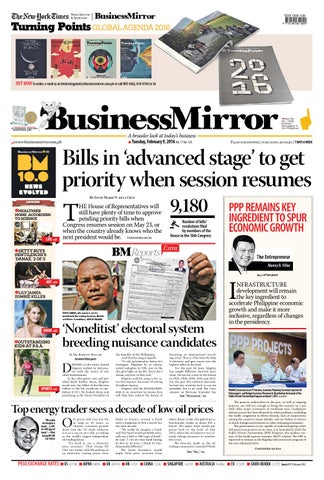
Bills in ‘advanced stage’ to get priority when session resumes
T
INSIDE
LIFE
A broader look at today’s business
B J M N. C
HE House of Representatives will still have plenty of time to approve pending priority bills when Congress resumes session on May 23, or when the country already knows who the next president would be. C A
9,180
Number of bills/ resolutions filed by members of the House in the 16th Congress
PPP REMAINS KEY INGREDIENT TO SPUR ECONOMI C CONOMI ECONOMIC GROWTH
BMReports
GETTY BUYS GENTILESCHI’S ‘DANAË,’ 2 OF 3
The Entrepreneur Manny B. Villar
ART
I
D4
LILY JAMES, ZOMBIE KILLER
EDDIE LLAMAS, who wants to run for president in the coming elections, files his certificate of candidacy. STEPHANIE TUMAMPOS
SHOW
D2
OUTSTANDING KIDS AT P.S.A.
‘Nonelitist’ electoral system breeding nuisance candidates B M R M
Second of three parts
D
SPORTS
C3
RESSED to the nines, Daniel Magtira walked in Intramuros with the stance of any other businessman. In his olive-green coat and polished black leather shoes, Magtira strode into the Office of the Election Officer to file his certificate of candidacy (COC). He looked sharp and promising as the future President of
the Republic of the Philippines. And then he sang a cappella. “O, tala ng kalawakan, buhay ko’y liwanagan. Pangarap ko sa tuwina, mahal mahagkan ka [Oh, star in the sky, give light on my life. Every day I dream, my love, to kiss you].” Magtira said his song is for actor Kris Aquino, the sister of exiting President Aquino. Magtira told the BusinessMirror in an interview he knows Kris will help him achieve his dream of
becoming an international recording artist. That is, if he wins the May 9 elections and gets sworn into the highest office in the land. For the past 24 years, Magtira has sought different electoral positions. He ran for a seat in the Senate in 1992, 1998, 2004, 2010 and 2013. For the past five national elections, he had also tried his luck to run for president, but to no avail. The Commission on Elections (Comelec) has S “N,” A
Top energy trader sees a decade of low oil prices “We really do imagine a band…a $40to-$60 type of band.”—Vitol Group BV CEO Ian Taylor
O
IL prices will stay low for as long as 10 years, as Chinese economic growth slows and the US shale industry acts as a cap on any rally, according to the world’s largest independent oil-trading house. “It’s hard to see a dramatic price increase,” Vitol Group BV CEO Ian Taylor told Bloomberg in an interview, saying prices were
PESO EXCHANGE RATES n US 47.7530
likely to bounce around a band with a midpoint of $50 a barrel for the next decade. “We really do imagine a band, and that band would probably naturally see a $40-to-$60 type of band,” he said. “I can see that band lasting for five to 10 years. I think it’s fundamentally different.” The lower boundary would imply little price recovery from
where Brent crude, the global price benchmark, trades at about $35 a barrel. The upper limit would put prices back to the level of July 2015, when the oil industry was already taking measures to weather the crisis. The forecast, made as the oil trading community’s annual IP Week S “O,” A
First of two parts
NFRASTRUCTURE development will remain the key ingredient to accelerate Philippine economic growth and make it more inclusive, regardless of changes in the presidency.
FINANCE Secretary Cesar V. Purisima, Economic Planning Secretary Cayetano W. Paderanga Jr. and Budget Secretary Florencio B. Abad during the launch of the Public-Private Partnership Program on March 7, 2011. BLOOMBERG
The projects undertaken in the past, as well as ongoing projects, are still not enough to bring the country on a par with other major economies in Southeast Asia. Inadequate infrastructure has been blamed for other problems, including the traffic congestion in Metro Manila; lack of connectivity among the country’s many islands; and our failure to attract as much foreign investments as other emerging economies. The government is not capable of undertaking big-ticket infrastructure projects on its own, so it launched in 2010 the Public-Private Partnership (PPP) Program, the modern version of the build-operate-transfer (BOT) scheme. The PPP is expected to remain as the flagship infrastructure program of the new administration. C A
n JAPAN 0.4092 n UK 69.6716 n HK 6.1331 n CHINA 7.2743 n SINGAPORE 34.2119 n AUSTRALIA 34.4862 n EU 53.5359 n SAUDI ARABIA 12.7375
Source: BSP (5 February 2016 )
BMReports BusinessMirror
A2 Tuesday, February 9, 2016
www.businessmirror.com.ph
Bills in ‘advanced stage’ to get priority when session resumes A Speaker Feliciano Belmonte Jr. said there are still many important measures that need to be approved by the 16th Congress, and this is what they intend to do from May 23 to June 10. “There’s still time to approve bills. Also, several bills will be tackled [when session resumes],” Belmonte said in a text message. Majority Leader and Liberal Party Rep. Neptali Gonzales II of Mandaluyong said their goal is to pass several bills that are already in the advanced stage. “We will approve bicameral committee reports and also bills already passed on third reading by the House and the Senate that either chamber would accept as its version,” Gonzales said, also in a
text message. Based on the legislative calendar, Congress sessions adjourned on February 3, as part of its preparation for the May national and local elections, and resume on May 23. This means legislators still have ample opportunity to approve bills after they have finished their works in the official canvassing of votes. Considered in the advanced stage that will be tackled at the resumption of sessions are the bicameral conference committee reports on the Strengthening the Balanced Housing Development Program; Amending Foreign Ownership Restrictions in Specific Laws Governing Adjustment Companies, Lending Companies, Financing Companies and Investment Houses Cited in The Foreign
Nuisance... constantly listed Magtira as a nuisance candidate. “Kapag sumuko ako, hindi kami makakapagpakasal ni Kris. Magpro-propose na nga ako eh [If I give up, Kris and I can’t get married. Actually, I’m already planning to propose to her].”
Mockery
THE Omnibus Election Code (OEC) of the Comelec defines a nuisance candidate as someone who files a COC “to put the election process in mockery or disrepute or to cause confusion among the voters by the similarity of the names of the registered candidates or by other circumstances or acts.” Likewise, the OEC said these acts “clearly demonstrate that the candidate has no bona fide intention to run for the office for which the certificate of candidacy has been filed, and thus prevent a faithful determination of the true will of the electorate.” Magtira, along with 123 other individuals, was declared as a nuisance candidate. Out of the 321 who were eyeing national positions, 205
A
were shunned by the Comelec from participating in the 2016 elections. Prospero de Vera, a political analyst from the University of the Philippines, explained that because the qualifications for presidency are easy to file, a lot of people think that it’s okay for them to file for candidacy. “When people are very frustrated about their lives, about the condition of the country, they don’t see dramatic changes,” de Vera said. “A lot of people vent their anger by saying that they could be the one to solve the problems of the country.” In the Philippines, the requirements needed to run for president include being a natural-born citizen of the country. Likewise, he or she should be a registered voter, is able to read and write, at least 40 years old on election day and a resident of the Philippines for at least 10 years immediately preceding the election. This makes it easier for a Filipino, compared to applying for a job.
Bond
RUNNING for presidency in the
Investment Negative List, except those in the Constitution; Modernizing the National Bureau of Investigation; Banning the Reappointment of a Regular Member of the Judicial and Bar Council who has already served two full terms; and Speed Limiters in Public Utility Vehicles. These proposals are now awaiting ratification by the House when sessions reconvene in May. On the other hand, measures still pending in the bicameral are the proposed Salary Standardization Law 4; increase in the prescriptive period for graft and considered corrupt practices from 15 years to 20 years; establishing the Philippine Trade Representative Office; and institutionalizing the national implementation of the Jobstart Philippines Program.
Philippines does not require a barangay clearance, police clearance or NBI clearance. It needs no academic transcript of records or diploma and no bank certification of deposits. Before the May 2013 elections, the Comelec raised the notion that aspirants should be able to raise a P1-million “candidate bond” to discourage nuisance filers. De Vera does not agree with the notion because it requires a financial requirement for voting. “If you require a bond, what is that, a penalty for you to become serious?” De Vera said the money could not measure the capacity of a candidate. “The capacity is measured by your [ability] to launch a nationwide campaign.” He explained that the candidate should be able to have groups that will support him during his campaign. The candidate should have people who would be able to accommodate him as he goes around the country to address issues and converse with potential voters. “The good thing about it is that the Comelec has a system that weeds out who are serious or not in public
Processed measures
THE House of Representatives processed a total of 3,126 measures from July 22, 2013, to February 2, 2016, based on statistics from the House Committee on Rules submitted to Belmonte by the House secretary-general after adjournment of session last week. In a statement, House Secretary-General Marilyn Barua Yap said an average of 16 measures were processed per session day during the first, second and third regular sessions of the 16th Congress, or a total of 191 session days. “Of the total 3,126 measures processed, a total of 1,097 bills/resolutions where approved. Statistics showed that a total of 117 bills were enacted into law—74 of national significance, 38 of local scope and five joint resolutions. The House also
service,” Dennis C. Coronacion, University of Santo Tomas Department of Political Science chairman, told the BusinessMirror. “I think [one of the Comelec’s] requirements for a presidential candidate is that you have enough resources and that you have a party that has a nationwide scope.” According to Coronacion, it may as well be an indication that the political system is not limited, that the electoral system is open to all people with different backgrounds. Nevertheless, this also indicates the weakness of the 1987 Constitution. “I think there are more nuisance candidates now because you see a very rapid decline in the impact of parties of presidential candidates,” de Vera said.
Peculiar
NOT all nuisance candidates appeared as peculiar as Magtira. A man in a checkered polo walked in the next day in October last year to file his candidacy. He was Florencio Orquilla and he wants to save his fellow 30 million farmers. There was also Alejandro Ignacio. Sporting a thinning gray hair and crooked teeth, his appear-
ratified bicameral reports on 10 national bills, adopted the Senate version of 14 national bills and one local bill, aside from concurring with Senate amendments to nine national and 44 local bills,” she said. The House also noted that the Senate passed without amendments four national and 38 local measures that originated from the lower chamber. It was able to process and approve on final reading and transmit to the Senate for proper consideration some 543 measures (221 of national scope, 313 local and nine joint resolutions), Yap added. Overall, she said, members of the House have filed a total of 9,180 measures (6,448 bills and 2,732 resolutions). Of these measures, 3,126 were processed and 1,097 were approved.
ance appealed to the crowd at the Comelec during the day for filing of COCs last year: that only an ordinary citizen like him can alleviate the poverty in the country. With tears building up at the corner of his eyes, Ignacio said he is “clean” and “honest,” implying that other candidates are “dirty” and “liars.” Meanwhile, chemical engineer and senatorial aspirant Victor Quijano expressed his promise to implement a federal system of government to equally distribute power and finances. Quijano said doing so would allow the national government to focus more on foreign policy and national security. “When you say nuisance candidates it’s a mixture of serious na wala lang resources and ’yung mga seryoso na nangloloko lang,” Coronacion said. Their common denominator is they don’t have the resources, a political party to back them up and the connections, he added. “But some of them really want change.” Coronacion said it would be very interesting to see one serious but penniless candidate to win a post in the May elections.
Oil...
A gathering starts in London on Monday, would mean oil-rich countries and the energy industry would face the longest stretch of low prices since the 1986-to-1999 period, when crude mostly traded between $10 and $20 a barrel. Vitol trades more than 5 million barrels a day of crude and refined products—enough to cover the needs of Germany, France and Spain together—and its views are closely followed in the oil industry. Taylor, a 59-year-old tradercum-executive who started his career at Royal Dutch Shell Plc. in the late 1970s, said he was unsure whether prices have already bottomed out, as supply continued to outpace demand, leading to ever higher global stockpiles. However, he said that prices were likely to recover somewhat in the second half of the year, toward $45 to $50 a barrel. For the foreseeable future, Taylor doubts the oil market would ever see the triple-digit prices that fattened the sovereign wealth funds of Middle East countries and propelled the valuations of companies such as Exxon Mobil Corp. and BP Plc. “You have to believe that there is a possibility that you will not necessarily go back above $100, you know, ever,” he said. The problem is that “there is so much more supply” while the global economy is more efficient in consuming crude. On top of that, Iran is returning to the market and growth in emerging markets, the biggest engine of oil demand, is slowing. “China has changed,” he said. Oil prices plunged after the Organization of Petroleum Exporting Countries (Opec) in November 2014 diverged from its traditional policy of adjusting supply to manage prices, announcing it would maintain output to defend its position in the market. The group formally dropped any production limits last December, boosting output and intensifying a price war against higher-cost producers, including US shale operations, the North Sea, Canada’s tar sands, and deep-water discoveries in Brazil and Angola. Taylor said there could be an agreement between Opec and nonOpec countries, like Russia, to cut production. “It’s probably slightly against, 60-40 against, but it’s a real possibility,” he said, While the price slump has hurt oil producers, independent traders, such as Vitol and its competitors Trafigura Group Pte., Glencore Plc., Gunvor Group Ltd., Castleton Commodities International Llc. and Mercuria Energy Group Ltd., are profiting from the increase in volatility. These companies also benefit from a market structure called contango—where forward prices are higher than current costs. This allows traders to buy oil, store it in tanks and use derivatives to lock in a higher selling price for a later date. Taylor said that Vitol, which celebrates its 50th anniversary this year and is owned by its employees, would report net income in 2015 above the $1.35 billion it earned in 2014. However, he said the company wouldn’t match the record of nearly $2.3 billion of 2009. Taylor said the company, which doesn’t publicly release its profit, planned to take write-downs in its exploration and production business, and make provisions against customers defaulting on contracts. The company, formally based in Rotterdam, has its major trading floors in London, Geneva, Singapore and Houston. Bloomberg News
BMReports BusinessMirror
Tuesday, February 9, 2016 A3
ERC has two weeks to review rules preventing abuses in power industry
T
B L L
HE Energy Regulatory Commission (ERC) has started reviewing the rules on cross ownership and market-share limitation rules following the muchawaited inputs submitted by the Philippine Electricity Market Corp. (PEMC) and the Grid Management Committee (GMC) as part of the initiative to prevent market abuse and anticompetitive schemes in the power industry.
The review will take a couple of weeks, ERC Chairman Jose Vicente Salazar said in a text message. During the review, the agency will determine if there is a need to revise these rules. Salazar said the modified rules would prevent anticompetitive behavior and market abuse by certain power companies. “With respect to market-share limitations, the commission already received the recommendations of GMC and PEMC. The commission will decide in the coming weeks on the proposed revisions of the rules on MSL,” Salazar told the BusinessMirror. PEMC is the operator of the Wholesale Electricity Spot Market. GMC, meanwhile, is a unit under the ERC. Salazar said PEMC and GMC “are just going to be treated as resources because the decision would still be made by the ERC. We are discussing these things with PEMC and GMC. We want to know the implications when we implement the options that are presented to us.” Salazar refused to disclose the contents of the recommendations
17,585.17 MW
Total installed generating capacity in the country in 2015, up from 15,832 MW in 2014 drafted by PEMC and GMC, as “it could preempt the decision of the commission.” Section 45 (a) of the Electric Power Industry Reform Act provides that “no company or related group can own, operate or control more than 30 percent of the installed generating capacity of a grid and/or 25 percent of the national installed generating capacity.” “The commission gave instructions to key offices of the ERC for the determination of the most optimal percentage,” he said when asked what is the ideal limit being considered by the ERC. While Epira allows generation companies (gencos) or distribution utilities (DUs) from participating in the transmission sector, crossownership between a genco and a DU is allowed. As a safeguard to abuse though, the law prevents
A GEOTHERMAL power plant in Mindanao
DUs from sourcing more than 50 percent of their total power demand from bilateral contracts with their affiliated gencos. “Completely disallowing crossownership between a DU and a genco might prove to be too much of a barrier to investment and entry into the market, and could also cause privatization to become more difficult,” according to a policy brief by the Senate Economic Planning Office. Instead of completely disallowing cross ownership, the Senate said the caps on bilateral contracts and gridcapacity ownership could be enough to promote competition in the power sector. Nonetheless, the ERC’s au-
thority plays an important role in discouraging possible market abuse. “In the end, however, grid caps and bilateral caps can only do so much and there is still no substitute for good regulation and strong antitrust and antimonopoly enforcement which should be the job of a truly strong and independent ERC,” the Senate added. Every year the ERC sets generation-capacity limits for power generators. The limit could be calculated based on the installed generating capacity (IGC), which refers to the sum of the maximum capacities of the generation facilities connected to a transmission or
Globe reports 23% hike in 2015 profit B L S. M
R
ECORD-BREAKING revenues driven by solid growth in data consumption brought Globe Telecom Inc.’s bottomline to an all-time high of P16.5 billion in 2015, a 23-percent spike from the P13.4 billion recorded the year prior, a filing to the stock exchange showed. The growth in Globe’s net income takes into consideration onetime gains coming from the sale of its 51-percent equity stake in Yondu Inc. and the acquisition of a 98.6-percent stake in Bayan Telecommunications Inc. Globe’s core net income—which strips off onetime gains and losses—grew by 4 percent to P15.1 billion in 2015 from P14.5 billion in 2014. In the same comparative periods, consolidated revenues of the company rose by 15 percent to P113.7 billion from P99 billion, while total operating expenses rose by a slower 14 percent to P67.9 billion from P59.8 billion. Globe has consolidated its financial statement with that of Bayan starting the second half of 2015. “The sustained revenue trajectory was driven by the solid growth in data consumption across all segments and the consolidation of the performance of Bayan in the second half of the year. The robust subscriber growth for both mobile and broadband, the increasing demand for mobile data and high-speed Internet connectivity for consumer and corporate clients, as well as the sustained execution excellence for the various product launches during the year, have paved the way for Globe’s continued success,” the disclosure read.
₧15.1B
Globe’s core net income, which excludes onetime gains and losses, in 2015 The company’s top line was largely driven by its mobile business, which grew 9 percent year on year to P85.1 billion from P78.1 billion. The sustained upsurge in mobile-data revenues led to the mobile business’s continued growth trajectory. Mobiledata service revenues reached P22.1 billion in 2015, 55 percent higher than the P14.3 billion reported a year ago. At t he end of December 2015, Globe’s mobile subscriber base further breached the 50-million milestone, reaching 52.9 million, up a robust 20 percent from the 44 million subscribers reported in 2014. This was driven by the record-level gross acquisitions during the year and lower churn rates in both prepaid brands. The company’s fixed line data business, likewise, improved year on year by 40 percent to reach P7.7 billion in 2015 from the P5.5 billion posted in 2014, as demand for data connectivity continues to surge, impacting customer expansion, circuit count increase and higher usage. The strong demand for Internet and domestic leased lines, as well as cloudcomputing solutions, contributed to the revenue growth in the fixed data business. The growth was, likewise, driven
by the impact of consolidating Bayan’s fixed line data revenues starting the third quarter of 2015. “We made history again in 2015, as Globe delivered a banner year, closing 2015 with record revenues, Ebitda and net income. We have proven year after year our strong commitment to create and deliver value for our customers and shareholders. Our latest achievements continue to motivate us to be more efficient, focused and ready to take on new challenges in the years ahead.” Globe President and CEO Ernest L. Cu said in the filing. Globe spent around P32.1 billion in capital expenditures as of endDecember 2015 to support the growing subscriber base and its demand for data. Of the total capital expenditures spent this year, close to half was for the data service needs of its customers. To date, Globe has a total of 28,336 base stations, with over 18,300 for 4G1, to support the service requirements of its customers. “As we foresee an increasingly challenging competitive landscape moving forward, we will continue to strengthen our leadership in the digital space, gearing all our efforts toward uplifting the state of Internet services in the country and fortifying the Globe brand as a whole to be the customer’s first choice for all their data needs,” Cu said. Globe has set an $800-million capital for 2016, bulk of which would be devoted mostly to enhancing bandwidth capacity “to enable us to stay ahead of the curve amid growing proliferation of smartphone and data-intensive multimedia applications.”
distribution system in a grid. The national grid has a total of 17,585.17-megawatt (MW) IGC in 2015 from 15,832 MW a year ago in 2014. In Luzon, last year’s IGC was at 13,057.76 MW from 12,041.42 MW in 2014. The Visayas has 2,363.69 MW from 1,827.29 MW in 2014. Mindanao’s IGC rose to 2,163.72 MW from 1,963.65MW in 2014. Based on existing rules, a genco could only corner 30 percent of the total IGC on a per-grid basis. Thus, if the rule is applied, the limit for Luzon this year is at 3,917.327 MW of IGC; 709.107 MW for the Visayas grid; and 649.115 MW for the Mindanao grid.
If the operation of a genco is concentrated in one particular grid, it is allowed to own 25 percent, or 4,346.291 MW, of the national grid’s total IGC. “The ERC determines and adjusts the installed generating capacity and the market-share limitation yearly to ensure a competitive generation sector in the electric power industry that promotes and protects consumer interests,” former ERC Chairman Zenaida Ducut said in the resolution she signed. Salazar replaced Ducut. The next adjustment will be implemented in March. To date, the ERC said no genco has violated the MSL.
BOC asks banks to operate Saturdays
T
When the clearing process is fast, prices will go down. Traders and importers don’t have to pay storage, for instance. These are savings. If you save these things, prices go down and benefit consumers.”—Lina
HE Bureau of Customs (BOC) urged banks on Monday to extend their business hours and operate even on weekends to service people in the trade business whose peak operating days are weekends when the truck ban is lifted. “I talked to the Bankers Association of the Philippines and said the businessmen really need help, for the banks to remain open on Saturdays so transactions clear and shipments pull out on Sunday,” Customs chief Alberto D. Lina said. Lina estimated if banks were open on Saturdays, clearing would be faster and the agency release maybe 10,000 containers on one day. At present, the BOC releases an estimated 2,000 containers a day. “This is because it will make the turnaround time faster because on Sundays there is no truck ban, right? So everything will be quicker. We would like to maximize the turnaround time on Sunday and early Monday morning up to lunch time,” Lina said. Lina also said he already talked with some bank officers and some already
agreed to have Saturday operations. But even then, such operations are not as extensive as exporters like given the extent of their weekend activities. “Sometimes, the problem is when Customs staff are already there by about 7 a.m. but the banks are still closed. If we open at 7, the banks should also open at 7. If we close at 7, the bank should close at 7,” Lina said. He quickly added if the various banks want to help the industry and the country, they should “operate from 7 to 7. Singapore has 24-hour banking and that is why trade in Singapore is faster.” The commissioner, likewise, said should the overall Customs clearing time is reduced, such will eventually result to lower prices of imported goods in the markets. “When the clearing process is fast, prices will go down. Traders and importers don’t have to pay storage, for instance. These are savings. If you save these things, prices go down and benefit consumers,” Lina said. The commissioner also said that port congestion could, eventually, ease. Bianca Cuaresma
A4
BMReports BusinessMirror
Tuesday, February 9, 2016
news@businessmirror.com.ph
DFA’s del Rosario expected to publicly announce resignation on Wednesday
F
B R M
OREIGN Secretary Albert F. del Rosario is reportedly set to officially announce his plan to quit the Aquino Cabinet on Wednesday due to health reasons, inside sources at the Department of Foreign Affairs (DFA) said on Monday. The inside sources, who insisted anonymity, said the 76-year-old del Rosario has been suffering from a spinal ailment “that would have crippled a regular guy.” But even before del Rosario could announce his departure from the Cabinet, a brief Palace statement said that President Aquino has accepted the resignation of the country’s top diplomat. “According to Executive Secretary Paquito Ochoa, President Aquino has accepted the resignation of Foreign Affairs Secretary Albert F. del Rosario effective 7 March 2016,” a news statement released by the office of Presidential Communications Secretary Herminio B. Coloma Jr. on Monday evening said. Asked to comment on the report, Foreign Affairs Spokesman Charles Jose said, “[It would be] better for SFA [Secretary of Foreign Affairs del Rosario] to announce it himself. He’ll meet the media on Wednesday.” Jose was referring to the invitation given to the members of the DFA press corps and the Foreign Correspondents Association of the Philippines for del Rosario’s annual get-together with the media on Wednesday on the 27th floor of the Constellation function room of the Diamond Hotel. “FYI [for your information], ang alam ko March,” texted a Malacañang media official who requested anonymity because he is not officially allowed to speak on the matter of del Rosario’s reported resignation plan. “I heard that, too, earlier, but I don’t have the last word. I heard [it
too] that P-Noy [President Aquino] wants him to stay a bit longer. Perhaps, my colleagues there would know better. Happy Lunar New Year,” Ambassador to Kuala Lumpur Eduardo Malaya said, when sought for comment. Del Rosario, at a meeting last November with a group of diplomatic reporters that include the BusinessMirror, who came to his office to greet him on his birthday, admitted that he had been suffering from a bad back, the result of a painful spinal problem that had been hounding him for the last two years. Earlier in May, he had a spinal surgery in the United States, which he admits was not so successful, hence the persistent pain. Coupled with this, the country’s top diplomat admits that a pacemaker had been installed to regulate the beating of his heart, thus, the marked slowness in his pace but not his sharp intellect. Del Rosario pointed out to the visiting media members the part of the back that was causing him pain, including the part of his chest where the pacemaker was installed. “The doctors operated me here,” he said, then installed the pacemaker here,” pointing to the left side of his chest. “But the pain has persisted, and I might go under the knife again. ” Del Rosario is scheduled to make a final trip abroad as foreign secretary when he attends the Asean-US summit on February 15 and 16 in Rancho Mirage, California, where he will accompany President Aquino. After the
DEFENSE Secretary Voltaire Gazmin (from left), Foreign Secretary Albert F. del Rosario and US Defense Secretary John Kerry is shown in this file photo. Palace and Department of Foreign Affairs sources say del Rosario may publicly disclose his plan to quit the Aquino Cabinet on Wednesday, ahead of the forthcoming May elections, due to a spine ailment.
According to Executive Secretary Paquito Ochoa, President Aquino has accepted the resignation of Foreign Affairs Secretary Albert F. del Rosario effective 7 March 2016,” a news statement released by the office of Presidential Communications Secretary Herminio B. Coloma Jr. on Monday evening said. summit, del Rosario will undergo another back treatment in the US, the sources added. Del Rosario has told Mr. Aquino of his plan to step down from his post due to health reasons, according to GMA News Online. H i s t ies w it h t he A qu i no family go way back to President Aquino’s mother, the late Corazon Aquino, whom he had accompanied on her state visits to the US. In 1991 the late President conferred the Philippine Army Award to del Rosario for his initiatives as chairman of the Makati Foundation Education. The online news report added that three reliable sources told them that Del Rosario has notified
senior diplomats at the DFA that he plans to leave his post as early as March and hand over the leadership to one of his deputies, Laura del Rosario, who is currently the undersecretary for international and economic relations. The two are not related. Del Rosario, the sources said, has informed the President of his decision to leave the top DFA post after five years, and is awaiting his go signal. Early on in his DFA post, del Rosario had been observed as a hands-on diplomat, traveling across the globe to look after the welfare of overseas Filipino workers (OFWs) in distress. He was responsible for filing the unprecedented case of
bringing a resurgent China before the International Tribunal of the United Nations Convention of the Law of the Sea in an attempt to stop them from claiming the entire West Philippine Sea (South China Sea). Del Rosario was responsible for the repatriation of large numbers of OFWs and residents trapped in conflict-torn Arab states like Libya and Syria. His frequent forays abroad had earned the DFA the moniker as “the department that never sleeps.” Del Rosario was proud of the fact that he was able to increase the funding for legal assistance to help distressed OFWs. Last year he discreetly negotiated with Indonesian officials to spare Filipino worker Mary Jane Veloso from imminent execution by firing squad earlier in the year. He backed Mr. Aquino’s quiet efforts to convince Indonesia’s top officials to save Veloso. The 30-year-old mother of two was among the nine foreign and local death-row prisoners, including Australians, scheduled to be executed by firing squad on April 29, 2015, for drug-related charges. All eight were executed, but Veloso was spared from death at the last minute. The Indonesian government ordered a stay in her
execution following President Aquino’s last-minute appeal to counterpart Jokowi Widodo to turn her into a witness. A highly successful businessman, del Rosario has been reported not to collect his monthly salaries since he assumed office in 2011. Every Christmas, he distributes his salary to the1,600 senior diplomats, officers and employees of the DFA as cash gifts. Del Rosario has told reporters he decided to set aside his businesses to serve in government out of his admiration for Mr. Aquino. He expressed his admiration for the President’s integrity on many occasions. He had initiated many reforms to ease the public burdens of dealing with the DFA, including the opening of dozens of DFA satellite offices in shopping malls to bring consular services, including passport applications, closer to the people. Del Rosario quietly resisted the entry into the DFA of personnel endorsed by politicians, bringing the number of those political appointees in the DFA at an alltime low during his watch. In lieu of the controversial practice, he promoted a merit-based promotion system, as attested by his spokesman, Charles Jose.
The magic formula that powered Japanese stocks is falling apart
F
OR Japanese investors, it must have seemed the equivalent of turning lead into gold. Unlike in the Middle Ages, the alchemy now relied on mixing central bank stimulus with a weakening yen to create rising profits and a stock market that soared to an eight-year high. But that was back in August, and the formula has since lost its potency. By one measure, earnings in the world’s third-largest stock market are poised to retreat more than 20 percent this quarter, and for the first time since 2012 more Japanese companies are missing forecasts than beating them. Meanwhile, the yen just staged its biggest weekly rally since 2009, even though the Bank of Japan (BOJ) surprised the world by cutting interest rates to below zero. “Whether it be quantitative easing or the weaker yen, the effect is getting smaller and smaller,” Ayako Sera, a Tokyo-based market strategist at Sumitomo Mitsui Trust Bank Ltd., which manages $453 billion. “The problem is that we’re not seeing excitement domestically. The fact that the global economy isn’t good is impacting Japanese earnings, too.” In many ways, Japan isn’t
alone. Evidence is mounting that central banks’ easy money policies are having less ability to give their economies—and asset prices—a boost. In the US Standard & Poor’s 500 Index companies are about to report the third consecutive quarter of declining income. Bank stocks in Europe are near a threeand-a-half year low as measures of risk in credit markets reach the highest since 2013. “We’ve entered a period of stagnation,” said Shinobu Yonezawa, a quantitative analyst at Mizuho Securities Research & Consulting Co. in Tokyo. “China has become an issue and oil prices tumbled at the end of last year, changing the landscape for corporate earnings.”
Hitachi tumbles
A JAPANESE casualty: Hitachi Ltd., which fell the most since 2011 last week after cutting its profit forecast 23 percent because of slowing China growth and plummeting oil. The Topix dropped 4.4 percent last week, unwinding all of its gains from the BOJ’s shock adoption of negative interest rates on January 29. Since Japanese equities tumbled more than 20 percent from a peak last month, rallies have faltered amid a global selloff
We’ve entered a period of stagnation. China has become an issue and oil prices tumbled at the end of last year, changing the landscape for corporate earnings.” —Yonezawa spurred by tumbling oil prices and concern about the outlook for the world’s biggest economies. The Topix rose 0.8 percent in Tokyo on Monday, after sinking as much as 1.7 percent.
Declining profits
FOR corporate profits, the consequences look bleak. Companies will post a 21-percent slide in net income in the three months through March, the biggest decline since the summer of 2012, according to figures compiled by Mizuho Securities on the nation’s largest firms excluding banks. The estimates are derived by comparing companies’ nine-month performances with full-year forecasts. Mizuho’s earnings-revision index, a measure of downgrades versus upgrades, dropped to minus 10.5 in January, the lowest since
November 2011, Yonezawa said. Of companies in the 1,934-member Topix that have reported earnings this quarter and for which Bloomberg had estimates, 52 percent have missed forecasts, the first time a majority have fallen short since the end of 2012. That compares with a year ago, when 67 percent topped projections, the data show. “Companies are losing their earnings momentum,” Yonezawa said. “Sectors impacted by lower commodity prices, such as steel, oil and trading houses, are facing the most difficulties.” T he To p i x M i n i n g i nd e x , which includes oil explorer Inpex Corp., is set for a 38 plunge in net income for the full year, Mizuho’s data show. Inpex reduced its full-year profit forecast by 26 percent on Thursday, more than analysts estimated.
China slowdown
HITACHI, which has businesses in everything from plants to consumer electronics, has seen the slowdown in China hit sales of construction machinery. It slashed its profit forecast for the year through March 31, disappointing analysts who had predicted an increase. Car parts maker Denso Corp. also lowered its estimate after changing its outlook due to a stronger yen. Some analysts say the yen’s impact is overstated, and that current levels aren’t yet too damaging for corporate earnings. Lower oil prices could also give a boost to consumer spending. Another bright spot for Japanese stocks are valuations, which are among the lowest in the developed market. The Topix traded last week at 13.7 times earnings, compared with 15.6 for the S&P 500 and 14.3 for Europe’s Stoxx 600 index. Yet, even bulls see reason for caution. Goldman Sachs Group Inc. strategist Kathy Matsui cited Japan as one of the brighter prospects among global markets, saying in a December report that dependence on yen weakness is a myth as currency sensitivity has declined. The next month Goldman cut its six-month Topix
target citing global macro turbulence, and said earnings disappointments are a key risk.
Consumer prices
JAPAN is struggling to achieve stable inflation, with core prices rising just 0.1 percent in December from a year earlier. The BOJ’s target is 2 percent. Industrial production fell more than expected the same month, as did imports, exports and household spending. Japan needs policies that will boost consumer spending to see a stock recovery, according to Norihiro Fujito, general manager of Mitsubishi UFJ Morgan Stanley Securities Co. in Tokyo. He sees limits to what the BOJ can do, and argues that there needs to be more effective government reform to put the economy back on the right path. “Abenomics isn’t easy,” said Sumitomo Mitsui’s Sera. “There’s nothing to show that we’ve had real reforms that have changed things from the core. There is no answer and there is no medicine. There’s so much uncertainty and it’s hard to pick the bottom for stocks. If the profit declines stop, then we’ll see money flowing back into Japanese stocks again.” Bloomberg News
AseanTuesday BusinessMirror
news@businessmirror.com.ph
Suspect in the murder of dismembered Spaniard arrested in Cambodia
A
SPANISH man who is the prime suspect in the gruesome murder of a fellow Spaniard was arrested in Cambodia, where he is believed to have fled after the victim’s dismembered body was recovered piece by piece from Bangkok’s Chao Phraya River, police said on Monday. The suspect, identified as Artur Segarra Princep, 36, was arrested on Sunday evening at a restaurant in the Cambodian coastal town of Sihanoukville where he had checked into a guesthouse a few days earlier, the regional police chief Gen. Chuon Narin said. “We received a request from Thai police to arrest this man and, after launching an investigation, we found him,” Chuon Narin said. “We will hand him over to Thailand.” Thai police have identified the victim as David Bernat of Spain, who was described as a consultant. They have speculated that he was abducted, tortured and forced to transfer a large amount of money before being killed. Thai police sent a helicopter to Cambodia on Monday to try to expedite the suspect’s return, said a senior Thai police official in Bangkok who attended a meeting at Bangkok police headquarters on the murder case. He spoke on condition of anonymity because he was not authorized to speak
to the media. Senior Thai police met on Monday in Bangkok about the murder case. An official at the meeting said a helicopter was sent to Cambodia. Thai police have declined to publicly comment on media reports of large transfers of money from Bernat’s bank account to accounts in Spain and Singapore. Police had obtained records showing that Segarra had withdrawn money from automated teller machines in the area as recently as Thursday, and also had video of him with an unidentified woman and in a black Isuzu pickup truck. Immigration police said Segarra has visited Thailand frequently, but his latest visa expired late last year. Records show that Bernat also visited Thailand many times, arriving most recently on January 19 on a flight from Iran. He was last seen alive leaving his Bangkok apartment on January 20. Medical examiners said they believe he died between January 25 and January 27, with the cause being suffocation. Thai media reports over the weekend said that Segarra’s motorcycle was found at the Thai border, and a Thai woman described as his girlfriend was quoted saying that he fled Bangkok after seeing his picture on Thai television news reports. AP
THIS February 7 photo provided by Cambodia’s Sihanoukville Police shows Artur Segarra Princep, 36, a Spanish man suspected of murder, at the Sihanoukville police station, southwest of Phnom Penh, Cambodia. A Spanish man who is the prime suspect in the gruesome murder of a fellow Spaniard was arrested in Cambodia, where he is believed to have fled after the victim’s dismembered body was recovered piece by piece from Bangkok’s Chao Phraya River, police said on Monday. AP
Myanmar’s next president to be known on March 17
IN this January 4, 2015, photo, Myanmar President Thein Sein travels in an open vehicle inspecting officers and military hard-wear during a ceremony to mark Myanmar’s 67th anniversary of Independence in Naypyitaw, Myanmar. The new era dawns on April 1, 2016, when Aung San Suu Kyi’s National League for Democracy, which captured nearly 80 percent of the contested parliamentary seats, takes over power from a military-dominated regime and attempts to shed decades of political oppression, civil war and economic ruin in this resource-blessed Southeast Asian nation once hailed as the continent’s rising star. AP
T
HE names of Myanmar’s next president and two vice presidents will be revealed on March 17, an official said on Monday, setting a clear timeline for the transition of power from a military-controlled government to democracy icon Aung San Suu Kyi’s party.
Parliament Chairman Mann Win Khaing Than announced that the upper house, the lower House and the military will have to select one candidate each for the three posts before March 17, and submit them to parliament on that day. While Suu Kyi herself is barred from becoming president, there are growing signs that her talks with the military to remove a constitutional hurdle blocking her path can be completed by March 17. Once the three names are put before the 664-member parliament, all members will take a vote. The person with the largest number of votes will become president, and the other two will be vice presidents. It isn’t clear when the vote will take place, but the current president’s term ends on March 31 and the successor must take office on April 1. Given that Suu Kyi’s National League for Democracy (NLD) party has a majority in both houses of
Big C sale adds another $3.5B to Asean M&A deals
C
ASINO Guichard-Perrachon SA agreed to sell its stake in Thai supermarket chain Big C Supercenter Pcl. for €3.1 billion ($3.5 billion) to reduce borrowings after short-seller Carson Block attacked the French retailer’s accounting for allegedly understating its debt. TCC Holding Co., controlled by Thailand’s richest man Charoen Sirivadhanabhakdi, agreed to buy the controlling stake for 252.88 baht a share, Casino said in an e-mailed statement on Sunday. The offer is 11 percent higher than the Thai grocer’s February 5 closing price and represents a 28-percent premium to January 14, just before Casino said it planned a sale. Big C shares jumped 9.3 percent to 248 baht at 10:44 a.m. on Monday in Bangkok, poised for the highest close in a year. The deal cuts Casino’s debt in half and puts it well on track to reach its goal of raising €4 billion through asset sales this year, CFO Antoine Giscard- D’Estaing said. Casino is “very confident that it can execute the debt- reduction plan
completely or even exceed the goal,” Giscard-D’Estaing said in a phone interview. Block’s Muddy Waters Llc. has said that Casino is using financial engineering to mask a sharply deteriorating core business. It also said Standard & Poor’s (S&P) has understated the retailer’s “dangerously” high debt burden. Casino has rejected the claims, saying it has a solid financial structure and that it may take legal action against Muddy Waters.
Asian M&A
THE deal adds to the $50.6 billion of acquisitions in Southeast Asia over the past 12 months. Big C runs more than 700 stores, ranging from hypermarkets to convenience shops. Berli Jucker Pcl., a Thai consumer goods distributor controlled by Charoen, surged 15 percent in Bangkok trading on Monday to 38 baht, on track for the biggest gain since June 2010. Univentures Pcl., a property developer part-owned by the billionaire, rose 4.9 percent, while Charoen-backed Golden Land
Editor: Max V. de Leon • Tuesday, February 9, 2016 A5
Property Development Pcl. gained 5.7 percent. The French retailer said the transaction will reduce debt by €3.3 billion, including Big C’s borrowings. Casino said it expects to complete the transaction by March 31. Central Group, backed by Thailand’s Chirathivat family, had also been weighing a bid for the stake, people with knowledge of the matter said last month. TCC, controlled by Thailand’s richest man, agreed last year to buy Metro AG’s Cash & Carry wholesale business in Vietnam for €655 million. The conglomerate acquired control of Singapore food and beverage maker Fraser & Neave Ltd. in 2013. S&P said last month Casino’s “BBB-” long-term rating is on negative watch as its profitability will continue to be fairly weak for an extended period of time and its debt levels, primarily located at the French operations, are too high. The rating may be cut as much as two levels, according to S&P. Bloomberg News
644 next president
Members of Myanmar’s parliament that will choose the
parliament, it is certain to get the president’s post and one of the vice presidential positions. The NLD won a landslide victory in the November 8 general elections. But Suu Kyi has been stymied by the
Constitution’s Article 59 (f), which says anyone with a foreign spouse or children cannot hold the executive office. Suu Kyi’s late husband was British as are her two sons. Still, she has been negotiating with commander-in-chief, Gen. Min Aung Hlaing, on having the clause suspended. The clause can be legally scrapped only through a 75 percent plus one vote in Parliament. The military holds 25 percent of seats in parliament—all unelected— which means the NLD cannot scrap the clause on its own. However, the clause can be suspended by a simple majority, but because all this is uncharted territory nobody is sure if that would be allowed. In separate but identical broadcasts late Sunday, Sky Net and Myanmar National Television, both progovernment, said “positive results could come out on the negotiation for the suspension of the constitution Article 59 [f].” “I think everything will be fine,” Kyaw Htwe, a senior member of the NLD, told the Associated Press. “The negotiations will be positive for our leader Aung San Suu Kyi to become president,” said Kyaw Htwe, who is also a member of parliament. But Yan Myo Thein, a political analyst, advised caution. “It is still too early to confirm that Suu Kyi will be among the presidential candidate,” he said. “Even the
suspension and the constitutional amendment will take time. And we cannot really comment relying only on a short announcement on TV,” he said. Suu Kyi has said previously that even if she doesn’t become the president she would run the country from behind the scenes. But clearly, the NLD would prefer that the 70-yearold Nobel peace laureate lead the country, having struggled almost all her adult life for it. On Monday Suu Kyi entered the parliament without commenting to the media. Watching the joint session of parliament as an observer was influential former general Shwe Mann, the former speaker of the lower house in the outgoing government and now a Suu Kyi ally. He is believed to be supportive of a constitutional change and is thought to be trying to broker a deal to allow her to become president. Myanmar was ruled with an iron fist by the military for 50 years until it stood back in 2010 to allow a quasi-civilian government to take over. In that time Suu Kyi was their chief adversary, defying them even while under house arrest for many years. The enmity still lingers, but the generals are thought to have invested too much in putting the country on the path to a civilian government to risk a pull back now. AP
The W
Business
A6 Tuesday, February 9, 2016 | Editor: Lyn Resurreccion
UN condemns NoKor missile launch, pledges significant new sanctions
S
EOUL, South Korea—The United Nations Security Council condemned North Korea’s launch of a long-range rocket that world leaders called a banned test of ballistic missile technology and another “intolerable provocation.” The UN’s most powerful body pledged to quickly adopt a new resolution with “significant” new sanctions. North Korean leader Kim Jong Un went ahead with the launch just two hours after an eight-day window opened early Sunday, and a month after the country’s fourth nuclear test. He ignored an appeal from China, its neighbor and important ally, not to proceed, and in another slap to Beijing, he chose the eve of the Chinese New Year, the country’s most important holiday. In a reflection of heightened hostilities between the rival Koreas, South Korea’s Defense Ministry said a South Korean naval vessel fired five shots into the water as a warning on Monday when a North Korean patrol boat briefly moved south of the countries’ disputed boundary line in the Yellow Sea. Since its January 6 nuclear test, which the North claimed was a powerful hydrogen bomb, despite outside skepticism, China and the United States have been negotiating the text of a new Security Council sanctions resolution. North Korean rocket launches and nuclear tests are seen as crucial steps toward Pyongyang’s ultimate goal of a nuclear-armed missile that could hit the US mainland. At the UN, the US, backed by its allies Japan and South Korea, wants tough sanctions reflecting Kim’s defiance of the Security Council. But diplomats say China, the North’s key protector in the council, is reluctant to impose economic measures that could cause North Korea’s economy to collapse—and a flight of North Koreans into China across their shared border. T h e 1 5 - m e m b e r S e c u r it y Council strongly condemned the launch and pledged to “expeditiously” adopt a new resolution with “further significant measures”—UN code for sanctions.
The word “robust” referring to the measures was in an initial draft, but was dropped in the final statement. US Ambassador Samantha Power told reporters that “it cannot be business as usual” after two successive North Korean acts that are “hostile and illegal.” “What’s important is that the Security Council unites,” Power said. “China is a critical player.... We are hopeful that China, like all council members, will see the grave threat to regional and international peace and security, see the importance of adopting tough, unprecedented measures, breaking new ground here, exceeding the expectations of Kim Jong Un.” However, China’s UN ambassador Liu Jieyi made clear that unprecedented sanctions aren’t Beijing’s priority. He said a new resolution should “do the work of reducing tension, of working toward denuclearization [of the Korean peninsula], of maintaining peace and stability, and of encouraging a negotiated solution.” “I believe the council needs to work together for a new resolution,” Liu added, indicating that China may want negotiations with the US to be widened. Russia’s UN Ambassador Vitaly Churkin, whose country is also a North Korean ally, said: “It has to be a weighty resolution, but it also has to be a reasonable resolution” that doesn’t lead to North Korea’s economic or humanitarian collapse, or further heighten tensions. Russia’s goal is to see six-party talks aimed at denuclearization resume, he said, but in the current atmosphere that’s unlikely because the North Koreans “have been very unreasonable” and are challenging the entire international community.
“We think this is wrong for their national interests...for the Korean Peninsula...for the region,” Churkin said. North Korea, which calls its launches part of a peaceful space program, said it had successfully put a new Earth observation satellite, the Kwangmyongsong 4, or Shining Star 4, into orbit less than 10 minutes after liftoff, and vowed more such launches. A US official said it might take days to assess whether the launch was a success. Japan’s UN ambassador Motohide Yoshikawa told reporters the missile, which went over Japan and landed near the Philippines, was “a clear threat to the lives of many people.” The Security Council underscored that launches using ballistic missile technology, “even if characterized as a satellite launch or space launch vehicle” contribute to North Korea’s development of systems to deliver nuclear weapons and violate four Security Council resolutions dating back to the North’s first nuclear test in 2006. North Korea under Kim Jong Un has pledged to bolster its nuclear arsenal unless Washington scraps what Pyongyang calls a hostile policy meant to collapse Kim’s government. In a development that will worry both Pyongyang and Beijing, a senior South Korean Defense Ministry official, Yoo Jeh Seung, told reporters that Seoul and Washington have agreed to begin talks on a possible deployment of the THAAD missiledefense system in South Korea. North Korea has long decried the 28,500 US troops stationed in South Korea, and Beijing would see a South Korean deployment of THAAD, which is one of the world’s most advanced missiledefense systems, as a threat to its interests in the region. In a statement, North Korea’s National Aerospace Development Administration, in typical propaganda-laden language, praised “the fascinating vapor of Juche satellite trailing in the clear and blue sky in spring of February on the threshold of the Day of the Shining Star.” Juche is a North Korean philosophy focusing on self-reliance; the Day of the Shining Star refers to the February 16 birthday of Kim Jong Un’s father, former dictator Kim Jong Il. North Korea has previously staged rocket launches to mark important anniversaries.
IN this image released by Japan’s Kyodo News agency, an unidentified object is photographed in the sky from Dandong, China, near the North Korean border on Sunday at the same time a North Korea rocket was allegedly launched. North Korea on Sunday defied international warnings and launched a long-range rocket that the United Nations and others call a cover for a banned test of technology for a missile that could strike the US mainland. MINORU IWASAKI/KYODO NEWS VIA AP
The global condemnation began almost immediately. South Korean President Park Geun-hye called the launch an “intolerable provocation,” saying the North’s efforts to advance its missile capabilities were “all about maintaining the regime” in Pyongyang and ignored the hardships of ordinary North Koreans. US Secretary of State John F. Kerry called the foreign ministers of South Korea and Japan and reaffirmed the US’s “ironclad commitment to the security and defense” of its allies, the State Department said. The Foreign Ministry in China expressed “regret that, disregard-
ing the opposition from the international community, the [North] side obstinately insisted in carrying out a launch by using ballistic missile technologies.” Noting China’s pivotal role in negotiating a new Security Council resolution, Britain’s Deputy UN Ambassador Peter Wilson said: “ Today is Chinese New Year’s eve and if I was a senior Chinese official, I would be pretty annoyed at what’s been happening here. I know what I feel like when I’m dragged out of bed on a major national holiday.” Kim Jong Un has overseen two of the North’s four nuclear tests and three long-range rocket
launches since taking over after the death of his father in late 2011. The UN Security Council prohibits North Korea from nuclear and ballistic missile activity. Experts say that ballistic missiles and rockets in satellite launches share similar bodies, engines and other technology. “If North Korea has only nuclear weapons, that’s not that intimidating. If they have only rockets, that’s not that intimidating, either. But if they have both of them, that means they can attack any target on Earth. So it becomes a global issue,” said Kwon Sejin, a professor at the Korea Advanced Institute of Science and Technology. AP
Finland lashes out at ‘suboptimal’ migrant-crisis response by Europe
F
ECUADORIAN President Rafael Correa (right) talks with Turkish President Recep Tayyip Erdogan as they meet in Quito, Ecuador, on February 4. Erdogan is in Ecuador as part of his Latin America tour that also includes Chile and Peru. AP/DOLORES OCHOA
Erdogan: US should choose between Turkey, Kurdish forces
A
NKARA, Turkey—Turkey’s president lashed out at the United States a week after President Barack Obama’s envoy visited a northern Syrian town that is under the control of Syrian Kurdish forces, which Ankara considers terrorists. In comments published on Sunday, President Recep Tayyip Erdogan said Washington should choose between Turkey and the Kurdish Democratic Union
Party, or PYD, as its partner. That came after envoy Brett McGurk’s visit to Kobani, where the PYD’s military wing, aided by US-led air strikes, drove back Islamic State militants a year ago. Turkey considers the PYD a terrorist group because of its affiliation with Turkey’s outlawed Kurdistan Workers’ Party, or PKK. Erdogan said: “How can we trust you? Is it me that is your partner or is it the
terrorists in Kobani?” In Washington, a State Department spokesman reiterated the long-standing US policy that considers the PKK “to be a terrorist organization.” “We continue to call on the PKK to immediately cease its campaign of violence. A resumed political process offers the best hope for greater civil rights, security, and prosperity for all the citizens of Turkey,” Clay of the State Department said. AP
INNISH Finance Minister Alexander Stubb urged European Union members to keep their borders open and work together to tackle the region’s biggest influx of refugees since World War II. “We should be looking for European solutions, not national solutions—and by this I mean we need more integration, not less integration,” Stubb said in an interview in Helsinki. “The intergovernmental methods that we are using—erecting walls, closing borders, refusing to share the burden, refusing to increase funding - lead to suboptimal results.” Stubb’s appeal comes against the backdrop of Sweden, Denmark and other EU countries reinstating border controls and German Finance Minister Wolfgang Schaeuble warning that the passport-free movement of people and goods throughout the region—known as the Schengen area—is on the
verge of collapse. The Nordic countries are also moving toward the possibility of a regional border as they try to coordinate their efforts to contain the influx of migrants coming from the Middle East and Northern Africa. Stubb joined Germany, which took in more than 1 million migrants last year, in calling instead for tighter controls on the EU’s outer frontier. That would include setting up locations outside the region to screen refugees before they enter the 28- member bloc and a common list of secure states to which asylum-seekers can be returned. Efforts thus far to reach a regionwide solution have failed as member-states bicker over who should take responsibility for those fleeing war and poverty, and who should shoulder the costs. “This is probably one of the biggest challenges of my political gen-
eratio—hands down,” the finance minister said. “We need to defend basic European values.” Less than a week after Danish Prime Minister Lars Loekke Rasmussen told the national broadcaster that a joint Nordic frontier was an option, a Swedish government minister said on Monday that the idea had her support. “I’m positive, I’m in favor,” Kristina Persson, Sweden’s Minister for Strategic Development and Nordic Cooperation, said in an interview in Dubai. Though the Swedish government hasn’t held formal talks on the subject, an arrangement “could be sorted out between our governments,” she said. Stubb, while calling for closer European ties as a whole, also said that the UK should be allowed to opt out of deeper integration within the EU as the country prepares for a referendum as soon as this June on whether to remain in the bloc. Bloomberg News
World
sMirror
news@businessmirror.com.ph | Tuesday, February 9, 2016
A7
Controversial minister to become Australia’s human-rights envoy
C
ANBERRA, Australia—The former Australian immigration minister who began the widely condemned policy of sending asylum-seekers to Pacific island detention camps will become Australia’s first special envoy for human rights, the government said on Monday. D u r i ng h i s 19 9 6 to 20 03 tenure as immigration minister, Philip Ruddock, the second longest-serving lawmaker in the Australian Parliament’s 105-year history, implemented Australia’s so-called Pacific solution to deter asylum-seekers from attempting to reach Australia by boat. The United Nations’ refugee agency joined human rights groups in criticizing Australia for sending thousands of asylum-seekers from the Middle East and Asia to Australia-funded camps in the impoverished island nations of Nauru and Papua New Guinea. As Australia’s special envoy for human rights, Ruddock, 72, will promote Australia’s candidacy for membership to the UN Human Rights Council for the 2018 to 2020 term. He will also represent Australia’s conservative government at international human rights events, Foreign Minister
Julia Bishop said. “He will also promote our broader human rights agenda, including global abolition of the death penalty, for which he has worked tirelessly over many years,” Bishop said in a statement. Ruddock, a long-standing member of Amnesty International who refused the rights group’s request to stop wearing its lapel badge whi le asylum-seekers were being deported, defended his role in implementing the government’s tough policy, which stripped refugees of legal rights they would have enjoyed on the Australian mainland. “No regrets,” Ruddock told Sky News television on Monday. “We have been studiously observing our obligations in relation to people who have a well-founded fear of persecution.” Ruddock will remain in Parliament until elections are held later this year. He will have spent 43 years in Parliament by September. The offshore detention camps were closed after a center-left Labor Party government was elected in 2007. But the camps were reopened the following year after a resurgence in asylum-seekers sailing for Australia in ever-growing numbers. AP
Haiti president leaves office to make way for interim government
P
ORT-AU-PRINCE, Haiti— President Michel Martelly made his farewell speech to Haiti as he departed office on Sunday with no successor yet chosen because a runoff election was delayed for a second time last month amid violent protests and deep suspicions about vote rigging. In a nearly 20-minute speech before a joint session of Parliament, Martelly said his “ biggest regret is that the presidential election was postponed.” Addressing the Haitian people, he said he worked as hard as he could to improve the country and was “ready to answer before the court of history.” Ma r te l ly, who took of f ice in May 2011, is departing on what was scheduled as the first day of Port-au-Prince’s annual three-day Carnival celebration. However, authorities called off Sunday’s festivities because of a tense atmosphere amid the political uncertainty. Lawmakers are beginning a process to patch together a short-term interim government to smooth political divisions and fill the void left by Martelly’s departure. Prime Minister Evans Paul remains in office for now, awaiting a provisional president to be chosen by Parliament in the coming days. Haiti last created a transitional government in 2004. That interim administration, which lasted for two years, took power in the chaotic days after President Jea n Ber t ra nd-A r ist ide was ousted by a rebellion and a UN peacekeeping force came to stabilize the country. This time, with quarreling political factions throwing Haiti into an electoral and constitutional crisis, a last-minute deal was forged by Martelly and lawmakers less than 24 hours before his scheduled departure from office. A special mission from the 35-nation Organization of American States was in Haiti to observe last week’s negotiations and help foster dialogue. T he dea l announced on Sat urd ay
says an interim government will rule until an elected leader can take office on May 14. The twice postponed presidential and legislative runoff is rescheduled for April 24. Martelly expressed satisfaction with the agreement, saying lawmakers “gave me a guarantee that the country is going to be stable.” He handed over his presidential sash after his address and embraced many of the 23 senators and 86 deputies in the National Assembly. The senators wore black suits and hats, while the deputies wore white. Seven legislators were absent. Senate President Jocelerme Privert said Parliament will accept nominations for a provisional president over the next five days. Legislators are expected to vote for a leader of the caretaker government a couple of days after the nomination period ends. Some opposition lawmakers disagree with the accord reached by Martelly and legislators, but Privert said they will have to accept the majority’s decision. “This is the democratic way,” he said. In a Sunday statement, UN Secretary-General Ban Ki-moon urged Haitian authorities to implement the accord “in order to ensure the democratic transfer of power to elected officials.” About 100 government supporters gathered outside Parliament wearing pink T-shirts emblazoned with the words: “I am Martelly.” Pink is the color of his Tet Kale political faction. Martelly greeted his supporters and waved from a car before his convoy sped off. It was not immediately clear what his immediate plans were. The pop star-turned-president repeatedly said he wanted to depart office singing on a Carnival float under his pop singer stage name, “Sweet Micky.” But another antigovernment protest by rockthrowing young men disrupted life in downtown Port-au-Prince on Sunday and some Carnival stands were destroyed. AP
PRESIDENTIAL candidate Sen. Marco Rubio, Republican-Florida, meets with attendees during a campaign stop on Sunday in Hudson, New Hampshire. AP/MATT ROURKE
After Rubio stumbles, rivals see good opening in New Hampshire
M
ANCHESTER, New Hampshire—Marco Rubio’s uneven debate performance just days before Tuesday’s pivotal New Hampshire primary has emboldened a trio of governors seeking to stem his rise in the Republican race for president. But if Rubio’s rivals can slow him in New Hampshire, they are likely to leave the Republican race with a muddled mix of establishment contenders and no clear favorite to challenge outsiders Donald Trump and Ted Cruz.
In the Democratic race, Hillary Clinton found herself trailing Vermont Sen. Bernie Sanders by large margins in New Hampshire polls after narrowly winning last Monday’s lead-off Iowa caucuses. Clinton aides worry that a big Sanders victory in the state could help him make headway among women and minority voters, important parts of the coalition that twice elected Barack Obama as president. Sanders’s strength with younger voters only heightens the threat he poses to what was once Clinton’s decisive national lead. Clinton took a detour on Sunday to Flint, Michigan, which continues to deal with the fallout from a lead-contaminated water system. She called the water crisis in the predominantly black city “immoral” and demanded that Congress approve $200 million in emergency aid to fix the pipes. Clinton said she was making a
“personal commitment” to help Flint in a message delivered not only to the congregants at a local Baptist church but also a more heavily minority electorate in upcoming Southern primary contests that could help her build a foundation for accumulating enough delegates to secure nomination at the party’s national convention. Sanders, a self-described Democratic socialist, tried to prevent Clinton from cutting into his lead in New Hampshire. He drew another large crowd on Sunday in Portsmouth, where he reprised his indictment of a “rigged economy” and “corrupt campaign finance system.” New Hampshire traditionally hosts the first presidential primary election on the campaign calendar, offering a clue into what Americans want in their next president. The winners will gain momentum heading into the next contests in South Carolina
and Nevada which have markedly more diverse populations. Among the Republicans, Rubio was downplaying his rough outing in Saturday night’s debate, while touting his overall campaign momentum after his third-place finish in Iowa, hoping to use that momentum to boost his chances in Tuesday’s contest. Trump, who finished second to Cruz in Iowa, was pleased with his debate performance and place atop New Hampshire’s Republican polls, and he doubled down Sunday on his call for the US to reinstitute waterboarding and even harsher treatment for interrogating foreign prisoners. On NBC’s Meet The Press Sunday, Trump said waterboarding, accepted as torture internationally and now forbidden by US law, is “peanuts” compared to what Islamic State group members practice. Rubio is trying to fend off challenges from New Jersey Gov. Chris Christie, Ohio Gov. John Kasich and former Florida Gov. Jeb Bush. In the debate, Christie unleashed withering attacks on the first-term Florida senator, questioning whether Rubio has the experience and policy depth to serve as president— or whether he’s simply a wellspoken l ight weight. C hr ist ie tripped up Rubio by calling him out in real-time for his reliance on rehearsed talking points.
The morning after, Christie declared the Republican contest a changed race. “There was a march amongst some in the chattering class to anoint Sen. Rubio,” Christie said on CNN’s State of the Union. “I think after last night, that’s over.” Christie and his fellow governors need that to be the case, given that they’ve staked their White House hopes on New Hampshire. Without a strong showing, each will face enormous pressure to drop out of the race from Republican Party leaders eager to rally around a single candidate more acceptable to the party establishment who can challenge Cruz and Trump, the top-two finishers in the Iowa caucuses. Cruz, a US Senator from Texas, is not expected to fare as well in New Hampshire as in Iowa, where he drew support from a large bloc of socially conservative evangelicals. His campaign is more focused on the Southern states that follow later in the primary calendar. The prospect of Trump or Cruz winning the Republican nomination has set many Republican leaders on edge, and that anxiousness is only likely to increase should New Hampshire voters leave Rubio and the governors clustered together in the primary results, failing to anoint one as their preferred challenger to the front-runners. AP
New Hampshire traditionally hosts the first presidential primary election on the campaign calendar, offering a clue into what Americans want in their next president.”
The World BusinessMirror
A8 Tuesday, February 9, 2016
Editor: Lyn Resurreccion • news@businessmirror.com.ph
NoKor satellite flew over Super Bowl site
IN this February 7 photo, Carolina Panthers fans sit in the stands after the NFL Super Bowl 50 football game, where the Broncos won 24-10 in Santa Clara, California According to observers of satellite tracking data, North Korea’s newest satellite Kwangmyongsong 4, which launched on Sunday, passed almost right over the stadium just an hour after the Super Bowl ended. AP CHARLIE RIEDEL
T
OKYO—Here’s a bit of Super Bowl trivia: North Korea’s newest satellite passed almost right over the stadium just an hour after it ended. Whatever motives Pyongyang may have about using its rocket launches to develop nuclear-tipped long-range missiles, it now has two satellites circling the Earth, according to Norad, the North American Aerospace Command, which monitors all satellites in orbit. Both of the Kwangmyongsong, or “Shining Star,” satellites complete their orbits in about 94 minutes and based on data released by international organizations tracking them, the new one passed almost right over Levi’s Stadium about an hour after the Super Bowl ended.
“It passed almost directly overhead Silicon Valley, which is where I am and where the stadium is,” tech watcher Martyn Williams said in an e-mail to the Associated Press. “The pass happened at 8:26 p.m., after the game. I would put it down to nothing more than a coincidence, but an interesting one.” The game in Santa Clara, California, ended at 7:25 p.m. local time. North Korea claims Sunday’s successful satellite launch was its fourth. The first two have never been confirmed by anyone else, but experts worldwide agree it got one into
orbit in 2012 and Norad, which is hardly a propaganda mouthpiece for Pyongyang, now has both that and the satellite launched on Sunday on its official satellite list. Kwangmyongsong 4, the satellite launched on Sunday, has the Norad catalog number 41332 and Kwangmyongsong 3-2, launched in 2012, is 39026. They are described as Earth-observation satellites, and weigh about 100 kilograms (220 pounds) apiece. Their main applications, according to Pyongyang, are monitoring the weather, mapping natural resources and forest distributions and providing data that might help farmers improve their crops. North Korea’s state-run media quoted scientists and researchers at the North’s State Hydro-Meteorological Administration as saying on Sunday they are “are delighted at the news” of the launch. Its deputy director, Ryu Pong Chol, reportedly said it will give a big boost to North
It passed almost directly overhead Silicon Valley, which is where I am and where the stadium is.”—Williams Korean weather forecasters. That remains to be seen. No signals from the previous satellite, which North Korea claimed transmitted the “Song of General Kim Il Sung” and “Song of General Kim Jong Il” after achieving orbit, have ever been confirmed by outside observers. That might be because it was never stable enough to transmit anything back home. Signals from the new satellite had also yet to be detected. Amateurs and experts alike are doing their best to listen in around the world, but it is unclear exactly what frequency the satellite is supposed to be using, or what it will be transmitting.
Jonathan McDowell, an astrophysicist working at the HarvardSmithsonian Center for Astrophysics, said four objects from the 2012 launch are still trackable in their orbits—the satellite itself, the final stage of the Unha-3 rocket that lifted it into space and two small pieces of debris. “It will stay up for a few more years,” McDowell said. “There’s no evidence that the spacecraft ever transmitted any signals. If it did work, I suspect it was for only a few hours, if at all.” He said the satellite was in an initial orbit of 498x587 kilometers— figures that denote the object’s closest
and farthest distance from Earth— similar to the orbit of the satellite launched on Sunday. But over three years, friction with the Earth’s outer atmosphere has brought the older one’s orbit closer, to 467x529 kilometers. That’s still well above the orbit of the International Space Station. “Perhaps if the new one works they’ll actually release Earth images from it,” McDowell said. “We’ll see.” He also said the Super Bowl coincidence would fit known tracking data. “I have no idea when the end of the Super Bowl was, not a sports fan,” he said. “But KMS-4 did pass over that part of California at 8:27 p.m. PST at an altitude of 480 kilometers. I calculate it was 35 miles west and 300 miles up as it passed overhead heading almost due north.” For the space buffs out there, the orbits of both satellites can be tracked in real time on the web site N2YO.com under the names KMS-4 and KMS 3-2. AP
TURKEY: REACHING LIMITS BUT WILL KEEP TAKING IN REFUGEES K
ILIS, Turkey—Turkey has reached the end of its “capacity to absorb” refugees but will continue to take them in, the deputy premier said on Sunday, as his country faced mounting pressure to open its border to tens of thousands of Syrians who have fled a government onslaught. The United Arab Emirates (UAE), meanwhile, joined Saudi Arabia in saying that it was open to the idea of sending ground troops to Syria to battle the Islamic State (IS) group, raising the possibility of even greater foreign involvement in the five-year-old civil war. Turkish authorities say up to 35,000 Syrians have massed along the border, which remained closed for a third day on Sunday. The governor of the Turkish border province of Kilis said on Saturday that Turkey would provide aid to the displaced within Syria, but would only open the gates in the event of an “extraordinary crisis.” Deputy Prime Minister Numan Kurtulmus told CNN-Turk television that Turkey is now hosting a total of 3 million refugees, including 2.5 million Syrians. “Turkey has reached the end of its capacity to absorb [refugees],” Kurtulmus said. “But in the end, these people have nowhere else to go. Either they will die
beneath the bombings and Turkey will... watch the massacre like the rest of the world, or we will open our borders.” Kurtulmus said some 15,000 refugees from Syria were admitted in the past few days, without elaborating. He put the number of refugees being cared for on the other side of the border at 30,000. He did not explain why the Turkish border gate at Oncupinar, opposite the Bab al-Salameh crossing in Syria, was being kept closed or why tens of thousands of refugees were not immediately being let in. In Syria, progovernment forces pressed ahead with their offensive in the northern Aleppo province, which has caused the massive displacement of civilians toward the Turkish border. Opposition activists said Syrian ground troops backed by Russian air strikes were engaged in intense fighting with insurgents around the village of Ratyan and surrounding areas north of Aleppo city. The army has almost fully encircled Aleppo, Syria’s largest city and onetime commercial center, preparing the way for a blockade. The main supply line to the Turkish border has already been cut and many residents of the city were looking to leave, anticipating severe shortages in coming days.
SYRIANS wait for information, in front of the closed Turkish border crossing with Syria, on the outskirts of the town of Kilis, in southeastern Turkey, on February 7. Turkey is facing mounting pressure to open its border as tens of thousands of Syrian fleeing a government onslaught and intense Russian air strikes arrived at the frontier. AP/LEFTERIS PITARAKIS Dr. Ahmad Abdelaziz, of the Syrian American Medical Society, a humanitarian organization, said there were only four general surgeons for the entire city.
“The people there are very worried there could be a siege at any time. We expect a lot of people to get out of the city if the situation remains like this, if there is
no improvement,” he said. Abdelaziz, who goes in and out of Aleppo but spoke to the Associated Press from the Turkish city of Gaziantep, described a dire scene at the border and said it was difficult to get medicine to the people gathered there. “There are so many old people and children in the cold weather.... They are surrounded by ISIS from the east, the regime from the south and Kurdish forces from the west,” he said, using an acronym for the IS group. On Saturday the European Union urged Turkey to open its borders, saying it was providing aid to Ankara for that purpose. EU nations have committed €3 billion ($3.3 billion) to Turkey to help refugees, part of incentives aimed at persuading Turkey to do more to stop thousands of migrants from leaving for Greece. Kurtulmus estimated that “in the worst case scenario” as many as 1 million more refugees could flee Aleppo and surrounding areas. The Syrian uprising began in March 2011 with mostly peaceful protests but escalated into a full-blown civil war after a harsh government crackdown. The fighting has killed more than 250,000 people and forced millions to
flee the country. The war has drawn in regional and international rivals, with a US-led coalition launching air strikes against the IS group and Russian warplanes backing Syrian President Bashar al-Assad’s forces. The Lebanese Hezbollah group has sent thousands of fighters to back Assad while Iran has dispatched what it refers to as “military advisers,” many of whom have been killed in combat in recent weeks. Saudi Arabia—one of the main backers of the rebels battling to topple Assad—said last week it was willing in principle to send ground troops to battle IS. The UAE’s Minister of State for Foreign Affairs Anwar Gargash echoed that pledge on Sunday, saying “we have been frustrated at the slow pace of confronting Daesh,” using the Arabic acronym for IS. He stressed that any deployment would be relatively small, saying: “We’re not talking about thousands of troops.” Even a small force, however, could alarm Damascus and escalate regional tensions even further. On Saturday Syrian Foreign Minister Walid al-Moallem said any Saudi or other foreign ground troops who enter Syria would “return home in wooden coffins.” AP
The World BusinessMirror
news@businessmirror.com.ph
Woman freed by jihadists arrives in Burkina Faso
Editor: Lyn Resurreccion • Tuesday, February 9, 2016
A9
American visited Mumbai 7 times before 2008 attack
N
EW DELHI—A Pakistani-American who helped plan a 2008 attack on India’s financial hub on Monday told a court in India that he traveled to India seven times to scout potential targets for a Pakistan-based group. David Coleman Headley gave the court details of his role in planning the attack in which more than 160 people were killed. Headley said he supplied his handlers in the Pakistan-based Islamic group, Lashkar-e-Taiba, with videos and maps of hotels, a Jewish center and the city’s main railway station that were attacked. Ujwal Nikam, the public prosecutor
who questioned Headley during Monday’s testimony, said Headley told the court that Lashkar-e-Taiba had made two attempts to launch attacks in India but did not succeed. The third attempt resulted in the November 2008 attack, Headley told the court. Headley testified by video conference on Monday from an undisclosed location in the United States where he is serving a 35-year prison term for his role in the Mumbai attack. The Mumbai court investigating the attack gave Headley a conditional pardon last December, which allowed him to become a witness. AP
Syria troops make more gains in Aleppo, near Turkish border
B
EIRUT—Syrian army troops recaptured a new village north of Aleppo on Monday, bringing troops and allied militiamen to within a few kilometers of the Turkish border as part of a major Russianbacked offensive in the area, the Syrian government and opposition activists said. State-run news agency SANA said army troops took control of the village of Kfeen in the northern countryside of Aleppo “after wiping out the last group of terrorists there.” Hezbollah’s Al-Manar TV and the proSyrian, Lebanon-based Al-Mayadeen station also reported Kfeen’s capture and aired live footage from the village. The government offensive around the city of Aleppo has sent tens of thousands of Syrians fleeing toward the border with Turkey. Turkish authorities say up to 35,000 Syrians have massed along the border, which remained closed for a fourth day on Monday. Turkey has come under mounting
AUSTRALIAN Jocelyn Elliott (right), who was freed by al-Qaeda captors, walks after getting off the airplane in Ouagadougou, Burkina Faso, on February 8. Family members urged the militants to grant similar mercy to her husband who remained a hostage. AP/THEO RENAUT
O
UAGADOUGOU, Burkina Faso—An Australian woman, who was freed by her al-Qaeda captors after several weeks, landed in Burkina Faso’s capital early Monday, as family members urged the militants to grant similar mercy to her husband who remained a hostage.
Jocelyn Elliott had been released over the weekend in neighboring Niger after the jihadists said they did not want “to make women involved in the war.” Niger’s president had worked with intelligence services in Burkina Faso to secure her release, officials said. Australian Foreign Minister Julie Bishop told reporters on Sunday that she had spoken with Elliott and said she was doing well. “She was relieved and she was very tired,” Bishop said. “Our overriding concern now is for her husband, Dr. Kenneth Elliott.” Both are in their 80s. Jocelyn Elliott was expected to meet with Burkina Faso’s president after arriving in Ouagadougou on Monday. She and her husband have run a medical clinic for four decades in the West African country.
“We are trusting that the moral and guiding principles of those who have released our mother will also be applied to our elderly father who has served the community of Djibo and the Sahel for more than half his lifetime,” the Elliott family said in a statement carried by Australian media on Sunday. The militant group behind the kidnapping, al-Qaeda in the Islamic Maghreb, rose to prominence in large part through kidnap-for-ransom operations targeting foreign aid workers and tourists. In recent months, the group has grabbed headlines with claims of responsibility for high-profile strikes in West Africa, killing 20 people in an attack on a hotel in Mali’s capital last November and 30 people in an attack in Burkina Faso’s capital the same day the Elliotts were kidnapped. AP
pressure to open its border to assist the fleeing Syrians, many of whom have been sleeping in cold weather in open fields near the Bab al-Salameh border crossing. The Turkish deputy premier said on Sunday that Turkey has reached the end of its “capacity to absorb” refugees. The governor of the Turkish border province of Kilis said that Turkey would provide aid to the displaced within Syria, but would only open the gates in the event of an “extraordinary crisis.” The army gains have allowed troops to almost fully encircle Aleppo, Syria’s largest city and one-time commercial center, preparing the way for a blockade. The main supply line to the Turkish border has already been cut and many residents of the city were looking to leave, anticipating severe shortages in the coming days. The army has been aided by massive Russian airpower and dozens of fighters from the Lebanese Shiite Hezbollah group, as well as Iranian fighters. AP
Suicide bombing in north Afghanistan kills 3 soldiers
K
ABUL, Afghanistan—At least three Afghan soldiers were killed in a suicide bomb attack on Monday morning on an army minibus near their base in northern Balkh province, an official said. The suicide bomber was on foot and targeted the army vehicle in Dahdadi district, said Munir Ahmad
A MEMBER of the Afghan security forces stands guard at the site of a suicide attack at the gate of a Civil Order Police compound in Kabul, Afghanistan, on February 1. A suicide bomber killed at least nine people and wounded 12 in an attack on a police base in Kabul on Monday, an Afghan official said. AP/RAHMAT GUL
Farhad, spokesman for the provincial governor in Balkh. He said another 18 military personnel were wounded in the attack. Taliban Spokesman Zabihullah Mujahid claimed responsibility for the attack in an e-mail to the media. Taliban insurgents have intensified their attacks across the coun-
try against Afghan security forces in the year since the international combat mission wound down. In eastern province of Nangarhar, a presidential palace guard was killed by unknown gunmen, said Attaullah Khogyani, spokesman for the provincial governor. Khogyani said the man was shot
inside his house and his mother was also wounded in the attack. “An investigation is under way by police to find out who is behind this attack,” Khogyani said. The chaos of Afghanistan’s war, now in its 15th year, often masks criminal behavior and personal feuds. AP
SURVIVORS PULLED OUT FROM BUILDING 2 DAYS AFTER TAIWAN QUAKE T
AINAN, Taiwan—Two survivors—one found shielded under the body of her husband— were pulled out alive from a toppled high-rise apartment building on Monday, two days after a powerful quake in southern Taiwan killed at least 37. Taiwan’s Eastern Broadcasting Corp. reported that Tsao Wei-ling called out “Here I am” as rescuers dug through to find her. A male survivor, Lee Tsung-tien, 42, was pulled out conscious from the sixth floor section of the folded 17-story building. Rescuers also found signs of life from a 28-year-old woman who is a migrant worker and an 8-year-old girl, both conscious but trapped in the fifth-floor sec-
tion, according to a notice posted at a rescue information center on site. More than 100 people are believed to be still buried in the collapsed building from a disaster that struck during the most important family holiday in the Chinese calendar—the Lunar New Year holiday. Family members of the missing continued to flood into the information center in search of their loved ones or sit by anxiously. Some of them walked around with green name cards around their necks indicating their missing relative’s name and location in the building. The government in Tainan, the worst-hit city, said that more than
2
Number of survivors found two days after Taiwan quake
170 people had been rescued from the 17-story building, which folded like an accordion after the quake struck. “It was all topsy-turvy. You couldn’t even tell where the ceiling was,” a 15-year-old survivor, only identified by his surname, Hu, said on EBC Television. He said he had crawled out of
a window to alert rescuers to his parents’ location, and they were all rescued soon after Saturday’s quake. The death toll from the powerful 6.4-magnitude quake stood at 37. Thirty-five of those were from the building collapse in Tainan city, and two other people died elsewhere in the city. Rescuers said Tsao was found under the body of her husband, who had shielded her from a collapsed beam, Taiwan’s government-run Central News Agency reported. Her husband and 2-year-old son were found dead, while five members of her family remained unaccounted for, it said. Earthquakes frequently rattle Taiwan, but most are minor and cause
little or no damage, though a magnitude-7.6 quake in central Taiwan in 1999 killed more than 2,300 people. The spectacular fall of the high-rise, built in 1989, raised questions about whether its construction had been shoddy. Tainan’s government said the building had not been listed as a dangerous structure, and Taiwan’s interior minister, Chen Wei-zen, said an investigation would examine whether the developer had cut corners. Chen Fu-yuan, chairman of a Tainan structural engineers’ association whose members assessed whether it was safe for rescuers to carry out work, said the building may have collapsed because its foundations, built on
loose earth, may not have been strong enough or because its construction materials weren’t of sufficient quality. “But this needs to be evaluated by authorities,” he said. Chen said that Taiwan has had anti-quake standards for buildings since the 1970s, but they had become stricter over time, particularly after the 1999 earthquake. The extended Lunar New Year holiday officially started on Monday, but celebrations were subdued and both President Ma Ying-jeou and Presidentelect Tsai Ing-wen canceled the handing out of envelopes of cash in their hometowns, a holiday tradition for Taiwan’s leader. AP
A10 Tuesday, February 9, 2016 • Editor: Angel R. Calso
Opinion BusinessMirror
editorial
Here lies the future of the Philippines
T
HE year 2015 brought into focus the need for the Philippines to come to terms with its position on the global geopolitical stage. It is reasonable to say that at no time since the darkest times of the Cold War between the US and the Soviet Union is the world more polarized than it is today.
Europe is still reeling from the civil war in Ukraine that has completely reshaped relations between Europe and Russia. The civil war in Syria—encouraged and fomented by the economic interests of Saudi Arabia/America and Iran/Russia—has changed the dynamics in the Middle East. Asia has the potential to be a major global flash point because of the need of the US to reassert its influence in the region and China’s need to counter domestic problems with a show of its regional power. Japan not only has territorial and economic disputes with China, but also has domestic economic problems that have forced its government to try to show strength on the world stage. Perhaps, the best stance of the Philippines would have been to “play both sides against the middle” but, instead, has cast its lot with the US in the hope that more military aid and investment would come from the Americans and to counter the problems with its relations with China. The future of the Philippines lies neither with the US nor with the other “superpowers”but with our Southeast Asian neighbors, and that is what the next president is going to have to work toward. Southeast Asia has the potential and probability of being the most important region in the world for decades to come, and the Philippines should be at the forefront of regional leadership. The 10 nations of the Association of Southeast Asian Nations (Asean) hold a population nearly as large as the US and the euro zone combined. The economic integration of these nations seemed completely unlikely. The 625 million people of Asean speak 11 major languages and hundreds of minor languages and dialects. Unlike in the West, religion is more important to the people of Asean. All the major global religions—Hinduism, Buddhism, Confucianism, Islam and Christianity—form a major part of the cultural life and even the politics of the region. Ten countries with 10 different currencies managed by 10 central banks would seem also to make economic integration a problem. But, while outsiders question the diversity of the region as a liability, the Asean charter embraces the diversity as a benefit, and it is correct. The Philippines must continue on the path of cooperation and even closer relations with our neighbors. Being Uncle Sam’s Asian stepchild is not an acceptable foreign policy for the Philippines in the 21st century. However, Asean integration does hold economic and political risks. That is why the Philippines must not just be a participant. It must show Asean leadership. The first state visits of the next president should not be to Washington, D.C., London, Tokyo or Beijing, but to Jakarta, Singapore, Bangkok and Kuala Lumpur.
PPP remains key ingredient to spur economic growth Manny B. Villar
THE ENTREPRENEUR Continued from A1
T
HE Philippine Chamber of Commerce and Industry (PCCI) says the PPP Program should be improved to gain headway in the country’s infrastructure gaps. Noting that implementation of the program had been slow, PCCI President George Barcelon said the next administration should accelerate the implementation of the PPP program to sustain or speed up economic growth.
In its 2016 Global Economic Prospects report, the World Bank said accelerated implementation of PPP projects and election spending would drive the Philippine economy to a 6.4-percent growth in 2016, up from 5.8 percent last year. Since 2010, the incumbent administration has awarded 12 projects worth about P217 billion.
Many more projects are in the bidding and other stages of implementation. Data from the PPP Center show 14 projects in the procurement stage (prequalification of bidders and bidding). Scheduled for rollout are the North Luzon Expressway-South Luzon Expressway connector road project and the Light Rail Transit (LRT) Line 4 project, which starts
Embrace the negative John Mangun
OUTSIDE THE BOX
I
F we took the time to make a list, there are at least a dozen solid reasons why the global geopolitical and geo-economic situation is going to hell in a hand basket through the rest of the year.
In the “Golden Age” of US newspapers, long before television, the rule was that “If it bleeds, it leads,” meaning the worst news is what people wanted to read and the most negative headline sold newspapers. “Partially Clothed Starlet Found Murdered In Alley” combines the best of the public’s fascination with both sex and violence, and gives the chief of police a great opportunity to call a press conference. Nothing has changed in the past 80 years. The unholy alliance between the press and media and the politicians in government fuels the obsession for bad news. Run a headline that says “OFWs losing jobs to low oil prices,” and the government will jump on the occasion to tell everyone how much on top of the situation they are.
Of course, when you read deeper, the problem is not immediate and is only speculation. The genuine and serious problems are almost always ignored because the politicians cannot do much to prepare and their efforts would be wasted anyway. For example, the Baltic Dry Index tracks daily the cost to charter a cargo ship to move freight around the world. The index is at an historic low—and in a major downtrend— which means there is low demand for shipping because of falling trade. Fortunately, the Philippines is not dependent on export trade for its economic survival. Checking the local newspapers, there have been only two stories about this situation in 2016, the last being three weeks ago. But there is no political mileage from “Baltic
The World Bank has identified 15 PPP projects worth about P500 billion as essential to the country’s infrastructure connectivity with other members of the Association of Southeast Asian Nations.”
from Taytay in Rizal to the OrtigasEdsa junction. For its part, the World Bank has identified 15 PPP projects worth about P500 billion as essential to the country’s infrastructure connectivity with other members of the Association of Southeast Asian Nations. In general, implementation of infrastructure projects is suspended during elections. Fortunately, the Commission on Elections has exempted 13 PPP projects worth a total of P514 billion, from the ban on public works and infrastructure projects, which lasts from March 25 to May 8. The exemption was granted on the ground that the PPP projects were being funded by the private sector and not by the government. The projects on the exempted
list are the P122-billion Laguna Lakeshore Expressway Dike; the P170.7-billion North-South Railway; the P19-billion Davao Sasa Port Modernization; the P18.72billion Kaliwa Dam project; airport construction and operation projects in Bohol, Laguindingan, Davao, Iloilo and Davao with a combined cost of P108.19 billion; LRT Line 2; the P50.18-billion regional prison facility in Nueva Ecija; the P24.4-billion Bulacan Bulk Water Supply project; and the P298-million Road Transport Information System project. To be concluded For comments, e-mail mbv.secretariat@gmail. com or visit www.mannyvillar.com.ph.
The more negative news, the more we will head into a deflationary period, which I will discuss in detail next time. The more negative news, the more investors stay away from stock market investing. That is why caution must prevail in your investing and spending right now. However, don’t take all the negatives too seriously. Dry Index Crashing.” But we do get stories like “British envoy finds PH energy investment policy ‘illogical’” because the Philippines limits foreign investment in “renewable energy,” while encouraging foreign investment in conventional power generation. What the British ambassador fails to mention is that his country spends $670 million each year to subsidize diesel generators to provide backup power because wind power is unreliable. Of course, the foreigners would love to have the Philippine government give them huge subsidies for renewable-energy development since their own countries are rapidly abandoning this policy that is costing so much. Rest assured, the Philippine government is studying the ambassador’s comments. The more negative news, the more we will head into a deflation-
ary period, which I will discuss in detail next time. The more negative news, the more investors stay away from stock-market investing. That is why caution must prevail in your investing and spending right now. However, don’t take all the negatives too seriously. As I pointed out last September, we have entered a transition period from money flowing into the public sector and instead into the private sector, which includes the stock market. Transitions always come with a lot of pain, and the pain is not over yet. We are still in the middle and any sunshine you see may just be the eye of the typhoon and not the end of the storm. E-mail me at mangun@gmail.com. Visit my web site at www.mangunonmarkets.com. Follow me on Twitter @mangunonmarkets. PSE stockmarket information and technical analysis tools provided by the COL Financial Group Inc.
Opinion BusinessMirror
opinion@businessmirror.com.ph
World is ‘dangerously unprepared’ for the next epidemic
M
B M K | TNS
OBILE apps are a fabulous waste of time and infinitely diverting. Except for “Plague.” The object of this strategy game is to achieve biological annihilation of the world with a complex virus or bacterial infection that runs roughshod over borders seeking warm and moist host bodies. People are infected and die regardless of their religion or nationality. Plague is an accelerated depiction of the race between finding a cure for disease and Armageddon. Slower-motion, real-world infectious diseases are also mass-murdering terrors of the modern era—ones that usually get short shrift, except when actual outbreaks occur. Nearly a century ago, at the end of World War I, more people died of the Spanish Flu—somewhere between 20 million and 40 million—than had died in the “war to end all wars.” That influenza epidemic remains the deadliest disease in recorded history. Yes, more than the 14th century’s Black Death Bubonic Plague. The newly resurrected Zika virus is not anywhere near as dangerous or deadly as the Spanish Flu. Zika is like the sniffles when compared to the Black Death. As with most diseases, not everyone gets infected but everyone is affected. Biologically, the Zika virus is now “spreading explosively,” according to the World Health Organization. Fertile women and future pregnancies are considered at risk; there is a link between infected mothers and babies born with abnormally small heads and brains. In parts of Latin America and the Caribbean, the next generation is threatened and governments are recommending that pregnancies be postponed. Abortion policies are being reexamined. The virus is spread by mosquitoes and, in a Texas case, sexually transmitted. Questions abound. In hot spots, like Brazil, fear has arrived. Brazil is one of 20 countries seriously hit by the virus. It is also a country suffering from a dramatic and ongoing economic downturn, political scandal and unpopular leadership. The last thing it needs is a public-health crisis. Economically reeling and politically wobbly Brazil looked toward the 2016 Summer Olympic Games for desperately needed extra tourism revenue and positive country branding. Instead, the Zika virus is actively disrupting travelers’ plans to go to Rio this summer and giving Brazil a bad name. The Brazilian coffers will likely further suffer from an
unexpected case of economic microcephaly — a case of shrinking capital. State economies invariably suffer. In fact, the World Bank warned that the world is “dangerously unprepared” for the next epidemic. But it is not just individuals or nations’ bottom-lines that get hurt by the spread of disease—political and social disruption abounds. In 2014 it was the threat of a wider Ebola pandemic that caused fear; the virulent disease spread by direct physical contact. A low-grade panic ensued via Internet hyperbole and media hyperventilation. Ebola also found fertile political bodies for its spread with some American lawmakers blaming the virus on President Barack Obama. During his 2016 State of the Union address, Obama declared that “we stopped the spread of Ebola in West Africa”—no small feat. But even with this declaration, the virus proved to be a bit more resilient with a new Ebola death reported in Sierra Leone just a few days later. Viruses are not subject to political calendars, but often take advantage of political inaction. Whether severe acute respiratory syndrome, AIDS, Ebola or, now, the Zika virus, diseases are hard to combat; vaccines, antiviral and antibiotic drugs take time to test, produce and distribute. Governments need to coordinate to expend resources and political capital to combat disease. The world has been relatively fast to react to many of the recent biological threats, but there are always new, more virulent strains waiting in the wings. An interconnected world is a world that spreads disease quickly. In the app Plague, an epidemic is fought by grounding flights, population quarantine and expensivedrug development. If the disease spreads and mutates successfully, social chaos ensues, governments collapse and everyone dies. “Play again” is an option in Plague. In the real world, such an event literally means “game over.”
Democracy in decline? Sen. Edgardo J. Angara
I
N its 2016 Freedom of the World report, Freedom House—a leading non-governmental organization in human-rights and democratic-change advocacy—said 2015 was the 10th consecutive year that global freedom declined and was also when it fell the sharpest in the past decade. Out of 195 countries studied, freedom advanced in 43 but declined in 72. Now, only 40 percent of the world’s 7.3 billion people live in a country the report considers “free,” down from 46 percent a decade ago. Overlapping crises, the report explains, “fueled xenophobic sentiments in democratic countries, undermined the economies of certain states and pushed authoritarian regimes to crack down even harder on dissent”—which, when taken together, accounts for this democratic decline. The intractable Syrian Civil War, for instance, has put front and center the long-brewing crisis of
Breach of faith Cecilio T. Arillo
DATABASE Part 1
T
HIRTY years ago this month, as the country teetered on the brink of a real revolution, people and an electric air filled the historic Club Filipino in Greenhills, San Juan, Metro Manila, to witness the hasty oath-taking of the late Mrs. Corazon Cojuangco Aquino as the 11th President—in defiance of President Ferdinand E. Marcos, who held a similar ceremony in Malacañang a few kilometers away.
To those present, most of whom had risked their lives only three days earlier on Edsa as human buffer to the breakaway group of then-rebellious Defense Minister Juan Ponce Enrile, Deputy Chief of Staff Gen. Fidel V. Ramos and the reformist soldiers, it was a supreme act of faith and hope that Mrs. Aquino would establish a good, just, honest and efficient government. Appearing to match faith with faith, Mrs. Aquino, the naïf icon of Philippine democracy and religious Catholic supremacy, humbly
Mining firm earns recognition for CSR Ernesto M. Hilario
ABOUT TOWN
H
OW important is a corporate social responsibility (CSR) program for a company? For Philex Mining Corp., it is an integral part of good governance. That’s the reason it has gained respect and recognition as the face of responsible mining in the country. In November last year Philex was hailed as the top publicly listed company (PLC) in corporate governance among 263 participants in the local bourse during the first Asean Corporate Governance Scorecard Awards held in the country. Philex was also among the top 50 PLCs in the Asean region in the field. Philex was, likewise, named as one of the top 5 firms in corporate governance in the highly prestigious Fourth Annual Philippines Stock Exchange Bell Awards held in the same month. In the area of sustainability, Philex bested other local and regional companies by being named as one of the top 5 CSR companies in Asia
during the Asia Corporate Excellence & Sustainability (Aces) Awards night held in Singapore. The Aces Awards are handed out to companies that have carried out significant CSR campaigns, or implemented policies and structures that generate returns going beyond financial gain. While these accolades do not directly contribute to the bottom line, investors appreciate and reward companies that demonstrate strong corporate governance and CSR platforms. Recently, Philex’s share price slowly climbed from P3.91 per share at the end of January to P4.68 per share as of February 4 and has,
confidence in the political institutions and liberal values espoused by leading democracies in North America and Europe. Meanwhile, the economic slowdown in China has fomented further uncertainty and restiveness, which has tempted some governments—especially those already authoritarian or with authoritarian pasts—to impose political and civil restrictions. Asia has been a bright spot for democracy in recent years. The 2014 Democracy Index of the Economist Intelligence Unit found that Asia was the best-performing region and has been since 2006, the first time the index was conducted.
accepted the gift of power, took her oath of office and pledged to obey the “fundamental law of the land” (Constitution), enforce the laws and do justice to every one. Then she said: “Beloved brothers and sisters, it is fitting that, if the rights and liberties of our people were taken away at midnight 14 years ago, the people should recover those rights and liberties in full daylight. It took the brutal murder of Ninoy [Benigno S. Aquino Jr., her husband] to bring about a unity so strong and the
in fact, outperformed the Philippine Stock Exchange index, which has fallen by 1 percent during the same period. Gold prices in the world market have rallied to around $1,155 per ounce from $1,128 per ounce. While a correlation between gold prices and Philex’s share price performances can be surmised, it is an incontrovertible fact that sound corporate-governance practices and an effective CSR program—two characteristics that are deeply embedded in and imprinted in the company’s DNA—serve to enhance the value of an organization.
Philex’s successful CSR programs are taking place amid the decline in the Philippine mining industry. The country has $1.4 trillion worth of untapped mineral reserves, including gold, copper and nickel, according to industry estimates.
Untapped potential
same period. This was attributed to complicated application procedures and intense anti-mining sentiment among indigenous peoples claiming ancestral domain. Under the Aquino administration, the contribution of the mining industr y to economic growth has not substantially improved because of a moratorium on new mining permits in 2012. It is now open to lifting the moratorium, but it also wants to levy higher taxes on newly approved mines and on mines whose permits would be renewed. Under the new tax system,
PHILEX’S successful CSR programs are taking place amid the decline in the Philippine mining industry. The country has $1.4 trillion worth of untapped mineral reserves, including gold, copper and nickel, according to industry estimates. The Philippines produced metals worth a record $3.1 billion in 2014, when it was the world’s top nickel producer, contributing more than 18 percent of global supply. But mining contributed just 0.7 percent to the GDP in 2013, as compared, for instance, to 8.3 percent for South Africa during the
Tuesday, February 9, 2016 A11
In fact, the 2015 Freedom in the World study stated that Asia Pacific has been the only region to record steady gains in political rights and civil liberties in the past five years. Two bright promising stars recently emerged: Myanmar and Taiwan. Last November national election in Myanmar—the first in 25 years—saw the National League of Democracy led by long-time opposition leader Aung San Suu Kyii clinching an unprecedented twothirds of the seats in parliament. While some analysts highlight lingering concerns over military influence on politics, deep-seated ethnic tensions and even the NLD’s inexperience, others point to Myanmar as an upcoming success story for democracy. Taiwan’s general election in January has generated similar optimism with the landslide victory of the Democratic Progressive Party (DPP) and its front-runner Tsai Ingwen over the ruling Kuomintang. Pollsters predicted the upset, especially in the wake of 2014’s Student Sunflower protests against the Cross-Strait Service Trade Agreement with mainland China. But as one Al Jazeera analyst explains,
few anticipated the magnitude of DPP’s victory. Despite these positive developments, democracy’s decline can still be observed in certain parts of Asia. For instance, the military junta’s continuing hold over power in Thailand paints a setback for democracy in Asia—with no less than the junta’s head declaring last March that his country has “seen so much trouble because [it has] had too much democracy.” Elections were promised for October 2015, but the junta has since postponed them to this month—though some believe 2017 would be the more likely year. Many may have lauded Indonesian President Joko Widodo’s victory in 2014 as a signal for the continuing democratic maturation of world’s largest Islamic country, Indonesia. But democracy in the archipelago-nation has not been measuring up to expectations, with vestiges of its authoritarian past rearing its head. Asia may continue to be a bright spot for democracy, despite its global decline. But, while the picture is generally mixed, the arc of history could very well bend either way. E-mail: angara.ed@gmail.com.
Appearing to match faith with faith, Mrs. Aquino, the naïf icon of Philippine democracy and religious Catholic supremacy, humbly accepted the gift of power, took her oath of office and pledged to obey the “ fundamental law of the land” (Constitution), enforce the laws, and do justice to every one. phenomenon of people power. We became exiles in our own land—we, Filipinos, who are at home only in freedom—when Marcos destroyed the republic 14 years ago. Through the power of the people, we are home again. And now, I would like to appeal to everybody to work for national reconciliation, which is what Ninoy came home for. Continue to pray! Pray to the Lord to help us, especially during these difficult days.” Appearing proud and magnanimous, she announced to the nation and the world that she would restore unity, genuine reconciliation and democratic space; that she would not file charges against Marcos; that she would not reside in the Presidential Palace (“because in these difficult times, it is not proper to live in extravagance”); and that she would be “the opposite of Marcos.” At the thanksgiving Mass at the
Luneta Park on March 3, a week after she took her oath of office, President Aquino also said: “We owe our mandates to the people. And it is a sacred trust that must not be violated. No one will be exempted from my uncompromising pledge not to tolerate graft and corruption, nepotism, usurpation and abuse of power and authority, extravagance, incompetence, abuse of human rights and violations of the basic freedom of speech, assembly, thought and nonviolent action.” Instead of all these, what many people witnessed during her term was a repetition of a strongman rule and an era of hatred, vengeance and disunity that lasted beyond her term.
the government’s share of revenue over the lifetime of a mine would increase to between 64 percent and 72 percent, from 59 percent. In other words, this would really make mining uncompetitive as it would deter new mining firms from coming in, and would drive those already operating here out of business.
Agency for shipment to the US. The microsatellite has four cameras, one of which is capable of taking a clear image of any object at least three meters in size. Aside from monitoring the weather, forest and marine resources and national security, Diwata-1 can take images for tourism purposes. Next on the DOST agenda is putting up a national space agency for the Philippines. Apparently, there’s already a law passed by Congress proving for the establishment of such an agency. The creation of a Philippine Space Agency patterned after the US National Aeronautics and Space Agency is long overdue because many technologies we use now, such as solar cells, actually came from space technology and space research, according to the DOST. But space-science research and projects will benefit the country in terms of more jobs. It is estimated that if there are 5,000 people working for the space-development program, then that would mean as many as 20,000 more can work as support staff, not to mention that nonspace-related jobs in manufacturing and services would also be created.
Our own Nasa: Not a pipe dream at all
NOW we can really say that our Department of Science and Technology (DOST) has entered the space age. No matter that the Russians launched Sputnik 1, the first artificial Earth satellite, way back in 1957, while the United State landed the first man on the moon in 1969, or 57 years ago. The DOST recently completed its first microsatellite, the Diwata-1, which will be launched in April. This is a low Earth orbit satellite set to fly 400 kilometers above the Earth. Its sensors will send vital images and data back to a ground receiving station center in Subic by May. The microsatellite, designed and built by Filipino engineers and scientists, mainly from the University of the Philippines in Diliman, Quezon City, has been turned over to the Japan Aerospace Exploration
To be continued To reach the writer, e-mail cecilio.arillo@ gmail.com.
E-mail: ernhil@yahoo.com.
N BusinessMirror
Turning Points: Global Agenda 2016 is a year-end package of opinion pieces and features, photos and cartoons covering events and trends in 2015 that will influence 2016 and beyond.
OUT NOW
To order, e-mail us at bmturningpoints@businessmirror.com.ph or call 893-1662, 814-0134 to 36