MEDIA PARTNER OF THE YEAR
BusinessMirror
UNITED NATIONS
2015 ENVIRONMENTAL MEDIA AWARD LEADERSHIP AWARD 2008
A broader look at today’s business
www.businessmirror.com.ph
n
Tuesday, May 10, 2016 Vol. 11 No. 213
PHL TO KEEP PACE WITH NEIGHBORS’ INFRA UPGRADE VIA 3YEAR PLAN
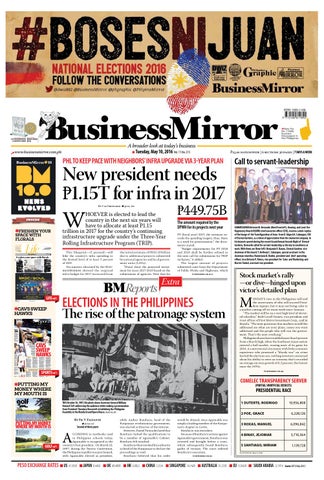
New president needs ₧1.15T for infra in 2017
W
FRESHEN YOUR SPACE WITH FLORALS Leadership for the kingdom
Y
FR. SAL PUTZU, SDB AND LOUIE M. LACSON Word&Life Publications • teacherlouie1965@yahoo.com
Editor: Gerard S. Ramos • lifestylebusinessmirror@gmail.com
Life
BOX OFFICE: ‘CAPTAIN AMERICA: CIVIL WAR’ DEBUTS WITH $181.8 MILLION D3
BusinessMirror
Tuesday, May 10, 2016
This blueprint—if pursued—will hike the country’s infra spending to the desired level of at least 5 percent of GDP. Documents obtained by the BusinessMirror showed the required infra budget for 2017 increased from
D1
Freshen your space with �lorals A RED floral arrangement adds a bold pop of color in this living room.
BY CATHY HOBBS Tribune News Service
and modern choice. 4. Use floral arrangements in unexpected places. Bathrooms, for example, are often discarded areas. 5. Embrace color. Color is your friend when it comes to florals and can be used to add interest to your home. 6. Avoid fillers. Fillers often create a less luxurious feel. 7. Look for silk. If you are considering purchasing artificial arrangements, silk is still the standard and comes in various levels of quality. 8. Take care of your arrangements. Even artificial arrangements need to be maintained— avoid stains and dust, and look out for excessive signs of wear and tear. 9. Look for interesting vases or containers. What you place your floral arrangement in is almost as important as your floral selection. 10. Choose arrangements of the appropriate size and scale. If you are looking to make an impact on a large surface, such as a coffee table or dining table, it is best to choose an arrangement that will provide for big visual impact. Conversely, if you are looking to make a statement in a smaller space, such as a bathroom, a smaller arrangement may be more appropriate. ■
W
HEN the weather is warm, nothing can revitalize and rejuvenate a space quite like florals. And the beauty is they don’t necessarily have to be fresh. One longtime secret of decorators is to use floral arrangements as accessories. Similar to decorative elements, such as sculptural pieces, vases or toss pillows, the right floral arrangement can add an elevated aesthetic and help set a mood, as well as add a much-needed punch of color. Floral arrangements come in all shapes and sizes, and can be used in locations throughout the home, from living rooms to kitchens and even bathrooms. When incorporating floral arrangements into your home this season, here are my top 10 tips to keep in mind: 1. Don’t overdo it. Too many floral arrangements can have a negative effect and overpower a space. 2. Look for variety. Try to mix and match your arrangements, as opposed to displaying just one color or type of arrangement. 3. Consider succulents. Succulents are a great
LIFE
D1
CAVS SWEEP HAWKS
Sports
C1
| TUESDAY, MAY 10, 2016 mirror_sports@yahoo.com.ph sports@businessmirror.com.ph Editor: Jun Lomibao Asst. Editor: Joel Orellana
@cuo_bm
HOEVER is elected to lead the country in the next six years will have to allocate at least P1.15 trillion in 2017 for the country’s continuing infrastructure upgrade under the Three-Year Rolling Infrastructure Program (TRIP).
INSIDE
ES, Lord, even we have master degrees in religious and values education, doctor of philosophy in theology, seasoned professors for decades in teaching religion, still we cannot claim to be the “chosen group” to head on and have the leadership for the kingdom. Because there were those ahead of us who lived with You, listened to You, who witnessed Your day to day teachings, who captured Your modeling. These men selected by You as Your assistants represented an average cross section of society in their day. Not the kind of group one would expect to win the world for You, yet, their leadership for the kingdom is far beyond than us. Amen.
B C O
BusinessMirror
the initial estimate of P839.29 billion due to additional projects submitted by national agencies and local government units (LGUs). “[Data] show the projected investment for years 2017-2019 based on the submissions of agencies. Note that for
The amount required by the DPWH for its projects next year
FY [fiscal year] 2017, the estimate exceeds the spending targets, thus, there is a need for prioritization,” the documents stated. “Budget requirements for FY 2018 and 2019 shall be further refined in the next call for submissions for TRIP inclusion,” it added. The largest amount of projects submitted came from the Department of Public Works and Highways, which C A
BMReports ELECTIONS IN THE PHILIPPINES The rise of the patronage system
KLAHOMA CITY—Kevin Durant went on a scoring spree that was spectacular, even by his standards. The four-time NBA scoring champion matched his career playoff high with 41 points, as the Oklahoma City Thunder beat the San Antonio Spurs, 111-97, on Sunday night to tie the Western Conference semifinal series, 2-2. Durant had 29 points on 10-for-13 shooting in the second half. He scored 17 points in the fourth quarter, one more than the Spurs, and did it on six-for-six shooting. “When you have a deep team, those 40-point nights—they don’t come a lot,” he said. “I’m just trying to be consistent in what I do, and I know in any given moment, I can go off and get a few shots.” Durant had plenty of help. “My teammates did a great job of sticking with me and finding me and getting me easy baskets and screening for me and sacrificing their bodies, and I’m definitely grateful for it,”
Kevin Love scored 27 points, LeBron James knocked down a huge shot with 39.2 seconds to go, and Kyrie Irving turned in another dazzling performance to lead Cleveland past the Atlanta Hawks, 100-99, on Sunday. B P N
CANADIANS say Dwyane Wade disrespected their national anthem. AP
LEBRON JAMES heads to the hoop against Atlanta’s Kyle Korver (26) in the second half of Game Four on Sunday. AP
points. The speedy point guard drove into the lane but was surrounded by James and Tristan Thompson. Schroder slipped and James tied up the ball, forcing a huge mismatch of a jump ball with 2.8 seconds left. “I just tried to be aggressive,’ said Schroder, who was at least hoping to draw a foul.” They didn’t call it, so we can’t take it back. We’ve got to live with that.” With a 7-inch height advantage on the jump, James easily flicked the ball toward the sideline. Paul Millsap wound up with it, flinging up a desperation shot, but it was after the buzzer and didn’t go in anyway. Cleveland launched into a raucous celebration on Atlanta’s home court. “We know Atlanta is a tough team, and the closeout game is the hardest game,” said Coach Tyronn Lue, who took over the Cavaliers during the season after David Blatt was fired. This was a rematch of last year’s conference finals, in which the Hawks were the top seed but got swept by the Cavaliers. With Cleveland seeded No. 1 this time, the result
was the same. Atlanta Hawks had fourthquarter leads in three of the four games but wasn’t strong enough to finish, dropping to 0-12 in the postseason against the Cavs. Schroder put the Hawks up, 97-96, on a drive with 1:31 remaining. But James, after having one shot blocked and missing two tip-ins, got another chance when a video review overturned a call that Cleveland had knocked the ball out of bounds. Off the inbounds pass, Matthew Dellavadova found James streaking into the lane and Millsap was called for goaltending. Even though the call stood after another review, Millsap insisted it was a clean block. “I’ll believe that all summer,” he said. Schroder’s next shot was blocked by Thompson, and the Cavaliers isolated James on the wing against Millsap. James stepped back and hit the jumper, pushing Cleveland ahead, 100-97. Schroder scored on a drive with 34.4 seconds left and James missed the potential-clinching three. It didn’t matter. The Cavaliers buckled down at the defensive end and wrapped up the series.
‘International incident’
work with its players to make sure no pregame routines interfere with either anthem going forward,” National Basketball Association (NBA) Spokesman Tim Frank said in a statement sent to The Associated Press on Sunday. The anthem before Miami home games is usually played at the end of the warm-up period. When the Raptors—Canada’s only NBA team— come to Miami for what becomes a two-anthem pregame, the songs are played about 12 minutes earlier and during the warmups. Some videos posted online show that someone threw a ball skyward at the Raptors’ end of the court a second or two into the performing of the Canadian anthem on Saturday, though it was impossible to determine who it was. “If people aren’t here, they see video footage of what they want to see,” Wade said. Canadian politicians were quick to express
their displeasure with the perceived slight. “Hey @DwyaneWade a Canadian invented the game. Respect the anthem,” read a tweet from the verified account of Toronto Mayor John Tory. Toronto Councillor Norm Kelly has sent out a few interesting tweets during the series, including one telling Heat fans after Miami’s Game One win that they actually lost because “Donald Trump is one step closer to being your President.” Kelly has also tweeted out details on how Americans can apply to immigrate to Canada, a cartoon of the Raptors’ mascot squeezing Wade and on Sunday, a request that the operations staff in Toronto’s arena play no other music than “O Canada” when the series returns to Ontario on Wednesday. “Just the national anthem,” Kelly wrote. “The whole game.”
M
IAMI—Dwyane Wade’s pregame routine has sparked a bit of an international incident, with some Canadians saying on Sunday that he disrespected their national anthem. The Miami Heat star was the subject of much scorn after video showed him taking a few extra warm-up shots as “O Canada” was performed before Game Three of the Eastern Conference semifinals against the Toronto Raptors on Saturday. Wade tends to not line up for the pregame anthem ceremony without making his last shot,
DURANT goes up for a basket over »SanKEVIN Antonio’s Tony Parker. AP
CAVS SWEEP HAWKS
came up short in Year 1, when both Love and Irving went down with injuries in the playoffs. Now, fully healthy and finally comfortable together after some rocky moments, LeBron & Co. cruised into the conference finals to meet either Toronto or Miami. The Raptors lead that series, 2-1. “We’re in a great rhythm right now,” said James, who won two titles with the Heat and wants to bring one home. “We know exactly where we want to be on the floor.” Love carried Cleveland much of the game, hitting one three-pointer after another as the Hawks continually left him open in the corner. He went cold down the stretch but still finished eight-of-15 from beyond the arc. He made only one two-point basket—with his toe on the stripe. James and Irving finished with 21 points apiece. James also doled out nine assists, while Irving had eight. The Hawks had one last chance to extend the series and put the ball in the hands of Dennis Schroder, who led the team with 21
The Associated Press
A
TLANTA—Cleveland’s Big Three is on quite a roll. Two playoff series, two sweeps. Now, the Cavaliers get to rest up for the Eastern Conference finals. Kevin Love scored 27 points, LeBron James knocked down a huge shot with 39.2 seconds to go, and Kyrie Irving turned in another dazzling performance to lead Cleveland past the Atlanta Hawks, 100-99, on Sunday. The Cavaliers finished off the secondround series with four straight wins, just as they did in the opening round against Detroit. “This is more than I dreamed of,” Irving said. “It’s what I genuinely enjoy about basketball, playing with great guys.” When James returned to Cleveland after four years in Miami, winning the franchise’s first championship was the only goal that mattered. Love was acquired from Minnesota to complete the dynamic trio, but the Cavaliers
usually a bank shot from the right wing—even when only “The Star-Spangled Banner” is to be played before home games. Video showed that he did not take his spot standing with teammates until about 20 seconds into the playing of the Canadian anthem on Saturday. “I’m not a disrespectful person,” Wade said. “So if anybody thinks I’m being disrespectful to a country, then they don’t know who Dwyane Wade is.” Wade said he’d adjust his pregame ritual for Game Four of the series on Monday night. “We spoke to the team, and the Heat will
SPORTS
Stock market’s rally —or dive—hinged upon victor’s detailed plan
M
ONDAY’S vote in the Philippines will end the uncertainty of who will succeed President Aquino, but it may not bring calm to a market coming off its worst week since January. “The market will be on a very high level of elevated volatility,” Bede Lovell Gomez, vice president and trust officer of First Metro Investment Corp., said in Manila. “The next questions that markets would like addressed are what are your plans, issues you want addressed and the people who will run the government. That’s the next overhang.” Philippine shares have tumbled more than 5 percent from a March high, when the Southeast Asian nation entered a bull market, erasing most of its gains for 2016. A controversial city mayor with little economic experience who promised a “bloody war” on crime has led the election race, rattling investors concerned about his ability to steer an economy that’s recorded an average six-year growth of 6.2 percent, the fastest since the 1970s. C A
COMELEC TRANSPARENCY SERVER (PARTIAL UNOFFICIAL RESULTS)
PRESIDENTIAL RACE
1 DUTERTE, RODRIGO
THIS October 16, 1907, file photo shows Governor General William Howard Taft addressing the audience while reading a proclamation from President Theodore Roosevelt establishing the Philippine Assembly in the Manila Grand Opera House. MGOH GALLERY
F1 | T
UESDAY, MAY 10, 2016 sports@businessmirror.com.ph Editor: Mike G. Besa | www.pinoygolfer.com
B F V. E
THE PALMER COURSE AT THE ORCHARD
PUTTING MY MONEY WHERE MY MOUTH IS
@elefantefil
Second of three parts
B M B
HE Orchard’s Palmer Course is one of the great golf courses in the country. Opened for play in 1994, it played host to the world’s best golfers when it hosted the Johnny Walker Classic the very next year; a tribute to the quality of the golf course. » F
GOLF
COMMISSIONER Antonio M. Bernardo (third from left), Housing and Land Use Regulatory Board (HLURB) chief executive officer (CEO), receives a mini-replica of the Image of the Transfiguration of Jesus from D. Edgard A. Cabangon, CEO of Eternal Gardens, as a token of appreciation from the memorial company. In his keynote speech during the recent Grand Annual Awards Night of Eternal Gardens, Bernardo called for servant-leadership as the key to excellence at work. With them are (from left) Benjamin V. Ramos, Eternal Gardens vice chairman of the board; T. Anthony C. Cabangon, special assistant to the chairman emeritus; Numeriano B. Rodrin, president and chief operating officer; Jose Antonio V. Rivera, vice president for Sales and Marketing; and Marvin Timbol, assistant vice president.
C1
PUTTING MY MONEY WHERE MY MOUTH IS
T
Call to servant-leadership
₧449.75B
THUNDER TIE SERIES O
he said. “After they do all that, it’s on me to finish the shot and just stick to the fundamentals I’ve been practicing since I was a kid.” Russell Westbrook finished with 14 points and 15 assists, while Dion Waiters added 17 points and Steven Adams had 16 points and 11 rebounds for Oklahoma City. The Thunder shot 50.6 percent overall and 57 percent in the second half to avoid going back to San Antonio, down 3-1, for Game Five on Tuesday night. “Durant got away from us,” San Antonio’s Kawhi Leonard said. “Westbrook did a great job getting his teammates involved. But [they] got those offensive rebounds when we’d get him to miss.” Tony Parker led San Antonio with 22 points, while Leonard had 21 and LaMarcus Aldridge 20. San Antonio led by 11 early in the second quarter, but the Thunder rallied and took a 45-44 lead on a three-pointer by Durant with 1:47 left in the first half. The Spurs closed the quarter on a 9-0 run, with all the points coming from Leonard and Aldridge, to take a 53-45 lead at the break. Durant and Westbrook were a combined six-for-21 from the field in the first half. Boris Diaw’s three-pointer from the corner in the closing seconds of the third quarter gave the Spurs an 81-77 lead heading into the fourth. Durant took over early in the final quarter. His back-to-back threes gave the Thunder a 93-87 lead. Enes Kanter’s fast-break dunk pushed the lead to 100-93. San Antonio hung tough, but a baseline floater, a lay-up and a corner three by Durant made it 108-97. “They just outplayed us,” Aldridge said of the Thunder’s dominant fourth quarter. “They made more plays than us. They got to the ball faster. They crashed the boards harder. We took tough shots. We had open shots, too. We didn’t make shots. They played better than we did down the stretch.” AP
P. | | 7 DAYS A WEEK
F1
A
CCORDING to textbooks used in Philippine schools today, Aguinaldo is recognized as the country’s first president. On March 22, 1897, during the Tejeros Convention, the Philippine republic was proclaimed, with Aguinaldo elected as president,
PESO EXCHANGE RATES n US 47.2050
while Andres Bonifacio, head of the Katipunan revolutionary government, was elected as director of the Interior. However, Daniel Tirona declared that Bonifacio lacked the qualifications to be a member of Aguinaldo’s Cabinet. Bonifacio felt insulted. Bonifacio then invoked his authority as head of the Katipunan to declare the proceedings as void. Bonifacio believed that his order
would be obeyed, since Aguinaldo was simply a leading member of the Katipunan’s chapter in Cavite. Bonifacio was mistaken. Because of Bonifacio’s actions against Aguinaldo’s government, Bonifacio was arrested and brought before a court, which subsequently found Bonifacio guilty of treason. The court ordered Bonifacio’s execution.
10,956,808
2 POE, GRACE
6,228,126
3 ROXAS, MANUEL
6,096,842
4 BINAY, JEJOMAR
3,710,364
5 SANTIAGO, MIRIAM
1,139,728
AS OF 8:30 P.M. (May 9, 2016)
C A
n JAPAN 0.4402 n UK 68.4000 n HK 6.0822 n CHINA 7.2534 n SINGAPORE 34.7428 n AUSTRALIA 35.2338 n EU 53.8420 n SAUDI ARABIA 12.5914
Source: BSP (6 May 2016 )
A2 Tuesday, May 10, 2016
BMReports BusinessMirror
www.businessmirror.com.ph
ELECTIONS IN THE PHILIPPINES The rise of the patronage system C A
Bonifacio and his brother Procopio were executed on May 10, 1897, in Mount Maragondon, Cavite. Downplayed in the conventional textbooks was the fact that Bonifacio went to Cavite as head of the Katipunan. However, no one has determined the real reason Bonifacio agreed to go to Cavite, which was Aguinaldo’s bailiwick, in November 1896.
Conflicts in history
DR. MILAGROS GUERRERO, one of the country’s most prominent historians, said Aguinaldo wrote in his memoirs, which was published in 1963, that the revolutionary government in Cavite was already in existence three months before the Tejeros Convention, thus, there was no need for Bonifacio’s intervention. Guerrero countered Aguinaldo’s statement. “In November 1896 no unified provincial revolutionary government existed, only the separate Magdiwang and Magdalo commands in their respective spheres of authority and influence,” Guerrero wrote. “Thus, by using the term revolutionary government, Aguinaldo was implying that Kawit represented the whole of Cavite.” Guerrero also wrote that Bonifacio told Mariano Alvarez, a revolutionary general, that he did not want to interfere in the feud between the two Cavite factions. Without stating a reason, Bonifacio went to Cavite. However, when he arrived there, his authority as head of the Katipunan, which was serving as the national revolutionary government, was ignored. “In Cavite, however, Aguinaldo and his compatriots looked down on Bonifacio as their inferior, socially and intellectually,” Guerrero wrote. Aguinaldo and his colleagues were members of the principalia class, which economically and socially benefited from the Spanish colonial system’s practice of patronage. “After Christmas of 1896, a truly vicious rumor against Bonifacio was circulated in Cavite,” Guerrero added. “The Supremo [Bonifacio], according to black propaganda, had run away with Katipunan funds, and that he had a beautiful sister whose lover was the Spanish curate of Tondo. He was a mason, an atheist, an uneducated man and a mere bodegero of a German company. He did not deserve his title because only God could be called Supremo.”
Confrontation
JOHN R AY R AMOS, a historian and heritage-conservation advocate, said Bonifacio suspected Tirona as the person responsible for spreading the rumors. When Bonifacio confronted Tirona, the latter assumed a superior air and simply dismissed Bonifacio’s accusations. Bonifacio felt insulted and challenged Tirona to a duel. Bonifacio drew his revolver, but cooler heads prevented Bonifacio from shooting Tirona. This would lead to a tragic consequence for Bonifacio. While in Cavite, other revolutionary leaders in Cavite presented a draft Constitution for Bonifacio’s approval. Guerrero said this was proof that some leaders in Cavite recognized Bonifacio’s authority over them. Aguinaldo’s faction insisted a new Constitution was needed to replace the Katagalugan charter. Guerrero wrote that Bonifacio rejected the draft charter. “Bonifacio deemed the draft utterly disgraceful for it was a virtual reproduction of the Maura law, a decree passed by Antonio Maura, Spain’s foreign minister for municipal governments in the Philippines,” Guerrero wrote. This was in direct contrast to the stance of the Katipunan, which wanted to do away with as much of Spain’s influence as possible. This even extended to the replacing the name of the country “Filipinas”, which was in honor of a Spanish monarch, to “Haring Bayang Katagalugan”, which meant “Sovereign Land of the River People.” The Maura law essentially expanded the power of the principalia class by naming members of the class as the only ones eligible for administrative posts in the expanded civil bureaucracy. When Aguinaldo’s faction included the Maura law in their proposed charter, they were, in effect, keeping themselves in power and denying anyone outside that class from a position of responsibility. Naturally, Bonifacio junked that proposal.
Second attempt
BY December 1896, another move to undermine Bonifacio’s authority was attempted. Baldomero Aguinaldo, Emilio Aguinaldo’s cousin, said a new government was needed because the Katipunan “should not continue to lead the revolution.” “The assembly was sharply split into two camps,” Guerrero wrote. “Those who argued that the Katipunan constitution [Cartilla] was in effect throughout the municipali-
ties revolting against Spain saw no reason to adopt a new one, while those who saw that the Katipunan ceased to exist when the revolution broke out argued that a new government should be formed in Cavite.” Guerrero wrote that, during the assembly, it was pointed out that “revolution was only in Cavite and its leadership must, therefore, be Caviteño.” In fairness to Aguinaldo, he did not seek the presidency at that time. He acted more as an observer. However, he did not discourage the suggestion that a Caviteño must be head of the revolution. “But the assembly failed to reach any resolution,” Guerrero wrote. “Instead, it approved a motion creating a legislative committee to be headed by Bonifacio himself. He was given blanket authority to appoint members of a legislative body that would draw up the basis for governmental reorganization.” However, no minutes of this meeting today exists. According to Guerrero, Baldomero Aguinaldo was supposed to record the minutes of this meeting. “Shortly after this, Bonifacio repeatedly requested for the minutes as a matter of legal procedure so that he would have at least the authority to create the legislative body agreed upon by the Imus assembly,” Guerrero wrote. “But Aguinaldo did not provide one.”
Offer to Spain
BY April 16, 1897, Bonifacio sent Emilio Jacinto a letter. In the letter, “Bonifacio expressed his belief that the purpose of Aguinaldo’s actuations was to surrender the revolution.” According to Guerrero, Spanish records showed that, as early as January 1897, Aguinaldo had sought a conference with the Spanish authorities through the Spanish curate of Pateros. “Already, Emilio Aguinaldo, through a friar, is seeking to negotiate, aiming to get an agreement with political concessions,” according to a letter sent by the Spanish governor general to the government in Madrid. The Spaniards rejected Aguinaldo’s request and demanded the “rebels should take advantage of the offer of pardon or else be rushed.” “Aguinaldo, therefore, was dealing with the enemy not as a victor but as a power player determined to obtain political advantage from a rapidly deteriorating military situation,” Guerrero wrote. “The ensuing rivalry and power play in
Tejeros can be seen as an integral part of a premeditated plan for seizing power from the Supremo of the revolution and the president of the Katagalugan government, however, much Aguinaldo and the Cavite municipal elite might have denied the existence of such a government. Only by the elimination of Bonifacio could his successor legitimately deliver to the Spaniards the entire revolution and request, or demand in return, political and economic concessions.”
Tejeros Convention
ON March 22, 1897, the Tejeros Convention was held. The crowd, which was described as “unruly,” demanded the establishment of a new revolutionary government. Bonifacio, who was supposed to preside over the assembly, was prevailed upon to hold an election. In return for Bonifacio’s approval, everyone was supposed to abide with the results of the election. But Bonifacio’s trust in the integrity of the proceedings was misplaced. Ramos said the election results were fixed. “What happened in Tejeros was actually a coup,” Ramos said. Guerrero, citing at least three sources, said the elections were “fraudulent.” Historical documents that exist showed that Mariano Alvarez observed that the ballots were already filled out before these were distributed to voters. “Gen. Guillermo Masangkay contended that there were more ballots prepared than the actual number of men present in the estate house,” Guerrero wrote. “In one fell swoop, the Tejeros elections delivered a deathblow to the K atipunan, the K at a g a lu g a n go ve r n me nt a nd t he authority of Bonifacio.”
Bonifacio’s downfall
BONIFACIO tried to reassert his authority, but he was trapped in Cavite, Aguinaldo’s stronghold. The Katipunan leader issued two orders. The first order, known as the Acta de Tejeros, “recognized the treachery of a few men who were determined to destroy the unity of the people and cooperate with the Spaniards.” Bonifacio’s second order, known as the “Naic Military Agreement”, “appointed Pio del Pilar as commander in chief of the revolutionary forces.” A month after neutralizing Bonifacio’s authority, Aguinaldo took his oath of office on April 18, 1897. Many of those who supported Bonifacio in Cavite defected to
Aguinaldo’s camp. When Bonifacio tried to leave Cavite, Aguinaldo had him arrested. Bonifacio was falsely accused as a traitor, and Aguinaldo interpreted the Naic Military Agreement as proof that Bonifacio was plotting to overthrow Aguinaldo’s government.
Trial and execution
BONIFACIO’S trial took place on April 29, 1897. By May 6, Aguinaldo’s court found the Bonifacio brothers, Andres and Procopio, guilty. Four days later, Bonifacio and his brother were executed in Maragondon, Cavite. According to Guerrero, the trial was a farce. This historian asked: “Why then did Aguinaldo order that the records of the investigation and trial of the Bonifacio brothers be buried lest they find their way into Spanish hands and be used against Filipino revolutionaries?” Aguinaldo’s orders were not followed, however. A merican troops captured the records. The records showed that the Aguinaldo group assigned Placido Martinez to act as the lawyers of the Bonifacio brothers. Instead of defending Bonifacio, Martinez asked the court to forgive Bonifacio’s “evil and detestable deeds,” Guerrero wrote. Bonifacio was accused in the trial of conspiring to surrender the revolution to the Spaniards. History would show Filipinos who actually sought a truce with Spain.
Pact of Biak-na-Bato
ON December 14, 1897, seven months after Bonifacio’s execution, President Emilio Aguinaldo signed the Pact of Biak-na-Bato, a peace settlement which stipulated that all revolutionary forces will stop fighting in exchange for reforms in the Spanish colonial government. Under the agreement, Spain was required to pay a total of P1,700,000, “of which P800,000 was to be paid to the rebel leaders, while the balance of P900,000 was to be distributed among the civilians who suffered from the war.” Aguinaldo also agreed to the Spanish demand that he declare all revolutionary forces that refuse to recognize the pact as bandits. Aguinaldo and his colleagues, who received the bulk of the money, agreed to go into exile, while the Spain maintained ownership and control over her colony.
Historical proof?
LATER, a correspondent for the Spanish newspaper El Imparcial interviewed Aguinaldo. Guerrero said the interview showed Aguinaldo admitting to having “masterminded the execution of Bonifacio.” A translation of part of the interview was included in Guerrero’s essay. In the interview, Aguinaldo said he was campaigning for reforms in how the Spanish colonial government was run and for the reduction of the friar’s authority over the towns. “It is quite true that the Katipunan instilled in us another desire—that of independence—but that desire was unattainable and, moreover, it was in opposition to our sentiments. It served as the banner of Andres Bonifacio, a cruel man whom I ordered shot and with his death, the Katipunan disappeared.” Conventional history teaches Filipino students that the revolution ceased with Aguinaldo’s exile. But this was not true, according to Guerrero. “Guerillla warfare continued relentlessly not only in Central Luzon but also in the Ilocos region and the Bicol Peninsula,” Guerrero wrote. “In February 1898 the Cebuanos rose in revolt, gaining control of practically the entire island by early April. The people of Panay followed suit in March.” “It was when independence was almost within sight that Aguinaldo and the political elite would build legal institutions and political structures and claim the people’s victory as their own,” Guerrero added. This would later lead to conflicts in how the war was to be conducted and provided a backdoor for the United States to take over the Spanish colony. The Maura law, which Bonifacio had rejected, was later used as a basis by US officials to solidify their hold over the Philippines after Aguinaldo surrendered to the Americans. Thus, the principalia class kept their hold on power. This exerted an influence on who were eligible in casting a ballot and the people who ran and won in the subsequent elections that would later lead to the birth of the the Philippine Commonwealth government. To be concluded
news@businessmirror.com.ph
BMReports BusinessMirror
Tuesday, May 10, 2016
A3
MPIC to spend ₧116.2B for new expressways
T
HE tollways arm of infrastructure conglomerate Metro Pacific Investments Corp. (MPIC) will spend some P116.2 billion to build new expressways and expand its current portfolio of thoroughfares across the Philippines.
Metro Pacific Tollways Corp. President Rodrigo E. Franco said this would allow the company to cement its dominance in the tollways sector in the Philippines, concurrent with its aim of expanding its footprint in the Asean. Combined, the company will invest roughly P116.2 billion in infrastructure development deals, bulk of which are under the government’s flagship infrastructure thrust, the Public-Private Partnership (PPP) Program. The company has the concession rights to build P18-billion Connector Road, the P10.7-billion C-5 South Link Road, the P50-billion Cavite-Laguna Expressway (Calax), the P27-billion Cebu Third Bridge and the P10.5billion Segment 10 of the North Luzon Expressway (Nlex). “These investments will run up to 2020. It will be funded mostly by bank loans. With regard to
₧64.9B The cost of the LRT Line 1 Cavite Extension project, a PPP deal won by MPIC
bonds, we’ll see, but we are leaning more toward corporate financing,” Franco told the BusinessMirror in an interview. He said this will aid his company in keeping its current market share of “over 60 percent” in the toll roads sector, with about 213 kilometers of expressways in Luzon. Cu r rent ly, it operates t he 97-kilometer Nlex, the 94-kilometer Subic-Clark-Tarlac Exp r e s s w a y, t h e 14 - k i l o m e t e r Manila-Cavite Toll Expressway (C av ite x) a nd t he 8 -k i lome ter Subic Freeport Expressway.
NORTH Luzon Expressway WIKIPEDIA
When built, the P116.2 billion worth of infrastructure deals— locations of which are scattered around Luzon and the Visayas— will add a total of 75 km to its current portfolio, bringing the total stretch to 288 km. “It will definitely increase, and we will continue to look for other projects to develop to keep our market share,” Franco said. He cited PPP deals, such as the Central Luzon Expressway (CLEx) and the Plaridel Bypass Toll Road, as example. Specifically, the company is interested in vying for the second phase of the CLEx, as the first phase of the toll road-development project will be implemented under a loan from Japan. Phase I will involve the construction of a thoroughfare that
will interconnect Tarlac and Cabanatuan in Nueva Ecija. The government has earmarked P14.94 billion for this venture. It will be funded by a loan from the Japan International Cooperation Authority (Jica). The contract for the additional 30 km of road, which will be auctioned off by the end of the year, is expected to be completed by 2018. The second phase of the thoroughfare, meanwhile, involves the construction of another road that will interconnect Cabanatuan to San Jose City. It carries a P14.2billion price tag. Phase II also involves the operations and maintenance contract for the expressway. It will be auctioned off under the PPP Program of the Aquino administration. The feasibility of the
35.70-km road is still under review. The Plaridel By pass Toll Road is an arterial road of 24.61 km, which will link the Nlex in Balagtas, Bulacan with the Ph i l ippi ne - Japa n Fr iend sh ip Highway, also called Maharlika Highway in San Rafael, Bulacan. It will bypass the town proper of Plaridel and urban areas of Pulilan and Baliuag along the existing Maharlika Highway, thus, alleviate the perennial traffic congestion at the core urban areas along Philippine-Japan Friendship Highway road section from Plaridel to San Rafael, Bulacan. The bypass road will traverse the vast agricultural lands of five municipalities in Bulacan, namely, Balagtas, Guiguinto, Plaridel, Bustos and San Rafael. These projects, according to Franco, are the native expansion initiatives for his company’s current tollways portfolio. “We’re looking at these projects, which, I think, will be up to the next admin to implement,” he said. MPIC Chairman Manuel V. Pangilinan said his company will place more bets on PPP deals when the next government comes in. Pangilinan said his group will bid for toll and water projects under the flagship infrastructure program. But while the fate of the key infrastructure thrust of the Aquino administration is still in limbo, given that a law that would
institutionalize the program was practically “dead” in Congress, the group of Pangilinan is still bullish that the infrastructure development scheme will be adopted by the next president of the Philippines. “The next president, who he or she might be, I think will probably continue the good programs of this government. I don’t see the new president turning a blind eye on the many good projects that should be done for the people,” he said. Pangilinan said his company will also be scouting for opportunities outside the Philippines. “I can’t say much, but we are looking at Malaysia and Indonesia,” he said. A side f rom t he bei ng t he largest toll road operator in the Philippines, the conglomerate also has significant shareholdings in expressways in Vietnam and Thailand. Metro Pacific is one of a handful of companies in the Philippines that are considered as mainstays in the PPP arena. It has won massive infrastructure deals, like the P1.72-billion Automated Fare Collection System; the P64.9-billion Light Rail Transit Line 1 Cavite Extension; and the P35.42-billion Calax. Metro Pacific—the f lagship company of Hong Kong-listed conglomerate First Pacific Ltd. Co.— has interests in the toll, energy, water, rail and health-care industries.
South China Sea watch: China starts drills, showcases isles C HINA’S Navy has launched annual war drills in the South China Sea with one of its most advanced warships, the missile destroyer Hefei. The exercises include simulations for breaking an enemy blockade and reconnaissance drills with submarine forces. Five other guided missile destroyers, a frigate and a supply ship of the South Sea Fleet based in Sanya on Hainan Island, home to a major naval and air force base, are taking part. According to the official Xinhua News Agency, the ships will be joined by forces based in the Spratly and Paracel islands, where China has embarked on massive island-building to expand and reinforce the reefs it controls in the disputed region. A lso last week, China sent famed singer of patriotic anthems Song Zuying on a tour of its manmade islands in the Spratlys to entertain troops and underscore confidence in asserting its claim in the contested area. Among the songs performed: “Ode to the South Sea Defenders,” whose lyrics speak of “troops of stout men with guns in their hands who battle the wind and fight the waves to guard the nation’s door.” Photos of the performances also offered a rare glimpse of the extensive work China has been carrying out at Fiery Cross Reef, showing lighthouses, harbors and buildings. In the background of some can be seen one of the Navy’s massive Type 071 amphibious dock ships, capable of carrying four helicopters and as many as 800 troops.
Rivals in joint exercises
BEIJING has also sent the Lanzhou missile-guided destroyer that took part in Beijing’s South China Sea drills for a multinational exercise that started last week off the waters of Brunei Darussalam and Singapore. It joined the navies of the 10 countries of the Association of Southeast Asian Nations, along with those of the US, India and six other dialogue partners for a maritime security and counterterrorism exercise. Several Asean members, including Vietnam and the Philippines, have claims in the South China Sea. The drills include a land-storming exercise. The US is participating
with a P-8 Poseidon surveillance aircraft, the destroyer USS Stethem and Army units. “Our crew will be able to see firsthand how other navies operate and we can learn from them while sharing our own operational tactics and procedures,” said Cmdr. Harry Marsh, commanding officer of the Stethem.
Port visit denial a ‘minor hurdle’
THE commander of the US Navy’s 7th Fleet says the cancellation of a planned port visit to Hong Kong by an American aircraft carrier is just a “minor hurdle” in relations between the two militaries. Vice Adm. Joseph Aucoin spoke on Friday in China’s financial hub of Shanghai after the docking of the USS Blue Ridge, the fleet’s command ship, whose visit he said indicated the durability of the China-US military-to-military relationship. The US State Department said last month that China recently denied a request for the USS John C. Stennis to visit Hong Kong, in an apparent sign of mounting tension in the disputed South China Sea. China hasn’t explained the reason for the cancellation, but previous cancellations have been linked to tensions over Taiwan or other political and military disputes. Aucoin said he didn’t know why the visit was denied, although Defense Secretary Ash Carter and his Philippine counterpart had visited the carrier in the South China Sea two weeks earlier, irking Beijing. The reason “would probably be a good question for the government of China,” he said. “But the very fact that we’re on this pier, that our two navies, our two countries, don’t let that minor hurdle get in the way of our relationships. Our, the relationship between our two countries is much too important for a port visit to get in the way of
that,” Aucoin told reporters.
A miscalculation
THE US Coast Guard commander said the Chinese coast guard is on the front line provoking the US Navy. “We are seeing Chinese fishing trawlers provoking the United States Navy, carrying out sovereign acts, but just over the horizon is the PLA,” said Rear Adm. Paul Zukunft, referring to the People’s Liberation Army. “So our biggest concern is about a miscalculation. But their coast guard has not been transparent in terms of what their intent is,” he said at a discussion at the Council on Foreign Relations. He said the US was working with its Chinese counterparts on a code of conduct for armed planned encounters at sea “so they won’t take these actions against our Navy and other forces, as well.” “Our sense is that China does not want to be a global hegemon, but they clearly want to be recognized as the regional leader in this area,” he said. Adm. John Richardson, chief of naval operations, said at the same forum that the Navy’s freedom of navigation operations—sailing warships close to Chinese man-made islands—are working. Their aim is to advocate for an international set of rules that ensures the free flow of goods and services in one of the world’s busiest shipping lanes, he said. “They don’t extend beyond that. There’s just a pure advocacy for that system. So we design those very carefully. It’s a policy decision that is made, interwoven with those other elements of power. So I think both aircraft, ships are ready to execute those as they fit into the plan,” he said. China has criticized Washington, saying it is trying to provoke conflict with such maneuvers. But Beijing also says it won’t impede free navigation. AP
The case brought by the Philippines is nothing but a political farce under the cloak of law.... It is a grave threat to regional peace and stability.”—O Y
IN this April 5 file photo provided by China’s Xinhua News Agency, guests attend the completion ceremony for the construction of a lighthouse on Zhubi Reef of Nansha Islands, known as the Spratly Islands, in the South China Sea. The words in this photo read “China Nansha Zhubi Lighthouse.” XINHUA VIA AP
A4 Tuesday, May 10, 2016
BMReports BusinessMirror
www.businessmirror.com.ph
Stock market’s rally—or dive—hinged upon victor’s detailed plan C A
International investors unloaded $34 million from local stocks in April, after adding $204 million to their holdings in March, data compiled by Bloomberg show. The Philippine Stock Exchange index sank 2.3 percent last week, while a measure of 10-day volatility reached a one-month high. The stock gauge slid below its 200-day moving average for the first time since August on Thursday. Philippine sovereign bonds stalled in May, after rallying 6 percent in the last five months, while the peso has weakened more than 2 percent in the past three weeks. “It’s important that the next administration defines the programs clearly in order to reduce or make the public more realistic with their expectations,” said Fritz Ocampo, chief investment officer at Manila-based
BDO Unibank Inc., the nation’s largest money manager with $20 billion in assets under management. “A lot of hype and promises were made during the campaign.” Ocampo says he is holding cash and has been picking up shares which have dropped excessively. Polling stations opened at 6 a.m. local time and are due to close at 5 p.m. Andres D. Bautista, chairman of the Commission on Elections, told GMA News it will extend hours in some areas where delays were reported for various reasons, including malfunctioning voting machines. The commission expects turnout this year to exceed the 75 percent recorded in 2010. There are 54.4 million registered voters, with 45 percent of those in the 18 to 34 age bracket. Rodrigo R. Duterte has been mayor of Davao City on the south-
ern island of Mindanao for two decades, where his strongman swagger and endorsement of the execution of criminals earned him the nicknames “Duterte Harry” and “The Punisher.” He’s been likened to US presidential candidate Donald Trump, using populist rhetoric to reach Filipinos who feel the mainstream political parties are out of touch. If Duterte wins, “we will have to wait until we hear what he wants to do, how he will do it and who will be the people in the Cabinet,” Gomez said. “What has been heard by the market so far are all motherhood statements. Markets would like to know something more detailed.”
Opinion polls
DUTERTE has a commanding lead among five contenders, who include Manuel A. Roxas II, a for-
mer interior secretary who lost a vice-presidential bid as Aquino’s running mate in 2010. Roxas is favored by business and investors to be the next head of state as he is expected to continue the programs and reforms of the government. The latest survey by Pulse Asia put his rating at 22 percent, behind Duterte’s 33 percent. Grace Poe, who is serving the first half of her six-year term as senator and also favored by business groups to continue Aquino’s legacy, is at third with a 21-percent rating. Vice President Jejomar C. Binay, who helped build Manila’s financial district as mayor, is at fourth with 17 percent. Should Duterte or Binay emerge as the victor,“we could see the stock index extending a fall below 7,000 and test its support at 6,800,” said John Padilla, who helps manage
the equivalent of about $7.84 billion at Metropolitan Bank & Trust Co. Stocks should rebound at 6,800 since the nation’s economic fundamentals and growth prospects remain intact. A victory by either Roxas or Poe could fuel a “euphoria” rally to 7,600 in three months, he said.
Tall order
AQUINO has delivered one of the fastest economic growth rates in the world and created almost 4 million jobs in his six-year term, as he boosted government spending to a record. Analysts’ forecasts indicate real GDP will maintain its annual growth rate of 5.8 percent to 5.9 percent, with consumer prices increasing moderately over the next three years. The Philippine Stock Exchange measure has rallied an average of
26 percent in the 12 months after electing a new president in each of the past four presidential polls that the nation has held since the ousting of dictator Ferdinand E. Marcos in 1986, according to data compiled by Bloomberg. Investors said it may be a tall order to duplicate those historical returns, as stocks remain among the most expensive in Asia and there are scant details on economic plans. Concerns of higher US interest rates and a sharp slowdown in China may also cap any rallies. Philippine equities are trading at 17 times the 12-month projected earnings, compared with 12.4 for the MSCI Asia Pacific Index. “It may be difficult for the market to repeat its historical performance,” Gomez said. “Valuations are high and vulnerable to external and domestic shocks.” Bloomberg News
DUTERTE, MARCOS LEAD PREXY, VP RACE
D
AVAO City Mayor Rodrigo Duterte of PDP-Laban is leading in the presidential race based on partial unofficial election results being transmitted to the Commission on Elections (Comelec) Transparency Server. As of 7:16 p.m. on Monday, Duterte has received 7,786,156 votes with Sen. Grace Poe trying to get close with 4,430,320 votes. Former Interior and Local Government Secretary and Liberal Party standard bearer Manuel Roxas (4,256,268 votes), Vice President Jejomar Binay (2,631,595) and Sen. Miriam Defensor Santiago (821,381) are in the third, fourth and fifth places, respectively. On the vice presidential race, Sen. Ferdinand “Bongbong” Marcos and Naga Rep. Lenie Robredo are neck and neck in the initial results. As of 7:16 p.m., Marcos registered 7,223,906 votes, while Robredo has 6,469,416. The Comelec en banc yesterday officially convened to act as the National Board of Canvassers. However, it suspended its session as they were no sufficient election results to canvass yet. Bautista also refused to say whether the next president will already be known based on the partial and unofficial results coming out. “We are not statisticians… our job is to count right so when the numbers come out that should be made public, we don’t want to make a trend,” Bautista said. “That’s is not for Comelec to do. As far as the Comelec is concerned we have a ministerial task of counting the votes right,” he added. However, Bautista said the Comelec is targeting to come up with the official announcement of winners for senatorial and party-list groups not later than one week. In a separate interview, Comelec Commissioner Rowena Guanzon said it might take three to seven days to officially announce the 12 new senators. Under the law, the canvassing and consolidation of votes will be conducted by the Board of Canvassers in each municipality, city, district and province. For senators and partylists groups, the Comelec will act as the National Board of Canvassers. Meanwhile, the House of Representatives and the Senate will act as the National Board of Canvassers to consolidate the country-wide votes and proclaim the winners for president and vice president. Joel San Juan
PRESIDENTIABLE Jejomar C. Binay verifies his vote on the receipt printed after feeding the ballot on the vote-counting machine at the San Antonio National High School in Makati City. ALYSA SALEN
BPI President Aurelio Montinola III. NONIE REYES
DMCI Holdings Inc. Chairman, CEO and President Isidro Consunji. NONIE REYES
FRONT-RUNNING presidential candidate Mayor Rodrigo Duterte votes in a polling precinct at Daniel R. Aguinaldo National High School at Matina district, in his hometown in Davao City. Duterte was the last to vote among five presidential hopefuls. AP PHOTO/BULLIT MARQUEZ
PRESIDENTIAL candidate Grace Poe casts her vote at Santa Lucia Elementary School in San Juan. ROY DOMINGO
PRESIDENTIAL candidate Manuel A. Roxas II shows the indelible ink on his finger after voting at a polling center in Capiz. MAR ROXAS MEDIA BUREAU VIA AP
TOYOTA Motor Philippines Corp. Vice Chairman Alfred Ty. NONIE REYES
AYALA Corp. Chairman Emeritus Jaime Zobel de Ayala and wife Beatriz Miranda Barcon. NONIE REYES
AYALA Corp. COO Fernando Zobel de Ayala. NONIE REYES
news@businessmirror.com.ph
AseanTuesday BusinessMirror
Editor: Max V. de Leon • Tuesday, May 10, 2016 A5
Sarawak win buys Najib time as economic woes rise $9.5B
Myanmar targets $8-B FDI in fiscal year 2016-17
M
YANMAR is seeking to attract $8 billion in foreign direct investment (FDI) in the present fiscal year (FY) of 20162017, according to the Directorate of Investment and Company Administration on Monday. The country drew $9.5 billion worth of FDI in the last FY of 20152016, which ended in March, up from FY 2014-2015. The increase was due to the investments injected into the sectors of oil and gas, manufacturing and telecom. Myanmar received $1.413-billion foreign investments in FY 20122013, $4.107 billion in FY 2013-2014 and over $5 billion in 2014-2015. According to official statistics, foreign investment in Myanmar totaled $63.718 billion as of the end of March 2016 since late 1988. China topped the foreign investors line-up with $18.072 billion, accounting for 28.36 percent of the total, followed by Singapore with $13.066 billion and Thailand with $10.5 billion. By sector, oil and gas stood atop with $22.41 billion, accounting for 35.17 percent of the total, followed by power with $19.684 billion, manufacturing with $6.585 billion and transport and communication with $5.085 billion. Foreign investment during U Thein Sein’s previous five-year government term from 2011 to 2016 has created over 350,000 job opportunities. The Myanmar Investment Commission has been encouraging more FDI in trade, agriculture and infrastructure in to speed up the country’s economic development and create more job opportunities. Meanwhile, Thai and Myanmar labor ministers have agreed to proceed with a labor-cooperation plan to import migrant workers through a government-to-government agreement, says a senior ministry official. Labor Spokesman Theerapol Khunmuang said the plan is aimed not only at putting an end to labor exploitation and human trafficking, but also ensuring migrant workers’ rights are protected. The agreement was concluded on a recent visit to Myanmar
development. BN under Najib has promised money for everything from roads to hospitals. “This is the first election after the introduction of GST” and serves as an important barometer on its impact on the electorate, Faisal said. Najib called on civil servants at a regular meeting on Monday to monitor the needs of voters in Sarawak and neighboring Sabah state, ensuring they have quality roads and equipping longhouses with utilities, according to the official Bernama news agency.
Myanmar’s FDI tally in fiscal year 2015-2016
by Labor Minister Gen Sirichai Distakul, he said, noting the meeting was a follow-up on the previous one in January in Nay Pyi Taw, the capital of Myanmar. Theerapol said the meeting in Myanmar was also intended to prepare for an upcoming meeting of Asean labor ministers in Lao PDR in the middle of this month. Thailand has already signed a labor agreement with Laos, Vietnam and Cambodia. He said the Labor Ministry will submit the proposed government-to-government labor-procurement agreement to the cabinet for approval. Both countries have agreed to set up working panels to prepare for the arrangement and launch of public relations campaigns to inform workers about welfare benefits and expenses to prevent them from being exploited. Gen Sirichai had also allayed concerns that bringing in migrant workers would dislodge Thais from their jobs, saying the import was merely intended to ease a shortage in certain industries where Thais do not want to work. Meanwhile, the National Steering Reform Assembly (NSRA) on Wednesday endorsed a report calling for all-year round registration of migrant workers at permanent border checkpoints to encourage illegal workers to enter the labor system. The report, prepared by the NSRA committee on social affairs, intends to help bring illegal migrant workers into the system to ensure their rights are protected and they have a decent working environment, work safety, social protection and welfare, officials said. PNA, MCT
THAI Foreign Minister Don Pramudwinai (left) and Myanmar President Htin Kyaw greet each other in Naypyitaw, Myanmar, o n Monday. Pramudwinai is visiting Myanmar as part of his regional tour. AP
Sarawak shares
A
A VIEW of a street in Sarawak, the largest state in Malaysia. BLOOMBERG
STATE election win for Malaysia’s ruling coalition has given Prime Minister Najib Razak breathing space after months of political turmoil, while serving as a reminder he needs to focus on the economy to avoid becoming a liability to his party before the next national vote. Barisan Nasional (BN) secured a bigger majority in Sarawak, the nation’s largest state located on Borneo island and across the South China Sea from peninsular Malaysia. Najib visited the state frequently over the past two months, shifting last week’s cabinet meeting there as he campaigned alongside Chief Minister Adenan Satem. Even as he carries back the message to his United Malays National Organization (UMNO)—the lead party in BN—that he can still help win elections, the Sarawak polls show Najib can’t afford to let breadand-butter issues slide with voters. Malaysians are contending with rising prices that are eating into disposable incomes and eroding consumer confidence, while a debt default by a government investment fund could pose a threat to state finances. “UMNO loves a winner so Najib will try to build on this momentum,” said James Chin, director of the Asia Institute at the University of Tasmania. Still, “if Najib cannot get the economy right, and the ringgit keeps falling again, then he will be in deep trouble.” T he Malaysian currency is the worst performer in Asia this
72
total of 82
The number of seats won by Najib’s party in the Sarawak assembly out of a
quarter after outperforming all others in the first three months of 2016. Debt-ridden fund 1Malaysia Development Bhd. (1MDB)— whose advisory board the premier has chaired—defaulted on a $1.75-billion bond last month and faces another coupon payment this week. The investment company is the subject of global investigations into alleged money laundering and embezzlement. “As the Sarawak state election gets done and dusted, it’s time to shift the focus back” to 1MDB, Tony Pua, an opposition lawmaker with the Democratic Action Party, said in a Facebook post on Saturday. 1MDB has denied any wrongdoing over its finances.
Mahathir’s campaign QUESTIONS are still being asked by Najib’s detractors, including former premier Mahathir Mohamad, of the $681 million that appeared in his accounts before the 2013 election. The ruling coalition, in power since independence in 1957, won that vote by its slimmest margin yet, with the next national poll due by 2018. The government said the money was a private donation from the Saudi royal family, and most of it was later returned. While the powerful divisional chiefs in UMNO have largely backed party President Najib through his worst political crisis since coming to power seven years ago, their support may wane if they believe he is a liability to lead them into the next election. Ethnic Malays make up the bulk of supporters for the UMNO-led coalition, and Najib has often relied on handouts to the poor to bolster his standing. With the economy slowing, he needs to close the door on the funding scandals to focus on improving living standards for voters, while staying on an austerity path to satisfy credit rating companies. There is still public anger over a goods and services tax (GST) implemented last year.
Funding development
PLEDGES of development probably swung ballots in Sarawak, and a “weak” opposition failed to capitalize on dissatisfaction over the GST, said Faisal S. Hazis, head of the Centre for Asia Studies at the National University of Malaysia. Opposition parties fielded multiple candidates in some seats. Najib told reporters on Saturday that voters saw the benefits the consumption tax would bring in improving the nation’s finances and funding
SHARES of Cahya Mata Sarawak Bhd., a manufacturer of building materials based in Kuching, rose as much as 2.3 percent on Monday, while Gamuda Bhd. gained as much as 2.1 percent. Infrastructure and construction companies are expected to benefit from BN’s win as projects announced by the state government are set to proceed. GDP is forecast by the government to increase 4 percent to 4.5 percent in 2016, after an expansion of 5 percent last year. The economy grew at the slowest pace in more than two years in the final quarter of 2015 and data this week may confirm economists’ predictions that it eased further last quarter. Indifference to the Najib and 1MDB-related scandals was one factor cited by analysts for BN winning 72 of 82 seats in the Sarawak assembly. Over on the peninsula, voters may be more attuned to the turmoil surrounding the premier. “Confidence is a major issue for Malaysia, and Najib needs as much political boost as he can get at the moment,” Trinh Nguyen, an economist at Natixis Asia Ltd. in Hong Kong, said in a report earlier in May. “The 1MDB saga is likely to continue to sap confidence on his management of the economy.”
Potential by-elections
NAJIB may have to test the public mood again soon. A helicopter crash in Sarawak last week killed six people including two UMNO parliamentarians, whose deaths could trigger by-elections for the vacated seats. That decision lies with the Election Commission. For now, the prime minister’s supporters are claiming the Sarawak win as a defeat for Mahathir’s campaign against him. Mahathir, who was premier for over two decades, has repeatedly said UMNO will lose the next general election if Najib is leader. “The people have again approved BN’s policies that have brought new jobs, inclusive development, and security and stability to all Malaysians,” said Abdul Rahman Dahlan, minister for housing, local government and urban well-being. For Mahathir, “the result also proves his claim that the prime minister must be removed, as BN will lose elections under his leadership is just another lie.” Bloomberg News
Military repression halts progress: So much for paradise in Thailand
T
HAILAND is an exotic destination for travelers and a big Southeast Asian economy, but it has an ugly side. Freedoms there are under siege from a heavyhanded military government that intends to rule indefinitely. While Thailand has a shaky political history, the country ramped up its commitment to free markets and free elections in the 1990s, a development that was good for the country and the rise of democracy in Asia. For a while, you could put Thailand in the same basket as South Korea, Taiwan and Indonesia—each a positive example of how economic liberalization can lead to political liberalization.
These days Thailand is defying that model. The Thai military seized power in 2014 for the second time in a decade, damaging the country’s chances of securing a stable, representative government. Rather than rebooting and trying again for democracy, Thailand’s army seems determined to keep order by keeping power. This is a mistake with far-reaching consequences. The instability is messing up Thailand’s exportdriven economy because investors are leery of putting money in a country that looks untrustworthy. For US interests, there is a larger concern: whether undemocratic Thailand might drift into China’s
orbit. Certainly the Thai military government today has more in common with Beijing than Washington. In March Thailand’s rulers, led by a former general, unveiled a proposed constitution that would keep the country firmly in the junta’s grip. How? Through control of an appointed senate, which would have far-reaching powers, including the ability to name a general as prime minister. The government will put the constitution to a vote in August, but the gesture looks bogus. A few days ago Thailand implemented a draconian law outlawing any aggressive campaigning—for or against—the constitution. Not surprisingly, the
government quickly filed charges against a group of people who criticized the draft constitution, saying they used “foul and strong language” on Facebook. Those arrested face up to 10 years in prison. So much for encouraging debate about the new constitution, or for respecting the public’s role in guiding Thailand’s future. Any Thais not getting this message risk a chilling punishment: detention in a government camp. The UN’s human-rights chief says 85 people have been called in by the authorities this year for “attitude adjustment” sessions. There was plenty imperfect with Thailand’s political system before the army took charge. Former leader
Thaksin Shinawatra, a divisive billionaire businessman, was ousted in a 2006 coup and fled the country. His best hope for a return came when democracy was restored and his sister, Yingluck Shinawatra, was elected prime minister. But she was kicked out of office before the army took over in 2014. The most important figure in Thailand is neither a political leader nor a general. It’s the country’s revered but ailing monarch, 88-year-old King Bhumibol Adulyadej, who has sat on the throne since 1946. The military likely wants to be in control when the king dies to protect its future role. That complicates Thailand’s path back to democracy, Walter Lohman,
an Asia expert at The Heritage Foundation, told us. Clearly the biggest losers are the Thai people, forced to live under a regime that is repressing dissent and driving away prosperity. The US has pulled back on its relationship with Thailand. Exports are contracting and direct foreign investment was down nearly 80 percent last year. The country is going backward. If Thailand’s leaders want to turn that around, they’ll affirm a commitment to democracy—by scrapping the proposed constitution, for starters. More likely, it will fall to Thai voters to summon the strength to reject this undemocratic measure. Chicago Tribune, MCT
A6
Tuesday, May 10, 2016
The World BusinessMirror
news.businessmirror@gmail.com.
Clinton pitches Sanders supporters, Republicans
W
ASHINGTON—Democratic presidentia l front-runner Hillary Clinton said she sees “a great role” for Bernie Sanders and his supporters in a “unified party,” even as she said she welcomed Republicans who are not supporting the presumptive nominee, Donald Trump. Days after Trump’s remaining Republican competitors dropped out of the race, the former secretary of state continues to battle for her party’s nomination against the Vermont senator, who has taken several positions to her left on economic issues. “Obviously, I’m reaching out to Democrats, Republicans, independents, all voters who want a candidate who is running a campaign based on issues,” Clinton said on Sunday on CBS’s Face the Nation. Clinton said she and Sanders have similar views on issues, including raising the minimum wage and reining “in bad actors on Wall Street and in corporate America.” She said she wants to unify Democrats around those issues. “I see a great role and opportunity for him and his supporters to be part of that unified party to
move into, not just in November to win the election against Donald Trump, but to then govern based on the progressive goals that he and I share,” she said. Sanders’s campaign manager Jeff Weaver last week warned Clinton against moving back to the middle—a common tactic by presidential nominees from both parties as they move from the primary season to the general election. Many Sanders supporters would “ just sit home, frankly” in November if Clinton shifted toward the center on important issues, Weaver said. While working to not alienate the party’s left wing, Clinton said she had communicated with members of the Republican Party who weren’t supporting Trump. They “take their vote seriously and who really see this as a crossroads kind of election,” she said. Clinton didn’t say who she’d spoken with. Several prominent Republicans, including former presidents George H.W. Bush and George W. Bush, and House Speaker Paul Ryan, have said they did not yet or would not support Trump. Bloomberg News/TNS
N. Korea willing to reconcile unless Seoul ‘opts for war’
PEOPLE hold up signs in support as Republican presidential candidate Donald Trump speaks on May 7 in Lynden, Washington. AP/ELAINE THOMPSON
Trump’s shifts on taxes not likely to be his last
W
ASHINGTON—One of the top reasons voters have flocked to Donald Trump’s campaign has been because the toughtalking businessman “tells it like it is,” polls have shown. But wh at , e x ac t ly, Tr u mp stands for has become a shifting picture of policies and proposals that even he acknowledged on Sunday may not produce the promised outcomes. It’s not just that the billionaire’s ideas are vague by traditional political standards: bring back jobs, build a “beautiful” wall, Make America Great Again. The political newcomer does not appear grounded in an ideology beyond assuring that America is “winning.” On Sunday Trump, the presumed Republican nominee, offered fresh evidence that he will be no ordinary presidential candidate, dismissing his own tax-cut proposal as unlikely to happen. “Let me explain how the world works, OK?” Trump said on NBC’s Meet the Press. Trump went on to describe his tax plan, which hews to traditional Republican ideas of lowering individual and corporate rates, as a “floor”—a starting point for eventual negotiations with Congress. “I don’t think that’s going to be the final plan,” he said. “I put it in. But that doesn’t mean that’s what we’re going to get. We have to negotiate.” T he more l i kely outcome? Higher tax rates for businesses and the wealthy than he initially proposed, he said.
$1B
The campaign fund Donald Trump has to raise
“It’s called life,” he said. “It’s not my word, of course.” The ease with which Trump strays from Republican Party orthodoxy and shifts shape on core campaign tenets is part of what has f lummoxed many members of the GOP establishment and fueled resistance to his candidacy. Campaigns often require awkward pivots, of course, as candidates work to broaden their appeal beyond the party faithful to a general election audience. But promises are not typically changed without at least the appearance of hand-wringing and poll-tested explanatory notes. One of the leaders of the GOP resistance, House Speaker Paul D. Ryan, Republican-Wisconsin, will meet with Trump and other GOP leaders this week on Capitol Hill, but their ideological differences are so vast that many insiders
doubt there will be a meeting of the minds. “I don’t see what Donald Trump can do to earn his support,” said one Republican operative, granted anonymity to frankly discuss the situation. On trade, entitlement reform and foreign policy, there is a wide gulf. Neither Ryan, the GOP’s chief policy architect, nor Trump, appears willing to budge. “Let’s make something very clear: Donald Trump just won a Republican primary,” top Trump adviser Paul Manafort said on Sunday on Fox. “So, it’s his agenda that has just been cemented as what the American people, or at least Republicans and independents who voted for him, want.” So f a r, Tr u mp’s c h a ng i ng views—he supported abortion rights before he didn’t; he opposed hiking the minimum wage before he bemoaned the hardship of living on $7.25 an hour—have done little to cool voter passions for his candidacy. It’s all part of his outsider status—what he portrays as a willingness to talk frankly about the challenges the country faces and the potential solutions. That support could be tested, however, on the next big shift, as Trump allies begin raising millions of dollars to back his candidacy. A pro-Trump super Political Action Committee (PAC) is gearing up to raise the extraordinary sums that will be spent, a projected $1 billion by each side, on the campaign showdown this fall. Great America PAC expects to become the main vehicle for millions of dollars from wealthy donors of the sort that have funded presidential elections in the past. “Usually, a super PAC is the
frosting on the cake. My sense is we’re going to be part of the cake,” veteran GOP strategist Ed Rollins, who joined Great America as an adviser, said during a recent conference call with supporters. “He’s going to need help,” Rollins said of Trump. Trump tapped Steven Mnuchin, a former Goldman Sachs executive-turned-film producer whose credits include Entourage, American Sniper and The Lego Movie, as his finance chairman, tasked with reeling in donors. In interviews during the primary season, voters in many states cited Trump’s independence from big-dollar donors as a key reason for their support. Many voters believe campaign money has a corrupting influence on politicians. Voters appreciated that Trump is wealthy enough to fund his own campaign, even though private donations have backfilled some of his expenses. But exactly how wealthy Trump is has long been a matter of debate. And if he is able to fund a $1-billion general election campaign, he does not appear willing to dig that deeply into his own pocket. “Do I want to sell a couple buildings and self-fund?” Trump said on MSNBC’s Morning Joe. “I don’t know that I want to do that necessarily.” Trump has downplayed the change of position, saying the fund-raising is simply part of his new duties as the party leader who must help Republicans on the ticket this fall. “I really won’t be asking for myself. I’ll be asking money for the party,” he said. “And really it’s something that we’re going to start on right away.” The PAC is now holding weekly calls with supporters. TNS
P
YONGYANG, North Korea— North Korea’s ruling party adopted a resolution on the third day of its first full congress in 36 years to strive toward a more prosperous and modern economy and stressed that it will push for the peaceful reunification of Korean Peninsula, but warned that if Seoul “opts for a war” its military will mercilessly wipeout all opposition. The resolution was adopted by the congress on Sunday, but foreign journalists brought into the country to cover the biggest political event in North Korea in decades have not been allowed inside the meeting hall to see the proceedings and must rely on the North’s state-run media, which has been reporting the events hours later, or even on the following day. A Korean Central News Agency report on Monday said the congress was to enter its fourth day after hearing a three-hour speech by leader Kim Jong Un the previous day reviewing the country’s situation and progress since the last congress was held in 1980, before Kim was born. In his speech, Kim announced a five-year economic plan, the first one made public since the 1980s, when his grandfather, “eternal president” and national founder Kim Il Sung, was in power. The speech, in which he said North Korea was a responsible nuclear state that will not use its nuclear weapons first unless its sovereignty was threatened, underscores Kim’s dual focus on building up the military while trying to kick-start the North’s economy, which has seen some growth in recent years but remains hamstrung by international sanctions over its nuclear program. Walking a fine balance between the two, he said the North is willing to develop friendly relations even with countries that had in the past been hostile toward it—a possible overture to the United States. But he made clear that the North has no intention of unilaterally giving up its nuclear program, or bending to international pressure aimed at forcing its regime into decline or collapse. Kim said North Korea “will sincerely fulfill its duties for the nonproliferation of nuclear weapons and work to realize the denuclearization of the world,” but that statement is predicated on other countries—again, mainly
the United States—also giving up their weapons, a highly unlikely scenario. The congress is something of a formal inauguration for Kim Jong Un, who became leader after his father’s death in 2011. But it also suggests he is more oriented toward working through the party and formal government organs to achieve his goals, unlike Kim Jong Il, who never called a party congress and preferred to work through his own personal network of trusted individuals to get things done. On South Korea, Kim Jong Un stressed the need for talks to ease cross-border animosities and emphasized reunification under a federal system, a decades-old proposal that would largely keep the North’s brand of socialism intact that has received no traction with Seoul. “But if the South Korean authorities opt for a war, persisting in the unreasonable ‘unification of social systems,’ we will turn out in the just war to mercilessly wipe out the antireunification forces and achieve the historic cause of national reunification, long-cherished desire of all Koreans,” he said. South Korea’s Unification Ministry on Monday dismissed Kim’s offer for talks as “propaganda” that lacks sincerity. Spokesman Jeong Joon Hee told reporters that talks could resume only when North Korea demonstrates how sincere it’s about nuclear disarmament. Though North Korea appears to be making significant progress in developing what it calls a nuclear deterrent, its economy is still recovering from the collapse of the Soviet Union and its East bloc allies and a massive famine in the 1990s. It depends heavily on trade with China and has fallen light years behind its southern rival. Kim identified a number of key areas, including the country’s power supply, agriculture and lightmanufacturing production, as critical parts of the program. Kim stressed that the country needs to increase its international trade and engagement in the global economy, but didn’t announce any significant reforms or plans to adopt capitaliststyle marketization. Detailing the economic policy in such a public way demonstrated that Kim is taking ownership of the country’s economic problems, something his father avoided as leader. AP
The World BusinessMirror
news.businessmirror@gmail.com.
Tuesday, May 10, 2016
A7
Brexit battle rages in week of barrage on economic risks
G
ET ready for a pro-European Union (EU) onslaught. This week voters tuning into the fraught battle over the UK’s future will hear from three heavyhitters who have already warned about the risks of leaving the single market. The chancellor of the exchequer, the governor of the Bank of England (BOE) and the head of the International Monetary Fund (IMF) are set to speak, while the National Institute of Economic and Social Research will share its view on the consequences of a Brexit. As the nation’s referendum on its EU membership draws closer, “Remain” campaigners are putting the economy at the heart of battle, arguing Britons would be less well off outside the bloc. With about 20 percent of voters still undecided and surveys showing uncertainty is already hampering growth, those arguments may be pivotal for the outcome. “ W hen a l l t hese economic figures come out and speak, it’s about the cumulative effect,” said YouGov’s Director of Political and Social Research Joe Tw yman. “This is an argument that is being pushed repeatedly and seriously by the ‘Stay’ campaign, because they know the economy is the most important issue for lots of people.” The interventions have been coming thick and fast, with highprofile figures, including United States President Barack Obama a nd Japa n’s P r i me M i n i ster Shinzo Abe, pressing the case for Remain, while Brexit campaigners saying such arguments are scaremongering. Donald Trump said immigration in Europe made him think Britons would be “better off ” outside the bloc. The barrage has helped cloud the outlook for monetary policy and growth, intensifying the forecasting challenge for BOE officials. The central bank will publish new forecasts in its quarterly Inflation Report on Thursday, alongside its interest-rate decision and minutes of the May meeting. While all economists in a Bloomberg survey forecast the key rate will be held at 0.5 percent, and the
majority predict a unanimous vote, analysts at Bank of America Merrill Lynch say one or two of the ninemember panel could vote for a cut. Even though officials said last month they would treat the data cautiously until after the June 23 referendum, a gauge of services, the biggest part of the economy, has since slumped to the lowest in more than three years. That may “test the patience of the doves,” according to Alan Clarke, an economist at Scotiabank.
Carney’s view
MARK CARNEY, who insists he’s neutral in the debate, has been criticized by some lawmakers for expressing views that they say back Remain. The governor, who is set to give a press conference on the economic outlook on Thursday, responded by saying it would be “political” of him to suppress the central bank’s risk analysis. The Brexit campaign gets some airtime on Monday, when Vote Leave’s chief, Matthew Elliott, testifies to lawmakers on the economic and financial costs and benefits of membership. Chancellor George Osborne, a Remain champion, speaks on the same topic two days later. He harnessed the economic arguments in an interview on Sunday, emphasizing the damage he thought a vote to exit would cause. “That would be catastrophic for peoples’ jobs and their incomes and their livelihoods,” the chancellor told ITV. “Some people might think that wrecking the economy is a price worth paying. I absolutely reject that.” The frenzy concludes on Friday, when IMF Managing Director Christine Lagarde speaks in London. The fund cut its UK growth forecast last month and warned of “severe” damage to the world economy if Britain leaves the EU. “The Leave campaign is doing its best to muddy the waters surrounding the economic argument,” YouGov’s Twyman said. “They want to get to a stage where no one can be sure whether they’ll be better or worse off in or out. So all these people coming out for Remain helps to battle against that.” Bloomberg News
Greek parliament passes pension, tax-reform bill
A
THENS, Greece—Greece’s parliament in a narrow vote has approved a bill reforming the debt-ridden country’s pension and tax systems. The bill, introduced as part of the requirements the country must meet under its third international bailout, is set to increase social security and pension contributions, and raise taxes for most people. T he bi l l w a s approved by the 153 lawmakers of the ruling Syriza/Independent Greeks government coalition in an early Monday vote. All opposition parties in the 300-member parliament voted against it. The vote took place amid a crippling general strike and protests that briefly turned violent on Sunday. The government now expects that its creditors, which include the European Commission, the European Central Bank, the European Stability Mechanism and the International Monetary Fund (IMF), will move to lighten its debt burden, and that this will dominate the agenda of a meeting of the European Union finance ministers in Monday’s Eurogroup. But the creditors themselves, with the notable exception of the IMF, are against forgiving part of Greece’s massive debt. At most, they appear willing to discuss cutting the higher interest rates that will prevail after 2022 and lengthening the repayment period. All of the creditors have put
pressure on Greece for further austerity measures costing billions of dollars, including ones that would kick in automatically should Greece fail to achieve agreed levels of a primary budget surplus in 2018. For the government, which had hoped to divide the creditors to achieve more favorable terms and be excused from further austerity measures, the latest vote will not be the last. Already, a new bill is being prepared, calling for higher taxes on a range of products, from tobacco to beer to broadband Internet connections. This bill is expected to pass later in the month. Talks on further reforms as part of the country’s third bailout have been dragging on for more than six months, delaying payouts of vital bailout loans. The opposition unanimously blasted the added taxes and the government’s record in failing to revive the economy, now in its eighth year of recession and its seventh under creditor-mandated austerity. Prime Minister Alexis Tsipras and his ministers defended their plans, saying things were worse when the opposition was ruling the country, and that taxes were better than spending cuts, and that they were trying to root out corruption and entanglements with powerful business interests. “You say you want spending cuts, but you don’t dare name them,” Tsipras told the opposition. AP
NORTH Korean delegates attend the party congress in Pyongyang, North Korea. Independent journalists were not given access to cover the event depicted in this photo, distributed via the Korean Central News Agency and the Korea News Service. KOREAN CENTRAL NEWS AGENCY/KOREA NEWS SERVICE VIA AP
N. Korea’s Kim announces five-year economic plan
P
YONGYANG, North Korea— North Korean leader Kim Jong Un announced the nation’s first five-year economic plan in decades, saying the country must modernize, but gave no indication that he was planning market-style reforms to jump-start the moribund state-dominated economy.
Kim gave an overview of his priorities on Saturday, the second day of the Workers’ Party Congress, the highest-level political gathering in the isolated, one-party state. It is the first such meeting in 36 years. Besides emphasizing the economy, Kim said that “as a responsible nuc lea r weapons state, our republic will not use a nuclear weapon unless its sovereignty is encroached upon by any ag gressive hostile forces with nukes, as [we have] already declared,” according to a summary of his remarks in English provided by the official Korean Central News Agency. He said North Korea would “ faithfully fulfill its obligation for nonproliferation and strive for the global denuclearization.” D e l ive r i n g a n hou r s - lon g speech to about 5,000 delegates and alternates at the April 25 House of Culture in the capital, Pyongyang, Kim emphasized the need to solve the problem of providing electric power. The nation has long suffered shortages, and even nowadays in Pyongyang— the most well-off city in the country—many residents have power only for three or four hours in the morning, and three or four hours in the evening. North Korea has significant coal deposits, but Kim said the nation must rely more on renewable sources, like hydroelectric, geother ma l and solar power. Solar-powered streetlights can be seen around Pyongyang, and solar panels hang from the balconies of apartments throughout the city. Kim mentioned the need to develop the metal and railway industries, and spoke
1 percent The growth of North Korea’s GDP in 2014 of his ambitions to export raw materials, like magnesite and g raph ite, a rou nd t he world . But he did not explain how t he cou nt r y cou ld do t hat u nder sa nct ions imposed in Ma rc h by t he United Nat ions a f ter t he nat ion’s recent hyd rogen bomb a nd m issi le tests. Kim gave repeated nods to the long-standing North Korean “Juche” ideology of self-reliance in all things. But, at the same time, he suggested that he wanted his country to engage more in the international economy. Foreign trade, he said, “should be widely developed, and with credibility.”
GDP
AFTER collapsing in the 1990s, North Korea’s economy has rebounded somewhat. South Korea’s central bank estimates North Korea’s GDP grew about 1.3 percent in 2012, 1.1 percent in 2013 and 1 percent in 2014. Five-year plans were typical pillars of many socialist countries in the past, and nations, including China, still draft them. Although five-year plans may be a sign of progress for North Korea, some outside experts said Kim’s announcement doesn’t necessarily portend bold changes. “Some experts are predicting bold economic reform, as they have been similarly predicting for decades, but they are likely
A NORTH Korean man reads the local newspapers displayed in a subway station in Pyongyang, North Korea. AP/WONG MAYE-E
to be disappointed,” said Bruce Klingner, a senior research fellow on North Asia at the Heritage Foundation in Washington. “The Kim regime has periodically allowed some economic changes, but these were never as extensive in scope or duration as predicted. And the regime usually walked them back either as economic conditions improved or it feared losing control over its minions.”
‘Improve and normalize the relations’
K I M a l s o s a id Nor t h K ore a would “ improve and normalize the relations” with those countries that respect its sovereignty “and are friendly toward it, though they had been hostile toward it in the past.” North Korea has not published economic statistics since the 1960s, making precise calculation of its GDP impossible. But the nation of 24 million is undoubtedly one of the world’s poorest countries. South Korea’s central bank estimated North Korea’s gross national income at $29 billion in 2014. That’s about 1 percent the size of California’s economy. North Korea has few trading partners; the largest ones are China and South Korea. Last year they accounted for about 90 percent of North Korea’s trade. But in February, following Kim’s test of a hydrogen bomb and a rocket launch, government authorities in Seoul decided to close the Kaesong industrial complex. The facility, six miles north of the demilitarized zone that has separated North and South Korea
since the 1950s, opened in 2004 and produced socks, watches and other goods. It was intended as a step toward economic cooperation and reconciliation.
$525 million earned in Kaesong
OVER its decade-plus history, the park is estimated to have earned North Korea about $525 million, according to South Korean government authorities. The park was built with South Korean investment but used tens of thousands of North Korean workers. “It appears that such funds have not been used to pave the way to peace, as the international community had hoped, but rather to upgrade its nuclear weapons and long-range missiles,” the South’s reunification minister, Hong Yong-pyo, said at the time. Stephan Haggard of the Petersen Institute for International Economics estimated in February that Kaesong accounted for about a third of all North Korean trade. What remains to be seen is whether China will pick up the slack now that Kaesong has been shuttered. From January to November 2015, China-North Korea trade volume totaled $4.9 billion, the South Korean state-run Korea Development Institute estimated. That was down 14.8 percent from the comparable period in 2014 and the first double-digit year-overyear drop since 2000. But a Chinese customs official said China’s exports to North Korea rose about 15 percent in the first three months of 2016, compared with 2015, and Chinese imports rose nearly 11 percent. Los Angeles Times/TNS
The World BusinessMirror
A8 Tuesday, May 11, 2016
CONSPIRACY THEORIES SAY THE GROUP WAS CREATED TO SOW CHAOS
US struggles to convince Iraqis it doesn’t support IS
news@businessmirror.com.ph
LIBYA PM: LIFT ARMS EMBARGO, ASSETFREEZE C AIRO—Libya’s new prime minister called on the international community to help his country bolster its fight against terrorism on Sunday, urging the lifting an arms embargo and release of funds that remain frozen under UN sanctions. The call was the latest move by the head of Libya’s United Nations-backed government to assert authority, after it began to set up shop in a naval base in the capital, Tripoli, since Fayez al-Serraj’s return to the country in March. He has been unable to exercise much power beyond his office walls—much like his predecessors. Speaking at the Arab League in Cairo, al-Serraj, prime minister of the UN-backed Government of National Accord, said the Libyan people were suffering and needed both the arms and assets to battle the extremist Islamic state (IS) group. “It doesn’t make sense that the international community supports our war against terrorism, and forbids us from arming ourselves,” he said. The European Union has been seeking to boost al-Serraj’s authority. Western nations hope that his government can unite
the country in order to combat an increasingly powerful IS affiliate there. IS militants gained a foothold in Libya amid the power struggle and security vacuum, taking over the central city of Sirte and carrying out deadly attacks across the country. Libya has been torn apart among rival militias, tribes, governments and parliaments since the 2011 downfall of longtime autocrat Moammar Qaddafi in a North Atlantic Treaty Organizationbacked rebellion. At the moment, the forces of Libya’s rival powers in the east and west of the country are moving on the city of Sirte, vowing to free it from the hold of the IS group, with each side aiming to capture the central city as a way to gain advantage over the other. The danger is they could very well fight each other, as well. Al-Serraj also met the Egyptian President Abdel-Fattah el-Sissi during his trip, whose office said in a statement later that he wished al-Serraj success, and would continue to support him and the Libyan army. Egypt supports the lifting of the weapons embargo. Al-Serraj also said the root causes of illegal immigration must be addressed. AP
Lawyers dig into Prince’s estate
M
INNEAPOLIS—Prince left behind no known will when he died on April 21, and the work of settling his multimillion-dollar estate is being carried out behind closed doors by tight-lipped lawyers. Estate attorneys unconnected to the case say they have a pretty good idea what’s happening, starting with a careful accounting of the megastar’s assets, debts and whether any unknown heirs exist. Some questions and answers about untangling the estate of an artist who industry experts say will continue earning millions after his death:
What’s happening?
SMOKE rises from Islamic State group positions after an air strike by US-led coalition warplanes in the Iraqi city of Ramadi in this December 25, 2015, photo during the Iraqi government offensive that drove the militants out of the city. AP
B
AGHDAD—For nearly two years, US air strikes, military advisers and weapons shipments have helped Iraqi forces roll back the Islamic State (IS) group. The US-led coalition has carried out more than 5,000 air strikes against IS targets in Iraq at a total cost of $7 billion since August 2014, including operations in Syria.
On Tuesday a US Navy SEAL was the third serviceman to die fighting IS in Iraq. But many Iraqis still aren’t convinced the Americans are on their side. Government-allied Shiite militiamen on the frontlines post videos of US supplies purportedly seized from IS militants, or found in areas liberated from the extremist group. Newspapers and TV networks repeat conspiracy theories that the US created the jihadi group to sow chaos in the region in order to seize its oil. Despite spending more than $10 million on public outreach in Iraq last year, the US government appears to have made little headway in dispelling such rumors. An unscientific survey by the State Department of Iraqi residents last year found that 40 percent believe that US policy is working to “destabilize Iraq and control its natural resources,” and a third believe America “supports terrorism in general and [IS] specifically.” Skepticism about US motives is deeply rooted in Iraq, where many still blame the chaos after the 2003 invasion that toppled Saddam Hussein on American malice rather than incompetence. The conspiracy theories are also stoked by neighboring Iran, which backs powerful
militias and political parties with active media operations. Among the most vocal critics is al-Ahad TV—a 24-hour satellite channel funded by Asaib Ahl alHaq, an Iranian-backed militia allied with the Iraqi government. The channel airs frontline reports and political talk shows where the allegedly harmful role of the US government frequently comes up. The US “aims at weakening Iraq and the Arab world, as well as the Shiites,” al-Ahad’s Spokesman Atheer al-Tariq said. “They spare no efforts to destabilize Iraq and neighboring countries in order to continue selling weapons and strengthening their presence in the region through establishing more military bases,” he added. While supervising the channel’s war reporting last year, he claimed to have witnessed incidents when US forces helped IS. As Iraqi security forces prepared to enter the city of Tikrit in April, he said two US helicopters evacuated senior militants. A few months later, during an operation to retake the Beiji oil refinery, crates of weapons, ammunition and food were dropped over militant-held territory, he said. “Is it logical to believe that America, the source of technology and science, could fire a rocket or drop aid materials in a mistaken
way?” he asked. Videos uploaded to social media by frontline militiamen purport to tell a similar story. One shows US military meals, ready-to-eat (MREs), as well as uniforms and weapons, said to have been found in an area held by IS. Another shows the interrogation of a captured IS militant. “Check out his boots, they are from the US army,” a fighter says. Another fighter points to a pile of rocket-propelled grenades he says were made in the US and shipped to IS. There are more plausible explanations for US supplies being found in the hands of the extremists. When IS swept across northern and western Iraq in the summer of 2014 it captured armored vehicles, heavy weapons and other US equipment that had been provided to Iraqi security forces at a cost of billions of dollars. And despite the US military’s technical sophistication, it’s not unheard of for airdrops or strikes to miss their mark in the heat of battle. The US Embassy and the US-led coalition have invested considerable time and resources in refuting the allegations. Both run Twitter feeds, Facebook pages and hold regular news conferences, and US officials frequently appear as guests on Iraqi TV networks. With a budget of $10.67 million for the 2015 fiscal year, the public diplomacy section for Iraq is the third largest in the world, according to a 2015 report by the State department’s special inspector general. “There are a lot of players out here on this information and media battle space,” said US Army Col. Steve Warren, the spokesman for the US-led coalition. “The Iranians have something to say every day, the Russian have something to say every day, ISIL [Islamic State in Iraq and the Levant, another acronym for IS] has something to say every single day, so we need to make sure that this coalition and this Iraqi government is also saying something every
5,000 The number of air strikes the US carried out against Islamic State in Iraq
day,” he said. “This coalition is here to fight ISIL,” he said, “not provide them MREs.” But if there is a media war under way, the US appears to be losing it. In December 2014 38 percent of Iraqis had a favorable view of the US, but by August 2015 that had dropped to just 18 percent, according to the State Department’s unscientific survey. A group of Iraqi men smoking cigarettes and sipping tea outside a Baghdad shop selling books and newspapers said their skepticism extends beyond US officials. They say Iraqis are well aware that most media outlets are run by political parties furthering their own agendas. “Iraqi media isn’t professional, it’s all just ideology,” Abu Muhammed said, asking that his full name not be used for fear of reprisals. But he said the accusations of US support for IS are hard to ignore because of America’s confusing tangle of regional alliances. “The US is always fighting groups on one side that they also support on the other side,” he said. He pointed to Syria, where the US supports Syrian Kurdish fighters who are considered terrorists by North Atlantic Treaty Organization ally Turkey. Others simply can’t understand how the world’s most powerful military hasn’t been able to defeat the extremists. “They took out Saddam in two weeks, but they can’t finish IS in two years?” asked Falih, another Iraqi who asked that his last name not be used out of security concerns. “It just doesn’t make sense.” AP
IN the days since Bremer Trust was named special administrator of the estate, the company likely has been tallying up the assets Prince left behind—financial accounts, real estate, recording catalog and the unreleased recordings in his vault at Paisley Park. It will also tackle the complicated job of trying to put a value on them. The company has been working to verify who Prince’s heirs are and determine what creditors are owed. And it’s still trying to dig up any will, trust documents or estate plan.
Who are the heirs?
ASSUMING there is no will or trust— and several experts say it’s too early to be sure there isn’t—Minnesota law is clear on who inherits Prince’s estate: his sister Tyka Nelson and his halfsiblings. That is, unless it turns out he has an unknown child. Nelson’s initial filing identified five surviving halfsiblings, but another person, Illinois resident Darcell Gresham Johnston, is claiming to be a half-sister. Court papers identify Johnston only as “an interested party and beneficiary in this matter.” When asked by The Associated Press whether she’s a half-sister of Prince, she replied, “Yes, but no comment.” She wouldn’t say who her parents were. The judge authorized genetic testing on Friday on a Prince blood sample kept by the medical examiner “recognizing that parentage issues might arise.”
Don’t rich people normally have wills?
LAWYERS with wealthy clients strongly recommend wills, or trusts, which many prefer because a trust doesn’t
have to go through probate and could remain secret. That’s usually appealing to someone as private as Prince. Los Angeles entertainment lawyer Howard King, who represented Prince from 2011 to 2013, wouldn’t say whether he discussed having a proper estate plan with Prince, but said his death has generated a lot of new trust and estate business in the entertainment community. “Every one of our artists has very strong ideas about how their intellectual property should be handled, so we do make sure to advise all clients to make sure that if they care about how their property is handled after they pass, they need an estate plan,” King said. “And some clients take our advice and some don’t.”
What’s next?
NO hearings are scheduled. Within the next six months, someone is likely to petition the court to appoint a personal representative, who would have authority to make the big decisions. And that could be the beginning of a big fight. That petition could come from Nelson, who got Bremer Trust named special administrator. She might ask to be named executor, or another sibling could seek that job. Experts say there’s a good chance the court will pick Bremer Trust or another neutral party. The court will also have to rule on the company’s motion to dismiss as frivolous a claim filed by a California man who contends Prince gave him control over his music catalog and vault via a verbal agreement in the mid-1990s. With so much money at stake, it’s a good bet that more claims will come for the court to sort out. The judge has set a four-month deadline for creditors.
What about the taxman?
TAXES could gobble up over half of Prince’s estate. Come January, whoever is in charge of the estate is supposed to file estate tax returns with the Internal Revenue Service, assuming it’s worth more than about $5 million, and with the state, assuming it’s bigger than $1.6 million. Those tax filings won’t be public, but the bills could be substantial since the top federal rate is 40 percent and Minnesota’s is 16 percent. AP
New prison for El Chapo ‘less secure’
M
EXICO CITY—Questions arose on both sides of the border about the decision to relocate convicted drug lord Joaquin “El Chapo” Guzman to a region that is one of his cartel’s strongholds, and a Mexican security official acknowledged on Sunday that the sudden transfer was to a less-secure prison. The official said that in general the Cefereso No. 9 prison on the outskirts of Ciudad Juarez, across from El Paso, Texas, is not as impregnable as the maximumsecurity Altiplano facility near Mexico City where he had been held. The official
wasn’t authorized to discuss Guzman’s case publicly and agreed to do so only if not quoted by name. The official said, however, that Guzman is being held in a maximum-security wing where the same protocols are being enforced as in Altiplano, including 24-hour monitoring via a camera in his cell. But Michael Vigil, the former head of international operations for the US Drug Enforcement Administration, wondered at the logic of sending Guzman to a lesser lockup in territory firmly controlled by his Sinaloa cartel underlings. AP
The World BusinessMirror
news@businessmirror.com.ph
LEBANON HOLDS LOCAL ELECTIONS, 1ST IN 6 YRS
Editor: Lyn Resurreccion • Tuesday, May 10, 2016
France’s prexy leads WWII ceremonies
P
ARIS—France’s president on Sunday led low-key commemorations in Paris marking the end of World War II (WWII) in Europe. Under a baking sun, Francois Hollande began the proceedings by laying a wreath at the statue of Charles de Gaulle, the former president and leader of the French WWII government-in-exile. In his last Victory in Europe Day ceremony before next year’s presidential election, Hollande observed a minute of silence before a rendition of the French national anthem. He then shook hands and chatted with De Gaulle’s grandson, Yves. A cortege followed Hollande up to the Arc de Triomphe war memorial. The French president laid another wreath at the tomb of the Unknown Soldier, where another moment of silence was held. Adolf Hitler marched his Nazi troops through the Arc de Triomphe when Germany took over France in 1940. It was also the site where allied troops celebrated victory over Germany 71 years ago. Victory in Europe Day is celebrated on May 8 to mark the date in 1945 that WWII ended in Europe following Nazi Germany’s surrender of its armed forces. Hollande urged young generations to remember “what happened in history and that it can happen again in the future.” “Unfortunately, war is also on our doorstep,” Hollande said, referring to bloodshed in Syria and Iraq. “We know war can resurface.” AP
B
EIRUT—Lebanese voted on Sunday in municipal elections in Beirut and the Bekaa Valley amid tight security and a low turnout in the capital that has recently seen the largest antigovernment protests in years following a months-long trash crisis. Security was tight in the country as authorities took strict measures to guarantee that the vote passed without trouble. Lebanon was hit by a wave of bombings in recent years that killed scores of people, and Syria’s civil war has spilled over in the past. Sunday’s vote is the first to be held in the country since 2010. The government has postponed parliamentary elections, citing security concerns linked to the conflict in neighboring Syria. Lebanon has also been without a president since 2014, with the parliament failing to elect a leader amid political disagreements, and a paralysis among political rivals often related to their stance on the war in Syria. Polling stations for the municipal election closed as planned at 7 p.m. (16:00 GMT). There were reports of limited scuffles outside some polling stations, but nothing major derailed the voting. Results are expected as early as Monday. There are 1.8 million voters registered for this round of voting. Three other rounds will take place over the coming weeks in other parts of the country. In Beirut, residents are voting for the first time since an eight-month trash crisis ignited antigovernment protests, with an outsider group of candidates challenging a political establishment widely seen as corrupt and incompetent. Beirut Madinati, Arabic for “Beirut, My City,” has vowed to clean up both the city’s streets and its politics. It is running against “Beirutis,” a list backed by several political groups, including the powerful predominantly Sunni Muslim Future Movement of former Prime Minister Saad Hariri, the Shiite Muslim Amal group and the country’s three main Christian groups. Lebanon’s powerful Hezbollah group is only backing neighborhood mayors, but not municipal candidates, in Beirut. Hezbollah has a strong base in the country’s south and the Bekaa Valley, and is fielding municipal candidates there. But turnout was low in Beirut two hours before polls closing. The interior minister said the turnout was at 17.7 percent in the capital. The highest turnout was in Baalbek, a Hezbollah-stronghold near the Syrian border, where 48 percent voted. Nadine Labaki, a well-known film director and candidate on the Beirut Madinati list, called on voters to “not let us down” in a televised interview. “It is not necessary that everything related to our daily life must wait for political parties to come to an agreement,” she told LBC TV. Madinati hopes to channel the energy of the protest movement, which emerged in response to the trash crisis that stemmed from a government failure for months to reach an agreement on how to deal with it. The protests went on to challenge the political class that has governed Lebanon since the end of its 1975-1990 civil war. In one of the Bekaa’s main cities, Baalbek, political groups, primarily Hezbollah and allied Shiite group Amal are pitted against family-backed candidates. A day ahead of the elections, Lebanese army and police intensified patrols and deployed in front of polling stations. Motorcycles were banned on the day of the vote in an apparent attempt to head off potential attacks or speedy getaways. And to avoid late-night crowds, Beirut’s famed nightclubs were ordered closed while bars and restaurants had to shut after midnight on Saturday. In the eastern town of Arsal, a curfew was imposed on tens of thousands of Syrian refugees until the polling stations closed. Lebanon is home to more than a million registered Syrian refugees, the equivalent of a quarter the country’s population of 4.5 million. Another half million unregistered Syrians live in the country. “Their situation is not right. It is a dangerous thing. Hopefully, when the municipality is elected, they will find a solution for them and they don’t stay in town here and return to their country,” said voter Walid Saramani from Zahleh, a major town in the Bekaa valley. AP
A9
briefs
N. KOREA EXPELS BBC JOURNALIST
FRENCH President François Hollande (center) lays a wreath at the Tomb of the Unknown Soldier during commemorations at the Arc de Triomphe, marking the 71st anniversary of the end of World War II (WWII), in Paris, France, on Sunday. Victory in Europe Day is celebrated on May 8 to mark the date in 1945 that WWII ended in Europe following Nazi Germany’s surrender of its armed forces. AP/KAMIL ZIHNIOGLU
California’s undocumented immigrants allowed to practice their professions
S
ACRAMENTO, California— In Mexico, Marco Nava was a trained cosmetologist working in a salon. He specialized in hair styling and coloring. But for eight of the nine years since he came to the United States illegally he toiled in the shadows, working as a field hand harvesting grapes.
Now, Nava is in an air-conditioned barbershop doing what he loves, thanks to a year-old California law that allows immigrants in the US to illegally apply for state licenses as barbers, cosmetologists, auto mechanics, security guards and other professions. The law also covers professionals, including doctors, nurses, psychologists and pharmacists. “It was a way for me to come out of hiding,” said Nava, 32. “I no longer have to wake up at 4 in the morning to go do something that is not my profession. Now I can take care of my kids, take them to school and go do something that I love doing.” More than 300 people have applied for professional licenses from the state under a special process outlined in the new law, which was written by Democratic state Sen. Ricardo Lara, whose parents were in the US illegally before they became citizens.
1.85M The number of illegal workers in California
“Where someone was born does not dictate their potential to contribute to our workforce and grow our economy,” Lara said. “We have the largest immigrant population in the country and we are the eighthlargest economy in the world. In California, we know that integration works.” California has led the nation in adopting laws aimed at easing the assimilation of those in the US illegally, previously allowing such people to get driver’s licenses, college financial aid and law licenses.
Advocates for strict immigration enforcement, including William Gheen, said the state cannot adopt measures that conflict with federal laws that make it illegal to hire someone who is not in the country legally—or even help them get a job. “California lawmakers should be focused on helping the American citizens they have sworn to serve instead of illegal invaders that take US jobs and taxpayer resources and corrupt our elections,” said Gheen, president of Americans for Legal Immigration Political Action Committee. California’s work force includes 1.85 million people in the US illegally, according to an estimate by the Public Policy Institute of California. Until Gov. Jerry Brown signed the law, professionals in California had to obtain licenses by submitting their Social Security numbers as proof of citizenship. The law allows the state’s 40 licensing boards to accept a federal taxpayer identification number, which those working in the country illegally can obtain in lieu of a Social Security number. The most sought-after licenses so far are for barbering and cosmetology, which had 151 applicants. Second was cemetery operator licenses, which saw 36 applicants, followed by security guard licenses, which drew 32 applications. There were 24 applicants for automobile repair licenses, 15 for registered nurses, 14 for vocational nurses and seven for dental hygienists. Five people applied for dental
licenses. No one has yet sought a license to work as a physician. Lara said many of the professionals getting state licenses were already doing the work in California, but without state permits and the training required to make sure they do their jobs in ways that do not jeopardize public health. “By improving access to professional licenses we will increase tax revenues, utilize an untapped worker population and promote stronger communities,” Lara said. To obtain a professional license, workers must undergo training and pass a test showing that they know how to operate safely with proper hygiene and sanitation so the public is protected, said Julie Landeros, an administrator at the state-licensed Cosmetica Cosmetology and Barbering Apprenticeship Program in Downey. “It’s amazing,” she said of the new law, “because before there were a lot of undocumented people doing this work already. Now these people can be regulated.” The training program’s students include Nancy Gonzalez, 35, of San Fernando, who said she was grateful for the ability to get a state license even though she is in the US illegally. Gonzalez and Nava said it also helps their businesses to be able to show clients a state license. “I feel free,” Gonzalez said in Spanish, with Landeros translating. “I am happy because I can now help my family, my husband in a much better way without fear that an inspector can come in at any time and give me a $1,000 fine for working without a license.” Los Angeles Times/TNS
PYONGYANG, North Korea—North Korea says it is expelling a BBC journalist for allegedly “insulting the dignity” of the authoritarian country, which has invited scores of foreign media for its ongoing ruling party congress. O Ryong Il, secretary-general of the North’s National Peace Committee, said on Monday that the news coverage by the BBC’s Rupert Wingfield-Hayes distorted facts and “spoke ill of the system and the leadership of the country.” He said Wingfield-Hayes wrote an apology, was being expelled and would never be admitted into the country again. The BBC says Wingfield-Hayes was detained on Friday along with producer Maria Byrne and cameraman Matthew Goddard, and that all have been taken to the Pyongyang airport. It said they were in North Korea before the congress and had accompanied a group of Nobel laureates on a trip. AP
14 DEAD, 25 MISSING AFTER CHINA LANDSLIDE BEIJING—Rescue teams have recovered 14 bodies while 25 people are still listed as missing on Monday following a landslide at the site of a hydropower project in southern China after days of heavy rain, authorities said. Rescuers aided by experts sent by the central government were rushing to search for signs of life and haul away stones and rocks, part of a 100,000 cubic meter mountain of displaced rubble that buried an office building and the construction workers’ living area early Sunday. “We were asleep when the mountains began to jolt very strongly and before we knew it, sand and mud were flowing into our room,” survivor Deng Chunwu told the official Xinhua News Agency. It said he and three other workers survived by huddling underneath a supporting pole. Their room was shifted a distance of 10 meters by the flowing mud, Deng said. AP
ISRAEL INDICTS NUCLEAR
WHISTLEBLOWER VANUNU
JERUSALEM—Israel has indicted Israeli nuclear whistleblower Mordecai Vanunu for meeting with American citizens in Jerusalem and violating other court-ordered restrictions. Vanunu is a former employee at Israel’s nuclear reactor who served 18 years in Israeli prison for leaking details and pictures of Israel’s alleged nuclear weapons program to a British newspaper in 1986. Israel neither confirms nor denies its nuclear capability. When he was released from prison in 2004, Israel banned him from speaking with foreigners and leaving Israel, among other restrictions. AP
A10 Tuesday, May 10, 2016 • Editor: Angel R. Calso
Opinion BusinessMirror
editorial
No longer ‘Us’ versus ‘Them’
P
HILIPPINE society has been split by this election, as we have mentioned before. Comments from Korina Sanchez, wife of presidential candidate Manuel A. Roxas II, that this election was a battle between good and evil shows the deep contempt for the voters of the Philippines. Apparently, citizens supporting candidates other than Roxas are “evil,” too.
Unfortunately, even statements coming from President Aquino have not done anything to create an environment that would heal the divide. It is only in the last day that he said, “Let us respect and understand any decision borne out of the collective voice of the majority.” That is our wish also. However, the political polarization we are experiencing is not unique to our nation. We know that in a democracy, the majority decision is supposed to prevail. The Philippine electoral system, as it stands, always elect a “minority” candidate to the highest office because it is almost impossible to gain a majority of the votes. That is also true in those countries that follow a parliamentary system of government. Even in countries that do elect a candidate with 50 percent, plus one of the popular vote, the gap and divide between one side and the other is growing much wider. Even when the vote is close on an issue, the ideological gap can be huge, and this may be a problem. Global investment banking and financial services corporation Citigroup noted that we are living in a world in which extreme events are becoming increasingly more common, and that is true not only in politics. For example, in the polling on the issue of the United Kingdom leaving the European Union (EU), neither side holds a majority. But the difference in the positions is as far apart as night and day. Politics in Europe—because these nations follow a parliamentary system of government—have always tended to offer extremes on the political spectrum. However, Europe has seen the emergence since 2009 of significantly large support for those political parties that support withdrawal from the EU. For example, France’s “National Front Party” has moved from 7-percent voter support to 22 percent, increasing by threefold. Both the United States and Europe are seeing great divides in positions on the issues between the voters in urban areas and in rural areas. Further, across the globe, surveys are showing that the public trust in government leaders, politicians in general, and even in big business is low and falling. The Philippines is a diverse nation from its geography through its regional identities. At times through history, it has seemed that the country was being held together simply because it was easier than breaking up into separate parts. The next president and the new administration must be proactive into bridging the gap that this election has created. The “Us” versus “Them” mentality that we have seen far too often in the last six years must stop immediately.
Since 2005
BusinessMirror A broader look at today’s business ✝ Ambassador Antonio L. Cabangon Chua Founder
Publisher Editor in Chief Managing Editor Associate Editor News Editor City & Assignments Editor Senior Editors
T. Anthony C. Cabangon Jun B. Vallecera Max V. de Leon Jennifer A. Ng Dionisio L. Pelayo Vittorio V. Vitug Lorenzo M. Lomibao Jr., Gerard S. Ramos Lyn B. Resurreccion, Efleda P. Campos
Online Editor Social Media Editor
Ruben M. Cruz Jr. Angel R. Calso
Creative Director Chief Photographer
Eduardo A. Davad Nonilon G. Reyes
Chairman of the Board & Ombudsman President VP-Finance VP-Corporate Affairs VP Advertising Sales Advertising Sales Manager Group Circulation Manager
Judge Pedro T. Santiago (Ret.) Benjamin V. Ramos Adebelo D. Gasmin Frederick M. Alegre Marvin Nisperos Estigoy Aldwin Maralit Tolosa Dante S. Castro
Persistent paradox: So many jobs available, so many unemployed Manny B. Villar
THE ENTREPRENEUR
I
N the past, new graduates and other people seeking employment mainly depended on the classified-ad section of newspapers to look for vacancies.
Today, job seekers have more ways to find what they are looking for. The Internet hosts numerous sites where job seekers can apply. Tens of thousands of jobs are also offered during job fairs organized by the Department of Labor and Employment (DOLE) and other government agencies, including local government units, as well as the private sector. In March the DOLE announced that more than a million jobs were available throughout the country, in response to complaints about the scarcity of jobs. According to the department, the informationtechnology business-process management (IT-BPM) industry alone is targeting to hire 1.19 million this year. However, statistics paint a different picture. A survey conducted by the Social Weather Stations (SWS) in the first week of December 2015 showed adult joblessness rate at 21.4 percent of the labor force, equivalent to an estimated 9.1
Going public John Mangun
BusinessMirror is published daily by the Philippine Business Daily Mirror
HOM
Publishing, Inc., with offices on the 3rd floor of Dominga Building III 2113 Chino Roces Avenue corner De La Rosa Street, Makati City, Philippines. Tel. Nos. (Editorial) 817-9467; 813-0725. Fax line: 813-7025. (Advertising Sales) 893-2019; 817-1351, 817-2807. (Circulation) 893-1662; 814-0134 to 36. E-mail: news@businessmirror.com.ph.
www.businessmirror.com.ph
REGIONAL OFFICES n DXQR -93dot5 HOME RADIO CAGAYAN DE ORO E-MAIL ADDRESS: homecdo@yahoo.com ADDRESS: Archbishop Hayes corner Velez Street, Cagayan de Oro City CONTACT NOs.: (088) 227-2104/ 857-9350/ 0922-811-3997 n DYQC -106dot7 HOME RADIO CEBU E-MAIL ADDRESS: homecebu@yahoo.com ADDRESS: Ground Floor, Fortune Life Building, Jones Avenue, Cebu City CONTACT NOs.: (032) 253-2973/ 234-4252/ 416-1067/ 0922-811-3994 n DWQT -89dot3 HOME RADIO DAGUPAN E-MAIL ADDRESS: homeradiodagupan@ yahoo.com ADDRESS: 4th Floor, Orchids Hotel Building,
Rizal Street, Dagupan City CONTACT NOs.: (075) 522-8209/ 515-4663/ 0922-811-4001 n DXQM – 98dot7 HOME RADIO DAVAO E-MAIL ADDRESS: home98dot7@gmail.com ADDRESS: 4D 3rd Floor, ATU Plaza, Duterte Street, Davao City CONTACT NOs.: (082) 222-2337/ 221-7537/ 0922-811-3996 n DXQS -98dot3 HOME RADIO GENERAL SANTOS E-MAIL ADDRESS: homegensan@yahoo.com ADDRESS: 2nd Floor, Penamante Clinic Tiongson Street, General Santos City CONTACT NO.: 0922-811-3998 n DYQN -89dot5 HOME RADIO ILOILO E-MAIL ADDRESS: homeiloilo@yahoo.com
ADDRESS: 3rd Floor, Eternal Plans Building, Ortiz Street, Iloilo City CONTACT NOs.: (033) 337-2698/ 508-8102/ 0922-811-3995 n DWQA -92dot3 HOME RADIO LEGAZPI E-MAIL ADDRESS: homeradiolegazpi@ yahoo.com ADDRESS: 4th Floor, Fortune Building, Rizal Street, Brgy. Pigcale, Legazpi City CONTACT NOs.: (052) 480-4858/ 820-6880/ 0922-811-3992 n DWQJ -95dot1 HOME RADIO NAGA E-MAIL ADDRESS: homenaga@yahoo.com ADDRESS: Eternal Garden Compound, Balatas Road, Naga City CONTACT NOs.: (054) 473-3818/ 811-2951/ 0922-811-3993
Printed by BROWN MADONNA Press, Inc.–San Valley Drive KM-15, South Superhighway, Parañaque, Metro Manila
million adults (at least 18 years old). Included in the unemployed, based on the SWS survey, were 1.5 million first-time job seekers, probably new graduates. The figures from the SWS survey differ from the results of the government’s monthly Labor Force Survey (LFS), but both show the seriousness of the unemployment problem. Based on the LFS, the unemployment rate in January 2016 was estimated at 5.8 percent, equivalent to 7.879 million. The January 2016 unemployment rate was actually lower from the 6.6 percent recorded in the same month last year. On the other hand, the underemployment rate, which counts the number of employed workers who are looking for additional work to augment their compensation, increased from 17.9 percent in January 2015 to 19.7 percent in January 2016, which translates to 2.469 million people. So, we have, on one hand, over a million jobs waiting to be filled.
OUTSIDE THE BOX
O
VER four decades and on three different stock exchanges, I have consulted with several private companies on doing their initial public offering and being listed on the stock market. The most important advice that I could give is this: The moment you even begin considering going public, you must also begin acting like a public company. Private means “private” and “public” means just that, when every move you make and every decision you contemplate comes under public scrutiny. A private owner must now conduct business as if someone is looking over the shoulder every minute of the day. That is because, as a listed public company, there will be observers all the time. Government regulators, like the Securities and Exchange Commission, will be doing regular and random audits of your accounting practices and numbers. The stock
exchange will be examining your books and also any statements you make about your business. Investment companies and the press will go through your financial statements looking for “gold” and “garbage.” No matter how good the developments are in your business, there will always be someone out there that will question both the reliability and credibility of what the company reports. Good profits in the last three months will be challenged as to sustainability in the
The government should continue to involve the educational system to encourage better matching between job demand and curriculum. The types of skills needed by industries change over time so the educational system should be able to respond accordingly to minimize, if not eliminate, the mismatch problem that we have now, and prevent it from recurring in the future. On the other hand, millions are still looking for decent work. Despite the improvement in the unemployment rate in January, the problem will remain a big challenge for the new administration. The Philippines, according to the World Bank, must generate 1.15 million jobs every year until 2020 to address the needs of both the unemployed and new job seekers. More t ha n 20 percent, or 240,000, of the job seekers entering the labor force every year are expected to find work in the formal sector, while 200,000 would land employment overseas. Around 60,000 would not likely find a job. The largest portion of the job seekers would be in the informal sector. Creating new jobs by stimulating industries are urgent and necessary. Job fairs and other forms of assistance for the unemployed are good,
next quarter. Your great ideas to make more money in the future will be dismissed as unrealistic. The image of your public company is as important as the reputation of your product or service. Mistakes are magnified 100 times; successes are diminished by the same amount. Damage control must be proactive and ahead of the problem. You have to be prepared with a ready answer when—not if—any negative publicity comes out. Further, the perception of a company’s image can change quickly. McDonald’s and Burger King fastfood companies pushed the idea that their hamburgers were bigger—the “Big Mac” and the “Whopper.” But the smaller rival Wendy’s attacked both by showing that “bigger” at the other two was because of a larger bun and not because of more actual hamburger. Wendy’s slogan—“Where’s the beef?—became iconic in showing that, sometimes, there is not much substance and accomplishment behind the image. You have to actually deliver content and substance and not just promises and plans.
but these are not enough to solve the unemployment problem, which is directly linked to the persistent poverty problem. Experts and authorities know why there are so many unemployed while there are so many jobs available: skills mismatch. I have written about skills mismatch in the past, but I feel the need to reemphasize it, maybe as a reminder or as an unsolicited advice for the new leaders who were elected on Monday. This is also one way of speaking in behalf of the millions of Filipinos who are still looking for work. In the past, when demand for nurses surged in other countries, local schools were quick to expand their course offerings to produce nursing graduates. However, many nursing schools closed when demand for nurses declined, which shows the need for closer coordination between the government and the private sector. The government should continue to involve the educational system to encourage better matching between job demand and curriculum. The types of skills needed by industries change over time so the educational system should be able to respond accordingly to minimize, if not eliminate, the mismatch problem that we have now, and prevent it from recurring in the future. For comments, e-mail mbv.secretariat@gmail. com or visit www.mannyvillar.com.ph.
However, the bottom line for a corporation is always “the bottom line.” A company is expected to deliver continuing profits. There may be ups and downs, and even failures, but the investing public wants to see a trend of success. Investors can be very forgiving of problems as long as they can see the company taking responsibility and offering sound explanations for the “bad” times. They want to know that the company also took full advantage during the “good” times. All of the above show the reality and the life of a private company that goes public. It is also the life of a person that runs for elected office. If a company is not willing to adhere to and accept those concepts, it does not have the capability to go public and will lose in the long run. Likewise, some political candidates should not be running for public office for the same reason. E-mail me at mangun@gmail.com. Visit my web site at www.mangunonmarkets.com. Follow me on Twitter @mangunonmarkets. PSE stock-market information and technical analysis tools provided by the COL Financial Group Inc.
Opinion BusinessMirror
opinion@businessmirror.com.ph
Election 2016: A preliminary assessment Ernesto M. Hilario
ABOUT TOWN
A
DAY after the 2016 general elections, we should already have partial but unofficial returns for both national and local positions. So it’s understandable that those who are leading by a wide margin are already uncorking the champagne or premium single malt whiskey to celebrate their electoral triumph, while those trailing in the counting are, perhaps, already drowning their sorrows in their poison of choice, whether it’s whiskey or gin, or whatever gets them woozy and addled to forget a nightmare. But as they say, it ain’t over until the fat lady sings, that is, until the Commission on Elections and the Senate proclaim the official winners.
So how do we assess this election? The campaign period allowed the electorate to make an informed choice through public debates among the presidential, vice-presidential and senatorial candidates that generated much interest. But the three debates among the presidential candidates showed that they shared the same views on many issues, such as continuing the conditional cash transfer, or CCT, as part of a broad poverty-alleviation program; pursuing the peace process in Muslim Mindanao, and fighting crime and corruption with hammer and tongs. In other words, it was a contest of personalities rather than of platforms. Another interesting trend was how the presidential campaign unfolded. When Vice President Jejomar C. Binay was leading in popularity surveys last year, he became the target of corruption allegations in the Senate. No doubt the allegations hurt his candidacy, as his survey ratings dropped progressively until he landed in fourth place with a week to go before election day. When Binay’s political stock declined, Sen. Grace Poe took the lead in surveys. But the questions over her qualifications to run, whether she was a natural-born Filipino and had met the 10-year residency requirement, also affected her bid, with Davao City Mayor Rodrigo R. Duterte taking the lead in the last two weeks of the campaign. As soon as Duterte emerged as the man to beat, all the other candidates ganged up on him, accusing him having taken part in extrajudicial killings of criminals in Davao City during his 20-year stint as mayor and amassing hidden wealth, among other things. We will see from the final results whether the last-minute attacks on his character had an adverse effect on his candidacy—or perhaps, even helped him capture the top elective position. The campaign also saw social media becoming a crucial arena for the candidates to muster support from the electorate. Rabid supporters of the candidates made Facebook and other social media the platform of
choice for scurrilous attacks against the other bets. And when words were not enough to bring down political adversaries, some candidates and their supporters took to heart the classic Mao Zedong dictum that political power grows out of the barrel of a gun. Cases of election-related violence were reported even before the official campaign period started. The May 9 election was the third nationwide automated election despite doubts raised over the accuracy of the vote-counting machines and the installed software. But it is clear that we can no longer go back to manual polls and the dagdag-bawas (vote-padding and vote-shaving) that came with it. What we expect of the eventual winners in this political exercise is for them to keep their promises and to serve their constituents in the best way they can. To the losers, there is always the next election to look forward to, perhaps, with better strategy and tactics for winning an electoral contest. At the same time, we should strive toward replacing the politics of patronage that only tends to maintain the status quo and prevents real reforms from taking place. The politics of patronage makes politicians keep themselves in power for as long as they can, even if they cannot show real achievements in public office. The politics of platforms, on the other hand, compels candidates to make a clear and unequivocal stand on urgent national issues, such as poverty, corruption, crime, our territorial dispute with China, the peace process and many others. Our elections should not be just a contest of personalities but of platforms, with candidates able to offer us a clear vision of what they hope to achieve for the country and a program of governance that the Filipino people can accept as their own. Will the next general elections in 2022 be less about personalities and more of platforms? We’ll have to wait and see. E-mail: ernhil@yahoo.com.
A fair playing ground Edgardo J. Angara
L
AST week Chinese Ambassador Zhao Jianhua told the press that Beijing hopes the incoming administration will turn a “new chapter” and resume bilateral talks with China over ongoing maritime disputes. He said that, regardless of the upcoming decision of the Permanent Court of Arbitration on the South China Sea case, the two countries should focus on areas where both can benefit rather than on those where they differ. Malacañang quickly rejected the overtures, saying the proposal is effectively asking the Philippines to reverse its current foreign policy. Ever since the disputes intensified, the Aquino administration consis-
tently stood pat on its multilateral approach to the territorial dispute, as there are other claimants to the disputed area. Embarking on bilateral talks also allows China to use as powerful leverage its might, money and even domestic influence over Chinese-Filipino businessmen and politicians. In short, the odds are overwhelmingly in China’s favor if we went mano a mano. Hence, the country brought the matter to the Permanent Court
Bloomberg View
C
HINESE markets have rarely looked more like Vegas casinos. In recent weeks, investors have driven up trading volumes in China to astronomical levels, betting on everything, from rebar to eggs. China traded enough steel in one day last month to build 178,082 Eiffel Towers and enough cotton to make at least one pair of jeans for every person on the planet. These commodity markets aren’t gyrating purely because Chinese are inveterate gamblers. Government policies have made China especially prone to asset bubbles. Even as some of those bubbles are carefully deflated, new ones are sure to emerge, unless the policies themselves change. The issue is surplus liquidity— what’s been described as China’s “great ball of money,” which bounces from asset class to asset class as if in a pinball machine. Even Chinese lead-
ers acknowledge it was their effort to fend off the 2009 global financial crisis that allowed that pile of money to grow to epic proportions. By now, credit and money growth has far outstripped any good opportunities for investment in China’s real economy, which is hobbled by excess capacity. And the mismatch is getting worse: Total social financing, China’s broadest measure of lending, grew nearly four times as fast as nominal GDP last year. Money doesn’t sit still; all this increased liquidity is flooding into real estate and financial assets. Last summer that led to the boom and bust of the Shanghai stock market. Now it’s driving up property prices in top cities—Shenzhen real estate is up more than 50 percent in the past year—to levels higher than in any US metropolis other than New York. Yet, rather than retreating, the government is doubling down on its strategy. In January, soon after drafting a new five-year plan that
of Arbitration at the Hague, a more balanced dispute-resolution arm of the United Nations. The incoming administration should stay the course. China’s belligerent behavior in the West Philippine Sea is a blatant flouting of international law and diplomacy that allows even disputant nations to act toward each other with civility and sobriety. China is dangerously testing the Philippines’s and its allies’ will to fight, and recklessly risking armed conflict over a vital maritime trade artery—a prospect that obviously would hurt all and help none. Bilateral discussions, however, should not be rejected outright. Resolving the overarching maritime disputes is critical to the long-term growth, stability and prosperity of the Philippines and of the entire Asean. Hence, we should consider every diplomatic channel, every rule of law, good offices of allies and friends, to break the standoff.
In 2013 in an Angara Center for Law and Economics conference on the maritime disputes, a panel of experts recommended the disputing parties to work on forging doable agreements on nonsovereignty issues, i.e., fisheries regulation and environmental protection. Such agreements may be peripheral to the central dispute, but they can supply the first building blocks to a wider arrangement. The Philippines, it’s important to remember, before any bilateral talks begin, must demand that China give up their forcible occupation of the disputed areas—including the Fiery Cross Reef in the Spratlys, the Reed Bank and the Scarborough Shoal. For how can one negotiate in good faith and a truly honest-togoodness negotiations take place, when the other side already controlled and occupied the object of the negotiation? E-mail: angara.ed@gmail.com
The next president must review the 1987 Aquino Constitution Cecilio T. Arillo
S
DATABASE
TRANGELY, none of the presidential candidates during the campaign had taken issue against the flawed 1987 Aquino Constitution, which arguably reduced the country to the preindustrial age, economically and socially retrogressing instead of progressing.
And because of this, whoever wins the presidency must work upon assuming office to cohere with the two other branches of the government (Congress and Judiciary) to amend or revise the Constitution. Why is a good Constitution important? The answer is simple: It is very important because it is the supreme law of the land and it affects the lives of all Filipinos, rich and poor. Their rights are protected by it and their way of life depended on it. To paraphrase Floyd G. Cullop, a teacher: “To be ignorant of the Constitution is to be ignorant of all the things your country is...and of the truth its people have believed to be above all others in the relationship between human beings and government.” Indeed, the real danger that the country faces today is ignorance masquerading as morality. After the fall of the Marcos regime following the 1986 Edsa mutiny, the succeeding administration of the late President Corazon Cojuangco-Aquino invoked the powers of a revolutionary government, abolished the 1973 Constitution, scrapped the Batasan Pambansa (Parliament), the Supreme Court, local government units, and the civil and military services.
And to provide her administration with democratic legitimacy, it adopted the dominant yellow color as a rallying point, arrogated power unto itself, hand-picked 48 men and women, including prelates and suspected communists, and framed what is now known as the 1987 Aquino Constitution, the substance and wordings of which, due mostly to the hatred of Marcos and accommodations of the diverse political, social and economic interests of the framers, became the longest in Philippine history and, probably, in the world. It had 39,000 words and punctuation marks, printed on 58 pages and is eight times longer than the brief but all-embracing US Constitution that has already been amended 27 times. By stark and brief comparison, the 1935 Philippine Constitution, with 7,828 words and punctuation marks, was finished in nine months; the 1973 Constitution, consisting of 13,671 words and punctuation marks, was deliberated in a span of two years; and the 1987 Constitution was hastily completed in a record time of only four months. As a result, it had 97 open-ended and ambiguous provisions that were entrusted to Congress to provide the enabling law with equally nebulous
Why China is prone to bubbles B C B
Tuesday, May 10, 2016 A11
ENOUGH cotton was traded on one day to make jeans for everyone on earth. STR/AFP/GETTY IMAGES
focused in part on the need to shrink industries, such as steel and coal, the government eased credit yet again, boosting loan growth by 67 percent in January and 43 percent through the first quarter. The money
was meant to—and did—buy an uptick in GDP growth. But it’s also gone into new loans to zombie companies, as well as speculation in the commodity and bond markets. Officials have also maintained
The real danger that the country faces today is ignorance masquerading as morality. After the fall of the Marcos regime following the 1986 Edsa mutiny, the succeeding administration of the late President Corazon CojuangcoAquino invoked the powers of a revolutionary government, abolished the 1973 Constitution, scrapped the Batasan Pambansa, the Supreme Court, local government units, and the civil and military services.
Still another vague provision is the mandate that the government pursues an industrialization policy, a policy that was no different from the infamous 1946 Bell Trade Act that was designed to preserve the Philippines as an agricultural country, a supplier of raw materials, a reliable source of cheap labor and a market for imported consumer goods. Up to now, none of these imperfect provisions had been corrected or amended, resulting to an economy that cannot employ its own people and the repeated culpable violations of the Constitution. Worse, most Filipinos, particularly the present generation, are still ignorant about the Constitution. Why? Because the government failed to explain and educate them about its meaning and implications despite the specific mandate of the Constitution in Section 3, Article XIV, that: “All educational institutions shall include the study of the Constitution as part of the curricula.” For instance, when the proponents of the 1987 Constitution campaigned for its ratification, they resorted to “glittering generalities” by ascribing the proposed Constitution with some lofty ideals. Thus, they said that a “yes” vote for the Constitution was a “yes” for democracy, for freedom, for progress and for stability. What right-thinking person was not for democracy, or freedom, or progress or stability? Indeed, since many voters were for these beautiful concepts, they voted “yes” to the Constitution although most of them had not read its provisions.
phrases: “...as may be provided by law” or “as Congress may provide.” For instance, the 1987 Constitution, in Section 26, Article II, mandates that: “The state shall guarantee equal opportunities for public service, and prohibit political dynasties as may be defined by law.” Because of inaction, dynastism has become widespread and unemployment continued to rise. Another provision in Section 28, Article II, also provides that: “Subject to reasonable conditions prescribed by law, the state adopts and implements a policy of full public disclosure of all its transactions involving public interests.” The first freedom of information bill, filed 29 years ago, was based on this mandate, but strangely, Congress has yet to pass one despite the global surge in FOI laws. As a result, one administration after another had swept too many secrets under the rug and their regimes were littered with numerous rugs bulging with dark and dirty transactions, including those traced to the recently outlawed multibillion-peso pork-barrel Priority Development Assistance Fund and Disbursement Acceleration Program.
To reach the writer, e-mail cecilio.arillo@ gmail.com.
their firm grip on the economy, thus encouraging investors to focus on government statements, rather than economic fundamentals, when deciding where to put their money. Prior to the stock market peak in July 2015, top leaders were actively talking up the virtues of equities and boasting of how high the Shanghai index could go. More recently, they’ve extolled the virtues of home ownership and lowered down-payment requirements for some homebuyers. Ever since the government announced a raft of new infrastructure investments last December, prices of constructionrelated materials, such as rebar and cement, have shot up. The government has tried to dampen speculation in commodities recently, by raising the fees and shortening hours for trading, and the measures appear to be having some effect. But the only sure way for China to prevent new bubbles is to tighten credit, slow money growth
and allow risk to price assets properly. If the government keeps stepping in to prevent falling prices and to bail out banks or other investors, the possibility of loss is discounted. The probability of an asset crunch like the ones Japan experienced in the 1990s and the US in 2009 remains low for now, in part because of all that liquidity. But the risks are rising every day. Meanwhile, the money sloshing around the Chinese economy, trapped by increasingly tight capital controls, is putting inexorable pressure on the currency. Smart investors are looking to get out: The returns on offer inside China aren’t enough to compensate for the risks of buying into what look like controlled markets and artificial prices. Sooner or later, if risks continue to build, there will come a moment where the government will lose the ability to prop up the yuan and to roll over loans indefinitely. In real life, the house doesn’t always win.
2nd Front Page BusinessMirror
A12 Tuesday, May 10, 2016
www.businessmirror.com.ph
Villar: Next Congress must STABLE POWER reduce tax rates for workers SUPPLYDURING
T
B J M N. C
@joveemarie
HE chairman of the House Committee on Trade and Industry on Monday offered an unsolicited advice to incoming members of the 17th Congress to ensure the passage of a measure lowering individual tax rates and help improve the quality of life of ordinary workers.
Nacionalista Party Rep. Mark Villar of Las Piñas, the panel chairman, said tax policies of all members of Asean show that the Philippines has the second-highest average tax rate, following Vietnam and Thailand. “To ease the tax burden of Filipino workers, and for our country to be at par with regional standards and to make the Philippine work force more competitive, the next Congress should pass a tax-reform measure lowering individual tax rate,” he told the BusinessMirror. Singapore has the lowest marginal tax rate at both ends of its tax bracket spectrum—at 20 percent for the wealthiest and 2 percent for the lowest income earners. “ T he countr y suffers from inequalities. One of the said inequalities that continuously batter our countrymen is our current tax system,” he said. The tax-reform measure is now considered dead in the 16th Congress, following the strong position of the Palace against tax-reform proposals and due to lack of time.
President Aquino, taking the cue from the Department of Finance and the Bureau of Internal Revenue (BIR), has repeatedly rejected the passage in Congress of a long-pending bill mandating adjustments in individual and corporate income-tax rates, saying the government “cannot put our fiscal sustainability and credit rating at risk by doing piecemeal revenuereducing legislation.” The Department of Finance has said the proposal may cause the government to lose revenues totaling as much as 1.5 percent or P30 billion of the country’s GDP. Meanwhile, Villar said he would propose to the 17th Congress new tax brackets, which include: ■ those ear ning not over P25,000 will pay a fixed-tax rate of 5 percent; ■ those earning over P25,000, but not over P70,000, would pay a fixed tax of P1,500 with an additional 10 percent of the excess over P25,000; ■ those earning over P70,000, but not over P160,000, would pay
a fixed tax of P5,500 with an additional 15 percent of the excess over 70,000; ■ those earning over P160,000, but not over P320,000, would pay an excess tax of P19,000 with an additional 20 percent of the excess over P160,000; ■ those earning over P320,000, but not over P570,000, would pay a fixed tax of P50,000 with an additional 25 percent of the excess over P320,000; ■ those earning over P570,000, but not over P1.2 million, would pay a fixed tax of P115,000 with an additional 30 percent of the excess over P570,000; ■ those earning over P1.2 million would pay a fixed tax of P120,000, with an additional 32 percentof the excess over P1.2 million. In the current setup, those ea r n i ng P10,0 0 0 or less per month pay 5-percent income tax, while those with yearly earnings of P500,000 and above pay 32percent income tax. Villar, citing the 1987 Constitution, said “the rule of taxation shall be uniform and equitable. Congress shall evolve a progressive system of taxation.” The lawmaker vowed to file the tax-reform proposal should he ear n another seat in the 17th Congress. In a separate statement, Villar said: “Our neighbors in the Asean clearly see that at certain income levels, more disposable cash or purchasing power must be left in the hands of taxpayers to enable them to have good quality of lives and provide for their families. In our case, taxpayers who are not considered high earning are pushed into high-tax brackets, same brackets as the richest taxpayers.” “Inflation makes it hard for Filipinos to meet the demands of daily
living. The rise in commodity prices has clearly weakened the purchasing power of our people’s hardearned money. Also, the people are left without any purchasing power to contribute to the economy due to excessive taxation. Hence, having to contend with the above mentioned factors, the quality of life of the Filipino people is highly adversely affected,” he added. The lawmaker, citing the BIR data, said the majority, or roughly 82 percent of the total collection from individual income taxes comes from compensation-income earners. “The bulk of this is automatica l ly deducted from sa lar ied professionals. These individuals are the middle class. The middle class is the ‘goose that lays the golden eggs,’ as the said class is the moderating force in society, because their wealth is adequate to keep them from the extremism of a hungry poor or an indulgent rich. In individual income taxation, the poor are exempted, while the rich have many government incentives,” he said. Earlier, the Tax Management Association of the Philippines called on all presidential candidates to certify tax reform as urgent, urging them to commit to enact a holistic tax-reform measure within the first 100 days of their presidency. The group also urged all candidates for the Senate and the House of Representatives to support and enact the needed taxreform measure. “The candidates are again reminded of the urgent need to enact tax reform due to the inherent inequity in the current personal income tax system and our uncompetitive corporate incometax rates vis-à-vis the corporate income-tax rates of our Asean neighbors,” it said.
POLLSD.O.E.
B L L
@llectura
E
N E RG Y a g e n c i e s o n Monday reported stable power services in polling areas nationwide. The Power Task Force Election (PTFE), spearheaded by the Department of Energy (DOE), on Monday said the “powersupply situation in the country is normal,” despite occurrences of minor power incidents, which were immediately restored by technical personnel on standby. “Efforts were more coordinated this time,” the National Grid Corp. of the Philippines (NGCP), which also reported that the system recorded sufficient power supply in Luzon, the Visayas and Mindanao on election day. The Manila Electric Co. (Meralco), for its part, said there were power outages in its franchise area, but these were quickly resolved. “Generally, the power-supply situation is normal in the Meralco franchise area. Though there were a few isolated outage incidents these were resolved almost immediately,” Meralco Spokesman Joe Zaldarriaga said. He cited a 17-hour brownout in Lucena, Quezon. “The longest was in Ransohan Elementary School, but a genset [generator set] was sent while the repair was ongoing,” Zaldarriaga said. Earlier in the day, Energy Secretary Zenaida Y. Monsada visited the dedicated PTFE Command Centers. Among others, the energy chief went to the National Power Corp. (Napocor)
which monitors the remaining government-owned power plants and rural areas under the Small Power Utilities Group (SPUG). Napocor President Gladys Cruz-Sta. Rita reported that “very brief” power outages occurred in some missionary electrification areas, but did not impede at all the conduct of the elections in over 300 SPUG areas. Moreover, Sta. Rita noted that its Agus-Pulangi hydropower facilities are in normal operation, and the deployment of 72 gensets for use in missionary areas further augmented the power supply across the country. Monsada also visited Meralco’s command center in Ortigas to check on the utility’s power monitoring within its franchise area, and the command center of the National Electrification Administration (NEA) in Quezon City, which monitors electric cooperatives. Power gross reserve in Luzon reached as high as 4,000 megawatts (MW) on Monday, it was learned. However, power demand is expected to shoot up on Tuesday to about 9,600 MW, placing the power reserve at 1,223 MW. Monsada added that, while the power situation remained normal due to the synchronization of measures from the entire energy family, the PTFE will continue to monitor developments in the sector to fully contribute to the holding a clean and credible national and local elections. The PTFE also enjoins the public to report any power disruption or untoward incident.
New president needs ₧1.15T for infra in 2017 C
proposed P449.75 billion for FY 2017. Other government agencies that submitted the most projects were the Department of Education with P150.57 billion and Government-Owned and -Controlled Corps. (GOCCs) with P113.03 billion. The list of GOCCs that submitted projects for funding under the TRIP included the National Irrigation Administration, Local Water Utilities Administration, Philippine National Railways and the Light Rail Transit Authority (LRTA), among others. “The TRIP is government’s tool to strengthen the link between programming and budgeting. This shall ensure that the right types or the needed projects are included in the pipeline and accordingly funded,” documents stated. “[It is also a tool to] attain public infrastructure-spending targets. In order to keep pace with our neighboring countries in development, increased spending on infrastructure is needed. Estimates show that we need to invest an amount of at least 5.1 percent of GDP. The TRIP will help in driving and monitoring the attainment of this goal,” it added. The list of outcomes from the 2017 to 2019 TRIP includes transportation facilities, such as roads and railways; water projects, such as irrigation and water supply; energy projects; and social infrastructure, such as classrooms and health facilities. Under transport, the TRIP aims to finance 10,699.53 kilometers of new national roads to help ease congestion and improve connectivity and mobility issues. It will also finance the rehabilitation and improvement of 15,130.19 km of national and local roads.
The government also aims to finance, under the TRIP, the improvement of eight airports—Laoag, Masbate, Kalibo, Calbayog, Tacloban, Surigao, Panglao and Bicol. Under the TRIP, the government will also finance the construction of new and rehabilitate existing railways. The total length of railways to be constructed and rehabilitated will reach 160.29 km. These railways include Light Rail Transit (LRT) Line 1 South Extension; LRT Line 2 East and West Extension; LRT Line 4 and Line 6; and the North and South Commuter Line. Under water projects, the TRIP aims to irrigate 179,106 hectares of land. This will place a dent on the 194,759 hectares of irrigation backlog estimated this year. The TRIP also aims to finance sewerage systems in 17 highly urbanized cities in the Manila Bay region, as well as 63 water districts with sewerage and septage systems. For water-supply projects, the TRIP aims to finance projects that will provide water to 630,000 households of the total gap of 2 million households without water supply. Under energy projects, the TRIP aims to provide an additional 240.18 megawatts and supply 322,486 households with electricity. This will allow the country to increase total electrification to 90 percent of households. For social projects, the TRIP aims to finance the construction of 19,384 classrooms, at least for 2017. This is geared toward addressing the classroom gap of 166,094 classrooms between 2017 and 2019. The government also aims to finance the upgrade of 808 health facilities. Documents showed that the gap in constructed and upgraded health facilities is 4,965 for
2017 only. Further, the TRIP aims to finance the construction of housing units for low-income families. The outcome includes the completion of 58,358 house and lot packages and 11,368 housing units. In 2017 the government estimates that there will be 1.727 million informalsettler families, and 661,904 are found in Metro Manila. The government also aims to provide Solid Waste Management for 8,421 barangays out of the existing gap of 36,144 barangays. Documents showed that, at least in the past two years, programmed infrastructure spending has been higher than actual spending. Dat a showed t h at prog ra mmed national spending for infrastructure was at 3.5 percent of GDP, or P442.31 billion, in 2014 and 4.48 percent of GDP, or P595.77 billion, in 2015. However, act u a l spend i ng a s a percentage of GDP was at 2.74 percent, or P346.24 billion, in 2014 and 3.28 percent, or P435.3 billion, in 2015. “[Data] show that, while programmed public spending on infrastructure has increased in the last five years, actual spending, on average, has been only at 2.5 percent of GDP. This shows that we still have a long way (to go) before we actually reach our targets,” documents stated. Public-private partnership (PPP) infrastructure projects are all part of the medium-term investment blueprint, the Public Investment Plan (PIP). The PIP has two components, the Trip and Core Investment Program (CIP). The CIP includes all locally funded and PPP-funded projects that cost P1 billion and above.