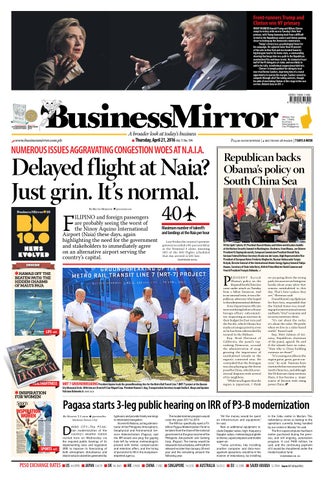
Front-runners Trump and Clinton win NY primary Front-runners Donald Trump and Hillary Clinton swept to victory with ease in Tuesday’s New York primary, with Trump bouncing back from a difficult stretch in the Republican contest and Clinton pushing closer to locking up the Democratic nomination. Trump’s victory was a psychological boost for his campaign. He captured more than 50 percent of the vote in New York and was headed toward a big delegate haul in his home state, a commanding showing that keeps him on a path to the Republican nomination if he continues to win. He claimed at least half of the 95 delegates at stake, and was likely to add to his tally, in individual congressional districts. Clinton’s triumph padded her delegate lead over rival Bernie Sanders, depriving him of a crucial opportunity to narrow the margin. Sanders vowed to compete through all of the voting contests, though his odds of overtaking Clinton at this stage in the race are low. Related story on A10. AP
media partner of the year
BusinessMirror
United nations
2015 environmental Media Award leadership award 2008
www.businessmirror.com.ph
A broader look at today’s business n
Thursday, April 21, 2016 Vol. 11 No. 194
NUMEROUS ISSUES AGGRAVATING CONGESTION WOES AT N.A.I.A.
Delayed flight at Naia? Just grin. It’s normal. 40 F By Recto Mercene
INSIDE
hawaii off the beaten path: the hidden charms of Maui’s paia
d1
inspiration for women BusinessMirror
C1
| Thursday, april 21, 2016 mirror_sports@yahoo.com.ph sports@businessmirror.com.ph Editor: Jun Lomibao Asst. Editor: Joel Orellana
INSPIRATION for WOMEN By Jimmy Golen
The Associated Press OSTON—Atsede Baysa learned a little about the Boston Marathon’s history a few days before she ran in it, hearing how Bobbi Gibb was turned down for a spot in the 1966 event but ran anyway to show that women could handle the 26.2 miles. Then, after winning the race, Baysa asked if she could meet with Gibb. On Tuesday morning Baysa presented Gibb with the 2016 Boston Marathon trophy—a silver cup she had earned on Boylston Street less than 24 hours earlier. Because Gibb, who also ran in 1967 and 1968, came before women were officially allowed to enter, she never received a trophy of her own after any of her three first-place finishes. “She’s inspiring for us, being women and runners,” Baysa said. “Now we are running around the globe. Her story is very touching.” Fifty years after Gibb broke the Boston Marathon’s gender barrier, the Boston Athletic Association recognized the accomplishment by making her the grand marshal of the 120th edition of the race. The free-spirited lawyer-turned-sculptor rode a sports car into Copley Square on Monday before stepping out to break a ceremonial finish line tape. Soon after, Baysa followed in her footsteps—and not for the first time. The two-time Chicago Marathon winner made up a deficit of about 200 yards with less than five miles to go, passing the leaders on Beacon Street in Brookline before pulling away to win in two hours, 29 minutes and 19 seconds. Lemi Berhanu Hayle completed Ethiopia’s first sweep on Monday when he won the men’s race in 2:12:45, moving past defending champion Lelisa Desisa to win by 47 seconds. Desisa also won the race three years ago, just a couple of hours before two homemade bombs at the finish line killed three people and wounded more than 260 others. In recognition of the tragedy, he donated his 2013 victory medal to the city of Boston. Baysa also had trouble holding onto her prize. Boston Athletic Association (BAA) Spokesman Jack Fleming said Baysa told race organizers of her plan on Monday, shortly after receiving the trophy. “We wanted to make sure we understood her. We said, ‘Why don’t you sleep on it?’” he said on Tuesday. “But she woke up this morning and said, ‘Yes.’” A singer back in Ethiopia—by request, she regaled reporters with an Oromo song at the news conference—Baysa said she felt a connection with Gibb as a fellow artist. Gibb’s next project is a sculpture that would recognize the women in the Boston Marathon history, one that would join the several sculptures of men already dotting the course. Gibb said she would only keep the trophy for one year because Baysa deserved to have it. “I was so impressed with what she did” in the race, Gibb said. BAA President Joann Flaminio, the first woman to lead the organization, said Baysa’s victory was a fitting conclusion to a year that celebrated a half-century of women in the race. At the Champions Breakfast over the weekend, several women joined Gibb to tell their stories. Three-time winner Uta Pippig was so moved that she registered for this year’s race on Sunday and ran on Monday. She finished in 3:39, crying as she crossed over the special logo painted on the street to commemorate the 50 years since Gibb’s first run. “We are so proud of all that’s happened, Bobbi, and so happy that you are getting the recognition you deserve,” Flaminio said. In his usual day-after statistical rundown, Race Director Dave McGillivray said nearly half the 27,487 runners who started the race were women. “That’s 1-percent growth every year,” he joked. “After another 50 years, it’s going to be an all-women’s race.”
B
MRT 7 GROUNDBREAKING President Aquino leads the groundbreaking rites for the Metro Rail Transit Line 7 (MRT 7) project at the Quezon City Memorial Circle. With him are (from left) San Miguel Corp. President Ramon S. Ang, Transportation Secretary Joseph Emilio A. Abaya and Speaker Feliciano Belmonte Jr. NONOY LACZA
By Manuel T. Cayon
@awimailbox typhoons and provide timely warnings Mindanao Bureau Chief to interisland navigation.
JACK NICKLAUS’S latest role is being a mentor to a burgeoning class of young golfers. AP
HE TALKS, THEY LISTEN J
USTIN THOMAS could sense his expectations getting higher and his game going nowhere. He was coming off a strong rookie year in 2015, contending a half-dozen times before breaking through for his first Professional Golfers’ Association (PGA) Tour victory in Malaysia last October. But then he started the new year in a rut, and Thomas knew just what to do—no matter how awkward it might have seemed. He asked Jack Nicklaus if he could come over to his house to talk. “Very weird,” Thomas said about making a call to the 76-year-old owner of 18 major championships. “I was nervous to do it, but it was the coolest thing when I first met him. We had lunch before I got in The Bear’s Club, and for someone of his status and how comfortable I felt around him, I give him a lot of credit for that. He didn’t try to intimidate me or make me feel uncomfortable. As soon as you’re around him, you’re not nervous. It really speaks to his character.” Nicklaus designs and builds golf courses. His business enterprise includes everything from wine to ice cream. He is heavily involved in
the Nicklaus Children’s Health Care Foundation. And in his latest role, he is a mentor to a burgeoning class of young golfers. And he loves it. “I don’t know why they do it. They seem to think it’s going to help them,” Nicklaus said with a wink and a smile. “I get a big kick out of it, sure. Why would you not get a big kick out of it? I’m 76 years old and I’ve got a 22-year-old kid coming here asking me for advice. “How many 22-year-olds ask anybody for advice?” Jordan Spieth spent time with him before his first Masters. Charl Schwartzel met with Nicklaus before he won the
green jacket. So did Trevor Immelman. Rory McIlroy talks shop with the Golden Bear all the time, though rarely about the Masters. (Note to McIlroy: The man has six green jackets.) “Just like approaching any of the greats of the game, one can be intimidated a little bit,” Spieth said. “But every time I’ve spoken to him, he’s been very open and willing to help me. I think he’s just rooting for the game of golf. It’s not just me. He’s doing it for everyone that I’ve seen around him. “He’s certainly been in our shoes, and we haven’t quite been in the shoes that’s he’s been in,” Spieth added. “It’s very, very nice of him, and I’ve enjoyed my time.” Patrick Rodgers was at Muirfield Village two years ago to receive the Jack Nicklaus Award as college player of the year. Nicklaus stuck around to meet with Rodgers and the rest of the winners from various college divisions. Before leaving, he looked Rodgers right in the eye and told him, “You ever need anything at all, just call me.” Nicklaus didn’t break eye contact until Rodgers nodded back. Rodgers is on the growing list of young players who have taken Nicklaus up on his offer. That includes Jordan Niebrugge, who reached out to Nicklaus when he qualified for the 2014 Masters as the US Public Links champion. A year later, Nicklaus sent him a hole-by-hole crib sheet on how to play Saint Andrews when Niebrugge made it through local final qualifying for the British Open. Maybe it was a coincidence, but Niebrugge tied for sixth and was low amateur. At their age, Nicklaus learned by watching more than listening. He would study the practice of Ben Hogan, Sam Snead, Julius Boros and Tommy Bolt and try to learn through imitation. It’s different now. Nicklaus said he was lucky to see the greats twice a year. He sees these kids all the time, particularly at his Bear’s Club in South Florida, where several of them now are members. He doesn’t teach anyone how to play golf. He just talks. And they listen. “Justin came and we talked for a couple of hours. Just talked,” Nicklaus said. “I don’t want to tell him what to do. I let him ask questions and I tried to feel how he’s doing and what he’s doing and how can I help his thought process. That’s more what it was about.” Nicklaus played his final major 11 years ago at Saint Andrews. He was Presidents Cup captain for the last time in 2007. He remains relevant, especially to the next generation. “I’ve had a lot of guys come to me. Most of them are afraid to approach me,” Nicklaus said. “To have all these young guys want to listen to something an old man has to say? It’s very flattering, and it’s also very nice that they want to do that.” Conversations can last a few minutes (Spieth) to a few hours (Thomas). And sometimes, the education goes beyond golf. AP
sports
r esiden t Ba rac k Obama’s policy on the disputed South China Sea came under attack on Tuesday from a fellow Democrat. And in an unusual twist, it was a Republican adversary who leaped to the administration’s defense. State Department officials were testifying before a House foreign-affairs subcommittee, requesting an increase in their budget for East Asia and the Pacific, which Obama has made a strategic priority, even as he has been sidetracked by turmoil in the Mideast. Rep. Brad Sher man of California, the panel’s topranking Democrat, accused the administration of exaggerating the importance of uninhabited islands in the region’s contested seas. He contended that the Pentagon was also playing up the threat posed by China, which has territorial disputes with several of its neighbors. “While we all agree that the region is important, I think
we are going down the wrong path, because we are being war hawks about some islets that remain uninhabited to this day. That’s how useless they are,” Sherman said. Daniel Russel, top diplomat for East Asia, responded that the United States was standing up for international norms and had a “vital” economic and security interests there. “It’s not about the rocks; it’s about the rules. We profit when we live in a rules-based world,” Russel said. Rep. Matt Salmon of Arizona, Republican chairman of the panel, agreed. He said if the islands have no value, “then why is China building runways on them?” “It’s causing our allies in the region great, great, great concern,” he said. Tensions have risen in the last two years in the South China Sea, and although the US does not claim territory there, it has become a major source of friction with rising power China. AP
Pagasa starts 3-leg public hearing on IRR of P3-B modernization
Sports
ATSEDE BAYSA (above) draws inspiration from Bobbi Gibb, the first woman to run the Boston Marathon. AP
In this April 1 photo, US President Barack Obama and fellow world leaders huddle at the Nuclear Security Summit in Washington. Clockwise, from Obama, are Chinese President Xi Jinping (obscured), European Commission President Donald Tusk, German Federal Defense Secretary Ursula von der Leyen, High Representative Vice President of European Union Frederica Mogherini, Russian Ambassador Sergey Kislyak, Director General of the International Atomic Energy Agency General Yukiya Amano, Secretary of State John Kerry, British Prime Minister David Cameron and French President François Hollande. AP
P
health&fitness
Atsede Baysa presented Bobbi Gibb with the 2016 Boston Marathon trophy—a silver cup she had earned on Boylston Street. Because Gibb, who also ran in 1967 and 1968, came before women were officially allowed to enter, she never received a trophy of her own after any of her three firstplace finishes.
Republican backs Obama’s policy on South China Sea
@rectomercene
ilipino and foreign passengers are probably seeing the worst of Maximum number of takeoffs the Ninoy Aquino International and landings at the Naia per hour Airport (Naia) these days, again highlighting the need for the government Last Friday the country’s premier gateway recorded a 96-percent delay and stakeholders to immediately agree at the Terminal 3 alone, meaning 383 of the 400 flights scheduled on an alternative airport serving the that day arrived or left late. country’s capital. Continued on A2
life
P25.00 nationwide | 4 sections 28 pages | 7 days a week
D C1
AVAO C I T Y—Th e P 3 - b i llion modernization of the country’s weather station started here on Wednesday via the required public hearings of its implementing rules and regulation (IRR) to improve its forecasting of both atmospheric disturbances and inland natural calamities generated by
PESO exchange rates n US 46.0990
Vicente B. Malano, acting administrator of the Philippine Atmospheric, Geophysical and Astronomical Services Administration (Pagasa), said the IRR would also plug the gaping hole left by veteran meteorologists pirated with better compensation and retention offers, and the hiring of personnel to fill in the manpowerdepleted agency.
The modernization program would cover the years 2017 to 2019. The IRR has specifically eyed a P3billion Pagasa Modernization Fund to be taken from the share of the national government in the gross income of the Philippine Amusement and Gaming Corp. (Pagcor). The money would be released in two schedules, with half of it released no later than January 20 next year and the remaining amount the following year.
“All the money would be spent on infrastructure and equipment,” he said. New or additional equipment include Doppler radars, high- frequency Doppler radars, meteorological glider or drones, supercomputers and mobile upper-air. “Some activities, like installing another computer and data-management operations, would be in the manner of redundancy, by installing
in the Cebu center in Mactan. This redundancy serves as backup to the operations currently being handled by our center in Manila,” he said. The first supercomputer had been earlier purchased during the previous, and still ongoing, automation program. It cost P400 million, he said, and the continuing payment of it would be shouldered under the modernization fund.
n japan 0.4219 n UK 66.3641 n HK 5.9450 n CHINA 7.1382 n singapore 34.5130 n australia 36.0125 n EU 52.3500 n SAUDI arabia 12.2964
Continued on A2
Source: BSP (20 April 2016 )
BMReports BusinessMirror
A2 Thursday, April 21, 2016
news@businessmirror.com.ph
Delayed flight at Naia? Just grin. It’s normal. were delayed; then on April 17 there were 279 delays. On April 18, 276 flights were disrupted, before the condition improved the following day, when only 133 delays were recorded. Delays in the other terminals are in proportion to those of Naia 3. The Naia 3 has the most number of aircraft operations at 400 a day, followed by Naia 2 at less than 200, Naia 1 at about 100 and Naia 4 at about 80, for a combined 780 flights daily. Since the Civil Aviation Authority of the Philippines (Caap) had decreed that airport events—or the number of takeoff and landings—at the Naia must not exceed 40 an hour, the total 24-hour operation of the airport can only accommodate 960 events. Most of the flights start shortly after midnight at the Naia and end at their provincial points at sunset, because many outlying airports have no nightlanding capabilities. Most of the flight schedules for the provincial routes are crammed within the 12-hour window at the premier airport. Terminal 4 Manager Bing Lina said scheduled departures at Naia 3 are bunched into eight waves: From 12 a.m. to 3 a.m.; 3 to 6 a.m.; 6 to 9 a.m.; 9 a.m. to 12 p.m.; 12 to 3 pm; and so on at three-hour intervals until midnight. Unfortunately, these schedules are mostly breached because of the night-landing limitations of some provincial airports.
units and the Metropolitan Manila Development Authority to speed things up. He added that the skyway project is not projected to conclude construction up to later in the year. “Until then, we expect traffic [to be heavy], as already announced by the DPWH [Department of Public Works and Highways],” he said, meaning people should just grin and bear it. He said aside from accredited airport vehicles, the Miaa had an agreement with Grab. “Soon to come is Uber,” he added, “to cushion the demand.” Some premium buses have also been fielded to bring passengers from the Miaa to the city centers. The Miaa contributes to lessening congestion by reactivating runway 1331 and the construction taxiway “November” to ease aircraft ground traffic, he said. Meanwhile, Caap Director General William K. Hotchkiss’s promise to upgrade eight to 11 provincial airports did not fully materialize because he is hamstrung by the Department of Transportation and Communications (DOTC). Despite being declared an “independent and autonomous” agency on paper, the Caap remains under the thumb of the Transportation Secretary Emilio “Jun” Abaya. “He [Abaya] dictates what and where to build the next international airport, what fund to give to any of the many agencies under his control,” said an airport insider who asked not to be quoted for obvious reasons.
Vehicular traffic
Chain reaction
Continued from A1
As for vehicular traffic at the Naia, things had gone a little better and the one-hour traffic jam, recorded last year for weeks on end, is gone. Today traffic flows, albeit slowly, because the construction of the skyway linking the terminals to the casinos at the Macapagal Avenue is halfway finished. But waiting for a taxi or a limousine remains a problem. There are 30,000 to 50,000 passengers arriving and departing at the Naia daily, while the accredited vehicles are only 3,000, or at most 5,000. Regular taxis are discouraged to enter because the airport because it is hard to trace the violators among them. David de Castro, Manila International Airport Authority (Miaa) spokesman, said airport police are on the ground to facilitate traffic movement. He said the Miaa works with the local government
On the other hand, if any of the five local carriers suffers a “technical problem” or any of their aircraft gets into a minor incident at any of the country’s 30 active provincial airports, the delays would roll over to their next flights, and a chain reaction occurs. This is the explanation provided by aviation authorities, who said local airlines had experienced some technical problems on Friday due to still unexplained reasons, causing “situational” problems, or a chain reaction. “If you are late leaving at your original schedule, then you arrive late at your destination. On the way back to Manila, you would be late in arriving, as well, until the delays had affected all succeeding flights,” said Rodante Joya, the Caap deputy director general for operations. He said the congestion at the Naia could not be blamed to air-
traffic management alone. He said the airlines could be at fault for not leaving on time, but the riding public, or the airlines, themselves, usually point the finger to them. “Ganun ba kadami ang congestion?” he asked. “It was caused by a chain reaction.” He said air carrier’s maintenance procedures should be the key to avoid delays, and that the particular carriers should stick to their takeoff schedules. Joya added that separate planes to take care of the slack are a pipe dream, because it is very expensive to maintain a separate aircraft.
The Naia experience
The story of these two travelers showed vividly the congestion at the Naia. Jessica Ramos and her friend Danica, both employees of ABSCBN, went to Boracay last Friday, and were at the Naia 4 at 10 a.m. for their scheduled 12:30 p.m. departure for Kalibo. From Kalibo, they would take a bus for the two-hour trip to the famed resort. When the scheduled departure was nearing, they heard the public announcement system announced that their flights would be delayed to 5:45 p.m. At 9:16 p.m., Ramos said they’re still at the domestic terminal and wondering whether it was their plane that was late or that the congestion was the cause of their stay. “Ang daming nakapila, lahat kami delayed [There were many that are lined up, all of us were delayed],” she texted her parents, peering through the glass door of the domestic terminals at the parked airplanes outside. At 11:13 p.m., Ramos said they were finally onboard their plane waiting for takeoff, but remains stuck in the tarmac. “They just kept saying ‘congestion sa airport’,” she said, quoting the flight attendant. At 12:01 a.m. on Saturday, Ramos texted to her parents, “Touchdown Kalibo.” The duo is not as lucky on the way back on April 17. Their plane was scheduled to leave Kalibo at 9:30 p.m., but they were delayed to 12:30 a.m. Eventually they boarded their plane at 1:19 a.m. and touched down at Naia 4 at 2:20 a.m. on Monday. Needless to say, many more passengers had the same experience. The BusinessMirror asked Cebu Pacific and Air Asia for comment, but they did not respond. This is not unusual. Silence is the carriers’ best defense
against the ire from aviation’s higherups. Or maybe both sides are helpless to explain the situation.
Silent protest
These series of unfortunate events transpired last week while the air-traffic controllers at the Naia were at the nadir of their career. On April 15 members of the airtraffic controllers association expressed their frustration by hanging a banner at the top of the control tower that reads: “Mayday, mayday”—the controllers’ aim to bring to the public’s attention the cold shoulder they are getting from the government. They rue, with justification, that some government agencies received so much money without the same risks that they confront daily. The members of the air-traffic controllers’ association and other technical experts of the Caap were told by the Commission on Audit (COA) that they should return the approximately half- a-million pesos each of them received in 2012 and 2014. The emoluments were given by the agency for having exerted so much effort, bringing the country’s aviation sector back to Category 1 status. But the COA told them that their financial windfall was illegal. Their reward does not bear the approval of President Aquino, although the Caap Board had unanimously stamped its approval on it. Until now Malacañang refused to act on the air controllers’ behalf, despite the representations made by Hotchkiss and his staff last month at the Palace. The air controllers have been in a defiant mode since the COA ruling and have been wearing black armbands at the Caap compound when they report for duty. Was there sabotage involved? Nobody could say.
PAL weighs in
Flag carrier Philippine Airlines (PAL) responded to the air controller’s plight and on Wednesday called for a peaceful and immediate resolution to the brewing labor unrest among members of the employees union. PAL President and COO Jaime Bautista said: “We are hoping for a swift and acceptable solution to the ongoing labor issues within the ranks of the Caap. We express optimism that a resolution will be reached in due time. We are glad to note that technical personnel
such as air-traffic controllers continue to carry out their duties.” PAL, however, warned that a longdrawn conflict between the Caap labor and management on the issue of salaries and bonuses and protest actions, albeit peaceful, will paint a negative picture of the country’s aviation industry. “It is important to protect the Philippines’s return to Category 1 status, a reflection of the country’s compliance to international safety standards set by the Icao, [International Civil Aviation Organization]. Any perception of disunity in the civil-aviation sector may affect the status the country has earned,” Bautista added. Joya said the air controllers were reporting on time. He said they have vowed to him that they will never abandon their job. “They said they will stick to their vow of a safe, expeditious and orderly flow of air traffic.” Tower supervisor Marlene Singson said they don’t have any intention of disrupting air-traffic movement, “because we bowed to serve the flying public.” We do not have plan or attempt to take over the Manila control facilities; we are just in silent protest.” The BusinessM irror asked authorities why they limit aircraft operations to 40 events per hour. Joya said the numbers being implemented at the Naia is the optimum, not maximum, capacity, due to the current airport and technical limitations, without sacrificing safety.
ATC
It was reported that the government is planning to privatize the country’s air-traffic control (ATC) operations, with the hope that this would solve the congestion problem. On the other side of the negotiating table is NATS, the UK’s leading provider of air-traffic control services. Each year it handles 2.4 million flights and 250 million passengers in UK airspace in 13 UK airports. They provide services around the world spanning Europe, the Middle East, Asia and North America. UK Ambassador Asif Ahmad told the B usiness M irror last December there are ongoing discussion about NATS offer to operate the Naia air-traffic system. He said NATS would be able to improve the Naia’s 40 events per hour to 60 or more events per hour, “the same way they do at Heathrow
Pagasa starts 3-leg public hearing on IRR of P3-B modernization More Doppler radars would also be purchased for the five regional centers and satellite stations. He said these are used to monitor atmospheric data and disturbances, while the highfrequency Doppler radars would be used “to observe ocean waves to help
and guide us about inland and coastal sea travel around the archipelago.” “Other instruments would be installed in the 13 other major river basins outside Luzon,” he said, saying that the five river basins in Luzon have their own instruments
already. “This forms part of enhancing our facilities for field services, including improved and better monitoring of floods.” The five regional centers in Tuguegarao for northern Luzon, Legaspi in southern Luzon, Mactan for the Vi-
sayas, El Salvador in Misamis Oriental for Mindanao, and in Manila, would have to acquire also calibration instruments to check yearly the calibration of all-weather monitoring gadgets. “We need this calibration instrument to maintain the accuracy of our instruments,” he added. The Pagcor-funded modernization would not cover the personnel program, however, but would be covered by the annual general appropriation. Under the humanresource program are items on upgrading salary scales of personnel down to the lowest Weather Facilities Specialist 1 and Weather Specialist 1, both with Salary Grade 15, to two-step higher grade. The upgrading of the salary is also by two salary grades. There is also the so-called retention incentive equivalent to 15 percent to 20 percent of one’s salary to be given at the end of the year, and on top of the mandated economic privileges also given at the yearend. The human-resource program is intended to fill in the gap left by 25 veteran meteorologists who were mainly hired by other countries’ weather stations since 2010 for higher salaries and better remuneration package. “All in all, we need to hire 200 personnel. This includes one floodforecasting personnel each in the 13 centers and meteorologists for our stations that don’t have the designated personnel,” he added. Director Anthony C. Sales of the re-
gional office here of the Department of Science and Technology (DOST), said the IRR “is the pag-asa [hope] of Pagasa.” “We look forward to fruitful discussions in the public hearings to improve further the IRR,” he said in opening the public hearing. The implementing rules and regulations would cap the modernization road supposed to happen two years earlier, when the law was ready for signing in 2013 when then Senate President Juan Ponce Enrile resigned. The Pagasa Modernization Act of 2015, tagged Republic Act 10692, was enacted in November last year, and the IRR was drafted weeks later. The law requires the IRR to undergo public hearings before it would be signed by the Science secretary. The next public hearing would be held next week in Bohol, for the Visayas leg. The ocean east of Mindanao has traditionally churned out low-pressure areas that develop typhoons in Southeast Asia. In the last decade, however, it has demonstrated its ferocity by nurturing the more powerful typhoons, the Pagasa said on Wednesday. Vicente B. Malano, acting administrator of Pagasa the told BusinessMirror here that the area in the Pacific Ocean about 1,000 nautical miles east of Mindanao have been the traditional generators of typhoons going west to China and Japan. “But in the last 10 years, this area, although officially outside the Philippine area of responsibility, also generates about five powerful typhoons
Airport in London.” Joya said: “Employees under a private entity could go on strike, do you want our air controllers to go on strike every time they want an issue resolved?” He said government employees are banned from conducting strikes, which is probably why the Naia air controllers remain at their posts. However, the air controllers at the Naia are probably slowing down without anybody taking much notice.
Expeditious but safe
Christian Faber, who works at Eurocontrol as an ATC expert on Flow and Capacity Management, elucidates the current dilemma of air-traffic controllers worldwide. He explains whether the old essence of safe, expeditious and orderly flow still apply today, with the industry dominated by hordes of low-cost carriers, stiff competition, slim profit margin and throng of tourists taking advantage of cheap flights. He said most people understand“expeditious” to mean “done with speed and efficiency, but fast and efficient may lead to an unsafe situation.” He said from a Flow and Capacity Management point of view, the terms safe and expeditious are contradictory, even though they proceed from the same source. His observations about ATC in Europe and elsewhere also apply to the Philippines. Air-traffic standard worldwide is enforced by the International Civil Aviation Organization. “The aviation world has changed dramatically over the last 20 years and we are faced with challenges, such as the continuing increase of air traffic in the face of limited capacity. On top of that, we are experiencing daily problems such as lack of staffing, adverse weather condition, complex routing schemes, etc.” “An increase of air traffic goes hand in hand with an increased potential risk of overloading air-traffic controllers; adherence to flight plan, flight levels, routes and ATC slots becomes critical,” Faber added. “In this light, the ‘expeditious’ flow of air traffic is not always safe. Instead, we might have to consider an ‘optimized’ flow of air traffic, which balances flight efficiency and safety,” he concluded, meaning air travelers have to live with the prospects of delays for the years to come.
Continued from a1 each year,” he said. Among these were Typhoon Sendong in 2011 and Typhoon Pablo on the following year. Although Sendong did not pack strong winds, it poured a tremendous volume of water that either killed via onrushing water, or washed away to sea more than 1,000 lives. Pablo was then the strongest typhoon to hit the country until it was sidelined by Supertyphoon Yolanda a year later. “The pathway is now usually going Mindanao, lower than the traditional entry in eastern Visayas or between it and lower southern Luzon,” he said. “Typhoons usually tread the path to the hotter parts of the ocean.” Malano attended the first public hearing at the Marco Polo Hotel here for the IRR of the P3-billion modernization of the Pagasa. Party-list Rep. Angelo B. Palmones of Agham said, “Before, the Philippines was the first nation hit first before typhoons proceeded inland to China or swerve to the north to Japan. It’s not that anymore now. Mindanao is now the generator of typhoons, specifically the ocean east of Mindanao,” he said. But he added that “the message here is not about Mindanao as the generator of typhoons in Asia.” “The message is: It’s high time that we reforest and bring back the vibrancy of our rainforests. Because where there’s heat, typhoons are also attracted to it,” he also told BusinessMirror.
BMReports BusinessMirror
news@businessmirror.com.ph
Thursday, April 21, 2016 A3
Generika eyes aggressive expansion in PHL G By VG Cabuag
@Vilygc
ENERIKA Drugstore, the country’s third-largest player and half-owned by Ayala Corp., eyes aggressive expansion in the country’s far-flung areas and, possibly, in the Southeast Asian region, as its executives see the public’s general acceptance of generic drugs. Teodoro Ferrer, president of Generika, said the company plans to add 152 stores in its current network of more than 600 this year, and an average of 100 stores annually over the next few years. “We need to grow further to more than 1,000 stores in less than five years,” Ferrer said in an interview at the sidelines of the Asia SME Summit 2016, organized by the Asia CEO Forum. “We also need to focus the product line to include food supplements and also focus on health care and wellness, and not just on medicines.” Ferrer said such endeavor could be considered already aggressive for a company the size of Generika, founded 12 years ago. He added the company’s tack should not be compared with opening a branch for a convenience store that sell mostly food and grocery items.
“You need to have approvals from the local government, from the FDA [Food and Drug Administration]; hire a licensed pharmacist; and then look for the right franchise owner that will take care of your store.” Ferrer said the company will put branches in far-flung areas of the country where he believes its services are needed. But we’re not necessarily leaving the urban centers where we also have a huge customer base, he added. Last year the Ayala group, through its Ayala Healthcare Holdings Inc., acquired 50 percent of Generika after it bought the share of Frenchman Julien Bello, the drug retailer’s cofounder. Mabuhay Capital served as financial advisor to the group of Bello in its transaction with Ayala Healthcare. Ayala allowed Ferrer, who still owns
half of the company, to continue serving as Generika’s president and CEO. Ferrer himself worked with the Ayala group for 30 years. He served at the group’s property firm Mermac Inc., which, in turn, owns about half of the country’s oldest conglomerate. Ferrer said after Ayala group came into the company, they found “there are still many‘house-fixing’”to do in Generika for it to become at par with the good governance standards of the conglomerate. He added that he and Bello had some disagreements, which came to point of stalemate in the decision of where the company should go. “But despite the stalemate, we were still able to grow the company,” Ferrer said. However, he admitted the five-year plan they crafted with Ayala group executives has set “high targets” for the company, as it now competes with Mercury Drug, the country’s top pharmaceutical firm, and The Generics Pharmacy, the Philippines largest generic-drug retailer. At the moment, about 42 percent of the total branches of Generika are company-owned, since previously it didn’t have the capital to own stores, which cost about P1.2 million to P1.5 million to build. The rest of the stores are operated through franchise owners. “Now that our profit is increasing and Ayala group has come in, we can now expand company-owned stores.” Ferrer said he wants to increase the ratio to 50 percent in order for them to have a control in the drugstore network. Generics medicines, he added, will
continue to have a share in the country’s pharmaceutical market that even a big drugstore, such as Mercury Drug, known to sell branded medicines, has changed its business model and are now also selling generic drugs. “Some 12 years ago, no one buys generic drugs. But through our constant education, we were able to convince the public that it is safe to take generic medicines,” he said. “Medicines are protected by patents and, normally, these patents expire in 20 years,” Ferrer s,aid. “Then the trend toward [the intake of] generic medicines in the Philippines, and globally, is inevitable. It will just get more and more market share because the moment the patents expire, that’s when anybody can come up with their generic equivalent.” Generic drugs are about 85 percent to 90 percent cheaper than the branded ones, he said. The company is also in talks with other firms for Generika to supply their medicine requirements, as part of its effort to convince the public to switch to generic drugs. These include Ayala-controlled companies, such as Manila Water Inc. and Integrated Microelectronics Inc. Likewise, Ferrer said they are also eyeing the local unit of Lufthansa. Ferrer added that the company has no plans yet to go public since the capital that Ayala infused is enough for the company to expand in the local market. What is more feasible, Ferrer said, is to expand to other countries in Southeast Asia as part of the Asean economic integration. That plan, however, is not a
priority right now since we have much to do at the home soil, according to Ferrer. But the idea is not far-fetched since other Ayala-led firms are expanding in the region, he added. “If you open in another country, it makes a lot of sense to find a local partner. It becomes feasible all of a sudden.” Ferrer said. “Right now, Ayala has projects in other countries, so that may open doors [for us]. Maybe their local partner in real estate or in water may also turn out to be a good partner for something like a generic drugstore chain in that country.” Generika is part of the health-care venture of Ayala, which is also in the process of putting up retail clinics to cater to middle class health-care consumers in major cities across the country. Paolo Borromeo, head of the conglomerate’s Corporate Strategy and Development Group, said the move is still on its early stages and experimental, but it is looking at opening 100 stand-alone clinics under the brand FamilyDoc during the next three years across the country. Last December the company opened two pilot clinics—one in Las Piñas and the other in Imus in Cavite. The said clinics are for profit and will not be part of the company’s corporate social responsibility. “We are at a very early stage but the idea is…. We took models from the US, India and Indonesia, where you have small format primary-care clinics that [is] a pharmacy, a convenience store and a diagnostics [center] all in one,”Borromeo said. He added Generika’s would also have a blood laboratory. At any given time, he said, the clinic
will be staffed by at least five medical professionals: one doctor, two nurses, one pharmacist and one lab technicians. “All of these professionals will be employed by the company,” he said. Ferrer’s view of the generics drugs sector goes against a survey by the Philippine Institute of Development Studies (PIDS) that said the use—and even awareness of generic medicines in the country—was still low despite the passage of Republic Act 6675, also known as the Generics Act of 1988, and campaigns done by the Department of Health. The authors of the study surveyed over a thousand respondents and only 7.2 percent knew the correct definition of generic drugs. Around 71 percent were “partially knowledgeable” or able to mention that either generic drugs were of the same quality as that of branded drugs or generic drugs were cheaper than branded drugs. The results also showed that 21.52 percent were not knowledgeable at all, and gave incorrect definitions of generic drugs. The authors also said that, across six geographic zones, respondents who correctly identified three or four generic drugs were in the National Capital Region, while the lowest was in the Autonomous Region in Muslim Mindanao. The study, titled “How effective has the Generics Act Been?” was authored by PIDS consultants and researchers led by John Q. Wong of the Ateneo de Manila University. With report from Cai U. Ordinario
Asean
BusinessMirror www.businessmirror.com.ph
A4 Thursday, April 21, 2016 • Editor: Max V. de Leon
What does water scarcity mean exactly? Asean-EU Perspective
HENRY J. SCHUMACHER
I
n general, this term is divided into three categories: a. Annual water availability below 1,700 cubic meters per capita per year is called water stress; b. If this value drops under 1,000 cubic meters, it is already called water scarcity; and c. A level below 500 cubic meters per capita per year is related to absolute water scarcity (UN-Water 2014). Worldwide, about 700 million people are affected by water scarcity; this figure is likely to increase to about 1.8 billion people by 2025! Furthermore, two-thirds of the world’s population may live in areas with acute water stress (UN-Water 2014). In the face of this lack of water, global water consumption is currently 1,200 cubic meters per person per year. Apart from physical water scarcity, there is also economic water scarcity, which is related to the possible water supply, in terms of infrastructure, water management and policy. A growing problem is related to the progressive privatization of water stocks, which requires regulatory authorities to focus on pricing for the lessprivileged sector of society. The Philippines is one of 37 Asian countries cited by the Asian Development Bank (ADB) as “either suffering from low levels of water security, or have barely begun to engage in the essential task of improving water security.” In 2013 the ADB said local public utilities responsible for providing water and sanitation services to local communities “were found to lack capacity in all aspects of sustainability, including effective functioning, financing and demand responsiveness.” Although more and more people are consuming much more water, domestic water consumption is not the biggest problem. Regarding the different consumer sectors, agriculture is globally responsible for the bulk of water consumption (up to 85 percent of the Philippines’s water demand comes from agriculture. Industry and the domestic sector are the next largest water consumers). Due to the annual increase of food demand, water demand is expected to double within the next 50 years. Ways of overcoming this problem may be the increased use and treatment of rainwater, waste water and the desalination of sea water. The latter, however, is a financially and energetically very complex procedure. Far simpler solutions may generally be seen in the field of saving water, raising public awareness of this precious finite commodity and in political framework concerning management and distribution of water. The worst-case scenario predicts a water crisis in the Philippines by 2025. This prediction by the Japan International Cooperation Agency (Jica) identified Metro Manila, Metro Cebu, Baguio, Angeles and Davao as among those to be worst hit by a severe water shortage by 2025. Knowledge of this impending emergency prompted the European Chamber of Commerce of the Philippines to make “water” one of its advocacies; we have been running Water Challenge Forums for some time and intend to do this again this year in Manila, in Cebu and in Davao. The forums are multisectoral gatherings involving the government, water utilities and private business firms that together will discuss issues, such as increasing sustainable access to water supply, water security, conservation, water management and the perspective of the leading water users, especially agriculture that accounts for up to 85 percent of the freshwater used in the Philippines every year. To be the hardest hit by this life-threatening water crisis a scant decade away will be the poor, which are also the hardest hit today. It remains a humiliating fact that the poor pay a whole lot more for water than any other social class. By 2025, all of the following three goals must be accomplished: universal access coverage and sustained utility operations; continued coverage expansion of existing formal utilities at par with population growth and regulation of all waterservice providers. While the onus of protecting freshwater sources rests with the state that owns all water sources in this country, citizens can play a key role by conserving water.
Singapore loses to less-developed neighbors in board diversity
S
ingapore, Southeast Asia’s most advanced economy, is falling behind its less-developed peers when it comes to women breaking the glass ceiling at companies.
The island nation is ranked near the bottom on female representation on company boards in the Asia-Pacific region, behind only South Korea and Japan, according to a Korn Ferry study of 2014 annual reports in 10 economies. Women made up 7.7 percent of the boards of the largest publicly listed companies in Singapore, 2.6 percent in South Korea and 3.3 percent in Japan, the executive search and organizational advisory firm said in a news statement. In contrast, Malaysia saw the largest year-on-year increase in female board representation to 12.5 percent, from 8.3 percent, while companies in India reported an increase to 8.6 percent, from 7.3 percent. “Singapore, in general, believes more strongly on meritocracy and there are other priorities superseding
gender diversity,” Alicia Yi, managing director for board and CEO services at Korn Ferry, said in Singapore on Tuesday. “But if it’s through meritocracy, you would think that there would be more women that you’d see naturally on company boards.” Government policy or support— such as targets, quota or disclosure requirements—helps, according to Korn Ferry.
Malaysian target
Malaysia is the only country in the study to have set a target of 30percent female representation by 2016, and provided active support for companies to reach the goal, Korn Ferry said. In India, the law requires all listed companies to have at least one woman on the board, it said. Australia is the best performing
7.7%
Women representation in the boards of the largest publicly listed companies in Singapore
country in the region, with 21.9 percent female board members among companies listed on the nation’s stock exchange. Aided by genderdiversity policies in its corporate governance council reporting rules, the country is the only one in the survey where more than 20 percent of board members are women, almost double what it used to be in 2011, according to Korn Ferry. “Singapore needs to set guidelines and targets,” said Marleen Dieleman, associate professor at National University of Singapore’s business school. “They need to make a political decision to do something more substantial.”
Other takeaways from the study: n Companies with at least 10 percent female board members delivered a 14.9-percent return on equity in 2014, compared to 12.6 percent for those without. n Women make up 10.2 percent of all directors in the 10 Asia-Pacific economies studied, up from 9.4 percent in 2013 and 8 percent in 2012. n The Asia-Pacific region is behind economies, such as the United States, the United Kingdom and the European Union, in terms of female representation on boards. At the current pace of growth, the region wouldn’t catch up for another decade. n All-male boards are no longer a majority in the region, falling to 39 percent in 2014, from 53.2 percent in 2012. In the Financial Times Stock Exchange 100 companies, there are no longer any all-male boards. The study examined the largest 100 publicly listed companies’ 2014 annual reports in Australia, China, Hong Kong, India, Indonesia, Japan, Malaysia, New Zealand, Singapore and South Korea. Korn Ferry collaborated with the National University of Singapore on the study. Bloomberg News
The ruling coalition of Prime Minister Najib Razak (center) could still cling to power despite the 1MDB scandal. BLOOMBERG
In Malaysia’s biggest state, indifference to Najib’s 1MDB scandal is his friend
I
n the rainforests of Borneo island, the name 1MDB doesn’t mean much. About a thousand kilometers from the Malaysian capital, more basic issues are likely to return Prime Minister Najib Razak’s coalition to power in the Sarawak state election next month. Amin Amid, 72, has watched life improve in his coastal village in Malaysia’s biggest state over the decades. Locals have electricity, schools, clinics and, recently, big blue tanks to store water. He hasn’t heard of 1Malaysia Development Bhd. (1MDB), the government fund hit by multiple financial scandals, or questions over hundreds of millions of dollars that showed up in Najib’s bank accounts three years ago. When told, he doesn’t particularly care. “I don’t really understand the issue,” said Amin, an ethnic Malay who sells palm sugar, coconut oil and fermented shrimps by the side of a two-lane main road. “He definitely has a lot of not-so-good news going on, but I’m not really bothered. He is already the leader, what else can we do?” Indifference to the scandals outside Malaysia’s biggest cities will probably help Najib’s Barisan Nasional (BN) coalition retain Sarawak—a state held since 1963—in
47
Number of times Najib visited Sarawak since 2009, more than his five predecessors’ visit to this Malaysian state combined elections on May 7. It would show the difficulty his opponents have in gaining momentum among ordinary Malays by painting him as corrupt and self-serving. But it’d also be a warning to the premier that voters could shift their allegiance if they feel their lives are impacted by a slowing economy.
Rural support
Najib’s critics, including former premier Mahathir Mohamad, have embarked on a nationwide tour aimed at winning over Malays, the largest ethnic group in the country and the bulwark of BN. They’ve struggled to make a serious dent in his support in rural areas, despite months of attacks over 1MDB’s fi-
nances and the $681 million the government said was a donation to Najib from the Saudi royal family. Najib, who has since returned the bulk of the money, has denied any wrongdoing, as has 1MDB. With the collapse in global commodity prices last year denting incomes in the rubber and palm-oil nation, alongside a goods and services tax introduced in April 2015, Najib is also working to woo Malays. He could potentially claim a Sarawak win as a personal endorsement, even if the popularity of Chief Minister Adenan Satem, in power since February 2014, is the bigger factor. Equally, a weaker showing would be seized on by his critics. For Sarawak voters, “local and state issues are far more important than national issues and also national personalities,” said Faisal S. Hazis, head of the Centre for Asia Studies at the National University of Malaysia. Faisal is the author of Domination and Contestation: Muslim Bumiputera Politics in Sarawak. Najib had visited Sarawak 47 times since he came into power in 2009, more than his five predecessors combined, Adenan said during one of Najib’s trips last month, jokingly suggesting he could get a new wife from the local Iban community. The premier has since made at
least three more visits, promising to ensure infrastructure projects are implemented. Separated from peninsula Malaysia by the South China Sea, Sarawak was the country’s third-largest state or territory contributor to GDP in 2015, accounting for an estimated 10.6 percent of output. It contributed to half the country’s crude-oil output and is the sole provider of liquefied natural gas, according to Standard & Poor’s. Najib touted development of Sarawak and neighboring Sabah state in his budget speech last October, pledging funds for paddy fertilizers, longhouses and a 1,796-kilometer highway, linking the two states, which will cost 28.9 billion ringgit ($7.4 billion.) The premier “wants to claim credit” for BN’s popularity in Sarawak, said See Chee How, an opposition People’s Justice Party lawmaker. “That’s why he comes so often and gives money here and there, promising this and that.” Najib’s office declined to comment. In a state with one of the highest poverty rates in Malaysia and the lowest literacy rate, voters rely on the government for farming subsidies, as well as jobs in the civil service, See said. Electoral officials are adding 11 seats to the state assembly,
redrawing boundaries last year in a way that critics, such as Maria Chin Abdullah of the Coalition for Clean and Fair Elections, said at the time was skewed in favor of BN. Najib has described the move as necessary to better serve voters. Almost 80 percent of the 82 seats up for grabs are in rural areas, according to Faisal. A large section of the state is covered by mountain highlands and rainforests, with some settlements accessible only by helicopter or a long river trip. BN and its allies have 55 of the 71 current seats. In the 2013 federal election, Sarawak and Sabah contributed about a third of the parliamentary seats won by BN. Adenan, who has abolished bridge toll charges, lowered electricity tariffs and implemented policies supportive of Chinese-language education in Sarawak, said this month he is confident of BN winning at least 60 to 70 seats. Sarawak is also the subject of perennial allegations that both opposition and government parties have offered cash for votes. A court ruled that BN’s victory in the Bukit Begunan constituency in the 1996 state election was null and void on the grounds of vote-buying. BN won the subsequent by-election. “Sarawak politics is all about money, nothing is an issue,” said Nicholas Mujah, secretary of the Sarawak
Dayak Iban Association, who helps the indigenous group fight landrights cases. Mujah, whose parents live in a traditional longhouse, stood as an opposition-party candidate in the 2013 federal election and lost. Some voters would probably accept as little as 30 ringgit from parties for their vote, he said. “Election is like fruit season, it’s time to get money.”
Urban voters
A spokesman for Adenan said his office won’t respond to an e-mail seeking comment on last year’s boundary redraw, and claims by opposition politicians of vote buying. Voters in urban areas are more inclined toward national issues. “Najib should call for a general election now to see if voters still support him,” said Chew, 55, an ethnic Chinese opposition supporter in the capital Kuching who would only give her surname. “Of course 1MDB matters. It is Malaysia’s money, it is our money.” And the development promised by Najib’s government hasn’t reached everyone. Iban farmers Jaya and Nuli said indigenous groups are sidelined. About 40 percent of Sarawak people are non-Muslim natives, collectively known as Dayaks, while Malay Muslims are about a quarter of the population. Bloomberg News
BMReports BusinessMirror
news@businessmirror.com.ph
Thursday, April 21, 2016 A5
Bangladesh central-bank heist unlikely to derail Asean financial integration
T
By Bianca Cuaresma
@BcuaresmaBM
he recent Bangladesh central-bank fiasco involving $81 million lost to crossborder bank heist will not derail the integration of the region’s financial system, a local bank economist said.
Bank of the Philippine Islands (BPI) research officer Nicholas Antonio Mapa told the BusinessMirror the cybercrime will not necessarily affect the progress of the Asean Banking Integration Framework (Abif). The Abif, which aims to liberalize the region’s banking market by 2020, is part of the Asean economic-community blueprint. The plan is to harmonize banking services
2020
Target year to liberalize the region’s banking market under the Asean Banking Integration Framework
in the region through bilateral and regional agreements. What the recent heist will affect, according to Mapa, is the crafting of crucial rules and policies in Asean and in each member-country to prevent money laundering. “I think the recent scandal will put more focus on antimoney laundering but will not necessarily affect the Abif. For sure, there will be a need for stricter guidelines and for laws in each country to be strengthened to be able to fend off such crimes,” Mapa said. The integration of the global banking community has been evident in the Philippines, as more and more financial institutions are looking to invest and put up branches in the country following the sector’s liberalization. Since the entry of foreign banks has been liberalized, the Philippines was able to attract six new foreign banks—two from Taiwan, two from South Korea, one from Japan and one from Singapore.
Part of the money surrendered by Chinese casino junket operator Kam Sin Wong to the Anti-Money Laundering Council. AP
Central bank Governor Amando M. Tetangco Jr. said earlier they expect more foreign banks to set up shop in the country. Asked if the money-laundering
scandal could affect the interest of foreign banks to operate in the Philippines, Mapa said it will not be as big a factor to their decisions as the issue tackles largely internal regulations of
individual banks and not the entire banking system itself. “The decision to come to the Philippines may be more in line with our ability to provide a good base for operation, and if the financial needs of the Philippines will be large enough to entice foreign parties to come over. Our robust growth will surely be a plus factor, but we are still very much behind our Asean peers in terms of financial sophistication,” Mapa said. Earlier, French Ambassador to the Philippines Thierry Mathou told the BusinessMirror about the interest of French financial institutions to invest in the Philippine banking system. With regard to the money-laundering scandal, he said that while it still has not come to an alarming point, he disclosed that they are “monitoring very closely” the situation in the Philippines, adding that solutions “have to be done” to plug loopholes in the country’s antimoney-laundering laws.
TheBroa
Business
A6 Thursday, April 21, 2016
PHL capacity to accommodate touri
TOURISTS disembark from a Philippine Airlines plane at the General Santos International Airport in General Santos City, Mindanao. The government wants to increase tourist arrivals by 1 million from the 5 million tourists last year, and has passed several bills protecting and promoting numerous tourist spots in the country. ED Davad
By Catherine Pillas, Jovee Marie dela Cruz, Cai Ordinario & David Cagahastian @c_pillas29
@joveemarie
@caiordinario
@davecaga
T
he Philippines cannot accommodate more than 5 million tourists a year because its existing facilities are already operating at maximum capacity, according to an official of the Philippine Chamber of Commerce and Industry (PCCI). PCCI Vice President for Tourism and Retailing Samie Lim said the next two administrations should scale up the “5As” of tourism to “8As” to enable the Philippines to accommodate 20 million tourists in the next decade. “Tourism Secretary Ramon R. Jimenez Jr. and other former tourism chiefs were able to bring in 5 million tourists. But let’s not be shortsighted again. Let’s build capacity for 20 million tourists. It can be done; it’s just a mind-set,” Lim said. Last year the Philippines had already attracted more than 5 million tourists. This year the government wants to increase tourist arrivals by 1 million. Considering the state of the country’s tourism infrastructure, however, the additional visitors could find their stay in the Philippines more unpleasant than relaxing. To prevent this scenario, Lim said the “5As” of tourism—arrival, access, accommodations, attractions and activities—must be revisited. He said these 5As are at the heart of his “BizTour5” program as PCCI vice chairman. He said three more “As”—advertising, academic linkage and assurance of safety—should be added. Aside from putting in place “hard” and “soft” tourism infrastructure, Lim said it is also important for tourists to be assured of their safety in the Philippines. Lim said the government should develop the Clark International Airport as an international gateway to attract more cargo and passenger traffic. He said runway expansion and nighttime facilities should be among the targeted improvements.
Clark has a passenger capacity of 5 million, but passenger volume in 2014 only reached 877,757, representing a utilization rate of 17.6 percent. To make accommodations more comfortable, Lim suggested the improvement of the Star Rating System/Mandatory Accreditation, adopted by the Department of Tourism (DOT) and which received funding from the Canadian International Development Agency. The system has been for supposedly making use of “subjective” metrics. Lim also underscored the need to focus on the academic training of tourism workers, as there is a dearth of properly accredited workers in the industry. Employment in tourism industries accounted for 12.5 percent of total employment in 2014, according to the DOT. Lim said the thrust on academics is especially important if the Philippines wants to capitalize on the cruise industry. “The next big thing is going to be cruising. We should already plant the seeds for this and in three years’ time, we could make it happen. A cruise ship can bring in 3,000 tourists per visit,” he said.
Tourism initiatives
To increase tourist arrivals, the House of Representatives has passed several bills protecting and promoting numerous tourist spots in the country. Speaker Feliciano Belmonte Jr. said the lower chamber approved these tourismrelated bills to provide funds for the development of various tourist destinations. While the Philippines boasts of numerous tourist attractions,
Rep. Maximo Dalog of Mountain Province said many remain undeveloped and undiscovered. Some tourist attractions, he said, also need to be preserved. Measures approved by the House to boost tourism include: n House Bill (HB) 4998, an act declaring Mainit Falls and Hot Springs in the municipality of Brooke’s Point in Palawan as a tourist destination, providing for its development and appropriating funds for it (authored by Rep. Frederick Abueg of Palawan). n HB 671, an act declaring the Puraran Beach and its premises located in Puraram, Baras, Catanduanes, as a tourist spot (authored by Rep. Cesar Sarmiento of Catanduanes). n HB 5299, development and promotion of farm tourism in the Philippines (authored by Partylist Rep. Sharon Garin of AAMBIS-OWA). n HB 2165, an act declaring Mount Tapulao in Zambales as an ecotourism zone and forest reserve (authored by Rep. Cheryl DelosoMontalla of Zambales). n HB 1303, an act declaring the Mighty Cave Park and its premises located in Tagolon, Lanao del Norte, as a tourist spot (authored by Rep. Imelda Dimaporo of Lanao del Norte). n HB 1306, an act declaring the Tinago Falls and its premises in Linamon, Lanao del Norte, as a tourist spot (authored by Rep. Imelda Dimaporo of Lanao del Norte). n HB 1306, an act declaring the province of Misamis Oriental as a tourism zone (authored by Rep. Juliette Uy of Misamis Oriental). n HB 1875, an act declaring the Nati Spring and its premises in Barangay Nuling, Sultan Kudarat, as a tourist spot (authored by Rep. Arnulfo Go of Sultan Kudarat). n HB 1951, an act declaring the Datablao Falls and its premises in Barangay Datablao, Sultan Kudarat, as a tourist spot (authored by Rep. Raden Sakaluran of Sultan Kudarat). n HB 2370, an act declaring the Pilot Case and its premises in Barangay Santo Niño, Sultan Kudarat, as a tourist spot (authored by Rep. Arnulfo Go of Sultan Kudarat). n HB 2698, an act declaring the municipality of Talaingod, Davao del Norte, as an eco-cultural tourism zone (authored by Rep. Anthony del Rosario of Davao del Norte). n HB 3884, an act declaring
Tourism Secretary Ramon R. Jimenez Jr. and other former tourism chiefs were able to bring in 5 million tourists. But let’s not be shortsighted again. Let’s build capacity for 20 million tourists. It can be done; it’s just a mindset.”—PCCI Vice President for Tourism and Retailing Samie Lim Mapaso Hot and Cold Springs in Barangay La Paz, Agusan del Norte, as a priority tourism site (authored by Rep. Erlpe Jhon Amante of Agusan del Norte). n HB 3885, an act declaring the Tanote Falls-Mount Hilonghilong Park in the municipality of Remedios Romualdez in Agusan del Norte as a priority tourism site (authored by Rep. Erlpe Jhon Amante of Agusan del Norte). n HB 3886, an act declaring Punta Diwata in Vinapor, municipality of Carmen in Agusan del Norte, as a priority tourism site (authored by Rep. Erlpe Jhon Amante of Agusan del Norte). n HB 3891, an act declaring the Lantawan Ecopark in Municipality of Kitcharao, province of Agusan del Norte, as a priority tourism development area (authored by Rep. Erlpe Jhon Amante of Agusan del Norte). n HB 4253, an act declaring the tourism-development areas in the province of Camiguin, organizing the Camiguin Tourism Council, mandating support for tourism, development in the province of Camiguin (authored by Rep. Xavier Jesus Romualdo of Camiguin). Aside from these congressional measures and increased infrastructure spending, Presidential Communications Operations Office Secretary Herminio B. Coloma Jr. said good governance will also boost arrivals in the Philippines. On the part of the private sector, the PCCI said it is planning to drum up interest in 50 new destinations in the next five years. “We’ll identify 50 new destinations or products in the next five years. These can be both new and
upgrades of existing destinations such as Boracay,” Lim said. “Malaysia’s [tourist] arrivals are at 27 million, Thailand at 30 million, Indonesia nearing 10 million, and we’re at 5 million. Myanmar might overtake us if we don’t do something,” he added.
Economic impact
According to the latest figures from the DOT, the tourism industry generated an estimated earnings of P27.5 billion in February 2016 alone, or an increase of 42.09 percent compared to the P19.35billion income generated in the same month last year. This income helps stimulate the economy by providing employment to Filipinos, especially in the countryside, and through consumption both by the Filipino service providers and to foreign tourists. According to the DOT’s annual report for 2015, the 5.36 million foreign tourists who arrived in the country contributed P227.62 billion in earnings, or an increase of 5.94 percent from earnings in tourism-related activities in 2014. The number of foreigners visiting the country and their tourism spend has been on the rise since 2001, according to data from the Philippine Statistics Authority (PSA). Data showed the number of tourists visiting the country has increased to 4.63 million in 2014, from only 1.7 million in 2001. Total tourism receipts have also increased over the 14-year period to $4.65 billion in 2014, from $1.63 billion in 2001. With the increase in the number of tourists, the average daily
expenditures of tourists have declined to $100.37 in 2014, from $105.17 in 2001. This, despite the increase in the number of stay of tourists to 10.54 days in 2014, from 9.16 days in 2001. The increasing trend observed in the number of foreign tourists and their tourism spending has also been observed among overseas Filipinos. The number of overseas Filipinos has steadily increased to 207,904 in 2014 from 98,831 in 2001. In terms of total receipts, data showed overseas Filipinos spent $192.06 million in 2014, from $94.2 million in 2001. The increase was almost double, since overseas Filipinos, unlike their foreign counterparts, were spending more on a daily basis, despite their shorter stay in the country. Their average daily spending increased to $55.99 in 2014, from $49.06 in 2001. Their average stay, meanwhile, has declined to 17.02 days in 2014, from 20.25 days in 2001. The growth in tourist arrivals and tourism spending has benefited the tourism industry as a whole. Based on the preliminary results of the 2009 Survey of Tourism Establishments in the Philippines, the total revenue earned by these establishments amounted to P96.7 billion. Of this total, establishments providing other amusement and recreational activities generated the highest revenue at P62.6 billion, or 64.7 percent. “Of the total revenue, P2.3 billion, or 2.3 percent, was generated from tourists,” the PSA said. With these revenues, tourism establishments provided employment for a total of 47,136 employees in 2009. The majority, or 28,792, or 61.1 percent, of the employees were males; and 18,342, or 38.9 percent, were females. Establishments providing other amusement and recreational activities employed the most number of workers, with 28,332, or 60.1 percent. Sporting activities ranked second, with 6,926, or 14.7 percent, which was followed by establishments engaged in pre-need plan for health with 3,863, or 8.2 percent. The Philippines has yet to realize all the possible gains from tourism. Lim, however, believes that the country can go head-to-head with other popular destinations in the Asean, especially if the next administration will roll out a more “holistic” approach for tourism.
aderLook
sMirror
www.businessmirror.com.ph | Thursday, April 21, 2016
ists only at 5 million sans 8As–Lim
a7
A8
The World BusinessMirror
Thursday, April 21, 2016
Death toll reaches 48 from Japan earthquakes
T
OKYO—Searchers found a man’s body on Wednesday in a landslide-hit area in southern Japan, bringing the death toll to 48 from two powerful earthquakes last week. Three people remain missing. Kumamoto Prefecture said another 11 have died from illnesses believed to be related to the physical stress of evacuation. More than 100,000 people are homeless or have fled their homes as aftershocks continue to shake the area. Many are living in cramped conditions in shelters or even their cars, with limited food and water. A 6.5-magnitude earthquake on Thursday night followed by a 7.3-magnitude quake early Saturday morning caused widespread damage in parts of Kumamoto city and surrounding communities on the island of Kyushu, the southernmost of Japan’s four main islands. The body was found in the mountain village of Minamiaso, where the second quake triggered landslides that slammed into buildings and across roads. Soldiers and other rescue workers used backhoes and shovels to search through dirt and debris for the missing. In all, 14 victims have been found in Minamiaso. The hardest-hit town appears to be Mashiko, where 20 people died. Kumamoto Prefecture has tallied 1,453 homes destroyed so far, of which 1,026 are in Mashiko. AP
Watchdog: Press freedom declines around the world
W
ASHINGTON—Media freedom around the world has suffered a “deep and disturbing decline” due to pressure from governments and businesses, an international media watchdog said on Wednesday.
T he Par is-based Repor ters Without Borders said in an annual report that many of the world’s leaders have developed “a paranoia” about journalism and are clamping down on the media, while coverage in privately owned outlets is increasingly shaped by corporate interests. “ The climate of fear results in a growing aversion to debate and pluralism,” said Christophe Deloire, secretar y-genera l of Reporters Without Borders.
“Journalism worthy of the name must be defended against the increase in propaganda and media content that is made to order or sponsored by vested interests.” While Europe has the freest media, according to the report, some countries, such as Poland, fell sharply on the press-freedom index by tightening government control. In Hungary the government has also sought to impose restrictions on press freedoms. Journalists in the Middle East
and Africa fell victim to terrorism, armed conflict and intimidation by authorities. In Latin America reporters were constrained by organized crime, violence and corruption. In the United States they faced cyber surveillance. The decline in media freedom was also observed in east Asian democracies, such as Japan and South Korea, while in China, “the Communist Party took repression to new heights,” the study said. In post-Soviet countries, freedom has declined steadily, with many countries following the ex-
ample of Russia, where government critics face persecution. Ukraine was a notable exception, seeing an improvement due to a decline in violence in the separatist conflict in the east of the country and some reform, though many problems still remain. The index measures media pluralism, independence, the legal framework and the safety of journalists in 180 countries. It is based on questionnaires filled out by experts around the world, as well as on quantitative data on abuses and acts of violence perpetrated against reporters. AP
Journalism worthy of the name must be defended against the increase in propaganda and media content that is made to order or sponsored by vested interests.” —Deloire
Volunteers hand out water and food from a truck to the residents of Estancia Las Palmas after a 7.8-magnitude earthquake hit the area in Ecuador on April 19. The strongest earthquake to hit Ecuador in decades flattened buildings and buckled highways along its Pacific coast, sending the Andean nation into a state of emergency. AP
Pulled from rubble, Ecuadorean would not need coffin wife got
P
ORTOV IEJO, Ecuador— Despite the grief roiling this earthquake-stricken town, Pablo Cordova has something to be thankful for: He can return the coffin his wife had obtained for his funeral. The 51-year-old hotel administrator was one of a trickle of survivors pulled from the rubble after Ecuador’s strongest earthquake in decades flattened towns along the coast and killed more than 500 people. Cordova’s wife had given up on ever seeing him again after the five-story Gato de Portoviejo hotel collapsed on him on Saturday night, pancaked by the 7.8-magnitude earthquake like the rest of downtown. She asked his boss to buy his casket. But Cordova held out for 36 hours beneath the rubble, drinking his own urine and praying service would be restored before his cellphone battery died. He was finally
able to call his wife on Monday afternoon, and was pulled from the wreckage soon after by a team of rescuers from Colombia. “They were organizing the funeral, but I’ve been reborn,” Cordova said, grinning from beneath his bushy mustache in a provincial hospital. “I will have to give that coffin back because I still have a long way to go before I die.” On Tuesday teams from all over the world fanned out across the country’s Pacific coastline to look for the dozens of people still missing. Residents joined in with their bare hands, increasingly desperate as the clock for finding survivors runs down. “Since Saturday, when this country started shaking, I’ve slept only two hours and haven’t stopped working,” said Juan Carranza, one of the firefighters leading the rescue effort in Portoviejo. In the port city of Manta, a group of about 50 rescuers working with
trained dogs, hydraulic jacks and a drill managed to free eight people trapped for more than 32 hours in the rubble of a shopping center that was flattened by Saturday night’s quake. While the country cheered videos of such rescues, tragedy continued to mount. At the same shopping center, authorities were working to free a woman they had found buried alive with a heavy concrete slab pinning her legs when an aftershock forced them to suspend the effort. When they returned, the debris pile had moved and the woman was dead, said Angel Moreira, a firefighter coordinating the effort. The official death toll was raised to 507 in the evening, but there was confusion about the number of missing. Deputy Interior Minister Diego Fuentes said 2,000 people had been reported as missing to a government registry created to track casualties. But it was
not clear if all of those people remain unaccounted for. Earlier, Ecuador’s Defense Ministry said 231 people were missing. Whichever number was correct, it raised the likelihood that more dead would be found and the toll could surpass casualties from earthquakes in Chile and Peru in the past decade. Among the dead were at least nine foreigners, including an American and two Canadians. A nun from Northern Ireland also died. Her Roman Catholic religious order, Servant Sisters of the Home of the Mother, said Sis. Clare Theresa Crockett was leading a group of trainee nuns to safety at a school where she worked when a stairwell collapsed. She and five of the young postulants died. Complicating rescue efforts is the lack of electricity in many areas, meaning noisy power generators must be used, making it harder to hear anyone who might be trapped
beneath rubble. Christian Rivera, the head of emergency services for the capital, Quito, said depending on the circumstances, a person without serious injuries can survive up to a week in such conditions. “After that, there’s a quick decline...and the rescuers’ work becomes very difficult,” he said. Foreign Minister Guillaume Long tweeted that 654 search experts from other nations were on the ground late Monday and that more were expected to arrive on Tuesday—bringing to 13 the nationalities involved in the rescue. The US said on Tuesday it would be sending experts and $100,000 in assistance. President Rafael Correa has spent the past days touring flattened towns and accompanying missions to delivery supplies. He said on Tuesday the quake had caused $3 billion in damage, about 3 percent of GDP, and rebuilding would take years. AP
news@businessmirror.com.ph
Some legal pot businesses see easing banking woes
S
ALEM, Oregon—In a onceempty office in Oregon’s Department of Revenue headquarters, officials have installed a mini-fortress. Recently hired workers sit behind bulletproof glass at a window inaccessible to the public. Police officers brought out of retirement roam the building with handguns on their hips. Security cameras monitor the hallways. The changes, paid for with a $3.5-million budget and inspired by the state’s newly legal marijuana industry, are similar to those Colorado and Washington made for accepting huge cash payments, of pot taxes from businesses historically blocked from banking. Such security arrangements are a necessity for safety reasons, but new statistics suggest that could be starting to change. Federal data show that the number of banks and credit unions across the country willing to handle pot money under Treasury Department guidelines issued two years ago has jumped from 51 in March 2014 to 301 last month. More than three years into Washington’s legal pot experiment, a large majority of businesses are paying taxes electronically, a sign of better access to bank accounts. The state is even poised to require electronic payments, unless the shops can show a good reason to pay in cash. “People don’t call me anymore and say, ‘I’m opening a new business and I can’t find a bank account,’” said Robert McVay, a Seattle marijuana business attorney. Marijuana’s prohibition under federal law still presents a serious hurdle for pot-related businesses, which generally can’t accept credit or debit cards due to card companies’ fears about liability for money laundering or other offenses. Many legal pot shops in Washington, Colorado and Oregon—the only states with legal recreational sales so far—and dispensaries in medical marijuana states keep automated-teller machine on site to facilitate cash transactions. Most banking access has been through local credit unions, which limits options for the businesses. It’s still difficult to get loans, too, though some have been able to by putting up real property, rather than inventory, as collateral. Two years ago, the Treasury Department gave banks permission to do business with legal marijuana entities with conditions, including trying to make sure the customers are complying with regulations. Under the guidance, banks must review state license applications for marijuana customers, request information about the business, develop an understanding of the types of products to be sold and monitor publicly available sources for any negative information about the business. With that in mind, Washington officials began posting the sales activity of licensed marijuana growers, sellers and processers online—along with any warnings or fines issued to businesses caught out of compliance. The idea was to make it easier for banks or credit unions to discover red flags that might indicate illegal activity; such information is not posted online in Oregon or Colorado, where state officials refused to provide a breakdown of how many pot businesses pay their taxes in cash. Only two credit unions serviced Washington’s legal marijuana industry early on—Seattle-based Salal and Spokane-based Numerica—but now several others have followed suit, and even big banks seem more tolerant of pot-related accounts, McVay said. AP
news@businessmirror.com.ph
The World BusinessMirror
Japan Catholic school sex-abuse victims want stories to be heard
T
OKYO—The Roman Catholic Church’s sex-abuse scandal has stretched into one of the least Catholic countries: Japan, where former students at a prestigious allboys parochial school allege they were molested or raped by religious brothers who taught there decades ago.
Three former students at Saint Mary’s International School in Tokyo told The Associated Press (AP) they were sexually abused by brothers there. One described “health checkups” in which a brother touched boys’ testicles. Another says he was raped in the chapel by two brothers at age 11. That former student received an in-person apology from one of the men, Bro.Lawrence Lambert, in 2014. The former student’s account of the meeting suggests Lambert might have initially confused him with yet another victim whose assault went unreported. The former student said the school sent Lambert away after the 1965 attack, only to have him return to serve as elementary-school principal for nearly two decades. Allegations from former students have been published in an English-language Tokyo newspaper, but otherwise have received little attention in Japan. There are only about 500,000 Catholics in the country of 127 million, and the school is aimed at foreigners, like the three former students, rather than Japanese. Many sex-abuse victims choose not to come forward in conservative Japan. Unlike in the US, in Japan victims must press charges for cases to proceed. Japan’s statute of limitations is 10 years for rape and seven years for sexual assault. School officials say they reported the chapel rape allegations to Tokyo police when the victim approached them in 2013. Yet, Tokyo police spokesman Satoru Matsunaga said there were no re-
cords of the case in their files and no investigation is ongoing. Though the victim said his family made Saint Mary’s aware of the attack in 1965, Saburo Kagei, who has headed the school since 2013, said he had been unaware of them. In October 2014 Saint Mary’s set up an investigative panel to look into sex abuse at the school. Their findings are not ready, and the head of the panel declined to comment. Kagei acknowledged Lambert’s apology without confirming the attack or any other sexual abuse. “The last thing we would want any child to go through is any kind of harm,” he said. “We want to uphold and take care of the children who are placed in our care.” Founded by the Brothers of Christian Instruction in 1954, Saint Mary’s runs from first to 12th grade. Its 900 students hail from 60 countries, and it boasts of having 13,500 alumni. It bills itself as the “most prestigious international school for boys.” The Archdiocese of Tokyo declined to comment, saying Saint Mary’s is handling the matter. Conrad Lord, a lawyer for The Brothers of Christian Instruction, which runs Saint Mary’s, said Lambert’s apology had been obtained by “coercion,” and that both brothers were wrongfully accused, but declined to comment further. The Vatican does not get involved in specific cases. Bro. A lber t Heinr ich, who heads the brotherhood in the US and taught at Saint Mar y’s in the 1980s, said he learned of
the abuse only in recent years. “I had no knowledge at that time of any alleged problems at the school,” he said in an e-mail from A lfred, Maine. Religious brothers are not ordained as priests, but take vows of poverty, chastity and obedience and work in a variety of ministries, including education. Teja Arboleda, 53, a former Saint Mary’s student who says he was sexually abused by a brother in the mid-1970s, said students at the time “were told not to say anything. Otherwise, they would do something bad to us.” A rboleda, a movie producer, is working on a documentar y about sex-abuse sur v ivors at C at hol ic sc hool s a rou nd t he world, including Saint Mar y’s, titled Ring Around the Collar. “Most of them will not talk about it for the rest of their lives. Many of them are in denial,” he said in a telephone interview from Dedham, Massachusetts. “People, I think, often believe this only takes place in the United States, because Americans are much more vocal.” Arboleda says he was sexually abused by a brother who died in 1980. Ferdinand Stoer, another former Saint Mary’s student, said he was abused by the same teacher. Stoer, 56, said his class of about 30 students underwent a health checkup in which they were told to take off all their clothes; then the brother touched their testicles while they coughed. He was not a medical doctor. “It was weird,” said Stoer, who lives in Sacramento, California, and like Arboleda agreed to have his name published. Some of the boys talked about it among themselves, but he did not tell his parents, and the checkup was not taken up as a problem at the school at that time. In fall 2014 Stoer and some other alumni received an email in which Kagei acknowledged sex-abuse allegations had been made against former teachers. Stoer assumed it was about the checkups. In fact, the e-mail was sent after the former student who said he was raped began reaching out to school and church officials and
500k The total number of Catholics in Japan
authorities in Japan and Canada. The police in Quebec, where the Brothers of Christian Instruction are based, said they have no jurisdiction over crimes in Japan. No lawsuits have been filed over any of the allegations. Now 61, the former student believes he deserves compensation but has little hope that will happen. “Nothing can be done,” he told the AP. “They decided to do nothing.” The AP generally does not identify victims of sexual abuse who do not wish to be named. The former student remembers many details of the rape, down to what his mother had made him for lunch that day: rollmops, or pickled herring held with wooden skewers. He is Jewish, and the school lunches served at Saint Mary’s weren’t kosher. He decided to eat alone, in the chapel. The two brothers walked in, making signs of the cross, and announced he had to be punished for eating there. He was forced to face a table. His pants were pulled down. He was quiet. He thought maybe he was going to be spanked. He didn’t know what was happening. All he remembers is the pain. One brother raped him, and then the other man pulled his T-shirt over his head and raped him again. When he was finally alone, he looked down and saw he had been clenching his fist so hard a rollmops skewer had stabbed through the skin of his palm. He did not tell anyone, but his family’s maid found his bloodied underwear in the laundry. He initially refused to tell his parents who attacked him, but finally said he could not tell because “Brother Lawrence” might do the same thing to his 4-year-old brother.
The former student said his family did not pursue charges, but demanded that Lambert be kept away from children. They were told he was reassigned to Canada after the rape. Decades later, he learned that Lambert returned to Saint Mary’s, serving as principal of its elementary school from 1982 until retiring in 2011. After that, he lived at a brothers’ residence in Japan. The Brothers of Christian Instruction declined to reveal Lambert’s current whereabouts; Kagei said in his 2014 letter to alumni that he was no longer in Japan. The AP found the second brother the former student accuses of rape, at a Japanese school in Yokohama where he continues to teach. He declined to comment. The former student left Japan with his family back to his native Australia soon after the rape. He did not return until January 2014, when he met Lambert in Tokyo. The meeting was set in a synagogue with a rabbi present. The former student did not feel safe anywhere else. Lambert, accompanied by a fellow brother, brought two letters of apology. He read them aloud and signed them at the meeting. The former student was also handed a letter from Kagei’s predecessor as school head, who apologized on the school’s behalf without confirming any specific allegations. That official, also a brother, did not come to the meeting and did not lead the school at the time of the alleged rape. “The simple truth is that still today I cannot understand the fact that I raped you,” one of Lambert’s letters read. “It was the first time that I did that in my life, and I did not do that again. I was on my way to my bedroom upstairs when I saw you and saw nothing wrong with talking to you on the way. But then somehow passion suddenly took over....” That account did not match the victim’s at all. An explanation might be found in Lambert’s reaction when he first saw the former student at the start of the meeting. AP
Fidel Castro gives rare speech saying he’s nearing the end H AVA N A — Cu b a n re vo l u t i o n a r y leader Fidel Castro delivered a valedictory speech on Tuesday to the Communist Party that he put in power a half-century ago, telling party members he is nearing the end of his life and exhorting them to help his ideas survive. “I’ll be 90 years old soon,” Castro said in his most extensive public appearance in years. “Soon I’ll be like all the others. The time will come for all of us, but the ideas of the Cuban Communists will remain as proof on this planet that if they are worked at with fervor and dignity, they can produce the material and cultural goods that human beings need, and we need to fight without a truce to obtain them.” Castro spoke as the government announced that his brother Raul will retain the Cuban Communist Party’s highest post alongside his hardline second-in-command. That announcement and Fidel Castro’s speech together delivered a resounding message that the island’s revolutionary generation will remain in control even as its members age and die, relations with the US are normalized, and popular dissatisfaction grows over the country’s economic performance. Fifty-five years after Fidel Castro declared that Cuba’s revolution was socialist and began installing a single-party system and centrally planned economy, the Cuban government is battling a deep crisis of credibility. With no memory of the revolution’s heady first decades, younger Cubans complain bitterly about low state salaries of about $25 a month that leave them
Fidel Castro sits, as he clasps hands with his brother, Cuban President Raul Castro (right) and Second Secretary of the Central Committee Jose Ramon Machado Ventura, moments before the playing of the Communist party hymn during the closing ceremonies of the Seventh Congress of the Cuban Communist Party in Havana, Cuba, on April 19. Fidel formally stepped down in 2008, after suffering gastrointestinal ailments and public appearances have been increasingly unusual in recent years. AP
struggling to afford food and other staple goods. Cuba’s creaky state-run media and cultural institutions compete with flashy foreign programming shared online and on memory drives passed hand-to-hand. Emigration to the United States and other countries has soared to one of its highest points since the revolution. Limited openings to private enterprise have stalled, and the government describes capitalism as a threat even as it appears
unable to increase productivity in Cuba’s inefficient, theft-plagued networks of state-run enterprises. The ideological gulf between government and people widened last month when President Barack Obama became the first US leader to visit Cuba in nearly 90 years and delivered a widely praised speech live on state television urging Cubans to forget the histor y of hostility between the US and Cuba
and move toward a new era of normal diplomatic and economic relations. The Cuban government offered little unified response until the Communist Party’s Seventh Party Congress began Saturday, and one high-ranking official after another warned that the US was still an enemy that wants to take control of Cuba. They said Obama’s trip represented an ideological “attack.” That defensive stance was reinforced
Tuesday as the congress ended and the government said Raul Castro, 84, would remain the party’s first secretary and Jose Ramon Machado Ventura would hold the post of second secretary for at least part of a second five-year term. Castro currently is both president and party first secretary. The decision means Castro could hold a Communist Party position at least as powerful as the presidency even after he is presumably replaced by a younger president in 2018. Castro indicated that he and Machado may also step down before the next congress in 2021, saying this year’s was the last to be led by Cuba’s revolutionary generation. Machado Ventura, 85, who fought alongside the Castro brothers to overthrow dictator Fulgencio Batista in 1959, is known as an enforcer of Communist orthodoxy and voice against some of the biggest recent economic reforms. He often has been employed by the Castros to impose order in areas seen as lacking discipline, most recently touring the country to crack down on private sellers of fruits, vegetables and other agricultural goods. While Raul Castro opened Cuba’s faltering agricultural economy to private enterprise, the government has blamed a new class of private farmers and produce merchants for a rise in prices. Jon Lee Anderson, a staff writer at The New Yorker who is writing a biography of Fidel Castro, called the day’s events “a way of restoring some kind of essential revolutionary presence or muscle in the room after the starstruck effect of Obama.” AP
Thursday, April 21, 2016
A9
briefs
Mitsubishi Motors finds cheating on emissions tests
TOKYO—Mitsubishi Motors Corp. says it has found evidence its employees falsified emissions test data for several models of vehicles. The maker of the eK wagon and Outlander sports-utility vehicle said on Wednesday the inaccurate tests involved 157,000 of its own brand light passenger cars and 468,000 vehicles produced for Nissan Motor Co. Company President Tetsuro Aikawa said the misconduct was reported to the transportation ministry. AP
Germany asks Belgium to take two nuclear reactors offline BERLIN—The German government is asking neighboring Belgium to take two nuclear reactors offline temporarily because of safety concerns. Germany, which plans to switch off all of its own nuclear reactors by 2022, is sensitive to concerns about plants outside the country. Berlin already has called on France to shut down its oldest plant, at Fessenheim on the German border, as soon as possible. AP
Kuwait oil unions end 3-day strike over govt cutbacks KUWAIT CITY—Oil unions in Kuwait ended a three-day strike over government cutbacks, authorities said on Wednesday, though it remained unclear what concessions may have been granted to the workers amid low global crude prices. The state-run Kuwait News Agency reported that the unions ended the strike by praising the country’s ruling emir, Sheikh Sabah Al Ahmad Al Sabah, and saying their action showed their “ability to affect the production process.” AP
New Indonesia mill raises doubts about tissue-maker’s forests pledge JAKARTA, Indonesia—A landmark commitment by one of the world’s largest producers of tissue and paper to stop cutting down Indonesia’s prized tropical forests is under renewed scrutiny as the company prepares to open a giant pulp mill in South Sumatra. To fanfare more than three years ago, Asia Pulp and Paper promised to use only plantation woods, after an investigation by one of its strongest critics, Greenpeace, showed its products were partly made from the pulp of endangered trees. AP
Taiwan officials in Beijing to negotiate over deportations BEIJING—Taiwanese officials are seeking to ensure fair treatment for their nationals who were deported from Kenya to face wire-fraud charges in China, a case that has prompted concerns that Beijing is bringing additional diplomatic pressure on the island it considers its own territory. The 10-member delegation of judicial and police officials arrived in Beijing on Wednesday for talks that will also try to set up a mechanism for cooperation on such cases, team leader Chen Wen-chi said before departing Taiwan. AP
Three to be charged in Flint water crisis
LANSING, Michigan—Michigan’s attorney general will announce criminal charges on Wednesday against two state regulators and a Flint employee, alleging wrongdoing related to the city’s lead-tainted water crisis, according to government officials familiar with the investigation. The charges—the first levied in a probe that is expected to broaden—will be filed against a pair of state Department of Environmental Quality officials and a local water-treatment plant supervisor, two officials told The Associated Press late Tuesday. They spoke on the condition of anonymity because they were not authorized to discuss the investigation publicly. AP
A10 Thursday, April 21, 2016 • Editor: Angel R. Calso
Opinion BusinessMirror
editorial
Cyber criminals are on the loose
T
he $81 million stolen by still-unidentified hackers from the Bangladesh central bank’s US account is an alarming wake-up call for financial institutions, global organizations and governments. It sends a shocking message that cyber criminals are now far more skilled, organized and well-funded than ever before. No wonder these hackers are called the epitome of all that the public fears in computer criminals.
The World Economic Forum’s 2016 Global Risks Report estimates that cyber crimes will cost the global economy half-a-billion dollars this year. The challenge for big businesses, global organizations and governments is how to protect themselves against an increasingly sophisticated enemy intent on attacking bigger and more lucrative targets. When institutions like banks, media organizations and government agencies fall victim to advanced cyber attacks, the negative effects are not just confined to financial losses, disrupted operations, or reputational damage. A greater danger lurks not only for the hacking victims themselves, but also for people associated with them. Take the case of a popular dating site whose data was breached. The users affected by the Ashley Madison hacking not only had to endure embarrassment. Some of them also experienced rounds of online extortion after their personal data was publicly leaked. The Bangladesh central bank’s unfortunate experience shows that cyber criminals are increasingly using sophisticated technology to evade detection. It is not uncommon for cyber criminals to find the weakest links to breach portals, stealing secret codes and other vital information, and setting up so-called back doors, or secret digital passageways, that can be sold to other criminals with different capabilities. As previous cases have shown, cyber criminals can use the information gathered from the data breach to perform acts of extortion and other activities. For example, if they hack into a major law firm and then realize that it has direct communication channels with multinational corporations, cyber criminals can leapfrog from this law firm into all of those entities. A classic example is the case of the Panama Papers, an unprecedented leak of 11.5 million files from the database of the world’s fourth-biggest offshore law firm, Mossack Fonseca. The records were obtained from an anonymous source by the German newspaper Süddeutsche Zeitung, which shared them with the International Consortium of Investigative Journalists. The ICIJ, in turn, shared them with a large network of international partners, including BBC and The Guardian. Hackers are not just targeting banks, dating sites or government portals nowadays. Even media entities are no longer safe. All over the world newspapers face the growing threat of cyber attacks. After Sweden’s major news web sites were attacked and taken down recently, it’s clear that hackers represent a real threat to news publishers online. No less than the World Association of Newspapers and News Publishers (WAN-Ifra) has acknowledged that the newspublishing industry is experiencing painful transformation. That’s how WANIfra’s battle cry against hackers was born: “If you want peace, prepare for war.” In the digital age, the war against cyber criminals virtually goes on forever.
Since 2005
BusinessMirror A broader look at today’s business ✝ Ambassador Antonio L. Cabangon Chua Founder
Publisher Editor in Chief Managing Editor Associate Editor News Editor City & Assignments Editor Senior Editors
T. Anthony C. Cabangon Jun B. Vallecera Max V. de Leon Jennifer A. Ng Dionisio L. Pelayo Vittorio V. Vitug Lorenzo M. Lomibao Jr., Gerard S. Ramos Lyn B. Resurreccion, Efleda P. Campos
Online Editor Social Media Editor
Ruben M. Cruz Jr. Angel R. Calso
Creative Director Chief Photographer
Eduardo A. Davad Nonilon G. Reyes
Chairman of the Board & Ombudsman President VP-Finance VP-Corporate Affairs VP Advertising Sales Advertising Sales Manager Group Circulation Manager
Judge Pedro T. Santiago (Ret.) Benjamin V. Ramos Adebelo D. Gasmin Frederick M. Alegre Marvin Nisperos Estigoy Aldwin Maralit Tolosa Dante S. Castro
BusinessMirror is published daily by the Philippine Business Daily Mirror
HOM
Publishing, Inc., with offices on the 3rd floor of Dominga Building III 2113 Chino Roces Avenue corner De La Rosa Street, Makati City, Philippines. Tel. Nos. (Editorial) 817-9467; 813-0725. Fax line: 813-7025. (Advertising Sales) 893-2019; 817-1351, 817-2807. (Circulation) 893-1662; 814-0134 to 36. E-mail: news@businessmirror.com.ph.
www.businessmirror.com.ph
regional offices n DXQR -93dot5 HOME RADIO CAGAYAN DE ORO E-MAIL ADDRESS: homecdo@yahoo.com ADDRESS: Archbishop Hayes corner Velez Street, Cagayan de Oro City CONTACT NOs.: (088) 227-2104/ 857-9350/ 0922-811-3997 n DYQC -106dot7 HOME RADIO CEBU E-MAIL ADDRESS: homecebu@yahoo.com ADDRESS: Ground Floor, Fortune Life Building, Jones Avenue, Cebu City CONTACT NOs.: (032) 253-2973/ 234-4252/ 416-1067/ 0922-811-3994 n DWQT -89dot3 HOME RADIO DAGUPAN E-MAIL ADDRESS: homeradiodagupan@ yahoo.com ADDRESS: 4th Floor, Orchids Hotel Building,
Rizal Street, Dagupan City CONTACT NOs.: (075) 522-8209/ 515-4663/ 0922-811-4001 n DXQM – 98dot7 HOME RADIO DAVAO E-MAIL ADDRESS: home98dot7@gmail.com ADDRESS: 4D 3rd Floor, ATU Plaza, Duterte Street, Davao City CONTACT NOs.: (082) 222-2337/ 221-7537/ 0922-811-3996 n DXQS -98dot3 HOME RADIO GENERAL SANTOS E-MAIL ADDRESS: homegensan@yahoo.com ADDRESS: 2nd Floor, Penamante Clinic Tiongson Street, General Santos City CONTACT NO.: 0922-811-3998 n DYQN -89dot5 HOME RADIO ILOILO E-MAIL ADDRESS: homeiloilo@yahoo.com
ADDRESS: 3rd Floor, Eternal Plans Building, Ortiz Street, Iloilo City CONTACT NOs.: (033) 337-2698/ 508-8102/ 0922-811-3995 n DWQA -92dot3 HOME RADIO LEGAZPI E-MAIL ADDRESS: homeradiolegazpi@ yahoo.com ADDRESS: 4th Floor, Fortune Building, Rizal Street, Brgy. Pigcale, Legazpi City CONTACT NOs.: (052) 480-4858/ 820-6880/ 0922-811-3992 n DWQJ -95dot1 HOME RADIO NAGA E-MAIL ADDRESS: homenaga@yahoo.com ADDRESS: Eternal Garden Compound, Balatas Road, Naga City CONTACT NOs.: (054) 473-3818/ 811-2951/ 0922-811-3993
Printed by brown madonna Press, Inc.–San Valley Drive KM-15, South Superhighway, Parañaque, Metro Manila
The 2016 political cycle John Mangun
OUTSIDE THE BOX
M
any years ago at a luncheon for a purpose my old brain cannot now remember, I sat across the table from Dr. Sixto K. Roxas. During the conversation, he mentioned that the Philippines goes through minor “upheavals” every three years and a major one every six years. The study of historical cycles has been an interest of mine for some time, and when you have lived long enough—even over a man’s limited life span—you see patterns that tend to repeat themselves. Peter Turchin is a Russian-American scientist, specializing in population biology and mathematical modeling. In 2003 he coined the term “cliodynamics” to describe statistical cycle modeling of the dynamics of historical societies. Empires rise and fall, economies shrink and grow, and the dynamics of these changes tend to follow patterns over time if you look at a long enough period.
There are also waves of political change that follow cycles. The time frames are often, but not always, precise. Turchin, in the Journal of Peace Research last year, compiled historical data about the cycle of violent incidents in the United States between 1780 and 2010, including riots, terrorism, assassinations and rampages of about every 50 years. This interestingly coincides with Martin Armstrong’s 51.6-year cycle of political change. At some point, the people will rise up against the political establishment and power elite. It can be bloody, as in France 1789 or Rus-
sia 1917, when the political elite of the monarchy fell. It all depends on how strongly the elite want to hold on to their power. The monarchy of England was reduced without such bloody revolutions. But 2016 is a period of global revolt against the powers-that-be. Mauricio Macri of Argentina, Justin Trudeau of Canada and Donald Trump of the US are completely different, and yet represent the same phenomenon. Macri is trained civil engineer from a relatively rich family who worked in his father’s construction company, for Citibank Argentina, as president of one of the most popular football clubs and the chief of government of Buenos Aires. He was just elected president of Argentina on the first ballot (a historical first), replacing the “anointed one” of former President Cristina Kirchner, who, with her husband, ruled the country since 2003. He is “probusiness” but also strongly supports LGBT and indigenous peoples’ rights. Trudeau, the new prime minister of Canada, is the son of a former prime minister. He has spent virtually all of his adult life in politics, working for the Liberal Party,
considered left of center. He defeated the government that had been in power for 10 years. Trump comes from a wealthy family, is a billionaire and has never run for public office. His campaign is, in effect, self-funded. He runs as a Republican, but holds policies across the political spectrum from tight immigration controls to higher taxes on the wealthy. He might become US president. This year we have seen governments being replaced from Iceland to Kyrgyzstan and farther to even Vietnam where Nguyen Tàn Dung —prime minister since 2006—was replaced for being “too reformist.” But we can ignore the eventual “winners” and “losers.” The effects of the cycle are found in the high emotions, intense frustrations on all sides, and the heated, sometimes bizarre, rhetoric, on the global political stage. The Philippines is not different. E-mail me at mangun@gmail.com. Visit my web site at www.mangunonmarkets.com. Follow me on Twitter @mangunonmarkets. PSE stock-market information and technical analysis tools provided by the COL Financial Group Inc.
Trump and Clinton gain more than delegates Jonathan Bernstein
BLOOMBERG VIEW
T
uesday night was an opportunity for Donald Trump to make up ground he needed to win the Republican nomination and, for once, he made the most of it. He even beat the polling projections for a change. His blowout in New York doesn’t quite put him back on track to reach 1,237 delegates and the nomination, but it appears he did what he needed to do: win almost all of the 95 delegates up for grabs. Trump accomplished this, despite having jumped out of the Red Queen Race he has been in ever since he declared his candidacy last summer. All along, he had managed to grab and maintain an unprecedented share of media attention by making more and more outrageous comments, attacks on the press, antidemocratic boasts and personal smears against his Republican rivals. The formula seemed clear, and Republican voters, who barely knew anything about the other candidates in that information environment, have supported him. Suddenly, after the Wisconsin primary and his loss to Ted Cruz, that changed. He is still complaining about the “rigged” nomination process, but for the last two weeks
he has been acting more or less like a normal candidate. His victory speech on Tuesday night—in which he repeatedly referred to “Senator Cruz” rather than “Lyin’ Ted”—was positively boring. Everything worked: Trump finally cleared 50 percent in a primary, with plenty to spare. Of course, this was also his home state, one that was always going to be demographically welcoming for him. And Cruz was going to be a particularly weak candidate in the Empire State, having run against it earlier in the campaign. Perhaps, the media is so welltrained by now that it will give Trump plenty of attention no matter what he does. CNN’s pundits were gushing about how disciplined he sounded after his victory. Perhaps, Republican voters who might have actively resisted Trump will be quick to forgive him if he will remain (relatively) subdued. More on the delegate count: Nothing Trump could have done
CLINTON
on Tuesday night, and nothing he can do next week in Pennsylvania and other Northeastern states he’s expected to win, can put him on a safe path to 1,237 bound and committed delegates. Unless something changes dramatically, the big states are still Indiana on May 3 and California on June 7. On the Democratic side, Hillary Clinton won comfortably, as the polls and demographic analysis predicted. Nothing changes. Clinton still has the nomination locked up, and Bernie Sanders continues to run an impressive, but losing, campaign. The Vermont senator has earned the right to fight on through June 7, but it’s not clear that going all-out for
a nomination he isn’t going to win is the best use of the energy and enthusiasm he has unleashed. As for Clinton, we’re now entering the period when she’ll most likely get a bit of a public opinion surge. It might happen now, or after June 7, or perhaps not until the Democratic National Convention. But at some point, not only will the party be united behind her. She’ll also start looking like a winner in the media, and at that point her polling numbers will almost certainly rally. This hardly means she’s a lock in the general election. But she’s about to hit a point where the process is going to stop hurting her favorability scores and start helping them.
opinion@businessmirror.com.ph
Opinion
Terrorism by the book
Love that glorifies
T
BusinessMirror
By Fawaz A. Gerges | TNS
he Islamic State’s (IS) Islamist utopia has taken hold of the imagination of small Sunni communities almost everywhere, including in Brussels, where suicide bombers killed 32 people last month. Its worldview, Salafi jihadism, is perhaps the most powerful weapon in its deadly arsenal. A traveling and expanding ideology, Salafi jihadism, or religious totalitarianism, has evolved into an influential social movement with a repertoire of ideas, iconic leaders, far-flung supporters, networks of recruiters and theorist enablers who provide members with theological sustenance. Regardless of what happens to the IS, Salafi jihadism is here to stay and will likely gain more converts in politically polarized Arab and Muslim societies. The challenge is to shine light on this growing ideology and make sense of it. IS leader Abu Bakr Baghdadi and his inner circle rely particularly on three Salafi jihadist manifestoes to justify what they do. The most wellknown is The Management of Savagery. Circulated in pdf format under the pseudonym Abu Bakr Najji in the early 2000s, the manifesto provides a strategic road map of how to create an Islamic caliphate. The second book is Introduction to the Jurisprudence of Jihad by Abu Abdullah Muhajjer, which calls on Salafi jihadists to do whatever it takes to establish a purely unified Islamic state. The final book is The Essentials of Making Ready (for Jihad) by Sayyid Imam Sharif, a.k.a. Abdel-Qader Ibn Abdel-Aziz, or Dr. Fadl. This massive work focuses on the theological and practical meanings of jihad in Islam, and it has become a central text in jihadist training. Fadl admitted that he wrote the book in the late-1980s as a manual for training camps of what subsequently became known as al-Qaeda. The three manifestoes represent the most extreme thinking within the Salafi jihadist movement and the degeneration of this ideology into Fiqh Damaa (the jurisprudence of blood). Despite differences, there are common conceptual threads. First, the three authors call for all-out war and advocate performing offensive jihad as opposed to only defensive jihad in order to bleed the kuffar (infidels), or the enemies of Islam, thus creating chaos and fear. Second, although this total war should target both the “near enemy” (Muslim rulers) and the “far enemy” (the US and its European allies), they prioritize the fight against tyrannical Muslim rulers who do not apply sharia (Koranic law). Finally, all three call on the movement’s planners to kill with impunity, to observe no limits and follow in the footsteps of the prophet’s companions, who, in their opinion, brutally punished dissenters and rivals. They cite selective cases of early Islamic history to prove their claim that excessive violence produces the desired effect: submission. According to their logic, viciousness is the secret to success, while softheartedness is a recipe for failure. They also argue that the ends— reclaiming Islam’s golden age and establishing the Islamic state—justify the means: savagery. Although all three Salafi jihadist theorists advocate offensive jihad rather than defensive jihad, Najji explicitly makes the case for all-out war. He offers an expansive plan with three stages in which violence escalates qualitatively and strategically rather than in an ad hoc and random way. In the first stage, NikayawalTamkeen (vexation and empowerment), Salafi jihadists break the will of the enemy by carrying out attacks against vital economic and strategic targets, such as oil facilities and the tourism infrastructure. As security forces rush in to protect these targets, the state weakens and its powers wither away, a condition conducive to “savagery and chaos.” Salafi jihadists can take advantage
of this security vacuum, notes Najji, by launching an all-out battle on the thinly dispersed security forces. Once the rulers are overthrown, a second phase commences, Idrarat Tawhush (the administration or management of savagery), and the third and final stage, Shawkat Tamkeen (empowerment), sees the establishment of an Islamic state. This Islamic state, Najji explains, should be ruled by a single leader who can then unify diffuse and scattered groups in a caliphate. Not surprisingly, Najji emphasizes the significance of the media and propaganda as an ideological tool to mobilize and recruit the Muslim masses to the side of Salafi jihadists during the first and second stages of the long war, and then to control them and pacify them during the final stage. All three authors argue that Salafi jihadists must hasten social and institutional disintegration of the state system, induce mayhem and be prepared to manage this cataclysm. The goal is to kill and terrorize not for the sake of killing or terrorism but for a higher moral purpose: cultural cleansing and the imposition of God’s laws on infidels. For example, Najji points out that “the worst chaotic condition is by far preferable to stability under the system of apostasy,” thus turning the received wisdom of the mainstream religious establishment on its head. He depicts Salafi jihadists as the vanguard best equipped to trigger an apocalypse, an end to the world as we know it and a religious rebirth. “We must drag all the people to battle and bring the temple down on the heads of everyone,” Najji states. Even “if the whole umma [the global Muslim community] perishes, they would all be martyrs,” he adds, justifying the death of millions of Muslims. As to their favorite methods of violence, the three authors have a preference for beheading and burning, which they see as effective in instilling fear and deterring others from resisting. The three manifestoes provide a glimpse into the IS’s worldview, one characterized by a perpetual war against real and imagined enemies. According to this ideology, stability can only be attained when enemies are either subjugated or forced to recognize the group’s sacred mandate. The IS’s absolutist ideology is a doubled-edged sword. On the one hand, it has cemented the ties that bind among Islamic State combatants. On the other, it has blinded the group to the complex realities of governance at home and international relations abroad. Ideological fanaticism has led Baghdadi and his associates to monstrously miscalculate by turning the entire world against it, including the clerical Muslim establishment. The group’s religious ideology is important inasmuch as it allows it to exploit a poisonous environment, and to offer an alternative model (the IS) to secular political authoritarianism. But in the final analysis, the IS is a product of the breakdown of Middle Eastern institutions and geostrategic regional and global rivalries. Syrians and Iraqis would not have embraced the IS’s Islamist worldview if their legitimate grievances had been addressed. While ideas are the first line of defense against the IS and other Salafi jihadists, the key to delegitimizing this transnational ideology will depend on the reconstruction of the political process and genuine political reconciliation among warring ethnic and religious communities, a complex and difficult process that will take years to materialize.
Msgr. Sabino A. Vengco Jr.
L
Alálaong Bagá
et all bless the Lord and speak of His glory, for He is gracious and merciful (Psalm 145:8-9, 10-11, 12-13). God is glorified in the Son of Man, who is Himself glorified in the love His disciples have for one another (John 13:31-33a, 34-35).
Compassionate to all His works
Psalm 145 is a hymn of praise of God’s goodness and glorious might. The psalmist commits himself to praise the name of God his King, and the reasons given are the manifest characteristics of God in His dealing with all His creatures. He is good to all; His compassion is over all He has made. God is gracious (hannum), compassionate and merciful (rahum), loving and kind (hesed). That has been the experience of His people who found out that, indeed, “The Lord is tenderly compassionate and gracious, slow to anger and abounding in kindness and faithfulness” (Exodus 34:6).
All God’s works should give Him thanks, and all His faithful ones bound to Him in covenant are to bless and honor Him. The Lord will be praised on all sides; all will come to know of His mighty deeds and tremendous love and goodness. God is here portrayed like a monarch ruling over a kingdom, all encompassing and eternal, whose glory (kabod) is of such magnitude and splendor it is the talk of everyone. And all His covenanted people are called to proclaim to all humankind the glory of God’s rule so that all may participate in it, a reign of kindness and graciousness that is everlasting, as well as universal.
Thursday, April 21, 2016 A11
The glory of the Son of Man
Judas’ departure sets into motion the final events in Jesus’ life. The events of salvation have begun; the hour of eschatological fulfillment has come. Suffering and death are on the horizon, but, in fact, it is the hour of glorification, because death, resurrection and exaltation are really all one event. When Jesus will be lifted up on the cross, He will be lifted up in glory because of His willingness to obey God even unto death and because God will glorify Him by rendering His sacrifice truly salvific. Jesus’ love for God glorifies God and reveals the extent of God’s love for humankind. This mutual glorification flows from the intimate relationship between God and the Son of Man. The sacrifice and glorification of Jesus create a new situation. He will not remain for long with the 11 apostles whom He calls affectionately as “my children.” They are now to love one another as Jesus has loved them. That is what is new in this commandment of love; the measure of their love must be the self-sacrificing love Jesus has shown them. Thus, in their love for
I get it–but wet jobs need dry hands Teddy Locsin Jr.
Free fire
I
F I had stood in that room of murdered hostages, surrounded by the killers I keep, to keep order in my city; and if I uncovered the ravaged body of that pretty missionary, who came to convert convicts to Christ—for chrissake, they’re convicts! And if I had waxed lyrical when looking at her ravaged body…. Yes, if I waxed lyrical about an early blossom blasted by late frost: My own men would have shot me as a sissy. I get it. In a rage—and also in a rush to reassert my authority because I bungled the problem as U recall— and while I am brave to offer myself as a hostage every time I screw up, I am also stupid that U let it come to that…. But, yes, I get it. In a rage, Duterte muttered for his men to hear, lips curling with contempt for the scum who lined up
to rape the girl, “Sooo beautiful, tooo beautiful, a mayor shoulda had her first. Kill them all!” Spoken like a Viking. Demanding blood, never out of a sissy sense of justice, but to satisfy a Viking craving for blood. He was not a mayor but a chieftain. Okay, I get it. But to repeat that obscenity that is music only
to the ears of scum; to repeat it in campaign sorties, where surely he was not always surrounded only by scum; indeed, to repeat the obscenity he knew it to be, because when he repeated it, he stopped and changed tone—only to repeat it again. It is for that he should say sorry. Not for the moment when first he saw the handiwork of Satan in a violated woman’s corpse; but for the times he repeated the story because words matter. Just like the words of Pacquiao mattered, that gays are worse than animals. Because if my son is gay, is it open season on him? Just because some idiot reads only the Bible? What about Tolstoy and Proust? Richard Helms, CIA director, majored in Proust studies in the original French. James Hesus Angleton, CIA counterintelligence, made mastery of T.S. Eliot the sine qua non for recruitment by the Agency. I will shoot every Bible-thumping Protestant
one another, they will be the earthly counterpart of the mutual glorification of God and the Son of Man. This way of love is the universal sign of discipleship of Jesus and proof of the new order. This distinctive kind of love characterizing Christians will be what glorifies God. Alálaong bagá, the glory of God in the light of the Gospel of Jesus speaks of the power of God that not only earns respect of all but rules and guides all creation into the fulfillment of God’s design. And this is the power of divine love. God is all-powerful, because God is allloving, gracious and merciful, compassionate to all. And we give glory to God when we recognize His love wonderfully and effectively in action in the world through Jesus Christ, and when we commit ourselves to welcome it in our own lives and in our families and in our societies according to the measure of Jesus’ own love, and thus become instruments of God’s and Christ’s love to others. Join me in meditating on the Word of God every Sunday, 5 to 6 a.m. on DWIZ 882, or by audio-streaming on www.dwiz882.com.
preacher before I let anyone touch a curl of my boy’s coiffured head. Because words matter…. Because they have effects, intended or not. I will never espouse extrajudicial executions. They are philosophically indefensible. Indeed, Demontita de Manila on Twitter is right: We will not trade the safety of women when rape is used as a joke for the peace and order guaranteed only by animals who enjoy rape jokes. However, if, yes if, dirty jobs need to be done because there is no other way to get the job done—you do not turn to dirty men to do it, to scum who get it off on jokes about rape. You turn to professionals with which Duterte was supplied and surrounded by early admirers. Wet jobs must never be done in anger or when the blood is up and the mind is clouded. Wet jobs need dry hands; because they are slippery. We need the kind of experts who cleared Davao of Sparrows way before Duterte even got the job.
The booby trap named ‘withholding-tax system’ Reynaldo M. Prudenciado Jr.
Tax Law for Business
T
he withholding-tax system is said to be a land mine for the tax authorities. It is a booby trap—an explosive mine hidden underground that can explode when stepped into or driven over. Never in my six years of tax practice have I ever handled a Bureau of Internal Revenue (BIR) assessment without any findings on withholding tax. As an agent of the payee and of the government, a withholding agent is required to withhold portion of the amount paid to suppliers, and remit the amount withheld to the BIR on or before the required due dates, which is usually after the 10th to 15th day of every month. Failure to withhold the proper amount of tax or apply the correct withholding-tax rate on certain income payments would effectively deprive the taxpayer of its right to claim said income payments as deduction against its income. Way back in 2013, a regulation was issued which provides that no deduction will be allowed, notwithstanding the payments of withholding tax at the time of the audit investigation or reinvestigation/reconsideration where no withholding of tax was made. In effect, a single transaction, due to mere failure to withhold, would be taxed thrice: first, the 1-percent to 15-percent expanded withholding tax; second, 30-percent income tax on the part of the payor due to disallowance of
the expense; and another 30 percent on the payee, as earner or recipient of the income. Although not all income payments should be subjected to withholding taxes, the regulations include an “all-encompassing provision,” that is the imposition of 1percent and 2-percent withholding tax on income payments to regular suppliers of goods and services by top 20,000 private corporations. Under the prevailing rules, top 20,000 private corporations shall include a corporate taxpayer who has been determined and notified by the BIR as having satisfied any of the criteria enumerated in the regulations. A corporation shall not be considered as one of the top 20,000 private corporations, unless such entity has been determined and duly notified in writing by the commissioner that it has been selected as such. Said corporation’s authority as withholding agent shall be effective only upon receipt of written notice of the commissioner. There is no au-
Under the prevailing rules, top 20,000 private corporations shall include a corporate taxpayer who has been determined and notified by the BIR as having satisfied any of the criteria enumerated in the regulations. A corporation shall not be considered as one of the top 20,000 private corporations, unless such entity has been determined and duly notified in writing by the commissioner that it has been selected as such.
tomatic or deemed classification as one of the top 20,000 private corporations, in the absence of the written notification, notwithstanding the fact that the taxpayer/withholding agent can be classified as such based on existing criteria. The Court of Tax Appeals (CTA), in a recent case (CTA Case 8551), however, provided an exemption on the written notice requirement. In the said case, an assessment was made by the BIR for deficiency 1-percent expanded withholding tax. The taxpayer argued that the BIR failed to inform the former that it is one of the top 10,000 (now 20,000) taxpayers. According to the taxpayer, being a top 10,000 corporation was neither alleged nor proven during the trial. This being so, the income payments made were not subject to 1-percent withholding tax on income payments to regular suppliers of goods. The CTA found petitioner’s arguments without merit. According to
the CTA, when taxpayer remitted the EWT under the Alphanumeric Tax Codes (ATC) of WC158 and WC160, taxpayer deemed itself as one of the top 10,000 corporations. Accordingly, the income payments on its purchases of goods and services are subject to withholding tax as one of the top 20,000 corporations. It can be gleaned that, by voluntarily (or in some cases, erroneously) withholding 1-percent or 2-percent expanded withholding tax on suppliers of goods and services, despite the absence of written notification from the BIR, a taxpayer is deemed a top 20,000 private corporation. Hence, it is no longer allowed to argue or raise as defense, during BIR assessment, the absence of such written BIR notification. A taxpayer that voluntarily withholds on its income payments, notwithstanding the fact that it is not required to do so, is effectively implanting a land mine on its backyard. Thus, a withholding agent should be vigilant in determining not only its obligation to withhold, but also its obligation not to withhold.
The author is the tax manager of Du-Baladad and Associates Law Offices (BDB Law), a memberfirm of World Tax Services. The article is for general information only and is not intended, nor should be construed as a substitute for tax, legal or financial advice on any specific matter. Applicability of this article to any actual or particular tax or legal issue should be supported, therefore, by a professional study or advice. If you have any comments or questions concerning the article, you may e-mail the author at reynaldo.prudenciado@bdblaw.com.ph or call 403-2001, local 390.