ER.MAR.pp.proof.corr.qxp_Layout 1 15/02/2016 16:59 Page 23
EXHIBITIONS
Ingres Madrid by SIMON LEE T H A N K S T O S I G N I F I C A N T loans from the Musée du Louvre, the Musée Ingres, Montauban and from other major European and North American institutions, the exhibition Ingres at the Museo Nacional del Prado, Madrid (to 27th March), is the first ever exhibition in Spain to be devoted to the Montalbanais master. The show, comprising almost seventy works, adopts both a chronological and thematic framework. Displayed in ten rooms on the ground floor of the Museum’s temporary exhibitions spaces in the Jerónimos extension, eleven separate aspects of Ingres’s activity are covered, including ‘early official portraits’, Rome and the myths of art, ‘captive women’, ‘sumptuous nudity’ and ‘late portraits’ – categories that correspond to the trajectory of much recent Ingres scholarship. This exhibition represents a considerable coup for the Prado, and the curators have negotiated the loans of such key paintings as the 1801 Prix-de-Rome-winning Ambassadors of Agamennon, Napoleon as First Consul (cat. no.5) Napoleon on the Imperial throne, The dream of Ossian, La Grande odalisque, Monsieur Bertin, The Turkish bath, Countess d’Haussonville and the sitting and standing portraits of Madame Moitessier. Drawings and studies are sparsely, but tellingly, interspersed with paintings to give valuable insights into Ingres’s methodical yet obsessive creative process. In the nineteenth century, Spain was practically an Ingres-free zone, but this exhibition makes the most of the few tangible connections. His sole Spanish commission came in 1816–18 from Carlos Miguel, 14th Duke of Alba (1794–1835), who succeeded his flamboyant cousin Cayetana (Goya’s famous Duchess of Alba) to the title. The Duke was in Rome, taking a strategic Grand Tour to absent himself from Madrid at the restoration of Ferdinand VII, after having supported the brief régime of Napoleon’s brother, Joseph. Through the Duke’s Roman representative, the Belgian Guillaume-Ange Poublon (himself drawn by Ingres in 1817; Musée des Beaux Arts, Dijon), three or perhaps four small-scale paintings commemorating key moments from the history of the House of Alba were proposed, but only one was finished: Philip V of Spain investing the Marshal of Berwick with the Golden Fleece. Completed in 1818, it remains in the Alba collection and is represented in the exhibition by two watercolours and a gouache (nos.40, 41 and 42) produced by Ingres for his wife in 1864. A further Alba connection is provided in the exhibition with the recently identified portrait drawing of the Duke’s mother, the Marquesa de Ariaza and her daughter, Elena de Palafox (no.33). Tragically, the Marquesa died soon after sitting for Ingres and this probably explains why the portrait never reached the Alba collection.
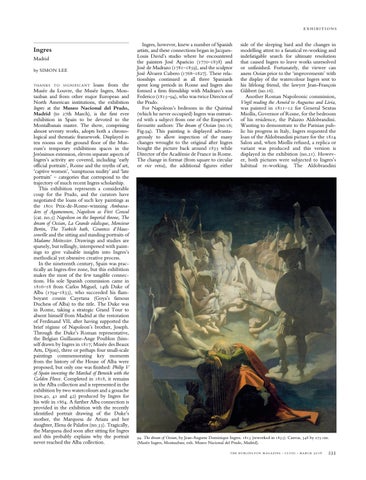
Ingres, however, knew a number of Spanish artists, and these connections began in JacquesLouis David’s studio where he encountered the painters José Aparicio (1770–1838) and José de Madrazo (1781–1859), and the sculptor José Álvarez Cubero (1768–1827). These relationships continued as all three Spaniards spent long periods in Rome and Ingres also formed a firm friendship with Madrazo’s son Federico (1815–94), who was twice Director of the Prado. For Napoleon’s bedroom in the Quirinal (which he never occupied) Ingres was entrusted with a subject from one of the Emperor’s favourite authors: The dream of Ossian (no.16; Fig.94). This painting is displayed advantageously to allow inspection of the many changes wrought to the original after Ingres bought the picture back around 1835 while Director of the Académie de France in Rome. The change in format (from square to circular or vice versa), the additional figures either
side of the sleeping bard and the changes in modelling attest to a fanatical re-working and indefatigable search for ultimate resolution that caused Ingres to leave works unresolved or unfinished. Fortunately, the viewer can assess Ossian prior to the ‘improvements’ with the display of the watercolour Ingres sent to his lifelong friend, the lawyer Jean-François Gilibert (no.16). Another Roman Napoleonic commission, Virgil reading the Aeneid to Augustus and Livia, was painted in 1811–12 for General Sextus Miollis, Governor of Rome, for the bedroom of his residence, the Palazzo Aldobrandini. Wanting to demonstrate to the Parisian public his progress in Italy, Ingres requested the loan of the Aldobrandini picture for the 1814 Salon and, when Miollis refused, a replica or variant was produced and this version is displayed in the exhibition (no.21). However, both pictures were subjected to Ingres’s habitual re-working. The Aldobrandini
94. The dream of Ossian, by Jean-Auguste Dominique Ingres. 1813 (reworked in 1835). Canvas, 348 by 275 cm. (Musée Ingres, Montauban; exh. Museo Nacional del Prado, Madrid). the burlington m a g a z i n e • c l v i I i • m a r c h 2 0 1 6
233