
MILITARY BUILDING CONTRACTS • NEW COLUMNISTS! • IBS March / April 2023 Ideas & Strategies for Outdoor Living Professionals
SPECIALIST
DECK
Digital Edition Sponsored by
Hardscapes and Heating


March / April 2023
Ideas & Strategies for Outdoor Living Professionals


President/Publisher
Vice
Managing Editor Sara Graves sgraves@526mediagroup.com
Editorial Director David Koenig dkoenig@526mediagroup.com
Columnists
Brendan Casey, April Edwards, Andy Henley, Mike Mitchell, Bobby Parks
Guest Contributors
Greg DiBernardo, Joe Raboine
Advertising Sales (714) 486-2735
Chuck Casey ccasey@526mediagroup.com
Nick Kosan nkosan@526mediagroup.com
Virtual Events
Alek Olson aolson@526mediagroup.com
Circulation/Support info@526mediagroup.com

DECK SPECIALIST is published fivetimes a year at 151 Kalmus Dr., Ste. E200, Costa Mesa, CA 92626, (714) 486-2735, www.building-products.com, by 526 Media Group, Inc. (a California Corporation). It is an independently owned publication for U.S.-based builders and contractors that specialize in decking and other outdoor living projects. Copyright®2023 by 526 Media Group, Inc. Cover and entire contents are fully protected and must not be reproduced in any manner without written permission. All Rights Reserved. Deck Specialist reserves the right to accept or reject any editorial or advertising matter, and assumes no liability for materials furnished to it.


March/April 2023
• Volume 7 • Number 1

ASMY BEST FRIEND and I sat outside a tiny French bistro on a small avenue on Coronado Island, near San Diego, I was looking around thinking how interesting it was that as a native Southern Californian I had not been here before.
This was the fourth stop on our island visit. Earlier that morning, we had set out on an eating quest to try all the delicacies this ritzy tourist destination had to offer. We had shared fish tacos on the sand under an overcast sky; fancy-looking refreshments at the upscale Coronado Hotel; and a snack near a 100-year-old bank.
Surprisingly, I wasn’t full when I read over the bistro’s menu. I was torn between trying one of my favorites—French onion soup—or going out on a limb and trying escargot for the first time.

While waiting for the food, I caught myself watching the restaurant’s only waiter talking and laughing with a middle-aged couple sitting next to us. It was obvious the couple had been here before. They seemed more like old friends than customers. I overheard a few words: France, unoaked Chardonnay, escargot.
My soup arrived and didn’t disappoint, but our waiter’s service had been lackluster. We were treated more like two-star, French onion customers than fivestar, escargot friends.
It got me thinking about our industry. Just because customers have a “menu” of project options to select from doesn’t mean they will automatically feel comfortable “ordering” them. It can take the personal touch to move your clients to spend more.
That five-star treatment is something a few builders I spoke to know how to give.
Mike Mitchell, Mitchell Construction, Monee, IL., one of our two new tool columnists on page 48, said that the five-star treatment requires you to set realistic expectations from the beginning, beat those expectations, and consistently communicate with your customer.
Bill Groth, Working Class Carpentry, Manhattan, IL., agreed, adding that “every client on our wait list
gets a call Thursday afternoon to say hi, and (we) keep in touch until we start the build.” Then the client receives a “coozie” (shirt) a few weeks after signing, along with a personalized thank you note, hat, and hoodie. “(We) keep them in the loop and give them a sense of ownership on the project.”
Shaun Dietz, Dietz Home Improvements, Vancouver, WA., takes the personal touch a bit further, suggesting that builders not only be friendly and punctual, but consider going out of their way to find out what their customers like. “Take a peek at the recycling bin at the end of the job and gift the customer a bottle of wine or craft beer to enjoy on their new deck.”
That’s good advice—especially for our waiter. If he had spent more time getting to know us, he would’ve realized that I was on the brink of becoming an escargot customer—but I needed someone to sell me on the idea.
Lucky for the waiter, the five-star couple did the selling for him. On their way out, they leaned over and said enthusiastically to my friend and I: “You should try the escargot the next time you come. It’s the best—and we’ve tried a lot.”
FastenMaster has spent decades listening to top PRO contactors as we’ve developed the most innovative hidden and structural fastening solutions in the industry. We understand that craftsmanship requires the need to both meet code while delivering a superior finished look. That’s why thousands of top deck builders have made FastenMaster their preferred choice for delivering the ultimate finished look. Share your stories of craftmanship with us on Instagram: @fastenmasterpro.


MFM Building Products, Coshocton, OH., recently finished a substantial expansion project that began in February 2021.

MFM, a manufacturer of a full envelope of waterproofing and weather barrier products for the building industry, has been acquiring additional raw materials to ensure product availability for their customer base and the new facility now accommodates this additional inventory. The thrust of the expansion project was adding 48,000 sq. ft. to the production area and the acquisition of new production equipment to meet the rising demand for orders. The building, which was planned to be completed by the fall of 2021, was finished in June 2022 due to extended lead times for raw materials. The exterior portion of the facility was completed in November.
Other aspects of the expansion project included constructing new offices in the main headquarters building, and the addition of a new, state-of-the-art Research & Development laboratory for increased quality control and new product development. Once the production equipment is fully operational, the company expects to hire additional full-time employees.
According to Tony Reis, president, “We definitely had some setbacks with the current state of the supply chain, which caused some delays in the completion date. Now that we are finished, we are focused on meeting the needs of our customers and hope to be introducing several new waterproofing products to our portfolio. As an ESOP company, there is a lot of excitement among our employees as MFM continues to grow.”
Accoya USA, LLC is on track to begin manufacturing Accoya modified wood products in early 2024 after breaking ground on its U.S. manufacturing facility in June. Once operational, the Kingsport site is expected to create 50 new jobs and double the company’s 2022 Accoya sustainable wood production volumes.
“Our sales in North America grew 44% between our fiscal 2021 and 2022 years and we are seeing continued strong demand for Accoya,” said John Alexander, group sales director, at Accsys, the manufacturer of Accoya wood.
The groundbreaking comes on the heels of the completion of a Netherlands plant in September. The fourth reactor increases Arnhem’s Accoya production capacity by 33% and the Kingsport facility will increase capacity by 67% from 2022 volumes.
Once operational in early 2024, the Kingsport facility will supply the North American market and the Netherlands plant will supply the rest of the world. The U.S. reactors were transported from Europe.
Fiberon announced a new partnership with HomeSphere that will give builders access to exclusive rebates on select products, including Fiberon, and allow builders to “bundle” rebates to earn even more.
“Fiberon products are an excellent choice for decking, railing, and cladding in new construction,” said HomeSphere president and CEO Greg Schwarzer. Fiberon composites are manufactured using increased sustainable processes, and their polyethylene decking products contain a minimum of 94 percent recycled content.
Annually, Fiberon says its products use approximately 100 million lbs. of recycled plastic on average while helping to avoid the destruction of up to one million trees.
Products are available in various colors, styles, and price points and include industry-leading stain, fade, and performance warranties. All PE composite decking product lines, PVC decking product lines, railing product lines, and Wildwood composite cladding are eligible for rebate.
“Fiberon is very excited to partner with HomeSphere and for the opportunity to work with their network of more than 2,700 builders,” said Chris Hayn, VP of sales for Fiberon. “With the cost of building materials rising, homebuilders who want to use high-quality products can benefit from choosing Fiberon and HomeSphere.”

 By Joe Raboine
Photos by Belgard
By Joe Raboine
Photos by Belgard
LIVING remains a high priority for homeowner investment. According to a study from Grand View Research published by Angi, 19% of all home improvement spending by 2027 is expected to go toward outdoor improvements—specifically what they call “outdoor leisure.”
While outdoor leisure certainly is a catch-all term for many of these renovations, outdoor living spaces are more than just areas to lounge and relax. Outdoor living encompasses many of the same activities we perform indoors—like cooking, exercising and even working—meaning homeowners are looking to expand on their outdoor spaces to make them more functional for everyday life
Updating, renovating and building these outdoor spaces provides a space where contractors can show off their creative prowess. With new trends influencing design and construction, contractors have the opportunity to work together with their clients to create a stunning space using different materials, textures and more.
There are a few key trends we expect to be heavily popular in 2023 in terms of hardscape design, which you can incorporate into the projects on your schedule this year.

Clients today are looking to add more visual interest to make their spaces truly unique. As opposed to choosing just one product to cover the majority of their outdoor surface area, they are looking for a mix of different colors, patterns and textures.
COMBINING different colored pavers the perfect board for an outdoor game of chess.Combining materials such as wood, composite decking, textured pavers, and even metal or glass elevates and adds more depth to spaces that may otherwise feel flat and too linear. Integrating more color and texture is a natural extension of the popular modular design trend, as it layers in even more dimension.
Hardscape manufacturers are capitalizing on this trend, developing new textured pavers that mesh with any design style. They can be used on their own or paired with other paver colors and textures to create one-of-a-kind designs and patterns.


With color and texture being the top deciding factor for homeowners selecting pavers, contractors must step into the role of an interior designer. Having that extra knowledge to consult homeowners on more complex design decisions can give contractors an edge and create an additional selling point for your business.
Contractors can also use the excitement around colored and textured pavers to elevate projects to the next level. One option is incorporating colors and designs that can double as an outdoor game for families to enjoy, such as a chess board or checker pattern. Homeowners are looking to create fun and entertaining spaces for children and guests by including games like bocce ball, checkers or Scrabble, that are integrated into their outdoor living area.
Functionality is a top priority in outdoor living projects. According to the same Angi-published survey,
26% of projects in the last year were focused on creating spaces that better met lifestyle needs. This now includes outdoor spaces so homeowners can spend more time in nature.
With this continued interest in connecting with nature, gardening is seeing a resurgence. More people aim to grow their own produce at home, as well as add decorative plants around patios, decks and walkways.
Raised and vertical gardens are well suited for patios, especially with the variety of paver materials available to build both the patio and base of the planters. Products, such as concrete panel systems, which align well with popular modern design styles, are perfect for creating raised patio garden beds.
Functional and biophilic design trends have encouraged homeowners to consider patios and porches as true extensions of their home, blending the indoor and outdoor spaces to create one cohesive unit. This shift in perspective can be observed when you look at popular design choices and elements that homeowners are integrating into their spaces, like mixed materials or folding glass walls that connect to the exterior.
Overall, hybrid spaces combining multiple features make outdoor living areas feel more cohesive. For example, a beautiful lounge area can also include outdoor kitchen or gardening elements that are a source of food for the family. Homeowners want to expand their space to prioritize functionality to best suit their family’s needs.
Environmental concerns will remain an important conversation around the world, making it essential
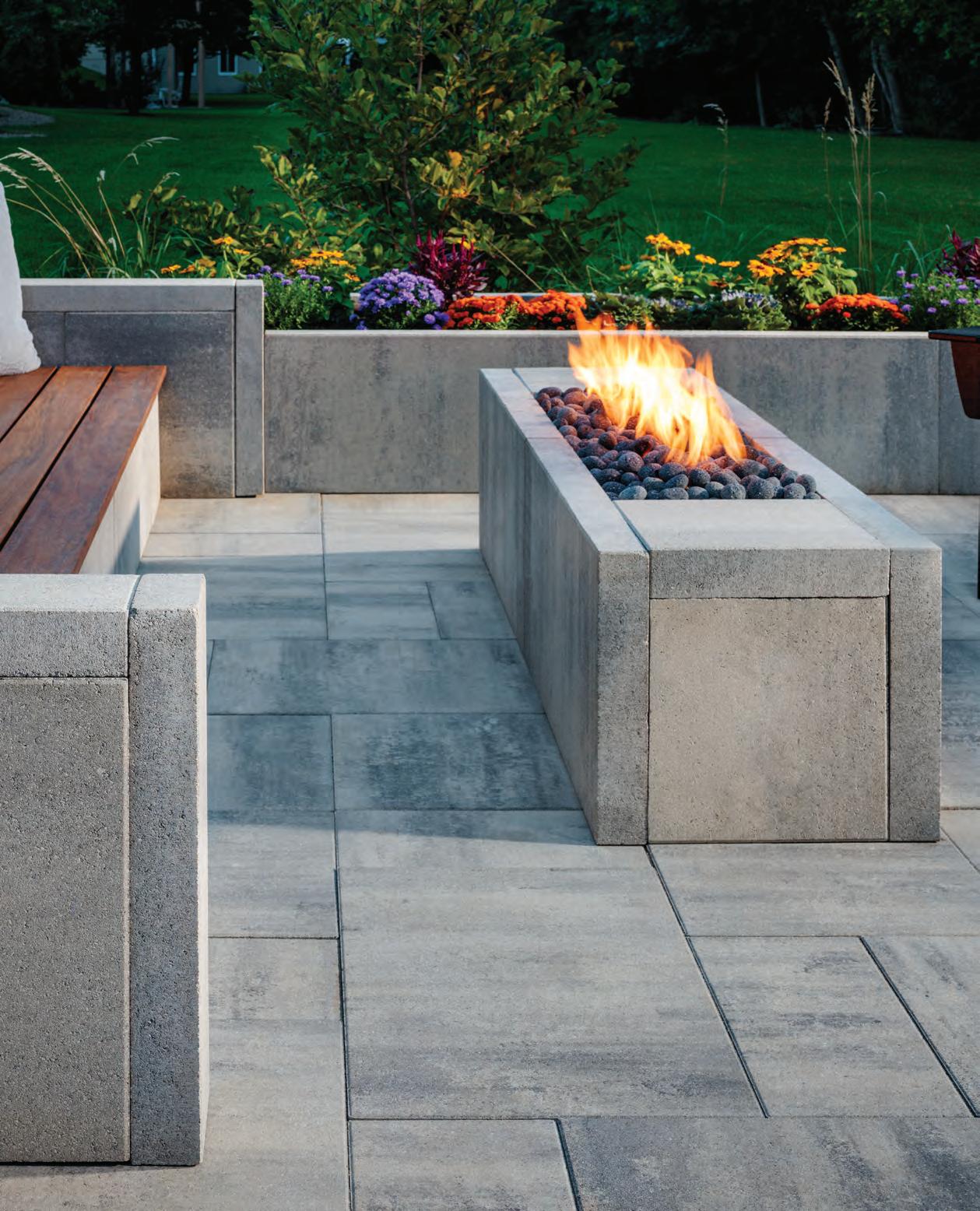
INTEGRATING a functional outdoor fire pit with stylish geometric pavers completes this year-round space.that the outdoor living industry adapts to meeting new goals regarding energy and waste. New products continue coming to market that prove homeowners are understanding the value of taking care of their


outdoor spaces, and contractors are prioritizing high quality products that have longer lifecycles.
If contractors are looking for ways to integrate sustainability practices into their business, they can start by recommending products that prioritize durability and have a long life cycle. Also, local requirements regarding permeable pavers have become more common as communities realize the importance of water runoff and planning for city expansions, so contractors should stay up to date with local legislation and community guideline updates.
Overall, outdoor living investments will remain a high priority for homeowners in 2023, especially in terms of hardscape products like pavers and other patio elements. Continued interest in outdoor living opens the door to more creative design ability and unique challenges pushing contractors to think outside the box to meet all the homeowner wants and needs. DS
After starting his career as a contractor over 25 years ago, Joe Raboine now oversees the Residential Program as the director of residential hardscapes at Belgard (www.belgard.com).
 BIOPHILLIC DESIGN connects the natural feel of the outside patio with the interior living space.

SEE the snow coming down hard in the window behind David Schwank, co-owner of Colorado Custom Decks and Mosaic Outdoor Living, as we are talking over video conferencing. It hardly seems like the kind of weather you’d go outside in, let alone in a T-shirt, but that’s what he did—thanks to his outdoor heating.
“I was in short sleeves, and I went out to grill. It was just starting to snow so I turned on one of my electric heaters— it makes it much more comfortable,” says Schwank, whose outdoor living company completes 100-150 projects a year, and has three Colorado locations along the Front Range.
He’s not alone. “Some clients don’t mind going outside and donning a hoodie or a Polar Tech in the wintertime, so then we would put in a few less heaters,” Schwank explains. “Sometimes we have clients that want to go out in a T-shirt at all times and then we have to add more heaters.”
Schwank, whose crew was featured on DIY Network’s television show Mega Decks for three seasons, is no stranger to working with outdoor heating. “I’ve been doing this about 30 years now. The only outdoor heating was those big, clunky gas heaters and they had to hang down from the ceiling about a foot, and when (you) ignited them, they made kind of a funny sound,” he recalls.
Outdoor heating has come a long way since then. With a myriad of heating options now available—including electric, gas, and natural heating sources—it’s no wonder builders have improved how they incorporate it into their projects.

Although Schwank says he prefers using electric heaters and fire pits in a project, he ultimately decides on the heating sources based on his customer’s usage of the space.
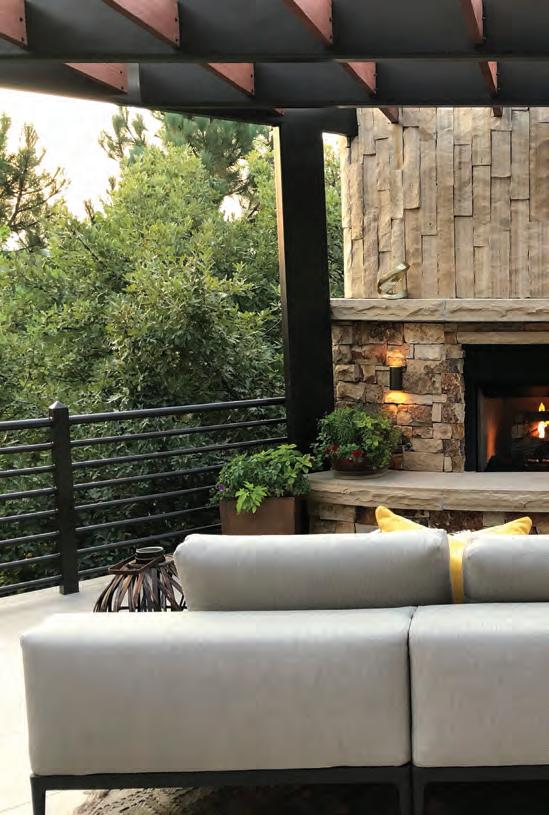
“When I’m designing, I try to think of how people are going to use their space. Fire pits and fireplaces are a key element to layering that heat,” he says. “Most of our fire pits are custom. We use larger lava media which heats up, holds the heat, and radiates that out at our client.”

He adds that although “tabletop fireplaces are nice,” they don’t necessarily put off a lot of heat. Instead, he installs custom burners for his clients.
Similarly, Schwank explains that fireplaces don’t put off a lot of heat either, unless you invest a lot of money into them. “They look great, but the heat goes right up the chimney or out the back.”
To combat the heat loss, Schwank builds his custom fireplaces out of cinder block or real fire block so that “once the fire block warms up, it radiates the heat out to our customers.”
David Arnold, director of sales for heating manufacturer Infratech, says another way to compensate for the lack of heat from an outdoor fireplace is to use an electric radiant heater behind the seating area facing the fireplace.
According to Schwank, one of the most popular heating sources requested by his customers is electric heaters mounted above or adjacent to a space.
Infrared heaters “act more like the sun. It’s like when the sun hits you, it heats the object—that’s what infrared heater does, versus a forced air-heating system,” Schwank explains.
Originally when Schwank started selling electric heaters, he recalls, “our clients would glow red, much like a hamburger at McDonald’s under the heat lamp, but now the heaters are not nearly as bright. I don’t know what they did to the elements, but they certainly don’t illuminate people to this bright orange or red color anymore.”
And because many of his clients have beautiful views, Schwank avoids putting a heater “right where they’re looking out at their view of Pikes Peak in Colorado Springs.” Instead, he installs the heaters above the doors or against the house so he can direct the heat down onto his clients. And if somebody’s has an adjacent roof or is adding a covered space, like a pergola, then he will mount the heaters on the perimeter beams.
If you have heaters recessed in a ceiling, Schwank explains, they would be 18 in. higher than if you mounted the heater at the bottom of that beam. That 18 in. makes the heat more intense. “You get more bang for the buck out of the heater by lowering it. The number one thing I’ve learned is sometimes you’re better off not recessing

and getting the heating element closer to clients and hiding them somewhere.”
Electric heaters require quite a bit of amperage, says Schwank, so builders must ensure there’s adequate power available to run the heaters.
“I think the key element is to make sure you have enough capacity in the electrical service to the home to handle however many heaters you sell to your client because it can cost somebody $30,000-$40,000 to upgrade their (electrical) service to their house if you sell them heaters,” Schwank adds.
Likewise, the amperage can dictate how many heaters can be installed. For instance, if only three or four electric heaters can be installed in a big space, Schwank will install a gas fire pit because it doesn’t require any power. “If you’re limited in the amount of electric heat, then you could fall back to the gas heaters which use very little power to ignite…or you move to adding a couple of fire pits instead if you’re limited and you have the gas.” He says keep in mind that propane may be the only source of fuel available in some areas.
Another consideration for installing heaters, says Schwank, is clearance, especially since outdoor amenities are getting bigger. “We have to keep the heaters away from the TVs and ceiling fans and whatever else a client may be putting into their space.”

“If the clearance is 18 in. in front of the heater, then we have to stay 18 in. (away)…and then there’s not just 18 in. in front, but there’s 6 in. behind so it’s almost 2 ft. because you can’t put the heater right on a beam without the insulating box,” he explains.
Arnold adds, “Many other manufacturers, especially gas, need additional room behind the heater to
ENCOMPASSING the outdoor living space with multiple sources of heat while blocking the wind with glass walls creates a uniform and consistent temperature so the space can be used year-round.

allow for heat loss, Infratech sends the heat to the people, and little is lost behind the heater.”
When adding heating to a space, Schwank advises not to forget how wind dissipates heat in an outdoor space. He often installs operable glass walls or adjustable solar shades to block the wind. “If we remove the wind, it becomes a more year-round, usable space.”
“In Colorado, we have about three really great months, but if you all of a sudden add heating elements you can have nine to 12 incredible months throughout the year,” says Schwank, who will undoubtedly spend those months in a T-shirt. DS
EVENAS a teenager, Justin Dupont knew what he loved to do: he was passionate about the Army, and he loved building decks.
“Over the summers when I was 15 years old, I started out framing houses. I was involved in building my first deck one summer and I was attracted to the whole process from beginning to end,” says Dupont, co-owner of Dupont Decks, Inc., North Branch, MN.

At 17, he enlisted into the Army as a junior in high school and went into basic training and AIT (Advanced Individual Training) at Fort Sill, OK.
After high school graduation, Dupont went to Airborne school and was accepted into the 82nd Airborne Ranger Team at Fort Bragg, N.C.

Almost immediately, as a member of the Alpha 1-504th unit, Dupont was deployed to the tropical jungles of Panama for Operation Just Cause.
At the time, President George H.W. Bush had deemed that Panamanian dictator Manuel Noriega posed a threat to the thousands of U.S. citizens living there, and ordered American troops to remove him from power. On December 20, 1989, Dupont and over 50 other soldiers of his unit jumped from less than 500 ft.—the lowest elevation jump since World War II—onto Panama’s Torrijos International Airport. The
team had been trained to jump from 800-1,200 ft.
They were told ahead of time that it would be a low jump so that the plane could fly under radar and give the jumpers a better chance to land before being shot at by Panamanian resistance. Dupont says everyone was excited because it was a combat jump and most of the other jumps they had done were in training exercises—“this was a real-time experience.”
“They were shooting (to land at) around 700 ft., but it ended up being lower, at 500 ft,” he adds. With no reserve chutes and no time for hesitation, the soldiers had to pull their chutes almost immediately upon jumping to land safely. Dupont admits that this was probably the most exciting jump while being an Airborne Ranger.
Following a successful mission in which the U.S. forces gained control of the airport, rescued prisoners and captured Manuel Noriega, Dupont went back and forth to Fort Bragg a couple of times between deployments for training before he became a Green Beret. After a number of special operations assignments, he retired in May of 1997 as a Staff Sergeant, having fulfilled his eight-year contract with the Army.
Despite being asked to extend his stay with his unit, Dupont was homesick and needed a break, he says. It wasn’t long before he met his wife, Brooke, and started a family. In 2000, Dupont and Brooke started Dupont Decks, Inc.

As the Duponts raised their family, they grew their business to what it is today—a company that builds an average of 100 decks and a couple of porches each year in the Minneapolis, MN., area, earning approximately $2 million a year. Two of the older Dupont children work on deck projects, while their youngest daughter is currently serving in the U.S. Air Force.
He explains that every custom and unique decking project “is approached like a special mission, ensuring that each detail is carried out specifically as planned.” To do so, they keep a consistent work schedule, are diligent and committed to doing the best job possible, and maintain consistent communication with the homeowners “just like it was key with

every member of my platoon in the Army.”
The company’s tagline “Our work is our word” is reflected in everything they do, Dupont adds, because it reflects “how important it was to us to do high-quality work for our homeowners.” What drives him is the “amazing opportunity to create unique one-of-a-kind spaces for homeowners that they are going to get enjoyment out of for years to come.”
The Duponts give back by donating a portion of the proceeds of every project to various non-profit organizations. According to Brooke, “Justin has always been able to relate to people that are less fortunate and struggling,” having faced hard times himself. And it’s his compassion and faith that fuels his personal passion to give back to those in need, especially those who have been wounded physically and mentally that have served “this great nation.”
In the years since Dupont returned to decking, his passion for deck building has not subsided. He still loves the process of “envisioning a space that is not currently there and then be able to create it and see it completed,” adding that “decks tend to be a place where families gather to create memories and be together.” DS
FORBUILDERS interested in working as a contractor on Department of Defense (DoD) outdoor living contracts, the process to get started takes time, but once you are registered in the system, it can be a lucrative option for your business.

“It really was a pretty easy process,” recalls builder Shawn Miller, Deck Designs, Littleton, CO., who worked on a couple of small military projects in the past. “When the residential market was completely flat, the government was still spending money and gave us an opportunity to survive!”
The first step in the process is connecting with the Procurement Technical Assistance Program (PTAP), which is administered by the Defense Logistics Agency (DLA).
PTAP has local centers (called Procurement Technical Assistance Centers, or PTACs) that help businesses compete to win DoD and other federal agencies contracts. Most of these more than 300 local PTAC offices offer their services for free.
PTACs help local businesses by offering one-onone counseling with procurement specialists, help in locating bid opportunities, assistance with bid and proposal, and assistance with government certifications. Visit www.aptac-us.org to find the PTAC closest to you.
All vendors wanting to do business with the federal government must register for free in the SAM database at https://sam.gov/content/home. Federal government agencies publish their contracts on the website and provide information on how and when vendors should respond.
Detailed instructions for the SAM application process are provided on the website. registration must be renewed annually. Get help with SAM registrations via GSA’s Federal Service Desk at www.fsd.gov.
Contract types vary according to the degree and timing of the responsibility assumed by the contractor for the costs of performance; and the amount of profit offered to the contractor if they meet the required standards or project goals.
Contract types are grouped into two broad categories: fixed-price contracts and cost-reimbursement contracts. The contracts range from firm-fixed-price contracts that require the contractor to be fully
responsible for the costs and resulting profit (or loss), to cost-plus-fixed-fee contracts, in which the contractor has minimal responsibility for the performance costs, and the negotiated fee (profit) is fixed. For more information, visit www.acquisition.gov.
“There was a web page that listed the jobs open to bid,” Miller recalls. “You would just click on a job that sounded like something you could do. Then all the requirements for the job would be listed and you could create a proposal from there. They basically told you what they needed and what it would pay and you would decide if you could do the job for that price. Overall a pretty straightforward process.”
All acquisitions exceeding $700,000 ($1.5 million for construction) that have subcontracting possibilities will provide subcontracting opportunities for small businesses. Subcontracting enable small firms to participate in DLA or federal government procurements even if they are not ready to bid as a prime contractor.
To be eligible, you must be a small business; veteran-owned small business; service-disabled veteran-owned small business; HUBZone business (fuels business growth in underutilized business zones); small, disadvantaged business, or a woman-owned small business.
All veteran-owned companies should register their company with the U.S. Department of Veterans Affairs (VA) Office of Small and Disadvantaged Business Utilization’s (OSDBU) through the Vets First Verification Program. The Vendor Information Pages (VIP) database, www.vetbiz.va.gov, is free and available to any veteran-owned business.
The SBA’s Office of Veterans Business Development (www.sba.govt) provides additional resources and information. DS

WHENSOUTHERN HERITAGE Custom Construction was asked to build a deck overlooking Colorado’s Pikes Peak in the spring, it required strategic planning to ensure that the job kept moving forward.


“We started the project in April and had to strategically demo certain areas of the old deck and build new areas independently in order to keep access to the working areas,” said Southern Heritage owner Drew Kennedy.
In addition, the driveway is one of the steepest driveways in town with a lot of canopy (branches) from the mature trees along the driveway. “We had to carefully plan how to deliver and stage materials, roll offs, etc. during the project. We had to break down the deliveries and have special sized roll offs due to the limited space for staging,” Kennedy added.
The crew also methodically thought through how to connect each elevation and platform in order to keep a nice flow of traffic. “We had to build two flights of stairs off of the shed while maintaining code compliance and keeping with the same finishes (railing, decking selections and layout),” Kennedy said. “We had to adjust the flight of stairs on the shed to fit within a very narrow tolerance. The width,
height and landing all had to hit exactly in order to make everything fit.”
Another unexpected issue was the existing retaining wall. After closer inspection, it was determined that a new timber retaining wall would need to be built under the lower deck to retain the soil from moving.
Kennedy said it took more time than usual since they had to be careful around the sandstone bluffs and cliff edges. Piers took longer to dig out in the sandstone as well.
The crew manually slid the existing hot tub out of the way onto the embankment in order to frame the lower deck, then added the decking. The hot tub was moved back in place once the decking was in place.
The cedar shakes were removed off the shed and a matching stucco was applied to the shed. Stucco was also applied in various patches throughout.
The crew poured the concrete steps and patio before the project faced delays due to the mountainside weather in April and May. A line pump was used for the cement to reach the top of the backyard for the patio and concrete steps.
The concrete patio with steps down to the lower deck had to be calculated carefully to meet code clearances and provide access into the shed. “There was about an inch tolerance from where the stairs had to land and still provide a walkway in front of the steps and provide clearance to access the shed underneath,” Kennedy explained.
A major consideration on the $127,500+ deck was keeping to a budget. “We built the frame out of KDAT pressure treated lumber to keep the cost down,” he added.

They opted for Allweather Wood KDAT pressure treated lumber, which included 2x10 joists for the main, upper deck and lower decks, and 2x12, 2x6, 2x8s as needed. Support posts were 6x6 and 4x4 PT posts with new concrete piers, and 4x4 S4S cedar posts were used for the exposed areas.
In addition, the customer wanted the 1,538 sq. ft. of deck space (excluding stairs) to last and remain strong.
Kennedy said they first proposed moisture tape over the beams only. Then later they decided to install moisture tape over the top of joists and any other surface areas where water could seep in through a screw. “The customer values the home and wants it to last as long as possible.”
They added ice and watershield membrane behind the ledger attached to the house, and EPDM membrane over the shed roof/deck for an additional layer of protection.
The Colorado Springs, CO., project also featured:
• Simpson Strong-Tie structural hangers, brackets, post base and hardware
• Red Head concrete anchors
• 2" and 4" Blueskin Butyl Flash joist tape over the joists, and beams
• Fiberon Good Life composite decking in Cabin color
• Trex Universal hidden fasteners
• 2-3/4" Deckfast composite screws
• RDI Excalibur Steel railing by Barrette Outdoor Living in Hammered Bronze color, traditional style
• 8", 10" and 12" MiraTec hardboard textured trim for the fascia, stair risers, beam and posts wraps
• 6x6 treated timbers for the retaining wall
• Heavy-duty cedar lattice for the perimeter of the main deck
Kennedy said the most unique and favorite part of the project was being able to enjoy the best view in town of the Pikes Peak mountain range. “We were able to enjoy the mountainscape views from the snow-capped mountains into the beginning of the fall foliage. It helped us through some of the challenges by stopping for a few minutes while eating lunch and taking in the majestic views. I have worked all over the three counties and Denver for the past 15 years and this is by far the best view on any jobsite.” DS
 By Greg DiBernardo
THELONGER you have been in the contracting business, the more customers you have engaged with over the years. Usually, the good customers outweigh the bad ones, but it’s impossible to be in our business and not have some challenging customers come across your path every now and then. Great customers are a pleasure to work for, respect you and your team, are eager to pay their invoices and refer you to everyone they know. We all love working for great customers, but we are going to ignore them for now—they are easy. For the sake of this article, we are going to focus on the bad customers that find their way to you and how I developed an approach to deal with them.
The bad ones usually don’t start out overtly bad. In fact, if you are an experienced contractor, you probably see them coming a mile away and choose to not even work with them. There are red flags that we note either on preliminary calls or during a face-toface meeting that let us make a quick decision that it is probably best to let them find another contractor to make miserable. I would like to think that my radar is efficient after working with hundreds of clients over 20 years, but sometime bad clients are so good at being bad that they know how to fly under the best of radars. Everything seems fine until you start the project and then they have you.
Some bad clients are just evil people who make it
their life’s mission to try to get one over on anyone they encounter. They want something for nothing and have no qualms about it—they are almost gleeful about it. We joke at my company that it is likely that these kinds of clients send every meal in a restaurant back to the kitchen and have probably never left an establishment without complaining about something—you know the type.
Other bad clients are bad because they just don’t know any better. They have little experience working with truly professional contractors and have a misguided idea that they know better than us and we are out to cheat them or take shortcuts. They usually do too much internet research before and during the project, and question every screw you put in. In either case, it is challenging getting from start to finish with a bad client, staying professional and collecting all your money at end of the job.
The most important step in dealing with a bad client is having a contract agreement with a detailed scope of work. The contract will make you or break you. You are, after all, a CONTRACT-OR!
Your contract needs to clearly define the scope of the project, all the finishes, materials, who is responsible for what, specific exclusions, terms and conditions, payment schedules, official methods of communication, etc. With a good customer, you hardly ever even need to look at the contract, but with a bad
one, you’ll need it taped to the inside of your windshield to get through the job.

If your contract does not have all of these items, I suggest making it a priority to get one immediately.
Our businesses are our babies, and it is easy to get emotional when clients start becoming difficult. You must remove the emotion from your side of the dialogue if you want to be successful at coming out ahead. Everything we do is in the contract. It is black and white. There is no room for feelings in a business transaction which is what we are doing. The customer pays us money in exchange for our products and services. What they think doesn’t matter—it’s just noise. Point to the contract and deliver what is on the contract. No more, no less. If they want more, you write a change order and charge them more.
When things start to get ugly, you must remain the consummate professional. Do not stoop to their level. Communicate promptly, clearly and maintain a business-like tone. Just because they are screaming about something does not mean you should. In fact, do the opposite. Be cool, calm, and slow down. Sometimes I will call a client just so they can hear
my calm voice. You would be surprised at how you can deescalate a situation by going 100% opposite of their intensity. I recommend a book, Never Split the Difference by Chris Voss, that features this technique.
It is important that you communicate officially in writing. I prefer email, but texts are OK, albeit slightly less professional. These communications will serve

to create a paper trail should things really go bad. I would go as far to say that ALL of your communication with clients should be in writing. Our contract states that all official communication can only be via email. Calls and texts are fine, but they have no clout. Verbal discussions are ambiguous and not finite. Written communication is indisputable.
Whenever we sign a contract, I go over every single line of it with the clients point by point. I do most of the talking and get a lot of head nodding in response—but when things go south, all the head nodding in the world isn’t going to help you. For instance, we have a section in our terms and conditions that says we are not responsible for hitting buried wires and pipes. So, I ask them if they have a sprinkler system and most people say “yes,” so I follow up with “do you know exactly where the pipes are wires are run for it?” and of course, they say “no.” I explain it’s highly likely that we will hit a sprinkler pipe during the job and when all is done, they’ll need to contact a sprinkler company to move heads, fix the pipes and get the system running again. They nod and say “sure, makes sense”…until you hit a sprinkler line and they conveniently forget the entire conversation and their nodding and want us to fix it.
We have a lot of language in our contract along similar lines. It’s there to protect my company, limit liability and set the expectation that we are there to do specific things, but not resod their lawn or paint their house. The longer I have been in the business, the more real-world experience I have and that Terms and Conditions keeps growing. Black-and-white writing will save your bacon.

A bad client will undoubtedly force you to pull up a copy of their contract, circle something specific and show it to them. That alone will usually prevent a bad situation from getting worse and hopefully resolve the dispute.
A bad client may or may not overtly threaten you with leaving a bad review someplace. Or you maybe you are afraid they might. Take the next sentence to heart. You can’t operate your business in fear of a bad review. There are some people you will never be able to please at any cost. Forget about the reviews, execute the project per your contract. Do not bend. Do not give in. If you ever look at reviews yourself, you know that no matter how great a product is, there are always bad reviews. Most intelligent customers know this and don’t worry about two bad reviews when you have 100 good reviews.
Your contract has payment terms in it. Those payment terms are non-negotiable by either party. A bad customer might decide to start playing games with money that is rightfully due to you. In some convoluted way, they think this is going to solve a problem when in fact, all it does, is make it worse.

Since we have a contract with payment terms in it, your response can be simple: “Mr. Customer, per the terms of our contract, your payment of $XX,XXXX was due today and you made it known that you are refusing to make that payment. Our company, per the terms of the contract, will be withdrawing from your project effective immediate-

ly and will not return until your account is brought current. Our attorney will be beginning the process of filing a mechanic’s lien on your property to collect any and all monies due to us.”

Modify my example as you wish, but this is all that needs to be said and most bad clients have never had to face the music because every other person they have tried to pull this move on caved in. You will notice my example is a statement of facts and there is no emotion in it. Stick to the contract. That’s why you have it.
Dealing with difficult clients is a skill that you must master to be successful in business long term. As much as we would all like every job we do to go smoothly, it is inevitable that we all will encounter a difficult client. By sticking to black-and-white terms and remaining professional, you should be able to handle the few that come your way and minimize your stress.
After creating, growing and selling Bergen Decks in northern N.J., Greg DiBernardo moved to the Atlanta area and owns Peachtree Decks and Porches, Alpharetta, GA. He lives in Canton, GA., with his wife and daughter.


It takes a whole lot to earn the right to wear the Yella Tag. Backed by fifty years of proven knowledge and quality, YellaWood Protector® products are specifically formulated by the makers of YellaWood® pressure treated pine. YellaWood Protector® products provide long-lasting, rich color and the superior protection savvy homeowners demand. All with a limited warranty against chipping, peeling, water damage, mold, mildew and color fade. Since there are no long drying times or even in-store mixing or tinting required, you’ll love how easy it is to use. Find your local dealer at yellawood.com/protector and finish like a pro.








 By Sara Graves
YOU KNOW what they say: if you can’t stand the heat, get out of the kitchen. And that’s exactly what builder Dale Dossett did.

Dossett, who grew up building decks and fences since “pretty much since he was able to walk,” decided on another career at 22—he went to Le Cordon Bleu to become a chef, working his way up until he was running his own station at a Michelin Star restaurant in California.
“I always liked creating stuff, and whenever you can cook you can also create at the same time. In high school, whenever I took culinary, I liked the fact that you were able to create a dish and make it from nothing. It’s the same thing as building a deck, fence or anything else, you take stuff and create something. It’s kind of the same thing for me.”
Yet, Dossett found it “very intense” working at Santé at Fairmont Sonoma Mission Inn & Spa,
Sonoma, CA., as a chef de partie—a chef that is in charge of a particular station—and garde-manger—a chef responsible for the cold apps (appetizers).

“I’d show up two hours before shift and run nonstop until the 6 o’clock bell hit, when the service started,” he explains. “I had over 200 items every day I had to prep. Everything was fresh on the menu— we never used anything from the day before—so I had over 200 items I had to prep for that service for that night.”
It was after he started dreaming about his head chef yelling at him that Dossett knew he needed to go back to his construction roots.
“When I woke up having nightmares that I was at work, that’s when I knew I needed a change,” he says. “I enjoy creating stuff, but when I’m not looking forward to going and creating it, I knew it was time for a change.”
Three months later, he got certified in HVAC, later taking care of the HVAC needs for Mary’s Pizza Shack, a small pizza chain headquartered in Sonoma. Then he joined California-based Millwrights Local 102 and ran conveyor systems out to the terminals at San Francisco International Airport. The goal of the project was for the airport to stop using baggage carts. To do so, they ran two directional conveyors out to the terminals where they could pull the luggage off the plane, put it onto the conveyor and have it brought inside without using any carts.
He also helped install 12 mixing tanks, two chocolate chip lines and various equipment at Ghirardelli Chocolate Co., and build the assembly lines for Model 3 Tesla cars.
After his sister-in-law lost her battle to cancer three years ago, Dossett returned to his family’s business, Mr. Fence, Evansville, IN., to help his brother. “I came to be with him—and I’ve been at Mr. Fence ever since.”
As Dossett explains, when he was 16 years old, he and his father, both part owners in the family business, had differing ideas on the direction to take the business in. At the time, one of Dossett’s brothers was going to the United States Military Academy West Point so 100% of the company was given to the other brother.
Back in the family business, Dossett says that he is the one who sells the jobs and is responsible for special projects, while his brother mostly handles the fencing side of the business. “It’s kind of nice. I can go through and design the jobs I want to do and build them the way I want to build them. As long as the profits are coming in, he lets me do what I want to do, such as decks, docks, pergolas.” Last year, the company built $1.2 million in special projects.
One recent project, he explains, was a dock over the water with a two-tone deck top with lights on the border and a pergola. “I just love being able to see these projects come into being and being able to


create them like the customer wants them to be—and hopefully exceed their expectation.”
In addition to Mr. Fence, the family owns a landscape company, Uniqu-E-Scapes, that specializes in hardscapes. “My special projects are transitioning over to their company now so that we can incorporate them more into a finished backyard. I moved over from being just Mr. Fence to Mr. Fence and Uniqu-E-Scapes,” Dossett explains.
And when he’s not working an 80-hour week at the company, he will occasionally cook Sunday dinner for his nephews. “Usually for those, I will go all out and do chicken wings—eight ways—where they can make their own sauces to go on them, or a Hibachi grill, where I put on a little show. We try to let them request what they want for dinner. We’re trying to keep the family together as much as we can.”
His specialty dish? Bar food. He loves a good steak, burger, or chicken wings. “Give me a good steak with some good sides and I’m good to go,” he
“One of the first restaurants I worked in when I got out the school was a bar and grill where the only thing frozen was the ice cream,” he says. “All the breads, desserts, everything was made fresh in house—it was something you don’t typically see anymore because everything comes in premade. I really like that—it’s not uppity, it’s not where you have 1,000 different things on one plate to make it look like a piece of art—it’s just good, down-home cooking.”
(Continued on page 34)
Time management. “You’ve got four hours to get 200 things done so you’re thinking in your head, ‘make every step count’—everything you do has a motion or a method behind it. And if you really think about it, if you’re doing construction, even if you’re walking from the truck, you’re going to bring the tool you’re going to need in three hours or 20 minutes— don’t walk (in) empty. Bring something to the job site that you’ll need because it’s going to help you out in the future.”
He compares this job site efficiency to working in a kitchen. “The kitchen was a lot of the same stuff where if I’m prepping this one thing, am I going to need to prep it again for this other recipe? Well, let’s go ahead and get it done right now instead of having to do it twice. It’s just making you look ahead and making you think what the best option is for you to manage your time doing it.”
Efficiency keeps you from getting “into the weeds,” he adds. “The kitchen can be very hectic so it puts everything in strain—especially after everything has gone up in flames. When you don’t have your (dish) on, and you’re running behind on tickets, you say ‘you’re in the weeds.’ The best way to stay out of the weeds is to pre-think the night and think how you can do it the best way possible.”
Looking ahead and determining what can be done before it gets hectic pays dividends when dealing
with delays or difficulties on a decking project.

“If I don’t have decking on this project, is there other stuff I can do until the decking gets in?” he’ll ask. “Lately, I’ve had a lot of issues just getting supplies delivered. They tell me it’ll be two weeks out and it ends up being four weeks out, so then I’ve got to look at seeing what I can do with the time I do have… is there other stuff I can get done on that project until the material does come in?”
He acknowledges that he relies on his teams to help him figure out what can be done. “I’ll try to figure out exactly how we can work around it, and I will get their feedback from what they think they can get done in the time we do have.”
He relies on the three guys that are a part of the special projects team to oversee deck projects. Similarly, the company has another 20-man crew that does different aspects of the projects, such as a retaining wall or a yard guy, for instance. “Altogether between all the companies, we’ve got around 60 employees,” he says. “I work really closely with about 20 to 30 of them.”
In the future, the company is looking to get into much higher-end backyards, especially with the addition of its landscape business. “We are already doing half-million-dollar projects,” he says. “We’re hoping to incorporate it more into fully livable spaces with complete decks and everything else to where we can run it a little bit better.” DS




DECK RAILINGS, once an afterthought, have become a primary focus in outdoor living projects. With the options multiplying, make sure you know what your customers want and need.

“Since product availability is no longer a major issue and consumers are much more price-conscious than in previous years due to the economic climate, stocking an on-trend product that can satisfy buyer’s design-oriented preferences at a reasonable price point will be critical to maximizing investments up and down the channel,” notes Don Douglas, senior product manager at Fortress Building Products.
Here’s what’s hot in railing materials, colors and styles:
By far, the trend most cited by railing manufacturers was the growth in aluminum. BuyRailings.com, among others, is experiencing particularly strong growth in aluminum railing systems, which offer durability, anodized or color finishes, infill panels, and easy installation.
Powder-coated aluminum railing provides the low maintenance that is demanded of all outdoor living products, is simple to install, and is available at a lower cost than composite railing,” explains Rob Mitchell, president and CEO of Vista Railings. “It also has growing design versatility available, as picket, framed glass, frameless glass, cable railing, and privacy wall.”
“We’re seeing a lot of people switching from PVC, steel and composites to aluminum,” adds Joseph Moriarty, new business development manager for Specrail Aluminum Products. “It may not be cheaper than wood, but it offers advantages strength-wise, is easy to install, stands up to the elements, and won’t rot or rust. Those are big advantages, especially in any area near water. And it’s so versatile. We offer a lot of options in color and infill materials. Other materials don’t offer as many options.”
Christopher Manduka, co-founder of Cable Bullet, also foresees continued growth for aluminum rail components. “Aluminum is not only long-lasting and requires minimal maintenance, but has an expediency and ease-
of-install that appeals not only to professional contractors and homeowners, but also DIY builders,” he says. “Aluminum systems, by nature of the materials, are a more applicable option for affixing to existing structures.”


Deckorators, which introduces dozens of new products each year, is banking heavily on aluminum in 2023, with a wealth of new aluminum railing enhancements. New additions include expanded post sizes, two-piece brackets, color-matched cable rail spacers, and bracket install templates to improve ease of installation, and customization for its lines of Aluminum Contemporary Rail, Contemporary Cable Rail, and Aluminum Rapid Rail.
2


The second-most-mentioned trend was the rise in cable and glass railings, driven primarily by homeowners who want railings that don’t block their nice views. “Consumers want or need a railing either for safety concern, aesthetics or to meet building codes. But they don’t want this to limit the view of their outdoor living space or the view from the deck or patio,” says Mary Gearhart, marketing manager for Digger Specialties. “Both cable railing and glass railing are growing in popularity allowing the safety of railing while not obscuring the view.”
Robert P. Viviano, president of Invis-A-Rail producer 3G-Industries, also sees the “increasing trend toward the need for transparent railings. (Use on) lakefronts and ocean view areas is a no-brainer. However, we are seeing an uptick in your average backyard for transparent rails where customers want to see the kids and garden areas.”
3 4


While many homeowners seek railings that open up their views, others want to achieve the opposite. “With the proximity of houses in newer neighborhoods, there is an increasing demand for privacy in your outdoor living space from your noisy neighbor,” notes Vista Railing’s Mitchell. “This can be achieved in a variety of ways using more opaque railing infills including frosted glass, composite slats, or decorative panels.”
The wide variety of colors and textures now available allows deck designers to better match the exterior of the home, to carry the interior theme outdoors, or to create interesting combinations.

Vista Railings is seeing homeowners mixing black balusters with white railing and posts, which matches their house trim.
“Mixing and matching railing colors and textures can also offset a beautiful composite deck,” says Matthew Bruce, VP–sales for MoistureShield. “For example, composite railings maybe work best in white, matched to the deck color or as an edgy contrast to black.”
“I think the most important thing driving the railing business is matching railing to the decking, either complementary or contrasting,” says NewTechWood America’s Richard Lam. “One of the issues that falls on other composite decking companies is that it doesn’t always match. If you look at all the composite railing


DeckWrap PowerBond® is the quick and easy way to extend the life of deck support systems and posts. Our patented PowerBond® adhesive aggressively adheres to all wood types, even in temperatures as low as 25°F. Self-adhering and self-sealing for protection you can trust, roll after roll.


out there, it’s all smooth with zero embossing. This really creates a dilemma for the customer as they have this nice woodgrained-out deck and when they get the matching color railing, it’s as smooth as can be. For us, it is the opposite; we are able to put a nice grain on all the railing products to give a matching look and feel.”
5 6 7
Expect to see more dark, textured colors in railings, primarily driven by the desire to lessen view-blocking. “Darker colors, particularly with black, your eye looks beyond the railing to the view beyond,” explains Vista’s Mitchell. “This effect is enhanced when the railing surface is non-glossy—in other words, a flat or textured black. Think textured black aluminum railing with stainless steel cable infill.”
Fortress’ Douglas says, “Matte black will continue to be in high demand, especially since black has become a popular color choice for house window trim. Homeowners are paying close attention to these types of finishing details because they want their outdoor living space to complement their home’s exterior—creating a truly seamless design aesthetic.”
How the deck will be used should determine how it should be designed. “For function, consider how the homeowner lives on their deck,” says MoistureShield’s Bruce. “If they entertain, a flat cocktail top rail may work well or if they like to relax and take in the view, selecting a round baluster or trendy cable rail will enable them to enjoy the view.”
Since exterior design trends tend to follow interior trends, 2023 should lead us to a transitional period from neutral tones and blank spaces to a combination of rich colors dotted with modern touches, suggests Chase
Moritz, director of marketing and communication for Envision Outdoor Living Products. “Designers are predicting a strong desire to have more fun with surroundings and create a personalized, color-rich space. We crave stimulating color and texture palettes and ‘plain Jane’ decks don’t provide the visual interest that creative installations and colorful accents do.”
He considers homeowners to be more design savvy than ever before and with so many resources online, from Pinterest to their favorite influencers or TV personalities, they’re able to curate a specific look for their space. “The balance to the rich color palette for any space can be balanced with modern railing that mixes materials for an added punch,” Moritz says. “Antique bronze aluminum railing with black horizontal balusters are right on trend for that personality driven design.”
3G Industries responded to more traditional home styles’ demanding railing transparency without looking “too contemporary” by introducing a black powder-coated stainless infill system. The line has quickly grown to 50% of Invis-A-Rail’s sales compared to its all stainless system.

8
“DIYers, installers and homeowners are looking for a fast installation,” says Digger’s Gearhart. “With the current workforce issues, being able to install a quality railing in a short amount of time is a money-saver for the consumer when hiring an installer, and the ease of installation for a DIY installer is a must for the self-installation warrior.”
Moritz says, “As homeowners become more comfortable with DIY projects, they will lean toward products that look great and feel simple to install on their own. For those who want a sleek modern look but may be intimidated by cable railing, a horizontal baluster infill is a great option. At a fraction of the cost of cable rail and
simple installation, we are anticipating this to be a popular product for the DIY crowd.”


Invis-A-Rail’s Viviano agrees that the need for simpler installations is increasing due to the shortage of skilled labor. “Simpler is better and also fewer SKUs to deal with is better,” he explains. “We keep hearing from dealers how they like the fact Invis-A-Rail is only a two-part system that covers both the level and stairs.”
As we have come out of the pandemic, people seem now to be busier than ever with getting back to normal, which means taking advantage of any opportunity to get rid of unnecessary maintenance on chores around the home.

options—like aluminum, vinyl or steel—save real time and money in the long-term for homeowners who don’t want to spend their down time staining or painting their wood deck and railing each spring. They’re instead able to spend that time relaxing or entertaining in their beauti ful outdoor space.”


space and ensuring the products homeowners and con tractors choose to put on their projects meet code com pliance and testing requirements is extremely important. You want t family and friends safe.
retires, they’ll be spending more time at home in these spaces they’ve worked so hard to build for themselves. Aging in place becomes a big factor in that next phase
t secondary handrail, ensure they can use




Lock on these 10 deck railing trends to build the decks

CUSTOMERS are great to work with while a few can be problematic. Some are legitimately difficult on arrival, but occasionally we create our own problem customers.

MOST
Oftentimes, it’s a miscommunication of expectations that could have been avoided that converts what should have been an uneventful project, into one more eventful than it needed to be. Customers can mistakenly expect aspects to be included that aren’t or believe you’re doing something wrong when you’re not. In both cases you can contribute to the difficulty aspect if you don’t cover the necessary bases. Your process of clarifying details and managing expectations impacts how many customer problems you’ll have. Your credibility and communication skills impacts how well you’ll be able to deal with them if they occur.
There are typically two problem categories. One is the truly difficult or unreasonable customer that includes a variety of personalities. The second includes the problem customers of your own making. The challenge is to avoid or minimize your exposure to either. Trust your instincts when you’re meeting with a prospect as to how they might be to work with. Not all jobs and customers are a good fit. Learn to acknowledge the wrong job types and recognize
behavior that provides warning signs. Note how a prospect communicates through emails or with you on the phone during first encounters. Observe how they interact with you during your meetings.
Pay attention to demanding and controlling traits. If a customer starts talking about how bad other contractors they’ve used in the past were, it might not mean the contractor was bad. It might indicate the customer is hard to please or deal with. If a customer starts asking for breakdowns of labor and material or what your profit margins are, it may not necessarily be a difficult customer, but a clear line should be drawn for discussions to continue. (For me this information was proprietary and I provided an overall price depending on options, not a price breakdown).
The more customers you’re exposed to, the better you will get at reading personalities. Know that if your hunches about a person causes concern or you don’t like the prospect you’re making the proposal to, you probably won’t like the customer you’re building for. It’s not that you have to like them to work with them, but it is one of the signs to watch for. To an extent, each job you take on means you have accepted a building partner. So be selective when choosing who you want to work with for the next few weeks or months.
For the customers and jobs you do take on, communicate just what you’re delivering and what the process of delivery will be. Set realistic expectations for general daily activity as well as estimated job starts and completion. When you’re writing up an agreement, you are listing the customers choices, but a number of other options have been discussed and over time these can merge and run together in a customer’s mind. Often, there’s a waiting period of weeks to months before a project starts so both parties can forget details of previous discussions. Even when spelled out, the customer doesn’t know your terminology regarding styles and details which can cause confusion.
My contract included written and illustrated details for the job. It was a four-page document (along with additional attachments) that included several sections covering everything from general conditions to exact product choices. This included a scaled-down overview drawing inserted into the contract and a full-sized overview or CAD drawing that was signed off on by the customer. I used “approximate” measurements, not exact. (A framing detailed drawing was not included.) The rail type, decking brand, color, and outer band materials were noted. Porches included knee-wall types, roof types, which columns were being wrapped, and ceiling finishes etc. Lighting types with exact locations marked with a count were provided. I included attached photos as extra pages to show examples of all listed.
Because we had to get HOA approvals for jobs, I sent the customer a copy of the HOA package which also included photo examples as an additional layer of verification. The contract had 21 standard clauses. In addition to the typical legal elements, it included statements such as: We don’t remove displaced dirt from the site (It would be spread on site or we’d charge to remove). Others covered customer provided electricity and water and that lawn disfigurement from work area to material storage could occur. An unforeseen clause was included for rot, bad soil, or any existing conditions that affected the job. Any material left over belonged to the company and not the customer. A clause that stated rights to take and use photos for marketing was included. There was a payment schedule section that showed down payments, progress payments, final payments, and that the contract served as a final invoice. (Today’s contract would include an “Escalation” clause to cover significant material cost increases that might impact the job.)

All jobs require that a customer has to be satisfied with the finished product before paying in full, but my process didn’t include an official punch list. I asked customers to take a look at the project as we were approaching the finish and if they had any concerns or questions to let me know. It accomplished the same thing but my thinking was that if you tell a

customer to make a punch list, they expect there to be a need for it and are glad to make one for you. I approached it in a different way that doesn’t set the expectation that there will be a need for corrections or extra trips back to the job. New home construction or major projects for some might require an official clause. But I did large projects and for me, simple communications through the build allowed this to work.
Trust and confidence in you factor in to how customers respond to you throughout a job. The more you’ve connected with the customer, the more likely misunderstandings can be resolved. Sloppy work or obvious errors left for a customer to see triggers a harder look at everything you’ve done. If you leave a mistake with plans of circling back later and the customer sees it beforehand, they become concerned and start poking at items they would not have paid attention to before. Once the confidence is compromised, items that shouldn’t be a problem are now a problem.
Problems are not the end of the world and if handled properly, provide an opportunity to make a builder and customer relationship even stronger. Acknowledge the obvious when necessary and take
care of what should be taken care of. To become defensive over an issue you caused will damage credibility and cost you beyond dollars alone. To accept and take care of an issue with the right attitude reinforces your credibility and intentions. A smooth running job is great and what we strive for, but jobs that have an issue that are handled in the right way can make an even stronger impression with customers. Handle it and act like you’re glad to do it. The mission is to leave them satisfied, not stressed, and to not leave you a bad review.
Mistakes or lack of details provide an opportunity for certain customer types to work you for monetary gain. If you’re legally compromised because of a major mistake or a weak contract, resolution can be difficult. If you’re covered legally and it’s more about miscommunication or understanding, there are ways to resolve it. For potentially major issues, eye-to-eye discussions are better than emails and text messages. My approach was to put myself in the customer’s shoes and fast forward through how a conversation might go, and how the customer would look at the situation. I would diplomatically make their arguments or points for them and then present my resolution. My experience is that if both parties are fair and reasonable, fair solutions are not hard to reach. With truly difficult or manipulating people, referring back to the written agreement and clauses is necessary. The customer is not always right and some will try to take advantage of you. Some probe or do boundary checks so there will be times when firm diplomacy and standing your ground comes into play. But do it in a professional and unemotional way. Whenever I was faced with a situation that was in a gray area, I weighed the actual cost of what the
work would be compared to the cost of a damaged customer relationship. For example: Was a $500$1,000 known cost on a large job that you’ve spent weeks on worth the unknown cost of leaving an unhappy customer that believes they were handled unfairly? Is a negative review or a customer that doesn’t provide referrals a larger cost? Or would it make better long-term business sense to get them to meet you halfway or for you to just take care of it in full? Keep in mind that winning isn’t winning if relationships are damaged.
Some customers handle the building intrusion process better than others. Many become stressed as a job goes on and require patience on your part. Keep communication channels open. Take steps to avoid creating your own problem customers and don’t provide openings that some will take advantage of. I found that when you have communicated details and properly set expectations, most conversations end up being a reminder to the customer that what you’re doing is what was agreed on and are resolved with a handshake. Fast forwarding and making their points and arguments for them followed by your explanations and solutions disarms 90% of the people you’ll deal with. With the other 10%, good luck.
Bobby Parks is a nationally known contractor who has delivered over $40 million of outdoor living projects. He is founder and former owner of Peachtree Decks & Porches LLC and current president of BP Consulting & Design LLC.


WHY WOULD any logical thinking person in their right mind want to become a Deck Specialist? Seriously, you are up before dawn, work in brutal blistering heat, rain, snow, or sweltering humidity.
We carry loads on our shoulders and backs that would bow the knees of an Army mule, raise blisters the size of Mount Kilimanjaro that will eventually gush like Old Faithful, and we come home bruised, bleeding, broken, beaten, and exhausted. Then we shower, dine, spend some time with our spouses and kids, knock out more paperwork, and get ready to start all over the following morning.
A lot of us have bad backs, blown out knees, worn out shoulders, carpal tunnel, tendonitis, and lungs that are coated in a thick layer of one sawdust. Yet, we get up every day and do it again.
So I ask you: “Why would any logical-thinking person in their right mind want to become a Deck Specialist?” I’d say, “Because I love what I do!”
For starters, let’s get that right-mind business out of the way.
It takes a special breed of individual to gravitate toward this trade, excel and become successful. We don’t cry over splinters the size of toothpicks—we dig ‘em out and get back to work. I wouldn’t even want to take a poll on how many readers have been
zapped by their own nail gun, field dressed it, applied ointment, wrapped some duct tape around it, and got right back to work.
Please note: we don’t condone that. It’s always safety first, please. Point being, just the notion of it makes the average person squeamish.
Not deck builders. They persevere because the first time one of these “hard as nails” individuals built a deck, they knew they had found their happy place. It made sense. It was more physical and tougher than imagined, but they designed and built something to be proud of. They took a sketch and a pile of materials, artistically crafted it into a masterpiece that not many people could duplicate. There is an ego trip of accomplishment and a great sense of pride seldom experienced by people in other walks of life.
While recently having a breakfast meeting with the VP of our lumberyard and two manufacturer reps, I mentioned the topic of this article. One of the guys, Dave, laughed and shared this little story:
When he was a little kid riding in the car with his mom, she pointed out some construction workers. She said, “You see those guys over there working? You don’t want to grow up to be one of them. Make sure you get good grades and go to college so you can get a good paying job.” Dave thought to himself,
“Bummer—I want to be able to build something like that.” Dave got good grades, went to college and now works in the industry. Good for you, Dave.
I mention this story because I’m always floored by this overwhelming notion that people in construction never went to college. Some did, some didn’t. So what?! People think they have a lack of education, or fell back on this industry by default because they couldn’t do anything else. The truth is, it doesn’t matter how you got here. This is an exciting, lucrative and extremely rewarding profession where you feel a sense of accomplishment everyday.
Deck Specialists come from every background imaginable. That’s part of the uniqueness—no two are alike. We have second- and third-generation builders, former bankers, IT specialists, musicians, women, men, firefighters, law enforcement, designers, high-caliber athletes, architects, college grads, and guys who left high school early, all to have their creativity push them toward fulfilling that old Mark Twain quote, “Find a job you enjoy doing and you will never have to work a day in your life.”
That’s right, folks. I have yet to meet the miserable owner of a successful deck building business. Most of them fire out of the blocks in the morning, ready to greet a new day like a little kid on Christmas morning.
Because these articles are meant to be about you the reader, I’ve reached out to several other elitelevel builders and asked them to share their stories and why they chose to pursue a career of becoming a Deck Specialist.
The work these guys produce is not only motivational, but inspirational and influential. If you don’t follow their work, you should. I have gleaned a ton of knowledge from these craftsman.
The first builder, Charles Chadd, whose work I have been following for some time, is the owner of Decks Unlimited, Lafayette, IN. Here’s what Charles had to say about becoming a Deck Specialist:
“I started working in construction over 30 years ago at the age of 15. During the summer months back in high school I worked for my father, a general contractor, remodeling homes, doing roofing, siding and building decks. After high school I started my own company, Decks Unlimited, and for 25 years now I have followed my passion creating unique deck designs. Specializing in composite materials, we were the first in our area to design and create decks utilizing two-tone colors, borders, custom inlays and curves. Although we offer wood frame projects, 80% of our work is framed with steel and we lean toward helical piers.
“People ask me why I became a Deck Specialist, I enjoy the challenge of creating unique and creative projects that the clients love. Having been blessed to win multiple NADRA awards, my father is the
one who inspired me to specialize in decks and the challenge is what continues to motivate me and my designs.“
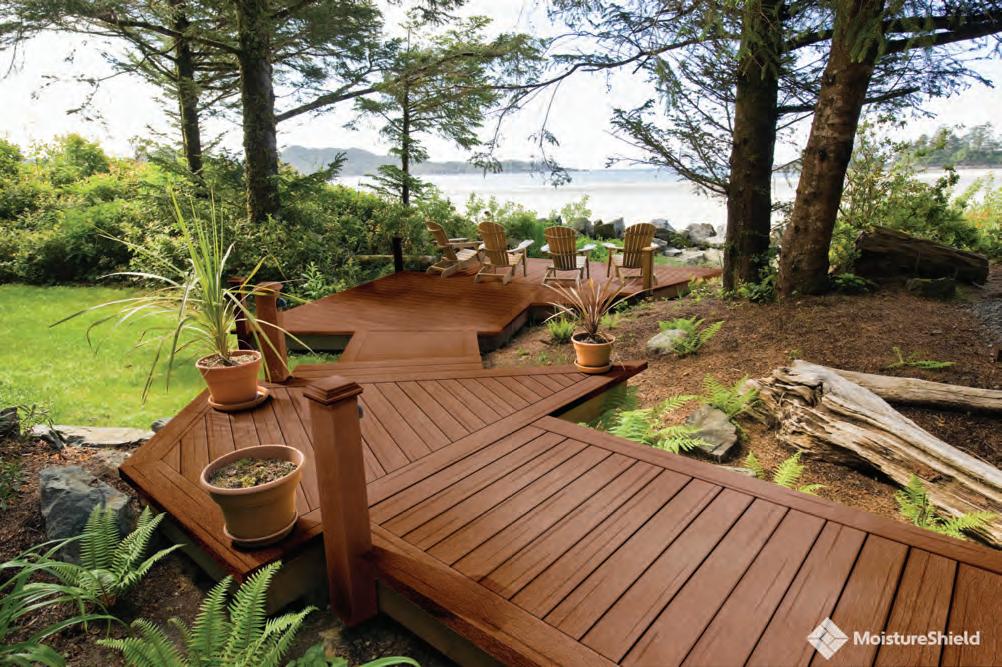
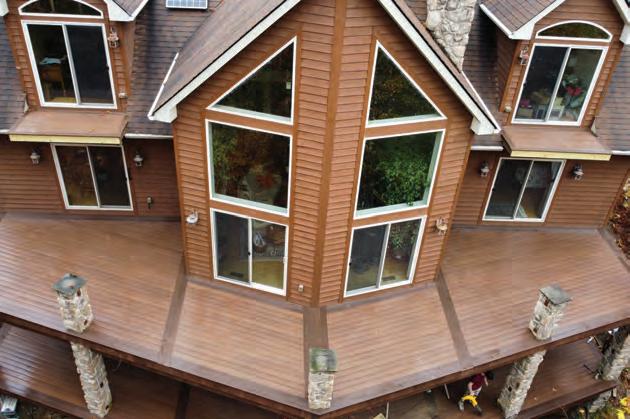
Chuck, I can honestly say that your MoistureShield projects would make any Dad proud.
The next fantastic gentleman, husband, father, builder is a man I met at one of the NADRA National+ award banquets and immediately found myself impressed with his mindset, motivation and drive in the pursuit of excellence. Levi Tippetts of TC Decks, Saratoga Springs, UT., comes to this trade from another angle, but with a great deal of talent, skill and building experience.
“I come from what I feel to be one of the lost and under-appreciated trades in the building industry; residential framing/rough carpentry. After getting my license in 2005, I started a small framing crew that grew to about 50 employees, all while I battled through many ups and downs, including the Great Recession. After 20 years of dealing with ungrateful contractors, homeowners, employees along with many other adversities, I came to my breaking point.
“Finally, after completing a beautiful deck that ended up on the cover of the Fall 2021 issue of Deck Specialist magazine, I found I enjoyed building again. Having received a great deal of appreciation from the homeowners and making a decent profit, I decided that’s what I’m going to do instead of framing. I sold my framing company, and now enjoy building beautiful custom decks all on my own (for the most part). Being a Deck Specialist is gratifying, enjoyable, and lucrative. I wish I would have made the switch 20 years ago. The cherry on top (and I love this), is this incredible community of deck builders—like-minded friends from all over the world that I look forward to seeing at trade shows a couple of times per year.”
Thank you, Levi. I find myself in awe of your work.
(Continued on page 46)
(Continued from page 45)

My third perspective comes from a young man whom I’ve come to greatly admire for his ingenuity and design prowess. Oddly enough, he was out of the industry for the better part of a decade and came back with a fresh new set of eyes. Daniel “Dan” Eric Pettit is the owner of Northern Outdoor Living, Hastings, MN. While his story may seem rather incredible, it pales in comparison to his outdoor living creations.
“I cut my teeth working on million-dollar projects for a custom builder/remodeling company. After a dozen years of learning to take pride in craftsmanship, things dried up and in 2008 and I found myself having to make a decision.
“At that point, my other passion, music, was able to provide a more consistent and reliable paycheck. I was teaching 40 private lessons and two to five ensemble classes per week along with playing as many as 120 shows per year. I put in long hours and lots of travel.
“Along the way came two sets of twins in two years (wow!) and some more changes needed to be made. I decided I needed more home life and another career path was in order if my wife and I wanted to avoid being like ‘two ships passing in the night.’ It was time to return to my original passion of creating beautiful outdoor living spaces.
“Since that’s where I found my inspiration, in 2018 I decided to open Northern Outdoor Living. Now, I find it a little bit of a guilty pleasure getting to be so creative in this arena. The sky is the limit with materials to use, and how to put them together. Glass, metal, all the composite decking and framing, fire, water and lighting features, add-on structures, covers, outdoor kitchens, accent walls and bar tops— there is no stopping our imagination. Right now, I have a team of four highly talented individuals who all share a passion for what we create.”
There is no doubt they share a creative passion, one look at Daniel’s work is all the proof you need. He is blazing a new trail in this industry.
I want to thank Charles, Levi, and Daniel for sharing their unique stories and perspectives on why these men (in their right minds or not) would choose to become Deck Specialists. Default or desire, there is no disputing they are consistently “Setting the Standard In Excellence” in the world of outdoor living.
With 35+ years experience in construction, Brendan Casey, with his wife Dianna, launched Casey Fence & Deck, Frederick, MD., fulfilling a growing need in the outdoor living market for an innovative, creative, custom builder.


Lamello 101402S Zata P2 Biscuit Joiner
www.lamello.com
Retail Price: $1,600
EARLIER THIS YEAR, seasoned deck builders Andy Henley and Mike Mitchell agreed to step into the big shoes left behind by Marv Johnson, Deck Specialist’s previous tool review columnist who passed away last year.
These two craftsmen, who own and operate deck building companies and are active NADRA members, will share their reviews and discussions about tools and technology that impact the decking industry to equip you with the tools to build your business to the next level.
Andy is the owner and operator of Hen-House Decks, Uniontown, OH., a national award-winning deck company known for its creativity and high quality. If you know the name, then you are probably familiar with the company’s amazing guitar deck project.
Mike is a second generation, award-winning owner and operator of Mitchell Construction in the Chicagoland market. The company specializes in low-mainte-

nance, outdoor living spaces, focusing on the customer experience throughout the process. In addition, Mike is invested in the industry, actively learning, educating, and elevating others.
In this first column, Andy and Mike have added a new section, the Contractor’s Corner, which focuses on the favorite tool of a featured contractor, and have chosen to review Lamello’s 101402S Zata P2 Biscuit Joiner.

About the Biscuit Joiner
Andy: Lamello opened their doors in 1944 and launched their first handheld biscuit joiner in 1968. The Zeta model was launched in 2010.
The Zeta P2 is a biscuit joiner for P-System connectors and is used to create a form locking groove within seconds. It is a special joiner that creates slots to inset P-system-style biscuit anchors. The integrated vertical mechanical drive is automatically triggered at the maximum cutting depth and performs a lateral cutter movement for the P-System groove. Connectors with various functions can then be inserted into the groove. This particular model has a cord,
but a cordless option was released in some markets in September 2022.
Mike: The carrying case really set the tone for how this tool was going to perform. It is a solid container with form-fitting plastic to hold the tool, its accessories, and the various biscuits securely in place. The containers stack and lock together for organized storing and ease of bringing it out on the jobsite. I was excited to plug this thing in knowing how much effort they put into the carrying case!
Andy: Although there are a few different types of biscuits or connectors in the P-System, and a variety of additional components, there are two biscuit-type connectors worth noting: Tenso-P and Clamex-P.
Tenso-P. This is a two-piece self-clamping biscuit. Each half of the biscuit rotates into the secure slot. Just apply a little glue before you push the biscuits together and, thanks to its self-locking technology, the biscuit securely locks together, clamping the board in place. That’s right, no clamps needed! There is also an optional piece, to insert in one half of the biscuit to reduce the amount of pressure it takes to push the biscuits together.
Mike: It cuts a quick and accurate slot for a hidden fastener in the side of solid boards, and you can do it right in place while setting your picture frame border. This reduces screws, lets the hidden fastener set the gap, and results in a cleaner finish!


Clamex-P. This biscuit has a moving-center-locking clamp that secures the two biscuit halves together, similar to the way a double hung window locks. This requires access to the back of the board to rotate the locking mechanism. The access is through a small hole drilled to fit an Allen wrench into the lock. This has what we believe to be the highest clamping power that is also removable. Just unlock the clamp and pull the biscuit apart.
With a quick change of the blade, it becomes a versatile biscuit joiner. You can use this to cut standard biscuits in miters to reduce movement or cut slots for hidden fasteners.
Andy: Let me tell you a few reasons a biscuit joiner is a must-have tool in your arsenal. Imagine, it’s 4:30 pm and you’re one board shy of being finished with laying the decking for the day. It’s too late to grab another grooved board, however; you have an extra solid board just staring at you.
When we asked Kevin Choquette, Ravin Builders, Wood River Junction, R.I., what tool he found essential to have in his tool collection, he shared with us his experience with the The Muro CH7390 Ultra Driver collated fastener gun by Starborn Industries, Inc.
“The decking industry is constantly evolving through product innovation and development. We are challenged to remain teachable and seek better, more efficient, and lasting methods of building. The Starborn gun checks those boxes for us. We preassemble our stair treads, fasten with coated or stainless screws, and plug the holes for an almost unnoticeable finish. With around 24 screws per tread on a standard set, this innovation has become a serious growth of efficiency, accuracy, and also eliminates dropped, stripped, and lost screws. The collation makes transporting and storing them easier, and the way the screws drive and exit the gun seems to promote better vertical drive into pressure treated lumber.”
Check Kevin out on Instagram, Tiktok, and YouTube @ravinbuilders.
For more information on the Starborn Collated Fastener Gun, visit starbornindustries.com.
That’s when you realize you have a secret weapon in the trailer. Boom! The biscuit joiner to the rescue! You grab the solid deck board and place it on the saw horses and you make your own slots for hidden fasteners. This also works great when you want to use hidden fasters on only one side of a solid board, such as on a picture frame border.
Andy: Another reason to use biscuits is to help keep your miters tight! Have you ever cut a tight miter and left the jobsite for the day with perfect miters, only to return the following day to find the miters have a small gap? A biscuit joiner is a great way to prevent this from occurring.
Billy Shirey of Shirey Construction, Copley, OH., has been successfully practicing this method for a few years.
When we asked Billy about the tool, he said, “Aside from setting yourself apart from the competition quality, what really made me pull the trigger on

buying this product was that every guy on the crew could put down picture frame stair treads without struggle and they will be perfect.”
“If you don’t know the tricks of the trade it can be hard to accomplish perfect 45s on multiple stair treads, but the Lamello biscuit joiner eliminates that problem. Also, it’s something you can prep in your down time or on a rainy day if you sell a standard size of steps,” Shirey said.
“Although we will do quite a bit of custom stairs, the majority of our stairs are 4 ft. There is a bit of a learning curve in the beginning, but once you overcome that it is worth the wait. I honestly don’t know all the capabilities of this tool but it works great for what I do,” he added.
Mike: The Zeta P2 is really a high-end tool. It has a full range of adjustments for every direction and
angle with pinpoint accuracy. It is very powerful and plows through wood or composite with ease. The sliding movement is super smooth, and you can hardly feel when the actuator moves the blade up and down to create the slot. The weight is well balanced when holding in one hand. I liked how easy it was to get the switch to turn on and then it remained on while making your plunge. I was not a big fan of the secondary handle. It felt a little flimsy and I couldn’t get it to lock into any position. I did not like dealing with the cord and feel like the cordless option will be a big advantage especially when working out in the field. Although there are plenty of benefits, it is rather expensive—as are the biscuits. If you do a lot of miters and are looking for a consistent way to lock them together, it is worth breaking open that piggy bank! For those of you in the AMC (Anti-Miter Coalition) a regular biscuit jointer may suit you just fine.
If you have any questions or tools you would like to see featured in this column, please reach out to us directly on the Decking TNT Facebook page. DS




I’MAPRIL EDWARDS, digital marketing strategist and founder of Deck Builder Marketers. Welcome to my first column for Deck Specialist magazine!

I look forward to helping you learn new ways to market your business online. Whether you are already using digital marketing or haven’t quite made the leap yet, I want to show you ways to help your business thrive. Proper digital marketing can actually be one of the best assets for ensuring year-over-year growth for your business (and it doesn’t have to be hard).
As far as my background, I’ve been in the branding, marketing, and advertising space since graduating from the Cleveland Institute of Art in 2004. I’ve done everything from web design, Flash animation, package design, brand design, email marketing, and every single facet of digital marketing and advertising (web, SEO, social, digital ads, automation, etc.). I’ve held various positions in-house for a few companies as “the” marketing department for a couple of compa-
nies and creative director for another.
In 2008, I moved to San Diego, CA., from Cleveland, OH., because I always wanted to live by the ocean and surf. I looked for work as a full-time employee, but no one was hiring because of the down economy at the time. Instead, I landed a lot of contract jobs and regular freelance gigs.
Contracting with various brand and marketing agencies simultaneously gave me a wealth of knowledge to eventually go out on my own.
After speaking with several builders, I learned that our journeys aren’t all that far off.
After working for others, I incorporated AE Design Co. in 2012.
After a while, I wanted to be able to help more small businesses and make a larger impact in one industry. I decided to niche down so we could master
our process for one type of client and make a big impact!
After some soul searching and realizing the type of client that we loved working with the most, combined with a tried-and-true marketing system we perfected for them over the course of a few years, we decided to go all in with deck builders specifically. And Deck Builder Marketers was born.
So, here I am today. Deciding to go all-in with the deck construction industry was the best decision I could have made! I absolutely love this community and am honored to be here to share everything I know with you with the goal of helping you have the business you deserve and take things to the next level.
I have a lot in store for you! From simple to more advanced marketing plans, how much to invest in marketing, how to build a world-class website, how to leverage content to build your brand, automation tactics, and so much more!
The goal of this column is to be your go-to marketing resource. Regardless of where you are in your business today, I hope that you can apply even one nugget of marketing wisdom to start seeing significant changes in your business right away.
Deck builders need digital marketing, not just better leads, but also to save time on calls, build a solid reputation, and hire skilled craftsmen. If you want to streamline your business and grow, you need a marketing plan.
Proper marketing will create a world-class reputation for your deck business that no one will question. Leveraging marketing and advertising will help you build your authority so your ideal clients will wait however long it takes to only work with you.
• Dominate the Internet.
• Become the best known deck builder in your area.
• Grow Your business and thrive.
April Edwards is a digital marketing strategist and founder of Deck Builder Marketers (www. deckbuildermarketers.com), Carlsbad, CA. Message her on Instagram @deckbuildermarketers.

Aluminum Rapid Rail, developed with the help of Deckorators’ network of Certified Pros, offers a quality powder-coated aluminum railing in a textured-black finish with a contemporary design that complements a variety of home styles. It is available in 6' and 8' lengths.

Deckorators expanded its aluminum railing enhancements with more post sizes, two-piece brackets, Contemporary Cable Rail spacers, and templates to improve installation for Aluminum Contemporary Rail, Contemporary Cable Rail, and Aluminum Rapid Rail.
[deckorators.com]
New Castle Steel has added a hot-dipped galvanized steel support post to its steel framing system, now available for distribution nationwide. The new 6"x 6" post is available in 12' and 6' lengths. It boasts a 3/16" wall thickness for increased stiffness and load support. The post works with a 10" diameter round base plate welded for post-to-pier attachment.

The framing system features:
• Post cap for increased beam bearing support.
• Front and back post-to-beam brackets made of 14-gauge G60 galvanized steel.
• Textured Charcoal Black finish.
• Designed for increased lateral stiffness using an integral post-to-beam connection.
• Features a 10" round base to work well with a standard 12" Sonotube.
[ncsteel.com]
Trex has introduced a host of new decking and assorted products.

The newest colors of the Trex Transcend Lineage decking line are: Carmel (a creamy taupe) and Jasper (a deep shade of mocha).

The warranty for Trex Transcend and Trex Transcend Lineage decking products was increased to 50-year limited, and the warranty for Trex Select decking is now 35 years.
Trex also introduced pre-assembled stair panels (6'x36", 6'x42", 8'x36" and 8'x42") to its Trex Signature Railing line; Trex Fire Pit Tables in 42" and 48" round designs; 11"-wide aluminum-lined butyl Trex Seal Ledger Flashing Tape, and a new WiFi Controller for use with its Trex Outdoor Lighting system.
[trex.com]
Glass Flooring Systems released the SkyFloor Modular Glass Deck System, which is designed specifically to be used in a deck application to allow light to shine through the deck into the space below.
The system is available with two standard panel sizes: 32" x 32" and 32" x 48". The panels can be used as a single unit or grouped together for a larger area.
The ICC-approved SkyFloor modular glass deck system comes with the structural glass panels, frame, setting gasket, silicone, and fasteners, and product drawings.
The walkable glass panels are available in two, anti-slip texture options. NanoDot is the “clear” option and LuxRaff Regular, which is opaque, provides more privacy. Both textures are tested to ANSI A326.3 and are suitable for outdoor wet conditions.
[glassflooringsystems.com]
Grad Concept USA has introduced the North American launch of its Grad Rooftop Decking System

The thermoplastic polyolefin (TPO)-friendly system speeds up installation up to 50% faster than conventional decking, while requiring fewer people to complete the job. Utilizing screwadjustable pedestals, the waterproof system raises the deck floor off the TPO as high as 15". The subdeck remains easily accessible since boards can be individually removed.
The polypropylene pedestals provide a stable infrastructure, while the polyoxymethylene fasteners offer strength and flexibility.

The decking system can also be used for poolside decking and is compatible with many different Grad-approved decking brands.

[us.gradconcept.com]
National Nail’s CAMO brand has a new line of IRC/IBC code-compliant and third-party tested structural screws. The product line includes:

• 6" CAMO Truss Screws for interior wall and exterior beam-to-joist connections
• CAMO Multi-Ply screws for both sawn and structural composite lumber beams. Three screws do double duty as ledger screws.
• 2 1/2" and 3" framing screws
• CAMO’s Multi-Purpose screws in flat and hex head.
[camofasteners.com]


OKC Home + Outdoor Living Show
When: March 24-26
Where: OKC Fairgrounds, Oklahoma City, OK.
What: Attendees gain inspiration for their own backyard projects and engage with other professionals.

More info: www.homeshowokc.com
North American Deck & Railing Association – Awards Dinner & Networking Event

When: March 29-31
Where: Sheraton Sand Key Resort, Clearwater Beach, FL.
What: NADRA will honor this year’s best decks at its annual prestigious awards presentation. Other activities include workshops, beach Olympics, and a farewell luncheon.
More info: www.nadra.org

Portland House & Outdoor Living Show
When: April 14-16
Where: Oregon Convention Center, Portland, OR,
What: This expansive home show brings together homeowners and the area’s top remodeling and building experts. Every aspect of the home can be explored, from the smallest to the largest house addition.

More info: www.homeshowcenter.com
PCBC Summer Showcase
When: May 24-25
Where: Anaheim Convention Center, Anaheim, CA.
What: The event includes educational programs, a Hall of Fame Awards Dinner that pays tribute to men and women for their accomplishments in the California homebuilding industry, and the Gold Nugget Awards that recognize those who improve their communities.
More info: www.pcbc.com
black finish adds a level of sophistication to a modern classic.


When Partel and Sons was asked to build a beach walkover in Ponte Vedra Beach, FL., they had several issues to contend with—the temperature of the exposed decking, sand erosion, and rust and corrosion due to the salt air.

“When building anything on the ocean, there are many obstacles we face,” said Kevin Partel, owner/president of Partel and Sons, Inc.
To combat the temperature of the exposed decking that follows the contour of the natural sand dune, the team used Owens Corning’s WearDeck composite decking to build the 150-ft. long by 4-ft. wide, low-profile decking. According to Partel, the material does not splinter and reflects the hot Florida sun better than any other product on the market. In addition, they used all Marine grade #1 southern yellow pine for the framing and the top and mid rails.

“WearDeck is a product we have been using for many years,” he explained. “This product can withstand the rain, the sun, the salt air, and anything else Florida can offer. It also is great for customers because it never splinters and stays cool, allowing walking, and is comfortable for pets to walk on as well.”
In addition, Partel built a seating area near the ocean so the customer could enjoy the beautiful sunrises over the Atlantic Ocean.
Partel added that erosion in Florida has become a major issue due to hurricanes and Nor’easters in the area. To combat this, the team dug the 4x4 posts 5-6 ft. into the ground “so that if some sand is washed away, the structure will still be standing and we can come back and add post extensions to the existing walkover,” Partel added. They also buried multiple steps below grade so the customer could still access the beach after a storm.
To reduce rusting and corrosion, they used the highest-grade stainless steel products available, Partel added. “All of our projects are designed by a structural engineer who adheres to all local and state building codes. We use stainless steel bolts, screws, nails, and strapping to ensure the structures are built to handle any and all that Mother Nature throws our way.”
Ultimately, Partel said the project turned out how he and the customer imagined.
UPPER: WearDeck composite decking was used to reflect the hot, Florida sun, and because it does not splinter.
MIDDLE: Multiple steps were buried below grade so the customer could access the beach after a storm.
LOWER: The 4x4 posts were dug 5-6 ft. into the ground so that if any sand washed away due to hurricanes or Nor’easters, the structure would be left standing.

