
BuildEXT
We are general designers We are integrators
Shaping our own future through responsible extension of architectural practices
How do we work
We are Designers, Engineers, and Project managers delivering complete solutions from the idea, across the design, and construction coordination to the building operation. We believe that we can make efficient, cost-effective, and eco-friendly projects. Our mission is to implement the latest technology to develop real-life BIM projects in the CEE region.
Let’s speak a common language using the BIM working method!
To turn a strong design into a reliable plan and later into an outstanding structure, a lot of participants need to work together successfully. Such a project without a transparent flow of information would break out a Babel.
Therefore, we take advantage of the BIM working method and we invite all participants to a common – cloud-based – design table, where we make our decisions together and everyone adds their expertise to the project. This way we immediately increase quality, save time and save resources.
Design in a diverse team
In architectural design, the experience of many professionals condenses into an excellent design. The BIM working method reinforces the collaboration and rapid exchange of information, thus preventing design errors. The detailed digital environment helps us experiment with the best solution even on the drafting board.
Digitally supported construction
From the cost estimation to the completion of the building, all construction is burdened with ongoing problems and forced changes. The extraordinary advantage of the BIM working method is that these changes can be tracked quickly and transparently, saving time and money.
Optimized facility management
The as-built model, which is being constructed in parallel with the building, is key to sustainability. We can link the model to our facility via modern FM software, creating its digital twin. This can be used to optimize the operation of the building and reduce maintenance costs by orders of magnitude. In addition, it can be used immediately for any architectural or interior design renovation.
2
We take responsibility for our future
The most important task of architecture today is to take into account the needs of its customers, users, and the environment at the same time, and even to flexibly manage their changes throughout the entire life cycle of the building.
Therefore, we need to conduct communication between actors in the AEC industry and we also need to be technically able to adapt quickly. Together with customers and users, colleagues and partners, we ask the questions that lead to answers that last, not just today but tomorrow as well.
We believe that with our knowledge and passion we can make efficient, cost-effective, and eco-friendly projects across the whole digital lifecycle.Csaba Livják, founder and CEO of BuildEXT
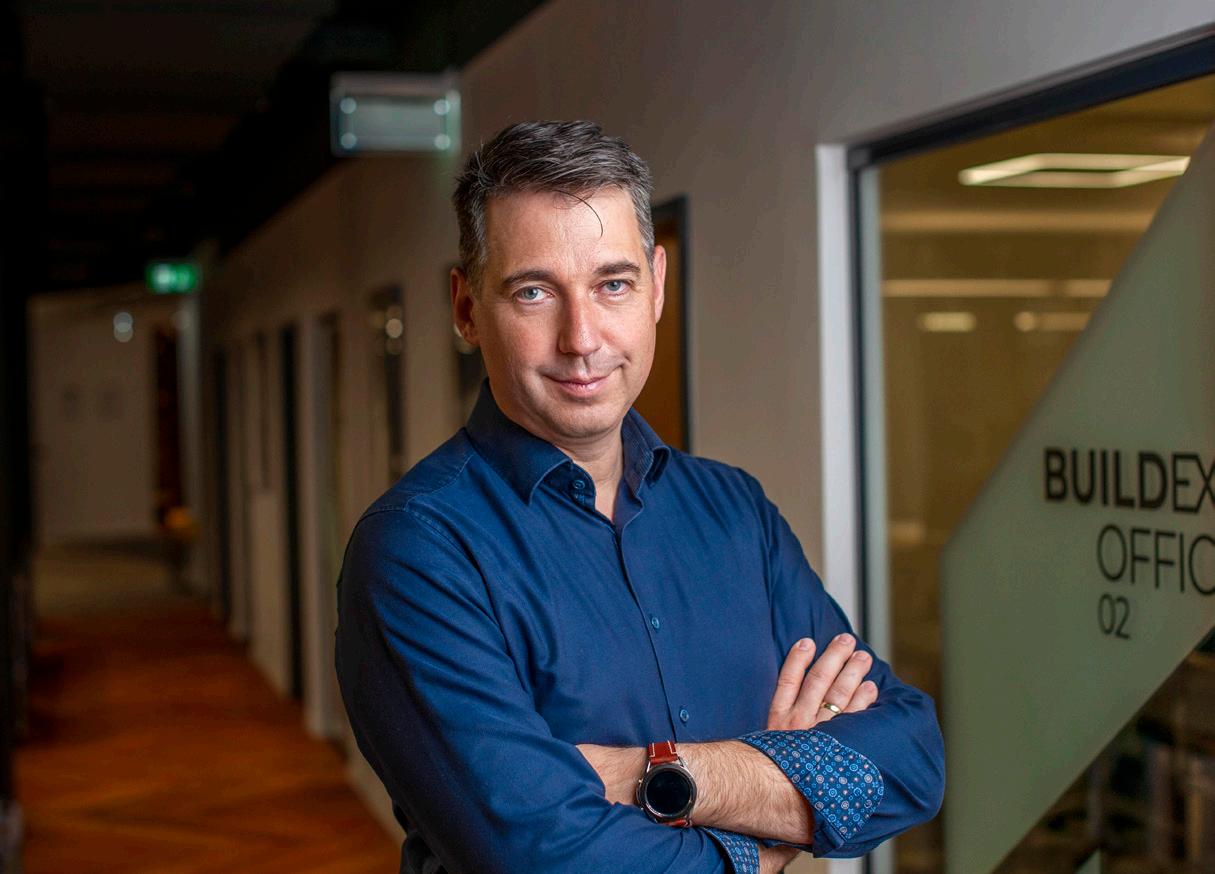
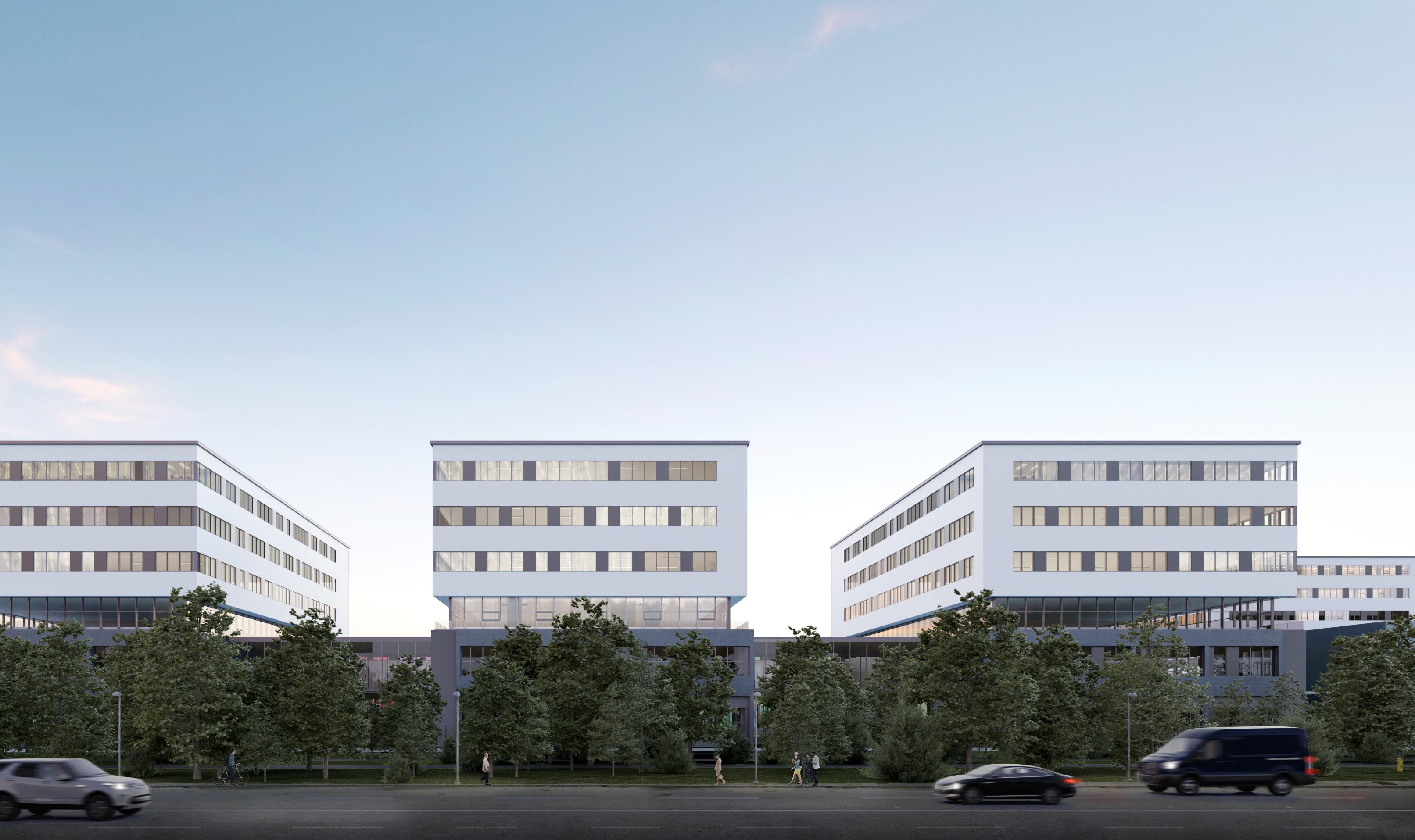
BuildEXT introduces the BIM workflow to everyone to orchestrating the dialog between the stakeholders.
3
BIM services worldwide
Our ISO 19650 audited BIM services are available worldwide for large-scale and complex industrial, commercial, office, and public building projects.
We speak a common language using BIM working method.
Our improved ISO 19650 audited BIM workflow highly increases the efficiency of design, construction, and maintenance work in the total lifecycle of the buildings. We use hi-tech devices of digitization to build up, collaborate in, and share a highly-automated, interactive, detailed information ecosystem with each other. It keeps the construction process on target, within budget and time frames, and makes facility management more efficient and cheaper with less environmental impact.
Multidisciplinary process
In architectural design, the experience of many professionals condenses into an excellent design. BIM workflow reinforces the collaboration and rapid exchange of information, thus preventing design errors.
Software we use


International projects
Remote QA of construction projects in the USA
BuildEXT cooperated with solidspac3 in their software development with its’ point cloud processing and analyzing resources via real construction projects in the USA.
We gained practical experience in:
• survey analysis, comparative reports
• construction tracking & monitoring
• integration of electrical, mechanical, plumbing systems into federated model
• space analysis
• BOQ (Bill of quantities)
To achieve that, all the engineers are working together in a central Revit model.
We sync the model into the cloud and we make it available to all the stakeholders through easy-to-use applications. This way all the changes can be tracked quickly and transparently, saving time and money.
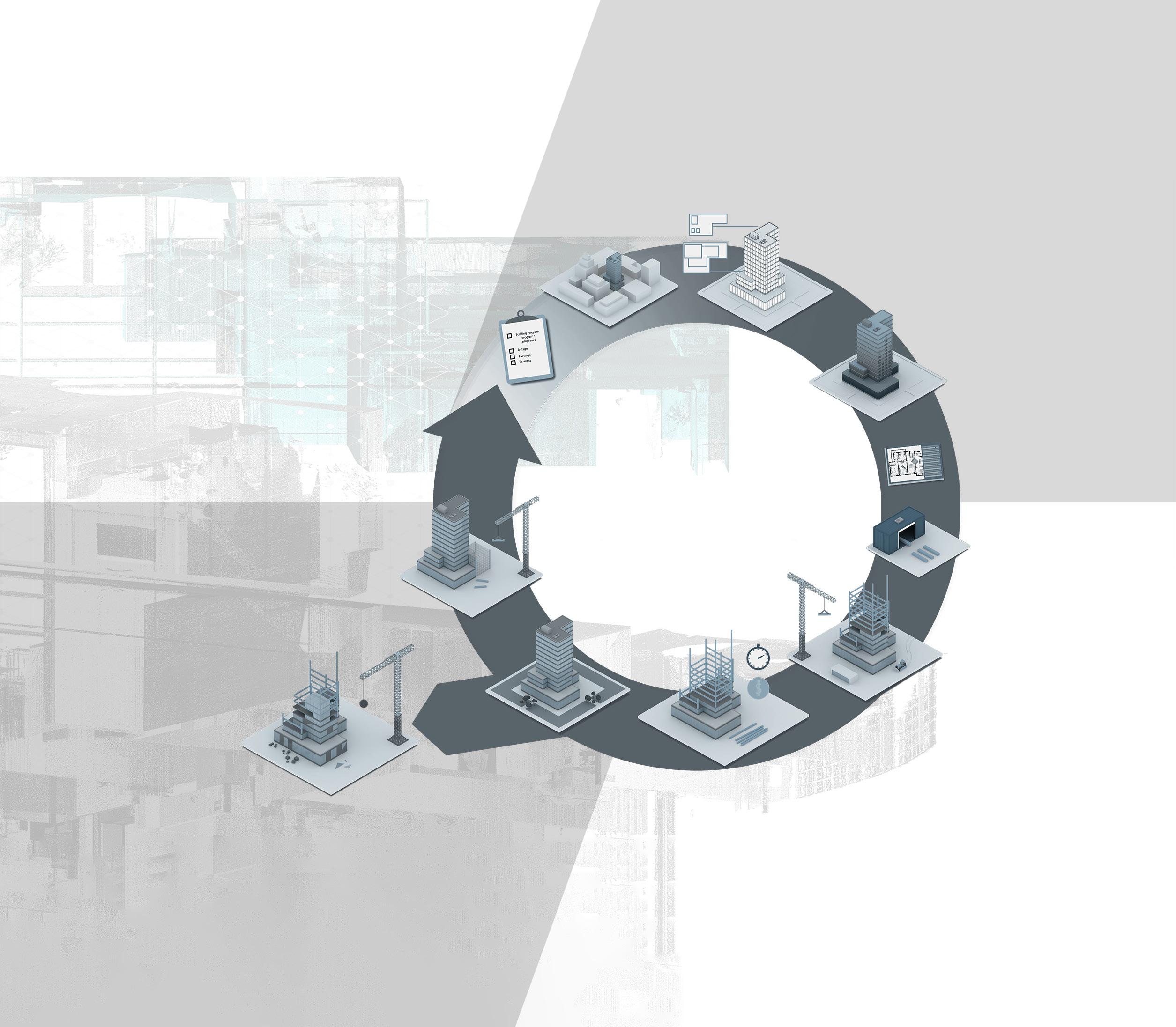
The BIM lifecycle
BIM lifecycle is the practice of creating, maintaining, and utilizing building information to manage the building’s design, construction, and operation and facilitate information sharing between all the stakeholders.



Hi-level site logistics in Stockholm
A European company, worldwide leader in light and sustainable construction approached us to create a logistical plan for a 7,000 m2 construction in Stockholm that would make the work of the drywallers easier than ever before.
This pilot project included several professional challenges:
• import model from different software w/o data loss
• write scripts to automate as many manual processes as possible
• creating BIM model with detailed information
• LBS (Location Breakdown Structure)
4
Remote BIM services we provide globally
O&M support
• Scan on-site and make as built-model for refurbishment or other purposes
• Support to implement FM software on BIM model
• Update and maintain as-built BIM model
Design support
• Detect clashes and propose multidisciplinary solutions
• Integrate different levels of discipline models into federated BIM model
• Run analyses and create 4D, 5D and 6D simulations
Construction support
• Scan on-site and process point cloud to analyse and make comparative reports from it
• Provide data from digital model for BOQ, site logistics, design supervision and remote QA
and maintenence
Programming Conceptual design Detailed design Analysis Documentation Prefabrication Construction simulation Construction logistics Operation
Demolition Renovation
Hi-tech challenge in BIM workflow
Continental’s Budapest factory has all the developments available to make it one of the five Industry 4.0 flagship factories in Hungary.
Client: Continental Automotive Hungary Kft. Size: 30,100 m2
Continental manufactures electronics products for the world’s leading automotive manufacturers, applying highly advanced and innovative technologies in many areas of automotive electronics. It has several sites in Hungary, of which the Budapest site is planned to be developed in 5 phases. In the brownfield project, BIM objectives included a special focus on the implementation of digital facilities management, so we worked in a BIM-based workflow throughout the project.
Global automotive supplier
The Budapest plant’s activities focus on the production of key systems for self-driving, electrically powered and internet-connected vehicles, such as electric control units, displays, drive, mechatronic and infotainment systems.
On the customer side, we had to meet strict standards and expectations, which led us to make major improvements to our own BIM workflow and to our tooling.
Scan to BIM
The quality of architectural work is greatly influenced by the availability of data, existing conditions and documentation.
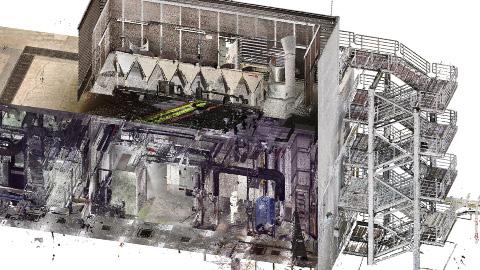
Therefore, we first created a point cloud of the entire site by laser scanning, and then built the BIM model based on the data set. This gave us an accurate picture of the exact, current condition of the building complex.
Common Data Environment
We also had to deal with the different quality of the sectional plans of the existing buildings, the provision of data, the coordination of large model files and the software installation stop on the client side. To do this, we created the conditions for a common data environment (CDE) based on the Dalux BIM construction management software. During the project, we shared the multidisciplinary, federated model on this cloud-based, online platform.
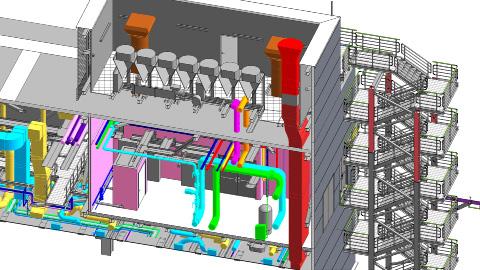
The project participants were able to interactively follow the entire design cycle of the buildings in 3D, even on a browser running on a smartphone. Data sheets were added to the model elements, creating a digital twin that provides the basis for optimal facility management.
Representative interior
In addition to the engineering challenges of complex industrial solutions, we were proud that our interior design team was also given an important role in the development plans for the headquarters.
We had to design high quality office and community spaces to meet representative needs. And perhaps the most exciting part of the project was the design of a meeting room and associated roof terrace in a steel-framed glass-fronted cube on the upper level of the headquarters.
1.
Services: General Design
Project Management Scan to BIM
BIM Services | Interior design
Function: Industrial building | Office
2.
6
site, Budapest
Continental
5 years, 5 phases. Complete factory development for one of the world’s leading automotive companies.
3-4.
7
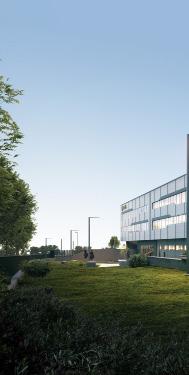
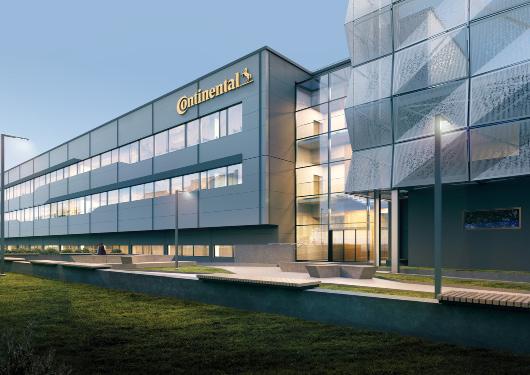
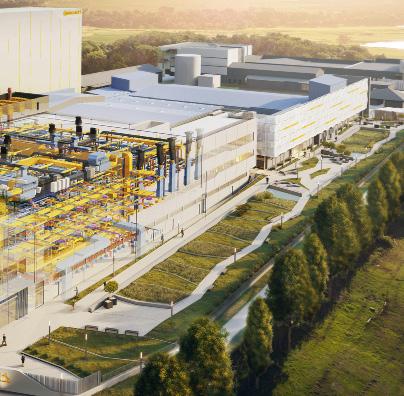
1. The visual design of the main building, the construction of the facility has been postponed due to Covid.
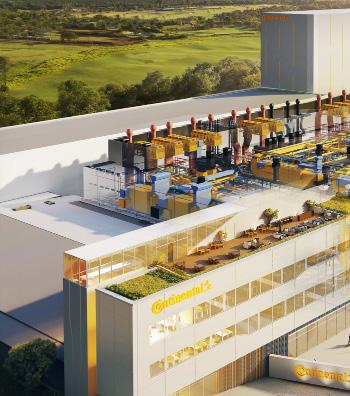
2. Digital model of the complete site with a fully automated high-bay warehouse in the background
Point cloud and detail of the model
4.
3.
Scan to BIM and interior redesign
What started as a traditional interior design project soon turned into a complex scan to BIM pilot project for the renovation of a grade A office building in Budapest.
Client: Convergen Central Europe
Hungary Area: 9,400 m2
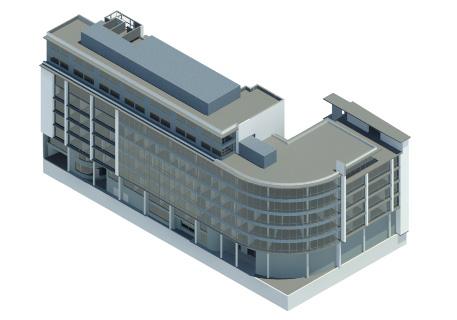
Our original brief was only to design the interior of the common areas of the ZenGarden office building. However, we saw more potential in the assignment, so we decided to create an as-built model of the building, which is the basis for the digital twin.
With the information stored in the digital twin, our aim was to lay the foundations for better space management, more economical refurbishment, modern preventive maintenance and more efficient cost management, as well as to increase the overall value of the building.
Benefit for tenants
One of the most significant added values becomes apparent when a new or prospective tenant is considering an office conversion.
The ability for the building owner to provide the tenant with a detailed building information model greatly speeds up the workflow.
This means not only that the tenant knows the exact geometry of the rental property, but also that he can calculate the building’s mechanical capacities. This can both speed up the planning process and visibly reduce the running costs of the rental property in the long term.
Office building in virtual space
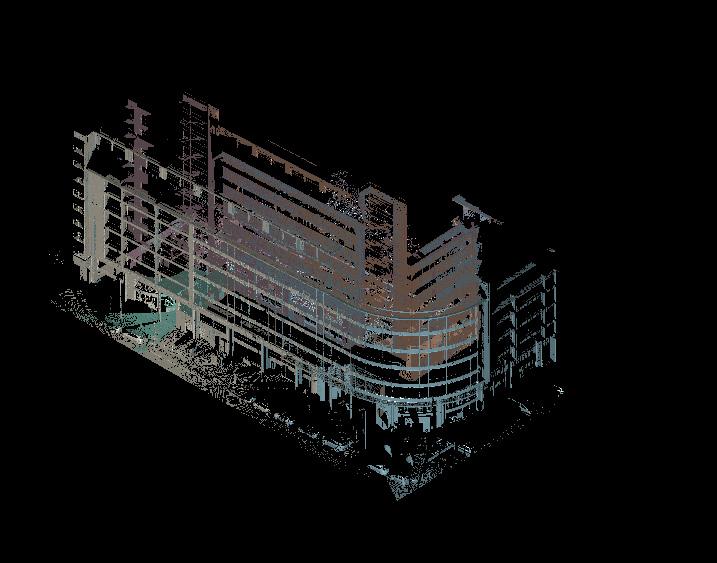
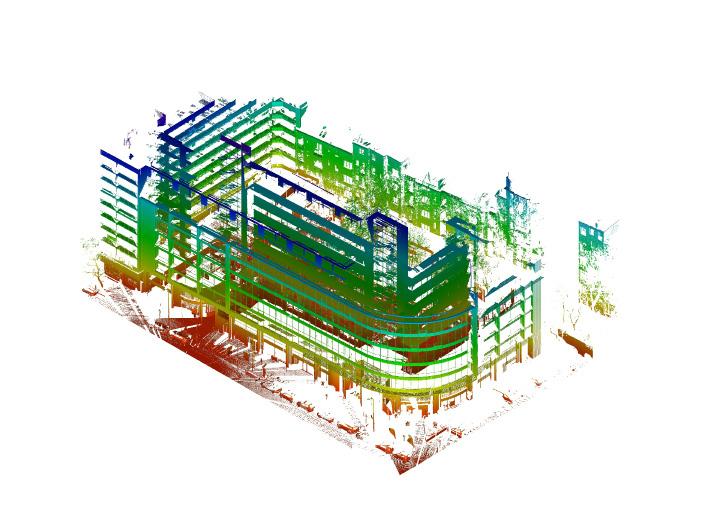
Over an area of 9,400 m2, the entire office building was digitized with an accuracy of 1.5-5 cm using a scanner. We walked around the facility and ended the project with more than 800 scanning stations, more than 8 billion laser points across the floors and 600 GB of data.
We put information into the model and then ran an energy analysis on it, the results of which were used by the property owner to upgrade the windows.
Interior design in BIM workflow
When designing the interiors of the common spaces, we benefited from being able to quickly obtain accurate data about the building. This allowed us to produce detailed plans, material estimates, cost estimates and all engineering calculations with a smaller margin of error.
In practice, this meant that the ZenGarden office building owner was able to carry out the building refurbishment more quickly and cheaply, with less risk.
8
office building, Budapest
ZenGarden
1. 2. 3. 3.
Services: Interior Design | BIM Services | Scan to BIM
Function: Office building
1. ZenGarden office building point cloud model
2. Elevation based on EOV
3. The “as built” model based on the point cloud
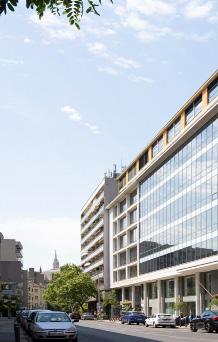
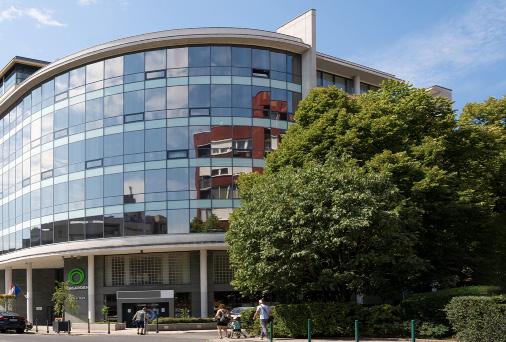
4. Zen garden Office building street view
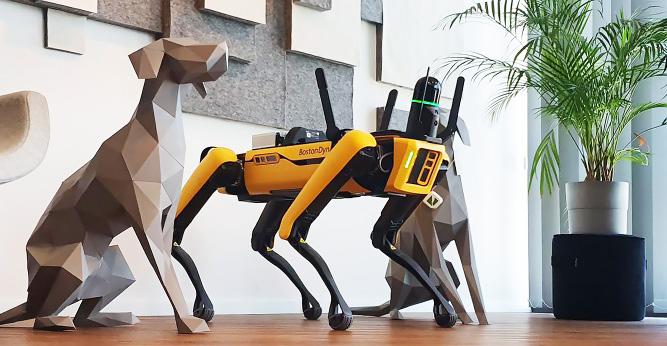
5. BLK2GO scanner mounted on Spot, Boston Dynamics agile robot
Scan for details

9
5.
Elegant swimming pool in a historic environment
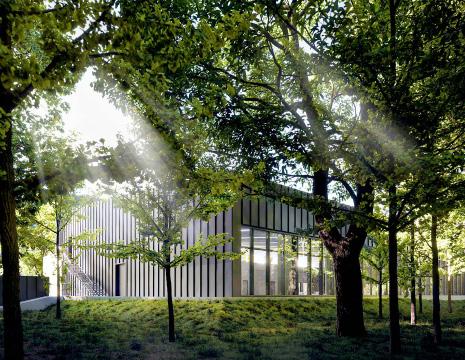
For the students of the Sárospatak Reformed College High School and Primary School, we have designed a separate swimming pool within a World Heritage Site, in the famous School Garden.
Client: Reformed High School of Sárospatak Area: 1,335 m2
Modern building meets tradition
The school swimming pool is located in the eastern half of a seven-hectare park, which includes two boarding school buildings and a newly built sports hall.
The building, designed for a World Heritage site, will not compete with the centuries-old listed buildings in its surroundings in terms of appearance, timeless, highquality use of materials, objectlike massing and reflective glass surfaces.
Rather it blends with that, retreating into the background, neutrally, with a restrained appearance typical of the Reformed tradition.
Given the tight budget, the primary objective of the project was to meet functional needs and sustainable operation, which led to a focus on cost-effective solutions.
Installation and functions
Behind the closed facade of the street front of the new building, the service functions are located.
The eastern glass façade of the pool area overlooks the sheltered garden of the schoolyard, densely planted with trees. One class is expected to be in the building at the same time, and the changing block design allows for a 15-minute break for the changing and undressing classes to dress in parallel.
In the pool area, a large teaching pool (15x25x2m, with 6 swimming lanes) and a children’s pool (10x6.5, variable depth) for lower school pupils have been created.
Above the block of dressing rooms there is a gallery level for the attendants, while the basement level houses the mechanical and electrical rooms.
History and new values
The link with tradition, school and spirit is expressed in the facade with contemporary graphic signs, quotations and interior design references to centuries-old water life.
At the same place, the landscape architectural elements are represented by local - Hangach zeolite - stone paving.
Services: General Design | Project Management
BIM Services | Architectural Design
Project Management
Function: Sports facility
10
Swimming pool, Sárospatak
2. 1.

General design using BIM tools
The area was surveyed in advance using a Leica BLK2GO mobile scanner, so the conceptual design, which was placed between 3D walkable, real-world environmental elements, was delivered very quickly on the fourth day.
We built the model in Revit, and communicated with the branch designers and the client in a closed data environment on the Dalux platform.
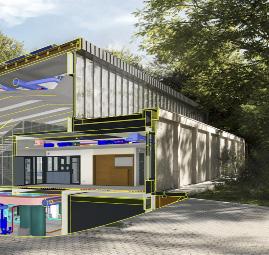
The design of the building was thus completed more quickly, with potential technical problems immediately identified and resolved.
The model, with its detailed information, can be used for construction, maintenance and operation.
11 3.
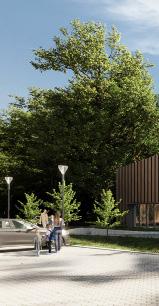
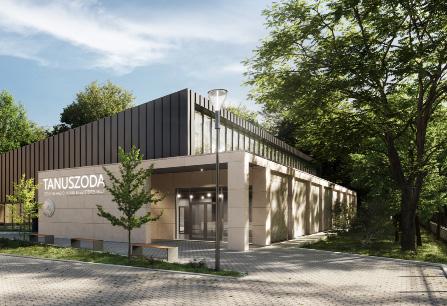
1. Visual design of the entrance to the swimming pool
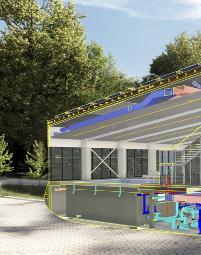
2. Cross-section showing the pool’s engineering
3. Scanning of the surroundings during the design phase to minimize tree felling
Scan for video
Extreme technology under the hood
Synlab laboratory in Budapest is the largest medical laboratory in Central and Eastern Europe, designed in BIM methodology with extremely complex and strict requirements.
By converting and extending the neoclassical main building of the former Hungarian Royal Budapest Customs Free Port in the area of the free port of Csepel, the client wanted to create an office and industrial building that meets contemporary needs.
Modern building in a centuryold industrial environment
The Royal Hungarian Budapest Customs Free Port opened in 1928 after nine years of planning and construction. When it opened, it was one of the most modern and the second largest port on the Danube.
The 1000×150 m basin of the duty-free port was connected to the Great Danube. The 44-metre high grain warehouse with a capacity of 35 000 tonnes stands on the shore of the bay, surrounded by railway tracks, and the loading halls on the shore also allowed duty-free free storage.
Architectural challenges
Three main aspects had to be considered when designing the building.
Firstly, the fit between the almost 100-year-old administrative building and the new block had to be resolved. Secondly, the building is adjacent to industrial sidings and container yards in use, which is an important consideration for tenants.
Thirdly, the building complex is located next to the main entrance to the entire industrial complex and thus has a representative role.
Behaviour
The massing of the new wing is a natural continuation of the old one, but its use of materials is distinctly different.
The rhythm of the facade cladding panels refers to the containers in the immediate vicinity. The enclosed, blocklike appearance of the building provides protection from the hustle and bustle of the harbour.
Approaching from the main entrance to the harbour, the new wing emerges in a flow from behind the classical block of the old building, forming a natural transition between the industrial world of the harbour and the urban scale of the main building.
Handling the details
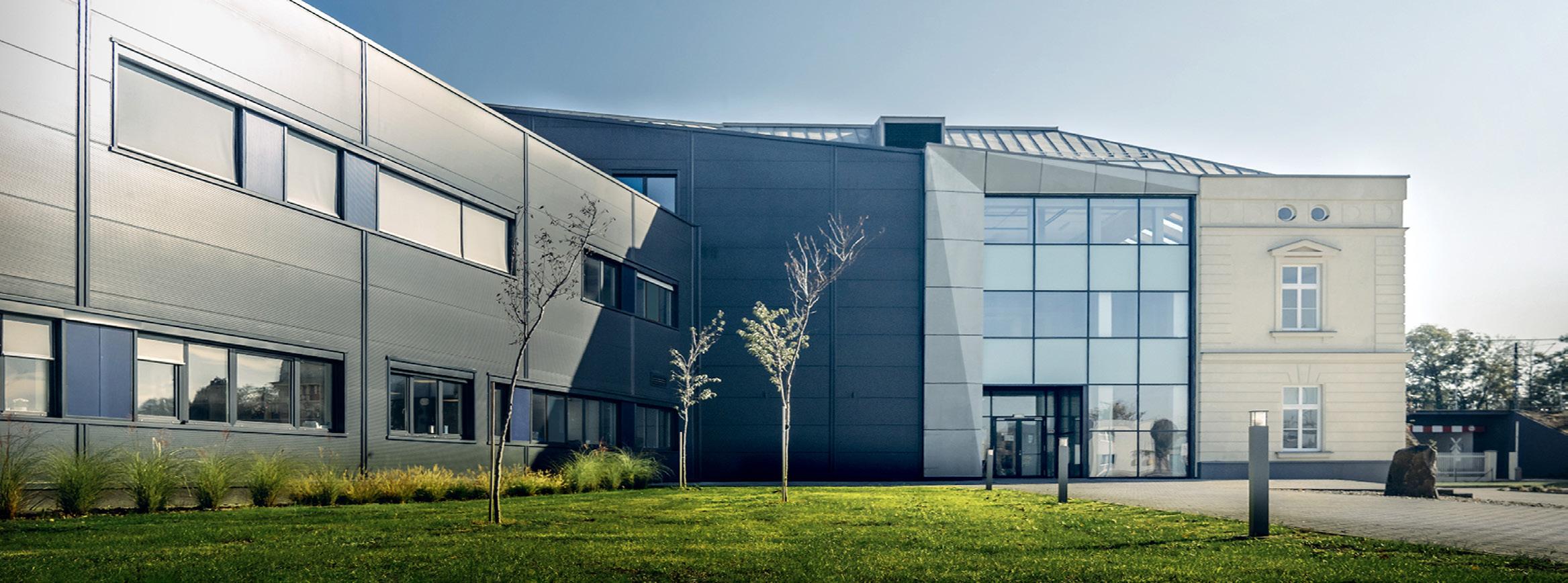
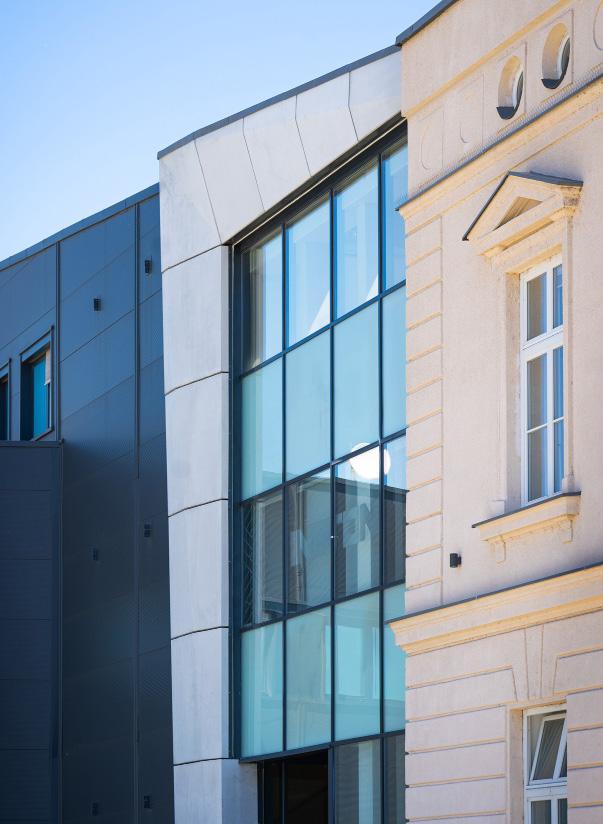
A striking feature of the house is the main entrance, where a stone-clad gateway element forms a transition between the old plastered facade and the new metal panels. This not only provides an elegant link between the two wings, but also creates a unique element that defines the character of the whole complex. The metal and glass are organically integrated into the southern facade of the original building, while the main entrance is echoed in the design of the western part of the new wing.
12
Synlab laboratory, Budapest
Client: Budapesti Szabadkikötő Logisztikai Zrt. Size: 9,500 m2 1.
2.
Services: BIM Services | Architectural Design | General Design Function: Healthcare | Office building
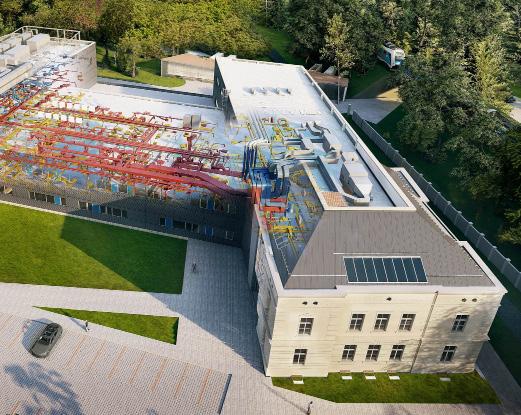

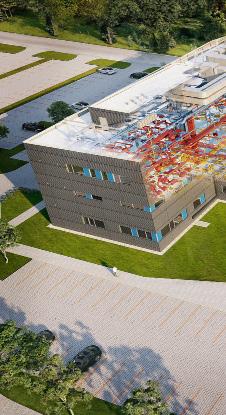
4. The harmonious extension of a classic block with a new building section was an exciting architectural challenge
3. The design of the largest bioanalytical laboratory in Central and Eastern Europe required complex multidisciplinary collaboration
Design of complex systems using BIM
The most exciting challenge was that the tenant of the building, Synlab laboratory, had some unusual requirements.
The building was to house the largest medical diagnostic laboratory in CEE. Accordingly, more than 30 different types of laboratory were installed, with some 400 km of piping above the suspended ceiling and machinery to handle 16 different medical gases, 4 types of water and 7 ventilation systems.
Meeting the special engineering needs of the design was a man-testing task. It became obvious to us that we had to work in a common data environment with the various engineers
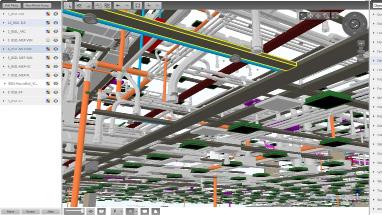
when we had to correct 10.2 million clashes in the initial phase of the design.
Planning in a closed BIM system saves a lot of time for a task of this complexity. Engineers from different disciplines can make decisions based on up-to-date knowledge of each other’s work.
BuildEXT effectively managed communication between partners and the resulting building information model is used to support construction.
The aesthetics of orderliness
The Synlab laboratory presented us with a unique architectural and engineering challenge.
The relationship between the old and the new is a noble task in itself and was further enriched by a set of unconventional technical requirements. This building combines technical knowledge, systems thinking and a measured architectural attitude of which BuildEXT is justly proud.
13
1. Bird’s eye view of the Synlab building
Scan for details
3.
A playful new look for an industrial building
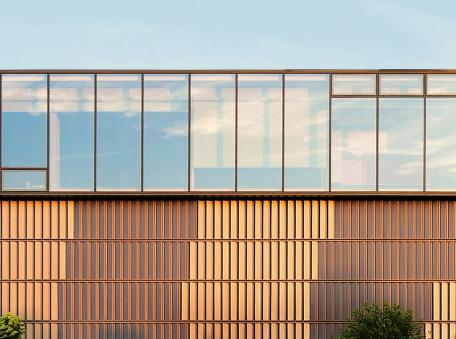

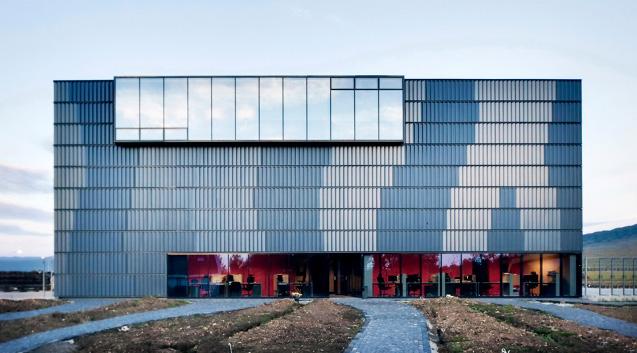
A simple geometry idea gives the building a unique look, which always shows a new face at different times of the day and from different perspectives.
Client: Weinberg 93 Építő Kft. Size: 5,000 m2
For the expansion of the steel structure manufacturing plant of Weinberg 93 Kft., we went beyond the established practice of facade cladding with an innovative solution.
Specific use of steel cladding system
The project combined design creativity with the client’s decades of professional experience.
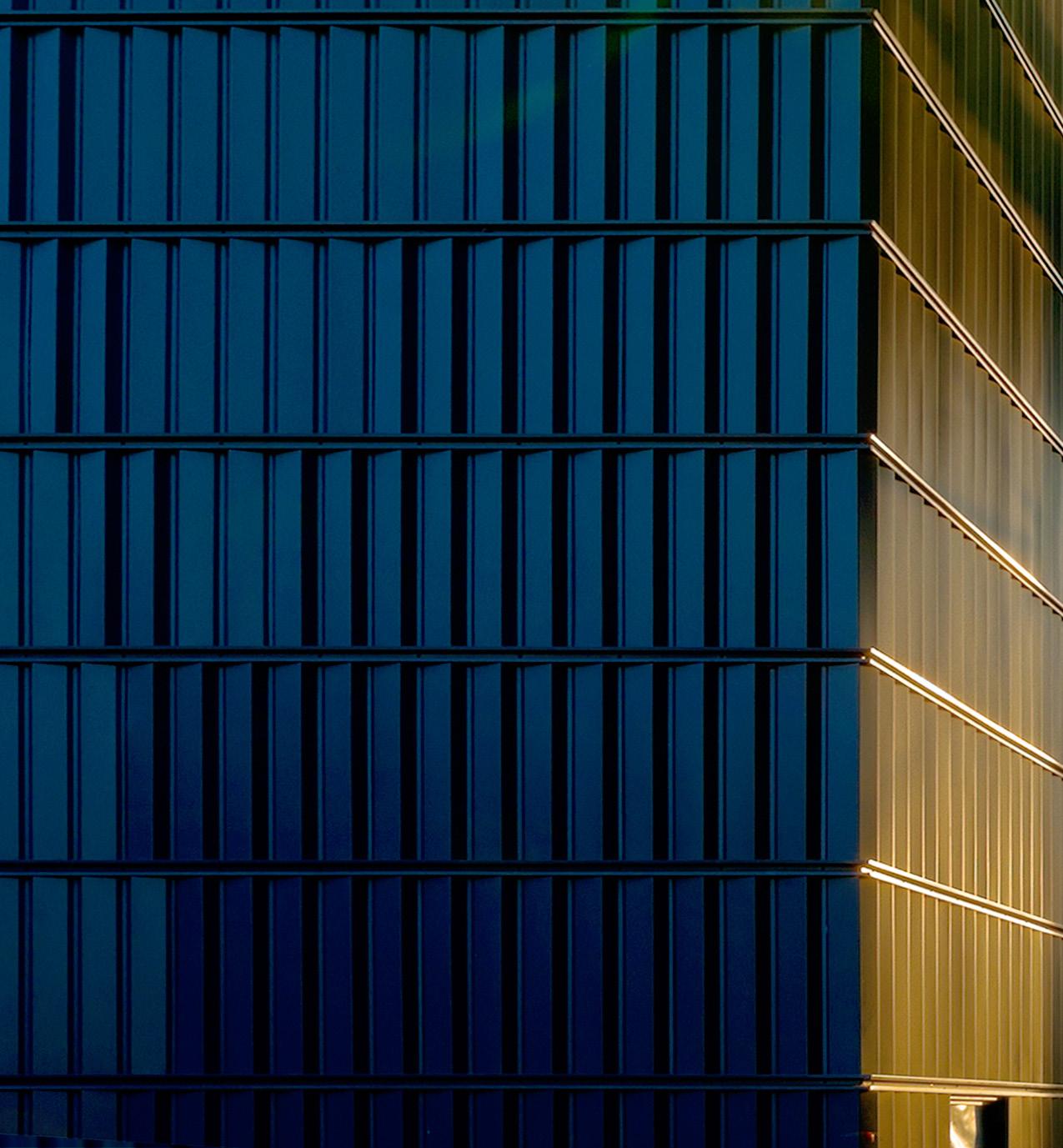
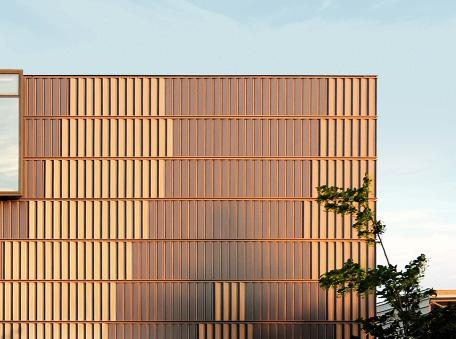
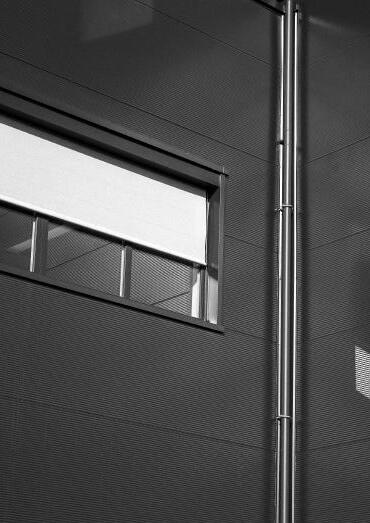
The facade cladding is made from a single-colour, massproduced material, and the cladding system can be designed to produce any pattern. The dynamic light and shadow effects, are the result of the particular way in which the simple steel plates are arranged.
The light on one plate appears as a shadow on the other. This effect is further enhanced by the use of large, “organic” patterns.
Variety of colours
In terms of colour, it’s a similar story: the modular system allows a simple blueberry blue steel sheet to appear on the building in almost any shade from light steel grey to orange to dark ocean blue, depending on the lighting conditions. An interesting feature of the system is the turning corner solution, which allows the overal pattern to be the dominant visual experience, rather than the corner edge, for both positive and negative corners.

14
Master of Architecture Award – Industrial Building Award
Light reflection facade, Sárospatak
1.

Services: Architectural design
Function: Industrial building
Simple construction
With the facade cladding system developed, any pattern can be created, from lettering to large, organic patterns, to angular or barcode architecture, and perspective can be distorted by moving the horizontal division. This can be used to reduce or increase the sense of building mass as desired.
Unique facade in traditional materials
Another great feature of the system is its cost-effectiveness. The basic material of the system is a mass-produced sheet cladding, which is made unique by a patented facade cladding and positioning system developed on behalf of Weinberg 93 Ltd.
The visual experience achieved is unique, something that is only possible with custom systems that are orders of magnitude more expensive.
Award winning design
The professional jury awarded founding owner, Csaba Livják, with the “Master of Architecture Award – Industrial Building Award” for the development of the system.
15
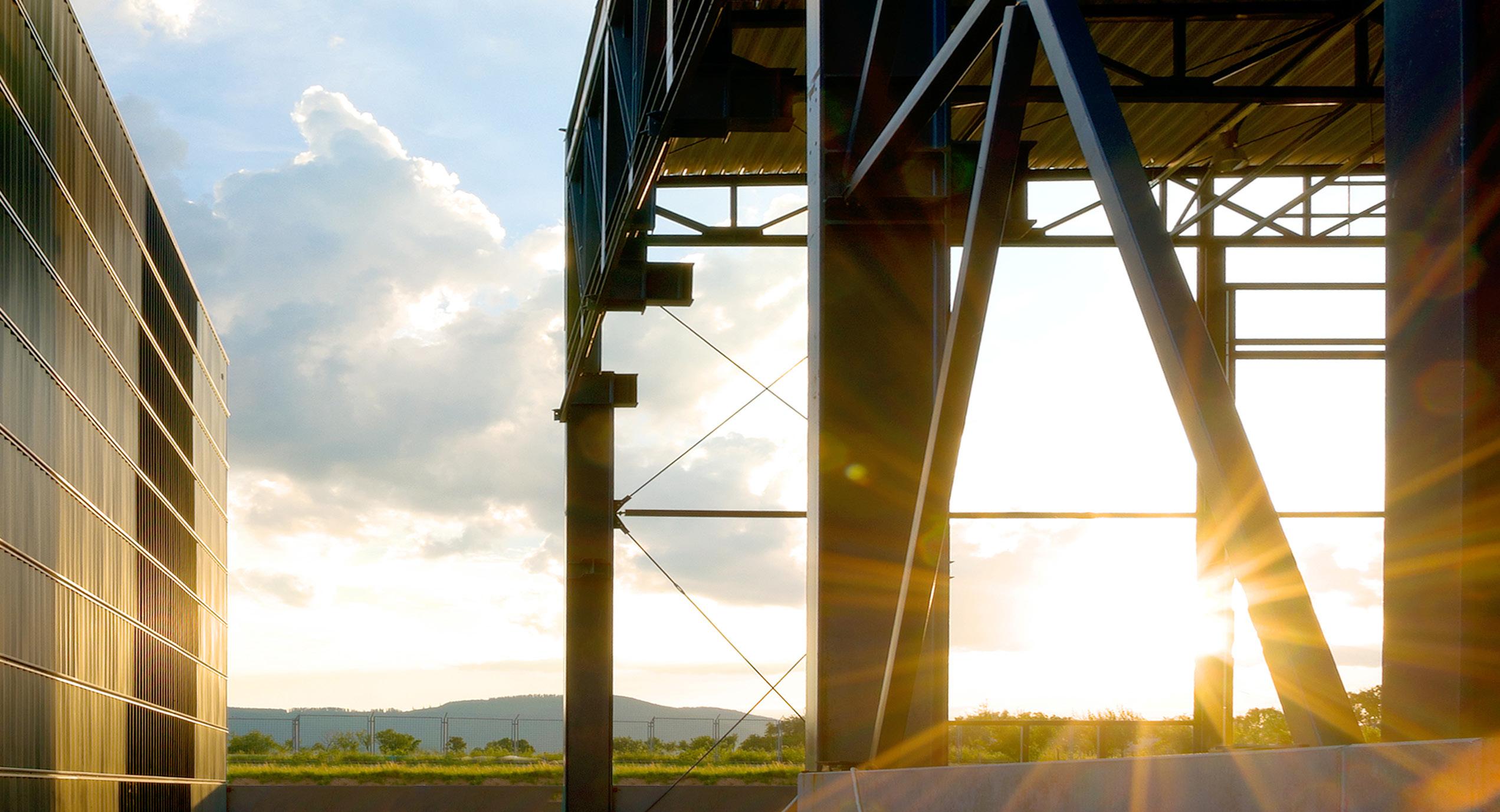
1-3. Play of lights on the unique facade of the factory building
Scan for details
2.
3.
+36 70 432 7046 office@buildext.com H-1027 Budapest, Horvát str. 14-24. ZenGarden Office Building, 5th floor buildext.com