![]()


10
16
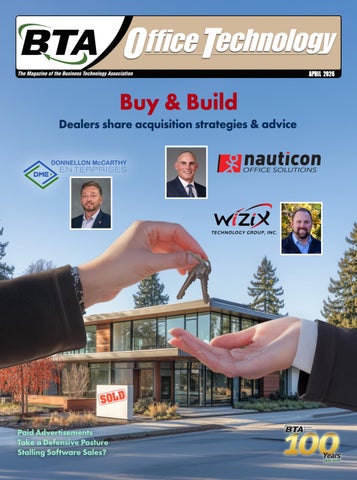
Buy & Build
Dealers share acquisition strategies & advice by Brent Hoskins Office Technology Magazine

Many office technology dealers have taken the step to expand beyond organic growth by way of acquiring other dealerships. It can be a way to add to your customer base, acquire talent and further diversify your product offerings. Is it time for you to pursue an acquisition strategy?
Five Vertical Gold Mines
How dealers can turn IDP into recurring revenue by Petra Beck Infosource Software

Intelligent document processing (IDP) has evolved from traditional capture into a cornerstone of digital transformation. For dealers, it is a natural extension of document-centric services into high-value automation — and a bridge to recurring revenue streams.
Paid Advertisements
22
Are they worth the investment? by Jenna Miller Emerald Strategic Marketing

There is a misconception that paid ads are a magic switch — flip them on and leads pour in. But the truth is more nuanced. Paid ads and organic marketing work together, not independently. Organic marketing establishes your brand while paid ads amplify it.
BTA AT 100!
24 ‘A Forum for Connection’
Members share their BTA stories & association’s impact
Compiled by Brent Hoskins Office Technology Magazine

As BTA celebrates its 100th year, the association is gathering testimonials that reflect on the people, businesses and experiences that have shaped BTA across the decades. Office Technology asked BTA members to share what the association has meant to them and their businesses.

Maximizing EBITDA & CRMs
Dealers answer questions from fellow dealers
Compiled by Elizabeth Marvel Office Technology Magazine

This feature includes two questions submitted by dealer members as part of BTA’s Dealers Helping Dealers resource and many of the answers received. These answers and others can be found in the members-only section of the BTA website. Visit www.bta.org/DealersHelpingDealers.
27
Take a Defensive Posture
Avoid becoming a target for AI privacy lawsuits by Greg Goldberg
BTA General Counsel

The rapid growth of artificial intelligence (AI) technology has spawned a broad range of new products and use cases designed to run offices more smoothly and efficiently. Although the upside of these advancements may seem limitless, the reality is more nuanced.
Stalling Software Sales?
Seven ways you may be impeding your growth by Kristal Cook RockRoot

Software can be the growth engine of the modern office technology dealership. It can create recurring revenue, help you close bigger bundled deals and embed you further with your customers. Yet for many dealers, software sales remain inconsistent, reactive and heavily dependent on vendor reps.
28
Business Technology Association • BTA Highlights


SExecutive Director/BTA Editor/Office Technology
Brent Hoskins brent@bta.org (816) 303-4040
Associate Editor
Elizabeth Marvel elizabeth@bta.org (816) 303-4060
Contributing Writers
Petra Beck, Infosource Software www.info-source.com

ince our January 2026 issue, I have enjoyed using this space to write about various aspects of the Business Technology Association’s (BTA’s) rich history as we celebrate our 100th anniversary. As I am just back from the March 20-21 BTA IGNITE Orlando event, it seems like a good opportunity to reminisce a bit about one of the first association events I attended.
I started working at the association in November 1986 when it was still the National Office Machine Dealers Association (NOMDA). When I arrived, NOMDA was gearing up for its national convention, which was held July 22-25, 1987, at the Georgia World Congress Center in Atlanta, Georgia.
If you joined this great industry after the days of the NOMDA conventions, you cannot appreciate the mind-boggling scope of those legendary events. Those of you who did attend our conventions know what I am talking about. Looking at the October 1987 issue of the association’s magazine, our coverage of that year’s convention reports: “The industry’s premier event attracted 15,608 attendees and 299 vendors in 1,745 booth spaces.”
I spent nearly a week in Atlanta for that convention. The association’s staff members arrived a day or two early for a pre-event meeting where we walked through every detail of the convention — from beginning to end — to ensure we were fully prepared. Then we hit the ground running. What followed were many hours among the sea of vendors in the exhibit hall, 11 educational sessions, plenty of networking opportunities, great meals and top entertainment.
In that October 1987 issue, I see a photo of Vanna White in the exhibit hall standing in front of the word KONICA in large block
letters characteristic of TV’s Wheel of Fortune puzzle board. I believe that was the same convention where Jim Fowler of TV’s Wild Kingdom was greeting conventiongoers at another exhibit booth, posing for photos with them — along with a python [I have not had a snake draped over my shoulders since]. The convention’s closing night entertainment: The Oak Ridge Boys.
You get the idea. The NOMDA conventions were a big deal — and for good reason. They were the industry’s primary means of vendors connecting with dealers in person. That is, at the time, there were no manufacturer dealer meetings. Instead, if you wanted to see the full product lineup of your vendor (and those of the competition) you headed to a NOMDA convention in Atlanta, New Orleans, Louisiana, or Las Vegas, Nevada — essentially the only cities with the requisite volume of meeting space and hotel rooms.
Those days were an important part of the association’s history. Once in a while someone will say to me: “I miss the NOMDA conventions. I wish we could bring them back.”
My response is always the same: “Yes, they were great, but they won’t return.” The reason: They were the product of the era in which they existed. There were more than 7,000 independent dealers at the time, and the imaging vendors were aggressively seeking to build their U.S. dealer distribution; they were doing so through NOMDA.
Today, we still have our events, of course. They are smaller, but I would contend they are better in one very important way: BTA’s current events are far more conducive to making meaningful connections with others in the industry and providing opportunities for dealers to help one another. Plan to attend our next event, BTA IGNITE Kansas City, Sept. 1-3, and you will experience this firsthand. n
Kristal Cook, RockRoot https://rockroot.biz
Greg Goldberg, BTA General Counsel Business Technology Association
Jenna Miller, Emerald Strategic Marketing www.emeraldstrategicmarketing.com

Business Technology Association 12411 Wornall Road Kansas City, MO 64145 (816) 941-3100 www.bta.org
Member Services: (800) 505-2821 BTA Legal Hotline: (847) 922-0945
Valerie Briseno Marketing Director valerie@bta.org
Brian Smith Membership Sales Representative brian@bta.org
Naomi Garza Administrative Assistant naomi@bta.org
Photo Credits: Adobe Stock. Cover created by Bruce Quade, Brand X Studio. ©2026 by the Business Technology Association. All Rights Reserved. No part of this publication may be reproduced by any means without the written permission of the publisher. Every effort is made to ensure the accuracy of published material. However, the publisher assumes no liability for errors in articles nor are opinions expressed necessarily those of the publisher.

The association’s magazine cover 47 years ago this month — the NOMDA Spokesman, April 1979.

Do your customers suffer from brownouts or random power anomalies they can't control?
Protect your investments with ESP/SurgeX non-sacrificial power management equipment.


T2025-2026 Board of Directors
President
Debra Dennis CopyPro Inc. Greenville, North Carolina ddennis@copypro.net
President-Elect
Mike Boyle
BASE Technologies Inc. Bethel, Connecticut mboyle@baseinc.com
Vice President

he Business Technology Association’s (BTA’s) recent events — e-automate Elevate and BTA IGNITE Orlando — delivered exceptional experiences for attendees and truly showcased the strength of our dealer community. And Disney’s Yacht Club Resort provided an incredible backdrop that encouraged meaningful engagement. We kicked things off on March 19 with e-automate Elevate, a dealer-driven event centered on helping attendees get more out of the software. ECI’s Laryssa Alexander welcomed attendees and set the tone for a day dedicated to practical knowledge and shared success. Sessions led by Dondra Bott, Jack Duncan, Mike Kirkpatrick, Gary Lavin, Jason Plott and Duane Walker delivered actionable insights and real-world strategies. The collaboration and openness between the presenters and attendees reinforced what makes BTA events unique — they provide an environment where dealers learn directly from one another.
Building on that momentum, BTA IGNITE Orlando, held March 20-21, brought together a packed audience for two days of forward-thinking content and networking. The agenda reflected the dynamic nature of our industry. During the manufacturer panel, attendees heard about key issues shaping the marketplace, including tariffs, economic pressures and the future of office technology. Dealer panels explored practical applications of artificial intelligence (AI) and company culture, offering insights attendees could take back to their businesses. Breakout sessions covered topics ranging from sales and service alignment, to leveraging CEO Juice’s Power BI for KPI tracking, to leadership and communication skills.
Beyond the sessions, the event floor was vibrant with activity. With 38 exhibiting sponsors, attendees had ample opportunity to explore new solutions, build partnerships and strengthen existing relationships. Networking events — including a first-time attendee reception and dinner at the Yacht Club Marina — provided valuable time for connection in more relaxed settings.
A highlight of the event was the keynote address, “How Leadership Affects Customer Service & How Customer Service Affects Your Bottom Line,” presented by Don Crawley of Compassionate Geek. His message reinforced that strong leadership and a commitment to service excellence are critical drivers of long-term success.
As we build on the momentum from Orlando, I encourage everyone to make plans to attend BTA IGNITE Kansas City and BTA at 100: A Celebration, to be held Sept. 1-3 in Kansas City, Missouri. This milestone gathering will bring a full schedule of meaningful engagement:
n Aug. 31: Arrival day for IBPI, which is hosting its meeting in conjunction with BTA n Sept. 1: IBPI meets all day; joint welcome reception with IGNITE attendees in the evening at the National World War I Museum and Memorial
n Sept. 2: IGNITE all day; BTA at 100: A Celebration, honoring 100 years of BTA at Union Station Kansas City, in the evening n Sept. 3: IGNITE wraps up at noon
In addition, be sure to mark your calendars for the Fall Colors Retreat, Oct. 29-30 at the Omni Grove Park Inn in Asheville, North Carolina — another great opportunity for education and networking.
The association’s events exemplify what BTA is all about — education, collaboration and community. Visit www.bta.org/ BTAEvents for additional information. n — Debra Dennis
Mike Hicks Electronic Business Machines Inc. Lexington, Kentucky mhicks@ebmky.com
Immediate Past President
Adam Gregory Advanced Business Solutions LLC
St. Augustine, Florida adam@goabsinc.com
BTA East
Chip Denlinger DCS Technologies Corp. Franklin, Ohio chip.denlinger@dcs-tech.com
Tim Seeley Jr. Seeley Office Systems Inc. Glens Falls, New York tseeleyjr@seeleyoffice.com
BTA Mid-America
Brett Blake Corporate Business Systems LLC Madison, Wisconsin bblake@corpbussystems.com
Grant Goldsmith
Regal Business Machines/Gateway Business Systems Chicago, Illinois goldsmithg@gateway-biz.com
BTA Southeast
Blake Renegar
Kelly Office Solutions Winston-Salem, North Carolina tbrenegar@kellyofficesolutions.com
Richie Creech CopyPro Inc. Greenville, North Carolina rcreech@copypro.net
BTA West
Scott Reynolds Imagine Technology Group LLC Chandler, Arizona sreynolds@itgarizona.com
Richard Van Dyke Advanced Office Irvine, California rvandyke@goadvanced.com
Ex-Officio/General Counsel
Greg Goldberg
Barta | Goldberg West Hollywood, California ggoldberg@bartagoldberg.com
• Obtain 20%+ EBITDA when industry
• Achieve an 85% close on your MSP
• Capture
• Enhance

by: Brent Hoskins, Office Technology Magazine
Many office technology dealers have taken the step to expand beyond organic growth by way of acquiring other dealerships. Are you among them? It can be a way to add to your customer base, acquire talent and further diversify your product offerings. Is it time for you to pursue an acquisition strategy? Perhaps the insight shared in the three dealership profiles below will assist you in making plans to buy and build.

With its roots dating back to 1957, Donnellon McCarthy Enterprises (DME), based in Cincinnati, Ohio, is mastering the art of the acquisition. Today, at $50 million in annual revenues and 192 employees, DME has 14 locations in five states — Illinois, Indiana, Kentucky, Ohio and West Virginia. All location expansion beyond the corporate office is the result of acquisitions, says Jim George, president and CEO. “The goal is to go coast to coast,” he says. “We plan to hit the $100-million mark within the next 18 months.”
DME has been very active with acquisitions over the past 10 years, George says. Since 2017, there have been eight acquisitions. The most recent and the largest to date was Ohio Business Machines, a $20-million dealership based in Cleveland, Ohio.
Beyond the immediate growth of DME’s customer base, there is another key benefit of acquisitions, George says. “They add different competencies to our organization,” he explains. “DME is not just a traditional copier company anymore. We have DME managed services, managed print, software solutions, managed security, tech infrastructure and managed IT ... For those dealers acquiring, make sure you are acquiring a diversified business. If you are just buying somebody’s copier leases, all you’re doing is buying a base; you’re not really buying a business and you’re going to get burned.”
The value of some diversification strategies may be bigger than expected, George says. One acquisition, for example, led DME to diversify into security cameras, he says. At the
time of the acquisition, George says he was unsure about bringing on cabling personnel and cabling trucks. “Then I saw 62% margins,” he says. “Today, that’s a $5-million business for us; it’s the fastest growing area of our business on the IT side.”
George has no shortage of advice for his fellow dealers beginning their acquisition journeys. Among his recommendations:
n Strive to keep the prior owner on board for at least three years to assist in the transition of customer loyalty. “I am looking for an owner who is looking to get out but isn’t ready to just walk out the door the same day ... If the owner is going to leave right away, that’s a red flag for me.”
n Consider keeping the acquired dealership’s name to maintain customer loyalty. “We keep everybody’s company name the same [as it was before the acquisition], but just add the tagline ‘A DME Company.’ We do, however, change its logo to emulate the DME logo.”
n Do not make false promises regarding continued employment to the acquired dealership’s employees. “The last thing I am going to say to them is: ‘Don’t worry, nothing is going to change.’ That would be lying; everything is going to change. My goal is to find a spot for everyone, even through relocation. But in certain cases, there is no fit. That is the harsh reality of acquisitions.”
n Concentrate on keeping key employees. “You want to keep the heavy hitters; you know who you want. Immediately after signing the documents, I grab those folks, sit down with them and try to calm their nerves. There are certain folks you don’t want to lose.”
n If the acquisition target has any customer representing 20% or more of the business, walk away. “I had one possible acquisition where I learned that a hospital customer represented 40% of its business. If that hospital customer ever went away, I would have just bought a shell.”
n During due diligence, confirm employee tenure for the past three years. “A lot of times, when someone is about to


sell, they get rid of a bunch of service people to lower operating and personnel costs.”
Despite DME’s successes in growth through acquisitions, George emphasizes the importance of organic growth as well. “If you don’t have organic growth, you are not really growing as an organization,” he says. “The way I look at acquisitions is that they can help you move forward faster, but organic growth is what proves your model is working.”
“You want to keep the heavy hitters ... Immediately after signing the documents, I grab those folks, sit down with them and try to calm their nerves. There are certain folks you don’t want to lose.”

— Jim George Donnellon McCarthy Enterprises
In 1997, Tom Cunningham and Gary Sockel acquired Gold Systems, a Gaithersburg, Maryland, dealership serving the Washington, D.C., market with around six employees, 100 customers and $1 million in annual revenues. Today, now known as Nauticon Office Solutions, the dealership has 110 employees, close to 10,000 MFPs in the field and is at more than $30 million in annual revenues.
After about 10 years, Nauticon began making acquisitions, including one company servicing the Baltimore, Maryland, area that was later sold to Konica Minolta; the divestiture occurred to allow for greater concentration on Nauticon’s then-new MSP — Nauticon Information Systems. In 2023, Nauticon acquired Digital Office Products (Digital) in McLean, Virginia. More recently, in 2025, it acquired Annapolis Office Products (AOP) in Millersville, Maryland.
Digital was nearby, also serving the D.C. market. “We knew they had a few pretty talented salespeople, so that made us interested — acquiring a bit of talent as well as the customer base,” says Carter Hertzberg, Nauticon president and co-owner. “Since Digital [like Nauticon] was a Toshiba dealership, it made it a simple tuck-in where we could just eliminate their real estate and some of their systems.”
The most recent acquisition, AOP, was the result of a cold call by Nauticon. “We had lunch with the owners back in 2023; two brothers who owned it jointly,” Hertzberg says, noting that they were approaching retirement. “They said, ‘You’ll be the first one we call when we are ready.’ And, sure enough, a year and a half or so later they called and said, ‘If you guys are still interested, we’d like to advance the conversation.’ That was in about April 2025. We had a deal closed by Sept. 30, 2025.”
The first meeting with a newly acquired team “is hard to do,” Hertzberg says. “It’s difficult to put yourself in the acquired employees’ shoes. They have no idea what’s happening.
They show up at 8 a.m. for an all-staff meeting and some man or woman they have never seen before says, ‘Hi, I’m your new boss.’”
Hertzberg advises any dealers acquiring for the first time to be particularly empathetic at such a meeting. “Understand that some people are going to have an adverse reaction. Don’t hold that against them. Try to build a level of trust by saying, ‘I understand. Take your time. All I am asking from you is to give us a chance’ ... If you come at it with an empathy-forward approach, you can gain trust a lot more quickly than just trying to whip them into shape and saying, ‘There’s a new sheriff in town and this is how it’s going to be.’”
A few other points of guidance from Hertzberg:
n Verify the acquisition target’s customer base. “Pick 10 or 20 customers and call them. If they say something like, ‘We would prefer you not call these three customers,’ that’s a huge red flag.”
n Verify the lease portfolio. “You’ve got to get underneath the lease portfolio to make sure it exists. Sit down with them and watch them download it from the leasing company’s website.”
n Verify the accounts receivable. In the case of the dealership that Nauticon acquired and later sold, at the time of the acquisition, “they had $2.5 million of AR. We quickly deduced that $1.5 million of it was uncollectible; it just built up over the years.”
n For those making their first acquisition, hire one of the industry’s consultants who help buyers and sellers. “They will help you enormously, digging up things and looking around corners you don’t know exist. They will give you A, B and C, but also D, E, F, G and H.”
While Nauticon has had some successful acquisitions, has it ever pursued an acquisition that did not come to fruition? “Multiple times,” Hertzberg acknowledges. “We’ve been unsuccessful many times, but you miss all the shots you never take.”
Although WiZiX Technology Group, based in Roseville, California, is a relatively young company [established in 2017], it has already made significant strides with acquisitions. “In eight-and-a-half years, we’ve completed nine acquisitions,” says Eric McIntosh, WiZiX senior vice president and co-owner. “It has definitely been a meaningful part of our growth strategy.”
In 2025, WiZiX reached just shy of $30 million in annual


revenues. “We hope to achieve $50 million in revenues by the end of 2030,” McIntosh says. “There’s an adage that is so true: ‘If you’re not growing, you’re dying.’ It doesn’t mean we have to ‘take over the whole world,’ but we’re always trying to grow.”
While the nine acquisitions each contributed immediate growth at WiZiX, “the majority of our growth, 65% to 70%, still comes organically,” McIntosh says. “The other 30% to 35% has been through
“Try to build a level of trust by saying, ‘I understand ... All I am asking from you is to give us a chance’ ... If you come at it with an empathyforward approach, you can gain trust a lot more quickly ... ” — Carter Hertzberg Nauticon Office Solutions
McIntosh notes that essentially all acquired employees remain at WiZiX, except for the owners. Among the smaller dealerships acquired, there have not been many admin redundancies with existing WiZiX employees, he says. “In some cases, the owner and the owner’s spouse were doing the admin work,” he explains. “So, we’re left with the sales reps and technicians, who we want. We want to retain the reps to maintain the customer relationships, and with all the


“Spend more time on the due diligence than you may think you need ... You want to work with the seller to understand the business as much as possible and minimize as many surprises post-sale as you can.“

— Eric McIntosh WiZiX Technology Group
Among McIntosh’s recommendations for his fellow dealers new to making acquisitions:
n Ensure that a non-disclosure agreement is in place when conversations with a possible acquisition target get underway. “I highly encourage anyone who is looking at an acquisition to have an NDA signed — for your protection as the buyer, but also for the seller — because what comes next is somewhat intrusive.”
n Allocate plenty of time for thorough due diligence. “Spend more time on the due diligence than you may think you need. It’s easy to see the ‘shiny object’ in front of you and get excited, but in every opportunity you want to work with the seller to understand the business as much as possible and minimize as many surprises post-sale as you can.”
n Complete a comprehensive inventory evaluation. “Validate the inventory that is listed on the balance sheet to confirm how much of it is usable. The last thing you want to do is write a check for inventory of parts and toners for machines that are discontinued and no longer in the field.”
n Be wary of unclear financials. “If the company you are looking to acquire cannot produce consistent and reliable financials that allow you to dig in and understand more about the business, that is usually a telltale sign that there are more issues down the road. It doesn’t necessarily mean the deal is dead. You may want to tell them: ‘Clean up A, B and C, then, once you’ve done that, let’s talk again.’”
WiZiX will continue down the acquisition path, McIntosh says. “I don’t ever see the acquisition strategy going away for us, whether it’s in our own marketplace or in neighboring regions where we want to expand. We are not trying to be a national takeover company ... but we do see ourselves continuing to grow.” n
Brent Hoskins, executive director of the Business Technology Association, is editor of Office Technology magazine. He can be reached at (816) 303-4040 or brent@bta.org.


by: Petra Beck, Infosource Software
Intelligent document processing (IDP) has evolved from traditional capture into a cornerstone of digital transformation. For dealers, it is a natural extension of document-centric services into high-value automation — and a bridge to recurring revenue streams.
Compliance mandates, labor shortages, and customer expectations for speed and transparency make IDP more than a technology trend — it is a business imperative. Two forces are accelerating this shift:
n Generative artificial intelligence (AI): Enables template-free extraction, dynamic document understanding, multilingual communication and automated validation — all of which cut deployment time and improve accuracy.
n Agentic automation: Goes beyond extraction to orchestrate multistep workflows autonomously — chasing missing documents, validating anomalies and triggering downstream actions — while maintaining human oversight for sensitive decisions.
North America leads global IDP adoption, driven by compliance-heavy industries and advanced digital maturity. For dealers, this means a deep well of opportunity across five verticals that align with existing customer bases.
(1) Banking & Financial Services (BFS) — BFS is the most mature vertical for IDP and a top adopter of generative AI. Banks and credit unions face mounting compliance mandates (Basel III, AI governance), fraud risks and customer experience pressures. Despite digital progress, paper and hybrid workflows persist in onboarding, lending and regulatory reporting.
Key use cases:
n Customer onboarding (know your customer [KYC]/ anti-money laundering [AML] frameworks)
n Mortgage and loan processing
n Regulatory reporting and audit trails
North America outlook: Approximately 15% compound annual growth rate (CAGR) through 2029, supported by scaled generative AI pilots in onboarding and mortgage

processing. North America remains the global leader with strong, compliance-driven demand.
Dealer opportunity: Start with onboarding and lending workflows where automation delivers quick wins. Offer IDP bundles integrated with core banking systems and loan origination platforms. Highlight measurable KPIs: cycletime reduction, SLA compliance and fraud detection.
(2) Insurance — Insurance processes are document-intensive and multimodal. Claims, underwriting and compliance involve PDFs, photos, handwritten notes and internetof-things (IoT) data. Generative AI is already transforming claims handling and fraud detection, while agentic automation promises end-to-end orchestration.
Key use cases:
n Claims processing and First Notice of Loss (FNOL)
n Underwriting and risk assessment
n Regulatory reporting (IFRS 17, Solvency II)
North America outlook: Approximately 14% CAGR, with strong ROI from generative AI-enabled claims automation. North America leads IDP adoption, with strong ROI from generative AI pilots.
Dealer opportunity: Focus on claims and underwriting automation to speed up response times and improve the customer experience. Emphasize multilingual capabilities and compliance readiness.
(3) Health-Care Providers — Administrative workflows


Generative AI accelerates invoice and order processing; agentic automation orchestrates end-to-end procure-topay (P2P) and order-tocash (OTC) workflows.
in health care lag behind clinical innovation. Staff shortages, rising costs and compliance mandates (HIPAA, CMS rules and state-level privacy laws like CCPA) create urgency for automation. Generative AI pilots show measurable ROI in documentation and revenue cycle management.
Key use cases:
n Patient onboarding and intake
n Prior authorization and referral management
n Billing and revenue cycle automation
North America outlook: Approximately 13.6% CAGR, driven by large health systems scaling generative AI for documentation and claims. Growth in North America is slightly lower compared to other geographies.
Dealer opportunity: Provide HIPAA-compliant IDP solutions that reduce paperwork and ease staff workloads. Begin with patient intake and billing workflows, and stress how automation improves accuracy and patient satisfaction.
(4) Public Sector (State & Local) — Government agencies face service backlogs, budget constraints and rising citizen expectations. IDP enables faster, more transparent workflows for benefits, permits and public records. Generative AI adds multilingual capabilities and automated redaction; agentic AI can orchestrate eligibility checks and procurement-to-pay cycles.
Key use cases:
n Benefits and social services intake
n Licensing and permitting
n Procurement and invoice processing
North America outlook: Approximately 9% CAGR for state/local agencies; federal growth is higher (about 12%).
Dealer opportunity: Position yourself as a modernization partner by offering shared-service IDP platforms. Start with permitting or benefits intake to show immediate impact, and highlight compliance and accessibility features.
(5) Manufacturing — Despite advanced shop-floor automation, document workflows remain fragmented. Supply chain complexity, ESG reporting and compliance mandates drive demand for IDP. Generative AI accelerates invoice and order processing; agentic automation orchestrates end-toend procure-to-pay (P2P) and order-to-cash (OTC) workflows.
Key use cases:
n Invoice and order automation
n Supplier onboarding and compliance

n ESG and sustainability reporting
North America outlook: Approximately 6.8% CAGR, fueled by supply chain automation and Industry 5.0 initiatives.
Dealer opportunity: Target invoice and order processing to help manufacturers cut cycle times and improve cash flow. Add supplier onboarding and compliance checks for extra value.
Agentic automation represents the next frontier ... Agentic AI introduces autonomous orchestration of multistep processes. These AI agents adapt dynamically ...
Generative AI is more than a buzzword — it is reshaping IDP economics and capabilities. Initially introduced for data extraction, generative AI now enables dynamic document understanding, automated validation and personalized communication. It reduces the need for extensive template training, accelerating deployment and lowering costs. Beyond extraction, generative AI adds value through risk assessment, predictive analytics and multilingual support. Agentic automation represents the next frontier. While

generative AI improves accuracy and flexibility within document-centric workflows, agentic AI introduces autonomous orchestration of multistep processes. These AI agents adapt dynamically to context, propose and execute decisions, and coordinate downstream actions without manual intervention. For dealers, this means IDP can evolve from “capture” to “end-to-end workflow automation” — a shift that opens new revenue streams in compliance-heavy and high-volume environments.
Practical implications for dealers:
n Governance matters: Buyers will ask about responsible AI, auditability and bias controls.
n Cost control: Generative AI compute costs and unpredictable usage patterns require clear pricing models.
n Human-in-the-loop remains essential: Especially for risk-sensitive workflows in BFS, insurance and health care.
n ROI proof points: Early adopters report double-digit cycle-time reductions and measurable compliance gains — critical for building trust and scaling deployments.
n Start small, scale quickly: Pick one vertical and two highimpact use cases (e.g., BFS onboarding and mortgage packets).
n Bundle for compliance: Combine IDP with existing content services and governance frameworks.
n Price for outcomes: Tie subscriptions to KPI improvements — cycle time, SLA compliance and audit readiness.
n Show proof: Publish case studies with before/after metrics to build credibility and accelerate adoption.
Bottom line: IDP is the bridge from devices and print services to digital-first outcomes. Start where you already win — health-care systems, credit unions, school districts, municipalities and manufacturers — and layer in generative AI-enabled IDP with governance and measurable ROI. n
Petra Beck is a senior industry analyst at Infosource Software, where she leads the analysis and forecasting of the global intelligent capture software and intelligent document processing markets. With more than 25 years of experience in the information management market, she brings a wealth of knowledge and expertise. Before joining Infosource, Beck held global roles in industry-leading strategic planning, market intelligence and thought leadership. She holds a degree in business administration and has completed multiyear assignments in the United States, the United Kingdom and France. For more information, email query@info-source.com. Visit www.info-source.com.


You need to get your company noticed, but you do not want to throw money into ads because your budget is tight. At the same time, you need quick results. So, you may be asking: “Should we run paid ads or stick with organic options?” You are not alone. It is a common question we hear from CEOs, founders and business development leaders.

There is a misconception that paid ads are a magic switch — flip them on and leads pour in. But the truth is more nuanced. Paid ads and organic marketing work together, not independently. Organic marketing establishes your brand while paid ads amplify it. One sustains, the other accelerates. Understanding the difference is the key to smart spending and effective scaling.
Organic marketing includes the marketing and brand presence you build without paying for placement. You will find organic marketing in social media posts, user-generated content, content marketing, webinars, emails, on your website, and the Google search rankings that are driven by SEO, answer engine optimization (AEO) and backlinks.
Here is the reality: Organic traffic still makes up 62% of all website visits. It is the backbone of discovery. Organic marketing is a slow burn that builds momentum over time, while building trust and credibility. But it does require consistency, clarity and a strong strategy. It is also important to realize that organic marketing does not give instant results, can be unpredictable and is not actually free — it takes time, effort and expertise to execute it correctly.
On the other hand, paid advertising is paying for visibility, clicks or conversions. This includes social media ads on LinkedIn and Meta, as well as Google search ads (often referred to as pay-per-click [PPC] ads).
Paid ads can deliver fast visibility and traffic, better audience targeting and scalable options with a growing budget. And while organic marketing dominates overall traffic, the top three paid search ads still capture 46% of all clicks on
by: Jenna Miller, Emerald Strategic Marketing
page one, proving paid ads absolutely command attention when used strategically. But paid ads do have an obvious downside — the cost. The cost of running ads varies widely depending on the platform, your target audience and the popularity of the keywords you choose to use. LinkedIn ads generally cost $15 to $20-plus per click. For search engine ads on Google, the range is even wider — from a few dollars up to $80 per click. For many, this is the biggest barrier to entry.
Paid ads amplify what already exists. They do not fix weak strategies, outdated websites or inconsistent content. Without a strong organic foundation, ads become expensive, leads do not convert and audiences do not trust your brand. Imagine a potential client is searching for a managed services business in his (or her) area. Your ad pops up and he clicks the link to learn more. But when he gets to your site, he finds it is out-of-date, and does not speak to his struggles and goals. The landing page and site do not show social proof that your company is qualified or reputable (using testimonials, case studies or white papers) and it is difficult to get the information he is looking for. On top of that, he cannot find your contact information. You just lost the client. This is why organic marketing, like website optimization, needs to come first.
Organic marketing establishes a clear brand voice, proof of expertise, social proof and a healthy website ecosystem, while paid ads work best when they reinforce a strong foundation. To get the most for your money, we recommend focusing on organic marketing before considering ad spending.
Once your organic presence is strong, paid ads can accelerate the momentum you have built. The additional traffic they generate sends positive signals to search engines, increasing your visibility over time. As more people search for your brand, your authority grows and retargeting ads allows you to stay in front of audiences that first discovered you organically.
Paid campaigns also give you rapid feedback on messaging and creative, offering insights that strengthen your organic content strategy. They will quickly reveal what works and what does not.
When it comes to conversions, paid ads have a clear advantage: PPC traffic converts 50% better than organic traffic. Paid ads do not replace organic growth; they simply speed it up.
Paid ads are powerful. Organic marketing is essential ... But without strategy, clarity and a strong organic foundation, paid ads become expensive experiments ...
Admittedly, organic marketing can feel painfully slow. For example, a strong SEO strategy typically takes four to 12-plus months to show meaningful results. It takes time to build momentum and strengthen long-term brand equity. While paid advertising delivers quick wins with immediate visibility, results stop the moment the budget does. The strongest marketing strategies blend both approaches with intentionality, using organic marketing for durability and paid ads for acceleration.


Paid ads are powerful. Organic marketing is essential. Together, they create a marketing engine that grows visibility, trust and revenue. But without strategy, clarity and a strong organic foundation, paid ads become expensive experiments instead of profitable investments. The smartest marketing investment is one that aligns both, building a brand that grows steadily through organic momentum and scales quickly through paid acceleration. n
Jenna Miller is the CEO of Emerald Strategic Marketing, a digital marketing agency in Tampa Bay, Florida, that delivers custom solutions like SEO, social media management and other marketing services. She can be reached at info@emeraldstrategicmarketing.com. Visit www.emeraldstrategicmarketing.com.


Compiled by: Brent Hoskins, Office Technology magazine
As the Business Technology Association (BTA) celebrates its 100th year, the association is gathering testimonials that reflect on the people, businesses and experiences that have shaped BTA across the decades. Office Technology asked BTA members to share what the association has meant to them and their businesses — favorite memories, experiences when BTA made a difference for them, the value of membership, their perspective on BTA’s role in the industry, words of congratulations, etc. Below are additional responses received. More responses will be published in this feature throughout 2026. If you would like to share your BTA story, email it to Brent Hoskins at brent@bta.org.

“Thank you for the opportunity to share my experiences and the story of how BTA has provided value and importance during my career and my company’s history. I could literally write dozens of pages about all the people, places and the many events that have helped shape the way U.S. Business Systems operates, and the strategies and tactics that we have utilized over the years to grow the business and maintain our core values.
“I cannot remember when my company first became a member; it has been many years ago now [1999]. I just remember how important I thought it was to be a member of the largest and best advocacy group in the country for independent office technology dealers. That turned out to be a very good decision. The guidance and assistance we gained from that early in our history proved to be extremely helpful and well worth the investment. We have had the good fortune to be able to talk with so many brilliant and successful people over the years to glean pieces of advice, strategic insight and business support.
“Once the business became established and we were fortunate enough to gather enough critical mass in clients and contracts, I was interested in serving the dealer community to give back and share what I had learned. The business market was changing and MPS was becoming a strategic play that a lot of dealers were looking at. We had developed some programs and processes to enter that market early in that move. I had created my own acronym before MPS had been coined ‘a thing’ and thought I had something to offer. So, ‘I put
my name in the hat,’ so to speak, to serve in the BTA Mid-America district.
“That started something like a six-year journey where I worked through the district and found myself on the national BTA Board of Directors, ultimately serving as the 2014-2015 BTA national president. During that journey, we launched a BTA Mid-America-hosted event, the first one being in St. Louis, Missouri. That was a super event that was well supported by all the great sponsors. We had as a special speaker, John O’Leary, who, to this day, has impacted my personal life. What a story of triumph in the midst of tragedy. I would like to give a special thanks to Chris Polek for sponsoring John to speak.
“During that time, there were so many fantastic events put on by the BTA districts all over the country, where dealers came together to share and learn as the business evolved to an ‘all-things-technology’ industry. We all had the opportunity to learn together and grow our businesses. From the days of typewriters to the standalone analog copier to today, where many of us have moved into becoming managed service providers (to include managed print and managed document services), the association has been a constant and evolved with us from NOMDA [National Office Machine Dealers Association] to BTA. The BTA Channel has successfully transitioned and transformed through all that change to continue to be the goto choice when it comes to delivering those services to businesses in all sectors and markets. Through all of that change and transformation, BTA has remained a constant leader in bringing us together to educate, motivate and position our businesses to win.
“I have memories from BTA events in wonderful places like Waynesville, North Carolina (spectacular beauty in the fall); Walt Disney World in Orlando, Florida; White Plains, New York; New Orleans, Louisiana (quite the party, right Valerie?); Minnesota; California; St. Louis, Missouri; Chicago, Illinois; and who could forget the last big BTA anniversary celebration in Kansas City, Missouri, for BTA’s 90th year.
“Each event represents a lot of great memories with a lot of awesome people, fantastic speakers and sponsors, and a lot of learning opportunities. I was very privileged to be able to represent the dealer community and participate and, along the way, got to work alongside other awesome volunteers and get
good work done strengthening the association and honoring some of the best minds and people in the business.
“I would be remiss if I did not mention the people at BTA who work so hard to make sure that the events are coordinated, relevant and well organized in great facilities. Each of them play an important role in keeping BTA on point with the industry and in touch with the dealer community. Brent [Hoskins, BTA executive director], Valerie [Briseno, BTA marketing director], Elizabeth [Marvel, associate editor, Office Technology magazine], and Brian [Smith, BTA membership sales representative] are all top-notch people I consider friends and are great at their jobs. [Former BTA General Counsel] Bob Goldberg played an enormous role in not just educating the community, but also representing all of us to make sure the governance and legal services component of the benefit stack BTA has to offer is top notch. He has now passed that baton off to Greg [Goldberg, BTA general counsel], who has already shown those same qualities, and it is clear that the dealer community will continue to be well represented.
“BTA has played an important role in bringing together the people and partnerships that continue to move the office technology channel forward.“
in particular, the independent dealer channel that remains so vital to our business and the industry as a whole. From an OEM perspective, organizations like BTA are important because they help bring dealers, partners and manufacturers together around shared challenges, opportunities and the future of the channel.
“Over the years, BTA has created a valuable forum for connection, education, advocacy and collaboration. That role is especially meaningful in an industry that continues to evolve, where strong alignment between OEMs and dealers is essential to delivering value to customers and sustaining long-term success.
“We appreciate BTA’s contribution to the industry and congratulate the association on its past, present and future success.”
Jose Estebanez, vice president, Corporate Marketing Group Kyocera Document Solutions America Inc., Fairfield, New Jersey
“The benefits stack and the educational classes continue to evolve with the industry and represent some of the best there is to offer. Congratulations to Brent and the entire staff on elevating and igniting the dealer community for what is now 100 years! Best wishes, and here’s to the future!”
Ron Hulett, president & CEO
U.S. Business Systems Inc., Elkhart, Indiana
“I just wanted to share that [being a member of] BTA has been a wonderful experience for me and my team at Premium Digital. We have met the best of the best in the industry, and without BTA and its various networking opportunities, I am not sure we would have those connections.
“Being part of the PRO Dealer Group [one of BTA’s peer groups] is the best thing that has happened. It has expanded our business in many ways, but the number-one thing is diversification and taking on other vendors. We became a water dealer specifically from listening to and learning from other BTA members’ successes. In many ways, listening to other dealers’ successes and applying them to our own philosophy has made the difference.
“I would like to thank the BTA vendors and staff members for all they have done and do on a daily basis.”
Van Seretis, managing partner
Premium Digital Office Solutions, Fairfield, New Jersey
“Congratulations to BTA on reaching this incredible 100year milestone. On behalf of Kyocera Document Solutions America, we are proud to recognize the important role BTA has played in supporting the office technology industry and,
“The strongest industries are built on collaboration and shared knowledge. BTA has played an important role in bringing together the people and partnerships that continue to move the office technology channel forward. We love the connection and camaraderie here!”
Kelly Loya, strategic partnership manager ecoprintQ, Miami Lakes, Florida
“My first experience with BTA was the 1993 summer NOMDA convention in Las Vegas, Nevada. As a young person who was brand new to the industry, the hugeness and extravaganza was overwhelming. I would never have imagined that one day I would be an instructor in the longest-running educational class that BTA offers. What an amazing legacy for BTA.”
Todd Johnson, partner Strategic Business Associates, Minneapolis, Minnesota
“Congratulations to BTA on 100 years — what an incredible milestone! Abadan is proud to have been a part of the BTA community for more than 40 years — maybe even 50 or 60. My dad and the previous owners were very involved with the association back when it was known as the National Office Machine Dealers Association [NOMDA] during the 1970s and 1980s. We have seen the organization evolve into BTA as the industry has changed.
“We are grateful for the role BTA has played in our industry and our company’s history. Congrats again on a century of excellence!”
Tyler Best, president Abadan, Richland, Washington n Brent Hoskins, executive director of the Business Technology Association, is editor of Office Technology magazine. He can be reached at (816) 303-4040 or brent@bta.org.

Compiled
by: Elizabeth Marvel, Office Technology Magazine
Following are two questions submitted by dealer members as part of BTA’s Dealers Helping Dealers resource and many of the answers received. These answers and others can be found in the members-only section of the BTA website. Visit www.bta.org/DealersHelping Dealers. You will need your username and password to access this member resource.

What are some ways to maximize or increase an already good EBITDA?
“(1) Manage inventory; nothing more than 90 days.
(2) It is critical to buy correctly, maximizing discounts but not violating Rule 1. If inventory is more than 90 days old, it is no longer a good deal.
(3) Keep your staff as lean as possible, even if it hurts.
(4) Regularly review and write down inventory each month.”
Clint Feybusch, president
Office Concepts, Pipersville, Pennsylvania
“Payroll. Keeping the number of employees you need to operate your business at an optimal size. Overstretch and you will see your profits shrink.”
Alec Bean, president
Gray & Creech Office Solutions, Greensboro, North Carolina
“When EBITDA is already good, higher-margin revenue matters more than just more sales.”
Chip Miceli, CEO
Pulse Technology, Schaumburg, Illinois
“Deploy agentic artificial intelligence (AI) for service if you have not already done so. Augmented reality and AI will supercharge your margins and excite your younger employees.”
Jeffrey Foley, COO
Apollo Office Systems, Alvin, Texas
“In-house financing.”
Dan Detrick, vice president
CopyLady Inc., Fort Myers, Florida
“Increase pack [internal markup] a little, pack lease rates
a little and negotiate better pricing from distribution (not accomplished yet). Make sure you are taking advantage of all rebates, takeouts and OEM programs.”
Nick Lioce, president
The Lioce Group, Huntsville, Alabama
We have searched long and hard for the right ERM [electronic records management] CRM [customer relationship management] software to use. Can anyone recommended a solution we should research and explain why they recommend it?
“We are still on Sherpa and customized it. We recently looked at HubSpot and it was going to be four times the cost of Sherpa. We are looking at the Sailor Group’s AgentDealer, but we don’t really have issues with what we have.”
Nick Lioce, president
The Lioce Group, Huntsville, Alabama
“We really like SalesChain as a CRM.”
Dan Detrick, vice president
CopyLady Inc., Fort Myers, Florida
“We have been using HubSpot for several years now. We have it recording calls and using AI to help sales team members get better, as well as tracking all their activity.”
Chip Miceli, CEO
Pulse Technology, Schaumburg, Illinois
“All CRMs are difficult to use and take a lot of time and money to configure. Choosing one and dedicating the time necessary to making it work will trump just about any brand choice. We liked HubSpot because it was more geared toward marketing.”
Alec Bean, president
Gray & Creech Office Solutions, Greensboro, North Carolina
“We continue to build out capabilities and further AI automation for ECI e-automate using partners GIDR.ai and CEO Juice.”
Jeffrey Foley, COO
Apollo Office Systems, Alvin, Texas n Elizabeth Marvel is associate editor of Office Technology magazine. She can be reached at (816) 303-4060 or elizabeth@bta.org.

The rapid growth of artificial intelligence (AI) technology has spawned a broad range of new products and use cases designed to run offices more smoothly and efficiently. Although the upside of these advancements may seem limitless, the reality is more nuanced.
In the absence of meaningful federal AI laws and a patchwork of inconsistent rules across individual states, in many cases the task of regulating AI falls to the courts. And lurking behind every corner are plaintiffs’ class action attorneys seeking to monetize uncertainty in the regulatory landscape to generate bankable lawsuits. Last October, Legal Perspective highlighted a series of privacy lawsuits filed in California seeking to apply a Cold War-era trap-and-trace law written during the telephone age to application programming interfaces (APIs) and software development kits (SDKs) embedded in websites that gather data from website visitors.

This month, Legal Perspective considers Lisota v. Heartland Dental LLC, a lawsuit accusing companies using AI phone systems of illegally eavesdropping. Lisota arises from the healthcare industry, but the legal issues are relevant to any company deploying AI-assisted call handling technologies, such as automated service desks or AI receptionists.
According to the plaintiffs’ complaint, defendant Heartland Dental provides administrative and call-center services to dental clinics. In turn, Heartland Dental relies on cloud-based phone systems provided by co-defendant, RingCentral, to handle overflow call volumes. RingCentral’s phone systems allegedly incorporate AI tools that capture and transcribe realtime call details provided by patients. RingCentral’s AI tools then analyze the call details to assist call-center staff members with identifying a caller’s needs, prioritizing responses and spotting opportunities to schedule appointments. In other words, plaintiffs allege RingCentral’s AI technology does not simply route calls; they allege it actively listens to conversations, processes them and converts them into data.
Accordingly, plaintiffs claim the AI systems unlawfully eavesdrop on phone calls in violation of the Federal Wiretap Act, a statute that prohibits the interception of telephonic communications without consent. In its initial ruling, the court found that the alleged unauthorized recording of plaintiffs’ phone calls raises a legitimate privacy concern that may be redressed in court, but ultimately ruled in favor of the defendants.
The court reasoned that because RingCentral’s AI recording
by: Greg Goldberg, BTA General Counsel
tools are a core component of its phone service, those tools fall within an exception to the wiretap law. Because RingCentral was forthright about its AI data collection practices, and because those practices were a key selling point of its software, RingCentral was not eavesdropping on callers surreptitiously in violation of the Wiretap Act.
Following the initial dismissal of the case, the plaintiffs filed an amended complaint raising new allegations, including one potential bombshell. Plaintiffs expanded the scope of the allegations to accuse RingCentral of using recorded call data to train its own AI models. This new claim raises an important question: When an AI-enabled product collects customer information and feeds it into a large language model, who is entitled to benefit from that information and what safeguards can be implemented to protect customers’ privacy? Based on this new legal theory, many analysts believe the plaintiffs’ amended complaint is likely to survive the defendants’ next motion to dismiss.
In light of the proliferation of AI-based privacy lawsuits and the prohibitive expense of defending against class actions, BTA members should consider adopting a defensive posture in order to avoid becoming litigation targets. First, consider disclosing at the top of calls that AI tools may be in use. This way, customers are placed on notice. Second, give customers the option to speak with a human representative. Although AI systems can handle routine requests efficiently, callers with privacy concerns may prefer human interaction. Third, carefully review contracts with AI vendors to understand how call data is used, including whether conversations are stored, whether recordings are used for training models and what measures exist to protect customer information. Finally, internal policies should define when AI tools are appropriate and when sensitive calls should be routed directly to human staff members.
Although the chances of being dragged into a class action lawsuit may seem remote, dealers cannot be too careful. One reason, of course, is that plaintiffs’ attorneys are just as likely to be using AI tools to identify who they are going to sue next. In summary: Climbing out on a limb may be unavoidable. Handing a lawyer a saw, on the other hand, rarely is. n
Greg Goldberg, partner at Barta | Goldberg, is general counsel for the Business Technology Association. He can be reached at ggoldberg@bartagoldberg.com or (847) 922-0945.


BTA would like to welcome the following new members to the association:
American Document Solutions, Randolph, NJ
Digicom Business Solutions, Monroe, CT
Offtech of New England, Westbrook, ME
For full contact information of these new members, visit www.bta.org.

Each year, the Business Technology Association (BTA) awards two $3,000, two $2,000, and a number of $1,500 scholarships to qualifying applicants. Since the 1984-85 school year, BTA has presented 1,627 scholarships to deserving students, totaling $1.8955 million.
To qualify, applicants must be (at the time of the evaluation and the award): A full-time employee, or the son or daughter of a full-time employee, of a current BTA member dealership AND a full-time student maintaining a class schedule of at least 12 hours (nine hours for graduate students) of college credits per semester throughout the school year covered by the scholarship.
Patriot Pack scholarships are also available to office technology industry U.S. military veterans, their children and grandchildren. Scholarship applications must be submitted by May 1, 2026.
For more information, visit www.bta.org/Scholarships.
For information on BTA member benefits, visit www.bta.org/MemberBenefits.
Each month, BTA features two of its vendor or consultant/trainer members in this space. BTA recommends due diligence when choosing a partner.

Most CEOs are asking the same questions: “Can we really grow with this sales team? Are we getting the most out of our people? Do our managers know how to lead? Who should we hire next and why?” The challenge is that CRMs and KPIs only show lagging indicators. They cannot reveal your team’s true capacity, your managers’ effectiveness or the real drivers of performance. That is where SalesIndex comes in. It delivers clarity that is fast, simple and actionable, giving you a data-driven view into your team’s potential. SalesIndex gives leaders the insights they need to make better decisions and unlock hidden revenue.
https://salesindex.ai

CET Group USA
Inc. is a privately held company specializing in the marketing and sales of CET-manufactured compatible parts, assemblies and supplies for use in copier/ MFPs and printers. CET USA offers highly competitive manufacturer-direct pricing with additional cost-saving opportunities found in its popular instructional videos on YouTube at CET Group USA. CET USA is also an approved IBPI supplier and an authorized PO Processor vendor.
www.cetgroupusa.com
A full list of BTA vendor members can be found online at www.bta.org.

by: Kristal Cook, RockRoot
Software can be the growth engine of the modern office technology dealership. It can create recurring revenue. It can help you close bigger bundled deals with higher margins. It can embed you further with your customers, increasing retention. Yet for many dealers, software sales remain inconsistent, reactive and heavily dependent on vendor reps. If software revenue feels stalled, here are seven ways you might be accidentally stalling your own growth.
(1) You may be carrying too many software solutions in your portfolio. More software does not necessarily mean more opportunities or more revenue. When you have too many solutions in your portfolio and sales reps are tasked with learning and selling all of them, they never become proficient in any of them. A lower number of solutions paired with specific talk-track training helps reps stay focused and confident when talking to customers about solutions.

(2) Your leaders do not talk about software. Your sales team members listen closely to what your leadership emphasizes. If your sales meetings revolve around hardware placements and equipment quotas, and software is never mentioned, sales reps are never going to prioritize software sales. Your sales leaders should be asking their reps about software opportunities, sharing wins and losses, coaching sales team members on their software talk tracks, and setting software sales goals. As sales reps get more comfortable talking about software, they will identify more opportunities.
(3) You are selling software like it is a copier/MFP. Selling software is not the same as selling boxes. Copier/MFPs have set functions and software is much more customized to the customer. Your sales reps have the opportunity to present themselves as business consultants and workflow experts when they can ask the right discovery questions and position software solutions as a way to solve a customer’s workflow pain. Customers want someone experienced to help them navigate security risks and compliance requirements while solving inefficiencies, saving them future headaches and money.
(4) Training is inconsistent and vendor dependent. While vendors do a great job training their resellers, your sales reps need more than one or two vendor trainings a year. Software sales require a rhythm of ongoing training, coaching,
story sharing, goal setting and internal accountability. Schedule a training session with your vendors for the start of every quarter and have your sales leaders reinforce the messaging in weekly meetings. Know who your vendor contacts are and stay updated, and practice talk tracks with sales team members to incorporate new features.
(5) Your compensation plan says software does not matter. Sales reps know what they make in commission when they sell an MFP, but they usually do not know what they would make from software on the same deal. Creating sample packages is a great way to simplify software sales for your reps while showing them what pricing and commission to expect. Look at your comp plan honestly. Does it promote software? Do reps get renewal credit? How are they paid on recurring revenue (subscriptions)? Are solution wins celebrated and awarded? Are software sales required for your President’s Club? The more clear you can make commission on software, the more motivated your sales reps will be to learn and sell it.
(6) Past installations went poorly. Nothing kills future software sales more quickly than a bad implementation. Installations tend to go poorly when they drag on, when there is a lack of communication, when the implementation requires something different than the customer expected it to or when the software does not work as expected. Reps and sales managers remember — and they hesitate to sell it again.
You can reduce these risks by working with your vendors to create installation checklists and “What to expect” documents for your sales reps and customers. These lists will include what the vendor is responsible for, what the dealer is responsible for and what the customer is responsible for, and the timeline they can expect for the project. This will allow the sales rep to confidently discuss the installation process and keep everyone on the same page from the start, with no surprises.
Without a leader aligning your teams and driving software growth, software becomes a vendor-driven effort — a side conversation instead of a growth focus.
(7) No one takes ownership of driving software sales. In many dealerships, software is everyone’s responsibility, which means efforts may not be aligned. Hiring a full-time solutions director can cost $120,000 to $200,000 annually, and qualified leaders are hard to find. Without a leader aligning your teams and driving software growth, software becomes a vendor-driven effort — a side conversation instead of a growth focus. n
Kristal Cook is a solutions sales executive and the founder of RockRoot, where she helps office technology dealerships grow
7 • AMETEK (800) 883-1001 / www.ametekesp.com
11 • Avanue (213) 313-1454 / https://avanue.ai
31 • BPO Media
www.workflowotg.com / www.theimagingchannel.com
3 • BTA at 100: A Celebration
(800) 843-5059 / www.bta.org/BTAEvents
31 • BTA Legal Services
(847) 922-0945 / www.bta.org/Legal
2 • BTA IGNITE Kansas City (800) 843-5059 / www.bta.org/BTAEvents
profitable software revenue with confidence. Through RockRoot, Cook serves as a virtual solutions director, providing leadership alignment and onboarding, solutions portfolio evaluation, vendor coordination, sales enablement and presales support. Her work includes assistance with demos, trials and POCs, installation supervision, customer training, and the creation of customized sell sheets and sales resources. With a dealer-first approach, Cook aligns software strategy to each dealership’s KPIs, goals and priorities. RockRoot offers a “Virtual Solutions Director” package for dealers who would like to bring a software veteran on board to help them drive software growth. If you would like training and alignment for your current leadership, RockRoot offers a software sales growth course with a workbook to create a tangible, actionable plan to implement, and includes coaching sessions. Cook can be reached at kcook@rockroot.biz. Visit https://rockroot.biz.
17 • BTA Scholarship Program (800) 843-5059 / www.bta.org/Scholarships
20 • Business Equipment Quota Index (800) 843-5059 / www.bta.org/BEQI
13 • Distribution Management (800) 729-9300 / www.distributionmgmt.com
23 • ENX Magazine (818) 505-0022 / www.enxmag.com
32 • MyQ (941) 932-6203 / www.myq-solution.com
11 • PEAC Solutions
https://peacsolutions.com

14 • PrintReleaf
https://printreleaf.com
19 • ProFinance
(800) 843-5059 / www.bta.org/ProFinance
9 • Technology Assurance Group (858) 946-2112 / www.tagnational.com
5 • Toshiba
https://business.toshiba.com/become-a-dealer
21 • UPS (800) 636-2377 / www.savewithups.com/bta
13 • Y Soft www.ysoft.com