A School of INNOVATORS
The British School of Brussels (BSB) offers one of the most dynamic and innovative STEAM (Science, Technology, Engineering, Arts and Mathematics) programmes in Europe.
STEAM at BSB is not just about preparing students for exams, it is about nurturing curiosity, equipping learners for the challenges of tomorrow, and inspiring a sense of social responsibility. With exceptional teaching, unique international pathways, and world-class facilities, BSB shapes innovators ready to impact the world.
BSB is internationally recognised for its interdisciplinary approach, handson learning, and strong industry partnerships. The school’s outstanding academic achievements in STEAM-related subjects, and graduate progression to leading universities to study STEAM courses clearly demonstrate its leadership and impact in this field.
Additionally, external recognition of BSB’s STEAM programme includes being named Spear’s School of the Year in 2023, an accolade based on the school’s outstanding excellence and innovation in academic performance, facilities, and technology integration, criteria in which STEAM is central. The school has also been rated as one of the world’s best private schools for five consecutive years, recognised by the Spear’s 500 index and other international organisations such as Carfax Education for its leadership and innovation in education.
Designed to engage learners from their earliest school years through to university preparation, BSB’s STEAM education emphasises interdisciplinarity, inquiry, creativity, and real-world application. Students benefit from a balance of theory and practice, with strong academic achievement supported by a thriving co-curricular programme and international outlook.
EARLY YEARS and PRIMARY
STEAM learning begins early at BSB, embedding curiosity and creativity into the foundation of schooling:
CURRICULUM HOURS:
In Early Years (ages 1–5), children experience around 3–4 hours per week of STEAM-related learning built into play-based, cross-curricular activities. In Primary (Ages 5–11), this increases to 6–8 hours weekly across Science, Design Technology, and Mathematics, with coding introduced from Year 1.
APPROACH:
STEAM (Science, Technology, Engineering, Arts, Mathematics) projects are hands-on, taught in specialist areas and outdoor learning environments.
HIGHLIGHTS:
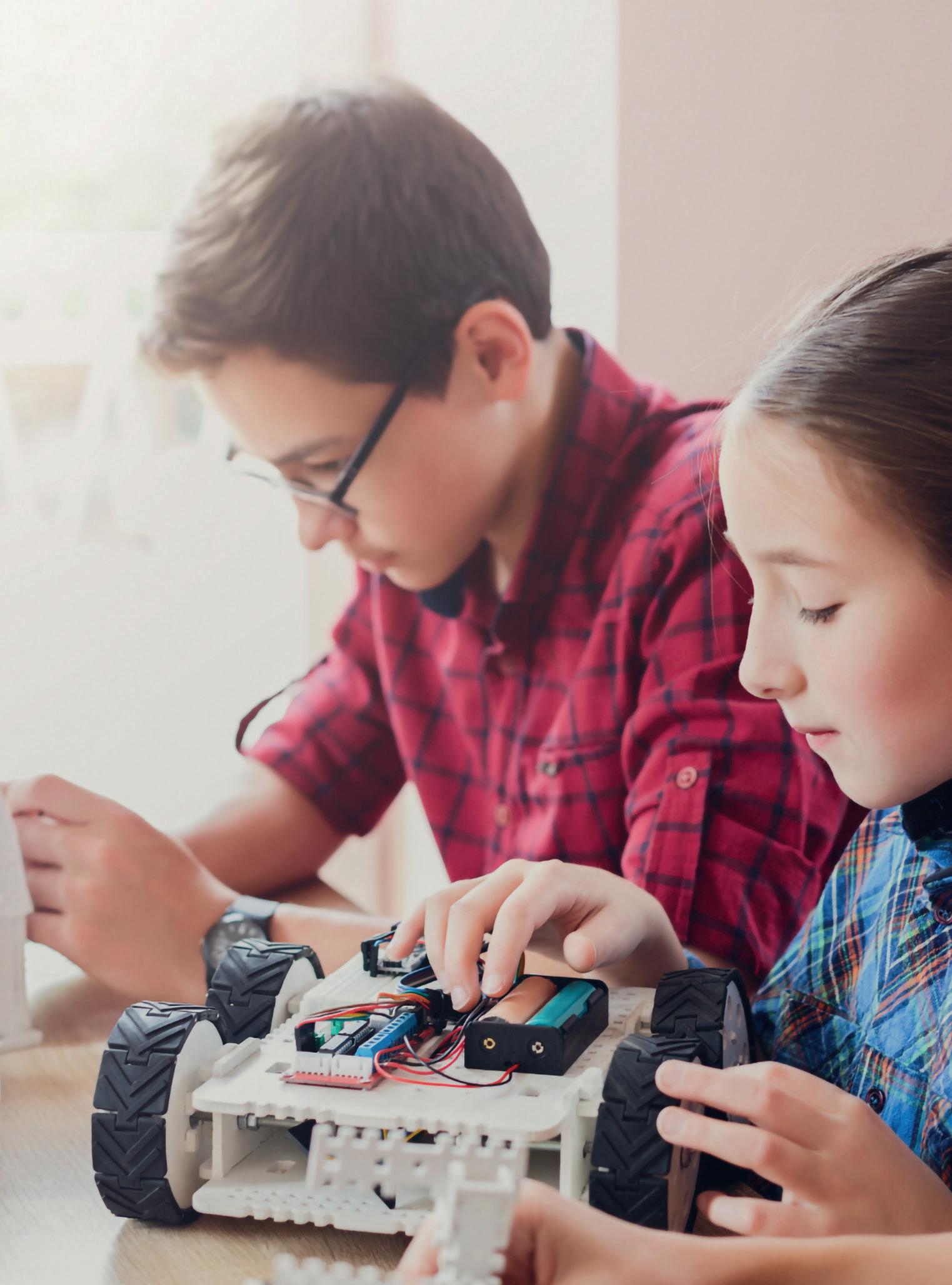
Children build simple circuits, explore forces through play, and begin blockbased coding through platforms like Code.org, Lego WeDo and Kubo robots.
EXTRA CURRICULAR ACTIVITIES AND CLUBS:
The popular “I Wonder Club” allows pupils to explore their own questions through experiments, alongside eco clubs and junior robotics challenges.
PARTICIPATION:
Primary students engage with STEAM projects in class, with over 200 joining after-school STEAM-related clubs annually.

200+
BSB students join STEAM-related after-school clubs every year
LOWER SECONDARY
STEAM evolves into a structured, interdisciplinary programme as students transition into lower secondary.
CURRICULUM HOURS:
Students typically study 4–6 hours of STEAM per week in Science, 4 hours in Mathematics, and 2–3 hours in Technology & Computing, approximately 12–13 hours per week dedicated to STEAM learning.
TRANSFORMATIVE LEARNING:
Major projects focus on sustainability, renewable energy and climate science, linking science, geography, and design technology to create interdisciplinary connections. Transformative Learning promotes deep understanding and critical thinking and encourages reflection.
Students learn by connecting concepts to real-world issues and develop skills that are directly applicable to future careers and civic life. These group projects build teamwork and communication skills, essential for modern workplaces while promoting adaptability and resilience.
TECHNOLOGY FOCUS:
All students learn coding and programming through micro:bit, code.org, Lego Spike, Sphero Bolt, Minecraft Education and game design tasks.
STEAM DAYS:
Themed days challenge students to apply what they have learned, solving engineering and sustainability problems, such as solar-powered cars and sustainable fashion.
ENRICHMENT:
First Lego League (with competitions in Belgium), Digital Ambassadors, Graphic Design, Sphero Robotics, Minecraft Ambassadors, and engineering challenges such as bridge-building are among the most popular activities.
75% of BSB students join at least one STEAM-related co-curricular activity