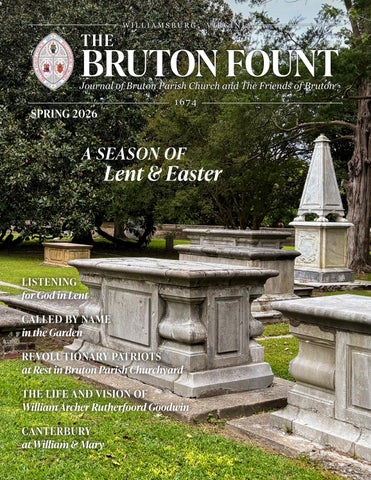
BrutonFount_Spring2026_Issuu

Page 1


BRUTON FOUNT

Journal of Bruton Parish Church and The Friends of Bruton 1674

A SEASON OF Lent & Easter

LISTENING for God in Lent

CALLED BY NAME in the Garden

REVOLUTIONARY PATRIOTS at Rest in Bruton Parish Churchyard

THE LIFE AND VISION OF William Archer Rutherfoord Goodwin

CANTERBURY at William & Mary

Listening for God in Lent

the rev william j watson , iii

Called by Name in the Garden

the rev . charles h . bauer

Inside the Vestry: Caring for the Teapot, Drinking the Tea

lori forcucci smith

Bruton & Beyond: How Colonial Virginians

Kept Easter

jonathan l . stolz

The Joy of Spring Flowers

michael h miller

Revolutionary Patriots at Rest in Bruton Parish Churchyard—Part I

lianne johnson boller

The Life and Vision of William Archer

Rutherfoord Goodwin

anne conkling

Canterbury at William & Mary

catherine stapleton

Music Ministry: New Music for the New Year

rebecca e . davy

Children & Youth Formation: Growing in Faith Together

meghan o . brewer

The Hennage Memorial Library at Bruton Parish

nancy larsen

The Bruton Parish Gift Shop

diane w koun

Mission & Outreach: Shelter from the Cold

john and melinda morgan

Voices From the Pews: A Different Account of Bruton’s Name

john fitzhugh millar

Annual & Planned Giving: Looking Ahead with Hope

margaret m driscoll

of Bruton:

Bruton Parish Church

Clergy

The Rev. William J. Watson, III Interim Rector

The Rev. Charles H. Bauer

Associate Rector, Christian Formation

The Rev. Lauren M. McDonald

Associate Rector, Outreach & Women’s Ministries

Vestry Members

John Morgan, Senior Warden

Randy Hobbs, Junior Warden

Michael Smith, Register

Taylor Banks, Carlyle Campbell, Robyn Hansen, Kathy Harper, Ron Hurst, Anna Martin, Lori Forcucci Smith, Sue Saunders, and Larry Zensinger

Friends of Bruton Committee

Jonathan L. Stolz, Chairman

Donald Bogus, Lianne Johnson Boller, Isabel Burch, Lynn Clark, Anne Conkling, Hilary Cooley, Catherine Stapleton, John Fogarty, James Morford, Rev. William J. Watson, III, and Larry Zensinger

The Bruton Fount Editorial Board

Jonathan L. Stolz, Editor

Lianne Johnson Boller, Anne Conkling, Hilary Cooley, Margaret Driscoll, Lori Forcucci Smith, and Rev. William J. Watson, III

the bruton fount email BrutonFount@brutonparish.org

Bruton Parish Church

Williamsburg, Virginia, 23187-3520

phone 757-229-2891 fax (757) 221-0290

email BPC@brutonparish.org

website www.brutonparish.org

Contents ©2026 by Bruton Parish Church. All rights reserved. Reproduction in whole or in part without written permission is prohibited. Design by Christina Hancock

Journal of Bruton Parish Church and The Friends of Bruton 1674
WILLIAMSBURG , VIRGINIA

LISTENING FOR GOD IN LENT

An Unexpected Call to Awareness

Lent offers forty days to focus on repentance, reflection, and discernment. This season can be a time for spiritual growth by attending to a discipline of prayer, formation, or more faithful living.

Some people mark this season by taking on a spiritual practice—such as worship, prayer, or study. For many others, being faithful during Lent involves giving something up for forty days. The hope is that when we are tempted by what we have set aside, we may turn instead to prayer and gratitude for the gift of relinquishing our desires, if only for a time. A discipline may involve engaging more deeply in a faithful exercise, or it may involve letting go of something that creates distance between ourselves and the divine.

Lent arrived during my first year at Virginia Theological Seminary, and I was unsure what discipline I should undertake. So, in my naivete, I asked God in prayer to show me a way forward.

Seminary mornings began in the chapel with daily morning prayer. My habit was to arrive early for a time of personal prayer. One morning, as I sat in my usual place, another student entered and sat close by. Almost immediately, my mind became active. This was a student whom I had asked in the fall for assistance with a course. He had said he was too busy at the time but would get back to me. That opportunity never came. In an instant, I became judgmental, replaying the ways I felt he had let me down.

Then I was struck with a moment of insight. I became aware that this might be the Lenten devotion God was inviting me into. Perhaps I was being called to practice letting go of my easy tendency toward judgment of others—to use this season to become more aware of

what I had long considered a harmless habit. Yet my actions, even though unspoken, were not harmless. I was actively creating distance between myself and those whom God loves and with whom God hopes I might be in relationship.

The Lenten season can be a time of awareness and opportunity if we open ourselves to the work of the Spirit, who is always willing and working for our growth in faith and love. It is my heartfelt hope that Lent will be a time of discovery and deepening faith for you.

the rev . william j . watson , iii interim rector

CALLED BY NAME IN THE GARDEN

Mary Magdalene and the Work of Resurrection

Jesus said to Mary, “Woman, why are you weeping? Whom are you looking for?” Supposing him to be the gardener, she said to him, “Sir, if you have carried him away, tell me where you have laid him, and I will take him away.” Jesus said to her, “Mary!” She turned and said to him in Hebrew, “Rabbouni!” (which means Teacher). (John 20:15–16, NRSVUE).

I am a terrible gardener. I do not exactly mean that as the opposite of having a green thumb: I have kept houseplants alive; I have known the joy of planting bulbs in the fall and awakening one spring day to color piercing through the earth; I have cultivated a vegetable garden, complete with netting to keep the birds off the scattering of tomatoes and the occasional zucchini. My family name, Bauer, even means farmer in German—something I chose not to share with my wife before she put aside her royal Irish clan name for one more befitting a peasant. Gardening is in my blood.

But none of that truly makes me a gardener. I simply do not have enough patience.

Resurrection and springtime are intertwined. As we turn our attention this season to this part of Jesus’ story, each of the four gospel texts offers us a slightly different view of the revelation of Jesus’ resurrection. In all accounts, some assemblage of women gathers to mourn Jesus, and there they discover the empty tomb, astonished. In John’s gospel alone, however, Jesus appears to one of them—Mary Magdalene.

To our ears, knowing the truth of the resurrection, this story is odd: how could Mary mistake the sight of Jesus for a gardener, of all people?

Someone as ordinary as they come, living in the background of society, as far from the Son of God as we might imagine. Gardeners must have been easy to ignore, a common springtime sight.

Each spring, I dream of what might be—the garden I could cultivate. Flowers and vegetables, a whole season of beauty and sustenance. Perennials that will reemerge year after year, offering delight and surprise. And, invariably, I realize that I ought to have planted those seeds weeks earlier, or kept watering through one of those early Virginia heatwaves, or done any number of things I failed to do. It is not a lack of ability, I tell myself, but priority. I could do it; I just have other things going on, always pulling me away.

None of that makes me exceptional. Wherever you find yourself in life, you are juggling more than you can accomplish. That is one of the delights of humanness: the things we want and the things we need so often conflict. There is always next year, I tell myself. I see what might be, rather than what is.

Mary finally sees Jesus, all because he calls her by name. A jolt out of what she expected. A simple recognition. A life—and a world— changed. Mary knows she has work to do. She must share all that she has seen, so she sprints from the garden, from the one she now realizes is so dear to her, and shouts to the rest of the disciples, “I have seen the Lord!” Her words echo to us, too.

Of all the words we use to name and describe Jesus, gardener might not make the top of the list. Jesus the Good Shepherd, the Son of Man, the Messiah, God with us. Yet we are called to do exactly that kind of work: to cultivate our relationships—the relationship we hold with God our creator, and the relationships we form with our fellow children of God. We tend our faith, grow in our knowledge of the Lord, and bear fruit as we walk through this one precious life of ours in service of Jesus Christ. We are told, in effect, to be gardeners.

And like my garden, too often I find myself putting off the very things that would water my life of faith. The world has its way of interfering, after all. I would set aside more time for prayer, but there is laundry to do. The paperwork piles up. The one I see before me is not Christ, just a lonely gardener. Mary Magdalene reminds us that even in her momentary lack of recognition, God continues to call us—call us by name. Are we ready to set aside the worries of the world and listen for God’s call?

the rev . charles h . bauer associate rector , christian formation

Caring for the Teapot, Drinking the Tea

A Reflection on Vestry Service, Faithful Stewardship, and Spiritual Transformation

There is a saying attributed to the late Buddhist monk Thich Nhat Hanh: “Don’t become so involved in caring for the teapot that you forget to drink the tea.” In some Eastern traditions, caring for a fragile clay teapot is a solemn act—an expression of what one values. Mindful drinking of ceremonial tea brings a transformational path.

In many ways, the Vestry and congregation resemble those who carefully tend the teapot. If Bruton Parish Church is our teapot, then the Holy Trinity is our tea. Caring for Bruton expresses our values; drinking the tea transforms us.

Each year, four Vestry members complete their three-year terms, and four new people take their places. At the end of 2025, the Vestry offered gratitude and farewell to Judi Dorn, Joyce Haines, Diane Howerton, and Sue Warner, who reflected on their experiences of service.

Judi Dorn speaks with joy about her time on the Vestry. She felt blessed to observe the careful oversight of parish operations and the commitment to upholding Bruton’s mission and values. Aware of the trust placed in her by the congregation, Judi expresses deep gratitude and describes her service as both an honor and a privilege. She notes that the Holy Spirit was clearly present throughout the Vestry’s activities.

Diane Howerton likewise affirms that the Holy Spirit guided the Vestry’s endeavors, particularly during significant decision-making. She points to strong teamwork, impressive talents, and generous gifts of time that helped turn ideas into reality. One such effort was the installation of an energy-efficient geothermal system, undertaken to enhance comfort during worship. For Diane, the most rewarding part of her service was the shared humor and positive spirit among Vestry members, clergy, and staff as they worked together to support Bruton Parish and the greater Williamsburg community.

Sue Warner also reflects on her Vestry service with gratitude. During her second year on the Vestry, Bruton Parish commem-

orated its 350th anniversary. Co-chairing the celebration with Leith Mullaly, she helped organize events and oversee the development of a commemorative website. These efforts explored Bruton’s rich history, its present witness, and its future calling. As Sue observed, people “have entered the Church seeking the inspiration of the word of God through worship, study, music, community service, and fellowship.”

Joyce Haynes considers that serving as Senior Warden for four months after Rector Chris Epperson’s departure was a time of growth, challenge, and renewed commitment. This period tested her leadership, flexibility, and faith, with communication becoming her top priority— keeping everyone informed, listening carefully, and fostering continuity.

She notes that “the most rewarding aspects was seeing the parish come together.” Encouraging involvement sustained the unity and deepened her appreciation for church leadership, supported by fellow parishioners, Vestry members, and the Diocese. In moving closer to calling a new rector, she expressed her gratefulness for Bruton’s resilience and adaptability and hope these lessons continue to strengthen in the seasons ahead.

We give thanks for the faithful service of our retiring Vestry members and for those who stepped in to serve—Kathy Harper, Ron Hurst, Anna Martin and Larry Zensinger. Through their careful stewardship, the Bruton Vestry continues forward during the search for a new rector and ensures that the teapot is well tended, sustaining and nourishing our parish community.

top , left to right
Judi Dorn, Joyce Haines, Diane Howerton, Sue Warner
bottom , left to right
Michael Smith, Register ; John Morgan, Senior Warden ; Randy Hobbs, Junior Warden

Bruton & Beyond: HOW COLONIAL VIRGINIANS KEPT EASTER

Quiet Worship, Liturgical Faith, and the Hope of Resurrection

Today, for the faithful, Easter is celebrated with elaborate church services and joyful festivities. This modern religious praxis stands in sharp contrast to the manner in which Christ’s resurrection was observed in Colonial Virginia’s Anglican parishes, such as Bruton.

Virginia colonists attended the established church on Easter, yet the specifics of how the day was celebrated remain unclear. This lack of detail stems from the challenge of uncovering consistent evidence regarding colonial worship practices for this holy day. As author Arthur P. Middleton observes, “Unfortunately, the spiritual as opposed to the institutional side of the church is hard to document. It is something not easily detected by the instruments at the historian’s disposal.”

While substantial information on how Lent and Easter were commemorated at Bruton Parish and other Colonial Virginia Anglican churches “slips through the mesh of the historian’s net,” certain practices can nevertheless be inferred.

The Anglican tradition of holiday observances was brought to Virginia by the earliest settlers. Their experience was shaped by Parliament’s 1647 ban on religious festivals and holy days and the subsequent reversal of that ban by Charles II several decades later. While celebrations such as Christmas saw a revival, Easter stayed a more solemn and sacred church rite.

Commenting on Easter in early 17th century Virginia, Janet Cummings, in an article about Kecoughtan Church in the then Elizabeth Cittie Parish, relates: “While Virginians liked a goodtime, their seasonal celebrations were more muted than those in England. Religious pageantry and festivities did not seem to have a hold among those who were still struggling to establish themselves and improve their lot in this new world.” By the 18th century, this subdued approach had become the typical practice in most of Virginia’s Anglican parishes.

The forty days of Lent were largely a private matter of personal observance, with few additional services beyond Ash Wednesday and Good Friday. Easter itself was likely a solemn occasion, marked by a special Eucharist service. The interior of the church would have featured simple décor, in keeping with the restrained aesthetic of the time. However, as the state church in the capital, it is conceivable that a slightly more elaborate commemoration may have taken place at Bruton Parish. In all cases, the observance would have been shaped and guided entirely by the Book of Common Prayer.

Though details remain elusive, the Easter observances of colonial Virginians at Bruton and beyond reflect a faith shaped by restraint, reverence, and the practical realities of a new world. Far from today’s exuberance, their worship was quiet, liturgical, and deeply rooted in Anglican tradition.

jonathan l . stolz

References:

Arthur Pierce Middleton, “Anglican Virginia: The Established Church of the Old Dominion 1607-1786,” Colonial Williamsburg Foundation Library, 1990.

Janet Cummings, “Easter 1628 at the Kecoughtan Church in Elizabeth Cittie Parish (Hampton), Virginia,” thorowgoodworld.wordpress.com, June 30, 2024.

Roseanna M. White, “How the Colonist Celebrated the Resurrection,” colonialquills.blogspot.com, March 23, 2016.

Anthony Aveni, “Once Around the Colonial Seasons,” colonialwilliamsburg.org.

Christine Leigh Heyman, “The Church of England in Early America,” nationalhumanitiescenter.org.

THE JOY OF Spring Flowers

Signs of Renewal, Hope , and God's Creation in Bloom

Spring flowers renew our sense of freshness and possibility. They invite us to pause and enjoy the season’s simple pleasures—lush greenery, bright blossoms, and warm sunlight. Beautiful and abundant, spring blossoms are also essential to the ecosystem, supporting pollinators such as bees and butterflies.

After winter’s dormancy, springtime blooms bring a burst of color and fragrance. Many are perennials that return each year, while others—especially bulbs—must be planted anew each fall to provide their early spring display.

The variety of flowers you choose will determine the personality and beauty of your garden. Planning is part of the joy. Bulbs are the first to push through the soil, offering the early colors of crocus, snowdrops, daffodils, tulips, and hyacinths in late February and March. The key is preparing in the fall so that spring arrives in full bloom.

Vernal florets appear in many forms. Early in the season, golden forsythia announces that warmer days are coming. Dogwood—the state flower of Virginia—blossoms in graceful whites and pinks. Shrubs such as azaleas, rhododendron, peonies, and hydrangeas fill gardens with shape and texture. Planting native flowers is essential, as they provide habitat and nourishment for insects and pollinators that depend on them.

Creativity has a place in every garden. Climbing roses, clematis, and passion vine can add height and drama to your spring display. Sharing plants is another way to celebrate the season. A perennial passed from one gardener to another becomes a living memory of friendship. Many of us first learned about spring flowers from parents, grandparents, and neighbors—another reminder that flowers connect generations as well as gardens.

Spring flowers inspire joy. A meadow of blooms evokes peace and goodwill, and a simple bouquet can express love, sympathy, or celebration. Spring blossoms appear at teas, weddings, family gatherings, and special occasions. Even birds seem to sing more cheerfully when the world is in bloom. Indeed, April showers truly do bring spring flowers.

Popular Springtime Flowers

Discover more about seasonal flowers at the Williamsburg Garden Club’s special event on Tuesday, April 21, 2026. This program is part of the statewide Historic Garden Week, celebrating Virginia’s historic gardens and landscapes. For event details and tickets, please visit the Garden Club of Virginia website.

Popular Springtime Flowers

1. Pansy—Charming, face-like bloom

2. Lily of the Valley—Fragrant; often used in weddings

3. Crocus—Early bloom that signals spring’s arrival

4. Daffodil—Symbol of hope and renewal

5. Tulip—A joyful emblem of the season

6. Forsythia—Bright yellow, eye-catching display

7. Hyacinth—Known for its sweet fragrance

8. Camellia—Available in many colors and varieties

9. Columbine—Nicknamed “Granny’s Bouquet”

10. Lily—Magnificent symbol of beauty and faith

11. Iris—Associated with glory and royalty

Facts About Spring Flowers

1. White flowers symbolize purity and peace.

2. Red flowers represent the Holy Spirit, the Holy Cross, and Pentecost.

3. Yellow flowers bring cheer and brightness to spring arrangements.

4. Purple and lavender are traditional colors of Advent.

5. Cross-shaped flower frames appear in many churchyards on Easter Sunday.

6. During Garden Club Week in early April, historic homes and public buildings showcase spring flowers.

Spring flowers remind us that renewal is always possible. Whether on an altar, in a garden, a bouquet, or a single blossom along a path, they invite us to notice beauty, to share it generously, and to greet each new season with hope.

michael h . miller

The Joy of Spring Flowers

Revolutionary Patriots at Rest IN BRUTON PARISH CHURCHYARD

Part I: James Pate Anderson and Cyrus Griffin

Bruton Parish Churchyard is the final resting place of five individuals who played meaningful roles in the American Revolution and the formation of the new republic. Some are well known; others, despite distinguished service, have faded from public memory. This two-part series explores the lives of these Revolutionary patriots. Part I focuses on two men whose exact burial sites are unknown but whose contributions to Virginia and the nation were substantial: James Pate Anderson and Cyrus Griffin.

James Pate Anderson

James Pate Anderson, born January 24, 1740, was the son of William Anderson and Frances Pate. A Williamsburg blacksmith, he became an armourer for the Virginia colony’s arms magazine in 1766. In 1776, Anderson secured the contract as Virginia’s Public Armourer, transforming his modest shop into a major industrial operation. Over four years, his two forges expanded to seven, and his workforce grew from six men to for-

ty, including gunsmiths, tinsmiths, nail-makers, and blacksmiths of European and African descent. Enslaved, imprisoned, apprenticed, and free workers labored together to maintain arms for Virginia’s soldiers and supply iron, steel, and tin for the war effort.

Colonial Williamsburg later reconstructed Anderson’s shop on Duke of Gloucester Street to reflect its peak production years. The Armoury building and kitchen opened in 2012, followed in 2013 by a tin shop, workshop, storage buildings, and a privy, all based on archaeological and historical evidence.

James Anderson died at his Williamsburg home on September 8, 1798, and was buried in Bruton Parish Churchyard. The location of his grave is unknown.

Cyrus Griffin

Cyrus Griffin was a colleague of many of the republic’s principal leaders, including Washington, Jefferson, Madison, Henry, Marshall, and Franklin. He served as a member of the Virginia House of Delegates, a Congressman, a judge of the Court of Appeals in Cases of Capture, and a judge of the United States District Court of Virginia. Despite this record, he remains largely forgotten.

Born in Farnham Parish, Richmond County, in 1748, Griffin was the sixth son of Captain LeRoy Griffin, a prosperous tobacco planter. At eighteen, he enrolled at the University of Edinburgh, where he met Charles Stuart, Lord Linton. A visit to Linton’s family home led to Griffin’s courtship of Lady Christina Stuart and, four years later, their elopement.

image

They married on April 29, 1770. Their son, John, was born the following year. Griffin then studied law at the Middle Temple in London. After briefly returning to Virginia in 1775, he went back to London alone, growing concerned by reports of unrest following Lord Dunmore’s proclamation. By petitioning Britain’s Secretary for the Colonies, Griffin received permission to return to Virginia in 1776.

Soon after his return, Griffin was elected to represent Lancaster County in the Virginia House of Delegates. On his first day in the Assembly, May 5, 1777, he was appointed to the Committee for Courts of Justice alongside Thomas Jefferson and Patrick Henry. Within a year, Griffin was regarded as one of Virginia’s most capable legal minds.

In 1778, Griffin was elected to Congress while still serving in the House of Delegates. When Congress established the Court of Appeals in Cases of Capture, he was named one of its three judges and ultimately became the court’s sole remaining original member. On January 22, 1788, Griffin was elected president of the Continental Congress, formally titled “President of the United States in Congress Assembled” and was George Washington’s immediate predecessor.

In 1789, President Washington appointed Griffin associate judge of the U.S. District Court of Virginia. He presided with Chief Justice John Marshall over the trials of John Thompson Callender and Aaron Burr. Thomas Jefferson took a critical view of Griffin’s role in both cases a judgment that endured until Griffin’s death.

Cyrus Griffin died at Yorktown on December 14, 1810. In accordance with his will, he was buried “in the Church yard of Wmsburg near beloved Christina at the smallest expense possible.”

His grave is unmarked, unlike Lady Christina’s ledger stone. Of all his contemporaries, only Thomas Jefferson is known to have spoken of him disparagingly.

Though their gravesites are unknown and their names little celebrated today, James Anderson and Cyrus Griffin made lasting contributions to the Revolutionary cause and the early republic. Their lives remind us that Bruton Parish Churchyard preserves not only prominent memorials, but also the quiet legacies of patriots whose service deserves remembrance. In the Summer issue of the Fount, the second of this two-part series will examine the remaining three Revolutionary figures buried at Bruton: Edmund Pendleton, John Blair, II and David Meade Randolph.

lianne johnson boller

References:

Anderson, Robert, “Family Records of Anderson, Pate, Tyler, Graves and Mouring Families,” The William and Mary Quarterly, 1st ser., 12, no. 2 (October 1903)

“Armoury Reconstruction, Rebuilding the James Anderson Site,” https://research.colonialwilliamsburg.org/projects/ armoury/

Chorlton, Thomas Patrick, The First American Republic: 1774-1789 (The First Fourteen American Presidents Before Washington), Chapter 14, “Cyrus Griffin of Virginia,” (selfpublished, April 26, 2011)

Gentry, Daphne, Dictionary of Virginia Biography, vol 1, (Richmond: The Library of Virginia, 1998), 139–40

Rorer, Henry S., Cyrus Griffin: Virginia’s First Federal Judge, 21 Wash. & Lee Law Rev. 201 (1964).

image : the miriam and ira d wallach division of art , prints and photographs : print collection , the new york public library digital collections

The Life and Vision of WILLIAM ARCHER RUTHERFOORD GOODWIN

The Man Behind the Rebirth of Colonial Williamsburg

Ihave heard that when you meet a new person, a whole universe opens for exploration. And if we do not take the timely opportunity to appreciate each person, we miss an encyclopedia of knowledge, experience, and autobiographical moments of immense value.

Gemstones can show multiple facets, sometimes cut by life’s vicissitudes. As each new angle is exposed, the life story gains richness and color—and a new way to reflect light.

Think of people in your life who have so many different sides. Some are blessed to have friends for fifty years or more, and each friendship is a special treasure, made sweeter by shared experiences, faith, love, and connection. Some have accomplished monumental successes, and each has left a legacy for generations yet to arrive.

William Archer Rutherfoord Goodwin was such a man.

His family story reaches from the 1620 Mayflower group to generations of Episcopal clergy in Virginia. He often described the blend as a St. Vitus dance!

Known as Will—or Willie—he was born in Richmond in 1869, shortly after his Confederate captain father limped home with thousands of walking wounded. The war was real for the Goodwins; his father was with General Lee at Appomattox, and his mother, Letitia Rutherfoord, nursed wounded troops first at Manassas and later on the Virginia Peninsula.

His father then found work as a machinist in Richmond before moving the family to a hardscrabble rocky farm in the mountains of Nelson County near Charlottesville. Poor was an understatement. Bare survival was the norm due to the lack of food and basic necessities. Two younger sisters suffered as well.

His early education took place in one end of a ramshackle building, with a business occupying the other side. He loved his teacher and longed to write as beautifully as she did—all fancy letters. A highlight for the teenager was buying his first book, paid for by four days of work in a cornfield. Titled Buried Cities Recovered, it planted the seed that would later blossom as the restoration of Colonial Williamsburg.

He left the family home at Norwood to study in Richmond, then on to Roanoke, and finally to Virginia Theological Seminary, where he earned a Bachelor of Divinity in 1893. Fate led him to St. John’s in Petersburg, and he also served on the faculty at Bishop Payne Divinity School, teaching African American seminarians. That school is now part of VTS.

Called to Bruton Parish Church in 1902–03, Goodwin was tasked with repairing the old building. I believe he heard restore, because he arrived here with a burning, passionate dream to bring the past back to life. Others—mostly elderly, high-born families—had wanted to save Williamsburg, but the cost was overwhelming.

Under the guidance of Goodwin and Rockefeller, the restoration of Colonial Williamsburg became a reality. image : encyclopedia virginia

He needed exactly the right benefactor, and that man would be John D. Rockefeller, Jr.

While it proved to be a circuitous route to the solution, all the puzzle pieces eventually fell into a nearly perfect picture. Later, while teaching at William and Mary, constantly fundraising and serving full time at Bruton Parish, President Chandler directed Goodwin to travel to New York to represent the College at the dedication of Phi Beta Kappa Hall. Fortunately, John D. Rockefeller was also in attendance. Conversation followed, and before long Goodwin invited the Rockefeller family to visit Williamsburg.

The Rockefellers were donors to many causes, and on their way home from an appearance at Hampton University, Williamsburg became the obvious stop. With both families having young

sons, an immediate bond was formed between the two men. All correspondence from the New York office would be signed simply “David’s Father,” protecting the anonymity of the man who would eventually give millions of dollars to Williamsburg projects—all so that “the future might learn from the past,” and the lives, words, actions, and experiences of Virginia’s founders would endure for posterity.

Goodwin’s new and close friendship with Rockefeller required constant travel, countless meetings, and steady correspondence—enough to fill a small library. As the scope and intensity of the project grew, so did the demands on Goodwin’s life, health, and energy. Pure exhaustion was frequent. During the birth pangs of the Restoration, North and South met again, as they still often do today. Into the heart of the South came exec-

utives, architects, planners, financial advisers, merchandising staff, and lawyers—almost all from Boston and New York. In the end, good manners and gentility won out . . . one person at a time.

As the Restoration evolved through change and enormous growth, Goodwin aged gracefully, and his camaraderie with Rockefeller deepened, even as it evolved in character and complexion. Like two little boys playing with a new toy—one they privately referred to as “Dreamland”—they set the stage, placed the characters and necessary props, and trusted in faith that future generations would be good stewards, caregivers, and shepherds.

The ultimate success of Goodwin’s vision was nurtured by his deep and abiding faith. When asked about the Restoration’s realization, he would simply say, “God gave me the idea, and John D. Rockefeller gave me the money.”

In this 1926 telegram Rockefeller authorized the purchase of the first property that started the restoration of Colonial Williamsburg. image : the colonial williamsburg foundation anne conkling

Sources:

National Endowment for the Arts

A Link Among the Days, by Dennis Montgomery

Notes from Linda Rowe (Colonial Williamsburg Research) from 1970-1990.

Special thanks to Cathie Hillier and Marianne Martin, Rockefeller Library.

Goodwin in Bruton Parish’s rectory circa 1909 with his wife Evelyn and his son, Rutherfoord. image : the colonial williamsburg foundation

Canterbury at William & Mary Rooted in Tradition, Growing Toward Tomorrow

When the vitality and witness of the Episcopal Church are considered—its capacity to love boldly, welcome widely, and engage faithfully with the world—campus ministries deserve special attention. For centuries, the Church has flourished not only in parish pews but in spaces where faith intersects with formative seasons of life. Campus ministries like Canterbury at William & Mary stand at that intersection, accompanying young adults as they ask essential questions about identity, purpose, and faith.

A Home Away From Home

Canterbury at William & Mary is the Episcopal Church on a college campus. A ministry of Bruton Parish Church and the Diocese of Southern Virginia, it is grounded in the liturgical and theological traditions of Anglican worship while remaining open to students of every background and faith experience. Weekly student-led Eucharists and Evening Prayer form the heart of the community’s worship life, complemented by fellowship, service, retreats, and opportunities for spiritual formation. Above all, Canterbury offers students a place to belong.

That sense of belonging has shaped the wider Church for generations. When the Canterbury Association became an official student organization at William & Mary in 1942, its influence was already taking root. One early member, Pamela Chinnis ’46 (then Mary Permelia Pauly), later became the first woman to serve as President of the House of Deputies at the Episcopal Church’s General Convention. From its earliest days, Canterbury has formed leaders whose faith and service extend well beyond the campus.

For many students, like me who arrived during the uncertainty of the COVID-19 pandemic, Canterbury provided stability during a disorienting transition. Entering college often means navigating academic pressure, new relationships, and emerging adult values all at once. Canterbury meets students in those moments—sometimes even before they arrive—offering connection, worship, and friendship that quickly become foundational. Long after graduation, alumni continue to testify that what Canterbury offered them—a faith-rooted community of care—remains a lasting gift.

Why Canterbury Matters to the Wider Church

The Episcopal Church has long held together tradition and responsiveness to the world’s needs. Campus ministries bring this vision to life in several essential ways.

Forming the Next Generation of Disciples Young adulthood is a decisive period for spiritual formation. Canterbury offers intentional discipleship by teaching students how to pray, worship, serve, engage Scripture, and ask hard questions with curiosity and honesty. Students are also encouraged to exercise leadership, often discovering gifts they carry into parish and diocesan life. Formation in campus ministry frequently translates into confident, engaged lay leadership well beyond graduation.

Creating Inclusive and Welcoming Christian Community

Radical welcome is a hallmark of Episcopal identity, and Canterbury embodies it fully. Students from many traditions—or none at all—are welcomed into worship and leadership. Leadership roles are entrusted based on commitment and care for the community rather than

Canterbury at William & Mary

The Wren Chapel at William & Mary

denominational background. This openness deepens shared life and models the breadth of the Church’s welcome, forming leaders prepared to nurture inclusive communities wherever they serve.

Connecting Faith with Service and Justice

Canterbury invites students to live their faith beyond the chapel. Through partnerships with local ministries and opportunities for outreach, students connect belief with action, learning that Christian discipleship is inseparable from justice, compassion, and service. This integration is essential to a Church seeking to remain relevant and responsive in a changing world.

Sustaining the Church Across Generations

Communities that invest in young adults invest in the Church’s future. Students who find grounding faith communities during college are far more likely to remain engaged as adult worshipers, volunteers, leaders, and stewards. Campus ministries ensure that the Episcopal Church remains a living, intergenerational body rather than a static institution.

Voices from Today’s W&M Canterburians

Current students speak powerfully about what Canterbury offers. Leslie Ipock ’26 describes the community as marked by “spontaneous joy,” where relationships and support systems make faith feel alive. Amelia Keck ’27 reflects that Canterbury quickly becomes a place students can lean on when classes are hard or homesickness sets in. For Henry Freytag ’28, the defining feature was “the invitation to belong,” shaped by the steady rhythm of worship and a shared commitment to loving God and neighbor. Audrey Haile ’29 shares that she arrived hoping to find a faith community that felt like home—and did.

Another student, Caroline Cromwell ’26, recalls encountering God on pilgrimage with Canterbury: “It was the first time I truly felt God’s presence and the assurance that I was known and cared for.” Such experiences reveal that Canterbury is more than a weekly meeting or student club; it is a place where students encounter God and one another in ways that shape their lives.

How the Wider Church Can Help Bruton Parish’s Canterbury ministry flourishes when the wider Church congregation walks alongside it.

• Pray for Canterburians. Hold students, leaders, and chaplains in prayer, asking that they be grounded in Christ and equipped to bear hope to their peers.

• Offer Hospitality. Simple acts—sharing a meal, mentoring, or inviting students into parish life—can make a college town feel like home and forge lasting connections.

• Give Financially. Financial support sustains worship, retreats, service projects, and pilgrimages. The annual Canterbury Gala and Silent Auction, for example, funds the Canterbury Missions Fund, which helps make these formative experiences accessible to all students.

• Stay Connected. Learn about Canterbury’s life, follow its ministry, and show up when possible. Whether attending worship, supporting a local campus ministry, or reaching out to students nearby, presence matters.

Campus ministries like Canterbury at William & Mary are not simply about helping students find a church. They equip a generation to live faithfully, serve boldly, and shape the future of the Episcopal Church with courage and compassion. Investing in them is an investment in young adults—and in the flourishing of the Church itself.

catherine stapleton

music ministry New Music for the New Year

Renewing Our Song for a Living Faith

At the close of 2024, Selah Publishing Co. released a much-anticipated hymnal supplement, Take Up the Song. The purpose of this new collection is to offer fresh expressions of faith—hymns that both address and contemplate the concerns, hopes, and aspirations of our contemporary world.

The Hymnal 1982 has served the Episcopal Church well and has truly stood the test of time. Yet the tradition it represents is a living one. Inspired poets and composers continue to enrich our shared treasury of hymnody, offering texts of theological depth shaped by poetic artistry and paired with well-crafted, memorable tunes. Take Up the Song reflects this ongoing vitality, presenting 331 new hymns. It is available in both print and electronic formats; we will be using the electronic version, printing the hymns as they are sung in our Sunday service bulletins.

During Advent, our choirs introduced two of these new hymns at Communion. This practice will continue as our general pattern, allowing the congregation time to learn, sing, and absorb the new texts and melodies at a comfortable pace.

While Take Up the Song does not include new service music, Music Direc-

tor Mario Buchanan of Christ Church, Hudson, Ohio, and I have commissioned a new congregational Mass setting from conductor and composer Sarah MacDonald. Dr. MacDonald is currently Director of Music at Selwyn College, Cambridge, and Director of the Girl Choristers at Ely Cathedral. Entitled the Aurora and Gloucester Street Mass, the work takes its name from the street addresses of our two churches—words that mean “dawn” and “bright.”

Mario and I hope that this Mass setting will bring a sense of renewal and light not only to our congregations, but to many others, as together we carry God’s message into the world we share.

e .

children and youth formation Growing in Faith Together

Celebrating a Season of Learning, Service, and Renewal

This past fall and early winter marked a season of joyful gathering, learning, and growth within our children’s and youth ministries. As familiar routines resumed and new faces joined our community, we were reminded how deeply these ministries enrich the life of our parish. Together, we witnessed faith taking root in meaningful and visible ways.

Throughout the fall, our children’s formation program invited young hearts and minds to explore Scripture, prayer, and the rhythms of the Church Year through storytelling, music, art, and hands-on activities. Lessons centered on God’s love and care for creation, along with fresh encounters with familiar Bible stories, encouraged children to ask questions, wonder freely, and discover how faith connects to everyday life. One of my greatest joys was seeing children and youth step confidently into worship leadership—as readers, junior ushers, choir members, and participants in special seasonal moments—helping them recognize that they are not just present in worship, but essential to it.

None of this meaningful work happens in isolation. I am deeply grateful to all who help bring these programs to life. From our dedicated Sunday teachers to children’s choir director Sara Meldrum, to our nursery staff who faithfully care for our youngest members each week, this ministry is truly a shared labor of love. I also extend sincere thanks to those who support parish-wide events and assist with our Christmas and Epiphany pageants. I could not do this work without you.

This year marks the beginning of deeper planning for our Vacation Bible School, which will take place during the first week of August here at Bruton Parish, in collaboration with St. Martin’s and Hickory Neck. At the same time, we are preparing for our summer youth mission trip with Youth Works in Harrisburg, Pennsylvania. Our youth will meet more regularly for fundraising, relationship-building, and spiritual preparation—combining practical goals with meaningful community formation.

Alongside these larger initiatives, the steady rhythm of weekly parish life continues. Children’s Church, Sunday School, Choir, and Youth Group remain central to our shared ministry. Our children and youth serve faithfully as acolytes, readers, ushers, and singers. This winter, we also begin Confirmation classes, offering our youth the opportunity to deepen their understanding of faith and to choose, for themselves, a life of witness to Christ.

Our youth participated in COFM Homeless Shelter Week in February, serving neighbors in need within our community. Fundraising efforts occur throughout the year, including our beloved parish-wide Shrove Tuesday Dinner—a joyful gathering that marks the final celebration before Ash Wednesday.

We will celebrate Easter with our annual Easter Egg Hunt following Easter Sunday services, a cherished tradition filled with joy and resurrection hope. In May, we will honor our high school seniors—many of whom have grown up at Bruton Parish—in a full-circle celebration of faith and belonging.

The energy surrounding our children’s and youth ministries is a clear sign of a vibrant and thriving parish. By investing in these young lives, we are nurturing not only their faith, but the future of our church. I am deeply honored to witness this sacred work and look ahead with gratitude and hope for all that is to come.

meghan o . brewer coordinator of children ’ s and youth formation

Epiphany Pageant 2026

The Hennage Memorial Library AT BRUTON PARISH

As our nation approaches its 250th anniversary, it is fitting to reflect on places that bore witness to both the trials and triumphs of America’s founding. Bruton Parish Church, founded in 1674, stood at the heart of Williamsburg during the American Revolution. Within its walls, congregants experienced the fears and divisions of war, as well as the profound joy that followed independence and the birth of a new nation.

Such reflection naturally invites questions. What role did Bruton Parish—and the Anglican Church more broadly—play in the daily lives of Williamsburg’s colonial residents? Did loyalists and patriots worship side by side in the same pews? How did the faith of church leaders and parishioners influence the ideals that shaped the emerging republic?

The Hennage Memorial Library of Bruton Parish offers rich resources for those seeking answers. Housing approximately 1,700 volumes, the library contains materials of special interest to parishioners and supports the parish’s ministries, organizations, programs, and staff. Its catalog is a rewarding resource not only for those who wish to borrow books, but also for researchers and readers exploring from afar. The collection spans devotional works, church history, and studies of Episcopal beliefs and traditions.

The library catalog may be browsed online at: www.librarycat.org/lib/BrutonParishChurch

The Hennage Memorial Library at Bruton Parish

For readers interested in the religious life of early Virginians and the spiritual perspectives of America’s founders, the library includes several notable works, including:

• Bond, Edward, Spreading the Gospel in Colonial Virginia: Preaching Religion and Community, With Selected Sermons and Other Primary Documents (2004). 277.55 BonS

• Bonomi, Patricia U., Under the Cope of Heaven: Religion, Society, and Politics in Colonial Virginia (2003). 277.3 BonU

• Carté, Katherine, Religion and the American Revolution: An Imperial History (2021). 322 CarR

• Holmes, David L., The Faiths of the Founding Fathers (2006). 200.972 HolF

• Hutson, James H., The Founders on Religion: A Book of Quotations (2007). 277 HutF

• Meacham, Jon, American Gospel: God, the Founding Fathers, and the Making of America (2006). 322.1 MeaA

• Nelson, John K., A Blessed Company: Parishes, Parsons, and Parishioners in Anglican Virginia, 1690–1776 (2002). 283.73 NelB

• Vogt, John, Bruton Parish Virginia, Register 1662–1797 (2004). 283.73 VogB

• Warder, Oran E., Rebuilding Zion: William Holland Wilmer and the Rebirth of the Episcopal Church in Virginia, 1782–1827 (2023). 283.73 WarR

The library is located on the basement level of the Parish House. Designed as an inviting and comfortable space, it offers visitors the opportunity to browse, read, and reflect. The library is open weekdays from 8:00 a.m. to 4:00 p.m. As meetings are occasionally held in the space, visitors are encouraged to consult the online church calendar before planning a visit. On Fridays, however, no meetings are scheduled, and the library remains open all day.

Books may be borrowed by parishioners for a thirty-day loan period. To check out materials, users are asked to record the required information in the checkout notebook located in the library.

The Hennage Memorial Library is a treasured resource for the clergy and parishioners of Bruton Parish. Guided by a dedicated library committee, it continues to grow in relevance and meaning for the entire Bruton family. Through its collection, the library deepens our understanding of faith while offering a glimpse into the lives of those who worshipped at Bruton Parish before us.

nancy larsen

THE BRUTON PARISH Gift Shop

In 2025, the Bruton Parish Gift Shop proudly celebrated its thirtieth anniversary. The shop’s story began in the early 1990s during the rectorship of the Reverend Richard May, when the women of the Episcopal Church Women (ECW) envisioned creating a permanent gift shop. For years, they had raised funds to support those in need through various fundraising efforts and felt called to establish something more enduring.

Their dream became a reality, and three decades later, the Bruton Parish Gift Shop remains alive, vibrant, and thriving—an extraordinary journey indeed.

In 2017, after twenty-two years of service, the shop underwent a complete renovation. The redesign opened the exhibit space and allowed natural light to flood the display area, transforming the atmosphere and enhancing the visitor experience. The impact was immediate and lasting.

The following year, in 2018, the Heritage Center was installed in one half of the shop. Through thoughtfully curated wall displays of photographs and text, the Heritage Center tells the story of Bruton Parish Church from its founding in 1674 to the present day. Guests delight in spending time learning about Bruton’s rich history, and the space provides a natural opportunity to encourage visitors to step across Duke of Gloucester Street and experience the church itself.

Over the years, the shop has continued to evolve. Today, we are pleased to offer not only

spiritual readings, Bibles, Books of Common Prayer, and hymnals, but also beautiful jewelry, children’s gifts, tabletop items, stationery, and ladies’ accessories—thoughtful selections that reflect both faith and hospitality.

In 2019, the shop sponsored its first Jumble Sale, an initiative that has since evolved into a permanent section known as Heavenly Treasures. This area features beautiful items donated by parishioners and friends, offered at bargain boutique prices. Heavenly Treasures has been a resounding success and stays a favorite among our customers.

The heart of the Bruton Parish Gift Shop is its remarkable sales team—dedicated volunteers who generously share their time and talents to ensure the shop is open daily. We are deeply grateful for their commitment and service.

Thanks to our loyal customers and extraordinary volunteers, the Bruton Parish Gift Shop has contributed more than $2.8 million over the past 30 years to support people in need throughout our community. We invite you to become one of our favorite customers—browse, buy, and help us continue this meaningful ministry.

The Bruton Parish Gift Shop

mission and outreach SHELTER from the Cold Bruton Parish Volunteers Bring Warmth and Hope Each Winter

Each winter, Bruton Parish looks forward to serving as a host church for the Community of Faith Winter Shelter program. Founded in 2012, this vital ministry provides temporary shelter, warm meals, and a safe place to sleep for our neighbors experiencing homelessness.

Bruton Parish has been an active host site since the program’s early years, partnering with seventeen other churches across our community. During Bruton’s Host Week—February 1–8, 2026—parishioners once again came together to welcome our guests. As in years past, volunteer sign-ups filled quickly, reflecting the generosity and commitment of our parish family. In recent seasons, we have hosted between 17 and 28 guests each night, including several families.

A typical host week includes 56 volunteer shifts, and last year alone, 210 parishioners generously offered their time and care. We are deeply grateful for the remarkable support within our parish for those in our community who are facing the urgent challenges of homelessness in the Williamsburg area. The strength of this ministry lies in the unwavering dedication of our volunteers, whose compassion and hospitality make a tangible difference.

Many volunteers have shared that participating in this outreach has warmed their hearts and strengthened their faith. We hope you will prayerfully consider volunteering for the 2027 Winter Shelter and becoming part of this meaningful and life-giving ministry.

For I was hungry, and you gave Me something to eat; I was thirsty, and you gave Me something to drink; I was a stranger, and you invited Me in.
—Matthew 25:35

For questions or additional information, please contact John and Melinda Morgan, Bruton Chairs for the 2026 Winter Shelter Program.

john and melinda morgan

Voices from the Pews

As a long-time parishioner, I have always explained the origin of the name Bruton Parish a bit differently from what was described in the article “Bruton’s Treasure: St. Mary the Virgin Church” in the Fall 2025 issue of The Bruton Fount.

Bruton’s founders in 1674 were apprehensive about English politics and uncertain about how much of what they had long relied upon might suddenly disappear. The English Civil War had ended only 14 years earlier with the coronation of Charles II. Queen Elizabeth I, who died in 1603, had kept a careful balance, ensuring that the English Church remained less radically Protestant than many on the Continent, yet still partly Catholic—without the Pope.

During the English Civil War, extreme Protestants dominated Parliament, which triumphed over Charles I, who was ultimately executed. These reformers opposed saints’ names, statues, stained-glass windows, organs, vestments, Latin texts, the printed Book of Common Prayer, and even the authority of bishops.

Bruton’s founders, aware that the Civil War was still recent and that such extremists remained influential, decided to hedge their bets. Naming the new church St. Mary’s might have provoked controversy, so they called it Bruton Parish instead. Virginians who had emigrated from Bruton, Somerset, would have known that their English parish church was St. Mary’s, and expected that the Virginia church would eventually assume the same name once politics had settled. But when calm finally returned, the founders had simply forgotten to make the change.

Editor’s Note:

Mr. Millar offers an engaging and imaginative account of the origin of our church’s name. The historical record, however, suggests a rather less dramatic—though no less interesting—story.

In 1624, the Virginia Assembly enacted legislation establishing geographic units throughout the colony known as parishes. Within each parish, the Anglican Church was authorized not only to serve the spiritual needs of the community but also to carry out certain functions of local governance. Churches in these areas took the name of their respective parishes.

In 1674, Middletown Parish and York County’s Marston Parish were consolidated to form a larger parish called Bruton. The name derives from Bruton in Somerset, England, the ancestral home of both the colonial governor, Sir William Berkeley, and the secretary of the Virginia colony, Thomas Ludwell.

Following the consolidation, both the Middleton and Marston church buildings continued to be used, though each was in need of repair. In 1677, the Bruton vestry determined that neither structure should be restored and instead resolved to construct a new brick church in Middle Plantation (later renamed Williamsburg). The land for this new church was given to Bruton Parish by Colonel John Page.

This new house of worship became the church of Bruton Parish, giving rise to the name that remains in use today for the 1715 building that replaced the earlier brick church. There is no surviving documentation indicating of ever considering naming Bruton Parish’s church St. Mary’s.

You are invited to share your thoughts—whether in response to articles in The Fount or on any topic related to Bruton Parish Church.

Email your letter with your full name and address to: brutonfount@brutonparish.org. Submissions are subject to editing before publication. We look forward to hearing from you.

annual and planned giving Looking Ahead with Hope

How the Bruton Parish Church Foundation Sustains Our Shared Mission

Spring is a season of renewal and hope. It invites us to look ahead with confidence and to reflect on how we, as a parish, care for the future of Bruton Parish Church and its mission.

Established in 2003, the Bruton Parish Church Foundation supports the longterm mission and financial stability of the parish through careful stewardship of gifts received during life, as well as bequests and other planned gifts. Through both restricted and unrestricted funds, the Foundation provides vital resources that strengthen worship, education, outreach, and other ministries. These funds reflect our shared call to faithful stewardship and thoughtful planning, allowing today’s generosity—whether given now or entrusted through a legacy—to bless future generations and provide stability and continuity in an ever-changing world.

FWithin the Foundation, the newly created Bruton Parish Church Fund was established through a generous gift from two parishioners who hoped to nurture the parish’s mission and ensure that it continues to flourish in the years ahead. This unrestricted fund offers parishioners an opportunity to make gifts of any size, providing flexible and ongoing support for the parish’s ministries and evolving needs.

As faithful stewards, we are called to care wisely for the resources entrusted to us. Gifts to the Bruton Parish Church Foundation—whether immediate or planned—are an expression of faith in God’s ongoing work through our parish. Together, through prayerful generosity and thoughtful stewardship, the Foundation stands as a tangible expression of hope: hope that Bruton Parish Church will continue to worship, serve, and proclaim God’s love for generations to come.

Stewards of a Sacred Legacy

Honoring History • Nurturing Faith • Building Tomorrow

or more than a decade, the Friends of Bruton has united individuals and families—from Williamsburg and across the nation to communities around the world—who share a profound love for the history, faith, and spiritual legacy of Bruton Parish Church.

Founded to preserve and advance the story of our beloved and historic church, the Friends of Bruton has supported vital restoration efforts and meaningful outreach initiatives. Through this work, Bruton’s mission continues to educate, inspire, and serve generations yet to come.

You are warmly invited to take part in this enduring ministry. By joining the Cornerstone Circle, you affirm your commitment to Bruton’s heritage, its living faith, and its vibrant community.

Thank you for helping ensure that Bruton’s story—and its witness—endures.

To become a member, please send a check for $100 or more per person (with Cornerstone in the memo line) to:

Bruton Parish Church P.O. Box 3520

Williamsburg, Virginia 23187

REGULAR WORSHIP SERVICE

SUNDAY

8:00 am

9:15 am 9:15 am 11:15 am 5:30 pm

Holy Eucharist, Rite I

Children’s Church (St. Mary’s Chapel)

Holy Eucharist, Rite II*

Holy Eucharist, Rite II

Holy Eucharist, Rite II (held when W&M is in session)

WEDNESDAY

11:00am

Holy Eucharist, Rite II

An updated schedule of the Regular Worship Schedule and Special Events are listed on the Homepage of the church’s website, www.brutonparish.org, for the coming Sunday.

*live-streamed on YouTube

SPECIAL EVENTS

MARCH

First Fridays Recovery Eucharist at 5:30 pm*

Children's Choir Sings This Sunday

Sunday Worship at 8:00 am, 9:15 am*, 11:15 am and 5:30 pm

No Children's Church

Palm Sunday

Sunday Worship at 8:00 am, 9:15 am*, 11:15 am

APRIL

Maundy Thursday

Holy Eucharist at 6:00 pm*

Good Friday Liturgy at 12:00 pm in the church Stations of the Cross at 1:30 pm at BPC Tenebrae at 7:00 pm* in the church

The Great Vigil of Easter at 8:00 pm* in the church

Easter Sunday

Sunday Worship at 8:00 am, 9:15 am*, 11:15 am and 5:30 pm in the church

Sunday Worship at 9:15 am in the churchyard

Bishop's Visitation (Confirmation Sunday)

Sunday Worship at 8:00 am, 9:15 am*, 11:15 am and 5:30 pm in the church Children's Church at 9:15 am in St. Mary's Chapel

The Seventh Sunday of Easter

Sunday Worship at 8:00 am, 9:15 am* and 11:15 am in the church

Williamsburg Baroque "1776" Concert at 7:00 pm in the church

John D. Rockefeller Jr. Memorial Concert at 7:00 pm in the church

MAY

Trinity Sunday

Sung Latin Mass at 9:15 am and 11:15 am service

JUNE

Williamsburg Baroque "1776" Concert at 7:00 pm in the church

Bruton Parish Episcopal Church

331 Duke of Gloucester St, Williamsburg VA 23185

THE TARPLEY BELL A Peal of Faith and Freedom

High in the steeple of Bruton Parish Church hangs the bell gifted by James Tarpley in 1761. Cast at London’s renowned Whitechapel Foundry—the same foundry that produced Philadelphia’s Liberty Bell—the Tarpley Bell is often called the Virginia Liberty Bell. Long celebrated for its role in colonial and revolutionary history, it is said to have been the first bell in America to ring for civil independence on May 15, 1776, when the Fifth Virginia Convention in Williamsburg instructed its delegates to the Continental Congress to call for independence.

Turn static files into dynamic content formats.

Create a flipbook
BrutonFount_Spring2026_Issuu by BrutonParishFount - Issuu