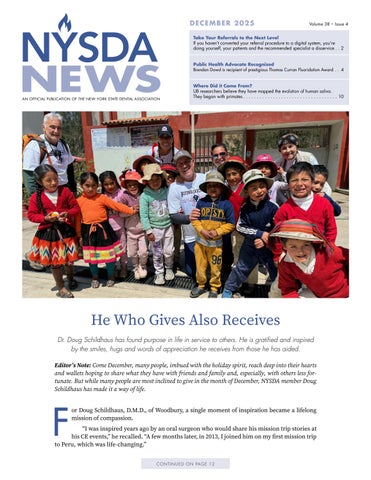
Dr. Doug Schildhaus has found purpose in life in service to others. He is gratified and inspired by the smiles, hugs and words of appreciation he receives from those he has aided.
Editor’s Note: Come December, many people, imbued with the holiday spirit, reach deep into their hearts and wallets hoping to share what they have with friends and family and, especially, with others less fortunate. But while many people are most inclined to give in the month of December, NYSDA member Doug Schildhaus has made it a way of life.
For Doug Schildhaus, D.M.D., of Woodbury, a single moment of inspiration became a lifelong mission of compassion.
“I was inspired years ago by an oral surgeon who would share his mission trip stories at his CE events,” he recalled. “A few months later, in 2013, I joined him on my first mission trip to Peru, which was life-changing.”
Reimagining the Dental Referral
How Digital Workflows Are Transforming Patient Coordination
The dental referral process remains one of the least digitized areas of clinical practice, often plagued by delays, data loss and poor patient follow-through. As dentistry increasingly embraces integrated care, referral efficiency directly impacts patient outcomes and provider satisfaction. Digital referral platforms are redefining this experience by creating real-time visibility, structured communication and measurable accountability across providers.
Shravya Soupathi
IN MODERN DENTISTRY, digital imaging, cloud-based records and AI-driven diagnostics have become standard. Yet one essential workflow—the referral— remains largely manual. Despite its clinical significance, referral management has
CONTINUED ON PAGE 15 1
EDITOR
Stuart L Segelnick, D D S , M S
MANAGING EDITOR
Mary Grates Stoll
ADVERTISING & SPONSORSHIP MANAGER
Jeanne DeGuire
ART DIRECTOR
Ed Stevens
DECEMBER 2025
Volume 38 • Issue 4
NYSDA OFFICERS
Maurice Edwards, President
Amarilis Jacobo, President-Elect
Lynn Stacy, Vice President
Paul Leary, Secretary-Treasurer
William Karp, Speaker of the House
Mike Herrmann, Executive Director
Editorial and advertising offices are at Suite 602, 20 Corporate Woods Boulevard, Albany, NY 12211-2370
Telephone (518) 465-0044
Email info@nysdental org
Website www nysdental org
The NYSDA News (ISSN 1531684X) is published quarterly, in February, May, October and December by the New York State Dental Association, Suite 602, 20 Corporate Woods Boulevard, Albany, NY 12211-2370 It is available in digital form only and accessible online in the members-only section of the NYSDA website, www nysdental org, under publications
Brendan Dowd Recognized for Fluoridation Advocacy
The New York State Oral Health Coalition, advocates for better oral health policy and practice, in October presented its annual Dr. Thomas Curran Fluoridation Award to NYSDA Past President and current ADA Trustee Brendan Dowd, D.D.S. The presentation was made during the coalition’s virtual annual meeting in October.
Dr. Dowd was cited for his early support of the ADA Fluoride Ambassador program, created this year to promote the addition of fluoride to community water supplies, monitor its use and intervene with evidence-based research when the safety of fluoride is questioned. It currently relies on over 340 ambassadors, including health professionals, water experts, community leaders and state/county health commissioners to carry out its mission. He was also a key player in a successful earlier effort to get the City of Buffalo to reintroduce fluoride into its water supply.
The award recognizes Dr. Thomas Curran, whose long history of volunteerism on behalf of improving oral health in New York State is legend. Most notably, his contributions have made a profound impact on efforts to protect and expand fluoridation of public water systems.
“To be mentioned in the same breath as Dr. Curran is an exceptional feeling,” Dr. Dowd said. “I am truly honored to receive the award.”
Awards are nice, but not the end of the story, according to Dr. Dowd. “There is much to be done,” he said. “As long as the current Health and Human Services Secretary, a person known to be against fluoridation in any form, is in office, there will be many instances when we are called into action. We will stay involved as long as it takes to continue to promote fluoridation and community water fluoridation and show how it benefits oral health and overall health.” z
Brendan Dowd
ADA Installs New Leaders at October Meeting
Richard Rosato of New Hampshire Becomes 162nd President
Richard Rosato, D.M.D., of Concord, NH, was installed president of the American Dental Association at the conclusion of the annual meeting of the ADA House of Delegates in October in Washington, DC. Dr. Rosato is the 162nd president of the association.
Also taking office at the meeting were the newly elected President-Elect Thomas M. Paumier, D.D.S., of Canton OH, Second Vice President Ben Youel, D.D.S., of Grayslake, IL, and Speaker Debra Schmit Peters, D.D.S., of Grand Rapids, MI.
Richard Rosato Ben Youel
Debra Schmit Peters
Endorsed Vendor Updates
Endorsed Vendors, Exclusive Discounts: Explore the Latest Deals and Save Big with NYSDA’s Trusted Endorsed Vendors.
Patient financing resources for NYSDA Members
When you add the CareCredit credit card for only $30 (a $165 savings), your patients may be more likely to accept recommended treatments not covered by insurance. That’s good for your patients’ health and your bottom line. Get FREE tools and resources to help your practice thrive. Connect with your CareCredit Practice Development Team at carecredit. com/dental.
Dress up the way you greet your patients
Lands’ End Outfitters provides team apparel that meets some of the highest quality standards in the industry, as well as hundreds of customized products that help your practice stand out in the marketplace.
Members qualify for an automatic program discount of 20% off logos, promotional products and Lands’ End labeled products.
Lands’ End Outfitters helps your brand succeed with quality business and uniform apparel, legendary service and real value.
WHY LANDS’ END OUTFITTERS?
• NO MINIMUMS, NO INVENTORY: Need 1 or 1,000? Not a problem. They maintain the inventory so you have less risk – and no investment up front.
• ON-DEMAND EMBROIDERY: Their expert designers accurately reproduce your logo with state-of-the-art technology. Feature your logo on polos, sweaters, hats and more!
• PROGRAM MANAGEMENT: Theirs is a turnkey experience, convenient for your employees and easy for you. They manage the program, so you don’t have to. Calls are answered fast, by real people.
• INNOVATIVE ONLINE SHOPPING: They can customize an e-store for you that exclusively features your apparel assortment and your choice of logos.
• LANDS’ END FITS EVERY BODY: With sizes from XXL to 5XL, Big and Tall, Plus, Maternity, and Adaptive Clothing. And if they don’t carry the size you need, ask them about a custom order.
800.990.5407 | ada.landsend.com
New York Dentist is Whiz with a Paddle
NICHOLAS ZACHARCZENKO, part-time dentist and full-time athlete, is finding fame on the pickleball court. A competitive player since 2019, Dr. Zacharczenko is a multiple title holder, competing in advanced singles tournaments throughout the Northeast in the 65- to 69-age group. He came close to winning in his last appearance for the season, at the Rhode Island Senor Olympics, losing out in the finals of the advanced singles pickleball tourney.
The Cooperstown prosthodontist switched to pickleball when he gave up tennis, a sport he also excelled in, achieving ranked status as a tournament player. He credits his daily workouts with keeping him in shape for what he says is a lot of competition in singles pickleball. His routine includes weightlifting, cold plunge, pickleball practice, sauna and strict diet. z
Nominations Council Call for Nominations
The NYSDA Council on Nominations will meet on Tuesday, March 24, at 1 p.m. to make its selections for President-Elect, Vice President, Secretary-Treasurer and Speaker of the House of the Association in 2026.
Nominees for President-Elect must be members of the Fifth District Dental Society. Nominees for Vice President must be members of the Nassau County Dental Society. Nominees for Secretary-Treasurer and Speaker of the House may be members of any NYSDA component. All nominees must meet the eligibility requirements in Chapter VI of the NYSDA Bylaws.
Members wishing to submit nominations for any of these positions must do so no later than March 7. Nominations should be sent to Dr. Prabha Krishnan, Chair, Council on Nominations, NYSDA, 20 Corporate Woods Blvd., Suite 602, Albany, NY 12211. z
UB Study Tracks Evolution of Human Saliva Back to Primates
Saliva is a bodily fluid most of us take for granted despite the significant roles it plays: aiding in digestion, maintaining strong teeth and defending against oral disease.
However, the evolution of human saliva has been largely unknown — until now, thanks to two University at Buffalo faculty members and two graduate students.
Stefan Ruhl, D.D.S., Ph.D., professor and chair of the Department of Oral Biology in the School of Dental Medicine, and Omer Gokcumen, Ph.D., associate professor of biological sciences in the College of Arts and Sciences, discovered that the protein genes that create human saliva have undergone frequent duplications, losses and regulatory changes, which became particularly evident in the primate lineage.
“Our work highlights how evolutionary adaptations to diet and disease may have influenced primate biology, including humans,” explains Dr. Ruhl, who has studied different aspects of saliva biology for years.
The scientists recently published their findings in the journal Genome Biology and Evolution.
Petar Pajic, a former Ph.D. student in biological sciences who is now a National Science Foundation (NFS) postdoctoral research fellow at Yale University, contributed to the study and is the first author on the paper. Luane Landau, a current Ph.D. student in biological sciences, also contributed. It was funded by the National Science Foundation, the National Institute of Dental and Craniofacial Research and the National Cancer Institute.
Using DNA and RNA datasets to compare species, they found that secretory calcium-binding phosphoprotein (SCPP) genes changed and expanded at pivotal moments over the course of evolution — when early animals first developed skeletons, when tooth enamel appeared in fish and when mammals began producing milk.
“Our idea was that saliva, as a biological fluid that constantly interacts with food, microbes and pathogens, may evolve more rapidly than other systems,” says Dr. Gokcumen, an expert in evolutionary anthropology. “We thought this locus might serve as a model for understanding that evolutionary dynamic.”
He Who Gives
That trip would set the course for the next decade of Dr. Schildhaus’s life. The following year, he traveled deep into the Peruvian Amazon jungle. When his team leader became ill, Dr. Schildhaus stepped up to lead the group—drawing on his experience as captain of his college wrestling team to guide others through uncertainty. “The rest is history,” he said. “I was next trained by Flying Doctors of America to be a Team Leader. Now, 12 years later, I’ve been leading two mission trips per year and am proud to serve on the Flying Doctors of America Board of Directors.”
Each trip brings new moments of gratitude and inspiration. “Every moment of every trip is inspirational,” he said. “One of the most powerful is when you arrive early in the morning and hundreds of people are lined up waiting to see you. Many wait for hours, and some walk through the night just to be seen.”
As a pediatric dentist, Dr. Schildhaus connects most deeply with children. “The best is getting a hug from a child and parent after a difficult extraction appointment—or when they come back the next day all smiles just to say ‘hi.’”
Two moments, in particular, have stayed with him. “I extracted three infected teeth on one little girl in Peru on the first day. The next day, we visited her school to teach oral hygiene. She immediately came up to me, hugged me, grabbed my hand and took me to her classroom to show me her schoolwork. She spoke no English, but we communicated perfectly—all while holding my hand.”
He Who Gives
continued from page 12
He also remembers an elderly woman in El Salvador who arrived unable to speak or open her mouth due to severe pain and swelling. “I worked with our oral surgeon and physicians and agreed she had a life-threatening infection that needed to be addressed immediately,” he related. “We treated her and provided antibiotics. Two days later, she was healing beautifully and feeling great. The most moving part is that if we hadn’t been there that day, in that particular remote location, we estimate she had only three to five days to live.”
The Flying Doctors of America teams provide a full range of care, medical and dental alike. “We have nurses perform triage, then direct patients to different providers,” he explained. “We offer general medicine, pediatrics, ophthalmology, geriatrics, physical therapy, dental, internal medicine, gastroenterology and pharmacy. We bring all our own supplies—dental instruments, eyeglasses, medications—and work side by side with local volunteer interpreters.”
Those experiences abroad continually shape Dr. Schildhaus’s compassion at home. “Each time I return from a mission trip, I have a renewed sense of appreciation for what I have here at both my office and at home,” he said. “It takes a special type of person to volunteer their time and finances to join a mission team. That’s one of the reasons these trips are so enjoyable—it’s always a group of caring and like-minded professionals.”
CONTINUED ON PAGE 14 1
continued from page 13
His commitment to organized dentistry mirrors that same spirit of service. As cochair of Give Kids A Smile in Nassau County, Dr. Schildhaus helps unite over 300 dental volunteers to provide care for more than 1,000 children each year. “It’s the most rewarding day of the year,” he said. “I love working with all levels of the tripartite and striving to make a difference. I’ve seen positive results from our work, especially in advocacy and policy change. This work must continue to guide the future of dental health, which is essential to overall health.”
When asked what keeps him motivated, his answer is simple: gratitude and joy. “I love what I do, and I’m so grateful to be able to continue doing it,” he said. “Another joy is sharing the experience with others and seeing how it affects them. Some of my teammates have joined me year after year, and we’ve developed very strong friendships.”
And at the heart of it all is his philosophy on giving. “Giving back in life is what it’s all about. Life is too short not to,” he said. “I enjoy discussing this with students at ASDA events. Yes, you’ll make money as a dentist—but nothing feels better than showing your gratitude and giving back to the profession that has given so much to you. Helping someone in need is one of the most powerful acts we can do, and the rewards are priceless.”
He smiled as he shared his favorite quote—words that capture his purpose perfectly:
“The best way to find yourself is to lose yourself in the service of others.” z
Reimagining the Dental
continued from page 2 -
long relied on faxed forms, emails and ad-hoc phone calls. The result: incomplete information, lost communication trails and poor visibility into whether patients ever receive the specialist care they need.
Recent industry data suggest that up to 50% of dental referrals fail to convert into completed specialist visits. In a system built on trust and continuity of care, this silent breakdown erodes both patient confidence and clinical outcomes. The move toward digital referral platforms represents not merely an operational upgrade but a paradigm shift toward accountable, connected dentistry.
Anatomy of a Broken Referral
A typical referral involves three parties: the referring dentist, the specialist and the patient. Each plays a critical role, yet traditional workflows offer limited alignment among them, leading to:
1. Information fragmentation.
2. Patient confusion.
3. Specialist bottlenecks.
4. Lack of feedback loop.
This gap in communication isn’t just inconvenient, it has measurable clinical and financial consequences. Missed appointments, treatment delays and administrative overhead can lead to reduced practice productivity, dissatisfied patients and gaps in comprehensive oral-systemic care.
Reimagining the Dental
Why Digital Referrals Matter Now
Three converging trends have accelerated the urgency for digital transformation in dental referral management: Integrated Care Expectations, Data Interoperability, and Regulatory and Reimbursement Alignment. Patients increasingly expect a healthcare experience that mirrors other industries—transparent, trackable and personalized. Digital platforms make this possible by connecting the entire journey within a single, secure interface.
The Human Factor
Technology alone cannot fix a process that is fundamentally relational. Successful adoption of digital referral systems depends on human factors, chiefly, trust and shared accountability between referring and receiving providers. Addressing these concerns requires leadership and education.
From the patient’s perspective, the referral journey is often the least transparent phase of their care. Digital referral workflows transform that experience by providing clarity, confidence and continuity, which directly improves satisfaction and adherence.
The Strategic Value of Digital Referrals
Practical Benefits
• Patient Confidence: Patients benefit from the transparency and efficiency of digital referrals, increasing their trust in the care pathway.
• Data Security: Secure platforms comply with privacy standards such as HIPAA, ensuring sensitive information is protected and confidential.
• Scalability: As practices expand, digital referral systems can easily accommodate higher referral volumes and integrate with specialist networks without disrupting workflow.
Benefits
for Specialists
• Improved Coordination: Specialists benefit from accurate, complete patient documentation shared instantly, allowing for better preparation and tailored treatment plans.
• Reduced Bottlenecks: Digital referrals minimize scheduling delays and administrative bottlenecks, enabling specialists to see and treat more referred patients promptly.
• Accountability and Feedback: Real-time updates provide a clear feedback loop, fostering stronger collaboration and trust between specialists and referring dentists.
Benefits
for General Dentists
• Streamlined Workflow: Digital referrals reduce paperwork, minimize manual errors and automate patient engagement, freeing up more time for clinical care.
• Enhanced Patient Outcomes: Instant data transfer and real-time tracking allow dentists to monitor patient progress and ensure timely specialist care, improving treatment outcomes.
• Measurable Practice Growth: Analytics from digital referral systems highlight referral trends and conversion rates, helping general dentists identify growth opportunities and improve care strategies.
Expanded Industry Metrics
• Referral Conversion Rate: Up to 50% of dental referrals fail to result in a specialist visit, highlighting the need for more transparent, accountable processes.
• Customer Satisfaction Impact: Practices prioritizing patient satisfaction see higher referral conversion rates; referrals are the highest converting patient acquisition channel, averaging 3.74%.
• Digital Engagement Rate: Over 71% of patients search online before booking dental appointments, making digital visibility crucial for referral completion.
Reimagining the Dental
• Patient Retention: Practices utilizing automated digital reminders experience higher patient retention post-referral, decreasing the rate of missed appointments and increasing completed treatment cycles.
• Operational Efficiency: Practices integrating digital referral workflows note reductions in administrative time, fewer errors, improved data security and faster referral processing.
• Online Reputation: A strong digital reputation is tightly linked to higher patient trust, referral volume and conversion rates, as reflected in reviews and testimonials.
• Appointment Scheduling Speed: Electronic referrals allow for same-day communication, decreasing time from referral to specialist treatment.
Beyond operational efficiency, digital referral systems unlock strategic insights that can shape practice growth and patient care strategies—highlighting trends, conversion rates and referral response times for continuous improvement.
Overcoming Barriers to Implementation
Adoption of digital referral platforms faces challenges, including integration complexity, cost concerns and change management. Embedded workflows, gradual rollout and digital champions can ease this transition.
Vision for the Future
The future of dental care will be defined by connected ecosystems—clinics, specialists and patients sharing data fluidly to enable proactive, preventive care. Digital referrals will serve as a key enabler of this transformation. More than just a software upgrade, they symbolize a cultural evolution in dentistry. By bridging the gap between providers and patients, they enable collaboration that paper-based systems could never achieve. z
Shravya Soupathi is practice solutions specialist for CareHigh (www.carehigh.com). CareHigh represents a new generation of dental referral solutions designed to bring clarity, accountability and collaboration into an often-overlooked process. It consolidates all active referrals into a single dashboard, structures communication channels, automates patient engagement, and generates analytics for continuous improvement. CareHigh employs end-to-end encryption, role-based access control, and HIPAA-compliant audit logs while supporting interoperability through open APIs. Queries about CareHigh can be directed to Ms. Soupathi at shravya@carehigh.com.
ADA Installs
continued from page 6
An active volunteer leader and member of the ADA for 35 years, Dr. Rosato represented the 1st District on the ADA Board of Trustee from 2019 to 2023, as well as chair of the ADA Council on Ethics, Bylaws and Judicial Affairs. He is a past president of the New Hampshire Dental Society and is active also in the Academy of General Dentistry, the American Association of Oral and Maxillofacial Surgeons, the American College of Dentists, the International College of Dentists and the Pierre Fauchard Academy.
A graduate of Tufts University School of Dental Medicine and the oral and maxillofacial residency program at the University of Illinois, Dr. Rosato owns his own OMS practice. His wife, Laurie Rosato, also practices dentistry.
President-Elect Thomas Paumier has logged more than 35 years as a volunteer leader and member of the ADA. Previously, he served on the ADA Strategic Forecasting Committee, as chair of the Public/Professional Subcommittee and chair of the Council on Members Insurance and Retirement Programs. He was a member of two scientific expert panels which developed clinical practice guidelines related to appropriate antibiotic use and the COVID Recovery Task Force.
Dr. Paumier is a past president of the Ohio Dental Association, fellow of the American College of Dentists, the International College of Dentists and the Pierre Fauchard Academy. He currently serves as vice chair of the Ohio Section of the American College of Dentists and chair of the Mercy Medical Center Development Foundation Board Endowment Committee. He is also chair of the Cleveland Clinic Mercy Hospital Board of Trustees, a member of the Procter and Gamble Global Oral Health Systemic Health Advisory Board and sits on the Cleveland Clinic Ohio Regional Hospitals Board of Directors Executive Committee.
A graduate of The Ohio State University, Dr. Paumier earned his dental degree from The Ohio State University College of Dentistry and certificate in general practice from St. Elizabeth Hospital Medical Center. He is in private practice in Canton.
Second Vice President Ben Youel, D.D.S., is an orthodontist. An ADA member for 12 years, he currently serves on the association’s Finance Committee. He previously served as a member of the ADA Council on Scientific Affairs, New Dentist Committee and Council on Membership. He is an Illinois State Dental Society Trustee and member of the Chicago Dental Society and Illinois Society of Orthodontics.
Dr. Youel earned his dental degree from the University of Illinois at Chicago and completed a hospital-based residency program at Advocate Illinois Masonic Medical Center in Chicago. He completed a three-year orthodontic residency program at UIC.
Speaker Debra Schmit Peters, D.D.S., a general dentist, is a past president of the Michigan Dental Association and its current speaker. She has been an active member of the ADA for more than 30 years who previously served as chair of the Council on Ethics, Bylaws and Judicial Affairs and Council on Membership. She also served on the House of Delegates Standing Committee on Constitution and Bylaws, was the Governance Forecaster of the Strategic Forecasting Task Force and part of the Task Force for the House of Delegates Restructure in 2017.
In Michigan, Dr. Peters is a member of the MDA Committee on Government and Insurance Affairs and co-leader of the MDA Women in Dentistry program. She is active as well in the American College of Dentists, the International College of Dentists, the Pierre Fauchard Academy, the Chicago Dental Society and the American Institute of Parliamentarians.
Dr. Peters received her dental degree from the University of Michigan School of Dentistry. A general dentist, she had her own private practice alongside her husband, Dan, in Grand Rapids up until 2021. z
UB Study continued from page 10 -
Differences between Saliva in Apes and Humans
This study preceded others in which Drs. Ruhl, Gokcumen and Pajic have collaborated, and it stemmed from a desire to understand more about the functions of saliva.
“We know that saliva contains almost everything that also appears in blood,” says Dr. Ruhl, explaining how saliva is composed of more than 3,000 components, yet only a dozen or so exist in high abundance.
“Those abundant proteins, produced by the salivary glands, are probably the ones that really matter for keeping the mouth healthy because the salivary glands have evolved to protect the teeth,” he says. “Teeth are the only place in the body where a mineralized substance is exposed to the environment. And it’s constantly being challenged by acids from food and those produced by bacteria that cause dental caries, along with the simple mechanical attrition of chewing.”
When the group began their research, they initially thought that human saliva would be identical to that of apes, which are more than 98% genetically homologous to humans.
“If you look at their blood, it’s pretty identical to ours in its composition. We thought it would be the same for saliva, with maybe one or two different components we could study,” Dr. Ruhl says. “How wrong we were. It turned out there were not one or two but many substances that were different.”
That revelation prompted the team to compare human saliva to that of other animals.
“We have proven that saliva protein composition is influenced by diet,” Dr. Ruhl says. “The environment a certain animal lives in and what it prefers to consume will shape, evolutionarily speaking, the composition of saliva proteins.”
For instance, nonhuman primates have relatively low amounts of amylase, the enzyme that breaks down starch into simpler sugars, in their saliva, while humans have a great deal more of it. That change happened because humans became consumers of starch early on, while apes did not.
Upon further review, the researchers realized there are a handful of other genes that encode very abundant salivary proteins in humans, and they were found in the same cluster of genes as milk caseins. Those genes provide growing infants with calcium for bone growth, much as saliva protects teeth through mineralization.
“The real development of the saliva genes that resemble those in humans occurred in the primate lineage,” Dr. Ruhl says. “That was interesting to us because nonhuman primates are picky eaters, and they mostly choose from a variety of fruit and veggies. We believe that the diversity of saliva proteins in primates must have something to do with them being able to distinguish between different taste varieties or to protect from harmful substances in the plants they eat.”
Saliva Could Reveal Specifics of Oral Health
Another possible frontier to study is the composition of saliva in different cultures around the globe that traditionally follow distinct diets. This could provide a better understanding not only of saliva itself but also why individuals are differently prone to oral diseases.
“If you want to find reliable biomarkers for disease and disorders, you first have to establish a robust baseline,” Dr. Ruhl says. “We know there are biomarkers among different individuals, but we don’t know what their normal baseline levels in saliva are, whether it has to do with our genetic backgrounds or where and how we live and eat.”
He adds that while medical doctors have blood and urine as diagnostic fluids indicative of health, dentists and dental researchers should claim saliva as their biofluid, which can indicate a great deal about the oral cavity and should be used more often. z