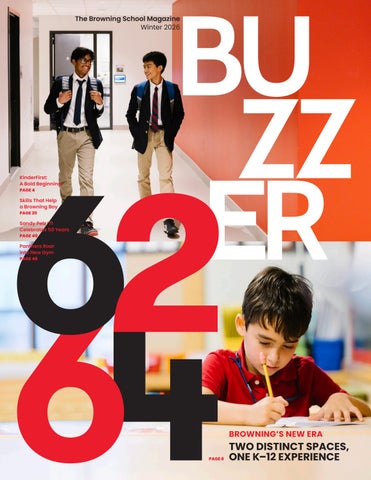
Buzzer Winter 2026

Page 1


Our first Coffeehouse in the new building gathered Middle and Upper School musicians, along with their families, classmates, and faculty, for a night of creativity, community, and music.

Signals

Dear Browning Friends,

What a fall season we had in this first year at our two-building campus at 62 and 64. The realization of this dream could not have been more exciting—or more daunting. We certainly knew what we would gain: a building created especially for older boys, a regulation-size gym for home games, and a K–8 building where Middle School students would have the opportunity to lead and mentor Lower School boys. But what might we lose? How would we maintain the intimacy and relationships that existed in an admittedly bursting building at 62?

Happily, those concerns dissolved on day one, as I hustled from handshaking at 62 to meet with our Grade 12 boys at 64. As the seniors and I walked back to their old stomping grounds to join the tradition of accompanying our first graders to the opening assembly at Christ Church, I chatted with our oldest guys on their “last first day” about creating a new tradition. That engagement was captured by videographers, but more moments just like that are being made every day as we grow with new spaces and faces, and recognize that change is not only necessary, but often also great.

None of this would be possible without your generosity. This issue shares more about what this change has meant for our boys, and provides information about opportunities to continue participation in the Building Our Future Campaign that fuels excellence in our school.

We are also featuring our Core Four in this issue—skills that we are intentionally teaching so that boys might live our core values of honesty, curiosity, dignity, and purpose. As an example, our new two-year Core Four courses in the Upper School—constructive dialogue and storytelling—are equipping our young men with the capabilities they need in a fast-paced world increasingly dominated by screens.

Speaking of screens: Artificial intelligence is rapidly transforming many areas of our lives, including education. Browning was early in exploring the possibilities of AI in learning, while at the same time experimenting with initiatives to reduce tech use. Danielle Passno, our Assistant Head of School, shares more about how teaching and learning will evolve in light of these developments.

There is one part of Browning that remains timeless, however, and that is our colleague Sanford Pelz ’71, who celebrated 50 years of employment at Browning this year. Mr. Pelz has seen more change than most, yet remains the true embodiment of Browning values, as well as an engaging teacher, wonderful colleague, and expert in his field. A Buzzer profile but scratches the surface of his prolific career.

Read Dr. Botti’s Margin Notes blog at browning.edu/head-of-school.

We are also featuring our Core Four in this issue—skills that we are intentionally teaching so that boys might live our core values of honesty, curiosity, dignity, and purpose.

Dr. Botti in the new Upper School building.

Mission and Values

The Browning School fosters growth of courageous and compassionate men of intellect and integrity who aspire to contribute meaningfully to our world.

The Browning gentleman develops amid a community that upholds these values…

HONESTY

We speak the truth, act with integrity and take responsibility for our actions.

DIGNITY

We honor and celebrate the dignity of all people and support the power of a diverse, inclusive and welcoming community.

CURIOSITY

We encourage and celebrate open-minded inquiry about our world and the perspectives of those around us.

PURPOSE

We believe that education encourages exploration and discovery in pursuit of meaning and enduring fulfillment.

Diversity Statement

The Browning School strives to create a diverse community in which all members are safe, respected and valued. We believe that in actively promoting a diverse learning environment, we are fostering intellectual, social and emotional growth for all. Recognizing and pursuing diversity, however, are not enough; we seek to transcend mere tolerance of differences and aspire to a celebration of the varied appearances, abilities, perspectives and values that characterize our community.

Good news to begin with

A Bold Beginning for a Browning Education

KinderFirst Provides an Accelerated Entry Point to the Lower School

Starting in the 2026–27 school year, Browning is introducing KinderFirst, a unique accelerated entry program that allows some boys to complete both Kindergarten and Grade 1 in a single year.

Designed for a select group of students with exceptional intellectual curiosity and social-emotional readiness, who thrive in an accelerated environment, KinderFirst replaces the traditional Kindergarten experience. In intimate settings, students master essential literacy and numeracy skills while cultivating collaboration, independence, and confidence—foundations that ensure success as they move into Grade 2.

“KinderFirst represents Browning’s commitment to providing the right level of challenge for every boy,” Dr. Botti says. “For students who demonstrate readiness, this program offers a rigorous yet supportive start to their educational journey.”

The program coincides with Browning’s updated Kindergarten cutoff date, from September 1 to December 31, aligning with New York City public schools, offering families greater flexibility in choosing the right starting point for their sons.

Expanding opportunities for young learners; guidance for growing boys

BUZZWORDS Visit buzzwords.browning.edu for a fresh approach to telling the Browning story online.

Speaker Series Addresses Rising Concern of Teen Gambling

Browning’s latest Today’s Boys, Tomorrow’s Men Speaker Series addressed a rising issue for teens: online gambling. Saul Malek, a nationally recognized expert in gambling prevention, shared his personal journey from addiction to recovery, highlighting the hidden risks gambling poses for young men.

Throughout his visit, Malek spoke with Middle and Upper School students, met with faculty, and led a parent evening program, offering practical guidance on recognizing risky behavior, understanding new ways teens access gambling, and talking with children before problems arise. His visit reinforced Browning’s commitment to supporting students’ emotional, social, and intellectual growth while addressing real-world challenges.

Babysitting Program Builds Community Across Buildings

The Browning Babysitting Program is bringing our community closer together—connecting Upper School students with Lower and Middle School families for mentorship, tutoring, and babysitting support. Launched and managed by the Student Council, the program features a website where families can browse active student babysitters and find the perfect match for their needs.

“This program isn’t just about babysitting—Upper Schoolers are discovering what it means to guide and nurture, shaping the men they’re becoming,” says Student Council co-president, Noah L. ’26, who initiated and led the development of the program. “For Lower Schoolers, they gain a big brother at Browning to look up to and feel connected to through shared tradition and community.

By linking families across our two buildings, the program offers a meaningful way to strengthen bonds across age groups, bringing Browning’s values of community and brotherhood to life.

Service Milestones

Celebrating the longevity of our colleagues’ commitment to Browning.

10 YEARS

Lauck Blake

K–8 PE Department Chair

Sandra Martinez

Upper School Spanish Teacher

20 YEARS

Judit Resika

Upper School Math Teacher

Katherine Kummer Kindergarten Teacher

Janetta Lien

Assistant Head of School / Director of Enrollment

25 YEARS

Andrew West ’92

Director of Athletics

Theresa Rodriguez

Director of Operations / Parent Engagement Officer

50 YEARS

Sanford Pelz ’71*

Director of College Guidance

BUZZER

The Browning School Magazine

Editors

Jan Abernathy, Chief Communications Officer

Jeremy Katz ’04, Director of Communications

Editorial Contributors

John Botti, Head of School

Stacey Duchak, Director of Alumni Affairs

Anna LaSala-Goettler, Assistant Head of Upper School

Ophelia Ma, Head of Middle School

Eric Ogden, Head of Lower School

Danielle Passno, Assistant Head of School

Andrew West ’92, Director of Athletics

Jon Willson, Head of Upper School

Contributing Photographers

Coffee Pond Photography

Da Ping Luo

Carla Torres

Design by Michael Wiemeyer / Designlounge, NY

The Buzzer is published twice a year by The Browning School. Submissions may be sent to Jeremy Katz at jkatz@browning.edu. All submissions may be edited for length and clarity.

Follow Us

@browningschool

@TheBrowningSchool

Visit our website: browning.edu

Board of Trustees 2025–2026

Valda M. Witt, President

Andrew E. Vogel, Vice President

Jeffrey M. Landes ’83, Secretary

Martin Small, Treasurer

John Botti, Head of School

Alexander Perruzzi, President, Parents Association

Shagun Mehandru, Vice President, Parents Association

Stevie Rachmuth ’10, President, Alumni Association

Maegan Boger

Hayley Broadbent

Sandra Buergi

George Cabrera III ’98

Sandrine A.

Cousquer-Okasmaa

Nathaniel X. Garcia ’06

Christopher L. Hartmann

Carolyn Lamphier

John M. Liftin

Betty Noel-Pierre

Stephen Palmese

Manish S. Parikh

Jerry C. Pi ’95

Ian J. Sandler

Jodi J. Schwartz

Rahul Sharma

Graig J. Springer ’98

Angelos M. Stergiou

Vance Wilson

Sara B. Zablotney

James S. Chanos, Honorary Trustee

Stuart J. Ellman, Honorary Trustee

Allan L. Gropper, Honorary Trustee

*Learn more about Mr. Pelz’s Browning career on page 40.

Browning Welcomes New Faculty and Staff

We are thrilled to have added these dedicated professionals to our community this year. With our exciting expansion, we welcomed a record number of new colleagues to support our growing programs.

ANDREW CUNNINGHAM Security Personnel
ERNESTO ESTRELLA Middle School Spanish Teacher
ALLIE GLICKMAN Director of Annual Giving
ALEXANDRA DAVIS Upper School Math Teacher
FRANKIE FOYLE Middle School Librarian
MARLEY GIFFORD Special Events Manager & Community Liaison
AMANDA DILLON Middle School History Teacher
NATALIE FROMAN Upper School English Teacher
CURTIS GISCOMBE Assistant Director of Facilities
COREY HERNANDEZ Head Chef
DANIEL DI MEO Upper School French/Spanish Teacher
MILES GENCARELLI Physical Education Teacher

BEVERLY HUTCHINS Executive Assistant to Head of School Office

BRIAN JIMENEZ Maintenance Staff

LINDSAY MARTIN Middle School Science Teacher

RUBIN Upper School Counselor

SAMUEL HOELZLE Upper School Nurse

DAMIEN KELLY Upper School Music Teacher

LISA MELORE Upper School Administrative Assistant

MARCI SCHONFELD Kindergarten Associate Teacher

EMMANUEL JEFFERS Upper School Computer Science & Engineering Teacher

ENCY LU Upper School Mandarin Teacher

SARA MONEA Upper School Science Teacher

ALEX SHUMAN Upper School History Teacher

Advancement Officer

OSWALDO LUCIANO K–8 Nurse
MIRANDA JANG Grades 3–8 Art Teacher
YAEL NATORI Middle School Math Teacher
BETH ZAPATKA Chief
STEVEN

A NEW ERA

TWO DISTINCT SPACES, ONE K–12 EXPERIENCE

Browning boys now call two addresses home: a reimagined K–8 at 52 East 62nd Street and a purpose-built Upper School at 337 East 64th Street. This milestone fulfills a long-held vision: providing a K–12 experience designed around curiosity, connection, and growth. From the youngest learners to our Upper School students, every space now inspires exploration, collaboration, and the joy of learning.

Left: Science teacher Michael Vetrano teaches in one of the new Upper School’s six STEAM labs and studios.
Bottom: A sixth grader learns in the redesigned 62nd Street campus.
Bottom left: CSE Teacher Kevin Wilkinson works with a Kindergartener in the Curiosity Zone, a new hands-on experimentation and design space at 62nd Street.

This transformative expansion enables Browning to grow intentionally, welcoming more families while preserving strong relationships and high expectations.

Large light-filled classrooms and community spaces at the new Upper School create a dynamic learning environment.

Last September, Browning welcomed students to an entirely new chapter in the life of the School, behind two sets of Red Doors. Upper School boys now inhabit a purpose-built home on 64th Street, featuring expanded classrooms, state-of-the-art science and technology labs, a regulation-sized gymnasium, arts studios, and collaborative learning spaces. Meanwhile, the reimagined K–8 campus on 62nd Street offers classrooms and creative spaces designed to support younger boys, giving the School the ability to implement schedules suited to their developmental stage. Together, these campuses nurture exploration, leadership, and joy at every age.

Head of School John Botti says, “While our students and teachers now learn and work across two campuses, our core values of curiosity, dignity, honesty, and purpose remain steadfast. These new spaces allow us to live those values even more fully, offering boys of all ages environments designed to meet their academic, social, and emotional needs.”

This transformative expansion enables Browning to grow intentionally, welcoming more families while preserving

strong relationships and high expectations. The new Upper School building provides students with flexible classrooms, a bright community commons, collaborative faculty workspaces, and an expansive gymnasium—spaces designed for exploration, collaboration, and pursuing their passions.

Honoring Our History, Embracing the Future

Browning has been shaping the minds and characters of boys since 1888. Beginning at its original home at 27 West 55th Street, the School moved to 52 East 62nd Street in 1922 and has continually evolved to meet the needs of its students. Browning expanded its campus in 1967 with the addition of an enclosed rooftop gym, and grew again in 1980 with new academic and communal spaces in the adjacent 40 East 62nd Street building. Targeted renovations in the 1990s modernized laboratories, classrooms, and the library, followed by a comprehensive transformation in the 2010s that reimagined learning, technology, and community spaces from top to bottom. Each expansion has reflected Browning’s enduring commitment to creating environments that inspire development, learning, and self-expression.

NEW NEW GROWTH ENERGY

NEW NEW GROWTH ENERGY

The Upper School’s move to 64th Street has redefined the Browning experience yet again. A top-to-bottom transformation of a historic horse stable turned parking garage building created a 60,000-squarefoot campus for our oldest boys, allowing Browning to expand with intention while remaining true to its core values.

New Building, New Horizons

The new Upper School is alive with light, movement, and possibility. From the Community Commons and the library to the regulation-sized gym every space communicates expansiveness and intention. Designed for adaptability, flexible classrooms can shift to support group work or focused study, and faculty now have dedicated areas for collaboration and planning. Communal spaces encourage connection beyond the classroom, creating a dynamic environment where boys can learn, create, and grow. The building not only accommodates current needs but also anticipates the school’s growth, creating an environment where boys can thrive academically, socially, and emotionally.

“The School was purpose-built for older boys, and we are seeing the benefits of that intention throughout the school day,” Dr. Botti says. “From larger classrooms to collaborative spaces, the East 64th Street building embodies Browning’s commitment to a relational, rigorous education.”

Reimagining the K–8 Experience

With the Upper School relocated, 62nd Street now functions as a fully dedicated K–8 campus. Here, younger boys explore the arc of childhood within spaces crafted to support curiosity, collaboration, and creativity, including the new Curiosity Zone: a hybrid art, music, and science space that encourages experimentation and self-expression.

The addition of Grade 5 to the Lower School gives boys an extra year to deepen leadership, peer engagement, and independence. Redesigned schedules reduce class transitions and allow students to focus more deeply on learning, while new faculty and programming enrich academic and extracurricular offerings. Together, these enhancements reflect Browning’s vision: preparing boys to engage confidently, thoughtfully, and purposefully with the world around them.

“Our original building, home to the Lower and Middle Schools, remains a place teeming with incredibly high

Every hallway, classroom, and gathering space in both campuses is designed with intention, fostering the relationships, collaboration, and joy that define the Browning experience.

Top left: Upper Schoolers in the Community Commons at 64.
Top right: Grade 8 boys gather at one of the repurposed terraces at 62.
Bottom left: A Kindergartener experiences joy in the classroom at 62.
Bottom right: Grade 9 boys learn guitar in the music studio at 64.

Always Connected: Six Intersections

Two Blocks Four Avenues

62nd Street

64th Street

energy, free expression, and warm bonhomie,” Dr. Botti says. “The soul of the site is happily intact, yet there is also a greater sense of serenity and measure, directly attributable to the de-densification of the building.”

Middle School students now enjoy a three-grade structure, allowing more time for focused academic instruction, athletic development, and advisory programming. Integrated Grades 6–8 experiences during community time foster deeper relationships, while expanded faculty and resources provide opportuni-

ties for creative expression and leadership development. Browning’s Middle School stands at the crossroads of independence and connection, uniquely positioned to nurture boys in a K–8 environment within a K–12 institution.

Spaces That Empower Faculty

The move to a two-campus model has reshaped not only Browning’s physical environment but also the professional culture that drives teaching and learning. With purpose-designed spaces on both campuses, faculty now work together with greater clarity on the developmental needs of the boys they teach. Classrooms, studios, labs, and common areas are no longer one-size-fits-all; instead, they reflect a shared philosophy about what boys need at each developmental stage.

“Because the classrooms better fit the purpose for which they are intended, faculty are able to experiment with arrangements of furniture and class decor that infuse the learning environment with artifacts of the discipline,” Assistant Head of School Danielle Passno says. “We have space to move and interact with boys in a whole new way that allows us to put better learning into action.”

These redesigned spaces also strengthen mentorship across divisions

and deepen professional dialogue. The result is a more cohesive, aligned, and future-facing faculty culture, one that reinforces Browning’s mission in every classroom, on every floor, in both buildings.

Two Buildings, One Browning

Despite physical separation, Browning remains a cohesive and connected community. Inter-age student relationships, unstructured encounters in hallways and communal spaces, and shared traditions continue to foster connection across grades and campuses. Cross-divisional programs such as Field Day, musical performances, and athletic mentorship ensure that the sense of “One Browning” thrives, regardless of location.

“While we will have to be more intentional about creating opportunities that once emerged more organically, this is the commitment we make to sustain the continuity of cultural ‘feel’ throughout our two buildings,” Dr. Botti says.

Across these two campuses, Browning boys enjoy environments that inspire engagement, creativity, and discovery. Together, our two buildings reflect our commitment to excellence, relational learning, and the joy of being a Browning boy—today and for generations to come.

ST RIES

Some Browning leaders share how our two campuses are providing a K–12 experience unlike any other on the Upper East Side, offering insight into the opportunities, innovation, and excitement of this transformative new era.

A New Building That Elevates Teaching and Student Voice

While Browning’s core philosophy of relational teaching remains constant, the Upper School’s new facility—and the possibilities it opened—has energized our faculty. Larger classes and faculty size enable a broader slate of electives, sparking greater enthusiasm among teachers and students. We’ve also introduced Storytelling, Constructive Dialogue, Research Skills, and Research Practicum as standalone courses. These signature Upper School offerings develop the core skills and dispositions of studentship, connection, storytelling, and constructive dialogue. Designed to reinforce our core values, these competencies

strengthen learning across all subjects, and the faculty teaching these courses have found the work deeply rewarding and central to our mission.

The building itself elevates this mission in practical and profound ways. Expanded science and technology labs invite boys to push the boundaries of inquiry, experimentation, design, and iteration, with a confidence that comes from having spaces built for discovery. A full-size gymnasium and fitness center support both wellness and community—two pillars of Upper School life that come alive when boys gather before school, during free periods, and after teams finish practice. In the arts studios, students explore new media, collaborate on ambitious projects, and let curiosity drive creativity.

A schedule designed for deeper learning—core classes meeting more frequently and for longer periods, electives expanding, and academic conflicts minimized—gives boys the freedom to pursue both rigor and passion. The build-

ing’s flexibility allows teachers to rethink lessons, switch between discussion and hands-on work, and support students who want to stay, stretch, and study.

Student voices fill this community. In every classroom and communal space we hear their ideas, energy, and cheer. Boys wake up early to work out, squeeze in pickup basketball during lunch, and talk nonstop in our wide hallways and stairwells. They run clubs in classrooms, debate the yearbook in the library, and exchange fist bumps everywhere. After school, they meet with teachers, finish projects, dive into political debates, and build robots.

More than a building, this new chapter gives Upper School boys a space that feels truly their own—a place where they can level up in responsibility, leadership, and connection. While this initiative has always been part of Browning, dedicated access to 64th Street amplifies it, giving them room to explore, collaborate, and connect learning across contexts. Surrounded by the strength of Browning’s traditions and the promise of innovation, they embrace their purpose with dignity and honesty, prepared to make their mark within and beyond our community.

Spaces That Shape Confidence and Community

Middle School boys thrive when they are trusted to step forward, and our program gives them meaningful spaces in which to connect, to belong, to practice independence, and to develop competence. The recent updates in our East 62nd Street building help students take ownership of both their environment and themselves.

You feel it first in homeroom. Every advisory now has a true home base, designed to support connection and studentship. The boys begin each morning here and return throughout the day to organize materials, track commitments, and reconnect with curiosity and empathy. In every homeroom, you’ll find a community agreement and major assessment calendar, alongside small but powerful signs that the group has made the space its own: a birthday wall, a shared Lego

build, a mascot perched on a shelf. These personal touches remind boys what it feels like to belong to a small community within a larger one, and they reinforce the routines that shape confident learners. The library has become the center of the division. Boys come to seek research support, check out books, and learn medialiteracy skills that help them navigate a noisy world with discernment. During daily recess, the room shifts into a social and intellectual crossroads: chess in one corner, quiet reading in another, cornhole out on the patio when the weather cooperates. It is a space that says both think deeply and make yourself at home. A dedicated librarian anchors all of this energy and champions our weekly Drop Everything and Read block, helping to sustain the joy of reading and the stamina that strong scholarship requires.

Our refitted science labs and technology room further show that when a space is built for

making, boys are more willing to try. Age-appropriate furniture makes long investigations comfortable, and streamlined supply organization reduces setup time so experiments happen more often— usually with students driving the inquiry. A brainstorming whiteboard wall fosters design thinking and collaboration. It’s no surprise that our robotics program has grown; this year, we will send two teams to compete in the First Lego League.

The student lounge offers a different kind of learning. Comfortable furniture and an outdoor deck invite boys to talk, play games, and unwind between classes. This is monitored independence at its best: adults are nearby, but students are trusted to manage the space and each other. Two new movement spaces extend that same message. The fitness center enables team conditioning, earlymorning workouts, and a thriving fitness club. This winter, we opened the Panther Den, equipped with traverse climbing walls and a ping-pong table, giving boys another supervised place to challenge themselves and connect with friends.

Ultimately, the shine of new rooms matters less than how boys are evolving within them. Spaces that invite responsibility create leaders, and our Grade 8 tour guides and Lamp Society ambassadors make that visible every day. Each corner of the building offers a new chance to practice stewardship, and the boys share Browning’s story with confidence and pride.

Transforming Learning for Our Youngest Students

The reimagining of 62nd Street as a K–8 space had an immediate positive impact on the Lower School program this fall. Some of our spaces are fully renovated to create new opportunities for teaching and learning. Additional bandwidth in our staffing model allows programs to grow and expand. And more flexibility in the schedule is maximizing instructional time by reducing class transitions and having dedicated spaces for specialty teachers.

A great example is the Curiosity Zone, a new classroom space specifically designed to allow hands-on exploration for our youngest learners in Grades K–2. Equipped with easels, tinkering materials, and plenty of art supplies, K–2 science and art classes are taught in this room and a

new specialist role was created specific to focus on art and music with K–2 boys. Lower School teachers can also take their boys to the space for creative projects. On a recent morning I visited a Kindergarten science class in the Curiosity Zone. The boys were designing and constructing their own Rube Goldberg machines. With plenty of space and materials such as marbles, tubing, blocks, and dominos, the kindergarteners were able to truly design, test, and refine their creations in real time. It was an amazing example of delight in learning!

Many other changes are having a positive impact on how faculty teach and how boys learn. The Lower School library is now truly a space for young learners, with books at the right height for boys to browse and a teaching space that is warm and welcoming, allowing boys greater access to children’s literature. With each counselor now having their own office, the Lower School counseling office is much more kid-friendly. A Lego wall, sensory toys, and a write-on table create a space for boys to get some support if they are having a hard day, while a counselor can hold small lunch groups to practice social skills and build friendships. A dedicated language classroom creates a class atmosphere that is immersed in learning Spanish or French

and maximizes instructional time as our language specialist no longer needs to transition from room to room in order to set up for each lesson.

Along with the concrete changes in our physical space and schedule, having a K–8 space is serving to deepen connections at the Lower School. Grades K and 1 are now across the hallway from one another, as are Grades 4 and 5. This helps create smaller pockets of community between students of similar ages and fosters collaboration of teachers across these grade levels. The addition of Grade 5 to our Lower School brings new opportunities for leadership and connection as our popular Buddies program has been extended to a two-year program matching up Grades 1 and 5. Additionally, Grades 4 and 5 boys came together this fall in our first-ever Lower School intramural soccer tournament. Over four weeks, the boys competed in Central Park and Browning gyms on both campuses under the guidance of our physical education team. The winning team had the exciting distinction of being the first-ever Browning team to secure a championship in our new gym at 64th Street!

As we settle into this new era at Browning, the Lower School is certainly thriving and enjoying the new possibilities of our K–8 space in a K–12 school.

There’s No Place Like Home

As an alum, I’ve always been proud of our school spirit, even though we’d never had a gymnasium that was big enough for official competition. To finally have a facility that is worthy of Browning’s athletic aspirations is a dream come true, not only for our athletes but for our community.

When you are at a New York City school, space is at a premium, so any opportunity for expanded sports facilities is a gift. This double-height gym, which is part of more than 10,000 square feet of new athletics space that includes a mezzanine, weight room, and home and visitor locker rooms, is going to bring a new sense of Panther Pride for a community that can gather in a space that is our own. Even our Grade 4 and 5 boys use it for physical education.

We opened the season strong with lots of support from our Lower School students, who held a pep rally to welcome some of our varsity basketball athletes back to 62. The younger guys came to the

games the next day with handmade signs and cheered the teams on. These are the kinds of events that will do so much to reinforce brotherhood and help all Panthers see athletics as a positive experience that they’ll want to be a part of when they are older.

As for our current basketball teams, the experience of the fans filling the bleachers to help us defend our house is something they will never forget. We’d had good hosts for our games over the years, but there’s still no place like home, where, after each victory, the coaches will select an athlete to put up a new number on the win banner.

I look forward to seeing many wins in the new space—and hopefully the first bucket for my son, Evan, who is in Grade 9 this year. And the gym does have the features necessary for volleyball, so that’s something we are exploring. But mostly, I am going to enjoy watching families, alumni, faculty, and boys gather on our own campus, deepening our connections to one another. I’m proud to be here for the opening of a home court that reinforces what Browning stands for: commitment, teamwork, dignity, and the joy of striving toward a shared purpose.

Today’s Boys, Tomorrow’s Men

CONNECTION

STUDENTSHIP

CONSTRUCTIVE DIALOGUE

THE CORE FOUR

STORYTELLING

Skills that help a Browning boy live a life of meaning through embodying our school’s values.

Which skill prepares a boy to live a life that honors both his own dignity and the dignity of others?

As a boys’ school by choice, not by chance, Browning’s core values go to the heart of what is essential to being a good man. To reinforce our values of curiosity, honesty, dignity and purpose, we designed a curriculum for teaching the skills necessary to embody them. Our Core Four programming—emphasizing connection, storytelling, constructive dialogue, and studentship—aims to provide boys with the foundation of a healthy and meaningful life.

As Danielle Passno, Assistant Head of School and Director of Teaching and Learning, notes, “Boys need a skill set in order for our values to be adopted as dispositions. You don’t just become honest, you have to practice honesty. You don’t just develop purpose, you have to engage in activities that allow you to discover purpose. So looking at research on boys,

we knew we had to incorporate these skills into the curriculum.”

STUDENTSHIP SETS THE STAGE

A lack of organization can stand in the way of academic success and makes boys feel overwhelmed. The Browning Learning System helps meet this challenge by teaching boys how to use a planner, take notes, read for comprehension, and use standard abbreviations. “Data shows boys develop slower than girls in organizing and bringing work to completion; thus, we focused our efforts on developing scaffolding for these important components

of academic success,” Passno says. Learning these skills starts in Lower School, while in Middle School students have dedicated time devoted to the practice.

With a “very healthy culture of asking for help,” Ms. Passno says, Upper School boys routinely seek out help from faculty, and the schedule allows boys to do so before classes start in the morning.

CONNECTION IS KEY

As more headlines warn about the “male loneliness epidemic,” making sure that boys don’t lose or mask their ability to be close to others has become a focus, particularly in the middle school years.

Megan Ryan, Director of Today’s Boys, Tomorrow’s Men programming, says “it is common for friendships to shift in Middle School due to changing interests and differences in developmental stages, and as time with others becomes limited as academics become more complex.”

Because they are not as independent as older boys, nor socially managed by adults as younger boys are, providing middle school boys with intentional relationship building in school is important. “We think if we show boys explicitly how to make friends, be a friend, and play a role in their community, while giving them permission to access a full range of emotions and interests, we are offering them the kind of support they need to become healthy, purposeful men,” says Ms. Ryan.

Some of this learning and exploration occurs in advisory, where boys spend time in a circle answering questions that increase in emotional depth. For instance, an initial question might be: What was the best birthday gift you ever received? The next would be: What is a gift you gave someone that you thought was meaningful to them? And finally: What is one present you wish someone would give you that isn’t a material thing?

Which skill allows a boy to speak honestly about his purpose?

TELL YOUR OWN STORY

Adam Giordano, drama teacher and Upper School assistant librarian, is teaching a new course on storytelling for Grade 12 boys and can see easily how it ties into all of the core values. “What makes a story really good is you bringing some of your authenticity to it—maybe some of your vulnerability. It requires honesty. The more dignity you bring to it, the more compelling the story is going to be. Certainly curiosity comes into play—not only for the storyteller, but for the listeners in class. And this kind of talking and sharing gets us closer to discovering our purpose.”

Which skill allows a boy to construct arguments while also remaining curious about others’ beliefs?

This course is also required of all Grade 9 students, helping to bind those students closer to one another at the start of Upper School. Before graduation, boys will tell a story in front of their families and peers. Mr. Giordano notes that this can be a balm in today’s divisive world: “So much of what we do is filtered through computers, but storytelling breaks through a lot of that. My goal isn’t just to send them out into the world able to tell a perfectly told story, but that they will organically and naturally draw on these tools and principles in their lives—personally and professionally.”

BEYOND AN OPINION

Upper School Head Jon Willson teaches Constructive Dialogue to Grade 10, showing the boys how to construct an argument, as well as how to be curious about others’ beliefs—and why doing that is so hard. “It’s important for kids to understand how their brains work and the political moment we’re in so they can understand why and how constructive dialogue is so hard. Being an educated citizenry is absolutely crucial to the healthy functioning of democracy. This is a 21st-century skill.”

ForHONESTY

DIGNITY

Teaching Our Values in Lower School

CURIOSITY

PURPOSE

our youngest learners, Browning values are incorporated into the school day organically. For example, Morning Meeting sharing becomes a way for boys to practice storytelling, says Eric Ogden, Head of Lower School. “We also have families come in to discuss their traditions and holidays, and those are opportunities to be curious and recognize the dignity of others whose experiences vary from yours.”

While the Grade 9 class taught by Passno focuses on constructing a solid argument, the Grade 10 class will study the Supreme Court to better understand how important cases were argued.

Ms. Passno adds, “Constructive Dialogue offers a response to data on how polarized societal issues tend to be, particularly around gender. The only way for boys to combat that is to learn skills of constructive dialogue, which are largely about getting to know another person’s perspective and how they came to hold it—not about winning an argument.”

The division’s theme for the year is “Be Curious,” while last year’s was “Sharing Our Stories.” In fact, the boys even chant the core values during assemblies. “It doesn’t take long for them to understand that Browning believes in honesty, dignity, curiosity, and purpose,” Mr. Ogden adds, “and to embrace those values.”

Which skill allows a boy to stay organized and focused so he can express curiosity?

Name What Endures

Browning has always been more than a school—it is a place where boys are known, loved, needed, and challenged to become the best version of themselves. The Building Our Future Campaign is our bold step forward, ensuring that Browning continues to thrive for generations to come.

As 64 evolves, our community has a meaningful opportunity to name the spaces where Browning boys will learn, gather, compete, and grow. From classrooms and labs to shared commons and athletic spaces, this provides a way to honor a family legacy, recognize a mentor or loved one, or affirm a belief in Browning’s mission. Each named space becomes an enduring expression of purpose that links past generosity to future possibility, and helps ensure that what we build today continues to serve generations of boys.

Naming

at 64th Street

Good news keeps on coming

The reMarkables help Grade 9 boys explore distraction-free, handwritten learning.

Welcoming New Leaders to the Board

Vice President of the Parents Association, Shagun brings a global perspective shaped by her career in technology risk and leadership roles at JPMorgan Chase and Morgan Stanley. Currently Vice President on Morgan Stanley’s Cyber Data Risk & Resiliency Team, she began her career at Deloitte. She is an active member of the Browning community and is passionate about building connections among families. Shagun and her husband, Gaurav Anand, have one son, Rhyal ’36.

Stephen Palmese

Stephen is a Managing Principal of Integritas Capital, a real estate private-equity firm specializing in opportunistic equity transactions, loan origination, and credit investments. Previously, Stephen focused on corporate brokerage, serving as Vice Chairman at both Jones Lang LaSalle and Cushman & Wakefield, and as a partner at Massey Knakal Realty Services. He and his wife, Lauren, have two sons: Julien ’31 and Alexander ’35. Lauren is actively involved in the Parents Association and chair of the Browningdales committee.

Grade 9 Rethinks Note-Taking with reMarkable Tablets

Browning has launched an innovative pilot program integrating reMarkable note-taking tablets into Grade 9 courses. What began in Constructive Dialogue and biology has quickly spread, with most students choosing to use their reMarkables across all classes. The tablets provide a focused, distraction-free way to capture ideas, stay organized, and strengthen critical thinking.

Students are discovering how a single, streamlined space for notes enhances engagement and deeper learning, while faculty gather feedback to inform best practices for teaching with digital tools. Early results from the pilot will guide how Browning integrates technology moving forward, shaping future programs that help boys take greater ownership of their learning.

Rahul has been a member of the Browning community for more than six years and has a professional background in business, law, and finance. He is currently Deputy General Counsel at MoonPay and has held leadership roles at fintech and crypto startups, including OANDA, as well as earlier experience in investment banking and restructuring law. Rahul and his wife, Veena Isaac, have three sons: Caleb ’31, Max ’31, and Jack ’38.

Rahul Sharma

STUDENTSHIP IN THE AGE OF AI

Daily ChatGPT Usage May–August 2025

As articles are published daily about the uneasy marriage between AI and education, Browning is in its third year of discerning how to use AI for the good of boys and their education.

In the age of AI, the option to shortchange one’s learning is ever-present. Just as social media companies have vied to win adolescents’ attention by any means necessary, so too does AI present an alluring path that can be anything but rewarding.

Perhaps the most intriguing chart of the year was published in a Futurism article in August. It mapped the usage of ChatGPT from early May to early August 2025, and while the data in early May to early June of the chart evokes the Himalayas, the rest of the data more closely resembles the Great Plains on a windy day. In short, ChatGPT usage skyrockets when schools are in session and plummets when they are not. Are students using ChatGPT for schoolwork? Yes, the data is undeniable and the usage seemingly unstoppable. Can we help students learn to use it for the good of themselves and others? That’s the challenge we’re eagerly tackling at Browning.

First, all Browning teachers must continue to grow in their understand-

learning paths for the year. Faculty will continue learning through organizations such as the Association for Academic Leaders, or through our subscriptions with AI platforms MagicSchool and Flint. We must understand how boys might use GenAI so we can plan learning experiences that put them in the position to use it well.

Second, our assessments must evolve with the rise of AI. How can we ensure that a boy’s performance on an assessment is indicative of what he knows, can do, and has learned, rather than what he can mimic via AI? Toward this end, our faculty in Computer Science & Engineering are exploring how assessments can honor the process over the final product, while our humanities teachers are researching how oral examinations and presentations can be a better indicator of learning and preparatory experience for future careers.

ing of AI, what it can do, and how students will use it and regard it in their lives, whether they are GenAI natives or seeing it change their experience as high school students. Understanding GenAI is now a teacher’s professional obligation, and thus, all of our departments and divisions have crafted AI

If schools are in the business of character formation for the purpose of a good life, then our third goal of contemplating how we motivate students to take the more virtuous, productive path to learning is perhaps the most important. Finding ways to encourage boys to choose what is right and good is the true culmination of Browning’s work. AI is the siren call that, if heeded, can turn a life of meaning into one of empty achievement. Motivating boys to take what may be the harder path, to learn for the sake of knowledge, improvement, fulfillment, purpose, and service to others—which amounts to a good life—is our daily charge. The challenge of teaching and learning in the age of GenAI is nothing more than our perennial challenge to motivate boys to their highest selves— courageous and compassionate men of intellect and integrity who aspire to contribute meaningfully to the world.

OpenRouter data reported by Futurism shows a steep drop once school lets out, underscoring the strong link between ChatGPT activity and the academic year.

wild about Books

In the Heart of the Reading Jungle

This year’s Book Fair transformed Browning into a vibrant literary jungle, inviting families to explore new reads and celebrate a shared love of stories. From an important parent panel on tech health for kids to spirited Halloween family festivities to joyful class visits and inspiring author talks, every moment honored the adventure and wonder of reading.

Get wild about reading

A Community Spirit That Shines as Bright as Our Generosity

Our community donated a record number of books to the Brooklyn Book Bodega, helping put stories into the hands of children who often struggle to access them. That same spirit of giving extended to Browning—we also raised a record amount of funds, all of which will support strengthening both libraries, enhancing learning tools, and meaningful books for our boys to discover and enjoy.

Why ChoseWe Browning(Twice)

Brad and Victoria Coltun P ’34, ’36 began their Browning journey when they started the application process for their older son. Impressed by the school’s close-knit, supportive environment, they also enrolled their younger son at the same time. Now in their second year, both boys are thriving in Browning’s curiosity-driven, individualized community.

How did Browning first come onto your radar when you were exploring schools?

Victoria: Honestly, we didn’t know anything about the independent school landscape at first—not the advantages or what made it different. We just had a general sense that, eventually, we wanted our kids in a strong, independent school environment.

Brad: When we started researching, people told us to look at a few all-boys schools. We hadn’t grown up in single-sex schools, and no one we knew had either, so it felt foreign to us. But once we started

hearing the feedback and learning about things like relational learning and the flexibility that an independent school offers, it clicked almost immediately. What felt unfamiliar at first suddenly made total sense, and that’s how Browning came onto our radar.

You enrolled both of your sons in the same year—what made the School the right fit for both of them?

Brad: It wasn’t our original plan to start both boys that year. Our goal was to find a long-term home first for our older son. But as the school year approached, we realized that a much larger classroom environment might not be the right fit for our younger son anymore. Because we’d already had such a great experience with the Admissions team and program when we started the process, it just clicked— Browning felt like the right place for both of them.

Victoria: We were drawn to the smaller classes and the all-boys environment, which we hadn’t really considered before. I was impressed by how intentional everything felt—from the way expectations are set to the emphasis on presenting work publicly. You can see the thought behind every tradition and process, and it’s all designed to serve the boys’ growth. Values like honor and virtue aren’t just talked about here, they’re real—and that made Browning stand out.

What made you feel welcome during the admissions process and before school started?

Brad: Even before applying, we attended the Book Fair, which was such a fun, informal way to get a sense of the community. It gave us a real feel for the energy and warmth of the place.

Victoria: We also attended Browning’s “Ask Me Anything” admissions Zoom event. We’d seen similar overviews at other schools, and they felt so impersonal in comparison. But when Head of Lower School Eric Ogden spoke, it was different—he highlighted things about

the School we hadn’t even realized were important for our kids, and it immediately felt like the right fit.

What are the most impressive features of your son’s experience thus far?

Brad: What’s impressed me most is how teachers go above and beyond to nurture each child’s interests. If a student shows curiosity in something new, they find ways to help him explore it fully, giving him the tools to really dive in. Even when our younger son made a mistake, his teacher immediately reached out and worked with us to support him—showing that the care extends beyond academics.

What would you tell a family that is considering Browning, but is unsure about the boys’ school experience?

Victoria: The more schools you visit, the more you get a sense of what feels right. For us, Browning just clicked—and it happens to be all boys.

Brad: I hadn’t considered an all-boys school because I didn’t go to one myself, but keeping an open mind made all the difference. The boys form a closeness I didn’t expect, and the School emphasizes values and character alongside academics. It’s not just about grades or tests— it’s about teaching boys how to grow into thoughtful, responsible men and leaders.

Winter City HolidayLightsParty

The annual Holiday Party made its debut in the new building, offering many guests their first glimpse of the expansive gym. Spanning an entire wall, a projected New York City skyline—complete with falling snow and shimmering northern lights—transformed the gym into a glowing winter cityscape as parents, alumni, faculty, and friends gathered to celebrate the season. Thanks to the Parents Association, volunteers, and staff, whose creativity and dedication brought this magical evening to life!

JV Soccer’s playoff milestone defines a season of growth and achievement in Browning athletics!

FALL SEASON

The Browning Panthers wrapped up an exciting fall season filled with growth, grit, and strong competition across all levels. Varsity soccer closed the season on a high note, demonstrating resilience and teamwork, with many talented players returning next year, promising a bright future. JV soccer made history by reaching the playoffs for the first time in years, their hard work and competitive spirit setting a high standard for seasons ahead. Our 7/8 soccer squad impressed with an 8-4 record, just one win shy of first place. Meanwhile, Grade 6 soccer showed remarkable effort and improvement, finishing 3-1-2 in a season of development and teamwork.

On the trails, varsity and 7/8 cross country runners achieved personal bests and helped build one of the largest and most enthusiastic teams in school history. Above all, the Panthers’ grit, determination, and sportsmanship— values that define Browning athletics—shone through this fall.

Varsity soccer player Oscar S. ’26
JV soccer player Armaan S. ’29
Varsity cross country runner Andrew B. ’28
Varsity soccer player William S. ’26
View photos from the season at browning.edu/athletics-photos
7/8 soccer player
Rhys B. ’30
Varsity cross country runner Edward C. ’29
7/8 cross country runner Benjamin F. ’30
JV soccer player Danny Y. ’29
Grade 6 soccer player Jack M. ’32
7/8 soccer player TimmyJo R. ’30
Grade 6 soccer player Charlie O. ’32
7/8 cross country runners
Kenzo P. ’31 and Theodore P. ’30

“I know what room I was in, and I remember the teacher. By the time I was in 11th grade, I couldn’t even remember that I had ever visited another school.”

“My mother was in admissions for 20 years. I’m good at the therapy and diplomacy—both of which are part of the job.”

HALF A CENTURY OF PURPOSE

A career of joy, curiosity, and Grytte for Sanford Pelz ’71

Mr. Pelz as a student, 1971.
Mr. Pelz, 1980.

When asked the secret to his longevity at The Browning School, Director of College Guidance Sanford Pelz ’71 replies, “I don’t like change!” But that simple statement can’t possibly explain the joy, curiosity, and purpose with which Mr. Pelz approaches his work, and the boys, in his 51st year of teaching.

While his Browning employment story starts with a job offer in an uncertain economy, it’s no surprise that the man whose Subaru’s vanity license plate reads “Grytte” can still remember moments from his student revisit day in 1965.

“I know what room I was in, and I remember the teacher,” Mr. Pelz says. “By the time I was in 11th grade, I couldn’t even remember that I had ever visited another school—my mother had to show me her notes!” He happily entered Grade 7 (then called Form I) here and hasn’t looked back since.

While majoring in physics at Colorado College, Mr. Pelz thought of becoming a professor. However, a recessionary job market made him receptive to a math faculty job offered by Donald Smith, then math department chair at Browning. Luckily for Browning, the work Mr. Pelz thought he’d do for “a year or two” turned into a lifelong commitment to educating thousands of boys and providing crucial guidance for the next step in their educational journey. While in his early career Mr. Pelz entertained other opportunities, including at Hunter College High School (“I’d have twice the number of students and the salary was roughly the same so I said to heck with that”), a move to Greenwich Village proved pivotal to his evolution as a Browning teacher. “I started taking courses at the New School 50

Mr. Pelz began his career at Browning as a math teacher.

in communications,” he says, “and I found something I could learn at night and use it the next morning in my classes.”

Soon he was pursuing his masters in media studies at the New School, and creating an interdisciplinary class he would teach for more than 40 years: Science, Technology and Society (STS). “That’s something I’m very proud of. I tell prospective parents that college guidance programs are more alike than they are different. We have the same end game. But STS was all about exposing boys to different books and topics each year. I still have all those books on my shelves.”

While Mr. Pelz is modest about the role he’s held since 1989, college guidance is different when you’re working with every boy in the Upper School, including many who are the sons of men he guided through the process decades before. “I call them my grandchildren and it’s amazing,” Mr. Pelz says. He even guided his own twin sons through the process.

It’s fitting that this job is still exciting for a former college tour guide. “If a guide didn’t show up, the office called me because they knew I’d be there, even if I was sound asleep. I’d be there in eight minutes to give the best tour that prospective students ever had.” And as generations of boys who have been on Browning’s signature college trip have seen firsthand, there’s no better planner of a trip designed to teach how to assess college fit.

Pelz’s science background also lent itself to the early adoption of data mining. “I approached college guidance by building a database starting on day one—this was 15 years before Naviance (a college guidance database) was around. Data is important to help boys make good decisions.” Another skill, which he allows might be genetic, is collaborating with families. “My mother was in admissions for 20 years. I’m good at the therapy and diplomacy—both of which are part of the job. I’m good at getting parents and boys to acknowledge another’s point of view. And sometimes I’m just pulling the kid aside and saying, “You’re applying to a bunch of places for a bunch of different reasons.

This one I want you to apply to as a favor to me, because it’s a good choice for you.”

Mr. Pelz has many success stories, often about boys who were initially dismayed at their college choices yet a semester later couldn’t imagine being anywhere else, or who were able to secure financial aid awards when it appeared that no funding was available. Sometimes they involve getting a boy to have the confidence to apply to a school where he believed he wouldn’t be admitted. “I’ve always said, they don’t always get into the places they think they want to go,” he adds. “They get into the places they ought to be going.”

Asked to reflect on what is timeless at Browning (besides himself), Mr. Pelz emphasizes the high quality of a Browning education. “We’ve always had awesome faculty. I had amazing teachers, my sons had amazing teachers, and today, I see colleagues building great relationships with boys. I look back and realize that Browning faculty taught me things I wouldn’t fully appreciate until decades later.”

Mr. Pelz’s vanity license plate reads “GRYTTE”—the first word that comes to mind when he thinks of Browning.
Mr. Pelz at Colorado College in the ’70s. Mr. Pelz reviews college choices with a student in 2023.

1970s

Sanford Pelz ’71 celebrated 50 years of service to Browning on October 6, 2025, joined by more than 100 friends, colleagues, alumni, and past parents. His sons, Jon ’12 and Chris ’12, traveled from Australia and England for the occasion.

Jamie Dimon ’74 received the Bower Award for Business Leadership from the Franklin Institute, recognizing his leadership at JPMorgan Chase and his advocacy for the American business community.

1980s

Randal Fippinger ’85 retired from his illustrious career leading the performing arts center at Williams College.

1990s

Jerry Pi ’95 was appointed to Boston University’s Alumni Council and also serves on the Dean’s Advisory Board for the Pardee School of Global Studies. He and the board are currently leading efforts to develop a new 70,000 sq. ft. energy-efficient building for the school. Sasha Forostenko ’98 recently co-founded Sonotheia, which offers next-generation voice-fraud detection for financial institutions, combining physics-based deepfake analysis with regulatory compliance expertise.

Life after Browning

2000s

Nick Versandi ’01 and Martin Arnabal ’01 caught up with Browning staff member Theresa Rodriguez while attending a concert at Webster Hall last October.

Samora Legros ’03 married Michelle Thomas on April 18, 2025, in New Rochelle, NY.

Alec Adjil ’05 and his wife, Jess, welcomed a daughter, Annabelle Rose, on July 1, 2025.

Nate Garcia ’06 got engaged to Niara Phillips on June 7, 2025, and the couple is looking forward to planning their upcoming wedding.

Owen Canavan ’06 and his wife, Meghan, welcomed a daughter, Rosalie (Rose) Francis, on August 6, 2025, in Nashville, TN.

Kenton Kilmer ’07 earned Product of the Year at the Hedgeweek US Awards 2025 for his company, Addigence, honored for its innovation in investmentmanagement technology.

2010s

Ben Sheridan ’10 and his wife, Maya, caught up with Stevie Rachmuth ’10 during an alumni Oktoberfest event.

Logan Stark ’17 and Slater Stark ’15 filmed their debut feature, Nurture, this past September. The folk horror story explores loss, control, and the dark twists of love in the aftermath of trauma.

2020s

Alex Liptak ’20, Liam Lis ’20, and Oliver Gad ’20 founded Carte Blanche, an app-based marketplace connecting private chefs with clients in New York City and the Hamptons.

Brett Schulman ’08 married his wife, Lindsay, on October 18, 2025, in Bridgehampton, NY, with many Browning classmates in attendance.

Front row: Jeff Hendren, Caren Hendren, Miles Bogner ’08, Nancy Schulman, Allan Schulman, Lindsay Schulman, Brett Schulman ’08, Cleve Langton, Tricia Langton

Back row: Ethan Schulman ’08, Harry Finkelstein ’08, Tennyson Singer ’08, Bradley Aronson ’08, John Hendren ’08, Christopher Perkins ’08, Conor Schmertz ’08, Robert Van Laer ’08, Kip Langton ’08, Claude Singer, Constance Bosworth

For Peter Gardner ’76, Browning Is a Family Affair

One of four brothers to attend the School and now marking his 50th reunion, Peter Gardner ’76 has remained connected for nearly his entire life—including 37 consecutive years of annual giving.

“I give out of duty,” he says. “Some years ago, I was introduced to Howard Dean ’66 when he was running for president. He told me that his family’s total years at Browning were exceeded—by one year—only by my own. I hadn’t known that. So that longevity may figure into the matter, I suppose.”

He offers candid advice to students preparing for college: follow your intellectual interests, not others’ expectations. “Visit the places where you’d thrive and aim for the school with the smartest, most curious students.” For recent graduates, his guidance is simple: find an honest, capable advisor—and don’t assume the hardest course is always the best one.

For Peter, giving back is a way of honoring a lifelong connection that still matters.

ALUMNI SPOTLIGHT

Skyler Bell ’21, a senior at the University of Connecticut, was named a first-team All-American by the Associated Press and a second-team selection on the 136th Walter Camp All-America Team, marking historic national honors after his recordbreaking season. He was also a Biletnikoff Award finalist as one of the nation’s top wide receivers and earned a spot on the Senior Bowl 300 as a top NFL prospect. Browning faculty Jon Willson and Alex Shuman, his former Taft School teachers, cheered him on at a November game.

Fernando Cohate ’21, pictured here with faculty member Megan Ryan at Lehigh University, is finishing up his senior year on the soccer team and will begin his career at Deutsche Bank in July.

Oliver Messler ’21 reconnected with faculty members Theresa Rodriguez and Dan Ragsdale after graduating from St. Andrews University.

Malek Assef ’23, Ethan Fitzpatrick ’23, and Rohan Mehra ’23 reunited last November at Boston College to catch a football game together.

Alex Kavour ’24 caught up with faculty members Melodie Ting and Judit Resika during the Grades 11 and 12 College Trip visit to Johns Hopkins last fall. ALUMNI:

Connected by Our New Mark

The lamp has long symbolized Browning’s warmth, wisdom, and community—and that hasn’t changed. Our new mark, 6264, connects our two homes on 62nd and 64th Streets, serving as a tie that binds our growing campus while keeping us one school and one family. We know it may feel new, but it’s built on the same foundation that shaped all of us. Thank you for being part of this continuing story.

SAVE THE DATE

Alumni Indoor Golf Social

Bring your best swing— or just your best stories— for a night of friendly competition! Good food, cold drinks, and even better company make this a spring kickoff you won’t want to miss.

March 3, 2026 5:30 p.m.

Five Iron Golf on the Upper East Side

IN MEMORIAM

Barbara Belknap, Former Faculty

Robert Burns PP ’18

Dee Ann Dorsey P ’29

David G. Luther ’72

Philip Miller P ’32

Jacques Nordeman ’54

Edward L. Reboul ’58

SHARE YOUR GOOD NEWS!

Whether you’ve started a new job, celebrated a milestone, or reunited with classmates, we love to hear what you are all up to! Share your news and photos at browning.edu/classnotes

Powered by Purpose. Sustained by You.

With our Upper School campus at 64 buzzing with innovation and our younger Panthers thriving in reimagined spaces at 62, every corner of Browning reflects what’s possible when curiosity, dignity, honesty, and purpose come alive.

Your gift to the Annual Fund keeps that momentum strong— powering transformative teaching, bold ideas, and experiences that shape the confident, compassionate young men the world needs. Invest in what’s next for Browning.

MAKE YOUR GIFT TODAY.

Scan this QR code to learn how to give to Browning, and get ready for our first-ever Giving Days to increase the impact of your philanthropy!

Panthers Roar into New Gym

Browning opened the 64th Street gym in unforgettable fashion, with a RED OUT doubleheader, as the JV and varsity basketball teams faced Riverdale before a roaring crowd. Lower, Middle, and Upper School boys and their families brought incredible energy, cheering, chanting, and waving foam paws and signs that filled the space with Panther pride. Through hard-fought play, strong sportsmanship, and fans setting the tone from the first tip-off, the Panthers officially and memorably marked the beginning of a new home-court era.

JV hoopster EJ M. ’28 receives the pass.
The Upper School Panther Posse cheers hard.
Varsity hoopster Dennis R. ’28 goes for a layup.
Varsity hoopster Ryan K. ’27 runs the offense.
The youngest fans show off their Panther Pride in red.
Varsity hoopster Jesse S. ’27 floats a shot over defender.
JV hoopster Earl C. ’28 scans the court.

Turn static files into dynamic content formats.

Create a flipbook