SINCE 1891
THE BROWN DAILY HERALD WEDNESDAY, OCTOBER 6, 2021
VOLUME CLVI, ISSUE XXIII
BROWNDAILYHERALD.COM
UNIVERSITY NEWS
METRO
U. plans to lower COVID testing freqency
Sam Zurier wins District 3 Democratic primary
Brown also vetting 10 to 20 Afghan students granted asylum to host next academic year
Former Providence city council member garners 1,282 votes per unofficial results
BY ALEX NADIRASHVILI SENIOR STAFF WRITER President Christina Paxson P’19 discussed plans to scale down COVID-19 testing frequency for vaccinated individuals, noting the nearly $1 million per week price tag on the testing program at Tuesday’s faculty meeting. The University is also in the midst of a vetting process to host between 10 to 20 female Afghan students granted asylum for the upcoming academic year, Provost Richard Locke P’18 said at the meeting. Despite the University’s continued dedication to “protecting public health,” Paxson said that the push to decrease testing is ultimately a financial decision for the University, which has spent a large portion of revenues from Summer@Brown this past summer on testing costs. Paxson celebrated the recent decline in COVID-19 rates on campus, pointing
BY BEN GLICKMAN METRO SECTION EDITOR Sam Zurier, a former Providence city council member who ran on an education-oriented progressive platform, has won Rhode Island’s District 3 State Senate Democratic primary with 1,282 votes — approximately 32% — according to unofficial results from the R.I. Board of Elections reported by WPRI. Zurier edged out a crowded race of competitors: Geena Pham, a public school teacher, came in second with 982 votes; Bret Jacob, a former staffer of Providence Mayor Jorge Elorza, had 908; Hilary Levy Friedman, a visiting assistant professor of education at the University, had 613; and Ray Rickman, a civil rights veteran and former state representative, had 269.
TRACY PAN / HERALD
Paxson cited the nearly $1 million per week price tag on COVID-19 testing as a push to lower the frequency for vaccinated individuals. to low case numbers this past week. She attributed this decline to the University going “above and beyond” Centers for Disease Control and Prevention testing guidelines, which do not recommend testing asymptomatic, vaccinated people at all. She suggested aligning University restrictions with CDC guidelines more closely throughout the semester, with more information to be released in the coming days. In response to concerns regarding contact tracing and travel, Paxson emphasized that the University will be ready “to do surge testing when people
come back from the holidays. We’re going to preserve the capacity to ramp up testing if the data tells us we have to. … I wouldn’t want to disassemble a lot of the machinery that we have.” Paxson also addressed the overall financial status of the University, which is expecting a $30 million deficit this year as well as positive endowment and fundraising growth, which will be detailed in the coming weeks, she added. Strong endowment return could enable the University to bolster its financial
SEE TESTING PAGE 3
At the time of publication, 4,054 voters cast their ballots in the Democratic primary, according to the unofficial results, a high turnout for a special election. Zurier will appear on the ballot in the general election Nov. 2 against Republican Alex Cannon. But given the strong Democratic leaning of the district — 63% of registered voters are Democrats — Zurier is ultimately strongly favored to win the state senate seat. District 3 encompasses most of Providence’s East Side, including College Hill. Zurier, who served on the Providence School Board and co-founded the East Side Public Education Coalition, ran a campaign focused on improving education in Providence public schools, as well as other progressive issues such as environmental justice, The Herald previously reported . Candidates in the race drew a wide array of endorsements. Climate Action Rhode Island and Black Lives
SEE ZURIER PAGE 3
UNIVERSITY NEWS
METRO
Court hears oral arguments in Title IX settlement appeal
Mayor Maria Rivera reflects on first months
Appellants call on Court to reject settlement reached following Athletics Initiative BY PETER SWOPE SENIOR STAFF WRITER The United States Court of Appeals for the First Circuit in Boston heard oral arguments about a call by attorney Robert Bonsignore, representing 12 current members of the women’s hockey and gymnastics teams, to reject a settlement reached in Cohen v. Brown in December 2020, which reinstated the women’s equestrian and fencing teams and set an expiration date on the 1998 equal opportunity agreement mandating that Brown offer athletic opportunities to women roughly proportional to their enrollment. This settlement was reached in the aftermath of the Excellence in Brown Athletics Initiative, which led class representatives to file a motion to enforce judement under the landmark 1998 case Cohen v. Brown, in which a federal court ruled that Brown had violated
federal Title IX legislation after cutting funding for multiple varsity women’s teams, The Herald previously reported. The plaintiffs from the Cohen case and the University comprised the two key parties in negotiating a settlement following that motion’s filing, ultimately reaching a settlement in December 2020. The Cohen plaintiffs and the University oppose Bonsignore’s calls for the court to reject that settlement. Attorney Lynette Labinger, who represents the plaintiffs from the original Cohen case, explained that the plaintiffs participated in discovery and briefing followed by extensive mediation when coming to the December 2020 settlement . The parties “came to an agreement that restored two of the five teams, set a framework for restoring more if Brown were to restore (more) men’s teams, provided some financial support for the restored teams, prohibited Brown from cutting any more women’s teams for the remaining life of the agreement,” Labinger said. The settlement will end after the 2023-2024 academic year, while the original 1998 settlement had an indefinite duration.
SEE TITLE IX PAGE 5
Maria worked to improve vaccine uptake, communitybased policing, housing BY OLIVER KNEEN SENIOR STAFF WRITER Mayor Maria Rivera loves the people of Central Falls, Rhode Island. Whether she’s entering a restaurant or walking down the street, she loves that people will go so far as to roll down their car windows just to start a conversation. Since assuming office this January as the city’s first woman elected mayor and the state’s first Latina mayor, Rivera has worked to enshrine this sense of community in City Hall, whether that be through the inclusion of Spanish-speakers in every department or the simple “good morning” she tells her staff every day. Rivera wants to make sure that “when people walk into City Hall … they feel that somebody is listening to them,” she told The Herald. Indeed, from her two terms on the Central Falls City Council to her current tenure as mayor, her focus has always been maintaining an ongoing dialogue with
the community through frequent conversations with residents.
with the community during the campaign and throughout her tenure as
Rhode Island Attorney General Peter Neronha, who said he doesn’t “make a lot of endorsements,” shared in a recent conversation with The Herald that it was this “willingness to really know her residents” and her “real, genuine commitment” to the city that led him to endorse Rivera in her 2020 campaign. Throughout her conversations
mayor, Rivera pledged to and has continued to bring to City Hall a set of grassroots policy interests, all of which focus on improving the “quality of life” of Central Falls citizens. Some of these include raising the local COVID-19 vaccination rate, improving the relationship between the police and the community, addressing the opioid crisis and balancing economic
COURTESY OF MARIA RIVERA
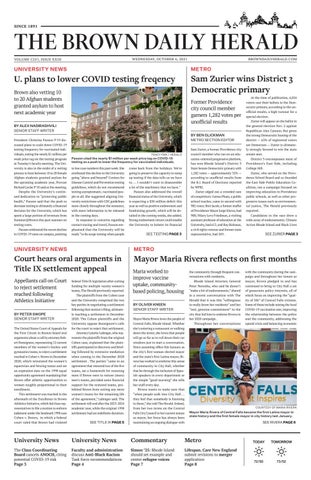
Mayor Maria Rivera of Central Falls became the first Latina mayor in state history and the first female mayor in city history last January.
University News
University News
Commentary
Metro
The Class Coordinating Board cancels ANOCH, citing potential COVID-19 risk Page 3
Faculty and administration discuss Anti-Black Racism Task force recommendations Page 4
Simon ’25: Rhode Island should set example and center refugee voices Page 7
Lifespan, Care New England submit revisions to merger application Page 8
SEE RIVERA PAGE 6
TODAY
TOMORROW
72/50
73/52
2
THE BROWN DAILY HERALD | NEWS
WEDNESDAY, OCTOBER 6, 2021
SPORTS
Athletes, administrators discuss COVID-19 return-to-play policy Seven-day sports reentry period aimed to minimize risk of cardiovascular issues BY PETER SWOPE SENIOR STAFF WRITER Due to concerns about the cardiovascular health of student-athletes following COVID-19 infection, the University has implemented a seven-day reentry period for athletes, a process aimed to ease them back into high-intensity competition and ensure that they are physically ready to return. “Providing for a safe reentry”: policy at the department level Back-to-play protocols are flexible based on the severity of cases, according to Colin Sullivan, deputy director of athletics. “There’s a baseline for the return to play,” he added. “But that could be extended based on whether it’s a mild, moderate or severe case.” Because other Ivy League schools have comparable policies, Brown’s protocol doesn’t lead to any competitive disadvantages, according to Sullivan. “It’s all about providing for a safe reentry.” Sullivan said that the process is informed by input from multiple levels of University staff. “The doctors in Health Services are working with our athletic training staff. Each of our teams has a designated athletic training contact,” he said. The process of reentry “is being very closely monitored, and decisions are being made at the athletic training and the medical level with guidance from our physicians here.” He also emphasized that Brown’s guidance is influenced by a number of other authorities, including the NCAA, CDC and the Rhode Island Department of Health. So far, Sullivan is not aware of any severe cases among athletes, with most being mild or asymptomatic. “Almost rewinding the clock”: contending with COVID-19 in what was supposed to be a ‘normal’ season For field hockey player Emma Rosen
’22, not being able to play after testing positive reminded her of last year’s cancelled season. “It was hard. Since (during) my junior year we didn’t really have any opportunities to play, I was really looking forward to my senior season. And literally just after having our first two games, I tested positive,” she said. “I felt like I was almost rewinding the clock, I was going back to when we weren’t allowed to play at all.” But Rosen emphasized that her time away from the team made her appreciate being able to play even more. “It did give me kind of a new perspective when I came back, not taking a second or minute or anything for granted when I’m on the field,” she said. Rosen’s field hockey teammate Celia Donner ’24 described being eased back in after her 10-day quarantine. “It was kind of a slow progression,” she said. “I just started with a 15 minute walk the first day and then slowly built up so that they could see how my heart reacted as my heart rate went up.” Donner’s symptoms were mild and she had no difficulties going through the protocol. While the wait felt prolonged, especially relative to her mild symptoms, Donner acknowledged the neccesity of the protocols. “It was definitely frustrating feeling like there was nothing physically wrong with me but still not being able to practice fully,” she said. “But it definitely was good just to be on the safe side of things and make sure that I was completely okay before getting fully back into it.” For her, the main challenge was the fitness she lost while in quarantine. “The only thing that really affected me was that I hadn’t been able to work out during the 10 days so I definitely wasn’t in the same shape,” she said. Rosen described the process as a gradual increase in allowable physical activity, starting at walks or light jogs in which her heart rate couldn’t exceed 130 beats per minute. The subsequent stages enabled her to slowly increase the intensity of her work outs. The completion of stage seven marked her official “graduation” from the protocols. For Donner, the protocol was flexible to allow her some competitive opportunities. “The first five (or so) days
VICTORIA YIN / HERALD
Other Ivy League universities have similar protocols for their athletic programs, ensuring that the seven-day reentry window will not put Brown athletes at a competitive disadvantage. of protocol we just had practices, so I did modified practice,” she said. “By the time we had more games I was able to play half of one of our games (and another) in full.” The impact of COVID-19 cases on the team has made the season difficult, but the team has pushed through, according to Donner. “Our coaches have done the best they can with adjusting and our team is definitely very adaptable,” she said. “Everyone’s done a really good job of just staying flexible and doing the best we can.” Rosen also appreciated the efforts her trainers made in helping her get back on the field. “I give our trainers a lot of credit, because I know my trainer really tried to help me move through the whole protocol as swiftly and smoothly as possible,” she said. “She didn’t want to rush through it, but she very much understood I was doing good and I really just wanted to get back out there.” “Trying to do our best to protect our student athletes”: how experts approach the situation Dr. Hung Le, a staff physician who works in Health Services and has played a key role in crafting Brown’s COVID-19
return-to-play policies, outlined the medical rationale behind the protocols. “The impact (of) COVID-19 infection is still being understood when it comes to cardiac manifestations. And that’s really the main concern for why we have a return-to-play protocol,” he said. “There are reports of COVID-related cardiac complications, (but) that finding is very, very uncommon.” While these cases are uncommon, there remains a risk of severe heart conditions, Le explained. “The biggest concern (we have) is that some patients have been documented, not at Brown but nationally, (with) heart inflammation called myocarditis that is associated with COVID infection,” he said. “And our concern is that if you have (myocarditis), it may lead to arrhythmias, which can be quite detrimental if you exert yourself at a high level.” Due to the nature of the pandemic, policies are fluid, Le explained. “We’re always learning new information and we use that new information to drive protocols when it comes to return to play,” he said. “Our current policy is driven by professional organizations (and) expert consensus and opinion.” He also added that a policy change is a possibility. “We are actively engaging
in conversation about changing these guidelines for return to play,” he said. “There was a recently published updated recommendation by two professional organizations, the American College of Cardiology (and) the American Medical Society for Sports Medicine. These two organizations came together and modified guidelines for return to play following COVID infection.” The new guidelines differ based on the nature of the COVID infection, Dr. Le explained. “An asymptomatic or mildly symptomatic patient may return to exercise as soon as three days following a positive test or symptom onset,” he said. “But that’s under the assumption that the symptoms are not cardiac or pulmonary-related symptoms. Once you have cardiac or pulmonary symptoms, then you have to be evaluated further before you get full clearance.” “Ultimately, the possibility of COVID-related cardiac complications is the driving factor behind the decisions,” he said. “It can be complicated, but the reason why we’re doing this is to identify folks who may be at the highest risk of having a cardiac-related complication that may be associated with a COVID illness. We’re trying to do our best to protect our student-athletes.”
WEDNESDAY, OCTOBER 6, 2021
THE BROWN DAILY HERALD | NEWS
3
UNIVERSITY NEWS
COVID-19 concerns cancel ANOCH for second consecutive year ANOCH canceled again due to COVID-19 concerns, CCB hopeful for future events BY NICHOLAS MILLER CONTRIBUTING WRITER On a Saturday night in October, Brown students from all grades would dress up in semi-formal attire and make their way to the Ruth J. Simmons Quadrangle. There, a huge tent would await them, housing live music performers, a photo booth and tables of food. Starting at 9 p.m., this night of dancing would last until well past midnight. This year, such a scene will not occur. ANOCH, or a Night on College Hill, is one of the largest events on the Brown calendar. The Class Coordinating Board has held it for six consecutive years from 2014 to 2019, attracting a range of 3,000 to 5,000 students each year, according to the Student Activities Office. Following its cancellation in 2020 due to the pandemic, the organizers from the Class Coordinating Board, after consulting with SAO, decided this year to cancel the dance despite moving forward with a number of other large events, including the Freshman Ice Cream Social, SophomOrientation and Senior Flatbread Night. “We wanted to make sure that people would be safe going to an event and we wouldn’t be able to guarantee that (for ANOCH),” said Mel Cui ’22, co-president of the class of 2022 CCB.
TESTING FROM PAGE 1 aid program and “strengthen Brown’s role in supporting social mobility and college access,” she said. Locke continued the meeting by discussing the University’s pledge to host Afghan students and scholars who have been granted asylum in the upcoming academic year. The University is currently vetting between 10 to 20 female Afghan students from the Asian University for Women. The University will “take care of their tuition, their fees, their meals, their housing and everything else they need to succeed here,” Locke said. Brown has also agreed to host at least two scholars from the Scholars at Risk Organization. Also at the meeting, Professor of Neuroscience Diane Lipscomb gave an update on the Task Force of Women Faculty as its chair. The task force will look at factors that influence the recruitment, hiring and retention of female faculty. “This is a really great opportunity. This is not just a Brown issue, it’s a na-
Bree Zhang ’22, co-president along with Cui, said that because ANOCH is open to all classes, it poses a larger public-health risk than other events the University and CCB have hosted. “For CCB moving forward, we just want to focus more on class-specific events,” she said. COVID-19 guidelines are also harder to follow at an event like ANOCH, Cui added. “The nature of the dance is that people are going to be very close to each other and we won’t be able to ensure that there is sufficient masking,” Cui said. Many of the large events that the University and CCB held this fall had far more attendees than expected, according to Cui, which prompted concern about the potential turnout at ANOCH. “A lot of people have missed that feeling of camaraderie with other undergraduates” Cui said. “ Public events, especially ones that are free, have a lot of turnout as a result.” Because of this, Cui and Zhang worried that ANOCH might be overcrowded and therefore unsafe. Joie Steele, director of student activities and advisor to CCB, wrote in an email to The Herald that planning delays due to the pandemic also made the event complicated to hold. The process of organizing ANOCH typically starts in the spring, but was postponed due to uncertainty about the fall’s public health conditions, according to Steele. Although Cui stressed that the biggest factor was public health conditions, she added that “planning on such short
tional issue and in fact an international issue,” Lipscombe said. “It’s important … to really think about the impact that we can have within this community.” Chair of the Task Force on Doctoral Education and Associate Dean of Academic Affairs Thomas Lewis also shared updates on his task force’s progress. The task force will focus on establishing organizational systems to enable the University’s graduate programs to be “world class.” Lewis explained that the task force will address issues relating to current graduate students, who are worried about completing their work in a “timely way and … launching into successful careers” following the pandemic. Both task forces are just beginning their work, and their chairs stressed the importance of faculty collaboration and input. Locke also discussed the Program on Financial Innovation and Sustainability, elaborating on the ad hoc committee’s recommendations. These include more strategic purchasing on behalf of the University through eProcurement technology, diversifying rev-
COURTESY OF CCB
ANOCH, or a Night on College Hill, is one of the largest events on the Brown calendar, with CCB hosting the dance every year from 2014 to 2019. This year’s cancelation was decided in consultation with SAO. notice … would have been difficult.” Over the summer, Cui and Zhang began partially planning for the event. When she returned to campus for the fall, Cui thought ANOCH would be able to happen. She said CCB had already lined up musical performers and a lighting service. But when the University announced new COVID-19 restrictions Sept. 13 amid a spike in on-campus cases, “we started to shift our mindsets,” Cui said. CCB is now hoping to host larger events in the spring. “If the health situation allows for it, we will definitely have a lot of great events in the
enue and reducing the rate of tuition growth through the likes of online programs and marginally growing the undergraduate population through increased participation in study-away programs. During the meeting, the Nominations Committee appointed Professor of English Philip Gould and Senior Lecturer in English Emily Hipchen as interim fall appointees to the Tenure, Promotions and Appointments Committee and Standing Committee for Academic Code respectively, with 94% of faculty voting in favor. The meeting also featured a moment of silence for Mutlu Konuk Blasing, former professor emerita of English, who died on Aug. 16. Blasing’s “students were ever-inspired by (her) intellectual breadth, her vast knowledge of American poetic traditions and her rigorous attention to language and form through close reading,” said Richard Rambuss, professor of English. “Her decades-long career at Brown introduced hundreds of Brown undergraduates to a wide range of American poets.
spring that will make up for not having ANOCH in the fall,” Cui said. Possible spring events include Gigs on the Green, the largest student music festival, and Gala, a formal dance open to all classes, along with Spring Weekend and Senior Week. Zhang also emphasized that specific classes could hold their own dances in the spring if there is enough interest. Although they said that they are excited for the spring events, Cui and Zhang personally found the decision to cancel ANOCH to be difficult. “For a lot of members on CCB, ANOCH was the very first event that
they attended or the very first event that they staffed.” Cui said. “It definitely is an important event and we are sad we can’t plan it this year,” “The atmosphere (at ANOCH) is electrifying. When you see there’s so many people there, you meet a lot of new people. … It’s a very unique experience and knowing that it’s planned by students is also very cool,” she said. Despite the disappointment, Cui and Zhang maintain that canceling ANOCH was the right decision. “We wouldn’t want our event to be a superspreader,” Zhang said. “It’s for the best.”
COURTESY OF SAM ZURIER
Zurier served on the Providence School Board, co-founded the East Side Public Education Committee and spent eight years on city council.
ZURIER FROM PAGE 3 Matter backed Pham, while the Providence Firefighters Union put its support behind Friedman. Rickman was endorsed by the Black Political Action Committee, and Jacob was backed by the Working Families Party. For his part, Zurier garnered the support of his colleagues in state politics, notably City Councilwoman Helen Anthony and State Rep. Edie Ajello. The special election was called after Sen. Gayle Goldin resigned from her
post in August to serve in the Biden administration as a senior adviser for the U.S. Department of Labor Women’s Bureau. The race was the first Democratic primary in the district since Golden first ran for her seat. Candidates faced off on a number of issues ranging from social justice to climate change. Pham and Jacobs both ran on progressive platforms that promised to bring change to Providence’s marginalized communities through increased representation, housing reform and a host of other social programs.
4
THE BROWN DAILY HERALD | NEWS
WEDNESDAY, OCTOBER 6, 2021
UNIVERSITY NEWS
Faculty, Paxson discuss Task Force on Anti-Black Racism recommendations Faculty to formally acknowledge Juneteenth as University holiday BY ALEX NADIRASHVILI SENIOR STAFF WRITER Members of the University’s administration and faculty discussed the Task Force on Anti-Black Racism at the second faculty meeting of the semester Tuesday. President Christina Paxson P’19 opened the meeting by addressing the task force’s recommendations. She highlighted the University’s “progress in compositional diversity,” citing the doubling of the number of Black faculty members since 2014 and the increase of the Black student population to 14% of the student population. “What the report really underscores … is that we have work to do in the areas of inclusion, how people are treated on campus, … to focus even on compositional diversity in (both academic and administrative) departments,” Paxson said. The University has already adopted many of the Task Force’s recommendations, including doubling the size of the Presidential Diversity Postdoctoral Program, planning renovations to both Churchill and Harambee Houses, expanding part-
nerships with Historically Black Colleges and Universities and fostering more engagement with Black high schoolers in Rhode Island. Paxson also spoke about the second edition of Brown’s Slavery and Justice Report, which will be a “fully-digital edition with new content and essays.” The original report was chosen as the University’s first-year reading this year, for the second year in a row. Currently, the University is discussing making the report a permanent addition to new student orientation, independent from the first-year reading. The University also recently received approval for its first steps in creating a program funded by the Howard Hughes Medical Institute, which would be “aimed at bringing diverse students, again with a focus on Black-identified students, into the sciences, … social sciences and humanities,” Paxson said. Paxson spoke to several other recommendations, the future of which she said must be determined on a faculty level. These recommendations included having every concentration require a course that prioritizes Black history, culture and scholarship and the creation of an Anti-Racist Science, Technology, Math and Medicine Institute. The Institute would provide a place on campus for scientists and engineers to study the effects of racism in their fields, according to the
task force’s report. These programs “grow out of faculty-led initiatives, they go through the Academic Priorities Committee as they grow, they come to the faculty for approval,” Paxson said, adding that the Institute at Brown for Environment and Society and the Brown Arts Institute have gone through similar processes. “This report identifies anti-Black racism as a force that does significant harm to Black students, to Black faculty and Black staff, but (that) ultimately diminishes all of us,” said Seth Rockman, associate professor of history and a member of the Task Force. “I urge all members of the faculty to spend time with this report, to read it and to follow some of the ways in which it suggests that combating anti-Black racism has a great deal to do with our larger (Diversity and Inclusion Action Plan) goals.” The Diversity and Inclusion Oversight Board, as well as the Corporation Committee on Diversity, Equity and Inclusion “will work to provide governance and oversight” over the University’s progress throughout the year, Paxson said. The Faculty Executive Committee also passed a motion with a 98% majority to update the “principles governing the academic calendar” by a formal acknowledgment and observation of Juneteenth as a University holiday.
Support The Herald www.browndailyherald.com/donate CA L E N DA R
COVID -19 AT BROWN LAST 7 DAYS*
OCTOBER S
3
M
4
Tu
5
W
6
Th
7
Completed Tests
People Tested
F
S
15,480
11,929
1
2
Confirmed Positives
Positivity Rates
7
0.0 %
8
9 SINCE AUGUST 24, 2020*
10
11
12
13
14
15
16
17
18
19
20
21
22
23
24/31
25
26
27
28
29
30
Completed Tests
People Tested
536,257
17,968
Total Cases
Prevalence
788
4.4 %
*AS OF OCT. 5
WEDNESDAY, OCTOBER 6, 2021
THE BROWN DAILY HERALD | NEWS
5
TITLE IX FROM PAGE 1 Reasons for appeal Bonsignore and his clients aim to restore the original 1998 judgment. “Our goal is (the reinstatement of) ... the judgment that was entered by a court and not appealed and (that) had ... a framework in place that worked extremely well to create equality and fairness and openness,” he said. He noted that when the University has previously come close to violating Title IX, the 1998 judgment stopped them. “This (judgment) was set in stone, ... and it worked well,” he said. Bonsignore also emphasized the significance of the 1998 decision being a court judgment rather than a settlement.. “It’s a formal endorsement by the court,and it’s an order from the court,” he said. “You don’t backtrack on an order.” Labinger, who was involved in the litigation leading up to the 1998 judgment, also praised the court judgement despite her defense of the 2020 settlement. “It appeared to deter Brown from taking any of those actions for over 20 years. During that time, (Brown) added women’s teams: equestrian and rugby,” she said. “We also built in what we thought was a substantial deterrent, which was (that) if you elevate any men’s team or you disadvantage any women’s team, that gap (that) is permissible drops from 3.5% (variance) to 2.25% (variance),” she said. The 1998 joint agreement states that beginning July 1, 2001, the fraction of varsity opportunities for women at Brown could not fall more than 3.5% below the fraction of undergraduates who are women; that variance would drop to 2.25% if Brown eliminated any womens’ team. Bonsignore represents 12 appellants who are members of the women’s hockey and gymnastics teams, neither of which lost varsity status. Consequently, supporters of the settlement defended it by pointing to the fact that no affected athletes joined Bonsignore’s appeal. He countered, arguing that the affected athletes were unaware of the settlement and of their possible recourse. Additionally, he argued that the original plaintiffs comprising the class representatives do not adequately represent current and future athletes and their interests. “They had their rights affected, but they received no notice of this,” he said. Labinger said that neither the objecting athletes nor Bonsignore himself directly communicated with her about the appeal. They only had contact through the formal objection and briefing. “We worked with about 50 of the class member women athletes, who were primarily on the teams that had been cut, pretty much from the time that they were notified of the cuts right through the settlement,” she said. “We’ve been in contact with
COURTESY OF BROWN ATHLETICS
The December 2020 settlement was reached following months of legal standoff between the group of plaintiffs and the University. The settlement reinstated the women’s equestrian and fencing teams and put an end date on the original court judgment from Cohen v. Brown from 1998. them, as well as our class representatives, throughout this proceeding, so everyone who wanted to be informed was informed and we collected a lot of information from folks.” Bonsignore found the emails between Chancellor Samuel Mencoff ’78 P’11 P’15 and President Christina Paxson P’19, — detailing intentions to “kill this pestilential thing,” referring to the consent decree — to be particularly incriminating evidence of Brown’s tactical approach to relieving themselves of the judgement’s constraints. The emails, which he called a “smoking gun,” demonstrated an intent to manufacture outrage, he argued, diverting anger away from the University and instead toward the Title IX judgement to get out of the consent decree. Bonsignore further accused Brown of being uninterested in promoting gender equity in sports. “I don’t think that they want to treat women as they’re required to do under the law. Title IX says you have to spend this amount of money (on women’s sports), and they didn’t want to do it,” he said. “They just decided … to try these dirty tricks, ... and that’s why we’re in the Appeals Court.” Labinger defends settlement While Labinger acknowledged the flaws of the settlement, she believes its overall impact is positive. “We wouldn’t have entered (into the settlement) if we didn’t think it was a favorable outcome,” she said. “It wasn’t the best outcome. The best outcome, of course,
would be putting all the teams back. Our goal was to maximize the number of participation opportunities that we felt we could that the law would require.” “Part of the settlement was that (Brown) restored two of the teams — equestrian and fencing,” she added. “If there’s no settlement, Brown won’t be required to restore them and won’t be required to not cut any other teams.” On the issue of proportional variance between the number of male and female athletes in Brown’s athletic program, Labinger conceded that perfectly equitable representation will be difficult to achieve when negotiating with Brown. “As I said both to the court and on many occasions, mathematical purity, which is zero percent (variance) for each gender, is not something that we consider a good outcome,” she said. Labinger and Bonsignore diverged in their speculations about what might happen after the December 2020 settlement expires in 2024, if it is upheld by the Appeals Court. “From (the) plaintiff’s perspective, we felt that we were not sacrificing the interests in any respect of our class members by putting an end date on the settlement,” Labinger said. “I don’t see Brown reversing course. It, probably more than most, understands what it needs to do and (that) it will not have the protection of the 2.25% (variance). I view it as a shield at this time more than a sword.” She also believes that the standard of 2.25% variance ultimately had detrimental consequences to gender equity in sports in the aftermath of the Ex-
cellence in Brown Athletics Initiative. After restoring the men’s track and field and cross country teams, Brown turned away from targeting proportionality between women’s and men’s teams based on undergraduate enrollment numbers to instead doing what it needed to meet the 2.25% variance requirement. “That is not (what) we want Brown to have as their goal,” Labinger said. “Their goal should be as close to proportionality (of men and women athletes to undergraduate enrollment numbers) as they can get.” Bonsignore offered a more grim prediction, speculating that Brown would “treat the women disparately (and) ... force the women to litigate” alleged violations of federal Title IX, rather than regularly prove its own compliance through the mechanisms of the consent decree, he said. “It’s going to be costly (and) no one’s going to take their cause, and the women will be treated like second-class citizens.” “I’m very proud of the student athletes that learned about this and contacted me and stood up for their rights. Whether it does them any good or not, at least they went down fighting.” University responds to appeal The University denied Bonsignore’s allegations and affirmed its commitment to gender equity in sports. “Each of those claims is unfounded,” University Spokesperson Brian Clark wrote in an email to The Herald. “As President Paxson said directly upon final court approval of the settlement: ‘From the
outset of this initiative, Brown’s efforts have been about one thing — increasing opportunities for our student-athletes to be part of a competitive program. The Cohen agreement served an important purpose when it was signed 22 years ago, but Brown’s commitment to women athletes transcends the agreement. We can provide excellent athletics opportunities for women and men, be a leader in upholding Title IX and have a competitive varsity program. And we will.’” During oral arguments in September, the University’s attorney Marcella Coburn rejected any proposed legal grounds upon which the settlement could be overturned. “The District Court acted well within its considerable discretion when it approved the settlement as fair, reasonable and adequate and objectors have presented no basis to overturn that decision,” she told the court. “Objectors’ argument that the class representatives are per-se inadequate because they’ve graduated from Brown is refuted by decades of Supreme Court precedent.” “The District Court’s conclusion that the settlement was substantively reasonable was also well within its considerable discretion,” she said in further defense of the settlement. “After extensive discovery, it provides adequate relief to the class, treats the members of the class fairly and the overall reaction of the class, noting that these 12 objectors are the only objectors (out of) hundreds of people, illustrates its reasonableness.”
THE BROWN DAILY HERALD | NEWS
6
RIVERA FROM PAGE 1 development with access to affordable housing. Alongside her policy agenda, Rivera is cognizant of the importance of presiding as the first Latina mayor of a city that is more than 66% Hispanic or Latinx, partially because she knows the value of representation. “I have all these young girls looking up to me right now, who — because I’m in this position — can say, ‘I can do it!’” she said. Journey to City Hall Before acquiring this post, Rivera had not imagined pursuing a career in politics. Born in Camden, New Jersey to a mother who had emigrated from Puerto Rico, Rivera spent the first 10 years of her life in Chicago. There, she learned English in school while her mother got by for a period of time with welfare assistance. Eventually, Rivera’s family moved to Central Falls, where her mother began working despite her lack of English fluency. “I (have) seen her struggle, I (have) seen her work so much and that (pushed) me to do more, especially because I have a daughter,” Rivera said. Rivera worked in government for 16 years as a caseworker for Rhode Island’s Department of Human Services, but she entered into the world of politics after taking a class in 2014 offered by the Rhode Island Latina Leadership Institute. The leadership course tasked its students with overcoming a challenge, and Rivera chose to overcome her fear of public speaking. Rivera said the other women in the class taught her “how to believe in (herself),” and after 10
months, she was prepared to speak at the Institute’s 10-year anniversary. “After that, I had tons of people reaching out to me, especially elected officials … to see if I could open up their events,” Rivera said. People soon began urging her to run for public office. Eventually, Rivera joined the Central Falls City Council, rose to the rank of City Council president and launched a campaign for mayor. According to Rivera, the relationship she fostered with the community while on the City Council greatly aided the campaigning process, adding that when she tried to talk about her platform amid the praise she received at events, “people didn’t want to hear it, because people already knew me from being out and about.” She attributes her 77% electoral victory last November to the conversations she had with the residents throughout her career in politics, as well as to her own community membership. “I know the challenges that my community faces because I have been there,” she said. “My family has been there.” James Diossa, who served as the first Latino mayor of Central Falls before reaching his term limit in 2020, endorsed Rivera’s campaign. He said that her work on the City Council, which distinguished her as a “very strong” and “capable” problem-solver, prompted him to realize that “she needed to be the next mayor of Central Falls.” While relinquishing office was “an emotional process” for Diossa, he said he was comforted by the belief that he was “passing the torch” to someone he knew would “continue the good work in moving Central Falls in the right
direction.” Pandemic challenges, reconceptualizing policing Rivera, who assumed the mayorship during a pandemic that left her city as one of the hardest hit in the state, said her proudest accomplishment was her team’s work to combat COVID-19 during the six months that followed her inauguration. She and her staff worked a “Sunday-to-Sunday” job tending to pandemic-related issues, hosting events to distribute food and connect residents to housing resources, promoting vaccination and often volunteering to operate weekend vaccine clinics that served 800 to 1,000 people in a day. It was important to Rivera that she and her staff, rather than the police or the National Guard, hosted these clinics at the beginning of the pandemic in order to gain the trust of the community. She stresses that the lack of vaccine uptake could largely be attributed to the fear of deportation among undocumented community members, rather than an unwillingness to get vaccinated. “If it wasn’t (for) the team I put together,” Rivera said, “I don’t think a lot of our undocumented residents would have gotten vaccinated.” Despite the rigor of this work, Rivera said that her biggest challenge was replacing the city’s police chief. Following the resurgence of the Black Lives Matter movement in summer 2020, Rivera knew she needed Central Falls residents “to feel comfortable with (their) police department.” Rivera made it a priority to expand the community policing unit — which, at the time, only included four officers — to include the whole
SINCE 1891
THE BROWN DAILY HERALD Editorial Leadership Editor-in-Chief Kayla Guo Managing Editors Henry Dawson Li Goldstein Senior Editors Kate Ok Kamran King Emily Teng Emilija Sagaityte Editorial Page Editor Johnny Ren
Metro Editors Ben Glickman Ben Pollard Julia Grossman Katie Chen Liza Mullett Victoria Yin News Editors Caroline Nash Caelyn Pender Gaya Gupta Jack Borris Livia Gimenes Jack Walker Science & Research Editors Rahma Ibrahim Claire Liu
post-magazine Editor-in-Chief Olivia Howe Sections Arts & Culture Editors Irene Chou Nicholas Michael
Augustus Bayard Jaehyun Hong Matt Walsh Clara Gutman-Argemí Johnny Ren Multimedia/Production Design Editors Anya Semizhova Keelin Lyons Lena He Raphael Li Head Photo Editors Areez Khan Nicole Kim Copy Desk Chief Catherine Healy
Sports Editor Ryan Handel
Assistant Copy Desk Chief Lily Lustig
Commentary Opinions Editors
Illustrations Head Loki Olin
Graphics Editor Usha Bhalla Podcast Ben Glickman Corey Gelb-Bicknell Olivia Burdette Business General Managers Michael Wang Noah Colón Office Manager Chelsey Barton-Keenes Directors Sales: Annika Sigfstead Finance: Andrew Willwerth Digital Director of Technology Jed Fox
@the_herald
facebook.com/browndailyherald
@browndailyherald
youtube.com/browndailyherald
88 Benevolent St., Providence, RI (401) 351-3372 www.browndailyherald.com Editorial: herald@browndailyherald.com Advertising: advertising@browndailyherald.com
department, in order to increase its engagement with the community. Former Providence Police Sargeant Anthony Roberson shared Rivera’s same “vision for community policing.” Rivera revealed the month after her election that Roberson would become the first Black police chief of Central Falls, assuming the role that former Chief Daniel Barzykowski had held for the last 21 years. The decision provoked critiques from members of the police union, who said at the time that they felt blindsided by her decision to replace the veteran chief. Rivera admitted that it was sometimes difficult to maintain faith in her decision while many people shared their disapproval online, but she was determined to not think “about what people from the outside were going to say.” She added, “I needed to stay focused on the reason behind it.” Now, “everything has changed so much,” Rivera said. Officers from the whole department, all of whom have completed a roughly 40-hour nonviolence training program, attend community events and strive “to build important relationships” with residents, she said, adding that members of both the department and the community tell her they are happy with the change in policing. Neronha said the “positive” dynamic between the residents and the police department is self-evident at community events. “That’s a real challenge in today’s environment, and Mayor Rivera is a big part of making that happen,” he said, emphasizing the “inspired choice” of appointing Roberson. Leaving a legacy In the future, Rivera is interested in
WEDNESDAY, OCTOBER 6, 2021 fostering economic growth in the city. She added that a Pawtucket-Central Falls train station offering service to nearby cities such as Boston, which is expected to open in 2022, has the potential to encourage people from other municipalities to support local businesses and invest in the city. While Diossa said the train station offers “unique opportunities,” he speculated that balancing this with the “overall concern of gentrification” will be a primary focus of Rivera in the coming years. Rivera, who said she is “huge on economic development,” also acknowledged the “need to focus on the residents that live here” and ensure they aren’t pushed out by increasing housing prices. She underscored an intention to expand affordable housing in the city to counter the threat of displacement. “If there’s anybody who could handle those kinds of complicated issues, it’s Mayor Rivera, and (so far,) she’s doing very, very well,” Neronha said. When Rivera’s tenure ends, Neronha said he hopes to see “a city that is vibrant, that has made strides economically” and “is well positioned for the rest of the 21st century.” Diossa said he looks forward to seeing Rivera continue his work of restoring faith in government among a community of immigrants who have had negative experiences with “corrupt, dangerous” authorities in their countries of origin. “It’s not impossible to do good things in this one square mile,” he said. Rivera has “been able to show that in her first months in office, and I think she’s going to leave a very important legacy as the first woman (elected) mayor of Central Falls.”
Submissions: The Brown Daily Herald publishes submissions in the form of op-eds and letters to the editor. Op-eds are typically between 750 and 1000 words, though we will consider submissions between 500 and 1200 words. Letters to the editor should be around 250 words. While letters to the editor respond to an article or column that has appeared in The Herald, op-eds usually prompt new discussions on campus or frame new arguments about current discourse. All submissions to The Herald cannot have been previously published elsewhere (in print or online — including personal blogs and social media), and they must be exclusive to The Herald. Submissions must include no more than two individual authors. If there are more than two original authors, The Herald can acknowledge the authors in a statement at the end of the letter or op-ed, but the byline can only include up to two names. The Herald will not publish submissions authored by groups. The Herald does not publish anonymous submissions. If you feel your circumstances prevent you from submitting an op-ed or letter with your name, please email herald@browndailyherald.com to explain your situation. You can submit op-eds to opinions@browndailyherald.com and letters to letters@browndailyherald. com. When you email your submission, please include (1) your full name, (2) an evening or mobile phone number in case your submission is chosen for publication and (3) any affiliation with Brown University or any institution or organization relevant to the content of your submission. Please send in submissions at least 24 hours in advance of your desired publication date. The Herald only publishes submissions while it is in print. The Herald reserves the right to edit all submissions. If your piece is considered for publication, an editor will contact you to discuss potential changes to your submission. Commentary: The editorial is the majority opinion of the editorial page board of The Brown Daily Herald. The editorial viewpoint does not necessarily reflect the views of The Brown Daily Herald, Inc. Columns, letters and comics reflect the opinions of their authors only. Corrections: The Brown Daily Herald is committed to providing the Brown University community with the most accurate information possible. Corrections may be submitted up to seven calendar days after publication. Periodicals postage paid at Providence, R.I. Postmaster: Please send corrections to P.O. Box 2538, Providence, RI 02906. Advertising: The Brown Daily Herald, Inc. reserves the right to accept or decline any advertisement at its discretion.
The Brown Daily Herald, Inc. is a financially independent, nonprofit media organization bringing you The Brown Daily Herald and Post- Magazine. The Brown Daily Herald has served the Brown University community daily since 1891. It is published Monday through Friday during the academic year, excluding vacations, once during Commencement and once during Orientation by The Brown Daily Herald, Inc. Single copy free for each member of the community. Subscription prices: $200 one year daily, $100 one semester daily. Copyright 2021 by The Brown Daily Herald, Inc. All rights reserved.
WEDNESDAY, OCTOBER 6, 2021
THE BROWN DAILY HERALD | COMMENTARY
7
Simon ’25: More than charity — it’s time to reenvision refugee aid BY ALISSA SIMON STAFF COLUMNIST
Centuries after the freedom-seekers of Roger Willams’ time arrived in droves to Rhode Island to escape religious persecution, the state, along with the rest of the nation, finds itself in a new age of asylum. As the United States withdraws from Afghanistan, political rhetoric about the implications for Biden’s administration or the nation’s foreign policy has permeated the country. But there’s another perspective to consider: that of the displaced Afghan citizens leaving their country behind — up to 95,000 of whom will be resettled across America, including in its smallest state. New England is anticipating an influx of more than 1,500 refugees over the next several months. Over a dozen have already arrived in Rhode Island and an additional 250 refugees are projected to come to the state by the end of October and begin the long road of economic and social integration that lies ahead. It’s a crisis, but also an inflection point. Rhode Island isn’t just inheriting the consequences of American interventionism; it’s now met with an opportunity to set an example by centering those receiving aid rather than those giving it. Much has been written about America’s responsibility to these Afghan citizens, along with refugees from a wide swath of other countries experiencing human rights crises. Providing shelter to those fleeing persecution is a mission that every nation should seek to undertake. However, the structures of humanitarian aid as they exist in America are guided by a specific vision of the nation as both a global policeman and a place of refuge for those fleeing violence in developing regions. This sense of responsibility can be slippery. When the rhetoric of so many politicians, including Rhode Island’s own, frames resettling
refugees as a resource drain on the state, albeit a necessary one, it calls to mind the same schools of thought that gave rise to the concept of “The White Man’s Burden” over a century ago. To be clear, there is nothing fundamentally wrong with the instinct to protect and promote human rights. The issue lies instead
meant to serve, rather than remaining reliant on the goodwill of philanthropists or the government. The slogan often associated with the movement is “solidarity, not charity.” Initiatives like the Rhode Island Solidarity Fund, a combined effort of six statewide mutual aid groups, help consolidate fundraising to free the unjustly incarcerated and realize rapid
“Rhode Island isn’t just inheriting the consequences of American interventionism; it’s now met with an opportunity to set an example by centering those receiving aid rather than those giving it.”
in the power dynamic inherent to almost any charity work that places its emphasis on the actors providing the aid as opposed to the ones receiving it. But, what then, are our options? The Trump administration defunded and destabilized the country’s programs for immigrant and refugee protections. And even before their budgets were slashed, those programs relied on the same problematic idea of responsibility through charity. One way out of this dilemma lies in a practice that has long existed outside the margins of government — mutual aid. Mutual aid is a term that has many different meanings. In the context of welfare policy, it refers to the idea that structures of aid should be reciprocal, built from the bottom up and incorporate a large degree of input from the people they’re
responses to housing insecurity. Operating under the goals of “self-sufficiency and integration,” the Refugee Dream Center of Rhode Island — founded by Dr. Omar Bah, a refugee himself — hosts programs ranging from individual case management to health education courses. Local news has lauded the center and it finds success in part because it is run by a dedicated team of individuals who personally understand the intricacies of the refugee experience. The deterioration of governmental humanitarian relief programs coupled with the steady lowering of refugee caps under the Trump administration was a disaster. However, as the country seeks to rebuild these programs, it is well positioned to reconceptualize how to expand them in ways that are more
grounded in the realities they address. Collaboration with existing refugee communities and mutual aid networks is a way forward. For instance, consider a scenario where instead of having to build their budgets from the ground up, local organizations could draw from a pool of federal or state funding set aside specifically for mutual aid groups to widen the reach of their projects without having to change their tactics or structure. Mutual aid networks hold the solutions we need, but they require additional resources and attention invested directly into them rather than filtered through bureaucracies. Championing the values behind mutual aid also means taking an active role in not only ensuring the security of families arriving on U.S. shores, but advocating for their rights and dignities. Refugees are provided with food and housing but they are still given only temporary immigration status, making it near impossible to establish lives and careers while also being denied access to visas and government programs. The conversation around resettling refugees reaches, at least in progressive circles, an easy consensus on the need to provide basic levels of material support. But it rarely extends into policy changes that would enable refugees to not only survive here, but to thrive. Lawmakers and citizens alike should heed the calls of community organizers, invest in their projects and advocate for their visions. The issues leading Afghans to seek asylum may have global roots, but it is ultimately work at the local level that will have the most impact in determining their futures. Let them determine that future. Alissa Simon ’25 can be reached at alissa_ simon@brown.edu. Please send responses to this opinion to letters@browndailyherald. com and other op-eds to opinions@browndailyherald.com.
WEDNESDAY, OCTOBER 6, 2021
THE BROWN DAILY HERALD | NEWS
8
METRO
Lifespan, Care New England submit revised merger application University collaboration with health care system to begin after completion of merger BY CAELYN PENDER UNIVERSITY NEWS EDITOR Lifespan and Care New England, Rhode Island’s two largest health care systems, submitted a revised Hospital Conversions Act application to the Rhode Island Attorney General’s Office and the Rhode Island Department of Health Oct. 1, according to a Monday press release. The application seeks approval for the two health care systems’ proposed merger and the revision addresses “follow-up questions” from the Attorney General’s Office and RIDOH to the original April application. The questions address “charity care, quality, population health, health equities and diversity,” Kathleen Hart, director of public relations at Lifespan, wrote in an email to The Herald. The University announced its intention to form an integrated academic health system with Lifespan and Care New England in April, The Herald previously reported. Through the partnership, the University will contribute research and medical education while Lifespan and Care New England supply clinical practice and resources from teaching hospitals, all with the goal of providing Rhode Island residents with
world-class physicians and “health care from birth to end of life,” President Christina Paxson P’19 previously wrote in an email to The Herald. Brown plans to invest at least $125 million into the partnership over the next five years. The University will have voting membership on the Board of Directors of the merged system, and the chair of the health system will become a voting member of the Corporation — the University’s highest governing body. The follow-up questions to the April application are a means for RIDOH and the Attorney General’s Office to “get the information we need to conduct our analysis,” wrote Kristy dosReis, public information officer at the Attorney General’s Office, in an email to The Herald. “It’s not uncommon, particularly in a transaction of this magnitude and complexity, to go back to the parties and request more information,” dosReis added. The Attorney General’s Office will have until Nov. 16 to approve the application, to approve it with certain conditions or to deny it, dosReis wrote. “In determining whether or not to approve a transaction, we will be evaluating the proposed transaction’s impact on health care quality, affordability and accessibility for Rhode Islanders,” dosReis added. RIDOH will conduct its own analysis of the application. Lifespan and Care New England initially submitted an antitrust filing under the Hart-Scott-Rodino Act to the Federal Trade Commission in April,
LEON JIANG / HERALD
The University’s partnership with the merged health care system will include investing at least $125 million and retaining voting membership of the merged entity’s Board of Directors. according to the press release. Over the past few months, the two companies have submitted several thousand pages of documents to answer “the FTC’s most pressing questions.” The two companies will respond to the FTC’s information requests in the coming weeks with more documentation. The University will begin its collaboration with the health care system after the merger is complete, University Spokesperson Brian Clark wrote in an email to The Herald. There is not yet a set timeline for the University’s involvement. Because the University is not legally a party in the merger, it will play no role in the application or revisions process. Since the announcement of the partnership, the University has focused on working with “stakeholders and constituencies to share the vision for the
integrated academic health system and why it is good for the people of Rhode Island and for the region,” Clark wrote. “Brown brings tremendous expertise in medical education, public health and research,” Clark added. “We have the opportunity to seamlessly integrate medical education and research with the clinical care at the patient bedside while also advancing biomedical discovery, educating future leaders in medicine and public health and creating a vibrant economic nexus in the region based on the health care industry.” “Our first priority is to ensure that the affiliation moves forward in a way that improves healthcare in our state for patients, creating a system meeting the needs of all in our community, across race, language and income,” Timothy Babineau, president and CEO
of Lifespan, said in the press release. The combined health care system will be better equipped to handle financial difficulties, healthcare worker shortages and the lingering effects of the COVID-19 pandemic, according to the press release. The merger also aims to improve access to and quality of health care, boost research and innovation and reduce health disparities. “We are pleased that the process has continued on track and look forward to continued dialogue with our regulators to ensure that they have all the necessary information to review and ultimately approve the proposed transaction,” James Fanale, president and CEO of Care New England, said in the press release. “With everything going on in the world and in healthcare today, we must create the most resilient system as we can.”