SINCE 1891
THE BROWN DAILY HERALD WEDNESDAY, SEPTEMBER 19, 2018
VOLUME CLII, ISSUE 65
WWW.BROWNDAILYHERALD.COM
Bike share program comes to Providence Hillel group provides space for Jewish students of color Hillelin’ with Melanin addresses intersectional identities, lack of representation By MAIA ROSENFELD STAFF WRITER
COLLIN HAM / HERALD
A University internal task force communicated with the City about the new bike share program and suggested campus locations for bike hubs. As of Sept. 15, there were 400 JUMP Bikes in Providence.
Uber-owned JUMP Bikes launched Sept. 6 with hundreds of bikes operational in Providence By DYLAN MAJSIAK SENIOR STAFF WRITER
METRO
As classes kicked off this semester,
so did JUMP Electric Bikes — a new bike-share program that brings hundreds of red dockless bikes to Providence. Uber, which purchased JUMP Bikes in spring 2018, and the City of Providence partnered to allow community members to rent bikes through the Uber or JUMP Bike apps. To rent a bike, users can select any of the small bike icons on either app to find a charged bike nearby. Once the JUMP
Bike is reserved, the app provides a pin to unlock the bike’s built-in lock. After each use, the bikes are either returned to a JUMP Bike hub — such as the one in front of Metcalf Research Building on Thayer Street — or to a public bike rack, a streetlight pole or another public spot. There are multiple ways to pay for the service. Riders can decide to pay $2 for 30 minutes of riding, and then pay » See JUMP, page 2
Last spring, Brown/RISD Hillel welcomed a new student group that strives to foster community among Jewish students of color. Hillelin’ with Melanin — created by Tessa Palisoc ’20 and Nicole Spring ’20.5 — is a social group that celebrates the students’ intersectional identities and increases their visibility on campus. “It’s hard when there’s very little visibility for Jews of color to find a space,” Palisoc said. “You think that there isn’t anyone like you, you think that there isn’t a space for you — but there is, and so we wanted to establish and create it.” According to Jordan Mann ’15, who started working for Hillel last fall as a staff liaison for student groups, Hillel used to house a similar group called Jews of Color, though the number of members dwindled over the past few years. Hillel staff wanted to
revive it, and Mann especially felt it was important to create a space at Hillel for Jewish students of color. One member of the group, Cameron Chaleff ’20, finds this space especially important because it allows her to find community without always placing identity at the forefront. “Hillelin’ with Melanin is more of just a social group,” Chaleff said. “It lets you be in a Jewish space and be in a people-of-color space without really thinking about each of those at every moment, and that’s been so awesome. I’ve never experienced anything like that before coming here.” The group meets about every other week for fun and relaxing programming, with many of its events centering on Jewish holidays. A recent event celebrated Rosh Hashanah, the Jewish New Year, and was themed “Apples to Apples with Honey,” following the tradition of eating apples with honey on the holiday. Upcoming events include a sunset barbeque picnic on Hillel’s balcony to celebrate the Jewish holiday of Sukkot and a bowling disco night in February to celebrate Black History Month. Hillelin’ with Melanin aims to » See HILLEL, BACK
Alum talks personalized mindfulness at School of Public Health Postdoc Michael Sacchet ’10 discusses research, methods for analyzing interregional connections By PRIYANKA PODUGU UNIVERSITY NEWS EDITOR
Matthew Sacchet ’10, a postdoctoral scholar from Stanford University, delivered a lecture at the School of Public Health Tuesday on “personalized mindfulness practices,” according to the event description. Sacchet began by pointing to a quote from Jon Kabat-Zinn, founding executive director of the Center for Mindfulness in Medicine, Health Care and Society at the University of Massachusetts Medical School, as a common definition of mindfulness: “paying attention in a particular way, on purpose, in the present moment and non-judgmentally.” Sacchet added that he is “particularly interested in … moving beyond targeting psychiatric disorders and really trying to target specific individuals (and tailoring) mindfulness-based interventions for what that specific
SCIENCE & RESEARCH
INSIDE
person needs.” There are several questions in the field that still need to be answered, Sacchet said. “What is the neuroscience of mindfulness?” he asked. “How can we leverage the insights of the neuroscience of mindfulness to develop more effective treatments?” In his lecture, Sacchet spoke about his research to better understand the brain structure and function of individuals with mood and anxiety disorders. His work may have applications in the field of mindfulness science. While neuroscience has historically focused on the structure and function of specific brain regions, Sacchet said the field has recently shifted toward understanding how interactions between regions affect behavioral and psychological processes. Specifically, Sacchet aims to understand “how disruptions to these interactions might relate to psychopathology,” he added. To explore this interest, Sacchet said he employed a variety of research methods, including diffusion-weighted magnetic resonance imaging, a technique that “allows an opportunity to investigate interregional (connections) non-invasively in humans.” » See MINDFULNESS, page 2
TIFFANY DING / HERALD
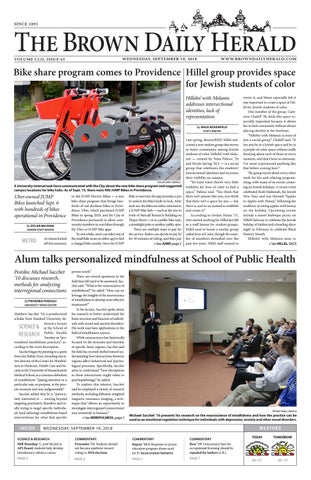
Michael Sacchet ’10 presents his research on the neuroscience of mindfulness and how the practice can be used as an emotional regulation technique for individuals with depression, anxiety and other mood disorders.
WEATHER
WEDNESDAY, SEPTEMBER 19, 2018
SCIENCE & RESEARCH S&R Roundup: U. prof elected to APS Board, students help develop introductory robotics course
COMMENTARY Fernandez ’21: Students should not become apathetic toward voting in 2018 elections
COMMENTARY Kupetz ’19.5: Response to prison education program shows need for U. Incarceration Initiative
COMMENTARY Rose ’19: Unnecessary laws for occupational licensing should be repealed for barbers in R.I.
PAGE 3
PAGE 4
PAGE 7
PAGE 7
TODAY
TOMORROW
68 / 57
69 / 57
NEWS
PAGE 2 • WEDNESDAY, SEPTEMBER 19, 2018
» MINDFULNESS, from page 1 In one study, Sacchet applied a modeling method called brain tractography to investigate the robustness of the uncinate fasciculus, a white matter bundle located in the prefrontal cortex, in individuals with mood and anxiety disorders to understand how “that relates to … emotion regulation techniques that they use.” From his research, Sacchet said he found that individuals with depression who engaged in emotional suppression — or the act of inhibiting emotional behavior such as keeping a poker face instead of expressing sadness — had a more robust uncinate fasciculus. Emotional suppression is significant because it is, in some ways, “the opposite of a mindful approach” and “the opposite of acceptance,” he said. Sacchet also discussed efforts to
understand interregional interactions occurring in the brain through the use of functional magnetic resonance imaging and identification of brain structures that show highly correlated activity. In his lecture, Sacchet spoke about his analyses on three brain networks: the control network, which is involved in planning and the inhibition of impulses; the default network, which is involved in self-related processing; and the salience network, which is involved in determining items for future processing. In one study, Sacchet used network analysis to study the control network in individuals with mood or anxiety disorders. During the experiment, participants were studied in both a resting state and while completing a cognitive control task. They found that individuals without these disorders showed modulation in this control network depending on the context they were in, but
THE BROWN DAILY HERALD “individuals with depression did not exhibit this flexibility,” Sacchet said. Judson Brewer, director of research and innovation at the Mindfulness Center, said he invited Sacchet to speak at the University because he is a “methodologic giant. He’s learned all of these different techniques and has started to apply those to look at clinical conditions.” Referencing the University’s creation and expansion of the Mindfulness Center, Brewer added that he hoped Sacchet could get people “excited about the future of neuroscience and how it applies to personalized medicine (as well as) meditation and mindfulness.” Dante Flores-Demarchi ’21 said he attended the lecture out of a personal interest in meditation, and was not aware of the ongoing research into mindfulness. “I found that (work) really inspiring,” he added.
» JUMP, from page 1 by the minute, or pay $20 per month for an hour of riding each day. There is also a $5 per hour option for participants in initiatives such as Supplemental Nutrition Assistance Program or the Free or Reduced Price School Lunch program. Launched Sept. 6, JUMP Bikes’ arrival follows seven years of talks about introducing a bike-share program to the city, according to Ben Smith, deputy director of communications for Mayor Jorge Elorza. “JUMP e-assist bikes position Providence to be a more sustainable, healthier and fun city for years to come,” Smith wrote in an email to The Herald. “They are incredibly powerful tools that provide residents and visitors with accessible, affordable transportation options.” Co-President of Bikes at Brown Harry August ’19 purchased a monthlong subscription to the service. “I love (JUMP Bikes). They’re just really fun to ride around,” he said, adding that he has not had to walk “more than a few blocks” to find a bike since the program’s inception. Assistant Vice President of Government and Community Relations Al Dahlberg sat on the University’s internal task force of students, faculty and staff that advised the city on the bike share initiative. According to Dahlberg, the dockless feature of the bike-share is
one of the system’s “key advantages.” He also highlighted the bike’s electric pedal-assist — which gives riders trekking up Providence’s many hills an extra 20mph boost. The University’s internal task force spoke with the City of Providence about issues of “cost, safety and convenience” and also pinpointed spots on campus where hubs should be stationed, Dahlberg said. “Brown supports bike share because it offers another means of mobility for our community,” Dahlberg said. “We want to see the program succeed and benefit all areas of Providence.” Rhode Island School of Design and Rhode Island Public Transportation Association, among other Providencebased organizations, were involved in the planning process. After a review of proposals received in the Request For Proposal process, the City awarded the contract to Social Bicycles, which later changed its name to JUMP, Smith wrote. Smith added that they “explored many bike share programs that exist in other U.S. cities as models” and ultimately chose to invest $400,000 in federal grant funds to Social Bicycles. Lifespan and Tufts Health Plan sponsored the project. As of Sept. 15, there were 400 JUMP Bikes in Providence.
NEWS
THE BROWN DAILY HERALD
Science & Research Roundup
WEDNESDAY, SEPTEMBER 19, 2018 • PAGE 3
comic
BY SARAH WANG, UNIVERSITY NEWS EDITOR U. professor elected to board of American Physical Society The American Physical Society has elected Professor of Physics S. James Gates to its presidential line, according to a University press release. The APS — a nonprofit organization representing over 55,000 physicists around the world — aims to use research and outreach to “advance and diffuse the knowledge of physics,” according to the release. By joining the presidential line, Gates will start his role as vice president Jan. 1, 2019 before becoming president-elect in 2020 and president in 2021. Gates is “known for pioneering work in theoretical physics, including the areas of supersymmetry and supergravity,” according to the press release. He has won numerous awards for his work, including the National Medal of Science, an honor given by the President of the United States to scientists and engineers. Throughout his career, Gates has also made a name for himself as a science communicator, appearing regularly as an expert on science series and news broadcasts, according to the press release. He believes the APS should also play a role in communicating science to the public. U. to sponsor celebration of science at WaterFire The University will co-host a science-focused event at WaterFire this Saturday. The Big Bang Science Fair will use activities, talks, exhibits and performances to “share the wonder of science” and explore the intersection of science and art, according to a University press release. The family-friendly fair hopes to engage both scientists and nonscientists of all ages. Through the event, Professor of Physics Meenakshi Narain, a co-organizer, hopes to broaden the public’s perspective of science and convey the importance of science in people’s everyday lives, according to the release. The fair will feature activities such as programming a robot and a video game design workshop. Speakers include Professor of Physics S. James Gates and Micky Dolenz, who is a “science enthusiast and member of the band The Monkees,” according to the press release. The event begins at 3 p.m. in Providence’s Market Square and 7 Canal Walk. Students spend summer developing introductory robotics course Four undergraduate students spent this past summer helping to create a robotics class, CSCI 1951-R: “Introduction to Robotics.” The course, taught by Professor of Computer Science Stefanie Tellex, teaches students how to assemble and eventually fly their own quadcopter drones, according to a press release from the computer science department. Using funding from an Undergraduate Teaching and Research Award, Luke Eller ’21, Theo Guerin ’21, Garrett Warren ’21 and Sophie Yang ’21 worked to improve and refine the algorithms behind the drones and update the course based on last year’s student feedback, according to the press release. One algorithm they refined even allows the drones to fly autonomously. The course itself uses inexpensive and rudimentary drones to teach students the basic concepts behind robotics, like how to integrate hardware and software. Eller, Guerin, Warren and Yang all agreed that their summer work helped them learn more about advanced robotics, according to the press release. All four students will serve as the course’s teaching assistants this fall.
CEYHUN FIRAT / HERALD
COMMENTARY PAGE 4 • WEDNESDAY, SEPTEMBER 19, 2018
THE BROWN DAILY HERALD
Vote — even if you’re disillusioned
SUMMER ZHANG / HERALD
MARYSOL FERNANDEZ staff columnist The United States’ position as the “defender of democracy” is a narrative that has always dominated the shaping of the American identity. We employ the rhetoric of a country founded by the people, for the people, which serves as a champion model for other countries to admire and imitate. While there are many reasons to be skeptical of this master narrative, there is one in particular that rises to the surface as we move into this electoral season — voting in America. What does it mean to be the “defender of democracy”? It does not seem to mean having the most active democratic process, for the United States ranks 26th on the list of countries with the highest voter turnout. It definitely does not seem to mean respecting democracies abroad, as many in Latin America and the Middle East alike can testify to the gross injustices the United States has carried out in the name of democracy. Perhaps then it means, at the very least, a theoretical understanding and faith in the idea of democracy itself, for the country is said to have been built on those very values. However, a general disillusionment with the democratic process in the United States has plagued Americans in recent years, suggesting that our title as the “defender of democracy”
has become, and potentially has always been, meaningless rhetoric. To rise to our democratic values, American citizens must vote in greater numbers. But even in the face of the crucial 2018 elections that have the power to shape the political landscape for years to come, many people are not expected to vote. Young people in particular, who often claim to
need to take place to re-legitimize the electoral system, namely the removing of big money and corporate interest from the process of choosing leadership. There is a growing suspicion, which I argue is not completely unwarranted, that we go through the motions of democracy to give off the appearance of representation, but the real decisions are
tions, the truth is that abstention is not political activism, but the ultimate form of consenting to the way the system currently runs. The more hopeful truth is that, while each vote might not hold the political capital it claims to possess, the vote still counts for something. If everyone were to vote, it would be much more difficult to justify ignoring the entire
Voting, regardless of how legitimate you believe our democracy to be, and again I do not argue that it is at all a fair and equitable system, is a great responsibility of serious consequence.
be driving the social revolution that has supposedly been taking place in the 21st century, have the lowest voter turnout rates. The relevant question is whether democracy works if people, even the politically conscious who can vote, choose not to exercise it. I believe the answer is no. How then do we reclaim that vote? There is a long list of changes that
made behind closed doors and are constructed to take place in a predetermined way. This sentiment has led to the development of the group of non-voting political activists, which I believe many young people fall into. This is the politically conscious person who refuses to participate in a system they believe to be fraudulent. While I can respect such inten-
voting population in favor of special interests. Voting, regardless of how legitimate you believe our democracy to be, and again I do not argue that it is at all a fair and equitable system, is a great responsibility of serious consequence. The issue grows in importance and interest when considering the educated youth in the country
— for example, students at Brown. Choosing to vote in your home state, to vote in Rhode Island or to not vote at all comes with a whole other host of implications, as we come from a position of great privilege. We are quite self-congratulatory in our political education and our strong opinions. But what does it mean if we choose not to invoke that education and those opinions to remove ourselves from the bubble that is the space of the University, momentarily, and find solidarity with people off of College Hill? The role of the privileged, politically conscious person does not end with voting. I have always been and continue to be a strong advocate of action from outside of the established political structure, believing it to be inherently necessary in systems that are so blatantly corrupted and biased. However, I find it difficult to argue against the fact that voting, and not exclusively in the big elections, is an essential first step. It is a first step that can act as an immediately accessible tool for significant change, and at the very worst is potentially inconsequential. It seems clear that there is little to lose and too much at stake to abstain.
Marysol Fernandez ’21 can be reached at marysol_fernandez@brown.edu. Please send responses to this opinion to letters@browndailyherald.com and other op-eds to opinions@ browndailyherald.com.
TODAY
WEDNESDAY, SEPTEMBER 19, 2018 • PAGE 5
THE BROWN DAILY HERALD
menu
s u m m e r b lo o m i n s e p t e m b e r g lo o m
SATELLITE DINING ANDREWS COMMONS
Pizza: Spicy Sausage and Garlic, Assorted Roasted Mushroom Grinders, Make Your Own Salad JOSIAH’S
BLUE ROOM
Pasta Night, Quesadilla Station, Guacamole Burger
Burrito Bowl, Broccoli and Cheddar Soup, Bread Bowl
DINING HALLS SHARPE REFECTORY LUNCH
DINNER
Muffuletta Sandwiches, Mungu, Jerk Chicken and Rice, Cajun Corn and Tomatoes
Barbeque Brisket, Herbed Turnips, Kaiser Roll, Blueberry Chocolate Mousse Cake
VERNEY-WOOLLEY LUNCH
DINNER
Mediterranean Grain Bar, Red Hummus and Roasted Broccoli Sandwiches
Rotisserie Style Chicken, Penne Caponata with Chickpeas, Purple Potato Bread HUAYU OUYANG / HERALD
sudoku
RISD Professor Adam Anderson completed 10,000 Suns, a public art installation, in summer 2016. Aesthetic charm aside, the site between South Water and South Main Streets helps to remove toxins from the air.
Q U O T E O F T H E D AY
RELEASE DATE– Wednesday, January 23, 2013
Los Angeles Times Daily Crossword Puzzle c rNorris o s sandwJoyce o rNichols d Lewis Edited by Rich
ACROSS 1 Exemplar of cruelty 7 Approach furtively, with “to” 14 Split and united? 15 2001 Disney film subtitled “The Lost Empire” 17 Pioneer transports 18 Animal’s paw warmer? 19 Boston-toProvidence dir. 20 Strauss’s “__ Rosenkavalier” 21 Neighbor of Ger. 22 Subject of a China/India/ Pakistan territorial dispute 26 Tokyo airport 29 Animal’s hiking gear? 30 Animal’s laundry? 31 Put in a zoo, say 32 Tippy transport 33 Suffix like “like” 34 Sets the pace 36 Marcel Marceau character 39 Indian spice 41 Assistant professor’s goal 44 Animal’s golf club? 47 Animal’s undergarment? 48 Like some bagels 49 Undoes, as laws 50 Heart lines: Abbr. 51 Brief life story? 52 HEW successor 54 Animal’s apartment? 58 Melodic 61 Wet ink concern 62 Night noises 63 One on the lam 64 Hot spots DOWN 1 Stitches 2 The Palins, e.g. 3 Animal’s timepiece? 4 Wall St. debut 5 Obama, before he was pres.
6 NFL stats 7 More secure 8 “Do __ else!” 9 CCLXXX x II 10 Trail 11 Lab blowup: Abbr. 12 Paradise 13 Turns on one foot 16 Psalm instruction 20 Cartoonist Browne 23 Health resort 24 Crone 25 Neil __, Defense secretary under Eisenhower 26 Continuous 27 Past 28 “The American Scholar” essayist’s monogram 29 Portuguese king 30 Swindled 32 Low islet 35 Coastal flier 36 Animal’s instrument? 37 It surrounds the Isle of Man 38 Vigor 39 Gp. in a 1955 labor merger
40 Coffee holder 42 Ram’s mate 43 Ultra-secretive org. 44 Burns bread and butter? 45 Tips may be part of it 46 Lively Baroque dances 47 Corp. head honcho
“I’m not made of fractions; I’m not this percent Jewish and this percent Filipina. I’m one person who is both.” — Tessa Palisoc ’20
49 Fingerprint feature 51 Ruination 53 Cong. meeting 55 Anatomical bag 56 Victorian, for one 57 Die dot 58 Donkey 59 Biological messenger 60 Debtor’s marker
See HILLEL on page 1.
ANSWER TO PREVIOUS PUZZLE:
xwordeditor@aol.com
calendar
01/23/13
TODAY SEPTEMBER NOVEMBER MARCH
S
2
5 9
6
10
4
7
11
W
Th
F
S
1
2
3
4
9
10
11
5
8
12
6
13
7
14
1
8
14
15
16
17
18
19
20
21
22
23
24
25
26
30
17
24
27
18 25
28
19 26
29
20 27
30
21
28
31
Developing a Weekly Study Schedule 12:00 P.M. J. Walter Wilson, 203
JCB Fellows’ Talk: Coulter and Sepúlveda 4:00 P.M. JCB Library, Reading Room
Foreign Flicks Presents: La Haine 7:00 P.M. Metcalf Research Building
15
13
23
01/23/13
3
T
12 16
By Mark Feldman (c)2013 Tribune Media Services, Inc.
M
Neurology Grand Rounds 8:00 A.M. Rhode Island Hospital
22
29
TOMORROW Biology of Aging Seminar 12:00 P.M. Biomedical Center
Innovation at Goldman Sachs Lunch 12:00 P.M. Barus and Holley
Reading: Poets Waldrop and Colby 5:30 P.M. McCormack Family Theater
emPower Pizza Party 6:00 P.M. Faunce House
COMMENTARY PAGE 6 • WEDNESDAY, SEPTEMBER 19, 2018
THE BROWN DAILY HERALD
EDITORIAL
LETTER TO THE EDITOR
U. prison education initiative needs to re-evaluate purpose To the Editor: A simple online search reveals that Jeremy Pontbriant, author of a recent Herald op-ed, and the subject of another, is incarcerated until at least 2030 for murder. What seems lacking in his Herald piece is any priority given to an expression of remorse and concern for his hapless young victim — Dawn Alves, age 24, who, like Pontbriant, worked at a grocery store — and her family. In his piece, Pontbriant decries “mass incarceration,” which might lead the reader to believe that he himself was guilty of a victimless drug crime or other non-violent offense, since that term is sometimes used to indicate the possibly excessive use of incarceration as punishment for such crimes. He does acknowledge being convicted of a “serious crime,” although he doesn’t mention that his was a particularly violent and heinous crime, in which he murdered a woman by blunt trauma to her head. He writes of his desire to be seen now as worthy and able to be redeemed, and that he is enthusiastic about learning and about participating in the Brown prison educational outreach program. The combination of the violent nature of Pontbriant’s crime, his lack of prominent expressions in his piece of any ongoing struggle with remorse and regret over the pain he caused his victim and her family and his possible attempt to subsume his own imprisonment under the politically facile label of “mass incarceration” in the United States raises questions about his worthiness to be a participant in the
Brown prison outreach program. The value to society of finishing high school education with a GED for any inmate without these basic educational credentials is obvious. For those prisoners whose post-incarceration educational and employment potential includes college-level coursework, there is potential benefit to making available online learning or possibly face-toface classroom instruction. From a societal standpoint, the main rationale for all such education is to reduce recidivism and to encourage socially compliant behavior and economic independence after prison discharge. But the Brown History Education Initiative’s resources do not quite accomplish this goal. Sharing insights about the history of the goals, methods and injustices of the United States prison system with inmates, to raise their consciousness of the issues involved, seems to be of only marginal societal value. I would suggest that the Brown faculty and students involved in this well-meaning project give greater consideration of these factors in choosing whom they enroll in their program. I would also encourage a corresponding effort to aid the victims of these imprisoned criminals and the victims’ families to move past the pain and suffering to which the inmate subjected them. These victims and families might benefit from efforts to improve their own educational achievement, with resulting improvements to economic and social outcomes. Preston Calvert ’76, MD ’79
Elimination of writing requirement step in right direction In July, the University announced it will no longer require applicants to the class of 2023 to submit their scores for the essay portions of the SAT and ACT. According to Dean of Admission Logan Powell, the requirement may have discouraged low-income students who rely on free, school-day SAT testing from applying to the University, since not all SAT tests administered during the school week offer a writing component. Incoming applicants who take a non-essay standardized exam are “encouraged,” but not required, to submit a graded paper from a high school humanities course instead. We applaud the decision to remove the writing score requirement from the University’s admission policy and the efforts to critically examine the ways in which Brown can be made more accessible to those traditionally underserved and marginalized by existing college admission processes. The writing portion of the ACT has been optional since the exam’s inception. Over a decade ago, the College Board included a 25-minute essay in the SAT and raised the highest possible score from 1600 to 2400. In March 2016, the College Board made the essay portion optional, doubled the amount of time for the essay and removed its traditional writing prompts, instead asking test-takers to analyze a given passage. But, because variations of the tests that include an optional writing section cost more, 30 percent of schoolday SAT exams and half of school-day ACT exams do not include the essay, potentially dissuading some students from applying to schools with more onerous testing requirements. Some estimates suggest that fewer than 25 universities still require writing scores from standardized exams.
Find us online! facebook.com/browndailyherald
browndailyherald.com
@the_herald
Location: 195 Angell St., Providence, R.I. www.browndailyherald.com
@browndailyherald
youtube.com/browndailyherald
Editorial Leadership
Sections
Multimedia & Production
Business
Editors-in-Chief Elena Renken Kasturi Pananjady
Arts & Culture Editors Connor Sullivan Ethel Renia
General Managers Michael Borrello Matilda Lynton
Managing Editor Alex Skidmore
Metro Editors Emily Davies Isabel Gensler
Design Editors Kyle Cui Eduard Muñoz-Suñé Assistants: Julie Wang, Kelvin Yang
Senior Editors Julianne Center Madison Rivlin Hattie Xu Editorial Page Editor Anuj Krishnamurthy POST- MAGAZINE Editor Jennifer Osborne
News Editors Eduard Muñoz-Suñé Priyanka Podugu Sarah Wang Science & Research Editors Jonathan Douglas Jackson Wells Sports Editors Alexandra Russell James Schapiro COMMENTARY Opinions Editors Connor Cardoso Anuj Krishnamurthy Clare Steinman Emily Miller
Photo Editors Sam Berube Anita Sheih Copy Desk Chief Kelley Tackett Illustrations Editor Daphne Zhao Video Editor Celia Hack Graphics Editors Marlis Flinn Sarah Martinez
The University previously dropped the essay requirement for those seeking admission to the Class of 2021. In lieu of a writing score, the University asked applicants to send either their SAT score and two SAT subject test scores, or their ACT score. Dean of Admission Jim Miller ’73 said of the decision, “We know that tests are stressful and time consuming, and for some people they can be a significant expense. So we want to make sure we’re doing what is in the best interest of the applicants.” The writing section of the ACT was still “strongly recommended” by the Office of Admission. For the Class of 2022, the University reinstated the writing score requirement for the SAT and ACT. (The University also recommended, but did not require, that applicants take two SAT subject tests.) Powell, who became Dean of Admission in the summer of 2016, cited concerns that applicants were not registering for the exams in time for application deadlines. He also noted that the Office of Admission would use the writing scores to “see how the scores line up with (its) sense of the student’s writing ability” and assess whether applicants “can craft strong, logical, evidence-based arguments,” but that the Office might “adjust (its) policy” later. The essays included in the SAT and ACT have long been the objects of fierce criticism. A previous Herald editorial noted that “the essay format disproportionately favored students who came from higher socioeconomic backgrounds and the score seemed to not correlate with eventual success in college.” According to a 2004 investigation conducted by the College Board, the introduction of the essay and the subsequent lengthening of the exam
Office Manager Diane Silvia Directors Sales: Shreya Raghunandan Finance: Ravi Betzig Strategy: Edwin Farley, Caroline Ziegler
resulted in test-takers reporting higher levels of fatigue. Further, critics have called into question the essays’ utility in predicting applicants’ postsecondary academic performance, since students generally have several days — along with the ability to gather facts, outline, revise and cite — to write essays in college. Fairness in grading also became a point of concern: In the past, scorers of the SAT, for example, had only three minutes to evaluate the merits of each essay and did not assess the factual accuracy of students’ arguments and evidence. To be sure, the alternative to the writing requirement — a graded essay written for a class — implemented by the University is not without its own set of potential complications. For example, low-income students may not have the resources, such as writing centers or libraries designed for extensive research, that higher-income students might have. Though the decision to eliminate the essay requirement is one significant step toward greater inclusivity and accessibility, the University should make the policy change permanent, applicable to all future applicants to Brown. And, going forward, it must take unflagging care to ensure that its alternatives do not inadvertently perpetuate the same systemic disadvantages calcified by standardized exams.
Editorials are written by The Herald’s editorial page board: Anuj Krishnamurthy ’19, Rhaime Kim ’20, Grace Layer ’20, Mark Liang ’19 and Krista Stapleford ’21. Please send responses to this opinion to letters@browndailyherald.com and op-eds to opinions@browndailyherald.com.
Editorial contact: 401-351-3372 herald@browndailyherald.com
Advertising contact: 401-351-3372 advertising@browndailyherald.com
Submissions: The Brown Daily Herald publishes submissions in the form of op-eds and letters to the editor. Op-eds are typically between 750 and 1000 words, though we will consider submissions between 500 and 1200 words. Letters to the editor should be around 250 words. While letters to the editor respond to an article or column that has appeared in The Herald, op-eds usually prompt new discussions on campus or frame new arguments about current discourse. All submissions to The Herald cannot have been previously published elsewhere (in print or online — including personal blogs and social media), and they must be exclusive to The Herald. Submissions must include no more than two individual authors. If there are more than two original authors, The Herald can acknowledge the authors in a statement at the end of the letter or op-ed, but the byline can only include up to two names. The Herald will not publish submissions authored by groups. The Herald does not publish anonymous submissions. If you feel your circumstances prevent you from submitting an op-ed or letter with your name, please email herald@browndailyherald.com to explain your situation. You can submit op-eds to opinions@browndailyherald.com and letters to letters@browndailyherald.com. When you email your submission, please include (1) your full name, (2) an evening or mobile phone number in case your submission is chosen for publication and (3) any affiliation with Brown University or any institution or organization relevant to the content of your submission. Please send in submissions at least 24 hours in advance of your desired publication date. The Herald only publishes submissions while it is in print. The Herald reserves the right to edit all submissions. If your piece is considered for publication, an editor will contact you to discuss potential changes to your submission. Commentary: The editorial is the majority opinion of the editorial page board of The Brown Daily Herald. The editorial viewpoint does not necessarily reflect the views of The Brown Daily Herald, Inc. Columns, letters and comics reflect the opinions of their authors only. Corrections: The Brown Daily Herald is committed to providing the Brown University community with the most accurate information possible. Corrections may be submitted up to seven calendar days after publication. Advertising: The Brown Daily Herald, Inc. reserves the right to accept or decline any advertisement at its discretion. The Brown Daily Herald, Inc. is a financially independent, nonprofit media organization bringing you The Brown Daily Herald, BlogDailyHerald and Post- Magazine. The Brown Daily Herald has served the Brown University community daily since 1891. It is published Monday through Friday during the academic year, excluding vacations, once during Commencement and once during Orientation by The Brown Daily Herald, Inc. Single copy free for each member of the community. Subscription prices: $200 one year daily, $100 one semester daily. Copyright 2018 by The Brown Daily Herald, Inc. All rights reserved. Periodicals postage paid at Providence, R.I. Postmaster: Please send corrections to P.O. Box 2538, Providence, RI 02906.
THE BROWN DAILY HERALD
COMMENTARY WEDNESDAY, SEPTEMBER 19, 2018 • PAGE 7
Why is it so hard to be a barber in R.I.? AUSTIN ROSE
op-ed contributor There is broad, bipartisan agreement, from former president Barack Obama to Milton Friedman, that America today regulates away economic growth and opportunity by erecting unreasonable barriers to participation in labor markets. Lobbied by special interest groups, states have built ever-expanding mazes of difficult and bewildering red tape that discourage people from finding employment. One particularly egregious example of over-demanding licensing schemes can be found in Chapters 5-10 of the Rhode Island Statutes, which control the regulation of barbering and hairdressing in the state. Before you can legally make a dollar cutting hair, you have to have graduated high school. You must disclose all your criminal convictions, even though “ban the box” legislation made that policy illegal in the private sector five years ago. And, worst of all, you have to go through nine months of full-time training, when, for comparison, it takes only five months to become a police officer in the state. It’s too hard to get a job cutting hair, but luckily there is a very simple remedy: Repeal Chapters 5-10 of the Rhode Island Statutes. I think the current licensing system is unreasonably burdensome, but to prove that I first want to establish
a framework for thinking about what makes a license reasonable in the first place. First, it seems reasonable to me that we should assume a sort of standing, a priori right that everyone has to engage in the market and provide for themselves. This right has the convenient effect of being associated with economic benefits as well. If people can freely enter a market and sell their services, not only do they get jobs, but they serve to raise the supply of the service they are producing. All else constant, this lowers the price of the service to a
versely, if a license does so much harm to the agency of individuals and the economy overall that it outweighs the public harms the license was supposed to prevent, then it should get the boot. So, how do we know that Rhode Island’s hairdressing license is out of proportion? For one thing, it is very unclear that the license actually saves the public from any danger. A 2013 paper by Mark Klee finds, counterintuitively, that “neither overall licensing policy nor any dimension of licensing policy seems to affect” the level of vo-
ably managed to find yourself a different haircutter that met your standards. Indeed, Britain has no licensing for hairdressers at all, and people manage. Here’s the essential question: Is saving yourself from a bad haircut, keeping in mind that there is pretty solid evidence that the current licensing system is bad at doing that, worth denying people access to a livelihood? Is it worth making haircuts more expensive for you and everyone else in the state? As dubious as the costs of freedom are, the costs of licensing are pretty
Is saving yourself from a bad haircut, keeping in mind that there is pretty solid evidence that the current licensing system is bad at doing that, worth denying people access to a livelihood? more competitive level, where producers are still happy to sell their services and consumers are even happier to buy them. In short, more economic freedom produces economic gains. Second, it seems reasonable that we as a society, using the levers of government, should curtail that right if that one person’s right to practice any job with freedom sufficiently hurts other people. As has been said, my right to swing my fist ends where your face begins. Similarly, my right to be an open heart surgeon ends where your right not to die from malpractice begins. In other words, licensing makes a lot of sense when there is a harm to the public that outweighs the benefits. Con-
cational training for cosmetologists. If you want safer haircuts, it seems that training-hour requirements are ineffective even at boosting the level of training in the labor force, let alone overall safety. Vox’s Matt Yglesias fairly points out that “People don’t die of bad haircuts, and since hairstyle is a quintessential matter of taste, there’s absolutely no reason to think consumers can’t figure out for themselves who has a decent reputation as a cutter of hair.” Approach the question from a third angle: Have you ever gotten a haircut you were unsatisfied with from a Rhode Island barbershop? I’ll go out on a limb and say that despite the presence of low-quality haircuts in the market, you still prob-
staggering. Licensing of barbers reduces the probability of a black individual working as a barber by 17.3 percent, according to a study published by the Mercatus Center at George Mason University. Every 100 hours of training required adds $2.15 to the price of beauty salon visits. Licensing, by making it more difficult for job-seekers to enter new lines of business and employment, harms social mobility. And, as an Obama White House report notes, lowincome entrepreneurship activity takes a hit as well. Is the current licensing system worth it? I sure don’t think so. But, lest you think there’s a coherent defense to be made of the current system that I’m
not portraying, consider this: The official definitions for hairdressing and barbering in Rhode Island state law are each around 100 words and share nine key phrases — but, in the eyes of the law, they are different professions, with different licensing requirements. Both occupations deal with “cutting” hair. Both work on the “scalp, face, or neck.” Both color hair. Both dress hair. The list goes on to frustration, and it’s very hard to imagine catching a clever barber masquerading as a hairdresser, inflicting hidden terror on the population by having escaped training with fully 300 hours less than they needed to be safe. The truth is, nobody — not even the author of these licensing rules — has put forward a reasonable explanation for the system as it stands. The larger battle over how much occupational licensing is too much is not going to be resolved today, nor should it be. There are gray areas, occupations where good arguments exist on each side of the debate. But hairdressing is an easy case. Our community should not allow such an obviously counterproductive policy to continue.
Austin Rose ’19 is happy to have supporters in his effort to fight nonsensical occupational licensing rules, and can be reached at austin_rose@brown.edu Please send responses to this op-ed to letters@browndailyherald.com and op-eds to opinions@browndailyherald.com.
In defense of the Brown Incarceration Initiative SOPHIE KUPETZ
op-ed contributor When The Herald published my article, “In Favor of the Brown Incarceration Initiative,” alongside Jeremy Pontbriant’s beautiful article, “A Testament to the Power of Education in Prison,” a few weeks back, I did not expect to write this reply. I am upset that somebody read Pontbriant’s article and left with the takeaway: “I must google the crime for which he was incarcerated.” I am upset that The Herald would publish a letter that attacks Pontbriant’s character and fails to engage thoughtfully with his argument. I am upset that Pontbriant has been put on trial once again, forced to defend his humanity when he seeks only to improve himself through study. I do not want to speak for Pontbriant, as he can best speak for himself. However, due to prison rules that make communication challenging, it will take some time to receive and publish Pontbriant’s response. In the meantime, I will share some of what I have learned about the prison-industrial complex in classes, through organizing work, and most importantly, through my work as a teaching assistant in the Rhode Island Adult Correctional Institute for the past two years. While the author emphasizes the crime for which Pontbriant was convicted, the letter to the editor is not about Pontbriant. The letter to the editor cannot be about Pontbriant, because the author does not know anything about him. I was not permitted to read the response in its entirety before it was published, but I strongly suspect that the re-
sponse is a reflection of a country that stigmatizes people convicted of crimes and denies them any chance of meaningful redemption. This is especially concerning considering that the criminal legal system disproportionately targets people of color and low-income people. The following five points are essential to grasp some of the injustices ingrained within the United States’s treatment of incarcerated people, rebut the unfair claims lodged against Pontbriant and understand Brown’s responsibility to implement the Brown Incarceration Initiative. First, the dichotomy of victim and criminal is false. As soon as someone is labeled a criminal, we no longer view them as a whole person who too has suffered and has likely been victim to both interpersonal and systemic harm. As Bryan Stevenson, founder of the Equal Justice Initiative, says in his TedTalk, “Each of us is more than the worst thing we’ve ever done.” We ought to shift our mentality to one of restorative justice, which focuses on healing the community, not to justify acts of violence, but to actually address and prevent them. Second, we cannot solely talk about non-violent offenders. Most of the conversation surrounding decarceration focuses on non-violent drug offenders, as it is easier to sympathize with such people. However, this reformist logic is flawed. Nobody should be defined as “violent” for the rest of their life without any room for transformation. We, as a society, must address the root causes of harm and not simply the individual manifestations of oppressive systems. Further, 84 percent of incarcerated people are in state prisons and more than half were incarcerated for
violent crimes. In order to meaningfully address mass incarceration, we must expand our focus to people incarcerated for violent crimes. Third, the U.S. legal system prescribes incarceration, not the deprivation of education, as the punishment for crime. My personal politics are those of prison abolition, which is defined by Critical Resistance as “a political vision with the goal of eliminating imprisonment, policing, and surveillance and creating lasting alternatives to punishment and imprisonment.” I believe the prison-industrial complex was not built to be a system for rehabilitation, but a for-profit system of exploitation, domination and racial control (see Michelle Alexander’s “The New Jim Crow” and Ava Duvernay’s “13th”). Thus, I make the following point in an attempt to engage the argument of the letter writer. The U.S. criminal legal system claims that imprisonment is a tool for rehabilitation. Central to rehabilitation is education. In addition, according to the National Reentry Resource Center, 95 percent of people incarcerated in state prisons will be released. Therefore, prison education programs benefit all community members, as they help incarcerated people fight some of the barriers to reentry to society. Education is known to decrease recidivism rates, which saves tax dollars. A study by the RAND Corporation found that incarcerated people who participated in education programs in prison were 43 percent less likely to return to prison than those who did not. Fourth, education is a human right. As a University that values the “transformative power of education,” Brown must defend education as a hu-
man right. University classes can help students develop their critical-thinking and practical skills, which act as a source of empowerment both in prison and after release. Fifth, the University has the support, the resources and the responsibility to implement a for-credit college-in-prison program. There is an identified need for more college classes at the ACI, and the University has the financial resources and student and faculty support to respond. Both in its mission statement and in the 2006 Slavery and Justice report, the University asserts its commitment to communities outside of Brown. A University for-credit college-in-prison program is not simply community service. It would be an opportunity for the University to fulfill a responsibility as one of the largest institutions in Rhode Island and as an institution that claims to be dedicated to diversity and inclusion. Built by enslaved labor and with money from the transatlantic slave trade, the University must act on its stated commitment to “expand opportunities at Brown for those disadvantaged by the legacies of slavery and the slave trade,” as the Corporation’s 2007 response to the Slavery and Justice states. If one reads Pontbriant’s article carefully, it is clear that the length of his sentence and the crime for which he was convicted are completely irrelevant in the context of prison education. He does not hide his past, but instead acknowledges that he was convicted for a “serious crime,” and then thoughtfully articulates the power of education as a tool for transformation. Pontbriant shares how education helped him regain his self-worth. It is this appreciation and passion for education that made Pont-
briant such a wonderful student. Pontbriant exhibited intellectual curiosity and passion for learning, dedicating himself to his studies, asking questions and seeking out extra work. I have attended competitive private schools my whole life and I can confidently say that the classes I have attended in the prison have been some of the most intellectually rigorous, thought-provoking and fulfilling educational environments that I have experienced. The students display a deep respect and gratitude for the opportunity to learn, which is a refreshing change from the entitlement I have often seen on Brown’s campus. So, yes, I believe these students are worthy of Brown University credit — a credit that many students have access to, not due to merit or “worthiness,” but to privilege. In honor of the transformative power of education, I ask the author of the response to read Pontbriant’s article again and to truly listen to what he is saying. Focused on delegitimizing Pontbriant’s argument by centering his crime, the author has failed to hear him. So, I end by repeating Pontbriant’s words about the need for a Brown Incarceration Initiative: “An opportunity to shed the stigma and stereotypes associated with incarceration, a chance to prove to society as well as to ourselves that, if we are provided the means, not only will we succeed but we will flourish — well, that would be invaluable!”
Sophie Kupetz ’19.5 can be reached at sophie_kupetz@ brown.edu. Please send responses to this opinion to letters@ browndailyherald.com and opeds to opinions@browndailyherald.com.
NEWS THE BROWN DAILY HERALD
WEDNESDAY, SEPTEMBER 19, 2018
» HILLEL, from page 1 provide a space where aspects of members’ intersectional identities are supported at once. “Identifying with two different cultures is kind of hard, because in one group you feel like the other part of your culture is kind of shadowed, and then in the other group, vice versa,” Spring said. “But in our group, we’re really appreciating both sides.” For Palisoc, meeting other Jewish students of color through Hillelin’ with Melanin has been influential in forming her own identity. Before forming the group, Palisoc felt like her identities as a Jewish person and a person of color didn’t intersect with one another. But finding other people helped her realize that “those are both part of not two separate identities, but one identity,” Palisoc said. “I’m not made of fractions; I’m not this percent Jewish and this percent Filipina. I’m one person who is both.” With intersectional identity at its core, Hillelin’ with Melanin also addresses the whiteness of many Jewish spaces and the lack of representation of Jewish people of color, Palisoc said. “There’s a huge issue with erasing Jews of color. If you just look at any modern representation of a Jewish person, they’re probably white, and that’s just not true,” Palisoc said. “Hillel seems, on the surface, to be a very white space, and this discourages people of color from participating in a community that they have a claim to.” “You go there, and it kind of feels,
TED ORBEN / HERALD
Hillelin’ with Melanin was created last semester by Nicole Spring ’20.5 (left) and Tessa Palisoc ‘20 (right). The group recently hosted a Rosh Hashanah event and has planned a sunset barbeque picnic to celebrate Sukkot. oftentimes, like you’re out of place,” Mann said. As a Jewish person of color, Mann is often asked whether
or not he is Jewish. According to Chaleff, there have even been times when people assumed
that Hillelin’ with Melanin members were renting space in the Hillel building.
“For Jews of color, a lot of times it can feel like Jewish identity is just ‘the other thing’ that people aren’t seeing (in) me,” Chaleff said. Chaleff says she often feels like the only way to make her Jewish identity visible is by engaging with it religiously. Because of the lack of visibility of Jewish people of color, Mann, Palisoc and Spring were all surprised by the sheer size of the identity group on campus. After they reached out to more students, Hillelin’ with Melanin accumulated a listserv of about 30 people. “I was so surprised, because I did not expect nearly this number of people to even fit the demographic that would come to Hillelin’ with Melanin,” Palisoc said. “But that just shows how important it is — we had all of these people not coming to a place that should be their community safe space.” According to Spring, one of the greatest challenges for the club is recruiting. “The hardest part is finding members,” Spring said, “because if they don’t know it exists, then they might be kind of afraid to go into Hillel or approach Hillel by themselves.” But it isn’t always easy to tell who is a Jewish student of color. Spring added that recruitment can be awkward, because it involves approaching people and asking if they share an identity that lies beneath the surface. “The biggest thing that the group offers is just visibility,” Mann said, “the sense that other people know that you exist.”
MEAL PLAN
changes
STEP ONE:
Choose a Meal Plan.
REMINDER:
T DAY THE LASEA L PLAN
TO MAKE M EDNESDAY, CHANGES IS W
SEPT. 2 !
VIEW OPTIONS AT BROWN.EDU/FOOD
• You can ADD a new Meal Plan at any time during the year • You can make one CHANGE per semester. Fall deadline is 9/2 • Meal Plan CANCELLATIONS for the whole year are due by 9/2
STEP TWO:
Let us assist you!
EMAIL DINING_SERVICES@BROWN.EDU OR CALL 863-3343 WITH QUESTIONS
• Changes can only be made in person weekdays from 9:00AM to 4:00PM at the Brown Dining office located at 144 Thayer Street (Sharpe Refectory).
brown.edu/food