SINCE 1891
THE BROWN DAILY HERALD WEDNESDAY, OCTOBER 31, 2018
VOLUME CLII, ISSUE 92
WWW.BROWNDAILYHERALD.COM
Dhingra talks racism, minority assimilation Squirrel Hill shooting vigil Center for Race and grieves victims of hate crimes Ethnicity in America hosts lecture about race, social privilege
Students, faculty, community members stand together against violence, bigotry
By LI GOLDSTEIN STAFF WRITER
“How should we understand the relevance of race for minorities who approach or even surpass whites along key measures of mobility?” asked Professor of American Studies at Amherst College Pawan Dhingra at the beginning of his lecture Tuesday evening. Dhingra’s lecture, entitled “The Racialization of ‘Honorary Whites’: Asian Americans and New Conceptions of Race,” was sponsored by the Center for the Study of Race and Ethnicity in America. The lecture was adapted from his current book project, Dhingra said. Dhingra defined honorary whites as minority Americans who “approximate or surpass whites in terms of adaptation in society.” Within this category he included “light-skinned latinos,” Chinese, Indian, Korean, Japanese and Middle Eastern Americans. He adopted the terminology from Duke University Professor of Sociology Eduardo Bonilla-Silva. This seldom discussed category, Dhingra argued, is rarely accounted for in contemporary conversations about race. The success of honorary whites “maintains the disenfranchisement of the ‘collective black’”
By ALLIE REED SENIOR STAFF WRITER
VICTORIA YIN / HERALD
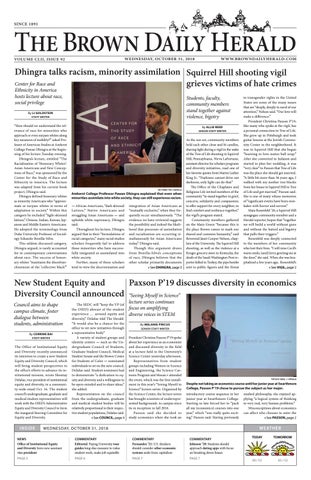
Amherst College Professor Pawan Dhingra explained that even when minorities assimilate into white society, they can still experience racism. — African Americans, “dark skinned Latinos,” Native Americans and struggling Asian Americans — and upholds white supremacy, Dhingra said. Throughout his lecture, Dhingra argued that in their “formulations of racial categories,” many racial studies scholars frequently fail to address those minorities who have successfully integrated or assimilated into white society. Further, many of these scholars tend to view the discrimination and
integration of Asian Americans as “mutually exclusive,” when they frequently occur simultaneously. “The evidence we have reviewed suggests the possibility and indeed the likelihood that processes of assimilation and racialization are occurring simultaneously for Asian Americans today,” Dhingra said. Though this argument draws from Bonilla-Silva’s conceptions of race, Dhingra believes that the other scholar primarily documents » See DHINGRA, page 3
As the sun set, community members held each other close and lit candles, sharing light during a vigil in the wake of the Tree of Life shooting in Squirrel Hill, Pennsylvania. Nirva LaFortune, assistant director for scholars programs and diversity initiatives, read one of her favorite quotes from Martin Luther King Jr.: “Darkness cannot drive out darkness; only light can do that.” The Office of the Chaplains and Religious Life invited members of the community “to stand together in grief, concern, solidarity and compassion; to offer support for every neighbor; to find comfort and resilience together,” the vigil’s program stated. Community members gathered on the Main Green “because this is the place Brown comes to mark our shared and common humanity,” said Reverend Janet Cooper Nelson, chaplain of the University. The Squirrel Hill shooting, as well as the violence at a Kroger grocery store in Kentucky, the death of the Saudi Washington Post reporter killed in Turkey, the pipe bombs sent to public figures and the threat
to transgender rights in the United States are some of the many issues that are “deeply, deeply in need of our attention,” Nelson said. “Our love will make a difference.” President Christina Paxson P’19, like many who spoke at the vigil, has a personal connection to Tree of Life. She grew up in Pittsburgh and took guitar lessons at the Jewish Community Center in the neighborhood. It was in Squirrel Hill that she began “learning to love matzo ball soup.” After she converted to Judaism and started to plan her wedding, it was “very clear” to Paxson that Tree of Life was the place she should get married. “A little bit more than 36 years ago, I walked with my mother two blocks from her house in Squirrel Hill to Tree of Life and got married,” Paxson said. She is one of many whose memories of “significant events have been overladen with horror and sorrow.” Maia Rosenfeld ’20, a Squirrel Hill synagogue community member and a Herald reporter, hopes that “together we will build a world without guns and without the hatred and bigotry that pulls their triggers.” Rosenfeld was deeply connected to the members of her community who lost their lives. “I will miss Cecil’s warm smile, (and) Jerry greeting me at the door,” she said. When she was hospitalized a few years ago, Rosenfeld’s » See VIGIL, page 2
New Student Equity and Paxson P’19 discusses diversity in economics Diversity Council announced “Seeing Myself in Science” Council aims to shape campus climate, foster dialogue between students, administration By CORRINE BAI STAFF WRITER
The Office of Institutional Equity and Diversity recently announced its intention to create a new Student Equity and Diversity Council, which will bring student perspectives to the office’s efforts to advance its institutional mission, wrote Shontay Delalue, vice president of institutional equity and diversity, in a community-wide email Oct. 16. The student council’s undergraduate, graduate and medical student representatives will work with the OIED’s Administrative Equity and Diversity Council to form the inaugural Steering Committee for Equity and Diversity.
INSIDE
The SEDC will “keep the VP (of the OIED) abreast of the student experience … around equity and diversity,” Delalue told The Herald. “It would also be a chance for the office to vet new initiatives through a representative body.” A variety of student groups and identity centers — such as the Undergraduate Council of Students, Graduate Student Council, Medical Student Senate and the Brown Center for Students of Color — nominated individuals to sit on the new council, Delalue said. Student nominees had to demonstrate “a dedication to equity and diversity and a willingness to be open-minded and to share ideas,” she added. Representation on the council from the undergraduate, graduate and medical student bodies will be relatively proportional to their respective student populations, Delalue said. » See COUNCIL, page 4
lecture series continues focus on amplifying diverse voices in STEM By MELANIE PINCUS SENIOR STAFF WRITER
President Christina Paxson P’19 spoke about her experience as an economist and discussed diversity in the field at a lecture held in the University’s Science Center yesterday afternoon. Representatives from student groups including Women in Science and Engineering, the Science Cartoons Program and Mosaic+ attended the event, which was the first installment in this year’s “Seeing Myself in Science” lecture series. Organized by the Science Center, the lecture series has brought scientists of underrepresented backgrounds to campus since its in inception in fall 2016. Paxson said she decided to study economics when she took an
TIFFANY DING / HERALD
Despite not taking an economics course until her junior year at Swarthmore College, Paxson P’19 chose to pursue the subject as her major. introductory course sequence in her junior year at Swarthmore College. Starting so late forced her to “pack all my (economics) courses into one year,” which “was really quite exciting,” Paxson said. Having previously
studied philosophy, she enjoyed applying “a logical system of thinking to very real, very human problems.” Misconceptions about economics can affect who chooses to enter the » See PAXSON, page 2
WEATHER
WEDNESDAY, OC TOBER 31, 2018
NEWS Office of Institutional Equity and Diversity hires new assistant vice president
COMMENTARY Editorial: Paying University tour guides long-due measure to value student work, make job equitable
COMMENTARY Fernandez ’21: U.S. thinkers should consider other economic systems aside from capitalism
COMMENTARY Johnson ’20: Students should approach dating apps with focus on breaking down biases
PAGE 3
PAGE 6
PAGE 7
PAGE 7
TODAY
TOMORROW
58 / 52
65 / 52
NEWS
PAGE 2 • WEDNESDAY, OCTOBER 31, 2018
» PAXSON, from page 1 field, Paxson said. She recalled seeing a test her son took in middle school that defined economics as “the study of money.” “It’s not the study of money, that’s ridiculous.” Paxson said. “It’s the study of human welfare.” There is a disparity between men and women in doctoral programs and among professors in economics, Paxson said. During the talk, Paxson highlighted three research papers she co-authored between 2004 and 2012. The first, which was published when Paxson was directing Princeton’s Center for Health and Wellbeing in 2004, asked whether orphans in 10 African countries received the same educational opportunities as children who weren’t orphans. The 10 countries featured in the study, which included Ghana, Kenya, Malawi, Mozambique and Zimbabwe, were selected for their
» VIGIL, from page 1 friends came to visit her thanks to congregation member Daniel Leger, a chaplain at the University of Pittsburgh Medical Center. He is currently in critical condition —“I send (him) the same love and prayers.” The Squirrel Hill community is dedicated to fighting for social justice and rights for immigrants and refugees, Rosenfeld said. “To be Jewish is to be inclusive, to be a voice for equity and peace.” This “commitment to loving our neighbors” was “why our congregation was targeted,” she added. “If any community can turn pain and prayers into action, this one can.” The vigil was not solely focused on mourning the victims. Many speakers expressed their exhaustion from the hate and violence they see pervading the country today. “Even as a minister, it is often difficult for me to process the thought of senseless violence and tragic deaths — I just can’t digest it,” said Jermaine Pearson, associate chaplain. “It seems like there’s no rhyme or reason that we’ve experienced such a
HIV and AIDS rates. “This was a time when the AIDS crisis was really at a boil in Africa and the roll-out of antiretrovirals really hadn’t gone very far, so AIDS was still a death sentence at that point,” Paxson said. “As a result of that, many, many people who had kids were dying, so the number of orphans in Africa was expanding rapidly.” The research found that orphans were less likely to be enrolled in school than other children with whom they lived, which led the researchers to recommend targeted transfers like vouchers to pay for school fees. The second study, published in 2010 while Paxson was a professor of economics and public affairs at Princeton, looked at the effect of unconditional cash transfers on the health and development of preschool children in Ecuador. The researchers found that the program was tied to improvements in fine motor control and long-term
THE BROWN DAILY HERALD memory, among other skills. “I like this research because it showed that actually money matters, and you can have a big impact on … the school readiness of kids simply by giving their parents more resources,” Paxson said. Director of the Science Center Gelonia Dent PhD’99 asked Paxson to discuss her administration’s work to increase diversity and inclusion at the University. Paxson outlined the development of the University’s Diversity and Inclusion Action Plan, which aims to bolster teaching and research on diversity and inclusion issues and representation of historically underrepresented groups on campus, among other initiatives. As the University works toward the 2016 DIAP benchmark of doubling the number of faculty from historically underrepresented groups by 2022, “we’re thinking a lot about cluster hiring in fields where it’s
tougher and really focusing in on some departments and less on others,” Paxson said. “Changing the faculty seems to me the most permanent way to change the culture,” Paxson said. With the floor open for questions, Charles Somerville ’22 asked Paxson whether she would “be open to working with students to (bring) the distribution of African-Americans in the school” up to match the distribution in the U.S. population. 13.4 percent of the U.S. population is black or African American, according to the U.S. Census Bureau. As of fall 2017, 11.2 percent of University undergraduates identified as black or African American. Paxson noted that under current laws, the University “can have loose targets,” for admissions from different racial groups but cannot set specific goals. Paxson also expressed worry about the potential effects of the current
lawsuit against Harvard, which alleges that Harvard discriminates against Asian American applicants. The lawsuit has implications for the future of affirmative action policies. “This case could make it even harder to do what we’ve been doing already in the last 10 to 15 years, which is holistic admissions,” Paxson said, adding that appeals could take the case to the Supreme Court, which “has changed” since it last upheld affirmative action practices in 2016. Somerville told The Herald that Paxson’s response to his question will help him “rephrase the question a little more next time and (consider) all of the variables that come into it.” Stephanie Alvarado ’20 and Seneca Meeks ’20, the co-coordinators for Mosaic+, also attended the event. At Mosaic+ they “often think about representation and retention (in computer science), so it was interesting to see that’s an issue in economics as well,” Alvarado said.
tragedy in this season. I’m holding back the tears, I’m fighting through the fears, it seems like things have worsened over the past few years.” In her address, Paxson also noted an uptick in hate crimes from 2016 to 2017. “Every hate crime, no matter who is victimized and who is targeted, hurts every single one of us,” she said. But “we can’t let these things weaken us.” Associate Chaplain Rabbi Michelle Dardashti, Rosenfeld and LaFortune insisted that community members must take action now and vote. Shanze Tahir ’19, president of the undergraduate council of students, Kelly Garrett, director of the LGBTQ center, Marquis Gatewood, associate dean of students and N’Kosi Oates GS also spoke at the vigil. Dardashti closed the evening by encouraging community members to find someone they hadn’t met and move close to them on the Green as she sang Psalm 23. Then, the community members sang Psalm 133 as a group. They formed a circle, holding each other around the waist, swaying. Some cried, others hugged, everyone lingered.
STAY UP-TO-DATE. FOLLOW US ON FACEBOOK. FACEBOOK.COM/BROWNDAILYHERALD
NEWS
WEDNESDAY, OCTOBER 31, 2018 • PAGE 3
THE BROWN DAILY HERALD
OIED hires Erin DeBobes as new assistant VP Position involves coordinating affirmative action plans, antidiscrimination policies By SHIRLEY SHI CONTRIBUTING WRITER
The Office of Institutional Equity and Diversity named Erin DeBobes as its new assistant vice president in early September, according an announcement on Today@Brown. In his new role, DeBobes is responsible for thinking “holistically about policies and procedures related to discrimination and harassment broadly, and how those policies work in con-
» DHINGRA, from page 1 the achievements of honorary whites, ignoring the racism they experience. Using these definitions, Dhingra also touched upon how the idea of honorary whites perpetuates white supremacy in the United States. The model minority myth, for example, allows white Americans to valorize honorary whites “as superior to blacks and comparable to whites.” White Americans can point to honorary whites’ levels of achievement to “perpetuate a colorblind ideology” and “reinforce the subjugation of the collective black.” Honorary whites are lauded only when their success is on par with that of white Americans, but when their achievement threatens to surpass white achievement and thereby threatens white supremacy, stereotypes of “orientalism” and “yellow peril” are restored to maintain a white-dominated state. “Race and racism are active for integrated minorities when they are negatively distinguished from whites,” Dhingra said. This dynamic can be witnessed most evidently in two institutions — the U.S. labor market and education system. The “tiger mom” stereotype, for example, portrays Asian American students as succeeding because of undue academic pressure by their parents. Looking broadly at his field, Dhingra believes that current racial studies are dominated by binaries — whiteness and blackness or
junction with existing policies in other campus units,” wrote Shontay Delalue, vice president for institutional equity and diversity, in an email to The Herald. The role also involves “streamlining harassment and discrimination policies,” assisting with the “evaluation of campus climate surveys, (coordinating) the preparation of the University’s affirmation action plans,” hearing appeals related to discrimination against people with disabilities and providing “day to day leadership for the compliance aspects of OIED work,” according to the Today@Brown announcement. “I will not only make sure the University is legally compliant but (also) … set a higher bar of equity and access,”
integration and discrimination, for example — while a formulation that includes honorary whiteness offers a more nuanced approach. “Asian Americans experience race differently and play a distinct role in the maintenance of white supremacy,” Dhingra concluded. Bilal Memon ’22 said that as an Asian American, he related to the “discrimination mentioned in the talk, but also the benefits and privileges.” Assistant Professor of Religious Studies Andre Willis said that he heard of the lecture through the CSREA mailing list and decided to attend because he had never heard of the topic of honorary whiteness proposed by Dhingra and was interested in learning more. Willis was particularly impressed by how Dhingra presented his work at such an early stage. “I enjoyed the openness of the dialogue because I felt that it was really significant how the interlocutors responded,” Willis said. Professor of Africana Studies and American Studies Matthew Guterl said he was interested in “the category of honorary white and wanted to understand …what kind of racial system (Dhingra) was going to articulate.” Guterl also appreciated the interdisciplinary nature of CSREA, which allowed him to compare his fields with Dhingra’s approach. “He’s obviously coming from a sociological perspective, and I’m a historian, so I recognize that some of what he was doing is not the way I would do it.”
DeBobes said. Before coming to the University, DeBobes worked at Bridgewater State University and Massachusetts Maritime Academy. In his previous positions, he gained experience handling “legal and compliance aspects of civil rights, discrimination and harassment” in higher education settings. His work also included dealing with sexual and relationship violence, campus climate issues and “recruiting and hiring with a focus on equity and diversity.” DeBobes believes his background and skill set are closely aligned with the University’s initiatives, and he was drawn to the position because of the University’s dedication to social justice
and the intellectual rigor of students and employees.“All of that was very attractive to me in thinking about a place to work,” DeBobes said. “There’s a focus on excellence in really all aspects of the University.” A search committee chaired by Assistant Vice President for Academic Diversity Marlina Duncan oversaw the selection process for the position, according to Delalue. Right now, DeBobes is still learning how the different offices of the University operate. In the future, DeBobes will review the current policies of OIED and provide recommendations so that “equity is deeply embedded into the structure on campus.” He hopes
to work in collaboration with Delalue in managing human resources to follow affirmative action guidelines and applying global diversity to the hiring process. DeBobes also aims to reduce unconscious bias in the University’s hiring process and focus on “hiring the best talent and the most diverse talent.” He also plans to monitor and prevent discrimination and harassment of students, faculty and staff. More generally, DeBobes wants to see the “identities and backgrounds and experiences (of the Brown community) have equal space, equal voice, equal access to the benefits of the University and (contribute) to the collective intellect of the University.”
Cosmic Shadows, Other Worlds -m7 - b[_ bl;mvbom uѴb; ĺ ; ;uv
;-m o= 1-7;lb1 @-buv =ou $ubmb| oѴѴ;]; o= u|v -m7 "1b;m1;v -m7 vvo1b-|; (b1; uo ov| =ou &m7;u]u-7 -|; 7 1-ঞom -| h; &mb ;uvb| ĸ ;mf-lbm o ;ѴѴ uo=;vvou o= -|_;l-ঞ1v -m7 - uo=;vvou o= _ vb1v -m7 1omolb1v "_-7o -m7 bѴѴ lbm-ঞom r- ;umv -u; -ѴѴ -uo m7 vĺ "blbѴ-u r- ;umv -u; -Ѵvo 1-v| |_uo ]_o | |_; mb ;uv; 0 |_; ]u- b|-ঞom-Ѵ C;Ѵ7v o= v|-uv -m7 ]-Ѵ- b;vĺ $_bv |-Ѵh bѴѴ unveil how these cosmic shadows carry clues -0o | |_; ; bv|;m1; o= ; |u-voѴ-u rѴ-m;|v -m7 - rovvb0Ѵ; C[_ 7bl;mvbomĺ
Thursday, November 8, 2018, 4 p.m.
ICERM, 121 S. MAIN STREET, 11TH FLOOR mѴbm; u;]bv|u-ঞom bv mo or;m -|Ĺ brown.edu/thinking-out-loud
NEWS
PAGE 4 • WEDNESDAY, OCTOBER 31, 2018
» COUNCIL, from page 1 The council’s first meeting is scheduled for this November, she added. While University adminstrators have been informally meeting on a monthly basis to discuss diversity and equity on campus, Delalue said she sought to formalize these conversations through the creation of the AEDC. The administrative council, which consists of eight members from various schools and divisions within the University, held its first official meeting in March, she added. Ultimately, the administrative council meetings have given University faculty and staff an opportunity to “discuss diversity work within their units,” said Jennifer Hunter, a council member and the associate director of athletics for diversity and inclusion initiatives. In addition, the OIED will pool student and administrative perspectives through the creation of the Steering Committee for Equity and Diversity, which will consist of members from the SEDC and AEDC. “The Steering Committee is important in that it creates an additional structure to promote the continued prioritization of equity and diversity work on campus” by encouraging
“collaboration and information sharing regarding successes and areas for improvement,” wrote Erin DeBobes, assistant vice president for institutional equity and diversity, in an email to The Herald. As one of its responsibilities, the Steering Committee will take on the work of the Title IX Oversight and Advisory Board, which was dissolved during the summer. The Steering Committee will update the goals of the Title IX Oversight and Advisory Board by allowing the community to consider Title IX concurrently with equity and other issues affecting students’ senses of belonging on campus, Delalue said. With its ability to oversee the University’s handling of issues such as race and disability, the Steering Committee will possess a more holistic function than the former Title IX Oversight and Advisory Board. Citing the Title IX Oversight and Advisory Board’s June 2016 report, Delalue added that board members felt their “charge was too limited.” Prior to joining the Steering Committee, student representatives sitting on the SEDC will be interviewed by Title IX administrative coordinators to prove their understanding of Title IX policy, Delalue said.
THE BROWN DAILY HERALD
TRACY PAN / HERALD
The Student Equity and Diversity Council will be comprised of individuals nominated from various student groups and identity centers across campus.
TODAY
WEDNESDAY, OCTOBER 31, 2018 • PAGE 5
THE BROWN DAILY HERALD
menu
b a n n e r b y t h e b i lt m o r e
SATELLITE DINING ANDREWS COMMONS
Pizza: Spicy Sausage and Garlic, Four Cheese and Basil Po’ Boy, Curry Bar JOSIAH’S
BLUE ROOM
Pasta Night, Rodeo Burger, Quesadilla Station
Beef Chili with Beans, Hearty Country Vegetable Soup
DINING HALLS SHARPE REFECTORY LUNCH
DINNER
Gyro Sandwich, Rice and Peas, Chickpea Schawarma, Balsamic Roasted Red Onion
Chicken Broccoli Alfredo Pasta, Sesame Ginger Baby Carrots, Braised Greens, Squash Rolls
VERNEY-WOOLLEY LUNCH
DINNER
Shaved Steak Sandwich, Falafel, Pasta Bar with Meatballs, Root Vegetable Medley
Beef Stir Fry with Fermented Chili, Napa with Garlic and Hoisin, Greek Salad Bar
sudoku
GUS REED / HERALD
Several portrait banners have popped up around downtown Providence for the 2018 PVDFest. Created by artist Mary Beth Meehan, the banners feature residents such as the sisters pictured above, Stephanie and Ashley.
Q U O T E O F T H E D AY
“I’m holding back the tears, I’m fighting through the fears, it seems like things have worsened over the past
”
few years.
— Jermaine Pearson, associate chaplain
RELEASE DATE– Monday, January 23, 2012
Los Angeles Times Daily Crossword Puzzle Edited by Rich c rNorris o s sand40 wJoyce o rNichols d Lewis ACROSS 4 USNA grad 53 Moby Dick Tough spot
1 Thumbs-way-up reviews 6 Knocks with one’s knuckles 10 Not feral 14 Low-budget, in company names 15 Happily __ after 16 October birthstone 17 Hexes 20 Dined 21 Twosome 22 Heart chambers 23 Positive thinker’s assertion 25 Cleopatra’s river 27 Surprised party, metaphorically 32 Beelzebub 35 Oboe or bassoon 36 Baled grass 37 “Jurassic Park” terror, for short 38 Meanspiritedness 40 Home plate, e.g. 41 Above, in verse 42 Apple computer 43 Showed on television 44 Destination not yet determined 48 Detest 49 Oscar-winning film about Mozart 53 End of __ 56 Yard sale warning 57 British mil. award 58 Beatles song, and a hint to the hidden word in 17-, 27- and 44Across 62 Opera solo 63 Like a steak with a red center 64 “That is to say ...” 65 Double O Seven 66 “P.U.!” inducer 67 Willy-__: sloppily
5 Slight trace 6 Symbol of financial losses 7 State firmly 8 For each 9 Málaga Mrs. 10 Best-seller list 11 Mimic 12 West African country 13 Jazzy Fitzgerald 18 Indian bread 19 “To your health,” to José 24 Big-screen format 25 Russian rejection 26 “That’s clear now” 28 Angels shortstop Aybar 29 Sear 30 Operate with a beam 31 Kept in view 32 Halt 33 Zone 34 Alaska, once: Abbr. 38 Obscene material 39 Glazier’s fitting
42 Newton or Stern 43 Inundated with 45 Needle’s partner 46 Sadat’s predecessor 47 Leave out 50 ’50s Ford flop 51 Typical 52 Hot-headed Corleone brother in “The Godfather”
chaser 54 Fiddling emperor 55 “__ Brockovich” 56 Flying prefix 59 Gold, in Granada 60 Insane 61 Record label initials across the pond
ANSWER TO PREVIOUS PUZZLE:
See vigil on page 1. CORRECTION A previous version of an Oct. 29 article, “Report suggests combining Watson concentrations” stated that the faculty committee held town halls Oct. 16 and 23. In fact, the faculty committee held town halls Oct. 16, 23 and 29. The Herald regrets the error. A previous version of an Oct. 29 Herald article, “Unionization vote set for Nov. 14, 15”, stated that a vote on graduate student unionization will be held Nov. 14 and 15. In fact, that election date has just been proposed and is not yet finalized. The Herald regrets the error. A previous version of an Oct. 29 article, “Booker Prize winner talks literary nuance,” mistakenly referred to “The Infinities” as “The Infinites.” The article also misquoted Professor of English Paul Armstrong’s opening remarks to John Banville. The Herald regrets the error. A previous version of an Oct. 30 Herald article, “Corporation celebrates Friedman Hall, BrownTogether”, stated that the performing arts center will be constructed at 450 Brook St. and that the project received approved from Providence’s City Plan Commission. In fact, the planned health and wellness center and residence hall project received approval from the Commission and will be built at the Brook St. site. The University has begun the process of selecting an architect for the wellness center. The Herald regrets the error.
xwordeditor@aol.com
calendar
01/23/12
TODAY OCTOBER
S
7
DOWN 1 Satisfy, as a loan 2 Like most triangle angles 3 Chooses at the By Johanna Fenimore polls
(c)2012 Tribune Media Services, Inc.
01/23/12
M
T
W
Th
F
S
1
2
3
4
5
6
8
9
10
11
12
13
14
15
16
17
18
19
20
21
22
23
24
25
26
27
28
29
30
31
1
Halloween Study Break 11:00 A.M. Stephen Robert ’62 Campus Center
Halloween Social 4:30 P.M. List Art Building
Halloween Movie Night 9:30 P.M. Sayles Hall
Midnight Halloween Organ Recital 11:30 P.M. Sayles Hall
TOMORROW Red and Blue Election Community Luncheon 11:30 A.M. Faculty Club
Dia de los Muertos 6:00 P.M. Leung Gallery
Paysagisme: Art and Ecological Responsibility 6:00 P.M. Granoff Center Studio 2
Reflective Translanguaging 7:00 P.M. Friedman Hall, 202
COMMENTARY PAGE 6 • WEDNESDAY, OCTOBER 31, 2018
THE BROWN DAILY HERALD
EDITORIAL
LETTER TO THE EDITOR
U. right to pay tour guides
Dining services update
Last week, The Herald reported that the Office of College Admission will pay undergraduate tour guides $11 an hour starting in 2019. We wholeheartedly commend this decision on the part of the University to compensate tour guides. (Previously, the University was one of just three Ivy League schools that did not pay their tour guides.) At a selective university like Brown, it is hard to overstate how much tour guides contribute to the University’s admission efforts. They field hundreds of questions, actively advocate for the University and often are the first real students that prospective applicants meet. An excellent group of undergraduate guides is fundamental evidence of an engaged student body, and paying these students for their service has been a long time coming. The work of giving campus tours to large groups of visitors is highly demanding. It requires flexibility and the kind of relentless positive energy needed to assuage anxious applicants and answer the inquiries of overbearing parents. Just as important, tour guides are entrusted with introducing people unfamiliar with Brown to the culture and intellectual life of campus. As a University pamphlet from the early 2000s reads, “A stroll around the Green affords a tour in microcosm of Brown’s history and a glimpse of the vitality and diversity of the campus today.” Student guides
are the principal stewards of that narrative. The most important benefit of paying tour guides will be the inclusion of more students of low-income backgrounds in the tour guide staff. Being a tour guide is by no means an easy commitment, as students must lead tours around their class schedules and many extracurriculars. Compensation now provides the opportunity to become a tour guide to students who might have otherwise not been able to be one. Having tour guides on staff who represent the full range of the socioeconomic spectrum in the United States is absolutely essential for the recruitment of talented students. We hope Brown continues to actively construct a cohort of tour guides that effectively represents the University, its commitment to diversity and its intellectual mission. Supporting these students by treating their work as paid employment is a wonderful first step.
To the Editor: On Oct. 16, The Herald published an article with the good news that a project to install air conditioning in the Sharpe Refectory is moving forward. However, the article implied that recent actions of the Brown Student Labor Alliance drove this decision. Though we appreciate the input of the SLA, I am writing to clarify that the decision was, in fact, the result of a thoughtful and deliberate three-year process on the part of staff in the Department of Facilities Management in collaboration with Brown Dining Services. Installing air conditioning in a 67-year-old facility is not a simple undertaking. The University’s approval of a $3 million investment to fund the installation of A/C in the Ratty culminates a process that began in Fall 2015. Over the past three years, the University made several major infrastructure upgrades that were required to install A/C while
Another Herald article on Oct. 12 raised concerns about the work hours of students who are employed in dining. No student should feel pressured to prioritize the demands of a campus job over academic work, and we are actively working in good faith with student managers to resolve the challenges they’ve outlined. We have approved a wage increase for all student workers in dining and will be creating a student/staff working group to conduct a full review of the current program and make recommendations on changes to improve it moving forward. BuDS is a student-founded and student-run program that has successfully operated for nearly 50 years. We are fully dedicated to achieving new solutions to ensure that the program’s next half century is as successful as its first. Barbara Chernow Executive Vice President for Finance and Administration
Editorials are written by The Herald’s editorial page board: Anuj Krishnamurthy ’19, Rhaime Kim ’20, Grace Layer ’20, Mark Liang ’19 and Krista Stapleford ’21. Please send responses to this opinion to letters@ browndailyherald.com and opeds to opinions@browndailyherald.com.
Find us online! facebook.com/browndailyherald
browndailyherald.com
@the_herald
Location: 195 Angell St., Providence, R.I. www.browndailyherald.com
@browndailyherald
youtube.com/browndailyherald
Editorial Leadership
Sections
Multimedia & Production
Business
Editors-in-Chief Elena Renken Kasturi Pananjady
Arts & Culture Editors Ethel Renia
Design Editors Kyle Cui Eduard Muñoz-Suñé Assistants: Julie Wang, Kelvin Yang
General Managers Michael Borrello Matilda Lynton
Managing Editor Alex Skidmore
Metro Editors Emily Davies Isabel Gensler
Senior Editors Madison Rivlin Hattie Xu Ben Shumate
News Editors Eduard Muñoz-Suñé Priyanka Podugu Sarah Wang
Editorial Page Editor Anuj Krishnamurthy
Science & Research Editors Jonathan Douglas Jackson Wells
POST- MAGAZINE Editor-in-Chief Jennifer Osborne
assessing the feasibility of different solutions. The path that was chosen aligns with Brown’s sustainability goals and will keep the Ratty operational to meet the full dining needs of the campus community during the project. While we recognize the importance of student activism in bringing pressing issues to the University’s attention, it’s essential to note that the administration, Brown’s dining workers and advocates from the SLA share the same goal — a healthy and safe work environment for all employees. The University has an effective working relationship with Dining Service workers and their union, and I am pleased to share that after productive conversations on a new contract for those workers, union members voted last week to ratify a new three-year agreement that will take effect Nov. 1. The full agreement will be publicly accessible on the Brown website when it takes effect.
Sports Editors Alexandra Russell James Schapiro COMMENTARY Opinions Editors Connor Cardoso Anuj Krishnamurthy Clare Steinman Emily Miller
Photo Editors Sam Berube Anita Sheih Copy Desk Chief Kelley Tackett Illustrations Editor Daphne Zhao Video Editor Celia Hack Graphics Editors Marlis Flinn Sarah Martinez
Office Manager Diane Silvia Directors Sales: Shreya Raghunandan Finance: Ravi Betzig Strategy: Edwin Farley
Editorial contact: 401-351-3372 herald@browndailyherald.com
Advertising contact: 401-351-3372 advertising@browndailyherald.com
Submissions: The Brown Daily Herald publishes submissions in the form of op-eds and letters to the editor. Op-eds are typically between 750 and 1000 words, though we will consider submissions between 500 and 1200 words. Letters to the editor should be around 250 words. While letters to the editor respond to an article or column that has appeared in The Herald, op-eds usually prompt new discussions on campus or frame new arguments about current discourse. All submissions to The Herald cannot have been previously published elsewhere (in print or online — including personal blogs and social media), and they must be exclusive to The Herald. Submissions must include no more than two individual authors. If there are more than two original authors, The Herald can acknowledge the authors in a statement at the end of the letter or op-ed, but the byline can only include up to two names. The Herald will not publish submissions authored by groups. The Herald does not publish anonymous submissions. If you feel your circumstances prevent you from submitting an op-ed or letter with your name, please email herald@browndailyherald.com to explain your situation. You can submit op-eds to opinions@browndailyherald.com and letters to letters@browndailyherald.com. When you email your submission, please include (1) your full name, (2) an evening or mobile phone number in case your submission is chosen for publication and (3) any affiliation with Brown University or any institution or organization relevant to the content of your submission. Please send in submissions at least 24 hours in advance of your desired publication date. The Herald only publishes submissions while it is in print. The Herald reserves the right to edit all submissions. If your piece is considered for publication, an editor will contact you to discuss potential changes to your submission. Commentary: The editorial is the majority opinion of the editorial page board of The Brown Daily Herald. The editorial viewpoint does not necessarily reflect the views of The Brown Daily Herald, Inc. Columns, letters and comics reflect the opinions of their authors only. Corrections: The Brown Daily Herald is committed to providing the Brown University community with the most accurate information possible. Corrections may be submitted up to seven calendar days after publication. Advertising: The Brown Daily Herald, Inc. reserves the right to accept or decline any advertisement at its discretion. The Brown Daily Herald, Inc. is a financially independent, nonprofit media organization bringing you The Brown Daily Herald, BlogDailyHerald and Post- Magazine. The Brown Daily Herald has served the Brown University community daily since 1891. It is published Monday through Friday during the academic year, excluding vacations, once during Commencement and once during Orientation by The Brown Daily Herald, Inc. Single copy free for each member of the community. Subscription prices: $200 one year daily, $100 one semester daily. Copyright 2018 by The Brown Daily Herald, Inc. All rights reserved. Periodicals postage paid at Providence, R.I. Postmaster: Please send corrections to P.O. Box 2538, Providence, RI 02906.
COMMENTARY WEDNESDAY, OCTOBER 31, 2018 • PAGE 7
THE BROWN DAILY HERALD
Swipe with an open mind CHANEL JOHNSON staff columnist As the leaves transform from green to shades of gold and red and the days get noticeably shorter, it’s evident that the seasons are changing. The temperature dropping not only signals the arrival of autumn, but also the arrival of cuffing season. Cuffing season is defined as a period during the fall and winter months when many people find themselves wanting to be in a relationship or “cuffed” with someone. There will be people looking for dating prospects from their classes and their extracurriculars, but plenty of students at Brown will find their matches on dating applications. With dating apps, students have more opportunities to meet people who are more compatible with them, even outside the Brown and Rhode Island School of Design bubble. Unfortunately, students’ usual close-mindedness in looking for partners results in self-segregation and untold missed connections. Online dating is becoming more and more popular and socially acceptable, especially among young people. Dating apps are mostly infamous for featuring strange people and facilitating hookup culture, but data show that dating apps can create connections between people otherwise
separated by race, class, etc. In their paper, “The Strength of Absent Ties: Social Integration via Online Dating,” Josue Ortega and Philipp Hergovich investigated how dating apps have impacted interracial marriage within our society. People are more likely to date within their group of friends and tend to form friendships with others that live near them; people who occupy the same social positions; and people who share the same attitudes and behaviors. Since friendships and social networks are largely structured by race and ethnicity, interracial couples and marriages still aren’t very common — though they are on the rise. To study how dating apps overcome historical barriers, the researchers designed a social network consisting of men and women from different races. Randomly distributed links between individuals were devised to mimic social connections. When the researchers added links between people from different ethnic groups, the number of interracial marriages increased dramatically. The researchers concluded that online dating, with its ability to overcome barriers and make connections, leads to dramatic racial integration. As dating apps have the potential to create connections, students at Brown should do more to take advantage of these opportunities. Anecdotally, when students use these dating apps, they often swipe left on, or
reject, students who do not attend Brown or RISD. Many of them might say that this is because of proximity or safety reasons, which are fair points. On the other hand, Brown and RISD students should be more open to forming connections with students who do not attend our institutions, since it will increase their chances of building a relationship with someone who is compatible with them, despite external differences. Young adults may also harbor a false sense of security when they meet people online based on proximity alone. Professor of Sociology at the University of Houston Pamela Anne Quiroz discovered in her research that the popularity of dating applications stems from the illusion of “thin trust”— defined as the assumption that if an anonymous person appears similar to you and shares your extended social circle, they are trustworthy. Many individuals on these dating applications believe that this “thin trust” can lead to “thick trust” and ultimately a meaningful relationship. When Brown students in the Providence area swipe through profiles that say “Brown” or “RISD,” there is a notion of thin trust since they most likely share an extended social circle. This false sense of security can be tricky since it doesn’t necessarily mean a meaningful connection can develop due to surface-level traits. Furthermore, this type of thinking
can prevent students from meeting people who attend schools that they aren’t too familiar with, since they do not, at first glance, resemble them. This mindset that many Brown and RISD students have about dating also stems from a phenomenon called assortative mating, the tendency for individuals to marry people resembling themselves. Educationally assortative mating rose for decades after World War II — when more people began to attend college and more good jobs were reserved for college graduates — and is still in play today. Many Brown students look for romantic partners who, like themselves, are planning to enter a wellpaid career, have a family financial situation that resembles theirs and attend a high-status college. It’s worth noting that most elite colleges have certain characteristics that are associated with the students: in the case of Brown, being well-rounded, passionate, intelligent, etc. By swiping right on students at Brown and other elite colleges, they, subconciously or not, associate these characteristics — perhaps exclusively — with these people, too. It’s important to note that while it’s not bad to want to date someone who resembles you in some ways, educationally assortative mating can be particularly damaging. In the short term, it can limit people to only surrounding themselves with similar
perspectives and not being able to grow and be challenged by someone with a different experience. In the long term, educationally assortative mating exacerbates income inequality and social divides. It has been found in studies that through this phenomenon, well-paid college graduates tend to marry each other while poorly paid high school dropouts do the same, which only deepens the gap of income inequality. While dating apps can give Brown students more chances to meet different people, educationally assortative mating and the false sense of security based on proximity can restrict students in doing this. These biases that are prevalent on campus may be subconsciously affecting these students. If students are looking for a connection of any commitment level, they should consider two things. First, where are they looking for these connections? And secondly, why are they looking for these connections in these places? Thorough reflection on these questions will help address these biases.
Chanel Johnson ’20 can be reached at chanel_johnson@ brown.edu. Please send responses to this opinion to letters@browndailyherald.com and op-eds to opinions@browndailyherald.com.
Reconsidering capitalism as the only option MARYSOL FERNANDEZ staff columnist The Political Theory Project hosted a Janus Forum called “Urban Policy in the 21st Century” Oct. 25 to discuss the future of economic policy in the United States. The two lecturers, representing a conservative and a liberal perspective on economic policy, discussed the practicality of specific economic measures — such as userfee systems and investment in education — that might function within the hyper-capitalist framework of the United States and address as-yet unmet social needs. As I left the Forum, I was not so much concerned with the specifics of the policies discussed as I was disappointed in the unquestioning acceptance of the underlying capitalist framework of our economic system. Perhaps this was simply not the scope of the Forum, but nevertheless I was prompted to think back to my experience in economics and political science courses and was faced with a similar absence of self-critical questioning. It becomes clear that in the field of U.S. economics there is a consensus that considers capitalism the only viable framework within which advanced society can exist. Even in the dominant discourse of political philosophy in elite institutions across the United States, we presume the infeasibility of alternative economic systems as discussion is centered on their nominal value rather than their practicality. Are these consensuses or presumptions justified, and what are the consequences of holding them if they are not sufficiently so? The answer to at least the first part of this question seems to be quite certainly no, for there are functioning alternatives active today. Let us consider the example of Bolivia, which defined itself as a “social economy” in 2009. This serves as a real and current challenge to the rhetoric of capitalism as the only viable option. The social econo-
MIRANDO MO
my is understood to be a third-sector system that bridges the gap between the traditional two-sector public and private in order to most efficiently and fairly meet social needs. The Bolivian “plural (social) economy is made up of Community, State, private and social cooperative forms of economic organization.” In this way, the social economy recognizes both private and public interests and values both efficiency of production and fairness of distribution in ways inaccessible to either modern capitalism or socialism. The Bolivian model of the social economy is centered around the small-scale production of the commercial along with the noncommercial, linked to indigenous and traditional forms of communal organization. These economic measures are not only founded in the values of cohesion and equality, but also in larger political agendas of overcoming the legacies of the neoliberal and colonial models that governed until the election of Evo Morales in 2006. U.S. theorists cannot even conceptualize the social economy outside of the framework of capitalism. For the American economist, the social entrepreneur is at the center of the U.S. approximation of the social economy. The social entrepreneur is the owner of the nonprofit social enterprise, and is explained by the capitalist framework
as having individualistic motivations similar to those of the business entrepreneur, differing only in that social entrepreneurs focus on maximizing social impact rather than maximizing profit. In this way, the U.S. conceptualization of the social economy is still subject to the mechanism of self-interest and is reliant on the exceptionalism of certain individuals. However, in Bolivia, the state’s social or economic mechanisms are not reliant on the individual’s benevolent intentions; these individuals are seen as participants of the private sector. Instead, the responsibility for acting in the public interest lies primarily with state and community actors. In the United States, the social economy is seen not as a genuine alternative to capitalism, but rather as a means to correct the gaps left by the existing market system. As a result, the United States employs many of these means in the forms of social safety nets, for it is distinctly not organized under a purely market driven institution. However, the Bolivian social economy is substantively different, as it is not merely a correcting mechanism, but instead an overarching framework that places profit-seeking interests squarely below community interests. The Bolivian conceptualization understands that there is no space in which the private sector can
be allowed to act independently from the community decision making process, and therefore the private sector only acts as one of many means by which the economy works toward collective goals. In this way, the private sector is only one contributing factor that works to achieve sustainability alongside the community, state and social cooperatives that do the bulk of the heavy lifting. And the Bolivian system of a social economy has had many successes. Bolivia has seen some of the highest GDP growth rates in all of Latin America in the last decade. The country has reduced the levels of moderate poverty from 59 percent to 39 percent and inequality has also fallen significantly. Bolivia was even running budget surpluses from 2006 to 2014, setting its economy up for sustainability. Bolivia’s social economy is unquestionably an organization that is fundamentally different from U.S. capitalism, proving at least the potential for a successful alternative. My intention is not to say that the United States should adopt the Bolivian constitution; if economic theorists can agree on anything, it is that the social economy depends on the society it is meant to serve. Instead, I hope to invite the thinkers in this field to imagine, for a moment, an alternative to our forms of economic organization. I’d like to question why we are so quick to accept the presumptions on which we build discussions about economic policy. At the very least, the Bolivian model urges us to include these challenges in theoretical spaces of courses and forums at institutions like Brown. If there is anyone with the privilege of imagining a reality outside of our entrenched capitalist tradition, one we might potentially be more excited to live in, it is participants in these spaces.
Marysol Fernandez ’21 can be reached at marysol_fernandez@brown.edu. Please send responses to this opinion to letters@ browndailyherald.com and other op-eds to opinions@browndailyherald.com.
THE GOVERNOR FRANK LICHT ’38 LECTURE
U.S. SENATOR
ELIZABETH WARREN WEDNESDAY, NOVEMBER 7, 2018 | 5-6PM
DOORS OPEN AT 4:30PM
DE CICCIO FAMILY AUDITORIUM, SALOMON CENTER FOR TEACHING TICKETS REQUIRED and available at watson.brown.edu/events/senatorwarren This event is free and open to the public. Backpacks and large bags not allowed. Brown or government- issued ID required. To request special services, accommodations or assistance for this event, please contact the Office of University Event & Conference Services at universityevents@brown.edu or 401-863-3100.