SINCE 1891
THE BROWN DAILY HERALD WEDNESDAY, NOVEMBER 7, 2018
VOLUME CLII, ISSUE 96
WWW.BROWNDAILYHERALD.COM
R.I. voters elect Dems. across Students watch election with caution, optimism state in high-turnout election Gov. Raimondo, Sen. Whitehouse, Mayor Elorza all defended their seats Tuesday By EMILY DAVIES METRO EDITOR
Rhode Islanders showed up and went blue Tuesday, with the highest midterm voter turnout in over a decade. Voters elected a Democratic majority across every statewide and federal office and approved a $250 million bond issue to rebuild schools. Notable Election Day victors included incumbent Gov. Gina Raimondo, who retained her seat with over 50 percent of the vote in a six-way race. Her closest contender, Cranston Mayor Allan Fung, trailed behind at 38 percent. The governor’s win is sizable in comparison to the 2014 race, when she secured 40.7 percent of the vote to narrowly edge out Fung’s 36.2 percent. “To all the little girls out there in Rhode Island, that’s the message to you,” Raimondo said in her acceptance speech. “You can be anything you want if you work hard.” Fung congratulated Raimondo on a “hard-fought campaign” during his
concession speech, commending her for “(driving) out that vote.” In a remarkably close race, incumbent Rhode Island Speaker Nicholas Mattiello edged out Republican Steven Frias to keep his seat with only 141 votes separating the two before mail ballots were counted, according to the Rhode Island Board of Elections. Sen. Sheldon Whitehouse (DR.I.) and Representative David Cicilline ’83 (D-R.I.) kept their seats, as did Providence Mayor Jorge Elorza. Lieutenant Governor Daniel McKee and Secretary of State Nellie Gorbea also easily defended their titles. Rhode Islanders also voted in favor of the state’s largest bond issue ever — $250 million for school repairs. Voters also approved bonds to remodel the University of Rhode Island’s Narragansett Bay Campus and Rhode Island College’s Feinstein School of Education and Human Development. They also supported $47.3 million in bonds for environmental, water and recreational projects. As of 8:30 p.m., 346,735 Rhode Islanders had voted in the election, according to RIBOE. Voting across the state appeared to go smoothly » See ELECTION, page 3
JACK BROOK / HERALD
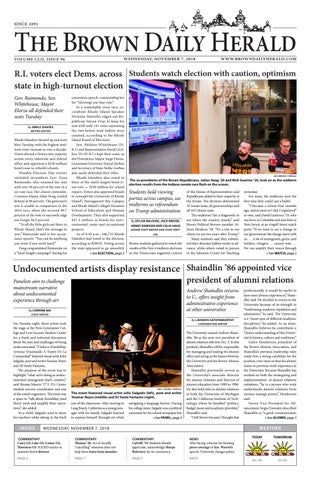
The co-presidents of the Brown Republicans, Julian Haag ’20 and Nick Guarino ’20, look on as the midterm election results from the Indiana senate race flash on the screen.
Students hold viewing parties across campus, see midterms as referendum on Trump administration By DYLAN MAJSIAK, JACK BROOK, HENRY DAWSON AND CELIA HACK SENIOR STAFF WRITER AND STAFF WRITERS
Brown students gathered to watch the results of the Nov. 6 midterm elections as the Democrats regained control
of the House of Representatives and Republicans added to their majority in the Senate. The elections determined 35 Senate seats, 36 governorships and all 435 House seats. The midterms “are a diagnostic to see where the country stands,” said Brown Political Review member Allison Meakem ’20. “It’s a test to see where we are two years after Trump.” Many students said they submitted their absentee ballots weeks in advance, while others voted in person in the Salomon Center for Teaching
yesterday. For some, the midterms were the first time they could cast a ballot. “I became a citizen four months ago, and as soon as I did, I registered” to vote, said David Gutierrez ’19, who was born in Colombia and now lives in New Jersey, at an Angell Street watch party. “If we want to see a change in our government, the change starts with us. … A lot of immigrants, green card holders, refugees … cannot vote. … We can amplify their voices through » See WATCH, page 2
Undocumented artists display resistance Shaindlin ’86 appointed vice
president of alumni relations
Panelists aim to challenge mainstream narrative about undocumented experience through art
Andrew Shaindlin returns to U., offers insight from administrative experience at other universities
By CORRINE BAI STAFF WRITER
On Tuesday night, three artists took the stage at the First-Generation College and Low-Income Student Center for a frank and informal discussion about the joys and challenges of being undocumented. “Undocu-Friendship: Artistas Triunfando A Través De La Comunidad” featured visual artist Julio Salgado, poet and writer Yosimar Reyes and DJ Sizzle Fantastic. The purpose of the event was to highlight “what we’re doing as undocumented immigrants that’s creative,” said Renata Mauriz ’17.5, FLi Center student success coordinator and one of the event’s organizers. The event was a space to “talk about friendship (and their) work and amplify their narratives,” she added. As a child, Salgado used to draw his teachers while sitting in the back
INSIDE
By LAVANYA SATHYAMURTHY CONTRIBUTING WRITER
JACK JACOBY / HERALD
The event featured visual artist Julio Salgado (left), poet and writer Yosimar Reyes (middle) and DJ Sizzle Fantastic (right). row of the classroom. After moving to Long Beach, California as a young teenager with his family, Salgado learned to express himself through art while
navigating a language barrier. During his college years, Salgado was a political cartoonist for his school newspaper but » See PANEL, page 3
The University named Andrew Shaindlin ’86 as the next vice president of alumni relations effective Dec. 3. In this position, Shaindlin will be responsible for managing and leading the alumni office and acting as the liaison between the University and the Brown Alumni Association. Shaindlin previously served as the University’s associate director for alumni relations and director of alumni education from 1989 to 1996. He also held roles in alumni relations at both the University of Michigan and the California Institute of Technology, where he handled “politics, budget issues and academic priorities,” Shaindlin said. “I left Brown because I thought that
professionally it would be useful to have more diverse experiences,” Shaindlin said. He decided to return to the University because of its strength in “fundraising, academic reputation and admissions,” he said. The University is a “sweet spot of different academic disciplines,” he added. As an alum, Shaindlin believes he contributes a “clearer understanding of (the University’s) history, culture and traditions.” Galen Henderson, president of the Brown Alumni Association, said Shaindlin’s previous leadership roles made him a strong candidate for the position, even more so than his alumni status or previous work experience at the University. Because Shaindlin has worked on both the strategizing and implementation of alumni relations initiatives, “he is a person who truly understands alumni relations from various vantage points,” Henderson said. Senior Vice President for Advancement Sergio Gonzalez described Shaindlin as “a good communicator, » See ALUMNI, page 3
WEATHER
WEDNESDAY, NOVEMBER 7, 2018
COMMENTARY Casey GS, Lake GS, Lomax GS, Thorsness GS: SUGSE’s tactics to unionize breed distrust
COMMENTARY Thomas ’20: Act of socially “cancelling” someone does not help them learn from mistakes
COMMENTARY Calvelli ’19: Students should appreciate, acknowledge Sharpe Refectory for its consistency
NEWS After facing criticism for limiting press coverage of Sen. Warren’s speech, University changes policy
PAGE 4
PAGE 7
PAGE 7
BACK
TODAY
TOMORROW
60 / 40
54 /35
NEWS
PAGE 2 • WEDNESDAY, NOVEMBER 7, 2018
» WATCH, from page 1 our vote.” The Herald attended four watch parties on campus to gauge how students reacted to the midterms. These included private parties as well as those hosted by BPR, No Labels, the Brown Democrats and Brown Progressive Action Committee and Brown College Republicans. Members of BPR met in the lounge at 257 Thayer St. to stream CNN coverage of the election results. At the beginning of the evening, some BPR members expressed hope that the anticipated blue wave — Democrats eagerly taking to the polls — would secure a Democratic majority in the Senate and House, but attendees such as Meakem and Dhruv Gaur ’21 were skeptical of being too certain of such victories following Hillary Clinton’s unexpected defeat in 2016, they said. “I’m really closely following the Georgia governor race,” said Gaur, a Gainesville, Georgia native. “I’ve been watching Stacey Abrams for a long time. … I really, really hope she pulls off a win tonight, (but) I’m always a little cynical when it comes to elections in Georgia,” he added, noting that Georgia has not had a Democratic governor for many years. Dheraj Ganjikunta ’22 held a small viewing party in his room in EmeryWoolley. Five first years clustered around two screens — one streaming television coverage and another rotating through online news coverage. “With all these races, all the hype around (the) blue wave, I’m surprised
that (the races) went as red as they did,” Ganjikunta said. Jason Gong ’22, however, described himself as “nonchalant.” “I have my qualms with both the Democrats and Republicans,” Gong said. “So I don’t have a dog in the game in regard to, ‘Do I want the Democrats or Republicans to win?’” Brown Dems and BPAC joined in on No Labels’ viewing party in Salomon. When Democrat wins rolled across the screen, many jumped up and down and whooped with excitement. Even when the results weren’t what they were hoping for — boos followed the anouncement that Beto O’Rourke lost to Sen. Ted Cruz — the majority of students remained cautiously hopeful. “For a Democrat to get such a high percentage in Texas in such a major race is a huge deal,” said Rose LangMaso ’20, president of the Brown Dems. “Of course we’re all very disppointed that Beto didn’t win, but the fact that Texas became a battleground state at all during this election should tell (the) Trump administration and Republicans that Democrats across the country are serious.” BPAC Political Director Jenna Israel ’21 reacted with excitement when ABC projected that Democrat Chrissy Houlahan would win Pennsylvania’s 6th congressional district. But she confessed there would most likely be tears later if the blue wave didn’t follow through as predicted. “No matter what happens tonight, it’s really important that we keep up the level of engagement and passion, and we carry it through to local and state-level politics,” she added.
THE BROWN DAILY HERALD Another attendee at the DemsBPAC event, Jason Carroll ’21, said he believed that a Democratic majority in the House would help contain the Trump administration. “If it doesn’t happen, it means we have at least two more years of unchecked Trump governancy,” Carroll said. “What’s really important in the House and the Senate is the oversight of the administration.” A Democratic chairperson of the House Financial Services Committee could potentially subpoena Trump’s tax records, he added. Meanwhile, around a dozen members of Brown College Republicans were tuned into Fox News on the top floor of Page-Robinson Hall. Co-President Nick Guarino ’20 said he does not support President Trump but remains committed to the Republican party. He sees the midterms as an opportunity for his party to continue to grow and broaden the range of voters to whom conservative politics appeal. “I’d like to see conservatism remain a big tent, … and I’m hopeful that it might be,” Guarino said. Closely following the results from their phones and computers as well as the television, attendees at the Republicans’ party read aloud live updates while comparing sources for polling data. “I’m a huge statistics guy, so I always find it super exciting to watch these elections play out and see polls fall apart,” said Adam Shepardson ’22. Following an announcement that Rhode Island’s Republican Senate candidate Bob Flanders ’71 had lost to Democratic incumbent Sen. Sheldon
DYLAN MAJSIAK / HERALD
The election watch party at 204 Angell St. printed photos of public figures and placed humorous commentary on adjacent sticky notes. Whitehouse, mock cries of “Bob!” rang out. Flanders had been considered a long shot, but the club supported his campaign. By and large, the Republicans were not surprised with the outcomes of the elections. Midterms often see the House shift away from the party of the incumbent
president, so it was not unexpected to see Democrats regain control, said Julian Haag ’20, co-president of the club and a Trump supporter. “I think history is against the Republicans tonight,” Haag said. But “win or lose, the people are speaking, so I don’t see a problem with it.”
NEWS
WEDNESDAY, NOVEMBER 7, 2018 • PAGE 3
THE BROWN DAILY HERALD
» PANEL, from page 1 chose not to major in visual art because he found the curriculum too rigid and inaccessible. Salgado began his talk with this introduction: “I am a queer artist of color, and I am still alive.” Salgado explained that he envisions art as a form of resistance; after the Orlando nightclub shooting, Salgado created an image captioned “Don’t stop dancing” to assert the importance of gay bars as places for the marginalized community to “party and organize.” Salgado aims to “fight back through art” against the misrepresentation of people with marginalized identities. Taking inspiration from popular culture, Salgado’s artistic creations reimagine popular sitcoms such as “Friends” and “Gilmore Girls” with black or Hispanic characters. “Hollywood is important,” Salgado said. Many people who dislike undocumented immigrants are not exposed to academic or activist work from this community, he said. Instead, “they’re watching TV. It’s important for us to infiltrate those bases.” Reyes grew up on the East Side of San Jose with his grandparents in a neighborhood composed of predominantly undocumented people. Growing up, his apartment often housed undocumented people, since his family rented out three rooms for extra income. Like Salgado, Reyes found a creative outlet in art, namely poetry. He self-published his first collection of poetry, “For Colored Boys Who Speak Softly…” with Mexican-American guitarist Carlos Santana. Focusing on the intersection of the experiences of undocumented immigrants and low-income people could forge a path of solidarity between people of different races and immigration statuses, Reyes said. Growing up in Boyles Heights, Los Angeles, DJ Sizzle’s teenage years were marked by a pressure to assimilate and “keep all her other identities closeted,” she said. Throughout high school, she built a reputation as a competitive cheerleader while hiding the fact that
she worked 50 hours a week as a food vendor and housekeeper. But after her undocumented status made her ineligible to work as a cheerleading coach, DJ Sizzle reconsidered her efforts to assimilate. “Assimilation is a … drug and a trap,” she said. Since then, DJ Sizzle has devoted herself to organizing activist movements. For instance, she helped lead a campaign to fight gentrification in her community when a number of art galleries appeared in the area. Throughout Tuesday’s event, panelists criticized the dominant narrative of undocumented people in the media. “The current narrative is based on fear (of deportation),” Reyes said. He added that the media often portrays undocumented immigrants as “in despair and crying” and people who cannot speak for themselves in order to “pacify the anxiety” of white Americans. Salgado echoed Reyes’s concern. Referencing the pressure undocumented immigrants face to prove their right to reside in the United States, Salgado said that “it all starts with ‘Look America — I went to college and even joined the military.’” People who grew up undocumented are often led to believe that “it’s the fault of (their) parents. But that’s fucked up. My parents are courageous and responsible — that’s why I am here,” Salgado added. John Lopez, an organizer of the event, told The Herald that the FLi Center reached out to this group of artists after seeing them on social media. “It is misleading that in news and the media, undocumented immigrants are seen as people in cages,” Lopez said. He incorporated the Undocu-Friendship panel into the year-long series — Undocu — to “focus on the fact that (undocumented immigrants) are real people who laugh and form connections.” Oscar Espiricueta ’21 particularly enjoyed the way that the panel “helped to change the undocumented narrative.” Espiricueta would also have liked to see different examples of resistance that the panelists engaged with, from attending rallies to confronting the daily dangers that accompany being undocumented.
Find Post- magazine on Facebook! facebook.com/postmagazinebdh
» ALUMNI, from page 1 a team player and a good manager,” which is why several University alums had initially referred him for the role, Gonzalez said. Gonzalez added that Shaindlin “believes in a philosophy that I believe in — providing engagement opportunities for alumni throughout their lifetimes.” In his role, Shaindlin plans to “make sure alumni feel connected to the University and feel a part of the Brown community.” This connection is important because alums form the largest and only permanent audience that the University has, Shaindlin said. To prepare for his position, Shaindlin has started familiarizing himself with current matters at the University with the help of both Gonzalez and Jill Rossi, who is currently interim vice president of alumni relations. Though he hasn’t worked at the University in a long time, Shaindlin believes the transition will be easy and described his return as a “homecoming.”
COURTESY OF GLENN BROOKES
After working in the alumni office from 1989 to 1996, Shaindlin returns to the University as vice president of alumni relations.
» ELECTION, from page 1 with the exception of Portsmouth High School’s polling location, which stayed open past the 8 p.m. closing time due to an electrical issue that moved voters to a gym in a different building. Executive Director of RIBOE Robert Rapoza told The Herald that he is “very pleased with the way the election was conducted today.”
THIS COULD BE YOU. To advertise your: business student group event in The Herald, visit bdhsales.com.
Cosmic Shadows, Other Worlds -m7 - b[_ bl;mvbom uѴb; ĺ ; ;uv
;-m o= 1-7;lb1 @-buv =ou $ubmb| oѴѴ;]; o= u|v -m7 "1b;m1;v -m7 vvo1b-|; (b1; uo ov| =ou &m7;u]u-7 -|; 7 1-ঞom -| h; &mb ;uvb| ĸ ;mf-lbm o ;ѴѴ uo=;vvou o= -|_;l-ঞ1v -m7 - uo=;vvou o= _ vb1v -m7 1omolb1v "_-7o -m7 bѴѴ lbm-ঞom r- ;umv -u; -ѴѴ -uo m7 vĺ "blbѴ-u r- ;umv -u; -Ѵvo 1-v| |_uo ]_o | |_; mb ;uv; 0 |_; ]u- b|-ঞom-Ѵ C;Ѵ7v o= v|-uv -m7 ]-Ѵ- b;vĺ $_bv |-Ѵh bѴѴ unveil how these cosmic shadows carry clues -0o | |_; ; bv|;m1; o= ; |u-voѴ-u rѴ-m;|v -m7 - rovvb0Ѵ; C[_ 7bl;mvbomĺ
Thursday, November 8, 2018, 4 p.m.
ICERM, 121 S. MAIN STREET, 11TH FLOOR mѴbm; u;]bv|u-ঞom bv mo or;m -|Ĺ brown.edu/thinking-out-loud
COMMENTARY PAGE 4 • WEDNESDAY, NOVEMBER 7, 2018
THE BROWN DAILY HERALD
What we stand to lose from SUGSE’s union CHRISTIAN CASEY, DEREK LAKE, JJ LOMAX, REBECCA THORSNESS op-ed contributors Dear graduate student workers, We write in response to the Nov. 5 op-ed “What we stand to gain from unionization,” and to respond more broadly to past claims made by Stand Up for Graduate Student Employees, which misled and divided this community. This is a dissenting opinion of sorts, but let us emphasize from the outset that none of us are against unionization on principle. Rather, we oppose SUGSE’s drive for unionization on campus at this time because of a different set of beliefs: a belief in honesty and personal integrity, a belief that the ends do not justify the means and a belief that those who would abuse their power should never be allowed to wield it. We have arrived at this opinion through various paths. Some of us were initially supportive of this union, some skeptical, but the behavior of SUGSE has solidified our opinions against it. While the recent false accusation of a conspiracy among administrators to disenfranchise people of color from a vote was the final straw, our aversion to SUGSE has long been building as a result of its persistently aggressive tactics, including angry rhetoric against anyone who disagrees with its cause (ourselves included), and harassing students by turning up at their homes and offices unannounced and calling their private numbers. There has been little public opposition to this unionization vote by graduate students, which gives SUGSE the incorrect impression that it has a mandate to act as it pleases. This letter is intended to address this state of affairs. Cynicism, Propaganda and Bad Faith In its attacks on University administrators, SUGSE accuses them of working to undermine the right of graduate student employees to decide whether to unionize. While it may be true that some members of the administration oppose unionization (as we should expect), we have seen no evidence that they have operated to discourage anyone from expressing their opinion. Rather, the administration has allowed SUGSE to move the voting process forward. In particular, the administration and SUGSE worked together to develop the Pre-Election Agreement, which borrows its model from the National Labor Relations Board. Both parties decided not to work with the NLRB directly because it is dominated by President Trump appointees. Instead, they agreed to adopt its previous framework and respect the results of a vote without requiring a (currently unreliable) government agency’s direct involvement. These are not the actions of an administration that seeks to stifle student-employee voices. On the contrary, it is obvious that this administration values student input and respects the right of students to decide on this matter, despite objections its individual members may have. The claim, often repeated by individual members of SUGSE, that the administration’s manipulation has forced SUGSE’s hand is a
weak defense at best. Even if we accept the argument that SUGSE’s behavior is required by circumstance, its willingness to use the disenfranchisement of students of color to discredit the administration is misguided. A stronger argument for a union should be made on principle alone, without reference to actions of administrators, but the arguments SUGSE prefers invariably cast administrators as villains. The inclination to perceive every action by authority as motivated by selfishness has a name: cynicism. It should worry all graduate students that those who claim to represent us would so easily succumb to the temptation to see the worst in others. It should be concerning that SUGSE denies any kindness or good intentions in our administrative leaders, yet simultaneously demands a powerful leadership role for itself. SUGSE’s legitimacy rests on its claim to support all graduate students, but in practice, it only considers the views of those who share its goals. Brown students of color have repeatedly raised issues regarding unions in
When one of us faced a life-threatening health condition, the administration sprang into action and actively supported him through his hospitalization and subsequent recovery. This is not an isolated incident. All of us know of situations in which the administration has helped us and our fellow graduate students, asking for nothing in return, but instead encouraging us to continue our studies and assuring that they would support us however they could. The administration is also actively working to improve support for graduate student parents and expand health care coverage. Indeed, this is what they are supposed to do, and they get no special credit for doing it. But they should not be so readily considered our enemy, even in the battle over unionization. SUGSE’s resolve to attack the administration at every turn demands that we abandon our gratitude toward those who have invested time and money in our success. A call for unionization is reasonable and permissible, but it should not include unjustified attacks on those who have supported us. Even with a union, we will continue to work with
Some of us were initially supportive of this union, some skeptical, but the behavior of SUGSE as a group has solidified all of our opinions against it.
general, because unions have historically ignored the rights of underrepresented groups. SUGSE showed little concern for these legitimate objections to unionization in town halls and open meetings this semester. Recently, SUGSE changed course dramatically, accusing the administration of actively working to disenfranchise students of color by holding the election in a manner consistent with the Pre-Election Agreement. These students are not convenient bargaining chips to be used as leverage. From the Pre-Election Agreement’s conception, this disenfranchisement was present, but the needs of students from historically underrepresented groups were not considered. When this particular matter was brought to the attention of SUGSE last week, it was mentioned with the intention of shifting SUGSE’s proposed election dates, not to become a talking point. While the concerns of students from historically underrepresented groups have been raised to members of SUGSE, they refuse to reopen negotiations with administration to resolve said issues. Rather, SUGSE has resorted to taking the needs of those students and twisting them for their own purposes. Health and Family Care Those of us who have been at Brown for many years have experienced the sorts of personal crises that can arise in the course of graduate school, events which inevitably challenge any administration’s ability to support its students. In many real cases, the current administration has fought on our behalf.
the administration as both students and employees of the University. We will continue to believe in Brown as an organization engaged in the pursuit of higher ideals and in ourselves as something more than wage-earning employees. Pay and Costs Despite naive claims to the contrary, the formation of a union does not free us from powerful authorities. It replaces one authority with another. The call for a union demands that we trust that SUGSE and the American Federation of Teachers will be better leaders than those we currently have. The evidence demonstrates otherwise. In our collective decades of experience as graduate student employees, the administration has repeatedly proven itself to be a trustworthy support system, while SUGSE’s overt cynicism and dishonesty suggest that it will be anything but. SUGSE members (particularly those who have been at Brown for only a few months) who have failed to realize that they can address their problems to administrators and count on their aid should not attack the open, good-faith relationship that the rest of us already enjoy with the graduate school administration. Finally, finances matter to graduate students. Students in the bargaining unit will be required to pay union dues. While the specifics will not be decided until after the election, we have been told to expect to pay 1.5 to 2 percent of our annual stipend in dues — probably between $200 and $500, depend-
ing on department. That amount is similar to the annual raises Brown has consistently provided to current graduate students. While SUGSE promises that our dues will be offset with a raise, this assertion must be critically examined. The bargaining unit will not have unrestricted access to Brown’s financial books if we unionize, and available University financial reports and the recent accreditation report make it clear that there is not an untapped pot of money available to dramatically increase graduate student stipends or benefits. (Despite what some union supporters claim, Brown’s $3.8 billion endowment cannot simply be drawn from to pay graduate students.) In our view, SUGSE has failed to articulate what cuts the University would realistically make to further enhance graduate student stipends and benefits, and we remain concerned that any benefits of unionization would not offset the costs, or worse, come at the expense of forward progress (e.g. limited recruitment of more underrepresented minority students as mandated by Diversity and Inclusion Action Plan). You may not have been involved with this process so far, but you soon will be. Choosing not to vote leaves the most ideologically extreme to make this decision for everyone. Voting your conscience will ensure that the opinion of the graduate student body as a whole will determine the outcome. So we implore you, our fellow graduate students, to vote, and to think critically about your vote. Remember that a “no” vote is a vote against SUGSE’s union at this time, not a vote against future unionization at Brown. Sincerely, JJ Lomax GS, Ecology and Evolutionary Biology Derek Lake GS, Health Services Research, Policy, and Practice Rebecca Thorsness GS, Health Services Research, Policy and Practice Christian Casey GS, Egyptology Jerson Cochancela GS, Biostatistics Megan Dempsey GS, Biomedical Engineering Kira DiClemente GS, Behavioral and Social Sciences John Krantz GS, Earth, Environmental and Planetary Sciences Lacey Loomer GS, Health Services Research, Policy and Practice E.L. Meszaros GS, History of the Exact Sciences in Antiquity Zachary Rubin GS, Assyriology Shane M. Thompson GS, Religious Studies Jessica Tomkins GS, Egyptology Tanner Walker GS, Religious Studies
Christian Casey GS, Derek Lake GS, JJ Lomax GS and Rebecca Thorsness GS can be reached at christian_casey@ brown.edu, derek_lake@brown.edu, jeremy_lomax@brown.edu and rebecca_thorsness@brown.edu. Please send responses to this opinion to letters@ browndailyherald.com and op-eds to opinions@browndailyherald.com.
TODAY
WEDNESDAY, NOVEMBER 7, 2018 • PAGE 5
THE BROWN DAILY HERALD
menu
from grey to green
SATELLITE DINING ANDREWS COMMONS
Pizza: Spicy Sausage and Garlic, Four Cheese and Basil Po’ Boys, Curry Bar JOSIAH’S
BLUE ROOM
Pasta Night, Samosa Burger, Quesadilla Station
Tomato Florentine Soup, Chicken Kadhai, Vegetable Curry
DINING HALLS SHARPE REFECTORY LUNCH
DINNER
Chicken Tikka Masala, Xi’an Pulled Pork, Bolo Role, Pumpkin Cupcakes
Roast Turkey with Gravy, Herbed Turnips, Meat Lovers Pizza, Salted Caramel Eclair
VERNEY-WOOLLEY LUNCH
DINNER
Baked Polenta, Brown Rice Pilaf, Pasta Bar with Sausage, Pizza Rustica With Spinach
Roasted Corn Chowder with Bacon and Potatoes, Risotto Primavera, Anadama Bread
sudoku
DANIELLE EMERSON / HERALD
The green space on the rooftop of the 85 Waterman building is populated by bamboo shoots and studying students, who come to get away from the gloomy skies and cold temperatures of Providence in November.
crossword
Q U O T E O F T H E D AY
“I believe in openness as a reporter and the importance of the free flow of discourse, especially at a college
”
campus that espouses those ideals.
— Mike Stanton, former reporter for the Providence Journal
See warren on BACK
calendar TODAY NOVEMBER
S
4
M
5
T
6
W
7
Th
F
S
1
2
3
8
9
10
Teach-In: Impact of the Midterm Elections 12:00 P.M. Watson Insitute
Research Activities Information Session 12:00 P.M. CareerLab
LingLangLunch Talk 2:00 P.M. Metcalf Research Building, 305
Tibetan Singing Bowls 7:30 P.M. Paige-Robinson Hall, 411
TOMORROW
11
12
13
14
15
16
17
18
19
20
21
22
23
24
25
26
27
28
29
30
Jinku Kim: Hardwired Wonderland 1:00 P.M. Granoff, Studio 1
Turkish Tea 3:30 P.M. 195 Angell St., 202
Math Slam 4:00 P.M. 170 Hope St., 108
Flickers’ Italian Film Festival 7:30 P.M. Friedman Hall, 102
COMMENTARY PAGE 6 • WEDNESDAY, NOVEMBER 7, 2018
THE BROWN DAILY HERALD
EDITORIAL
U. must address inequality in its innovation strategic plan In June, the University unveiled the Brown and the Innovation Economy Strategic Plan, an initiative to support economic development and entrepreneurship in Rhode Island. The University aims to promote job creation and innovative commercial activity in the local economy by supporting talent development and retention and building a regional network of business leaders, investors and technology developers. We applaud the University for articulating a clear commitment to enhancing the vitality and long-term prospects of the Rhode Island economy. As the wealthiest institution of higher education in the state, the University has long played a significant role in Rhode Island’s economy. Still, as the University embarks on the ambitious process of realizing the strategic plan’s central objectives, it must address the issue of local inequality and ensure that its efforts will yield broad-based growth that delivers positive outcomes and opportunities for all Rhode Islanders. The strategic plan commits the University to forging strong, long-term partnerships with students, policymakers and businesspeople in the surrounding community. For example, the University’s Office of Industry Engagement and Commercial Venturing will support the Rhode Island Innovation Hub, a collaboration between industry and academics to support innovation and the commercialization of new technologies. In addition, the Nelson Center for Entrepreneurship will administer Brown Venture Founders, a program designed to incentivize University graduates to launch their startups in Providence. The strategic plan’s other goals include deepening ties with industry, facilitating cooperation between University researchers and businesses and commercializing discoveries in biomedicine. While it is impossible to precisely predict how much the University’s strategic plan will drive economic growth, the literature suggests that University expenditures — coupled with the creation of highly concentrated districts that host technology developers, researchers and investors — can make a substantial contribution to the local economy. Universities well-integrated in the commercial fabric of their host cities generate more patents and startups than schools in suburbs, rural areas or college towns. And for every $1 spent by a university in an urban area, the average income in the surrounding city grows by 89 cents. Given these realities, it is safe to say that the strategic plan gives the University a solid chance to support the development of a vibrant and innovative Rhode Island economy. Yet, while the University has made ambitious commitments to supporting local entrepreneurship and commercial activity, its strategic plan fails to make any mention of inequality — a particularly acute problem in Rhode Island. Providence is one of the most unequal cities in the
United States, having simultaneously experienced precipitous declines in manufacturing and rapid growth in well-off neighborhoods such as College Hill. The statistics are startling: In one low-income tract in downtown Providence, children are predicted to have an annual household salary of $23,000 as adults. Black low-income residents of Federal Hill are projected to make $12,000 per year. But in the tract that includes much of the University and Rhode Island School of Design, children are predicted to have an annual household salary of $72,000. These disparities in economic opportunities are caused by multiple factors including local crime, poverty and access to education. In general, American cities and towns featuring large universities, despite their aforementioned contributions to local commercial activity, often experience considerable inequality. In Syracuse, New York, the number of households in higher income brackets increased during the 2014-15 school year, but one in two children still lives in poverty. In Richmond, Virginia, the average household income in the tract that includes the University of Richmond is $73,542; in another tract, almost 50 percent of residents are below the poverty line, with a median household income of $9,583. Of course, the University cannot reasonably be expected to solve all of the entrenched injustices and obstacles to opportunity that create inequality in Providence or Rhode Island. But the University does have a responsibility to support the kind of economic growth that extends opportunity to all of the neighborhoods in Providence, and it should develop a strategy for doing so. We certainly do not have all the answers, and we fully acknowledge that spurring innovative growth that delivers prosperity to all segments of society will not be easy. But in asking the University to critically examine how it might combat inequality through its strategic plan, we are fundamentally concerned with the character of Brown and its role in community life in the years to come. As John Logan, professor of sociology, told The Herald, the University “can be perceived as a progressive force, helping to revitalize the city, or it can be seen as participating in a kind of growth whose benefits will be reaped by some kinds of people and not others.” We hope that the University selects the former route in its efforts to improve innovation and economic activity in Rhode Island.
Editorials are written by The Herald’s editorial page board: Anuj Krishnamurthy ’19, Rhaime Kim ’20, Grace Layer ’20, Mark Liang ’19 and Krista Stapleford ’21. Please send responses to this opinion to letters@browndailyherald.com and opeds to opinions@browndailyherald.com.
STAY UP-TO-DATE. FOLLOW US ON FACEBOOK. FACEBOOK.COM/BROWNDAILYHERALD
Find us online! facebook.com/browndailyherald
browndailyherald.com
@the_herald
Location: 195 Angell St., Providence, R.I. www.browndailyherald.com
@browndailyherald
youtube.com/browndailyherald
Editorial Leadership
Sections
Multimedia & Production
Business
Editors-in-Chief Elena Renken Kasturi Pananjady
Arts & Culture Editors Ethel Renia
Design Editors Kyle Cui Eduard Muñoz-Suñé Assistants: Julie Wang, Kelvin Yang
General Managers Michael Borrello Matilda Lynton
Managing Editor Alex Skidmore
Metro Editors Emily Davies Isabel Gensler
Senior Editors Madison Rivlin Hattie Xu Ben Shumate
News Editors Eduard Muñoz-Suñé Priyanka Podugu Sarah Wang
Editorial Page Editor Anuj Krishnamurthy
Science & Research Editors Jonathan Douglas Jackson Wells
POST- MAGAZINE Editor Jennifer Osborne
Sports Editors Alexandra Russell James Schapiro COMMENTARY Opinions Editors Connor Cardoso Anuj Krishnamurthy Clare Steinman Emily Miller
Photo Editors Sam Berube Anita Sheih Copy Desk Chief Kelley Tackett Illustrations Editor Daphne Zhao Video Editor Celia Hack Graphics Editors Marlis Flinn Sarah Martinez
Office Manager Diane Silvia Directors Sales: Shreya Raghunandan Finance: Ravi Betzig Strategy: Edwin Farley
Editorial contact: 401-351-3372 herald@browndailyherald.com
Advertising contact: 401-351-3372 advertising@browndailyherald.com
Submissions: The Brown Daily Herald publishes submissions in the form of op-eds and letters to the editor. Op-eds are typically between 750 and 1000 words, though we will consider submissions between 500 and 1200 words. Letters to the editor should be around 250 words. While letters to the editor respond to an article or column that has appeared in The Herald, op-eds usually prompt new discussions on campus or frame new arguments about current discourse. All submissions to The Herald cannot have been previously published elsewhere (in print or online — including personal blogs and social media), and they must be exclusive to The Herald. Submissions must include no more than two individual authors. If there are more than two original authors, The Herald can acknowledge the authors in a statement at the end of the letter or op-ed, but the byline can only include up to two names. The Herald will not publish submissions authored by groups. The Herald does not publish anonymous submissions. If you feel your circumstances prevent you from submitting an op-ed or letter with your name, please email herald@browndailyherald.com to explain your situation. You can submit op-eds to opinions@browndailyherald.com and letters to letters@browndailyherald.com. When you email your submission, please include (1) your full name, (2) an evening or mobile phone number in case your submission is chosen for publication and (3) any affiliation with Brown University or any institution or organization relevant to the content of your submission. Please send in submissions at least 24 hours in advance of your desired publication date. The Herald only publishes submissions while it is in print. The Herald reserves the right to edit all submissions. If your piece is considered for publication, an editor will contact you to discuss potential changes to your submission. Commentary: The editorial is the majority opinion of the editorial page board of The Brown Daily Herald. The editorial viewpoint does not necessarily reflect the views of The Brown Daily Herald, Inc. Columns, letters and comics reflect the opinions of their authors only. Corrections: The Brown Daily Herald is committed to providing the Brown University community with the most accurate information possible. Corrections may be submitted up to seven calendar days after publication. Advertising: The Brown Daily Herald, Inc. reserves the right to accept or decline any advertisement at its discretion. The Brown Daily Herald, Inc. is a financially independent, nonprofit media organization bringing you The Brown Daily Herald, BlogDailyHerald and Post- Magazine. The Brown Daily Herald has served the Brown University community daily since 1891. It is published Monday through Friday during the academic year, excluding vacations, once during Commencement and once during Orientation by The Brown Daily Herald, Inc. Single copy free for each member of the community. Subscription prices: $200 one year daily, $100 one semester daily. Copyright 2018 by The Brown Daily Herald, Inc. All rights reserved. Periodicals postage paid at Providence, R.I. Postmaster: Please send corrections to P.O. Box 2538, Providence, RI 02906.
COMMENTARY WEDNESDAY, NOVEMBER 7, 2018 • PAGE 7
THE BROWN DAILY HERALD
Ode to the Sharpe Refectory AIDAN CALVELLI op-ed columnist College dining halls don’t often make the news. However, as this semester commenced, a nickname controversy catapulted the Sharpe Refectory into the headlines. Should it be the Ratty? (Sure.) The Rodent? (I will not entertain this.) The Sharpe Refectory? (Preach!) The outpouring of feeling and meme-ery generated by this debate indicated that Brown students care about their biggest eating establishment. Soon, though, debate died down, and the name of the Ratty faded from the spotlight. Though it’s good we’ve moved past debating a name, we shouldn’t take the Ratty for granted, underappreciating its crucial role on campus. The Ratty is a beacon of consistency, a foil to self-importance and an integral part of a healthy campus life. It deserves our recognition and respect. There’s a wide range of opinions about the actual food from the Ratty. I, for one, am a loyal devotee. Cajun pasta, sauteed broccoli and lentil soup are all worth the price of admission. (And cream cheese brownies. Mmmm. I once had five in one sitting, and still wasn’t sated.) But regardless of where on the Ratty food appreciation spectrum you fall, we should all agree on one thing: The Ratty is remarkably consistent. Three meals
a day, seven days a week, the Ratty is churning out copious amounts of food to feed all sorts of palates and diets. Its dependability is a breath of fresh air. While it might not have any Michelin stars, it humbly and readily takes on the necessary but unsexy task of putting food on the table. The Ratty’s institutional humility contrasts with the attitudes of the students who patronize it. Students at Brown — myself very much included — have a reputation for self-importance, with attending an Ivy League
dining at the Ratty can remind us that no matter who you are or what you do, everyone’s gotta eat, and we are incredibly privileged to have the Ratty there to provide for us. Taking the time to appreciate Ratty meals as valuable parts of the day, not just as pit stops between more “important” endeavors, is an elixir to elitism, a puncturer of the pretension of the college bubble. Reflecting on the Ratty’s symbolic role can make us more thoughtful, appreciative people. But the Ratty’s most important role is its practical one that
into the Ratty by summer 2019. And the Ratty does more than just serve any kind of food. It provides a dazzling array of healthy choices, with vegetables, whole grains and lean proteins abounding. Of course, it also serves its fair share of unhealthy options, (hello again, cream cheese brownies), but ultimately how nutritiously you eat is your choice. You might want to grumble that you had steamed snow peas the last two weeks, but try cooking for yourself every day and see how long you go
Taking the time to appreciate Ratty meals as valuable parts of the day, not just as pit stops between more “important” endeavors, is an elixir to elitism, a puncturer of the pretension of the college bubble. university and presumably having been the best at everything since being the first kid in their neighborhood to recite the alphabet backwards. What better antidote to that alluring self-importance than regularly eating at an establishment whose nickname is endearingly self-deprecating. I don’t know about you, but it’s hard for me to sustain a view of myself as a future member of the secret global leadership cabal while circling the Ratty’s tables in vain for a friend to sit with at a dining hall explicitly evocative of a rodent. More seriously,
I’ve only passingly mentioned: feeding the population of Brown University. Possibly never again in our lives will we have such abundant and diverse food available to us at a moment’s notice, without even having to turn on a stove. Producing food is incredibly hard work, and the cooks at the Ratty put in an enormous amount of behind-the-scenes labor that is too easily taken for granted. For instance, up until now Ratty employees have endured the summer months with no central air. Thankfully, the administration has promised to install air conditioning
before a bowl of cereal and days-old leftovers feel like a gourmet dinner. Having such reliable access to nutritious meals is a situation we would do well to appreciate before it’s gone. Just imagine explaining to someone elsewhere in the world that Brown provides its students with functionally unlimited access to food, and you’ll begin to see how unique and incredible the Ratty is. Yet instead of taking time to appreciate the Ratty, we are quick to belittle or poke fun at it. When I go on my Aidan-loves-Ratty-broccoli rants,
I often get blank stares. And even in the course of writing this column, I had to edit out some of my unnecessarily harsh jabs at Ratty food that overlooked the labor of the talented people who work there. Perhaps because we feel too important for dining hall food or are too caught up in our own daily pursuits, the Ratty just becomes another part of our college lives that we take for granted. Still, no matter what insults we unthinkingly throw at the Ratty, it doesn’t let that criticism get in the way of its mission. You can complain all you want about the lack of potatoes au gratin on the Sunday brunch menu, but the Ratty isn’t going to let our unreasonable expectations keep it from serving up perfectly good food. You may laugh at a dining hall that calls itself “The Ratty,” but it’s self-confident enough to withstand mockeries of its moniker. You may want to drop off meal plan altogether, but the Ratty will be there for you to crawl back to when you tire of instant ramen and Baja’s takeout. No matter what barbs you throw at it, the Ratty will still be there, ready and willing to serve you fresh, thoughtfully-prepared food.
Aidan Calvelli ’19 is head chef of Maizie’s restaurant on Lloyd Ave. He, unfortunately, is off meal plan, and will trade you a meal at Maizie’s for a Ratty swipe. He can be reached at aidan_calvelli@brown.edu.
Cancelling cancel culture QUENTIN THOMAS staff columnist The practice of “cancelling” is becoming increasingly common. By cancelling, I mean the process by which people mark someone as problematic and withdraw any and all prior support to ignore and exclude this person. To a lesser degree, when I talk about “cancel culture” I’m also referring to the broader habit our society has of simply doing away with those it finds undesirable. One way this manifests is when celebrities’ old, problematic tweets resurface and people decide to cancel them in retaliation. It is important to remember that actions do have consequences, and folks absolutely should be held accountable for disrespectful or mean-spirited behavior. However, we should also think about what it means for us to immediately close someone off. I believe it’s worth thinking about what accountability looks like beyond simply exiling someone. In doing so, we can position ourselves more firmly within the values of social justice. One reason worth giving cancel culture a hard examination is that it doesn’t seem to be working. If cancel culture is meant to be a tool for social justice, cancelling people and not paying them any mind would compel them look at their actions and take the time to understand why what they’ve done or said might not be in good taste. While the idea of cancelling someone might be well-intentioned and intended to inspire some introspection and critical thought on the part of the individual being cancelled, rarely does this learning manifest on its own. For example, this past summer Roseanne Barr had the reboot of her show cancelled by ABC following a racist tweet she
made about Valerie Jarrett, a former adviser to former president Barack Obama. As a result, Barr was forced to apologize in hopes of reacquiring a spot in the public’s good graces. However, in her apologies to Jarrett, it was clear that Barr had not really grasped an understanding of why she had warranted criticism. Further, her apology doesn’t show her raising her critical consciousness or being more mindful with her language. In other words, nowhere in her apology did Barr say that this fiasco prompted a change in her politics, a hard look in the mirror, an interrogation of the ways
pose a shift in how we deal with people who have said or done irresponsible things. Thinking through what it means to hold people accountable is more in line with the social justice ideals that cancel culture is — at its most basic level — rooted in. That cancel culture may simply be brushing aside those individuals who don’t fit into a collective vision of the future is troubling, and may actually be serving as a direct antithesis to the mission of social justice at the end of the day. I’ll try to flesh this out more. In some ways, cancel culture is exemplified by our prison
I believe it’s worth thinking about what accountability looks like beyond simply exiling someone. In doing so, we can position ourselves more firmly within the values of social justice.
in which she perpetuated racism or a lifelong commitment to unlearning racial privilege on her part. This is not to question the validity of Barr’s facing consequences for her actions. Rather, I’m arguing that effectively shutting Barr out might provide an immediate band-aid solution to the problem, but it also provides no real impetus for Barr to critically examine and think about why, exactly, her tweet was problematic, why she was criticized and why her show was cancelled. Recognizing that cancel culture is not resulting in the learning and changed behavior of cancelled individuals is precisely why I pro-
system. We send people away to prison after they’ve committed a crime. It is somewhat implied that the time individuals spend in prison will turn them into good citizens, the kinds of people who don’t commit crimes. Yet, over a nine-year time period, released prisoners averaged five arrests. Like cancel culture, the prison system punishes people, but doesn’t really provide space for behavioral change. What’s more is that the prison population is disproportionately representative of the black and Latinx population in the United States. Obviously there’s absolutely no moral equivalence between mass incarceration and the efforts by
social justice activists to cancel those responsible for bigoted behaviors or statements, and it’s important to recognize that there’s a power disparity between the actors in these situations. But for those of us who seek to uphold social justice ideals, it behooves us to think about what it means for one of the mechanisms we access in the name of social justice — cancelling — to so closely resemble a system that produces negative life outcomes disproportionately for people of color. Engaging in this thought process and envisioning accountability beyond models evocative of oppressive structures are worthwhile exercises if we seek to live out social justice ideals and frameworks. This is not to say that accountability can’t, in part, look like cancelling. Sometimes, people commit crimes and engage in behavior so harmful and so galling that they don’t deserve a second chance — especially to keep the people around them safe from further harm. But for those who’ve behaved in ways that can be reasonably unlearned, I believe it’s also worth thinking about accountability in terms of restorative justice. In totality, accountability might look like going further than punitive measures to ensure that individuals take active steps to understand the harm they may have perpetuated and develop ways to lead a life in which they’ve given up harmful notions and tendencies. To do this would be to truly commit ourselves to a socially just society.
Quentin Thomas ’21 can be reached at quentin_thomas@brown.edu. Please send responses to this opinion to letters@browndailyherald.com and opeds to opinions@browndailyherald. com.
NEWS THE BROWN DAILY HERALD
WEDNESDAY, NOVEMBER 7, 2018
University allows press to film, photograph Warren speech Policy change follows criticism from ProJo, New England First Amendment Coalition By DYLAN MAJSIAK SENIOR STAFF WRITER
The University revoked and altered its “pencil press” media policy for Sen. Elizabeth Warren’s, D-MA, speech today after receiving criticism from local publications and community members. ABC6 will now film and pool the recording to media outlets, while the Providence Journal will do the same
for photography, wrote Brian Clark, director of news and editorial development, in an email to The Herald. Previously, the University stipulated that reporters could not record any portion of the event. The Providence Journal and the New England First Amendment Coalition protested the University policy as unnecessarily restrictive, as the Providence Journal previously reported. Journalist Michelle Smith from the Associated Press took to Twitter to voice her discontent with the plan, tweeting that the original policy made the University appear to move “backwards as time has progressed.” “I was appalled” by the initial policy,
said Mike Stanton, a former University professor of journalism and former reporter for the Providence Journal who also tweeted his dissatisfaction. “I believe in openness as a reporter and the importance of the free flow of discourse, especially at a college campus that espouses those ideals.” Given Warren’s status as a highprofile politician, the University should extend access to reporters, particularly as her speech takes place the day after the midterm election, Stanton added. Originally scheduled for last Thursday at the Olney-Margolies Athletic Center, the lecture was rescheduled to today at 5 p.m. and relocated to the De Ciccio Family Auditorium in the
Salomon Center. The initial media parameters for the Salomon lecture aimed to “make a very high-demand event work in a small space,” Clark wrote. “Our goal was to ensure that news reporters could access the event, yet in a way that acknowledged the limitations of the venue.” Still, some journalists question whether the venue’s size was the University’s true motives for setting such a policy. Previously, the University hosted the 2014 Providence mayoral debate between then-candidates Jorge Elorza and Vincent “Buddy” Cianci in Salomon and provided a “simulcast” of the full debate, according to the Oct. 8,
2014 press release. While the University might limit press access due to venue capacity, restricting coverage of Warren’s lecture does not seem reasonable since Salomon is a “huge venue,” said Rose Lang-Maso ’20, president of the Brown Democrats. “I’m glad to see they have changed their mind,” Lang-Maso said. The University is not obligated to follow first amendment regulations as a private institution, but it should still aim to uphold the ideals of free speech, she added. “There’s all kinds of measures that (should) have been taken to accommodate the press,” Stanton said.