SINCE 1891
THE BROWN DAILY HERALD WEDNESDAY, NOVEMBER 14, 2018
VOLUME CLII, ISSUE 101
WWW.BROWNDAILYHERALD.COM
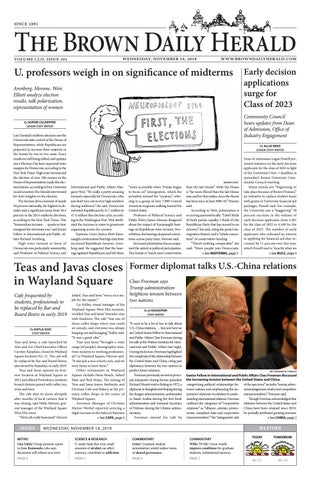
U. professors weigh in on significance of midterms Arenberg, Morone, Weir, Elliott analyze election results, talk polarization, representation of women
Community Council hears updates from Dean of Admission, Office of Industry Engagement
By SOPHIE CULPEPPER SENIOR STAFF WRITER
Last Tuesday’s midterm elections saw the Democrats take control of the House of Representatives, while Republicans are projected to increase their majority in the Senate by one to two seats. Exact results are still being tallied, and updates since Election Day have improved voter margins for Democrats, according to the New York Times. High voter turnout and the election of over 100 women to the House of Representatives made this election historic, according to four University social scientists The Herald interviewed for their insights on the election. The election drew a turnout of nearly 50 percent nationally, the highest in decades and a significant jump from 36.4 percent in the 2014 midterm elections, according to the New York Times. This “tremendous increase … speaks to how energized the electorate was,” said Senior Fellow in International and Public Affairs Richard Arenberg. High voter turnout in favor of Democrats was particularly noteworthy, said Professor of Political Science and
Early decision applications surge for Class of 2023
By ALLIE REED SENIOR STAFF WRITER
SIMONE ZHAO
International and Public Affairs Margaret Weir. “It’s really a pretty amazing turnout, especially for Democrats, who just don’t turn out in very high numbers during midterms,” she said. Democrats outvoted Republicans by 51.7 million to 47.4 million this election cycle, according to the Washington Post. Weir attributed the increase in votes to grassroots organizing across the country. Supreme Court Justice Brett Kavanaugh’s confirmation hearings may have increased Republican turnout, Arenberg said. He suggested that the hearings agitated Republicans and left them
“more accessible when Trump began to focus on” immigration, which the president termed the “caravan,” referring to a group of over 7,000 Central American migrants walking toward the United States. Professor of Political Science and Public Policy James Morone disagreed about the impact of Kavanaugh’s hearings on Republican voter turnout. Nevertheless, the hearings deepened convictions across party lines, Morone said. Increased polarization has accompanied the uptick in political participation. This Senate is “much more conservative
than the last Senate” while the House is “far more liberal than the last House was, and for that matter, since the House has been since at least 2008-10,” Morone said. According to Weir, polarization is occurring asymmetrically. “I don’t think it’s both parties equally; I think it’s the Republican Party that has moved to an extreme,” she said, citing the party’s immigration rhetoric and a “whole consortium” of conservative funding. “There’s nothing comparable,” she said. “More people join Democratic » See MIDTERMS, page 2
Dean of Admission Logan Powell presented statistics on the early decision applicants for the class of 2023 in light of the University’s Nov. 1 deadline at yesterday’s Brown University Community Council meeting. Many trends are “beginning to take place because of Brown Promise,” an initiative to replace student loans with grants in University financial aid packages, Powell said. For example, the University saw a “staggering” 20 percent increase in the volume of early decision applicants, from 3,501 for the class of 2022 to 4,169 for the class of 2023. The number of early applicants who indicated an interest in applying for financial aid also increased by 11 percent over last year, which Powell said is “exactly what we » See BUCC, page 4
Teas and Javas closes Former diplomat talks U.S.-China relations Freeman says in Wayland Square Chas Trump administration Cafe frequented by students, professionals to be replaced by Bar and Board Bistro in early 2019 By KAYLA GUO STAFF WRITER
Teas and Javas, a cafe launched by Alex and Ani Chief Executive Officer Carolyn Rafaelian, closed its Wayland Square location Oct. 11. The cafe will be replaced by Bar and Board Bistro, also owned by Rafaelian, in early 2019. Teas and Javas opened its firstever location at Wayland Square in 2012 and offered Providence residents brunch fixtures paired with coffee, tea, wine and beer. The cafe shut its doors abruptly after months of local rumors that it was closing, said Nikki Patrizzi, general manager of the Wayland Square West Elm store. “We’re all really bummed,” Patrizzi
INSIDE
added. Teas and Javas “was a nice staple for the square.” Liz Kelley, visual manager of the Wayland Square West Elm location, recalled Teas and Javas’ lavender chai with fondness. The cafe “was one of those coffee shops where you could sit outside, and everyone was always hanging out and lounging,” Kelley said. “It was a good vibe.” Teas and Javas “brought a wide range (of people), demographic-wise, from students to working professionals” to Wayland Square, Patrizzi said. “It was just a nice eclectic mix, and we were lucky to have them.” Other restaurants in Wayland Square include Pasta Beach, Salted Slate and Red Stripe. The closing of Teas and Javas leaves Starbucks and L’Artisan Cafe and Bakery as the primary coffee shops in the center of Wayland Square. Assistant Manager of L’Artisan Meirav Werbel reported noticing a slight increase in the bakery’s business » See CAFE, page 3
heightens tension between two nations By LI GOLDSTEIN STAFF WRITER
“It used to be a lot of fun to talk about U.S.-China relations, … but now here we are,” joked Senior Fellow in International and Public Affairs Chas Freeman during his talk at the Watson Institute for International and Public Affairs last night. During his lecture, Freeman highlighted the complexity of the relationship between the United States and China, citing past diplomacy between the two nations to predict future relations. Freeman previously served as principal interpreter during former president Richard Nixon’s visit to Beijing in 1972, a diplomat in Bangkok and Beijing during the Reagan administration, ambassador to Saudi Arabia during the first Bush administration and Assistant Secretary of Defense during the Clinton administration. Freeman started his talk by
JEFF DEMANCHE / HERALD
Senior Fellow in International and Public Affairs Chas Freeman discussed the increasing tension between the United States and China. categorizing political relationships be- of the spectrum” includes “enemy, advertween nations and emphasizing the im- sarial antagonism, rivalry and competitive portance of precise vocabulary in under- transactionalism,” Freeman said. standing international relations. Freeman Though Freeman acknowledged that outlined the categories of “cooperative relations between the United States and relations” as “alliance, entente, protec- China have been strained since 2010, torate, compliant state and cooperative he partially attributed growing tensions transactionalism.” The “antagonistic side » See CHINA, page 2
WEATHER
WEDNESDAY, NOVEMBER 14, 2018
METRO Gun Safety Group presents report to Gov. Raimondo, who says document will inform new term
SCIENCE & RESEARCH U. study finds that even small amounts of alcohol can affect memory, contribute to addiction
COMMENTARY Letter: Graduate student unionization would realize vision of shared governance
COMMENTARY Wilks ’15 GS: Union would improve conditions for graduate students, institutional memory
PAGE 3
PAGE 4
PAGE 6
PAGE 7
TODAY
TOMORROW
36 / 21
34 / 31
NEWS
PAGE 2 • WEDNESDAY, NOVEMBER 14, 2018
» MIDTERMS, from page 1 Socialists of America, but the amount of power that a group like that has in the Democratic Party compared to what (far-right) groups have in the Republican Party is just nothing.” The United States at this political moment is “a very alienated society,” said Professor of Sociology Gregory Elliott, which has caused the “notion of tribes” to arise, he added. Arenberg also noted increasing polarization. Some Democrats have shifted left, while most Republicans have shifted toward Trump rather than the traditional right, he said. Polarization is also reflected in deepening rural-urban divisions, which split along partisan lines. But in a shift this election, suburban voters, especially women, moved left. “In major cities, the suburban (rings) which have typically been largely Republican are flipping over and are looking more Democratic,” Arenberg said. Women might have been “inspired by the Women’s March” or were disappointed after the 2016 election “and decided to do something about it — there’s certainly a lot of cases of that across the country,” Weir said. Furthermore, ballot initiatives in certain states to depoliticize district-line drawing suggest a political undercurrent toward bipartisanship. “If you look at the ballot initiatives, there is a kind of popular surge in blue and red states to try to get away from the hard-knuckle politics, so several states voted to end
political gerrymandering — including Missouri, an increasingly red state,” Morone said. Gerrymandering has brought heightened attention to state legislative races for both political parties. Because of gerrymandering of House districts in recent decades, “both parties have recognized a kind of national importance to winning these battles for the state houses,” Arenberg said. As a result, these races are “becoming much more expensive” and “big donors in both parties are paying more attention to that level than ever before,” he added. This awareness has also entered into the consciences of voters, Morone said. “For the first time in recent history, voters are thinking not just about who they want to vote for, but also what the rules of the game are. Just the fact that we’ve had eight different states voting on the rules of the game is really quite striking,” he said. While Morone considered national results more of a tie, on a state level, “where the Democrats have been doing very, very badly since 2010,” the Democrats came out ahead. The flipping of seven governorships further strengthened Democratic control at the state level, Morone added. Morone and Arenberg stressed that, in light of the upcoming 2020 census, the number of state-level victories for the Democrats lays groundwork for increases to the party’s power, depending on how state legislatures choose to redraw district lines. Despite the focus on increasing polarization, “the biggest factor that’s
THE BROWN DAILY HERALD noteworthy doesn’t fit on the ideological spectrum,” Arenberg said: 114 women were newly elected or re-elected to Congress as of Nov. 13, according to the Center for American Women and Politics at Rutgers University. This is a “historic high,” which could signal a permanent change in representation, he explained. According to NBC News, 234 women were their party’s nominees for the House, and 22 women were their party’s nominees for the Senate. Of the 186 Democratic women running, 105 were elected, compared to 15 of the 52 Republican women, according to CAWP. The priorities of Democratic women’s campaigns may largely explain these victories, Weir noted. “A lot of these women won not on ideological issues, but on bread-and-butter issues like health care and jobs, and there will be a focus on those things” going forward, she said. Health care and “bread-and-butter” issues reflected a general Democratic focus that was also evident across male candidates’ platforms, Weir added. Focusing on health care and jobs rather than ideology was a success, she said. Arenberg and Morone agreed that the Democrats ran largely on health care, whereas Republicans echoed Trump’s rhetoric on immigration. “Trump did a brilliant job mobilizing his base and pulling this issue out of thin air — the migrant-caravan — and deploying it to great effect, creating this atmosphere of real tension and fear,” Morone said. “The rhetoric around immigration
on the part of Republicans has been disgraceful; I think it has put people’s lives in danger. I don’t think it’s worthy of our country,” Weir said. The disproportionate focus on health care and immigration came at the expense of other issues during this cycle, Morone said. For instance, the environment and the economy received little media attention, he added. Republican rhetoric on immigration comes from a party that is now strikingly more racially homogenous than its counterpart, Morone said. There was an overall increase in demographic diversity among the Democrats, Morone said, which contrasts sharply with the Republican Party profile. While the House’s Democratic caucus is about one-third white male, the Republican caucus is “almost 90 percent white male,” he said. Neither the Democratic nor the Republican congressional victories should be underestimated, Arenberg and Morone said. These results are “much more important than most people are realizing,” since the significance of the results could be dimmed by the lack of great upsets in certain key races, Arenberg said. In the gubernatorial races in Florida and Georgia and the Texas Senate race — one swing state and two historically red states — high-profile progressive challengers came within a few percentage points of winning their races. Arenberg said it was unclear whether these outcomes should be interpreted by the Democrats as instructive losses or nearenough victories to suggest a viable way forward for the party.
Weir and Morone saw the nearvictories as significant for Democrats. “American politics is really changing, and over the next decades, if interest remains as high as it does, we may see some really big changes,” Morone said. Weir suggested that Texas and Georgia are now “purple places” because of changing demographics and “the sharp differences between urban and rural voters.” The idea that the Democratic Party could or should become more progressive is “a little bit of a fake argument, a wrong argument,” Weir said. “Democrats need to emphasize the issues that have always worked for them,” such as health care and support for working families, she added. President Trump is due some credit for the Republican Senate victory, Morone said, since it is “relatively unusual” for an incumbent party to gain seats in one house during midterm elections. “It’s really impressive how he mobilized his supporters to protect vulnerable senators” and flip four seats. The slight increase in the number of seats is significant because one or twovote margins often play a significant role in the Senate, Arenberg said. Looking to 2020, it is an “open question” whether increases in turnout or changes in voting patterns from this cycle will last, Arenberg said. “The single biggest question about the 2020 election” is whether millennials will start to vote more, since “that is really going to change American politics in dramatic ways,” Morone said.
» CHINA, from page 1
China is rapidly advancing industrially and economically, so it is in the United States’ best interest to cooperate with them, Freeman said. He added that a lack of collaboration could have negative consequences for U.S. “technological production.” Though the Trump administration views the United States as central to the global economy, Freeman believes that China is the most sought after trading partner currently. If Trump were to impose sanctions on China, Freeman said, the country would still remain the “fastest growing market in the world.” Aside from the economic incentives, China’s improvements in equality and social justice for its citizens “inspire foreign admiration,” creating a moral and ideological incentive to engage in trade with China rather than the United States, Freeman said. As China continues to grow, and the Trump Administration distances itself further from the nation, opposition to U.S. policy will only heighten, Freeman warned. This is detrimental to both nations, particularly in time-sensitive issues such as climate change. A positive relationship between the United States and China is a “mutually advantageous one,” Freeman concluded. Third-year Chinese exchange student Bin Cheng Zeng attended the lecture because she was interested in gaining a new perspective on the topic. She believed that U.S.-China relations are particularly complex because they involve “economic, political and ideological differences.” Harvard student Gabriello Adler traveled from Boston to attend Freeman’s lecture after hearing him speak previously at the Harvard Kennedy School. Adler was especially impressed by how Freeman “provided insight on ways to describe U.S-China relations.”
between the two nations to anti-China rhetoric promoted by President Trump. “The Trump administration has now taken the significant step beyond rivalry into adversarial antagonism,” Freeman said. According to Freeman, relations between the United States and China throughout history can be characterized by all the general categories, excluding “alliance.” Freeman briefly touched upon the Clinton administration’s attempt to “coerce the restructuring of human rights practices in China by linking them to improved access to the U.S. market.” This is representative of a greater pattern of seeking to “Americanize” China and express “pious hope for its democratization” without taking the actual steps to do so, Freeman said. “At no point did America put its money where its mouth was.” Many American “elites … continue to justify their support of engaging with China in ideological rather than strategic terms,” Freeman said. But “China’s failure to fulfill American ideological expectations now inspires claims that Sino-American relations have always been abusive.” The current administration in particular has furthered “absurdist” claims about China that are not based in fact, Freeman said. These inaccuracies stem from Trump’s placement of policymaking “in the hands of fringe figures with hyper-nationalist obsessions,” Freeman said. Though many political experts criticize Chinese foreign policy, Freeman argued that this is ultimately hypocritical; for example, the United States “abruptly withdraws from international agreements,” engages in trade wars, imposes sanctions and ignores U.N. charters.
NEWS
PAGE 3 • WEDNESDAY, NOVEMBER 14, 2018
THE BROWN DAILY HERALD
R.I. gun safety working group to inform Gov.’s decisions Working group addresses school safety, R.I. gun laws, recommends banning ghost, 3-D guns By DYLAN MAJSIAK SENIOR STAFF WRITER
The October findings of Gov. Gina Raimondo’s Working Group for Gun Safety — the 43-member collective that worked to study gun violence in Rhode Island for over six months — are informing many of the Governor’s conversations in preparation for the start of the January legislative session, wrote Deputy Press Secretary of the Governor’s Office Audrey Lucas in an email to The Herald. The group was first convened by the Governor in February following the Parkland Florida shooting and included health professionals, law enforcement, educators and other community members. Members met five times over several months and worked across six different subcommittees to examine current gun safety measures and to provide future suggestions for the Governor, said Associate Professor of Health Services, Policy and Practice, Emergency Medicine and working group co-chair Megan Ranney. “This task force was very focused,” said James Manni, town manager of Narragansett and cochair of the working group. “We made some very common-sense, specific
recommendations.” In its October Final Report, the working group advised stricter regulation of military-style assault weapons and a ban on high-capacity magazines, ghost guns and 3D-printed guns. Ghost guns — guns that are made at home as to avoid being traced — were identified as a potential loophole in R.I. law. These guns can be purchased 80 percent completed and are later finished by obtaining the frame or receiver separately, which is where the serial number of the gun is printed, Manni said. While the task force initially began studying ghost guns as a possibility in Rhode Island, the state had its first documented case when a biker gang was arrested for dealing ghost guns in late May, he added. While there are over 50 laws in the state regarding guns, some were found to be dated, with some even originating in the 1960s, Manni said. Ranney does not find the proposal to ban guns to be controversial because the report is comprised of “consensus recommendations” that “came out of the experiences of many gun owners.” She added that nearly half of the working group members were gun owners who wanted to find common sense resolutions. Members of the working group also provided mental health resources, data collection of gun-related incidents and school-specific recommendations. “(What) really hit home to me was listening to the educators’
TALIA MERMIN / HERALD
stories and the fear that they live through in their schools worrying about a mass shooting and what they would do. … As someone who works in the healthcare field, I see the effects of guns in almost every shift that I work in the ER, but I don’t work as a teacher, and I don’t experience that … first-hand fear of teachers and students,” Ranney said. She added that the report recommended increasing the number of counselors and school psychologists as well as the number of non-violence and anti-bullying programs. Jennifer Boylan of the gun
U. study examines link between alcohol consumption, memory
Rhode Island can raise the minimum age to buy an assault weapon from 18 to 21, after a bill with that proposal did not make it out of committee last spring. “The Governor looks forward to working with her colleagues in the General Assembly during the next session to pass common sense, meaningful legislation to keep Rhode Islanders safe,” Lucas said. Looking forward, Ranney acknowledges that reducing gun violence in the state “will not happen overnight” because “guns are part of the culture of the United States.”
» CAFE, from page 1
well in Newport, it could do well here,” Kelley said about Bar and Board. Despite Teas and Javas’ departure, Patrizzi believes the area is “on the uptick.” “We’re just really trying to turn (Wayland Square) into a hub for people to come meet, see beautiful art and for it to be a lively place,” Patrizzi said. Wayland Square is “just one of those spots on the East Side where it’s pleasant to walk,” Kelley said. “There’s a lot of new families moving in, and it’s kind of just bustling. There’s just this great vibe of ‘Come and eat and hang out and walk.’” A spokesperson from Alex and Ani declined to comment.
immediately after Teas and Javas closed. Bar and Board Bistro replaced another Teas and Javas location in Newport but has been undergoing renovations after a fire in 2015. Bar and Board’s entry is “good for the neighborhood, for the customers,” Werbel said. “As long as their business is in the neighborhood, then I think it’s wonderful.” Kelley noted that many businesses in Newport were looking at Providence for a second location. “It’s not like we want just anything coming in, but it seems like if it’s doing
Results show link between environmental cues, effects on memory formation, addiction By AURIA ZHANG CONTRIBUTING WRITER
A University study published last month shows that a pathway for making memories is changed when alcohol, even in small amounts, is consumed — a finding that has implications for understanding addiction. The researchers investigated the role that environmental cues play in memory and addiction, wrote Karla Kaun, assistant professor of neuroscience and principal investigator, in an email to The Herald. “While you are drinking, you are forming memories for cues in your environment, like the feel of the glass or the bouquet of your wine, that become associated with the feeling of being intoxicated,” she wrote. The study examined flies and showed that the consumption of alcohol affects the Notch pathway, a cell-signaling pathway that remains unaltered as species evolve and is associated with the misregulation of a gene that influences memory formation. Specifically, this gene is involved in associative learning, which is a mechanism for addiction. “We speculate that this contributes to why memories for cues associated with addictive substances like alcohol and other drugs of abuse are so long-lasting, and can trigger relapse events in people recovering from alcohol or substance-use disorders,”
prevention advocacy group Mom’s Demand Action was enthusiastic about the working group’s final report and hopes that the Governor will continue to prioritize gun safety. “We’re excited about the whole process … and her commitment to working on this problem.” Still, Boylan sees opportunities for the state legislature to tighten gun safety measures. While Raimondo signed an executive order in August barring firearms from Pre-K to 12 schools back in August, Boylan argues that criminal penalties need to be formalized by the state legislature. Boylan also hopes
USHA BHALLA
Kaun wrote. The study chose to test flies because researchers can use “tools available for precise manipulation of genes,” particularly for neurons and circuits, Kaun wrote. Emily Petruccelli, assistant professor of biology at Southern Illinois University and lead author of the paper, added that “fruit flies are really amenable to genetic manipulation and … have a much more rapid lifespan.” This allowed the researchers to quickly test a variety of techniques, such as brain staining and microscopy, and approach the problem from diverse angles. “In general, the fly is really good for testing kind of off-the-wall or crazy, weird ideas,” Petruccelli said. Flies let researchers find “new, unexpected things that we can go on and test later,” she added. The study can help other researchers form their own hypotheses on mammalian models. “This could be something that kickstarts a really big domino effect
because the pathway can control a lot of different genes,” Petruccelli said. “Mammalian researchers will know where to look” in future studies, she added. “I find it very … interesting that this Notch pathway has a role … that’s related to alcohol memory,” said Ulrike Heberlein, a senior fellow at the Janelia Research Campus who was unaffiliated with the study. This study “provides not only some really exciting new scientific insight but it also provides potential for eventual development of therapies for alcoholism,” she added. Since researchers know the Notch pathway changes with alcohol consumption, “we can now start to look to see if drugs that affect Notch signaling could potentially alleviate cravings,” Kaun wrote. She also hopes to identify which genes the Notch pathway targets and gain a better understanding of the mechanisms behind cravings, she added.
MARIANNA MCMURDOCK / HERALD
Teas and Javas closed its doors in Wayland Square in October after months of local rumors about its impending closure. The cafe opened in 2012 and was a hub for patrons ranging from students to professionals.
NEWS
PAGE 4 • WEDNESDAY, NOVEMBER 14, 2018
THE BROWN DAILY HERALD
» BUCC, from page 1 hoped to see.” The Brown Promise might make the University “more attractive to students and families from parts of the country we wanted to see more of,” like the Midwest, Powell said. In fact, the University saw a 43 percent increase in early applications from the Midwest from last year. Powell stressed that policy changes like the Brown Promise are made because “(they’re) the right thing to do,” rather than attempts to drive up application volume. Nevertheless, changes in the University’s financial aid policy have historically spiked growth in applications. According to Powell, “when we announced we were need blind, we had our first real surge in applications.” The class of 2023 “is actually the first cohort of applicants we’ve seen since some pretty large policy shifts,” Powell said. Recently, the University doubled travel grants for low-income students to visit campus during the prospective student program A Day on College Hill, The Herald previously reported. Students who visit campus are twice as likely to commit to Brown as those who don’t, Powell added. This year, the University saw a 33 percent total increase in the number of students who visited during ADOCH, likely due to this increase in accessibility for low-income students, Powell said. In years past, the University didn’t “have the funds available to actually invite every low-income admitted
TIFFANY DING / HERALD
At the Brown University Community Council meeting, Dean of Admission Logan Powell noted that the number of early applicants who applied for financial aid increased by 11 percent this year as compared to the previous year. student” to campus for ADOCH, Powell said. “In some cases, we had multiple low-income students admitted from the same high school and we had been selecting one or two out of three or four of them — and that was just heartbreaking to me, we shouldn’t have been doing that.”
Other recent policy changes include hosting ADOCH on two separate weekends rather than one, waiving application fees for low-income students, creating a financial aid brochure, creating a new admission website, paying tour guides and creating a working group on access
for first-generation and low-income students. At the meeting, Powell and President Christina Paxson P’19 also discussed the lawsuit between Harvard and Students for Fair Admissions regarding affirmative action procedures. “Brown has been very clear in
its firm support for the use of holistic admissions in which race is one of many factors that’s used for deciding whether to offer an applicant admission to Brown,” Paxson said. “When we admit a student to Brown, we’re looking at the whole person. We’re looking at their background, their experience, their test scores, whether they come from a rural area, an urban area, whether they play the tuba,” Paxson said. “We’ve rejected pretty strongly the idea that applications should be censored in a way that removes something that is actually a really important part of their backgrounds and their experience,” she added. Following Powell’s presentation, Executive Director of the Office of Industry Engagement and Commercial Venturing Daniel Behr took the podium to highlight the office’s work in its first year at the University. The mission of the office is “unleashing the impact of Brown’s research,” Behr said. “Universities are terrific at educating and research, but their business model doesn’t include thinking commercially,” he added. The office will work to commercialize innovations “from the lab to the marketplace.” While many peer institutions such as Penn and Harvard have $800 million to $1 billion dollar research funds, the University sits in the $150 to $200 million range. Behr hopes the University will some day value “rare, unpredictable, highly desirable unicorns” like the billion dollar drugs that can generate universities a lot of revenue.
The Brown Budget: Get Informed! Get Involved! The University Resources Committee (URC) needs your input. Plan to attend the open forum to learn about the process and share your ideas and insights.
Wednesday, November at 4pm Thursday, November 17 at 14 4pm Stephen Robert’62 ‘62Campus Campus Center Stephen Robert Center Petteruti Lounge,2nd 2nd Floor Petteruti Lounge, Floor Provost Richard M. Locke will discuss the process for developing the University’s budget, sharing primary sources of revenue and spending, and outlining key decisions that need to be made to advance the University mission. Community input is essential to the process. For more information about the URC see the following link: http://www.brown.edu/about/administration/provost/universityhttp://brown.edu/go/urc resources-committee-urc
TODAY
WEDNESDAY, NOVEMBER 14, 2018 • PAGE 5
THE BROWN DAILY HERALD
menu
d a z z l i n g d ay l i g h t
SATELLITE DINING ANDREWS COMMONS
Pizza: Pepperoni, Cajun Chicken, Spinach and Feta Pho Bar, Grinders, Curry Bar JOSIAH’S
BLUE ROOM
Pasta Night, Southwestern Bean Burger, Thanksgiving Burger
Beef Chili with Beans, Bread Bowls, Grain Bowls
DINING HALLS SHARPE REFECTORY LUNCH
DINNER
Shrimp and Lemongrass Stir Fry, Cuban Sandwiches, Cookies and Cream Cookies
Chicken Tikka Masala, Cachupa, Fall Seasonal Vegetables, Cranberry Apple Crisp
VERNEY-WOOLLEY LUNCH
DINNER
Turkey Pot Pie, Steak Fries, Fresh Sugar Snap Peas, Pumpkin Cupcakes
Ham and Bean Soup, Citrus Balsamic Glazed Corn Beef, Hearth Bread
sudoku
REBECCA HO / HERALD
In between the torrential downpours that have drenched College Hill this week, partly clear skies briefly emerged to showcase the beginning of a sunset in the mid-afternoon over the University’s north campus.
Q U O T E O F T H E D AY
“The rhetoric around immigration on the part of the Republicans has been disgraceful. ... It has put people’s
”
lives in danger. I don’t think it’s worthy of our country.
— Professor of International and Public Affairs Margaret Weir
See MIDTERMS on FRONT.
crossword
calendar TODAY NOVEMBER
S
4
M
5
T
6
W
7
Th
F
S
1
2
3
8
9
10
Blood Drive 10:00 A.M. Stephen Robert ’62 Campus Center
Public Policy Study Abroad Panel 1:00 P.M. CIT, Kim Koo Library
Modern Greek Lecture 5:30 P.M. Watson Institute, Joukowsky Forum
Foreign Flicks Series 7:00 P.M. Metcalf Auditorium
TOMORROW
11
12
13
14
15
16
17
18
19
20
21
22
23
24
25
26
27
28
29
30
Brown Give Annual Bake Sale 8:00 A.M. School of Public Health, Lobby
MCAT Decoded Info Session 4:00 P.M. CareerLab
Reading: Essayist Eliot Weinberger 5:00 P.M. Granoff Center, Martinos Auditorium
Fashion Internship Panel 7:00 P.M. 85 Waterman St., 130
COMMENTARY PAGE 6 • WEDNESDAY, NOVEMBER 14, 2018
THE BROWN DAILY HERALD
LETTER TO THE EDITOR
Unionization would further shared governance To the Editor: In response to President Christina Paxson’s P’19 Nov. 12 op-ed in The Herald: “shared governance” is valuable to the extent that it includes shared power. Forming a union will give Brown graduate students the agency to advocate for and address their needs both as students and as
University employees. Unionization will mean that there is a bargaining table where graduate student “workers” can represent themselves and sort out their differences with “management.” This is a form of “shared governance” that deserves our support. William Keach Professor of English
Find us online! facebook.com/browndailyherald
browndailyherald.com
@the_herald
Location: 195 Angell St., Providence, R.I. www.browndailyherald.com
@browndailyherald
youtube.com/browndailyherald
Editorial Leadership
Sections
Multimedia & Production
Business
Editors-in-Chief Elena Renken Kasturi Pananjady
Arts & Culture Editors Ethel Renia
Design Editors Kyle Cui Eduard Muñoz-Suñé Assistants: Julie Wang, Kelvin Yang
General Managers Michael Borrello Matilda Lynton
Managing Editor Alex Skidmore
Metro Editors Emily Davies Isabel Gensler
Senior Editors Madison Rivlin Hattie Xu Ben Shumate
News Editors Eduard Muñoz-Suñé Priyanka Podugu Sarah Wang
Editorial Page Editor Anuj Krishnamurthy
Science & Research Editors Jonathan Douglas Jackson Wells
POST- MAGAZINE Editor-in-Chief Jennifer Osborne
Sports Editors Alexandra Russell James Schapiro COMMENTARY Opinions Editors Connor Cardoso Anuj Krishnamurthy Clare Steinman Emily Miller
Photo Editors Sam Berube Anita Sheih Copy Desk Chief Kelley Tackett Illustrations Editor Daphne Zhao Video Editor Celia Hack Graphics Editors Marlis Flinn Sarah Martinez
Office Manager Diane Silvia Directors Sales: Shreya Raghunandan Finance: Ravi Betzig Strategy: Edwin Farley
Editorial contact: 401-351-3372 herald@browndailyherald.com
Advertising contact: 401-351-3372 advertising@browndailyherald.com
Submissions: The Brown Daily Herald publishes submissions in the form of op-eds and letters to the editor. Op-eds are typically between 750 and 1000 words, though we will consider submissions between 500 and 1200 words. Letters to the editor should be around 250 words. While letters to the editor respond to an article or column that has appeared in The Herald, op-eds usually prompt new discussions on campus or frame new arguments about current discourse. All submissions to The Herald cannot have been previously published elsewhere (in print or online — including personal blogs and social media), and they must be exclusive to The Herald. Submissions must include no more than two individual authors. If there are more than two original authors, The Herald can acknowledge the authors in a statement at the end of the letter or op-ed, but the byline can only include up to two names. The Herald will not publish submissions authored by groups. The Herald does not publish anonymous submissions. If you feel your circumstances prevent you from submitting an op-ed or letter with your name, please email herald@browndailyherald.com to explain your situation. You can submit op-eds to opinions@browndailyherald.com and letters to letters@browndailyherald.com. When you email your submission, please include (1) your full name, (2) an evening or mobile phone number in case your submission is chosen for publication and (3) any affiliation with Brown University or any institution or organization relevant to the content of your submission. Please send in submissions at least 24 hours in advance of your desired publication date. The Herald only publishes submissions while it is in print. The Herald reserves the right to edit all submissions. If your piece is considered for publication, an editor will contact you to discuss potential changes to your submission. Commentary: The editorial is the majority opinion of the editorial page board of The Brown Daily Herald. The editorial viewpoint does not necessarily reflect the views of The Brown Daily Herald, Inc. Columns, letters and comics reflect the opinions of their authors only. Corrections: The Brown Daily Herald is committed to providing the Brown University community with the most accurate information possible. Corrections may be submitted up to seven calendar days after publication. Advertising: The Brown Daily Herald, Inc. reserves the right to accept or decline any advertisement at its discretion. The Brown Daily Herald, Inc. is a financially independent, nonprofit media organization bringing you The Brown Daily Herald, BlogDailyHerald and Post- Magazine. The Brown Daily Herald has served the Brown University community daily since 1891. It is published Monday through Friday during the academic year, excluding vacations, once during Commencement and once during Orientation by The Brown Daily Herald, Inc. Single copy free for each member of the community. Subscription prices: $200 one year daily, $100 one semester daily. Copyright 2018 by The Brown Daily Herald, Inc. All rights reserved. Periodicals postage paid at Providence, R.I. Postmaster: Please send corrections to P.O. Box 2538, Providence, RI 02906.
COMMENTARY WEDNESDAY, NOVEMBER 14, 2018 • PAGE 7
THE BROWN DAILY HERALD
Graduate student unionization improves power dynamics, institutional memory BENJAMIN WILKS op-ed contributor It is important to celebrate our achievements; Brown University and its student, staff and faculty representatives have accomplished a lot in its very long history. However, the recent barrage of propaganda targeting graduate students on a daily basis from various administrative offices in response to the pending unionization vote raises some troubling concerns, particularly because it emanates from some of the only individuals within our community who have a full picture of happenings on campus. This kind of messaging erases the many students who have not had positive experiences at Brown and the many hours of work required of students who advocate for themselves because their basic needs are not being met. The two strongest arguments for unionization center on equalizing this kind of one-sided narrative. First, a union would even out the power dynamic in our shared governance model in which graduate students are currently the most vulnerable. Second, a union would provide institutional memory for graduate student voices by documenting grievances, student retention and patterns of abuse. The progress cited in administrative emails, proselytizing postcards and posters dropped off in various departments directly resulted from student advocacy consisting of hours of dialogue, sometimes protest, and other forms of unpaid labor. This kind of advocacy work to improve our working conditions via dialogue — and on the rare occasion protest — is how we are already improving our working conditions. We bring our individual or collective issues to our directors of graduate study, chairs, departments, deans and various offices on campus. However, a union would formalize this mechanism of advocacy work so that graduate students can collectively discuss the issues that matter to us. Some issues affect us all — such as wages, grievance procedures, wrongful termination — or disproportionately affect some among us, such as student parents (childcare, health insurance), international students (visas, federal policies like the immigration ban), undocumented students (the Deferred Action for Childhood Arrivals program) and students from historically underrepresented groups (microaggression training, Title VII, Title IX, cultural competency education). By uniting graduate students under the aegis of a union, we would have a formal mechanism to discuss and document the
issues that matter to us and bring those issues to the bargaining table with the American Federation of Teachers backing us. This is in stark contrast to the current situation, where we are siloed within our respective departments with little to no formal power to negotiate or prevent arbitrary changes to our benefits or status. Currently, we must plead to whoever will listen to advocate on our behalf. With a union, we negotiate at the table. In any workplace there are inherent power differentials. At Brown, graduate students are at the bottom of the heap. I believe that in most cases when a student approaches a dean for support, the dean will do everything they can to help. I’ve personally met with many senior administrators and believe that many, if not most of them, care deeply about the Brown community — including graduate students — and are
mediate, not inflame an already challenging situation. Furthermore, the few cases I’ve seen play out don’t support the hypothesis that administrative intervention de-escalates the situation or results in a desirable outcome for the student. A union would provide a third party mediator that could have better success than University administrators in this regard and would support students in navigating bureaucracy and legalese. As a counterargument, I often hear administrators make the case that the dissertation committee exists as a form of checks and balances, and in the off-chance that an advisor oversteps their authority, the committee will intervene. But why? Tenure-track faculty positions are permanent whereas students are transient. I don’t want to imply that no faculty member ever sticks their neck out for students and advocates on their behalf to the chagrin of their colleague.
Currently, we must plead to whoever will listen to advocate on our behalf. With a union, we negotiate at the table.
working tirelessly to try to make the institution a better place for us. However, in the all too possible scenario that the dynamic of a complaint becomes student versus the University, the inherent power dynamic stipulated by a dean’s financial security and career prospects pose a direct conflict of interest. By definition, no one employed by the University can truly be independent or unbiased because their job security depends on supporting the institution. That is why external reviews by independent third parties exist. Even if your complaints are heard and pursued by a dean, what are the potential outcomes? The University has a system of shared governance characterized by strong decentralized departments. There are many benefits to this structure, but the bureaucratic policies that ensure autonomy can make administrative intervention challenging, especially in departments with faculty leadership that have an adversarial relationship with the administration. I find it difficult to imagine how bringing in deans to engage with faculty who might have skepticism and animosity toward the administration will
However, the academic system is engineered to make choosing to fight for a student against a colleague an uphill battle. In the vast majority of cases that I’m aware of, the student is moved to a different advisor or even department, to continue — that is, effectively restart — their studies, or given the option of “mastering out.” Obviously, these are imperfect solutions, and at the very least we should agree that students deserve grievance redressal options. Additionally, a union provides the benefit of documentation — institutional memory. The accumulation of data by documenting complaints by graduate students across the institution is powerful. It affords us a record that we currently don’t have due to the cyclical nature of graduate student turnover and the siloing of graduate students into departments, both of which inhibit the growth of an information network. The constant turnover of students is intrinsically linked to institutional memory: the narratives that are preserved or quietly forgotten. Without robust systems of reporting in place to document formal and informal complaints between various offices, events are interpreted as
extraordinary instead of common, and patterns of abuse cannot be identified nor perpetrators held accountable. As far as I can tell, Brown does not currently have a system in place to aggregate information from academic or administrative offices, whether informal or formal (Title VI, Title VII, Title IX or the ombudsperson), that would enable the centralized tracking of complaints. Unfortunately, complaints defined by “this person said, that person said” are difficult to substantiate. They are even more difficult to investigate when viewed singularly instead of within the context of a pattern of behavior. This necessary context can only come from a system that aggregates this kind of data from multiple sources. Furthermore, even if that data were to exist, would we ever have access to it? If nothing else, a union’s record-keeping ability is justification enough to unionize. We need graduate student voices to have permanent memory in the form of a union and the data it collects. With this information, we can begin to ask our own questions about graduate student retention and patterns of abuse that arise from the accumulation of complaints so that our individual knowledge about abuse of power isn’t dictated by our circle of friends, department or if we’ve been around long enough to witness it firsthand. As I conclude, I’d be remiss if I didn’t acknowledge my concerns about the numerous accounts I’ve heard about individual members of Stand Up for Graduate Student Employees overstepping boundaries into territory that may be categorized as harassment. While I should clarify that receiving a cold call does not amount to harassment, I wonder what mechanisms SUGSE has in place or can think about implementing to facilitate the collection of critical feedback when representatives act in ways that conflict with the mission and values of the organization. For graduate students who are anti-SUGSE, not anti-union, I would remind you that SUGSE is a grassroots organization comprised almost entirely of our graduate student peers, and I fundamentally believe that graduate students have the capacity and incentive to be far better advocates for one another than the University could ever be. Why not vote, or better yet run, for elected positions within the union governing body that will advocate for what you care about in a contract if you don’t oppose the union altogether?
Benjamin Wilks ’15 GS can be reached at benjamin_wilks@brown.edu. Please send responses to this opinion to letters@browndailyherald.com and opeds to opinions@browndailyherald.com.
YOUR VOTE MATTERS GRADUATE STUDENT UNIONIZATION
VOTING INFORMATION:
NOVEMBER 14, 15, 16 AND 19 10 AM TO 6 PM VOTERS ASSIGNED TO A POLLING STATION BASED ON DEGREE PROGRAM. BROWN OR GOVERNMENT-ISSUED ID REQUIRED TO VOTE.
POLLING LOCATIONS BIOMED & LIFE SCIENCES
SIDNEY FRANK HALL | CONF ROOM 218 185 MEETING STREET
ENGINEERING & PHYSICAL SCIENCES
ENGINEERING RESEARCH CENTER (ERC) | ROOM 325 345 BROOK STREET
HUMANITIES & SOCIAL SCIENCES
SALOMON CENTER | UPPER LOBBY 79 WATERMAN STREET | LOCATED ON MAIN GREEN
PUBLIC HEALTH
121 SOUTH MAIN STREET | ICERM | ROOM 1014 LOCATED ON 10TH FLOOR OF 121 SOUTH MAIN STREET
For more information, visit brown.edu/go/be-informed