SINCE 1891
THE BROWN DAILY HERALD WEDNESDAY, JANUARY 24, 2018
VOLUME CLIII, ISSUE 1
WWW.BROWNDAILYHERALD.COM
U. faces further litigation Bears edge Yale for first Ivy win Bruno records first win in sexual assault case against Bulldogs since Federal judge upholds claims against U. for potentially violating Title IX policies in Phi Psi case By PRIYANKA PODUGU UNIVERSITY NEWS EDITOR
Following a motion hearing held in October 2017, Chief Judge William Smith of the U.S. District Court for the District of Rhode Island ruled Jan. 16 on several complaints filed by a former Brown student in a sexual assault lawsuit against another former student, the University and the national and local leadership of Phi Kappa Psi. The judge dismissed claims of negligence against the University but upheld claims that it engaged in discriminatory and retaliatory behavior, violating Title IX policy. The recent ruling marks the latest development in the lawsuit, which began in 2016, as The Herald previously reported. The suit centers around an October 2014 incident in which the student, identified as Jane Doe in court documents, and another female student
attended a party at Sears House hosted by the fraternity Phi Kappa Psi and received two drinks allegedly spiked with a date rape drug. Following the party, Doe alleged that she was sexually assaulted, as The Herald previously reported. In the complaint’s list of defendants, Doe identifies the son of a University trustee, named as John Smith in legal documents, as the student who spiked her drink, according to a copy of Doe’s complaint obtained by The Herald. Doe sued Smith for assault and battery; of these two charges, the judge ruled to uphold her battery claim. Doe also sued the national fraternity organization, Phi Kappa Psi Fraternity, Inc., and the presidents and secretaries of the Rhode Island chapter of Phi Kappa Psi in 2014 and 2015 on the count of negligence — a claim that the judge ruled to uphold. The motion hearing allowed defendants in the case to challenge Doe’s complaints in addition to requesting a dismissal from the suit. In her suit, Doe contends that the University engaged in discriminatory » See PHI PSI, page 2
2014 in contest marked by free throw shooting By ALEX SMOLAR SENIOR STAFF WRITER
SAM BERUBE / HERALD
Though the Bears lost to the Yale Bulldogs the week before, Travis Fuller ‘19 assured that the preparation and hard work paid off this weekend.
Following a series of non-conference matchups over the winter break, the men’s basketball team claimed its first victory over Yale since 2014 with an 81-80 home win Friday night. Clutch free-throw shooting in the final minutes propelled Bruno to its first Ivy League victory of the season. “We’re excited to get our first Ivy win under our belt,” said Travis Fuller ’19. “We lost (to Yale) the week before and had a great week of preparation, so it feels great to see our hard work pay off.” The score tilted back and forth between the storied Ivy League rivals in the first half. The Bears (8-7, 1-1 Ivy) were able to take advantage of the stubborn defense of Zach Hunsaker ’20 and the flashy layups of Brandon Anderson ’20 to a 30-22 lead with five minutes left in the first period. But the Bulldogs (8-10, 1-1), who are » See BEARS, page 6
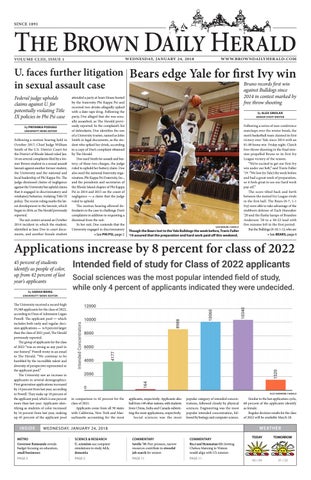
Applications increase by 8 percent for class of 2022 45 percent of students identify as people of color, up from 42 percent of last year’s applicants By SARAH WANG UNIVERSITY NEWS EDITOR
The University received a record-high 35,368 applicants for the class of 2022, according to Dean of Admission Logan Powell. The applicant pool — which includes both early and regular decision applications — is 8 percent larger than the class of 2021 pool, The Herald previously reported. The group of applicants for the class of 2022 “was as strong as any pool in our history,” Powell wrote in an email to The Herald. “We continue to be humbled by the incredible talent and diversity of perspective represented in the applicant pool.” The University saw an increase in applicants in several demographics. First generation applications increased by 13 percent from last year, according to Powell. They make up 18 percent of the applicant pool, which is one percent more than last year. Applicants identifying as students of color increased by 16 percent from last year, making up 45 percent of the applicant pool
INSIDE
ALEX SKIDMORE / HERALD
in comparison to 42 percent for the class of 2021. Applicants come from all 50 states with California, New York and Massachusetts accounting for the most
applicants, respectively. Applicants also hail from 149 other nations, with students from China, India and Canada submitting the most applications, respectively. Social sciences was the most
popular category of intended concentrations, followed closely by physical sciences. Engineering was the most popular intended concentration, followed by biology and computer science.
Similar to the last application cycle, 60 percent of the applicants identify as female. Regular decision results for the class of 2022 will be available March 28.
WEATHER
WEDNESDAY, JANUARY 24, 2018
METRO Governor Raimundo reveals budget focusing on education, small businesses
SCIENCE & RESEARCH U. scientists use computer simulations to study ALS, dementia
COMMENTARY Savello ’18: Peer pressure, narrow resources contribute to stressful job search for seniors
COMMENTARY Ricci and Hemmatian GS: Inviting Chelsea Manning to Watson would align with U.’s mission
PAGE 3
PAGE 5
PAGE 11
PAGE 11
TODAY
TOMORROW
42 / 24
31 / 22
NEWS
PAGE 2 • WEDNESDAY, JANUARY 24, 2018
» PHI PSI, from page 1 behavior and retaliation in violation of Title IX policies, in addition to negligence, according to the copy of her complaint. During the motion hearing, the University requested a judgment on Doe’s complaints and argued that Doe failed to state any claims requiring Brown to provide relief, according to a copy of the University’s motion for judgment on the pleadings obtained by The Herald. After hearing arguments from lawyers representing each party in the case, the judge dismissed Doe’s claims of negligence. Rhode Island law limits claims of negligent infliction of emotional distress to “those within the ‘zone-ofdanger’ who are physically endangered by the acts of a negligent defendant, and bystanders related to a victim whom they witness being injured,” groups that do not include Doe, according to the judge’s ruling. Additionally, the judge dismissed Doe’s claim of University negligence in supervising the fraternity on the grounds that Brown did not have an obligation under Rhode Island law to protect students from any harmful behavior perpetrated by the group, according to the judge’s ruling. However, the judge ruled that Doe had a plausible claim in accusing the University of violating Title IX practices. Doe’s lawyers argued that the University demonstrated “deliberate indifference” to her rights protected by Title IX by failing to provide a “thorough disciplinary process for (her) claims to be investigated” and by improperly examining physical evidence, according to court documents reviewed by The Herald. Specifically, Doe’s lawyers argued that the University mishandled Doe’s blood and urine samples. Rather than sending them to a “qualified forensic toxicology laboratory” capable of providing analysis for evidence, the
THE BROWN DAILY HERALD
University sent the samples to a medical laboratory which led to “unreliable and inconclusive results with no evidentiary value,” according to the court documents. Furthermore, rather than testing the samples for the full range of possible date rape drugs, University officials ordered tests for two substances, GHB and flunitrazepam. While Doe’s urine sample initially tested positive for traces of GHB, it was later deemed inconclusive by an independent examiner hired by the University, as The Herald previously reported. Hair samples taken from the other female student who attended the party were also determined to be inconclusive for GHB by an independent company used by the University. However, this company has received criticism for producing unreliable and misleading work, as The Herald previously reported. Doe contends that by sending her samples to faulty laboratories, the University lost evidence that may have aided her cases against her assailant and John Smith. Furthermore, Doe alleges that this loss of evidence left her as a “target for anger” from the fraternity. After the University notified community members that the samples were inconclusive, the fraternity spread fliers complaining about Doe’s allegations and their treatment at the hands of the University. This caused Doe to experience a great deal of fear and anxiety, according to court documents obtained by The Herald. Additionally, according to the complaint, Doe did not receive an interview from the Alpert Medical School despite being admitted into higher ranked medical schools, like Harvard and Stanford University. Doe alleges that her rejection from the Med School is evidence of retaliation in violation of Title IX. During the hearing, lawyers for the University pushed back against allegations of being “deliberately indifferent” to Doe’s claims. “This was not
HERALD FILE PHOTO
This lawsuit followed a 2014 incident in which a student, identified as Jane Doe, claimed that she was given a drink spiked with a date rape drug at a Phi Psi party, after which she says she was sexually assaulted. a situation where the University was trying to sweep it under the rug,” said Thomas Bender, associate counsel for the University, pointing out that the University held three separate hearings to investigate the events that transpired in October 2014. University lawyers also added during the hearing that the only way the University could be plausibly accused of being deliberately indifferent was “if they knew that what they were doing … wasn’t going to cut it.” “The law makes plain that a response to Doe’s complaints does not, by itself, shield Brown from liability under Title IX; the nature of the response matters,” the federal judge wrote in his ruling. Doe also sued Smith for assault and battery, but the judge dismissed her claim of assault. Richard Ratcliffe, the attorney for Smith, told The Herald that under common law, a legitimate
claim for assault requires the victim to experience a “fear of impending harm.” Because Doe did not allege that she “was in fear of harmful or offensive bodily contact” before ingesting her drink, her claim of assault was dismissed, according to the judge’s ruling. However, Doe’s claim of battery — the act of causing bodily harm — against Smith remains intact. “My client is absolutely not responsible … for battery,” Ratcliffe said. “We believe that the complaint was very thin with respect to the allegations of battery. There was no medical evidence.” However, Carolyn Wheeler, an attorney for Doe, told The Herald that the judge’s ruling was “a pretty good outcome, (given) that most claims survived.” “Our case illustrates that it’s important to see that evidence is handled appropriately,” she added. Ratcliffe said the ruling marks “a
THE DEPARTMENT of AFRICANA STUDIES/RITES AND REASON THEATRE NEW COURSE OFFERINGS SPRING 2018 AFRI 0760A Rastafari Studies
Shamara Wyllie Alhassante | shamara_alhassan@brown.edu T 4pm-6:30pm | Churchill House 106
Located in the historic Churchill House of Brown University, the Department of Africana Studies is the intellectual center for faculty and students interested in the artistic, cultural, historical, literary, and theoretical expressions of the peoples and cultures of Africa and the African Diaspora.
AFRI 1060U An Introduction to Africa
The Department’s Rites and Reason Theatre brings together artists and scholars in creating original performances and artistic expressions that generate new knowledge about the world and human experience.
AFRI 1100A Comparative Identity Politics in Africa
<PM LMXIZ\UMV\ WٺMZ[ I ZQOWZW][ ]VLMZOZIL]I\M XZWOZIU and graduate program leading to the Ph.D. in Africana Studies and has one of the leading faculties in the discipline.
Dr. Oladotun Ayobade | dotun_ayobade@brown.edu F 3pm-5:30pm | Churchill House 106
Dr. Patricia Agupusi | patricia_agupusi@brown.edu TTh 10:30am-11:50am | Churchill House 106
AFRI 1100B The CARIBBEAN: Cultures, Politics, Histories & Literature Patrick Sylvain | patrick_sylvain@brown.edu W 5:40pm-8:10pm | Smith-Buonanno Hall G18
AFRI 1100C Racial Slavery and Empire in an Age of Global Capital Dr. Zach Sell | zachary_sell@brown.edu TTh 9am-10:20am | Churchill House 106
For more information on full course listings, please visit:
https://cab.brown.edu
SAVE THE DATE! ASHES: a dramatic presentation that investigates abuse and healing among Women of Color
Produced by Department of Africana Studies/Rites and Reason Theatre March 2-3, 7:00 pm | March 4, 3:00 pm | FREE The BassPas @ Churchill House
The Black Lavender Experience 2018 [BLX18]: 10th Annual Presentation Produced by Department of Africana Studies/Rites and Reason Theatre in partnership with the LGBTQ Center, and the Brown-Tougaloo Exchange April 11-14, Various times | FREE The BassPas @ Churchill House
For more information on performances, events and programs: https://www.brown.edu/academics/africana-studies/events-programs email: africana_studies@brown.edu phone: (401) 863-3137
very early stage in the case. … The judge isn’t determining any facts” but seeing “if what’s alleged establishes a claim.” In an email to The Herald, Brian Clark, director of news and editorial development, wrote, “The University has reviewed the order and the counts remaining after the judge’s dismissal of the plaintiff ’s negligence claims. The decision narrows the scope of the case and appears to reflect the court’s interest in hearing the arguments of the parties, which is understandable in light of national discussions regarding issues of sexual misconduct on college campuses. We believe that Brown has a strong case to present to the court as this matter proceeds in the months ahead.” A trial, if one occurs, is expected to take place in the middle of 2019, Wheeler said.
NEWS
WEDNESDAY, JANUARY 24, 2018 • PAGE 3
THE BROWN DAILY HERALD
Gov. reveals $9.38 billion budget, relies on sports betting revenues Public school repairs will receive $250 million, while small R.I. businesses will be granted $3 million By KATE TALERICO
officials have said that because they rely less on the federal personal tax income, they do not expect to see these gains. This month the R.I. House of Representatives will open itself for hearings before they pass a revised version, likely this summer.
STAFF WRITER
Gov. Gina Raimondo’s administration unveiled a $9.38 billion budget that would finance $250 million in public school repairs and allocate $3 million to growing the state’s small businesses, while relying upon sports betting — should it be legalized by the Supreme Court this year — to bring in $23.5 million of new revenue. Much of the state’s numbers depend on outcomes in Washington, such as whether or not the Children’s Health Insurance Program will be reauthorized by Congress. “This is a difficult budget environment,” said Michael DiBiase, the director of the Department of Administration who managed Raimondo’s proposal. “We have a lot of uncertainty in Washington.” New sources of revenue also include increasing the number of compassion centers (sites where patients with qualifying conditions can obtain medical marijuana), new co-pay fees on non-disabled adult Medicaid enrollees and a cloud-based software tax, which would tax software like Microsoft Office 365. These sources will be needed to fund new expenditures, such as the $6.4 million going to the RI Promise campaign and paying back cities and towns as the state phases out the car tax, on top of the projected $260 million deficit. Raimondo’s budget does not propose broad-based tax increases. Raimondo’s introduction to the budget expressed optimism for the state, which is at its lowest unemployment rate since March 2001 at 4.3 percent. But Rhode Island has posted job losses in four out of the last five months. As state and local officials come to understand how federal tax reform will affect them, many have voiced concerns that their budgets could suffer, despite President Trump and many lawmakers’ promises that it would instead bolster state finances. Some budget analysts, like the right-leaning Tax Foundation, argue that the new tax law broadens taxable items at both the state and federal level and brings in potential new revenue for the state by eliminating certain deductions. But Rhode Island state tax
Education In addition to the updates on public school facilities, Raimondo’s other proposed ballot measures include $25 million to improve the University of Rhode Island campus at Narragansett Bay, $25 million for renovations at Rhode Island College and a $48.5 million green economy and clean water fund that would protect the state’s waters and remediate industrial sites for redevelopment. Between FY15 and FY19, the budget for commerce, the Department of Business Regulation, higher education and elementary and secondary education has grown by nearly 4 percent, or around $270 million. The FY19 budget also proposes $1.1 million toward expanding prekindergarten programs and $1.5 million for infant and toddler childcare. Medicaid changes Raimondo’s plan would charge Medicaid enrollees new co-payments between $2 and $8 on services that tend to be overused, said Patrick Tigue, Medicaid program director for the Office of Health and Human Services. Adult enrollees without disabilities would pay a co-pay of $8 on non-emergency emergency room visits, $3 for non-preventative physician visits, $4 for name brand prescription drugs, $2.50 for generics and $3 for inpatient hospitalizations. While people with disabilities and elderly people make up only 20 percent of Medicaid enrollees, they account for 59 percent of the state’s expenditures, according to a study by the Kaiser Family Foundation. The new budget proposal targets adults without disabilities; still, Eric Beane, secretary of the Office of Health and Human Services, said the new fees would add up to $3.2 million in new revenue. The changes would bring Rhode Island in line with 24 other states, including Massachusetts, that have instated these types of co-payments, Beane added. Rhode Islanders in need The plan would use $1.7 million from the state’s general fund to extend the care of Department of Children, Youth and Families for foster children
KATE TALERICO / HERALD
Medicaid Program Director for the Office of Health and Human Services Patrick Tigue (left) and Secretary for the Office Eric Beane (right) addressed the audience during the press conference held last Thursday. aged 18-21 that decide to opt back into its services. The state would also increase the rates paid to foster families by adding $1.3 million to its budget, bringing those rates on par with Massachusetts. The budget also makes provisions to address the state’s opioid crisis, which caused 233 overdose deaths between January and September 2017. The budget outlines a new “Behavioral Health Link” resource that would connect those with mental health concerns to treatment resources and keep them out of the justice system. Raimondo also hopes to establish a job-training
program for those with substance abuse issues. Under the proposed budget, the state would add 12 new medical marijuana compassion centers to its current three. Raimondo would also allow patients from Connecticut and Massachusetts to access medical marijuana in Rhode Island, although the former is set to open recreational marijuana shops in July 2018. Despite the upfront costs of opening the compassion centers, state officials said they expect to see net revenue by broadening its customer base, as well as by expanding the options to
receive a medical marijuana card. Business The state would also see new revenue by taxing cloud-based services, such as TurboTax, a service that users pay for through the Internet but do not download onto their computer. In her budget, Raimondo also set aside $475,000 for a new SupplyRI program, which would connect large buyers with in-state smaller suppliers. The plan would also add $500,000 to the small business loan fund, doubling the number of loans added this year.
SCIENCE & RESEARCH PAGE 4 • WEDNESDAY, JANUARY 24, 2018
THE BROWN DAILY HERALD
U. physicists refine analysis of nano-objects Researchers find that manipulating NMR coils enhances ability to study small objects By JACKSON WELLS SCIENCE & RESEARCH EDITOR
While nuclear magnetic resonance technology has long been used in physics to study materials, it has not been especially effective at analyzing small, thin substances. New research from University scientists published in the Review of Scientific Instruments unveils how the orientation of coils matters and can drastically increase the quality of results obtained by NMR analysis. NMR technology works by placing an object inside of a cylindrical coil to bombard the object with radio waves, causing electrons within the object to give off signals that offer scientists information about its composition. Because the coils use particles of the object for analysis, objects with a large number of particles have better readings, meaning that small, flat
nanomaterials are extremely difficult to analyze under the traditional coils. The researchers found that using flat coils instead of cylindrical coils creates more accurate readings of these objects, expanding the scope of what can be analyzed with NMR technology, said Wencong Liu PhD’17, co-lead author of the study. The research was born out of the issues associated with the previous NMR technique, said Vesna Mitrovic, associate professor of physics and co-lead author of the study. Because different geometries of the coil allow enhanced readings of these objects, the paper investigated optimal geometries for particular objects. Scientists are now better able to determine the properties of these small objects, which is extremely useful in a large number of areas, such as in making electronic devices, Mitrovic said. This solved a prominent issue within NMR technology, said Kemp Plumb, assistant professor of physics. Because scientists previously used round coils in their experiment, they had difficulty studying square objects, since it resulted in an overabundance of empty
space. The same kind of excess space existed when NMR is used to study small objects, rendering the technique ineffective. These findings could contribute to Plumb’s area of research, which is the study of magnetism and “exotic” materials, or materials that have uncommon properties. Plumb’s work specifically focuses on the atomic-level activity that gives rise to the macroscopic aspects of an object. One example is superconducting material, or material that conducts electricity similarly to metal but is unique in that it has no resistance. The properties of the superconductor are only possible due to the activity of its electrons. NMR technology will allow him to study substances on a microscopic level to aid understanding of how these kinds of characteristics arise. This finding also broadly expands the scope of what NMR technology can do in scientific research. The new method allows the materials being analyzed to be manipulated in a number of ways, such as applying stress or voltage, Liu said. This was not possible beforehand, as the previous method involved enclosing the object.
LITERARY ARTS COURSES, SPRING 2018 For First Year Seminars: LITR 0100 workshops (Introduction to Fiction, Introduction to Poetry) and LITR 0710 seminars: spaces were filled by the Dean of the Collegeʼs office. No wait lists are created before the first class meeting; attend the first class to see if space has become available. These courses are open to First Year undergraduate students. For LITR 0110 workshops (Fiction I, Poetry I, Screenwriting I): spaces were filled during the registration period. No wait lists are created before the first class meeting; attend the first class to see if space has become available. For LITR 0210 (Fiction II, Poetry II), LITR 1010 (Advanced Fiction, Advanced Poetry, Advanced Screenwriting) & LITR 0310* & 1110* (Special Topics) workshops: writing samples are due in the front hallway of the Literary Arts Building, 68.5 Brown Street, between 10 am and 4 pm on Wednesday, 24 January. Most sections may accept samples through early afternoon, Friday, 26 January. For LITR 1150/1151* workshop/seminars: attend the first class session; bring a writing sample with you. For LITR 1200, 1230/1231* & 2110* literature courses: register through Banner during the registration period; and/or attend the first class. LITR 310G – Comix: Words + Image ~ LITR 310I – Exploding the Book: An Introduction to Hybrid + Cross-Disciplinary Poetry ~ LITR 1110R – Performance Dimenions of Text ~ LITR 1151S – Fan_Fic ~ LITR 1151T – Poetry for Healing Terrtories ~ LITR 1151V – Black Box Poetics ~ LITR 1151W – The Restless Desk: Hybrid Writing, Performance, Collaboration ~ LITR 1200 – Writers on Writing ~ LITR 1231C – Experimental Poets of Color ~ LITR 2110P – World of Echoes: The Poet as Translator
For details, see our web site: https://www.brown.edu/cw or visit “courses at brown”
MEAL PLAN
changes
STEP ONE:
Choose a Meal Plan. VIEW OPTIONS AT BROWN.EDU/FOOD
REMINDER:
T DAY THE LASEA L PLAN
TO MAKE M EDNESDAY, CHANGES IS W
FEB. 14!
• You can ADD a new Meal Plan at any time during the year • You can make one CHANGE per semester. The deadline for spring semester changes is Wednesday, Feb. 14. • Meal Plan CANCELLATIONS are not available during the spring
STEP TWO:
Let us help!
EMAIL DINING_SERVICES@BROWN.EDU OR CALL 863-3343 WITH QUESTIONS
• Changes may be made in person weekdays from 9:00AM to 4:00PM at the main Brown Dining office located at 144 Thayer Street (Sharpe Refectory).
NEWS
WEDNESDAY, JANUARY 24, 2018 • PAGE 5
THE BROWN DAILY HERALD
U. scientists use simulations to study proteins associated with ALS Medical scientists see how ALS formation varies with changes in amino acid sequences By KENDRICK TAN SENIOR STAFF WRITER
A new University study published in Molecular Cell examined the specific amino acid changes that cause damaging processes associated with ALS and the dementia that results from it. Amyotrophic lateral sclerosis, more commonly known as ALS, is a disease involving the death of neurons that control voluntary muscles. As these neurons die, patients lose the ability to control these muscles, and eventually lose the abilities to speak, eat, move and even breathe. The research studies the disease at a molecular level, following the way changes in amino acid sequences can affect the behavior of the family of proteins linked to the disease. There are two types of ALS: sporadic ALS, which accounts for about 90 to 95 percent of ALS cases, can affect anyone and any area of the body, while familial ALS, accounting for 5 to 10 percent of ALS cases, refers to inherited cases of the disease. Right now, no effective treatments exist for either form of the disease, but the best upcoming treatments focus on familial ALS. “For the rest of the
patients, we’re trying to understand how to change the protein directly,” said Nicolas Fawzi, assistant professor of medical science and co-author of the study. Many of the proteins associated with the disease contain “low-complexity regions,” which, unlike parts of proteins that are traditionally studied, are disordered and lack definite structure. These proteins are flexible, constantly changing shape. Fawzi explained that while scientists do not have a clear understanding of these proteins, due to the lack of clear, structural images, they know them to be functionally important. Some of these proteins undergo phase transition, forming droplets in the cells similar to those we see when oils are mixed with water, Wayne Bowen, professor of pharmacology, explained. These droplets, known as membrane-less organelles, are where the functions of these proteins, such as RNA processing, occur. “When these interactions go awry, the proteins transition out of the droplet phase and form solid clumps,” Bowen said. “These protein aggregates have been found to be toxic to the cells. Depending on the type of cell, this process may cause cell death.” Fawzi’s study focuses on one of the proteins that is mutated during disease. Using computer simulations and analysis based on radio waves, the study demonstrated how small changes in the amino acid sequence
COURTESY OF BROWN UNIVERSITY
The study of ALS was conducted in part by Assistant Professor of Medical Science Nicolas Fawzi. He hopes that studying these amino acid changes will contribute to the development of a drug. of this protein could result in an increased propensity for the proteins to aggregate and form solid clumps that may damage the cells. The computer simulation component of the study was led by Jeetain Mittal, associate professor of chemical and biomolecular engineering at Lehigh University. Mittal and his team have been comparing the data produced by his models to the data obtained from the experiments, trying “to see if these
models can be trusted to the point where they can be used confidently,” he said. “Computer modeling can allow us to represent the dynamic structure of the proteins and can, when accurately represented, give us a more detailed view of the structures,” Mittal said. Using similar techniques, studies have also demonstrated that particlelevel processes could alter the propensity of proteins to form droplets. “By studying these different
interactions, we can attempt to understand the underlying causes of the disease, and ultimately, if we can understand the cause, we can develop a drug or process that can prevent aggregation,” Bowen said. “While this research doesn’t directly lead to treatment, we are hoping that our insights can tell us how the proteins behave, and what we can do to change this behavior. This can be useful for testing ideas and treatments in the future,” Fawzi said.
SPORTS
PAGE 6 • WEDNESDAY, JANUARY 24, 2018
» BEARS, from page 1 just two years removed from winning the Ivy League crown and pulling off an upset in the first round of the NCAA Men’s Division I Basketball Tournament, started to heat up in the final minutes of the half. Trey Phills finished the half with 10 points, leading the way for Yale on a 14-point run that reclaimed the advantage for the Bulldogs. At the half, Yale led Brown 3833. Bruno shot 43 percent from the field, grabbed 13 rebounds and shot 36 percent from beyond the threepoint arc in the first period. Anderson and Joshua Howard ’20 both led the Bears with nine points each. Bruno came out of halftime prepared, and surged to a 43-42 lead after a technical foul on Desmond Cambridge ’21. But the Bulldogs quickly returned to form, taking advantage
of Bruno’s turnovers and hitting a contested three-point shot to take a seven-point lead with just under 15 minutes left in the contest. Brown answered back, continuing to drive to the basket and play strong defense to claw its way back into the game. After a strong and-one layup by Jason Massey ’18 and two three-point shots from Cambridge, the Bears tied the game at 61 with just eight minutes to play. With four minutes left in the game, Tamenang Choh ’21 highlighted a strong scoring and passing night with a powerful one-handed dunk over Miye Oni to give the Bears a 69-65 lead. After a resurgence from Yale, Cambridge tied the game at 72 with less than two minutes to play. Obi Okolie ’19 hit a three-point shot with 1:10 on the clock to break the tie and give the Bears a 75-72
THE BROWN DAILY HERALD lead. Just 18 seconds later, Yale’s Alex Copeland hit an and-one layup and a free throw to tie the thrilling game again at 75. As the game raced to a conclusion, it became clear that free-throw shooting would determine its outcome. Anderson was fouled and sunk both free throws to give the Bears a two-point lead with 44 seconds remaining. After Yale hit two more free throws, the Bears got the ball back in a tied game 11 seconds later. Okolie got fouled on a jump shot with five seconds left and sunk both shots at the charity stripe to give the Bears a 79-77 lead. After Yale’s Oni missed a
potential game-tying alley-oop layup with 2.5 seconds left, Okolie’s clutch free throws finally secured the muchneeded victory. “Proud of our Bears for the grit and determination our young men showed tonight,” wrote Head Coach Mike Martin ’04 on Twitter. “Huge contributions from everyone.” The Bears made 49 percent of their shots from the field and 37 percent from beyond the three-point arc for the game. The Brown bench bounced back in the second half, scoring 26 points. Cambridge led all Bears in scoring with 16 points followed by Okolie and Choh who recorded 12
points each. “Some keys to victory for us were how we played together as a team and continued to fight together as a team,” Hunsaker said. “We have a lot to improve on. We really have to continue to focus on the defensive end and then just execute on offense.” Looking ahead, Fuller emphasized his confidence in the team’s development. “We are going to continue to grow as a team,” Fuller said. “I’m confident that we can beat any team in the Ivy League.” The Bears will host Dartmouth Friday and Harvard Saturday at the Pizzitola Center.
Science and Technology Studies
SCSO 1701Q - THE FATE OF THE COAST: In an Era of Rising Seas
This seminar focuses on what happens when science, politics and money intersect in a highly contested venue - in this case, the coast, the nation’s most beloved and highly valued landscape, and a landscape already suffering severe and costly effects of climate change
library.brown.edu Welcome back to campus. The Library is ready to serve you. Research support: We’re here for you, online, on the phone, or in person —
library.brown.edu/libweb/askalib.php
Special Collections: You’ll be amazed by what is right here at Brown —
library.brown.edu/collatoz
John D. Rockefeller, Jr. Library — humanities, social sciences, fine arts Sciences Library — physical, biological, medical sciences John Hay Library — rare books, manuscripts, University Archives Orwig Music Library — music materials in all formats Champlin Memorial (Medical) Library — online access to journals, textbooks, databases library.brown.edu/about/champlin/#champlin
Library hours — we’re open when you need us
library.brown.edu/hours
Library exhibitions — See
library.brown.edu/exhibits
< Twitter: @brownlibrary Fun! @brownbooktruck 0 Facebook: brownuniversitylibrary > Instagram: brownuniversitylibrary
NEWS
THE BROWN DAILY HERALD
WEDNESDAY, JANUARY 24, 2018 • PAGE 7
City offers advice, new programs for small business owners Self-employment program aims to support the unemployed, women, Latinx populations By JACK BROOK SENIOR STAFF WRITER
Providence small business owners gathered Tuesday night for a community forum hosted by Mayor Jorge Elorza in the Joseph A. Doorley Jr. Municipal Building to highlight new opportunities for loans and programs designed to streamline business development. “Small business is the lifeblood of the community,” Elorza told the mostly Latinx audience, as an interpreter translated his words into Spanish. Elorza presented the Office of Economic Opportunity’s Providence SelfEmployment Program, aimed to offer unemployed and underemployed residents the opportunity to gain financial literacy and business skills. The Self-Employment Program was created to aid the lengthy loan application process. To qualify for loans and expanded city support, entrepreneurs need to present a profitable business idea with a well-constructed business plan. This process can be difficult for people without prior experience or business education, said Maryellen O’Mahony, director for the Center for Women and Enterprise. “It’s really hard to make a business plan. You need to really know all the
necessary mechanics,” said O’Mahony, whose organization will provide free classes and one-on-one mentorship to 100 Providence residents and 125 Spanish-speaking residents through the Self-Employment Program. The initiatives are in part meant to bolster an already existing mandate in which at least 10 percent of Providence business contracts go to companies run by women and at least 10 percent of bids for city-funded projects are given to minority-owned companies, according to State Rep. Grace Diaz, D-Providence. The key, Diaz said, is to expand the pool of minority- and women-owned companies eligible to receive city contracts, especially for construction work. She noted the importance of reaching out to Providence’s large Latino population. “Latinos have less access to capital — they are often coming from lowincome families, which makes it hard for them to put up their own capital up front,” Diaz said. “They still need capital, and I think the city can help make the process clearer and simpler.” Early stage entrepreneur funding is limited and, as a result, it’s important for applicants to be prepared and technically well-versed in the business world, said Brian Hull, director of the Office of Economic Opportunity for Providence. “You are not going to get a long-term loan for your start-up without demonstrating a business plan and a bankable business idea,” Hull said. Educational initiatives like the Self-Employment
JACK BROOK / HERALD
Mayor Jorge Elorza presented the Providence Self-Employment Program, which aims to help entrepreneurs access loans for business through education sessions, at a community forum Tuesday night. Program are crucial to build up neces- have had their loan applications turned question-and-answer session, represensary skill sets, he added. down by local banks, and hopes to inject tatives from a variety of organizations, The city must extend support to nearly $2 million into Providence busi- such as Goldman Sachs’ 10,000 Small small business owners to expand their nesses over the next three years. Businesses program, handed out flyers businesses, said Tom Hoagland, director Hoagland encouraged business and answered questions. of the Providence Business Loan Fund. owners in the room to approach him Juana Flores, who owns a clothing “Big banks are not as well-equipped for advice and share what they learned store called Bella Boutique, said she anymore to deal with small businesses,” with their colleagues. planned to share the information with Hoagland said. “The process to get a small business her two daughters, who each run their Some businesses, like restaurants loan is very tedious,” said Roberto Cas- own cleaning businesses. She hopes and beauty salons, can have trouble tellanos, who operates a dry cleaning they can all qualify for loans to expand obtaining funds from large banks be- business with 10 employees. “It’s a lot their businesses. cause they have a high turnover rate of work, and it costs a lot of money, “I feel content because I learned a and are considered risky, with limited and while there’s been a lot of effort to lot,” Flores said. “There is help offered, profitability, he added. make progress, there are still a lot of projects open for us, and we want to be The PBLF offers loans of $50,000 to challenges.” part of them.” $250,000 for established businesses that Following the speeches and a
ANTH | Anthropology of the Himalayas | Th 4-6:30pm | S. Besky ANTH | Introduction to Cultural Anthropology | MWF 11-11:50am | B. Singh ANTH | Ideology of Development | M 3-5:30pm | L. Fruzzetti CLAS | India’s Classical Performing Arts | TTh 1-2:20p | D. Buchta COST | Saints and Mystics of India | TTh 9-10:20a | S. Reddy COST | Introduction to Contemplative Studies | MWF 9-9:50am and W 3-5:30pm | S. Reddy ECON | Development and the International Economy | MW 8:30-9:50aM | B. Steinberg ECON | Economic Development I | MW 10:30-11:50aM | B. Steinberg GNSS | Pembroke Research Sem in Femonsit Theory: Cultures of Pacifism | W 10-12:30pm | L. Gandhi HIAA | Architecture of the House Through Space and Time | MWF 11-11:50am | I. Osayimwese HIST | The Ottomans: Faith, Law, Empire | TTh 2:30-3:50p | F. Ahmed HIST | Legal and Constitutional History: Methods and Approaches in Comp Perspective | M 3-5:30pm | F. Ahmed HNDI | Beginning, Intermediate, & Advanced Hindi-Urdu | A. Koul MCM | Does Utopia Still Exist? Media, politics and the hope of something else | R. Dasgupta T 4:00-6:30pm Screenings Sun 7-11pm POLS | Politics, Economy and Society in India | TTh 2:30-3:50p | A. Varshney RELS | Islam in South Asia | Th 4-6:30p | S. Bashir RELS | The Imaginary Lives of Muslims | TTh 10:30-11:50a | S. Bashir RELS | Introduction to Buddhism | MWF 11-11:50am | J. Protass RELS | Buddhist Poetry | M 3-5:30pm | J. Protass SANS | Classical Sanskrit Story Literature | TBD | D. Buchta SANS | Elementary Sanskrit II | MTThF 12-12:50pm | D. Buchta SANS | Vedic Sanskrit | TTh 10:30-11:50a | J. Fitzgerald SOC | Globalization and Social Conflict | TTh 2:30-3:50pm | P. Heller Visit our site for complete course listing watson.brown.edu/southasia
NEWS
PAGE 8 • WEDNESDAY, JANUARY 24, 2018
THE BROWN DAILY HERALD
RISD to offer inaugural liberal arts graduate programs Nature-CultureSustainability, Global Arts, Culture programs to be unveiled in fall By JACKSON WELLS SCIENCE & RESEARCH EDITOR
The Rhode Island School of Design is bolstering its selection of graduate degrees by offering its first-ever graduate school programs in the liberal arts departments. This fall, students will be able to pursue Master of Arts degrees in the new Global Arts and Culture program as well as the Nature-Culture-Sustainability Studies program. The NCSS program emerges from a current undergraduate concentration, whereas the GAC program is completely new, said Eric Anderson, associate professor of history of art and visual culture. They are made possible through interdisciplinary cooperation among the three liberal arts programs already offered at RISD: History of Art and Visual Culture; Literary Arts and Studies; and History, Philosophy and Social Sciences, said Nicole Merola, department head and professor of literary arts and studies. The programs were inspired by an interest in taking advantage of the untapped potential of collaboration between the departments, said
Andrew Robarts, assistant professor of history, philosophy and social sciences. RISD’s approach to liberal arts is unique in that it is not constrained by boundaries that exist at traditional liberal arts colleges, Anderson said. To implement the changes, the faculty and dean involved in the new programs have been working to develop curricula, recruit prospective students, construct the website and converse internally. The majority of their work has gone into developing the core courses, Anderson said. In creating these courses, those involved identified the intellectual content of the courses and considered how they wanted to incorporate them into the syllabi. One of the core courses for GAC is “Critical Globalisms,” which intends to expose students to global exchange, economy, politics and production of art and literatures. The purpose of the program is to provide an overall theoretical framework for future studies, Anderson said. Students of NCSS will take “Theories of Nature Culture,” which is likewise meant to provide a theoretical framework, and “Inventive Political Ecologies,” which focuses on creative production in the arts and humanities as it relates to environment and nature, Anderson said. The faculty involved are waiting to see how these new programs will become a part of RISD, Robarts said. Current undergraduate students
SAM BERUBE / HERALD
Beginning this fall, the Rhode Island School of Design will offer graduate degrees in the liberal arts, a feat made possible through collaboration between its existing undergraduate liberal arts programs. may be good candidates, since they already know and have potentially worked with the faculty, he added. Those involved in the programs may
also consider students coming from undergraduate programs at more traditional colleges. RISD’s culture has always been
closely tied to critical and theoretical inquiry as well as the liberal arts, and these new graduate programs will build upon this legacy, Anderson said.
Now Leasing for Fall 2018
đ All-Inclusive đ Fully Furnished đ Top Of The Line Amenities đ Outdoor Grill & Fire Pit đ Clubroom With Billiards đ Private Study Rooms đ Computer Room đ Free Wi-Fi đ State-Of-The-Art Fitness Center đ Controlled Access Facility đ Coffee Bar
đ Underground Heated Garage đ Bike Storage đ Roommate Matching Available đ On-Site Management đ Designed To Meet Leed Silver Certification đ Fully Furnished All Inclusive Apartments (Includes Utilities) đ Private Bedrooms And Private Bathrooms Available đ Weekly Resident Events
LEASE ONLINE AT 257THAYER.COM
Text THAYERŏ0+ŏąĈąćąŏ"+.ŏ)+.!ŏ%*"+ŏđŏąĀāċĂĈĂċĈĈĈĈŏđŏĂĆĈŏ $ 5!.ŏ 0Čŏ .+2% !* !ŏ ŏŏ
TODAY
WEDNESDAY, JANUARY 24, 2018 • PAGE 9
THE BROWN DAILY HERALD
menu
the carrie tower
SATELLITE DINING ANDREWS COMMONS
Pizza: Cheese, Pepperoni, Sausage and Garlic, Mushroom’s Revenge JOSIAH’S
BLUE ROOM
Chicken Wings Bar, Quesadillas
Beef Chili With Beans, Broccoli and Cheddar Soup
DINING HALLS SHARPE REFECTORY LUNCH
DINNER
Meatloaf with Mushroom Gravy, Chicken and Dumplings, Wheat Berry Grain Bowl
Cajun Baked Fish, Couscous, Creamy Cajun Pasta, Roasted Broccoli, Banana Cake
VERNEY-WOOLLEY LUNCH
DINNER
Cavatini, Steak Fries, Turkey Wild Rice Soup, Vegetable Pot Pie With Biscuit
Italian Chicken Parmesan, Broccoli and Cheese Rice Casserole
sudoku
SAM BERUBE / HERALD
The Carrie Tower, located on the Quiet Green, was given by Count Paul Bajnotti of Turin, Italy, as a tribute to his late wife, Caroline Mathilde Brown, who was also the grandaughter of the founder of Brown University.
Q U O T E O F T H E D AY
“Some keys to victory for us were how we played together as a team and continued to fight together as a crossword
team.” — Zach Hunsaker ‘20, basketball player
calendar TODAY JANUARY MARCH
S
75
M
T
W
Th
F
S
1
2
31
42
53
64
86
97
10 8
11 9
12 10
13 11
Welcome Back Coffee with a Cop Event 8:45 A.M. Faunce Arch
Vinyasa Yoga 12:00 P.M. Hillel, Winnick Chapel
Greek & Program Housing Interest Fair 12:00 P.M. Stephen Robert ’62 Center
How to Find a Job for Seniors 8:00 P.M. CareerLAB
TOMORROW
14 12
15 13
16 14
17 15
18 16
19 17
20 18
21 19
22 20
23 21
24 22
25 23
26 24
27 25
28 26
29 27
30 28
31 29
30
31
Wellness at Brown: Tai Chi 12:00 P.M. Sayles Hall Auditorium
How to Make the Most of Shopping Period 12:00 P.M. J.Walter Wilson, Room 203
Career Fair Prep 4:00 P.M. CareerLAB
Computer Science Town Hall Meeting 4:00 P.M. CIT, 3rd Floor Atrium
COMMENTARY PAGE 10 • WEDNESDAY, JANUARY 24, 2018
THE BROWN DAILY HERALD
LETTER TO THE EDITOR
In memory of Noah Arnold ’20 To the Editor: Noah Solomon Mukamal Arnold ’20 of Swarthmore, Pennsylvania died on Dec. 29, 2016. Noah was the beloved son of Reisa Mukamal and Steven Arnold of Swarthmore; brother and brother-in-law of Zachary Arnold and Molly Wasser, Benjamin Arnold and Samuel Arnold; and grandson of Jeanne and Bernard Arnold, Florence Appel and Meir Mukamal. A bright, compassionate young man, Noah hid a despair from all who loved him so dearly, tragically leading him to take his own life at the age of 19. Born Nov. 12, 1997 at Pennsylvania Hospital, Noah was an effervescent young child who thrived amid his older brothers and friends. He began school at Swarthmore Presbyterian Nursery Day School and continued in the Wallingford Swarthmore School District. For years, he studied piano with Chris Emata, and, with a restless hunger for mastery and knowledge that would come to define him, took full advantage of Strath Haven’s Summer Band Camp, learning many instruments. He studied bassoon with Roberta Winemiller, becoming a member of the Delaware County Youth Orchestra, Philadelphia Sinfonia and Rose Tree Pops. He also played trombone with the high school marching band and sang with the Silvertones, fortunate to be part of their concert tour of Sicily in 2015. Noah swam on the Swarthmore Swim Club swim team from the age of five to 12, and played freshman soccer and ran cross-country in high school. He competed in the Science Olympiad, the FIRST Robotics Competition (Team 486) and the PA Envirothon, and was an editor for the Panther Press. He liked to work with his hands and taught himself to craft jewelry out of coins. Always independent, he arranged to graduate high school early and spend his senior year in an educational program
on Kibbutz Tzuba in Jerusalem, followed by volunteering at Lindforst Alpakas, an alpaca farm in Bavaria. He had been lucky enough to travel to Germany previously through his German classes’ exchange programs. Noah’s first job was at Congregation Beth Israel of Media, where he taught Jewish ethics in the Hebrew school under Principal Helene Cohen and Rabbi Linda Potemken. During the summer of 2014, he worked as a mechanic’s assistant at King’s Automotive in Swarthmore and, on his return from Israel and Germany, waited tables at Warmdaddy’s restaurant and blues club in Philadelphia. His favorite job was as sales assistant at Seven Stones Gallery in Media, under owners Denise and Nick Yocco, with whom he developed a special friendship. Noah completed his freshman fall semester at Brown. He intended to major in mathematics, which he considered the purest form of truth, but was cultivating a growing interest in the fine arts. Despite Noah’s personal struggles, he fully engaged in his studies at Brown and formed cherished new relationships. A Ginkgo biloba tree was dedicated in his memory May 5, 2017 outside the List Art Building, with Noah’s friends, teachers and family in attendance. A memorial service was held Jan. 3, 2017 at Congregation Beth Israel. The family has greatly appreciated the outpouring of love and support from Noah’s friends and from the community shown then and over the past year. Donations in Noah’s memory may be sent to Mighty Writers at 1501 Christian Street, Philadelphia, PA 19146, whose mission is to fill the literacy gap for kids ages seven to 17 in Philadelphia. REISA MUKAMAL AND STEVEN ARNOLD
Find us online! facebook.com/browndailyherald
browndailyherald.com
@the_herald
Location: 195 Angell St., Providence, R.I. www.browndailyherald.com
@browndailyherald
youtube.com/browndailyherald
Editorial Leadership
Sections
Multimedia & Production
Editor-in-Chief Elena Renken
Arts & Culture Editors Connor Sullivan Elizabeth Toledano
Design Editors General Managers Kyle Cui Michael Borrello Eduard Muñoz-Suñé Matilda Lynton Assistants: Julie Wang, Kelvin Yang
Metro Editors Emily Davies Bella Roberts
Photo Editors Sam Berube Anita Sheih
News Editors Anna Kramer Eduard Muñoz-Suñé Priyanka Podugu Sarah Wang
Copy Desk Chief Abby Borges
Managing Editor Kasturi Pananjady Senior Editors Julianne Center Madison Rivlin Alex Skidmore Hattie Xu POST- MAGAZINE Editor Saanya Jain
Science & Research Editors Jonathan Douglas Jackson Wells Sports Editors Alexandra Russell Nicholas Wey COMMENTARY Opinions Editors Connor Cardoso Anuj Krishnamurthy Clare Steinman
Illustrations Editor Pia Mileaf-Patel Directors of Web Development Eli White
Business
Office Manager Diane Silvia Directors Sales: Shreya Raghunandan Finance: Ravi Betzig Strategy: Caroline Ziegler
COURTESY OF REISA MUKAMEL AND STEVEN ARNOLD
Editorial contact: 401-351-3372 herald@browndailyherald.com
Business contact: 401-351-3260 gm@browndailyherald.com
Submissions: The Brown Daily Herald publishes submissions in the form of op-eds and letters to the editor. Op-eds are typically between 750 and 1000 words, though we will consider submissions between 500 and 1200 words. Letters to the editor should be around 250 words. While letters to the editor respond to an article or column that has appeared in The Herald, op-eds usually prompt new discussions on campus or frame new arguments about current discourse. All submissions to The Herald cannot have been previously published elsewhere (in print or online — including personal blogs and social media), and they must be exclusive to The Herald. Submissions must include no more than two individual authors. If there are more than two original authors, The Herald can acknowledge the authors in a statement at the end of the letter or op-ed, but the byline can only include up to two names. The Herald will not publish submissions authored by groups. The Herald does not publish anonymous submissions. If you feel your circumstances prevent you from submitting an op-ed or letter with your name, please email herald@browndailyherald.com to explain your situation. You can submit op-eds to opinions@browndailyherald.com and letters to letters@browndailyherald.com. When you email your submission, please include (1) your full name, (2) an evening or mobile phone number in case your submission is chosen for publication and (3) any affiliation with Brown University or any institution or organization relevant to the content of your submission. Please send in submissions at least 24 hours in advance of your desired publication date. The Herald only publishes submissions while it is in print. The Herald reserves the right to edit all submissions. If your piece is considered for publication, an editor will contact you to discuss potential changes to your submission. Commentary: The editorial is the majority opinion of the editorial page board of The Brown Daily Herald. The editorial viewpoint does not necessarily reflect the views of The Brown Daily Herald, Inc. Columns, letters and comics reflect the opinions of their authors only. Corrections: The Brown Daily Herald is committed to providing the Brown University community with the most accurate information possible. Corrections may be submitted up to seven calendar days after publication. Advertising: The Brown Daily Herald, Inc. reserves the right to accept or decline any advertisement at its discretion. The Brown Daily Herald, Inc. is a financially independent, nonprofit media organization bringing you The Brown Daily Herald, BlogDailyHerald and Post- Magazine. The Brown Daily Herald has served the Brown University community daily since 1891. It is published Monday through Friday during the academic year, excluding vacations, once during Commencement and once during Orientation by The Brown Daily Herald, Inc. Single copy free for each member of the community. Subscription prices: $200 one year daily, $100 one semester daily. Copyright 2018 by The Brown Daily Herald, Inc. All rights reserved. Periodicals postage paid at Providence, R.I. Postmaster: Please send corrections to P.O. Box 2538, Providence, RI 02906.
COMMENTARY WEDNESDAY, JANUARY 24, 2018 • PAGE 11
THE BROWN DAILY HERALD
Toward a broader job search SAMANTHA SAVELLO op-ed contributor As the spring semester begins, students are scrambling to secure summer internships and post-graduation positions. The pressure is especially high for seniors, who will soon be completing their final semester and walking through the Van Wickle gates into the dreaded “real world.” For those of us seniors who still don’t have a job lined up after fall recruitment, it can be a stressful or even anxiety-inducing experience. Financial uncertainty is perhaps the most stressful element of the job search. Most graduating students need to find an immediate way to support themselves economically or pay off student loans, and the lingering uncertainty surrounding job prospects and potential salaries can be unsettling. Not only do these students need to figure out where they are going to live, they also need to consider their budget and living expenses. Yet financial anxiety is not the only motivating factor for graduating students. There is also a pressure, particularly for Brown and other Ivy League students, to go on and do something extraordinary after college. Every day, we are bombarded with news of students going on to attend top-tier graduate schools, receive Fulbright grants and take prestigious jobs at multi-
million dollar companies. While Brown has a reputation for being one of the least competitive Ivies, post-graduation plans can create competition between students and, in turn, affect students’ levels of self-confidence and self-worth. To seek validation, some students mass apply on job boards, seeking opportunities solely based on the organization’s prestige. But this is a problematic mindset to have. If you ask people who have graduated in recent years, many admit that their first job was not their favorite or most glamorous job; it
dents in their job search is a tendency to turn down post-graduation internship opportunities because they don’t pay well or lack a professional title. After all, why settle for being an intern when you can hold a fulltime position? But what few people realize is that these internships often open doors to entry-level positions at the end of the summer and can lead to new connections within the field. In addition, if you ultimately don’t like it, you only need to commit to three months there, compared with a year or two for many full-time positions. Unfor-
Unfortunately, CareerLAB and other on-campus resources do not effectively expose students to the variety of career paths open to them, which only makes the job search process more stressful. Instead, CareerLAB takes a narrower approach to the job hunt. They bombard students with messages about career fairs, the Handshake recruiting tool and constant reminders about consulting, finance and technology opportunities, only heightening the pressure to land a traditional, high-stress position. Not only can this tactic discourage students from
Unfortunately, CareerLAB and other on-campus resources do not effectively expose students to the variety of career paths open to them, which only makes the job search process more stressful. was mostly a learning experience or a way to break into an industry. Thus, while taking on the challenge of finding a first job, students shouldn’t be basing their decisions off of the “prestige” or “reputation” of the organization. They should be looking for opportunities that offer room to learn and grow and that foster a positive work environment. Oftentimes, this environment can be found not in a big-name industry hub, but in a smaller organization where young employees may play a larger role. Another issue that can limit stu-
tunately, too many internship programs are low-paying or only offer stipends, but the networking and opportunities they offer can result in more rapid advancement in the field, allowing them to pay off in the long term. Other career paths may only be accessible through internships. For example, many ad agencies, magazines and digital media companies hire recent grads for internship roles with the intention of training for them for a full-time position at the company, rather than using a more traditional entry-level recruiting process.
looking outside of the most popular companies, but it can also deter them from considering internships post graduation. CareerLAB distinctly separates the job and internship searches, targeting their internship resources and events at underclassmen, while only marketing full-time jobs to seniors. This is a troubling binary to follow, as it’s not inclusive of alternative career paths and reinforces the unrealistically high standards set for Brown students. CareerLAB also fails to offer adequate student support in calculating their financial needs after
college. Cover letters and resumes aren’t the only things students need help with; figuring out the appropriate salary to cover living costs is just as important, if not more, to students’ job searches, and this should be given more attention during career counseling sessions. Moving forward, the University should work towards broadening conversations about the job search. Perhaps instead of having seasoned alums with top roles and degrees come speak at campus events, they can invite younger alumni who can speak about navigating their first job or two in fields outside of consulting, finance and technology. CareerLAB can also make more of an effort to diversify the job fields and companies they promote to students and help demystify stereotypes about pursuing a post-graduation internship. By showing students that they are not alone and making the job search a more manageable task, the University can help make senior year less stressful and more enjoyable — as it should be.
Samantha Savello ’18 can be found applying to jobs (and internships!). She is a former employee of CareerLAB. She can be reached at samantha_savello@brown.edu. Please send responses to this opinion to letters@browndailyherald.com and other op-eds to opinions@ browndailyherald.com.
Invite Chelsea Manning to Watson MATTHEW RICCI AND BABAK HEMMATIAN BORUJENI op-ed contributors Dear Director Edward Steinfeld: On Sept. 15, Dean Douglas Elmendorf of Harvard’s Kennedy School of Government rescinded his invitation to Chelsea Manning to be a Visiting Fellow. Harvard’s initial offer to Manning prompted the public foot-stomping of former CIA Deputy Director Mike Morrell and current CIA Director Mike Pompeo, the latter of whom labeled the whistleblower a “traitor” to her country. We are deeply disappointed that an institution like Harvard, ostensibly dedicated to principles of political justice and free expression, would avoid bestowing any “perceived honor” on Manning, who is widely lauded for both her exposure of potential war crimes and for her courage in the face of cruelty and torture. With this recent action, Harvard has transparently embraced and amplified the interests of government officials who seek to marginalize those who expose their actions to public scrutiny. We believe Manning deserves to be honored for her dedication to “serving the community, the nation and the world by discovering, communicating and preserving knowledge and understanding in a spirit of free inquiry...” These, after all, are the opening words of Brown University’s mission statement. Brown War Watch and the undersigned ask that the Watson Institute for International and Public Affairs join us in our commitment to the University’s mission and invite Manning to Brown as a visiting fellow or in some other official capacity, where she can
receive the honor and appreciation she deserves. On Aug. 21, 2013, Manning was sentenced to 35 years in prison after she exposed potential war crimes committed by the U.S. military. Included among these crimes were the wanton killing of over a dozen Iraqi men, including two Reuters journalists, the use of bombing raids to conceal the extrajudicial execution of Iraqi civilians and the torture and baseless detainment of prisoners at Guantanamo Bay.
ning never posed a security threat to any U.S. government personnel. Instead, the primary effects of her leaks were to invigorate public scrutiny of military action and to help kindle the Arab uprisings of the early 2010s, as argued by New York Times Executive Editor Bill Keller. Manning’s actions are real-world examples of a principle laid out in President Christina Paxson’s P’19 strategic plan, “Building on Distinction,” namely, to “support scholarship
Brown War Watch and the undersigned ask that the Watson Institute join us in our commitment to the University’s mission and invite Manning to Brown as a visiting fellow or in some other official capacity, where she can receive the honor and appreciation she deserves.
We believe empowering and defending whistleblowers like Manning is critical for maintaining accountable institutions, and for holding governments to the standards of the people they govern. The specific reasons behind Harvard’s decision to rescind Manning’s invitation are widely disputed. McClatchy, the Associated Press and former Defense Secretary Robert Gates have all emphasized that the material released by Man-
and public discourse on institutions and ideas that promote social justice.” During her seven-year incarceration, Manning faced “cruel and inhumane” treatment, according to a United Nations special rapporteur on torture. Manning was subjected to constant surveillance, stripped naked in humiliating public displays and often kept in extended isolation, driving her to attempt suicide more than once. According to Amnesty Internation-
al, Manning’s treatment constituted a “breach (of) the (United States’) obligations under international standards and treaties.” Despite the inhumane conditions of her confinement, Manning made the decision to come out as transgender and demand the medical and psychological treatment she deserved. She is therefore not just a symbol of political justice, but also a major figure in the struggle for LGBTQ+ rights. We request that the Watson Institute continue the University’s commitment to justice, human rights and free expression by inviting Chelsea Manning to Brown University as a visiting fellow or in some other official capacity. Bestowing this distinction upon Manning would be an opportunity for Brown to demonstrate on the national stage how a university can responsibly channel its substantial influence to fight for global justice and the rights of LGBTQ+ people. Sincerely, Matthew Ricci GS, acting co-president, Brown War Watch Babak Hemmatian Borujeni GS, acting copresident, Brown War Watch
Matthew Ricci GS can be reached at Matthew_Ricci_1@brown.edu and Babak Hemmatian Borujeni GS can be reached at Babak_Hemmatian@brown. edu. They are writing on behalf of Brown War Watch. Please send responses to this opinion to letters@browndailyherald.com and other op-eds to opinions@browndailyherald.com.
THE BROWN DAILY HERALD
WEDNESDAY, JANUARY 24, 2018
His Excellency Ban Ki-moon Secretary-General of the United Nations (2007-16) Sustainable Development Goals and Global Citizenship
Monday, Februar y 26, 2018 5 p.m. Salomon Center for Teaching DeCiccio Family Auditorium 79 Waterman Street
Tickets Required brown.edu/ogden
This event is free and open to the public Doors open at 4:30 p.m. Backpacks and large bags are not allowed Brown or government-issued photo ID required To request special services, accommodations or assistance for this event, please contact the University Event & Conference” -iÀÛ Vià "vwVi >Ì universityevents@brown.edu or 401-863-3100