SINCE 1891
THE BROWN DAILY HERALD WEDNESDAY, FEBRUARY 28, 2018
VOLUME CLIII, ISSUE 24
WWW.BROWNDAILYHERALD.COM
CIT to create more labs, public space Community rallies for
assault weapons ban
Computing and Information Services to move out of CIT over summer
High school students make impassioned plea for gun control legislation in Rhode Island
By TANUSHRI SUNDAR SENIOR STAFF WRITER
As part of ongoing efforts to expand the University’s computer science resources and facilities, the first floor of the Thomas J. Watson Sr. Center for Information Technology will be renovated this summer. The changes, first announced at the CS Town Hall January 2018,will moveComputing and Information Services out of the first floor. The current help desks may be replaced with updated furniture and potentially a food cart from dining services. A new virtual reality lab, an expanded robotics lab and a relocation of the graphics lab to the first floor are all also included in therenovation plans. The current graphics lab location on the fourth floor will be transformed into office space for faculty and graduate students. In further renovations, the department aims to upgrade this office
By JACK BROOK SENIOR STAFF WRITER
SCIENCE & RESEARCH
TIMOTHY MUELLER-HARDER / HERALD
The University will make changes to the CIT to promote interdisciplinary work among faculty in fields such as graphics and robotics. space as well as create a gender neutral bathroom on the second floor. The first floor renovations will also create a new smaller seminar room and a larger conference room, as well as re-purpose the public computer cluster into space for labs and courses. These changes are driven by expanding research and student involvement in the Computer Science department, said Thomas Doeppner, associate professor and vice chair of the department. In particular, faculty who specialize in graphics and robotics research were
hired with “the understanding that they would get more office space,” he explained. Assistant Professor of Computer Science Daniel Ritchie, who joined the department in 2017 with a focus in graphics, said in an email to The Herald that the proximity of the robotics lab to the graphics lab will encourage “collaboration and community” between the groups. Stefanie Tellex, assistant professor of computer science, seconded that sentiment, adding that the increased » See CIT, page 2
Fifteen-year-old Adah Bryan urged lawmakers to do more to prevent gun violence, listing off the mass shootings that had occurred in her lifetime before a crowd of over a hundred community members gathered in the State House rotunda Tuesday afternoon. “People say we’re too young to know what we’re talking about, but I’m a young adult who has seen these shootings over and over and over again,” said Bryan, a ninth grader from Classical High School. “Laws need to be passed, action needs to be taken.” “Don’t let us be the next Parkland, the next Sandy Hook, the next Columbine,” she added. The Rhode Island Coalition Against Gun Violence organized the rally in support of the “Rhode Island Assault Weapons Ban Act of 2018.” The bill was
introduced into the R.I. General Assembly by Senator Josh Miller D-Cranston, Providence and Representative Jason Knight D-Bristol, Warren on Tuesday. The legislation (2018-S 2493) would ban the sale and ownership of semiautomatic rifles, pistols and shotguns — including the AR-15 rifle, a weapon used in a series of mass shootings including Sandy Hook and, recently, Stoneman Douglas High School in Parkland, Florida Feb. 14. The bill has 29 sponsors in the House and 18 in the Senate, according to a press release from the R.I. General Assembly. Ten states, including Massachusetts and Connecticut, have passed similar legislation. “These (assault) weapons have so much more lethality than just a regular shotgun or handgun,” said Linda Finn, president of RICAGV. “It’s really important to keep them off the streets and away from people.” The bill would also prohibit “large capacity” magazines that would accept more than ten rounds of ammunition. Currently Rhode Island only allows five rounds of magazine capacity for deer hunting and three rounds for » See BILL, page 3
Students Math professor wins Sloan Research Fellowship Chan recieves lobby for Melody award for research in and housing combinatorics algebraic geometry legislation By ALEX REICE STAFF WRITER
Bill introduced Tuesday would protect potential renters who receive housing vouchers By COLLEEN CRONIN SENIOR STAFF WRITER
University students lobbied for a bill designed to eliminate housing discrimination against homeless individuals Tuesday afternoon at the Rhode Island State House. House Bill No. 7528, entitled “An Act Relating to Property — Fair Housing Practices,” was introduced to the House Committee on Judiciary by seven Democratic representatives. The bill will allow more of Rhode Island’s homeless community to find housing, said Morgan Talbot ’18, advocacy director for Housing Opportunities for People Everywhere. Without this » See HOUSING, page 2
Assistant Professor of Mathematics Melody Chan won a Sloan Research Fellowship, an award that recognizes 126 promising young scientific researchers from the United States and Canada. Chan is one of 20 researchers in the field of mathematics to win the award in 2018 and will receive $65,000 to be spent over a two-year term in support of her research. Chan is “thrilled and honored to receive the award.” It’s particularly special to her because “in the academic career path there aren’t always a lot of positive markers like that,” Chan said. “So it’s really fun to be able to celebrate.” Dan Abramovich, chair of the mathematics department and winner of the Sloan Research Fellowship in 1996, nominated Chan for the award. “She has proven herself to be a very productive researcher in an area that is quite active nowadays,” Abramovich said. Chan’s area of research bridges the subjects of
Brown University students, activate your complimentary WSJ memberships Visit WSJ.com/BrownDailyHerald
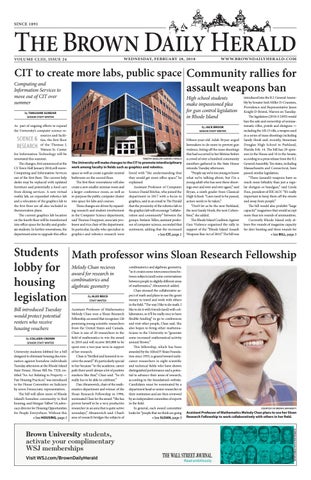
COURTESY OF BROWN UNIVERSITY
Assistant Professor of Mathematics Melody Chan plans to use her Sloan Research Fellowship to work collaboratively with others in her field.
WEATHER
© 2018 Dow Jones & Co., Inc. All rights reserved.
INSIDE
combinatorics and algebraic geometry, “so it creates some interconnections between subjects (and) some conversations between people in slightly different areas of mathematics,” Abramovich added. Chan stressed the collaborative aspect of math and plans to use the grant money to travel and work with others in the field. “The way I like to do math, I like to do it with friends (and) with collaborators, so it’ll be really nice to have flexible funding” to go to conferences and visit other people, Chan said. She also hopes to bring other mathematicians to the University to “generate some increased mathematical activity around Brown.” This fellowship, which has been awarded by the Alfred P. Sloan Foundation since 1955, is geared toward earlycareer researchers in eight scientific and technical fields who have shown distinguished performance and a potential to advance their areas of research, according to the foundation’s website. Candidates must be nominated by a department head or senior researcher at their institution and are then reviewed by an independent committee of experts in the field. In general, each award committee looks for “people that we think are going » See SLOAN, page 3
NEWS
PAGE 2 • WEDNESDAY, FEBRUARY 28, 2018
THE BROWN DAILY HERALD
» HOUSING, from page 1
COLLEEN CRONIN / HERALD
Maritiza Del Rosa poses with her son and Gabe Zimmerman '18 at the Rhode Island State House after lobbying for a bill that aims to end housing discrimination for homeless individuals who receive vouchers.
» CIT, from page 1 square footage in the robotics lab will be particularly useful to her research. Undergraduate and graduate student researchers also called for more lab space in the renovations, Doeppner said. The department hopes that these changes will significantly benefit research efforts, as they “really need more space for robotics, graphics and VR research,” he added. “The renovations will allow us to accommodate the growth in our program,” said Ugur Cetintemel, professor of computer science and department chair. Over one-sixth of undergraduate students have declared a concentrationin computer science, making it the most popular department at Brown, as the Herald previously reported. There is a “definite need for more space,” Doeppner explained, but at the moment, the possibility of constructing an additional computer science building is “not a reality.” Aside from accommodating academic ventures, renovations to the CIT could also boost students’ mental health, explained Sarah Berman ’20, adding that the CIT is “generally associated with sitting and doing work for 12 hours.” Changes to the building’s architecture and interior design would “make people a lot happier,” she said.
legislation, landlords can discriminate against buyers in the Housing Choice Voucher program, which gives supplemented rent to those that score highest on the homelessness vulnerability index form, he added. As part of their research, HOPE finds housing listings that discriminate against potential buyers who receive vouchers. “It’s pretty sad to see these,” Talbot said. “Sometimes it’s like, ‘No dogs, no smoking, no Section 8.’” Maritiza Del Rosa, a Rhode Island constitutent who has experienced homelessness, was already inside the State House when students arrived. As Del Rosa walked around the House chamber with Executive Director of HOPE Gabe Zimmerman ’18, she shared her own story. She explained how difficult it was to get back on her feet and to raise children out of a shelter, where she still lives. “Everyone deserves a home,” she said. HOPE reached out to Del Rosa to tell her about the bill’s introduction after she left her contact information on a HOPE survey indicating her interest in advocacy. The survey, which asked 200 Rhode Islanders experiencing homelessness what prevented them from finding stable housing, revealed “lack of affordable housing” and “sources of income” to be the leading causes, Talbot said. The bill would address concerns surrounding “sources of income” by outlawing discrimination against those who receive money from the government, he added. Before the bill’s introduction at the State House, it had not seen much opposition, Talbot said. Mandated Section 8 inspections were included in the 2017 version of the bill, which passed the Senate but died in the House, he added. “We don’t think (the bill) is going to be a hassle for landlords,” Talbot said. Some landlords actually encourage those with vouchers to apply for
housing because they are guaranteed payment from them, he added. State Representative Anastasia Williams (D-9), one of the bill’s sponsors, emphasized that “safe, sanitary, affordable living accommodations” are a basic human right. “For far too long many of us haven’t been able to rest easy … especially those of us with children,” Williams said, adding that the “affordable housing” that is created isn’t always as affordable as it seems. Before the House convened, students from HOPE and the Brown Progressive Action Committee approached representatives to advocate on behalf of the bill. Many cited similar bills that exist in Massachusetts, New York and Connecticut. Most representatives were receptive to the students’ pitch; some said they had to look over the bill before they could make promises, while others were busy getting signatures and sponsors for other pieces of legislation and asked if they could discuss the bill later. When the bell on the House floor started to ring, most of the legislators, lobbyists and aids ignored it until the Speaker banged his gavel and the session began, at which point advocates were asked to leave the chamber. Outside, both Zimmerman and Del Rosa spoke fondly of their advocacy experiences. “We got a lot of information on where legislators stand,” Zimmerman said. “For many students, it was their first time on The Hill,” he added, happy that the group was able to include constituents who had experienced homelessness. Del Rosa was also pleased to have lobbied, although she admitted that she had been nervous. She posed with her son and Zimmerman for a photo in the State House to mark the moment. “Our goal, ultimately, is to end homelessness in Rhode Island,” Talbot said, “which we firmly believe is possible.” The bill will be discussed at the Senate Judiciary meeting on Thursday.
NEWS
WEDNESDAY, FEBRUARY 28, 2018 • PAGE 3
THE BROWN DAILY HERALD
Student-produced short presented at film festival » SLOAN, Team directed by Meier ’83 MS ’87, Robinson ’17 to showcase animated film in Athens By ARJUN GANGA STAFF WRITER
“Toymaker,” a seven-minute animated short developed by Senior Lecturer in Computer Science Barbara Meier ’83 MS’87 and her students was accepted to the Athens Animfest 2018 film festival Feb. 16. The short follows the occasionally tense but ultimately loving relationship between a toymaker and her daughter. The process of creating “Toymaker” began when Nellie Robinson ’17, a Brown/RISD dual degree student with an interest in animation, wanted to work on a collaborative film project and pitched the idea to Meier in fall 2015. After Meier got on board, Robinson started to develop the story. “I started to think more about the style and feeling I wanted to convey first,” she said. “I wanted to convey an excitement about creating things, about creating fantasy worlds, about turning something everyday and mundane into something more magical, and from there, it was just a matter of what story would allow me to convey those feelings.” Working with other RISD students, Robinson developed concept art, the script and the storyboard to create the
» BILL, from page 1 duck hunting, RICAGV stated in a press release. However, the bill does allow for the continued use of some “grandfathered” assault weapons and exempts R.I. peace officers. Last week, Gov. Gina Raimondo signed an executive order, the “Red Flag Law,” directing law enforcement agencies to remove guns from individuals who display signs — including on social media — that they may be a public safety threat. Raimondo told the crowd that she had felt motivated to enact gun control
look of the film before the animation began fall 2016 in one of Meier’s animation classes. The film’s production — which divided responsibilities between members of the small team — involved animation, lighting and shadows control and a long rendering process, among other tasks. The project took about a year from inception to completion and was created by the team “as if we were an actual small animation studio,” said Kenji Endo ’18, who led the group on modeling and set directing. Meier drew inspiration for this class structure from her own experience in the visual effects industry in Hollywood and from her work on integrating computer graphics into live-action movies. “I have a lot of professional experience doing production, so I modeled the class after that,” she said. The film was selected for showing alongside 417 other films, 68 of which were student-produced. The festival will be held March 15-18, and films will be evaluated for prizes in various categories including shorts, student work, Greek films and experimental projects. The festival will screen works from over 50 countries. The success of “Toymaker” has left Meier open to the idea of doing future long-term projects, but not alone. “I also need the group of students that is willing to put their heart and soul” into the project, she said.
reform after her 13-year-old daughter demanded to know what she had been doing about gun violence in Rhode Island. “We’ve had enough talking,” Raimondo said. “Get me the bill and I’ll sign it!” Lawmakers and activists stressed the importance of listening to the voices of youth in the gun control debate. Taliq Tillman, a student at the Met School, expressed anger at feeling “overwhelmingly helpless” after hearing about the Parkland shooting, especially following inaction from many lawmakers. “Silence is tiring, draining and infuriating,” Tillman said. “Silence is another
COURTESY OF BARBARA MEIER
A short created by Brown and RISD students portrays a connection between a toymaker and her daughter using fantastical storylines.
word for acceptance.” “I stand here today because I believe in myself, my peers and youth, and I believe that we can shape national narratives,” he added. “Enough is enough,” the crowd chanted in support, many wearing orange shirts in solidarity with the Parkland survivors. “Protect kids, not guns” read one sign, while others hoisted white sheets of paper splattered with red paint. Not everyone at the rally came in support of the legislation. “There’s a lot more that we can do (to prevent mass shootings) than simply taking away my weapons or infringing upon my rights,” said Greg Brown, a member of both the
R.I. Second Amendment Coalition and the NRA. Restricting access to guns could make it more difficult for “good guys” to stop school shootings, he said. John Rinaldi, president and founder of the Sandy Hook Center, told The Herald that although he supported Raimondo’s executive order and the state’s assault weapons ban, he remained pessimistic about the National Rifle Association’s lobby power on federal and state levels. Since the Sandy Hook shooting in 2012, the gun control movement has been “drowned out by the NRA influence,” he said. “If people cannot relate or don’t want to actualize the reality of our kids being
COURTESY OF NAOMY PEDROZA
Community members rallied on the steps of the State House in support of the Rhode Island Assault Weapons Ban Act of 2018.
from page 1
to have the biggest impact in their field over their careers,” said Adam Falk, president of the Sloan Foundation. This includes doing research that’s not just, “high quality, but should be groundbreaking in some new directions. It also helps to be a great communicator about your work,” Falk added. The Sloan Fellowship is “meant to fill a kind of gap that a lot of young people face in terms of getting funding really early on,” Falk said. “Our belief is that if you invest in really good young people early in their careers, you can have a disproportionate effect on what happens to them for the rest of their careers.” During Abramovich’s tenure as head of the mathematics department, every researcher the department has nominated has won the award. “This doesn’t speak about us, so much as the people we are successful in hiring,” Abramovich said. Chan is the only professor from the University to receive the award this year. Associate Professor of Computer Science Tim Kraska was awarded the fellowship in computer science last year, as The Herald reported. While the fellowship has been around for over 60 years, it is not meant to be static, Falk said. The fellowship started with only three fields in 1955: physics, chemistry and math. Over the years, the foundation has added more fields as they have gained prominence. Although the foundation doesn’t have any plans to add a new field right now, they are always looking out for areas where people are doing interesting work, Falk said.
slaughtered, they will be dismissive, say it’s not an issue, and until you lose your child, you can’t fully comprehend,” Rinaldi said. The issue of gun violence cannot be fixed by only one piece of legislation, said Pete Bilderback, senior program coordinator at the Institute for Brain and Neural Systems and board member of RICAGV. Still, he emphasized the importance of preventative steps like banning assault weapons. “When I go to bed, I lock my door. I’m fully aware that doing so won’t keep a professional burglar out of my house,” Bilderback said. “But I lock it anyway because I don’t want to make it easy for them and that’s what we’re doing right now, we’re making it easy for these crimes to happen.” Other bills on RICAGV’s legislative agenda for 2018 include the Safe Schools Act to restrict concealed carry weapons in K-12 schools and a Gun Violence Restraining Order that prevents individuals who endanger themselves or those around them from buying or owning firearms or ammunition. A national school walkout is planned for March 14 to protest gun violence in light of the Parkland shooting. Providence high school students will be participating, Bryan said. “I think that this year is going to be a different year because of (student) voices — you can’t ignore those voices,” Miller said. “This is a large chorus that can’t be denied and it will not stop at red flags, it will not stop at bump stocks, it will not stop at magazines, it will not stop at assault weapons. It will stop when we hear from our schools and our teachers that they feel safe.” The NRA did not respond to a request for comment.
SCIENCE & RESEARCH PAGE 4 • WEDNESDAY, FEBRUARY 28, 2018
THE BROWN DAILY HERALD
Financial ethics complaint against Raimondo dismissed Ethics Commission dismisses complaint about financial transaction, employee relations By JACK BROOK SENIOR STAFF WRITER
On Feb. 27, the Rhode Island Ethics Commission voted 5-to-1 to dismiss an ethics complaint filed by GOP Chairman Brandon Bell against Gov. Gina Raimondo, according to a report released by the Commission yesterday. Bell’s complaint alleged that a Jan. 31 fundraising agreement between Raimondo’s re-election campaign and the Providence Democratic City Committee violated Regulation 36-14-5011, which prohibits financial transactions between employers and their employees. The Providence Democratic City Committee’s Chairman, Patrick Ward, was a state employee at the time of the incident. Raimondo hired Ward in June 2017 as the chief of program development for the Rhode Island Department of Human Services at a salary of $71,608, according to the Providence Journal. Ward resigned from his position as Chairman Feb. 9 this year following backlash from a controversial meme he posted on Facebook. The Commission’s ruling stated that because Ward was not a department head or working in the governor’s office, he was not under the “direct control and supervision” of Raimondo, which meant that the agreement did not violate the state ethics code. The Commission based its ruling on precedent from a 2006 case involving state employees and thengovernor Donald Carcieri. In that case, the Commission ruled that “employees
who served in other (executive) branch agencies, with multiple layers of supervision between that employee and the governor, were not direct subordinates,” said Jason Gramitt, an attorney for the Rhode Island Ethics Commission. “The Ethics Commission ignored the fact that Mr. Ward is a subordinate of Governor Raimondo’s appointee at the Department of Human Services,” Bell said in a statement following the Commission’s decision. Raimondo’s campaign did not initially announce its fundraising agreement with the Committee to the public. Following media coverage of this agreement’s existence, Raimondo’s office still did not release the contents of the agreement. Under pressure from a Providence Journal editorial, the R.I. GOP and members of Raimondo’s party who had not seen the agreement, the governor finally released the two-page document Feb. 18, more than two weeks after it was signed. In the agreement, the Committee stated that it would authorize Ward to open three different bank accounts, one federal and two nonfederal, for Raimondo’s campaign funds. The Committee promised that Ward would be the only person with the authority to “spend, transfer and otherwise disburse funds” from these three accounts, as well as have the power to designate other people to act on his behalf, the agreement stated. “Ward would have complete control over how the money would be spent, while Raimondo had control over Ward as her subordinate state employee,” Bell said in a statement following the agreement’s release. The agreement included a plan for the Committee to develop a coordinated budget with the campaign. But it also
stipulated that donors to the Committee could not assign their contribution to a distinct Democratic candidate. The Committee and Raimondo’s campaign said in the agreement that their arrangement did not “create any relationship of employer and employee or of master and servant.” The agreement allows Raimondo to bolster her fundraising, said John Marion, executive director of Common Cause Rhode Island, a nonprofit focusing on government accountability. “Under R.I. law, donors can only give $1,000 per year to campaign but $10,000 to a party committee; we presume that she has donors who are maxed out to her campaign,” he added. “She is clearly going to face a spirited re-election campaign, ... and she is looking for creative ways to use one of her strongest advantages as a candidate, which is her national fundraising network,” Marion said. Raimondo’s campaign has a balance of over $3.3 million, significantly greater funds than those raised by her gubernatorial opponent Cranston Mayor Allan Fung, according to Rhode Island Public Radio. Had Raimondo been a federal employee, her agreement with Ward would have been prohibited, since federal employees are barred from engaging in partisan activities under the Hatch Act of 1939, Marion said. “You don’t want government employees to feel that they have to support candidates in order to maintain their jobs,” Marion said. “If you want a professional bureaucracy, it shouldn’t be subject to the whims of partisan politics.” Raimondo’s office could not be reached for comment at the time of publication.
COURTESY OF WIKIMEDIA COMMONS
Gov. Gina Raimondo’s re-election campaign made a controversial fundraising agreement with the Providence Democratic City Committee.
TODAY
WEDNESDAY, FEBRUARY 28, 2018 • PAGE 5
THE BROWN DAILY HERALD
t h e g r e at g at e o f 1878
menu SATELLITE DINING ANDREWS COMMONS
Pizza: Spicy Sausage and Garlic, Assorted Roasted Mushroom, Cheese Red Curry Pork and Potatoes JOSIAH’S
BLUE ROOM
Chicken Wings Bar, Rodeo Burger, Quesadilla Station
Beef Chili with Beans Broccoli and Cheese Soup
DINING HALLS SHARPE REFECTORY LUNCH
DINNER
Grilled Italian Chicken, Mashed Sweet and White Potatoes, Chicken and Dumplings
Cajun Baked Fish, Cajun Pasta, Meat Lovers Pizza, Split Pea Soup, Roasted Broccoli
VERNEY-WOOLLEY LUNCH
DINNER
Spicy Pepper Pulled Chicken, French Fried Potatoes, Vegetable Stuffed Red Peppers
Green Beans with Thai Teriyaki Sauce, Beef and Lemongrass Stir Fry, Sticky Rice KAITLYN LEE / HERALD
sudoku
Each number etched on a Brown fence is dedicated to the class that contributed to the cost of its respective section. The University constructed the fences after building the Van Wickle Gates in 1903.
Q U O T E O F T H E D AY
“If you want a professional bureaucracy, it shouldn’t be subject to the whims of partisan politics.” —John Marion, executive director of Common Cause R.I.
See Raimondo on page 4.
crossword
calendar TODAY FEBRUARY MARCH
S
45
M
56
T
67
W
Th
F
S
1
12
23
34
87
89
10 9
10 11
Wellness at Brown: Breath and Bliss Yoga 12:00 P.M. 200 Dyer St., 122
Brown/CASA in Spain Session 12:00 P.M. J. Walter Wilson, 411
Academy in Context 6:00 P.M. Faculty Club
Brown Religious Literacy Project 7:30 P.M. J. Walter Wilson, 411
TOMORROW
11 12
12 13
13 14
14 15
15 16
16 17
17 18
18 19
19 20
20 21
21 22
22 23
23 24
24 25
25 26
26 27
27 28
28 29
30 1
31
Reimagining the Museum’s Community 12:00 P.M. Nightingale-Brown House
Jenifer Nash Pembroke Center Lecture 4:00 P.M. Pembroke Hall, 305
ADOCH Host Recruitment Sign Up 5:00 P.M. Upper Blue Room
MEME Colloquium with Matt Wellens 6:00 P.M. Orwig Music Building, 112
COMMENTARY PAGE 6 • TUESDAY, FEBRUARY 27, 2018
THE BROWN DAILY HERALD
LETTER TO THE EDITOR
MAT program article does not capture intention To the Editor: The recent article on the University’s decision to suspend acceptances to the elementary education track of the Master of Arts in Teaching program for the 2018-19 academic year did not accurately capture the purpose of this action or the process that we followed. As provost, one of my chief responsibilities is assessing and ensuring the academic strength and integrity of our educational programs. It was in this spirit — and as a follow-up to the report of the regularly scheduled academic review of our Department of Education — that in summer 2017, I appointed Karen Sibley, dean of the School for Professional Studies and vice president for strategic initiatives, to conduct a comprehensive review of the University’s MAT programs in elementary and secondary education. After careful consideration of a number of factors, including the most effective and efficient use of resources to meet the needs of current students while conducting meaningful program review and redesign, the University decided to suspend acceptances of new applicants to the elementary education track for the current cycle. This pause will enable us to fully evaluate our current program based on evolving classroom and community needs and in light of expanding scholarly expertise in the newly refocused Annenberg Institute
for School Reform. Ultimately, we want to ensure that we are preparing teachers with the knowledge and skills to understand social contexts and how they impact students, meet the needs of diverse learners and promote greater equity in our schools. Once this decision was made, we communicated with current students, faculty, alums and community partners, emphasizing that we believe these immediate steps are necessary to ensure ongoing program strength and to position the University and its graduates to continue to make a difference in classrooms in our city, state and nation. We also communicated with the Rhode Island Department of Education, which is charged with program approval. In their response, the department commended our commitment to continuous improvement and to preparing candidates for current workforce needs. We know, and research shows, that a good teacher can make all the difference in a student’s life. Institutions of higher education that take on the important responsibility of preparing the capable and innovative teachers we need in our classrooms today must ensure ongoing rigor and relevance. This is at the heart of our recent decision, and will guide our choices moving forward.
STEPHANIE WU / HERALD
Richard M. Locke P’18 Provost
Find us online! facebook.com/browndailyherald
browndailyherald.com
@the_herald
Location: 195 Angell St., Providence, R.I. www.browndailyherald.com
@browndailyherald
youtube.com/browndailyherald
Editorial Leadership
Sections
Multimedia & Production
Editor-in-Chief Elena Renken
Arts & Culture Editors Connor Sullivan Elizabeth Toledano
Design Editors General Managers Kyle Cui Michael Borrello Eduard Muñoz-Suñé Matilda Lynton Assistants: Julie Wang, Kelvin Yang
Metro Editors Emily Davies Bella Roberts
Photo Editors Sam Berube Anita Sheih
News Editors Anna Kramer Eduard Muñoz-Suñé Priyanka Podugu Sarah Wang
Copy Desk Chief Abby Borges
Managing Editor Kasturi Pananjady Senior Editors Julianne Center Madison Rivlin Alex Skidmore Hattie Xu Features Editor Isabel Gensler Editorial Page Editor Anuj Krishnamurthy
Science & Research Editors Jonathan Douglas Jackson Wells
POST- MAGAZINE Editor Saanya Jain
Sports Editors Alexandra Russell Nicholas Wey COMMENTARY Opinions Editors Connor Cardoso Anuj Krishnamurthy Clare Steinman
Illustrations Editor Pia Mileaf-Patel
Business
Office Manager Diane Silvia Directors Sales: Shreya Raghunandan Finance: Ravi Betzig Strategy: Caroline Ziegler
Editorial contact: 401-351-3372 herald@browndailyherald.com
Advertising contact: 401-351-3372 advertising@browndailyherald.com
Submissions: The Brown Daily Herald publishes submissions in the form of op-eds and letters to the editor. Op-eds are typically between 750 and 1000 words, though we will consider submissions between 500 and 1200 words. Letters to the editor should be around 250 words. While letters to the editor respond to an article or column that has appeared in The Herald, op-eds usually prompt new discussions on campus or frame new arguments about current discourse. All submissions to The Herald cannot have been previously published elsewhere (in print or online — including personal blogs and social media), and they must be exclusive to The Herald. Submissions must include no more than two individual authors. If there are more than two original authors, The Herald can acknowledge the authors in a statement at the end of the letter or op-ed, but the byline can only include up to two names. The Herald will not publish submissions authored by groups. The Herald does not publish anonymous submissions. If you feel your circumstances prevent you from submitting an op-ed or letter with your name, please email herald@browndailyherald.com to explain your situation. You can submit op-eds to opinions@browndailyherald.com and letters to letters@browndailyherald.com. When you email your submission, please include (1) your full name, (2) an evening or mobile phone number in case your submission is chosen for publication and (3) any affiliation with Brown University or any institution or organization relevant to the content of your submission. Please send in submissions at least 24 hours in advance of your desired publication date. The Herald only publishes submissions while it is in print. The Herald reserves the right to edit all submissions. If your piece is considered for publication, an editor will contact you to discuss potential changes to your submission. Commentary: The editorial is the majority opinion of the editorial page board of The Brown Daily Herald. The editorial viewpoint does not necessarily reflect the views of The Brown Daily Herald, Inc. Columns, letters and comics reflect the opinions of their authors only.
Directors of Web Development Eli White
Corrections: The Brown Daily Herald is committed to providing the Brown University community with the most accurate information possible. Corrections may be submitted up to seven calendar days after publication.
Video Editors Celia Hack Roland High
Advertising: The Brown Daily Herald, Inc. reserves the right to accept or decline any advertisement at its discretion. The Brown Daily Herald, Inc. is a financially independent, nonprofit media organization bringing you The Brown Daily Herald, BlogDailyHerald and Post- Magazine. The Brown Daily Herald has served the Brown University community daily since 1891. It is published Monday through Friday during the academic year, excluding vacations, once during Commencement and once during Orientation by The Brown Daily Herald, Inc. Single copy free for each member of the community. Subscription prices: $200 one year daily, $100 one semester daily. Copyright 2018 by The Brown Daily Herald, Inc. All rights reserved. Periodicals postage paid at Providence, R.I. Postmaster: Please send corrections to P.O. Box 2538, Providence, RI 02906.
COMMENTARY TUESDAY, FEBRUARY 27, 2018 • PAGE 7
THE BROWN DAILY HERALD
Hackathons can’t solve everything hingya refugee crisis. We ought to be skeptical of the extent to which we can apply the tools of the tech industry to solve social problems. America’s health care delivery system is broken. Refugee crises are real and persistent. Social problems are caused by institutional
RUTH FOSTER staff columnist
Hackathons seem to be the hot new thing. A portmanteau of “hack” and “marathon,” hackathons began around the turn of the millennium when programmers gathered to solve problems related to sending data over a computer network. In the following decade, hackathons have gained traction in the tech world. During hackathons, groups of coders (and non-coders) get together to take a shot at making the next big thing. At the end of a long, energy-drink fueled weekend, they pitch their ideas to a panel of judges (or investors), and the winner receives a sum of money to further develop their pitch. Unfortunately, most of these ideas never leave the ground. For the most part, hackathons produce nothing. Today, hackathons are no longer restricted to the tech world. Earlier this school year, Brown hosted Brown Hack Health, a hackathon aiming to “develop tools to change the worlds of medicine and health,” according to its website. In March, Brown will host “Hack for Humanity,” which intends to gather students together to explore solutions to problems emerging from the Ro-
pitched at Brown Hack Health last fall. Teams aimed to create products to enhance doctor-patient trust, increase understanding of medication side effects and improve medication compliance in patients. We ought to ask ourselves — why do these problems exist in the first place? A con-
day’s doctor’s visits aren’t sufficient to build a trusting, personal relationship between patients and their physicians. Similarly, it’s unrealistic to expect that a doctor can effectively counsel patients about medications, review existing health problems, address current complaints and provide
We ought to be skeptical of the extent to which we can apply the tools of the tech industry to solve social problems.
failures, misaligned incentives and longstanding cultural issues. These problems can’t be solved with a flashy tech deliverable. To really fix contemporary crises, we need both systemic and policy change. This is the sort of thing that takes longer than a weekend. Solving a problem requires us to immerse ourselves in the context in which it takes place. When we become deeply involved, we learn what the real constraints of a problem are. Consider some of the ideas
fluence of factors have caused primary care appointments to become shorter in the last several decades. Pressure from hospital systems for doctors to see a high volume of patients have increased the number of appointments providers are expected to complete each day. Comparatively low reimbursement rates for providers have disincentivized entry into primary care. The result? Fewer doctors are left to see more patients in the same amount of time. The ten to fifteen minutes that constitute to-
guidance about improving health behaviors all in such a short span of time. A new tech product might serve as a temporary relief, but it can’t resolve the underlying problem. An app will not be our saving grace. I’m not entirely cynical. There’s value in gathering creative people together and getting them excited about making the world a better place. It’s important to dream up solutions to problems instead of doing nothing for fear that no single solu-
tion is perfect enough. At the same time, we ought to be skeptical of the hackathon model of problem solving as a viable platform for correcting the ills caused by failing systems. We ought to be honest and call a hackathon what it really is — something between a networking event and a skill-building session. Neither of these things is bad, but it’s dishonest to suggest that a hackathon is a place where problems really get solved. Change needs sustained engagement, and that’s something a frenzied bout of weekend coding can’t provide. It’s tempting to give into the flashy promise of the tech world — with enough people and coffee and free t-shirts, we can disrupt anything, right? But if our goal is meaningful change, I propose the following: Let’s find the cause that we’re willing to show up for every week. Let’s get involved with a community. Let’s figure out the problems that exist, figure out what keeps them from being solved, then get to work alongside our community members to solve them.
Ruth Foster ’19 can be reached at ruth_foster@brown.edu. Please send responses to this opinion to letters@browndailyherald. com and op-eds to opinions@ browndailyherald.com.
I, not a robot, wrote this article EMILY MILLER staff columnist Computer science has impacted almost every aspect of our world, linking individual minds in a searchable format. Every field has responded to, and many have benefited from, the innovations brought by the computer and its increasing capabilities. Journalism has been no exception. Artificial intelligence has made it possible for reporters to access hugely complex visualizations of data, instantly connecting them to stories worthy of further investigation and broadening and balancing their views. With even further implications, natural language processing and generating has enabled bots to create news articles that are nearly indistinguishable from those that human journalists would write. Journalism and computer science are now intertwined, with overarching consequences for the field of journalism and its employees. While workers in many sectors of the economy have already seen or fear the prospect of job displacement through automation, I do not think journalists will meet the same fate anytime soon. And while computers can never fully assume the journalist’s work of reporting and conducting interviews, I welcome the contributions that AI and NLP can bring to the field, aiding journalists in making new connections and assembling stories. Following the technological revolution of the past few decades, journalists have had to respond to myriad changes and innovations. But few ever thought that a computer using NLP would be capable of writing articles for them
and taking their jobs from them. And the manner in which the computers can do this is fascinating. The NLP system first uses content selection to find the information. Next, it organizes that information, makes a structure of the text and finds the correct words to discuss the information. Lastly, the system adds in “emotion” and proper grammar to emulate a human-generated article. (All emotion written in this arti-
Sweden demonstrated. I promise I wrote this article you are now reading, but would you even know if I hadn’t? Newspapers have started to discuss the legitimacy of allowing computers to become their chosen authors, and many have decided at most to allow computers to handle data and other tedious tasks, such as summarizing, and allowing reporters to focus on assignments befitting of
And while computers can never fully assume the journalist’s work of reporting and conducting interviews, I welcome the contributions that AI and NLP can bring to the field, aiding journalists in making new connections and assembling stories.
cle came from the heart.) While this technology has been around since the birth of the computer, NLP systems have become more accurate and efficient wordsmiths: “Things looked bleak for the Angels when they trailed by two runs in the ninth inning, but Los Angeles recovered thanks to a key single from Vladimir Guerrero to pull out a 7-6 victory over the Boston Red Sox at Fenway Park on Sunday.” It is hard to believe that a computer generated this sentence, but few people can even tell the difference between a computer-generated version and a human-written article, as a study in
their qualifications. However, others have estimated that “90 percent of news could be algorithmically generated by the mid-2020’s.” AI systems have aided journalists in finding new stories by categorizing masses of data into data visualizations. In other cases, the computer has fully taken over the job of the reporter and NLP has enabled it to generate articles fit for print. In both, the computer has provided a tool to safeguard accuracy and identify meaningful results, while providing writers additional time for creative expression. It is a developing partnership which, while young, has already begun
to bear a bounty of journalistic fruit. However, this partnership ends at a certain point. While the computer can amass an enormous data visualization set, the AI system can only go so far, and the inferences on which story to tell from the data can be discovered by the journalists themselves. Meredith Broussard, a professor of data journalism at Temple University, describes what the computer can and can’t do: “Using the vast ‘computational’ resources of the human brain, the reporter takes only moments to look at the data revealed by the system, leverage formal and informal knowledge and make a judgment about the likelihood of a story. It would require vast amounts of computing power to get the computer to draw the same conclusions; it could take years to tease out all of the subtleties of human news judgment and implement them computationally.” Even this “expert system” has its limitations. She adds, “The human brain thus becomes an efficient and complementary part of the story-generating process, aided and augmented by the computational system.” Only with time will we see how the balance plays out between NLP systems and journalists, not to mention whether our egos will allow proper attribution in the by-line. I believe that computer systems and journalists will forge a synergistic relationship producing the best quality of journalism with new possibilities for data visualization. In the meantime, lucky for me, I will live to see another day as a columnist.
Emily Miller ’19 can be reached at emily_miller@brown.edu. Please send responses to this opinion to letters@browndailyherald.com and opeds to opinions@browndailyherald.com.
SCIENCE & RESEARCH THE BROWN DAILY HERALD
WEDNESDAY, FEBRUARY 28, 2018
Robots engage in autonomous high-level planning
COURTESY OF GEORGE KONIDARIS
Researchers have developed an algorithm that allows robots to plan goal-directed, multi-step tasks by creating abstract representations of the world.
Algorithm connects sensory data with higherlevel processing to improve robots’ planning abilities By KENDRICK TAN SENIOR STAFF WRITER
A new study by led by George Konidaris, assistant professor of computer science, describes an algorithm to help robots plan intelligently by engaging in high-level tasks using low-level data. The study was supported by an award from the Defense Advanced Research Projects Agency. Artificial Intelligence researchers
have been struggling to put together the idea of how robots could plan and understand abstract concepts. “The study is about connecting abstract cognitive states with physical states of the world,” explained Michael Littman, professor of computer science. “When we (humans) think about problem solving, we think about it in an abstract, conceptual space, and if we want robots to process ideas at a more complex level, they must be able to do the same.” “Right now, robots are making decisions based on sensorimotor data, which is limited to low-level processing tasks,” Konidaris said. For example, if a human were to put on a jacket using only low-level processes, they would
have to understand every movement necessary to reach for the jacket, process every muscle that needs to be contracted and position the jacket optimally. In these cases, programmers must dictate how the robots think about the world, which inhibits robots from acting and learning autonomously. “The problem is that … low-level sensory data are confusing and hard to process, which makes long-term goal-based plans hard to achieve,” said Stefanie Tellex, assistant professor of computer science. Konidaris’ approach links the low-level data to high-level concepts, she added. High-level processing would involve self-learning the methods
necessary to complete a task without being explicitly instructed about every detail and would require a fine-grained understanding of abstract concepts, Konidaris said. “What our work tries to do is to bridge the gap between these two types of processing and investigate how a robot can learn (these concepts) by simply interacting with objects in the world, just as we as humans do,” he added. The study was published in the Journal of Artificial Intelligence and co-authored by Leslie Pack Kaelbling and Tomás Lozano-Peréz, professors of computer science from the Massachusetts Institute of Technology. Together with Konidaris, they came up with an
algorithm that allows for connections between low-level sensory data and higher-level processing. Now, when robots are provided with only motor skills, they will be able to identify and process images and tasks in the real world, Konidaris said. The experimentation largely involved simulations and “lots of math” in the early stages, Konidaris added. Eventually, they were able to apply these algorithms to robots in a lab setting. Being able to make robots engage in long-term, goal-based planning is “very exciting,” Tellex said. “It points robots towards a way of functioning that’s more autonomous and self-sufficient.”